Brett H. Robinson', Robert R. Brooks?, Heather A. Outred1 and John H. Kirkmanz
Department of Plant Biology and Biotechnology, Massey University, Palmerston North, New Zealand Department of Soil Science, Massey University, Palmerston North, New Zealand
1ABSTRACT摘要
Mercury and arsenic levels were determined in the flesh and livers of rainbow trout (Oncorhyncus mykiss Richardson) and brown trout (Salmo trutta L.) from lakes of the Taupo Volcanic Zone, and some locations on, or near, the Waikato River, North Island, New Zealand. All the fish sampled had measurable amounts of mercury in their flesh. Some trout from Lakes Rotorua, Rotoiti, and Rotomahana and trout from the Puwheto stream had flesh mercury concentrations above the World Health Organization's limit for mercury in foodstuffs. There were significant positive correlations between the flesh mercury concentration and the body weight and/or length of the trout. Brown trout taken from Puwheto had higher flesh mercury concentrations than rainbow trout taken from the same area. This may have been because the brown trout had a greater average length. Arsenic concentrations in the flesh of all the trout were of the same order of magnitude as the water from which they were taken and therefore pose no threat to human health because of the lack of accumulation of this element.
本研究测定了新西兰北岛陶波火山带湖泊以及怀卡托河沿岸或附近部分地点的虹鳟(Oncorhyncus mykiss Richardson)和褐鳟(Salmo trutta L.)肌肉和肝脏中的汞和砷含量。所有采样鱼类的肌肉中均检出汞。来自Rotorua湖、Rotoiti湖和Rotomahana湖的部分鳟鱼以及Puwheto溪的鳟鱼,其肌肉汞浓度超过了世界卫生组织规定的食品汞限量。鳟鱼肌肉汞浓度与体重和/或体长之间存在显著正相关。Puwheto的褐鳟肌肉汞浓度高于同一区域的虹鳟,这可能是由于褐鳟平均体长较大所致。所有鳟鱼肌肉中的砷浓度与其所处水体的砷浓度处于同一数量级,由于该元素不发生富集,因而不会对人体健康构成威胁。
Keywords: Heavy metals, mercury, arsenic, trout.
关键词:重金属,汞,砷,鳟鱼。
2INTRODUCTION引言
Certain heavy metals such as mercury and lead are known to accumulate in biological tissue. Animals near the top of the food chain, tend to have the highest heavy metal concentraenvironments, where the food chains tend to be longer and more complex.
已知汞和铅等某些重金属会在生物组织中积累。处于食物链顶端附近的动物往往具有最高的重金属浓度,在食物链较长且较复杂的环境中尤为如此。
Trout (Oncorhychus mykiss Richardson and Salmo trutta L.), as well as being an attraction to tourists and a food source, are the top natural predators in the Taupo Volcanic Zone. It has been shown previously (Weissberg and Zobel, 1973; Brooks et al. 1976; Kim, 1994) that rainbow trout from some lakes contain considerable amounts of mercury, in some cases greater than the foodstuff limit of 0.5 ug g-1 set by the World Health Organisation (WHO). Over 90% of the mercury in trout is in the highly toxic methyl form (Weissberg and Zobel, 1973; Kim, 1994). No work has been done on the mercury content of brown trout in New Zealand.
鳟鱼(Oncorhychus mykiss Richardson和Salmo trutta L.)不仅是吸引游客的资源和食物来源,也是陶波火山带的顶级天然捕食者。已有研究表明(Weissberg and Zobel, 1973; Brooks et al. 1976; Kim, 1994),部分湖泊的虹鳟含有相当数量的汞,有些情况下超过世界卫生组织(WHO)规定的0.5 μg g-1食品限量。鳟鱼体内90%以上的汞以剧毒的甲基汞形态存在(Weissberg and Zobel, 1973; Kim, 1994)。目前尚未有关于新西兰褐鳟汞含量的研究。
The source of mercury in the aquatic environment of the Taupo Volcanic Zone and Waikato River is hydrothermal emissions (Weissberg, 1975), both natural (hot springs) and anthropogenic (geothermal power stations). It is well documented (Sarbutt, 1964; Ritchie, 1961; Liddle, 1982) that the hydrothermal emissions also contain considerable amounts (up to 6 ug mL -' [ppm]) of the toxic metal arsenic.
陶波火山带和怀卡托河水生环境中汞的来源是热液排放(Weissberg, 1975),包括天然来源(温泉)和人为来源(地热电站)。已有大量文献记载(Sarbutt, 1964; Ritchie, 1961; Liddle, 1982),热液排放中还含有相当数量(高达6 μg mL-1 [ppm])的有毒金属砷。
Aggett and Aspell (1980) determined arsenic in the flesh of five rainbow trout caught from lake Taupo and Broadlands. It was found that the flesh arsenic content of the trout was of the same order of magnitude as the water from which they were caught, and because of this lack of accumulation, no risk to human health was posed. While arsenic does not seem to accumulate in trout in a manner similar to mercury, larger numbers of fish from more locations needed to be analysed before arsenic could be dismissed as a potential health hazard to humans.
Aggett and Aspell(1980)测定了在陶波湖和Broadlands捕获的5尾虹鳟肌肉中的砷含量,发现鳟鱼肌肉砷含量与其所处水体处于同一数量级,由于砷不发生富集,因而不会对人体健康构成风险。尽管砷在鳟鱼体内似乎不像汞那样积累,但在排除砷作为潜在人体健康危害之前,仍需对更多地点的更多鱼类样本进行分析。
The aims of this study were:
本研究的目的是:
(1) To provide an up-to-date inventory of the flesh mercury concentrations in trout from the lakes of the Taupo Volcanic Zone and Waikato River. Such an investigation is timely because the recently commissioned Ohaaki (Broadlands) geothermal power station discharges a greater-than-natural volume of geothermal water into the
(1)提供陶波火山带湖泊和怀卡托河鳟鱼肌肉汞浓度的最新清单。由于新近投产的Ohaaki(Broadlands)地热电站向
(2) To investigate the flesh mercury concentration in brown trout (Salmo trutta) from the Taupo Volcanic Zone because of the sparsity of data for this species compared
(2)调查陶波火山带褐鳟(Salmo trutta)的肌肉汞浓度,因为与
(3) To investigate the concentration of arsenic in the flesh of the trout because of the virtual absence of data on this
(3)调查鳟鱼肌肉中的砷浓度,因为有关此方面的数据几乎空白
THE TEST AREA研究区域
The Taupo Volcanic Zone covers an area of 6000 km? in the central North Island, New Zealand. It extends from White Island south-west to Mt Ruapehu in a long narrow belt (Figure 1). The area features five active volcanoes: White Island, Mt Tarawera, Mt Tongariro, Mt Ngauruhoe and Mt Ruapehu.
陶波火山带位于新西兰北岛中部,面积6000 km²,从White岛向西南延伸至鲁阿佩胡山,呈狭长带状分布(图1)。区内有5座活火山:White岛、塔拉威拉山、汤加里罗山、瑙鲁霍伊山和鲁阿佩胡山。
Geologically, the Taupo Volcanic Zone forms a trough some 3.5 km deep. On each side of the trough are faults bordering uplands of greywacke covered with flat-topped, tilted layers of ignimbrite (Thornton, 1985). This is manifested in gravitational, seismic and magnetic anomalies (Modriniak and Studt, 1959). The area is rich in hydrothermal activity, abounding in hot springs, geysers and mud pools. Such areas are common in fields of geothermal activity.
在地质上,陶波火山带构成一个深约3.5 km的地槽。地槽两侧为断层,毗邻被平顶、倾斜熔结凝灰岩层覆盖的杂砂岩高地(Thornton, 1985),这在重力、地震和磁力异常中均有体现(Modriniak and Studt, 1959)。该区域热液活动丰富,温泉、间歇泉和泥浆池众多,此类地貌在地热活动区十分常见。
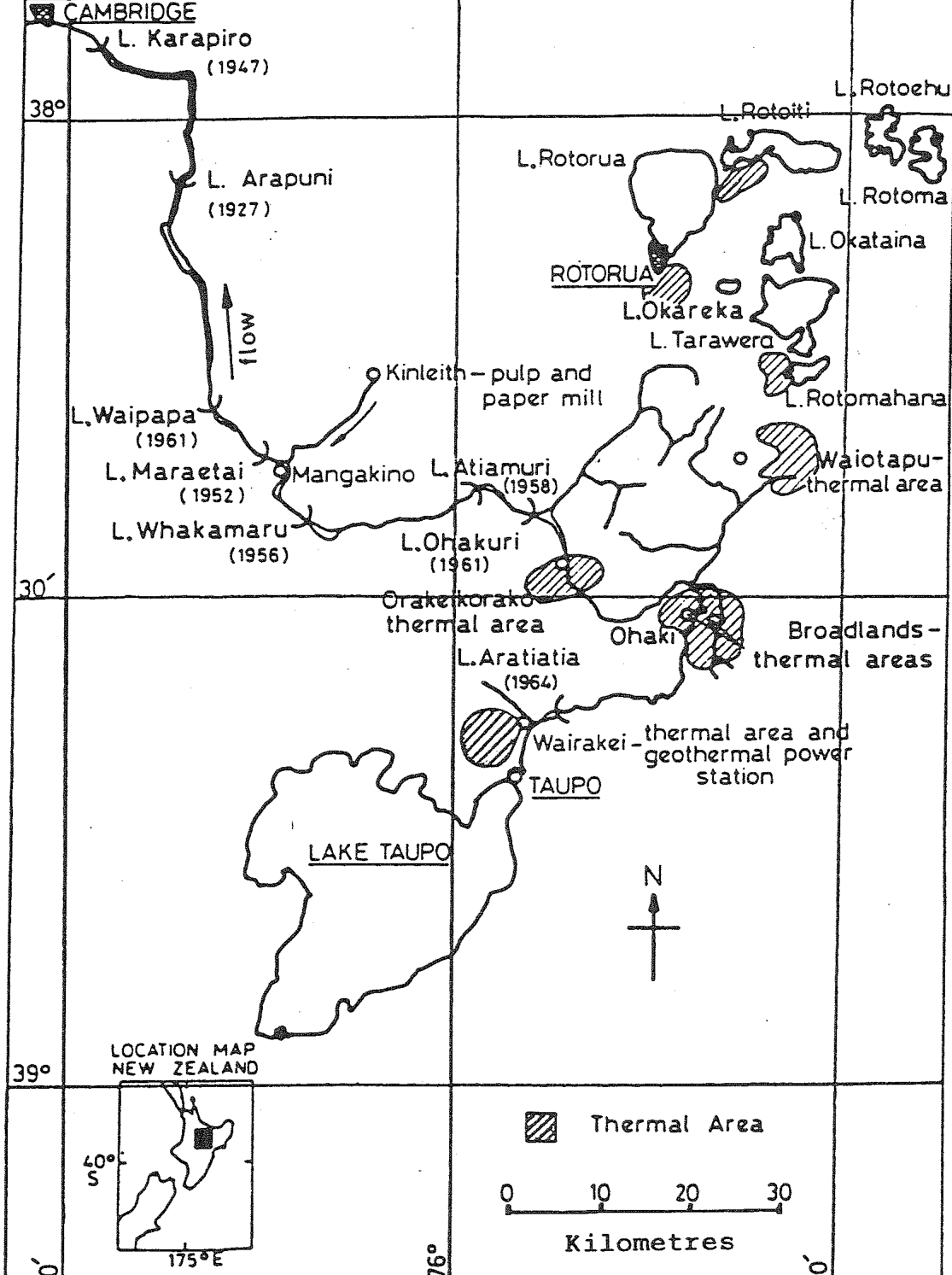
There are two geothermal power stations in the Taupo Volcanic Zone, Wairakei, commissioned in 1968 and Ohaaki, commissioned in 1989. Both of these stations release hydrothermal water and condensed steam of geothermal origin into the Waikato River at a faster rate than would occur naturally.
陶波火山带内有两座地热电站:1968年投产的Wairakei电站和1989年投产的Ohaaki电站。两座电站均以高于自然状态的速率向怀卡托河排放地热来源的热液水和冷凝蒸汽。
The Taupo Volcanic Zone contains at least 32 natural lakes as well as eight man-made ones along the length of the Waikato River.Many of the natural lakes are associated with geothermal activity (McColl, 1975), having geothermal waters either flowing into the lake, or upwelling in the lake itself. Some lakes have also had large amounts or sodium arsenate added in an attempt to control invasive aquatic macrophytes (Liddle, 1982; Rutherford, 1984; Tanner and Clayton, 1990). Tanner and Clayton (1990) showed there were still large amounts of arsenic in Lake Rotoroa near Hamilton 24 years after the application of a sodium arsenate herbicide. This lake has no geothermal inflows.
陶波火山带内至少有32个天然湖泊,另有8个人工湖分布于怀卡托河沿线。许多天然湖泊与地热活动相关(McColl, 1975),地热水或流入湖中,或在湖内涌出。部分湖泊还曾投加大量亚砷酸钠以控制入侵性水生大型植物(Liddle, 1982; Rutherford, 1984; Tanner and Clayton, 1990)。Tanner and Clayton(1990)研究表明,汉密尔顿附近的Rotoroa湖在施用亚砷酸钠除草剂24年后仍含有大量砷,而该湖并无地热水流入。
3MATERIALS AND METHODS材料与方法
Sampling
Rainbow trout (139 fish) were taken from Lakes Taupo, Rotorua, Rotokakahi, Okareka, Rotoiti, Kotoma, Tarawera, Okataina, Rotoehu, Rerewhakaaitu, Rotomahana, Rotokawa, and Blue Lake during a fishing competition in Rotorua in
1993年11月罗托鲁瓦举办钓鱼比赛期间,从陶波湖、Rotorua湖、Rotokakahi湖、Okareka湖、Rotoiti湖、Rotoma湖、Tarawera湖、Okataina湖、Rotoehu湖、Rerewhakaaitu湖、Rotomahana湖、Rotokawa湖和蓝湖采集虹鳟(139尾)
4RESULTS AND DISCUSSION结果与讨论
November 1993. The sex, weight, and origin of the trout were recorded. A piece of flesh from behind the head and a section of liver were taken from each specimen.
记录鳟鱼的性别、体重和来源,并从每尾样本头后部取一块肌肉并取一部分肝脏。
Mercury in rainbow trout from the Taupo Volcanic Zone and the Waikato River
陶波火山带和怀卡托河虹鳟中的汞
The samples were stored in polythene bags in a refrigerated container. They were subsequently frozen (-18°C) on the evening of the day they were collected
样品装入聚乙烯袋中,置于冷藏容器内保存,并于采集当日晚间冷冻(-18°C)
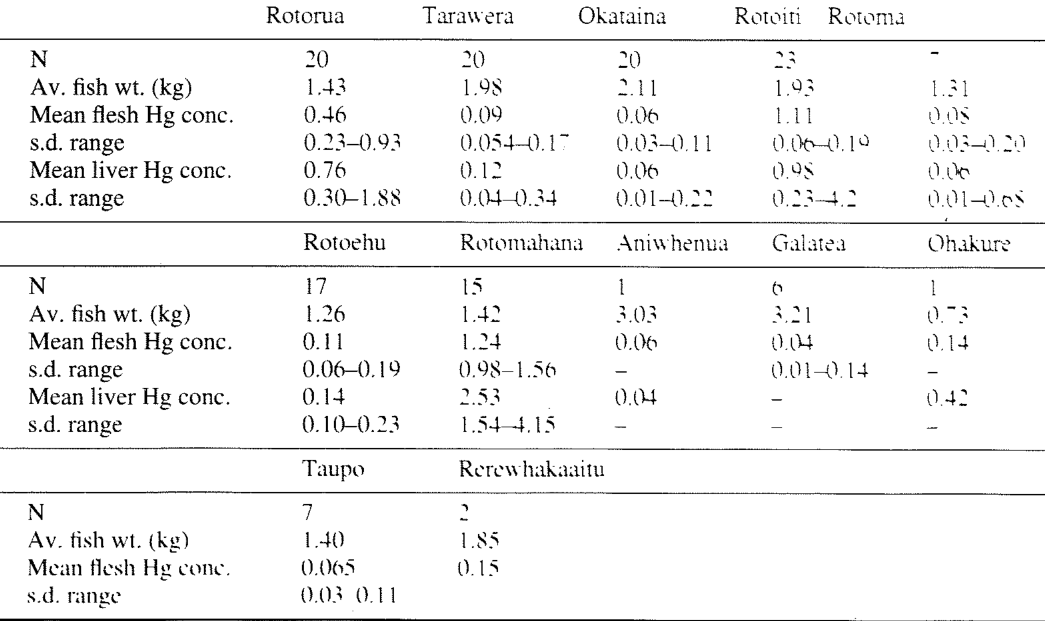
Mercury concentrations (ug g wet weight) in trout from the Taupo Volcanic Zone and the Waikato River are shown in Tables 2 and 3. Since the data were lognormally distributed, concentration data were logarithmically transtormed and therefore, average values are shown as geometric means and, standard deviations as a range.
陶波火山带和怀卡托河鳟鱼的汞浓度(μg g-1湿重)见表2和表3。由于数据呈对数正态分布,浓度数据经对数转换,因此平均值以几何均值表示,标准差以范围表示。
Rainbow trout (57) and brown trout (11) from the Waikato River were taken from Lakes Maraetai and Atiamuri and surrounding tributaries of the Waikato River in September 1994. The length and head widths of the fish were recorded, and a flesh sample of each was refrigerated at 4°C before
1994年9月,从怀卡托河的Maraetai湖和Atiamuri湖及周边支流采集虹鳟(57尾)和褐鳟(11尾)。记录鱼的体长和头宽,每尾鱼取一份肌肉样品于4°C冷藏,之后
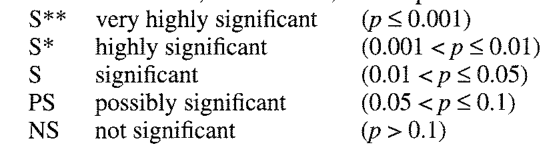
Most of the trout had flesh mercury concentrations below the WHO limit for mercury in foodstuffs (0.5 pg g-'). There were, however, four lakes (Rotoiti, Rotomahana, Rotorua and Rotoehu) where fish had mercury concentrations in excess of this limit. These were Lakes Rotoiti, Rotomahana, Rotorua and Rotoehu. In the first two lakes. the average mercury content of the fish exceeded (.5 pg g mercury: This was significantly greater than any of the other lakes as determined from t-tests (Table 4). In general. in lakes where the mean mercury content of trout flesh was below 0.5 ug go there was no significant difference in this value between the lakes.
大多数鳟鱼的肌肉汞浓度低于WHO食品汞限量(0.5 μg g-1)。然而,有4个湖泊(Rotoiti湖、Rotomahana湖、Rotorua湖和Rotoehu湖)的鱼汞浓度超过该限量。在前两个湖泊中,鱼的平均汞含量超过0.5 μg g-1,经t检验确定,显著高于其他任何湖泊(表4)。总体而言,在鳟鱼肌肉平均汞含量低于0.5 μg g-1的湖泊之间,该值无显著差异。
Sample preparation样品制备
Samples (0.5-2.5 g wet wt) of muscle or liver were weighed into a boiling tube. Five mL of 70% HNO, was added to each tube which was then heated to ca. 100°C in an electrically heated metal block until the sample had dissolved. Each solution was transferred to a measuring cylinder and made up to exactly 10 mL with distilled water. Samples were stored in 25 mL polythene containers. Two reagent blanks were prepared for every 40 samples.
称取肌肉或肝脏样品(0.5–2.5 g湿重)置于沸腾管中,每管加入5 mL 70% HNO3,然后在电加热金属块中加热至约100°C,直至样品溶解。将各溶液转移至量筒中,用蒸馏水定容至10 mL。样品保存于25 mL聚乙烯容器中。每40个样品制备2个试剂空白。
The livers of the trout had mercury concentrations in some cases up to three times higher than the flesh. The relative standard deviation of mercury in the livers was also higher. Lakes containing fish with an average flesh mercury concentration greater than O.12 ug go had fish with significant to highly significant correlations between liver and flesh mercury concentrations. In lakes containing fish with an average desh mercury concentration less than O.12 mg get there was no correlation between liver and flesh mercury concentrations
部分鳟鱼肝脏的汞浓度高达肌肉的3倍,且肝脏汞的相对标准偏差也较高。在鱼肌肉平均汞浓度大于0.12 μg g-1的湖泊中,鱼的肝脏与肌肉汞浓度之间存在显著至极显著相关;而在鱼肌肉平均汞浓度小于0.12 μg g-1的湖泊中,肝脏与肌肉汞浓度之间无相关性
Determination of mercury and arsenic using hydride generation atomic absorption spectrometry Mercury and arsenic were determined using a GBC 900 spectrophotometer combined with a purpose-built hydride generation apparatus. The conditions used for the analysis of each element are given in Table 1.
氢化物发生原子吸收光谱法测定汞和砷 采用GBC 900分光光度计结合专门搭建的氢化物发生装置测定汞和砷。各元素的分析条件见表1。
P There were highly significant positive correlations between the weight of fish and the mercury concentration in the desh for fish from Lakes Rotorua and Rotomahana Table Su
Rotorua湖和Rotomahana湖的鱼体重与肌肉汞浓度之间存在极显著正相关(表5)

There was a possibly significant negative correlation
可能存在显著负相关
N.B. Values of p < 0.01 are shown as 0.00. A = Rotorua, B = Tarawera, C = Okataina, D = Rotoiti, E = Rotoma, F = Rotoehu, G = Rotomahana, H = Galatea, I = Taupo.
注:p < 0.01的值以0.00表示。A = Rotorua,B = Tarawera,C = Okataina,D = Rotoiti,E = Rotoma,F = Rotoehu,G = Rotomahana,H = Galatea,I = Taupo。
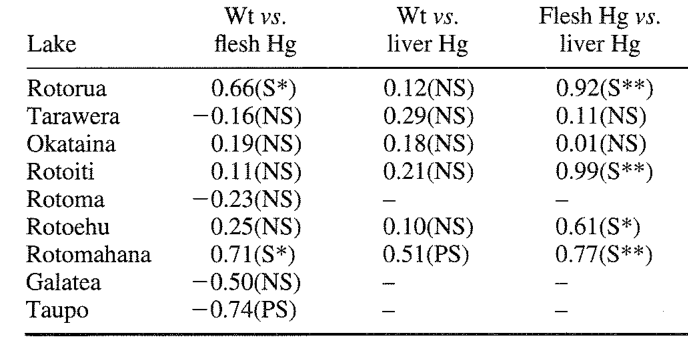

between the size of the fish and mercury concentration in the fiesh for trout from Lake Taupo (Table 5). There was no correlation between the mercury concentration in the liver and the weight of the fish in any of the lakes.
(见于陶波湖鳟鱼的鱼体大小与肌肉汞浓度之间,表5)。在所有湖泊中,肝脏汞浓度与鱼体重之间均无相关性。
The mercury levels found in the fish are somewhat lower than those reported by Brooks et al. (1976) and the average
本研究鱼体中的汞含量略低于Brooks et al.(1976)的报道,且平均
weight of the fish was heavier. The mercury concentrations in fish from lakes Rotorua, Tarawera, and Rotomahana are similar to methylmercury concentrations reported by Kim (1994) for the same lakes. As the concentration of mercury in the waters of these lakes was below detection limits (<0.005 ug mL-'), it would appear that there is a strong accumulation of mercury up the food chain. Strong correlations between the body weight (length) and mercury concentrations in the flesh of the trout suggest that mercury is not excreted in appreciable quantities and accumulates during the life of the fish. Bache et al. (1971) showed a strong correlation between the age of the trout (Salvelinus namaycush) and mercury content of the flesh. Livers of the trout generally contained more mercury than the flesh. This is probably because the liver intercepts the products of digestion before they are laid down in flesh tissue and thus bind some of the mercury from all food items ingested.
鱼体重更大。Rotorua湖、Tarawera湖和Rotomahana湖鱼体中的汞浓度与Kim(1994)报道的同一湖泊甲基汞浓度相近。由于这些湖泊水体中的汞浓度低于检出限(<0.005 μg mL-1),表明汞沿食物链存在强烈的富集。鳟鱼体重(体长)与肌肉汞浓度之间的强相关性表明,汞不会被大量排出,而是在鱼的一生中持续积累。Bache et al.(1971)发现鳟鱼(Salvelinus namaycush)年龄与肌肉汞含量之间存在强相关。鳟鱼肝脏的汞含量通常高于肌肉,这可能是因为肝脏在消化产物沉积到肌肉组织之前将其截留,从而结合了所摄入各类食物中的部分汞。
Following Brooks et al. (1976), the maximum recommended consumption of trout flesh from various lakes was calculated using the acceptable daily intake (ADI) of mercury set at 30 ug for an adult by Grimstone (1972). The calculations (Table 7) make the assumption that all the mercury in the trout is in the methyl form. Weissberg and Zobel (1973) and Kim (1994) showed that this was the case in virtually all the mercury in trout sampled by them.
参照Brooks et al.(1976)的方法,采用Grimstone(1972)规定的成人汞每日允许摄入量(ADI)30 μg,计算了各湖泊鳟鱼肌肉的最大推荐食用量。计算(表7)假定鳟鱼体内的汞全部为甲基汞形态。Weissberg and Zobel(1973)和Kim(1994)的研究表明,其所采集鳟鱼中的汞几乎全部为甲基汞。
For all but three of the lakes (Rotorua, Rotoiti and Rotomahana), it is extremely unlikely that many people would consume fish at a rate that would exceed the acceptable daily intake of mercury. The three lakes listed are unlikely to cause problems unless trout makes up a large proportion of an individual's diet. Kim (1994) showed that the flesh
除3个湖泊(Rotorua湖、Rotoiti湖和Rotomahana湖)外,其他湖泊中极少有人会以超过汞每日允许摄入量的速率食用鱼类。上述3个湖泊的鱼类除非在个人膳食中占很大比例,否则不太可能造成问题。Kim(1994)的研究表明,鱼的肌肉
methylmercury concentration of a fish decreases posteriorly by about 20%. As flesh samples in this study were taken from behind the head of the fish, the average mercury concentration for the whole fish may be slightly higher, and the consequent ADI value may be slightly lower. The ADI values in this study are higher than those calculated by Brooks et al. (1976), because the average mercury concentration in the flesh of the trout was approx·mately 30% less for many of the lakes. The differences may have been due to: (a) different analytical techniques; (b) a decrease of mercury concentration in some of the lakes; or (c) seasonal variation in the fish. A decrease in the mercury concentrations in the water of the lakes is likely to occur if there is a decrease in geothermal input into the lakes or if there has been a cessation of mercury pollution from a human source. Geothermal sources are known to change over time (Henley, 1985). Drilling of bores for steam/hot water may also change the rate of geothermal activity in the area. This occurred when the Wairakei power station opened in 1967, and several geysers at the 'craters of the moon' park disappeared (Henley, 1985). There may be seasonal variation in the mercury concentration in trout. A possible explanation for this may be that after a fish has gone through a stage of rapid growth, the newly grown flesh will not have accumulated much mercury and thus have a low concentration. Mercury will accumulate in the flesh of a fish that has a slow rate of
甲基汞浓度自头部向尾部降低约20%。由于本研究的肌肉样品取自鱼头后部,整条鱼的平均汞浓度可能略高,相应的ADI值可能略低。本研究的ADI值高于Brooks et al.(1976)的计算结果,原因是许多湖泊鳟鱼肌肉的平均汞浓度约低30%。这些差异可能源于:(a)分析技术不同;(b)部分湖泊汞浓度下降;或(c)鱼体的季节性变化。若湖泊地热输入减少或人为汞污染停止,湖水汞浓度很可能下降。已知地热源会随时间变化(Henley, 1985)。钻探蒸汽/热水井也可能改变区域地热活动速率。1967年Wairakei电站投运时即发生过此类情况,“月球火山口”公园的数个间歇泉消失(Henley, 1985)。鳟鱼汞浓度可能存在季节性变化,一种可能的解释是:鱼经历快速生长阶段后,新生长的肌肉尚未积累多少汞,因而浓度较低;而生长速率较慢的鱼,其肌肉中会积累汞
Mercury in brown trout from Puwheto, Waikato River Brown trout (11 - with an average length of 47.4 cm) taken from Puwheto had a geometric mean of 0.28 ug g- I mercury in their flesh (s.d. 0.11-0.70 ug g-'). As with rainbow trout, there was a highly significant (r= 0.77 S*) correlation between the length of the fish and the mercury concentration in the flesh. Although concentrations were significantly (p < 0.01) higher than the flesh mercury concentration of rainbow trout taken from the same area (Table 8), the average length of the fish was greater so there was insufficient information to conclude that brown trout have higher flesh mercury concentrations than rainbow trout.
怀卡托河Puwheto褐鳟中的汞 Puwheto采集的褐鳟(11尾,平均体长47.4 cm)肌肉汞几何均值为0.28 μg g-1(标准差范围0.11–0.70 μg g-1)。与虹鳟一样,鱼体长与肌肉汞浓度之间存在极显著相关(r = 0.77**)。尽管其浓度显著高于同一区域虹鳟的肌肉汞浓度(p < 0.01)(表8),但由于褐鳟平均体长更大,尚无足够信息得出褐鳟肌肉汞浓度高于虹鳟的结论。
A difference in flesh mercury concentration between brown trout and rainbow trout may be explained by one of the following: (1) differences in the fish's ability to excrete arsenic, or (2) differences in diet. The results indicate that brown trout from other areas in the Taupo Volcanic Zone are likely to have elevated flesh mercury concentrations. It is probable that many brown trout from Lakes Rotorua, Rotoiti and Rotomahana have flesh mercury concentrations above the
褐鳟与虹鳟肌肉汞浓度的差异可能由以下原因之一解释:(1)鱼类排泄砷的能力不同;或(2)食性不同。结果表明,陶波火山带其他区域的褐鳟肌肉汞浓度可能偏高。Rotorua湖、Rotoiti湖和Rotomahana湖的许多褐鳟肌肉汞浓度很可能超过
Arsenic in trout from the Taupo Volcanic Zone and the Waikato River陶波火山带和怀卡托河鳟鱼中的砷
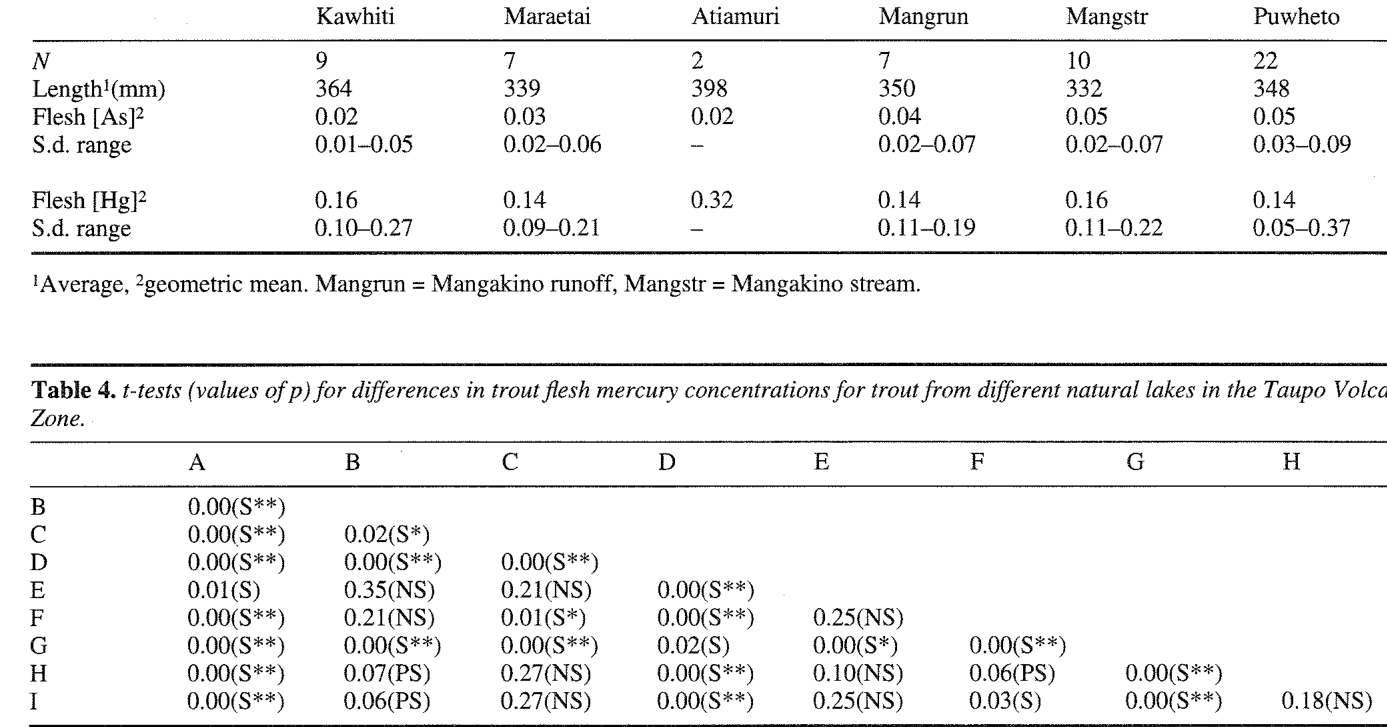
Some of the trout taken had measurable amounts of arsenic (Tables 3 and 9). Determinations made on trout from the Taupo Volcanic Zone revealed that the concentration of arsenic in the flesh for all trout tested was of the same order of magnitude as the water from which they were taken. The liver of the trout generally had a lower arsenic concentration, often below detection limits. Surprisingly, trout from lakes with the highest arsenic levels in the waters (Rotomahana and Rotoma), had flesh arsenic levels below the detection limits. Trout from lakes with relatively high water arsenic levels (Lakes Tarawera and Okataina, Table 9) had measurable amounts of arsenic in their flesh. All trout of both species taken from the Waikato River area had measurable amounts of arsenic in their flesh (T'able 3).
部分采集的鳟鱼检出砷(表3和表9)。对陶波火山带鳟鱼的测定表明,所有受测鳟鱼肌肉中的砷浓度与其所处水体处于同一数量级。鳟鱼肝脏砷浓度通常较低,常低于检出限。令人意外的是,水体砷含量最高的湖泊(Rotomahana湖和Rotoma湖)的鳟鱼肌肉砷含量低于检出限,而水体砷含量相对较高的湖泊(Tarawera湖和Okataina湖,表9)的鳟鱼肌肉中检出了砷。怀卡托河区域采集的两种鳟鱼肌肉中均检出砷(表3)。
None of the trout tested had arsenic concentrations above the WHO limit for arsenic in foodstuffs (2 ug g-). There were no significant correlations between the flesh arsenic concentration and fish weight, length, head width, or mercury concentration. These findings reinforce the conclusions of Aggett and Aspell (1980) that arsenic in trout from these areas poses no threat to human health. The low arsenic levels in trout is surprising since the arsenic concentration in the water of these lakes is more than an order of magnitude greater than the water mercury concentration. This may be explained if arsenic can be eliminated from biological tissue more readily than mercury and thus does not accumulate as strongly up the
所有受测鳟鱼的砷浓度均未超过WHO食品砷限量(2 μg g-1)。肌肉砷浓度与鱼体重、体长、头宽或汞浓度之间均无显著相关。这些结果进一步证实了Aggett and Aspell(1980)的结论,即这些区域鳟鱼中的砷不会对人体健康构成威胁。鳟鱼砷含量较低令人意外,因为这些湖泊水体中的砷浓度比汞浓度高出一个数量级以上。这可能是由于砷比汞更易从生物组织中排出,因而沿

Table 9. Concentrations of arsenic (ug 8-1 wet weight) in the flesh of trout from Lakes Tarawera and Okataina.表9. Tarawera湖和Okataina湖鳟鱼肌肉中的砷浓度(μg g-1湿重)。

N.B. values of p < 0.01 are shown as 0.00.
注:p < 0.01的值以0.00表示。
A = Kaiwhiti, B = Maraetai, C = Atiamuri, D = Mangakino runoff, E = Mangakino stream, F = Puwheto.
A = Kaiwhiti,B = Maraetai,C = Atiamuri,D = Mangakino径流,E = Mangakino溪,F = Puwheto。
CONCLOSIONS结论
All brown and rainbow trout from the Lakes of the Taupo Volcanic Zone and the Waikato River had measurable (> 0.005 ug g-') amounts of mercury in their flesh. Some rainbow trout from lakes Rotorua, Rotoiti, Rotomahana, and Rotoehu, and some brown trout from Puwheto stream, near the Waikato River, had flesh mercury concentrations above the WHO limit for mercury in foodstuffs (0.5 ug g-'). Trout from these lakes, should therefore, not constitute a large proportion of human diet.
陶波火山带湖泊和怀卡托河的所有褐鳟和虹鳟肌肉中均检出汞(> 0.005 μg g-1)。Rotorua湖、Rotoiti湖、Rotomahana湖和Rotoehu湖的部分虹鳟,以及怀卡托河附近Puwheto溪的部分褐鳟,其肌肉汞浓度超过WHO食品汞限量(0.5 μg g-1)。因此,这些湖泊的鳟鱼不应在人类膳食中占较大比例。
There were strong positive correlations between the mercury concentration in the flesh of the trout and the weight (length) of the fish, implying that mercury accumulates with time in the fish as it grows.
鳟鱼肌肉汞浓度与鱼体重(体长)之间存在强正相关,表明汞随鱼的生长在体内逐渐积累。
Brown trout from Puwheto stream, had on average, a higher flesh mercury concentration than rainbow trout from the same area. This may be explained however, by the fact that the average length of the fish was longer, suggesting that the fish
Puwheto溪褐鳟肌肉汞浓度平均高于同一区域的虹鳟。然而,这可能是由于褐鳟平均体长更长,表明这些鱼
The levels of arsenic in the flesh of the trout were of the same order of magnitude as the water from which they were taken. This indicates that arsenic does not accumulate as strongly up the food chain as does mercury. The levels of arsenic in the flesh of the trout pose no threat to human health.
鳟鱼肌肉中的砷含量与其所处水体处于同一数量级,表明砷沿食物链的富集程度不及汞。鳟鱼肌肉中的砷含量不会对人体健康构成威胁。
Further work can be done on the mercury levels in brown trout of other lakes, particularly those lakes where there are high mercury levels in rainbow trout.
今后可进一步研究其他湖泊褐鳟的汞含量,尤其是虹鳟汞含量较高的湖泊。
Periodic surveys need to be done on mercury levels in trout from all lakes which at present and in the past have contained mercury levels near or above the WHO limit for mercury (Lakes Rotorua, Rotoiti, Rotomahana, and Rotoehu). Any future industrial developments which have the potential to release mercury into the aforementioned lakes need to be carefully assessed
对于目前或过去汞含量接近或超过WHO汞限量的所有湖泊(Rotorua湖、Rotoiti湖、Rotomahana湖和Rotoehu湖),需定期调查鳟鱼的汞含量。今后任何可能向上述湖泊释放汞的工业开发项目都需审慎评估
5ACKNOWLEDGEMENTS致谢
We gratefully acknowledge the help of Mr D.J.Stack and staff of the New Zealand Eastern Region Fish and Game Council, Kotorua, tor assistance in obtaining fish samples. We would also like to thank the New Zealand Department of Health for a grant towards field expenses as well as the Massey University Research Fund that also made a financial contribution.
衷心感谢罗托鲁瓦新西兰东部地区渔猎委员会的D.J. Stack先生及工作人员在获取鱼类样品方面提供的帮助。同时感谢新西兰卫生部资助野外经费,以及梅西大学研究基金提供的资金支持。
6REFERENCES参考文献
Aggett, J. and Aspell, A.C. 1976. The determination of arsenic (I) and total arsenic by atomic-absorption spectroscopy. The Analyst, 101, 341-347.
Bache, C.A., Gutemann, W.H. and Lisk, D.J. 1971. Residues of total
mercury and methylmercuric salts in lake trout as a function of age. Science, 172, 951-952
Brooks, R.R., Lewis, J.R. and Reeves, R.D. 1976. Mercury and other heavy metals in trout of the central North Island, NewZealand. New Zealand Journal of Marine and Freshwater Research, 10,233-244.
Grimstone, G.,1972. Mercury in British fish. Chemistry in Britain, 8,
Henley, R.W. 1985. Applied chemistry in the exploration and development of New Zealand geothermal systems. New Zealand Journal of Technology 1, 207-221.
Kim, J. 1994. Methylmercury in rainbow trout (Oncorhyncus mykiss) from Lakes Okareka, Okaro, Rotomahana, Rotorua, Tarawera, North Island, New Zealand. Science of the Total Environment (in press).
Liddle, J.R. 1982. Arsenic and other elements of geothermal origin in the Taupo Volcanic Zone. PhD Thesis, Massey University, New Zealand.
McColl, R.H.S., 1975. Chemical and biological conditions in lakes of the Volcanic Plateau. In: Jolly, V.H. and Brown, J.M.A. (eds), New Zealand Lakes. Auckland University Press, Auckland
Modriniak, N. and Studt, F.E. 1959. Geological structure and
volcanism of the Taupo-Tarawera district. New Zealand Journal of Geology and Geophysics, 2, 654-684.
Ritchie, J.A. 1961. Arsenic and antimony in some New Zealand thermal waters. New Zealand Journal of Science, 4, 218-229
Rutherford, J.C. 1984. Trends in Lake Rotorua water quality New
Zealand Journal of Marine and Freshwater Research, 18, 355-365 Sarbutt, J.V. 1964. A chemical survey of the hot spring and drillhole waters of the Taupo borough. New Zealand Journal of Science, 7, 491-505.
Tanner, C.C. and Clayton, J.S. 1990. Persistence of arsenic 24 years after sodium arsenate herbicide application to Lake Rotoroa, Hamilton, New Zealand. New Zealand Journal of Marine and Freshwater Research, 24, 173-179.
Thornton, J.S. 1985. Field Guide to New Zealand Geology. Heinemann Reed, Auckland.
Weissberg, B.G. 1975. Mercury in some New Zealand waters. New Zealand Journal of Science, 18, 195-203.
Weissberg, B.G. and Zobel, M.G.R. 1973. Geothermal mercury pollution in New Zealand. Bulletin of Environmental Contamination and Toxicology, 9, 148-155.
Paper received: 10 December 1994.