Contents lists available at SciVerse ScienceDirect journal homepage: www.elsevier.com/locate/scitotenv
Rainer Rees a,⁎, Brett H. Robinson b,1, Christopher J. Rog c,2, Andreas Papritz a,3, Rainer Schulin a,4
a Institute of Terrestrial Ecosystems, ETH Zürich, Universitätsstrasse 16, 8092 Zürich, Switzerland b Soil and Physical Sciences, Burns 222, P. O. Box 84, Lincoln University, Lincoln 7647, Christchurch, New Zealand c Sand Creek Consultants, Inc., P.O. Box 1512, 16 Randall Ave., Rhinelander, WI 54501, USA
a Institute of Terrestrial Ecosystems, ETH Zürich, Universitätsstrasse 16, 8092 Zürich, Switzerland b Soil and Physical Sciences, Burns 222, P. O. Box 84, Lincoln University, Lincoln 7647, Christchurch, New Zealand c Sand Creek Consultants, Inc., P.O. Box 1512, 16 Randall Ave., Rhinelander, WI 54501, USA
a r t i c l e i n f o
a b s t r a c t
Article history: Received 1 February 2012 Received in revised form 21 May 2012 Accepted 28 May 2012 Available online 22 June 2012 Keywords: Hybrid poplars Boron Trace element contamination Nutrient imbalance Phytomanagement Root traits
Paper mill wastes are a mixture of by-products from pulp production and on-site energy production, consisting of paper mill sludge, ash and cinders. Landfilling of these highly boron (B) and heavy metal laden waste products carries environmental risks. Poplars have been successfully employed in the phytomanagement and hydraulic control of B contaminated sites. Here, we assess the performance of hybrid poplars on a paper-mill waste landfill, investigate the accumulation of B by the trees and explore the relationship between local-scale root growth and substrate properties. Leaf and root tissue samples were collected on three plots and analyzed for their chemical properties and root traits. Additionally, we sampled four soil cores in the vicinity of each of the trees and determined chemical and physical properties. Using a principal component analysis followed by a cluster analysis, we identified three substrate types. This method delineated the soil effects on tree survival and growth, although correlations with individual soil element concentrations were weak. Despite signs of B toxicity in some leaves, B was not the key limiting factor for poplar growth. Instead, Ca deficiency caused by a Mg:Ca imbalance was the primary reason for the poor performance of some trees. Root growth was not limited by toxicity effects of soil contaminants. Our results show that hybrid poplars perform well under the harsh growing conditions on a multi-contaminated, B-laden substrate in a hemiboreal climate. Exploiting the differences in the performance of the four clones in relation to the soil types, could increase the success of revegetation on this and other landfills. © 2012 Elsevier B.V. All rights reserved.
造纸厂废弃物是纸浆生产和厂内能源生产所产生副产物的混合物,由造纸污泥、灰分和炉渣组成。这些富含硼(B)和重金属的废弃物进行填埋处置存在环境风险。杨树已成功应用于B污染场地的植物管理和水力控制。本研究评估了杂交杨树在造纸厂废弃物填埋场上的生长表现,考察了树木对B的积累,并探讨了局部尺度根系生长与基质性质之间的关系。在三个样地采集叶片和根系组织样品,分析其化学性质和根系性状。此外,在每株树附近采集4个土芯,测定其化学和物理性质。通过主成分分析结合聚类分析,识别出三种基质类型。该方法揭示了土壤对树木存活和生长的影响,但与单一土壤元素浓度的相关性较弱。尽管部分叶片出现B毒害症状,但B并非限制杨树生长的关键因子;Mg:Ca失衡导致的Ca缺乏才是部分树木生长不良的主要原因。根系生长未受到土壤污染物毒性效应的限制。结果表明,在半北方带气候条件下,杂交杨树在多重污染、富B基质的恶劣生长条件下表现良好。利用4个无性系在不同土壤类型上的生长表现差异,可提高该填埋场及其他填埋场植被重建的成功率。© 2012 Elsevier B.V. 版权所有。
1Introduction引言
Paper mill sludge is, by volume, the most important by-product of paper production. It is used as raw material in other industries, spread on agricultural land as fertilizer, incinerated for energy production in paper mills or otherwise landfilled (Lteif et al., 2007; Monte et al., 2009). Sludge production was found to vary widely among 104 mills (U.S.EPA, 1988); ranging from 14 to 140 kg per 103 kg of pulp with a total generation of 2.5×10⁹ kg a−1. Other solid wastes from paper mills include various kinds of ash and cinders, originating from on-site energy production by incineration of wood wastes and paper mill sludge. Fly and other ashes contain high concentrations of boron (B), besides other potentially toxic elements such as Cu and Ni (Dellantonio et al., 2008). Landfilling and agricultural application of paper mill wastes, including ash, are the major source of B in the environment (Nable et al., 1997; Pavlović et al., 2004). Boron is an essential micronutrient for plants and animals at low concentrations (Mastromatteo and Sullivan, 1994; Salisbury and Ross, 1992), but like other trace elements it becomes toxic at higher concentrations. Boron is mobile in the environment and significant quantities can leach from landfills into ground or surface waters if not contained properly. In contrast to many other trace elements, B transport in the soil solution and plant uptake occurs as neutral H3BO3 over a wide pH range (pKa: 9.24) (Goldberg, 1997). Thus, landfilling paper mill sludge or their incineration products require particular attention.
按体积计,造纸污泥是造纸生产中最主要的副产物。它可作为其他行业的原料,作为肥料施用于农田,在造纸厂内焚烧用于能源生产,或进行填埋处置(Lteif et al., 2007; Monte et al., 2009)。104家造纸厂的污泥产量差异很大(U.S.EPA, 1988),每103 kg纸浆产生14~140 kg污泥,总产生量为2.5×10⁹ kg a−1。造纸厂的其他固体废弃物包括各类灰分和炉渣,来源于厂内焚烧木材废料和造纸污泥进行的能源生产。飞灰及其他灰分中除含有Cu、Ni等其他潜在有毒元素外,还含有高浓度的硼(B)(Dellantonio et al., 2008)。造纸厂废弃物(包括灰分)的填埋和农田施用是环境中B的主要来源(Nable et al., 1997; Pavlović et al., 2004)。低浓度的硼是植物和动物必需的微量营养元素(Mastromatteo and Sullivan, 1994; Salisbury and Ross, 1992),但与其他微量元素一样,高浓度时会产生毒性。硼在环境中具有较强的迁移性,若未妥善封存,大量B可从填埋场淋溶进入地下水或地表水。与许多其他微量元素不同,在较宽的pH范围内(pKa: 9.24),B在土壤溶液中的迁移和植物吸收均以中性H3BO3形式进行(Goldberg, 1997)。因此,造纸污泥或其焚烧产物的填埋处置需要特别关注。
⁎ Corresponding author. Tel.: +41 44 633 60 78; fax: +41 44 632 11 08.
⁎ 通讯作者。电话:+41 44 633 60 78;传真:+41 44 632 11 08。
E-mail addresses: rainer.rees@env.ethz.ch (R. Rees), Brett.Robinson@lincoln.ac.nz
(B.H. Robinson), cjrog@sand-creek.com (C.J. Rog), andreas.papritz@env.ethz.ch
(A. Papritz), rainer.schulin@env.ethz.ch (R. Schulin).
1 Tel.: +64 3 325 3838 8471.
2 Tel.: +1 715 365 1828.
3 Tel.: +41 44 633 60 72.
4 Tel.: +41 44 633 60 71.
Poplars are used extensively for soil stabilization and erosion control (McIvor et al., 2009; Wilkinson, 1999), for phytomanagement and hydraulic control of contaminated sites (Robinson et al., 2007; Zalesny et al., 2009). Being passive B hyperaccumulators, they are of particular interest for the treatment of B contaminated soils. No growth reduction was found in a Populus x canadensis Moench clone at average leaf B concentrations of 800 mg kg−1 (Rees et al., 2011). By extracting large amounts of water for transpiration and simultaneously taking up B from the soil into their aerial parts, poplars can reduce B leaching from contaminated soils into receiving waters (Robinson et al., 2003). The accumulated B then can be removed from the site by harvesting the aboveground biomass. Complete clean-up of a B-contaminated site is limited in theory only by the depth to which the contamination is accessible by root water uptake and by the tolerance of the tissues to the accumulated contaminant. Our previous pot experiments have shown that poplars are promising as phytoremediation plants on B-rich soils.
杨树被广泛用于土壤固持和侵蚀控制(McIvor et al., 2009; Wilkinson, 1999),以及污染场地的植物管理和水力控制(Robinson et al., 2007; Zalesny et al., 2009)。杨树作为B的被动超富集植物,在B污染土壤的治理中尤其受到关注。在叶片B平均浓度为800 mg kg−1时,Populus x canadensis Moench的一个无性系未出现生长下降(Rees et al., 2011)。杨树通过蒸腾作用吸取大量水分,同时将土壤中的B吸收并转运至地上部,从而可减少污染土壤中B向受纳水体的淋溶(Robinson et al., 2003)。积累的B随后可通过收获地上生物量从场地中移除。理论上,B污染场地的彻底修复仅受限于根系吸水所能到达的污染深度以及组织对所积累污染物的耐受能力。我们先前的盆栽试验表明,杨树有望成为富B土壤上的植物修复植物。
0048-9697/$ – see front matter © 2012 Elsevier B.V. All rights reserved. doi:10.1016/j.scitotenv.2012.05.089
0048-9697/$ – see front matter © 2012 Elsevier B.V. 版权所有。doi:10.1016/j.scitotenv.2012.05.089
However, in phytoremediation and phytomanagement research there is often a discrepancy between results obtained under wellcontrolled experimental conditions and in real‐world field situations. A major problem in the design of phytomanagement systems, under field situations, is the large spatial variability in soil properties and contaminant distribution (Dickinson et al., 2009), which can strongly affect the development and activity of the root system and thus the success and efficiency of the operation (Keller et al., 2003; Wenzel, 2009). Reports on root reactions to trace element hot spots provide contrasting information and root responses can therefore not be predicted (Breckle and Kahle, 1992; Whiting et al., 2000). Soil is a heterogeneous medium in general. Not only trace elements but also other soil factors influencing root traits and morphology, such as water, air or macronutrients, often show quite heterogeneous distribution patterns (Hodge, 2010). Under well-defined conditions, poplar root growth was shown to be inhibited in soil patches with B concentrations>20 mg kg−1 (Rees et al., 2012), but there are no studies on the response of poplar roots to a spatially heterogeneous distribution of soil B under field conditions.
然而,在植物修复和植物管理研究中,严格控制的试验条件下获得的结果与实际田间情况之间常存在差异。田间条件下植物管理系统设计面临的一个主要问题是土壤性质和污染物分布的空间变异性大(Dickinson et al., 2009),这会强烈影响根系的发育和活性,进而影响修复工程的成败与效率(Keller et al., 2003; Wenzel, 2009)。关于根系对微量元素热点响应的报道结论不一,因此根系响应难以预测(Breckle and Kahle, 1992; Whiting et al., 2000)。土壤总体上是一种非均质介质。不仅微量元素,影响根系性状和形态的其他土壤因子(如水分、空气或大量营养元素)也常呈现相当不均匀的分布格局(Hodge, 2010)。在明确界定的条件下,已证实杨树根系在B浓度>20 mg kg−1的土壤斑块中生长受到抑制(Rees et al., 2012),但尚无关于田间条件下杨树根系对土壤B空间异质分布响应的研究。
Here, we report the results of a study on the relationship between root development, tree growth and the concentrations of soil B and other contaminants in landfilled paper mill wastes that had been revegetated with various P. x canadensis Moench clones. The aims of this study were: (1) to assess the growth and survival of the different poplar clones (a) in response to soil conditions and (b) in relation to the concentrations of B and other potentially toxic or deficient elements in the tissues of the trees; (2) to investigate the accumulation of B by the trees in relation to the extent of soil contamination and (3) to determine the relationship between local-scale root growth, B contamination and other soil factors.
本文报道了一项关于根系发育、树木生长与土壤B及其他污染物浓度之间关系的研究,研究对象为以多个P. x canadensis Moench无性系进行植被重建的填埋造纸厂废弃物。研究目的为:(1)评估不同杨树无性系的生长和存活情况,(a)其对土壤条件的响应,以及(b)其与树木组织中B及其他潜在有毒或缺乏元素浓度的关系;(2)考察树木对B的积累与土壤污染程度的关系;(3)确定局部尺度根系生长与B污染及其他土壤因子之间的关系。
2Material and methods材料与方法
2.1. Site description2.1. 场地概况
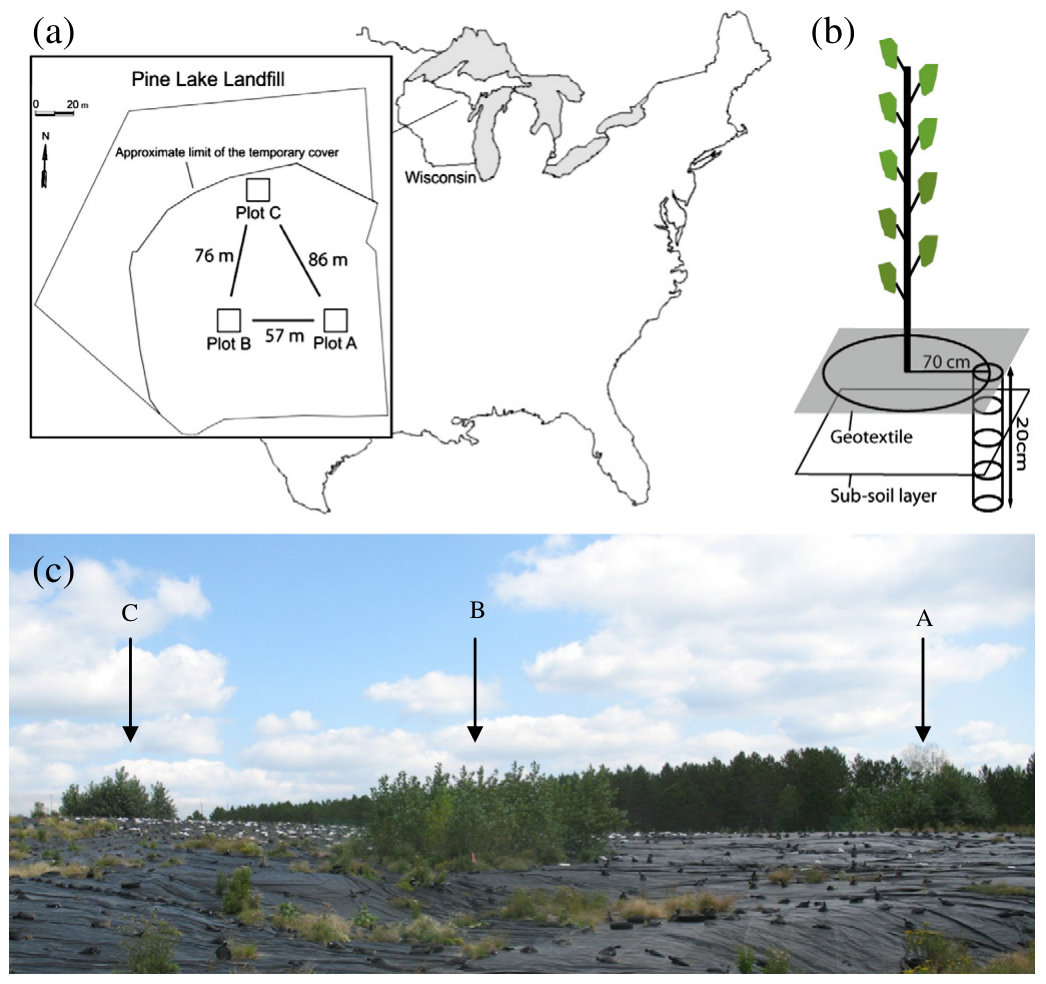
The study was carried out at “Pine Lake Landfill”, Rhinelander, WI, U.S. (Fig. 1(a)). The average annual mean temperature at Rhinelander is 4.9 °C, with a maximum of 19.6 °C in July and a minimum of −11.9 °C in January (NCDC normal 1971–2000). The annual precipitation averages 810 mm. The landfill has an area of about 4 ha. Paper mill sludge, fly ash and cinders had been deposited on the site until 1995. The dumped truck loads created a pattern of patches with an average patch size of approximately 40 m2. A bottom liner and a leachate collection system were installed. The leachates are collected in tanks, from where they are brought to a wastewater treatment facility. A 2- ha area of the landfill had been covered only provisionally with an approximately 10 cm thick layer of subsoil (Podzol, loamy sand,) and a geotextile (Fig. 1(a)). This part of the landfill had a slight slope facing southwards. The sub-soil layer was partially eroded due to runoff below the geotextile.
研究在美国威斯康星州Rhinelander的“Pine Lake Landfill”进行(图1(a))。Rhinelander年均气温为4.9 °C,7月最高为19.6 °C,1月最低为−11.9 °C(NCDC 1971–2000年气候平均值)。年均降水量为810 mm。该填埋场面积约4 ha,1995年以前一直堆放造纸污泥、飞灰和炉渣。卡车倾倒形成了斑块格局,斑块平均面积约40 m2。填埋场设有底部衬层和渗滤液收集系统,渗滤液收集于储罐中,再运至污水处理设施。填埋场中2 ha的区域仅临时覆盖了一层约10 cm厚的底土(灰化土,壤质砂土)和一层土工布(图1(a))。该区域略向南倾斜。由于土工布下方的径流冲刷,底土层已部分侵蚀。
In July 2006, a pilot project was started to investigate whether a poplar stand could be established and provide an alternative cover to the weakened geotextile for erosion and leachate control. Three 10×10 m test plots (A, B and C, Fig. 1(a), (b)) were established with 4 commercially available, non-transgenic poplar clones of P. x canadensis (DN-2, DN-34, DN-182, OP-367). On each plot 36 poplar cuttings were planted in a 6×6 grid with a spacing of 1.7 m (9 cuttings of each clone). While DN-2 was planted as rooted stock, DN- 34, DN-182 and OP-367 were planted as 25 cm cuttings. Holes were made into the geotextile, allowing the planting of the cuttings into the substrate. The trees were neither irrigated nor fertilized; weeds were pulled once in summer '07.
2006年7月启动了一项试点项目,以研究能否建立杨树林分,替代已老化的土工布作为控制侵蚀和渗滤液的覆盖层。共建立3个10×10 m试验样地(A、B和C,图1(a)、(b)),种植4个市售非转基因P. x canadensis杨树无性系(DN-2、DN-34、DN-182、OP-367)。每个样地按6×6网格、1.7 m间距种植36株杨树插条(每个无性系9株)。DN-2以带根苗木种植,DN-34、DN-182和OP-367则以25 cm插条种植。在土工布上开孔,使插条能够插入基质。树木既未灌溉也未施肥;2007年夏季人工除草一次。
2.2. Sampling and sample analyses2.2. 采样与样品分析
The survival and height of the trees were recorded for up to 39 months in July '07, July '08, October '08 and September '09. In September '09 also the diameter at breast height (DBH) was determined. Woody biomass (stem+branches) of the trees was estimated using the equation of Riemenschneider et al. (2001):
分别于2007年7月、2008年7月、2008年10月和2009年9月记录树木存活情况和树高,持续时间最长达39个月。2009年9月还测定了胸径(DBH)。木质生物量(树干+枝条)采用Riemenschneider et al. (2001)的方程估算:

In September 2009, soil and leaf samples were taken over a 10 day period. Ten leaves each were taken from each of the lower and the upper half of the trees. The leaf samples were dried at 60 °C until constant weight and then ground, digested in a heating block (130 °C, 65% HNO3) and analyzed by means of ICP-OES (Vista MPX, Varian, Australia). Carbon and N were determined by elemental analyzer (CNS-2000, Leco Corp., Saint Joseph, Michigan USA). Soils including roots were sampled by taking 4 cores (5 cm length, 5 cm diameter), one by one to a total depth of 20 cm. Four samples from 15 to 20 cm depth could not be taken for mechanical reasons. The direction of the sampling point for each tree was randomly selected at a distance of 70 cm (Fig. 1(c)). For the geostatistical analysis the coordinates of the sampling locations were calculated in relation to the coordinate system origin, which was defined as the south-west corner of plot B. The samples were stored in a cool box until they were further processed in the lab. Substrate subsamples, from each collected sample, were taken for chemical and physical analyses. Roots were separated from the substrate by washing in tab water using a 1 mm sieve and then were scanned in a water bath at 400 dpi with a backlighting scanner. The morphology of the roots was analyzed by image analysis software (Regent Instruments. Inc., WinRhizo 2009c). Specific root length (SRL, cm fine root (FR) length g−1 FR dry weight) and root length density (RLD, cm FR length cm−3 soil) were calculated. After scanning, FRs was dried, biomasses were recorded and then digested in the same way as the leaf samples. Only FR samples >50 mg were analyzed chemically. This criterion was met by about half of the samples.
2009年9月,在10天内采集土壤和叶片样品。分别从每株树的下半部和上半部各采集10片叶片。叶片样品于60 °C烘干至恒重后粉碎,在加热消解仪中消解(130 °C,65% HNO3),并采用ICP-OES(Vista MPX, Varian, Australia)分析。碳和N采用元素分析仪(CNS-2000, Leco Corp., Saint Joseph, Michigan USA)测定。含根系的土壤通过逐段采集4个土芯(长5 cm,直径5 cm)取样,总深度为20 cm。由于机械原因,有4个15~20 cm深度的样品未能采集。每株树的采样点方向随机选定,距树干70 cm(图1(c))。为进行地统计分析,以B样地西南角为坐标系原点计算各采样点坐标。样品在冷藏箱中保存,直至在实验室进一步处理。从每个采集样品中取基质子样品进行化学和物理分析。根系在自来水中用1 mm筛冲洗与基质分离,然后置于水槽中用背光扫描仪以400 dpi扫描。采用图像分析软件(Regent Instruments. Inc., WinRhizo 2009c)分析根系形态。计算比根长(SRL,cm细根(FR)长度 g−1 FR干重)和根长密度(RLD,cm FR长度 cm−3土壤)。扫描后将FR烘干,记录生物量,并按与叶片样品相同的方法消解。仅对>50 mg的FR样品进行化学分析,约一半样品满足该条件。
Soil B and other element concentrations were analyzed in a HNO3/ H2O2 solution (microwave digestion, 0.1 g sample, 180 °C, 1 h, 5 ml 69% HNO3:2 ml 30% H2O2) to obtain quasi-total concentrations (denoted “tot”). Extraction with a CaCl2− solution was used to characterize the availability of soil B and other elements (denoted: “CaCl2”) (1 g sample, 10 ml 0.01 mol CaCl2, 16 h shaken, centrifuged at 2500 rpm, 0.25 μm filter). Soil bulk density (ρ [g cm−3]) was calculated, gravimetric water content (H2Ograv) and pH (soil:H2O ratio: 1:2.5) were also determined. Carbon and N concentrations of soil samples were determined. Digested FRs and digests and extracts of soil samples were analyzed by ICP-OES as described above. Certified reference material used for quality control for plant samples was: NCS DC-73350 (China National Analysis Centre for Iron and Steel, Beijing, China) and for soil samples we used samples from WEPAL (Wageningen, Netherlands).
土壤B及其他元素浓度采用HNO3/ H2O2溶液(微波消解,样品0.1 g,180 °C,1 h,5 ml 69% HNO3:2 ml 30% H2O2)测定,以获得准全量浓度(记为“tot”)。采用CaCl2−溶液提取表征土壤B及其他元素的有效性(记为“CaCl2”)(样品1 g,10 ml 0.01 mol CaCl2,振荡16 h,2500 rpm离心,0.25 μm滤膜过滤)。计算土壤容重(ρ [g cm−3]),并测定重量含水量(H2Ograv)和pH(土水比1:2.5)。同时测定土壤样品的碳和N浓度。消解后的FR以及土壤样品的消解液和提取液均按上述方法采用ICP-OES分析。植物样品质量控制所用的有证标准物质为NCS DC-73350(中国钢铁研究总院国家钢铁材料测试中心,北京,中国),土壤样品则采用WEPAL(Wageningen, Netherlands)的样品。
2.3. Statistics2.3. 统计分析
Based on varimax-rotated principal component analysis (PCA) of the standardized and normalized physical and chemical soil parameters (Reimann et al., 2008), the soil samples were classified into 3 substrate types (ST) using hierarchical clustering (Ward, 1963). To find the best cluster model for our data, an algorithm was applied to determine the best model according to the average silhouette width (3 clusters, average silhouette width: 0.7). Non-detects were treated according to the method proposed by Farnham et al. (2002).
基于标准化和归一化后的土壤物理化学参数的方差最大化旋转主成分分析(PCA)(Reimann et al., 2008),采用层次聚类法(Ward, 1963)将土壤样品划分为3种基质类型(ST)。为确定最适合本数据的聚类模型,采用一种算法依据平均轮廓宽度确定最优模型(3个聚类,平均轮廓宽度:0.7)。低于检出限的数据按Farnham et al. (2002)提出的方法处理。
To describe the spatial auto-correlation structure of the substrate, semi-variograms were computed for the PC scores of the samples and FR length, using the “modulus” estimator proposed by Cressie and Hawkins (1980). The dependence of tree growth, element uptake, and root morphology on soil properties was analyzed by means of multiple analysis of variance and regression analysis. Each tree was assigned to the ST of the soil core taken next to it. For the regression analysis of tree growth and element accumulation, average values of the core segments were used. For the leaf samples, a 2-way factorial ANOVA was conducted using substrate and clone as independent factors. For the root samples, a 2-way factorial ANOVA was conducted for each clone×depth and depth×substrate combination. Significant differences between groups were post-hoc tested using the Holm–
为描述基质的空间自相关结构,采用Cressie and Hawkins (1980)提出的“modulus”估计量,计算样品PC得分和FR长度的半变异函数。采用多元方差分析和回归分析考察树木生长、元素吸收和根系形态对土壤性质的依赖关系。每株树被归入其旁侧所采土芯的ST。在树木生长和元素积累的回归分析中,采用各土芯分段的平均值。对叶片样品,以基质和无性系为自变量进行双因素ANOVA。对根系样品,分别针对无性系×深度和深度×基质组合进行双因素ANOVA。组间显著性差异采用Holm–
Factor loadings of the analyzed soil parameters on the first three principal components of the varimax-rotated PCA. Values between −0.1 and 0.1 are not shown. The highest (lowest) loadings on each component are highlighted.
方差最大化旋转PCA中所分析土壤参数在前三个主成分上的因子载荷。介于−0.1和0.1之间的值未列出。各主成分上的最高(最低)载荷以突出显示。
| Parameter参数 | Principal com PC 1主成分 PC 1 | ponent PC 2主成分 PC 2 | PC 3 | and ro multipland ro multipl | ot morph e analysis ot morph e analysis | ology on of varia ology on of varia | soil properties w nce and regressio soil properties w nce and regressio | , as analyz n analysis, as analyz n analysis | ed by means . Each tree w ed by means . Each tree w |
|---|---|---|---|---|---|---|---|---|---|
| Factor loadin | gs [−] | assigne | d to the S | T of the | soil core taken ne | xt to it. Fo | r the regressio | ||
| BCaCl2 | 0.78 | 0.47 | 0.22 | analysi | s of tree g | rowth a | nd element accum | ulation, a | verage values |
| Btot | 0.92 | 0.29 | – | the cor | e segmen | ts were | used. For the leaf s | amples, a | 2-way factori |
| Ctot | 0.77 | 0.56 | −0.10 | ANOVA | was cond | ucted us | ing substrate and | clone as in | dependent fa |
| Cutot | 0.86 | 0.22 | −0.20 | tors. Fo | r the roo | t sample | s, a 2-way factori | al ANOVA | was conducte |
| Fetot H2O | 0.85 0.84 | 0.41 0.43 | – – | for eac | h clone×d | epth an | d depth×substrat | e combina | tion. Significa |
| KCaCl2 | 0.71 | 0.29 | 0.22 | differe | nces betw | een grou | ps were post-hoc | tested u | sing the Holm |
| Ktot | 0.81 | −0.45 | – | ||||||
| MgCaCl2 | 0.80 | 0.32 | 0.30 | ||||||
| Mgtot | 0.79 | 0.13 | 0.39 | Table 2 | |||||
| MnCaCl2 | – | – | −0.79 | Associati | on of surviv | ing trees w | ith the 3 substrate ty | pes (ST) for | each plot (numb |
| Mntot | – | −0.81 | – | and perc | entage per p | lot). | |||
| Ntot | 0.63 | 0.56 | −0.24 | Plot | |||||
| NaCaCl2 | 0.74 | 0.36 | 0.33 | ||||||
| Natot | 0.86 | 0.23 | 0.13 | A | B | C | |||
| Nitot Pbtot | 0.46 0.49 | 0.82 0.82 | – – | Number | % | Number % | Number | % Sum | |
| PCaCl2 | 0.42 | 0.40 | −0.43 | ST1 | 24 | 80.0 | 2 7.1 | 0 | 0.0 26 |
| Ptot | 0.92 | – | −0.11 | ST2 | 6 | 20.0 | 20 71.4 | 7 | 41.2 33 |
| pH | 0.14 | – | 0.78 | ST3 | 0 | 0.0 | 6 21.4 | 10 | 58.8 16 |
| Zntot | 0.89 | 0.35 | – | Sum | 30 | 28 | 17 | 75 |
Association of surviving trees with the 3 substrate types (ST) for each plot (number and percentage per plot).
各样地存活树木与3种基质类型(ST)的对应关系(每个样地的数量及百分比)。
Physical and chemical characteristics of the 3 substrate types.
3种基质类型的物理和化学特征。
| Parameter参数 | Substrate t基质类型 | ype | ||||||||
|---|---|---|---|---|---|---|---|---|---|---|
| 1 | 2 | 3 | ||||||||
| Mean | ± | S.D. | Mean | ± | S.D. | Mean | ± | S.D. | ||
| pHH2O | [−] | 7.66 | ± | 0.43 | 7.73 | ± | 0.42 | 7.54 | ± | 0.50 |
| H2O | [g kg−1] | 11.06 | ± | 10.03 | 37.52 | ± | 10.82 | 31.14 | ± | 11.18 |
| Bulk density [ρ] | [g cm−3] | 1.13 | ± | 0.27 | 0.58 | ± | 0.13 | 0.53 | ± | 0.11 |
| C | [g kg−1] | 45.93 | ± | 82.77 | 283.84 | ± | 78.13 | 293.16 | ± | 69.77 |
| N | [g kg−1] | 1.44 | ± | 2.52 | 7.56 | ± | 2.31 | 8.59 | ± | 3.01 |
| Btot | [mg kg−1] | 61.14 | ± | 79.57 | 304.9 | ± | 101.9 | 173.0 | ± | 79.95 |
| BCaCl | [mg kg−1] | 6.09 | ± | 6.69 | 23.16 | ± | 10.26 | 20.49 | ± | 9.89 |
| Catot | [g kg−1] | 4.69 | ± | 6.06 | 16.50 | ± | 7.58 | 11.23 | ± | 4.01 |
| CaCaCl | [g kg−1] | N/A | N/A | N/A | ||||||
| Cutot | [mg kg−1] | 129.9 | ± | 288.7 | 496.7 | ± | 212.1 | 316.1 | ± | 271.4 |
| CuCaCl | [mg kg−1] | 0.09 | ± | 0.05 | 0.13 | ± | 0.11 | 0.22 | ± | 0.10 |
| Fetot | [g kg−1] | 12.80 | ± | 8.16 | 35.56 | ± | 8.12 | 30.54 | ± | 7.50 |
| FeCaCl | [mg kg−1] | 1.32 | ± | 2.71 | 7.43 | ± | 16.43 | 5.56 | ± | 14.35 |
| Ktot | [g kg−1] | 2.67 | ± | 1.14 | 4.96 | ± | 1.26 | 1.29 | ± | 1.16 |
| KCaCl | [mg kg−1] | 72.96 | ± | 64.71 | 196.6 | ± | 110.6 | 160.0 | ± | 119.3 |
| Mgtot | [g kg−1] | 1.94 | ± | 0.84 | 3.79 | ± | 1.35 | 2.62 | ± | 1.21 |
| MgCaCl | [mg kg−1] | 161.6 | ± | 137.9 | 603.2 | ± | 308.7 | 470.9 | ± | 303.7 |
| Mntot | [mg kg−1] | 126.9 | ± | 72.16 | 151.8 | ± | 66.11 | 535.2 | ± | 419.1 |
| MnCaCl | [mg kg−1] | 1.46 | ± | 1.86 | 2.71 | ± | 3.83 | 4.20 | ± | 6.01 |
| Natot | [g kg−1] | 0.83 | ± | 0.47 | 1.88 | ± | 0.46 | 1.43 | ± | 0.55 |
| NaCaCl | [mg kg−1] | 50.64 | ± | 51.99 | 187.4 | ± | 93.34 | 154.1 | ± | 105.1 |
| Nitot | [mg kg−1] | 35.39 | ± | 37.10 | 102.6 | ± | 42.50 | 204.9 | ± | 79.87 |
| NiCaCl | [mg kg−1] | 0.51 | ± | 0.64 | 0.38 | ± | 0.64 | 0.84 | ± | 1.63 |
| Ptot | [g kg−1] | 0.60 | ± | 0.82 | 2.63 | ± | 0.85 | 1.23 | ± | 0.80 |
| PCaCl | [mg kg−1] | 0.46 | ± | 0.46 | 0.81 | ± | 0.47 | 0.95 | ± | 0.87 |
| Pbtot | [mg kg−1] | 138.0 | ± | 119.5 | 307.9 | ± | 89.31 | 606.1 | ± | 252.5 |
| PbCaCl | [mg kg−1] | N/A | N/A | N/A | ||||||
| Zntot | [mg kg−1] | 60.30 | ± | 79.20 | 294.0 | ± | 92.41 | 227.1 | ± | 77.35 |
| ZnCaCl | [mg kg−1] | N/A | N/A | N/A |
S.D. = standard deviation; N/A = not applicable.
S.D. = 标准差;N/A = 不适用。
Sidak test (Holm, 1979). All data were tested for normality prior to statistical analysis and transformed if necessary.
Sidak检验(Holm, 1979)进行事后检验。所有数据在统计分析前均进行正态性检验,必要时进行数据转换。
To analyze root diameter distributions, a log-normal distribution was fitted to the cumulative frequency distribution of the measured root radii of each sample. From μln and σln parameter values of the best-fit distribution, the back-transformed distribution mean and variance were calculated for each distribution (Scanlan and Hinz, 2010).
为分析根系直径分布,对每个样品实测根半径的累积频率分布拟合对数正态分布。根据最优拟合分布的μln和σln参数值,计算每个分布的反变换均值和方差(Scanlan and Hinz, 2010)。
3Results and discussion结果与讨论
3.1. Substrate properties and spatial structure3.1. 基质性质与空间结构
The data classification procedure applied worked well for our data set as the results of the PCA and the clustering showed. The 1st principal component (PC1) explained 50.3% of the total variance of the soil parameters, PC2 20.0% and PC3 9.6%. The highest loadings on PC1 were obtained from Btot, Ptot and Zntot while PC2 was dominated by Pbtot and Nitot (Table 1). PC3 was characterized by a high negative score for MnCaCl2 and a high positive score for pH. The three STs derived by hierarchical grouping were primarily determined by PC1 and PC2. The ST1 was defined by high negative scores on PC1 and PC2, while ST2 had a high positive score on PC1 only. ST3 had a high positive score on PC2 and a less pronounced negative score on PC1. Table 2 gives an overview of the association of the STs with the surviving trees. Of the 296 soil samples taken, 100 were classified as ST1, 135 as ST2, and 61 as ST3. Other authors have used this method, i.e. a combination of principal component and cluster analysis, to identify sources of contaminants (Micó et al., 2006). Our motivation for using this approach was to reduce the complexity of the dataset and to classify our substrate samples based on the a priori knowledge that 4 substrates with distinct properties had been deposited on the landfill. Using this technique to classify substrates with less distinct boundaries between different types would probably have been less successful, especially at the relatively high spatial resolution used in our study. Some mixing of the four initial substrates certainly occurred, creating transition forms between the substrates. Even though the classification quality was slightly lower for mixed samples, no samples were misclassified as indicated by the positive silhouette widths of all samples (data not shown). However, mixed samples probably caused the relatively high variation of some substrate properties.
PCA和聚类结果表明,所采用的数据分类方法对本数据集效果良好。第1主成分(PC1)解释了土壤参数总方差的50.3%,PC2解释了20.0%,PC3解释了9.6%。PC1上载荷最高的是Btot、Ptot和Zntot,而PC2以Pbtot和Nitot为主(表1)。PC3的特征是MnCaCl2具有较高的负得分,pH具有较高的正得分。通过层次聚类得到的三种ST主要由PC1和PC2决定。ST1在PC1和PC2上均具有较高的负得分,ST2仅在PC1上具有较高的正得分,ST3在PC2上具有较高的正得分,在PC1上具有不太明显的负得分。表2概述了各ST与存活树木的对应关系。在采集的296个土壤样品中,100个归为ST1,135个归为ST2,61个归为ST3。其他学者曾采用这种主成分分析与聚类分析相结合的方法识别污染物来源(Micó et al., 2006)。本研究采用该方法的目的在于降低数据集的复杂性,并基于填埋场曾堆放4种性质各异基质这一先验知识对基质样品进行分类。若用该技术对不同类型间边界不太明显的基质进行分类,效果可能较差,尤其是在本研究所采用的相对较高的空间分辨率下。4种原始基质之间必然发生了一定程度的混合,形成了基质间的过渡类型。尽管混合样品的分类质量略低,但所有样品的轮廓宽度均为正值,表明没有样品被错误分类(数据未列出)。然而,混合样品可能是部分基质性质变异相对较大的原因。
Tree survival rates by clones and plots, presented as [%] of living trees relative to the total number of trees initially planted per plot.
各无性系和各样地的树木存活率,以存活树木占各样地初始种植树木总数的百分比[%]表示。
| Survival rate存活率 | |||||
|---|---|---|---|---|---|
| Plot | Clone | Average | |||
| DN-182 | DN-2 | DN-34 | OP-367 | ||
| A | 100.0 | 33.3 | 100.0 | 100.0 | 83.3 |
| B | 55.6 | 77.8 | 77.8 | 100.0 | 77.8 |
| C | 66.7 | 66.7 | 11.1 | 44.4 | 47.2 |
| Average | 74.1 | 59.3 | 63.0 | 81.5 | 69.4 |
Woody biomass [103 ×kg ha−1] of the surviving trees on the three plots. The standing woody biomass was calculated on a per hectare basis and extrapolated for a complete tree survival.
三个样地上存活树木的木质生物量[103 ×kg ha−1]。立木木质生物量按每公顷计算,并外推至树木全部存活的情形。
| Woody bio木质生物 | mass量 | ||||
|---|---|---|---|---|---|
| Plot | Clone | Average | |||
| DN-182 | DN-2 | DN-34 | OP-367 | ||
| A | 20.6 | 3.5 | 11.0 | 15.4 | 12.6 |
| B | 5.4 | 8.0 | 8.4 | 12.5 | 8.6 |
| C | 13.2 | 13.0 | 1.9 | 10.2 | 9.6 |
| Average | 12.7 | 8.2 | 7.1 | 12.7 | 10.3 |
The semivariograms showed that the substrate samples were a good representation of the soil conditions around the trees, showing spatial autocorrelation of the PCA scores of substrate samples over lag distance ranges of 5–7 m (data not shown). There was still considerable short range variability, as the nugget value was still about half of the sill variance.
半变异函数表明,基质样品能较好地代表树木周围的土壤条件,基质样品的PCA得分在5~7 m的滞后距离范围内存在空间自相关(数据未列出)。但短距离变异仍相当大,块金值仍约为基台方差的一半。
ST1 was characterized by lower C and N concentrations, a lower H2Ocontent and higher bulk density than STs2 and 3 (Table 3). The concentrations of B, P and metal elements were lowest in ST1, except for K. Most of the elements including Btot, Catot, Cutot, Fetot, Nitot, Ptot, Pbtot and
与ST2和ST3相比,ST1的C和N浓度较低,H2O含量较低,容重较高(表3)。除K外,ST1中B、P和金属元素的浓度均最低。大多数元素,包括Btot、Catot、Cutot、Fetot、Nitot、Ptot、Pbtot和
Zntot were on average at least twice as concentrated in STs2 and 3 as in ST1. ST1 probably consisted to a large extent of soil from the adjacent forest used as cover, as it was rarely found covered by other materials and it was the substrate with the lowest trace element concentrations. Btot, Cutot, Ktot and Ptot were on average highest in ST2, while Mntot, Nitot and Pbtot were most abundant in ST3. The trace element concentrations were all in ranges of values that are frequently found in contaminated soils and fly ash disposal sites (Domínguez et al., 2008; Fässler et al., 2010; Pavlović et al., 2004). The main source of B on the site was probably fly ash. The B concentrations were higher than usually found in contaminated soils, particularly in ST2, where Btot averaged 305 mg kg−1.
Zntot,在ST2和ST3中的平均浓度至少是ST1的2倍。ST1可能主要由用作覆盖层的邻近林地土壤构成,因为它很少被其他材料覆盖,且是微量元素浓度最低的基质。Btot、Cutot、Ktot和Ptot平均在ST2中最高,而Mntot、Nitot和Pbtot在ST3中含量最高。各微量元素浓度均处于污染土壤和飞灰堆放场常见的数值范围内(Domínguez et al., 2008; Fässler et al., 2010; Pavlović et al., 2004)。该场地B的主要来源可能是飞灰。B浓度高于污染土壤中的常见水平,尤其是在ST2中,Btot平均达305 mg kg−1。
The solubility of the investigated trace elements was low, which is consistent with the high pH of the soils (7.5–7.7). Only 0.3–0.7% of Cutot, 0.8–1.8% of Mntot and 0.4–1.4% of Nitot were extractable with CaCl2. The proportion of CaCl2-extractable B was higher in comparison (7.6–11.8% of Btot).
所研究微量元素的溶解度较低,这与土壤的高pH(7.5~7.7)相一致。仅0.3%~0.7%的Cutot、0.8%~1.8%的Mntot和0.4%~1.4%的Nitot可被CaCl2提取。相比之下,CaCl2可提取态B的比例较高(为Btot的7.6%~11.8%)。
3.2. Tree survival and growth of the surviving trees3.2. 树木存活及存活树木的生长
Table 4 gives a comparison of tree survival rates, among clones and plots. It was not possible to calculate survival rates for STs, because we have no data on the substrates associated with the non-surviving trees. Among the surviving trees, there was no significant correlation between clones and associated STs. No specimen of DN-34 clone was found associated with ST3. Mortality was highest on plot C, where more than 50% of the trees died and only one specimen of DN-34 clone survived. The survival rate of DN-2 clone and DN-34 clone was lower than that of OP-367表4比较了各无性系和各样地之间的树木存活率。由于缺乏死亡树木所对应基质的数据,无法计算各ST的存活率。在存活树木中,无性系与所对应ST之间无显著相关性。未发现DN-34无性系的个体与ST3对应。C样地死亡率最高,超过50%的树木死亡,DN-34无性系仅存活1株。DN-2无性系和DN-34无性系的存活率低于OP-367
Concentrations of macro- and micro-nutrients in the leaves of the different poplar clones planted on the experimental site (±standard error).
试验场地所种植不同杨树无性系叶片中的大量和微量营养元素浓度(±标准误)。
| Clone无性系 | Element concentration元素浓度 | |||||
|---|---|---|---|---|---|---|
| C | N | Ca | K | Mg | P | |
| [g kg−1] | ||||||
| DN-182 | 449.3 (28.37) | 30.76 (3.37) | 13.32a (3.66) | 26.24a (3.36) | 3.77bc (1.32) | 2.82 (0.45) |
| DN-2 | 451.5 (13.59) | 33.45 (2.38) | 11.25ab (5.48) | 25.68ab (3.84) | 4.59a (1.33) | 2.59 (0.43) |
| DN-34 | 460.6 (21.19) | 31.24 (4.67) | 9.47b (2.01) | 26.66a (2.86) | 3.55b (0.62) | 2.91 (0.48) |
| OP-367 | 454.2 (19.72) | 32.30 (3.32) | 11.29ab (2.96) | 24.00b (2.34) | 4.35ac (1.25) | 2.59 (0.39) |
| B | Cu | Fe | Mn | Na | Zn | |
| [mg kg−1] | ||||||
| DN-182 | 636.9a (143.9) | 25.19 (6.13) | 67.01 (14.93) | 127.1a (48.87) | 39.74b (7.19) | 239.5ab (104.2) |
| DN-2 | 830.5b (220.1) | 29.91 (7.58) | 69.56 (27.28) | 85.73ab (51.05) | 74.00b (56.31) | 313.6a (124.4) |
| DN-34 | 636.3a (99.43) | 28.60 (6.26) | 63.26 (11.70) | 72.38b (27.24) | 87.88b (75.72) | 181.2b (67.59) |
| OP-367 | 1017.8c (180.9) | 27.17 (8.04) | 65.89 (15.54) | 103.8ab (46.27) | 193.5a (130.1) | 253.2ab (81.38) |
Different letters indicate statistically significant differences in leaf element concentrations between clones at the pb0.05 level (Holm–Sidak-Test).
不同字母表示无性系间叶片元素浓度在p<0.05水平上差异显著(Holm–Sidak检验)。
Linear correlations (Pearson's coefficients) between the average scores of the first 3 principal components (PC) of the soil cores taken next to each tree, tree growth parameters (height and biomass after 40 months), leaf nutrient concentrations and the Mg:Ca ratio. Only coefficients of significant correlations are given.
每株树旁侧所采土芯前3个主成分(PC)的平均得分与树木生长参数(40个月后的树高和生物量)、叶片养分浓度及Mg:Ca比之间的线性相关(Pearson系数)。仅列出显著相关的系数。
| Height树高 | Biomass生物量 | N | B | Ca | Cu | Fe | K | Mn | P | |
|---|---|---|---|---|---|---|---|---|---|---|
| PC 1 | −0.40* | −0.35 | ||||||||
| PC 2 | 0.25* | – | ||||||||
| PC 3 | −0.24* | −0.44* | ||||||||
| Mg:Ca ratio | −0.58* | −0.50* | ||||||||
| B | – | – | 0.38 | |||||||
| Ca | 0.63* | 0.60* | – | – | ||||||
| Cu | – | – | 0.36 | 0.35 | 0.23* | |||||
| Fe | – | – | 0.36 | – | 0.45* | 0.24* | ||||
| K | – | – | – | – | – | 0.33 | 0.35 | |||
| Mg | −0.37 | −0.36 | – | 0.60* | – | 0.32 | – | – | ||
| Mn | 0.65* | 0.44* | – | – | 0.79* | 0.31 | – | – | ||
| Na | – | – | – | 0.60* | – | – | – | – | – | |
| P | – | – | 0.36 | – | 0.28 | 0.47* | 0.25* | 0.42* | 0.31 | |
| Zn | 0.29* | 0.31 | – | – | 0.61* | 0.28* | 0.27* | – | 0.50* | 0.28 |
Significance levels are indicated by asterisks: *p≤0.05; **p≤0.01; ***p≤0.001; – = non-significant.
显著性水平以星号表示:*p≤0.05;**p≤0.01;***p≤0.001;– = 不显著。
clone and DN-182 clone. Mortality was highest in the first year (88%). This could be probably due to the late planting in the growing season, which left the trees approximately 2–3 months to establish before the first frosts. A second planting of 200 cuttings in 2007 failed completely due to early frost. Another factor that may have increased the first year mortality was incidental covering of cuttings by the geotextile. Furthermore, single trees tipped over and died because of insufficient mechanical stability of the rather soft paper mill sludge substrate. However, the mortality rates found are not unusual for poplar stands, on both contaminated and uncontaminated sites (Hansen, 1992; Laureysens et al., 2005).
无性系和DN-182无性系。死亡主要发生在第一年(88%)。这可能是由于种植时间在生长季较晚,树木在首次霜冻前仅有约2~3个月的定植时间。2007年第二次种植的200株插条因早霜而全部失败。另一个可能增加第一年死亡率的因素是插条偶然被土工布覆盖。此外,由于质地较软的造纸污泥基质机械稳定性不足,个别树木倾倒死亡。然而,无论在污染场地还是未污染场地,所观察到的死亡率对杨树林分而言并不罕见(Hansen, 1992; Laureysens et al., 2005)。
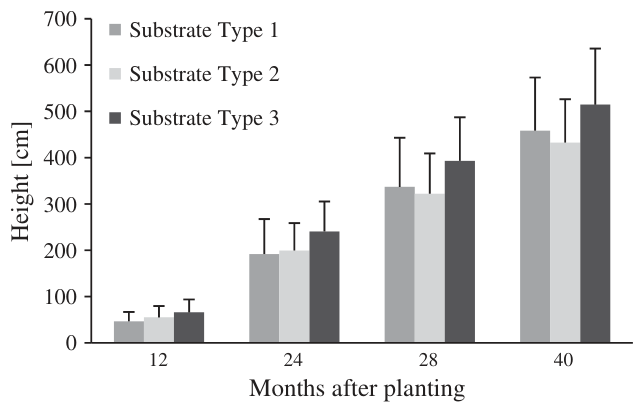
On average, surviving trees associated with ST3 grew higher than trees associated with STs1 and 2 (Fig. 2). There was a wide range in biomass production among clones and plots, with a minimum of 1.9 Mg ha−1 and a maximum of 20.6 Mg ha−1 (Table 5), showing a similar pattern to the survival rates. Thus, OP-367 clone and DN-182 clone, the clones with the lower mortality also had the higher biomass. On the other hand, trees on plot C produced more biomass than on plot B, even though mortality on C was 30% higher. The higher biomass production could be attributed to the wider spacing, resulting in reduced competition and improved nutrient and water acquisition of the trees on plot C. While a dense spacing (1×1 m) was found to be adequate for poplar coppice cultures (Armstrong et al., 1999), it can cause density dependent mortality in single-stem plantations (Karacic et al., 2003). According to Green et al. (2001) DN-34 does not perform well under strong competition for light, which may be a major reason for its poorer growth compared to the other clones. The mean annual biomass production of all clones and on all plots was 3.4 Mg ha−1 a−1, exceeding the averages of respective values given by Hansen (1990) for DN-34 clone and DN-182 clone, 2.5 and 3.3-fold, respectively.
平均而言,与ST3对应的存活树木比与ST1和ST2对应的树木更高(图2)。各无性系和各样地间的生物量产量差异很大,最小为1.9 Mg ha−1,最大为20.6 Mg ha−1(表5),其格局与存活率相似。因此,死亡率较低的OP-367无性系和DN-182无性系生物量也较高。另一方面,尽管C样地的死亡率高出30%,其树木生物量却高于B样地。较高的生物量产量可归因于株距较宽,使C样地树木间竞争减弱,养分和水分获取得到改善。虽然密植(1×1 m)被认为适合杨树矮林作业(Armstrong et al., 1999),但在单干人工林中可能导致密度依赖性死亡(Karacic et al., 2003)。据Green et al. (2001)报道,DN-34在强烈光竞争条件下表现不佳,这可能是其生长劣于其他无性系的主要原因。所有无性系和所有样地的年均生物量产量为3.4 Mg ha−1 a−1,分别为Hansen (1990)所报道DN-34无性系和DN-182无性系相应平均值的2.5倍和3.3倍。
3.3. Element concentrations of leaves3.3. 叶片元素浓度
The concentrations of macro and micro-nutrients in the leaf samples of the four poplar clones are given in Table 6. Leaf element concentrations differed more strongly among clones than among STs. Significant substrate-related differences in leaf element concentrations were only found for Mn and Zn (data not shown). The foliar concentrations of N, K, Mg and P were in the same range as reported for fertilized poplar cultures (Jug et al., 1999; van den Driessche et al., 2008) and always above the respective sufficiency levels (van den Burg, 1985, 1990). Foliar Ca levels were below the recommended concentration of 7 mg g−1 in 7 trees, the other trees were well supplied with Ca. However, Ca deficiency threshold concentrations for foliage vary widely and are not well established (Jug et al., 1999). The Ca concentration of 22 g kg−1, which was proposed for poplars as optimum level by Côté and Camiré (1987), was not reached in any leaf sample.
4个杨树无性系叶片样品中的大量和微量营养元素浓度见表6。叶片元素浓度在无性系间的差异大于在ST间的差异。仅Mn和Zn的叶片浓度存在与基质相关的显著差异(数据未列出)。叶片N、K、Mg和P浓度与施肥杨树栽培中的报道值处于同一范围(Jug et al., 1999; van den Driessche et al., 2008),且始终高于相应的充足水平(van den Burg, 1985, 1990)。有7株树的叶片Ca含量低于推荐浓度7 mg g−1,其余树木Ca供应充足。然而,叶片Ca缺乏阈值浓度差异很大,尚未明确确立(Jug et al., 1999)。Côté and Camiré (1987)提出的杨树最适Ca浓度22 g kg−1在所有叶片样品中均未达到。
The concentrations of B were extraordinarily high in the leaves of all clones. DN-34 clone (636 mg kg−1) and DN-182 clone (637 mg kg−1) had a similar leaf B concentration, differing significantly from DN-2 clone (831 mg kg−1) and OP-367 clone (1018 mg kg−1). In some leaves,
所有无性系叶片中的B浓度均异常高。DN-34无性系(636 mg kg−1)和DN-182无性系(637 mg kg−1)的叶片B浓度相近,与DN-2无性系(831 mg kg−1)和OP-367无性系(1018 mg kg−1)存在显著差异。在部分叶片中,
Mean concentrations of elements in poplar fine roots for the 3 substrate types (±standard error).
3种基质类型中杨树细根的平均元素浓度(±标准误)。
| Substrate基质 | Element con元素 | centration浓度 | ||||||||||
|---|---|---|---|---|---|---|---|---|---|---|---|---|
| Ca | Fe | K | Mg | Na | P | |||||||
| [g kg−1] | ||||||||||||
| Type 1 | 14.81a | (1.20) | 13.24 | (1.40) | 5.71 | (0.54) | 2.65a | (0.14) | 2.31a | (0.28) | 1.82a | (0.09) |
| Type 2 | 19.13ab | (1.73) | 15.32 | (1.22) | 4.28 | (0.38) | 2.50a | (0.12) | 1.66ab | (0.13) | 2.47b | (0.11) |
| Type 3 | 21.85b | (1.97) | 17.13 | (1.77) | 4.47 | (0.41) | 1.77b | (0.12) | 1.29b | (0.18) | 2.31b | (0.11) |
| B | Cu | Mn | Ni | Pb | Zn | |||||||
| [mg kg−1] | ||||||||||||
| Type 1 | 134.4a | (9.49) | 393.6a | (36.61) | 383.4a | (53.35) | 28.99 | (2.78) | 141.4a | (19.01) | 149.0a | (16.45) |
| Type 2 | 186.5b | (8.59) | 569.9b | (31.95) | 367.9a | (48.18) | 39.21 | (2.48) | 221.0b | (16.13) | 222.5b | (11.90) |
| Type 3 | 150.1a | (8.56) | 533.2ab | (50.83) | 208.6b | (33.01) | 69.72 | (12.82) | 132.4a | (9.23) | 214.5b | (17.20) |
Different letters indicate statistically significant differences in leaf element concentrations (pb0.05).
不同字母表示叶片元素浓度差异显著(p<0.05)。
B toxicity symptoms such as necrotic leaf margins were observed. Leaf B concentrations were only weakly correlated to the soil BCaCl2 concentrations of the associated cores (r2=0.061; y=5.21x+702.14; pb0.05). The leaf B concentrations measured here are comparable in magnitude to those found by Bañuelos et al. (1999) and Robinson et al. (2003). The findings of Bañuelos et al. (1999) also confirm the higher B accumulation of clone OP-367 compared to DN-34. The capacity of poplars to accumulate high B concentrations in their leaves indicates that they have special mechanisms for B detoxification and storage. There is limited information on B detoxification in plants. The binding of B to alcohol sugars in some Rosaceae species and the complexation of B with cis-diol groups in Halophytes are detoxification mechanisms that work at tissue concentrations of up to 300 mg kg−1 (Brown and Shelp, 1997; Rozema et al., 1992). However, this is well below the toxicity threshold level in poplar leaves (800 mg kg−1). Leaf B concentrations were found to decrease with leaf position along the axis of young pot-grown poplar shoots from base to top (Rees et al., 2011). Here we found no such relationship between leaf position and B concentration, which might have been due to early senescence and fall of older leaves. Some of the trees were strongly defoliated at the time of sampling, especially in their lower parts.
观察到叶缘坏死等B毒害症状。叶片B浓度与对应土芯中土壤BCaCl2浓度之间仅存在弱相关(r2=0.061;y=5.21x+702.14;p<0.05)。本研究测得的叶片B浓度与Bañuelos et al. (1999)和Robinson et al. (2003)的结果量级相当。Bañuelos et al. (1999)的研究结果也证实了无性系OP-367的B积累量高于DN-34。杨树叶片能够积累高浓度B,表明其具有特殊的B解毒和储存机制。关于植物B解毒的资料有限。某些蔷薇科物种中B与糖醇的结合以及盐生植物中B与顺式二醇基团的络合是解毒机制,可在组织浓度高达300 mg kg−1时发挥作用(Brown and Shelp, 1997; Rozema et al., 1992)。然而,该浓度远低于杨树叶片的毒性阈值(800 mg kg−1)。已有研究发现,盆栽幼龄杨树枝条上叶片B浓度随叶位由基部向顶部递减(Rees et al., 2011)。本研究未发现叶位与B浓度之间存在此种关系,这可能是由于老叶提早衰老脱落所致。采样时部分树木落叶严重,尤其是下部。
Other trace elements, such as Zn, were also present in the leaves at elevated concentrations (Vandecasteele et al., 2003). This was especially true for clone DN-2, in which leaf Zn concentrations averaged 314 mg kg−1 and reached a maximum concentration of 508 mg kg−1. Such concentrations are not uncommon in poplars and not known to be phytotoxic in poplar leaves (Dos Santos Utmazian et al., 2007; Hermle et al., 2007; Robinson et al., 2005). The leaf Cu concentrations varied between 25.2 and 30.0 mg kg−1, which is within the range where Cu toxicity can occur (Kramer, 2010). The concentrations of Cd, Pb and Ni were well below toxicity levels for poplars and other plants (Kramer, 2010; Vandecasteele et al., 2003).
其他微量元素如Zn在叶片中也呈较高浓度(Vandecasteele et al., 2003)。无性系DN-2尤为明显,其叶片Zn浓度平均为314 mg kg−1,最高达508 mg kg−1。这样的浓度在杨树中并不罕见,且尚未发现对杨树叶片具有植物毒性(Dos Santos Utmazian et al., 2007; Hermle et al., 2007; Robinson et al., 2005)。叶片Cu浓度介于25.2和30.0 mg kg−1之间,处于可能发生Cu毒害的范围内(Kramer, 2010)。Cd、Pb和Ni浓度远低于杨树及其他植物的毒性水平(Kramer, 2010; Vandecasteele et al., 2003)。
3.4. Regression analysis of tree growth and leaf element concentrations3.4. 树木生长与叶片元素浓度的回归分析
There were significant correlations between the average PC scores of the soil cores and tree growth parameters (Table 7). PC1 and PC3 were found to be negatively correlated with tree height and biomass, while PC2 showed a positive correlation with tree height. This agrees with the finding of a positive influence of ST3 on tree growth, as this ST had a high positive score on PC2, and the rather negative influence on tree growth associated with ST2, which scored high on PC1.
土芯的平均PC得分与树木生长参数之间存在显著相关(表7)。PC1和PC3与树高和生物量呈负相关,而PC2与树高呈正相关。这与ST3对树木生长具有正面影响(该ST在PC2上得分较高)以及ST2(在PC1上得分较高)对树木生长具有较为负面影响的结果相一致。
Tree height and biomass showed strong correlations with the concentrations of some elements in leaves, in particular Ca, Mn and to a lesser degree Mg and Zn (Table 6). The strongest positive correlation between nutrient element concentration in foliage and tree growth parameters was found for Ca and the strongest negative correlation was found for Mg. Calcium and B play an important role in the formation of pectic polysaccharides in cell wall constituents and Ca is especially important for wood formation in poplars (Lautner et al., 2007;
树高和生物量与叶片中某些元素浓度密切相关,尤其是Ca、Mn,其次是Mg和Zn(表6)。叶片营养元素浓度与树木生长参数之间最强的正相关出现在Ca,最强的负相关出现在Mg。钙和B在细胞壁组分果胶多糖的形成中起重要作用,而Ca对杨树的木材形成尤为重要(Lautner et al., 2007;
Matoh and Kobayashi, 1998). Teasdale et al. (1986) showed that at a high Mg:Ca ratio, Mg is able to displace Ca from the binding sites of an acceptor molecule that is only activated when both, Ca and B, are bound to it. At high Mg:Ca ratios, high B concentrations were found to promote growth in cell cultures. The Mg:Ca ratio was as high as 1 in some of our leaf samples. Under these conditions, the high B concentrations found in the leaves might have partially compensated growth reduction induced by low Ca supply to the leaves. However, this was not expressed by a positive correlation of tree growth with leaf B accumulation as B was present in excess in all leaf samples.
Matoh and Kobayashi, 1998)。Teasdale et al. (1986)表明,在Mg:Ca比较高时,Mg能够将Ca从某种受体分子的结合位点上置换下来,而该受体分子只有在Ca和B同时结合时才被激活。在Mg:Ca比较高时,高B浓度可促进细胞培养物的生长。本研究部分叶片样品的Mg:Ca比高达1。在此条件下,叶片中的高B浓度可能部分补偿了叶片Ca供应不足引起的生长下降。然而,由于所有叶片样品中B均过量存在,这一点并未表现为树木生长与叶片B积累之间的正相关。
Low foliage Ca concentrations were not related to low soil Ca concentrations, as substrate Ca concentrations were lowest in ST1, whereas most of the trees (5 out of 7) with foliage Ca concentrations b7 g kg−1 were associated with ST2. Leaf Zn and Mn concentrations were far above deficiency levels and their positive correlation with tree growth might have been co-incidental due to their correlation with leaf Ca.
叶片Ca浓度低与土壤Ca浓度低无关,因为基质Ca浓度在ST1中最低,而叶片Ca浓度<7 g kg−1的树木大多数(7株中的5株)与ST2对应。叶片Zn和Mn浓度远高于缺乏水平,其与树木生长的正相关可能是由于它们与叶片Ca相关而产生的偶然结果。
3.5. Fine root traits3.5. 细根性状
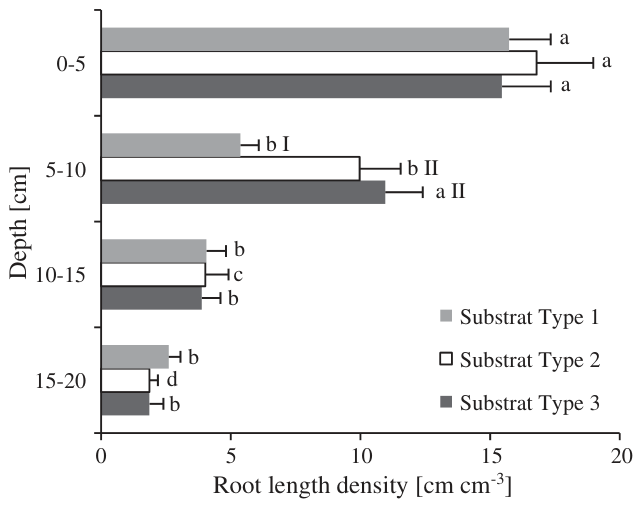
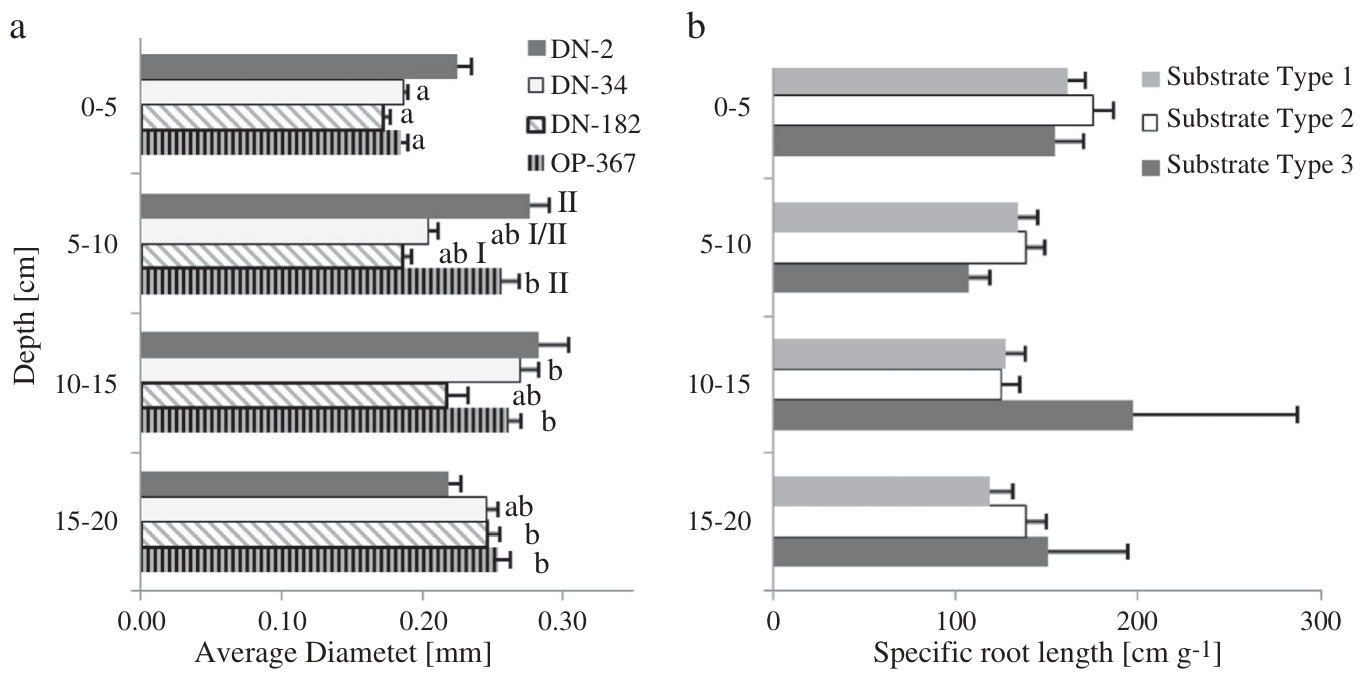
All three substrates were intensively colonized by roots (Fig. 3). The semivariograms for fine root (FR) biomass and FR length showed a pure nugget effect, meaning that these parameters were spatially independent (data not shown). Fine root length densities were found to vary between 1.9 and 16.8 cm cm−3. These values are 2–6 times higher than those found by Al Afas et al. (2008) in a poplar coppice culture. No significant differences in RLD were found among clones and STs when all soil samples were pooled. However, pair-wise comparisons revealed differences in RLD among STs collected at 5–10 cm depth. Trees associated with ST1 developed fewer roots at this depth than in association with STs2 and 3. For all STs and clones, RLD decreased significantly with depth, in contrast to the FR diameter which increased (Fig. 4(a)). The FR diameter differed significantly between clones. Specific root length decreased with depth and was higher in ST3 than in STs1 and 2 (Fig. 4(b)). The SRL values found here are twice as high as those reported by Ostonen et al. (2007) and Brunner et al. (2008), but in the same order of magnitude as those reported by Pregitzer et al. (2002) for Populus balsamifera L.. Also our FR diameter values agreed well with those of Pregitzer et al. (2002).
三种基质均被根系密集占据(图3)。细根(FR)生物量和FR长度的半变异函数表现为纯块金效应,表明这些参数在空间上相互独立(数据未列出)。细根长度密度介于1.9和16.8 cm cm−3之间,是Al Afas et al. (2008)在杨树矮林中所测值的2~6倍。将所有土壤样品合并时,各无性系和各ST间RLD无显著差异。然而,两两比较显示,5~10 cm深度采集的各ST间RLD存在差异:与ST1对应的树木在该深度的根系少于与ST2和ST3对应的树木。对所有ST和无性系而言,RLD均随深度显著降低,而FR直径则随深度增加(图4(a))。FR直径在无性系间差异显著。比根长随深度降低,且ST3中高于ST1和ST2(图4(b))。本研究的SRL值是Ostonen et al. (2007)和Brunner et al. (2008)报道值的2倍,但与Pregitzer et al. (2002)报道的Populus balsamifera L.的数值处于同一数量级。本研究的FR直径值也与Pregitzer et al. (2002)的结果吻合良好。
The cumulative frequency distributions of the FR diameters were well described by log-normal distributions. The average r2 of all samples was 0.993 for all models. The back-transformed model distribution parameters agreed well with the respective parameters compiled by Scanlan and Hinz (2010). Differences between sample average diameters determined by model-fitting were significant for all three factors: substrate, clone and depth. The sample variances in root diameter were independent of the clone, but showed the same trends as the distribution mean otherwise. Pair-wise comparison showed that the uppermost substrate samples (0–5 cm) significantly differed in variance from the deeper samples. The latter had the highest distribution variance.
FR直径的累积频率分布可用对数正态分布很好地描述,所有模型的全部样品平均r2为0.993。反变换后的模型分布参数与Scanlan and Hinz (2010)汇编的相应参数吻合良好。通过模型拟合确定的样品平均直径在基质、无性系和深度三个因素上均存在显著差异。根径的样品方差与无性系无关,但在其他方面表现出与分布均值相同的趋势。两两比较表明,最上层基质样品(0~5 cm)的方差与较深层样品显著不同,后者的分布方差最高。
Linear correlations between root traits and root element concentrations, between root traits and principal component (PC) scores and between root traits and soil parameters of the substrate samples. Arrows indicate the soil parameters with the highest scores on the respective PC. Only coefficients of significant correlations are given.
基质样品的根系性状与根系元素浓度、根系性状与主成分(PC)得分以及根系性状与土壤参数之间的线性相关。箭头指示在相应PC上得分最高的土壤参数。仅列出显著相关的系数。
| FR BiomassFR生物量 | RLD | SRL | Avg. Diam.1平均直径1 | Dist. Mean2分布均值2 | Dist. Variance2分布方差2 | ||
|---|---|---|---|---|---|---|---|
| B | 0.22* | 0.29 | 0.30* | − | 0.20* | − | |
| tion | Ca | − | − | −0.19* | − | − | − |
| ntra | Cu | − | − | 0.31* | −0.22* | − | − |
| conce | K | − | − | −0.20* | − | − | − |
| ent | Mg | − | 0.27 | 0.23* | − | − | − |
| elem | Na | − | 0.19* | 0.19* | − | − | − |
| Root | Pb | − | − | − | − | 0.37* | 0.35 |
| Zn | − | − | 0.23* | − | − | − | |
| ipal nents | PC 1 | − | − | − | 0.17 | 0.20* | 0.15* |
| Princ mpo | PC 2 | − | − | − | − | −0.13* | −0.17 |
co | PC 3 | 0.25* | 0.39* | 0.31* | −0.13* | − | − |
| Ptot | − | − | − | 0.15* | 0.13* | − | |
| Btot | − | − | − | 0.17 | 0.15 | − | |
| Zntot | − | − | − | 0.17 | 0.13* | − | |
| 1 | Natot | − | − | − | 0.18 | 0.17 | − |
| PC | H2O | − | − | − | 0.17 | 0.23* | 0.14* |
| Ktot | − | − | − | 0.14 | 0.21* | 0.18 | |
| KCaCl2 | − | − | − | 0.17 | 0.19 | − | |
| C | − | − | − | 0.12* | − | − | |
| Nitot | − | − | − | − | − | − | |
| s PC 2 | Pbtot | − | − | − | 0.12* | − | − |
| eter | Mntot | − | − | − | − | −0.15* | −0.14* |
| aram 3 | pH | 0.19 | 0.29* | 0.115* | − | − | − |
| Soil p PC | MnCaCl2 | −0.16 | −0.26* | −0.15* | − | − | − |
| __ | NaCaCl2 | - | 0.11* | − | − | − | − |
| _____ | BCaCl2 | 0.14* | 0.22* | − | − | − | − |
| _____ | Catot | − | − | − | − | 0.13 | − |
| ____ | CuCaCl2 | − | − | −0.12* | − | − | − |
| _____ | NiCaCl2 | − | −0.13* | − | −0.15* | 0.13* | − |
| ____ | PCaCl2 | − | − | − | − | − | − |
Significance levels are indicated by asterisks: *P≤0.05; **P≤0.01; ***P≤0.001; – =non-significant. 1Average FR diameter directly determined by means of WinRhizo for each sample. 2Mean and variance of the best-fit log-normal distribution of sample FR diameters.
显著性水平以星号表示:*P≤0.05;**P≤0.01;***P≤0.001;– = 不显著。1平均FR直径,由WinRhizo对每个样品直接测定。2样品FR直径最优拟合对数正态分布的均值和方差。
A higher SRL is associated with a higher root surface area for a given biomass and thus with an improved capacity for nutrient and water uptake. SRL is known to decrease under abiotic stresses from elevated trace element concentrations, because roots thicken under such conditions (Ostonen et al., 2007). Under abiotic stress conditions black alder FRs were found to avoid direct soil contact and invest more into exudation than into root growth (Lohmus et al., 2006). Poplars were found to react to high concentrations of heavy metals in nutrient solutions by exuding organic acids (Qin et al., 2007). The composition of the exudates differed for different trace elements. Metals bound to organic acids are less reactive than free metal ions. The combination of such morphological and chemical responses might enable poplar FR to deal flexibly with different stress conditions in soils.
较高的SRL意味着单位生物量具有较大的根表面积,从而提高养分和水分吸收能力。已知在微量元素浓度升高造成的非生物胁迫下SRL会降低,因为根系在此类条件下会增粗(Ostonen et al., 2007)。在非生物胁迫条件下,黑桤木的FR会避免与土壤直接接触,并将更多投入用于分泌而非根系生长(Lohmus et al., 2006)。杨树对营养液中高浓度重金属的响应是分泌有机酸(Qin et al., 2007),且分泌物组成因微量元素种类而异。与有机酸结合的金属比游离金属离子活性低。这些形态和化学响应的结合可能使杨树FR能够灵活应对土壤中不同的胁迫条件。
3.6. Element concentrations of fine roots3.6. 细根元素浓度
Table 8 shows that there were significant differences among STs in the concentrations of various elements in the FR. Significant differences between clones were only found for Na, where a significant difference between DN-34 clone and DN-182 clone emerged. Boron concentrations in roots are typically in the same magnitude as soil and below leaf B concentrations (Rees et al., 2011), which was the case here as well. Fine-root Ca concentrations were higher than soil and leaf Ca, suggesting that the low leaf Ca concentrations were not due to insufficient supply of soil Ca to the roots.表8表明,各ST间FR中多种元素的浓度存在显著差异。无性系间仅Na存在显著差异,表现为DN-34无性系与DN-182无性系之间差异显著。根系B浓度通常与土壤处于同一量级,且低于叶片B浓度(Rees et al., 2011),本研究亦是如此。细根Ca浓度高于土壤和叶片Ca浓度,表明叶片Ca浓度低并非由于土壤Ca向根系供应不足所致。
Zinc and Mn FR concentrations were in the same order of magnitude as reported by Brunner et al. (2008) from uncontaminated soil. The FR Fe concentrations, however were similar to the substrate Fe concentrations and far above the concentrations reported for poplar roots (Zalesny et al., 2008). These extraordinarily high root Fe concentrations might have been due to temporarily anaerobic conditions in the Fe-rich substrates, indicated by high soil water contents during sampling and precipitated Fe-oxides on root surfaces. Changes in redox conditions would have also affected redox state and thereby the mobility of Mn and possibly Cu. The Cu concentrations of the FR were indeed high. They ranged between 400 and 570 mg kg−1 and exceeded soil Cu concentrations. In roots, Cu is primarily bound in epidermis cell walls to pectins and thus hindered to be translocated into the shoots (Brunner et al., 2008). Copper concentrations of 3 mg l−1 were shown to be toxic to roots of Populus tremula L. in a 2×10⁻⁴ mol l−1 CaCl2-solution (Qin et al., 2007). In our study, CaCl2-extractable Cu concentrations were always more than an order of magnitude lower than 3 mg l−1 and should therefore not be toxic to poplar roots. Lead concentrations in roots were high. Like Cu, Pb is known to accumulate in tree roots and not to be translocated into stems and leaves readily (Marmiroli et al., 2005; Pulford and Watson, 2003).
锌和Mn的FR浓度与Brunner et al. (2008)报道的未污染土壤中的数值处于同一数量级。然而,FR中Fe浓度与基质Fe浓度相近,远高于已报道的杨树根系Fe浓度(Zalesny et al., 2008)。根系Fe浓度异常高可能是由于富Fe基质中出现暂时性厌氧条件,这可由采样期间土壤含水量较高以及根表面沉淀的Fe氧化物得到印证。氧化还原条件的变化也会影响Mn以及可能的Cu的氧化还原状态,进而影响其迁移性。FR中Cu浓度确实较高,介于400和570 mg kg−1之间,超过了土壤Cu浓度。在根系中,Cu主要与表皮细胞壁中的果胶结合,从而难以向地上部转运(Brunner et al., 2008)。已有研究表明,在2×10⁻⁴ mol l−1 CaCl2溶液中,3 mg l−1的Cu浓度对Populus tremula L.根系具有毒性(Qin et al., 2007)。本研究中CaCl2可提取态Cu浓度始终比3 mg l−1低一个数量级以上,因此不应对杨树根系产生毒性。根系中Pb浓度较高。与Cu类似,已知Pb会在树木根系中积累,而不易向茎和叶转运(Marmiroli et al., 2005; Pulford and Watson, 2003)。
3.7. Regression analysis of fine root traits3.7. 细根性状的回归分析
Various mineral element concentrations of the sampled FR were significantly correlated with SRL (Table. 9). While the macro-nutrient elements K and Ca were negatively correlated to SRL, Na and Mg and the micronutrients B, Cu and Zn showed a positive correlation with SRL. Copper was the only mineral element that was significantly correlated to the average root diameter determined directly by WinRhizo. In contrast to expectation, the correlation was negative, meaning that diameters decreased with increasing root Cu concentration. This finding was confirmed by the negative correlation between root Cu and root diameter, as thinner roots lead to a higher SRL. SRL also showed positive correlations with root B, Mg, Na and Zn, although all these elements were not significantly correlated with root diameter, suggesting that these relationships to SRL were of an indirect nature. Only root B concentrations were found to be positively correlated to FR biomass. The finding that SRL increased with the concentrations of some trace elements in the roots is in contrast to the opposite conclusion of a negative metal influence on SRL that Ostonen et al. (2007) drew from a meta-analysis of published root data. Root B, Mg and Na concentrations were also positively correlated with RLD.
所采FR中多种矿质元素浓度与SRL显著相关(表9)。大量营养元素K和Ca与SRL呈负相关,而Na、Mg以及微量营养元素B、Cu和Zn与SRL呈正相关。Cu是唯一与WinRhizo直接测定的平均根径显著相关的矿质元素。与预期相反,该相关为负相关,即根径随根系Cu浓度增加而减小。根系Cu与根径之间的负相关证实了这一结果,因为较细的根导致较高的SRL。SRL还与根系B、Mg、Na和Zn呈正相关,但这些元素均与根径无显著相关,表明它们与SRL的关系属间接性质。仅根系B浓度与FR生物量呈正相关。SRL随根系中某些微量元素浓度增加而增加,这一发现与Ostonen et al. (2007)通过对已发表根系数据进行荟萃分析所得出的金属对SRL具有负面影响的相反结论不同。根系B、Mg和Na浓度也与RLD呈正相关。
There was a good agreement between the correlations of PC scores and root traits and the correlations of these traits with those soil parameters showing high negative or positive loadings on the respective PCs: PC1 scores correlated positively to the average root diameters of the samples and so were all soil parameters with a high score on PC1; PC2 scores showed only a weak negative correlation to the parameters of the back-transformed model; and PC3 showed a weak negative correlation to the WinRhizo measured average root diameters, but no correlation with mean diameter of the best-fit model distribution. PC3 was also strongly correlated with FR biomass, SRL and RLD, as were the two main factors loading on PC3, i.e. pH and MnCaCl2. The correlation coefficients between root traits and soil chemical parameters were generally low, ranging from −0.26 to 0.3, suggesting that in our experimental field soil root growth was not simply governed by a few dominant factors, but by rather complex interactions among a large variety of factors.
PC得分与根系性状之间的相关性,与这些性状同在相应PC上具有高负载荷或高正载荷的土壤参数之间的相关性吻合良好:PC1得分与样品平均根径呈正相关,所有在PC1上得分较高的土壤参数亦是如此;PC2得分仅与反变换模型参数呈弱负相关;PC3与WinRhizo测定的平均根径呈弱负相关,但与最优拟合模型分布的平均直径无相关性。PC3还与FR生物量、SRL和RLD密切相关,在PC3上载荷最高的两个主要因子pH和MnCaCl2亦是如此。根系性状与土壤化学参数之间的相关系数总体较低,介于−0.26和0.3之间,表明在本试验田土壤中,根系生长并非简单地受少数主导因子控制,而是受众多因子之间相当复杂的相互作用所影响。
4Conclusions结论
Substrate type classification based on PC analysis proved to be an efficient method to detect soil effects on poplar survival and growth, despite of the complexity of the site conditions on the investigated landfill. Despite signs of B toxicity in the leaves and elevated concentrations also of some other trace elements in the substrates and the leaves, survival and growth of the poplars trees were in the range of normal performance. Nonetheless, taking into account that tree growth was clearly affected by the associated substrates could greatly enhance the chances of a successful establishment of poplars on the remainder of the site or on other sites with similar conditions. Our results show that poplars are well suited for establishing vegetation on B-laden paper mill sludge and similar landfill sites in order to stabilize the soil and control trace element leaching.
尽管所研究填埋场的立地条件较为复杂,基于主成分分析(PC分析)的基质类型划分仍被证明是检测土壤对杨树存活与生长影响的有效方法。尽管叶片中出现了B毒害症状,且基质和叶片中某些其他微量元素的浓度也有所升高,但杨树的存活率和生长状况仍处于正常表现范围内。然而,考虑到树木生长明显受到相应基质的影响,这将大大提高杨树在该场地其余区域或其他条件相似场地上成功定植的可能性。本研究结果表明,杨树非常适合用于在富含B的造纸厂污泥及类似填埋场上建立植被,以稳定土壤并控制微量元素淋溶。
Acknowledgments致谢
Funds for this study came from the Swiss National Science Foundation. We would like to thank Wausau Paper Specialty Products for allowing us to work at the site. We are thankful for the support in field work and organization that the staff of Sand Creek Consultants provided. We would also like to thank Judit Valentini, Stéphanie Conrad and Björn Studer from the Soil Protection group at ETH for their help.
本研究由瑞士国家科学基金会资助。感谢Wausau Paper Specialty Products允许我们在该场地开展工作。感谢Sand Creek Consultants的工作人员在野外工作和组织方面提供的支持。同时感谢ETH土壤保护组的Judit Valentini、Stéphanie Conrad和Björn Studer给予的帮助。
References参考文献
Al Afas N, Marron N, Zavalloni C, Ceulernansk R. Growth and production of a short-rotation coppice culture of poplar-IV: fine root characteristics of five poplar clones. Biomass Bioenergy 2008;32:494–502.
Armstrong A, Johns C, Tubby I. Effects of spacing and cutting cycle on the yield of poplar grown as an energy crop. Biomass Bioenergy 1999;17:305–14.
Bañuelos GS, Shannon MC, Ajwa H, Draper JH, Jordahl J, Licht J. Phytoextraction and accumulation of boron and selenium by poplar (Populus) hybrid clones. Int J Phytoremediation 1999;1:81–96.
Breckle SW, Kahle H. Effects of toxic heavy-metals (Cd, Pb) on growth and mineralnutrition of beech (Fagus sylvatica L.). Vegetation 1992;101:43–53.
Brown PH, Shelp BJ. Boron mobility in plants. Plant Soil 1997;193:85-101.
Brunner I, Luster J, Günthardt-Goerg MS, Frey B. Heavy metal accumulation and phytostabilisation potential of tree fine roots in a contaminated soil. Environ Pollut 2008;152:559–68.
Côté B, Camiré C. Tree growth and nutrient cycling in dense plantings of hybrid poplar and black alder. Can J For Res 1987;17:516–23.
Cressie N, Hawkins D. Robust estimation of the variogram: I. Math Geol 1980;12: 115–25.
Dellantonio A, Fitz WJ, Custovic H, Repmann F, Schneider BU, Grunewald H, et al. Environmental risks of farmed and barren alkaline coal ash landfills in Tuzla, Bosnia and Herzegovina. Environ Pollut 2008;153:677–86.
Dickinson N, Baker A, Doronila A, Laidlaw S, Reeves R. Phytoremediation of inorganics: realism and synergies. Int J Phytoremediation 2009;11:97-114.
Domínguez MT, Marañón T, Murillo JM, Schulin R, Robinson BH. Trace element accumulation in woody plants of the Guadiamar Valley, SW Spain: a large-scale phytomanagement case study. Environ Pollut 2008;152:50–9.
Dos Santos Utmazian MN, Wieshammer G, Vega R, Wenzel WW. Hydroponic screening for metal resistance and accumulation of cadmium and zinc in twenty clones of willows and poplars. Environ Pollut 2007;148:155–65.
Farnham IM, Singh AK, Stetzenbach KJ, Johannesson KH. Treatment of nondetects in multivariate analysis of groundwater geochemistry data. Chemom Intell Lab Syst 2002;60:265–81.
Fässler E, Robinson BH, Stauffer W, Gupta SK, Papritz A, Schulin R. Phytomanagement of metal-contaminated agricultural land using sunflower, maize and tobacco. Agric Ecosyst Environ 2010;136:49–58.
Goldberg S. Reactions of boron with soils. Plant Soil 1997;193:35–48.
Green DS, Kruger EL, Stanosz GR, Isebrands JG. Light-use efficiency of native and hybrid poplar genotypes at high levels of intracanopy competition. Can J For Res 2001;31: 1030–7.
Hansen E. Early yields of biomass plantations in the north central U.S. Res. Pap. NC-353. St. Paul, MN: Forest Service, North Central Forest Experiment Station; 1990.
Hansen E. Mid-rotation yields of biomass plantations in the north central U.S. Res. Pap. NC-309. St. Paul, MN: Forest Service, North Central Forest Experiment Station; 1992.
Hermle S, Vollenweider P, Günthardt-Goerg MS, McQuattie CJ, Matyssek R. Leaf responsiveness of Populus tremula and Salix viminalis to soil contaminated with heavy metals and acidic rainwater. Tree Physiol 2007;27:1517–31.
Hodge A. Roots: the acquisition of water and nutrients from the heterogeneous soil environment. In: Lüttge U, Beyschlag W, Büdel B, Francis D, editors. Progress in Botany, 71. Springer Berlin Heidelberg; 2010. p. 307–37.
Holm S. A simple sequentially rejective multiple test procedure. Scand J Stat 1979;6: 65–70.
Jug A, Hofmann-Schielle C, Makeschin F, Rehfuess KE. Short-rotation plantations of balsam poplars, aspen and willows on former arable land in the Federal Republic of Germany. II. Nutritional status and bioelement export by harvested shoot axes. For Ecol Manage 1999;121:67–83.
Karacic A, Verwijst T, Weih M. Above-ground woody biomass production of short-rotation populus plantations on agricultural land in Sweden. Scand J For Res 2003;18:427–37.
Keller C, Hammer D, Kayser A, Richner W, Brodbeck M, Sennhauser M. Root development and heavy metal phytoextraction efficiency: comparison of different plant species in the field. Plant Soil 2003;249:67–81.
Kramer U. Metal hyperaccumulation in plants. Annual review of plant Biology, 61. Palo Alto: Annual Reviews; 2010. p. 517–34.
Laureysens I, Pellis A, Willems J, Ceulemans R. Growth and production of a short rotation coppice culture of poplar. III. Second rotation results. Biomass Bioenergy 2005;29:10–21.
Lautner S, Ehlting B, Windeisen E, Rennenberg H, Matyssek R, Fromm J. Calcium nutrition has a significant influence on wood formation in poplar. New Phytol 2007;173:743–52.
Lohmus K, Truu J, Truu M, Kaar E, Ostonen I, Alma S, et al. Black alder as a perspective deciduous species for reclaiming of oil shale mining areas. In: Brebbia CA, Mander Ü, editors. Brownfields III. Prevention, assessment, rehabilitation and development of brownfield sites. Southampton: WIT Press; 2006. p. 87–97.
Lteif A, Whalen JK, Bradley RL, Camiré C. Mixtures of papermill biosolids and pig slurry improve soil quality and growth of hybrid poplar. Soil Use Manage 2007;23: 393–403.
Marmiroli M, Antonioli G, Maestri E, Marmiroli N. Evidence of the involvement of plant ligno-cellulosic structure in the sequestration of Pb: an X-ray spectroscopy-based analysis. Environ Pollut 2005;134:217–27.
Mastromatteo E, Sullivan F. Summary — International Symposium on the health-effects of boron and its compounds. Environ Health Perspect 1994;102:139–41. Matoh T, Kobayashi M. Boron and calcium, essential inorganic constituents of pectic polysaccharides in higher plant cell walls. J Plant Res 1998;111:179–90.
McIvor I, Douglas G, Benavides R. Coarse root growth of Veronese poplar trees varies with position on an erodible slope in New Zealand. Agrofor Syst 2009;76:251–64. Micó C, Recatalá L, Peris M, Sánchez J. Assessing heavy metal sources in agricultural soils of an European Mediterranean area by multivariate analysis. Chemosphere 2006;65:863–72.
Monte MC, Fuente E, Blanco A, Negro C. Waste management from pulp and paper production in the European Union. Waste Manage 2009;29:293–308.
Nable RO, Bañuelos GS, Paull JG. Boron toxicity. Plant Soil 1997;193:181–98. Ostonen I, Puttsepp U, Biel C, Alberton O, Bakker MR, Lohmus K, et al. Specific root length as an indicator of environmental change. Plant Biosyst 2007;141:426–42.
Pavlović P, Mitrović M, Djurdjević L. An ecophysiological study of plants growing on the fly ash deposits from the “Nikola Tesla‐A” thermal power station in Serbia. Environ Manage 2004;33:654–63.
Pregitzer KS, DeForest JL, Burton AJ, Allen MF, Ruess RW, Hendrick RL. Fine root architecture of nine North American trees. Ecol Monogr 2002;72:293–309. Pulford ID, Watson C. Phytoremediation of heavy metal-contaminated land by trees—a review. Environ Int 2003;29:529–40. Qin RJ, Hirano Y, Brunner I. Exudation of organic acid anions from poplar roots after exposure to Al, Cu and Zn. Tree Physiol 2007;27:313–20. Rees R, Robinson BH, Menon M, Lehmann E, Guenthardt-Goerg MS, Schulin R. Boron accumulation and toxicity in hybrid poplar (Populus nigra x euramericana). Environ Sci Technol 2011;45:10538–43. Rees R, Robinson B, Evangelou M, Lehmann E, Schulin R. Response of Populus tremula to heterogeneous B distributions in soil. Plant Soil 2012. http://dx.doi.org/10.1007/ s11104-12-1183-x.
Regent Instruments Canada Inc.: WinRhizo Pro, 2009 c,; 2009. Reimann C, Filzmoser P, Garrett RG, Dutter R. Principal Component Analysis (PCA) and Factor Analysis (FA). Chichester: John Wiley & Sons, Ltd.; 2008. Riemenschneider DE, Berguson WE, Dickmann DI, Hall RB, Isebrands JG, Mohn CA, et al. Poplar breeding and testing strategies in the northcentral U.S.: demonstration of potential yield and consideration of future research needs. For Chron 2001;77: 245–53. Robinson B, Green S, Mills T, Clothier B, Velde Mvd, Laplane R, et al. Phytoremediation: using plants as biopumps to improve degraded environments. Aust J Soil Res 2003;41:599–611. Robinson B, Mills T, Green S, Chancerel B, Clothier B, Fung L, et al. Trace element accumulation by poplars and willows used for stock fodder. N Z J Agric Res 2005;48: 489–97.
Robinson BH, Green SR, Chancerel B, Mills TM, Clothier BE. Poplar for the phytomanagement of boron contaminated sites. Environ Pollut 2007;150:225–33. Rozema J, De Bruin J, Broekman RA. Effect of boron on the growth and mineral economy of some halophytes and non-halophytes. New Phytol 1992;121:249–56. Salisbury FB, Ross CW. Plant physiology. 4th ed. Belmont: Wadsworth Publishing Co. Inc.; 1992.
Scanlan C, Hinz C. Using radius frequency distribution functions as a metric for quantifying root systems. Plant Soil 2010;332:475–93. Teasdale RD, Dawson PA, Woolhouse HW. Mineral nutrient requirements of a loblolly pine (Pinus taeda) cell suspension culture : evaluation of a medium formulated from seed composition data. Plant Physiol 1986;82:942–5. U.S.EPA. 104-mill study. Washington; 1988. van den Burg J. Foliar analysis for determination of tree nutrient saturation — a compilation of literature data. In: DeDorschkamp, editor. Wageningen: Inst. Forestry and Urban Ecology; 1985.
van den Burg J. Foliar analysis for determination of tree nutrient saturation — a compilation of literature data. In: DeDorschkamp, editor. Wageningen: Inst. Forestry and Urban Ecology; 1990. van den Driessche R, Thomas B, Kamelchuk D. Effects of N, NP, and NPKS fertilizers applied to four-year old hybrid poplar plantations. New For 2008;35:221–33. Vandecasteele B, Lauriks R, De Vos B, Tack FMG. Cd and Zn concentration in hybrid poplar foliage and leaf beetles grown on polluted sediment-derived soils. Environ Monit Assess 2003;89:263–83. Ward Jr JH. Hierarchical grouping to optimize an objective function. J Am Stat Assoc 1963;58:236–44. Wenzel W. Rhizosphere processes and management in plant-assisted bioremediation (phytoremediation) of soils. Plant Soil 2009;321:385–408. Whiting SN, Leake JR, McGrath SP, Baker AJM. Positive responses to Zn and Cd by roots of the Zn and Cd hyperaccumulator Thlaspi caerulescens. New Phytol 2000;145: 199–210.
Wilkinson AG. Poplars and willows for soil erosion control in New Zealand. Biomass Bioenergy 1999;16:263–74. Zalesny JA, Zalesny RS, Wiese AH, Sexton BT, Hall RB. Uptake of macro- and micro-nutrients into leaf, woody, and root tissue of Populus after irrigation with landfill leachate. J Sust For 2008;27:303–27. Zalesny Jr RS, Wiese AH, Bauer EO, Riemenschneider DE. Ex situ growth and biomass of populus bioenergy crops irrigated and fertilized with landfill leachate. Biomass Bioenergy 2009;33:62–9.