Agriculture, Ecosystems and Environment 191 (2014) 124-132
Contents lists available at ScienceDirect
Agriculture, Ecosystems and Environment
ELSEVIER journal homepage: www.elsevier.com/locate/agee
CrossMark
Kouping Lua,b, Xing Yang", Jiajia Shen', Brett Robinson, Huagang Huangd, Dan Liu a, b,
Nanthi Bolane, ·Jianchuan Pei,*, Hailong Wang a, b,»
a Zhejiang Provincial Key Laboratory of Carbon Cycling in Forest Ecosystems and Carbon Sequestration, Zhejiang A & F University, Lin'an, Hangzhou, Zhejiang 311300, China
· School of Environmental and Resource Sciences, Zhejiang A & F University, Lin'an, Hangzhou, Zhejiang 311300, China
· Agriculture and Life Sciences, Lincoln University, Lincoln, Canterbury 7647, New Zealand
d Yancao Production Technology Center, Bijie Yancao Company of Guizhou Province, Bijie 551700, China
e Centre for Environmental Risk Assessment and Remediation (CERAR), University of South Australia, South Australia 5095, Australia
ARTICLE INFO
ABSTRACT摘要
Article history: Received 29 July 2013 Received in revised form 1 April 2014 Accepted 3 April 2014 Available online 29 April 2014
文章历史:2013年7月29日收稿;2014年4月1日收到修改稿;2014年4月3日接受;2014年4月29日在线发表
Keywords: Bioavailability Biochar Contaminated soil Heavy metals Sedum plumbizincicola
关键词:生物有效性 生物炭 污染土壤 重金属 Sedum plumbizincicola
Soil contamination with heavy metals has become a global concern because of its adverse effects on ecosystem health and food security. Soil amendments including biochar can reduce the bioavailability of heavy metals in contaminated soils and reduce their risk of entering the food chain. A pot experiment was conducted to investigate the effects of biochars derived from bamboo and rice straw on bioavailability and plant growth in a sandy loam paddy soil naturally co-contaminated with Cd, Cu, Pb and Zn. The soil was moderately acidic (pH =5.7) and low in organic carbon content (8.7 g kg 1). Bamboo and rice straw biochars, pyrolyzed at temperatures · 500°C and with two mesh sizes (< 0.25 mm and < 1 mm), were applied at three rates (0, 1% and 5%, w/w). A metal-tolerant plant, Sedum plumbizincicola X. H. Guo et S. B. Zhou sp. nov. was used in the plant growth experiment to examine the bioavailability of these metals. The addition of biochars to soil significantly (p<0.05) increased the above-ground biomass of S. plumbizincicola. By the end of the experiment, soils amended with biochar had pH values significantly (p <0.05) higher, this effect being more accentuated at the high biochar dose and small particle size. The solubility of Cd, Cu, Pb, and Zn as measured by Toxicity Characteristic Leaching Procedure (TCLP) was significantly lower (p<0.05) in the biochar-amended soils than in the control soil. This was paralleled by significant reductions in Cd, Cu, Pb and Zn accumulated in the above-plant biomass of amended soils. Rice straw biochar reduced the concentration of Cu and Pb in the shoots by 46 and 71%, while bamboo biochar reduced concentration of Cd in the shoot by 49%. Finer biochar was more effective on reducing the concentrations of Zn in shoot than the coarse ones, while particle size had no effect on the concentrations of Cd, Cu and Pb in the shoot of S. plumbizincicola. In conclusion, the influence of biochar on heavy metal bioavailability varied not only with the feedstock and application rate of biochars, but also with the metal species. Therefore, biochar should be carefully designed to maximize the reduction of the bioavailability of a given heavy metal in soil.
重金属污染土壤因其对生态系统健康和粮食安全的不利影响,已成为全球关注的问题。包括生物炭在内的土壤改良剂可降低污染土壤中重金属的生物有效性,减少其进入食物链的风险。本研究通过盆栽试验,考察了竹子和稻草来源生物炭对Cd、Cu、Pb和Zn天然复合污染砂壤质水稻土中重金属生物有效性及植物生长的影响。供试土壤呈中度酸性(pH = 5.7),有机碳含量较低(8.7 g kg−1)。竹炭和稻草炭的热解温度 · 500°C,设两种粒径(< 0.25 mm和< 1 mm),按三个施用量(0、1%和5%,w/w)施入土壤。以耐金属植物伴矿景天(Sedum plumbizincicola X. H. Guo et S. B. Zhou sp. nov.)进行植物生长试验,考察上述金属的生物有效性。施用生物炭显著(p<0.05)提高了S. plumbizincicola的地上部生物量。试验结束时,施用生物炭土壤的pH值显著(p <0.05)升高,且在高施用量和小粒径条件下该效应更为明显。以毒性特征浸出程序(TCLP)测定的Cd、Cu、Pb和Zn溶解度在生物炭处理土壤中显著低于(p<0.05)对照土壤。与此相应,改良土壤中植物地上部生物量所积累的Cd、Cu、Pb和Zn也显著降低。稻草炭使地上部Cu和Pb浓度分别降低46%和71%,而竹炭使地上部Cd浓度降低49%。细粒径生物炭在降低地上部Zn浓度方面比粗粒径生物炭更为有效,而粒径对S. plumbizincicola地上部Cd、Cu和Pb浓度无影响。综上所述,生物炭对重金属生物有效性的影响不仅随生物炭原料和施用量而变化,也随金属种类而异。因此,应对生物炭进行精心设计,以最大限度地降低土壤中特定重金属的生物有效性。
© 2014 Elsevier B.V. All rights reserved.
© 2014 Elsevier B.V. 版权所有。
1Introduction引言
In recent decades, rapid industrial development has resulted in elevated levels of heavy metals in soils in Eastern and Southern
近几十年来,工业的快速发展导致中国东部和南部
* Corresponding authors at: School of Environmental and Resource Sciences, Zhejiang A & F University, Lin'an, Hangzhou, Zhejiang 311300, China. Tel.: +86 571 6370 5212; fax: +86 571 6374 0889. E-mail addresses: 147927078@qq.com (J. Pei), nzhailongwang@gmail.com, hailong@zafu.edu.cn (H. Wang). http://dx.doi.org/10.1016/j.agee.2014.04.010 0167-8809/© 2014 Elsevier B.V. All rights reserved.
China, which have resulted in great public health and environmental contamination concerns (Hu et al., 2007). Cadmium (Cd), copper (Cu), lead (Pb) and zinc (Zn) often coexist in contaminated soils and there is currently no effective means for their concurrent removal (Jiang et al., 2012). Concerns about their mobility and bioavailability have increased because of food safety, potential health risks and its detrimental effects on the ecosystems (Uchimiya et al., 2010a). The application of soil amendments that bind or precipitate contaminants whilst promoting plant growth can reduce environmental risk (Vangronsveld et al., 2009; Beesley et al., 2011; Bolan et al., biomass, such as residues from agricultural and forestry production (Wang et al., 2010; Liu et al., 2011). Most biochars have a highly porous structure and contain various functional groups that are studies showed that, typically, the application of biochar to soil can potentially enhance the long term soil carbon pool (Lehmann, 2007), improve soil properties and crop yield (Jeffery et al., 2011;
土壤中重金属含量升高,引发了严重的公众健康和环境污染问题(Hu et al., 2007)。镉(Cd)、铜(Cu)、铅(Pb)和锌(Zn)常在污染土壤中共存,目前尚无同时去除这些金属的有效手段(Jiang et al., 2012)。出于食品安全、潜在健康风险及其对生态系统的不利影响等方面的考虑,人们对其迁移性和生物有效性日益关注(Uchimiya et al., 2010a)。施用能够结合或沉淀污染物、同时促进植物生长的土壤改良剂,可降低环境风险(Vangronsveld et al., 2009; Beesley et al., 2011; Bolan et al., 生物质,如农林生产残余物(Wang et al., 2010; Liu et al., 2011)。大多数生物炭具有高度多孔的结构,并含有多种官能团, 研究表明,一般而言,向土壤施用生物炭可能增加长期土壤碳库(Lehmann, 2007),改善土壤性质并提高作物产量(Jeffery et al., 2011;
Table 1表1
Biochar is the solid product derived from the pyrolysis of waste
生物炭是废弃物经热解产生的固体产物,
Physicochemical properties of the sandy loam paddy soil and biochars used in the
供试砂壤质水稻土及生物炭的理化性质
experiment.
Soil Bamboo Rice straw biochar biochar
土壤 竹炭 稻草炭
Property
effective in the adsorption of metals (Wu et al., 2012). Numerous
能有效吸附金属(Wu et al., 2012)。大量
Sand (%) 51.5
Silt (%) 38.9 Clay (%) 9.6 Olsen-P (mg kg-1) 18 Total P (g kg-')
粉粒(%) 38.9 黏粒(%) 9.6 Olsen-P(mg kg-1) 18 全磷(g kg-')
Kookana et al., 2011; Matovic, 2011), and reduce greenhouse gas emissions including N20, CH4 and CO2 (Dong et al., 2013; Zhang et al., 2013a). It has been demonstrated that biochar could bind and/or precipitate contaminants in soil and minimize the risk of entering the human food chain (Zhang et al., 2010; Uchimiya et al., 2012). Unlike other soil amendments, the longevity of biochar
Kookana et al., 2011; Matovic, 2011),并减少包括N20、CH4和CO2在内的温室气体排放(Dong et al., 2013; Zhang et al., 2013a)。已有研究证明,生物炭可结合和/或沉淀土壤中的污染物,将其进入人类食物链的风险降至最低(Zhang et al., 2010; Uchimiya et al., 2012)。与其他土壤改良剂不同,生物炭的持久性
Electrical conductivity (ds m-') 0.02 pH (H2O) 5.7
电导率(ds m-') 0.02 pH(H2O) 5.7
Total C (g kg-') 8.7 Total N (g kg-1) 2.5
全碳(g kg-') 8.7 全氮(g kg-1) 2.5
Total H (g kg-1) Corg (g kg-') 8.7
全氢(g kg-1) Corg(g kg-') 8.7
reduces the need for repeated applications and the potential intro-
减少了重复施用的需要,以及由这些改良剂可能
Corg/N
Atomic H/Corg
duction of new contaminants derived from these amendments
引入新污染物的风险
Ash (%)
(Zhang et al., 2013a).
(Zhang et al., 2013a)。
Cation exchange capacity (cmol kg-') 5.3
阳离子交换量(cmol kg-') 5.3
While a number of studies have shown that biochar could signif-
尽管已有许多研究表明,生物炭可显著
Surface area (BET) (m2 g-1)
比表面积(BET)(m2 g-1)
icantly remove heavy metals from wastewaters (Chen et al., 2011;
去除废水中的重金属(Chen et al., 2011;
Alkalinity (cmol kg-1)
碱度(cmol kg-1)
Total Cd (mg kg-')
全Cd(mg kg-')
1.4
Lu et al., 2012; Xu et al., 2013), few studies have quantified the effect of adding biochar to contaminated soil systems. Recently, biochar remediation experiments (Fellet et al., 2011; Karami et al., 2011).
Lu et al., 2012; Xu et al., 2013),但定量研究向污染土壤体系中添加生物炭效果的工作较少。近来,生物炭 修复试验(Fellet et al., 2011; Karami et al., 2011)。
Total Cu (mg kg-1) 693
全Cu(mg kg-1) 693
from pyrolysis of different wastes has been used in various soil
由不同废弃物热解制得,已被应用于多种土壤
Total Pb (mg kg ) 527
全Pb(mg kg ) 527
Many studies indicated that biochar could significantly contribute to the immobilization of certain heavy metals such as Cd, Pb and
许多研究表明,生物炭可显著促进某些重金属如Cd、Pb和
Total Zn (mg kg-1) 1471
全Zn(mg kg-1) 1471
Zn in the soil (Beesley et al., 2010; Cao et al., 2011). However, the metals. Relatively few studies investigate the influence of biochar on the bioavailability of heavy metals in aged field contaminated
Zn在土壤中的固定(Beesley et al., 2010; Cao et al., 2011)。然而, 金属。针对生物炭对田间老化污染土壤中重金属生物有效性影响的研究相对较少
soils used in these studies were usually freshly spiked with heavy
这些研究中所用土壤通常为新近人工添加重
(Liu et al., 2010), thereby leading to the abandonment of this site
(Liu et al., 2010),从而导致该地块
for cultivation. Topsoil (0-20 cm) was taken for the pot experiment.
弃耕。采集表层土壤(0-20 cm)用于盆栽试验。
The bulk soil sample was thoroughly mixed, air-dried and passed through a 2-mm stainless steel sieve prior to the pot experiment.
盆栽试验前,将土壤混合样品充分混匀、风干,并过2 mm不锈钢筛。
The properties of biochar depend on the type of the feedstock and pyrolysis conditions (Wu et al., 2012). The selection of a specific type of feedstock is to a great extent determined by the availability of this material in the region where the biochar is likely to be produced, as this reduces the cost of transport while decreasing the carbon footprint of the biochar technology. Large quantities of crop residues (e.g., rice straw) are produced in China annually. In addition, bamboo, as a fast-growing timber crop commonly grown in this country, is an attractive feedstock for biochar production (Liu et al., 2011). A number of studies show that biochar
生物炭的性质取决于原料类型和热解条件(Wu et al., 2012)。特定原料的选择在很大程度上取决于该材料在生物炭拟生产地区的可获得性,这样既可降低运输成本,又可减少生物炭技术的碳足迹。中国每年产生大量作物秸秆(如稻草)。此外,竹子作为我国普遍种植的速生用材作物,是生产生物炭的理想原料(Liu et al., 2011)。多项研究表明,生物炭
Selected soil properties are presented in Table 1.
土壤部分性质见表1。
Two biochar samples, a bamboo biochar and a rice straw biochar, were used in the experiment. Bamboo biochar was a commercial product from a local producer using a batch pyrolysis facility with a sured, it was suggested that the pyrolysis temperature would be approximately 750°C. The straw biochar was produced using a continuous slow pyrolysis at a final temperature of 500°C with a retention time of 30 min. Biochar samples were ground and sieved, yielding two different size fractions, fine (<0.25 mm) and coarse addition can reduce the bioavailability of organic contaminants (Beesley et al., 2010), whereas less attention has been given to determining the effectiveness of biochar on bioavailability of heavy
试验采用竹炭和稻草炭两种生物炭样品。竹炭为当地生产商的商业产品,采用间歇式热解设备生产, 测定,推测其热解温度约为750°C。稻草炭采用连续慢速热解制备,终温为500°C,停留时间30 min。生物炭样品经研磨、过筛,得到细(<0.25 mm)和粗两种粒径组分, 施用可降低有机污染物的生物有效性(Beesley et al., 2010),而关于生物炭对重金属生物有效性影响效果的研究则较少
retention time of 3 h. Although its final temperature was not mea-
停留时间3 h。虽然其终温未经
2.2. Pot experiment2.2. 盆栽试验
metals in soils (Park et al., 2011; Méndez et al., 2012). Theresoil, and amended with 0, 1% (w/w, equivalent to 15.6 tha-1) and and 156 kg ha-1, respectively. Each treatment was replicated four times. Once all the experimental units received the amendments, the pots were irrigated with deionized water to 70% of the field
金属的研究关注较少(Park et al., 2011; Méndez et al., 2012)。因此, 土壤,分别添加0、1%(w/w,相当于15.6 t ha-1)和 和156 kg ha-1。每个处理重复4次。所有试验单元施加改良剂后,用去离子水将盆中土壤灌溉至田间
fore, the objective of this study was to evaluate the influence
本研究的目的是评估
of biochar feedstock and particle sizes on immobilizing of heavy
生物炭原料和粒径对土壤中重
metals in soil, thereby reducing their accumulation in a metal-
金属固定的影响,从而降低其在耐金属植物
tolerant plant, Sedum plumbizincicola X. H. Guo et S. B. Zhou sp. nov.
伴矿景天(Sedum plumbizincicola X. H. Guo et S. B. Zhou sp. nov.)中的积累。
The effectiveness of immobilization was evaluated by determining
固定效果通过测定天然复合污染土壤中
the availability of Cd, Cu, Pb and Zn based on Toxicity Characteristic
基于毒性特征浸出程序(TCLP)的Cd、Cu、Pb和Zn
Leaching Procedure (TCLP) in a naturally co-contaminated soil. The
有效性来评价。
bioavailability of the heavy metals was evaluated by the uptake of
重金属的生物有效性则通过植物吸收量进行评价
S. plumbizincicola.
In the pot experiment, the naturally co-contaminated paddy soil
盆栽试验采用天然复合污染水稻土,
was used to evaluate the effect of bamboo and rice straw biochars
评价竹炭和稻草炭对
on the bioavailability of mixed metal contaminants. Plastic pots
混合金属污染物生物有效性的影响。塑料盆
(18 cm in diameter and 14 cm in height) were filled with 2 kg of
(直径18 cm,高14 cm)中装入2 kg
5% (w/w, equivalent to 78 t ha-1) of bamboo or rice straw biochar.
5%(w/w,相当于78 t ha-1)的竹炭或稻草炭。
Each pot was fertilized with a basal dose of N, P and K at 156, 125
每盆施用N、P、K基肥,用量分别为156、125
water holding capacity, and allowed to equilibrate for 2 weeks. The
持水量的70%,平衡2周。
2Materials and methods材料与方法
soil was severely contaminated with heavy metals (Table 1) and most plants could not survive in this soil. Therefore, S. plumbizin-
该土壤受重金属严重污染(表1),大多数植物无法在其中存活。因此,选择S. plumbizin-
2.1. Soil and biochars2.1. 土壤与生物炭
cicola, a metal-tolerant plant, was chosen as an indicator plant to evaluate the effect of biochars on the bioavailability of the heavy
cicola这一耐金属植物作为指示植物,评价生物炭对重
Soil was collected from an abandoned paddy field in Fuyang with Cd, Cu, Pb and Zn, which severely reduced crop plant growth metals. Four S. plumbizincicola per pot were transplanted in mid
供试土壤采自中国浙江省杭州市西南富阳 Cd、Cu、Pb和Zn复合污染,严重抑制了作物生长 金属生物有效性的影响。每盆移栽4株S. plumbizincicola,移栽时间为
County, southwest of Hangzhou City, Zhejiang Province, China. The
县的一块弃耕稻田。
sandy loam soil developed from alluvial material was classified as
该砂壤土发育于冲积物,
paddy soil according to the Chinese soil classification (Gong, 1999).
按中国土壤分类系统划分为水稻土(Gong, 1999)。
The dominant clay mineral was illite. This site received dust emit-
主要黏土矿物为伊利石。该地块受到
ted from a copper smelter and the soil has been co-contaminated
铜冶炼厂排放粉尘的影响,土壤已受到
July 2012, and the number of plants was later thinned to 3 per pot after 4 weeks when all plants appeared to be established. The trial prevent rain from entering to the pots. The facility has no side walls.
2012年7月中旬;4周后所有植株均已成活,每盆间苗至3株。试验 防止雨水进入盆中。该设施无侧墙。
was carried out in a plant growth facility with a transparent roof to
在透明顶棚的植物生长设施中进行,以
The average temperature during the period was 26°C, with the maximum of 38 °C and minimum of 10°C during the experimental period. Regular watering (2 to 4 times a week) with deionized water was maintained to prevent drought stress to the plants. After 3 months of growth, the aboveground biomass of the plants was harvested. The harvested shoots were thoroughly washed with deionized water then oven-dried at 65°C in paper bags until a constant weight was reached. Dried samples were ground with a stainless steel mill and stored for chemical analysis. The soil from each pot was air-dried and thoroughly mixed. The air-dried soil was passed through a 2-mm sieve to remove any
试验期间平均气温为26°C,最高38 °C,最低10°C。定期(每周2至4次)以去离子水浇灌,防止植物受干旱胁迫。生长3个月后收获植物地上部生物量。收获的地上部用去离子水彻底洗净,装入纸袋于65°C烘干至恒重。干样用不锈钢粉碎机粉碎后储存,供化学分析。每盆土壤风干并充分混匀,风干土过2 mm筛以去除
2.3. Chemical analysis2.3. 化学分析
The pH of biochar in water solution was measured at 1:20 (w/v) ratio after occasionally stirring over 1h. The electrical conductivity (EC) of biochar was measured at 25°C after suspending in water (1:10 w/w). The cation exchange capacity (CEC) was measured using 1M ammonium acetate (pH 7) method (Lu, 1999). Ash content was determined using the ASTM D1762-84 method (ASTM International, 2013). The alkalinity of biochar was determined using the back titration method (Yuan and Xu, 2011). Briefly, 0.2 g of bamboo or rice straw biochar was weighed into plastic bottles. 40 mL of 0.03 M HC solution was added into each bottle and shaken for 2h at 25°C. After the samples were left standing for 24 h, residual HCI was titrated to pH 7.0 with 0.5 M NaOH. The acid uptake of the biochar was converted to its alkalinity content (Yuan and Xu, 2011). Total C, H and N contents in biochars were determined by an elemental analyzer (Flash EA1112, Thermo Finnigan, Italy). Inorganic C was analyzed by determination of CO>-C content with 1 M HC) treatment, as outlined in ASTM D4373-02 (ASTM nternational, 2007). Organic C was calculated as Total C subtracting Inorganic C, following the methods described in the IBI (2013) Biochar Standards. Surface area was determined by nitrogen sorption at 77K in a surface analyzer (Tristarll 3020, Micromeritica Instrument Corporation, USA). Before measurement, samples were thoroughly degassed at the out-gassing stations of the instrument at 573K, 10-4 mbar for 8h. The Brunauer-Emmett-Teller (BET) surface area of the biochars was calculated at the relative pressure of 0.05-0.30. Chemical analysis of the biochar particles was carried out with energy dispersive X-ray spectrometry (EDS) elemental mapping. The total phosphorous was measured with the molybdate-ascorbic acid procedure at 700 nm according to the method described by Lu (1999) Soil pH was measured in a soil/water slurry at a 1:2.5 (w/v) ratio and the electrical conductivity (EC) was measured in a soil/water slurry at a ratio of 1:5 (w/v). Total N was measured by semi-micro Kjeldhal method, and available phosphorus (P) was extracted with 0.5 M NaHC·3 and determined by colorimetry (UVA 132122 spectrophotometer, Thermo electron corporation, England). Organic C (OC) was determined by Walkley-Black method, and soil texture was determined using the pipette method, and the cation exchange capacity (CEC) of the soils was measured by the ammonium acetate (pH 7.0) method. All methods described above followed Lu (1999). Physicochemical properties and elemental analysis of the experimental soil and the biochars used are shown in Table 1. The total N, P concentration in the shoot of the plant was analyzed using H2S04-H202 digestion, following the methods described by Lu (1999). The uptake of N, P by the shoot of each pot was calculated as follows: the content (mg pot-') = the concentration in the shoot x the dry weight of the shoot in each pot. The solubility of heavy metals in the soil from each pot was estimated by the USEPA Toxicity Characteristic Leaching Procedure (TCLP) method 1311 (USEPA, 1992). Briefly, 1 g of soil sample was shaken in 20 mL of unbuffered glacial acetic acid solution (pH 2.88) for 18 h on an orbital shaker at 30 rpm, and then centrifuged at 4000rpm for 20 min. The supernatant was filtered through quantitative filter paper. The filtrates were analyzed for metals using an Inductively Coupled Plasma Optical Emission Spectroscopy (ICP-OES, Optima 2000, PerkinElmer Co., USA). The plant material was analyzed for metals using a nitric acid digestion (Zarcinas et al., 1987). The samples were mixed and filtered, and analyzed for metals with ICP-OES.
生物炭pH在1:20(w/v)固液比下,间歇搅拌1 h后测定。生物炭电导率(EC)在水中悬浮(1:10 w/w)后于25°C测定。阳离子交换量(CEC)采用1M乙酸铵(pH 7)法测定(Lu, 1999)。灰分含量采用ASTM D1762-84方法测定(ASTM International, 2013)。生物炭碱度采用返滴定法测定(Yuan and Xu, 2011)。简言之,称取0.2 g竹炭或稻草炭于塑料瓶中,每瓶加入40 mL 0.03 M HC溶液,于25°C振荡2h。样品静置24 h后,用0.5 M NaOH将残余HCI滴定至pH 7.0。将生物炭的酸吸收量换算为其碱度(Yuan and Xu, 2011)。生物炭全C、H和N含量用元素分析仪(Flash EA1112, Thermo Finnigan, Italy)测定。无机C按照ASTM D4373-02(ASTM nternational, 2007),经1 M HC)处理后测定CO>-C含量进行分析。有机C按IBI(2013)生物炭标准所述方法,以全C减去无机C计算。比表面积在表面分析仪(Tristarll 3020, Micromeritica Instrument Corporation, USA)上通过77K氮吸附测定。测定前,样品在仪器脱气站于573K、10-4 mbar下充分脱气8h。生物炭的Brunauer-Emmett-Teller(BET)比表面积在相对压力0.05-0.30范围内计算。生物炭颗粒的化学分析采用能量色散X射线光谱(EDS)元素面扫描进行。全磷按Lu(1999)所述方法,采用钼酸盐-抗坏血酸法于700 nm测定。土壤pH在1:2.5(w/v)土水比悬液中测定,电导率(EC)在1:5(w/v)土水比悬液中测定。全N采用半微量凯氏定氮法测定;有效磷(P)用0.5 M NaHC·3浸提,比色法测定(UVA 132122分光光度计,Thermo electron corporation, England)。有机C(OC)采用Walkley-Black法测定,土壤质地采用吸管法测定,土壤阳离子交换量(CEC)采用乙酸铵(pH 7.0)法测定。以上方法均参照Lu(1999)。供试土壤和生物炭的理化性质及元素分析结果见表1。植物地上部全N、全P浓度按Lu(1999)所述方法,经H2S04-H202消解后测定。每盆地上部N、P吸收量按下式计算:含量(mg pot-')= 地上部浓度 × 每盆地上部干重。各盆土壤中重金属的溶解度采用USEPA毒性特征浸出程序(TCLP)方法1311(USEPA, 1992)估算。简言之,将1 g土样置于20 mL无缓冲冰醋酸溶液(pH 2.88)中,在轨道振荡器上以30 rpm振荡18 h,然后以4000rpm离心20 min。上清液经定量滤纸过滤,滤液中金属用电感耦合等离子体发射光谱仪(ICP-OES, Optima 2000, PerkinElmer Co., USA)测定。植物样品采用硝酸消解法分析金属含量(Zarcinas et al., 1987),样品混匀、过滤后用ICP-OES测定金属。
2.4. Statistical analysis2.4. 统计分析
Analysis of variance (ANOVA) and Duncan's multiple range tests were used to determine the statistical significance of the biochar treatment effects on soil properties, shoot yield of S. plumbizincicola, and solubility and plant uptake of heavy metals using SPSS 17 software (SPSS Inc., USA). Variability in the data was expressed as the standard deviation, and the p<0.05 was considered to be statistically significant.
采用SPSS 17软件(SPSS Inc., USA),通过方差分析(ANOVA)和Duncan多重极差检验,确定生物炭处理对土壤性质、S. plumbizincicola地上部产量以及重金属溶解度和植物吸收量影响的统计显著性。数据变异以标准差表示,以p<0.05为具有统计学显著性。
3Results and discussion结果与讨论
3.1. Characteristics of the biochars3.1. 生物炭特性
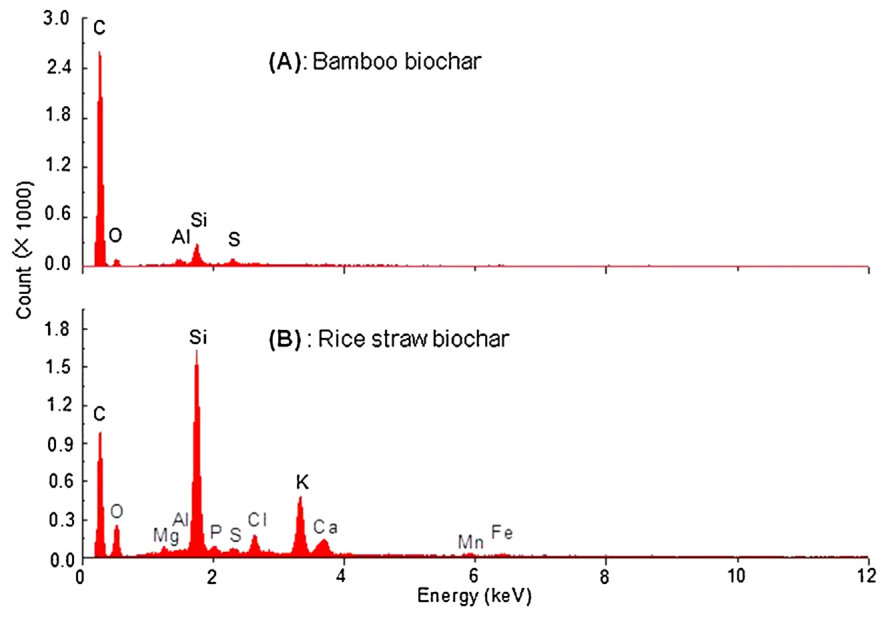
The biochars had high C but low N contents (Table 1). The rice straw biochar had a higher pH value and a higher alkalinity, but lower organic C content and specific surface area than the bamboo biochar (Table 1). The CEC values of bamboo and rice straw biochars were 15 and 45 cmol kg-', respectively, which were 3 and 9 times higher than the soil, respectively. In the present study, the bamboo biochar had a much larger surtace area than the rice straw biochar, indicating that feedstock and pyrolysis temperature can greatly influence biochar surface area. Park et al. (2011) reported that the surface area of chicken manure and green waste biochar produced at 550°C was 7.27 and 6.87 m2 g-1, respectively. A biochar with a large surface area and high in acidic functional groups would be expected to be suitable to immobilize cationic heavy metals in soil (Zhang et al., 2013a). The relative P, Si, K, Mg and Ca contents in the rice straw biochar were higher than those in the bamboo biochar
生物炭C含量高而N含量低(表1)。与竹炭相比,稻草炭的pH值和碱度较高,但有机C含量和比表面积较低(表1)。竹炭和稻草炭的CEC值分别为15和45 cmol kg-',分别为土壤的3倍和9倍。本研究中,竹炭的比表面积远大于稻草炭,表明原料和热解温度可对生物炭比表面积产生很大影响。Park et al.(2011)报道,550°C下制备的鸡粪和园林绿化废弃物生物炭比表面积分别为7.27和6.87 m2 g-1。具有较大比表面积和丰富酸性官能团的生物炭,预期适用于固定土壤中的阳离子型重金属(Zhang et al., 2013a)。稻草炭中P、Si、K、Mg和Ca的相对含量高于竹炭
3.2. Influence of biochar on soil EC and pH3.2. 生物炭对土壤EC和pH的影响
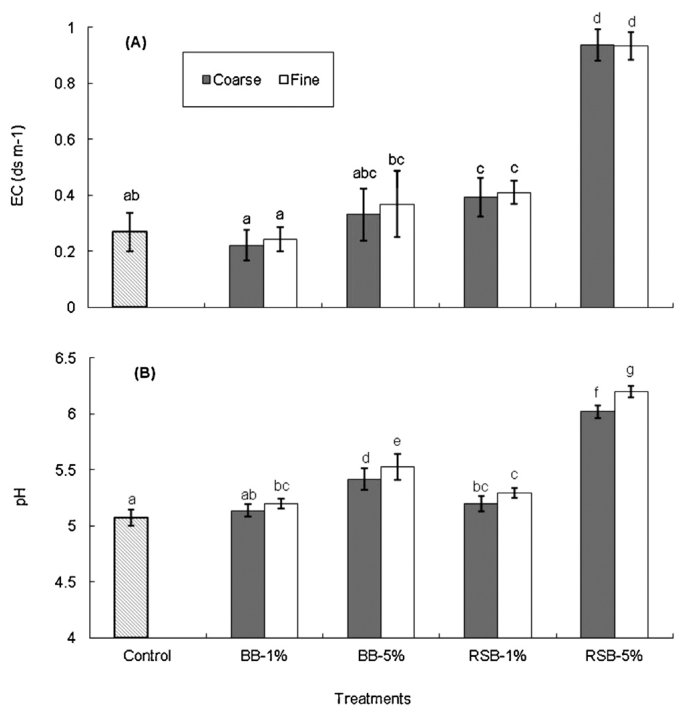
Application of rice straw biochar significantly increased soil electrical conductivity (EC) (Fig. 2A). Compared to the control, the 5% rice straw biochar treatments increased the EC by 350%. The results were consistent with Fellet et al. (2011) who found that mine tailing EC increased significantly with the addition of prune residues-derived biochar. However, there was no significant difference between bamboo biochar treatments and the control. This was expected given the relatively low EC value of the bamboo biochar (Table 1). Although the application of rice straw biochar increased the soil EC by 2-3 folds, the resulting EC was still low and would not lead to saline conditions (Arshad and Coen, 1992). The biochar size fraction had no significant influence on soil EC. The effect of an increase in soil EC on the uptake of heavy metals by plants depends on dominant ionic interactions in soil solution. Soil pH increased significantly (p<0.05) with biochar application, the highest soil pH corresponding to the 5% fine rice straw biochar treatment (Fig. 2B). The rice straw biochar was more effective than the bamboo biochar in increasing soil pH, as the former had a higher alkalinity than the latter (Table 1). Overall, fine biochars were more effective in increasing soil pH than soil EC, especially at the high rate (5%), which is in agreement with some previous studies (Liang et al., 2006; Uchimiya et al., 2010b). An increase in soil pH would promote heavy metal adsorption and precipitation, thereby reducing their bioavailability (Zhang et al., 2013a). This could have led to the reduction in plant shoot concentrations of Cd, Cu, Pb and Zn, as observed in the current study.
施用稻草炭显著提高了土壤电导率(EC)(图2A)。与对照相比,5%稻草炭处理使EC提高了350%。该结果与Fellet et al.(2011)的研究一致,其发现添加李子残渣来源的生物炭可显著提高尾矿EC。然而,竹炭处理与对照之间无显著差异。鉴于竹炭的EC值相对较低(表1),这一结果在预期之中。虽然施用稻草炭使土壤EC提高了2-3倍,但所得EC值仍较低,不会导致盐渍化(Arshad and Coen, 1992)。生物炭粒径对土壤EC无显著影响。土壤EC升高对植物吸收重金属的影响取决于土壤溶液中占主导地位的离子相互作用。施用生物炭后土壤pH显著升高(p<0.05),其中5%细粒径稻草炭处理的土壤pH最高(图2B)。由于稻草炭的碱度高于竹炭(表1),其提高土壤pH的效果也优于竹炭。总体而言,细粒径生物炭提高土壤pH的效果比提高土壤EC的效果更明显,尤其是在高施用量(5%)下,这与以往一些研究结果一致(Liang et al., 2006; Uchimiya et al., 2010b)。土壤pH升高会促进重金属的吸附和沉淀,从而降低其生物有效性(Zhang et al., 2013a)。这可能是本研究中观察到的植物地上部Cd、Cu、Pb和Zn浓度降低的原因。
The increased pH after biochar addition can result in the precipitation of Cd as CdCO3 (Mousavi et al., 2010), Cu as Cu(OH)2 and Pb as Pbs(PO4)3·· (Cao et al., 2011). In addition, metal adsorption to biochar could be one of the mechanisms by which metals are immobilized (Beesley and Marmiroli, 2011).
施用生物炭后pH升高,可导致Cd以CdCO3形式沉淀(Mousavi et al., 2010),Cu以Cu(OH)2形式沉淀,Pb以Pbs(PO4)3··形式沉淀(Cao et al., 2011)。此外,金属在生物炭上的吸附可能是金属被固定的机制之一(Beesley and Marmiroli, 2011)。
3.3. Effects of biochar treatments on shoot yield of S. plumbizincicola
3.3. 生物炭处理对S. plumbizincicola地上部产量的影响
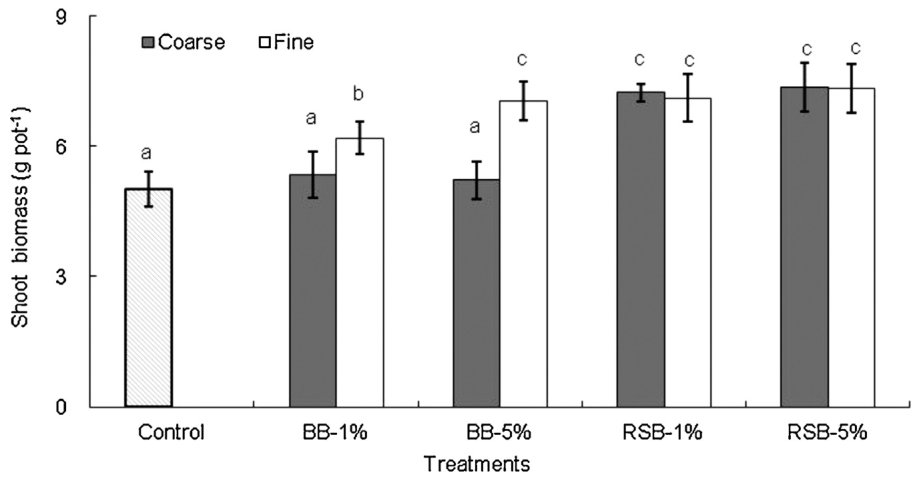
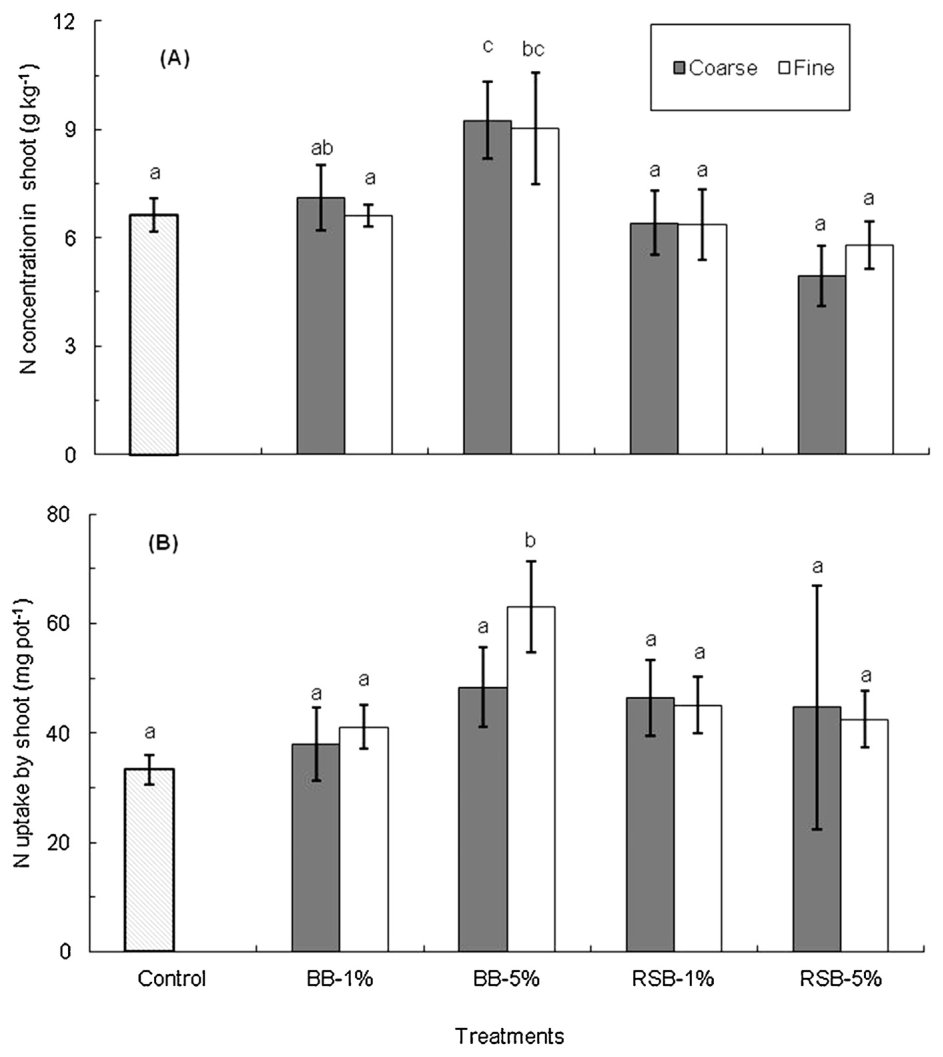
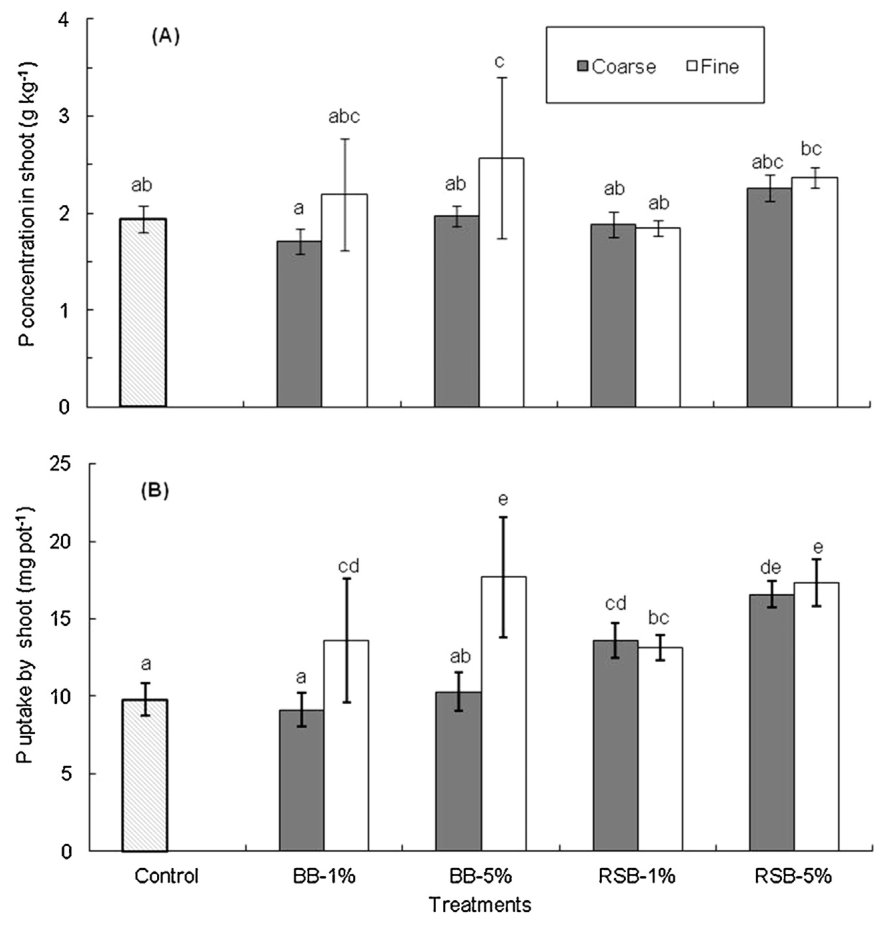
The shoot dry weight of S. plumbizincicola was significantly bamboo biochar treatments (Fig. 3). The rice straw biochar treatments produced the highest dry weight of shoot, which was 43% higher than in the control treatment. There was no significant difference in dry weight between different mesh sizes of biochars or loading rates within the rice straw biochar treatments (Fig. 3). The shoot N concentration in the 5% bamboo biochar treatments (Fig. 4A) and the total shoot N uptake in the 5% fine bamboo biochar treatment (Fig. 4B) were significantly (p<0.05) higher than in the uptake by the S. plumbizincicola shoots (Fig. 4). It is unlikely that the higher N uptake in the 5% fine bamboo biochar treatment would be from the additional N supply from the biochar, because N in biochars produced at a temperature higher than 500°C would not be bioavailable (Wanget al., 2012; Zheng et al., 2013). Enhancement of the shoot N uptake in the 5% fine bamboo biochar treatment may be due to increased efficiency in plant use of soil N in the presence of biochar application (Zheng et al., 2013). Although the biochar treatments, except the 5% fine bamboo biochar treatment, had no significant effect on the plant shoot P concentration (Fig. 5A), all biochar treatments, except the coarse bamboo biochar treatments, significantly increased the total shoot P uptake (Fig. 5B). Relatively higher P concentration in the rice straw biochar (Fig. 1) may have contributed to the increased shoot P uptake in the rice straw biochar treatments. Regression analysis showed that there was no significant relationship between the S. plumbizincicola shoot yield and the N uptake (R = 0.339), whereas the shoot yield was significantly (p<0.01) correlated with P uptake by the shoots (R2 = 0.719) (Fig. 5B). This was in agreement with Huang et al. (2012) who found that P fertilizer treatments resulted in greater growth rates and extraction of Zn by Sedum alfredii, a hyper-accumulator plant similar to S. plumbizincicola. These hyper-accumulating plants may have a higher P demand than other non-accumulating plants. The P applied with the basal fertilizer in the current study might have been insufficient to meet the P requirement for optimal growth of S. plumbizincicola. Furthermore, the relatively high concentration of the heavy metals, particularly Zn, in the soil (Table 1) may also have contributed to reduced P availability through precipitation (Loneragan et al., 1979; Bolan et al., 2003b).
S. plumbizincicola地上部干重显著 竹炭处理(图3)。稻草炭处理的地上部干重最高,比对照处理高43%。稻草炭处理中,不同粒径和施用量之间干重无显著差异(图3)。5%竹炭处理的地上部N浓度(图4A)和5%细粒径竹炭处理的地上部总N吸收量(图4B)显著(p<0.05)高于 S. plumbizincicola地上部的吸收(图4)。5%细粒径竹炭处理中较高的N吸收量不太可能来自生物炭额外供给的N,因为在高于500°C温度下制备的生物炭中的N不具有生物有效性(Wanget al., 2012; Zheng et al., 2013)。5%细粒径竹炭处理中地上部N吸收量的提高,可能是由于施用生物炭提高了植物对土壤N的利用效率(Zheng et al., 2013)。虽然除5%细粒径竹炭处理外,生物炭处理对植物地上部P浓度无显著影响(图5A),但除粗粒径竹炭处理外,所有生物炭处理均显著提高了地上部总P吸收量(图5B)。稻草炭中相对较高的P含量(图1)可能促进了稻草炭处理中地上部P吸收量的增加。回归分析表明,S. plumbizincicola地上部产量与N吸收量之间无显著相关关系(R = 0.339),而地上部产量与地上部P吸收量显著相关(p<0.01)(R2 = 0.719)(图5B)。这与Huang et al.(2012)的研究一致,其发现施用P肥可提高东南景天(Sedum alfredii,一种与S. plumbizincicola相似的超富集植物)的生长速率和Zn提取量。这类超富集植物对P的需求可能高于其他非富集植物。本研究中基肥所施P可能不足以满足S. plumbizincicola最佳生长所需的P。此外,土壤中较高浓度的重金属,尤其是Zn(表1),也可能通过沉淀作用降低了P的有效性(Loneragan et al., 1979; Bolan et al., 2003b)。
(p<0.05) increased in all biochar treatments except in the coarse
(p<0.05)增加,但粗粒径
control. All other biochar treatments had no significant effect on N
对照。其他生物炭处理对N
Most biochars have been shown to have a liming value when help raise soil pH, as shown in the current study (Fi 2B).
大多数生物炭在 有助于提高土壤pH,如本研究所示(图2B)。
applied to acidic soils (Beesley and Marmiroli, 2011) that would
施用于酸性土壤时已被证明具有石灰效应(Beesley and Marmiroli, 2011),
The increased soil pH would contribute to an increase in the productivity of crops such as maize, soybean, radish upon biochar addition to an acidic soil (Lehmann et al., 2003; Chan et al., 2008). Recent studies have shown that the addition of biochar to contaminated soils reduces metal toxicity to plants, resulting in decreased metal uptake and increased growth (Park et al., 2011;
向酸性土壤添加生物炭后,土壤pH升高将有助于提高玉米、大豆、萝卜等作物的生产力(Lehmann et al., 2003; Chan et al., 2008)。近期研究表明,向污染土壤添加生物炭可降低金属对植物的毒性,从而减少金属吸收并促进生长(Park et al., 2011;
Zhang et al., 2013b). Previous work reported that biochar derived in a Pb contaminated military shooting range soil. Biochar is able to bioavailability; however, some essential plant nutrients may also be immobilized through this mechanism, thereby reducing plant gent wetland species Juncus subsecundus in a Cd-contaminated soil.
Zhang et al., 2013b)。已有研究报道,来源于 在受Pb污染的军事射击场土壤中。生物炭能够 生物有效性;然而,一些植物必需营养元素也可能通过该机制被固定,从而降低植物 挺水湿地植物Juncus subsecundus在Cd污染土壤中的生长。
from forest green waste significantly increased the young quinoa
森林园林废弃物的生物炭显著促进了藜麦幼苗
(Chenopodium quinoa) growth in a Cu-contaminated soil (Buss et al.,
(Chenopodium quinoa)在Cu污染土壤中的生长(Buss et al.,
2012). In addition, oak wood-derived biochar increased lettuce
2012)。此外,橡木来源的生物炭使生菜
(Lactuca sativa) seed germination by 360% and root length by 189%
(Lactuca sativa)种子发芽率提高了360%,根长增加了189%
complex metal ions on the surfaces and therefore reduces the metal
在其表面络合金属离子,从而降低金属的
growth (Beesley et al., 2011). Zhang et al. (2013b) reported that
生长(Beesley et al., 2011)。Zhang et al.(2013b)报道,
wheat chaff-derived biochar did not improve the growth of emer-
小麦糠壳来源的生物炭未能促进挺
In our study, both the bamboo biochar (fine) and rice straw biochar significantly (p <0.05) increased the shoot dry weight of S. plumbizincicola (Fig. 3), which may be attributed to reduced metal toxicity through improvement of soil pH (Fig. 2B) and increased P availability (Fig. 5B).
本研究中,竹炭(细粒径)和稻草炭均显著(p <0.05)提高了S. plumbizincicola的地上部干重(图3),这可能归因于土壤pH改善(图2B)和P有效性提高(图5B)所导致的金属毒性降低。
3.4. Effects of biochar treatments on heavy metal solubility in soil3.4. 生物炭处理对土壤重金属溶解度的影响
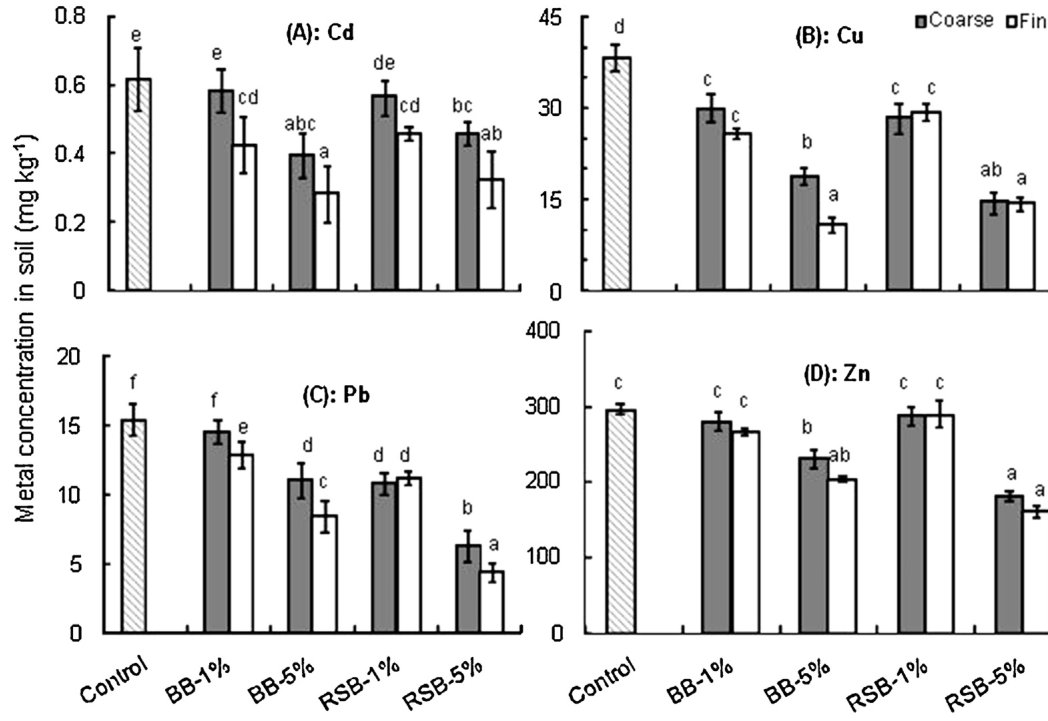
Concentrations of TCLP-extractable Cd, Cu, Pb and Zn in soil decreased significantly (p<0.05) with increasing rates of biochar application (Fig. 6). The 5% biochar treatment had the greatest decrease in extractable Cd (Fig. 6A) and Cu (Fig. 6B). Application of biochar also significantly (p <0.05) reduced the concentration of extractable Pb (Fig. 6C), and the fine biochar was more effective than the coarse biochars. The concentration of extractable Pb in soils amended with fine and coarse rice straw biochar at a dose of 5% was 4.4 and 6.3 mg kg-, respectively, whereas those in soils amended with bamboo biochar at the same dose were 8.5 and 11 mg kg-'. Rice straw biochar applications were more effective than those of bamboo biochar in reducing the concentration of soil extractable Pb. The concentration of extractable Zn significantly (p <0.05) decreased when both biochar types were applied at a 5% application rate, with the largest decrease being observed in rice straw biochar treatment. No significant effect was observed at the low dose of biochar application (Fig. 6D).
随着生物炭施用量的增加,土壤中TCLP可提取态Cd、Cu、Pb和Zn浓度显著降低(p<0.05)(图6)。5%生物炭处理的可提取态Cd(图6A)和Cu(图6B)降幅最大。施用生物炭也显著(p <0.05)降低了可提取态Pb浓度(图6C),且细粒径生物炭的效果优于粗粒径生物炭。5%施用量下,添加细、粗粒径稻草炭的土壤中可提取态Pb浓度分别为4.4和6.3 mg kg-,而同一施用量下添加竹炭的土壤中分别为8.5和11 mg kg-'。在降低土壤可提取态Pb浓度方面,施用稻草炭比施用竹炭更为有效。两种生物炭以5%施用量施用时,可提取态Zn浓度均显著(p <0.05)降低,其中稻草炭处理降幅最大。低施用量生物炭未观察到显著效应(图6D)。
Méndez et al. (2012) observed that biochar derived from sewage sludge significantly decreased the DTPA- and CaCI2-extractable
Méndez et al.(2012)观察到,污泥来源的生物炭显著降低了地中海农业土壤中DTPA和CaCI2可提取态
Cd, Pb and Zn in a Mediterranean agricultural soil. Similarly, Beesley et al. (2010) reported that a hardwood-derived biochar amendment (8.3%, w/w) significantly reduced water-extractable Cd concentration in soil. Fellet et al. (2011) reported that the biochar
Cd、Pb和Zn含量。同样,Beesley et al.(2010)报道,硬木来源的生物炭改良(8.3%,w/w)显著降低了土壤中水溶性Cd浓度。Fellet et al.(2011)报道,生物炭
application at a rate of 10% resulted in a significant decrease in
以10%施用量施用可显著降低
DTPA-extractable Cu bioavailability in the mine tailings. Cao et al. (2011) showed that dairy manure biochar could immobilize Pb in soil via both adsorption and precipitation, thereby leading to the transformation from less stable Pb species to more stable hydroxpyromorphite. This significantly reduced the TCLP-extractable Pb, and the reduction increased with the increasing biochar rates. Previous studies supported this finding, suggesting that the relatively high efficiencies of biochar in immobilizing Pb may be resulted from the precipitation of Pb-hydroxide and Pb-phosphate (Ok et al.
尾矿中DTPA可提取态Cu的生物有效性。Cao et al.(2011)表明,牛粪生物炭可通过吸附和沉淀作用固定土壤中的Pb,使其由较不稳定的Pb形态转化为更稳定的羟基磷铅矿。这显著降低了TCLP可提取态Pb,且降幅随生物炭施用量的增加而增大。以往研究支持这一发现,认为生物炭固定Pb的效率较高可能源于Pb-氢氧化物和Pb-磷酸盐的沉淀(Ok et al.
2010; Ahmad et al., 2012). In a recent study, Li et al. (2012) found that the addition of Si (in the form of Na2Si03.9H20) significantly soil. This reduced soil Pb availability and the corresponding Pb uptake by banana plants. In our study, rice straw biochar had a higher pH, alkalinity, Si and P concentrations than bamboo biochar (Table 1 and Fig. 1); this may explain the greater reduction in Pb solubility with the application of former biochar (Fig. 6C). The present results indicated that the effect of biochar on metal immobilization in soil may be influenced by the feedstock materials, pyrolysis conditions, and application rates, whereas the particle size (0.5-1 mm)
2010; Ahmad et al., 2012)。在最近的一项研究中,Li et al.(2012)发现,添加Si(以Na2Si03.9H20形式)显著 土壤。这降低了土壤Pb有效性以及香蕉植株相应的Pb吸收量。本研究中,稻草炭的pH、碱度、Si和P含量均高于竹炭(表1和图1),这可能解释了施用前者时Pb溶解度降幅更大的原因(图6C)。本研究结果表明,生物炭对土壤金属固定的效果可能受原料、热解条件和施用量的影响,而粒径(0.5-1 mm)
decreased the fraction of exchangeable Pb in a Pb-contaminated
降低了Pb污染土壤中交换态Pb的比例
Treatment处理
had a minor effect. Since most biochars have a large surface area, micro-porous structure, high pH and some soluble salts, they can potentially reduce the solubility of heavy metals in soils through adsorption and precipitation (Chan and Xu, 2009; Yuan et al., 2011;
影响较小。由于大多数生物炭具有较大的比表面积、微孔结构、较高的pH及一些可溶性盐,它们可能通过吸附和沉淀作用降低土壤中重金属的溶解度(Chan and Xu, 2009; Yuan et al., 2011;
Zhang et al·, 2013a).
Zhang et al·, 2013a)。
3.5. Effect of biochar on plant uptake of heavy metals3.5. 生物炭对植物吸收重金属的影响
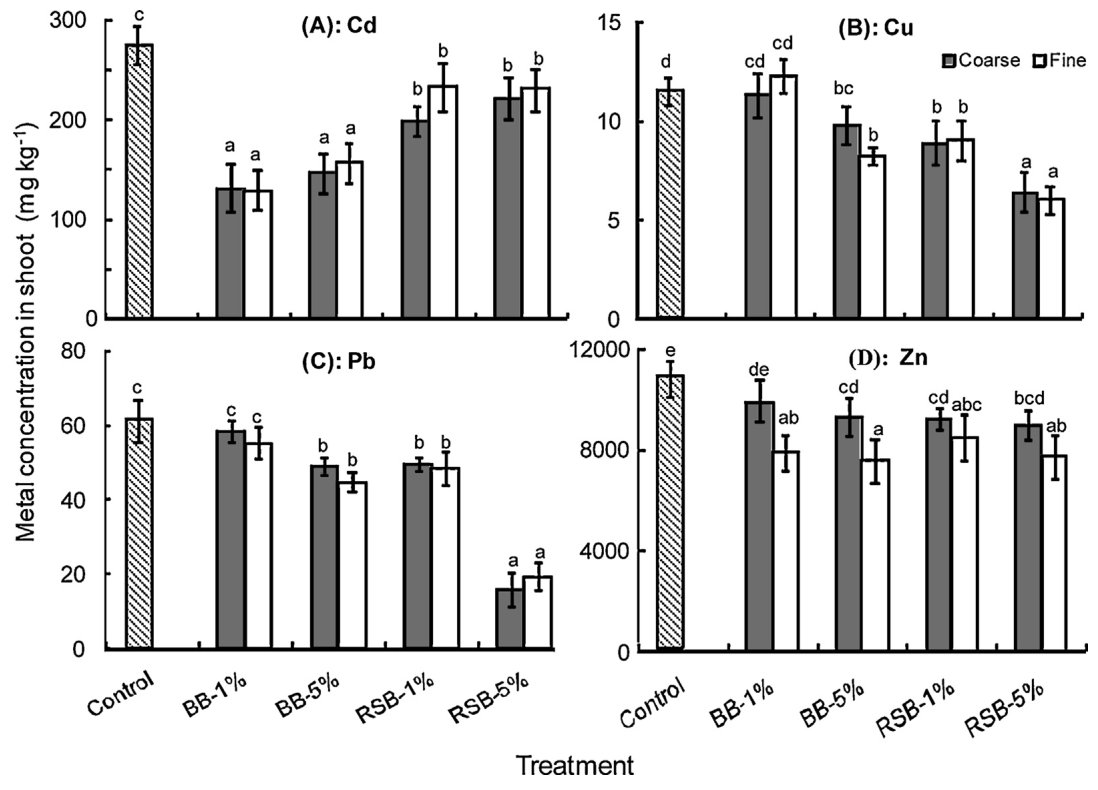
The type of biochar source material and grain size had a significant effect on the uptake of Cd, Cu, Pb and Zn by S. plumbizincicola (Fig. 7). The concentration of Cd in shoots significantly (p<0.05)
生物炭原料类型和粒径对S. plumbizincicola吸收Cd、Cu、Pb和Zn具有显著影响(图7)。地上部Cd浓度显著(p<0.05)
decreased with both bamboo and rice straw biochar application was no significant change in Cd concentration with increasing a greater decrease of Cu and Pb concentration in the shoot than that whereas fine biochars were generally more effective on reducing effective in reducing Zn concentrations in rice shoots than coarse biochar. This was attributed to a larger specific surface area of the at an application rate of 5% significantly (p<0.05) reduced the Cd whereas the rice straw biochar was more effective in reducing Cu and Pb uptake by the plant (Fig. 7B, C). The bamboo biochar may have a greater adsorption capacity because it had a much greater surface area than that of the rice straw biochar (Table 1). This sughave reduced its availability for plant uptake (Fig. 7A), some of the adsorbed Cd seemed to be extractable by the TCLP-solution (Fig. 6A). Although this may be attributed to formation of dissolved organic matter and Cd complexes, the associated mechanism is yet to be explored.
随竹炭和稻草炭的施用而降低 随施用量增加Cd浓度无显著变化 地上部Cu和Pb浓度的降幅大于 而细粒径生物炭通常更有效地降低 在降低水稻地上部Zn浓度方面比粗粒径生物炭更有效。这归因于 比表面积更大 在5%施用量下显著(p<0.05)降低了Cd 而稻草炭在降低植物对Cu和Pb的吸收方面更为有效(图7B、C)。由于竹炭的比表面积远大于稻草炭(表1),其吸附能力可能更强。这表 降低了其对植物的有效性(图7A),但部分被吸附的Cd似乎可被TCLP溶液提取(图6A)。虽然这可能归因于溶解性有机质与Cd络合物的形成,但相关机制尚待探究。
(Fig. 7A) by up to 49% and 20%, respectively. However, there
(图7A),降幅分别达49%和20%。然而,
biochar application rates (Fig. 7A). Addition of biochars significantly
生物炭施用量的增加(图7A)。添加生物炭显著
reduced the plant uptake of Cu (Fig. 7B) and Pb (Fig. 7C) except 1%
降低了植物对Cu(图7B)和Pb(图7C)的吸收,但1%
bamboo biochar treatment. The rice straw biochar additions caused
竹炭处理除外。添加稻草炭导致
of bamboo biochar. The concentrations of Cu and Pb significantly
竹炭。Cu和Pb浓度显著
(p<0.05) decreased with increasing rates of the rice straw biochar.
(p<0.05)随稻草炭施用量的增加而降低。
The 5% rice straw biochar treatment significantly (p<0.05) reduced
5%稻草炭处理显著(p<0.05)降低了
the uptake of Cu and Pb in the shoot from 11.6 to 6.2 mg kg-1 and
地上部对Cu和Pb的吸收,分别由11.6降至6.2 mg kg-1和
from 61 to 18 mg kg-, respectively. There was no significant dif-
由61降至18 mg kg-。5%竹炭与1%
ference in Cu and Pb uptake between 5% bamboo biochar and 1%
稻草炭处理之间Cu和Pb吸收量无显著差
rice straw biochar treatments. Compared to the control, biochar
异。与对照相比,添加生物炭
addition significantly (p< 0.05) reduced the uptake of Zn (Fig. 7D)
显著(p< 0.05)降低了Zn的吸收(图7D)
The particle size of biochar had no significant effect on reduc
生物炭粒径对降低
ing the concentrations of Cd, Cu and Pb in the plant shoots (Fig. 7),
植物地上部Cd、Cu和Pb浓度无显著影响(图7),
the concentration of Zn in the shoots than the coarse biochars
地上部Zn浓度的效果优于粗粒径生物炭
(Fig. 7D). Compared to the control, the coarse and fine biochars
(图7D)。与对照相比,粗、细粒径生物炭
reduced the uptake of Zn by 13% and 27%, respectively. Zheng
分别使Zn吸收量降低13%和27%。Zheng
et al. (2012) also reported that fine biochars were generally more
et al.(2012)也报道,细粒径生物炭通常更
finer biochar (Zheng et al., 2012).
细粒径生物炭(Zheng et al., 2012)。
Zhang et al. (2013b) reported that wheat chaff-derived biochar
Zhang et al.(2013b)报道,小麦糠壳来源的生物炭
concentration ofJ. subsecundus N.A. Wakef. The decrease in Cd concentration in plants in the presence of biochar application may be attributed to both the immobilization of bioavailable metals and
J. subsecundus N.A. Wakef.的浓度。施用生物炭后植物中Cd浓度的降低,可能归因于生物有效态金属的固定和
'dilution effect' due to increased plant biomass (Park et al., 2011). The bamboo biochar appeared to be more effective than the rice straw biochar in reducing Cd uptake by S. plumbizincicola (Fig. 7A),
植物生物量增加所产生的“稀释效应”(Park et al., 2011)。在降低S. plumbizincicola对Cd的吸收方面,竹炭似乎比稻草炭更为有效(图7A),
gests that high adsorption of Cd to biochar-amended soil may be
明生物炭改良土壤对Cd的高吸附可能是
one of the reasons for reducing its bioavailability more than that of Cu and Pb. Although Cd adsorbed by the bamboo biochar may
其生物有效性降幅大于Cu和Pb的原因之一。虽然竹炭吸附的Cd可能
In general, Cu availability in the biochar treatments may be reduced due to sorption, complexation and precipitation (Bolan et al., 2003a; Beesley et al., 2010; Zhang et al., 2013a). Similarly, Zheng et al. (2012) reported that 5% straw biochar additions caused the greatest decrease in Cu and Pb concentrations in rice shoots. Karami et al. (2011) showed that biochar reduced the uptake of Cu and Pb by ryegrass. Park et al. (2011) reported that chicken manure-derived biochar significantly reduced the uptake of Cu and
总体而言,生物炭处理中Cu的有效性可能因吸附、络合和沉淀作用而降低(Bolan et al., 2003a; Beesley et al., 2010; Zhang et al., 2013a)。同样,Zheng et al.(2012)报道,添加5%秸秆生物炭使水稻地上部Cu和Pb浓度降幅最大。Karami et al.(2011)表明,生物炭降低了黑麦草对Cu和Pb的吸收。Park et al.(2011)报道,鸡粪来源的生物炭显著降低了
Pb by Brassica juncea (L.), however, Cu concentration in the shoots was not significantly influenced by the amount of biochar addition.
芥菜(Brassica juncea (L.))对Cu和Pb的吸收,但地上部Cu浓度未受生物炭添加量的显著影响。
In the present study, biochar addition also significantly (p <0.05) decreased the uptake of Zn by S. plumbizincicola, and the results were similar to those reported by Sizmur et al. (2011). The high
本研究中,添加生物炭也显著(p <0.05)降低了S. plumbizincicola对Zn的吸收,结果与Sizmur et al.(2011)的报道相似。稻草炭中较高的
columns indicate significant (p <0.05) difference between treatments.
柱上不同字母表示处理间差异显著(p <0.05)。
Si content in the rice straw biochar (Fig. 1) may also play a role
Si含量(图1)也可能在
in reducing the plant uptake of heavy metals. It was reported that
降低植物对重金属的吸收方面发挥作用。据报道,
application of Si-rich amendment (e.g., Na2SiO3.9H20) can reduce
施用富Si改良剂(如Na2SiO3.9H20)可降低
heavy metal concentration in plant shoots due to reduced metal
植物地上部重金属浓度,原因在于土壤中金属
availability in soil (Li et al., 2012), and reduction in the uptake and transport of metals from root to shoot (Gu et al., 2012; Wu et al.,
有效性降低(Li et al., 2012),以及金属吸收和由根向地上部转运的减少(Gu et al., 2012; Wu et al.,
2013). Significant reductions in the concentration of Cd, Cu, Pb and
2013)。本研究中添加生物炭后地上部Cd、Cu、Pb和
Zn in the shoot with biochar addition in the current study could be
Zn浓度的显著降低,可
attributed to (i) precipitation or co-precipitation of the metals due
归因于:(i)土壤pH升高以及磷酸盐和硅酸盐的引入
to increased soil pH and introduction of phosphate and silicate salts (Ahmad et al., 2012), and (ii) adsorption of metals to biochar (Elliott
导致金属沉淀或共沉淀(Ahmad et al., 2012);(ii)金属在生物炭上的吸附(Elliott
et al., 1986; Namgay et al., 2010). In the rice straw biochar treat-
et al., 1986; Namgay et al., 2010)。在稻草炭处
ments, high Si content may have helped to reduce metal uptake in
理中,高Si含量可能有助于降低
S. plumbizincicola shoot (Wu et al., 2013).
S. plumbizincicola地上部对金属的吸收(Wu et al., 2013)。
only with the feedstock and application rate of biochars, and was metal-dependent. Therefore, biochar should be carefully designed to maximize the reduction of the bioavailability of a given heavy metal in a soil. Furthermore, the effectiveness of a biochar in
不仅随生物炭原料和施用量而变化,而且因金属而异。因此,应对生物炭进行精心设计,以最大限度地降低土壤中特定重金属的生物有效性。此外,生物炭在
remediation of contaminated soils should be tested under field conditions.
污染土壤修复中的有效性应在田间条件下进行检验。
Acknowledgments致谢
This study was funded by the National Natural Science Foundation of China (41271337), Zhejiang A & F University Research and Development Fund (2010FR097 and 2012FK031), Zhejiang Provincial Natural Science Foundation (No. LY12C16004), and the Science and Technology Foundation of the Guizhou Province, China (Grant No. [2013|2193).
本研究由国家自然科学基金(41271337)、浙江农林大学科研发展基金(2010FR097和2012FK031)、浙江省自然科学基金(No. LY12C16004)以及中国贵州省科学技术基金(Grant No. [2013|2193)资助。
4Conclusions结论
References参考文献
Addition of bamboo and rice straw biochars has potential for in situ remediation by immobilizing metals, thereby reducing the uptake of Cd, Cu, Pb and Zn by S. plumbizincicola grown in a severely polluted soil. Enhanced soil pH in the biochar treatments may have contributed to the decreasing metal toxicity, thereby increasing S.
plumbizincicola plant growth. Rice straw biochar was more effective
in the reduction of Cu and Pb concentrations in shoots, while bam-
boo biochar was more effective in the reduction of Cd. Fine biochars
were generally more effective in reducing In concentrations in
shoots than coarse biochars, but not Cd, Cu and Pb concentrations.
Biochar application decreased concentrations of TCLP-extractable
Cd, Cu, Pb and Zn in soil as well as in the S. plumbizincicola shoots.
Enhanced precipitation or co-precipitation and adsorption of the heavy metals in the biochar treatments would have contributed to the reduction of the solubility and bioavailability of the metals.
The influence of biochar on heavy metal bioavailability varied not
Ahmad, M., Soo Lee, S., Yang, J.E., Ro, H.M., Han Lee, Y., Sik Ok, Y., 2012. Effects of soil dilution and amendments (mussel shell, cow bone, and biochar) on Pb availability and phytotoxicity in military shooting range soil. Ecotox. Environ. Saf. 79, 225-231.
Arshad, M., Coen, G., 1992. Characterization of soil quality: physical and chemical criteria. Am. J. Altern. Agric. 7, 25-31.
ASTM International, 2007. ASTM D4373-02 (2007) Standard test method for rapid
determination of carbonate content of soils, http://www.astm.org/Standards/ D4373.htm (accessed April 2014).
ASTM International, 2013. ASTM D1762-84 (2013) Standard test method for chemical analysis of wood charcoal, http://www.astm.org/Standards/D1762.htm (accessed April 2014).
Beesley, L., Marmiroli, M., 2011. The immobilisation and retention of soluble arsenic, cadmium and zinc by biochar. Environ. Pollut. 159, 474-480. Beesley, L., Moreno-Jiménez, E., Gomez-Eyles, J.L., 2010. Effects of biochar and greenwaste compost amendments on mobility, bioavailability and toxicity of inorganic and organic contaminants in a multi-element polluted soil. Environ. Pollut. 158, 2282-2287.
Beesley, L., Moreno-Jiménez, E., Gomez-Eyles, J.L., Harris, E., Robinson, B., Sizmur, T., 2011. A review of biochars' potential role in the remediation, revegetation and restoration of contaminated soils. Environ. Pollut. 159, 3269-3282.
Bolan, N.S., Adriano, D.C., Mani, S., Khan, A.R., 2003a. Adsorption, complexation and phytoavailability of copper as influenced by organic manure. Environ. Toxicol. Chem. 22, 450-456.
Bolan, N.S., Adriano, D.C., Naidu, R., 2003b. Role of phosphorus in (im)mobilization and bioavailability of heavy metals in the soil-plant system. Rev. Environ. Contam. Toxicol. 177, 1-44. Bolan, N., Kunhikrishnan, A., Thangarajan, R., Kumpiene, J., Park, J., Makino, T., Kirkham, M.B., Scheckel, K., 2014. Remediation of heavy metal(loid)s contaminated soils - to mobilize or to immobilize? J. Hazard. Mater. 266, 141-166. Buss, W., Kammann, C., Koyro, H.W., 2012. Biochar reduces copper toxicity in chenopodium quinoa willd. In a sandy soil. J. Environ. Qual. 41, 1157-1165. Cao, X., Ma, L., Liang, Y., Gao, B., Harris, W., 2011. Simultaneous immobilization of lead and atrazine in contaminated soils using dairy-manure biochar. Environ. Sci. Technol. 45, 4884-4889. Chan, K.Y., Xu, Z., 2009. Biochar: nutrient properties and their enhancement. In: Lehmann, J., Joseph, S. (Eds.), Biochar for Environmental Management: Science and Technology. Earthscan, London, pp. 67-84. Chan, K., Van Zwieten, L., Meszaros, I., Downie, A., Joseph, S., 2008. Agronomic values of greenwaste biochar as a soil amendment. Aust. J. Soil Res. 45, 629-634. Chen, X., Chen, G., Chen, L., Chen, Y., Lehmann, J., McBride, M.B., Hay, A.G., 2011. Adsorption of copper and zinc by biochars produced from pyrolysis of hardwood and corn straw in aqueous solution. Bioresour. Technol. 102, 8877-8884. Dong, D., Yang, M., Wang, C., Wang, H., Li, Y., Luo, J., Wu, W., 2013. Responses of methane emissions and rice yield to applications of biochar and straw in a paddy field. J. Soils Sediments 8, 1450-1460. Elliott, H., Liberati, M., Huang, C., 1986. Competitive adsorption of heavy metals by soils. J. Environ. Qual. 15, 214-219. Fellet, G., Marchiol, L., Delle Vedove, G., Peressotti, A., 2011. Application of biochar on mine tailings: effects and perspectives for land reclamation. Chemosphere 83, 1262-1267.
Gong, Z.T., 1999. Chinese Soil Taxonomy: Theory Approaches and Application. China Science Press, Beijing (in Chinese). Gu, H.-H., Zhan, S.-S., Wang, S.-Z., Tang, Y.-T., Chaney, R.L., Fang, X.-H., Cai, X.-D., Qiu, R.-L., 2012. Silicon-mediated amelioration of zinc toxicity in rice (Oryza sativa L.) seedlings. Plant Soil 350, 193-204. Hu, N., Luo, Y., Wu, L., Song, J., 2007. A field lysimeter study of heavy metal movement down the profile of soils with multiple metal pollution during chelate-enhanced phytoremediation. Int. J. Phytoremediation 9, 257-268. Huang, H., Li, T., Gupta, D., He, Z., Yang, X.-E., Ni, B., Li, M., 2012. Heavy metal phytoextraction by Sedum alfredii is affected by continual clipping and phosphorus fertilization amendment. J. Environ. Sci. 24, 376-386. IBI, Available at http://www.biochar-international.org/characterizationstandard (accessed 9 February) 2013. The International Biochar Initiative (IBI) Standardized product definition and product testing guidelines for biochar that is used in soil standards. Jeffery, S., Verheijen, F.G.A., van der Velde, M., Bastos, A.C., 2011. A quantitative review of the effects of biochar application to soils on crop productivity using meta-analysis. Agric. Ecosyst. Environ. 144, 175-187. Jiang, J., Xu, R.-K., Jiang, T.-Y., Li, Z., 2012. Immobilization of Cu(II), Pb(II) and Cd(II) by the addition of rice straw derived biochar to a simulated polluted Ultisol. J. Hazard. Mater. 229-230, 145-150. Karami, N., Clemente, R., Moreno-Jiménez, E., Lepp, N.W., Beesley, L., 2011. Efficiency of green waste compost and biochar soil amendments for reducing lead and copper mobility and uptake to ryegrass. J. Hazard. Mater. 191, 41-48. Kookana, R.S., Sarmah, A.K., Van Zwieten, L., Krull, E., Singh, B., 2011. Chapter three - biochar application to soil: agronomic and environmental benefits and unintended consequences. In: Donald, L.S. (Ed.), Advances in Agronomy. Academic Press, San Diego, pp. 103-143. Lehmann, J., 2007. Bio-energy in the black. Front. Ecol. Environ. 5, 381-387. Lehmann, J., Pereira da Silva, J., Steiner, C., Nehls, T., Zech, W., Glaser, B., 2003. Nutrient availability and leaching in an archaeological Anthrosol and a Ferralsol of the Central Amazon basin: fertilizer, manure and charcoal amendments. Plant Li, L., Zheng, C., Fu, Y., Wu, D., Yang, X., Shen, H., 2012. Silicate-mediated alleviation of Pb toxicity in banana grown in Pb-contaminated soil. Biol. Trace Elem. Res. Liang, B., Lehmann, J., Solomon, D., Kinyangi, J., Grossman, J., O'Neill, B., Skjemstad, J., Thies, J., Luizao, F., Petersen, J., 2006. Black carbon increases cation exchange capacity in soils. Soil Sci. Soc. Am. J. 70, 1719-1730. Liu, L., Wu, L., Luo, Y., Zhang, C., Jiang, Y., Qiu, X., 2010. The impact of a copper smelter on adjacent soil zinc and cadmium fractions and soil organic carbon. J. Soils Sediments 10, 808-817. Liu, Y., Yang, M., Wu, Y., Wang, H., Chen, Y., Wu, W., 2011. Reducing CH4 and CO2 emissions from waterlogged paddy soil with biochar. J. Soils Sediments 11, Loneragan, J.F., Grove, T.S., Robson, A.D., Snowball, K., 1979. Phosphorus toxicity as a tactor in zinc-phosphorus interactions in plants. Soil Sci. Soc. Am. J. 43, 966-972.
Lu, R.K., 1999. Analytical Methods for Soil Agrochemistry. Chinese Agricultural Science and Technology Publishing House, Beijing (in Chinese). Lu, H., Zhang, W., Yang, Y., Huang, X., Wang, S., Qiu, R., 2012. Relative distribution of Pb'+ sorption mechanisms by sludge-derived biochar. Water Res. 46, 854-862. Méndez, A., Gómez, A., Paz-Ferreiro, J., Gascó, G., 2012. Effects of sewage sludge biochar on plant metal availability after application to a Mediterranean soil. Chemosphere 89, 1354-1359.
Matovic, D., 2011. Biochar as a viable carbon sequestration option: global and Canadian perspective. Energy 36, 1839-2314. Mousavi, Z.H., Hosseinifar, A., Jahed, V., 2010. Removal of Cu (II) from wastewater by waste tire rubber ash. J. Serb. Chem. Soc. 75, 845-853. Namgay, T., Singh, B., Singh, B.P., 2010. Influence of biochar application to soil on the availability of As, Cd, Cu, Pb, and Zn to maize (Zea mays L.). Aust. J. Soil Res. 48, 638-647.
Ok, Y.S., Oh, S.-E., Ahmad, M., Hyun, S., Kim, K.-R., Moon, D.H., Lee, S.S., Lim, K.J., Jeon, W.-T., Yang, J.E., 2010. Effects of natural and calcined oyster shells on Cd and Pb immobilization in contaminated soils. Environ. Earth Sci. 61, 1301-1308. Park, J.H., Choppala, G.K., Bolan, N.S., Chung, J.W., Chuasavathi, T., 2011. Biochar reduces the bioavailability and phytotoxicity of heavy metals. Plant Soil 348, 439-451. Sizmur, T., Wingate, J., Hutchings, T., Hodson, M.E., 2011. Lumbricus terrestris L. does not impact on the remediation efficiency of compost and biochar amendments. Pedobiologia 54 (Suppl.), S211-S216.
Uchimiya, M., Lima, I.M., Klasson, K.T., Wartelle, L.H., 2010a. Contaminant immobilization and nutrient release by biochar soil amendment: roles of natural organic matter. Chemosphere 80, 935-940.
Uchimiya, M., Lima, I.M., Thomas Klasson, K., Chang, S., Wartelle, L.H., Rodgers, J.E., 2010b. Immobilization of heavy metal ions (Cull, Cdll, Nill, and PbI) by broiler litter-derived biochars in water and soil. J. Agric. Food Chem. 58, 5538-5544. Uchimiya, M., Bannon, D.I., Wartelle, L.H., 2012. Retention of heavy metals by carboxyl functional groups of biochars in small arms range soil. J. Agric. Food Chem. 60, 1798-1809.
USEPA, 1992. EPA Method 1311. TCLP-toxicity characteristic leaching procedure. In: Test Methods for Evaluating Solid Waste, 3rd ed. Environmental Protection Agency, Washington, DC. Vangronsveld, J., Herzig, R., Weyens, N., Boulet, J., Adriaensen, K., Ruttens, A., Thewys, T., Vassilev, A., Meers, E., Nehnevajova, E., 2009. Phytoremediation of contaminated soils and groundwater: lessons from the field. Environ. Sci. Pollut. Res. 16, 765-794. Wang, H., Lin, K., Hou, Z., Richardson, B., Gan, J., 2010. Sorption of the herbicide terbuthylazine in two New Zealand forest soils amended with biosolids and biochars. J. Soils Sediments 10, 283-289.
Wang, T., Camps Arbestain, M., Hedley, M., Bishop, P., 2012. Chemical and bioassay characterisation of nitrogen availability in biochar produced from dairy manure and biosolids. Org. Geochem. 51, 45-54. Wu, W., Yang, M., Feng, Q., McGrouther, K., Wang, H., Lu, H., Chen, Y., 2012. Chemical characterization of rice straw-derived biochar for soil amendment. Biomass Bioenerg. 47, 268-276.
Wu, J.-W., Shi, Y., Zhu, Y.-X., Wang, Y.-C., Gong, H.-J. 2013. Mechanisms of enhanced heavy metal tolerance in plants by silicon: a review. Pedosphere 23, 815-825. Xu, X., Cao, X., Zhao, L., Wang, H., Yu, H., Gao, B., 2013. Removal of Cu, Zn, and Cd from aqueous solutions by the dairy manure-derived biochar. Environ. Sci. Pollut. R. 20, 358-368. Yuan, J.H., Xu, R.K., 2011. The amelioration effects of low temperature biochar generated from nine crop residues on an acidic Ultisol. Soil Use Manage. 27, 110-115. Yuan, J.-H., Xu, R.-K., Zhang, H., 2011. The forms of alkalis in the biochar produced from crop residues at different temperatures. Bioresour. Technol. 102, 3488-3497.
Zarcinas, B., Cartwright, B., Spouncer, L., 1987. Nitric acid digestion and multi-element analysis of plant material by inductively coupled plasma spectrometry. Commun. Soil Sci. Plan 18, 131-146. Zhang, H., Lin, K., Wang, H., Gan, J., 2010. Effect of Pinus radiata derived biochars on soil sorption and desorption of phenanthrene. Environ. Pollut. 158, 2821-2825. Zhang, X., Wang, H., He, L., Lu, K., Sarmah, A., Li, J., Bolan, N.S., Pei, J., Huang, H., 2013a. Using biochar for remediation of soils contaminated with heavy metals and organic pollutants. Environ. Sci. Pollut. Res. 20, 8472-8483. Zhang, Z., Solaiman, Z.M., Meney, K., Murphy, D.V., Rengel, Z., 2013b. Biochars immobilize soil cadmium, but do not improve growth of emergent wetland species Juncus subsecundus in cadmium-contaminated soil. J. Soils Sediments Zheng, R.L., Cai, C., Liang, J.H., Huang, Q., Chen, Z., Huang, Y.Z., Arp, H.P.H., Sun, G.X., 2012. The effects of biochars from rice residue on the formation of iron plaque and the accumulation of Cd, Zn, Pb As in rice (Oryza sativa L.) seedlings. Chemosphere 89, 856-862. Zheng, H., Wang, Z., Deng, X., Herbert, S., Xing, B., 2013. Impacts of adding biochar on nitrogen retention and bioavailability in agricultural soil. Geoderma 206, 32-39.