Contents lists available at ScienceDirect journal homepage: www.elsevier.com/locate/jgeoexp
Review article
B.H. Robinson a,⁎, C.W.N. Anderson b, N.M. Dickinson c
a Department of Soil and Physical Sciences, Lincoln University, New Zealand b Institute of Agriculture and Environment, Massey University, New Zealand c Department of Ecology, Lincoln University, New Zealand a r t i c l e i n f o
a b s t r a c t
Article history: Received 5 August 2014 Accepted 5 January 2015 Available online 10 January 2015 Keywords: Bioremediation Phytoremediation Phytotechnology Phytomining Trace elements Many articles concerning phytoextraction of trace elements state that it is “an emerging technology that can be used for the low-cost clean-up of contaminated land…”. Given the lack of commercial phytoextraction operations or even successful field trials, we sought to determine whether phytoextraction could ever compete with existing technologies to clean up soil within a realistic time-frame, say b25 years. We also investigate why phytoextraction has not found commercial use for the phytomining of valuable metals. Calculations reveal that bioaccumulation coefficients of N10 are required to reduce the total metal concentration in soil by 50% within 25 years, under conditions that are ideal for phytoextraction. Heterogeneity of both the target element, nutrients, and water in soil, as well as heterogeneity of plant roots has a large, but as-yet unquantified effect on remediation time. Variations in climatic conditions, including drought and flooding can also reduce metal extraction rates. Unlike phytoextraction for soil cleansing, phytomining could theoretically produce valuable crops of metal. However, phytomining suffers from a low efficiency of metal extracted per unit of land. Ironically, phytomining may have a larger ecological footprint than conventional mining. Currently, lack of infrastructure limits its implementation. While our review shows that phytoextraction for soil cleansing and phytomining is currently impractical, it is not our intention to discourage research in this area. The best rebuttal of our analyses would be full-scale field operations. However, investigations of new plants/soils/soil conditioner combinations should at least demonstrate how phytoextraction could work by providing convincing basic mass-balance calculations. © 2015 Elsevier B.V. All rights reserved.
文章历史:2014年8月5日收稿,2015年1月5日接受,2015年1月10日在线发表。关键词:生物修复;植物修复;植物技术;植物采矿;微量元素。许多关于微量元素植物提取的文章称其为“一种可用于低成本清理污染土地的新兴技术……”。鉴于目前尚无商业化的植物提取项目,甚至缺乏成功的田间试验,本文试图判断植物提取能否在现实的时间范围内(如<25年)与现有土壤清理技术相竞争。本文还探讨了植物提取为何未能在有价金属的植物采矿中实现商业应用。计算表明,在对植物提取最为理想的条件下,要在25年内将土壤中金属总浓度降低50%,所需生物富集系数须>10。土壤中目标元素、养分和水分的异质性以及植物根系的异质性,对修复时间具有重大但尚未量化的影响。干旱和洪涝等气候条件的变化也会降低金属提取速率。与以土壤净化为目的的植物提取不同,植物采矿在理论上可产出有价值的金属“作物”。然而,植物采矿存在单位土地面积金属提取效率低的问题。具有讽刺意味的是,植物采矿的生态足迹可能大于常规采矿。目前,基础设施的缺乏限制了其实施。尽管本综述表明以土壤净化为目的的植物提取和植物采矿目前均不切实际,但我们无意阻止该领域的研究。对本文分析最好的反驳将是全规模的田间运行实践。然而,对新的植物/土壤/土壤调理剂组合的研究,至少应通过提供令人信服的基本质量平衡计算来说明植物提取如何能够奏效。© 2015 Elsevier B.V. 版权所有。
Contents
| 1. Introd1. 引 | uction . . . . . . . . . . . . . . . . . . . . . . . . . . . . . . . . . . . . . . . . . .言 . . . . . . . . . . . . . . . . . . . . . . . . . . . . . . . . . . . . . . . . . . | . . . . . . . . . . . . . . . . . . . . . 34 |
|---|---|---|
| 1.1. | A reasonable time-frame . . . . . . . . . . . . . . . . . . . . . . . . . . . . . . . . . | . . . . . . . . . . . . . . . . . . . . . 35 |
| 1.2. | Shifting the goal posts . . . . . . . . . . . . . . . . . . . . . . . . . . . . . . . . . . | . . . . . . . . . . . . . . . . . . . . . 35 |
| 1.3. | Phytoextraction for soil cleansing–the challenge . . . . . . . . . . . . . . . . . . . . . . | . . . . . . . . . . . . . . . . . . . . . 35 |
| 1.4. | Beyond the beguilingly simple . . . . . . . . . . . . . . . . . . . . . . . . . . . . . . | . . . . . . . . . . . . . . . . . . . . . 36 |
| 1.5. | Setting the target . . . . . . . . . . . . . . . . . . . . . . . . . . . . . . . . . . . . | . . . . . . . . . . . . . . . . . . . . . 36 |
| 1.6. | Hitting the target . . . . . . . . . . . . . . . . . . . . . . . . . . . . . . . . . . . . | . . . . . . . . . . . . . . . . . . . . . 37 |
| 1.7. | Changing the target: phytomining . . . . . . . . . . . . . . . . . . . . . . . . . . . . . | . . . . . . . . . . . . . . . . . . . . . 37 |
| 1.8. | Agronomic limitations . . . . . . . . . . . . . . . . . . . . . . . . . . . . . . . . . . | . . . . . . . . . . . . . . . . . . . . . 38 |
| 1.9. | Biomass and metal processing: economics of scale . . . . . . . . . . . . . . . . . . . . . | . . . . . . . . . . . . . . . . . . . . . 38 |
| 1.10. | Clean-green phytomining? . . . . . . . . . . . . . . . . . . . . . . . . . . . . . . . | . . . . . . . . . . . . . . . . . . . . . 38 |
| 1.11. | Potential role of phytomining . . . . . . . . . . . . . . . . . . . . . . . . . . . . . . | . . . . . . . . . . . . . . . . . . . . . 39 |
| 1.12. | Where to for phytoextraction? . . . . . . . . . . . . . . . . . . . . . . . . . . . . . . | . . . . . . . . . . . . . . . . . . . . . 39 |
| 2. Concl | usions . . . . . . . . . . . . . . . . . . . . . . . . . . . . . . . . . . . . . . . . . . | . . . . . . . . . . . . . . . . . . . . . 39 |
| Acknowled | gement . . . . . . . . . . . . . . . . . . . . . . . . . . . . . . . . . . . . . . . . . | . . . . . . . . . . . . . . . . . . . . . 39 |
| References | . . . . . . . . . . . . . . . . . . . . . . . . . . . . . . . . . . . . . . . . . . . . . | . . . . . . . . . . . . . . . . . . . . . 39 |
1Introduction引言
⁎ Corresponding author. E-mail address: brett.robinson@lincoln.ac.nz (B.H. Robinson).
Over thirty years have passed since pioneering work by Rufus Chaney indicated that plants might be gainfully employed to improve soils that are contaminated with one or more trace elements (TEs) (Chaney, 1983). Baker et al. (1994) described experiments showing that hyperaccumulator plants such as Thlaspi caerulescens (now Noccaea caerulescens) could extract significant amounts of Zn from a contaminated soil. Repeated cropping, it seemed, could potentially reduce the soil’s Zn burden to acceptable levels. The biomass would be removed from the site and burned to reduce its volume. There was also a possibility of recovering metal from the ash. This idea lead to another related technology, phytomining (Nicks and Chambers, 1994), where the goal of the operation was to extract valuable amounts of TEs from low-grade ore bodies.
自Rufus Chaney的开创性工作表明植物或可被有效利用于改良受一种或多种微量元素(TEs)污染的土壤以来(Chaney, 1983),已过去三十余年。Baker et al. (1994) 描述的试验表明,超富集植物如Thlaspi caerulescens(现名Noccaea caerulescens)能够从污染土壤中提取大量Zn。当时看来,通过连续种植,有可能将土壤中的Zn负荷降低至可接受水平。收获的生物量将被移出场地并焚烧以减小体积,还存在从灰分中回收金属的可能。这一思路催生了另一项相关技术——植物采矿(Nicks and Chambers, 1994),其目标是从低品位矿体中提取具有经济价值的微量元素。
As of June 2014, over 6500 articles have appeared on Web of Science that deal with some aspect of phytoremediation. Of those, 535 use the word “phytoextraction” in the title and many others investigate metal uptake by plants with a view to their eventual use to clean up contaminated soil or to phytomine TEs for profit. Many of these articles include the mantra “…phytoremediation is an emerging technology that can be used for the low-cost clean-up of contaminated land…”. Frequently, these articles investigate:
截至2014年6月,Web of Science上已发表6500余篇涉及植物修复某一方面的文章。其中,535篇在标题中使用了“phytoextraction”(植物提取)一词,另有许多文章研究植物对金属的吸收,以期最终将其用于清理污染土壤或通过植物采矿获取微量元素以盈利。这些文章中许多都包含一句套话:“……植物修复是一种可用于低成本清理污染土地的新兴技术……”。这些文章常见的研究内容包括:
- The metal uptake by a new species/soil combination新的物种/土壤组合的金属吸收
- Genetic factors affecting metal uptake/gene manipulation and report that the shoot concentration of a target metal can be increased影响金属吸收的遗传因素/基因操控,并报道目标金属的地上部浓度可得到提高
- Soil amendments, such as chelators or biological inocula that can increase plant TE uptake.可提高植物微量元素吸收的土壤添加剂,如螯合剂或生物接种剂。
While there are numerous examples of using plants to improve degraded environments, there has been a conspicuous absence of published clean-up operations, where plants have reduced the total TE concentration in soil to below threshold values (Dickinson et al., 2009). Nor has phytomining transformed low-grade ore bodies into verdant landscapes of metal farming. A potential explanation for this is that academic studies resulting in phytoextraction publications are necessarily limited by the funding cycle, which is usually b5 years. Longer-term studies, undertaken by industry, may not be published. However, it is unlikely that industry would not advertise a successful new technology.
尽管利用植物改善退化环境的实例众多,但明显缺乏已发表的、植物将土壤微量元素总浓度降至阈值以下的清理工程实例(Dickinson et al., 2009)。植物采矿也未能将低品位矿体转变为绿意盎然的“金属农场”。对此的一种可能解释是,产生植物提取论文的学术研究必然受到资助周期的限制,而资助周期通常<5年。由产业界开展的长期研究可能未予发表。然而,产业界不宣传一项成功的新技术是不太可能的。
The lack of success to date is not a reflection on the quality of the science contained in many of the aforementioned articles. On the contrary, there have been tremendous advances in the understanding the interactions of TE with plants and all manner of innovative experiments and ideas to increase plant TE-uptake. The conceptual framework it provided significantly advanced knowledge soil chemistry and plant biology. Nevertheless, the challenges of successful phytoextraction (Robinson et al., 2006; Van Nevel et al., 2007) have still not been met. Some workers in the area of soil remediation erroneously equate phytoremediation with phytoextraction and conclude that “it does not work”, potentially tarnishing other “phyto” technologies, many of which have demonstrable successes (Conesa et al., 2012a).
迄今缺乏成功案例并不反映上述许多文章的科学质量。恰恰相反,在认识微量元素与植物的相互作用方面已取得了巨大进展,提高植物微量元素吸收的各类创新试验和构想层出不穷。其所提供的概念框架显著推进了土壤化学和植物生物学的知识。然而,成功实施植物提取所面临的挑战(Robinson et al., 2006; Van Nevel et al., 2007)至今仍未被克服。土壤修复领域的一些研究者错误地将植物修复等同于植物提取,并得出“它行不通”的结论,这可能损害其他“植物”技术的声誉,而其中许多技术已有可证实的成功案例(Conesa et al., 2012a)。
If achievable, phytoextraction for soil cleansing would compete directly with other soil rehabilitation technologies, i.e. chemical or physical processes that either clean up the soil, bury, or remove the contaminating layers. Non-biological treatments are routinely used for the remediation of urban areas and small contaminated-sites that pose a disproportionate environmental or political risk. Existing soil remediation technologies are prohibitively expensive for low-value land.
若能实现,以土壤净化为目的的植物提取将与其他土壤修复技术直接竞争,即通过化学或物理过程清理土壤、掩埋或移除污染层。非生物处理方法常规用于城市区域以及具有不成比例的环境或政治风险的小型污染场地的修复。对于低价值土地而言,现有土壤修复技术的成本高得令人望而却步。
We aim to determine whether phytoextraction could ever achieve “the low-cost clean-up of contaminated land…” by reducing the total TE concentration in soil to below threshold levels and investigate barriers that have prevented the implementation of phytomining. We seek to elucidate the most important factors that should be considered in studies that conclude that a particular plant or technique “has the potential to be used for the low-cost clean-up of contaminated land”. Furthermore, it is our intention to show that the discoveries and scientific endeavours associated phytoextraction have applications in other phytotechnologies and beyond.
本文旨在判断植物提取能否通过将土壤中微量元素总浓度降至阈值以下而实现“低成本清理污染土地……”,并探讨阻碍植物采矿实施的障碍。我们力图阐明,在得出某种植物或技术“具有用于低成本清理污染土地的潜力”这一结论的研究中,应当考虑的最重要因素。此外,我们还希望表明,与植物提取相关的发现和科学努力在其他植物技术及更广泛的领域中均有应用。
1.1. A reasonable time-frame1.1. 合理的时间范围
Successful phytoextraction can be guaranteed by removing the time constraint of the operation. As long as the rate of TE removal is greater than any TE inputs, the soil’s contaminant burden will eventually be reduced to acceptable levels. Clearly, any costs of phytoextraction increase in proportion to the time taken, unless the biomass is used to produce profit (Robinson et al., 2003; Thewys et al., 2010a,b). This is not just the costs of planting and maintaining the site, but also the cost of taking land out of productive use. Biomass produced could be used for non-food products such as bioenergy (Licht and Isebrands, 2005), timber (Pulford et al., 1995), or even as animal fodder that is fortified in the target TE (Fassler et al., 2010b). In this latter case, care must be taken to ensure non-essential elements are not present at excessive concentrations (Fassler et al., 2010a). Such long-term operations are included in the umbrella term of “phytomanagement”, where the phytoextraction of TEs for soil cleansing is relatively unimportant compared to the goal of producing a profit from contaminated land, while mitigating environmental risk (Robinson et al., 2009).
只要取消作业的时间限制,植物提取就必然能够成功。只要微量元素的移除速率大于任何微量元素输入,土壤污染物负荷最终将降至可接受水平。显然,除非生物量被用于创造利润(Robinson et al., 2003; Thewys et al., 2010a,b),植物提取的任何成本都将随所需时间成比例增加。这不仅包括场地种植和维护的成本,还包括土地退出生产性利用的成本。所产生的生物量可用于非食品产品,如生物能源(Licht and Isebrands, 2005)、木材(Pulford et al., 1995),甚至可作为富含目标微量元素的动物饲料(Fassler et al., 2010b)。在后一种情况下,须注意确保非必需元素不以过高浓度存在(Fassler et al., 2010a)。此类长期作业被纳入“植物管理”这一总括性术语之中,其中以土壤净化为目的的微量元素植物提取相对次要,主要目标是在降低环境风险的同时从污染土地中获取利润(Robinson et al., 2009)。
1.2. Shifting the goal posts1.2. 改变目标
Phytoextraction would always succeed in hypothetical “soil polishing” (Dickinson et al., 2009). Here, phytoextraction would be deployed on a soil that has a TE concentration fractionally above a target value and reduce the average concentration of the soil to below guidelines. While soil polishing may satisfy environmental regulation and have the appeal of a green technology, it hardly constitutes the clean-up of a contaminated soil. Arguably, a soil amendment such as compost may dilute the TE below target values at a lower cost and with the added benefit of reducing TE solubility.
在假设的“土壤抛光”情形中,植物提取总能成功(Dickinson et al., 2009)。此时,植物提取被用于微量元素浓度仅略高于目标值的土壤,并将土壤平均浓度降至准则值以下。尽管土壤抛光可能满足环境法规要求,并具有绿色技术的吸引力,但它很难构成对污染土壤的清理。可以说,添加堆肥等土壤改良剂或可以更低的成本将微量元素稀释至目标值以下,并具有降低微量元素溶解度的附加益处。
More promising is the use of phytoextraction to reduce the soluble, plant-available TE in soil, thereby reducing the environmental risk, a technique known as “bioavailable contaminant stripping” (Hamon and McLaughlin, 1999). Pot trials have revealed that the As hyperaccumulator plant Pteris vittata reduces the uptake of this non-essential element by rice plants (Ye et al., 2011). Similarly, Herzig et al. (2014) demonstrated that crops of sunflower and tobacco could reduce soluble Zn in a contaminated soil to below Swiss regulatory values. In these scenarios the rate of removal of soluble TE from the soil is greater than the immediate rate of recharge of the labile pool of TE from non-labile soil fractions. The length of time over which this reduction in soluble TE concentration is apparent should be considered, as should the bioaccessability of the contaminants to other organisms that may interact with the soil through dermal contact or direct ingestion.
更有前景的是利用植物提取降低土壤中可溶性、植物有效态的微量元素,从而降低环境风险,这一技术被称为“生物有效性污染物剥离”(Hamon and McLaughlin, 1999)。盆栽试验表明,As超富集植物Pteris vittata可降低水稻对这一非必需元素的吸收(Ye et al., 2011)。类似地,Herzig et al. (2014) 证明,种植向日葵和烟草可将污染土壤中的可溶性Zn降至瑞士法规限值以下。在这些情形下,土壤中可溶性微量元素的移除速率大于非活性土壤组分对活性微量元素库的即时补给速率。应当考虑可溶性微量元素浓度降低效果的持续时间,以及污染物对可能通过皮肤接触或直接摄入与土壤发生相互作用的其他生物的生物可给性。
1.3. Phytoextraction for soil cleansing – the challenge1.3. 以土壤净化为目的的植物提取——挑战
The successful deployment of phytoextraction in competition with chemical or physical methods for cleansing TE-contaminated soil, requires that it be cheaper than the best alternative technology and crucially, cheaper or more viable than the cost of inaction (Robinson et al., 2003). Phytoextraction might also be deployed, successfully or not, as a result of legislation designed to promote “green” technologies. The cost of “conventional” clean-up technologies can be NUS$ 1 M per hectare (Salt et al., 1995; USEPA, 2014b). For example, considering a site where the top 20 cm of soil is contaminated, i.e. in the rootzone of the plants that would be used for phytoextraction, there are some 2600 tonnes of soil (assuming a density of 1.3 t/m3). The offsite disposal of this soil in a landfill costs US$100–200 per tonne (USEPA, 2014a), equating to US$520,000 excluding transport and costs of amendments to rehabilitate the subsoil. While the clean-up is rapid and all contaminants are removed, there are also environmental issues associated with the disposal of large volumes of soil. The question is whether phytoextraction can do better than this in a reasonable time-frame. To distinguish phytoextraction from phytomanagement, we define “reasonable” as one human generation of b25 years. Certainly the costs are likely to be lower (ca. US$100,000/ha) (Salt et al., 1995). However, cost does not include the opportunity cost of having the land out of use for 25 years. The opportunity cost is greatest for land in high-value areas, such as occurs in urban environments. For low value land, such as occurs in rural settings, the cost of phytoextraction may be greater than the land value. In such cases, only regulators can force land owners to remediate the land (Robinson et al., 2007) and the regulators need to be convinced that phytoextraction will provide a solution (Conesa et al., 2012b). Cundy et al. (2013) propounded the need for effective stakeholder engagement when implementing “gentle” plant-based remediation approaches.
要使植物提取在净化微量元素污染土壤方面成功地与化学或物理方法竞争,其成本必须低于最佳替代技术,而且关键在于,其成本须低于不采取行动的代价或比之更为可行(Robinson et al., 2003)。植物提取也可能因旨在推广“绿色”技术的立法而被采用,无论成功与否。“常规”清理技术的成本可>1百万美元/公顷(Salt et al., 1995; USEPA, 2014b)。例如,考虑一个表层20 cm土壤受污染的场地,即污染位于用于植物提取的植物根区内,则土壤量约为2600吨(假设密度为1.3 t/m3)。将这些土壤异地填埋处置的成本为每吨100–200美元(USEPA, 2014a),合计520,000美元,尚不包括运输费用以及用于修复底土的改良剂费用。尽管该清理方式迅速且可移除全部污染物,但大量土壤的处置也会带来环境问题。问题在于植物提取能否在合理的时间范围内做得更好。为区分植物提取与植物管理,本文将“合理”定义为一代人的时间,即<25年。植物提取的成本确实可能更低(约100,000美元/公顷)(Salt et al., 1995)。然而,该成本并未包括土地25年不能利用的机会成本。高价值区域(如城市环境)土地的机会成本最大。对于低价值土地(如农村地区),植物提取的成本可能高于土地价值。在此类情况下,只有监管机构才能迫使土地所有者修复土地(Robinson et al., 2007),而监管机构需要确信植物提取能够提供解决方案(Conesa et al., 2012b)。Cundy et al. (2013) 提出,在实施基于植物的“温和”修复方法时,需要有效的利益相关者参与。
1.4. Beyond the beguilingly simple1.4. 超越看似简单的表象
Phytoextraction research focuses on increasing the metal extracted per hectare, X (g/ha), by increasing either the crop biomass B (tonnes/ ha) or the crop metal concentration P (g/tonne) (Eq. (1)). Of critical importance is the bioaccumulation coefficient (BC), which relates P to the metal concentration in the soil, M (Eq. (2)).
植物提取研究的重点是通过提高作物生物量B(吨/公顷)或作物金属浓度P(g/吨)来提高单位面积金属提取量X(g/ha)(式1)。至关重要的是生物富集系数(BC),它将P与土壤中金属浓度M联系起来(式2)。
X = BP (1)

For example, if the 2600 tonnes/ha of soil were contaminated with a TE at an average concentration of 5 mg/kg, then there would be a total of 13 kg of TE per hectare. Reducing this concentration to below a threshold level of 2 mg/kg would require the removal of 7.8 kg in 25 years. Thus a crop where B = 10 tonnes/ha would need to have a TE concentration (P) of 31.2 mg/kg of TE in the shoots each year, which represents a bioaccumulation coefficient (plant/soil concentration quotient) of just over 6. This seems reasonable, as there are numerous reports of plants having bioaccumulation coefficients of this magnitude for elements such as Cd e.g. (Robinson et al., 2000). However, numerous authors, e.g. Mertens et al. (2005), have pointed out that TE uptake is a function of the soil TE concentration and therefore uptake decreases as the metal concentration in soil decreases. Therefore, the time to clean up the soil, t (years) requires a parameter that describes the changing concentration of the plant-available TE around the root, E (g/t), as described in Eq. (3) (Robinson et al., 2006).
例如,若每公顷2600吨土壤受到平均浓度为5 mg/kg的微量元素污染,则每公顷共有13 kg微量元素。要将该浓度降至2 mg/kg的阈值以下,需要在25年内移除7.8 kg。因此,生物量B = 10吨/公顷的作物每年地上部微量元素浓度(P)需达到31.2 mg/kg,相当于生物富集系数(植物/土壤浓度比)略高于6。这似乎是合理的,因为已有大量报道显示植物对Cd等元素的生物富集系数可达此量级,例如(Robinson et al., 2000)。然而,许多研究者(例如Mertens et al. (2005))指出,微量元素吸收是土壤微量元素浓度的函数,因此吸收量会随土壤金属浓度的降低而降低。因此,清理土壤所需时间t(年)需要一个描述根系周围植物有效态微量元素浓度变化的参数E(g/t),如式3所述(Robinson et al., 2006)。

where Mi is the initial TE burden (g ha−1) in the affected area, and Mf is the target TE soil burden (g ha−1). Assuming that the biomass production B is unaffected by the soil metal concentration, and that the metal concentration in the plant P, is directly proportional to the total metal concentration in the soil, which is usually not the case (Robinson et al., 2009), then the initial plant concentration P required to clean up the aforementioned soil in 25 years would be 47 mg/kg, representing a bioaccumulation coefficient of just under 10. If the soluble (plant – available) TE concentration decrease more rapidly than the total concentration (as described by Langmuir or Freundlich isotherms), then the required bioaccumulation coefficient would increase beyond 15.
式中,Mi为受影响区域的初始微量元素负荷(g ha−1),Mf为目标土壤微量元素负荷(g ha−1)。假设生物量B不受土壤金属浓度影响,且植物中金属浓度P与土壤中金属总浓度成正比(而实际情况通常并非如此(Robinson et al., 2009)),则要在25年内清理上述土壤,所需初始植物浓度P为47 mg/kg,相当于生物富集系数略低于10。若可溶性(植物有效态)微量元素浓度的下降速度快于总浓度(如Langmuir或Freundlich等温线所描述),则所需生物富集系数将增至15以上。
Such high bioaccumulation coefficients have been demonstrated in pot trials where a single cropping has been carried out on a plant growing in homogenized soil (Granel et al., 2002). However, as demonstrated by Bañuelos et al. (1998), TE concentrations in the field are often lower than in pot trials. This is because in the field situation, TEs are distributed heterogeneously over a wide range of scales, from the soil colloid to the entire site (French et al., 2006; Rees et al., 2012). Plants in the field may have a uniform distribution of roots within the target zone of contamination, or the root growth may be limited in contaminant hot spots. Rooting density is spatially affected by the distribution of water and nutrients in soil, which are themselves highly heterogeneous. Since TE uptake is greatest in zones of high root density, the plants themselves create heterogeneities of the TE in soil over successive crops. The plant-available TE, E, at a given point x (latitude, longitude) is thus described by Eq. (4) (Robinson et al., 2009).
在均质化土壤中生长的植物进行单次种植的盆栽试验中,已证实可达到如此高的生物富集系数(Granel et al., 2002)。然而,正如Bañuelos et al. (1998) 所证实的,田间的微量元素浓度往往低于盆栽试验。这是因为在田间条件下,微量元素在从土壤胶体到整个场地的广泛尺度上呈异质分布(French et al., 2006; Rees et al., 2012)。田间植物的根系可能在目标污染区域内均匀分布,也可能在污染热点处生长受限。根系密度在空间上受土壤中水分和养分分布的影响,而水分和养分本身也高度异质。由于微量元素吸收在根系密度高的区域最大,植物自身会在连续种植过程中造成土壤微量元素的异质性。因此,给定点x(纬度,经度)处的植物有效态微量元素E由式4描述(Robinson et al., 2009)。

where z is depth (m), R is the root fraction (dimensionless) that is in contact with the soluble TE, C (g t−1), which is a function of M. Eq. (4) can only be solved numerically. Increasing the contaminant and root heterogeneity in Eq. (4) almost invariably increases extraction times because localized soil contaminant concentrations will be higher than the average for the site and hence require longer remediation times. In our example above, a site with an average soil TE concentration of 5 mg/kg may have localized areas where the concentration is 10 mg/kg. Cleansing this site in 25 years would now require a plant with a bioaccumulation coefficient N20. A small minority of plants with roots that forage contaminant hotspots, such as Thlaspi caerulescens (Whiting et al., 2000), would remove TEs at a greater rate than the vast majority of plants with root systems that are indifferent or avoid contaminant hotspots (Breckle and Kahle, 1992; Dickinson et al., 1991).
式中,z为深度(m),R为与可溶性微量元素C(g t−1)接触的根系比例(无量纲),C是M的函数。式4只能通过数值方法求解。增加式4中污染物和根系的异质性几乎总会延长提取时间,因为局部土壤污染物浓度将高于场地平均值,从而需要更长的修复时间。在上述例子中,平均土壤微量元素浓度为5 mg/kg的场地可能存在浓度为10 mg/kg的局部区域。要在25年内净化该场地,现在需要生物富集系数>20的植物。少数根系会向污染热点觅食的植物,如Thlaspi caerulescens(Whiting et al., 2000),其移除微量元素的速率将高于绝大多数根系对污染热点无偏好或回避污染热点的植物(Breckle and Kahle, 1992; Dickinson et al., 1991)。
1.5. Setting the target1.5. 设定目标
Eqs. (3) and (4) can be solved numerically to calculate minimum bioaccumulation coefficients (BC) required for various degrees of soil cleansing in the scenario described above (Table 1). These values are likely to at least double in the field situation where contaminants and roots occur heterogeneously.
可对式3和式4进行数值求解,以计算上述情景中不同土壤净化程度所需的最低生物富集系数(BC)(表1)。在污染物和根系呈异质分布的田间条件下,这些数值可能至少翻倍。
It must also be noted that the arbitrary conditions used to calculate the values shown in Table 1 represent an ideal case for phytoextraction: uniform and superficial contamination of a single contaminant. Many, if not most contaminated sites contain more than one contaminant. In such cases, successful phytoextraction requires that adequate bioaccumulation coefficients exist for all the contaminants present if the operation is not to exceed the reasonable timeframe of 25 years. The co-occurrence of organic contaminants, such as Polycyclic Aromatic Hydrocarbons (PAHs) can reduce both the growth and TE uptake of plants (Carlo-Rojas and Lee, 2009). While plants that accumulate high concentrations of some elements, such as Ni, Cd, Zn, As, Se and Tl are known, there are other elements for which there are no reliable reports of natural accumulators. These include Cr, Pb, and Hg (van der Ent et al., 2013a).
还必须指出,用于计算表1数值的任意设定条件代表了植物提取的理想情形:单一污染物的均匀浅表污染。许多(即便不是大多数)污染场地含有不止一种污染物。在此类情况下,若要使作业不超过25年的合理时间范围,成功的植物提取要求对所有存在的污染物均具有足够的生物富集系数。多环芳烃(PAHs)等有机污染物的共存会降低植物的生长和微量元素吸收(Carlo-Rojas and Lee, 2009)。尽管已知有植物能够富集高浓度的某些元素,如Ni、Cd、Zn、As、Se和Tl,但对于另一些元素尚无关于天然富集植物的可靠报道,包括Cr、Pb和Hg(van der Ent et al., 2013a)。
Minimum bioaccumulation coefficients to reduce the Trace Element concentration in a soil by (% cleansing) in a 25-year period. Assumes a cleansing depth of 0.2 m, a soil density of 1.3 (g/cm3) and a homogeneous distribution of the TE. Note that the required bioaccumulation coefficients will increase in proportion heterogeneity of the TE in soil and with increasing heterogeneity of the plants’ root distribution.
在25年内将土壤中微量元素浓度降低一定比例(净化百分比)所需的最低生物富集系数。假设净化深度为0.2 m,土壤密度为1.3(g/cm3),且微量元素均匀分布。注意,所需生物富集系数将随土壤中微量元素异质性的增加以及植物根系分布异质性的增加而成比例增大。
| Biomass producti生物量 | on | ||
|---|---|---|---|
| % Cleansing | 5 tonnes/ha | 10 tonnes/ha | 20 tonnes/ha |
| 10 | 2.3 | 1.1 | 0.6 |
| 20 | 4.8 | 2.4 | 1.2 |
| 30 | 7.7 | 3.8 | 1.9 |
| 40 | 11.0 | 5.5 | 2.7 |
| 50 | 14.8 | 7.4 | 3.7 |
| 60 | 19.5 | 9.7 | 4.9 |
| 70 | 25.4 | 12.7 | 6.4 |
| 90 | 47.6 | 23.8 | 11.9 |
Similarly, the depth of contamination here is within the root zones of most plants. If the contaminated zone is shallower, then much of the plant’s roots will be present in uncontaminated soil (Turner and Dickinson, 1993) and therefore not phytoextract the contaminants. If the zone of contamination is deeper, then the lower rooting density of the plants at depth will result in deeper zones not being cleaned-up as quickly.
同样,此处的污染深度处于大多数植物的根区范围内。若污染区较浅,则植物的大部分根系将位于未污染土壤中(Turner and Dickinson, 1993),因而无法提取污染物。若污染区较深,则由于深层植物根系密度较低,较深区域的清理速度将较慢。
1.6. Hitting the target1.6. 实现目标
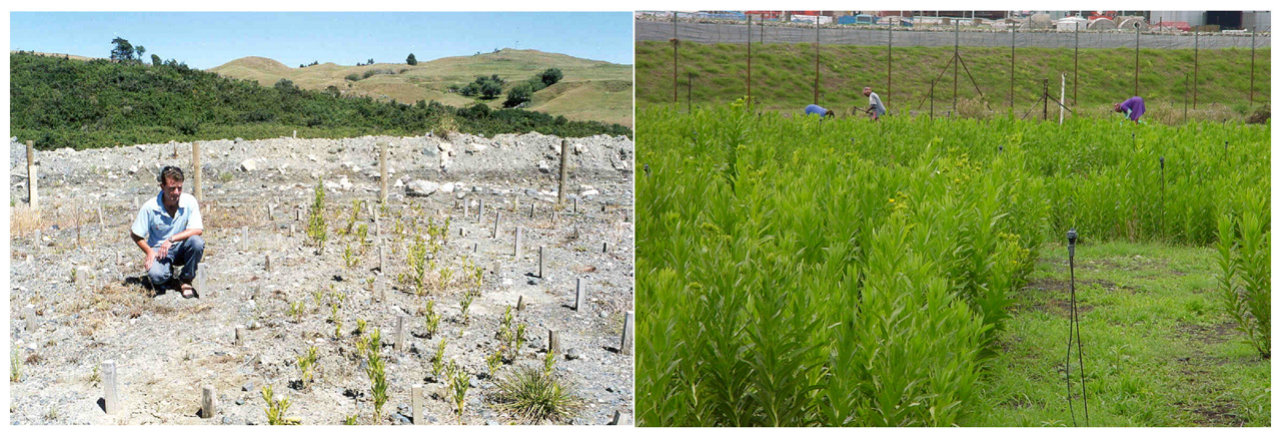
There are several strategies to achieve the bioaccumulation coefficients shown in Table 1. These are described in detail in numerous reviews e.g. (Nowack et al., 2006; Robinson et al., 2009; Sheoran et al., 2011), which we will not repeat. Briefly, phytoextraction may employ hyperaccumulator plants (Brooks et al., 1977), which accumulate inordinate concentrations of one or more trace elements as part of their normal metabolism (Reeves, 2006). Hyperaccumulator plants have lower biomass productions than crop plants, which is unsurprising as there is a metabolic cost to hyperaccumulation. When not grown in their native environments, hyperaccumulators may be difficult to procure, exhibit reduced growth, and suffer from weed competition (Fig. 1).
有多种策略可实现表1所示的生物富集系数。这些策略在众多综述中已有详细描述,例如(Nowack et al., 2006; Robinson et al., 2009; Sheoran et al., 2011),本文不再赘述。简言之,植物提取可利用超富集植物(Brooks et al., 1977),这类植物在其正常代谢过程中可富集异常高浓度的一种或多种微量元素(Reeves, 2006)。超富集植物的生物量低于作物,这并不奇怪,因为超富集需要付出代谢代价。在非原生环境中种植时,超富集植物可能难以获取,生长减缓,并受到杂草竞争(图1)。
An alternative strategy is developing/inducing standard crop plants to accumulate high TE concentrations by selective breeding, gene manipulation, soil conditioners such as biological inocula (Lebeau et al., 2008) or TE-mobilising agents such as chelants (Shahid et al., 2014). The addition of chelants such ethylenediaminetetraacetic acid (EDTA) or ethylenediamine-N,N'-disuccinic acid (EDDS) either fails to result in sufficient TE uptake, or resulted in groundwater contamination or both (Bolan et al., 2014). A large excess of chelant is required to solubilize the target metal due to the co-solubilisation of Ca and Fe. Soil solution chelate concentrations of at least several mM are required to induce appreciable shoot concentrations. Nowack et al. (2006) reported that at such soil solution concentrations, plants will remove only a small fraction of the solubilized metals. Leaching, exacerbated by preferential flow processes, is unavoidable unless the operation is conducted ex situ on an impermeable liner (Robinson et al., 2009).
另一种策略是通过选择育种、基因操控、生物接种剂等土壤调理剂(Lebeau et al., 2008)或螯合剂等微量元素活化剂(Shahid et al., 2014),培育或诱导常规作物富集高浓度微量元素。添加乙二胺四乙酸(EDTA)或乙二胺-N,N'-二琥珀酸(EDDS)等螯合剂,要么无法实现足够的微量元素吸收,要么导致地下水污染,或二者兼而有之(Bolan et al., 2014)。由于Ca和Fe的共溶解,需要大大过量的螯合剂才能溶解目标金属。土壤溶液中螯合物浓度至少需达到数mM才能使地上部浓度明显提高。Nowack et al. (2006) 报道,在此类土壤溶液浓度下,植物只能移除被溶解金属的一小部分。除非在不透水衬层上进行异位作业,否则因优先流过程而加剧的淋溶是不可避免的(Robinson et al., 2009)。
Whatever strategy is used to procure plants with high bioaccumulation coefficients, target values, such as those reported in Table 1, should be used to determine whether any resulting operation would be successful. Where these targets cannot be met, conclusions need to state that phytoextraction using these plants would be limited to soil polishing, rather than soil cleansing in a reasonable 25-year timeframe. That said, the minimum bioaccumulations coefficients calculated using Eqs. (3) and (4) multiplied by the heterogeneity of the system indicates that phytoextraction for soil cleansing in a reasonable time-frame, are not likely to be achieved without a quantum leap in techniques to increase plant metal uptake (Table 2).
无论采用何种策略获得具有高生物富集系数的植物,均应以目标值(如表1所列数值)来判断由此开展的作业能否成功。若无法达到这些目标,结论中需说明,利用这些植物的植物提取仅限于土壤抛光,而非在合理的25年时间范围内实现土壤净化。尽管如此,利用式3和式4计算的最低生物富集系数乘以系统的异质性表明,若不在提高植物金属吸收的技术上实现质的飞跃,在合理时间范围内以土壤净化为目的的植物提取不太可能实现(表2)。
1.7. Changing the target: phytomining1.7. 改变目标:植物采矿
Phytomining is the phytoextraction of economically valuable TEs from environments where the target metal concentration is too low for conventional mining, or, where the surface volume of mineralized soil is insufficient to justify the capital expenditure of the necessary processing, despite target metal concentrations in excess of minimum grades. Here, the goal is profit. Bioaccumulation coefficients are less important. There need not be any clean-up goal, although there may be secondary environmental goals. For example, in the case of Hgcontaminated artisanal and small-scale gold mining waste, Au phytomining may generate revenue that can pay for or subsidise the phytoremediation of an insidious environmental pollutant (Krisnayanti et al., 2012). For any given crop, the key value for phytomining, PM (US$/ha), is metal extracted per hectare multiplied by the value of the metal, V (US$), (Eq. (5)).
植物采矿是指从目标金属浓度过低而不适合常规采矿的环境中,或者尽管目标金属浓度超过最低品位、但矿化土壤的表层体积不足以支撑所需加工的资本支出的环境中,通过植物提取获取具有经济价值的微量元素。此时的目标是利润,生物富集系数则不那么重要。其不必有任何清理目标,尽管可能存在次要的环境目标。例如,对于受Hg污染的手工和小规模金矿开采废弃物,Au植物采矿所产生的收入可用于支付或补贴对这一隐蔽性环境污染物的植物修复(Krisnayanti et al., 2012)。对于任一作物,植物采矿的关键价值PM(美元/公顷)为单位面积金属提取量乘以金属价值V(美元)(式5)。
(5)
PM ¼ BPVPM = BPV
As with Eq. (1), there is no time component in Eq. (5). This becomes important for successive crops, which are discussed later. Early studies (Nicks and Chambers, 1994, 1995) showed that the Ni hyperaccumulator Streptanthus polygaloides grown on ultramafic soils in California, could remove up to 100 kg ha−1 of Ni in their biomass. This was worth US$550 ha−1 at the prices at that time. Profit could also be gained from converting the biomass to energy (ca. $219/ha). These revenue streams were comparable to that obtained from a crop of wheat. Moreover, phytomining could be used to turn a profit on the vast swathes of Earth that are covered in ultramafic soil, upon which it is problematic to grow conventional crops. Subsequent studies (Chaney et al., 2007) have reported that using Alyssum species to phytomine Ni could give a return of US$ 16,000 ha−1, a figure related to the high value of Ni at that time. Bani et al. (2015) showed that native populations of Alyssum murale in Albania, when fertilized, could phytoextract an economically-viable crop of Ni.
与式1一样,式5中不含时间分量。这一点对于连续种植十分重要,将在后文讨论。早期研究(Nicks and Chambers, 1994, 1995)表明,在加利福尼亚超基性(蛇纹岩)土壤上种植的Ni超富集植物Streptanthus polygaloides可在其生物量中移除多达100 kg ha−1的Ni。按当时价格计算,其价值为550美元 ha−1。将生物量转化为能源也可获得利润(约219美元/公顷)。这些收入与一季小麦的收入相当。此外,地球上大片区域覆盖着超基性土壤,在这些土壤上种植常规作物存在困难,而植物采矿可用于在这些区域获利。后续研究(Chaney et al., 2007)报道,利用Alyssum属植物进行Ni植物采矿可获得16,000美元 ha−1的回报,这一数值与当时Ni的高价格有关。Bani et al. (2015) 表明,阿尔巴尼亚的Alyssum murale本地种群在施肥后可提取具有经济可行性的Ni产量。
Other studies have shown the potential for phytomining precious metals such as Au (Anderson et al., 1999), In (Nguyen Thi Hoang et al., 2011) and Re (Bozhkov et al., 2012). Studies involving the uptake of precious metals usually require a lixivant to solubilize the metal and induce plant uptake. It is propounded that these operations could be conducted using the model of heap-leach mining techniques, in the form of a ‘phyto-leach’ pad (Hunt et al., 2014). The value of the proposed operation may not come directly from the precious metal, but the plantmetal matrix, which when processed, may have valuable properties as catalysts (Haverkamp et al., 2007). Hunt et al. (2014) propose that plants containing platinum-group elements could be turned into high-value catalysts for specific industrial and chemical reactions.
其他研究表明了利用植物开采Au(Anderson et al., 1999)、In(Nguyen Thi Hoang et al., 2011)和Re(Bozhkov et al., 2012)等贵金属的潜力。涉及贵金属吸收的研究通常需要浸出剂来溶解金属并诱导植物吸收。有人提出,这些作业可借鉴堆浸采矿技术的模式,以“植物浸出”堆场的形式进行(Hunt et al., 2014)。所提出作业的价值可能并非直接来自贵金属本身,而是来自植物-金属基质,其经加工后可能具有作为催化剂的宝贵特性(Haverkamp et al., 2007)。Hunt et al. (2014) 提出,含铂族元素的植物可被制成用于特定工业和化学反应的高价值催化剂。
Example biomass production and bioaccumulation coefficients of various soil/plant combinations.
不同土壤/植物组合的生物量及生物富集系数示例。
| Class of plant植物类别 | Target element(s)目标 元素 | Biomass production (t/ha)生物量 (t/ha) | Typical soil conc. (mg/kg)典型土壤浓度 (mg/kg) | Typical plant conc. (mg/kg)典型植物浓度 (mg/kg) | Typical BC典型 BC | Reference(s)参考文献 |
|---|---|---|---|---|---|---|
| Ultramafic hyperaccumulators | Ni, Mn | 2–23 | 1000–5000 | 1000–30,000 | 1–5 | (Brooks, 1998; van der Ent et al., 2013b) |
| Thlaspi caerulescensand other calamine | Zn, Cd | 2 | Up to 1% in native range | Ca. 1% | 1–15 | (Robinson et al., 1998) |
| Pteris vittataand As-hyperaccumulating ferns | As | b2 | Up to 3% | Up to 6030 | b1–18.6 | (Luu Thai et al., 2014) |
| Salix species | Zn, Cd | Up to 30 | variable | Up to 100 | 1–15 | (Robinson et al., 2000) |
| Induced hyperaccumulation in crop species | Pb | Up to 30 | 200–600 | Up to 1.5% | Up to 25 | (Blaylock et al., 1997) |
Unlike phytoextraction for soil cleansing, which suffers from prohibitively long clean-up times, the reason why phytomining has not found widespread commercial application is not immediately apparent. Potential limiting factors are:
以土壤净化为目的的植物提取存在清理时间过长的问题,与之不同,植物采矿未能获得广泛商业应用的原因并不显而易见。潜在的限制因素包括:
1.8. Agronomic limitations1.8. 农艺限制
Ultramafic soils, where Ni phytomining would occur, are usually nutrient poor and have poor soil structure (Chiarucci et al., 1998). While native ultramafic vegetation is adapted to such environments, the biomass production in its natural habitat is well below the requirements of phytomining (Robinson et al., 1997). Fertiliser and irrigation requirements for ultramafic soils are higher than other soils because of their low ability to retain water and nutrients. Using soil amendments such as compost to improve the water and nutrient holding capacities may lessen the plant-availability of the target metal and hence reduce profits. That said, Chaney et al. (2007) concluded that although phytomining crops require special fertilisation, this would not be prohibitively expensive. Irrigation may be critical. Whereas large cropgrowing areas often have collective irrigation schemes, areas to be phytomined may be geographically distant and not have easy access to water. Similarly, disused mine sites or mine tailings where phytomining may occur generally have low fertility, and may have salinity and acidity issues.
进行Ni植物采矿的超基性土壤通常养分贫瘠且土壤结构不良(Chiarucci et al., 1998)。尽管超基性土壤上的本土植被已适应此类环境,但其在自然生境中的生物量远低于植物采矿的要求(Robinson et al., 1997)。由于超基性土壤保水保肥能力低,其施肥和灌溉需求高于其他土壤。使用堆肥等土壤改良剂提高保水保肥能力,可能会降低目标金属的植物有效性,进而减少利润。尽管如此,Chaney et al. (2007) 认为,虽然植物采矿作物需要特殊施肥,但其费用不会高得令人望而却步。灌溉可能至关重要。大型作物种植区通常拥有集体灌溉系统,而拟进行植物采矿的区域可能地处偏远,不易取水。同样,可能开展植物采矿的废弃矿区或尾矿通常肥力低下,并可能存在盐渍化和酸化问题。
Unlike conventional cropping, there are, as yet, no large-scale suppliers of seeds for hyperaccumulator plants that would be used in phytomining. Suppliers would doubtless appear if phytomining were to find widespread use. However, given the difficulties (Fig. 1) and ecological concerns of growing hyperaccumulator plants outside their normal range, phytomining would most likely employ local species, each of which would have distinct propagation and fertilization requirements.
与常规作物种植不同,目前尚无用于植物采矿的超富集植物种子的大规模供应商。若植物采矿得到广泛应用,供应商无疑会出现。然而,鉴于在正常分布范围之外种植超富集植物的困难(图1)和生态方面的担忧,植物采矿最有可能采用当地物种,而每个物种都有各自不同的繁殖和施肥要求。
Agronomic challenges also exist for phytomining operations that rely on the use of chelants to promote metal uptake in nonhyperaccumulator plants. Crops species are generally not suited to growth on edaphically challenging environments. Furthermore, efficiency in the use of the chelants to target specific elements is poorly optimised. Risk mitigation to ensure that phytomining of gold, for example, does not cause secondary environmental harm will be needed before this technology can be implemented in applied scenarios (Anderson et al., 2013).
对于依赖螯合剂促进非超富集植物吸收金属的植物采矿作业,也存在农艺挑战。作物物种通常不适合在土壤条件恶劣的环境中生长。此外,利用螯合剂靶向特定元素的效率优化不足。在该技术可应用于实际场景之前,需要采取风险缓解措施,例如确保金的植物采矿不会造成次生环境危害(Anderson et al., 2013)。
1.9. Biomass and metal processing: economics of scale1.9. 生物量与金属加工:规模经济
Phytomining is the production of metal rich biomass that could provide revenue through conversion to energy and recovery of the metal from the plant ash (bio-ore) or through green chemistry, where plant-borne metals form part of valuable phytochemicals grown for harvest (Hunt et al., 2014). Li et al. (2003) and Zhang et al. (2014) demonstrated the feasibility of Ni recovery from the bio-ore of crops from the genera Alyssum, Leptoplax and Bornmuellera. These bio-ores from Ni hyperaccumulator plants contain Ni concentrations of 6 - 20% (Koppolu et al., 2004; Zhang et al., 2014), which is significantly higher than normal Ni-ores (ca. 3%). Bio-ores have low concentrations of Mn, Fe and Si oxides that are problematic in Ni recovery from conventional ores (Li et al., 2003). Bio-ore generated from Berkheya coddii can contain high Ca concentrations (34%), which may reduce the efficiency of Ni recovery from the bio-ore (Boominathan et al., 2004).
植物采矿是生产富含金属的生物量,其可通过转化为能源和从植物灰分(生物矿石)中回收金属来产生收入,或通过绿色化学途径——即植物所含金属构成为收获而种植的有价值植物化学物质的一部分——来产生收入(Hunt et al., 2014)。Li et al. (2003) 和Zhang et al. (2014) 证明了从Alyssum、Leptoplax和Bornmuellera属作物的生物矿石中回收Ni的可行性。这些来自Ni超富集植物的生物矿石Ni含量为6 - 20%(Koppolu et al., 2004; Zhang et al., 2014),显著高于普通Ni矿石(约3%)。生物矿石中Mn、Fe和Si氧化物的浓度低,而这些氧化物在从常规矿石中回收Ni时会造成问题(Li et al., 2003)。由Berkheya coddii产生的生物矿石可能含有高浓度的Ca(34%),这可能降低从生物矿石中回收Ni的效率(Boominathan et al., 2004)。
While energy production and metal recovery are theoretically feasible, in practice this could only happen if phytomining occurs in proximity to existing energy conversion facilities or to infrastructure that is actively processing metal (for example a Ni smelter). However, incineration destroys the original structure of metals in a plant (oxidation) and therefore negates many of the stated opportunities to use in vivo metal nanoparticles in catalysis.
尽管能源生产和金属回收在理论上可行,但实际上只有当植物采矿靠近现有能源转化设施或正在运营的金属加工基础设施(如Ni冶炼厂)时才能实现。然而,焚烧会破坏植物中金属的原始结构(氧化),从而使许多所宣称的利用体内金属纳米颗粒进行催化的机会化为乌有。
In the event where phytomining is not conducted near to existing infrastructure, long-distance transport of the biomass would greatly reduce any profits. Alternatively, phytomining could be conducted over very large areas that justify the construction of purpose-build facilities. This would require significant capital outlay, and may not be feasible without government help. Scale-up of phytomining to field scenarios and models for the construction of the necessary infrastructure are lacking. The definition of viable and working engineering solutions to process metal-rich biomass is an area that is ready for development.
若植物采矿不在现有基础设施附近进行,生物量的长途运输将大大削减利润。另一种选择是在足以证明建设专用设施合理性的超大面积上开展植物采矿。这将需要大量资本投入,若无政府帮助可能难以实现。目前缺乏将植物采矿放大至田间场景的研究以及建设必要基础设施的模式。确定可行且有效的富金属生物量加工工程方案是一个亟待开发的领域。
1.10. Clean-green phytomining?1.10. 清洁绿色的植物采矿?
The environmental impacts of conventional mining are welldocumented (Conesa and Schulin, 2010). Intuitively, phytomining, which would produce green landscapes, would appear to have a lower environmental impact. However, from an environmental perspective, the comparison needs to be made on the relative effects of phytomining on ecosystem functioning and human health. While conventional mining leaves a visible scar on the landscape, it can extract a much greater mass of metal per unit area than phytomining. The theoretical maximum nickel harvest from phytomining of 0.4 t/ha per year (Chaney et al., 2007) can be obtained from just 15 tonnes of conventional ore in just a few hours (Robinson et al., 2009).
常规采矿的环境影响已有充分记载(Conesa and Schulin, 2010)。直观上,能形成绿色景观的植物采矿似乎具有较低的环境影响。然而,从环境角度看,需要比较的是植物采矿对生态系统功能和人类健康的相对影响。尽管常规采矿会在景观上留下明显的伤痕,但其单位面积可提取的金属量远大于植物采矿。植物采矿每年0.4 t/ha的理论最大镍收获量(Chaney et al., 2007),仅需15吨常规矿石在短短数小时内即可获得(Robinson et al., 2009)。
While the land used for phytomining is under vegetation, this is most likely to be a monoculture that is receiving high rates of fertiliser inputs, which due to the low water and nutrient holding capacity of ultramafic soils, may contaminate receiving waters with plant nutrients. Most low fertility of ultramafic soils are not currently under crop production and instead support native ecosystems with plants that are often locally endemic (Brooks, 1998; Erskine et al., 2012). Phytomining would require clearing of most of this vegetation and replacement with a hyperaccumulator species, which may itself be exotic.
尽管用于植物采矿的土地处于植被覆盖之下,但这很可能是接受高量施肥的单一栽培,而由于超基性土壤的保水保肥能力低,可能导致受纳水体受到植物养分污染。大多数低肥力超基性土壤目前并未用于作物生产,而是支撑着通常为当地特有植物的本土生态系统(Brooks, 1998; Erskine et al., 2012)。植物采矿将需要清除这些植被的大部分,并代之以超富集植物物种,而后者本身可能是外来物种。
If phytomining and its associated infrastructure were established on a large scale, there are only a limited number of profitable crops that a metalliferous soil can support before plant metal concentrations drop below profitability. After 3–18 phytomining crops (Robinson et al., 1999a), continuation of economically-viable phytomining would require the removal of the topsoil or alteration of its geochemical properties to release more plant-available Ni. Such actions would not only be expensive, but also result in environmental perturbation on a massive scale.
若植物采矿及其相关基础设施大规模建立,含金属土壤所能支撑的盈利作物茬数有限,此后植物金属浓度将降至盈利水平以下。在3–18茬植物采矿作物之后(Robinson et al., 1999a),要继续进行具有经济可行性的植物采矿,就需要移除表土或改变其地球化学性质以释放更多植物有效态Ni。此类措施不仅代价高昂,还将造成大规模的环境扰动。
1.11. Potential role of phytomining1.11. 植物采矿的潜在作用
More promising is the combination of phytomining with mine rehabilitation, where the revenue generated from phytomining crops can offset the cost of remediation. Here, plants could be used to recover metals from tailings or waste rock that have metal concentrations too low for conventional processing. In such cases, the infrastructure to recover the metals may already be in place. The role of the hyperaccumulator plants would be to initially tolerate the adverse conditions on the tailings, thereby stabilizing the substrate and introducing organic matter that permits the subsequent establishment of native species. Associated with this scenario could be development opportunities in mining areas. Many large-scale mines are in rural areas of poor countries where agriculture is a primary livelihood. Where farmers are cultivating crop species on mineralized soils, yields are generally low as pointed out by Brooks and Robinson (1998) for Brazilian farmers growing Soy Bean on ultramafic soil. A phytomining operation could create opportunities to train rural communities in modern agricultural skills. Such skills would be essential to ensure that phytomining crop yields meet targets, and these same skills could be applied by farmers to the cultivation of suitable crop species on adjacent but non-mineralised land. Anglo Platinum’s Ni phytomining work at the Rustenburg Base Metal Refinery in South Africa in the early part of this century exemplified this model well (Fig. 1). The company contracted local farmers to collect seeds of Berkheya coddii growing throughout the surrounding area. Farmers then raised seedlings of the hyperaccumulator and planted these onto contaminated land. The farmers tended the crop throughout the growth season, and collected seeds at the end of summer for subsequent planting. The biomass was then harvested by hand, tied in bundles and fed directly into the Ni smelter. Through this process the land was remediated, Ni from the biomass was incorporated into the bulk metal product, and farmers were employed and provided with training on how to better grow plants. This could, perhaps, be considered as the best-recorded example of the potential of phytomining to effect environmental, economic and social development.
更有前景的是将植物采矿与矿区复垦相结合,利用植物采矿作物产生的收入抵消修复成本。在此情形下,植物可用于从金属浓度过低而不适合常规加工的尾矿或废石中回收金属。此时,回收金属的基础设施可能已经存在。超富集植物的作用首先是耐受尾矿上的不利条件,从而稳定基质并引入有机质,使本土物种随后得以定居。与这一情景相关的还有矿区的发展机遇。许多大型矿山位于以农业为主要生计的贫困国家农村地区。在农民于矿化土壤上种植作物的地方,产量通常较低,正如Brooks and Robinson (1998) 针对在超基性土壤上种植大豆的巴西农民所指出的。植物采矿作业可为培训农村社区掌握现代农业技能创造机会。这些技能对于确保植物采矿作物产量达标至关重要,农民也可将同样的技能应用于在邻近的非矿化土地上种植适宜的作物。本世纪初,英美铂业公司(Anglo Platinum)在南非Rustenburg贱金属精炼厂开展的Ni植物采矿工作很好地诠释了这一模式(图1)。该公司与当地农民签约,收集周边地区广泛生长的Berkheya coddii种子。农民随后培育这种超富集植物的幼苗,并将其种植于污染土地上。农民在整个生长季照料作物,并在夏末收集种子以供后续种植。然后,生物量被人工收割、捆扎成束并直接送入Ni冶炼炉。通过这一过程,土地得到修复,生物量中的Ni被并入大宗金属产品,农民获得了就业,并接受了如何更好地种植植物的培训。这或许可被视为植物采矿促进环境、经济和社会发展潜力的最佳记录实例。
1.12. Where to for phytoextraction?1.12. 植物提取何去何从?
It is clear that phytoextraction faces perhaps insurmountable challenges to ever find widespread application to decontaminate soil in b25 years. Nevertheless, research on mechanisms of plant TE-uptake as well as techniques to engineer increases in plant uptake has the potential for widespread applications in various related technologies that will benefit humanity.
显然,植物提取要在<25年内实现土壤去污的广泛应用,面临着或许无法克服的挑战。尽管如此,关于植物吸收微量元素机制的研究以及通过工程手段提高植物吸收的技术,在各种相关技术中具有造福人类的广泛应用潜力。
Zhao and McGrath (2009) pointed out the synergisms between phytoextraction for the remediation of contaminated soil and enhancing the concentration of essential TEs in food crops. Knowledge from phytoextraction studies may provide effective tools for biofortification, which seeks to increase the concentration of this essential micronutrient in crop plants, pre-harvest, by agronomic means or genetic modification (Cakmak, 2008). Zinc deficiency affects between a quarter and a third of humanity, with deficiency rates ranging from 4 to 73% (Hotz and Brown, 2004) in various countries. Some 10% of the population in the United States consume less than half the recommended dietary allowance for Zn (Ho, 2004).
Zhao and McGrath (2009) 指出了用于修复污染土壤的植物提取与提高粮食作物中必需微量元素浓度之间的协同作用。植物提取研究所获得的知识可为生物强化提供有效工具,生物强化旨在通过农艺手段或基因改良,在收获前提高作物中这种必需微量营养素的浓度(Cakmak, 2008)。锌缺乏影响着四分之一至三分之一的人类,各国缺乏率为4%至73%不等(Hotz and Brown, 2004)。美国约10%的人口Zn摄入量不足推荐膳食供给量的一半(Ho, 2004)。
Similarly, phytoextraction technology may be used to improve livestock nutrition. Pasture often has lower TEs concentrations compared to trees and shrubs (Robinson et al., 2005). Cobalt accumulators in the genus Nyssa could provide stock with an adequate source of this essential micronutrient when grown on deficient soils (Robinson et al., 1999b). Similarly, willow clones that have been investigated in relation to Zn phytoextraction have been shown to cause a significant increase in the Zn concentration in the blood of grazing animals (Anderson et al., 2012).
同样,植物提取技术可用于改善牲畜营养。与乔木和灌木相比,牧场的微量元素浓度通常较低(Robinson et al., 2005)。Nyssa属的钴富集植物在缺钴土壤上种植时,可为牲畜提供这种必需微量营养素的充足来源(Robinson et al., 1999b)。类似地,已在Zn植物提取方面开展研究的柳树无性系已被证明可使放牧动物血液中Zn浓度显著增加(Anderson et al., 2012)。
2Conclusions结论
Our analyses show that phytoextraction for the clean-up of TE-contaminated soils is not “an emerging technology that can be used for the low-cost clean-up of contaminated land” and that phytomining is inefficient and likely to have a lager ecological footprint than conventional mining. However, it is not our intention to discourage research in this area. The best rebuttal to this analysis would be publication of TE mass balances in full-scale field operations. That said, scientific articles investigating new plants/soils/soil conditioner combinations should at least demonstrate how phytoextraction could work by providing basic mass balance calculations. Continuing to tout phytoextraction as a low-cost alternative for soil clean-up when, clearly it is not, tarnishes all “phyto” technologies. To a large extent, this has already happened. The broadest term, ‘phytomanagement’, encompasses a range of land management activities, many of which only affect the plants indirectly. The challenge before the phyto community is to find a new ‘non-phyto’ term that describes the betterment of the stressed environments through biological manipulation, perhaps shifting the focus from clean-up to palliative care.
本文分析表明,用于清理微量元素污染土壤的植物提取并非“一种可用于低成本清理污染土地的新兴技术”,而植物采矿效率低下,其生态足迹可能大于常规采矿。然而,我们无意阻止该领域的研究。对本文分析最好的反驳将是发表全规模田间作业中的微量元素质量平衡。尽管如此,研究新的植物/土壤/土壤调理剂组合的科学文章至少应通过提供基本的质量平衡计算来说明植物提取如何能够奏效。在植物提取显然并非土壤清理的低成本替代方案的情况下,继续将其标榜为低成本替代方案,会损害所有“植物”技术的声誉。在很大程度上,这种情况已经发生。最宽泛的术语“植物管理”涵盖了一系列土地管理活动,其中许多仅间接影响植物。植物技术学界面临的挑战是找到一个新的“非植物”术语,用以描述通过生物调控改善受胁迫环境,或许可将重点从清理转向“姑息治疗”。
Acknowledgement致谢
We would like to thank the reviewers of this article for their careful editing and constructive comments.
感谢本文审稿人的细致编辑和建设性意见。
References参考文献
Anderson, C.W.N., Brooks, R.R., Chiarucci, A., LaCoste, C.J., Leblanc, M., Robinson, B.H., Simcock, R., Stewart, R.B., 1999. Phytomining for nickel, thallium and gold. J. Geochem. Explor. 67, 407–415.
Anderson, C.W.N., Robinson, B.H., West, D.M., Clucas, L., Portmann, D., 2012. Zincenriched and zinc-biofortified feed as a possible animal remedy in pastoral agriculture: Animal health and environmental benefits. J. Geochem. Explor. 121, 30–35.
Anderson, C.W.N., Bhatti, S.M., Gardea-Torresdey, J., Parsons, J., 2013. In vivo effect of copper and silver on synthesis of gold nanoparticles inside living plants. ACS Sustain. Chem. Eng. 1, 640–648.
Baker, A.J.M., McGrath, S.P., Sidoli, C.M.D., Reeves, R.D., 1994. The possibility of in-situ heavy-metal decontamination of polluted soils using crops of metal-accumulating plants. Resour. Conserv. Recycl. 11, 41–49.
Bani, A., Echevarria, G., Sulce, S., Morel, J.L., 2015. Improving the agronomy of alyssum murale for extensive phytomining: a five-year field study. Int. J. Phytoremediation 17 (2), 117–127. http://dx.doi.org/10.1080/15226514.2013.862204.
Bañuelos, G.S., Ajwa, H.A., Wu, L., Zambrzuski, S., 1998. Selenium accumulation by Brassica napus grown in Se-laden soil from different depths of Kesterson Reservoir. J. Soil Contam. 7, 481–494.
Blaylock, M.J., Salt, D.E., Dushenkov, S., Zakharova, O., Gussman, C., Kapulnik, Y., Ensley, B.D., Raskin, I., 1997. Enhanced accumulation of Pb in Indian mustard by soilapplied chelating agents. Environ. Sci. Technol. 31, 860–865.
Bolan, N., Kunhikrishnan, A., Thangarajan, R., Kumpiene, J., Park, J., Makino, T., Kirkham, M.B., Scheckel, K., 2014. Remediation of heavy metal(loid)s contaminated soils – To mobilize or to immobilize? J. Hazard. Mater. 266, 141–166.
Boominathan, R., Saha-Chaudhury, N.M., Sahajwalla, V., Doran, P.M., 2004. Production of nickel bio-ore from hyperaccumulator plant biomass: Applications in phytomining. Biotechnol. Bioeng. 86, 243–250.
Bozhkov, O., Tzvetkova, C., Borisova, L., Bryskin, B., 2012. Phytomining: New method for rhenium production. Adv. Mater. Process. 170, 34–37.
Breckle, S.W., Kahle, H., 1992. Effects of toxic heavy-metals (Cd, Pb) on growth and mineral-nutrition of beech (FAGUS-SYLVATICA L). Vegetatio 101, 43–53.
Brooks, R.R., 1998. Plants that hyperaccumulate heavy metals: their role in phytoremediation, microbiology, archaeology, mineral exploration and phytomining. CAB International, Wallingford, UK.
Brooks, R.R., Robinson, B.H., 1998. The potential use of hyperaccumulators and other plants for phytomining. Plants that hyperaccumulate heavy metals: their role in phytoremediation, microbiology, archaeology, mineral exploration and phytominingpp. 327–356.
Brooks, R.R., Lee, J., Reeves, R.D., Jaffre, T., 1977. Detection of nickeliferous rocks by analysis of herbarium specimens of indicator plants. J. Geochem. Explor. 7, 49–57. Cakmak, I., 2008. Enrichment of cereal grains with zinc: Agronomic or genetic biofortification? Plant Soil 302, 1–17.
Carlo-Rojas, Z., Lee, W.Y., 2009. Cu and Zn uptake inhibition by PAHs as primary toxicity in plants.
Chaney, R.L., 1983. Plant uptake of inorganic waste constituents. In: Parr, J.F.E.A. (Ed.), Land treatment of hazardous wastes. Noyes Data Corp, pp. 50–76.
Chaney, R.L., Angle, J.S., Broadhurst, C.L., Peters, C.A., Tappero, R.V., Sparks, D.L., 2007. Improved understanding of hyperaccumulation yields commercial phytoextraction and phytomining technologies. J. Environ. Qual. 36, 1429–1443.
Chiarucci, A., Robinson, B.H., Bonini, I., Petit, D., Brooks, R.R., De Dominicis, V., 1998. Vegetation of tuscan ultramafic soils in relation to edaphic and physical factors. Folia Geobot. 33, 113–131.
Conesa, H.M., Schulin, R., 2010. The Cartagena – La Union mining district (SE spain): a review of environmental problems and emerging phytoremediation solutions after fifteen years research. J. Environ. Monit. 12, 1225–1233.
Conesa, H.M., Evangelou, M.W.H., Robinson, B.H., Schulin, R., 2012a. A critical view of current state of phytotechnologies to remediate soils: still a promising tool? Sci. World J. http://dx.doi.org/10.1100/2012/173829 (173829-173829).
Conesa, H.M., Wieser, M., Studer, B., Gonzalez-Alcaraz, M.N., Schulin, R., 2012b. A critical assessment of soil amendments (slaked lime/acidic fertilizer) for the phytomanagement of moderately contaminated shooting range soils. J. Soils Sediments 12, 565–575.
Cundy, A.B., Bardos, R.P., Church, A., Puschenreiter, M., Friesl-Hanl, W., Muller, I., Neu, S., Mench, M., Witters, N., Vangronsveld, J., 2013. Developing principles of sustainability and stakeholder engagement for “gentle” remediation approaches: The European context. J. Environ. Manag. 129, 283–291.
Dickinson, N.M., Turner, A.P., Lepp, N.W., 1991. How do trees and other long-lived plants survive in polluted environments? Funct. Ecol. 5, 5–11.
Dickinson, N., Baker, A., Doronila, A., Laidlaw, S., Reeves, R., 2009. Phytoremediation of inorganics: realism and synergies. Int. J. Phytoremediation 11, 97–114.
Erskine, P., Van der Ent, A., Fletcher, A., 2012. Sustaining metal-loving plants in mining regions. Science 337, 1172–1173.
Fassler, E., Robinson, B.H., Gupta, S.K., Schulin, R., 2010a. Uptake and allocation of plant nutrients and Cd in maize, sunflower and tobacco growing on contaminated soil and the effect of soil conditioners under field conditions. Nutr. Cycl. Agroecosyst. 87, 339–352.
Fassler, E., Robinson, B.H., Stauffer, W., Gupta, S.K., Papritz, A., Schulin, R., 2010b. Phytomanagement of metal-contaminated agricultural land using sunflower, maize and tobacco. Agric. Ecosyst. Environ. 136, 49–58.
French, C.J., Dickinson, N.M., Putwain, P.D., 2006. Woody biomass phytoremediation of contaminated brownfield land. Environ. Pollut. 141, 387–395.
Granel, T., Robinson, B., Mills, T., Clothier, B., Green, S., Fung, L., 2002. Cadmium accumulation by willow clones used for soil conservation, stock fodder, and phytoremediation. Aust. J. Plant Res. 40, 1331–1337.
Hamon, R.E., McLaughlin, M.J., 1999. Use of the hyperaccumulator Thlaspi cearulescens for bioavailable contaminant stripping. In: Wenzel, W.W., Adriano, D.C., Alloway, B., Doner, H., Keller, C., Lepp, N.W., Mench, M., Naidu, R., Pierzynski, G.M. (Eds.), 5th International Conference on the Biogeochemistry of Trace Elements, Vienna, pp. 908–909.
Haverkamp, R.G., Marshall, A.T., van Agterveld, D., 2007. Pick your carats: nanoparticles of gold-silver-copper alloy produced in vivo. J. Nanoparticle Res. 9, 697–700.
Herzig, R., Nehnevajova, E., Pfistner, C., Schwitzguebel, J.P., Ricci, A., Keller, C., 2014. Feasibility of labile Zn phytoextraction using enhanced tobacco and sunflower: Results of five- and one-year field-scale experiments in Switzerland. Int. J. Phytoremediation 16, 735–754.
Ho, E., 2004. Zinc deficiency, DNA damage and cancer risk. J. Nutr. Biochem. 15, 572–578.
Hotz, C., Brown, K.H., 2004. International Zinc Nutrition Consultative Group (IZiNCG) technical document #1. Assessment of the risk of zinc deficiency in populations and options for its control. Food Nutr. Bull. 25, S94–S203.
Hunt, A.J., Anderson, C.W.N., Bruce, N., Garcia, A.M., Graedel, T.E., Hodson, M., Meech, J.A., Nassar, N.T., Parker, H.L., Rylott, E.L., Sotiriou, K., Zhang, Q., Clark, J.H., 2014. Phytoextraction as a tool for green chemistry. Green Process. Synth. 3, 3–22.
Koppolu, L., Prasad, R., Clements, L.D., 2004. Pyrolysis as a technique for separating heavy metals from hyperaccumulators. Part III: pilot-scale pyrolysis of synthetic hyperaccumulator biomass. Biomass Bioenergy 26, 463–472.
Krisnayanti, B.D., Anderson, C.W.N., Utomo, W.H., Feng, X., Handayanto, E., Mudarisna, N., Ikram, H., Khususiah, 2012. Assessment of environmental mercury discharge at a four-year-old artisanal gold mining area on Lombok Island, Indonesia. J. Environ. Monit. 14, 2598–2607.
Lebeau, T., Braud, A., Jezequel, K., 2008. Performance of bioaugmentation-assisted phytoextraction applied to metal contaminated soils: A review. Environ. Pollut. 153, 497–522.
Li, Y.M., Chaney, R., Brewer, E., Roseberg, R., Angle, J.S., Baker, A., Reeves, R., Nelkin, J., 2003. Development of a technology for commercial phytoextraction of nickel: economic and technical considerations. Plant Soil 249, 107–115.
Licht, L.A., Isebrands, J.G., 2005. Linking phytoremediated pollutant removal to biomass economic opportunities. Biomass Bioenergy 28, 203–218.
Luu Thai, D., Truong, P., Mammucari, R., Foster, N., 2014. A critical review of the arsenic uptake mechanisms and phytoremediation potential of Pteris vittata. Int. J. Phytoremediation 16, 429–453.
Mertens, J., Luyssaert, S., Verheyen, K., 2005. Use and abuse of trace metal concentrations in plant tissue for biomonitoring and phytoextraction. Environ. Pollut. 138, 1–4. Nguyen Thi Hoang, H., Sakakibara, M., Sano, S., 2011. Accumulation of Indium and other heavy metals by Eleocharis acicularis: an option for phytoremediation and phytomining. Bioresour. Technol. 102, 2228–2234.
Nicks, L.J., Chambers, M.F., 1994. Nickel farming. Discover. Nicks, L.J., Chambers, M.F., 1995. Farming for metals. MIn. Environ. Manag. 3, 15–18.
Nowack, B., Schulin, R., Robinson, B.H., 2006. Critical assessment of chelant-enhanced metal phytoextraction. Environ. Sci. Technol. 40, 5225–5232.
Pulford, I.D., McGregor, S.D., Duncan, H.J., Wheeler, C.T., 1995. Uptake of heavy metals from contaminated soil by trees, Fourteenth Annual Symposium. Current topics in plant biochemistry, physiology and molecular biology. Will plants have a role in bioremediation?Interdisciplinary Plant Group, University of Missouri, Columbia, MO, pp. 49–50.
Rees, R., Robinson, B.H., Evangelou, M.W.H., Lehmann, E., Schulin, R., 2012. Response of Populus tremula to heterogeneous B distributions in soil. Plant Soil 358, 403–415.
Reeves, R., 2006. Hyperaccumulation of trace elements by plants. In: Morel, J.L., Echevarria, G., Goncharova, N. (Eds.), Phytoremediation of metal-contaminated soils, pp. 25–52.
Robinson, B.H., Chiarucci, A., Brooks, R.R., Petit, D., Kirkman, J.H., Gregg, P.E.H., DeDominicis, V., 1997. The nickel hyperaccumulator plant Alyssum bertolonii as a potential agent for phytoremediation and phytomining of nickel. J. Geochem. Explor. 59, 75–86.
Robinson, B.H., Leblanc, M., Petit, D., Brooks, R.R., Kirkman, J.H., Gregg, P.E.H., 1998. The potential of Thlaspi caerulescens for phytoremediation of contaminated soils. Plant Soil 203, 47–56.
Robinson, B.H., Brooks, R.R., Gregg, P.E.H., Kirkman, J.H., 1999a. The nickel phytoextraction potential of some ultramafic soils as determined by sequential extraction. Geoderma 87, 293–304.
Robinson, B.H., Brooks, R.R., Hedley, M.J., 1999b. Cobalt and nickel accumulation in Nyssa (tupelo) species and its significance for New Zealand agriculture. N. Z. J. Agric. Res. 42, 235–240. Robinson, B.H., Mills, T.M., Petit, D., Fung, L.E., Green, S.R., Clothier, B.E., 2000. Natural and induced cadmium-accumulation in poplar and willow: Implications for phytoremediation. Plant Soil 227, 301–306. Robinson, B., Fernandez, J.E., Madejon, P., Maranon, T., Murillo, J.M., Green, S., Clothier, B., 2003. Phytoextraction: an assessment of biogeochemical and economic viability. Plant Soil 249, 117–125.
Robinson, B., Mills, T., Green, S., Chancerel, B., Clothier, B., Fung, L., Hurst, S., McIvor, I., 2005. Trace element accumulation by poplars and willows used for stock fodder. N. Z. J. Agric. Res. 48, 489–497.
Robinson, B.H., Schulin, R., Nowack, B., Roulier, S., Menon, M., Clothier, B.E., Green, S.R., Mills, T.M., 2006. Phytoremediation for the management of metal flux in contaminated sites. For. Snow Landsc. Res. 80, 221–234.
Robinson, B.H., Green, S.R., Chancerel, B., Mills, T.M., Clothier, B.E., 2007. Poplar for the phytomanagement of boron contaminated sites. Environ. Pollut. 150, 225–233.
Robinson, B.H., Banuelos, G., Conesa, H.M., Evangelou, M.W.H., Schulin, R., 2009. The phytomanagement of trace elements in soil. Crit. Rev. Plant Sci. 28, 240–266.
Salt, D.E., Blaylock, M., Kumar, N., Dushenkov, V., Ensley, B.D., Chet, I., Raskin, I., 1995. Phytoremediation – a novel strategy for the removal of toxic metals from the environment using plants. Bio/Technology 13, 468–474.
Shahid, M., Austruy, A., Echevarria, G., Arshad, M., Sanaullah, M., Aslam, M., Nadeem, M., Nasim, W., Dumat, C., 2014. EDTA – enhanced phytoremediation of heavy metals: a review. Soil Sediment Contam. 23, 389–416.
Sheoran, V., Sheoran, A.S., Poonia, P., 2011. Role of hyperaccumulators in phytoextraction of metals from contaminated mining sites: A review. Crit. Rev. Environ. Sci. Technol. 41, 168–214.
Thewys, T., Witters, N., Meers, E., Vangronsveld, J., 2010a. Economic viability of phytoremediation of a cadmium contaminated agricultural area using energy maize. Part II: Economics of anaerobic digestion of metal contaminated maize in Belgium. Int. J. Phytoremediation 12, 663–679.
Thewys, T., Witters, N., Van Slycken, S., Ruttens, A., Meers, E., Tack, F.M.G., Vangronsveld, J., 2010b. Economic viability of phytoremediation of a cadmium contaminated agricultural area using energy maize. Part I: Effect on the farmer's income. Int. J. Phytoremediation 12, 650–662.
Turner, A.P., Dickinson, N.M., 1993. Survival of Acer pseudoplantanus (sycamore) seedlings on metalliferous soils. New Phytol. 123, 509–521.
USEPA, 2014. Mid-Atlantic brownfields & land revitalization.
USEPA, 2014b. Cleanup fact sheets, Mid-Atlantic Brownfields & Land Revitalization. van der Ent, A., Baker, A.J.M., Reeves, R.D., Pollard, A.J., Schat, H., 2013b. Hyperaccumulators of metal and metalloid trace elements: Facts and fiction. Plant Soil 362, 319–334.
van der Ent, A., Baker, A.J.M., van Balgooy, M.M.J., Tjoa, A., 2013a. Ultramafic nickel laterites in Indonesia (Sulawesi, Halmahera): Mining, nickel hyperaccumulators and opportunities for phytomining. J. Geochem. Explor. 128, 72–79.
Van Nevel, L., Mertens, J., Oorts, K., Verheyen, K., 2007. Phytoextraction of metals from soils: How far from practice? Environ. Pollut. 150, 34–40.
Whiting, S.N., Leake, J.R., McGrath, S.P., Baker, A.J.M., 2000. Positive responses to Zn and Cd by roots of the Zn and Cd hyperaccumulator Thlaspi caerulescens. New Phytol. 145, 199–210.
Ye, W.-L., Khan, M.A., McGrath, S.P., Zhao, F.-J., 2011. Phytoremediation of arsenic contaminated paddy soils with Pteris vittata markedly reduces arsenic uptake by rice. Environ. Pollut. 159, 3739–3743.
Zhang, X., Houzelot, V., Bani, A., Morel, J.L., Echevarria, G., Simonnot, M.-O., 2014. Selection and combustion of Ni – hyperaccumulators for the phytomining process. Int. J. Phytoremediation 16, 1058–1072.
Zhao, F.-J., McGrath, S.P., 2009. Biofortification and phytoremediation. Curr. Opin. Plant Biol. 12, 373–380.