Contents lists available at ScienceDirect journal homepage: www.elsevier.com/locate/apsoil
Interactions of native and introduced earthworms with soils and plant rhizospheres in production landscapes of New Zealand
Young-Nam Kima, Brett Robinsonb, Stephane Boyera, Hong-Tao Zhonga, Nicholas Dickinsona,*
a Department of Ecology, Lincoln University, Lincoln, 7647 Christchurch, New Zealand
b Department of Soil and Physical Sciences, Lincoln University, Lincoln, 7647 Christchurch, New Zealand
1Introduction引言
Duetoalongperiodofgeographicandevolutionaryisolation,and the former absence of mammals, New Zealand is one of the world’s biodiversity hotspots; more than 80% of most floral and faunal groups are endemic and found nowhere else (Trewick et al., 2007). Human colonization and introduction of mammalian pests to these islands has been relatively recent, but native biodiversity has been impacted particularly severely (Lee, 1961; Sparling and Schipper, 2002; MacLeod and Moller, 2006). Agricultural modification of landscapes, vegetation and soils has certainly been to the detriment of native earthworms (Lee, 1959a; Molloy, 1988; Bowie et al., 2016).
由于长期的地理与进化隔离,加之历史上缺乏哺乳动物,新西兰成为全球生物多样性热点地区之一;大多数植物和动物类群中80%以上为特有种,在世界其他地方均无分布(Trewick et al., 2007)。人类在这些岛屿上的定居以及哺乳类有害动物的引入相对较晚,但本土生物多样性却受到了尤为严重的影响(Lee, 1961; Sparling and Schipper, 2002; MacLeod and Moller, 2006)。农业活动对景观、植被和土壤的改造无疑对本土蚯蚓造成了损害(Lee, 1959a; Molloy, 1988; Bowie et al., 2016)。
Megascolecid earthworms are naturally well represented in the endemic fauna of New Zealand, with 177 recognized species (Lee, 1959a; Sims and Gerard, 1985; Lee et al., 2000; Glasby et al., 2009) that are otherwise poorly described in the scientific literature, compared with the 17 species of exotic introduced lumbricids. One of only a few recent field surveys of New Zealand’s native earthworms revealed extensive cryptic taxonomic diversity with about 48 additional species (Buckley et al., 2011). The province of Canterbury on South Island has 25 recorded species, many of which are dispersed through the lowland plain that has been largely converted to intensive agriculture (Winterbourne et al., 2008). Several additional species found in Canterbury by two authors of the present paper (SB and YK) are currently in the process of formal recognition subsequent to DNA barcoding.
巨蚓科(Megascolecidae)蚯蚓在新西兰特有动物区系中天然占有重要地位,已确认的种类达177种(Lee, 1959a; Sims and Gerard, 1985; Lee et al., 2000; Glasby et al., 2009),但与17种外来引入的正蚓科(Lumbricidae)蚯蚓相比,这些种类在科学文献中的描述十分匮乏。在为数不多的近期新西兰本土蚯蚓野外调查中,有一项调查揭示了广泛的隐存分类多样性,另发现约48个物种(Buckley et al., 2011)。南岛坎特伯雷地区已记录25个物种,其中许多分布于已大面积转为集约化农业用地的低地平原(Winterbourne et al., 2008)。本文两位作者(SB和YK)在坎特伯雷发现的另外若干物种,经DNA条形码鉴定后,目前正处于正式命名认定过程中。
* Corresponding author.
E-mail address: Nicholas.Dickinson@lincoln.ac.nz (N. Dickinson).
Native earthworms apparently disappeared quickly following conversion of land to agriculture, which was then colonized intentionally or unintentionally by introduced exotic European Lumbricidae, predominantly Aporrectodea caliginosa,Aporrectodea longa, Aporrectodea rosea, Aporrectodea trapezoides, Lumbricus rubellus and Octolasion cyaneum (Lee, 1961; Springett et al., 1992; Fraser et al.,1996; Springett et al.,1998). Endemic earthworms have found refuge beneath small remnants of native vegetation on the borders of agricultural land, which account for less than 0.5% of the vegetation cover of Canterbury (Winterbourne et al., 2008). In these restricted areas we have found that it is common to find coexisting assemblages of both native and exotic earthworms. It is recognized that ground disturbance through burning, vegetation clearance and ploughing played a major role in the demise of native megascolecids, as is the case elsewhere in the world (Edwards and Bohlen, 1996; Hendrix, 2006). However, little is known of the interdependence and interactions between soil properties and the presence, absence or combinations of natives and exotic species. This lack of knowledge has much relevance in terms of both conservation of endemic species and the potential benefits of native earthworms to soil quality and ecosystem services.
土地转为农业用地后,本土蚯蚓显然迅速消失,随后这些土地被有意或无意引入的欧洲外来正蚓科蚯蚓所占据,主要包括Aporrectodea caliginosa、Aporrectodea longa、Aporrectodea rosea、Aporrectodea trapezoides、Lumbricus rubellus和Octolasion cyaneum(Lee, 1961; Springett et al., 1992; Fraser et al.,1996; Springett et al.,1998)。特有蚯蚓在农业用地边缘残存的小片本土植被下找到了庇护所,而这些植被仅占坎特伯雷植被覆盖面积的不到0.5%(Winterbourne et al., 2008)。我们发现,在这些有限区域内,本土蚯蚓与外来蚯蚓共存的群落十分常见。人们已认识到,焚烧、植被清除和翻耕等地表扰动是导致本土巨蚓科蚯蚓衰退的主要原因,世界其他地区亦是如此(Edwards and Bohlen, 1996; Hendrix, 2006)。然而,关于土壤性质与本土种、外来种的存在、缺失或组合之间的相互依存和相互作用,目前所知甚少。这一知识空白对于特有物种保护以及本土蚯蚓对土壤质量和生态系统服务的潜在益处均具有重要意义。
http://dx.doi.org/10.1016/j.apsoil.2015.07.008 0929-1393/ã 2015 Elsevier B.V. All rights reserved.
http://dx.doi.org/10.1016/j.apsoil.2015.07.008 0929-1393/© 2015 Elsevier B.V. 版权所有。
Earthworms are known to mediate structural and functional processes in soil including aggregate stability, porosity, organic matter dynamics and nutrient cycling (Lee, 1985; Edwards, 2004; Al-Maliki and Scullion, 2013). They facilitate the mineralization of nitrogen and phosphorus from organic matter, thus stimulating plant growth and development (Blakemore, 1997; Sizmur and Hodson, 2009). These beneficial effects are weighed against the potentially detrimental effect of earthworm burrowing enhancing the preferential flow pathways for water and nitrate movement to waterways and increasing the release of greenhouse gases (Kernecker et al., 2014). Clearly, earthworms potentially have an important role both in management and mediation of the environmental footprint of production systems.
已知蚯蚓可调节土壤的结构与功能过程,包括团聚体稳定性、孔隙度、有机质动态和养分循环(Lee, 1985; Edwards, 2004; Al-Maliki and Scullion, 2013)。蚯蚓促进有机质中氮和磷的矿化,从而刺激植物生长发育(Blakemore, 1997; Sizmur and Hodson, 2009)。但这些有益效应需与潜在的不利影响相权衡:蚯蚓掘穴会强化水分和硝酸盐向水体迁移的优先流路径,并增加温室气体的释放(Kernecker et al., 2014)。显然,蚯蚓在生产系统环境足迹的管理与调节中可能发挥着重要作用。
The aims of the present study were (i) to elucidate the predilection of native earthworms for soils that have become nutrient enriched and otherwise modified by agriculture and forestry, and (ii) to begin to understand the functionality and role of native earthworms alongside introduced species on marginal land, refugia and restoration plantings within production landscapes. A series of laboratory and glasshouse experiments were devised to compare the interactions of native and introduced earthworms with variously-modified soils and two native plant rhizospheres.
本研究的目的是:(i)阐明本土蚯蚓对因农业和林业而养分富集及发生其他改变的土壤的偏好;(ii)初步了解生产性景观中边际土地、庇护地和恢复种植区内本土蚯蚓与引入种共存时的功能与作用。为此设计了一系列实验室和温室试验,比较本土蚯蚓与引入蚯蚓同不同改变程度的土壤及两种本土植物根际之间的相互作用。
2Materials and methods材料与方法
2.1. Soils2.1. 供试土壤
Surface soils (0–15 cm) were collected from two Lincoln University farms situated close to the Lincoln University campus (Table 1). One is an intensively-managed, irrigated and fertilized dairy farm (referred to as DF) soil, well represented on intermediate terraces in Canterbury (Molloy, 1998). A second soil from a nearby dryland sheep farm (referred to as SF) has a lowercapacity for storing water due to a high stone content, although the collected surface horizon of soil beneath the turf was largely free of stones. Sheep-farming since the mid-19th century will have involved some degree of ploughing, top-dressing and reseeding, but this site had no recent history of fertilization or intensive management. A third Canterbury soil was collected from a relatively undisturbed plantation forest (referred to as PF) of non-native Pinus radiata that was established in about 1930 on land that had been used for perhaps the previous 50–80 years by European settlers for extensive sheep grazing. The original vegetation was probably degraded through burning by Maori in the centuries before this, but remnants of native plants (dominantly Kunzea robusta, Myrtaceae, kanuka) still exist. By way of further contrast, a fourth soil was collected from a native forest (referred to as NF) on the west coast of South Island. This soil has had little modification from its natural state, and incorporated a substantial organic component from plant litter. This location has much higher rainfall of >2000 mm, compared to mean annual regional rainfall of 630 mm at the Canterbury sites, and supports luxuriant indigenous broadleaf forest (Hahner et al., 2013; Rhodes et al., 2013).
表层土壤(0–15 cm)采自林肯大学校园附近的两个林肯大学农场(表1)。其一为集约化管理、灌溉并施肥的奶牛场(简称DF)土壤,该类土壤在坎特伯雷中部阶地上分布广泛(Molloy, 1998)。第二种土壤采自附近的旱地牧羊场(简称SF),由于石砾含量高,其持水能力较低,但草皮下所采集的表层土壤基本不含石砾。自19世纪中叶以来的牧羊活动必然涉及一定程度的翻耕、追肥和补播,但该样地近期没有施肥或集约化管理的历史。第三种坎特伯雷土壤采自一片受扰动相对较少的非本土辐射松(Pinus radiata)人工林(简称PF),该林约于1930年营造,此前约50–80年间该土地被欧洲定居者用于粗放式放牧绵羊。在此之前的几个世纪里,原生植被可能已因毛利人焚烧而退化,但仍有本土植物残存(以桃金娘科Kunzea robusta,即卡努卡为主)。作为进一步对比,第四种土壤采自南岛西海岸的一片天然林(简称NF)。该土壤基本保持自然状态,几乎未受改变,且含有大量来源于植物凋落物的有机组分。该地降雨量远高于坎特伯雷样地(>2000 mm,而坎特伯雷样地所在区域年均降雨量为630 mm),生长着繁茂的本土阔叶林(Hahner et al., 2013; Rhodes et al., 2013)。
Stones were removed from soils, using 4 mm sieves, and soils were stored for periods of up to 3 months prior to use in experimental work.
用4 mm筛去除土壤中的石砾,土壤在用于试验前储存时间最长为3个月。
2.2. Earthworms2.2 蚯蚓
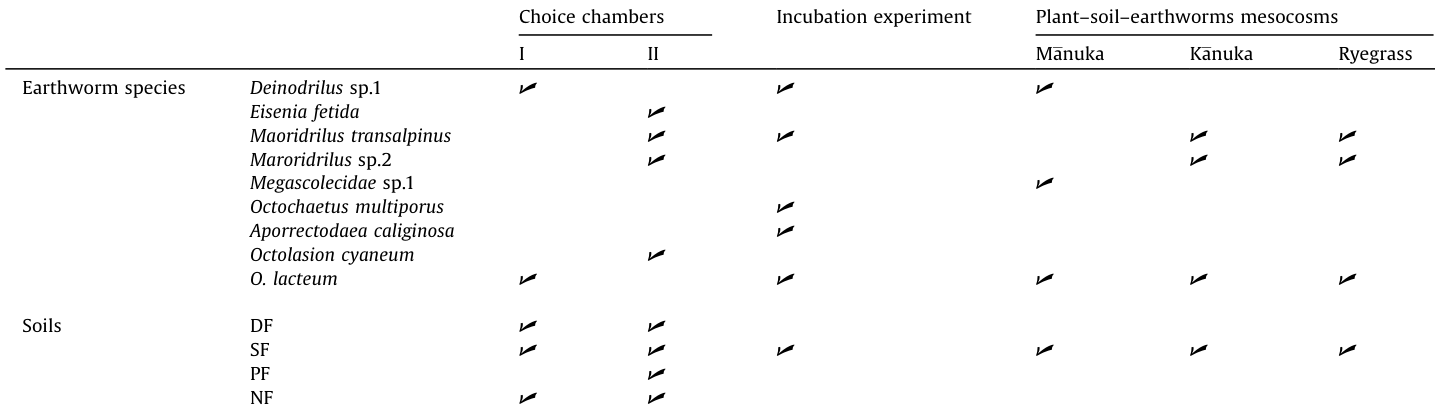
Five native species of earthworms representing epigeic, anecic, and endogeic functional groups were collected from locations in South Island, New Zealand. Three of these species have been described (Deinodrilus sp.1, Maoridrilus transalpinus, and Octochaetus multiporus) and are known to occur in Canterbury, but the remaining two are abundant but appear to be undescribed and are likely to be new to science (Table 2). We also collected specimens of four exotic species of lumbricid earthworms. Three of these (Aporrectodea calginosa, Octolasion lacteum, and O. cyaneum) are endogeics that are well represented on agricultural land, amongst about 19 species of exotics in New Zealand. The fourth exotic species, Eisenia fetida (an epigeic species), was collected from local compost heaps. The species of the present study were selected largely by virtue of ease of collection in large enough numbers by digging, abundance of adults during field sampling, most easilyrecognizable morphology, and survivorship under laboratory conditions. Native species were initially identified morphologically using keys and descriptions from Lee (1959a,b), followed by molecular methods using a DNA barcoding approach based on the cytochrome oxidase subunit 1 (COI) and 16S rDNA regions, as described previously (Boyer et al., 2011).
从新西兰南岛各地采集了代表表栖类、深栖类和内栖类功能群的5种本土蚯蚓。其中3种已有描述(Deinodrilus sp.1、Maoridrilus transalpinus和Octochaetus multiporus),且已知分布于坎特伯雷;其余2种数量丰富,但似乎尚未被描述,可能为科学上的新种(表2)。我们还采集了4种外来正蚓科蚯蚓标本。其中3种(Aporrectodea calginosa、Octolasion lacteum和O. cyaneum)为内栖类,在新西兰约19种外来蚯蚓中,它们在农业用地上分布广泛。第四种外来种赤子爱胜蚓(Eisenia fetida,表栖类)采自当地堆肥堆。本研究物种的选择主要基于以下因素:易于通过挖掘大量采集、野外采样时成体数量丰富、形态最易识别以及在实验室条件下的存活能力。本土物种首先依据Lee(1959a,b)的检索表和描述进行形态鉴定,然后采用基于细胞色素氧化酶亚基1(COI)和16S rDNA区域的DNA条形码分子方法进行鉴定,方法如前所述(Boyer et al., 2011)。
For each part of the experimental work, earthworm species were further selected on the basis of the visually most viable and healthy laboratory cultures on each set-up occasion (Table 3).
在每一部分试验中,还根据每次试验布置时目测最具活力和最健康的实验室培养群体进一步选择蚯蚓种类(表3)。
2.3. Choice-chamber experiments2.3 选择室试验
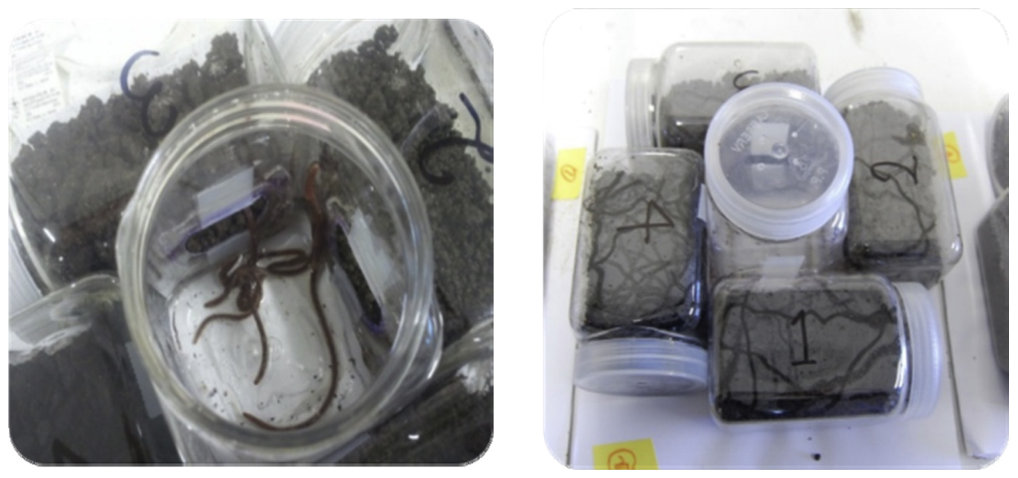
Simple choice chamber pieces of apparatus were constructed (Fig. 1) to investigate whether earthworms had clear preferences for the different soils in a series of separate assays. A commerciallyavailable organic compost (intelligro.co.nz) that provided a suitable medium for maintaining the cultures, was placed in a fourth chamber. A moisture content of 30 % was established and maintained in each soil by weighing. The species of earthworms in each assay was dependent of the availability, numbers and viability of cultures that were being maintained in the laboratory throughout. All comparisons between species made in this paper refer to replicate choice-chamber assays run at the same time. Using different species (Table 3), groups of five earthworms per species were placed in the central chamber of the apparatus which was then maintained in darkness. After a period of one week, the apparatus was emptied to observe where the earthworms were resident. Each soil was also carefully evaluated for visible evidence of burrowing activity. Representative fresh bulked sub-samples from each of the replicates, were then analyzed for pH, EC and mobile fractions of N as described below.
构建了简易的选择室装置(图1),通过一系列独立测定考察蚯蚓对不同土壤是否具有明显偏好。第四个室中放入一种市售有机堆肥(intelligro.co.nz),该堆肥为维持培养群体提供了适宜的介质。通过称重法使各土壤含水量达到并维持在30%。各测定中所用蚯蚓种类取决于整个试验期间实验室所维持培养群体的可得性、数量和活力。本文中所有物种间的比较均指同时进行的重复选择室测定。使用不同物种(表3),每个物种5条蚯蚓为一组,置于装置的中央室内,然后将装置置于黑暗中。一周后清空装置,观察蚯蚓的栖居位置。同时仔细检查每种土壤中是否有可见的掘穴活动迹象。随后取各重复具有代表性的新鲜混合子样品,按下文所述方法测定pH、EC和氮的可移动组分。
Location and description of the four soils collected for experimental work. Distance is related to DF.
用于试验的四种土壤的采集地点及描述。距离以DF为参照。
| Dairy farm (DF)奶牛场(DF) | Sheep farm (SF)牧羊场(SF) | Plantation forest (PF)人工林(PF) | Native forest (NF)天然林(NF) | |
|---|---|---|---|---|
| Location | 43�38’11.2700S, 172�26’17.5600E University grounds | 43�38’39.4800S, 172�23’28.0700E Gammack Estate | 43�25’24.5500S, 172�18’28.1400E Eyrewell | 42�8’38.3900S, 171�19’50.3600E Punakaiki |
| Distance (km) | 0 | 5 | 25 | 200 |
| Classification | Templeton (immature Pallic) | Eyre (immature Pallic) | Lismore (orthic brown) | Karoro (sandy to orthic brown) |
| Description | Well-drained, fine sandy to silty alluvium. High WHC. Ryegrass paddock. | As for DF, but stonier, freer draining, with lower WHC. Ryegrass, Cocksfoot paddock. | Very similar to SF, but more stony. Mature Pinus radiata | Leached soil on sandplain of old marine and river terraces. Broadleaf, Podocarp. |
Species of earthworms used in the experiments, their origin, ecology and some aspects of morphology. Endemic earthworms were named based on morphological identification following Lee (1959a,b). Specimens that did not match any know description were considered undescribed and were attributed a code name. Functional group was determined based on earthworm location in the soil profile as well as general morphology and behavior.
试验所用蚯蚓种类及其来源、生态学特征和部分形态特征。特有蚯蚓依据Lee(1959a,b)进行形态鉴定并命名。与任何已知描述均不符的标本被视为未描述种,并赋予代号。功能群依据蚯蚓在土壤剖面中的位置以及一般形态和行为确定。
| Functional Group功能 群 | Name of species物种名称 | Status状态 | Description Origin描述 来源 | Colour颜色 | Length (mm)体长 (mm) | Prostomium口前叶 | Photo照片 |
|---|---|---|---|---|---|---|---|
| Epigeic | Deinodrilus sp.1 | Native | Nikau Reserve | Dark brown with reddish head | 80–120 | Tanylobous | |
| Eisenia fetida | Exotic | Compost and manure heaps | Red or brown with transverse pigmented bands | 32–130 | Epilobous | ||
| Anecic # | Maoridrilus transalpinus | Native | Bank Peninsula, Lincoln township | Brown with incompletely dark clitellum | 160–200 | Tanylobous | |
| Maroridrilus sp.2 | ” | Lincoln University | Pale orange with reddish brown head | 120–150 | Tanylobous | ||
| Endogeic | Megascolecidae sp.1 | Native | Nikau Reserve | Pale pink or white | 60–80 | Tanylobous | |
| Octochaetus multiporus | ” | Bank Peninsula, Lincoln township | Pale pink or white | 180–300 | Prolobous | ||
| Aporrectodaea caliginosa | Exotic | ” | Colour variable, dark green | 30–80 | Epilobous | ||
| Octolasion cyaneum | ” | ” | Bluish grey and bright yellow in tail | 65–180 | Epilobous | ||
| O. lacteum | ” | Punakaiki coastal restoration area | Grey and yellow spot in tail | 45–55 | Epilobous |
# Based on laboratory observations of the authors.
# 基于作者的实验室观察。
Earthworm species and soils used in the experiments.
试验所用蚯蚓种类及土壤。
2.4. Incubation experiments2.4 培养试验
Five species of earthworm were placed separately in 250 g of wetted SF soil (30% moisture) within 400 ml polypropylene containers (Table 3). A gauze covering prevented the earthworms escaping and soil moisture was maintained on a weekly basis by weighing each container and adding appropriate amounts of water. Sawdust (2 g) was added as a food source, having been previously found to maintain earthworm viability whilst adding minimal additional nutrients into the containers. Four replicates of each treatment were maintained in the dark in an incubator at 15 �C for 3 weeks, with a randomized arrangement of the containers. The same procedure was followed in four reference pots without earthworms. Earthworm survival was monitored on a weekly basis with minimal disturbance of the soils. On completion of this experiment, earthworms were removed and the soils were sampled and analyzed as described below.
将5种蚯蚓分别放入400 ml聚丙烯容器内的250 g湿润SF土壤(含水量30%)中(表3)。容器上覆纱布以防蚯蚓逃逸,每周称量各容器并补加适量水分以维持土壤含水量。加入锯末(2 g)作为食物来源,此前已发现锯末可维持蚯蚓活力,同时向容器中引入的额外养分极少。每个处理设4个重复,容器随机排列,于15 °C培养箱中避光培养3周。另设4个不加蚯蚓的对照盆,采用相同程序处理。每周监测蚯蚓存活情况,尽量减少对土壤的扰动。试验结束时取出蚯蚓,按下文所述对土壤进行采样和分析。
Conservation nursery at Motukarara. Plants of each species were transplanted singly into 20 plastic plant pots filled with 1.3 L of SF soil. Five treatments consisted of three species of native earthworm, one species of exotic earthworm and plants without earthworms as a control (Table 3). Each treatment contained two individual earthworms, with 5 replicate pots [2 plant species � 5 earthworms treatments � 5 replicates = 50 pots]. To stop earthworms escaping, drainage holes in the bottom of the pots were sealed with a nylon mesh which was also placed over the top of the pots and sealed around the single woody stems of the plants. The pots were maintained in a glasshouse for 7 weeks, after which the pots contents were removed and compared. This experiment was carried out on two occasions with different species of earthworms as they became available in suitable numbers. In the second experiment, a further 20 pots were sown with perennial ryegrass (L. perenne) as an additional treatment to provide a dairy pasture comparison. Plant growth (biomass at final harvest), earthworm survival and root structure (biomass and photographic comparisons) were measured.
保护苗圃(位于Motukarara)。每种植物单株移栽至20个装有1.3 L SF土壤的塑料花盆中。5个处理包括3种本土蚯蚓、1种外来蚯蚓以及不加蚯蚓的植物对照(表3)。每个处理放入2条蚯蚓,设5个重复盆[2种植物 × 5个蚯蚓处理 × 5个重复 = 50盆]。为防止蚯蚓逃逸,盆底排水孔用尼龙网封住,盆顶同样覆盖尼龙网并在植物单一木质茎周围密封。花盆在温室中维持7周,之后取出盆中内容物进行比较。由于不同种类的蚯蚓在不同时间才能获得足够数量,本试验分两次进行。在第二次试验中,另有20盆播种多年生黑麦草(L. perenne)作为附加处理,以提供奶牛场牧场的对照。测定了植物生长(最终收获时的生物量)、蚯蚓存活及根系结构(生物量及照片比较)。
2.6. Analytical2.6 分析方法
2.5. Plant-soil-earthworm mesocosms2.5 植物–土壤–蚯蚓中宇宙试验
Uniform one-year old plants of native tea trees, Leptospermum scoparium (Myrtaceae, manuka) and Kunzea robusta (Myrtaceae, kanuka) grown in plugs were obtained from the Department of
所用植物为规格一致、穴盘培育的一年生本土茶树幼苗,即Leptospermum scoparium(桃金娘科,麦卢卡)和Kunzea robusta(桃金娘科,卡努卡),购自Department of
All soils were analyzed in-house by Analytical Services in the Department of Soil and Physical Sciences at the Lincoln University using standard methodologies, with ASPAC Ring Test QA procedures. Following extraction with 2 M KCl using fresh soil, samples were analyzed for available-N using a FIA star 5000 triple channel analyser (Foss Tecator AB, Sweden), attached to a spectrophotometer (Blakemore et al., 1987; Clough et al., 2001). Air-dried soil samples were sieved to <2 mm using a metal sieve. Soil pH and electronic conductivity (EC) were measured using pH and EC meters (Mettler Toledo Seven Easy). Total N and C were analyzed by a Vario-Max CN elemental analyser (Elementar GmbH, Germany). Oven-dried (100 �C) soil samples were analyzed for loss on ignition (LOI) at 550 �C in a muffle furnace. Following microwave digestion of oven-dried soil, Total-P was analyzed using ICP-OES (Varian 720 ES, USA). Available-P was determined as Olsen P, using 0.5 M NaHCO3 extractant and a UV160A spectrophotometer (Shimadzu, Japan) (Blakemore et al., 1987). Soils from the choice chamber and incubation experiments were analyzed for LOI at the beginning and end of the experiments to provide an estimate of the amount of organic matter consumed.
所有土壤均由林肯大学土壤与物理科学系分析服务部采用标准方法进行分析,并执行ASPAC环形测试质量保证程序。新鲜土壤经2 M KCl浸提后,使用连接分光光度计的FIA star 5000三通道分析仪(Foss Tecator AB,瑞典)测定有效氮(Blakemore et al., 1987; Clough et al., 2001)。风干土样用金属筛过筛至<2 mm。土壤pH和电导率(EC)采用pH计和EC计(Mettler Toledo Seven Easy)测定。全氮和全碳采用Vario-Max CN元素分析仪(Elementar GmbH,德国)测定。烘干(100 °C)土样在马弗炉中于550 °C测定烧失量(LOI)。烘干土壤经微波消解后,采用ICP-OES(Varian 720 ES,美国)测定全磷。有效磷以Olsen P表示,采用0.5 M NaHCO3浸提剂和UV160A分光光度计(Shimadzu,日本)测定(Blakemore et al., 1987)。选择室试验和培养试验的土壤在试验开始和结束时测定LOI,以估算有机质的消耗量。
Gas sampling was conducted at 16 �C in the incubation experiments after 20 days in all treatments except those containing A. caliginosa, where high mortality rates were being recorded at the time. Lids placed on the 400 ml containers left about 20 ml of headspace above the soil, from which 10 ml aliquots of gas were sampled 0, 20, and 40 min after sealing. Emission rates were calculated from regression equations. Nitrous oxide (N2O) and carbon dioxide (CO2) were analyzed using a gas chromatograph (SRI 8610 GC, CA, USA) with a 63Ni electron capture detector and flame ionization detector, linked to an autosampler (Gilson 222 XL, USA). All methods follow those described by Clough et al. (2006).
在培养试验中,除含A. caliginosa的处理外(当时该处理正出现高死亡率),所有处理均在第20天于16 °C下进行气体采样。400 ml容器加盖后,土壤上方约留有20 ml顶空,于密封后0、20和40 min分别从中抽取10 ml气体样品。排放速率由回归方程计算。氧化亚氮(N2O)和二氧化碳(CO2)采用配有63Ni电子捕获检测器和火焰离子化检测器并连接自动进样器(Gilson 222 XL,美国)的气相色谱仪(SRI 8610 GC,CA,美国)测定。所有方法均参照Clough et al.(2006)所述。
2.7. Statistical analysis2.7. 统计分析
Data were analyzed using Minitab (Minitab Inc., State College, Pennsylvania, USA). To compare means of each earthworm species treatment, data were analyzed using one-way ANOVA with Fisher’s least-significant-difference post-hoc test.
数据采用Minitab(Minitab Inc.,State College,Pennsylvania,美国)进行分析。为比较各蚯蚓种类处理的均值,采用单因素ANOVA及Fisher最小显著差异法事后检验进行数据分析。
3.2. Soil preference3.2 土壤偏好
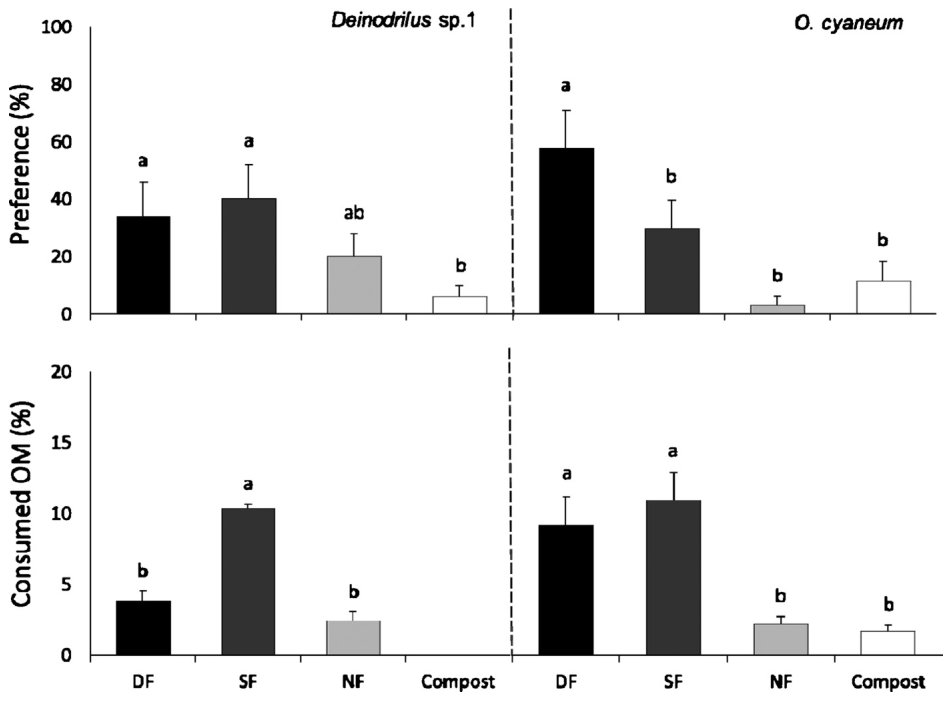
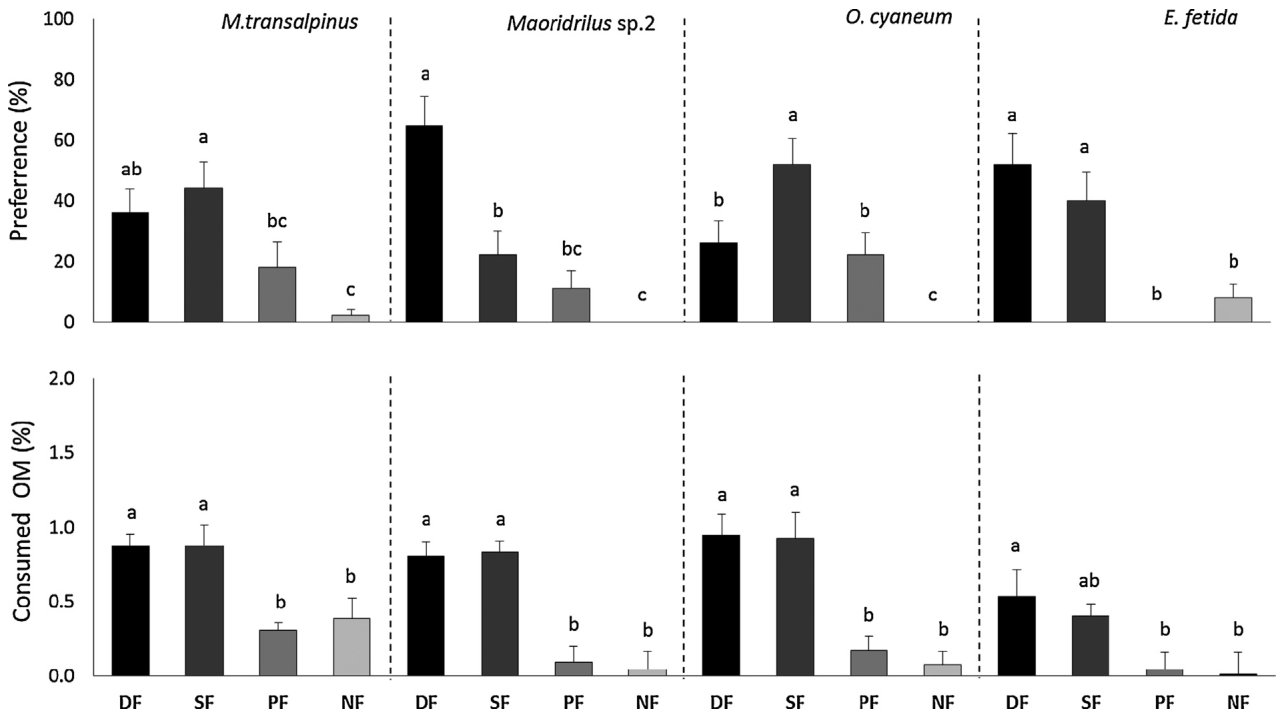
The first Choice Chamber assays clearly showed that native and exotic earthworms selected agricultural soils in preference to native forest and plantation forest soils and compost (Fig. 2). This was not a case of earthworms preferring the soil they were acclimatized to, since they had been collected from a range of different sites, none of which were dairy farm of sheep farm soil (Table 1). Earthworms in the early trials tended to lose weight; this varied between species, ranging from 0.2% fresh weight losses in Deinodrilus sp. to 15.4% weight loss in O. lacteum. More detailed Choice Chamber studies resolved this problem, showing earthworms did not select the most organic soils, although the amount of organic matter consumed corresponded with soil preference (Fig. 3). In these trials, fresh weight gains over one week were 2.1% (M. transalpinus), 12.1% (Maoridrilus sp.2), 2.6% (O. cyaneum), and 5.5% (E. fetida).
首次选择室测定清楚表明,与天然林土壤、人工林土壤和堆肥相比,本土蚯蚓和外来蚯蚓均优先选择农业土壤(图2)。这并非蚯蚓偏好其已适应的土壤所致,因为这些蚯蚓采自多个不同地点,其中没有一处是奶牛场或牧羊场土壤(表1)。早期试验中蚯蚓体重有下降趋势,且因物种而异,鲜重损失从Deinodrilus sp.的0.2%到O. lacteum的15.4%不等。更为细致的选择室研究解决了这一问题,结果表明蚯蚓并未选择有机质含量最高的土壤,尽管有机质消耗量与土壤偏好相对应(图3)。在这些试验中,一周内的鲜重增加分别为2.1%(M. transalpinus)、12.1%(Maoridrilus sp.2)、2.6%(O. cyaneum)和5.5%(E. fetida)。
It is counter-intuitive that native species, or even lumbricid earthworms, would prefer the physico-chemical conditions of farmed soils to the soils of a plantation forest and a native forest. They had a predilection for less acid soils with lower C/N ratios and higher soluble P, although the actual causal factors for their preference are unknown. High levels of OM were less important, and earthworms were not sensitive to high soil NO3�–N. Eijsackers (2011) considered that abiotic factors such as pH, soil type and organic matter play a more important role than inherent ecological characteristics of the particular species. The findings of the present study appear to support this, with few discernible or consistent differences between native and exotic species or between functional groups. Earthworms have been found to use chemical odours to guide their foraging behaviour towards microbial food sources (Zirbes et al., 2011) and are likely to be able to detect NH4+. However, it appears from the results of the present study that the likely attraction of high levels of organic matter is outweighed either by higher soil pH or avoidance of elevated NH4+. The high NO3-N that is quite typical of agricultural soils, but a less easy form of N for animals to detect, does not appear to be a deterrent.
本土物种乃至正蚓科蚯蚓会偏好农耕土壤的理化条件,而非人工林和天然林土壤,这与直觉相悖。它们偏好酸性较弱、C/N比较低且可溶性磷较高的土壤,但其偏好的实际成因尚不清楚。高有机质含量的重要性较低,且蚯蚓对土壤高NO3−–N不敏感。Eijsackers(2011)认为,pH、土壤类型和有机质等非生物因素比特定物种固有的生态学特征发挥着更重要的作用。本研究结果似乎支持这一观点,本土种与外来种之间以及各功能群之间几乎没有可辨别的或一致的差异。已发现蚯蚓利用化学气味引导其向微生物食物源觅食(Zirbes et al., 2011),并且很可能能够感知NH4+。然而,从本研究结果来看,高有机质可能具有的吸引力被较高的土壤pH或对NH4+升高的回避所抵消。农业土壤中十分典型的高NO3-N是一种动物较难感知的氮形态,似乎并不构成排斥因素。
3Results and discussion结果与讨论
3.3. Effects on soil properties3.3 对土壤性质的影响
3.1. Soils3.1 土壤
The selected soils had contrasting physicochemical characteristics as expected. The native forest soil was more acidic than the agricultural soils, with substantially higher organic matter, total N and total P (Table 4). Lability of both N and P presented the opposite picture, with higher concentrations of soluble nitrate and mobile P in the agricultural soils. High Olsen P in SP, despite low total-P is an anomaly that has been described previously (Randhawa 2003). Organic forms of N and NH4+ were much more prevalent in the native forest soil, but there was much less mobile NO3�. The absence of fertilization is evident in the plantation forest soil.
如预期,所选土壤具有差异显著的理化特征。天然林土壤的酸性强于农业土壤,有机质、全氮和全磷含量显著更高(表4)。氮和磷的活性则呈相反情形,农业土壤中可溶性硝酸盐和可移动磷的浓度更高。SP土壤全磷虽低但Olsen P较高,这一异常现象此前已有报道(Randhawa 2003)。有机态氮和NH4+在天然林土壤中更为普遍,但可移动NO3−则少得多。人工林土壤中未施肥的特征十分明显。
After three weeks of the incubation in SF soil, earthworm activity had marginally increased Electrical Conductivity (EC), Microbial Biomass Carbon (MBC) and Olsen P (Table 5). There were no significant differences, or else only negligible differences, between the soils with and without earthworms, in terms of pH, OM and C/N ratio (data not shown). Other studies with longer incubation periods have shown a much more pronounced effect on mobile P (e.g., Scheu and Parkinson, 1994; Vos et al., 2014). In the present study, an initial soil pH of 5.4 of the sheep farm soil was reduced to 4.85–4.90 after being wetted and incubated in the reference containers (without earthworms), but was reduced no lower than pH 4.7 in earthworm treatments. In future work it would be advisable to allow for an initial period of wetting before the experiment begins. A decline in soil pH has been reported previously (Cheng and Wong, 2002), although many studies have demonstrated that earthworm activity increase soil pH towards neutrality, due to excretion of intestine and cutaneous mucus (Schrader, 1994; Edwards and Bohlen, 1996; Cole et al., 2006).
在SF土壤中培养3周后,蚯蚓活动使电导率(EC)、微生物生物量碳(MBC)和Olsen P略有增加(表5)。就pH、有机质和C/N比而言,有蚯蚓与无蚯蚓的土壤之间无显著差异,或仅有可忽略的差异(数据未列出)。其他培养期较长的研究表明,蚯蚓对可移动磷的影响更为显著(如Scheu and Parkinson, 1994; Vos et al., 2014)。在本研究中,牧羊场土壤的初始pH为5.4,在对照容器(无蚯蚓)中经湿润和培养后降至4.85–4.90,而在蚯蚓处理中最低仅降至pH 4.7。在今后的研究中,建议在试验开始前预留一段初始湿润期。土壤pH下降此前已有报道(Cheng and Wong, 2002),但许多研究表明,由于肠道和体表黏液的分泌,蚯蚓活动会使土壤pH趋向中性(Schrader, 1994; Edwards and Bohlen, 1996; Cole et al., 2006)。
Properties of the four soils used in experimental work. Values in blankets represent standard error of the mean (n = 3). Plantation forest values are mean of two samples.
试验所用四种土壤的性质。括号内数值为均值的标准误(n = 3)。人工林数值为两个样品的均值。
| Properties性质 | Dairy farm (DF)奶牛场(DF) | Sheep farm (SF)牧羊场(SF) | Plantation forest (PF)人工林(PF) | Native forest (NF)天然林(NF) |
|---|---|---|---|---|
| Texture | Silt loam | Silt loam | Silt loam | Silt loam |
| pH (1:5W) | 5.6 (0.0) | 5.4 (0.0) | 5.0 (0.0) | 4.7 (0.2) y |
| OM (%) | 7.3 (0.2) | 7.5 (0.1) | 4.3 (0.1) | 22.6 (0.2) |
| Total C (%) | 3.3 (0.4) z | 3.3 (0.1) | 2.4 (0.1) | 10.7 (3.4) y |
| Total N (%) | 0.2 (0.0) z | 0.3 (0.0) | 0.1 (0.0) | 0.7 (0.2) y |
| C/N Ratio | 15.0 (0.0) z | 12.2 (0.3) | 17.2 (2.0) | 16.9 (0.9) y |
| NO3-N (mg�kg-1) | 1.8 (0.5) | 2.9 (0.5) | 0.2 (0.2) | 19.6 (1.4) |
| NO3-N (mg�kg-1) | 118 (12) | 88.1 (0.6) | < 0.1 | 18.3 (0.5) |
| Total P (mg�kg-1) | 596 (7) z | 341 (-) | 335 (-) | 836 (116) y |
| Olsen P (mg�kg-1) | 23.8 (0.2) | 34.4 (0.1) | 4.8 (0.1) | 15.5 (0.2) |
y Hahner et al. (2013). z Gartler et al. (2012).
y Hahner et al.(2013)。z Gartler et al.(2012)。
), PF ( ), and DF ( ).)、PF( )和DF( )。
Changes of soil properties by all species of earthworm throughout incubation for 3 weeks in DF soil. Value in blankets represent standard errors of the mean (n = 4). The same letters indicate no significant difference (p < 0.05).
DF土壤中各种蚯蚓培养3周期间土壤性质的变化。括号内数值为均值的标准误(n = 4)。相同字母表示无显著差异(p < 0.05)。
| Properties性质 | Control对照 | Native本土种 | Exotic外来种 | |||
|---|---|---|---|---|---|---|
| Deinodrilus sp.1 | Maoridrilus transalpinus | Octochaetus multiporus | Aporrectodaea calginosa | Octolasion lacteum | ||
| EC (dS m�1) | 0.16 (0.00)c | 0.19 (0.00)b | 0.21 (0.01)a | 0.21 (0.00)a | 0.20 (0.01)ab | 0.19 (0.00)b |
| Olsen P (mg g�1) | 34.1 (0.10)e | 34.7 (0.13)cd | 35.8 (0.24)a | 35.2 (0.07)b | 34.8 (0.13)bc | 34.3 (0.14)de |
| MBC (mg g�1) | 122 (13)b | 146 (23)b | 161 (17)ab | 141 (20)b | 190 (46)ab | 241 (54)a |
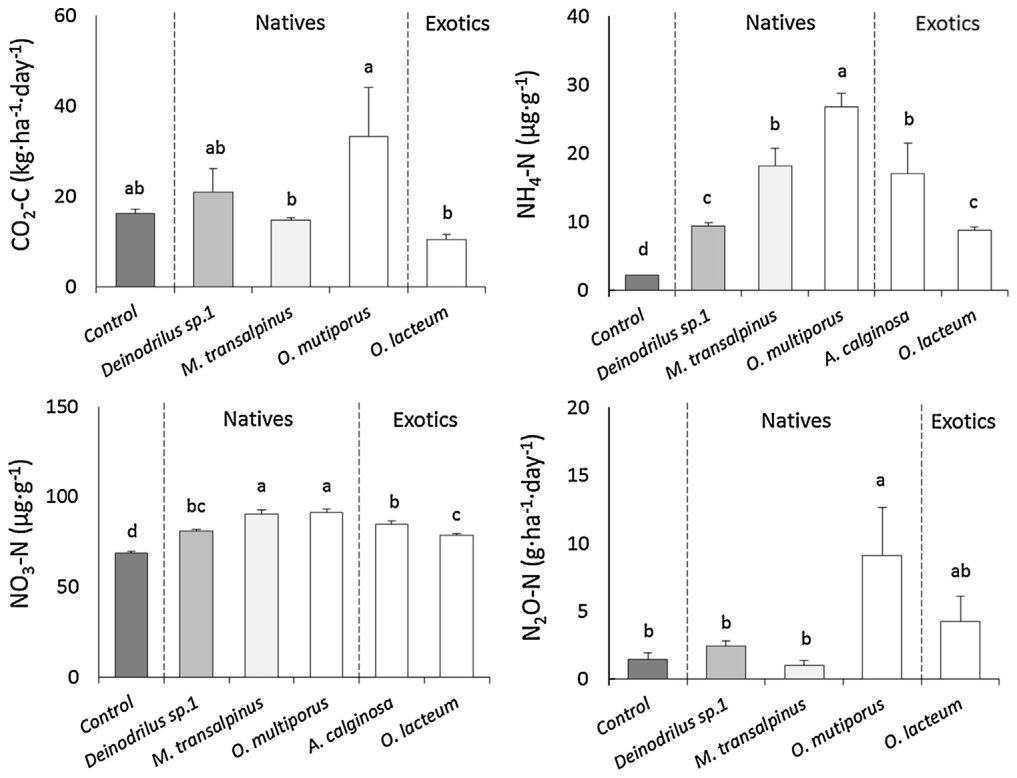
Earthworms have been shown previously to increase nitrification and denitrification activity (Parkin and Berry, 1999). They probably also have impacts on nitrate leaching in soil through both their effects on mineralization of organic N and water movement through burrow channels, but these effects have not yet been quantified under New Zealand conditions (Fraser, 2010). In our study, increased microbial biomass led to increased OM decomposition that is reflected in increased respiration and more release of NH4+ from organic N in the earthworm incubated soils (Fig. 4). This appears to have a knock-on effect causing marginal increases of soluble N03-N associated with earthworm activity.
此前已有研究表明,蚯蚓可增强硝化和反硝化活性(Parkin and Berry, 1999)。蚯蚓可能还通过影响有机氮矿化以及经由洞穴通道的水分运移而影响土壤硝酸盐淋溶,但这些效应在新西兰条件下尚未得到量化(Fraser, 2010)。在本研究中,微生物生物量增加导致有机质分解增强,表现为蚯蚓培养土壤中呼吸作用增强以及有机氮释放更多NH4+(图4)。这似乎产生了连锁效应,导致与蚯蚓活动相关的可溶性N03-N略有增加。
Release of substantially more CO2 (by 33%) and N2O (by 42%) by burrowing endogeic species has also been reported elsewhere from a detailed meta-analysis from 57 short-term studies each of up to 200 days (Lubbers et al., 2013), although production of N2O from denitrification requires anaerobic conditions. Of course, earthworm burrowing increases aerobic conditions, and therefore the main source of N2O would be expected to be from nitrification (Chen et al., 2013). However, earthworms are known to also stimulate nitrification, leading to enhanced release of N2O, (Postma-Blaauw et al., 2006). Presumably the requisite anaerobic conditions could occur in microsites in the walls of the drilosphere.
另有一项基于57项短期研究(每项研究历时最长200天)的详细meta分析报道,掘穴内栖类物种使CO2和N2O释放量分别大幅增加33%和42%(Lubbers et al., 2013),尽管反硝化作用产生N2O需要厌氧条件。当然,蚯蚓掘穴会增强好氧条件,因此N2O的主要来源预计为硝化作用(Chen et al., 2013)。然而,已知蚯蚓也会刺激硝化作用,从而增加N2O释放(Postma-Blaauw et al., 2006)。推测所需的厌氧条件可能出现在蚓触圈(drilosphere)洞壁的微位点中。
The data from the present study have been extrapolated to be shown as g ha�1 day�1 and represent perhaps 1% N2O emissions reported elsewhere in non-fertilized soils (e.g., de Klein et al., 2001). This may be of some concern since N2O accounts for about 29% of agricultural emissions in New Zealand which has the highest agricultural GHG emissions for any developed country. This greenhouse gas is 310 times more potent than CO2 and about 75% of N2O is emitted directly or indirectly from soils (Thorburn et al., 2013). Clearly this justifies further study.
本研究数据经外推后以g ha−1 day−1表示,约相当于其他研究报道的未施肥土壤N2O排放量的1%(如de Klein et al., 2001)。这可能值得关注,因为在新西兰N2O约占农业排放的29%,而新西兰是所有发达国家中农业温室气体排放最高的国家。该温室气体的增温潜势是CO2的310倍,约75%的N2O直接或间接排放自土壤(Thorburn et al., 2013)。显然,这值得进一步研究。
Present-day agricultural systems seek to improve the efficiency of N usage, mainly to limit the release of reactive N to the wider environment as soluble NO3� and gaseous N2O. It is argued that a shift is required towards NH4+-dominated, low-nitrifying agricultural production systems. Enhancing the release of biological nitrification inhibitors from the roots of pasture grasses and cereals is receiving considerable attention (Subbarao et al., 2013), but management of tillage systems and interactions between the rhizosphere and earthworm communities will also play a significant role.
当今农业系统致力于提高氮素利用效率,主要是为了限制活性氮以可溶性NO3−和气态N2O的形式释放到更广泛的环境中。有观点认为,需要转向以NH4+为主导、低硝化的农业生产系统。增强牧草和谷物根系释放生物硝化抑制剂正受到广泛关注(Subbarao et al., 2013),但耕作系统的管理以及根际与蚯蚓群落之间的相互作用也将发挥重要作用。
allow native earthworms on marginal land to recolonize, with concurrent benefits both to species conservation and to soil quality. Meanwhile, marginal land in agricultural landscapes provides suitable soils and a valuable habitat for earthworms.
使边际土地上的本土蚯蚓得以重新定殖,从而同时有益于物种保护和土壤质量。与此同时,农业景观中的边际土地为蚯蚓提供了适宜的土壤和宝贵的栖息地。
Acknowledgements致谢
3.4. Plant–soil–earthworm interactions3.4 植物–土壤–蚯蚓相互作用
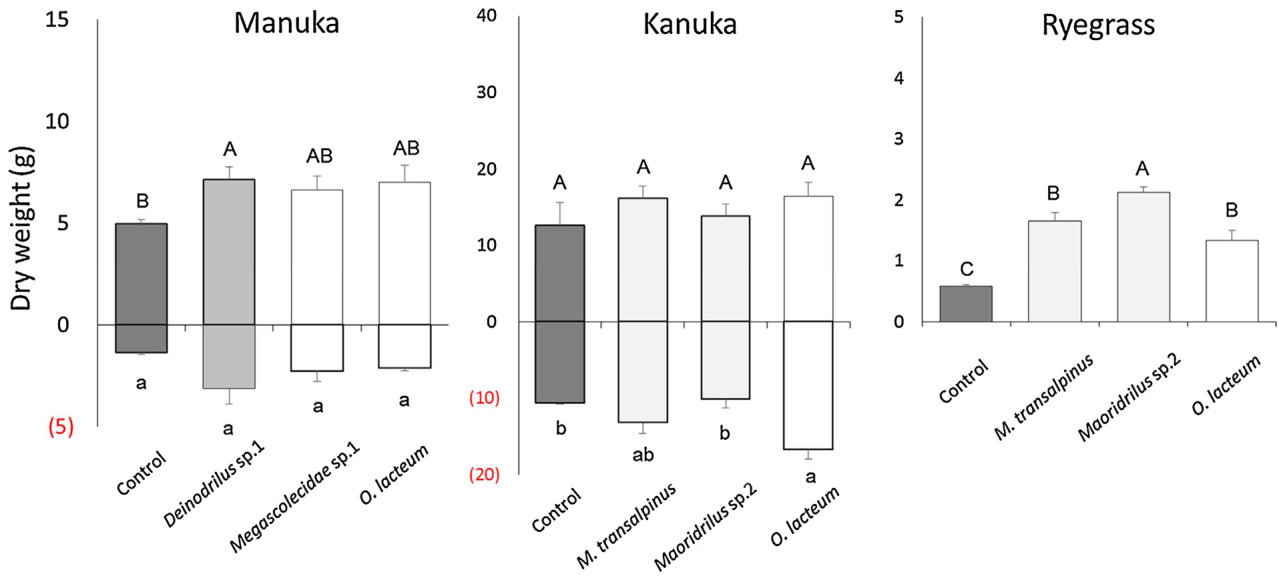
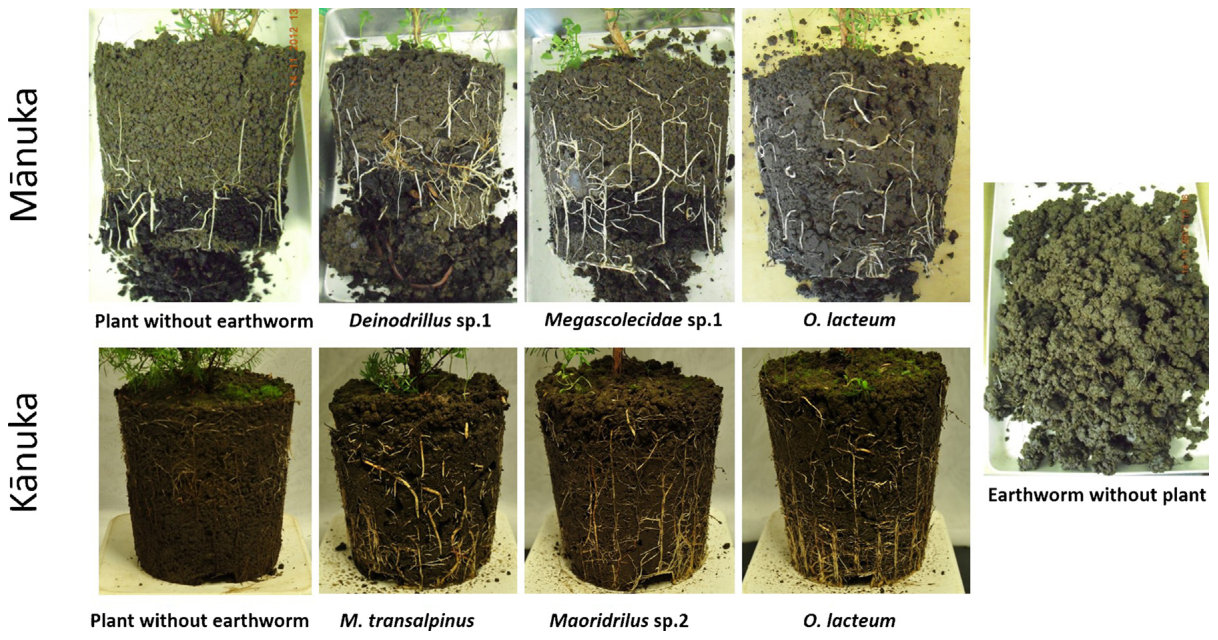
All tested species of earthworm increased the growth of ryegrass, and Deinodrilus significantly increased the above-ground growth of manuka (Fig. 5). When these root and shoot data were combined, they showed a general increase in growth of all plants in the presence of earthworms. More profound visual differences were evident between the root systems of different plants in the presence of earthworms (Fig. 6). The compost around the original plant plugs of manuka had been dispersed quite differently through the pots, and burrowing patterns evident in the soils as formed by different earthworms were also variable.
所有受试蚯蚓种类均促进了黑麦草的生长,且Deinodrilus显著促进了麦卢卡地上部的生长(图5)。将根和地上部数据合并后,结果显示蚯蚓存在下所有植物的生长普遍增加。在蚯蚓存在下,不同植物根系之间的视觉差异更为显著(图6)。麦卢卡原育苗穴周围的堆肥在花盆中的分散方式差异很大,不同蚯蚓在土壤中形成的掘穴格局也各不相同。
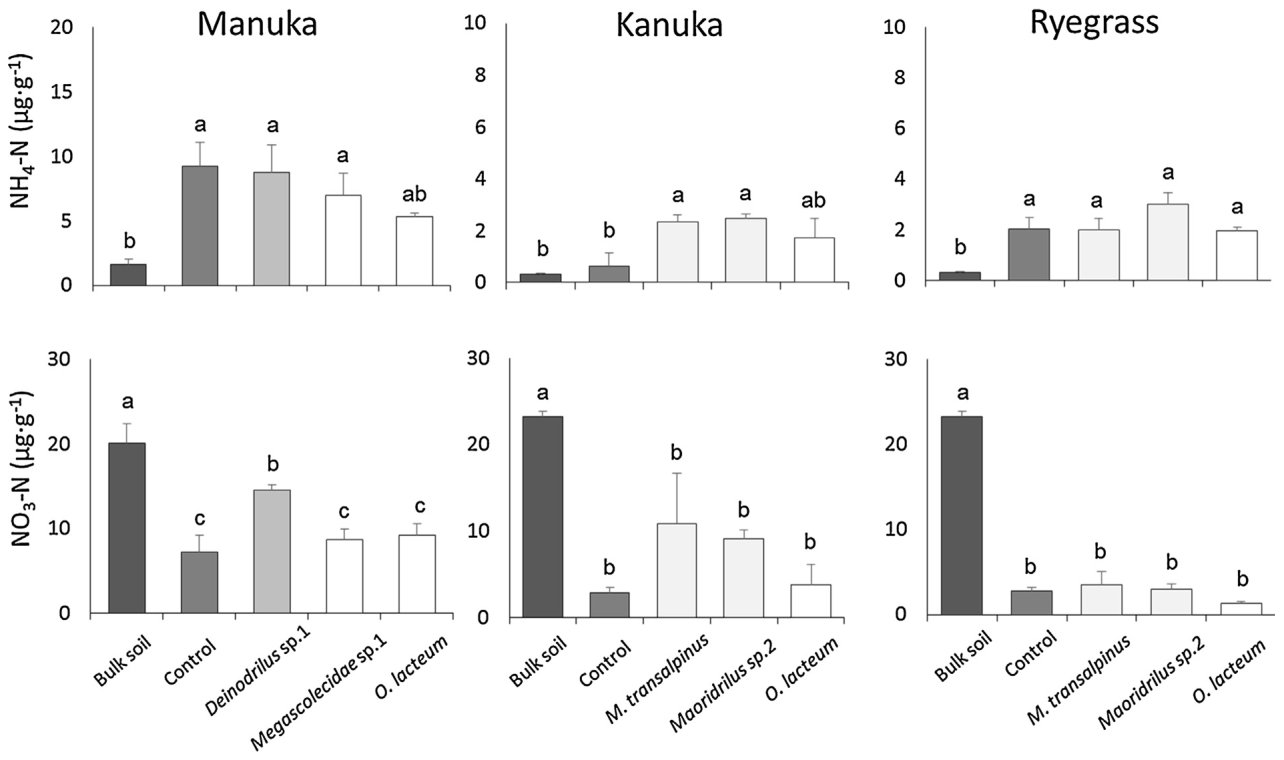
The presence of a plant rhizosphere hugely diminished the concentrations of mobile NO3� in soil, but raised the concentrations of NH4+ (Fig. 7). These mobile forms of N tended to be higher with the additional presence of earthworms. In the presence of earthworms, there were differences between the plants: kanuka, increased NH4+ concentrations in soil, kanuka and manuka raised NO3�, but here was no apparent effect in the presence of ryegrass. These results illustrate that we require a more detailed understanding the interactions between soils, root systems, earthworms and soil chemistry, and their impact on the soil ecosystems of agricultural landscapes in New Zealand.
植物根际的存在大幅降低了土壤中可移动NO3−的浓度,但提高了NH4+的浓度(图7)。在蚯蚓同时存在时,这些可移动形态的氮往往更高。在蚯蚓存在下,不同植物之间存在差异:卡努卡提高了土壤NH4+浓度,卡努卡和麦卢卡提高了NO3−浓度,而在黑麦草存在下则无明显影响。这些结果表明,我们需要更深入地了解土壤、根系、蚯蚓和土壤化学之间的相互作用,以及它们对新西兰农业景观土壤生态系统的影响。
4Conclusions结论
This study provides a first step towards managing rare species of earthworm remaining in the very restricted refugia within production landscapes of New Zealand. The deeper-burrowing endogeic earthworm O. multiporus is the only native species that is known to survive successfully in agricultural pastures (Springett et al., 1998). However, we were unable to identify any differences, in terms of burrowing and feeding behaviours, associated with the coexistence of these disparate families of native and exotic earthworms which have apparently similar functional traits. In New Zealand there is no evidence that lumbricids have been responsible for the disappearance of native megascolecid species, nor that they competitively exclude them; both natives and exotics appear to be able coexist on the margins of agricultural land. The disappearance and current absence of native species from agricultural land appears to be related to the inability of megascolecid worms to tolerate disturbance, as suggested by Lee (1985), rather than to any agricultural modification of the physico-chemistry of soil.
本研究为管理新西兰生产性景观中极为有限的庇护地内残存的珍稀蚯蚓物种迈出了第一步。深层掘穴的内栖类蚯蚓O. multiporus是已知唯一能够在农业牧场中成功存活的本土物种(Springett et al., 1998)。然而,对于功能性状明显相似、分属不同科的本土和外来蚯蚓,我们未能识别出与其共存相关的掘穴和取食行为差异。在新西兰,没有证据表明正蚓科蚯蚓导致了本土巨蚓科物种的消失,也没有证据表明其对后者存在竞争排斥;本土种和外来种似乎能够在农业用地边缘共存。本土物种从农业用地上消失及目前的缺失,似乎与巨蚓科蚯蚓无法耐受扰动有关(如Lee(1985)所提出的),而非与农业对土壤理化性质的改变有关。
The inherent taxonomic and ecological characteristics of earthworms were less important than soil type to their habitation. In the present study, native species preferred the physico-chemical conditions of farmed soils to the soils of a plantation forest and a native forest. Less acid soils with lower C/N ratios and higher soluble P were more important than high OM. Earthworms were not sensitive to high soil NO3�–N. Their borrowing increased microbial biomass, mobile-P and EC in our short-term incubation studies, but increased gaseous NH4+ and N2O emissions. Earthworms also influenced root morphology and sometimes increased plant growth, with raised soil NH4+ and NO3� in the presence of plant roots.
对蚯蚓栖居而言,其固有的分类学和生态学特征不如土壤类型重要。在本研究中,本土物种偏好农耕土壤的理化条件,而非人工林和天然林土壤。酸性较弱、C/N比较低且可溶性磷较高的土壤比高有机质更为重要。蚯蚓对土壤高NO3−–N不敏感。在我们的短期培养研究中,蚯蚓掘穴增加了微生物生物量、可移动磷和EC,但也增加了气态NH4+和N2O排放。蚯蚓还影响根系形态,有时促进植物生长,并在植物根系存在时提高土壤NH4+和NO3−。
Whilst introduced Lumbricidae have colonized agricultural pastures in New Zealand, their establishment has often been less successful than agronomists have hoped (Fraser, 2010). However, reduced tillage in modern agricultural management systems may
尽管引入的正蚓科蚯蚓已在新西兰农业牧场中定殖,但其建群往往不如农学家所期望的那样成功(Fraser, 2010)。然而,现代农业管理系统中的少耕措施可能
The authors thank Sherra Erna Jole and Tang Bee Eik for help with field sampling experimental work, and Lynne Clucas for analytical support.
作者感谢Sherra Erna Jole和Tang Bee Eik在野外采样和试验工作中提供的帮助,以及Lynne Clucas提供的分析支持。
References参考文献
Al-Maliki, S., Scullion, J., 2013. Interactions between earthworms and residues of differing quality affecting aggregate stability and microbial dynamics. Appl. Soil Ecol. 64, 56–62. Blakemore, L.C., Searle, P.L., Daly, B.K., 1987. Methods for chemical analysis of soils. N. Z. Soil Bur. Sci. Rep. 80, 7.
Blakemore, R.J.,1997. Agronomic potential of earthworms in brigalow soils of southeast Queensland. Soil Biol. Biochem. 29, 603–608.
Bowie, M.H., Black, L., Boyer, S., Dickinson, N.M., Hodge, S., 2016. Persistence of biodiversity in a dryland remnant within an intensified dairy farm landscape. N. Z. J. of Ecol. 40 (1) . http://www.newzealandecology.org/nzje/.
Boyer, S., Blackemore, R.J., Wratten, S.D., 2011. An integrative taxonomic approach to the identification of three New Zealand endemic earthworm species (Acanthodrilidae, Octochaetidae: Oligochaeta). Zootaxa 2994, 21–32.
Buckley, T.R., James, S., Allwood, J., Bartlam, S., Howitt, R., Prada, D., 2011. Phylogenetic analysis of New Zealand earthworms (Oligochaeta: Megascolecidae) reveals ancient clades and cryptic taxonomic diversity. Mol. Phylogenet. Evol. 58, 85–96.
Chen, H.A., Li, X.C., Hu, F., Shi, W., 2013. Soil nitrous oxide emissions following crop residue addition: a meta-analysis. Global Change Biol. 19, 2956–2964. Cheng, J., Wong, M.H., 2002. Effects of earthworms on Zn fractionation in soils. Biol. Fertil. Soils 36, 72–78.
Clough, T.J., Stevens, R.J., Laughlin, R.J., Sherlock, P.R., Cameron, K.C., 2001. Transformations of inorganic-N in soil leachate under differing storage conditions. Soil Biol. Biochem. 33, 1473–1480.
Clough, T.J., Bertram, J., Sherlock, R.R., Leonard, R.L., Nowicki, B.L., 2006. Comparison of measured and EF5-r-derived N2O fluxes from a spring-fed river. Global Change Biol 12, 477–488.
Cole, L., Bradford, M.A., Shaw, P.J.A., Bardgett, R.D., 2006. The abundance, richness and functional role of soil meso- and macrofauna in temperate grassland – a case study. Appl. Soil Ecol. 33, 186–198.
Edwards, C.A., Bohlen, P.J., 1996. Biology and Ecology of Earthworms, vol. 3. Chapman and Hall, London.
Edwards, C.A., 2004. The importance of earthworms as key representatives of the soil fauna. In: Edwards, C.A. (Ed.), Earthworm Ecology. CRC Press, New York. Eijsackers, H., 2011. Earthworms as colonizers of natural and cultivated soil environments. Appl. Soil Ecol. 50, 1–13.
Fraser, P.M., Williams, P.H., Haynes, R.J., 1996. Earthworm species, population size and biomass under different cropping systems across the Canterbury plains, New Zealand. Appl. Soil Ecol. 3, 49–57.
Fraser, T., 2010. The turn the lowly earthworm 33rd Norman Taylor Memorial Lecture. N. Z. Soil News (Newsletter of the N. Z. Soc. Soil Sci.) 58, 31–45. Gartler, J., Robinson, B., Burton, K., Clucas, L., 2012. Carbonaceous soil amendments to biofortify crop plants with zinc. Sci. Total Environ. 465, 308–313. Glasby, C., Read, G., Lee, K., Blakemore, R., Fraser, P., Pinder, A., Erseus, C., Moser, W., Burreson, E., Govedich, F., et al., 2009. Phylum Annelida: bristleworms, earthworms, leeches. In: Gordon, D. (Ed.), New Zealand Inventory of Biodiversity. Canterbury University Press, Christchurch, NZ, pp. 312–358.
Hahner, J.L., Bowie, M.H., Dickinson, N.D., Smith, C.M.S., Boyer, S., Chassagneux, A., Segresting, J., Carter-Brown, R., Zhong, H., Mountier, C., 2013. Development and testing indicators of restoration success: Punakaiki coastal restoration project. Lincoln University Wildlife Management Report No. 52. Lincoln.
Hendrix, P.F., 2006. Biological Invasions Belowground: Earthworms as Invasive Species. Springer Verlag, Amsterdam.
Kernecker, M., Whalen, J.K., Bradley, R.L., 2014. Litter controls earthworm-mediated carbon and nitrogen transformations in soil from temperate riparian buffers. Appl. Environ. Soil Sci. 2014, 1–12.
Lee, K.E., Blakemore, R.J., Fraser, P.M., 2000. Earthworms down under. Species 2000. Te Papa Press, Wellington, NZ.
Lee, K.E.,1959a. The Earthworm Fauna of New Zealand. New Zealand Department of Scientific and Industrial Research Bullentin 130, Wellington, NZ.
Lee, K.E., 1959. A key for the identification of New Zealand earthworms, Soil Bur. Publ. No. 172., Tuatara, 8, p. 48.
Lee, K.E., 1961. Interactions between native and introduced earthworms. Proc. N.Z. Ecol. Soc. 8, 60–62.
Lee, K.E., 1985. Earthworms, Their Ecology and Relationships with Soils and Land Use. Academic Press, New York.
Lubbers, I.M., van Groenigen, K.J., Fonte, S.J., Six, J., Brussard, L., van Groenigen, J.W., 2013. Greenhouse-gas emissions from soils increased by earthworms. Nat. Clim. Change 3, 187–194.
MacLeod, C.J., Moller, H., 2006. Intensification and diversification of New Zealand agriculture since 1960: an evaluation of current indicators of land use change. Agric. Ecosyst. Environ. 115, 201–218.
Molloy, L., 1988. Soils in the New Zealand Landscape: The Living Mantle. Mallinson Rendell, Wellington, New Zealand.
Parkin, T., Berry, E., 1999. Microbial nitrogen transformations in earthworm burrows. Soil Biol. Biochem. 31, 1765–1771.
Postma-Blaauw, M.B., Bleom, J., Faber, J.H., van Groenigen, J.W., de Goede, R.G.M., Brussaard, L., 2006. Earthworm species composition affects the soil bacterial community and net nitrogen mineralization. Pedobiologia 50, 243–256.
Randhawa, P.S., 2003. Influence of green manuring and phosphate rock inputs on soil phosphorus cycling and availability. PhD Thesis. Lincoln University, New Zealand.
Rhodes, S.H., Lorenzon, K., Hahner, J.L., Bowie, M.H., Boyer, S., Dickinson, N., Smith, C., Sharp, D., et al., 2013. Punakaiki Coastal Restoratoin Project: a partnership for closure and restoration of a mineral sand project site in New Zealand. In: Tibbet, M. (Ed.), Mine Closure, UK, pp. 447–462.
Scheu, S., Parkinson, D., 1994. Effects of earthworms on nutrient dynamics:carbon turnover and microorganisms in soils from cool temperate forests of the Canadian Rocky Mountains –laboratory studies. Appl. Soil Ecol. 1, 113–125.
Schrader, S., 1994. Influence of earthworms on the pH conditions of their environment by cutaneous mucous secretion. Zool. Ang. 233, 211–219.
Sims, R.W., Gerard, B.M., 1985. Earthworms, in: Kermack, D.M., Barnes, R.S.K. (Eds.), Synopses of the British Fauna (New Series) No. 31.
Sizmur, T., Hodson, M.E., 2009. Do earthworms impact metal mobility and availability in soil? – a review. Environ. Pollut. 157, 1981–1989.
Sparling, G.P., Schipper, L.A., 2002. Soil quality at a national scale in New Zealand. J. Environ. Qual. 31, 1848–1857.
Springett, J.A., Gray, R.A.J., Reid, J.B., 1992. Effect of introducing earthworms into horticultural land previously denuded of earthworms. Soil Biol. Biochem. 24, 1615–1622.
Springett, J., Gray, R., Barker, D.J., Lambert, M.G., Mackay, A.D., Thomas, V.J., 1998. Population density and distribution of the New Zealand indigenous earthworm Octochaetus multiporus (Megascolecidae: Oligochaeta) in hill pastures. N. Z. Ecol. 22, 87–93.
Subbarao, G.V., Sahrawat, K.L., Nakahara, K., Rao, I.M., Ishitani, M., Hash, C.T., Kishii, M., Bonnett, D.G., Berry, W.L., Lata, J.C., 2013. A paradigm shift towards low-nitrifying production systems: the role of biological nitrification inhibition (BNI). Ann. Bot. 112, 297–316.
Thorburn, P.J., Robertson, M.J., Clothier, B.E., Snow, V.O., Charmley, E., Sanderman, J., Teixeira, E., Dynes, R.A., Hall, A., Brown, H., Howden, S.M., Battaglia, M., 2013. Australia and New Zealand Perspectives on Climate Change in Agriculture, Chapter 7. In: Hillel, D., Rosenzweig, C. (Eds.), Handbook of Climate Change and Agroecosystems. Imperial College Press, London, pp. 107–141.
Trewick, S.A., Paterson, A.M., Campbell, H.J., 2007. Hello New Zealand. J. Biogeogr. 34, 1–6.
Vos, H.M.J., Ros, M.B.H., Koopmans, G.F., van Gorenigen, J.W., 2014. Do earthworms affect phosphorus availability to grass? A pot experiment. Soil Biol. Biochem. 79, 34–42.
Winterbourne, M., Knox, G., Burrows, C., Marsden, I., 2008. The Natural History of Canterbury. Canterbury University Press, Christchurch.
Zirbes, L., Mescher, M., Vrancken, V., Wathelet, J.P., Verheggen, F.J., Thonart, P., Haubruge, E., 2011. Earthworms use odor cues to locate and feed on microorganisms in soil. PLoS One 6, 1–7.
de Klein, C.A.M., Sherlock, R.R., Cameron, K.C., van der Weerden, T.J., 2001. Nitrous oxide emissions from agricultural soils in New Zealand – a review of current knowledge and directions for future research. J. Royal Soc. N. Z. 31, 543–574.