REGULAR ARTICLE
Hannah M. Franklin & Nicholas M. Dickinson & Cyril J. D. Esnault & Brett H. Robinson
Received: 10 June 2015 /Accepted: 24 July 2015 /Published online: 15 August 2015 © Springer International Publishing Switzerland 2015
1Abstract摘要
Background and Aims The Canterbury Plains of the South Island, New Zealand are being converted to intensive dairy farming; native vegetation now occupies<0.5 % of the area. Reintroducing native species into nutrient-rich systems could provide economic, environmental and ecological benefits. However, native species are adapted to low nitrogen (N) environments. We aimed to determine the growth and N-uptake response of selected native species to elevated soil N loadings and elucidate the effect of these plants on the N speciation in soil.
背景与目的 新西兰南岛的坎特伯雷平原正被转变为集约化奶牛养殖区,目前本土植被所占面积已<0.5 %。将本土物种重新引入养分丰富的系统可带来经济、环境和生态效益。然而,本土物种适应于低氮(N)环境。本研究旨在确定所选本土物种对土壤N负荷升高的生长和N吸收响应,并阐明这些植物对土壤中N形态的影响。
Methods Plant growth, N-uptake, and N speciation in rhizosphere soil of selected native species and Lolium perenne (ryegrass, as reference) were measured in greenhouse and field trials.
方法 通过温室试验和田间试验,测定了所选本土物种及Lolium perenne(黑麦草,作为参照)的植物生长、N吸收以及根际土壤中的N形态。
Results At restoration sites, several native species had similar foliar N concentrations to ryegrass. Deciduous (and N-fixing) species had highest concentrations. There was significant inter-species variation in soil mineral N concentrations in native plant rhizospheres, differing substantially to the ryegrass root-zone. Pot trials revealed that native species tolerated high N-loadings, although there was a negligible growth response. Among the native plants, monocot species assimilated most N. However, total N assimilation by ryegrass would exceed native species at field productivity rates. Conclusions Selected native plant species could contribute to the sustainable management of N in intensive agricultural landscapes.
结果 在生态恢复样地中,若干本土物种的叶片N浓度与黑麦草相近。落叶(及固氮)物种的叶片N浓度最高。本土植物根际土壤矿质N浓度存在显著的种间差异,且与黑麦草根区存在显著不同。盆栽试验表明,本土物种能够耐受高N负荷,但其生长响应可忽略不计。在本土植物中,单子叶物种同化的N最多。然而,按田间生产力水平计算,黑麦草的N总同化量将超过本土物种。结论 所选本土植物物种可为集约化农业景观中N的可持续管理作出贡献。
Responsible Editor: Peter Christie .
H. M. Franklin (*) : N. M. Dickinson : C. J. D. Esnault Department of Ecology, Lincoln University, PO Box 85084, Lincoln 7647 Canterbury, New Zealand e-mail: hannah.franklin@lincolnuni.ac.nz
B. H. Robinson
Department of Soil and Physical Sciences, Lincoln University, PO Box 85084, Lincoln 7647 Canterbury, New Zealand
Department of Soil and Physical Sciences, Lincoln University, PO Box 85084, Lincoln 7647 Canterbury, New Zealand
Keywords Biodiversity. Dairy farming . Nitrate leaching . Nitrogen . Rhizosphere . Soil
关键词 生物多样性;奶牛养殖;硝酸盐淋溶;氮;根际;土壤
2Introduction引言
Native plants in New Zealand have evolved in geographic and evolutionary isolation on soils developed from primary rocks low in essential plant nutrients, many of which are strongly leached or weathered. More than 80 % of New Zealand’s native biota is endemic and the country is recognized as a world biodiversity hotspot (Mittermeier et al. 1999). Native vegetation has been converted to pastoral land in about one third of New Zealand’s land area, with an increasing component of irrigated and fertilized dairy farms, planted with perennial ryegrass (Lolium perenne) and other non-native species (Charlton and Stewart 1999). Land conversion has been particularly extensive in the Canterbury Plains region of the country’s South Island. Prior to relatively recent human colonization, vegetation in this mild subhumid region (rainfall 600–800 mm yr−1) consisted of podocarp-broadleaf forest on deeper soils, woody shrubland (dominantly Kunzea spp., Myrtaceae) on more stony free-draining soils, and dry tussock grassland on disturbed sites. The area also supported wetland mosaics and riparian vegetation (McGlone 1989; Wardle 2002).
新西兰本土植物是在地理和进化隔离的条件下,在由缺乏植物必需养分的原生岩石发育而成的土壤上演化而来的,其中许多土壤经历了强烈的淋溶或风化。新西兰80 %以上的本土生物为特有种,该国被公认为世界生物多样性热点地区(Mittermeier et al. 1999)。新西兰约三分之一国土面积上的本土植被已被转变为牧业用地,其中灌溉施肥的奶牛场比例不断增加,种植多年生黑麦草(Lolium perenne)及其他非本土物种(Charlton and Stewart 1999)。土地转换在该国南岛的坎特伯雷平原地区尤为广泛。在相对较晚的人类定居之前,这一温和半湿润地区(降水量600–800 mm yr−1)的植被包括:较深厚土壤上的罗汉松–阔叶林,多石、排水良好土壤上的木本灌丛(以Kunzea spp.为主,桃金娘科),以及受扰动立地上的干旱丛生草地。该地区还分布有湿地镶嵌体和河岸植被(McGlone 1989; Wardle 2002)。
Fragments of biodiversity embedded in production landscapes in New Zealand are susceptible to dramatically elevated spillover of nitrogen (N) (Didham et al. 2015). Land application of N fertilizers and recycled dairy shed effluent has led to more fertile soils with substantially raised soil N loadings (Schipper et al. 2007). Nitrate (NO3−) leaching from agricultural land is a major cause of poor water quality (Larned et al. 2004; Smith et al. 1993) and a range of measures to improve N management on farmland include the establishment of riparian buffer zones. Native species are also increasingly planted in shelterbelts, paddock borders and other set-aside areas on farms (Meurk and Hall 2006; Meurk and Swaffield 2000). There are no examples where vegetated buffers have been used to mitigate nutrient spillover between managed and natural terrestrial systems in New Zealand. However, planting a combination of species to intercept multiple nutrient flows has been suggested recently (Didham et al. 2015). The restoration of native plants into agricultural landscapes provides numerous potential benefits including increased biodiversity, wildlife refugia and corridors, improved pollination and pest and disease management, shelter and supplementary fodder for livestock, and better quality honey production.
嵌于新西兰生产性景观中的生物多样性斑块易受急剧增加的氮(N)外溢影响(Didham et al. 2015)。施用N肥和回用奶牛棚废水使土壤更加肥沃,土壤N负荷大幅升高(Schipper et al. 2007)。农业用地的硝酸盐(NO3−)淋溶是导致水质恶化的主要原因(Larned et al. 2004; Smith et al. 1993),改善农田N管理的一系列措施包括建立河岸缓冲带。本土物种也越来越多地被种植于农场的防护林带、围场边界及其他休耕区域(Meurk and Hall 2006; Meurk and Swaffield 2000)。在新西兰,尚无利用植被缓冲带缓解管理型与自然陆地系统之间养分外溢的实例。不过,近期有研究建议种植多物种组合以拦截多种养分流(Didham et al. 2015)。在农业景观中恢复本土植物具有诸多潜在效益,包括提高生物多样性、提供野生动物庇护所和廊道、改善授粉以及病虫害管理、为牲畜提供遮蔽和补充饲料,以及生产更优质的蜂蜜。
Most native species are adapted to infertile soils (Wardle 1985) and little is known about their response to elevated N in the environment. The few published studies are contradictory, suggesting that fertilizers lead to little growth response (Douglas et al. 2007; Ogle 1996; Pratt 1999) or significantly improved growth (Hawkins and Sweet 1989; Langer et al. 1999). In broad terms, luxury uptake of nutrients is common among plants adapted to low soil fertility (Aerts and Chapin 2000). Plant uptake of N potentially reduces N losses from soil to the wider environment, but is dependent on a combination of factors including standing biomass, plant growth rates and tissue N concentrations. Plants also regulate soil processes through their rhizospheres (Hinsinger et al. 2009). Root depth and root morphology affect the mass-flow of solutes (Garnett et al. 2009). Furthermore, plants may influence soil N cycles by altering water infiltration rates, and through rootmediated inputs of organic carbon (C) and changes to the soil microbial community (Hobbie 1992). New Zealand native species commonly used in agricultural plantings are known to rapidly develop deeper, more extensive root systems than ryegrass (Marden et al. 2005; Phillips et al. 2011), which raises the possibility of a role in N management. Elsewhere, high biomass producing plants have been used for this purpose; for example in the use of short-rotation forestry to remove N from wastewaters and effluents (Guo et al. 2002; Pandey et al. 2011; Tzanakakis et al. 2009).
大多数本土物种适应于贫瘠土壤(Wardle 1985),而其对环境中N升高的响应知之甚少。为数不多的已发表研究结论相互矛盾:有的表明施肥几乎不引起生长响应(Douglas et al. 2007; Ogle 1996; Pratt 1999),有的则表明生长显著改善(Hawkins and Sweet 1989; Langer et al. 1999)。总体而言,养分奢侈吸收在适应低土壤肥力的植物中较为普遍(Aerts and Chapin 2000)。植物对N的吸收有可能减少N从土壤向更大范围环境的损失,但这取决于现存生物量、植物生长速率和组织N浓度等多种因素的共同作用。植物还通过其根际调控土壤过程(Hinsinger et al. 2009)。根系深度和根系形态影响溶质的质流(Garnett et al. 2009)。此外,植物还可能通过改变水分入渗速率、通过根系介导的有机碳(C)输入以及改变土壤微生物群落来影响土壤N循环(Hobbie 1992)。已知农业种植中常用的新西兰本土物种能比黑麦草更快地形成更深、更广的根系(Marden et al. 2005; Phillips et al. 2011),这提示其可能在N管理中发挥作用。在其他地区,高生物量植物已被用于此目的,例如利用短轮伐期林业去除废水和污水中的N(Guo et al. 2002; Pandey et al. 2011; Tzanakakis et al. 2009)。
The aims of the present study were to determine how native plants respond to N-enriched soils and to investigate whether it would be practicable to use native plants to mediate the transfer of N currently emanating from agricultural systems to the wider environment. We hypothesise that there will be a distinctly different response to elevated soil N between native species and perennial ryegrass that will also alter the speciation and environmental mobility of N. Using ryegrass as a reference species, we investigated variation in foliar and rhizosphere N, both in the field and in glasshouse pot trials. We selected typical dairy farm soils and a range of soil N amendments that reflected both normal fertilizer usage and the high levels of N recorded in urine patches of dairy cows.
本研究的目的是确定本土植物对富N土壤的响应,并探讨利用本土植物调控目前由农业系统向更大范围环境迁移的N是否可行。我们假设,本土物种与多年生黑麦草对土壤N升高的响应存在明显差异,且这种差异也将改变N的形态及其环境迁移性。以黑麦草为参照物种,我们在田间和温室盆栽试验中研究了叶片N和根际N的变化。我们选取了典型的奶牛场土壤,并设置了一系列土壤N添加水平,既反映常规施肥用量,也反映奶牛尿斑中记录到的高N水平。
3Materials and methods材料与方法
A glasshouse trial investigated plant response to N loading ranging from a typical annual farm fertilizer application rate of 200 kg ha−1, to that found in a typical urine patch, 1600 kg ha−1 (Di and Cameron 2012). The relevance of the latter is that stands of woody plants sometimes provide shelter for stock. A parallel field survey studied the variation of foliar and rhizosphere N in native species and ryegrass at two planted restoration sites established on contrasting soils with different N status. The native species of the present study are represented most abundantly in this landscape.
温室试验研究了植物对N负荷的响应,N负荷范围从典型的农场年施肥量200 kg ha−1到典型尿斑中的水平1600 kg ha−1(Di and Cameron 2012)。后者的意义在于木本植物林分有时为牲畜提供遮蔽。同时开展的田间调查研究了在两个土壤类型和N状况不同的已种植恢复样地中本土物种和黑麦草叶片N和根际N的变化。本研究所选本土物种是该景观中分布最为丰富的物种。
4Glasshouse trial温室试验
Plant nutrient trials (2012 and 2013) were conducted in a glasshouse at Lincoln University, using five native species (Table 1, a subset of those sampled in the field survey). Native seedlings were raised from locally sourced seed by the Department of Conservation Motukarara Nursery, potted in 0.5 L containers using a bark-based media amended with lime (1 kg m−3) and fertilizers (FeSO4 0.5 kg m−3 and N:P:K (15:4:7.5), 5 kg m−3). The soil used as growth medium was a sieved (<5 mm) low fertility Templeton silt loam (Immature Pallic, Hewitt 1998; Udic Haplustept, Soil Survey Staff 2014) collected from a ryegrass pasture (0–0.3 m, after removing the sward), near Springston, Canterbury (43°38′40.09″S, 172°23′29.15″E). The area had been farmed with low intensity (sheep grazing) for about 60 years (Randhawa 2003) and was selected as the soil is of the same soil series as that at the Lincoln University Dairy Farm field survey site (Table 2). Total and mineral N concentrations (Table 2) were at the low end of the normal range for arable pasture (Hill and Sparling 2009), raising the likelihood that plants would respond to nutrient treatments. The soil was also low in inorganic phosphorus (P) (Randhawa 2003), total P and Olsen P, total sulfur (S) and sulfate-S (Table 2) based on guidelines for pasture growth (Hill and Sparling 2009). Roots were shaken free of much of the compost, then plants placed on a 20 mm layer of soil, in 2.5 L plastic pots. Soil was packed around and above the plant roots (total 1.7 L per pot). Additional pots were packed with 2.3 L of soil for seeding of L. perenne. Plastic saucers beneath pots prevented leaching loss of nutrients during treatment application and watering.
植物养分试验(2012年和2013年)在Lincoln University的温室中进行,采用5种本土物种(表1,为田间调查所采样物种的子集)。本土幼苗由Department of Conservation Motukarara Nursery以本地采集的种子培育,盆栽于0.5 L容器中,基质为以树皮为主的育苗基质,添加石灰(1 kg m−3)和肥料(FeSO4 0.5 kg m−3及N:P:K(15:4:7.5)5 kg m−3)。用作生长介质的土壤为过筛(<5 mm)的低肥力Templeton粉砂壤土(Immature Pallic,Hewitt 1998;Udic Haplustept,Soil Survey Staff 2014),采自坎特伯雷Springston附近的黑麦草牧场(0–0.3 m,去除草皮后)(43°38′40.09″S, 172°23′29.15″E)。该区域约60年来一直进行低强度(放牧绵羊)经营(Randhawa 2003),选择该土壤是因为其与Lincoln University奶牛场田间调查样地的土壤属于同一土系(表2)。全N和矿质N浓度(表2)处于耕作牧场正常范围的低端(Hill and Sparling 2009),从而提高了植物对养分处理产生响应的可能性。根据牧草生长指南(Hill and Sparling 2009),该土壤的无机磷(P)(Randhawa 2003)、全P和Olsen P、全硫(S)及硫酸盐S(表2)含量也较低。将根系上的大部分堆肥抖落后,把植株置于2.5 L塑料盆中20 mm厚的土层上。将土壤填压于植株根系周围及上方(每盆共1.7 L)。另外的盆中填装2.3 L土壤用于播种L. perenne。盆下放置塑料托盘,以防止施加处理和浇水期间养分淋溶损失。
| Species物种 | Family科 | Māori and English names毛利语名和 英文名 |
|---|---|---|
| Cordyline australisa (G. Forst.) Endl. (1883) | Asparagaceae | s tī kōuka, cabbage tree |
| Phormium tenax a, b J.R.Forst. et G.Forst. (1976) | Xanthorrhoeaceae | tyledon harakeke, New Zealand flax |
| Austroderia richardiia, b (Endl.) N.P.Barker et H.P.Linder (2012) | Poaceae | monoco toetoe |
| Carex virgatab, c Sol. ex Boott (1853) | Cyperaceae | pukio, swamp sedge |
| Coprosma robustaa Raoul (1844) | Rubiaceae | karamu |
| Pittosporum tenuifoliuma Sol. ex Gaertn. (1788) | Pittosporaceae | kōhūhū, black matipo |
| Kunzea robustaa, b de Lange et Toelken (2014) | Myrtaceae | ns kānuka, white tea tree |
| Leptospermum scopariumb, c J.R.Forst. et G.Forst (1776) | Myrtaceae | cotyledo mānuka, red tea tree |
| Sophora microphylla Aiton (1789) | Fabaceae | di kōwhai, small- leaved kōwhai |
| Olearia paniculata (J.R.Forst. & G.Forst.) Druce (1917) | Asteraceae | akiraho, golden akeake |
| Plagianthus regius (Poit.) Hochr. (1907) | Malvaceae | manatu, lowland ribbonwood |
a Species at the DF site from which soil pore water was sampled b Species included in glasshouse trial c Species only sampled at one field site due to absence
a DF样地中采集土壤孔隙水的物种 b 温室试验所用物种 c 因缺失而仅在一个田间样地采样的物种
| Soil property土壤性质 | SH site Anthropic soilSH样地 人为土 | DF site Templeton silt loam soilDF样地 Templeton粉砂 壤土 | Pot trial Low-N Templeton silt loam soil盆栽试验 低N Templeton 粉砂壤土 |
|---|---|---|---|
| pH | 4.8 | 5.6 | 5.4 |
| Total N (%) | 0.24 | 0.30 | 0.27 |
| Total C (%) | 3.1 | 2.7 | 3.21 |
| C:N ratio | 13 | 9.2 | 12 |
| Olsen P (mg L−1) | 28 | 26 | 16 |
| Total P a | 510 | 697 | 341 |
| Sulfate S a | 10 | 6 | 4 |
| Total S a | 214 | 353 | 369 |
| Total Base Saturation (%) a | 33 | 53 | 47 |
| CEC (cmol kg−1) a | 12 | 17 | 16 |
| Exchangeable K a | 0.36 | 0.91 | 0.87 |
| Exchangeable Ca a | 1.8 | 3.8 | 4.8 |
| Exchangeable Mg a | 1.7 | 1.29 | 1.9 |
| Exchangeable Na a | 0.13 | 0.13 | 0.13 |
a Total P, S and exchangeable cations concentrations were analyzed by ICP-OES (Blakemore et al. 1987), methodology for Sulfate S and Total Base Saturation were those of Watkinson and Perrott (1990) and Hesse (1971) respectively. Olsen P was analyzed via the Murphy Riley method (Watanabe and Olsen 1965)
a 全P、S及交换性阳离子浓度采用ICP-OES分析(Blakemore et al. 1987),硫酸盐S和总盐基饱和度的测定方法分别参照Watkinson and Perrott(1990)和Hesse(1971)。Olsen P采用Murphy Riley法分析(Watanabe and Olsen 1965)
In October 2012 24 1 year-old seedlings of each native species were individually potted. Seeds of L. perenne (cultivar Ceres One50, entophyte AR1) were sown in 24 additional pots at a rate equivalent to 20 kg ha−1 (Charlton and Stewart 1999). Four N treatments, with 6 replicate plants of each species, were arranged in a complete randomized block design. Nitrogen was applied at three levels equivalent to 200, 800 and 1600 kg N ha−1 (0.38, 1.52 and 3.02 g N per pot respectively). A control treatment consisting of untreated tap water (<10 mg N L−1) was applied in equal volumes. Nitrogen was applied in 10 split applications over 5 weeks, beginning 2 weeks after potting. Urea (CH4N2O) was dissolved in 0.2 L of water for application to the native plant seedlings and 0.1 L for the L. perenne and unplanted pots (which required less water). The glasshouse had average day and night temperatures of 22 and 17 °C respectively during the 2012 seedling growth period.
2012年10月,将每种本土物种的24株1年生幼苗分别单独上盆。另在24盆中播种L. perenne(品种Ceres One50,内生菌AR1),播种量相当于20 kg ha−1(Charlton and Stewart 1999)。设置4个N处理,每种物种每个处理6个重复植株,按完全随机区组设计排列。N施用设3个水平,分别相当于200、800和1600 kg N ha−1(分别为每盆0.38、1.52和3.02 g N)。对照处理施用等体积的未处理自来水(<10 mg N L−1)。N在上盆2周后开始施用,5周内分10次施入。尿素(CH4N2O)溶于0.2 L水中施于本土植物幼苗,溶于0.1 L水中施于L. perenne和未种植植物的盆(所需水量较少)。2012年幼苗生长期间,温室昼夜平均温度分别为22和17 °C。
Twenty-four additional seedlings of each species (Table 1) were potted (during the austral winter of 2013) to examine the effect of N on plant growth after correcting for other potential soil deficiencies (low pH, inorganic and total P, and S). A factorial experiment was conducted to test the effects of increasing soil pH (control and limed soil) and nutrient treatment (no N, 0 kg N ha−1; N, 200 kg N ha−1; and N-P-S, 200 kg N ha−1+ 100 kg P ha−1+60 kg S ha−1) on plant growth. Twelve plants of each species were potted in lime-amended soil (6 g L−1 soil, to raise the pH approximately one unit to 6.5) and 12 in unamended soil (control soil, pH 5.4). In 24 additional pots (12 lime and 12 control), seeds of L. perenne were sown in preparation for spring growth. Four replicate plants per treatment combination were arranged in a complete randomized block design. The nutrient treatments, N (as urea, NH2CONH2) and N-P-S (P as monopotassium phosphate, KH2PO4 and S as potassium sulfate, K2SO4) were applied in 4 split applications (volumes and control as in 2012) over 4 weeks in September 2013. During this period the average day and night temperatures in the glasshouse were 20 and 16 °C respectively.
(2013年南半球冬季期间)另将每种物种(表1)的24株幼苗上盆,以考察在校正其他潜在土壤缺陷(低pH、无机P和全P以及S)后N对植物生长的影响。采用析因试验检验提高土壤pH(对照土壤和施石灰土壤)和养分处理(不施N,0 kg N ha−1;N,200 kg N ha−1;N-P-S,200 kg N ha−1+ 100 kg P ha−1+60 kg S ha−1)对植物生长的影响。每种物种12株植于施石灰土壤中(6 g L−1土壤,使pH提高约1个单位至6.5),12株植于未改良土壤中(对照土壤,pH 5.4)。另在24盆中(12盆施石灰、12盆对照)播种L. perenne,为春季生长做准备。每个处理组合4个重复植株,按完全随机区组设计排列。养分处理N(以尿素NH2CONH2形式)和N-P-S(P以磷酸二氢钾KH2PO4形式,S以硫酸钾K2SO4形式)于2013年9月在4周内分4次施入(体积及对照同2012年)。在此期间,温室昼夜平均温度分别为20和16 °C。
L. perenne germinated in 7–10 days and was harvested fortnightly from 3 weeks after sowing. Pots were watered as required for each species, to maintain visually moist soil, consistently across all pots. To measure growth rate plant height (all species), the length of three tracked branches (L. scoparium and K. robusta), number of tillers (C. virgata and A. richardii) and number of leaves (P. tenax) were monitored fortnightly. Above- (leaves and stems) and below-ground (native plant only, L. perenne roots too fine to separate) plant components were harvested 2 weeks after the final nutrient applications. All plant material was weighed fresh, then dried for 48 h at 60 °C, then re-weighed. Roots were washed and patted dry (using absorbent paper) before weighing. During the harvest, soil was carefully collected from the rhizosphere established in the Templeton silt loam soil (avoiding collection of any potting compost remaining in the center of the pot).
L. perenne在7–10 d内萌发,自播种后3周起每两周刈割一次。根据各物种需要浇水,使所有盆的土壤均保持目视湿润状态。为测定生长速率,每两周监测一次株高(所有物种)、3个标记枝条的长度(L. scoparium和K. robusta)、分蘖数(C. virgata和A. richardii)和叶片数(P. tenax)。在最后一次施用养分2周后收获植物地上部分(叶和茎)和地下部分(仅本土植物,L. perenne根系过细无法分离)。所有植物材料先称鲜重,然后于60 °C烘干48 h后再次称重。根系经清洗并用吸水纸轻拍吸干后称重。收获时,小心采集在Templeton粉砂壤土中形成的根际土壤(避免采集盆中心残留的育苗堆肥)。
5Field survey田间调查
Two restoration areas on the Canterbury Plains, were selected to contrast in soil type and N availability (Table 2). The two sites had been planted with a range of early successional native species, typical of lowland riparian environments in Canterbury. The Lincoln University Dairy Farm site (DF, 43°38′38.07″ S, 172°26′ 1.96″ E) is a fenced area (c. 1800 m2) which had been removed from dairy grazing and planted with native seedlings in 2008. Soil is a Templeton silt loam soil (Immature Pallic, Hewitt 1998; Udic Haplustept, Soil Survey Staff 2014), developed from weakly weathered greywacke alluvium-silt and sand over gravel and stones. The Selwyn Huts site (SH, 43°44′31.73″ S, 172°26′47.67″) is on an anthropic soil (Fill Anthropic, Hewitt 1998; Anthropic, Soil Survey Staff 2014) with a sandy loam texture and a thin organic matter layer, derived from silt dredged from the adjacent river to form a raised stopbank in the 1940’s (Singleton 2007). A rectangular section of the stopbank (c. 500 m long, 15–20 m wide) was fenced and planted in 2009, following periodical dry sheep grazing. Plants were a similar age and height to the DF site. At both sites, glyphosate weed control 2 years post-planting has maintained a largely bare ground surface between plants. At the time of the present research, exotic weeds and L. perenne had established in isolated patches. Canopy closure had occurred in some areas, with the faster growing woody species (e.g. Plagianthus regius and Cordyline australis) above 2 m in height.
在坎特伯雷平原选择了两个土壤类型和N有效性不同的恢复区(表2)。两个样地均种植了一系列坎特伯雷低地河岸环境中典型的早期演替本土物种。Lincoln University奶牛场样地(DF,43°38′38.07″ S, 172°26′ 1.96″ E)为一处围栏区域(约1800 m2),已退出奶牛放牧,并于2008年种植了本土幼苗。其土壤为Templeton粉砂壤土(Immature Pallic,Hewitt 1998;Udic Haplustept,Soil Survey Staff 2014),由弱风化杂砂岩冲积物(粉砂和砂覆于砾石和石块之上)发育而成。Selwyn Huts样地(SH,43°44′31.73″ S, 172°26′47.67″)位于人为土上(Fill Anthropic,Hewitt 1998;Anthropic,Soil Survey Staff 2014),质地为砂壤土,有机质层较薄,由20世纪40年代从邻近河流疏浚的淤泥堆筑成防洪堤而形成(Singleton 2007)。防洪堤的一段矩形区域(长约500 m,宽15–20 m)在经历周期性旱季绵羊放牧后,于2009年围栏并种植。植株的树龄和高度与DF样地相近。两个样地在种植后2年均采用草甘膦除草,使植株间地表基本保持裸露。在本研究开展时,外来杂草和L. perenne已在零星斑块中定植。部分区域已出现林冠郁闭,生长较快的木本物种(如Plagianthus regius和Cordyline australis)高度超过2 m。
In October 2013, foliage and rhizosphere soil samples were collected from 5 replicate plants of 10 native species (Table 1) randomly selected across each site. Bulk foliar samples were collected from multiple parts of the canopy of each individual plant. Rhizosphere soil samples were collected using a hand trowel beneath each plant, from a depth of 0.15–0.30 m as close to the trunk or the centre of the plant as possible. Bulked foliar samples of L. perenne were collected from five randomly selected patches growing within each site, separated by at least 1 m from native plants. Rhizosphere soil (0.15–0.30 m depth) was taken from below each patch.
2013年10月,在每个样地中随机选取10种本土物种(表1)各5个重复植株,采集叶片和根际土壤样品。从每株植物冠层的多个部位采集混合叶片样品。用手铲在每株植物下方尽可能靠近树干或植株中心处采集0.15–0.30 m深度的根际土壤样品。在每个样地内随机选取5个距本土植物至少1 m的L. perenne斑块,采集其混合叶片样品,并在每个斑块下方采集根际土壤(0.15–0.30 m深度)。
Five replicate even-sized plants each of 6 native species were selected (Table 1) at separate locations, randomly distributed within the DF site. Patches of L. perenne provided a reference, as above. Soil pits had been dug immediately beside each plant in 2011, as described previously (Hahner et al. 2014). Briefly, a 0.3 m×0.3 m pit (0.5 m depth) was dug, 0.40 m from the stem or center of the plant, in a randomly chosen direction, and in the centre of reference plots. Roots had grown out of the pit wall into the pit since the time of construction. Rhizon soil moisture samplers, ( E i j k e l k a m p A g r i s o l u t i o n s E q u i p m e n t , The Netherlands) 100 mm×25 mm (0.1 μm pore size), were inserted at 0.15 and 0.30 m depth, in September 2013. Samplers were inserted so that the filter was 20 mm behind the pit wall to avoid effects of the exposed face. After a 14 day equilibration period pore water was sampled fortnightly, on four occasions during September and October 2013.
在DF样地内随机分布的不同位置,选取6种本土物种(表1)各5个大小一致的重复植株。以L. perenne斑块作为参照,同上。如前所述(Hahner et al. 2014),2011年已在每株植物旁挖掘了土壤剖面坑。简言之,在距植物茎干或中心0.40 m处沿随机方向挖掘一个0.3 m×0.3 m(深0.5 m)的坑,参照样方则在其中心挖坑。自挖掘以来,根系已从坑壁长入坑内。2013年9月,在0.15和0.30 m深度插入Rhizon土壤水分采样器(Eijkelkamp Agrisolutions Equipment,荷兰),规格为100 mm×25 mm(孔径0.1 μm)。采样器插入时使滤头位于坑壁后20 mm处,以避免暴露面的影响。经14 d平衡期后,于2013年9月和10月期间每两周采集一次孔隙水,共采集4次。
6Chemical analyses化学分析
Rhizosphere soil samples from the glasshouse trial and field survey were sieved (4 mm) and a subsample was dried at 105 °C for gravimetric soil moisture content. A subsample (4 g) of moist soil was shaken with 40 mL of 2 M potassium chloride (KCl) for 1 h, centrifuged at 2000 rpm for 10 min and then filtered (Whatman No. 41) (Blakemore et al. 1987). The KCl extracts were analyzed by Flow Injection Analyzer (FIA) (FOSS FIAstar 5000 triple channel with SoFIA software version 1.30; Foss Tecator, Hoganas, Sweden) for ammonium-N (NH4+-N) and nitrate-N (NO3−-N). The remaining soil was air-dried (35 °C for 48 h), ground, and sieved (2 mm). Soil pH was measured in suspension with water (water/soil ratio, 2.5:1). Foliage, stem and root samples were dried (60 °C for 48 h) and ground to <200 μm. Total C and N in dried plant material and soil samples (field survey and 2012 glasshouse trial only) were determined using Dumas combustion method on CNS Elemental Analyser (LECO Elemental Analyzer, NSW, Australia). Soil pore water samples were analyzed for NH4+-N and NO3−- N concentrations by FIA.
温室试验和田间调查的根际土壤样品过筛(4 mm),取一部分子样于105 °C烘干以测定土壤重量含水量。取湿土子样(4 g)加入40 mL 2 M氯化钾(KCl)振荡1 h,以2000 rpm离心10 min,然后过滤(Whatman No. 41)(Blakemore et al. 1987)。KCl浸提液采用流动注射分析仪(FIA)(FOSS FIAstar 5000三通道,SoFIA软件1.30版;Foss Tecator,Hoganas,瑞典)测定铵态氮(NH4+-N)和硝态氮(NO3−-N)。剩余土壤风干(35 °C,48 h)、研磨并过筛(2 mm)。土壤pH在水土悬液中测定(水土比2.5:1)。叶、茎和根样品烘干(60 °C,48 h)并研磨至<200 μm。干燥植物材料和土壤样品(仅田间调查和2012年温室试验)中的全C和全N采用Dumas燃烧法在CNS元素分析仪(LECO Elemental Analyzer,NSW,澳大利亚)上测定。土壤孔隙水样品的NH4+-N和NO3−- N浓度采用FIA测定。
7Statistical analysis统计分析
In the glasshouse trial plant biomass, root to shoot ratio, plant N concentrations, plant N uptake and soil properties were analyzed using Analysis of Variance (ANOVA). The models included plant species, N treatment, lime (2013 trial only) and their interaction as fixed effects, and experimental block as a random additive effect. For the analysis of foliar N concentration and N uptake (2012 trial only), following the identification of significant interaction effects (species x N), regression analysis and curve fitting was undertaken for all species individually in order to improve interpretation of the results (SigmaPlot Version 13.0, Systat Software, San Jose, CA). The relationships between plant N uptake and root biomass with soil N were explored using linear regression, at each N application rate. Plant N uptake was calculated by combining the total N concentration in plant materials with the dried biomass values. The effects of site, species and their interaction on foliar (N and C:N) and soil (NH4+-N and NO3−- N, mineral N, total N and C, pH and soil moisture) properties from the field survey were analyzed statistically by conducting ANOVA. Repeated measures ANOVA, was used to examine the effect of depth, species and sampling date on soil pore water NO3−-N and NH4+-N. Pearson’s correlation coefficient (r) was used to test for linear relationships between variables. All analyses were conducted using R version 3.0.1 (R Foundation for Statistical Computing, Vienna, Austria).
温室试验中的植物生物量、根冠比、植物N浓度、植物N吸收量和土壤性质采用方差分析(ANOVA)进行分析。模型以植物物种、N处理、石灰(仅2013年试验)及其交互作用为固定效应,以试验区组为随机加性效应。对于叶片N浓度和N吸收量(仅2012年试验)的分析,在识别出显著的交互效应(物种×N)后,为更好地解释结果,对所有物种分别进行了回归分析和曲线拟合(SigmaPlot Version 13.0,Systat Software,San Jose,CA)。在每个N施用水平下,采用线性回归探讨植物N吸收量和根系生物量与土壤N之间的关系。植物N吸收量由植物材料中的全N浓度与干生物量相乘计算。田间调查中样地、物种及其交互作用对叶片性质(N和C:N)和土壤性质(NH4+-N和NO3−- N、矿质N、全N和全C、pH及土壤含水量)的影响采用ANOVA进行统计分析。采用重复测量ANOVA考察深度、物种和采样日期对土壤孔隙水NO3−-N和NH4+-N的影响。采用Pearson相关系数(r)检验变量间的线性关系。所有分析均使用R version 3.0.1(R Foundation for Statistical Computing,Vienna,Austria)进行。
8Results结果
9Plant growth response to nitrogen植物生长对氮的响应
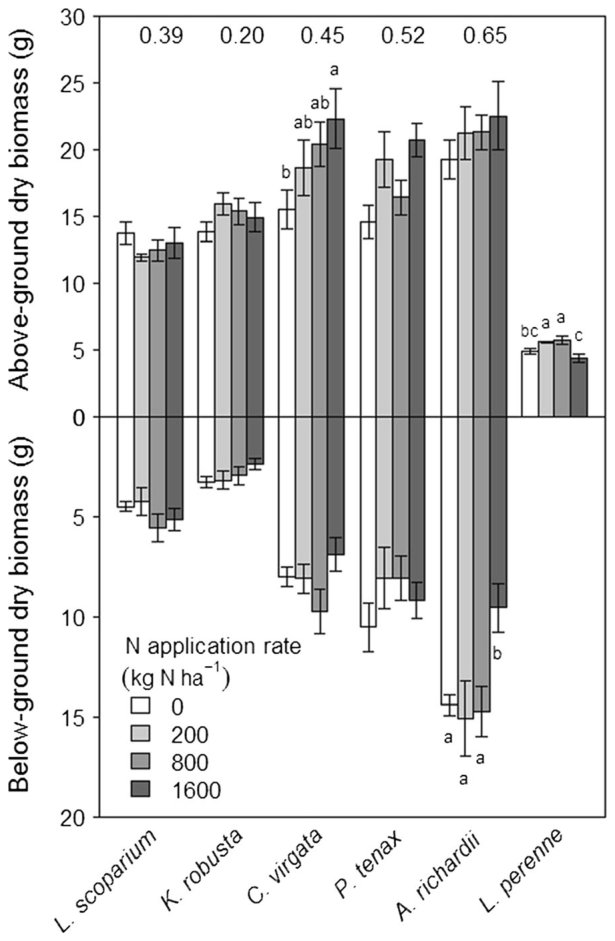
In the glasshouse trials, all native species remained healthy with no visible symptoms of N deficiency or toxicity. Native species were generally unresponsive to N (Fig. 1), although N addition did have significant overall effect (all species combined) on above-ground biomass (p<0.01, 2012 and 2013 trials) and below-ground biomass (p<0.05, 2012 trial only). C. virgata and L. perenne were the only species responsive to N in both trials, whilst P. tenax significantly increased yield (p<0.01) by 28 % at 200 kg N ha−1 in the 2013 trial (data not shown). There were no additional growth responses when N was added in combinations with P, S and lime (data not shown). L. perenne had a significant positive yield response at 200 kg N ha−1 in both trials, and growth was inhibited at 1600 kg N ha-1. C. virgata produced significantly (p<0.05) more tillers with elevated N (data not shown). The native dicots, L. scoparium and K. robusta, were slower growing and produced less biomass than the native monocotyledons (Fig. 1) which had more fibrous root systems; differences in root biomass between species were large. Root biomass of A. richardii was significantly reduced (p<0.05) at 1600 kg N ha−1 (Fig. 1). Woody stems made up significantly more (p<0.05) of the total above-ground biomass of K. robusta (41 %) than L. scoparium (37 %) but was not affected by N application rate.
在温室试验中,所有本土物种均保持健康,未出现可见的N缺乏或毒害症状。本土物种总体上对N不敏感(图1),尽管添加N对地上生物量(p<0.01,2012年和2013年试验)和地下生物量(p<0.05,仅2012年试验)具有显著的总体效应(所有物种合并)。C. virgata和L. perenne是两次试验中唯一对N有响应的物种,而在2013年试验中P. tenax在200 kg N ha−1处理下产量显著提高(p<0.01)28 %(数据未列出)。N与P、S和石灰组合施用时未产生额外的生长响应(数据未列出)。在两次试验中,L. perenne在200 kg N ha−1处理下均表现出显著的正产量响应,而在1600 kg N ha-1处理下生长受到抑制。C. virgata在N升高时产生的分蘖显著增多(p<0.05)(数据未列出)。本土双子叶植物L. scoparium和K. robusta生长较慢,生物量低于根系更为须状的本土单子叶植物(图1);物种间根系生物量差异较大。A. richardii的根系生物量在1600 kg N ha−1处理下显著降低(p<0.05)(图1)。木质茎在K. robusta地上总生物量中所占比例(41 %)显著高于(p<0.05)L. scoparium(37 %),但不受N施用量的影响。
10Plant nitrogen concentrations and uptake植物氮浓度与吸收
The foliar N concentration of all species increased significantly in response to increasing N application (p<0.001, Fig. 2a). This increase trend was linear for L. scoparium, K. robusta and P. tenax, but curvilinear (gradual increase above 200 kg N ha−1) for C. virgata, A. richardii and L. perenne (Fig. 2a). The order of greatest mean foliar N concentration was L. perenne> L. scoparium>K. robusta>C. virgata>P. tenax>
随N施用量增加,所有物种的叶片N浓度均显著升高(p<0.001,图2a)。L. scoparium、K. robusta和P. tenax的升高趋势呈线性,而C. virgata、A. richardii和L. perenne则呈曲线型(高于200 kg N ha−1后逐渐增加)(图2a)。平均叶片N浓度由高到低依次为L. perenne> L. scoparium>K. robusta>C. virgata>P. tenax>
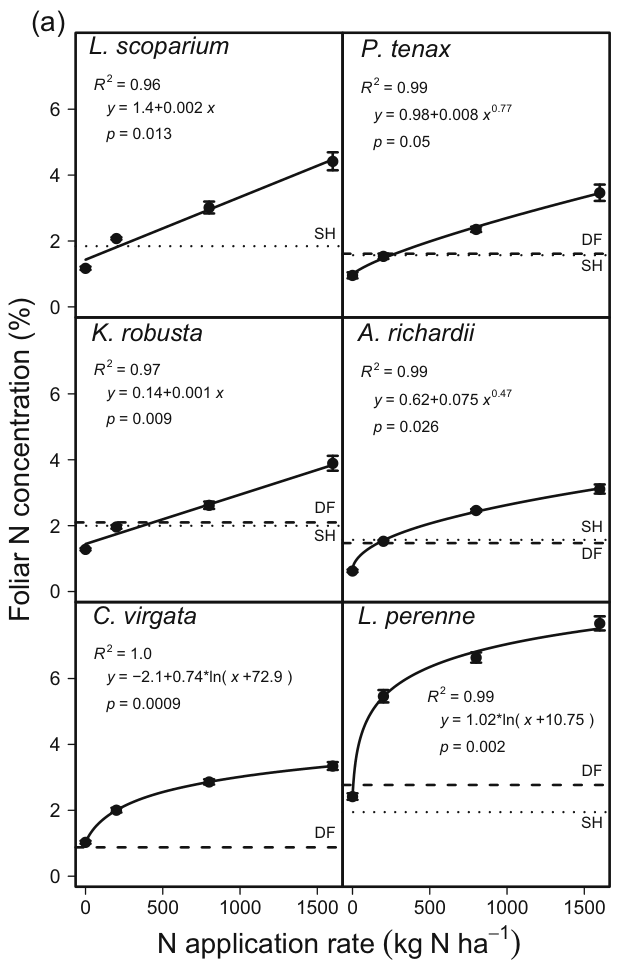
A. richardii. There was no discernible relationship between foliar N concentration and total above-ground biomass of individual species, except C. virgata (positive linear relationship, p<0.05, F(1,22)=5.15, R2=0.19).
A. richardii。除C. virgata(正线性关系,p<0.05,F(1,22)=5.15,R2=0.19)外,各物种叶片N浓度与地上总生物量之间均无明显关系。
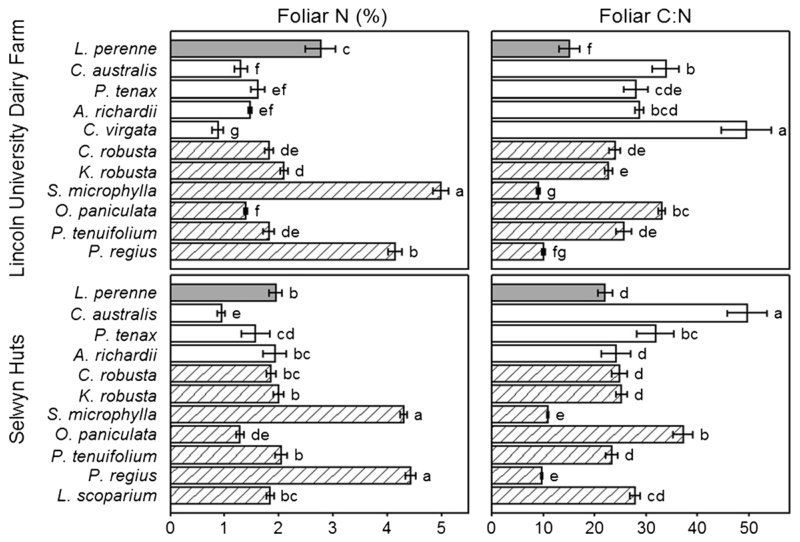
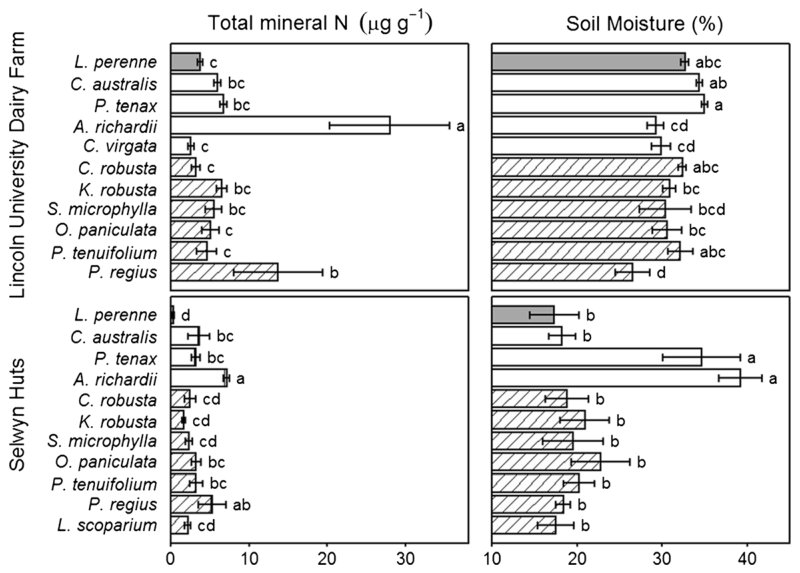
There was significant inter-species variation in foliar N concentrations measured in the field (Fig. 3), but no difference in mean concentrations between the two sites. Field based measurements were comparable to glasshouse-grown plants which received 200 kg N ha−1, with the exception of C. virgata and L. perenne (similar to control, Fig. 2a). S. microphylla and P. regius had significantly higher mean foliar N than other species at both field sites (p<0.001, Fig. 3), this corresponded to significantly lower C:N ratios than others (p<0.001, Fig. 3). L. perenne had significantly higher foliar N than the remaining native species at the DF site (Fig. 3). C. australis, O. paniculata and C. virgata (DF site only) had the lowest mean foliar N concentrations, significantly less than L. perenne (Fig. 3). C. virgata and C. australis had the highest foliar C:N ratios at the DF and SH sites respectively. Foliar N concentrations were not significantly correlated with rhizosphere soil total or mineral N at either site.
田间测定的叶片N浓度存在显著的种间差异(图3),但两个样地间平均浓度无差异。除C. virgata和L. perenne(与对照相近,图2a)外,田间测定值与接受200 kg N ha−1处理的温室植物相当。在两个田间样地中,S. microphylla和P. regius的平均叶片N均显著高于其他物种(p<0.001,图3),相应地其C:N比显著低于其他物种(p<0.001,图3)。在DF样地,L. perenne的叶片N显著高于其余本土物种(图3)。C. australis、O. paniculata和C. virgata(仅DF样地)的平均叶片N浓度最低,显著低于L. perenne(图3)。C. virgata和C. australis分别在DF和SH样地具有最高的叶片C:N比。在两个样地中,叶片N浓度与根际土壤全N或矿质N均无显著相关性。
R2 values for the fitted curve showing the data trend. Mean N concentration of each species at the field sites indicated (Lincoln University Dairy Farm, DF and Selwyn Huts, SH)
R2值用于表示数据趋势。图中标出了各物种在田间样地(Lincoln University奶牛场,DF;Selwyn Huts,SH)的平均N浓度
Mean stem and root N concentrations were lower than foliar N for all native species (except A. richardii roots, data not shown) and increased in response to N addition (p<0.001). Woody stem N concentrations were similar for L. scoparium (1.25 %) and K. robusta (1.14 %). A. richardii (2.14 %) and C. virgata (1.77 %) had significantly higher (p<0.001) root N concentrations than others. Stem and root N were not measured in the field.
所有本土物种的平均茎和根N浓度均低于叶片N(A. richardii根除外,数据未列出),且随N添加而升高(p<0.001)。L. scoparium(1.25 %)和K. robusta(1.14 %)的木质茎N浓度相近。A. richardii(2.14 %)和C. virgata(1.77 %)的根N浓度显著高于(p<0.001)其他物种。田间未测定茎和根N。
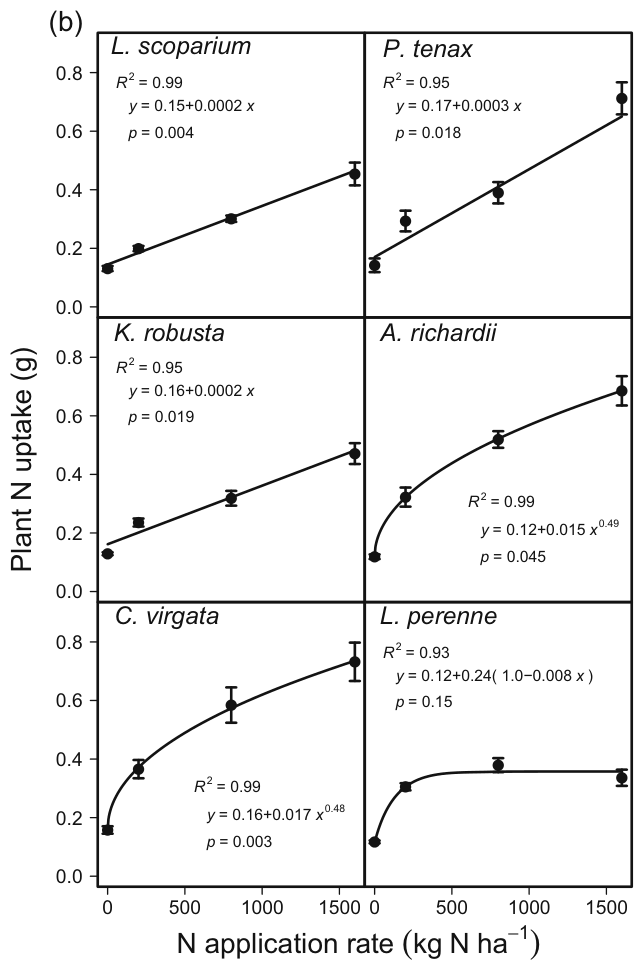
The pattern of N uptake by the native species was similar in nature to that of the foliar N concentration, however, L. perenne reached a maximum in uptake between 200 and 800 kg N ha−1 (Fig. 2b). Nitrogen uptake across treatments increased to a greater extent for the native monocotyledons (4–6 fold increase), which took up more N overall than the native dicotyledons and L. perenne (3 fold increase) (Fig. 2b). More N was taken up in above-ground (leaves and stems) biomass than roots. Root N accounted for between 12 % (K. robusta) and 40 % (A. richardii) of total plant N.
本土物种N吸收的模式与叶片N浓度的模式在性质上相似,但L. perenne的吸收量在200至800 kg N ha−1之间达到最大值(图2b)。在各处理间,本土单子叶植物的N吸收量增幅更大(增加4–6倍),其总体N吸收量高于本土双子叶植物和L. perenne(增加3倍)(图2b)。地上(叶和茎)生物量吸收的N多于根系。根系N占植物总N的12 %(K. robusta)至40 %(A. richardii)。
11Rhizosphere nitrogen status根际氮状况
Mean mineral N (NO3−-N and NH4+-N) was significantly higher (p<0.001) at the DF site (7.80 μg g−1) than at
DF样地的平均矿质N(NO3−-N和NH4+-N)(7.80 μg g−1)显著高于(p<0.001)
SH (3.18 μg g−1). A. richardii and P. regius had significantly higher mineral N concentrations in the rhizosphere soil at both sites (DF, p<0.001 and SH, p<0.01), when compared to L. perenne (Fig. 4), with A. richardii having more than all others (Fig. 4). Patterns in NO3−-N concentrations were similar to mineral N, while for NH4+-N, despite significant treatment effects, no consistent inter-species pattern was identified across sites (data not shown). Mean total N concentration was higher (p<0.001) at the DF site (0.29 %) than SH (0.18 %), but only varied significantly according to species at SH (p<0.001, A. richardii higher total N than others and C. australis less). Total N was positively correlated with NH4+-N and NO3−-N in rhizosphere soil at the SH site (r=0.32, p<0.05 and r=0.45, p<0.01 respectively) but not at DF.
SH样地(3.18 μg g−1)。与L. perenne相比,A. richardii和P. regius在两个样地的根际土壤矿质N浓度均显著更高(DF,p<0.001;SH,p<0.01)(图4),其中A. richardii高于所有其他物种(图4)。NO3−-N浓度的模式与矿质N相似;而对于NH4+-N,尽管处理效应显著,但各样地间未发现一致的种间模式(数据未列出)。DF样地的平均全N浓度(0.29 %)高于(p<0.001)SH样地(0.18 %),但仅在SH样地随物种显著变化(p<0.001,A. richardii全N高于其他物种,C. australis较低)。在SH样地,根际土壤全N与NH4+-N和NO3−-N呈正相关(分别为r=0.32,p<0.05和r=0.45,p<0.01),而在DF样地则无此相关性。
Mean soil moisture and total C were significantly higher (p<0.001) at the DF site (31 and 3.0 % respectively) compared to SH (23 and 1.9 % respectively). Soil moisture and total C (data not shown) were significantly higher (p<0.001) for A. richardii and P. tenax at the SH site, while fewer between species differences occurred at DF (despite a significant species effect, p<0.001, Fig. 4). Mean soil pH was significantly higher (p<0.001) at the DF site (5.4) than at SH (4.7), but did not vary between species.
DF样地的平均土壤含水量和全C(分别为31和3.0 %)显著高于(p<0.001)SH样地(分别为23和1.9 %)。在SH样地,A. richardii和P. tenax的土壤含水量和全C(数据未列出)显著较高(p<0.001),而在DF样地物种间差异较少(尽管物种效应显著,p<0.001,图4)。DF样地的平均土壤pH(5.4)显著高于(p<0.001)SH样地(4.7),但物种间无差异。
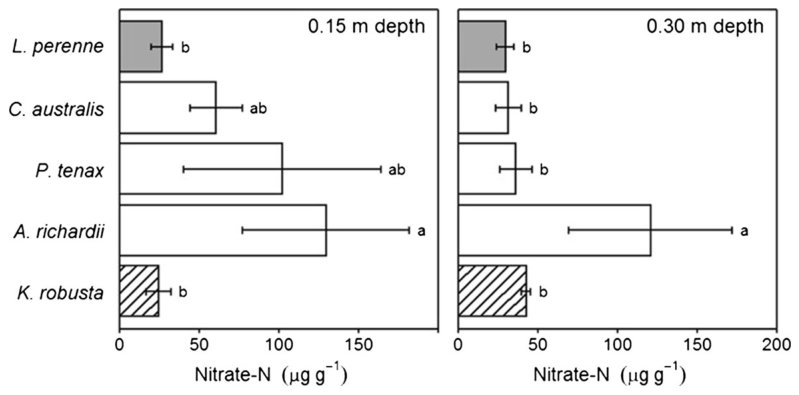
Nitrate-N in soil pore water samples were consistent across the 2-month sampling period. Missing values occurred for all species, as low soil moisture prevented sample collection in some instances, consequently C. robusta and P. tenuifolium were not included in analysis due to insufficient replication. A. richardii had significantly more NO3−-N than L. perenne at both depths (p<0.05, Fig. 5) and more than other native species at 0.30 m (Fig. 5). Nitrate-N patterns were similar across sampling dates (data shown for 18 September 2013 only). Ammonium-N concentrations were mostly below detection limit and were not analyzed.
在2个月的采样期内,土壤孔隙水样品中的硝态氮保持稳定。由于某些情况下土壤含水量过低无法采样,所有物种均存在缺失值,因此C. robusta和P. tenuifolium因重复数不足未纳入分析。在两个深度,A. richardii的NO3−-N均显著高于L. perenne(p<0.05,图5),且在0.30 m处高于其他本土物种(图5)。各采样日期的硝态氮模式相似(仅列出2013年9月18日的数据)。铵态氮浓度大多低于检出限,未进行分析。
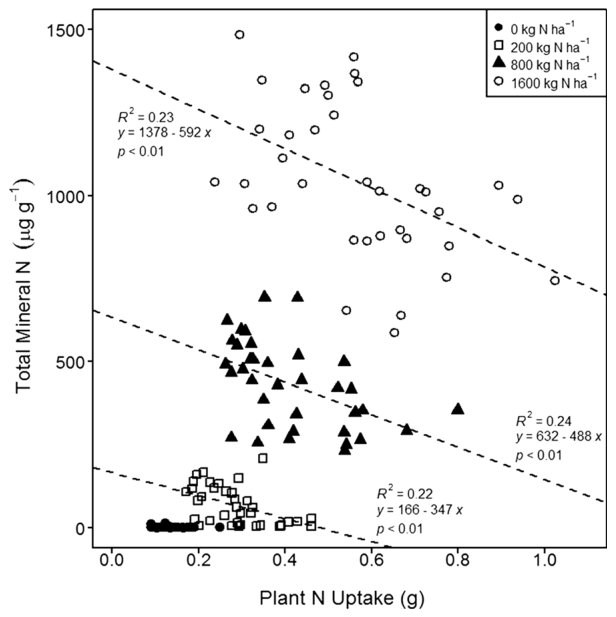
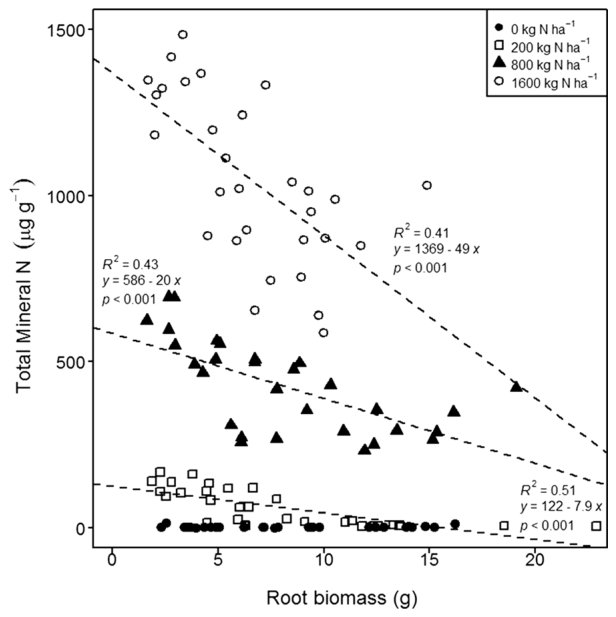
Total and mineral N in rhizosphere soil increased linearly in response to N application in the 2012 glasshouse trial (p<0.001). Soil gravimetric moisture content did not differ between plant species or N treatments (data not shown). Within each N treatment (200– 1600 kg N ha−1), plants of species with high N uptake had less mineral N remaining in soil (Fig. 6). In addition, as root biomass increased the concentration of soil mineral N significantly decreased (200–1600 kg N ha−1, Fig. 7). Similar relationships existed for total soil N and NO3−-N and NH4+-N individually (data not shown). As for root biomass, an increase in above-ground biomass corresponded to a significant decrease (p<0.001) in soil mineral N (data not shown) but explained less variation in mineral N (12-30 %). There was no relationship between above-ground biomass and total soil N.
在2012年温室试验中,根际土壤全N和矿质N随N施用量增加而线性升高(p<0.001)。土壤重量含水量在植物物种或N处理间无差异(数据未列出)。在每个N处理(200– 1600 kg N ha−1)中,N吸收量高的物种的土壤中残留矿质N较少(图6)。此外,随根系生物量增加,土壤矿质N浓度显著降低(200–1600 kg N ha−1,图7)。土壤全N以及NO3−-N和NH4+-N单独分析时也存在类似关系(数据未列出)。与根系生物量相似,地上生物量的增加也对应于土壤矿质N的显著降低(p<0.001)(数据未列出),但对矿质N变异的解释程度较低(12-30 %)。地上生物量与土壤全N之间无相关关系。
12Discussion讨论
Limited growth response but tolerance to nitrogen
生长响应有限但耐受氮
Nitrogen fertilization achieved limited or no additional growth in the glasshouse trials, supporting some earlier findings that New Zealand native species are poorly adapted to respond to elevated N supply (Craine and Lee 2003). Only C. virgata, a riparian tussock sedge had a substantial and consistent growth response to increasing supply of N, producing 44 % more biomass at 1600 kg N ha-1. Reduced root production in A. richardii indicates potential N saturation, despite similarities in growth form with C. virgata. There are no previous or comparable reports for these species. Our study agrees with previous reports of a lack of response to increased fertility of L. scoparium (Ledgard and Davis 2004), Kunzea spp. (Stevenson and Smale 2005) and P. tenax (Ogle 1996). We did not record a significant growth response to N in native woody species, as found previously (Hawkins and Sweet 1989; Langer et al. 1999). No further growth response occurred when N was supplied in combination with lime or P and S, that would otherwise indicate these factors were limiting the response. This suggests potential adaption of these species to New Zealand’s low-fertility, acidic soils (McLaren and Cameron 1996). It is possible that native species and ryegrass would have shown a growth response to lower applications of N, but the present study was concerned with investigating the higher levels of N enrichment that are associated with problematic leachates.
在温室试验中,施N仅带来有限的额外生长或未带来额外生长,这支持了早期部分研究的结论,即新西兰本土物种对N供应升高的响应适应性较差(Craine and Lee 2003)。仅河岸丛生莎草C. virgata对N供应增加表现出显著且一致的生长响应,在1600 kg N ha-1处理下生物量增加44 %。尽管A. richardii与C. virgata生长型相似,但其根系生产量降低表明可能已达到N饱和。此前尚无关于这些物种的报道或可比报道。本研究结果与此前关于L. scoparium(Ledgard and Davis 2004)、Kunzea spp.(Stevenson and Smale 2005)和P. tenax(Ogle 1996)对肥力提高缺乏响应的报道一致。与此前研究(Hawkins and Sweet 1989; Langer et al. 1999)不同,本研究未记录到本土木本物种对N的显著生长响应。N与石灰或P和S组合施用时未出现进一步的生长响应,否则将表明这些因素限制了响应。这表明这些物种可能已适应新西兰的低肥力酸性土壤(McLaren and Cameron 1996)。本土物种和黑麦草可能会对较低的N施用量表现出生长响应,但本研究关注的是与问题性淋出液相关的较高N富集水平。
Despite a limited growth response, native species were tolerant and healthy at high N loads and at levels that were harmful to ryegrass, indicating their suitability for planting in agricultural matrices. The more substantial roots of native species appear to be more N-tolerant than ryegrass. Applications of 200 kg N ha−1 increased ryegrass growth by 15 % in both trials, but no further increase occurred at higher rates. Dieback of ryegrass at high N loads was possibly due to root scorching, as previously reported (Richards and Wolton 1975; Saarijärvi and Virkajärvi 2009).
尽管生长响应有限,本土物种在高N负荷下以及在对黑麦草有害的水平下仍能耐受并保持健康,表明其适合种植于农业基质中。本土物种更为发达的根系似乎比黑麦草更耐N。在两次试验中,施用200 kg N ha−1使黑麦草生长增加15 %,但更高施用量下未进一步增加。高N负荷下黑麦草的枯死可能是由于根系灼伤,与此前报道一致(Richards and Wolton 1975; Saarijärvi and Virkajärvi 2009)。
13Patterns of N uptake and luxury accumulationN吸收模式与奢侈积累
Foliar N concentrations in the glasshouse trial were more than double those recorded at the field sites of the present study and those previously reported in unfertilized soils for these species (Hahner et al. 2014; Lambert et al. 1989; Ross et al. 2009). This is undoubtedly luxury uptake of N, rather than essential uptake, which may be an adaptation that allows rapid acquisition of N from nutrient pulses in low-nutrient environments (Chapin 1980; Millard 1988). Moir et al. (2013) similarly report luxury N uptake in perennial ryegrass.
温室试验中的叶片N浓度是本研究田间样地记录值以及此前报道的这些物种在未施肥土壤中数值的两倍以上(Hahner et al. 2014; Lambert et al. 1989; Ross et al. 2009)。这无疑属于N的奢侈吸收而非必需吸收,可能是一种使植物在低养分环境中能够从养分脉冲中快速获取N的适应机制(Chapin 1980; Millard 1988)。Moir et al.(2013)同样报道了多年生黑麦草的N奢侈吸收。
Despite differences in soil N status between the field sites, foliar N was similar at both sites for each species, as were patterns of differences between species. This is contrary to variation previously reported between populations of native species associated with soil fertility (Adams 1976; Wardle 2002). Glasshouse-grown native plants which received 200 kg N ha−1 generally had comparable foliar N to plants at the restoration sites, reflecting similar levels of elevated soil N at these sites compared to the low fertility glasshouse trial soil. In the field, C. virgata was an exception being similar to the control, but this species was only available to sample at the DF site on a particularly sandy-textured soil adjacent to a drainage ditch. Foliar concentrations of N in ryegrass were comparable in the field and glasshouse controls; higher foliar N compared to native species was recorded in the glasshouse trial, but not consistently in the field. Craine and Lee (2003) similarly found native grass species had significantly lower foliar N compared to exotic grasses at the same sites. In the glasshouse, foliar N concentrations for L. perenne were higher than previous trials at similar N rates (Crush et al. 2005, 2007; Moir et al. 2013), possibly due to careful watering and reduced leaching in the closed-system pots of the trial in the present study.
尽管两个田间样地的土壤N状况存在差异,但各物种在两个样地的叶片N相近,物种间的差异模式也相似。这与此前报道的本土物种不同种群间与土壤肥力相关的变异相反(Adams 1976; Wardle 2002)。接受200 kg N ha−1处理的温室本土植物的叶片N总体上与恢复样地植物相当,这反映出与低肥力温室试验土壤相比,这些样地的土壤N升高程度相近。在田间,C. virgata是一个例外,与对照相近,但该物种仅能在DF样地靠近排水沟、质地特别偏砂的土壤上采样。黑麦草叶片N浓度在田间和温室对照中相当;在温室试验中记录到其叶片N高于本土物种,但在田间并不一致。Craine and Lee(2003)同样发现,在相同样地中本土禾草的叶片N显著低于外来禾草。在温室中,L. perenne的叶片N浓度高于此前相似N施用量下的试验(Crush et al. 2005, 2007; Moir et al. 2013),这可能是由于本研究采用封闭系统盆栽,浇水谨慎且淋溶减少。
Variation between species in foliar N that was identified in the field reflects the deciduous nature of P. regius (fully deciduous) and S. microphylla (brevideciduous in Canterbury); N was consistently elevated compared to the evergreen species. Deciduous trees invest in short-lived but high nutrient leaves which decompose quickly in soil for re-absorption by the plant (Aerts and Chapin 2000; Givnish 2002). S. microphylla is a legume that fixes N; lower foliar C:N ratios (C:N<20, Taylor et al. 1989) of P. regius and S. microphylla (<11) suggest that leaf litter turnover is rapid beneath these species.
田间发现的叶片N种间差异反映了P. regius(完全落叶)和S. microphylla(在坎特伯雷为短期落叶)的落叶特性;与常绿物种相比,其N始终较高。落叶树种将养分投入寿命短但养分含量高的叶片,这些叶片在土壤中快速分解,供植物重新吸收(Aerts and Chapin 2000; Givnish 2002)。S. microphylla是一种固氮豆科植物;P. regius和S. microphylla较低的叶片C:N比(<11)(C:N<20,Taylor et al. 1989)表明这些物种下方的凋落叶周转迅速。
14Nitrogen uptake influenced by plant morphology植物形态对氮吸收的影响
In the glasshouse trial, the standing plant biomass and proportion of high-N foliage determined inter-species differences in N uptake. L. scoparium and K. robusta had lower overall N uptake, due to lower biomass, 40 % of which was low-N woody material. High N uptake by the leafy native monocotyledons probably contributed to increased growth of C. virgata and P. tenax. The low productivity of L. perenne resulted in comparatively low N offtake from soil, although productivity is certainly higher than native species in the field, where production is 8.5–13 t ha−1 year−1 (Agricutural and Natural Resources University of California 2015). Recently in southern China, exotic tree species with fast growth rates were found to assimilate more N in plant biomass than slow-growing native species (Wang et al. 2013). Foliar N concentrations were accurate predictors of the way each native species responded to increasing N in terms of N uptake. For L. perenne N uptake did not increase above 200 kg N ha−1, due to decreasing biomass (despite foliar N continuing to increase). Elsewhere, linear increases in N uptake have been reported up to 700–1000 kg N ha−1 for L. perenne (Di and Cameron 2007; Moir et al. 2013). In native plants, N uptake into roots was lower than in above-ground tissues, due to lower biomass and lower N concentration.
在温室试验中,现存植物生物量和高N叶片所占比例决定了N吸收的种间差异。L. scoparium和K. robusta的总体N吸收量较低,原因是其生物量较低,且其中40 %为低N木质材料。多叶本土单子叶植物的高N吸收可能促进了C. virgata和P. tenax的生长增加。L. perenne生产力较低,导致其从土壤中带走的N相对较少,但在田间其生产力无疑高于本土物种,田间产量为8.5–13 t ha−1 year−1(Agricutural and Natural Resources University of California 2015)。近期在中国南方的研究发现,生长速率快的外来树种在植物生物量中同化的N多于生长缓慢的本土物种(Wang et al. 2013)。叶片N浓度可准确预测各本土物种N吸收量对N增加的响应方式。对于L. perenne,由于生物量下降(尽管叶片N持续升高),N吸收量在200 kg N ha−1以上不再增加。在其他研究中,L. perenne的N吸收量在700–1000 kg N ha−1范围内呈线性增加(Di and Cameron 2007; Moir et al. 2013)。在本土植物中,由于根系生物量和N浓度均较低,根系的N吸收量低于地上组织。
15Multiple drivers of rhizosphere soil N根际土壤N的多重驱动因素
In the field, foliar N concentrations of each species were similar at the two sites but between species did not correspond to patterns of N uptake in the glasshouse trial. Plant N uptake in the pots clearly reflected rhizosphere soil N status, but the explanation is more difficult for the field. In the glasshouse trial, increased root biomass was associated with more fine roots (rather than thicker and woody roots) that reduced the amount of soil N. Extensive fibrous root systems of native monocotyledons may provide increased access to soil N, facilitating high uptake. This may explain a subsequent growth response in C. virgata. Root depth (Webb et al. 1997), density (Dunbabin et al. 2003; Tufekcioglu et al. 1998) and metabolic activity (Malcolm et al. 2014) have all been associated with inter-species differences in N uptake.
在田间,各物种在两个样地的叶片N浓度相近,但物种间差异与温室试验中的N吸收模式并不对应。盆栽中植物N吸收明显反映了根际土壤N状况,但对田间的解释则更为困难。在温室试验中,根系生物量的增加与更多细根(而非较粗的木质根)相关,从而降低了土壤N量。本土单子叶植物发达的须根系可能增加了对土壤N的获取,促进了高吸收。这可能解释了C. virgata随后出现的生长响应。根系深度(Webb et al. 1997)、密度(Dunbabin et al. 2003; Tufekcioglu et al. 1998)和代谢活性(Malcolm et al. 2014)均与N吸收的种间差异有关。
In rhizosphere soil of A. richardii and P. regius in the field, mineral N was consistently more concentrated than in ryegrass rhizospheres, despite differences in soil N status between sites. Nitrate-N concentrations in soil pore water from A. richardii (DF site) were higher than beneath ryegrass, consistent with previous findings at this site (Hahner et al. 2014). It is important to note that there were few differences in total soil N beneath different plant species, which suggests that variation in mineral N is the result of rhizosphere conditions facilitating differing rates of mineralization of the total (largely organic) N pool. The causal factors are merely conjecture, but may be due for example to reduced water infiltration under the dense foliar canopies of some natives which may have a concentrating effect on soil NO3--N. This was previously thought to be the case for A. richardii (Hahner et al. 2014). However, in the present study mineral N and soil moisture were not correlated (data not shown) and several tree species had clearly formed denser canopies than A. richardii. Variation in evapotranspiration rates may have a similar effect. The root system of A. richardii is extensive (Marden and Phillips 2009) compared to both
在田间,尽管各样地土壤N状况不同,A. richardii和P. regius根际土壤中的矿质N浓度始终高于黑麦草根际。A. richardii(DF样地)土壤孔隙水中的硝态氮浓度高于黑麦草下方,与此前在该样地的研究结果一致(Hahner et al. 2014)。值得注意的是,不同植物物种下方的土壤全N差异很小,这表明矿质N的变异是根际条件促使全N(主要为有机N)库矿化速率不同的结果。其成因目前仅为推测,但可能是由于某些本土植物茂密的叶冠减少了水分入渗,从而对土壤NO3--N产生浓缩效应。此前曾认为A. richardii属于这种情况(Hahner et al. 2014)。然而,在本研究中矿质N与土壤含水量不相关(数据未列出),且若干树种形成的冠层明显比A. richardii更为茂密。蒸散速率的差异可能也有类似效应。A. richardii的根系较为发达(Marden and Phillips 2009),与两者相比
L. perenne (Bolinder et al. 2002) and the woody natives, potentially influencing soil chemistry and microbiology to mobilize N into mineral form (Craine 2009). The other substantially rooted monocots do not have elevated mineral N. Of course, decomposition of N-rich foliage shed by the deciduous P. regius each season may also elevate soil mineral N. Despite high foliar N and Nfixation, S. microphylla was not distinct from the other species in terms of rhizosphere mineral N. The consistent N status of soil pore water across the spring period confirms that taking a one-off soil sample for extract analysis was sufficient to represent this period, although seasonal differences were not examined in this study. Further research, involving study sites across a range of soil fertility and types, may elucidate the causal mechanisms that determine rhizosphere N speciation and mobility beneath native species.
L. perenne(Bolinder et al. 2002)及木本本土植物,可能通过影响土壤化学和微生物过程,将氮活化为矿质态(Craine 2009)。其他根系较为发达的单子叶植物并未表现出矿质氮升高。当然,落叶树种 P. regius 每季脱落的富氮叶片分解也可能提高土壤矿质氮含量。尽管 S. microphylla 叶片氮含量较高且具有固氮能力,但其根际矿质氮与其他物种相比并无显著差异。春季期间土壤孔隙水氮素状况保持稳定,证实单次采集土壤样品进行浸提分析足以代表该时期,但本研究未考察季节差异。今后需在不同土壤肥力和土壤类型的研究点开展进一步研究,以阐明决定本土植物下根际氮形态与迁移性的因果机制。
16Native plants in farm mangement systems农场管理系统中的本土植物
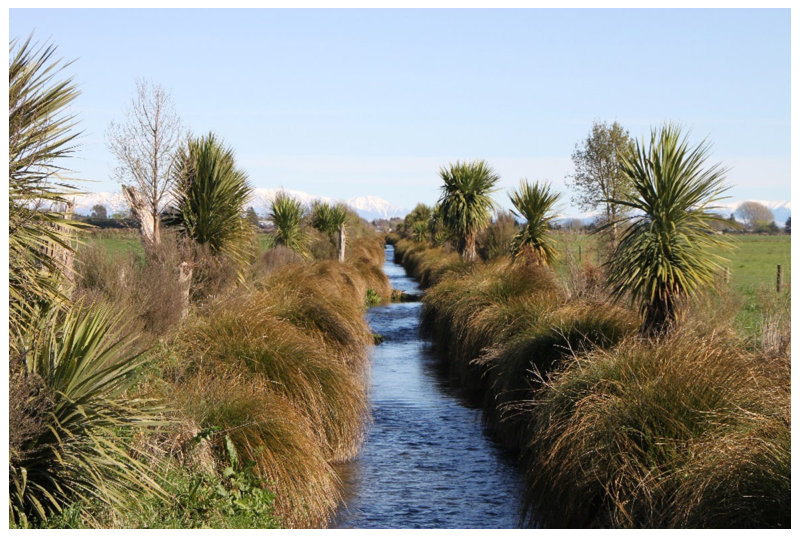
Local authorities in New Zealand are currently setting restrictions on NO3− losses from farmland to improve freshwater quality. The findings of the present research have relevance to assessing the potential of native species to mitigate environmentally damaging N fluxes from agricultural land. A range of native species are shown to be tolerant to elevated soil N and are suitable for planting on N-loaded soils. Native plants assimilated large amounts of applied N into foliage as luxury uptake, which may be an adaptation of native species to naturally low fertility soils. Of the native plants, C. virgata (Fig. 8) was responsive to high N levels in both trials (up to 1600 kg N ha-1). Monocots were generally more effective than woody dicots in sequestering N. Selected native species have the potential to be competitive with pasture grasses, to establish quickly in high-N agricultural soils. Native species with comparable growth rates to exotic species have similarly been identified for afforestation projects in southern China, with added conservation benefits (Wang et al. 2013). In terms of reasons to plant native species, irrigation of dairy shed effluent onto established stands of native monocotyledons may provide an alternative to application to grazed pastures.
新西兰地方政府目前正在对农田NO3−流失设定限制,以改善淡水水质。本研究结果对于评估本土植物缓解农业用地对环境有害的氮通量的潜力具有参考意义。结果表明,多种本土植物能够耐受较高的土壤氮水平,适宜种植于氮负荷较高的土壤。本土植物以奢侈吸收的方式将大量施入的氮同化至叶片中,这可能是本土植物对天然低肥力土壤的一种适应。在本土植物中,C. virgata(图8)在两项试验中均对高氮水平(最高达1600 kg N ha-1)表现出响应。总体而言,单子叶植物在固持氮方面比木本双子叶植物更为有效。部分本土植物具有与牧草竞争的潜力,能够在高氮农业土壤中快速定植。在中国南方的造林项目中,同样已筛选出生长速率与外来物种相当的本土物种,并兼具保护效益(Wang et al. 2013)。就种植本土植物的理由而言,将奶牛场挤奶棚废水灌溉至已定植的本土单子叶植物林分,可作为施用于放牧草地的一种替代方案。
The field studies showed species-specific concentrations of N in foliar tissues and in rhizosphere soil. Higher concentrations of NO3−-N both in rhizosphere soil and soil pore water indicate that variation in rhizosphere soil conditions are responsible either for greater production or retention of NO3−-N. This probably reflects differing root biomass and morphology in combination with variable plant canopies that influence rain percolation, differing evapotranspiration, and some influence of root exudation or leaf litter on soils. The greater occupancy of soil by the roots of native species compared to ryegrass may provide an opportunity to use native plants to mediate soluble N fluxes in the rhizosphere. As suggested in other studies (Marden et al. 2005; Sutton-Grier et al. 2013), the significant between-species variation indicates that mixed plantings may make the most of plant traits which maximise N removal through different pathways (such as root interception, biomass acquisition, rhizosphere soil denitrification). This work shows that native plants have a role in riparian zones and paddock margins designed to protect waterways from N leachates. This investigation of native plant growth, N uptake and impact on rhizosphere soil N status has provided valuable insights to facilitate the strategic incorporation of these species into farming systems.
田间研究表明,叶片组织和根际土壤中的氮浓度具有物种特异性。根际土壤和土壤孔隙水中NO3−-N浓度均较高,表明根际土壤条件的差异导致了NO3−-N生成量增加或滞留量增加。这可能反映了根系生物量与形态的差异,并结合不同植物冠层对降雨入渗的影响、蒸散量的差异,以及根系分泌物或凋落叶对土壤的一定影响。与黑麦草相比,本土植物根系对土壤的占据程度更高,这为利用本土植物调节根际可溶性氮通量提供了可能。正如其他研究所指出的(Marden et al. 2005; Sutton-Grier et al. 2013),显著的种间差异表明,混合种植可以充分利用通过不同途径(如根系截留、生物量积累、根际土壤反硝化)最大化氮去除的植物性状。本研究表明,本土植物可在为保护水体免受氮淋溶液影响而设计的河岸带和围场边缘中发挥作用。本研究对本土植物生长、氮吸收及其对根际土壤氮素状况影响的考察,为将这些物种有策略地纳入农业系统提供了有价值的见解。
Acknowledgments This research was funded by Lincoln University, the South Island Dairy Event (SIDE) and Pioneer Brand Products (Genetic Technologies Ltd). The authors wish to thank Qian Liang, Vicky Zhang, Brent Richards, Youngnam Kim, Tao Zhong, Paula Greer, Juergen Esperschuetz, Obed Nedjo Lense and Jason Hahner (Faculty of Agriculture and Life Sciences, Lincoln University) for valuable technical assistance.
致谢 本研究由林肯大学(Lincoln University)、南岛乳业大会(South Island Dairy Event, SIDE)和 Pioneer Brand Products(Genetic Technologies Ltd)资助。作者感谢 Qian Liang、Vicky Zhang、Brent Richards、Youngnam Kim、Tao Zhong、Paula Greer、Juergen Esperschuetz、Obed Nedjo Lense 和 Jason Hahner(林肯大学农业与生命科学学院)提供的宝贵技术协助。
Di HJ, Cameron KC (2012) How does the application of different nitrification inhibitors affect nitrous oxide emissions and nitrate leaching from cow urine in grazed pastures? Soil Use Manag 28:54–61
Di HJ, Cameron KC (2012) How does the application of different nitrification inhibitors affect nitrous oxide emissions and nitrate leaching from cow urine in grazed pastures? Soil Use Manag 28:54–61
Didham RK et al (2015) Agricultural intensification exacerbates spillover effects on soil biogeochemistry in adjacent forest remnants. PLoS One 10:e0116474
Didham RK et al (2015) Agricultural intensification exacerbates spillover effects on soil biogeochemistry in adjacent forest remnants. PLoS One 10:e0116474
Douglas GB, Dodd MB, Power IL (2007) Potential of direct seeding for establishing native plants into pastoral land in New Zealand. N Z J Ecol 31:143–153
Douglas GB, Dodd MB, Power IL (2007) Potential of direct seeding for establishing native plants into pastoral land in New Zealand. N Z J Ecol 31:143–153
Dunbabin V, Diggle A, Rengel Z (2003) Is there an optimal root architecture for nitrate capture in leaching environments? Plant Cell Environ 26:835–844
Dunbabin V, Diggle A, Rengel Z (2003) Is there an optimal root architecture for nitrate capture in leaching environments? Plant Cell Environ 26:835–844
Garnett T, Conn V, Kaiser BN (2009) Root based approaches to improving nitrogen use efficiency in plants. Plant Cell Environ 32:1272–1283
Garnett T, Conn V, Kaiser BN (2009) Root based approaches to improving nitrogen use efficiency in plants. Plant Cell Environ 32:1272–1283
Givnish TJ (2002) Ecological constraints on the evolution of plasticity in plants. Evol Ecol 16:213–242
Givnish TJ (2002) Ecological constraints on the evolution of plasticity in plants. Evol Ecol 16:213–242
17References参考文献
Adams JA (1976) Nutrient requirements of four Nothofagus species in north Westland, New Zealand, as shown by foliar analysis. N Z J Bot 14:211–223
Aerts R, Chapin FSI (2000) The mineral nutrition of wild plants revisited: a re-evaluation of processes and patterns. Adv Ecol Res 30:1–67
Agricutural and Natural Resources University of California (2015) Cover crops database: perennial ryegrass. http://ucanr.org/ sites/asi/db/covercrops.cfm?crop_id=29
Blakemore LC, Searle PL, Daly BK (1987) Methods for chemical analysis of soils. New Zealand soil bureau report. New Zealand Soil Bureau, Lower Hutt
Bolinder MA, Angers DA, Bélanger G, Michaud R, Laverdière MR (2002) Root biomass and shoot to root ratios of perennial forage crops in eastern. Can Can J Plant Sci 82:731–737
Chapin FSI (1980) The mineral nutrition of wild plants. Annu Rev Ecol Evol Syst 11:233–260
Charlton JFL, Stewart AV (1999) Pasture species and cultivars used in New Zealand – a list. Proc N Z Grassl Assoc 61:147– 166
Craine JM (2009) Resource strategies of wild plants. Princeton University Press, Princeton
Craine JM, Lee WG (2003) Covariation in leaf and root traits for native and non-native grasses along an altitudinal gradient in New Zealand. Oecologia 134:471–478
Crush JR, Waller JE, Care DA (2005) Root distribution and nitrate interception in eleven temperate forage grasses. Grass Forage Sci 60:385–392
Crush JR, Easton HS, Waller JE, Hume DE, Faville MJ (2007) Genotypic variation in patterns of root distribution, nitrate interception and response to moisture stress of a perennial ryegrass (Lolium perenne L.) mapping population. Grass Forage Sci 62:265–273
Di HJ, Cameron KC (2007) Nitrate leaching losses and pasture yields as affected by different rates of animal urine nitrogen returns and application of a nitrification inhibitor—a lysimeter study. Nutr Cycl Agroecosyst 79:281–290
Guo LB, Sims REH, Horne DJ (2002) Biomass production and nutrient cycling in Eucalyptus short rotation energy forests in New Zealand: biomass and nutrient accumulation. Bioresour Technol 85:273–283
Hahner JL, Robinson BH, Hong-Tao Z, Dickinson NM (2014) The phytoremediation potential of native plants on New Zealand dairy farms. Int J Phytoremediat 16:719–734
Hawkins BJ, Sweet GB (1989) The growth of three podocarp species under different nutrient regimes. N Z J Bot 27:305– 310
Hesse PR (1971) A textbook of soil chemical analysis. John Murray Publisher, London
Hewitt AE (1998) New Zealand soil classification, 2nd edn, Landcare research science series. Manaaki Whenua Press, Lincoln
Hill RB, Sparling GP (2009) Soil quality monitoring. In: Forum LM (ed) Land and soil monitoring: a guide for SoE and regional council reporting. Land Monitoring Forum, Wellington, pp 27–51
Hinsinger P, Bengough AG, Vetterlein D, Young IM (2009) Rhizosphere: biophysics, biogeochemistry and ecological relevance. Plant Soil 321:117–152
Hobbie SE (1992) Effects of plant species on nutrient cycling. Trends Ecol Evol 7:336–339
Lambert MG, Jung GA, Harpster HW, Lee J (1989) Forage shrubs in North Island hill country 4. Chemical composition and conclusions. N Z J Agric Res 32:499–506
Langer ER, Davis MR, Ross CW (1999) Rehabilitation of lowland indigenous forest after mining in Westland, vol 117. Department of Conservation, Wellington
Larned ST, Scarsbrook MR, Snelder TH, Norton NJ, Biggs BJF (2004) Water quality in low-elevation streams and rivers of New Zealand: recent state and trends in contrasting landcover classes. N Z J Mar Freshw 38:347–366
Ledgard N, Davis M (2004) Restoration of mountain beech (Nothofagus solandri var. cliffortioides) forest after fire. N Z J Ecol 28:125–136
Malcolm BJ, Cameron KC, Di HJ, Edwards GR, Moir JL (2014) The effect of four different pasture species compositions on nitrate leaching losses under high N loading. Soil Use Manag 30:58–68
Marden M, Phillips C (2009) Native plant trial. Gisborne District Council, Gisborne
Marden M, Rowan D, Phillips C (2005) Stabilising characteristics of New Zealand indigenous riparian colonising plants. Plant Soil 278:95–105
McGlone MS (1989) The Polynesian settlement of New Zealand in relation to environmental and biotic changes. N Z J Ecol 12:115–129
McLaren RG, Cameron KC (1996) Soil science: sustainable production and environmental protection. Oxford University Press, Auckland
Meurk CD, Hall GMJ (2006) Options for enhancing forest biodiversity across New Zealand’s managed landscapes based on ecosystem modelling and spatial design. N Z J Ecol 30:131–146
Meurk CD, Swaffield SR (2000) A landscape ecological framework for indigenous regeneration in rural New Zealand- Aotearoa. Landsc Urban Plan 50:129–144
Millard P (1988) The accumulation and storage of nitrogen by herbaceous plants. Plant Cell Environ 11:1–8
Mittermeier RA, Myers N, Mittermeier CG, Robles Gil P (1999) Hotspots: earth’s biologically richest and most endangered terrestrial ecoregions. CEMEX, SA, Agrupación, Sierra Madre Moir JL, Edwards GR, Berry LN (2013) Nitrogen uptake and leaching loss of thirteen temperate grass species under high N loading. Grass Forage Sci 68:313–325
Ogle M (1996) Factors affecting the early growth and survival of indigenous seedlings planted for the purpose of ecological restoration. Dissertation. University of Canterbury
Pandey A, Singh M, Srivastava R, Vasudevan P (2011) Pollutant removal potential, growth and nutritional characteristics of short rotation woody crops in grey water vegetation filter system. J Sci Ind Res 70:610–615
Phillips CJ, Ekanayake JC, Marden M (2011) Root site occupancy modelling of young New Zealand native plants: implications for soil reinforcement. Plant Soil 346:201–214
Pratt C (1999) Factors affecting the establishment, growth and survival of native woody plant communities on the Canterbury Plain, New Zealand. Dissertation. Lincoln University
Randhawa PS (2003) Influence of green manuring and phosphate rock inputs on soil phosphorus cycling and availability. Dissertation. Lincoln University
Richards IR, Wolton KM (1975) A note on urine scorch caused by gracing animals. Grass Forage Sci 30:187–188
Ross DJ, Scott NA, Lambie SM, Trotter CM, Rodda NJ, Townsend JA (2009) Nitrogen and carbon cycling in a New Zealand pumice soil under a manuka (Leptospermum scoparium) and kanuka (Kunzea ericoides) shrubland. Soil Res 47:725–736
Saarijärvi K, Virkajärvi P (2009) Nitrogen dynamics of cattle dung and urine patches on intensively managed boreal pasture. J Agric Sci 147:479–491
Schipper LA, Baisden WT, Parfitt RL, Ross C, Claydon JJ, Arnold G (2007) Large losses of soil C and N from soil profiles under pasture in New Zealand during the past 20 years. Glob Chang Biol 13:1138–1144
Singleton G (2007) Ellesmere: the jewel in the Canterbury crown. Selwyn District Council, Leeston
Smith CM, Wilcock RJ, Vant WN, Smith DG, Cooper AB (1993) Towards sustainable agriculture: freshwater quality in New Zealand and the influence of agriculture. National Institute of Water and Atmospheric Research, Wellington
Soil Survey Staff (2014) Keys to soil taxonomy. USDA-Natural Resources Conservation Service, Washington
Stevenson BA, Smale MC (2005) Seed bed treatment effects on vegetation and seedling establishment in a New Zealand pasture one year after seeding with native woody species. Ecol Manag Restor 6:124–131
Sutton-Grier AE, Wright JP, Richardson CJ (2013) Different plant traits affect two pathways of riparian nitrogen removal in a restored freshwater wetland. Plant Soil 365:1–17
Taylor BR, Parkinson D, Parsons WFJ (1989) Nitrogen and lignin content as predictors of litter decay rates: a microcosm test. Ecology 70:97–104
Tufekcioglu A, Raich JW, Isenhart TM, Schultz RC (1998) Fine root dynamics, coarse root biomass, root distribution, and soil respiration in a multispecies riparian buffer in Central Iowa, USA. Agrofor Syst 44:163–174
Tzanakakis VA, Paranychianakis NV, Angelakis AN (2009) Nutrient removal and biomass production in land treatment systems receiving domestic effluent. Ecol Eng 35:1485– 1492
Wang F, Zhu W, Zou B, Neher D, Fu S, Xia H, Li Z (2013) Seedling growth and soil nutrient availability in exotic and native tree species: implications for afforestation in southern China. Plant Soil 364:207–218
Wardle P (1985) Environmental influences on the vegetation of New Zealand. N Z J Bot 23:773–788
Wardle P (2002) Vegetation of New Zealand. The Blackburn Press, Cadwell
Watanabe FS, Olsen SR (1965) Test of an ascorbic acid method for determining phosphorus in water and NaHCO3 extracts from soil. Soil Sci Soc Am J 29:677–678
Watkinson JH, Perrott KW (1990) A new soil test for sulphate and mineralisable organic sulphur. In: Proceedings of the New Zealand Feriliser Manufacturers’ Research Association Conference, Auckland, New Zealand. pp 189–198
Webb J, Sylvester-Bradley R, Seeney F (1997) The effects of site and season on the fate of nitrogen residues from root crops grown on sandy soils. J Agric Sci 128:445–460