Contents lists available at ScienceDirect journal homepage: www.elsevier.com/locate/foodres
Wendy V. Parr a,⁎, Dominique Valentin b, Jason Breitmeyer a, Dominique Peyron b, Philippe Darriet c,d, Robert Sherlock a, Brett Robinson a, Claire Grose e, Jordi Ballester b
a Lincoln University, Christchurch, New Zealand
b CSGA UMR5170 CNRS, University of Burgundy Franche-Comté, INRA, France
c Univ. Bordeaux, ISVV, EA 4577 ŒNOLOGIE, 33140 Villenave d'Ornon, France d INRA, ISVV, USC1366 ŒNOLOGIE, 33140 Villenave d'Ornon, France e Plant and Food Research, Marlborough, New Zealand
1Introduction引言
Mineral characteristics are frequently reported when white wines are described sensorially (Ballester, Mihnea, Peyron, & Valentin, 2013; Heymann, Hopfer, & Bershaw, 2014; Parr, Ballester, Peyron, Grose, & Valentin, 2015). Despite this, our knowledge and understanding of the role played by a wine's composition in producing characteristics perceived as mineral remains limited. Combining both sensory and chemical data has become an established method for examining a range of wine phenomena including regional characterisation of wines (Green, Parr, Breitmeyer, Valentin, & Sherlock, 2011), perceived quality (Sáenz-Navajas et al., 2015), and influence of yeast (King et al., 2010). We aimed to combine sensory data from wine professionals of two diverse cultures (France, NZ) with chemical data to investigate the relation between wine composition and perception of mineral character in sauvignon blanc wines.
在对白葡萄酒进行感官描述时,矿物感特征常被提及(Ballester, Mihnea, Peyron, & Valentin, 2013; Heymann, Hopfer, & Bershaw, 2014; Parr, Ballester, Peyron, Grose, & Valentin, 2015)。尽管如此,对于葡萄酒成分在形成被感知为矿物感的特征中所起作用的认识和理解仍然有限。将感官数据与化学数据相结合,已成为研究多种葡萄酒现象的成熟方法,包括葡萄酒的产区特征(Green, Parr, Breitmeyer, Valentin, & Sherlock, 2011)、感知品质(Sáenz-Navajas et al., 2015)以及酵母的影响(King et al., 2010)。本研究旨在将来自两种不同文化背景(法国、新西兰)的葡萄酒专业人士的感官数据与化学数据相结合,探讨长相思葡萄酒成分与矿物感知之间的关系。
In previous articles, we reported sensory data concerning qualitative and quantitative aspects of perceived minerality in chardonnay wines (Ballester et al., 2013) and sauvignon blanc wines (Parr et al., 2015). The present study extends this work by investigating the sensorial reality of perceived minerality in wine from a wine-composition perspective. More specifically, we associate key aspects of the sensory data concerning the sauvignon wines described in Parr et al. (2015) with physical and chemical characteristics of the same sixteen wines to investigate which, if any, aspects of wine composition are potentially relevant to perception of mineral character in sauvignon wines. Analysing both sensory and chemical data together is essential to elucidating the nature of minerality in wine, as chemical data alone cannot predict how an experienced taster will evaluate a wine's character (Noble & Ebeler, 2002).
在此前的文章中,我们报道了霞多丽葡萄酒(Ballester et al., 2013)和长相思葡萄酒(Parr et al., 2015)中感知矿物感的定性与定量感官数据。本研究从葡萄酒成分的角度考察葡萄酒中感知矿物感的感官真实性,从而拓展了上述工作。具体而言,我们将Parr et al. (2015) 所描述的长相思葡萄酒感官数据的关键方面,与同一批16款葡萄酒的物理和化学特性相关联,以探究葡萄酒成分中哪些方面(如果存在的话)可能与长相思葡萄酒矿物感的感知有关。由于仅凭化学数据无法预测有经验的品酒者将如何评价葡萄酒的特征(Noble & Ebeler, 2002),因此将感官数据与化学数据结合分析,对于阐明葡萄酒矿物感的本质至关重要。
1.1. Potential sources of perceived mineral character in wine1.1. 葡萄酒中感知矿物感的潜在来源
⁎ Corresponding author at: Department of Wine, Food & Molecular Biosciences, Faculty of AGLS, Lincoln University, P.O. Box 85084, Lincoln, 7647, Christchurch, New Zealand. E-mail address: wendy.parr@lincoln.ac.nz (W.V. Parr).
1.1.1. Wine origin and elemental composition1.1.1. 葡萄酒产地与元素组成
Historically, wine origin has been an important factor when considering perceived minerality in wine, not least because of an assumed link between perception of mineral character in wine and aspects of vineyard terroir or grape provenance (see Maltman, 2013 for a review). A number of wine writers defend the literal definition of minerality, namely the sensory impact of elements such as salts (Vignon, Pillet, Kessler, Lhotellier, & Le Bras, 2012). However, Maltman (2013) propounded that there is no evidence for a direct link between minerals in a soil and elements in a wine. The current study does not purport to address this issue directly. On the other hand, we considered the issue indirectly in two ways. First, we investigated the relation between concentration of wine elements and perceived minerality to determine the relationship between elemental composition and wine flavour, including perception of mineral character (Yang, Duan, Du, Tian, & Pan, 2010). In doing this, we note that concentrations of Ca, Mg, K and other elements measured in the wines are as likely to have their source in oenological processing (e.g., deacidification; use of bentonite for fining) as in vineyard soil composition (Maltman, 2013). Our interest in the current study was in their influence on wine perception rather than their source. Second, we investigated the influence of wine origin, with sauvignon wines from French regions where the wines have a long history of being described in terms of stony or soil notes (e.g., “flinty”, “silex”, “chalky”, “wet stones”) by their producers compared with New Zealand sauvignons. The latter wines have historically been described as fruit-driven, with the interest in their perceived minerality a more recent fashion (Parr, Green, White, & Sherlock, 2007; Parr et al., 2015). Hence, we measured a suite of biologically relevant elements that may affect wine perceived attributes, either as a result of plant uptake (Tyler & Olsson, 2001) or oenological processing.
历史上,在讨论葡萄酒的感知矿物感时,葡萄酒产地一直是一个重要因素,这在很大程度上是因为人们假定葡萄酒矿物感的感知与葡萄园风土或葡萄来源的某些方面存在联系(综述见Maltman, 2013)。一些葡萄酒作家坚持矿物感的字面定义,即盐类等元素所产生的感官影响(Vignon, Pillet, Kessler, Lhotellier, & Le Bras, 2012)。然而,Maltman (2013) 提出,并无证据表明土壤中的矿物质与葡萄酒中的元素之间存在直接联系。本研究并不试图直接解决这一问题,但从两个方面间接考察了该问题。首先,我们研究了葡萄酒元素浓度与感知矿物感之间的关系,以确定元素组成与葡萄酒风味(包括矿物感知)之间的关系(Yang, Duan, Du, Tian, & Pan, 2010)。在此过程中我们注意到,葡萄酒中测得的Ca、Mg、K及其他元素的浓度,既可能来源于葡萄园土壤组成,也同样可能来源于酿造工艺(如降酸、使用膨润土澄清)(Maltman, 2013)。本研究关注的是这些元素对葡萄酒感知的影响,而非其来源。其次,我们考察了葡萄酒产地的影响,将来自法国若干产区的长相思葡萄酒(其生产者长期以石质或土壤类香气描述这些酒,如“燧石”“silex”“白垩”“湿石”)与新西兰长相思葡萄酒进行比较。后者历来被描述为以果香为主导,人们对其感知矿物感的关注是较为晚近的潮流(Parr, Green, White, & Sherlock, 2007; Parr et al., 2015)。因此,我们测定了一系列具有生物学意义的元素,这些元素可能通过植物吸收(Tyler & Olsson, 2001)或酿造工艺影响葡萄酒的感知属性。
1.1.2. Acidity1.1.2. 酸度
Mineral character in wine, in particular in wines from cooler climates, is often associated with wine acidity (Coutier & Marchand, 2011; Ross, 2012) by wine writers and wine producers. To date, this remains a hypothesis in that data from the few studies that have investigated perception of minerality in wine in relation to wine acidity have produced equivocal results. Heymann et al. (2014) reported minerality to be positively correlated with acid taste, and with measures of malic acid, tartaric acid, and titratable acidity. On the other hand, Ballester et al. (2013) found one sub-group only of their participants to associate minerality with perceived acidity, and Parr et al. (2015) reported no association or an inverse association of perceived minerality with perceived sourness. One conceivable reason for the lack of consistency in previously reported data is that the relation between individual aspects of acidity such as pH and titratable acidity may be more relevant to perceived wine qualities than the individual components themselves. In the present study we explored how the quantitative relation between wine pH and titratable acidity (e.g., low pH and high TA, low pH and low TA) related to qualitative and quantitative aspects of perceived minerality in wines by employing an acidity index (Plane, Mattick, & Weirs, 1980) as a derived variable.
葡萄酒作家和葡萄酒生产者常将葡萄酒中的矿物感(尤其是凉爽气候产区的葡萄酒)与酸度联系起来(Coutier & Marchand, 2011; Ross, 2012)。迄今为止,这仍是一种假设,因为少数考察葡萄酒矿物感知与酸度关系的研究得出的结果并不一致。Heymann et al. (2014) 报道矿物感与酸味以及苹果酸、酒石酸和可滴定酸度的测定值呈正相关。另一方面,Ballester et al. (2013) 发现仅有一部分参与者将矿物感与感知酸度相联系,而Parr et al. (2015) 则报道感知矿物感与感知酸味之间无关联或呈负相关。以往报道数据缺乏一致性的一个可能原因是,酸度各方面(如pH与可滴定酸度)之间的关系可能比这些单一组分本身与葡萄酒感知品质的关系更为密切。本研究采用酸度指数(Plane, Mattick, & Weirs, 1980)作为衍生变量,探讨葡萄酒pH与可滴定酸度之间的定量关系(如低pH高TA、低pH低TA)如何与葡萄酒感知矿物感的定性和定量方面相关联。
1.1.3. Association of minerality with sulphur compounds1.1.3. 矿物感与含硫化合物的关联
Concurrent increased usage of the descriptor mineral and increased usage of anoxic bottle closures, in particular screw-cap closures, has not gone unnoticed by wine writers (e.g., Goode & Harrop, 2011). Various hypotheses have been put forward in wine industry media, often indirectly, to suggest that increased perception of minerality in wines bottled under closures other than cork could have its basis in factors related to sulphide reduction and/or the implication of odoriferous thiol compounds. We investigated wine compositional differences in the volatile sulphur compounds typically associated with the pungent aromas of perceived reduced character (e.g., hydrogen sulphide) with perception of mineral character in the wines. As with acidity, recent empirical results concerning this hypothesis are not definitive. Although Parr et al. (2015) found no association, Ballester et al. (2013) and Heymann et al. (2014) both reported sensory data demonstrating a positive relationship between reductive notes and perceived minerality. However, this perceptual relationship was not confirmed conceptually with Ballester et al. (2013) and Le Fur and Gautier (2013) both reporting few citations of reductive or sulphur notes when wine experts provided linguistic data in the form of definitions of minerality.
“矿物”这一描述词使用频率的增加与无氧瓶封(尤其是螺旋盖)使用的增加同时发生,这一现象并未被葡萄酒作家忽视(如Goode & Harrop, 2011)。葡萄酒行业媒体中提出了多种假说(通常是间接提出),认为以非软木塞封装的葡萄酒中矿物感知增强,可能源于与硫化物还原和/或具有气味的硫醇类化合物有关的因素。我们考察了通常与还原性特征刺激性气味相关的挥发性含硫化合物(如硫化氢)在葡萄酒成分上的差异与葡萄酒矿物感知之间的关系。与酸度一样,关于这一假说的近期实证结果尚无定论。尽管Parr et al. (2015) 未发现两者存在关联,但Ballester et al. (2013) 和Heymann et al. (2014) 均报道了表明还原性香气与感知矿物感之间存在正相关的感官数据。然而,这种感知上的关系并未在概念层面得到证实:Ballester et al. (2013) 和Le Fur and Gautier (2013) 均报道,当葡萄酒专家以矿物感定义的形式提供语言数据时,很少提及还原性或硫味香气。
Other sulphur compounds found in sauvignon wine, notably the varietal thiols, are generally considered to contribute positively to a wine's aroma (Darriet, Tominaga, Lavigne, Boidron, & Dubourdieu, 1995; Green et al., 2011; Tominaga, Furrer, Henry, & Dubourdieu, 1998). Further, several thiol compounds reported in sauvignon wine and in chardonnay wine have been linked with mineral notes in prior research. For example, Tominaga, Guimbertau and Dubourdieu (2003a, b) identified and assayed a thiol compound benzenemethanethiol (BMT), the descriptors of which are gun flint, in various wines including chardonnay, sauvignon blanc and sémillon, with wine tasters reporting empyreumatic, spicy and mineral characters in sauvignon blanc wines as BMT concentration increased (Tominaga, Baltenweck-Guyot, Peyrot des Gachons, & Dubourdieu, 2003). In their sensory study, Parr et al. (2015) reported that citrus and passion fruit, two characters often associated with 3-sulfanylhexan-1-ol (3MH) and 3-sulfanylhexyl acetate (3MHA), respectively, significantly contributed but in opposite ways to the perception of minerality in New Zealand sauvignon wines (Parr et al., 2015), with citrus a positive predictor and passion fruit a negative predictor of minerality. Hence, in the current study, we determined concentrations of varietal thiols in the wines including BMT and a fermentative thiol with reductive notes, ethyl-2 sulfanylacetate (E2MA) (Nikolantonaki & Darriet, 2011).
长相思葡萄酒中的其他含硫化合物,尤其是品种硫醇,通常被认为对葡萄酒香气有积极贡献(Darriet, Tominaga, Lavigne, Boidron, & Dubourdieu, 1995; Green et al., 2011; Tominaga, Furrer, Henry, & Dubourdieu, 1998)。此外,以往研究已将长相思和霞多丽葡萄酒中报道的若干硫醇类化合物与矿物香气相联系。例如,Tominaga, Guimbertau and Dubourdieu (2003a, b) 在霞多丽、长相思和赛美蓉等多种葡萄酒中鉴定并测定了一种以燧石为描述词的硫醇化合物——苯甲硫醇(BMT),品酒者报告称,随着BMT浓度的升高,长相思葡萄酒中呈现焦香、辛香和矿物特征(Tominaga, Baltenweck-Guyot, Peyrot des Gachons, & Dubourdieu, 2003)。Parr et al. (2015) 在其感官研究中报道,柑橘和百香果这两种分别常与3-巯基己醇(3MH)和乙酸3-巯基己酯(3MHA)相关的特征,对新西兰长相思葡萄酒的矿物感知有显著贡献但作用方向相反(Parr et al., 2015),其中柑橘为矿物感的正向预测因子,百香果为负向预测因子。因此,本研究测定了葡萄酒中品种硫醇(包括BMT)以及一种具有还原性香气的发酵硫醇——2-巯基乙酸乙酯(E2MA)的浓度(Nikolantonaki & Darriet, 2011)。
1.1.4. Absence of flavour in wine1.1.4. 葡萄酒风味的缺失
The final hypothesis we considered concerns an association between perceived minerality in white wine and the sensory context created by relative absence of flavour in a wine, in particular, the absence of fruity characteristics (Goode, 2012). It has been hypothesised by some wine writers that a low intensity of varietal flavours (e.g., low concentrations of varietal thiols, esters, and/or methoxypyrazine compounds in sauvignon wine) may give rise to a sensory context where a wine is judged as mineral by a process of elimination, that is, merely because no other descriptor comes to mind. To investigate this notion, the current study related measures of perceived minerality with determination of concentrations of chemical compounds typically associated with the fruity and vegetal aspects of sauvignon blanc wines (Green et al., 2011).
我们考虑的最后一个假说,涉及白葡萄酒感知矿物感与葡萄酒风味相对缺失(尤其是果香特征缺失)所形成的感官情境之间的关联(Goode, 2012)。一些葡萄酒作家推测,品种风味强度较低(如长相思葡萄酒中品种硫醇、酯类和/或甲氧基吡嗪类化合物浓度较低)可能形成一种感官情境,使葡萄酒通过排除法被判定为具有矿物感,即仅仅因为想不到其他描述词。为检验这一观点,本研究将感知矿物感的测定值与通常与长相思葡萄酒果香和植物性特征相关的化合物浓度测定结果相关联(Green et al., 2011)。
1.2. Sauvignon blanc1.2. 长相思
Sauvignon blanc, Vitis vinifera L. var. sauvignon blanc, has been described as a variety presenting characteristic nuances from herbaceous characters associated with various alkyl 2-methoxypyrazines to more fruity nuances related to passion fruit, grapefruit and boxwood nuances associated largely to the presence of powerful varietal thiols. These latter compounds can evolute during wine aging to produce empyreumatic, smoked, flinty/stone nuances depending on vine provenance (Dubourdieu, Tominaga, Masneuf-Pomarede, Peyrot des Gachons, & Murat, 2006). The implicated chemical compounds, along with the sensory qualities of sauvignon wine, have been the subject of much research (e.g., Allen, Lacey, Harris, & Brown, 1991; Darriet et al., 1995; Tominaga et al., 1998; Parr et al., 2007; Parr, Valentin, Green, & Dacremont, 2010; King et al., 2010; Capone & Jeffery, 2011; Green et al., 2011; Pena-Gallego, Hernandez-Orte, Cacho, & Ferreira, 2012). For current purposes, sauvignon blanc is an ideal varietal upon which to investigate perceived minerality as a function of grape provenance. The major reason for this is that the classic variants from central France are frequently described in terms of mineral characteristics (Easton, 2009; Parr et al., 2010) whereas New Zealand sauvignon is judged typically as exhibiting intense fruity and vegetal characters rather than obvious minerality (e.g., Parr et al., 2007, 2010). Hence, in terms of our directional hypothesis linking wine flavour and perceived minerality, the classic French sauvignons and the NZ wines may have distinct sensory and compositional profiles in terms of wine impact compounds.
长相思(Vitis vinifera L. var. sauvignon blanc)被描述为一个呈现特征性香气层次的品种,其范围从与多种烷基2-甲氧基吡嗪相关的草本特征,到主要与强效品种硫醇存在相关的百香果、葡萄柚和黄杨等更具果香的层次。后一类化合物在葡萄酒陈酿过程中可发生演变,因葡萄藤来源不同而产生焦香、烟熏、燧石/石质等香气层次(Dubourdieu, Tominaga, Masneuf-Pomarede, Peyrot des Gachons, & Murat, 2006)。相关化合物以及长相思葡萄酒的感官品质已得到大量研究(如Allen, Lacey, Harris, & Brown, 1991; Darriet et al., 1995; Tominaga et al., 1998; Parr et al., 2007; Parr, Valentin, Green, & Dacremont, 2010; King et al., 2010; Capone & Jeffery, 2011; Green et al., 2011; Pena-Gallego, Hernandez-Orte, Cacho, & Ferreira, 2012)。就本研究目的而言,长相思是研究感知矿物感随葡萄来源变化的理想品种。主要原因在于,法国中部的经典类型常以矿物特征来描述(Easton, 2009; Parr et al., 2010),而新西兰长相思通常被认为表现出浓郁的果香和植物性特征,而非明显的矿物感(如Parr et al., 2007, 2010)。因此,就我们关于葡萄酒风味与感知矿物感之间关系的方向性假说而言,法国经典长相思与新西兰葡萄酒在葡萄酒关键影响化合物方面可能具有不同的感官和成分特征。
1.3. Summary and hypotheses1.3. 总结与假说
Over recent years, multivariate statistical techniques have been developed to elucidate the relationships between sensory and physico-chemical data. We employed these techniques to correlate sets of sensory data from two cultures with chemical data concerning composition of French and NZ sauvignon wines. Based on the limited scientific literature on the topic of minerality in wine, along with anecdotal evidence from wine industry professionals, we hypothesised that there would be an inverse relation between perceived minerality and concentration of volatile aroma compounds considered the source of sauvignon blanc wine's characteristic varietal character, primarily the volatile thiols and 3-isobutyl-2-methoxypyrazine (IBMP). We also predicted that qualitative and quantitative aspects of wine acidity, volatile sulphur composition, and elemental composition would each associate statistically with perceived minerality, the precise nature of such relations to be determined. Finally, on the basis of data reported in Parr et al. (2015) where French participants relied on olfaction to a greater degree in their global wine judgments than NZ participants, we hypothesised that cross-cultural differences would be evidenced in terms of physico-chemical sources of perceived minerality.
近年来,多元统计技术已发展用于阐明感官数据与理化数据之间的关系。我们采用这些技术,将来自两种文化的感官数据集与法国和新西兰长相思葡萄酒成分的化学数据进行相关分析。基于有关葡萄酒矿物感的有限科学文献以及葡萄酒行业专业人士的经验性证据,我们假设感知矿物感与被认为是长相思葡萄酒典型品种特征来源的挥发性香气化合物(主要是挥发性硫醇和3-异丁基-2-甲氧基吡嗪(IBMP))浓度之间存在负相关关系。我们还预测,葡萄酒酸度的定性与定量方面、挥发性含硫化合物组成以及元素组成均会与感知矿物感存在统计学关联,其确切关系有待确定。最后,基于Parr et al. (2015) 报道的数据(法国参与者在整体葡萄酒评判中比新西兰参与者更依赖嗅觉),我们假设在感知矿物感的理化来源方面会表现出跨文化差异。
Sauvignon blanc wines employed in the experiment. Marlb = Marlborough, New Zealand. All wines were from the 2010 vintage.
试验所用长相思葡萄酒。Marlb = 新西兰马尔堡(Marlborough)。所有葡萄酒均为2010年份。
| Wine code葡萄酒编号 | Wine origin葡萄酒产地 | Alc %v/v |
|---|---|---|
| NZSVA | New Zealand, Southern Valleys, Marlb | 13 |
| NZLWWH | New Zealand, Lower Wairau, Marlb | 14 |
| NZAVV | New Zealand, Awatere Valley, Marlb | 13.5 |
| FBCLM | France, Bordeaux | 13 |
| FSBI | France, Saint Bris | 12.5 |
| FLPC | France, Loire | 12.5 |
| NZLWB | New Zealand, Lower Wairau, Marlb | 13 |
| FSBAGA | France, Saint Bris | 12.5 |
| NZSVCH | New Zealand, Southern Valleys, Marlb | 13.5 |
| FSHB | France, Sancerre | 13 |
| FSFC | France, Sancerre | 13 |
| NZAVFB | New Zealand, Awatere Valley, Marlb | 13 |
| FLCH | France, Loire | 12.5 |
| NZRSL | New Zealand, Rapaura, Marlb | 13.5 |
| FBCBB | France, Bordeaux | 13.5 |
| NZRS | New Zealand, Rapaura, Marlb | 13 |
| Warm-up | New Zealand, Marlborough | 12.5 |
from both hand-harvested and machine-harvested fruit. This factor was included due to recent reports (Parr, Schlich, Theobald, & Harsch, 2013) that grape processing operations at harvest may influence concentrations of key impact compounds that underlie the varietal expression of sauvignon blanc wine.
分别来自人工采收和机械采收葡萄的酒。纳入这一因素是因为近期有报道(Parr, Schlich, Theobald, & Harsch, 2013)指出,采收时的葡萄处理操作可能影响构成长相思葡萄酒品种表达的关键影响化合物的浓度。
2Materials and methods材料与方法
2.1.3. Procedure2.1.3. 试验程序
2.1. Sensory methods2.1. 感官方法
2.1.1. Participants2.1.1. 参与者
Thirty-one NZ (11 female, 20 male) and 32 French (4 female, 28 male) wine professionals participated in the sensory study. All were experienced with production and tasting of sauvignon wines. Mean age of the NZ participants was 38.6 years (age range = 30–61 years). Participants included oenologists, winemakers, and wine producers, fourteen of whom were formally designated wine judges. Three participants reported that they were smokers. Mean number of years of wine industry experience was 13.5 years (range = 6–32 years). The French wine professionals (mean age = 43.8 years, range = 26–61 years) participated in one of the three major sauvignon-producing regions of France, either in Bordeaux (N = 10), Sancerre (N = 13), or Chablis in Burgundy (N = 9). They included oenologists (N = 16), oenology researchers (N = 5), vignerons/viticulturists (N = 10), and negociants (N = 1) who were involved in sauvignon blanc production and sales. Smoking data were not recorded. The experiment was performed in the official language of the respective countries, namely in French in France and in English in NZ, and in keeping with ethical requirements of the Lincoln University Human Ethics Committee, NZ, and University of Burgundy, France.
31名新西兰(女11名,男20名)和32名法国(女4名,男28名)葡萄酒专业人士参与了感官研究。所有人均具有长相思葡萄酒生产和品鉴经验。新西兰参与者的平均年龄为38.6岁(年龄范围 = 30–61岁),包括酿酒学家、酿酒师和葡萄酒生产者,其中14人为正式认定的葡萄酒评委。3名参与者报告吸烟。其葡萄酒行业从业年限平均为13.5年(范围 = 6–32年)。法国葡萄酒专业人士(平均年龄 = 43.8岁,范围 = 26–61岁)分别在法国三大长相思主产区之一参与试验,即波尔多(Bordeaux,N = 10)、桑塞尔(Sancerre,N = 13)或勃艮第的夏布利(Chablis,N = 9)。他们包括参与长相思生产和销售的酿酒学家(N = 16)、酿酒学研究人员(N = 5)、葡萄种植者(N = 10)和酒商(N = 1)。未记录其吸烟情况。试验以各国官方语言进行,即在法国使用法语、在新西兰使用英语,并符合新西兰Lincoln University人类伦理委员会和法国勃艮第大学的伦理要求。
2.1.2. Wines2.1.2. 葡萄酒样品
Sixteen sauvignon blanc wines from the 2010 vintage were selected for the experiment. The wines, listed in Table 1, comprised eight sauvignon wines from Marlborough, NZ, and eight sauvignon wines from France. All wines were 100% sauvignon blanc. The French wines were from the major sauvignon regions of France, namely Loire, Saint Bris, and Bordeaux. The Marlborough, NZ sauvignons were from four sub-regions of Marlborough: Rapaura, Wairau Lowlands, Southern Valleys, and Awatere Valley. The wines were selected by senior wine professionals in each country on the basis of three main criteria. These were (i) that each wine was judged by its producers as reflecting well its provenance and its vintage (2010), (ii) that the eight wines from each country spanned a range in terms of a priori judgments of perceived minerality (e.g., as judged by available wine reviews by reputable wine critics/reviewers), and (iii) that the wines were non-oaky. A fourth consideration concerned employing French and NZ wines produced
试验选用了16款2010年份的长相思葡萄酒。表1所列葡萄酒包括8款来自新西兰马尔堡的长相思和8款来自法国的长相思。所有葡萄酒均为100%长相思。法国葡萄酒来自法国主要长相思产区,即卢瓦尔(Loire)、圣布里(Saint Bris)和波尔多。新西兰马尔堡长相思来自马尔堡的4个子产区:Rapaura、Wairau Lowlands、Southern Valleys和Awatere Valley。葡萄酒由两国资深葡萄酒专业人士依据三项主要标准挑选:(i)每款酒经其生产者判定能很好地体现其产地和年份(2010);(ii)每国的8款葡萄酒在先验判断的感知矿物感方面(如依据知名葡萄酒评论家现有的酒评判断)涵盖一定范围;(iii)葡萄酒无明显橡木味。第四项考虑是选用分别以
The NZ component of the study was conducted at the sensory facilities of the Marlborough Wine Research Centre (MWRC), Blenheim, NZ, in two sessions, each lasting approximately two hours, and separated by 1 week (7–9 days). Due to geographical distance between the French wine regions, the sensory sessions for the French component took place in three facilities: the sensory lab of the Institut des Sciences de la Vigne et du Vin in Bordeaux, the meeting room of the Centre Technique Interprofessionnel des Vins du Centre-Loire in Sancerre, and the meeting room of the Bureau Interprofessionel des Vins de Bourgogne (BIVB) in Chablis. All facilities were suitable in terms of requirements for conducting sensory analysis (ASTM, 1986), providing a quiet, odourless environment that was large enough to avoid communication between panelists.
新西兰部分的研究在新西兰布莱尼姆(Blenheim)马尔堡葡萄酒研究中心(MWRC)的感官设施中进行,分两次开展,每次约2小时,间隔1周(7–9天)。由于法国各葡萄酒产区之间地理距离较远,法国部分的感官评价在三处设施进行:波尔多Institut des Sciences de la Vigne et du Vin的感官实验室、桑塞尔Centre Technique Interprofessionnel des Vins du Centre-Loire的会议室,以及夏布利Bureau Interprofessionel des Vins de Bourgogne(BIVB)的会议室。所有设施均满足开展感官分析的要求(ASTM, 1986),提供安静、无异味且足够宽敞以避免评价员之间交流的环境。
The fully within-subject design required every participant to evaluate every wine via every task, the order of the tasks being the same for each participant. Participants were advised that they would taste and make judgments about sixteen wines and that all wines were sauvignon blanc. They were not given any other information about the study. Wines were served in standardised tasting glasses (ISO, 1977) that were opaque (black) to eliminate visual cues and were coded with 3-digit numbers. In order to limit carryover effects and memory biases, all wine samples were presented in a different order specific to each participant within each session according to a Williams Latin square arrangement generated by FIZZ software (Biosystemes, Courtenon, France).
采用完全被试内设计,要求每位参与者通过每项任务评价每款葡萄酒,且所有参与者的任务顺序相同。参与者被告知将品尝16款葡萄酒并作出评判,且所有葡萄酒均为长相思。除此之外未向其提供任何关于研究的信息。葡萄酒盛于标准品酒杯(ISO, 1977)中,酒杯为不透明(黑色)以消除视觉线索,并以3位数字编码。为限制残留效应和记忆偏差,每次评价中所有酒样按照FIZZ软件(Biosystemes, Courtenon, France)生成的Williams拉丁方设计,以每位参与者特定的不同顺序呈现。
In their first session, participants undertook by full global evaluation an extended, free-sorting task followed by a descriptive rating task. Data from the descriptive rating task only are reported in the current article. Table 2 shows that the 20 descriptors employed comprised five sauvignon aromatic characteristics (herbaceous, boxwood, citrus, green, passion fruit), three tastes (sweetness, bitterness, sourness), five classes considered as potential descriptions of types of perceived minerality and/or reductive characteristics (flinty/stony/smoky, chalky, iodine/oyster shell, pencil/graphite, matchstick/burnt rubber/sulphide), and six other characteristics, the latter three in particular considered to require ensemble (i.e., overall) judgments (astringency, freshness, concentration, complexity, familiarity, liking). Thus, the rated characteristics comprised those related to sauvignon varietal character (Parr et al., 2007, 2010) and those relevant to perception of minerality and reductive characteristics (Ballester et al., 2013). The descriptors were rated in the same order by all participants with the descriptor “mineral” always the first descriptor to be rated and “liking” was the final wine attribute to be rated. Flavour intensities were rated via a 100 mm, horizontal visual analogue scale (VAS: see Parr et al., 2007) anchored by the words “absent” on the left-hand side and “very strong” on the right-hand side. The scales for the ensemble wine characteristics were anchored as follows: concentration/palate-weight and complexity scales were anchored with “low” at the left-hand end and “high” at the right-hand end, the familiarity scale was anchored with “unfamiliar” at the left-hand end and “familiar” at the right-hand end, and the liking scale with “strongly dislike” to the left and “strongly like” to the right.
在第一次评价中,参与者通过完整的整体评价先完成一项扩展的自由分类任务,随后进行描述性评分任务。本文仅报道描述性评分任务的数据。表2显示,所用的20个描述词包括5个长相思香气特征(草本、黄杨、柑橘、青涩、百香果)、3种味道(甜、苦、酸)、5类被视为感知矿物感类型和/或还原性特征的潜在描述(燧石/石质/烟熏、白垩、碘/牡蛎壳、铅笔/石墨、火柴/焦橡胶/硫化物),以及6个其他特征,其中后3个尤其被认为需要进行整体(即综合)判断(涩感、清新度、浓郁度、复杂度、熟悉度、喜好度)。因此,所评特征既包括与长相思品种特征相关的特征(Parr et al., 2007, 2010),也包括与矿物感和还原性特征感知相关的特征(Ballester et al., 2013)。所有参与者按相同顺序对描述词评分,“矿物”始终为第一个评分的描述词,“喜好度”为最后一个评分的葡萄酒属性。风味强度采用100 mm水平视觉模拟量表(VAS:见Parr et al., 2007)评分,量表左端标注“无”,右端标注“非常强”。整体葡萄酒特征量表的标注如下:浓郁度/酒体和复杂度量表左端标注“低”,右端标注“高”;熟悉度量表左端标注“不熟悉”,右端标注“熟悉”;喜好度量表左端标注“非常不喜欢”,右端标注“非常喜欢”。
Descriptors and ensemble-judgment attributes employed in the sensory experiment.
感官试验中所用的描述词及整体判断属性。
| English terms英文术语 | French terms法文术语 | Experimenta试验 | l conditions条件 | |
|---|---|---|---|---|
| Olfactory | Nose clip | Global | ||
| Mineral | Minéral | Yes | Yes | Yes |
| Passion fruit | Fruit de la passion | Yes | No | Yes |
| Herbaceous | Herbe coupée | Yes | No | Yes |
| Boxwood/cat's urine | Buis/pipi de chat | Yes | No | Yes |
| Citrus (lemon, grapefruit) | Agrumes (citron, pamplemousse) | Yes | No | Yes |
| Green (vegetal/green capsicum) | Végétal/poivron vert | Yes | No | Yes |
| Sweetness | Sucré | No | Yes | Yes |
| Bitterness | Amertume | No | Yes | Yes |
| Acidity/sourness | Acidité/Vivacité | No | Yes | Yes |
| Astringency | Astringent/sécheresse | No | Yes | Yes |
| Concentration | Concentration | Yes | No | No |
| Concentration/palate weight | Corps/volume en bouche | No | Yes | Yes |
| Freshness/zingy | Fraîcheur | Yes | Yes | Yes |
| Flinty/stony/smoky/gunflint | Pierre a fusil/silex frotté/fumé | Yes | Yes | Yes |
| Chalky/calcareous | Craie/calcaire | Yes | Yes | Yes |
| Iodine/oyster shell | Coquillages/iodé | Yes | No | Yes |
| Pencil/lead/graphite | Mine de crayon/graphite | Yes | Yes | Yes |
| Matchstick/struck match/ burnt rubber/sulphide | Allumette/allumette grattée/phosphore/Caoutchouc brule/souffre/réduit | Yes | No | Yes |
| Complexity | Complexité | Yes | No | Yes |
| Familiarity | Familiarité | Yes | No | Yes |
| Liking | Aimez ce vin? | Yes | No | Yes |
In a second session, participants evaluated the same wines via two other tasks and these data are reported elsewhere (Parr et al., 2015).
在第二次评价中,参与者通过另外两项任务评价了同一批葡萄酒,相关数据已另行报道(Parr et al., 2015)。
water to pH 8.2 using a Mettler Toledo DL50 autotitrator and Mettler Toledo pH electrode (Mettler Toledo Gmbtt Analytical, Switzerland), with endpoint calculations performed by LabX Pro titration software (Mettler Toledo Gmbtt Analytical, Switzerland). A Metrohm 744 pH meter and Metrohm Solitrode electrode (Metrohm AG, Switzerland) were used to determine pH values. Determinations of wine pH and total acidity (g L−1) were used to compute an Acidity Index for each wine as per Plane et al. (1980):
水稀释后,使用Mettler Toledo DL50自动滴定仪和Mettler Toledo pH电极(Mettler Toledo Gmbtt Analytical, Switzerland)滴定至pH 8.2,终点计算由LabX Pro滴定软件(Mettler Toledo Gmbtt Analytical, Switzerland)完成。采用Metrohm 744 pH计和Metrohm Solitrode电极(Metrohm AG, Switzerland)测定pH值。根据葡萄酒pH和总酸(g L−1)的测定值,按照Plane et al. (1980) 的方法计算每款葡萄酒的酸度指数:
Acidity index = total acid (g L−1) − pH酸度指数 = 总酸(g L−1)− pH
Reducing sugars in gL−1 were determined by the Rebelein method as described in Iland (2004). Free, bound, and total sulphur dioxide concentrations in mg/L were determined by the aspiration method described in Iland (2004). Ethanol was determined by NIR using an Anton Paar alcoholyser. Dry extract was calculated in g L−1 from density and alcohol.
还原糖(gL−1)采用Iland (2004) 所述的Rebelein法测定。游离、结合及总二氧化硫浓度(mg/L)采用Iland (2004) 所述的通气法测定。乙醇采用Anton Paar酒精分析仪以近红外(NIR)法测定。干浸出物(g L−1)由密度和酒精度计算得出。
2.2. Chemical and instrumental analyses2.2. 化学与仪器分析
At the time of the sensory study in NZ, samples (180 mL) from each of the 16 wines were collected, placed into three 40-mL SPME sample bottles and two 30-mL specimen vials, immediately frozen, and sent to Lincoln University for selected chemical analyses. Five volatile organic acids, sixteen fermentation-derived volatile aroma compounds (Table 3), one methoxypyrazine compound (IBMP), five non-volatile organic acids, and eighteen elements were measured in all wines at Lincoln University. A further 500 mL of each wine was taken for replicate testing (triplicate) of physical wine parameters (e.g., pH, sugars, TA, Alc. v/v) at MWRC. These latter samples were not frozen.
在新西兰开展感官研究时,采集16款葡萄酒各180 mL样品,分装于3个40 mL SPME样品瓶和2个30 mL样品管中,立即冷冻,并送往Lincoln University进行选定的化学分析。在Lincoln University测定了所有葡萄酒中的5种挥发性有机酸、16种发酵来源的挥发性香气化合物(表3)、1种甲氧基吡嗪化合物(IBMP)、5种非挥发性有机酸和18种元素。另取每款葡萄酒500 mL,在MWRC对葡萄酒物理参数(如pH、糖、TA、酒精度v/v)进行重复(三次)测定。后一批样品未冷冻。
Just after the sensory study's conduction in Bordeaux, wine samples were taken for analysis of five volatile thiol compounds and six volatile sulphur compounds. This meant that the NZ and French wine samples for chemical analysis were all taken within a 1-month time period. The analyses at the University of Bordeaux were conducted in duplicate. Sample volumes taken from the 16 wines were kept under nitrogen at 4 °C in glass bottles until required for analysis. Subsamples of 2 × 10 mL and 2 × 50 mL were taken on the same day for the analysis of volatile sulphur compounds and volatile thiols, respectively.
在波尔多完成感官研究后,随即采集酒样用于分析5种挥发性硫醇化合物和6种挥发性含硫化合物。这意味着用于化学分析的新西兰和法国酒样均在1个月内采集。在波尔多大学进行的分析均重复两次。从16款葡萄酒中采集的样品于4 °C下在充氮玻璃瓶中保存至分析。同日分别取2 × 10 mL和2 × 50 mL的子样品,用于挥发性含硫化合物和挥发性硫醇的分析。
2.2.1. Wine standard parameters2.2.1. 葡萄酒常规参数
Wine sugars, pH, titratable acidity (TA), ethanol, free and total sulphur dioxide (SO2), and dry extract were determined at MWRC. All analyses were undertaken in triplicate. Titratable acidity in g L−1 was analysed by the titration of 5 mL of juice diluted with 30 mL of distilled
葡萄酒的糖、pH、可滴定酸度(TA)、乙醇、游离和总二氧化硫(SO2)以及干浸出物均在MWRC测定。所有分析均重复三次。可滴定酸度(g L−1)的测定方法是:取5 mL汁液,用30 mL蒸馏
The 16 fermentation-derived aroma compounds measured and sensory descriptors associated to the compounds not including the volatile acids (see Table 4) and the sulphur compounds which are listed in the Methods section of the text.
所测定的16种发酵来源香气化合物及与之相关的感官描述词,不包括挥发性酸(见表4)以及在正文方法部分列出的含硫化合物。
| Chemical compound化合物 | Odour/flavour notes气味/风味特征 |
|---|---|
| Isoamyl acetate | Banana, fruity, sweeta,b,c |
| Isoamyl alcohol | Fusel, solventa,b,d |
| Ethyl hexanoate | Fruity, anise, green apple, banana, brandy, wine-likea,b,c |
| Hexyl acetate | Apple, cherry, pear, sweet,floralb,g |
| Hexanol | Grass, herbaceous, woodya,b,e |
| trans-3-Hexen-1-ol | Green, bitter, fattyg,d,h |
| cis-3-Hexen-1-ol | Grass, green, bitter, fattya,b,e |
| Phenylethyl alcohol | Rose, honeya,b,d |
| Ethyl butanoate | Fruity, strawberry, apple, bananaa,b,c |
| Ethyl isobutyrate | Fruity, strawberrya,c,e |
| Ethyl acetate | Varnish, pineapple, sweet, fruity, solvent, balsamicb,f,g |
| Ethyl decanoate | Fruity, brandy, grape, soapa,b,f |
| Benzaldehyde | Almond, fragrant, nutty, cherryb,g |
| Ethyl octanoate | Sweet,floral, fruity, fresh, banana, pear, brandya,b,c |
| Isobutanol | Bitter, fusel, solvent, alcohol, nail polishb,d,f |
| Diethyl succinate | Fruity, melon, winelikea,b,h |
Notes: a(Sáenz-Navajas, Campo, Fernández-Zurbano, Valentin, & Ferreira, 2010) b (Peinado et al., 2004) c (Botelho, Mendes-Faia, & Climaco, 2008) d (Campo, Ferreira, Escudero, Marqués, & Cacho, 2006) e (Escudero, Campo, Fariña, Cacho, & Ferreira, 2007) f (Lukić, Plavša, Sladonja, Radeka, & Peršurić, 2008) g (Fang & Qian, 2005) h (Moyano, Zea, Moreno, & Medina, 2002)
注:a(Sáenz-Navajas, Campo, Fernández-Zurbano, Valentin, & Ferreira, 2010)b(Peinado et al., 2004)c(Botelho, Mendes-Faia, & Climaco, 2008)d(Campo, Ferreira, Escudero, Marqués, & Cacho, 2006)e(Escudero, Campo, Fariña, Cacho, & Ferreira, 2007)f(Lukić, Plavša, Sladonja, Radeka, & Peršurić, 2008)g(Fang & Qian, 2005)h(Moyano, Zea, Moreno, & Medina, 2002)
2.2.2. Solid phase micro-extraction (SPME) fiber selection and conditioning2.2.2. 固相微萃取(SPME)纤维的选择与老化
A 2-cm-long Stableflex DVB/CAR/PDMS combination SPME fiber (p/n 57,348-U, Supelco Bellefonte, PA, USA, through Sigma Aldrich Australia) was selected for non-sulphur SPME methods used in this current work. Prior to use, the SPME fiber was conditioned at 270 °C in the gas chromatograph mass spectrometer (GC-MS) injection port for 1 h. Before each sample was analysed, the SPME fiber was conditioned in helium for 10 min at 270 °C in a fiber conditioning station attached to a CTC Combi-Pal auto-sampler (CTC Analytics AG, Zwingen, Switzerland) used with the Shimadzu GC-MS (Shimadzu Corporation, Kyoto. Japan).
本研究中非含硫化合物的SPME方法选用2 cm长的Stableflex DVB/CAR/PDMS复合SPME纤维(p/n 57,348-U,Supelco Bellefonte, PA, USA,经由Sigma Aldrich Australia购得)。使用前,SPME纤维在气相色谱-质谱联用仪(GC-MS)进样口中于270 °C老化1 h。每个样品分析前,SPME纤维在与Shimadzu GC-MS(Shimadzu Corporation, Kyoto. Japan)配套使用的CTC Combi-Pal自动进样器(CTC Analytics AG, Zwingen, Switzerland)所附的纤维老化站中,于270 °C氦气中老化10 min。
2.2.3. Volatile organic acids—HS-SPME GC-MS2.2.3. 挥发性有机酸——HS-SPME GC-MS
Five volatile organic acids were determined utilising a procedure reported in full elsewhere (Tomasino et al., 2015) with their quantification parameters listed in Table 4. Details of the procedure employed are as follows. Automated headspace (HS) SPME-GC-MS analysis was carried out on a Shimadzu GC-MS-QP2010 GC-MS equipped with a CTC Combi-Pal auto-sampler using GC-MS solution version 2.5 as the data acquisition software. The chromatography was performed using two GC columns in series, namely a Rtx-Wax 30.0 m × 0.25 mm ID × 0.5 μm film thickness (polyethylene glycol; Restek, Bellefonte, PA, USA) and a Rxi-1 ms 15 m × 0.25 mm ID × 0.5 μm (100% dimethyl polysiloxane; Restek, Bellefonte, PA, USA). The helium carrier gas was set to a constant linear velocity of 46.8 cm s−1. The injector was operated in splitless mode for 3 min then switched to a 20:1 split ratio.
5种挥发性有机酸采用已另行详细报道的方法(Tomasino et al., 2015)测定,其定量参数列于表4。所用方法的细节如下。自动顶空(HS)SPME-GC-MS分析在配备CTC Combi-Pal自动进样器的Shimadzu GC-MS-QP2010气质联用仪上进行,数据采集软件为GC-MS solution 2.5版。色谱分离采用两根串联的GC色谱柱,即Rtx-Wax 30.0 m × 0.25 mm ID × 0.5 μm膜厚(聚乙二醇;Restek, Bellefonte, PA, USA)和Rxi-1 ms 15 m × 0.25 mm ID × 0.5 μm(100%二甲基聚硅氧烷;Restek, Bellefonte, PA, USA)。氦载气设定为46.8 cm s−1的恒定线速度。进样口以不分流模式运行3 min,然后切换为20:1分流比。
The column oven was initially held at 50 °C for 3 min (during desorption of the SPME fiber), then heated to 240 °C at 10 °C min−1, then further increased to 250 °C at 30 °C min−1 and held at this temperature for 5 min. The total run time was 27.33 min. The interface and MS source temperatures were set at 250 °C and 200 °C, respectively. The MS was operated in electron impact mode (EI) at an ionisation energy of 70 eV.
柱温箱初始温度为50 °C,保持3 min(在此期间SPME纤维解吸),然后以10 °C min−1升温至240 °C,再以30 °C min−1升至250 °C并保持5 min。总运行时间为27.33 min。接口和质谱离子源温度分别设定为250 °C和200 °C。质谱以电子轰击(EI)模式运行,电离能为70 eV。
All analytic data were acquired in full scan mode. Selected ions (m/z in scan mode, Table 4) were used for the quantification of these analytes, by comparing the peak area of selected ions for each compound with those of the selected internal standards. The peak area ratios were then plotted against the concentration of prepared standards (Table 4).
所有分析数据均以全扫描模式采集。通过将各化合物选定离子的峰面积与所选内标的峰面积进行比较,采用选定离子(扫描模式下的m/z,表4)对这些分析物进行定量。随后将峰面积比对所配制标准品的浓度作图(表4)。
All five standards used to generate calibration curves for quantitative analysis were obtained from commercial suppliers Sigma-Aldrich (Auckland, New Zealand), Merck (Auckland, New Zealand) and AppliChem GmbH (Lab Supply Ltd., Dunedin, New Zealand). The 3 deuterated standards used were purchased from Sigma-Aldrich and CDN isotopes (SciVac PTY. Ltd., Hornsby NSW, Australia).
用于绘制定量分析校准曲线的全部5种标准品均购自商业供应商Sigma-Aldrich(Auckland, New Zealand)、Merck(Auckland, New Zealand)和AppliChem GmbH(Lab Supply Ltd., Dunedin, New Zealand)。所用3种氘代标准品购自Sigma-Aldrich和CDN isotopes(SciVac PTY. Ltd., Hornsby NSW, Australia)。
Primary standard solutions were prepared in 10% ethanol (Scharlau Chemie SA, HPLC Grade ACS ISO UV–vis) for 4 of the 5 volatile organic acid compounds and 2 of the 3 deuterated compounds. Primary standards were made in 100% ethanol for octanoic acid and d2-octanoic acid due to their low aqueous solubility. All primary standard solutions were stored in amber bottles at −20 °C.
5种挥发性有机酸化合物中的4种以及3种氘代化合物中的2种,其一级标准溶液以10%乙醇(Scharlau Chemie SA, HPLC Grade ACS ISO UV–vis)配制。辛酸和d2-辛酸由于水溶性较低,其一级标准品以100%乙醇配制。所有一级标准溶液均于−20 °C储存于棕色瓶中。
For GC-MS analysis, secondary standard solutions were prepared from these primary standards by dilution with either 100% ethanol (for octanoic acid and d2-octanoic acid) or 10% ethanol for the rest. The concentration of each standard solution was individually selected so that when combined into a composite standard could be diluted to working strength. This created a range of concentrations that fully spanned the anticipated concentrations of the volatile organic acids found in the wine. Six diluted standards were used to generate the calibration curve for each aroma compound. The diluent for these standards was acidified deionised water (pH 3.5) with the ethanol content standardised to 1.4% (10-fold dilution).
用于GC-MS分析时,二级标准溶液由上述一级标准品经100%乙醇(辛酸和d2-辛酸)或10%乙醇(其余化合物)稀释配制。各标准溶液的浓度经单独选定,使其合并为混合标准品后可稀释至工作浓度。由此形成的浓度范围完全覆盖葡萄酒中挥发性有机酸的预期浓度。每种香气化合物采用6个稀释标准品绘制校准曲线。这些标准品的稀释剂为酸化去离子水(pH 3.5),乙醇含量统一为1.4%(10倍稀释)。
Sample preparation involved pipetting 0.9 mL of wine (thawed 40 mL SPME sample bottle) and 8.06 mL of acidified deionised water (pH 3.5) into 20 mL SPME sample vials (a 10-fold dilution of the wine), followed by 40 μL of the internal standard solution (a mix of 3 internal standards, see Table 4). Crystalline sodium chloride (4.5 g) was then added to the SPME vial just prior to capping. Samples were incubated initially for 10 min at 60 °C during which time the vial was agitated at 500 rpm. After 10 min the SPME fiber (2 cm long Stableflex DVB/ CAR/PDMS) was exposed to the headspace of the vial for a period of 30 min at 60 °C. During this exposure period the headspace volatiles were adsorbed onto the fiber. Desorption of these volatiles occurred for 5 min at 270 °C.
样品制备方法为:将0.9 mL葡萄酒(取自解冻的40 mL SPME样品瓶)和8.06 mL酸化去离子水(pH 3.5)移入20 mL SPME样品瓶(葡萄酒稀释10倍),随后加入40 μL内标溶液(3种内标的混合物,见表4)。在即将封盖前向SPME样品瓶中加入结晶氯化钠(4.5 g)。样品先于60 °C孵育10 min,其间以500 rpm振荡样品瓶。10 min后,将SPME纤维(2 cm长Stableflex DVB/ CAR/PDMS)于60 °C暴露于样品瓶顶空30 min。在此暴露期间,顶空挥发物吸附于纤维上。这些挥发物于270 °C解吸5 min。
2.2.4. Fermentation derived volatile aroma compounds2.2.4. 发酵来源的挥发性香气化合物
Sixteen fermentation-derived aroma compounds were quantified using a GC-MS procedure similar to that described above but with some minor differences including differing carrier flow rates and temperature ramps as described by Green et al. (2011). The quantification parameters for the two compounds not reported in Green et al. (2011), namely isobutanol and diethyl succinate, are shown in Table 5.
16种发酵来源香气化合物采用与上述类似的GC-MS方法定量,但存在一些细微差异,包括Green et al. (2011) 所述的不同载气流速和升温程序。Green et al. (2011) 未报道的两种化合物(即异丁醇和琥珀酸二乙酯)的定量参数见表5。
2.2.5. HS-SPME MD-GC-MS of 3-isobutyl-2-methoxypyrazine (IBMP)2.2.5. 3-异丁基-2-甲氧基吡嗪(IBMP)的HS-SPME MD-GC-MS分析
3-isobutyl-2-methoxypyrazine concentrations in the wines were determined using an adaption of the automated HS-SPME (headspace solid-phase micro-extraction) method described elsewhere (Parr et al., 2007). Automated multi-dimensional gas chromatography mass spectrometry (MD-GC-MS) was used to enhance the single dimension GC separation method described by Parr et al. (2007) into a two-dimensional procedure. The two dimensional procedure provided more sensitivity through improved chromatographic separation and was a more prudent approach given the work of Schmarr et al. (2010) who reported co-elution anomalies with standard GC-MS methods for methoxypyrazine analysis in wines that included HS-SPME techniques.
葡萄酒中3-异丁基-2-甲氧基吡嗪浓度采用对已另行报道的自动HS-SPME(顶空固相微萃取)方法(Parr et al., 2007)加以改进的方法测定。采用自动多维气相色谱-质谱联用(MD-GC-MS),将Parr et al. (2007) 所述的一维GC分离方法提升为二维方法。二维方法通过改善色谱分离提供了更高的灵敏度;鉴于Schmarr et al. (2010) 报道了包括HS-SPME技术在内的葡萄酒甲氧基吡嗪分析标准GC-MS方法中存在共流出异常,该方法也更为审慎。
The automated HS-SPME MD-GC-MS analysis of IBMP was carried out using a Shimadzu GC-2010 oven containing a special pressure switch (Dean's switching valve) coupled to a Shimadzu GC-MS (Model QP2010-Ultra) equipped with a CTC Combi-Pal auto-sampler. Chromatographic separation was performed using a Rtx-Wax (polyethylene glycol) 60 m × 0.25 mm ID × 0.25 μm film thickness (Restek, Bellefonte, PA, USA) connected to the ”Dean's switching valve” (DSV) in the first GC oven (first dimension). The DSV (Deans, 1968) is pressure-controlled and was used to transfer a timed segment of the column outflow (heart cut) of the first dimension to a GC column in the second oven (second dimension). The DSV utilises an extra pressure controller to ensure no loss of carrier flow in the second dimension. In this case, a Rtx-5 ms (5% diphenyl 95% dimethyl polysiloxane) 30 m × 0.25 mm ID × 0.25 μm film thickness (Restek, Bellefonte, PA, USA) column was connected to the outflow of the DSV and was installed in the GC-MS oven (second dimension). A 0.75 mm ID SPME inlet liner (SGE Analytical Science Pty. Ltd., Ringwood, Victoria, Australia) was used in the injection port. The helium carrier gas was programmed to a linear velocity of 20 cm s−1 in the first dimension column with a resultant initial column flow of 1.69 mL min−1 in the second dimension column. A separate switching pressure (92 kPa programmed to 163 kPa) was applied to the DSV to ensure 100% of the material switched from the first dimension column was loaded onto the second dimension column. A constant flow of 1.3 mL min−1 was maintained in the second dimension column from the 45th to the 62nd minute to ensure adequate separation of IBMP as described in Parr et al. (2007). The injector was set to a temperature of 270 °C and operated in split mode at a ratio of 20:1 to reduce column overloading. The first dimension column was held at 35 ° C for 3 min then increased to 100 °C at 8 °C min−1, held for 5 min then increased to 120 °C at 1 °C min−1 and held for 5 min before a final increase to 250 °C at 40 °C min−1 where this was held for 17 min. The second dimension column was held at 35 °C for 15 min then increased to 90 °C at 3 °C min−1 and held for 19.67 min then increased to 250 °C at 40 °C min−1 and held for 5 min. The total runtime was 62 min.
IBMP的自动HS-SPME MD-GC-MS分析采用内置专用压力切换装置(Dean's切换阀)的Shimadzu GC-2010柱温箱,与配备CTC Combi-Pal自动进样器的Shimadzu GC-MS(型号QP2010-Ultra)联用进行。色谱分离采用Rtx-Wax(聚乙二醇)60 m × 0.25 mm ID × 0.25 μm膜厚色谱柱(Restek, Bellefonte, PA, USA),该柱连接至第一GC柱温箱(第一维)中的”Dean's切换阀”(DSV)。DSV(Deans, 1968)为压力控制型,用于将第一维色谱柱流出物的定时片段(中心切割)转移至第二柱温箱(第二维)中的GC色谱柱。DSV利用一个额外的压力控制器,确保第二维中载气流量无损失。本研究中,将一根Rtx-5 ms(5%二苯基95%二甲基聚硅氧烷)30 m × 0.25 mm ID × 0.25 μm膜厚色谱柱(Restek, Bellefonte, PA, USA)连接至DSV出口,并安装于GC-MS柱温箱(第二维)中。进样口使用0.75 mm ID SPME进样衬管(SGE Analytical Science Pty. Ltd., Ringwood, Victoria, Australia)。第一维色谱柱中氦载气线速度设定为20 cm s−1,由此第二维色谱柱初始柱流量为1.69 mL min−1。对DSV施加单独的切换压力(92 kPa程序升至163 kPa),以确保从第一维色谱柱切换的物质100%加载至第二维色谱柱。如Parr et al. (2007) 所述,为确保IBMP充分分离,自第45 min至第62 min第二维色谱柱保持1.3 mL min−1的恒定流量。进样口温度设定为270 °C,以20:1的分流比运行以减轻色谱柱过载。第一维色谱柱于35 ° C保持3 min,然后以8 °C min−1升至100 °C,保持5 min,再以1 °C min−1升至120 °C并保持5 min,最后以40 °C min−1升至250 °C并保持17 min。第二维色谱柱于35 °C保持15 min,然后以3 °C min−1升至90 °C并保持19.67 min,再以40 °C min−1升至250 °C并保持5 min。总运行时间为62 min。
Quantification parameters for the 5 volatile organic acid analytes.
5种挥发性有机酸分析物的定量参数。
| RT | Target ion目标离子 | Confirming ionsm/z确认离子m/z | Calibration rangeμg/L校准范围μg/L | Purity of standards标准品纯度 | |||||
|---|---|---|---|---|---|---|---|---|---|
| Analyte | ISTDa | (min) | m/z | (% to target ion) | (1/10 dilution) | R2 # | (%) | CAS No. | Supplier |
| d4-Acetic acid | (1) | 12.37 | 46 | 63 (72) | – | – | 99.9A% | 1186-52-3 | CDN isotopes |
| d11-Hexanoic acid | (2) | 17.25 | 63 | 77 (43), 93 (12) | – | – | 98A% | 95348-44-0 | Sigma |
| d2-Octanoic acid | (3) | 19.69 | 62 | 74 (33) 102 (12) | – | – | 98 A% | 64118-36-1 | CDN isotopes |
| Acetic acid | 1 | 12.43 | 43 | 60 (82), 45 (84) | 0–204,878 | 0.9999 | 99 | 64-19-7 | Merck |
| Isobutyric acid | 1 | 14.06 | 88 | 42 (170) | 0–395.12 | 0.9994 | 99 | 79-31-2 | Sigma |
| Butanoic acid | 1 | 14.81 | 60 | 73 (27) | 0–2195 | 0.9994 | 99 | 107-92-6 | AppliChem |
| Hexanoic acid | 2 | 17.41 | 60 | 73 (41), 87 (12) | 0–1170.7 | 0.9999 | 99 | 142-62-1 | Sigma |
| Octanoic acid | 3 | 19.74 | 60 | 73 (56), 101 (20) | 0–878 | 0.9999 | 97.5 | 124-07-2 | BDH (Merck) |
# All fitted standard (calibration) curves were quadratic functions. a Internal standards used are in brackets.
# 所有拟合的标准(校准)曲线均为二次函数。a 所用内标列于括号中。
Quantification parameters for additional fermentation-derived aroma compounds, method in Green et al. (2011).
其他发酵来源香气化合物的定量参数,方法见Green et al. (2011)。
| RT | Target ion目标离子 | Confirmin确认 | g ionsm/z离子m/z | Calibration rangeμg/L校准范围μg/L | Purity of stand标准品 | ards纯度 | ||||
|---|---|---|---|---|---|---|---|---|---|---|
| Analyte | ISTDa | (min) | m/z | (% to targ | et ion) | (1/10 dilution) | R2 # | (%) | CAS No. | Supplier |
| Isobutanol | 4 | 13.42 | 43 | 41 (72), | 74 (10) | 0–1272 | 0.9999 | 99.5 | 78-83-1 | Sigma |
| Diethyl succinate | – | 33.50 | 129 | 128 (27), | 102 (23) | 0–320.3 | 0.9981 | 99 | 123-25-1 | Sigma |
#All fitted standard (calibration) curves were quadratic functions. a Internal standard 4 is d13-hexanol (Green et al., 2011).
#所有拟合的标准(校准)曲线均为二次函数。a 内标4为d13-己醇(Green et al., 2011)。
The temperature of the flame ionisation detector (FID) (first dimension GC oven) was set at 250 °C. The mass spectrometer (MS) was operated in electron impact mode (EI) at an ionisation voltage of 70 eV with the interface and source temperatures set at 250 °C and 200 °C, respectively. IBMP was quantified using selected ion monitoring (SIM) mode with the selected ions m/z 124 and 151 with the internal standard d3- IBMP using selected ions m/z 127 and 154. The m/z ratio 124/127 was used to quantify the IBMP concentrations in the wine samples. The retention time of IBMP and d3-IBMP in the first dimension was 34.82 min with the second dimension retention times being 46.24 min for IBMP and 45.97 min for d3-IBMP. The cut window used to switch IBMP and d3-IBMP from the first to the second dimension column was 34.11–35.82 min.
火焰离子化检测器(FID)(第一维GC柱温箱)温度设定为250 °C。质谱仪(MS)以电子轰击(EI)模式运行,电离电压为70 eV,接口和离子源温度分别设定为250 °C和200 °C。IBMP采用选择离子监测(SIM)模式定量,选定离子为m/z 124和151,内标d3- IBMP的选定离子为m/z 127和154。采用m/z比值124/127定量酒样中的IBMP浓度。IBMP和d3-IBMP在第一维的保留时间为34.82 min,在第二维的保留时间分别为IBMP 46.24 min和d3-IBMP 45.97 min。将IBMP和d3-IBMP从第一维切换至第二维色谱柱的切割窗口为34.11–35.82 min。
A 2 cm Stableflex DVB/CAR/PDMS SPME fiber was used to increase adsorption capacity and hence sensitivity. As a result, the dilution of the wine was changed from a 5- to a 3-fold dilution, namely 3.0 mL of wine and 4.85 mL of deionised water were added to a 20 mL SPME sample vial followed by 150 μL of (d3)-isobutyl-2-methoxypyrazine (d3-IBMP) deuterated internal standard solution. To this, 1 mL of 4 M NaOH was added followed immediately by 3.0 g of crystalline sodium chloride. The sample vial was then quickly capped.
采用2 cm Stableflex DVB/CAR/PDMS SPME纤维以提高吸附容量,从而提高灵敏度。因此,葡萄酒的稀释倍数由5倍改为3倍,即向20 mL SPME样品瓶中加入3.0 mL葡萄酒和4.85 mL去离子水,随后加入150 μL (d3)-异丁基-2-甲氧基吡嗪(d3-IBMP)氘代内标溶液。再加入1 mL 4 M NaOH,并立即加入3.0 g结晶氯化钠,随后迅速封盖样品瓶。
2.2.6. Non-volatile organic acids—HPLC2.2.6. 非挥发性有机酸——HPLC
The five non-volatile organic acids (Table 6) were quantified using an adapted HPLC procedure described elsewhere (Shi et al., 2011). The more important procedural details are given below.
5种非挥发性有机酸(表6)采用对已另行报道的HPLC方法(Shi et al., 2011)加以改进的方法定量。较重要的操作细节如下。
The HPLC analysis was conducted using a Shimadzu LC system (Shimadzu Corporation, Kyoto. Japan) consisting of a system controller CMM-20A, pump LC-20CE, degassing unit DGU-20A5, auto-sampler SIL-10AF with sample cooler, UV detector SPD-20A, and column oven CTO-10 ASvp. Chromatographic separation was achieved using a Prevail™ organic acid column (250 mm × 4.6 mm, 5 μm particle size; Grace Davison Discovery Sciences) fitted with a guard column (7.5 mm × 4.6 mm, 5 μm particle size; Grace Davison Discovery Sciences). The mobile phase used was 25 mM KH2PO4 (pH 2.5, adjusted by H3PO4) filtered through a 47 mm × 0.45 μm cellulose acetate membrane (Advantec supplied by MicroAnalytix, New Zealand). The column flow rate was set to 0.6 mL min−1, at a temperature of 50 °C. The UV detector wavelength was set a 210 nm with a sample injection volume of 20 μL.
HPLC分析采用Shimadzu液相色谱系统(Shimadzu Corporation, Kyoto. Japan),由系统控制器CMM-20A、泵LC-20CE、脱气单元DGU-20A5、带样品冷却器的自动进样器SIL-10AF、紫外检测器SPD-20A和柱温箱CTO-10 ASvp组成。色谱分离采用Prevail™有机酸色谱柱(250 mm × 4.6 mm,粒径5 μm;Grace Davison Discovery Sciences),并配有保护柱(7.5 mm × 4.6 mm,粒径5 μm;Grace Davison Discovery Sciences)。流动相为25 mM KH2PO4(用H3PO4调节至pH 2.5),经47 mm × 0.45 μm醋酸纤维素膜(Advantec,由MicroAnalytix, New Zealand供应)过滤。柱流速设定为0.6 mL min−1,柱温50 °C。紫外检测波长设定为210 nm,进样体积20 μL。
Standard L-tartaric acid (99.5%), shikimic acid (99%), and malonic acid (99%) were purchased from Sigma-Aldrich (Auckland, New Zealand), L-malic acid (N99%) and acetic acid (100%) were obtained from Merck (Auckland, New Zealand) with DL-lactic acid (85%) obtained from Acros Chemicals (ThermoFisher Scientific, Auckland, New Zealand). A total of 11 working standards were prepared in 13.3% ethanol (Table 6) to cover a range of concentrations required to calibrate the HPLC system.
标准品L-酒石酸(99.5%)、莽草酸(99%)和丙二酸(99%)购自Sigma-Aldrich(Auckland, New Zealand),L-苹果酸(N99%)和乙酸(100%)购自Merck(Auckland, New Zealand),DL-乳酸(85%)购自Acros Chemicals(ThermoFisher Scientific, Auckland, New Zealand)。共以13.3%乙醇配制11个工作标准品(表6),以覆盖校准HPLC系统所需的浓度范围。
Adapted from the work of Kordis-Krapez, Abram, Kac, and Ferjancic (2001) wine samples were diluted 4 times with 13.3% ethanol in deionised water, vortex-mixed, and filtered through a 0.2 μm Phenex glass fiber/cellulose acetate membrane (Phenomenex, Auckland, New Zealand). Samples were thawed and diluted just prior to analysis. The identification of the organic acids was obtained by comparing the retention time of the samples to the standards. Quantification was determined by the comparison of peak heights of organic acids, obtained from the chromatograms, using an external calibration standard curve. All data was processed using Shimadzu's LC Solution software version 1.24 SP.
参照Kordis-Krapez, Abram, Kac, and Ferjancic (2001) 的方法,酒样用含13.3%乙醇的去离子水稀释4倍,涡旋混匀,并经0.2 μm Phenex玻璃纤维/醋酸纤维素膜(Phenomenex, Auckland, New Zealand)过滤。样品在临分析前解冻并稀释。通过比较样品与标准品的保留时间鉴定有机酸。采用外标校准曲线,通过比较色谱图中有机酸的峰高进行定量。所有数据均使用Shimadzu LC Solution软件1.24 SP版处理。
2.2.7. Wine elements—ICP-OES2.2.7. 葡萄酒元素——ICP-OES
One milliliter of wine was taken from 30 mL specimen vials and digested with 3 mL of Aristar™ nitric acid (69%) in sealed 100 mL Teflon tubes in a microwave digester (CEM MARS Xpress, CEM Corporation, USA). The temperature was ramped to 150 °C over ten minutes and samples were held for an additional ten minutes at that temperature. Cooled samples were made up to 10 mL using MilliQ (Barnstead Easy Pure RF) water. Concentrations of Al, As, B, Ca, Cd, Cr, Cu, Fe, K, Mg, Mn, Na, Ni, P, Pb, S, and Zn were determined using inductively coupled plasma optical emission spectroscopy (ICP-OES Varian 720 ES, USA).
从30 mL样品管中取1 mL葡萄酒,加入3 mL Aristar™硝酸(69%),在微波消解仪(CEM MARS Xpress, CEM Corporation, USA)中于密封的100 mL聚四氟乙烯消解管内消解。温度在10 min内升至150 °C,样品在该温度下再保持10 min。冷却后的样品用MilliQ(Barnstead Easy Pure RF)水定容至10 mL。采用电感耦合等离子体发射光谱仪(ICP-OES Varian 720 ES, USA)测定Al、As、B、Ca、Cd、Cr、Cu、Fe、K、Mg、Mn、Na、Ni、P、Pb、S和Zn的浓度。
2.2.8. Analysis of volatile thiols2.2.8. 挥发性硫醇分析
2.2.8.1. Specific extraction of volatile thiols. The five volatile thiols were specifically extracted by reversible combination of the thiols with sodium-p-hydroxymercuribenzoate (p-HMB), as described by Tominaga and Dubourdieu (2006). A total of 7.5 mL p-HMB solution (2 mM in 0.1 M Tris) was added to 50 mL wine samples previously supplemented with 1.2 nmol 4-methoxy-2-methyl-2-mercaptobutane (Oxford Chemicals, Hartlepool, UK) and 6-sulfanylhexan-1-ol as internal standards with the pH raised to 7.0 using a NaOH solution (10 N) under magnetic stirring for 10 min. Wine samples were then percolated for 10 min through a strongly basic anion-exchange column (Dowex 1– 1 × 2–100). The column was rinsed with 50 mL sodium acetate buffer (0.1 M, pH 7). The volatile thiols were released from the thiol-p-HMB complex fixed on the column by percolating with 60 mL cysteine solution (10 gL−1) adjusted to pH 7 with NaOH (10 N). The eluate containing the volatile thiols was collected in a 100 mL flask and 0.5 mL ethyl acetate was added. The eluate was extracted twice with dichloromethane (4 and 3 mL, respectively) for 10 min each time, under magnetic stirring. The two organic phases were combined, dried over anhydrous sodium sulfate, and then concentrated under nitrogen flow in a 10 mL graduated tube to approximately 200 μL. The concentrate was then transferred to a 1 mL vial, concentrated to 25 μL, and injected into a gas chromatograph/mass spectrometer (GC-MS) within 24 h.
2.2.8.1. 挥发性硫醇的特异性萃取。按照Tominaga and Dubourdieu (2006) 所述方法,通过硫醇与对羟基汞苯甲酸钠(p-HMB)的可逆结合特异性萃取5种挥发性硫醇。向预先加入1.2 nmol 4-甲氧基-2-甲基-2-巯基丁烷(Oxford Chemicals, Hartlepool, UK)和6-巯基己醇作为内标的50 mL酒样中加入共7.5 mL p-HMB溶液(2 mM,溶于0.1 M Tris),用NaOH溶液(10 N)将pH调至7.0,磁力搅拌10 min。随后将酒样以10 min通过强碱性阴离子交换柱(Dowex 1– 1 × 2–100)。用50 mL醋酸钠缓冲液(0.1 M,pH 7)冲洗色谱柱。以60 mL用NaOH(10 N)调至pH 7的半胱氨酸溶液(10 gL−1)淋洗,将挥发性硫醇从固定于柱上的硫醇-p-HMB复合物中释放出来。将含挥发性硫醇的洗脱液收集于100 mL烧瓶中,并加入0.5 mL乙酸乙酯。洗脱液用二氯甲烷(分别为4 mL和3 mL)在磁力搅拌下萃取两次,每次10 min。合并两次有机相,经无水硫酸钠干燥,然后在10 mL刻度管中于氮气流下浓缩至约200 μL。随后将浓缩液转移至1 mL小瓶中,浓缩至25 μL,并在24 h内注入气相色谱-质谱联用仪(GC-MS)。
Quantification parameters for 6 non-volatile organic acids.
6种非挥发性有机酸的定量参数。
| Analyte分析物 | RT (min) | Calibration range mg/L (1/4 dilution)校准范围 mg/L(1/4稀释) | R2 # | Purity of standards (%)标准品纯度(%) | CAS No. | Supplier供应商 |
|---|---|---|---|---|---|---|
| Tartaric acid | 5.53 | 0–800 | 0.9998 | 99.5 | 87-69-4 | Sigma |
| Malic acid | 6.94 | 0–800 | 0.9998 | 99 | 6915-15-7 | Merck |
| Malonic acid | 7.27 | 0–800 | 0.9999 | 99 | 141-82-2 | Sigma |
| Shikimic acid | 8.00 | 0–40 | 0.9998 | 99 | 138-89-0 | Sigma |
| Lactic acid | 8.52 | 0–800 | 0.9999 | 85 | 50-21-5 | Acros |
| Acetic acid | 9.30 | 0–800 | 0.9999 | 99 | 64-19-7 | Merck |
# All fitted standard (calibration) curves were quadratic functions.
# 所有拟合的标准(校准)曲线均为二次函数。
4-Methyl-4-sulfanylpentan-2-one (4MMP) (1% in polyethylene glycol) and 3-sulfanylhexyl acetate (3MHA) (98% purity) were supplied by Interchim (Montluçon, France). 3-Sulfanylhexan-1-ol (3MH) (N95% purity) was obtained from Acros Organics (Illkirch, France). Ethyl-2 sulfanylacetate (E2MA) (N98% purity) was from Alfa Aesar (Schiltigheim, France), 6-Sulfanylhexan-1-ol (6SH) and benzemethanethiol (BMT) (both 99% purity) were from Sigma-Aldrich (L'Isle d'Abeau Chesnes, France).
4-甲基-4-巯基-2-戊酮(4MMP)(1%,溶于聚乙二醇)和乙酸3-巯基己酯(3MHA)(纯度98%)由Interchim(Montluçon, France)提供。3-巯基己醇(3MH)(纯度N95%)购自Acros Organics(Illkirch, France)。2-巯基乙酸乙酯(E2MA)(纯度N98%)购自Alfa Aesar(Schiltigheim, France),6-巯基己醇(6SH)和苯甲硫醇(BMT)(纯度均为99%)购自Sigma-Aldrich(L'Isle d'Abeau Chesnes, France)。
2.2.8.2. Quantification of volatile thiols by GC-MS. GC-MS analysis was carried out on a 6890N gas chromatograph (Agilent Technologies) coupled with an MS 5973 Agilent Technologies series mass selective detector (MSD). A 3 μL sample of each concentrated extract was injected in splitless mode (250 °C; purge time = 1 min, purge flow =50 mL min−1) at an initial oven temperature of 45 °C into a BP20 capillary column (SGE, 50 m × 0.22 mm ID × 0.25 μm film thickness). The GC oven temperature program was as follows: initially held at 45 °C for 10 min then increased to 230 °C at 3 °C min−1 and held for 20 min. Helium 55 (Air Liquide, France) was the carrier gas used with a column-head pressure of 22 psi and a flow rate of 1 mL min−1. The mass spectrometer, functioning in electron impact mode (electron energy = 70 eV), was connected to the GC with a transfer line heated to 250 °C. 3MH, 3MHA, 4MMP, BMT, E2MA and the internal standards were detected in SIM mode by selecting the following ions: m/z = 134 and 100 for 3MH and the internal standard, 4-methoxy-2- methylbutane-2-thiol; m/z = 132, 99, and 75 for 4MMP, m/z = 124 and 91 for BMT, m/z = 116, 101, 98 for 3MHA, m/z = 74 for E2MA, m/z 116, 101 for 6MH. The quantification ions were m/z = 134 for both 3MH and 4-methoxy-2-methylbutane-2-thiol (internal standard), m/z = 75 for 4MMP, m/z = 74 for E2MA, m/z 124 for BMT, m/z 116 for 3MHA, m/z 101 for 6MH (internal standard).
2.2.8.2. 挥发性硫醇的GC-MS定量。GC-MS分析在6890N气相色谱仪(Agilent Technologies)与Agilent Technologies MS 5973系列质量选择检测器(MSD)联用系统上进行。取每份浓缩萃取物3 μL,以不分流模式(250 °C;吹扫时间 = 1 min,吹扫流量 =50 mL min−1)在柱温箱初始温度45 °C下注入BP20毛细管柱(SGE,50 m × 0.22 mm ID × 0.25 μm膜厚)。GC柱温箱升温程序如下:初始于45 °C保持10 min,然后以3 °C min−1升至230 °C并保持20 min。载气为Helium 55(Air Liquide, France),柱头压力22 psi,流速1 mL min−1。质谱仪以电子轰击模式运行(电子能量 = 70 eV),通过加热至250 °C的传输线与GC相连。3MH、3MHA、4MMP、BMT、E2MA及内标采用SIM模式检测,选择的离子如下:3MH及内标4-甲氧基-2-甲基丁烷-2-硫醇为m/z = 134和100;4MMP为m/z = 132、99和75;BMT为m/z = 124和91;3MHA为m/z = 116、101、98;E2MA为m/z = 74;6MH为m/z 116、101。定量离子为:3MH和4-甲氧基-2-甲基丁烷-2-硫醇(内标)均为m/z = 134,4MMP为m/z = 75,E2MA为m/z = 74,BMT为m/z 124,3MHA为m/z 116,6MH(内标)为m/z 101。
2.2.9. Analysis of volatile sulphur compounds2.2.9. 挥发性含硫化合物分析
The analytical method used for the analysis of six volatile sulphur compounds was adapted from Fedrizzi, Magno, Moser, Nicolini, and Versini (2007). Briefly, volatile compounds were extracted by HS-SPME, and then desorbed in a gas chromatograph coupled to a mass spectrometer operating in SIM mode. Sulphur compounds analysed were hydrogen sulphide (H2S), methylmercaptan (MeSH), ethylmercaptan (EtSH), dimethyl sulphide (DMS), diethyl sulphide (DES), and dimethyl disulphide (DMDS) from Sigma-Aldrich (L'Isle d'Abeau Chesnes, France) with level of purity higher than 98%. Thiophene (99% pure, Sigma-Aldrich) was used as the internal standard.
6种挥发性含硫化合物的分析方法参照Fedrizzi, Magno, Moser, Nicolini, and Versini (2007)并加以改进。简言之,采用HS-SPME萃取挥发性化合物,随后在以SIM模式运行的气相色谱-质谱联用仪中解吸。所分析的含硫化合物为硫化氢(H2S)、甲硫醇(MeSH)、乙硫醇(EtSH)、二甲基硫醚(DMS)、二乙基硫醚(DES)和二甲基二硫醚(DMDS),均购自Sigma-Aldrich(L'Isle d'Abeau Chesnes,法国),纯度高于98%。以噻吩(纯度99%,Sigma-Aldrich)作为内标。
Volatile compounds were directly extracted using a HS-SPME fiber (75 μm CAR/PDMS fused silica 24 gauge, p/n 57,319, Supelco Bellefonte, PA, USA, through Sigma-Aldrich) after adding the internal standard to the wine sample. Briefly, 10 mL of wine was transferred into a 20 mL SPME vial under nitrogen, and then supplemented with thiophene (10 μL at 100 μg/L) and 5 g of crystalline sodium chloride was added. The sealed sample was placed on the MPS2 GERSTEL autosampler tray and extracted for 30 min with agitation at 35 °C.
向葡萄酒样品中加入内标后,采用HS-SPME纤维(75 μm CAR/PDMS熔融石英,24 gauge,p/n 57,319,Supelco Bellefonte, PA, USA,经Sigma-Aldrich购得)直接萃取挥发性化合物。简言之,在氮气保护下将10 mL葡萄酒转移至20 mL SPME样品瓶中,加入噻吩(10 μL,100 μg/L)及5 g结晶氯化钠。将密封样品置于MPS2 GERSTEL自动进样器托盘上,于35 °C下搅拌萃取30 min。
The SPME fiber was desorbed in the injection port of an Agilent 6890 gas chromatograph coupled to a 5975 Agilent mass detector. The analysis was performed on a BP 20 column (30 m × 0.32 mm i.d.; 1 μm film thickness fused-silica capillary). Gas chromatography conditions were as follows: GC injector temperature, 250 °C; injection in splitless mode for 1 min; GC oven temperature program was as follows: initially held at 35 °C for 5 min then increased to 40 °C at 1 °C min−1 then further increased to 250 °C at 10 °C min−1. The mass spectrometer, functioning in electron impact mode (electron energy = 70 eV), was connected to the GC with a transfer line heated to 250 °C. H2S, MeSH, EtSH, DMS, DES, DMDS, and the internal standard thiophene were detected and quantified in SIM mode by selecting the following ions: m/z = 34, 33 for H2S, m/z = 47, 48, 45 for MeSH, m/z = 62 and 47 for EtSH as for DMS, m/z = 90, 75, 61 for DES, m/z = 94, 79, 45 for DMDS, m/z = 84, 58, 45 for thiophene.
SPME纤维在Agilent 6890气相色谱仪(联用5975 Agilent质量检测器)的进样口中解吸。分析采用BP 20色谱柱(30 m × 0.32 mm i.d.;膜厚1 μm熔融石英毛细管柱)。气相色谱条件如下:进样口温度250 °C;不分流进样1 min;柱温程序为:初始35 °C保持5 min,以1 °C min−1升至40 °C,再以10 °C min−1升至250 °C。质谱仪以电子轰击模式运行(电子能量 = 70 eV),经加热至250 °C的传输线与气相色谱仪连接。H2S、MeSH、EtSH、DMS、DES、DMDS及内标噻吩均在SIM模式下检测和定量,选择的离子如下:H2S为m/z = 34、33;MeSH为m/z = 47、48、45;EtSH与DMS均为m/z = 62和47;DES为m/z = 90、75、61;DMDS为m/z = 94、79、45;噻吩为m/z = 84、58、45。
3Data analysis数据分析
3.1. Sensory data3.1. 感官数据
Data concerning judgments of perceived minerality from the global condition of the sensory experiment only were included in the analyses. A two-way mixed ANOVA with wine as a within-subject variable and subject origin as a between-subject variable was carried out on the perceived minerality ratings.
分析仅纳入感官试验整体评价条件下的感知矿物感评分数据。以葡萄酒为被试内变量、被试来源为被试间变量,对感知矿物感评分进行双因素混合方差分析(two-way mixed ANOVA)。
3.2. Chemical data3.2. 化学数据
A one-way ANOVA with wine as the main effect was carried out on the concentration of each chemical compound.
以葡萄酒为主效应,对各化学成分的浓度进行单因素方差分析(one-way ANOVA)。
3.3. Wine characterisation by multivariate analysis of sensory and physico-chemical data3.3. 基于感官与理化数据多元分析的葡萄酒表征
We employed partial least squares regression (PLSR) with the aim of predicting perceived minerality for each culture from wine chemical composition. PLSR combines features of PCA and multiple regressions and is particularly suitable when there is a need to predict a set of dependent variables from a large set of independent variables. Further, PLSR is appropriate when multicolinearity between independent variables is expected. Since some of the chemicals estimated are assumed metabolically related, multicolinearity was expected. Prior to undertaking the PLSR, independent variables were pre-selected by computing their correlation with French and/or NZ perceived minerality average scores. In order to check possible quadratic relationships, squared values of concentrations were also included in the variables' pre-selection. A significant quadratic predictor with a positive sign can be interpreted as a “minimum effect”, the curve having an apex at the bottom, whereas a quadratic predictor with a negative sign can be interpreted as an “optimum effect” in which perceived minerality reaches a maximum, the apex of the curve being at the top. Only independent variables with a correlation coefficient above 0.30 were considered as PLSR predictors. PLSR analyses were performed with XLstat 2014 1.08 (Addinsoft, New York, USA).
采用偏最小二乘回归(PLSR),旨在根据葡萄酒化学组成预测每种文化群体的感知矿物感。PLSR兼具主成分分析(PCA)和多元回归的特点,尤其适用于需要由大量自变量预测一组因变量的情形。此外,当预期自变量之间存在多重共线性时,PLSR亦较为适用。由于所测定的部分化学物质被认为存在代谢关联,因此预期会出现多重共线性。在进行PLSR之前,通过计算自变量与法国和/或新西兰感知矿物感平均评分的相关性对自变量进行预筛选。为检验可能存在的二次关系,浓度的平方值亦纳入变量预筛选。符号为正的显著二次预测因子可解释为“最小值效应”,即曲线顶点位于底部;而符号为负的二次预测因子可解释为“最优值效应”,即感知矿物感达到最大值,曲线顶点位于顶部。仅相关系数大于0.30的自变量被视为PLSR预测因子。PLSR分析采用XLstat 2014 1.08(Addinsoft, New York, USA)完成。
4Results结果
4.1. Sensory analyses4.1. 感官分析
4.3. Association of physico-chemical and sensory data by PLSR4.3. 基于PLSR的理化数据与感官数据关联分析
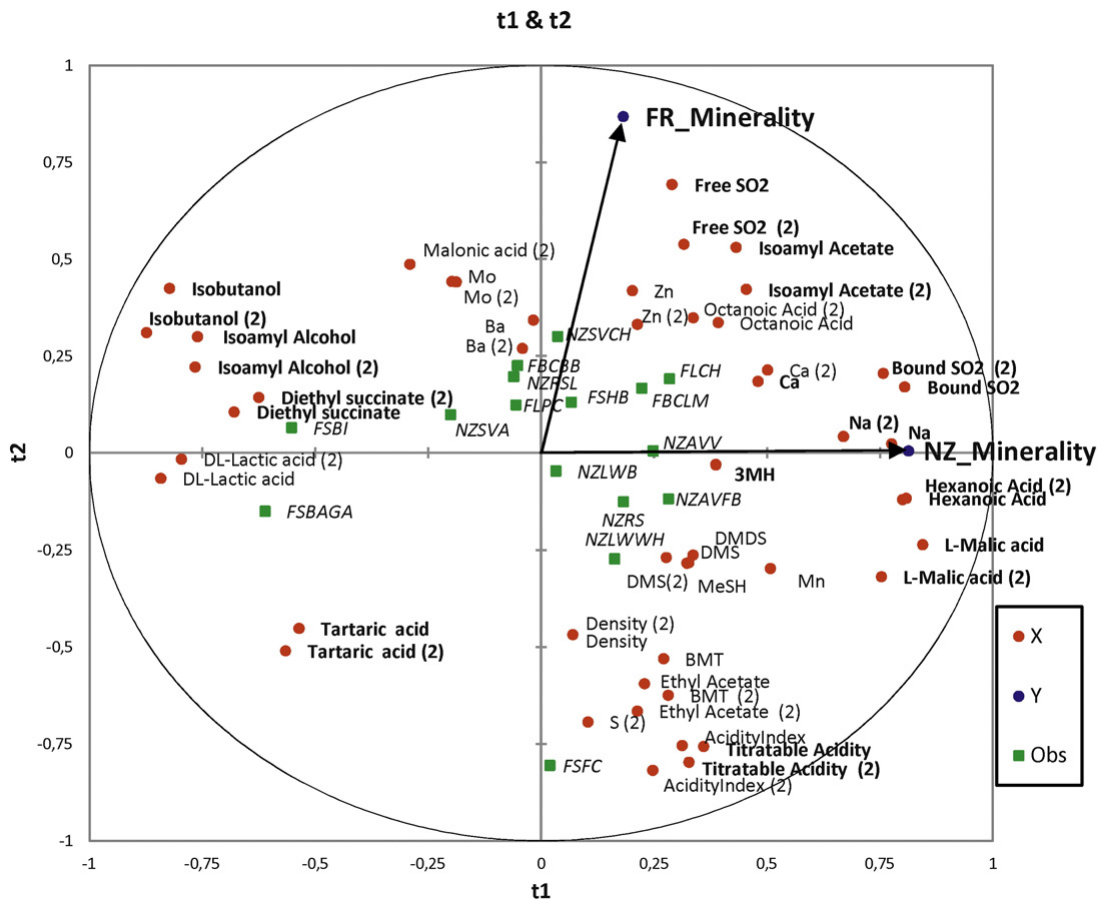
The PLSR gave an optimal solution for 2 latent vectors (Stone– Geisser Q2 = 0.401), explaining 40.1% of the X variance and 72.4% of Y. Fig. 2 shows the correlation plot with the projections of the Y variables (NZ and French perceived minerality average scores), the X variables (chemical compounds) and the observations (wines).
PLSR在2个潜在向量时获得最优解(Stone– Geisser Q2 = 0.401),解释了X变量方差的40.1%和Y变量方差的72.4%。图2为相关图,显示了Y变量(新西兰和法国感知矿物感平均评分)、X变量(化学成分)以及观测值(葡萄酒)的投影。
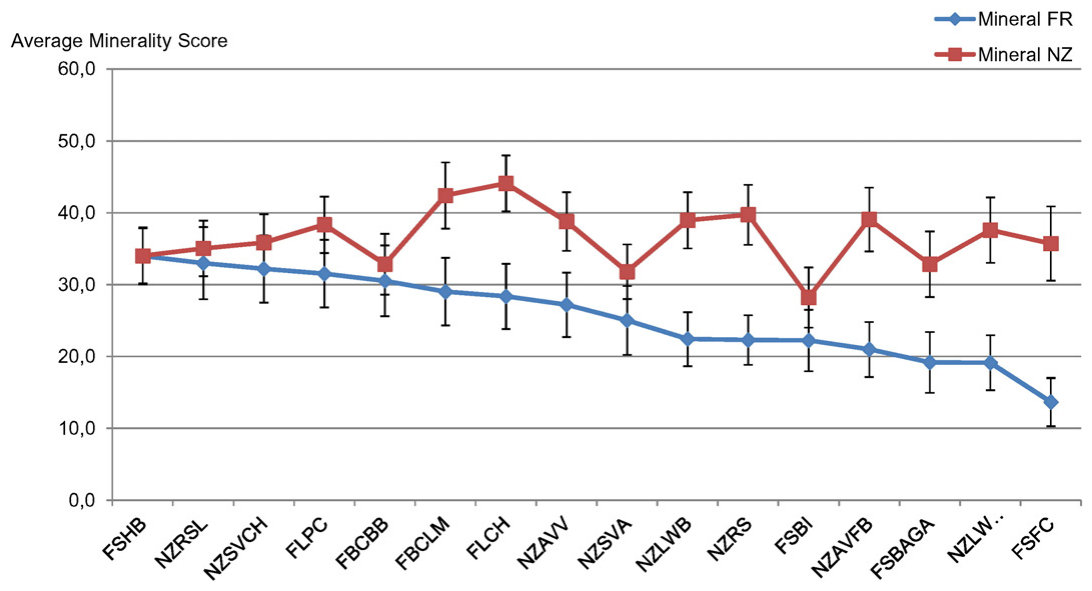
ANOVA results on the minerality scores showed significant effects for wine (F15,885 = 2.53; p = 0.001), subject origin (F1,59 = 87.26; p b 0.0001) and the interaction subject origin × wine (F15,885 = 2.22; p = 0.0048). These effects can be observed in Fig. 1, which shows the average minerality scores for each wine and for each culture. For clarity, the wines were ranged from the most mineral to the least mineral according to the perception of French participants.
矿物感评分的方差分析结果显示,葡萄酒(F15,885 = 2.53;p = 0.001)、被试来源(F1,59 = 87.26;p < 0.0001)以及被试来源 × 葡萄酒交互作用(F15,885 = 2.22;p = 0.0048)均具有显著效应。这些效应可见于图1,该图显示了每种葡萄酒在每种文化群体中的平均矿物感评分。为清晰起见,葡萄酒按法国参与者的感知从矿物感最强到最弱排列。
Fig. 1 shows that the NZ tasters gave higher minerality ratings overall than did the French tasters. This is in keeping with results reported in Parr et al. (2015), where a three-way, mixed design ANOVA conducted on an extended version of the dataset (with culture as the between-subject variable and perception mode and wine as within-subject variables) showed a significant effect of tasters' culture, with NZ scores higher than French scores (Parr et al., 2015; Fig. 1, global).图1显示,新西兰品评者给出的矿物感评分总体上高于法国品评者。这与Parr et al. (2015)报道的结果一致:该研究对扩展数据集进行了三因素混合设计方差分析(以文化为被试间变量,感知模式和葡萄酒为被试内变量),结果显示品评者文化具有显著效应,新西兰评分高于法国评分(Parr et al., 2015;图1,整体评价)。
Fig. 1 also shows the interaction between subject origin and wine. The NZ tasters gave higher minerality scores only to some wines (NZRS, NZAVFB, FSBAGA, NZLWWH, and FSFC), while for other wines, the average scores were similar for French and NZ tasters. This interaction cannot be explained in terms of wine origin as half of the wines that received higher scores from NZ participants were from NZ and the other from France, suggesting that prior exposure was not a major factor in the differences in minerality ratings to the wines. Due to the differences in minerality judgment between cultures for many of the wines, a decision was made to separate the data as a function of culture in subsequent data analyses.图1亦显示了被试来源与葡萄酒之间的交互作用。新西兰品评者仅对部分葡萄酒(NZRS、NZAVFB、FSBAGA、NZLWWH和FSFC)给出了更高的矿物感评分,而对其他葡萄酒,法国与新西兰品评者的平均评分相近。该交互作用无法以葡萄酒产地来解释,因为获得新西兰参与者较高评分的葡萄酒中一半来自新西兰、另一半来自法国,这表明先前接触并非造成葡萄酒矿物感评分差异的主要因素。鉴于两种文化群体对许多葡萄酒的矿物感判断存在差异,后续数据分析中决定按文化群体分别处理数据。
4.2. Chemical analyses4.2. 化学分析
The average concentrations and SD of each measured compound is given in Table 7 (see Supplementary Material). One-way ANOVA showed significant differences between wines for all but four of the compounds estimated: Ba, Cu, Ni, and H2S (data not given).
各测定化合物的平均浓度及标准差见表7(见补充材料)。单因素方差分析显示,除Ba、Cu、Ni和H2S四种化合物外,其余所有测定化合物在不同葡萄酒之间均存在显著差异(数据未列出)。
4.3.1. Cultural differences4.3.1. 文化差异
Fig. 2 shows that NZ participants' minerality perceived scores project onto the positive side of the first dimension and the main positive predictors were bound SO2, hexanoic acid, Na, Ca, and malic acid for both linear and quadratic relationships apart from Ca, which was not significant in its quadratic form. The negative predictors of perceived minerality by NZ participants were isoamyl alcohol, diethyl succinate, and isobutanol for both linear and quadratic relationships (the normalized regression coefficients and their confidence intervals can be seen in Fig. 3a).图2显示,新西兰参与者的感知矿物感评分投影于第一维度的正向一侧,主要正向预测因子为结合态SO2、己酸、Na、Ca和苹果酸,其线性和二次关系均显著,但Ca的二次形式不显著。新西兰参与者感知矿物感的负向预测因子为异戊醇、琥珀酸二乙酯和异丁醇,其线性和二次关系均显著(标准化回归系数及其置信区间见图3a)。
Consistent with our hypothesis predicting cultural differences, the French participants' perceived minerality scores project onto the positive side of the second dimension. The significant positive predictors were isoamyl acetate and free SO2 for both the linear and quadratic relationships, and the negative predictors were tartaric acid and titratable acidity (the normalized regression coefficients and their confidence intervals can be seen in Fig. 3b).
与我们预测存在文化差异的假设一致,法国参与者的感知矿物感评分投影于第二维度的正向一侧。显著的正向预测因子为乙酸异戊酯和游离态SO2(线性和二次关系均显著),负向预测因子为酒石酸和可滴定酸度(标准化回归系数及其置信区间见图3b)。
4.3.2. Absence of flavour in wine4.3.2. 葡萄酒风味的缺失
With respect to our hypothesis concerning the relation between perceived flavour and minerality, and hence influence of the major impact compounds of sauvignon blanc, namely IBMP, 3MHA, 3MH, 4MMP, BMT, E2MA, and the C6 compounds, PLSR results show that 3MH only, a compound implicated in citrus-type aromas, had a significant and positive effect on perceived minerality for NZ participants. This result is at odds with our hypothesis since 3MH is considered among the most important varietal, sauvignon blanc impact compounds. However, if we consider that 3MH is involved in citrus/grapefruit aromas this result is consistent with Parr et al. (2015) who reported that the citrus aroma was a positive predictor of minerality for wine professionals from both France and NZ.
关于感知风味与矿物感之间关系的假设,即长相思葡萄酒主要特征化合物(IBMP、3MHA、3MH、4MMP、BMT、E2MA及C6化合物)的影响,PLSR结果显示,仅3MH(一种与柑橘类香气相关的化合物)对新西兰参与者的感知矿物感具有显著正向效应。该结果与我们的假设相悖,因为3MH被认为是长相思最重要的品种特征化合物之一。然而,若考虑到3MH与柑橘/葡萄柚香气相关,则该结果与Parr et al. (2015)的报道一致,该研究指出柑橘香气是法国和新西兰葡萄酒专业人士矿物感的正向预测因子。
4.3.3. Wine acidity4.3.3. 葡萄酒酸度
Results related to aspects of wine acidity are mixed in terms of support for our hypotheses. More specifically, the results demonstrate that for NZ participants, malic acid was a positive predictor of perceived minerality, while lactic acid tended toward a negative association with minerality. For French participants, tartaric acid and titratable acidity were both significant negative predictors of minerality. Neither wine pH nor the derived acidity index were significant variables in predicting perceived minerality for either culture (see Fig. 3).
与葡萄酒酸度相关的结果对我们假设的支持程度不一。具体而言,结果表明,对新西兰参与者而言,苹果酸是感知矿物感的正向预测因子,而乳酸则倾向于与矿物感呈负相关。对法国参与者而言,酒石酸和可滴定酸度均为矿物感的显著负向预测因子。葡萄酒pH值及衍生的酸度指数对两种文化群体的感知矿物感均不是显著预测变量(见图3)。
4.3.4. Wine elements4.3.4. 葡萄酒中的元素
In terms of the elements, Ca2+ and Na+ were positive predictors of minerality for NZ participants. On the other hand, none of the measured elements had a significant role in the prediction of perceived minerality by French participants.
就元素而言,Ca2+和Na+是新西兰参与者矿物感的正向预测因子。另一方面,所测定的元素均未在法国参与者感知矿物感的预测中发挥显著作用。
4.3.5. Association of minerality with sulphur compounds4.3.5. 矿物感与含硫化合物的关联
Contrary to our hypothesis, the sulphur compound BMT, which has been reported to be a source of perceived flinty characteristics, was not found to be a significant predictor of perceived minerality for either culture.
与我们的假设相反,据报道为感知燧石特征来源的含硫化合物BMT,对两种文化群体而言均不是感知矿物感的显著预测因子。
The final results important to report in light of our a priori hypotheses concern volatile sulphur compounds commonly associated with perceived reductive phenomena. Our results show that none of the reductive sulphur compounds estimated were significant predictors of perceived minerality for participants of either culture. Interestingly, free SO2 concentration was the most important predictor of minerality for French participants, and bound SO2 the most important for NZ participants, both associations being positive. This result is congruent with the sensory data demonstrating a greater reliance on olfactory information by French than NZ tasters in their global wine judgments since free SO2 would be detectable via olfaction whereas bound SO2 would be assumed to be experienced primarily as a palate sensation (Bueno, Carrascon, & Ferreira, 2016; Coetzee, Brand, Jacobson, & Du Toit, 2016; Jackowetz & Mira de Orduna, 2013; Liu & Pilone, 2000).
根据我们的先验假设,最后需要报告的重要结果涉及通常与感知还原现象相关的挥发性含硫化合物。结果表明,所测定的还原性含硫化合物对两种文化群体的参与者而言均不是感知矿物感的显著预测因子。值得注意的是,游离态SO2浓度是法国参与者矿物感最重要的预测因子,而结合态SO2是新西兰参与者最重要的预测因子,二者均呈正相关。该结果与感官数据相符:感官数据表明,法国品评者在整体葡萄酒判断中比新西兰品评者更依赖嗅觉信息,而游离态SO2可经嗅觉察觉,结合态SO2则被认为主要作为口腔感觉被感知(Bueno, Carrascon, & Ferreira, 2016; Coetzee, Brand, Jacobson, & Du Toit, 2016; Jackowetz & Mira de Orduna, 2013; Liu & Pilone, 2000)。
5Discussion讨论
The current study aimed to investigate the nature of perceived minerality in sauvignon wines from a wine composition perspective. The major result is demonstration that several aspects of chemical composition associated significantly with perceived minerality in sauvignon blanc wines. Further, the specific compounds that served as significant predictors of perceived minerality varied as a function of participant culture. That is, not only did French and NZ participants draw on different sensory information to make their minerality judgements, with French relying more on olfaction while New Zealanders relied equally on olfaction and palate phenomena (Parr et al., 2015), but also the aspects of wine composition predicting each culture's judgments of perceived minerality differed. For French participants, the significant positive predictors of their minerality judgments were isoamyl acetate and free SO2 while the negative predictors were tartaric acid and total acidity. For NZ participants, positive predictors were bound SO2, hexanoic acid, Na, Ca, and malic acid while negative predictors were isoamyl alcohol, diethyl succinate and isobutanol. Several of these results are more interpretable than others and these are discussed below in relation to our a priori hypotheses.
本研究旨在从葡萄酒组成的角度探讨长相思葡萄酒感知矿物感的本质。主要结果表明,化学组成的若干方面与长相思葡萄酒的感知矿物感显著相关。此外,作为感知矿物感显著预测因子的具体化合物因参与者文化而异。也就是说,法国和新西兰参与者不仅依据不同的感官信息作出矿物感判断——法国参与者更依赖嗅觉,而新西兰参与者对嗅觉和口腔感觉的依赖程度相当(Parr et al., 2015)——而且预测两种文化群体感知矿物感判断的葡萄酒组成因素也不相同。对法国参与者而言,矿物感判断的显著正向预测因子为乙酸异戊酯和游离态SO2,负向预测因子为酒石酸和总酸度。对新西兰参与者而言,正向预测因子为结合态SO2、己酸、Na、Ca和苹果酸,负向预测因子为异戊醇、琥珀酸二乙酯和异丁醇。其中部分结果较其他结果更易于解释,下文将结合我们的先验假设予以讨论。
Contrary to our hypothesis, the major impact compounds giving sauvignon blanc wines their varietal character, namely the volatile thiols (Dubourdieu et al., 2006) and IBMP (Allen et al., 1991), were not found to be negative predictors of perceived minerality for either culture. This negative result includes not only the thiol compounds considered the source of fruity characters in sauvignon wines, but also the volatile sulphur compound BMT which was identified by Tominaga et al. (2003) as associated with empyreumatic and spicy aroma of sauvignon blanc. The lack of a significant association between BMT and perceived minerality was an unexpected finding in that Parr et al. (2015) reported their sensory data as showing stony/flinty notes to be good predictors of global minerality for both cultures. These results do not mean necessarily that the negative relationship between perceived minerality and intensity of varietal character reported by Parr et al. (2015) does not have some of its basis in wine concentration of varietal thiols and IBMP, but that the wine composition effects are potentially more complex (e.g., masking effects as perceptual interaction phenomena may be at play) than the present study has been able to consider. Interestingly, the one compound assumed to contribute a fruity character that was a significant predictor, isoamyl acetate, contributed positively to perceived minerality, rather than negatively, further eroding any support for our first hypothesis.
与我们的假设相反,赋予长相思葡萄酒品种特征的主要特征化合物,即挥发性硫醇(Dubourdieu et al., 2006)和IBMP(Allen et al., 1991),对两种文化群体而言均不是感知矿物感的负向预测因子。这一否定结果不仅涉及被认为是长相思葡萄酒果香来源的硫醇化合物,也涉及挥发性含硫化合物BMT,Tominaga et al. (2003)确认其与长相思的焦香和辛香香气相关。BMT与感知矿物感之间缺乏显著关联是一个意外发现,因为Parr et al. (2015)报道其感官数据显示石质/燧石气息是两种文化群体整体矿物感的良好预测因子。这些结果并不必然意味着Parr et al. (2015)报道的感知矿物感与品种特征强度之间的负相关关系与葡萄酒中品种硫醇和IBMP的浓度毫无关联,而是葡萄酒组成的效应可能比本研究所能考虑的更为复杂(例如,可能存在作为感知交互现象的掩蔽效应)。值得注意的是,唯一被认为贡献果香特征且为显著预测因子的化合物——乙酸异戊酯——对感知矿物感的贡献为正而非负,这进一步削弱了对我们第一个假设的支持。
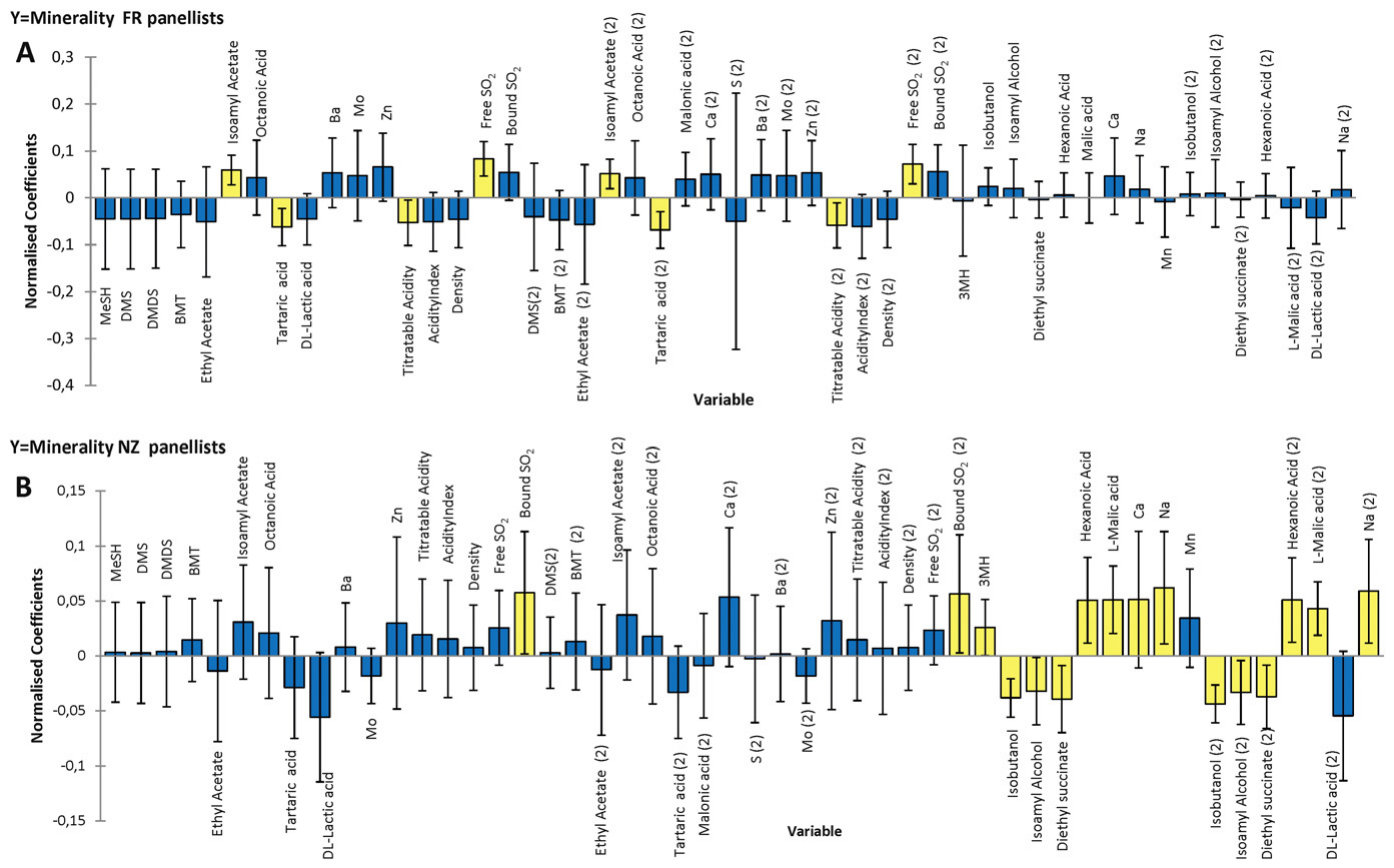
Our second hypothesis concerning an influence of qualitative and quantitative aspects of wine acidity on perception of mineral character received some support. However, overall the data demonstrate that the relationship between perceived minerality and acidity is complex. First, our derived acidity index relating wine pH and titratable acidity failed to serve as either a positive or negative predictor of perceived mineral character in the wines, contrary to Heymann et al. (2014) results and much anecdotal evidence from wine producers and wine writers. Second, the relation between perceived minerality and the organic acids seems particularly complex. In support of the hypothesis linking mineral character to qualitative aspects of acidity is demonstration that for NZ participants, malic acid, an acid imparting a sharp, green-apple character to musts and wine, was a positive predictor of minerality, whereas lactic acid correlated negatively with minerality. Lactic acid in wine results from the oenological process known as malolactic fermentation (MLF), with the conversion of malic acid to lactic acid resulting in not only a decrease in total acidity but as well a modification in the aromatic profile of a wine with the emergence of lactic notes which tend toward buttery characteristics. Such buttery, milky characters were found negatively correlated to minerality by Heymann et al. (2014) and conceivably could have a negative effect on perception of wine freshness, freshness being a character that Parr et al. (2015) reported to positively associate with perceived minerality for both French and NZ participants. Finally, the result demonstrating that for French participants perceived minerality associated negatively with tartaric acid and total acidity was not entirely unexpected in that Parr et al. (2015) failed to show a positive relationship between perceived sourness and perceived minerality for either culture in the global tasting of these same sauvignon wines.
关于葡萄酒酸度的质与量对矿物特征感知影响的第二个假设得到了部分支持。然而,总体而言,数据表明感知矿物感与酸度之间的关系较为复杂。首先,将葡萄酒pH值与可滴定酸度相关联的衍生酸度指数既未成为葡萄酒感知矿物特征的正向预测因子,也未成为负向预测因子,这与Heymann et al. (2014)的结果以及葡萄酒生产者和葡萄酒作家的大量经验性证据相悖。其次,感知矿物感与有机酸之间的关系似乎尤为复杂。支持矿物特征与酸度质量方面相关联这一假设的证据是:对新西兰参与者而言,苹果酸(一种赋予葡萄汁和葡萄酒尖锐的青苹果特征的酸)是矿物感的正向预测因子,而乳酸与矿物感呈负相关。葡萄酒中的乳酸源于称为苹果酸-乳酸发酵(MLF)的酿造工艺,苹果酸转化为乳酸不仅使总酸度降低,而且会改变葡萄酒的香气轮廓,出现趋向黄油特征的乳香。Heymann et al. (2014)发现此类黄油、奶香特征与矿物感呈负相关,并且可以设想其可能对葡萄酒清新感的感知产生负面影响,而Parr et al. (2015)报道清新感对法国和新西兰参与者而言均与感知矿物感呈正相关。最后,法国参与者的感知矿物感与酒石酸和总酸度呈负相关这一结果并非完全出乎意料,因为Parr et al. (2015)在对这些长相思葡萄酒的整体品评中,未能发现两种文化群体的感知酸味与感知矿物感之间存在正相关关系。
In terms of the relation between wine volatile sulphur composition and perceived minerality, the present data lend little support to the notion that reported mineral notes in wines bottled under inert bottle closures (the NZ wines) have their source in reductive phenomena. This however does not imply that reported mineral notes do not at times have their source, at least in part, in reductive phenomena, and further research is needed to clarify the complex situation. Indeed, the sensory data published to date are equivocal with respect to this issue, Ballester et al. (2013) and Heymann et al. (2014) reporting a positive relationship, while Parr et al. (2015) did not. What we can say is that in the present results, the concentrations of reductive sulphur compounds did not serve as significant positive predictors of perceived minerality for either culture. However, it is interesting to note that concentration of free SO2, a compound considered to give a distinctive pungent note when in high concentration, was the most important predictor of perceived minerality for French participants, who were shown in the sensory data to rely to a large degree on olfactory information in their global wine judgments. This result is in agreement with Heymann et al. (2014). Also consistent with the sensory data is demonstration that bound SO2, the non-volatile component expected to produce a palate sensation rather than a significant odour (Coetzee et al., 2016), was the most important predictor for NZ participants who were shown to rely equally on olfaction and palate information when making their global judgments of perceived minerality. This result is particularly relevant to wine sensory research where in general researchers do not report concentrations of either free or bound SO2 in their reports of wine sensory phenomena but rather focus on other standard measures such as ethanol and residual sugar as likely determinants of sensory outcomes. Clearly, further research is warranted in this area.
关于葡萄酒挥发性含硫组成与感知矿物感之间的关系,本研究数据几乎不支持以惰性瓶塞封装的葡萄酒(新西兰葡萄酒)中所报道的矿物气息源于还原现象这一观点。然而,这并不意味着所报道的矿物气息有时不会至少部分源于还原现象,仍需进一步研究以厘清这一复杂情况。事实上,迄今发表的感官数据在这一问题上尚无定论:Ballester et al. (2013)和Heymann et al. (2014)报道了正相关关系,而Parr et al. (2015)则未发现。可以肯定的是,在本研究结果中,还原性含硫化合物的浓度对两种文化群体而言均不是感知矿物感的显著正向预测因子。然而值得注意的是,游离态SO2(一种高浓度时被认为产生独特刺激性气味的化合物)的浓度是法国参与者感知矿物感最重要的预测因子,而感官数据表明法国参与者在整体葡萄酒判断中在很大程度上依赖嗅觉信息。该结果与Heymann et al. (2014)一致。同样与感官数据相符的是,结合态SO2(预期产生口腔感觉而非明显气味的非挥发性组分;Coetzee et al., 2016)是新西兰参与者最重要的预测因子,而新西兰参与者在作出感知矿物感整体判断时对嗅觉和口腔信息的依赖程度相当。该结果对葡萄酒感官研究尤为重要,因为研究者在报道葡萄酒感官现象时通常不报告游离态或结合态SO2的浓度,而是关注乙醇和残糖等其他常规指标作为感官结果的可能决定因素。显然,该领域有必要开展进一步研究。
Our hypothesis concerning possible impact of wine elemental composition on perceived minerality in wine received some support. The present data show Ca and Na, likely present in wine as ionic Ca2+ and Na+, to be positive predictors of perceived minerality for NZ participants. In keeping with this result, Parr et al. (2015) reported the sensory descriptor chalky/calcareous to be a significant positive predictor of perceived minerality irrespective of participant culture and sensory evaluation mode. However, this descriptor is somewhat ambiguous with both chalky odour and chalky texture possible, and the link between these linguistic terms and underlying sensory-derived concepts with actual ionic calcium is far from obvious. To complicate the situation further, we point out that Maltman's (2013) analysis suggesting that it is unlikely that any particular ion, due to its concentration in wine, plays a role in wine taste did not consider synergistic effects involving various ions at sub-threshold level (Dalton, Doolittle, Nagata, & Breslin, 2000).
关于葡萄酒元素组成可能影响葡萄酒感知矿物感的假设得到了部分支持。本研究数据表明,Ca和Na(在葡萄酒中可能以离子态Ca2+和Na+存在)是新西兰参与者感知矿物感的正向预测因子。与此结果一致,Parr et al. (2015)报道,无论参与者文化和感官评价模式如何,感官描述词“白垩/石灰质”均是感知矿物感的显著正向预测因子。然而,该描述词含义较为模糊,既可能指白垩气味,也可能指白垩质感,且这些语言术语及其背后源于感官的概念与实际离子态钙之间的联系远非显而易见。使情况更为复杂的是,我们指出Maltman (2013)的分析认为,任何特定离子因其在葡萄酒中的浓度而在葡萄酒味觉中发挥作用的可能性不大,但该分析未考虑多种离子在阈下水平的协同效应(Dalton, Doolittle, Nagata, & Breslin, 2000)。
Vignon et al. (2012) reported an exploratory investigation concerning sodium, magnesium, potassium and minerality, but there appear to be few published data on the effect of ions on wine taste and/or texture that are based on sound scholarship. Clearly further research in this area is warranted.
Vignon et al. (2012)报道了一项关于钠、镁、钾与矿物感的探索性研究,但基于严谨学术研究的有关离子对葡萄酒味觉和/或质感影响的已发表数据似乎很少。显然,该领域有必要开展进一步研究。
Having addressed each of our a priori hypotheses, it now behoves us to comment on the predictors of perceived minerality in sauvignon wines that have been identified in the current study. The negative contributions of fusel alcohols isoamyl alcohol and isobutanol, as well as diethyl succinate do not, at face value, fit any of our hypotheses. While the roles of isoamyl alcohol and isobutanol are far from clear, diethyl succinate could be linked to succinic acid. Diethyl succinate is one of two ethyl esters found in wine formed by esterification of ethanol with succinic acid, a diprotic acid (Ribereau-Gayon, Glories, Maujean, & Dubourdieu, 2006). Along with ethyl succinate, both are regarded as marker compounds in aging white wines with notable increases found in bottled white wines b12 months old (Câmara, Alves, & Marques, 2006; Francioli, Torrens, Riu-Aumatell, Lopez-Tamames, & Buxaderas, 2003; Garde-Cerdán & Ancín-Azpilicueta, 2007; Recamales, Gallo, Hernanz, Gonzalez-Miret, & Heredia, 2011). While it is fair to assume diethyl succinate was generated from succinic acid it is not possible to ascertain from this the quantity of succinic acid present in these wines, which according to Baron and Fiala (2012) influences wine perceived minerality.
在逐一讨论先验假设之后,有必要对本研究所确定的长相思葡萄酒感知矿物感预测因子加以评述。杂醇油异戊醇和异丁醇以及琥珀酸二乙酯的负向贡献,从表面上看不符合我们的任何假设。尽管异戊醇和异丁醇的作用尚不明确,但琥珀酸二乙酯可能与琥珀酸有关。琥珀酸二乙酯是葡萄酒中由乙醇与琥珀酸(一种二元酸)酯化形成的两种乙酯之一(Ribereau-Gayon, Glories, Maujean, & Dubourdieu, 2006)。它与琥珀酸乙酯均被视为白葡萄酒陈酿的标志性化合物,在瓶储不足12个月的白葡萄酒中其含量显著增加(Câmara, Alves, & Marques, 2006; Francioli, Torrens, Riu-Aumatell, Lopez-Tamames, & Buxaderas, 2003; Garde-Cerdán & Ancín-Azpilicueta, 2007; Recamales, Gallo, Hernanz, Gonzalez-Miret, & Heredia, 2011)。虽然可以合理推断琥珀酸二乙酯由琥珀酸生成,但据此无法确定这些葡萄酒中琥珀酸的含量,而根据Baron and Fiala (2012),琥珀酸会影响葡萄酒的感知矿物感。
5.1. Limitations and qualifications5.1. 局限性与说明
Despite the present study's relatively comprehensive nature in terms of the physico-chemical measures undertaken on the sauvignon wines, there are some limitations worthy of reporting. In retrospect, there were some perceived attributes (e.g., the sensory descriptor “salty”) and some wine compositional aspects (e.g., the organic acid succinic acid) that were not investigated due to feasibility but that had potential to strengthen the present study. Succinic acid has been recently suggested as a potential source of wine perceived minerality (Baron & Fiala, 2012) although there is no clear evidence in support of this. Succinic acid is known to have an ambiguous taste involving sourness, bitterness and saltiness (Peynaud & Blouin, 2013; Ribereau-Gayon et al., 2006) but its sensory impact in wines is still unknown.
尽管本研究对长相思葡萄酒进行的理化测定相对全面,但仍存在一些值得指出的局限性。回顾而言,部分感知属性(如感官描述词“咸味”)和部分葡萄酒组成成分(如有机酸琥珀酸)因可行性原因未予研究,而这些本可增强本研究的说服力。近期有研究提出琥珀酸可能是葡萄酒感知矿物感的来源之一(Baron & Fiala, 2012),但尚无明确证据支持。已知琥珀酸具有兼含酸、苦、咸的模糊味道(Peynaud & Blouin, 2013; Ribereau-Gayon et al., 2006),但其在葡萄酒中的感官影响仍不清楚。
6Conclusion结论
Our sensory and chemical data demonstrate both cultural similarities and cultural differences in terms of what drives perception of mineral character in sauvignon wine. In extending our earlier work, these data show the complexity of the concept of minerality in wine from both a chemical and sensory perspective, with most of our specific hypotheses partially supported only. Clearly, further research is required, including with wine varietals other than sauvignon blanc, to delineate the wine attributes and compositional factors associated significantly with perception of mineral character in white wine. Of particular interest for both researchers and practitioners is the finding that concentrations of both free and bound sulphur dioxide were positive predictors of perceived mineral character in the wines, suggesting that these compounds require more serious consideration, maybe as chemical markers, in future wine sensory investigations.
我们的感官和化学数据表明,在驱动长相思葡萄酒矿物特征感知的因素方面,不同文化之间既存在相似性,也存在差异。作为对我们先前工作的拓展,这些数据从化学和感官两个角度揭示了葡萄酒矿物感概念的复杂性,我们的大多数具体假设仅得到部分支持。显然,仍需开展进一步研究(包括长相思以外的其他葡萄品种),以明确与白葡萄酒矿物特征感知显著相关的葡萄酒属性和组成因素。对研究者和从业者而言尤其值得关注的是,游离态和结合态二氧化硫的浓度均为葡萄酒感知矿物特征的正向预测因子,这表明在今后的葡萄酒感官研究中,这些化合物需要得到更认真的考虑,或可作为化学标志物。
Supplementary data to this article can be found online at http://dx. doi.org/10.1016/j.foodres.2016.06.026.
本文补充数据可在线获取:http://dx. doi.org/10.1016/j.foodres.2016.06.026。
Acknowledgement致谢
The research was funded by New Zealand Winegrowers, the New Zealand Institute of Plant & Food Research, Pernod Ricard NZ and Pernod Ricard Centre de Recherche, Paris, France, the Regional Council of Burgundy, the Bureau Interprofessionnel des Vins de Bourgogne and Conseil Interprofessionnel des Vins de Bordeaux. We thank Richard Hider and Joy Jiao, and the wine professionals in France and New Zealand who participated in the study.
本研究由New Zealand Winegrowers、New Zealand Institute of Plant & Food Research、Pernod Ricard NZ及Pernod Ricard Centre de Recherche(法国巴黎)、勃艮第大区议会(Regional Council of Burgundy)、Bureau Interprofessionnel des Vins de Bourgogne以及Conseil Interprofessionnel des Vins de Bordeaux资助。感谢Richard Hider和Joy Jiao,以及参与本研究的法国和新西兰葡萄酒专业人士。
References参考文献
Allen, M. S., Lacey, M. J., Harris, R. L. N., & Brown, W. V. (1991). Contribution of methoxypyrazines to sauvignon blanc wine aroma. American Journal of Enology and Viticulture, 42, 109–112. ASTM (1986). Physical requirement guidelines for sensory evaluation laboratories, ASTM STP 913. Philadelphia: ASTM Publications.
Ballester, J., Mihnea, M., Peyron, D., & Valentin, D. (2013). Exploring minerality of Burgundy chardonnay wines: A sensory approach with wine experts and trained panellists. Australian Journal of Grape and Wine Research, 19, 140–152. Baron, M., & Fiala, J. (2012). Chasing after minerality, relationship to yeast nutritional stress and succinic acid production. Czech Journal of Food Science, 30, 188–193. Botelho, G., Mendes-Faia, A., & Climaco, M. C. (2008). Differences in odor-active compounds of Trincadeira wines obtained from five different clones. Journal of Agricultural and Food Chemistry, 56(16), 7393–7398. Bueno, M., Carrascon, V., & Ferreira, V. (2016). Release and formation of oxidation-related aldehydes during wine oxidation. Journal of Agricultural and Food Chemistry, 64, 608–617.
Câmara, J. S., Alves, M. A., & Marques, J. C. (2006). Changes in volatile composition of Madeira wines during their oxidative ageing. Analytica Chimica Acta, 563(1–2), 188–197. Campo, E., Ferreira, V., Escudero, A., Marqués, J. C., & Cacho, J. (2006). Quantitative gas chromatography—olfactometry and chemical quantitative study of the aroma of four Madeira wines. Analytica Chimica Acta, 563(1–2), 180–187. Capone, D. L., & Jeffery, D. W. (2011). Effects of transporting and processing sauvignon blanc grapes on 3-mercaptohexan-1-ol precursor concentrations. Journal of Agricultural and Food Chemistry, 59, 4659–4667. Coetzee, C., Brand, J., Jacobson, D., & Du Toit, W. J. (2016). Sensory effect of acetaldehyde on the perception of 3-mercaptohexan-1-ol and 3-isobutyl-2-methoxypyrazine. Australian Journal of Grape and Wine Research. http://dx.doi.org/10.1111/ajgw.12206. Coutier, M., & Marchand, J. (2011). In F.C. Vesoul (Ed.), Petit manuel du gouter de vin. Vesoul, France: Culture et Patrimoine. Dalton, P., Doolittle, N., Nagata, H., & Breslin, P. (2000). The merging of the senses: Integration of subthreshold taste and smell. Nature Neuroscience, 3, 431–432. Darriet, P., Tominaga, T., Lavigne, V., Boidron, J. N., & Dubourdieu, D. (1995). Identification of a powerful aromatic component of Vitis vinifera var. sauvignon wines: 4-Mercapto- 4-methylpentan-2-one. Flavour and Fragance Journal, 10, 385–392. Deans, D. R. (1968). A new technique for heart cutting in gas chromatography [1]. Chromatographia, 1(1–2), 18–22.
Dubourdieu, D., Tominaga, T., Masneuf-Pomarede, I., Peyrot des Gachons, C., & Murat, M. - L. (2006). The role of yeasts in grape flavor development during fermentation: The example of sauvignon blanc. American Journal of Enology and Viticulture, 57, 81–88. Easton, S. (2009). Minerality. Drinks business. (pp. 86–88), 86–88 (May Issue). Escudero, A., Campo, E., Fariña, L., Cacho, J., & Ferreira, V. (2007). Analytical characterization of the aroma of five premium red wines. Insights into the role of odor families and the concept of fruitiness of wines. Journal of Agricultural and Food Chemistry, 55(11), 4501–4510.
Fang, Y., & Qian, M. (2005). Aroma compounds in Oregon pinot noir wine determined by aroma extract dilution analysis (AEDA). Flavour and Fragance Journal, 20(1), 22–29. Fedrizzi, B., Magno, F., Moser, S., Nicolini, G., & Versini, G. (2007). Concurrent quantification of light and heavy sulphur volatiles in wine by headspace solid-phase microextraction coupled with gas chromatography/mass spectrometry. Rapid Communications in Mass Spectrometry, 21(5), 707–714.
Francioli, S., Torrens, J., Riu-Aumatell, M., Lopez-Tamames, E., & Buxaderas, S. (2003). Volatile compounds by SPME-GC as age markers of sparkling wines. American Journal of Enology and Viticulture, 54(3), 158–162.
Garde-Cerdán, T., & Ancín-Azpilicueta, C. (2007). Effect of SO2 on the formation and evolution of volatile compounds in wines. Food Control, 18(12), 1501–1506.
Goode, J. (2012). Minerality in wine. Sommelier Journal(October Issue), 63–67.
Goode, J., & Harrop, S. (2011). Authentic wine: Toward natural and sustainable winemaking. CA, USA: University of California Press.
Green, J. A., Parr, W. V., Breitmeyer, J., Valentin, D., & Sherlock, R. (2011). Sensory and chemical characterisation of sauvignon blanc wine: Influence of source of origin. Food Research International, 44, 2788–2797.
Heymann, H., Hopfer, H., & Bershaw, D. (2014). An exploration of the perception of minerality in white wines by projective mapping and descriptive analysis. Journal of Sensory Studies, 29, 1–13.
Iland, P. (2004). Chemical analysis of grapes and wine: Techniques and concepts. Campbelltown, SA: Patrick Iland Wine Promotions.
ISO (1977). Sensory analysis—Apparatus—Wine-tasting glass. Geneva, Switzerland: ISO.
Jackowetz, J. N., & Mira de Orduna, R. (2013). Survey of SO2 binding carbonyls in 237 red and white table wines. Food Control, 32, 687–692.
King, E. S., Kievit, R. L., Curtin, C., Swiegers, J. H., Pretorius, I. S., Bastian, S., & Francis, I. L. (2010). The effect of multiple yeasts co-inoculations on sauvignon blanc wine aroma composition, sensory properties and consumer preference. Food Chemistry, 122, 618–626.
Kordis-Krapez, M., Abram, V., Kac, M., & Ferjancic, S. (2001). Determination of organic acids in white wines by RP-HPLC. Food Technology and Biotechnology, 39, 93–99.
Le Fur, & Gautier (2013, September/October). De la minéralité dans les rosés? Revue Française d'œnologie, 260, 40–43.
Liu, S. -Q., & Pilone, G. J. (2000). An overview of formation and roles of acetaldehyde in winemaking with emphasis on microbial implications. International Journal of Food Science and Technology, 35, 49–61.
Lukić, I., Plavša, T., Sladonja, B., Radeka, S., & Peršurić, Đ. (2008). Aroma compounds as markers of wine quality in the case of Malvazija Istarska young wine. Journal of Food Quality, 31(6), 717–735.
Maltman, A. (2013). Minerality in wine: A geological perspective. Journal of Wine Research, 24, 169–181.
Moyano, L., Zea, L., Moreno, J., & Medina, M. (2002). Analytical study of aromatic series in sherry wines subjected to biological aging. Journal of Agricultural and Food Chemistry, 50(25), 7356–7361.
Nikolantonaki, M., & Darriet, P. (2011). Identification of ethyl 2-sulfanylacetate as an important off-odor compound in white wines. Journal of Agricultural and Food Chemistry, 59, 10191–10199.
Noble, A. C., & Ebeler, S. E. (2002). Use of multivariate statistics in understanding wine flavour. Food Reviews International, 18, 1–21.
Parr, W. V., Ballester, J., Peyron, D., Grose, C., & Valentin, D. (2015). Investigation of perceived minerality in sauvignon wines: Influence of culture and mode of perception. Food Quality and Preference, 41, 121–132.
Parr, W. V., Green, J. A., White, K. G., & Sherlock, R. R. (2007). The distinctive flavour of New Zealand sauvignon blanc: Sensory characterisation by wine professionals. Food Quality and Preference, 18, 849–861.
Parr, W. V., Schlich, P., Theobald, J. C., & Harsch, M. J. (2013). Association of selected viniviticultural factors with sensory and chemical characteristics of New Zealand sauvignon blanc wines. Food Research International, 53, 464–475.
Parr, W. V., Valentin, D., Green, J. A., & Dacremont, C. (2010). Evaluation of French and New Zealand sauvignon wines by experienced French wine assessors. Food Quality and Preference, 21, 56–64.
Peinado, R. A., Moreno, J., Bueno, J. A., & Mauricio, J. C. (2004). Comparative study of aromatic compounds in two young white wines subjected to pre-fermentative cryomaceration. Food Chemistry, 84, 585–590.
Pena-Gallego, A., Hernandez-Orte, P., Cacho, J., & Ferreira, V. (2012). S-cysteinylated and S-glutathionylated thiol precursors in grapes. A review. Food Chemistry, 131, 1–13. Peynaud, E., & Blouin, J. (2013). Le goût du vin: Le grand livre de la dégustation (5th ed.). Paris: Dunod.
Plane, R. A., Mattick, L. R., & Weirs, L. D. (1980). An acidity index for the taste of wine. American Journal of Enology and Viticulture, 31, 265–268.
Recamales, A. F., Gallo, V., Hernanz, D., Gonzalez-Miret, M. L., & Heredia, F. J. (2011). Effect of time and storage conditions on major volatile compounds of Zalema white wine. Journal of Food Quality, 34(2), 100–110.
Ribereau-Gayon, P., Glories, Y., Maujean, A., & Dubourdieu, D. (2006). Handbook of enology. The chemistry of wine stabilization and treatment (6th ed.)Vol. 2, . England: Wiley (p. 7 & p. 61).
Ross, J. (2012). Minerality: Rigorous or romantic? Practical Winery & Vineyard Journal, XXXIII, 50–57 (Winter 2012).
Sáenz-Navajas, M. -P., Avizcuri, J. M., Ballester, J., Fernández-Zurbano, P., Ferreira, V., Peyron, D., & Valentin, D. (2015). Sensory-active compounds influencing wine experts' and consumers' perception of red wine intrinsic quality. LWT- Food Science and Technology, 60, 400–411.
Sáenz-Navajas, M. -P., Campo, E., Fernández-Zurbano, P., Valentin, D., & Ferreira, V. (2010). An assessment of the effects of wine volatiles on the perception of taste and astringency in wine. Food Chemistry, 121(4), 1139–1149.
Schmarr, H. -G., Ganß, S., Koschinski, S., Fischer, U., Riehle, C., Kinnart, J., ... Kutyrev, M. (2010). Pitfalls encountered during quantitative determination of 3-alkyl-2- methoxypyrazines in grape must and wine using gas chromatography–mass spectrometry with stable isotope dilution analysis. Comprehensive two-dimensional gas chromatography–mass spectrometry and on-line liquid chromatography–multidimensional gas chromatography–mass spectrometry as potential loopholes. Journal of Chromatography A, 1217(43), 6769–6777.
Shi, S., Condron, L., Larsen, S., Richardson, A. E., Jones, E., Jiao, J., ... Stewart, A. (2011). In situ sampling of low molecular weight organic anions from rhizosphere of radiata pine (Pinus radiata) grown in a rhizotron system. Environmental and Experimental Botany, 70(2–3), 131–142.
Tomasino, E., Harrison, R., Breitmeyer, J., Sedcole, R., Sherlock, R., & Frost, A. (2015). Aroma composition of 2-year-old New Zealand pinot noir wine and its relationship to sensory characteristics using canonical correlation analysis and addition/omission tests. Australian Journal of Grape and Wine Research, 21(3), 376–388.
Tominaga, T., & Dubourdieu, D. (2006). A novel method for quantification of 2-methyl-3- furanthiol and 2-furanmethanethiol in wines made from Vitis vinifera grape varieties. Journal of Agricultural and Food Chemistry, 54(1), 29–33.
Tominaga, T., Baltenweck-Guyot, R., Peyrot des Gachons, C., & Dubourdieu, D. (2003). Contribution of volatile thiols to the aromas of white wines made from several Vitis vinifera grape varieties. American Journal of Enology and Viticulture, 51, 178–181.
Tominaga, T., Furrer, A., Henry, R., & Dubourdieu, D. (1998). Identification of new volatile thiols in the aroma of Vitis vinifera L. var. sauvignon blanc wines. Flavour and Fragance Journal, 13, 159–162.
Tominaga, T., Guimbertau, G., & Dubourdieu, D. (2003a). Contribution of benzenemethanethiol to smoky aroma of certain Vitis vinifera L. wines. Journal of Agricultural and Food Chemistry, 51, 1373–1376.
Tominaga, T., Guimbertau, G., & Dubourdieu, D. (2003b). Role of certain volatile thiols in the bouquet of aged champagne wines. Journal of Agricultural and Food Chemistry, 51, 1016–1020.
Tyler, G., & Olsson, T. (2001). Plant uptake of major and minor mineral elements as influenced by soil acidity and liming. Plant and Soil, 230, 307–321. Vignon, X., Pillet, O., Kessler, G., Lhotellier, N., & Le Bras, G. (2012). Salinité et Minéralité. Le chaînon manquant. La Revue des Oenologues, 143, 49–53 (April 2012). Yang, Y., Duan, C., Du, H., Tian, J., & Pan, Q. (2010). Trace element and rare earth element profiles in berry tissue of three grape cultivars. American Journal of Enology and Viticulture, 61, 401–407.