INTERNATIONAL JOURNAL OF PHYTOREMEDIATION 2016, VOL. 18, NO. 9, 943-948 http://dx.doi.org/10.1080/15226514.2015.1131234
Michael W.H. Evangelou", Annina Bürgi, Brett H. Rabinson", Madeleine S. Günthardt-Goerg", Marcel Schöngens", and Rainer Schulin®
In·titute of Terrestrial Ecosystems, ETH Zürich, Universitätstrasse, Zürich, Switzerland; Agriculture and Life Sciences, Lincoln University, Lincoln, Canterbury, New Zealand; 'Swiss Federal Institute for Forest, Snow and Landscape Research WSL, Zürcherstrasse, Birmensdorf, Switzerland; "Institute for Theoretical Computer Science, ETH Zurich, Universitatstrasse, Zurich, Switzerland
苏黎世联邦理工学院陆地生态系统研究所,Universitätstrasse,瑞士苏黎世;林肯大学农业与生命科学学院,新西兰坎特伯雷林肯;瑞士联邦森林、雪与景观研究所(WSL),Zürcherstrasse,瑞士Birmensdorf;苏黎世联邦理工学院理论计算机科学研究所,Universitätstrasse,瑞士苏黎世
ABSTRACT Measuring the uptake of the chemical elements by plants usually requires the destructive harvest of the plants. Analyzing individual leaves is unsatisfactory because their elemental concentration depends on their age and position on the branch or stem. We aimed to find an easy method to determine the elemental concentrations using a few suitable single leaves along the main shoot of poplar (Populus monviso) and willow (Salix viminalis) cuttings at the end of the first season. Using Ca, Cd, Mn, Fe, K, P, Pb, and Zn concentrations, measured in selected leaves along the main shoots of the cuttings, mathematical functions were derived, which described best their distribution. Elemental allocation patterns were independent of the soil character stics and soil ele nent concentrations. Based on these functions, three leaves from specific positions along the main shoot were selected, which could accurately describe the derived functions. The deviation of the calculated average concentration, based on the 3-leaves method, was ·15% in approximately 65% of the cases compared to the measured concentration. This method could be used to calculate element concentrations and fluxes in phytomanagement, biomonitoring, or biomass productions projects using one-season poplar or willow cuttings.
摘要 测定植物对化学元素的吸收通常需要对植物进行破坏性收获。分析单片叶片的效果并不理想,因为叶片的元素浓度取决于其叶龄及其在枝条或茎上的着生位置。本研究旨在寻找一种简便方法,利用第一个生长季末杨树(Populus monviso)和柳树(Salix viminalis)插条主枝上少数几片合适的单叶来确定元素浓度。基于插条主枝上所选叶片中测得的Ca、Cd、Mn、Fe、K、P、Pb和Zn浓度,推导出最能描述其分布的数学函数。元素分配格局与土壤性质及土壤元素浓度无关。根据这些函数,选取了主枝上特定位置的三片叶片,它们能够准确地描述所推导的函数。与实测浓度相比,基于三叶法计算的平均浓度在约65%的情况下偏差≤15%。该方法可用于在采用一年生杨树或柳树插条的植物管理、生物监测或生物质生产项目中计算元素浓度和通量。
KEYWORDS
allocation; plant uptake; macro- and micronutrients; trace elements
1Introduction引言
Poplar and willow are planted worldwide for soil conservation, riverbank protection, timber, bioenergy, supplementary stock fodder, and for the phytomanagen.ent of contaminated sites Isebrands and Richardson (2014). Poplar and willow are used because they have a high biomass production (Klasnja, Kopitovic and Orlovic 2002; Evangelou et al. 2012), are easily propagated, establish rapidly, can be coppiced (Robinson et al. 2009) and accumulate trace elements (TEs), especially Cd and Zn (Dickinson and Pulford 2005; Unterbrunner et al. 2007; Dicknate growth, poplar and willow are also preferred experimental tree species for short (one season) experiments.
杨树和柳树在世界范围内被广泛种植,用于水土保持、河岸防护、木材生产、生物能源、补充性家畜饲料以及污染场地的植物管理(Isebrands and Richardson 2014)。选用杨树和柳树是因为它们生物质产量高(Klasnja, Kopitovic and Orlovic 2002; Evangelou et al. 2012),易于繁殖,定植迅速,可平茬萌生(Robinson et al. 2009),并能积累微量元素(TEs),尤其是Cd和Zn(Dickinson and Pulford 2005; Unterbrunner et al. 2007; Dickinson et al. 2009)。由于其无限生长的特性,杨树和柳树也是短期(一个生长季)试验中首选的试验树种。
Knowledge on the elemental uptake by poplars and willows is critical when assessing their health, the likely nutritive value when used as stock fodder, and the ecological risks posed by them when planted on contaminated sites. The elemental uptake in the foliage is determined by harvesting the entire foliage per plant or a represéntative aliquot (Robinson et al. 2005). For the former, the elemental determination can only be performed at the end of the experiment. In this case, however, a determination of element fluxes during the growth period is not possible. For the latter, achievirg a representative aliquot, could mean harvesting a great number of leaves which in turn could interfere with the growth of the cutting and thus alter the outcome of the experiment. Thus, to reduce the number of harvested leaves, one should harvest representative leaves. The best election of representative leaves along the main shoot of young woody plants with indeterminate growth is however not clear, because after allocation of the elements by the transpiration stream, later dislocations differ by the element for the transfer to younger leaves, to senescing leaves or to other plant parts (Laureysens et al. 2004; Vollenweider, Menard, and Günthardt-Goerg 2011). In addition, these processes change during the season (Robinson et al. 2005). Furthermore, knowledge to which extent the foliar element concentration depends on the soil type is scarce.
在评估杨树和柳树的健康状况、其用作家畜饲料时可能具有的营养价值以及在污染场地种植时带来的生态风险时,了解其对元素的吸收至关重要。叶片中的元素吸收量通常通过收获每株植物的全部叶片或具有代表性的部分样品来测定(Robinson et al. 2005)。对于前者,元素测定只能在试验结束时进行,因而无法测定生长期间的元素通量。对于后者,要获得具有代表性的样品可能需要收获大量叶片,这反过来可能干扰插条的生长,从而改变试验结果。因此,为减少收获叶片的数量,应当收获具有代表性的叶片。然而,对于无限生长的幼龄木本植物,沿主枝如何最佳地选取代表性叶片尚不清楚,因为元素经蒸腾流分配后,其随后向幼叶、衰老叶片或其他植物器官的再迁移因元素而异(Laureysens et al. 2004; Vollenweider, Menard, and Günthardt-Goerg 2011)。此外,这些过程在生长季内也会发生变化(Robinson et al. 2005)。再者,关于叶片元素浓度在多大程度上取决于土壤类型的认识也十分有限。
We aimed to determine the distribution patterns of leaf Ca, Cd, Mn, Fe, K, P, Pb, and Zn concentrations along the main shoots of poplar, Populus monviso (mother: P. deltoides 583 [Iowa, USA] x P. trichocarpa 196 [Oregon, U.S.A.], father: P. nigra 715-86 [Piemonte, Italy] × P. nigra 7 [Umbria, Italy]) and willow (Salix viminalis L..) cuttings grown on six soils with different TE contamination (four naturally TE-contaminated soils, a TE-spiked soil and an uncontaminated control soil). Specifically, we sought to a) determine the spatial distribution of the above-mentioned elements; b) determine its dependence from the soil type and c) establish a simple functional relationship between the minimum number of samples leaves needed to calculate the average element concentration of a cutting and the measured average element concentration.
本研究旨在确定生长于六种不同微量元素污染程度土壤(四种天然微量元素污染土壤、一种人工添加微量元素的土壤和一种未污染对照土壤)上的杨树Populus monviso(母本:P. deltoides 583 [美国艾奥瓦州] × P. trichocarpa 196 [美国俄勒冈州],父本:P. nigra 715-86 [意大利皮埃蒙特] × P. nigra 7 [意大利翁布里亚])和柳树(Salix viminalis L.)插条主枝上叶片Ca、Cd、Mn、Fe、K、P、Pb和Zn浓度的分布格局。具体而言,我们试图:a)确定上述元素的空间分布;b)确定其对土壤类型的依赖性;c)在计算插条平均元素浓度所需的最少采样叶片数与实测平均元素浓度之间建立简单的函数关系。
CONTACT Michael W.H. Evangelou © michael.evangelou@env.ethz.ch C Institute of Terrestrial Ecosystems, ETH Zürich, Universitätstrasse 16, CH-8092 Zürich, Switzerland. © 2016 Taylor & Francis Group, LLC
Analysis of individual leaves followed the method of Gramlich et al. (2011). All leaves were subsequently washed with tap and deionized water and were dried at 60°C until a constant weight was obtained. Leaves with a weight > 0.2 g, were cut longitudinally along the main vein. Each leaf or leaf portion was crushed using a mortar and pestle and approximately 0.2 g, was digested in 15 mL of HNO3 (65%), at 120°C for 1 h using a digestion block (DigiPREP MS, SCP-Science), and diluted to 25 mL. with Millipore· H2O. The extracts were analyzed using ICP-OES (Varian, Vista-MPX CCS simultaneous). The remaining dried pooled leaves of the main shoot were ground using a Retsch ZM-200 centrifugal titanium mill. Pooled leaf samples had sufficient biomass for X-ray fluorescence (XRF) analyses following the method of Marmiroli et al. (2012). TEs were determined using a Spectro X-lab 2000 (Germany) XRF. For quality assurance, we analyzed certified plant reference material (Virginia tobacco leaves CTA-VTL-2, Polish Reference Material). Recoveries were for Ca, Cd, Mn, Fe, K, P, Pb, and Zn were within 10% of their certified values.
单片叶片的分析参照Gramlich et al. (2011)的方法。所有叶片依次用自来水和去离子水洗净,于60°C烘干至恒重。重量> 0.2 g的叶片沿主脉纵向切开。每片叶片或叶片部分用研钵和研杵磨碎,取约0.2 g,用15 mL HNO3(65%)于120°C在消解块(DigiPREP MS,SCP-Science)中消解1 h,并用Millipore H2O定容至25 mL。提取液采用ICP-OES(Varian,Vista-MPX CCS同步型)测定。主枝上其余烘干的混合叶片用Retsch ZM-200离心式钛研磨机粉碎。混合叶片样品的生物量足以参照Marmiroli et al. (2012)的方法进行X射线荧光(XRF)分析。微量元素采用Spectro X-lab 2000(德国)XRF测定。为保证质量,我们分析了经认证的植物标准物质(弗吉尼亚烟叶CTA-VTL-2,波兰标准物质)。Ca、Cd、Mn、Fe、K、P、Pb和Zn的回收率均在其认证值的10%以内。
2Material and methods材料与方法
The soils used in this study were allocated at four contaminated sites in Switzerland: Allmend (47°01'48 N, 8°18'30"E), Losone (46°10'21"N, 8°44'46"E), Dornac1 (47°28'36"N, 7°36'36"E) and Witzwil (46°58'60"N, 7°2'60E). In addition we used a loamy soil from the area of Brugg that had been artificially contaminated with dust from a brass smelter and used in a previous lysimeter experiment at WSL Birmensdorf (Switzerland) (Menon et al. 2005), and an uncontaminated substrate (technosol) for control. It consisted of peat bark humus and lay pot mixture, as it is regularly used for growing seedlings in the tree nursery of WSL (47°21'40.53"N; 8°27'21.82"E). The chemical and physical properties of the soils are reported in Evangelou
本研究所用土壤采自瑞士四个污染场地:Allmend(47°01'48"N, 8°18'30"E)、Losone(46°10'21"N, 8°44'46"E)、Dornach(47°28'36"N, 7°36'36"E)和Witzwil(46°58'60"N, 7°2'60"E)。此外,我们还使用了一种来自Brugg地区的壤土,该土壤曾被黄铜冶炼厂粉尘人工污染,并曾用于WSL Birmensdorf(瑞士)先前的渗漏计试验(Menon et al. 2005);另以一种未污染基质(技术土)作为对照。该基质由泥炭、树皮腐殖质和盆栽混合土组成,是WSL苗圃(47°21'40.53"N; 8°27'21.82"E)常规用于育苗的基质。土壤的化学和物理性质见Evangelou
Mathematical calculation of average concentration平均浓度的数学计算
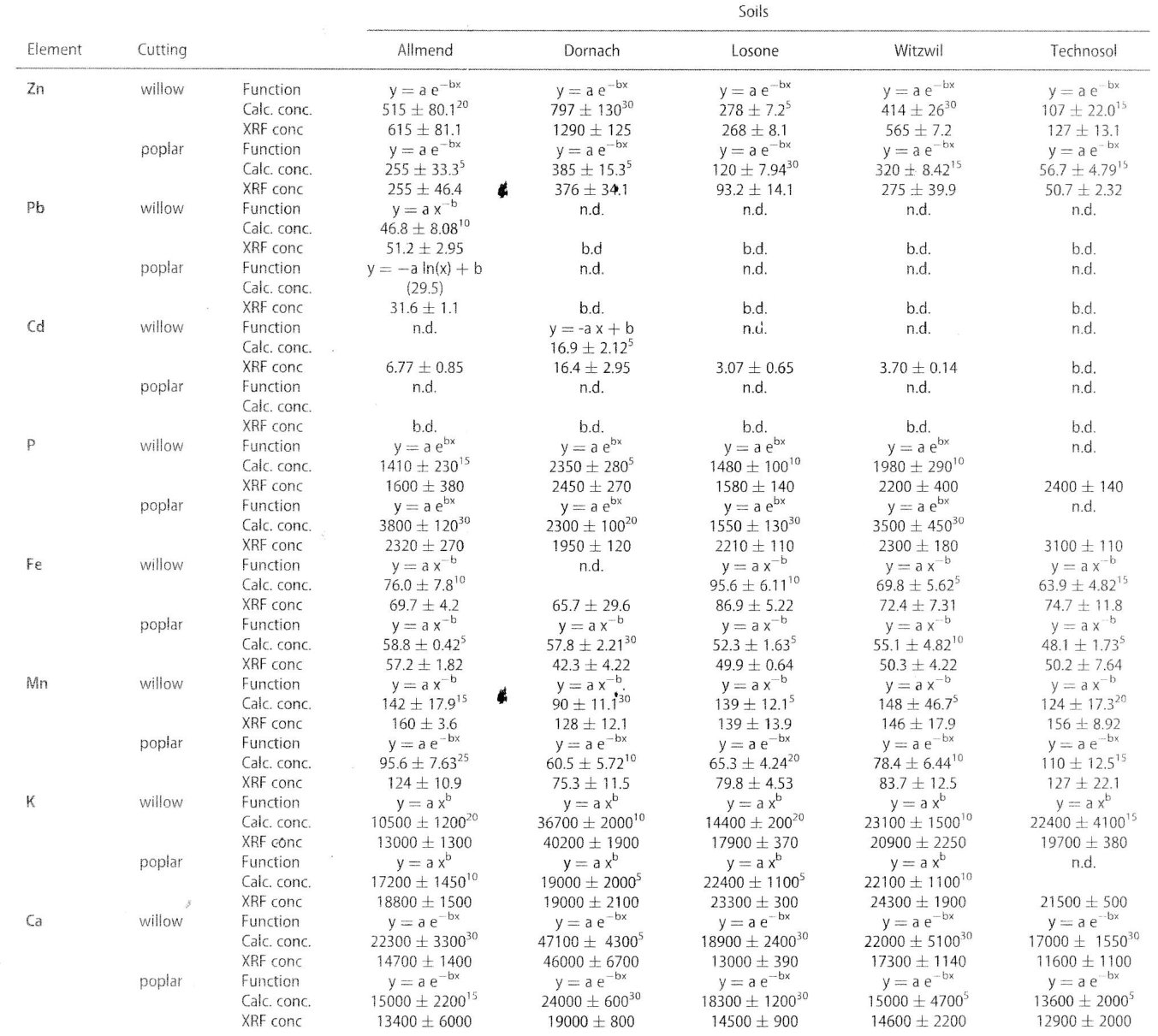
Based on the elemental concentrations of the individually analyzed leaves (every 5th leaf from bottom to top of the cutting) along the main shoot, we selected function f(x) (e.g., logarithmic, exponential etc.), which gave the best description of the distribution using the least square method (Wolberg 2005). For example, for uptake of Zn in Salix viminalis the model function was f(x) = a-e°*, where a, b are parameters. These functions are given in Table 1. The average elemental concentration of the main shoot of the cutting was estimated by utilizing f(x) in the following way (1):
根据主枝上单独分析的叶片(自插条底部至顶部每隔5片取1片)的元素浓度,我们采用最小二乘法(Wolberg 2005)选取能够最佳描述其分布的函数f(x)(如对数函数、指数函数等)。例如,对于Salix viminalis对Zn的吸收,模型函数为f(x) = a·e^(bx),其中a、b为参数。这些函数列于表1。插条主枝的平均元素浓度利用f(x)按如下方式估算(1):
Pot experiment盆栽试验
Pot experiments were conducted from May to September in the WSL tree nursery at Birmensdorf (47°21'48" N, 8°27'23" E, 545 m a.s.l.) under ambient climate conditions. The average (+standard deviation) monthly temperature during the experiment was 13.1 (2.6) °C and the average solar radiation was 4.8 (0.8) kWh/m/d. Ten-L plastic pots with six small bottom holes each were filled with approximately 9 kg air-dried soil that had been sieved to <1 cm grain size fraction. A tray was placed under each pot to collect any leachate, which was recycled to ensure that there was no loss of macronutrients or TE from the pots. The soils were fertilized using Osmocote 6 M at rates recommended by the manufacturer, resulting in the addition of 500 mg N, 100 mg P and 200 mg K kg of soil. Pots were irrigated to field capacity with tap water 3-4 times per week. For each soil type, three replicate pots were planted with one willow (Salix viminalis) cutting and three replicates with one poplar (Populus monviso) cutting per pot. The poplar and willow were planted as un-rooted cuttings of approximately 300mm length (dry weight of 20.1 + 2.5 g and 9.5 · 1.5 g) respectively. All cuttings successfully established, although some cuttings in soils from Brugg and Dornach showed severe chlorosis and necrosis. The pots were positioned in a completely randomized design. Every 2-3 weeks the length of the main shoot was determined. There were no visible signs of pathogen activity during the experimental period.
盆栽试验于5月至9月在Birmensdorf的WSL苗圃(47°21'48" N, 8°27'23" E,海拔545 m)自然气候条件下进行。试验期间月平均气温(±标准差)为13.1(2.6)°C,平均太阳辐射为4.8(0.8)kWh/m2/d。每个10 L塑料盆底部开有6个小孔,装入约9 kg过1 cm筛的风干土。每个盆下放置托盘以收集淋溶液,并将其回灌,以确保盆中大量营养元素或微量元素不流失。按照生产商推荐的用量施用Osmocote 6 M肥料,相当于每千克土壤添加500 mg N、100 mg P和200 mg K。每周用自来水灌溉3–4次至田间持水量。每种土壤类型设3个重复盆,每盆种植1株柳树(Salix viminalis)插条,另设3个重复盆,每盆种植1株杨树(Populus monviso)插条。杨树和柳树以长约300 mm的无根插条种植(干重分别为20.1 ± 2.5 g和9.5 ± 1.5 g)。所有插条均成功定植,但Brugg和Dornach土壤上的部分插条出现了严重的失绿和坏死。花盆按完全随机设计摆放。每2–3周测定一次主枝长度。试验期间未见病原菌活动的明显迹象。
()
where ce, is the total concentration of element e. Counting every fifth leat from bottom to top, i is the count of the first leaf (i6 = 1) and i, is the count of the last leaf. Thereby f(x) was parameterized by means of the least square method using every fifth
式中,ce为元素e的总浓度。自底部至顶部每隔5片计数叶片,i0为第一片叶的计数(i0 = 1),in为最后一片叶的计数。据此,利用每隔5片
To validate our method, the calculated average elemental concentration was compared to the average elemental concentration (mean value from the every 5th leaf) as well as to the pooled foliage. We then selected just three leaves to determine the parameters for the type of distribution function f(x). We denote this newly fitted function as f(x)3 leaves: To identify the required three leaves, the main shoot was divided into five equal parts. A leaf must be harvested at the bottom of the main shoot of the cutting, at the top as well as from the top of the bottom 6th (see graphic abstract). This is the case for all determined elements except for P, where a leaf must be harvested at the bottom of the main shoot of the cutting, at the top as well as from the bottom of the upper 6th. Again, the foliage concentration was determined using equation (1) but substituted f(x)· leaves for f(x). For the method to work accurately, it is important that f(x)3-leaves is nearly equal to f(x). This similarity depends on
为验证本方法,将计算的平均元素浓度与平均元素浓度(每隔5片所取叶片的平均值)以及混合叶片的浓度进行比较。随后,我们仅选取三片叶片来确定分布函数f(x)类型的参数,并将这一重新拟合的函数记为f(x)3 leaves。为确定所需的三片叶片,将主枝等分为五段。需在插条主枝的底部、顶部以及底部1/6段的顶端各收获一片叶片(见图文摘要)。除P以外的所有测定元素均如此;对于P,需在插条主枝的底部、顶部以及上部1/6段的底端各收获一片叶片。同样,叶片浓度采用式(1)计算,但以f(x)3 leaves代替f(x)。为使该方法准确可行,f(x)3 leaves须与f(x)近乎相等。这种相似性取决于
Leaf harvest, biomass and analysis叶片收获、生物量与分析
After 4 months of growth, first every fifth leaf of every tree was collected starting with the Ist leaf at the bottom of the main shoot and the last grown leaf at the top, approximately 6-8 leaves for poplar and 11-18 leaves for willow. Afterwards all remaining leaves were harvested and pooled. Stems were not analyzed because their TE concentration is small compared to stems (Marmiroli et al. 2012).
生长4个月后,首先从每株树主枝底部的第1片叶开始,每隔5片收集1片叶,直至顶部最后长出的叶片,杨树约6–8片,柳树约11–18片。之后收获其余全部叶片并混合。茎未作分析,因为其微量元素浓度与叶片相比较低(Marmiroli et al. 2012)。
INTERNATIONAL JOURNAL OF PHYTOREMEDIATION * 945 the position of the three specific leaves. To determine the position with the largest similarity, we tested all 3-leaves combinations and compared the resulting functions.
三片特定叶片的位置。为确定相似性最大的位置,我们测试了所有三叶组合并比较了所得函数。
For application in the field, the method can be simplified: instead of counting the leaves of the tree, it is possible to also use its height. Then equation (1) is adapted as follows: · leaf in cm, t is the height of the top leaf of the main shoot of the cutting in cm and h = t-b.
在田间应用时,该方法可以简化:不必对树的叶片计数,也可以使用其高度。此时式(1)调整如下:叶片的高度(cm),t为插条主枝顶端叶片的高度(cm),h = t − b。
3Results结果
Mathematical functions of element allocation元素分配的数学函数
C = - 1 f(x) dx function), while Ca and P followed exponential vertical distributions and Fe, K, Mn, and Pb followed power functions. The elemental allocation did not follow a specific pattern (not shown) in cutting showing symptoms of severe toxicity, such as severe leaf chlorosis and necrosis and severely reduced growth (SI Figure 1). This was the case for the poplars and willows growing on the artificially contaminated Brugg soil, and the willows growing on the Dornach soil. In the case of the Brugg, in contrast to the Dornach soil, the toxicity symptoms were so severe that the cuttings lost the majority of their leaves, so that it was impossible to derive an element distribution function. The types or distribution function differed between the two species for some elements, such as for Mn, while they were the same in for others such as P (Table 1).
函数近似),而Ca和P遵循指数型垂直分布,Fe、K、Mn和Pb遵循幂函数分布。在表现出严重毒害症状(如严重的叶片失绿、坏死以及生长严重受抑)的插条中,元素分配未遵循特定格局(未列出)(SI 图1)。生长于人工污染的Brugg土壤上的杨树和柳树以及生长于Dornach土壤上的柳树即属此种情况。与Dornach土壤不同,在Brugg土壤上毒害症状极为严重,插条失去了大部分叶片,因而无法推导元素分布函数。对于某些元素(如Mn),两个树种的分布函数类型不同,而对于另一些元素(如P)则相同(表1)。
where c, is the total concentration in the main shoot of the cutting of the element e and where b is the height of the bottom
式中,ce为插条主枝中元素e的总浓度,b为底部
Independent of the soil, each tree species showed a unique distribution function of the leaf concentration of each element along the main shoot of the cutting (Table 1, Figure 1). For poplar, the element allocation was not influenced by the soil substrate, but it was specific for individual elements. For willow, En allocation followed a polynomial function (which was approximated by an exponential
无论土壤如何,每个树种主枝上各元素的叶片浓度均呈现出独特的分布函数(表1,图1)。对于杨树,元素分配不受土壤基质影响,但因元素而异。对于柳树,Zn的分配遵循多项式函数(以指数
5, 10, 15, 20, 25 < 5%, 10%, 15%, 20%, 25% deviation of the calculuted concentration with 3-leaf method from XRF concentration, 30 ~30% deviation of the calculated concentration with 3-leaf method from XRF concentration
5、10、15、20、25:三叶法计算浓度与XRF浓度的偏差 < 5%、10%、15%、20%、25%;30:三叶法计算浓度与XRF浓度的偏差 ≥30%
Figure 1: Examples of various element distribution functions, encountered in this study. (mean of standard deviation, n=3). The examples are taken from willow. The dashed line (-) shows the element distribution function when all concentrations of all leaves were considered; the solid line (-) shows the element distribution function when only 3-leaves were considered (3-leaves method). The square (LI) shows the leaves chosen for the 3-leaves method.图1 本研究中出现的各类元素分布函数示例(平均值 ± 标准差,n = 3)。示例取自柳树。虚线表示考虑所有叶片全部浓度时的元素分布函数;实线表示仅考虑三片叶片时的元素分布函数(三叶法)。方框表示三叶法所选取的叶片。
Calculation of average elemental concentrations from allocation functions基于分配函数计算平均元素浓度
Based on the fitted element and cutting specific distribution functions, we calculated the average element concentrations in the foliage of the respective cuttings. With the 3-leaves method, it was possible to calculate, in approximately 65% the cuttings, the average concentration in foliage with a deviation ·15% compared to the XRF-determined concentration, and in 75% with a deviation ·20% (Table 1). The error exceeded 30% in only 10% of the trees (six cases). Five of these cases were found for the elements Ca and P. In these cases, the deviation from the total concentration ranged between 31 and 39%. Zinc showed a polynomial allocation pattern, which was approximated with an exponential function, giving satisfactory results with deviation from the total foliage ranging between 2 and 24%, except for willow growing on Dornach soil, where the deviation was 38%. For poplar, the Pb allocation pattern was best approximated with a logarithmic function. In this case the deviation was 7%.
基于拟合得到的元素及插条特异性分布函数,我们计算了各插条叶片中的平均元素浓度。采用三叶法,约65%的插条叶片平均浓度计算值与XRF测定浓度相比偏差≤15%,75%的偏差≤20%(表1)。仅10%的树木(6例)误差超过30%,其中5例为Ca和P元素,其与总浓度的偏差在31%–39%之间。Zn呈多项式分配格局,以指数函数近似,结果令人满意,与全部叶片浓度的偏差为2%–24%,仅生长于Dornach土壤上的柳树偏差为38%。对于杨树,Pb的分配格局以对数函数近似最佳,此时偏差为7%。
4Discussion讨论
Usability and precision of the proposed 3-leaves-method所提出三叶法的适用性与精度
The elemental allocation from bottom to top was specific for each tree species and each element and independent of the soils' physicochemical characteristics and element concentrations in all cases where we did not observe stress related symptoms in the plants. Thus, it is possible to predict the elemental allocation from bottom to top for the elements Ca, Cd, Mn, Fe, K, P, Pb, and Zn in young (one season) poplars and willows, with rather high reliability by sampling just three leaves at welldefined positions from the main axis of the cutting.
在所有未观察到植物出现胁迫相关症状的情况下,自底部至顶部的元素分配因树种和元素而异,且与土壤理化性质及元素浓度无关。因此,只需在插条主轴上明确界定的位置采集三片叶片,即可较为可靠地预测幼龄(一个生长季)杨树和柳树中Ca、Cd、Mn、Fe、K、P、Pb和Zn自底部至顶部的元素分配。
The main deviation of the average concentration calculated from the average concentration determined via XRF using the 3-leaves method occurred with Ca and at P for poplar. In contrast to willow leaves, the weight of poplar leaves at the bottom and the top of the cutting can be substantially different. Thus as the proposed calculation does not include a correction for leaf weight, the error was higher for P, where two of the three leaves were collected from the top 6th of the cutting, than for the other elements Ca, Cd, Mn, Fe, Pb, and Zn
三叶法计算的平均浓度与XRF测定的平均浓度之间的主要偏差出现在杨树的Ca和P上。与柳树叶片不同,杨树插条底部与顶部叶片的重量可能存在显著差异。由于所提出的计算未对叶片重量进行校正,因此对于有两片叶取自插条顶部1/6段的P,其误差高于其他元素Ca、Cd、Mn、Fe、Pb和Zn。
Neither XRF, nor ICP-OES were found to be methods of choice for determining Ca concentrations, as the measurement error was large and, consequently, also the deviation between the two determination methods; XRF and 3-leaves method via ICP-OES, was large. With the exception of Ca and P, the healthier (determined by biomass and leaf chlorosis and necrosis) the cuttings (on contaminated soil) were (SI Figure 1), the smaller the deviation of the average concentration calculated via 3-leaves method was from the average concentration determined via XRF.
XRF和ICP-OES均不是测定Ca浓度的理想方法,因为测量误差较大,因而两种测定方法(XRF与基于ICP-OES的三叶法)之间的偏差也较大。除Ca和P外,(污染土壤上的)插条越健康(以生物量及叶片失绿和坏死程度判定)(SI 图1),三叶法计算的平均浓度与XRF测定的平均浓度之间的偏差越小。
Limitations of the 3-leaves-method三叶法的局限性
The validity of our method needs to be validated for a wider range of conditions. At present, it is limited to the distribution patterns over time during a growing season, indicating that the derived functions in this study may be used for a whole growing season.
本方法的有效性需在更广泛的条件下加以验证。目前,它仅限于一个生长季内随时间变化的分布格局,这表明本研究推导的函数可适用于整个生长季。
conditions covered by our pot trial with respect to a) plant species, b) growing conditions, c) TE toxicity and d) developmental stage of the plants. In the current study, only the two plant species, poplar (Populus monviso) and willow (Salix viminalis) were used, and among these plant species only two varieties from the numerous that exist. We chose poplar (Populus monviso) because of its higher biomass production compared to other poplar varieties (Pannacci, Bartolini, and Covarelli 2009) and willow (Salix viminalis) because it is the most common used willow clone (Dickinson and Pulford 2005; Cosio, Vollenweider and Keller 2006; Adler et al. 2008). The pot trial was conducted under homogeneous soil conditions and the sufficient supply of water as well as nutrients. Under field conditions, the distribution of growth-limiting soil resources such as nutrients and water is typically heterogeneous. Many plants can adapt to such conditions through specific precision foraging (de Kroo i and Mommer McNickle, St Clair, and Cahill 2009). Although such adaptations in root foraging behavior can counteract resource limitations, restrictions still occur, which can influence the element distribution along the main shoot. Furthermore, in the field, surface deposition of windborne dust from contaminated soil can occur, which may have a strong influence on the results of our method (Laureysens et al. 2004; Robinson et al. 2008). Therefore, the allocation patterns as well as our model need further validation under field conditions.
本盆栽试验所涵盖的条件,涉及a)植物种类,b)生长条件,c)微量元素毒性和d)植物发育阶段。本研究仅使用了杨树(Populus monviso)和柳树(Salix viminalis)两种植物,且在现有众多品种中仅各选用一个品种。选用杨树(Populus monviso)是因为其生物质产量高于其他杨树品种(Pannacci, Bartolini, and Covarelli 2009),选用柳树(Salix viminalis)是因为它是最常用的柳树无性系(Dickinson and Pulford 2005; Cosio, Vollenweider and Keller 2006; Adler et al. 2008)。盆栽试验在土壤条件均一、水分和养分供应充足的条件下进行。在田间条件下,养分和水分等限制生长的土壤资源通常呈异质性分布。许多植物可通过特定的精确觅食来适应此类条件(de Kroon and Mommer 2006; McNickle, St Clair, and Cahill 2009)。尽管根系觅食行为的这种适应可以抵消资源限制,但限制依然存在,并可能影响主枝上的元素分布。此外,在田间,来自污染土壤的风传粉尘可能沉降于叶面,这可能对本方法的结果产生很大影响(Laureysens et al. 2004; Robinson et al. 2008)。因此,分配格局及本模型均需在田间条件下进一步验证。
Due to commonalities in tree physiology (Dreyer 1989), it is likely that the results from this study would also be applicable to'other deciduous dicotyledonous plants. However, evergreen and monocotyledonous species have distinct uptake patterns (Robinson et al. 2009) and would require the development of a new model. Due to interspecific differences, or even differences between clones (Granel et al. 2002), a database of parameters is required to make this method broadly applicable.
由于树木生理上的共性(Dreyer 1989),本研究结果很可能也适用于其他落叶双子叶植物。然而,常绿植物和单子叶植物具有不同的吸收格局(Robinson et al. 2009),需要建立新的模型。由于种间差异乃至无性系间的差异(Granel et al. 2002),需要建立参数数据库才能使该方法得到广泛应用。
5Conclusions结论
The 3-leaves method for average element concentrations determination of a poplar or willow cutting gives comparable results compared to the commonly used technique of harvesting all leaves from a cutting. This method could assist researchers in determining elemental fluxes and average concentrations of a cutting over a season in pot and possibly field experiments without influencing the growth of the experimental plants. This could be used to assess plant TE-uptake in phytomanagement, biomonitoring, and biomass production projects. The results of this study were used to build a calculator been generated (trecc. ethz.ch), offering users the possibility to calculate the average concentration of their poplar or willow cutting
用于测定杨树或柳树插条平均元素浓度的三叶法,其结果与常用的收获插条全部叶片的技术相当。该方法可帮助研究人员在盆栽试验乃至田间试验中测定插条在一个生长季内的元素通量和平均浓度,而不影响试验植物的生长。该方法可用于评估植物管理、生物监测和生物质生产项目中植物对微量元素的吸收。基于本研究结果开发了一个计算器(trecc.ethz.ch),供用户计算其杨树或柳树插条的平均浓度。
6Acknowledgments致谢
We would like to thark the gardeners of the WSL for their assistance during this experiment. Michael Evangelou would also like to thank the DFG (German Research Foundation) for its support. We would also like to thank Simon Eugster for the programming of the TRECC (trecc.ethz.ch)
感谢WSL的园艺人员在本试验期间给予的协助。Michael Evangelou还感谢DFG(德国研究基金会)的资助。同时感谢Simon Eugster编写了TRECC程序(trecc.ethz.ch)。
The effect of TE toxicity and other types of stress conditions such as high salinity, diseases etc. on elemental allocation patterns have rarely been studied. One of the few exceptions is the study of (Cosio et al. 2006). They found that stress due to TE contamination in soil that led to visible leaf injury and growth reduction changed the TE allocation pattern. Thus, in such cases application of the 3-leaves method may not be possible.
微量元素毒性及其他胁迫条件(如高盐度、病害等)对元素分配格局的影响鲜有研究。少数例外之一是(Cosio et al. 2006)的研究。他们发现,土壤微量元素污染导致的胁迫若引起可见的叶片损伤和生长下降,则会改变微量元素的分配格局。因此,在此类情况下可能无法应用三叶法。
Adler A, Dimitriou I, Aronsson P, Verwijst T, Weiha M. 2008. Wood fuel quality of two Salix viminalis stands fertilised with sludge, ash and sludge-ash mixtures. Biomass Bioenerg 32:914-925.
Adler A, Dimitriou I, Aronsson P, Verwijst T, Weiha M. 2008. Wood fuel quality of two Salix viminalis stands fertilised with sludge, ash and sludge-ash mixtures. Biomass Bioenerg 32:914-925.
In the current study the leaves were sampled and the element concentrations in the leaves were determined only once (after 4 months of growth). These results provided the data basis for deriving the distribution functions f(x) on which we based our 3-leaves function f(x)3-leaves· However, the concentration of elements along the main shoot of a cutting does not only depend on the position of the leaves (Cosio et al. 2006), but also on their age and on factors such as the time of sampling during the growing season (Laureysens et al. 2004; Laureysens et al. 2005).
本研究中叶片仅采样一次,其元素浓度也仅测定一次(生长4个月后)。这些结果为推导分布函数f(x)提供了数据基础,我们的三叶函数f(x)3 leaves即以此为基础。然而,插条主枝上的元素浓度不仅取决于叶片的位置(Cosio et al. 2006),还取决于叶龄以及生长季内采样时间等因素(Laureysens et al. 2004; Laureysens et al. 2005)。
Cosio C, Vollenweider P, Keller C. 2006. Localization and effects of cadmium in leaves of a cadmium-tolerant willow (Salix viminalis L.) I. Macrolocalization and phytotoxic effects of cadmium. Environ Exp Bot 58:64-74.
Cosio C, Vollenweider P, Keller C. 2006. Localization and effects of cadmium in leaves of a cadmium-tolerant willow (Salix viminalis L.) I. Macrolocalization and phytotoxic effects of cadmium. Environ Exp Bot 58:64-74.
de Kroon H, Mommer L. 2006. Root foraging theory put to the test. Trends
de Kroon H, Mommer L. 2006. Root foraging theory put to the test. Trends
Diekinson N, Baker A, Doronila A, Laidlaw S, Reeves R. 2009. Phytodemediation of inorganics: realism and synergies. Int J Phytoremediat 11:97-114. Dickinson NM, Pulford ID. 2005. Cadmium phytoextraction using shortrotation coppice Salix: the evidence trail. Environ Int 31:609-613.
Diekinson N, Baker A, Doronila A, Laidlaw S, Reeves R. 2009. Phytodemediation of inorganics: realism and synergies. Int J Phytoremediat 11:97-114. Dickinson NM, Pulford ID. 2005. Cadmium phytoextraction using shortrotation coppice Salix: the evidence trail. Environ Int 31:609-613.
Dreyer E. 1989. Forest Tree Physiology: Editions scientifiques Elsevier.
Dreyer E. 1989. Forest Tree Physiology: Editions scientifiques Elsevier.
The distribution of the elements along the main shoot is mainly regulated physiologically by three processes: a) the translocation in the xylem, b) re-translocation in the phloem (e.g., during senescence) and c) exchange between xylem and phloem (Marschner 1995; Laureysens et al. 2005). The extent to which these processes affect spatial distribution along the shoot of a plant differs among elements. The phloem mobility of Ca and Mn is low, Zn is moderate and K and P are high (Marschner 1995; Riesen and Feller 2005). Thus, over time, the foliar concentrations of elements such as Ca, Fe, Mn, and Zn tend to increase, while for element: such as K and P they tend to decrease (Vollenweider et al. 2011). On the other hand, Laureysens et al. (2005) found no substantial variation in
元素沿主枝的分布在生理上主要受三个过程调控:a)木质部中的转运,b)韧皮部中的再转运(如衰老期间),c)木质部与韧皮部之间的交换(Marschner 1995; Laureysens et al. 2005)。这些过程对沿植物枝条空间分布的影响程度因元素而异。Ca和Mn的韧皮部移动性低,Zn中等,K和P较高(Marschner 1995; Riesen and Feller 2005)。因此,随着时间推移,Ca、Fe、Mn和Zn等元素的叶片浓度趋于升高,而K和P等元素则趋于降低(Vollenweider et al. 2011)。另一方面,Laureysens et al. (2005)发现
Evangelou MWH, Conesa HM, Robinson BH, Schulin R. 2012. Biomass production on trace element-contaminated land: A review. Environmental Engineering Science 29:823-839.
Evangelou MWH, Conesa HM, Robinson BH, Schulin R. 2012. Biomass production on trace element-contaminated land: A review. Environmental Engineering Science 29:823-839.
Evangelou MWH, Robinson BH, Gunthardt-Goerg MS, Schulin R. 2013. Metal uptake and allocation in trees grown on contaminated land: implications for biomass production. Int J Phytoremediation 15:77-90. Gramlich A, Moradi AB, Robinson BH, Kaestner A, Schulin R. 2011. Dimethylglyoxime (DMG) staining for semi-quantitative mapping of Ni in plant tissue. Environ Exp Bot 71:232-240.
Evangelou MWH, Robinson BH, Gunthardt-Goerg MS, Schulin R. 2013. Metal uptake and allocation in trees grown on contaminated land: implications for biomass production. Int J Phytoremediation 15:77-90. Gramlich A, Moradi AB, Robinson BH, Kaestner A, Schulin R. 2011. Dimethylglyoxime (DMG) staining for semi-quantitative mapping of Ni in plant tissue. Environ Exp Bot 71:232-240.
Granel T, Robinson B, Mills T, Clothier B, Green S, Fung L. 2002. Cadmium accumulation by willow clones used for soil conservation, stock fodder, and phytoremediation. Aust J Soil Res 40:1331-1337
Granel T, Robinson B, Mills T, Clothier B, Green S, Fung L. 2002. Cadmium accumulation by willow clones used for soil conservation, stock fodder, and phytoremediation. Aust J Soil Res 40:1331-1337
Isebrands JG, Richardson J. 2014. Poplars and Willows: Trees for the Society and the Environment. Wallingford (UK): CABI Publishing
Isebrands JG, Richardson J. 2014. Poplars and Willows: Trees for the Society and the Environment. Wallingford (UK): CABI Publishing
Riesen O, Feller U. 2005. Redistribution of Nickel, Cobalt, Manganese, Zinc, and Cadmium via the Phloem in Young and Maturing Wheat. Journal of Plant Nutrition 28:421-430.
Riesen O, Feller U. 2005. Redistribution of Nickel, Cobalt, Manganese, Zinc, and Cadmium via the Phloem in Young and Maturing Wheat. Journal of Plant Nutrition 28:421-430.
Klasnja B, Kopitovic S, Orlovic S. 2002. Wood and bark of some poplar and willow clones as fuelwood. Biomass Bioenerg 23:427-432.
Klasnja B, Kopitovic S, Orlovic S. 2002. Wood and bark of some poplar and willow clones as fuelwood. Biomass Bioenerg 23:427-432.
Laureysens I, Blust R, De Temmerman L, Lemmens C, Ceulemans R. 2004. Clonal variation in heavy metal accumulation and biomass production in a poplar coppice culture: I. Seasonal variation in leat, wood and bark concentrations. Environ Pollut 131:485-494.
Laureysens I, Blust R, De Temmerman L, Lemmens C, Ceulemans R. 2004. Clonal variation in heavy metal accumulation and biomass production in a poplar coppice culture: I. Seasonal variation in leat, wood and bark concentrations. Environ Pollut 131:485-494.
Robinson B, Mills T, Green S, Chancerel B, Clothier B, Fung L, Hurst S, McIvor I. 2005. Trace element accumulation by poplars and willows used for stock fodder. N. Z. J. Agric Res 48:489-497
Robinson B, Mills T, Green S, Chancerel B, Clothier B, Fung L, Hurst S, McIvor I. 2005. Trace element accumulation by poplars and willows used for stock fodder. N. Z. J. Agric Res 48:489-497
Robinson BH, Banuelos G, Conesa HM, Evangelou MWH, Schulin R. 2009. The phytomanagement of trace elements in soil. Cr Rev Plant Sci 28:240-266.
Robinson BH, Banuelos G, Conesa HM, Evangelou MWH, Schulin R. 2009. The phytomanagement of trace elements in soil. Cr Rev Plant Sci 28:240-266.
Laureysens I, De Temmerman L, Hastir T, Van Gysel M, Ceulemans R. 2005. Clonal variation in heavy metal accumulation and biomass production in a poplar coppice culture. JI. Vertical distribution and phytoextraction potential. Environ Pollut 133:541-551.
Laureysens I, De Temmerman L, Hastir T, Van Gysel M, Ceulemans R. 2005. Clonal variation in heavy metal accumulation and biomass production in a poplar coppice culture. JI. Vertical distribution and phytoextraction potential. Environ Pollut 133:541-551.
Robinson BH, Bischofberger S, Stoll A, Schroer D, Furrer G, Roulier S, Gruenwald A, Attinger W, Schulin R. 2008. Plant uptake of trace elements on a Swiss military shooting range: Uptake pathways and land management implications. Environ Pollut 153:668-676
Robinson BH, Bischofberger S, Stoll A, Schroer D, Furrer G, Roulier S, Gruenwald A, Attinger W, Schulin R. 2008. Plant uptake of trace elements on a Swiss military shooting range: Uptake pathways and land management implications. Environ Pollut 153:668-676
Marmiroli M, Robinson BH, Clothier BE, Bolan NS, Marmiroli N, Schulin R. 2012. Effect of dairy effluent on the biomass, transpiration, and elemental composition of Salix kinuyanagi Kimura. Biomass Bioenerg 37:282-288.
Marmiroli M, Robinson BH, Clothier BE, Bolan NS, Marmiroli N, Schulin R. 2012. Effect of dairy effluent on the biomass, transpiration, and elemental composition of Salix kinuyanagi Kimura. Biomass Bioenerg 37:282-288.
Unterbrunner R, Puschenreiter M, Sommer P, Wieshammer G, Tlustos P, Zupan M, Wenzel WW. 2007. Heavy metal accumulation in trees growing on contaminated sites in Central Europe. Environ Pollut 148:107-114. Vollenweider P, Menard T, Günthardt-Goerg MS. 2011. Compartmentation of metals in foliage of Populus tremula grown on soils with mixed contamination. I. From the tree crown to leaf cell level. Environ Pollut
Unterbrunner R, Puschenreiter M, Sommer P, Wieshammer G, Tlustos P, Zupan M, Wenzel WW. 2007. Heavy metal accumulation in trees growing on contaminated sites in Central Europe. Environ Pollut 148:107-114. Vollenweider P, Menard T, Günthardt-Goerg MS. 2011. Compartmentation of metals in foliage of Populus tremula grown on soils with mixed contamination. I. From the tree crown to leaf cell level. Environ Pollut
Marschner H. 1995. Mineral nutrition of higher plants. London (UK): Academic Press.
Marschner H. 1995. Mineral nutrition of higher plants. London (UK): Academic Press.
McNickle GG, St Clair CC, Cahill JF, Ir. 2009. Focusing the metaphor: plant roo foraging behaviour. Trends in Ecology and Evolution 24:419-426
McNickle GG, St Clair CC, Cahill JF, Ir. 2009. Focusing the metaphor: plant roo foraging behaviour. Trends in Ecology and Evolution 24:419-426
Menon M, Hermle S, Abbaspour KC, Gunthardt-Georg MS, Oswald SE, Schulin R. 2005. Water regime of metal-contaminated soil under juvenile forest vegetation. Plant Soil 271:227-241.
Menon M, Hermle S, Abbaspour KC, Gunthardt-Georg MS, Oswald SE, Schulin R. 2005. Water regime of metal-contaminated soil under juvenile forest vegetation. Plant Soil 271:227-241.
Pannacci E, Bartolini S, Covarelli G. 2009. Evaluation of four poplar clones Wolberg J. 2005. Data analysis using the least-squares method. Extracting in a short rotation forestry in central Italy. Italian Journal of Agronomy the most information from experiments. Berlin, Heildelberg (Ger- 4:191-198. many): Springer.
Pannacci E, Bartolini S, Covarelli G. 2009. Evaluation of four poplar clones Wolberg J. 2005. Data analysis using the least-squares method. Extracting in a short rotation forestry in central Italy. Italian Journal of Agronomy the most information from experiments. Berlin, Heildelberg (Ger- 4:191-198. many): Springer.
the most information from experiments. Berlin, Heildelberg (Germany): Springer.
the most information from experiments. Berlin, Heildelberg (Germany): Springer.