Journal of Environmental Quality
WASTE MANAGEMENT
Dharini Paramashivam, Timothy J. Clough, Nicholas M. Dickinson, Jacqui Horswell, Obed Lense, Lynne Clucas, and Brett H. Robinson*
1Abstract摘要
Humanity produces ~27 kg of dry matter in biosolids per person per year. Land application of biosolids can improve crop production and remediate soils but may result in excessive nitrate N (NO3−–N) leaching. Carbonaceous materials can reduce the environmental impact of biosolids application. We aimed to ascertain and compare the potentials for Monterey pine (Pinus radiata D. Don)-sawdust-derived biochars and raw sawdust to reduce NO3−–N leaching from biosolids. We used batch sorption experiments 1:10 ratio of material to solution (100 mg kg−1 of NH4+ or NO3−) and column leaching experiments with columns containing biosolids (2.7% total N, 130 mg kg−1 NH4+ and 1350 mg kg−1 NO3−) mixed with soil, biochar, or sawdust. One type of low-temperature (350°C) biochar sorbed 335 mg kg−1 NH4+, while the other biochars and sawdust sorbed <200 mg kg−1 NH4+. None of the materials sorbed NO3−. Biochar added at rates of 20 to 50% reduced NH4+–N (<1% of total N) leaching from columns by 40 to 80%. Nitrate leaching (<7% of total N) varied little with biochar form or rate but was reduced by sawdust. Incorporating dried sawdust with biosolids showed promise for mitigating NO3−–N leaching. This effect likely is due to sorption into the pores of the biochar combined with denitrification and immobilization of N rather than chemical sorption onto surfaces.
人类每人每年产生约27 kg(干物质)生物固体(污泥)。生物固体土地施用可提高作物产量并修复土壤,但可能导致过量硝态氮(NO3−–N)淋溶。含碳材料可降低生物固体施用对环境的影响。本研究旨在确定并比较辐射松(Pinus radiata D. Don)锯末衍生生物炭与未处理锯末降低生物固体NO3−–N淋溶的潜力。采用批量吸附试验(材料与溶液比为1:10,溶液含100 mg kg−1 NH4+或NO3−)和土柱淋溶试验,土柱中装填生物固体(全氮2.7%,NH4+ 130 mg kg−1,NO3− 1350 mg kg−1)与土壤、生物炭或锯末的混合物。一种低温(350°C)生物炭吸附了335 mg kg−1 NH4+,而其他生物炭和锯末对NH4+的吸附量均<200 mg kg−1。所有材料均未吸附NO3−。以20%~50%的比例添加生物炭,可使土柱NH4+–N淋溶量(<全氮的1%)降低40%~80%。硝态氮淋溶量(<全氮的7%)随生物炭类型或添加量变化不大,但锯末可使其降低。将干燥锯末与生物固体混合在减缓NO3−–N淋溶方面具有应用前景。这一效应可能源于生物炭孔隙内的吸持作用,以及反硝化作用和氮的固定作用,而非表面的化学吸附。
Core Ideas核心观点
- Dry sawdust reduced nitrate leaching from biosolids; moist sawdust was less effective.干燥锯末降低了生物固体的硝态氮淋溶;湿润锯末效果较差。
- Biochar was ineffective in reducing nitrate leaching from aged biosolids.生物炭不能有效降低陈化生物固体的硝态氮淋溶。
- Biochar chemically sorbed significant amounts of ammonium, whereas sawdust did not.生物炭可化学吸附大量铵态氮,而锯末则不能。
- Neither biochar nor sawdust chemically sorbed nitrate.生物炭和锯末均不能化学吸附硝态氮。
- Sawdust physically sorbed both ammonium and nitrate.锯末可物理吸持铵态氮和硝态氮。
umanity produces ~27 kg of biosolids (treated sewage sludge) per person per year (Hue, 2014). HApplying biosolids to productive land improves plant growth (Ronald et al., 2008) but may result in both high levels of nitrate (NO3−) leaching (Correa et al., 2006) and contamination of the soil and food chain. The application of biosolids to prime agricultural land is still unacceptable to many stakeholders, even though many countries have guidelines to manage their environmental impacts. As a consequence, many biosolids are disposed of in landfills, into waterways, or burned. This represents a waste of organic matter and plant nutrients.
人类每人每年产生约27 kg生物固体(污泥,即经处理的污水污泥)(Hue, 2014)。将生物固体施用于生产性土地可促进植物生长(Ronald et al., 2008),但可能同时导致大量硝态氮(NO3−)淋溶(Correa et al., 2006)以及土壤和食物链污染。尽管许多国家已制定了管理其环境影响的指南,但对许多利益相关方而言,将生物固体施用于优质农田仍不可接受。因此,大量生物固体被填埋、排入水体或焚烧处置。这造成了有机质和植物养分的浪费。
Soil degradation is a common problem in most countries. In New Zealand, thousands of hectares of land, formally under Monterey pine (Pinus radiata D. Don) plantations (Ministry of Agriculture and Forestry, 2010) have both low soil organic matter levels and soil fertility (Brockerhoff et al., 2005). Similarly, land affected by open-cast mining often fails to develop a vegetative cover and requires remediation. In both cases, biosolids have been used to successfully re-establish soil fertility (Daniels et al., 2003; Novak et al., 2009). However, to achieve a meaningful increase in soil organic matter, high rates (>50 t ha−1) of biosolids are required (Henry et al., 1994). Given that biosolids comprise 2 to 5% N by weight (Daniels et al., 2001), rebuilding degraded soil can result in N rates of up to 2500 kg ha−1, which is well in excess of the maximum rates currently permitted (~200 kg ha−1 yr−1) in most jurisdictions (EPA Victoria, 2004; New Zealand Waste Water Association, 2003). Most of the N in biosolids is in an organic form, and as it mineralizes, it provides a source of plant available inorganic N that promotes plant growth with minimal N leaching. However, biosolids can also contain significant amounts of inorganic N as ammonium (NH4+–N), which can rapidly nitrify to form NO3−–N. In aged biosolids, NO3−–N may also be present at significant levels (Smith et al., 1998). In both cases, NO3−–N may be leached. Excessive loadings of mineral N are associated with high levels of NO3−–N leaching, which can contribute to eutrophication of lakes, rivers, and groundwater (Davis, 2014) and thus, should be prevented.
土壤退化是大多数国家普遍存在的问题。在新西兰,数千公顷原为辐射松(Pinus radiata D. Don)人工林的土地(Ministry of Agriculture and Forestry, 2010)土壤有机质含量和土壤肥力均较低(Brockerhoff et al., 2005)。同样,受露天采矿影响的土地往往难以形成植被覆盖,需要进行修复。在这两种情况下,生物固体均已被成功用于恢复土壤肥力(Daniels et al., 2003; Novak et al., 2009)。然而,要显著提高土壤有机质含量,需要高施用量(>50 t ha−1)的生物固体(Henry et al., 1994)。鉴于生物固体含氮量为2%~5%(按质量计)(Daniels et al., 2001),重建退化土壤可导致氮施用量高达2500 kg ha−1,远超目前大多数管辖区允许的最大施用量(约200 kg ha−1 yr−1)(EPA Victoria, 2004; New Zealand Waste Water Association, 2003)。生物固体中的氮大部分为有机态,其矿化后可为植物提供可利用的无机氮来源,在促进植物生长的同时使氮淋溶最小化。然而,生物固体中也可能含有大量铵态无机氮(NH4+–N),其可迅速硝化形成NO3−–N。在陈化生物固体中,NO3−–N也可能大量存在(Smith et al., 1998)。在这两种情况下,NO3−–N均可能发生淋溶。矿质氮负荷过高与大量NO3−–N淋溶相关,可导致湖泊、河流和地下水富营养化(Davis, 2014),因此应予以防止。
Copyright © American Society of Agronomy, Crop Science Society of America, and Soil Science Society of America. 5585 Guilford Rd., Madison, WI 53711 USA. All rights reserved.
版权所有 © American Society of Agronomy, Crop Science Society of America, and Soil Science Society of America。5585 Guilford Rd., Madison, WI 53711 USA。保留所有权利。
J. Environ. Qual. 45:360–367 (2016) doi:10.2134/jeq2015.06.0298 Supplemental material is available online for this article. Received 22 June 2015. Accepted 21 Sept. 2015.
J. Environ. Qual. 45:360–367 (2016) doi:10.2134/jeq2015.06.0298 本文补充材料可在线获取。收稿日期:2015年6月22日。接受日期:2015年9月21日。
*Corresponding author (brett.robinson@lincoln.ac.nz).
D. Paramashivam, T.J. Clough, O. Lense, L. Clucas, and B.H. Robinson, Department of Soil and Physical Sciences, Lincoln University, PO Box 84, Lincoln 7647, New Zealand; N.M. Dickinson, Dep. of Ecology, Lincoln Univ., PO Box 84, Lincoln 7647, New Zealand; J. Horswell, Environmental Science and Research, Kenepuru Science Centre, PO Box 50-348, Porirua 5240, New Zealand. Assigned to Associate Editor Minori Uchimiya.
D. Paramashivam, T.J. Clough, O. Lense, L. Clucas, B.H. Robinson,Department of Soil and Physical Sciences, Lincoln University, PO Box 84, Lincoln 7647, New Zealand;N.M. Dickinson,Dep. of Ecology, Lincoln Univ., PO Box 84, Lincoln 7647, New Zealand;J. Horswell,Environmental Science and Research, Kenepuru Science Centre, PO Box 50-348, Porirua 5240, New Zealand。责任副编辑:Minori Uchimiya。
Abbreviations: CEC, cation exchange capacity; FIA, flow-injection analysis; IC, inorganic C; TC, total C; TOC, total organic C; VOC, volatile organic compound; WSC, Water-soluble C.
缩略语:CEC,阳离子交换量;FIA,流动注射分析;IC,无机碳;TC,总碳;TOC,总有机碳;VOC,挥发性有机化合物;WSC,水溶性碳。
Mixing carbonaceous substances, such as sawdust or biochar, with biosolids can offset some of the negative environmental effects of biosolids addition (Knowles et al., 2011; Daniels et al., 2001; Schmidt, 2001; Simmler et al., 2013). Composting biosolids with sawdust can reduce NO3− leaching (Ammari et al., 2012). The timber industry produces large volumes of wood waste, including sawdust, which is often inappropriately disposed of in wood waste piles (Robinson, 2007; Wendong et al., 2005). Provided the sawdust is not contaminated with timber treatment residues, such as Cu, Cr, and As, this waste material may potentially be used to improve environmental outcomes from biosolids-amended soils. Costs would be greatly reduced if the sawdust could be incorporated with the biosolids on site rather than being composted beforehand. However, it is unclear whether uncomposted mixtures are effective in mitigating NO3−–N leaching. Composting of biosolids may improve quality of organic matter, which in turn may beneficial for soil (Bernal et al., 2009). Furthermore, composting can reduce amount of potentially phytotoxic compounds (Borchard et al., 2014). Thus, applying biosolids directly into soil may reduce treatment costs but may risk negative effects on soil health and crop growth that increase costs.
将锯末或生物炭等含碳物质与生物固体混合,可抵消施用生物固体的部分负面环境效应(Knowles et al., 2011; Daniels et al., 2001; Schmidt, 2001; Simmler et al., 2013)。生物固体与锯末共堆肥可减少NO3−淋溶(Ammari et al., 2012)。木材工业产生大量木材废弃物(包括锯末),这些废弃物常被不当堆放于木材废料堆中(Robinson, 2007; Wendong et al., 2005)。只要锯末未受到Cu、Cr和As等木材防腐处理残留物的污染,这种废弃物就有可能用于改善生物固体改良土壤的环境效果。若能在现场将锯末与生物固体直接混合而无需预先堆肥,成本将大幅降低。然而,未经堆肥的混合物能否有效减缓NO3−–N淋溶尚不清楚。生物固体堆肥可改善有机质品质,进而可能有益于土壤(Bernal et al., 2009)。此外,堆肥可减少潜在植物毒性化合物的含量(Borchard et al., 2014)。因此,将生物固体直接施入土壤虽可降低处理成本,但可能对土壤健康和作物生长产生负面影响,从而增加成本。
Potentially, NO3−–N leaching could also be reduced by pyrolyzing pine waste and using the resulting biochar as a biosolids amendment. The sorptive properties of biochar are profoundly affected by the source material, the pyrolysis temperature (Glaser et al., 2002), the particle size (Kwapinski et al., 2010), and the degree of weathering the biochar has undergone in the soil (Novak et al., 2009). Steam activation of biochar can change the sorptive properties of biochar (Borchard et al., 2012). Ducey et al. (2013) showed that steam activation of biochars increased the microbiological communities in the soil. Fungo et al. (2014) reported that steam activation of biochar derived from Eucalyptus spp. wood increased the biochar’s capacity to suppress CH4 and N2O emissions from soil.
将松木废弃物热解并将所得生物炭用作生物固体改良剂,也有可能减少NO3−–N淋溶。生物炭的吸附特性深受原料、热解温度(Glaser et al., 2002)、粒径(Kwapinski et al., 2010)以及生物炭在土壤中的风化程度(Novak et al., 2009)的影响。蒸汽活化可改变生物炭的吸附特性(Borchard et al., 2012)。Ducey et al. (2013)的研究表明,蒸汽活化生物炭可增加土壤微生物群落。Fungo et al. (2014)报道,对Eucalyptus spp.木材衍生生物炭进行蒸汽活化,可提高其抑制土壤CH4和N2O排放的能力。
Amending biosolids with biochar has been shown to reduce NO3−–N leaching from pasture by over 50% (Knowles et al., 2011) when the biochar was made from Monterey pine pyrolyzed at 350°C. Other authors using the same biochar, have also reported lower concentrations of NO3−–N in pasture soils following the application of ruminant urine (Taghizadeh-Toosi et al., 2011).
研究表明,当以350°C热解辐射松制备的生物炭改良生物固体时,可使牧场NO3−–N淋溶减少50%以上(Knowles et al., 2011)。其他作者使用同一种生物炭也报道,施用反刍动物尿液后牧场土壤中NO3−–N浓度较低(Taghizadeh-Toosi et al., 2011)。
Reductions in soil NO3−–N leaching following biochar amendment to soils have been reported to range from 10 to 96% with results varying widely because of experimental conditions, applied N form, N and biochar rates used, biochar feedstock variations, and pyrolysis temperatures (Guo et al., 2014; Knowles et al., 2011; Sika and Hardie, 2014; Troy et al., 2014). It is unclear why biochar amendment of biosolids reduced NO3−–N leaching, although it was speculated that biochar could adsorb NH4+–N or NO3−–N, thus rendering it less available for leaching and plant uptake or that it inhibited either the mineralization of organic-N or nitrification (Knowles et al., 2011). We hypothesized that mixing biosolids with either pine sawdust or biochar would reduce the mobility of NO3−–N and NH4+–N. We aimed to determine the potential of Monterey pine sawdust and various sawdust-derived biochars for N immobilization in biosolids and biosolids-amended soils.
已有报道显示,土壤添加生物炭后NO3−–N淋溶的降低幅度为10%~96%,结果因试验条件、施用氮形态、氮和生物炭用量、生物炭原料差异及热解温度不同而差异很大(Guo et al., 2014; Knowles et al., 2011; Sika and Hardie, 2014; Troy et al., 2014)。生物炭改良生物固体减少NO3−–N淋溶的原因尚不清楚,有推测认为生物炭可能吸附NH4+–N或NO3−–N,从而降低其淋溶和被植物吸收的可能性,或者生物炭抑制了有机氮的矿化或硝化作用(Knowles et al., 2011)。我们假设,将生物固体与松木锯末或生物炭混合可降低NO3−–N和NH4+–N的迁移性。本研究旨在确定辐射松锯末及多种锯末衍生生物炭在生物固体及生物固体改良土壤中固定氮的潜力。
2Materials and Methods材料与方法
Soil (Lismore stony silt loam ) was collected (0−30 cm) from the Lincoln University Ashley Dene sheep farm (43°39′05.82″ S, 172°19′41.47″ E), New Zealand. The soil is a low-fertility Lismore soil formed from gravel glacial outwash with a variable depth of silty loess deposited at the surface. The soil is well drained and has moderate to rapid permeability (Waikato Regional Council, 2011). The soil was air-dried to a gravimetric moisture content (qg) of 11.85% and sieved to <2 mm. Table 1 and Supplemental Table S1 give the chemical properties of the soil. Biosolids were obtained from the Kaikōura Regional treatment works (42°21′47.78″ S, 173° 41′20.32″ E), New Zealand. Approximately 160 kg of stockpiled and weathered biosolids were collected and homogenized using a concrete mixer and initially passed through a 20-mm sieve. A 2-kg subsample was passed through a 2-mm nylon sieve. Biosolids qg equaled 53%. Table 1 and Supplemental Table S1 give the properties of the biosolids.
土壤(Lismore多石粉砂壤土)采自新西兰林肯大学Ashley Dene绵羊农场(43°39′05.82″ S, 172°19′41.47″ E)0−30 cm土层。该土壤为低肥力Lismore土,由冰川冲积砾石发育而成,表层覆盖有深度不一的粉质黄土。该土壤排水良好,渗透性中等至快速(Waikato Regional Council, 2011)。土壤经风干至质量含水量(qg)为11.85%,并过<2 mm筛。表1和补充表S1列出了土壤的化学性质。生物固体取自新西兰Kaikōura地区处理厂(42°21′47.78″ S, 173° 41′20.32″ E)。采集约160 kg堆存并经风化的生物固体,用混凝土搅拌机混匀后先过20 mm筛。取2 kg子样品过2 mm尼龙筛。生物固体qg为53%。表1和补充表S1列出了生物固体的性质。
Untreated pine sawdust was obtained from a local sawmill (Shands Road Sawmills Ltd) in New Zealand. After drying at 60°C to a constant weight, the sawdust was sieved to <4 mm. A further portion of the sawdust was kept moist (qg = 25%), as collected. The dried sawdust was pyrolyzed at a range of temperatures for varying lengths of time to produce biochars with contrasting properties. A slow pyrolysis method was used to produce low-temperature biochars. A muffle furnace was used to manufacture biochars at 350°C in a low-oxygen environment (Zhang et al., 2015). Sawdust (200 g) was weighed into steel containers covered with aluminum foil. The temperature was monitored using a thermocouple to ensure the temperature of the material was maintained at 350°C. Chars were prepared with pyrolysis times of 3 and 12 h. The target temperature, 350°C, was reached at the rate of 16°C min−1. Higher temperature biochars were produced using a specialized furnace (Hina et al., 2010) equipped with a rotating cylinder of 5-L capacity. Liquefied petroleum gas was used as the heat source to pyrolyze the sawdust at 400 and 550°C. The target temperatures were reached at rates of 38 and 46°C min−1, respectively. Treatments were prepared with and without steam activation. Steam activation (henceforth denoted as “A”) was achieved by injecting water into the pyrolysis chamber at a rate of 4 mL min−1 with an airflow of 10 mL min−1. A further biochar was also made from pine at 350°C, as previously described by Knowles et al. (2011). This biochar contained particles sizes from <1 to 45 mm and was sieved (<4 mm) and is subsequently referred to as bulk biochar. We included this biochar because Taghizadeh-Toosi et al. (2012) and Knowles et al. (2011) demonstrated that this char affected N fluxes in soil. Table 1 and Supplemental Table S1 show the properties of the sawdust and biochars.
未经处理的松木锯末取自新西兰当地一家锯木厂(Shands Road Sawmills Ltd)。锯末在60°C下烘干至恒重后过<4 mm筛。另取一部分锯末保持采集时的湿润状态(qg = 25%)。将干燥锯末在不同温度下热解不同时长,以制备性质各异的生物炭。低温生物炭采用慢速热解法制备。在低氧环境下用马弗炉于350°C制备生物炭(Zhang et al., 2015)。称取锯末(200 g)置于钢制容器中,并用铝箔覆盖。用热电偶监测温度,以确保材料温度维持在350°C。炭化产物的热解时间分别为3 h和12 h。以16°C min−1的速率升至目标温度350°C。较高温度的生物炭采用配有5 L旋转圆筒的专用炉(Hina et al., 2010)制备。以液化石油气为热源,分别在400°C和550°C下热解锯末,升温速率分别为38°C min−1和46°C min−1。各处理均设蒸汽活化和不活化两种。蒸汽活化(下文记为“A”)通过以4 mL min−1的速率向热解室注水并通入10 mL min−1的气流实现。另按Knowles et al. (2011)所述方法,以松木在350°C下制备了一种生物炭。该生物炭粒径为<1~45 mm,经过筛(<4 mm)后,下文称为块状生物炭。纳入该生物炭是因为Taghizadeh-Toosi et al. (2012)和Knowles et al. (2011)已证明该炭可影响土壤氮通量。表1和补充表S1列出了锯末和生物炭的性质。
| pH (H2O) | CEC | Bulk density容重 | C | N | C/N ratioC/N比 | NH4 + | NO3 − | |
|---|---|---|---|---|---|---|---|---|
| cmolckg−1 | g cm−3 | ———— % | ———— | ———— mg | kg−1———— | |||
| Lismore stony silt loam | 6.3 | 13.5 (0.2) | 1.1 | 4.3 (0.1) | 0.37 (0.01) | 11.6 | 7.9 (2.9) | 181 (10.8) |
| Biosolids | 4.5 | 16.7 (0.7) | 0.7 | 25.3 (0.4) | 2.7 (0.0) | 9.4 | 130 (7.3) | 1352 (2.5) |
| Pinus radiata (pyrolysis temper | ature, time) A = | steam activati | on | |||||
| Sawdust (SD, unpyrolyzed) | 5.7 | 10.6 | 0.2 | 51 (0.04) | 0.06 (0.00) | 850 | nd† | nd |
| Char 350°C, 3 h | 5.5 | 2.2 | 0.2 | 71 (0.09) | 0.03 (0.00) | 2367 | nd | nd |
| Char 350°C, 12 h | 5.5 | 1.3 | 0.2 | 72.8 (0.1) | 0.03 (0.01) | 2427 | nd | nd |
| Bulk biochar 350°C | 6.9 | 9.1 | 0.2 | 78.1 (0.08) | 0.06 (0.20) | 1302 | nd | nd |
| Char 400°C A | 6.2 | 5.9 | 0.1 | 75.5 (0.07) | 0.04 (0.00) | 1888 | nd | nd |
| Char 400°C | 5.9 | 5.2 | 0.2 | 75.3 (0.07) | 0.04 (0.00) | 1883 | nd | nd |
| Char 550°C A | 8.1 | 6.7 | 0.1 | 88.4 (0.1) | 0.03 (0.00) | 2947 | nd | nd |
| Char 550°C | 7.9 | 6.7 | 0.1 | 86.5 (0.06) | 0.03 (0.00) | 2883 | nd | nd |
† nd, not determined.
† nd,未测定。
The pH of the materials was determined in water using a sample to water ratio (w/w) of 1:2.5 following the method of Blakemore et al. (1987). Soil carbon (C) and N concentrations were measured using an Elementar Vario MAX CN analyzer (Elementar GmbH). Actual cation exchange capacity (CEC) was measured for all materials using the method described by Blakemore et al. (1987), which uses Ag+ as the index cation. Extractable NH4+ and NO3− concentrations in the soil and biosolids were determined using a 2 M KCl extract following the method of Blakemore et al. (1987) and Clough et al. (2001). Water-soluble C (WSC) was determined using cold (20°C) and hot (80°C) water extracts (Ghani et al., 2003). To measure WSC, 3 g of oven-dried material and 30 mL of cold distilled water were placed in polypropylene centrifuge tubes on an endover-end shaker for 30 min and then centrifuged for 20 min at 2253 g. The extracts were then decanted off and filtered through 0.45-µm cellulose nitrate membrane filters. The sample remaining in the centrifuge tube had 30 mL of distilled water added before it was then placed in a hot water bath at 80°C for 16 h then centrifuged and filtered as before. Total carbon (TC), inorganic carbon (IC), and total organic carbon (TOC) concentrations of the WSC samples were measured using a TOC-5000A analyzer (Shimadzu Oceania Pty Ltd.). Total elemental concentrations were measured in acid digests using inductively coupled plasma–optical emission spectrometry (Varian 720-ES) fitted with SPS-3 auto-sampler and ultrasonic nebulizer (Simmler et al., 2013). Digests were prepared with 0.5 g of material mixed with 5 mL of HNO3 and 1 mL of H2O2 (Merck hydrogen peroxide 30%). The mixtures were digested at 175°C for 20 min and diluted up to 25 mL with Milli Q (double deionized water). Wageningen reference soil (ISE 989) and plant (IPE 100) material were analyzed for quality assurance (Van Dijk and Houba, 1998). Recoveries were 95 to 108% for the elements measured.
按照Blakemore et al. (1987)的方法,以样品与水质量比(w/w)1:2.5测定材料的pH。土壤碳(C)和氮浓度采用Elementar Vario MAX CN分析仪(Elementar GmbH)测定。所有材料的实际阳离子交换量(CEC)采用Blakemore et al. (1987)所述方法测定,该方法以Ag+为指示阳离子。土壤和生物固体中可提取NH4+和NO3−浓度按照Blakemore et al. (1987)和Clough et al. (2001)的方法,用2 M KCl浸提测定。水溶性碳(WSC)采用冷水(20°C)和热水(80°C)浸提测定(Ghani et al., 2003)。测定WSC时,将3 g烘干材料和30 mL冷蒸馏水置于聚丙烯离心管中,在翻转振荡器上振荡30 min,然后以2253 g离心20 min。倾出浸提液,用0.45 µm硝酸纤维素滤膜过滤。向离心管中残留样品加入30 mL蒸馏水,置于80°C热水浴中16 h,然后按上述方法离心和过滤。WSC样品的总碳(TC)、无机碳(IC)和总有机碳(TOC)浓度采用TOC-5000A分析仪(Shimadzu Oceania Pty Ltd.)测定。酸消解液中的元素全量采用配备SPS-3自动进样器和超声雾化器的电感耦合等离子体发射光谱仪(Varian 720-ES)测定(Simmler et al., 2013)。消解时取0.5 g材料,加入5 mL HNO3和1 mL H2O2(Merck过氧化氢30%)。混合物在175°C下消解20 min,并用Milli Q(双去离子水)定容至25 mL。以Wageningen参考土壤(ISE 989)和植物(IPE 100)物料进行质量控制(Van Dijk and Houba, 1998)。所测元素回收率为95%~108%。
Batch Sorption Experiments批量吸附试验
Batch sorption experiments were performed with all individual materials (not mixtures) using an ambient solution of 0.01 M CaCl2 solution containing 100 mg L−1 NH4+ [pH 5.1 as (NH4)2SO4] or NO3− (pH 7.0 as KNO3) following the method of Wang et al. (2010). Samples (20 g of dry matter) were weighed into 250-mL centrifuge tubes and replicated thrice. Controls were also performed and had no sample addition. Then 200 mL of either the (NH4)2SO4 or KNO3 solution was added and the samples were then placed on an end-over-end shaker for 6 h. Previous experiments had indicated that this was the minimum time required for the biochar samples to equilibrate with the NH4+ solution (data not shown). Harmayani and Anwar (2012) showed that equilibrium times for biochars in batch experiments varied from 1 to 96 h.
按照Wang et al. (2010)的方法,对所有单一材料(非混合物)进行批量吸附试验,背景溶液为0.01 M CaCl2溶液,含100 mg L−1 NH4+[pH 5.1,以(NH4)2SO4形式]或NO3−(pH 7.0,以KNO3形式)。称取样品(20 g干物质)置于250 mL离心管中,重复3次。同时设置不加样品的对照。然后加入200 mL (NH4)2SO4或KNO3溶液,将样品置于翻转振荡器上振荡6 h。前期试验表明,这是生物炭样品与NH4+溶液达到平衡所需的最短时间(数据未列出)。Harmayani and Anwar (2012)的研究表明,批量试验中生物炭的平衡时间为1~96 h不等。
The effect of pH on sorption was determined for the bulk biochar. Batch sorption experiments used 10 g of bulk biochar and 100 mL of a 100 mg L−1 NH4+ [as (NH4)2SO4 in a 0.01 M CaCl2 matrix]. The pH of the initial mixtures (pH = 5.1) were adjusted downward by adding 400 and 200 mL of 0.6 M HCl to give pH values of 3.4 and 4.2, respectively. The pH was adjusted upward by adding 450 mL of 0.03 M KOH or 750 mL of 0.3 M KOH to give pH values of 6.1 and 7.1, respectively. After shaking (2 h), samples were centrifuged at 2253 g for 10 min, filtered (Whatmann 52), then analyzed for residual NH4+ and NO3− concentrations using flow-injection analysis (FIA; Alpkem FS 3000 twin channel analyzer).
以块状生物炭测定pH对吸附的影响。批量吸附试验采用10 g块状生物炭和100 mL 100 mg L−1 NH4+溶液[以(NH4)2SO4形式,0.01 M CaCl2基质]。通过加入400 mL和200 mL 0.6 M HCl,将初始混合物的pH(pH = 5.1)分别下调至3.4和4.2。通过加入450 mL 0.03 M KOH或750 mL 0.3 M KOH,将pH分别上调至6.1和7.1。振荡(2 h)后,样品以2253 g离心10 min,过滤(Whatmann 52),然后采用流动注射分析(FIA;Alpkem FS 3000双通道分析仪)测定残留NH4+和NO3−浓度。
The biosolids were not sterile. Thus, a test of the potential microbial activity on sorption experiment results was performed over a 48-h sorption experiment where the Lismore soil and bulk biochars were mixed with the (NH4)2SO4 solution at a ratio of 1:10. Unsterilized and sterilized (using 1 mL of 5% v/v phenol) treatments were included. Samples were again shaken on an endover-end shaker with subsamples collected at 10-min and 6-, 24-, and 48-h intervals, with all samples analyzed for both NH4+ and NO3− concentrations.
生物固体未经灭菌。因此,通过48 h吸附试验检验潜在微生物活性对吸附试验结果的影响:将Lismore土壤和块状生物炭以1:10的比例与(NH4)2SO4溶液混合,设未灭菌和灭菌(加入1 mL 5% v/v苯酚)处理。样品同样在翻转振荡器上振荡,分别于10 min及6、24和48 h采集子样品,所有样品均测定NH4+和NO3−浓度。
Column Leaching Experiments土柱淋溶试验
Leaching columns (4-cm height by 4-cm diam.) with an internal volume of 50.3 cm3 were filled with mixtures of biosolids (sieved to <2 mm), pyrolyzed or unpyrolyzed (sawdust) pine wood (sieved to <4 mm), and quartz sand (<1 mm). Supplemental Table S2 lists, in detail, the treatments with the masses of each material. There were three replicates of each treatment. The total dry matter in each column was 15 g. Column bulk densities ranged between 0.5 and 1.5 g cm−3. The volume of water in the columns at field capacity varied between 9.4 (sand) and 28.9 cm3 (sawdust plus biosolids). Each column was irrigated daily with 5 mL of deionized water. The eluent was collected weekly and analyzed for both NO3−–N and NH4+–N concentrations using FIA. Columns were leached under laboratory conditions (20°C) for at least 3 mo or until the NH4+–N and NO3−–N concentrations in the eluent had stabilized at levels equal to <5% of the concentrations recorded in the initial flush.
淋溶柱(高4 cm,直径4 cm)内部容积为50.3 cm3,装填生物固体(过<2 mm筛)、热解或未热解(锯末)松木(过<4 mm筛)与石英砂(<1 mm)的混合物。补充表S2详细列出了各处理及各材料的质量。每个处理设3个重复。每柱干物质总量为15 g。土柱容重为0.5~1.5 g cm−3。田间持水量下土柱中水的体积在9.4 cm3(砂)至28.9 cm3(锯末加生物固体)之间。每柱每天用5 mL去离子水灌溉。每周收集淋出液,采用FIA测定NO3−–N和NH4+–N浓度。土柱在实验室条件(20°C)下淋溶至少3个月,或直至淋出液中NH4+–N和NO3−–N浓度稳定在初始淋洗浓度的<5%。
Data were analyzed using Minitab 16 (Minitab, 2010). Data sets were analyzed using ANOVA with Fisher’s LSD post hoc test to compare means. The level of significance was 0.05.
数据采用Minitab 16(Minitab, 2010)分析。数据集采用ANOVA分析,并用Fisher’s LSD事后检验比较均值。显著性水平为0.05。
3Results and Discussion结果与讨论
Inorganic Nitrogen Sorption无机氮吸附
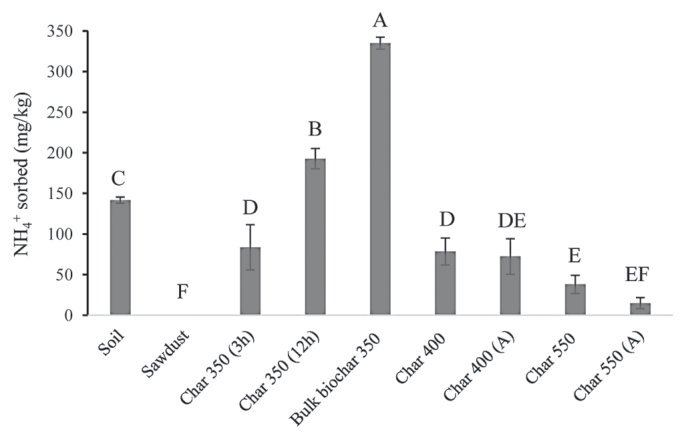
All of the materials tested, with the exception of sawdust, sorbed significant amounts of NH4+ ranging from 14 to 335 mg NH4+ kg−1 material (Fig. 1). However, only the biochar produced at 350°C for 12 h and the bulk biochar sorbed more NH4+ than the soil (Fig. 1; p < 0.05). The amounts of NH4+ sorbed by the biochars in the current study were relatively small compared with previous reports. For example, Sarkhot et al. (2013) reported biochar produced from hardwood shavings pyrolyzed at 300°C sorbed up to 5300 mg NH4+ kg−1. Differences in biochar sorptive capacity for NH4+ have been shown to result from feedstock type, for example, Thalia spp. and Schinus spp. have been shown to sorb NH4+ up to 785 and 3700 mg kg−1 by Yao et al. (2012) and Zeng et al. (2013), respectively.
除锯末外,所有供试材料均吸附了大量NH4+,吸附量为14~335 mg NH4+ kg−1材料(图1)。然而,仅350°C热解12 h制备的生物炭和块状生物炭对NH4+的吸附量高于土壤(图1;p < 0.05)。与已有报道相比,本研究中生物炭对NH4+的吸附量相对较小。例如,Sarkhot et al. (2013)报道,以硬木刨花在300°C下热解制备的生物炭对NH4+的吸附量高达5300 mg NH4+ kg−1。研究表明,生物炭对NH4+吸附能力的差异源于原料类型,例如,Yao et al. (2012)和Zeng et al. (2013)分别发现Thalia spp.和Schinus spp.生物炭对NH4+的吸附量可达785和3700 mg kg−1。
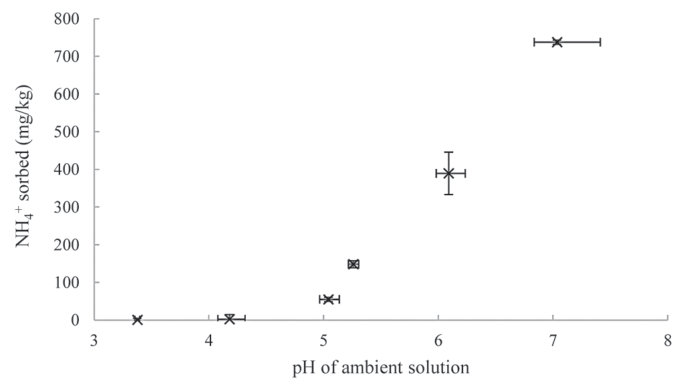
Biochar retention of NH4+ is a function of the materials’ CEC, which besides being a function of feedstock type, is also the result of the biochar production method (Libra et al., 2011). Specifically, the CEC of a biochar is a function of both the pH and porosity (Mukherjee et al., 2011), which varies with pyrolysis temperature. This was demonstrated by Lehmann (2007), using Robinia pseudoacacia L. as a feedstock, who showed a strong correlation between increasing biochar pH and increasing CEC as the pyrolysis temperature was increased, with an optimal CEC of 20 cmolc kg−1 at a temperature of 450°C and pH ~ 9. Similar results were observed by Zhang et al. (2015) for Quercus spp. Xiao and Pignatello (2015) demonstrated that maple (Acer spp.) wood biochars pyrolyzed at 300 to 700°C all had negative zeta potentials above pH 3 with a large increase in negative charge between pH 3 and pH 5.5. In the current study, increasing the pH during the batch sorption experiments also increased the sorption of NH4+ (Fig. 2), and this is consistent with the surface charge varying with pH and directly influencing the biochar’s CEC (Lehmann, 2007).
生物炭对NH4+的保持能力取决于材料的CEC,而CEC除取决于原料类型外,也受生物炭制备方法的影响(Libra et al., 2011)。具体而言,生物炭的CEC取决于pH和孔隙度(Mukherjee et al., 2011),而二者随热解温度而变化。Lehmann (2007)以Robinia pseudoacacia L.为原料证实了这一点,结果表明随热解温度升高,生物炭pH升高与CEC增加之间存在强相关性,在450°C、pH约9时CEC达到最优值20 cmolc kg−1。Zhang et al. (2015)在Quercus spp.中观察到类似结果。Xiao and Pignatello (2015)证明,300~700°C热解的槭木(Acer spp.)生物炭在pH 3以上均具有负zeta电位,且在pH 3至pH 5.5之间负电荷大幅增加。本研究中,批量吸附试验中提高pH同样增加了NH4+的吸附(图2),这与表面电荷随pH变化并直接影响生物炭CEC的结论一致(Lehmann, 2007)。
Other studies specifically measuring CEC following the pyrolysis of Pinus spp. at 400 and 600°C have shown CEC to range from 10 to 38 cmolc kg−1 at near neutral biochar pH (Mukherjee et al., 2011). The lower CEC values in this range are consistent with the lower CEC values for the materials in the current study (Table 1). For non-Pinus spp., CEC is reported to range from 0.2 to 25 cmolc kg−1 and varies with different feedstock and pyrolysis conditions (Cheng et al., 2006; Gundale and DeLuca, 2007; Lehmann, 2007; Nguyen and Lehmann, 2009; Sarkhot et al., 2013). In the current study, there was no significant correlation (r = 0.19, p > 0.05) between the CEC of the materials tested and their ability to sorb NH4+. Sterilizing the solutions using phenol addition during the batch sorption experiments showed no significant differences occurred in terms of NH4+ sorption. This observation, and the lack of any increase in the NO3− concentration (results not shown), indicates that microbial activity did not affect the results of our batch-sorption experiments.
其他专门测定Pinus spp.在400°C和600°C热解后CEC的研究表明,在接近中性的生物炭pH下,CEC为10~38 cmolc kg−1(Mukherjee et al., 2011)。该范围内较低的CEC值与本研究材料较低的CEC值一致(表1)。对于非Pinus spp.,已报道的CEC为0.2~25 cmolc kg−1,并随原料和热解条件不同而变化(Cheng et al., 2006; Gundale and DeLuca, 2007; Lehmann, 2007; Nguyen and Lehmann, 2009; Sarkhot et al., 2013)。本研究中,供试材料的CEC与其吸附NH4+的能力之间无显著相关性(r = 0.19,p > 0.05)。在批量吸附试验中加入苯酚对溶液进行灭菌,结果显示NH4+吸附无显著差异。这一观察结果以及NO3−浓度未见任何增加(结果未列出)表明,微生物活性未影响批量吸附试验的结果。
The lack of any significant sorption of NH4+ by the sawdust may be due to several reasons. Sawdust cell walls are active ion exchange sites resulting from the presence of cellulose, lignin, and hydroxyl groups (Shukla et al., 2002). However, cation adsorption onto sawdust is pH dependent, in the case of heavy metals, and thus in the current study, lack of NH4+ sorption may be due to nonoptimum pH conditions for maximum CEC expression. Another factor that prevents cation exchange on sawdust includes competition for cation sorption sites. In the current study, the Ca2+ ions in the assay matrix may have competed with NH4+ and been selectively adsorbed on the sawdust (Shukla et al., 2002). The molar ratio of Ca2+ to NH4+ in our study was 18:1. Furthermore, Harmayani and Anwar (2012) found the initial cation concentrations and extraction time also affected sorption onto pine sawdust. Thus these factors may not have been optimal in the current study for sorption of NH4+ by sawdust. Based on these results, the chemical sorption of NH4+ is not a mechanism that will reduce the potential leaching of NO3− when mixing biosolids with biochars or sawdust and soil.
锯末对NH4+无显著吸附可能有多方面原因。锯末细胞壁因含有纤维素、木质素和羟基而具有活性离子交换位点(Shukla et al., 2002)。然而,就重金属而言,锯末对阳离子的吸附依赖于pH,因此本研究中NH4+未被吸附可能是由于pH条件未达到CEC最大表达的最佳状态。阻碍锯末阳离子交换的另一因素是对阳离子吸附位点的竞争。本研究中,测定基质中的Ca2+离子可能与NH4+竞争并被锯末选择性吸附(Shukla et al., 2002)。本研究中Ca2+与NH4+的摩尔比为18:1。此外,Harmayani and Anwar (2012)发现,初始阳离子浓度和提取时间也会影响松木锯末的吸附。因此,本研究中这些因素对锯末吸附NH4+而言可能并非最优。根据这些结果,当生物固体与生物炭或锯末及土壤混合时,NH4+的化学吸附并不是降低NO3−潜在淋溶的机制。
None of the materials tested sorbed NO3− (data not shown). Using sugarcane (Saccharum officinarum L.) bagasse as a biochar feedstock, Kameyama et al. (2012) reasoned that the increased sorption of NO3− with increasing temperature was the result of N-containing basic functional groups on the biochar surface increasing in number with increasing pyrolysis temperature. Wang et al. (2015) also found NO3− sorption increased with increasing biochar manufacturing temperature. Clough et al. (2013) reviewed the studies examining NO3− sorption on biochar and concluded that sorption of NO3− onto a biochar surface was unlikely to occur unless the pyrolysis temperature during biochar manufacture was >600°C, with the degree of
所有供试材料均未吸附NO3−(数据未列出)。Kameyama et al. (2012)以甘蔗(Saccharum officinarum L.)渣为生物炭原料,推断NO3−吸附随温度升高而增加,是由于生物炭表面含氮碱性官能团数量随热解温度升高而增多。Wang et al. (2015)同样发现NO3−吸附随生物炭制备温度升高而增加。Clough et al. (2013)综述了有关生物炭吸附NO3−的研究,认为除非生物炭制备时的热解温度>600°C,否则NO3−不太可能吸附于生物炭表面,且其程度
NO3− sorption also dependent on feedstock type. Other more recent studies, also showing low sorption of NO3− by biochar, have generally examined biochar manufactured at pyrolysis temperatures <600°C (Gai et al., 2014; Hale et al., 2013; Zhang et al., 2015). Chintala et al. (2013) showed that NO3− sorption of a biochar produced at 650°C was only significant in acidic condi- − tions. Thus, ignoring feedstock type as an issue, the lack of NO3 sorption in the current experiment is most likely because the low pyrolysis temperatures in our study were insufficient for the formation of N-containing basic functional groups (Kameyama et al., 2012). Shafeeyan et al. (2010) reported that significant numbers of N-containing basic functional groups only form at temperatures >700°C. Sawdust materials can retain cations, but they are not able to bind anions unless they are chemical modified (Ebrahimi and Roberts, 2013; Keränen et al., 2015; Mishra and Patel, 2009; Sousa et al., 2010; Su et al., 2012). For − example, Keränen et al. (2015) modified sawdust to sorb NO3 using epichlorohydrin, ethylenediamine, and trimethylamine in the presence of N,N-dimethylformamide. It is therefore unlikely that chemical sorption of NO3− by the sawdust or biochars will reduce NO3− leaching.
NO3−吸附还取决于原料类型。其他近期研究同样显示生物炭对NO3−的吸附较低,这些研究所考察的生物炭一般在<600°C的热解温度下制备(Gai et al., 2014; Hale et al., 2013; Zhang et al., 2015)。Chintala et al. (2013)表明,650°C制备的生物炭仅在酸性条件下对NO3−有显著吸附。因此,若不考虑原料类型问题,本试验中NO3−未被吸附最可能的原因是本研究的热解温度较低,不足以形成含氮碱性官能团(Kameyama et al., 2012)。Shafeeyan et al. (2010)报道,大量含氮碱性官能团仅在>700°C的温度下形成。锯末材料可保持阳离子,但除非经过化学改性,否则无法结合阴离子(Ebrahimi and Roberts, 2013; Keränen et al., 2015; Mishra and Patel, 2009; Sousa et al., 2010; Su et al., 2012)。例如,Keränen et al. (2015)在N,N-二甲基甲酰胺存在下,用环氧氯丙烷、乙二胺和三甲胺对锯末进行改性,使其能够吸附NO3−。因此,锯末或生物炭对NO3−的化学吸附不太可能减少NO3−淋溶。
Inorganic Nitrogen Leaching无机氮淋溶
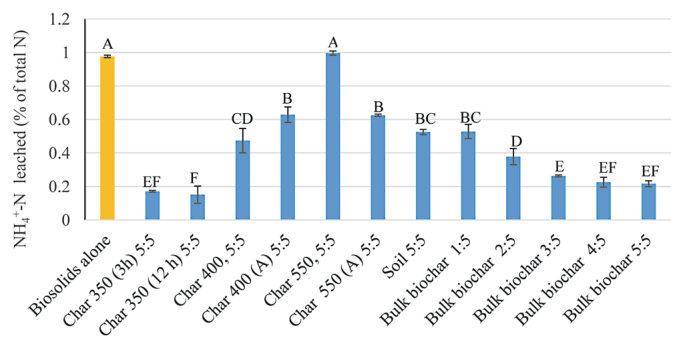
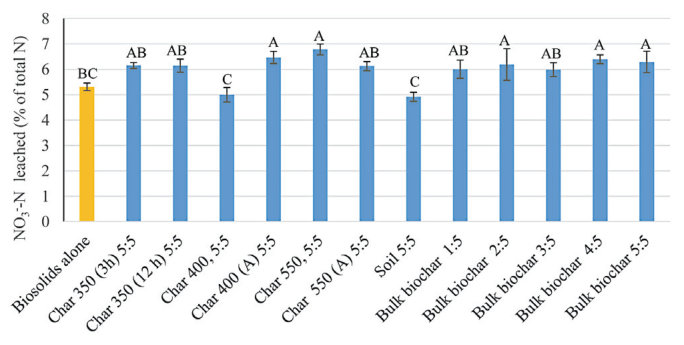
Ammonium N in the leachate accounted for <1% of N applied (Fig. 3). The assumption is made that given the N content of the biochar (Table 1), the source of the NH4+–N in the leachate is the biosolids. When biochar materials were mixed with biosolids in the leaching columns, the biochars reduced the amount of NH4+–N leached when expressed as a percentage of the total N initially present in the biosolids (Fig. 3). The effect of increasing biochar rate observed with the bulk biochar treatment was to further reduce NH4+ leaching. This is most likely a consequence of the increasing CEC, since the amount of NO3−–N leached did not vary with the bulk biochar rate applied (Fig. 4). This also indicates that increasing the rate of biochar addition did not significantly accelerate nitrification via potential liming effects, which could in turn have enhanced subsequent NO3−–N leaching (Clough et al., 2013). Incorporating biochar into acidic agricultural soils accelerates nitrification and thus, weakens the liming effects of biochar (Zhao et al., 2014).
淋出液中的铵态氮占施氮量的<1%(图3)。鉴于生物炭的氮含量(表1),假定淋出液中NH4+–N来源于生物固体。当生物炭材料与生物固体在淋溶柱中混合时,以占生物固体初始全氮的百分比表示,生物炭降低了NH4+–N淋溶量(图3)。块状生物炭处理中,增加生物炭用量可进一步减少NH4+淋溶。这最可能是CEC增加的结果,因为NO3−–N淋溶量并未随块状生物炭施用量变化(图4)。这也表明,增加生物炭添加量并未通过潜在的石灰效应显著加速硝化作用,否则可能进而增强后续NO3−–N淋溶(Clough et al., 2013)。在酸性农业土壤中添加生物炭会加速硝化作用,从而削弱生物炭的石灰效应(Zhao et al., 2014)。
The low-temperature biochars (350°C) reduced NH4+–N leaching more than the high-temperature chars (400 and 550°C), while steam activation did not have a consistent effect on NH4+–N leaching (Fig. 3). Park et al. (2003) and Shafeeyan et al. (2010) reported that although steam activation increased the surface area and micropore volume of biochar, it depleted the surface functional groups, possibly offsetting any increase in sorption capacity.
低温生物炭(350°C)比高温炭(400°C和550°C)更能减少NH4+–N淋溶,而蒸汽活化对NH4+–N淋溶的影响不一致(图3)。Park et al. (2003)和Shafeeyan et al. (2010)报道,虽然蒸汽活化增加了生物炭的比表面积和微孔体积,但会消耗表面官能团,可能抵消吸附容量的增加。
Another possible mechanism for reducing NH4+–N leaching declining with increasing biochar rate is microbial immobilization of NH4+. The C to N ratios of most of our biochar–biosolids and sawdust–biosolids mixtures (calculated from Table 1) were above 25, the value required to trigger immobilization (McLaren and Cameron, 1996). We did not measure any microbiological parameters; however, if there were significant microbial immobilization, then there would be a negative correlation between WSC (Supplemental Table S3) and the mass of NH4+–N leached (Fig. 3, 5). However, the hot and cold WSC concentrations did not correlate with the reduction in NH4+–N leaching observed (r = −0.35, P > 0.05 NS).
NH4+–N淋溶随生物炭用量增加而降低的另一可能机制是NH4+的微生物固定。本研究大多数生物炭–生物固体和锯末–生物固体混合物的C/N比(根据表1计算)高于25,即触发固定作用所需的值(McLaren and Cameron, 1996)。我们未测定任何微生物学参数;然而,若存在显著的微生物固定,则WSC(补充表S3)与NH4+–N淋溶量(图3、图5)之间应呈负相关。然而,热水和冷水WSC浓度与所观察到的NH4+–N淋溶减少量无相关性(r = −0.35,P > 0.05 NS)。
While NH3 adsorption onto biochar can occur (Taghizadeh- Toosi et al., 2011) the likelihood of NH3 adsorption occurring in the biochar material, as a mechanism for reducing NH4+ in solution, is unlikely a result of the pH being too low (<7.0). The pH values of the solutions in our batch sorption experiments ranged from 4.2 to 5.8.
虽然生物炭可吸附NH3(Taghizadeh- Toosi et al., 2011),但由于pH过低(<7.0),NH3吸附于生物炭材料作为降低溶液中NH4+的机制不太可能发生。本研究批量吸附试验中溶液的pH为4.2~5.8。
Nitrate leaching from the column experiment accounted for <7% of the N applied (Fig. 4) and showed few differences as a consequences of biochar–biosolids treatment. Most of the N in the biosolids remained as organic N. None of the biochar treatments caused a significant decrease in NO3−–N leaching (Fig. 4), in fact, the high temperature biochars and the high rates of the bulk biochar caused an increase (p < 0.05) in NO3−–N leaching. Reasons for the greater NO3−–N leaching could include greater aeration of the biosolids material, resulting in higher rates of mineralization and subsequent nitrification causing more NO3−–N leaching. Our result deviates from the findings of Knowles et al. (2011), who reported that the bulk biochar significantly reduced NO3−–N leaching from biosolids-amended soil. However, the experimental conditions described in Knowles et al. (2011) were significantly different. Their experiment was performed in the field with large lysimeters containing intact soil cores with pasture present (Lolium perenne L.) and thus, plant N uptake occurred.
土柱试验中的硝态氮淋溶量占施氮量的<7%(图4),各生物炭–生物固体处理间差异很小。生物固体中大部分氮仍为有机氮。所有生物炭处理均未显著降低NO3−–N淋溶(图4),事实上,高温生物炭和高用量块状生物炭反而增加了NO3−–N淋溶(p < 0.05)。NO3−–N淋溶增加的原因可能包括生物固体材料通气性增强,导致矿化速率提高及随后的硝化作用增强,从而引起更多NO3−–N淋溶。本研究结果与Knowles et al. (2011)的发现不同,后者报道块状生物炭显著降低了生物固体改良土壤的NO3−–N淋溶。然而,Knowles et al. (2011)所述的试验条件与本研究明显不同。其试验在田间进行,采用装有原状土柱并种植牧草(Lolium perenne L.)的大型渗漏计,因此存在植物对氮的吸收。
Volatile organic compounds (VOCs) may be present in biochars and sawdust (Spokas et al., 2011) and can potentially reduce nitrification (Clough et al., 2010) and mineralization. Borchard et al. (2014) demonstrated that VOCs from biochar influence N cycle and can reduce greenhouse gas emissions from soil. The fact that the NO3−–N leached as a percentage of N applied was higher (p < 0.05) under the biochar treatments than in the biosolids alone (Fig. 4) indicates that if biochar-borne VOCs were inhibiting nitrification, then the effect was small.
生物炭和锯末中可能存在挥发性有机化合物(VOCs)(Spokas et al., 2011),其可能抑制硝化作用(Clough et al., 2010)和矿化作用。Borchard et al. (2014)证明,生物炭释放的VOCs可影响氮循环并减少土壤温室气体排放。生物炭处理下NO3−–N淋溶量占施氮量的百分比高于单施生物固体(p < 0.05)(图4),这表明即便生物炭携带的VOCs抑制了硝化作用,其效应也很小。
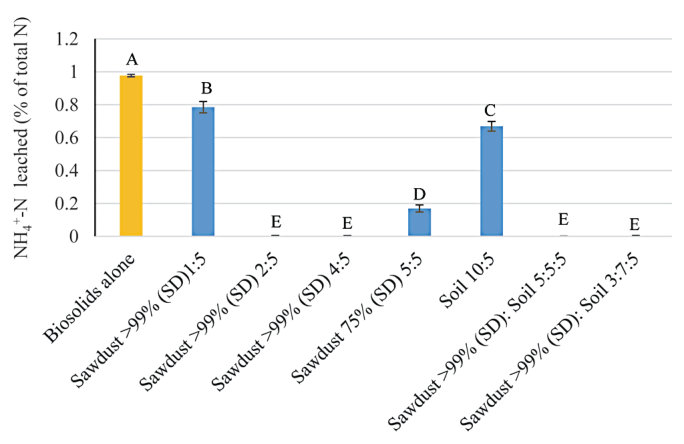
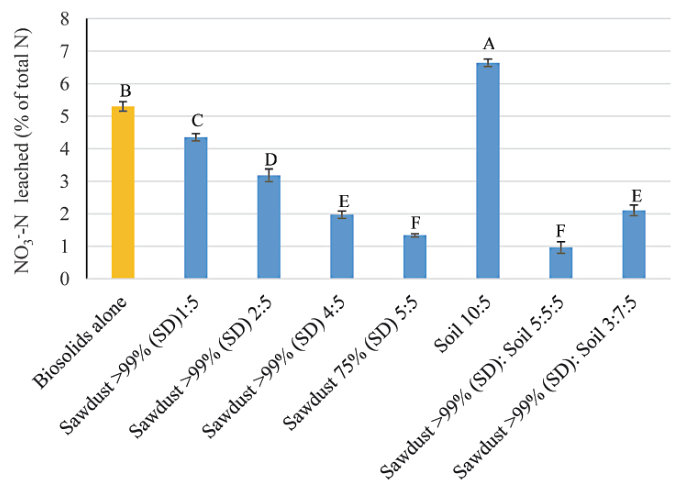
Sawdust caused a significant reduction (p < 0.05) in both NH4+–N and NO3−–N leaching from both biosolids and biosolids-amended soil treatments (Fig. 5, 6). Rates of more than two parts of sawdust to five parts of biosolids eliminated NH4+–N leaching and reduced NO3−–N leaching by >40% (Fig. 6). These results cannot be explained by chemical sorption mechanisms because the batch experiments revealed that the sawdust sorbed neither NH4+–N nor NO3−–N. Adding sawdust increased the C to N ratio (Table 1) of the mixtures, which may have resulted in microbial immobilization of biosolids derived N. The sawdust’s C to N ratio of 850 is well in excess of the value required to trigger immobilization (C/N of >25:1 McLaren and Cameron (1996). The WSC extracts (Supplemental Table S3) also indicate that in the unmixed materials, C was readily available for microbial immobilization to occur. Consistent with this theory are the results of Daniels et al. (2001), who showed that adding sawdust to biosolids at a rate of 3:2 reduced NO3−–N in soil pore water by >50%. In contrast, Schmidt (2001) showed that a 1:1 biosolids to sawdust mixture was ineffective in reducing NO3−–N leaching in the first growing season. The high WSC availability also raises the possibility of other heterotrophic activity, such as denitrification, also consuming NO3−–N and contributing to the decrease in NO3−–N leaching observed. Schipper and Vojvodic-Vukovic (1998) showed that soil amended with sawdust will remove NO3−–N from the groundwater via denitrification. Sawdust with a moisture content of 25% had a significantly smaller effect on NH4+–N and NO3−–N leaching than dry sawdust (Fig. 5, 6). This indicates that the sawdust may have irreversibly sorbed some of the N-rich pore water from the fresh biosolids and that physical sorption may be an important mechanism for the retention of N in these experiments. Our experiments did not provide any information on the mechanisms of such physical sorption. Biochar containing some partially pyrolyzed or unpyrolyzed material may therefore also mitigate N leaching. In this case, partial pyrolysis may be a low-cost means of drying the material. As the material weathers in the soil, the CEC of the biochar may increase (Glaser et al., 2002; Liang et al., 2006), further retaining NH4+–N in the root-zone where plant uptake can occur.
锯末显著降低了(p < 0.05)生物固体及生物固体改良土壤处理的NH4+–N和NO3−–N淋溶(图5、图6)。锯末与生物固体比例超过2:5时,NH4+–N淋溶消失,NO3−–N淋溶减少>40%(图6)。这些结果无法用化学吸附机制解释,因为批量试验表明锯末既不吸附NH4+–N,也不吸附NO3−–N。添加锯末提高了混合物的C/N比(表1),可能导致来源于生物固体的氮被微生物固定。锯末的C/N比为850,远超触发固定作用所需的值(C/N >25:1,McLaren and Cameron (1996))。WSC浸提结果(补充表S3)也表明,在未混合材料中,碳易于被利用,可发生微生物固定。与这一理论一致的是Daniels et al. (2001)的结果,其表明以3:2的比例向生物固体中添加锯末可使土壤孔隙水中NO3−–N减少>50%。相反,Schmidt (2001)表明,1:1的生物固体与锯末混合物在第一个生长季内未能有效减少NO3−–N淋溶。较高的WSC有效性也提示其他异养活动(如反硝化作用)可能消耗NO3−–N,从而促成所观察到的NO3−–N淋溶减少。Schipper and Vojvodic-Vukovic (1998)表明,添加锯末的土壤可通过反硝化作用去除地下水中的NO3−–N。含水量为25%的锯末对NH4+–N和NO3−–N淋溶的影响显著小于干燥锯末(图5、图6)。这表明锯末可能不可逆地吸持了新鲜生物固体中部分富氮孔隙水,物理吸持可能是本试验中氮保持的重要机制。本试验未能提供此类物理吸持机制的任何信息。因此,含有部分热解或未热解物质的生物炭也可能减缓氮淋溶。在这种情况下,部分热解可能是一种低成本的材料干燥方法。随着材料在土壤中风化,生物炭的CEC可能增加(Glaser et al., 2002; Liang et al., 2006),从而进一步将NH4+–N保持在可被植物吸收的根区。
4Conclusions结论
The potential for unweathered biochars derived from sawdust feedstock to mitigate NO3−–N leaching from biosolids-amended soils is low and the biochars may even accelerate NO3−–N leaching. However, pine waste and pine biochars significantly reduced NH4+–N mobility. Conversely, including raw, dried sawdust when amending soils with biosolids shows significant promise to limit N mobility in biosolids and potentially reduce NO3−–N leaching. Future work should look to better understand the reasons for this while optimizing rates and methods to achieve NO3−–N leaching mitigation.
未经风化的锯末原料衍生生物炭减缓生物固体改良土壤NO3−–N淋溶的潜力较低,甚至可能加速NO3−–N淋溶。然而,松木废弃物和松木生物炭显著降低了NH4+–N的迁移性。相反,在用生物固体改良土壤时加入未处理的干燥锯末,在限制生物固体中氮的迁移性及潜在降低NO3−–N淋溶方面显示出显著前景。今后的工作应进一步阐明其原因,同时优化用量和方法,以实现NO3−–N淋溶的减缓。
5Acknowledgments致谢
Biochars were prepared with the support and supervision of Professor Marta Camps and Dr. Peter Bishop from the Massey University, Palmerston North, New Zealand. We gratefully acknowledge the Centre for the Integrated Biowaste Research (CIBR) for funding this research.
生物炭的制备得到了新西兰Palmerston North梅西大学(Massey University)Marta Camps教授和Peter Bishop博士的支持与指导。衷心感谢Centre for the Integrated Biowaste Research(CIBR)对本研究的资助。
6References参考文献
Ammari, T.G., Q. Al-Omari, and E.A. Bassim. 2012. Composting sewage sludge amended with different sawdust proportions and textures and organic waste of food industry- assessment of quality. Environ. Technol. 33:1641– 1649. doi:10.1080/09593330.2011.641589
Bernal, M.P., J.A. Alburquerque, and R. Moral. 2009. Composting of animal manures and chemical criteria for compost maturity assessment. A review. Bioresour. Technol. 100:5444–5453. doi:10.1016/j.biortech.2008.11.027
Blakemore, L.C., P.L. Searle, and B.K. Daly. 1987. Methods for chemical analysis of soils. NZ Soil Bureau Scientific Report 80. NZ Soil Bureau, Dep. of Scientific and Industrial Research, Lower Hutt, NZ.
Borchard, N., K. Spokas, K. Prost, and J. Siemens. 2014. Greenhouse gas production in mixtures of soil with composted and noncomposted biochars is governed by char-associated organic compounds. J. Environ. Qual. 43:971–979. doi:10.2134/jeq2013.07.0290
Borchard, N., A. Wolf, V. Laabs, R. Aeckersberg, H.W. Scherer, A. Moeller, et al. 2012. Physical activation of biochar and its meaning for soil fertility and nutrient leaching- a greenhouse experiment. Soil Use Manage. 28:177– 184. doi:10.1111/j.1475-2743.2012.00407.x
Brockerhoff, E.G., A.B. Berndt, and H. Jactel. 2005. Role of exotic pine forests in the conservation of the critically endangered New Zealand ground beetle Holcaspis brevicula (Coleoptera: Carabidae). NZ J. Ecol. 29:37–43.
Cheng, C.H., J. Lehmann, J.E. Thies, S.D. Burton, and M.H. Engelhard. 2006. Oxidation of black carbon by biotic and abiotic processes. Org. Geochem. 37:1477–1488. doi:10.1016/j.orggeochem.2006.06.022
Chintala, R., J. Mollinedo, T.E. Schumacher, S.K. Papiernik, D.D. Malo, D.E. Clay, et al. 2013. Nitrate sorption and desorption in biochars from fast pyrolysis. Microporous Mesoporous Mater. 179:250–257. doi:10.1016/j. micromeso.2013.05.023
Clough, T.J., J.E. Bertram, J.L. Ray, L.M. Condron, M. O’Callaghan, R.R. Sherlock, et al. 2010. Unweathered wood biochar impact on nitrous oxide emissions from a bovine-urine-amended pasture soil. Soil Sci. Soc. Am. J. 74:852–860. doi:10.2136/sssaj2009.0185
Clough, T.J., L.M. Condron, C. Kammann, and C. Müller. 2013. A Review of Biochar and Soil Nitrogen Dynamics. Agronomy 3:275–293. doi:10.3390/agronomy3020275
Clough, T.J., R.J. Stevens, R.J. Laughlin, R.R. Sherlock, and K.C. Cameron. 2001. Transformations of inorganic-N in soil leachate under differing storage conditions. Soil Biol. Biochem. 33:1473–1480. doi:10.1016/ S0038-0717(01)00056-6 Correa, R.S., R.E. White, and A.J. Weatherley. 2006. Risk of nitrate leaching from two soils amended with Biosolids. Water Resour. 33:453–462.
Daniels, W.L., G.K. Evanylo, S.M. Nagle, and J.M. Schmidt. 2003. Nitrate leaching potentials in gravel-mined lands reclaimed with biosolids. In: Proceedings of the Virginia Water Resources Symposium, Water Resource Management for the Commonwealth, Blacksburg, VA. 7–10 Oct. 2003. Virginia Water Resources Research Center, Blacksburg, VA. p. 75–78.
Daniels, W.L., G.K. Evanylo, S.M. Nagle, and J.M. Schmidt. 2001. Effects of biosolids loading rate and sawdust additions on row crop yield and nitrate leaching potentials in Virginia sand and gravel mine reclamation. Presented at National Meeting of the American Society for Surface Mining and Reclamation, Albuquerque, NM. 3–7 June 2011. ASSMR, Lexington KY. p. 399–405.
Davis, M. 2014. Nitrogen Leaching losses from forests in New Zealand. NZ J. For. Sci. 44:2. doi:10.1186/1179-5395-44-2
Ducey, T.F., J.A. Ippolito, K.B. Cantrell, J.M. Novak, and R.D. Lentz. 2013. Addition of activated switchgrass biochar to an aridic subsoil increases microbial nitrogen cycling gene abundances. Appl. Soil Ecol. 65:65–72. doi:10.1016/j.apsoil.2013.01.006
Ebrahimi, S., and D.J. Roberts. 2013. Sustainable nitrate-contaminated water treatment using multi cycle ion-exchange/bioregeneration of nitrate selective resin. J. Hazard. Mater. 262:539–544. doi:10.1016/j. jhazmat.2013.09.025
EPA Victoria. 2004. Guidelines for environmental management: Biosolids land application. EPA Victoria Pub. no. 943. EPA Victoria, Australia. p. 47–61.
Fungo, B., D. Guerena, M. Thiongo, J. Lehmann, H. Neufeldt, and K. Kalbitz. 2014. N2O and CH4 emission from soil amended with steamactivated biochar. J. Plant Nutr. Soil Sci. 177:34–38. doi:10.1002/ jpln.201300495
Gai, X., H. Wang, J. Liu, L. Zhai, S. Liu, T. Ren, et al. 2014. Effects of feedstock and pyrolysis temperature on biochar adsorption of ammonium and nitrate. PLoS ONE 9: e113888. doi:10.1371/journal.pone.0113888
Ghani, A., M. Dexter, and K.W. Perrott. 2003. Hot-water extractable carbon in soils: A sensitive measurement for determining impacts of fertilisation, grazing and cultivation. Soil Biol. Biochem. 35:1231–1243. doi:10.1016/ S0038-0717(03)00186-X
Glaser, B., J. Lehmann, and W. Zech. 2002. Ameliorating physical and chemical properties of highly weathered soils in the tropics with charcoal: A review. Biol. Fertil. Soils 35:219–230. doi:10.1007/s00374-002-0466-4
Gundale, M.J., and T.H. DeLuca. 2007. Charcoal effects on soil solution chemistry and growth of Koeleria macrantha in the ponderosa pine/ Douglas-fir ecosystem. Biol. Fertil. Soils 43:303–311. doi:10.1007/ s00374-006-0106-5
Guo, Y., H. Tang, G. Li, and D. Xie. 2014. Effects of cow dung biochar amendment on adsorption and leaching of nutrient from an acid yellow soil irrigated with biogas slurry. Water Air Soil Pollut. 225:1820. doi:10.1007/ s11270-013-1820-x
Hale, S.E., V. Alling, V. Martinsen, J. Mulder, G.D. Breedveld, and G. Cornelissen. 2013. The sorption and desorption of phosphate-P, ammonium-N and nitrate-N in cacao shell and corn cob biochars. Chemosphere 91:1612– 1619. doi:10.1016/j.chemosphere.2012.12.057
Harmayani, K.D., and A.H.M.F. Anwar. 2012. Adsorption of nutrients from stormwater using sawdust. Int. J. Environ. Sci. Dev. 3:114–117. doi:10.7763/IJESD.2012.V3.199
Henry, C.L., D.W. Cole, and R.B. Harrison. 1994. Use of municipal sludge to restore and improve site productivity in forestry: The Pack Forest sludge research program. For. Ecol. Manage. 66:137–149. doi:10.1016/0378-1127(94)90153-8
Hina, K., P. Bishop, M.C. Arbestain, R. Calvelo-Pereira, J.A. Macia-Agullo, J. Hindmarsh, et al. 2010. Producing biochars with enhanced surface activity through alkaline pretreatment of feedstocks. Aust. J. Soil Res. 48:606–617. doi:10.1071/SR10015 Hue, N.V. 2014. Land application of biosolids. Univ. Hawai’i at Manoa, College of Tropical Agric. And Human Resources. http://www.ctahr.hawaii.edu/ huen/biosolids.htm (accessed 16 Mar. 2015).
Kameyama, K., T. Miyamoto, T. Shiono, and Y. Shinogi. 2012. Influence of sugarcane bagasse-derived biochar application on nitrate leaching in calcaric dark red soil. J. Environ. Qual. 41:1131–1137. doi:10.2134/jeq2010.0453 Keränen, A., T. Leiviska, O. Hormi, and J. Tanskanen. 2015. Removal of nitrate by modified pine sawdust: Effects of temperature and co-existing anions. J. Environ. Manage. 147:46–54. doi:10.1016/j.jenvman.2014.09.006
Knowles, O.A., B.H. Robinson, A. Contangelo, and L. Clucas. 2011. Biochar for the mitigation of nitrate leaching from soil amended with biosolids. Sci. Total Environ. 409:3206–3210. doi:10.1016/j.scitotenv.2011.05.011
Kwapinski, W., C.M.P. Byrne, E. Kryachko, P. Wolfram, C. Adley, J. Leahy, et al. 2010. Biochar from Biomass and waste. waste and Biomass Valorization 1:177–189. doi:10.1007/s12649-010-9024-8
Lehmann, J. 2007. Bio-energy in the black. Front. Ecol. Environ 5:381–387. doi:10.1890/1540-9295(2007)5[381:BITB]2.0.CO;2
Liang, B., J. Lehmann, D. Solomon, J. Kinyangi, J. Grossman, B. O’Neill, et al. 2006. Black Carbon increases cation exchange capacity in soils. Soil Sci. Soc. Am. J. 70:1719–1730. doi:10.2136/sssaj2005.0383
Libra, J., S.R. Kyoung, C. Kammann, A. Funke, N. Berge, Y. Neubauer, et al. 2011. Hydrothermal carbonization of biomass residuals: A comparative review of the chemistry, processes and applications of wet and dry pyrolysis. Biofuels 2:71–106. doi:10.4155/bfs.10.81
McLaren, R.G., and K.C. Cameron. 1996. Soil science: Sustainable production and environmental protection. Oxford Univ. Press, Auckland, New Zealand.
Ministry of Agriculture and Forestry. 2010. National exotic forest description as in 2009. Ministry of Agriculture and Forestry, Wellington, New Zealand. Minitab. 2010. Minitab release 16.0. Minitab, State College, PA.
Mishra, P.C., and R.K. Patel. 2009. Use of agricultural waste for the removal of nitrate-nitrogen from aqueous medium. J. Environ. Manage. 90:519–522. doi:10.1016/j.jenvman.2007.12.003
Mukherjee, A., A.R. Zimmerman, and W. Harris. 2011. Surface chemistry variations among a series of laboratory-produced biochars. Geoderma 163:247–255. doi:10.1016/j.geoderma.2011.04.021
Nguyen, B.T., and J. Lehmann. 2009. Black carbon decomposition under varying water regimes. Org. Geochem. 40:846–853. doi:10.1016/j. orggeochem.2009.05.004
Novak, J.M., I. Lima, B.S. Xing, J.W. Gaskin, C. Steiner, K.C. Das, et al. 2009. Characterization of designer biochar produced at different temperatures and their effects on a loamy sand. Ann. Environ. Sci. 3:195–206.
New Zealand Waste Water Association. 2003. Guidelines for the safe application of biosolids to land in New Zealand. NZWWA, Wellington, New Zealand.
Park, S.J., Y.S. Jang, J.W. Shim, and S.K. Ryu. 2003. Studies on pore structures and surface functional groups of pitch-based activated carbon fibers. J. Colloid Interface Sci. 260:259–264. doi:10.1016/S0021-9797(02)00081-4 Robinson, B.H. 2007. Poplar for the phytomanagement of boron contaminated sites. Environ. Pollut. 150:225–233. doi:10.1016/j.envpol.2007.01.017
Ronald, J.L., M. Peter, and P.R. Roland, editors. 2008. Global atlas of excreta, wastewater sludge, and biosolids management: Moving forward the sustainable and welcome uses of a global resource. United Nations Human Settlements Programme, Nairobi, Kenya.
Sarkhot, D.V., T.A. Ghezzehei, and A.A. Berhe. 2013. Effectiveness of biochar for sorption of ammonium and phosphate from dairy effluent. J. Environ. Qual. 42:1545–1554. doi:10.2134/jeq2012.0482
Schipper, L., and M. Vojvodic-Vukovic. 1998. Nitrate removal from groundwater using a denitrification wall amended with sawdust: Field trial. J. Environ. Qual. 27:664–668. doi:10.2134/jeq1998.00472425002700030025x
Schmidt, J.M., Daniels, W.L., Li, R.S., and McFaden, D. 2001. Determining optimal sawdust/biosolids mixtures to manage nitrate leaching in reclaimed disturbed soils. Presented at National Meeting of the American Society for Surface Mining and Reclamation, Albuquerque, NM. 3–7 June 2011. ASSMR, Lexington KY. p. 399–405.
Shafeeyan, M.S., W.M.A.W. Daud, A. Houshmand, and A. Shamiri. 2010. A review on surface modification of activated carbon for carbon dioxide adsorption. J. Anal. Appl. Pyrolysis 89:143–151. doi:10.1016/j.jaap.2010.07.006
Shukla, A., Y.H. Zhang, P. Dubey, J.L. Margrave, and S.S. Shukla. 2002. The role of sawdust in the removal of unwanted materials from water. J. Hazard. Mater. 95:137–152. doi:10.1016/S0304-3894(02)00089-4
Sika, M.P., and A.G. Hardie. 2014. Effect of pine wood biochar on ammonium nitrate leaching and availability in a South African sandy soil. Eur. J. Soil Sci. 65:113–119. doi:10.1111/ejss.12082
Simmler, M., L. Ciadamidaro, R. Schulin, P. Madejón, R. Reiser, L. Clucas, et al. 2013. Lignite reduces the solubility and plant uptake of cadmium in pasturelands. Environ. Sci. Technol. 47:4497–4504. doi:10.1021/es303118a
Smith, S.R., V. Woods, and T.D. Evans. 1998. Nitrate dynamics in biosolidstreated soils. I. Influence of biosolids type and soil type. Bioresour. Technol. 66:139–149. doi:10.1016/S0960-8524(97)00095-3
Sousa, F.W., A.G. Oliveira, J.P. Ribeiro, M.F. Rosa, D. Keukeleire, and R.F. Nascimento. 2010. Green coconut shells applied as adsorbent for removal of toxic metal ions using fixed-bed column technology. J. Environ. Manage. 91:1634–1640. doi:10.1016/j.jenvman.2010.02.011
Spokas, K.A., J.M. Novak, C.E. Stewart, K.B. Cantrell, M. Uchimiya, M.G. Du- Saire, et al. 2011. Qualitative analysis of volatile organic compounds on biochar. Chemosphere 85:869–882. doi:10.1016/j.chemosphere.2011.06.108
Su, P., K. Granholm, A. Pranovich, L. Harju, B. Holmbom, and A. Ivaska. 2012. Metal ion sorption to birch and spruce wood. BioResources 7:2141–2155. doi:10.15376/biores.7.2.2141-2155
Taghizadeh-Toosi, A., T.J. Clough, L.M. Condron, R.R. Sherlock, C.R. Anderson, and R.A. Craigie. 2011. Biochar incorporation into pasture soil suppresses in situ nitrous oxide emissions from ruminant urine patches. J. Environ. Qual. 40:468–476. doi:10.2134/jeq2010.0419
Taghizadeh-Toosi, A., T.J. Clough, R.R. Sherlock, and L.M. Condon. 2012. Biochar adsorbed ammonia is bioavailable. Plant Soil 350:57–69. doi:10.1007/s11104-011-0870-3
Troy, S.M., P.G. Lawlor, C.J.O. Flynn, and M.G. Healy. 2014. The impact of biochar addition on nutrient leaching and soil properties from tillage soil amended with pig manure. Water Air Soil Pollut. 225:1900. doi:10.1007/ s11270-014-1900-6
Waikato Regional Council. 2011. NZ Soils. http://www.nzsoils.org.nz/ (accessed 16 Mar. 2015).
Wang, H., K. Lin, Z. Hou, B. Richardson, and J. Gan. 2010. Sorption of the herbicide terbuthylazine in two New Zealand forest soils amended with biosolids and biochars. J. Soils Sediments 10:283–289. doi:10.1007/ s11368-009-0111-z
Wang, Z., H. Guo, F. Shen, G. Yang, Y. Zhang, Y. Zeng, et al. 2015. Biochar produced from oak sawdust by Lanthanum (La)-involved pyrolysis for adsorption of ammonium (NH4+), nitrate (NO3−), and phosphate (PO43−). Chemosphere 119:646–653. doi:10.1016/j.chemosphere.2014.07.084
Wendong, T., K.J. Hall, A. Masbough, K. Frankowski, and S.J.B. Duff. 2005. Characterization of leachate from a woodwaste pile. Water Qual. Res. J. Canada 40:476–483. Xiao, F., and J.J. Pignatello. 2015. Interactions of triazine herbicides with biochar: Steric and electronic effects. Water Res. 80:179–188. doi:10.1016/j. watres.2015.04.040
Yao, Y., B. Gao, M. Zhang, M. Inyang, and A.R. Zimmerman. 2012. Effect of biochar amendment on sorption and leaching of nitrate, ammonium, and phosphate in a sandy soil. Chemosphere 89:1467–1471. doi:10.1016/j. chemosphere.2012.06.002
Zeng, Z., S.-D. Zhang, T.-Q. Li, F.-L. Zhao, Z.-L. He, H.-P. Zhao, et al. 2013. Sorption of ammonium and phosphate from aqueous solution by biochar derived from phytoremediation plants. J. Zhejiang Univ. Sci. B 14:1152– 1161. doi:10.1631/jzus.B1300102
Zhang, H., R.P. Voroneya, and G.W. Price. 2015. Effects of temperature and processing conditions on biochar chemical properties and their influence on soil C and N transformations. Soil Biol. Biochem. 83:19–28. doi:10.1016/j.soilbio.2015.01.006
Zhao, X., S. Wang, and G. Xing. 2014. Nitrification, acidification, and nitrogen leaching from subtropical cropland soils as affected by rice straw-based biochar: Laboratory incubation and column leaching studies. J. Soils Sediments 14:471–482. doi:10.1007/s11368-013-0803-2
Van Dijk, D., and V.J.G. Houba. 1998. Wageningen evaluating programmes for analytical laboratories (WEPAL). Presented at the AOAC International Central Europe Subsection 5th International Symposium on Interpretation of Chemical, Microbiological and Biological Results and the Role of Proficiency Testing in Accreditation of Laboratories, Vara`din, Croatia. 21–23 Oct. 1998. Department of Environmental Sciences, Wageningen Agricultural University. Wageningen.