Contents lists available at ScienceDirect journal homepage: www.elsevier.com/locate/scitotenv
Dharini Paramashivam a, Tim J. Clough a, Anna Carlton a, Kelsi Gough a, Nicholas Dickinson b, Jacqui Horswell c, Robert R. Sherlock a, Lynne Clucas a, Brett H. Robinson a,⁎
a Department of Soil and Physical Sciences, Lincoln University, PO Box 84, Lincoln 7647, New Zealand b Department of Ecology, Lincoln University, PO Box 84, Lincoln 7647, New Zealand c Environmental Science and Research, Kenepuru Science Centre, PO Box 50-348, Porirua 5240, New Zealand
a 林肯大学土壤与物理科学系,PO Box 84, Lincoln 7647, 新西兰 b 林肯大学生态学系,PO Box 84, Lincoln 7647, 新西兰 c 环境科学与研究所(Environmental Science and Research),Kenepuru科学中心,PO Box 50-348, Porirua 5240, 新西兰
H I G H L I G H T S
G R A P H I C A L A B S T R A C T
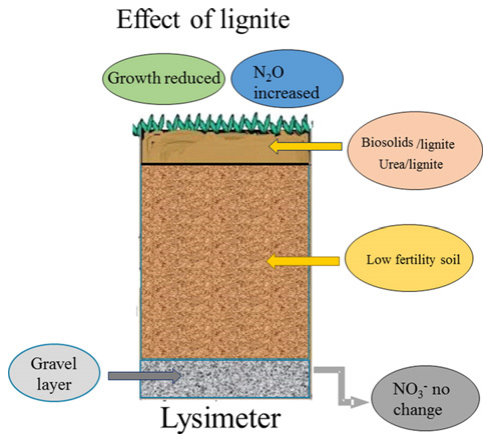
- Lignite reduces the beneficial effects of urea and biosolids on plant growth.褐煤削弱了尿素和生物固体(污泥)对植物生长的有益作用。
- Lignite has minimal effect on nitrate leaching and plant metal uptake.褐煤对硝酸盐淋溶和植物金属吸收的影响甚微。
- Lignite exacerbates nitrous oxide emissions from soil.褐煤加剧了土壤氧化亚氮的排放。
a r t i c l e i n f o
a b s t r a c t
Article history: Received 7 July 2015 Received in revised form 16 November 2015 Accepted 16 November 2015 Available online 23 November 2015
Editor: D. Barcelo
Keywords: Black urea Coal Fertilizer Lysimeter Sewage sludge
关键词:黑色尿素 煤 肥料 渗漏计 污水污泥
Lignite has been proposed as a soil amendment that reduces nitrate (NO3−) leaching from soil. Our objective was to determine the effect of lignite on nitrogen (N) fluxes from soil amended with biosolids or urea. The effect of lignite on plant yield and elemental composition was also determined. Batch sorption and column leaching experiments were followed by a lysimeter trial where a low fertility soil was amended with biosolids (400 kg N/ ha equivalent) and urea (200 kg N/ha equivalent). Treatments were replicated three times, with and without lignite addition (20 t/ha equivalent). Lignite did not reduce NO−3 leaching from soils amended with either biosolids or urea. While lignite decreased NO−3 leaching from an unamended soil, the magnitude of this effect was not significant in an agricultural context. Furthermore, lignite increased cumulative N2O production from soils receiving urea by 90%. Lignite lessened the beneficial growth effects of adding biosolids or urea to soil. Further work could investigate whether coating urea granules with lignite may produce meaningful environmental benefits. © 2015 Elsevier B.V. All rights reserved.
褐煤曾被提议作为一种可减少土壤硝酸盐(NO3−)淋溶的土壤改良剂。本研究旨在确定褐煤对施用生物固体(污泥)或尿素土壤氮(N)通量的影响,同时考察褐煤对植物产量和元素组成的影响。在批量吸附试验和土柱淋溶试验之后,开展了渗漏计试验:在一种低肥力土壤中分别施用生物固体(相当于400 kg N/ha)和尿素(相当于200 kg N/ha),各处理均设添加与不添加褐煤(相当于20 t/ha)两种情况,重复3次。褐煤并未减少施用生物固体或尿素土壤的NO−3淋溶。虽然褐煤降低了未改良土壤的NO−3淋溶,但就农业生产而言,该效应的幅度并不显著。此外,褐煤使施用尿素土壤的累积N2O产生量增加了90%。褐煤削弱了向土壤添加生物固体或尿素对植物生长的有益作用。今后可进一步研究以褐煤包膜尿素颗粒能否产生有意义的环境效益。© 2015 Elsevier B.V. 版权所有。
⁎ Corresponding author. E-mail address: brett.robinson@lincoln.ac.nz (B.H. Robinson).
http://dx.doi.org/10.1016/j.scitotenv.2015.11.075 0048-9697/© 2015 Elsevier B.V. All rights reserved.
1Introduction引言
Countries with sewage treatment plants produce approximately 27 kg (dry mass) of biosolids (sewage sludge) per person per year (Hue, 2014). Biosolids can be used to rebuild low-fertility or degraded soils (Rigby and Smith, 2013; Robinson et al., 2011), but may have detrimental effects through contributing to nitrate (NO3−) leaching (Correa et al., 2006b) and due to accumulation of heavy metals in both soils and plants (Civeira and Lavado, 2008). Most nitrogen (N) in biosolids is present as organic N, which only oxidizes slowly, but there are often high concentrations of ammonium (NH4+) and NO3− (Correa et al., 2006a). This can result in a large flush of NO3− leaching if sufficient rainfall occurs shortly after application. High concentrations of NO−3 in soil can also result in large emissions of N2O (Di and Cameron, 2002), a greenhouse gas that has a global warming potential 298 times that of CO2 (Ravishankara et al., 2009).
拥有污水处理厂的国家每人每年约产生27 kg(干重)生物固体(污泥)(Hue, 2014)。生物固体可用于重建低肥力或退化土壤(Rigby and Smith, 2013; Robinson et al., 2011),但也可能因促进硝酸盐(NO3−)淋溶(Correa et al., 2006b)以及导致重金属在土壤和植物中累积(Civeira and Lavado, 2008)而产生不利影响。生物固体中的大部分氮(N)以有机氮形式存在,其氧化过程缓慢,但铵(NH4+)和NO3−浓度往往较高(Correa et al., 2006a)。若施用后不久出现充足降雨,可能导致大量NO3−集中淋溶。土壤中高浓度的NO−3还可能导致大量N2O排放(Di and Cameron, 2002),N2O是一种温室气体,其全球增温潜势为CO2的298倍(Ravishankara et al., 2009)。
Knowles et al. (2011) reported that NO3− leaching from biosolids applied to soil could be mitigated by mixing the biosolids with biochar, produced by pyrolyzing wood-waste. However, biochar is not available in sufficient quantities for large-scale commercial operations and thus it is currently expensive (US$200–US$500) per ton (Kulyk, 2012). Lignite, a low grade coal (Kabe et al., 2004) may be an alternative option for reducing NO3− leaching from biosolids. Lignite is globally abundant with ca. 195 × 109 t of proven and recoverable lignite resources, (WEC, 2010) including 333 × 106 t located in New Zealand. Lignite has a similar structure to many biochars (Kwiatkowska et al., 2008). Typically, biochar comprises 54.9% carbon (C), 2.14% hydrogen (H), 4.97% N and 20.04% oxygen (O) (Ozcimen and Karaosmanoglu, 2004), whereas lignite has 65% C, 5% H, 1.2% N and 27.8% O (Janos et al., 2011). Lignite has a greater number of organic functional groups than biochar, with a resultant higher Cation Exchange Capacity (CEC) 20–70 cmolc/kg (Wong et al., 1996), compared to 20–35 cmolc/kg for a typical biochar (Gundale and DeLuca, 2007). The higher CEC of lignite may provide greater retention of NH4+ and thus the lower the potentially for NO−3 leaching loss.
Knowles et al.(2011)报道,将生物固体与木材废弃物热解制得的生物炭混合,可缓解施入土壤的生物固体所引起的NO3−淋溶。然而,生物炭的供应量不足以满足大规模商业化应用,因此目前价格昂贵(每吨200–500美元)(Kulyk, 2012)。褐煤是一种低品位煤(Kabe et al., 2004),可能成为减少生物固体NO3−淋溶的替代选择。褐煤在全球储量丰富,已探明可采褐煤资源约195 × 109 t(WEC, 2010),其中333 × 106 t位于新西兰。褐煤的结构与许多生物炭相似(Kwiatkowska et al., 2008)。典型生物炭含碳(C)54.9%、氢(H)2.14%、N 4.97%和氧(O)20.04%(Ozcimen and Karaosmanoglu, 2004),而褐煤含C 65%、H 5%、N 1.2%和O 27.8%(Janos et al., 2011)。褐煤所含有机官能团多于生物炭,因而具有更高的阳离子交换量(CEC),为20–70 cmolc/kg(Wong et al., 1996),而典型生物炭为20–35 cmolc/kg(Gundale and DeLuca, 2007)。褐煤较高的CEC可能使其对NH4+的保持能力更强,从而降低NO−3淋溶损失的可能性。
There is a paucity of scientific research examining the effects of unmodified lignite on NO3− leaching. Commercially, however, lignite has been combined with urea CO(NH2)2 and sold as “black urea”(Ferguson, 2002). In South Africa, van Vuuren and Claassens (2009), have reported that in pot trials and field trials the yield of maize (Zea mays L.) increased by 20–46% when “black urea” was applied and compared with standard urea. They also showed that 10– 20% and 30–50% less “black urea” was required than normal urea was required when applied as topdressing on an alkaline and acidic soil respectively. ARTH (2009) reported that the fertilizer requirements of field grown maize were reduced by 15–35% when “black urea” and “black DAP (lignite coated di-ammonium phosphate fertilizer) were applied, compared to the uncoated fertilizers. There is little scientific validation of these claims. In contrast, there are many studies demonstrating heavy metal sorption by lignite (Domańska and Smolinska, 2012; Doskocil and Pekar, 2012; Jezierski et al., 2000). Qi et al. (2011) showed that lignite mixed with dewatered biosolids sludge could reduce heavy metal leaching. Simmler et al. (2013) also demonstrated that lignite could reduce plant cadmium (Cd) uptake from biosolids-amended soils. Lignite may also offset potentially toxic effects of high copper (Cu) and zinc (Zn) concentrations (Lafferty and Hobday, 1990) that are typically found in biosolids and which can accumulate in a soil. We aimed to evaluate the combined effect of lignite amendments on both N and trace metal mobility in a soil..
目前关于未改性褐煤对NO3−淋溶影响的科学研究十分匮乏。然而在商业上,褐煤已与尿素CO(NH2)2结合,以“黑色尿素”的名义销售(Ferguson, 2002)。在南非,van Vuuren and Claassens(2009)报道,在盆栽试验和田间试验中,与普通尿素相比,施用“黑色尿素”使玉米(Zea mays L.)产量提高了20–46%。他们还表明,在碱性土壤和酸性土壤上作追肥施用时,“黑色尿素”的用量分别比普通尿素少10–20%和30–50%。ARTH(2009)报道,与未包膜肥料相比,施用“黑色尿素”和“黑色DAP”(褐煤包膜磷酸二铵肥料)可使田间种植玉米的肥料需求量减少15–35%。上述说法鲜有科学验证。相比之下,已有许多研究证明褐煤对重金属具有吸附作用(Domańska and Smolinska, 2012; Doskocil and Pekar, 2012; Jezierski et al., 2000)。Qi et al.(2011)表明,褐煤与脱水生物固体污泥混合可减少重金属淋溶。Simmler et al.(2013)也证明,褐煤可降低植物从施用生物固体的土壤中吸收镉(Cd)。褐煤还可能抵消生物固体中常见且可在土壤中累积的高浓度铜(Cu)和锌(Zn)的潜在毒性效应(Lafferty and Hobday, 1990)。本研究旨在评价褐煤改良对土壤中N和微量金属迁移性的综合影响。
We hypothesised that incorporating lignite into soils amended with biosolids would (i) reduce N leaching as a result of increased CEC and (ii) reduce the plant uptake of heavy metals. These hypotheses were tested using batch studies, column-leaching studies and a lysimeter experiment.
我们假设,在施用生物固体的土壤中掺入褐煤将:(i)由于CEC提高而减少N淋溶;(ii)降低植物对重金属的吸收。通过批量试验、土柱淋溶试验和渗漏计试验对上述假设进行了检验。
2Materials and methods材料与方法
2.1. Soil2.1. 土壤
Lismore Stony Silt Loam (NZ classification: Pallic Orthic Brown Soil) was collected (0–30 cm depth) from the Ashley Dene sheep farm at Lincoln University (43°39′05.82″S 172°19′41.47″E), New Zealand. The low-fertility Lismore soil (Table 1) was formed from gravelly glacial outwash gravels and has a variable depth of silty loess deposited at the surface. The soil was air-dried to a gravimetric moisture content (θg) of 11.9% and sieved to b2 mm. Table 1 gives the chemical properties of the soil.
Lismore石质粉砂壤土(新西兰土壤分类:Pallic Orthic Brown Soil)采自新西兰林肯大学Ashley Dene羊场(43°39′05.82″S 172°19′41.47″E),采样深度为0–30 cm。该低肥力Lismore土壤(表1)发育于砾质冰水沉积砾石,表层覆盖有厚度不一的粉质黄土。土壤风干至质量含水量(θg)为11.9%,过2 mm筛。表1给出了土壤的化学性质。
2.2. Biosolids2.2. 生物固体
Biosolids were obtained from the Kaikōura Regional treatment works (42°21′47.78″S 173°41′20.32″E), New Zealand. Some 160 kg of stockpiled and weathered biosolids were collected and homogenized using a concrete mixer and passed initially through a 20 mm sieve. A 2 kg sub-sample was then passed through a 2 mm nylon sieve. Biosolids θg equalled 53%. Table 1 gives the properties of the biosolids.
生物固体取自新西兰Kaikōura区域污水处理厂(42°21′47.78″S 173°41′20.32″E)。采集约160 kg堆存并经风化的生物固体,用混凝土搅拌机混匀,先过20 mm筛,再取2 kg子样过2 mm尼龙筛。生物固体θg为53%。表1给出了生物固体的性质。
2.3. Lignite2.3. 褐煤
Three types of powdered lignites were provided by Solid Energy New Zealand Ltd. The New Vale lignite (NV), a low calorific value lignite, was sourced from an open cast mine in Southland, New Zealand, (46°08′23.80″S 168°45′11.62″E), the Charleston lignite, was sourced from Charleston open cast mine near Charleston, West Coast, New Zealand (41°54′51.77″S 171°25′58.62″E), and the Millerton lignite, was sourced from the Millerton section of the Stockton open cast mine on the West Coast, New Zealand (41°39′47.67″S 171°51′52.17″ E). The lignites were sorted on a crusher with an air swept classifier, which separated the lignite particles based on size (Simmler et al., 2013). Table 1 shows the chemical properties of the respective lignites.
3种粉状褐煤由Solid Energy New Zealand Ltd.提供。New Vale褐煤(NV)为低热值褐煤,采自新西兰Southland的一座露天矿(46°08′23.80″S 168°45′11.62″E);Charleston褐煤采自新西兰西海岸Charleston附近的Charleston露天矿(41°54′51.77″S 171°25′58.62″E);Millerton褐煤采自新西兰西海岸Stockton露天矿的Millerton矿段(41°39′47.67″S 171°51′52.17″ E)。褐煤经配有气流分级器的破碎机分选,按粒径分离褐煤颗粒(Simmler et al., 2013)。表1列出了各褐煤的化学性质。
The pH of the soil, biosolids and lignites was determined in water using a sample: water ratio (w/w) of 1:2.5 following the method of Blakemore et al. (1987), using a Mettler Toledo, GmbH, Switzerland. Carbon (C) and N concentrations were determined using an Elementar Vario MAX CN analyser (Elementar GmbH Germany). The CEC was measured with the silverthiourea method described by Blakemore et al. (1987). Extractable NH+4 and NO−3 concentrations in the soil and biosolids were determined with a 2 M KCl extract following the method of Blakemore et al. (1987) and Clough et al. (2001).
土壤、生物固体和褐煤的pH按照Blakemore et al.(1987)的方法,以样品与水质量比(w/w)1:2.5在水中测定,所用仪器为Mettler Toledo(GmbH,瑞士)。碳(C)和N浓度采用Elementar Vario MAX CN分析仪(Elementar GmbH,德国)测定。CEC采用Blakemore et al.(1987)所述的硫脲银法测定。土壤和生物固体中可提取NH+4和NO−3浓度按照Blakemore et al.(1987)和Clough et al.(2001)的方法,用2 M KCl浸提测定。
Water soluble C (WSC) was determined using cold (20 °C) and hot (80 °C) water extracts (Ghani et al., 2003). To measure WSC, 3 g of oven dried material and 30 mL of cold distilled water were placed in polypropylene centrifuge tubes on an end-over-end shaker for 30 min and then centrifuged for 20 min at 2253 g. The extracts were then decanted off and filtered through 0.45 μm cellulose nitrate membrane filters. The sample remaining in the centrifuge tube had a further 30 mL of distilled water added before it was then placed in a hot water bath at 80 °C for 16 h, where after it was centrifuged and filtered as before. Total carbon (TC), inorganic carbon (IC) and total organic carbon (TOC) concentrations of the WSC samples were measured using a TOC-5000A analyser (Shimadzu Oceania Pty Ltd., NSW, Australia).
水溶性碳(WSC)采用冷水(20 °C)和热水(80 °C)浸提测定(Ghani et al., 2003)。测定WSC时,将3 g烘干样品和30 mL冷蒸馏水置于聚丙烯离心管中,在翻转振荡器上振荡30 min,然后以2253 g离心20 min。倾出浸提液,经0.45 μm硝酸纤维素滤膜过滤。向离心管中剩余样品再加入30 mL蒸馏水,置于80 °C热水浴中16 h,之后按前述方法离心和过滤。WSC样品的总碳(TC)、无机碳(IC)和总有机碳(TOC)浓度采用TOC-5000A分析仪(Shimadzu Oceania Pty Ltd.,NSW,澳大利亚)测定。
Element concentrations were measured in acid digests by the ICP- OES (Varian 720-ES, Melbourne, Australia). Samples (0.5 g dry weight) of soil, lignites, biosolids or pasture (harvested from the lysimeters) were digested in 5 mL HNO3/1 mL H2O2 (Merck hydrogen peroxide 30%) at 175 °C for 20 min. The digest was diluted with deionized water (Milli Q, Barnstead, EASYpure RF, 18.2 MΩ-cm) to a volume of 25 mL and filtered through a Whatman 52 filter paper (Simmler et al., 2013). A Wageningen reference soil (ISE 989) and plant (IPE 100) material were analysed for quality assurance (van Dijk and Houba, 1998).
元素浓度采用ICP-OES(Varian 720-ES,墨尔本,澳大利亚)测定酸消解液。将土壤、褐煤、生物固体或牧草(采自渗漏计)样品(干重0.5 g)用5 mL HNO3/1 mL H2O2(Merck 30%过氧化氢)于175 °C消解20 min。消解液用去离子水(Milli Q, Barnstead, EASYpure RF, 18.2 MΩ-cm)定容至25 mL,经Whatman 52滤纸过滤(Simmler et al., 2013)。分析Wageningen参比土壤(ISE 989)和植物(IPE 100)物质以进行质量控制(van Dijk and Houba, 1998)。
Physicochemical properties of the materials used in the experiments. Values represent the mean (n = 3) except pH (median). Values in brackets are the standard error of the mean. Values with the same letter are not significantly different at the 5% level (ANOVA with Fisher's test).
试验所用材料的理化性质。除pH(中位数)外,数值均为平均值(n = 3)。括号内数值为平均值的标准误。标有相同字母的数值在5%水平上差异不显著(ANOVA结合Fisher检验)。
| Lismore stony silt loamLismore石质粉砂壤土 | Biosolids生物固体 | Lignites褐煤 | |||
|---|---|---|---|---|---|
| New Vale | Charleston | Millerton | |||
| pH (H2O) | 6.3 | 4.5 | 4.5 | 4.1 | 3.4 |
| Moisture % | 11.8 (0.02)d | 48.7 (0.008)a | 38 (0.36)c | 47.9 (0.38)b | 1.2 (0.002)e |
| NH4 +(mg/kg) | 7.9 (2.9)b | 130 (7.3)a | n/a | n/a | n/a |
| NO3 −(mg/kg) | 181 (10.8)b | 1352 (2.5)a | n/a | n/a | n/a |
| CEC (cmolc/kg) | 12.6 (0.2)d | 16.7 (0.7)b | 43.6 (0.8)a | 14.7 (0.2)c | 2.1 (0.3)e |
| Base saturation (%) | 45.5 (1.5)c | 106.9 (2.3)b | 115.3 (0.5)b | 125.2 (2.5)a | 15.3 (4)c |
| Bulk density (g/cm3) | 1.1 | 0.7 | 0.6 | 0.8 | 0.7 |
| Total C (g/kg) | 48.3 (3.7)e | 296 (4.9)d | 862 (3.6)a | 558 (13.7)b | 515 (6)c |
| Total N (g/kg) | 3.8 (0.08)d | 30.7 (0.6)a | 12.4 (0.08)b | 8.7 (0.4)c | 9.2 (0.2)c |
| C/N | 12.9 (0.1)d | 9.7 (0.2)e | 69.8 (0.3)a | 64.5 (1.8)b | 56.3 (0.4)c |
| Water soluble carbon-cold (WSC) (mg/kg) | 382 (2)b | n/a | 901(30)a | 203 (8)c | 3.4 (3)d |
| Water soluble carbon-hot (WSC) (mg/kg) | 728 (17)b | n/a | 3028 (63)a | 1026 (4)b | 77 (4)c |
| P (mg/kg) | 991.2 (21)b | 3463 (248)a | 57.6 (0.2)d | 478.3 (50)c | 4.2 (0.3)d |
| S (mg/kg) | 486.7 (5)c | 6736 (450.2)b | 6539 (35)b | 6180 (589)b | 13,799 (455)a |
| Ca (mg/kg) | 5393 (216)c | 9455 (534)b | 17,502 (119)a | 1850 (190)d | 51.9 (1.1)e |
| Mg (mg/kg) | 1638 (68)c | 2994 (55)a | 2815 (11)b | 779.4 (85)d | 13.4 (0.8)e |
| K (mg/kg) | 2330 (102)b | 3014 (173)a | 219 (2)c | 295 (21)c | 30.8 (1.6)d |
| Na (mg/kg) | 160 (9.1)b | 299 (12)a | 176 (1.1)b | 94 (3.7)c | 69 (1.5)d |
| Al (mg/kg) | 23,371 (865)a | 17,351 (500)b | 2488 (44.7)c | 3629 (48.9)c | 134 (1.3)d |
| B (mg/kg) | 7.0 (0.2)cd | nd | 36.3 (0.1)b | 211.2 (24)a | 23.4 (0.6)bc |
| Cu (mg/kg) | 7.3 (0.1)b | 637.3 (39)a | 2 (0)b | 3.85 (0.4)b | 1.9 (0.0)b |
| Cd (mg/kg) | 0.17 (0.001)b | 2.3 (0.1)a | 0.06 (0.007)c | 0.1 (0.0)bc | 0.04 (0.0)c |
| Fe (mg/kg) | 18,186 (450)a | 8352 (221)c | 12,918 (145)b | 3490 (198)d | 1704 (184)e |
| Mn (mg/kg) | 355 (1)a | 189 (2.2)c | 280 (3)b | 30.3 (2)d | 1.45 (0.1)e |
| Zn (mg/kg) | 81 (3)b | 1047 (69)a | 9 (1)c | 20 (2.2)c | 35.5 (1.2)bc |
nd — not detected; n/a — not analysed.
nd — 未检出;n/a — 未分析。
2.4. Batch sorption experiments2.4. 批量吸附试验
Batch sorption experiments were carried out with the three lignites using an ambient (matrix) solution of 0.01 M CaCl2 solution containing 100 mg/L NH4+ [pH 5.1 as (NH4)2SO4)] or NO3− (pH 7.0 as KNO3) following the method of Wang et al. (2010). Samples (20 g of dry matter) were weighed into 250 mL centrifuge tubes, replicated thrice. Controls were prepared with no sample addition. Then 200 mL of either the (NH4)2SO4 or KNO3 solution was added and the samples were placed on an end-over-end shaker for 6 h. Previous experiments had indicated that this was the minimum time required to reach an approximate equilibrium between the solution and the material (data not shown). Based on the sorption experiments, the NV lignite was selected for further experimentation because it had the highest CEC (Table 1) and showed the greatest capacity to sorb NH+4.
按照Wang et al.(2010)的方法,以含100 mg/L NH4+[pH 5.1,以(NH4)2SO4形式]或NO3−(pH 7.0,以KNO3形式)的0.01 M CaCl2溶液为背景(基质)溶液,对3种褐煤进行批量吸附试验。称取样品(干物质20 g)置于250 mL离心管中,重复3次。对照不添加样品。然后加入200 mL (NH4)2SO4或KNO3溶液,将样品置于翻转振荡器上振荡6 h。前期试验表明,这是溶液与材料之间达到近似平衡所需的最短时间(数据未列出)。根据吸附试验结果,选择NV褐煤开展后续试验,因为其CEC最高(表1)且对NH+4的吸附能力最强。
The effect of pH on sorption was determined for the NV lignite. Batch sorption experiments used NV lignite (10 g) and the CaCl2–(NH4)2SO4 solution at a ratio of 1:10. The pH values of these mixtures were adjusted by adding 50 μL, 100 μL, 125 μL, 150 μL, 175 μL, 200 μL and 250 μL of 10 M KOH to give pHs of 4.4, 4.9, 5.2, 5.5, 6.0, 6.3, and 6.7, respectively. After agitation, the samples were centrifuged at 1862 g for 10 min and filtered (Whatmann 52), then analysed for residual NH+4 concentrations using flow injection analysis (FIA; Alpkem FS 3000 twin channel analyser, Texas, USA).
测定了pH对NV褐煤吸附的影响。批量吸附试验采用NV褐煤(10 g)与CaCl2–(NH4)2SO4溶液,比例为1:10。通过分别加入50 μL、100 μL、125 μL、150 μL、175 μL、200 μL和250 μL的10 M KOH调节混合液pH,使其pH分别为4.4、4.9、5.2、5.5、6.0、6.3和6.7。振荡后,样品以1862 g离心10 min并过滤(Whatmann 52),然后采用流动注射分析(FIA;Alpkem FS 3000双通道分析仪,Texas,美国)测定残余NH+4浓度。
2.5. Column leaching experiments2.5. 土柱淋溶试验
Leaching columns (4 cm height × 4 cm diameter), with an internal volume of 50.3 mL, were filled with mixtures of biosolids (sieved to b2 mm), NV lignite (b1 mm) and quartz sand (b1 mm) and maintained at 20 °C. The total dry weight of the materials added was 30 g. The biosolids ratio (by weight) was 5 parts in each treatment, lignite was added at 0, 1, 2, 3, 4, 5 g and the total weight brought to 30 g by adding appropriate weights of quartz sand. Each column was irrigated daily with 5 mL of deionized water. Column bulk densities ranged between 1.1 g/cm3 and 1.5 g/cm3. The eluent was collected weekly and analysed for both NO−3 and NH4+ concentrations using FIA. Columns were leached under laboratory conditions (20 °C) for at least three months, or until the NH4+ and NO−3 concentrations in the eluent had stabilized at levels ≤ 5% of the concentrations recorded in the initial flush.
淋溶柱(高4 cm × 直径4 cm)内部容积为50.3 mL,填充生物固体(过2 mm筛)、NV褐煤(<1 mm)和石英砂(<1 mm)的混合物,保持在20 °C。所加材料总干重为30 g。各处理中生物固体比例(按质量)为5份,褐煤添加量为0、1、2、3、4、5 g,并以适量石英砂补足至总重30 g。每个土柱每日用5 mL去离子水灌溉。土柱容重介于1.1 g/cm3至1.5 g/cm3之间。每周收集淋出液,采用FIA测定NO−3和NH4+浓度。土柱在实验室条件(20 °C)下淋溶至少3个月,或直至淋出液中NH4+和NO−3浓度稳定在初始淋出液所记录浓度的≤ 5%。
Data were analysed using Minitab® 16 (Minitab Inc., State College, Pennsylvania, USA). Data sets were analysed using ANOVA with Fisher's Least-Significant-Difference post-hoc test to compare means. The level of significance was 0.05.
数据采用Minitab® 16(Minitab Inc., State College, Pennsylvania,美国)进行分析。采用ANOVA结合Fisher最小显著差异事后检验比较平均值。显著性水平为0.05。
2.6. Lysimeter field experiment2.6. 渗漏计田间试验
2.6.1. Lysimeter setup2.6.1. 渗漏计设置
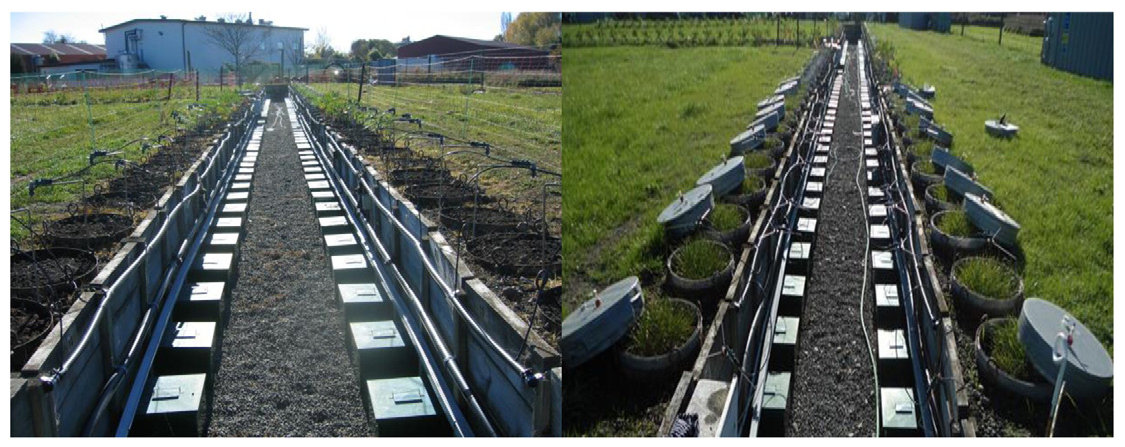
Eighteen undisturbed soil monolith lysimeters 0.5 m in diameter, and 0.7 m deep, containing Lismore stony soil, were taken from the Ashley Dene sheep farm Canterbury, New Zealand (43°39′05.82″S 172°19′ 41.47″E). The lysimeters were installed at the Lincoln University Field Service Centre (Fig. 1). The design of lysimeter castings and method of sampling is described in detail by Cameron et al. (1992).
从新西兰坎特伯雷Ashley Dene羊场(43°39′05.82″S 172°19′ 41.47″E)采集18个直径0.5 m、深0.7 m、含Lismore石质土壤的原状土柱渗漏计,安装于林肯大学田间服务中心(图1)。渗漏计外壳设计和采样方法详见Cameron et al.(1992)。
There were six treatments, each replicated three times. Biosolids, NV lignite and urea were applied separately at rates of 400 kg N/ha, 20 t/ha and 200 kg N/ha respectively. A further three treatments consisted of either biosolids + lignite, urea + lignite and a control with no addition applied.
试验共设6个处理,每个处理重复3次。生物固体、NV褐煤和尿素分别以400 kg N/ha、20 t/ha和200 kg N/ha的用量单独施用。另外3个处理分别为生物固体 + 褐煤、尿素 + 褐煤以及不添加任何物质的对照。
The application of each treatment occurred on the 16th of May 2012. To stimulate biosolids amendment to soil, the top 10 cm of soil in each lysimeter was removed and mixed with the applicable treatment in a concrete mixer for one minute. The control lysimeters were treated in an identical manner. Following treatment applications 0.5 g of tetraploid perennial ryegrass (Lolium perenne L. var. Bronsyn) was broadcast by hand over each lysimeter. Ten litre containers were installed at the base of the lysimeters for leachate collection.
各处理于2012年5月16日施用。为模拟生物固体施入土壤,将每个渗漏计表层10 cm土壤取出,与相应处理材料在混凝土搅拌机中混合1分钟。对照渗漏计按相同方式处理。施用处理后,在每个渗漏计上人工撒播0.5 g四倍体多年生黑麦草(Lolium perenne L. var. Bronsyn)。在渗漏计底部安装10升容器用于收集渗滤液。
2.7. Sample collection2.7. 样品采集
2.7.1. Leachate2.7.1. 渗滤液
Lysimeter drainage was collected bi-weekly or more frequently following heavy rain. The volume of drainage was measured and a 70 mL subsample taken and stored immediately in a freezer for subsequent analysis of both NO−3 and NH4+ using FIA.
渗漏计排水每两周收集一次,强降雨后收集更为频繁。测定排水体积并取70 mL子样,立即冷冻保存,随后采用FIA测定NO−3和NH4+。
2.7.2. Herbage2.7.2. 牧草
Herbage was harvested on three occasions (28th of Sep 2012, 16th of Jan 2013 and 15th of Mar 2013) when pasture reached typical pregrazing levels of dry mater (DM). Hand shears were used to clip the pasture to a height of 2 cm.
当牧草干物质(DM)达到典型放牧前水平时进行收割,共收割3次(2012年9月28日、2013年1月16日和2013年3月15日)。用手剪将牧草剪至2 cm高度。
2.8. Climate and irrigation2.8. 气候与灌溉
Simulated rainfall was applied (if required) to all lysimeters to supplement a shortage of natural rainfall with the aim of meeting the 75th percentile of rainfall based on a 25 years rainfall record.
必要时对所有渗漏计进行模拟降雨,以弥补自然降雨的不足,目标是达到基于25年降雨记录的第75百分位降雨量。
Utah, USA) was used to collect soil moisture and temperature information every ten minutes during the N₂O measurement periods, while hourly and daily averages were also recorded throughout the experiment. Both moisture and temperature probes were installed prior to N2O gas sample collection.
Utah,美国)用于在N₂O测定期间每10分钟采集一次土壤水分和温度数据,同时在整个试验期间记录每小时和每日平均值。水分和温度探头均在采集N2O气体样品之前安装。
2.9.2. Nitrous oxide gas collection2.9.2. 氧化亚氮气体采集
A standard closed chamber method (Fig. 1) similar to that described by Hutchinson and Mosier (1981) was used to determine N₂O emissions from the lysimeters. Sampling was carried out over a four week period starting 7th May 2013, in which samples were collected every day for seven days and every second or third day for the remaining weeks. An initial gas sample was taken prior to treatment application. Gas samples were collected between 12.30 pm and 2.30 pm. The gas chamber was constructed from a metal cylinder, insulated on the outside with 2.5 mm thick polystyrene foam to avoid heating of the chamber head space during sampling. An annular ring mounted on the monolith lysimeters formed a U-shaped water trough around the lysimeter to which the chamber was fitted during sampling to create an air-tight seal. A rubber septum in the chamber surface facilitated gas sampling. At each sampling time, the chamber was placed on top of the lysimeter for a total of 60 min, and three samples (25 mL), were collected. Samples were collected in 6 mL Exetainer® vials which had been preevacuated (−1 atm) according to de Klein et al. (2001). The air temperature was recorded prior to sampling followed by measurements of the chamber air temperature at 20, 40 and 60 min.
采用与Hutchinson and Mosier(1981)所述方法相似的标准静态箱法(图1)测定渗漏计的N₂O排放。采样自2013年5月7日开始,持续4周,其中前7天每天采样,其余各周每隔2或3天采样一次。施用处理前采集初始气体样品。气体样品于下午12:30至2:30之间采集。气室由金属圆筒制成,外侧包覆2.5 mm厚的聚苯乙烯泡沫以隔热,避免采样期间气室顶空升温。安装在原状土柱渗漏计上的环形圈在渗漏计周围形成U形水槽,采样时将气室置于其中以形成气密密封。气室表面的橡胶隔垫便于气体采样。每次采样时,将气室置于渗漏计顶部共60 min,采集3个样品(25 mL)。按照de Klein et al.(2001)的方法,将样品收集于预先抽真空(−1 atm)的6 mL Exetainer®样品瓶中。采样前记录气温,随后在20、40和60 min时测定气室内空气温度。
Nitrous oxide concentrations were determined at New Zealand's National Centre for Nitrous Oxide Measurement (NZ-NCNM) at Lincoln University, New Zealand using a gas chromatograph (GC) (SRI 8610 gas chromatograph; SRI Instruments, CA, USA) fitted with a 63Ni electron capture detector (ECD), and linked to an autosampler (Gilson 222 XL; Gilson Inc., WI, USA). PeakSimple software (SRI Instruments, CA, USA) was used to control and monitor the ECD. The N2O fluxes were (g N2O–N ha/d) was calculated using the change in headspace N2O concentration (μL/L) over time and the protocols and equations of Hutchinson and Mosier (1981). A full description of the GC and its operation can be found elsewhere (Kelliher et al., 2012).
氧化亚氮浓度在新西兰林肯大学新西兰国家氧化亚氮测定中心(NZ-NCNM)测定,所用气相色谱仪(GC)(SRI 8610气相色谱仪;SRI Instruments, CA,美国)配备63Ni电子捕获检测器(ECD),并连接自动进样器(Gilson 222 XL;Gilson Inc., WI,美国)。采用PeakSimple软件(SRI Instruments, CA,美国)控制和监测ECD。N2O通量(g N2O–N ha/d)根据顶空N2O浓度(μL/L)随时间的变化,并采用Hutchinson and Mosier(1981)的方案和公式计算。GC及其操作的详细说明见Kelliher et al.(2012)。
3Results and discussion结果与讨论
2.9. Gas sampling—collection and analysis2.9. 气体采样——采集与分析
2.9.1. Soil moisture and temperature2.9.1. 土壤水分与温度
The average soil water content in the lysimeter (0–15 cm depth) was measured using a Hydrosense moisture probe (15 cm) (Campbell Scientific, Utah, USA). Soil temperature was recorded using a 107-L temperature sensor (Campbell Scientific, Utah, USA) to measure the soil temperature at 7.5 cm depth. A data logger (CR23X, Campbell Scientific,
渗漏计内(0–15 cm深度)平均土壤含水量采用Hydrosense水分探头(15 cm)(Campbell Scientific, Utah,美国)测定。土壤温度采用107-L温度传感器(Campbell Scientific, Utah,美国)记录,测定7.5 cm深度处的土壤温度。数据记录仪(CR23X,Campbell Scientific,
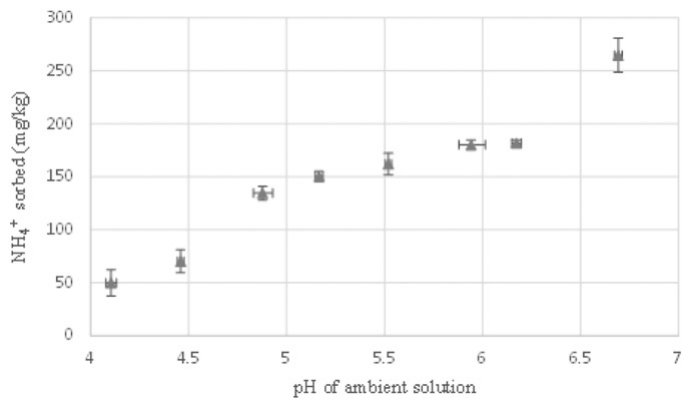
Batch sorption experiments revealed there was negligible NH4+ sorption by the Lismore soil and the Charleston and Millerton lignites. In contrast, there was significant NH4+ sorption by the NV lignite. Fig. 2 shows the NH4+ sorption by the NV lignite at solution pHs between 4.1 and 6.7. Ammonium sorption by the NV lignite increased with increasing pH. This is consistent with there being a pH dependent variable charge on the NV lignite.
批量吸附试验表明,Lismore土壤以及Charleston和Millerton褐煤对NH4+的吸附可忽略不计。相比之下,NV褐煤对NH4+有显著吸附。图2显示了溶液pH为4.1–6.7时NV褐煤对NH4+的吸附。NV褐煤对铵的吸附随pH升高而增加,这与NV褐煤带有pH依赖性可变电荷相一致。
Chemical properties of the pasture grown on the lysimeters. Values represent the mean (n = 3). Values in brackets are the standard error of the mean. Values with the same letter are not significantly different at the 5% level (ANOVA with Fisher's test).
渗漏计上生长牧草的化学性质。数值为平均值(n = 3)。括号内数值为平均值的标准误。标有相同字母的数值在5%水平上差异不显著(ANOVA结合Fisher检验)。
| Soil treatments土壤处理 | ||||||
|---|---|---|---|---|---|---|
| Control | Lignite | Biosolids | Biosolids + lignite | Urea | Urea + lignite | |
| Total C (g/kg) | 439 (2.5)ab | 441 (2.3)ab | 442 (2.1)a | 443 (0.8)a | 441 (1.3)ab | 434 (3.7)b |
| Total N (g/kg) | 25.3 (0.8)a | 24.2 (0.6)a | 25.3 (1.6)a | 25 (2.1)a | 24 (1.6)a | 23.8 (0.3)a |
| P (mg/kg) | 4511 (145)ab | 4585 (93) ab | 4084 (124)b | 4121 (121)b | 4421 (237.3) ab | 4738 (265)a |
| S (mg/kg) | 2292 (119)a | 2714 (74)a | 2469 (228)a | 2408 (226)a | 2729 (270.5)a | 2826(78)a |
| Ca (mg/kg) | 7898 (569)a | 6888 (150)b | 7920 (309)a | 7502 (331)ab | 7917 (147)a | 8270 (220)a |
| Mg (mg/kg) | 914 (18.8)bc | 983 (40.9)ab | 840 (53.8)c | 918 (20)b | 921 (82.4)bc | 1073 (26.3)a |
| K (mg/kg) | 24,170 (967)ab | 23,888 (389)ab | 21,055 (982)c | 21,158 (319)c | 21,609 (780)bc | 25,274 (1244)a |
| Na (mg/kg) | 1461 (40)a | 1464 (114)a | 1887 (274)a | 1925 (352)a | 1819 (176)a | 1304(75)a |
| Al (mg/kg) | 429 (107) ab | 422 (45) ab | 279 (35) b | 400 (54.7) ab | 357 (26.7) ab | 519 (89.8) a |
| Cu (mg/kg) | 4.4 (0.3)b | 4.5 (0.3)b | 6.2 (0.4)a | 5.3 (0.4)ab | 5.2 (0.4)ab | 5.1 (0.2)b |
| Cd (mg/kg) | 0.07 (0.05)a | 0.01 (0.0)a | 0.02 (0.01)a | 0.02 (0.0)a | 0.02 (0.0)a | 0.02 (0.0)a |
| Fe (mg/kg) | 327 (68)ab | 324 (35)ab | 231 (28)b | 306 (35.9)ab | 295 (12)ab | 392 (70)a |
| Mn (mg/kg) | 20.7 (2)c | 33.9 (5.6)c | 23.4 (3.6)c | 24.1 (1.3)c | 76 (11.2)b | 102 (12.3)a |
| Zn (mg/kg) | 15.4 (0.7)b | 14.8 (0.2)b | 21.9 (2)a | 20.0 (1)a | 15.1 (0.5)b | 16.3 (1)b |
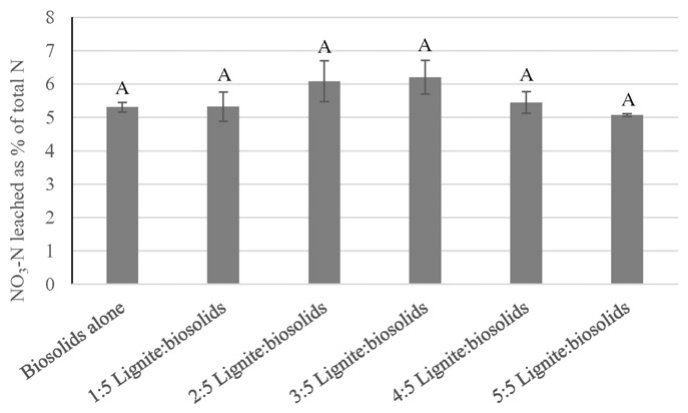
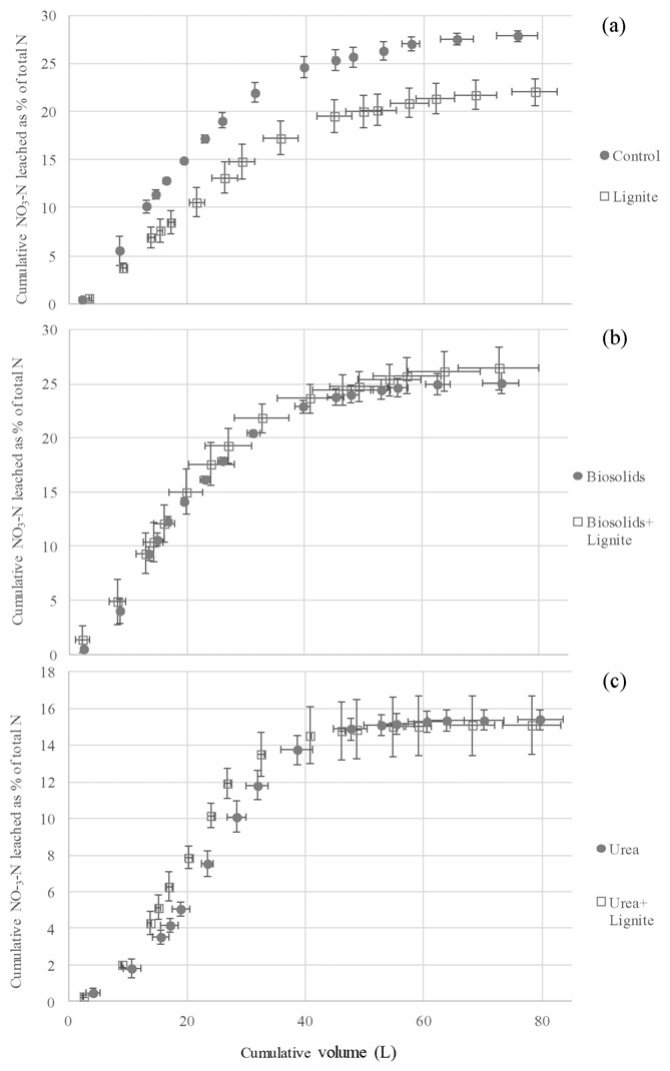
Nitrate sorption on the lignite did not occur during the batch sorption and this is consistent with the negative surface charge on the NV lignite (Simmler et al., 2013). Lignite materials have been adopted to adsorb NO3− by modifying the surface using chemical (ZnCl2) and thermal activation (Khan et al., 2011). Given that most mineral-N in aged biosolids is in the form of NO3− (Bernal et al., 1998; Smith et al., 1998), it is unlikely that lignite would prevent the initial flush of N leaching from biosolids-amended soil. The results of the column leaching study agree with this supposition, with the addition of increasing rates of NV lignite making no difference to the amount of NO3− leached (Fig. 3) and where the amount of NO3−–N lost was ca 5-fold greater than the highest NH+4 loss.
批量吸附试验中褐煤未吸附硝酸盐,这与NV褐煤表面带负电荷相一致(Simmler et al., 2013)。已有研究通过化学(ZnCl2)和热活化对褐煤材料进行表面改性以吸附NO3−(Khan et al., 2011)。鉴于陈化生物固体中的大部分矿质氮以NO3−形式存在(Bernal et al., 1998; Smith et al., 1998),褐煤不大可能阻止施用生物固体土壤初期的N集中淋溶。土柱淋溶试验的结果支持这一推断:增加NV褐煤的添加量对NO3−淋溶量没有影响(图3),且NO3−–N损失量约为最高NH+4损失量的5倍。
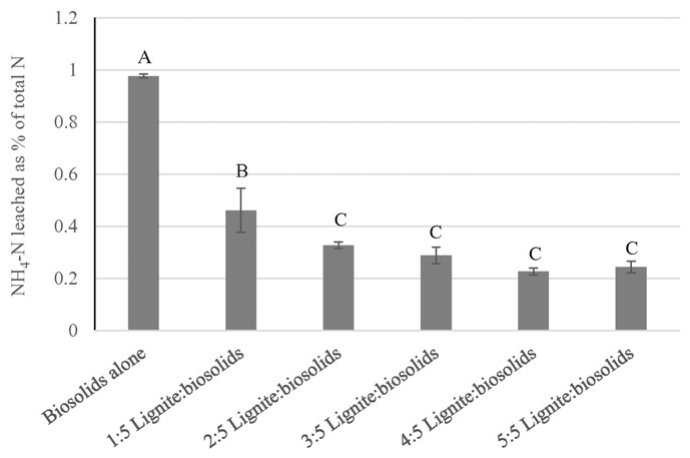
In contrast, younger biosolids, which have a significant NH4+ component of their mineral N, may leach less N if amended with lignite to retain NH4+ Increasing the amount of NV lignite added to the biosolids significantly reduced the mass of NH+4–N that leached from the columns (Fig. 4). However, above a NV lignite:biosolids ratio of 2:5, there was no further decrease in NH4+–N leaching.
相反,较新鲜的生物固体的矿质氮中含有较大比例的NH4+,若添加褐煤以保持NH4+,其N淋溶量可能减少。增加生物固体中NV褐煤的添加量显著降低了土柱中NH+4–N的淋溶量(图4)。然而,当NV褐煤与生物固体之比超过2:5时,NH4+–N淋溶量不再进一步降低。
The total cation exchange sites in the columns equated to 2.0 × 10⁻³ mol of negatively charged sites and this was significantly higher than the total potential NH4+–N available (assuming complete mineralisation of both NV lignite and biosolids) of 1.1 × 10⁻⁵ mol.
土柱中阳离子交换位点总量相当于2.0 × 10⁻³ mol负电荷位点,显著高于潜在可利用NH4+–N总量(假设NV褐煤和生物固体完全矿化)1.1 × 10⁻⁵ mol。
However, NH4+–N compete with other cations Al3+, Ca2+, K+ and Na+ for these sites. The positive charge from these ions in our columns was N0.006 mol, in excess of the total moles of negative charged surface. A second mechanism for NH4+–N leaching reducing with as increasing NV lignite rate could be the microbial immobilization of NH+4, due to increasing availability of water WSC as lignite rates increase (Ghani et al., 2003).
然而,NH4+–N需与其他阳离子Al3+、Ca2+、K+和Na+竞争这些位点。土柱中这些离子所带正电荷>0.006 mol,超过负电荷表面的总摩尔数。随NV褐煤用量增加NH4+–N淋溶减少的第二种机制可能是NH+4的微生物固持,因为随着褐煤用量增加,WSC的有效性提高(Ghani et al., 2003)。
Between April and November, the lysimeters received 1105 mm of rainfall + irrigation, equating to 221 L per lysimeter. The monthly average air temperature in April was 12 °C, decreased to 5.5–6.5 °C in June– July, before increasing in spring to 10–11 °C in October–November. The total N leached as NH4+–N from the lysimeters varied between 6.7– 10 mg which is equivalent to 0.33 and 0.50 kg/ha (data not shown) and was insignificant compared to the NO3−–N leached (524–3207 mg, equivalent to 26 kg/ha–160 kg/ha).
4月至11月期间,渗漏计共接受1105 mm降雨 + 灌溉,相当于每个渗漏计221 L。4月月平均气温为12 °C,6–7月降至5.5–6.5 °C,春季10–11月又升至10–11 °C。渗漏计中以NH4+–N形式淋溶的总N为6.7–10 mg,相当于0.33–0.50 kg/ha(数据未列出),与NO3−–N淋溶量(524–3207 mg,相当于26 kg/ha–160 kg/ha)相比可忽略不计。
The high CEC of the NV lignite (Table 1) indicates that adding the NV lignite to the Lismore soil will increase the total CEC. This increase in CEC may be offset by the acidic pH of the NV (Table 1) compared to the Lismore soil (6.3). The contrasting effects of increased CEC and reduced pH caused by lignite addition have been highlighted by Pehlivan and Arslan (2006) and Simmler et al. (2013).
NV褐煤的高CEC(表1)表明,向Lismore土壤中添加NV褐煤将提高总CEC。但与Lismore土壤(6.3)相比,NV褐煤的酸性pH(表1)可能抵消CEC的增加。Pehlivan and Arslan(2006)和Simmler et al.(2013)已指出添加褐煤导致CEC升高和pH降低这两种相反的效应。
Sorption of NH4+ by the lignite may result in prolonged retention of N in the plant root-zone allowing greater plant uptake, and reducing N-leaching. Richards et al. (1986) showed that lignite significantly increased the growth of tomato and two ornamental plants which they attributed to the high CEC of the lignite (ca. 60 cmolc/kg).
褐煤对NH4+的吸附可能使N在植物根区保持更长时间,从而促进植物吸收并减少N淋溶。Richards et al.(1986)表明,褐煤显著促进了番茄和两种观赏植物的生长,并将其归因于褐煤的高CEC(约60 cmolc/kg)。
Fig. 5 shows the NO3−–N leached as a percentage of the total N (soil N and amendments) in the top 10 cm of soil, i.e. the soil into which the treatments were mixed. The lignite-only treatment leached less NO−3– N compared to the control (p b 0.05). However, in the biosolids and urea treatments, the addition of lignite had no significant effect on the amount of N leached. The lack of any effect of lignite on N-leaching from the biosolids can be explained if most of the mineral N in the biosolids was present as NO3−, which the batch sorption and column leaching experiments demonstrated was not sorbed by the lignite. However, the lack of any effect of lignite on NO3−–N leaching from the urea treatment was unexpected, since urea hydrolyses to form NH+4 and it was expected that this would be partially retained by the lignite. Since the addition of lignite increased CEC by 5.56% potentially alter the retention of all urea-N as NH+4 on the increased CEC.
图5显示了NO3−–N淋溶量占表层10 cm土壤(即混入处理材料的土层)总N(土壤N和改良剂N)的百分比。单施褐煤处理的NO−3–N淋溶量低于对照(p < 0.05)。然而,在生物固体和尿素处理中,添加褐煤对N淋溶量无显著影响。如果生物固体中的大部分矿质氮以NO3−形式存在,而批量吸附和土柱淋溶试验已证明褐煤不吸附NO3−,则可解释褐煤对生物固体N淋溶没有影响的原因。然而,褐煤对尿素处理NO3−–N淋溶没有任何影响出乎意料,因为尿素水解生成NH+4,预期其会被褐煤部分保持。由于添加褐煤使CEC提高了5.56%,可能改变了全部尿素N以NH+4形式在增加的CEC上的保持。
Our lysimeter experiment was conducted from autumn to spring, which is when most leaching from pasture occurs (Di and Cameron, 2007) and when pasture growth is low relative to the summer months. Our lysimeters produced between 1000 and 2500 kg DM/ha. L. perenne L. is reported to produce 14,200–23,400 kg DM/ha/yr. (Glassey et al., 2010) with most of this growth occurring in the warmer months. The pasture in our experiments removed the equivalent of 25–62.5 kg N/ ha, less than the amount of N added (200–400 kg N/ha equivalent). Therefore, it is unlikely the pasture would have been unable to remove any additional NH4+ that was detained in the root-zone by the lignite.
本渗漏计试验在秋季至春季进行,这一时期是牧场淋溶最主要的发生期(Di and Cameron, 2007),且相对于夏季月份牧草生长较慢。本试验渗漏计的产量为1000–2500 kg DM/ha。据报道,L. perenne L.的产量为14,200–23,400 kg DM/ha/yr(Glassey et al., 2010),其中大部分生长发生在较温暖的月份。本试验中牧草移除的N相当于25–62.5 kg N/ha,低于施氮量(相当于200–400 kg N/ha)。因此,牧草不大可能无法移除被褐煤保持在根区的额外NH4+。
In our study, the lignite was incorporated into the top 10 cm of soil in order to try and modify urea-N cycling. In contrast, previous studies have used “black urea”, which is a mixture of urea and lignite. Thus, our results do not necessarily indicate that adding lignite to urea as “black urea” would be ineffective in reducing NO3−–N leaching. However, our results do indicate that the addition of lignite to soil is unlikely to reduce N leaching from surface-applied urea.
本研究中,褐煤被混入表层10 cm土壤,以尝试调控尿素N的循环。相比之下,以往研究使用的是“黑色尿素”,即尿素与褐煤的混合物。因此,本研究结果并不一定表明以“黑色尿素”形式将褐煤添加到尿素中对减少NO3−–N淋溶无效。然而,本研究结果确实表明,向土壤中添加褐煤不大可能减少表施尿素的N淋溶。
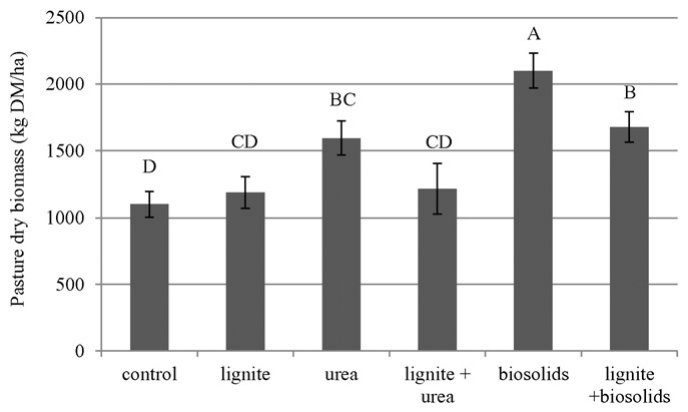
The growth of pasture increased following the addition of urea, biosolids and biosolids + lignite (p b 0.05). Adding lignite to the biosolids, however, reduced the pasture yield (Fig. 6) compared to biosolids alone, whereas adding lignite + urea did not significantly reduce yield compared to urea alone. In the control soil, the addition of lignite had no effect on pasture yield. The treatments had only a minor effect on the elemental composition of the pasture (Table 2) with the addition of biosolids significantly increasing the pasture Zn concentration, while lignite addition did not reduce heavy metal concentrations in any treatment.
施用尿素、生物固体以及生物固体 + 褐煤后,牧草生长量增加(p < 0.05)。然而,与单施生物固体相比,在生物固体中添加褐煤降低了牧草产量(图6),而与单施尿素相比,添加褐煤 + 尿素并未显著降低产量。在对照土壤中,添加褐煤对牧草产量无影响。各处理对牧草元素组成的影响较小(表2):添加生物固体显著提高了牧草Zn浓度,而添加褐煤在任何处理中均未降低重金属浓度。
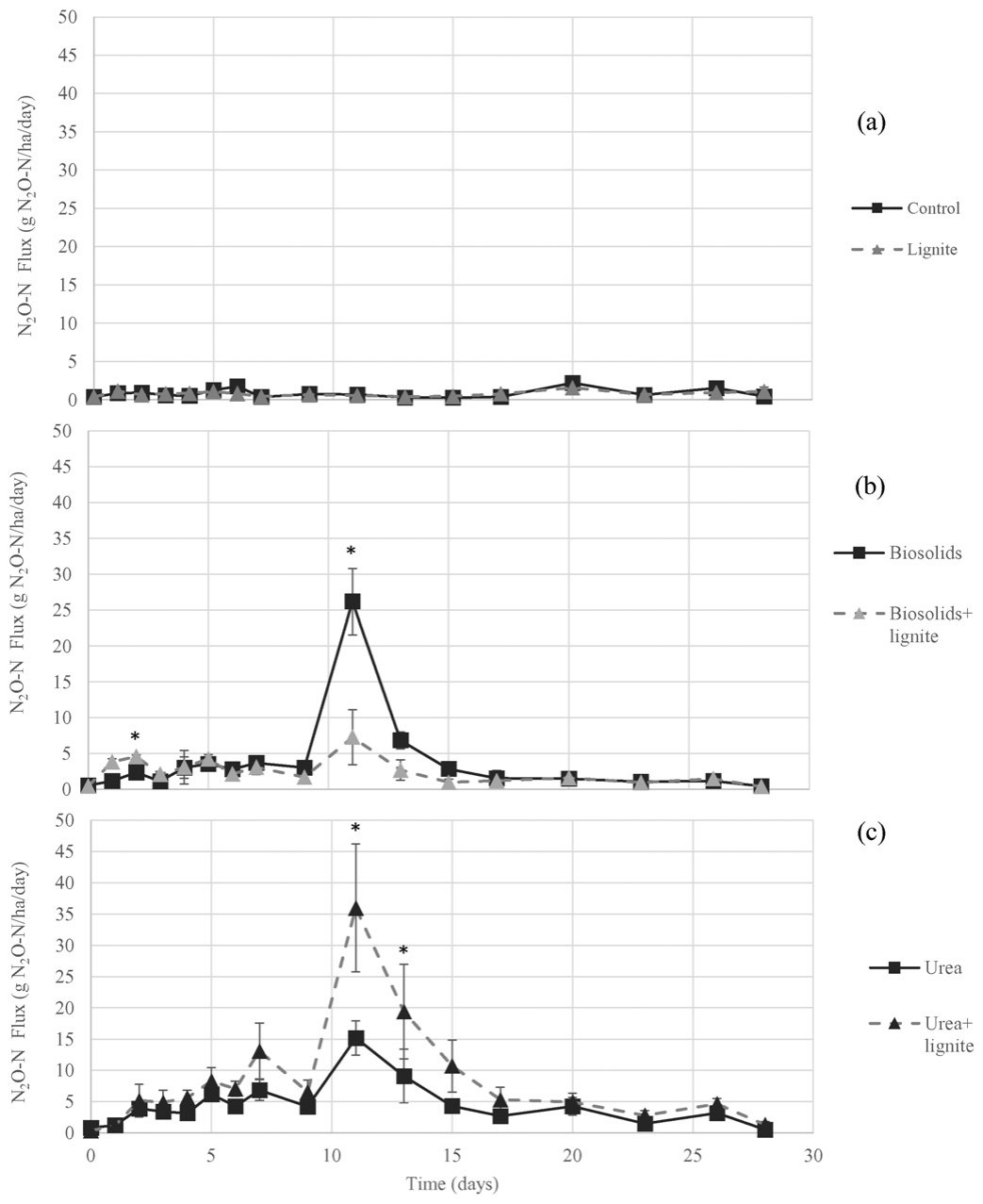
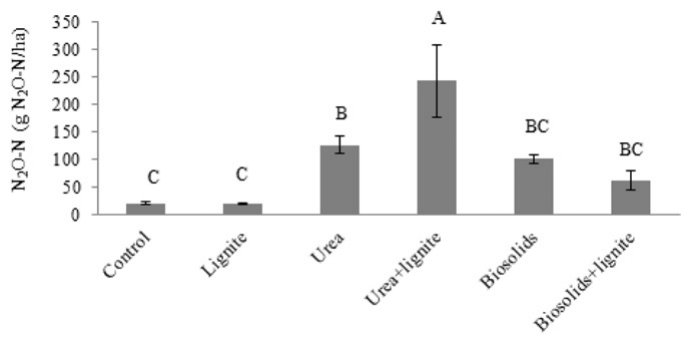
There were no detectable N2O emissions (b2.5 g N2O–N/ha) from the control or lignite treatments over the 28 d period (Fig. 7a). The addition of biosolids alone did not significantly increase N2O emissions over the entire experimental period (Fig. 8). Fig. 7b shows that during the experimental period, the biosolids + lignite treatment emitted significantly more N2O than the biosolids alone treatment on day 3 and visa-versa on day 10. The addition of urea increased daily and cumulative N2O emissions (Fig. 8) and this increase was exacerbated by lignite (Figs. 7c, 8). This may have been a consequence of the increased availability of lignite derived WSC enhancing denitrification, since WSC has been shown to correspond to denitrification rates (Burford and Bremner, 1975) or lignite addition may have altered (Table 1), soil physical properties which may have resulted in higher (Schmidt et al., 1999) N2O emissions.
在28 d期间,对照和褐煤处理均未检测到N2O排放(<2.5 g N2O–N/ha)(图7a)。在整个试验期间,单施生物固体未显著增加N2O排放(图8)。图7b显示,在试验期间,生物固体 + 褐煤处理在第3天的N2O排放显著高于单施生物固体处理,而第10天则相反。施用尿素增加了每日和累积N2O排放(图8),且褐煤加剧了这一增加(图7c、8)。这可能是由于褐煤来源的WSC有效性提高促进了反硝化作用,因为已有研究表明WSC与反硝化速率相对应(Burford and Bremner, 1975);或者褐煤添加可能改变了土壤物理性质(表1),从而导致N2O排放升高(Schmidt et al., 1999)。
4Conclusions结论
The addition of lignite to soil did not significantly offset the increase in NO3− leaching caused by adding biosolids or urea. There was a small reduction in NO3− leaching from unamended soil, which corresponded to the increase in cation exchange sites in the lysimeter by 3.33 mol. This reduction is unlikely to be significant in an agricultural context. Lignite exacerbated N2O emissions from soils receiving urea. Furthermore, lignite lessened the beneficial growth effects of adding biosolids or urea to soil. Future work should investigate whether coating urea granules with lignite results in lower reactive N losses from pastures.
向土壤中添加褐煤并未显著抵消施用生物固体或尿素所引起的NO3−淋溶增加。未改良土壤的NO3−淋溶略有减少,这与渗漏计中阳离子交换位点增加3.33 mol相对应。就农业生产而言,这一减少不大可能具有显著意义。褐煤加剧了施用尿素土壤的N2O排放。此外,褐煤削弱了向土壤添加生物固体或尿素对植物生长的有益作用。今后应研究以褐煤包膜尿素颗粒能否降低牧场活性N的损失。
Acknowledgements致谢
We gratefully acknowledge the Centre for Integrated Biowaste Research (CIBR) for funding this research.
衷心感谢生物废弃物综合研究中心(Centre for Integrated Biowaste Research, CIBR)对本研究的资助。
References参考文献
ARTH. Agriculture Research Trust Harare: BLACK™ Enhanced Efficiency Fertiliser- Commercial Field Demonstrations., Zimbabwe, 2009, pp. 3.
Bernal, M.P., Navarro, A.F., Sanchez-Monedero, M.A., Roig, A., Cegarra, J., 1998. Influence of sewage sludge compost stability and maturity on carbon and nitrogen mineralization in soil. Soil Biol. Biochem. 30, 305–313.
Blakemore, L.C., Searle, P.L., Daly, B.K., 1987. Methods for chemical analysis of soils. NZ Soil Bureau Scientific Report 80.
Burford, J.R., Bremner, J.M., 1975. Relationships between the denitrification capacities of soils and total, water-soluble and readily decomposable soil organic matter. Soil Biol. Biochem. 7, 389–394.
Cameron, K.C., Smith, N.P., McLay, C.D.A., Fraser, P.M., McPherson, R.J., Harrison, D.F., et al., 1992. Lysimeters without edge flow—An improved design and sampling procedure. Soil Sci. Soc. Am. J. 56, 1625–1628.
Civeira, G., Lavado, R.S., 2008. Nitrate losses, nutrients and heavy metal accumulation from substrates assembled for urban soils reconstruction. J. Environ. Manage. 88, 1619–1623.
Clough, T.J., Stevens, R.J., Laughlin, R.J., Sherlock, R.R., Cameron, K.C., 2001. Transformations of inorganic-N in soil leachate under differing storage conditions. Soil Biol. Biochem. 33, 1473–1480.
Correa, R.S., White, R.E., Weatherley, A.J., 2006a. Effect of compost treatment of sewage sludge on nitrogen behavior in two soils. Waste Manag. 26, 614–619.
Correa, R.S., White, R.E., Weatherley, A.J., 2006b. Water Quality and Protection: Environmental Aspects Risk of nitrate leaching from two soils amended with biosolids. Earth Environ. Sci. 33, 453–462.
de Klein, C.A.M., Sherlock, R.R., Cameron, K.C., van der Weerden, T.J., 2001. Nitrous oxide emissions from agricultural soils in New Zealand — a review of current knowledge and directions for future research. J. R. Soc. N. Z. 31, 543–574.
Di, H.J., Cameron, K.C., 2002. The use of a nitrification inhibitor, dicyandiamide (DCD), to decrease nitrate leaching and nitrous oxide emissions in a simulated grazed and irrigated grassland. Soil Use Manag. 18, 395–403.
Di, H.J., Cameron, K.C., 2007. Nitrate leaching losses and pasture yields as affected by different rates of animal urine nitrogen returns and application of a nitrification inhibitor — a lysimeter study. Nutr. Cycl. Agroecosyst. 79, 281–290.
Domańska, K.K., Smolinska, B., 2012. Advantages of lignite addition in purification process of soil polluted by heavy metals. Biotechnology and Food Science 76, 51–58. Doskocil, L., Pekar, M., 2012. Removal of metal ions from multi-component mixture using natural lignite. Fuel Process. Technol. 101, 29–34.
Ferguson, J., 2002. Not so Basic Black Offers Fertiliser Efficiency. What is Black Urea. Advanced Nutrients, Australia.
Ghani, A., Dexter, M., Perrott, K.W., 2003. Hot-water extractable carbon in soils: a sensitive measurement for determining impacts of fertilisation, grazing and cultivation. Soil Biol. Biochem. 35, 1231–1243.
Glassey, C.B., Roach, C.G., Strahan, M.R., McClean, N., 2010. Dry matter yield, pasture quality and profit on two Waikato dairy farms after pasture renewal. Proceedings of the New Zealand Grassland Association 72, 91–96.
Gundale, M.J., DeLuca, T.H., 2007. Charcoal effects on soil solution chemistry and growth of Koeleria macrantha in the ponderosa pine/Douglas-fir ecosystem. Biol. Fertil. Soils 43, 303–311.
Hue, N.V., 2014. Land Application of Biosolids. University of Hawaii.
Hutchinson, G.L., Mosier, A.R., 1981. Improved soil cover method for field measurement of nitrous oxide fluxes. Soil Sci. Soc. Am. J. 45, 311–316.
Janos, P., Zavodska, L., Lesny, J., Krizenecka, S., 2011. Young Brown Coals for Environmental Applications Composition, Acid–Base, Ion-exchange and Sorption Properties of Selected Central European Coals. NOVA Science Publishers, Inc.
Jezierski, S., Czechowski, F., Jerzykiewicz, M., Drozd, J., 2000. EPR investigations of structure of humic acids from compost, soil, peat and soft brown coal upon oxidation and metal uptake. Appl. Magn. Reson. 18, 127–136.
Kabe, T., Ishihara, A., Qian, E.W., Sutrisna, I.P., Kabe, Y., 2004. Coal and Coal-related Compounds — Structures, Reactivity and Catalytic Reactions. Elsevier, Amsterdam.
Kelliher, F., Sherlock, R., Clough, T., Premaratne, M., Laughlin, R., McGeough, K., et al., 2012. Air sample collection, storage and analysis. In: de Klein, C.A.M., Harvey, M.J. (Eds.), Nitrous Oxide Chamber Methodology Guidelines. 1. Global Research Alliance on agricultural Geernhouse gases, Wellington, New Zealand, pp. 56–72.
Khan, M.A., Ahn, Y.-T., Kumar, M., Lee, W., Min, B., Kim, G., et al., 2011. Adsorption studies for the removal of nitrate using modified lignite granular activated carbon. Sep. Sci. Technol. 46, 2575–2584.
Knowles, O.A., Robinson, B.H., Contangelo, A., Clucas, L., 2011. Biochar for the mitigation of nitrate leaching from soil amended with biosolids. Sci. Total Environ. 409, 3206–3210.
Kulyk, N., 2012. Cost–Benefit Analysis of the Biochar Application in the U.S. Cereal Crop Cultivation. University of Massachusetts — Amherst: Center for Public Policy Administration Capstones.
Kwiatkowska, J., Provenzano, M.R., Senesi, N., 2008. Long term effects of a brown coal-
based amendment on the properties of soil humic acids. Geoderma 148, 200–205. Lafferty, C., Hobday, M., 1990. The use of low rank brown coal as an ion-exchange material. 2. Ionic selectivity and factors affecting utilization. Fuel 69, 84–87.
Ozcimen, D., Karaosmanoglu, F., 2004. Production and characterization of bio-oil and biochar from rapeseed cake. Renew. Energy 29, 779–787.
Pehlivan, E., Arslan, G., 2006. Comparison of adsorption capacity of young brown coals and humic acids prepared from different coal mines in Anatolia. J. Hazard. Mater. 138 (2), 401–408.
Qi, Y., Szendrak, D., Yuen, R.T.W., Hoadley, A.F.A., Mudd, G., 2011. Application of sludge dewatered products to soil and its effects on the leaching behaviour of heavy metals. Chem. Eng. J. 166, 586–595.
Ravishankara, A.R., Daniel, J.S., Portmann, R.W., 2009. Nitrous oxide (N2O): the dominant ozone-depleting substance emitted in the 21st century. Science 326, 123–125.
Richards, D., Lane, M., Beardsell, D.V., 1986. The influence of particle size distribution in pinebark sand brown coal potting mixes on water supply, areation and plant growth. Sci. Hortic. 29, 1–14.
Rigby, H., Smith, S.R., 2013. Nitrogen availability and indirect measurements of greenhouse gas emissions from aerobic and anaerobic biowaste digestates applied to agricultural soils. Waste Manag. 33, 2641–2652.
Robinson, B., Anderson, C.W.N., Knowles, O.A., Gartler, J., Portmann, D., Contangelo, A., et al., 2011. Closing the loop: biosolids to rebuild degraded soils. 24th Annual Fertilizer and Lime Research Centre (FLRC) Massey University.
Schmidt, M.W.I., Rumpel, C., Kogel-Knabner, I., 1999. Particle size fractionation of soil containing coal and combusted particles. Eur. J. Soil Sci. 50, 515–522.
Simmler, M., Ciadamidaro, L., Schulin, R., Madejón, P., Reiser, R., Clucas, L., et al., 2013. Lignite reduces the solubility and plant uptake of cadmium in pasturelands. Environ. Sci. Technol. 47, 4497–4504.
Smith, S.R., Woods, V., Evans, T.D., 1998. Nitrate dynamics in biosolids-treated soils. I. Influence of biosolids type and soil type. Bioresour. Technol. 66, 139–149.
van Dijk D, Houba VJG. Wageningen Evaluating Programmes for Analytical Laboratories (WEPAL). 5th International Symposium on Interpretation of Chemical, Microbiological and Biological Results and the Role of Proficiency Testing in Accreditation of Laboratories. Department of Environmental Sciences, Wageningen Agricultural University, Presented at Varaždin, Croatia, 1998.
van Vuuren, J.A.J., Claassens, A.S., 2009. Greenhouse pot trials to determine the efficacy of black urea compared to other nitrogen sources. Commun. Soil Sci. Plant Anal. 40, 576–586.
Wang, H., Lin, K., Hou, Z., Richardson, B., Gan, J., 2010. Sorption of the herbicide terbuthylazine in two New Zealand forest soils amended with biosolids and biochars. J. Soils Sediments 10, 283–289.
WEC. World Energy Council: Survey of Energy Resources-2010. Regency House 1–4 Warwick Street, London W1B 5LT, United Kingdom: World Energy Council, 2010.
Wong AS, Stalnaker ND, Lafferty CJ, Robertson JD, Kuhr JH. The ion exchange properties of low rank coals on actinides and other heavy metals. Abstracts of Papers of the American Chemical Society 1996; 211: 133-FUEL.