Journal of Environmental Quality
WASTE MANAGEMENT
Jürgen Esperschütz, Obed Lense, Craig Anderson, Simon Bulman, Jacqui Horswell, Nicholas Dickinson, and Brett Robinson*
1Abstract摘要
Biosolids (sewage sludge) can be beneficially applied to degraded lands to improve soil quality. Plants grown on biosolids-amended soils have distinct concentrations of macronutrients and trace elements, which can be beneficial or present a risk to humans and ecosystems. Potentially, biosolids could be blended with other biowastes, such as sawdust, to reduce the risks posed by rebuilding soils using biosolids alone. We sought to determine the effect of mixing biosolids and sawdust on the macronutrient and trace element concentration of ryegrass over a 5-mo period. Lolium multiflorum was grown in a low fertility soil, typical for marginal farm areas, that was amended with biosolids (1250 kg N ha-1), biosolids + sawdust (0.5:1) and urea (200 kg N ha-1), as well as a control. Biosolids increased the growth of L. multiflorum from 2.93 to 4.14 t ha-1. This increase was offset by blending the biosolids with sawdust (3.00 t ha-1). Urea application increased growth to 4.93 t ha-1. The biowaste treatments increased N, P, Cu, Mn, and Zn relative to the control, which may be beneficial for grazing animals. Although biowaste application caused elevated Cd concentrations (0.15–0.24 mg kg-1) five- to eightfold higher than control and urea treatments, these were below levels that are likely to result in unacceptable concentrations in animal tissues. Mixing biosolids with sawdust reduced Cd uptake while still resulting in increased micronutrient concentrations (P, S, Mn, Zn, Cu) in plants. There were significant changes in the elemental uptake during the experiment, which was attributed to the decomposition of the sawdust.
生物固体(污泥)可有益地施用于退化土地以改善土壤质量。在施用生物固体的土壤上生长的植物具有特定的大量营养元素和微量元素浓度,这些元素既可能有益,也可能对人类和生态系统构成风险。生物固体有望与锯末等其他生物废弃物混合,以降低单独使用生物固体重建土壤所带来的风险。本研究旨在确定生物固体与锯末混合对黑麦草5个月内大量营养元素和微量元素浓度的影响。将Lolium multiflorum种植于一种典型的边际农区低肥力土壤中,分别施用生物固体(1250 kg N ha-1)、生物固体 + 锯末(0.5:1)和尿素(200 kg N ha-1),并设对照。生物固体使L. multiflorum的生物量由2.93 t ha-1增至4.14 t ha-1。将生物固体与锯末混合则抵消了这一增幅(3.00 t ha-1)。施用尿素使生物量增至4.93 t ha-1。与对照相比,生物废弃物处理提高了N、P、Cu、Mn和Zn的含量,这可能对放牧动物有益。尽管施用生物废弃物导致Cd浓度升高(0.15–0.24 mg kg-1),比对照和尿素处理高5~8倍,但仍低于可能导致动物组织中出现不可接受浓度的水平。生物固体与锯末混合降低了Cd吸收,同时仍提高了植物中微量营养元素(P、S、Mn、Zn、Cu)的浓度。试验期间元素吸收发生了显著变化,这归因于锯末的分解。
Core Ideas核心观点
- Biowastes (biosolids + sawdust) were effective in improving a low-fertility soil.生物废弃物(生物固体 + 锯末)可有效改良低肥力土壤。
- The biowaste mixture improved growth and quality of Lolium multiflorum over 5 months.生物废弃物混合物在5个月内改善了Lolium multiflorum的生长和品质。
- The biowaste treatments increased N, P, Cu, Mn, and Zn.生物废弃物处理提高了N、P、Cu、Mn和Zn的含量。
- Mixing biosolids with sawdust reduced Cd uptake.生物固体与锯末混合降低了Cd吸收。
- Biowaste induced changes in elemental composition increased over the 5-month period.生物废弃物引起的元素组成变化在5个月内逐渐增大。
iosolids are a product of municipal wastewater treatment. They are primarily derived from domestic sources, Bwhich are combinations of human feces, urine and gray water, as well as small inputs from industry and occasionally stormwater (Lu et al., 2012). Biosolids are produced at an annual rate of 27 kg per person, and their disposal can be expensive (e.g., incineration or in landfills) or environmentally damaging via legal or illegal disposal into waterways (LeBlanc et al., 2009).
生物固体是城市污水处理的产物,主要来源于生活污水,即人类粪便、尿液和灰水的混合物,以及少量工业排放物,偶尔还包括雨水(Lu et al., 2012)。生物固体的年产生量为每人27 kg,其处置费用可能较高(如焚烧或填埋),或者通过合法或非法排入水体而对环境造成危害(LeBlanc et al., 2009)。
Biosolids provide nutrients and organic matter, which can improve soil structure (Antolín et al., 2005; Singh and Agrawal, 2008), enhance plant growth (Miaomiao et al., 2009; Mok et al., 2013), and increase soil microbial activity (Cytryn et al., 2011). The efficacy of biosolids in improving soil quality depends on their provenance and treatment. Biosolids application to soil can also cause negative effects because they can introduce pathogens (Vasseur et al., 1996; Zaleski et al., 2005) and contaminants, including heavy metals (Oliver et al., 1994; Miaomiao et al., 2009; Lomonte et al., 2010; Lopes et al., 2011) that may be hazardous to soil biological processes and to human health. Therefore, the rate of biosolids addition to land is regulated with respect to the levels of heavy metals, organic compounds and pathogens (EEC, 1986; USEPA, 1993; NZWWA, 2003). Excessive biosolids applications to land can result in excessive runoff or leaching of plant nutrients such as nitrate (NO3-) and phosphate (PO43-) into receiving waters (Agopsowicz et al., 2008; Knowles et al., 2011). Therefore, biosolids are more suitable for rebuilding eroded land, low-fertility with poor soil structure, such as marginal farm areas (Fresquez et al., 1990; Shahid and Al-Shankiti, 2013). Such sites are not directly linked to the human food chain, and the high organic matter contents of biosolids may be more effective than mineral fertilizers for restoring degraded soils.
生物固体可提供养分和有机质,从而改善土壤结构(Antolín et al., 2005; Singh and Agrawal, 2008)、促进植物生长(Miaomiao et al., 2009; Mok et al., 2013)并提高土壤微生物活性(Cytryn et al., 2011)。生物固体改善土壤质量的效果取决于其来源和处理方式。生物固体施入土壤也可能产生负面影响,因为其可能引入病原体(Vasseur et al., 1996; Zaleski et al., 2005)和污染物,包括重金属(Oliver et al., 1994; Miaomiao et al., 2009; Lomonte et al., 2010; Lopes et al., 2011),这些物质可能危害土壤生物过程和人类健康。因此,生物固体的土地施用量须依据重金属、有机化合物和病原体水平进行管控(EEC, 1986; USEPA, 1993; NZWWA, 2003)。过量施用生物固体会导致硝酸盐(NO3-)和磷酸盐(PO43-)等植物养分经地表径流或淋溶大量进入受纳水体(Agopsowicz et al., 2008; Knowles et al., 2011)。因此,生物固体更适用于重建侵蚀土地以及土壤结构差的低肥力土地,如边际农区(Fresquez et al., 1990; Shahid and Al-Shankiti, 2013)。此类场地与人类食物链无直接联系,且生物固体较高的有机质含量在修复退化土壤方面可能比矿物肥料更为有效。
Some of the negative effects of biosolids addition to soil, namely environmental impacts of heavy metals, can be mitigated by blending the biosolids with other biowastes including biochar (Knowles et al., 2011), lignite (Simmler et al., 2013) and wood waste (Paramashivam et al., 2015). Bugbee (1999) reported that blending biosolids with sawdust could improve plant growth, while reducing NO3- leaching by increasing the C/N ratio. In addition to reducing NO3- leaching, wood waste, which can be expensive and environmentally damaging to dispose of, can effectively sorb heavy metals such as Cd, Cr, Cu, Ni, Pb and Zn from industrial effluents (Ajmal et al., 1998; Marchetti et al., 2000; Yu et al., 2000). Bulut and Tez (2007) demonstrated that there was variation in the sorption of individual metals (Pb ≈ Cd > Ni), which was attributed to the affinity of each element to the proteins, carbohydrates, and phenolic compounds in the sawdust.
生物固体施入土壤的部分负面影响,即重金属的环境影响,可通过将生物固体与其他生物废弃物混合来减轻,包括生物炭(Knowles et al., 2011)、褐煤(Simmler et al., 2013)和木材废弃物(Paramashivam et al., 2015)。Bugbee(1999)报道,将生物固体与锯末混合可促进植物生长,同时通过提高C/N比减少NO3-淋溶。木材废弃物的处置费用较高且可能危害环境,它除了能减少NO3-淋溶外,还可有效吸附工业废水中的Cd、Cr、Cu、Ni、Pb和Zn等重金属(Ajmal et al., 1998; Marchetti et al., 2000; Yu et al., 2000)。Bulut和Tez(2007)证明,不同金属的吸附存在差异(Pb ≈ Cd > Ni),这归因于各元素对锯末中蛋白质、碳水化合物和酚类化合物的亲和力不同。
Copyright © American Society of Agronomy, Crop Science Society of America, and Soil Science Society of America. 5585 Guilford Rd., Madison, WI 53711 USA. All rights reserved.
版权所有 © American Society of Agronomy, Crop Science Society of America, and Soil Science Society of America。5585 Guilford Rd., Madison, WI 53711 USA。保留所有权利。
J. Environ. Qual. doi:10.2134/jeq2015.09.0459 Received 10 Sept. 2015. Accepted 21 Dec. 2015. *Corresponding author (brett.robinson@lincoln.ac.nz).
J. Esperschütz, O. Lense, and B. Robinson, Lincoln Univ., Agriculture and Life Sciences, Dep. of Soil and Physical Sciences, PO Box 84, Lincoln 7647, New Zealand; C. Anderson, Plant and Food Research, Soil Sciences Division, Canterbury Agriculture and Science Center, Gerald St., Lincoln 7608, New Zealand; S. Bulman, Plant and Food Research, Microbiology Division, Canterbury Agriculture and Science Center, Gerald St., Lincoln 7608, New Zealand; J. Horswell, Institute of Environmental Science and Research Limited, Kenepuru Science Center, PO Box 50-348, Porirua 5240, New Zealand; N. Dickinson, Lincoln Univ., Agriculture and Life Sciences, Dep. of Ecology, PO Box 84, Lincoln 7647, New Zealand. Assigned to Associate Editor Tracy Punshon.
J. Esperschütz、O. Lense和B. Robinson,Lincoln Univ., Agriculture and Life Sciences, Dep. of Soil and Physical Sciences, PO Box 84, Lincoln 7647, 新西兰;C. Anderson,Plant and Food Research, Soil Sciences Division, Canterbury Agriculture and Science Center, Gerald St., Lincoln 7608, 新西兰;S. Bulman,Plant and Food Research, Microbiology Division, Canterbury Agriculture and Science Center, Gerald St., Lincoln 7608, 新西兰;J. Horswell,Institute of Environmental Science and Research Limited, Kenepuru Science Center, PO Box 50-348, Porirua 5240, 新西兰;N. Dickinson,Lincoln Univ., Agriculture and Life Sciences, Dep. of Ecology, PO Box 84, Lincoln 7647, 新西兰。责任副主编:Tracy Punshon。
Abbreviations: PAHs, polycyclic aromatic hydrocarbons; DOM, dissolved organic matter; DOC, dissolved organic carbon; SOM, solid organic matter.
缩写:PAHs,多环芳烃;DOM,溶解性有机质;DOC,溶解性有机碳;SOM,固相有机质。
Sawdust undergoes decomposition when mixed with N-rich material. During decomposition, the cation exchange capacity of the sawdust increases, as more functional groups form on the surface of the sawdust particles (Jokova et al., 1997). Therefore, it is likely that the sorption of metals by sawdust will increase, at least temporarily, as it decomposes. Sawdust may be beneficial in countries with forestry operations that produce large quantities of wood waste, which can be expensive and environmentally damaging to dispose of (Robinson et al., 2007).
锯末与富氮物质混合后会发生分解。在分解过程中,随着锯末颗粒表面形成更多官能团,锯末的阳离子交换量随之增加(Jokova et al., 1997)。因此,随着锯末的分解,其对金属的吸附很可能增加,至少是暂时增加。在林业生产产生大量木材废弃物的国家,锯末的利用可能具有优势,因为这些废弃物的处置费用高且可能危害环境(Robinson et al., 2007)。
Previous studies have shown that biosolids increases the growth of ryegrass (Crush et al., 2006; Santibanez et al., 2008). Biosolids also increase the uptake of Cd, Cu and Zn into the plant biomass (Ahumada et al., 2009; Bai et al., 2013; Mugica-Alvarez et al., 2015). Therefore, contaminants such as Cd may enter grazing animals and result in concentrations in excess of food safety standards in animal products (Reiser et al., 2014). In contrast, the increase in Cu and Zn in the plant biomass can be beneficial to the health of grazing animals in areas where these elements are deficient, or where high Zn concentrations are needed such as a prophylaxis to facial eczema (Anderson et al., 2012).
已有研究表明,生物固体可促进黑麦草生长(Crush et al., 2006; Santibanez et al., 2008)。生物固体还会增加植物生物量对Cd、Cu和Zn的吸收(Ahumada et al., 2009; Bai et al., 2013; Mugica-Alvarez et al., 2015)。因此,Cd等污染物可能进入放牧动物体内,导致动物产品中的浓度超过食品安全标准(Reiser et al., 2014)。相反,在Cu和Zn缺乏的地区,或需要高Zn浓度(如预防面部湿疹)的情况下,植物生物量中Cu和Zn的增加对放牧动物的健康有益(Anderson et al., 2012)。
We hypothesize that mixing sawdust with biosolids will reduce the solubility and hence the plant uptake of heavy metals from biosolids-amended soil. We aimed to determine whether mixtures of biowastes (biosolids + sawdust) could be used to rebuild a low-fertility soil without resulting in excessive metal concentrations in the aerial portions of ryegrass. Specifically, we sought to elucidate the effect of biosolids, either alone or mixed with sawdust, and urea on the growth and concentration of macronutrients and trace elements in L. multiflorum.
我们假设,将锯末与生物固体混合可降低施用生物固体土壤中重金属的溶解度,从而减少植物对重金属的吸收。本研究旨在确定生物废弃物混合物(生物固体 + 锯末)能否用于重建低肥力土壤,而不导致黑麦草地上部分金属浓度过高。具体而言,我们试图阐明单独施用或与锯末混合施用的生物固体以及尿素对L. multiflorum生长及其大量营养元素和微量元素浓度的影响。
2Materials and Methods材料与方法
Experimental Setup试验设计
The experiment was conducted at Lincoln University greenhouse facility (43°38′42″ S, 172°27′41″ E). Low-fertility soil, with now history of fertilizer addition, was collected from a marginal farm area near Bideford, New Zealand (40°45′56″ S, 175°54′42″ E). The soil has been classified as an orthic brown soil, and has been chosen as a representative of marginal soils commonly found around farm systems. Biosolids and sawdust were collected from the Kaikoura Wastewater Treatment Plant, New Zealand (42°21′37.40″ S, 173°41′27.35″ E). Biosolids were homogenized thoroughly after sieving (≤10 mm). Tables 1 and 2 show the properties of the soil, biosolids, and sawdust.
试验在Lincoln University温室设施(43°38′42″ S, 172°27′41″ E)中进行。低肥力土壤采自新西兰Bideford附近的边际农区(40°45′56″ S, 175°54′42″ E),该土壤无施肥历史。该土壤被归类为正常棕壤(orthic brown soil),选作农业系统周边常见边际土壤的代表。生物固体和锯末采自新西兰Kaikoura污水处理厂(42°21′37.40″ S, 173°41′27.35″ E)。生物固体过筛(≤10 mm)后充分混匀。表1和表2列出了土壤、生物固体和锯末的性质。
Twenty-four 10-L pots (25 cm diam., 29 cm height) were filled with 10 kg of soil to a soil bulk density of 1.3 g cm-3. Pots were incubated at ambient conditions in the greenhouse for 14 wk before treatment application. Three treatments (urea, biosolids, and biosolids + sawdust) and a control were setup randomly with six replicates each within the experimental setup. The treatments comprised urea (2.11 g dry weight), biosolids (245 g dry weight), and the same amount of biosolids mixed with sawdust (123 g dry weight). The applications rates for urea and biosolids were equivalent to 200 and 1250 kg N ha-1, respectively, with the application rate of biosolids equivalent to 50 t ha-1 dry weight. The biosolids and biosolids + sawdust mixtures were applied to the surface of the pots before sowing. Urea (50 kg ha-1 equivalent) was applied four times during the experimental period. Pots were arranged in a randomized block design.
将24个10 L盆(直径25 cm,高29 cm)各装入10 kg土壤,土壤容重为1.3 g cm-3。施加处理前,盆钵在温室环境条件下培养14周。在试验布置中随机设置3个处理(尿素、生物固体和生物固体 + 锯末)及对照,每个处理6个重复。各处理分别为尿素(干重2.11 g)、生物固体(干重245 g)以及等量生物固体与锯末(干重123 g)的混合物。尿素和生物固体的施用量分别相当于200和1250 kg N ha-1,其中生物固体施用量相当于干重50 t ha-1。播种前将生物固体及生物固体 + 锯末混合物施于盆钵表面。尿素(相当于50 kg ha-1)在试验期间分4次施用。盆钵按随机区组设计排列。
| Soil土壤 | Sawdust锯末 | Biosolids生物固体 | |
|---|---|---|---|
| pH | 6.1 | 5.7 (0.1) | 4.5 (0.0) |
| Moisture content, % w/w | 25.5 | 230.4 (2.7) | 106.2 (4.2) |
| Dry matter, % w/w | 79.7 | 30.3 (0.2) | 48.6 (1.0) |
| C/N ratio | 14.3 | 908.4 (154.0) | 10.6 (0.1) |
| Total available N, mg kg-1 | 43.1 | n.d. (n.d.)† | 403.8 (7.1) |
| CEC‡, cmolckg-1 | 21.0 | 8.0 (0.2) | 17.1 (0.6) |
| total base saturation, %BS | 55.0 | 76.2 (0.8) | 86.3 (3.0) |
| C, % w/w | 6.5 | 47.7 (0.1) | 27.1 (0.7) |
| N, % w/w | 0.5 | 0.1 (0.0) | 2.5 (0.6) |
| P, % w/w | 0.05 (0.00) | n.d. (n.d.) | 0.59 (0.00) |
| K, % w/w | 0.19 (0.00) | 0.05 (0.00) | 0.37 (0.00) |
| S, % w/w | 0.04 (0.00) | 0.01 (0.00) | 0.87 (0.01) |
| Ca, % w/w | 0.41 (0.01) | 0.08 (0.00) | 0.63 (0.01) |
| Mg, % w/w | 0.20 (0.00) | 0.02 (0.00) | 0.30 (0.00) |
| B, mg kg-1 | 29.0 (0.3) | 1.9 (0.2) | 26.7 (0.1) |
| Cu, mg kg-1 | 4.2 (0.0) | 0.8 (0.0) | 891.0 (18.9) |
| Zn, mg kg-1 | 29 (0) | 8 (0) | 1073 (27) |
| Mn, mg kg-1 | 133.5 (2.9) | 47.2 (0.8) | 184.9 (4.5) |
| Fe, mg kg-1 | 15,461 (108) | 116 (6) | 14,534 (92) |
| Cd,mgkg-1 | 0.05 (0.00) | n.d. (n.d.) | 3.97 (0.07) |
† n.d. = not detected.
‡ CEC = cation exchange capacity.
‡ CEC = 阳离子交换量。
| Sawdust锯末 | Biosolids生物固体 | |
|---|---|---|
| ---------------------------------- mg kg–1---- | ------------------------------ | |
| P | 13 (1) | 49 (1) |
| K | 295 (6) | 170 (5) |
| S | 5 (2) | 1193 (64) |
| Mg | 185 (2) | 349 (14) |
| B | n.d. (n.d.)† | n.d. (n.d.) |
| Cu | 0.06 (0.02) | 8.90 (0.32) |
| Zn | 6.1 (1.0) | 530.7 (12.0) |
| Mn | 33.2 (1.3) | 74.0 (2.9) |
| Fe | 0.5 (0.1) | 77.6 (1.7) |
| Cd | 0.01 (0.00) | 1.32 (0.02) |
† n.d. = not detected.
In September 2013, 2 g of L. multiflorum (‘Feast II’ tetraploid Italian ryegrass) seeds were sown in all pots immediately after treatment application. An automated irrigation system applied a total of 1060 mm of water to each pot over the experimental period of 18 wk to ensure optimal plant growth at conditions near field capacity. The temperature in the greenhouse ranged from 9 to 20°C during the night (10 pm until 6 am) and from 14°C to 28°C during the day. The plant biomass was repeatedly cut back to 2 cm above the soil to simulate grazing. Harvesting occurred fortnightly over the summer (southern-hemisphere) starting from 16 Oct. 2013 to 29 Jan. 2014.
2013年9月,在施加处理后立即向所有盆钵播种2 g L. multiflorum(‘Feast II’四倍体意大利黑麦草)种子。在18周的试验期间,自动灌溉系统向每盆共施水1060 mm,以确保植物在接近田间持水量的条件下最佳生长。温室温度夜间(22:00至次日6:00)为9~20°C,白天为14°C~28°C。反复将植物生物量刈割至距土面2 cm处,以模拟放牧。收获在(南半球)夏季每两周进行一次,自2013年10月16日至2014年1月29日。
Analyses and Statistical Evaluation分析与统计评价
At the end of the experiment, soil and plant samples were dried at 70°C until constant weight was obtained, then ground using a Retch ZM200 grinder. Soil samples were collected and passed through a 5-mm stainless steel sieve prior to chemical analyses. Soil and plant C and N concentrations were measured using an Elementar Vario MAX CN analyzer. Soil pH was determined with pH meter (Mettler Toledo Seven Easy) 24 h after shaking 10 g of soil in 25 mL deionized water. Plant-available elements was estimated with a 0.05-M Ca(NO3)2 extraction following Black et al. (2012), who reported that this extraction was the most effective procedure for determining the plant-availability of metals in biosolids-amended soil. In brief, 5 g soil was weighed into 50-mL centrifuge tubes and extracted with 30 mL of 0.05 M Ca(NO3)2 after 2 h of end-over-end shaking and centrifuging at 3200 rpm for 15 min (Whatman 52 filter paper). Extracts were stored in sealed containers until chemical analyses.
试验结束时,将土壤和植物样品于70°C烘干至恒重,然后用Retch ZM200粉碎机粉碎。化学分析前,采集土壤样品并过5 mm不锈钢筛。土壤和植物的C、N浓度采用Elementar Vario MAX CN分析仪测定。土壤pH采用pH计(Mettler Toledo Seven Easy)测定:将10 g土壤与25 mL去离子水振荡,24 h后测定。植物有效态元素参照Black et al.(2012)的方法采用0.05 M Ca(NO3)2提取法估算,该研究报道此提取法是测定施用生物固体土壤中金属植物有效性的最有效方法。简言之,称取5 g土壤于50 mL离心管中,加入30 mL 0.05 M Ca(NO3)2,端对端振荡2 h后于3200 rpm离心15 min(Whatman 52滤纸过滤)。提取液储存于密封容器中直至化学分析。
Pseudo-total elemental analysis was performed using microwave digestion in 8 mL of nitric acid (Aristar; ±69%), filtered through Whatman 52 filter paper, and diluted with filtered (MilliQ) water to a volume of 25 mL. Concentrations of B, Ca, Cd, Cu, Fe, K, Mg, Mn, P, S, and Zn were determined using inductively coupled plasma optical emission spectrometry (ICP–OES Varian 720 ES). For quality assurance, reference soil and plant material from Wageningen University, the
准全量元素分析采用8 mL硝酸(Aristar;±69%)微波消解,经Whatman 52滤纸过滤后,用过滤(MilliQ)水定容至25 mL。B、Ca、Cd、Cu、Fe、K、Mg、Mn、P、S和Zn的浓度采用电感耦合等离子体发射光谱仪(ICP–OES Varian 720 ES)测定。为保证质量,将来自荷兰Wageningen University的
Netherlands (International Soil analytical Exchange 921 and International Plant analytical Exchange 100) was analyzed with the samples. Recoverable concentrations were 81–112% of the certified values.
参考土壤和植物材料(International Soil analytical Exchange 921和International Plant analytical Exchange 100)与样品一同分析。回收浓度为认证值的81–112%。
Significant differences (a = 0.05) between control soil, urea, biosolids, and biosolids + sawdust treatments were determined by analysis of variance (Trillas et al., 2006), followed by Duncan post-hoc tests at p ≤ 0.05. The analyses were performed using SPSS v.22 (IBM, 2013). Correlation analyses between dry biomass production and element concentrations were performed in Microsoft Excel 2013 (Microsoft Office, 2013).
采用方差分析(Trillas et al., 2006)确定对照土壤、尿素、生物固体和生物固体 + 锯末处理之间的显著差异(a = 0.05),随后在p ≤ 0.05水平进行Duncan事后检验。分析使用SPSS v.22(IBM, 2013)完成。干生物量产量与元素浓度之间的相关分析在Microsoft Excel 2013(Microsoft Office, 2013)中进行。
3Results结果
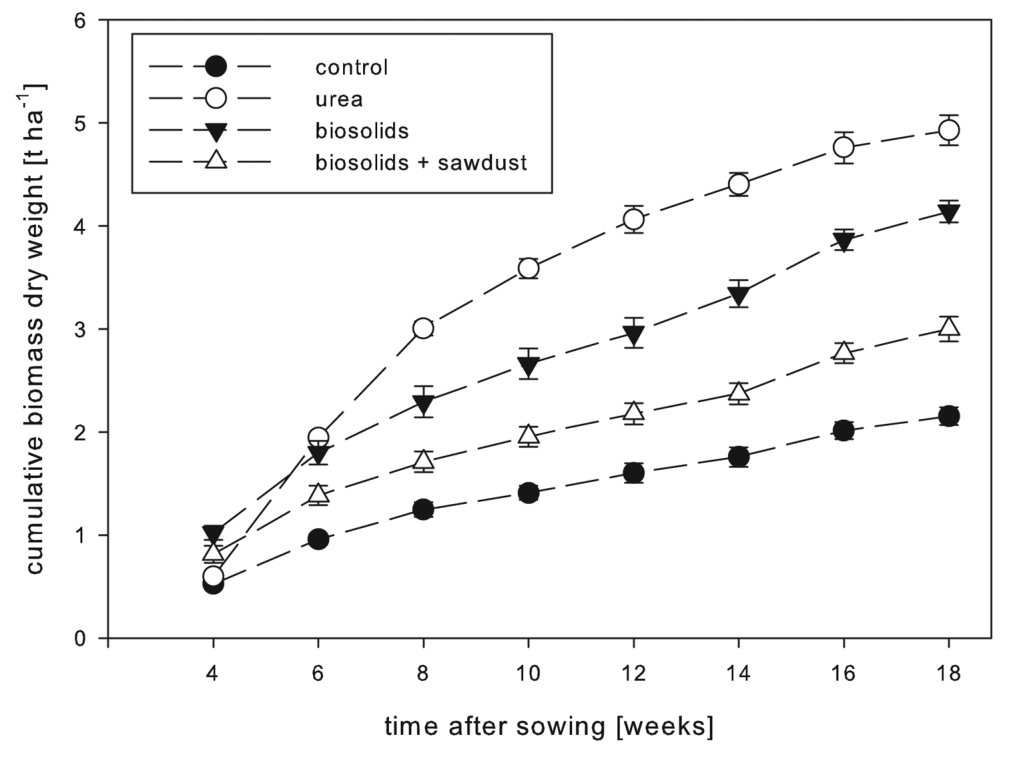
Figure 1 shows the cumulative pasture biomass production over the 18 wk experimental period. Control treatments showed a total average of 10.56 g biomass dry weight per pot, equivalent to 2.15 t ha-1. Urea fertilization increased the cumulative biomass to 24.19 g, equivalent to 4.93 t ha-1. Biosolids application also resulted in a significant biomass response (20.32 g, equivalent to 4.14 t ha-1), while mixing sawdust with biosolids lowered the biomass growth of L. multiflorum compared to biosolids alone (14.72 g, equivalent to 3.00 t ha-1). Six weeks after sowing, significant differences were detected in the growth response of L. multiflorum as a result of different treatments ranking in order of urea > biosolids > biosolids + sawdust > control, which remained unchanged throughout the duration of the experiment.图1显示了18周试验期内牧草生物量的累积产量。对照处理的平均总生物量干重为每盆10.56 g,相当于2.15 t ha-1。施用尿素使累积生物量增至24.19 g,相当于4.93 t ha-1。施用生物固体也产生了显著的生物量响应(20.32 g,相当于4.14 t ha-1),而与单独施用生物固体相比,锯末与生物固体混合降低了L. multiflorum的生物量增长(14.72 g,相当于3.00 t ha-1)。播种6周后,不同处理下L. multiflorum的生长响应出现显著差异,排序为尿素 > 生物固体 > 生物固体 + 锯末 > 对照,并在整个试验期间保持不变。
Table 3 shows that there were significant differences macronutrient uptake between untreated control and the treatments. Biosolids addition significantly increased the concentrations of P and S, but surprisingly not N, relative to the control. Biosolids decreased plant K concentration. Biosolids + sawdust increased both N and P. Urea application only caused a significant increase in N and caused significant decreases in P, K and S.表3显示,未处理对照与各处理之间的大量营养元素吸收存在显著差异。与对照相比,施用生物固体显著提高了P和S浓度,但出人意料的是N浓度未显著提高。生物固体降低了植物K浓度。生物固体 + 锯末同时提高了N和P。施用尿素仅使N显著增加,而使P、K和S显著降低。
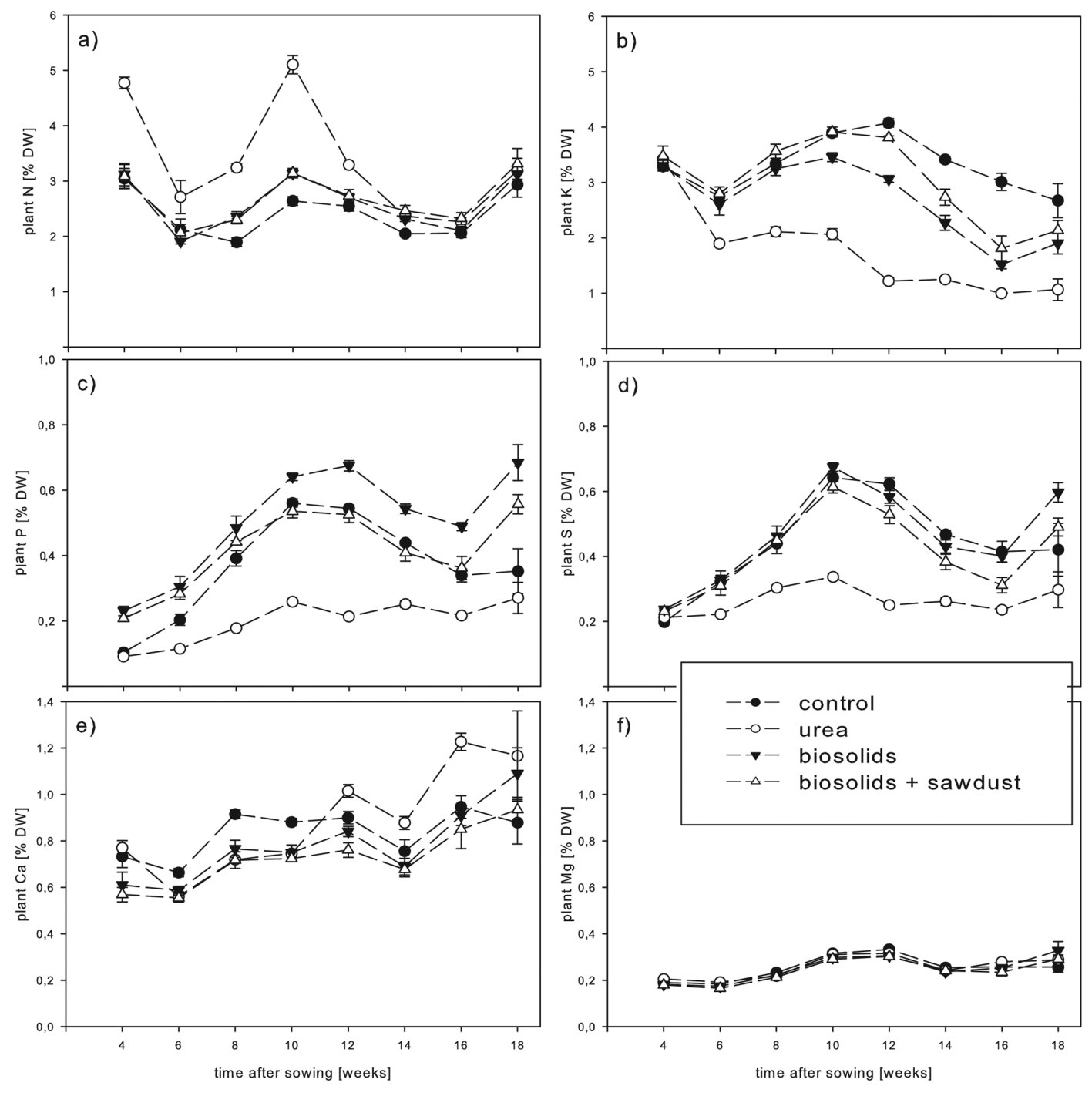
Within treatments, there were significant differences in the uptake of K, P, and S over the experimental period (Fig. 2). Whereas K concentration in the plant biomass showed a decreasing trend in all treatments (Fig. 2b), the highest concentrations of P and S were detected in plant biomass harvested 10 and 12 wk after sowing, as well as at the end of the experiment (Fig. 2c and 2d). For the control, biosolids, and biosolids + sawdust treatments, the N concentration varied between 2 and 3% throughout the experimental period. Concentrations of N were between 3 and 5% during the experiment in urea treatments, with distinct peaks in the initial harvest and at the 10-wk harvest, whereas N concentrations in control, biosolids and biosolids + sawdust treatments ranged between 2 and 3% (Fig. 2a). Plant P at individual harvest time points was negatively correlated with the corresponding biomass in the biosolids and biosolids + sawdust treatments (r = −0.97, p ≤ 0.001; r = −0.89, p ≤ 0.01), as well as plant S (r = −0.88, p ≤ 0.01; r = −0.78, p ≤ 0.05, data not shown).
在同一处理内,K、P和S的吸收在试验期间存在显著差异(图2)。所有处理中植物生物量K浓度均呈下降趋势(图2b),而P和S的最高浓度出现在播种后第10周和第12周收获的植物生物量中以及试验结束时(图2c和2d)。对照、生物固体和生物固体 + 锯末处理的N浓度在整个试验期间介于2%~3%之间。尿素处理的N浓度在试验期间介于3%~5%之间,并在首次收获和第10周收获时出现明显峰值,而对照、生物固体和生物固体 + 锯末处理的N浓度介于2%~3%之间(图2a)。在生物固体和生物固体 + 锯末处理中,各收获时间点的植物P与相应生物量呈负相关(r = −0.97,p ≤ 0.001;r = −0.89,p ≤ 0.01),植物S亦然(r = −0.88,p ≤ 0.01;r = −0.78,p ≤ 0.05,数据未列出)。
The application of biosolids and biosolids + sawdust increased the average plant Zn concentrations up to nine- and sixfold, respectively. Foliar Cu concentrations were increased by up to 50% in the biosolids, and 70% in the biosolids + sawdust treatments (Table 4). Average concentrations of Mn were increased by approximately 50% after biosolids application compared to control treatments. Plant Cd concentrations in the biosolids treatment were approximately eightfold higher than the control and urea treatments. This increase was only a fivefold increase in the biosolids + sawdust treatment. Urea application did not cause significant differences in average foliar concentration of any trace element.
施用生物固体和生物固体 + 锯末使植物平均Zn浓度分别提高至多9倍和6倍。叶片Cu浓度在生物固体处理中提高至多50%,在生物固体 + 锯末处理中提高至多70%(表4)。与对照相比,施用生物固体后Mn平均浓度提高约50%。生物固体处理的植物Cd浓度约为对照和尿素处理的8倍,而在生物固体 + 锯末处理中仅为5倍。施用尿素未使任何微量元素的叶片平均浓度产生显著差异。
biomass production of 2.2 and 8.7 t ha-1, depending on the growth period, reported for ‘Feast II’ (Hanson et al., 2006; Moir et al., 2013). Smith and Tibbett (2004) reported annual biomass production of 1.7, 2.0, and 2.4 t ha-1 in pastures receiving 4, 8, and 16 t ha-1 of dried biosolids, which is somewhat lower than our study equating to approximately 50 t ha-1 of dried biosolids. Biosolids and biosolids + sawdust hence were effective in increasing plant growth on a low-fertility soil. The results indicate that mixing sawdust with biosolids significantly reduced the growth increase compared to biosolids alone and that neither biosolids nor biosolids + sawdust was as effective as urea in increasing biomass. The lower biomass production of the biosolids + sawdust treatment compared to the biosolids-alone treatment is consistent with sawdust immobilizing N. While the average N concentration in the biosolids + sawdust was not significantly lower than the biosolids-alone treatment (Table 3), the mass that was extracted (biomass × N concentration) was significantly higher for the biosolids alone treatment.
生物量产量(2.2和8.7 t ha-1,取决于生长期),该数据报道于‘Feast II’(Hanson et al., 2006; Moir et al., 2013)。Smith和Tibbett(2004)报道,施用4、8和16 t ha-1干生物固体的牧场年生物量产量分别为1.7、2.0和2.4 t ha-1,略低于本研究(相当于约50 t ha-1干生物固体)。因此,生物固体和生物固体 + 锯末可有效促进低肥力土壤上的植物生长。结果表明,与单独施用生物固体相比,锯末与生物固体混合显著减小了生长增幅,且生物固体和生物固体 + 锯末在提高生物量方面均不如尿素有效。生物固体 + 锯末处理的生物量低于单独施用生物固体处理,这与锯末固定N的作用相一致。尽管生物固体 + 锯末处理的平均N浓度并不显著低于单独施用生物固体处理(表3),但单独施用生物固体处理的吸收量(生物量 × N浓度)显著更高。
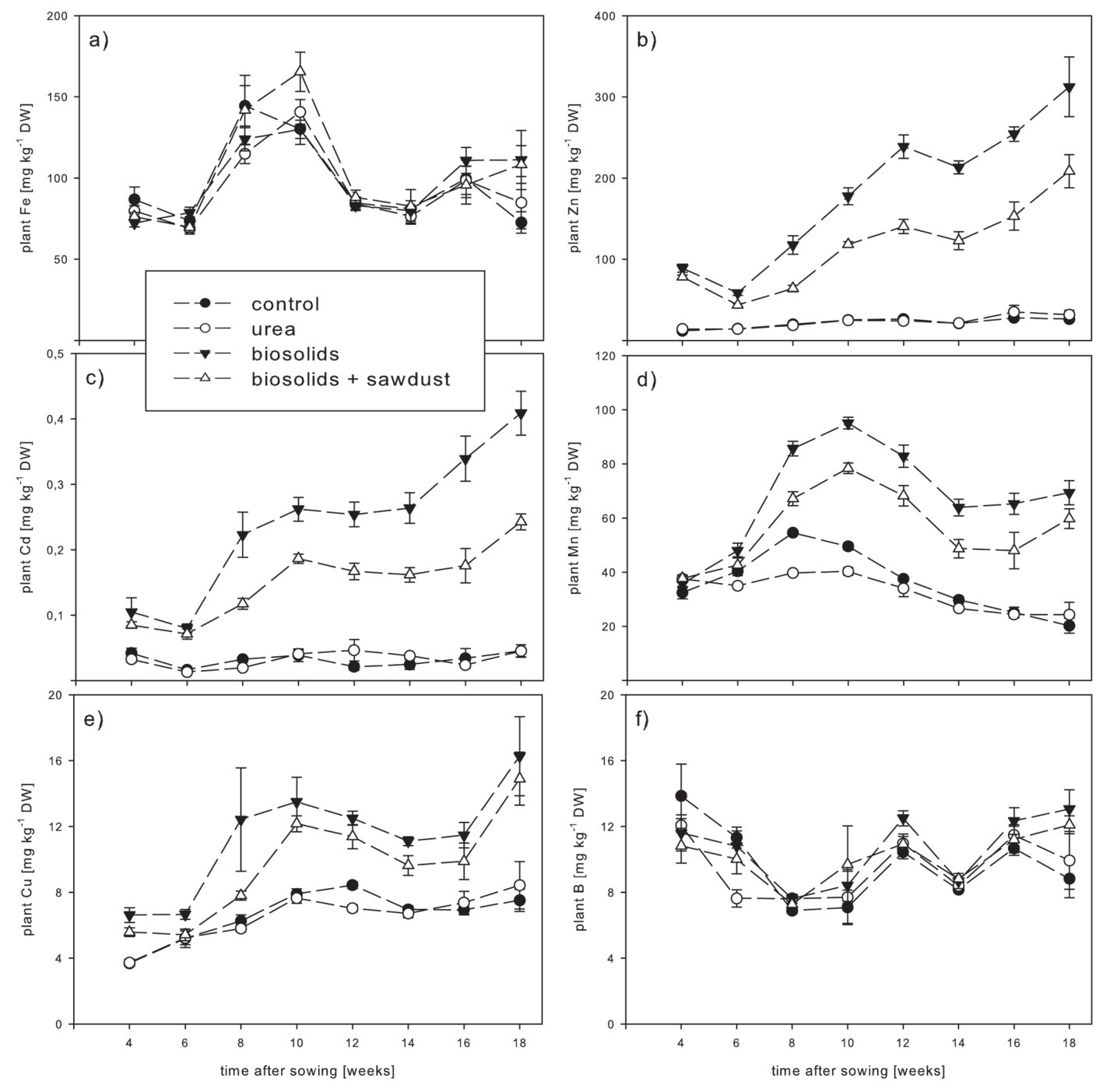
As with the macronutrients, there was significant variation in the uptake of trace elements over the 18-wk experimental period (Fig. 3). In the biosolids and biosolids + sawdust treatments, the concentrations of Zn, Cd and Cu increased throughout the experimental period (Fig. 3b, 3c, and 3e). In contrast, there was little difference in the Cu concentration between biosolids and biosolids + sawdust treatments (Fig. 3e). For Cd and Zn, the difference between the biosolids and the biosolids + sawdust treatment increased over time (Fig. 3b and 3c). Between the 6- and 8-wk harvests, the results showed a pronounced increase in the elemental concentrations of Fe, Cd, Mn and Cu, especially in biosolids treatments.
与大量营养元素一样,微量元素的吸收在18周试验期间也存在显著变化(图3)。在生物固体和生物固体 + 锯末处理中,Zn、Cd和Cu的浓度在整个试验期间持续升高(图3b、3c和3e)。相比之下,生物固体与生物固体 + 锯末处理之间的Cu浓度差异很小(图3e)。对于Cd和Zn,生物固体与生物固体 + 锯末处理之间的差异随时间推移而增大(图3b和3c)。在第6周和第8周收获之间,Fe、Cd、Mn和Cu的元素浓度明显升高,在生物固体处理中尤为明显。
4Discussion讨论
The total biomass production (2–5 t ha-1 equivalent) of L. multiflorum over 18 spring and summer weeks under biosolids and biosolids + sawdust treatments is comparable to the average
在生物固体和生物固体 + 锯末处理下,L. multiflorum在18个春夏周内的总生物量产量(相当于2–5 t ha-1)与平均
In the control treatment, the N concentration in our study was in a similar range of the value reported for annual ryegrass (L. multiflorum) in a study comparing different grass species under different rates of N loading (Moir et al., 2013). That the urea treatment (N) resulted in a greater increase in biomass than either of the biosolids treatments (N plus a suite of other plant nutrients) indicates that other components in the biosolids, such as heavy metals, reduced the effectiveness of the added N. In the biosolids and biosolids + sawdust treatments, only a limited amount of the total N applied with biosolids (1250 kg ha-1) was immediately plant available. Most of the N in biosolids is locked up in organic compounds which need to undergo (microbial) transformation processes to become available (Sommers, 1977).
在对照处理中,本研究的N浓度与一项比较不同氮负荷水平下不同草种的研究中所报道的一年生黑麦草(L. multiflorum)数值范围相近(Moir et al., 2013)。尿素处理(N)比两种生物固体处理(N加上一系列其他植物养分)带来更大的生物量增幅,这表明生物固体中的其他组分(如重金属)降低了所添加N的效果。在生物固体和生物固体 + 锯末处理中,随生物固体施入的总N(1250 kg ha-1)中仅有有限部分可被植物立即利用。生物固体中的大部分N固定在有机化合物中,需要经历(微生物)转化过程才能变为有效态(Sommers, 1977)。
| Control对照 | Urea尿素 | Biosolids生物固体 | Biosolids + sawdust生物固体 + 锯末 | |
|---|---|---|---|---|
| ------------------------------------------ | ------------------------------------ % w | /w ----------------------------------------- | ------------------------------------- | |
| N | 2.39 (0.04) a† | 3.35 (0.09) c | 2.56 (0.05) ab | 2.63 (0.12) b |
| P | 0.30 (0.01) b | 0.17 (0.00) a | 0.43 (0.02) d | 0.35 (0.02) c |
| K | 3.21 (0.03) c | 1.93 (0.02) a | 2.73 (0.06) b | 3.00 (0.12) c |
| S | 0.38 (0.01) bc | 0.26 (0.00) a | 0.40 (0.01) c | 0.35 (0.02) b |
| Ca | 0.80 (0.01) c | 0.77 (0.02) bc | 0.73 (0.01) b | 0.66 (0.02) a |
| Mg | 0.23 (0.00) a | 0.24 (0.01) bc | 0.23 (0.00) b | 0.21 (0.01) a |
With the exception of N, the concentrations of macronutrients in our study were similar to those reported for perennial ryegrass (Harrington et al., 2006). Even though urea significantly increased the biomass, the concentrations of other essential macronutrients, namely P, S and K were significantly lower in the urea treatment, indicating that these elements were not limiting in the control soil. These elements dropped to near-deficient concentrations (McNaught, 1970) in the urea treatment, possible due to a dilution-by-growth effect. The biosolids + sawdust treatment (Table 3) showed that the concentrations of K, P, and S were higher than the critical deficiency threshold concentrations (28, 2.1, and 1.8 g kg-1, respectively) reported for perennial ryegrass (L. perenne) (McNaught, 1970; Smith et al., 1985). This is consistent with using biosolids and biosolids + sawdust not only to improve plant growth, but also to enhance plant nutrient uptake in a low fertility environment. The concentration of plant K decreased throughout the experimental period, which could
除N外,本研究中大量营养元素的浓度与多年生黑麦草的报道值相近(Harrington et al., 2006)。尽管尿素显著提高了生物量,但尿素处理中其他必需大量营养元素(即P、S和K)的浓度显著较低,表明这些元素在对照土壤中并非限制因子。在尿素处理中,这些元素降至接近缺乏的浓度(McNaught, 1970),这可能是由生长稀释效应所致。生物固体 + 锯末处理(表3)中K、P和S的浓度高于多年生黑麦草(L. perenne)的临界缺乏阈值浓度(分别为28、2.1和1.8 g kg-1)(McNaught, 1970; Smith et al., 1985)。这表明,在低肥力环境中施用生物固体和生物固体 + 锯末不仅可促进植物生长,还可提高植物养分吸收。植物K浓度在整个试验期间持续下降,这可能
† Different lowercase letters indicate significant differences between treatments at p ≤ 0.05.
† 不同小写字母表示处理间在p ≤ 0.05水平差异显著。
| Control对照 | Urea尿素 | Biosolids生物固体 | Biosolids + sawdust生物固体 + 锯末 | |
|---|---|---|---|---|
| ----------------------------------------------- | ----------------------- mg kg- | 1dry wt. -------------------------- | -------------------------------------------- | |
| B | 11.4 (1.0) b† | 8.9 (0.3) a | 10.5 (0.3) ab | 9.9 (0.8) ab |
| Cu | 5.9 (0.1) a | 6.0 (0.2) a | 10.3 (0.6) c | 8.7 (0.4) b |
| Zn | 21.6 (2.3) a | 19.8 (0.7) a | 150.4 (8.3) c | 91.7 (3.7) b |
| Mn | 37.4 (1.0) a | 35.2 (0.8) a | 60.2 (1.7) c | 51.0 (2.4) b |
| Fe | 96.0 (3.9) a | 105.8 (13.6) a | 118.7 (14.4) a | 105.5 (7.1) a |
| Cd | 0.03 (0.01) ab | 0.02 (0.00) a | 0.26 (0.06) c | 0.13 (0.00) b |
† Different lowercase letters indicate significant differences between treatments at p ≤ 0.05.
† 不同小写字母表示处理间在p ≤ 0.05水平差异显著。
be attributed to a limited supply of K from the initial soil, as well as biosolids and biosolids + sawdust treatments (Table 2).
归因于初始土壤以及生物固体和生物固体 + 锯末处理中K的供应有限(表2)。
Lolium multiflorum growing in the biosolids and biosolids + sawdust treatments had significantly higher concentrations of Cd, Cu and Zn compared to control and urea treatments. Mixing sawdust with biosolids significantly decreased the Cd and Zn concentrations compared to the biosolids treatment. Clearly, this is beneficial in the case of Cd; sawdust addition can reduce the entry of this toxic element into fodder and food plants. In our study, Cd concentrations were within the range of acceptable daily intake of Cd concentration based on both food standards of New Zealand (≤1.25 mg kg-1 for kidney and ≤2.5 mg kg-1 for liver) and the European Union (≤1.0 mg kg-1 for kidney and ≤0.5 mg kg-1 for liver) (Reiser et al., 2014). The average Cd concentrations in our study (Table 3) were lower compared to others studies where biosolids had been used as a soil conditioner at similar rates (Antoniadis and Alloway, 2001; Black et al., 2012).
与对照和尿素处理相比,生长在生物固体和生物固体 + 锯末处理中的Lolium multiflorum具有显著更高的Cd、Cu和Zn浓度。与生物固体处理相比,锯末与生物固体混合显著降低了Cd和Zn浓度。显然,这对Cd而言是有益的:添加锯末可减少这一有毒元素进入饲料和粮食作物。在本研究中,Cd浓度处于基于新西兰食品标准(肾脏≤1.25 mg kg-1,肝脏≤2.5 mg kg-1)和欧盟标准(肾脏≤1.0 mg kg-1,肝脏≤0.5 mg kg-1)的Cd每日可接受摄入量范围内(Reiser et al., 2014)。本研究中的平均Cd浓度(表3)低于其他以相近施用量将生物固体用作土壤调理剂的研究(Antoniadis and Alloway, 2001; Black et al., 2012)。
Some of the negative effects of elevated Cd may be offset by the elevated Zn concentrations (Oliver et al., 1994; Khoshgoftar et al., 2004; Reiser et al., 2014). Since Cd is absorbed by the root Zn transporter, a low supply of plant available Zn promotes Cd accumulation by plants (Khoshgoftar et al., 2004). Applying Zn fertilizer inhibits Cd uptake and translocation, especially in soils with low plant available Zn (Oliver et al., 1994). Khoshgoftar et al. (2004) reported that when Zn fertilizer was applied in a greenhouse experiment, Zn concentration in wheat shoot increased from 26 to 56 mg kg-1, and Cd concentration was reduced from 0.90 to 0.09 mg kg-1. In our study, foliar Zn concentrations were similar to the 129 to 390 mg kg-1 range reported by Santibanez et al. (2008) and Torri and Lavado (2009), who used higher rates of biosolids addition (150–400 t ha-1) for perennial ryegrass. Biomass Zn concentrations in L. multiflorum in this study were higher than those reported for similar or lower rates of biosolids addition in combination with L. perenne (Antoniadis and Alloway, 2001; Ahumada et al., 2009; Black et al., 2012), hence they could have offset Cd uptake into plant biomass. The high Zn concentrations in our study can be explained by the relatively high Zn content in the used biosolids, as well as the mildly to moderately acidic nature of the soil and biosolids respectively (Table 1). The Zn concentrations in L. multiflorum in the biosolids treatment were within the range that Anderson et al. (2012) reported to cause a beneficial increase in blood Zn concentrations in sheep.
Cd升高带来的部分负面影响可能被升高的Zn浓度所抵消(Oliver et al., 1994; Khoshgoftar et al., 2004; Reiser et al., 2014)。由于Cd经根系Zn转运蛋白吸收,植物有效态Zn供应不足会促进植物对Cd的积累(Khoshgoftar et al., 2004)。施用Zn肥可抑制Cd的吸收和转运,在植物有效态Zn较低的土壤中尤为明显(Oliver et al., 1994)。Khoshgoftar et al.(2004)报道,在温室试验中施用Zn肥后,小麦地上部Zn浓度由26 mg kg-1增至56 mg kg-1,Cd浓度则由0.90 mg kg-1降至0.09 mg kg-1。本研究中叶片Zn浓度与Santibanez et al.(2008)和Torri and Lavado(2009)报道的129~390 mg kg-1范围相近,而这些研究对多年生黑麦草使用了更高的生物固体施用量(150–400 t ha-1)。本研究中L. multiflorum生物量的Zn浓度高于在相近或更低生物固体施用量下L. perenne的报道值(Antoniadis and Alloway, 2001; Ahumada et al., 2009; Black et al., 2012),因此可能抵消了植物生物量对Cd的吸收。本研究中较高的Zn浓度可由所用生物固体中相对较高的Zn含量,以及土壤和生物固体分别呈弱酸性和中等酸性(表1)来解释。生物固体处理中L. multiflorum的Zn浓度处于Anderson et al.(2012)所报道的可使绵羊血液Zn浓度有益升高的范围内。
Although Cd and Zn were significantly higher in biosolids compared to biosolids + sawdust, plant Cu concentrations in plant biomass increased after mixing biosolids with sawdust compared to pure biosolids application. Copper deficiency is a widespread problem in all agricultural systems (Sinclair and Edwards, 2008; White and Broadley, 2009); thus increasing Cu uptake by plants by mixing biosolids with sawdust can provide agricultural benefits. However, the Cu concentration in our study were generally lower than those reported for L. perenne (Antoniadis and Alloway, 2001; Ahumada et al., 2009; Black et al., 2012). Urea application caused significant differences in uptake of B, Cu, and Zn, however, the differences were small and unlikely to be of agricultural significance.
尽管生物固体处理中的Cd和Zn显著高于生物固体 + 锯末处理,但与单独施用生物固体相比,生物固体与锯末混合后植物生物量中的Cu浓度有所提高。缺Cu是所有农业系统中普遍存在的问题(Sinclair and Edwards, 2008; White and Broadley, 2009);因此,通过将生物固体与锯末混合来提高植物对Cu的吸收可带来农业效益。然而,本研究中的Cu浓度总体上低于L. perenne的报道值(Antoniadis and Alloway, 2001; Ahumada et al., 2009; Black et al., 2012)。施用尿素使B、Cu和Zn的吸收产生显著差异,但差异较小,不太可能具有农业意义。
During the experimental period, an accumulation of Zn, Cd and Cu was observed in L. multiflorum biomass. An increase of these elements at the end of the growing season may be related to decreased metabolic processes and smaller changes in the plant biomass, as suggested in studies investigating seasonal variations in trace metal uptake by Phragmites australis (Kastratović et al., 2013; Eid and Shaltout, 2014). This is consistent with the results obtained from total biomass harvests (Fig. 1), which show only a small growth increase toward end of the experiment. In the biosolids + sawdust treatment, Cd and Zn concentrations increased at a lower rate compared to the biosolids treatments, indicating that sawdust reduced the mobility of these elements. It was likely that the sawdust started to decompose during the experiment, resulting in increased metal sorption. Kostov et al. (1991) showed that the C/N ratio of Picea excelsa sawdust decreased from 251 to 62 only 6 mo after treatment with nutrient solution. Sawdust decomposition could explain the greater difference between the biosolids + sawdust treatment and biosolids treatments at the end of the experiment compared to the harvests before 6 wk, where difference were minimal.
在试验期间,观察到Zn、Cd和Cu在L. multiflorum生物量中积累。生长季末这些元素的增加可能与代谢过程减弱和植物生物量变化较小有关,正如研究Phragmites australis微量金属吸收季节变化的研究所指出的(Kastratović et al., 2013; Eid and Shaltout, 2014)。这与总生物量收获结果(图1)一致,后者显示试验后期生长增幅较小。在生物固体 + 锯末处理中,Cd和Zn浓度的增加速率低于生物固体处理,表明锯末降低了这些元素的移动性。锯末很可能在试验期间开始分解,从而增加了对金属的吸附。Kostov et al.(1991)表明,Picea excelsa锯末经营养液处理仅6个月后,其C/N比即由251降至62。锯末分解可以解释为何试验结束时生物固体 + 锯末处理与生物固体处理之间的差异大于第6周之前的收获(当时差异极小)。
The application of biosolids and biosolids mixed with sawdust improved the growth of L. multiflorum on a low-fertility soil, while the biowaste mixture (biosolids + sawdust) was less effective in restoring fertility compared to biosolids alone. Although less growth promoting, the advantage of using sawdust was seen in a reduction of the Cd uptake by the plants. There were significant changes in the elemental composition of the pasture over time, with the differences between the biosolids and biosolids + sawdust treatments increasing over time to favorable agronomic levels. Our results indicate that a single harvest of pasture can be insufficient to determine the effect of a soil treatment on element uptake, since results highly vary with environmental conditions, plant growth, and metabolism. Future work could involve a field study to reveal the effect of sawdust decomposition on the longterm fertility of soils amended with a mixture of biowastes.
施用生物固体以及生物固体与锯末的混合物改善了低肥力土壤上L. multiflorum的生长,但与单独施用生物固体相比,生物废弃物混合物(生物固体 + 锯末)在恢复土壤肥力方面效果较差。尽管促生长作用较弱,但使用锯末的优势体现在降低了植物对Cd的吸收。牧草的元素组成随时间发生了显著变化,生物固体与生物固体 + 锯末处理之间的差异随时间增大,并达到有利的农艺水平。结果表明,由于结果随环境条件、植物生长和代谢而变化很大,单次牧草收获可能不足以确定土壤处理对元素吸收的影响。未来工作可开展田间研究,以揭示锯末分解对施用生物废弃物混合物土壤长期肥力的影响。
5Acknowledgments致谢
The study was financially supported by the Deutsche Forschungsgemeinschaft (DFG, ES 416/1-1), the Center for Integrated Biowaste Research (CIBR) as well as Plant and Food Research (Blueskies). We highly appreciate H. Lowe (Lowe Environmental Impact) for providing and assisting with soil and soil collection, and acknowledge Lincoln University, especially L. Clucas, B. Richards, D. Paramashivan, S. Mammun, Y. Kim, T. Zhongtao, N. Stief, Y. Yang and H. Franklin for their support in sample analyses and maintaining the experiment.
本研究得到Deutsche Forschungsgemeinschaft(DFG, ES 416/1-1)、Center for Integrated Biowaste Research(CIBR)以及Plant and Food Research(Blueskies)的资助。衷心感谢H. Lowe(Lowe Environmental Impact)提供并协助采集土壤,并感谢Lincoln University,特别是L. Clucas、B. Richards、D. Paramashivan、S. Mammun、Y. Kim、T. Zhongtao、N. Stief、Y. Yang和H. Franklin在样品分析和试验维护方面给予的支持。
6References参考文献
Agopsowicz, M., A. Bialowiec, and P. Pijarczyk. 2008. Sewage sludge land disposal effects on groundwater. Archives of Environmental Protection 34:73–82.
Ahumada, I., O. Gudenschwager, M.A. Carrasco, G. Castillo, L. Ascar, and P. Richter. 2009. Copper and zinc bioavailabilities to ryegrass (Lolium perenne L.) and subterranean clover (Trifolium subterraneum L.) grown in biosolid treated Chilean soils. J. Environ. Manage. 90:2665–2671. doi:10.1016/j.jenvman.2009.02.004
Ajmal, M., K.A. Hussain, S. Ahmad, and A. Ahmad. 1998. Role of sawdust in the removal of copper(II) from industrial wastes. Water Res. 32:3085–3091. doi:10.1016/S0043-1354(98)00067-0
Anderson, C.W.N., B.H. Robinson, D.M. West, L. Clucas, and D. Portmann. 2012. Zinc-enriched and zinc-biofortified feed as a possible animal remedy in pastoral agriculture: Animal health and environmental benefits. J. Geochem. Explor. 121:30–35. doi:10.1016/j.gexplo.2012.01.009
Antolín, M.C., I. Pascual, C. García, A. Polo, and M. Sánchez-Díaz. 2005. Growth, yield and solute content of barley in soils treated with sewage sludge under semiarid Mediterranean conditions. Field Crops Res. 94:224–237. doi:10.1016/j.fcr.2005.01.009
Antoniadis, V., and B.J. Alloway. 2001. Availability of Cd, Ni and Zn to Ryegrass in Sewage Sludge-Treated Soils at Different Temperatures. Water Air Soil Pollut. 132:201–214. doi:10.1023/A:1013202104550 Bai, Y., C. Gu, T. Tao, L. Wang, K. Feng, and Y. Shan. 2013. Growth characteristics, nutrient uptake, and metal accumulation of ryegrass (Lolium perenne L.) in sludge-amended mudflats. Acta Agriculturae Scandinavica Section B, Soil and Plant Science 63:352–359. doi:10.1080/09064710.2013.782 424
Black, A., R.G. McLaren, S.M. Reichman, T.W. Speir, L.M. Condron, and G. Houliston. 2012. Metal bioavailability dynamics during a two-year trial using ryegrass (Lolium perenne L.) grown in soils treated with biosolids and metal salts. Soil Res. 50:304–311. doi:10.1071/SR11315
Bugbee, G.J. 1999. Effects of hardwood sawdust in potting media containing biosolids compost on plant growth, fertilizer needs, and nitrogen leaching. Commun. Soil Sci. Plant Anal. 30:689–698. doi:10.1080/00103629909370238
Bulut, Y., and Z. Tez. 2007. Removal of heavy metals from aqueous solution by sawdust adsorption. J. Environ. Sci. (China) 19:160–166. doi:10.1016/ S1001-0742(07)60026-6 Crush, J.R., U. Sarathchandra, and A. Donnison. 2006. Effect of plant growth on dehydration rates and microbial populations in sewage biosolids. Bioresour. Technol. 97:2447–2452. doi:10.1016/j.biortech.2005.04.019
Cytryn, E., L. Kautsky, M. Ofek, R.T. Mandelbaum, and D. Minz. 2011. Shortterm structure and functional changes in bacterial community composition following amendment with biosolids compost. Appl. Soil Ecol. 48:160–167. doi:10.1016/j.apsoil.2011.03.010
EEC (European Economic Community). 1986. Using sewage sludge in farming. Directive 86/278, soil protection when sewage sludge is used in agriculture. 12 June 1986. European Economic Community, Brussels, Belgium.
Eid, E.M., and K.H. Shaltout. 2014. Monthly variations of trace elements accumulation and distribution in above- and below-ground biomass of Phragmites australis (Cav.) Trin. ex Steudel in Lake Burullus (Egypt): A biomonitoring application. Ecol. Eng. 73:17–25. doi:10.1016/j. ecoleng.2014.09.006
Fresquez, P., R. Francis, and G. Dennis. 1990. Sewage sludge effects on soil and plant quality in a degraded, semiarid grassland. J. Environ. Qual. 19:324– 329. doi:10.2134/jeq1990.00472425001900020020x
Hanson, R., K. Armstrong, J. de Ruiter, A. Hay, and G. Milne. 2006. Cereal forage breeding for New Zealand agriculture. In: C.F. Mercer, editor, Breeding for success: Diversity in action. 13th Australasian Plant Breeding Conference. Christchurch, New Zealand. 18–21 April 2006. p. 84–92.
Harrington, K.C., A. Thatcher, and P.D. Kemp. 2006. Mineral composition and nutritive value of some common pasture weeds. New Zealand Plant Protection 59:261–265. IBM (International Business Machines Corp.). 2013. SPSS Statistics V22.0. Armonk, NY.
Jokova, M., O. Kostov, and O. Van Cleemput. 1997. Cation exchange and reducing capacities as criteria for compost quality. Biol. Agric. Hortic. 14:187– 197. doi:10.1080/01448765.1997.9754809
Kastratović, V., S. Krivokapić, D. Đurović, and N. Blagojević. 2013. Seasonal changes in metal accumulation and distribution in the organs of Phragmites australis (common reed) from Lake Skadar, Montenegro. Journal of the Serbian Chemical Society 78:1241–1258. doi:10.2298/JSC121026153K Khoshgoftar, A., H. Shariatmadari, N. Karimian, M. Kalbasi, S. Van der Zee, and D. Parker. 2004. Salinity and zinc application effects on phytoavailability of cadmium and zinc. Soil Sci. Soc. Am. J. 68:1885–1889. doi:10.2136/ sssaj2004.1885
Knowles, O.A., B.H. Robinson, A. Contangelo, and L. Clucas. 2011. Biochar for the mitigation of nitrate leaching from soil amended with biosolids. Sci. Total Environ. 409:3206–3210. doi:10.1016/j.scitotenv.2011.05.011 Kostov, O., V. Rankov, G. Atanacova, and J.M. Lynch. 1991. Decomposition of sawdust and bark treated with cellulose-decomposing microorganisms. Biol. Fertil. Soils 11:105–110. doi:10.1007/BF00336373
LeBlanc, R.J., P. Matthews, and R.P. Richard, editors. 2009. Global atlas of excreta, wastewater sludge, and biosolids management: Moving forward the sustainable and welcome uses of a global resource. United Nations Human Settlements Program, Nairobi, Kenya.
Lomonte, C., A.I. Doronila, D. Gregory, A.J.M. Baker, and S.D. Kolev. 2010. Phytotoxicity of biosolids and screening of selected plant species with potential for mercury phytoextraction. J. Hazard. Mater. 173:494–501. doi:10.1016/j.jhazmat.2009.08.112
Lopes, C., M. Herva, A. Franco-Uría, and E. Roca. 2011. Inventory of heavy metal content in organic waste applied as fertilizer in agriculture: Evaluating the risk of transfer into the food chain. Environ. Sci. Pollut. Res. Int. 18:918–939. doi:10.1007/s11356-011-0444-1 Lu, Q., Z.L. He, and P.J. Stoffella. 2012. Land application of biosolids in the USA: A review. Appl. Environ. Soil Sci. 11.
Marchetti, V., A. Clément, P. Gérardin, and B. Loubinoux. 2000. Synthesis and use of esterified sawdusts bearing carboxyl group for removal of cadmium(II) from water. Wood Sci. Technol. 34:167–173. doi:10.1007/ s002260000040
McNaught, K. 1970. Diagnosis of mineral deficiencies in grass-legume pastures by plant analysis. In: Proceedings of the 11th International Grassland Congress, Surfers Paradise, QLD, Australia. 12–23 Apr. 1970. Univ. Queensland Press, Saint Lucia, Queensland. p. 334–338.
Miaomiao, H., L. Wenhong, L. Xinqiang, W. Donglei, and T. Guangming. 2009. Effect of composting process on phytotoxicity and speciation of copper, zinc and lead in sewage sludge and swine manure. Waste Manag. 29:590– 597. doi:10.1016/j.wasman.2008.07.005 Microsoft Office. 2013. Microsoft Excel 2013. Microsoft Corporation, Redmond, WA.
Moir, J.L., G.R. Edwards, and L.N. Berry. 2013. Nitrogen uptake and leaching loss of thirteen temperate grass species under high N loading. Grass Forage Sci. 68:313–325. doi:10.1111/j.1365-2494.2012.00905.x
Mok, H.F., R. Majumder, W.S. Laidlaw, D. Gregory, A.J.M. Baker, and S.K. Arndt. 2013. Native Australian species are effective in extracting multiple heavy metals from biosolids. Int. J. Phytoremediation 15:615–632. doi:10. 1080/15226514.2012.723063
Mugica-Alvarez, V., V. Cortés-Jiménez, M. Vaca-Mier, and V. Domínguez-Soria. 2015. Phytoremediation of mine tailings using Lolium multiflorum. Intl. J. Environ. Sci. Dev. 6:246–251. doi:10.7763/IJESD.2015.V6.599
Oliver, D.P., R. Hannam, K. Tiller, N. Wilhelm, R.H. Merry, and G. Cozens. 1994. The effects of zinc fertilization on cadmium concentration in wheat grain. J. Environ. Qual. 23:705–711. doi:10.2134/ jeq1994.00472425002300040013x
Paramashivam, D., T. Clough, N. Dickinson, J. Horswell, O. Lense, L. Clucas, and B. Robinson. 2015. The effect of pine waste and pine-biochar on nitrogen mobility in biosolids. J. Environ. Qual.
Reiser, R., M. Simmler, D. Portmann, L. Clucas, R. Schulin, and B. Robinson. 2014. Cadmium concentrations in New Zealand pastures: Relationships to soil and climate variables. J. Environ. Qual. 43:917–925. doi:10.2134/ jeq2013.09.0367
Robinson, B.H., S.R. Green, B. Chancerel, T.M. Mills, and B.E. Clothier. 2007. Poplar for the phytomanagement of boron contaminated sites. Environ. Pollut. 150:225–233. doi:10.1016/j.envpol.2007.01.017
Santibanez, C., C. Verdugo, and R. Ginocchio. 2008. Phytostabilization of copper mine tailings with biosolids: Implications for metal uptake and productivity of Lolium perenne. Sci. Total Environ. 395:1–10. doi:10.1016/j. scitotenv.2007.12.033
Shahid, S.A., and A. Al-Shankiti. 2013. Sustainable food production in marginal lands—Case of GDLA member countries. Intl. Soil Water Conserv. Res. 1:24–38. doi:10.1016/S2095-6339(15)30047-2
Simmler, M., L. Ciadamidaro, R. Schulin, P. Madejoìn, R. Reiser, L. Clucas, P. Weber, and B. Robinson. 2013. Lignite reduces the solubility and plant uptake of cadmium in pasturelands. Environ. Sci. Technol. 47:4497–4504. doi:10.1021/es303118a
Sinclair, A., and A. Edwards. 2008. Micronutrient deficiency problems in agricultural crops in Europe. In: B. Alloway, editor, Micronutrient deficiencies in global crop production. Springer, the Netherlands. p. 225–244. Singh, R.P., and M. Agrawal. 2008. Potential benefits and risks of land application of sewage sludge. Waste Manag. 28:347–358. doi:10.1016/j. wasman.2006.12.010
Smith, G.S., I.S. Cornforth, and H.V. Henderson. 1985. Critical leaf concentrations for deficiencies of nitrogen, potassium, phosphorus, sulphur, and magnesium in perennial ryegrass. New Phytol. 101:393–409. doi:10.1111/j.1469-8137.1985.tb02846.x
Smith, M.T.E., and M. Tibbett. 2004. Nitrogen dynamics under Lolium perenne after a single application of three different sewage sludge types from the same treatment stream. Bioresour. Technol. 91:233–241. doi:10.1016/ S0960-8524(03)00205-0
Sommers, L. 1977. Chemical composition of sewage sludges and analysis of their potential use as fertilizers. J. Environ. Qual. 6:225–232. doi:10.2134/ jeq1977.00472425000600020026x
Torri, S., and R. Lavado. 2009. Plant absorption of trace elements in sludge amended soils and correlation with soil chemical speciation.
Trillas, M.I., E. Casanova, L. Cotxarrera, J. Ordovás, C. Borrero, and M. Avilés. 2006. Composts from agricultural waste and the Trichoderma asperellum strain T-34 suppress Rhizoctonia solani in cucumber seedlings. Biol. Control 39:32–38. doi:10.1016/j.biocontrol.2006.05.007
USEPA. 1993. The standards for the use or disposal of sewage sludge, Title 40 of the Federal Regulations Part 503. USEPA, Washington, DC. Vasseur, L., C. Cloutier, A. Labelle, J.N. Duff, C. Beaulieu, and C. Ansseau. 1996. Responses of indicator bacteria to forest soil amended with municipal sewage sludge from aerated and non-aerated ponds. Environ. Pollut. 92:67– 72. doi:10.1016/0269-7491(95)00079-8 White, P.J., and M.R. Broadley. 2009. Biofortification of crops with seven mineral elements often lacking in human diets–iron, zinc, copper, calcium, magnesium, selenium and iodine. New Phytol. 182:49–84. doi:10.1111/j.1469-8137.2008.02738.x
Yu, B., Y. Zhang, A. Shukla, S.S. Shukla, and K.L. Dorris. 2000. The removal of heavy metal from aqueous solutions by sawdust adsorption: removal of copper. J. Hazard. Mater. 80:33–42. doi:10.1016/S0304-3894(00)00278-8
Zaleski, K.J., K.L. Josephson, C.P. Gerba, and I.L. Pepper. 2005. Potential regrowth and recolonization of salmonellae and indicators in biosolids and biosolid-amended soil. Appl. Environ. Microbiol. 71:3701–3708. doi:10.1128/AEM.71.7.3701-3708.2005
NZWWA (New Zealand Water and Wastewater Association). 2003. Guidelines for the safe application of biosolids to land in New Zealand. Ministry for the Environment, New Zealand Water and Wastewater Association, Wellington, New Zealand.