Journal of Environmental Quality
WASTE MANAGEMENT
Production of Biomass Crops Using Biowastes on Low-Fertility Soil: 2. Effect of Biowastes on Nitrogen Transformation Processes
J. Esperschuetz, S. Bulman, C. Anderson, O. Lense, J. Horswell, N. Dickinson, and B. H. Robinson*
1Abstract摘要
Increasing production of biowastes, particularly biosolids (sewage sludge), requires sustainable management strategies for their disposal. Biosolids can contain high concentrations of nutrients; hence, land application can have positive effects on plant growth and soil fertility, especially when applied to degraded soils. However, high rates of biosolids application may result in excessive nitrogen (N) leaching, which can be mitigated by blending biosolids with other biowastes, such as sawdust. We aimed to determine the effects of biosolids and sawdust on growth and N uptake by sorghum, rapeseed, and ryegrass as well as N losses via leaching. Plants were grown in a greenhouse over a 5-mo period in a low-fertility soil amended with biosolids (1250 kg N ha-1), biosolids-sawdust (0.5:1), or urea (200 kg N ha-1). Urea application increased biomass production of sorghum and ryegrass but proved insufficient for rapeseed on low-fertility soil. Biosolids application increased plant N concentrations in ryegrass and rapeseed and increased N uptake into the seeds of sorghum, increasing seed quality. Biosolids application did result in lower N leaching compared with urea, irrespective of plant species, and N leaching was unaffected by mixing the biosolids with sawdust. There was an indication of biological nitrification inhibition in the rhizosphere of sorghum. Rapeseed had similar growth and N uptake into biomass in biosolids and biosolids-sawdust treatments and hence was the most promising species with regard to recycling fresh sawdust in combination with high rates of biosolids on low-fertility soil.
生物废弃物,尤其是生物固体(污泥)的产量不断增加,亟需可持续的处置管理策略。生物固体可含有高浓度养分,因此土地施用可对植物生长和土壤肥力产生积极影响,施用于退化土壤时尤为明显。然而,高施用量的生物固体可能导致过量的氮(N)淋溶,将生物固体与锯末等其他生物废弃物混合可缓解这一问题。本研究旨在确定生物固体和锯末对高粱、油菜和黑麦草生长及N吸收的影响,以及对N淋溶损失的影响。植物在温室中生长5个月,所用低肥力土壤分别添加生物固体(1250 kg N ha-1)、生物固体-锯末(0.5:1)或尿素(200 kg N ha-1)。施用尿素提高了高粱和黑麦草的生物量,但在低肥力土壤上不足以满足油菜生长。施用生物固体提高了黑麦草和油菜植株的N浓度,并增加了高粱籽粒对N的吸收,从而改善了籽粒品质。无论植物种类如何,与尿素相比,施用生物固体的N淋溶量均较低,且生物固体与锯末混合对N淋溶无影响。高粱根际存在生物硝化抑制的迹象。油菜在生物固体和生物固体-锯末处理中的生长及生物量N吸收相近,因此在低肥力土壤上将新鲜锯末与高施用量生物固体配合回收利用方面,油菜是最具前景的物种。
Core Ideas核心观点
- Mixing sawdust with biosolids did not reduce NO3− leaching irrespective of plant species.无论植物种类如何,锯末与生物固体混合均未减少NO3−淋溶。
- Compared with urea, biosolids application did not result in higher N loss via leaching.与尿素相比,施用生物固体未导致更高的N淋溶损失。
• Results indicated biological nitrification inhibition of sorghum.
• 结果表明高粱具有生物硝化抑制作用。
orldwide, biowaste production is increasing because of a rising population, agricul- Wtural intensification, and the need for improved food production (Río et al., 2011). Biowastes include crop residues, wood wastes, animal manures, food processing waste, and waste from municipal sewage treatment plants. Sustainable management strategies for disposal and recycling are required to reduce costs and negative environmental outcomes of landfill deposition (Amajirionwu et al., 2008). For some of these wastes, especially animal manure and biosolids (treated or stabilized sewage sludge), application to agricultural land is widely practiced and has shown positive effects on soil fertility and plant biomass (Miaomiao et al., 2009; Mok et al., 2013), along with improvements in soil chemical, physical, biological, and microbial properties (Cytryn et al., 2011; Rogers and Smith, 2007; Singh and Agrawal, 2008).
在全球范围内,由于人口增长、农业集约化以及提高粮食产量的需求,生物废弃物的产量不断增加(Río et al., 2011)。生物废弃物包括作物残体、木材废料、动物粪便、食品加工废弃物以及城市污水处理厂的废弃物。为降低填埋处置的成本及其负面环境后果,需要制定可持续的处置和回收管理策略(Amajirionwu et al., 2008)。对于其中部分废弃物,尤其是动物粪便和生物固体(经处理或稳定化的污水污泥),施用于农田已被广泛采用,并显示出对土壤肥力和植物生物量的积极作用(Miaomiao et al., 2009; Mok et al., 2013),同时改善了土壤的化学、物理、生物和微生物性质(Cytryn et al., 2011; Rogers and Smith, 2007; Singh and Agrawal, 2008)。
Biosolids are rich in organic matter and can contain essential plant nutrients such as nitrogen (N), phosphorus, sulfur, and potassium (Al-Dhumri et al., 2013). Therefore, land application of biosolids can have positive effects on soil fertility and plant growth (Corrêa, 2004; Petersen et al., 2003; Smith and Durham, 2002; Westerman and Bicudo, 2005), but there are drawbacks that need to be considered because biosolids may contain elevated concentrations of heavy metals, organic contaminants, and pathogens (Bolan et al., 2014). Because of the potential risks in using biosolids for agriculture, the notion of using biosolids to rebuild degraded land has become increasingly popular (Dere et al., 2012; Mbakwe et al., 2013; Meyer et al., 2001; Oladeji et al., 2013; Speir et al., 2003; Stehouwer et al., 2006). Biosolids application may promote topsoil development and enhance the reestablishment of vegetation, especially in degraded environments (Hearing et al., 2000; Lu et al., 2012).
生物固体富含有机质,并可含有氮(N)、磷、硫和钾等植物必需养分(Al-Dhumri et al., 2013)。因此,生物固体的土地施用可对土壤肥力和植物生长产生积极影响(Corrêa, 2004; Petersen et al., 2003; Smith and Durham, 2002; Westerman and Bicudo, 2005),但也存在需要考虑的弊端,因为生物固体可能含有较高浓度的重金属、有机污染物和病原体(Bolan et al., 2014)。鉴于生物固体农用的潜在风险,利用生物固体修复退化土地的理念日益受到青睐(Dere et al., 2012; Mbakwe et al., 2013; Meyer et al., 2001; Oladeji et al., 2013; Speir et al., 2003; Stehouwer et al., 2006)。施用生物固体可促进表土发育并加速植被重建,在退化环境中尤为如此(Hearing et al., 2000; Lu et al., 2012)。
Most N in biosolids is contained within the organic matter and thus is unavailable for plant uptake and not subject to leaching (Gilmour et al., 2003; Pu et al., 2012). Only small amounts of N are present in forms of nitrate (NO3-) and ammonium (NH4+) (Eldridge et al., 2008); therefore, high rates of biosolids are necessary to establish plant growth and ecosystem function in low-fertility soils and degraded environments. However, high loads of potentially available N applied with biosolids can lead to excessive NO3- leaching, which can negatively affect waterways (Smith, 2003). Therefore, best management practices have to be followed to ensure protection of soil, food, feed, and waterways. Total and mineral N concentrations in biosolids vary with type and treatment of biosolids, which has been extensively reviewed recently by Rigby et al. (2016). Several factors have been identified influencing N transformations in biosolids-amended soil, such as biosolids type, C/N ratio, application rate, soil texture and organic matter content, soil temperature, soil moisture, and soil pH (Rigby et al., 2016).
生物固体中的大部分N存在于有机质中,因而无法被植物吸收,也不易淋溶(Gilmour et al., 2003; Pu et al., 2012)。仅有少量N以硝酸盐(NO3-)和铵(NH4+)形态存在(Eldridge et al., 2008);因此,在低肥力土壤和退化环境中,需要高施用量的生物固体才能建立植物生长和生态系统功能。然而,随生物固体施入的大量潜在有效N可能导致过量的NO3-淋溶,进而对水体产生不利影响(Smith, 2003)。因此,必须遵循最佳管理措施,以确保对土壤、食品、饲料和水体的保护。生物固体中的全氮和矿质氮浓度因生物固体类型和处理方式而异,Rigby et al. (2016)近期对此进行了全面综述。已确定影响生物固体改良土壤中N转化的若干因素,包括生物固体类型、C/N比、施用量、土壤质地和有机质含量、土壤温度、土壤湿度以及土壤pH(Rigby et al., 2016)。
Copyright © American Society of Agronomy, Crop Science Society of America, and Soil Science Society of America. 5585 Guilford Rd., Madison, WI 53711 USA. All rights reserved.
版权所有 © American Society of Agronomy, Crop Science Society of America, and Soil Science Society of America。5585 Guilford Rd., Madison, WI 53711 USA。保留所有权利。
J. Environ. Qual. 45:1970–1978 (2016) doi:10.2134/jeq2015.12.0597 Supplemental material is available online for this article. Received 8 Dec. 2015. Accepted 25 July 2016.. *Corresponding author (brett.robinson@lincoln.ac.nz).
J. Esperschuetz, O. Lense, and B.H. Robinson, Lincoln Univ., Faculty of Agriculture and Life Sciences, Dep. of Soil and Physical Sciences, PO Box 84, Lincoln 7647, New Zealand; S. Bulman, Plant and Food Research, Microbiology Division, Canterbury Agriculture and Science Center, Gerald St, Lincoln 7608, New Zealand; C. Anderson, Plant and Food Research, Soil Sciences Division, Canterbury Agriculture and Science Center, Gerald St, Lincoln 7608, New Zealand; J. Horswell, The Institute of Environmental Science and Research Limited, Kenepuru Science Centre, PO Box 50-348, Porirua 5240, New Zealand; N. Dickinson, Lincoln Univ., Faculty of Agriculture and Life Sciences, Dep. of Ecology, P O Box 84, Lincoln 7647, New Zealand. Assigned to Associate Editor Tracy Punshon.
J. Esperschuetz、O. Lense和B.H. Robinson,Lincoln Univ., Faculty of Agriculture and Life Sciences, Dep. of Soil and Physical Sciences, PO Box 84, Lincoln 7647, 新西兰;S. Bulman,Plant and Food Research, Microbiology Division, Canterbury Agriculture and Science Center, Gerald St, Lincoln 7608, 新西兰;C. Anderson,Plant and Food Research, Soil Sciences Division, Canterbury Agriculture and Science Center, Gerald St, Lincoln 7608, 新西兰;J. Horswell,The Institute of Environmental Science and Research Limited, Kenepuru Science Centre, PO Box 50-348, Porirua 5240, 新西兰;N. Dickinson,Lincoln Univ., Faculty of Agriculture and Life Sciences, Dep. of Ecology, P O Box 84, Lincoln 7647, 新西兰。责任副编辑:Tracy Punshon。
Abbreviations: BNI, biological nitrification inhibition; DW, dry weight.
缩略语:BNI,生物硝化抑制;DW,干重。
The negative effects of biosolids addition to soil can be mitigated by mixing biosolids with other biowastes. Positive results have been reported by adding biochar and wood wastes (Ammari et al., 2012; Knowles et al., 2011). Biosolids-sawdust mixtures have a beneficial effect on plant growth and soil aggregate stability while reducing NO3- leaching (Bugbee, 1999; Sandoval et al., 2012). In combination with other organic wastes, sawdust has the potential to improve the physical, chemical, and nutritional properties of soils (Paramashivam et al., 2016; Sandoval et al., 2012). Therefore, blending biowastes can enable recycling strategies that result in decreased landfill deposits. The optimal ratios of mixing other biowastes with biosolids have to be determined to avoid negative effects on plant growth (Schmidt et al., 2001).
将生物固体与其他生物废弃物混合,可缓解生物固体施入土壤的负面效应。已有研究报道添加生物炭和木材废料取得了积极效果(Ammari et al., 2012; Knowles et al., 2011)。生物固体-锯末混合物对植物生长和土壤团聚体稳定性具有有益作用,同时可减少NO3-淋溶(Bugbee, 1999; Sandoval et al., 2012)。锯末与其他有机废弃物配合使用,具有改善土壤物理、化学和养分性质的潜力(Paramashivam et al., 2016; Sandoval et al., 2012)。因此,混合生物废弃物可实现回收利用策略,从而减少填埋量。为避免对植物生长产生负面影响,需确定其他生物废弃物与生物固体的最佳混合比例(Schmidt et al., 2001)。
Rapid nitrification, the conversion of NH4+ to NO3-, can result in the inefficient use of N due to NO3- loss from agricultural systems through leaching or the emission of N2O after subsequent denitrification (Robertson and Groffman, 2015). By restricting nitrification, N retention in the soil is increased because NH4+ is less likely to be lost via leaching and denitrification (Subbarao et al., 2013). Several plant species have shown the potential to inhibit nitrification, which could further mitigate N loss from agricultural systems (Fillery, 2007; Subbarao et al., 2009, 2013). Biological nitrification inhibition (BNI) through exudation of nitrification inhibiting compounds from roots has been shown for tropical pasture plants (Subbarao et al., 2009), but biomass crop species such as sorghum (Sorghum bicolor L.) and rapeseed (Brassica napus L.) have also shown potential to inhibit nitrification (Brown and Morra, 2009; Zakir et al., 2008). Growing crops with BNI properties on biosolids-amended soils could therefore influence N transformation processes and reduce the risk of N leaching after high rates of biosolids application.
快速硝化作用,即NH4+转化为NO3-的过程,可因NO3-通过淋溶或随后反硝化产生N2O排放而从农业系统中损失,导致N利用效率低下(Robertson and Groffman, 2015)。通过限制硝化作用,NH4+不易通过淋溶和反硝化损失,从而提高了土壤中N的保留(Subbarao et al., 2013)。已有若干植物物种显示出抑制硝化作用的潜力,可进一步减少农业系统的N损失(Fillery, 2007; Subbarao et al., 2009, 2013)。热带牧草已被证明可通过根系分泌硝化抑制化合物实现生物硝化抑制(BNI)(Subbarao et al., 2009),而高粱(Sorghum bicolor L.)和油菜(Brassica napus L.)等生物量作物也显示出抑制硝化作用的潜力(Brown and Morra, 2009; Zakir et al., 2008)。因此,在生物固体改良土壤上种植具有BNI特性的作物,可影响N转化过程,并降低高施用量生物固体后的N淋溶风险。
We aimed to determine the effects of biosolids and sawdust on the growth and N uptake by sorghum, rapeseed, and ryegrass as well as N losses via leaching. Following high biosolids application rates on low fertility soil, we hypothesize that potential loss of N can be mitigated by blending biosolids with sawdust and by the selection of plant species with high N requirements or nitrification inhibition properties. The focus of this manuscript is on plant and soil N transformation processes; nutrients and trace elements are discussed in Part 1 of this study (Esperschütz et al., 2016a)
本研究旨在确定生物固体和锯末对高粱、油菜和黑麦草生长及N吸收的影响,以及对N淋溶损失的影响。我们假设,在低肥力土壤上高施用量生物固体后,可通过将生物固体与锯末混合以及选择高需氮或具有硝化抑制特性的植物物种来减少潜在的N损失。本文重点关注植物和土壤中的N转化过程;养分和微量元素已在本研究的第一部分中讨论(Esperschütz et al., 2016a)
2Materials and Methods材料与方法
Experimental Setup试验设计
An experiment was set up at the Lincoln University plant growth facility, as described in detail by Esperschütz et al. (2016a). In brief, low-fertility soil, as defined according to its low Olsen P of 11 mg L-1, was collected from a marginal farm area (40°45′56′′ S, 175°54′42′′ E) and placed into small lysimeters (25 cm in diameter; of 29 cm). To measure NO3- leaching, a leachate-sampling device was installed in the bottom of each lysimeter. Lysimeters were incubated at ambient conditions in a greenhouse for 14 wk before treatment application. Rapeseed (Brassica napus L. ‘MAKRO’), sorghum (Sorghum bicolor L. Moench ‘Sudanese’), and ryegrass (Lolium multiflorum Lam. Feast II tetraploid Italian ryegrass, 2 g) were grown in four different treatments (control, biosolids, biosolids-sawdust, urea) in individual lysimeters, randomized within the experiment with four replicates for rapeseed and sorghum and six replicates for ryegrass, respectively.
试验在Lincoln University植物培养设施中进行,详见Esperschütz et al. (2016a)。简言之,从边际农场区域(40°45′56′′ S, 175°54′42′′ E)采集低肥力土壤(依据其较低的Olsen P值11 mg L-1界定),并装入小型渗漏计(直径25 cm;高29 cm)。为测定NO3-淋溶,在每个渗漏计底部安装了渗滤液采样装置。施加处理前,渗漏计在温室自然条件下培养14周。油菜(Brassica napus L. ‘MAKRO’)、高粱(Sorghum bicolor L. Moench ‘Sudanese’)和黑麦草(Lolium multiflorum Lam. Feast II四倍体意大利黑麦草,2 g)分别在4种处理(对照、生物固体、生物固体-锯末、尿素)下种植于单独的渗漏计中,在试验内随机排列,油菜和高粱各设4个重复,黑麦草设6个重复。
Biosolids were collected from settlement ponds of the Kaikoura Sewage Treatment Plant; sawdust was obtained from an adjacent wood-waste disposal area (Kaikoura, New Zealand, 42°21′37.40′′ S, 173°41′27.35′′ E). Biosolids (untreated pond sludge, characterized as Grade “Bb” according to NZWWA [2003]) were homogenized thoroughly after sieving (≤10 mm). Fresh Pinus radiata sawdust was used to mix with the biosolids. A characterization of soil, sawdust, and biosolids is presented in Esperschütz et al. (2016a). Fresh biosolids (245 g dry weight [DW]) and biosolids mixed with sawdust (245 g DW + 123 g DW) were applied at rates of 1250 kg N ha-1, respectively, with biosolids application equivalent to 50 t ha-1 DW. Urea was applied four times over the experimental period (50 kg N ha-1 equivalent) up to a total amount of 200 kg N ha-1. Seeds were sown directly into the lysimeters after urea and biosolids application.
生物固体采自Kaikoura污水处理厂的沉淀池;锯末取自邻近的木材废料处置区(Kaikoura, 新西兰, 42°21′37.40′′ S, 173°41′27.35′′ E)。生物固体(未经处理的池塘污泥,根据NZWWA [2003]定为“Bb”级)经过筛(≤10 mm)后充分混匀。采用新鲜的Pinus radiata锯末与生物固体混合。土壤、锯末和生物固体的特性见Esperschütz et al. (2016a)。新鲜生物固体(245 g干重[DW])和生物固体-锯末混合物(245 g DW + 123 g DW)的施用量均为1250 kg N ha-1,生物固体施用量相当于50 t ha-1 DW。尿素在试验期间分4次施用(每次相当于50 kg N ha-1),总量达200 kg N ha-1。施用尿素和生物固体后,将种子直接播于渗漏计中。
The experiment was maintained for 18 wk. The temperature in the greenhouse ranged between 9 and 20°C during nighttime (10 PM until 6 AM) and between 14 and 28°C during the daytime. Using automatic and manual irrigation, soil was maintained at near-field capacity conditions. A total of 2160 mm of irrigation was applied to rapeseed, 1190 mm to sorghum, and 1060 mm to ryegrass.
试验持续18周。温室温度夜间(22:00至次日6:00)为9~20°C,白天为14~28°C。通过自动和人工灌溉,使土壤保持在接近田间持水量的状态。油菜共灌溉2160 mm,高粱1190 mm,黑麦草1060 mm。
Analyses and Measurements分析与测定
The amount of leachate was sampled and recorded weekly throughout the experimental period; aliquots were stored at −20°C until further analyses. Nitrate-N (NO3-–N), nitrite-N (NO2-–N), and ammonium-N (NH4+–N) were determined using a flow injection analyzer (FIA FS3000 twin channel analyzer, Alpkem). Evapotranspiration was calculated as the volume of water irrigated (mL), reduced by the volume recovered as drainage (mL), and subsequently added week by week over the experimental period.
在整个试验期间每周采集并记录渗滤液量;分装样品于−20°C保存直至进一步分析。采用流动注射分析仪(FIA FS3000双通道分析仪,Alpkem)测定硝态氮(NO3-–N)、亚硝态氮(NO2-–N)和铵态氮(NH4+–N)。蒸散量按灌溉水量(mL)减去排水回收量(mL)计算,并在试验期间逐周累加。
The biomass of ryegrass was repeatedly harvested and analyzed for its macro- and micronutrient speciation throughout the experiment (Esperschütz et al., 2016b). In this study, the cumulative ryegrass biomass was calculated based on eight harvests performed fortnightly with the first harvest 4 wk after sowing. The cumulative ryegrass biomass was compared with the biomass of sorghum and rapeseed, respectively, obtained from a final destructive harvest of all lysimeters after 18 wk. The total plant biomass of sorghum and rapeseed was weighed and ovendried at 70°C until a constant weight was achieved. Dried plant parts were further separated into roots, leaves, and seeds and ground to a fine powder using a Retch ZM200 grinder for analyses. Soil that has been attached to the plant roots ≤2 mm was considered as rhizosphere soil. Rhizosphere soil was sieved (≤5 mm) before chemical analyses. Based on the different harvesting protocol for ryegrass, no seeds or roots were harvested from L. multiflorum plants. Total C and N in plant and soil material were analyzed from ground material using a CNS-2000 Element Analyzer (LECO Australia Pty Ltd).
在整个试验期间,对黑麦草生物量进行多次刈割,并分析其大量和微量营养元素形态(Esperschütz et al., 2016b)。本研究中,黑麦草累积生物量基于每两周一次、共8次刈割计算,首次刈割在播种后4周进行。将黑麦草累积生物量分别与高粱和油菜生物量进行比较,后者来自18周后对所有渗漏计的最终破坏性收获。高粱和油菜的植株总生物量经称重后于70°C烘干至恒重。烘干的植株进一步分为根、叶和籽粒,并用Retch ZM200粉碎机磨成细粉用于分析。附着于植物根系≤2 mm的土壤视为根际土壤。根际土壤在化学分析前过筛(≤5 mm)。由于黑麦草的收获方式不同,未从L. multiflorum植株收获籽粒或根系。植物和土壤样品的全碳和全氮采用CNS-2000元素分析仪(LECO Australia Pty Ltd)测定。
The soil inorganic N speciation was determined using a KCl extraction from fresh soil (4°C) within 4 d after harvest according to (Blakemore et al., 1987). After adding 40 mL of a 2 mol L−1 KCl reagent to 4 g of soil, the solution was shaken on an endover-end shaker for 1 h, centrifuged at 827 g for 10 min, and filtered through Whatman 41 filter paper. Nitrate-N (NO3–N) and ammonium-N (NH4–N) were determined using a flow injection analyzer (FIA FS3000 twin channel analyzer, Alpkem).
按照(Blakemore et al., 1987)的方法,在收获后4 d内用KCl浸提新鲜土壤(4°C)测定土壤无机氮形态。向4 g土壤中加入40 mL 2 mol L−1 KCl试剂,在翻转振荡器上振荡1 h,以827 g离心10 min,并用Whatman 41滤纸过滤。采用流动注射分析仪(FIA FS3000双通道分析仪,Alpkem)测定硝态氮(NO3–N)和铵态氮(NH4–N)。
Statistical analyses were based on four individual replicates for rapeseed and sorghum and six replicates for ryegrass, respectively. Using SPSS 22 (IBM SPSS statistics), ANOVAs were performed followed by Duncan’s post hoc tests to identify homogenous subsets for a = 0.05. Significance between treatments during the 18-wk period were investigated using a full factorial, multivariate model followed by Duncan’s post hoc tests. Results were illustrated in SigmaPlot 11.0 (Systat Software Inc.).
统计分析基于油菜和高粱各4个独立重复以及黑麦草6个重复。采用SPSS 22(IBM SPSS statistics)进行ANOVA,随后进行Duncan事后检验,以确定a = 0.05水平下的同质子集。18周期间各处理间的显著性采用全因子多元模型分析,随后进行Duncan事后检验。结果采用SigmaPlot 11.0(Systat Software Inc.)绘图。
3Results结果
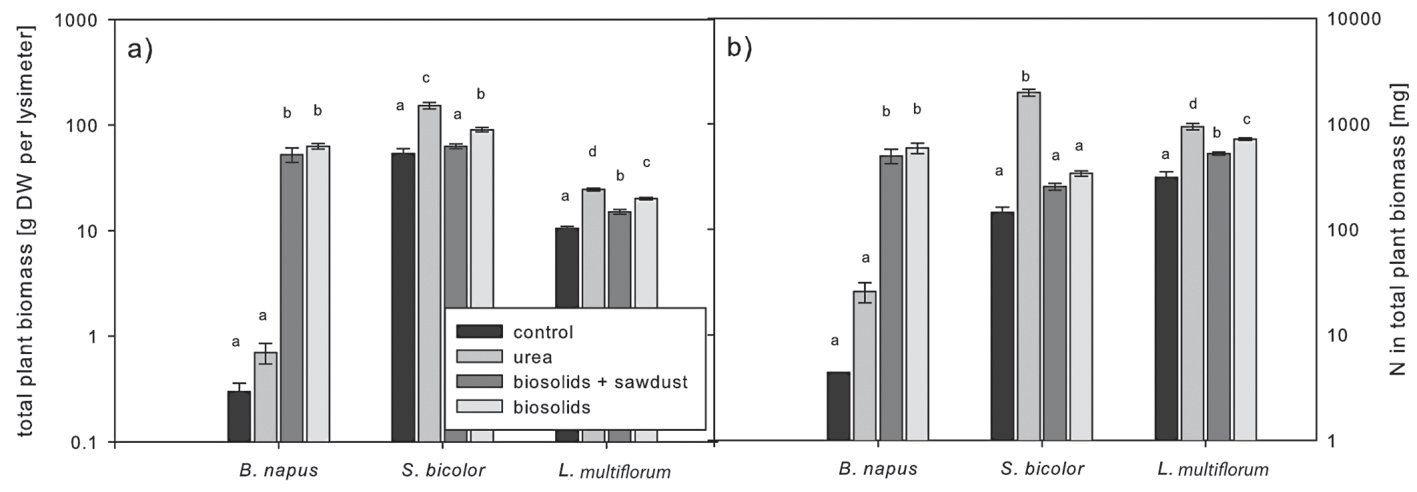
High rates of biosolids application to low-fertility soil resulted in a significant growth response of rapeseed, sorghum, and ryegrass compared with control treatments (Fig. 1a). Rapeseed produced negligible biomass in the control and urea treatments due to a lack of nutrients available to maintain the growth of this species (Esperschütz et al., 2016a). Mixing sawdust with biosolids reduced the growth of sorghum and ryegrass compared with biosolids-only, whereas similar biomass was harvested in rapeseed treatments. Urea application increased biomass production of sorghum and ryegrass but had no effect on rapeseed grown on low-fertility soil.
与对照处理相比,在低肥力土壤上高施用量生物固体使油菜、高粱和黑麦草的生长显著增加(图1a)。由于缺乏维持该物种生长所需的有效养分,油菜在对照和尿素处理中的生物量可忽略不计(Esperschütz et al., 2016a)。与单施生物固体相比,锯末与生物固体混合降低了高粱和黑麦草的生长,而油菜处理的收获生物量相近。施用尿素提高了高粱和黑麦草的生物量,但对低肥力土壤上种植的油菜无影响。
Biosolids application significantly increased total N uptake into plant biomass in combination with rapeseed and ryegrass (Fig. 1b). Higher N contents in sorghum and ryegrass were seen in urea treatments compared with control, biosolids-sawdust, and biosolids treatments. For rapeseed and sorghum, the N uptake into total plant biomass was similar in biosolids-sawdust and biosolids treatments, whereas ryegrass grown with the biosolids-sawdust mix showed lower N uptake compared with biosolids.
施用生物固体显著提高了油菜和黑麦草植株生物量的总N吸收(图1b)。与对照、生物固体-锯末和生物固体处理相比,尿素处理中高粱和黑麦草的N含量更高。对于油菜和高粱,生物固体-锯末和生物固体处理中植株总生物量的N吸收相近,而与生物固体处理相比,在生物固体-锯末混合物中生长的黑麦草N吸收较低。
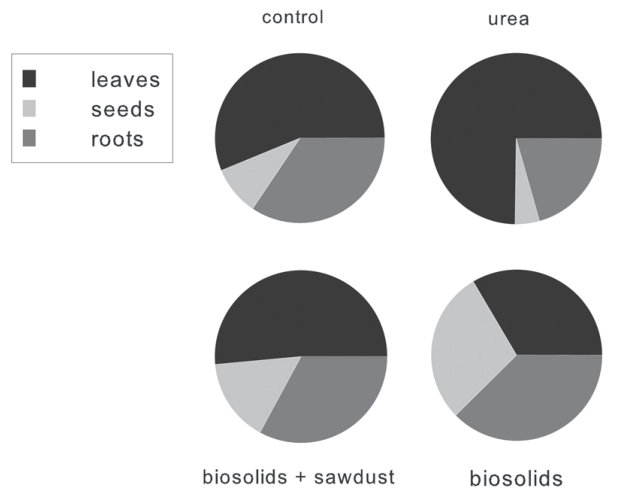
Due to the different harvesting procedure for ryegrass, no seeds or roots were harvested from L. multiflorum plants at the end of the experiment. The scarce growth of rapeseed in control and urea treatments has not resulted in seed production in these treatments; hence, seeds could only be harvested from rapeseed biosolids-sawdust and biosolids treatments. No difference was detected in the seed N concentration between biosolids and biosolids-sawdust treatments in rapeseed (2.9 and 3.0%, respectively). The percentage distribution of N between sorghum leaves, seeds, and roots is shown in Fig. 2. Urea application increased leaf-N by up to 74.8% compared with the control, whereas a decrease was observed in seed-N (−4.6%) and root-N (−20.6%) concentration. Biosolids-sawdust application caused an increase in seed-N up to 15.7% relative to controls. Nitrogen was further partitioned into the seeds in the biosolids alone treatment (28.9%).
由于黑麦草的收获方式不同,试验结束时未从L. multiflorum植株收获籽粒或根系。油菜在对照和尿素处理中生长稀疏,未能结实;因此,仅能从油菜的生物固体-锯末和生物固体处理中收获籽粒。油菜生物固体和生物固体-锯末处理的籽粒N浓度无差异(分别为2.9%和3.0%)。高粱叶、籽粒和根之间N的百分比分布见图2。与对照相比,施用尿素使叶片N提高达74.8%,而籽粒N(−4.6%)和根系N(−20.6%)浓度下降。相对于对照,施用生物固体-锯末使籽粒N提高达15.7%。在单施生物固体处理中,N进一步向籽粒分配(28.9%)。
At the end of the 18-wk experiment, NH4+ concentrations were below detection limit (0.1 mg L-1, equivalent to 5 mg kg-1) in the rhizosphere of all plant species. Nitrate was not significantly different between treatments in rapeseed and ryegrass (12.7–20.5 mg kg-1), whereas NO3- concentrations were below detection limit (0.1 mg L-1, equivalent to 5 mg kg-1) in the rhizosphere of sorghum (data not shown).
18周试验结束时,所有植物物种根际的NH4+浓度均低于检出限(0.1 mg L-1,相当于5 mg kg-1)。油菜和黑麦草各处理间硝酸盐无显著差异(12.7~20.5 mg kg-1),而高粱根际的NO3-浓度低于检出限(0.1 mg L-1,相当于5 mg kg-1)(数据未列出)。
Drainage and evapotranspiration of different plant species in combination with soil treatments were calculated for each week. Under ryegrass, no significant difference was detected between treatments up to Week 4. Five weeks after the start of the experiment, the cumulative drainage was lowest in biosolids treatments (79 mm) compared with biosolids-sawdust (105 mm) until the end of the experiment (366 and 476 mm, respectively) (Fig. 3a).
逐周计算了不同植物物种与土壤处理组合的排水量和蒸散量。黑麦草下,第4周之前各处理间无显著差异。试验开始5周后直至试验结束,生物固体处理的累积排水量(79 mm)均低于生物固体-锯末处理(105 mm)(试验结束时分别为366和476 mm)(图3a)。
In combination with rapeseed, the cumulative drainage at the end of the experiment was significantly higher in urea and control treatments (670 and 676 mm, respectively) compared with biosolids and sawdust-biosolids treatments (450 and 477 mm, respectively) (Fig. 3b), with the differences between these two groups consistent after 8 wk (p ≤ 0.05).
油菜组合中,试验结束时尿素和对照处理的累积排水量(分别为670和676 mm)显著高于生物固体和锯末-生物固体处理(分别为450和477 mm)(图3b),且两组之间的差异在8周后保持一致(p ≤ 0.05)。
Drainage from the sorghum treatments ranged from 289 mm in urea treatments to 392 mm in the biosolids-sawdust treatments at the end of the experiment (Fig. 3c). The urea and biosolids treatments had similar drainage compared with the control until Week 15 but separated significantly during the last 3 wk, with negligible drainage recovered from urea treatments. In biosolids-sawdust treatments, drainage was consistently higher compared with other treatments after 5 wk.
试验结束时,高粱处理的排水量从尿素处理的289 mm到生物固体-锯末处理的392 mm不等(图3c)。直至第15周,尿素和生物固体处理的排水量与对照相近,但在最后3周显著分化,尿素处理的排水回收量可忽略不计。5周后,生物固体-锯末处理的排水量始终高于其他处理。
At the end of the experiment, the cumulative evapotranspiration of ryegrass was significantly higher in biosolids treatments (627 mm) compared with the control and biosolids-sawdust treatments (532 and 516 mm, respectively). The cumulative evapotranspiration of urea and biosolids was consistently higher after the first 8 wk (302 and 312 mm, respectively) compared with biosolids-sawdust (262 mm) (Fig. 4a), whereas control treatments showed similar evapotranspiration as biosolids-sawdust (276 mm). In the rapeseed treatments, a higher cumulative evapotranspiration was detected in biosolids and biosolids-sawdust treatments, consistently significant after 10 wk (Fig. 4b). Sorghum had a consistently lower evapotranspiration in the biosolids-sawdust treatments compared with all other treatments after Week 6 (585 mm). The urea, control, and biosolids treatments used similar amounts of water during the experiment, with the urea treatments significantly higher (676 mm) at Week 18 compared with the control (627 mm) and biosolids (638 mm) treatments (Fig. 4c). Irrespective of soil treatments, cumulative evapotranspiration was highest in rapeseed (814–1017 mm) compared with sorghum (585–675 mm) and ryegrass (516–627 mm).
试验结束时,生物固体处理中黑麦草的累积蒸散量(627 mm)显著高于对照和生物固体-锯末处理(分别为532和516 mm)。前8周后,尿素和生物固体处理的累积蒸散量(分别为302和312 mm)始终高于生物固体-锯末处理(262 mm)(图4a),而对照处理的蒸散量与生物固体-锯末处理相近(276 mm)。在油菜处理中,生物固体和生物固体-锯末处理的累积蒸散量较高,10周后始终显著(图4b)。第6周后,高粱在生物固体-锯末处理中的蒸散量始终低于其他所有处理(585 mm)。尿素、对照和生物固体处理在试验期间的耗水量相近,第18周时尿素处理(676 mm)显著高于对照(627 mm)和生物固体(638 mm)处理(图4c)。无论土壤处理如何,油菜的累积蒸散量(814~1017 mm)均高于高粱(585~675 mm)和黑麦草(516~627 mm)。
Leaching of NO3- varied depending on plant species, whereas NO2- and NH4+ concentrations were always below detection limits (data not shown). No differences were observed between biosolids-sawdust and biosolids treatments for any plant species in the experiment. Rates of NO3- detection in leachate were 135 to 148 mg NO3- under rapeseed (Fig. 5b), 218 to 220 mg NO3- under sorghum (Fig. 5c), and 79 to 115 mg NO3- under ryegrass (Fig. 5a). - No differences were detected in the amount of NO3 leached from soil treatments with ryegrass during the first 3 wk of the experiment (Fig. 5a), but significantly higher contents of NO3- were collected from drainage of biosolids-sawdust and urea treatments compared with the control from Week 5 onward. Leaching of NO3- from biosolids treatments was higher compared with the control but lower compared with urea and biosolids-sawdust until the end of the experiment. However, no significant differences were recorded between either of these treatments. After 18 wk, the total NO3- leached was 116 and 113 mg from urea and biosolids-sawdust treatments, respectively, whereas 95 mg was leached from biosolids treatments and 79 mg leached from the control.
NO3-淋溶因植物物种而异,而NO2-和NH4+浓度始终低于检出限(数据未列出)。试验中任何植物物种的生物固体-锯末和生物固体处理之间均未观察到差异。渗滤液中检出的NO3-量在油菜下为135~148 mg NO3-(图5b),高粱下为218~220 mg NO3-(图5c),黑麦草下为79~115 mg NO3-(图5a)。- 试验前3周,黑麦草各土壤处理的NO3淋溶量无差异(图5a),但从第5周起,生物固体-锯末和尿素处理排水中收集的NO3-含量显著高于对照。直至试验结束,生物固体处理的NO3-淋溶量高于对照,但低于尿素和生物固体-锯末处理。然而,这些处理之间均未记录到显著差异。18周后,尿素和生物固体-锯末处理的NO3-总淋溶量分别为116和113 mg,而生物固体处理为95 mg,对照为79 mg。
![Fig. 3. Cumulative drainage [mm] of ryegrass (L. multiflorum) (a), rapeseed (B. napus) (b), and sorghum (S. bicolor) (c) during the experimental period. Differences p ≤ 0.05 are represented by nonoverlapping SEM.](127/figure-03.jpg)
In combination with rapeseed, the highest amount of cumulative NO3- (796 mg) leached in drainage was detected in the urea treatments, followed by control treatments (357 mg) and then biosolids and biosolids-sawdust treatments (162 and 180 mg, respectively) (Fig. 5b). Urea treatments leached significantly higher amounts than the other treatments after only 8 wk, whereas control treatments were consistently higher compared with biosolids and biosolids-sawdust after 12 wk. No differences were found between biosolids and biosolids-sawdust treatments throughout the 18-wk experimental period.
油菜组合中,排水中累积NO3-淋溶量最高的是尿素处理(796 mg),其次为对照处理(357 mg),然后是生物固体和生物固体-锯末处理(分别为162和180 mg)(图5b)。仅8周后,尿素处理的淋溶量即显著高于其他处理,而12周后对照处理始终高于生物固体和生物固体-锯末处理。在整个18周试验期间,生物固体和生物固体-锯末处理之间未发现差异。
![Fig. 4. Cumulative evapotranspiration [mm] of ryegrass (L. multiflorum) (a), rapeseed (B. napus) (b), and sorghum (S. bicolor) (c) during the experimental period. Differences (p ≤ 0.05) are represented by nonoverlapping](127/figure-04.jpg)
Cumulative NO3- leached from sorghum controls (142 mg) was lower than the urea, biosolids, and biosolids-sawdust treatments (Fig. 5c). Higher amounts of NO3- were recovered from urea treatments (312 mg) but were not significant (p = 0.076) compared with biosolids and biosolids-sawdust treatments.
高粱对照的累积NO3-淋溶量(142 mg)低于尿素、生物固体和生物固体-锯末处理(图5c)。尿素处理回收的NO3-量较高(312 mg),但与生物固体和生物固体-锯末处理相比差异不显著(p = 0.076)。
![Fig. 5. Cumulative NO3- in leachate [mg] under ryegrass (L. multiflorum) (a), rapeseed (B. napus) (b), and sorghum (S. bicolor) (c) vegetation during the experimental period. Differences (p ≤ 0.05) are represented by non](127/figure-05.jpg)
4Discussion讨论
Biosolids and Sawdust Application Increase Growth and Biomass N in Rapeseed施用生物固体和锯末提高油菜的生长和生物量N
Rapeseed showed a very scarce biomass production in control and urea treatments, which was likely the result of other limiting nutrients than N, mainly S and P (Esperschütz et al., 2016a). Growth of rapeseed increased due to biosolids-sawdust and biosolids. A biomass increase of rapeseed after biosolids application confirms findings from Shaheen and Tsadilas (2013), who reported a biomass increase after different rates of biosolids were applied in a pot experiment using low-fertility soil comparable (to some extent) to the soil used in our study.
油菜在对照和尿素处理中的生物量极低,这可能是由于N以外的其他养分(主要是S和P)受限所致(Esperschütz et al., 2016a)。生物固体-锯末和生物固体处理促进了油菜的生长。施用生物固体后油菜生物量增加,证实了Shaheen and Tsadilas (2013)的结果,他们在盆栽试验中使用(在一定程度上)与本研究土壤相似的低肥力土壤,报道了施用不同量生物固体后生物量的增加。
Nitrogen accumulation in the total plant biomass reflected results from total plant biomass. Biosolids and biosolids-sawdust application increased the total plant N content and thereby enhanced plant quality. At the end of the growing period, the total N content in rapeseed biomass was equivalent to 110 kg ha-1 in the biosolids and biosolids-sawdust treatments. In rapeseed, neither plant growth, plant N content, nor N uptake into seeds was influenced in biosolids-sawdust treatments compared with pure biosolids application. This may indicate that mixing sawdust with biosolids is a suitable way of recycling fresh sawdust in combination with high rates of biosolids on a low-fertility soil in combination with rapeseed.
植株总生物量中的N积累与植株总生物量的结果一致。施用生物固体和生物固体-锯末提高了植株总N含量,从而改善了植株品质。生长期结束时,生物固体和生物固体-锯末处理中油菜生物量的总N含量相当于110 kg ha-1。在油菜中,与单施生物固体相比,生物固体-锯末处理对植株生长、植株N含量及籽粒N吸收均无影响。这可能表明,在低肥力土壤上配合种植油菜时,将锯末与生物固体混合是将新鲜锯末与高施用量生物固体配合回收利用的适宜方式。
The total mass of NO3- leached in rapeseed was higher in the control and urea treatments compared with biosolids and biosolids-sawdust treatments. A lack of plant establishment in urea and control treatments (<1 g) resulted in NO3- leaching comparable to bare soil. Compared with pure biosolids treatments, biosolids-sawdust application did not affect plant growth, drainage, or evapotranspiration during the experimental period, as shown for ryegrass and sorghum. This may indicate that rapeseed is more sensitive to other macronutrients, such as P and S, as discussed elsewhere (Esperschütz et al., 2016a), and that N was not the limiting factor for rapeseed.
油菜对照和尿素处理的NO3-总淋溶量高于生物固体和生物固体-锯末处理。尿素和对照处理中植物未能定植(<1 g),导致NO3-淋溶与裸土相当。与单施生物固体处理相比,施用生物固体-锯末在试验期间未影响油菜的植株生长、排水或蒸散,这与黑麦草和高粱的情况不同。这可能表明油菜对P和S等其他大量营养元素更为敏感(如另文所述,Esperschütz et al., 2016a),而N并非油菜的限制因子。
Decreased Growth and N Uptake of Ryegrass in Sawdust Treatments锯末处理降低黑麦草的生长和N吸收
Biosolids as well as urea application resulted in a total biomass production of ryegrass similar to the reported average for a Feast II Italian ryegrass cultivar (Hanson et al., 2006), as discussed in detail by Esperschütz et al. (2016b). Biosolids-sawdust application in combination with ryegrass caused a decrease in plant growth and reduced N accumulation into plants. As discussed in Esperschütz et al. (2016b), our results showed that biosolids and biosolids-sawdust resulted in less growth compared with urea application. Only a limited amount of the total N applied with biosolids (1250 kg ha-1) was immediately plant available, with most of the N in biosolids locked up in organic compounds. Such organic N needs to undergo (microbial) transformation processes to become available (Sommers, 1977). In addition, other properties of the biosolids, such as elevated trace elements or salinity, may have reduced the effectiveness of the added N. Throughout the 18-wk experimental period, available N from urea and biosolids application was taken up for biomass growth, resulting in a better growth response, lower drainage, and higher evapotranspiration compared with control treatments (Di Paolo and Rinaldi, 2008; Kim et al., 2008). Higher drainage in biosolids-sawdust treatments compared with biosolids or urea application is compatible with reduced plant biomass (due to less available N) and therefore less need of water to support biomass growth. Leaching of NO3- occurred mainly in the first weeks of the experiment, immediately after treatment application. This was probably due to leaching through rather bare soil until significant plant biomass was established after 4 wk. After biomass harvests began, drainage was sampled weekly with NO3- <0.5 mg, which indicates the utilization of available N by ryegrass plants in all treatments. Biosolids application at a rate of 1250 kg ha-1 N hence did not result in higher N loss via leaching compared with 200 kg N ha-1 applied with urea.
施用生物固体和尿素后,黑麦草的总生物量与Feast II意大利黑麦草品种的报道平均值相近(Hanson et al., 2006),Esperschütz et al. (2016b)对此进行了详细讨论。黑麦草组合中施用生物固体-锯末导致植株生长下降,并减少了植株中的N积累。如Esperschütz et al. (2016b)所述,我们的结果表明,与施用尿素相比,生物固体和生物固体-锯末处理的生长较差。随生物固体施入的总N(1250 kg ha-1)中仅有有限部分可立即被植物利用,生物固体中的大部分N被固定在有机化合物中。此类有机N需经过(微生物)转化过程才能变为有效态(Sommers, 1977)。此外,生物固体的其他性质,如较高的微量元素含量或盐分,可能降低了所添加N的有效性。在整个18周试验期间,尿素和生物固体施用提供的有效N被吸收用于生物量生长,与对照处理相比,表现为更好的生长响应、更低的排水量和更高的蒸散量(Di Paolo and Rinaldi, 2008; Kim et al., 2008)。与生物固体或尿素处理相比,生物固体-锯末处理排水量较高,这与植株生物量减少(由于有效N较少)从而支持生物量生长所需水分较少相符。NO3-淋溶主要发生在试验最初几周,即施加处理后不久。这可能是由于在4周后植物形成显著生物量之前,水分通过近乎裸露的土壤淋溶所致。开始刈割后,每周采集的排水中NO3- <0.5 mg,表明所有处理中黑麦草均利用了有效N。因此,与尿素施用200 kg N ha-1相比,以1250 kg ha-1 N的量施用生物固体并未导致更高的N淋溶损失。
Using sawdust in combination with biosolids provided no additional benefit over biosolids alone with regard to plant growth and evapotranspiration. This could have been related to an immobilization of N by heterotrophic bacteria that were likely stimulated by the C-rich sawdust (Robertson and Groffman, 2015; Schmidt et al., 2001) or to adsorption reactions of NO3- with functional groups on sawdust, as suggested by Harmayani and Anwar (2012). Because there is insufficient N in sawdust to allow microbes to build proteins, they must accumulate N from their environment, in this case from biosolids; hence, biosolids- N might have already been immobilized by sawdust when sawdust was mixed with biosolids before application.
就植物生长和蒸散而言,锯末与生物固体配合使用并未比单施生物固体带来额外益处。这可能与富碳锯末可能刺激的异养细菌对N的固定有关(Robertson and Groffman, 2015; Schmidt et al., 2001),或如Harmayani and Anwar (2012)所提出的,与NO3-和锯末表面官能团的吸附反应有关。由于锯末中的N不足以供微生物合成蛋白质,微生物必须从环境中(此处即从生物固体中)获取N;因此,在施用前将锯末与生物固体混合时,生物固体中的N可能已被锯末固定。
Mixing biosolids with sawdust caused a reduction of plant-available N, which resulted in reduced plant growth compared with biosolids and urea treatments; hence, lower evapotranspiration was calculated on the basis of total plant biomass. This is in contrast to a study growing a hybrid ryegrass (Lolium × hybridum Hausskn. ‘Belinda’) in combination with different biosolids and sawdust ratios applications in a degraded soil (Sandoval et al., 2012). Whereas biosolids-sawdust application in our study (using Feast II Italian ryegrass) showed a negative growth response, comparable treatments in Sandoval et al. (2012) indicated a biomass increase. We therefore suggest the influence of soil type and fertility, as well as the Lolium species and cultivar type, need to be taken into account when determining biosolids-sawdust ratios to optimize plant growth and soil regeneration.
生物固体与锯末混合导致植物有效N减少,与生物固体和尿素处理相比植物生长下降;因此,基于植株总生物量计算的蒸散量较低。这与另一项研究结果相反,该研究在退化土壤中以不同比例施用生物固体和锯末种植杂交黑麦草(Lolium × hybridum Hausskn. ‘Belinda’)(Sandoval et al., 2012)。本研究(使用Feast II意大利黑麦草)中施用生物固体-锯末表现出负面的生长响应,而Sandoval et al. (2012)中的类似处理则显示生物量增加。因此,我们建议在确定生物固体-锯末比例以优化植物生长和土壤修复时,应考虑土壤类型和肥力以及Lolium物种和品种类型的影响。
Response of Sorghum to Mineral and Organic Soil Amendments高粱对矿质和有机土壤改良剂的响应
Both urea and biosolids enhanced the biomass production of sorghum by providing N sources readily available for plant growth (Esperschütz et al., 2016a). However, higher growth response was obtained in urea treatments, likely due to higher amounts of N readily available for plant uptake compared with biosolids, as discussed for ryegrass above. The high biomass response of sorghum to mineral N (urea) fertilization was in accordance with Fellet and Marchiol (2011), who suggested that higher biomass due to mineral fertilization was caused by a longer vegetative period, delaying the senescence of the canopy. In our study, however, a mineral fertilization rate of 200 kg N ha-1 resulted in a growth response similar to control treatments without N addition, carried out by Turgut et al. (2005). This may indicate that in addition to N limitation, the total plant yield was likely affected by the low fertility soil used in our study, specifically the lower availability of macronutrients P and K.
尿素和生物固体均通过提供可供植物生长直接利用的N源而提高了高粱的生物量(Esperschütz et al., 2016a)。然而,尿素处理的生长响应更高,这可能是由于与生物固体相比,尿素可供植物直接吸收的N量更多,如上文对黑麦草的讨论。高粱对矿质N(尿素)施肥的高生物量响应与Fellet and Marchiol (2011)的结果一致,他们认为矿质施肥导致的生物量增加是由于营养生长期延长、冠层衰老推迟所致。然而,在本研究中,200 kg N ha-1的矿质施肥量所产生的生长响应,与Turgut et al. (2005)开展的无N添加对照处理相近。这可能表明,除N限制外,植株总产量很可能还受到本研究所用低肥力土壤的影响,特别是大量营养元素P和K的有效性较低。
In our study, sorghum had a high response to N (urea) fertilization, with high N uptake into aboveground vegetative plant parts. This result can be of potential interest at sites with high N because plants showed a fast uptake of available N, hence removing N susceptible to leaching. Whereas biosolids and biosolids-sawdust application did not cause a significant N increase in the total sorghum plant, a clear shift could be observed in the plant N distribution toward higher contents of N in seeds, indicating an increase of seed quality and a change in the plant N translocation through organic amendment treatments (Fig. 2).
在本研究中,高粱对N(尿素)施肥响应强烈,地上营养器官的N吸收量高。这一结果对于高N场地可能具有潜在意义,因为植物表现出对有效N的快速吸收,从而去除易于淋溶的N。虽然施用生物固体和生物固体-锯末并未使高粱植株总N显著增加,但可观察到植株N分布明显向籽粒N含量更高的方向转移,表明有机改良处理提高了籽粒品质并改变了植株N的转运(图2)。
In sorghum, more drainage in biosolids-sawdust treatments was observed compared with biosolids or urea treatments. This is in accordance with lower evapotranspiration and is likely related to less available N and therefore less need of water for biomass growth. Biosolids application increased evapotranspiration (less drainage) compared with the control treatment, which is consistent with the findings of (Fiasconaro et al., 2013), who showed an increased evapotranspiration of leguminous plants after sewage sludge treatment. Using sawdust in combination with biosolids had no benefit with regard to plant growth and evapotranspiration in sorghum. Directly after biosolids application, an increasing amount of NO3- (up to 33 mg) in leachate in the first 4 wk could be explained by the phase of plant development. The amounts of NO3- recovered in leachate was likely the result of N flow through the bulk soil before significant plant biomass was established. Neither NH4+ nor NO3- was measured in the rhizosphere of sorghum after 18 wk, whereas in both rapeseed and ryegrass, rhizosphere NO3- was detected between 15 and 20 mg (data not shown). However, no difference was found in rhizosphere NO3- at the end of the experiment in rapeseed and ryegrass treatments, which may indicate a contamination of rhizosphere with bulk soil, making NO3- less accessible for roots. Because large amounts of NO3- might have been leached from sorghum bulk soil before plant growth and preferential flow, less “bulk soil NO3-” was available at the end of the experiment to “contaminate” the rhizosphere sample.
在高粱中,与生物固体或尿素处理相比,生物固体-锯末处理的排水量更多。这与较低的蒸散量一致,可能与有效N较少从而生物量生长所需水分较少有关。与对照处理相比,施用生物固体提高了蒸散量(排水量减少),这与(Fiasconaro et al., 2013)的研究结果一致,其表明施用污水污泥后豆科植物的蒸散量增加。就高粱的植物生长和蒸散而言,锯末与生物固体配合使用并无益处。施用生物固体后,前4周渗滤液中NO3-量不断增加(最高达33 mg),这可以用植物发育阶段来解释。渗滤液中回收的NO3-可能是在植物形成显著生物量之前N通过土体流动的结果。18周后高粱根际中既未测得NH4+也未测得NO3-,而油菜和黑麦草根际中均检出15~20 mg的NO3-(数据未列出)。然而,试验结束时油菜和黑麦草处理的根际NO3-无差异,这可能表明根际样品受到了土体土壤的污染,使NO3-较难被根系利用。由于在植物生长和优先流形成之前,大量NO3-可能已从高粱土体土壤中淋失,试验结束时可“污染”根际样品的“土体土壤NO3-”较少。
Commonly, NO3- and NH4+ are the main sources of N for plant growth (Robertson and Groffman, 2015), with uptake mechanisms varying between plant species and growth stages and depending on environmental parameters, along with plant physiological processes (Ruffel et al., 2014). Nutrient availability in the rhizosphere may be influenced by evapotranspiration or differences in the preferential flow due to different root system architecture (Allaire et al., 2011; Mitchell et al., 1995). In our study, sorghum plants may have compensated high N requirements by mobilizing high amounts of soil-available N in addition to utilizing biosolids-available N. In this context, root exudates may have been involved, influencing root–microbe interactions and thereby inhibiting nitrification (Nardi et al., 2000; Subbarao et al., 2013). This would be in accordance with recent findings, where nitrification-inhibiting compounds have been detected in root exudates of sorghum (Zakir et al., 2008). Biological nitrification inhibition (BNI) would have decreased the NO3- in rhizosphere with NH4+ serving as major N source taken up by the plants. In a nitrification assay, performed from rapeseed, ryegrass, and sorghum control soil, sorghum showed lower NO3- and higher NH4+ concentrations compared with rapeseed and ryegrass (Supplemental Fig. S1). This may indicate the presence of BNI compounds due to root exudation and hence an inhibition of nitrifying bacteria, oxidizing NH4+ to NO3-. In this context, methyl 3-(4-hydroxyphenyl) was isolated as an active BNI compound in sorghum root exudates and was found in higher concentrations in the presence of NH4+ (Zakir et al., 2008). However, this could not be verified in our study because a nitrification assay was performed only from control soil, but this finding opens new lines of research studying urea and biosolids application in combination with sorghum plants.
通常,NO3-和NH4+是植物生长的主要N源(Robertson and Groffman, 2015),其吸收机制因植物物种和生长阶段而异,并取决于环境参数以及植物生理过程(Ruffel et al., 2014)。根际养分有效性可能受蒸散作用或不同根系构型导致的优先流差异的影响(Allaire et al., 2011; Mitchell et al., 1995)。在本研究中,高粱植株除利用生物固体中的有效N外,可能还通过活化大量土壤有效N来满足其高需氮量。在此背景下,根系分泌物可能参与其中,影响根系–微生物相互作用,从而抑制硝化作用(Nardi et al., 2000; Subbarao et al., 2013)。这与近期的研究结果一致,已在高粱根系分泌物中检测到硝化抑制化合物(Zakir et al., 2008)。生物硝化抑制(BNI)会降低根际NO3-,使NH4+成为植物吸收的主要N源。在以油菜、黑麦草和高粱对照土壤进行的硝化试验中,与油菜和黑麦草相比,高粱表现出较低的NO3-浓度和较高的NH4+浓度(补充图S1)。这可能表明根系分泌产生了BNI化合物,从而抑制了将NH4+氧化为NO3-的硝化细菌。在此背景下,methyl 3-(4-hydroxyphenyl)已被分离为高粱根系分泌物中的活性BNI化合物,且在NH4+存在时浓度更高(Zakir et al., 2008)。然而,由于硝化试验仅针对对照土壤开展,本研究未能对此加以验证,但这一发现为研究尿素和生物固体施用与高粱植物组合开辟了新的研究方向。
Effect of Adding Sawdust to Biosolids on N Leaching生物固体中添加锯末对N淋溶的影响
No significant difference between biosolids and biosolids-sawdust treatments were detected regarding the amount of NO3- leaching in combination with any plant species. Nitrate was recovered in leachate from both treatments, which is in contrast to other studies (and discussed above with regard to NO3- immobilization by sawdust) because this process should result in less NO3- leached in biosolids-sawdust treatments. An inhibitory effect of sawdust regarding N and other elements was shown by Kováčik et al. (2013) when fresh sawdust had been applied with dry pig manure to reduce nutrient mobility in soil. However, we suggest that in our study the available inorganic N applied with biosolids has been immobilized, whereas the NO3- recovered in leachate was likely to be of soil origin, because throughout the experiment NO3- leaching could be observed from more or less bare soil (i.e., rapeseed control treatments).
对于任何植物物种,生物固体和生物固体-锯末处理之间的NO3-淋溶量均未检测到显著差异。两种处理的渗滤液中均回收到硝酸盐,这与其他研究结果相反(并如上文关于锯末固定NO3-所讨论的),因为这一过程本应使生物固体-锯末处理的NO3-淋溶量较少。Kováčik et al. (2013)在将新鲜锯末与干猪粪一同施用以降低土壤养分迁移性时,发现锯末对N和其他元素具有抑制作用。然而,我们认为在本研究中,随生物固体施入的有效无机N已被固定,而渗滤液中回收的NO3-很可能来源于土壤,因为在整个试验期间,均可观察到来自近乎裸露土壤(即油菜对照处理)的NO3-淋溶。
The total N in soil at the beginning of the experiment was calculated as 7200 kg ha-1, which was increased by 1250 kg ha-1 in biosolids and biosolids-sawdust treatments, and 200 kg ha-1 in urea treatments, respectively. Although, depending on the plant species, between 20 and 150 kg ha-1 of N was removed with plant biomass and between 10 and 80 kg ha-1 was lost via leaching, any change in soil N at the end of the experiment will be in the order of 3%. Although we measured the residual N concentration in the rhizosphere soil, we could not resolve this difference, particularly in the case of the biosolids-amended soils where there would have been significant redistribution of N within the soil profile.
试验开始时土壤全氮经计算为7200 kg ha-1,生物固体和生物固体-锯末处理分别增加了1250 kg ha-1,尿素处理增加了200 kg ha-1。尽管因植物物种不同,有20~150 kg ha-1的N随植物生物量移除,10~80 kg ha-1的N通过淋溶损失,但试验结束时土壤N的变化约为3%。虽然我们测定了根际土壤中的残留N浓度,但未能分辨这一差异,尤其是在生物固体改良土壤中,N在土壤剖面内可能发生了显著的再分布。
5Conclusions结论
Biosolids application to low-fertility soil provided sufficient nutrients to ensure adequate growth of all plant species in this experiment. Biosolids application rates equivalent to 1250 kg N ha-1 did not result in an increased N loss via leaching compared - with urea treatments. The use of sawdust did not reduce NO3 leaching but instead may have immobilized and reduced available N for plant growth in combination with sorghum and ryegrass. Further investigation of different biosolids/sawdust ratios and different plant species could increase the prevalence of sawdust and biosolids recycling on land, instead of increasing landfill deposits. The BNI properties of sorghum affected rhizosphere N but showed no effect on NO3- leaching. In this context, mixing biosolids with soil instead of topsoil applications could be of interest for future experiments. To investigate N leaching and BNI, stable isotope experiments could identify different sources of NO3- and further identify the effect of plant exudates on N transformation processes in combination with biowastes. Future work should involve field measurements in large plantations, where edge effects are less important than in a lysimeter experiment.
在低肥力土壤上施用生物固体提供了充足的养分,确保了本试验中所有植物物种的正常生长。与尿素处理相比,相当于1250 kg N ha-1的生物固体施用量并未导致N淋溶损失增加。锯末的使用并未减少NO3淋溶,反而可能在高粱和黑麦草组合中固定并减少了可供植物生长的有效N。进一步研究不同的生物固体/锯末比例和不同植物物种,可促进锯末和生物固体的土地回收利用,而非增加填埋量。高粱的BNI特性影响了根际N,但对NO3-淋溶无影响。在此背景下,将生物固体与土壤混合而非表层施用,可作为未来试验的研究方向。为研究N淋溶和BNI,稳定同位素试验可识别NO3-的不同来源,并进一步明确植物分泌物在与生物废弃物组合时对N转化过程的影响。未来工作应在大型种植园开展田间测定,因为与渗漏计试验相比,边缘效应在大型种植园中影响较小。
6Acknowledgments致谢
The study was supported by the Deutsche Forschungsgemeinschaft (DFG, ES 416/1-1), Center of Integrated Biowastes (CIBR), and Plant & Food Research (Blueskies). The authors thank Lowe Environmental Impact for assisting with soil collection; I. Khan for work with nitrification assays; Lincoln University for hosting the research; and L. Clucas, B. Richards, D. Paramashivan, S. Mammun, Y. Kim, T. Zhongtao, and H. Franklin for laboratory assistance and maintaining the experiment.
本研究由Deutsche Forschungsgemeinschaft(DFG, ES 416/1-1)、Center of Integrated Biowastes(CIBR)和Plant & Food Research(Blueskies)资助。作者感谢Lowe Environmental Impact协助采集土壤;感谢I. Khan开展硝化试验;感谢Lincoln University为本研究提供场地;感谢L. Clucas、B. Richards、D. Paramashivan、S. Mammun、Y. Kim、T. Zhongtao和H. Franklin在实验室工作和试验维护方面给予的帮助。
7References参考文献
Al-Dhumri, S., F.H. Beshah, N.A. Porter, B. Meehan, and R. Wrigley. 2013. An assessment of the guidelines in Victoria, Australia, for land application of biosolids based on plant-available nitrogen. Soil Res. 51:529–538. doi:10.1071/SR13191
Allaire, E.S., E. van Bochove, J.-T. Denault, H. Dadfar, G. Thériault, A. Charles, and R. De Jong. 2011. Preferential pathways of phosphorus movement from agricultural land to water bodies in the Canadian Great Lakes basin: A predictive tool. Can. J. Soil Sci. 91:361–374. doi:10.4141/cjss09121
Amajirionwu, M., N. Connaughton, B. McCann, R. Moles, J. Bartlett, and B. O’Regan. 2008. Indicators for managing biosolids in Ireland. J. Environ. Manage. 88:1361–1372. doi:10.1016/j.jenvman.2007.07.003
Ammari, T.G., A.-O. Qusai, and B.E. Abbassi. 2012. Composting sewage sludge amended with different sawdust proportions and textures and organic waste of food industry: Assessment of quality. Environ. Technol. 33:1641– 1649. doi:10.1080/09593330.2011.641589
Blakemore L.C., P.L. Searle, and B.K. Daly. 1987. Methods for chemical analysis of soils. NZ Soil Bureau, Dep. of Scientific and Industrial Research, Wellington, New Zealand.
Bolan, N., A. Kunhikrishnan, R. Thangarajan, J. Kumpiene, J. Park, T. Makino, M.B. Kirkham, and K. Scheckel. 2014. Remediation of heavy metal(loid) s contaminated soils: To mobilize or to immobilize? J. Hazard. Mater. 266:141–166. doi:10.1016/j.jhazmat.2013.12.018
Brown, P.D., and M.J. Morra. 2009. Brassicaceae tissues as inhibitors of nitrification in soil. J. Agric. Food Chem. 57:7706–7711. doi:10.1021/ jf901516h
Bugbee, G.J. 1999. Effects of hardwood sawdust in potting media containing biosolids compost on plant growth, fertilizer needs, and nitrogen leaching. Commun. Soil Sci. Plant Anal. 30:689–698. doi:10.1080/00103629909370238
Corrêa, R.S. 2004. Efficiency of five biosolids to supply nitrogen and phosphorus to ryegrass. Pesquisa Agropecu. Bras. 39:1133–1139. doi:10.1590/ S0100-204X2004001100012
Cytryn, E., L. Kautsky, M. Ofek, R.T. Mandelbaum, and D. Minz. 2011. Shortterm structure and functional changes in bacterial community composition following amendment with biosolids compost. Appl. Soil Ecol. 48:160–167. doi:10.1016/j.apsoil.2011.03.010
Dere, A.L., R.C. Stehouwer, E. Aboukila, and K.E. McDonald. 2012. Nutrient leaching and soil retention in mined land reclaimed with stabilized manure. J. Environ. Qual. 41:2001–2008. doi:10.2134/jeq2012.0036
Di Paolo, E., and M. Rinaldi. 2008. Yield response of corn to irrigation and nitrogen fertilization in a Mediterranean environment. Field Crops Res. 105:202–210. doi:10.1016/j.fcr.2007.10.004
Eldridge, S.M., K.Y. Chan, Z.H. Xu, C.R. Chen, and I. Barchia. 2008. Plant-available nitrogen supply from granulated biosolids: Implications for land application guidelines. Soil Res. 46:423–436. doi:10.1071/SR07234
Esperschütz, J., C. Anderson, S. Bulman, J. Horswell, N.M. Dickinson, and B.H. Robinson. 2016a. Production of biomass crops using biowastes on low-fertility soil: 1. Influence of biowaste on plant and soil quality. J. Environ. Qual. doi:10.2134/jeq2015.12.0596
Esperschütz, J., O. Lense, C. Anderson, S. Bulman, J. Horswell, N.M. Dickinson, and B.H. Robinson. 2016b. Biowaste mixtures affecting the growth and elemental composition of Italian ryegrass (Lolium multiflorum). J. Environ. Qual. 45:1054–1061. doi:10.2134/jeq2015.09.0459
Fellet, G., and L. Marchiol. 2011. Towards green remediation: Metal phytoextraction and growth analysis of sorghum bicolor under different agronomic management. Low Carbon Economy 2:144–151. doi:10.4236/ lce.2011.23018
Fiasconaro, L.M., M. Sánchez-Díaz, and C.M. Antolín. 2013. Nitrogen metabolism is related to improved water-use efficiency of nodulated alfalfa grown with sewage sludge under drought. J. Plant Nutr. Soil Sci. 176:110–117. doi:10.1002/jpln.201100393
Fillery, I.P. 2007. Plant-based manipulation of nitrification in soil: A new approach to managing N loss? Plant Soil 294:1–4. doi:10.1007/ s11104-007-9263-z
Gilmour, J.T., C.G. Cogger, L.W. Jacobs, G.K. Evanylo, and D.M. Sullivan. 2003. Decomposition and plant-available nitrogen in biosolids: Laboratory studies, field studies, and computer simulation. J. Environ. Qual. 32:1498– 1507. doi:10.2134/jeq2003.1498
Hanson, R., K. Armstrong, J. de Ruiter, A. Hay, and G. Milne. 2006. Cereal forage breeding for New Zealand agriculture. In: C.F. Mercer, editor, Proceedings of the 13th Australasian Plant Breeding Conference, Christchurch, New Zealand. 18–21 Apr. 2006. New Zealand Grassland Association, Dunedon, New Zealand. p. 84–92.
Harmayani, K.D., and A.H.M.F. Anwar. 2012. Adsorption of nutrients from stormwater using sawdust. Int. J. Environ. Sci. Dev. 3:114–117. doi:10.7763/IJESD.2012.V3.199
Hearing, K.C., W.L. Daniels, and S.E. Feagley. 2000. Reclaiming mined lands with biosolids, manures, and papermill sludges. In: R.I. Barnhisel, W.L. Daniels, S.E. Feagly, editors, Reclamation of drastically disturbed lands. Agronomy Monograph 41. SSSA, Madison, WI. p. 615–644.
Kim, K.-I., D.E. Clay, C.G. Carlson, S.A. Clay, and T. Trooien. 2008. Do synergistic relationships between nitrogen and water influence the ability of corn to use nitrogen derived from fertilizer and soil? Agron. J. 100:551– 556. doi:10.2134/agronj2007.0064
Knowles, Q.A., B.H. Robinson, A. Contangelo, and A. Clucas. 2011. Biochar for the mitigation of nitrate leaching from soil amended with biosolids. Sci. Total Environ. 409:3206–3210. doi:10.1016/j.scitotenv.2011.05.011 Kováčik, P., M. Kmeťová, and M. Renčo. 2013. The impact of fresh sawdust and dry pig manure produced on sawdust bedding application on the nutrients mobility in soil and sugar beet yield. J. Ecol. Eng. 14:69–76.
Lu, Q., Z.L. He, and P.J. Stoffella. 2012. Land application of biosolids in the USA: A review. Appl. Environ. Soil Sci. 11. doi:10.1155/2012/201462
Mbakwe, I., P.C. De Jager, J.G. Annandale, and T. Matema. 2013. Nitrogen mineralization from sludge in an alkaline, saline coal gasification ash environment. J. Environ. Qual. 42:835–843. doi:10.2134/jeq2012.0410
Meyer, V.F., E.F. Redente, K.A. Barbarick, and R. Brobst. 2001. Biosolids applications affect runoff water quality following forest fire. J. Environ. Qual. 30:1528–1532. doi:10.2134/jeq2001.3051528x
Miaomiao, H., L. Wenhong, L. Xinqiang, W. Donglei, and T. Guangming. 2009. Effect of composting process on phytotoxicity and speciation of copper, zinc and lead in sewage sludge and swine manure. Waste Manag. 29:590– 597. doi:10.1016/j.wasman.2008.07.005
Mitchell, A.R., T.R. Ellsworth, and B.D. Meek. 1995. Effect of root systems on preferential flow in swelling soils. Commun. Soil Sci. Plant Anal. 26:2655– 2666. doi:10.1080/00103629509369475
Mok, H.F., R. Majumder, W.S. Laidlaw, D. Gregory, A.J. Baker, and S.K. Arndt. 2013. Native Australian species are effective in extracting multiple heavy metals from biosolids. Int. J. Phytoremediation 15:615–632. doi:10.1080 /15226514.2012.723063 Nardi, S., G. Concheri, D. Pizzeghello, A. Sturaro, R. Rella, and G. Parvoli. 2000. Soil organic matter mobilization by root exudates. Chemosphere 41:653– 658. doi:10.1016/S0045-6535(99)00488-9
NZWWA. 2003. Guidelines for the safe application of biosolids to land in New Zealand. New Zealand Water and Wastewater Association, Ministry for the Environment, Wellington, New Zealand.
Oladeji, O.O., G. Tian, A.E. Cox, T.C. Granato, C. O’Connor, Z. Abedin, and R.I. Pietz. 2013. Effect of long-term application of biosolids for mine land reclamation on groundwater chemistry: Nutrients and other selected qualities. J. Environ. Qual. 42:94–102. doi:10.2134/jeq2012.0179
Paramashivam, D., T. Clough, N. Dickinson, J. Horswell, O. Lense, L. Clucas, and B. Robinson. 2016. The effect of pine waste and pine-biochar on nitrogen mobility in biosolids. J. Environ. Qual. 45:360–367. doi:10.2134/ jeq2015.06.0298
Petersen, S.O., J. Petersen, and G.H. Rubæk. 2003. Dynamics and plant uptake of nitrogen and phosphorus in soil amended with sewage sludge. Appl. Soil Ecol. 24:187–195. doi:10.1016/S0929-1393(03)00087-8
Pu, G., M. Bell, G. Barry, and P. Want. 2012. Estimating mineralisation of organic nitrogen from biosolids and other organic wastes applied to soils in subtropical Australia. Soil Res. 50:91–104.
Rigby, H., B.O. Clarke, D.L. Pritchard, B. Meehan, F. Beshah, S.R. Smith, and N.A. Porter. 2016. A critical review of nitrogen mineralization in biosolids-amended soil, the associated fertilizer value for crop production and potential for emissions to the environment. Sci. Total Environ. 541:1310– 1338. doi:10.1016/j.scitotenv.2015.08.089
Río, M., A. Franco-Uría, E. Abad, and E. Roca. 2011. A risk-based decision tool for the management of organic waste in agriculture and farming activities (FARMERS). J. Hazard. Mater. 185:792–800. doi:10.1016/j. jhazmat.2010.09.090
Robertson, G.P., and P.M. Groffman. 2015. Nitrogen transformations. In: E.A. Paul, editor, Soil microbiology, ecology and biochemistry. Academic Press, Burlington, MA. p. 421–446.
Rogers, M., and S.R. Smith. 2007. Ecological impact of application of wastewater biosolids to agricultural soil. Water Environ. J. 21:34–40. doi:10.1111/j.1747-6593.2006.00043.x Ruffel, S., A. Gojon, and L. Lejay. 2014. Signal interactions in the regulation of root nitrate uptake. J. Exp. Bot. 65:5509–5517. doi:10.1093/jxb/eru321
Sandoval, M.E., J.H. Celis, and C.P. Bahamondes. 2012. Effect of sewage sludge and sawdust in association with hybrid ryegrass (Lolium x hybrydum Hausskin.) on soil macroaggregates and water content Chilean. J. Agric. Res. 72:568–573.
Schmidt, J.M., W.L. Daniells, R.S. Li, and D. McFaden. 2001. Determining optimal sawdust/biosolids mixtures to manage nitrate leaching in reclaimed disturbed soils. 18th Annual National Meeting of the American Society for Surface Mining and Reclamation, Albuquerque, NM. 3–7 June 2001. American Society for Surface Mining and Reclamation, Albuquerque, NM.
Shaheen, S., and C. Tsadilas. 2013. Utilization of biosolids in production of bioenergy crops I: Impact of application rate on canola biomass, soil properties, and nutrient availability. Commun. Soil Sci. Plant Anal. 44:243–258. doi:10.1080/00103624.2013.741771
Singh, R.P., and M. Agrawal. 2008. Potential benefits and risks of land application of sewage sludge. Waste Manag. 28:347–358. doi:10.1016/j. wasman.2006.12.010
Smith, S.R., and E. Durham. 2002. Nitrogen release and fertiliser value of thermally-dried biosolids. Water Environ. J. 16:121–126. doi:10.1111/j.1747-6593.2002.tb00382.x
Smith, V. 2003. Eutrophication of freshwater and coastal marine ecosystems a global problem. Environ. Sci. Pollut. Res. Int. 10:126–139. doi:10.1065/ espr2002.12.142
Sommers, L.E. 1977. Chemical composition of sewage sludges and analysis of their potential use as fertilizers. J. Environ. Qual. 6:225–231. doi:10.2134/ jeq1977.00472425000600020026x
Speir, T.W., A.P. Van Schaik, H.J. Percival, M.E. Close, and L. Pang. 2003. Heavy metals in soil, plants and groundwater following high-rate sewage sludge application to land. Water Air Soil Pollut. 150:319–358. doi:10.1023/A:1026101419961
Stehouwer, R., R.L. Day, and K.E. Macneal. 2006. Nutrient and trace element leaching following mine reclamation with biosolids. J. Environ. Qual. 35:1118–1126. doi:10.2134/jeq2005.0134
Subbarao G.V., I.M. Rao, K. Nakahara, K.L. Sahrawat, Y. Ando, and T. Kawashima. 2013. Potential for biological nitrification inhibition to reduce nitrification and N2O emissions in pasture crop–livestock systems. Animal 7:322–332. doi:10.1017/S1751731113000761
Subbarao, G.V., K. Nakahara, M.P. Hurtado, H. Ono, D.E. Moreta, A.F. Salcedo, A.T. Yoshihashi, T. Ishikawa, M. Ishitani, M. Ohnishi-Kameyama, M. Yoshida, M. Rondon, I.M. Rao, C.E. Lascano, W.L. Berry, and O. Ito. 2009. Evidence for biological nitrification inhibition in Brachiaria pastures. Proc. Natl. Acad. Sci. USA 106:17302–17307. doi:10.1073/pnas.0903694106 Turgut, I., U. Bilgili, A. Duman, and E. Acikgoz. 2005. Production of sweet sorghum (Sorghum bicolor L. Moench) increases with increased plant densities and nitrogen fertilizer levels. Acta Agriculturae Scandinavica B Soil Plant Sci. 55:236–240. doi:10.1080/09064710510029051
Westerman, P.W., and J.R. Bicudo. 2005. Management considerations for organic waste use in agriculture. Bioresour. Technol. 96:215–221. doi:10.1016/j. biortech.2004.05.011
Zakir, H.A.K.M., G.V. Subbarao, S.J. Pearse, S. Gopalakrishnan, O. Ito, T. Ishikawa, N. Kawano, K. Nakahara, T. Yoshihashi, H. Ono, and M. Yoshida. 2008. Detection, isolation and characterization of a root-exuded compound, methyl 3-(4-hydroxyphenyl) propionate, responsible for biological nitrification inhibition by sorghum (Sorghum bicolor). New Phytol. 180:442–451. doi:10.1111/j.1469-8137.2008.02576.x