B.H. Robinson, R.R. Brooks *, P.E.H. Gregg, J.H. Kirkman
Soil Science, College of Sciences, Massey University, Palmerston North, New Zealand
Received 19 August 1997; accepted 10 June 1998
Abstract摘要
Sequential extractions at three pH values were used to model the effect of successive harvests of Ni hyperaccumulator plants on the Ni availability of several ultramafic soils. All soils, with one exception, contained about 2000 µgrg Ni and all behaved in a similar manner. It was found that between 13 and 80% of the total Ni in the soil was potentially available to plants. The remainder could not be removed even after a large number of theoretical hyperaccumulator harvests. This necessarily limits the soils’ potential for phytoremediation and phytomining. The concentration of residual soluble Ni after several extractions could be predicted mathematically. As it has been shown that the Ni concentration in hyperaccumulator plants is related to the soluble Ni fraction in the soils, an estimate was made on how many economic harvests of Ni could be obtained from each soil. It was found that between three (Dun Mountain, New Zealand. and 18 (Kouaoua, New Caledonia. economic Ni extracts could be obtained before the soil would need to be modified. Similar sequential extractions may be used to determine the bioavailability of other heavy metals in soils that are to be phytoremediated or phytomined. © 1999 Elsevier Science B.V. All rights reserved.
采用三种pH条件下的连续提取法,模拟了多次收获镍超富集植物对若干超基性(蛇纹岩)土壤中镍有效性的影响。除一种土壤外,其余土壤的镍含量均约为2000 µg/g,且表现出相似的行为。结果表明,土壤全镍中有13%~80%可能被植物利用;其余部分即使经过大量理论上的超富集植物收获也无法去除。这必然限制了这些土壤用于植物修复和植物采矿的潜力。多次提取后残余可溶性镍的浓度可通过数学方法进行预测。鉴于已有研究表明超富集植物体内的镍浓度与土壤中可溶性镍组分相关,本文估算了每种土壤可获得的具有经济价值的镍收获次数。结果表明,在需要对土壤进行改良之前,可获得3次(新西兰Dun Mountain)至18次(新喀里多尼亚Kouaoua)具有经济价值的镍提取。类似的连续提取法可用于测定拟进行植物修复或植物采矿的土壤中其他重金属的生物有效性。© 1999 Elsevier Science B.V. 版权所有。
Keywords: nickel; phytomining; phytoremediation; sequential extraction
关键词:镍;植物采矿;植物修复;连续提取
* Corresponding author. Tel.: +64-6-356-9099 ext. 7023; Fax: +64-6-350-5632; E-mail: r.brooks@massey.ac.nz 0016-7061r99r$ - see front matter © 1999 Elsevier Science B.V. All rights reserved. PII: S0016-7061(98)00062-7
1Introduction引言
Commercial mining of Ni is usually performed from ores that have a high concentration of the target metal. To be economically viable, such operations require ore bodies with a relatively high (ca) 3% in New Caledonia. Ni content. Ore bodies of this nature occur only in small localised areas, and in some cases are becoming exhausted. There are however, much larger areas of low-grade ores that are not economical to exploit using current conventional methods. Most of these ore bodies are associated with ultramafic ( serpentine) outcrops that are scattered throughout the world and usually support a characteristic flora. In serpentine-derived soils, Ni is usually present at concentrations between 0.1 and 0.7%. This is well below the minimum Ni content (3%) required for modern mining activities.
镍的商业开采通常以目标金属浓度较高的矿石为对象。此类开采要具有经济可行性,需要镍含量相对较高的矿体(在新喀里多尼亚约为3%)。这类矿体仅分布于局部小范围区域,且部分已趋于枯竭。然而,还存在面积大得多的低品位矿石,采用现有常规方法开采并不经济。这些矿体大多与超基性(蛇纹岩)露头相关,此类露头散布于世界各地,通常生长着特有的植物区系。在蛇纹岩发育的土壤中,镍浓度一般为0.1%~0.7%,远低于现代采矿活动所要求的最低镍含量(3%)。
Often associated with serpentine and other metalliferous soils are plants with very unusual properties, the most notable are species that translocate large concentrations of metals to their aerial portions. These plants belong to a group known as hyperaccumulators, defined by Brooks et al. (1977) as plants containing a metal concentration of over 1000 µgrg (0)1%) in the above ground dry biomass. These values represent a concentration around ten times greater than the maximum metal concentration found in non-accumulator plants growing on the same substrate. At present, there are about 300 known species of hyperaccumulators of Ni.
蛇纹岩土壤及其他含金属土壤上常生长着具有非常特殊性质的植物,其中最显著的是能将大量金属转运至地上部分的物种。这些植物属于一类被称为超富集植物的类群,Brooks et al. (1977) 将其定义为地上部干生物量中金属浓度超过1000 µg/g(0.1%)的植物。该数值约为生长于同一基质上的非富集植物中最高金属浓度的10倍。目前已知的镍超富集植物约有300种。
Nicks and Chambers (1995) showed in a benchmark paper, that by growing a crop of the Ni hyperaccumulator Strepthanthus polygaloides on an ultramafic soil, then burning the harvested material, up to 100 kg Nirha could be recovered from the resulting ash (termed bio-ore) which had a Ni concentration of over 15%. The net economic yield of the process at that time would have been $385rha, assuming that around 25% of the energy produced from burning could be utilised to produce electricity. This yield is similar to the net return on a crop of wheat. The process is termed phytomining. Since this initial study there have been two others (Robinson et al., 1997a,b. which have shown that two other species, Alyssum bertolonii and Berkheya coddii could in theory be used to extract Ni commercially from serpentine soils. A better-known use for the above plants is a process called phytoremediation, which is fundamentally similar to phytomining but where the aim of the operation is to decontaminate soils polluted with heavy metals. So far the majority of phytoremediative work has focused on cadmium, lead and zinc (McGrath et al., 1993; Brown et al., 1994; Mench et al., 1994; Huang and Cunningham, 1996.. However, Ni contamination is a problem in many soils associated with smelters and areas where sewage sludge has been used as a soil amendment. The above-mentioned plants may, therefore, be used to remediate such soils. Both phytoremediation and phytomining may be considered as subdivisions of the wider subject of phytoextraction of metals from soils.
Nicks and Chambers (1995) 在一篇开创性论文中指出,在超基性土壤上种植镍超富集植物Strepthanthus polygaloides,然后焚烧收获的植物材料,可从所得灰分(称为生物矿石)中回收高达100 kg Ni/ha,该灰分的镍浓度超过15%。假设焚烧所产生能量的约25%可用于发电,则该工艺在当时的净经济收益可达385美元/ha,与种植一季小麦的净收益相当。这一工艺被称为植物采矿。自该项初步研究以来,另有两项研究(Robinson et al., 1997a,b)表明,另外两个物种Alyssum bertolonii和Berkheya coddii在理论上也可用于从蛇纹岩土壤中商业化提取镍。上述植物更为人熟知的用途是一种称为植物修复的工艺,其原理与植物采矿基本相同,但目的在于净化受重金属污染的土壤。迄今为止,大部分植物修复工作集中于镉、铅和锌(McGrath et al., 1993; Brown et al., 1994; Mench et al., 1994; Huang and Cunningham, 1996)。然而,在许多冶炼厂周边土壤以及施用污水污泥作为土壤改良剂的区域,镍污染也是一个问题。因此,上述植物可用于修复此类土壤。植物修复和植物采矿均可视为更广义的土壤金属植物提取的分支。
Central to the process of phytoextraction, is the nature of the soil on which the hyperaccumulator plants are to be grown. Ernst (1996) and Robinson et al. (1997a,b) have shown that the metal concentration in the plant is proportional to the plant-available metal concentration in the soil. It was noted that a high total concentration of a given element did not necessarily indicate a high concentration of its soluble form. Predictions can be made of the expected metal concentration in plants by measuring the ‘soluble’ Ni content of the substrate.
植物提取过程的核心在于拟种植超富集植物的土壤的性质。Ernst (1996) 和 Robinson et al. (1997a,b) 已证明,植物体内的金属浓度与土壤中植物有效态金属浓度成正比。研究还指出,某一元素的全量浓度高并不一定意味着其可溶态浓度也高。通过测定基质中“可溶性”镍含量,可以预测植物中预期的金属浓度。
In the process of phytomining, several successive crops would be grown on each site. The question then arises of how these crops would affect the bioavailability of Ni in these soils, and whether subsequent harvests would contain economically viable Ni concentrations. In the best case (for the phytominer., the available Ni in the soil will remain relatively constant in a scenario where an equilibrium situation between soluble and insoluble metal allows for full or partial replacement of the soluble fraction removed by the plant until all the metal in the soil has been removed. In a worst-case scenario, most of the metal would be matrix-bound, and once the initial metal harvest had been obtained, no further ‘crops’ could be grown without soil modification.
在植物采矿过程中,每块场地上将连续种植若干茬作物。由此产生的问题是:这些作物将如何影响土壤中镍的生物有效性,以及后续收获物是否仍具有经济可行的镍浓度。在最理想的情况下(对植物采矿者而言),可溶态与不溶态金属之间存在平衡,使植物移除的可溶性组分得到全部或部分补充,直至土壤中所有金属被移除,从而使土壤中有效态镍保持相对稳定。在最不利的情况下,大部分金属与基质结合,一旦获得首次金属收获,若不对土壤进行改良,便无法再种植后续“作物”。
Modification may involve acidification, which was shown by Robinson et al. (1996) to increase the availability of Ni in ultramafic soils. Another possibility is the addition of chelating agents such as EDTA. However, this was found to decrease the Ni uptake of B. coddii despite increasing the soluble Ni (Robinson et al., 1997b.. This was attributed to competition from the plant’s own Ni uptake system. It is yet to be established whether this is the case for all Ni hyperaccumulators. When profitable crops can no longer be grown, the topsoil will have to be removed or ploughed to bring fresh material to the surface. If this nickel-exhausted topsoil were to be removed, however, it could still have a use as a magnesium additive to fertilisers that would contain less phytotoxic Ni than the original soil. Addition of serpentine to superphosphate fertilisers was first carried out in New Zealand during World War II when magnesium fertilisers were scarce (During, 1984.. An ever-present problem with such admixtures has been the unwanted accumulation of Ni in the treated pastures.
改良措施可包括酸化,Robinson et al. (1996) 已证明酸化可提高超基性土壤中镍的有效性。另一种可能是添加EDTA等螯合剂。然而,研究发现,尽管这会提高可溶性镍含量,却降低了B. coddii对镍的吸收(Robinson et al., 1997b)。这被归因于其与植物自身镍吸收系统之间的竞争。这一现象是否适用于所有镍超富集植物尚待确定。当无法再种植有利可图的作物时,需要移除表土或进行翻耕,以将新鲜物质带到地表。不过,若移除这种镍已耗竭的表土,它仍可用作肥料的镁添加剂,其所含植物毒性镍低于原始土壤。第二次世界大战期间,新西兰镁肥紧缺,当时首次将蛇纹岩添加到过磷酸钙肥料中(During, 1984)。此类混合肥料一直存在的一个问题是镍在施用牧场中的不良积累。
An important factor influencing the number of Ni harvests that could be removed from a soil will be the percentage of Ni that is silicate bound or present in a very insoluble form. Such metal will never be removed by plants no matter how many crops are grown on the soil. This necessarily limits the effectiveness of any phytoextraction operation. It might be argued that, in the case of phytoremediation, the insoluble fraction of the target metal will not affect the biota and, therefore, does not need to be removed.
影响可从土壤中移除的镍收获次数的一个重要因素,是与硅酸盐结合或以极难溶形态存在的镍所占的百分比。无论在土壤上种植多少茬作物,这部分金属都不会被植物移除。这必然限制了任何植物提取作业的效果。有观点认为,就植物修复而言,目标金属的不溶性组分不会影响生物区系,因而无需移除。
The aim of this study was to investigate how many theoretically economic harvests of Ni could be taken from some ultramafic soils before they would need to be modified. As it is impractical to test each soil by growing successive crops of hyperaccumulators (a process which would take many years., it was decided to use a method of sequential extractions to model the behaviour of the soil.
本研究旨在探讨在需要改良之前,可从某些超基性土壤中获得多少次理论上具有经济价值的镍收获。由于通过连续种植超富集植物来测试每种土壤并不现实(该过程需耗时多年),因此决定采用连续提取法来模拟土壤的行为。
2The rationale for use of sequential extraction as a model for nickel removal by successive harvests of hyperaccumulator plants以连续提取模拟超富集植物连续收获移除镍的原理
There has been much controversy about how to approximate the plant-availability of selected elements. Nevertheless, there is some agreement that chemical extraction procedures using extractants such as ammonium acetate can give some indication of this (Ernst, 1996.. The aims of this study were to simulate the removal of Ni harvests from serpentine soils. Nicks and Chambers (1995) and Robinson et al. (1997a,b) have shown that to be economic, it is necessary to extract about 100 kg Nirha. If we assume a soil depth of 15 cm and a soil density of 1.3, removal of 100 kg of Ni from a hectare of soil (weighing ca. 2000 t. would equate to 50 µgrg Ni for a single harvest.
关于如何估算特定元素的植物有效性,一直存在较大争议。尽管如此,人们在一定程度上认同,采用乙酸铵等提取剂的化学提取方法可在一定程度上反映植物有效性(Ernst, 1996)。本研究旨在模拟从蛇纹岩土壤中移除镍收获物的过程。Nicks and Chambers (1995) 和 Robinson et al. (1997a,b) 已表明,要实现经济效益,需要提取约100 kg Ni/ha。假设土层深度为15 cm、土壤容重为1.3,从1 ha土壤(重约2000 t)中移除100 kg镍,相当于单次收获移除50 µg/g镍。
Studies by the above authors using the Ni hyperaccumulators S. polygaloides, A. bertolonii and B. coddii have shown that a single crop of a hyperaccumulator can provide 100 kg Nirha with the accompanying removal of 50 µgrg of the soluble Ni fraction in the soil. This is, therefore, the rationale for use of an extractant that would in theory remove this amount of Ni and hence, model the behaviour of a hyperaccumulator crop.
上述作者利用镍超富集植物S. polygaloides、A. bertolonii和B. coddii开展的研究表明,一茬超富集植物可提供100 kg Ni/ha,同时从土壤可溶性镍组分中移除50 µg/g。因此,这便是采用理论上可移除该数量镍的提取剂来模拟超富集植物作物行为的依据。
It has been shown (Robinson et al., 1996. that the amount of metal extracted is inversely proportional to the pH of the extractant. We have used potassium hydrogen phthalate as an extractant buffered at pH 2, 4 and 6. This extractant was chosen because the pH could be easily controlled without greatly changing the composition of the extractant. The three pH values were used to extract different amounts of Ni from the soils and were not intended to ‘model’ the pH of the rhizosphere. The most acid extract (pH 2. removed on average 85 µgrg Ni from the soils. This equates to a crop of 170 kg Nirha given the above conditions. The pH 4 extractant removed on average 22 µgrg Ni equating to a 44 kg Nirha, indicating that the 100 kg Nirha yield could be predicted at an extractant pH between 2 and 4. Hyperaccumulator plants extract the same amount of Ni in a much higher pH range, presumably due to the excretion of metal-binding and metal-sequestering agents. McGrath et al. (1997) showed that rhizosphere acidification was not responsible for zinc hyperaccumulation in Thlaspi species. The extractants used here, removed in 24 h, the same amount of Ni as the plant would extract over a period of 1 year or more.
已有研究表明(Robinson et al., 1996),金属提取量与提取剂的pH成反比。本研究采用pH分别缓冲至2、4和6的邻苯二甲酸氢钾作为提取剂。选择该提取剂的原因在于其pH易于控制,且不会显著改变提取剂的组成。采用三个pH值是为了从土壤中提取不同数量的镍,并非意在“模拟”根际pH。酸性最强的提取剂(pH 2)平均从土壤中移除85 µg/g镍,在上述条件下相当于一茬170 kg Ni/ha的收获。pH 4提取剂平均移除22 µg/g镍,相当于44 kg Ni/ha,表明100 kg Ni/ha的产量可在提取剂pH介于2与4之间时预测得到。超富集植物在高得多的pH范围内即可提取等量的镍,这可能归因于其分泌的金属结合剂和金属螯合剂。McGrath et al. (1997) 表明,根际酸化并非Thlaspi属物种超富集锌的原因。本研究所用提取剂在24 h内移除的镍量,与植物在1年或更长时间内提取的镍量相当。
Origin, principal minerals, nickel content (mgrg dry weight. and pH of soils used in the experiments供试土壤的来源、主要矿物、镍含量(mg/g干重)及pH
| Country国家 | Location地点 | Principal minerals主要矿物 | Ni content镍含量 | pH |
|---|---|---|---|---|
| New Zealand | Dun Mountain | quartz, goethite | 2244 | 6.7 |
| New Zealand | Rai Valley | antigorite, magnetite | 2109 | 7.5 |
| New Caledonia | Kouaoua | antigorite, goethite, quartz | 17,208 | 7.2 |
| Spain | Ojen ´ | antigorite, quartz, olivine | 1800 | 7.8 |
| Spain | Puente Basadre | antigorite, quartz, talc | 2100 | 6.3 |
| Italy | Ž . Tuscany Firenze | antigorite, quartz | 1609 | 6.9 |
| Morocco | Taafat | antigorite, chlorite, olivine | 1700 | 7.5 |
It must again be re-emphasised that there is no suggestion that there is any comparison between the pH values of the extractants used and the pH of the rhizosphere. The extractants are simply intended to remove similar amounts of Ni as would be extracted by hyperaccumulator plants.
必须再次强调,本文并无意将所用提取剂的pH值与根际pH进行比较。这些提取剂仅用于移除与超富集植物提取量相近的镍。
3Materials and methods材料与方法
3.1. Soils studied3.1. 供试土壤
The soils used in these experiments and some of their properties are given in Table 1. They are comprised of minerals typically associated with serpentine soils, antigorite being common to all except for the soils from Dun Mountain, New Zealand. The concentrations of Ni are all elevated compared to ‘normal’ non-serpentine soils, which have an average Ni concentration of around 30 µgrg (Brooks, 1983.. The Ni concentrations in the ultramafic soils were all well below the minimum value of 3% (30,000 µgrg. necessary for commercial mining.
本试验所用土壤及其部分性质见表1。这些土壤由蛇纹岩土壤中典型的矿物组成,除新西兰Dun Mountain土壤外,其余土壤均含有叶蛇纹石。与平均镍浓度约为30 µg/g的“正常”非蛇纹岩土壤相比(Brooks, 1983),这些土壤的镍浓度均偏高。但超基性土壤中的镍浓度均远低于商业开采所需的最低值3%(30,000 µg/g)。
3.2. Time taken for extractions to reach equilibrium3.2. 提取达到平衡所需时间
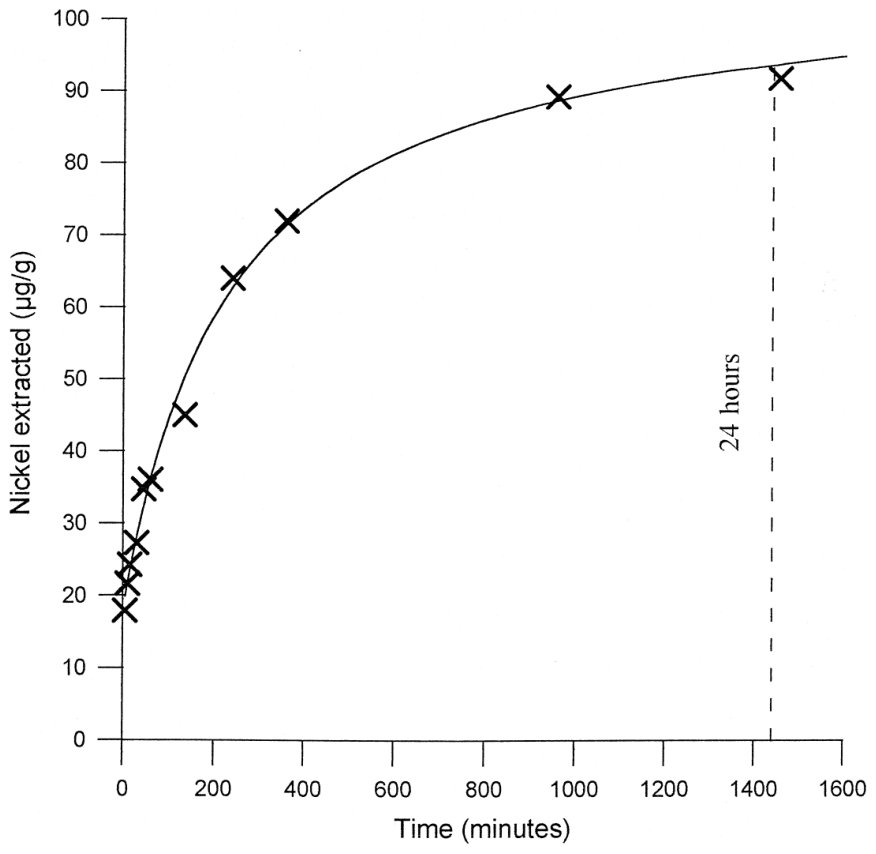
The time taken for an extraction system to reach equilibrium was of crucial importance to these experiments. Obviously, there will be a decrease in the amount of metal removed if the soilrextractant mixture has not had time to reach equilibrium. A common practice is to allow 24 h for equilibrium to be reached. To determine the time needed for Ni extractions to reach equilibrium, the following experiment was conducted on serpentine soil from the Rai Valley, South Island, New Zealand. One gram samples of soil were weighed into 20 ml centrifuge tubes and 10 ml of potassium hydrogen phthalate buffered to pH 2 was added to each. Samples were placed on an end-over-end agitator. Samples were removed after 5, 10, 15, 30, 45, 60, 135, 240, 360, 960, and 1455 min, centrifuged (3000 rpm for 5 min. and filtered. The Ni concentrations were determined by flame atomic absorption spectrometry. The results are shown in Fig. 1. The curve indicates that after 24 h, the samples were close to equilibrium. Leaving the samples for longer periods of time would increase the effect of abrasion on the soil particles, thus, giving an artificially high Ni reading. It was assumed that the time taken to reach equilibrium for the extractions at higher pH would be less, as these extractants remove less Ni.
提取体系达到平衡所需的时间对本试验至关重要。显然,若土壤/提取剂混合物未能充分达到平衡,金属移除量将会降低。通常做法是给予24 h使体系达到平衡。为确定镍提取达到平衡所需的时间,以新西兰南岛Rai Valley的蛇纹岩土壤进行了如下试验:称取1 g土壤样品置于20 ml离心管中,各加入10 ml缓冲至pH 2的邻苯二甲酸氢钾,将样品置于翻转式振荡器上。分别于5、10、15、30、45、60、135、240、360、960和1455 min后取出样品,离心(3000 rpm,5 min)并过滤。采用火焰原子吸收光谱法测定镍浓度。结果见图1。曲线表明,24 h后样品已接近平衡。样品放置时间过长会加剧土壤颗粒的磨损效应,从而导致镍读数虚高。假定在较高pH下提取达到平衡所需的时间较短,因为这些提取剂移除的镍较少。
3.3. Experimental procedure3.3. 试验步骤
Soils were sieved to −0.25 mm. Three lots of 1 g of each soil were weighed accurately into 40 ml centrifuge tubes. For each soil, 10 ml of potassium hydrogen phthalate buffered with NaOH to pH values 2, 4 and 6 was added. Tubes were placed on an end-over-end agitator for 24 h. After this time period, each tube was removed, centrifuged and the top 8 ml of extractant carefully removed using an auto-pipette. This fraction was stored for analysis. Fresh extractant (8 ml. was added and the samples replaced on the agitator. This process was repeated eight times.
土壤过0.25 mm筛。每种土壤准确称取3份1 g样品,分别置于40 ml离心管中。对每种土壤,加入10 ml用NaOH缓冲至pH 2、4和6的邻苯二甲酸氢钾,将离心管置于翻转式振荡器上振荡24 h。随后取出各离心管,离心后用自动移液器小心吸取上层8 ml提取液,保存该组分待分析。再加入新鲜提取剂(8 ml),将样品重新置于振荡器上。该过程重复8次。
Extractions were also carried out with 0.1 M and 1 M HCl in an attempt to get an estimate of the potentially available (i)e), non silicate-bound. metal fraction. Solutions were analysed using flame atomic absorption spectrometry.
还采用0.1 M和1 M HCl进行了提取,以估算潜在有效态(即非硅酸盐结合态)金属组分。溶液采用火焰原子吸收光谱法分析。
4Results and discussion结果与讨论
4.1. Determination of the potentially available Ni fraction of the soils4.1. 土壤潜在有效态镍组分的测定
Table 2 shows the concentrations of Ni extracted by using 0.1 M and 1 M HCl. The 1 M acid removed about five times the concentration of the 0.1 M extractant. This could be accounted for, if the 0.1 M extractant does not remove all the potentially available Ni, or if the 1 M acid removes some of the silicate-bound Ni. The total Ni extracted after eight extractions at pH 2 was only slightly less than that removed by the 0.1 M HCl extractant. If the rate of decrease in subsequent extractions follows the trend of the first eight, then the total Ni extracted after about 10 extractions will be greater than that extracted by 0.1 M HCl. This indicates that a stronger extractant is needed to estimate the potentially available Ni.表2列出了0.1 M和1 M HCl提取的镍浓度。1 M酸的提取量约为0.1 M提取剂的5倍。其原因可能是0.1 M提取剂未能移除全部潜在有效态镍,或1 M酸移除了部分硅酸盐结合态镍。pH 2条件下8次提取后的镍提取总量仅略低于0.1 M HCl提取剂的移除量。若后续提取量的下降速率遵循前8次的趋势,则约10次提取后的镍提取总量将超过0.1 M HCl的提取量。这表明需要更强的提取剂来估算潜在有效态镍。
The cumulative quantity (average of seven different nickel-rich soils shown in Table 2. of Ni as a percentage of the total amount extracted by 1 M HCl (assumed to reflect the total non-silicate Ni. vs. the number of extractions is shown in Fig. 2. The pH 2 extractant removed the most Ni, followed by the pH 4 and 6 extractants. All three curves followed the general formula:
图2显示了镍的累积提取量(表2所列7种不同富镍土壤的平均值)占1 M HCl提取总量(假定反映非硅酸盐镍总量)的百分比与提取次数的关系。pH 2提取剂移除的镍最多,其次为pH 4和pH 6提取剂。三条曲线均符合如下通式:

where Mc is the cumulative total percentage of the available metal removed, M1 is the percentage of extractable Ni removed by the initial extract (this percentage is related to the pH and other variables such as the ionic strength of the extractant., T is the potentially available Ni percentage and X is the extraction number. Fitting curves to each of these lines gives a value of T of 39% for all three extraction curves.
式中,Mc为有效态金属的累积移除百分比;M1为首次提取移除的可提取镍百分比(该百分比与pH以及提取剂离子强度等其他变量有关);T为潜在有效态镍百分比;X为提取次数。对每条曲线进行拟合,三条提取曲线的T值均为39%。
Potentially available nickel (mgrg or percentage of total. in ultramafic soils as determined by various extractants or extrapolation from Fig. 2
采用不同提取剂测定或由图2外推所得的超基性(蛇纹岩)土壤中潜在可利用镍含量(mg/g或占全量的百分比)
| Location of soil土壤采样地点 | A | B | C | D |
|---|---|---|---|---|
| Ž . Dun Mountain NZ | Ž . 298 13% | 231 | 1040 | 205 |
| Ž . Rai Valley NZ | Ž . 925 44% | 490 | 1725 | 373 |
| Ž . Kouaoua New Caledonia | Ž . 4383 25% | 2093 | 6531 | 1760 |
| Ž . Ojen Spain ´ | Ž . 1432 80% | 483 | 1454 | 305 |
| Ž . Puente Basadre Spain | Ž . 432 20% | 244 | 962 | 199 |
| Ž . Tuscany Firenze | Ž . 767 48% | 286 | 1084 | 273 |
| Ž . Taafat Morocco | Ž . 1039 61% | 403 | 1227 | 292 |
A: Calculated by extrapolation from Fig. 2. B: Extracted with 0.1 M HCl.
A:由图2外推计算所得。B:以0.1 M HCl提取。
C: Extracted with 1 M HCl.
C:以1 M HCl提取。
D: Sum of eight cumulative extractions at pH 2.
D:pH 2条件下8次累积提取之和。
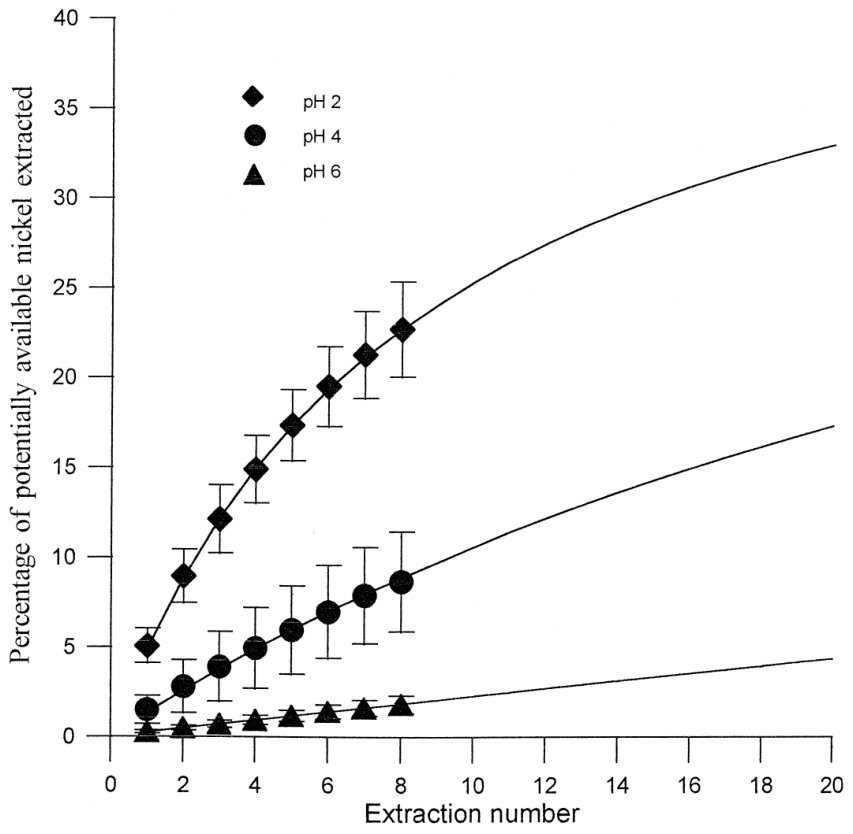
For the seven soils tested, the calculated potentially available Ni was in the range 13–80% of the total Ni content of the soil (Table 2), showing that the total Ni concentration gives no indication of the fraction that could be removed in a phytoextraction operation. This has implications for both phytoremediation and phytomining. Heavy metals that are unavailable to plants may still be toxic if the soil itself is ingested. Wind-borne dust consumed on foodstuffs or inhaled may prove toxic if the metals are liberated in the body by stomach acids, etc. The Ni in soils that are to be phytomined needs to be available to plants as well as be present in large total concentrations.
在所测试的7种土壤中,计算所得的潜在可利用Ni占土壤全Ni含量的13%–80%(表2),表明土壤全Ni浓度并不能反映植物提取作业中可被移除的部分。这一结果对植物修复和植物采矿均具有重要意义。对植物不可利用的重金属,若土壤本身被摄入,仍可能产生毒性。随食物摄入或经呼吸吸入的风载粉尘,若其中的金属在体内被胃酸等释放,也可能表现出毒性。用于植物采矿的土壤,其中的Ni不仅需要具有较高的全量浓度,还必须能够被植物吸收利用。
4.2. Decrease in soluble Ni after successive harvests
4.2. 连续多次收获后可溶性Ni的降低
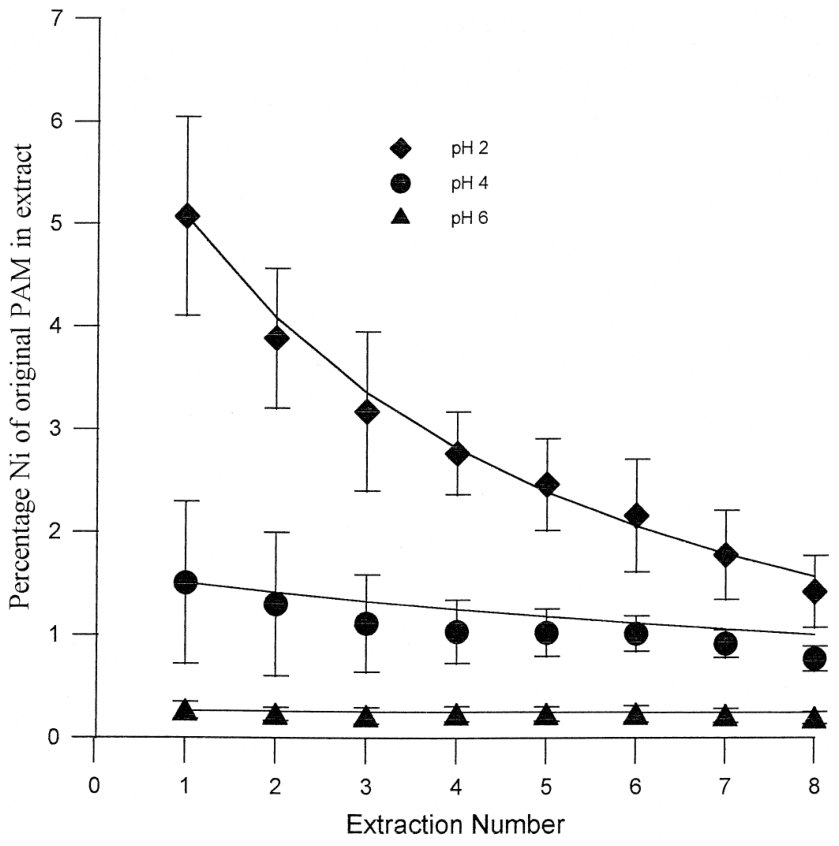
Since the Ni concentration in a hyperaccumulator plant is correlated with the soluble Ni concentration in the soil (Robinson et al., 1997a., the decreasing soil Ni solubility after several harvests will affect the Ni yield of the crop. The decrease in Ni concentration of the solutions vs. extraction number is shown in Fig. 3.
由于超富集植物体内的Ni浓度与土壤中可溶性Ni浓度相关(Robinson et al., 1997a),多次收获后土壤Ni溶解度的下降将影响作物的Ni产量。提取液中Ni浓度随提取次数的下降情况见图3。
Equations of the plots follow the formula:
各曲线的方程符合下式:
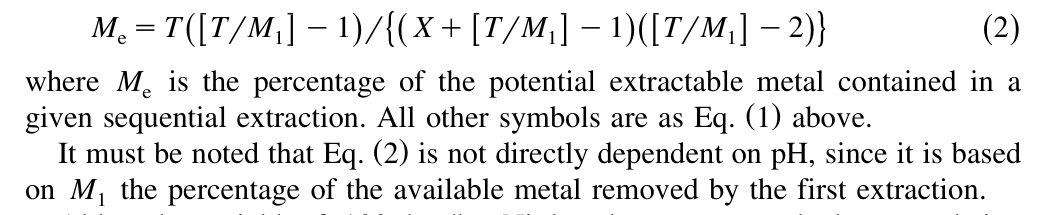
Although a yield of 100 kgrha Ni has been suggested above as being economically desirable, it should be possible to have yields as low as 70 kgrha under favourable conditions where a significant profit from incineration of biomass could be achieved. Under field conditions, the number of economic Ni harvests ()70 kg Nirha and assuming an initial crop of 100 kg Nirha. can be calculated from Eq. (2) and the results are shown in Fig. 4. Before depletion to the limit of 70 kgrha, the number of crops ranges from a high of about 20 (Kouaoua) to a low of about three for Dun Mountain soils. The higher number of theoretical harvests that could be taken from the Kouaoua soil may be expected because its total Ni concentration is about an order of magnitude higher than in the other soils used in the experiments. The calculations assume a starting point of 100 kg Nirha and it must be remembered that Ni yields well in excess of this figure should be able to be realised. The value of 100 kgrha is based on a soil depth of 15 cm and density of 1.3 (typical for ultramafic soils.. One hectare of soil would, therefore, weigh about 2000 t and a crop with a yield of 100 kgrha of Ni would remove 50 µgrg of the plant-available Ni in the soil. Once the lower economic limit of 70 kgrha has been reached, ploughing to transfer subsoil to the surface should provide sufficient fresh material for more harvests.
尽管上文提出100 kg/ha的Ni产量在经济上较为理想,但在条件有利、生物质焚烧可获得可观利润的情况下,低至70 kg/ha的产量也应是可行的。在田间条件下,经济性Ni收获的次数(>70 kg Ni/ha,并假定首茬作物产量为100 kg Ni/ha)可由式2计算,结果见图4。在降至70 kg/ha的下限之前,可收获的茬数最多约为20茬(Kouaoua),最少约为3茬(Dun Mountain土壤)。Kouaoua土壤可获得较多的理论收获次数是可以预期的,因为其全Ni浓度约比试验所用其他土壤高一个数量级。上述计算假定起始产量为100 kg Ni/ha,但应当指出,实际上应能实现远高于该数值的Ni产量。100 kg/ha这一数值基于15 cm的土层深度和1.3的容重(超基性土壤的典型值)。因此,1公顷土壤重约2000 t,Ni产量为100 kg/ha的作物将移除土壤中50 µg/g的植物可利用Ni。一旦达到70 kg/ha的经济下限,可通过深翻将底土翻至表层,从而为后续收获提供足够的新鲜土壤。
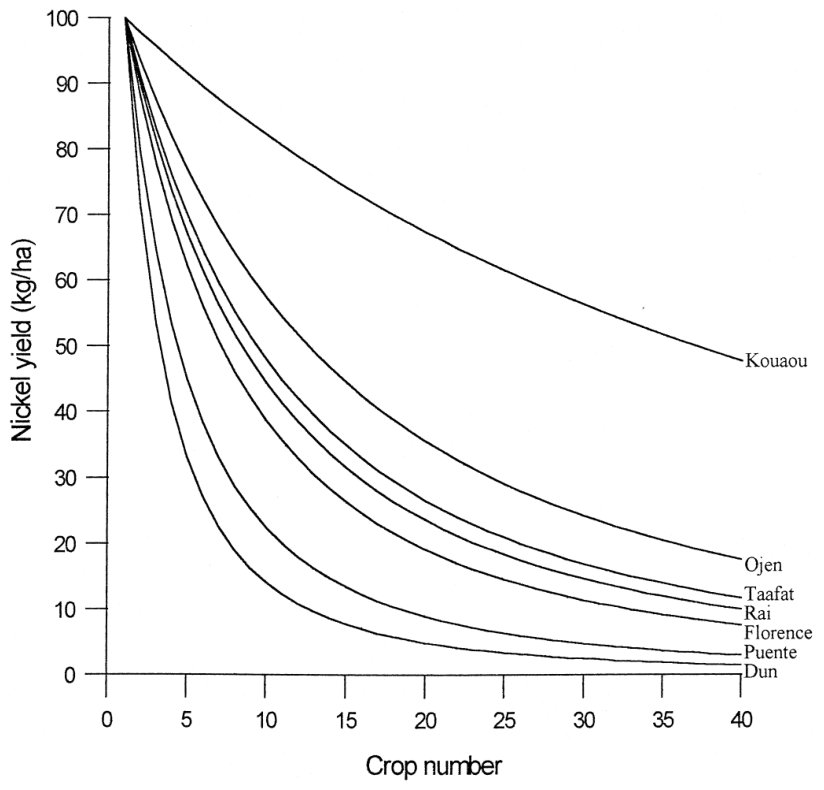
The data in Fig. 4 show that there is a large difference between different soils in their ability to be phytomined or phytoremediated. Theoretically, the soil from Kouaoua (New Caledonia. could sustain seven times the number of theoretical harvests as the soil from Dun Mountain (New Zealand..
图4数据表明,不同土壤在可用于植物采矿或植物修复的能力方面存在很大差异。理论上,Kouaoua(新喀里多尼亚)土壤可维持的理论收获次数是Dun Mountain(新西兰)土壤的7倍。
5Concluding discussion总结与讨论
It is to be emphasised that the data in this present paper are only an approximation of the field situation. Factors such as climate, weathering, mass flow of Ni, the effect of phytometallophores, pH, Eh, presence of oxides or clays in the soil, salinity and plant or microbial variables, have not been considered here. These factors might increase or decrease the availability of Ni in soils (Stoeppler, 1992..
需要强调的是,本文数据仅是对田间实际情况的近似。气候、风化作用、Ni的质流、植物金属载体(phytometallophores)的作用、pH、Eh、土壤中氧化物或黏土的存在、盐度以及植物或微生物因素等均未在此考虑。这些因素可能提高或降低土壤中Ni的有效性(Stoeppler, 1992)。
Despite the obvious limitations of using extractants to simulate plant behaviour, we must face the fact that time restraints preclude the use of sequential croppings in field trials over say a 20-year period to determine the plant availability of heavy metals in soils. Although chemical extractions are probably the best methods currently available to solve this problem, it is surprising that there are at present few, if any, long-term trials to assess the true correlation between simulated and actual uptake of heavy metals by plants under field conditions.
尽管用提取剂模拟植物行为存在明显的局限性,但我们必须正视这样一个事实:由于时间限制,无法通过例如长达20年的田间试验连续种植来测定土壤中重金属的植物有效性。虽然化学提取可能是目前解决这一问题的最佳方法,但令人惊讶的是,目前几乎没有长期试验来评估田间条件下模拟吸收与植物对重金属实际吸收之间的真实相关性。
The evidence from our simulations of the ability of some soils to sustain several theoretical Ni crops indicates that phytomining could be a viable economic proposition on these soils. The sequential extraction method may also be used to investigate the behaviour of other metals such as lead, zinc and cadmium in polluted soils. These metals are contaminants of many soils near industrial sites. Many such sites are too large to be cleaned economically using conventional methods, so that phytoremediation might be the only viable decontamination method.
我们对部分土壤维持多茬理论Ni作物能力的模拟结果表明,在这些土壤上开展植物采矿在经济上可能是可行的。连续提取法也可用于研究污染土壤中铅、锌、镉等其他金属的行为。这些金属是许多工业场地附近土壤中的污染物。许多此类场地面积过大,采用常规方法进行治理在经济上不可行,因此植物修复可能是唯一可行的去污方法。
References参考文献
Brooks, R.R., 1983. Biological Methods of Prospecting for Minerals. Wiley, New York. Brooks, R.R., Lee, J., Reeves, R.D., Jaffre,´ T., 1977. Detection of nickeliferous rocks by analysis of herbarium specimens of indicator plants. J. Geochem. Explor. 7, 49–57.
Brown, S.L., Chaney, R.L., Angle, J.S., Baker, A.J.M., 1994. Phytoremediation potential of Thlaspi caerulescens and bladder campion for zinc- and cadmium-contaminated soil. J. Environ. Qual. 23, 1151–1157.
During, C., 1984. Fertilisers and Soils in New Zealand Farming. Government Printer, Wellington, New Zealand.
Ernst, W., 1996. Bioavailability of heavy metals and decontamination of soils by plants. Appl. Geochem. 11, 163–167.
Huang, J.W., Cunningham, S.D., 1996. Lead phytoextraction: species variation in lead uptake and translocation. New Phytol. 134, 75–84.
McGrath, S.P., Sidoli, C.M.D., Baker, A.J.M., Reeves, R.D., 1993. The potential for the use of metal-accumulating plants for the in situ decontamination of metal-polluted soils. In: Eijsackers, H.J.P., Hamers, T. (Eds)), Integrated Soil and Sediment Research: A Basis for Proper Protection. Kluwer Academic Publishers, Dordrecht, pp. 673–676.
McGrath, S.P., Shen, Z.G., Zhao, F.J., 1997. Heavy metal uptake and chemical changes in the rhizosphere of Thlaspi caerulescens and Thlaspi ochroleucum grown in contaminated soils. Pl. Soil 188, 153–159.
Mench, M.J., Didier, V.L., Loeffler, M., Gomez, A., Masson, P., 1994. A mimicked in situ remediation study of metal-contaminated soils with emphasis on cadmium and lead. J. Environ. Qual. 23, 58–63.
Nicks, L., Chambers, M.F., 1995. Farming for metals. Mining Environ. Manage., September, 15–18.
Robinson, B.H., Brooks, R.R., Kirkman, J.H., Gregg, P.E.H., Gremigni, P., 1996. Plant-available elements in soils and their influence on the vegetation over ultramafic (serpentine) rocks in New Zealand. J. R. Soc. N.Z. 26, 455–466.
Robinson, B.H., Chiarucci, A., Brooks, R.R., Petit, D., Kirkman, J.H., Gregg, P.E.H., 1997a. The nickel hyperaccumulator plant Alyssum bertolonii as a potential agent for phytoremediation and phytomining of nickel. J. Geochem. Explor. 59, 75–86.
Robinson, B.H., Brooks, R.R., Howes, A.W., Kirkman, J.H., Gregg, P.E.H., 1997b. The potential of the high-biomass nickel hyperaccumulator Berkheya coddii for phytoremediation and phytomining. J. Geochem. Explor. 60, 115–226.
Stoeppler, M., 1992. Hazardous Metals in the Environment. Elsevier, Amsterdam, 541 pp.