Contents lists available at ScienceDirect journal homepage: www.elsevier.com/locate/scitotenv
J. Esperschuetz a,⁎, C. Anderson b, S. Bulman b, O. Katamian a, J. Horswell c, N.M. Dickinson d, B.H. Robinson a
a Lincoln University, Faculty of Agriculture and Life Sciences, Department of Soil and Physical Sciences, P O Box 84, Lincoln 7647, New Zealand b The New Zealand Institute for Plant & Food Research Limited, Canterbury Agriculture and Science Centre, Gerald St, Lincoln 7608, New Zealand c The Institute of Environmental Science and Research Limited, Kenepuru Science Centre, PO Box 50-348, Porirua 5240, New Zealand d Lincoln University, Faculty of Agriculture and Life Sciences, Department of Ecology, P O Box 84, Lincoln 7647, New Zealand
a 林肯大学农业与生命科学学院土壤与物理科学系,P O Box 84, Lincoln 7647, 新西兰 b 新西兰植物与食品研究所(The New Zealand Institute for Plant & Food Research Limited),坎特伯雷农业与科学中心,Gerald St, Lincoln 7608, 新西兰 c 环境科学与研究所(The Institute of Environmental Science and Research Limited),Kenepuru科学中心,PO Box 50-348, Porirua 5240, 新西兰 d 林肯大学农业与生命科学学院生态学系,P O Box 84, Lincoln 7647, 新西兰
H I G H L I G H T S
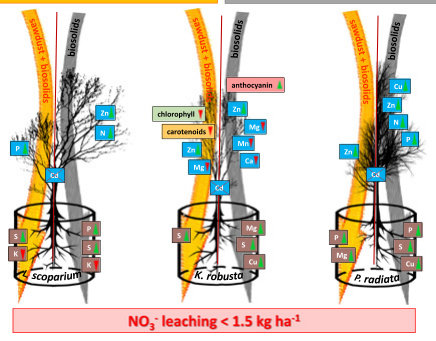
G R A P H I C A L A B S T R A C T
- Biosolids increase the growth of mānuka, kānuka and radiata pine.生物固体(污泥)促进了麦卢卡、卡努卡和辐射松的生长。
- Biosolids application did not result in unacceptable heavy metal accumulation.施用生物固体(污泥)未导致不可接受的重金属积累。
- Biosolids altered leaf phytochemicals in kānuka but not other species.生物固体(污泥)改变了卡努卡叶片的植物化学成分,但对其他物种无此影响。
- Nitrogen leaching was negligible in all treatments and plant species.所有处理和植物物种的氮淋溶量均可忽略不计。
- Blending biosolids with sawdust did not affect nitrate leaching.生物固体(污泥)与锯末混合施用不影响硝酸盐淋溶。
a r t i c l e i n f o
a b s t r a c t
Article history: Received 7 December 2016 Received in revised form 15 February 2017 Accepted 16 February 2017 Available online 24 February 2017
Editor: F.M. Tack
Keywords: Kānuka Mānuka Pine Biosolids Sawdust Degraded soil
关键词:卡努卡 麦卢卡 松树 生物固体 锯末 退化土壤
The myrtaceae family has a cosmopolitan distribution and includes the Australasian native species Leptospermum scoparium (mānuka) and Kunzea robusta (kānuka), which are of economic interest for the production of highvalue honey and essential oils. Potentially, these species could be established on low-fertility or degraded soils that have been amended with biowastes, including biosolids and sawdust. We aimed to determine the effect of these biowastes on nitrate leaching and the growth and chemical composition of these plant species compared to Pinus radiata (pine), a common forestry species. The addition of biosolids (1250 kg N ha−1 equiv.) increased the total dry biomass of mānuka, kānuka, and pine by 117, 90, and 86% respectively. Mixing sawdust with biosolids stimulated growth of mānuka (52%), kānuka (121%) but not pine. Biosolids increased plant uptake of N, P, and trace elements, but not to levels of concern. Nitrate leaching from all treatments was negligible (b2 kg ha−1).
桃金娘科(Myrtaceae)呈世界性分布,包括澳大拉西亚本土物种Leptospermum scoparium(麦卢卡)和Kunzea robusta(卡努卡),二者因可用于生产高价值蜂蜜和精油而具有经济价值。这些物种有可能在施用了生物固体(污泥)和锯末等生物废弃物的低肥力或退化土壤上定植。本研究旨在确定上述生物废弃物对硝酸盐淋溶以及这些植物物种生长和化学组成的影响,并与常见造林树种Pinus radiata(辐射松)进行比较。施用生物固体(相当于1250 kg N ha−1)使麦卢卡、卡努卡和辐射松的总干生物量分别增加了117%、90%和86%。将锯末与生物固体混合施用促进了麦卢卡(52%)和卡努卡(121%)的生长,但对辐射松无促进作用。生物固体提高了植物对N、P和微量元素的吸收,但未达到令人担忧的水平。所有处理的硝酸盐淋溶量均可忽略不计(<2 kg ha−1)。
© 2017 Elsevier B.V. All rights reserved.
1Introduction引言
⁎ Corresponding author. E-mail address: esperschuetz@gmx.com (J. Esperschuetz).
Monterey pine (Pinus radiata) is one of the most common commercially grown tree species, with plantings covering N4.3 million ha (Jeyakumar et al., 2014). P. radiata forests are often established on poor soils and as a result, nutrient and trace element deficiencies can limit plant growth and biomass production (Jeyakumar et al., 2014; Mosquera-Losada et al., 2010). To alleviate soil nutrient and trace element deficiencies, biosolids from treated municipal or agricultural sewage sources represent an opportunity to improve tree growth in poor soils while enabling safe disposal of a waste stream. Biosolids application to pine forests improves tree growth with minimal environmental impacts (Jeyakumar et al., 2014; Wang et al., 2006).
辐射松(Pinus radiata)是最常见的商业化种植树种之一,种植面积超过430万ha(Jeyakumar et al., 2014)。P. radiata人工林通常建立在贫瘠土壤上,因此养分和微量元素缺乏会限制植物生长和生物量生产(Jeyakumar et al., 2014; Mosquera-Losada et al., 2010)。为缓解土壤养分和微量元素缺乏,来源于处理后的城市或农业污水的生物固体(污泥)提供了一种在贫瘠土壤上促进树木生长的途径,同时可实现废弃物流的安全处置。在松树林中施用生物固体可促进树木生长,且环境影响极小(Jeyakumar et al., 2014; Wang et al., 2006)。
Plant-soil interactions and nutrient leaching have been thoroughly investigated in combination with moderate and repeated biosolids applications to avoid environmental risks, especially loss of N and P (Kimberley et al., 2004; McLaren et al., 2007; Mosquera-Losada et al., 2010). Various studies have shown positive effects of biosolids fertilization on forest tree species, which can subsequently provide economic returns through increased biomass and soil nutrients, while avoiding accumulation of biosolids derived contaminants above threshold values (Kimberley et al., 2004; Singh and Agrawal, 2008; Wang et al., 2013). However, biosolids application to forest soil can also result in decreased forest productivity because there is a strong dependence on the biosolids composition, soil type and plant species (Cline et al., 2012). Some of the negative effects of biosolids addition to soil can be mitigated by mixing biosolids with wood wastes (Paramashivam et al., 2015) or other biomass products such as biochar (Ammari et al., 2012; Knowles et al., 2011). For example, a beneficial effect of combining biosolids with sawdust on plant growth and soil aggregate stability was shown by Bugbee (1999), Schmidt et al. (2001) and Sandoval et al. (2012). In addition, sawdust potentially can reduce the uptake of heavy metals and contaminants (Fiset et al., 2000), hence improving growth conditions for plants. Sawdust in combination with N-rich material, such as biosolids, undergoes decomposition, hence providing additional functional groups to immobilize metals (Jokova et al., 1997).
为避免环境风险,特别是N和P的损失,已有研究结合适量和重复施用生物固体(污泥),对植物-土壤相互作用及养分淋溶进行了深入研究(Kimberley et al., 2004; McLaren et al., 2007; Mosquera-Losada et al., 2010)。多项研究表明,生物固体施肥对森林树种具有积极作用,可通过增加生物量和土壤养分带来经济回报,同时避免生物固体来源的污染物积累超过阈值(Kimberley et al., 2004; Singh and Agrawal, 2008; Wang et al., 2013)。然而,由于其效果强烈依赖于生物固体组成、土壤类型和植物物种,向森林土壤施用生物固体也可能导致森林生产力下降(Cline et al., 2012)。将生物固体与木材废弃物(Paramashivam et al., 2015)或生物炭等其他生物质产品(Ammari et al., 2012; Knowles et al., 2011)混合,可减轻向土壤添加生物固体的部分负面效应。例如,Bugbee(1999)、Schmidt et al.(2001)和Sandoval et al.(2012)均表明,生物固体与锯末配合施用对植物生长和土壤团聚体稳定性具有有益作用。此外,锯末有可能减少重金属和污染物的吸收(Fiset et al., 2000),从而改善植物的生长条件。锯末与生物固体等富氮材料结合后会发生分解,从而提供额外的官能团以固定金属(Jokova et al., 1997)。
Decreases in the price of P. radiata logs combined with an increasing interest in restoring degraded lands with native vegetation (Franklin et al., 2015) has focused attention on establishing alternative plant species in low fertility or degraded soils. Candidates include species from Myrtaceae, which comprises some 3100 species with a cosmopolitan distribution (Imatomi et al., 2013). Eucalyptus (subfamily Leptospermoideae) is the most widely studied genus (Imatomi et al., 2013) because of its use for timber, pulp, and paper production. Other members of the Myrtaceae are economically important as cultivated ornamentals (Callistemon spp., Chamelaucium spp.) and the production of essential oils (Eucalyptus spp., Melaleuca spp., Leptospermum scoparium and Kunzea robusta) (Barbosa et al., 2013). Several plant species in this family exhibit high concentrations of terpenes (Keszei et al., 2008) and triketones (Douglas et al., 2004) in their leaves, which may be responsible for allelopathic effects (Fang et al., 2009), antimicrobial properties (Douglas et al., 2004) or the inhibition of nitrification (White, 1988), which could be beneficial traits for improving forestry management.
P. radiata原木价格下降,加之利用本土植被恢复退化土地的兴趣日益增加(Franklin et al., 2015),使人们开始关注在低肥力或退化土壤上种植替代植物物种。候选物种包括桃金娘科植物,该科约有3100种,呈世界性分布(Imatomi et al., 2013)。桉属(Eucalyptus,薄子木亚科Leptospermoideae)因被用于木材、纸浆和造纸生产而成为研究最广泛的属(Imatomi et al., 2013)。桃金娘科的其他成员作为栽培观赏植物(Callistemon spp.、Chamelaucium spp.)以及用于精油生产(Eucalyptus spp.、Melaleuca spp.、Leptospermum scoparium和Kunzea robusta)而具有重要经济价值(Barbosa et al., 2013)。该科若干植物物种叶片中含有高浓度的萜烯(Keszei et al., 2008)和三酮类化合物(Douglas et al., 2004),这些物质可能与化感作用(Fang et al., 2009)、抗菌特性(Douglas et al., 2004)或硝化抑制(White, 1988)有关,而这些可能是有利于改进林业管理的性状。
Mānuka (Leptospermum scoparium J.R. Forst & G. Forst) and kānuka (Kunzea robusta de Lange & Toelken) are pioneer species in the myrtaceae family, commonly found in degraded environments and low fertility soil in New Zealand and Australia (Bergin et al., 1995; Stephens et al., 2005). L. scoparium is of particular interest due to its high value honey (Beitlich et al., 2014; Steinhorn et al., 2011) and the antimicrobial effects of compounds detected in its essential oils (Maddocks-Jennings et al., 2005; Song et al., 2013).
麦卢卡(Leptospermum scoparium J.R. Forst & G. Forst)和卡努卡(Kunzea robusta de Lange & Toelken)是桃金娘科的先锋物种,常见于新西兰和澳大利亚的退化环境和低肥力土壤中(Bergin et al., 1995; Stephens et al., 2005)。L. scoparium因其高价值蜂蜜(Beitlich et al., 2014; Steinhorn et al., 2011)及其精油中所检测到化合物的抗菌作用(Maddocks-Jennings et al., 2005; Song et al., 2013)而尤其受到关注。
We hypothesise that biosolids will enhance the growth of P. radiata, L. scoparium, and K. robusta in low-fertility soil and lead to increased concentrations of trace elements in the aerial portions. Further, we hypothesise that sawdust will eliminate the initial flush of nitrate leaching associated with biosolids addition, and may offset the growth benefits associated with biosolids addition. We aimed to determine the plant-soil interactions of P. radiata, L. scoparium, and K. robusta with soils amended with biosolids and biosolids combined with sawdust. Specifically, we sought to determine the effect of biowastes on the growth and chemical composition of the plants, as well as determine the effects of the plants on N-losses from the biowaste-amended soils.
我们假设:生物固体(污泥)将促进P. radiata、L. scoparium和K. robusta在低肥力土壤中的生长,并导致其地上部微量元素浓度升高。此外,我们假设锯末将消除添加生物固体后初期的硝酸盐淋溶峰值,并可能抵消添加生物固体带来的生长效益。本研究旨在确定P. radiata、L. scoparium和K. robusta与施用生物固体以及生物固体配施锯末的土壤之间的植物-土壤相互作用。具体而言,我们试图确定生物废弃物对植物生长和化学组成的影响,以及植物对施用生物废弃物土壤中N损失的影响。
2Material and methods材料与方法
A low-fertility orthic brown soil, with no history of fertilizer addition, was collected from a marginal farm area near Bideford, New Zealand (40o45′56″S 175o54′42″E). Analyses showed the soil had a mildly acidic pH (pH 6.1), with medium C (6.5%) and N (0.46%) levels, a C/N ratio of 14.3 and a low level of bicarbonate (Olsen) extractable P (11 mg L−1). The Cation Exchange Capacity (CEC) was 21 meq 100 g−1.
供试土壤为一种无施肥历史的低肥力正常棕壤(orthic brown soil),采自新西兰Bideford附近的一处边际农场区域(40o45′56″S 175o54′42″E)。分析表明,该土壤呈弱酸性(pH 6.1),C(6.5%)和N(0.46%)含量中等,C/N比为14.3,碳酸氢盐(Olsen)可提取P含量较低(11 mg L−1)。阳离子交换量(CEC)为21 meq 100 g−1。
The experiment was conducted at the Lincoln University greenhouse facility (43o38′42″S 172o27′41″E). Thirty-six 10 L lysimeters (25 cm in diameter with a height of 29 cm) were filled with 10 kg of fresh soil to a soil bulk density of 0.9 g cm−3. The soil was allowed to settle for eight weeks with regular automated irrigation. P. radiata seedlings (GF19) were purchased from Southern Woods Nursery Ltd., Christchurch/New Zealand. To measure NO3− leaching, a leachate-sampling device was installed in the bottom of each lysimeter. L. scoparium (PH lebsco, 6M) and Kunzea robusta (KV kunert, 6M) were purchased from Waiora Nursery Ltd., Christchurch, New Zealand. All plants were planted after the eight-week soil settling period and allowed establish for six weeks before treatments were applied to the soil surface around the plants. The lysimeters were arranged in the glasshouse via a randomized block design.
试验在林肯大学温室设施(43o38′42″S 172o27′41″E)中进行。将36个10 L渗漏计(直径25 cm,高29 cm)各装入10 kg新鲜土壤,土壤容重为0.9 g cm−3。在定期自动灌溉条件下使土壤沉降8周。P. radiata幼苗(GF19)购自新西兰基督城Southern Woods Nursery Ltd.。为测定NO3−淋溶,在每个渗漏计底部安装了渗滤液采样装置。L. scoparium(PH lebsco, 6M)和Kunzea robusta(KV kunert, 6M)购自新西兰基督城Waiora Nursery Ltd.。所有植物均在8周土壤沉降期后种植,并在定植6周后将处理物施于植物周围的土壤表面。渗漏计在温室内按随机区组设计排列。
Two soil treatments (biosolids and biosolids-sawdust) and an unamended control were setup randomly with four replicates for each plant species within the experimental setup. The treatments comprised biosolids (245 g DW) and the same amount of biosolids mixed with sawdust (123 g DW). The biosolids application rate was the equivalent of 50 t ha−1 dry weight, providing 1250 kg N ha−1. Control treatments did not receive any fertilization during the experimental period. Biosolids and sawdust were collected from the Kaikoura Wastewater Treatment Plant, New Zealand (42°21′37.40″S, 173°41′27.35″E). Biosolids were homogenized thoroughly after sieving (≤10 mm). The biosolids had a pH of 4.5, a total N concentration of 2.5%, available N of 403.8 mg kg−1, a C/N ratio of 10.6 and a CEC of 17.1 meq 100 g−1. The total C and N in the sawdust were 47.7% and 0.1%, respectively, whereas available N was below detection limit (b5 mg kg−1). Concentrations of further total macro- and micronutrients in the initial substrates used are shown in Table 1a.
试验设置两种土壤处理(生物固体和生物固体-锯末)及一个未改良对照,每个植物物种各处理随机设置,重复4次。处理包括生物固体(245 g DW)以及等量生物固体与锯末(123 g DW)的混合物。生物固体施用量相当于50 t ha−1干重,提供1250 kg N ha−1。对照处理在试验期间未施用任何肥料。生物固体和锯末采自新西兰Kaikoura污水处理厂(42°21′37.40″S, 173°41′27.35″E)。生物固体过筛(≤10 mm)后充分混匀。生物固体pH为4.5,全N浓度为2.5%,有效N为403.8 mg kg−1,C/N比为10.6,CEC为17.1 meq 100 g−1。锯末中全C和全N分别为47.7%和0.1%,而有效N低于检出限(<5 mg kg−1)。所用初始基质中其他大量和微量养分的全量浓度见表1a。
An estimation of plant-available elements from biosolids and sawdust was made using a 0.05 M Ca(NO3)2 extraction following Black et al. (2012), who reported that this extraction was the most effective procedure for determining the plant-availability of metals (Table 1b). Briefly, 5 g of the initial material were weighed into 50 mL centrifuge tubes and extracted with 30 mL of 0.05 M Ca(NO3)2 after 2 h of end-over-end shaking and centrifuging at 3200 rpm for 15 min (pre-leached Whatman 52 filter paper).
参照Black et al.(2012)的方法,采用0.05 M Ca(NO3)2提取法估算生物固体和锯末中的植物有效态元素;该研究报道此提取法是测定金属植物有效性最有效的方法(表1b)。简言之,称取5 g初始材料于50 mL离心管中,加入30 mL 0.05 M Ca(NO3)2,端对端振荡2 h,于3200 rpm离心15 min后过滤(预淋洗的Whatman 52滤纸)。
Nutrient, trace element and contaminant concentrations in sawdust and biosolids used in the present study [mg kg−1]. Concentrations of trace elements As, Al, Co, Li, Mo and Sr were below the detection limit (n = 5 ± se).
本研究所用锯末和生物固体中的养分、微量元素和污染物浓度[mg kg−1]。微量元素As、Al、Co、Li、Mo和Sr的浓度低于检出限(n = 5 ± se)。
| Sawdust锯末 | Biosolids生物固体 | Soil土壤 | |
|---|---|---|---|
| P | 42 ± 1 | 5941 ± 42 | 544 ± 5 |
| K | 455 ± 6 | 3653 ± 34 | 1886 ± 46 |
| S | 70 ± 1 | 8681 ± 140 | 405 ± 2 |
| Ca | 838 ± 11 | 6331 ± 91 | 4063 ± 67 |
| Mg | 212 ± 3 | 3005 ± 34 | 1962 ± 22 |
| Na | 40 ± 2 | 202 ± 1 | 207 ± 5 |
| B | 1.9 ± 0.2 | 26.7 ± 0.1 | 29.0 ± 0.3 |
| Cu | 0.8 ± 0.0 | 891.0 ± 18.9 | 4.2 ± 0.0 |
| Fe | 116 ± 6 | 14,534 ± 92 | 15,461 ± 108 |
| Mn | 47 ± 1 | 185 ± 5 | 133 ± 3 |
| Zn | 8.4 ± 0.4 | 1073.1 ± 26.8 | 28.6 ± 0.3 |
| Cd | n.d. ± n.d. | 3.97 ± 0.07 | 0.05 ± 0.00 |
| Ni | 0.6 ± 0.5 | 20.7 ± 0.4 | 4.1 ± 0.0 |
| Cr | 0.2 ± 0.0 | 47.6 ± 0.8 | 14.0 ± 0.2 |
| Pb | n.d. ± n.d. | 151.3 ± 3.2 | 8.3 ± 0.1 |
Plant available (CaNO3−-extractable) concentrations of nutrients, trace elements and contaminants in sawdust and biosolids used in the present study [mg kg−1]. Concentrations of trace elements As, Al, B, Co, Li, Mo, Pb and Sr were below the detection limit (n = 5 ± se).
本研究所用锯末和生物固体中养分、微量元素和污染物的植物有效态(CaNO3−可提取态)浓度[mg kg−1]。微量元素As、Al、B、Co、Li、Mo、Pb和Sr的浓度低于检出限(n = 5 ± se)。
| Sawdust锯末 | Biosolids生物固体 | |
|---|---|---|
| P | 13 ± 1 | 49 ± 1 |
| K | 295 ± 6 | 170 ± 5 |
| S | 5 ± 2 | 1193 ± 64 |
| Ca | n.d. ± n.d. | n.d. ± n.d. |
| Mg | 185 ± 2 | 349 ± 14 |
| Na | 26 ± 1 | 54 ± 2 |
| Cu | 0.1 ± 0.0 | 8.9 ± 0.3 |
| Fe | 0.5 ± 0.1 | 77.6 ± 1.7 |
| Mn | 33 ± 1 | 74 ± 3 |
| Zn | 6.1 ± 1.0 | 530.7 ± 12.0 |
| Cd | 0.01 ± 0.00 | 1.32 ± 0.02 |
| Ni | 0.03 ± 0.01 | 3.97 ± 0.06 |
| Cr | n.d. ± n.d. | 0.03 ± 0.00 |
After treatments were applied to the lysimeters, the experiment was maintained for 18 weeks in the greenhouse with night-time (10 pm till 6 am) temperatures ranging between 9 °C and 20 °C and day-time temperatures between 14 °C and 28 °C. The lysimeters were weeded fortnightly. An irrigation system allowed the independent watering of each plant species by pressure compensated drippers. Manual irrigation was used to apply additional water to treatments within species. Soil moisture was kept above field capacity to allow drainage. The total irrigation for L. scoparium, K. robusta, and P. radiata was 2400, 1985, and 1240 mm, respectively.
处理施入渗漏计后,试验在温室中持续18周,夜间(22:00至次日6:00)温度为9 °C至20 °C,白天温度为14 °C至28 °C。每两周对渗漏计除草一次。灌溉系统通过压力补偿滴头对每个植物物种进行独立浇水。同一物种内各处理的额外用水采用人工灌溉。土壤水分保持在田间持水量以上以产生排水。L. scoparium、K. robusta和P. radiata的总灌溉量分别为2400、1985和1240 mm。
A final destructive harvest of all lysimeters was carried out after 18 weeks. Bulk density measurements were carried out by pushing rings (5 cm in height and 10 cm in diameter) into the soil. The rings with soil were oven-dried and weighed with subsequent determination of the dry bulk density per total ring volume. The total aboveground and belowground plant biomass of all plants was weighed and oven-dried at 70 °C until a constant weight was achieved. Dried plant parts were ground to fine powder using a Retch ZM200 grinder prior to analysis. Soil that was attached to the plant roots (≤1 mm from root surface) was considered rhizosphere soil (Hinsinger, 1998). Rhizosphere soil was sieved ≤5 mm prior to chemical analyses. Total C and N in ground plant and soil material was analysed using a CNS-2000 Element Analyser (LECO Australia Pty Ltd., Australia). Inorganic-N speciation in soil was determined using a KCl extraction from fresh soil (4 °C) within 4 days after harvest according to Blakemore et al. (1987): after adding 40 mL of a 2 M KCl reagent to 4 g of soil, the solution was shaken on an end-over-end shaker for 1 h, centrifuged at 827g for 10 min and subsequently filtered through pre-leached Whatman 41 filter paper. Nitrate-N (NO3−-N) and ammonium-N (NH4+-N) was determined using a flow injection analyser (FIA FS3000 twin channel analyser, Alpkem, USA).
18周后对所有渗漏计进行最终破坏性收获。采用将环刀(高5 cm,直径10 cm)压入土壤的方法测定容重。将装有土壤的环刀烘干并称重,随后按环刀总体积计算干容重。称量所有植物地上部和地下部总生物量,并于70 °C烘干至恒重。分析前使用Retch ZM200粉碎机将烘干的植物各部分磨成细粉。附着于植物根系的土壤(距根表面≤1 mm)视为根际土壤(Hinsinger, 1998)。化学分析前将根际土壤过≤5 mm筛。采用CNS-2000元素分析仪(LECO Australia Pty Ltd.,澳大利亚)分析磨细的植物和土壤样品中的全C和全N。按照Blakemore et al.(1987)的方法,于收获后4天内对新鲜土壤(4 °C保存)进行KCl提取以测定土壤无机氮形态:向4 g土壤中加入40 mL 2 M KCl试剂,端对端振荡1 h,以827g离心10 min,随后经预淋洗的Whatman 41滤纸过滤。硝态氮(NO3−-N)和铵态氮(NH4+-N)采用流动注射分析仪(FIA FS3000双通道分析仪,Alpkem,美国)测定。
Pseudo-total elemental analysis was carried out using microwave digestion in 8 mL of Aristar™ nitric acid (±69%), filtered using pre-leached Whatman 52 filter paper, and diluted with milliQ water to a volume of 25 mL. Concentrations of P, K, S, Ca, Mg, Na, B, Cu, Fe, Mn, Zn, Cd, Ni, Cr and Pb were determined using inductively coupled plasma optical emission spectrometry (ICP-OES Varian 720 ES - USA). For quality assurance, reference soil and plant material (International Soil analytical Exchange - ISE 921 and International Plant analytical Exchange IPE 100) from Wageningen University, the Netherlands, was analysed with the samples. Recoverable concentrations were 81% - 112% of the certified values.
采用微波消解法进行准全量元素分析:以8 mL Aristar™硝酸(±69%)消解,经预淋洗的Whatman 52滤纸过滤,用milliQ水定容至25 mL。采用电感耦合等离子体发射光谱法(ICP-OES Varian 720 ES,美国)测定P、K、S、Ca、Mg、Na、B、Cu、Fe、Mn、Zn、Cd、Ni、Cr和Pb的浓度。为进行质量保证,将荷兰瓦赫宁根大学的参比土壤和植物材料(International Soil analytical Exchange - ISE 921和International Plant analytical Exchange IPE 100)与样品一同分析。回收浓度为认证值的81%~112%。
Significant differences between control soil, biosolids, and biosolids-sawdust treatments were determined by analysis of variance, followed by Duncan post-hoc tests to identify homogenous subsets for α = 0.05. The analyses were performed using IBM SPSS v.22 (International Business Machines Corp., New Orchard Road, Armonk, New York 10504 914-499-1900), based on n = 4 individual replicates. Results were illustrated in SigmaPlot 11.0 (Systat Software Inc).
采用方差分析确定对照土壤、生物固体和生物固体-锯末处理之间的显著性差异,随后采用Duncan事后检验识别α = 0.05水平下的同质子集。分析使用IBM SPSS v.22(International Business Machines Corp., New Orchard Road, Armonk, New York 10504 914-499-1900)进行,基于n = 4个独立重复。结果使用SigmaPlot 11.0(Systat Software Inc)绘图。
3Results and discussion结果与讨论
3.1. Aerial biomass and root growth3.1. 地上部生物量与根系生长
Compared to control treatments in kg ha−1 equiv., biosolids application caused an N increase of 165.7 kg ha−1 in P. radiata, 66.9 kg ha−1 in K. robusta and 80.3 kg ha−1 in L. scoparium biomass, respectively, whereas mixing biosolids with sawdust resulted in a N decrease of 117.1 kg ha−1, 13.5 kg ha−1 and 22.1 kg ha−1 for P. radiata, K. robusta and L. scoparium, respectively, compared to biosolids treatments (data not shown). A reduced biomass N content in biosolids-sawdust compared to biosolids only treatments irrespective plant species could have been related to N competition by microbes involved in the breakdown of the sawdust. The growth response of P. radiata to biosolids application was related to both, aboveground (61%) and belowground (25%) biomass compared to controls (Fig. 1). Whereas biosolids had no significant effect on L. scoparium and K. robusta root growth (Fig. 1b), biosolids stimulated their aboveground plant growth, with increases of 60% and 27%, respectively compared to control treatments (Fig. 1a). Biosolids application to low fertility soil resulted in a positive growth response of P. radiata, which is in accordance with a previous study by Kimberley et al. (2004), who reported a positive growth response of P. radiata by diameter, volume and height growth. Growth responses associated with biosolids application were comparable to responses to inorganic fertilizer (Prescott and Brown, 1998; Weetman et al., 1993). An increased root growth of P. radiata suggests a stimulation of roots by nutrients associated with biosolids. Our results suggest that biosolids may be an effective tool for establishing these species on low-fertility or degraded soils.
以kg ha−1当量计,与对照处理相比,施用生物固体使P. radiata、K. robusta和L. scoparium生物量中的N分别增加了165.7 kg ha−1、66.9 kg ha−1和80.3 kg ha−1;而与生物固体处理相比,生物固体与锯末混合使P. radiata、K. robusta和L. scoparium的N分别减少了117.1 kg ha−1、13.5 kg ha−1和22.1 kg ha−1(数据未列出)。无论何种植物,生物固体-锯末处理生物量N含量均低于单施生物固体处理,这可能与参与锯末分解的微生物对N的竞争有关。与对照相比,P. radiata对施用生物固体的生长响应同时体现在地上部(61%)和地下部(25%)生物量上(图1)。生物固体对L. scoparium和K. robusta的根系生长无显著影响(图1b),但促进了其地上部生长,与对照处理相比分别增加了60%和27%(图1a)。在低肥力土壤中施用生物固体使P. radiata产生了正向生长响应,这与Kimberley et al.(2004)此前的研究一致,该研究报道了P. radiata在胸径、材积和树高生长方面的正向响应。施用生物固体引起的生长响应与施用无机肥料的响应相当(Prescott and Brown, 1998; Weetman et al., 1993)。P. radiata根系生长增加表明生物固体带入的养分对根系具有促进作用。我们的结果表明,生物固体可能是在低肥力或退化土壤上建立这些物种的有效手段。
![Fig. 1. Aboveground (a) and belowground (b) plant biomass [g DW] after a growing period of 18 weeks in control, biosolids-sawdust and biosolids treatments (n = 4 ± se). Significant differences between treatments at p ≤ 0](135/figure-02.jpg)
Biosolids-sawdust stimulated aboveground as well as belowground plant growth of L. scoparium and K. robusta, whereas no increase was observed in P. radiata, neither aboveground nor belowground. In K. robusta, mixing sawdust with biosolids resulted in similar aboveground biomass gain for K. robusta compared to biosolids only, whereas the biomass gain was lower for L. scoparium. While small increases/decreases in L. scoparium and P. radiata root biomass were not significant, K. robusta unlike the other species, had a higher root biomass in the biosolids-sawdust treatment (Fig. 1b). Aboveground and belowground biomass increases with biosolids-sawdust for K. robusta was 62% and 121%, whereas that of L. scoparium was 57% and 52%, respectively. Since we observed negligible biomass increase of P. radiata after biosolids-sawdust application, these results indicate superior growth of the myrtaceae species (L. scoparium and K. robusta) in combination with biosolids-sawdust when compared with P. radiata, although L. scoparium and K. robusta species are naturally adapted to low fertility soil. Therefore, recycling fresh sawdust for land application via mixing with biosolids provides a suitable alternative to biosolids alone in combination with these myrtaceae species.
生物固体-锯末促进了L. scoparium和K. robusta的地上部及地下部生长,而P. radiata的地上部和地下部均未见增加。对于K. robusta,锯末与生物固体混合所获得的地上部生物量增量与单施生物固体相近,而L. scoparium的生物量增量则较低。L. scoparium和P. radiata根系生物量的小幅增减均不显著,而K. robusta与其他物种不同,其在生物固体-锯末处理中的根系生物量较高(图1b)。生物固体-锯末使K. robusta地上部和地下部生物量分别增加62%和121%,而L. scoparium分别增加57%和52%。由于施用生物固体-锯末后P. radiata的生物量增加可忽略不计,这些结果表明,尽管L. scoparium和K. robusta天然适应低肥力土壤,但与P. radiata相比,桃金娘科物种(L. scoparium和K. robusta)在配施生物固体-锯末条件下生长更优。因此,对于这些桃金娘科物种而言,通过与生物固体混合将新鲜锯末循环用于土地施用,是替代单施生物固体的一种适宜选择。
A positive root growth in K. robusta treatments was only observed when mixing biosolids with sawdust (Fig. 1b). The lack of growth response in K. robusta biosolids compared to biosolids-sawdust treatments may have been due to either the physical properties of the soil and/or the mycorrhizal state of the different plants. Mixing sawdust with biosolids may have resulted in higher porosity of the growth media (favourable physical properties) thus enabling better growth of K. robusta roots which are smaller in diameter and thus more fragile when compared to L. scoparium and P. radiata roots (Haynes and Goh, 1987; Watson and Marden, 2004). This was confirmed by bulk soil density measurements at the end of the experiment, where biosolids-sawdust treatments showed significantly lower densities (0.57– 0.64 g cm−3) when compared to control soil (0.74–0.81 g cm−3), irrespective plant species (Table 2). Considering the total biomass growth in L. scoparium and K. robusta in biosolids-sawdust treatments, the increase in L. scoparium was mainly reason of aboveground growth, whereas K. robusta invested belowground, suggesting different growth strategies of both plant species.
K. robusta处理仅在生物固体与锯末混合时才观察到根系的正向生长(图1b)。与生物固体-锯末处理相比,K. robusta在生物固体处理中缺乏生长响应,可能是由于土壤物理性质和/或不同植物的菌根状态所致。锯末与生物固体混合可能提高了生长基质的孔隙度(有利的物理性质),从而使K. robusta根系生长更好;与L. scoparium和P. radiata根系相比,K. robusta根系直径更小,因而更为脆弱(Haynes and Goh, 1987; Watson and Marden, 2004)。试验结束时的土壤容重测定结果证实了这一点:无论何种植物,生物固体-锯末处理的容重(0.57–0.64 g cm−3)均显著低于对照土壤(0.74–0.81 g cm−3)(表2)。就生物固体-锯末处理中L. scoparium和K. robusta的总生物量增长而言,L. scoparium的增加主要源于地上部生长,而K. robusta则将资源投入地下部,表明两种植物具有不同的生长策略。
In combination with such physical properties, plant growth could have been influenced via the composition of mycorrhiza. Biosolids may have stimulated ectomycorrhiza, especially in context with providing additional P (Smith et al., 2011). Ectomycorrhiza has been identified with L. scoparium and K. robusta (Moyersoen and Fitter, 1999; Weijtmans et al., 2007) as well as P. radiata (Walbert et al., 2010). An influence of biosolids on the growth of ectomycorrhizal symbionts would explain results from our study, showing an increased total plant biomass (aboveground + belowground), somewhat in a similar range in L. scoparium, K. robusta and P. radiata (117%, 90% and 86%, respectively compared to control treatments). When sawdust was mixed with biosolids, additional C was provided to the plant, whereas biosolids provided organic-N, potentially promoting the growth of arbuscular mycorrhiza (Smith et al., 2011; Whiteside et al., 2012). Both plant species, K. robusta and L. scoparium have been identified with dual colonisation, ectomycorrhiza as well as arbuscular mycorrhiza (Moyersoen and Fitter, 1999; Weijtmans et al., 2007), whereas P. radiata only supports ectomycorrhiza (Walbert et al., 2010). We therefore suggest that an increased mycorrhization in K. robusta and L. scoparium due to favourable conditions caused by sawdust mixed within biosolids resulted in a higher growth increase (149% and 77% for K. robusta and L. scoparium, respectively) compared to P. radiata (8%).
除上述物理性质外,植物生长还可能受到菌根组成的影响。生物固体可能刺激了外生菌根,尤其是在提供额外P的情况下(Smith et al., 2011)。已在L. scoparium和K. robusta(Moyersoen and Fitter, 1999; Weijtmans et al., 2007)以及P. radiata(Walbert et al., 2010)中发现外生菌根。生物固体对外生菌根共生体生长的影响可以解释本研究的结果,即L. scoparium、K. robusta和P. radiata的总生物量(地上部 + 地下部)增幅大致相近(与对照处理相比分别为117%、90%和86%)。当锯末与生物固体混合时,为植物提供了额外的C,而生物固体提供了有机氮,这可能促进了丛枝菌根的生长(Smith et al., 2011; Whiteside et al., 2012)。K. robusta和L. scoparium两种植物均已被证实存在外生菌根和丛枝菌根双重定殖(Moyersoen and Fitter, 1999; Weijtmans et al., 2007),而P. radiata仅支持外生菌根(Walbert et al., 2010)。因此,我们认为,生物固体中混入锯末所创造的有利条件提高了K. robusta和L. scoparium的菌根化程度,使其生长增幅(K. robusta和L. scoparium分别为149%和77%)高于P. radiata(8%)。
Soil bulk density (0–5 cm) at the end of the experiment (n = 4 ± se). Letters (a, b) indicate significant differences (p ≤ 0.05) within plant species between treatments.
试验结束时的土壤容重(0–5 cm)(n = 4 ± se)。同一植物物种内不同字母(a, b)表示处理间差异显著(p ≤ 0.05)。
| Control对照 | Sawdust + biosolids锯末 + 生物固体 | Biosolids生物固体 | |
|---|---|---|---|
| L. scoparium | 0.74 ± 0.04a | 0.60 ± 0.02b | 0.67 ± 0.02ab |
| K. robusta | 0.81 ± 0.04a | 0.57 ± 0.08b | 0.66 ± 0.04ab |
| P. radiata | 0.75 ± 0.03a | 0.64 ± 0.04b | 0.73 ± 0.01a |
3.2. Plant element concentration3.2. 植物元素浓度
Biosolids as well as biosolids-sawdust application significantly affected the elemental concentrations in the leaves. Whereas biosolids application to P. radiata significantly increased plant N, P, Zn and Cu concentrations, only N and Zn were increased in L. scoparium. In combination with K. robusta, biosolids application resulted in an increase of plant Zn, but resulted in a decrease of Ca, Mg, and Mn (Fig. 2). As discussed by Koo et al. (2013), biosolids application could have stimulated root exudation, including organic acids, which in turn are responsible for solubilisation and mobilization of nutrients (Bertin et al., 2003). Such compounds can increase the availability of P and Zn (Hinsinger, 2001; Keller and Römer, 2001). Since exudate composition strongly varies with plant species (Walker et al., 2003), this can lead to contrasting plant responses in terms of nutrient and contaminant uptake, and may explain the differences in nutrient concentration increases observed between plant species in our study. A different exudate composition of myrtaceae species may have mobilized only Zn in K. robusta and Zn and N in L. scoparium treatments, whereas P and Cu uptake were increased in addition to Zn and N due to specific compounds in P. radiata exudates. Foliar Zn concentrations in K. robusta in biosolids treatments increased by 118% compared to control treatments, whereas in P. radiata and L. scoparium leaves, Zn increased by 27% and 32%, respectively (Fig. 2d). However, determination of the root exudate composition was outside the scope of this study. Interestingly, biosolids application reduced Ca and Mg concentrations in K. robusta leaves. Calcium is an essential plant nutrient, and is required for many structural roles in cell walls and membranes, as well as inter- and intracellular functions (Marschner, 1995). Uptake of Ca into the plants is primarily occurring through root tips (White and Broadley, 2003), hence biosolids application could have altered root growth or chemical composition of available nutrients in the rhizosphere less favourable for uptake into aboveground plant parts, although Ca was additionally applied with biosolids (Table 1b).
施用生物固体以及生物固体-锯末均显著影响叶片中的元素浓度。施用生物固体显著提高了P. radiata植株的N、P、Zn和Cu浓度,而L. scoparium仅N和Zn浓度升高。对于K. robusta,施用生物固体使植株Zn增加,但Ca、Mg和Mn降低(图2)。正如Koo et al.(2013)所讨论的,施用生物固体可能刺激了包括有机酸在内的根系分泌,而根系分泌物可使养分溶解和活化(Bertin et al., 2003)。此类化合物可提高P和Zn的有效性(Hinsinger, 2001; Keller and Römer, 2001)。由于分泌物组成随植物物种差异很大(Walker et al., 2003),这可能导致植物在养分和污染物吸收方面产生截然不同的响应,并可解释本研究中不同植物物种养分浓度增幅的差异。桃金娘科物种分泌物组成的不同可能使K. robusta处理中仅Zn被活化,L. scoparium处理中Zn和N被活化;而P. radiata分泌物中的特定化合物则使其在Zn和N之外还增加了P和Cu的吸收。与对照处理相比,生物固体处理中K. robusta叶片Zn浓度增加了118%,而P. radiata和L. scoparium叶片Zn分别增加了27%和32%(图2d)。然而,根系分泌物组成的测定超出了本研究的范围。有趣的是,施用生物固体降低了K. robusta叶片中的Ca和Mg浓度。钙是植物必需营养元素,在细胞壁和细胞膜中承担多种结构作用,并参与细胞间和细胞内功能(Marschner, 1995)。植物对Ca的吸收主要通过根尖进行(White and Broadley, 2003),因此,尽管生物固体额外带入了Ca(表1b),施用生物固体仍可能改变了根系生长或根际有效养分的化学组成,使其不利于向地上部的吸收转运。
Mixing biosolids with sawdust did not result in significantly different element concentrations compared to biosolids. However, Zn was found the only element, which concentrations were significantly further increased in P. radiata in biosolids-sawdust compared to biosolids only treatments. Bowen et al. (1974) discussed the influence of ectomycorrhizal fungi on the uptake and translocation of Zn into P. radiata. An increased Zn uptake by P. radiata in biosolids-sawdust treatments compared to biosolids may hence indicate an increased mycorrhization of pine roots in our study. However, this is contradictory with results obtained from biomass results, where neither root nor shoot biomass was increased in P. radiata in biosolids-sawdust treatments compared to controls.
与生物固体相比,生物固体与锯末混合并未导致元素浓度出现显著差异。然而,Zn是唯一在生物固体-锯末处理中较单施生物固体处理进一步显著增加的P. radiata元素。Bowen et al.(1974)讨论了外生菌根真菌对P. radiata吸收和转运Zn的影响。因此,与生物固体处理相比,生物固体-锯末处理中P. radiata对Zn吸收的增加可能表明本研究中松树根系的菌根化程度提高。但这与生物量结果相矛盾,即与对照相比,生物固体-锯末处理中P. radiata的根系和地上部生物量均未增加。
As discussed previously, in contrast to P. radiata, K. robusta and L. scoparium had a positive growth response after biosolids-sawdust application, although in L. scoparium this was lower compared to biosolids. Sawdust may have immobilized plant available N (Schmidt et al., 2001), thus decreasing the growth response compared to biosolids in L. scoparium and P. radiata treatments. The high C/N ratio of sawdust would have resulted in the immobilization of available N in the biosolids (Haynes and Goh, 1987). K. robusta and L. scoparium are adapted to low N environments, therefore N immobilization by sawdust did not affect plant growth as compared to P. radiata. Assuming that sawdust immobilizes N (Schmidt et al., 2001), our results indicate that K. robusta is more adapted to low N environments than L. scoparium, since mixing sawdust with biosolids lowered the growth response of L. scoparium compared to biosolids, whereas similar growth compared to biosolids was observed for K. robusta. Plants benefit from other macro- and micronutrients aside from N, which are applied with biosolids (Anderson et al., 2012; Antoniadis et al., 2015).
如前所述,与P. radiata不同,K. robusta和L. scoparium在施用生物固体-锯末后呈现正向生长响应,但L. scoparium的响应低于生物固体处理。锯末可能固定了植物有效N(Schmidt et al., 2001),从而使L. scoparium和P. radiata处理的生长响应低于生物固体处理。锯末的高C/N比会导致生物固体中有效N被固定(Haynes and Goh, 1987)。K. robusta和L. scoparium适应低N环境,因此与P. radiata相比,锯末对N的固定并未影响其生长。假设锯末固定N(Schmidt et al., 2001),我们的结果表明K. robusta比L. scoparium更适应低N环境,因为锯末与生物固体混合降低了L. scoparium相对于生物固体的生长响应,而K. robusta的生长与生物固体处理相近。除N以外,植物还受益于生物固体带入的其他大量和微量养分(Anderson et al., 2012; Antoniadis et al., 2015)。
![Fig. 2. Concentration of selected macro- and micronutrients in plant leaves [mg kg−1 DW] after a growing period of 18 weeks in control, biosolids-sawdust and biosolids amended treatments (n = 4 ± se). Significant differe](135/figure-03.jpg)
Other elements (K, B, S, Mn, Fe, Mo, Al and Na) were analysed, but the effects of the treatments on plant leaf concentrations were negligible, or not of environmental significance (Table S1 – supplemental material). Concentrations of S, Mo, Al and Na, did not differ between treatments for any plant species. Potential contaminants, such as Cr, Ni, Cd and As, were detected in plant leaves only in low concentrations, and were not significantly increased by either biosolids or biosolids-sawdust application compared to control treatments. There was no significant difference in foliar Cd concentrations, and in many cases, Cd was below detection limit (Table S1 – Supplemental material).
还分析了其他元素(K、B、S、Mn、Fe、Mo、Al和Na),但各处理对植物叶片浓度的影响可忽略不计,或不具有环境意义(表S1,补充材料)。对于任一植物物种,S、Mo、Al和Na浓度在处理间均无差异。Cr、Ni、Cd和As等潜在污染物在植物叶片中仅以低浓度检出,与对照处理相比,施用生物固体或生物固体-锯末均未使其显著增加。叶片Cd浓度无显著差异,且在许多情况下Cd低于检出限(表S1,补充材料)。
3.3. Phytochemical analysis3.3. 植物化学分析
None of the treatments affected any of the measured plant pigment concentrations in P. radiata and L. scoparium (Fig. 3). Biosolids significantly increased anthocyanin in K. robusta. (Fig. 3b). The biosolids and sawdust treatment significantly increased chlorophyll and carotenoid concentration K. robusta (Fig. 3a, c).
各处理均未影响P. radiata和L. scoparium中所测定的任何植物色素浓度(图3)。生物固体显著提高了K. robusta的花青素含量(图3b)。生物固体与锯末处理显著提高了K. robusta的叶绿素和类胡萝卜素浓度(图3a, c)。
Photosynthetic activity has been related to nutrient supply and uptake, including P (Singh et al., 1939), whereas other elements, such as heavy metals can have a negative impact on photosynthetic pigments (Sai Kachout et al., 2015). In our study, chlorophyll and carotenoids decreased in K. robusta plants when amended with biosolids-sawdust, while an increase in anthocyanin was achieved with biosolids application alone (Fig. 3b). Sawdust mixed with biosolids did not reduce plant available P (Table S2, supplemental material), nor plant P (Fig.
光合活性与包括P在内的养分供应和吸收有关(Singh et al., 1939),而重金属等其他元素可能对光合色素产生负面影响(Sai Kachout et al., 2015)。在本研究中,施用生物固体-锯末的K. robusta植株叶绿素和类胡萝卜素降低,而单施生物固体则使花青素增加(图3b)。锯末与生物固体混合既未降低植物有效P(表S2,补充材料),也未降低植株P(图
![Fig. 3. Concentration of chlorophyll (a), anthocyanin (b) and carotenoids (c) in plant leaves [μmol g−1] after a growing period of 18 weeks in control, biosolids-sawdust and biosolids amended treatments (n = 4 ± se). Sig](135/figure-04.jpg)
2) in K. robusta. Therefore our results did not support a decrease in photosynthetic activity due to an immobilization of P. Higher anthocyanin concentrations in K. robusta biosolids treatment could be a result of an increased Zn uptake due to biosolids application, however, results were inconsistent and higher Zn in P. radiata did not result in increased anthocyanin concentrations in biosolids amended soil. Similarly, plant available concentrations of S, Mg and Cu could have stimulated anthocyanin synthesis in K. robusta, but at the same time, increased concentrations of these elements in the rhizosphere of P. radiata did not result in increased anthocyanin contents. The synthesis of anthocyanins is induced by several factors, including nutrient deficiency (Pinto et al., 1999) and heavy metal stress (Dai et al., 2006). It is possible that decreased concentrations of Ca and Mg in K. robusta plant leaves hence could have been responsible for an increased anthocyanin production after biosolids application.
2)在K. robusta中的含量。因此,我们的结果不支持P固定导致光合活性下降的观点。K. robusta生物固体处理中花青素浓度较高,可能是施用生物固体使Zn吸收增加所致;然而结果并不一致,在施用生物固体的土壤中,P. radiata的Zn含量较高却未导致花青素浓度增加。同样,S、Mg和Cu的植物有效态浓度可能刺激了K. robusta的花青素合成,但与此同时,P. radiata根际中这些元素浓度的增加并未导致花青素含量升高。花青素的合成受多种因素诱导,包括养分缺乏(Pinto et al., 1999)和重金属胁迫(Dai et al., 2006)。因此,K. robusta叶片中Ca和Mg浓度的降低可能是施用生物固体后花青素产量增加的原因。
3.4. Rhizosphere soil elements and N-flux3.4. 根际土壤元素与氮通量
Biosolids and biosolids-sawdust treatments had increased element concentrations in the rhizosphere soil at the end of the experiment, depending on the plant species. In P. radiata, rhizosphere, P was increased in biosolids and biosolids-sawdust, whereas S was only increased in the biosolids treatment, and Mg only in biosolids-sawdust treatments compered to controls (Table S2 – Supplemental material). In combination with K. robusta, biosolids application increased S, Mg and Cu concentrations, and S concentrations in biosolids-sawdust treatments. Biosolids significantly increased concentrations of P and S in the rhizosphere of L. scoparium and increased S in biosolids-sawdust. The same pattern occurred in the K. robusta treatments. There was a decrease in K in the L. scoparium rhizosphere after biosolids and biosolids-sawdust application compared to control treatments.
试验结束时,生物固体和生物固体-锯末处理的根际土壤元素浓度有所升高,且因植物物种而异。在P. radiata根际,与对照相比,生物固体和生物固体-锯末处理中P均增加,而S仅在生物固体处理中增加,Mg仅在生物固体-锯末处理中增加(表S2,补充材料)。对于K. robusta,施用生物固体提高了S、Mg和Cu浓度,生物固体-锯末处理提高了S浓度。生物固体显著提高了L. scoparium根际中P和S的浓度,生物固体-锯末处理则提高了S浓度。K. robusta处理中也出现了相同的规律。与对照处理相比,施用生物固体和生物固体-锯末后L. scoparium根际中K有所降低。
The total cumulative mass of NO3− recovered in drainage during the experimental period was b1.5 kg N ha−1 equiv. for all plant species (Fig. 4a). There were no differences between the biosolids and biosolids-sawdust treatments, irrespective plant species. The total amount of N in soil at the end of the experiment increased with biosolids and biosolids-sawdust application (Fig. 4b). Specifically, soil planted with P. radiata showed N increases of 686 kg ha−1, soil planted with L. scoparium had increases of 1602 kg ha−1 and soil planted with K. robusta had increases of 1449 kg ha−1.
试验期间,所有植物物种排水中回收的NO3−累积总量均<1.5 kg N ha−1当量(图4a)。无论何种植物,生物固体与生物固体-锯末处理之间均无差异。试验结束时,土壤全N总量随生物固体和生物固体-锯末的施用而增加(图4b)。具体而言,种植P. radiata的土壤N增加了686 kg ha−1,种植L. scoparium的土壤增加了1602 kg ha−1,种植K. robusta的土壤增加了1449 kg ha−1。
Blending biosolids with sawdust was shown previously to improve plant growth while reducing (NO3−) leaching by increasing the C:N (Bugbee, 1999; Paramashivam et al., 2015). In our study, mixing sawdust with biosolids did not result in differences in N leaching, irrespective plant species (Fig. 4a). However, total NO−3 recovered in leachate ranged below 2 kg ha−1 in all treatments and plant species, hence was considered negligible in our experiment. Biosolids was applied at a rate of 1250 kg ha−1, increasing both plant N and total N in soil at the end of the experiment in combination with all plant species.
已有研究表明,生物固体与锯末混合可通过提高C:N比促进植物生长,同时减少(NO3−)淋溶(Bugbee, 1999; Paramashivam et al., 2015)。在本研究中,无论何种植物,锯末与生物固体混合均未导致N淋溶出现差异(图4a)。然而,所有处理和植物物种渗滤液中回收的NO−3总量均低于2 kg ha−1,因此在本试验中视为可忽略不计。生物固体按1250 kg ha−1的用量施用,试验结束时所有植物物种的植株N和土壤全N均有所增加。
![Fig. 4. Total N loss via NO3− leaching (a) and total N in soil (b) at end of the experiment [kg ha−1] after a growing period of 18 weeks in control, biosolids-sawdust and biosolids amended treatments (n = 4 ± se). Signif](135/figure-05.jpg)
Whereas similar total N contents were detected in control soils irrespective plant species (5650–5809 kg ha−1), an increase in total N up to 7260 kg ha−1 was measured in soil planted with K. robusta and L. scoparium treatments after biosolids application, with smaller increases (6440 kg ha−1) detected in P. radiata biosolids lysimeters. This difference of 820 kg ha−1 could not be completely explained by a larger N use for biomass production of P. radiata compared to L. scoparium and K. robusta. The growth response of P. radiata resulted in an additional 222 kg ha−1 of N compared to K. robusta, and 183 kgha−1 N compared to L. scoparium growth leaving up to ~640 kg ha−1 N retained in the soil associated with myrtacece species. These calculations show that both, L. scoparium and K. robusta planted on degraded soil amended with biosolids showed evidence of interference with the N cycle, and could potentially reduce gaseous N losses compared to P. radiata trees. However, given the low levels of N-leaching in this experiment, further studies need to verify N emissions and overall N balances from K. robusta and L. scoparium compared to P. radiata.
无论何种植物,对照土壤中检测到的全N含量相近(5650–5809 kg ha−1),而施用生物固体后,种植K. robusta和L. scoparium的土壤全N增至最高7260 kg ha−1,P. radiata生物固体渗漏计中的增幅较小(6440 kg ha−1)。这820 kg ha−1的差值无法完全由P. radiata较L. scoparium和K. robusta在生物量生产中消耗更多N来解释。P. radiata的生长响应比K. robusta多消耗222 kg ha−1 N,比L. scoparium多消耗183 kg ha−1 N,因此与桃金娘科物种相关的土壤中仍有约640 kg ha−1 N被保留。这些计算表明,种植于施用生物固体的退化土壤上的L. scoparium和K. robusta均表现出干预氮循环的迹象,与P. radiata相比可能减少气态N损失。然而,鉴于本试验中N淋溶水平较低,尚需进一步研究以验证K. robusta和L. scoparium与P. radiata相比的N排放及总体N平衡。
4Conclusions结论
Biosolids application to low-fertility soil can enhance the growth of L. scoparium, K. robusta and P. radiata, increase N uptake, and not result in unacceptable concentrations of trace element contaminants such as Cd. Mixing sawdust with biosolids had no effect on N leaching, but reduced benefits from biosolids application in combination with P. radiata and L. scoparium. Biosolids-sawdust application to L. scoparium and K. robusta could provide a suitable way of recycling wood-waste while increasing plant growth. Differences in biomass increase between tree species in biosolids compared to biosolids-sawdust treatments might result from a stimulation of different mycorrhiza types, associated with the respective tree species, which will be an interesting area for future research. Biosolids may influence plant rhizodeposition, hence in future studies there is a strong need to include investigations of plantroot-microbe interactions in terms of N dynamics and plant element uptake.
在低肥力土壤中施用生物固体(污泥)可促进L. scoparium、K. robusta和P. radiata的生长,提高N吸收,且不会导致Cd等微量元素污染物达到不可接受的浓度。锯末与生物固体混合对N淋溶无影响,但降低了生物固体对P. radiata和L. scoparium的施用效益。对L. scoparium和K. robusta施用生物固体-锯末可成为循环利用木材废弃物并促进植物生长的适宜途径。生物固体与生物固体-锯末处理间不同树种生物量增幅的差异,可能源于对各树种相关的不同菌根类型的刺激,这将是未来研究中值得关注的领域。生物固体可能影响植物根际沉积,因此未来研究亟需纳入植物根系-微生物相互作用在N动态和植物元素吸收方面的研究。
5Acknowledgements致谢
We thank LEI Environmental Impact for assisting with soil collection, and acknowledge Lincoln University for hosting research. We are grateful to and L. Clucas, B. Richards, HOV, D. Paramashivan, S. Mammun, Y. Kim, T. Zhongtao and H. Franklin for assistance in laboratory and maintaining the experiment.
感谢LEI Environmental Impact协助采集土壤,感谢林肯大学为本研究提供场地。感谢L. Clucas、B. Richards、HOV、D. Paramashivan、S. Mammun、Y. Kim、T. Zhongtao和H. Franklin在实验室工作和试验维护方面给予的帮助。
Funding基金资助
The study was financially supported by the Deutsche Forschungsgemeinschaft (DFG, ES 416/1-1), the Center of Integrated Biowaste Research (CIBR) as well as Plant & Food Research (Blueskies fund) and Environmental Science and Research (Pioneer fund).
本研究得到德国研究基金会(Deutsche Forschungsgemeinschaft,DFG,ES 416/1-1)、生物废弃物综合研究中心(Center of Integrated Biowaste Research,CIBR)以及Plant & Food Research(Blueskies基金)和Environmental Science and Research(Pioneer基金)的资助。
Appendix A. Supplementary data附录A. 补充数据
Supplementary data to this article can be found online at http://dx. doi.org/10.1016/j.scitotenv.2017.02.134.
本文补充数据可在线获取:http://dx. doi.org/10.1016/j.scitotenv.2017.02.134。
References参考文献
Ammari, T.G., Qusai, A.-O., Abbassi, B.E., 2012. Composting sewage sludge amended with different sawdust proportions and textures and organic waste of food industry - assessment of quality. Environ. Technol. 33, 1641–1649.
Anderson, C.W.N., Robinson, B.H., West, D.M., Clucas, L., Portmann, D., 2012. Zinc-enriched and zinc-biofortified feed as a possible animal remedy in pastoral agriculture: Animal health and environmental benefits. J. Geochem. Explor. 121:30–35. http://dx.doi.org/ 10.1016/j.gexplo.2012.01.009.
Antoniadis, V., Koutroubas, S.D., Fotiadis, S., 2015. Nitrogen, phosphorus, and potassium availability in manure- and sewage sludge–applied soil. Commun. Soil Sci. Plant Anal. 46, 393–404.
Barbosa, L.C.A., Silva, C.J., Teixeira, R.R., Meira, R.M.S.A., Pinheiro, A.L., 2013. Chemistry and biological activities of essential oils from Melaleuca L. Species Agriculturae Conspectus Scientificus 78, 11–23. Beitlich, N., Koelling-Speer, I., Oelschlaegel, S., Speer, K., 2014. Differentiation of manuka honey from kanuka honey and from jelly bush honey using HS-SPME-GC/MS and UHPLC-PDA-MS/MS. J. Agric. Food Chem. 62:6435–6444. http://dx.doi.org/10.1021/ jf501818f.
Bergin, D.O., Kimberley, M.O., Marden, M., 1995. Protective value of regenerating tea tree stands on erosion-prone hill country, East Coast, North Island, New Zealand. N. Z. J. For. Sci. 25, 3–19.
Bertin, C., Yang, X., Weston, L.A., 2003. The role of root exudates and allelochemicals in the rhizosphere. Plant Soil 256:67–83. http://dx.doi.org/10.1023/A:1026290508166.
Black, A., McLaren, R.G., Reichman, S.M., Speir, T.W., Condron, L.M., Houliston, G., 2012. Metal bioavailability dynamics during a two-year trial using ryegrass (Lolium perenne L.) grown in soils treated with biosolids and metal salts. Soil Research 50:304–311. http://dx.doi.org/10.1071/sr11315.
Blakemore, L.C., Searle, P.L., Daly, B.K., 1987. Methods for chemical analysis of soils. NZ Soil Bureau Scientific Report 80, 9–12. Bowen, G.D., Skinner, M.F., Bevege, D.I., 1974. Zinc uptake by mycorrhizal and uninfected roots of Pinus radiata and Araucaria cunninghamii. Soil Biol. Biochem. 6:141–144. http://dx.doi.org/10.1016/0038-0717(74)90017-0.
Bugbee, G.J., 1999. Effects of hardwood sawdust in potting media containing biosolids compost on plant growth, fertilizer needs, and nitrogen leaching. Commun. Soil Sci. Plant Anal. 30:689–698. http://dx.doi.org/10.1080/00103629909370238.
Cline, E.T., Nguyen, Q.T., Rollins, L., Gawel, J.E., 2012. Metal stress and decreased tree growth in response to biosolids application in greenhouse seedlings and in situ Douglas-fir stands. Environ. Pollut. 160:139–144. http://dx.doi.org/10.1016/j.envpol.2011. 09.012.
Dai, L.P., Xiong, Z.T., Huang, Y., Li, M.J., 2006. Cadmium-induced changes in pigments, total phenolics, and phenylalanine ammonia-lyase activity in fronds of Azolla imbricata. Environ. Toxicol. 21:505–512. http://dx.doi.org/10.1002/tox.20212.
Douglas, M.H., van Klink, J.W., Smallfield, B.M., Perry, N.B., Anderson, R.E., Johnstone, P., Weavers, R.T., 2004. Essential oils from New Zealand manuka: triketone and other chemotypes of Leptospermum scoparium. Phytochemistry 65:1255–1264. http://dx. doi.org/10.1016/j.phytochem.2004.03.019.
Fang, B., Yu, S., Wang, Y., Qiu, X., Cai, C., Liu, S., 2009. Allelopathic effects of Eucalyptus urophylla on ten tree species in south China. Agrofor. Syst. 76:401–408. http://dx. doi.org/10.1007/s10457-008-9184-8.
Fiset, J.F., Blais, J.F., Ben, Cheikh R., Dayal, Tyagi R., 2000. Review on metal removal by adsorption on sawdusts and wood barks. Rev. Sci. Eau 13, 325–349.
Franklin, H.M., Dickinson, N.M., Esnault, C.J.D., Robinson, B.H., 2015. Native plants and nitrogen in agricultural landscapes of New Zealand. Plant Soil 394:407–420. http://dx. doi.org/10.1007/s11104-015-2622-2.
Haynes, R.J., Goh, K.M., 1987. Effects of nitrogen and potassium applications on strawberry growth, yield and quality. Commun. Soil Sci. Plant Anal. 18, 457–471.
Hinsinger, P., 1998. How Do Plant roots acquire mineral nutrients? Chemical processes involved in the rhizosphere, in: L. S. Donald (Ed.). Advances in Agronomy, Academic Press, pp. 225–265.
Hinsinger, P., 2001. Bioavailability of soil inorganic P in the rhizosphere as affected by root-induced chemical changes: a review. Plant Soil 237:173–195. http://dx.doi.org/ 10.1023/A:1013351617532.
Imatomi, M., Novaes, P., Gualtieri, S.C.J., 2013. Interspecific variation in the allelopathic potential of the family Myrtaceae. Acta Bot. Bras. 27, 54–61.
Jeyakumar, P., Loganathan, P., Anderson, C.W., Sivakumaran, S., McLaren, R.G., 2014. Comparative tolerance of Pinus radiata and microbial activity to copper and zinc in a soil treated with metal-amended biosolids. Environ. Sci. Pollut. Res. Int. 21:3254–3263. http://dx.doi.org/10.1007/s11356-013-2271-z.
Jokova, M., Kostov, O., Van Cleemput, O., 1997. Cation exchange and reducing capacities as criteria for compost quality. Biol. Agric. Hortic. 14:187–197. http://dx.doi.org/10. 1080/01448765.1997.9754809.
Keller, H., Römer, W., 2001. Cu-, Zn- und Cd-Aneignungsvermögen von zwei Spinatgenotypen in Abhängigkeit von der P-Versorgung und Wurzelexsudation. J. Plant Nutr. Soil Sci. 164:335–342. http://dx.doi.org/10.1002/1522- 2624(200106)164:3b335::AID-JPLN335N3.0.CO;2-C.
Keszei, A., Brubaker, C.L., Foley, W.J., 2008. A molecular perspective on terpene formation in Australian Myrtaceae. Aust. J. Bot. 56, 197–213.
Kimberley, M.O., Wang, H., Wilks, P.J., Fisher, C.R., Magesan, G.N., 2004. Economic analysis of growth response from a pine plantation forest applied with biosolids. For. Ecol. Manag. 189, 345–351.
Knowles, Q.A., Robinson, B.H., Contangelo, A., Clucas, A., 2011. Biochar for the mitigation of nitrate leaching from soil amended with biosolids. Sci. Total Environ. 409, 3206–3210.
Koo, B.-J., Chang, A.C., Crowley, D.E., Page, A.L., Taylor, A., 2013. Availability and plant uptake of Biosolid-borne metals. Appl. Environ. Soil Sci. 2013:10. http://dx.doi.org/10. 1155/2013/892036.
Maddocks-Jennings, W., Wilkinson, J.M., Shillington, D., Cavanagh, H., 2005. A fresh look at manuka and kanuka essential oils from New Zealand. Int. J. Aromather. 15: 141–146. http://dx.doi.org/10.1016/j.ijat.2005.07.003.
Marschner, H., 1995. Mineral Nutrition of Higher Plants. 2 ed. Academic Press, London. McLaren, R.G., Clucas, L.M., Speir, T.W., van Schaik, A.P., 2007. Distribution and movement of nutrients and metals in a Pinus radiata forest soil following applications of biosolids. Environ. Pollut. 147:32–40. http://dx.doi.org/10.1016/j.envpol.2006.08.
027.
Mosquera-Losada, M.R., Ferreiro-Domínguez, N., Rigueiro-Rodríguez, A., 2010. Fertilization in pastoral and Pinus radiata D. Don silvopastoral systems developed in forest and agronomic soils of Northwest Spain. Agric. Ecosyst. Environ. 139:618–628. http://dx.doi.org/10.1016/j.agee.2010.10.007.
Moyersoen, B., Fitter, A.H., 1999. Presence of arbuscular mycorrhizas in typically ectomycorrhizal host species from Cameroon and New Zealand. Mycorrhiza 8: 247–253. http://dx.doi.org/10.1007/s005720050241.
Paramashivam, D., Clough, T., Dickinson, N., Horswell, J., Lense, O., Clucas, L., Robinson, B., 2015. The Effect of Pine Waste and Pine-Biochar on Nitrogen Mobility in Biosolids. Journal of Environmental Quality, DOI http://dx.doi.org/10.2134/jeq2015.06.0298.
Pinto, M.E., Casati, P., Hsu, T.P., Ku, M.S., Edwards, G.E., 1999. Effects of UV-B radiation on growth, photosynthesis, UV-B-absorbing compounds and NADP-malic enzyme in bean (Phaseolus vulgaris L.) grown under different nitrogen conditions. J. Photochem. Photobiol. B 48, 200–209.
Prescott, C., Brown, S.M., 1998. Five-year growth response of western red cedar, western hemlock, and amabilis fir to chemical and organic fertilizers. Can. J. For. Res. 28, 1328–1334.
Sai Kachout, S., Ben, Mansoura A., Ennajah, A., Leclerc, J.C., Ouerghi, Z., Karray, Bouraoui N., 2015. Effects of metal toxicity on growth and pigment contents of annual halophyte (A. hortensis and A. rosea). Int. J. Environ. Res. 9, 613–620.
Sandoval, M.E., Celis, J.H., Bahamondes, C.P., 2012. Effect of sewage sludge and sawdust in association with hybrid ryegrass (Lolium x hybrydum Hausskin.) on soil macroaggregates and water content. Chilean Journal of Agricultural Research 72, 568–573.
Schmidt, J.M., Daniells, W.L., Li, R.S., McFaden, D., 2001. Determining Optimal Sawdust/ Biosolids Mixtures to Manage Nitrate Leaching in Reclaimed Disturbed Soils, National Meeting of the American Society of Surface Mining and Recovery. ASSMR, Albuquerque, New Mexico.
Singh, R.P., Agrawal, M., 2008. Potential benefits and risks of land application of sewage sludge. Waste Manag. 28:347–358. http://dx.doi.org/10.1016/j.wasman.2006.12.010.
Singh, B.N., Lal, K.N., Lal, M.B., 1939. The influence of artificial fertilisers upon the photosynthetic efficiency ofAndropogon sorghum. Proceedings of the Indian Academy of Sciences - Section B 9:151–168. http://dx.doi.org/10.1007/BF03049621.
Smith, S.E., Jakobsen, I., Grønlund, M., Smith, F.A., 2011. Roles of arbuscular mycorrhizas in plant phosphorus nutrition: interactions between pathways of phosphorus uptake in arbuscular mycorrhizal roots have important implications for understanding and manipulating plant phosphorus acquisition. Plant Physiol. 156:1050–1057. http://dx.doi. org/10.1104/pp.111.174581.
Song, C.Y., Nam, E.H., Park, S.H., Hwang, C.Y., 2013. In vitro efficacy of the essential oil from Leptospermum scoparium (manuka) on antimicrobial susceptibility and biofilm
formation in Staphylococcus pseudintermedius isolates from dogs. Vet. Dermatol. 24 (404–8), e87. http://dx.doi.org/10.1111/vde.12045.
Steinhorn, G., Sims, I.M., Carnachan, S.M., Carr, A.J., Schlothauer, R., 2011. Isolation and characterisation of arabinogalactan-proteins from New Zealand kanuka honey. Food Chem. 128:949–956. http://dx.doi.org/10.1016/j.foodchem.2011.03.124.
Stephens, J.M.C., Molan, P.C., Clarkson, B.D., 2005. A review of Leptospermum scoparium (Myrtaceae) in New Zealand. N. Z. J. Bot. 43:431–449. http://dx.doi.org/10.1080/ 0028825X.2005.9512966.
Walbert, K., Ramsfield, T.D., Ridgway, H.J., Jones, E.E., 2010. Ectomycorrhizal species associated with Pinus radiata in New Zealand including novel associations determined by molecular analysis. Mycorrhiza 20:209–215. http://dx.doi.org/10.1007/s00572-009- 0277-7.
Walker, T.S., Bais, H.P., Grotewold, E., Vivanco, J.M., 2003. Root exudation and rhizosphere biology. Plant Physiol. 132:44–51. http://dx.doi.org/10.1104/pp.102.019661.
Wang, H., Kimberley, M.O., Magesan, G.N., McKinley, R.B., Lee, J.R., Lavery, J.M., Hodgkiss, P.D.F., Payn, T.W., Wilks, P.J., Fisher, C.R., McConchie, D.L., 2006. Midrotation effects of biosolids application on tree growth and wood properties in a Pinus radiata plantation. Can. J. For. Res. 36:1921–1930. http://dx.doi.org/10.1139/x06-084.
Wang, H., Kimberley, M.O., Wilks, P.J., 2013. Economic analysis of a pine plantation receiving repeated applications of biosolids. PLoS One 8, e57705. http://dx.doi.org/10.1371/ journal.pone.0057705.
Watson, A.J., Marden, M., 2004. Live root-wood tensile strenghts of some common New Zealand indigenous and plantation tree species. N. Z. J. For. Sci. 34, 344–353.
Weetman, G.F., McDonald, M.A., Prescott, C.E., Kimmins, J.P., 1993. Responses of western hemlock, Pacific silver fir, and western red cedar plantations on northern Vancouver Island to applications of sewage sludge and inorganic fertilizer. Can. J. For. Res. 23: 1815–1820. http://dx.doi.org/10.1139/x93-230.
Weijtmans, K., Davis, M., Clinton, P., Kuyper, T.W., Greenfield, L., 2007. Occurrence of arbuscular mycorrhiza and ectomycorrhiza on Leptospermum scoparium from the Rakaia catchment, Canterbury. N. Z. J. Ecol. 31, 255–260.
White, C.S., 1988. Nitrification inhibition by Monoterpenoids: theoretical mode of action based on molecular structures. Ecology 69:1631–1633. http://dx.doi.org/10.2307/ 1941663.
White, P.J., Broadley, M.R., 2003. Calcium in plants. Ann. Bot. 92:487–511. http://dx.doi. org/10.1093/aob/mcg164.
Whiteside, M.D., Digman, M.A., Gratton, E., Treseder, K.K., 2012. Organic nitrogen uptake by arbuscular mycorrhizal fungi in a boreal forest. Soil Biol. Biochem. 55. http://dx. doi.org/10.1016/j.soilbio.2012.06.001.