Journal of Environmental Quality
TrAce elemenTs in The environmenT
Shamim Al Mamun, Niklas J. Lehto, Jo Cavanagh, Richard McDowell, Munmun Aktar, Ebrahim Benyas, and Brett H. Robinson*
1Abstract摘要
Repeated applications of Cd-rich phosphate fertilizers have resulted in elevated concentrations of this toxic element in some New Zealand soils. Exceedance of the food safety standard for Cd (0.1 mg kg-1 fresh weight) has been reported for potato (Solanum tuberosum L.). Composts may efficiently sorb Cd in soil and therefore reduce its phytoavailability, leading to reduced uptake by plants. We aimed to determine the potential of various composts, shredded corn stover, and lime at two different rates to reduce the transfer of Cd from a soil (containing 1.45 mg kg-1 Cd) to potato (var. ‘Nadine’). In the control, the peeled tubers, skins, leaves, and stems had Cd concentrations of 0.04, 0.09, 0.26, and 0.53 mg kg-1 dry weight, respectively. There was a 71% reduction in tuber Cd concentrations in potatoes grown in soil amended with 5% (w/w) shredded corn stover, although it significantly decreased potato biomass. Potatoes grown in soil amended with pig manure compost, mushroom compost, sawdust-animal waste compost, and municipal compost at rates of either 2.5 or 5% (w/w) reduced tuber Cd concentrations by 58 to 66%, 46 to 63%, 52 to 53%, and 29 to 49%, respectively. Lime (1.3%) application in soil reduced tuber Cd concentrations by 50%. Composts significantly increased tuber biomass. Further work is warranted to identify the key components of composts that result in reduced Cd uptake by plants.
长期反复施用富Cd磷肥已导致新西兰部分土壤中这一有毒元素的浓度升高。已有报道指出马铃薯(Solanum tuberosum L.)中Cd含量超过食品安全标准(0.1 mg kg-1鲜重)。堆肥可有效吸附土壤中的Cd,从而降低其植物有效性,减少植物对Cd的吸收。本研究旨在探讨不同堆肥、玉米秸秆碎料和石灰在两种施用量下降低Cd由土壤(Cd含量1.45 mg kg-1)向马铃薯(品种‘Nadine’)迁移的潜力。对照处理中,去皮块茎、薯皮、叶片和茎的Cd浓度分别为0.04、0.09、0.26和0.53 mg kg-1干重。施用5%(w/w)玉米秸秆碎料使块茎Cd浓度降低71%,但显著降低了马铃薯生物量。以2.5%或5%(w/w)的用量施用猪粪堆肥、蘑菇渣堆肥、锯末-动物废弃物堆肥和城市堆肥,块茎Cd浓度分别降低58%~66%、46%~63%、52%~53%和29%~49%。土壤施用石灰(1.3%)使块茎Cd浓度降低50%。堆肥显著提高了块茎生物量。有必要进一步研究,以明确堆肥中导致植物Cd吸收降低的关键组分。
core ideas核心观点
• Composts made from contrasting source materials reduced Cd uptake by potatoes.
• 由不同原料制成的堆肥均降低了马铃薯对Cd的吸收。
- Unlike lime, composts did not result in reduced micronutrient uptake.与石灰不同,堆肥未导致微量营养元素吸收降低。
- Composts resulted in a greater biomass increase than lime.堆肥带来的生物量增幅大于石灰。
Copyright © American Society of Agronomy, Crop Science Society of America, and Soil Science Society of America. 5585 Guilford Rd., Madison, WI 53711 USA. All rights reserved.
版权所有 © American Society of Agronomy, Crop Science Society of America, and Soil Science Society of America。5585 Guilford Rd., Madison, WI 53711 USA。保留所有权利。
J. Environ. Qual.
doi:10.2134/jeq2017.02.0059
This is an open access article distributed under the terms of the CC BY-NC-ND license (http://creativecommons.org/licenses/by-nc-nd/4.0/) Supplemental material is available online for this article. Received 6 Feb. 2017. Accepted 29 May 2017.
本文为依据CC BY-NC-ND许可协议(http://creativecommons.org/licenses/by-nc-nd/4.0/)发布的开放获取文章。本文补充材料可在线获取。收稿日期:2017年2月6日;接受日期:2017年5月29日。
*Corresponding author (brett.robinson@lincoln.ac.nz).
admium (Cd), a nonessential trace element (Kabata- Pendias and Mukherjee, 2007), has accumulated in Cmany soils worldwide (Hooda, 2010; Kabata-Pendias and Mukherjee, 2007; Kabata-Pendias and Pendias, 2001). Humans are exposed to Cd through contaminated food products, which may result in adverse health effects (Bernard, 2008; Dziubanek et al., 2015; Fekete et al., 2001; Järup and Åkesson, 2009; Peters et al., 2010; Sigel et al., 2013). The concentration of Cd in the renal cortex of the kidneys increases with time.
镉(Cd)是一种非必需微量元素(Kabata-Pendias and Mukherjee, 2007),已在全球许多土壤中积累(Hooda, 2010; Kabata-Pendias and Mukherjee, 2007; Kabata-Pendias and Pendias, 2001)。人类通过受污染的食品暴露于Cd,可能导致不良健康效应(Bernard, 2008; Dziubanek et al., 2015; Fekete et al., 2001; Järup and Åkesson, 2009; Peters et al., 2010; Sigel et al., 2013)。肾皮质中的Cd浓度随时间推移而升高。
Cadmium accumulates in agricultural soils from the repeated application of phosphorus (P) fertilizers (Loganathan et al., 2003; Pérez and Anderson, 2009; Roberts et al., 1994; Schipper et al., 2011; Taylor, 1997; Taylor et al., 2007) as well as industrial activities and the land application of biosolids (Kabata-Pendias and Mukherjee, 2007). It has been reported that Cd may be accumulating in New Zealand soils (N. Kim, unpublished data, 2005), with market garden soils accumulating more than other agricultural practices because of higher fertilizer inputs (Cadmium Working Group, 2011). Cadmium in agricultural land is of concern in New Zealand and Australia because these countries historically manufactured superphosphate using phosphate rock from Nauru and Christmas Island containing relatively high Cd concentrations (>600 mg Cd kg-1 P) (Syers et al., 1986).
农业土壤中的Cd积累源于反复施用磷(P)肥(Loganathan et al., 2003; Pérez and Anderson, 2009; Roberts et al., 1994; Schipper et al., 2011; Taylor, 1997; Taylor et al., 2007),以及工业活动和生物固体(污泥)的土地施用(Kabata-Pendias and Mukherjee, 2007)。有报道指出新西兰土壤中可能正在积累Cd(N. Kim, 未发表数据, 2005),其中由于化肥投入较高,商品菜园土壤的Cd积累多于其他农业利用方式(Cadmium Working Group, 2011)。农田中的Cd问题在新西兰和澳大利亚受到关注,因为这两个国家历史上曾使用来自瑙鲁和圣诞岛、Cd含量相对较高(>600 mg Cd kg-1 P)的磷矿石生产过磷酸钙(Syers et al., 1986)。
Increased Cd in soil has been linked to increased uptake by plants (Dziubanek et al., 2015; Fekete et al., 2001; Krauss and Diez, 1997; MacLean, 1976; McLaughlin et al., 1997; Pérez and Anderson, 2009; Rai et al., 2015; Weggler-Beaton et al., 2000) and accumulation in the food chain (EFSA, 2012; N. Kim, unpublished data, 2005).
土壤Cd含量的增加与植物吸收量的增加(Dziubanek et al., 2015; Fekete et al., 2001; Krauss and Diez, 1997; MacLean, 1976; McLaughlin et al., 1997; Pérez and Anderson, 2009; Rai et al., 2015; Weggler-Beaton et al., 2000)以及Cd在食物链中的积累(EFSA, 2012; N. Kim, 未发表数据, 2005)相关。
Potatoes (Solanum tuberosum L.) are a staple food in many countries and can accumulate Cd at a concentrations (in fresh weight) of 0.002 to 0.3 mg kg-1 (Kabata-Pendias and Mukherjee, 2007; McLaughlin et al., 1994a, 1994b; N. Kim, unpublished data, 2005), which is equivalent to 0.01 to 1.5 mg kg-1 dry weight (assuming a moisture content of 80%). A survey of potatoes grown in the Waikato Region of New Zealand was conducted (N. Kim, unpublished data, 2005) and showed that 1.5% of the potatoes exceeded the WHO and Australia and New Zealand Food Standard of 0.1 mg kg-1 fresh wt. (Bigdeli and Seilsepour, 2008; FSANZ, 2015). In Australia, McLaughlin et al. (1997) reported Cd concentrations more than double the guideline value (0.232 mg kg-1 fresh wt.) in potatoes in some samples. Per capita potato consumption rates in the United States, United Kingdom, Russia, Poland, Germany, and New Zealand are 55, 105, 110, 149, 146, and 66 kg yr-1, respectively (Lisinska and Leszczynski, 1989; Russell et al., 1999). In high potato-consuming countries, even potato Cd concentrations below the permissible limits may also pose risk to human health (EFSA, 2012). Therefore, there is an imperative to reduce the transfer of Cd from soil to potato tubers.
马铃薯(Solanum tuberosum L.)是许多国家的主食,其Cd积累浓度(鲜重)可达0.002~0.3 mg kg-1(Kabata-Pendias and Mukherjee, 2007; McLaughlin et al., 1994a, 1994b; N. Kim, 未发表数据, 2005),相当于0.01~1.5 mg kg-1干重(按含水率80%计)。一项针对新西兰怀卡托地区所产马铃薯的调查(N. Kim, 未发表数据, 2005)表明,1.5%的马铃薯超过了WHO及澳大利亚新西兰食品标准规定的0.1 mg kg-1鲜重限值(Bigdeli and Seilsepour, 2008; FSANZ, 2015)。在澳大利亚,McLaughlin et al.(1997)报道部分马铃薯样品的Cd浓度超过指导值的两倍以上(0.232 mg kg-1鲜重)。美国、英国、俄罗斯、波兰、德国和新西兰的人均马铃薯消费量分别为55、105、110、149、146和66 kg yr-1(Lisinska and Leszczynski, 1989; Russell et al., 1999)。在马铃薯高消费国家,即使马铃薯Cd浓度低于允许限值,也可能对人体健康构成风险(EFSA, 2012)。因此,亟需减少Cd由土壤向马铃薯块茎的迁移。
S.A. Mamun, N.J. Lehto, R. McDowell, M. Aktar, E. Benya, B.H. Robinson, Dep. of Soil Science, Faculty of Agricultural and Life Sciences, Lincoln Univ., PO Box 85084, Lincoln 7647, New Zealand; J. Cavanagh, Landcare Research, PO Box 69040, Lincoln 7640, Lincoln, New Zealand; R. McDowell, AgResearch, Invermay Agricultural Centre, Puddle Alley, Private Bag 50034, Mosgiel 9053, New Zealand. Assigned to Associate Editor Emmanuel Doelsch.
S.A. Mamun, N.J. Lehto, R. McDowell, M. Aktar, E. Benya, B.H. Robinson,林肯大学农业与生命科学学院土壤科学系,PO Box 85084, Lincoln 7647, 新西兰;J. Cavanagh,Landcare Research,PO Box 69040, Lincoln 7640, Lincoln, 新西兰;R. McDowell,AgResearch,Invermay Agricultural Centre,Puddle Alley, Private Bag 50034, Mosgiel 9053, 新西兰。责任副编辑:Emmanuel Doelsch。
Abbreviations: CEC, cation exchange capacity; LM, lime; MC, municipal green waste compost; MS, mushroom industry residue compost; SC, shredded corn stover; SD, animal offal and sawdust compost.
缩写:CEC,阳离子交换量;LM,石灰;MC,城市绿色废弃物堆肥;MS,蘑菇产业残渣堆肥;SC,玉米秸秆碎料;SD,动物内脏与锯末堆肥。
Soil properties significantly affect the uptake of Cd by plants (Kabata-Pendias and Mukherjee, 2007; McLaughlin et al., 1994b; Merian, 1991). These properties can be modified by the use of soil amendments that have high numbers of functional groups that can reduce the phytoavailability of Cd (Pusz, 2007). Simmler et al. (2013) showed that certain organic amendments sorb significant amounts of Cd. In particular, composts have more than fourfold higher Cd sorption capacity than soils (Al Mamun et al., 2016). Increasing metal sorption in soil through the use of pH manipulation or introducing sorbing agents decreased the uptake of Cd by plants (Simmler et al., 2013; Valentinuzzi et al., 2015). Municipal composts reduced Cd uptake in spinach, lettuce, and onion by up to 60% (Al Mamun et al., 2016). Only one type of compost (municipal compost made from lawn clippings, tree pruning, and food debris) was tested in this study.
土壤性质显著影响植物对Cd的吸收(Kabata-Pendias and Mukherjee, 2007; McLaughlin et al., 1994b; Merian, 1991)。这些性质可通过施用富含官能团的土壤改良剂加以调节,从而降低Cd的植物有效性(Pusz, 2007)。Simmler et al.(2013)表明,某些有机改良剂可吸附大量Cd。特别是,堆肥的Cd吸附容量比土壤高4倍以上(Al Mamun et al., 2016)。通过调节pH或引入吸附剂来增强土壤对金属的吸附,可降低植物对Cd的吸收(Simmler et al., 2013; Valentinuzzi et al., 2015)。城市堆肥使菠菜、生菜和洋葱的Cd吸收降低达60%(Al Mamun et al., 2016)。但该研究仅测试了一种堆肥(由草坪修剪物、树木修剪枝和食物残渣制成的城市堆肥)。
The use of composts may improve soil fertility and reduce the need for mineral fertilizers and associated Cd inputs. Composts improve the physical properties of soils by increasing total pore space, aggregate stability, nutrient- and water-holding capacity, erosion resistance, and temperature insulation and by decreasing apparent soil density. Composts can also improve the chemical properties of soils by modifying the soil pH (Sarwar et al., 2008; Shiralipour et al., 1992), cation exchange capacity (CEC), and soil nutrient content (Shiralipour et al., 1992) and can significantly increase the growth of plants (Barkoczi et al., 2008; Khan et al., 2007; Muhammad et al., 2007).
施用堆肥可提高土壤肥力,减少对矿质肥料的需求及随之带入的Cd。堆肥可通过增加总孔隙度、团聚体稳定性、养分和水分保持能力、抗侵蚀能力和保温性能以及降低土壤容重来改善土壤物理性质。堆肥还可通过改变土壤pH(Sarwar et al., 2008; Shiralipour et al., 1992)、阳离子交换量(CEC)和土壤养分含量(Shiralipour et al., 1992)来改善土壤化学性质,并可显著促进植物生长(Barkoczi et al., 2008; Khan et al., 2007; Muhammad et al., 2007)。
Depending on the soil properties, plant species, and application rates, liming can either decrease or increase the transfer of Cd from soil to plants in field conditions (Chaney et al., 2009; Hong et al., 2007; Maier et al., 1997; Tiller et al., 1997). Maier et al. (2002) observed that liming effectively reduced the accumulation of Cd in potato tubers in three soils where the initial pH of the soils ranged between 4.1 and 4.7. Maier et al. (1997) reported that when calcite lime was applied at a rate of 20 t ha-1 in field conditions and potato was grown, liming of the soil did not reduce the concentration of Cd in potato tuber. In some cases liming increased plant Cd uptake even though soil pH increased by two units. Shaheen and Rinklebe (2015) observed that liming the soil decreased the phytoavailable and exchangeable Cd in soil (Chen et al., 2016) but increased the concentration of Cd in rapeseed in the field trial (Shaheen and Rinklebe, 2015). The increase in Cd uptake may be due to an induced Zn deficiency at high soil pH, which persuades the plant to produce more root Zn transport proteins to obtain adequate soil Zn to check the Zn deficiency stress (Chaney et al., 2009). Because the Zn transport proteins also accumulate Cd, increased Zn transporting protein production by plants may cause even higher Cd accumulation during Zn deficiency stress in plants (Hart et al., 2002). Moreover, liming can create an imbalance among the nutrient elements in soil, specifically through significantly decreasing the concentration of essential nutrient elements K, Mn, B, and S (Maier et al., 2002).
在田间条件下,取决于土壤性质、植物种类和施用量,施用石灰既可能降低也可能增加Cd由土壤向植物的迁移(Chaney et al., 2009; Hong et al., 2007; Maier et al., 1997; Tiller et al., 1997)。Maier et al.(2002)观察到,在初始pH为4.1~4.7的三种土壤中,施用石灰有效降低了马铃薯块茎中的Cd积累。Maier et al.(1997)报道,在田间条件下以20 t ha-1的用量施用方解石石灰并种植马铃薯时,土壤施用石灰并未降低马铃薯块茎中的Cd浓度。在某些情况下,即使土壤pH升高了两个单位,施用石灰仍增加了植物对Cd的吸收。Shaheen and Rinklebe(2015)观察到,施用石灰降低了土壤中植物有效态和交换态Cd(Chen et al., 2016),但在田间试验中却增加了油菜籽中的Cd浓度(Shaheen and Rinklebe, 2015)。Cd吸收的增加可能是由于高pH土壤诱导的Zn缺乏,促使植物产生更多根系Zn转运蛋白以获取足够的土壤Zn,从而缓解Zn缺乏胁迫(Chaney et al., 2009)。由于Zn转运蛋白同样可累积Cd,植物在Zn缺乏胁迫下Zn转运蛋白产量的增加可能导致更高的Cd积累(Hart et al., 2002)。此外,施用石灰可能造成土壤养分元素失衡,特别是显著降低必需营养元素K、Mn、B和S的浓度(Maier et al., 2002)。
We aimed to understand the influence of compost type and properties on the transfer of Cd from a soil (containing 1.5 mg kg-1 Cd) to potato (var. ‘Nadine’). We sought to compare the effects of compost with lime added at 0.6 and 1.3% (w/w). Furthermore, we aimed to elucidate the effects of these soil amendments on the growth and nutrient uptake of potato.
本研究旨在了解堆肥类型和性质对Cd由土壤(Cd含量1.5 mg kg-1)向马铃薯(品种‘Nadine’)迁移的影响。我们比较了堆肥与以0.6%和1.3%(w/w)用量施用的石灰的效果。此外,我们还旨在阐明这些土壤改良剂对马铃薯生长和养分吸收的影响。
2Materials and Methods材料与方法
Soils土壤
We collected soil from a market garden in Pukekohe (37°13′18.92′′ S, 174°52′5.94′′ E) in the North Island of New Zealand. Samples were collected evenly across an area of 30 m2 within the plow depth (0–0.25 m), and large stones and roots were removed manually. Soils were homogenized using a spade. A subsample was dried in an oven at 70°C for 1 wk, ground, and passed through a 2-mm plastic sieve before analysis. Table 1 shows the soil properties.
供试土壤采自新西兰北岛Pukekohe的一处商品菜园(37°13′18.92′′ S, 174°52′5.94′′ E)。在30 m2范围内于耕层深度(0~0.25 m)均匀采样,人工去除大块石头和根系。用铁锹将土壤混匀。取部分样品于70°C烘箱中干燥1周,研磨并过2 mm塑料筛后供分析。土壤性质见表1。
Composts and Lime堆肥与石灰
We used four commercially available composts made from contrasting raw materials (Table 1): municipal green waste compost (MC), animal offal and sawdust compost (SD), mushroom industry residue compost (MS), and pig manure and sawdust compost (PG). The effects of shredded corn stover (SC) and lime (LM) were also considered. Laboratory-grade dry lime powder (calcium carbonate) was used (AnalaR NORMAPUR, VWR, PROLABO).
本研究采用四种由不同原料制成的市售堆肥(表1):城市绿色废弃物堆肥(MC)、动物内脏与锯末堆肥(SD)、蘑菇产业残渣堆肥(MS)以及猪粪与锯末堆肥(PG)。同时考察了玉米秸秆碎料(SC)和石灰(LM)的效果。石灰采用实验室级干石灰粉(碳酸钙)(AnalaR NORMAPUR, VWR, PROLABO)。
Treatments处理
Soils were mixed with the following specific treatments: the composts and shredded corn stover at (w/w) application rates of 0% (control), 2.5% (Treatment 1), and 5% (Treatment 2) and lime at a rate of 0.6% (Treatment 1) and 1.3% (Treatment 2). All treatments were replicated three times. Liming rates were chosen following Valentinuzzi et al. (2015), who demonstrated these rates effectively reduced the Cd uptake by lupin (Lupinus albus L.). The pots were placed in a greenhouse in a randomized block design, where the temperature ranged between 15.6 and 27.4°C over the growth period.
土壤按以下处理混合:堆肥和玉米秸秆碎料的施用量(w/w)分别为0%(对照)、2.5%(处理1)和5%(处理2),石灰施用量为0.6%(处理1)和1.3%(处理2)。所有处理均设3次重复。石灰施用量参照Valentinuzzi et al.(2015)确定,该研究表明这些用量可有效降低白羽扇豆(Lupinus albus L.)对Cd的吸收。盆钵按随机区组设计置于温室中,生长期间温度为15.6~27.4°C。
Pot Trial盆栽试验
Seed potatoes (Solanum tuberosum ‘Nadine’) were purchased from a seed supplier (Morton and Smith). After a 7-d incubation in covered trays, the sprouted potatoes were planted on 18 Aug. 2014 in 5-L pots containing approximately 5 kg of soil (dry weight). Plants were watered daily in the morning up to field capacity, and weeds were removed manually. The potatoes were harvested when the plants showed symptoms of shoot dieback. For the SC-treated soils, this occurred 75 d after planting. All other treatments were harvested 60 d after planting. No fertilizers were applied before or during the growth period.
种薯(Solanum tuberosum ‘Nadine’)购自种子供应商(Morton and Smith)。在加盖托盘中催芽7 d后,于2014年8月18日将发芽的马铃薯种植于装有约5 kg土壤(干重)的5 L盆中。每天上午浇水至田间持水量,并人工除草。当植株出现地上部枯萎症状时收获马铃薯。SC处理土壤中的植株在种植后75 d出现该症状,其他所有处理均在种植后60 d收获。生长期前及生长期间均未施肥。
Soil samples were collected at the time of harvesting potatoes from each pot. Care was taken to avoid scratching the potato tubers. The aboveground portions and the tubers were separated and washed three times with tap water followed by three washings with deionized water. The tubers were dried with paper towels, the fresh weights of the tubers were obtained.
收获马铃薯时从每盆采集土壤样品。操作中注意避免划伤马铃薯块茎。将地上部与块茎分离,先用自来水冲洗3次,再用去离子水冲洗3次。用纸巾擦干块茎后称取鲜重。
| Pti | soil amendments†土壤改良剂† | Pkkh ilPkkh il | ||||
|---|---|---|---|---|---|---|
| roperes | sc | mc | ms | sD | PG | ueoe so |
| Source | a local farm at Leeston, Christchurch, NZ | Living Earth Ltd., Christchurch, NZ | Christchurch, NZ | from a commercial vegetable garden at Pukekohe, Auckland, NZ (37°13¢18.92¢¢ S, 174°52¢5.94¢¢ E) | ||
| Raw ingredients | corn stover | municipal compost originated from municipal green waste, including lawn mowing and tree pruning | residual compost waste generated by the mushroom production industry | animal residues and sawdust | pig manure added with sawdust | soil |
| pH (H2O) | 5.5 (0.2) | 7.3 (0.06) | 6.8 (0.01) | 7.1 (0.2) | 7.0 (0.01) | 5.9 (0.02) |
| CEC, cmolckg-1 | 11 (1) | 46 (2) | 42 (3) | 46 (2) | 44 (1) | 21 (2) |
| Moisture, % | 30 (2) | 24 (3) | 73 (4) | 42 (3) | 42 (2) | 25 (2) |
| C, % | 47 (2) | 19 (2) | 34 (3) | 20 (2) | 41 (3) | 2.2 (0.3) |
| N, % | 0.09 (0.02) | 2.0 (0.3) | 2.0 | 1.4 (0.2) | 1.2 | 0.24 (0.01) |
| P, mg kg-1 | 341 (16) | 4,120 (40) | 4,860 (116) | 4,879 (198) | 6,559 (357) | 3,424 (31) |
| S, mg kg-1 | 642 (13) | 2,547 (110) | 16,352 (74) | 3,725 (140) | 2,618 (61) | 498 (15) |
| Ca, mg kg-1 | 1,907 (48) | 25,132 (434) | 67,427 (1,131) | 37,159 (981) | 10,372 (298) | 4,170 (149) |
| Mg, mg kg-1 | 503 (6.4) | 4,217 (150) | 2,957 (100) | 2,431 (122) | 2,790 (52) | 2,464 (91) |
| K, mg kg-1 | 19,666 (13) | 14,351 (149) | 7,306 (91) | 5,119 (172) | 5,882 (106) | 1,995 (53) |
| B, mg kg-1 | <0.0003 | 18 (2) | 13 (0.07) | <0.0003 | 20 (0.3) | 28 (4) |
| Cd, mg kg | <0.00026 | 0.68 (0.1) | 0.24 (0.07) | 0.47 (0.1) | 0.16 (0.027) | 1.5 (0.03) |
| Cu, mg kg-1 | 2.3 (0.35) | 57 (1) | 68 (2.6) | 27 (1) | 296 (0.43) | 64 (1) |
| Zn, mg kg-1 | 18 (1.9) | 319 (20) | 230 (2.5) | 35 (2) | 304 (13) | 174 (4) |
| Cr, mg kg-1 | 1.02 (0.60) | 28 (1) | 18 (0.10) | 39 (1) | 3.0 (0.48) | 42 (1) |
| Ni, mg kg-1 | 0.89 (0.20) | 10 (2) | 4 (0.2) | 6 (2) | 2.4 (0.03) | 21 (1) |
| Fe, % | 0.01 (0.00) | 1.24 (0.03) | 0.42 (0.00) | 0.82 (0.02) | 0.17 (0.00) | 5.42 (0.06) |
† MC, municipal green waste compost; MS, mushroom industry residue compost; PG, pig manure and sawdust compost; SC, shredded corn stover; SD, animal offal and sawdust compost. ‡ Standard errors are given in parentheses (n = 3).
† MC,城市绿色废弃物堆肥;MS,蘑菇产业残渣堆肥;PG,猪粪与锯末堆肥;SC,玉米秸秆碎料;SD,动物内脏与锯末堆肥。‡ 括号内为标准误(n = 3)。
The potato skin (1–2 mm) was separated using a clean stainless steel knife, and the potato was cut in to small pieces to facilitate grinding. The aboveground portions were separated in to shoots and leaves. All plant parts were kept in labeled paper envelopes and left in an oven at 70°C until a constant weight was obtained (?1 wk). Paper envelopes were immediately transferred to sealed polythene sacks to prevent absorption of moisture from the air. After weighing and grinding, samples were placed in sealed plastic vials before analysis.
用洁净的不锈钢刀削下马铃薯薯皮(1~2 mm),并将马铃薯切成小块以便研磨。地上部分为茎和叶。所有植物样品分装于标记好的纸信封中,置于70°C烘箱中烘至恒重(约1周)。随后立即将纸信封转入密封聚乙烯袋中,以防吸收空气中的水分。称重和研磨后,样品装入密封塑料小瓶中待分析。
Chemical Analysis化学分析
Soil pH was determined using 10 g of soil and 25 mL of deionized water (18.2 MΩ resistivity; Heal Force SMART Series, SPW Ultra-pure Water system, Model-PWUV) at a solid/water ratio of 1:2.5 (1:10 for composts and shredded corn stover). The mixture was shaken, left to equilibrate for 24 h before measurement and shaken again before determination with a pH meter (Mettler Toledo Seven Easy) (Blakemore, 1987). We measured CEC using the 0.01 M Silver Thiourea (AgTU) method (Blakemore, 1987). An Elementar Vario-Max CN analyzer was used to analyze the total carbon and nitrogen content in the soil and compost samples.
土壤pH测定采用10 g土壤和25 mL去离子水(电阻率18.2 MΩ;Heal Force SMART Series, SPW Ultra-pure Water system, Model-PWUV),固水比为1:2.5(堆肥和玉米秸秆碎料为1:10)。混合液经振荡后平衡24 h,测定前再次振荡,用pH计(Mettler Toledo Seven Easy)测定(Blakemore, 1987)。CEC采用0.01 M硫脲银(AgTU)法测定(Blakemore, 1987)。土壤和堆肥样品的全碳和全氮含量采用Elementar Vario-Max CN分析仪测定。
The phytoavailable fraction of Cd in the soils was determined using a modified 0.05 M Ca(NO3)2 extraction based on Black et al. (2012) and Gray et al. (1999a, 199b). Briefly, in a centrifuge tube, 5 g of soil was mixed with 30 mL of extractant using a vortex mixer, and a suspension was formed. The centrifuge tube was agitated for 2 h using an end-over-end shaker and then centrifuged at 3000 rpm for 15 min. The supernatant was filtered through Whatman no. 52 filter paper and frozen until analysis.
土壤中Cd的植物有效态采用改进的0.05 M Ca(NO3)2提取法测定,该方法基于Black et al.(2012)和Gray et al.(1999a, 199b)。简言之,在离心管中将5 g土壤与30 mL提取剂用涡旋混合器混合形成悬浊液。离心管用翻转振荡器振荡2 h,然后以3000 rpm离心15 min。上清液经Whatman no. 52滤纸过滤后冷冻保存待分析。
Pseudo-total elemental analyses of plants were performed using microwave digestion (MARSXPRESS, CEM Corp.) of 0.5 g of plant sample in 8 mL of Aristar nitric acid (±69%) and filtered through Whatman no. 52 filter paper (pore size, 7 µm) after dilution with milliQ water to a volume of 10 mL. For soils, a block digest method was used following the procedure of Kovács et al. (2000). We also analyzed Certified Reference Materials for soil (International Soil analytical Exchange- ISE 921) and plant (International Plant analytical Exchange IPE 100) from Wageningen University, The Netherlands.
植物样品的准全量元素分析采用微波消解法(MARSXPRESS, CEM Corp.):取0.5 g植物样品,加入8 mL Aristar硝酸(±69%)消解,用milliQ水定容至10 mL后经Whatman no. 52滤纸(孔径7 µm)过滤。土壤采用Kovács et al.(2000)的方法进行块式消解。同时分析了荷兰瓦赫宁根大学提供的土壤(International Soil analytical Exchange- ISE 921)和植物(International Plant analytical Exchange IPE 100)有证标准物质。
Concentrations of Cd, Ca, Mg, K, S, B, Cu, P, Pb, Zn, Cr, Ni, and Zn were determined using inductively coupled plasma optical emission spectrometry (Varian 720 ES- USA) in soils (Kovács et al., 2000) and in plants (Simmler et al., 2013; Valentinuzzi et al., 2015). Extraction and digestion solution and method blanks were analyzed in triplicate as part of standard quality control procedure for the analysis and were as below the detection limit of inductively coupled plasma optical emission spectrometry for all metals. Recoverable concentrations of the Certified Reference Materials were within 93 to 110% of the certified values.
采用电感耦合等离子体发射光谱仪(Varian 720 ES- USA)测定土壤(Kovács et al., 2000)和植物(Simmler et al., 2013; Valentinuzzi et al., 2015)中Cd、Ca、Mg、K、S、B、Cu、P、Pb、Zn、Cr、Ni和Zn的浓度。作为分析的标准质量控制程序,提取液、消解液及方法空白均进行三次重复分析,所有金属均低于电感耦合等离子体发射光谱仪的检出限。有证标准物质的回收浓度为标准值的93%~110%。
Statistical Analysis统计分析
We used Minitab 17 (Minitab Inc.) and Microsoft Excel 2013 to analyze data. Analysis of variance with Fisher’s LSD post hoc test was used to assess the effects of different treatments. The significance level for all statistical analyses was P < 0.05.
采用Minitab 17(Minitab Inc.)和Microsoft Excel 2013进行数据分析。采用方差分析及Fisher’s LSD事后检验评估不同处理的效应。所有统计分析的显著性水平均为P < 0.05。
3Results结果
Effect of Amendments on Cd Concentration in Peeled Potato Tubers改良剂对去皮马铃薯块茎Cd浓度的影响
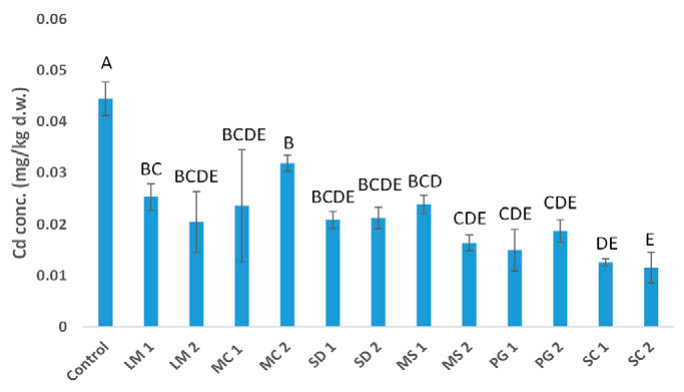
The Cd concentration in the peeled tubers ranged from 0.01 to 0.04 mg kg-1 dry wt. (Fig. 1), which is at the lower end of the range of 0.01 to 1.50 mg kg-1 dry wt. reported in the literature (Kabata-Pendias and Mukherjee, 2007; Kim, 2008; McLaughlin et al., 1994a, 1994b). The moisture content in our potatoes was 82% (w/w). Therefore, the fresh weight Cd concentrations of the tubers ranged from 0.002 to 0.008 mg kg-1. This Cd concentration is well below the World Health Organization’s and Food Standards of Australia and New Zealand’s limit for Cd in vegetables of 0.1 mg kg-1 (fresh wt.) (Bigdeli and Seilsepour, 2008; FSANZ, 2015) and the Codex limit of 0.1 mg kg-1 fresh wt. for potatoes (Codex, 2011; Codex, 2015).
去皮块茎中的Cd浓度为0.01~0.04 mg kg-1干重(图1),处于文献报道范围(0.01~1.50 mg kg-1干重)的低端(Kabata-Pendias and Mukherjee, 2007; Kim, 2008; McLaughlin et al., 1994a, 1994b)。本研究中马铃薯的含水率为82%(w/w),因此块茎的鲜重Cd浓度为0.002~0.008 mg kg-1。该Cd浓度远低于世界卫生组织及澳大利亚新西兰食品标准规定的蔬菜Cd限值0.1 mg kg-1(鲜重)(Bigdeli and Seilsepour, 2008; FSANZ, 2015),以及国际食品法典对马铃薯规定的0.1 mg kg-1鲜重限值(Codex, 2011; Codex, 2015)。
All the composts significantly decreased (P < 0.05) the concentration of Cd in peeled tubers (29–73%) compared with the control (Fig. 1). The greatest reduction in the Cd concentration compared with the control was achieved by the SC treatment (71%). Potatoes grown in soils treated with PG, MS, SD, and MC accumulated less Cd (58–66%, 46–63%, 52–53%, and 29–49%, respectively) in the potato flesh compared with the control. The 0.6 and 1.3% lime treatments decreased Cd concentration in the peeled tubers (by 43–54%).
与对照相比,所有堆肥均显著降低(P < 0.05)了去皮块茎中的Cd浓度(29%~73%)(图1)。与对照相比,SC处理的Cd浓度降幅最大(71%)。与对照相比,PG、MS、SD和MC处理土壤中生长的马铃薯薯肉Cd积累较少(分别降低58%~66%、46%~63%、52%~53%和29%~49%)。0.6%和1.3%石灰处理使去皮块茎中的Cd浓度降低(43%~54%)。
Cadmium in Potato Skins and Shoots马铃薯薯皮和地上部中的镉
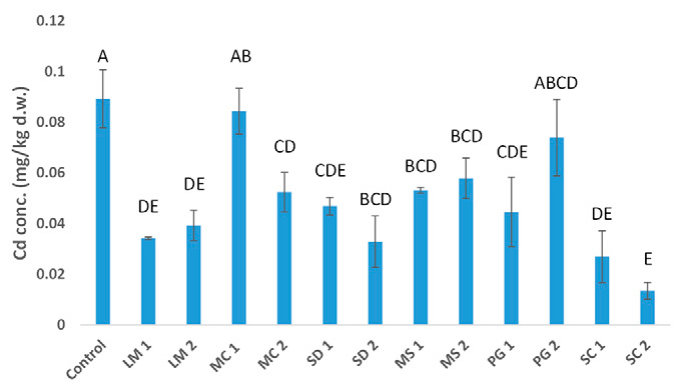
The Cd concentration in potato skins varied from 0.02 to 0.09 mg kg-1 dry wt. (Fig. 2). All treatments in soil significantly decreased the concentration of Cd in potato skins except the potato skins grown in soils treated with MC1 and PG2 (Fig. 2). The greatest reduction (85%) in the potato skin Cd concentration was observed in soils treated with SC2, followed by soils treated with SC1 (70% reduction), SD2 (63% reduction), and L1 (62% reduction). No significant difference was observed in the concentration of Cd in potato skin grown in the two rates of soil amendments except MC-treated soils, where potato skins of potato grown in MC2-treated soils had significantly less Cd concentration than that of MC1-treated soils.
马铃薯薯皮中的Cd浓度为0.02~0.09 mg kg-1干重(图2)。除MC1和PG2处理外,所有土壤处理均显著降低了马铃薯薯皮中的Cd浓度(图2)。SC2处理土壤中薯皮Cd浓度降幅最大(85%),其次为SC1(降低70%)、SD2(降低63%)和L1(降低62%)。除MC处理外,同一改良剂两种施用量下生长的马铃薯薯皮Cd浓度无显著差异;MC2处理土壤中马铃薯薯皮的Cd浓度显著低于MC1处理。
The Cd concentrations in the potato stems ranged from 0.18 to 0.94 mg kg-1 dry wt. (Supplemental Table S1). Both the rates of MC and SD and the 2.5% rate of PG significantly reduced the concentration of Cd in potato stem (by 62, 66, 62, 67, and 66%, respectively), whereas SC1 increased the concentration of Cd compared with control. The Cd concentrations in the potato leaves ranged from 0.11 to 0.27 mg kg-1 dry wt. (Supplemental Table S2). Both the rates of SC and LM 1 significantly decreased the concentration of Cd in potato leaves by 52, 56, and 51%, respectively.
马铃薯茎中的Cd浓度为0.18~0.94 mg kg-1干重(补充表S1)。MC和SD的两种施用量以及PG的2.5%施用量均显著降低了马铃薯茎中的Cd浓度(分别降低62%、66%、62%、67%和66%),而SC1处理则较对照增加了Cd浓度。马铃薯叶片中的Cd浓度为0.11~0.27 mg kg-1干重(补充表S2)。SC的两种施用量和LM 1均显著降低了马铃薯叶片中的Cd浓度,降幅分别为52%、56%和51%。
Concentrations of Other Elements其他元素的浓度
Unlike Cd, the treatments had no consistent effect on the other elements in the tubers, peel, stems, or leaves (Tables 2–5; Supplemental Tables S1 and S2). The concentration of B decreased in potato tubers grown in soils treated with both rates of LM and SC (Table 3). The Zn concentration in potato tubers ranged from 16.7 to 23.0 mg kg-1, and no consistent differences were observed for Zn accumulation in potato tuber compared with control. There were no significant differences in the concentration of P in the potato tubers, skins, or stems. Phosphorous in potato leaves increased in the SC treatments. All the treatments reduced the Zn and Fe concentrations in potato skins.
与Cd不同,各处理对块茎、薯皮、茎或叶中其他元素没有一致的影响(表2~表5;补充表S1和S2)。LM和SC两种施用量处理土壤中生长的马铃薯块茎B浓度降低(表3)。马铃薯块茎中的Zn浓度为16.7~23.0 mg kg-1,与对照相比,块茎Zn积累无一致差异。马铃薯块茎、薯皮或茎中的P浓度无显著差异。SC处理使马铃薯叶片中的磷含量增加。所有处理均降低了马铃薯薯皮中的Zn和Fe浓度。
Effect of Treatments on Potato Growth各处理对马铃薯生长的影响
Composts significantly increased the growth of both tubers and shoots (Fig. 3 and 4). The LM treatments significantly increased the tuber growth but decreased the shoot growth. Treatment with SC decreased potato tuber and shoot growth. An unpleasant odor emanated from the SC soil, indicating that it may have turned anaerobic after approximately 3 wk, which may explain the poor yield. The highest tuber growth was observed in soils treated with MC2 (168% increase), followed by soils treated with PG1 (112% increase), MS2 (109% increase), MC1 (106% increase), MS1 (102%), PG2 (67%), SD2 (63%), SD1 (47%), LM1 (45%), and LM2 (33%). The addition of SC1 and SC2 decreased potato growth by 50 and 60%, respectively.
堆肥显著促进了块茎和地上部的生长(图3和图4)。LM处理显著促进了块茎生长,但抑制了地上部生长。SC处理抑制了马铃薯块茎和地上部的生长。SC处理土壤散发出难闻气味,表明其可能在约3周后转为厌氧状态,这或许可以解释其产量低下的原因。块茎生长量最高的是MC2处理(增加168%),其次为PG1(增加112%)、MS2(增加109%)、MC1(增加106%)、MS1(102%)、PG2(67%)、SD2(63%)、SD1(47%)、LM1(45%)和LM2(33%)。添加SC1和SC2分别使马铃薯生长量降低50%和60%。
Effect of Treatments on Soil Properties各处理对土壤性质的影响
Table 6 shows that all treatments increased pH except SD1, SD2, PG2, and SC1, which had no significant effect on pH. The LM treatments resulted in by far the largest pH increase by 1.0 to 1.2 pH units, respectively, whereas the composts either had no effect or resulted in a slight increase (<0.4 pH units). All the由表6可知,除SD1、SD2、PG2和SC1对pH无显著影响外,其余处理均提高了土壤pH。LM处理的pH增幅最大,达1.0~1.2个pH单位,而堆肥或无影响,或仅使pH略有升高(<0.4个pH单位)。所有
| Treatment†处理† | % c | % n | ca | K | mg | P (ns)‡ | s |
|---|---|---|---|---|---|---|---|
| —————— | ——————————— | —— mg kg-1——— | ————————— | ——————— | |||
| Control | 40.59 (0.193)ab§ | 0.83 (0.075)b | 419 (65)abc | 20,811 (424)bcd | 1,268 (72)bcd | 3,356 (179) | 1,248 (71)ef |
| LM 1 | 40.34 (0.189)abc | 0.85 (0.034)b | 436 (42)ab | 19,428 (526)cd | 1,134 (29)d | 3118 (116) | 1,338 (60)cdef |
| LM 2 | 40.70 (0.197)a | 0.96 (0.062)b | 518 (66)a | 18,791 (867)d | 1,137 (28)d | 3,088 (170) | 1,366 (56)cdef |
| MC 1 | 40.24 (0.257)abc | 0.91 (0.022)b | 289 (15)cd | 21,565 (705)abc | 1,253 (39)bcd | 3,245 (60) | 1,214 (37)f |
| MC 2 | 39.98 (0.099)c | 0.98 (0.034)b | 258 (22)d | 21,640 (123)abc | 1,217 (19)cd | 3,163 (111) | 1,275 (38)def |
| SD 1 | 40.07 (0.099)c | 0.86 (0.065)b | 307 (18)bcd | 20,414 (694)bcd | 1,227 (17)cd | 3,284 (21) | 1,295 (60)def |
| SD 2 | 40.33 (0.046)abc | 0.93 (0.040)b | 308 (53)bcd | 21,229 (11081)abc | 1,330 (37)abc | 3,264 (267) | 1,405 (48)cdef |
| MS 1 | 40.19 (0.157)bc | 0.88 (0.108)b | 418 (55)abc | 20,011 (185)cd | 1,201 (60)cd | 3,026 (88) | 1,539 (83)bcd |
| MS 2 | 40.25 (0.083)abc | 0.85 (0.031)b | 320 (23)bcd | 21,600 (1,476)abc | 1,294 (34)bc | 3,014 (43) | 1,593 (53)bc |
| PG 1 | 40.63 (0.109)ab | 0.95 (0.035)b | 298 (33)cd | 22,611 (757)ab | 1,473 (18)a | 3,397 (12) | 1,531 (24)bcde |
| PG 2 | 40.65 (0.255)ab | 1.01 (0.104)b | 420 (57)abc | 20,464 (414)bcd | 1,386 (69)ab | 3,082 (61) | 1,452 (100)cdef |
| SC 1 | 39.37 (0.165)d | 1.40 (0.152)a | 326 (48)bcd | 21,622 (988)abc | 1,143 (101)d | 3,134 (87) | 1,757 (209)ab |
| SC 2 | 39.44 (0.161)d | 1.55 (0.292)a | 376 (49)bcd | 23,203 (1039)a | 1,239 (36)cd | 3,327 (340) | 1,900 (206)a |
† Control, no treatment in soil; LM 1 and LM 2, lime 0.6 and 1.3%, respectively; MC 1 and MC 2, municipal green waste compost 2.5 and 5%, respectively; MS 1 and MS 2, mushroom industry residue compost 2.5 and 5%, respectively; PG 1 and PG 2, pig manure composted with sawdust 2.5 and 5%, respectively; SC 1 and SC 2, shredded corn stover 2.5 and 5%, respectively; SD 1 and SD 2, sawdust composted with animal offal 2.5 and 5%, respectively. ‡ ns, no significant differences between P concentrations. § Standard errors are given in parentheses (n = 3). Values in the same column with the same letters are not significantly different.
† 对照,土壤未作处理;LM 1和LM 2,石灰分别为0.6%和1.3%;MC 1和MC 2,城市绿色废弃物堆肥分别为2.5%和5%;MS 1和MS 2,蘑菇产业残渣堆肥分别为2.5%和5%;PG 1和PG 2,猪粪与锯末堆肥分别为2.5%和5%;SC 1和SC 2,玉米秸秆碎料分别为2.5%和5%;SD 1和SD 2,锯末与动物内脏堆肥分别为2.5%和5%。‡ ns,P浓度间无显著差异。§ 括号内为标准误(n = 3)。同列中标有相同字母的数值间差异不显著。
| Treatment†处理† | B | cr | cu | Fe | mn | mo | na | Zn |
|---|---|---|---|---|---|---|---|---|
| ————— | —————————— | ———————— | —————— mg | kg-1——————— | ———————— | ————————— | ————— | |
| Control | 7.40 (0.04)a‡ | 0.624 (0.04)a | 6.1 (0.3)ab | 23 (2)ab | 6.96 (0.7)abc | 0.6 (0.05)d | 87 (16)cd | 20 (2)abc |
| LM 1 | 6.37 (0.2)bc | 0.484 (0.2)abc | 5.9 (0.2)b | 19 (0.8)b | 6.04 (0.2)c | 2.1 (0.1)a | 110 (13)abcd | 18 (0.4)bcd |
| LM 2 | 6.43 (0.04)bc | 0.463 (0.06)abc | 6.2 (0.4)ab | 19 (1)b | 5.95 (0.1)c | 2.1 (0.2)a | 83 (4)d | 18 (0.8)bcd |
| MC 1 | 7.33 (0.3)a | 0.266 (0.02)bcd | 6.4 (0.4)ab | 21 (0.2)b | 6.7 (0.2)abc | 1.4 (0.2)b | 153 (1)abc | 19 (1)bcd |
| MC 2 | 6.72 (0.3)abc | 0.469 (0.1)abc | 6.6 (0.3)ab | 21 (0.1)ab | 6.3 (0.1)c | 1.3 (0.2)bc | 173 (34)a | 19 (0.6)bcd |
| SD 1 | 6.80 (0.1)abc | 0.467 (0.2)abc | 5.8 (0.2)b | 20 (1)b | 6.8 (0.2)abc | 0.63 (0.1)cd | 98 (20)bcd | 17 (0.3)cd |
| SD 2 | 6.89 (0.2)ab | 0.495 (0.07)ab | 6.6 (0.2)ab | 23 (0.3)ab | 7.5 (0.2)ab | 1.2 (0.1)bc | 152 (47)abc | 18 (1)bcd |
| MS 1 | 6.66 (0.4)abc | 0.212 (0.04)d | 6.8 (0.5)ab | 19 (0.7)b | 6.4 (0.4)bc | 0.6 (0.04)d | 140 (31)abcd | 17 (0.4)cd |
| MS 2 | 6.61 (0.3)abc | 0.18 (0.1)d | 6.3 (0.2)ab | 18 (0.9)b | 6.0 (0.2)c | 0.57 (0.2)d | 135 (25)abcd | 16 (0.5)d |
| PG 1 | 6.74 (0.1)abc | 0.169 (0.1)d | 6.1 (0.1)ab | 21 (0.6)b | 7.0 (0.1)abc | 0.8 (0.07)bcd | 110 (10)abcd | 18 (0.3)cd |
| PG 2 | 6.95 (0.3)ab | 0.238 (0.03)cd | 6.1 (0.4)ab | 20 (0.7)b | 6.4 (0.3)bc | 0.9 (0.02)bcd | 158 (21)ab | 17 (1)cd |
| SC 1 | 5.99 (0.3)cd | 0.105 (0.02)d | 7.6 (0.5)a | 21 (2.5)ab | 6.7 (0.9)abc | 1.1 (0.5)bcd | 89 (12)cd | 22 (2)ab |
| SC 2 | 5.39 (0.4)d | 0.241 (0.1)cd | 7.4 (1.5)ab | 27 (5)a | 7.6 (0.6)a | 1.4 (0.5)b | 120 (14)abcd | 23 (3)a |
† Control, no treatment in soil; LM 1 and LM 2, lime 0.6 and 1.3%, respectively; MC 1 and MC 2, municipal green waste compost 2.5 and 5%, respectively; MS 1 and MS 2, mushroom industry residue compost 2.5 and 5%, respectively; PG 1 and PG 2, pig manure composted with sawdust 2.5 and 5%, respectively; SC 1 and SC 2, shredded corn stover 2.5 and 5%, respectively; SD 1 and SD 2, sawdust composted with animal offal 2.5 and 5%, respectively. ‡ Standard errors are given in parentheses (n = 3). Values in the same column with the same letters are not significantly different.
† 对照,土壤未作处理;LM 1和LM 2,石灰分别为0.6%和1.3%;MC 1和MC 2,城市绿色废弃物堆肥分别为2.5%和5%;MS 1和MS 2,蘑菇产业残渣堆肥分别为2.5%和5%;PG 1和PG 2,猪粪与锯末堆肥分别为2.5%和5%;SC 1和SC 2,玉米秸秆碎料分别为2.5%和5%;SD 1和SD 2,锯末与动物内脏堆肥分别为2.5%和5%。‡ 括号内为标准误(n = 3)。同列中标有相同字母的数值间差异不显著。
composts significantly increased C and N, and there was a small increase in the C/N ratio in all treatments.
堆肥均显著提高了C和N含量,且所有处理的C/N比均略有升高。
All of the organic amendments reduced Ca(NO3)2–extractable Cd in the soil, except PG2 (Table 7). The effect of the composts on the Ca(NO3)2–extractable concentrations of other elements was variable, with the changes reflecting the composition of the composts (Table 1). The LM treatments caused an approximately 10-fold decrease in Ca(NO3)2–extractable Zn, whereas the effect of the composts was smaller and in many cases not significant (Table 7)
除PG2外,所有有机改良剂均降低了土壤中Ca(NO3)2可提取态Cd(表7)。堆肥对其他元素Ca(NO3)2可提取态浓度的影响不一,其变化反映了堆肥的组成(表1)。LM处理使Ca(NO3)2可提取态Zn降低约10倍,而堆肥的影响较小,且在许多情况下不显著(表7)。
4Discussion讨论
The low Cd concentrations in the potato tubers was not anticipated because the soil Cd concentration (1.48 mg kg-1) is within the top 5% of New Zealand soils (Reiser et al., 2014), although the same low concentration was observed in the potato tubers in New Zealand soils by Kim (2008) and in Australia by Maier et al. (2002). In contrast to the tubers, the Cd concentrations in the stems and leaves of potato were with the range (0.2–0.9 mg kg-1) of concentrations reported by Maier et al. (2002). This indicates that the low concentration of Cd in the tubers is the result of plant physiological processes rather than low Cd bioavailability in the soil. Given that Cd is relatively phloem immobile (Uraguchi et al., 2009), one would not expect high Cd concentrations in the tubers, which receive most of their nutrients via the phloem (Dunbar et al., 2003).
马铃薯块茎中Cd浓度较低出乎预期,因为该土壤Cd浓度(1.48 mg kg-1)位于新西兰土壤的前5%(Reiser et al., 2014);不过,Kim(2008)在新西兰土壤以及Maier et al.(2002)在澳大利亚也观察到马铃薯块茎中同样较低的Cd浓度。与块茎不同,马铃薯茎和叶中的Cd浓度处于Maier et al.(2002)报道的浓度范围内(0.2~0.9 mg kg-1)。这表明块茎中Cd浓度较低是植物生理过程的结果,而非土壤中Cd生物有效性较低所致。鉴于Cd在韧皮部中移动性相对较弱(Uraguchi et al., 2009),而块茎的大部分养分经由韧皮部供应(Dunbar et al., 2003),因此块茎中的Cd浓度预计不会很高。
The lower tuber Cd concentrations in our study compared withthose reported by other authors (Kabata-Pendias and Mukherjee, 2007; McLaughlin et al., 1994a, 1994b; N. Kim, unpublished data, 2005) may be due to differences in variety, although McLaughlin et al. (1994a) reported only small differences in Cd uptake between varieties. In our study, the potatoes were peeled with a knife to ensure that no skin and associated soil particles remained on the tuber. Knife peeling removes a greater portion of the tuber than a typical peeler. If the potato flesh directly under the skin has a higher Cd concentration than the remainder of the tuber, then this would explain our lower Cd results in our study.
本研究中块茎Cd浓度低于其他作者的报道(Kabata-Pendias and Mukherjee, 2007; McLaughlin et al., 1994a, 1994b; N. Kim, 未发表数据, 2005),可能与品种差异有关,尽管McLaughlin et al.(1994a)报道不同品种间Cd吸收差异较小。本研究中马铃薯用刀削皮,以确保块茎上无残留薯皮及附着的土壤颗粒。刀削去除的块茎部分多于常规削皮器。若紧贴薯皮下方的薯肉Cd浓度高于块茎其余部分,则可解释本研究中较低的Cd测定结果。
| Treatment†处理† | ca | K | mg | P (ns)‡ | s |
|---|---|---|---|---|---|
| ———————— | —————————————— | ——— mg kg-1————— | ———————————— | ———————— | |
| Control | 1,286 (155)b§ | 37,687 (1,278)a | 2,063 (146)ab | 5,327 (269) | 1,647 (150)abc |
| LM 1 | 1,690 (224)ab | 27,967 (921)e | 1,504 (72)b | 4,540 (176) | 1,394 (55)c |
| LM 2 | 1,909 (19)ab | 30,785 (1,623)cde | 1,733 (61)b | 5,000 (209) | 1,607 (82)bc |
| MC 1 | 925 (114)b | 35,960 (1,956)ab | 1,811 (46)b | 5,269 (327) | 1,388 (14)c |
| MC 2 | 859 (17)b | 35,257 (614)abc | 1,750 (74)b | 5,058 (96) | 1,452 (76)c |
| SD 1 | 1,018 (166)b | 33,589 (1071)abcd | 1,711 (115)b | 5,298 (373) | 1,482 (101)c |
| SD 2 | 1,232 (46)b | 31,632 (2983)bcde | 2,039 (98)ab | 5,075 (565) | 1,676 (64)abc |
| MS 1 | 1,252 (79)b | 32,001 (1101)bcde | 1,801 (52)b | 4,972 (128) | 2,129 (25)a |
| MS 2 | 1,084 (75)b | 32,503 (1229)bcde | 1,601 (50)b | 4,594 (109) | 1,809 (39)abc |
| PG 1 | 890 (79)b | 32,041 (1624)bcde | 1,784 (89)b | 5,177 (172) | 1,435 (113)c |
| PG 2 | 3,540 (23)a | 34,002 (1104)abcd | 2,534 (730)a | 4,946 (195) | 2,045 (474)ab |
| SC 1 | 840 (37)b | 34,760 (1914)abcd | 1,498 (226)b | 4,496 (522) | 1,546 (238)c |
| SC 2 | 931 (79)b | 30,190 (2899)de | 1,463 (72)b | 4,401 (723) | 1,789 (175)abc |
† Control, no treatment in soil; LM 1 and LM 2, lime 0.6 and 1.3%, respectively; MC 1 and MC 2, municipal green waste compost 2.5 and 5%, respectively; MS 1 and MS 2, mushroom industry residue compost 2.5 and 5%, respectively; PG 1 and PG 2, pig manure composted with sawdust 2.5 and 5%, respectively; SC 1 and SC 2, shredded corn stover 2.5 and 5%, respectively; SD 1 and SD 2, sawdust composted with animal offal 2.5 and 5%, respectively. ‡ ns, no significant differences between P concentrations. § Standard errors are given in parentheses (n = 3). Values in the same column with the same letters are not significantly different.
† 对照,土壤未作处理;LM 1和LM 2,石灰分别为0.6%和1.3%;MC 1和MC 2,城市绿色废弃物堆肥分别为2.5%和5%;MS 1和MS 2,蘑菇产业残渣堆肥分别为2.5%和5%;PG 1和PG 2,猪粪与锯末堆肥分别为2.5%和5%;SC 1和SC 2,玉米秸秆碎料分别为2.5%和5%;SD 1和SD 2,锯末与动物内脏堆肥分别为2.5%和5%。‡ ns,P浓度间无显著差异。§ 括号内为标准误(n = 3)。同列中标有相同字母的数值间差异不显著。
| Treatment†处理† | B | cr | cu | Fe | mn | mo | Zn |
|---|---|---|---|---|---|---|---|
| —————— | ————————— | —————————— | —— mg kg-1——— | ————————— | ——————————— | ———— | |
| Control | 15.3 (1)a‡ | 0.4 (0.1)a | 7.5 (0.4)bc | 353 (115)a | 20 (5)a | 0.6 (0.1)cd | 42 (10)a |
| LM 1 | 9.8 (0)de | 0.1 (0.03)c | 7.0 (0.1)c | 77 (18)b | 7 (0.1)b | 1.9 (0.1)a | 22 (2)b |
| LM 2 | 11.6 (1)bcde | 0.2 (0.02)b | 7.9 (0.6)bc | 53 (3)b | 8 (0.4)b | 1.9 (0.1)a | 24 (1)b |
| MC 1 | 13 (1)abc | 0.1 (0.03)c | 8.8 (0.5)abc | 119 (33)b | 9 (1.4)b | 1.1 (0.1)bc | 25 (3)b |
| MC 2 | 12.6 (0)bc | 0.1 (0.02)c | 9.5 (0.3)ab | 98 (32)b | 9 (1.3)b | 1.1 (0.1)bc | 25 (2)b |
| SD 1 | 12.7 (1)bc | 0.1 (0.02)c | 8.2 (0.7)bc | 98 (22)b | 10 (0.8)b | 0.5 (0.1)cd | 22 (2)b |
| SD 2 | 12.1 (1)bcd | 0.2 (0.03)b | 8.5 (0.5)abc | 109 (11)b | 10 (1.5)b | 1.1 (0.1)bc | 22 (3)b |
| MS 1 | 11.9 (1)bcde | 0.1 (0.03)c | 9.3 (0.4)abc | 133 (42)b | 10 (1)b | 0.5 (0.1)cd | 20 (0)b |
| MS 2 | 10.8 (1)cde | 0.1 (0.01)c | 8.8 (0.5)abc | 50 (8)b | 7 (0.8)b | 0.4 (0.1)d | 19 (0)b |
| PG 1 | 11.1 (0)bcde | 0.1 (0.02)c | 8.6 (0.1)abc | 67 (9)b | 7 (0.1)b | 0.7 (0.1)cd | 20 (1)b |
| PG 2 | 13.5 (0)ab | 0.2 (0.08)bc | 9.6 (1.1)ab | 161 (73)b | 12 (2.2)b | 0.8 (0.2)bcd | 24 (3)b |
| SC 1 | 11.5 (2)bcde | 0.1 (0.01)c | 9 (1.4)abc | 49 (11)b | 8 (3)b | 1.1 (0.4)bc | 28 (5)b |
| SC 2 | 9.6 (1)e | 0.1 (0.01)c | 10.7 (1.9)a | 40 (12)b | 9 (0.3)b | 1.4 (0.5)ab | 24 (3)b |
† Control, no treatment in soil; LM 1 and LM 2, lime 0.6 and 1.3%, respectively; MC 1 and MC 2, municipal green waste compost 2.5 and 5%, respectively; MS 1 and MS 2, mushroom industry residue compost 2.5 and 5%, respectively; PG 1 and PG 2, pig manure composted with sawdust 2.5 and 5%, respectively; SC 1 and SC 2, shredded corn stover 2.5 and 5%, respectively; SD 1 and SD 2, sawdust composted with animal offal 2.5 and 5%, respectively.
† 对照,土壤未作处理;LM 1和LM 2,石灰分别为0.6%和1.3%;MC 1和MC 2,城市绿色废弃物堆肥分别为2.5%和5%;MS 1和MS 2,蘑菇产业残渣堆肥分别为2.5%和5%;PG 1和PG 2,猪粪与锯末堆肥分别为2.5%和5%;SC 1和SC 2,玉米秸秆碎料分别为2.5%和5%;SD 1和SD 2,锯末与动物内脏堆肥分别为2.5%和5%。
‡ Standard errors are given in parentheses (n = 3). Values in the same column with the same letters are not significantly different.
‡ 括号内为标准误(n = 3)。同列中标有相同字母的数值间差异不显著。
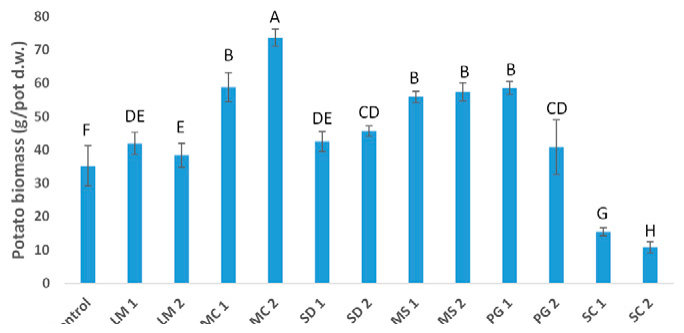
![Fig. 4. shoot biomass (dry weight [d.w.]). Bars represent sem (n = 3). values with the same letters are not significantly different.](139/figure-04.jpg)
The concentration ratio of the potato flesh:skin/peel:shoots was 2:5:29, with little variation between treatments. This is similar to other experiments with potato (Corguinha et al., 2012; Reid et al., 2003). Some of Cd in potato skins may arise from the incorporation of soil particles into the skin that could not be removed even after washing.
马铃薯薯肉:薯皮:地上部的Cd浓度比为2:5:29,各处理间差异很小。这与其他马铃薯试验结果相似(Corguinha et al., 2012; Reid et al., 2003)。马铃薯薯皮中的部分Cd可能来源于嵌入薯皮、即使清洗后也无法去除的土壤颗粒。
All amendments significantly reduced Cd uptake by the potato tubers and most amendments reduced uptake into the shoots. A similar result was also observed by Kim et al. (2016), who observed a reduction in the accumulation of Cd due to the application of lime and peat, although in their experiment the soil had exceptionally higher Cd concentration than in our experiment (55 mg Cd kg-1 soil vs. 1.5 mg Cd kg-1 soil) where the Cd concentration was elevated due to the application of P fertilizers in New Zealand agricultural soils (Taylor, 1997). The reduction in Cd uptake may be partially explained by the reduction in bioavailable Cd [estimated in our experiments using a 0.05 M Ca(NO3)2 extraction], which occurred in all of the treatments and which has been reported by other authors with different plants (Pandit et al., 2012) and soils (Kim et al., 2016; Pandit et al., 2012). Black et al. (2012) and Gray et al. (1999a, 1992b) reported a strong positive correlation between plant Cd and Ca(NO3)2–extractable Cd in a single soil type.
所有改良剂均显著降低了马铃薯块茎对Cd的吸收,大多数改良剂还降低了Cd向地上部的转运。Kim et al.(2016)也观察到类似结果,即施用石灰和泥炭可降低Cd积累;但其试验土壤的Cd浓度远高于本试验(55 mg Cd kg-1土壤 vs. 1.5 mg Cd kg-1土壤),本试验土壤Cd浓度的升高源于新西兰农业土壤中磷肥的施用(Taylor, 1997)。Cd吸收的降低可部分归因于生物有效态Cd的减少[本试验采用0.05 M Ca(NO3)2提取法估算],这一现象在所有处理中均有出现,其他作者在不同植物(Pandit et al., 2012)和土壤(Kim et al., 2016; Pandit et al., 2012)中也有报道。Black et al.(2012)和Gray et al.(1999a, 1992b)报道,在单一土壤类型中,植物Cd与Ca(NO3)2可提取态Cd之间存在显著正相关。
For the MC, MS, and PG1 treatments, the reduced Cd concentration in the tubers may be partly explained by the small increase in pH of the amended soils (Table 6). However, most of the decrease in tuber Cd may be attributed to the increase in Cd-binding sites on the composts, which is indicated by their high CEC values (Table 1). The CEC of the composts in this study was similar to those reported in other composts and organic amendments (Pusz, 2007; Simmler et al., 2013). The increase in CEC in the amended soils is likely due to the high concentration of organic C in the composts (20–47%) compared with the soil (2.2%). Although Fe oxides are important for Cd binding in soil (Covelo et al., 2007), the Fe concentrations in the composts tested were an order of magnitude less than the soil (Table 1). For all treatments except the SC, the increased growth of the tuber may have resulted in a lower Cd concentration due to a “dilution effect” (Robinson et al., 2009). This effect may also explain the increased shoot Cd in the SC1 treatment where the shoot growth was significantly reduced.
对于MC、MS和PG1处理,块茎Cd浓度的降低可部分归因于改良土壤pH的小幅升高(表6)。然而,块茎Cd的降低主要可归因于堆肥带来的Cd结合位点增加,这体现在堆肥较高的CEC值上(表1)。本研究中堆肥的CEC与其他堆肥和有机改良剂的报道值相近(Pusz, 2007; Simmler et al., 2013)。改良土壤CEC的增加可能源于堆肥中有机C含量(20%~47%)远高于土壤(2.2%)。尽管Fe氧化物对土壤中Cd的结合十分重要(Covelo et al., 2007),但所测堆肥中的Fe浓度比土壤低一个数量级(表1)。除SC外,其余处理中块茎生长量的增加可能通过“稀释效应”降低了Cd浓度(Robinson et al., 2009)。该效应也可解释SC1处理中地上部生长显著受抑而地上部Cd浓度升高的现象。
| Treatment†处理† | ph | Total c全C | Total n全N | c/n | K | mg | P | s |
|---|---|---|---|---|---|---|---|---|
| —————— | % —————— | ——————— | —————— mg | kg-1——————— | —————— | |||
| Control | 6.04 (0.02)gh‡ | 2.29 (0.02)g | 0.212 (0.003)fg | 10.84 (0.021)efg | 258 (13)h | 426 (18)e | 3.85 (0.3)fg | 219 (57)d |
| LM 1 | 7.03 (0.58) b | 2.28 (0.13)g | 0.206 (0.002)fg | 11.06 (0.046)def | 271 (5)gh | 291 (1)f | 3.99 (0.01)fg | 231 (23)d |
| LM 2 | 7.28 (0.03)a | 2.29 (0.03)g | 0.185 (0.009)g | 12.47 (0.540)bc | 244 (6)h | 247 (2)g | 4.01 (0.14)fg | 200 (16)d |
| MC 1 | 6.26 (0.02)e | 3.00 (0.08)ef | 0.285 (0.007)bc | 10.53 (0.128)fg | 305 (3)fg | 493 (4)cd | 4.27 (0.03)def | 184 (11)d |
| MC 2 | 6.37 (0.03 cd | 4.07 (0.16)a | 0.403 (0.018)a | 10.12 (0.070)g | 408 (5)cd | 569 (13)ab | 4.88 (0.1)bc | 155 (7)d |
| SD 1 | 6.09(0.01)fgh | 3.21 (0.04)de | 0.269 (0.006)cd | 11.93 (0.257)cd | 267 (4)h | 431 (7)e | 4.10 (0.2)efg | 146 (12)d |
| SD 2 | 6.13 (0.05)fg | 4.12 (0.08)a | 0.309 (0.009)b | 13.34 (0.172)ab | 258 (20)h | 452 (6)de | 4.54 (0.3)cde | 135 (9)d |
| MS 1 | 6.28 (0.03)de | 3.84 (0.02)ab | 0.247 (0.002)de | 11.84 (0.007)cd | 374 (14)de | 535 (8)bc | 4.79 (0.1)bc | 1064 (53)b |
| MS 2 | 6.43 (0.01)c | 2.93 (0.10)ef | 0.302 (0.007)b | 12.70 (0.071)bc | 422 (2)c | 612 (6)a | 5.70 (0.1)a | 1521 (54)a |
| PG 1 | 6.30 (0.05)de | 2.86 (0.04)f | 0.231 (0.015)ef | 12.43 (0.690)bc | 573 (24)b | 430 (9)e | 3.73 (0.1)g | 47 (4)d |
| PG 2 | 6.10 (0.03)fgh | 3.67 (0.11)bc | 0.264 (0.008)cd | 13.90 (0.532)a | 769 (9)a | 504 (21)c | 4.67 (0.1)bcd | 96 (8)d |
| SC 1 | 6.01 (0.01)h | 2.92 (0.11)f | 0.255 (0.007)de | 11.46 (0.128)de | 313 (5)f | 452 (8)de | 4.87 (0.1)bc | 287 (37)d |
| SC 2 | 6.14 (0.04)f | 3.45 (0.22)cd | 0.306 (0.020)b | 11.27 (0.187)def | 372 (16)e | 502 (15)c | 5.02 (0.1)b | 559 (88)c |
† Control, no treatment in soil; LM 1 and LM 2, lime 0.6 and 1.3%, respectively; MC 1 and MC 2, municipal green waste compost 2.5 and 5%, respectively; MS 1 and MS 2, mushroom industry residue compost 2.5 and 5%, respectively; PG 1 and PG 2, pig manure composted with sawdust 2.5 and 5%, respectively; SC 1 and SC 2, shredded corn stover 2.5 and 5%, respectively; SD 1 and SD 2, sawdust composted with animal offal 2.5 and 5%, respectively.
† 对照,土壤未作处理;LM 1和LM 2,石灰分别为0.6%和1.3%;MC 1和MC 2,城市绿色废弃物堆肥分别为2.5%和5%;MS 1和MS 2,蘑菇产业残渣堆肥分别为2.5%和5%;PG 1和PG 2,猪粪与锯末堆肥分别为2.5%和5%;SC 1和SC 2,玉米秸秆碎料分别为2.5%和5%;SD 1和SD 2,锯末与动物内脏堆肥分别为2.5%和5%。
‡ Standard errors are given in parentheses (n = 3). Values in the same column with the same letters are not significantly different.
‡ 括号内为标准误(n = 3)。同列中标有相同字母的数值间差异不显著。
| Treatment†处理† | cd | cu | Fe | mn | na | Zn |
|---|---|---|---|---|---|---|
| ———————— | ——————————— | ————————— mg kg-1 | ————————— | ———————————— | ——————— | |
| Control | 0.011 (0.003)a‡ | 0.16 (0.014)def | 0.20 (0.04)c | 23 (2)de | 118 (9)ef | 0.419 (0.03)a |
| LM 1 | 0.002 (0.001)de | 0.21 (0.005)ab | 0.34 (0.15)bc | 6 (2)fg | 92 (0.2)g | 0.032 (0.01)e |
| LM 2 | 0.009 (0.000)e | 0.20 (0.004)bc | 0.41 (0.1)abc | 3 (0.6)g | 89 (1)g | 0.055 (0.02)e |
| MC 1 | 0.002 (0.000)de | 0.17 (0.015)de | 0.34 (0.11)bc | 14 (0.2)ef | 200 (4)b | 0.322 (0.04)abc |
| MC 2 | 0.001 (0.000)e | 0.17 (0.018)cde | 0.43 (0.13)abc | 14 (2)efg | 245 (3)a | 0.215 (0.04)cd |
| SD 1 | 0.006 (0.000)b | 0.15 (0.015)efg | 0.19 (0.02)c | 23 (4)de | 114 (5)f | 0.323 (0.01)abc |
| SD 2 | 0.003 (0.000)cde | 0.13 (0.013)fg | 0.14 (0.06)c | 23 (2)de | 123 (4)ef | 0.251 (0.03)bcd |
| MS 1 | 0.004 (0.000)cd | 0.24 (0.006)a | 0.17 (0.1)c | 33 (7)cd | 146 (4)d | 0.175 (0.03)cde |
| MS 2 | 0.001 (0.000)e | 0.24 (0.001)a | 0.30 (0.01)bc | 17 (0.3)e | 179 (4)c | 0.148 (0.08)de |
| PG 1 | 0.006 (0.001)b | 0.13 (0.001)g | 0.43 (0.01)abc | 44 (2)ab | 89 (4)g | 0.457 (0.11)a |
| PG 2 | 0.009 (0.002)a | 0.15 (0.003)defg | 0.53 (0.2)ab | 49 (8)a | 127 (6)ef | 0.419 (0.09)a |
| SC 1 | 0.005 (0.001)bc | 0.19 (0.003)bcd | 0.38 (0.03)abc | 38 (3)bc | 135 (6)de | 0.475 (0.06)a |
| SC 2 | 0.001 (0.000)e | 0.17 (0.001)cde | 0.69 (0.02)a | 29 (0.4)cd | 173 (3)c | 0.403 (0.05)ab |
† Control, no treatment in soil; LM 1 and LM 2, lime 0.6 and 1.3%, respectively; MC 1 and MC 2, municipal green waste compost 2.5 and 5%, respectively; MS 1 and MS 2, mushroom industry residue compost 2.5 and 5%, respectively; PG 1 and PG 2, pig manure composted with sawdust 2.5 and 5%, respectively; SC 1 and SC 2, shredded corn stover 2.5 and 5%, respectively; SD 1 and SD 2, sawdust composted with animal offal 2.5 and 5%, respectively. ‡ Standard errors are given in parentheses (n = 3). Values in the same column with the same letters are not significantly different.
† 对照,土壤未作处理;LM 1和LM 2,石灰分别为0.6%和1.3%;MC 1和MC 2,城市绿色废弃物堆肥分别为2.5%和5%;MS 1和MS 2,蘑菇产业残渣堆肥分别为2.5%和5%;PG 1和PG 2,猪粪与锯末堆肥分别为2.5%和5%;SC 1和SC 2,玉米秸秆碎料分别为2.5%和5%;SD 1和SD 2,锯末与动物内脏堆肥分别为2.5%和5%。‡ 括号内为标准误(n = 3)。同列中标有相同字母的数值间差异不显著。
It is unlikely in this study that Zn reduced Cd uptake by alleviating Zn deficiency because the soil contained 174 mg kg-1 Zn (Table 1), which is more than double the mean Zn concentration in New Zealand pastoral soils (65 mg kg-1) (Reiser et al., 2014). Nevertheless, in Zn-deficient soils, the higher Zn concentrations (>200 mg kg-1) of the MC may supply sufficient Zn to reduce plant Cd uptake. The MS and PG amendments may reduce Cd uptake by reducing the expression plant Zn transport proteins (which also transport Cd) that are produced in Zn-deficient environments (Chaney et al., 2009).
本研究中Zn通过缓解Zn缺乏而降低Cd吸收的可能性不大,因为该土壤Zn含量为174 mg kg-1(表1),是新西兰牧场土壤平均Zn浓度(65 mg kg-1)的两倍以上(Reiser et al., 2014)。尽管如此,在缺Zn土壤中,MC较高的Zn浓度(>200 mg kg-1)可能提供足够的Zn以降低植物对Cd的吸收。MS和PG改良剂可能通过降低植物在缺Zn环境中产生的Zn转运蛋白(该蛋白同样转运Cd)的表达而减少Cd吸收(Chaney et al., 2009)。
The reduction of Cd concentration in potato flesh grown in LM treatments was anticipated because these two rates of lime were selected from a previous study using the same soil, where the effects of seven rates of lime treatment were tested on the Cd solubility and uptake by white lupin (Valentinuzzi et al., 2015). Lime treatments in soil have been reported to both increase and decrease the uptake of Cd by plants. Lime significantly increased soil pH (Table 6), which has been associated with decreasing the accumulation of Cd in plants in almost all studies (Hong et al., 2007; Kabata-Pendias and Mukherjee, 2007; Kim et al., 2016; Simmler et al., 2013) through increasing the availability of negative binding sites on variable charged soil moieties (Brady and Weil, 2008) that may bind Cd. Our results stand in contrast to other studies that reported an increased uptake of Cd by plants due to lime application, which was attributed to competition between Cd and Ca for sorption sites in soil (Chaney et al., 2009; Maier et al., 2002; McLaughlin et al., 1997; Merian, 1991).
LM处理中马铃薯薯肉Cd浓度的降低在预期之中,因为这两种石灰用量选自此前使用同一土壤的研究,该研究测试了七种石灰用量对Cd溶解度及白羽扇豆Cd吸收的影响(Valentinuzzi et al., 2015)。已有报道表明,土壤施用石灰既可能增加也可能降低植物对Cd的吸收。石灰显著提高了土壤pH(表6),几乎所有研究均表明pH升高与植物Cd积累降低相关(Hong et al., 2007; Kabata-Pendias and Mukherjee, 2007; Kim et al., 2016; Simmler et al., 2013),其机理是可变电荷土壤组分上可结合Cd的负电荷结合位点有效性增加(Brady and Weil, 2008)。本研究结果与其他研究报道的施用石灰导致植物Cd吸收增加相反,后者将其归因于土壤中Cd与Ca对吸附位点的竞争(Chaney et al., 2009; Maier et al., 2002; McLaughlin et al., 1997; Merian, 1991)。
A positive growth response to compost addition has also been shown by other authors (Barkoczi et al., 2008; Khan et al., 2007; Muhammad et al., 2007). The composts used in this study contained high P content compared with the soil, and thus no fertilizer was used, which eliminated the risk of further addition of Cd input in this soils. Moreover, this compost probably improved the physical properties of soils by improving soil porosity, aggregate stability, nutrient- and water-holding capacity, and temperature insulation and by decreasing apparent soil density (Sarwar et al., 2008; Shiralipour et al., 1992) and soil nutrient content (Shiralipour et al., 1992). The reduced shoot growth in the lime treatment may have been due to the imbalance of nutrient elements in soil due to the pH increase (Maier et al., 2002).
其他作者也报道了施用堆肥对植物生长的正效应(Barkoczi et al., 2008; Khan et al., 2007; Muhammad et al., 2007)。本研究所用堆肥的P含量高于土壤,因此未施用化肥,从而避免了向该土壤进一步输入Cd的风险。此外,堆肥可能通过提高土壤孔隙度、团聚体稳定性、养分和水分保持能力及保温性能、降低土壤容重(Sarwar et al., 2008; Shiralipour et al., 1992)以及提高土壤养分含量(Shiralipour et al., 1992)改善了土壤性质。石灰处理中地上部生长的降低可能是由于pH升高导致土壤养分元素失衡(Maier et al., 2002)。
5Conclusions结论
Composts with contrasting provenances all decreased the concentration of Cd in potato tubers and skins and decreased the Ca(NO3)2–extractable concentrations of Cd in soil. Most of this effect was attributed to the increased number binding sites for Cd in compost-amended soil. In addition, the increase in fertility associated with compost addition may have reduced potato Cd concentrations by increasing the biomass, thereby resulting in a “dilution by growth” effect. All composts and lime significantly increased tuber growth except SC, which significantly reduced growth. That all the composts in this study reduced Cd uptake does not imply that every compost will do so. Further work is warranted to identify the key components of composts that result in reduced Cd uptake by plants and increased biomass of potato. Potentially, composts may be a low-cost means of ensuring that crop Cd concentrations remain within Food Safety Standards by reducing plant uptake and offsetting the need to apply Cd-contaminated phosphate fertilizers.
不同来源的堆肥均降低了马铃薯块茎和薯皮中的Cd浓度,并降低了土壤中Ca(NO3)2可提取态Cd浓度。这一效应主要归因于堆肥改良土壤中Cd结合位点数量的增加。此外,施用堆肥带来的肥力提升可能通过增加生物量、产生“生长稀释”效应而降低马铃薯Cd浓度。除SC显著抑制生长外,所有堆肥和石灰均显著促进了块茎生长。本研究中所有堆肥均降低了Cd吸收,但这并不意味着所有堆肥都具有同样效果。有必要进一步研究,以明确堆肥中导致植物Cd吸收降低和马铃薯生物量增加的关键组分。堆肥有望成为一种低成本手段,通过降低植物吸收并减少含Cd磷肥的施用需求,确保作物Cd浓度符合食品安全标准。
6Acknowledgments致谢
This research was partially funded by the Centre for Integrated Biowaste Research (CIBR). Shamim Al Mamun acknowledges the receipt of an NZ-AID doctoral scholarship.
本研究部分由综合生物废弃物研究中心(Centre for Integrated Biowaste Research, CIBR)资助。Shamim Al Mamun感谢新西兰援助(NZ-AID)博士奖学金的资助。
7References参考文献
Al Mamun, S., G. Chanson, Muliadi, E. Benyas, M. Aktar, N. Lehto, R. McDowell, J. Cavanagh, L. Kellermann, L. Clucas, and B. Robinson. 2016. Municipal composts reduce the transfer of Cd from soil to vegetables. Environ. Pollut. 213:8– 15. doi:10.1016/j.envpol.2016.01.072 Barkoczi, M., P. Szakal, R. Schmidt, and R. Turi. 2008. Effect of sewage-sludge compost on maize plant. Cereal Res. Commun. 36:1923–1926. Bernard, A. 2008. Cadmium & its adverse effects on human health. Indian J. Med. Res. 128:557–564. Bigdeli, M., and M. Seilsepour. 2008. Investigation of metals accumulation in some vegetables irrigated with waste water in Shahre Rey-Iran and toxicological implications. Am-Eurasian J Agric. Environ. Sci. 4:86–92.
Black, A., R.G. McLaren, S.M. Reichman, T.W. Speir, and L.M. Condron. 2012. Examining the integrity of soil metal bioavailability assays in the presence of organic amendments to metal-spiked soils. Soil Use Manage. 28:89–100. doi:10.1111/j.1475-2743.2011.00384.x Blakemore L.C. 1987. Methods for chemical analysis of soils. NZ Soil Bureau Sci. Report 80:71–76.
Brady, N., and R. Weil. 2008. The nature and properties of soils. Prentice Hall, Upper Saddle River, NJ.
Cadmium Working Group. 2011. Cadmium and New Zealand agriculture and horticulture: A strategy for long term risk management. Ministry of Agriculture and Forestry, Wellington, NZ. Chaney, R.L., C.E. Green, H.A. Ajwa, and R.F. Smith. 2009. Zinc fertilization plus liming to reduce cadmium uptake by Romaine lettuce on Cd-mineralized Lockwood soil. Proceedings of the International Plant Nutrition Colloquium XVI. Department of Plant Science, UC Davis.
Chen, Y., T. Xie, Q. Liang, M. Liu, M. Zhao, M. Wang, and G. Wang. 2016. Effectiveness of lime and peat applications on cadmium availability in a paddy soil under various moisture regimes. Environ. Sci. Pollut. Res. Int. 23:7757–7766. doi:10.1007/s11356-015-5930-4
Codex. 2011. Working document for information and use in discussions related to contaminants and toxins in the GSCTFF, joint FAO/WHO food standards programme. CODEX Committee on Contaminants in Foods, Codex Alimentarius Commission, The Hague, The Netherlands.
Codex. 2015. Codex Alimentarius International Food Standards, general standard for contaminants and toxins in food and feed (CODEX STAN 193-1995). FAO/WHO. Corguinha, A.P.B., V.C. Gonçalves, G.A.d. Souza, W.E.A.d. Lima, E.S. Penido, C.A.B.P. Pinto, E.A.B. Francisco, and L.R.G. Guilherme. 2012. Cadmium in potato and soybeans: Do phosphate fertilization and soil management systems play a role? J. Food Compos. Anal. 27:32–37. doi:10.1016/j.jfca.2012.05.001
Covelo, E.F., F.A. Vega, and M.L. Andrade. 2007. Competitive sorption and desorption of heavy metals by individual soil components. J. Hazard. Mater. 140:308– 315. doi:10.1016/j.jhazmat.2006.09.018
Dunbar, K.R., M.J. McLaughlin, and R. Reid. 2003. The uptake and partitioning of cadmium in two cultivars of potato (Solanum tuberosum L.). J. Exp. Bot. 54:349–354. doi:10.1093/jxb/erg016
Dziubanek, G., A. Piekut, M. Rusin, R. Baranowska, and I. Hajok. 2015. Contamination of food crops grown on soils with elevated heavy metals content. Ecotoxicol. Environ. Saf. 118:183–189. doi:10.1016/j.ecoenv.2015.04.032
EFSA. 2012. European Food Safety Authority, Cadmium dietary exposure in the European population EFSA J. 2012;10(1):2551–2588. doi:10.2903/j. efsa.2012.2551
Fekete, S.G., A. Bersenyi, I. Kádár, R. Glavits, J. Koncz, and L. Zöldág. 2001. Study of soil-plant (potato and beetroot)-animal cycle of nutritive and hazardous minerals in a rabbit model. Acta Vet. Hung. 49:301–310.
Food Standards of Australia and New Zealand (FSANZ). 2015. Australia New Zealand Food Standards Code-Standard 1.4.1: Contaminants and natural toxicants-F2015C00052. FSANZ, Wellington, NZ.
Gray, C.W., R.G. McLaren, A.H.C. Roberts, and L.M. Condron. 1999a. Effect of soil pH on cadmium phytoavailability in some New Zealand soils. N. Z. J. Crop Hortic. Sci. 27:169–179. doi:10.1080/01140671.1999.9514093
Gray, C.W., R.G. McLaren, A.H.C. Roberts, and L.M. Condron. 1999b. Cadmium phytoavailability in some New Zealand soils. Aust. J. Soil Res. 37:461–477. doi:10.1071/S98070
Hart, J.J., R.M. Welch, W.A. Norvell, and L.V. Kochian. 2002. Transport interactions between cadmium and zinc in roots of bread and durum wheat seedlings. Physiol. Plant. 116:73–78. doi:10.1034/j.1399-3054.2002.1160109.x
Hong, C.O., D.K. Lee, D.Y. Chung, and P.J. Kim. 2007. Liming effects on cadmium stabilization in upland soil affected by gold mining activity. Arch. Environ. Contam. Toxicol. 52:496–502. doi:10.1007/s00244-006-0097-0
Hooda, P.S. 2010. Trace elements in soils. Wiley-Blackwell, Chichester, UK
Järup, L., and A. Åkesson. 2009. Current status of cadmium as an environmental health problem. Toxicol. Appl. Pharmacol. 238:201–208. doi:10.1016/j. taap.2009.04.020
Kabata-Pendias, A., and H. Pendias. 2001. Trace elements in soils and plants. CRC Press, Boca Raton, FL.
Kabata-Pendias A., A.B. Mukherjee. 2007. Trace elements from soil to human. Springer, New York.
Khan, M.A.I., K. Ueno, S. Horimoto, F. Komai, K. Tanaka, and Y. Ono. 2007. Evaluation of the physio-chemical and microbial properties of green tea waste-rice bran compost and the effect of the compost on spinach production. Plant Prod. Sci. 10:391–399. doi:10.1626/pps.10.391
Kim, H.S., B.-H. Seo, J.-S. Bae, W.-I. Kim, G. Owens, and K.-R. Kim. 2016. An integrated approach to safer plant production on metal contaminated soils using species selection and chemical immobilization. Ecotoxicol. Environ. Saf. 131:89–95. doi:10.1016/j.ecoenv.2016.05.008
Kim, N. 2008. Cadmium accumulation in Waikato soils, Environment Waikato Regional Council, Hamilton, NZ.
Kovács, B., J. Prokisch, Z. Györi, A.B. Kovács, and A.J. Palencsár. 2000. Studies on soil sample preparation for inductively coupled plasma atomic emission spectrometry analysis. Comm. Soil Sci. Plant Anal. 31:1949–1963. Krauss, M., and T. Diez. 1997. Uptake of heavy metals by plants from highly contaminated soils. Agribiol. Res. 50:343–349.
Lisinska G., Leszczynski W. (1989) Potato science and technology. Springer Science & Business Media, Berlin, Germany.
Loganathan, P., M.J. Hedley, N. Grace, J. Lee, S. Cronin, N.S. Bolan, and J. Zanders. 2003. Fertiliser contaminants in New Zealand grazed pasture with special reference to cadmium and fluorine: A review. Soil Res. 41:501–532. doi:10.1071/ SR02126
MacLean, A.J. 1976. Cadmium in different plant speciesand its availability in soils as influenced by organic matter and additions of lime P, Cd and Zn. Can. J. Soil Sci. 56:129–138. doi:10.4141/cjss76-021
Maier, N., M.J. McLaughlin, M. Heap, M. Butt, and M. Smart. 2002. Effect of nitrogen source and calcitic lime on soil pH and potato yield, leaf chemical composition, and tuber cadmium concentrations. J. Plant Nutr. 25:523–544. doi:10.1081/ PLN-120003380
Maier, N.A., M.J. McLaughlin, M. Heap, M. Butt, M.K. Smart, and C.M.J. Williams. 1997. Effect of current-season application of calcitic lime on soil pH, yield and cadmium concentration in potato (Solanum tuberosum L.) tubers. Nutr. Cycl. Agroecosyst. 47:29–40. doi:10.1007/BF01985716
McLaughlin, M., C. Williams, A. McKay, R. Kirkham, J. Gunton, K. Jackson, R. Thompson, B. Dowling, D. Partington, M. Smart, and K. Tiller. 1994a. Effect of cultivar on uptake of cadmium by potato tubers. Aust. J. Agric. Res. 45:1483– 1495. doi:10.1071/AR9941483
McLaughlin, M.J., L.T. Palmer, K.G. Tiller, T.A. Beech, and M.K. Smart. 1994b. Increased soil salinity causes elevated cadmium concentrations in fieldgrown potato tubers. J. Environ. Qual. 23:1013–1018. doi:10.2134/ jeq1994.00472425002300050023x
McLaughlin, M.J., N.A. Maier, G.E. Rayment, L.A. Sparrow, G. Berg, A. McKay, P. Milham, R.H. Merry, and M.K. Smart. 1997. Cadmium in Australian potato tubers and soils. J. Environ. Qual. 26:1644–1649. doi:10.2134/ jeq1997.00472425002600060026x Merian, E. 1991. Metals and their compounds in the environment: Occurrence, analysis and biological relevance. VCH Verlagsgesellschaft, Weinheim, Germany.
stan in comparison with a nonsaline soil from Germany. J. Plant Nutr. Soil Sci. 170:745–752. doi:10.1002/jpln.200625122
Pandit, T., S. Naik, P. Patra, and D. Das. 2012. Influence of lime and organic matter on the mobility of cadmium in cadmium-contaminated soil in relation to nutrition of spinach. Soil Sediment Contam. 21:419–433.
Pérez, A.L., and K.A. Anderson. 2009. DGT estimates cadmium accumulation in wheat and potato from phosphate fertilizer applications. Sci. Total Environ. 407:5096–5103. doi:10.1016/j.scitotenv.2009.05.045
Peters, J.L., T.S. Perlstein, M.J. Perry, E. McNeely, and J. Weuve. 2010. Cadmium exposure in association with history of stroke and heart failure. Environ. Res. 110:199–206. doi:10.1016/j.envres.2009.12.004
Pusz, A. 2007. Influence of brown coal on limit of phytotoxicity of soils contaminated with heavy metals. J. Hazard. Mater. 149:590–597. doi:10.1016/j. jhazmat.2007.06.115
Rai, S., S. Gupta, and P.C. Mittal. 2015. Dietary intakes and health risk of toxic and essential heavy metals through the food chain in agricultural, industrial, and coal mining areas of northern India. Hum. Ecol. Risk Assess. 21:913–933. doi:10.1 080/10807039.2014.946337
Reid, R.J., K.R. Dunbar, and M.J. McLaughlin. 2003. Cadmium loading into potato tubers: The roles of the periderm, xylem and phloem. Plant Cell Environ. 26:201–206. doi:10.1046/j.1365-3040.2003.00945.x
Reiser, R., M. Simmler, D. Portmann, L. Clucas, R. Schulin, and B. Robinson. 2014. Cadmium concentrations in New Zealand pastures: Relationships to soil and climate variables. J. Environ. Qual. 43:917–925. doi:10.2134/jeq2013.09.0367
Roberts, A., R. Longhurst, and M. Brown. 1994. Cadmium status of soils, plants, and grazing animals in New Zealand. N. Z. J. Agric. Res. 37:119–129. doi:10.1080 /00288233.1994.9513048
Robinson, B.H., G. Bañuelos, H.M. Conesa, M.W. Evangelou, and R. Schulin. 2009. The phytomanagement of trace elements in soil. Crit. Rev. Plant Sci. 28:240– 266. doi:10.1080/07352680903035424
Russell, D., W. Parnell, N. Wilson, J. Faed, E. Ferguson, P. Herbison, C. Horwath, T. Nye, P. Reid, and R. Walker. 1999 NZ food: NZ people. Key results of the 1997 national nutrition survey. Ministry of Health, Wellington, NZ.
Sarwar, G., H. Schmeisky, N. Hussain, S. Muhammad, M. Ibrahim, and E. Safdar. 2008. Improvement of soil physical and chemical properties with compost application in rice-wheat cropping system. Pak. J. Bot. 40:275–282.
Schipper, L.A., G.P. Sparling, L. Fisk, M. Dodd, I. Power, and R.A. Littler. 2011. Rates of accumulation of cadmium and uranium in a New Zealand hill farm soil as a result of long-term use of phosphate fertilizer. Agric. Ecosyst. Environ. 144:95– 101. doi:10.1016/j.agee.2011.08.002
Shaheen, S.M., and J. Rinklebe. 2015. Impact of emerging and low cost alternative amendments on the (im) mobilization and phytoavailability of Cd and Pb in a contaminated floodplain soil. Ecol. Eng. 74:319–326. doi:10.1016/j. ecoleng.2014.10.024
Shiralipour, A., D.B. McConnell, and W.H. Smith. 1992. Physical and chemical properties of soils as affected by municipal solid waste compost application. Biomass Bioenergy 3:261–266. doi:10.1016/0961-9534(92)90030-T
Sigel, A., H. Sigel, R.K.O. Sigel, W. Maret, and J.-M. Moulis. 2013. The bioinorganic chemistry of cadmium in the context of its toxicity, cadmium: From toxicity to essentiality. Springer, the Netherlands. doi:10.1007/978-94-007-5179-8
Simmler, M., L. Ciadamidaro, R. Schulin, P. Madejoìn, R. Reiser, L. Clucas, P. Weber, and B. Robinson. 2013. Lignite reduces the solubility and plant uptake of cadmium in pasturelands. Environ. Sci. Technol. 47:4497–4504. doi:10.1021/ es303118a
Syers, J.K., A.D. Mackay, M.W. Brown, and L.D. Currie. 1986. Chemical and physical characteristics of phosphate rock materials of varying reactivity. J. Sci. Food Agric. 37:1057–1064. doi:10.1002/jsfa.2740371102 Taylor, M.D. 1997. Accumulation of cadmium derived from fertilisers in New Zealand soils. Sci. Total Environ. 208:123–126. doi:10.1016/S0048-9697(97)00273-8
Taylor M.D., R. Gibb, J. Willoughby, A. Hewitt, and G. Arnold. 2007. Soil maps of cadmium in New Zealand. Ministry of Agriculture and Forestry, Wellington, NZ.
Tiller, K., D. Oliver, M. McLaughlin, R. Merry, R. Naidu, I. Iskander, and D. Adriano. 1997. Managing cadmium contamination of agricultural land: Remediation of soils contaminated with metals. In: Proceedings of a conference on the biogeochemistry of trace elements, Taipei, Taiwan, 5–10 Sept. 1993. Science Reviews Ltd., Northwood, UK. p. 225–255.
Uraguchi, S., S. Mori, M. Kuramata, A. Kawasaki, T. Arao, and S. Ishikawa. 2009. Root-to-shoot Cd translocation via the xylem is the major process determining shoot and grain cadmium accumulation in rice. J. Exp. Bot. 60:2677–2688. doi:10.1093/jxb/erp119
Valentinuzzi, F., T. Mimmo, S. Cesco, S. Al Mamun, J. Santner, C. Hoefer, E. Oburger, B. Robinson, and N. Lehto. 2015. The effect of lime on the rhizosphere processes and elemental uptake of white lupin. Environ. Exp. Bot. doi:10.1016/j. envexpbot.2015.06.010
Weggler-Beaton, K., M.J. McLaughlin, and R.D. Graham. 2000. Salinity increases cadmium uptake by wheat and Swiss chard from soil amended with biosolids. Soil Res. 38:37–46. doi:10.1071/SR99028
Muhammad, S., T. Mueller, and R.G. Joergensen. 2007. Compost and P amendments
for stimulating microorganisms and maize growth in a saline soil from Paki-