Journal of Environmental Quality
TRACE ELEMENTS IN THE ENVIRONMENT
Ebrahim Benyas, Jennifer Owens, Salome Seyedalikhani, and Brett Robinson*
1Abstract摘要
Cadmium accumulates in soils that receive repeated applications of Cd-rich superphosphate fertilizers. There is evidence that adding clovers to a crop solubilizes soil Cd, increasing the bioavailability of Cd. This can lead to high plant Cd concentrations. This research aimed to test whether liming-induced increases in pH in mixed crops of clovers and ryegrasses reduced forage Cd concentrations. A greenhouse pot trial applied lime at three rates (0, 1, and 2% of soil dry weight) to eight different plant treatments—four as monocultures (perennial ryegrass [Lolium perenne L.], Italian ryegrass [L. multiflorum Lam.], white clover [Trifolium repens L.], and red clover [T. pratense L.]) and four as ryegrass–clover mixtures (two plant types in each treatment)—in soil (initial soil pH = 5.1, initial soil Cd concentration = 1.31 mg kg−1) with added Cd (CdSO4 ? 1 mg kg−1). Adding lime increased soil pH in both mono- and mixed crops and, in most treatments, increased forage yields. However, the relationship between forage Cd and soil pH differed between plant treatments. In mono- and mixed crop treatments containing perennial ryegrass, adding lime increased the forage yield but did not increase the mass of Cd in the plants compared with the no-lime treatment. However, adding lime to treatments that included Italian ryegrass increased both the forage yield and the Cd compared with the no-lime treatment. The results show that a combination of certain plant species composition and lime rates can optimize forage yields without increasing forage Cd concentrations.
长期反复施用富含Cd的过磷酸钙肥料会导致镉在土壤中累积。有证据表明,在作物中混种三叶草会使土壤Cd溶解,从而提高Cd的生物有效性,并可能导致植物Cd浓度升高。本研究旨在检验在三叶草与黑麦草混播体系中,施用石灰引起的pH升高能否降低牧草Cd浓度。通过温室盆栽试验,在添加Cd(CdSO4 ≈ 1 mg kg−1)的土壤(初始土壤pH = 5.1,初始土壤Cd浓度 = 1.31 mg kg−1)中,以三种用量(土壤干重的0、1%和2%)施用石灰,并设置8种植物处理,其中4种为单播(多年生黑麦草[Lolium perenne L.]、多花黑麦草[L. multiflorum Lam.]、白三叶[Trifolium repens L.]和红三叶[T. pratense L.]),4种为黑麦草–三叶草混播(每个处理含两种植物)。施用石灰提高了单播和混播处理的土壤pH,并在大多数处理中提高了牧草产量。然而,牧草Cd与土壤pH之间的关系因植物处理而异。在含多年生黑麦草的单播和混播处理中,与不施石灰处理相比,施用石灰提高了牧草产量,但并未增加植物中的Cd质量。而在含多花黑麦草的处理中,与不施石灰处理相比,施用石灰同时提高了牧草产量和Cd含量。结果表明,特定植物种类组成与石灰用量的组合可以在不提高牧草Cd浓度的前提下优化牧草产量。
Core Ideas核心观点
- Liming increased plant yield in all plant treatments.施用石灰提高了所有植物处理的产量。
- Liming decreased plant Cd uptake in mixed crops that included perennial ryegrass.在含多年生黑麦草的混播体系中,施用石灰降低了植物对Cd的吸收。
- Liming increased plant Cd uptake in mixed crops that included Italian ryegrass在含多花黑麦草的混播体系中,施用石灰增加了植物对Cd的吸收
- Managing Cd uptake requires the correct pairing of lime with both soil and pasture.调控Cd吸收需要使石灰施用与土壤及牧草种类正确匹配。
Copyright © American Society of Agronomy, Crop Science Society of America, and Soil Science Society of America. 5585 Guilford Rd., Madison, WI 53711 USA. All rights reserved.
版权所有 © American Society of Agronomy, Crop Science Society of America, and Soil Science Society of America。5585 Guilford Rd., Madison, WI 53711 USA。保留所有权利。
J. Environ. Qual. 47:1249–1257 (2018) doi:10.2134/jeq2018.01.0015
J. Environ. Qual. 47:1249–1257 (2018) doi:10.2134/jeq2018.01.0015
This is an open access article distributed under the terms of the CC BY-NC-ND license (http://creativecommons.org/licenses/by-nc-nd/4.0/). Received 10 Jan. 2018. Accepted 9 July 2018.
本文为依据CC BY-NC-ND许可协议(http://creativecommons.org/licenses/by-nc-nd/4.0/)发布的开放获取论文。收稿日期:2018年1月10日;接受日期:2018年7月9日。
*Corresponding author (brett.robinson@canterbury.ac.nz).
Capplication of superphosphate fertilizer can result
过磷酸钙肥料的施用可导致
admium is a contaminant of phosphate fertilizer (Kabata-Pendias and Mukherjee, 2007). Repeated Capplication of superphosphate fertilizer can result in Cd accumulation in agricultural soils (Loganathan et al., 2003). Accumulation of soil Cd can be slowed by monitoring and controlling fertilizer inputs (Mortvedt, 1995; Roberts and Longhurst, 2002); however, there is no practical method of removing Cd from soil (Robinson et al., 2009).
镉是磷肥中的一种污染物(Kabata-Pendias and Mukherjee, 2007)。反复施用过磷酸钙肥料可导致Cd在农业土壤中累积(Loganathan et al., 2003)。通过监测和控制肥料投入可减缓土壤Cd的累积(Mortvedt, 1995; Roberts and Longhurst, 2002);然而,目前尚无从土壤中去除Cd的实用方法(Robinson et al., 2009)。
Soil Cd levels of 1 mg kg−1 are regarded as polluted (Fay, 2007). Once in the soil, Cd can be taken up by plants and enter the food chain when contaminated plants are grazed by livestock (Lee et al., 1996; Cadmium Working Group, 2011). Over time, livestock grazing high-Cd plants will accumulate Cd in their liver and kidneys, and consumption of Cd-contaminated offal meats can have detrimental effects on human health and compromise exports of offal products (Cadmium Working Group, 2011). For example, offal meat from pasture-grazed New Zealand sheep older than 30 mo is not fit for human consumption due to the risk of high Cd levels (Cadmium Working Group, 2011). Strategies to minimize the ingestion of Cd by grazing animals include selecting forage species that have low Cd uptake and creating soil conditions that minimize the plant availability of Cd (Simmler et al., 2013).
土壤Cd含量达到1 mg kg−1即被视为受污染(Fay, 2007)。Cd进入土壤后可被植物吸收,当家畜采食受污染植物时即进入食物链(Lee et al., 1996; Cadmium Working Group, 2011)。长期采食高Cd植物的家畜会在肝脏和肾脏中累积Cd,食用受Cd污染的内脏肉类可能危害人体健康,并影响内脏产品出口(Cadmium Working Group, 2011)。例如,新西兰草地放牧的30月龄以上绵羊,其内脏肉因存在Cd含量偏高的风险而不宜供人食用(Cadmium Working Group, 2011)。减少放牧动物Cd摄入的策略包括选择Cd吸收量低的牧草品种,以及营造使Cd植物有效性最低的土壤条件(Simmler et al., 2013)。
Rates of Cd uptake by plants depend on soil Cd concentrations, soil organic matter content, soil clay content, soil moisture conditions, availability of macro- and micronutrients, soil pH, and plant species (Grant et al., 1999; Welch and Norvell, 1999). Others have found that increased soil pH of soil amended with Cd salts (CdSO4) decrease plant Cd concentrations in corn (Zea mays L.; Street et al., 1978; Mahler et al., 1987; López-Chuken and Young, 2010) and Swiss chard (Beta vulgaris L.; Mahler et al., 1987), but that there were species-specific differences in Cd uptake. Cadmium salts may result in greater Cd uptake by plants that would be observed in nonamended Cd-contaminated soils (López-Chuken and Young, 2010). Nitrogen-fixing legumes such as clovers can acidify the soil around the rhizosphere, which may solubilize soil Cd (Liu et al., 2012). This infers that the presence of a leguminous species in pastures may increase Cd uptake by neighboring nonleguminous plants (Li et al., 2009,
植物对Cd的吸收速率取决于土壤Cd浓度、土壤有机质含量、土壤黏粒含量、土壤水分状况、大量和微量养分的有效性、土壤pH以及植物种类(Grant et al., 1999; Welch and Norvell, 1999)。已有研究发现,在添加Cd盐(CdSO4)的土壤中提高土壤pH可降低玉米(Zea mays L.; Street et al., 1978; Mahler et al., 1987; López-Chuken and Young, 2010)和瑞士甜菜(Beta vulgaris L.; Mahler et al., 1987)的植物Cd浓度,但Cd吸收存在种间差异。与未添加Cd盐的Cd污染土壤相比,Cd盐可能导致植物吸收更多的Cd(López-Chuken and Young, 2010)。三叶草等固氮豆科植物可使根际周围土壤酸化,从而可能使土壤Cd溶解(Liu et al., 2012)。这意味着草地中豆科植物的存在可能会增加相邻非豆科植物对Cd的吸收(Li et al., 2009,
E. Benyas, J. Owens, and S. Seyedalikhani, Dep. of Soil and Physical Sciences, Faculty of Agriculture and Life Sciences, Lincoln Univ., PO Box 85084, Lincoln 7647, New Zealand; B. Robinson, School of Physical Sciences and Chemical Sciences, Univ. of Canterbury, Christchurch 8041, New Zealand. Assigned to Associate Editor Matthew Polizzotto.
E. Benyas、J. Owens和S. Seyedalikhani,Dep. of Soil and Physical Sciences, Faculty of Agriculture and Life Sciences, Lincoln Univ., PO Box 85084, Lincoln 7647, 新西兰;B. Robinson,School of Physical Sciences and Chemical Sciences, Univ. of Canterbury, 基督城 8041, 新西兰。责任副主编:Matthew Polizzotto。
Abbreviations: AgTU, silver thiourea; ICP–OES, inductively coupled plasma–optical emission spectrometer; Ir, Italian ryegrass; Pr, perennial ryegrass; Rc, red clover; Wc, white clover.
缩略语:AgTU,硫脲银;ICP–OES,电感耦合等离子体发射光谱仪;Ir,多花黑麦草;Pr,多年生黑麦草;Rc,红三叶;Wc,白三叶。
Liu et al., 2013). However, rhizosphere acidification in such mixed-crop systems may also improve nutrient availability and plant growth in alkaline soils (Latati et al., 2014). Pasture species composition varies, but many temperate grazed pastures are cultivated with perennial ryegrass (Pr, Lolium perenne L.) and white clover (Wc, Trifolium repens L.), and some include red clover (Rc, T. pratense L.) (Frame and Newbould, 1986; Brock and Hay, 1996; Ramírez-Restrepo and Barry, 2005; Sanderson et al., 2005). Italian ryegrass (Ir, Lolium multiflorum Lam.) may be increasingly used in grazed pastures due to its potential to reduce NO3 leaching (Malcolm et al., 2015). A mixed crop of legumes like clovers and nonlegumes like ryegrass as forage for grazing livestock may improve plant yields and nutrition and may also result in higher plant Cd concentrations.
Liu et al., 2013)。然而,此类混播体系中的根际酸化也可能改善碱性土壤中的养分有效性和植物生长(Latati et al., 2014)。草地物种组成各不相同,但许多温带放牧草地种植多年生黑麦草(Pr,Lolium perenne L.)和白三叶(Wc,Trifolium repens L.),部分草地还包括红三叶(Rc,T. pratense L.)(Frame and Newbould, 1986; Brock and Hay, 1996; Ramírez-Restrepo and Barry, 2005; Sanderson et al., 2005)。由于多花黑麦草(Ir,Lolium multiflorum Lam.)具有减少NO3淋溶的潜力,其在放牧草地中的应用可能日益增多(Malcolm et al., 2015)。以三叶草等豆科植物与黑麦草等非豆科植物混播作为放牧家畜的牧草,可能提高植物产量和营养价值,但也可能导致植物Cd浓度升高。
A potential strategy to reduce plant Cd uptake in mixed legume and nonlegume systems may be to reduce soil Cd solubility by increasing soil pH with lime additions (Bolan et al., 2003a). Differences in Cd uptake by individual plant species and their individual effects on the soil environment will influence the environmental conditions and therefore Cd solubilization and uptake. How liming mixed legume (clover) and nonlegume (ryegrass) systems affects plant Cd concentrations in the context of grazed pasture management must be tested. Results from past studies indicate that the rates of plant Cd uptake vary with plant species (An et al., 2011; Liu et al., 2012). Therefore, the objectives of this study were to test whether :
在豆科与非豆科植物混播体系中,降低植物Cd吸收的一种潜在策略是通过施用石灰提高土壤pH,从而降低土壤Cd的溶解度(Bolan et al., 2003a)。不同植物种类对Cd吸收的差异及其各自对土壤环境的影响,将改变环境条件,进而影响Cd的溶解和吸收。在放牧草地管理背景下,对豆科(三叶草)与非豆科(黑麦草)混播体系施用石灰如何影响植物Cd浓度,亟需加以检验。以往研究结果表明,植物Cd吸收速率随植物种类而异(An et al., 2011; Liu et al., 2012)。因此,本研究的目的是检验:
1. The presence of clovers in clover–ryegrass mixed-crop systems increases forage Cd. We hypothesized that N fixation by the clover species would acidify soil substrates thereby decreasing soil pH and increasing forage Cd.
1. 三叶草–黑麦草混播体系中三叶草的存在会增加牧草Cd。我们假设三叶草的固氮作用会使土壤基质酸化,从而降低土壤pH并增加牧草Cd。
2. Liming soil negates the effects of the presence of clovers, thereby reducing forage Cd in clover–ryegrass mixed-crop systems.
2. 对土壤施用石灰可抵消三叶草存在的影响,从而降低三叶草–黑麦草混播体系中的牧草Cd。
3. The treatments of mixed ryegrass–clover crops and lime additions increase forage yields.
3. 黑麦草–三叶草混播与施用石灰处理可提高牧草产量。
2Materials and Methods材料与方法
Experimental Design试验设计
A pot trial was conducted in a greenhouse at Lincoln University, New Zealand, with six replicates for each treatment in a complete randomized block design. The soil had one of three levels of lime added (0, 1, and 2% of lime for the total dry soil mass), and one of eight plant treatments. The plant treatments were monocrops of perennial ryegrass (Pr), Italian ryegrass (Ir), white clover (Wc), or red clover (Rc), or ryegrass–clover mixed crops of Pr+Wc, Pr+Rc, Ir+Wc, or Ir+Rc.
盆栽试验在新西兰Lincoln University的温室中进行,采用完全随机区组设计,每个处理6次重复。土壤施加三种石灰水平之一(石灰用量为土壤总干重的0、1%和2%),并设置8种植物处理之一。植物处理包括多年生黑麦草(Pr)、多花黑麦草(Ir)、白三叶(Wc)或红三叶(Rc)单播,以及Pr+Wc、Pr+Rc、Ir+Wc或Ir+Rc黑麦草–三叶草混播。
For all monocrop treatments, 40 seeds were planted per pot, and 16 plants were kept for the duration of the experiment. For the mixed-crop treatments, 40 ryegrass and 20 clover seeds were planted, and 16 ryegrass plants and eight clover plants were kept; the density ratio of ryegrass to clovers was 2:1. The plants were left to grow for 45 d in the greenhouse. The plants were not treated with inoculum at planting since the soil was harvested from a field that had a long history of clover establishment.
所有单播处理每盆播种40粒种子,试验期间保留16株植物。混播处理播种40粒黑麦草种子和20粒三叶草种子,保留16株黑麦草和8株三叶草,黑麦草与三叶草的密度比为2:1。植物在温室中生长45 d。由于供试土壤采自长期种植三叶草的田块,播种时未接种根瘤菌剂。
Soil Collection and Preparation土壤采集与制备
Soil was collected from an established pasture at the Lincoln University Commercial Dairy Farm (43°38′11.35′′ S, 172°26′17.00′′ E). The soil is classified as typic immature pallic soil according to the New Zealand Soil Classification (Hewitt, 2010; Landcare Research, 2018). The chemical properties of the soil prior to treatment applications are listed in Table 1. Plant material and visible roots were removed from the soil, and the soil was sieved to <20 mm. Both Cd and lime were added at the start of the experiment (Day 1) when the soil was added into the pots.
土壤采自Lincoln University商业奶牛场的一块成熟草地(43°38′11.35′′ S, 172°26′17.00′′ E)。根据新西兰土壤分类系统,该土壤属于典型未成熟灰黄土(typic immature pallic soil)(Hewitt, 2010; Landcare Research, 2018)。处理前土壤的化学性质见表1。去除土壤中的植物残体和可见根系后,将土壤过<20 mm筛。Cd和石灰均在试验开始时(第1天)将土壤装盆时加入。
Cadmium Addition to Soil土壤Cd添加
For Cd additions, 456 mg CdSO4 was dissolved in 2 L deionized water and divided into three portions of 0.66 L. Each portion of this Cd solution was separately poured on 83.33 kg wet soil at 25% soil moisture (66.66 kg dry soil equivalent). The CdSO4 solution was added to soil to ensure that it contained sufficient Cd concentrations for the experiment (Table 2).
Cd添加方法:将456 mg CdSO4溶于2 L去离子水中,并分为三份,每份0.66 L。每份Cd溶液分别浇入83.33 kg含水量为25%的湿土(相当于66.66 kg干土)中。向土壤中添加CdSO4溶液,以确保土壤中Cd浓度满足试验需要(表2)。
Lime Additions石灰添加
Lime (solid limestone CaCO3, Thermo Fisher Scientific New Zealand) was added as a percentage of the total dry mass of soil to achieve liming concentrations of 1 and 2%. No lime was added to the 0% lime treatment.
石灰(固体石灰石CaCO3,Thermo Fisher Scientific New Zealand)按土壤总干重的百分比添加,使石灰用量分别达到1%和2%。0%石灰处理不添加石灰。
For the 1 and 2% lime treatments, 0.667 and 1.334 kg of lime were added to 83.33 kg wet soil (66.66 kg dry soil equivalent), respectively. Assuming a bulk density of 1.0 g cm−3 and 50-cm soil depth, the 1 and 2% liming rates were equivalent to field rates of ?40,000 and ?80,000 kg ha−1.
对于1%和2%石灰处理,分别向83.33 kg湿土(相当于66.66 kg干土)中添加0.667 kg和1.334 kg石灰。假设土壤容重为1.0 g cm−3、土层深度为50 cm,则1%和2%的石灰用量分别相当于约40,000和约80,000 kg ha−1的田间用量。
In the soil treatments that received lime (1 and 2%), the soil had already received the CdSO4 solution, and for each lime treatment, the lime and soil were homogenized in a concrete mixer.
在施用石灰(1%和2%)的土壤处理中,土壤已预先添加CdSO4溶液;对于每个石灰处理,均用混凝土搅拌机将石灰与土壤混匀。
Pot Preparation盆栽准备
Pots were filled with treated soil to a volume of 1.25 L, ?640 g dry weight equivalent of soil per pot. Each pot was irrigated with tap water every other day for the first 2 wk of the experiment.
将处理后的土壤装入盆中至1.25 L体积,每盆约相当于640 g干土。试验前2周每隔一天用自来水浇灌一次。
| Properties性质 | Value数值 |
|---|---|
| Clay/silt/sand (%)† | 4/20/76 |
| pH (H2O)† | 5.1 |
| Cation exchange capacity (cmolckg−1) | 12.3 |
| Soil C (%)† | 3.3 |
| Soil N (%)† | 0.3 |
| Cd (mg kg−1) | 1.31 |
| Al (mg kg−1) | 24,720 |
| Cu (mg kg−1) | 4.65 |
| Fe (g kg−1) | 12.4 |
| K (g kg−1) | 4.75 |
| Mg (g kg−1) | 3.86 |
| Mn (mg kg−1) | 369 |
| Na (mg kg−1) | 338 |
| P (mg kg−1) | 718 |
| Pb (mg kg−1) | 12.6 |
| S (mg kg−1) | 336 |
| Zn (mg kg−1) | 61.7 |
| Ca (gkg−1) | 3.44 |
† These properties were taken from previous research using the same soil as was used in this research (Simmler et al., 2013)
† 这些性质数据引自以往使用与本研究相同土壤的研究(Simmler et al., 2013)
| Before p种植 | lanting前 | After har收获 | vesting后 | |||||||||
|---|---|---|---|---|---|---|---|---|---|---|---|---|
| Extractable concentration | 0% li | ming | 1% li | ming | 2% li | ming | 0% li | ming | 1% li | ming | 2% li | ming |
| Mean | ±SE | Mean | ±SE | Mean | ±SE | Mean | ±SE | Mean | ±SE | Mean | ±SE | |
| Cd (mg kg−1) | 0.196 | 0.012 | 0.013 | 0.003 | 0.003 | 0.000 | 0.190 | 0.014 | 0.005 | 0.001 | 0.003 | 0.001 |
| Al (mg kg−1) | 12.85 | 0.342 | 0.373 | 0.004 | 0.322 | 0.006 | 11.56 | 0.650 | 0.318 | 0.008 | 0.321 | 0.017 |
| Cu (mg kg−1) | 0.034 | 0.003 | 0.021 | 0.001 | 0.020 | 0.001 | 0.013 | 0.002 | 0.020 | 0.002 | 0.020 | 0.003 |
| Fe (mg kg−1) | 0.753 | 0.022 | 0.296 | 0.002 | 0.264 | 0.005 | 0.855 | 0.055 | 0.278 | 0.008 | 0.278 | 0.011 |
| K (mg kg−1) | 40.61 | 0.820 | 33.96 | 0.207 | 34.58 | 0.153 | 24.14 | 1.098 | 22.42 | 0.953 | 19.08 | 0.770 |
| Mg (mg kg−1) | 144.20 | 1.581 | 122.70 | 1.315 | 85.83 | 0.778 | 135.29 | 0.820 | 89.58 | 0.334 | 69.56 | 0.746 |
| Mn (mg kg−1) | 23.85 | 1.258 | 2.967 | 0.048 | 1.093 | 0.034 | 34.54 | 3.272 | 3.773 | 1.038 | 4.232 | 0.884 |
| Na (mg kg−1) | 80.36 | 2.233 | 77.34 | 0.674 | 70.68 | 2.956 | 101.23 | 5.768 | 79.10 | 3.213 | 77.22 | 6.080 |
| Ni (mg kg−1) | 0.046 | 0.005 | – | – | – | – | 0.024 | 0.003 | – | – | 0.009 | 0.006 |
| P (mg kg−1) | 2.083 | 0.079 | 1.946 | 0.007 | 2.492 | 0.086 | 2.008 | 0.047 | 1.907 | 0.068 | 2.030 | 0.122 |
| Pb (mg kg−1) | – | – | – | – | – | – | – | – | 0.012 | – | 0.008 | 0.001 |
| S (mg kg−1) | 17.51 | 2.573 | 26.23 | 1.034 | 33.09 | 2.484 | 14.65 | 1.056 | 13.10 | 0.675 | 13.20 | 0.668 |
| Zn (mg kg−1) | 1.625 | 0.114 | 0.536 | 0.048 | 0.658 | 0.080 | 1.348 | 0.099 | 0.477 | 0.063 | 0.335 | 0.084 |
| pH | 5.11 | 0.044 | 6.68 | 0.013 | 7.03 | 0.006 | – | – | – | – | – | – |
| Soil N (%) | 0.285 | 0.008 | 0.277 | 0.002 | 0.264 | 0.004 | – | – | – | – | – | – |
| Soil C (%) | 3.19 | 0.079 | 3.27 | 0.026 | 3.33 | 0.032 | – | – | – | – | – | – |
| Soil C/N ratio | 11.19 | 0.042 | 11.81 | 0.048 | 12.63 | 0.312 | – | – | – | – | – | – |
During irrigation, water was manually added to each pot until the soil water content of each pot reached approximately field capacity. Each pot had four holes in the bottom to prevent pooling of water after irrigation. The soil pH and extractable metals for each soil treatment prior to plants being added are presented in Table 2. Due to a limited research budget, only one plant treatment was assessed for soluble chemicals after the plants were harvested, and Pr was chosen due to its prevalence as a grazed pasture species.
浇水时,人工向每盆加水,直至各盆土壤含水量约达田间持水量。每盆底部有4个孔,以防浇水后积水。添加植物前各土壤处理的pH和可提取金属含量见表2。由于研究经费有限,植物收获后仅对一种植物处理测定了可溶性化学物质;鉴于Pr是普遍的放牧草地物种,因此选择了Pr。
Chemical Analysis of Soil and Plants土壤与植物化学分析
At the end of the growing period, the plants were harvested, washed with tap water and then distilled water, and oven dried at 70°C for 72 h to acquire plant dry mass to represent forage yield.
生长期结束时收获植物,先后用自来水和蒸馏水冲洗,然后于70°C烘干72 h,获得植物干重以代表牧草产量。
Immediately after harvesting the plants, the pots were sacrificed, and the soil was mixed and then subsampled for measurements. The plants were not separated into above- and belowground portions because our primary concern was the removal of Cd from soil by plants rather than where the Cd in the plant was stored. Soil pH was measured from a subsample of soil that was air dried for 3 d, and the rest of the soil was oven dried at 50°C for 1 wk.
植物收获后立即对盆栽进行破坏性取样,将土壤混匀后取亚样进行测定。由于我们主要关注的是植物从土壤中移除Cd的量,而非Cd在植物体内的储存部位,因此未将植物分为地上部和地下部。土壤pH采用风干3 d的土壤亚样测定,其余土壤于50°C烘干1周。
The soil pH was determined from a mixture of soil and deionized water at a ratio of 1:2.5. The mixture was stirred and left to settle for 24 h (Blakemore et al., 1987) and then measured using a pH meter (SevenEasy, Mettler Toledo). The terms “rhizosphere soil” and “rhizosphere soil pH” refer to the soil in the pot after plants were established.
土壤pH采用土水比1:2.5的土壤与去离子水混合液测定。混合液搅拌后静置24 h(Blakemore et al., 1987),然后用pH计(SevenEasy, Mettler Toledo)测定。“根际土壤”和“根际土壤pH”指植物定植后盆中的土壤。
Cation exchange capacity of the soil was measured using the 0.01 M silver thiourea (AgTU) method (Blakemore et al., 1987). This included mixing on an end-over-end shaker 0.70 g of dry soil with 35 mL of 0.01 M AgTU in a 50-mL vial for 16 h, followed by centrifuging for 10 min at 2000 rpm. The supernatant was filtered through a Whatman No. 40 filter, and analysis was completed using a Varian 720 ES inductively coupled plasma– optical emission spectrometer (ICP–OES).
土壤阳离子交换量采用0.01 M硫脲银(AgTU)法测定(Blakemore et al., 1987)。具体方法为:在50 mL离心管中将0.70 g干土与35 mL 0.01 M AgTU混合,在翻转振荡器上振荡16 h,然后以2000 rpm离心10 min。上清液经Whatman No. 40滤纸过滤,用Varian 720 ES电感耦合等离子体发射光谱仪(ICP–OES)进行分析。
The total C and N were used to report the percentage C, percentage N, and C/N ratio. They were measured from soil samples using an Elementar Vario-Max CN elemental analyzer.
以全碳和全氮计算碳百分比、氮百分比和C/N比,采用Elementar Vario-Max CN元素分析仪测定土壤样品。
The extractable concentrations of elements, including Cd, of soil and plant material were determined using acid digests analyzed on the ICP–OES. Dried soil (0.5 g) was digested in 5 mL HNO3 and 1 mL 30% H2O2 (Merck Group). Samples were left overnight in a fume cupboard and then digested using a microwave digestion at 175°C for 20 min. After cooling, the samples were diluted with deionized water to a volume of 25 mL and filtered with a Whatman No. 52 filter paper. For plant material, 0.2 g of dry biomass was acid digested and extracted in 5 mL of HNO3 and 1 mL of H2O2 and was subsequently diluted to a volume of 10 mL with deionized water. Reference soil and plant material (International Soil analytical Exchange [ISE] 921 and International Plant analytical Exchange [IPE] 100) from Wageningen University, the Netherlands, were analyzed for quality assurance. Recoverable concentrations were 91 to 108% of the certified values.
土壤和植物样品中包括Cd在内的元素可提取浓度采用酸消解后ICP–OES分析测定。干土(0.5 g)用5 mL HNO3和1 mL 30% H2O2(Merck Group)消解。样品在通风橱中放置过夜,然后于175°C微波消解20 min。冷却后,用去离子水定容至25 mL,并用Whatman No. 52滤纸过滤。植物样品取0.2 g干生物量,用5 mL HNO3和1 mL H2O2酸消解提取,随后用去离子水定容至10 mL。为进行质量控制,同时分析了荷兰Wageningen University的标准土壤和植物参考物质(International Soil analytical Exchange [ISE] 921和International Plant analytical Exchange [IPE] 100),回收率为认证值的91%~108%。
Extractable element concentrations for the soil treatments were determined from Ca(NO3)2 extracts on the ICP–OES. Dried soil (0.5 g) was weighted into a 50-mL tube, and 30 mL of 0.05 M Ca(NO3)2 was added (Gray et al., 1999a; Black et al., 2012). Tubes were shaken on the end-over-end shaker for 2 h, then centrifuged at 10000 rpm for 10 min and filtered with a Whatman No. 52 filter paper.
各土壤处理的可提取元素浓度采用Ca(NO3)2提取液经ICP–OES测定。称取干土(0.5 g)于50 mL离心管中,加入30 mL 0.05 M Ca(NO3)2(Gray et al., 1999a; Black et al., 2012)。离心管在翻转振荡器上振荡2 h,然后以10000 rpm离心10 min,并用Whatman No. 52滤纸过滤。
For the Pr monocrop treatment, the extractable elements in the soil were measured both before the plants were added to the soil and after the plants were harvested at the end of the experiment. The extractions from the soil represent the solute that was extractable from the soil using the simple salt extracts employed in this study.
对于Pr单播处理,分别在植物种入土壤前和试验结束收获植物后测定土壤中的可提取元素。土壤提取物代表本研究所采用的简单盐提取法可从土壤中提取的溶质。
Data Analysis数据分析
Forage Cd is represented in concentrations (mg Cd kg−1) and mass of Cd in the forage for each pot (mg Cd pot−1) to compare how the potential mass of Cd that may be consumed by cattle, which varied by forage yield. A two-way ANOVA (plants species ´ lime concentration) was used to test for between group differences of dry mass forage yields and concentrations of Cd in dry plants (mg kg−1), and a Tukey’s post hoc test at 0.05 probability levels was performed. This analysis was completed using SPSS 16 (SPSS, 2007).
牧草Cd以浓度(mg Cd kg−1)和每盆牧草中Cd质量(mg Cd pot−1)表示,以比较牛可能摄入的Cd质量(其随牧草产量而变化)。采用双因素方差分析(ANOVA,植物种类 × 石灰浓度)检验牧草干物质产量和干植物中Cd浓度(mg kg−1)的组间差异,并在0.05概率水平下进行Tukey事后检验。该分析使用SPSS 16(SPSS, 2007)完成。
Differences in extractable soil elements before planting and after harvesting from the Pr monocrop treatment were calculated. This was done to detect whether there was an increase or decrease in extractable elements associated with the presence of Pr plants.
计算Pr单播处理种植前与收获后土壤可提取元素的差值,以检测可提取元素的增减是否与Pr植物的存在有关。
Pearson’s correlations were completed to assess the strength of the relationships between forage Cd concentrations per unit dry weight of forage (mg Cd kg−1), and plant variables and soil pH using R Statistics version 3.3.0 (R Core Team, 2013). For this analysis, data were pooled by plant treatments, and correlations were run for each plant treatments using data from all three liming rates (0, 1, and 2% lime). Significance was established at P ≤ 0.05.
采用R Statistics 3.3.0版(R Core Team, 2013)进行Pearson相关分析,以评估单位牧草干重Cd浓度(mg Cd kg−1)与植物变量及土壤pH之间关系的强度。在该分析中,数据按植物处理汇总,并利用所有三种石灰用量(0、1%和2%石灰)的数据对每种植物处理分别进行相关分析。显著性水平设为P ≤ 0.05。
3Results结果
Effects of Clovers on Soil and Forage Cadmium三叶草对土壤和牧草Cd的影响
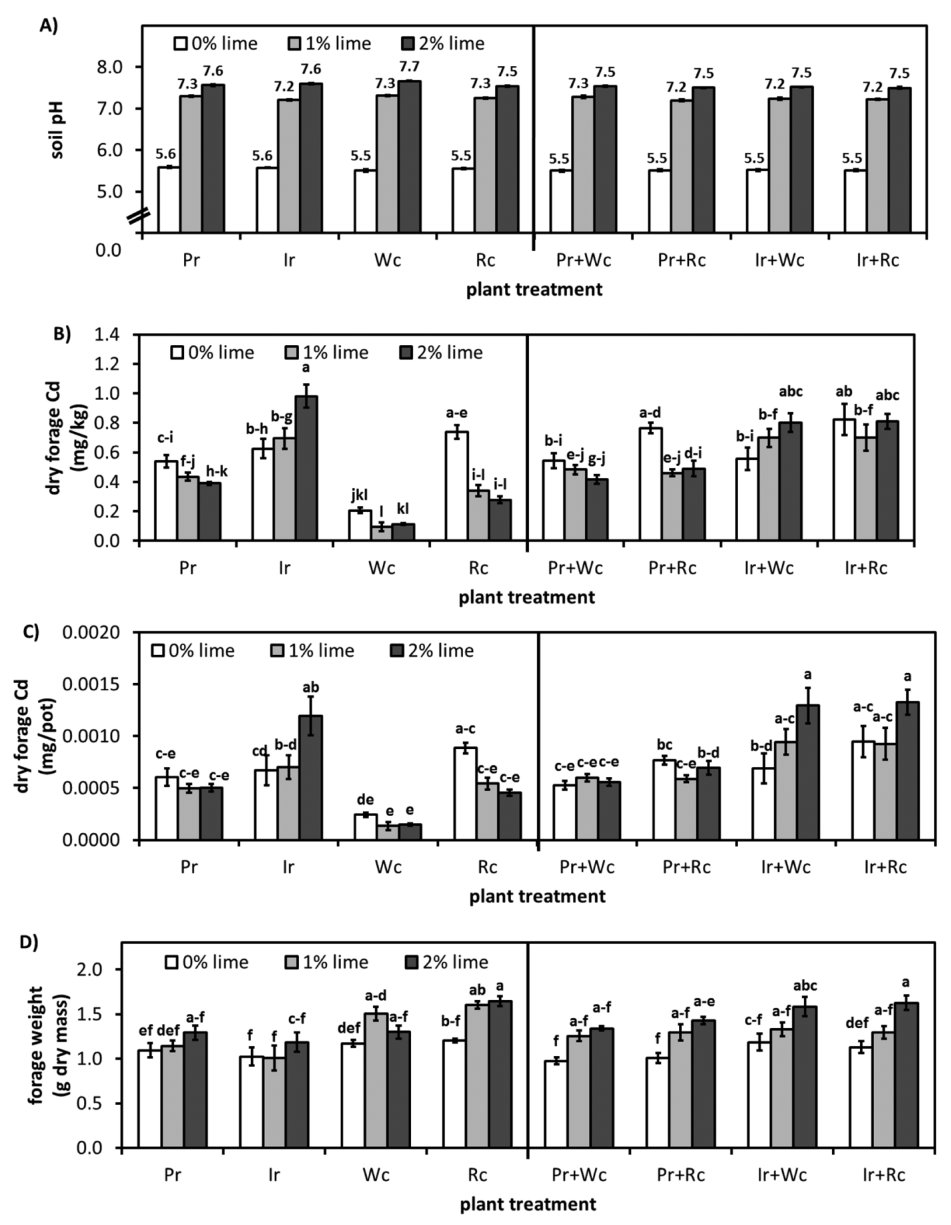
Adding plants to lime-free soil increased soil pH by ?0.5 units compared with the soil before planting. The soil pH in the lime-free mixed crops was not significantly different from that in lime-free monocrop ryegrass treatments (Fig. 1A). This is contrary to the original hypothesis that the addition of clovers to ryegrasses would decrease soil pH.
与种植前土壤相比,在未施石灰的土壤中种植植物使土壤pH升高约0.5个单位。未施石灰混播处理的土壤pH与未施石灰黑麦草单播处理无显著差异(图1A)。这与三叶草加入黑麦草会降低土壤pH的最初假设相反。
Plant treatments had a significant effect on forage Cd concentrations (P < 0.001). In the 0% lime treatment, forage Cd in Wc was significantly lower than in Rc (Fig. 1B). Within the 0% lime treatments, there was no significant difference in forage Cd concentrations between Ir monocrops and Ir mixed crops (Ir+Rc and Ir+Wc), and there were no significant differences between Pr monocrops and Pr mixed crops (Pr+Rc and Pr+Wc) (Fig. 1B).
植物处理对牧草Cd浓度有显著影响(P < 0.001)。在0%石灰处理中,Wc的牧草Cd显著低于Rc(图1B)。在0%石灰处理中,Ir单播与Ir混播(Ir+Rc和Ir+Wc)之间的牧草Cd浓度无显著差异,Pr单播与Pr混播(Pr+Rc和Pr+Wc)之间也无显著差异(图1B)。
The masses of forage Cd within each pot in the 0% lime treatments were similar in Pr (0.00061 mg pot−1) and Ir (0.00067 mg pot−1), and forage Cd concentrations were generally lower in the mixed-crop treatments that included Wc (Pr+Wc and Ir+Wc) compared with the treatments that included Rc (Pr+Rc and Ir+Rc) (Fig. 1C).
在0%石灰处理中,Pr(0.00061 mg pot−1)和Ir(0.00067 mg pot−1)每盆牧草Cd质量相近;含Wc的混播处理(Pr+Wc和Ir+Wc)的牧草Cd浓度总体低于含Rc的处理(Pr+Rc和Ir+Rc)(图1C)。
Effects of Lime Addition on Forage施用石灰对牧草
Cadmium ConcentrationsCd浓度的影响
The addition of 1% lime increased soil pH by 1.7 to 1.8 units compared with soil without lime (Fig. 1A, Table 3). Soil pH in the 2% lime treatment was between 7.5 and 7.7 in all treatments (Fig. 1A). Soil pH in the 2% lime treatment for the mixed crops was 0.1 units lower than for the monocrop ryegrasses (Ir and Pr).
与未施石灰的土壤相比,施用1%石灰使土壤pH升高1.7~1.8个单位(图1A,表3)。2%石灰处理中所有处理的土壤pH均在7.5~7.7之间(图1A)。在2%石灰处理中,混播的土壤pH比黑麦草单播(Ir和Pr)低0.1个单位。
Lime treatments had a significant effect on forage Cd concentrations (P < 0.001). A significant interaction between the plant treatments and lime treatments on forage Cd concentrations was detected (P < 0.001). Forage Cd concentration was significantly higher in the Ir 2% lime treatment than in the Ir 0% lime treatment (Table 3, Fig. 1B). The monocrop Rc, Wc, and Pr forage Cd showed small decreases with the addition of lime, but greater liming rates (2 vs. 1%) did not consistently result in lower forage Cd in these treatments (Table 3, Fig. 1B).
石灰处理对牧草Cd浓度有显著影响(P < 0.001)。植物处理与石灰处理对牧草Cd浓度存在显著交互作用(P < 0.001)。Ir在2%石灰处理下的牧草Cd浓度显著高于0%石灰处理(表3,图1B)。Rc、Wc和Pr单播的牧草Cd随施用石灰略有下降,但更高的石灰用量(2%对1%)并未使这些处理的牧草Cd持续降低(表3,图1B)。
Adding lime to the mixed crops tended to decrease forage Cd concentrations compared with the 0% lime treatment. However, adding more lime (2 vs. 1%) did not further reduce forage Cd concentrations in Pr+Rc or Ir+Wc (Fig. 1B). The Ir+Wc treatment was the only treatment where greater lime additions increased forage Cd concentrations. Despite the increases in forage yield (Fig. 1D), the Pr mono- and mixed crop masses of forage Cd were similar at all liming rates, ranging from 0.000498 to 0.000768 mg Cd pot−1 (Fig. 1C). In the Ir mono- and mixed-crops, both forage yields and plant Cd concentrations increased, and masses of forage Cd ranged from 0.00026 to 0.00193 mg Cd pot−1.
与0%石灰处理相比,混播施用石灰后牧草Cd浓度有降低趋势。然而,在Pr+Rc或Ir+Wc中,增加石灰用量(2%对1%)并未进一步降低牧草Cd浓度(图1B)。Ir+Wc处理是唯一一个石灰用量增加导致牧草Cd浓度升高的处理。尽管牧草产量有所增加(图1D),但在所有石灰用量下,Pr单播和混播的牧草Cd质量相近,范围为0.000498~0.000768 mg Cd pot−1(图1C)。在Ir单播和混播中,牧草产量和植物Cd浓度均增加,牧草Cd质量范围为0.00026~0.00193 mg Cd pot−1。
Effects of Liming on Soil Element Solubility施用石灰对土壤元素溶解度的影响
Adding plants to soil, and adding lime to soil, likely influenced the solubility of elements in the soil. In Pr, Cd and most other measured extractable elements decreased with increasing lime rates before Pr was added to the soil and after Pr was harvested, including Cd (Table 2). Despite increased lime application decreasing the solubility of many of the elements, many of the extractable elements were lower in the soil after Pr was harvested compared with before the plants were harvested. These elements included Cd, Al, Fe, Mn, Na, and S (Table 2).
向土壤中种植植物和施用石灰可能影响了土壤中元素的溶解度。在Pr处理中,无论是Pr种入土壤前还是Pr收获后,Cd及大多数其他所测可提取元素均随石灰用量增加而降低,其中包括Cd(表2)。尽管增加石灰用量降低了许多元素的溶解度,但许多可提取元素在Pr收获后的土壤中低于收获前。这些元素包括Cd、Al、Fe、Mn、Na和S(表2)。
Effects of Liming and Plant Species on Forage Yields施用石灰和植物种类对牧草产量的影响
Both plant treatments (P < 0.001) and lime treatments (P < 0.001) had an effect of forage yield, and there was a significant interaction between plant treatment and lime treatment on forage yield (P = 0.029). Within the 0% lime treatment, there was no statistical difference in forage yields between any of the plant treatments (Fig. 1D). When comparing yield from within the 1 and 2% lime treatments individually, there were differences by plant treatments.
植物处理(P < 0.001)和石灰处理(P < 0.001)均对牧草产量有影响,且植物处理与石灰处理对牧草产量存在显著交互作用(P = 0.029)。在0%石灰处理中,各植物处理间牧草产量无统计学差异(图1D)。分别比较1%和2%石灰处理内的产量时,植物处理间存在差异。
Adding lime at rates of 1 and 2% generally increased the forage yield in all plant treatments compared with 0% lime; however, not all increases were statistically significant. Reductions in mean forage yields occurred in the Ir at the 1% liming rate, where there was a 1% decrease in forage yield compared with the 0% lime treatment, and the Wc monocrop, where forage yields were lower with 2% lime than with 1% lime (Table 3, Fig. 1C).
与0%石灰相比,施用1%和2%石灰总体上提高了所有植物处理的牧草产量,但并非所有增幅均具有统计学显著性。平均牧草产量下降出现在1%石灰用量下的Ir(与0%石灰处理相比牧草产量下降1%),以及Wc单播(2%石灰下的牧草产量低于1%石灰)(表3,图1C)。
Lime application had a greater effect on forage yields in the mixed-crop treatments that included Ir compared with those with Pr (Fig. 1C). The greatest increase in forage yield from the mixed-crop treatments was observed in the Ir+Rc treatment at 2% lime, which showed a 44% increase in yield compared with the 0% treatment (Table 3).
与含Pr的混播处理相比,施用石灰对含Ir的混播处理牧草产量影响更大(图1C)。混播处理中牧草产量增幅最大的是2%石灰下的Ir+Rc处理,与0%处理相比产量提高了44%(表3)。
Relationships among Forage Yield, Cadmium Uptake, and Other Nutrients牧草产量、Cd吸收与其他养分之间的关系
In the mono-crop clover treatments (Wc and Rc), there were negative relationships between forage yield and forage Cd concentrations (Table 4). The greatest reduction in forage Cd concentrations and increase in forage yields with lime application was observed in the Rc mono-crop where adding liming increased forage yields by more than 30% and decreased forage Cd concentrations by more than 50%, compared to the 0% lime treatment (Table 3). While there was no significant relationship observed between those variables in the Pr mono-crops, there was a positive relationship between forage yield and forage Cd concentrations in the Ir mono-crop. In the mono-crop treatments, there were some similarities in the relationships between the forage Cd concentrations and other plant elements (Table 4). In the mixed-crop treatments, there were weak positive relationships between forage yield and forage Cd concentrations, except in the Pr+Rc treatment, where the relationship between the two variables was negative (Table 4).
在三叶草单播处理(Wc和Rc)中,牧草产量与牧草Cd浓度呈负相关(表4)。施用石灰后牧草Cd浓度降幅和牧草产量增幅最大的是Rc单播,与0%石灰处理相比,施用石灰使牧草产量提高30%以上,牧草Cd浓度降低50%以上(表3)。Pr单播中上述变量之间无显著关系,而Ir单播中牧草产量与牧草Cd浓度呈正相关。在单播处理中,牧草Cd浓度与其他植物元素之间的关系存在一定相似性(表4)。在混播处理中,牧草产量与牧草Cd浓度呈弱正相关,但Pr+Rc处理例外,其两变量之间呈负相关(表4)。
4Discussion讨论
Compared to the ryegrass mono-crops, mixing clover and ryegrasses had little influence on soil pH (Fig. 1A), and did not always lead to significantly higher forage Cd concentrations
与黑麦草单播相比,三叶草与黑麦草混播对土壤pH影响甚微(图1A),且并不总是导致牧草Cd浓度显著升高
| D | ifference betwe石灰处理 | en lime treatmen间差异 | ts | |||||
|---|---|---|---|---|---|---|---|---|
| Plant | Soil | pH | Forage | weight | Cd dry forage | concentration | Cd dry forage | concentration |
| treatment | Lime tr | eatments | ||||||
| 0 vs. 1% | 0 vs. 2% | 0 vs. 1% | 0 vs. 2% | 0 vs. 1% | 0 vs. 2% | 0 vs. 1% | 0 vs. 2% | |
| ——— g dry | matter ——— | ———— mg | kg−1———— | ———— mg | pot−1———— | |||
| Pr | 1.7 (0.02) | 2.0 (0.03) | 8 (11) | 22 (14) | −15 (12) | −25 (7) | −5 (21) | −7 (15) |
| Ir | 1.6 (0.01) | 2.0 (0.02) | 5 (21) | 21 (17) | 22 (23) | 64 (22) | 37 (39) | 114 (63) |
| Wc | 1.8 (0.03) | 2.2 (0.02) | 30 (9) | 12 (8) | −51 (18) | −42 (7) | −40 (20) | −36 (8) |
| Rc | 1.7 (0.02) | 2.0 (0.02) | 33 (4) | 37 (6) | −52 (7) | −61 (5) | −36 (10) | −47 (6) |
| Pr+Wc | 1.8 (0.02) | 2.0 (0.02) | 29 (6) | 38 (6) | −10 (5) | −19 (11) | 16 (9) | 11 (15) |
| Pr+Rc | 1.7 (0.02) | 2.0 (0.03) | 29 (9) | 43 (6) | −40 (3) | −35 (8) | −23 (3) | −6 (16) |
| Ir+Wc | 1.7 (0.04) | 2.0 (0.02) | 16 (11) | 35 (7) | 39 (24) | 62 (31) | 71 (41) | 126 (52) |
| Ir+Rc | 1.7 (0.02) | 2.0 (0.02) | 16 (6) | 46 (11) | −11 (12) | 6 (13) | 6 (18) | 57 (23) |
| r value forr值: | Pearson correlat与植物Cd的 | ion with plant CPearson相关 | d (mg kg−1) | |||||
|---|---|---|---|---|---|---|---|---|
| Variable | Plant tre | atment | ||||||
| Pr | Ir | Wc | Rc | Pr+Wc | Pr+Rc | Ir+Wc | Ir+Rc | |
| Plant dry wt. | −0.02 | 0.54* | −0.62* | −0.89* | 0.24 | −0.41 | 0.34 | 0.24 |
| Plant fresh wt. | −0.17 | 0.62* | −0.64* | −0.89* | 0.33 | −0.45 | 0.40 | 0.33 |
| Plant Zn | 0.39 | 0.56* | 0.52* | 0.88* | 0.38 | 0.07 | −0.27 | 0.38 |
| Plant Cu | −0.69* | 0.49* | 0.42 | 0.79* | 0.06 | 0.03 | 0.01 | 0.06 |
| Plant Fe | 0.22 | 0.67* | 0.17 | 0.58* | 0.18 | 0.05 | 0.18 | 0.18 |
| Plant Mn | 0.50* | 0.16 | 0.74* | 0.90* | −0.19 | 0.45 | −0.50* | −0.19 |
| Plant B | 0.66* | 0.56* | −0.18 | 0.42 | −0.12 | 0.21 | −0.14 | −0.12 |
| Plant K | −0.09 | 0.48* | 0.60* | 0.91* | 0.26 | 0.15 | −0.14 | 0.26 |
| Plant P | −0.22 | 0.35 | −0.64* | −0.70* | 0.05 | −0.12 | −0.43 | 0.05 |
| Plant Mg | 0.10 | 0.75* | 0.07 | −0.44 | 0.17 | −0.06 | 0.13 | 0.17 |
| Plant Ca | −0.30 | 0.78* | −0.36 | −0.51* | 0.32 | −0.08 | −0.05 | 0.32 |
| Plant Na | −0.21 | 0.69* | −0.13 | 0.06 | 0.29 | −0.09 | 0.43 | 0.29 |
| Plant N (%) | −0.41 | 0.19 | −0.52* | −0.35 | 0.23 | −0.23 | 0.21 | 0.23 |
| Plant C (%) | 0.25 | 0.29 | 0.02 | −0.37 | 0.17 | −0.28 | 0.47 | 0.17 |
| Plant C/N | 0.46 | −0.23 | 0.58* | 0.27 | −0.22 | 0.25 | −0.17 | −0.22 |
| SoilpH | −0.69* | 0.54* | −0.69* | −0.92* | 0.17 | −0.32 | 0.01 | 0.17 |
* Significant at the 0.05 probability level.
* 在0.05概率水平上显著。
(Fig. 1B). Lime induced increases in soil pH tended to increase forage yield (Fig. 1D). However, the interaction between the presence of the clovers and the application of lime in the mixed-crops failed to consistently lower forage Cd concentrations.
(图1B)。石灰引起的土壤pH升高倾向于提高牧草产量(图1D)。然而,在混播体系中,三叶草的存在与施用石灰之间的交互作用未能持续降低牧草Cd浓度。
Effects of Mixing Clovers and Ryegrasses on Forage Cadmium Concentrations三叶草与黑麦草混播对牧草Cd浓度的影响
Failure to consistently observe higher forage Cd concentrations in mixed clover–ryegrass systems compared with the ryegrass monocrops at 0% lime, as originally hypothesized, differs from the results of other studies. Higher Cd concentrations have been noted in various crops mixed with Japanese clover [Kummerowia striata (Thunb.) Schindl.], compared with monocrops of the same plants (An et al., 2011, Liu et al., 2012). Forage Cd concentrations in the mixed-crop species increased due to soil acidification from N fixation by clovers. A net efflux of H+ ions into the soil increases clover cation uptake (Tang, 1997). The small differences in soil pH (?0.1–0.2 units) between the monocrop ryegrasses and different mixed crops in the lime-free treatments (Fig. 1A) may be partially attributed to the similar conditions in which the plants were grown. The magnitude of rhizosphere soil acidification under clovers is influenced by nutrient availability, growth conditions, and the stage of plant growth (Pierre and Banwart, 1973). With only two clover species used during this experiment, and all of the plants being the same age, grown under the same conditions, and grown in soils with the same concentrations of Cd, the abovementioned factors known to contribute to variability in rhizosphere pH were minimized.
与最初假设不同,在0%石灰条件下,三叶草–黑麦草混播体系的牧草Cd浓度并未持续高于黑麦草单播,这与其他研究的结果不同。已有研究发现,与鸡眼草(Japanese clover,[Kummerowia striata (Thunb.) Schindl.])混种的多种作物,其Cd浓度高于相同植物的单播(An et al., 2011, Liu et al., 2012)。混播物种的牧草Cd浓度升高是由于三叶草固氮引起的土壤酸化。H+离子向土壤的净外排增加了三叶草对阳离子的吸收(Tang, 1997)。在未施石灰处理中,黑麦草单播与各混播之间土壤pH的微小差异(约0.1~0.2个单位)(图1A)可能部分归因于植物生长条件相似。三叶草下根际土壤酸化的程度受养分有效性、生长条件和植物生长阶段的影响(Pierre and Banwart, 1973)。本试验仅使用两种三叶草,且所有植物苗龄相同、生长条件相同、土壤Cd浓度相同,因此上述已知导致根际pH变异的因素被降至最低。
There were some significant differences in forage Cd concentrations in the mixed-cropped systems that appeared to be related to clover species. Specifically, in the 0% lime treatment, there tended to be (nonsignificantly) higher forage Cd from the mixed crops that contained Rc (Pr+Rc and Ir+Rc) compared with those that contained Wc (Pr+Wc and Ir+Wc) (Fig. 1B). This suggests the influence of factors other than soil pH. The Rc monocrops had a significantly greater apparent natural affinity for Cd uptake compared with the Wc in 0% lime treatments (Fig. 1B). The differences in clover Cd in the current study may be partially related to differences in the rhizosphere architecture in young plants. Newly established Rc forms a deep, thick tap root, with many fine lateral roots, whereas Wc forms many finer roots during its initial establishment (Weaver and Bruner, 1926). A bulkier root system with greater root density in the 0% lime Rc mixed crops may have increased uptake of Cd by the neighboring plants from increasing Cd solubilization due to greater soil acidification than in the Wc mixed crops. However, changes in soil pH induced by the rhizosphere may have been too subtle to detect using the methods employed in this study. If plant Cd uptake was enhanced in the mixed crops that included Rc compared with those that included Wc, despite the lack of significant difference in soil pH, this may explain why forage Cd concentrations were higher in the mixed crops that included Rc compared with those that included Wc in the no lime treatment.
混播体系中牧草Cd浓度存在一些显著差异,这些差异似乎与三叶草种类有关。具体而言,在0%石灰处理中,含Rc的混播(Pr+Rc和Ir+Rc)的牧草Cd有高于含Wc的混播(Pr+Wc和Ir+Wc)的趋势(差异不显著)(图1B)。这表明存在土壤pH以外的影响因素。在0%石灰处理中,Rc单播表现出的对Cd吸收的天然亲和力显著高于Wc(图1B)。本研究中三叶草Cd的差异可能部分与幼苗根际构型的差异有关。新定植的Rc形成粗深的主根,并有许多细侧根,而Wc在初期定植阶段形成许多较细的根(Weaver and Bruner, 1926)。在0%石灰的Rc混播中,更为粗大、根系密度更高的根系可能比Wc混播造成更强的土壤酸化,增加Cd的溶解,从而提高相邻植物对Cd的吸收。然而,根际引起的土壤pH变化可能过于细微,本研究所采用的方法难以检测。如果在土壤pH无显著差异的情况下,含Rc混播的植物Cd吸收仍高于含Wc的混播,则这可以解释为何在不施石灰处理中,含Rc混播的牧草Cd浓度高于含Wc的混播。
Although Cd uptake by plants is dependent on many factors including soil Cd concentrations and soil pH (Tudoreanu and Phillips, 2004), the acidifying effect of the clovers on the rhizosphere differs between species (McLay et al., 1997, Tang, 1997), and plant Cd uptake is also related to individual plant Cd uptake kinetics (Stritsis and Claassen, 2013). These species-specific factors should be considered in future studies to better understand the plant-specific regulators of Cd uptake.
尽管植物对Cd的吸收取决于土壤Cd浓度和土壤pH等多种因素(Tudoreanu and Phillips, 2004),但三叶草对根际的酸化作用因种而异(McLay et al., 1997, Tang, 1997),且植物Cd吸收还与单株植物的Cd吸收动力学有关(Stritsis and Claassen, 2013)。今后的研究应考虑这些物种特异性因素,以更好地理解植物特异性的Cd吸收调控因子。
Effects of Liming on Cadmium Uptake施用石灰对混播体系
in Mixed-Cropped SystemsCd吸收的影响
The liming rates used in this experiment increased the soil pH (Fig. 1A). It was originally hypothesized that liming would reduce forage Cd concentrations. However, the effectiveness of lime to do this depends on both plant species and liming rates (Bolan et al., 2003b; Al Mamun et al., 2016). This is consistent with the results from the current study where forage Cd concentrations (both significantly and nonsignificantly) increased (as in the Ir and Ir+Wc treatments), decreased (as in the Pr, Rc, and Pr+Wc treatments), or increased or decreased depending on the amount of lime (as in the Wc, Pr+Rc, and Ir+Rc treatments), with lime additions (Fig. 1B). Generally, liming was least effective at reducing forage Cd concentrations when Ir was included in the mixed crops and was most effective at reducing forage Cd with increased yield when Pr was included (Table 3), suggesting that the ryegrass species influenced the treatment response to liming.
本试验采用的石灰用量提高了土壤pH(图1A)。最初假设施用石灰会降低牧草Cd浓度。然而,石灰的这一效果取决于植物种类和石灰用量(Bolan et al., 2003b; Al Mamun et al., 2016)。这与本研究结果一致:随着石灰的施用,牧草Cd浓度(显著或不显著地)升高(如Ir和Ir+Wc处理)、降低(如Pr、Rc和Pr+Wc处理),或因石灰用量不同而升高或降低(如Wc、Pr+Rc和Ir+Rc处理)(图1B)。总体而言,当混播中含Ir时,施用石灰降低牧草Cd浓度的效果最差;而当含Pr时,施用石灰在提高产量的同时降低牧草Cd的效果最好(表3),表明黑麦草种类影响了处理对施用石灰的响应。
Consistent with the original hypothesis that liming (both significantly and nonsignificantly, depending on the plant treatments) decreases the bioavailability of elements, most extractable elements decreased with increases in lime before the plants were added to the soil (Table 2). Liming can create soil conditions that reduce the bioavailability of Cd. Increases in pH can increase the binding of Cd with Fe or Mn oxides in soils (Chen et al., 2016), thereby inhibiting plant uptake of Cd (Mclaughlin et al., 1996; Loganathan et al., 2003). This occurs when liming increases the negative charge, or cation exchange capacity, in variable charge soils, which influences the soil’s ability to hold essential nutrients and provides a buffer against soil acidification (Bolan et al., 1999) and can occur in the presence of N2–fixing plants like clover (Tang, 1997).
与施用石灰(因植物处理不同而显著或不显著地)降低元素生物有效性的最初假设一致,在植物种入土壤前,大多数可提取元素随石灰用量增加而降低(表2)。施用石灰可营造降低Cd生物有效性的土壤条件。pH升高可增强土壤中Cd与Fe或Mn氧化物的结合(Chen et al., 2016),从而抑制植物对Cd的吸收(Mclaughlin et al., 1996; Loganathan et al., 2003)。这是因为在可变电荷土壤中施用石灰会增加负电荷即阳离子交换量,从而影响土壤保持必需养分的能力,并提供抵御土壤酸化的缓冲作用(Bolan et al., 1999);在存在三叶草等固N2植物的情况下也可发生这一过程(Tang, 1997)。
There are a few factors that may have contributed to the differences in forage Cd in the Pr and Ir treatments at different liming rates (Fig. 1B). Experiments have shown that in solution, plants will take up increasing amounts of Cd with increasing concentrations of Cd (Page et al., 1972; Pettersson, 1976). The most likely explanation for the differences in forage Cd between the Pr and Ir response to liming may be attributed to plant-related difference in the exudates expelled from the root systems of the plants. The composition of root exudates varies by species (Marschner, 1995), and they can alter the soil microbial community in the rhizosphere (Sørensen, 1997). Other studies have noted that an exchange of cations can occur at the root surface when exudates are expelled. For example, forage Cd concentrations may be higher when roots release high concentrations of Ca, Mn, and Zn due to competition for adsorption sites on plant roots with other cations, which may contribute to the species-specific differences in adsorption of Cd (Jarvis et al., 1976; Vergara and Schalscha, 1992; Serrano et al., 2005; Liao and Selim 2009).
有若干因素可能导致了不同石灰用量下Pr和Ir处理牧草Cd的差异(图1B)。试验表明,在溶液中,植物对Cd的吸收量随Cd浓度的增加而增加(Page et al., 1972; Pettersson, 1976)。Pr与Ir对施用石灰的牧草Cd响应存在差异,最可能的解释是两种植物根系分泌物的差异。根系分泌物的组成因物种而异(Marschner, 1995),并可改变根际土壤微生物群落(Sørensen, 1997)。其他研究指出,根系分泌物释放时根表面可发生阳离子交换。例如,当根系释放高浓度的Ca、Mn和Zn时,由于与其他阳离子竞争植物根系上的吸附位点,牧草Cd浓度可能更高,这可能是Cd吸附存在种间差异的原因之一(Jarvis et al., 1976; Vergara and Schalscha, 1992; Serrano et al., 2005; Liao and Selim 2009)。
The contrasting responses of Pr (no change in forage Cd concentrations with increasing lime) and Ir (increasing forage Cd concentration with increasing lime) may be related to their N-uptake profiles; Ir takes up proportionally more N than Pr (Popay and Crush, 2010). This will create differences between the soil rhizosphere environments in the Pr and Ir treatments. This idea is supported by the correlation results (Table 4), whereby there were differences in the strength and direction of the relationship between elements in the treatments that include Pr and those that include Ir.
Pr(牧草Cd浓度不随石灰用量增加而变化)与Ir(牧草Cd浓度随石灰用量增加而升高)的不同响应可能与二者的氮吸收特征有关;Ir吸收的N按比例多于Pr(Popay and Crush, 2010)。这将导致Pr与Ir处理的根际土壤环境存在差异。相关分析结果(表4)支持这一观点,即含Pr的处理与含Ir的处理中元素之间关系的强度和方向存在差异。
In some circumstances, liming can increase forage concentrations, as shown in the current experiment with higher Cd in Ir with higher lime treatments (Fig. 1B). Plant Cd uptake by roots may be increased under lime-induced Zn deficiency (Smolders, 2001). Some evidence of this is shown in the nonsignificant negative correlations between Cd and Zn in the Ir+Wc treatment (Table 4). The effects of lime-induced Zn deficiency on plant Cd uptake have not been directly considered in this study. Future studies should explore the role of plant-specific root exudates on plant Cd uptake to better understand the mechanisms by which various plant species take up Cd under various conditions.
在某些情况下,施用石灰可提高牧草浓度,如本试验中Ir在较高石灰处理下Cd含量更高(图1B)。在石灰诱导的Zn缺乏条件下,植物根系对Cd的吸收可能增加(Smolders, 2001)。Ir+Wc处理中Cd与Zn之间不显著的负相关为此提供了一定证据(表4)。本研究未直接考察石灰诱导的Zn缺乏对植物Cd吸收的影响。今后的研究应探讨植物特异性根系分泌物在植物Cd吸收中的作用,以更好地理解不同植物种类在不同条件下吸收Cd的机制。
Compound Effects of Liming and Plant Species施用石灰与植物种类对牧草产量
on Forage Yield and Cadmium Concentration和Cd浓度的复合效应
Consistent with the original hypothesis, liming (both significantly and nonsignificantly) increased the forage yield in both mono- and mixed-crop systems (Fig. 1C). In the mixed crops, liming at 2% had a greater effect on forage yield when the treatments included Rc compared with treatments that included Wc (Fig. 1C). However, liming as a strategy to negate the uptake of Cd by forage while also increasing forage yields was most effective in treatments that included Pr (Fig. 1B).
与最初假设一致,施用石灰(显著或不显著地)提高了单播和混播体系的牧草产量(图1C)。在混播中,2%石灰对含Rc处理牧草产量的影响大于含Wc的处理(图1C)。然而,作为一种在提高牧草产量的同时抑制牧草Cd吸收的策略,施用石灰在含Pr的处理中最为有效(图1B)。
The mass of Cd per pot shows how differences in forage yield and forage Cd concentrations combine to affect the potential intake of Cd by grazing animals. Although we have not identified where in our forage the Cd was stored, these results suggest Pr mixed crops and monocrops present the lowest potential intake of Cd by grazers (Fig. 1C). Although more research is needed to further understand the mechanisms that regulate Cd uptake by different plant species, it can be concluded that pH in isolation is not suitably variable for determining plant uptake of Cd when pasture species are combined in a system. The outcome from the current study that greater liming increased forage yields but did not consistently decrease forage Cd (Fig. 1B) is an important finding in the development of grazing management strategies. The results suggest that a mixture of Ir and clovers is a poor choice as grazing forage in Cd-contaminated soils.
每盆Cd质量反映了牧草产量和牧草Cd浓度的差异如何共同影响放牧动物的潜在Cd摄入量。尽管我们尚未确定Cd在牧草中的储存部位,但这些结果表明,Pr混播和单播对放牧动物而言潜在Cd摄入量最低(图1C)。虽然仍需进一步研究以深入理解不同植物种类Cd吸收的调控机制,但可以得出结论:当多种草地物种组合成一个体系时,仅凭pH不足以判断植物对Cd的吸收。本研究发现增加石灰用量提高了牧草产量,但并未持续降低牧草Cd(图1B),这是制定放牧管理策略的一项重要发现。结果表明,在Cd污染土壤上,Ir与三叶草的混播不宜作为放牧牧草。
Italian ryegrass is likely to increase in popularity as a pasture species, as it is well suited for helping reduce NO3 leaching as drainage (Malcolm et al., 2015; Woods et al., 2016; Bryant et al., 2018). However, the results from our study suggest that it may not be a suitable pasture species for grazing in Cd-contaminated soil due to its high uptake of Cd under the tested conditions. Using Ir as a grazed pasture species could result in trading one problem (NO3 leaching) for another (higher Cd consumption by grazing cattle).
由于多花黑麦草非常适合帮助减少随排水发生的NO3淋溶(Malcolm et al., 2015; Woods et al., 2016; Bryant et al., 2018),其作为草地物种可能日益普及。然而,本研究结果表明,由于在试验条件下对Cd的吸收较高,它可能不适合作为Cd污染土壤上的放牧草地物种。将Ir用作放牧草地物种,可能会以一个问题(NO3淋溶)换来另一个问题(放牧牛的Cd摄入量增加)。
Pastures that included Pr+Wc and Pr+Rc had the most favorable results as a foraging crop. These species combinations increased forage yield without increasing forage Cd. Optimization of grazing forage for the highest yield with the lowest Cd concentrations will entail a greater understanding of the mechanisms of Cd uptake. Other measures of nutritional value (i.e., crude protein, detergent fiber, etc.) were not measured during this study but should be considered in future studies, since they will factor into the choice of forage.
含Pr+Wc和Pr+Rc的草地作为牧草作物的效果最为理想。这些物种组合在提高牧草产量的同时未增加牧草Cd。要优化放牧牧草以实现最高产量和最低Cd浓度,需要更深入地理解Cd吸收机制。本研究未测定其他营养价值指标(如粗蛋白、洗涤纤维等),但由于这些指标会影响牧草的选择,今后的研究应予以考虑。
Experimental Design Considerations试验设计的考虑
There is a chance that water additions during our experiment may have affected the soil redox, thereby influencing the availability of soluble Cd. Soils under prolonged saturation and strongly reducing conditions form insoluble Cd complexes, which decreases Cd availability (de Livera et al., 2011; Zhang et al., 2012; Zheng et al., 2013). Instead, there is some evidence (increases in Fe and Mn soil concentrations from 0% lime before and after the experiment, Table 2) that short periods of saturation after water additions may have temporarily created weakly reducing soil conditions. These conditions can develop quickly (Ponnamperuma, 1972). Such mild and temporarily reducing conditions have the potential to influence solubility of Cd; Cd will be released if was sorbed to Fe and Mn hydrous oxides and dissolution occurs (Kim and Fergusson, 1992; Backes et al., 1995;
试验期间的浇水可能影响了土壤氧化还原状况,从而影响可溶性Cd的有效性。在长期饱和及强还原条件下,土壤会形成不溶性Cd络合物,从而降低Cd的有效性(de Livera et al., 2011; Zhang et al., 2012; Zheng et al., 2013)。与此不同,有证据表明(0%石灰处理试验前后土壤Fe和Mn浓度增加,表2),浇水后的短暂饱和可能暂时形成了弱还原的土壤条件。此类条件可迅速形成(Ponnamperuma, 1972)。这种温和且暂时的还原条件可能影响Cd的溶解度;如果Cd吸附于Fe和Mn水合氧化物上且发生溶解,Cd将被释放(Kim and Fergusson, 1992; Backes et al., 1995;
Gray et al., 1999b; Loganathan et al., 2012). Other research tested the effects of different irrigation treatments (flooded for 3 d vs. not flooded) on extractable soil Cd concentrations and found no significant effect of these irrigation treatments on extractable soil Cd concentrations or on the soil pH within the same soil type, suggesting that soil Cd is insensitive to short-term periods of soil saturation (Stafford et al., 2018).
Gray et al., 1999b; Loganathan et al., 2012)。另有研究考察了不同灌溉处理(淹水3 d与不淹水)对土壤可提取Cd浓度的影响,发现在同一土壤类型中,这些灌溉处理对土壤可提取Cd浓度和土壤pH均无显著影响,表明土壤Cd对短期土壤饱和不敏感(Stafford et al., 2018)。
The increase in Mn concentrations in the 0% lime treatment before and after planting may be attributed to the slightly acidic pH (?5.11 before planting, Table 2); the dissolution Mn hydrous oxides—and therefore the release of Cd—can occur under oxidizing conditions when soil pH is mildly acidic (Gotoh and Patrick, 1972), suggesting that regardless of the water application to the soil during our experiment, there may have been increases in soil extractable Mn in the 0% lime treatment.
0%石灰处理中种植前后Mn浓度的增加可能归因于土壤呈微酸性(种植前pH约为5.11,表2);当土壤pH呈弱酸性时,Mn水合氧化物可在氧化条件下溶解,进而释放Cd(Gotoh and Patrick, 1972)。这表明,无论试验期间是否向土壤浇水,0%石灰处理中土壤可提取Mn均可能增加。
5Conclusions结论
Ideally, liming at low rates could be used to reduce solubility and mobility of soil Cd in mixed clover and ryegrass pasture. However, the interactions between forage Cd uptake and the soil environment are complex and there was no consistent relationship observed between soil pH and forage Cd among the treatments in the current study. Many factors may have influenced the experimental outcomes including soil pH, solubility of Cd from liming, interaction between Cd and other soil nutrients, and plant root exudates and their impact on the soil environment and subsequently on forage Cd.
理想情况下,可在三叶草与黑麦草混播草地中低量施用石灰,以降低土壤Cd的溶解度和迁移性。然而,牧草Cd吸收与土壤环境之间的相互作用十分复杂,本研究各处理间未观察到土壤pH与牧草Cd之间的一致关系。许多因素可能影响了试验结果,包括土壤pH、施用石灰后Cd的溶解度、Cd与其他土壤养分的相互作用,以及植物根系分泌物及其对土壤环境进而对牧草Cd的影响。
Liming at rates of 1 to 2% of the soil dry weight, which were used in this study, increased forage yields in all mixed-crop treatments compared with 0% lime. However, lime prevented increases in forage Cd in mixed-crop systems that included Pr (Pr+Wc and Pr+Rc) but increased forage Cd in treatments that included Ir, especially the Ir+Wc treatment.
本研究采用的土壤干重1%~2%的石灰用量,与0%石灰相比提高了所有混播处理的牧草产量。然而,在含Pr的混播体系(Pr+Wc和Pr+Rc)中,石灰阻止了牧草Cd的增加,而在含Ir的处理中,尤其是Ir+Wc处理,石灰增加了牧草Cd。
With the data available, we are not able to conclude what mechanisms were responsible for reduced forage Cd in the Pr, Wc, Rc, Pr+Wc, and Pr+Rc treatments associated with liming. However, the stark differences in forage Cd between the mixed crops that contain Pr and Ir in response to liming suggest that the results were due to a combination of Cd binding in soil and competition with other elements during plant uptake, which were induced by rhizosphere exudates.
根据现有数据,我们无法确定Pr、Wc、Rc、Pr+Wc和Pr+Rc处理中与施用石灰相关的牧草Cd降低是由何种机制引起的。然而,含Pr与含Ir的混播在施用石灰后牧草Cd的显著差异表明,这些结果是由根际分泌物诱导的土壤中Cd结合与植物吸收过程中与其他元素竞争的共同作用所致。
6Acknowledgments致谢
We gratefully acknowledge the Centre for Integrated Biowaste Research (CIBR) for partially funding this project.
感谢Centre for Integrated Biowaste Research(CIBR)对本项目的部分资助。
7References参考文献
Al Mamun, S., G. Chanson, E. Muliadia, M. Benyas, N. Aktar, R.C. Lehto, et al. 2016. Municipal composts reduce the transfer of Cd from soil to vegetables. Environ. Pollut. 213:8–15. doi:10.1016/j.envpol.2016.01.072
An, L., Y. Pan, Z. Wang, and C. Zhu. 2011. Heavy metal absorption status of five plant species in monoculture and intercropping. Plant Soil 345:237–245. doi:10.1007/s11104-011-0775-1
Backes, C.A., R.G. McLaren, A.W. Rate, and R.S. Swift. 1995. Kinetics of cadmium and cobalt desorption from iron and manganese oxides. Soil Sci. Soc. Am. J. 59:778–785. doi:10.2136/sssaj1995.03615995005900030021x
Black, A., R. McLaren, S. Reichman, T. Speir, and L. Condron. 2012. Examining the integrity of soil metal bioavailability assays in the presence of organic amendments to metal‐spiked soils. Soil Use Manage. 28:89–100. doi:10.1111/j.1475-2743.2011.00384.x
Blakemore, L., P. Searle, and B. Daly. 1987. Methods for chemical analysis of soils. Sci. Rep. N. Z. Soil Bureau, Lower Hutt, New Zealand.
Bolan, N.S., D.C. Adriano, P. Duraisamy, and A. Mani. 2003a. Immobilization and phytoavailability of cadmium in variable charge soils. III. Effect of biosolid compost addition. Plant Soil 256:231–241. doi:10.1023/A:1026288021059
Bolan, N.S., R. Naidu, J. Syers, and R. Tillman. 1999. Surface charge and solute interactions in soils. Adv. Agron. 67:87–140. doi:10.1016/ S0065-2113(08)60514-3
Bolan, N.S., R. Nanthi, and V.P. Duraisamy. 2003b. Role of inorganic and organic soil amendments on immobilisation and phytoavailability of heavy metals: A review involving specific case studies. Soil Res. 41:533–555. doi:10.1071/SR02122
Brock, J., and M. Hay. 1996. A review of the role of grazing management on the growth and performance of white clover cultivars in lowland New Zealand pastures. Publ. no. 11. Grassl. Res. Practice Ser. 6. Agron. Soc. N. Z., New Zealand. Bryant, R., B. Welten, D. Costall, P. Shorten, and G. Edwards. 2018. Milk yield and urinary-nitrogen excretion of dairy cows grazing forb pasture mixtures designed to reduce nitrogen leaching. Livest. Sci. 209:46–53. doi:10.1016/j.livsci.2018.01.009
Cadmium Working Group. 2011. Cadmium and New Zealand agriculture and horticulture: A strategy for long term risk management. Tech. Paper 2011/02. Minist. Agric. For., Wellington, New Zealand.
Chen, Y., T. Xie, Q. Liang, M. Liu, M. Zhao, M. Wang, and G. Wang. 2016. Effectiveness of lime and peat applications on cadmium availability in a paddy soil under various moisture regimes. Environ. Sci. Pollut. Res. Int. 23:7757–7766. doi:10.1007/s11356-015-5930-4
de Livera, J., M.J. McLaughlin, G.M. Hettiarachchi, J.K. Kirby, and D.G. Beak. 2011. Cadmium solubility in paddy soils: Effects of soil oxidation, metal sulfides and competitive ions. Sci. Total Environ. 409:1489–1497. doi:10.1016/j.scitotenv.2010.12.028 Fay, D. 2007. Soil geochemical atlas of Ireland. Teagasc and Environ. Prot. Agency, Carlow, Ireland.
Frame, J., and P. Newbould. 1986. Agronomy of white clover. Adv. Agron. 40:1– 88. doi:10.1016/S0065-2113(08)60280-1
Gotoh, S., and W. Patrick. 1972. Transformation of manganese in a waterlogged soil as affected by redox potential and pH. Soil Sci. Soc. Am. J. 36:738– 742. doi:10.2136/sssaj1972.03615995003600050018x
Grant, C.A., L.D. Bailey, M.J. McLaughlin, and B.R. Singh. 1999. Management factors which influence cadmium concentrations in crops. In: M.J. McLaughlin and B.R. Singh, editors, Cadmium in soils and plants. Springer, Dordrecht, the Netherlands, p. 151–198. doi:10.1007/978-94-011-4473-5_7 Gray, C., R. McLaren, A. Roberts, and L. Condron. 1999a. Cadmium phytoavailability in some New Zealand soils. Soil Res. 37:461–478. doi:10.1071/ S98070
Gray, C., R. McLaren, A. Roberts, and L. Condron. 1999b. Solubility, sorption and desorption of native and added cadmium in relation to properties of soils in New Zealand. Eur. J. Soil Sci. 50:127–137. doi:10.1046/j.1365-2389.1999.00221.x
Hewitt, A.E. 2010. New Zealand soil classification. Manaaki-Whenua Press, Lincoln, New Zealand.
Jarvis, S., L. Jones, and M. Hopper. 1976. Cadmium uptake from solution by plants and its transport from roots to shoots. Plant Soil 44:179–191. doi:10.1007/BF00016965 Kabata-Pendias, A., and A.B. Mukherjee. 2007. Trace elements from soil to human. Springer Verlag, Berlin. doi:10.1007/978-3-540-32714-1
Kim, N., and J. Fergusson. 1992. Adsorption of cadmium by an aquent New Zealand soil and its components. Soil Res. 30:159–167. doi:10.1071/ SR9920159
Landcare Research. 2018. Soil order. N. Z. Soils Portal. https://soils.landcareresearch.co.nz/index.php/describing-soils/nzsc/soil-order (accessed 8 Mar. 2018).
Latati, M., D. Blavet, N. Alkama, H. Laoufi, J.J. Drevon, F. Gérard, et al. 2014. The intercropping cowpea-maize improves soil phosphorus availability and maize yields in an alkaline soil. Plant Soil 385:181–191. doi:10.1007/ s11104-014-2214-6
Lee, J., J. Rounce, A. Mackay, and N. Grace. 1996. Accumulation of cadmium with time in Romney sheep grazing ryegrass-white clover pasture: Effect of cadmium from pasture and soil intake. Aust. J. Agric. Res. 47:877–894. doi:10.1071/AR9960877
Li, N.Y., Z.A. Li, P. Zhuang, B. Zou, and M. McBride. 2009. Cadmium uptake from soil by maize with intercrops. Water Air Soil Pollut. 199:45–56. doi:10.1007/s11270-008-9858-x
Liao, L., and H. Selim. 2009. Competitive sorption of nickel and cadmium in different soils. Soil Sci. 174:549–555. doi:10.1097/SS.0b013e3181bbbd27
Liu, L., Q. Zhang, L. Hu, J. Tang, L. Xu, X. Yang, et al. 2012. Legumes can increase cadmium contamination in neighboring crops. PLoS One 7:e42944. doi:10.1371/journal.pone.0042944
Liu, M., Z.P. Li, and X.C. Zhai. 2013. Peanut straw decomposition products promoted by chemical additives and their effect on enzymatic activity and microbial functional diversity in red soil. Compost Sci. Util. 21:76–86. do i:10.1080/1065657X.2013.829674
Loganathan, P., M.J. Hedley, N. Grace, J. Lee, S. Cronin, N.S. Bolan, and J. Zanders. 2003. Fertiliser contaminants in New Zealand grazed pasture with special reference to cadmium and fluorine: A review. Soil Res. 41:501– 532. doi:10.1071/SR02126
Loganathan, P., S. Vigneswaran, J. Kandasamy, and R. Naidu. 2012. Cadmium sorption and desorption in soils: A review. Crit. Rev. Environ. Sci. Technol. 42:489–533. doi:10.1080/10643389.2010.520234
López-Chuken, U.J., and S.D. Young. 2010. Modelling sulphate-enhanced cadmium uptake by Zea mays from nutrient solution under conditions of constant free Cd(2+) ion activity. J. Environ. Sci. (China) 22:1080–1085. doi:10.1016/S1001-0742(09)60220-5
Mahler, R.J., J. Ryan, and T. Reed. 1987. Cadmium sulfate application to sludgeamended soils I. Effect on yield and cadmium availability to plants. Sci. Total Environ. 67:117–131. doi:10.1016/0048-9697(87)90205-1
Malcolm, B.J., J.L. Moir, K.C. Cameron, H.J. Di, and G.R. Edwards. 2015. Influence of plant growth and root architecture of Italian ryegrass (Lolium multiflorum) and tall fescue (Festuca arundinacea) on N recovery during winter. Grass Forage Sci. 70:600–610. doi:10.1111/gfs.12157
Marschner, H. 1995. Mineral nutrition of higher plants. Academic Press, London.
Mclaughlin, M., K. Tiller, R. Naidu, and D. Stevens. 1996. Review: The behaviour and environmental impact of contaminants in fertilizers. Soil Res. 34:1–54. doi:10.1071/SR9960001
McLay, C.D.A., L. Barton, and C. Tang. 1997. Acidification potential of ten grain legume species grown in nutrient solution. Aust. J. Agric. Res. 48:1025–1032. doi:10.1071/A96174
Mortvedt, J.J. 1995. Heavy metal contaminants in inorganic and organic fertilizers. Fert. Res. 43:55–61. doi:10.1007/BF00747683
Page, A., F. Bingham, and C. Nelson. 1972. Cadmium absorption and growth of various plant species as influenced by solution cadmium concentration. J. Environ. Qual. 1:288–291. doi:10.2134/jeq1972.00472425000100030017x
Pettersson, O. 1976. Heavy-metal ion uptake by plants from nutrient solutions with metal ion, plant species and growth period variations. Plant Soil 45:445–459.
Pierre, W.H., and W.L. Banwart. 1973. Excess-base and excess-base/nitrogen ratio of various crop species and parts of plants. Agron. J. 65:91–96. doi:10.2134/agronj1973.00021962006500010028x
Ponnamperuma, F.N. 1972. The chemistry of submerged soils. Adv. Agron. 24:29–96.
Popay, A.J., and J.R. Crush. 2010. Influence of different forage grasses on nitrate capture and leaching loss from a pumice soil. Grass Forage Sci. 65:28–37.
R Core Team. 2013. R: A language and environment for statistical computing. R Found. Stat. Comput., Vienna.
Ramírez-Restrepo, C., and T. Barry. 2005. Alternative temperate forages containing secondary compounds for improving sustainable productivity in grazing ruminants. Anim. Feed Sci. Technol. 120:179–201. doi:10.1016/j. anifeedsci.2005.01.015
Roberts, A.H.C., and R.D. Longhurst. 2002. Cadmium cycling in sheep‐grazed hill‐country pastures. N. Z. J. Agric. Res. 45:103–112. doi:10.1080/0028 8233.2002.9513499
Robinson, B.H., G. Bañuelos, H.M. Conesa, M.W. Evangelou, and R. Schulin. 2009. The phytomanagement of trace elements in soil. Crit. Rev. Plant Sci. 28:240–266. doi:10.1080/07352680903035424
Sanderson, M., K. Soder, L. Muller, K. Klement, R. Skinner, and S. Goslee. 2005. Forage mixture productivity and botanical composition in pastures grazed by dairy cattle. Agron. J. 97:1465–1471. doi:10.2134/ agronj2005.0032
Serrano, S., F. Garrido, C. Campbell, and M. Garcıa-González. 2005. Competitive sorption of cadmium and lead in acid soils of Central Spain. Geoderma 124:91–104. doi:10.1016/j.geoderma.2004.04.002
Simmler, M., L. Ciadamidaro, R. Schulin, P. Madejoìn, R. Reiser, L. Clucas, et al. 2013. Lignite reduces the solubility and plant uptake of cadmium in pasturelands. Environ. Sci. Technol. 47:4497–4504. doi:10.1021/es303118a
Smolders, E. 2001. Cadmium uptake by plants. Int. J. Occup. Med. Environ. Health 14:177–183.
Sørensen, J. 1997. The rhizosphere as a habitat for soil microorganisms. In: J.D. Van Elsas, et al., editors, Modern microbiology. Marcel Dekker, New York. p. 21–45.
SPSS. 2007. SPSS for Windows. Release 16.0. SPSS, Chicago, IL.
Stafford, A., P. Jeyakumar, M. Hedley, and C. Anderson. 2018. Influence of soil moisture status on soil cadmium phytoavailability and accumulation in plantain (Plantago lanceolata). Soil Syst. 2:9. doi:10.3390/soils2010009
Street, J.J., B. Sabey, and W. Lindsay. 1978. Influence of pH, phosphorus, cadmium, sewage sludge, and incubation time on the solubility and plant uptake of cadmium. J. Environ. Qual. 7:286–290. doi:10.2134/ jeq1978.00472425000700020027x
Stritsis, C., and N. Claassen. 2013. Cadmium uptake kinetics and plants factors of shoot Cd concentration. Plant Soil 367:591–603. doi:10.1007/ s11104-012-1498-7
Tang, C. 1997. Soil acidification under legumes: A review. In: D. Williamson, editor, Proceedings of the 4th Triennial Western Australian Soil Science Conference, Geraldton, WA. 30 Sept.–2 Oct. 1997. Aust. Soc. Soil Sci. (WA Branch), Geraldton. p. 121–127.
Tudoreanu, L., and C.J.C. Phillips. 2004. Empirical models of cadmium accumulation in maize, rye grass and soya bean plants. J. Sci. Food Agric. 84:845– 852. doi:10.1002/jsfa.1730
Vergara, I., and E. Schalscha. 1992. Cadmium-copper competitive absorption in soils. Agrochimica, Bolzano, Italy.
Weaver, J. E., and W. E. Bruner. 1926. Root development of field crops. Botanical Gazette 82:228.
Welch, R.M., and W.A. Norvell. 1999. Mechanisms of cadmium uptake, translocation and deposition in plants. In: M.J. McLaughlin and B.R. Singh, editors, Cadmium in soils and plants. Springer, Dordrecht, the Netherlands. p. 125–150. doi:10.1007/978-94-011-4473-5_6
Woods, R., K. Cameron, G. Edwards, H. Di, and T. Clough. 2016. Effects of forage type and gibberellic acid on nitrate leaching losses. Soil Use Manage. 32:565–572. doi:10.1111/sum.12297
Zhang, C., Y. Ge, H. Yao, X. Chen, and M. Hu. 2012. Iron oxidation-reduction and its impacts on cadmium bioavailability in paddy soils: A review. Front. Environ. Sci. Eng. 6:509–517. doi:10.1007/s11783-012-0394-y
Zheng, S., X. Zheng, and C. Chen. 2013. Transformation of metal speciation in purple soil as affected by waterlogging. Int. J. Environ. Sci. Technol. 10:351–358. doi:10.1007/s13762-012-0146-3