Robyn Simcock 1*, Jo Cavanagh 1, Brett Robinson 2 and Maria J. Gutierrez-Gines 3
1 Manaaki Whenua Landcare Research, Lincoln, New Zealand, 2 School of Physical and Chemical Sciences, University of Canterbury, Christchurch, New Zealand, 3 Institute of Environmental Science and Research Limited, Christchurch, New Zealand
Edited by: Paula Alvarenga, University of Lisbon, Portugal
Reviewed by: Paula Madejón, Institute of Natural Resources and Agrobiology of Seville (CSIC), Spain Laura Zavattaro, University of Turin, Italy
*Correspondence: Robyn Simcock simcockr@landcareresearch.co.nz
Specialty section: This article was submitted to Waste Management in Agroecosystems, a section of the journal Frontiers in Sustainable Food Systems
Received: 27 May 2019 Accepted: 18 September 2019 Published: 04 October 2019
Citation:
Simcock R, Cavanagh J, Robinson B and Gutierrez-Gines MJ (2019) Using Biowastes to Establish Native Plants and Ecosystems in New Zealand. Front. Sustain. Food Syst. 3:85. doi: 10.3389/fsufs.2019.00085
Biowastes can enhance the establishment of New Zealand (NZ) native vegetation, particularly on degraded land, where biological or physicochemical deficiencies limit plant growth. We identified critical success factors influencing selection and use of biowastes for a) growing native plants and b) rehabilitating native ecosystems. These were: weed competition; resilience (especially to drought and storms); ecosystem succession; and soil microbiome responses to elevated Nitrogen, Phosphorus, Organic Matter (OM) and contaminants (including Trace Elements). These factors determine the selection, timing and methods of biowaste application, selection of plant species and target ecosystems, and post-application management of receiving sites. Commonly planted native NZ species benefit from biowastes application where soils have depleted OM or sites with surface crusting, erosion, or high exposure to wind and temperature fluctuations. Commonly planted native species display luxury uptake of macro-nutrients, even on soils that are low-fertility under agricultural standards. Therefore, the growth responses to additional nutrients may be small. In contrast, most exotic weeds outcompete NZ species in high fertility soils. Therefore, biowaste application should not result in excessive nutrient availability. This can be achieved by using blends that contain a high-carbon biowaste, such as wood-waste, which immobilizes some macronutrients in the short term. We recommend long-term research using mixed-species field trials to identify biowastes and application methods that together support development of resilient native ecosystems. In particular, research should determine the role of biowastes on the beneficial mycorrhizae and native soil fauna. Application methods that enhance heterogeneity may help retain and/or build responsive microbiomes while conserving “native” microbiomes to deliver sustainable, rehabilitated native ecosystems.
生物废弃物可促进新西兰(NZ)本土植被的建立,尤其是在生物或理化性质缺陷限制植物生长的退化土地上。本文识别了影响生物废弃物选择与利用的关键成功因素,用于(a)种植本土植物和(b)修复本土生态系统。这些因素包括:杂草竞争;恢复力(尤其是对干旱和风暴的抵御能力);生态系统演替;以及土壤微生物组对氮、磷、有机质(OM)和污染物(包括微量元素)含量升高的响应。这些因素决定了生物废弃物的选择、施用时间与方法,植物物种与目标生态系统的选择,以及受纳场地施用后的管理。在有机质耗竭的土壤或存在地表结皮、侵蚀、或强烈风力与温度波动暴露的场地,常见栽植的新西兰本土物种可从生物废弃物施用中获益。常见栽植的本土物种对大量营养元素表现出奢侈吸收,即使在按农业标准属于低肥力的土壤上亦是如此。因此,其对额外养分的生长响应可能较小。相反,在高肥力土壤中,大多数外来杂草的竞争力强于新西兰本土物种。因此,生物废弃物的施用不应导致养分有效性过高。这可通过使用含高碳生物废弃物(如木材废弃物)的混合物来实现,此类物料可在短期内固定部分大量营养元素。建议利用多物种混交田间试验开展长期研究,以识别能够共同支持具有恢复力的本土生态系统发展的生物废弃物及其施用方法。尤其应研究生物废弃物对有益菌根和本土土壤动物的作用。增强异质性的施用方法有助于保留和/或构建具有响应能力的微生物组,同时保护“本土”微生物组,从而实现可持续的本土生态系统修复。
Keywords: biowastes, New Zealand, rehabilitation, biosolids, biodiversity, ecosystems
关键词:生物废弃物,新西兰,修复,生物固体(污泥),生物多样性,生态系统
1INTRODUCTION引言
New Zealand (NZ) is re-establishing large areas into native species and ecosystems, especially on land that is marginal for pasture or plantation forestry due to low productivity or high environmental risks associated with grazing stock or clear-fell harvesting of trees (Davis et al., 2013). Recent initiatives have included “million tree” projects in NZ’s largest city1 and on Te Runanga o Ngai Tahu farms (tribally owned), and a nationwide “One Billion Trees Programme”2. Native seedlings are being planted into newly-fenced riparian areas on farms to help improve water quality under the 2018 Good Farming Action Plan for Water Quality3 and into low-producing areas of farms to produce high-value honey from m¯anuka (Leptospermum scoparium). Native biodiversity is recognized as contributing to a wide range of ecosystem services on farmland (Maseyk et al., 2019). Finally, significant areas of non-native plantation forests are being converted at harvest to permanent native forests, especially under new National Environmental Standards for Plantation Forestry which restrict planting areas that are highly vulnerable to erosion when clear-fell harvested.
新西兰(NZ)正在将大面积土地重新恢复为本土物种和生态系统,尤其是那些由于生产力低下,或因放牧牲畜及林木皆伐带来高环境风险而不适于牧场或人工林经营的边际土地(Davis et al., 2013)。近期的举措包括在新西兰最大城市1及Te Runanga o Ngai Tahu(部落所有)农场开展的“百万棵树”项目,以及全国性的“十亿棵树计划”2。根据2018年《水质良好农业行动计划》3,本土幼苗被栽植于农场新围栏的河岸带以帮助改善水质,并被栽植于农场的低产区域,以利用麦卢卡(Leptospermum scoparium)生产高价值蜂蜜。本土生物多样性被认为对农田多种生态系统服务具有贡献(Maseyk et al., 2019)。最后,大面积非本土人工林正在采伐时转变为永久性本土森林,这在新的《人工林国家环境标准》下尤为明显,该标准限制在皆伐时极易发生侵蚀的区域进行造林。
Most agricultural landscapes in NZ contain little native vegetation. Repeated burning following Polynesian settlement in the thirteenth century reduced the original closed-forest cover by nearly 40% in one of the most rapid and complete landscape transformations in the world (McWethy et al., 2010). Following European arrival, most of the remaining native plant cover was removed from lowland NZ and replaced with farms, non-native forests, and urban areas (Ministry for the Environment, 2000; Walker et al., 2006; Ministry for the Environment Statistics New Zealand, 2015). Intensification of farming in recent decades has steadily removed residual native biodiversity in these cleared areas through clearing, draining, plowing and/or irrigation. In addition, inorganic Phosphate (P) fertilizers and lime has been applied because most NZ soils are naturally acidic and have suboptimal levels of available soil P for growing pastures, crops, and non-native plantation trees (Will, 1985; McLaren and Cameron, 1996). Less than 10% of indigenous vegetation cover remains in fertile lowland areas (Walker et al., 2006), and in the Canterbury plains (a large, agricultural landscape) the number of native plant and bird species seen while driving over 150 km may be “counted on one hand” (Norton and Reid, 2013).
新西兰大多数农业景观中的本土植被很少。13世纪波利尼西亚人定居后反复焚烧,使原有郁闭森林覆盖减少了近40%,这是世界上最迅速、最彻底的景观转变之一(McWethy et al., 2010)。欧洲人到来后,新西兰低地剩余的大部分本土植被被清除,取而代之的是农场、非本土森林和城市区域(Ministry for the Environment, 2000; Walker et al., 2006; Ministry for the Environment Statistics New Zealand, 2015)。近几十年来农业集约化通过清理、排水、耕作和/或灌溉,逐步清除了这些已开垦区域内残存的本土生物多样性。此外,由于新西兰大多数土壤天然呈酸性,且用于牧草、作物和非本土人工林生长的土壤有效磷水平不足,因此施用了无机磷肥和石灰(Will, 1985; McLaren and Cameron, 1996)。在肥沃的低地区域,本土植被覆盖保留不足10%(Walker et al., 2006);在坎特伯雷平原(一个大型农业景观),驾车行驶150 km所见的本土植物和鸟类物种数量可能“屈指可数”(Norton and Reid, 2013)。
Biowastes comprise “unwanted material” of biological origin such as products of sewage treatment (Sanchez et al., 2009; Guo et al., 2014), animal effluents (Paavola et al., 2006), crop residues, and sawdust. Disposal of biowastes can be expensive e.g., disposal to landfill (Güereca et al., 2006), and environmentally damaging if disposed to waterways (Correa et al., 2006), incinerated (Werther and Ogada, 1999), or injudiciously applied to land with increased risks to human health (Pritchard et al., 2010). However, some biowastes can be beneficially applied to land to improve soil fertility (Esperschuetz et al., 2016). In NZ, social attitudes and indigenous values restrict use of biowastes containing human effluent for food (Ataria et al., 2016). Linked to this are NZ industry constraints on the application of sewage wastes. For example, Fonterra, a NZ company that is the world’s largest dairy exporter, does not allow suppliers to use feed grown with municipal biosolids. Resistance to reusing biosolids in NZ is also partly due to a lack of precedent, as NZ farmers have tended to use inorganic fertilizers, particularly P, to support pasture and crop growth. The result is that NZ landfills about 59% of its biosolids (ANZBP, 2017) contrasting with Europe and Asia, where there is a long history of recycling of organic wastes— including human wastes from cities—to agricultural land rural as fertilizers. NZ also contrasts with neighbor Australia, which uses most of its biosolids productively; 75% in agriculture in 2017.
生物废弃物是指生物来源的“无用物质”,如污水处理产物(Sanchez et al., 2009; Guo et al., 2014)、动物排泄废水(Paavola et al., 2006)、作物残体和锯末。生物废弃物的处置成本可能很高,例如填埋处置(Güereca et al., 2006);若排放至水体(Correa et al., 2006)、焚烧(Werther and Ogada, 1999)或不当施用于土地,则可能损害环境并增加人体健康风险(Pritchard et al., 2010)。然而,某些生物废弃物可有益地施用于土地以提高土壤肥力(Esperschuetz et al., 2016)。在新西兰,社会观念和原住民价值观限制了含人类排泄物的生物废弃物用于食物生产(Ataria et al., 2016)。与此相关的是新西兰产业界对污水废弃物施用的限制。例如,全球最大乳制品出口商、新西兰公司Fonterra不允许供应商使用以城市生物固体(污泥)种植的饲料。新西兰对生物固体再利用的抵触部分还源于缺乏先例,因为新西兰农民倾向于使用无机肥料(尤其是磷肥)来支持牧草和作物生长。其结果是,新西兰约59%的生物固体被填埋(ANZBP, 2017),这与欧洲和亚洲形成对比,后者长期以来将有机废弃物(包括来自城市的人类排泄物)作为肥料回用于农村农业用地。新西兰也与邻国澳大利亚形成对比,后者将其大部分生物固体加以有效利用:2017年有75%用于农业。
1https://www.aucklandcouncil.govt.nz/mayor-of-auckland/mayor-priorities/ protecting-our-environment/Pages/million-trees.aspx
1https://www.aucklandcouncil.govt.nz/mayor-of-auckland/mayor-priorities/ protecting-our-environment/Pages/million-trees.aspx
2https://www.mpi.govt.nz/funding-and-programmes/forestry/planting-onebillion-trees/
2https://www.mpi.govt.nz/funding-and-programmes/forestry/planting-onebillion-trees/
3http://www.fedfarm.org.nz/FFPublic/Policy2/National/
3http://www.fedfarm.org.nz/FFPublic/Policy2/National/
Good_Farming_Practice-Action_Plan_for_Water_Quality_2018.aspx.
Good_Farming_Practice-Action_Plan_for_Water_Quality_2018.aspx.
Potentially, biowastes could be used to re-establish native vegetation on land that is physically, biologically or chemically degraded (Gutiérrez-Ginés et al., 2017b). The latter driver has been proposed since at least 2002 in NZ (O’Connor et al., 2002); more recently by Dickinson et al. (2015), Esperschuetz et al. (2017b), and Gutiérrez-Ginés et al. (2019). Native plant species are increasingly grown for honey, timber, oils, fiber, and medicinal extracts4. Biowaste application could increase productivity and/or qualities of such harvested native plants and enhance carbon sequestration and/or ecosystem rehabilitation.
生物废弃物有望用于在物理、生物或化学退化的土地上重建本土植被(Gutiérrez-Ginés et al., 2017b)。后一种驱动因素在新西兰至少自2002年起即已被提出(O’Connor et al., 2002);近年来Dickinson et al. (2015)、Esperschuetz et al. (2017b) 和Gutiérrez-Ginés et al. (2019) 也提出了这一观点。本土植物物种越来越多地被种植用于生产蜂蜜、木材、精油、纤维和药用提取物4。施用生物废弃物可提高此类收获性本土植物的生产力和/或品质,并增强碳封存和/或生态系统修复。
In this review, we aim to identify the critical success factors influencing selection and use of biowastes for (a) growing native plants and (b) rehabilitating native terrestrial ecosystems. First, we describe the characteristics of NZ biowastes, then look at ways biowastes are used to support plant growth and land production. Given the lack of field data, we draw on inorganic fertilizer trials with native species and ecosystems (Langer et al., 1999; Norton et al., 2013; Franklin et al., 2015; Simcock and Ross, 2017) to support directly-relevant biowastes research. The greatest number of NZ studies that can inform long-term biowaste use are in non-native plantation forests. Most of these plantations were established to stabilize and produce revenue from “waste” land with low productivity due to low OM and highly vulnerability to erosion if denuded, for example, Raw Soils on coastal sand dunes in Horowhenua (The Pot), Canterbury (Bottle Lake) and Nelson (Rabbit Island) regions, and Pumice Soils of the Central North Island.
本综述旨在识别影响生物废弃物选择与利用的关键成功因素,用于(a)种植本土植物和(b)修复本土陆地生态系统。首先,描述新西兰生物废弃物的特性,然后考察生物废弃物用于支持植物生长和土地生产的途径。鉴于田间数据缺乏,本文借鉴以本土物种和生态系统开展的无机肥料试验(Langer et al., 1999; Norton et al., 2013; Franklin et al., 2015; Simcock and Ross, 2017),以支撑直接相关的生物废弃物研究。可为生物废弃物长期利用提供参考的新西兰研究大多在非本土人工林中开展。这些人工林大多是为稳定并从“废弃”土地获取收益而营造的,这些土地由于有机质含量低而生产力低下,且一旦裸露极易遭受侵蚀,例如Horowhenua(The Pot)、坎特伯雷(Bottle Lake)和Nelson(Rabbit Island)地区海岸沙丘上的原始土(Raw Soils),以及北岛中部的浮石土(Pumice Soils)。
We then focus on how native plants and other components of native ecosystems such as soil animals and mycorrhizae may benefit from, or be adversely impacted by, different biowastes and application methods. The interactions between species, particularly with competing weed species, are reported. Most studies investigating the interactions between biowastes and NZ native plants have been conducted in highly controlled glasshouse and laboratory trials (e.g., Xue et al., 2012; Waterhouse et al., 2014; Gutiérrez-Ginés et al., 2017b; Seyedalikhani et al., 2019 with few field studies Parker, 2011; Xue et al., 2015. Most research has used municipal biosolids from three urban areas (Auckland, Kaikoura, or Christchurch), although these biowastes have changed as treatment processes and inputs changed. We conclude by identifying critical knowledge gaps and recommend research to fill these gaps.
随后,本文重点讨论本土植物以及本土生态系统的其他组分(如土壤动物和菌根)如何从不同生物废弃物及其施用方法中获益或受到不利影响,并报道了物种间(尤其是与竞争性杂草物种之间)的相互作用。大多数关于生物废弃物与新西兰本土植物相互作用的研究均在高度受控的温室和实验室试验中进行(例如Xue et al., 2012; Waterhouse et al., 2014; Gutiérrez-Ginés et al., 2017b; Seyedalikhani et al., 2019),田间研究较少(Parker, 2011; Xue et al., 2015)。大多数研究使用了来自三个城市区域(奥克兰、Kaikoura或基督城)的城市生物固体(污泥),尽管随着处理工艺和输入物的变化,这些生物废弃物也已发生改变。最后,本文识别了关键知识空白,并提出填补这些空白的研究建议。
2CHARACTERISTICS AND GENERAL EFFECTS OF NEW ZEALAND BIOWASTES新西兰生物废弃物的特性及其一般效应
The potential benefits from biowaste application depend on the nature of the biowaste, how it is applied, and the receiving soils and site conditions. As an agricultural and horticultural exporter, NZ generates a wide range of organic byproducts: fruit, vineyard and orchard waste materials, and animal-processing wastes, including those from the marine industry, notably mussel and oyster shell. Common high-volume biowastes with low solids content are dairy-shed effluents, municipal effluents, and discharges from agricultural industries such as wool scouring-, dairy- and meat-processors, along with their human equivalents (gray water and land-based effluent fields). Biowastes investigated for beneficial land application include urban organic wastes (road sweepings and road catch-pit contents, garden wastes) and crop residues (e.g., straw or oat husk), including those used as bedding for farm animals such as poultry or cattle.
生物废弃物施用的潜在效益取决于生物废弃物的性质、施用方式以及受纳土壤和场地条件。作为农业和园艺产品出口国,新西兰产生多种有机副产物:水果、葡萄园和果园废弃物,以及动物加工废弃物,包括来自海洋产业的废弃物,尤其是贻贝壳和牡蛎壳。常见的大体量、低固体含量生物废弃物包括奶牛棚废水、城市污水,以及羊毛洗涤、乳品和肉类加工等农业产业的排放物,以及与之相当的生活来源废水(灰水和土地处理污水场)。已被研究用于有益土地施用的生物废弃物包括城市有机废弃物(道路清扫物和道路集水井沉积物、园林废弃物)和作物残体(如秸秆或燕麦壳),包括用作家禽或牛等农场动物垫料的残体。
4https://www.landcareresearch.co.nz/resources/data/nga-tipu-whakaorangamaori-plant-use-database.
4https://www.landcareresearch.co.nz/resources/data/nga-tipu-whakaorangamaori-plant-use-database.
Although all biowastes contain OM, the properties of individual biowastes are strongly influenced by source materials (especially concentrations of trace elements, TE trace elements (including trace elements) and emerging organic contaminant, EOCs), and the type and extent of processing, including composting and removal or addition of water (Table 1). There is greater concern over biowaste derived from municipal wastewater systems because of the wider range of novel contaminants, for example new biocides and pharmaceutical products entering consumer markets (e.g., Triclosan, nano-silver, microplastics) (Muñoz et al., 2009). Industrial effluents also change, for example, Hart and Speir (1992) reported process changes at a Canterbury meat-works that elevated inorganic sulfur (S), sodium (Na), chlorides, and chromium to levels that degraded receiving soils, and reversed the benefits of decades of previous biowaste applications.
尽管所有生物废弃物均含有有机质,但单一生物废弃物的性质在很大程度上受源材料(尤其是微量元素TE和新兴有机污染物EOCs的浓度)以及处理的类型和程度(包括堆肥化以及水分的去除或添加)的影响(表1)。源自城市污水系统的生物废弃物更受关注,因为其含有范围更广的新型污染物,例如进入消费市场的新型杀菌剂和药品(如三氯生、纳米银、微塑料)(Muñoz et al., 2009)。工业废水也会发生变化,例如Hart and Speir (1992) 报道,坎特伯雷一家肉类加工厂的工艺变化使无机硫(S)、钠(Na)、氯化物和铬升高至使受纳土壤退化的水平,并抵消了此前数十年生物废弃物施用所带来的效益。
Wastewater废水
Wastewaters typically have low concentrations of contaminants compared with solid waste, since they are composed of approx. 99% water and 1% solids (UN-Water, 2015). Such wastes are irrigated at application rates that may maximize disposal rates within environmental limits to limit the land area required for individual factories and cities to dispose of waste products. Environmental limits include avoiding excessive leaching of N and P and/or inducing anaerobic conditions that impact on plant health. In New Zealand, municipal liquid wastes are applied using surface or subsurface irrigation at frequencies ranging from daily to weekly. Wastewaters typically have low concentration of N and P, but daily or weekly application can equate to large annual kg/ha inputs. For example, O’Connor et al. (2002) reported sewage wastewater, with 40 and 9 g/m3 N and P, respectively, was applied at annual rates of about 500 kg N/ha and 110 kg P/ha. Some wastewaters can have high Na or potassium (K) concentrations or build up to high concentrations if applied at high rates (Haynes and Naidu, 1998).
与固体废弃物相比,废水中的污染物浓度通常较低,因为其组成约为99%的水和1%的固体(UN-Water, 2015)。此类废弃物的灌溉施用速率可在环境限值内使处置量最大化,以减少单个工厂和城市处置废弃物所需的土地面积。环境限值包括避免氮和磷的过度淋溶和/或避免诱发影响植物健康的厌氧条件。在新西兰,城市液态废弃物采用地表或地下灌溉方式施用,频率从每日到每周不等。废水中氮和磷的浓度通常较低,但每日或每周施用可折合为较大的年度kg/ha输入量。例如,O’Connor et al. (2002) 报道,氮和磷浓度分别为40和9 g/m3的生活污水,以每年约500 kg N/ha和110 kg P/ha的速率施用。某些废水的钠或钾(K)浓度可能较高,或在高速率施用时累积至高浓度(Haynes and Naidu, 1998)。
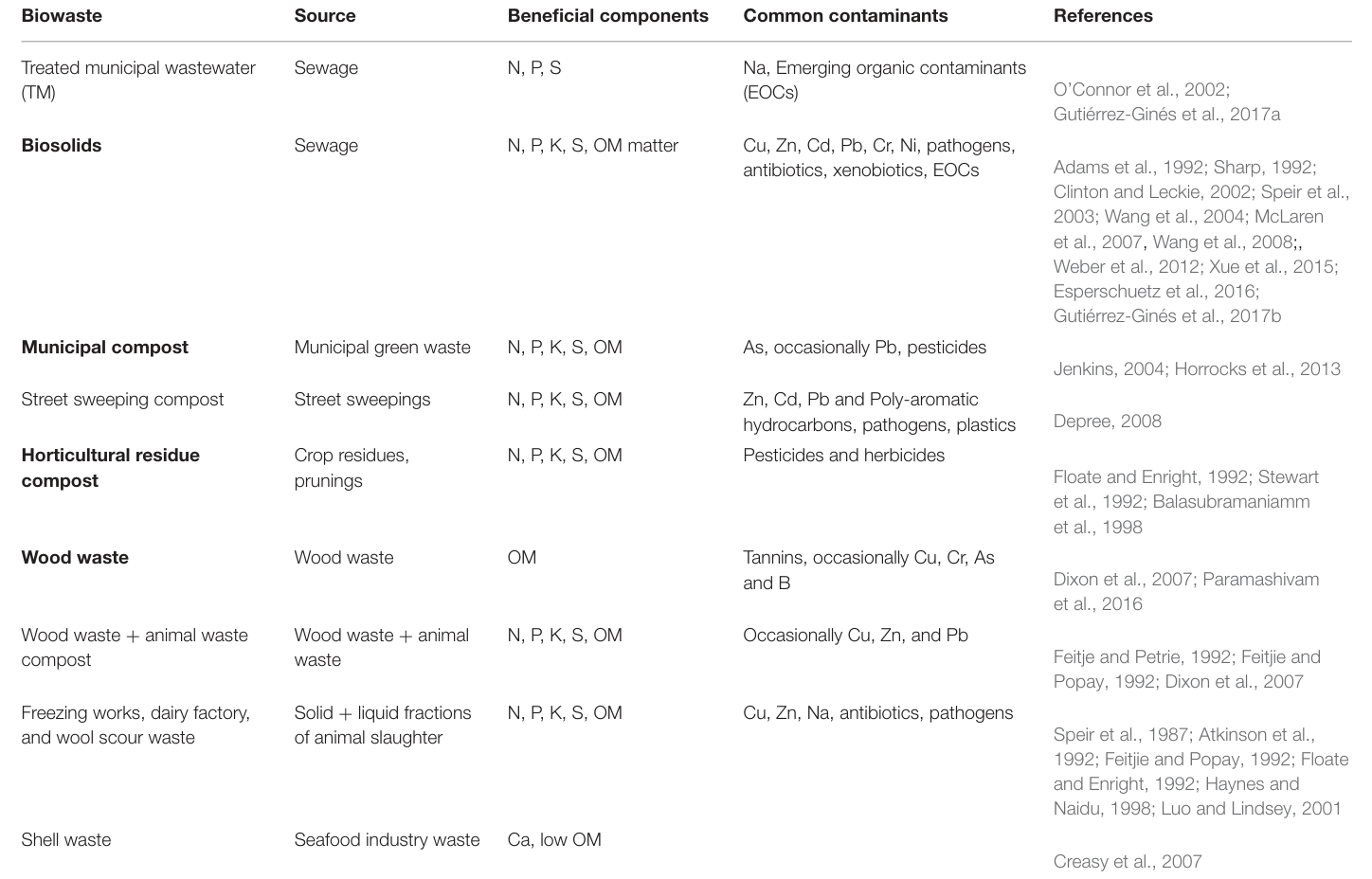
Bold biowastes are prioritized in this review.
粗体标注的生物废弃物为本综述的重点。
Solids and Slurries固体与浆状物
Biowaste solids include slurries, semi-liquid residues with more than 20–25% solids by dry weight, composts, and plant residues which vary in key nutrients and contaminants (Table 1). Biosolids in particular can have a wide range of moisture contents depending on processing and storage methods; hence one product can vary from slurry to solids. However, all these materials are too dense to be irrigated, so may be applied using spreaders on vehicles. As nutrient-density increases, such materials are economic to use further from source, as cartage costs are lower relative to their nutrient or amendment value, but they are still relatively less economic to transport long distances than most chemical fertilizers. Biowastes with high solids content have the advantage of being more easily applied at the high rates needed to ameliorate degraded soil OM. Weber et al. (2012) describe the value of repeated municipal sludge applications for rehabilitation of infertile, mined land to plantation forests in Waikato. At the same site, sustainable pasture rehabilitation required a one-off basal application of at least 100 dry t/ha of composted municipal biosolids (Simcock and Xue, 2017). Some NZ biosolids are treated by alkaline stabilization, in which waste materials such as lime, cement kiln dust, coal or fly-ash are added to stabilize carbon and reduce leaching of TEs (trace elements) (notably Zn). This process is also reported to reduce N fertilizer value by increasing NH3 volatilization (Wang et al., 2008), and hence contributing to green-house gas emissions.
生物废弃物固体包括浆状物、干重固体含量超过20–25%的半液态残余物、堆肥以及植物残体,其关键养分和污染物含量各不相同(表1)。尤其是生物固体,其含水量可因处理和储存方式不同而差异很大;因此同一产品可从浆状物变化至固体。然而,所有这些物料密度过大而无法灌溉施用,因此可使用车载撒布机施用。随着养分密度增加,此类物料在距源头更远处使用也具有经济性,因为运输成本相对于其养分或改良价值较低,但相比大多数化学肥料,其长距离运输的经济性仍相对较差。高固体含量生物废弃物的优势在于更易以改善退化土壤有机质所需的高用量施用。Weber et al. (2012) 描述了在Waikato将贫瘠的采矿后土地修复为人工林过程中反复施用城市污泥的价值。在同一场地,可持续的牧场修复需要一次性基施至少100干t/ha的堆肥化城市生物固体(Simcock and Xue, 2017)。新西兰部分生物固体采用碱性稳定化处理,即添加石灰、水泥窑灰、煤或粉煤灰等废料以稳定碳并减少微量元素(尤其是Zn)的淋溶。据报道,该过程还会因增加NH3挥发而降低氮肥价值(Wang et al., 2008),从而加剧温室气体排放。
Solid biowastes include wood wastes (Table 1) generated by large volumes of exported logs, and bark from log storage and processing areas processed with other agricultural biowastes to produce high-value growing media after composting, screening, and blending. Such plantation forest biowastes have particular value as “clean” materials (i.e., with low contaminants such as HM or EOC) that can facilitate co-disposal of other biowastes. For example, Feitjie and Popay (1992) developed horticultural growing media (3%N, 0.02%P, 0.06% K) and soil amendments from pine bark and sheep blood, and from fish waste products (Feitje and Petrie, 1992). Other silvicultural and forest processing byproducts include sawdust and paper mill sludges; post peelings, and untreated timbers shredded for re-use as urban landscaping mulches and applied at 5–10-cm depth. Such biowastes have minimal seasonal variation compared with materials derived from municipal green wastes and street sweepings in areas with exotic deciduous trees that dominate many urban areas (Depree, 2008).
固体生物废弃物包括木材废弃物(表1),其来源于大量出口原木,以及原木储存和加工区产生的树皮,这些物料与其他农业生物废弃物一同经堆肥、筛分和混配后可制成高价值的栽培基质。此类人工林生物废弃物作为“清洁”物料(即重金属或新兴有机污染物等污染物含量低)具有特殊价值,可促进其他生物废弃物的协同处置。例如,Feitjie and Popay (1992) 利用松树皮和羊血开发了园艺栽培基质(3%N、0.02%P、0.06% K)和土壤改良剂,并利用鱼类废弃物产品开发了类似产品(Feitje and Petrie, 1992)。其他营林和森林加工副产物包括锯末和造纸污泥、柱材剥皮,以及经粉碎后作为城市景观覆盖物再利用并以5–10 cm厚度铺设的未处理木材。与来自城市园林废弃物和街道清扫物(在许多城市区域以外来落叶树为主的地区)的物料相比,此类生物废弃物的季节性变化极小(Depree, 2008)。
3IMPACTS OF BIOWASTES ON NEW ZEALAND SOILS生物废弃物对新西兰土壤的影响
Influence of Biowastes on Soil Carbon and Nutrients生物废弃物对土壤碳和养分的影响
Biowastes can increase soil carbon (Wang et al., 2008). Through the processes of immobilization and sorption, this carbon may increase plant available N, P, K, and S (McLaren and Cameron, 1996) unless these elements are present in high concentrations in the biowaste itself (Esperschuetz et al., 2016). Most land-based municipal wastewater sites in NZ have low initial carbon contents, so they respond to relatively moderate levels of biowaste additions. The duration of soil response is influenced by stability of the biowaste. Composted material has a proportionately greater effect on soil carbon because it has a higher proportion of stable carbons and lower proportion of easily decomposed (labile) carbon. Microbiological activity/turnover in receiving soils also influences the soil carbon response, as does the “readiness” of the soil microbial community.
生物废弃物可增加土壤碳(Wang et al., 2008)。通过固定和吸附过程,这部分碳可能增加植物有效态氮、磷、钾和硫(McLaren and Cameron, 1996),除非生物废弃物本身含有高浓度的这些元素(Esperschuetz et al., 2016)。新西兰大多数城市污水土地处理场地的初始碳含量较低,因此对相对适量的生物废弃物添加即有响应。土壤响应的持续时间受生物废弃物稳定性的影响。堆肥化物料对土壤碳的影响相对更大,因为其稳定碳比例较高,而易分解(活性)碳比例较低。受纳土壤中的微生物活性/周转以及土壤微生物群落的“准备状态”也会影响土壤碳的响应。
NZ has large areas of soils with high surface charge due to high Al oxides; these Allophanic Soils can maintain substantially higher “base” concentrations of soil carbon (Sparling and Schipper, 2004). The high surface charge in these soils and Oxidic Soils (which have high Fe oxides) also moderates plant responses by moderating the readily, plant-available PO34−, commonly reported in New Zealand literature as “Olsen P.” The strength of response to applied P is indicated by “PO34− retention,” or anion retention capacity (McLaren and Cameron, 1996; Drewry et al., 2013). Low P limits growth of many non-native plants in New Zealand, particularly legumes, as most NZ soils are naturally deficient (Olsen P 0–5 mg/kg). NZ target Olsen P for agricultural pasture production are 20–35 mg/kg for sedimentary soils (Mackay et al., 2013).
新西兰有大面积因富含Al氧化物而具有高表面电荷的土壤;这些水铝英石土(Allophanic Soils)可维持显著更高的土壤碳“本底”浓度(Sparling and Schipper, 2004)。这些土壤以及氧化土(Oxidic Soils,富含Fe氧化物)的高表面电荷还通过调节易被植物利用的PO34−,(在新西兰文献中通常称为“Olsen P”)来调节植物响应。对施用磷的响应强度以“PO34−保持量”即阴离子保持能力表示(McLaren and Cameron, 1996; Drewry et al., 2013)。由于新西兰大多数土壤天然缺磷(Olsen P 0–5 mg/kg),低磷限制了新西兰许多非本土植物(尤其是豆科植物)的生长。新西兰沉积母质土壤上农业牧场生产的目标Olsen P为20–35 mg/kg(Mackay et al., 2013)。
The liming effect of some biowaste can help counter effects of acidification. However, the main biowastes studied in NZ are weakly to strongly acidic with the impact on soil pH influenced by soil buffering capacity. For example, a municipal biowaste with pH 4.3 strongly acidified a Raw Sand with low buffering potential (initial Total Carbon 0.13% w/w) as soil pH dropped from 8.8 to 5.2 (Gutiérrez-Ginés et al., 2017b). However, the same biosolid added to a well-buffered Orthic Brown Soil with initial 3.9% Total Carbon increased pH from 3.9 to 4.9. Acidification is most severe in biowastes with low C:N ratios and high N loading rates. The potential leaching losses of N associated with high N loading rates can be mitigated by co-disposal with woody wastes such as biochar (Knowles et al., 2011) or sawdust (Paramashivam et al., 2016, 2017). In the latter, microbe-extraction of N can be so effective that plant growth is suppressed. For example, blending 3 t/ha sawdust with 1,250 kg N/ha biosolids reduced ryegrass biomass by about 25% compared with unamended municipal biosolids (Esperschuetz et al., 2016). High inorganic N in biowastes can also enhance TE mobility, particularly Zn and Cd, which have less affinity for organic matter than Cr and Pb (Smith et al., 1992).
某些生物废弃物的石灰效应有助于抵消酸化作用。然而,新西兰主要研究的生物废弃物呈弱酸性至强酸性,其对土壤pH的影响受土壤缓冲能力制约。例如,一种pH为4.3的城市生物废弃物使缓冲能力低的原始砂土(初始总碳0.13% w/w)强烈酸化,土壤pH从8.8降至5.2(Gutiérrez-Ginés et al., 2017b)。然而,将同一生物固体添加至缓冲良好、初始总碳为3.9%的正常棕壤(Orthic Brown Soil)中,pH则从3.9升至4.9。低C:N比和高氮负荷的生物废弃物酸化最为严重。与高氮负荷相关的潜在氮淋溶损失可通过与生物炭(Knowles et al., 2011)或锯末(Paramashivam et al., 2016, 2017)等木质废弃物协同处置来缓解。在后者中,微生物对氮的提取可能极为有效,以至于抑制植物生长。例如,将3 t/ha锯末与1,250 kg N/ha的生物固体混合,与未改良的城市生物固体相比,黑麦草生物量降低约25%(Esperschuetz et al., 2016)。生物废弃物中高含量的无机氮还可增强微量元素的迁移性,尤其是Zn和Cd,二者对有机质的亲和力低于Cr和Pb(Smith et al., 1992)。
Waste waters with high Na or K concentrations can reduce soil infiltration rates if soil dispersion causes loss of structure until Na or K is leached (Haynes and Naidu, 1998). However, soil dispersion only affects permeability when the receiving soils have an appreciable clay content (Hart and Speir, 1992). Infiltration can also be impeded if wastewater physically clog soil pores or cause biological growths (Bedbabis et al., 2014).
如果土壤分散导致结构丧失,直至Na或K被淋溶,则高Na或K浓度的废水可降低土壤入渗速率(Haynes and Naidu, 1998)。然而,仅当受纳土壤具有相当的黏粒含量时,土壤分散才会影响渗透性(Hart and Speir, 1992)。若废水物理性堵塞土壤孔隙或引起生物滋生,入渗也可能受阻(Bedbabis et al., 2014)。
Influence of Soil Water and Oxygen on土壤水分和氧气对
Plant Response to Biowaste植物响应生物废弃物的影响
The benefits of wastewaters for plant growth are influenced by the frequency, volumes, and timing of application relative to plant water demand. The water in wastewaters and slurries benefits plant growth when application mitigates moisture stress and extends growth periods. These effects may be in addition to those generated from biowaste (Roberts et al., 1992). However, in the absence of moisture or nutrient stress, plant responses may be absent, for example Dixon et al. (2007) found no yield benefit from three types of mulches placed at 10-cm depth (composts, post peelings or bark chips), likely because the orchard soil was fertile and the avocados were irrigated. Plant growth responses may also not occur if biowastes exacerbate plant water demand and water is limiting (Clinton and Leckie, 2002). They reported lack of an anticipated growth response of 6-year-old pines to high rates of biosolids (800 kg N/ha equivalent) may have been masked by earlier onset of drought stress because the high N increased transpiration.
废水对植物生长的效益受施用频率、施用量以及施用时间与植物需水之间关系的影响。当施用缓解水分胁迫并延长生长期时,废水和浆状物中的水分有利于植物生长。这些效应可能叠加于生物废弃物本身产生的效应之上(Roberts et al., 1992)。然而,在不存在水分或养分胁迫的情况下,植物可能没有响应,例如Dixon et al. (2007) 发现以10 cm厚度铺设的三类覆盖物(堆肥、柱材剥皮或树皮碎片)均未带来增产效益,可能是因为果园土壤肥沃且鳄梨树已有灌溉。若生物废弃物加剧植物需水而水分受限,植物也可能不产生生长响应(Clinton and Leckie, 2002)。他们报道,6年生松树对高用量生物固体(相当于800 kg N/ha)未表现出预期的生长响应,可能是由于高氮增加了蒸腾,使干旱胁迫提早出现而掩盖了响应。
Biowastes are unlikely to have any beneficial effect where soils are, or become, waterlogged unless the method of biowaste application will fracture soils to improve drainage (e.g., biowaste injection). Sims et al. (1994) and Simcock and Xue (2017) reported Eucalyptus and Pinus radiata growth were reduced when biowastes were applied under anerobic conditions. In the former, coppicing severely reduced tree water uptake, necessitating reduced wastewater application rates until tree water use (and root development) recovered. In the latter, a combination of poor soil physical condition and low slope created poor drainage that prevented tree response to improved fertility from the biowaste. Adverse soil physical conditions were also proposed as major limitations to native karamu (Coprosma robusta) growth in a field study where growth did not respond to N or P, despite glasshouse trials indicating marked responses to these nutrients (Davis and Langer, 1997). Surface mulches applied to depths that suppress evaporation may also exacerbate the duration and severity of anoxic soil conditions in the underlying soils, as can wastewaters (Atkinson et al., 1992).
若土壤处于或变为渍水状态,除非生物废弃物的施用方式能使土壤破裂以改善排水(如生物废弃物注入),否则生物废弃物不太可能产生任何有益效应。Sims et al. (1994) 和Simcock and Xue (2017) 报道,在厌氧条件下施用生物废弃物会降低桉树和Pinus radiata的生长。在前者中,平茬严重降低了树木的水分吸收,因而需要降低废水施用速率,直至树木水分利用(及根系发育)恢复。在后者中,不良的土壤物理条件与低坡度共同导致排水不畅,使树木无法对生物废弃物带来的肥力改善产生响应。在一项田间研究中,尽管温室试验表明本土karamu(Coprosma robusta)对氮和磷有显著响应,但其生长对氮或磷均无响应,不良的土壤物理条件也被认为是其生长的主要限制因素(Davis and Langer, 1997)。覆盖厚度足以抑制蒸发的地表覆盖物也可能加剧下层土壤缺氧状况的持续时间和严重程度,废水亦然(Atkinson et al., 1992)。
4USING BIOWASTES FOR GROWING NATIVE VEGETATION利用生物废弃物培育本土植被
Methods of Establishing Native Vegetation本土植被的建立方法
Before discussing the effects of biowastes on native plants and ecosystems, it is useful to understand the methods used to establish native NZ vegetation since the late 1980s as this influences the success of biowaste use. The dominant establishment method is planting nursery-raised seedlings (Pollock, 1986; Porteous, 1993; Peters and Clarkson, 2010) as native woody species are typically poorly represented in seed banks in most areas where native plants are established (i.e., farms and cities). Planting is the only practical option where competition from non-native species is intense enough to prevent successful seeding. Ineffective control of competing vegetation is the most common reason for the failure of native plantings; Will (1985) and Sullivan et al. (2009) report adverse effects of weed competition on native plantings and plantation trees, respectively. NZ’s naturalized weed flora exceeds the number of native species, and non-native plants dominate nearly all lowland environments because they are more effective dispersers, seed earlier, and grow faster and/or taller. Many non-native plants are also N fixers (e.g., gorse, broom, acacia, hakea, clovers, lotus) and/or are better adapted to living with mammals by having prickles or thorns, or through being able to regrow after intensive browsing (Wardle, 1991).
在讨论生物废弃物对本土植物和生态系统的影响之前,有必要了解20世纪80年代末以来新西兰本土植被的建立方法,因为这会影响生物废弃物利用的成效。主要的建植方法是栽植苗圃培育的幼苗(Pollock, 1986; Porteous, 1993; Peters and Clarkson, 2010),因为在大多数建植本土植物的区域(即农场和城市),本土木本物种在种子库中通常很少。当非本土物种竞争激烈到阻碍播种成功时,栽植是唯一可行的选择。对竞争植被控制不力是本土植被栽植失败的最常见原因;Will (1985) 和Sullivan et al. (2009) 分别报道了杂草竞争对本土栽植植物和人工林树木的不利影响。新西兰归化杂草植物区系的物种数量超过本土物种,非本土植物几乎主导了所有低地环境,因为它们传播能力更强、结实更早,且生长更快和/或更高。许多非本土植物还是固氮植物(如荆豆、金雀花、金合欢、哈克木、三叶草、百脉根),和/或通过具有皮刺或枝刺,或能在强度啃食后再生,而更好地适应与哺乳动物共存(Wardle, 1991)。
Where weed competition is intense, taller native seedlings (>50 cm) are planted as these require less frequent “releasing” (Pardy et al., 1992). Weeds compete both above ground, for space and light, and below ground for nutrients and moisture, with the latter being the most damaging in terms of survival and growth (Will, 1985). Such competition is typically managed at planting by placing fertilizer below the root ball to avoid stimulating weeds, and at smaller sites organic mulches are spread to conserve water and slow weed establishment. Organic mulches are produced from cleared trees, plantation by-products, packing cases or green wastes. However, at large revegetation scales, mulching is not practical. Instead, establishment techniques from plantation forestry using pre- and post-plant herbicides are often adopted. Native planting densities of 2,500 to 10,000 plants/ha are used to achieve early canopy closure and weed suppression, higher than the 400–1,000 plants/ha of plantation forestry. Plantation forestry also uses facultative living mulches (often cereals, grasses or herbaceous legumes) to suppress weed growth and stabilize soils, but this approach is currently under-utilized in native plantings, along with bare-rooted plants and pre-planting cultivation treatments (e.g., ripping or spot mounding) used in plantation forestry to enhance drainage and mitigate compaction.
在杂草竞争激烈的地方,会栽植较高的本土幼苗(>50 cm),因为它们需要的“释放”(除草抚育)频率较低(Pardy et al., 1992)。杂草在地上竞争空间和光照,在地下竞争养分和水分,其中后者对存活和生长的危害最大(Will, 1985)。此类竞争通常在栽植时通过将肥料施于根团下方以避免刺激杂草来加以管理,在较小的场地还会铺设有机覆盖物以保持水分并延缓杂草定植。有机覆盖物由清除的树木、人工林副产物、包装箱或园林废弃物制成。然而,在大规模植被恢复中,覆盖并不可行。取而代之的是,常采用人工林经营中栽植前后施用除草剂的建植技术。本土植物栽植密度为2,500至10,000株/ha,以实现早期郁闭并抑制杂草,高于人工林经营的400–1,000株/ha。人工林经营还使用兼性活体覆盖物(通常为谷类、禾草或草本豆科植物)来抑制杂草生长并稳定土壤,但这一方法目前在本土植被栽植中利用不足,人工林经营中用于改善排水和缓解压实的裸根苗和栽植前整地处理(如深松或穴状起垄)亦是如此。
Response of NZ Native Plants to Fertilizers新西兰本土植物对肥料的响应
Native NZ plants are generally, but not exclusively, adapted to soils with low available N and P so growth responses to added nutrients are often low (Stevenson and Smale, 2005; Dickinson et al., 2015; Franklin et al., 2015, Appendix). The magnitude of response is influenced by the severity of nutrient deficiency and the availability of soluble N and P in amendments. Most native plant growth experiments show a plateau in plant response to increasing fertility, and this plateau occurs at a lower concentration than for agricultural species typically used for comparison. For example, Franklin et al. (2015) added increasing amounts of N as urea to native plants. The eight native species were tolerant to highly elevated N, from 200 to 1,600 kg/ha, as they were able to assimilate N into foliage through “luxury uptake.” Luxury uptake occurs when a plant takes up nutrients in excess of levels that increase plant growth; it is a feature of plants that grow slowly and/or in low-fertility conditions or where growth is limited by other nutrients (Iversen et al., 2010). Luxury uptake as a response to applied fertilizer has also been reported for P in manuka by Hall (1977), where it was regarded as representing a substantial P reserve for growing seedlings. Low background fertility conditions are typical of earlier NZ fertilizer trials on mine tailings, which typically have negligible OM and very low N. This research showed above-ground growth of some woody native species responded strongly to treatments containing N but not for treatments with only P (karamu, Coprosma robusta and kahikatea, Dacrycarpus dacrydioides), whereas other woody species (red beech, Fuscospora fusca and marble leaf, Carpodetus serratus) responded more strongly to applied P (Langer et al., 1999). In a linked trial, only foliar
新西兰本土植物通常(但并非全部)适应于有效氮和磷含量较低的土壤,因此其对添加养分的生长响应往往较低(Stevenson and Smale, 2005; Dickinson et al., 2015; Franklin et al., 2015, 附录)。响应程度受养分缺乏的严重程度以及改良物中可溶性氮和磷有效性的影响。大多数本土植物生长试验表明,植物对肥力增加的响应存在平台期,且该平台期出现的浓度低于通常用作对照的农业物种。例如,Franklin et al. (2015) 以尿素形式向本土植物添加递增量的氮。8种本土物种能够耐受从200至1,600 kg/ha的高氮水平,因为它们能够通过“奢侈吸收”将氮同化至叶片中。奢侈吸收是指植物吸收的养分超过促进植物生长所需的水平;这是生长缓慢和/或生长于低肥力条件下、或生长受其他养分限制的植物的特征(Iversen et al., 2010)。Hall (1977) 也报道了麦卢卡对施用磷肥的奢侈吸收,并认为其代表了幼苗生长的重要磷储备。低本底肥力条件是早期新西兰在尾矿上开展的肥料试验的典型特征,尾矿通常有机质可忽略不计且氮含量极低。该研究表明,某些本土木本物种的地上部生长对含氮处理响应强烈,而对仅含磷的处理则无响应(karamu,Coprosma robusta和kahikatea,Dacrycarpus dacrydioides),而其他木本物种(红山毛榉,Fuscospora fusca和marble leaf,Carpodetus serratus)则对施用磷的响应更强(Langer et al., 1999)。在一项关联试验中,仅叶片
N increased, with concentrations in plants grown in replaced topsoil more than double that of plants on infertile mine tailings. Glasshouse trials with k¯anuka (Kunzea serotina) in a low fertility soil also showed increased growth with the addition of N but not with additional P (Dollery, 2017).
氮含量增加,生长于回填表土中的植物其浓度是生长于贫瘠尾矿上植物的两倍以上。在低肥力土壤中对卡努卡(Kunzea serotina)开展的温室试验同样表明,添加氮可促进生长,而添加磷则不能(Dollery, 2017)。
Response of Native Plants to Nutrients Applied as Biowastes本土植物对生物废弃物所施养分的响应
Responses of native plants to biowastes are also influenced by baseline soil fertility and differ between plant species. Overall biomass and height responses are strongest in lowest fertility soils and for biosolids with the highest available N (Reis et al., 2017; Seyedalikhani et al., 2019), i.e., anaerobic digested biosolids with high NH+4 and low NO−3 rather than mature, stockpiled biosolids with low NH+4 . Biomass increases can be dramatic where baseline soils are extremely infertile, e.g., Reis et al. (2017) reported a 40-fold increase in m¯anuka biomass from low-fertility sand amended with 90 t/ha of aged stockpiled biosolids. Vermi-composts offer benefits of a slower N and P release that may better match the lower demand of native plants. Xue et al. (2012, 2016) report pot trials amending pumice subsoil (0.02% C, 0.01% N, 0.005% total P) with vermi-composts made from septic tank or dairy-shed solid waste and horticultural factory greenwastes. The vermi-composts (1.6 to 2.1%N and 0.34 to 0.38%P) supplied adequate P for seedling m¯anuka and totara (Podocarpus totara) growth and were at least as effective as Di-ammonium phosphate. However, vermi-compost did not supply adequate P for the much faster-growing (non-native) radiata pine seedlings, which had two to ten times greater dry weights than the native species.
本土植物对生物废弃物的响应还受本底土壤肥力的影响,且因植物物种而异。总生物量和株高响应在肥力最低的土壤中以及有效氮最高的生物固体处理下最为强烈(Reis et al., 2017; Seyedalikhani et al., 2019),即高NH+4、低NO−3的厌氧消化生物固体,而非低NH+4的腐熟堆存生物固体。在本底土壤极为贫瘠时,生物量增幅可能十分显著,例如Reis et al. (2017) 报道,在以90 t/ha陈化堆存生物固体改良的低肥力砂土上,麦卢卡生物量增加了40倍。蚯蚓堆肥的优势在于氮、磷释放较慢,可能更契合本土植物较低的需求。Xue et al. (2012, 2016) 报道了以化粪池或奶牛棚固体废弃物及园艺工厂绿色废弃物制成的蚯蚓堆肥改良浮石底土(0.02% C、0.01% N、0.005%全磷)的盆栽试验。蚯蚓堆肥(1.6至2.1%N和0.34至0.38%P)为麦卢卡和totara(Podocarpus totara)幼苗生长提供了充足的磷,其效果至少与磷酸二铵相当。然而,蚯蚓堆肥未能为生长快得多的(非本土)辐射松幼苗提供充足的磷,后者的干重是本土物种的2至10倍。
A positive height and/or biomass growth response in native species is usually linked to a lower shoot: root ratio (Waterhouse et al., 2014; Seyedalikhani et al., 2019). For example, only above-ground biomass of tussock (Chionochloa rubra) and m¯anuka responded to 20% v/v biosolids addition, not root biomass, even though the control was an acidic, infertile mine soil (Seyedalikhani et al., 2019). Native monocots, for example harakeke (flax, Phormium spp.), toetoe (Austroderia spp.), ti kouka (Cordyline australis), and sedges (Carex species) generally respond more strongly to fertilizers than native woody plants (dicotyledons) (Parker, 2011; Gutiérrez-Ginés et al., 2017b).
本土物种株高和/或生物量的正向生长响应通常与较低的茎根比相关(Waterhouse et al., 2014; Seyedalikhani et al., 2019)。例如,即使对照为酸性贫瘠的矿区土壤,丛生草(Chionochloa rubra)和麦卢卡也仅地上部生物量对20% v/v生物固体添加产生响应,而根系生物量无响应(Seyedalikhani et al., 2019)。本土单子叶植物,例如harakeke(新西兰麻,Phormium spp.)、toetoe(Austroderia spp.)、ti kouka(Cordyline australis)和莎草(Carex属物种),对肥料的响应通常强于本土木本植物(双子叶植物)(Parker, 2011; Gutiérrez-Ginés et al., 2017b)。
Pot trials indicate biowaste-stimulated increases in biomass of k¯anuka (Kunzea ericoides) and m¯anuka retain essential oil qualities (a potentially lucrative industry) at application rates equivalent to over 2,500 kg N/ha (Seyedalikhani et al., 2019). Native plants can deliver specific ecosystem benefits, for example, m¯anuka limits amplification of some HM contaminants typically elevated in biowastes; Morrell (1997) identified low foliar bioaccumulation of TE in native plants as a particular benefit in trials using municipal biosolids to revegetate toxic, base-metal mine tailings.
盆栽试验表明,在施用量相当于超过2,500 kg N/ha时,生物废弃物促进的卡努卡(Kunzea ericoides)和麦卢卡生物量增加仍能保持其精油品质(一个潜在的高利润产业)(Seyedalikhani et al., 2019)。本土植物可提供特定的生态系统效益,例如,麦卢卡可限制生物废弃物中通常含量较高的某些重金属污染物的放大;Morrell (1997) 在利用城市生物固体(污泥)对有毒贱金属尾矿进行植被恢复的试验中,认为本土植物叶片对微量元素的生物累积量低是一项特别的优势。
Effects of Native Plants on Biowastes本土植物对生物废弃物的作用
Some native species, notably k¯anuka and m¯anuka, also mitigate microbiological pathogens present in some biowastes (Prosser et al., 2016). In vitro and lysimeter studies show m¯anuka also inhibits nitrification processes in soil, potentially reducing NO−3 leaching; both actions could enhance protection of surface and ground water (Esperschuetz et al., 2017a). Recent field experiments are testing the efficacy of planting these species into riparian areas of farms and areas used for municipal wastewater-disposal. Early results of Escherichia coli, bromide, and dye tracing suggest enhanced bacterial bypass flow under m¯anuka and k¯anuka and predict that this enhanced preferential flow reduces the risk of surface pathogen runoff compared with pasture (Mishra, 2018). Further, this bypass flow route directs surface-applied pathogens toward the anti-microbial root compounds, increasing the chance of pathogen reduction in soils. Some native plants, such as m¯anuka, preferentially seek such enriched areas (Reis et al., 2017; Gutiérrez-Ginés et al., 2019) so could take advantage of discrete placement of highnutrient biowastes.
一些本土物种,尤其是卡努卡和麦卢卡,还可削减某些生物废弃物中存在的微生物病原体(Prosser et al., 2016)。体外和渗漏计研究表明,麦卢卡还可抑制土壤中的硝化过程,从而可能减少NO−3淋溶;这两种作用均可增强对地表水和地下水的保护(Esperschuetz et al., 2017a)。近期的田间试验正在检验在农场河岸带和城市污水处置区栽植这些物种的效果。大肠杆菌(Escherichia coli)、溴化物和染料示踪的初步结果表明,麦卢卡和卡努卡下细菌的旁路流增强,并预测这种增强的优先流与牧场相比可降低地表病原体径流风险(Mishra, 2018)。此外,这一旁路流途径将地表施用的病原体导向具有抗菌作用的根系化合物,从而增加土壤中病原体削减的机会。某些本土植物(如麦卢卡)会优先趋向此类富集区域(Reis et al., 2017; Gutiérrez-Ginés et al., 2019),因此可利用高养分生物废弃物的集中施放。
5RESPONSES OF NATIVE ECOSYSTEMS TO BIOWASTES本土生态系统对生物废弃物的响应
Weeds杂草
Pot and field trials investigating responses of individual native plants to a range of biowastes have shown above-ground biomass increases with the increased availability of N and/or P if these are limiting in the soil, but no root biomass response. Further, the N or P concentration at which native plants uptake luxury amounts of nutrients without necessarily increasing growth rates is lower than common “control” species such as (non-native) grasses, crops or pine trees. Therefore, in the presence of competition, native plants are generally disadvantaged by improved soil chemical fertility. Dollery (2017) reported fertilization (of 470 kg P/ha) and organic amendments had either negligible or detrimental effects on native species due to stimulation of competition from non-native weeds to develop. This research was unusual in reporting the impact on native moss species; there was a strong relationship between increase in exotic grasses and decrease in moss cover, as mosses are vulnerable to shading by grass. But increasing fertility can advantage natives where levels “release” natives from growth limitations but are low enough to limit growth of competing weeds, e.g., an Olsen P of 16 mg/kg for native species in pasture (Franklin et al., 2015). Weed control to allow native seedlings to grow is particularly critical in northern and lowland areas due to competing vine, shrub and tree weeds (Ross and Crequer, 2006; Sullivan et al., 2009). Specifically, control of pasture (grasses and herbaceous, particularly Lotus conrniculatus) was critical in the first 1–3 years to allow natives to establish, then control of woody weeds until canopy closure. The need for sympathetic post-application management was also highlighted by Phillips (1996) in a review of 11 Australian mines and quarries using biosolids for revegetation.
研究单一本土植物对一系列生物废弃物响应的盆栽和田间试验表明,若土壤中氮和/或磷为限制因子,其有效性提高会使地上部生物量增加,但根系生物量无响应。此外,本土植物奢侈吸收养分而不一定提高生长速率时的氮或磷浓度,低于常见的“对照”物种,如(非本土)禾草、作物或松树。因此,在存在竞争的情况下,土壤化学肥力的提高通常对本土植物不利。Dollery (2017) 报道,施肥(470 kg P/ha)和有机改良对本土物种的影响可忽略不计甚至有害,原因是刺激了非本土杂草的竞争。该研究少有地报道了对本土苔藓物种的影响:外来禾草增加与苔藓盖度下降之间存在强相关关系,因为苔藓易受禾草遮荫的影响。但当肥力水平能使本土植物“摆脱”生长限制、同时又低至足以限制竞争性杂草生长时,提高肥力可对本土植物有利,例如牧场中本土物种的Olsen P为16 mg/kg(Franklin et al., 2015)。由于存在竞争性的藤本、灌木和乔木杂草,在北部和低地地区,为使本土幼苗生长而进行的杂草控制尤为关键(Ross and Crequer, 2006; Sullivan et al., 2009)。具体而言,在最初1–3年内控制牧草(禾草和草本植物,尤其是Lotus conrniculatus)对本土植物的建立至关重要,其后需控制木本杂草直至郁闭。Phillips (1996) 在对11个利用生物固体(污泥)进行植被恢复的澳大利亚矿山和采石场的综述中,也强调了施用后进行适宜管理的必要性。
Native plants establishing from seeds are particularly vulnerable to competition. Langer et al. (1999) reported native karamu, koromiko (Hebe salicifolia) and m¯anuka seed could be established by broadcasting, and seedlings that survived the first winter responded strongly to fertilizer (N and P). However, the fertilizer also stimulated the growth of competitive herbaceous species such as Yorkshire fog (Holcus lantanus), lotus (Lotus corniculatus), and Himalayan honeysuckle (Leycesteria formosa) and plants that then smothered the natives. In some cases pasture grasses may be deliberately encouraged to suppress taller, more competitive weeds (as “green manure or green mulch”). They concluded native seeding only had potential as a revegetation technique for sites with low weed competition. Intense weed competition from pasture species was also reported by Douglas et al. (2007) in their research attempting seeding of native species into farmland.
由种子建立的本土植物尤其易受竞争影响。Langer et al. (1999) 报道,本土karamu、koromiko(Hebe salicifolia)和麦卢卡种子可通过撒播建立,度过第一个冬季的幼苗对肥料(氮和磷)响应强烈。然而,肥料也刺激了竞争性草本物种的生长,如绒毛草(Holcus lantanus)、百脉根(Lotus corniculatus)和鬼吹箫(Leycesteria formosa),以及随后覆压本土植物的其他植物。在某些情况下,可有意促进牧草生长以抑制更高、竞争力更强的杂草(作为“绿肥或绿色覆盖物”)。他们得出结论:本土植物播种仅在杂草竞争较低的场地才具有作为植被恢复技术的潜力。Douglas et al. (2007) 在尝试向农田播种本土物种的研究中也报道了来自牧草物种的激烈杂草竞争。
Competition from non-native species can be controlled by manipulating the timing and/or placement of biowastes or native plants, or by weed removal using herbicides or physical methods. Biowaste mulches are effective at control competition between planted native seedlings and common light-demanding weeds. Benefits depends on the depth, texture and rate of decomposition of the mulch, the characteristics of weed species and the drainage status of the soils. Balasubramaniamm et al. (1998) reported a range of mulches effectively suppressed weeds in NZ vineyards; Pratt (1999) reported bark was better at suppressing weeds over 2 years than shorter-lived mulches. Where native forest or shrubland is a target, many organic mulches can also enhance conditions for natural seed regeneration under the forest canopy once decomposed, thereby supporting longer-term ecological succession.
非本土物种的竞争可通过调控生物废弃物或本土植物的施用/栽植时间和/或位置,或通过使用除草剂或物理方法除草加以控制。生物废弃物覆盖物可有效控制栽植的本土幼苗与常见喜光杂草之间的竞争。其效益取决于覆盖物的厚度、质地和分解速率、杂草物种的特性以及土壤的排水状况。Balasubramaniamm et al. (1998) 报道,多种覆盖物可有效抑制新西兰葡萄园中的杂草;Pratt (1999) 报道,树皮在2年内对杂草的抑制效果优于寿命较短的覆盖物。以本土森林或灌丛为目标时,许多有机覆盖物在分解后还可改善林冠下天然种子更新的条件,从而支持较长期的生态演替。
Mycorrhizae菌根
Most NZ native plants form symbiotic associations with Arbuscular mycorrhizal fungi (AMF) (Williams, 2011) which enable them to access N and P directly from organic sources and can play an essential role in water and nutrient uptake (Davis et al., 2013). Although NZ has only four woody plant genera known to form ecto-mycorrhizal (ECM) associations in the field (Orlovich and Cairney, 2004), these are critical seral species (Leptospermum scoparium and Kunzea spp.) and forest canopy components (southern beech, Nothofagus spp., Lophonzonia sp.). In contrast, the ECM fungal diversity is high; for example, there are over 200 species that are likely linked with southern beech species (McKenzie et al., 2000). Mycorrhizas are essential for P uptake and growth of manuka and southern rata (Metrosideros umbellata) seedlings in soils where low P-status limits growth (Hall, 1977). Pot trials growing southern beech in soils with low available P showed seedlings that developed mycorrhizas grew more rapidly than those that did not (Johnston et al., 2003). Some ecto-mycorrhizae protect plants from root pathogens (Johnston et al., 2003) either through forming a dense, compact mantle (Peterson et al., 2004) or by producing antifungal compounds (Duchesne et al., 1989). They may also enhance plant resistance to climatic stresses like drought by enlarging surface area explored for water or moderating impacts of pollutants (Read, 2002). Lack of suitable ECM fungi appears to limit spread of southern beech from forest margins (Wardle, 1991), and ECM fungi also facilitate invasions of NZ native ecosystems by exotic species, for example Pinus contorta into tussock ecosystems and (Douglas fir) Pseudotsuga meziesii into southern beech forests (Orlovich and Cairney, 2004).
大多数新西兰本土植物与丛枝菌根真菌(AMF)形成共生关系(Williams, 2011),使其能够直接从有机来源获取氮和磷,并在水分和养分吸收中发挥重要作用(Davis et al., 2013)。尽管新西兰已知在野外形成外生菌根(ECM)共生的木本植物仅有4个属(Orlovich and Cairney, 2004),但它们是关键的演替系列物种(Leptospermum scoparium和Kunzea spp.)和森林林冠组分(南方山毛榉,Nothofagus spp.,Lophonzonia sp.)。相比之下,外生菌根真菌多样性很高;例如,可能与南方山毛榉物种相关联的真菌超过200种(McKenzie et al., 2000)。在低磷状态限制生长的土壤中,菌根对麦卢卡和southern rata(Metrosideros umbellata)幼苗的磷吸收和生长至关重要(Hall, 1977)。在低有效磷土壤中种植南方山毛榉的盆栽试验表明,形成菌根的幼苗比未形成菌根的幼苗生长更快(Johnston et al., 2003)。某些外生菌根可保护植物免受根部病原体侵害(Johnston et al., 2003),其方式或是形成致密紧实的菌套(Peterson et al., 2004),或是产生抗真菌化合物(Duchesne et al., 1989)。它们还可通过扩大探索水分的表面积或减缓污染物的影响,增强植物对干旱等气候胁迫的抗性(Read, 2002)。缺乏适宜的外生菌根真菌似乎限制了南方山毛榉从森林边缘的扩散(Wardle, 1991),而外生菌根真菌也促进了外来物种对新西兰本土生态系统的入侵,例如Pinus contorta入侵丛生草生态系统,以及(花旗松)Pseudotsuga meziesii入侵南方山毛榉森林(Orlovich and Cairney, 2004)。
The response of mycorrhizae to biowastes is influenced by the concentration and type of nutrients supplied. For example, moderate amounts of N fertilizer enhanced vesicular— arbuscular mycorrhizal infection in a low-P status soil, whereas applying P fertilizer reduced infection Hall (1977). Mycorrhizae are generally suppressed in nutrient-rich conditions. Hence, Waterhouse (2014) reported that unweathered municipal biosolids reduced AMF colonization of L. scoparium, whereas trials using vermi-composted, stabilized biowastes with lower available N and P had no significant effect on Ecto- or Arbuscular mycorrhizae (Xue et al., 2016). Further, Last et al. (1987) suggest ecto-mycorrhizal species adapted to soils with low OM contents are unlikely to be competitive in soils with high levels of carbon.
菌根对生物废弃物的响应受所供应养分的浓度和类型影响。例如,在低磷土壤中,适量氮肥可增强泡囊—丛枝菌根侵染,而施用磷肥则降低侵染(Hall, 1977)。菌根在养分丰富的条件下通常受到抑制。因此,Waterhouse (2014) 报道未风化的城市生物固体(污泥)降低了L. scoparium的丛枝菌根真菌定殖率,而使用有效氮、磷较低的蚯蚓堆肥化稳定生物废弃物的试验则对外生或丛枝菌根无显著影响(Xue et al., 2016)。此外,Last et al. (1987) 认为,适应低有机质含量土壤的外生菌根物种在高碳土壤中不太可能具有竞争力。
Native Soil Organisms本土土壤生物
Degraded soils typically have depleted soil fauna, due to lower OM contents, lower OM inputs (stressed plant growth), and degraded physical conditions. For example, earthworm numbers in rehabilitated lignite mine soils were initially <10% of the population of undisturbed soils (Widdowson and McQueeb, 1990). In New Zealand, even agricultural soils that are not degraded are profoundly modified from their natural state with elevated soil N and depleted native soil invertebrate fauna (Kim et al., 2017). Hence, invertebrates of leaf litter and native earthworms have been proposed as useful indicators of successful forest restoration in New Zealand (Smith et al., 2016).
退化土壤中的土壤动物通常已耗竭,原因在于有机质含量较低、有机质输入较少(植物生长受胁迫)以及物理条件退化。例如,修复后褐煤矿区土壤中的蚯蚓数量最初仅为未扰动土壤种群的<10%(Widdowson and McQueeb, 1990)。在新西兰,即使是未退化的农业土壤也已较其自然状态发生深刻改变,表现为土壤氮升高和本土土壤无脊椎动物区系耗竭(Kim et al., 2017)。因此,凋落物无脊椎动物和本土蚯蚓已被提议作为新西兰森林恢复成功与否的有用指示生物(Smith et al., 2016)。
New Zealand has a diverse, distinctive group of over 179 species of endemic earthworms (Kim et al., 2017) that are also important food for native animals such as Powelliphanta spp. snails and kiwi (Apteryx spp.) birds. Some native earthworms are highly tolerant to acidic conditions (down to ca pH 4, Boyer and Wratten, 2010). However, these earthworms are intolerant of soluble N, as are non-native earthworms, for example, a 200 kg/ha split-application of urea fertilizer reduced non-native worm numbers by up to 40% on rehabilitated soils (Widdowson and McQueeb, 1990). The impact of biowaste therefore depends on chemical contaminants in the biowaste (such as ammonia or trace elements), baseline soil limitations (organic matter, contaminants), and the degree to which these are alleviated by a specific biowaste. For example, mortality of native earthworms over 3 months incubation was reduced from 42% to zero when acidic topsoils were amended with municipal biosolids at 1:4 ratio (Waterhouse et al., 2014). In a similar incubation experiment using aged biosolids and two native Maoridrilus species, mortality of 40% in an unamended soil was considered due to lack of OM (food), and all worms died in 100% biosolids treatment (Kim et al., 2017). However, adding suitable types and rates of biowaste to soils can increase OM contents and improve soil physical conditions both directly, and indirectly, through benefitting earthworms that in turn enhance soil physical and chemical fertility (Ross and Widdowson, 1985; Boyer and Wratten, 2010; Kim et al., 2017).
新西兰拥有超过179种多样而独特的特有蚯蚓(Kim et al., 2017),它们也是Powelliphanta spp.蜗牛和几维鸟(Apteryx spp.)等本土动物的重要食物。某些本土蚯蚓对酸性条件具有高度耐受性(低至约pH 4,Boyer and Wratten, 2010)。然而,与非本土蚯蚓一样,这些蚯蚓不耐受可溶性氮,例如,在修复土壤上分次施用200 kg/ha尿素肥料使非本土蚯蚓数量减少多达40%(Widdowson and McQueeb, 1990)。因此,生物废弃物的影响取决于生物废弃物中的化学污染物(如氨或微量元素)、本底土壤限制因子(有机质、污染物)以及特定生物废弃物对这些限制的缓解程度。例如,当以1:4比例用城市生物固体(污泥)改良酸性表土时,本土蚯蚓在3个月培养期内的死亡率从42%降至零(Waterhouse et al., 2014)。在一项使用陈化生物固体和两种本土Maoridrilus物种的类似培养试验中,未改良土壤中40%的死亡率被认为是由于缺乏有机质(食物),而在100%生物固体处理中所有蚯蚓均死亡(Kim et al., 2017)。然而,向土壤中添加适宜类型和用量的生物废弃物可提高有机质含量并改善土壤物理条件,这既有直接作用,也有通过有益于蚯蚓进而增强土壤物理和化学肥力的间接作用(Ross and Widdowson, 1985; Boyer and Wratten, 2010; Kim et al., 2017)。
6CRITICAL FACTORS THAT DETERMINE SUCCESSFUL USE OF BIOWASTES FOR NZ PLANTS AND ECOSYSTEMS决定生物废弃物成功用于新西兰植物和生态系统的关键因素
To date, most NZ biowaste research has aimed to identify either the maximum rate of biowaste that can be applied with acceptable environmental impacts (to minimize land required for disposal) or the amount of biowaste needed to achieve a production outcome equivalent to inorganic fertilizer application (Sharp, 1992). These approaches are applicable to situations where native plants are being established for production, carbon sequestration or microbiological attenuation purposes. However, there is also value in selecting biowastes types and rates to achieve specific, beneficial ecosystem services, production and ecological rehabilitation outcomes that enhance the establishment, resilience and succession of native ecosystems.
迄今为止,新西兰大多数生物废弃物研究的目标,要么是确定在环境影响可接受前提下生物废弃物的最大施用量(以尽量减少处置所需土地),要么是确定达到与无机肥料施用相当的生产效果所需的生物废弃物量(Sharp, 1992)。这些方法适用于为生产、碳封存或微生物削减目的而建立本土植物的情形。然而,选择生物废弃物的类型和用量,以实现特定的有益生态系统服务、生产和生态修复成效,从而增强本土生态系统的建立、恢复力和演替,同样具有价值。
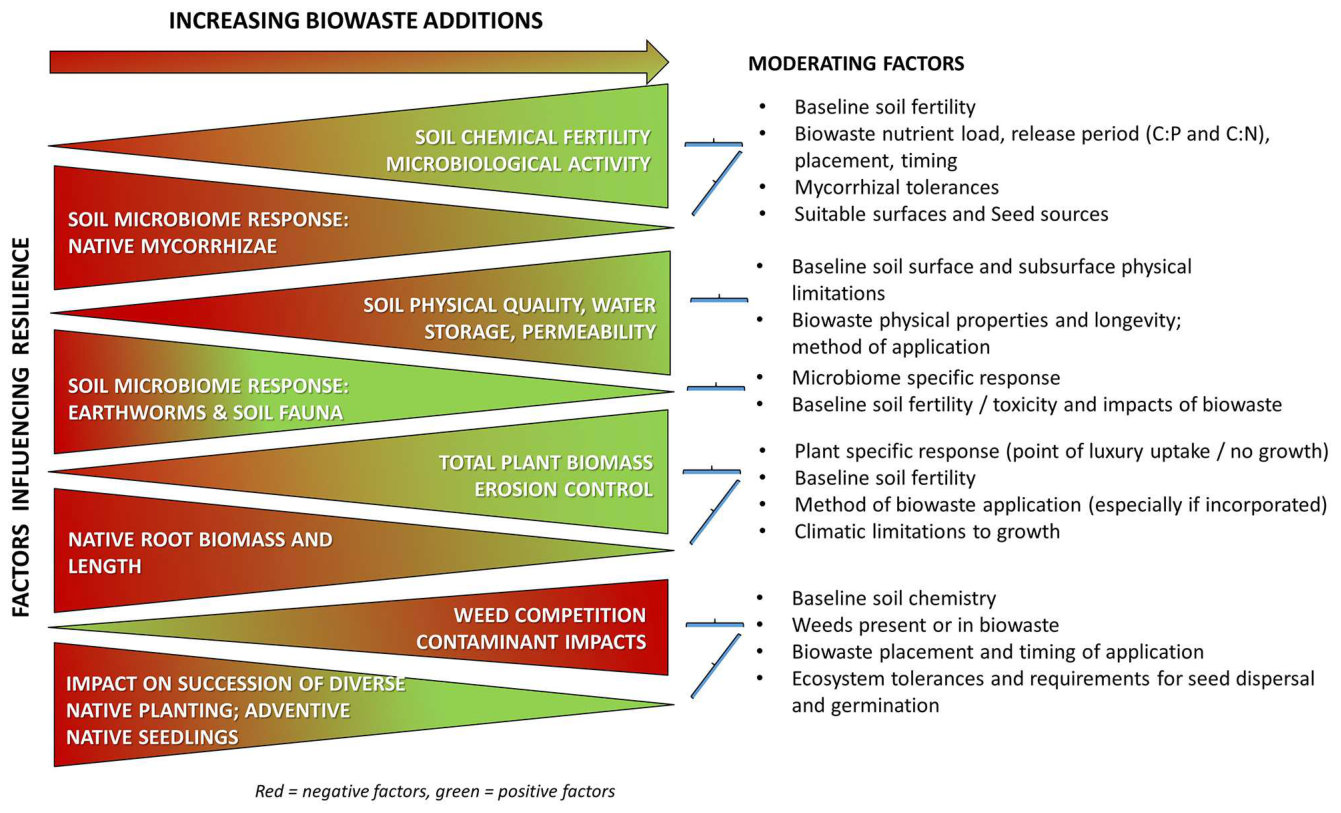
Four critical factors need to be considered when selecting a biowaste or biowastes and method/s of application to achieve the selected native NZ plant and ecosystem outcomes:
在选择一种或多种生物废弃物及其施用方法以实现所选定的新西兰本土植物和生态系统目标时,需要考虑以下四个关键因素:
- Weed competition;
- Ecosystem succession;
- Resilience (especially to drought and storms); and,恢复力(尤其是对干旱和风暴的抵御能力);以及
- Soil microbiome responses to elevated N, P, OM and contaminants.土壤微生物组对氮、磷、有机质和污染物含量升高的响应。
These factors are summarized in Figure 1, and should be considered in the selection of the specific biowastes, timing and methods of biowaste application, the selection of plant species and target ecosystems, and the post-application management of receiving sites. The three latter factors are most important where an aim of biowaste use is ecosystem rehabilitation and less important where native plants are used for carbon sequestration or production (other than for food).
这些因素概括于图1中,在选择特定生物废弃物、确定生物废弃物的施用时间和方法、选择植物物种和目标生态系统以及受纳场地施用后管理时均应加以考虑。当生物废弃物利用的目的之一是生态系统修复时,后三个因素最为重要;而当本土植物用于碳封存或生产(食物生产除外)时,其重要性较低。
Weed Competition杂草竞争
Control of herbaceous weeds is critical to allow native establishment in situations where biowastes stimulate plant growth, for example by overcoming nutrient limitations. Biowaste application rates at these sites should consider the availability (form) of N and P applied, and not be based on total N or P; the latter is typically limited to 200 kg N/ha /annum, while available P is strongly influenced by soil mineralogy. This approach may allow higher rates of low-concentration biowastes to be applied and encourage composting, vermi-composting or co-disposal of more concentrated biowastes with high C:N material (sawdust, arborist mulch or shredded bark). This is particularly valuable where soils are degraded and large volumes of biowastes (100–400 dry t/ha) are needed to enhance soil moisture holding capacity and soil organic contents.
在生物废弃物刺激植物生长(例如通过克服养分限制)的情况下,控制草本杂草对本土植物的建立至关重要。此类场地的生物废弃物施用量应考虑所施氮和磷的有效性(形态),而不应基于全氮或全磷;后者通常限制为200 kg N/ha/年,而有效磷则在很大程度上受土壤矿物组成的影响。这一方法可允许以较高用量施用低浓度生物废弃物,并鼓励对浓度较高的生物废弃物进行堆肥化、蚯蚓堆肥化,或与高C:N物料(锯末、树艺覆盖物或粉碎树皮)协同处置。在土壤退化且需要大量生物废弃物(100–400干t/ha)以增强土壤持水能力和土壤有机质含量的情况下,这一点尤为重要。
When natives are established with, or into, non-native pastures, herbicides are commonly used to create bare planting areas and to kill weeds that compete with native plants. An alternative or complementary approach is to use biowastes as a mulch (Dollery et al., 2019) to gain added benefits of soil moisture conservation (if applied to sufficient depth and when soils are moist) and surface temperature moderation. Mulches can be selected to create a leaf-litter layer and favorable seed bed following decomposition. Weed competition can also be managed using a temporary “green-mulch” of non-native grasses or cereals; these have the added advantage of high N uptake to quickly sequester N into plant biomass and rapid stabilization of erosion-prone surfaces. Native planting can then be delayed until available N levels decrease to levels at which native plants are more competitive and the green mulch has died-off (if annual species), is less competitive, or is killed.
在非本土牧场中或与非本土牧场一同建立本土植物时,通常使用除草剂来营造裸露的种植区域,并杀灭与本土植物竞争的杂草。另一种替代或补充方法是将生物废弃物用作覆盖物(Dollery et al., 2019),从而获得保持土壤水分(若施用深度足够且在土壤湿润时施用)和缓和地表温度的附加效益。可选择适当的覆盖物,使其分解后形成枯枝落叶层和良好的苗床。杂草竞争也可通过由非本土禾草或谷类作物构成的临时性“绿色覆盖”加以控制;其附加优势在于氮吸收量高,可将氮迅速固存于植物生物量中,并能快速稳定易受侵蚀的地表。随后可推迟本土植物的种植,直至有效氮水平降至本土植物更具竞争力的程度,且绿色覆盖植物已经死亡(若为一年生物种)、竞争力减弱或被清除。
Ecosystem Succession生态系统演替
Consideration of succession pathways is a critical factor where biowastes are used for native ecosystem rehabilitation, because many NZ plants are long lived (hundreds of years) and rehabilitation usually focuses on just establishing common seral plants (Dickinson et al., 2015; Simcock and Ross, 2017). Coarse biowastes such as logs and stumps have a unique role in facilitating succession as decomposing logs provide a substrate onto which seedlings can establish that cannot compete on the forest floor (Wardle, 1991). Such biowastes and finer organic mulches can also create sheltered, humid, and more stable microclimates in the initial establishment phases. Together, surrogate humus layers and coarse wood also provide habitats for a diverse range of native, endemic invertebrates otherwise absent from newly planted sites for decades. Branches and logs can also be used to physically protect plants from mammal browse, allowing establishment of palatable species (Forbes, 2015).
在利用生物废弃物进行本土生态系统修复时,考虑演替途径是一个关键因素,因为许多新西兰植物寿命很长(数百年),而修复工作通常仅侧重于建立常见的演替系列植物(Dickinson et al., 2015; Simcock and Ross, 2017)。原木和树桩等粗质生物废弃物在促进演替方面具有独特作用,因为腐烂的原木可为那些在林地地面上缺乏竞争力的幼苗提供定植基质(Wardle, 1991)。此类生物废弃物以及较细的有机覆盖物还可在初始定植阶段营造遮蔽、湿润且更为稳定的微气候。替代腐殖质层与粗木质残体共同为多种本土特有无脊椎动物提供栖息地,否则这些动物在新种植的场地中数十年内都不会出现。树枝和原木还可用于物理保护植物免受哺乳动物啃食,从而使适口性物种得以定植(Forbes, 2015)。
(Fuscospora cliffortioides), but not for the more wind-tolerant monocotyledons flax (Phormium spp.) and toetoe (Austroderia spp.) (Theinhardt, 2003). Thus, spreading such coarse woody material over soils amended with nutrient-rich biosolids could enable the full potential growth response of native plants at degraded or highly exposed sites. Other NZ mine-rehabilitation research consistently shows such provision of an erosionresistant root zone underpins native plant survival and growth (Simcock and Ross, 2017).
(Fuscospora cliffortioides),但对于更耐风的单子叶植物新西兰麻(Phormium spp.)和toetoe(Austroderia spp.)则并非如此(Theinhardt, 2003)。因此,在施用了富含养分的生物固体(污泥)的土壤上铺撒此类粗木质材料,可使退化或高度暴露场地上的本土植物充分发挥其生长潜力。新西兰其他矿山修复研究一致表明,提供此类抗侵蚀根区是本土植物存活和生长的基础(Simcock and Ross, 2017)。
Methods of biowaste application that involve cultivation can benefit plant resilience in physically-degraded soils, by increasing rooting depth and volume (Donn et al., 2015). Such considerations are increasingly important in a future of climate change and where biowaste additions are large enough, or initial soil conditions poor enough, to substantially change soil chemical fertility, plant-available water storage, and/or root volumes. Biowaste applications, especially large, one-off applications of vermi-composted or similar biowaste with relatively slow nutrient release profile appear best-suited for increasing native plant establishment where soils are chemically and/or physically degraded. This may reduce the risks associated with higher above-ground biomass and reduced below-ground roots. Where wastewaters are irrigated, plant resilience can be enhanced by manipulating frequency and depth to minimize surface rooting, overcome the severity of soil seasonal moisture deficit overcome, and/or avoid inducing anaerobic soil conditions.
涉及耕作的生物废弃物施用方法可通过增加根系深度和体积,提高物理退化土壤中植物的恢复力(Donn et al., 2015)。在未来气候变化的背景下,以及在生物废弃物添加量足够大或初始土壤条件足够差、以致显著改变土壤化学肥力、植物有效水储量和/或根系体积的情况下,此类考虑日益重要。在土壤存在化学和/或物理退化的情况下,施用生物废弃物,尤其是一次性大量施用养分释放相对缓慢的蚯蚓堆肥或类似生物废弃物,似乎最适合于促进本土植物的定植。这可能降低与地上生物量增加及地下根系减少相关的风险。在灌溉废水的情况下,可通过调控灌溉频率和深度来提高植物恢复力,以尽量减少表层根系、克服土壤季节性水分亏缺的严重程度和/或避免诱发土壤厌氧条件。
Soil Microbiome Response土壤微生物组响应
Resilience恢复力
Biowastes usually supply one or more primary benefits for plant growth, delivered by enhanced available N and P. However, because a positive height and/or biomass growth response in native species is usually linked to a lower shoot: root ratio (Waterhouse et al., 2014; Seyedalikhani et al., 2019), biowaste applications that stimulate a large above-ground growth are likely to reduce resilience on native plants to drought and windthrow (storms). Vulnerability to drought is increased where biowastes encourage development of a near-surface root mat, for example by regular surface application of wastewater (Sims et al., 1994) or use of surface mulches with fertilizer (Pratt, 1999). However, organic biowaste mulches are commonly used to enhance native seedling resilience to drought during establishment by reducing water loss directly (by reducing evaporation from soil) and indirectly (by suppressing growth of competing weeds). Mulches also enhance resilience when they overcome soil surface physical limitations, thereby reducing runoff and enhancing recharge of soil moisture by rainfall (Stewart et al., 1992). Organic mulches and compost amendments are also widely used to increase resilience of earthworked-slopes against erosion, both directly (by providing a physical cover and reducing runoff) and indirectly, by enhancing mechanical reinforcement of soil by roots (Donn et al., 2015).
生物废弃物通常通过提高有效氮和有效磷为植物生长提供一项或多项主要益处。然而,由于本土物种在株高和/或生物量方面的正向生长响应通常与较低的茎根比相关(Waterhouse et al., 2014; Seyedalikhani et al., 2019),刺激地上部大量生长的生物废弃物施用可能会降低本土植物对干旱和风倒(风暴)的恢复力。当生物废弃物促使近地表根垫形成时,例如定期地表施用废水(Sims et al., 1994)或将地表覆盖物与肥料配合使用(Pratt, 1999),植物对干旱的脆弱性会增加。然而,有机生物废弃物覆盖物常被用于在定植期间提高本土幼苗的抗旱恢复力,其途径包括直接减少水分损失(通过减少土壤蒸发)和间接作用(通过抑制竞争性杂草的生长)。当覆盖物克服土壤表面的物理限制,从而减少径流并增强降雨对土壤水分的补给时,也能提高恢复力(Stewart et al., 1992)。有机覆盖物和堆肥改良剂还被广泛用于提高土方工程边坡的抗侵蚀恢复力,其作用既有直接的(提供物理覆盖并减少径流),也有间接的,即增强根系对土壤的机械加固作用(Donn et al., 2015)。
Coarse mulches including logs and stumps also create a rough, erosion resistant topography with stable, sheltered microsites (Simcock and Ross, 2017). At exposed sites, the reducing wind exposure by creating a rough hummocky surface had a greater positive impact on growth than applying fertilizer for the woody koromiko (Hebe salicifolia) and mountain beech
包括原木和树桩在内的粗质覆盖物还能形成粗糙、抗侵蚀的地形,并具有稳定、遮蔽的微生境(Simcock and Ross, 2017)。在暴露场地上,对于木本植物koromiko(Hebe salicifolia)和山毛榉,通过营造粗糙的丘状地表来减少风暴露,对生长的正面影响大于施肥
The final critical success factor that influences the successful use of biowastes with NZ plants and ecosystems is soil microbiome responses to elevated HM and contaminants (including biological contaminants). There is little data on which to set concentration limits for contaminants such as HMs or EOC where the primary goal of biowaste amendment is ecosystem rehabilitation. Once added to soil, some contaminants are difficult to remove. Long-term NZ research on 3-yearly applications of municipal sludge to a sandy Raw Soil, with 900 mm rainfall and 2–4 m depth groundwater, concluded biowastes improved soil carbon levels, site fertility (N and P), and site productivity, without causing significant adverse impact on the receiving environment (Wang et al., 2004; Xue et al., 2015). Suitable ecosystems for higher-nutrient biosolids include those naturally adapted to high inputs of guano, such as those adjacent to seabird colonies. Such systems would provide a baseline to compare effects of enhanced foliar nutrition on palatability of plants to insects, other browsers or disease; factors that have received little attention.
影响生物废弃物在新西兰植物和生态系统中成功应用的最后一个关键成功因素,是土壤微生物组对重金属(HM)和污染物(包括生物污染物)浓度升高的响应。在以生态系统修复为生物废弃物改良主要目标的情况下,可用于设定重金属或EOC等污染物浓度限值的数据很少。某些污染物一旦进入土壤便难以去除。新西兰一项长期研究在降雨量为900 mm、地下水埋深为2–4 m的砂质原始土上每3年施用一次城市污泥,结果表明,生物废弃物提高了土壤碳水平、场地肥力(氮和磷)及场地生产力,且未对受纳环境造成显著不利影响(Wang et al., 2004; Xue et al., 2015)。适合施用高养分生物固体的生态系统包括那些天然适应大量鸟粪输入的生态系统,例如海鸟栖息地附近的生态系统。此类系统可作为基准,用以比较叶片营养增强对植物被昆虫、其他啃食动物取食或病害发生的影响;这些因素迄今鲜受关注。
New Zealand ecosystems that are adapted to low available N and P are likely to be transformed by biowaste applications that elevate the availability of these nutrients. Because biowastes contain organic-bound N and P, the duration during which nutrients such as P, K, Mg, and Ca are available for plant growth is extended and potential for N leaching is reduced (Horrocks et al., 2013; Esperschuetz et al., 2017a). Partly-stabilized biowastes, such as vermi-composts with moderate levels of available N and P, and large proportions of slowly-mineralisable N and P, also offer solutions as they are more likely to match release to native plant demand, which is lower than for arable crops or plantation forestry. In these biosolids, the surge of microbial activity is completed, and OM metabolized aerobically. This not only reduces the nutrient pulse compared with raw (anoxic/anaerobic) sludges, but also reduces the risks associated with HM leaching.
适应低有效氮和低有效磷的新西兰生态系统,很可能会因提高这些养分有效性的生物废弃物施用而发生转变。由于生物废弃物含有有机结合态氮和磷,磷、钾、镁和钙等养分可供植物生长利用的持续时间得以延长,氮淋溶的可能性也随之降低(Horrocks et al., 2013; Esperschuetz et al., 2017a)。部分稳定化的生物废弃物,如有效氮和有效磷含量适中、缓慢矿化态氮和磷比例较高的蚯蚓堆肥,也提供了解决方案,因为其养分释放更有可能与本土植物的需求相匹配,而本土植物的需求低于农作物或人工林。在这类生物固体中,微生物活性高峰已经结束,有机质已经过好氧代谢。与未经处理的(缺氧/厌氧)污泥相比,这不仅降低了养分脉冲,还降低了与重金属淋溶相关的风险。
While a spike in available N may be reduced by adding carbonrich biowastes, and by leaching and harvesting plant biomass, there is little potential for P-sensitive ecosystems to recover to natural levels of available P. An exception may be soils with high anion retention that could be cultivated. Elevated P is likely to have long-term effects on soil mycorrhizae, and there is little understanding of NZ native mycorrhizal relationships in native ecosystems. Elevated available P facilitates the establishment of a range of aggressive, N-fixing weed species. Together, these vulnerabilities mean some low-fertility native ecosystems are not suitable targets for rehabilitation or for the application of nutrient-rich biowastes or for the long-term application of low-concentration biowastes (e.g., wastewaters).
虽然通过添加富碳生物废弃物以及通过淋溶和收获植物生物量可以降低有效氮的峰值,但对磷敏感的生态系统恢复到有效磷自然水平的可能性很小。例外情况可能是具有高阴离子保持能力且可进行耕作的土壤。有效磷升高可能对土壤菌根产生长期影响,而目前对本土生态系统中新西兰本土菌根关系的认识还很有限。有效磷升高有利于多种侵略性固氮杂草物种的定植。综上所述,这些脆弱性意味着某些低肥力本土生态系统不适合作为修复对象,也不适合施用富含养分的生物废弃物或长期施用低浓度生物废弃物(如废水)。
Some emerging contaminants in municipal biowastes, such as anti-depressants, have been shown to have individual and cumulative impacts on terrestrial ecosystem components in European and North American studies (Whitlock et al., 2018). No equivalent studies on NZ species have been carried out using NZ-relevant contaminants and concentrations. Last, some biowastes are a potential source of non-native plants, animals and micro-organisms, especially where wastes contain viable propagules or are stored before transport in contact with soil or in the open; municipal sludges and composts have transferred tomatoes, violets, and non-native earthworms between sites.
欧洲和北美的研究表明,城市生物废弃物中的某些新兴污染物(如抗抑郁药)对陆地生态系统组分具有单独及累积影响(Whitlock et al., 2018)。目前尚未利用与新西兰相关的污染物及浓度对新西兰物种开展同类研究。最后,某些生物废弃物是非本土植物、动物和微生物的潜在来源,尤其是当废弃物中含有有活力的繁殖体,或在运输前与土壤接触或露天储存时;城市污泥和堆肥曾在不同场地之间传播番茄、堇菜和非本土蚯蚓。
At a fine scale, heterogeneous application methods that take advantage of the scavenging ability of some native plants may be method to retain or enhance a diverse soil microbiome. Methods to create variation in rooting environments can include physical treatments and placement of different biowastes. At a larger scale, the underlying importance of such habitat heterogeneity to support biodiversity heterogeneity is emphasized internationally, but is only beginning to be implemented in New Zealand rehabilitation. Enhancing heterogeneity may also enhance resilience to stresses, including long-term climatic change and short-term weed pressures—a critical factor for successful native restoration.
在精细尺度上,利用某些本土植物养分搜寻能力的非均质施用方法,可能是保持或增强土壤微生物组多样性的一种途径。营造根系环境差异的方法包括物理处理以及不同生物废弃物的布设。在更大尺度上,此类生境异质性对维持生物多样性异质性的根本重要性已在国际上得到强调,但在新西兰的修复工作中才刚刚开始实施。增强异质性还可能提高对各种胁迫的恢复力,包括长期气候变化和短期杂草压力——这是本土生态恢复取得成功的关键因素。
7CONCLUSIONS AND RESEARCH RECOMMENDATIONS结论与研究建议
Biowastes have important physicochemical- and ecological- roles for the rehabilitation of native NZ ecosystems. Eighty million years of isolation in the absence of mammals (except bats and seals) in NZ has resulted in high rates of endemism for plants (80%), birds (71%), insects (80%), and fungi (50%), along with complex inter-relationships. Most NZ native tree and shrub species have symbiotic mycorrhizal associations—an adaptation to soils with low available N and P, but relatively high soil OM; native plants are therefore commonly stress-tolerators (Grime, 2001). To facilitate increased beneficial use of biowaste for re-establishing these unique ecosystems, it is critical to characterize each biowaste and the receiving soil using both total element concentrations and biologically “available” concentrations. The key biosolids parameters that influence plant and soil animal responses are the concentration of soluble (plant-available) N, P, and toxic materials, especially HMs if soil pH favors HMs in soil solution. Phyto-toxicity is mediated by pH and surface area, the latter is in turn influenced by OM and clay mineralogy. The nature of the biowaste also informs the application method that can be used to maximize specific benefits. For example, “pre-shocking” small areas to develop a microbiome able to process and respond to biowastes (especially HMs, N, and EOCs), may help to improve resilience while conserving “native” microbiomes. Similarly, heterogeneous application methods, which take advantage of the scavenging ability of some native plants, may be another way to retain a diverse microbiome.
生物废弃物在新西兰本土生态系统修复中发挥着重要的物理化学和生态作用。新西兰在缺乏哺乳动物(蝙蝠和海豹除外)的条件下经历了八千万年的隔离,导致植物(80%)、鸟类(71%)、昆虫(80%)和真菌(50%)具有很高的特有率,并形成了复杂的相互关系。大多数新西兰本土乔木和灌木物种具有共生菌根关系——这是对有效氮和有效磷含量低但土壤有机质相对较高的土壤的一种适应;因此,本土植物通常属于胁迫耐受型(Grime, 2001)。为促进生物废弃物在重建这些独特生态系统中的更多有益利用,必须同时采用元素总浓度和生物“有效”浓度来表征每种生物废弃物及受纳土壤。影响植物和土壤动物响应的关键生物固体(污泥)参数是可溶性(植物有效)氮、磷和有毒物质的浓度,尤其是在土壤pH有利于重金属存在于土壤溶液中的情况下的重金属浓度。植物毒性受pH和比表面积调控,而后者又受有机质和黏土矿物组成的影响。生物废弃物的性质还决定了可采用何种施用方法以最大限度地发挥特定效益。例如,对小面积区域进行“预冲击”,以培育能够处理和响应生物废弃物(尤其是重金属、氮和EOC)的微生物组,可能有助于在保护“本土”微生物组的同时提高恢复力。同样,利用某些本土植物养分搜寻能力的非均质施用方法,可能是保持微生物组多样性的另一种途径。
Biowastes may increase the establishment and growth of native species grown directly for timber, oils, and fiber by overcoming nutrient or water limitations, or indirectly, by suppressing competition. Biowastes that enhance readily plant-available N and P typically increase above-ground plant biomass, but the effects are moderated by initial soil conditions; in soils that are not degraded, native species may take up luxury amounts of nutrients but not increase above-ground biomass. Because below-ground (root) biomass is typically unchanged, root: shoot ratios decrease. Biowastes generally enhance soil carbon sequestration rates, water-holding capacity and macroporosity if applied in large enough amounts and/or where soils initially have low organic contents. Such outcomes are enhanced by biowastes with high proportions of stable carbon (i.e., composted or vermi-composted materials) and/or mixing into soil. Benefits from any biowaste are likely to be greatest where root zones have depleted OM, weak structure, have formed crusts, low cation exchange and/or low available N and P as long as soil aeration is maintained at levels that meet the requirements of the selected plant/ecosystem.
生物废弃物可通过克服养分或水分限制,或间接地通过抑制竞争,促进直接用于生产木材、精油和纤维的本土物种的定植和生长。增加易被植物利用的氮和磷的生物废弃物通常会提高地上部植物生物量,但这种效应受初始土壤条件的调节;在未退化的土壤中,本土物种可能奢侈吸收养分,但地上生物量并不增加。由于地下(根系)生物量通常保持不变,根冠比随之降低。若施用量足够大和/或土壤初始有机质含量较低,生物废弃物通常可提高土壤碳固存速率、持水能力和大孔隙度。稳定碳比例较高的生物废弃物(即经堆肥或蚯蚓堆肥处理的材料)和/或将其混入土壤可增强上述效果。只要土壤通气状况维持在满足所选植物/生态系统需求的水平,在根区有机质耗竭、结构薄弱、已形成结皮、阳离子交换能力低和/或有效氮和有效磷低的情况下,任何生物废弃物带来的效益都可能最大。
Biowastes may also be applied in ways that overcome specific adverse effects and accentuate specific benefits; for example, tree waste can be incorporated into soil as compost to improve nutrient supply, and break surface crusts, and/or applied as a surface mulch to reduce water loss and suppress competing plants in the short term, and/or used as logs (i.e., unmulched) to create sheltered microhabitats. While numerous NZ studies describe these physicochemical benefits, there is little information on the ecological effects resulting from increased fertility or the impact of withholding wastewaters or sludges when sites reach such levels of N, P, or contaminants that applications cease.
生物废弃物还可以通过特定方式施用,以克服特定的不利影响并突出特定的效益;例如,可将树木废弃物制成堆肥混入土壤,以改善养分供应并打破地表结皮,和/或作为地表覆盖物施用,以在短期内减少水分损失并抑制竞争植物,和/或作为原木(即不粉碎)使用,以营造遮蔽的微生境。尽管新西兰已有大量研究描述了这些物理化学效益,但关于肥力提高所产生的生态效应,以及当场地氮、磷或污染物水平达到须停止施用的程度时停止施用废水或污泥所产生的影响,相关信息仍然很少。
This study identified the following critical factors that influence the successful use of biowastes with NZ plants and ecosystems:
本研究确定了影响生物废弃物在新西兰植物和生态系统中成功应用的以下关键因素:
- Weed competition—manipulating the application (rate, nutrient load, timing and/or placement) of biowastes to optimize nutrient supply and limit weed growth. This can include using mulches to control competition between planted native seedlings and common, light-demanding weeds;杂草竞争——调控生物废弃物的施用(施用量、养分负荷、施用时间和/或布设位置),以优化养分供应并限制杂草生长。这可包括利用覆盖物控制所种植的本土幼苗与常见喜光杂草之间的竞争;
- Resilience (especially to drought and storms)—surface application of biowastes can help conserve moisture恢复力(尤其是对干旱和风暴的恢复力)——地表施用生物废弃物有助于保持水分
by increasing infiltration, reducing runoff and reducing evapotranspiration. However, if surface-rooting is encouraged and/or root: shoot ratio is decreased (i.e., larger above-ground biomass) resilience of native plants to stresses such as drought is reduced, particularly if irregular irrigation is disrupted;
其途径是增加入渗、减少径流和减少蒸散。然而,如果促进了表层根系生长和/或降低了根冠比(即地上生物量增大),本土植物对干旱等胁迫的恢复力就会下降,尤其是在不规律的灌溉被中断的情况下;
- Ecosystem succession—species dominance and succession can be manipulated by the availability of nutrients applied through biowastes as species that respond with faster growth rates (rather than luxury uptake into leaves) are advantaged by higher nutrient levels. Succession can also be manipulated by using biowastes such as logs, which provide stable, sheltered sites in the short term and medium-term germination sites. Such coarse wood can also be used to physically exclude browsing mammals that otherwise prevent establishment of palatable plant species; and,生态系统演替——可通过生物废弃物施用的养分有效性来调控物种优势度和演替,因为以更快生长速率(而非叶片奢侈吸收)作出响应的物种会在较高养分水平下占据优势。还可利用原木等生物废弃物调控演替,原木在短期内提供稳定、遮蔽的场所,在中期则提供萌发场所。此类粗木质材料还可用于物理隔离啃食性哺乳动物,否则这些动物会阻碍适口性植物物种的定植;以及
- Soil microbiome responses to elevated N, P, HM, and contaminants (including biological contaminants)—some native plant- and ecosystem-specific mycorrhizal associations can be inhibited by elevated nutrients (either, or both, N and P). Similarly, contaminants such as HMs or EOC in certain biowastes can negatively impact the microbiome.土壤微生物组对氮、磷、重金属和污染物(包括生物污染物)浓度升高的响应——某些本土植物及生态系统特异性的菌根关系可能受到养分(氮或磷之一或二者)升高的抑制。同样,某些生物废弃物中的重金属或EOC等污染物也可能对微生物组产生负面影响。
These factors, and the characteristics of the different biowastes, should be considered in the selection, timing and methods of biowaste application, the selection of plant species and target ecosystems, and the post-application management of receiving sites. Field trials are needed to test techniques developed in glasshouse trials that reduce nutrient pulses and leaching losses from biowastes. These will facilitate high-enough, one-off (basal) applications to deliver soil physical benefits. Vermi-composted biowastes have potential in this area. Field confirmation of laboratory trials indicating if oil, wood and fiber quality is maintained under high biowaste application rates are also needed. Where possible, trials should be maintained long enough to capture OM transformations, as OM degrades and ecosystem changes as plant succession occurs.
在选择生物废弃物施用时间和方法、选择植物物种和目标生态系统以及受纳场地的施用后管理中,应考虑上述因素以及不同生物废弃物的特性。需要开展田间试验,以检验在温室试验中开发的、可降低生物废弃物养分脉冲和淋溶损失的技术。这将有助于实现足量的一次性(基施)施用,从而带来土壤物理效益。蚯蚓堆肥处理的生物废弃物在这方面具有潜力。此外,还需要对实验室试验结果进行田间验证,以确定在高生物废弃物施用量下精油、木材和纤维的品质能否得到保持。在可能的情况下,试验应维持足够长的时间,以捕捉有机质的转化过程,因为随着植物演替的进行,有机质会降解,生态系统也会发生变化。
New Zealand has the potential to move beyond a “biowaste disposal” approach and, instead, select biowastes to achieve
新西兰有潜力超越“生物废弃物处置”的思路,转而选择生物废弃物以实现
8REFERENCES参考文献
Adams, J. A., Warren, H. H., and Cameron, K. C. (1992). “Potential nitrogen and phosphorus leaching from a sandy soil under Pinus radiata following amendment with municipal sewage sludge,” in The Use of Wastes and Byproducts as Fertilisers and Soil Amendments for Pasture and Crops, eds P. E. H. Gregg and L. D. Currie. Occasional Report No. 6 (Palmerston North: Fertilizer and Lime Research Centre, Massey University), 69–90.
ANZBP (2017). New Zealand Biosolids Statistics. Australian and New Zealand Biosolids Partnership. Available online at: https://www.biosolids.com.au/ guidelines/new-zealand-biosolids-statistics/ (accessed December 11, 2017).
Ataria, J., Baker, V., Goven, J., Langer, E. R., Leckie, A., Ross, M., et al. (2016). From Tapu to Noa - Maori Cultural Views on Biowastes Management: A Focus on Biosolids. Centre for Integrated biowaste Research Report. Available online at: http://www.cibr.org.nz/assets/Uploads/Newsletter-Thumb/CIBR- From-Tapu-to-Noa.pdf (accessed September 24, 2019).
Atkinson, D. S., van der Mespel, G. J., and Popay, A. I. (1992). “Effectiveness of whey for controlling grass grub,” in The Use of Wastes and Byproducts as
specific, beneficial ecosystem services. To achieve this requires research both on factors that influence development of wholeecosystem rehabilitation where NZ-natives are planted, and research on how, when and where different biowastes can be applied to enhance ecosystem rehabilitation. Target ecosystems should be identified and explored. While rehabilitation of many NZ ecosystem may require a careful balance with nutrient loads provided by biowastes to manage weed competition, rehabilitation of some ecosystems may be achieved with higher-nutrient biosolids. For example, naturally fertile forests associated with seabird colonies that were present pre-European/Maori throughout NZ but are now rare. Use of biowastes for ecosystem rehabilitation also requires greater understanding of the tolerances and vulnerabilities of both native invertebrates and mycorrhizae to combinations of nutrients, HM, biocides, and EOCs. This includes understanding effects (including of mixtures), the concentrations at which they occur and investigating biowaste combinations and application methods that mitigate adverse effects.
9AUTHOR CONTRIBUTIONS作者贡献
All authors listed have made a substantial, direct and intellectual contribution to the work, and approved it for publication.
所有署名作者均对本研究作出了实质性、直接的智力贡献,并同意其发表。
10FUNDING基金资助
The project was conducted as part of the Center of Integrated Biowaste Research with financial support provided by the Institute of Environment Science and Research Ltd. through the Strategic Science Investment Fund from the Ministry of Business, Innovation and Employment, New Zealand (Grant: C03X1701).
本项目是综合生物废弃物研究中心(Center of Integrated Biowaste Research)的组成部分,由新西兰商业、创新与就业部战略科学投资基金通过环境科学与研究所有限公司(Institute of Environment Science and Research Ltd.)提供资助(资助号:C03X1701)。
11SUPPLEMENTARY MATERIAL补充材料
The Supplementary Material for this article can be found online at: https://www.frontiersin.org/articles/10.3389/fsufs. 2019.00085/full#supplementary-material
本文的补充材料可在线获取:https://www.frontiersin.org/articles/10.3389/fsufs. 2019.00085/full#supplementary-material
Fertilisers and Soil Amendments for Pastures and Crops, eds P. E. H. Gregg and L. D. Currie. Occasional Report No. 6 (Palmerston North: Fertiliser and Lime Research Centre, Massey University).
Fertilisers and Soil Amendments for Pastures and Crops, eds P. E. H. Gregg and L. D. Currie. Occasional Report No. 6 (Palmerston North: Fertiliser and Lime Research Centre, Massey University).
Balasubramaniamm, R., Scott, K., Agnew, R., and McDonald, A. (1998). “Options for waste stream utilisation for sustainable viticulture,” in Proceedings of the Technical Session No 17, eds H. Wang and J. M. Carnus (Blenheim: NZ Land Treatment Collective).
Balasubramaniamm, R., Scott, K., Agnew, R., and McDonald, A. (1998). “Options for waste stream utilisation for sustainable viticulture,” in Proceedings of the Technical Session No 17, eds H. Wang and J. M. Carnus (Blenheim: NZ Land Treatment Collective).
Bedbabis, S., Ben Rouina, B., Boukhris, M., and Ferrara, G. (2014). Effect of irrigation with treated wastewater on soil chemical properties and infiltration rate. J. Environ. Manag. 133, 45–50. doi: 10.1016/j.jenvman.2013. 11.007
Bedbabis, S., Ben Rouina, B., Boukhris, M., and Ferrara, G. (2014). Effect of irrigation with treated wastewater on soil chemical properties and infiltration rate. J. Environ. Manag. 133, 45–50. doi: 10.1016/j.jenvman.2013. 11.007
Boyer, S., and Wratten, S. D. (2010). The potential of earthworms to restore ecosystem services after opencast mining – a review. Basic Appl. Ecol. 11, 196–203. doi: 10.1016/j.baae.2009.12.005
Boyer, S., and Wratten, S. D. (2010). The potential of earthworms to restore ecosystem services after opencast mining – a review. Basic Appl. Ecol. 11, 196–203. doi: 10.1016/j.baae.2009.12.005
Clinton, P., and Leckie, A. (2002). “The fate of N in municipal biosolids applied to central South Island radiata pine plantations,” in New Zealand Land Treatment Collective: Proceedings for the 2002 Annual Conference, eds. H. Wang and J. Lavery (Whangamata).
Clinton, P., and Leckie, A. (2002). “The fate of N in municipal biosolids applied to central South Island radiata pine plantations,” in New Zealand Land Treatment Collective: Proceedings for the 2002 Annual Conference, eds. H. Wang and J. Lavery (Whangamata).
Correa, R. S., White, R. E., and Weatherley, A. J. (2006). Risk of nitrate leaching from two soils amended with biosolids. Water Resour. 33, 453–462. doi: 10.1134/S0097807806040117
Correa, R. S., White, R. E., and Weatherley, A. J. (2006). Risk of nitrate leaching from two soils amended with biosolids. Water Resour. 33, 453–462. doi: 10.1134/S0097807806040117
Creasy, G. L., LealPerez, G., Crawford, M., Ibbotson, L., Tompkins, J., Creasy, K., et al. (2007). Influence of Natural Reflective Mulch on Pinot Noir Grape and Wine Quality. Sustainable Farming Fund Report Project 03/110. Centre for Viticulture and Oenology, Lincoln University.
Creasy, G. L., LealPerez, G., Crawford, M., Ibbotson, L., Tompkins, J., Creasy, K., et al. (2007). Influence of Natural Reflective Mulch on Pinot Noir Grape and Wine Quality. Sustainable Farming Fund Report Project 03/110. Centre for Viticulture and Oenology, Lincoln University.
Davis, M., Dickie, I., Paul, T., and Carswell, F. (2013). Is Kanuka and Manuka establishment in grassland constrained by mycorrhizal abundance? N. Zeal. J. Ecol. 37, 172–177. Available online at: https://newzealandecology.org/nzje/3084 Davis, M. R., and Langer, E. R. (1997). “Giles Creek Fertiliser Response of Coprosma robusta and Nothofagus fusca seedlings. Rehabilitation of indigenous forest after mining, West Coast,” in Science for Conservation 54 (Wellington: Department of Conservation), 38–47.
Davis, M., Dickie, I., Paul, T., and Carswell, F. (2013). Is Kanuka and Manuka establishment in grassland constrained by mycorrhizal abundance? N. Zeal. J. Ecol. 37, 172–177. Available online at: https://newzealandecology.org/nzje/3084 Davis, M. R., and Langer, E. R. (1997). “Giles Creek Fertiliser Response of Coprosma robusta and Nothofagus fusca seedlings. Rehabilitation of indigenous forest after mining, West Coast,” in Science for Conservation 54 (Wellington: Department of Conservation), 38–47.
Depree, C. (2008). Contaminant Characterisation and Toxicity of Road Sweepings and Catchpit Sediments: Towards More Sustainable Reuse Options. Land Transport NZ Research Report 345. Wellington: Land Transport New Zealand, 114.
Depree, C. (2008). Contaminant Characterisation and Toxicity of Road Sweepings and Catchpit Sediments: Towards More Sustainable Reuse Options. Land Transport NZ Research Report 345. Wellington: Land Transport New Zealand, 114.
Dickinson, N., Marmiroli, M., Das, B., McLaughlin, D., Leung, D., and Robinson, B. (2015). Endemic plants as browse crops in agricultural landscapes of New Zealand. Agroecol. Sust. Food Syst. 39, 224–242. doi: 10.1080/21683565.2014.967438 Dixon, T., Elmsly, T. A., Fields, F. P., Smith, D. B., Mandemaker, A. J., Greenwood, A. G., et al. (2007). “What, when, where and how much mulch should be applied to ‘Hass’ avocado trees in the western Bay of Plenty,” in Annual Research Report, Vol. 7 (New Zealand Avocado Growers’ Association Annual Research Report), 49–72. Available online at: http://www.avocadosource.com/Journals/NZAGA/ NZAGA_2007/NZAGA_2007_06.pdf (accessed September 24, 2019).
Dickinson, N., Marmiroli, M., Das, B., McLaughlin, D., Leung, D., and Robinson, B. (2015). Endemic plants as browse crops in agricultural landscapes of New Zealand. Agroecol. Sust. Food Syst. 39, 224–242. doi: 10.1080/21683565.2014.967438 Dixon, T., Elmsly, T. A., Fields, F. P., Smith, D. B., Mandemaker, A. J., Greenwood, A. G., et al. (2007). “What, when, where and how much mulch should be applied to ‘Hass’ avocado trees in the western Bay of Plenty,” in Annual Research Report, Vol. 7 (New Zealand Avocado Growers’ Association Annual Research Report), 49–72. Available online at: http://www.avocadosource.com/Journals/NZAGA/ NZAGA_2007/NZAGA_2007_06.pdf (accessed September 24, 2019).
Dollery, R. (2017). Ecological Restoration of Dryland K¯anuka Communities in an Irrigated Agricultural Landscape. Doctor of Philosophy, Lincoln University. Dollery, R., Li, S., and Dickinson, N. M. (2019). Nutrient-enriched soils and native N-fixing plants in New Zealand. J. Plant Nutr. Soil Sci. 182, 104–110. doi: 10.1002/jpln.201800482
Dollery, R. (2017). Ecological Restoration of Dryland K¯anuka Communities in an Irrigated Agricultural Landscape. Doctor of Philosophy, Lincoln University. Dollery, R., Li, S., and Dickinson, N. M. (2019). Nutrient-enriched soils and native N-fixing plants in New Zealand. J. Plant Nutr. Soil Sci. 182, 104–110. doi: 10.1002/jpln.201800482
Donn, S., Wheatley, R. E., McKenzie, B. M., Loades, K. W., and Hallett, P. (2015). Improved soil fertility from compost amendment increases root growth and reinforcement of surface soil on slopes. Ecol. Eng. 71, 458–465. doi: 10.1016/j.ecoleng.2014.07.066
Donn, S., Wheatley, R. E., McKenzie, B. M., Loades, K. W., and Hallett, P. (2015). Improved soil fertility from compost amendment increases root growth and reinforcement of surface soil on slopes. Ecol. Eng. 71, 458–465. doi: 10.1016/j.ecoleng.2014.07.066
Douglas, G. B., Dodd, M. B., and Power, I. L. (2007). Potential of direct seeding for establishing native plants into pastoral land in New Zealand. N. Zeal. Journal of Ecology 31, 143–153. Available online at: https://newzealandecology.org/nzje/ 2831
Douglas, G. B., Dodd, M. B., and Power, I. L. (2007). Potential of direct seeding for establishing native plants into pastoral land in New Zealand. N. Zeal. Journal of Ecology 31, 143–153. Available online at: https://newzealandecology.org/nzje/ 2831
Drewry, J., Currane-Cournane, F., Taylor, M., Gray, C., and McDowell, R. (2013). “Olsen P methods and soil quality monitoring: are we comparing ‘apples with apples’?,” in Fertiliser and Lime Research Centre Annual Workshop. Occasional Report No. 6 (Palmerston North: Massey University).
Drewry, J., Currane-Cournane, F., Taylor, M., Gray, C., and McDowell, R. (2013). “Olsen P methods and soil quality monitoring: are we comparing ‘apples with apples’?,” in Fertiliser and Lime Research Centre Annual Workshop. Occasional Report No. 6 (Palmerston North: Massey University).
Duchesne, L. C., Ellis, B. E., and Peterson, R. L. (1989). Disease suppression by the ecto-mycorrhizal fungus Paxillus involutus: contribution of oxalic acid. Can. J. Bot. 67, 2726–2730. doi: 10.1139/b89-351
Duchesne, L. C., Ellis, B. E., and Peterson, R. L. (1989). Disease suppression by the ecto-mycorrhizal fungus Paxillus involutus: contribution of oxalic acid. Can. J. Bot. 67, 2726–2730. doi: 10.1139/b89-351
Esperschuetz, J., Anderson, C., Bulman, S., Katamian, O., Horswell, J., Dickinson, N. M., et al. (2017a). Response of Leptospermum scoparium, Kunzea robusta and Pinus radiata to contrasting biowastes. Sci. Total Environ. 587–588, 258–265. doi: 10.1016/j.scitotenv.2017. 02.134
Esperschuetz, J., Anderson, C., Bulman, S., Katamian, O., Horswell, J., Dickinson, N. M., et al. (2017a). Response of Leptospermum scoparium, Kunzea robusta and Pinus radiata to contrasting biowastes. Sci. Total Environ. 587–588, 258–265. doi: 10.1016/j.scitotenv.2017. 02.134
Esperschuetz, J., Anderson, C., Bulman, S., Lense, O., Horswell, J., Dickinson, N., et al. (2016). Production of biomass crops using biowastes on low-fertility soil: 1. influence of biowastes on plant and soil quality. J. Environ. Qual. 45, 1960–1969. doi: 10.2134/jeq2015.12.0596
Esperschuetz, J., Anderson, C., Bulman, S., Lense, O., Horswell, J., Dickinson, N., et al. (2016). Production of biomass crops using biowastes on low-fertility soil: 1. influence of biowastes on plant and soil quality. J. Environ. Qual. 45, 1960–1969. doi: 10.2134/jeq2015.12.0596
Esperschuetz, J., Balaine, N., Clough, T., Bulman, S., Dickinson, N. M., Horswell, J., et al. (2017b). The potential of L. scoparium, K. robusta and P. radiata to mitigate N-losses in silvopastural systems. Environ. Poll. 225, 12–19. doi: 10.1016/j.envpol.2017.03.042
Esperschuetz, J., Balaine, N., Clough, T., Bulman, S., Dickinson, N. M., Horswell, J., et al. (2017b). The potential of L. scoparium, K. robusta and P. radiata to mitigate N-losses in silvopastural systems. Environ. Poll. 225, 12–19. doi: 10.1016/j.envpol.2017.03.042
Feitje, G., and Petrie, R. (1992). “From fish, forestry and freezing works to a fertile soil amendment,” in The Use of Wastes and Byproducts as Fertilisers and Soil Amendments for Pastures and Crops, eds P. E. H. Gregg and L. D. Currie. Occasional Report No. 6 (Palmerston North: Fertiliser and Lime Research Centre, Massey University).
Feitje, G., and Petrie, R. (1992). “From fish, forestry and freezing works to a fertile soil amendment,” in The Use of Wastes and Byproducts as Fertilisers and Soil Amendments for Pastures and Crops, eds P. E. H. Gregg and L. D. Currie. Occasional Report No. 6 (Palmerston North: Fertiliser and Lime Research Centre, Massey University).
Feitjie, G., and Popay, A. I. (1992). “From forest and freezing works to fertiliser,” in The Use of Wastes and Byproducts as Fertilisers and Soil Amendments for
Feitjie, G., and Popay, A. I. (1992). “From forest and freezing works to fertiliser,” in The Use of Wastes and Byproducts as Fertilisers and Soil Amendments for
Pastures and Crops, eds P. E. H. Gregg and L. D. Currie. Occasional Report No. 6 (Palmerston North: Fertiliser and Lime Research Centre, Massey University). Floate, M. J. S., and Enright, P. D. (1992). “Preliminary studies on the availability and use of organic wastes for the restoration of depleted soils in Central Otago,” in The Use of Wastes and Byproducts as Fertilisers and Soil Amendments for Pastures and Crops, eds P. E. H. Gregg and L. D. Currie. Occasional Report No. 6 (Palmerston North: Fertiliser and Lime Research Centre, Massey University).
Pastures and Crops, eds P. E. H. Gregg and L. D. Currie. Occasional Report No. 6 (Palmerston North: Fertiliser and Lime Research Centre, Massey University). Floate, M. J. S., and Enright, P. D. (1992). “Preliminary studies on the availability and use of organic wastes for the restoration of depleted soils in Central Otago,” in The Use of Wastes and Byproducts as Fertilisers and Soil Amendments for Pastures and Crops, eds P. E. H. Gregg and L. D. Currie. Occasional Report No. 6 (Palmerston North: Fertiliser and Lime Research Centre, Massey University).
Forbes, A. S. (2015). Non-harvest Pinus radiata plantations for forest restoration in New Zealand (Ph.D. thesis). New Zealand School of Forestry, College of Engineering, University of Canterbury.
Forbes, A. S. (2015). Non-harvest Pinus radiata plantations for forest restoration in New Zealand (Ph.D. thesis). New Zealand School of Forestry, College of Engineering, University of Canterbury.
Franklin, H. M., Dickinson, N. M., Esnault, C. J. D., and Robinson, B. H. (2015). Native plants and nitrogen in agricultural landscapes of New Zealand. Plant Soil 394, 407–420. doi: 10.1007/s11104-015-2622-2
Franklin, H. M., Dickinson, N. M., Esnault, C. J. D., and Robinson, B. H. (2015). Native plants and nitrogen in agricultural landscapes of New Zealand. Plant Soil 394, 407–420. doi: 10.1007/s11104-015-2622-2
Grime, J. P. (2001). Plant Strategies, Vegetation Processes, and Ecosystem Properties. Chichester: John Wiley and Sons.
Grime, J. P. (2001). Plant Strategies, Vegetation Processes, and Ecosystem Properties. Chichester: John Wiley and Sons.
Güereca, L. P., Gass,ó, S., Baldasano, J. M., and Jiménez-Guerrero, P. (2006). Life cycle assessment of two biowaste management systems for Barcelona, Spain. Resour. Conserv. Recycl. 49, 32–48. doi: 10.1016/j.resconrec.2006.03.009
Güereca, L. P., Gass,ó, S., Baldasano, J. M., and Jiménez-Guerrero, P. (2006). Life cycle assessment of two biowaste management systems for Barcelona, Spain. Resour. Conserv. Recycl. 49, 32–48. doi: 10.1016/j.resconrec.2006.03.009
Guo, J., Wang, W., Liu, X., Lian, S., and Zheng, L. (2014). Effects of thermal pretreatment on anaerobic co-digestion of municipal biowastes at high organic loading rate. Chemosphere 101, 66–70. doi: 10.1016/j.chemosphere.2013.12.007 Gutiérrez-Ginés, M. J., Madejón, E., Lehto, N. J., McLenaghen, R. D., Horswell, J., Dickinson, N., et al. (2019). Response of a Pioneering Species (Leptospermum scoparium J. R.Forst. and G.Forst.) to heterogeneity in a low-fertility soil. Front. Plant Sci. 10:93. doi: 10.3389/fpls.2019.00093
Guo, J., Wang, W., Liu, X., Lian, S., and Zheng, L. (2014). Effects of thermal pretreatment on anaerobic co-digestion of municipal biowastes at high organic loading rate. Chemosphere 101, 66–70. doi: 10.1016/j.chemosphere.2013.12.007 Gutiérrez-Ginés, M. J., Madejón, E., Lehto, N. J., McLenaghen, R. D., Horswell, J., Dickinson, N., et al. (2019). Response of a Pioneering Species (Leptospermum scoparium J. R.Forst. and G.Forst.) to heterogeneity in a low-fertility soil. Front. Plant Sci. 10:93. doi: 10.3389/fpls.2019.00093
Gutiérrez-Ginés, M. J., McIntyre, C., Lense, O., Mishra, M., Seyedalikhani, S., McLenaghen, R., et al. (2017a). A Lysimeter Experiment and Field Trial to Determine Options for the Beneficial Reuse of Wastewater From Duvauchelle and Akaroa, Banks Peninsula. Final Report ed. Lincoln University.
Gutiérrez-Ginés, M. J., McIntyre, C., Lense, O., Mishra, M., Seyedalikhani, S., McLenaghen, R., et al. (2017a). A Lysimeter Experiment and Field Trial to Determine Options for the Beneficial Reuse of Wastewater From Duvauchelle and Akaroa, Banks Peninsula. Final Report ed. Lincoln University.
Gutiérrez-Ginés, M. J., Robinson, B. H., Esperschütz, J., Madejon, E., McLenaghen, R. D., and Horswell, J. (2017b). Potential use of biosolids to reforest degraded areas with New Zealand native vegetation. J. Environ. Qual. 46, 906–914. doi: 10.2134/jeq2017.04.0139
Gutiérrez-Ginés, M. J., Robinson, B. H., Esperschütz, J., Madejon, E., McLenaghen, R. D., and Horswell, J. (2017b). Potential use of biosolids to reforest degraded areas with New Zealand native vegetation. J. Environ. Qual. 46, 906–914. doi: 10.2134/jeq2017.04.0139
Hall, I. R. (1977). Effect of applied nutrients and endomycorrhizas on Metrosideros umbellata and Leptospermum scoparium. N. Zeal. J. Bot. 15, 481–484. doi: 10.1080/0028825X.1977.10432553
Hall, I. R. (1977). Effect of applied nutrients and endomycorrhizas on Metrosideros umbellata and Leptospermum scoparium. N. Zeal. J. Bot. 15, 481–484. doi: 10.1080/0028825X.1977.10432553
Hart, P. B. S., and Speir, T. (1992). “Agricultural and industrial effluent and wastes as fertilizers and soil amendments on New Zealand,” in The Use of Wastes and Byproducts as Fertilisers and Soil Amendments for Pasture and Crops, eds P. E. H. Gregg and L. D. Currie. Occasional Report No. 6 (Palmerston North: Fertilizer and Lime Research Centre, Massey University), 69–90.
Hart, P. B. S., and Speir, T. (1992). “Agricultural and industrial effluent and wastes as fertilizers and soil amendments on New Zealand,” in The Use of Wastes and Byproducts as Fertilisers and Soil Amendments for Pasture and Crops, eds P. E. H. Gregg and L. D. Currie. Occasional Report No. 6 (Palmerston North: Fertilizer and Lime Research Centre, Massey University), 69–90.
Haynes, R. J., and Naidu, R. (1998). Influence of lime, fertilizer and manure applications on soil organic matter content and soil physical conditions: a review. Nutr. Cycl. Agroecosyst. 51, 123–137. doi: 10.1023/A:1009738307837
Haynes, R. J., and Naidu, R. (1998). Influence of lime, fertilizer and manure applications on soil organic matter content and soil physical conditions: a review. Nutr. Cycl. Agroecosyst. 51, 123–137. doi: 10.1023/A:1009738307837
Horrocks, A. J., Tregurtha, C. S., Maley, S., and Meenken, E. D. (2013). “Compost SFF Final Report (2009–12),” in PFR SPTS (Lincoln: Plant and Food Research).
Horrocks, A. J., Tregurtha, C. S., Maley, S., and Meenken, E. D. (2013). “Compost SFF Final Report (2009–12),” in PFR SPTS (Lincoln: Plant and Food Research).
Iversen, C. M., Bridgham, S. D., and Kellogg, L. E. (2010). Scaling plant nitrogen use and uptake efficiencies in response to nutrient addition in peatlands. Ecology 91, 693–707. doi: 10.1890/09-0064.1
Iversen, C. M., Bridgham, S. D., and Kellogg, L. E. (2010). Scaling plant nitrogen use and uptake efficiencies in response to nutrient addition in peatlands. Ecology 91, 693–707. doi: 10.1890/09-0064.1
Jenkins, T. (2004). Annual Report Biological Husbandry Unit 2003-2004. Lincoln: Lincoln University.
Jenkins, T. (2004). Annual Report Biological Husbandry Unit 2003-2004. Lincoln: Lincoln University.
Johnston, P. R., Horner, I. J., and Beever, R. (2003). “Phytophthora cinnamomi in New Zealand’s indigenous forests,” in ‘Phytophthora in Forests and Natural Ecosystems’. 2nd International IUFRO Working Party 7.02.09 Meeting, eds J. A. McComb, G. E. Hardy, and I. C. Tommerup (Albany, WA: Murdoch University Print, Perth).
Johnston, P. R., Horner, I. J., and Beever, R. (2003). “Phytophthora cinnamomi in New Zealand’s indigenous forests,” in ‘Phytophthora in Forests and Natural Ecosystems’. 2nd International IUFRO Working Party 7.02.09 Meeting, eds J. A. McComb, G. E. Hardy, and I. C. Tommerup (Albany, WA: Murdoch University Print, Perth).
Kim, Y. N., Robinson, B., Horswell, J., Boyer, S., and Dickinson, N. (2017). Impacts of endemic Maoridrilus Earthworms (Megascolecidae) in biosolids-amended soil. J. Environ. Qual. 46, 177–184. doi: 10.2134/jeq2016.06.0207
Kim, Y. N., Robinson, B., Horswell, J., Boyer, S., and Dickinson, N. (2017). Impacts of endemic Maoridrilus Earthworms (Megascolecidae) in biosolids-amended soil. J. Environ. Qual. 46, 177–184. doi: 10.2134/jeq2016.06.0207
Knowles, O. A., Robinson, B. H., Contangelo, A., and Clucas, L. (2011). Biochar for the mitigation of nitrate leaching from soil amended with biosolids. Sci. Total Environ. 409, 3206–3210. doi: 10.1016/j.scitotenv.2011.05.011
Knowles, O. A., Robinson, B. H., Contangelo, A., and Clucas, L. (2011). Biochar for the mitigation of nitrate leaching from soil amended with biosolids. Sci. Total Environ. 409, 3206–3210. doi: 10.1016/j.scitotenv.2011.05.011
Langer, E. R., Davis, M. R., and Ross, C. W. (1999). “Rehabilitation of lowland indigenous forest after mining in Westland,” in Science for Conservation. Wellington: Department of Conservation. Last, F. T., Dighton, J., and Mason, P. A. (1987). Successions of sheathing mycorrhizal fungi. Trends Ecol. Evol. 2, 157–161. doi: 10.1016/0169-5347(87)90066-8
Langer, E. R., Davis, M. R., and Ross, C. W. (1999). “Rehabilitation of lowland indigenous forest after mining in Westland,” in Science for Conservation. Wellington: Department of Conservation. Last, F. T., Dighton, J., and Mason, P. A. (1987). Successions of sheathing mycorrhizal fungi. Trends Ecol. Evol. 2, 157–161. doi: 10.1016/0169-5347(87)90066-8
Luo, J., and Lindsey, S. (2001). “Irrigation of meat processing wastewater onto land,” in NZ Land Treatment Collective. 2001 Annual Conference. Invercagill: Technical Session 22.
Luo, J., and Lindsey, S. (2001). “Irrigation of meat processing wastewater onto land,” in NZ Land Treatment Collective. 2001 Annual Conference. Invercagill: Technical Session 22.
Mackay, A., Dominati, E., and Taylor, M. (2013). Soil Quality Indicators: The Next Generation. Palmerston North: AgReserach Ltd.
Mackay, A., Dominati, E., and Taylor, M. (2013). Soil Quality Indicators: The Next Generation. Palmerston North: AgReserach Ltd.
Maseyk, F., Dominati, E., and Mackay, A. (2019). More than a ‘nice to have’: integrating indigenous biodiversity into agroecosystems in New Zealand. N. Zeal. J. Ecol. 43, 1–12. doi: 10.20417/nzjecol.43.20
Maseyk, F., Dominati, E., and Mackay, A. (2019). More than a ‘nice to have’: integrating indigenous biodiversity into agroecosystems in New Zealand. N. Zeal. J. Ecol. 43, 1–12. doi: 10.20417/nzjecol.43.20
McKenzie, E. H. C., Buchanan, P. K., and Johnston, P. R. (2000). Checklist of fungi on Nothofagus in New Zealand. N. Zeal. J. Bot. 38, 635–720. doi: 10.1080/0028825X.2000.9512711
McKenzie, E. H. C., Buchanan, P. K., and Johnston, P. R. (2000). Checklist of fungi on Nothofagus in New Zealand. N. Zeal. J. Bot. 38, 635–720. doi: 10.1080/0028825X.2000.9512711
McLaren, R. G., and Cameron, K. C. (1996). Soil Science. Sustainable Production and Environmental Protection. Auckland: Oxford University Press.
McLaren, R. G., and Cameron, K. C. (1996). Soil Science. Sustainable Production and Environmental Protection. Auckland: Oxford University Press.
McLaren, R. G., Clucas, L. M., Speir, T. M., and van Schaik, A. P. (2007). Distribution and movement of nutrients and metals in a Pinus radiata forest soil following application of biosolids. Environ. Poll. 147, 32–40. doi: 10.1016/j.envpol.2006.08.027
McLaren, R. G., Clucas, L. M., Speir, T. M., and van Schaik, A. P. (2007). Distribution and movement of nutrients and metals in a Pinus radiata forest soil following application of biosolids. Environ. Poll. 147, 32–40. doi: 10.1016/j.envpol.2006.08.027
McWethy, D. B., Whitlock, C., Wilmshurst, J. M., McGlone, M. S., Fromont, M., Li, X., et al. (2010). Rapid landscape transformation in South Island New Zealand following initial Polynesian settlement. Proc. Natl. Acad. Sci. U.S.A. 107, 21343–21348. doi: 10.1073/pnas.1011801107
McWethy, D. B., Whitlock, C., Wilmshurst, J. M., McGlone, M. S., Fromont, M., Li, X., et al. (2010). Rapid landscape transformation in South Island New Zealand following initial Polynesian settlement. Proc. Natl. Acad. Sci. U.S.A. 107, 21343–21348. doi: 10.1073/pnas.1011801107
Ministry for the Environment (2000). New Zealand Biodiversity Strategy 2000-2020. New Zealand: Ministry for the Environment. Available online at: https://www.doc.govt.nz/nature/biodiversity/nz-biodiversity-strategy-andaction-plan/ (accessed September 24, 2019).
Ministry for the Environment (2000). New Zealand Biodiversity Strategy 2000-2020. New Zealand: Ministry for the Environment. Available online at: https://www.doc.govt.nz/nature/biodiversity/nz-biodiversity-strategy-andaction-plan/ (accessed September 24, 2019).
Ministry for the Environment and Statistics New Zealand (2015). Environment Aotearoa 2015: Data to 2013. New Zealand: Ministry for the Environment.
Ministry for the Environment and Statistics New Zealand (2015). Environment Aotearoa 2015: Data to 2013. New Zealand: Ministry for the Environment.
Mishra, M. (2018). Interactions between Escherichia coli and the New Zealand native plants Leptospermum scoparium and Kunzea robusta (Ph.D.), Lincoln Univeristy.
Mishra, M. (2018). Interactions between Escherichia coli and the New Zealand native plants Leptospermum scoparium and Kunzea robusta (Ph.D.), Lincoln Univeristy.
Morrell, W. J. (1997). An assessment of the revegetation potential of base-metal tailings from the Tui Mine, Te Aroha, New Zealand. Doctor of Philosophy in Soil Science, Massey University.
Morrell, W. J. (1997). An assessment of the revegetation potential of base-metal tailings from the Tui Mine, Te Aroha, New Zealand. Doctor of Philosophy in Soil Science, Massey University.
Muñoz, I., Gómez-Ramos, M. J., Agüera, A., Fernández-Alba, A. R., García-Reyes, J. F., and Molina-Díaz, A. (2009). Chemical evaluation of contaminants in wastewater effluents and the environmental risk of reusing effluents in agriculture. TrAC Trends Anal. Chem. 28, 676–694. doi: 10.1016/j.trac.2009.03.007
Muñoz, I., Gómez-Ramos, M. J., Agüera, A., Fernández-Alba, A. R., García-Reyes, J. F., and Molina-Díaz, A. (2009). Chemical evaluation of contaminants in wastewater effluents and the environmental risk of reusing effluents in agriculture. TrAC Trends Anal. Chem. 28, 676–694. doi: 10.1016/j.trac.2009.03.007
Norton, D. A., Creedy, S., and Keir, D. (2013). Substrate modification for enhanced native forest restoration, Reefton. Ecol. Manag. Restor. 14, 147–150. doi: 10.1111/emr.12038
Norton, D. A., Creedy, S., and Keir, D. (2013). Substrate modification for enhanced native forest restoration, Reefton. Ecol. Manag. Restor. 14, 147–150. doi: 10.1111/emr.12038
Norton, D. A., and Reid, N. (2013). Nature and Farming: Sustaining Native Biodiversity in Agricultural Landscapes. Melbourne, VIC: CSIRO Publishing
Norton, D. A., and Reid, N. (2013). Nature and Farming: Sustaining Native Biodiversity in Agricultural Landscapes. Melbourne, VIC: CSIRO Publishing
O’Connor, M. B., Crush, J. R., and Longhurst, R. D. (2002). “Applying sewage wastes to agricultural land – benefits and some limitations to acceptance,” in New Zealand Land Treatment Collective: Proceedings for the 2002 Annual Conference, eds H. W. J. Lavery and N. Z. Whangamata.
O’Connor, M. B., Crush, J. R., and Longhurst, R. D. (2002). “Applying sewage wastes to agricultural land – benefits and some limitations to acceptance,” in New Zealand Land Treatment Collective: Proceedings for the 2002 Annual Conference, eds H. W. J. Lavery and N. Z. Whangamata.
Orlovich, D. A., and Cairney, J. W. G. (2004). Ecto-mycorrhizal fungi in New Zealand: current perspectives and future directions. N. Zeal. J. Bot. 42, 721–738. doi: 10.1080/0028825X.2004.9512926
Orlovich, D. A., and Cairney, J. W. G. (2004). Ecto-mycorrhizal fungi in New Zealand: current perspectives and future directions. N. Zeal. J. Bot. 42, 721–738. doi: 10.1080/0028825X.2004.9512926
Paavola, T., Syväsalo, E., and Rintala, J. (2006). Co-digestion of manure and biowaste according to the EC Animal By-Products Regulation and Finnish national regulations. Water Sci. Technol. 53, 223–231. doi: 10.2166/wst.2006.253
Paavola, T., Syväsalo, E., and Rintala, J. (2006). Co-digestion of manure and biowaste according to the EC Animal By-Products Regulation and Finnish national regulations. Water Sci. Technol. 53, 223–231. doi: 10.2166/wst.2006.253
Paramashivam, D., Clough, T. J., Dickinson, N. M., Horswell, J., Lense, O., and Robinson, B. H. (2016). Effect of pine waste and biochar on nitrogen mobility in biosolids. J. Environ. Qual. 45:360–367. doi: 10.2134/jeq2015.06.0298
Paramashivam, D., Clough, T. J., Dickinson, N. M., Horswell, J., Lense, O., and Robinson, B. H. (2016). Effect of pine waste and biochar on nitrogen mobility in biosolids. J. Environ. Qual. 45:360–367. doi: 10.2134/jeq2015.06.0298
Paramashivam, D., Dickinson, N. M., Clough, T. J., Horswell, J., and Robinson, B. H. (2017). Potential environmental benefits from blending biosolids with other organic amendments before application to land. J. Environ. Qual. 46, 481–489. doi: 10.2134/jeq2016.10.0421
Paramashivam, D., Dickinson, N. M., Clough, T. J., Horswell, J., and Robinson, B. H. (2017). Potential environmental benefits from blending biosolids with other organic amendments before application to land. J. Environ. Qual. 46, 481–489. doi: 10.2134/jeq2016.10.0421
Pardy, G. F., Bergin, D. O., and Kimberley, M. (1992). “Survey of native tree plantation,” in FRI Bulletin 175 (Rotorua: Forest Research Institute), 24.
Pardy, G. F., Bergin, D. O., and Kimberley, M. (1992). “Survey of native tree plantation,” in FRI Bulletin 175 (Rotorua: Forest Research Institute), 24.
Parker, R. W. (2011). “Biosolids as a soil amendment for the rehabilitation of disturbed land,” in Winds of Change: Land Treatment in Challenging Times, Annual Conference, 23-25 March 2011: New Zealand Land Treatment Collective (Palmerston North).
Parker, R. W. (2011). “Biosolids as a soil amendment for the rehabilitation of disturbed land,” in Winds of Change: Land Treatment in Challenging Times, Annual Conference, 23-25 March 2011: New Zealand Land Treatment Collective (Palmerston North).
Peters, M., and Clarkson, B. (2010). Wetland Restoration: a Handbook for New Zealand Freshwater Systems. Lincoln: Manaaki Whenua Press.
Peters, M., and Clarkson, B. (2010). Wetland Restoration: a Handbook for New Zealand Freshwater Systems. Lincoln: Manaaki Whenua Press.
Peterson, R. L., Massicotte, H. B., and Melville, L. H. (2004). Mycorrhizas: Anatomy and Cell Biology. Ottawa, ON: NRC Research Press.
Peterson, R. L., Massicotte, H. B., and Melville, L. H. (2004). Mycorrhizas: Anatomy and Cell Biology. Ottawa, ON: NRC Research Press.
Phillips, C. (1996). A manual of Good Practice for the Use of Biosolids in Land Reclamation. Australia. Melbourne, VIC: Australian Minerals and Energy Environment Foundation Occasional Paper no. 5.
Phillips, C. (1996). A manual of Good Practice for the Use of Biosolids in Land Reclamation. Australia. Melbourne, VIC: Australian Minerals and Energy Environment Foundation Occasional Paper no. 5.
Pollock, K. M. (1986). “Plant materials handbook for soil conservation: Vol. 3, native plants,” in Water and Soil Miscellaneous Publication (Water and Soil Directorate, Ministry ofWorks and Development), ed C. W. VanKraayenoord (Wellington), 65.
Pollock, K. M. (1986). “Plant materials handbook for soil conservation: Vol. 3, native plants,” in Water and Soil Miscellaneous Publication (Water and Soil Directorate, Ministry ofWorks and Development), ed C. W. VanKraayenoord (Wellington), 65.
Porteous, T. (1993). Native Forest Restoration: A Practical Guide for Landowners. Queen Elizabeth the Second National Trust. Available online at: https:// qeiinationaltrust.org.nz/wp-content/uploads/2018/02/Native-Forests- Restoration.jpg.pdf (accessed September 24, 2019).
Porteous, T. (1993). Native Forest Restoration: A Practical Guide for Landowners. Queen Elizabeth the Second National Trust. Available online at: https:// qeiinationaltrust.org.nz/wp-content/uploads/2018/02/Native-Forests- Restoration.jpg.pdf (accessed September 24, 2019).
Pratt, C. (1999). Factors affecting the establishment, growth and survival of native woody plant communities on the Canterbury Plain (New Zealand Master of Science), Lincoln: Lincoln Univeristy.
Pratt, C. (1999). Factors affecting the establishment, growth and survival of native woody plant communities on the Canterbury Plain (New Zealand Master of Science), Lincoln: Lincoln Univeristy.
Pritchard, D. L., Penney, N., McLaughlin, M. J., Rigby, H., and Schwarz, K. (2010). Land application of sewage sludge (biosolids) in Australia: risks to the environment and food crops. Water Sci. Technol. 62, 48–57. doi: 10.2166/wst.2010.274
Pritchard, D. L., Penney, N., McLaughlin, M. J., Rigby, H., and Schwarz, K. (2010). Land application of sewage sludge (biosolids) in Australia: risks to the environment and food crops. Water Sci. Technol. 62, 48–57. doi: 10.2166/wst.2010.274
Prosser, J. A., Woods, R. R., Horswell, J., and Robinson, B. H. (2016). The potential in-situ antimicrobial ability of Myrtaceae plant species on pathogens in soil. Soil Biol. Biochem. 96, 1–3. doi: 10.1016/j.soilbio.2015. 12.007
Prosser, J. A., Woods, R. R., Horswell, J., and Robinson, B. H. (2016). The potential in-situ antimicrobial ability of Myrtaceae plant species on pathogens in soil. Soil Biol. Biochem. 96, 1–3. doi: 10.1016/j.soilbio.2015. 12.007
Read, D. J. (2002). “Towards ecological relevance – progress and pitfalls in the path towards an understanding of mycorrhizal functions in nature,” in Mycorrhizal Ecology, eds M. G. A. van der Heijden and I. Sanders (Berlin: Springer), 3–29. doi: 10.1007/978-3-540-38364-2_1
Read, D. J. (2002). “Towards ecological relevance – progress and pitfalls in the path towards an understanding of mycorrhizal functions in nature,” in Mycorrhizal Ecology, eds M. G. A. van der Heijden and I. Sanders (Berlin: Springer), 3–29. doi: 10.1007/978-3-540-38364-2_1
Reis, F. V. P., Gutiérrez-Ginés, M. J., Smith, C. M. S., Lehto, N. J., and Robinson, B. H. (2017). M¯anuka (Leptospermum scoparium) roots forage biosolids in low fertility soil. Environ. Exp. Bot. 133, 151–158. doi: 10.1016/j.envexpbot.2016.10.012
Reis, F. V. P., Gutiérrez-Ginés, M. J., Smith, C. M. S., Lehto, N. J., and Robinson, B. H. (2017). M¯anuka (Leptospermum scoparium) roots forage biosolids in low fertility soil. Environ. Exp. Bot. 133, 151–158. doi: 10.1016/j.envexpbot.2016.10.012
Roberts, A. H. C., O’Connor, M. B., and Longhurst, R. (1992). “Wastes as nutrient plant sources: issues and options,” in The Use of Wastes and Byproducts as Fertilisers and Soil Amendments for Pasture and Crops, eds P. E. H. Gregg and L. D. Currie. Occasional Report No. 6 (Palmerston North: Massey University).
Roberts, A. H. C., O’Connor, M. B., and Longhurst, R. (1992). “Wastes as nutrient plant sources: issues and options,” in The Use of Wastes and Byproducts as Fertilisers and Soil Amendments for Pasture and Crops, eds P. E. H. Gregg and L. D. Currie. Occasional Report No. 6 (Palmerston North: Massey University).
Ross, C. W., and Crequer, D. (2006). “Land rehabilitation at Golden Cross – 8 years after mine closure,” in Australian Institute of Mining and Metallurgy New Zealand Branch Conference (Waihi).
Ross, C. W., and Crequer, D. (2006). “Land rehabilitation at Golden Cross – 8 years after mine closure,” in Australian Institute of Mining and Metallurgy New Zealand Branch Conference (Waihi).
Ross, C. W., and Widdowson, J. P. (1985). Restoration research after open-cast mining in Southland. N. Zeal. Soil News 33, 163–169
Ross, C. W., and Widdowson, J. P. (1985). Restoration research after open-cast mining in Southland. N. Zeal. Soil News 33, 163–169
Sanchez, M. E., Otero, M., Gómez, X., and Morán, A. (2009). Thermogravimetric kinetic analysis of the combustion of biowastes. Renew. Energy 34, 1622–1627. doi: 10.1016/j.renene.2008.11.011
Sanchez, M. E., Otero, M., Gómez, X., and Morán, A. (2009). Thermogravimetric kinetic analysis of the combustion of biowastes. Renew. Energy 34, 1622–1627. doi: 10.1016/j.renene.2008.11.011
Seyedalikhani, S., Esperschuetz, J., Dickinson, N. M., Hofmann, R., Breitmeyer, J., Horswell, J., et al. (2019). Biowastes to augment the essential oil production of Leptospermum scoparium and Kunzea robusta in low-fertility soil. Plant Physiol. Biochem. 137, 213–221. doi: 10.1016/j.plaphy.2019. 02.008
Seyedalikhani, S., Esperschuetz, J., Dickinson, N. M., Hofmann, R., Breitmeyer, J., Horswell, J., et al. (2019). Biowastes to augment the essential oil production of Leptospermum scoparium and Kunzea robusta in low-fertility soil. Plant Physiol. Biochem. 137, 213–221. doi: 10.1016/j.plaphy.2019. 02.008
Sharp, R. W. (1992). “The benefits and problems of the beneficial reuse of sewage sludge in New Zealand,” in The Use of Wastes and Byproducts as Fertilisers and Soil Amendments for Pasture and Crops, eds P. E. H. Gregg and L. D. Currie. Occasional Report No. 6 (Palmerston North: Fertilizer and Lime Research Centre, Massey University).
Sharp, R. W. (1992). “The benefits and problems of the beneficial reuse of sewage sludge in New Zealand,” in The Use of Wastes and Byproducts as Fertilisers and Soil Amendments for Pasture and Crops, eds P. E. H. Gregg and L. D. Currie. Occasional Report No. 6 (Palmerston North: Fertilizer and Lime Research Centre, Massey University).
Simcock, R., and Ross, C. W. (2017). “Mine rehabilitation in New Zealand: overview and case studies,” in Spoil to Soil: Mine Site Rehabilitation and Revegetation, eds N. S. Bolan, M. B. Kirkham, and Y. S. Ok. (Boca Raton, FL: CRC Press. Taylor and Francis Group), 335–364. doi: 10.1201/9781351247337-24
Simcock, R., and Ross, C. W. (2017). “Mine rehabilitation in New Zealand: overview and case studies,” in Spoil to Soil: Mine Site Rehabilitation and Revegetation, eds N. S. Bolan, M. B. Kirkham, and Y. S. Ok. (Boca Raton, FL: CRC Press. Taylor and Francis Group), 335–364. doi: 10.1201/9781351247337-24
Simcock, R. C., and Xue, J. (2017). Biosolids Assist Mine Rehabilitation to Plantation Forestry. Putting Waste to Work: Centre for Integrated Biowaste Research newsletter 15, 4–5. Available online at: http://www.cibr.org.nz/assets/Uploads/ May-2017-Issue-16.pdf (accessed September 24, 2019).
Simcock, R. C., and Xue, J. (2017). Biosolids Assist Mine Rehabilitation to Plantation Forestry. Putting Waste to Work: Centre for Integrated Biowaste Research newsletter 15, 4–5. Available online at: http://www.cibr.org.nz/assets/Uploads/ May-2017-Issue-16.pdf (accessed September 24, 2019).
Sims, R. E. H., Hodson, R. W., and Watters, M. P. (1994). “Root production of short rotation coppice eucalyptus grown under an effluent disposal system,” in
Sims, R. E. H., Hodson, R. W., and Watters, M. P. (1994). “Root production of short rotation coppice eucalyptus grown under an effluent disposal system,” in
New Zealand Land Treatment Collective. Proceedings of the Technical Session No. 11, eds S. Pandey and J. M. Carnus (Massey University).
New Zealand Land Treatment Collective. Proceedings of the Technical Session No. 11, eds S. Pandey and J. M. Carnus (Massey University).
Smith, C. M. S., Bowie, M. H., Hahner, J. L., Boyer, S., Kim, Y. N., Zhong, H. T., et al. (2016). Punakaiki Coastal Restoration Project: A Case Study for a Consultative and Multidisciplinary Approach in Selecting Indicators of Restoration Success for a Sand Mining Closure site, West Coast, New Zealand. CATENA 136, 91–103. doi: 10.1016/j.catena.2015.07.024
Smith, C. M. S., Bowie, M. H., Hahner, J. L., Boyer, S., Kim, Y. N., Zhong, H. T., et al. (2016). Punakaiki Coastal Restoration Project: A Case Study for a Consultative and Multidisciplinary Approach in Selecting Indicators of Restoration Success for a Sand Mining Closure site, West Coast, New Zealand. CATENA 136, 91–103. doi: 10.1016/j.catena.2015.07.024
Smith, C. T., McMahon, S. D., Devoe, D. R., and Bowden, W. B. (1992). “Silvicultural and environmental aspects of wastewater sludge utilisation,” in The Use of Wastes and Byproducts as Fertilisers and Soil Amendments for Pasture and Crops, eds P. E. H. Gregg and L. D. Currie. Occasional Report No. 6 (Palmerston North: Fertilizer and Lime Research Centre, Massey University).
Smith, C. T., McMahon, S. D., Devoe, D. R., and Bowden, W. B. (1992). “Silvicultural and environmental aspects of wastewater sludge utilisation,” in The Use of Wastes and Byproducts as Fertilisers and Soil Amendments for Pasture and Crops, eds P. E. H. Gregg and L. D. Currie. Occasional Report No. 6 (Palmerston North: Fertilizer and Lime Research Centre, Massey University).
Sparling, G., and Schipper, L. (2004). Soil quality monitoring in New Zealand: trends and issues arising from a board-scale survey. Agric. Ecosyst. Environ. 104, 545–552. doi: 10.1016/j.agee.2003.11.014
Sparling, G., and Schipper, L. (2004). Soil quality monitoring in New Zealand: trends and issues arising from a board-scale survey. Agric. Ecosyst. Environ. 104, 545–552. doi: 10.1016/j.agee.2003.11.014
Speir, T. W., Ross, D. J., and Tate, K. R. (1987). “The effects of nutrientrich agricultural effluents on two New Zealand soils,” in 4th International CIEC Symposium Agricultural Waste Management and Environmental Protection: 1987 (Braunschweig), 11–14.
Speir, T. W., Ross, D. J., and Tate, K. R. (1987). “The effects of nutrientrich agricultural effluents on two New Zealand soils,” in 4th International CIEC Symposium Agricultural Waste Management and Environmental Protection: 1987 (Braunschweig), 11–14.
Speir, T. W., Van Schaik, A., Percival, H. J., Close, M. E., and Pang, L. (2003). Heavy metals in soil, plants and groundwater following high-rate sewage sludge application to land. Water Soil Air Poll. 150, 319–358. doi: 10.1023/A:1026101419961
Speir, T. W., Van Schaik, A., Percival, H. J., Close, M. E., and Pang, L. (2003). Heavy metals in soil, plants and groundwater following high-rate sewage sludge application to land. Water Soil Air Poll. 150, 319–358. doi: 10.1023/A:1026101419961
Stevenson, B. A., and Smale, M. C. (2005). Seed bed treatment effects on vegetation and seedling establishment in a New Zealand pasture one year after seeding with native woody species. Ecol. Manag. Restorat. 6, 124–131. doi: 10.1111/j.1442-8903.2005.00229.x
Stevenson, B. A., and Smale, M. C. (2005). Seed bed treatment effects on vegetation and seedling establishment in a New Zealand pasture one year after seeding with native woody species. Ecol. Manag. Restorat. 6, 124–131. doi: 10.1111/j.1442-8903.2005.00229.x
Stewart, D. P. C., Cameron, K. C., and Cornforth, I. S. (1992). “Evaluation of spent mushroom compost as a soil amendment,” in The Use of Wastes and Byproducts as Fertilisers and Soil Amendments for Pastures and Crops, eds P. E. H. Gregg and L. D. Currie. Occasional Report No. 6 (Palmerston North: Fertiliser and Lime Research Centre, Massey University).
Stewart, D. P. C., Cameron, K. C., and Cornforth, I. S. (1992). “Evaluation of spent mushroom compost as a soil amendment,” in The Use of Wastes and Byproducts as Fertilisers and Soil Amendments for Pastures and Crops, eds P. E. H. Gregg and L. D. Currie. Occasional Report No. 6 (Palmerston North: Fertiliser and Lime Research Centre, Massey University).
Sullivan, J. J., Williams, P. A., Timmins, S. M., and Smale, M. C. (2009). Distribution and spread of environmental weeds along New Zealand roadsides. N. Zeal. J. Ecol. 33, 190–204. Available online at: https://newzealandecology. org/nzje/2904
Sullivan, J. J., Williams, P. A., Timmins, S. M., and Smale, M. C. (2009). Distribution and spread of environmental weeds along New Zealand roadsides. N. Zeal. J. Ecol. 33, 190–204. Available online at: https://newzealandecology. org/nzje/2904
Theinhardt, N. I. (2003). Plant restoration at an open cast coal mine, West Coast, New Zealand. M. Sc. in Forestry University of Canterbury, Christchurch.
Theinhardt, N. I. (2003). Plant restoration at an open cast coal mine, West Coast, New Zealand. M. Sc. in Forestry University of Canterbury, Christchurch.
UN-Water (2015). Wastewater Management – A UN-Water Analytical Brief. UN- Water. Available online at: https://www.unwater.org/publications/wastewatermanagement-un-water-analytical-brief/ (accessed September 24, 2019).
UN-Water (2015). Wastewater Management – A UN-Water Analytical Brief. UN- Water. Available online at: https://www.unwater.org/publications/wastewatermanagement-un-water-analytical-brief/ (accessed September 24, 2019).
Walker, S., Price, R., Rutledge, D., Stephens, R. T. T., and Lee, W. G. (2006). Recent loss of indigenous cover in New Zealand. N. Zeal. J. Ecol. 30, 169–177. Available online at: https://newzealandecology.org/nzje/2313
Walker, S., Price, R., Rutledge, D., Stephens, R. T. T., and Lee, W. G. (2006). Recent loss of indigenous cover in New Zealand. N. Zeal. J. Ecol. 30, 169–177. Available online at: https://newzealandecology.org/nzje/2313
Wang, H., Brown, S. L., Magesan, G. N., Slade, A. H., Quintern, M., Clinton, P. W., et al. (2008). Technological options for the management of biosolids. Environ. Sci. Pollut. Res. Int. 15, 308–317. doi: 10.1007/s11356-008-0012-5
Wang, H., Brown, S. L., Magesan, G. N., Slade, A. H., Quintern, M., Clinton, P. W., et al. (2008). Technological options for the management of biosolids. Environ. Sci. Pollut. Res. Int. 15, 308–317. doi: 10.1007/s11356-008-0012-5
Wang, H., Magesan, G. N., Kimberley, M. O., Payn, T. W., Wilks, P. J., and Fisher, C. R. (2004). Environmental and nutritional responses of a Pinus radiata plantation to biosolids application. Plant Soil 267, 255–262. doi: 10.1007/s11104-005-0107-4
Wang, H., Magesan, G. N., Kimberley, M. O., Payn, T. W., Wilks, P. J., and Fisher, C. R. (2004). Environmental and nutritional responses of a Pinus radiata plantation to biosolids application. Plant Soil 267, 255–262. doi: 10.1007/s11104-005-0107-4
Wardle, P. (1991). Vegetation of New Zealand. Caldwell, NJ: The Blackburn Press. Waterhouse, B. R. (2014). Conserving New Zealand’s endemic carnivorous land snail
Wardle, P. (1991). Vegetation of New Zealand. Caldwell, NJ: The Blackburn Press. Waterhouse, B. R. (2014). Conserving New Zealand’s endemic carnivorous land snail
Powelliphanta patrikensis through restoration of a functioning ecosystem. (Ph.D. thesis), Lincoln University.
Powelliphanta patrikensis through restoration of a functioning ecosystem. (Ph.D. thesis), Lincoln University.
Waterhouse, B. R., Boyer, S., Adair, K. L., and Wratten, S. D. (2014). Using municipal biosolids in ecological restoration: what is good for plants and soil may not be good for endemic earthworms. Ecol. Eng. 70, 414–421. doi: 10.1016/j.ecoleng.2014.06.021
Waterhouse, B. R., Boyer, S., Adair, K. L., and Wratten, S. D. (2014). Using municipal biosolids in ecological restoration: what is good for plants and soil may not be good for endemic earthworms. Ecol. Eng. 70, 414–421. doi: 10.1016/j.ecoleng.2014.06.021
Weber, P., Wildy, J., Crombie, F., Olds, W., Rossiter, P., Pizey, M., et al. (2012). “Waste or resource: Solid Energy’s beneficial use of waste streams,” in WasteMINZ Conference, 18 October 2012. Available online at: https://www. wasteminz.org.nz/pubs/waste-or-resource-solid-energys-beneficial-use-ofwaste-streams/.
Weber, P., Wildy, J., Crombie, F., Olds, W., Rossiter, P., Pizey, M., et al. (2012). “Waste or resource: Solid Energy’s beneficial use of waste streams,” in WasteMINZ Conference, 18 October 2012. Available online at: https://www. wasteminz.org.nz/pubs/waste-or-resource-solid-energys-beneficial-use-ofwaste-streams/.
Werther, J., and Ogada, T. (1999). Sewage sludge combustion. Progr. Energy Combust. Sci. 25, 55–116. doi: 10.1016/S0360-1285(98)00020-3 Whitlock, S. E., Pereira, M. G., Shore, R. F., Lane, J., and Arnold, K. E. (2018). Environmentally relevant exposure to an antidepressant alters courtship behaviours in a songbird. Chemosphere 211, 17–24. doi: 10.1016/j.chemosphere.2018.07.074
Werther, J., and Ogada, T. (1999). Sewage sludge combustion. Progr. Energy Combust. Sci. 25, 55–116. doi: 10.1016/S0360-1285(98)00020-3 Whitlock, S. E., Pereira, M. G., Shore, R. F., Lane, J., and Arnold, K. E. (2018). Environmentally relevant exposure to an antidepressant alters courtship behaviours in a songbird. Chemosphere 211, 17–24. doi: 10.1016/j.chemosphere.2018.07.074
Widdowson, J. P., and McQueeb, D. (1990). “Rehabilitation after opencast mining in Southland,” in Issues in the Restoration of Disturbed Land, eds P. E. H. Gregg, R. B. Stewart, and L. D. Currie. Occasional Report No. 4 (Palmerston North: Fertiliser and Lime Research Centre, Massey University).
Widdowson, J. P., and McQueeb, D. (1990). “Rehabilitation after opencast mining in Southland,” in Issues in the Restoration of Disturbed Land, eds P. E. H. Gregg, R. B. Stewart, and L. D. Currie. Occasional Report No. 4 (Palmerston North: Fertiliser and Lime Research Centre, Massey University).
Will, G. (1985). “Nutrient deficiencies and fertilser use in NZ exotic forests,” in FRI Bulletin (Rotorua: Forest Research Institute, New Zealand Forest Service).
Will, G. (1985). “Nutrient deficiencies and fertilser use in NZ exotic forests,” in FRI Bulletin (Rotorua: Forest Research Institute, New Zealand Forest Service).
Williams, P. A. (2011). Secondary succession through non-native dicotyledonous woody plants in New Zealand. N. Zeal. Nat. Sci. 36, 73–91. Available online at: http://www.science.canterbury.ac.nz/nzns/issues/vol36-2011/williams.pdf
Williams, P. A. (2011). Secondary succession through non-native dicotyledonous woody plants in New Zealand. N. Zeal. Nat. Sci. 36, 73–91. Available online at: http://www.science.canterbury.ac.nz/nzns/issues/vol36-2011/williams.pdf
Xue, J., Bakker, M. R., Miln, S., Graham, D., Ross, C., and Horswell, J. (2016). “Application of vermi-composts from septic tank waste improved soil fertility, early growth and nutrition of native and exotic trees species,” in New Zealand Land Treatment Collective: Proceedings for the 2016 Annual Conference (Gisborne).
Xue, J., Bakker, M. R., Miln, S., Graham, D., Ross, C., and Horswell, J. (2016). “Application of vermi-composts from septic tank waste improved soil fertility, early growth and nutrition of native and exotic trees species,” in New Zealand Land Treatment Collective: Proceedings for the 2016 Annual Conference (Gisborne).
Xue, J., Graham, D., and Ross, M. (2012). “Response of radiata pine and totara seedlings to the addition of biosolids and vermicomposted biosolids under glasshouse conditions,” in New Zealand Land Treatment Collective: Proceedings for the 2012 Annual Conference (Tauranga), eds G. Gielen and M. Heaphy, 131–138.
Xue, J., Graham, D., and Ross, M. (2012). “Response of radiata pine and totara seedlings to the addition of biosolids and vermicomposted biosolids under glasshouse conditions,” in New Zealand Land Treatment Collective: Proceedings for the 2012 Annual Conference (Tauranga), eds G. Gielen and M. Heaphy, 131–138.
Xue, J. M., Kimberley, M. O., Ross, C., Gielen, G. J. H., Tremblay, L., Horswell, J., et al. (2015). Ecological impacts of long-term application of biosolids to a radiata pine plantation. Sci. Total Environ. 530–531, 233–240. doi: 10.1016/j.scitotenv.2015.05.096
Xue, J. M., Kimberley, M. O., Ross, C., Gielen, G. J. H., Tremblay, L., Horswell, J., et al. (2015). Ecological impacts of long-term application of biosolids to a radiata pine plantation. Sci. Total Environ. 530–531, 233–240. doi: 10.1016/j.scitotenv.2015.05.096
Conflict of Interest: The authors declare that the research was conducted in the absence of any commercial or financial relationships that could be construed as a potential conflict of interest.
利益冲突声明:作者声明,本研究不存在任何可能被视为潜在利益冲突的商业或财务关系。
Copyright © 2019 Simcock, Cavanagh, Robinson and Gutierrez-Gines. This is an open-access article distributed under the terms of the Creative Commons Attribution License (CC BY). The use, distribution or reproduction in other forums is permitted, provided the original author(s) and the copyright owner(s) are credited and that the original publication in this journal is cited, in accordance with accepted academic practice. No use, distribution or reproduction is permitted which does not comply with these terms.
版权所有 © 2019 Simcock, Cavanagh, Robinson and Gutierrez-Gines。本文为开放获取文章,依据知识共享署名许可协议(CC BY)发布。在其他平台使用、传播或复制本文时,须注明原作者及版权所有者,并按照公认的学术惯例引用本刊中的原始出版物。不符合上述条款的使用、传播或复制均不被允许。