Environmental Toxicology
Nadir Saleeb,a Brett Robinson,a Jo Cavanagh,b James Ross,a Kiran Munir,a and Ravi Gooneratnea,*
aFaculty of Agriculture and Life Sciences, Lincoln University, Lincoln, Canterbury, New Zealand bLandcare Research, Lincoln, Canterbury, New Zealand
Abstract: Silver nanoparticles (AgNPs) from industrial use, discharged via the land application of sewage sludge, are interacting with soil biota, including earthworms. In affected organisms, excessive production of reactive oxygen species can result in lipid peroxidation, shifting the balance between oxidants and antioxidants to cause oxidative stress. We determined selected lower‐ tier biomarkers such as antioxidant responses and lipid peroxidation in Aporrectodea caliginosa earthworms exposed to soils spiked with AgNPs or silver nitrate (AgNO3). Aporrectodea caliginosa were exposed to AgNPs at 0 (control), 0.3, 3, 30, and 300 mg/kg or Ag+ (as AgNO3) at 0, 0.03, 0.3, 3, and 10 mg/kg in soil for 4 wk. At 1, 2, 3, and 4 wk, the activity of the antioxidant enzymes superoxide dismutase, catalase, glutathione peroxidase, glutathione S‐transferase, as well as lipid peroxidation (malondialdehyde content), increased as a function of concentration, with a much larger response for Ag+ than AgNPs. Given the likelihood of ever‐increasing AgNP concentrations in soil, where AgNPs can transform to ionic Ag (Ag+), our findings of antioxidant response to oxidative stress in a common indicator organism even at an environmentally realistic exposure concentration of 0.03 mg/kg demonstrate that AgNPs may affect soil fertility and, thus, agricultural production. Evaluating selected lower‐tier biomarkers offers a meaningful assessment of AgNPs and Ag+ effects on terrestrial earthworms. Environ Toxicol Chem 2020;39:1257–1266. © 2020 SETAC
摘要:工业使用产生的银纳米颗粒(AgNPs)经由污泥土地施用排放,正与包括蚯蚓在内的土壤生物发生相互作用。在受影响的生物体内,活性氧的过量产生可导致脂质过氧化,使氧化剂与抗氧化剂之间的平衡发生偏移,进而引起氧化应激。本研究测定了暴露于添加AgNPs或硝酸银(AgNO3)土壤中的Aporrectodea caliginosa蚯蚓的若干低层级生物标志物,如抗氧化反应和脂质过氧化。将Aporrectodea caliginosa暴露于土壤中浓度为0(对照)、0.3、3、30和300 mg/kg的AgNPs或0、0.03、0.3、3和10 mg/kg的Ag+(以AgNO3形式)中4周。在第1、2、3和4周,抗氧化酶超氧化物歧化酶、过氧化氢酶、谷胱甘肽过氧化物酶、谷胱甘肽S-转移酶的活性以及脂质过氧化水平(丙二醛含量)均随浓度升高而增加,且Ag+引起的响应远大于AgNPs。鉴于土壤中AgNPs浓度很可能持续上升,且AgNPs在土壤中可转化为离子态Ag(Ag+),本研究发现即使在0.03 mg/kg这一符合环境实际的暴露浓度下,常见指示生物仍对氧化应激产生抗氧化响应,表明AgNPs可能影响土壤肥力,进而影响农业生产。评估若干低层级生物标志物可为AgNPs和Ag+对陆生蚯蚓的影响提供有意义的评价。Environ Toxicol Chem 2020;39:1257–1266. © 2020 SETAC
Keywords: Biomarkers; Ecotoxicology; Emerging pollutants; Nanotoxicology; Silver nanoparticles; Silver nitrate
关键词:生物标志物;生态毒理学;新兴污染物;纳米毒理学;银纳米颗粒;硝酸银
1INTRODUCTION引言
Silver nanoparticles (AgNPs) are increasingly used in a variety of industries (Xiong et al. 2013) and reach the soil from sewage sludge, waterways, air, volcanic eruption, mining, and from vehicle exhaust (Tripathi et al. 2017). This implies their increasing presence in the environment, making exposure of ecologically relevant organisms and humans possible (Kühnel and Nickei 2014). In the face of rapid growth in nanotechnology and environmental policy instruments that have not been designed to regulate the novel physical or chemical properties of substances like NPs, there is now an urgent need to understand their environmental impact, including that of AgNPs (Judy et al. 2011). Silver NPs may be released into the environment, including into soil, during the production and disposal of AgNP‐containing materials (Stensberg et al. 2011; Dobias and Bernier‐Latmani 2013). Many industries release wastes into sewerage systems that end in sludge, which is sometimes spread on the land as fertilizer (Meier et al. 2016). Silver NPs in sewage sludge when applied on soil may inhibit plant growth (Lee et al. 2012) and impact on terrestrial organisms and on aquatic organisms via leaching of land contaminants into waterways. Thus, AgNPs may accumulate in soil and be transmitted via the food chain to humans.
银纳米颗粒(AgNPs)在各类工业中的应用日益广泛(Xiong et al. 2013),并通过污泥、水道、大气、火山喷发、采矿以及机动车尾气进入土壤(Tripathi et al. 2017)。这意味着其在环境中的存在不断增加,使具有生态相关性的生物和人类均可能受到暴露(Kühnel and Nickei 2014)。面对纳米技术的迅速发展,以及现有环境政策工具并非为管控纳米颗粒等物质的新型物理或化学特性而设计的现状,目前迫切需要了解包括AgNPs在内的纳米颗粒的环境影响(Judy et al. 2011)。在含AgNPs材料的生产和处置过程中,银纳米颗粒可能释放到包括土壤在内的环境中(Stensberg et al. 2011; Dobias and Bernier‐Latmani 2013)。许多行业将废物排入污水系统,最终进入污泥,而污泥有时被作为肥料施用于土地(Meier et al. 2016)。污泥中的银纳米颗粒施入土壤后可能抑制植物生长(Lee et al. 2012),并影响陆生生物,还可能通过土地污染物淋溶进入水道而影响水生生物。因此,AgNPs可能在土壤中累积,并经食物链传递给人类。
This article includes online‐only Supplemental Data. * Address correspondence to Ravi.Gooneratne@lincoln.ac.nz Published online 18 March 2020 in Wiley Online Library
(wileyonlinelibrary.com). DOI: 10.1002/etc.4713
(wileyonlinelibrary.com)。DOI: 10.1002/etc.4713
Earthworms contribute significantly to ecosystem health by modifying the physical, chemical, and biological properties of soil; recycling organic material; increasing nutrient availability; providing food for other soil organisms; and improving the soil structure profile, all of which improve soil fertility (Lemtiri et al. 2014). Thus, earthworms are of importance to agriculture by increasing pastoral productivity (Blouin et al. 2013). Eisenia fetida is the most common earthworm species used to assess chemical toxicity (Organisation of Economic Co‐operation and Development 1984). In New Zealand, however, the most abundant earthworm species in agricultural land is Aporrectodea caliginosa, and this species has been shown to be equally suitable for monitoring soil toxicity (Gooneratne et al. 2011) and genotoxicity (Cataldo et al. 2011).
蚯蚓通过改变土壤的物理、化学和生物学性质,循环利用有机物质,提高养分有效性,为其他土壤生物提供食物,以及改善土壤结构剖面,对生态系统健康作出重要贡献,这些作用均可提高土壤肥力(Lemtiri et al. 2014)。因此,蚯蚓可提高牧业生产力,对农业具有重要意义(Blouin et al. 2013)。Eisenia fetida是用于评估化学品毒性最常用的蚯蚓物种(Organisation of Economic Co‐operation and Development 1984)。然而,在新西兰农业用地中数量最多的蚯蚓物种是Aporrectodea caliginosa,且已有研究表明该物种同样适用于土壤毒性(Gooneratne et al. 2011)和遗传毒性(Cataldo et al. 2011)监测。
The size and surface coating of AgNPs have impacts on the toxic response (Makama et al. 2016). Soil organic matter and the thiol compounds therein can reduce the toxicity of AgNPs to soil microorganisms but nevertheless still affect soil, plant, and animal enzymes (Levard et al. 2012). Exposure of earthworms to AgNPs results in increased lipid peroxidation (LPO) and elevated antioxidant defence enzyme systems such as superoxide dismutase (SOD), catalase (CAT), glutathione peroxidase (GPx), glutathione S‐transferase (GST; Zhang et al. 2013). However, AgNPs in soil tend to react with ligands such as sulfide but can also react with fluvic and humic acids in organic matter, resulting in reduced toxicity (Levard et al. 2012).
AgNPs的粒径和表面包覆会影响其毒性响应(Makama et al. 2016)。土壤有机质及其中的硫醇化合物可降低AgNPs对土壤微生物的毒性,但仍会影响土壤、植物和动物体内的酶(Levard et al. 2012)。蚯蚓暴露于AgNPs会导致脂质过氧化(LPO)增加,以及抗氧化防御酶系统如超氧化物歧化酶(SOD)、过氧化氢酶(CAT)、谷胱甘肽过氧化物酶(GPx)、谷胱甘肽S-转移酶(GST)活性升高(Zhang et al. 2013)。然而,土壤中的AgNPs倾向于与硫化物等配体反应,也可与有机质中的富里酸和腐殖酸反应,从而降低其毒性(Levard et al. 2012)。
Biomarkers such as SOD, CAT, GPx, and GST enzymes as well as LPO at suborganismal levels have been considered to be measures of responses to stressors (Huggett et al. 2017). Several biomarkers have been used at the cellular level as efficient tools because of their sensitivity, quickness, and accurate relationship between toxicant exposure and respective biological responses (Connon et al. 2012). Gordon et al. (2010) reported that Ag ions inactivate enzymes by binding to sulfhydryl (thiol) groups in amino acids and promote release of iron with subsequent free radical formation by a variety of mechanisms, mostly mediated by reactive oxygen species (ROS). Sources of O2− and H2O2 are functionally and spatially related to the production and cellular localization of natural antioxidant enzymes including SOD and CAT (Gobe and Crane 2010). Superoxide dismutases detoxify O2− into H2O2, which is then converted to water and molecular O2 by CAT. Glutathione S‐transferase is a phase II enzyme that catalyzes glutathionylation of xenobiotics. Glutathione peroxidase enzymes mediate the reduction of peroxides to alcohols. The balance between ROS production and the antioxidant system leads to regulated intracellular steady‐state levels of ROS in aerobic organisms (Sies 1997).
SOD、CAT、GPx和GST等酶以及亚个体水平的LPO等生物标志物被视为对胁迫因子响应的量度(Huggett et al. 2017)。由于具有灵敏、快速以及能准确反映毒物暴露与相应生物学响应之间关系等特点,若干细胞水平的生物标志物已被用作有效工具(Connon et al. 2012)。Gordon et al. (2010)报道,Ag离子通过与氨基酸中的巯基(硫醇基)结合使酶失活,并促进铁的释放,随后通过多种主要由活性氧(ROS)介导的机制生成自由基。O2−和H2O2的来源在功能和空间上与包括SOD和CAT在内的天然抗氧化酶的产生及其细胞定位相关(Gobe and Crane 2010)。超氧化物歧化酶将O2−解毒转化为H2O2,后者再由CAT转化为水和分子O2。谷胱甘肽S-转移酶是一种催化外源化合物谷胱甘肽化的II相酶。谷胱甘肽过氧化物酶介导过氧化物还原为醇。ROS产生与抗氧化系统之间的平衡使需氧生物细胞内ROS维持在受调控的稳态水平(Sies 1997)。
Oxidative stress is a deleterious process caused by an imbalance between oxidants and antioxidants in steady state, which plays a role in the pathogenesis of many diseases including some caused by environmental agents including metal ions (Samet and Wages 2018). It can result in damage to proteins and DNA and cause LPO (Wible and Bratten 2018). It is suggested that the major toxicity pathway for AgNPs in environmental organisms is via the impairment of oxidative phosphorylation, generation of ROS, and LPO (Terevinto et al. 2010; Cataldo et al. 2011). The aim of the present study was to compare time‐ and dose‐related responses of 4 antioxidant enzymes and LPO in A. caliginosa earthworms chronically exposed to AgNPs and Ag+ (as AgNO3) for 4 wk.
氧化应激是由稳态下氧化剂与抗氧化剂失衡引起的一种有害过程,在包括由金属离子等环境因子引起的多种疾病的发病机制中发挥作用(Samet and Wages 2018)。它可导致蛋白质和DNA损伤并引起LPO(Wible and Bratten 2018)。有研究认为,AgNPs对环境生物的主要毒性途径是损害氧化磷酸化、产生ROS以及LPO(Terevinto et al. 2010; Cataldo et al. 2011)。本研究旨在比较慢性暴露于AgNPs和Ag+(以AgNO3形式)4周的A. caliginosa蚯蚓体内4种抗氧化酶和LPO的时间及剂量相关响应。
2MATERIALS AND METHODS材料与方法
Chemicals and reagents化学品与试剂
Trisodium citrate (99% purity), sucrose, and dipotassium hydrogen phosphate (98% purity) were purchased from BDH. Analytical‐grade AgNO3 (99% purity) and all other chemicals (e.g., ferrous sulfate heptahydrate, 98% purity) were from Sigma‐Aldrich.
柠檬酸三钠(纯度99%)、蔗糖和磷酸氢二钾(纯度98%)购自BDH公司。分析纯AgNO3(纯度99%)及所有其他化学品(如七水合硫酸亚铁,纯度98%)均购自Sigma‐Aldrich公司。
AgNP synthesis and quantificationAgNPs的合成与定量
On the day of the experiments AgNPs were freshly prepared. We used citrate‐coated AgNPs because these are easy to synthesize, stable, and one of the less toxic AgNPs (Nguyen et al. 2013). Citrate‐coated AgNPs were synthesized from AgNO3, reduced by ferrous sulfate heptahydrate, and coated with trisodium citrate dehydrate, as reported by Lea (1889). The dissolved Ag (in the supernatant ~0.1 mg/mL) was removed from AgNP pellets by centrifugation at 1865 g for 10 min. The pellet was suspended in 10 mL of deionized water (MilliQ), and the synthesized AgNPs were kept at 4 °C. This method produced spherical particles, which did not aggregate because of the electrostatic repulsion of the citrate capping agent. Silver NPs were diluted from stock colloidal solution by diluting 0.35 (Ag) µL in 50 mL deionized water. The Ag concentration in AgNPs (diluted 1400×) was determined by flame atomic absorption spectroscopy (FAAS; model AA.6200; Shimadzu), calibrated with the Merck ICP certiPUR multielement standard (Sigma‐Aldrich).
AgNPs于试验当天新鲜制备。选用柠檬酸包覆的AgNPs,是因为其易于合成、性质稳定,且属于毒性较低的AgNPs之一(Nguyen et al. 2013)。按照Lea (1889)报道的方法,以AgNO3为原料,经七水合硫酸亚铁还原并用二水合柠檬酸三钠包覆,合成柠檬酸包覆的AgNPs。通过1865 g离心10 min,将溶解态Ag(上清液中约0.1 mg/mL)从AgNP沉淀中去除。将沉淀悬浮于10 mL去离子水(MilliQ)中,合成的AgNPs于4 °C保存。该方法制得球形颗粒,由于柠檬酸封端剂的静电排斥作用,颗粒不发生团聚。银纳米颗粒由储备胶体溶液稀释而得,即将0.35 µL(Ag)稀释于50 mL去离子水中。AgNPs(稀释1400倍)中的Ag浓度采用火焰原子吸收光谱法(FAAS;型号AA.6200;Shimadzu)测定,并以Merck ICP certiPUR多元素标准品(Sigma‐Aldrich)校准。
AgNP charge measurement and particle sizeAgNPs电荷测定与粒径
The average mean particle size and zeta potential (a measure of the magnitude of the electrostatic or charge repulsion or attraction between particles) of the synthesized AgNPs were determined using a Zetasizer Nano ZS (Malvern Instruments) at 25 °C. The conditions employed were He/Ne laser (wavelength = 633 nm), scattering angle 90°, refractive index 1.33, and viscosity 0.887 mPa. Prior to the measurements, the concentration of the AgNPs was diluted 200‐fold with deionized water.
采用Zetasizer Nano ZS(Malvern Instruments)在25 °C下测定所合成AgNPs的平均粒径和zeta电位(衡量颗粒间静电或电荷排斥或吸引作用大小的指标)。测定条件为He/Ne激光(波长 = 633 nm)、散射角90°、折射率1.33、黏度0.887 mPa。测定前,将AgNPs用去离子水稀释200倍。
The morphology and size of AgNPs were determined using a Philips CM200 transmission electron microscope (TEM). The AgNPs were diluted with deionized water to obtain a more uniform distribution and directly transferred onto a TEM gold‐ carbon grid for size characterization, using the high‐resolution TEM fitted with a Gatan digital camera.
AgNPs的形貌和粒径采用Philips CM200透射电子显微镜(TEM)测定。将AgNPs用去离子水稀释以获得更均匀的分布,然后直接转移至TEM金-碳网格上,使用配备Gatan数码相机的高分辨率TEM进行粒径表征。
Experimental design (soil studies)试验设计(土壤研究)
Aporrectodea caliginosa earthworms were used in the study from a colony typed to genus in our laboratory by Bate (2015). Adult earthworms (n = 200; average weight = 0.8 + 0.08 g, range = 0.66–1.02 g), 3 to 4 mo old with a well‐developed clitellum, were kept in plastic containers (n = 40; with small holes drilled in caps for air circulation) containing 200 g of test soil with a 5‐g total mixture of ground cow manure and grass clippings added weekly. Approximately 50 kg of Templeton Silt Loam soil (see Supplemental Data, Table S1, for soil properties) were sieved, and the moisture content (22%) was adjusted to field capacity (41%), as described by Grewal et al. (1990). The concentration of Ag in the control soil was 0.06 µg/L. Because this is negligible compared to the exposure concentrations, throughout present study it is stated as 0 mg/kg.
本研究所用Aporrectodea caliginosa蚯蚓来自本实验室由Bate (2015)鉴定至属的种群。选取具有发育良好环带、3至4月龄的成年蚯蚓(n = 200;平均体重 = 0.8 + 0.08 g,范围 = 0.66–1.02 g),饲养于塑料容器(n = 40;盖上钻有小孔以通气)中,每个容器装有200 g供试土壤,每周添加5 g由磨碎牛粪和草屑组成的混合物。将约50 kg Templeton粉砂壤土(土壤性质见补充数据表S1)过筛,并按照Grewal et al. (1990)所述方法将含水量(22%)调节至田间持水量(41%)。对照土壤中Ag浓度为0.06 µg/L。由于该值与暴露浓度相比可忽略不计,本研究中统一记为0 mg/kg。
Earthworms were exposed to 0, 0.3, 3, 30, and 300 mg/kg (as AgNPs) or 0, 0.03, 0.3, 3, and 10 mg/kg Ag+ (as AgNO3)
蚯蚓分别暴露于含0、0.3、3、30和300 mg/kg(以AgNPs形式)或0、0.03、0.3、3和10 mg/kg Ag+(以AgNO3形式)的
soil, with 20 earthworms (4 containers of 5 replicates) per exposure concentration (2 control and 8 Ag treatment groups). The exposure concentrations were selected based on a preliminary experiment conducted to determine the median lethal concentrations (LC50s) of A. caliginosa exposed to AgNPs and Ag+, calculated using probit analysis as 2649.2 and 305 mg/kg, respectively (Supplemental Data, Figure S1). Because these LC50 results showed that Ag+ was approximately 10‐fold more lethal than AgNPs, relatively much lower concentrations of AgNO3 were used in the present study. The highest concentrations for each Ag form used in the present study were approximately 10% of the LC50 doses. At each of 1, 2, 3, and 4 wk of exposure to AgNPs or AgNO3, 5 worms from each exposure concentration were removed, rinsed, dried with filter paper, labeled, and frozen at −20 °C for subsequent analysis of LPO and antioxidant enzyme activities (SOD, CAT, GPx, and GST). Earthworm Ag concentration was determined in the week‐4 samples.
土壤中,每个暴露浓度20条蚯蚓(4个容器,每个5个重复)(2个对照组和8个Ag处理组)。暴露浓度根据预试验结果确定,该预试验用于测定A. caliginosa暴露于AgNPs和Ag+的半数致死浓度(LC50),经概率单位分析计算分别为2649.2和305 mg/kg(补充数据图S1)。由于LC50结果表明Ag+的致死性约为AgNPs的10倍,本研究中AgNO3采用相对低得多的浓度。本研究中各形态Ag的最高浓度约为LC50剂量的10%。在暴露于AgNPs或AgNO3的第1、2、3和4周,分别从每个暴露浓度中取出5条蚯蚓,冲洗后用滤纸吸干、标记,并于−20 °C冷冻,用于后续LPO和抗氧化酶活性(SOD、CAT、GPx和GST)分析。蚯蚓体内Ag浓度于第4周样品中测定。
Because of the negligible soil Ag concentration and analysis of the spiking solution, we assumed the soil concentration of Ag to be approximately nominal. We did not analyze the soils directly.
鉴于土壤本底Ag浓度可忽略不计,且已对添加溶液进行了分析,我们假定土壤中Ag浓度近似等于名义浓度,未对土壤直接进行分析。
Earthworm homogenization and measurements蚯蚓匀浆及测定
Earthworms were homogenized (FJ 200, Gao Su Fen San Jun2HI JI Shanghai Specimen and Model Factory homogenizer) at a ratio of 1:3 (w/v) in 0.15 M phosphate saline buffer (PSB; pH 7.4) at high speed for 25 s in ice. Each 3 mL of PSB contained 175 µL of a mixture of protease inhibitors (aprotinin, leupeptin, and pepstatin, 5 µg/mL; antipain, 1 µg/mL; trypsin inhibitor, 1 mg/mL; Concetti et al. 1984; Laguerre et al. 2009). The homogenate was then centrifuged (Beckman J2‐MI; GMI Laboratory Solutions) at 30 390 g relative centrifugal field for 20 min at 4 °C to remove cell debris and most of the cell organelles. Aliquots of the supernatant for enzyme analysis and Ag and protein concentrations were transferred to 15‐mL capped plastic tubes and kept on ice. All antioxidant enzymes and LPO were measured using spectrophotometric (Shimadzu 1200) methods.
将蚯蚓以1:3(w/v)的比例在0.15 M磷酸盐缓冲液(PSB;pH 7.4)中于冰浴条件下高速匀浆25 s(FJ 200,上海标本模型厂高速分散均质机)。每3 mL PSB含175 µL蛋白酶抑制剂混合物(抑肽酶、亮抑酶肽和胃酶抑素,5 µg/mL;抗蛋白酶肽,1 µg/mL;胰蛋白酶抑制剂,1 mg/mL;Concetti et al. 1984; Laguerre et al. 2009)。随后将匀浆液于4 °C、相对离心力30 390 g下离心(Beckman J2‐MI;GMI Laboratory Solutions)20 min,以去除细胞碎片和大部分细胞器。将用于酶分析及Ag和蛋白质浓度测定的上清液分装至15 mL带盖塑料管中,置于冰上保存。所有抗氧化酶和LPO均采用分光光度法(Shimadzu 1200)测定。
Total protein in earthworm homogenate蚯蚓匀浆液总蛋白
Total protein was determined by the method of Bradford (1976) with bovine serum albumin as the standard. All enzyme activities are expressed as a function of the protein concentration in the earthworm homogenate supernatant.
总蛋白采用Bradford (1976)的方法测定,以牛血清白蛋白为标准品。所有酶活性均以蚯蚓匀浆上清液中蛋白质浓度为基准表示。
Ag concentration in earthworms蚯蚓体内Ag浓度
Earthworm homogenates were digested using concentrated nitric acid in a microwave (CEM MARS Xpress operating in selectable output of 0–1600 watts ± 15%). The Ag concentration was determined using an inductively coupled plasma optical emission spectrophotometer (Varian 720 ICP‐OES). The calibration internal standards were prepared by serially diluting the Merck ICP standard. The recovery of certified reference material for Ag concentrations ranging from 0.1 to 1000 µg/L ranged from 86 to 103% (Supplemental Data, Table S2).
蚯蚓匀浆液用浓硝酸经微波消解(CEM MARS Xpress,可选输出功率0–1600 W ± 15%)。Ag浓度采用电感耦合等离子体发射光谱仪(Varian 720 ICP‐OES)测定。校准内标通过逐级稀释Merck ICP标准品配制。Ag浓度在0.1至1000 µg/L范围内的有证标准物质回收率为86%至103%(补充数据表S2)。
SODSOD
Measurement of SOD activity in earthworm homogenate was based on the inhibition of pyrogallol autoxidation with the extinction coefficient of pyrogallol as 2640 M/cm (Terevinto et al. 2010). Briefly, 2.85 mL of phosphate buffer (pH 8), 75 µL of 10 mM pyrogallol, and 75 µL of homogenate were mixed; and the kinetics was followed by measuring the increase in absorbance at 340 nm, every minute for 4 min. The enzyme activity is expressed as µmol/min/mg protein. The assay buffer was used as the blank.
蚯蚓匀浆液中SOD活性的测定基于对邻苯三酚自氧化的抑制,邻苯三酚的消光系数取2640 M/cm(Terevinto et al. 2010)。简言之,将2.85 mL磷酸盐缓冲液(pH 8)、75 µL 10 mM邻苯三酚和75 µL匀浆液混合,每分钟测定一次340 nm处吸光度的增加,持续4 min,以跟踪反应动力学。酶活性以µmol/min/mg蛋白表示。以测定缓冲液作为空白。
CATCAT
Measurement of CAT activity was based on determination of the kinetics of the degradation of H2O2 with the extinction coefficient of H2O2 as 43.6 M/cm (Cataldo et al. 2011). Briefly, 72.5 µL of 50 mM phosphate buffer (pH 6.5), 2.5 mL of 300 mM H2O2 (30% w/w), and 0.5 mL of earthworm homogenate were mixed; and the kinetics was followed by measuring the decrease in absorbance at 240 nm, every minute for 4 min. The blank contained sodium phosphate buffer and H2O2. The enzyme activity is expressed as µmol/min/mg protein. The assay buffer was used as the blank.
CAT活性的测定基于H2O2降解动力学,H2O2的消光系数取43.6 M/cm(Cataldo et al. 2011)。简言之,将72.5 µL 50 mM磷酸盐缓冲液(pH 6.5)、2.5 mL 300 mM H2O2(30% w/w)和0.5 mL蚯蚓匀浆液混合,每分钟测定一次240 nm处吸光度的下降,持续4 min,以跟踪反应动力学。空白含磷酸钠缓冲液和H2O2。酶活性以µmol/min/mg蛋白表示。以测定缓冲液作为空白。
GPxGPx
The assay mixture consisted of 1.97 mL of assay buffer, made up of 1 mM reduced glutathione (GSH), 50 mM phosphate buffer, 0.15 mM nicotinamide adenine dinucleotide phosphate hydrogen (NADPH), 1 mM sodium azide, 1.5 U glutathione reductase (GR), 0.15 mM H2O2, and 0.0073 g ethylenediaminetetraacetic acid (EDTA). To this, 30 µL of earthworm homogenate was added and the GPx activity measured for 4 min at 22 °C based on the oxidation of NADPH monitored by the decrease in absorbance of the incubation mixture at 340 nm, measured every minute for 4 min. The extinction coefficient of NADPH was 6220 M/cm (Terevinto et al. 2010). The GPx activity is expressed as µmol oxidized NADPH per minute per mg protein. The assay buffer was used as the blank.
测定混合液由1.97 mL测定缓冲液组成,其中含1 mM还原型谷胱甘肽(GSH)、50 mM磷酸盐缓冲液、0.15 mM还原型烟酰胺腺嘌呤二核苷酸磷酸(NADPH)、1 mM叠氮化钠、1.5 U谷胱甘肽还原酶(GR)、0.15 mM H2O2和0.0073 g乙二胺四乙酸(EDTA)。向其中加入30 µL蚯蚓匀浆液,于22 °C下测定GPx活性4 min,依据NADPH的氧化,即通过监测孵育混合液在340 nm处吸光度的下降进行测定,每分钟测定一次,持续4 min。NADPH的消光系数为6220 M/cm(Terevinto et al. 2010)。GPx活性以每分钟每mg蛋白氧化的NADPH µmol数表示。以测定缓冲液作为空白。
GSTGST
Measurement of GST in earthworm homogenates was based on the increase in absorbance at 340 nm because of the conjugation of GST to 1‐chloro‐2,4‐dinitro‐benzene (CDNB) and the extinction coefficient of GSH as 9.6 M/cm (Cataldo et al. 2011). Briefly, the reaction mixture contained 100 µL of freshly prepared GSH (40 mM) in phosphate buffer (0.01 M, pH 7.6), 100 µL of CDNB (1 mM), and 500 µL of potassium phosphate buffer (0.1 M, pH 6.5), which were mixed and incubated for 5 min at 25 °C. The reaction was initiated by adding 30 µL of earthworm homogenate and the increase in absorbance at 340 nm followed every minute for 4 min. The enzyme activity is expressed as mmol/min/mg protein. The assay buffer was used as the blank.
蚯蚓匀浆液中GST的测定基于GST与1-氯-2,4-二硝基苯(CDNB)结合所致340 nm处吸光度的增加,GSH的消光系数取9.6 M/cm(Cataldo et al. 2011)。简言之,反应混合液含100 µL新鲜配制的GSH(40 mM,溶于0.01 M、pH 7.6的磷酸盐缓冲液)、100 µL CDNB(1 mM)和500 µL磷酸钾缓冲液(0.1 M,pH 6.5),混合后于25 °C孵育5 min。加入30 µL蚯蚓匀浆液启动反应,每分钟跟踪一次340 nm处吸光度的增加,持续4 min。酶活性以mmol/min/mg蛋白表示。以测定缓冲液作为空白。
LPOLPO
The assay of thiobarbituric acid (TBA) reactive substances measures malondialdehyde (MDA), which is formed by LPO as described by Cataldo et al. (2011). Initially, the proteins in the earthworm homogenates were removed by precipitation with trichloroacetic acid (30%) and centrifuged at 2000 g for 20 min. To 1 mL of the supernatant, 1 mM EDTA and 1% TBA were added, and the mixture was heated in a bath of boiling water (deionized) for 15 min. The sample was cooled on ice and the absorbance of MDA measured at 532 nm. The concentration of MDA was calculated using the molar extinction coefficient of MDA (156 000 M/cm), and the results are expressed as milligrams of MDA equivalents normalized to total earthworm homogenate protein.
硫代巴比妥酸(TBA)反应物测定法用于测定LPO所形成的丙二醛(MDA),方法参照Cataldo et al. (2011)。首先,用三氯乙酸(30%)沉淀去除蚯蚓匀浆液中的蛋白质,并于2000 g离心20 min。向1 mL上清液中加入1 mM EDTA和1% TBA,将混合物置于沸水(去离子水)浴中加热15 min。样品于冰上冷却后,在532 nm处测定MDA吸光度。采用MDA的摩尔消光系数(156 000 M/cm)计算MDA浓度,结果以经蚯蚓匀浆液总蛋白归一化的MDA当量毫克数表示。
Statistical analysis统计分析
Throughout, the results are reported as the mean ± standard error of the mean (SEM). The relationship between mean soil Ag concentration and mean earthworm Ag concentration after 4 wk was analyzed using linear regression. Differences between the means (n = 5) at each concentration were then analyzed using a one‐way analysis of variance (ANOVA). Repeated‐measures ANOVA was used to analyze differences for the 5 different soil concentrations at 1‐wk intervals. The LPO data (n = 5 worms per treatment; Table 1) are expressed on a weekly basis and comparisons made between the 5 soil concentrations at each time point. All comparisons of means used Fisher's least significant difference post hoc multiple comparison test (α = 0.05), with different letters indicating statistical significance. The data were analyzed using either Minitab® 17 Statistical Software for the repeated‐measures ANOVA. The data were also analyzed using Genstat (2018, 17th ed.; VSN International) to derive regression (either linear or nonlinear) fitting curves for the earthworm antioxidant enzyme responses on exposure to the different concentrations of AgNPs and Ag+ ions. The regression (either linear or nonlinear) fitting curves are shown in Supplemental Data, Figures S4 to S11. From the enzyme profiles generated, in general, for each biomarker enzyme, there was an obvious increasing trend over time (the detailed estimate parameters with week in regression functions are shown in Supplemental Data, Figures S4–S11), except some at concentration 0. This is what we expected. So we concluded that the enzyme activities at week 4 > week 3 > week 2 > week 1.
全文结果均以平均值 ± 平均值标准误(SEM)表示。采用线性回归分析4周后土壤平均Ag浓度与蚯蚓平均Ag浓度之间的关系。随后采用单因素方差分析(ANOVA)分析各浓度下平均值(n = 5)之间的差异。采用重复测量ANOVA分析5个不同土壤浓度在1周间隔上的差异。LPO数据(每处理n = 5条蚯蚓;表1)按周表示,并在各时间点对5个土壤浓度进行比较。所有平均值比较均采用Fisher最小显著差异事后多重比较检验(α = 0.05),不同字母表示差异显著。重复测量ANOVA采用Minitab® 17统计软件进行分析。数据还采用Genstat(2018,第17版;VSN International)进行分析,以得出蚯蚓抗氧化酶对不同浓度AgNPs和Ag+离子暴露响应的回归(线性或非线性)拟合曲线。回归(线性或非线性)拟合曲线见补充数据图S4至S11。从所得酶谱来看,总体上每种生物标志物酶均随时间呈明显上升趋势(回归函数中与周相关的详细估计参数见补充数据图S4–S11),但浓度为0时的部分情况除外。这与我们的预期一致。因此我们得出结论:酶活性为第4周 > 第3周 > 第2周 > 第1周。
3RESULTS结果
AgNPsAgNPs
The concentration of the synthesized AgNPs used in these earthworm experiments as measured by FAAS ranged from 12 to 13 g/L. The morphology of AgNPs examined by TEM varied from circular to sometimes oval. The size distribution of the samples synthesized varied between 10 and 40 nm, but most ranged from 10 to 30 nm, with an average size of approximately 25 ± 8 nm (Supplemental Data, Figure S2). The AgNP size measured by the zetasizer was 30 ± 4 nm. The zeta potential of the synthesized AgNPs was −41 ± 6 mV, indicating good stability of Ag.
经FAAS测定,本蚯蚓试验所用合成AgNPs的浓度为12至13 g/L。TEM观察显示AgNPs形貌为圆形,有时呈椭圆形。所合成样品的粒径分布在10至40 nm之间,但大多数为10至30 nm,平均粒径约为25 ± 8 nm(补充数据图S2)。zeta电位仪测得的AgNP粒径为30 ± 4 nm。所合成AgNPs的zeta电位为−41 ± 6 mV,表明Ag具有良好的稳定性。
Ag accumulation in earthworms蚯蚓体内Ag的累积
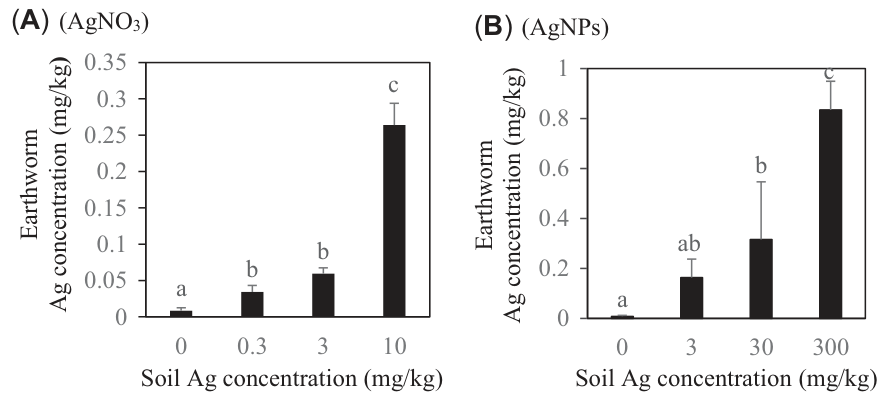
No mortality was observed during the study. Following a 4‐wk exposure, the Ag concentration in the earthworms increased in a dose‐responsive fashion as a function of exposure concentration (Figure 1), to a maximum of 0.84 mg/kg in the 300‐mg/kg AgNPs soil treatment (R2 = 0.94, y = 0.0023x + 0.1418, p = 0.0311) and 0.26 mg/kg in those exposed to the highest Ag+ concentration of 10 mg/kg soil (R2 = 0.96, y = 0.023x + 0.0211, p = 0.0186).
研究期间未观察到死亡。暴露4周后,蚯蚓体内Ag浓度随暴露浓度升高呈剂量响应性增加(图1),在300 mg/kg AgNPs土壤处理中最高达0.84 mg/kg(R2 = 0.94,y = 0.0023x + 0.1418,p = 0.0311),在暴露于最高Ag+浓度10 mg/kg土壤的蚯蚓中为0.26 mg/kg(R2 = 0.96,y = 0.023x + 0.0211,p = 0.0186)。
SODSOD
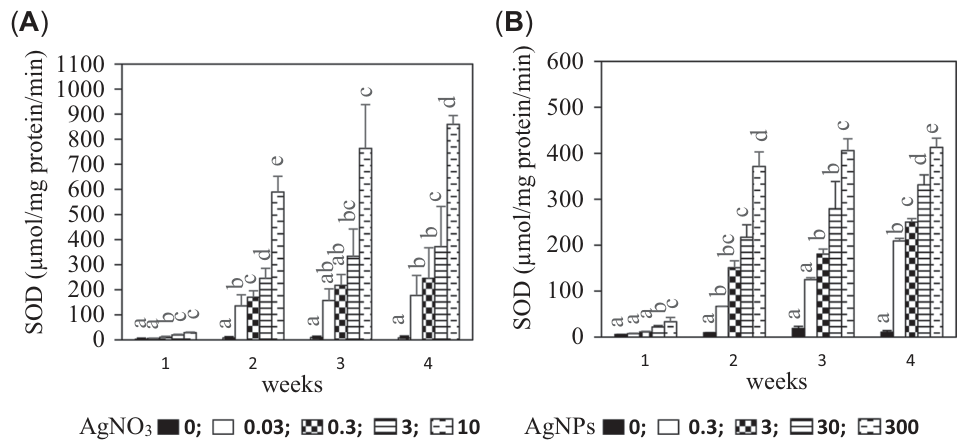
A concentration‐dependent significant increase (p < 0.05) in SOD enzyme activity in earthworms exposed to both AgNPs and AgNO3 was evident at most time points (Figure 2). The increase in SOD activity in earthworms exposed to AgNO3 (Ag+) was approximately twice that observed in the worms exposed to AgNPs.
在大多数时间点,暴露于AgNPs和AgNO3的蚯蚓体内SOD酶活性均呈浓度依赖性显著增加(p < 0.05)(图2)。暴露于AgNO3(Ag+)的蚯蚓SOD活性增幅约为暴露于AgNPs蚯蚓的2倍。
| Ag (mg/kg soil)Ag(mg/kg土壤) | Week 1第1周 | Week 2第2周 | Week 3第3周 | Week 4第4周 |
|---|---|---|---|---|
| AgNPs | ||||
| 0 | 25.9±4.97A | 51.21±7.06A | 41.84±11.94A | 52.25±10.23A |
| 0.3 | 111.37±8.91AB | 155.4±12.2A | 222.52±39.44B | 285.63±29.21B |
| 3 | 179.73±14.39B | 212.2±25.49B | 258.4±36.67BC | 407.46±28.83C |
| 30 | 238.73±.33.03C | 281.5±41.34B | 325.22±50.52C | 438.6±26.12C |
| 300 | 587.58±38.82D | 608.4±22.5B | 629.23±7.15D | 738.31±20.46D |
| Ag+ | ||||
| 0 | 46.51±11.26A | 36.61±4.06A | 34.09±11.94A | 52.25±10.23A |
| 0.03 | 119.42±25.38A | 234.88±21.78AB | 366.54±62.84AB | 485.84±128.42B |
| 0.3 | 174.32±54.6A | 303.08±28.21BC | 563.08±83.76AB | 575.88±154.88C |
| 3 | 382.24±.74.19B | 454.45±29.2CD | 600.32±77.74BC | 951±302.8C |
| 10 | 546±123.86B | 710.23±57.7CD | 808.11±7.15C | 1277±358.34D |
aMeans with different letters denote significant differences (p < 0.05) between treatments (n = 5 worms per treatment) at each time point for each Ag form separately.
a平均值标有不同字母表示在每个时间点、各Ag形态分别比较时处理间差异显著(p < 0.05)(每处理n = 5条蚯蚓)。
CATCAT
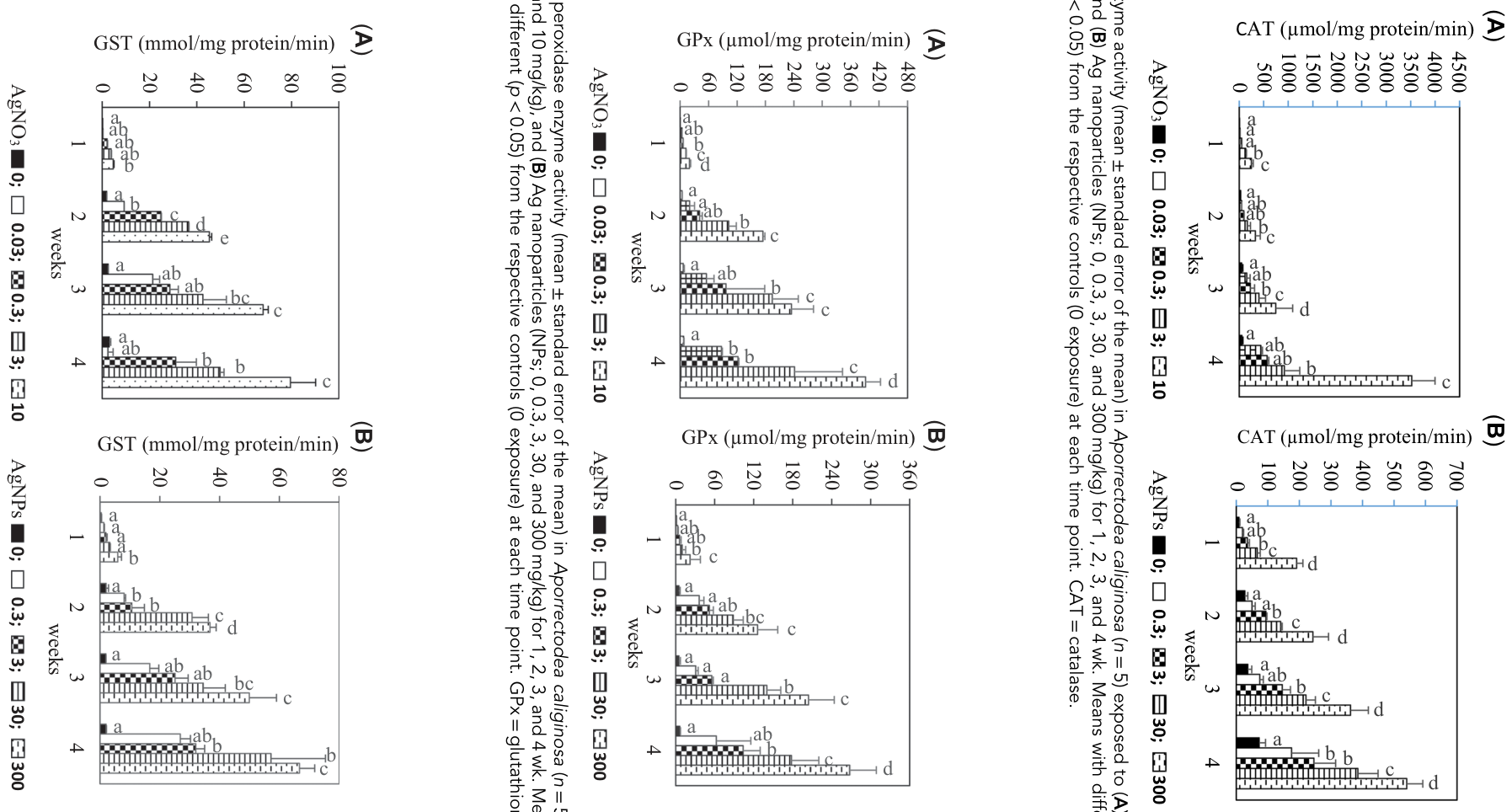
The CAT enzyme activity in A. caliginosa exposed to AgNPs or Ag+ over a 4‐wk period is shown in Figure 3. A concentration‐ dependent significant increase (p < 0.05) at most time points was observed, with the elevated CAT enzyme activities most marked in the earthworms exposed to the highest concentration of Ag+.
暴露于AgNPs或Ag+ 4周期间A. caliginosa的CAT酶活性见图3。在大多数时间点观察到浓度依赖性显著增加(p < 0.05),其中暴露于最高浓度Ag+的蚯蚓CAT酶活性升高最为显著。
GPxGPx
The GPx enzyme activity in A. caliginosa exposed to AgNPs or Ag+ over a 4‐wk period is shown in Figure 4. The GPx activity increased significantly (p < 0.05) in a concentration‐dependent manner, with the values observed on exposure to Ag+ not significantly different from those observed in earthworms exposed to AgNPs.
暴露于AgNPs或Ag+ 4周期间A. caliginosa的GPx酶活性见图4。GPx活性呈浓度依赖性显著增加(p < 0.05),且暴露于Ag+时的数值与暴露于AgNPs的蚯蚓无显著差异。
GSTGST
The GST enzyme activity was markedly elevated in earthworms exposed to both AgNPs and Ag+ compared to other enzyme activities. There was a significant (p < 0.05) concentration‐dependent GST increase in earthworms exposed to AgNPs or Ag+, and this was most marked in those exposed to Ag+ (Figure 5).
与其他酶活性相比,暴露于AgNPs和Ag+的蚯蚓GST酶活性显著升高。暴露于AgNPs或Ag+的蚯蚓GST均呈浓度依赖性显著增加(p < 0.05),其中以暴露于Ag+者最为显著(图5)。
Antioxidant enzymes (linear or nonlinear fitting curves)抗氧化酶(线性或非线性拟合曲线)
The regression (either linear or nonlinear) fitting curves derived from either linear or nonlinear fitting curves for the earthworm antioxidant enzyme responses (SOD, CAT, GPx, GST) on exposure to the different concentrations of AgNPs and Ag+ ions as analyzed by using Genstat are shown in Supplemental Data, Figures S4 to S11. From the enzyme profiles generated, in general, for each biomarker enzyme, there was an obvious increasing trend over time (the detailed estimate parameters with week in regression functions are shown in Supplemental Data, Figures S4 to S11), except some at concentration 0. This is what we expected. Based on this, we concluded that the enzyme activities at week 4 > week 3 > week 2 > week 1.
采用Genstat分析得出的蚯蚓抗氧化酶(SOD、CAT、GPx、GST)对不同浓度AgNPs和Ag+离子暴露响应的回归(线性或非线性)拟合曲线见补充数据图S4至S11。从所得酶谱来看,总体上每种生物标志物酶均随时间呈明显上升趋势(回归函数中与周相关的详细估计参数见补充数据图S4至S11),但浓度为0时的部分情况除外。这与我们的预期一致。据此我们得出结论:酶活性为第4周 > 第3周 > 第2周 > 第1周。
LPOLPO
The LPO activity as measured by MDA adduct formation is shown in Table 1. There was a concentration‐ and time‐ responsive increase in LPO following exposure to both AgNPs and Ag+. The LPO activity was higher in earthworms exposed to Ag+ > AgNPs over 4 wk but not significantly different (p > 0.05; Table 1).
以MDA加合物生成量表示的LPO活性见表1。暴露于AgNPs和Ag+后,LPO均呈浓度和时间响应性增加。4周内蚯蚓LPO活性为暴露于Ag+ > AgNPs,但差异不显著(p > 0.05;表1)。
4DISCUSSION讨论
With many industries now using AgNPs, potential exists for increased environmental and human exposure to occur with deleterious toxicological implications (Martirosyan et al. 2014). In the present study, both AgNPs and Ag+ increased antioxidant enzyme activities and increased LPO. In soil AgNPs dissociate to Ag+ with time, resulting in an increase in toxicity, but over an extended period will bind with soil ligands to reduce Ag bioavailability and toxicity (Diez‐Ortiz et al. 2015). Short‐term exposure of the earthworm Eisenia fetida to AgNPs/Ag+ induced oxidative damage, with a significant increase in the protein carbonyl, and by day 3 upregulated 9 stress response genes including CAT and heat shock protein 70 (Tsyusko et al. 2012). Eisenia fetida earthworms altered their behavior to avoid soil contaminated with AgNPs/Ag+ within 48 h when exposed to AgNPs and immediately on exposure to AgNO3 (Shoults‐Wilson et al. 2010).
随着越来越多的行业使用AgNPs,环境和人类暴露增加的可能性随之存在,并可能带来有害的毒理学影响(Martirosyan et al. 2014)。本研究中,AgNPs和Ag+均提高了抗氧化酶活性并增加了LPO。在土壤中,AgNPs会随时间解离为Ag+,导致毒性增加,但经过较长时间后会与土壤配体结合,从而降低Ag的生物有效性和毒性(Diez‐Ortiz et al. 2015)。蚯蚓Eisenia fetida短期暴露于AgNPs/Ag+可诱导氧化损伤,蛋白质羰基显著增加,且至第3天时包括CAT和热休克蛋白70在内的9个应激响应基因上调表达(Tsyusko et al. 2012)。Eisenia fetida蚯蚓在暴露于AgNPs后48 h内、暴露于AgNO3后立即改变行为,以回避受AgNPs/Ag+污染的土壤(Shoults‐Wilson et al. 2010)。
The earthworm A. caliginosa was selected for the present study because it is widespread throughout New Zealand, which makes it a good animal model to study the effects of AgNPs in this country's terrestrial environment. One of the common mechanisms of toxicity mediated by NPs is the induction of oxidative stress (Oberdörster et al. 2005). This has been demonstrated with AgNPs, which induce high levels of ROS within cells (Kawata et al. 2009). The present study has clearly shown that the antioxidant enzymes (Figures 2–5) that counteract oxidative stress and LPO (Table 1) were increased in A. caliginosa exposed to either Ag+ or AgNPs in a concentration‐dependent manner.
本研究选用蚯蚓A. caliginosa,是因为其在新西兰分布广泛,是研究AgNPs对该国陆地环境影响的良好动物模型。纳米颗粒介导毒性的常见机制之一是诱导氧化应激(Oberdörster et al. 2005)。这一点已在AgNPs中得到证实,AgNPs可在细胞内诱导高水平ROS(Kawata et al. 2009)。本研究清楚地表明,暴露于Ag+或AgNPs的A. caliginosa体内对抗氧化应激的抗氧化酶(图2–5)及LPO(表1)均呈浓度依赖性增加。
Two modes of action of AgNPs have been proposed: 1) the release of Ag+ ions on long‐term incubation in soil and induction of ROS (McShan et al. 2014), and 2) direct induction of ROS (Wijnhoven et al. 2009). Both modes of action can initiate oxidative stress, which can irreversibly damage proteins, lipids, and nucleic acids and stimulate the production of antioxidant enzymes such as SOD, CAT, and GPx (McShan et al. 2014). Both mechanisms can also lead to the harmful genotoxic effects associated with AgNP exposure (Durán et al. 2016; Wang et al. 2017). Silver NPs can also cause toxicity through surface oxidation, leading to the release of Ag+, which can interact with nucleic acids, lipid molecules, and proteins in biological systems (McShan et al. 2014). One of the most important differences between our earthworm AgNP study and those reported by others is that we used a mixture of protease inhibitors— aprotinin, leupeptin, pepstatin, and antipain—in the homogenizing buffer (Concetti et al. 1984; Laguerre et al. 2009). In a preliminary study, the protein yield of the earthworm homogenate supernatant prepared with the PSB containing protease inhibitors was approximately 35% higher than with PSB alone (Supplemental Data, Figure S11). We believe the addition of antiproteases may have prevented enzyme degradation and hence contributed to higher enzyme activities even when expressed as a fraction of the protein concentration. This is an important finding and may explain the differences in antioxidant enzyme activities and LPO between the present study and those reported by others (Pan et al. 2010; Aldarraji et al. 2013; Muthu and Durairaj 2015).
目前提出了AgNPs的两种作用方式:1)在土壤中长期孵育时释放Ag+离子并诱导ROS产生(McShan et al. 2014);2)直接诱导ROS产生(Wijnhoven et al. 2009)。两种作用方式均可引发氧化应激,对蛋白质、脂质和核酸造成不可逆损伤,并刺激SOD、CAT和GPx等抗氧化酶的产生(McShan et al. 2014)。两种机制还均可导致与AgNP暴露相关的有害遗传毒性效应(Durán et al. 2016; Wang et al. 2017)。银纳米颗粒还可通过表面氧化释放Ag+而产生毒性,后者可与生物系统中的核酸、脂质分子和蛋白质相互作用(McShan et al. 2014)。本研究与其他已报道的蚯蚓AgNP研究最重要的区别之一在于,我们在匀浆缓冲液中使用了蛋白酶抑制剂混合物——抑肽酶、亮抑酶肽、胃酶抑素和抗蛋白酶肽(Concetti et al. 1984; Laguerre et al. 2009)。在预试验中,用含蛋白酶抑制剂的PSB制备的蚯蚓匀浆上清液蛋白质得率比单用PSB约高35%(补充数据图S11)。我们认为,添加抗蛋白酶可能防止了酶的降解,因此即使以蛋白质浓度为基准表示时,酶活性也较高。这是一项重要发现,可能解释了本研究与其他研究所报道的抗氧化酶活性和LPO之间的差异(Pan et al. 2010; Aldarraji et al. 2013; Muthu and Durairaj 2015)。
The biomarkers of oxidative stress used in the present study comprised the antioxidant enzymes SOD, CAT, GPx, and GST as well as LPO, all of which were in general significantly increased in a concentration‐dependent manner on exposure to both Ag+ and AgNPs; and there was a trend for values in week 4 > week 3 > week 2 > week 1 in general but not always (Figures 2–5). Superoxide dismutase enzymes play a significant role in protecting cells from oxidative stress by catalyzing the dismutation of O2− anions to H2O2 and O2, and CAT converts H2O2 to water (Roubalová et al. 2015). The higher antioxidant enzyme activities in earthworms exposed to Ag+ even at concentrations 10 times lower than those of AgNPs are probably due to the high solubility and ready absorption of Ag+ by A. caliginosa (Zhan 2012), which is similar to what is observed in rats (Qin et al. 2017). Shoults‐Wilson et al. (2011), in their study on the effect of AgNP surface coating on bioaccumulation and reproductive toxicity in earthworms, reported that surface coating with polyvinylpyrrolidone (PVP) and oleic acid prevented excessive oxidation (<15%) and dissolution of NPs. Based on a study of a 28‐d exposure of earthworms to both PVP‐ and oleic acid–coated AgNPs in artificial soil, Shoults‐ Wilson et al. (2011) suggested that the marked toxicity of AgNPs was primarily due to the release of Ag+. Also, AgNPs can react with ligands present in soil, to form sulfides, thus reducing toxicity (Levard et al. 2012; Doolette et al. 2015).
本研究所用的氧化应激生物标志物包括抗氧化酶SOD、CAT、GPx和GST以及LPO,在暴露于Ag+和AgNPs时总体上均呈浓度依赖性显著增加;且数值总体上(但并非总是)呈第4周 > 第3周 > 第2周 > 第1周的趋势(图2–5)。超氧化物歧化酶通过催化O2−阴离子歧化为H2O2和O2,在保护细胞免受氧化应激方面发挥重要作用,而CAT将H2O2转化为水(Roubalová et al. 2015)。暴露于Ag+的蚯蚓即使在浓度比AgNPs低10倍时抗氧化酶活性仍较高,这可能是由于Ag+溶解度高且易被A. caliginosa吸收(Zhan 2012),这与在大鼠中观察到的情况相似(Qin et al. 2017)。Shoults‐Wilson et al. (2011)在研究AgNP表面包覆对蚯蚓生物累积和生殖毒性的影响时报道,聚乙烯吡咯烷酮(PVP)和油酸表面包覆可防止纳米颗粒过度氧化(<15%)和溶解。基于蚯蚓在人工土壤中暴露于PVP和油酸包覆AgNPs 28 d的研究,Shoults‐ Wilson et al. (2011)认为AgNPs的显著毒性主要源于Ag+的释放。此外,AgNPs可与土壤中存在的配体反应形成硫化物,从而降低毒性(Levard et al. 2012; Doolette et al. 2015)。
On a molar basis, Ag+ ions are some 5.6 × 10¹⁴ times more concentrated than an equal mass of AgNPs (Supplemental Data, Table S3). Given this large difference in molarity, it is likely that the toxicity of AgNPs is due in part to conversion of the AgNPs into Ag+ ions because such a dissociation can occur in the long term. Thus, the Ag+ released from AgNPs can lead to LPO in earthworms, either A. caliginosa or E. fetida (Li et al. 2014). Exposure of the soil invertebrate Enchytraeus crypticus to AgNPs showed that the oxidative stress mechanism caused by AgNPs may be somewhat different from that of Ag+, with AgNPs taking a longer time than Ag+ to produce toxic effects (Ribeiro et al. 2015).
按摩尔计,Ag+离子的浓度约为等质量AgNPs的5.6 × 10¹⁴倍(补充数据表S3)。鉴于摩尔浓度的巨大差异,AgNPs的毒性可能部分源于AgNPs向Ag+离子的转化,因为这种解离可在长期内发生。因此,AgNPs释放的Ag+可导致蚯蚓(无论是A. caliginosa还是E. fetida)发生LPO(Li et al. 2014)。土壤无脊椎动物Enchytraeus crypticus暴露于AgNPs的研究表明,AgNPs引起的氧化应激机制可能与Ag+有所不同,AgNPs产生毒性效应所需的时间比Ag+更长(Ribeiro et al. 2015)。
Among the antioxidant enzymes, CAT appears to be the most induced (Ribeiro et al. 2015). This agrees with our present study, which found a >2‐fold increase in CAT activity by Ag+. Gomes et al. (2015) showed that exposure of E. fetida to Ag+ mixed in Organisation of Economic Co‐operation and Development soil spiked with 25 to 200 mg/kg for 28 d resulted in increases in GPx, SOD, and GR by 300, 100, and 200%, respectively, but reduced the activities of CAT and GST. These findings in earthworms exposed to very high concentrations are somewhat dissimilar to our much lower dose 4‐wk study, where we observed a continued increase of all antioxidant enzymes up to 4 wk. Gomes et al. (2015) used E. fetida (whereas we used A. caliginosa earthworms) and high doses of Ag+ up to 200 mg/kg and uncapped AgNPs up to 1500 mg/kg, which could be considered unrealistic environmental concentrations. Such high concentrations can lead to marked irreversible enzymatic and metabolic changes. Mendes et al. (2015), in a similar study but with Folsomia candida (a member of the order Collembola, a common and widespread arthropod that occurs in soils throughout the world), found that the increases in metallothionein and GST > CAT, GR, GSH, and LPO were more marked in those exposed to Ag+ than in those exposed to AgNPs.
在各抗氧化酶中,CAT似乎受诱导最为明显(Ribeiro et al. 2015)。这与本研究结果一致,本研究发现Ag+使CAT活性增加>2倍。Gomes et al. (2015)表明,E. fetida暴露于添加25至200 mg/kg Ag+的经济合作与发展组织标准土壤28 d后,GPx、SOD和GR分别增加300%、100%和200%,但CAT和GST活性降低。这些在极高浓度暴露下的蚯蚓研究结果与本研究低得多剂量的4周研究结果有所不同,本研究观察到所有抗氧化酶在4周内持续增加。Gomes et al. (2015)使用的是E. fetida(而本研究使用A. caliginosa蚯蚓),且Ag+剂量高达200 mg/kg、无包覆AgNPs高达1500 mg/kg,可被视为不符合环境实际的浓度。如此高的浓度可导致显著且不可逆的酶学和代谢变化。Mendes et al. (2015)在一项类似研究中以Folsomia candida(弹尾目成员,一种在全球土壤中普遍广泛存在的节肢动物)为对象,发现暴露于Ag+者金属硫蛋白和GST的增加 > CAT、GR、GSH和LPO,且上述增加比暴露于AgNPs者更为显著。
A comparison of the antioxidant enzyme profiles in earthworms exposed to the same concentrations (0.3 and 3 mg/kg soil) of Ag+ and AgNPs showed that the activities of antioxidant enzymes were markedly higher in earthworms exposed to Ag+. There are several reasons Ag+ may be more toxic than AgNPs: 1) the solubility of Ag+ is much higher than that of AgNPs because Ag+ (from AgNO3) is a salt, although AgNPs are considered to be a base that forms a colloidal solution in water; 2) on a molar basis, Ag+ ions are some 5.6 × 10¹⁴ times more concentrated than an equal mass of AgNPs; 3) Ag from AgNPs accumulates in the cell membranes, whereas Ag+ is localized in the cytosolic fraction (Li et al. 2014); and 4) the elimination rate of Ag when exposed to AgNPs is greater than that of Ag+ (Ribeiro et al. 2015). Schlich et al. (2013) observed higher accumulation of Ag in the AgNP (sized 15 nm) group than in Eisenia andrei earthworms exposed to Ag+. However, the induction of antioxidant enzymes and LPO was 2.5‐ to 3‐fold higher in earthworms exposed to 0.3 and 3 mg/kg of Ag+ concentration compared to AgNPs (Table 1). When E. fetida earthworms were exposed to AgNPs of 2 particle sizes at doses up to 500 mg/kg for 14 d, the smaller 10‐nm particles were more toxic than the 80‐nm ones (Li et al. 2012). Thus, it appears that AgNP size influences uptake and degree of toxicity. In addition to a greater accumulation rate of Ag+ (Qin et al. 2017), certain toxicokinetic parameters, such as total body clearance, mean residence, half‐life, bioaccumulation factor, and elimination rate constant (Ramsey et al. 2009; Waalewijn‐Kool et al. 2014; Bednarska et al. 2016; Swi´ atek˛ et al. 2017), may have also contributed to the greater toxicity of Ag+ than AgNPs to A. caliginosa, which is in agreement with Qin et al. (2017).
对暴露于相同浓度(0.3和3 mg/kg土壤)Ag+和AgNPs的蚯蚓抗氧化酶谱进行比较表明,暴露于Ag+的蚯蚓抗氧化酶活性明显更高。Ag+毒性可能高于AgNPs的原因有以下几点:1)Ag+的溶解度远高于AgNPs,因为Ag+(来自AgNO3)为盐类,而AgNPs被视为在水中形成胶体溶液的碱;2)按摩尔计,Ag+离子的浓度约为等质量AgNPs的5.6 × 1014倍;3)来自AgNPs的Ag累积于细胞膜中,而Ag+定位于胞质组分中(Li et al. 2014);4)暴露于AgNPs时Ag的排出速率大于Ag+(Ribeiro et al. 2015)。Schlich et al. (2013)观察到,AgNP(粒径15 nm)组Eisenia andrei蚯蚓体内Ag累积高于暴露于Ag+的蚯蚓。然而,与AgNPs相比,暴露于0.3和3 mg/kg Ag+的蚯蚓抗氧化酶和LPO的诱导水平高2.5至3倍(表1)。E. fetida蚯蚓暴露于2种粒径、剂量高达500 mg/kg的AgNPs 14 d时,较小的10 nm颗粒毒性高于80 nm颗粒(Li et al. 2012)。因此,AgNP粒径似乎影响其吸收和毒性程度。除Ag+累积速率更高外(Qin et al. 2017),某些毒代动力学参数,如全身清除率、平均滞留时间、半衰期、生物累积因子和消除速率常数(Ramsey et al. 2009; Waalewijn‐Kool et al. 2014; Bednarska et al. 2016; Swi´ atek˛ et al. 2017),也可能导致Ag+对A. caliginosa的毒性高于AgNPs,这与Qin et al. (2017)的结果一致。
According to Zhan (2012), the LC50 of Ag+ to A. caliginosa is 418 mg/kg, which is higher than the LC50 of 305 mg/kg measured in AgNO3 (Ag+) by us (Supplemental Data, Figure S1). In the present study, AgNPs (LC50 2649 mg/kg; Supplemental Data, Figure S1) were acutely less toxic than Ag+, and earthworms exposed to AgNPs took a longer time than with Ag+ to show toxic effects, which is in agreement with Ribeiro et al. (2015). Choi and Park (2015) observed no mortality in E. fetida exposed to up to 100 mg/kg of AgNPs (citrate‐coated, particle size 11 nm) mixed with artificial soil and concluded that it was not acutely toxic. In contrast, Brami et al. (2017) observed that exposure of Allolobophora chlorotica earthworms to Ag+ or AgNPs mixed in Kettering loam soil (composed of 24% clay, 18% silt, 58% sand, 6.7% organic matter, pH 6.8) at 100 mg/kg soil caused 12.5% mortality with AgNPs (uncoated, spherical, 80 nm particle size) compared to 66.7% with Ag+. The highest concentrations of Ag+ and AgNPs used in the present study were 10 and 300 mg/kg, respectively, mixed in Templeton Silt Loam soil in a 4‐wk exposure period. No deaths occurred. This shows different degrees of toxicity to different earthworm species exposed to Ag in different soil types. Shoults‐Wilson et al. (2010) mixed artificial soil with 10, 100, and 1000 mg/kg AgNPs and with 10 or 100 mg/kg Ag+ and observed that earthworms exposed to Ag+ accumulated higher Ag concentrations than those exposed to AgNPs, which is in agreement with our results. This is also in agreement with our pharmacokinetic studies of a higher bioaccumulation in A. caliginosa with Ag+ when exposed to either AgNPs or Ag+ at a concentration of 20 mg/kg (N. Saleeb, Lincoln University, Lincoln, Canterbury, New Zealand, unpublished observation).
据Zhan (2012)报道,Ag+对A. caliginosa的LC50为418 mg/kg,高于本研究测得的AgNO3(Ag+)LC50 305 mg/kg(补充数据图S1)。本研究中,AgNPs(LC50 2649 mg/kg;补充数据图S1)的急性毒性低于Ag+,且暴露于AgNPs的蚯蚓出现毒性效应所需时间比Ag+更长,这与Ribeiro et al. (2015)的结果一致。Choi and Park (2015)观察到,E. fetida暴露于与人工土壤混合、浓度高达100 mg/kg的AgNPs(柠檬酸包覆,粒径11 nm)后无死亡,并得出其无急性毒性的结论。与此相反,Brami et al. (2017)观察到,Allolobophora chlorotica蚯蚓暴露于与Kettering壤土(含24%黏粒、18%粉粒、58%砂粒、6.7%有机质,pH 6.8)混合的100 mg/kg土壤Ag+或AgNPs后,AgNPs(无包覆,球形,粒径80 nm)处理死亡率为12.5%,而Ag+处理为66.7%。本研究中Ag+和AgNPs的最高浓度分别为10和300 mg/kg,与Templeton粉砂壤土混合,暴露期为4周,未出现死亡。这表明不同蚯蚓物种在不同土壤类型中暴露于Ag时毒性程度不同。Shoults‐Wilson et al. (2010)将人工土壤与10、100和1000 mg/kg AgNPs以及10或100 mg/kg Ag+混合,观察到暴露于Ag+的蚯蚓累积的Ag浓度高于暴露于AgNPs者,这与本研究结果一致。这也与我们的药代动力学研究结果一致,即A. caliginosa在20 mg/kg浓度下分别暴露于AgNPs或Ag+时,Ag+的生物累积更高(N. Saleeb, Lincoln University, Lincoln, Canterbury, New Zealand,未发表观察结果)。
Pollution by heavy metals of anthropogenic origin has long been recognized as a serious threat to terrestrial ecosystems. And heavy metals, including Ag, accumulate in earthworms by soil ingestion, via ion exchange of dissolved heavy metals across the lipophilic outer membrane and/or adsorption on membrane surfaces. For example, divalent metals such as cadmium (Cd2+), copper (Cu2+), chromium (Cr2+), lead (P2+), and zinc (Zn2+) accumulated in tissues of the earthworm Eudrilus euginiae exposed to 0.1 and 1.5 g of waste (vermicomposting municipal solid waste; Kumar et al. 2008). These divalent heavy metals may also be present in brownfields and public parks (Jennings et al. 2002). When the earthworm Lampito mauritii was exposed to different concentrations of Pb and Zn separately for 28 d (Maity et al. 2008), the activities of GST, GPx, GSH, and GR were linearly increased after exposure to Pb; but on exposure to Zn, only GPx and GR activities were increased, and that occurred only after 14 d and at >300 mg/kg soil. It appears that different metals accumulate in earthworms at different rates, and such differences may be attributable to differences in earthworm species and potentially the exposure concentration and length.
人为来源的重金属污染早已被公认为陆地生态系统的严重威胁。包括Ag在内的重金属通过土壤摄食、溶解态重金属穿过亲脂性外膜的离子交换和/或在膜表面的吸附在蚯蚓体内累积。例如,暴露于0.1和1.5 g废物(蚯蚓堆肥处理的城市固体废物)的蚯蚓Eudrilus euginiae组织中累积了镉(Cd2+)、铜(Cu2+)、铬(Cr2+)、铅(P2+)和锌(Zn2+)等二价金属(Kumar et al. 2008)。这些二价重金属也可能存在于棕地和公园中(Jennings et al. 2002)。蚯蚓Lampito mauritii分别暴露于不同浓度的Pb和Zn 28 d时(Maity et al. 2008),暴露于Pb后GST、GPx、GSH和GR活性呈线性增加;而暴露于Zn时,仅GPx和GR活性增加,且仅在14 d后及土壤浓度>300 mg/kg时才出现。不同金属在蚯蚓体内的累积速率似乎不同,这种差异可能归因于蚯蚓物种的差异,也可能与暴露浓度和暴露时长有关。
5CONCLUSION结论
Exposure to AgNPs or Ag+ resulted in an accumulation of Ag in A. caliginosa earthworms. Dose‐dependent significant increases in antioxidant enzyme activities (CAT, GPx, SOD, and GST) and increased LPO were observed in earthworms exposed to Ag+ > AgNPs. The increases in antioxidant enzyme activity tended to be time‐dependent, and this trend was more marked in LPO activity. In general, Ag+ was 2.5‐ to 4‐fold more toxic than AgNPs to A. caliginosa.
暴露于AgNPs或Ag+均导致Ag在A. caliginosa蚯蚓体内累积。在暴露于Ag+ > AgNPs的蚯蚓中观察到抗氧化酶活性(CAT、GPx、SOD和GST)呈剂量依赖性显著增加以及LPO升高。抗氧化酶活性的增加趋于时间依赖性,这一趋势在LPO活性中更为明显。总体而言,Ag+对A. caliginosa的毒性为AgNPs的2.5至4倍。
Supplemental Data—The Supplemental Data are available on the Wiley Online Library at https://doi.org/10.1002/etc.4713.
补充数据——补充数据可在Wiley Online Library获取:https://doi.org/10.1002/etc.4713。
Acknowledgment—The present study was supported by Lincoln University and Landcare Research, Lincoln, New Zealand. We thank C. Bunt for carrying out the zeta‐potential measurement. The technical assistance of M. Wellby is gratefully acknowledged. The present study was partly funded by the Centre for Integrated Biowaste Research.
致谢——本研究得到新西兰Lincoln University和Landcare Research(Lincoln)的支持。感谢C. Bunt进行zeta电位测定。衷心感谢M. Wellby提供的技术协助。本研究部分由Centre for Integrated Biowaste Research资助。
Data Availability Statement—Data are available on request to the corresponding author (Ravi.Gooneratne@lincoln.ac.nz).
6REFERENCES参考文献
Aldarraji QM, Halimmon N, Majid NM. 2013. Antioxidant activity and total phenolic content of earthworm paste Lumbricus rubellus (red worm) and Edurilus eugenia (African night crawler). J Entomol Nematol 5:33–37.
Bate A. 2015. Speciation of and the effects of silver nanoparticles on the earthworm Aporrectodea caliginosa. Master's thesis. Lincoln University, Lincoln, Canterbury, New Zealand.
Bednarska AJ, Laskowski R, Pyza E, Semik D, Swi´ atek˛ Z, Wo´znicka O. 2016. Metal toxicokinetics and metal‐driven damage to the gut of the ground beetle Pterostichus oblongopunctatus. Environ Sci Pollut Res 23:22047–22058.
Blouin M, Hodson ME, Delgado EA, Baker G, Brussaard L, Butt KR, Dai J, Dendooven L, Peres G, Tondoh JE, Cluzeau D, Brun JJ. 2013. A review of earthworm impact on soil function and ecosystem services. Eur J Soil Sci 64:161–182.
Bradford MM. 1976. A rapid and sensitive method for quantitation of microgram quantities of protein utilizing the principle of protein‐dye binding. Anal Biochem 72:248–254.
Brami C, Glover AR, Butt KR, Lowe CN. 2017. Effects of silver nanoparticles on survival, biomass change and avoidance behaviour of the endogeic earthworm Allolobophora chlorotica. Ecotoxicol Environ Saf 141(Suppl. C): 64–69.
Cataldo J, Hidalgo ME, Neaman A, Gaete H. 2011. Use of molecular biomarkers in Eisenia foetida to assess copper toxicity in agricultural soils affected by mining activities. J Soil Sci Plant Nutr 11:57–70.
Choi JS, Park JW. 2015. Molecular characterization and toxicological effects of citrate‐coated silver nanoparticles in a terrestrial invertebrate, the earthworm (Eisenia fetida). Mol Cell Toxicol 11:423–431.
Concetti A, Fioretti E, Barra D, Ascoli F. 1984. Protease inhibitors from the parasitic worm Parascaris equorum. Eur J Biochem 145:417–421.
Connon RE, Geist J, Werner I. 2012. Effect‐based tools for monitoring and predicting the ecotoxicological effects of chemicals in the aquatic environment. Sensors (Basel) 12:12741–12771.
Diez‐Ortiz M, Lahive E, George S, Ter Schure A, Van Gestel CAM, Jurkschat K, Svendsen C, Spurgeon DJ. 2015. Short‐term soil bioassays may not reveal the full toxicity potential for nanomaterials; bioavailability and toxicity of silver ions (AgNO3) and silver nanoparticles to earthworm Eisenia fetida in long‐term aged soils. Environ Pollut 203:191–198.
Dobias J, Bernier‐Latmani R. 2013. Silver release from silver nanoparticles in natural waters. Environ Sci Technol 47:4140–4146.
Doolette CL, Mcaughlin MJ, Kirby JK, Navarro DA. 2015. Bioavailability of silver and silver sulfide nanoparticles to lettuce (Lactuca sativa): Effect of agricultural amendments on plant uptake. J Hazard Mater 300:788–795.
Durán N, Durán M, de Jesus MB, Seabra AB, Fávaro WJ, Nakazato G. 2016. Silver nanoparticles: A new view on mechanistic aspects on antimicrobial activity. Nanomedicine 12:789–799.
Gobe G, Crane D. 2010. Mitochondria, reactive oxygen species and cadmium toxicity in the kidney. Toxicol Lett 15:49–55.
Gomes SI, Hansen D, Scott‐Fordsmand JJ, Amorim MJ. 2015. Effects of silver nanoparticles to soil invertebrates: Oxidative stress biomarkers in Eisenia fetida. Environ Pollut 199C:49–55.
Gooneratne R, Buser A, Lindsay P, Wellby M. 2011. Ecotoxicological assessment of acid mine drainage: Electrophysiological changes in earthworm (Aporrectodea caliginosa) and aquatic oligochaete (Lumbriculus variegatus). J Environ Monit 13:1360–1365.
Gordon O, Slenters TV, Brunetto PS, Villaruz AE, Sturdevant DE, Otto M, Landmann R, Fromm KM. 2010. Silver coordination polymers for
prevention of implant infection: Thiol interaction, impact on respiratory chain enzymes, and hydroxyl radical induction. Antimicrob Agents Chemother 54:4208–4218.
Grewal KS, Buchan GD, Tonkin PJ. 1990. Estimation of field capacity and wilting point of some New Zealand soils from their saturation percentages. N Z J Crop Hortic Sci 18:241–246.
Huggett RJ, Klmerle RA, Mehrle PM Jr, Bergman HL, eds. 2017. Biomarkers: Biochemical, Physiological and Histological Markers of Anthropogenic Stress. CRC, Boca Raton, FL, USA.
Jennings AA, Cox AN, Hise SJ, Petersen EJ. 2002. Heavy metal contamination in the Brownfield soils of Cleveland. Soil Sediment Contam 11:719–750.
Judy JD, Unrine JM, Bertsch PM. 2011. Evidence for biomagnification of gold nanoparticles within a terrestrial food chain. Environ Sci Technol 45:776–781.
Kawata K, Osawa M, Okabe S. 2009. In vitro toxicity of silver nanoparticles at non‐cytotoxic doses to HepG2 human hepatoma cells. Environ Sci Technol 43:6046–6051.
Kühnel D, Nickei C. 2014. The OECD meeting on ecotoxicology and environmental fate—Towards the development of improved OECD guidelines for the testing of nanomaterials. Sci Total Environ 472:347–353.
Kumar S, Sharma V, Bhoyar RV, Bhattacharyya JK, Chakrabarti T. 2008. Effect of heavy metals on earthworm activities during vermicomposting of municipal solid waste. Water Environ Res 80:154–161.
Laguerre C, Sanchez‐Hernandez JC, Köhler HR, Triebskorn R, Capowiez Y, Rault M, Mazzia C. 2009. B‐type esterases in the snail Xeropicta derbentina: An enzymological analysis to evaluate their use as biomarkers of pesticide exposure. Environ Pollut 157:199–207.
Lea MC. 1889. On allotropic forms of silver. Am J Sci 37:476–491.
Lee WM, Kwak JI, An YJ. 2012. Effect of silver nanoparticles in crop plants Phaseolus radiatus and Sorghum bicolor: Media effect on phytotoxicity. Chemosphere 86:491–499.
Lemtiri A, Colinet G, Alabi T, Cluzeau D, Zirbes L, Haubruge É, Francis F. 2014. Impacts of earthworms on soil components and dynamics. A review. Biotechnol Agron Soc Environ 18:121–133.
Levard C, Hotz EM, Lowry GV, Brown GE Jr. 2012. Environmental transformations of silver nanoparticles: Impact on stability and toxicity. Environ Sci Technol 46:6900–6914.
Li CHM, Wang W, Cui Y, Chen J, Yang L. 2012. Ecotoxicity of silver nanoparticles on earthworm Eisenia fetida: Responses of the antioxidant system, acid phosphatase and ATPase. Toxicol Environ Chem 94: 732–741.
Li L, Wu H, Peijnenburg WJGM, van Gestel CAM. 2014. Both released silver ions and particulate Ag contribute to the toxicity of AgNPs to earthworm Eisenia fetida. Nanotoxicology 9:792–801.
Maity S, Roy S, Chaudhury S, Battacharya S. 2008. Antioxidant responses of the earthworm Lampito mauritii exposed to Pb and Zn contaminated soil. Environ Pollut 151:1–7.
Makama S, Piella J, Undas A, Dimmers W, Peters R, Puntes VF, van den Brink NW. 2016. Properties of silver nanoparticles influencing their uptake in and toxicity of the earthworm Lumbricus rubellus following exposure in soil. Environ Pollut 218:870–878.
Martirosyan A, Bazes A, Schneider YJ. 2014. In vitro toxicity assessment of silver nanoparticles in the presence of phenolic compounds—Preventive agents against the harmful effect? Nanotoxicology 8:573–582.
McShan D, Ray PC, Yu H. 2014. Molecular toxicity mechanism of nanosilver. J Food Drug Anal 22:116–127.
Meier C, Voegelin A, Pradas del Real A, Sarret G, Mueller CR, Kaegi R. 2016. Transformation of silver nanoparticles in sewage sludge during incineration. Environ Sci Technol 50:3503–3510.
Mendes LA, Maria VL, Scott‐Fordsmand JJ, Amorim MJB. 2015. Ag nanoparticles (Ag NM300K) in the terrestrial environment: Effects at population and cellular level in Folsomia candida (Collembola). Int J Environ Res Public Health 12:12530–12542.
Muthu S, Durairaj B. 2015. Evaluation of antioxidant and free radical scavenging activity of Annona muricate. Eur J Exp Biol 5:39–45.
Nguyen KC, Seligu VL, Massarsky A, Moon TW, Rippstein P, Tan J, Tayabali AF. 2013. Comparison of toxicity of uncoated and coated silver nanoparticles. J Phys Conf Ser 429:012025.
Oberdörster G, Oberdörster E, Oberdörster J. 2005. Nanotoxicology: An emerging discipline evolving from studies of ultrafine particles. Environ Health Perspect 113:823–839.
Organisation of Economic Co‐operation and Development. 1984. Test No. 207: Earthworm: Acute toxicity tests. OECD Guidelines for the Testing of Chemicals. Paris, France.
Pan R, Zhang ZJ, He RQ. 2010. Earthworm protease. Appl Environ Soil Sci 2010:294258.
Qin G, Tang S, Li S, Lu H, Wang Y, Zhao P, Li B, Zhang J, Peng L. 2017. Toxicological evaluation of silver nanoparticles and silver nitrate in rats following 28 days of repeated oral exposure. Environ Toxicol 32:609–618.
Ramsey H, Levine H, Kennedy J. 2009. Development of a dynamic pharmacokinetic model to estimate bioconcentration of xenobiotics in earthworms. Environ Model Assess 14:411–418.
Ribeiro MJ, Maria VL, Scott‐Fordsmann JJ, Amorim MJB. 2015. Oxidative stress mechanisms caused by Ag nanoparticles (NM300K) are different from those of AgNO3: Effects in the soil invertebrate Enchytraeus crypticus. Int J Environ Res Public Health 12:9589–9602.
Roubalová R, Procházková P, Dvorákˇ J, Škanta F, Bilej F. 2015. The role of earthworm defense mechanisms in ecotoxicity studies. Invertebrate Surviv J 12:203–213.
Samet JM, Wages PA. 2018. Oxidative stress from environmental exposures. Curr Opin Toxicol 7:60–66.
Schlich K, Klawonn T, Terytze K, Hund‐Rinke K. 2013. Effects of silver nanoparticles and silver nitrate in the earthworm reproduction test. Environ Toxicol Chem 32:181–188.
Shoults‐Wilson A, Reinsch BC, Tsyusko OV, Bertsch PM, Lowry G, Unrine JM. 2010. Role of particle size and soil type in toxicity of silver nanoparticles to earthworms. Soil Sci Soc Am J 75:365–377.
Shoults‐Wilson W, Zhurbich OI, McNear DH, Tsyusko OV, Bertsch PM, Unrine JM. 2011. Evidence for avoidance of Ag nanoparticles by earthworms (Eisenia fetida). Ecotoxicology 20:385–396.
Sies H. 1997. Oxidative stress: Oxidants and antioxidants. Exp Physiol 82:291–295.
Stensberg MC, Wei Q, McLamore ES, Porterfield DM, Wei A, Sepúlveda MS. 2011. Toxicological studies on silver nanoparticles: Challenges and opportunities in assessment, monitoring and imaging. Nanomedicine 6:879–898.
´Swiatek˛ ZM, Van Gestel CAM, Bednarska AJ. 2017. Toxicokinetics of zinc‐ oxide nanoparticles and zinc ions in the earthworm Eisenia andrei. Ecotoxicol Environ Saf 143:151–158.
Terevinto ARA, Ramos A, Castroman G, Cabrera MC, Saadoun A. 2010. Oxidative status, in vitro iron‐induced lipid oxidation and superoxide dismutase, catalase and glutathione peroxidase activities in rhea meat. Meat Sci 84:706–710.
Tripathi DK, Tripathi A, Schweta, Singh S, Vishwakarma K, Yadav G, Sharma S, Singh VK, Mishra RK, Upadhyay RG, Dubey NK, Lee Y, Chauhan DK. 2017. Uptake, accumulation, and toxicity of silver nanoparticles in autotrophic plants, and heterotrophic microbes: A concentric review. Front Microbiol 8:7.
Tsyusko OV, Hardas SS, Shoults‐Wilson WA, Starnes CP, Joice G, Butterfield DA, Unrine JM. 2012. Short‐term molecular‐level effects of silver nanoparticle exposure on the earthworm, Eisenia fetida. Environ Pollut 171:249–255.
Waalewijn‐Kool PL, Klein K, Forniés RM, van Gestel CAM. 2014. Bioaccumulation and toxicity of silver nanoparticles and silver nitrate to the soil arthropod Folsomia candida. Ecotoxicology 23:1629–1637.
Wang J, Che B, Zhang LW, Dong G, Luo Q, Xin L. 2017. Comparative genotoxicity of silver nanoparticles in human liver HepG2 and lung epithelial A549 cells. J Appl Toxicol 37:495–501.
Wible DJ, Bratten SB. 2018. Reciprocity in ROS and autophagic signaling. Curr Opin Toxicol 7:28–36.
Wijnhoven SWP, Peijnenburg WJGM, Herberts CA, Hagens WI, Oomen AG, Heugens EHW, Roszek B, Bisschops J, Gosens I, Van De Meent D, Dekkers D, De Jong WH, van Zijverden M, Sips AJAM, Geertsma R. 2009. Nano‐silver—A review of available data and knowledge gaps in human and environmental risk assessment. Nanotoxicology 3:109–138.
Xiong J, Xue Q, Wu X. 2013. Synthesis of stable dispersions of water‐soluble and SERS‐active silver nanoparticles using PAM. Nano 8:1350046.
Zhan Y. 2012. Effect of silver nanoparticles on bacteria and earthworms. Master's thesis. Lincoln University, Lincoln, Canterbury, New Zealand.
Zhang Q, Zhu L, Wang J, Xie H, Wang J, Han Y, Yang J. 2013. Oxidative stress and lipid peroxidation in the earthworm Eisenia fetida induced by low doses of fomesafen. Environ Sci Pollut Res 20:201–208.