Contents lists available at ScienceDirect journal homepage: www.elsevier.com/locate/scitotenv
Zicheng Yi a, Niklas J. Lehto a,⁎, Brett H. Robinson b, Jo-Anne E. Cavanagh c
a Faculty of Agricultural and Life Sciences, Lincoln University, PO Box 7647, Lincoln 7647, New Zealand b School of Physical and Chemical Sciences, University of Canterbury, Private Bag 4800, Christchurch 8140, New Zealand c Manaaki Whenua – Landcare Research, Gerald Street, PO Box 69040, Lincoln 7640, New Zealand
a Faculty of Agricultural and Life Sciences, Lincoln University, PO Box 7647, Lincoln 7647, New Zealand b School of Physical and Chemical Sciences, University of Canterbury, Private Bag 4800, Christchurch 8140, New Zealand c Manaaki Whenua – Landcare Research, Gerald Street, PO Box 69040, Lincoln 7640, New Zealand
H I G H L I G H T S
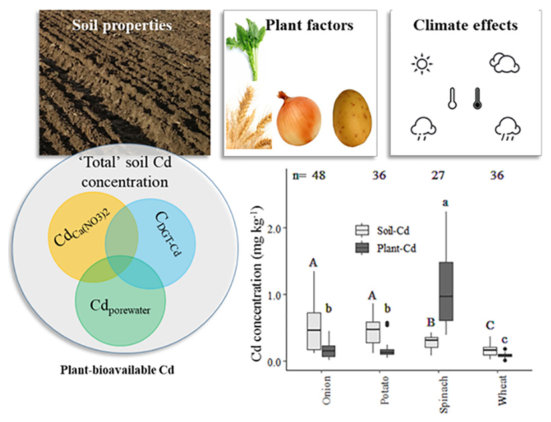
G R A P H I C A L A B S T R A C T
- Cadmium accumulation in soils increases risk of toxic concentrations in plants.土壤中镉的累积增加了植物中镉达到毒性浓度的风险。
- Soil Cd bioavailability was tested and compared to concentrations in crop plants.测定了土壤镉的生物有效性,并与作物体内的镉浓度进行了比较。
- 0.05 M Ca(NO3)2, DGT and porewater tests were better predictors than total Cd.0.05 M Ca(NO3)2提取、DGT及孔隙水测定比总镉更能预测作物镉浓度。
- Soil and environmental factors were important for determining Cd accumulation.土壤与环境因子是决定镉累积的重要因素。
- Understanding regional differences in Cd uptake is important for managing risk from soil Cd.了解镉吸收的区域差异对于管理土壤镉风险具有重要意义。
a r t i c l e i n f o
a b s t r a c t
Article history: Received 8 September 2019 Received in revised form 13 January 2020 Accepted 13 January 2020 Available online 15 January 2020
Editor: Charlotte Poschenrieder
Keywords: Diffusive gradients in thin-films Ca(NO3)2 extraction Porewater Bioavailability
关键词:薄膜扩散梯度技术 Ca(NO3)2提取 孔隙水 生物有效性
The relative ease with which cadmium (Cd) in agricultural soils can transfer to crop plants can pose a potential health risk to consumers. However, efforts to predict and mitigate these risks are often confounded by the various factors that influence metal accumulation in the edible plant parts. The aim of this work was to identify key drivers that determine Cd concentrations in spinach leaves, potato tubers, onion bulbs and wheat grain grown in commercial horticultural operations across New Zealand (NZ). Paired soil and plant samples (n = 147) were collected from farms across different NZ growing regions. Cadmium concentrations in the edible parts were measured and four different tests were used to examine the potential bioavailability of soil Cd: pseudo-total and porewater concentrations, 0.05 M Ca(NO3)2-extraction and diffusive gradients in thin-films (DGT). Information on a range of soil and climatic variables was also collected. The methods' ability to represent Cd concentrations in the plant parts was assessed through single and multiple regression analysis that considered the different variables and the farm locations. Soil Cd concentrations determined by the different tests were positively related to plant concentrations and there were clear regional differences between these relationships. The Ca(NO3)2 extraction predicted over 76% of the variability in Cd concentrations in onion bulbs and spinach leaves, while DGT and porewater Cd provided the best estimates for potato tubers and wheat grains, respectively, once regional differences were considered, along with certain environmental and soil variables. The results show that certain soil and environmental factors can be a key influence for determining Cd accumulation in the edible parts of some plants and that regional differences are important for modulating the extent to which this occurs. These effects should be considered when trying to mitigate the potential risks arising from Cd in agricultural soils. © 2020 Elsevier B.V. All rights reserved.
农业土壤中的镉(Cd)较易向作物转移,可能对消费者构成潜在健康风险。然而,影响金属在植物可食部位累积的因素众多,常使预测和缓解此类风险的工作受到干扰。本研究旨在确定决定新西兰各地商业园艺生产中菠菜叶片、马铃薯块茎、洋葱鳞茎和小麦籽粒镉浓度的关键驱动因素。在新西兰不同种植区的农场采集了配对的土壤与植物样品(n = 147)。测定了可食部位的镉浓度,并采用四种不同方法考察土壤镉的潜在生物有效性:准全量浓度、孔隙水浓度、0.05 M Ca(NO3)2提取以及薄膜扩散梯度技术(DGT)。同时收集了一系列土壤和气候变量信息。通过考虑不同变量及农场位置的一元与多元回归分析,评估了各方法表征植物部位镉浓度的能力。不同方法测得的土壤镉浓度均与植物镉浓度呈正相关,且这些关系存在明显的区域差异。在考虑区域差异及若干环境和土壤变量后,Ca(NO3)2提取可解释洋葱鳞茎和菠菜叶片镉浓度变异的76%以上,而DGT和孔隙水镉分别对马铃薯块茎和小麦籽粒提供了最佳估计。结果表明,某些土壤和环境因子可能是决定部分植物可食部位镉累积的关键影响因素,而区域差异对调节这一过程的程度具有重要作用。在设法缓解农业土壤镉可能带来的风险时,应考虑这些效应。© 2020 Elsevier B.V. 版权所有。
⁎ Corresponding author. E-mail address: Niklas.Lehto@lincoln.ac.nz (N.J. Lehto).
1Introduction引言
Cadmium (Cd) is a non-essential, potentially toxic metallic element that is a naturally occurring impurity in many phosphate fertilizers. The continued use of these fertilizers has led to the accumulation of Cd in many agricultural soils to concentrations above natural background levels (Chaney, 2010). These soils are the main source of the Cd to the edible parts of most food crops (McLaughlin et al., 2011); however, only a small proportion of soil Cd is available for uptake by plants and is mainly composed of the readily soluble fractions in the soil (Menzies et al., 2007). Phosphate fertilizers are essential for maintaining productivity in many agricultural operations, therefore the ability to quantify the soil Cd that can be taken up by a plant between planting and harvest (forthwith, ‘bioavailable Cd’, for simplicity) is an important prerequisite for predicting the associated potential risk for Cd transfer into food crops. A technique that can accurately estimate bioavailable Cd should account for the variability between the factors that determine the amount of soil Cd taken up by a plant. It follows that such a technique could also be used to interrogate variables that determine the extent to which Cd accumulates in crops. Further estimation of the risks to consumers of those plants should also consider factors that influence the translocation of the metal to the plant's edible parts.
镉(Cd)是一种非必需的、具有潜在毒性的金属元素,天然存在于许多磷肥中作为杂质。长期施用此类肥料已导致许多农业土壤中镉累积至高于自然背景值的浓度(Chaney, 2010)。这些土壤是大多数粮食作物可食部位镉的主要来源(McLaughlin et al., 2011);然而,土壤镉中只有一小部分可被植物吸收,且主要由土壤中易溶解的组分构成(Menzies et al., 2007)。磷肥对于维持许多农业生产的生产力必不可少,因此,定量从种植到收获期间植物可吸收的土壤镉(为简便起见,下文称“生物有效态镉”)是预测镉向粮食作物转移相关潜在风险的重要前提。一种能够准确估算生物有效态镉的技术,应能反映决定植物吸收土壤镉数量的各因素之间的变异。由此可见,此类技术也可用于探究决定作物中镉累积程度的变量。若要进一步评估这些植物对消费者的风险,还应考虑影响金属向植物可食部位转运的因素。
The solubility of soil Cd is affected by a wide range of many soil chemical properties, of which pH and organic carbon are most often important (Degryse et al., 2009a); however, total Cd concentrations (Gray et al., 1999a), complexing inorganic ligands (e.g. Cl−) (Rasa et al., 2006; Dahlin et al., 2016) and metal oxides (Michálková et al., 2014) also contribute. The accumulation of Cd in plants can be further affected by plant nutrients and the plant in question. Applications of P and N fertilizers have been shown to increase the solubility of soil Cd and its uptake by plants (Gray et al., 2002; Wångstrand et al., 2007; Gao et al., 2010). Maier et al. (2002) showed that adding Ca (as calcium nitrate) increased Cd uptake by potatoes, which they attributed to increased displacement of Cd from soil sorption sites. Both synergistic and antagonistic effects of Zn on Cd concentration in plants have been well documented (Nan et al., 2002; Wu et al., 2002; Hart et al., 2005; Sarwar et al., 2015; Qaswar et al., 2017). Cd concentrations in plant tissue also depend on the species, varieties and cultivars considered (Gray et al., 2001; Gray and McLaren, 2005; Khan et al., 2010; McLaughlin et al., 2011; Ashrafzadeh et al., 2017).
土壤镉的溶解度受多种土壤化学性质的影响,其中pH和有机碳最为重要(Degryse et al., 2009a);然而,总镉浓度(Gray et al., 1999a)、络合性无机配体(如Cl−)(Rasa et al., 2006; Dahlin et al., 2016)以及金属氧化物(Michálková et al., 2014)也有一定贡献。植物中镉的累积还会受到植物养分及植物本身的进一步影响。研究表明,施用磷肥和氮肥会提高土壤镉的溶解度及其被植物吸收的量(Gray et al., 2002; Wångstrand et al., 2007; Gao et al., 2010)。Maier et al. (2002) 发现,添加Ca(以硝酸钙形式)会增加马铃薯对镉的吸收,并将其归因于镉从土壤吸附位点上被置换的程度增加。Zn对植物镉浓度的协同与拮抗效应均已有大量报道(Nan et al., 2002; Wu et al., 2002; Hart et al., 2005; Sarwar et al., 2015; Qaswar et al., 2017)。植物组织中的镉浓度还取决于所涉及的物种、品种及栽培种(Gray et al., 2001; Gray and McLaren, 2005; Khan et al., 2010; McLaughlin et al., 2011; Ashrafzadeh et al., 2017)。
A wide-range of methodologies for assessing bioavailable Cd have been proposed, including: water extraction (Gray and McLaren, 2006), weak and neutral salt extractions (Gray et al., 1999a; Gray et al., 2001; Guiwei et al., 2010) and chelating agents (Jiang et al., 2003; Song et al., 2015). Menzies et al. (2007) synthesized the findings from 104 different studies on extraction-based bioavailability measurements and came to the general conclusion that the neutral salt extractants appear to provide the best predictive capability for plant Cd uptake, while total concentrations and chelant-based extractants performed poorly. Others have suggested that the diffusive gradients in thin-films (DGT) technique is a good predictor of Cd uptake (Nolan et al., 2005; Agbenin and Welp, 2012; Song et al., 2015). Most of these tests are influenced by some of the aforementioned soil properties that determine Cd solubility in soils (e.g. pH, organic carbon and cation exchange capacity) (Gray and McLaren, 2006; Pérez and Anderson, 2009; Reiser et al., 2014).
目前已提出多种评估生物有效态镉的方法,包括:水提取(Gray and McLaren, 2006)、弱盐及中性盐提取(Gray et al., 1999a; Gray et al., 2001; Guiwei et al., 2010)以及螯合剂提取(Jiang et al., 2003; Song et al., 2015)。Menzies et al. (2007) 综合了104项基于提取法的生物有效性测定研究结果,得出总体结论:中性盐提取剂对植物镉吸收的预测能力最佳,而总浓度和基于螯合剂的提取剂表现较差。另有研究认为,薄膜扩散梯度技术(DGT)是镉吸收的良好预测指标(Nolan et al., 2005; Agbenin and Welp, 2012; Song et al., 2015)。上述大多数测定方法均受到前述某些决定土壤镉溶解度的土壤性质(如pH、有机碳和阳离子交换量)的影响(Gray and McLaren, 2006; Pérez and Anderson, 2009; Reiser et al., 2014)。
Many of the studies above that have contributed towards the validation of these tests for estimating Cd bioavailability have been undertaken as pot trials in controlled or semi-controlled environments. Arguably, the greatest benefit of this is to minimize the influence of spatially and temporally variable edaphic and environmental conditions, and this approach has provided mechanistic insight into the factors that affect Cd uptake by different species. However, the applicability of these tests for estimating Cd uptake under field conditions has proved to be difficult. Higher spatial and temporal variability in soil moisture and nutrient content and different root densities and rooting depths among plants in the field (Thorup-Kristensen, 1999; Friesl et al., 2006) are difficult to replicate meaningfully in pot trials. Moreover, environmental factors that increase the transpiration rate (e.g. temperature and rainfall) can support greater Cd uptake through elevated mass flow to the root (McLaughlin et al., 2011), as demonstrated at a regional scale in Germany for potatoes (Ingwersen and Streck, 2005). Reiser et al. (2014) found that, in addition to soil variables, total solar radiation was a significant, but minor, explanatory variable for the variation of the Cd concentration in pasture (no reason was suggested for this). Certain crop management practices arise due to region-specific environmental conditions, which can subsequently be important determinants in Cd bioavailability to plants, these include: irrigation (Gray et al., 2002), rate and timing of fertilizer applications (Grant and Sheppard, 2008), crop rotation sequence (Oliver et al., 1993) and tillage practices (Gao and Grant, 2012). The challenge for any test of potentially bioavailable Cd is to be able to integrate as many of these effects as possible and in appropriate proportions.
上述为验证这些方法估算镉生物有效性作出贡献的研究中,许多是在受控或半受控环境下以盆栽试验形式开展的。可以说,这种方式最大的优势在于尽量减少时空变化的土壤和环境条件的影响,并已为影响不同物种镉吸收的因素提供了机理性认识。然而,将这些方法用于估算田间条件下的镉吸收已被证明是困难的。田间土壤水分和养分含量具有较高的时空变异性,且不同植物的根系密度和根深各异(Thorup-Kristensen, 1999; Friesl et al., 2006),这些都难以在盆栽试验中有意义地再现。此外,提高蒸腾速率的环境因子(如温度和降雨)可通过增强向根系的质流而促进镉吸收(McLaughlin et al., 2011),这已在德国马铃薯的区域尺度研究中得到证实(Ingwersen and Streck, 2005)。Reiser et al. (2014) 发现,除土壤变量外,太阳总辐射也是解释牧草镉浓度变异的一个显著但次要的变量(未给出原因)。某些作物管理措施源于特定区域的环境条件,这些措施随后可能成为影响植物镉生物有效性的重要决定因素,包括:灌溉(Gray et al., 2002)、施肥量与施肥时间(Grant and Sheppard, 2008)、作物轮作顺序(Oliver et al., 1993)以及耕作方式(Gao and Grant, 2012)。任何潜在生物有效态镉测定方法所面临的挑战,在于能否以适当的比例综合尽可能多的上述效应。
Various field campaigns have shown the difficulty in relating results from soil Cd measurements to plant tissue concentrations directly. Peris et al. (2007) found a negative correlation (r = −0.67) between total soil and artichoke Cd concentrations and no significant relationships for EDTA-extractable Cd or total soil Cd for leafy vegetables in eastern Spain. A study into Nigerian urban garden soils showed a non-linear relationship between Cd measured by DGT and lettuce leaf concentrations (Agbenin and Welp, 2012). Black et al. (2011) analysed total and soil solution Cd concentrations, Cd in Ca(NO3)2, EDTA and DGT extracts, and modelled Cd2+ free ion activity, in a wide variety of New Zealand (NZ) soils and showed that ryegrass and wheat shoot Cd concentrations correlated with all of the measurements, but with poor overall precision (R2 ≤ 0.49). An extensive survey of Cd concentrations in NZ horticultural soils and crops (onions, spinach, wheat and potatoes) between 2016 and 2017 did not find direct correlations between total Cd concentrations in the soil and the edible tissues of the plants. However, upon inclusion of other variables (e.g. pH, cation exchange capacity and soil Zn concentration) in empirical multiple regression models, just over half of the variability in the tissue concentrations were represented for onion and spinach (Cavanagh et al., 2019). Conversely, none of the soil factors measured by Gray et al. (2019a) and Gray et al. (2019b) explained the Cd concentration variability in potato tuber or wheat grain, respectively.
多项田间调查表明,直接将土壤镉测定结果与植物组织浓度相关联存在困难。Peris et al. (2007) 在西班牙东部发现,土壤总镉与洋蓟镉浓度呈负相关(r = −0.67),而叶菜类蔬菜与EDTA可提取态镉或土壤总镉之间均无显著关系。一项针对尼日利亚城市菜园土壤的研究表明,DGT测得的镉与莴苣叶片镉浓度之间呈非线性关系(Agbenin and Welp, 2012)。Black et al. (2011) 在多种新西兰(NZ)土壤中分析了总镉和土壤溶液镉浓度、Ca(NO3)2、EDTA及DGT提取态镉,并模拟了Cd2+自由离子活度,结果表明黑麦草和小麦地上部镉浓度与上述所有测定值均相关,但总体精度较差(R2 ≤ 0.49)。2016—2017年对新西兰园艺土壤及作物(洋葱、菠菜、小麦和马铃薯)镉浓度开展的一项大范围调查,未发现土壤总镉浓度与植物可食组织镉浓度之间存在直接相关。然而,在经验多元回归模型中纳入其他变量(如pH、阳离子交换量和土壤Zn浓度)后,洋葱和菠菜组织浓度变异的一半多一点得到了表征(Cavanagh et al., 2019)。相反,Gray et al. (2019a) 和 Gray et al. (2019b) 所测定的土壤因子均不能分别解释马铃薯块茎或小麦籽粒镉浓度的变异。
We hypothesise that the accuracy of an empirical model that uses total soil Cd concentration to predict the variability in the edible tissue concentrations of onion, spinach, wheat and potatoes under field conditions suffers from the cumulative uncertainty arising from factors that (i) determine the soluble fraction of Cd and (ii) affect Cd uptake by those plants and its translocation to their respective edible parts. This work aims to test this hypothesis by seeking to eliminate some of the uncertainty from the former through tests for Cd bioavailability and then analysing how those results represent Cd concentrations in the edible parts of those crops alongside a variety of environmental and edaphic variables. This will allow an examination which goes beyond analysing soil Cd solubility and seeks to discover other contributing factors that may inform potential risks arising from Cd accumulation in horticultural products grown under field conditions.
我们假设:利用土壤总镉浓度预测田间条件下洋葱、菠菜、小麦和马铃薯可食组织浓度变异的经验模型,其准确性受到以下因素所产生的累积不确定性的影响:(i)决定镉可溶组分的因素;(ii)影响这些植物吸收镉及其向各自可食部位转运的因素。本研究旨在检验这一假设,即通过镉生物有效性测定来消除前者带来的部分不确定性,进而结合多种环境和土壤变量,分析这些测定结果对作物可食部位镉浓度的表征情况。这将使研究超越对土壤镉溶解度的分析,进一步发现可能有助于认识田间种植园艺产品镉累积潜在风险的其他影响因素。
2Method and materials方法与材料
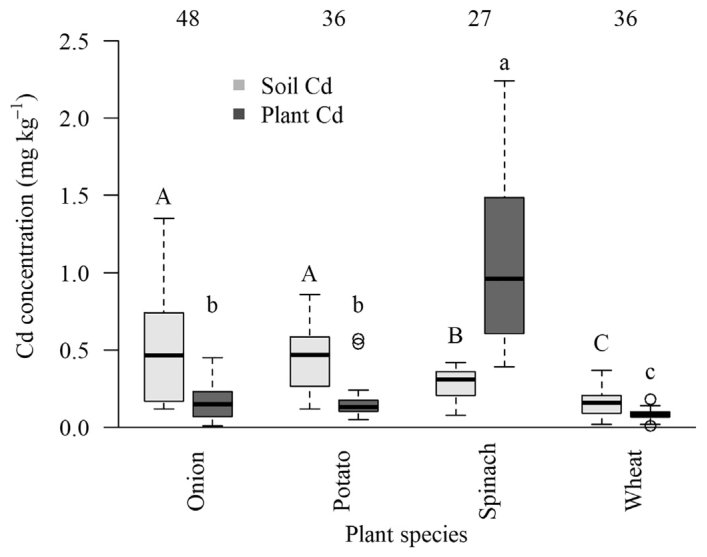
This study is a targeted investigation into a large subset of samples from the wider survey of horticultural crops and farms in NZ carried out 2016–2017 (Cavanagh et al., 2019; Gray et al., 2019a; Gray et al., 2019b). The analysis here was limited to single varieties and commercially grown cultivars of spinach (cv. Jedi), onion (cv. Rhinestone), potato (cv. Moonlight) and wheat (cv. Reliance) (Table 1) and the soils in which they were grown, and consisted of 147 paired soil and plant samples collected from 48 sites around NZ (c.f. the wider survey analysed 396 paired samples from 103 sites). The locations where the samples in this subset were collected from are shown in Fig. S1. The totalextractable Cd concentrations (forthwith, CdTot, analysis method provided below) within the subset of samples had low mean and median concentrations (0.29 and 0.37 mg kg−1, respectively), but with a large range (0.02–1.35 mg kg−1; Table 2). The median CdTot in the subset of soils in which the four crop species were grown decreased in the order potato (0.47 mg kg−1) N onion (0.465 mg kg−1) NN spinach (0.31 mg kg−1) NN wheat (0.16 mg kg−1) (NN where the difference was significant, P b 0.05; Fig. 1, see below for description of statistical analyses). The median plant Cd concentrations within this subset of samples decreased in the following order: spinach leaves (0.96 mg kg−1 DW) NN onion bulbs (0.15 mg kg−1 DW) N potato tubers (0.13 mg kg−1 DW) NN wheat grains (0.09 mg kg−1 DW) (NN where the difference was significant, P b 0.05; Fig. 1, analysis method provided below).
本研究是对2016—2017年在新西兰开展的园艺作物及农场大范围调查(Cavanagh et al., 2019; Gray et al., 2019a; Gray et al., 2019b)中大量样品子集的针对性研究。此处的分析仅限于菠菜(cv. Jedi)、洋葱(cv. Rhinestone)、马铃薯(cv. Moonlight)和小麦(cv. Reliance)的单一品种及商业栽培种(表1)及其生长土壤,共包括从新西兰各地48个样点采集的147对土壤和植物样品(相比之下,大范围调查分析了103个样点的396对样品)。该子集样品的采集地点见图S1。该子集样品中的全量可提取态镉浓度(下文称CdTot,分析方法见下文)平均值和中位数较低(分别为0.29和0.37 mg kg−1),但范围较大(0.02–1.35 mg kg−1;表2)。四种作物生长土壤子集中CdTot中位数的大小顺序为:马铃薯(0.47 mg kg−1)> 洋葱(0.465 mg kg−1)>> 菠菜(0.31 mg kg−1)>> 小麦(0.16 mg kg−1)(>> 表示差异显著,P < 0.05;图1,统计分析方法见下文)。该子集样品中植物镉浓度中位数的大小顺序为:菠菜叶片(0.96 mg kg−1 DW)>> 洋葱鳞茎(0.15 mg kg−1 DW)> 马铃薯块茎(0.13 mg kg−1 DW)>> 小麦籽粒(0.09 mg kg−1 DW)(>> 表示差异显著,P < 0.05;图1,分析方法见下文)。
These samples were used specifically to investigate the relationship between the bioavailable soil Cd, environmental factors and the Cd concentrations in the edible parts of these crop cultivars. Full details of soil and plant sample collection have been given by Cavanagh et al. (2019) for onion and spinach, by Gray et al. (2019a) for potatoes and by Gray et al. (2019b) for wheat. A brief description is provided in the Supplementary Information for convenience.
这些样品专门用于研究土壤生物有效态镉、环境因子与上述作物栽培种可食部位镉浓度之间的关系。土壤和植物样品采集的完整细节见 Cavanagh et al. (2019)(洋葱和菠菜)、Gray et al. (2019a)(马铃薯)和 Gray et al. (2019b)(小麦)。为便于参考,补充材料中提供了简要说明。
2.1. Soil and plant analyses2.1. 土壤与植物分析
The soils were analysed for soil pH (soil/water ratio of 1:2.5), cation exchange capacity (CEC) and base saturation (in pH 7, 1 M NH4OAc) (Blakemore and Price, 1987), and bioavailable soil P (Olsen-P) (Olsen, 1954) by a commercial laboratory (Hill Laboratories Ltd., Hamilton, New Zealand). Total C and N were determined using an Elementar Vario-Max CN Elementar analyser (Elementar®, Germany). The pseudo-total soil elemental concentrations (P, K, Ca, Mg, Na, Fe, Al, Mn and S) as well as key trace elements, Cd (CdTot) and Zn (ZnTot), were analysed using concentrated acid digests (Simmler et al., 2013). Briefly, soil (0.5 g) was digested in 3 mL trace element grade concentrated nitric acid (HNO3, N65%, Fisher Scientific, UK) and 3 mL hydrogen peroxide (H2O2, 30%, Merck KGaA) using a microwave digest system (MARSXPRESS, CEM Corp). The digest was diluted to 25 mL with high purity water (DI water; 18.2 MΩ-cm; Heal Force® SMART Series, SPW Ultra-pure Water system, Model PWUV) and filtered using Whatman 52 filter paper before analysis. Soil texture and water-extractable chloride were measured on a composite sample representative of each site (see Supporting Information). The texture was analysed using the pipette method (Claydon, 1989), while chloride was determined in a DI water extract (soil/water ratio of 1:5) (Rayment and Lyons, 2011). All results are expressed on an oven-dry (105 °C) soil basis.
土壤pH(土水比1:2.5)、阳离子交换量(CEC)和盐基饱和度(pH 7,1 M NH4OAc)(Blakemore and Price, 1987)以及土壤有效磷(Olsen-P)(Olsen, 1954)由一家商业实验室(Hill Laboratories Ltd., Hamilton, New Zealand)测定。全碳和全氮采用Elementar Vario-Max CN元素分析仪(Elementar®, Germany)测定。土壤元素准全量浓度(P、K、Ca、Mg、Na、Fe、Al、Mn和S)以及关键微量元素Cd(CdTot)和Zn(ZnTot)采用浓酸消解法测定(Simmler et al., 2013)。简言之,将土壤(0.5 g)与3 mL痕量元素级浓硝酸(HNO3,>65%,Fisher Scientific, UK)和3 mL过氧化氢(H2O2,30%,Merck KGaA)在微波消解系统(MARSXPRESS, CEM Corp)中消解。消解液用高纯水(去离子水;18.2 MΩ-cm;Heal Force® SMART Series, SPW Ultra-pure Water system, Model PWUV)定容至25 mL,并经Whatman 52滤纸过滤后进行分析。土壤质地和水溶性氯化物在代表各样点的混合样品上测定(见补充材料)。质地采用吸管法分析(Claydon, 1989),氯化物在去离子水浸提液(土水比1:5)中测定(Rayment and Lyons, 2011)。所有结果均以烘干(105 °C)土重计。
Total number of paired soil-crop plant samples analysed as part of the targeted survey.
针对性调查中分析的土壤—作物配对样品总数。
| Crops作物 | Total no. sites样点总数 | Total no. paired soil and plant samples土壤与植物配对样品总数 |
|---|---|---|
| Onion | 16 | 48 |
| Potato | 12 | 36 |
| Spinach | 9 | 27 |
| Wheat | 11 | 36 |
| Total | 48 | 150 |
Descriptive statistics of the element content & physicochemical characteristics of the soils analysed in this study.
本研究所分析土壤的元素含量及理化性质描述性统计。
| Parameter参数 | Minimum最小值 | Mean平均值 | Median中位数 | Maximum最大值 |
|---|---|---|---|---|
| pH | 4.88 | 6.01 | 5.97 | 7.23 |
| Sand (%) | 1 | 19 | 16 | 45 |
| Silt (%) | 19 | 49 | 49 | 71 |
| Clay (%) | 14 | 32 | 27 | 76 |
| Bulk density (g cm−1) | 0.45 | 0.92 | 0.94 | 1.23 |
| Olsen-P (mg kg−1) | 11 | 72 | 51 | 351 |
| Total P (g kg−1) | 0.53 | 1.84 | 1.60 | 5.08 |
| Total C (%) | 1.12 | 3.75 | 2.87 | 19.79 |
| Total N (%) | 0.09 | 0.33 | 0.27 | 1.25 |
| K (mg kg−1) | 728 | 3829 | 3570 | 11,628 |
| Ca (mg kg−1) | 2020 | 6937 | 6544 | 45,279 |
| Mg (mg kg−1) | 510 | 4703 | 4299 | 40,435 |
| Na (mg kg−1) | 161 | 376 | 300 | 1255 |
| CEC (cmolckg−1) | 10 | 21 | 19 | 48 |
| Total Zn (mg kg−1) | 29.63 | 89.90 | 89.15 | 154.16 |
| Znpw(μg L−1) | 44.26 | 282.65 | 254.70 | 781.70 |
| CDGT-Zn(μg L−1) | 0.68 | 3.12 | 1.85 | 26.66 |
| Extractable Cl (mg kg−1) | 6.71 | 30.11 | 22.16 | 160.29 |
| Soil Fe (mg kg−1) | 5891 | 23,730 | 21,279 | 66,971 |
| Soil Al (mg kg−1) | 16,333 | 50,997 | 36,192 | 144,385 |
| Soil Mn (mg kg−1) | 145 | 790 | 523 | 2829 |
| Soil S (mg kg−1) | 180 | 549 | 471 | 1971 |
| CdTot(mg kg−1) | 0.02 | 0.37 | 0.29 | 1.35 |
| CdCa(NO3)2(μg kg−1) | 0.05 | 8.18 | 3.76 | 60.21 |
| CDGT-Cd(μg L−1) | 0.04 | 0.83 | 0.76 | 2.10 |
| Cdpw(μg L−1) | 0.06 | 18.37 | 21.01 | 76.32 |
| Total rainfall (mm) | 56 | 416 | 421 | 816 |
| Temperature (°C) | 8.94 | 14.51 | 14.41 | 21.85 |
| Radiation (KMJ M−2 d−1) | 0.80 | 3.05 | 3.51 | 4.28 |
The plant material (0.2 g) was digested with 4 mL HNO3 (50:50, v/v) and 2 mL H2O2 using a microwave digestion (MARSXPRESS, CEM Corp.) (Cindrić et al., 2015). The digests were subsequently diluted with DI water to a final volume of 10 mL for analysis of Cd and Zn concentrations. The plant concentrations are reported here on a dry weight basis.
植物样品(0.2 g)采用4 mL HNO3(50:50, v/v)和2 mL H2O2进行微波消解(MARSXPRESS, CEM Corp.)(Cindrić et al., 2015)。消解液随后用去离子水定容至10 mL,用于测定Cd和Zn浓度。本文报告的植物浓度均以干重计。
2.2. Soil cadmium bioavailability testing2.2. 土壤镉生物有效性测定
The calcium nitrate extractable soil Cd fraction (forthwith, CdCa(NO3) 2) was determined following the method described by Gray et al.
硝酸钙可提取态土壤镉组分(下文称CdCa(NO3) 2)按照 Gray et al.
(1999c). Briefly, 5 g of soil was equilibrated with 30 mL of 0.05 M Ca (NO3)2 (Sigma-Aldrich) for 2 h in an end-over-end shaker. The suspension was then centrifuged for 10 min at 3300 rpm, after which the supernatant was filtered using a Whatman 52 filter paper. The filtrate was stored at −20 °C until analysis.
(1999c)所述方法测定。简言之,将5 g土壤与30 mL 0.05 M Ca (NO3)2(Sigma-Aldrich)在翻转振荡器中平衡2 h。随后将悬浮液以3300 rpm离心10 min,上清液经Whatman 52滤纸过滤。滤液于−20 °C保存直至分析。
The DGT-measured Cd fraction followed an adapted version of the method described by Zhang et al. (1998). Here, air-dried soil (ca. 20 g) was weighed into a small clean cylindrical container, where the soil extended at least 1 cm in each direction from the probe interface. DI water was added to create a homogeneous slurry with a moisture content equivalent to 100% maximum water-holding capacity, after which the slurry was left to equilibrate for 48 h at room temperature. Standard DGT soil probes were used, which comprised of an agarose crosslinked polyacrylamide (APA) hydrogel layer (thickness of 0.08 cm), polyethersulfone filter membrane (0.45 μm pore diameter; 0.014 cm thickness) and a 0.04 cm-thick APA resin gel with Chelex-100 binding resin (200–400 mesh, Bio-Rad), housed within in a polycarbonate piston probe (DGT Research Ltd.). The probes were deployed ensuring complete contact between the soil slurry and the device sampling window (physical area: 2.54 cm2). The deployment took place in a humidity (100%) and temperature-regulated (21 ± 1 °C) incubator for 24 h. At the end of the deployment the soil attached to the DGT devices was carefully removed using a gentle jet of DI water and the housings were dismantled. The resin gels were eluted with 1 mL of 1 M HNO3 for 24 h. Following DGT retrieval, the soil porewater Cd and Zn concentrations (forthwith, Cdpw, and Znpw, respectively; μg L−1) was measured, as described by Ernstberger et al. (2002). Briefly, the slurry was allowed to equilibrate for up to 4 h, after which it was transferred into a 50 mL centrifuge tube and centrifuged at 2000 rpm for 10 min. The supernatant was then filtered through a polyethersulphone disc filter (0.45 μm). The filtrate was diluted two-fold with 0.1 M Ca(NO3)2 immediately after filtration and stored at −20 °C until analysis.
DGT测定镉组分采用 Zhang et al. (1998) 所述方法的改进版本。将风干土壤(约20 g)称入一个洁净的小型圆柱形容器中,使土壤在各方向上距探头界面至少1 cm。加入去离子水制成均匀泥浆,其含水量相当于100%最大持水量,随后将泥浆在室温下平衡48 h。采用标准DGT土壤探头,其由琼脂糖交联聚丙烯酰胺(APA)水凝胶层(厚度0.08 cm)、聚醚砜滤膜(孔径0.45 μm;厚度0.014 cm)以及含Chelex-100结合树脂(200–400目,Bio-Rad)的0.04 cm厚APA树脂凝胶组成,并装于聚碳酸酯活塞式探头(DGT Research Ltd.)中。放置探头时确保土壤泥浆与装置采样窗口(物理面积:2.54 cm2)完全接触。放置过程在湿度(100%)和温度(21 ± 1 °C)可控的培养箱中进行,持续24 h。放置结束后,用温和的去离子水流小心去除附着在DGT装置上的土壤,并拆开外壳。树脂凝胶用1 mL 1 M HNO3洗脱24 h。取回DGT后,按照 Ernstberger et al. (2002) 所述方法测定土壤孔隙水Cd和Zn浓度(下文分别称Cdpw和Znpw;μg L−1)。简言之,泥浆平衡至多4 h后转移至50 mL离心管中,以2000 rpm离心10 min。上清液随后经聚醚砜圆盘滤器(0.45 μm)过滤。过滤后立即用0.1 M Ca(NO3)2将滤液稀释2倍,并于−20 °C保存直至分析。
The total mass (M) of Cd bound by the resin gel during the deployment was calculated using Eq. (1):
放置期间树脂凝胶结合的镉总质量(M)按式(1)计算:


where, Ce is the concentration of the metal in the eluent, Ve and Vr are the eluent and resin volumes, respectively, and fe is the metal-specific elution efficiency, (0.84 for Cd according to Garmo et al. (2003)).
式中,Ce为洗脱液中金属的浓度,Ve和Vr分别为洗脱液和树脂的体积,fe为特定金属的洗脱效率(根据 Garmo et al. (2003),Cd为0.84)。
The DGT-extractable Cd and Zn concentrations (CDGT-Cd and CDGT-Zn, μg L−1) were calculated according to Eq. (1) (Zhang et al., 1998).
DGT可提取态Cd和Zn浓度(CDGT-Cd和CDGT-Zn,μg L−1)按照式(1)计算(Zhang et al., 1998)。

where, δMDL is the total thickness of the material diffusion layer (diffusive hydrogel and filter membrane: 0.094 cm), D is the temperature-specific diffusion coefficient for the two metals in the diffusive gel (cm2 s−1) over the deployment time (at 21 °C); AE is the effective exposure area of the DGT device (3.08 cm2); and t is the deployment time (s). All extracts and eluents were diluted five-fold with 2% HNO3 before Cd analysis.
式中,δMDL为物质扩散层的总厚度(扩散水凝胶与滤膜:0.094 cm),D为两种金属在放置时间内(21 °C)于扩散凝胶中的温度特异性扩散系数(cm2 s−1);AE为DGT装置的有效暴露面积(3.08 cm2);t为放置时间(s)。所有提取液和洗脱液在测定Cd前均用2% HNO3稀释5倍。
2.3. Climate information2.3. 气候信息
Weather data for each sampling site was obtained from the nearest climate station of the NZ National Institute of Water and Atmospheric Research to each site. The data collected comprised of total solar radiation, total annual rainfall and the average daily air temperature (forthwith ‘average temperature’) for the crop-specific growth periods at the respective sites.
各采样点的气象数据取自新西兰国家水与大气研究所(NIWA)距各样点最近的气象站。收集的数据包括各样点特定作物生长期内的太阳总辐射、年降雨总量和日平均气温(下文称“平均温度”)。
Regression equations and coefficients of determination (R2) for relationships between different bioavailability tests and Cd concentrations in edible plant parts.
不同生物有效性测定方法与植物可食部位镉浓度之间关系的回归方程及决定系数(R2)。
| Plant part植物部位 | Test测定方法 | Regression equations回归方程 | R2 |
|---|---|---|---|
| Onion bulb | Total | log(Cdonion) = −0.05 + 0.40 log(CdTot) | 0.164⁎⁎ |
| 0.05 M Ca(NO3)2 | log(Cdonion) = 1.46 + 1.09 log(CdCa(NO3)2) | 0.259⁎⁎ | |
| DGT | log(Cdonion) = −0.01 + 0.02 log(CDGT-Cd) | 0.001(NS) | |
| Porewater | log(Cdonion) = 1.32 + 0.02 log(Cdpw) | 0.001(NS) | |
| Potato tuber | Total | log(Cdpotato) = −0.50 + 0.11 log(CdTot) | 0.013 (NS) |
| 0.05 M Ca(NO3)2 | log(Cdpotato) = 1.40 + 0.48 log(CdCa(NO3)2) | 0.062 (NS) | |
| DGT | log(Cdpotato) = 0.10 + 0.26 log(CDGT-Cd) | 0.082 (NS) | |
| Porewater | log(Cdpotato) = 1.23–0.17 log(Cdpw) | 0.001 (NS) | |
| Spinach leaves | Total | log(Cdspinach) = −0.60 + 0.79 log(CdTot) | 0.589⁎⁎⁎ |
| 0.05 M Ca(NO3)2 | log(Cdspinach) = 0.39 + 1.69 log(CdCa(NO3)2) | 0.529⁎⁎⁎ | |
| DGT | log(Cdspinach) = −0.40 −0.27 log(CDGT-Cd) | 0.023 (NS) | |
| Porewater | log(Cdspinach) = −0.36 −0.94 log(Cdpw) | 0.015 (NS) | |
| Wheat grain | Total | log(Cdwheat) = −1.25 −0.31 log(CdTot) | 0.041(NS) |
| 0.05 M Ca(NO3)2 | log(Cdwheat) = 0.31–0.06 log(CdCa(NO3)2) | 0.001(NS) | |
| DGT | log(Cdwheat) = −0.34 −0.13 log(CDGT-Cd) | 0.116⁎ | |
| Porewater | log(Cdwheat) = 1.95 + 0.91 log(Cdpw) | 0.172⁎ |
NS = not significant. ⁎ P b 0.05. ⁎⁎ P b 0.01. ⁎⁎⁎ P b 0.001.
NS = 不显著。⁎ P < 0.05。⁎⁎ P < 0.01。⁎⁎⁎ P < 0.001。
2.4. Trace element analyses and quality control2.4. 微量元素分析与质量控制
Cadmium in the soil digests, and Cd and Zn in the DGT eluents, were analysed by inductively-coupled plasma mass spectrometry (ICP-MS, Agilent-7500cx). The other elements in the soil digests and all plant digests and other soil extracts (Ca(NO3)2 and porewater) were analysed using optical emission spectrometry (ICP-OES, Varian 720 ES – USA). Internal and external reference soils (NIST Montana 2711; Interlab internal WEPAL soil 921; Interlab internal WEPAL soil 981), and plants (NIST 1573a, tomato leaves; ASPAC internal clover; ASPAC internal beetroot) were used as standard reference materials to confirm both the extraction efficiency of the digests and the accuracy of metal analysis on both instruments and comparability between them. The recovery ratios of the standard soils varied from 96 to 106% for Cd and 92–93% for Zn, while standard plants ranged between 92 and 96% for Cd and 103–105% for Zn, respectively.
土壤消解液中的镉以及DGT洗脱液中的Cd和Zn采用电感耦合等离子体质谱(ICP-MS, Agilent-7500cx)测定。土壤消解液中的其他元素、所有植物消解液及其他土壤提取液(Ca(NO3)2和孔隙水)采用光学发射光谱(ICP-OES, Varian 720 ES – USA)测定。以内部和外部参考土壤(NIST Montana 2711;Interlab internal WEPAL soil 921;Interlab internal WEPAL soil 981)及植物(NIST 1573a,番茄叶;ASPAC internal clover;ASPAC internal beetroot)作为标准参考物质,以确认消解的提取效率、两台仪器金属分析的准确性以及仪器间的可比性。标准土壤的回收率Cd为96%–106%,Zn为92%–93%;标准植物的回收率Cd为92%–96%,Zn为103%–105%。
2.5. Statistical analysis2.5. 统计分析
One-way ANOVA or Kruskall-Wallis tests were used to determine differences in soil and plant Cd concentrations between crops species. Correlations between plant Cd or Zn concentrations and single environmental variables were tested using Spearman correlation coefficients. Stepwise multiple linear regression analyses were used to develop multiple regression models (MRM) to represent plant tissue Cd concentrations and investigate the influence of environmental variables, soil Cd and Zn concentrations, soil properties on these. The different NZ Regions where the crops were grown were included as categorical predictors. Variables were log-transformed if identified as non-normally distributed by the Shapiro-Wilk test. The variance inflation factor (VIF) was used as the criterion to reduce multi co-linearity of the variables in the MRM: predictors with VIF N 5 were excluded. Where VIFs were between 2 and 5, the correlations between MRM variables were tested and where those correlations were significant (i.e. Olsen-P and CdCa(NO3)2 in spinach soils: ρ = 0.569; P b 0.01, not shown) only the bioavailability test variable was retained in the model. The stepwise linear regression analysis was carried out using Minitab 17 (Minitab, LLC) and all other statistical analyses were carried out using the R software (Pinheiro et al., 2012). Variables that were not significant predictors in the model were excluded from the MRMs. Because soil properties varied between plots within sites, the regression analyses were undertaken using individual plot data, where available. The exception to this was the information on the analytes measured in a single composite sample (i.e. particle size distribution and extractable Cl) which was comprised of samples taken along a 50 m transect representative of each site (c.f. Supporting Information) and these values were assumed to be representative of all plots on that site. As noted earlier, Zn deficiency has been identified as possible cause of increased Cd uptake by plants. Therefore, Zn concentrations measured both in the plant tissues and in the same samples as Cd from the different bioavailability tests (but not different tests) were included as possible predictors in the multiple regression analyses. Significance was assessed at the 5% level throughout, unless stated otherwise.
采用单因素ANOVA或Kruskall-Wallis检验确定不同作物物种间土壤和植物镉浓度的差异。采用Spearman相关系数检验植物Cd或Zn浓度与单一环境变量之间的相关性。采用逐步多元线性回归分析建立多元回归模型(MRM),以表征植物组织镉浓度,并考察环境变量、土壤Cd和Zn浓度及土壤性质对其的影响。作物种植所在的新西兰不同大区作为分类预测变量纳入模型。经Shapiro-Wilk检验判定为非正态分布的变量进行对数转换。以方差膨胀因子(VIF)作为降低MRM中变量多重共线性的标准:剔除VIF > 5的预测变量。当VIF介于2与5之间时,检验MRM变量间的相关性;若相关显著(如菠菜土壤中Olsen-P与CdCa(NO3)2:ρ = 0.569;P < 0.01,未列出),则模型中仅保留生物有效性测定变量。逐步线性回归分析使用Minitab 17(Minitab, LLC)完成,其他所有统计分析均使用R软件(Pinheiro et al., 2012)完成。模型中不显著的预测变量均从MRM中剔除。由于土壤性质在样点内各小区间存在差异,回归分析在可行时均采用单个小区数据。例外情况是在单一混合样品中测定的分析项(即粒径分布和可提取Cl),该混合样品由沿代表各样点的50 m样带采集的样品组成(参见补充材料),并假定这些数值可代表该样点的所有小区。如前所述,Zn缺乏已被认为是植物镉吸收增加的可能原因。因此,植物组织中测得的Zn浓度,以及不同生物有效性测定中与Cd在同一样品中测得的Zn浓度(但不跨测定方法),均作为可能的预测变量纳入多元回归分析。除另有说明外,全文显著性水平均为5%。
3Results and discussion结果与讨论
3.1. Relationships between plant cadmium concentrations, bioavailability tests and soil variables3.1. 植物镉浓度、生物有效性测定与土壤变量之间的关系
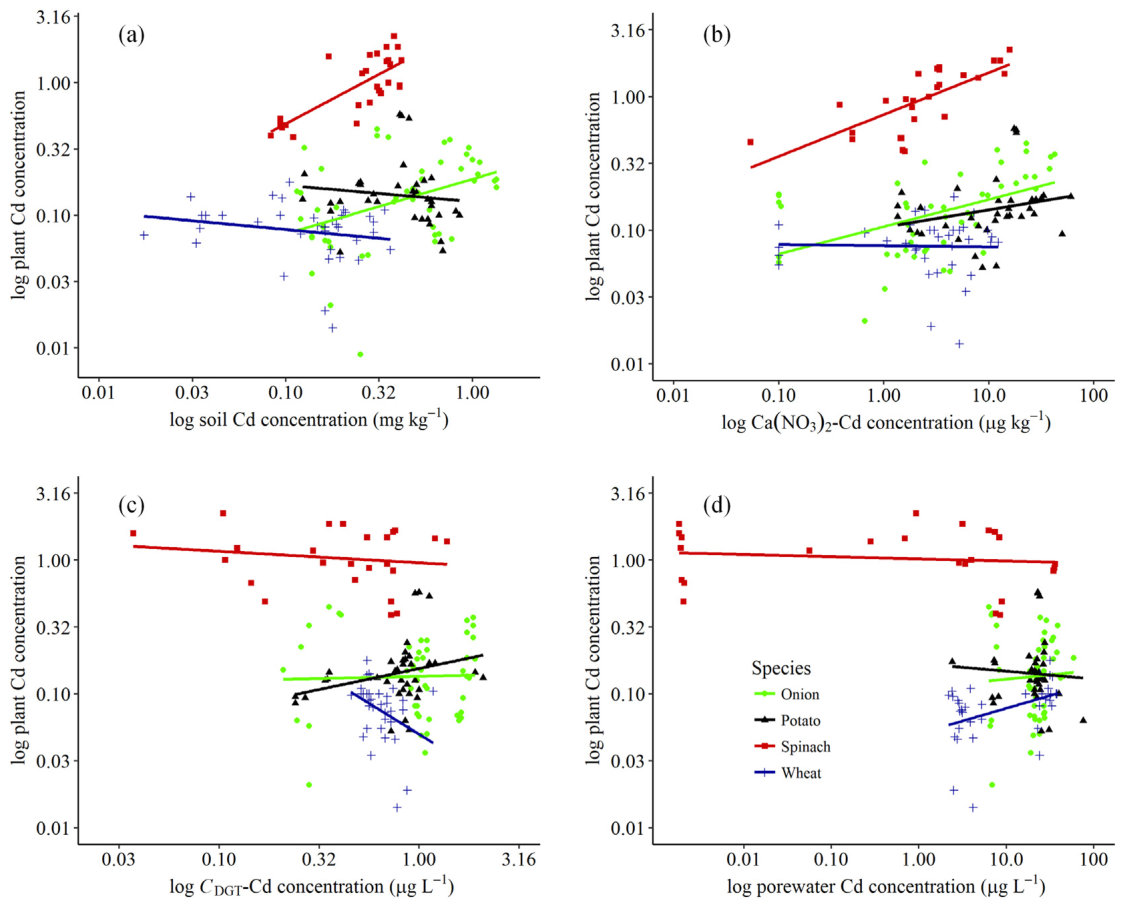
Variability in the Cd concentrations in spinach leaves was best represented by CdCa(NO3)2 (R2: 0.529) and CdTot (R2: 0.589) (P b 0.001)(Fig. 2; Table 3). This is the first comparison of the tests considered in this work being used to estimate the bioavailability of Cd to spinach, however others have shown that they correlate significantly with Cd concentrations in a wide variety of other leafy plants, such as lettuce, ryegrass and clover (CdTot R2: 0.59–0.81; CdCa(NO3)2 R2: 0.42–0.79)(Gray et al., 1999b; Black et al., 2011). The CdCa(NO3)2 concentrations also provided the best representation of Cd concentration in onion bulbs, although the correlation was weaker than for spinach (R2: 0.259; P b 0.01). The CdCa(NO3)2 correlated well with soil pH (ρ = −0.71; P b 0.01; Table 4), which agrees with previous studies that have shown pH as a critical determinant of soluble Cd concentrations in NZ soils and elsewhere (Gray et al., 1999a; Hooda, 2010; Reiser et al., 2014). The significant positive correlations between CdCa(NO3)2 and soil total Fe, Al and Mn concentrations (Table 4) agrees with results from Gray et al. (1999a) and suggests that the test can solubilize some of the Cd associated with Fe-, Al- and Mn-oxide soil minerals to a greater extent than CDGT-Cd and Cdpw (see also below).
菠菜叶片镉浓度的变异以CdCa(NO3)2(R2: 0.529)和CdTot(R2: 0.589)表征效果最佳(P < 0.001)(图2;表3)。这是首次比较本研究所考察的测定方法用于估算菠菜镉生物有效性的效果,但已有研究表明,这些方法与多种其他叶类植物(如莴苣、黑麦草和三叶草)的镉浓度显著相关(CdTot R2: 0.59–0.81;CdCa(NO3)2 R2: 0.42–0.79)(Gray et al., 1999b; Black et al., 2011)。CdCa(NO3)2浓度对洋葱鳞茎镉浓度的表征效果同样最佳,但相关性弱于菠菜(R2: 0.259;P < 0.01)。CdCa(NO3)2与土壤pH密切相关(ρ = −0.71;P < 0.01;表4),这与以往研究一致,即pH是新西兰及其他地区土壤可溶性镉浓度的关键决定因素(Gray et al., 1999a; Hooda, 2010; Reiser et al., 2014)。CdCa(NO3)2与土壤全Fe、Al和Mn浓度之间的显著正相关(表4)与 Gray et al. (1999a) 的结果一致,表明该方法溶解与Fe、Al和Mn氧化物土壤矿物结合的部分镉的程度大于CDGT-Cd和Cdpw(另见下文)。
The CDGT-Cd concentrations were higher than those found in other agricultural soils in the United States and China, not subject to industrial contamination (Pérez and Anderson, 2009; Williams et al., 2012) (0.02–0.63 μg L−1) which is most likely due to the generally lower CdTot (0.084–0.356 mg kg−1) in those studies, while Cdpw concentrations were similar to those measured elsewhere (0.002–125.0 μg L−1) (Black et al., 2011; Williams et al., 2012; Song et al., 2015). Only CDGT- Cd and Cdpw correlated with wheat grain Cd concentrations, but the relationship with the former was negative and relatively weak (R2 0.116;
CDGT-Cd浓度高于美国和中国其他未受工业污染的农业土壤(Pérez and Anderson, 2009; Williams et al., 2012)(0.02–0.63 μg L−1),这很可能是由于这些研究中的CdTot普遍较低(0.084–0.356 mg kg−1);而Cdpw浓度与其他地区的测定值相近(0.002–125.0 μg L−1)(Black et al., 2011; Williams et al., 2012; Song et al., 2015)。只有CDGT- Cd和Cdpw与小麦籽粒镉浓度相关,但前者呈负相关且相对较弱(R2 0.116;
Spearman correlations (ρ) between Cd bioavailability tests and soil chemical variables.
镉生物有效性测定结果与土壤化学变量之间的Spearman相关系数(ρ)。
| Parameter参数 | CdCa(NO3)2(μg kg−1) CDGT-Cd(μg L−1)CdCa(NO3)2(μg kg−1) CDGT-Cd(μg L−1) | Cdpw(μg L−1)Cdpw(μg L−1) |
|---|---|---|
| pH | −0.71⁎⁎ −0.08 | −0.11 |
| Sand (%) | −0.24⁎⁎ 0.12 | −0.03 |
| Silt (%) | −0.32⁎⁎ −0.10 | 0.02 |
| Clay (%) | 0.28⁎⁎ −0.09 | 0.01 |
| Olsen-P (mg kg−1) | 0.15 0.10 | −0.10 |
| Total P (g kg−1) | 0.22⁎⁎ 0.22⁎⁎ | 0.26⁎⁎ |
| Total C (%) | 0.24⁎⁎ 0.15 | 0.33⁎⁎ |
| Total N (%) | 0.22⁎⁎ 0.15 | 0.36⁎⁎ |
| C/N ratio | 0.06 0.00 | −0.20⁎ |
| K (mg kg−1) | −0.14 −0.41⁎⁎ | −0.26⁎⁎ |
| Ca (mg kg−1) | −0.47⁎⁎ −0.10 | 0.01 |
| Mg (mg kg−1) | −0.15 −0.32⁎⁎ | −0.21⁎ |
| Na (mg kg−1) | −0.06 0.34⁎⁎ | 0.15 |
| CEC (cmolckg−1) | 0.16 0.07 | 0.01 |
| Total Zn (mg kg−1) | 0.23⁎⁎ −0.05 | 0.10 |
| Extractable Cl (mg kg−1) | 0.19⁎ 0.21⁎⁎ | 0.20⁎ |
| Soil Fe (mg kg−1) | 0.21⁎ −0.37⁎⁎ | −0.40⁎⁎ |
| Soil Al (mg kg−1) | 0.39⁎⁎ −0.03 | −0.11 |
| Soil Mn (mg kg−1) | 0.18⁎ 0.06 | −0.05 |
| Soil S (mg kg−1) | 0.35⁎⁎ 0.19⁎ | 0.28⁎⁎ |
| CdTot(mg kg−1) | 0.24⁎⁎ 0.36⁎⁎ | 0.29⁎⁎ |
| CDGT-Cd(μg L−1) | 0.18⁎ | |
| Cdpw(μg L−1) | 0.28⁎⁎ 0.37⁎⁎ |
Significant relationships are indicated by ⁎ (P b 0.05) and ⁎⁎ (P b 0.01).
显著关系以⁎(P < 0.05)和⁎⁎(P < 0.01)表示。
P b 0.05) and only slightly stronger and positive for the latter (R2 0.172; P b 0.05; Table 3). The poor correlation between CDGT-Cd and plant concentrations is contrary to previous reports that have shown DGT to estimate well the Cd uptake by spinach (Oporto et al. (2009) at low available Cd concentrations), wheat and potato (Nolan et al., 2005; Pérez and Anderson, 2009). Black et al. (2011) found that the DGTderived Effective Concentration (CE) was able to predict Cd uptake better than Ca(NO3)2, where it predicted 49% of the variability in Cd concentration in wheat shoots, compared to 34% by the latter. The results presented here used CDGT-Cd instead of CE; however, these two measurements generally vary proportionally to each other (Degryse et al., 2009b) and, therefore, the difference in the relationship to plant tissue concentrations between the two is likely to be insignificant. The index RDGT (CDGT-Cd/Cdpw) shows the relationship between DGT-measured and porewater concentrations, where low values (RDGT b 0.1) are indicative of mostly diffusive supply of solute from the soil to the probe interface, with little buffering from labile solid phase reservoirs (Davison et al., 2007). 73% of the samples analysed here had RDGT values below this threshold, which suggests that the DGT-labile solid phase fraction of Cd in these soils was generally lower than seen in other studies (Senila et al., 2012; Dočekalová et al., 2015). McLaughlin et al. (2011) have highlighted the importance Cd transport to leaves from the soil via plant transpiration, where advective transport of the metal to the root is likely to be important. Lehto et al. (2006) showed that this transport mechanism is likely to be most important for determining how much solute can be taken up when (re)supply from solid phases (buffering) is low. Spinach has been shown to take up Cd2+ at a greater rate than can be resupplied by diffusion alone (Degryse et al., 2012). Hence, the relationship between CDGT-Cd and spinach Cd concentrations is probably weak because DGT cannot account for the advective transport of Cd from the soil to spinach roots in these soils. The DGT-measured and porewater Cd concentrations (CDGT-Cd and Cdpw) correlated weakly with soil Fe (ρ values of −0.37 and −0.40, respectively; P b 0.01) (Table 4), which may be driven by iron (oxyhydr)oxide minerals reducing the availability of the metal to be measured by these methods through sorption and occlusion (McLaren and Cameron, 1996), the fact that the relationship is relatively weak is probably due to the importance of the types of minerals involved, rather than the amount Fe present (Smith, 1999) and the influence of other factors, such as pH.
P < 0.05),后者仅略强且呈正相关(R2 0.172;P < 0.05;表3)。CDGT-Cd与植物浓度相关性较差,这与以往报道相反,以往研究表明DGT能够较好地估算菠菜(Oporto et al. (2009),在低有效镉浓度下)、小麦和马铃薯(Nolan et al., 2005; Pérez and Anderson, 2009)的镉吸收。Black et al. (2011) 发现,DGT衍生的有效浓度(CE)比Ca(NO3)2能更好地预测镉吸收,其可预测小麦地上部镉浓度变异的49%,而后者为34%。本研究采用CDGT-Cd而非CE;然而,这两种测定值通常成比例变化(Degryse et al., 2009b),因此二者与植物组织浓度关系的差异可能并不显著。指数RDGT(CDGT-Cd/Cdpw)反映DGT测定浓度与孔隙水浓度之间的关系,低值(RDGT < 0.1)表明溶质从土壤向探头界面的供应以扩散为主,来自活性固相库的缓冲作用很小(Davison et al., 2007)。本研究分析的样品中73%的RDGT值低于该阈值,表明这些土壤中DGT活性固相镉组分总体低于其他研究(Senila et al., 2012; Dočekalová et al., 2015)。McLaughlin et al. (2011) 强调了镉经植物蒸腾作用从土壤向叶片运输的重要性,其中金属向根系的对流运输可能起重要作用。Lehto et al. (2006) 表明,当固相(再)供应(缓冲)较低时,这种运输机制很可能是决定溶质吸收量的最重要因素。研究表明,菠菜吸收Cd2+的速率大于仅靠扩散所能再供应的速率(Degryse et al., 2012)。因此,CDGT-Cd与菠菜镉浓度关系较弱,可能是由于DGT无法反映这些土壤中镉从土壤向菠菜根系的对流运输。DGT测定镉与孔隙水镉浓度(CDGT-Cd和Cdpw)与土壤Fe呈弱相关(ρ值分别为−0.37和−0.40;P < 0.01)(表4),这可能是由于铁(氢)氧化物矿物通过吸附和包蔽作用降低了这些方法可测得的金属有效性(McLaren and Cameron, 1996);该关系相对较弱,可能是因为所涉及矿物的类型比Fe的含量更为重要(Smith, 1999),以及pH等其他因素的影响。
There were significant but weak positive correlations between all of the soil Cd bioavailability tests and CdTot (0.24 b ρ b 0.36; P b 0.01)
所有土壤镉生物有效性测定结果与CdTot之间均存在显著但较弱的正相关(0.24 < ρ < 0.36;P < 0.01)
(Table 4). Total soil Cd concentrations also correlated with various soil variables (in order of decreasing ρ): P N S N Mn N Al N CEC (0.86 N ρ N 0.49; P b 0.001, not shown). The relationship between CdTot and soil P and S is likely to reflect the historic use of superphosphate fertilizer on those soils (Taylor, 1997), while Mn, Al and CEC are indicative of the soils' capacity to retain Cd, where Mn and Al minerals can provide reactive surfaces that bind Cd from the fertilizers (Backes et al., 1995). Soils with short-range order Al minerals (e.g. allophane), also bind phosphate (Parfitt et al., 2005) and, hence, require higher rates of P fertilizer application to sustain productivity, which in turn would also increase the amount of Cd applied to the soil. Other studies have shown through multiple regression analysis how combinations of soil variables can be used to model CdCa(NO3) (Gray et al., 1999a; Gray and McLaren, 2006) and CDGT-Cd (Pérez and Anderson, 2009). Multiple regression analysis that considered various combinations of the variables given in Table 2 was carried to estimate the CdCa(NO3)2, CDGT- Cd and Cdpw concentrations measured here. The predictions by these models did not improve upon the results of single regression analysis shown above (results not shown).
(表4)。土壤总镉浓度还与多种土壤变量相关(按ρ递减排序):P > S > Mn > Al > CEC(0.86 > ρ > 0.49;P < 0.001,未列出)。CdTot与土壤P和S之间的关系可能反映了这些土壤历史上施用过磷酸钙肥料(Taylor, 1997),而Mn、Al和CEC则指示土壤对镉的保持能力,其中Mn和Al矿物可提供结合肥料来源镉的活性表面(Backes et al., 1995)。含有短程有序Al矿物(如水铝英石)的土壤也会结合磷酸盐(Parfitt et al., 2005),因而需要较高的磷肥施用量以维持生产力,这反过来也会增加施入土壤的镉量。其他研究已通过多元回归分析表明,可利用土壤变量的组合模拟CdCa(NO3)(Gray et al., 1999a; Gray and McLaren, 2006)和CDGT-Cd(Pérez and Anderson, 2009)。本研究对表2所列变量的各种组合进行了多元回归分析,以估算所测得的CdCa(NO3)2、CDGT- Cd和Cdpw浓度。这些模型的预测结果并未优于上述一元回归分析的结果(结果未列出)。
3.2. Regional differences in cadmium uptake and other contributory soil variables
3.2. 镉吸收的区域差异及其他影响土壤变量
The plant uptake factor (PUF = Cdplant/CdTot) compares plant (Cdplant, mg kg−1 DW) and soil Cd concentrations between the paired samples and can be used to provide a general indicator of differences between the plants' affinity to take up and translocate Cd across the various regions. The PUF results showed that Canterbury generally had the highest Cd PUF across all crops and significant differences between regions were found for onion, potatoes and wheat (Fig. S2). Inclusion of the NZ Region where the samples were grown as a categorical variable in the MRM improved relationships between the Cd bioavailability tests and plant Cd concentrations for all species (Table 5). When the Regions were included as categorical variables, CdCa(NO3)2 was able to predict a larger proportion of the variability in Cd concentrations in onion bulbs and spinach leaves (R2adj: 0.596 and 0.790, respectively; Table 5). When considered together with the previously noted strong negative correlation between soil pH and CdCa(NO3)2 (Table 4), it further indicates that managing soil pH can be an effective tool for reducing Cd uptake by onion and spinach across NZ. However, it should be noted that the addition of Ca2+ ions with lime may result in increased Cd solubility and
植物吸收因子(PUF = Cdplant/CdTot)比较配对样品间植物(Cdplant,mg kg−1 DW)与土壤的镉浓度,可作为反映不同区域植物吸收和转运镉能力差异的一般指标。PUF结果表明,坎特伯雷所有作物的镉PUF总体最高,且洋葱、马铃薯和小麦的PUF在区域间存在显著差异(图S2)。将样品种植所在的新西兰大区作为分类变量纳入MRM后,所有物种的镉生物有效性测定结果与植物镉浓度之间的关系均得到改善(表5)。将大区作为分类变量纳入后,CdCa(NO3)2能够预测洋葱鳞茎和菠菜叶片镉浓度更大比例的变异(R2adj分别为0.596和0.790;表5)。结合前述土壤pH与CdCa(NO3)2之间的强负相关(表4),这进一步表明,调控土壤pH可成为降低新西兰各地洋葱和菠菜镉吸收的有效手段。然而应注意,随石灰加入的Ca2+离子可能导致镉溶解度及
Multiple regression models describing Cd concentrations in onion, potato, spinach and wheat, with the different growing regions in New Zealand included as categorical variables. All model variables were significant (P b 0.001).
描述洋葱、马铃薯、菠菜和小麦镉浓度的多元回归模型,其中新西兰不同种植区作为分类变量纳入。所有模型变量均显著(P < 0.001)。
| Plant植物 | Region地区 | Region constant, Rc_plant区域 常数 Rc_plant | Regression equation回归方程 | R2 adj (P b 0.001) |
|---|---|---|---|---|
| Auckland | −0.46 | |||
| Onion | Canterbury Hawkes | −0.88 | log(Cdonion) = Rc_onion + 0.12 | 0.596 |
| Bay | −1.32 | log(CdCa(NO3)2) | n = 48 | |
| Waikato | −0.72 | |||
| Auckland | −0.02 | log(Cdpotato) = Rc_potato + 0.04 | ||
| Potato | Canterbury | −0.86 | log(CDGT-Cd) + | 0.767 |
| Ma-Wan | −0.37 | 2.84 log (air | n = 36 | |
| Waikato | −0.28 | temperature) −1.19 log(Total P) | ||
| Auckland | −0.21 | |||
| Spinach | Canterbury Gisborne Ma-Wan | −0.43 −0.08 −0.01 | log(Cdspinach) = Rc_spinach + 0.37 log(CdCa(NO3)2) | 0.790 n = 27 |
| Tasman | −0.07 | |||
| Waikato | −0.13 | |||
| Canterbury | 0.58 | log(Cdwheat) = Rc_wheat + 0.08 | ||
| Wheat | Hawkes Bay | 0.63 | log(Cdpw) - …0.51 log(Olsen-P) −0.80 log (Znwheat) | 0.579 n = 36 |
Ma-Wan: Manawatu-WanganuiMa-Wan: Manawatu-Wanganui
plant-availability (Bolan et al., 2003; Shaheen and Rinklebe, 2015). None of the methods tested here could successfully represent Cd concentrations in potato tuber by themselves; however, this was achieved by a MRM that included CDGT-Cd, average air temperature and soil total P concentration (R2adj: 0.767; Table 5), while Cdpw, Olsen-P, wheat grain Zn concentration provided the best model to describe Cd accumulation in wheat grains (R2adj 0.579; Table 5). The overall representation of plant tissue concentrations by the bioavailability tests (CdCa(NO3)2, CDGT- Cd and Cpw) was better than those when total Cd concentrations were included in a MRM: there the variability in Cd concentrations in onions was best represented when including the same Regions (as categorical variables), CdTot and soil pH (R2adj 0.50; n = 88), while the best model to describe Cd in spinach included using CdTot, extractable Mg and ZnTot (R2adj 0.55; n = 64) (Cavanagh et al., 2019). No significant relationships were found between soil properties and Cd concentrations in potato (Gray et al., 2019a) or wheat (Gray et al., 2019b).
植物有效性增加(Bolan et al., 2003; Shaheen and Rinklebe, 2015)。本研究所测试的方法均不能单独成功表征马铃薯块茎镉浓度;然而,包含CDGT-Cd、平均气温和土壤全磷浓度的MRM实现了这一点(R2adj: 0.767;表5),而Cdpw、Olsen-P和小麦籽粒Zn浓度构成了描述小麦籽粒镉累积的最佳模型(R2adj 0.579;表5)。生物有效性测定结果(CdCa(NO3)2、CDGT- Cd和Cpw)对植物组织浓度的总体表征效果优于将总镉浓度纳入MRM时的结果:在后一种情况下,洋葱镉浓度变异在纳入相同大区(作为分类变量)、CdTot和土壤pH时表征效果最佳(R2adj 0.50;n = 88),而描述菠菜镉的最佳模型包括CdTot、可提取Mg和ZnTot(R2adj 0.55;n = 64)(Cavanagh et al., 2019)。土壤性质与马铃薯(Gray et al., 2019a)或小麦(Gray et al., 2019b)镉浓度之间均未发现显著关系。
The influence of growing region on Cd uptake by the different species, as indicated by the Region constant, Rc_plant, was greatest for Cd concentrations in onion and potato (Table 5). The effect of regional differences was also reported by Pérez and Anderson (2009), who successfully employed specific MRMs that used CDGT-Cd and soil properties to explain Cd uptake by potato and wheat at different field sites with varied climates, soil types and agricultural management practices. Regional influence may result from environmental factors contributing to the differences in climate and soil variables, as well as farm management responses to those differences (e.g. irrigation scheduling, crop rotation and tillage) (Oliver et al., 1993; Cooper et al., 2011), whose full influence on Cd availability for plant uptake is unlikely to be captured by these soil tests or other variables that were included in the analysis. For the onion and spinach samples analysed here, only these unspecified regional differences were significant in helping to model the relationship between CdCa(NO3)2 and tissue Cd concentrations. The negative relationship between total P concentration and potato tuber Cd concentration may be an indirect reflection of the strong binding of P and Cd by Al- and Feoxide minerals that are abundant in the soils of the Auckland and Waikato Regions (as reflected by their high region constants, Rc_potato, in Table 5).
以区域常数Rc_plant表示的种植区域对不同物种镉吸收的影响,在洋葱和马铃薯镉浓度中最大(表5)。Pérez and Anderson (2009) 也报道了区域差异的影响,他们成功地采用基于CDGT-Cd和土壤性质的特定MRM,解释了气候、土壤类型和农业管理措施各异的不同田间样点马铃薯和小麦的镉吸收。区域影响可能源于造成气候和土壤变量差异的环境因子,以及农场针对这些差异所采取的管理措施(如灌溉安排、作物轮作和耕作)(Oliver et al., 1993; Cooper et al., 2011),而这些因素对植物可吸收镉的全部影响不太可能被这些土壤测定方法或分析中纳入的其他变量所反映。对于本研究分析的洋葱和菠菜样品,只有这些未明确的区域差异对模拟CdCa(NO3)2与组织镉浓度之间的关系具有显著作用。全磷浓度与马铃薯块茎镉浓度之间的负相关,可能间接反映了Auckland和Waikato大区土壤中富含的Al和Fe氧化物矿物对P和Cd的强烈结合(这体现在表5中这两个大区较高的区域常数Rc_potato上)。
Temperature was the only climatic variable that was found to significantly affect crop Cd uptake and it was important for determining Cd accumulation in potato tubers (Table 5). Previous studies have shown a positive relationship between temperature and Cd uptake rates through its effect on transpiration rates (Hooda and Alloway, 1993; Tudoreanu and Phillips, 2004). In this study, high transpiration rates may have facilitated Cd accumulation in the stem and leaves of the potato plant, and subsequent translocation of the metal through the phloem into the tuber (Reid et al., 2003; Chen et al., 2014). The mean extractable Cl concentration in the potato soils was 2.7 times higher than in the spinach soil (P b 0.001), and the link between Cl and Cd accumulation in tubers has been identified previously at higher Cl concentrations (mean value of 230 mg kg−1) in South Australia (McLaughlin et al., 1994; McLaughlin et al., 1997). Although that connection is not as clear here, Degryse et al. (2012) showed that buffering of Cd2+ ion concentrations by cadmium chloride-complexes at the root interface can reduce the diffusion limitation to plant uptake, and therefore diminish the contribution that advective mass flow would make to the overall Cd uptake. This may explain why Cl is a significant explanatory variable in the MRM, along with regional differences, for relating CDGT-Cd to Cd accumulation in the tuber. This is further supported by the significant correlation between CDGT-Cd and Cl in the soils analysed (ρ 0.21, P b 0.01; Table 4).
温度是唯一对作物镉吸收有显著影响的气候变量,且对决定马铃薯块茎镉累积具有重要作用(表5)。以往研究表明,温度通过影响蒸腾速率而与镉吸收速率呈正相关(Hooda and Alloway, 1993; Tudoreanu and Phillips, 2004)。在本研究中,较高的蒸腾速率可能促进了镉在马铃薯植株茎和叶中的累积,以及该金属随后经韧皮部向块茎的转运(Reid et al., 2003; Chen et al., 2014)。马铃薯土壤中可提取Cl的平均浓度是菠菜土壤的2.7倍(P < 0.001),而在南澳大利亚较高Cl浓度(平均值230 mg kg−1)条件下,Cl与块茎镉累积之间的联系此前已有报道(McLaughlin et al., 1994; McLaughlin et al., 1997)。尽管这种联系在本研究中不甚明显,但 Degryse et al. (2012) 表明,根系界面处氯化镉络合物对Cd2+离子浓度的缓冲作用可减轻植物吸收的扩散限制,从而降低对流质流对总镉吸收的贡献。这或许可以解释为何在将CDGT-Cd与块茎镉累积相关联时,Cl与区域差异一起成为MRM中的显著解释变量。所分析土壤中CDGT-Cd与Cl之间的显著相关(ρ 0.21,P < 0.01;表4)进一步支持了这一点。
The Cd concentration in wheat grains was related positively to Cdpw and negatively to Olsen-P and grain Zn concentration (Table 5). Competition between Zn and Cd for transport across the root cell membrane and subsequent translocation within the plant has been suggested as a possible control for Cd accumulation in wheat (Hart et al., 2002). Olsen-P in the wheat soils correlated with (bioavailable) Zn measured by DGT and 0.05 M Ca(NO3)2 (ρ = 0.427 and 0.633, respectively; P b 0.001; not shown), which indicates that plant availability of Zn in those soils is sufficient to limit the accumulation of Cd into the wheat grains, even when the higher fertility could allow increased biomass production. The net effect of this would be an overall dilution of Cd concentrations in the grain. The effects of P availability on grain Cd concentrations are inconsistent between studies: they have been shown to increase with (low Cd) P fertilizer applications (Grant et al., 2002; Grant et al., 2013), while others linked an increase in biomass to a decrease in grain Cd concentrations (albeit with a much higher CdTot of 3.13 mg kg−1)(Rehman et al., 2015). The results from this work agree best with Jiao et al. (2004) who demonstrated that combined application of Zn and P to soil achieved a net reduction in wheat grain Cd concentrations. Weak or non-linear relationships between Cdpw and grain Cd concentrations (P b 0.01) have been identified previously (Nolan et al., 2005; Pérez and Anderson, 2009; Black et al., 2011), although they did not suggest reasons for these. It could indicate that Cd uptake by wheat is not limited by diffusion (Lehto et al., 2006), which would also be linked to the regulation of Cd2+ entry into roots by Zn2+ ions, despite the possible effects of increased biomass; solute fluxes to DGT are not affected by such competitive effects at the concentrations seen here, so CDGT-Cd is less likely to mimic such an effect (Degryse et al., 2009b).
小麦籽粒镉浓度与Cdpw呈正相关,与Olsen-P和籽粒Zn浓度呈负相关(表5)。有研究认为,Zn与Cd在跨根细胞膜运输及随后在植物体内转运过程中的竞争,可能是调控小麦镉累积的机制之一(Hart et al., 2002)。小麦土壤中的Olsen-P与DGT和0.05 M Ca(NO3)2测得的(生物有效态)Zn相关(ρ分别为0.427和0.633;P < 0.001;未列出),表明即使较高的肥力可能促使生物量增加,这些土壤中Zn的植物有效性仍足以限制镉向小麦籽粒的累积。其净效应将是籽粒镉浓度的总体稀释。磷有效性对籽粒镉浓度的影响在不同研究间并不一致:有研究表明籽粒镉浓度随(低镉)磷肥施用而增加(Grant et al., 2002; Grant et al., 2013),而另有研究将生物量增加与籽粒镉浓度降低相关联(尽管其CdTot高得多,为3.13 mg kg−1)(Rehman et al., 2015)。本研究结果与 Jiao et al. (2004) 最为一致,该研究表明Zn和P配合施用于土壤可使小麦籽粒镉浓度净降低。Cdpw与籽粒镉浓度之间的弱相关或非线性关系(P < 0.01)此前已有报道(Nolan et al., 2005; Pérez and Anderson, 2009; Black et al., 2011),但这些研究未给出原因。这可能表明小麦对镉的吸收不受扩散限制(Lehto et al., 2006),这也与Zn2+离子对Cd2+进入根系的调控有关,尽管生物量增加可能产生影响;在本研究所见浓度下,向DGT的溶质通量不受此类竞争效应影响,因此CDGT-Cd不太可能模拟这种效应(Degryse et al., 2009b)。
4Conclusion结论
The use of different soil Cd bioavailability tests enabled the identification of factors that can contribute to the accumulation of Cd in the edible parts of spinach, onions, potatoes and wheat that could not be identified previously through the use of total Cd concentrations. Moreover, they have helped to predict a larger amount of the variability in the tissue Cd concentrations. Over 77% of the variability in the spinach leaf and potato tuber Cd concentrations was predicted by CdCa(NO3)2 and CDGT-Cd, respectively, once differences between growing regions, as well as other environmental factors were considered (total P and air temperature for potato). The ability of the two tests to achieve this may reflect the extent to which Cd uptake by the two plants is limited by diffusion in their respective soils, and indirectly suggest that differences in transpiration rates can be more important for Cd uptake by spinach than for potatoes. The best evidence for antagonistic effects by other soil nutrients was seen for wheat grain Cd uptake, where the results confirm previous findings that Zn uptake by the plant could be significant. These results not only underline the greater mechanistic insight that can be gained from using different bioavailability tests, but also their value for estimating possible risks to consumers of these crops with greater precision. Our results also suggest that, on a per unit mass of plant material consumed basis, the highest potential risk to consumers from Cd may be from plants grown on low pH soils, where the Cd solubility is highest, this is especially likely to be important to spinach grown in the Manawatu-Wanganui and Tasman Regions and onions grown in the Auckland Region. On the other hand, wheat grown on soils with low Zn and P bioavailability may have higher Cd grain concentrations, than can be expected from total soil Cd concentrations alone.
采用不同的土壤Cd生物有效性测试方法,能够识别出以往仅依据Cd全量无法识别的、可能促使Cd在菠菜、洋葱、马铃薯和小麦可食部位累积的因素。此外,这些方法还有助于解释植物组织Cd浓度中更大比例的变异。在考虑了种植区域之间的差异以及其他环境因子(马铃薯为全磷和气温)之后,CdCa(NO3)2和CDGT-Cd分别解释了菠菜叶片和马铃薯块茎Cd浓度77%以上的变异。这两种测试方法之所以能够实现这一点,可能反映了两种植物对Cd的吸收在各自土壤中受扩散限制的程度,并间接表明蒸腾速率的差异对菠菜Cd吸收的影响可能大于对马铃薯的影响。其他土壤养分拮抗作用的最有力证据见于小麦籽粒对Cd的吸收,结果证实了以往的发现,即植物对Zn的吸收可能具有重要作用。这些结果不仅凸显了采用不同生物有效性测试方法可获得更深入的机理认识,也表明其在更精确地评估这些作物消费者可能面临的风险方面的价值。我们的结果还表明,以单位质量所食用植物材料计,Cd对消费者的最高潜在风险可能来自生长于低pH土壤(Cd溶解度最高)上的植物,这对于Manawatu-Wanganui地区和Tasman地区种植的菠菜以及奥克兰地区种植的洋葱尤为重要。另一方面,生长在Zn和P生物有效性较低土壤上的小麦,其籽粒Cd浓度可能高于仅依据土壤Cd全量所预期的水平。
While specific drivers for differences between the different growing regions for the plants were not able to be identified, these results further highlight the need to consider other site-specific variables to better understand other factors that may be important, these could include other variables that influence transpiration (e.g. relative humidity, wind and soil moisture), as well as differences in biomass production. A better understanding of these factors will further contribute to more effective management practices for reducing the potential risks arising from the transfer of soil Cd to common food crops.
尽管未能确定造成各植物不同种植区域之间差异的具体驱动因素,但这些结果进一步表明,需要考虑其他特定于场地的变量,以更好地了解其他可能重要的因素,这些变量可包括影响蒸腾作用的其他变量(如相对湿度、风和土壤水分)以及生物量产量的差异。更好地认识这些因素,将进一步有助于制定更有效的管理措施,以降低土壤Cd向常见粮食作物转移所带来的潜在风险。
Declaration of competing interest利益冲突声明
We confirm that none of the authors are aware of any conflicts of interest regarding this work.
我们确认,所有作者均不知晓与本研究相关的任何利益冲突。
Acknowledgements致谢
Assistance from individual onion and leafy green growers to enable sampling to be undertaken is gratefully acknowledged. This project was funded by the Ministry for Primary Industries and the Fertiliser Association of New Zealand, with support from Manaaki Whenua −Landcare Research, DairyNZ, Foundation for Arable Research, Bakers Industry Research Trust, Flour Millers Association, Ministry for the Environment, New Zealand, Beef + Lamb NZ, Vegetables New Zealand, Onions NZ, Environment Canterbury, Gisborne District Council, Bay of Plenty Regional Council, Waikato Regional Council, Taranaki Regional Council, Greater Wellington Regional Council and Marlborough District Council. We also recognize the contribution by Jack Dixon for collecting the weather data for the field sampling sites and Dr. Peter Almond for cartographical assistance. Finally, we recognize the valuable contribution made by three anonymous reviewers to improving the quality of this paper.
衷心感谢各洋葱及叶菜种植者为采样工作提供的协助。本项目由初级产业部(Ministry for Primary Industries)和新西兰肥料协会(Fertiliser Association of New Zealand)资助,并得到Manaaki Whenua −Landcare Research、DairyNZ、Foundation for Arable Research、Bakers Industry Research Trust、Flour Millers Association、新西兰环境部(Ministry for the Environment)、Beef + Lamb NZ、Vegetables New Zealand、Onions NZ、Environment Canterbury、Gisborne District Council、Bay of Plenty Regional Council、Waikato Regional Council、Taranaki Regional Council、Greater Wellington Regional Council和Marlborough District Council的支持。我们还感谢Jack Dixon为野外采样点收集气象数据,以及Peter Almond博士在制图方面提供的帮助。最后,感谢三位匿名审稿人为提高本文质量所作的宝贵贡献。
Appendix A. Supplementary data附录A. 补充数据
Supplementary data to this article can be found online at https://doi. org/10.1016/j.scitotenv.2020.136694.
本文补充数据可在线获取:https://doi.org/10.1016/j.scitotenv.2020.136694。
References参考文献
Agbenin, J.O., Welp, G., 2012. Bioavailability of copper, cadmium, zinc, and lead in tropical savanna soils assessed by diffusive gradient in thin films (DGT) and ion exchange resin membranes. Environ. Monit. Assess. 184, 2275–2284.
Ashrafzadeh, S., Gaw, S., Genet, R., Glover, C.N., Leung, D.W.M., 2017. Natural variation in correlations between cadmium and micronutrients in potato tubers. J. Food Compos. Anal. 59, 55–60.
Backes, C.A., McLaren, R.G., Rate, A.W., Swift, R.S., 1995. Kinetics of cadmium and cobalt desorption from iron and manganese oxides. Soil Sci. Soc. Am. J. 59, 778–785.
Black, A., McLaren, R.G., Reichman, S.M., Speir, T.W., Condron, L.M., 2011. Evaluation of soil metal bioavailability estimates using two plant species (L. perenne and T. aestivum) grown in a range of agricultural soils treated with biosolids and metal salts. Environ. Pollut. 159, 1523–1535.
Blakemore, C., Price, D.J., 1987. Effects of dark-rearing on the development of area 18 of the cat’s visual cortex. J. Physiol. 384, 293–309.
Bolan, N.S., Adriano, D.C., Mani, P.A., Duraisamy, A., 2003. Immobilization and phytoavailability of cadmium in variable charge soils. II. Effect of lime addition. Plant Soil 251, 187–198.
Cavanagh, J.-A.E., Yi, Z., Gray, C., Munir, K., Lehto, N., Robinson, B., 2019. Cadmium uptake by onions, lettuce and spinach in New Zealand: implications for management to meet regulatory limits. Sci. Total Environ. 668, 780–789.
Chaney, R.L., 2010. Cadmium and zinc. In: Hooda, P.S. (Ed.), Trace Elements in Soils. John Wiley & Sons, pp. 409–440.
Chen, Z., Zhao, Y., Gu, L., Wang, S., Li, Y., Dong, F., 2014. Accumulation and localization of cadmium in potato (Solanum tuberosum) under different soil cd levels. Bull. Environ. Contam. Toxicol. 92, 745–751.
Cindrić, I.J., Zeiner, M., Požgaj, M., Šilić, T., Stingeder, G., 2015. Elemental characterisation of the medical plant Alchemilla velebitica. J. Trace Elem. Med. Biol. 31, 274–278.
Claydon, J.J., 1989. Determination of particle size distribution in fine-grained soil: pipette method. Dept. of Scientific and Industrial Research, Lower Hutt, New Zealand. Cooper, J., Sanderson, R., Cakmak, I., Ozturk, L., Shotton, P., Carmichael, A., et al., 2011. Effect of organic and conventional crop rotation, fertilization, and crop protection practices on metal contents in wheat (Triticum aestivum). J. Agric. Food Chem. 59, 4715–4724.
Dahlin, A.S., Eriksson, J., Campbell, C.D., Öborn, I., 2016. Soil amendment affects Cd uptake by wheat—are we underestimating the risks from chloride inputs? Sci. Total Environ. 554, 349–357.
Davison, W., Zhang, H., Warnken, K.W., 2007. Chapter 16. Theory and applications of DGT measurements in soils and sediments. In: Greenwood GM, R., Vrana, B. (Eds.), Comprehensive Analytical Chemistry Volume 48. Elsevier, pp. 353–378.
Degryse, F., Smolders, E., Parker, D., 2009a. Partitioning of metals (Cd, Co, Cu, Ni, Pb, Zn) in soils: concepts, methodologies, prediction and applications–a review. Eur. J. Soil Sci. 60, 590–612.
Degryse, F., Smolders, E., Zhang, H., Davison, W., 2009b. Predicting availability of mineral elements to plants with the DGT technique: a review of experimental data and interpretation by modelling. Environ. Chem. 6, 198–218.
Degryse, F., Shahbazi, A., Verheyen, L., Smolders, E., 2012. Diffusion limitations in root uptake of cadmium and zinc, but not nickel, and resulting bias in the Michaelis constant. Plant Physiol. 160, 1097–1109.
Dočekalová, H., Škarpa, P., Dočekal, B., 2015. Diffusive gradient in thin films technique for assessment of cadmium and copper bioaccessibility to radish (Raphanus sativus). Talanta 134, 153–157.
Ernstberger, H., Davison, W., Zhang, H., Tye, A., Young, S., 2002. Measurement and dynamic modeling of trace metal mobilization in soils using DGT and DIFS. Environ. Sci. Technol. 36, 349–354.
Friesl, W., Friedl, J., Platzer, K., Horak, O., Gerzabek, M.H., 2006. Remediation of contaminated agricultural soils near a former Pb/Zn smelter in Austria: batch, pot and field experiments. Environ. Pollut. 144, 40–50.
Gao, X., Grant, C.A., 2012. Cadmium and zinc concentration in grain of durum wheat in relation to phosphorus fertilization, crop sequence and tillage management. Appl. Environ. Soil Sci. 2012, 10.
Gao, X., Brown, K.R., Racz, G.J., Grant, C.A., 2010. Concentration of cadmium in durum wheat as affected by time, source and placement of nitrogen fertilization under reduced and conventional-tillage management. Plant Soil 337, 341–354.
Garmo, Ø., Røyset, O., Steinnes, E., Flaten, T.P., 2003. Performance study of diffusive gradients in thin films for 55 elements. Anal. Chem. 75, 3573–3580.
Grant, C.A., Sheppard, S.C., 2008. Fertilizer impacts on cadmium availability in agricultural soils and crops. Hum. Ecol. Risk Assess. Int. J. 14, 210–228.
Grant, C.A., Bailey, L.D., Harapiak, J.T., Flore, N.A., 2002. Effect of phosphate source, rate and cadmium content and use of Penicillium bilaii on phosphorus, zinc and cadmium concentration in durum wheat grain. J. Sci. Food Agric. 82, 301–308.
Grant, C., Flaten, D., Tenuta, M., Malhi, S., Akinremi, W., 2013. The effect of rate and Cd concentration of repeated phosphate fertilizer applications on seed Cd concentration varies with crop type and environment. Plant Soil 372, 221–233.
Gray, C.W., McLaren, R.G., 2005. The effect of ryegrass variety on trace metal uptake. N. Z. J. Agric. Res. 48, 285–292.
Gray, C.W., McLaren, R.G., 2006. Soil factors affecting heavy metal solubility in some New Zealand soils. Water Air Soil Pollut. 175, 3–14.
Gray, C., McLaren, R., Roberts, A., Condron, L., 1999a. Solubility, sorption and desorption of native and added cadmium in relation to properties of soils in New Zealand. Eur. J. Soil Sci. 50, 127–137.
Gray, C., McLaren, R., Roberts, A., Condron, L., 1999b. Cadmium phytoavailability in some New Zealand soils. Soil Res. 37, 461–478.
Gray, C.W., McLaren, R.G., Roberts, A.H.C., Condron, L.M., 1999c. The effect of long-term phosphatic fertiliser applications on the amounts and forms of cadmium in soils under pasture in New Zealand. Nutr. Cycl. Agroecosyst. 54, 267–277.
Gray, C.W., McLaren, R.G., Roberts, A.H.C., 2001. Cadmium concentrations in some New Zealand wheat grain. N. Z. J. Crop. Hortic. Sci. 29, 125–136.
Gray, C.W., Moot, D.J., McLaren, R.G., Reddecliffe, T., 2002. Effect of nitrogen fertiliser applications on cadmium concentrations in durum wheat (Triticum turgidum) grain. N. Z. J. Crop. Hortic. Sci. 30, 291–299.
Gray, C.W., Yi, Z., Lehto, N.J., Robinson, B.H., Munir, K., J-AE, C., 2019a. Effect of cultivar type and soil properties on cadmium concentrations in potatoes. N. Z. J. Crop. Hortic. Sci. 1–16.
Gray, C.W., Yi, Z., Munir, K., Lehto, N.J., Robinson, B.H., J-AE, C., 2019b. Cadmium concentrations in New Zealand wheat: effect of cultivar type, soil properties, and crop management. J. Environ. Qual. 48 (3), 701–708.
Guiwei, Q., De Varennes, A., Martins, L.L., Mourato, M.P., Cardoso, A.I., Mota, A.M., et al., 2010. Improvement in soil and sorghum health following the application of polyacrylate polymers to a Cd-contaminated soil. J. Hazard. Mater. 173, 570–575.
Hart, J.J., Welch, R.M., Norvell, W.A., Kochian, L.V., 2002. Transport interactions between cadmium and zinc in roots of bread and durum wheat seedlings. Physiol. Plant. 116, 73–78.
Hart, J.J., Welch, R.M., Norvell, W.A., Clarke, J.M., Kochian, L.V., 2005. Zinc effects on cadmium accumulation and partitioning in near-isogenic lines of durum wheat that differ in grain cadmium concentration. New Phytol. 167, 391–401.
Hooda, P.S., 2010. Assessing bioavailability of soil trace elements. Trace Elements in Soils, pp. 227–265.
Hooda, P.S., Alloway, B.J., 1993. Effects of time and temperature on the bioavailability of Cd and Pb from sludge-amended soils. J. Soil Sci. 44, 97–110.
Ingwersen, J., Streck, T., 2005. A regional-scale study on the crop uptake of cadmium from sandy soils this work was funded by the German Research Foundation (DFG). J. Environ. Qual. 34, 1026–1035.
Jiang, X.J., Luo, Y.M., Zhao, Q.G., Baker, A.J.M., Christie, P., Wong, M.H., 2003. Soil Cd availability to Indian mustard and environmental risk following EDTA addition to Cd-contaminated soil. Chemosphere 50, 813–818.
Jiao, Y., Grant, C.A., Bailey, L.D., 2004. Effects of phosphorus and zinc fertilizer on cadmium uptake and distribution in flax and durum wheat. J. Sci. Food Agric. 84, 777–785.
Khan, S., Rehman, S., Zeb Khan, A., Amjad Khan, M., Tahir Shah, M., 2010. Soil and vegetables enrichment with heavy metals from geological sources in Gilgit, northern Pakistan. Ecotoxicol. Environ. Saf. 73, 1820–1827.
Lehto, N.J., Davison, W., Zhang, H., Tych, W., 2006. Theoretical comparison of how soil processes affect uptake of metals by diffusive gradients in thinfilms and plants. J. Environ. Qual. 35, 1903–1913.
Maier, N.A., McLaughlin, M.J., Heap, M., Butt, M., Smart, M.K., 2002. Effect of nitrogen source and calcitic lime on soil pH and potato yield, leaf chemical composition, and tuber cadmium concentrations. J. Plant Nutr. 25, 523–544.
McLaren, R.G., Cameron, K.C., 1996. Soil Science: Sustainable Production and Environmental Protection. Oxford University Press.
McLaughlin, M.J., Palmer, L.T., Tiller, K.G., Beech, T.A., Smart, M.K., 1994. Increased soil salinity causes elevated cadmium concentrations in field-grown potato tubers. J. Environ. Qual. 23, 1013–1018.
McLaughlin, M.J., Maier, N., Rayment, G., Sparrow, L., Berg, G., McKay, A., et al., 1997. Cadmium in Australian potato tubers and soils. J. Environ. Qual. 26, 1644–1649.
McLaughlin, M.J., Smolders, E., Degryse, F., Rietra, R., 2011. Uptake of metals from soil into vegetables. In: Swartjes, F.A. (Ed.), Dealing with Contaminated Sites: From Theory towards Practical Application. Springer Netherlands, Dordrecht, pp. 325–367.
Menzies, N.W., Donn, M.J., Kopittke, P.M., 2007. Evaluation of extractants for estimation of the phytoavailable trace metals in soils. Environ. Pollut. 145, 121–130.
Michálková, Z., Komárek, M., Šillerová, H., Della Puppa, L., Joussein, E., Bordas, F., et al., 2014. Evaluating the potential of three Fe-and Mn-(nano) oxides for the stabilization of Cd, Cu and Pb in contaminated soils. J. Environ. Manag. 146, 226–234.
Nan, Z., Li, J., Zhang, J., Cheng, G., 2002. Cadmium and zinc interactions and their transfer in soil-crop system under actual field conditions. Sci. Total Environ. 285, 187–195.
Nolan, A.L., Zhang, H., McLaughlin, M.J., 2005. Prediction of zinc, cadmium, lead, and copper availability to wheat in contaminated soils using chemical speciation, diffusive gradients in thin films, extraction, and isotopic dilution techniques. J. Environ. Qual. 34, 496–507.
Oliver, D.P., Schultz, J.E., Tiller, K.G., Merry, R.H., 1993. The effect of crop rotations and tillage practices on cadmium concentration in wheat grain. Aust. J. Agric. Res. 44, 1221–1234.
Olsen, S.R., 1954. Estimation of Available Phosphorus in Soils by Extraction with Sodium Bicarbonate. United States Department Of Agriculture, Washington.
Oporto, C., Smolders, E., Degryse, F., Verheyen, L., Vandecasteele, C., 2009. DGT-measured fluxes explain the chloride-enhanced cadmium uptake by plants at low but not at high Cd supply. Plant Soil 318, 127–135.
Parfitt, R.L., Ross, D.J., Coomes, D.A., Richardson, S.J., Smale, M.C., Dahlgren, R.A., 2005. N and P in New Zealand soil chronosequences and relationships with foliar N and P. Biogeochemistry 75, 305–328.
Pérez, A.L., Anderson, K.A., 2009. DGT estimates cadmium accumulation in wheat and potato from phosphate fertilizer applications. Sci. Total Environ. 407, 5096–5103.
Peris, M., Micó, C., Recatalá, L., Sánchez, R., Sánchez, J., 2007. Heavy metal contents in horticultural crops of a representative area of the European Mediterranean region. Sci. Total Environ. 378, 42–48.
Pinheiro, J., Bates, D., DebRoy, S., Sarkar, D., Team, R.C., 2012. Nlme: linear and nonlinear mixed effects models. R package version 3.
Qaswar, M., Hussain, S., Rengel, Z., 2017. Zinc fertilisation increases grain zinc and reduces grain lead and cadmium concentrations more in zinc-biofortified than standard wheat cultivar. Sci. Total Environ. 605–606, 454–460.
Rasa, K., Peltovuori, T., Hartikainen, H., 2006. Effects of de-icing chemicals sodium chloride and potassium formate on cadmium solubility in a coarse mineral soil. Sci. Total Environ. 366, 819–825.
Rayment, G.E., Lyons, D.J., 2011. Soil Chemical Methods: Australasia. vol 3. CSIRO publishing.
Rehman, M.Z., Rizwan, M., Ghafoor, A., Naeem, A., Ali, S., Sabir, M., et al., 2015. Effect of inorganic amendments for in situ stabilization of cadmium in contaminated soils and its phyto-availability to wheat and rice under rotation. Environ. Sci. Pollut. Res. 22, 16897–16906.
Reid, R.J., Dunbar, K.R., McLaughlin, M.J., 2003. Cadmium loading into potato tubers: the roles of the periderm, xylem and phloem. Plant Cell Environ. 26, 201–206.
Reiser, R., Simmler, M., Portmann, D., Clucas, L., Schulin, R., Robinson, B., 2014. Cadmium concentrations in New Zealand pastures: relationships to soil and climate variables. J. Environ. Qual. 43, 917–925.
Sarwar, N., Ishaq, W., Farid, G., Shaheen Muhammad, R., Imran, M., Geng, M., et al., 2015. Zinc–cadmium interactions: impact on wheat physiology and mineral acquisition. Ecotoxicol. Environ. Saf. 122, 528–536.
Senila, M., Levei, E.A., Senila, L.R., 2012. Assessment of metals bioavailability to vegetables under field conditions using DGT, single extractions and multivariate statistics. Chem. Cent. J. 6, 119.
Shaheen, S.M., Rinklebe, J., 2015. Impact of emerging and low cost alternative amendments on the (im)mobilization and phytoavailability of Cd and Pb in a contaminated floodplain soil. Ecol. Eng. 74, 319–326.
Simmler, M., Ciadamidaro, L., Schulin, R., Madejón, P., Reiser, R., Clucas, L., et al., 2013. Lignite reduces the solubility and plant uptake of cadmium in pasturelands. Environ. Sci. Technol. 47, 4497–4504.
Smith, K.S., 1999. Metal sorption on mineral surfaces: an overview with examples relating to mineral deposits. The Environmental Geochemistry of Mineral Deposits. Part B: Case Studies and Research Topics 6, 161–182.
Song, N., Wang, F., Ma, Y., Tang, S., 2015. Using DGT to assess cadmium bioavailability to ryegrass as influenced by soil properties. Pedosphere 25, 825–833.
Taylor, M.D., 1997. Accumulation of cadmium derived from fertilisers in New Zealand soils. Sci. Total Environ. 208, 123–126.
Thorup-Kristensen, K., 1999. Root Growth and Soil Nitrogen Depletion by Onion, Lettuce, Early Cabbage and Carrot. pp. 201–206.
Tudoreanu, L., Phillips, C.J., 2004. Empirical models of cadmium accumulation in maize, rye grass and soya bean plants. J. Sci. Food Agric. 84, 845–852.
Wångstrand, H., Eriksson, J., Öborn, I., 2007. Cadmium concentration in winter wheat as affected by nitrogen fertilization. Eur. J. Agron. 26, 209–214.
Williams, P.N., Zhang, H., Davison, W., Zhao, S., Lu, Y., Dong, F., et al., 2012. Evaluation of in situ DGT measurements for predicting the concentration of Cd in Chinese fieldcultivated Rice: impact of soil Cd:Zn ratios. Environ. Sci. Technol. 46, 8009–8016.
Wu, R., Wu, J., Xie, C., Zhang, J., Wang, A., 2002. Morphological characteristic of Zn/ZnO nanopowders and the optical properties. Mater. Sci. Eng. A 328, 196–200.
Zhang, H., Davison, W., Knight, B., McGrath, S., 1998. In situ measurements of solution concentrations and fluxes of trace metals in soils using DGT. Environ. Sci. Technol. 32, 704–710.