Contents lists available at ScienceDirect journal homepage: www.elsevier.com/locate/indcrop
S. Seyedalikhania,*, J. Esperschuetza, N.M. Dickinsonb, R. Hofmanna, J. Breitmeyera, J. Horswellc, D. Paramashivama, B.H. Robinsond
a Lincoln University, Faculty of Agriculture and Life Sciences, Department of Soil and Physical Sciences, PO Box 84, Lincoln 7647, New Zealand b Lincoln University - Faculty of Agriculture and Life Sciences, Department of Ecology, PO Box 84, Lincoln 7647, New Zealand c Massey University Centre for Public Health Research, New Zealand d School of Physical and Chemical Sciences, University of Canterbury, Christchurch 8041, New Zealand
a 林肯大学农业与生命科学学院土壤与物理科学系,PO Box 84, Lincoln 7647, 新西兰 b 林肯大学农业与生命科学学院生态学系,PO Box 84, Lincoln 7647, 新西兰 c 梅西大学公共卫生研究中心,新西兰 d 坎特伯雷大学物理与化学科学学院,基督城 8041, 新西兰
1Introduction引言
Biowastes are unwanted materials of biological origin including the products of sewage treatment (Sanchez et al., 2009; Guo et al., 2014) and animal effluents (Colleran, 2000). Biowaste disposal e.g., into landfill or waterways can damage the environment (McLaughlin and Filmer, 2008) and may incur a significant economic cost (Güereca et al., 2006). Potentially, biowastes could be beneficially applied to land to improve soil fertility Esperschuetz et al. (2016b). However, injudicious application can result in environmental degradation and increased risks to human health (Pritchard et al., 2010).
生物废弃物是指源于生物的无用物料,包括污水处理产物(Sanchez et al., 2009; Guo et al., 2014)和动物排泄废水(Colleran, 2000)。将生物废弃物填埋或排入水体等处置方式可能破坏环境(McLaughlin and Filmer, 2008),并可能产生可观的经济成本(Güereca et al., 2006)。生物废弃物有望以有益方式施用于土地以提高土壤肥力 Esperschuetz et al. (2016b)。然而,不当施用可能导致环境退化并增加人体健康风险(Pritchard et al., 2010)。
Sewage treatment facilities generate, on average, 52 kg yr−1 of biosolids per person, resulting in the global production of > 10 Mt yr−1 Bradley et al. (2008). Biosolids boost up soil fertility as they contain high levels of important plant nutrients and organic matter (Obi and Ebo, 1995). Nevertheless, biosolids can also contain contaminants and pathogens (Krogmann et al., 1999; Singh and Agrawal, 2008). Biosolids disposal incurs costs, which would be reduced by using them to rebuild soils that have become degraded due to forestry, mining or intensive cropping (Daniels et al., 2003; Novak et al., 2009). Biosolids could also be applied to soils contaminated with HMs to reduce their bioavailability to plants and soil biota by sorption of the HMs onto organic matter exchange sites (Black et al., 2010).
污水处理设施平均每人每年产生 52 kg yr−1 生物固体(污泥),全球年产量 > 10 Mt yr−1 Bradley et al. (2008)。生物固体含有大量重要的植物养分和有机质,可提升土壤肥力(Obi and Ebo, 1995)。但生物固体也可能含有污染物和病原体(Krogmann et al., 1999; Singh and Agrawal, 2008)。生物固体的处置需要成本,若将其用于重建因林业、采矿或集约化种植而退化的土壤,则可降低该成本(Daniels et al., 2003; Novak et al., 2009)。生物固体还可施用于重金属污染土壤,通过有机质交换位点对重金属的吸附降低其对植物和土壤生物的生物有效性(Black et al., 2010)。
Animal effluents can cause environmental harm (BPDNZ, 2011) such as the degradation of water quality and increasing greenhouse gas emissions (Baskaran et al., 2009). Dairy Shed Effluent (DSE) comprises bovine urine and faeces (Zaman et al., 2002) and contains organic matter, plant nutrients as well as pathogens (Roach et al., 2001).
动物排泄废水可造成环境危害(BPDNZ, 2011),如水质恶化和温室气体排放增加(Baskaran et al., 2009)。奶牛场废水(Dairy Shed Effluent, DSE)由牛尿和牛粪组成(Zaman et al., 2002),含有有机质、植物养分以及病原体(Roach et al., 2001)。
⁎ Corresponding author.
E-mail address: sa.alikhani@gmail.com (S. Seyedalikhani).
https://doi.org/10.1016/j.indcrop.2020.112108 Received 9 October 2019; Received in revised form 23 December 2019; Accepted 9 January 2020 0926-6690/ © 2020 Elsevier B.V. All rights reserved.
https://doi.org/10.1016/j.indcrop.2020.112108 收稿日期:2019年10月9日;修回日期:2019年12月23日;接受日期:2020年1月9日 0926-6690/ © 2020 Elsevier B.V. 版权所有。
Discharge of DSE into the environment can result in nitrate leaching and infect ground and surface waters with pathogens (Houlbrooke et al., 2004). Land-application of DSE reduces the need for fertilizers (Cameron et al., 1995; Bolan et al., 2004), however DSE-borne pathogens can cause human illness (Jiang, 2008). When DSE is applied to a degraded soil, it can improve the productivity, water holding capacity, aeration and drainage as well as make the soil less vulnerable to compaction and loss through erosion (Rahmani and Tabaei-Aghdaei, 2014).
将 DSE 排入环境可导致硝酸盐淋溶,并使地下水和地表水受到病原体污染(Houlbrooke et al., 2004)。DSE 的土地施用可减少化肥需求(Cameron et al., 1995; Bolan et al., 2004),但 DSE 携带的病原体可能引发人类疾病(Jiang, 2008)。将 DSE 施用于退化土壤可提高土壤生产力、持水能力、通气性和排水性,并降低土壤压实和侵蚀流失的风险(Rahmani and Tabaei-Aghdaei, 2014)。
In countries with a substantial land area of plantation forestry, post-harvest soil degradation is commonplace (Paramashivam et al., 2017). Such degraded soils contain low levels of organic matter and plant nutrients (Chirino et al., 2010). There is ca. six Mha of degraded land worldwide (Gibbs and Salmon, 2015). These lands could be improved physically, chemically and biologically by applying biowastes (Rahmani and Tabaei-Aghdaei, 2014; Zebarth et al., 1999; Singh and Agrawal, 2008) and restored to productive ecosystems. These biowasterestored environments could be used for non-food products generation by cultivation of essential oils (EOs) producing plants. Production of non-food crops reduces the concerns of human exposure to biowasteborne contaminants (McLaughlin et al., 2007). Various studies showed the possibility of EO production in the contaminated lands by HMs (including Cu and Zn), as these metals are not distributed into secondary metabolites (Bağdat and Eid, 2007; Street, 2012; Zheljazkov et al., 2008). The EO production, not only enables profit generation from degraded land, but also divert biowastes from expensive or environmental-damaging disposal. Moreover, replanting the degraded lands with EO producing species refreshes the landscape to green, increases the biodiversity, pollinator services and possibly creates value through other industries such as honey production or tourism (Fontaine et al., 2005; Beyene and Verschuur, 2014).
在人工林面积较大的国家,采伐后的土壤退化十分普遍(Paramashivam et al., 2017)。此类退化土壤的有机质和植物养分含量较低(Chirino et al., 2010)。全球约有 6 Mha 退化土地(Gibbs and Salmon, 2015)。施用生物废弃物可从物理、化学和生物学方面改良这些土地(Rahmani and Tabaei-Aghdaei, 2014; Zebarth et al., 1999; Singh and Agrawal, 2008),并使其恢复为具有生产力的生态系统。这些经生物废弃物修复的环境可通过种植产精油(essential oils, EOs)植物用于生产非食用产品。生产非食用作物可减轻人们对人体暴露于生物废弃物源污染物的担忧(McLaughlin et al., 2007)。多项研究表明,在受重金属(包括 Cu 和 Zn)污染的土地上生产精油是可行的,因为这些金属不会分配到次生代谢产物中(Bağdat and Eid, 2007; Street, 2012; Zheljazkov et al., 2008)。精油生产不仅能使退化土地产生收益,还能使生物废弃物免于昂贵或破坏环境的处置。此外,在退化土地上重新种植产精油物种可使景观重新绿化,增加生物多样性和传粉服务,并可能通过蜂蜜生产或旅游等其他产业创造价值(Fontaine et al., 2005; Beyene and Verschuur, 2014)。
Biowastes have been demonstrated to increase the growth of some EO producing plant species including Lavender (Lavandula angustifolia Mill.), rosemary (Rosmarinus officinalis L.) and thyme (Thymus vulgaris L.) (Yadegari and Mosadeghzad, 2012; Agulló et al., 2011). The EO of L. angustifolia is commonly used because of its antibacterial and anti-inflammatory properties (Hajiali et al., 2016). The EO of T. vulgaris also has shown antibacterial activity (Dorman and Deans, 2000) that is broadly used. When biosolids and DSE are applied to the soil cultivated with EO producing plant species, they can change the microbial biomass (Zaman et al., 2002; Zaman et al. (1999b); Sanchez-Monedero et al., 2004; Garcıa-Gil et al., 2000), which in turn affect the EO quality and yield (Wicaksono et al., 2017). High levels of nutrients and C sources from biosolids are beneficial for microbial respiration (Kao et al., 2006). Some microbes present in the rhizosphere appear to increase EO production (Banchio et al., 2008). It is unclear what role individual species of bacteria and fungi have on EO production.
已有研究证明,生物废弃物可促进部分产精油植物的生长,包括薰衣草(Lavandula angustifolia Mill.)、迷迭香(Rosmarinus officinalis L.)和百里香(Thymus vulgaris L.)(Yadegari and Mosadeghzad, 2012; Agulló et al., 2011)。L. angustifolia 精油因其抗菌和抗炎特性而被广泛使用(Hajiali et al., 2016)。T. vulgaris 精油同样具有抗菌活性(Dorman and Deans, 2000),应用广泛。将生物固体(污泥)和 DSE 施用于种植产精油植物的土壤时,可改变微生物生物量(Zaman et al., 2002; Zaman et al. (1999b); Sanchez-Monedero et al., 2004; Garcıa-Gil et al., 2000),进而影响精油的品质和产量(Wicaksono et al., 2017)。生物固体中高含量的养分和碳源有利于微生物呼吸(Kao et al., 2006)。根际中存在的某些微生物似乎可提高精油产量(Banchio et al., 2008)。各细菌和真菌物种在精油生产中的作用尚不清楚。
Hadipour et al. (2013) showed that applying 180 kg N ha−1 of urea would increase the EO concentration of L. angustifolia. However, excessive N application (> 100 kg ha−1 ammonium nitrate) diminishes the quality and antioxidant activities of L. angustifolia EO (Biesiada et al., 2008). Chrysargyris et al. (2016) reported that some L. angustifolia EO components (1.8-cineole, borneol, camphor and α-terpineol) were affected (no constant pattern of increase or decrease) by increasing the N and P levels in a hydroponic experiment. The EO content of R. officinalis increased following the N and K (150 and 100 kg ha−1 yr−1) application (Puttanna et al., 2010). Baranauskiene et al. (2003) reported that applying 135 kg N ha−1 to soil did not change the EO yield of T. vulgaris. Other research showed that applying 300 kg ha−1 of mineral N did not affect the T. vulgaris EO quality (thymol content) (Omidbaigi and Arjmandi, 2002).
Hadipour et al. (2013) 研究表明,施用 180 kg N ha−1 尿素可提高 L. angustifolia 的精油含量。然而,过量施氮(> 100 kg ha−1 硝酸铵)会降低 L. angustifolia 精油的品质和抗氧化活性(Biesiada et al., 2008)。Chrysargyris et al. (2016) 在水培试验中发现,随着 N 和 P 水平的提高,L. angustifolia 精油的部分组分(1,8-桉叶素、龙脑、樟脑和 α-松油醇)受到影响(增减无固定规律)。施用 N 和 K(150 和 100 kg ha−1 yr−1)后,R. officinalis 的精油含量增加(Puttanna et al., 2010)。Baranauskiene et al. (2003) 报道,向土壤施用 135 kg N ha−1 未改变 T. vulgaris 的精油产量。另有研究表明,施用 300 kg ha−1 矿质氮不影响 T. vulgaris 精油品质(百里香酚含量)(Omidbaigi and Arjmandi, 2002)。
The environmental conditions, such as nutrient-deficiency, drought, salinity or HMs would affect the quantity and quality of EOs (Abdelmajeed et al., 2013). Although application of biowastes to degraded soil can improve plant growth by alleviating nutrient deficiency, it may increase plants stress by increasing concentrations of salts and HMs (Bai et al., 2012). Prasad et al. (2014a), showed that soil concentrations of 25–50 mg kg−1 Pb, Cr, Cd or Ni increased the EO concentration and khusimol content in Vetiveria zizanioides. Zheljazkov and Nielsen (1996a) demonstrated that HMs decreased the Mentha piperita and Mentha arvensis EO production but did not diminish the EO quality.
养分缺乏、干旱、盐分或重金属等环境条件会影响精油的数量和品质(Abdelmajeed et al., 2013)。向退化土壤施用生物废弃物虽可通过缓解养分缺乏促进植物生长,但也可能因盐分和重金属浓度升高而加剧植物胁迫(Bai et al., 2012)。Prasad et al. (2014a) 表明,土壤中 25–50 mg kg−1 的 Pb、Cr、Cd 或 Ni 可提高 Vetiveria zizanioides 的精油含量和岩兰草醇含量。Zheljazkov and Nielsen (1996a) 证明,重金属降低了 Mentha piperita 和 Mentha arvensis 的精油产量,但未降低精油品质。
The effect of biowastes addition on the L. angustifolia, R. officinalis and T. vulgaris EOs is unknown. We hypothesised that the biomass increases of the plants following the application of biowastes would dilute the EO concentration and change the EO quality either because of the change in macronutrients and micronutrients uptake that would alter the secondary metabolites or the plants’ enzyme activity (Cingöz and Karakaş, 2016; Morgan and Connolly, 2013). It also was assumed that the biowastes application would increase the plants’ EO production due to the biomass increase that would compensate the possible decline of EO concentration. Therefore, we aimed to determine the effect of biowastes on the quality and concentration of the EOs and to quantify the potential increase in the biomass and above-ground concentrations of HMs, namely Cu and Zn, following the contrasting biosolids and DSE application to a degraded soil.
添加生物废弃物对 L. angustifolia, R. officinalis and T. vulgaris 精油的影响尚不清楚。我们假设:施用生物废弃物后植物生物量的增加会稀释精油含量,并由于大量和微量营养元素吸收的变化改变次生代谢产物或植物酶活性,从而改变精油品质(Cingöz and Karakaş, 2016; Morgan and Connolly, 2013)。同时假设施用生物废弃物会因生物量增加而提高植物的精油产量,从而弥补精油含量可能出现的下降。因此,本研究旨在确定生物废弃物对精油品质和含量的影响,并量化向退化土壤施用不同生物固体和 DSE 后生物量以及地上部重金属(即 Cu 和 Zn)浓度可能的增加。
2Material and methods材料与方法
2.1. Soils and biowastes2.1. 土壤与生物废弃物
Two different experiments (Experiment 1: Exp. 1 and Experiment 2: Exp. 2) were designed and conducted in this research. In Exp. 1 two biowastes including biosolids and DSE were applied to a degraded soil. In this experiment three different species including L. angustifolia, R. officinalis and T. vulgaris were planted. In the next experiment (Exp. 2) the more profitable biowaste (biosolids) and EO producing species (L. angustifolia and R. officinalis) of Exp. 1 were used to be treated with different rates of biosolids.
本研究设计并开展了两项不同的试验(试验1:Exp. 1;试验2:Exp. 2)。在 Exp. 1 中,将生物固体和 DSE 两种生物废弃物施用于退化土壤,并种植了 L. angustifolia、R. officinalis 和 T. vulgaris 三个物种。在随后的试验(Exp. 2)中,选用 Exp. 1 中收益较高的生物废弃物(生物固体)和产精油物种(L. angustifolia 和 R. officinalis),并以不同施用量的生物固体进行处理。
A Lismore stony silt loam (LSL) soil was collected from the top 15 cm of Eyrewell Forest (43°43′87″S, 172°45′31″E) for the experiments. The forest was formerly under Pinus radiata cultivation. In Exp. 1, biosolids (KB) were collected from Kaikoura Regional Treatment Works, Kaikoura, Canterbury, New Zealand (42°21′37.40″S, 173°41′27.35″E). The KB were stockpiled in the oxidation pond and had least industrial input. For Exp. 2, the Christchurch City Council (CCC) supplied biosolids (CB) from municipal wastewater treatment plant. The biosolids were anaerobically digested and had a moderate industrial input (CCC, 2018). DSE used in Exp. 1 was provided from Lincoln University Dairy Farm (LUDF) (43° 38′ 38.07″ S, 172° 26′ 1.96″ E). The soil and biosolids were sieved (≤10 mm), mixed and homogenized prior to application. The chemical properties of the soils and biowastes are presented in Table 1.
试验用 Lismore 石质粉砂壤土(LSL)采自 Eyrewell Forest(43°43′87″S, 172°45′31″E)表层 0–15 cm。该林地过去种植 Pinus radiata。Exp. 1 中的生物固体(KB)采自新西兰坎特伯雷 Kaikoura 的 Kaikoura Regional Treatment Works(42°21′37.40″S, 173°41′27.35″E)。KB 堆存于氧化塘中,工业废水输入最少。Exp. 2 所用生物固体(CB)由基督城市议会(CCC)的市政污水处理厂提供。该生物固体经厌氧消化,工业废水输入中等(CCC, 2018)。Exp. 1 所用 DSE 来自林肯大学奶牛场(LUDF)(43° 38′ 38.07″ S, 172° 26′ 1.96″ E)。土壤和生物固体在施用前经过筛(≤10 mm)、混合和均质化。土壤和生物废弃物的化学性质见表1。
2.2. Plant material2.2. 植物材料
L. angustifolia (Lavender Grosso- English lavender hybrid) and R. officinalis plants were purchased from Oderings Nursery, Christchurch, NZ (https://www.oderings.co.nz/). T. vulgaris seeds were purchased (McGregor’s Brand), planted at Lincoln University Nursery and the seedlings were transferred to the pots after four weeks of growth. All the seedlings roots were fully washed with tap water to eliminate the potting mix before establishing.
L. angustifolia(Lavender Grosso,英国薰衣草杂交种)和 R. officinalis 植株购自新西兰基督城 Oderings Nursery(https://www.oderings.co.nz/)。T. vulgaris 种子(McGregor’s Brand)购得后播种于林肯大学苗圃,幼苗生长四周后移栽至盆中。定植前,所有幼苗根系均用自来水彻底冲洗以去除育苗基质。
2.3. Greenhouse experiments2.3. 温室试验
The experiments were conducted at Lincoln University Plant Growth Unit (43°38′42″S, 172°27′41″E) from 2014 to 2016 and pots were placed in a completely randomized block design. In Exp. 1, 2 L pots of 15 cm diameter and 15 cm height were used for L. angustifolia, R. officinalis and T. vulgaris. Pots were filled with Eyrewell LSL soil (1.35 kg) mixed with 0.15 kg of KB (2800 kg N ha−1 equiv.). The amount of biosolids was converted from kg pot−1 to kg N ha−1 by using the percentage of total N in biosolids and surface area of the pots. For DSE and control treatments, 1.5 kg of soil was used per pot. The equivalent of 1 % of the soil weight lime was added to the pots to optimise the soil pH (0.015 kg for control and DSE treatments and 0.0135 kg for the biosolids treatments). Daily irrigation of the pots to field capacity were performed. DSE application started in January 2015. A total of 2 L DSE was applied to the pots in portions of 50 mL (four days a week) for ten weeks. Note that the average greenhouse temperatures were not the same for L. angustifolia, R. officinalis, and T. vulgaris because the experimental periods were different. Details are given below.
试验于 2014—2016 年在林肯大学植物生长中心(43°38′42″S, 172°27′41″E)进行,盆钵按完全随机区组设计摆放。Exp. 1 中,L. angustifolia、R. officinalis 和 T. vulgaris 采用直径 15 cm、高 15 cm 的 2 L 盆。盆中装入 Eyrewell LSL 土壤(1.35 kg)与 0.15 kg KB(2800 kg N ha−1 当量)的混合物。根据生物固体全氮百分含量和盆钵表面积,将生物固体用量由 kg pot−1 换算为 kg N ha−1。DSE 处理和对照处理每盆使用 1.5 kg 土壤。按土壤质量的 1 % 向盆中添加石灰以优化土壤 pH(对照和 DSE 处理为 0.015 kg,生物固体处理为 0.0135 kg)。每日将盆栽灌溉至田间持水量。DSE 于 2015 年 1 月开始施用,共 10 周,每周四天,每次 50 mL,累计向每盆施用 2 L DSE。需要注意的是,由于试验周期不同,L. angustifolia, R. officinalis, 和 T. vulgaris 的温室平均温度并不相同,详见下文。
Properties of the soil and biowastes used in the experiments. LUDF = Lincoln University Dairy Farm. CCC = Christchurch City Council, n.a = not applicable and FW = Fresh Weight.
试验所用土壤和生物废弃物的性质。LUDF = 林肯大学奶牛场;CCC = 基督城市议会;n.a = 不适用;FW = 鲜重。
| Lismore stony silt loam (Pallic Firm Brown soil) mg kg−1 dry matterLismore 石质粉砂壤土 (Pallic Firm Brown 土) mg kg−1 干物质 | Kaikoura biosolidsKaikoura 生物固体 | CCC BiosolidsCCC 生物固体 | LUDF dairy effluent mg kg−1 fresh matterLUDF 奶牛场废水 mg kg−1 鲜物质 | |
|---|---|---|---|---|
| pH | 5.2 | 4.5 | 6.8 | 7.5 |
| CEC [me 100g−1] | 13.0 | 17.1 | 36.5 | n.a. |
| Total C [%] | 4.5 | 27 | 30 | 0.1 |
| Total N [%] | 0.23 | 2.6 | 4 | 0.02 |
| C/N | 20 | 11 | 8 | 6 |
| NH4- N (mg kg−1 FW) | 3 | 101 | 2375 | 82 |
| NO3- N (mg kg−1 FW) | 25 | 305 | 3.6 | 0.05 |
| P | 383 | 5941 | 16247 | 17 |
| K | 4468 | 3653 | 2164 | 143 |
| S | 210 | 8681 | 14029 | 19 |
| Ca | 2472 | 6331 | 30493 | 65 |
| Mg | 3768 | 3005 | 5022 | 15 |
| Fe | 22293 | 14534 | 22356 | 3.2 |
| Mn | 288 | 185 | 411 | 0.6 |
| Cu | 3.4 | 891 | 291 | 0.12 |
| Na | 268 | 202 | 648 | 27 |
| Ni | 7.3 | 20.7 | 27.5 | 0.01 |
| Zn | 75 | 1073 | 993 | 0.28 |
| Pb | 14 | 151 | 54 | ≤3*10-3 |
| Cd | 0.43 | 4.0 | 1.6 | ≤3*10−4 |
| Cr | 22 | 47.6 | 127 | ≤4*10−4 |
L. angustifolia plants were grown for 16 weeks from November 2014 to February 2015. The data used in the analysis is related to clusters of four weeks (started 10 days after application of DSE). Average night and day temperatures during this experiment in the greenhouse were 17.2 °C and 22 °C (minimum 9.6 °C and maximum 33 °C). R. officinalis plants were grown for 30 weeks from September 2014 to April 2015 and had been cut one time before final harvest. The average night and day temperature during this experiment in the greenhouse were 17.2 °C and 21.5 °C (minimum 9.6 °C and maximum 33 °C). T. vulgaris plants were grown for 27 weeks from October 2014 to April 2015. Plants were trimmed one time before final harvest. Average night and day temperature during this experiment in the greenhouse were 17.2 °C and 21.5 °C (minimum 9.6 °C and maximum 33 °C). There were four replicates of each treatment for all the plants in Exp. 1, though three replicates were used for the analysis that were selected at random.
L. angustifolia 植株于 2014 年 11 月至 2015 年 2 月生长 16 周。分析所用数据为四周龄花簇的数据(自施用 DSE 后 10 天开始)。本试验期间温室夜间和日间平均温度分别为 17.2 °C 和 22 °C(最低 9.6 °C,最高 33 °C)。R. officinalis 植株于 2014 年 9 月至 2015 年 4 月生长 30 周,在最终收获前刈割一次。本试验期间温室夜间和日间平均温度分别为 17.2 °C 和 21.5 °C(最低 9.6 °C,最高 33 °C)。T. vulgaris 植株于 2014 年 10 月至 2015 年 4 月生长 27 周,在最终收获前修剪一次。本试验期间温室夜间和日间平均温度分别为 17.2 °C 和 21.5 °C(最低 9.6 °C,最高 33 °C)。Exp. 1 中所有植物的每个处理均设四个重复,但分析时随机选取其中三个重复。
In Exp. 2, 5 L pots of 22.5 cm diameter and 17 cm high were used. Pots were filled with mixture of Eyrewell LSL soil and biosolids (CB) at rates of (0, 50, 150, 450 and 1350) g pot−1, equivalent to 0, 500, 1500, 4500 and 13,500 kg N ha−1. L. angustifolia and R. officinalis seedlings were cultivated in the prepared pots. One seedling per pot was planted and each treatment replicated five times. Lime was added to the pots at the rate equivalent of 1 % of the soil weight for increasing the soil pH and make the optimum element uptake by the plants. This experiment was continued from November 2015 to February 2016 intended for 11 weeks and 15 weeks for L. angustifolia and R. officinalis, respectively. Average night and day temperature during the experiment in the greenhouse for L. angustifolia were 17.3 °C and 21.7 °C (minimum 8.7 °C and maximum 43 °C) and for R. officinalis were 17.4 °C and 22.1 °C (minimum 8.7 °C and maximum 43 °C). Pots were irrigated once per day to field capacity.
Exp. 2 采用直径 22.5 cm、高 17 cm 的 5 L 盆。盆中装入 Eyrewell LSL 土壤与生物固体(CB)的混合物,CB 施用量为 (0, 50, 150, 450 和 1350) g pot−1,相当于 0、500、1500、4500 和 13,500 kg N ha−1。在准备好的盆中栽培 L. angustifolia 和 R. officinalis 幼苗,每盆种植一株,每个处理重复五次。按土壤质量 1 % 的用量向盆中添加石灰,以提高土壤 pH,使植物对元素的吸收达到最佳。本试验于 2015 年 11 月至 2016 年 2 月进行,L. angustifolia 和 R. officinalis 分别持续 11 周和 15 周。试验期间,L. angustifolia 温室夜间和日间平均温度分别为 17.3 °C 和 21.7 °C(最低 8.7 °C,最高 43 °C),R. officinalis 分别为 17.4 °C 和 22.1 °C(最低 8.7 °C,最高 43 °C)。每日将盆栽灌溉一次至田间持水量。
2.4. Plant harvest2.4. 植物收获
Aboveground parts of the plants were harvested by a cutter and used for the biomass, elemental composition and EO quality and quantity evaluation. Fresh EO producing part of the plants (leaves for R. officinalis and T. vulgaris as well as flowers for L. angustifolia) were sampled randomly. Immediately after harvest samples were plunged in liquid nitrogen and kept at −80 °C for EO extraction. Aboveground biomass of the plants was weighed instantly after harvest and washed using deionized water. Portions of the plants shoot were oven dried at 60 °C to reach a constant weight for calculating the whole plants’ moisture content and oven dried equivalent weight. After grinding the oven dried leaves, they were digested for analysis of nutrient and trace element status.
用剪刀收获植物地上部,用于测定生物量、元素组成以及精油品质和产量。随机采集植物新鲜的产精油部位(R. officinalis 和 T. vulgaris 为叶片,L. angustifolia 为花)。收获后立即将样品浸入液氮,并于 −80 °C 保存以备精油提取。收获后立即称量植物地上部生物量,并用去离子水清洗。取部分茎叶于 60 °C 烘干至恒重,用于计算整株含水量和烘干当量质量。烘干叶片经粉碎后进行消解,用于分析养分和微量元素状况。
2.5. Essential oil extraction2.5. 精油提取
Samples of the essential oil producing organs of the plants (clusters for L. angustifolia and leaves for R. officinalis and T. vulgaris) were accurately weighted (0.1 g) and soaked in 2 mL of a solvent in glass vials at room temperature. Different solvents and soaking times were tested for extracting the plants EOs to have optimum chromatographs. The solvents and soaking times used for EO extraction of L. angustifolia, R. officinalis and T. vulgaris were hexane for 19 h, hexane + ethanol (9:1) for three hours and hexane + ethanol (9:1) for 18 h1, respectively. After soaking the samples, one mL of the extracts and 100 μL of internal standard (eicosane- C20- 125 mg L−1) were transferred to vials that are designed for Gas Chromatography Mass Spectrometry (GC/MS). Analysis of the solvent extracts were performed by GC/MS. L. angustifolia, R. officinalis and T. vulgaris main EO components were selected and analysed using previous researches on these plants (Sahraoui et al., 2008; da Silva Bomfim et al. (2015d), Baranauskienė et al., 2003).
准确称取植物产精油器官样品(L. angustifolia 为花簇,R. officinalis 和 T. vulgaris 为叶片)0.1 g,于室温下在玻璃瓶中用 2 mL 溶剂浸提。为获得最佳色谱图,测试了不同溶剂和浸提时间用于提取植物精油。L. angustifolia, R. officinalis 和 T. vulgaris 精油提取所用溶剂和浸提时间分别为正己烷 19 h、正己烷 + 乙醇(9:1)3 h 和正己烷 + 乙醇(9:1)18 h1。浸提后,将 1 mL 提取液和 100 μL 内标(二十烷 C20,125 mg L−1)转移至气相色谱-质谱(GC/MS)专用样品瓶中。溶剂提取物采用 GC/MS 分析。参照前人对这些植物的研究(Sahraoui et al., 2008; da Silva Bomfim et al. (2015d), Baranauskienė et al., 2003),选取并分析了 L. angustifolia, R. officinalis 和 T. vulgaris 的主要精油组分。
1 The solvents mixtures and soaking time for L. angustifolia, R. officinalis and T. vulgaris were selected by evaluating different solvents including hexane, diethyl ether, petroleum ether and ethanol. Results showed that using ethanol more than the concentrations that are used in the experiments, extracted various unwanted components that caused difficulties in the chromatography interpretation. Different times of soaking was evaluated by Gas Chromatography Mass Spectrometry (GC/MS) to have the best chromatograph.
1 通过评价正己烷、乙醚、石油醚和乙醇等不同溶剂,选定了 L. angustifolia、R. officinalis 和 T. vulgaris 的溶剂混合物和浸提时间。结果表明,乙醇用量超过试验所用浓度时,会提取出多种不需要的组分,给色谱解析带来困难。采用气相色谱-质谱(GC/MS)评价了不同浸提时间,以获得最佳色谱图。
2.6. GC–MS analysis2.6. GC–MS 分析
The analysis of volatile organic compounds (VOCs) from EO plant extracts was performed by GC/MS and followed the method described by (Brophy et al., 1989). In brief, a Shimadzu QP2010 Ultra (GC/MS) fitted with a Restek RTX-5 ms capillary column (30 m x0.25 mm i.d x0.25 μm film thickness) was used to provide chromatographic separation, with helium carrier gas set to a constant linear velocity of 2658 cm min−1. A CTC-Combipal autosampler was used to inject 1 μL of sample extracts into the injection port operated in splitless highpressure injection mode (168 kPa) at a temperature of 250 °C for 0.67 min. The GC column oven was set to an initial temperature of 45 °C and held for 1.33 min before being ramped to 65 °C at 10 °C min−1 with a final ramp to 285 °C at 6 °C min−1 held for 10 min to release high boiling point components such as flavonoids and wax hydrocarbons.
精油植物提取物中挥发性有机化合物(VOCs)的分析采用 GC/MS,按照(Brophy et al., 1989)所述方法进行。简言之,采用配备 Restek RTX-5 ms 毛细管柱(30 m x0.25 mm i.d x0.25 μm 膜厚)的 Shimadzu QP2010 Ultra(GC/MS)进行色谱分离,载气为氦气,恒定线速度设为 2658 cm min−1。使用 CTC-Combipal 自动进样器将 1 μL 样品提取液注入进样口,进样口以不分流高压进样模式(168 kPa)运行,温度 250 °C,持续 0.67 min。GC 柱温箱初始温度设为 45 °C,保持 1.33 min,然后以 10 °C min−1 升至 65 °C,最后以 6 °C min−1 升至 285 °C 并保持 10 min,以洗脱类黄酮和蜡质烃类等高沸点组分。
The mass spectrometer was operated in electron impact mode (EI) at an ionization energy of 70 eV and a mass scanning range of 33–500 m/ z. The ion source and interface temperatures were set to 200 °C and 280 °C respectively. Compounds were identified by comparing acquired mass spectral data with those held in NIST11 and Wiley10 mass spectral libraries and confirmed through the use of published linear retention indices and the retention times of purchased standards. Compounds were tentatively quantified by comparing the amount of each compound identified to that of the internal standard added to each sample extract. Shimadzu software GCMS solution version 2.72 was used to both acquire and process the chromatographic data.
质谱仪以电子轰击(EI)模式运行,电离能 70 eV,质量扫描范围 33–500 m/ z。离子源和接口温度分别设为 200 °C 和 280 °C。通过将所得质谱数据与 NIST11 和 Wiley10 质谱库中的数据进行比对来鉴定化合物,并利用已发表的线性保留指数及外购标准品的保留时间加以确认。通过将所鉴定的各化合物的量与加入各样品提取液中的内标进行比较,对化合物进行半定量。采用 Shimadzu GCMS solution 2.72 版软件采集和处理色谱数据。
To evaluate the EOs of L. angustifolia, R. officinalis and T. vulgaris, standard commercial EOs were analysed by GC/MS. The chromatographs showed that the EO components of these plants elute early from the column. Therefore, the components that eluted before internal standard (eicosane- C20) were considered as volatile EO constituents.
为评价 L. angustifolia、R. officinalis 和 T. vulgaris 的精油,采用 GC/MS 分析了标准商品精油。色谱图显示,这些植物的精油组分较早从色谱柱中洗脱。因此,将在内标(二十烷 C20)之前洗脱的组分视为挥发性精油成分。
HNO3. The digests were diluted with Milli Q (Barnstead, EASYpure RF, 18.3 MΩ-cm) to a volume of 25 mL and filtered with a Whatman 52 filter paper (pore size 7 μm).
HNO3 中消解。消解液用 Milli Q 水(Barnstead, EASYpure RF, 18.3 MΩ-cm)定容至 25 mL,并用 Whatman 52 滤纸(孔径 7 μm)过滤。
2.9. pH
The soil and biosolids pH were measured using the method of Rayment and Lyons (2011) and Blackmore et al. (1987). To evaluate the pH, 10 ± 0.05 g of air-dried samples was mixed with 25 mL of deionised water (DIW), stirred and left to stabilise for one day. The pH meter (Mettler Toledo, Columbus, OH, USA) was calibrated by pH 4 and pH 7 buffers then the samples pH was measured.
土壤和生物固体 pH 按照 Rayment and Lyons (2011) 和 Blackmore et al. (1987) 的方法测定。称取 10 ± 0.05 g 风干样品,与 25 mL 去离子水(DIW)混合,搅拌后静置平衡一天。pH 计(Mettler Toledo, Columbus, OH, USA)用 pH 4 和 pH 7 缓冲液校准后测定样品 pH。
2.10. Electrical conductivity (EC)2.10. 电导率(EC)
For reading the EC the method of Rayment and Lyons (2011) was used. The quantity of 10 ± 0.05 kg of air-dried samples was mixed with 50 mL DIW in the centrifuge tube. The samples were mixed using an end over end shaker for 30 min and left for 30 min to settle. The conductivity meter was calibrated by 1413 μS cm−1 standard and EC was recorded using the EC meter.
EC 按照 Rayment and Lyons (2011) 的方法测定。在离心管中将 10 ± 0.05 kg 风干样品与 50 mL DIW 混合,用翻转振荡器振荡 30 min,静置 30 min 使其沉降。电导率仪用 1413 μS cm−1 标准液校准后记录 EC。
2.11. Cation exchange capacity (CEC)2.11. 阳离子交换量(CEC)
CEC were measured using the method described by Rayment and Lyons (2011) and Blackmore et al. (1987). Silver thiourea (AgTU) 0.01 M reagent was prepared by dissolving 75 × 10−3 kg thiourea in 1.5 L of DIW in a 5000 mL volumetric flask. A magnetic stirrer used for mixing. Silver nitrate (8.49 × 10⁻³ kg) was dissolved in 2500 mL of DIW. The silver nitrate solution was then slowly added to the thiourea solution and made up to a final volume of 5000 mL.
CEC 按照 Rayment and Lyons (2011) 和 Blackmore et al. (1987) 所述方法测定。在 5000 mL 容量瓶中将 75 × 10−3 kg 硫脲溶于 1.5 L DIW,配制 0.01 M 硫脲银(AgTU)试剂,用磁力搅拌器混匀。将硝酸银(8.49 × 10⁻³ kg)溶于 2500 mL DIW 中,然后将硝酸银溶液缓慢加入硫脲溶液,最终定容至 5000 mL。
2.12. Statistical analysis2.12. 统计分析
For ANOVA analysis and Fisher’s Least-Significant-Difference (P < 0.05), a post-hoc test to compare means, Minitab® 16 was used. The data normality was tested, and non-normally distributed data were log-transformed before the analysis.
采用 Minitab® 16 进行 ANOVA 分析和 Fisher 最小显著差数法(P < 0.05)事后均值比较检验。分析前检验数据正态性,对非正态分布数据进行对数转换。
2.7. Elemental analysis2.7. 元素分析
3Results and discussion结果与讨论
Total elemental analysis of P, K, S, Ca, Mg, Na, B, Cu, Fe, Mn, Zn, Cd, Ni, Cr and Pb carried out using microwave digestion. Samples were digested in 8 mL of Aristar ™nitric acid ( ± 69 %), filtered using pre-leached Whatman 52 filter paper, and diluted with milliQ water to a volume of 25 mL.
采用微波消解测定 P、K、S、Ca、Mg、Na、B、Cu、Fe、Mn、Zn、Cd、Ni、Cr 和 Pb 的全量。样品用 8 mL Aristar ™硝酸(± 69 %)消解,经预淋洗的 Whatman 52 滤纸过滤,并用 milliQ 水定容至 25 mL。
An Inductively coupled plasma optical emission spectrometry (ICP- OES Varian 720 ES-USA) was used to evaluate the elements concentrations in the acid digested samples. Certified Reference Materials of Wageningen (ISE 921, IPE 100) and NIST (1573a) were tested in the same sample sets. The range of recoveries was from 91 to 112 %. Total C and N of plants and soils were determined using A CNS-2000 Element Analyser (LECO Australia Pty Ltd., Australia).
采用电感耦合等离子体发射光谱仪(ICP- OES Varian 720 ES-USA)测定酸消解样品中的元素浓度。在同批样品中同时测定 Wageningen(ISE 921, IPE 100)和 NIST(1573a)有证标准物质,回收率为 91 %–112 %。植物和土壤的全 C 和全 N 采用 CNS-2000 元素分析仪(LECO Australia Pty Ltd., Australia)测定。
2.8. Extractable inorganic- N species (NH4+-N and NO3−-N) from the soil and biowastes
2.8. 土壤和生物废弃物中可提取无机氮形态(NH4+-N 和 NO3−-N)
The concentrations of nitrate (NO3−) and ammonium (NH4+), which are mineral nitrogen content, were analysed following the KCl extraction method of Blackmore et al. (1987) from frozen samples. Forty mL of 2 M KCl was added to 4 g of samples and the solution was shaken on an end-over-end shaker for 60 min, centrifuged at 827 g for 10 min and subsequently filtered through pre-leached Whatman 41 filter paper. A flow injection analyser (FIA FS3000 twin channel analyser, Alpkem, USA) was used to determine NO3− and NH4+. Oven dried samples were milled using a Cyclotech type 1093 cyclone grinder with an aluminium rotor. Plant material (0.5 g) was digested in 5 mL
按照 Blackmore et al. (1987) 的 KCl 浸提法,对冷冻样品中的矿质氮即硝态氮(NO3−)和铵态氮(NH4+)浓度进行分析。向 4 g 样品中加入 40 mL 2 M KCl,在翻转振荡器上振荡 60 min,以 827 g 离心 10 min,随后经预淋洗的 Whatman 41 滤纸过滤。采用流动注射分析仪(FIA FS3000 双通道分析仪,Alpkem, USA)测定 NO3− 和 NH4+。烘干样品用配有铝转子的 Cyclotech 1093 型旋风磨粉碎。植物材料(0.5 g)在 5 mL
3.1. Plants biomass3.1. 植物生物量
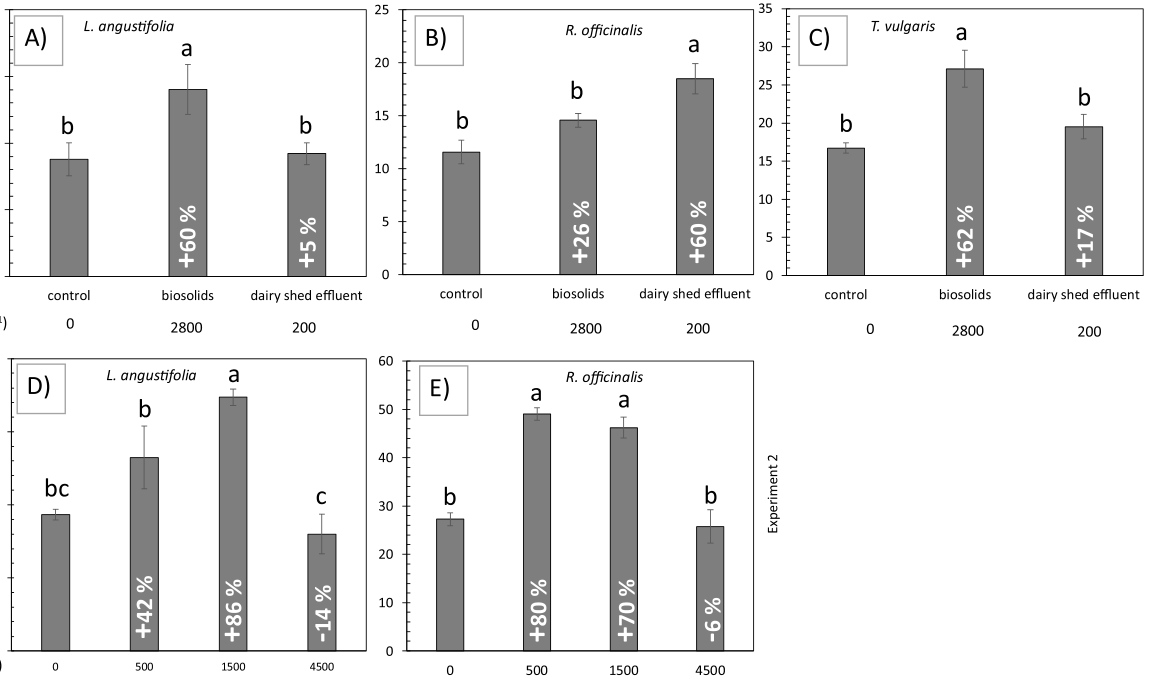
Fig. 1 shows that biosolids (CB) application of up to rate of 1500 kg N ha−1 equiv. significantly increased the dry biomass of L. angustifolia and R. officinalis by 86 % and 70 %, respectively and applying KB at the rate of 2800 kg N ha−1 equiv. increased the biomass of T. vulgaris by 62 % in the LSL. The maximum biomass increase for L. angustifolia clusters occurred when CB (1500 kg N ha−1 equiv.) were added to the LSL. The higher rates of application did not significantly increase growth and the highest rate of application (13,500 kg N ha−1 equiv.) killed the plants. The KB application of 2800 kg N ha−1 equiv. to the LSL significantly increased the dry biomass of L. angustifolia by 60 %. The application of 200 kg N ha−1 equiv. of DSE to the LSL increased the growth of R. officinalis by 60 % compared with the control. However, DSE application did not increase the biomass of the other two species.
图1显示,在 LSL 中,生物固体(CB)施用量不超过 1500 kg N ha−1 当量时,L. angustifolia 和 R. officinalis 的干生物量分别显著增加 86 % 和 70 %;以 2800 kg N ha−1 当量施用 KB 使 T. vulgaris 生物量增加 62 %。向 LSL 添加 CB(1500 kg N ha−1 当量)时,L. angustifolia 花簇生物量增幅最大。更高施用量未显著促进生长,最高施用量(13,500 kg N ha−1 当量)导致植株死亡。向 LSL 施用 2800 kg N ha−1 当量 KB 使 L. angustifolia 干生物量显著增加 60 %。与对照相比,向 LSL 施用 200 kg N ha−1 当量 DSE 使 R. officinalis 生长增加 60 %。但 DSE 施用未提高其余两个物种的生物量。
While the rates of biosolids application that significantly increased the plants’ growth in the experiments exceed the regulatory threshold for annual application of N (Gibbs, 2003) most of the biosolids N is present as organic form. When the organic matter in biosolids oxidises N is released slowly, therefore the high biosolids application rates would not result in excessive N leaching (Paramashivam, 2015). Increasing the CB application rate increased both biomass and foliar N concentration of the plants, a process that is called luxury uptake (McLaren and Cameron, 1996a).
尽管试验中显著促进植物生长的生物固体施用量超过了年施氮量的法规限值(Gibbs, 2003),但生物固体中的氮大部分以有机态存在。生物固体中的有机质氧化时氮缓慢释放,因此较高的生物固体施用量不会导致过量的氮淋溶(Paramashivam, 2015)。提高 CB 施用量同时增加了植物生物量和叶片氮浓度,这一过程称为奢侈吸收(McLaren and Cameron, 1996a)。
Increased biomass in L. angustifolia and R. officinalis following biosolids application is consistent with the findings of Agulló et al. (2011); Cala et al. (2005a). Similarly, Yadegari and Mosadeghzad (2012) showed that manure application increased the biomass and EO production of T. vulgaris. Soils tested in the current study and the experiment of Cala et al. (2005a) were both degraded and had C and N content range of 0.56 %–4.5 % and 0.06 %-0.23 %, respectively. Nevertheless, adding biowastes to high fertility soils may cause an adverse effect on plant biomass (Tabatabaie and Nazari, 2007) and reduce EO production (Rahmani and Tabaei-Aghdaei, 2014; Petropoulos et al., 2009; Tabatabaie and Nazari, 2007). The results show that high levels of biosolids addition reduce plant growth, probably due to toxic agents within the biosolids. In this study DSE was applied at a lower rate (200 kg N ha−1 equiv.) because it commonly contains a higher percentage of plant-available inorganic N. However, DSE only produced a significant biomass increase in R. officinalis. While higher rates may have resulted in greater biomass increases, the land application of DSE is limited to 200 kg N ha−1 equiv. in most jurisdictions (BPDNZ, 2011).
施用生物固体(污泥)后 L. angustifolia 和 R. officinalis 生物量增加,这与 Agulló et al. (2011); Cala et al. (2005a) 的研究结果一致。同样,Yadegari and Mosadeghzad (2012) 发现施用粪肥可提高 T. vulgaris 的生物量和精油产量。本研究与 Cala et al. (2005a) 试验所用土壤均为退化土壤,其 C 和 N 含量范围分别为 0.56 %–4.5 % 和 0.06 %-0.23 %。然而,向高肥力土壤添加生物废弃物可能对植物生物量产生不利影响(Tabatabaie and Nazari, 2007),并降低精油产量(Rahmani and Tabaei-Aghdaei, 2014; Petropoulos et al., 2009; Tabatabaie and Nazari, 2007)。结果表明,高量添加生物固体会抑制植物生长,这可能是生物固体中的有毒物质所致。本研究中 DSE 的施用量较低(200 kg N ha−1 当量),因为其通常含有较高比例的植物有效无机氮。然而,DSE 仅使 R. officinalis 生物量显著增加。虽然更高的施用量可能带来更大的生物量增幅,但在大多数司法管辖区,DSE 的土地施用量限定为 200 kg N ha−1 当量(BPDNZ, 2011)。
Other studies have similarly reported biomass increase by biowastes application (Monterumici et al., 2015; Seyedalikhani et al., 2016; Massa et al., 2016; Gutiérrez-Ginés et al., 2017). The increased biomass of the plants grown in biowastes amended soils would reduce the albedo and the consequent microclimate change would affect the atmosphere. The positive effect of biowastes on plant growth could be due to their available nutrients including N, P, K and S. Biowastes, including biosolids and DSE contain organic material. Organic material supports the plants’ growth and increases Cation Exchangeable Capacity (CEC) (Antolín et al., 2005; Weber et al., 2007) that results in retaining nutrients and making some of them available for the plants (Weber et al., 2007; Kaur et al., 2008). Given that these experiments investigated just a single application of biosolids, long-term repeated applications may have different outcomes due to the increased availability of other nutrients and the accumulation of potentially toxic HMs in the soil (Black, 2010).
其他研究同样报道了施用生物废弃物可增加生物量(Monterumici et al., 2015; Seyedalikhani et al., 2016; Massa et al., 2016; Gutiérrez-Ginés et al., 2017)。在生物废弃物改良土壤中生长的植物生物量增加会降低反照率,由此引起的小气候变化将影响大气。生物废弃物对植物生长的促进作用可能源于其所含的有效养分,包括 N、P、K 和 S。生物废弃物(包括生物固体和 DSE)含有有机物质。有机物质可促进植物生长并提高阳离子交换量(CEC)(Antolín et al., 2005; Weber et al., 2007),从而保持养分并使部分养分可被植物利用(Weber et al., 2007; Kaur et al., 2008)。鉴于本试验仅研究了生物固体的单次施用,由于其他养分有效性的提高以及潜在有毒重金属在土壤中的累积,长期重复施用可能产生不同的结果(Black, 2010)。
3.2. Effect of the biowastes on leaf elemental composition3.2. 生物废弃物对叶片元素组成的影响
An application rate of biosolids at or around 1500 kg N ha−1, resulted in significant increases in the concentrations of foliar N, P and S in L. angustifolia and R. officinalis, while concentration of Mg was largely unaffected (Tables 2–4). The concentration of Cu was increased following the application of KB (2800 kg N ha−1 equiv.) in all three plant species. The mass (and hence uptake) of all the macronutrients increased because of the significant rise in biomass resulting from the application of biosolids. The concentration of Cd in the plants was compared with food safety standards (ANZFSC, 2015). These standards are conservative indicator of HMs concentrations in the leaves that may pose a risk to human health. The maximum safe concentration of Cd in the fresh leaves is 0.1 mg kg−1. In this research, dried leaves were used for elements measurement that shows the concentrations higher than the fresh weight. The plants had the water content of ca. 70 %. Therefore, the Cd concentration up to 0.33 mg kg−1 of the dry leaves for these plants is accepted as safe level. Cd concentration in the analysed plants were ≤3*10-4 mg kg−1.
生物固体施用量为 1500 kg N ha−1 左右时,L. angustifolia 和 R. officinalis 叶片 N、P 和 S 浓度显著增加,而 Mg 浓度基本未受影响(表2–4)。施用 KB(2800 kg N ha−1 当量)后,三种植物的 Cu 浓度均有所增加。由于施用生物固体使生物量显著增加,所有大量营养元素的质量(即吸收量)均有所增加。将植物中的 Cd 浓度与食品安全标准(ANZFSC, 2015)进行了比较。这些标准是叶片中可能对人体健康构成风险的重金属浓度的保守指标。新鲜叶片中 Cd 的最高安全浓度为 0.1 mg kg−1。本研究采用干叶测定元素,其浓度高于鲜重浓度。植物含水量约为 70 %。因此,对于这些植物,干叶中 Cd 浓度不超过 0.33 mg kg−1 可视为安全水平。所分析植物中的 Cd 浓度 ≤3*10-4 mg kg−1。
Elemental concentrations of L. angustifolia leaves in Exp. 1 (n = 3) and Exp. 2 (n = 5). Numbers in in the treatments represent the concentration of N equiv. (kg ha−1) of biowastes applied to the soils. Different letters (a, b, c, d) represent significant differences between the treatments of each experiment (based on Fisher’s Least- Significant-Difference test at P ≤0.05). Standard errors are given in parentheses. KB and CB represent Kaikoura Biosolids and Christchurch City Council biosolids, respectively.
Exp. 1(n = 3)和 Exp. 2(n = 5)中 L. angustifolia 叶片的元素浓度。处理中的数字表示施入土壤的生物废弃物的 N 当量(kg ha−1)。不同字母(a, b, c, d)表示同一试验内各处理间差异显著(基于 Fisher 最小显著差数法检验,P ≤0.05)。括号内为标准误。KB 和 CB 分别代表 Kaikoura 生物固体和基督城市议会生物固体。
| Treatment (kg N ha−1 equiv.)处理(kg N ha−1 当量) | N g kg−1 dry matterN g kg−1 干 物质 | P | K | S | Ca mg kg−1 dry matterCa mg kg−1 干 物质 | Mg | Zn | Cu | Cd | |
|---|---|---|---|---|---|---|---|---|---|---|
| Exp. 1 | Control (0) | 15 (0.3)b | 1646 (104)c | 6341 (643)b | 2649 (300)b | 18663 (521)b | 5715 (172)ab | 58 (15.1) | 4.9 (0.8)b | ≤3*10−4 |
| KB (2800) fl | 16 (0.7)b | 2738 (106)a | 6804 (317)b | 4228 (405)a | 20890 (386)a | 6497 (539)a | 58.9 (3.1) | 14 (1.5)a | ≤3*10−4 | |
| Dairy shed effluent (200) | 18 (0.4)a | 2115 (50)b | 9329 (319)a | 3139 (200)b | 16647 (632)c | 4747 (261)b | 47.2 (4.4) | 8.6 (0.8)b | ≤3*10−4 | |
| Exp. 2 | fl Control (0) | 15 (0.5)d | 1950 (76)c | 12433 (539)a | 3151 (89.3)c | 17145 (324)b | 6383 (106) | 38.1 (2.2) | 4.5 (0.4) | ≤3*10−4 |
| CB (500) | 18 (0.7)c | 2742 (252)b | 8556 (247)bc | 4011 (260)b | 18500 (862)b | 6612 (301) | 44.9 (1.5) | 7.7 (0.6) | ≤3*10−4 | |
| CB (1500) | 20 (0.2)b | 2756 (93)b | 7636 (449)c | 3930 (128)b | 21457 (402)a | 6413 (238) | 47 (1.5) | 5.6 (0.3) | ≤3*10−4 | |
| CB (4500) | 25 (0.5)a | 3780 (192)a | 9912 (1027)b | 4643 (172)a | 21901 (1436)a | 6506 (447) | 78.7 (3.6) | 4.4 (0.2) | ≤3*10−4 | |
| CB (13500)* | 26 | 4236 | 6404 | 4502 | 24622 | 5706 | 115.5 | 4.2 | ≤3*10−4 |
* Only one sample thrived in this treatment. Therefore, mean calculation and statistical comparison was not possible.
* 该处理仅一个样品存活,因此无法计算均值和进行统计比较。
Elemental concentrations of R. officinalis leaves in Exp. 1 (n = 3) and Exp. 2 (n = 5). Numbers in in the treatments represent the concentration of N equiv. (kg ha−1) of biowastes applied to the soils. Different letters (a, b, c, d) represent significant differences between the treatments of each experiment (based on Fisher’s Least- Significant-Difference test at P ≤0.05). Standard errors are given in parentheses. KB and CB represent Kaikoura Biosolids and Christchurch City Council biosolids, respectively.
Exp. 1(n = 3)和 Exp. 2(n = 5)中 R. officinalis 叶片的元素浓度。处理中的数字表示施入土壤的生物废弃物的 N 当量(kg ha−1)。不同字母(a, b, c, d)表示同一试验内各处理间差异显著(基于 Fisher 最小显著差数法检验,P ≤0.05)。括号内为标准误。KB 和 CB 分别代表 Kaikoura 生物固体和基督城市议会生物固体。
| Treatment (kg N ha−1 equiv.)处理(kg N ha−1 当量) | g kg−1 dry | mg kg−1 dry | ||||||||
|---|---|---|---|---|---|---|---|---|---|---|
| matter | matter | |||||||||
| Exp. 1 | Control (0) | 11 (2.6) | 1000 (214)b | 7412 (1061)b | 1511 (259)b | 13032 (803)ab | 2225 (282) | 56 (22) | 2.8 (1.1)b | ≤3*10−4 |
| KB (2800) fl | 11 (0.8) | 1969 (351)a | 7054 (80)b | 2897 (256)a | 14095 (626)a | 2928 (535) | 54 (9.6) | 11 (0.4)a | ≤3*10−4 | |
| Dairy shed effluent (200) | 16 (0.8) | 1444 (42)ab | 16980 (2159)a | 2019 (163)b | 10397 (1406)b | 1824 (76) | 39 (4.1) | 4.8 (0.2)b | ≤3*10−4 | |
| Exp. 2 | fl Control (0) | 11 (0.2)d | 2011 (112)c | 10056 (471)a | 2923 (188)bc | 11747 (848)b | 2399 (169)bc | 38 (3.0) | 2.0 (0.1) | ≤3*10−4 |
| CB (500) | 13 (0.7)c | 2601 (123)b | 6577 (416)b | 2788 (168)c | 10562 (574)b | 2310 (123)c | 33 (2.2) | 6.0 (0.4) | ≤3*10−4 | |
| CB (1500) | 16 (0.5)b | 2518 (131)bc | 6300 (349)b | 3369 (139)b | 10962 (666)b | 2717 (86.4)b | 39 (0.4) | 7.6 (0.6) | ≤3*10−4 | |
| CB (4500) | 23 (1.0)a | 3246 (331)a | 11392 (1686)a | 3981 (125)a | 15658 (1275)a | 3465 (92)a | 80 (7.5) | 6.2 (0.5) | ≤3*10−4 |
The increase in foliar Cu by KB application was consistent with the findings of Dickinson et al. (2015) and Gartler et al. (2013). The plants’ HMs concentrations were lower than the limits that can pose a risk to human health and animals that is supported by results of previous experiments on L. scoparium, K. robusta Esperschuetz et al. (2017a) and R. officinalis Cala et al. (2005a). For instance, the toxic levels of Zn and Cu are 225−450 mg and 250−500 mg (Barceloux and Barceloux, 1999; Bingham et al., 2001), although could vary among the individuals. Scora and Chang (1997) showed that the HMs concentration in Mentha piperita grown in soil treated with sewage sludge was same as control (< 1 mg L−1). Cultivation of Mentha piperita and Mentha arvensis in soils that contained high concentrations of Cd, Pb, and Cu showed that there is no risk of excessive HMs transfer into the EOs. Moreover, high HMs concentrations in the soil did not change the EO compositions to the extent that would invalidate marketability (Zheljazkov et al., 2006). The EO quality of Vetiveria zizanoides grown in soil treated with moderate concentrations of Cr, Cd and Ni (25 mg Cr, 25 and 50 mg of Cd, and 50 mg kg−1 soil) was improved due to increased concentrations of some key EO components, e.g. khuzimol Prasad et al. (2014a).
施用 KB 后叶片 Cu 增加,这与 Dickinson et al. (2015) 和 Gartler et al. (2013) 的研究结果一致。植物重金属浓度低于可能对人类和动物健康构成风险的限值,这得到了先前对 L. scoparium、K. robusta Esperschuetz et al. (2017a) 和 R. officinalis Cala et al. (2005a) 试验结果的支持。例如,Zn 和 Cu 的中毒剂量分别为 225−450 mg 和 250−500 mg(Barceloux and Barceloux, 1999; Bingham et al., 2001),但可能因个体而异。Scora and Chang (1997) 表明,在施用污水污泥的土壤中生长的 Mentha piperita 重金属浓度与对照相同(< 1 mg L−1)。在含高浓度 Cd、Pb 和 Cu 的土壤中栽培 Mentha piperita 和 Mentha arvensis 的研究表明,不存在重金属过量转移至精油的风险。此外,土壤中高浓度重金属并未使精油成分改变到影响其市场销售的程度(Zheljazkov et al., 2006)。在添加中等浓度 Cr、Cd 和 Ni(25 mg Cr,25 和 50 mg Cd,以及 50 mg kg−1 土壤)的土壤中生长的 Vetiveria zizanoides,由于部分关键精油组分(如岩兰草醇)浓度提高,其精油品质得到改善 Prasad et al. (2014a)。
There are some concerns about the accumulation of biowastesborne HMs in soil (Natal-da-Luz et al., 2012). However, since EOs are usually obtained through distillation process, HMs are less concentrated in the EOs compared with leaves (Supplementary Table S-4), there is less apprehension about the biowastes contaminating HMs transfer to the EOs. Bağdat and Eid (2007); Street (2012) and Zheljazkov et al. (2008) demonstrated that medicinal plants can be safely cultivated in soils contaminated by HMs (including Cu and Zn) for EO production. Moreover, biosolids for instance, show the potential of reducing the phytoavailability of heavy metals, like Pb and Cd in contaminated soils (Basta et al., 2001). It should be noted that the application of biowastes to high fertility soils is unlikely to increase nutrient uptake as much as in low-fertility ones. The benefits of increased nutrients may be offset by increases in some elements to levels that are toxic for the plants (Morgan and Connolly, 2013). Moreover, increasing the mobile nutrients like N following some of the biowastes application, can result in excessive N leaching (Cogger et al., 2001; White et al., 2011) and some elements such as P, Ca, Mg and HMs micronutrients that are relatively immobile in the soil may accumulate following repeated applications (MU, 2018).
生物废弃物携带的重金属在土壤中的累积引起了一定担忧(Natal-da-Luz et al., 2012)。然而,由于精油通常通过蒸馏获得,精油中的重金属浓度低于叶片(补充材料表 S-4),因此对生物废弃物中污染性重金属转移至精油的顾虑较小。Bağdat and Eid (2007); Street (2012) 和 Zheljazkov et al. (2008) 证明,药用植物可安全地种植于受重金属(包括 Cu 和 Zn)污染的土壤中用于生产精油。此外,以生物固体(污泥)为例,其具有降低污染土壤中 Pb 和 Cd 等重金属植物有效性的潜力(Basta et al., 2001)。需要指出的是,向高肥力土壤施用生物废弃物对养分吸收的促进作用不太可能像在低肥力土壤中那样明显。养分增加带来的益处可能会被某些元素增加至对植物有毒的水平所抵消(Morgan and Connolly, 2013)。此外,施用某些生物废弃物后,N 等移动性养分的增加可能导致过量的氮淋溶(Cogger et al., 2001; White et al., 2011),而 P、Ca、Mg 以及属于微量营养元素的重金属等在土壤中移动性相对较差的元素,可能在重复施用后发生累积(MU, 2018)。
3.3. Essential oils3.3. 精油
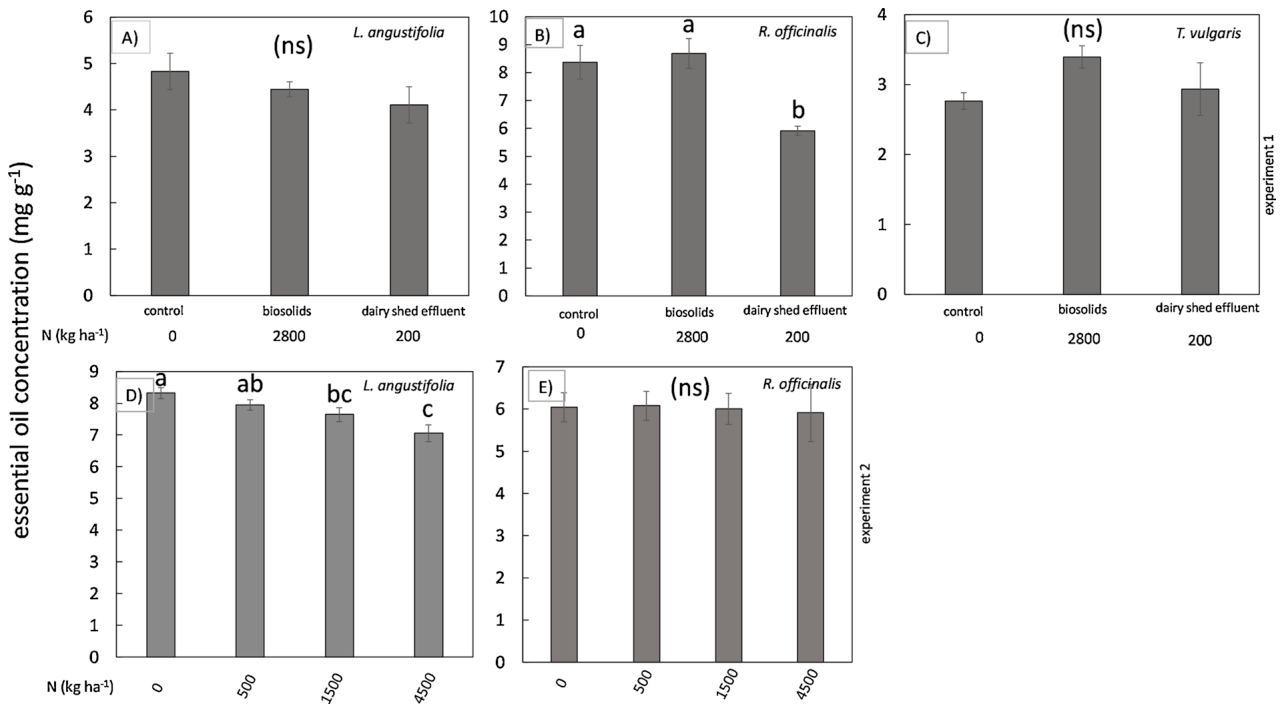
The effect of biowastes application on the EO producing plants’ biomass and elemental composition is equally important as the EO concentrations in terms of EO production. In this study the EO concentration in the controls of L. angustifolia and R. officinalis ranged from 0.48 %-0.83 % (4.8–8.3 mg g−1 F.W.) and 0.60 %-0.84 % (6.0–8.4 mg g−1 F.W.), respectively (Fig. 2). The average concentration of T. vulgaris EO in the control was 0.34 % (3.4 mg g−1 F.W.). The EO concentrations of R. officinalis significantly decreased by ca. 29 % when DSE (200 kg N ha−1 equiv.) was applied to LSL. Mixing more than 1500 kg N ha−1 equiv. CB with LSL significantly decreased (< 8 %) the L. angustifolia EO concentration (Fig. 2 D). None of the other biowaste treatments changed the EO concentrations. There was a significant negative correlation between the L. angustifolia EO concentration and the level of N in CB applied to the soil.
就精油生产而言,施用生物废弃物对产精油植物生物量和元素组成的影响与对精油含量的影响同等重要。本研究中,L. angustifolia 和 R. officinalis 对照组的精油含量分别为 0.48 %-0.83 %(4.8–8.3 mg g−1 F.W.)和 0.60 %-0.84 %(6.0–8.4 mg g−1 F.W.)(图2)。对照组 T. vulgaris 精油平均含量为 0.34 %(3.4 mg g−1 F.W.)。向 LSL 施用 DSE(200 kg N ha−1 当量)后,R. officinalis 精油含量显著降低约 29 %。向 LSL 混入超过 1500 kg N ha−1 当量的 CB 使 L. angustifolia 精油含量显著降低(< 8 %)(图2 D)。其他生物废弃物处理均未改变精油含量。L. angustifolia 精油含量与施入土壤的 CB 氮水平呈显著负相关。
Elemental concentrations of T. vulgaris leaves in Exp. 1 (n = 3). Numbers in in the treatments represent the concentration of N equiv. (kg ha−1) of biowastes applied to the soils. Different letters (a, b, c, d) represent significant differences between the treatments (based on Fisher’s Least-Significant-Difference test at P ≤0.05). Standard errors are given in parentheses. KB represents the Kaikoura Biosolids.
Exp. 1(n = 3)中 T. vulgaris 叶片的元素浓度。处理中的数字表示施入土壤的生物废弃物的 N 当量(kg ha−1)。不同字母(a, b, c, d)表示各处理间差异显著(基于 Fisher 最小显著差数法检验,P ≤0.05)。括号内为标准误。KB 代表 Kaikoura 生物固体。
| Treatment (kg N ha−1 equiv.)处理(kg N ha−1 当量) | g kg−1 dry matterg kg−1 干物质 | mg kg−1 dry mattermg kg−1 干物质 | ||||||||
|---|---|---|---|---|---|---|---|---|---|---|
| Exp. 1 | Control (0) | 11 (0.9) | 1167 (115) | 7048 (323) | 1162(96.2) | 9768 (517)b | 2012 (193) | 63 (22) | 2.3 (0.3)b | ≤3*10−4 |
| KB (2800) fl | 11 (0.5) | 1610 (52) | 6926 (195) | 1224 (85.5) | 10562 (340)ab | 2596 (422) | 66 (13) | 4.5 (0.1)a | ≤3*10−4 | |
| Dairy shed effluent (200) | 14 (2.4) | 1580 (226) | 11826 (3495) | 1396 (123) | 11889 (856)a | 2204 (85) | 51 (6.6) | 4.0 (0.9)ab | ≤3*10−4 |
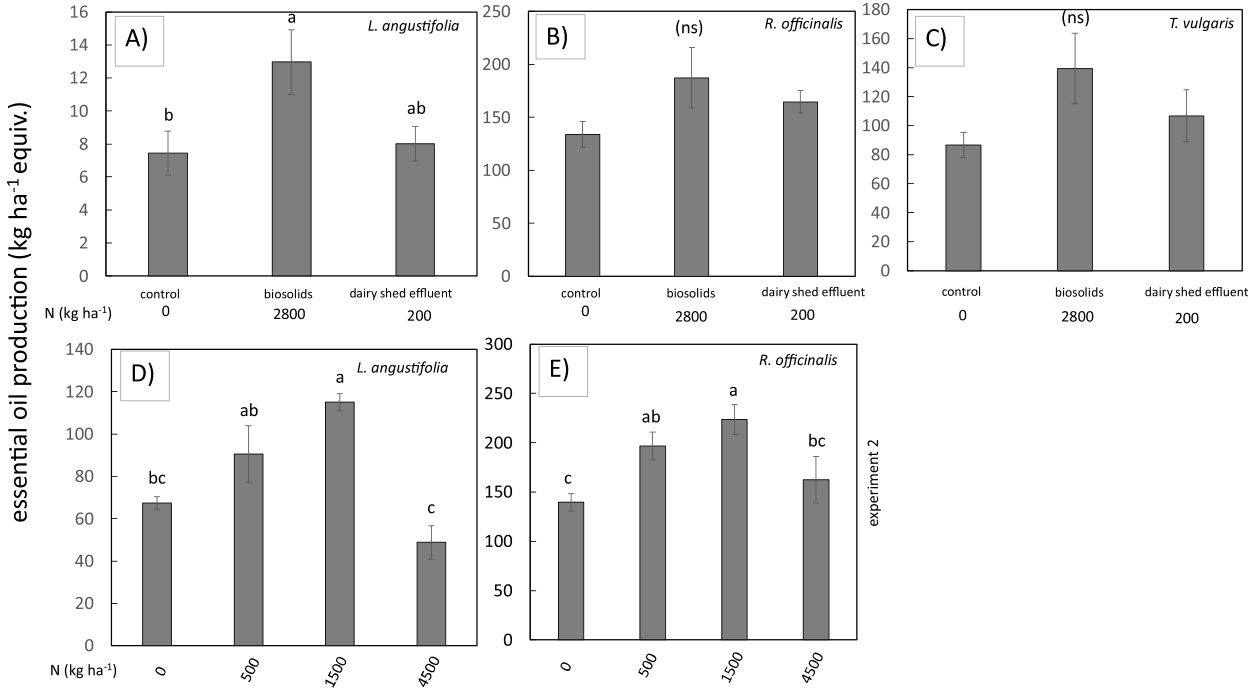
The EO production of L. angustifolia, R. officinalis and T. vulgaris was increased by biosolids application but not the DSE. Applying 2800 kg N ha−1 equiv. of KB and 1500 kg N ha−1 equiv. of CB to LSL significantly increased the EO production of L. angustifolia by 74 % and 69 % in Exp. 1 and Exp. 2, respectively (Fig. 3 A and D). The application of 1500 kg N ha−1 equiv. CB to LSL significantly increased the R. officinalis EO production (by 60 %) in Exp. 2 (Fig. 3 E) while KB had no effect on the EO production (Fig. 3 B). Although the dry biomass of R. officinalis was highest in the 500 kg N ha−1 equiv. CB application (Fig. 1 E), the maximum oil production was related to 1500 kg N ha−1 biosolids application. This was because the fresh biomass and water content of the plants were higher when 1500 kg N ha−1 biosolids were applied to the soil. Biowastes application did not change the EO production by T. vulgaris in LSL (Exp. 1) (Fig. 3 C). The maximum EO production increase occurred with L. angustifolia. The EO production increased by 74 % in
施用生物固体提高了 L. angustifolia、R. officinalis 和 T. vulgaris 的精油产量,而 DSE 则无此作用。向 LSL 施用 2800 kg N ha−1 当量 KB 和 1500 kg N ha−1 当量 CB,使 Exp. 1 和 Exp. 2 中 L. angustifolia 的精油产量分别显著增加 74 % 和 69 %(图3 A 和 D)。在 Exp. 2 中,向 LSL 施用 1500 kg N ha−1 当量 CB 使 R. officinalis 精油产量显著增加(60 %)(图3 E),而 KB 对精油产量无影响(图3 B)。尽管 R. officinalis 干生物量在 500 kg N ha−1 当量 CB 处理下最高(图1 E),但最大产油量出现在 1500 kg N ha−1 生物固体处理下。这是因为向土壤施用 1500 kg N ha−1 生物固体时,植物鲜生物量和含水量更高。在 LSL 中(Exp. 1),施用生物废弃物未改变 T. vulgaris 的精油产量(图3 C)。精油产量增幅最大的是 L. angustifolia。精油产量在
Exp. 1 and 71 % in Exp. 2 when 2800 kg N ha−1 equiv. of KB and 1500 kg N ha−1 equiv. of CB were applied to LSL (Fig. 3 A and D) 2.
向 LSL 施用 2800 kg N ha−1 当量 KB 和 1500 kg N ha−1 当量 CB 时,Exp. 1 中增加 74 %,Exp. 2 中增加 71 %(图3 A 和 D)2。
In our study the EO concentration3 of T. vulgaris did not reduce when the biomass was increased following the application of biowastes (Fig. 2 C). For R. officinalis and L. angustifolia, some of the biowaste treatments significantly reduced the oil concentration (Fig. 2 B & D), thereby offsetting some of the gain resulting from increased growth (Fig. 1 B &D). It was expected that EO concentration would either decrease because of the high concentration of plant essential nutrients that make an optimum condition for the plants growth (Stevović et al., 2011; Abdelmajeed et al., 2013; Obi and Ebo, 1995) or increase due to the presence of HMs in the biowastes, which increase the stress for the plants Prasad et al. (2014a). For example, N increases the rate of photosynthesis, which increases the growth and biomass, but it can decrease the EO components concentration (Shabahang et al., 2016), although the concentration changes are not consistent. Shabahang et al. (2016) showed that the application of up to 100 kg N ha−1 equiv. urea decreased the EO concentration of Nigella sativai and Foeniculum vulgare. Milthorpe et al. (1994) found no change in the EO concentration and yield of Eucalyptus polybmctea following 30 kg ha−1 application of N and P fertilizers. Close et al. (2004) found higher EO level in E. globulus and E. nitens (Myrtaceae family) when fertilizer (N: P: K 20:2.2:6.6; solution concentration 1 g L−1) was applied twice a week compared with once a week.
本研究中,施用生物废弃物后生物量增加,但 T. vulgaris 的精油含量3并未降低(图2 C)。对于 R. officinalis 和 L. angustifolia,部分生物废弃物处理显著降低了含油量(图2 B & D),从而抵消了生长增加带来的部分收益(图1 B &D)。原先预期精油含量或因植物必需养分浓度高、为植物生长创造了最适条件而降低(Stevović et al., 2011; Abdelmajeed et al., 2013; Obi and Ebo, 1995),或因生物废弃物中存在重金属、加剧植物胁迫而升高 Prasad et al. (2014a)。例如,N 可提高光合速率,从而促进生长、增加生物量,但可能降低精油组分浓度(Shabahang et al., 2016),尽管浓度变化并不一致。Shabahang et al. (2016) 表明,施用不超过 100 kg N ha−1 当量的尿素降低了 Nigella sativai 和 Foeniculum vulgare 的精油含量。Milthorpe et al. (1994) 发现,施用 30 kg ha−1 的 N 和 P 肥料后,Eucalyptus polybmctea 的精油含量和产量均无变化。Close et al. (2004) 发现,与每周施肥一次相比,每周施肥两次(N: P: K 20:2.2:6.6;溶液浓度 1 g L−1)时 E. globulus 和 E. nitens(桃金娘科)的精油含量更高。
In our study, the EO composition of the plants were slightly affected by some of the biowastes treatments. However, the magnitude of the changes in the concentration of EO components were mostly < 20 %. The time of the sampling for the EO production is also important in the quality and quantity of the produced EO. Figueiredo et al. (2008) and Hussain et al. (2008) demonstrated that the EO composition and yield of Achillea millefolium and Ocimum basilicum significantly changed during the season. During the vegetative period, Achillea millefolium EO had higher sesquiterpene hydrocarbons, while in the flowering season, the monoterpene hydrocarbons were dominant. Ocimum basilicum showed higher EO content (0.8 %) in winter than summer (0.5 %).
本研究中,部分生物废弃物处理对植物精油组成有轻微影响,但精油组分浓度的变化幅度大多 < 20 %。精油生产的采样时间对所产精油的品质和数量同样重要。Figueiredo et al. (2008) 和 Hussain et al. (2008) 证明,Achillea millefolium 和 Ocimum basilicum 的精油组成和产量在季节内发生显著变化。在营养生长期,Achillea millefolium 精油中倍半萜烃含量较高,而在开花期则以单萜烃为主。Ocimum basilicum 冬季精油含量(0.8 %)高于夏季(0.5 %)。
The EO production of L. angustifolia and R. officinalis was increased by biosolids application although T. vulgaris EO production did not change following the application of biosolids and DSE. The findings of Scavroni et al. (2005) are consistent with the results of this experiment. They found no change in the Mentha piperita EO quality but increase in the EO quantity in presence of 28 t ha−1 biosolids application. Other studies also reported the EO production increase by biowastes application. Results of an experiment on Rosa damascena showed that EO production increased by 59 % when cow manure was applied at the rate of 15 t ha−1 (Rahmani and Tabaei-Aghdaei, 2014). Similarly, EO production of Ocimum basilicum significantly increased following the application of 10 t ha−1 farmyard manure with 1.28 % N, 2.14 % P, and 0.95 % K (Anwar et al., 2005). Kumar and Patra (2012) showed that mixing organic wastes with fly ash and garden soil increases the EO content of Mentha piperita. Darvishi et al. (2010) also reported a 17 % EO production increase by irrigating the Ocimum basilicum with treated domestic wastewater.
施用生物固体(污泥)提高了L. angustifolia和R. officinalis的精油(EO)产量,而施用生物固体和DSE后T. vulgaris的精油产量未发生变化。Scavroni et al. (2005) 的研究结果与本试验结果一致,他们发现施用28 t ha−1生物固体后,Mentha piperita的精油品质未变,但精油产量有所增加。其他研究也报道了施用生物废弃物可提高精油产量。Rosa damascena的试验结果表明,以15 t ha−1的用量施用牛粪后,精油产量提高了59 %(Rahmani and Tabaei-Aghdaei, 2014)。同样,施用10 t ha−1含1.28 % N、2.14 % P和0.95 % K的农家肥后,Ocimum basilicum的精油产量显著增加(Anwar et al., 2005)。Kumar and Patra (2012) 研究表明,将有机废弃物与粉煤灰及园土混合可提高Mentha piperita的精油含量。Darvishi et al. (2010) 亦报道,用处理后的生活污水灌溉Ocimum basilicum可使精油产量提高17 %。
Applying up to 2800 kg N ha−1 equiv. of the biosolids significantly increased the EO production of L. angustifolia by more than 70 % in both experiments (Fig. 3 A and D). This result is supported by Hadipour et al. (2013) experiment that showed an increase in L. angustifolia EO content following 180 kg N ha−1 application. There are other cases that showed
施用最高相当于2800 kg N ha−1的生物固体(污泥),在两个试验中均使L. angustifolia的精油产量显著提高70 %以上(图3 A和D)。Hadipour et al. (2013) 的试验结果支持这一结论,该试验表明施用180 kg N ha−1后L. angustifolia的精油含量增加。另有其他案例表明
2 Supplementary figures and tables provide further information about the affected components and the major components of the EOs.
2 补充图表进一步提供了受影响组分及精油主要组分的相关信息。
3 It should be clarified that the total EO concentrations of L. angustifolia, R. officinalis and T. vulgaris in our experiments were less than the average of commercially grown plants that usually is obtained by distillation (Esoteric- Oils, 2014). The EO concentration in untreated low-fertility soil used in this research only reached 50% of the commercial production rate.
3 需要说明的是,本试验中L. angustifolia、R. officinalis和T. vulgaris的总精油浓度低于通常经蒸馏获得的商业种植植物的平均水平(Esoteric- Oils, 2014)。本研究所用未处理低肥力土壤中的精油浓度仅达到商业生产水平的50%。
N application would enhance the production of EOs in various plants. For example, 60 kg ha−1 application of urea increased the Tanacetum parthenium EO production (Hamisi et al., 2012). Similarly, R. officinalis EO content significantly increased by applying N and K (150 and 100 kg ha−1 yr−1) in forms of urea and muriate of potash (Puttanna et al., 2010). These findings are parallel with the results of Exp. 2 (Fig. 3 E) that application of up to 1500 kg N ha−1 equiv. of CB increased the EO production of R. officinalis.
施用氮素可提高多种植物的精油产量。例如,施用60 kg ha−1尿素提高了Tanacetum parthenium的精油产量(Hamisi et al., 2012)。同样,以尿素和氯化钾形式施用N和K(150和100 kg ha−1 yr−1)显著提高了R. officinalis的精油含量(Puttanna et al., 2010)。这些结果与试验2的结果(图3 E)相一致,即施用最高相当于1500 kg N ha−1的CB提高了R. officinalis.的精油产量。
4Conclusions结论
The growth of L. angustifolia, R. officinalis and T. vulgaris was increased by the addition of biowastes to a low-fertility soil. Foliar concentrations of HMs, including Cd, were always below the food safety standards. In most cases, the addition of biowastes did not reduce the EO concentration and quality in the plants, hence, the increased biomass resulting from biowaste addition would result in an improved EO yield. This study showed that low-fertility or contaminated soils could be beneficially rebuilt using a single biosolids application equivalent to 1500 kg N ha−1 without the risk of human exposure to HMs. This would give the greatest growth response while likely remaining within environmental constraints relating to nitrate leaching. Regulations may need to be adjusted to allow this. Clearly, as the EO crops mature, further nutrients will need to be applied. Nitrogen could be applied through mineral fertilisers or alternatively through further applications of biowastes. Longer-term experiments would clarify the options for repeated applications with time. Future work is needed to compare the application of same rates of elements (e.g. N, P, K, Ca and Mg) by mineral fertilizers and biowastes in terms of EO production. The effect of higher N concentration or other type of biosolids application on T. vulgaris EO has not been evaluated, which could be the subject of future research. The biowastes effect on the EOs would be different in contrasting environments and based on the biowastes composition, soil type and plant species. However, the findings of the current research indicate that real benefits can be achieved through a combination of biosolids application and essential oil production on degraded land.
向低肥力土壤中添加生物废弃物促进了L. angustifolia、R. officinalis和T. vulgaris的生长。包括Cd在内的叶片重金属浓度始终低于食品安全标准。在大多数情况下,添加生物废弃物并未降低植物的精油浓度和品质,因此,添加生物废弃物所带来的生物量增加将提高精油产量。本研究表明,低肥力或受污染土壤可通过一次性施用相当于1500 kg N ha−1的生物固体(污泥)得到有益的重建,且不存在人体暴露于重金属的风险。该用量可获得最大的生长响应,同时可能仍处于与硝酸盐淋溶相关的环境限制范围之内。为此可能需要调整相关法规。显然,随着精油作物的成熟,还需进一步施用养分。氮素可通过矿质肥料施用,或通过再次施用生物废弃物补充。开展更长期的试验将有助于明确随时间重复施用的可选方案。未来的工作需就精油产量比较矿质肥料与生物废弃物施用相同量元素(如N、P、K、Ca和Mg)的效果。更高氮浓度或其他类型生物固体的施用对T. vulgaris精油的影响尚未评估,可作为未来研究的课题。生物废弃物对精油的影响会因环境条件不同而有所差异,并取决于生物废弃物组成、土壤类型和植物种类。然而,本研究结果表明,在退化土地上将生物固体施用与精油生产相结合可带来切实的效益。
Authors’ contributions作者贡献
BR, SS, ND, JE and DP designed the experiments. BR led the writing and all authors delivered feedback on the manuscript and final approval for publication.
BR、SS、ND、JE和DP设计了试验。BR主导论文撰写,全体作者对手稿提供了反馈意见并最终批准发表。
CRediT authorship contribution statementCRediT作者贡献声明
S. Seyedalikhani: Conceptualization, Methodology, Writing - review & editing, Writing - original draft. J. Esperschuetz: Conceptualization, Methodology, Software, Formal analysis. N.M. Dickinson: Supervision, Methodology, Writing - review & editing. R. Hofmann: Supervision, Methodology, Writing - review & editing. J. Breitmeyer: Conceptualization, Methodology, Software, Formal analysis. J. Horswell: Supervision, Methodology. D. Paramashivam: Conceptualization, Methodology, Software, Formal analysis. B.H. Robinson: Conceptualization, Methodology, Writing - review & editing, Writing - original draft.
S. Seyedalikhani:构思、方法、写作—审阅与编辑、写作—初稿。J. Esperschuetz:构思、方法、软件、形式分析。N.M. Dickinson:指导、方法、写作—审阅与编辑。R. Hofmann:指导、方法、写作—审阅与编辑。J. Breitmeyer:构思、方法、软件、形式分析。J. Horswell:指导、方法。D. Paramashivam:构思、方法、软件、形式分析。B.H. Robinson:构思、方法、写作—审阅与编辑、写作—初稿。
Declaration of Competing Interest利益冲突声明
The authors declare that they have no known competing financial interests or personal relationships that could have appeared to influence the work reported in this paper.
作者声明,不存在任何可能影响本文所报道工作的已知经济利益冲突或个人关系。
Acknowledgements致谢
We would like to thank Centre for Integrated Biowaste Research (CIBR) and NZIDRS for a doctoral scholarship and their support. We thank L. Clucas, B. Richards, R. McLenaghen, L. Hassall and M. Gutiérrez-Ginés for their information, maintaining the experiment and help in the laboratory. We acknowledge the reviewers comprehensive and useful comments on this manuscript.
感谢生物废弃物综合研究中心(CIBR)和NZIDRS提供的博士奖学金及支持。感谢L. Clucas、B. Richards、R. McLenaghen、L. Hassall和M. Gutiérrez-Ginés提供的信息、对试验的维护以及在实验室中给予的帮助。感谢审稿人对本文提出的全面而有益的意见。
Appendix A. Supplementary data附录A. 补充数据
Supplementary material related to this article can be found, in the online version, at doi:https://doi.org/10.1016/j.indcrop.2020.112108.
与本文相关的补充材料可在线上版本中查阅,doi:https://doi.org/10.1016/j.indcrop.2020.112108。
References参考文献
Abdelmajeed, N.A., Danial, E.N., Ayad, H.S., 2013. The effect of environmental stress on qualitative and quantitative essential oil of aromatic and medicinal plants. Arch. Sci. 66 (4), 100–120.
Agulló, E., Bustamante, M., Paredes, C., Moral, R., Pascual, J., Suárez-Estrella, F., 2011. Use of functional biosolids-derived composts as growing media for the production of lavender (Lavandula dentate) and rosemary (Rosmarinus officinalis). Symposium conducted at the meeting of the International Symposium on growing Media. Composting & Substrate Anal. 1013 (2011), 351–357.
Antolín, M.C., Pascual, I., García, C., Polo, A., Sánchez-Díaz, M., 2005. Growth, yield and solute content of barley in soils treated with sewage sludge under semiarid Mediterranean conditions. Field Crops Res. 94 (2-3), 224–237. Anwar, M., Patra, D., Chand, S., Alpesh, K., Naqvi, A.A., Khanuja, S., 2005. Effect of organic manures and inorganic fertilizer on growth, herb and oil yield, nutrient accumulation, and oil quality of French basil. Commun. Soil Sci. Plant Anal. 36 (13-14), 1737–1746.
ANZFSC, 2015. Australia New Zealand Food Standards Code - Standard 1.4.1 - Contaminants and Natural Toxicants. Available on2018, from. https://www. legislation.gov.au/Details/F2015C00052. Bağdat, R.B., Eid, E.M., 2007. Phytoremedation behaviour of some medicinal and aromatic plants to various pollutants. J. Field. Crops. Res (Ankara). 16 (1-2), 1–10.
Bai, S., Srikantaswamy, S., Krishnanandan, V., Naik, O.P., 2012. Speciation of heavy metals in biosolids of wastewater treatment plants at Mysore, Karnataka. India. Environ. Monit. Assess. 184 (1), 239–249.
Banchio, E., Bogino, P.C., Zygadlo, J., Giordano, W., 2008. Plant growth promoting rhizobacteria improve growth and essential oil yield in Origanum majorana L. Biochem. Syst. Ecol. 36 (10), 766–771. Baranauskiene, R., Venskutonis, P.R., Viskelis, P., Dambrauskiene, E., 2003. Influence of nitrogen fertilizers on the yield and composition of thyme (Thymus vulgaris). J. Agric. Food Chem. 51 (26), 7751–7758.
Barceloux, D.G., Barceloux, D., 1999. Copper. J. Toxicol. 37 (2), 217–230.
Baskaran, R., Cullen, R., Colombo, S., 2009. Estimating values of environmental impacts of dairy farming in New Zealand. New. Zeal. J. Agr. Res. 52 (4), 377–389.
Beyene, T., Verschuur, M., 2014. Assessment of constraints and opportunities of honey production in Wonchi district South West Shewa Zone of Oromia. Ethiopia. Am. J. Res. Commun. 2 (10), 342–353.
Biesiada, A., Sokol-Letowska, A., Kucharska, A., 2008. The effect of nitrogen fertilization on yielding and antioxidant activity of lavender (Lavandula angustifolia Mill.) [Article]. Acta Scientiarum Polonorum-Hortorum Cultus 7 (2), 33–40. Bingham, E., Cohrssen, B., Powell, C.H., 2001. Patty’S Toxicology: Toxicological Issues Related to Metals, Neurotoxicology and Radiation Metals and Metal Compounds Vol 2 John Wiley and Sons.
Black, A., 2010. Bioavailability of Cadmium, Copper, Nickel and Zinc in Soils Treated With Biosolids and Metal Salts. Lincoln University.
Black, A., McLaren, R.G., Reichman, S.M., Speir, T.W., Condron, L.M., 2010. Changes in Cd bioavailability in metal spiked soils amended with biosolids: results from a wheat seedling bioassay. In: Proceedings of the 19th World Congress of Soil Science: Soil Solutions for a Changing World. Brisbane, Australia, 1-6 August 2010. Symposium 2.5.2 Bioavailability of Metals and Organics, 42-45. Blackmore, L., Searle, P., Daly, B., 1987. Methods for Chemical Analysis of Soils (NZ Soil Bureau Scientific Report 80). NZ Soil Bureau, DSIR, Lower Hutt, New Zealand, pp. 9–12. Bolan, N.S., Horne, D.J., Currie, L.D., 2004. Growth and chemical composition of legumebased pasture irrigated with dairy farm effluent. New. Zeal. J. Agr. Res. 47 (1), 85–93.
BPDNZ, 2011. A Guide to Managing Farm Dairy Effluent: Bay of Plenty. Whakatane, N.Z.] : [Hamilton, N.Z.]: Whakatane, N.Z. : Bay of Plenty Regional Council, Hamilton, N.Z. : DairyNZ.
Bradley, J., LeBlanc, R.J.P.M., Richard, R.P., 2008. Global Atlas of Excreta Wastewater Sludge, and Biosolids Management [Moving Forward the Sustainable and Welcome Uses of a Global Resource].
Brophy, J.J., Davies, N.W., Southwell, I.A., Stiff, I.A., Williams, L.R., 1989. Gas-
Cchromatographic quality-control for oil of Melaleuca terpinen-4-ol type (Australian tea tree). J. Agr. Food. Chem. 37 (5), 1330–1335.
Cala, V., Cases, M., Walter, I., 2005a. Biomass production and heavy metal content of Rosmarinus officinalis grown on organic waste-amended soil. J. Arid Environ. 62 (3), 401–412. Cameron, K.C., Rate, A.W., Carey, P.L., Smith, N.P., 1995. Fate of nitrogen in pig effluent applied to a shallow stony pasture soil. New. Zeal. J. Agr. Res. 38 (4), 533–542.
Chirino, I., Condron, L., McLenaghen, R., Davis, M., 2010. Effects of plantation forest species on soil properties. In: Proceedings of the 19th World Congress of Soil Science:
Soil Solutions for a Changing World. Brisbane, Australia, 1-6 August 2010. Working Group 3.2 Forest Soil Processes and Change, 49-51.
Chrysargyris, A., Panayiotou, C., Tzortzakis, N., 2016. Nitrogen and phosphorus levels affected plant growth, essential oil composition and antioxidant status of lavender plant (Lavandula angustifolia Mill.). Ind. Crops Prod. 83, 577–586.
Cingöz, G., Karakaş, F.P., 2016. The effects of nutrient and macronutrient stress on certain secondary metabolite accumulations and redox regulation in callus cultures of Bellis perennis L. Turk. J. Biol. 40 (6), 1328–1335.
Close, D.C., McArthur, C., Pietrzykowski, E., Fitzgerald, H., Paterson, S., 2004. Evaluating effects of nursery and post-planting nutrient regimes on leaf chemistry and browsing of eucalypt seedlings in plantations. For. Ecol. Manage. 200 (1-3), 101–112.
Cogger, C.G., Bary, A.I., Fransen, S.C., Sullivan, D.M., 2001. Seven years of biosolids versus inorganic nitrogen applications to tall fescue. J. Environ. Qual. 30 (6), 2188–2194.
Colleran, E., 2000. Hygienic and sanitation requirements in biogas plants treating animal manures or mixtures of manures and other organic wastes. Anaerobic Digestion: Making Energy and Solving Modern Waste Problem. pp. 77–86.
da Silva Bomfim, N., Nakassugi, L.P., Oliveira, J.F.P., Kohiyama, C.Y., Mossini, S.A.G., Grespan, R., Nerilo, S.B., Mallmann, C.A., Abreu Filho, B.A., Machinski Jr., M., 2015d. Antifungal activity and inhibition of fumonisin production by Rosmarinus officinalis L. Essential oil in Fusarium verticillioides (Sacc.) Nirenberg. Food Chem. 166, 330–336.
Daniels, W.L., Evanylo, G.K., Nagle, S.M., Schmidt, J.M., 2003. Effects of biosolids loading rate on nitrate leaching potentials in sand and gravel mine reclamation in Virginia. Proc. Water Environ. Fed. 2003 (8), 271–278.
Darvishi, H.H., Manshouri, M., Sedghi, H., Jahromi, S.H.M., 2010. Irrigation influence by treated domestic wastewater instead of agronomical water on essential oil yield of basil (Ocimum basilicum L.). Afr. J. Microbiol. Res. 4 (6), 475–479.
Dickinson, N., Marmiroli, M., Das, B., McLaughlin, D., Leung, D., Robinson, B., 2015. Endemic plants as browse crops in agricultural landscapes of New Zealand. Agroecol. Sustain. Food Syst. 39 (2), 224–242.
Dorman, H., Deans, S.G., 2000. Antimicrobial agents from plants: antibacterial activity of plant volatile oils. J. Appl. Microbiol. 88 (2), 308–316. Esoteric-Oils, 2014. 1/ Jan/2015. Essential Oils by Esoteric Oils. Available on 11/07/ 2014, from. http://www.essentialoils.co.za/.
Esperschuetz, J., Anderson, C., Bulman, S., Katamian, O., Horswell, J., Dickinson, N., Robinson, B., 2017a. Response of Leptospermum scoparium, Kunzea robusta and Pinus radiata to contrasting biowastes. Sci. Total Environ. 587, 258–265.
Esperschuetz, J., Bulman, S., Anderson, C., Lense, O., Horswell, J., Dickinson, N., Robinson, B.H., 2016b. Production of biomass crops using biowastes on low-fertility soil: 2. Effect of biowastes on nitrogen transformation processes. J. Environ. Qual. 45, 1970–1978.
Figueiredo, A.C., Barroso, J.G., Pedro, L.G., Scheffer, J.J., 2008. Factors affecting secondary metabolite production in plants: volatile components and essential oils. Flavour Fragr. J. 23 (4), 213–226.
Fontaine, C., Dajoz, I., Meriguet, J., Loreau, M., 2005. Functional diversity of plant–- pollinator interaction webs enhances the persistence of plant communities. PLoS Biol. 4 (1), e1.
Garcıa-Gil, J., Plaza, C., Soler-Rovira, P., Polo, A., 2000. Long-term effects of municipal solid waste compost application on soil enzyme activities and microbial biomass. Soil Biol. Biochem. 32 (13), 1907–1913.
Gartler, J., Robinson, B., Burton, K., Clucas, L., 2013. Carbonaceous soil amendments to biofortify crop plants with zinc. Sci. Total Environ. 465, 308–313. Gibbs, H.K., Salmon, J.M., 2015. Mapping the world’s degraded lands. Appl. Geogr. 57 (Supplement C), 12–21.
Gibbs, T., 2003. Guidelines for the Safe Application of Biosolids to Land in New Zealand. Water Ministry for the Environment, Wellington NZ: New Zealand.
Güereca, L.P., Gassó, S., Baldasano, J.M., Jiménez-Guerrero, P., 2006. Life cycle assessment of two biowaste management systems for Barcelona. Spain. Resour. Conserv. Recycl. 49 (1), 32–48.
Guo, J., Wang, W., Liu, X., Lian, S., Zheng, L., 2014. Effects of thermal pre-treatment on anaerobic co-digestion of municipal biowastes at high organic loading rate. Chemosphere 101, 66–70.
Gutiérrez-Ginés, M.J., Robinson, B.H., Esperschuetz, J., Madejón, E., Horswell, J., McLenaghen, R., 2017. Potential use of biosolids to reforest degraded areas with New Zealand native vegetation. J. Environ. Qual. 46 (4), 906–914.
Hadipour, A., Hoseini Mazinani, M., Mehrafarin, A., 2013. Changes in essential oil Content/Composition and shoot aerial yield of lavender (Lavandula officinalis L.) affected by different treatments of nitrogen. J. Med. Plant Res. 2 (46), 156–169.
Hajiali, H., Summa, M., Russo, D., Armirotti, A., Brunetti, V., Bertorelli, R., Athanassiou, A., Mele, E., 2016. Alginate–lavender nanofibers with antibacterial and anti-inflammatory activity to effectively promote burn healing. J. Mater. Chem. B Mater. Biol. Med. 4 (9), 1686–1695. Hamisi, M., Sefidkon, F., Nasri, M., Lebaschi, M.H., 2012. Effects of different amounts of nitrogen, phosphor and bovine fertilizers on essential oil content and composition of Tanacetum parthenium L. IJMAPR. Iranian J. Med. Aromat. Plants) 28 (3), Pe399–Pe409 En410.
Houlbrooke, D., Horne, D., Hedley, M., Hanly, J., Scotter, D., Snow, V., 2004. Minimising surface water pollution resulting from farm‐dairy effluent application to mole‐pipe drained soils. I. An evaluation of the deferred irrigation system for sustainable land treatment in the Manawatu. New. Zeal. J. Agr. Res. 47 (4), 405–415.
Hussain, A.I., Anwar, F., Sherazi, S.T.H., Przybylski, R., 2008. Chemical composition, antioxidant and antimicrobial activities of basil (Ocimum basilicum) essential oils depends on seasonal variations. Food Chem. 108 (3), 986–995.
Jiang, S., 2008. Bacterial Leaching From Dairy Shed Effluent Applied to a Fine Sandy Loam Under Flood and Spray Irrigations. Lincoln University.
Kaur, T., Brar, B., Dhillon, N., 2008. Soil organic matter dynamics as affected by long-term use of organic and inorganic fertilizers under maize–wheat cropping system. Nutr. Cycl. Agroecosyst. 81 (1), 59–69.
Krogmann, U., Boyles, L.S., Bamka, W.J., Chaiprapat, S., Martel, C.J., 1999. Biosolids and sludge management. Water Environ. Res. 71 (5), 692–714.
Kumar, K.V., Patra, D., 2012. Alteration in yield and chemical composition of essential oil of Mentha piperita L. plant: effect of fly ash amendments and organic wastes. Ecol. Eng. 47, 237–241.
Massa, D., Prisa, D., Montoneri, E., Battaglini, D., Ginepro, M., Negre, M., Burchi, G., 2016. Application of municipal biowaste derived products in hibiscus cultivation: effect on leaf gaseous exchange activity, and plant biomass accumulation and quality. Sci. Hortic. 205, 59–69.
McLaren, R.G., Cameron, K.C., 1996. Soil Sciencesustainable Production and Environmental Protectio. Oxford University Press, Greenlane. McLaughlin, M., Filmer, M., 2008. Biosolids Bring Extended Benefits to Cropping. Available Sep, 2014 on from. www.farmingahead.com.au. McLaughlin, M.J., Whatmuff, M., Warne, M., Heemsbergen, D., Barry, G., Bell, M., Nash, D., Pritchard, D., 2007. A field investigation of solubility and food chain accumulation of biosolid-cadmium across diverse soil types. Environ. Chem. 3 (6), 428–432. Milthorpe, P., Hillan, J., Nicol, H., 1994. The effect of time of harvest, fertilizer and irrigation on dry matter and oil production of blue mallee. Ind. Crops Prod. 3 (3), 165–173. Monterumici, C.M., Rosso, D., Montoneri, E., Ginepro, M., Baglieri, A., Novotny, E.H., Kwapinski, W., Negre, M., 2015. Processed vs. Non-processed biowastes for agriculture: effects of post-harvest tomato plants and biochar on radish growth, chlorophyll content and protein production. Int. J. Mol. 16 (4), 8826–8843.
Morgan, J., Connolly, E., 2013. Plant-soil interactions: nutrient uptake. Nat. Educ. Knowl. 4 (8), 2. MU, 2018. Removal of Nutrients From the Soil. Available on2018, from. https:// nevegetable.org/cultural-practices/removal-nutrients-soil.
Natal-da-Luz, T., Ojeda, G., Costa, M., Pratas, J., Lanno, R., Van Gestel, C., Sousa, J., 2012. Short-term changes of metal availability in soil. Part I: comparing sludge-amended with metal-spiked soils. Arch. Environ. Contam. Toxicol. 63 (2), 199–208. Novak, J.M., Lima, I., Xing, B.S., Gaskin, J.W., Steiner, C., Das, K.C., Ahmedna, M., Rehrah, D., Watts, D.W., Busscher, W.J., Schomberg, H., 2009. Characterization of designer biochar produced at different temperatures and their effects on a loamy sand. Annal. Environ. Sci. 3, 195–206. Obi, M.E., Ebo, P.O., 1995. The effects of organic and inorganicamendments on soil physicl properties and maize production in a severely degraded sandy soil in southern Nigeria. Bioresour. Technol. 51 (2-3), 117–123.
Omidbaigi, R., Arjmandi, A., 2002. Effects of NP supply on growth, development, yield and active substances of garden thyme (Thymus vulgaris L.). In: Bernath, J., ZamborineNemeth, E., Craker, L., Kock, O. (Eds.), Proceedings of the International Conference on Medicinal and Aromatic Plants Possibilities and Limitations of Medicinal and Aromatic Plant Production in the 21st Century, pp. 263–265 Retrieved from < Go to ISI > ://WOS:000176890200038.
Paramashivam, D., Dickinson, N.M., Clough, T.J., Horswell, J., Robinson, B.H., 2017. Potential environmental benefits from blending biosolids with other organic amendments before application to land. J. Environ. Qual. 46, 481–489.
Paramashivam, D., 2015. Combining Biosolids With Carbonaceous Materials to Mitigate Nitrogen-losses. Lincoln University.
Petropoulos, S.A., Daferera, D., Polissiou, M.G., Passam, H.C., 2009. Effect of nitrogen‐application rate on the biomass, concentration, and composition of essential oils in the leaves and roots of three types of parsley. J. Plant Nutr. Soil Sci. (1999) 172 (2), 210–215.
Prasad, A., Chand, S., Kumar, S., Chattopadhyay, A., Patra, D., 2014a. Heavy metals affect yield, essential oil compound, and rhizosphere microflora of vetiver (Vetiveria zizanioides Linn. nash) grass. Commun. Soil Sci. Plant Anal. 45 (11), 1511–1522.
Pritchard, D., Penney, N., McLaughlin, M., Rigby, H., Schwarz, K., 2010. Land Application of Sewage Sludge (biosolids) in Australia: Risks to the Environment and Food Crops. Puttanna, K., Rao, E., Singh, R., Ramesh, S., 2010. Influence of nitrogen and potassium fertilization on yield and quality of rosemary in relation to harvest number. Commun. Soil Sci. Plant Anal. 41 (2), 190–198.
Rahmani, A., Tabaei-Aghdaei, S., 2014. Effect of cow manure rate on essential oil content of Rosa damascena Mill. JMPB (J. Med. Plants By-Prod.) 3 (1), 89–91. Rayment, G.E., Lyons, D.J., 2011. Soil Chemical Methods: Australasia Vol. 3 CSIRO publishing.
Roach, C., Longhurst, R., Ledgard, S., 2001. In: Land Application of Farm Dairy Effluent for Sustainable Dairy Farming Symposium Conducted at the Meeting of the Proceedings of the Conference- New Zealand Grassland. 2001. 53-58.
Sahraoui, N., Vian, M.A., Bornard, I., Boutekedjiret, C., Chemat, F., 2008. Improved microwave steam distillation apparatus for isolation of essential oils: comparison with conventional steam distillation. J. Chromatogr. A 1210 (2), 229–233.
Sanchez-Monedero, M., Mondini, C., De Nobili, M., Leita, L., Roig, A., 2004. Land application of biosolids. Soil response to different stabilization degree of the treated organic matter. J. Waste Manag. 24 (4), 325–332.
Sanchez, M.E., Otero, M., Gómez, X., Morán, A., 2009. Thermogravimetric kinetic analysis of the combustion of biowastes. Renew. Energy 34 (6), 1622–1627.
Scavroni, J., Boaro, C.S.F., Marques, M.O.M., Ferreira, L.C., 2005. Yield and composition of the essential oil of Mentha piperita L.(Lamiaceae) grown with biosolid. Braz. J. Plant Physiol. 17 (4), 345–352.
Scora, R., Chang, A., 1997. Essential oil quality and heavy metal concentrations of peppermint grown on a municipal sludge-amended soil. J. Environ. Qual. 26 (4), 975–979.
Seyedalikhani, S., Robinson, B.H., Dickinson, N., Hofmann, R., Breitmeyer, J., Esperschuetz, J., Horswell, J., 2016. In: Freshen up Your Poo and Earn Money Too! Post Graduate Conference. Lincoln University, New Zealand.
Shabahang, J., Khorramdel, S., Gheshm, R., 2016. Evaluation of symbiosis with mycorhizzal on yield, yield components and essential oil of fennel (Foeniculum vulgare mill.) and ajowan (Carum copticum L.) under different nitrogen levels. Būm/shināsī-i kishāvarzī 5 (3), 289–298.
Singh, R.P., Agrawal, M., 2008. Potential benefits and risks of land application of sewage sludge. J. Waste Manag. 28 (2), 347–358.
Stevović, S., Ćalić-Dragosavac, D., Mikovilović, V.S., Zdravković-Korać, S., 2011. Correlation between environment and essential oil production in medical plants. Adv. Environ. Biol. 5 (2), 465–468.
Street, R., 2012. Heavy metals in medicinal plant products—an African perspective. S. Afr. J. Bot. 82, 67–74.
Tabatabaie, S.J., Nazari, J., 2007. Influence of nutrient concentrations and NaCl salinity on the growth, photosynthesis, and essential oil content of peppermint and lemon verbena. Turk. J. Agric. For. 31 (4), 245–253. Weber, J., Karczewska, A., Drozd, J., Licznar, M., Licznar, S., Jamroz, E., Kocowicz, A., 2007. Agricultural and ecological aspects of a sandy soil as affected by the application of municipal solid waste composts. Soil Biol. Biochem. 39 (6), 1294–1302.
White, R.E., Torri, S.I., Corrêa, R.S., 2011. Biosolids soil application: agronomic and environmental implications. Appl. Environ. Soil Sci. 2011.
Wicaksono, W.A., Sansom, C.E., Jones, E.E., Perry, N.B., Monk, J., Ridgway, H.J., 2017. Arbuscular mycorrhizal fungi associated with Leptospermum scoparium (mānuka): effects on plant growth and essential oil content. Symbiosis 1–12.
Yadegari, M., Mosadeghzad, Z., 2012. Biofertilizers effects on quantitative and qualitative yield of Thyme (Thymus vulgaris). Afr. J. Agric. Res. 7 (34), 4716–4723. Zaman, M., Cameron, K., Di, H., Inubushi, K., 2002. Changes in mineral N, microbial biomass and enzyme activities in different soil depths after surface applications of dairy shed effluent and chemical fertilizer. Nutr Cycl Agroecosys. 63 (2-3), 275–290. Zaman, M., Di, H., Cameron, K., Frampton, C., 1999b. Gross nitrogen mineralization and nitrification rates and their relationships to enzyme activities and the soil microbial biomass in soils treated with dairy shed effluent and ammonium fertilizer at different water potentials. Biol Fert Soils. 29 (2), 178–186.
Zebarth, B., Neilsen, G., Hogue, E., Neilsen, D., 1999. Influence of organic waste amendments on selected soil physical and chemical properties. Can. J. Soil Sci. 79 (3), 501–504.
Zheljazkov, V.D., Craker, L.E., Xing, B., 2006. Effects of Cd, Pb, and Cu on growth and essential oil contents in dill, peppermint, and basil. Environ. Exp. Bot. 58 (1-3), 9–16. Zheljazkov, V.D., Craker, L.E., Xing, B., Nielsen, N.E., Wilcox, A., 2008. Aromatic plant production on metal contaminated soils. Sci. Total Environ. 395 (2-3), 51–62.
Zheljazkov, V.D., Nielsen, N.E., 1996a. Effect of heavy metals on peppermint and cornmint. Plant Soil 178 (1), 59–66.