Maria Jesus Gutierrez-Gines1,2 & Minakshi Mishra1 & Cameron McIntyre1 & Henry Wai Chau1 & Juergen Esperschuetz1 & Roger McLenaghen1 & Mike P. Bourke3 & Brett H. Robinson1,4
Received: 19 September 2019 /Accepted: 15 January 2020 © The Author(s) 2020
1Abstract摘要
Compared to discharge into waterways, land application of treated municipal effluent (TME) can reduce the need for both inorganic fertilizers and irrigation. However, TME irrigation may result in the accumulation of phosphorus (P) or trace elements in soil, and increased salinity and sodicity, which could damage soil structure and reduce infiltration. TME irrigation can also result in groundwater contamination through nitrate leaching or surface water contamination through runoff. This study aimed to evaluate the effects of increasing TME irrigation rates on quantity and quality of leachate and pasture growth in a lysimeter experiment using a Fluvial Recent soil and a Fragic Pallic soil. Pasture growth in the lysimeters was up to 2.5-fold higher in the TME treatments compared to the non-irrigated treatments. There were no signs of toxicity or accumulation of B, Al, Cd, Cu, Fe, Mn, As, and Zn. TME significantly increased the concentration of P and Na in the pasture. Nitrogen leaching from the lysimeters was negligible (< 1 kg/ha−1 equiv.) in all treatments, but mineral N accumulated in the soil profile of the highest application rate (1672 mm/yr). Although more P was added than removed in pasture, the rate of accumulation indicated that over a 50-year period, P will still be within the current New Zealand thresholds for grazed pastures. Sodium accumulated in the soil columns in all the TME treatments. The rate of accumulation was not proportional to the TME application rate, indicating that Na was moving down through the soil profile and leaching. Results indicate a low to moderate risk of sodicity in soil or toxicity in plants caused by Na.
与排入水体相比,将处理后的城市污水(TME)进行土地施用可同时减少对无机肥料和灌溉的需求。然而,TME灌溉可能导致土壤中磷(P)或微量元素的累积,以及盐度和碱度(钠质化)的升高,进而破坏土壤结构并降低入渗能力。TME灌溉还可能通过硝酸盐淋溶造成地下水污染,或通过地表径流造成地表水污染。本研究采用渗漏计试验,以Fluvial Recent土壤和Fragic Pallic土壤为对象,评价了TME灌溉量增加对渗滤液数量与质量以及牧草生长的影响。渗漏计中TME处理的牧草生长量比不灌溉处理高出最多2.5倍。未发现B、Al、Cd、Cu、Fe、Mn、As和Zn的毒害或累积迹象。TME显著提高了牧草中P和Na的浓度。所有处理中渗漏计的氮淋溶量均可忽略不计(< 1 kg/ha−1 当量),但在最高施用量(1672 mm/yr)处理中,矿质氮在土壤剖面中发生了累积。尽管P的输入量大于牧草的带走量,但其累积速率表明,在50年内P仍将处于新西兰现行放牧草地阈值范围之内。所有TME处理的土柱中均出现Na累积。累积速率与TME施用量不成比例,表明Na在土壤剖面中向下迁移并发生淋溶。结果表明,Na引起土壤钠质化或植物毒害的风险为低至中等。
Keywords Treated municipal effluent reuse . Soil sodicity . Nitrogen leaching . Soil phosphorus . Wastewater
关键词 处理后城市污水回用 . 土壤钠质化 . 氮淋溶 . 土壤磷 . 废水
2Introduction引言
Treated municipal effluent (TME) is a resource of water and plant nutrients, especially N and P, and lower concentrations of K, Zn, B and S (Pedrero et al. 2010). As well as alleviating drought stress, irrigation with TME offsets the need for mineral fertilizers such as superphosphate, which, depending on their origin, may contain elevated concentrations of toxic cadmium, fluorine and uranium (Kim and Robinson 2015).
处理后的城市污水(TME)是一种水分和植物养分资源,尤其富含N和P,并含有较低浓度的K、Zn、B和S(Pedrero et al. 2010)。TME灌溉除了能缓解干旱胁迫外,还可抵消对过磷酸钙等矿质肥料的需求,而这类肥料因来源不同,可能含有较高浓度的有毒镉、氟和铀(Kim and Robinson 2015)。
Responsible author: Kitae Baek
责任编辑:Kitae Baek
Electronic supplementary material The online version of this article (https://doi.org/10.1007/s11356-020-07759-8) contains supplementary material, which is available to authorized users.
电子补充材料 本文在线版本(https://doi.org/10.1007/s11356-020-07759-8)包含补充材料,授权用户可获取。
* Maria Jesus Gutierrez-Gines maria.gines@esr.cri.nz
1 Department of Soil and Physical Sciences, Lincoln University, Ellesmere Junction Road/Springs Road, Lincoln 7647, New Zealand
1 Department of Soil and Physical Sciences, Lincoln University, Ellesmere Junction Road/Springs Road, Lincoln 7647, New Zealand
2 Institute of Environmental Science and Research Ltd, 27 Creyke Rd, Christchurch 8041, New Zealand
2 Institute of Environmental Science and Research Ltd, 27 Creyke Rd, Christchurch 8041, New Zealand
3 Christchurch City Council, 53 Hereford Street, Christchurch 8154, New Zealand
3 Christchurch City Council, 53 Hereford Street, Christchurch 8154, New Zealand
4 School of Physical and Chemical Sciences, University of Canterbury, 20 Kirkwood Ave, Christchurch 8041, New Zealand
4 School of Physical and Chemical Sciences, University of Canterbury, 20 Kirkwood Ave, Christchurch 8041, New Zealand
There are environmental benefits for using TME for irrigation if the alternative is discharge into waterways or the ocean, where the nutrients that TME contains can exacerbate eutrophication and/or toxic algal blooms (Sonune and Ghate 2004). Apart from taking up nutrients, plant roots can mitigate pathogens (Prosser et al. 2016) and break down or immobilize contaminants (Chaudhry et al. 2005) that would otherwise degrade water bodies. Protecting freshwater and reusing the resources of TME are major drivers for irrigation with TME (pasture, crops, forestry, urban gardens, among others), which can make up > 20% of the irrigation water in water-scarce regions around the world (Pedrero et al. 2010).
如果替代方案是排入水体或海洋,那么将TME用于灌溉具有环境效益,因为TME所含养分排入水体后可能加剧富营养化和/或有毒藻华(Sonune and Ghate 2004)。植物根系除吸收养分外,还能削减病原体(Prosser et al. 2016),并降解或固定原本会使水体退化的污染物(Chaudhry et al. 2005)。保护淡水资源和回收利用TME中的资源是推动TME灌溉(用于牧场、作物、林地、城市园地等)的主要动因;在全球缺水地区,TME可占灌溉用水的 > 20%(Pedrero et al. 2010)。
Irrigation with TME carries risks that need to be assessed and mitigated for a successful operation (Cameron et al. 1997). Increased salinity and/or sodicity in the soils (Pedrero et al. 2010; Qian and Mecham 2005; Zalacáin et al. 2019) can reduce soil fertility (Abrol et al. 1988) and damage soil structure through the dispersion of clays (Mojid and Wyseure 2013), thereby reducing the permeability of soils (Tanji 1997). TME may add trace elements to soils (Xu et al. 2010), which could enter the food chain (Asgari and Cornelis 2015; Pedrero et al. 2010).
TME灌溉存在一定风险,需要加以评估和控制才能成功运行(Cameron et al. 1997)。土壤盐度和/或碱度的升高(Pedrero et al. 2010; Qian and Mecham 2005; Zalacáin et al. 2019)会降低土壤肥力(Abrol et al. 1988),并通过黏粒分散破坏土壤结构(Mojid and Wyseure 2013),从而降低土壤渗透性(Tanji 1997)。TME还可能向土壤中带入微量元素(Xu et al. 2010),这些元素可能进入食物链(Asgari and Cornelis 2015; Pedrero et al. 2010)。
Although the effect on groundwater is usually mentioned as a potential risk (Lal et al. 2015; Rattan et al. 2005), only Barton et al. (2005) and Sparling et al.( 2006) directly analysed N and P in the leachates resulting from soils irrigated with wastewater. They reported that the N and P leached was 3–5% and < 1% in pumice and allophanic soils, respectively, of the total N and P applied by TME irrigation. This percentage increased to 22% for N and 8–13% for P in gley and recent soils. These are two of the main concerns about water quality in New Zealand (MfE and MPI 2018).
尽管对地下水的影响通常被列为一种潜在风险(Lal et al. 2015; Rattan et al. 2005),但仅有Barton et al. (2005)和Sparling et al. (2006)直接分析了废水灌溉土壤渗滤液中的N和P。他们报道,在浮石土和水铝英石土中,淋失的N和P分别占TME灌溉施入总N和总P的3–5%和 < 1%。在潜育土和新成土中,这一比例升至N为22%、P为8–13%。二者是新西兰水质方面的两大主要关注点(MfE and MPI 2018)。
The balance between the benefits of the water and nutrients supplied by TME irrigation, and the risks posed by potential contaminants or excess of certain elements, is dependent on the quality of the TME, as well as environmental conditions, including soil type, vegetation cover and climate (Pedrero et al. 2010). Although there is much research on the potential risks and benefits of irrigation with TME, there is a scarcity of experimental evidence that assess comprehensively the positive and negative effects of TME irrigation in all the affected compartments in the system: plant cover, soil and leachates.
TME灌溉所提供的水分和养分效益与潜在污染物或某些元素过量所带来的风险之间的平衡,取决于TME的水质以及环境条件,包括土壤类型、植被覆盖和气候(Pedrero et al. 2010)。尽管关于TME灌溉潜在风险和效益的研究已有很多,但能够全面评估TME灌溉对系统中所有受影响组分(植被、土壤和渗滤液)正负效应的试验证据仍然匮乏。
To address this lack of experimental data, above all in quantity and quality of leaching, a lysimeter experiment was set up for assessing the benefits and risks of increasing irrigation rates of TME over two soil profiles with distinct pasture types. The objectives of this experiment were:
为弥补这一试验数据的不足,特别是关于淋溶数量和质量的数据,本研究开展了渗漏计试验,以评估在两种土壤剖面及不同牧草类型条件下提高TME灌溉量的效益与风险。本试验的目标为:
& To measure the pasture production and its quality in two soils types with TME irrigation
& 测定两种土壤类型在TME灌溉下的牧草产量及其品质
& To determine whether TME irrigation would cause excessive leaching of N, P, Na or trace elements
& 确定TME灌溉是否会导致N、P、Na或微量元素的过量淋溶
& To assess whether there would be an unacceptable accumulation of P, Na or other elements in the soil
& 评估土壤中P、Na或其他元素是否会出现不可接受的累积
3Materials and methods材料与方法
Field sites and soils and treated municipal effluent野外样地、土壤与处理后的城市污水
The two sites chosen for this experiment are currently under consideration for receiving TME from a wastewater treatment plant located in their proximity: a golf course and a grazed pasture. The Akaroa Golf Course is located in Duvauchelle, NZ (43°44′53.06”S, 172°55′41.44″E) over a Fluvial Recent soil (Barry’s soil, silt loam) (LandcareResearch 2018a), henceforth called Fluvial Recent soil site. The grazed pasture is located in Takamatua Peninsula (43°47′33.11”S, 172°57′ 16.96″E) over Fragic Pallic soil (Pawson silt loam) (LandcareResearch 2018a), referred to along the text as Fragic Pallic soil site. Before collecting the lysimeters, soil pits were opened to ascertain that they would have an adequate permeability to allow significant throughflow of water. Both soils are imperfectly drained (as indicated by mottling); however, there was no evidence of perched water or a fragipan. The particle size fractions for these soils were course sand 1.2 (s.d. 0.2) %, fine sand 44.5 (s.d. 0.9) %, silt 28.1 (s.d. 2.1) % and clay 24.0 (s.d. 2.2) % (Anon, 1939).
本试验选取的两个样地目前均被考虑接收附近一座污水处理厂的TME:一处为高尔夫球场,另一处为放牧草地。Akaroa高尔夫球场位于新西兰Duvauchelle(43°44′53.06”S, 172°55′41.44″E),土壤为Fluvial Recent土壤(Barry’s土,粉砂壤土)(LandcareResearch 2018a),下文称为Fluvial Recent土壤样地。放牧草地位于Takamatua半岛(43°47′33.11”S, 172°57′ 16.96″E),土壤为Fragic Pallic土壤(Pawson粉砂壤土)(LandcareResearch 2018a),文中称为Fragic Pallic土壤样地。在采集渗漏计之前,先挖掘土壤剖面坑,以确认土壤具有足够的渗透性,可保证显著的水分通量。两种土壤均排水不良(由锈斑可见),但无滞水或脆盘层的迹象。这些土壤的粒径组成为:粗砂1.2(s.d. 0.2)%,细砂44.5(s.d. 0.9)%,粉粒28.1(s.d. 2.1)%,黏粒24.0(s.d. 2.2)%(Anon, 1939)。
The TME was sourced from Duvauchelle wastewater treatment plant (43°45′07.16”S, 172°56′22.81″E). The wastewater received primary and secondary treatment within the plant followed by a UV disinfection. Table 1 shows the chemical characteristics of soils and TME.
TME取自Duvauchelle污水处理厂(43°45′07.16”S, 172°56′22.81″E)。污水在厂内经过一级和二级处理,随后进行紫外消毒。表1列出了土壤和TME的化学特性。
Lysimeter experiment set up and monitoring渗漏计试验设置与监测
Lysimeters comprised intact soil cores (80 cm deep and 50 cm diameter) collected following the method of Cameron et al. (1992): they were excavated around a cylinder to minimize soil disturbance, with a 5-cm layer of gravel to allow for leaching. Molten petroleum jelly was injected around the edge of the lysimeter to eliminate bypass flow. Prior to the setup of the full lysimeter experiment, two intact lysimeters were collected from the Fluvial Recent soil site to test that the intact soil cores drained and therefore were suitable for the full experiment. These two lysimeters were taken to Lincoln University lysimeter facility (43°38′53.54”S, 172°28′7.69″E) and irrigated with 2 L of water (10 mm) per day for 6 weeks until drainage was stabilized. After that, a further ten lysimeters were taken from the Fluvial Recent soil site and six were taken from the Fragic Pallic soil site. The original vegetation was kept in the lysimeters. The Fluvial Recent soil lysimeters were covered with a fescue/browntop (Festuca sp./Agrostis capillaris L.) mixture, which is a common golf course turf. These species grow densely but not very tall (compared with ryegrass), and they do not require intensive maintenance and fertilization. The Fragic Pallic soil lysimeters were dominated by perennial ryegrass (Lolium perenne L.), which is characterized by a high biomass production but needs maintenance and frequent fertilization compared with the golf course turf.
渗漏计由原状土柱(深80 cm,直径50 cm)构成,按照Cameron et al. (1992)的方法采集:围绕圆筒进行挖掘以尽量减少土壤扰动,底部铺设5 cm砾石层以便排水。在渗漏计边缘注入熔融凡士林以消除优先流(旁路流)。在建立完整的渗漏计试验之前,先从Fluvial Recent土壤样地采集两个原状渗漏计,以检验原状土柱能否正常排水,从而判断其是否适用于正式试验。将这两个渗漏计运至Lincoln University渗漏计试验站(43°38′53.54”S, 172°28′7.69″E),每天灌水2 L(10 mm),持续6周直至排水稳定。此后,再从Fluvial Recent土壤样地采集10个渗漏计,从Fragic Pallic土壤样地采集6个渗漏计。渗漏计中保留原有植被。Fluvial Recent土壤渗漏计覆盖羊茅/细弱剪股颖(Festuca sp./Agrostis capillaris L.)混播草,这是一种常见的高尔夫球场草坪。这些草种生长密集但不高(与黑麦草相比),且无需精细养护和施肥。Fragic Pallic土壤渗漏计以多年生黑麦草(Lolium perenne L.)为主,其特点是生物量高,但与高尔夫球场草坪相比需要养护和频繁施肥。
From 9 February to the 21 April 2015, the lysimeters were irrigated with 10 mm (2 L) of water per day, to provide drainage a reasonable timeframe (about 2 weeks) without an unrealistically high water input. After 10 days, all the lysimeters started to drain, and after 6 weeks, similar volumes of leachate were obtained for all lysimeters; this irrigation was kept until 22 April, when TME application of the lysimeters began. TME was collected by the Christchurch City Council (CCC) from the Duvauchelle wastewater treatment plant and delivered to Lincoln University in a 1000-L tank. Samples of the stored TME were collected and analysed weekly. The tank was refilled as needed. The chemical characteristics of the TME tank samples (Table 1) were similar to data provided by CCC from various times during the past 5 years (data not shown). Irrigation treatments were chosen to represent approximately half of the annual rainfall in the area (low TME application), same as the annual rainfall (medium TME application) and double the annual rainfall (high TME application). There were three replicates per treatment (Table 2).
2015年2月9日至4月21日,渗漏计每天灌水10 mm(2 L),以便在合理的时间内(约2周)产生排水,而又不致输入不切实际的大量水分。10 d后,所有渗漏计开始排水;6周后,所有渗漏计获得的渗滤液量相近。该灌溉一直持续到4月22日,随后开始对渗漏计施用TME。TME由基督城市议会(CCC)从Duvauchelle污水处理厂采集,并用1000 L储罐运送至Lincoln University。每周采集储存的TME样品并进行分析,储罐根据需要补充。储罐TME样品的化学特性(表1)与CCC提供的过去5年不同时期的数据相近(数据未列出)。灌溉处理的设定分别约相当于该地区年降雨量的一半(低TME施用量)、与年降雨量相同(中TME施用量)和年降雨量的两倍(高TME施用量)。每个处理设3次重复(表2)。
| Parameters参数 | TME | TME guidelinesTME指导值 | Fluvial Recent soilFluvial Recent土壤 | Fragic Pallic soilFragic Pallic土壤 |
|---|---|---|---|---|
| pH | 7.5 | 6.5–8.4 1 | 4.8 | 5.2 |
| EC (μS/cm) | 423 (40) | 700 1 | – | |
| Total suspended solids | 32 | 450 1 | – | – |
| NH4 +-N | 0.49 (0.15–0.80)* | 10.1 (7.5) | 11 (6.8) | |
| NO3 −-N | 18 (7.5) | 5 1 –10 2 | 4.4 (1.1) | 17.1 (13.2) |
| NO2 –N | 0.86 (0.09) | – | – | |
| Total C (%) | – | 4.4 (0.6) | 5.4 (0.3) | |
| Total N (%) | < 0.025 | 0.38 (0.05) | 0.48 (0.03) | |
| Al | 0.43 (0.11–1.7)* | 5 2 | 34,900 (3700) | 32,700 (1420) |
| B | 0.10 (0.04) | 0.7 1 | – | |
| Ca | 59 (12) | 5850(187) | 6770 (393) | |
| Cd | < 0.001 | 0.01 2 | < 0.05 | <0.05 |
| Cu | 0.04 (0.03) | 0.2 2 | 5.1 (1.4) | 7.7 (0.2) |
| Fe | 0.96 (0.25–3.6)* | 5 2 | 16,800 (4100) | 20,200 (2850) |
| K | 22 (5.0) | 4008 (365) | 4490 (346) | |
| Mg | 19 (5.5) | 3580 (463) | 4250 (76) | |
| Mn | 0.06 (0.03) | 0.2 2 | 496 (50) | 624 (9) |
| Na | 95 (21) | 69 1 | 374 (30) | 290 (10) |
| P | 11 (5.0) | 5 2 | 599 (125) | 1050 (30) |
| S | 25 (11) | 430 (5) | 490 (21) | |
| Zn | 0.17 (0.11) | 2 2 | 62 (7) | 68 (3) |
| SAR | 2.75 | – |
*Geometric mean and standard deviation range 1 FAO (Food and Agriculture Organization) guidelines for unrestricted reuse (FAO 2003) 2 EPA (US Environmental Protection Agency) guidelines for agricultural reuse (EPA 2004) Values in brackets represent the standard deviation of the mean. TME, n = 54 except trace elements n = 14. Concentrations of dissolved elements in TME are in mg/L, and the total elements in soils are expressed in mg/kg, unless otherwise indicated
*几何平均值及标准差范围 1 FAO(联合国粮食及农业组织)无限制回用指南(FAO 2003) 2 EPA(美国环境保护署)农业回用指南(EPA 2004) 括号内数值为平均值的标准差。TME,n = 54,微量元素n = 14。除另有说明外,TME中溶解态元素浓度单位为mg/L,土壤中全量元素单位为mg/kg
TME was irrigated daily from the stored tank with a watering can for the period of 17.5 months (until 9 October 2016). The TME in the tank was homogenized every day before TME application with a hand stirrer. Drainage volumes were measured and collected weekly or more often following high rainfall events. Pasture was harvested periodically, typically every 3 weeks during the growing season or every 2 months over winter.
在17.5个月内(至2016年10月9日),每天用洒水壶从储罐取TME进行灌溉。每次施用TME前,用手持搅拌器将储罐中的TME搅拌均匀。每周测量并收集排水量,遇强降雨后收集更为频繁。定期刈割牧草,生长季通常每3周一次,冬季每2个月一次。
The experiment was conducted for 17.5 months, covering two wet seasons. At the end of the experiment, pasture was harvested for the final time, and the lysimeters were deconstructed. Soil samples were collected and analysed from 0–15, 15–30, 30–45 to 45–60 cm.
试验持续17.5个月,涵盖两个雨季。试验结束时,最后一次刈割牧草,并拆解渗漏计。采集0–15、15–30、30–45和45–60 cm土层的土壤样品进行分析。
Sample preparation and chemical analyses样品制备与化学分析
Samples of both the TME storage tank (duplicates) and the leachates were collected weekly. One sample per week from the TME storage tank was filtered through a 0.45-μm syringe filter and frozen at − 20 °C until analysis. Other sample was frozen without filtering. All the leachate samples were filtered and stored at − 20 °C until analysis. NO3−-N and NH4+-N were measured weekly in tank samples and leachates using a flow injection analyser (FIA FS3000 twin channel analyser, Alpkem, USA). pH was determined with a pH meter and conductivity meter (Mettler Toledo Seven Easy) and total C and N with a Vario-Max CN Elementar Analyser (Elementar®, Germany). Every 2 months, acidified (using 1 mL of 6 M HNO3 into 30 mL) subsamples of leachates and TME were analysed for As, B, Ca, Cd, Cr, Cu, Fe, K, Mg, Mn, Mo, Na, P, S and Zn using inductively coupled plasma optical emission spectrometry (ICP-OES Varian 720 ES, USA). Unfiltered TME samples were also microwaved, digested (see method below) and analysed by ICP-OES.
每周采集TME储罐样品(双份)和渗滤液样品。每周取一份储罐TME样品经0.45 μm针式滤器过滤,于− 20 °C冷冻保存至分析;另一份样品不经过滤直接冷冻。所有渗滤液样品均经过滤并于− 20 °C保存至分析。每周采用流动注射分析仪(FIA FS3000双通道分析仪,Alpkem,美国)测定储罐样品和渗滤液中的NO3−-N和NH4+-N。pH和电导率采用pH计和电导率仪(Mettler Toledo Seven Easy)测定,全C和全N采用Vario-Max CN元素分析仪(Elementar®,德国)测定。每2个月对酸化(30 mL样品中加入1 mL 6 M HNO3)的渗滤液和TME子样品,采用电感耦合等离子体发射光谱仪(ICP-OES Varian 720 ES,美国)分析As、B、Ca、Cd、Cr、Cu、Fe、K、Mg、Mn、Mo、Na、P、S和Zn。未过滤的TME样品也经微波消解(方法见下文)后用ICP-OES分析。
| Soil type / Irrigation土壤类型 / 灌溉 | 0 mm/yr | 446 mm/yr | 836 mm/yr | 1672 mm/yr |
|---|---|---|---|---|
| Fluvial Recent soil | X 3 | X 3 | X 3 | X 3 |
| Fragic Pallic soil | X 3 | – | X 3 | – |
The fresh samples of soils were sieved (< 2 mm), and NO3−-N, and NH4+-N concentrations were determined on 2- M KCl extracts (Clough et al. 2001) and analysed with a flow injection analyser (FIA FS3000 twin channel analyser, Alpkem, USA). Sieved samples of soil were then dried at room temperature and analysed for pH and electrical conductivity in a 1:5 (w:v) soil-water ratio (Blakemore et al. 1987). Total C and N concentrations were determined using a Vario- Max CN Elementar Analyser. Pseudo-total elements were extracted using the microwave CEM MARS Xpress acid digest technique (0.5-g substrate, 4.0-ml trace element grade nitric acid (69%) and 4.0 ml 30% hydrogen peroxide), according to the equipment specifications. The Olsen P was extracted with 0.5-M NaHCO3 (Olsen et al. 1954). Exchangeable cations were extracted with 0.01-M AgTU+ (silver thiourea) (Blakemore et al. 1987).
新鲜土壤样品过筛(< 2 mm)后,用2 M KCl浸提(Clough et al. 2001),以流动注射分析仪(FIA FS3000双通道分析仪,Alpkem,美国)测定NO3−-N和NH4+-N浓度。过筛土样随后室温风干,按1:5(w:v)土水比测定pH和电导率(Blakemore et al. 1987)。全C和全N浓度采用Vario-Max CN元素分析仪测定。准全量元素按照仪器说明,采用CEM MARS Xpress微波酸消解技术提取(0.5 g样品,4.0 ml痕量元素级硝酸(69%)和4.0 ml 30%过氧化氢)。Olsen P用0.5 M NaHCO3浸提(Olsen et al. 1954)。交换性阳离子用0.01 M AgTU+(硫脲银)浸提(Blakemore et al. 1987)。
Samples of pasture were washed with tap water to remove soil and oven-dried at 65 °C until constant weight was obtained. Dried samples were weighed and ground and passed through a 0.5-mm stainless steel sieve.Total C and N concentrations were determined using a Vario-Max CN Elementar Analyser. Arsenic, Ca, Cd, Cu, K, Mg, Pb, S and Zn were analysed following acid digestion in a microwave (CEM MARS Xpress), using 0.3-g dried plant material ,2.0-ml trace element grade nitric acid (69%) and 2.0 ml 30% hydrogen peroxide, according to the equipment specifications.
牧草样品用自来水洗去土壤后,于65 °C烘干至恒重。干样称重、粉碎并过0.5 mm不锈钢筛。全C和全N浓度采用Vario-Max CN元素分析仪测定。按照仪器说明,取0.3 g干植物样品,加入2.0 ml痕量元素级硝酸(69%)和2.0 ml 30%过氧化氢,经微波(CEM MARS Xpress)酸消解后分析As、Ca、Cd、Cu、K、Mg、Pb、S和Zn。
Analysis of elements in the extracts of soil and plants was determined by ICP-OES and expressed on a dry weight basis. The microwave extraction method was assessed using a reference soil (reference 981, sandy soil from the Netherlands) and a reference plant sample (reference 952, mixture of grasses from the Netherlands) from Wageningen Evaluating Programs for Analytical Laboratories (WEPAL, NL-6700 EC Wageningen, the Netherlands). Recoverable concentrations of the reference materials were within 93–110% of the certified values. For soils and plants, the detection limit (LD) was 0.05 mg/kg for most elements, and the quantification limit (LQ) was 0.1 mg/kg. For solutions the LD and LQ were 50 times lower.
土壤和植物提取液中的元素采用ICP-OES测定,结果以干重计。微波提取方法采用Wageningen Evaluating Programs for Analytical Laboratories(WEPAL,NL-6700 EC Wageningen,荷兰)的参考土壤(参考物981,荷兰砂质土)和参考植物样品(参考物952,荷兰混合禾草)进行验证。参考物质的回收浓度在认证值的93–110%之间。对于土壤和植物,大多数元素的检出限(LD)为0.05 mg/kg,定量限(LQ)为0.1 mg/kg;溶液的LD和LQ低50倍。
Data analysis数据分析
The sodium adsorption ratio (SAR) in soils and TME were calculated based on Ayers and Westcot (1985), using exchangeable Ca, Mg and Na data in meq/L or meq/kg.
土壤和TME的钠吸附比(SAR)根据Ayers and Westcot (1985),利用以meq/L或meq/kg表示的交换性Ca、Mg和Na数据计算。
Exchangeable sodium percentage (ESP) in soils was calculated using exchangeable Na, Ca and Mg data in cmol/kg (Abrol et al. 1988).
土壤交换性钠百分率(ESP)利用以cmol/kg表示的交换性Na、Ca和Mg数据计算(Abrol et al. 1988)。
Data were analysed using Minitab® 17 (Minitab Inc., State College, Pennsylvania, USA) and Microsoft Excel 2013. The results from the two soils were analysed separately. For the results of the Fluvial Recent soil, the ANOVA with Tukey’s post hoc test was used to assess the effects of different treatments. For the results of the Fragic Pallic soil, the t-test not assuming equal variances was used to assess the both treatments. The significance level for all statistical analyses was P < 0.05.
数据采用Minitab® 17(Minitab Inc., State College, Pennsylvania, USA)和Microsoft Excel 2013进行分析。两种土壤的结果分别分析。对于Fluvial Recent土壤,采用ANOVA及Tukey事后检验评估不同处理的效应;对于Fragic Pallic土壤,采用不假设方差齐性的t检验比较两个处理。所有统计分析的显著性水平均为P < 0.05。
Calculations of phosphorus fluxes磷通量计算
Data of P in TME, soil, leachate and biomass were used to calculate the P accumulation in the topsoil (0–30 cm) in a period of 50 years with 500-mm TME applied per year and three P concentrations in the TME. Calculations were done for the 0–30-cm topsoil because it is a typical plough depth and is where the most root biomass is found. The parameters used in the model are shown in Table 3. The total concentration of P in the soil was calculated according to Eq. (1):
利用TME、土壤、渗滤液和生物量中的P数据,计算在每年施用500 mm TME、TME中设三种P浓度的条件下,50年内表层土壤(0–30 cm)中P的累积量。之所以针对0–30 cm表土进行计算,是因为该深度为典型耕作深度,且大部分根系生物量分布于此。模型所用参数见表3。土壤中P的全量浓度按式(1)计算:

where P mass is the total amount of P in kg/ha in the top 30 cm of soil in a certain year (n); and Soil mass is calculated in the 0–30 cm horizon with 1.4 t/m3 density.
式中,P mass为某一年份(n)表层30 cm土壤中P的总量(kg/ha);Soil mass按0–30 cm土层、容重1.4 t/m3计算。
For calculating the changes of P mass in the soil, the simulations assumed that all the P that is applied in the TME, and is not taken up by plants, or leached to deeper horizons, will accumulate in the soil, as exposed in Eq. (2). Loss by run off was not considered.
在计算土壤中P量的变化时,模拟假设TME施入的P中凡未被植物吸收或未淋溶至深层的部分均在土壤中累积,如式(2)所示。未考虑径流损失。

The initial P mass (P mass n0) was calculated based on the initial P concentration in the soil (Tables 1 and 3). Application of P by 500 mm/yr of TME irrigation would depend on the P concentration in the TME, as shown in Table 3. P leached will depend on the water-soluble P, and the water flux, as shown in Eq. (3):
初始P量(P mass n0)根据土壤初始P浓度计算(表1和表3)。每年500 mm TME灌溉施入的P量取决于TME中的P浓度,见表3。P淋失量取决于水溶性P和水通量,如式(3)所示:

Water-soluble P was calculated as a fraction of Olsen extractable P (McDowell and Condron 2004; Sánchez-Alcalá et al. 2014). Initial Olsen P and the fraction of Olsen P/Total P were those measured in the control lysimeters in the two soils. Fractions Olsen P/Total P and Soluble P/Olsen P were considered constant based on historical P unpublished data from Lincoln University and on McDowell and Condron (2004) and Sánchez-Alcalá et al. (2014).
水溶性P按Olsen可提取P的一定比例计算(McDowell and Condron 2004; Sánchez-Alcalá et al. 2014)。初始Olsen P以及Olsen P/全P比值采用两种土壤对照渗漏计的实测值。根据Lincoln University未发表的历史P数据以及McDowell and Condron (2004)和Sánchez-Alcalá et al. (2014),Olsen P/全P和可溶性P/Olsen P比值均视为常数。
The water flux was calculated as shown in Eq. (4):
水通量按式(4)计算:

Evapotranspiration was calculated interpolating the lysimeter data for each type of plant cover (Table 4) for the assumed rainfall and irrigation values, and Rainfall is the average annual rainfall in Banks Peninsula, NZ, in the last 20 years (Macara 2016).
蒸散量根据假定的降雨和灌溉量,对各植被类型的渗漏计数据进行插值计算(表4);Rainfall为新西兰Banks半岛近20年的年均降雨量(Macara 2016)。
Plant P uptake was calculated separately for each type of plant cover, based on lysimeter data. The pasture production was considered constant over the 50 years, since the results showed that water is the most limiting factor for plant growth. It was assumed that biomass was not limited by nutrients. Biomass production was interpolated from lysimeter data for each type of plant cover based on water supply of 1469 mm/yr (rain + TME irrigation).
植物P吸收量根据渗漏计数据,按植被类型分别计算。由于结果显示水分是植物生长的最主要限制因子,因此假定牧草产量在50年内保持不变,并假设生物量不受养分限制。生物量产量根据1469 mm/yr的供水量(降雨 + TME灌溉),由各植被类型的渗漏计数据插值得到。
4Results and discussion结果与讨论
Water balance and biomass水量平衡与生物量
Irrigation with TME increased the drainage of the lysimeters (Table 4). In the Fluvial Recent soils without TME application, drainage was 22% of the input water (rainfall only), while in the treatment with the medium irrigation rate (836 mm/yr), this percentage was 37%. In the case of Fragic Pallic soil, drainage was 19% of rainfall in control lysimeters, compared with 31% in the TME applied at 836 mm/yr. Although some authors reported a decreased infiltration rate in the long term (Bedbabis et al. 2014; Sparling et al. 2006), in the experiment, all the lysimeters receiving TME, even at the highest application rate, drained throughout the experiment. There was no ponding or visible evidence that the soil structure had been degraded.
TME灌溉增加了渗漏计的排水量(表4)。在未施用TME的Fluvial Recent土壤中,排水量占输入水量(仅降雨)的22%,而在中等灌溉量(836 mm/yr)处理中,这一比例为37%。对于Fragic Pallic土壤,对照渗漏计的排水量为降雨量的19%,而836 mm/yr TME处理为31%。尽管有学者报道长期灌溉会降低入渗速率(Bedbabis et al. 2014; Sparling et al. 2006),但在本试验中,所有接受TME的渗漏计,即使在最高施用量下,在整个试验期间均能正常排水,未出现积水,也无土壤结构退化的明显迹象。
Irrigation with TME significantly increased the biomass production in all the treatments (Table 4). The ryegrass growth in the Fragic Pallic soil lysimeters was significantly higher than the fescue/brown top mixture in the lysimeters containing Fluvial Recent soil: a 121% increase compared with 65% increase with the same TME irrigation rate. This is likely due to differences in species composition as well as previous soil management. The Fragic Pallic soil had higher fertility than the Recent Fluvial soil (Table 1). Increased biomass or yield is a general benefit of irrigation with TME. Such increases have been reported in studies with barley (Mohammad Rusan et al. 2007), olive trees (Bedbabis et al. 2015), pasture (Barton et al. 2005) and lettuce (Urbano et al. 2017) and other crops.
TME灌溉显著提高了所有处理的生物量(表4)。在相同TME灌溉量下,Fragic Pallic土壤渗漏计中黑麦草的增长显著高于Fluvial Recent土壤渗漏计中的羊茅/细弱剪股颖混播草:前者增加121%,后者增加65%。这可能源于物种组成以及以往土壤管理方式的差异。Fragic Pallic土壤的肥力高于Recent Fluvial土壤(表1)。生物量或产量增加是TME灌溉的普遍益处,已有研究在大麦(Mohammad Rusan et al. 2007)、油橄榄(Bedbabis et al. 2015)、牧草(Barton et al. 2005)、生菜(Urbano et al. 2017)及其他作物上报道了此类增产效果。
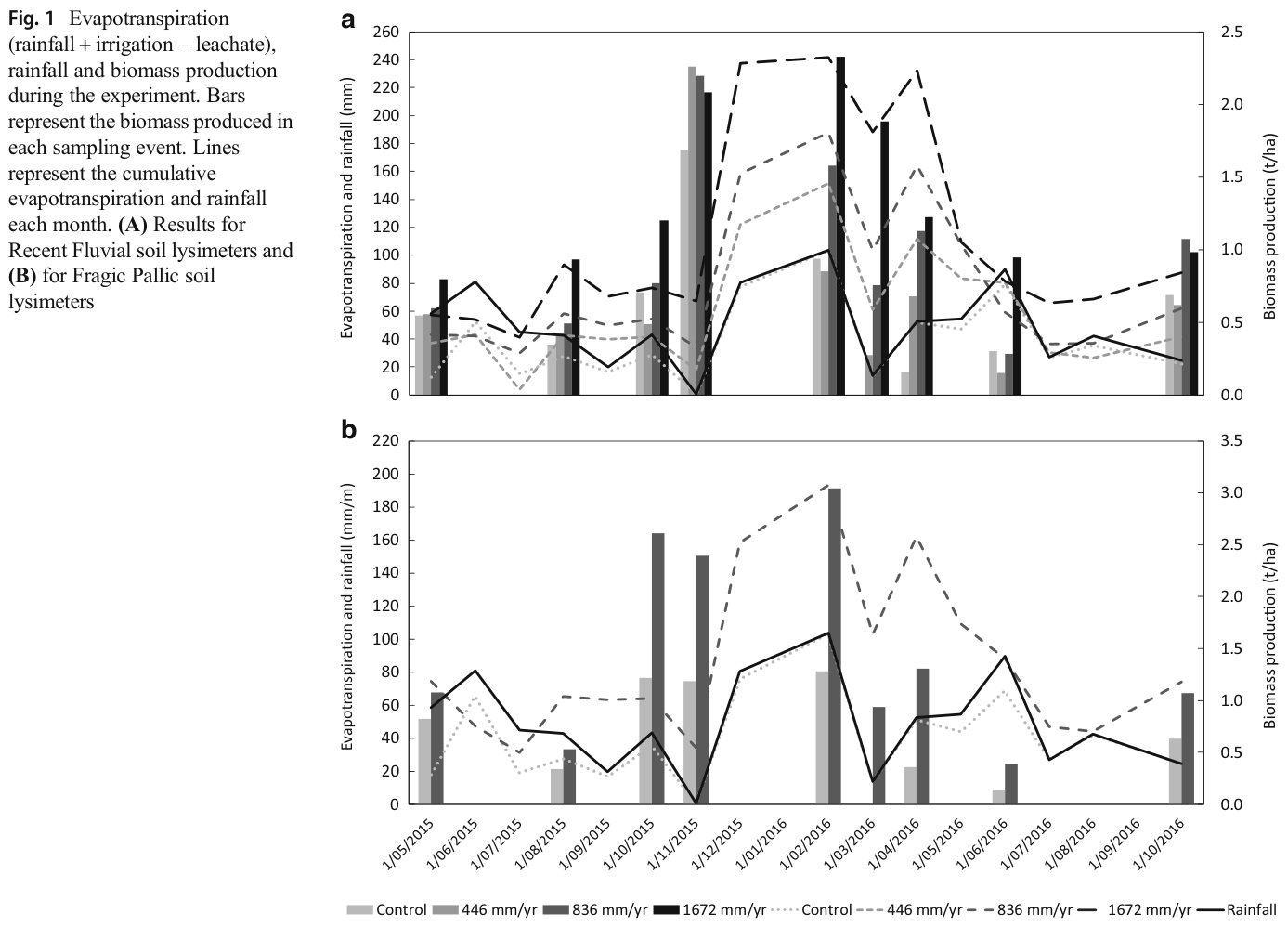
Figure 1 shows the seasonality of the water balance, rainfall and pasture production. The biggest differences in evapotranspiration between treatments happened during the warmest months (December to April). The biggest difference in biomass production between treatments also happened during this period. This was remarkable in March and April 2016, when there was negligible plant growth in the control lysimeters (Fig. 1 and Supp. Material), indicating that irrigation was essential to maintain production. This is especially relevant for climate change scenarios, where the East Coast of New Zealand is forecasted to have drier summers, with rainfall less evenly distributed along the year (MfE 2018) and more need of alternative water sources.图1显示了水量平衡、降雨和牧草产量的季节变化。各处理间蒸散量的最大差异出现在最温暖的月份(12月至次年4月),生物量的最大差异也出现在这一时期。这在2016年3月和4月尤为显著,当时对照渗漏计中植物几乎没有生长(图1和补充材料),表明灌溉对维持产量至关重要。这对于气候变化情景尤其重要:预计新西兰东海岸夏季将更加干旱,全年降雨分布更不均匀(MfE 2018),对替代水源的需求也将增加。
Only 1% of the total drainage in lysimeters irrigated with 836 mm/yr TME occurred between October and April in both soil types (see Supp. Material). This percentage increased to 7% in the case of 1672 mm/yr application rate. This implies that, if possible, irrigation rates can be optimized in each season to maximize pasture production and minimize leaching.
在两种土壤类型中,836 mm/yr TME灌溉渗漏计仅有1%的总排水量发生在10月至次年4月之间(见补充材料)。在1672 mm/yr施用量下,这一比例升至7%。这意味着在条件允许时,可按季节优化灌溉量,以最大限度提高牧草产量并减少淋溶。
| Parameter参数 | Fluvial Recent soilFluvial Recent土壤 | Fragic Pallic soilFragic Pallic土壤 |
|---|---|---|
| Effluent P concentration (mg/L) | 5, 10 or 15 | 5, 10 or 15 |
| Effluent application rate (mm/yr) | 500 | 500 |
| P application rate (kg/ha/yr) | 25, 50, or 75 | 25, 50 or 75 |
| Water flux (mm)1 | 482 | 400 |
| Initial soil P concentration (mg/kg) | 599 | 1046 |
| Initial Olsen P (mg/kg) | 11 | 41 |
| Initial water-soluble P (CaCl2) (mg/L)2 | 0.048 | 0.18 |
| Soil density (t/m3) | 1.4 | 1.4 |
| Simulation depth (m) | 0.3 | 0.3 |
| Biomass production (t/ha/yr)3 | 5.4 | 6.8 |
1 Estimated from rainfall (969 mm/yr) + TME irrigation (500 mm/yr) – evapotranspiration (987 mm/yr for Festuca sp./ Agrostis capillaris L. and 1068 mm/yr for Lolium perenne L.) 2 Estimated from ratios with Olsen P on similar soils from McDowell and Condron (2004) and Sánchez-Alcalá et al. (2014) 3 Interpolated from data from lysimeters, for each type of plant cover, for total water irrigation of 1496 mm/yr
1 根据降雨量(969 mm/yr)+ TME灌溉量(500 mm/yr)– 蒸散量(Festuca sp./ Agrostis capillaris L.为987 mm/yr,Lolium perenne L.为1068 mm/yr)估算 2 根据McDowell and Condron (2004)和Sánchez-Alcalá et al. (2014)中相似土壤与Olsen P的比值估算 3 根据渗漏计数据,按各植被类型在总水量1496 mm/yr条件下插值得到
| Treatment处理 | Total irrigation (mm)总灌溉量 (mm) | Total drainage (mm)总排水量 (mm) | Total evapotranspiration (mm)总蒸散量 (mm) | Biomass production (t/ha equiv.)生物量 产量 (t/ha 当量) |
|---|---|---|---|---|
| Fluvial Recent | soil | |||
| Control | 0 | 169 ± 22 a | 610 | 5.4 ± 1.0 a |
| 446 mm/yr | 632 | 485 ± 23 b | 926 | 6.3 ± 0.6 ab |
| 836 mm/yr | 1185 | 736 ± 17 c | 1228 | 8.9 ± 0.6 b |
| 1672 mm/yr | 2370 | 1375 ± 11 d | 1774 | 12.3 ± 0.2 c |
| Fragic Pallic | soil | |||
| Control | 0 | 148 ± 2.0 a | 631 | 6.0 ± 0.3 a |
| 836 mm/yr | 1185 | 609 ± 32 b | 1355 | 13.3 ± 0.7 b |
Total rainfall was 779 mm. Mean ± standard error (n = 3). For each soil type, values with the same letter are not significantly different (P < 0.05). The Fluvial Recent soil and Fragic Pallic soil were tested independently
总降雨量为779 mm。平均值 ± 标准误(n = 3)。同一土壤类型中,标有相同字母的数值差异不显著(P < 0.05)。Fluvial Recent土壤和Fragic Pallic土壤分别独立检验
Nutrient balances养分平衡
The average concentration of NO3− in the TME (18 mg/L) was almost twice the maximum value (10 mg/L) for unrestricted irrigation of TME onto agricultural land according to guidelines in several states from the USA and other countries such as Arabia Saudi (EPA 2004) or for disposal in rivers according to the European Union (EEC 1991). The total P in the TME (11 mg/L) was fivefold higher than the maximum concentration allowed for TME disposal in surface water in the European Union (1–2 mg/L, EEC, 1991), or some states in the USA (1 mg/L, EPA, 2004), and twice the guideline value for unrestricted use on agricultural land (EPA, 2004).When discharged into water bodies, N and P can exacerbate algal blooms and reduce water quality (Leip et al. 2015). Reused in irrigation at the medium rate (836 mm/yr), TME would supply 146 kg N/ha/yr and 120 kg/P/ha/yr, as well as other nutrients such as S, K, Mg and Ca (Supp. Material), which, at the price of the lowest cost fertilizer in NZ, the total fertilizing value of this effluent at an application rate of 500 mm/yr is about US$ 840ha/yr (Table 5). Note that the total value of the nutrients is less than the sum of the individual elements because some fertilizers contain more than one element.
TME中NO3−的平均浓度(18 mg/L)几乎是美国若干州及沙特阿拉伯等国家指南规定的TME无限制农田灌溉最大值(10 mg/L)(EPA 2004)或欧盟规定的河流排放限值(EEC 1991)的两倍。TME中的全P(11 mg/L)比欧盟(1–2 mg/L,EEC, 1991)或美国部分州(1 mg/L,EPA, 2004)允许排入地表水的TME最大浓度高出五倍,是无限制农田利用指导值的两倍(EPA, 2004)。排入水体时,N和P会加剧藻华并降低水质(Leip et al. 2015)。若以中等灌溉量(836 mm/yr)回用于灌溉,TME每年可提供146 kg N/ha和120 kg P/ha,以及S、K、Mg和Ca等其他养分(补充材料);按新西兰最低成本肥料价格计算,该污水在500 mm/yr施用量下的总肥料价值约为840美元/ha/yr(表5)。需要注意的是,由于部分肥料含有不止一种元素,养分总价值低于各元素价值之和。
In contrast to the findings of other authors (Barton et al. 2005; Mohammad Rusan et al. 2007), TME irrigation did not affect pasture’s N concentration (Table 6), although it significantly increased the total amount of N taken up, due to the increased pasture growth. On the contrary, P concentration increased in proportion to the TME irrigation rates (Table 6), as also reported by previously cited authors. This indicates that N was, at least partially, a limiting nutrient for both types of pasture, while in the case of P, pasture presented a luxury uptake (McLaren and Cameron 1996). For TME irrigation rates up to 836 mm/yr, pasture extracted similar or more N than that supplied by TME. If the experiment had included a second growing season, a higher N uptake would have likely been demonstrated. Therefore, it would be the case that pasture could remove the N added with TME at rates above 1000 mm/yr. This is consistent with the findings of other studies investigating TME land application (Barton et al. 2005; Mohammad Rusan et al. 2007).
与其他学者的研究结果(Barton et al. 2005; Mohammad Rusan et al. 2007)不同,TME灌溉并未影响牧草的N浓度(表6),但由于牧草生长量增加,N的总吸收量显著提高。相反,P浓度随TME灌溉量成比例增加(表6),这与上述学者的报道一致。这表明N至少在一定程度上是两种牧草的限制性养分,而对于P,牧草则表现出奢侈吸收(McLaren and Cameron 1996)。在TME灌溉量不超过836 mm/yr时,牧草吸收的N与TME供应的N相当或更多。若试验包含第二个生长季,很可能会显示出更高的N吸收量。因此,在施用量高于1000 mm/yr时,牧草仍有可能移除TME带入的N。这与其他关于TME土地施用研究的结果一致(Barton et al. 2005; Mohammad Rusan et al. 2007)。
In the highest irrigation rate (1672 mm/yr), the mass of N added was 1.4 times greater than that taken up by pasture. That was the only treatment that showed an accumulation of N in the soil, mainly as mineral nitrogen (NH4+, NO3−). In this study, the accumulation of inorganic N had only a small effect on the soil total N because total N > > inorganic N. However, other authors have reported significant increases in total N after 5–10 years of TME irrigation (Bedbabis et al. 2015; Mohammad Rusan et al. 2007). The total inorganic N leached from all treatments was < 2 kg/ha equiv. This was negligible compared to the > 40 kg/N/ha/yr that can be leached from a grazed pasture (Menneer et al. 2004). It was also lower than the NO3− leached (4.5–22 kg N/ha/yr) reported by Barton et al. (2005), following TME irrigation at a rate of 400 kg/N/ha/yr.
在最高灌溉量(1672 mm/yr)下,N的输入量为牧草吸收量的1.4倍。该处理是唯一出现土壤N累积的处理,累积形态主要为矿质氮(NH4+、NO3−)。在本研究中,由于全N > > 无机N,无机N的累积对土壤全N影响很小。然而,其他学者报道TME灌溉5–10年后土壤全N显著增加(Bedbabis et al. 2015; Mohammad Rusan et al. 2007)。所有处理的无机N总淋失量均 < 2 kg/ha 当量,与放牧草地可能淋失的 > 40 kg/N/ha/yr(Menneer et al. 2004)相比可忽略不计,也低于Barton et al. (2005)在以400 kg/N/ha/yr速率进行TME灌溉后报道的NO3−淋失量(4.5–22 kg N/ha/yr)。
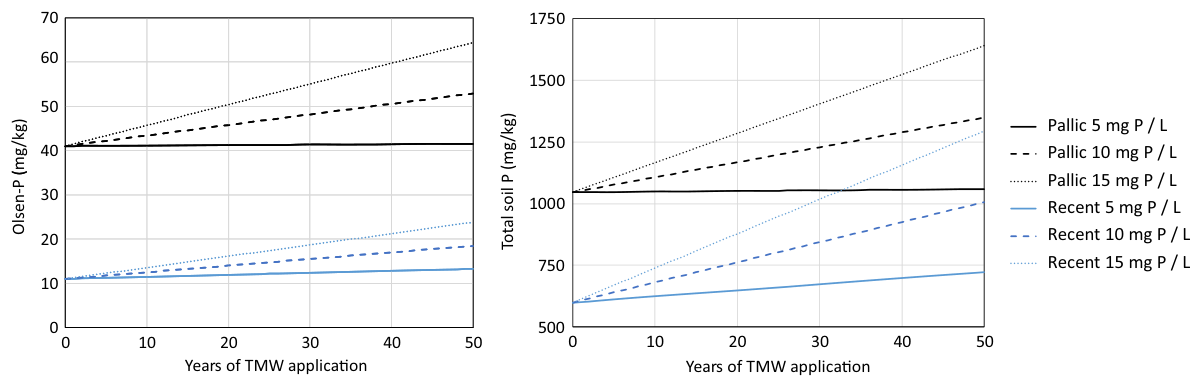
Even after P luxury uptake, TME irrigation added five to seven times more P than the removed by the pasture, and there was negligible P leaching (Table 6). The accumulation of P in the soil, or topsoil, was not detectable because the extra P applied (120 kg/ha) was 30-fold lower than the P concentration in soil. Over several years, P is likely to accumulate in the topsoil. Significant increases in P after 5 to 10 years of TME irrigation was reported by Barton et al. (2005), Mohammad Rusan et al. (2007) and Qian and Mecham (2005). The potential accumulation of P in the top soil calculated for a period of 50 years of TME irrigation is shown in Fig. 2. With a P concentration in the TME similar to the one of this experiment (10 mg/L), over a 50-year period of the total P concentration in the top 30 cm would increase from 1046 to 1349 mg/kg in the Fragic Pallic soil and from 599 to 1006 mg/kg in the Fluvial Recent soil (Fig. 2). Even with this increase, the total concentration at the end of the 50-year period would still be well within the range of P concentrations for NZ agricultural soils reported by McDowell and Condron (2004) and Reiser et al. (2014).
即使考虑P的奢侈吸收,TME灌溉施入的P仍比牧草带走的P多五至七倍,而P淋溶可忽略不计(表6)。由于额外施入的P(120 kg/ha)比土壤中P含量低30倍,因此未能检测到土壤或表土中P的累积。在若干年内,P很可能在表土中累积。Barton et al. (2005)、Mohammad Rusan et al. (2007)和Qian and Mecham (2005)报道了TME灌溉5至10年后P显著增加。图2显示了计算得到的TME灌溉50年期间表土P的潜在累积量。若TME中P浓度与本试验相近(10 mg/L),50年内表层30 cm土壤全P浓度在Fragic Pallic土壤中将从1046 mg/kg增至1349 mg/kg,在Fluvial Recent土壤中将从599 mg/kg增至1006 mg/kg(图2)。即便有此增幅,50年末的全P浓度仍完全处于McDowell and Condron (2004)和Reiser et al. (2014)报道的新西兰农业土壤P浓度范围之内。
In the nominal case, the Olsen-extractable P in these soils is likely to increase from 41 to 53 mg/kg in the Fragic Pallic soil and increase from 11 to 18 mg/kg in the Fluvial Recent soil. The initial Olsen P concentration in the Fragic Pallic soil was within the range recommended by Dairy NZ (35–40 mg/kg) to maintain high productivity on sedimentary soils (DairyNZ 2012). This is undoubtedly a result of the soil management under the previous land use, grazed pasture. In contrast, the Fluvial Recent soil, with an initial Olsen P concentration of 11 mg/L is consistent with non-productive but managed land, in this case a golf course. Even with an increase to 18 mg/kg, the plant-available P would only be sufficient for low Prequiring crops such as golf course turf or for winter wheat (Tang et al. 2009). For pasture, Olsen P values above 100 mg/kg are excessive, and values are considered “high” from 50 to 100 mg/kg (LandcareResearch 2018b).
在基准情景下,这些土壤中的Olsen可提取P在Fragic Pallic土壤中可能从41 mg/kg增至53 mg/kg,在Fluvial Recent土壤中从11 mg/kg增至18 mg/kg。Fragic Pallic土壤的初始Olsen P浓度处于Dairy NZ为维持沉积土高生产力所推荐的范围(35–40 mg/kg)之内(DairyNZ 2012),这无疑是先前土地利用方式(放牧草地)下土壤管理的结果。相比之下,Fluvial Recent土壤的初始Olsen P浓度为11 mg/L,与非生产性但受管理的土地(此处为高尔夫球场)相符。即使增至18 mg/kg,植物有效P也仅能满足高尔夫球场草坪或冬小麦等低需P作物的需要(Tang et al. 2009)。对于牧草而言,Olsen P值高于100 mg/kg即为过量,50至100 mg/kg被视为“高”水平(LandcareResearch 2018b)。
| Element元素 | Mass (kg/ha/yr)质量(kg/ha/yr) | Value of element in cheapest fertilizer (US$/ha/yr)按最便宜肥料计算的 元素价值(US$/ha/yr) |
|---|---|---|
| N | 95 | 72 |
| P | 55 | 135 |
| K | 110 | 201 |
| S | 125 | 262 |
| Mg | 95 | 175 |
| Ca | 295 | 249 |
The value was calculated from the cheapest fertilizer (Ballance 2017)
价值按最便宜的肥料计算(Ballance 2017)
Phosphorous from a TME-irrigated area could enter waterways via runoff, particularly if it is an easily erodible area. In that case, it could cause serious environmental issues (Tilman et al. 2001). However, the loss of P from a cut-and-carry pasture irrigated by TME will always be lower than the losses from a grazed pasture (TME irrigated or otherwise) because of the mechanical disturbance of soil by the animals’ hooves (McDowell et al. 2003).
TME灌溉区的磷可能通过径流进入水体,尤其是在易侵蚀地区,从而可能引发严重的环境问题(Tilman et al. 2001)。然而,由于放牧牲畜蹄踏对土壤的机械扰动,TME灌溉的刈割运出型牧场的P损失总是低于放牧草地(无论是否进行TME灌溉)(McDowell et al. 2003)。
Although S, K, Ca and Mg are usually present at high concentrations in TME (Bedbabis et al. 2014; Qian and Mecham 2005), their behaviour in soil, plant or leachates is not as well studied as N and P, probably because they are not usually linked to excessive eutrophication (Garnier et al.
尽管TME中S、K、Ca和Mg的浓度通常较高(Bedbabis et al. 2014; Qian and Mecham 2005),但它们在土壤、植物或渗滤液中的行为不如N和P研究得充分,这可能是因为它们通常与过度富营养化无关(Garnier et al.
| Table 6 Mass of N and P (kg/ha equiv., unless otherwise indicated) in the TME, pasture, soil and drainage water over the entire lysimeter experiment表6 整个渗漏计试验期间 TME、牧草、土壤和排水中 N和P的量(kg/ha 当量,另有说明者除外) | Treatment处理 | Irrigation灌溉 | Pasture concentration (N %, P mg/kg)牧草 浓度(N %,P mg/kg) | Pasture uptake牧草 吸收量 | Soil total (0–60 cm) (N t/ha)土壤全量 (0–60 cm) (N t/ha) | Soil mineral N/ Olsen P (0– 60 cm)土壤矿质N/ Olsen P(0– 60 cm) | Leached淋失量 |
|---|---|---|---|---|---|---|---|
| (17.5 months) | Nitrogen | ||||||
| Fluvial Recen | t soil | ||||||
| Control | 0 | 2.14 ± 0.06 ab | 115 ± 21 a | 15.8 ± 2.0 a | 74 ± 12 a | 0.32 ± 0.03 a | |
| 446 mm/yr | 111 | 1.97 ± 0.08 b | 124 ± 14 ab | 13.4 ± 2.0 a | 63 ± 6 a | 0.72 ± 0.08 ab | |
| 836 mm/yr | 207 | 2.18 ± 0.01 ab | 193 ± 14 b | 13.1 ± 1.0 a | 95 ± 6 a | 1.09 ± 0.03 b | |
| 1672 mm/yr | 415 | 2.32 ± 0.05 a | 288 ± 113 c | 15.0 ± 1.3 a | 161 ± 17 b | 1.97 ± 0.18 c | |
| Fragic Pallic | soil | ||||||
| Control | 0 | 2.52 ± 0.09 a | 151 ± 13 a | 19.7 ± 1.2 a | 78 ± 16 a | 0.37 ± 0.06 a | |
| 836 mm/yr | 207 | 2.36 ± 0.07 a | 314 ± 11 b | 19.0 ± 0.8 a | 91 ± 17 a | 1.05 ± 0.05 b | |
| Phosphorus | |||||||
| Fluvial Recen | t soil | ||||||
| Control | 0 | 2277 ± 99 a | 13 ± 2 a | 4140 ± 464 a | 43 ± 6.3 a | <1 | |
| 446 mm/yr | 77 | 2722 ± 91 ab | 16 ± 2 ab | 3500 ± 641 a | 29 ± 7.1 a | <1 | |
| 836 mm/yr | 144 | 2960 ± 94 bc | 25 ± 3 b | 3410 ± 165 a | 29 ± 0.8 a | <1 | |
| 1672 mm/yr | 289 | 3382 ± 113 c | 40 ± 1 c | 3720 ± 415 a | 33 ± 4.9 a | <1 | |
| Fragic Pallic | soil | ||||||
| Control | 0 | 3286 ± 160 a | 20 ± 2 a | 6020 ± 485 a | 164 ± 20 a | <1 | |
| 836 mm/yr | 144 | 3502 ± 145 a | 45 ± 2 b | 5670 ± 100 a | 120 ± 4.2 a | <1 |
Mean ± standard error (n = 3). For each soil type, values with the same letter are not significantly different P < 0.05)
平均值 ± 标准误(n = 3)。同一土壤类型中,标有相同字母的数值差异不显著(P < 0.05)
2010; Leip et al. 2015). In this experiment, concentrations of S, K, Ca and Mg in pasture did not increase in response to the TME treatments. Nevertheless, the total nutrients extracted by the pasture in the treatments was higher due to the increased biomass (Tables S1 to S4). Uptake of S, Ca and Mg was between 8 and 17% of the added amount in the 836-mm/yr treatments and 34 and 70% of the K added in Recent Fluvial and Fragic Pallic soils, respectively. Only small amounts of these nutrients leached (up to 13% in the 836-mm/yr treatments), so most will accumulate in the soil. The accumulation in soil was insignificant because the soil concentrations were at least 100-fold greater than the amount being added and a difference might be only noticeable in the long term (Bedbabis et al. 2014; Bedbabis et al. 2015; Mohammad Rusan et al. 2007; Qian and Mecham 2005). The addition of Mg and Ca will offset the Na supply, and will help maintaining the soil structure (Abrol et al. 1988). The application of any element to a system at a rate greater than the rate that is removed is ultimately unsustainable (Mills et al. 2005).
2010; Leip et al. 2015)。在本试验中,牧草中S、K、Ca和Mg的浓度未随TME处理而增加。然而,由于生物量增加,各处理牧草吸收的养分总量更高(表S1至表S4)。在836 mm/yr处理中,S、Ca和Mg的吸收量占施入量的8%至17%,而在Recent Fluvial土壤和Fragic Pallic土壤中K的吸收量分别占施入量的34%和70%。这些养分仅有少量淋失(836 mm/yr处理中最多13%),因此大部分将在土壤中累积。由于土壤中这些元素的含量至少比施入量高100倍,其在土壤中的累积并不显著,差异可能只有在长期才会显现(Bedbabis et al. 2014; Bedbabis et al. 2015; Mohammad Rusan et al. 2007; Qian and Mecham 2005)。Mg和Ca的施入将抵消Na的输入,有助于维持土壤结构(Abrol et al. 1988)。任何元素向系统中的施入速率若大于其移除速率,最终都是不可持续的(Mills et al. 2005)。
Sodium and trace elements钠与微量元素
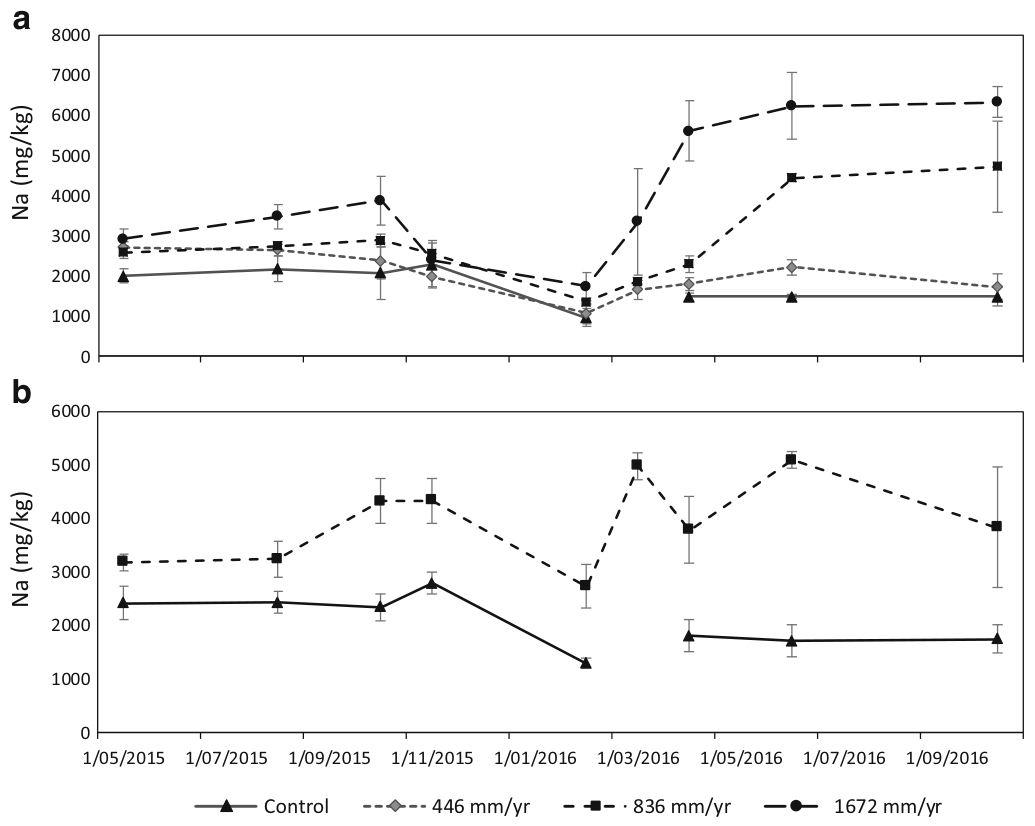
The TME contained 95 mg/L Na, which is about 50% higher than the FAO guidelines for unrestricted use of effluent (FAO 2003). The SAR of the TME was 2.75, which when assessed in combination with EC (0.42 dS/m) indicates that the TME has a “slight to moderate” use restriction, in terms of maintaining the soil structure and crop production (Ayers and Westcot 1985). Table 7 shows that TME irrigation added more Na to soil than the amount taken up by the pasture. At the medium application rate (836 mm/yr), fescue/browntop and ryegrass uptake were 2 and 4%, respectively, of the applied Na. The Na concentration in pasture increased when increasing TME application rates (Table 7). The differences of plant Na between treatments were higher in the second half of the experiment (Fig. 3), above all for medium (836 mm/yr) and high (1672 mm/yr) rates. Zalacáin et al. (2019) also reported an increased Na concentration in leaves of plants irrigated with TME over a 15-year period. Elevated concentrations of Na in pasture increase its palatability to stock (Chiy et al. 1998), and farmers occasionally apply Na to their pastures for this reason. Although most pasture species are not overly sensitive to Na, the maximum concentration found in leaves (0.6%) can be toxic for some sensitive plants (Ayers and Westcot 1985).
TME含Na 95 mg/L,比FAO污水无限制利用指南值高约50%(FAO 2003)。TME的SAR为2.75,结合EC(0.42 dS/m)评估表明,从维持土壤结构和作物生产的角度看,该TME属于“轻度至中度”使用限制(Ayers and Westcot 1985)。表7显示,TME灌溉向土壤施入的Na多于牧草的吸收量。在中等施用量(836 mm/yr)下,羊茅/细弱剪股颖和黑麦草的吸收量分别占施入Na的2%和4%。牧草中Na浓度随TME施用量的增加而升高(表7)。各处理间植物Na的差异在试验后半期更大(图3),尤其是中等(836 mm/yr)和高(1672 mm/yr)施用量处理。Zalacáin et al. (2019)也报道了经15年TME灌溉的植物叶片中Na浓度升高。牧草中Na浓度升高可提高其对牲畜的适口性(Chiy et al. 1998),农民有时也因此向牧草施用Na。尽管大多数牧草物种对Na并不特别敏感,但叶片中测得的最高浓度(0.6%)对某些敏感植物可能具有毒害作用(Ayers and Westcot 1985)。
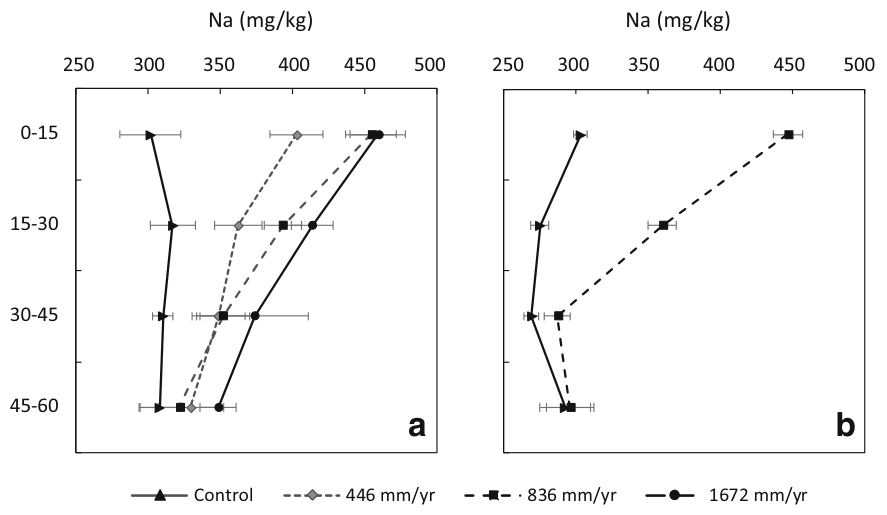
About 20% of the Na applied by medium TME application rate (836 mm/yr) leached (Table 7). It also accumulated in the soil profile, mainly in the top horizons 0–15 cm and 15–30 cm (Fig. 4). This was also reported by Bedbabis et al. (2015), Qian and Mecham (2005) and Zalacáin et al. (2019). The control topsoil had ca. 300-mg/kg Na, whereas the topsoil under the low TME treatment (446 mm/yr) contained significantly higher concentrations (ca. 400 mg/kg). However, at the medium TME irrigation rate (836 mm/yr, i.e., double the “low” rate), Na only increased to ca. 450 mg/kg. Quadrupling the “low” TME irrigation rate increased the topsoil Na concentration to 460 mg/kg. The results indicate that at soil concentrations > ca. 400 mg/kg, most additional Na was not retained by the soil and leached down through the soil profile (Table 7 and Fig. 4). Similar findings were also shown by Bedbabis et al. (2014), who demonstrated that soil Na increased 4.3 times after 5 years of 500 mm/TME/yr application and was only five times higher (compared with initial soil concentration) after 10 years of irrigation. SAR and ESP values in the topsoil follow the same pattern (see Supp. Material), with an increase between control soil and the 446- mm/yr treatment (SAR from 0.87 to 1.48, ESP from 5.2 to 9.4%). Doubling irrigation rates did not double SAR and ESP in the soil (SAR 1.94 and 2.16 in 836- and 1672-mm/yr treatments in the Fluvial Recent soil, respectively, and ESP 12.5 and 13.4% in the same treatments). Even in the treatments with the highest rate of TME application, ESP remains lower than 15%, a sodicity risk level of “none to slight” (Abrol et al. 1988). In spite of this Na accumulation, only the topsoil of the Fluvial Recent soil increased the EC with higher TME application rates (Fig. S5). EC in Fragic Pallic soil and pH in both soil types were not affected by TME application. It is possible that changes would happen in the long term, as usually reported by other authors (Bedbabis et al. 2015; Mohammad Rusan et al. 2007; Qian and Mecham 2005).
在中等TME施用量(836 mm/yr)下,约20%的施入Na发生淋失(表7)。Na也在土壤剖面中累积,主要集中在0–15 cm和15–30 cm表层(图4)。Bedbabis et al. (2015)、Qian and Mecham (2005)和Zalacáin et al. (2019)也有类似报道。对照表土Na含量约为300 mg/kg,而低TME处理(446 mm/yr)表土的Na含量显著更高(约400 mg/kg)。然而,在中等TME灌溉量(836 mm/yr,即“低”施用量的两倍)下,Na仅增至约450 mg/kg。将“低”TME灌溉量提高至四倍,表土Na浓度增至460 mg/kg。结果表明,当土壤Na浓度 > 约400 mg/kg时,大部分额外施入的Na不被土壤保持,而是沿土壤剖面向下淋溶(表7和图4)。Bedbabis et al. (2014)也得到了类似结果,他们证明每年施用500 mm TME 5年后土壤Na增加了4.3倍,而灌溉10年后仅为初始土壤浓度的5倍。表土的SAR和ESP值呈现相同规律(见补充材料),对照土壤与446 mm/yr处理之间有所增加(SAR从0.87增至1.48,ESP从5.2%增至9.4%)。灌溉量加倍并未使土壤SAR和ESP加倍(Fluvial Recent土壤中836和1672 mm/yr处理的SAR分别为1.94和2.16,ESP分别为12.5%和13.4%)。即使在TME施用量最高的处理中,ESP仍低于15%,钠质化风险等级为“无至轻微”(Abrol et al. 1988)。尽管存在Na累积,但仅Fluvial Recent土壤的表土EC随TME施用量增加而升高(图S5)。Fragic Pallic土壤的EC以及两种土壤的pH均未受TME施用影响。正如其他学者通常报道的那样(Bedbabis et al. 2015; Mohammad Rusan et al. 2007; Qian and Mecham 2005),长期可能会出现变化。
Although Na accumulation in the soil did not perturb drainage in this experiment, over the long term, a reduction in infiltration rates may occur (Assouline and Narkis 2011; Bedbabis et al. 2014). In that case, the soils may require periodic amendments with gypsum or dolomite to maintain structure (Abrol et al. 1988).
尽管在本试验中土壤Na累积并未干扰排水,但从长期看,入渗速率可能会降低(Assouline and Narkis 2011; Bedbabis et al. 2014)。在这种情况下,土壤可能需要定期施用石膏或白云石以维持结构(Abrol et al. 1988)。
Boron and trace elements are occasionally a concern for the reuse of TME (Angin et al. 2005; Pedrero et al. 2010). On some occasions, crop yield has been decreased by the application of TME due to toxicity of one or various elements, as reviewed by Pedrero et al. (2010) and reported by Chatzakis et al. (2011). In this experiment, the concentrations of B, Al,
硼和微量元素有时是TME回用中的关注问题(Angin et al. 2005; Pedrero et al. 2010)。在某些情况下,由于一种或多种元素的毒害作用,施用TME会导致作物减产,Pedrero et al. (2010)对此进行了综述,Chatzakis et al. (2011)也有报道。在本试验中,B、Al、
| Treatment处理 | Irrigation Na (kg/ha equiv.)灌溉Na (kg/ha 当量) | Average pasture Na (mg/kg)牧草平均 Na(mg/kg) | Pasture Na (kg/ha equiv.)牧草Na (kg/ha 当量) | Soil Na (0–60 cm) (kg/ha equiv.)土壤Na(0–60 cm) (kg/ha 当量) | Na leached (kg/ha equiv.)Na淋失量 (kg/ha 当量) |
|---|---|---|---|---|---|
| Fluvial Recent | soil | ||||
| Control | 0 | 1741 ± 270 a | 10 ± 3 a | 2598 ± 102 a | 45 ± 6 a |
| 446 mm/yr | 605 | 2028 ± 205 a | 13 ± 3 a | 3031 ± 156 ab | 159 ± 18 b |
| 836 mm/yr | 1131 | 2836 ± 138 ab | 23 ± 3 a | 3195 ± 149 ab | 264 ± 23 b |
| 1672 mm/yr | 2256 | 4002 ± 499 b | 45 ± 6 b | 3349 ± 170 b | 412 ± 61 c |
| Fragic Pallic | soil | ||||
| Control | 0 | 2121 ± 85 a | 13 ± 1 a | 2394 ± 54 a | 30 ± 0 a |
| 836 mm/yr | 1131 | 3813 ± 348 b | 50 ± 2 b | 2919 ± 89 b | 232 ± 32 b |
Mean ± standard error. For each soil type, values with a different letter are significantly different (P < 0.05)
平均值 ± 标准误。同一土壤类型中,标有不同字母的数值差异显著(P < 0.05)
Cd, Cu, Fe, Mn, As and Zn in TME were below detection limits (< 0.001 mg/Cd/L) or much lower than the recommended limits (Table 1) for use in irrigation according to EPA (EPA 2004). Cd was not detected in the leachates or pasture (< 0.001 mg/kg), and B, Al, Cu, Fe, Mn and Zn concentrations were not higher in TME irrigated treatments than in controls.
TME中的Cd、Cu、Fe、Mn、As和Zn浓度低于检出限(< 0.001 mg/Cd/L),或远低于EPA灌溉利用推荐限值(表1)(EPA 2004)。渗滤液和牧草中均未检出Cd(< 0.001 mg/kg),TME灌溉处理中B、Al、Cu、Fe、Mn和Zn的浓度也不高于对照。
Although they were not an objective of this experiment, further consideration of emerging organic contaminants would increase the understanding of potential risks of TME irrigation into food chains or receiving environments (González García et al. 2019; Hurtado et al. 2016; Martínez- Piernas et al. 2018).
尽管新兴有机污染物不属于本试验的研究目标,但进一步考虑这类污染物将有助于加深对TME灌溉进入食物链或受纳环境潜在风险的认识(González García et al. 2019; Hurtado et al. 2016; Martínez- Piernas et al. 2018)。
5Conclusions and recommendations结论与建议
The TME from Duvauchelle treatment plant was suitable for pasture irrigation in both the Fluvial Recent soil and the Fragic Pallic soil. This experiment demonstrated that irrigation was fundamental for keeping the pasture production during the summer months, which recommends TME as an alternative water source in climate change scenarios with reduced water availability. TME irrigation would decrease the need of mineral fertilizers, and at a rate of 800 mm/yr, it could save about US$ 840 ha/yr in fertilizing with N, P, S, K, Ca and Mg. In case of a constant irrigation rate during the year, up to 800 mm/yr would be an optimal option, with an increase in pasture production, compared with non-irrigation, by 65%, in the case of fescue/brown top over Fluvial Recent soil lysimeters, and by 121%, in case of ryegrass over the Fragic Pallic soil lysimeters. At this application rate, the amount of N leached (1 kg/N/ha) was insignificant compared with grazed pastures (~ 40 kg/N/ha). Adapting the irrigation rate in different seasons would allow to increase irrigation during summer up to 1500 mm/yr without risk of nutrient leaching and to increase pasture production to an extra of 57%.
Duvauchelle污水处理厂的TME适用于Fluvial Recent土壤和Fragic Pallic土壤上的牧草灌溉。本试验表明,灌溉对于维持夏季牧草产量至关重要,因此在气候变化导致水资源减少的情景下,TME可作为一种替代水源。TME灌溉可减少对矿质肥料的需求,在800 mm/yr施用量下,可节省约840美元/ha/yr的N、P、S、K、Ca和Mg施肥费用。若全年采用恒定灌溉量,不超过800 mm/yr为最优选择:与不灌溉相比,Fluvial Recent土壤渗漏计上羊茅/细弱剪股颖的牧草产量可提高65%,Fragic Pallic土壤渗漏计上黑麦草的产量可提高121%。在此施用量下,N淋失量(1 kg/N/ha)与放牧草地(~ 40 kg/N/ha)相比微不足道。按季节调整灌溉量,可在夏季将灌溉量提高至1500 mm/yr而无养分淋溶风险,并使牧草产量额外增加57%。
It is unlikely that in the medium term (~ 20 years), P or Na accumulation in the soil will be a problem. In the worst case scenario of applying 75 kg/P/ha/yr, the total P concentration in the topsoil will rise to 57% over 50 years in the case of ryegrass over Fragic Pallic soil and 100% over 50 years in the case of fescue/browntop over Fluvial Recent soil. The final concentrations of the total P and Olsen P calculated for both scenarios were comparable with those on productive pastures in New Zealand. Although Na accumulated in the soil columns in all the TME treatments, the rate of accumulation was not proportional to the TME application rate, which indicates that Na was moving down through the soil profile and leaching. During the experiment, there was no evidence of ponding or decreased infiltration capacity. Na concentration in pasture increased with higher TME application rates. Highly productive cut and carry pasture, such as ryegrass for feed instead of fescue/browntop for turf, would be the best option for removing the N, P and Na supplied by TME. The amount of P, Ca, S, K, Mg and Na applied was higher than the uptake by pasture and the total leached in all the TME irrigated treatments. The application of any element to a system at a rate that is greater than the rate that is removed is ultimately unsustainable. The TME used in this experiment did not pose any risk related with trace elements. However, future work should investigate fluxes of contaminants associated with pharmaceuticals and/or personal care products in TME-irrigated soils.
从中期(约20年)来看,土壤中P或Na的累积不太可能成为问题。在施用75 kg/P/ha/yr的最不利情景下,50年内表土全磷浓度在Fragic Pallic土壤上种植黑麦草的情况下将升高57%,在Fluvial Recent土壤上种植羊茅/细弱剪股颖的情况下将升高100%。两种情景下计算得到的全磷和Olsen P最终浓度与新西兰高产牧场的水平相当。尽管所有TME处理的土柱中均出现了Na累积,但累积速率与TME施用量并不成比例,这表明Na沿土壤剖面向下迁移并发生淋溶。试验期间未发现积水或入渗能力下降的迹象。牧草中的Na浓度随TME施用量的增加而升高。高产的刈割移出型牧草(例如用作饲料的黑麦草,而非用作草坪的羊茅/细弱剪股颖)是去除TME所带入N、P和Na的最佳选择。在所有TME灌溉处理中,P、Ca、S、K、Mg和Na的施入量均高于牧草吸收量与淋溶总量。以高于移除速率的速率向系统中施加任何元素,最终都是不可持续的。本试验所用TME不存在与微量元素相关的风险。然而,今后的研究应探讨TME灌溉土壤中与药品和/或个人护理用品相关的污染物通量。
Funding information Authors acknowledge the Christchurch City Council for funding this experiment and City Care for providing the treated municipal wastewater. This project was partially co-funded by the Centre for Integrated Biowaste Research, under the ESR Strategic Science Investment Funding from the Ministry of Business, Innovation and Employment, New Zealand (contract number C03X1701), New Zealand. MJGG held a scholarship from Fundacion Ramon Areces (Spain).
基金信息 作者感谢基督城市议会(Christchurch City Council)为本试验提供资助,并感谢City Care提供处理后的城市污水。本项目部分由Centre for Integrated Biowaste Research共同资助,资金来源为新西兰商业、创新与就业部(Ministry of Business, Innovation and Employment)ESR战略科学投资基金(合同编号C03X1701)。MJGG获得了Fundacion Ramon Areces(西班牙)奖学金资助。
Compliance with ethical standards遵守伦理标准
Conflict of interest The authors declare that they have no conflict of interest.
利益冲突 作者声明不存在利益冲突。
Open Access This article is licensed under a Creative Commons Attribution 4.0 International License, which permits use, sharing, adaptation, distribution and reproduction in any medium or format, as long as you give appropriate credit to the original author(s) and the source, provide a link to the Creative Commons licence, and indicate if changes were made. The images or other third party material in this article are included in the article's Creative Commons licence, unless indicated otherwise in a credit line to the material. If material is not included in the article's Creative Commons licence and your intended use is not permitted by statutory regulation or exceeds the permitted use, you will need to obtain permission directly from the copyright holder. To view a copy of this licence, visit http://creativecommons.org/licenses/by/4.0/.
开放获取 本文采用知识共享署名4.0国际许可协议(Creative Commons Attribution 4.0 International License)进行许可,该协议允许以任何媒介或格式使用、共享、改编、分发和复制本文,但须适当注明原作者及来源,提供知识共享许可协议的链接,并说明是否作了修改。除非在材料的署名行中另有说明,本文中的图像或其他第三方材料均包含在本文的知识共享许可协议范围内。如果材料未包含在本文的知识共享许可协议范围内,且您的预期用途不为法律法规所允许或超出允许的使用范围,则需直接获得版权持有人的许可。如需查看该许可协议副本,请访问http://creativecommons.org/licenses/by/4.0/。
6References参考文献
Abrol IP, Yadav JSP, Massoud FI (1988) Salt-affected soils and their management vol 39. FAO Soils Bulletin, Rome
Angin I, Yaganoglu AV, Turan M (2005) Effects of long-term wastewater irrigation on soil properties journal of sustainable agriculture. Ann Agric Sci 26:31–42. https://doi.org/10.1300/J064v26n03_05
Anon (1939) Soil Survey of Banks Peninsula. Akaroa Mail and Banks Peninsula Advertiser LXIII
Asgari K, Cornelis WM (2015) Heavy metal accumulation in soils and grains, and health risks associated with use of treated municipal wastewater in subsurface drip irrigation. Environ Monit Assess 187(7):410. https://doi.org/10.1007/s10661-015-4565-8
Assouline S, Narkis K (2011) Effects of long-term irrigation with treated wastewater on the hydraulic properties of a clayey soil. Water Resour Res 47(8). https://doi.org/10.1029/2011WR010498 Ayers RS, Westcot DW (1985) Water quality for agriculture vol 29 rev. 1. FAO irrigation and drainage paper. Food and agriculture Organization of the United Nations, Rome
Ballance (2017) Product price list. Accessed April 2017
Barton L et al (2005) Land application of domestic effluent onto four soil types. J Environ Qual 34:635–643. https://doi.org/10.2134/jeq2005.0635 Bedbabis S, Ben Rouina B, Boukhris M, Ferrara G (2014) Effect of irrigation with treated wastewater on soil chemical properties and infiltration rate. J Environ Manag 133:45–50. https://doi.org/10. 1016/j.jenvman.2013.11.007
Bedbabis S, Trigui D, Ben Ahmed C, Clodoveo ML, Camposeo S, Vivaldi GA, Ben Rouina B (2015) Long-terms effects of irrigation with treated municipal wastewater on soil, yield and olive oil quality. Agric Water Manag 160:14–21. https://doi.org/10.1016/j.agwat.2015.06.023
Blakemore LC, Searle PL, Daly BK (1987) Methods for chemical analysis of soils
Cameron KC, Di HJ, McLaren RG (1997) Is soil an appropriate dumping ground for our wastes? Soil Res 35:995–1036. https://doi.org/10. 1071/S96099
Cameron KC, Smith NP, McLay CDA, Fraser PM, McPherson RJ, Harrison DF, Harbottle P (1992) Lysimeters Without Edge Flow: An Improved Design and Sampling Procedure. Soil Sci Soc Am J 56:1625–1628. https://doi.org/10.2136/sssaj1992.03615995005600050048x
Chatzakis MK, Tzanakakis VA, Mara DD, Angelakis AN (2011) Irrigation of castor bean (Ricinus communis L.) and sunflower (Helianthus annus L.) plant species with municipal wastewater effluent: impacts on soil properties and seed yield. Water 3:1112 Chaudhry Q, Blom-Zandstra M, Gupta SK, Joner E (2005) Utilising the synergy between plants and rhizosphere microorganisms to enhance breakdown of organic pollutants in the environment (15 pp). Environ Sci Pollut Res 12:34–48. https://doi.org/10.1065/ espr2004.08.213
Chiy PC, Al-Tulihan A-lA, Hassan MH, CJC P (1998) Effects of sodium and potassium fertilisers on the composition of herbage and its acceptability to dairy cows. J Sci Food Agric 76:289–297. https://doi. org/10.1002/(SICI)1097-0010(199802)76:2<289::AID- JSFA959>3.0.CO;2-L Clough TJ, Stevens RJ, Laughlin RJ, Sherlock RR, Cameron KC (2001) Transformations of inorganic-N in soil leachate under differing storage conditions. Soil Biol Biochem 33:1473–1480. https://doi.org/ 10.1016/S0038-0717(01)00056-6
DairyNZ (2012) Phosphorus fertiliser
EEC (1991) Council Directive of 21 May 1991 concerning urban waste water treatment vol 91/271/EEC
EPA (2004) Guidelines for Water Reuse. U.S. Environmental Protection Agency U.S. Agency for International Development, Washington FAO (2003) Users Manual for Irrigation with Treated Wastewater. FAO Regional Office for the Near East, Cairo. doi:http://www.fao.org/ tempref/GI/Reserved/FTP_FaoRne/morelinks/Publications/ English/Usersmanual-en.pdf
Garnier J, Beusen A, Thieu V, Billen G, Bouwman L (2010) N:P:Si
nutrient export ratios and ecological consequences in coastal seas evaluated by the ICEP approach. Global Biogeochem Cycles 24(4). https://doi.org/10.1029/2009gb003583
González García M, Fernández-López C, Polesel F, Trapp S (2019) Predicting the uptake of emerging organic contaminants in vegetables irrigated with treated wastewater – implications for food safety assessment. Environ Res 172:175–181. https://doi.org/10.1016/j. envres.2019.02.011
Hurtado C, Domínguez C, Pérez-Babace L, Cañameras N, Comas J, Bayona JM (2016) Estimate of uptake and translocation of emerging organic contaminants from irrigation water concentration in lettuce grown under controlled conditions. J Hazard Mater 305:139–148. https://doi.org/10.1016/j.jhazmat.2015.11.039
Kim N, Robinson BH (2015) Cadmium: a clandestine threat to food safety Food Quality & Safety doi:https://www.foodqualityandsafety.com/ article/cadmium-a-clandestine-threat-to-food-safety/
Lal K, Minhas PS, Yadav RK (2015) Long-term impact of wastewater irrigation and nutrient rates II. Nutrient balance, nitrate leaching and soil properties under peri-urban cropping systems. Agric Water Manag 156:110–117. https://doi.org/10.1016/j.agwat.2015.04.001
LandcareResearch (2018a) New Zealand soil Classifiation. Manaaki Whenua - Landcare Research New Zealand Ltd. https://soilsmaps.landcareresearch.co.nz/#maps
L a n dc a r e R e s e a r c h ( 2 0 1 8 b ) Ols en P Method http s:// sindilandcareresearchconz/Content/HelpOlsenPhtml
Leip A et al (2015) Impacts of European livestock production: nitrogen, sulphur, phosphorus and greenhouse gas emissions, land-use, water eutrophication and biodiversity. Environ Res Lett 10:115004. https://doi.org/10.1088/1748-9326/10/11/115004
Macara GR (2016) The climate and weather of Canterbury vol number 68, 2nd edition edn.,
Martínez-Piernas AB, Plaza-Bolaños P, García-Gómez E, Fernández- Ibáñez P, Agüera A (2018) Determination of organic microcontaminants in agricultural soils irrigated with reclaimed wastewater: target and suspect approaches. Analytica Chimica Acta 1030:115–124. https://doi.org/10.1016/j.aca.2018.05.049
McDowell RW, Condron LM (2004) Estimating phosphorus loss from New Zealand grassland soils. N Z J Agric Res 47:137–145. https:// doi.org/10.1080/00288233.2004.9513581
McDowell RW, Drewry JJ, Muirhead RW, Paton RJ (2003) Cattle treading and phosphorus and sediment loss in overland flow from grazed cropland. Soil Res 41:1521–1532. https://doi.org/10.1071/SR03042 McLaren RG, Cameron KC (1996) Soil Science. Sustainable production and environmental protection. Oxford Univeristy Press
Menneer JC, Ledgard SF, Gillingham AG (2004) Land use impacts on nitrogen and phosphorus loss and management options for intervention. Client report for Environment Bay of Plenty, Wellington
MfE (2018) Climate change projections for New Zealand: atmosphere projections based on simulations from the IPCC fifth assessment, 2nd edition edn. Ministry for the Environment, Wellington
MfE, MPI (2018) Essential freshwater: healthy water, fairly allocated. Ministry for the Environment and Ministry for Primary Industries, Wellington
Mills TM, Robinson BH, Sivakumaran S, Arnold B, Clothier BE (2005) Kim N current practice and future land-use: the sustainabillity of
productive sector environments. In: Drew R (ed) The international symposium on harnessing the potential of horticulture in the Asian- Pacific region. Coolum, Canberra
Mohammad Rusan MJ, Hinnawi S, Rousan L (2007) Long term effect of wastewater irrigation of forage crops on soil and plant quality parameters. Desalination 215:143–152. https://doi.org/10.1016/j. desal.2006.10.032
Mojid MA, Wyseure GCL (2013) Implications of municipal wastewater irrigation on soil health from a study in Bangladesh. Soil Use Manag 29:384–396. https://doi.org/10.1111/sum.12056
Olsen SR, Cole CV, Watanabe FS, Dean LA (1954) Estimation of avail-
able phosphorous in soils by extraction with sodium bicarbonate
Pedrero F, Kalavrouziotis I, Alarcón JJ, Koukoulakis P, Asano T (2010)
Use of treated municipal wastewater in irrigated agriculture— review of some practices in Spain and Greece. Agric Water Manag 97:1233–1241. https://doi.org/10.1016/j.agwat.2010.03.003
Prosser JA, Woods RR, Horswell J, Robinson BH (2016) The potential in-situ antimicrobial ability of Myrtaceae plant species on pathogens in soil. Soil Biol Biochem 96:1–3
Qian YL, Mecham B (2005) Long-term effects of recycled wastewater irrigation on soil chemical properties on golf course fairways. Agron Journal 97:717–721. https://doi.org/10.2134/agronj2004.0140
Rattan RK, Datta SP, Chhonkar PK, Suribabu K, Singh AK (2005) Long-term impact of irrigation with sewage effluents on heavy metal content in soils, crops and groundwater—a case study agriculture. Ecosyst Environ 109:310–322. https://doi.org/10.1016/j.agee.2005.02.025
Reiser R, Simmler M, Portmann D, Clucas L, Schulin R, Robinson B (2014) Cadmium concentrations in New Zealand pastures: relationships to soil and climate variables. J Environ Qual 43:917–925. https://doi.org/10.2134/jeq2013.09.0367
Sánchez-Alcalá I, del Campillo MC, Barrón V, Torrent J (2014) The Olsen P/solution P relationship as affected by soil properties. Soil Use Manag 30:454–462. https://doi.org/10.1111/sum.12141
Sonune A, Ghate R (2004) Developments in wastewater treatment methods. Desalination 167:55–63. https://doi.org/10.1016/j.desal.2004.06.113
Sparling GP et al (2006) Nutrient leaching and changes in soil characteristics of four contrasting soils irrigated with secondary-treated municipal wastewater for four years. Soil Res 44:107–116. https://doi. org/10.1071/SR05084
Tang X, Ma Y, Hao X, Li X, Li J, Huang S, Yang X (2009) Determining critical values of soil Olsen-P for maize and winter wheat from long-term experiments in China. Plant Soil 323:143–151. https://doi.org/ 10.1007/s11104-009-9919-y
Tanji KK (1997) Irrigation with marginal quality waters: issues. J Irrig Drain Eng 123:165–169. https://doi.org/10.1061/(ASCE)0733- 9437(1997)123:3(165
Tilman D, Fargione J, Wolff B, D'Antonio C, Dobson A, Howarth R, Schindler D, Schlesinger WH, Simberloff D, Swackhamer D (2001) Forecasting agriculturally driven global environmental change. Science 292:281–284. https://doi.org/10.1126/science.1057544
Urbano VR, Mendonça TG, Bastos RG, Souza CF (2017) Effects of treated wastewater irrigation on soil properties and lettuce yield. Agric Water Manag 181:108–115. https://doi.org/10.1016/j.agwat.2016.12.001
Xu J, Wu L, Chang AC, Zhang Y (2010) Impact of long-term reclaimed wastewater irrigation on agricultural soils: A preliminary assessment. J Hazard Mater 183:780–786 doi:https://doi.org/10.1016/j. jhazmat.2010.07.094
Zalacáin D, Martínez-Pérez S, Bienes R, García-Díaz A, Sastre-Merlín A (2019) Salt accumulation in soils and plants under reclaimed water irrigation in urban parks of Madrid (Spain). Agric Water Manag 213: 468–476. https://doi.org/10.1016/j.agwat.2018.10.031
Publisher’s note Springer Nature remains neutral with regard to jurisdictional claims in published maps and institutional affiliations.