Contents lists available at ScienceDirect journal homepage: www.elsevier.com/locate/envexpbot
Stefan Wagnera,b,c,1, Christoph Hoefera,d,1, Markus Puschenreitera, Walter W. Wenzela, Eva Oburgera, Stephan Hannc, Brett Robinsone, Ruben Kretzschmard, Jakob Santnerb,f,*
a Department of Forest and Soil Sciences, Institute of Soil Research, Rhizosphere Ecology & Biogeochemistry Group, University of Natural Resources and Life Sciences, Vienna, Konrad-Lorenz-Strasse 24, 3430, Tulln, Austria
b Department General, Analytical and Physical Chemistry, Chair of General and Analytical Chemistry, Montanuniversität Leoben, Franz-Josef-Strasse 18, 8700, Leoben,
Austria
c Department of Chemistry, Institute of Analytical Chemistry, University of Natural Resources and Life Sciences, Vienna, Muthgasse 18, 1190, Vienna, Austria
d Department of Environmental Systems Science, Institute of Biogeochemistry and Pollutant Dynamics, Soil Chemistry Group, ETH Zürich, Universitätstrasse 16, CHN, 8092, Zürich, Switzerland
e School of Physical and Chemical Sciences, University of Canterbury, 20 Kirkwood Ave, Ilam, Christchurch, 8041, New Zealand
f Department of Crop Sciences, Institute of Agronomy, University of Natural Resources and Life Sciences, Vienna, Konrad-Lorenz-Strasse 24, 3430, Tulln, Austria
1Introduction引言
Arsenic (As) is a widespread and persistent metalloid contaminant in natural soil environments. From As-rich (> 10 mg kg−1) soil, As can be taken up by plants, may enter food and fodder, or leach into groundand surface waters, causing severe environmental and human health problems (Zhao et al., 2009, 2010; Wenzel, 2013; Zhao et al., 2015). Terrestrial plants generally restrict As uptake in roots and translocation to shoots to survive As stress (Fitz and Wenzel, 2006). In contrast, 13 species from the Pteris genus of ferns, including Pteris vittata (PV) and Pteris quadriaurita (PQ), are known to hyperaccumulate As (Chen et al., 2018; Claveria et al., 2019), showing efficient As root uptake and translocation from As-rich soil to aboveground tissues (i.e. fronds) (Ma et al., 2001; Zhao et al., 2002; Meharg, 2003; Srivastava et al., 2006), which is used for the plant-based remediation (i.e. phytoremediation) of As-contaminated environments (Tu et al., 2004a; Wang and Ma, 2015; da Silva et al., 2018).
砷(As)是自然土壤环境中分布广泛且持久存在的类金属污染物。在富砷(> 10 mg kg−1)土壤中,As可被植物吸收,进而进入食物和饲料,或淋溶进入地下水和地表水,造成严重的环境和人体健康问题(Zhao et al., 2009, 2010; Wenzel, 2013; Zhao et al., 2015)。陆生植物通常通过限制根系对As的吸收及其向地上部的转运来耐受As胁迫(Fitz and Wenzel, 2006)。与此相反,凤尾蕨属(Pteris)中已知有13种蕨类可超富集As,包括蜈蚣草(Pteris vittata,PV)和Pteris quadriaurita(PQ)(Chen et al., 2018; Claveria et al., 2019)。这些植物表现出高效的根系As吸收能力,并能将As从富砷土壤转运至地上组织(即叶片)(Ma et al., 2001; Zhao et al., 2002; Meharg, 2003; Srivastava et al., 2006),因而被用于As污染环境的植物修复(Tu et al., 2004a; Wang and Ma, 2015; da Silva et al., 2018)。
The mobility of As in soil and thus its availability to plants is determined by its speciation (Fitz and Wenzel, 2002, 2006; Zhao et al., 2009; Wenzel, 2013). Hyperaccumulator ferns are native to aerobic (oxic) soil environments (Jones, 1987), where arsenate (AsV) is the predominant As species in soil solution. Under anaerobic (anoxic)
土壤中As的迁移性及其对植物的有效性取决于其形态(Fitz and Wenzel, 2002, 2006; Zhao et al., 2009; Wenzel, 2013)。超富集蕨类原生于好氧(氧化性)土壤环境(Jones, 1987),其土壤溶液中的主要As形态为砷酸盐(AsV)。在厌氧(缺氧)
⁎ Corresponding author.
E-mail address: jakob.santner@boku.ac.at (J. Santner).
1 These authors contributed equally to this work.
1 这些作者对本研究贡献相同。
https://doi.org/10.1016/j.envexpbot.2020.104122
https://doi.org/10.1016/j.envexpbot.2020.104122
Received 13 March 2020; Received in revised form 14 May 2020; Accepted 15 May 2020 Available online 20 May 2020 0098-8472/ © 2020 The Author(s). Published by Elsevier B.V. This is an open access article under the CC BY license (http://creativecommons.org/licenses/BY/4.0/).
conditions, abiotic reduction of AsV to arsenite (AsIII) can increase As mobility in soil, because AsIII is more weakly bound to most soil minerals compared to AsV (Wenzel, 2013). Organic As species are typically present only in minor proportions in most mineral soils (Huang et al., 2011a). Plant uptake of AsV and AsIII proceeds inadvertently via transporter systems generally responsible for phosphate (P) and silicon (Si) uptake (Zhao et al., 2009). Redox-sensitive elements, such as iron (Fe) or manganese (Mn), often interact with As in soil and their relative abundance and speciation in the rhizosphere determine the fate of As in the environment (Borch et al., 2010). For example, reductive dissolution of FeIII (oxyhydr)oxides to soluble FeII following prolonged anoxia in e.g. paddy soils can result in concomitant release and reduction of adsorbed AsV, liberating AsIII into solution (Takahashi et al., 2004). Conversely, MnIII/IV (oxyhydr)oxides can reduce As mobility by mediating AsIII oxidation to AsV, enhancing As adsorption on FeIII (oxyhydr) oxide surfaces (Oscarson et al., 1981; Ying et al., 2012).
条件下,AsV非生物还原为亚砷酸盐(AsIII)可提高土壤中As的迁移性,因为与AsV相比,AsIII与大多数土壤矿物的结合较弱(Wenzel, 2013)。在大多数矿质土壤中,有机砷形态通常仅占很小比例(Huang et al., 2011a)。植物对AsV和AsIII的吸收是通过通常负责磷(P)和硅(Si)吸收的转运系统被动进行的(Zhao et al., 2009)。铁(Fe)、锰(Mn)等氧化还原敏感元素常在土壤中与As发生相互作用,其在根际中的相对丰度和形态决定了As在环境中的归趋(Borch et al., 2010)。例如,在稻田土壤等长期缺氧条件下,FeIII(氢)氧化物还原溶解为可溶性FeII,可导致吸附态AsV同时释放并被还原,从而将AsIII释放到溶液中(Takahashi et al., 2004)。相反,MnIII/IV(氢)氧化物可介导AsIII氧化为AsV,增强As在FeIII(氢)氧化物表面的吸附,从而降低As的迁移性(Oscarson et al., 1981; Ying et al., 2012)。
Hyperaccumulator roots have evolved unique mechanisms that can potentially change As speciation and mobility in soil (Fitz and Wenzel, 2002; Xie et al., 2009; Han et al., 2017). Previous work where PV was grown in hydroponics indicated that PV may actively release phytic acid from its roots to mobilize AsV from sparingly soluble mineral surfaces by competitive desorption (Tu et al., 2004b; Liu et al., 2016). Although Liu et al. (2016) proposed that this represents an important mechanism of hyperaccumulator ferns for enhanced As accumulation, verification of phytic acid exudation under soil-based conditions is still missing. Inside PV roots, AsV is rapidly reduced to AsIII via AsV reductase (Duan et al., 2005; Liu et al., 2009; Cesaro et al., 2015). Subsequently, a major AsIII fraction is efficiently translocated into frond tissues via xylem transport (Su et al., 2008) and sequestered both intracellularly in the epidermal cell vacuoles (Lombi et al., 2002) and extracellularly in the pinnae cell apoplasm (Datta et al., 2017). However, a fraction of the internal AsIII may be released (effluxed) from root tissues into the external medium (Su et al., 2008; Huang et al., 2011b; Chen et al., 2016; Han et al., 2016). For example, Chen et al. (2016) found rapid AsV reduction to AsIII in sterile nutrient solution culture where PV roots were exposed to AsV concentrations of ≥15 mg L−1. This is consistent with a mechanism of AsIII root efflux for As detoxification, which is reported for several non-accumulating plants such as Oryza sativa, Lycopersicon esculentum and Zea mays (Xu et al., 2007; Zhao et al., 2009). Chen et al. (2016) demonstrated that the change in As speciation was a direct result of AsIII efflux and not due to As transformation by microbes or root exudates. However, the high AsV concentrations (≥15 mg L−1) in the hydroponic solution used in this study exceeded As porewater concentrations found in even highly As contaminated soils (Wenzel et al., 2002). Moreover, hydroponics are not directly comparable with soil-based systems (Oburger and Jones, 2018), and do not allow to investigate As redox transformations and interactions with other elements in the rhizosphere at relevant spatial scales.
超富集植物根系已进化出独特的机制,可能改变土壤中As的形态和迁移性(Fitz and Wenzel, 2002; Xie et al., 2009; Han et al., 2017)。以往在水培条件下种植PV的研究表明,PV可能主动从根系分泌植酸,通过竞争解吸作用从难溶性矿物表面活化AsV(Tu et al., 2004b; Liu et al., 2016)。尽管Liu et al.(2016)提出这是超富集蕨类增强As累积的一种重要机制,但在土壤条件下植酸分泌的验证仍然缺乏。在PV根系内部,AsV经AsV还原酶迅速还原为AsIII(Duan et al., 2005; Liu et al., 2009; Cesaro et al., 2015)。随后,大部分AsIII通过木质部运输高效转运至叶片组织(Su et al., 2008),并既在细胞内被区隔于表皮细胞液泡中(Lombi et al., 2002),又在细胞外被区隔于羽片细胞质外体中(Datta et al., 2017)。然而,体内的一部分AsIII可能从根组织释放(外排)到外部介质中(Su et al., 2008; Huang et al., 2011b; Chen et al., 2016; Han et al., 2016)。例如,Chen et al.(2016)发现,在PV根系暴露于≥15 mg L−1 AsV浓度的无菌营养液培养中,AsV迅速还原为AsIII。这与AsIII根系外排的As解毒机制一致,该机制已在水稻(Oryza sativa)、番茄(Lycopersicon esculentum)和玉米(Zea mays)等若干非富集植物中报道(Xu et al., 2007; Zhao et al., 2009)。Chen et al.(2016)证明As形态的变化是AsIII外排的直接结果,而非微生物或根系分泌物对As的转化所致。然而,该研究所用水培溶液中的高AsV浓度(≥15 mg L−1)甚至超过了重度As污染土壤中的孔隙水As浓度(Wenzel et al., 2002)。此外,水培体系与土壤体系不能直接比较(Oburger and Jones, 2018),且无法在相关空间尺度上研究根际中As的氧化还原转化及其与其他元素的相互作用。
The As speciation and flux dynamics in the rhizosphere environment of soil-grown hyperaccumulator ferns is largely unknown. In an earlier study on PV rhizosphere characteristics, Fitz et al. (2003) used a rhizobox experiment with a rhizosphere slicing technique to resolve onedimensional As gradients parallel to a root mat at ∼1 mm spatial resolution. Sampling of the labile (i.e. reversibly adsorbed) As fraction by diffusive gradients in thin films (DGT) (Davison and Zhang, 1994) revealed substantial depletion of labile As extending up to ∼3 mm from the root mat into the rhizosphere soil. In the rhizosphere porewater, however, no changes in the inorganic As concentration and speciation were measured throughout the growth period. The slightly decreased soil redox potential and increased Fe concentrations in the rhizosphere porewater compared to bulk soil indicated reductive co-dissolution of AsV from FeIII (oxyhydr)oxides, thus sustaining AsV concentrations in the rhizosphere. Advanced as the experimental approach of Fitz et al. (2003) was at its time, it could only partially explain the observed As resupply, since measurements were performed ex situ and at inadequate spatial resolution to detect potential As transformation and mobilization processes in the rhizosphere microenvironment.
土壤中生长的超富集蕨类根际环境中As的形态与通量动态在很大程度上尚不清楚。在早期一项关于PV根际特征的研究中,Fitz et al.(2003)采用根箱试验结合根际切片技术,以约1 mm的空间分辨率解析了平行于根垫的一维As梯度。利用薄膜扩散梯度技术(DGT)(Davison and Zhang, 1994)对有效态(即可逆吸附态)As组分的采样显示,有效态As显著亏缺,亏缺区从根垫向根际土壤延伸至约3 mm。然而,在整个生长期内,根际孔隙水中无机As的浓度和形态均未测得变化。与本体土壤相比,根际孔隙水中土壤氧化还原电位略有降低、Fe浓度升高,表明AsV从FeIII(氢)氧化物中发生了还原性共溶解,从而维持了根际中的AsV浓度。尽管Fitz et al.(2003)的试验方法在当时较为先进,但由于测定是在异位条件下进行的,且空间分辨率不足以检测根际微环境中潜在的As转化和活化过程,该方法只能部分解释所观察到的As补给现象。
An alternative approach is to use rhizotron experiments in combination with solute imaging techniques such as DGT coupled to laser ablation inductively coupled plasma mass spectrometry (LA-ICP-MS) and/or planar optodes (Santner et al., 2015; Oburger and Schmidt, 2016; Santner and Williams, 2016). These techniques combine passive solute sampling with high-resolution chemical imaging methods, allowing for simultaneous, sub-mm scale mapping of multi-elemental solute flux distributions across the two-dimensional (2D) soil-root interface. For example, the combination of DGT with LA-ICP-MS was used to study Cd and Zn mobilization after S° addition in the rhizosphere of metal-accumulating Salix smithiana (Hoefer et al., 2015), while DGT and planar optode imaging was used to study pH-dependent P and Fe solubilization processes in the rhizosphere of the seagrass Cymodocea serrulata (Brodersen et al., 2017).
另一种方法是将根窗(rhizotron)试验与溶质成像技术相结合,例如DGT与激光剥蚀电感耦合等离子体质谱(LA-ICP-MS)联用和/或平面光极(Santner et al., 2015; Oburger and Schmidt, 2016; Santner and Williams, 2016)。这些技术将被动溶质采样与高分辨率化学成像方法相结合,可在二维(2D)土壤–根系界面上同步实现亚毫米尺度的多元素溶质通量分布成像。例如,DGT与LA-ICP-MS联用已被用于研究金属富集植物Salix smithiana根际中添加S°后Cd和Zn的活化(Hoefer et al., 2015),而DGT与平面光极成像则被用于研究海草Cymodocea serrulata根际中pH依赖的P和Fe溶解过程(Brodersen et al., 2017)。
We aimed to investigate the distribution of AsIII and AsV in the rhizosphere of the two As hyperaccumulator ferns P. vittata and P. quadriaurita grown in soil geogenically enriched in As. In addition, we measured the distribution of Mn, Fe, P and O2, which are potentially involved in the redox transformation and cycling of As. In line with previous evidence, we hypothesized that (1) As is mobilized in the rhizosphere due to reductive co-dissolution of AsV/AsIII from FeIII (oxyhydr)oxides (Fitz et al., 2003), (2) AsIII is effluxed from fern roots into the rhizosphere after AsV reduction to AsIII inside the roots (Su et al., 2008; Huang et al., 2011b; Chen et al., 2016; Han et al., 2016), and (3) As accumulation by PV is linked to phytic acid exudation from roots (Tu et al., 2004b; Liu et al., 2016). To this end, we mapped labile AsIII, AsV, P, Mn and Fe along individual PV and PQ roots using a combined dual-layer DGT LA-ICP-MS technique in a rhizotron setup. In parallel, we applied planar optodes to map the distribution of O2 as an indicator for the redox status in rooted soil of PV and PQ. Accumulation of total As in fern frond and root tissues was assessed by biomass digestion and ICP-MS analysis. Moreover, root exudates of soil-grown ferns were analyzed for phytic acid using a rhizobox setup and ion chromatography combined with ICP-MS.
本研究旨在探究生长于地质成因富砷土壤中的两种As超富集蕨类P. vittata和P. quadriaurita根际中AsIII和AsV的分布。此外,我们还测定了可能参与As氧化还原转化与循环的Mn、Fe、P和O2的分布。根据已有证据,我们提出以下假设:(1)由于AsV/AsIII从FeIII(氢)氧化物中还原性共溶解,As在根际中被活化(Fitz et al., 2003);(2)AsV在根内还原为AsIII后,AsIII从蕨类根系外排至根际(Su et al., 2008; Huang et al., 2011b; Chen et al., 2016; Han et al., 2016);(3)PV对As的累积与根系植酸分泌有关(Tu et al., 2004b; Liu et al., 2016)。为此,我们在根窗装置中采用双层DGT与LA-ICP-MS联用技术,沿单条PV和PQ根系对有效态AsIII、AsV、P、Mn和Fe进行了成像。同时,我们应用平面光极对PV和PQ有根土壤中O2的分布进行成像,以O2作为氧化还原状态的指示指标。通过生物量消解和ICP-MS分析评估了蕨类叶片和根组织中总As的累积。此外,采用根箱装置并结合离子色谱–ICP-MS,分析了土培蕨类根系分泌物中的植酸。
2Materials and methods材料与方法
2.1. Experimental soil2.1. 供试土壤
The experimental soil, an upper B horizon of a Calcaric Cambisol (IUSS Working Group WRB, 2015), was collected near St. Margarethen, Carinthia, Austria (46° 52′ 56.356″N, 14° 45′ 25.942″E). The soil is referred to as “Forst99” and was used in earlier studies (Lombi et al., 2000; Wenzel et al., 2002; Fitz et al., 2003). A compilation of physicochemical soil parameters and characterization methods is provided in Table S1. Forst99 is characterized by a pHCaCl2 of 7.21, a CaCO3 content of 135 g kg−1, and a high pseudo-total (aqua regia extractable) As fraction of 2080 mg kg−1 ± 18.1 mg kg−1. The high As mass fraction in Forst99 originates from the As-rich parent material containing arseniosiderite (Ca2Fe3(AsO4)3O2·3(H2O)), which weathers to secondary FeIII (oxy)hydroxide and releases AsV during soil formation (Lombi et al., 2000). Prior to filling into the experimental growth containers (rhizotrons and rhizoboxes), the Forst99 soil was air-dried, sieved (≤2 mm), moistened to 280 g kg−1 water content corresponding to 40% water holding capacity (WHC), and incubated in the dark at 20 °C for 40 days.
供试土壤为石灰性雏形土(Calcaric Cambisol)(IUSS Working Group WRB, 2015)的上部B层,采自奥地利克恩顿州St. Margarethen附近(46° 52′ 56.356″N, 14° 45′ 25.942″E)。该土壤称为“Forst99”,已在早期研究中使用(Lombi et al., 2000; Wenzel et al., 2002; Fitz et al., 2003)。土壤理化参数及表征方法汇总于表S1。Forst99的pHCaCl2为7.21,CaCO3含量为135 g kg−1,拟全量(王水可提取)As含量高达2080 mg kg−1 ± 18.1 mg kg−1。Forst99中的高As含量源自含砷铁钙石(arseniosiderite,Ca2Fe3(AsO4)3O2·3(H2O))的富砷母质,该矿物在成土过程中风化为次生FeIII(氢)氧化物并释放AsV(Lombi et al., 2000)。在装入试验培养容器(根窗和根箱)之前,将Forst99土壤风干、过筛(≤2 mm),加水至280 g kg−1含水量(相当于40%持水量(WHC)),并在20 °C黑暗条件下预培养40天。
2.2. Plant materials and growth conditions2.2. 植物材料与培养条件
Sporophytes of P. vittata (PV) and P. quadriaurita (var. tricolor; PQ) were purchased from ARC Ferns LLC (Apopka, FL, USA) and Der Palmenmann® (Castrop Rauxel, Germany), respectively. Ferns were pre-cultivated in a peat, perlite and compost-containing potting mix (pH 5.0–6.5) for 4–5 weeks. After the ferns had developed ∼6 fronds, healthy PV and PQ specimen of similar size were selected and planted into pre-incubated Forst99 soil in the different experimental setups. The plants were grown in a controlled greenhouse environment at day/ night temperatures of 22 °C/17 °C (14 h/10 h), a minimum light intensity of 300 μmol m−2 s−1, and 60–70% relative humidity.
P. vittata(PV)和P. quadriaurita(var. tricolor;PQ)的孢子体分别购自ARC Ferns LLC(Apopka, FL, USA)和Der Palmenmann®(Castrop Rauxel, Germany)。蕨类先在含泥炭、珍珠岩和堆肥的盆栽基质(pH 5.0–6.5)中预培养4–5周。待蕨类长出约6片叶后,选取大小相近的健康PV和PQ植株,移栽至不同试验装置中经预培养的Forst99土壤中。植物在温室受控环境中生长,昼/夜温度为22 °C/17 °C(14 h/10 h),最低光照强度为300 μmol m−2 s−1,相对湿度为60–70%。
2.3. Solute imaging in the rhizosphere2.3. 根际溶质成像
2.3.1. Reagents and analytical procedures2.3.1. 试剂与分析程序
Unless stated otherwise, chemical reagents were of analytical grade and purchased from Alfa Aesar (Ward Hill, MA, USA), Merck (Darmstadt, Germany), Sigma-Aldrich (St. Louis, MO, USA) or VWR (Radnor, PA, USA). Glassware and plastics used for DGT gel preparation and deployment were acid-cleaned using 5% (w/w) HNO3 and rinsed three times with laboratory water type 1 (≤0.055 μS cm−1; TKAGenPure, Thermo Electron LED GmbH, Niederelbert, Germany). DGT gel solutions and reagents were prepared with laboratory water type 1. DGT coating and handling was performed in a biological class II laminar flow bench (Clean Air, EuroFlow EF/S, Telstar Laboratory Equipment B.V., Woerden, The Netherlands). All mass spectrometric analyses were conducted in a cleanroom (ISOclass 8 according to ISO14644-1).
除另有说明外,化学试剂均为分析纯,购自Alfa Aesar(Ward Hill, MA, USA)、Merck(Darmstadt, Germany)、Sigma-Aldrich(St. Louis, MO, USA)或VWR(Radnor, PA, USA)。用于DGT凝胶制备和放置的玻璃器皿及塑料器具经5%(w/w)HNO3酸洗,并用1类实验室用水(≤0.055 μS cm−1;TKAGenPure, Thermo Electron LED GmbH, Niederelbert, Germany)冲洗3次。DGT凝胶溶液和试剂均用1类实验室用水配制。DGT涂布和操作在II级生物安全层流柜(Clean Air, EuroFlow EF/S, Telstar Laboratory Equipment B.V., Woerden, The Netherlands)中进行。所有质谱分析均在洁净室(依据ISO14644-1为ISO 8级)中进行。
2.3.2. Rhizotron setup2.3.2. 根窗装置
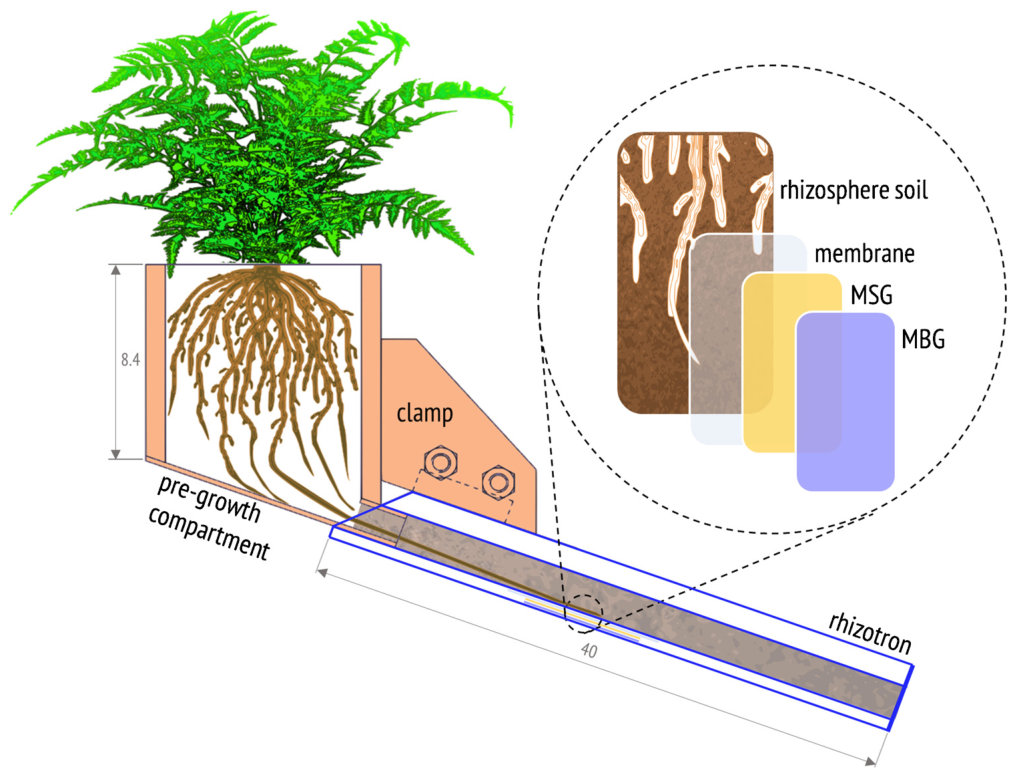
Twelve acrylic rhizotrons (inner dimensions (i.d.) of H × W × D = 40 cm × 10 cm × 1.5 cm) with removable front plates and 14 irrigation drillings on the backside were equipped with tightly fitting pre-growth compartments (i.d. 8 cm × 8 cm × 8.4 cm; Technisches Büro für Bodenkultur, Auersthal, Austria) (Fig. 1). The rhizotron and pre-growth compartments were filled with pre-incubated Forst99 soil to a dry bulk density of 0.95 g cm−3 ± 0.05 g cm−3 (mean ± standard deviation (SD), n = 24). This ensured a homogeneous soil profile with adequate porosity for root growth. Before the removable front plate was attached, the soil was covered with a 50 μm-thin PTFE-foil (Haberkorn, Wolfurt, Austria) overlain by a PE-foil to allow opening the rhizotron upon sampling with minimal soil and root disturbance. Six pre-cultivated fern specimen per species were transferred into soil-filled pre-growth compartments. Fern roots reached the bottom opening of the pre-growth compartments 28 days after planting (DAP) in Forst99 soil and were connected to the rhizotrons at this time. The assembly was inclined at ∼25° to ensure root development along the removable front plate. For irrigation, rhizotrons were weighed twice per week and deionized water (≤0.2 μS cm−1, Millipore Elix 3, MilliporeSigma, Burlington, MA, USA) was added to maintain Forst99 at ∼60% WHC during growth.
12个亚克力根窗(内部尺寸(i.d.)高 × 宽 × 深 = 40 cm × 10 cm × 1.5 cm)配有可拆卸前板,背面有14个灌溉孔,并装配紧密贴合的预生长隔室(i.d. 8 cm × 8 cm × 8.4 cm;Technisches Büro für Bodenkultur, Auersthal, Austria)(图1)。根窗和预生长隔室中填装经预培养的Forst99土壤,干容重为0.95 g cm−3 ± 0.05 g cm−3(平均值 ± 标准差(SD),n = 24),从而保证土壤剖面均匀且具有适于根系生长的孔隙度。在安装可拆卸前板之前,土壤表面覆盖一层50 μm厚的PTFE薄膜(Haberkorn, Wolfurt, Austria),其上再覆一层PE薄膜,以便采样时打开根窗而对土壤和根系的扰动最小。每个物种选取6株预培养的蕨类植株移入装土的预生长隔室中。在Forst99土壤中种植后第28天(DAP),蕨类根系到达预生长隔室底部开口,此时将其与根窗连接。整个装置倾斜约25°,以确保根系沿可拆卸前板生长。灌溉方面,每周对根窗称重两次,并添加去离子水(≤0.2 μS cm−1,Millipore Elix 3, MilliporeSigma, Burlington, MA, USA),使生长期间Forst99保持在约60% WHC。
2.3.3. Diffusive gradients in thin films (DGT) solute imaging2.3.3. 薄膜扩散梯度技术(DGT)溶质成像
For simultaneous solute imaging of AsIII, AsV, P, Mn and Fe in the rhizosphere, we used a novel approach, combining previously published DGT-mass spectrometric procedures (Bennett et al., 2011; Kreuzeder et al., 2013). We applied AsIII-specific DGT gels (MSG) and anion and cation mixed binding DGT gels (MBG) as a dual-layer gel sandwich in order to separate inorganic As species (i.e. AsIII and AsV) on MSG and MBG in situ during solute sampling. In this setup (Fig. 1), the MSG was placed onto the MBG and faced towards the soil-root interface to force AsIII binding to MSG only. The thiol (–SH) functional groups of the 3-mercaptopropyl-functionalized silica gel resin in the MSG have been shown to selectively bind AsIII but not AsV or organic As species (Howard et al., 1987; Bennett et al., 2011) and thus enable targeted sampling of labile AsIII in the rhizosphere porewater. The original MSG gel fabrication procedure of Bennett et al. (2011) was modified to produce ∼100 μm-thin DGT gels in a polyurethane gel matrix where the AsIII-selective binding resin was incorporated homogenously. Details on MSG fabrication can be found in the Supporting Information. The MBG was produced according to Kreuzeder et al. (2013) and consisted of the same gel matrix and had the same thickness as the MSG, but contained a mixture of suspended particulate reagent-iminodiacetate (SPR-IDA; CETAC Technologies, NE, USA) and zirconiumhydroxide precipitate (ZrOH), binding both labile trace metals (Mn and Fe) and oxyanions (AsIII, AsV and P).
为同步成像根际中的AsIII、AsV、P、Mn和Fe,我们结合已发表的DGT–质谱方法(Bennett et al., 2011; Kreuzeder et al., 2013),采用了一种新方法。我们将AsIII特异性DGT凝胶(MSG)与阴阳离子混合结合DGT凝胶(MBG)组成双层凝胶夹层,以便在溶质采样过程中原位将无机As形态(即AsIII和AsV)分别分离于MSG和MBG上。在该装置中(图1),MSG置于MBG之上并朝向土壤–根系界面,使AsIII仅结合于MSG。已有研究表明,MSG中3-巯丙基功能化硅胶树脂的巯基(–SH)官能团可选择性结合AsIII,而不结合AsV或有机As形态(Howard et al., 1987; Bennett et al., 2011),从而能够对根际孔隙水中的有效态AsIII进行靶向采样。我们对Bennett et al.(2011)原有的MSG凝胶制备方法进行了改进,制备出约100 μm厚、AsIII选择性结合树脂均匀分布于聚氨酯凝胶基质中的DGT凝胶。MSG制备的详细信息见补充材料。MBG依据Kreuzeder et al.(2013)的方法制备,其凝胶基质和厚度与MSG相同,但含有悬浮颗粒试剂–亚氨基二乙酸(SPR-IDA;CETAC Technologies, NE, USA)与氢氧化锆沉淀(ZrOH)的混合物,可同时结合有效态痕量金属(Mn和Fe)和含氧阴离子(AsIII、AsV和P)。
Dual-layer DGT probes were deployed for 24 h on selected regions of interest alongside individual PV and PQ roots grown in the rhizotron setup. The soil water content was increased from ∼60% to ∼80% WHC 24 h before solute sampling to ensure optimal diffusion properties while avoiding anoxic soil conditions. A 10 μm-thin polycarbonate membrane (0.2 μm pore size; Nuclepore, Whatman, Maidstone, UK) served as diffusion layer between soil and dual-layer DGT. The gels were applied between 58 and 66 DAP for PV, and 65 and 72 DAP for PQ. The later gel application was due to slower growth of PQ roots.
将双层DGT探针沿根窗装置中生长的单条PV和PQ根系,放置于选定的目标区域24 h。在溶质采样前24 h,将土壤含水量由约60%提高至约80% WHC,以确保最佳扩散条件,同时避免土壤出现缺氧状态。以10 μm厚的聚碳酸酯膜(孔径0.2 μm;Nuclepore, Whatman, Maidstone, UK)作为土壤与双层DGT之间的扩散层。PV的凝胶放置时间为58–66 DAP,PQ为65–72 DAP。PQ凝胶放置较晚是由于其根系生长较慢。
After dual-layer DGT sampling, an excimer-based 193 nm laser ablation (LA) system (NWR193, ESI, NWR Division, Portland, OR, USA) coupled to a quadrupole ICP-MS (NexION 350D, Perkin Elmer, Waltham, MA, USA) was operated in line-scan mode for the spatiallyreferenced multi-element analysis of As, P, Mn and Fe on the dried MSG and MBG surfaces. Operating parameters of the LA-ICP-MS analysis (Table S2) were set to achieve a final pixel (i.e. datapoint) size in the solute images of 113 μm × 400 μm. The acquired data for each m/z was gas blank corrected, normalized using 13C as internal standard (Kreuzeder et al., 2013), and quantified using external calibration with both matrix-matched AsIII (MSG), and AsV, P, Mn and Fe (MBG) calibration standards. Refer to the Supporting Information for details on the DGT LA-ICP-MS calibration standard preparation and method detection limits (MDLs; Table S3). Data processing was conducted using a custom-written VBA macro in Excel, Version 2016 (Microsoft, Redmond, WA, USA). After calibration of the normalized signal intensities to solute loadings per gel area, μg cm−2, DGT-labile metal(loid) flux equivalents, fDGT, were calculated (Kreuzeder et al., 2013).
双层DGT采样后,采用193 nm准分子激光剥蚀(LA)系统(NWR193, ESI, NWR Division, Portland, OR, USA)与四极杆ICP-MS(NexION 350D, Perkin Elmer, Waltham, MA, USA)联用,以线扫描模式对干燥的MSG和MBG表面的As、P、Mn和Fe进行空间定位多元素分析。LA-ICP-MS分析的操作参数(表S2)设定为使溶质图像的最终像素(即数据点)尺寸为113 μm × 400 μm。各m/z的采集数据经气体空白校正,以13C为内标进行归一化(Kreuzeder et al., 2013),并采用基质匹配的AsIII(MSG)以及AsV、P、Mn和Fe(MBG)校准标准进行外标定量。DGT LA-ICP-MS校准标准的制备及方法检出限(MDL;表S3)详见补充材料。数据处理采用Excel 2016版(Microsoft, Redmond, WA, USA)中自编的VBA宏程序完成。将归一化信号强度校准为单位凝胶面积的溶质负载量(μg cm−2)后,计算DGT有效态金属(类金属)通量当量fDGT(Kreuzeder et al., 2013)。
2.3.4. Planar optode O2 imaging2.3.4. 平面光极O2成像
Imaging of oxygen (O2) distributions in rooted soil of PV and PQ was accomplished by color ratiometric planar optode imaging according to Larsen et al. (2011). The O2-optodes used in our study were based on a O2-quenchable platinum(II)octaethylpor-phyrin (PtOEP) fluorophore (Borisov, 2018). O2-optodes were deployed in parallel, at different regions of interest, to the dual-layer DGT probes in the corresponding PV and PQ replicates. After ∼1 h incubation with deployed O2-optodes in the growth room, the rhizotrons were transferred to a dark room and positioned on a horizontal glass plate perpendicular to a digital single lens reflex camera (Canon EOS 1000D, Canon Inc., Tokyo, Japan) equipped with a macro lens (SIGMA 50 mm F2.8 DG MACRO, Sigma Corporation, Kanagawa, Japan). Optical filters and excitation LEDs were used as described in Larsen et al. (2011). The camera settings were ISO: 100, Av: f5.6, and Tv: 1/30 s. Details on O2-optode fabrication and calibration can be found in the Supporting Information.
依据Larsen et al.(2011)的方法,采用颜色比率平面光极成像技术对PV和PQ有根土壤中的氧气(O2)分布进行成像。本研究所用O2光极基于可被O2猝灭的铂(II)八乙基卟啉(PtOEP)荧光团(Borisov, 2018)。O2光极与双层DGT探针同时放置于相应PV和PQ重复中的不同目标区域。O2光极在生长室中放置约1 h后,将根窗转移至暗室,平放于水平玻璃板上,与配备微距镜头(SIGMA 50 mm F2.8 DG MACRO, Sigma Corporation, Kanagawa, Japan)的数码单反相机(Canon EOS 1000D, Canon Inc., Tokyo, Japan)垂直。光学滤光片和激发LED的使用参照Larsen et al.(2011)。相机设置为ISO:100,Av:f5.6,Tv:1/30 s。O2光极的制备和校准详见补充材料。
compared to the bulk soil fluxes. To determine the spatial extent of these areas, the solute images were imported in Photoshop CS3 (Adobe, San Jose, CA, USA) and the maximum width of the areas of increased and decreased fluxes was measured using the ruler tool following image scaling. This value was subtracted from the average root diameter of the corresponding root surfaces (0.51 mm ± 0.04 mm; n = 7) and divided by two to obtain the distance of solute flux features from the root surface into each side of the rhizosphere soil (termed ‘beyond the root surface’ throughout this paper). Solute flux and distance values in text are reported as means ± SD.
(与本体土壤通量相比),则相应判定为溶质通量降低、中等程度降低和略有降低。为确定这些区域的空间范围,将溶质图像导入Photoshop CS3(Adobe, San Jose, CA, USA),经图像比例尺校正后,使用标尺工具测量通量升高区和降低区的最大宽度。将该值减去相应根表面的平均根直径(0.51 mm ± 0.04 mm;n = 7)后除以2,即得到溶质通量特征从根表面向根际土壤每一侧延伸的距离(本文中称为“超出根表面”)。文中溶质通量和距离数值均以平均值 ± SD表示。
2.4. Phytic acid analysis in root exudates of soil-grown P. vittata2.4. 土培P. vittata根系分泌物中植酸的分析
2.4.1. Rhizobox setup2.4.1. 根箱装置
Twelve rhizoboxes (Wenzel et al., 2001) were filled with Forst99 soil to achieve a consistent bulk density of ∼1.2 g cm−3. The rhizoboxes were equipped with soil-filled pre-growth compartments in which two pre-cultivated fern specimen per species were planted each. During growth, the soil water content in the rhizobox assembly was gravimetrically kept constant at ∼60% WHC.
12个根箱(Wenzel et al., 2001)中填装Forst99土壤,使容重一致,约为1.2 g cm−3。根箱配有装土的预生长隔室,每个隔室种植每个物种的2株预培养蕨类植株。生长期间,采用称重法使根箱装置中的土壤含水量保持在约60% WHC。
2.4.2. Exudate sampling2.4.2. 根系分泌物采样
Fern root exudates were sampled using a root exudate collection system (REC) in the rhizobox setup according to Oburger et al. (2013). Over the course of the three-month experimental growth period, roots of PQ did not develop the dense root mat required for this approach. Therefore, PQ was excluded from the exudate analysis. Sampling of PV root exudates was conducted 85 DAP over one day/night cycle (24 h) at four different sub-units on each PV root mat. All exudates were collected in a matrix of 10 mg L−1 Micropur Classic (Katadyn Products Inc., Kemptthal, Switzerland) to prevent microbial exudate decomposition. At the end of the sampling period, the four exudate-containing solutions from each sub-unit were pooled for each rhizobox replicate (n = 6). Recovery of exudates by the REC (75% ± 5%; n = 3) on Forst99 soil was determined as detailed in Oburger et al. (2013).
依据Oburger et al.(2013)的方法,在根箱装置中使用根系分泌物收集系统(REC)采集蕨类根系分泌物。在3个月的试验生长期内,PQ的根系未能形成该方法所需的致密根垫,因此未对PQ进行分泌物分析。PV根系分泌物的采样于85 DAP进行,历时一个昼夜周期(24 h),在每个PV根垫的4个不同子单元进行。所有分泌物均收集于10 mg L−1 Micropur Classic(Katadyn Products Inc., Kemptthal, Switzerland)基质中,以防止分泌物被微生物分解。采样结束后,将每个根箱重复中4个子单元的分泌物溶液合并(n = 6)。REC在Forst99土壤上的分泌物回收率(75% ± 5%;n = 3)按Oburger et al.(2013)所述方法测定。
2.4.3. Phytic acid analysis2.4.3. 植酸分析
Phytic acid in PV root exudates was analyzed by high-performance ion chromatography (ICS-3000DP, Thermo Fisher Scientific, Waltham, MA, USA) combined with ICP-MS (Elan 6100 DRC II, PerkinElmer, Woodbridge, Ontario, Canada) according to Rugova et al. (2014).
依据Rugova et al.(2014)的方法,采用高效离子色谱(ICS-3000DP, Thermo Fisher Scientific, Waltham, MA, USA)与ICP-MS(Elan 6100 DRC II, PerkinElmer, Woodbridge, Ontario, Canada)联用分析PV根系分泌物中的植酸。
2.5. Fern biomass analysis2.5. 蕨类生物量分析
2.3.5. Image generation and data evaluation2.3.5. 图像生成与数据评价
The image processing software Fiji ImageJ 1.52p (National Institute of Health, Bethesda, MD, USA) was used for 2D image plotting, calculation, and evaluation. A Y/X scale factor of 3.53 without pixel interpolation was applied to recalculate pixel dimensions in the DGT images before their lossless export as TIFF files and figure arrangement in InDesign CS6 (Adobe, San Jose, CA, USA). For image evaluation, solute images and corresponding photographs were scale-matched and evaluated first visually for metal(loid) flux or O2 gradients between rhizosphere and bulk soil. If gradients to the corresponding bulk soil were visible, average solute fluxes and/or O2 values were calculated for the respective rhizosphere areas and compared to the average fluxes in the bulk soil. For solute flux quantifications in the rhizosphere, DGT images were first rotated to vertically align the root axis in the image center, before average solute fluxes were extracted from rectangular areas in the rhizosphere. These areas were defined as areas of increased solute flux, if their average fluxes were substantially higher (i.e. > average of corresponding adjacent area + 3 × SD) compared to the adjacent areas. Decreased, moderately decreased, and slightly decreased solute fluxes were assigned if the average fluxes in the rhizosphere were substantially lower (i.e. < average of corresponding bulk soil – 3 × SD), moderately lower (i.e. < average of corresponding bulk soil – 2 × SD), or slightly lower (i.e. < average of corresponding bulk soil – 1 × SD)
采用图像处理软件Fiji ImageJ 1.52p(National Institute of Health, Bethesda, MD, USA)进行二维图像绘制、计算和评价。在DGT图像以TIFF文件无损导出并于InDesign CS6(Adobe, San Jose, CA, USA)中排版之前,采用3.53的Y/X比例因子(不进行像素插值)重新计算其像素尺寸。图像评价时,将溶质图像与相应照片进行比例匹配,首先目视评价根际与本体土壤之间是否存在金属(类金属)通量或O2梯度。若可见与相应本体土壤之间的梯度,则计算相应根际区域的平均溶质通量和/或O2值,并与本体土壤的平均通量进行比较。在根际溶质通量定量时,先旋转DGT图像使根轴垂直位于图像中央,再从根际的矩形区域提取平均溶质通量。若某区域的平均通量显著高于相邻区域(即 > 相应相邻区域平均值 + 3 × SD),则定义为溶质通量升高区。若根际平均通量显著低于(即 < 相应本体土壤平均值 – 3 × SD)、中等程度低于(即 < 相应本体土壤平均值 – 2 × SD)或略低于(即 < 相应本体土壤平均值 – 1 × SD)
Ferns grown in the rhizotron experiment were immediately harvested after DGT and O2-optode application (52–67 DAP for PV and 66–73 DAP for PQ). Ferns were separated into roots (including the rhizome) and fronds. All biomass samples were thoroughly washed with deionized water (≤0.2 μS cm−1) in an ultrasonic bath, rinsed several times with laboratory water type 1 (≤0.055 μS cm−1) gently blotted, dried at 65 °C for 72 h, and the weights were recorded. Finely ground and homogenized subsamples (200 mg) of the plant material were digested in a 5:1 (v/v) mixture of HNO3 (65%, w/w; EMPARTA, ACS, Merck), H2O2 (30%, w/w; TraceSELECT Ultra, Fluka, Sigma-Aldrich) and a drop of iso-Octanol in open Pyrex tubes using an electrical heating block system (DK Heating Digester, Velp Scientifica, Usmate Velate, Italy). For quality control, three blanks and certified plant reference material (Oriental Basma Tobacco Leaves, INCT-OBTL-5, Institute of Nuclear Chemistry and Technology, Warsaw, Poland) were included in each digestion run. The digests were filtered (0.45 μm; Munktell 14/N, Munktell, Bärenstein, Germany) and diluted with laboratory water type 1 to reach a 2% (w/w) HNO3 matrix. Elemental concentrations in the fern digests were measured using ICP-OES (Optima 8300, Perkin Elmer, Waltham, USA) and ICP-MS (Elan 9000 DRCe, Perkin Elmer, Waltham, USA) with internal standardization (115In) and external multi-point calibration (ICP multi-element standard VI, Certipur®, Merck).
根窗试验中的蕨类在完成DGT和O2光极测定后立即收获(PV为52–67 DAP,PQ为66–73 DAP)。将蕨类分为根(包括根状茎)和叶片两部分。所有生物量样品均在超声波浴中用去离子水(≤0.2 μS cm−1)彻底清洗,再用1类实验室用水(≤0.055 μS cm−1)冲洗数次,轻轻吸干,于65 °C烘干72 h后称重。取经精细研磨并混匀的植物样品亚样(200 mg),在开口Pyrex管中以HNO3(65%,w/w;EMPARTA, ACS, Merck)与H2O2(30%,w/w;TraceSELECT Ultra, Fluka, Sigma-Aldrich)5:1(v/v)的混合液加一滴异辛醇,采用电加热块消解系统(DK Heating Digester, Velp Scientifica, Usmate Velate, Italy)进行消解。为进行质量控制,每批消解均包含3个空白和植物有证标准物质(Oriental Basma Tobacco Leaves, INCT-OBTL-5, Institute of Nuclear Chemistry and Technology, Warsaw, Poland)。消解液经过滤(0.45 μm;Munktell 14/N, Munktell, Bärenstein, Germany)后用1类实验室用水稀释至2%(w/w)HNO3基质。蕨类消解液中的元素浓度采用ICP-OES(Optima 8300, Perkin Elmer, Waltham, USA)和ICP-MS(Elan 9000 DRCe, Perkin Elmer, Waltham, USA)测定,采用内标校正(115In)和外标多点校准(ICP multi-element standard VI, Certipur®, Merck)。
2.6. Statistical analysis2.6. 统计分析
One-way analysis of variances (ANOVAs) were calculated for testing significant differences of As and P mass fractions between PV and PQ root and frond biomasses at p ≤ 0.05. Statistical analysis was conducted in IBM SPSS Version 23 (IBM Corporation, Armonk, NY, USA).
采用单因素方差分析(ANOVA)检验PV与PQ根和叶片生物量中As和P含量的显著性差异(p ≤ 0.05)。统计分析在IBM SPSS 23版(IBM Corporation, Armonk, NY, USA)中进行。
3Results结果
3.1. Fern biomass production and elemental composition3.1. 蕨类生物量与元素组成
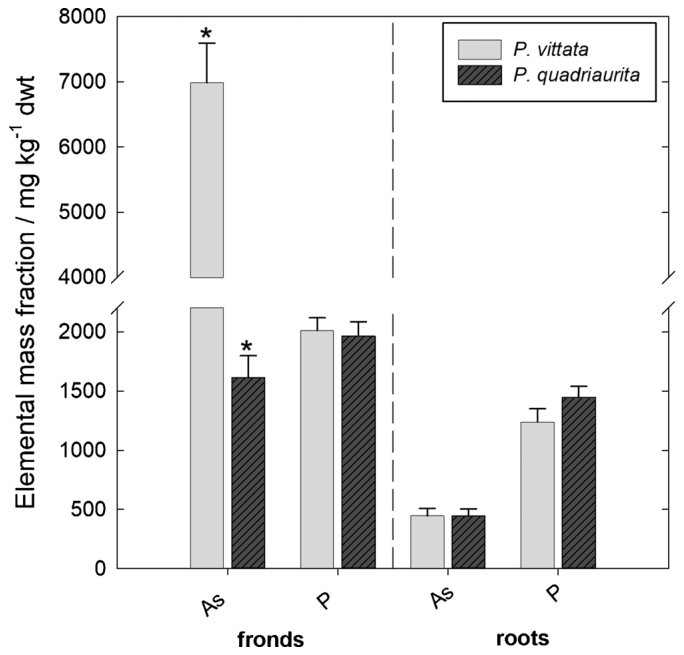
After ∼2 months of growth in As-rich Forst99 soil, dry-weight biomass production was not different for the two fern species (p > 0.05), with 3.31 g ± 0.70 g of fronds and 1.96 g ± 0.66 g of roots for PV (mean ± SD, n = 5), and 3.12 g ± 0.81 g of fronds and 2.04 g ± 0.54 g of roots for PQ (mean ± SD, n = 4). However, PV showed isolated necrotic areas at the pinnae margins of a few senescing fronds, whereas PQ did not develop visual toxicity symptoms. Fern tissue As and P mass fractions are presented in Fig. 2. While As mass fractions in fronds were 4-fold higher in PV than in PQ (p ≤ 0.05), As mass fractions in roots of the fern species were virtually identical (p > 0.05). Consequently, PV showed a 4-fold higher As frond-to-root ratio (i.e. translocation factor; 14.1; n = 5) as compared to PQ (3.71; n = 4). Frond and root P mass fractions were not different between PV and PQ (p > 0.05).
在富砷Forst99土壤中生长约2个月后,两种蕨类的干重生物量无显著差异(p > 0.05),PV叶片为3.31 g ± 0.70 g,根为1.96 g ± 0.66 g(平均值 ± SD,n = 5);PQ叶片为3.12 g ± 0.81 g,根为2.04 g ± 0.54 g(平均值 ± SD,n = 4)。然而,PV少数衰老叶片的羽片边缘出现零星坏死斑,而PQ未表现出可见的毒害症状。蕨类组织中As和P的含量见图2。PV叶片中的As含量是PQ的4倍(p ≤ 0.05),而两种蕨类根中的As含量几乎相同(p > 0.05)。因此,PV的As叶/根比(即转运系数;14.1;n = 5)比PQ(3.71;n = 4)高4倍。PV与PQ叶片和根中的P含量无显著差异(p > 0.05)。
3.2. Solute flux distribution of AsIII, AsV, P, Mn and Fe3.2. AsIII、AsV、P、Mn和Fe的溶质通量分布
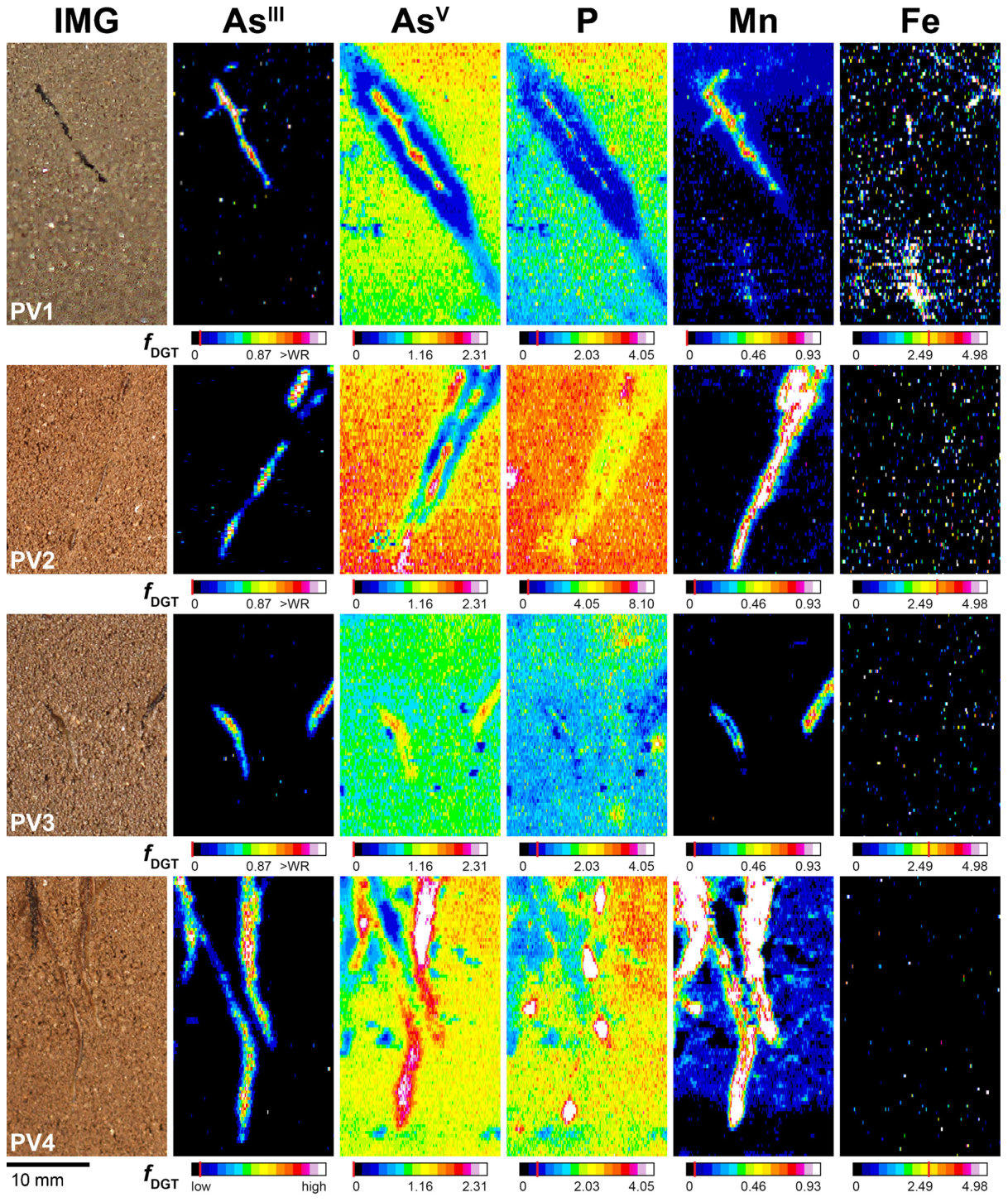
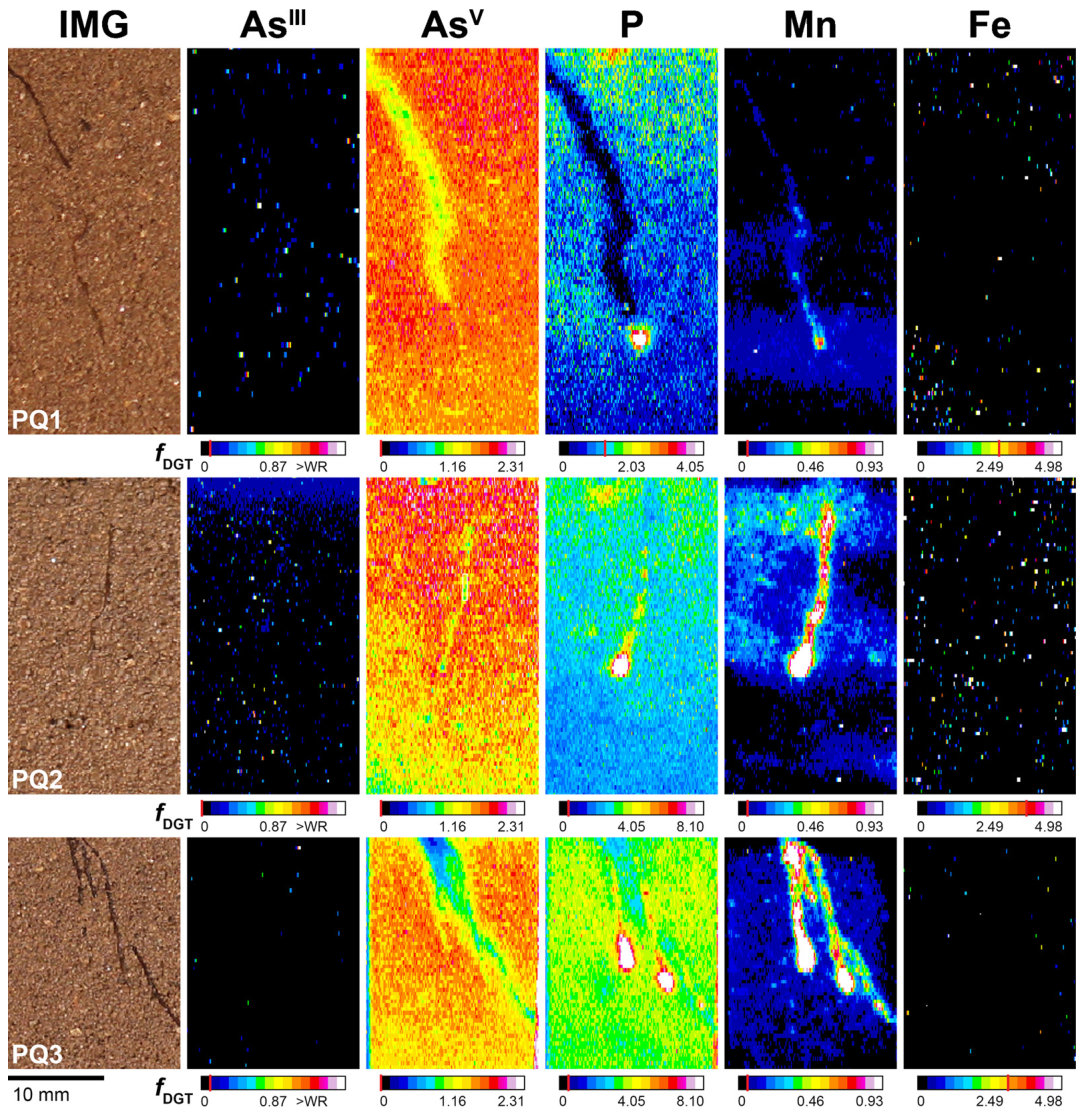
The 2D AsIII, AsV, P, Mn and Fe solute flux distribution in the rhizosphere and bulk soil of four PV (PV1−4) and three PQ (PQ1−3) replicates are presented in Figs. 3 and 4. Areas from which solute flux values were extracted are shown in Figs. S1 (PV) and S2 (PQ). For enhanced visualization of the fine-scale solute flux patterns in the rhizosphere of PV, an exemplary profile plot across the soil-root interface of one PV replicate (PV1) is provided in Fig. S3. The highest total AsIII gel loading at any single MSG location (i.e. over the whole data range) was 2.91 nmol cm−2 and thus well below the reported MSG AsIII binding capacity of 329 nmol cm−2 (Bennett et al., 2011). For MBG, anion and cation gel loadings were generally also well below the respective anion (230 nmol cm−2) and cation (310 nmol cm−2) MBG binding capacities (Kreuzeder et al., 2013), except for some isolated, almost single-pixel areas where Fe exceeded the MBG capacity up to 3- fold (Fig. 4, PQ2). This ensured zero sink conditions during deployment of the dual-layer DGT probes.
4个PV重复(PV1−4)和3个PQ重复(PQ1−3)根际及本体土壤中AsIII、AsV、P、Mn和Fe的二维溶质通量分布见图3和图4。提取溶质通量值的区域见图S1(PV)和图S2(PQ)。为更清晰地展示PV根际中精细尺度的溶质通量格局,图S3给出了一个PV重复(PV1)跨土壤–根系界面的示例剖面图。MSG上任一位置(即整个数据范围内)的最高总AsIII凝胶负载量为2.91 nmol cm−2,远低于已报道的MSG AsIII结合容量329 nmol cm−2(Bennett et al., 2011)。对于MBG,阴离子和阳离子凝胶负载量通常也远低于MBG相应的阴离子(230 nmol cm−2)和阳离子(310 nmol cm−2)结合容量(Kreuzeder et al., 2013),仅在个别几乎为单像素的区域中Fe超过MBG容量达3倍(图4,PQ2)。这确保了双层DGT探针放置期间的零汇条件。
3.2.1. Solute flux in bulk soil3.2.1. 本体土壤中的溶质通量
The average background flux of AsIII, AsV, P, Mn and Fe in bulk soil of all PV and PQ replicates is presented in Table 1. Labile AsIII was consistently below the AsIII MDL (Tab. S3). In contrast, labile AsV showed a homogeneous distribution with an average AsV flux of 1.37 pg cm−2 s-1 ± 0.26 pg cm−2 s-1 across all PV and PQ bulk soil areas. Compared to AsV, the bulk distribution of labile P was more heterogeneous within and between PV and PQ replicates. Labile Mn and Fe were consistently below or close to the Mn MDL and Fe MDL, respectively (Tab. S3).
所有PV和PQ重复本体土壤中AsIII、AsV、P、Mn和Fe的平均背景通量见表1。有效态AsIII始终低于AsIII的MDL(表S3)。相反,有效态AsV分布均匀,所有PV和PQ本体土壤区域的平均AsV通量为1.37 pg cm−2 s-1 ± 0.26 pg cm−2 s-1。与AsV相比,有效态P在PV和PQ重复内及重复间的本体分布更不均匀。有效态Mn和Fe分别始终低于或接近Mn和Fe的MDL(表S3)。
3.2.2. Solute flux in the rhizosphere of P. vittata3.2.2. P. vittata根际中的溶质通量
Distinct AsIII flux increases were mapped in the rhizosphere of all PV replicates (Fig. 3). The AsIII increases occurred as elongated areas closely associated with individual PV root axes, extending on average up to 0.5 mm ± 0.1 mm (n = 4) beyond the root surface (Fig. S3). At locations where the root surface was covered by a thin soil layer, and therefore not in direct contact with the dual-layer DGT, AsIII fluxes diminished (Fig. 3, PV1 and PV2). Flux maxima of AsIII up to 2.52 pg cm−2 s-1 were measured at the very root surface of mature root segments (Fig. 3, PV2). Only minor relative increase was found at apical root segments (Fig. 3, PV3 and PV4). For example, at the root tip of PV3, the average AsIII flux was 0.39 pg cm−2 s-1 ± 0.13 pg cm−2 s-1, corresponding to a 58% AsIII flux decrease as compared to the sub-apical region of the same root (Fig. 3, PV3).
在所有PV重复的根际中均观测到明显的AsIII通量升高(图3)。AsIII升高区呈与单条PV根轴紧密相关的狭长区域,平均超出根表面达0.5 mm ± 0.1 mm(n = 4)(图S3)。在根表面被薄层土壤覆盖、因而未与双层DGT直接接触的位置,AsIII通量减弱(图3,PV1和PV2)。AsIII通量最大值(最高2.52 pg cm−2 s-1)出现在成熟根段的根表面(图3,PV2)。根尖段仅有轻微的相对升高(图3,PV3和PV4)。例如,在PV3根尖处,平均AsIII通量为0.39 pg cm−2 s-1 ± 0.13 pg cm−2 s-1,与同一根的亚根尖区相比,AsIII通量降低了58%(图3,PV3)。
Mapping of AsV revealed a highly heterogeneous AsV distribution in the vicinity of PV roots (Fig. 3). We found elongated areas of increased AsV, which were consistently co-localized with the areas of increased AsIII but extended generally a little farther (0.6 mm ± 0.2 mm) beyond the root surface (Fig. S3). Flux maxima of AsV up to 3.85 pg cm−2 s−1 were determined in PV4, at the location where the surfaces of two adjoining PV roots were in direct contact with the dual-layer DGT (Fig. 3, PV4). The areas of increased AsIII/AsV flux were consistently localized within areas of decreased AsV, where AsV fluxes were depleted down to minimum values of 0.27 pg cm−2 s−1 (Fig. 3, PV1). The distinct zones of AsV depletion in PV1 and PV2 extended up to 2.2 mm (Fig. S3) and 1.5 mm beyond the root surface and accounted for a 67% and 61% AsV flux decrease, respectively, compared to the average AsV flux in the respective bulk soils (Fig. 3, PV1 and PV2). Slightly decreased AsV fluxes were also observed alongside apical and sub-apical root segments (Fig. 3, PV3 and PV4).
AsV成像结果显示,PV根系附近AsV分布高度不均匀(图3)。我们观察到AsV升高的狭长区域,这些区域始终与AsIII升高区共定位,但通常延伸得稍远(超出根表面0.6 mm ± 0.2 mm)(图S3)。AsV通量最大值(最高3.85 pg cm−2 s−1)出现在PV4中两条相邻PV根表面与双层DGT直接接触的位置(图3,PV4)。AsIII/AsV通量升高区始终位于AsV降低区内,后者AsV通量亏缺至最低0.27 pg cm−2 s−1(图3,PV1)。PV1和PV2中明显的AsV亏缺区分别超出根表面达2.2 mm(图S3)和1.5 mm,与相应本体土壤的平均AsV通量相比,AsV通量分别降低了67%和61%(图3,PV1和PV2)。沿根尖段和亚根尖段也观察到AsV通量略有降低(图3,PV3和PV4)。
Co-localized with the areas of increased AsIII/AsV, elongated areas of increased P and Mn were mapped in the PV rhizosphere (Fig. 3). The increased P fluxes were localized at the immediate root surface (Fig. 3, PV1, PV2 and PV4), whereas the increased Mn fluxes extended 0.8 mm ± 0.2 mm beyond the root surface and thus ∼0.2 mm beyond the areas of increased AsIII/AsV (Fig. S3). At PV4 root tips and apical root segments, drop-shaped areas with substantially increased P and Mn flux maxima up to 28.3 pg cm−2 s−1 and 10.1 pg cm−2 s−1, respectively, were observed (Fig. 3, PV4). The areas of increased P were found within areas of moderately (Fig. 3, PV1, PV2 and PV4) and slightly (Fig. 3, PV3) decreased P flux in the rhizosphere. Congruent to AsV, P depletion extended up to 2.2 mm beyond the root surface, lowering P fluxes down to 60% as compared to the respective bulk soil (Figs. 3 and S3, PV1). Labile Fe in the rhizosphere remained consistently below the Fe MDL, with no relative changes in rhizosphere compared to bulk soil (Fig. 3).
在PV根际中观测到与AsIII/AsV升高区共定位的P和Mn升高狭长区域(图3)。P通量升高区位于紧邻根表面处(图3,PV1、PV2和PV4),而Mn通量升高区超出根表面0.8 mm ± 0.2 mm,即比AsIII/AsV升高区远约0.2 mm(图S3)。在PV4的根尖和根尖段观察到P和Mn通量显著升高的水滴状区域,最大值分别达28.3 pg cm−2 s−1和10.1 pg cm−2 s−1(图3,PV4)。P升高区位于根际P通量中等程度降低(图3,PV1、PV2和PV4)和略有降低(图3,PV3)的区域内。与AsV一致,P亏缺区超出根表面达2.2 mm,与相应本体土壤相比,P通量降低至60%(图3和图S3,PV1)。根际中有效态Fe始终低于Fe的MDL,与本体土壤相比根际中无相对变化(图3)。
3.2.3. Solute flux in the rhizosphere of P. quadriaurita
3.2.3. P. quadriaurita根际中的溶质通量
In the rhizosphere of PQ, AsIII remained consistently below the AsIII MDL, no areas of increased AsIII or AsV fluxes were mapped (Fig. 4). Distinct depletion of AsV alongside individual PQ roots was observed in two out of three PQ replicates, with AsV flux minima of 0.38 pg cm−2 s−1 at the location where three adjoining PQ roots were in direct contact with the dual-layer DGT (Fig. 4, PQ3). In one PQ replicate areas of decreased AsV in the rhizosphere were observed only visually and not according to the defined classification criteria (Fig. 4, PQ2). Depletion of AsV fluxes in PQ1 and PQ3 extended up to 0.7 mm and 0.3 mm beyond the root surface, accounting for a 24% and 37% AsV flux decrease, respectively, as compared to the respective bulk soils (Fig. 4, PQ1 and PQ3). Thus, AsV depletion in the rhizosphere was less pronounced for PQ as compared to PV.
在PQ根际中,AsIII始终低于AsIII的MDL,未观测到AsIII或AsV通量升高区(图4)。在3个PQ重复中的2个中,观察到沿单条PQ根系的明显AsV亏缺,在三条相邻PQ根与双层DGT直接接触的位置,AsV通量最低为0.38 pg cm−2 s−1(图4,PQ3)。在一个PQ重复中,根际AsV降低区仅可目视观察到,而未达到所定义的分类标准(图4,PQ2)。PQ1和PQ3中AsV通量亏缺区分别超出根表面达0.7 mm和0.3 mm,与相应本体土壤相比,AsV通量分别降低了24%和37%(图4,PQ1和PQ3)。因此,与PV相比,PQ根际中AsV亏缺程度较轻。
For P and Mn, co-localized areas of highly increased fluxes around root tips were mapped in all PQ replicates, reaching P and Mn flux maxima of 78.9 pg cm−2 s−1 and 9.07 pg cm−2 s−1, respectively (Fig. 4, PQ2). With increasing distance to the root tip, P and Mn fluxes generally decreased. Two out of three PQ replicates showed, however, distinct areas of elongated Mn increase at mature root parts, extending up to 0.7 mm beyond the root surface (Fig. 4, PQ2 and PQ3). For P, solubilization hotspots at root tips extended towards moderately/ slightly decreased P fluxes around mature PQ root segments (Fig. 4, PQ1 and PQ3). As for PV, labile Fe fluxes in the rhizosphere of PQ remained below the Fe MDL (Fig. 4).
在所有PQ重复中,均观测到根尖周围P和Mn通量显著升高的共定位区域,P和Mn通量最大值分别达78.9 pg cm−2 s−1和9.07 pg cm−2 s−1(图4,PQ2)。随着与根尖距离的增加,P和Mn通量总体下降。然而,3个PQ重复中有2个在成熟根段显示出明显的Mn升高狭长区域,超出根表面达0.7 mm(图4,PQ2和PQ3)。对于P,根尖处的溶解热点向成熟PQ根段周围P通量中等程度/略有降低的区域延伸(图4,PQ1和PQ3)。与PV相同,PQ根际中有效态Fe通量低于Fe的MDL(图4)。
Average AsIII, AsV, P, Mn and Fe solute fluxes ( ± SD, n = 340) in bulk soil areas (A = 14.8 mm2) of PV and PQ replicates.
PV和PQ重复本体土壤区域(A = 14.8 mm2)中AsIII、AsV、P、Mn和Fe的平均溶质通量(± SD,n = 340)。
| fDGT in bulk soil (pg cm−2 s-1)本体土壤中的fDGT(pg cm−2 s-1) | ||||||
|---|---|---|---|---|---|---|
| Fern species | AsIII | AsV | P | Mn | Fe | |
| Pteris vittata | PV1 | ≤0.07a | 1.03 ± 0.10 | 1.41 ± 0.23 | 0.06 ± 0.02 | ≤2.72a |
| PV2 | ≤0.03a | 1.46 ± 0.14 | 5.47 ± 0.39 | ≤0.08a | ≤3.25a | |
| PV3 | ≤0.05a | 0.97 ± 0.08 | 1.55 ± 0.27 | ≤0.04a | ≤2.66a | |
| PV4 | n.c.b | 1.22 ± 0.08 | 2.22 ± 0.24 | 0.10 ± 0.06 | ≤2.66a | |
| Pteris quadriaurita | PQ1 | ≤0.07a | 1.55 ± 0.13 | ≤1.34a | 0.06 ± 0.02 | ≤2.81a |
| PQ2 | ≤0.05a | 1.41 ± 0.19 | 2.37 ± 0.32 | 0.07 ± 0.20 | ≤3.65a | |
| PQ3 | ≤0.07a | 1.44 ± 0.11 | 3.50 ± 0.28 | ≤0.08a | ≤3.19a |
a Method detection limit (MDL). b Not calibrated.
a 方法检出限(MDL)。b 未校准。
3.3. Oxygen (O2) distribution in rooted soil of P. vittata and P. quadriaurita
3.3. P. vittata和P. quadriaurita有根土壤中的氧气(O2)分布
Planar O2-optode measurements showed a rapid and extensive depletion of O2 in the rhizosphere of PV and PQ (Fig. 5). The O2 air saturation measured in selected bulk soil and rhizosphere areas (A = 4.24 mm2, n = 400) revealed an average decrease of O2 from up to 48.9% ± 0.8% (n = 2) in bulk soil to 2.51% ± 3.51% (n = 2) in the densely rooted soil of PV (Fig. 5, PV1 and PV4). For PQ, O2 air saturation was decreased from 51.6% ± 17.5% (n = 2) in bulk soil to 4.62% ± 0.37% (n = 2) alongside roots (Fig. 5, PQ1 and PQ2). Thus, PV and PQ showed similar patterns of O2 depletion in terms of reduced
平面O2光极测定显示,PV和PQ根际中O2迅速且大范围亏缺(图5)。在选定的本体土壤和根际区域(A = 4.24 mm2,n = 400)测得的O2空气饱和度显示,O2平均由本体土壤中的最高48.9% ± 0.8%(n = 2)降至PV密集根系土壤中的2.51% ± 3.51%(n = 2)(图5,PV1和PV4)。对于PQ,O2空气饱和度由本体土壤中的51.6% ± 17.5%(n = 2)降至根系附近的4.62% ± 0.37%(n = 2)(图5,PQ1和PQ2)。因此,就降低的
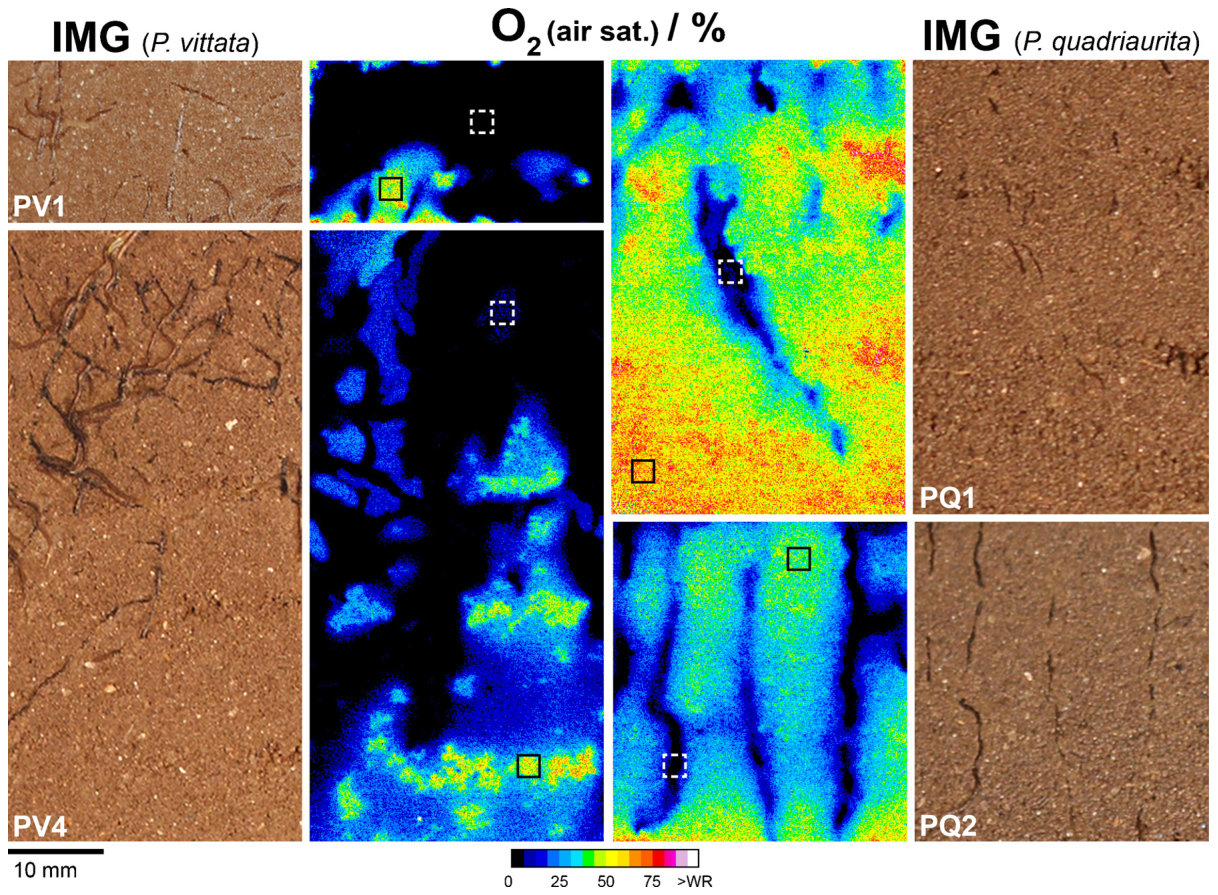
O2 availability. For PQ, however, the spatial extent of the lowered O2 availability was more confined to the immediate root surroundings (Fig. 5). Note that multiple roots located just behind the soil surface might have contributed to the substantial O2 decrease.
O2有效性而言,PV和PQ表现出相似的O2亏缺格局。然而,对于PQ,O2有效性降低的空间范围更局限于紧邻根系的周围区域(图5)。需要注意的是,位于土壤表面稍后方的多条根系可能共同导致了O2的显著降低。
3.4. Phytic acid in root exudates of P. vittata3.4. P. vittata根系分泌物中的植酸
In all investigated PV rhizobox replicates (n = 6) the content of phytic acid in root exudate samples was below the method detection limit (MDL) of 4.8 nmol L−1.
在所有供试PV根箱重复(n = 6)中,根系分泌物样品中的植酸含量均低于方法检出限(MDL)4.8 nmol L−1。
4Discussion讨论
4.1. Arsenic accumulation in P. vittata and P. quadriaurita4.1. P. vittata和P. quadriaurita对砷的累积
Biomass analysis revealed significant differences in As accumulation between PV and PQ (Fig. 2). For PV, strong As root uptake, translocation and frond accumulation confirmed As hyperaccumulation characteristics (Ma et al., 2001; Fitz et al., 2003). In contrast, PQ was evidently less efficient in As uptake and translocation than PV, as shown by the significantly lower As translocation factor and the significantly lower As mass fractions in fronds compared to soil (i.e. bioconcentration factor). Yet, both PV and PQ showed almost identical total root As mass fractions with 445 mg kg−1 ± 141 mg kg−1 for PV (mean ± SD, n = 5) and 444 mg kg−1 ± 119 mg kg−1 for PQ (mean ± SD, n = 4). Moreover, molar P/As ratios in root tissues were not significantly different with 7.30 ± 2.82 for PV (mean ± SD, n = 5) and 8.21 ± 1.66 for PQ (mean ± SD, n = 4). This suggests that both fern species tightly control the root As and P levels to avoid interferences of As with plant P metabolism. In PV, however, the strong As translocation from roots to fronds resulted in necrotic effects at pinnae margins of senescing fronds and low frond molar P/As ratios of 0.71 ± 0.13 (mean ± SD, n = 5). This indicates moderate As toxicity in PV due to As stress (Lombi et al., 2002; Tu and Ma, 2003, 2005; Gonzaga et al., 2009; Han et al., 2019), inducing internal As detoxification to sustain P nutrition at adequate levels for plant growth. PQ did not show necrosis at fronds and the molar P/As ratios of 3.01 ± 0.37 (mean ± SD, n = 4) in fronds were in line with previous work where PQ was grown in As-spiked soil (100 mg kg−1) without suffering from As toxicity (Srivastava et al., 2006). Contrary to the moderately elevated soil As levels in the study of Srivastava et al. (2006), where both As translocation and bioconcentration factors were clearly indicative for As hyperaccumulation by PQ, the high soil As levels (2080 mg kg−1) in the present study resulted in As accumulation typical for As-tolerant plant species (Meharg and Hartley-Whitaker, 2002; Fitz and Wenzel, 2006). Thus, PQ appears to use an adaptive strategy to cope with As toxicity, where it acts as an hyperaccumulator if As exposure is moderate (Srivastava et al., 2006), and as an As-tolerant ecotype if As exposure is high (the present study). To the best of our knowledge, this mechanism has not been observed before in other plant species and thus warrants further investigations in targeted dose-response experiments.
生物量分析表明,PV与PQ在As累积方面存在显著差异(图2)。PV表现出强烈的根系As吸收、转运及叶片累积,证实了其As超富集特性(Ma et al., 2001; Fitz et al., 2003)。相比之下,PQ的As吸收与转运效率明显低于PV,表现为其As转运系数显著较低,且叶片中As质量分数相对于土壤显著较低(即生物富集系数)。然而,PV与PQ根系总As质量分数几乎相同,PV为445 mg kg−1 ± 141 mg kg−1(平均值 ± SD,n = 5),PQ为444 mg kg−1 ± 119 mg kg−1(平均值 ± SD,n = 4)。此外,根组织中P/As摩尔比亦无显著差异,PV为7.30 ± 2.82(平均值 ± SD,n = 5),PQ为8.21 ± 1.66(平均值 ± SD,n = 4)。这表明两种蕨类均严格调控根系As和P水平,以避免As干扰植物P代谢。然而,在PV中,As由根系向叶片的强烈转运导致衰老叶片羽片边缘出现坏死,且叶片P/As摩尔比较低,为0.71 ± 0.13(平均值 ± SD,n = 5)。这表明PV因As胁迫而受到中度As毒害(Lombi et al., 2002; Tu and Ma, 2003, 2005; Gonzaga et al., 2009; Han et al., 2019),从而诱导体内As解毒,以将P营养维持在满足植物生长的适宜水平。PQ叶片未出现坏死,其叶片P/As摩尔比为3.01 ± 0.37(平均值 ± SD,n = 4),与此前PQ生长于As加标土壤(100 mg kg−1)而未受As毒害的研究结果一致(Srivastava et al., 2006)。Srivastava et al. (2006) 研究中土壤As水平中度升高,As转运系数和生物富集系数均明确表明PQ具有As超富集特性;与之不同,本研究中土壤As含量较高(2080 mg kg−1),PQ表现出As耐性植物物种典型的As累积特征(Meharg and Hartley-Whitaker, 2002; Fitz and Wenzel, 2006)。因此,PQ似乎采用了一种应对As毒性的适应性策略:在中度As暴露下表现为超富集植物(Srivastava et al., 2006),而在高As暴露下则表现为As耐性生态型(本研究)。据我们所知,该机制此前尚未在其他植物物种中观察到,因此有必要通过有针对性的剂量–效应试验作进一步研究。
4.2. Root-induced modulation of O2 availability at the soil-root interface4.2. 根系对土壤–根系界面O2有效性的调节
Planar O2-optode measurements visualized extensive O2 depletion in the immediate root vicinity of both ferns (Fig. 5), suggesting partly anoxic conditions and thus a locally lowered redox potential in the rhizosphere as observed earlier (Fitz et al., 2003). Although the planar optode images are not providing direct mechanistic insight into the origin of the O2 depletion (Blossfeld, 2013), it has been shown before that enhanced root and microbial respiration in the carbon-rich root zone of terrestrial plants can cause the formation of transient O2 gradients between rhizosphere and bulk soil (Rudolph-Mohr et al., 2012; Hoefer et al., 2015). Upon rapid consumption of the energetically most favorable terminal electron acceptor (TEA), O2, the reduction of less favorable TEAs, NO3− and MnIII/IV, proceeds quickly (McBride, 1994), resulting in rapid MnII release into the rhizosphere solution as shown by the areas of elongated Mn flux increase alongside PV and PQ roots. Strong O2 depletion in the rhizosphere can cause reducing conditions resulting in direct abiotic AsV reduction to AsIII (Masscheleyn et al., 1991). However, as the areas of increased AsIII flux were confined to the immediate root surface of PV only, while the zones of O2 depletion covered extensive areas across the soil-root interface of both PV and PQ, the lowered O2 availability appears to be insufficient to cause reducing conditions which could result in abiotic AsV reduction to AsIII. This is corroborated by the consistent lack of labile Fe in the O2-depleted rhizospheres of both fern species. The AsV/AsIII and FeIII/FeII redox couples share very similar transition thresholds in soil (between 0 mV and -100 mV at pH 7; Borch et al., 2010). Thus, the absence of changes in labile Fe between rhizosphere and bulk soil confirms that the redox potential remained sufficiently high for Fe and hence As to remain in their oxidized forms. This was initially surprising when compared to Fitz et al. (2003), who found 3-fold higher soil porewater Fe concentrations in PV rhizosphere than in bulk soil using a rhizobox setup and the same experimental soil. However, accumulation of labile Fe would imply acidic pH < 6.5 and prolonged anoxic conditions if labile Fe is released during siderite dissolution (Renard et al., 2017) or dissimilatory FeIII (oxyhydr)oxide reduction by microorganisms (Lovley et al., 2004). Siderite dissolution primarily releases insoluble FeCO3(aq) at pH > 6.5 or Fe(CO3)22− at pH > 8.5 and is regarded a slow process (Bruno et al., 1992). Labile MnII is kinetically relatively stable at neutral pH even in the presence of O2 (Tebo et al., 2005), and oxidation to MnIII/IV is much slower compared to oxidation of FeII to FeIII phases (Morgan, 2000). Therefore, the apparent discrepancy between our results and the findings of Fitz et al. (2003) may be explained by the different experimental approaches, with reductive Fe solubilization proceeding only under the influence of a dense root mat, but not along the individual roots investigated in the present study.
平面O2光极测定显示,两种蕨类根系紧邻区域均出现大范围O2耗竭(图5),表明根际存在局部缺氧条件,从而导致局部氧化还原电位降低,这与此前的观察一致(Fitz et al., 2003)。尽管平面光极图像无法直接从机理上揭示O2耗竭的成因(Blossfeld, 2013),但已有研究表明,陆生植物富碳根区中增强的根系呼吸和微生物呼吸可在根际与土体之间形成暂时性的O2梯度(Rudolph-Mohr et al., 2012; Hoefer et al., 2015)。在能量上最有利的末端电子受体(TEA)O2被迅速消耗后,次优TEA(NO3−和MnIII/IV)的还原随即迅速进行(McBride, 1994),导致MnII迅速释放到根际溶液中,这体现为沿PV和PQ根系分布的Mn通量升高的狭长区域。根际强烈的O2耗竭可产生还原条件,从而导致AsV直接经非生物途径还原为AsIII(Masscheleyn et al., 1991)。然而,AsIII通量升高的区域仅局限于PV根表紧邻处,而O2耗竭区则在PV和PQ的土壤–根系界面上覆盖了大片区域,因此O2有效性的降低似乎不足以形成可导致AsV非生物还原为AsIII的还原条件。两种蕨类的O2耗竭根际中均始终缺乏活性Fe,这进一步证实了上述推论。AsV/AsIII和FeIII/FeII氧化还原电对在土壤中的转变阈值非常接近(pH 7时介于0 mV至-100 mV之间;Borch et al., 2010)。因此,根际与土体之间活性Fe无变化,证实氧化还原电位始终足够高,使Fe进而As保持氧化态。与Fitz et al. (2003) 的结果相比,这一点起初令人意外:该研究采用根箱装置和相同的试验土壤,发现PV根际土壤孔隙水中Fe浓度比土体高3倍。然而,若活性Fe是在菱铁矿溶解(Renard et al., 2017)或微生物异化还原FeIII(氢)氧化物(Lovley et al., 2004)过程中释放的,则活性Fe的累积意味着需要pH < 6.5的酸性条件及长时间的缺氧条件。菱铁矿溶解在pH > 6.5时主要释放不溶性FeCO3(aq),在pH > 8.5时释放Fe(CO3)22−,且被认为是一个缓慢过程(Bruno et al., 1992)。在中性pH条件下,即使存在O2,活性MnII在动力学上也相对稳定(Tebo et al., 2005),其氧化为MnIII/IV的速率远低于FeII氧化为FeIII相的速率(Morgan, 2000)。因此,本研究结果与Fitz et al. (2003) 结果之间的明显差异可能源于试验方法的不同:Fe的还原溶解仅在致密根垫的影响下发生,而不会沿本研究所考察的单根发生。
4.3. Spatial patterns of arsenic cycling in the rhizosphere4.3. 根际砷循环的空间格局
Simultaneous, sub-mm scale solute imaging of labile AsIII and AsV fluxes by dual-layer DGT LA-ICP-MS visualized differential patterns of As redox transformations showing different mechanisms of As cycling at the soil-root interface of individual PV and PQ roots. Consistent with more efficient As accumulation by PV, we found 2-fold higher depletion of labile soil AsV in the rhizosphere of PV (Figs. 3 and 4), indicating an overall higher AsV root uptake efficiency of PV compared to PQ. The observed AsV depletion in the PV rhizosphere is in line with previous evidence from both hydroponic (Wang et al., 2002; Poynton et al., 2004) and soil-based (Fitz et al., 2003; Gonzaga et al., 2006) experiments and shows that individual PV roots act as a strong localized sink for labile AsV in As-rich soil, depleting labile AsV fractions up to ∼2 mm from the root surface into the adjacent soil. At the immediate soil–root interface (i.e. the rhizoplane), the local As speciation and associated P and Mn solute flux patterns differed largely between PV and PQ. Only PV showed steep AsIII gradients which were co-localized with increased AsV, P and Mn fluxes in the center of the AsV depletion zones, whereas indications for root-induced As redox transformations were consistently missing in the rhizosphere of PQ (Figs. 3 and 4).
利用双层DGT LA-ICP-MS对活性AsIII和AsV通量进行同步亚毫米尺度溶质成像,揭示了As氧化还原转化的差异格局,显示PV与PQ单根的土壤–根系界面存在不同的As循环机制。与PV更高效的As累积相一致,我们发现PV根际土壤活性AsV的耗竭程度是PQ的2倍(图3和图4),表明PV根系对AsV的总体吸收效率高于PQ。PV根际观察到的AsV耗竭与此前水培试验(Wang et al., 2002; Poynton et al., 2004)和土培试验(Fitz et al., 2003; Gonzaga et al., 2006)的证据一致,表明在富As土壤中PV单根是活性AsV的强局部汇,可使距根表约2 mm范围内相邻土壤中的活性AsV组分耗竭。在紧邻的土壤–根系界面(即根面)处,PV与PQ的局部As形态及相关P和Mn溶质通量格局差异很大。仅PV表现出陡峭的AsIII梯度,且在AsV耗竭区中心与AsV、P和Mn通量升高区域共定位;而在PQ根际中始终未见根系诱导As氧化还原转化的迹象(图3和图4)。
The localized AsIII flux increase at the PV rhizoplane is consistent with enhanced AsV reductase activity in root tissues (Liu et al., 2009; Cesaro et al., 2015) and AsIII root efflux (Chen et al., 2016; Han et al., 2016) by PV when grown in AsV-rich growth media, and shows that individual PV roots can change As speciation in the rhizosphere (AsIII/ AsV ratio of 0.57) as compared to bulk soil (AsIII/AsV ratio of ≤0.04).
PV根面局部AsIII通量升高,与PV生长于富AsV介质中时根组织AsV还原酶活性增强(Liu et al., 2009; Cesaro et al., 2015)及根系AsIII外排(Chen et al., 2016; Han et al., 2016)的结果相一致,并表明PV单根可改变根际As形态(AsIII/ AsV比值为0.57),而土体中AsIII/AsV比值≤0.04。
Since AsIII is, compared to AsV, no chemical analogue to P, it does not interfere with plant P metabolism (Zhao et al., 2009). However, AsIII is also toxic to plants due to reactions with thiol groups, disrupting enzymatic activity and protein synthesis (Meharg and Hartley-Whitaker, 2002). While non-accumulators typically cope with high cytoplasmic AsIII concentrations via sequestration of AsIII-phytochelatin complexes in root vacuoles resulting in low AsIII translocation to shoots (Zhao et al., 2009), PV shows only minor AsIII complexation in roots and efficient AsIII translocation to fronds (Su et al., 2008). Therefore, in line with previous results from hydroponic experiments (Su et al., 2008; Huang et al., 2011b; Chen et al., 2016; Han et al., 2016), a fraction of the AsIII produced in PV root cells may be effluxed into the apoplasm and subsequently diffuse into the rhizosphere soil to lower the cellular AsIII burden and thus avoid metabolic AsIII stress. This AsIII efflux mechanism may be essential for adaptive As detoxification by PV if AsV uptake and internal reduction to AsIII exceeds AsIII translocation rates to fronds (Wang et al., 2010).
与AsV不同,AsIII并非P的化学类似物,因此不会干扰植物P代谢(Zhao et al., 2009)。然而,AsIII可与巯基反应,破坏酶活性和蛋白质合成,因而同样对植物有毒(Meharg and Hartley-Whitaker, 2002)。非富集植物通常通过将AsIII-植物螯合肽复合物区隔于根部液泡中来应对细胞质中高浓度的AsIII,从而使AsIII向地上部的转运量较低(Zhao et al., 2009);而PV根部AsIII的络合程度很低,AsIII可高效转运至叶片(Su et al., 2008)。因此,与此前水培试验结果一致(Su et al., 2008; Huang et al., 2011b; Chen et al., 2016; Han et al., 2016),PV根细胞中产生的部分AsIII可能被外排至质外体,随后扩散进入根际土壤,以降低细胞AsIII负荷,从而避免AsIII代谢胁迫。若AsV吸收及其在体内还原为AsIII的速率超过AsIII向叶片的转运速率,这一AsIII外排机制可能对PV的适应性As解毒至关重要(Wang et al., 2010)。
Indeed, it has been proposed that AsIII efflux may be a constitutive mechanism for As tolerance in plants (Gupta et al., 2011). However, the apparent lack of detectable AsIII fluxes in the rhizosphere and hence AsIII root efflux by PQ contrasts with this interpretation. The 2-fold lower AsV depletion in the rhizosphere of PQ compared to PV (Figs. 3 and 4), along with the 4-fold lower total As content in fern tissues (Fig. 2), indicate that As-tolerance by PQ involves an overall reduced As uptake compared to PV. Exclusion of As from root uptake is known from several non-hyperaccumulating As-tolerant plant species such as Holcus lanatus, Deschampsia cespitosa and Cytisus striatus (Meharg and Hartley- Whitaker, 2002; Bleeker et al., 2003). While PQ does not avoid As uptake, our data indicate that this species efficiently controls As uptake to avoid exceeding tolerable cytoplasmic As, and not effluxing As like PV.
事实上,已有研究提出AsIII外排可能是植物耐As的组成型机制(Gupta et al., 2011)。然而,PQ根际中明显未检测到AsIII通量,因而也不存在PQ根系AsIII外排,这与上述解释相悖。PQ根际AsV耗竭程度比PV低2倍(图3和图4),且蕨类组织总As含量低4倍(图2),表明与PV相比,PQ的As耐性涉及总体As吸收量的降低。已知若干非超富集的As耐性植物物种(如Holcus lanatus、Deschampsia cespitosa和Cytisus striatus)通过将As排斥于根系吸收之外来耐受As(Meharg and Hartley- Whitaker, 2002; Bleeker et al., 2003)。虽然PQ并不回避As吸收,但我们的数据表明,该物种能够有效调控As吸收,以避免细胞质As超出可耐受水平,而非像PV那样外排As。
The spatial patterns of AsIII efflux in the PV rhizosphere were consistently co-localized with increased AsV, P and Mn fluxes, pointing towards AsIII re-oxidation in the rhizosphere through chemical oxidation of AsIII to AsV by MnIII/IV (oxyhydr)oxides (Oscarson et al., 1981, 1983; Li et al., 2010; Liu et al., 2012). Following oxidation of AsIII on MnIII/IV (oxyhydr)oxide surfaces, AsV and MnII are concomitantly released into solution, where they may readily bind to the available sorption sites, including the MBG in the dual-layer DGT probe. The AsV produced in this reaction can mobilize P via ligand exchange on mineral surfaces (Liu et al., 2001), which may explain the increased P fluxes at the immediate root surface (Fig. 3). We therefore hypothesize that the observed Mn solubilization was, apart from dissimilatory Mn reduction, linked to As cycling by PV, partially mediating AsIII re-oxidation to AsV. Redox cycling remained rapid as increased AsIII fluxes were confined to the immediate root vicinity and AsV quantities were similar to those of AsIII (Fig. S3), especially if the AsV background in the adjacent depletion zones was accounted for (AsIII/AsV ratio of 0.97). The fact that the areas of AsV and Mn co-localization showed almost an identical spatial extent as compared to those of AsIII (Fig. S3) indicated only marginal diffusion of AsIII from the rhizoplane into the soil and back towards the dual-layer DGT probe during AsIII efflux and re-oxidation. Thus, in line with previous evidence from soil incubation experiments (Ying et al., 2012; Ehlert et al., 2016), MnIII/IV (oxyhydr)oxides may effectively retard diffusion of AsIII from the rhizosphere into the bulk soil by promoting rapid AsIII oxidation and subsequent AsV sorption to soil solid phases. However, rhizospheric oxidation of AsIII to AsV may have also been mediated by microbes present at the root surface (Mathews et al., 2010).
PV根际AsIII外排的空间格局始终与AsV、P和Mn通量升高区域共定位,表明AsIII在根际中发生了再氧化,即AsIII经MnIII/IV(氢)氧化物化学氧化为AsV(Oscarson et al., 1981, 1983; Li et al., 2010; Liu et al., 2012)。AsIII在MnIII/IV(氢)氧化物表面被氧化后,AsV和MnII同时释放到溶液中,并可迅速结合到可用的吸附位点上,包括双层DGT探针中的MBG。该反应产生的AsV可通过矿物表面的配体交换活化P(Liu et al., 2001),这可能解释了紧邻根表处P通量的升高(图3)。因此,我们推测,除异化Mn还原外,所观察到的Mn溶解与PV的As循环相关联,部分介导了AsIII再氧化为AsV的过程。由于AsIII通量升高仅局限于根系紧邻区域,且AsV数量与AsIII相近(图S3),尤其在扣除相邻耗竭区中AsV背景值后(AsIII/AsV比值为0.97),可见氧化还原循环始终保持快速。AsV与Mn共定位区域的空间范围与AsIII区域几乎相同(图S3),表明在AsIII外排和再氧化过程中,AsIII从根面扩散进入土壤并返回双层DGT探针的程度极小。因此,与此前土壤培养试验的证据一致(Ying et al., 2012; Ehlert et al., 2016),MnIII/IV(氢)氧化物可通过促进AsIII快速氧化及随后AsV在土壤固相上的吸附,有效阻滞AsIII由根际向土体的扩散。不过,根际中AsIII氧化为AsV也可能由根表存在的微生物介导(Mathews et al., 2010)。
Interestingly, the spatial pattern of AsIII root efflux and re-oxidation in the PV rhizosphere consistently followed root development. Localized patterns of AsIII efflux were observed in the zone of root maturation (Fig. 3, PV1−4), decreasing towards the root tips (Fig. 3, PV3 and PV4). This spatial zonation coincides with the reported root tissue distribution of aquaporins (Hachez et al., 2006), which are known to mediate bidirectional AsIII transport along concentration gradients across PV root membranes (He et al., 2016). The small spatial extension of this diffusion-controlled mechanism may also explain why previous soil-based experiments could not detect As speciation and mobilization changes in the rhizosphere porewater (Fitz et al., 2003). While rapid diffusion of effluxed AsIII in hydroponic experiments can lead to a complete reduction of AsV to AsIII in the growth medium (Xu et al., 2007; Chen et al., 2016), retarded AsIII diffusion in soil-based systems may confine As mobilization to the immediate (sub-mm) root vicinity (Kuppardt et al., 2010). The steep AsIII /AsV gradients in the immediate vicinity of individual PV roots visualized in the solute images are in line with this assumption.
值得注意的是,PV根际AsIII根系外排及再氧化的空间格局始终与根系发育相对应。AsIII外排的局部格局出现在根系成熟区(图3,PV1−4),并向根尖方向减弱(图3,PV3和PV4)。这一空间分区与已报道的水通道蛋白在根组织中的分布相吻合(Hachez et al., 2006),已知水通道蛋白可介导AsIII沿浓度梯度跨PV根膜的双向转运(He et al., 2016)。这一受扩散控制的机制空间范围很小,这也可能解释了此前土培试验为何未能检测到根际孔隙水中As形态和活化的变化(Fitz et al., 2003)。在水培试验中,外排AsIII的快速扩散可导致生长介质中的AsV完全还原为AsIII(Xu et al., 2007; Chen et al., 2016);而在土壤体系中,AsIII扩散受阻,可能使As活化局限于根系紧邻(亚毫米)区域(Kuppardt et al., 2010)。溶质图像中所显示的PV单根紧邻区域陡峭的AsIII /AsV梯度与这一推测相符。
4.4. Phosphorus and manganese mobilization at root tips4.4. 根尖处磷和锰的活化
Co-localization of highly increased P and Mn fluxes was observed at both PV and PQ root tips (Figs. 3 and 4). The P and Mn hotspots were not accompanied by increased AsIII or AsV fluxes, revealing a surprising, spatially confined disconnect between P and Mn mobilization and As release. In earlier work, we observed similar P flux patterns with increased labile P at root tip regions of Brassica napus, Fagopyrum esculentum, Lupinus albus and Triticum aevestivum which were partly co-localized with increased Mn fluxes (Santner et al., 2012; Kreuzeder et al., 2018). These Mn features had been shown to be caused by localized rhizosphere acidification leading to MnIII/IV (oxyhydr)oxide dissolution. Although Pteris species can also modify their rhizosphere pH (Gonzaga et al., 2006, 2009), rhizosphere acidification is unlikely to play an important role for Mn solubilization in the present study due to the high buffer capacity of the Forst99 soil for protons (Fitz et al., 2003). Besides, rhizodeposition of root border cells into the rhizosphere soil during root growth may have contributed to the co-localization of increased P and Mn fluxes at root tip areas. In ongoing work evidence for P rhizodeposition at root tips of several plant species, including Zea mays, Helianthus annuus and Phaseolus vulgaris has been found (Golestanifard and Santner et al., unpublished results). We thus suggest that rhizodeposition also contributes to the increased P and Mn fluxes around fern root tips observed in the present study.
在PV和PQ根尖处均观察到P和Mn通量大幅升高且相互共定位(图3和图4)。这些P和Mn热点并未伴随AsIII或AsV通量的升高,揭示了P和Mn活化与As释放之间一种出人意料的、空间上局限的脱节。在早期研究中,我们在Brassica napus、Fagopyrum esculentum、Lupinus albus和Triticum aevestivum的根尖区域观察到类似的P通量格局,即活性P升高,且部分与Mn通量升高区域共定位(Santner et al., 2012; Kreuzeder et al., 2018)。已证明这些Mn特征是由局部根际酸化导致MnIII/IV(氢)氧化物溶解所致。尽管凤尾蕨属植物也能改变其根际pH(Gonzaga et al., 2006, 2009),但由于Forst99土壤对质子具有较高的缓冲容量(Fitz et al., 2003),根际酸化在本研究Mn溶解中不太可能起重要作用。此外,根系生长过程中根边缘细胞向根际土壤的根际沉积可能促成了根尖区域P和Mn通量升高的共定位。在正在进行的研究中,已在包括Zea mays、Helianthus annuus和Phaseolus vulgaris在内的多种植物根尖发现P根际沉积的证据(Golestanifard and Santner et al.,未发表结果)。因此,我们认为根际沉积也促成了本研究中观察到的蕨类根尖周围P和Mn通量的升高。
reduction of O2 and MnIII/IV (oxyhydr)oxides leading to decreased O2 availability and increased Mn solubilization along individual roots. In contrast to PV, we found no AsIII efflux by PQ, but indication for PQ efficiently controlling As root uptake to tolerable levels. Interestingly, in the present study, As acquisition by PV was not associated with phytic acid release from roots, highlighting the need for further work to elucidate the role of phytic acid in As hyperaccumulation. Our study demonstrates that two closely-related As-accumulating fern species, P. vittata and P. quadriaurita, have distinct mechanisms for As uptake, and provides new evidence for the importance of species-specific plant adaptations in modulating As redox transformations and cycling in As-rich environments. Future work on PV and PQ should aim to determine the adaptive advantages of each mechanism.
O2和MnIII/IV(氢)氧化物的还原,导致沿单根O2有效性降低、Mn溶解增加。与PV不同,我们未发现PQ存在AsIII外排,但有迹象表明PQ能将根系As吸收有效控制在可耐受水平。值得注意的是,本研究中PV对As的获取与根系植酸释放无关,这凸显了需进一步研究以阐明植酸在As超富集中的作用。本研究表明,两种亲缘关系相近的As富集蕨类P. vittata和P. quadriaurita具有不同的As吸收机制,并为物种特异性植物适应在调控富As环境中As氧化还原转化和循环方面的重要性提供了新证据。今后对PV和PQ的研究应致力于确定各机制的适应性优势。
Declaration of Competing Interest利益冲突声明
The authors declare that they have no known competing financial interests or personal relationships that could have appeared to influence the work reported in this paper.
作者声明,不存在任何可能影响本文所报道工作的已知经济利益冲突或个人关系。
CRediT authorship contribution statementCRediT作者贡献声明
Stefan Wagner: Conceptualization, Methodology, Validation, Formal analysis, Investigation, Data curation, Writing - original draft, Writing - review & editing, Visualization, Project administration. Christoph Hoefer: Conceptualization, Methodology, Software, Validation, Formal analysis, Investigation, Data curation, Writing - original draft, Writing - review & editing, Visualization, Supervision, Project administration. Markus Puschenreiter: Conceptualization, Writing - review & editing, Supervision. Walter W. Wenzel: Conceptualization, Writing - review & editing, Supervision, Funding acquisition. Eva Oburger: Methodology, Writing - review & editing. Stephan Hann: Methodology, Investigation, Writing - review & editing. Brett Robinson: Writing - review & editing. Ruben Kretzschmar: Writing - review & editing. Jakob Santner: Conceptualization, Methodology, Validation, Writing - review & editing, Supervision, Project administration.
Stefan Wagner:构思、方法、验证、形式分析、调查研究、数据整理、撰写–初稿、撰写–审阅与编辑、可视化、项目管理。Christoph Hoefer:构思、方法、软件、验证、形式分析、调查研究、数据整理、撰写–初稿、撰写–审阅与编辑、可视化、指导、项目管理。Markus Puschenreiter:构思、撰写–审阅与编辑、指导。Walter W. Wenzel:构思、撰写–审阅与编辑、指导、经费获取。Eva Oburger:方法、撰写–审阅与编辑。Stephan Hann:方法、调查研究、撰写–审阅与编辑。Brett Robinson:撰写–审阅与编辑。Ruben Kretzschmar:撰写–审阅与编辑。Jakob Santner:构思、方法、验证、撰写–审阅与编辑、指导、项目管理。
4.5. Phytic acid exudation by P. vittata?4.5. P. vittata是否分泌植酸?
Acknowledgments致谢
Despite previous reports on phytic acid exudation from PV roots in hydroponic culture (Tu et al., 2004b; Liu et al., 2016), we did not detect phytic acid in exudates sampled from soil-grown PV specimen. Interestingly, phytic acid exudation rates in the hydroponic study of Liu et al. (2016) increased with increasing AsV concentration in the external medium. If phytic acid would be released for mobilizing As from the soil for plant uptake, analogous to e.g. citrate release for mobilizing soil P by Lupinus albus (Neumann and Römheld, 1999), decreasing exudation rates with increasing external As concentrations would be expected, as the larger carbon and energy investment for As mobilization would be necessary in the case of low, but not high, external As availability. Since there are no other investigations of phytic acid release from PV roots available, further work is required to elucidate if phytic acid contributes to As hyperaccumulation by PV.
尽管此前有报道称水培条件下PV根系分泌植酸(Tu et al., 2004b; Liu et al., 2016),但我们在土培PV样本采集的根系分泌物中未检测到植酸。值得注意的是,在Liu et al. (2016) 的水培研究中,植酸分泌速率随外部介质AsV浓度的升高而增加。若植酸的释放是为了活化土壤中的As以供植物吸收(类似于Lupinus albus释放柠檬酸盐以活化土壤P;Neumann and Römheld, 1999),则应预期分泌速率随外部As浓度的升高而降低,因为只有在外部As有效性较低而非较高时,才需要为As活化投入更多的碳和能量。由于目前尚无关于PV根系植酸释放的其他研究,需要进一步研究以阐明植酸是否有助于PV的As超富集。
This study was co-funded by the Austrian Science Fund (FWF): P30085-N28 (Thomas Prohaska) and the Austrian Science Fund (FWF) and the Federal State of Lower Austria P27571-BBL (Jakob Santner). We thank Veronika Slavik (University of Natural Resources and Life Sciences, Vienna) for technical assistance in the laboratory and Christian Kleinschmid for providing the soil sample.
本研究由奥地利科学基金(FWF)项目P30085-N28(Thomas Prohaska)以及奥地利科学基金(FWF)与下奥地利州联合项目P27571-BBL(Jakob Santner)共同资助。感谢Veronika Slavik(维也纳自然资源与生命科学大学)在实验室工作中提供的技术协助,以及Christian Kleinschmid提供土壤样品。
Appendix A. Supplementary data附录A. 补充数据
Supplementary material related to this article can be found, in the online version, at doi:https://doi.org/10.1016/j.envexpbot.2020. 104122.
与本文相关的补充材料可在在线版本中获取,doi:https://doi.org/10.1016/j.envexpbot.2020. 104122。
References参考文献
5Conclusion结论
We visualized the sub-mm solute flux distribution of AsIII, AsV, P, Mn, Fe and O2 along individual As hyperaccumulator roots grown for two months in soil geogenically enriched in As. Reproducible patterns in the rhizospheric AsIII/AsV distribution and total As accumulation in fern tissues revealed differential As uptake mechanisms and biotransformation pathways in PV and PQ. We conclude that the high As uptake, translocation and accumulation from As-rich soil in PV fronds induced the need for root As detoxification via AsV reduction and AsIII efflux leading to AsIII accumulation and re-oxidation to AsV in the rhizosphere porewater. This As cycling mechanism is accompanied by the
我们对在As地质成因富集土壤中生长两个月的As超富集植物单根沿线AsIII、AsV、P、Mn、Fe和O2的亚毫米尺度溶质通量分布进行了可视化。根际AsIII/AsV分布及蕨类组织总As累积的可重复格局揭示了PV与PQ在As吸收机制和生物转化途径上的差异。我们得出结论:PV从富As土壤中对As的高吸收、高转运及其在叶片中的高累积,诱导其需要通过AsV还原和AsIII外排进行根系As解毒,进而导致根际孔隙水中AsIII累积并再氧化为AsV。这一As循环机制同时伴随着
Bennett, W.W., Teasdale, P.R., Panther, J.G., Welsh, D.T., Jolley, D.F., 2011. Speciation of dissolved inorganic arsenic by diffusive gradients in thin films: selective binding of AsIII by 3-mercaptopropyl-functionalized silica gel. Anal. Chem. 83, 8293–8299.
Bennett, W.W., Teasdale, P.R., Panther, J.G., Welsh, D.T., Jolley, D.F., 2011. Speciation of dissolved inorganic arsenic by diffusive gradients in thin films: selective binding of AsIII by 3-mercaptopropyl-functionalized silica gel. Anal. Chem. 83, 8293–8299.
Bleeker, P.M., Schat, H., Vooijs, R., Jos, A.C.V., Wilfried, H.O.E., 2003. Mechanisms of
Bleeker, P.M., Schat, H., Vooijs, R., Jos, A.C.V., Wilfried, H.O.E., 2003. Mechanisms of
arsenate tolerance in Cytisus striatus. New Phytol. 157, 33–38.
arsenate tolerance in Cytisus striatus. New Phytol. 157, 33–38.
Blossfeld, S., 2013. Light for the dark side of plant life: planar optodes visualizing rhizosphere processes. Plant Soil 369, 29–32.
Blossfeld, S., 2013. Light for the dark side of plant life: planar optodes visualizing rhizosphere processes. Plant Soil 369, 29–32.
Borch, T., Kretzschmar, R., Kappler, A., Cappellen, P.V., Ginder-Vogel, M., Voegelin, A., Campbell, K., 2010. Biogeochemical redox processes and their impact on contaminant dynamics. Environ. Sci. Technol. 44, 15–23.
Borch, T., Kretzschmar, R., Kappler, A., Cappellen, P.V., Ginder-Vogel, M., Voegelin, A., Campbell, K., 2010. Biogeochemical redox processes and their impact on contaminant dynamics. Environ. Sci. Technol. 44, 15–23.
Borisov, S.M., 2018. Fundamentals of quenched phosphorescence O2 sensing and rational design of sensor materials. Quenched-Phosphorescence Detection of Molecular Oxygen: Applications in Life Sciences. The Royal Society of Chemistry. pp. 1–18.
Borisov, S.M., 2018. Fundamentals of quenched phosphorescence O2 sensing and rational design of sensor materials. Quenched-Phosphorescence Detection of Molecular Oxygen: Applications in Life Sciences. The Royal Society of Chemistry. pp. 1–18.
Brodersen, K.E., Koren, K., Moßhammer, M., Ralph, P.J., Kühl, M., Santner, J., 2017.
Brodersen, K.E., Koren, K., Moßhammer, M., Ralph, P.J., Kühl, M., Santner, J., 2017.
Seagrass-mediated phosphorus and iron solubilization in tropical sediments. Environmental Science & Technology.
Seagrass-mediated phosphorus and iron solubilization in tropical sediments. Environmental Science & Technology.
Bruno, J., Wersin, P., Stumm, W., 1992. On the influence of carbonate in mineral dis-
Bruno, J., Wersin, P., Stumm, W., 1992. On the influence of carbonate in mineral dis-
solution: II. The solubility of FeCO3 (s) at 25°C and 1 atm total pressure. Geochim. Cosmochim. Acta 56, 1149–1155.
solution: II. The solubility of FeCO3 (s) at 25°C and 1 atm total pressure. Geochim. Cosmochim. Acta 56, 1149–1155.
Cesaro, P., Cattaneo, C., Bona, E., Berta, G., Cavaletto, M., 2015. The arsenic hyperaccumulating Pteris vittata expresses two arsenate reductases. Sci. Rep. 5, 14525.
Cesaro, P., Cattaneo, C., Bona, E., Berta, G., Cavaletto, M., 2015. The arsenic hyperaccumulating Pteris vittata expresses two arsenate reductases. Sci. Rep. 5, 14525.
Chen, Y., Fu, J.W., Han, Y.H., Rathinasabapathi, B., Ma, L.Q., 2016. High As exposure induced substantial arsenite efflux in As-hyperaccumulator Pteris vittata. Chemosphere 144, 2189–2194.
Chen, Y., Fu, J.W., Han, Y.H., Rathinasabapathi, B., Ma, L.Q., 2016. High As exposure induced substantial arsenite efflux in As-hyperaccumulator Pteris vittata. Chemosphere 144, 2189–2194.
Chen, Y., Cao, Y., Rathinasabapathi, B., Ma, L., 2018. Novel genes of hyperaccumulator ferns in arsenic tolerance, uptake, and metabolism: implications for crop improvement. In: Fernández, H. (Ed.), Current Advances in Fern Research. Springer International Publishing, Cham, pp. 361–379.
Chen, Y., Cao, Y., Rathinasabapathi, B., Ma, L., 2018. Novel genes of hyperaccumulator ferns in arsenic tolerance, uptake, and metabolism: implications for crop improvement. In: Fernández, H. (Ed.), Current Advances in Fern Research. Springer International Publishing, Cham, pp. 361–379.
Claveria, R.J.R., Perez, T.R., Apuan, M.J.B., Apuan, D.A., Perez, R.E.C., 2019. Pteris melanocaulon fée is an As hyperaccumulator. Chemosphere 236, 124380.
Claveria, R.J.R., Perez, T.R., Apuan, M.J.B., Apuan, D.A., Perez, R.E.C., 2019. Pteris melanocaulon fée is an As hyperaccumulator. Chemosphere 236, 124380.
da Silva, E.B., Lessl, J.T., Wilkie, A.C., Liu, X., Liu, Y., Ma, L.Q., 2018. Arsenic removal by As-hyperaccumulator Pteris vittata from two contaminated soils: a 5-year study. Chemosphere 206, 736–741.
da Silva, E.B., Lessl, J.T., Wilkie, A.C., Liu, X., Liu, Y., Ma, L.Q., 2018. Arsenic removal by As-hyperaccumulator Pteris vittata from two contaminated soils: a 5-year study. Chemosphere 206, 736–741.
Datta, R., Das, P., Tappero, R., Punamiya, P., Elzinga, E., Sahi, S., Feng, H., Kiiskila, J., Sarkar, D., 2017. Evidence for exocellular arsenic in fronds of Pteris vittata. Sci. Rep. 7, 2839. Davison, W., Zhang, H., 1994. In situ speciation measurements of trace components in natural waters using thin-film gels. Nature 367, 546–548.
Datta, R., Das, P., Tappero, R., Punamiya, P., Elzinga, E., Sahi, S., Feng, H., Kiiskila, J., Sarkar, D., 2017. Evidence for exocellular arsenic in fronds of Pteris vittata. Sci. Rep. 7, 2839. Davison, W., Zhang, H., 1994. In situ speciation measurements of trace components in natural waters using thin-film gels. Nature 367, 546–548.
Duan, G.L., Zhu, Y.G., Tong, Y.P., Cai, C., Kneer, R., 2005. Characterization of arsenate reductase in the extract of roots and fronds of Chinese brake fern, an arsenic hyperaccumulator. Plant Physiol. 138, 461–469.
Duan, G.L., Zhu, Y.G., Tong, Y.P., Cai, C., Kneer, R., 2005. Characterization of arsenate reductase in the extract of roots and fronds of Chinese brake fern, an arsenic hyperaccumulator. Plant Physiol. 138, 461–469.
Ehlert, K., Mikutta, C., Kretzschmar, R., 2016. Effects of manganese oxide on arsenic reduction and leaching from contaminated floodplain soil. Environ. Sci. Technol. 50, 9251–9261.
Ehlert, K., Mikutta, C., Kretzschmar, R., 2016. Effects of manganese oxide on arsenic reduction and leaching from contaminated floodplain soil. Environ. Sci. Technol. 50, 9251–9261.
Fitz, W.J., Wenzel, W.W., 2002. Arsenic transformations in the soil-rhizosphere-plant system: fundamentals and potential application to phytoremediation. J. Biotechnol. 99, 259–278.
Fitz, W.J., Wenzel, W.W., 2002. Arsenic transformations in the soil-rhizosphere-plant system: fundamentals and potential application to phytoremediation. J. Biotechnol. 99, 259–278.
Fitz, W.J., Wenzel, W.W., 2006. Sequestration of arsenic by plants. In: Naidu, R., Smith, E., Owens, G., Bhattacharya, P., Nadebaum, P. (Eds.), Managing Arsenic In The Environment. CSIRO, Australia, pp. 209–222.
Fitz, W.J., Wenzel, W.W., 2006. Sequestration of arsenic by plants. In: Naidu, R., Smith, E., Owens, G., Bhattacharya, P., Nadebaum, P. (Eds.), Managing Arsenic In The Environment. CSIRO, Australia, pp. 209–222.
Fitz, W.J., Wenzel, W.W., Zhang, H., Nurmi, J., Stipek, K., Fischerova, Z., Schweiger, P., Kollensperger, G., Ma, L.Q., Stingeder, G., 2003. Rhizosphere characteristics of the arsenic hyperaccumulator Pteris vittata L. and monitoring of phytoremoval efficiency. Environ. Sci. Technol. 37, 5008–5014.
Fitz, W.J., Wenzel, W.W., Zhang, H., Nurmi, J., Stipek, K., Fischerova, Z., Schweiger, P., Kollensperger, G., Ma, L.Q., Stingeder, G., 2003. Rhizosphere characteristics of the arsenic hyperaccumulator Pteris vittata L. and monitoring of phytoremoval efficiency. Environ. Sci. Technol. 37, 5008–5014.
Gonzaga, M.I.S., Santos, J.A., Ma, L.Q., 2006. Arsenic chemistry in the rhizosphere of Pteris vittata L. and Nephrolepis exaltata L. Environ. Pollut. 143, 254–260.
Gonzaga, M.I.S., Santos, J.A., Ma, L.Q., 2006. Arsenic chemistry in the rhizosphere of Pteris vittata L. and Nephrolepis exaltata L. Environ. Pollut. 143, 254–260.
Gonzaga, M.I., Ma, L.Q., Santos, J.A., Matias, M.I., 2009. Rhizosphere characteristics of
Gonzaga, M.I., Ma, L.Q., Santos, J.A., Matias, M.I., 2009. Rhizosphere characteristics of
two arsenic hyperaccumulating Pteris ferns. Sci. Total Environ. 407, 4711–4716.
two arsenic hyperaccumulating Pteris ferns. Sci. Total Environ. 407, 4711–4716.
Gupta, D.K., Srivastava, S., Huang, H.G., Romero-Puertas, M.C., Sandalio, L.M., 2011.
Gupta, D.K., Srivastava, S., Huang, H.G., Romero-Puertas, M.C., Sandalio, L.M., 2011.
Arsenic tolerance and detoxification mechanisms in plants. In: Sherameti, I., Varma, A. (Eds.), Detoxification of Heavy Metals. Springer, Berlin, Heidelberg, pp. 169–179. Hachez, C., Moshelion, M., Zelazny, E., Cavez, D., Chaumont, F., 2006. Localization and quantification of plasma membrane aquaporin expression in maize primary root: a clue to understanding their role as cellular plumbers. Plant Mol. Biol. 62, 305–323.
Arsenic tolerance and detoxification mechanisms in plants. In: Sherameti, I., Varma, A. (Eds.), Detoxification of Heavy Metals. Springer, Berlin, Heidelberg, pp. 169–179. Hachez, C., Moshelion, M., Zelazny, E., Cavez, D., Chaumont, F., 2006. Localization and quantification of plasma membrane aquaporin expression in maize primary root: a clue to understanding their role as cellular plumbers. Plant Mol. Biol. 62, 305–323.
Han, Y.H., Fu, J.W., Chen, Y., Rathinasabapathi, B., Ma, L.Q., 2016. Arsenic uptake, arsenite efflux and plant growth in hyperaccumulator Pteris vittata: role of arsenicresistant bacteria. Chemosphere 144, 1937–1942.
Han, Y.H., Fu, J.W., Chen, Y., Rathinasabapathi, B., Ma, L.Q., 2016. Arsenic uptake, arsenite efflux and plant growth in hyperaccumulator Pteris vittata: role of arsenicresistant bacteria. Chemosphere 144, 1937–1942.
Han, Y.H., Liu, X., Rathinasabapathi, B., Li, H.B., Chen, Y., Ma, L.Q., 2017. Mechanisms of efficient As solubilization in soils and As accumulation by As-hyperaccumulator Pteris vittata. Environ. Pollut. 227, 569–577.
Han, Y.H., Liu, X., Rathinasabapathi, B., Li, H.B., Chen, Y., Ma, L.Q., 2017. Mechanisms of efficient As solubilization in soils and As accumulation by As-hyperaccumulator Pteris vittata. Environ. Pollut. 227, 569–577.
Han, Y.-H., Jia, M.-R., Wang, S.-S., Deng, J.-C., Shi, X.-X., Chen, D.-L., Chen, Y., Ma, L.Q., 2019. Arsenic accumulation and distribution in Pteris vittata fronds of different ages: impacts of soil As concentrations. Sci. Total Environ., 135298.
Han, Y.-H., Jia, M.-R., Wang, S.-S., Deng, J.-C., Shi, X.-X., Chen, D.-L., Chen, Y., Ma, L.Q., 2019. Arsenic accumulation and distribution in Pteris vittata fronds of different ages: impacts of soil As concentrations. Sci. Total Environ., 135298.
He, Z., Yan, H., Chen, Y., Shen, H., Xu, W., Zhang, H., Shi, L., Zhu, Y.G., Ma, M., 2016. An aquaporin PvTIP4;1 from Pteris vittata may mediate arsenite uptake. New Phytol. 209, 746–761.
He, Z., Yan, H., Chen, Y., Shen, H., Xu, W., Zhang, H., Shi, L., Zhu, Y.G., Ma, M., 2016. An aquaporin PvTIP4;1 from Pteris vittata may mediate arsenite uptake. New Phytol. 209, 746–761.
Hoefer, C., Santner, J., Puschenreiter, M., Wenzel, W.W., 2015. Localized metal solubilization in the rhizosphere of salix smithiana upon sulfur application. Environ. Sci. Technol. 49, 4522–4529.
Hoefer, C., Santner, J., Puschenreiter, M., Wenzel, W.W., 2015. Localized metal solubilization in the rhizosphere of salix smithiana upon sulfur application. Environ. Sci. Technol. 49, 4522–4529.
Howard, A.G., Volkan, M., Ataman, D.Y., 1987. Selective pre-concentration of arsenite on mercapto-modified silica gel. Analyst 112, 159–162.
Howard, A.G., Volkan, M., Ataman, D.Y., 1987. Selective pre-concentration of arsenite on mercapto-modified silica gel. Analyst 112, 159–162.
Huang, J.-H., Hu, K.-N., Decker, B., 2011a. Organic arsenic in the soil environment: speciation, occurrence, transformation, and adsorption behavior. Water Air Soil Pollut. 219, 401–415.
Huang, J.-H., Hu, K.-N., Decker, B., 2011a. Organic arsenic in the soil environment: speciation, occurrence, transformation, and adsorption behavior. Water Air Soil Pollut. 219, 401–415.
Huang, Y., Hatayama, M., Inoue, C., 2011b. Characterization of As efflux from the roots of As hyperaccumulator Pteris vittata L. Planta 234, 1275–1284.
Huang, Y., Hatayama, M., Inoue, C., 2011b. Characterization of As efflux from the roots of As hyperaccumulator Pteris vittata L. Planta 234, 1275–1284.
IUSS Working Group W.R.B, 2015. World reference Base for soil resources 2014 (update 2015): International soil classification system for naming soils and creating legends for soil maps. World Soil Resources Reports. Food and Agriculture Organization of the United Nations (FAO), Rome.
IUSS Working Group W.R.B, 2015. World reference Base for soil resources 2014 (update 2015): International soil classification system for naming soils and creating legends for soil maps. World Soil Resources Reports. Food and Agriculture Organization of the United Nations (FAO), Rome.
Jones, D.L., 1987. Encyclopedia of Ferns: an Introduction to Ferns, Their Structure, Biology, Economic Importance, Cultivation and Propagation. Timber Press, Portland, USA.
Jones, D.L., 1987. Encyclopedia of Ferns: an Introduction to Ferns, Their Structure, Biology, Economic Importance, Cultivation and Propagation. Timber Press, Portland, USA.
Kreuzeder, A., Santner, J., Prohaska, T., Wenzel, W.W., 2013. Gel for simultaneous chemical imaging of anionic and cationic solutes using diffusive gradients in thin films. Anal. Chem. 85, 12028–12036.
Kreuzeder, A., Santner, J., Prohaska, T., Wenzel, W.W., 2013. Gel for simultaneous chemical imaging of anionic and cationic solutes using diffusive gradients in thin films. Anal. Chem. 85, 12028–12036.
Kreuzeder, A., Santner, J., Scharsching, V., Oburger, E., Hoefer, C., Hann, S., Wenzel, W.W., 2018. In situ observation of localized, sub-mm scale changes of phosphorus biogeochemistry in the rhizosphere. Plant Soil 424, 573–589.
Kreuzeder, A., Santner, J., Scharsching, V., Oburger, E., Hoefer, C., Hann, S., Wenzel, W.W., 2018. In situ observation of localized, sub-mm scale changes of phosphorus biogeochemistry in the rhizosphere. Plant Soil 424, 573–589.
Kuppardt, A., Vetterlein, D., Harms, H., Chatzinotas, A., 2010. Visualisation of gradients
Kuppardt, A., Vetterlein, D., Harms, H., Chatzinotas, A., 2010. Visualisation of gradients
in arsenic concentrations around individual roots of Zea mays L. Using agar-immobilized bioreporter bacteria. Plant Soil 329, 295–306.
in arsenic concentrations around individual roots of Zea mays L. Using agar-immobilized bioreporter bacteria. Plant Soil 329, 295–306.
Larsen, M., Borisov, S.M., Grunwald, B., Klimant, I., Glud, R.N., 2011. A simple and inexpensive high resolution color ratiometric planar optode imaging approach: application to oxygen and pH sensing. Limnol. Oceanogr. Methods 9, 348–360.
Larsen, M., Borisov, S.M., Grunwald, B., Klimant, I., Glud, R.N., 2011. A simple and inexpensive high resolution color ratiometric planar optode imaging approach: application to oxygen and pH sensing. Limnol. Oceanogr. Methods 9, 348–360.
Li, X.-j., Liu, C.-s., Li, F.-b., Li, Y.-t., Zhang, L.-j., Liu, C.-p., Zhou, Y.-z., 2010. The oxidative transformation of sodium arsenite at the interface of α-MnO2 and water. J. Hazard. Mater. 173, 675–681.
Li, X.-j., Liu, C.-s., Li, F.-b., Li, Y.-t., Zhang, L.-j., Liu, C.-p., Zhou, Y.-z., 2010. The oxidative transformation of sodium arsenite at the interface of α-MnO2 and water. J. Hazard. Mater. 173, 675–681.
Liu, F., De Cristofaro, A., Violante, A., 2001. Effect of pH, phosphate and oxalate on the adsorption/desorption of arsenate on/from goethite. Soil Sci. 166, 197–208. Liu, Y., Wang, H.B., Wong, M.H., Ye, Z.H., 2009. The role of arsenate reductase and superoxide dismutase in As accumulation in four Pteris species. Environ. Int. 35, 491–495.
Liu, F., De Cristofaro, A., Violante, A., 2001. Effect of pH, phosphate and oxalate on the adsorption/desorption of arsenate on/from goethite. Soil Sci. 166, 197–208. Liu, Y., Wang, H.B., Wong, M.H., Ye, Z.H., 2009. The role of arsenate reductase and superoxide dismutase in As accumulation in four Pteris species. Environ. Int. 35, 491–495.
Liu, C., Wang, X., Li, X., Cao, W., Yang, J., 2012. Detoxification of arsenite through adsorption and oxidative transformation on pyrolusite. CLEAN – Soil Air Water 40, 1265–1272.
Liu, C., Wang, X., Li, X., Cao, W., Yang, J., 2012. Detoxification of arsenite through adsorption and oxidative transformation on pyrolusite. CLEAN – Soil Air Water 40, 1265–1272.
Liu, X., Fu, J.W., Guan, D.X., Cao, Y., Luo, J., Rathinasabapathi, B., Chen, Y., Ma, L.Q., 2016. Arsenic induced phytate exudation, and promoted FeAsO4 dissolution and plant growth in As-hyperaccumulator Pteris vittata. Environ. Sci. Technol. 50, 9070–9077.
Liu, X., Fu, J.W., Guan, D.X., Cao, Y., Luo, J., Rathinasabapathi, B., Chen, Y., Ma, L.Q., 2016. Arsenic induced phytate exudation, and promoted FeAsO4 dissolution and plant growth in As-hyperaccumulator Pteris vittata. Environ. Sci. Technol. 50, 9070–9077.
Lombi, E., Sletten, R.S., Wenzel, W.W., 2000. Sequentially extracted arsenic from different size fractions of contaminated soils. Water Air Soil Pollut. 124, 319–332.
Lombi, E., Sletten, R.S., Wenzel, W.W., 2000. Sequentially extracted arsenic from different size fractions of contaminated soils. Water Air Soil Pollut. 124, 319–332.
Lombi, E., Zhao, F.J., Fuhrmann, M., Ma, L.Q., McGrath, S.P., 2002. Arsenic distribution and speciation in the fronds of the hyperaccumulator Pteris vittata. New Phytol. 156, 195–203.
Lombi, E., Zhao, F.J., Fuhrmann, M., Ma, L.Q., McGrath, S.P., 2002. Arsenic distribution and speciation in the fronds of the hyperaccumulator Pteris vittata. New Phytol. 156, 195–203.
Lovley, D.R., Holmes, D.E., Nevin, K.P., 2004. Dissimilatory Fe(III) and Mn(IV) reduction. Advances in Microbial Physiology. Academic Press, pp. 219–286. Ma, L.Q., Komar, K.M., Tu, C., Zhang, W., Cai, Y., Kennelley, E.D., 2001. A fern that hyperaccumulates arsenic. Nature 409, 579.
Lovley, D.R., Holmes, D.E., Nevin, K.P., 2004. Dissimilatory Fe(III) and Mn(IV) reduction. Advances in Microbial Physiology. Academic Press, pp. 219–286. Ma, L.Q., Komar, K.M., Tu, C., Zhang, W., Cai, Y., Kennelley, E.D., 2001. A fern that hyperaccumulates arsenic. Nature 409, 579.
Masscheleyn, P.H., Delaune, R.D., Patrick, W.H., 1991. Effect of redox potential and pH on arsenic speciation and solubility in a contaminated soil. Environ. Sci. Technol. 25, 1414–1419.
Masscheleyn, P.H., Delaune, R.D., Patrick, W.H., 1991. Effect of redox potential and pH on arsenic speciation and solubility in a contaminated soil. Environ. Sci. Technol. 25, 1414–1419.
Mathews, S., Ma, L.Q., Rathinasabapathi, B., Natarajan, S., Saha, U.K., 2010. Arsenic transformation in the growth media and biomass of hyperaccumulator Pteris vittata L. Bioresour. Technol. 101, 8024–8030.
Mathews, S., Ma, L.Q., Rathinasabapathi, B., Natarajan, S., Saha, U.K., 2010. Arsenic transformation in the growth media and biomass of hyperaccumulator Pteris vittata L. Bioresour. Technol. 101, 8024–8030.
McBride, M., 1994. Environmental Chemistry of Soils. Oxford University Press, New York. Meharg, A.A., 2003. Variation in arsenic accumulation – hyperaccumulation in ferns and their allies. New Phytol. 157, 25–31. Meharg, A.A., Hartley-Whitaker, J., 2002. Arsenic uptake and metabolism in arsenic resistant and nonresistant plant species. New Phytol. 154, 29–43.
McBride, M., 1994. Environmental Chemistry of Soils. Oxford University Press, New York. Meharg, A.A., 2003. Variation in arsenic accumulation – hyperaccumulation in ferns and their allies. New Phytol. 157, 25–31. Meharg, A.A., Hartley-Whitaker, J., 2002. Arsenic uptake and metabolism in arsenic resistant and nonresistant plant species. New Phytol. 154, 29–43.
Morgan, J.J., 2000. Manganese in natural waters and earth’s crust: its availability to organisms. Met. Ions Biol. Syst. 37, 1–34.
Morgan, J.J., 2000. Manganese in natural waters and earth’s crust: its availability to organisms. Met. Ions Biol. Syst. 37, 1–34.
Neumann, G., Römheld, V., 1999. Root excretion of carboxylic acids and protons in phosphorus-deficient plants. Plant and Soil 211, 121–130. Oburger, E., Jones, D.L., 2018. Sampling root exudates – mission impossible? Rhizosphere 6, 116–133.
Neumann, G., Römheld, V., 1999. Root excretion of carboxylic acids and protons in phosphorus-deficient plants. Plant and Soil 211, 121–130. Oburger, E., Jones, D.L., 2018. Sampling root exudates – mission impossible? Rhizosphere 6, 116–133.
Oburger, E., Schmidt, H., 2016. New methods to unravel rhizosphere processes. Trends Plant Sci. 21, 243–255.
Oburger, E., Schmidt, H., 2016. New methods to unravel rhizosphere processes. Trends Plant Sci. 21, 243–255.
Oburger, E., Dell’mour, M., Hann, S., Wieshammer, G., Puschenreiter, M., Wenzel, W.W., 2013. Evaluation of a novel tool for sampling root exudates from soil-grown plants compared to conventional techniques. Environ. Exp. Bot. 87, 235–247.
Oburger, E., Dell’mour, M., Hann, S., Wieshammer, G., Puschenreiter, M., Wenzel, W.W., 2013. Evaluation of a novel tool for sampling root exudates from soil-grown plants compared to conventional techniques. Environ. Exp. Bot. 87, 235–247.
Oscarson, D.W., Huang, P.M., Defosse, C., Herbillon, A., 1981. Oxidative power of Mn(IV) and Fe(III) oxides with respect to As(III) in terrestrial and aquatic environments. Nature 291, 50–51.
Oscarson, D.W., Huang, P.M., Defosse, C., Herbillon, A., 1981. Oxidative power of Mn(IV) and Fe(III) oxides with respect to As(III) in terrestrial and aquatic environments. Nature 291, 50–51.
Oscarson, D.W., Huang, P.M., Liaw, W.K., Hammer, U.T., 1983. Kinetics of oxidation of arsenite by various manganese dioxides. Soil Sci. Soc. Am. J. 47, 644–648. Poynton, C.Y., Huang, J.W., Blaylock, M.J., Kochian, L.V., Elless, M.P., 2004. Mechanisms of arsenic hyperaccumulation in Pteris species: root As influx and translocation. Planta 219, 1080–1088.
Oscarson, D.W., Huang, P.M., Liaw, W.K., Hammer, U.T., 1983. Kinetics of oxidation of arsenite by various manganese dioxides. Soil Sci. Soc. Am. J. 47, 644–648. Poynton, C.Y., Huang, J.W., Blaylock, M.J., Kochian, L.V., Elless, M.P., 2004. Mechanisms of arsenic hyperaccumulation in Pteris species: root As influx and translocation. Planta 219, 1080–1088.
Renard, F., Putnis, C.V., Montes-Hernandez, G., King, H.E., 2017. Siderite dissolution coupled to iron oxyhydroxide precipitation in the presence of arsenic revealed by nanoscale imaging. Chem. Geol. 449, 123–134.
Renard, F., Putnis, C.V., Montes-Hernandez, G., King, H.E., 2017. Siderite dissolution coupled to iron oxyhydroxide precipitation in the presence of arsenic revealed by nanoscale imaging. Chem. Geol. 449, 123–134.
Rudolph-Mohr, N., Esser, H., Carminati, A., Moradi, B., Hilger, A., Kardjilov, N., Nagl, S., Oswald, S., 2012. Dynamic oxygen mapping in the root zone by fluorescence dye imaging combined with neutron radiography. J. Soil Sediment. 12, 63–74.
Rudolph-Mohr, N., Esser, H., Carminati, A., Moradi, B., Hilger, A., Kardjilov, N., Nagl, S., Oswald, S., 2012. Dynamic oxygen mapping in the root zone by fluorescence dye imaging combined with neutron radiography. J. Soil Sediment. 12, 63–74.
Rugova, A., Puschenreiter, M., Santner, J., Fischer, L., Neubauer, S., Koellensperger, G., Hann, S., 2014. Speciation analysis of orthophosphate and myo-inositol hexakisphosphate in soil- and plant-related samples by high-performance ion chromatography combined with inductively coupled plasma mass spectrometry. J. Sep. Sci. 37, 1711–1719.
Rugova, A., Puschenreiter, M., Santner, J., Fischer, L., Neubauer, S., Koellensperger, G., Hann, S., 2014. Speciation analysis of orthophosphate and myo-inositol hexakisphosphate in soil- and plant-related samples by high-performance ion chromatography combined with inductively coupled plasma mass spectrometry. J. Sep. Sci. 37, 1711–1719.
Santner, J., Williams, P.N., 2016. Measurement at High spatial Resolution. In: Davison, W. (Ed.), Diffusive Gradients In Thin-Films For Environmental Measurements. Cambridge University Press, Cambridge, pp. 174–215.
Santner, J., Williams, P.N., 2016. Measurement at High spatial Resolution. In: Davison, W. (Ed.), Diffusive Gradients In Thin-Films For Environmental Measurements. Cambridge University Press, Cambridge, pp. 174–215.
Santner, J., Zhang, H., Leitner, D., Schnepf, A., Prohaska, T., Puschenreiter, M., Wenzel, W.W., 2012. High-resolution chemical imaging of labile phosphorus in the rhizosphere of Brassica napus L. Cultivars. Environ. Exp. Bot. 77, 219–226.
Santner, J., Zhang, H., Leitner, D., Schnepf, A., Prohaska, T., Puschenreiter, M., Wenzel, W.W., 2012. High-resolution chemical imaging of labile phosphorus in the rhizosphere of Brassica napus L. Cultivars. Environ. Exp. Bot. 77, 219–226.
Santner, J., Larsen, M., Kreuzeder, A., Glud, R.N., 2015. Two decades of chemical imaging of solutes in sediments and soils - a review. Anal. Chim. Acta 878, 9–42.
Santner, J., Larsen, M., Kreuzeder, A., Glud, R.N., 2015. Two decades of chemical imaging of solutes in sediments and soils - a review. Anal. Chim. Acta 878, 9–42.
Srivastava, M., Ma, L.Q., Santos, J.A., 2006. Three new arsenic hyperaccumulating ferns. Sci. Total Environ. 364, 24–31.
Srivastava, M., Ma, L.Q., Santos, J.A., 2006. Three new arsenic hyperaccumulating ferns. Sci. Total Environ. 364, 24–31.
Su, Y.H., McGrath, S.P., Zhu, Y.G., Zhao, F.J., 2008. Highly efficient xylem transport of arsenite in the arsenic hyperaccumulator Pteris vittata. New Phytol. 180, 434–441. Takahashi, Y., Minamikawa, R., Hattori, K.H., Kurishima, K., Kihou, N., Yuita, K., 2004. Arsenic behavior in paddy fields during the cycle of flooded and non-flooded periods. Environ. Sci. Technol. 38, 1038–1044.
Su, Y.H., McGrath, S.P., Zhu, Y.G., Zhao, F.J., 2008. Highly efficient xylem transport of arsenite in the arsenic hyperaccumulator Pteris vittata. New Phytol. 180, 434–441. Takahashi, Y., Minamikawa, R., Hattori, K.H., Kurishima, K., Kihou, N., Yuita, K., 2004. Arsenic behavior in paddy fields during the cycle of flooded and non-flooded periods. Environ. Sci. Technol. 38, 1038–1044.
Tebo, B.M., Johnson, H.A., McCarthy, J.K., Templeton, A.S., 2005. Geomicrobiology of
Tebo, B.M., Johnson, H.A., McCarthy, J.K., Templeton, A.S., 2005. Geomicrobiology of
manganese(II) oxidation. Trends Microbiol. 13, 421–428.
manganese(II) oxidation. Trends Microbiol. 13, 421–428.
Tu, C., Ma, L.Q., 2003. Effects of arsenate and phosphate on their accumulation by an arsenic-hyperaccumulator Pteris vittata L. Plant Soil 249, 373–382.
Tu, C., Ma, L.Q., 2003. Effects of arsenate and phosphate on their accumulation by an arsenic-hyperaccumulator Pteris vittata L. Plant Soil 249, 373–382.
Tu, C., Ma, L.Q., 2005. Effects of arsenic on concentration and distribution of nutrients in the fronds of the arsenic hyperaccumulator Pteris vittata L. Environ. Pollut. 135, 333–340.
Tu, C., Ma, L.Q., 2005. Effects of arsenic on concentration and distribution of nutrients in the fronds of the arsenic hyperaccumulator Pteris vittata L. Environ. Pollut. 135, 333–340.
Tu, S., Ma, L.Q., Fayiga, A.O., Zillioux, E.J., 2004a. Phytoremediation of arsenic-contaminated groundwater by the arsenic hyperaccumulating fern Pteris vittata L. Int. J. Phytorem. 6, 35–47.
Tu, S., Ma, L.Q., Fayiga, A.O., Zillioux, E.J., 2004a. Phytoremediation of arsenic-contaminated groundwater by the arsenic hyperaccumulating fern Pteris vittata L. Int. J. Phytorem. 6, 35–47.
Tu, S.X., Ma, L., Luongo, T., 2004b. Root exudates and arsenic accumulation in arsenic hyperaccumulating Pteris vittata and non-hyperaccumulating Nephrolepis exaltata. Plant Soil 258, 9–19.
Tu, S.X., Ma, L., Luongo, T., 2004b. Root exudates and arsenic accumulation in arsenic hyperaccumulating Pteris vittata and non-hyperaccumulating Nephrolepis exaltata. Plant Soil 258, 9–19.
Wang, X., Ma, L.Q., 2015. Recent advances in phytoremediation of arsenic-contaminated soils. In: Bundschuh, J., Holländer, H.M., Ma, L.Q. (Eds.), In-Situ Remediation of Arsenic-Contaminated Sites. Taylor & Francis Group, London, UK, pp. 69–86.
Wang, X., Ma, L.Q., 2015. Recent advances in phytoremediation of arsenic-contaminated soils. In: Bundschuh, J., Holländer, H.M., Ma, L.Q. (Eds.), In-Situ Remediation of Arsenic-Contaminated Sites. Taylor & Francis Group, London, UK, pp. 69–86.
Wang, J., Zhao, F.J., Meharg, A.A., Raab, A., Feldmann, J., McGrath, S.P., 2002. Mechanisms of arsenic hyperaccumulation in Pteris vittata. Uptake kinetics, interactions with phosphate, and arsenic speciation. Plant Physiol. 130, 1552–1561.
Wang, J., Zhao, F.J., Meharg, A.A., Raab, A., Feldmann, J., McGrath, S.P., 2002. Mechanisms of arsenic hyperaccumulation in Pteris vittata. Uptake kinetics, interactions with phosphate, and arsenic speciation. Plant Physiol. 130, 1552–1561.
Wang, X., Ma, L.Q., Rathinasabapathi, B., Liu, Y., Zeng, G., 2010. Uptake and translocation of arsenite and arsenate by Pteris vittata L.: effects of silicon, boron and mercury. Environ. Exp. Bot. 68, 222–229.
Wang, X., Ma, L.Q., Rathinasabapathi, B., Liu, Y., Zeng, G., 2010. Uptake and translocation of arsenite and arsenate by Pteris vittata L.: effects of silicon, boron and mercury. Environ. Exp. Bot. 68, 222–229.
Wenzel, W.W., 2013. Arsenic. In: Alloway, B. (Ed.), Heavy Metals in Soils: Trace Metals and Metalloids in Soils and Their Bioavailability, 3 ed. Springer Science+Business
Wenzel, W.W., 2013. Arsenic. In: Alloway, B. (Ed.), Heavy Metals in Soils: Trace Metals and Metalloids in Soils and Their Bioavailability, 3 ed. Springer Science+Business
Media, Dordrecht, pp. 241–282.
Media, Dordrecht, pp. 241–282.
Wenzel, W.W., Wieshammer, G., Fitz, W.J., Puschenreiter, M., 2001. Novel rhizobox design to assess rhizosphere characteristics at high spatial resolution. Plant Soil 237, 37–45.
Wenzel, W.W., Wieshammer, G., Fitz, W.J., Puschenreiter, M., 2001. Novel rhizobox design to assess rhizosphere characteristics at high spatial resolution. Plant Soil 237, 37–45.
Wenzel, W.W., Brandstetter, A., Wutte, H., Lombi, E., Prohaska, T., Stingeder, G., Adriano, D.C., 2002. Arsenic in field-collected soil solutions and extracts of contaminated soils and its implication to soil standards. J. Plant Nutr. Soil Sci. 165, 221–228.
Wenzel, W.W., Brandstetter, A., Wutte, H., Lombi, E., Prohaska, T., Stingeder, G., Adriano, D.C., 2002. Arsenic in field-collected soil solutions and extracts of contaminated soils and its implication to soil standards. J. Plant Nutr. Soil Sci. 165, 221–228.
Xie, Q.E., Yan, X.L., Liao, X.Y., Li, X., 2009. The arsenic hyperaccumulator fern Pteris vittata L. Environ. Sci. Technol. 43, 8488–8495.
Xie, Q.E., Yan, X.L., Liao, X.Y., Li, X., 2009. The arsenic hyperaccumulator fern Pteris vittata L. Environ. Sci. Technol. 43, 8488–8495.
Xu, X.Y., McGrath, S.P., Zhao, F.J., 2007. Rapid reduction of arsenate in the medium mediated by plant roots. New Phytol. 176, 590–599.
Xu, X.Y., McGrath, S.P., Zhao, F.J., 2007. Rapid reduction of arsenate in the medium mediated by plant roots. New Phytol. 176, 590–599.
Ying, S.C., Kocar, B.D., Fendorf, S., 2012. Oxidation and competitive retention of arsenic between iron- and manganese oxides. Geochim. Cosmochim. Acta 96, 294–303.
Ying, S.C., Kocar, B.D., Fendorf, S., 2012. Oxidation and competitive retention of arsenic between iron- and manganese oxides. Geochim. Cosmochim. Acta 96, 294–303.
Zhao, F.J., Dunham, S.J., McGrath, S.P., 2002. Arsenic hyperaccumulation by different fern species. New Phytol. 156, 27–31.
Zhao, F.J., Dunham, S.J., McGrath, S.P., 2002. Arsenic hyperaccumulation by different fern species. New Phytol. 156, 27–31.
Zhao, F.J., Ma, J.F., Meharg, A.A., McGrath, S.P., 2009. Arsenic uptake and metabolism in plants. New Phytol. 181, 777–794.
Zhao, F.J., Ma, J.F., Meharg, A.A., McGrath, S.P., 2009. Arsenic uptake and metabolism in plants. New Phytol. 181, 777–794.
Zhao, F.J., McGrath, S.P., Meharg, A.A., 2010. Arsenic as a food chain contaminant: mechanisms of plant uptake and metabolism and mitigation strategies. Annu. Rev. Plant Biol. 61, 535–559.
Zhao, F.J., McGrath, S.P., Meharg, A.A., 2010. Arsenic as a food chain contaminant: mechanisms of plant uptake and metabolism and mitigation strategies. Annu. Rev. Plant Biol. 61, 535–559.
Zhao, F.J., Ma, Y., Zhu, Y.G., Tang, Z., McGrath, S.P., 2015. Soil contamination in China: current status and mitigation strategies. Environ. Sci. Technol. 49, 750–759.
Zhao, F.J., Ma, Y., Zhu, Y.G., Tang, Z., McGrath, S.P., 2015. Soil contamination in China: current status and mitigation strategies. Environ. Sci. Technol. 49, 750–759.