International Journal of Phytoremediation: Vol. 1, No. 4, pp. 327–338 (1999)
Cher LaCoste,1 Brett Robinson,2,* Robert Brooks,1 Chris Anderson,1 Alessandro Chiarucci,3 and Marc Leblanc 4 1Soil and Earth Sciences, Institute of Natural Resources, Massey University, Palmerston North, New Zealand.; 2Horticulture and Food Research Institute of New Zealand, Palmerston North, New Zealand.; 3Dipartimento di Biologia Ambientale, Università di Siena, Siena, Italy.; 4Géofluides-Bassins-Eau, CNRS, Université de Montpellier II, 34095 Montpellier, France.
Cher LaCoste,1 Brett Robinson,2,* Robert Brooks,1 Chris Anderson,1 Alessandro Chiarucci,3 和 Marc Leblanc 4 1梅西大学自然资源研究所土壤与地球科学系,新西兰北帕默斯顿。; 2新西兰园艺与食品研究所,新西兰北帕默斯顿。; 3锡耶纳大学环境生物学系,意大利锡耶纳。; 4法国国家科学研究中心(CNRS)Géofluides-Bassins-Eau实验室,蒙彼利埃第二大学,34095 Montpellier,法国。
* Corresponding author; E-mail: r.brooks@massey.ac.nz.
1ABSTRACT摘要
Biscutella laevigata and Iberis intermedia were sampled from sites near St Laurent le Minier, Southern France, and B. laevigata was also sampled from Rocca San Silvestro, Tuscany, Italy. Soils associated with the rhizosphere of each plant were also sampled. Both Biscutella laevigata and Iberis intermedia accumulate inordinately high concentrations of thallium (1.94 and 0.4%, respectively) in their above-ground dry tissue. The levels of thallium accumulated by both species were strongly correlated with both the total and extractable concentrations of thallium in the soils. Concentrations of zinc, cadmium, and lead were below the threshold for hyperaccumulation. It is proposed that B. laevigata and/or I. intermedia could be used for phytoremediation or phytomining of thallium-contaminated soils. Such an operation would involve the repeated cropping of either species, until an acceptable level of thallium in the soils was reached. Additionally, the harvested plant material could be burnt and the resulting ash smelted to produce an economically viable ‘crop’ of thallium.
在法国南部St Laurent le Minier附近的样点采集了Biscutella laevigata和Iberis intermedia,并在意大利托斯卡纳Rocca San Silvestro采集了B. laevigata,同时采集了每株植物的根际土壤。Biscutella laevigata和Iberis intermedia的地上部干组织中均积累了极高浓度的铊(分别为1.94%和0.4%)。两种植物积累的铊含量与土壤中铊的全量及可提取态浓度均呈强相关。锌、镉和铅的浓度均低于超富集阈值。本文提出,B. laevigata和/或I. intermedia可用于铊污染土壤的植物修复或植物采矿。该操作需对任一物种进行多次连续种植收获,直至土壤中铊含量降至可接受水平。此外,收获的植物材料可经焚烧,再将所得灰分冶炼,从而获得具有经济效益的铊“收成”。
KEY WORDS: thallium, phytoremediation, phytomining, Iberis intermedia, Biscutella laevigata.
关键词:铊,植物修复,植物采矿,Iberis intermedia, Biscutella laevigata.
I. INTRODUCTION一、引言
In recent years there has been growing interest in remediation technologies for the ever-growing problem of heavy metal-contaminated soils. Phytoremediation (Chaney, 1983; Brooks, 1998) has emerged as a potentially effective method for the in situ decontamination of soils weakly polluted with some heavy metals.
近年来,针对日益严重的重金属污染土壤问题,修复技术受到越来越多的关注。植物修复(Chaney, 1983; Brooks, 1998)已成为对某些重金属轻度污染土壤进行原位净化的一种潜在有效方法。
Copyright© 1999, CRC Press LLC — Files may be downloaded for personal use only. Reproduction of this material without the consent of the publisher is prohibited.
版权所有© 1999,CRC Press LLC——文件仅供个人使用下载。未经出版者同意,禁止复制本材料。
In a phytoremediation operation, a crop of plants is grown over a metal-polluted soil with the aim of removing the toxic elements. The plants used for phytoremediation accumulate (either naturally or by addition of a chemical to the soil) the target metal in their stems and leaves. The plants can then be harvested and burnt to reduce the volume. The resulting ash may be stored in a ‘safe area’, or, if the metal is of sufficient value, be smelted and sold to recoup some, or all, of the cost of the operation. When monetary return is the sole purpose of the operation, the technique is known as phytomining (Chaney, 1983; Brooks et al., 1998). Plants used in a phytoremediation operation need to accumulate large quantities of the target metal in the aerial portions. Species that naturally accumulate heavy metals in their aerial portions are known as hyperaccumulators (Brooks et al., 1977). These plants also tolerate very high elemental concentrations in the substrate and perhaps the hyperaccumulation trait is the reason why these plants are able to grow on metalenriched soils. Other species can be induced to accumulate metals by the addition of chemicals to the soil. Ideally, the plants used in a phytoremediation operation should have a high biomass production, a high metal content, and be easily propagated.
在植物修复操作中,于金属污染土壤上种植作物,目的是去除有毒元素。用于植物修复的植物可将目标金属(天然地或通过向土壤添加化学物质)积累于茎和叶中。随后可收获植物并焚烧以减小体积。所得灰分可存放于“安全区域”;若该金属价值足够高,则可冶炼出售,以收回部分或全部操作成本。当经济回报是操作的唯一目的时,该技术称为植物采矿(Chaney, 1983; Brooks et al., 1998)。用于植物修复的植物需要在地上部积累大量目标金属。天然在地上部积累重金属的物种称为超富集植物(Brooks et al., 1977)。这类植物还能耐受基质中极高的元素浓度,超富集特性或许正是其能够在金属富集土壤上生长的原因。其他物种则可通过向土壤添加化学物质来诱导其积累金属。理想情况下,用于植物修复的植物应具有生物量高、金属含量高且易于繁殖的特点。
Thallium is a group IIIA heavy metal that is even more toxic than mercury. Zitko (1975) reported an LD50 of 0.03 mg/L for Atlantic salmon. Thallium is toxic to plants by inhibiting seed germination and chlorophyll formation in many plant species (Zitko, 1975). Thallium pollution can derive from anthropogenic or pedogeochemical sources. Thallium has limited uses in industrial applications that include semiconductors and rat poisons. There is only one thallium-mining operation in the world, at Alsar in Macedonia. Many industrial operations produce thallium as a byproduct. Geochemically, thallium can substitute for lead in galena, which is another source of natural contamination.
铊是IIIA族重金属,其毒性甚至高于汞。Zitko(1975)报道其对大西洋鲑的LD50为0.03 mg/L。铊可抑制许多植物种类的种子萌发和叶绿素形成,从而对植物产生毒害(Zitko, 1975)。铊污染可来源于人为源或土壤地球化学源。铊在工业上的用途有限,包括半导体和灭鼠药。全世界仅有一处铊矿开采作业,位于马其顿的Alsar。许多工业生产过程会产生副产品铊。在地球化学上,铊可替代方铅矿中的铅,这是天然污染的另一来源。
The first studies on thallium uptake by plants were performed by Zyka (1970), who found up to 1.7% (dry mass) in Galium sp. growing near the Alsar mine. In a preliminary survey of thallium concentrations in plants growing over thallium-rich mine tailings at Les Aviniärés from southern France, recently, we have reported up to 2810 mg/kg (0.28%) thallium in dry leaves of Iberis intermedia (Leblanc et al., 1999). This species is now classified as a hyperaccumulator of thallium. Lower concentrations of thallium were also reported in Biscutella laevigata by these same authors, although not at the level of hyperaccumulation. Both species are found growing wild in many locations throughout Europe and are not inhibited by high levels of thallium and pose a potential hazard to grazing animals.
关于植物吸收铊的最早研究由Zyka(1970)开展,他发现生长于Alsar矿附近的Galium sp.中铊含量高达1.7%(干重)。最近,在对法国南部Les Aviniärés富铊尾矿上生长植物的铊浓度进行初步调查时,我们报道了Iberis intermedia干叶中铊含量高达2810 mg/kg(0.28%)(Leblanc et al., 1999)。该物种现已被归类为铊超富集植物。上述作者还报道了Biscutella laevigata中含有较低浓度的铊,但未达到超富集水平。这两个物种在欧洲许多地区均有野生分布,不受高浓度铊的抑制,并对放牧动物构成潜在危害。
Biomass experiments by Leblanc et al. (1999) indicated up to 15 t/ha of Iberis intermedia could be harvested. This degree of accumulation could pay for remediation costs if an economic method of recovery were to be employed. This also has ramifications for the related field of phytomining (growing an economic crop of a metal) because of the high value of thallium ($US300,000/t. Estimations of the feasibility of thallium phytomining have been given by (Anderson et al., 1999).
Leblanc et al.(1999)的生物量试验表明,Iberis intermedia的收获量可达15 t/ha。若采用经济的回收方法,这一积累程度足以支付修复成本。由于铊价值很高(300,000美元/t),这对相关的植物采矿领域(种植具有经济价值的金属“作物”)同样具有重要意义。Anderson et al.(1999)已对铊植物采矿的可行性进行了估算。
French agrosystems typically have higher concentrations of thallium than those found in other countries. Tremel (1996) found a mean value of 1.513 mg/kg thallium
法国农业生态系统中的铊浓度通常高于其他国家。Tremel(1996)发现法国土壤中铊的平均值为1.513 mg/kg
Copyright© 1999, CRC Press LLC — Files may be downloaded for personal use only. Reproduction of this material without the consent of the publisher is prohibited.
版权所有© 1999,CRC Press LLC——文件仅供个人使用下载。未经出版者同意,禁止复制本材料。
in French soils, compared with Austria (0.30 mg/kg) and China (0.58 mg/kg). These high levels of thallium have prompted our own studies on phytoremediation/ phytomining by use of native French species.
,而奥地利和中国分别为0.30 mg/kg和0.58 mg/kg。正是这些较高的铊含量促使我们开展利用法国本土物种进行植物修复/植物采矿的研究。
The most extensive studies on the feasibility of phytoremediation for thallium have been centered at the University of Hohenheim, near Stuttgart, Germany (Kurz et al., 1999). They have proposed using brassicaceous plants such as rape (Brassica napus) or green cabbage to phytoremediate soils for thallium. Kurz et al. (1997) showed that simultaneous croppings of rape and cabbage in the same growing season were able to remove 6 to 8% of the thallium burden in the top 30 cm of soil.
关于铊植物修复可行性最为广泛的研究集中在德国斯图加特附近的霍恩海姆大学(Kurz et al., 1999)。他们提出利用油菜(Brassica napus)或绿甘蓝等十字花科植物对土壤中的铊进行植物修复。Kurz et al.(1997)表明,在同一生长季内同时种植油菜和甘蓝,可去除表层30 cm土壤中6%~8%的铊负荷。
Although there has been some highlighting of the thallium problem in recent papers from France and Germany, it is still not recognized in the world community that this problem is much more widespread than previously recognised. This is because few previous studies had bothered to look at thallium among the plethora of other heavy metals such as cadmium, lead, and arsenic that had been the focus of so many previous studies. A thorough survey of sites polluted with coal ash or emission from base-metal smelters will surely pinpoint many other areas of concern in public and animal health. There is a further reason why phytoremediation of thallium should be investigated further. Thallium concentrations in polluted soils tend to be of the order or 1 to 2 mg/kg rather than the 1 to 2% found in soils polluted by lead/zinc base-metal emissions from smelters (e.g., at Auby in northern France). Levels as high as the latter will never be able to be phytoremediated, even by hyperaccumulators, in the foreseeable future, whereas, as shown by Kurz et al. (1997), thallium concentrations of the order of 1 mg/kg could be remediated in 5 to 10 years by use of rape or Iberis intermedia.
尽管近期法国和德国的一些论文已对铊问题有所关注,但国际社会仍未认识到这一问题远比以往认为的更为普遍。这是因为以往研究大多聚焦于镉、铅、砷等众多其他重金属,很少有研究关注铊。对受煤灰或贱金属冶炼厂排放物污染的场地进行全面调查,必将发现更多危及公众和动物健康的区域。进一步研究铊植物修复还有另一个理由:污染土壤中的铊浓度通常在1~2 mg/kg量级,而受冶炼厂铅/锌贱金属排放物污染的土壤(如法国北部的Auby)中铅、锌浓度则可达1%~2%。在可预见的将来,即使利用超富集植物,也无法对后者这样高的含量进行植物修复;而如Kurz et al.(1997)所示,利用油菜或Iberis intermedia,可在5~10年内修复1 mg/kg量级的铊污染。
Recently, we have discovered thallium concentrations in Biscutella laevigata that are even higher than those previously reported for Iberis intermedia. The aims of the present study were therefore to: (1) extend the investigation of the uptake of thallium and other heavy metals in Iberis intermedia and Biscutella laevigata growing on soils with varying heavy metal contamination in France and Italy; (2) determine the relationship between the soil thallium concentrations (both total and extractable) and plant uptake; (3) investigate the solubility of thallium in these soils in relation to its total concentration; (4) investigate the potential of I. intermedia and B. laevigata for thallium phytoremediation and phytomining.
最近,我们在Biscutella laevigata中发现了比此前Iberis intermedia报道值更高的铊浓度。因此,本研究的目的是:(1)进一步研究法国和意大利不同程度重金属污染土壤上生长的Iberis intermedia和Biscutella laevigata对铊及其他重金属的吸收;(2)确定土壤铊浓度(全量及可提取态)与植物吸收之间的关系;(3)研究这些土壤中铊的溶解度与其全量的关系;(4)探讨I. intermedia和B. laevigata用于铊植物修复和植物采矿的潜力。
II. MATERIALS AND METHODS二、材料与方法
A. Site DescriptionsA. 样点描述
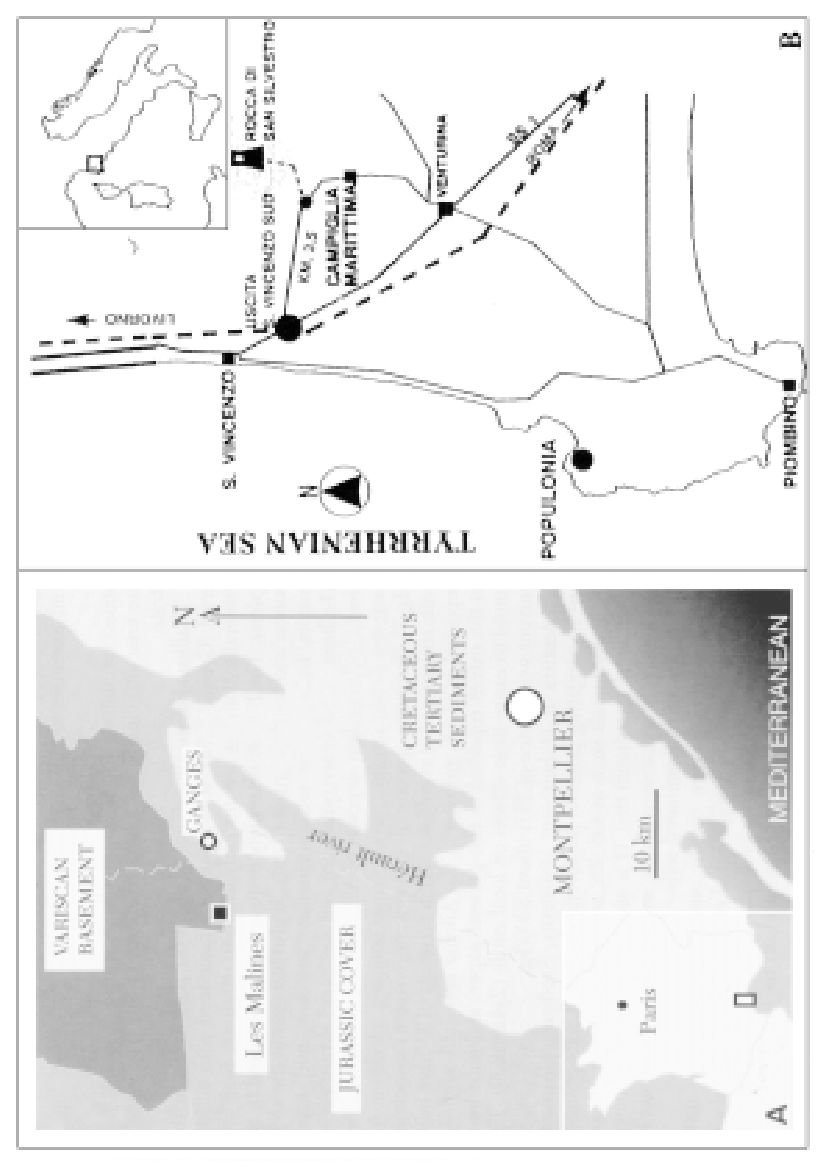
Iberis intermedia and Biscutella laevigata were collected from sites around St Laurent le Minier, southern France, and Rocca San Silvestro, Tuscany, Italy (Figure1). The region around St Laurent le Minier, known as Les Malines, is the location of one of the largest base metal mines in Europe that has been exploited since Roman times and only ceased operations about 5 years ago. The mineralization consists of zinc/lead sulfides and oxides associated with barite. The mine tips typically contain several percent of both lead and zinc with associated thallium and cadmium. The pH of the tailings is 7.3 (average of 60 samples) with a range of 6.4 to 7.7. The mine
Iberis intermedia和Biscutella laevigata采自法国南部St Laurent le Minier周边及意大利托斯卡纳Rocca San Silvestro的样点(图1)。St Laurent le Minier周边地区称为Les Malines,是欧洲最大的贱金属矿之一的所在地,该矿自罗马时代起即被开采,直至约5年前才停止作业。矿化类型为与重晶石伴生的锌/铅硫化物和氧化物。矿渣堆中铅和锌的含量通常均达百分之几,并伴有铊和镉。尾矿的pH为7.3(60个样品的平均值),范围为6.4~7.7。该矿
Copyright© 1999, CRC Press LLC — Files may be downloaded for personal use only. Reproduction of this material without the consent of the publisher is prohibited.
版权所有© 1999,CRC Press LLC——文件仅供个人使用下载。未经出版者同意,禁止复制本材料。
Copyright© 1999, CRC Press LLC — Files may be downloaded for personal use only. Reproduction of this material without the consent of the publisher is prohibited.
版权所有© 1999,CRC Press LLC——文件仅供个人使用下载。未经出版者同意,禁止复制本材料。
waste has been colonized by a base metal flora dominated by Minuartia verna (L.) Hiern. and Thlaspi caerulescens J. C. and R. Presl with associated Iberis intermedia Guersent, Biscutella laevigata L., and Armeria maritima (Miller) Willd.
废弃物上已定殖了以Minuartia verna (L.) Hiern.和Thlaspi caerulescens J. C. and R. Presl为优势种的贱金属植物群落,伴生有Iberis intermedia Guersent、Biscutella laevigata L.和Armeria maritima (Miller) Willd.。
The site near Rocca San Silvestro, Tuscany, Italy, was an ancient mining town where lead, copper, and silver have been mined since the tenth century. Geologically, the area consists of a limestone Massif with parallel veins of porphyritic rocks containing mixtures of sulfides (galena argentite, chalcopyrite, and blende) running in a southeast to northwest direction. The average pH of the soils is 7.3 (15 samples) with a range of 7.1 to 7.5.
意大利托斯卡纳Rocca San Silvestro附近的样点是一座古代矿业城镇,自10世纪起即开采铅、铜和银。地质上,该地区由石灰岩山体构成,其中有呈东南—西北走向的平行斑岩脉,含有多种硫化物(方铅矿、辉银矿、黄铜矿和闪锌矿)的混合物。土壤平均pH为7.3(15个样品),范围为7.1~7.5。
B. Sample CollectionB. 样品采集
Iberis intermedia (15 plants) and Biscutella laevigata (37 plants) were sampled at various sites within Les Malines. Biscutella laevigata (15 plants) was also sampled from around Rocca San Silvestro. The rhizosphere soil was also sampled in addition to the above-ground biomass.
在Les Malines范围内的多个样点采集了Iberis intermedia(15株)和Biscutella laevigata(37株)。另在Rocca San Silvestro周边采集了Biscutella laevigata(15株)。除地上部生物量外,还采集了根际土壤。
C. Plant DigestionC. 植物消解
Plants were rinsed thoroughly in distilled water and dried at 80°C. Approximately 0.2 g of material from each plant was accurately weighed into 50-mL Erlenmeyer flasks. Concentrated nitric acid (10 mL) was added to each tube and the mixtures heated on a heating block until a final volume of ca. 3 mL was reached. The samples were then diluted to 10 mL using distilled water and stored in polythene containers.
植物用蒸馏水彻底冲洗后于80°C烘干。准确称取每株植物约0.2 g材料于50 mL锥形瓶中。向每个容器中加入浓硝酸(10 mL),在加热块上加热混合物,直至最终体积约为3 mL。然后用蒸馏水将样品稀释至10 mL,储存于聚乙烯容器中。
D. Soil DigestionD. 土壤消解
Soil samples were dried at 80°C and sieved to <1 mm size using a nylon sieve. About 0.2 g quantities of sieved soil were accurately weighed into boiling tubes. Ten mL of concentrated nitric acid was then added and the mixtures boiled until a final volume of 3 mL was reached. A further 10 mL of concentrated hydrochloric acid was then added and the mixtures again evaporated to 3 mL. After dilution to a final volume of 10 mL with distilled water, the solutions were filtered.
土壤样品于80°C烘干,用尼龙筛过筛至粒径<1 mm。准确称取约0.2 g过筛土壤于消解管中。加入10 mL浓硝酸,煮沸混合物直至最终体积为3 mL。再加入10 mL浓盐酸,再次将混合物蒸发至3 mL。用蒸馏水稀释至最终体积10 mL后,过滤溶液。
E. Estimation of the pH and Plant-Available Elemental Fractions in the Soils and Mine WasteE. 土壤和矿山废弃物pH及植物有效态元素组分的测定
Sieved soil (2 g) was weighed accurately into 50-mL centrifuge tubes. Then 20 mL of 1 M ammonium acetate was added to each container. Samples were shaken in an end-over-end mixer (75 rpm) for 24 h, filtered, and stored in polythene containers. Ammonium acetate was chosen for the experiments because of its common use as an approximate measure of the plant-available fraction of soils (Ernst, 1996).
准确称取过筛土壤(2 g)于50 mL离心管中,然后向每个容器中加入20 mL 1 M乙酸铵。样品在翻转式混合器(75 rpm)中振荡24 h,过滤后储存于聚乙烯容器中。选择乙酸铵是因为其常被用作土壤植物有效态组分的近似测定方法(Ernst, 1996)。
The pH measurements were made by weighing 1-g samples of soils or mine waste into polythene containers, then adding 2.5 mL of distilled water and shaking. After being allowed to settle for 24 h, the samples were again shaken and the pH measured.
pH测定方法为:称取1 g土壤或矿山废弃物样品于聚乙烯容器中,加入2.5 mL蒸馏水并振荡。静置24 h后,再次振荡样品并测定pH。
F. Chemical AnalysisF. 化学分析
Thallium, cadmium, copper, lead and zinc were quantified in the plant and soil solutions using a GBC 904 atomic absorption spectrometer.
采用GBC 904原子吸收光谱仪测定植物和土壤溶液中的铊、镉、铜、铅和锌。
Copyright© 1999, CRC Press LLC — Files may be downloaded for personal use only. Reproduction of this material without the consent of the publisher is prohibited.
版权所有© 1999,CRC Press LLC——文件仅供个人使用下载。未经出版者同意,禁止复制本材料。
III. RESULTS AND DISCUSSION三、结果与讨论
A. Accumulation of Metals by Iberis intermedia and Biscutella laevigataA. Iberis intermedia和Biscutella laevigata对金属的积累
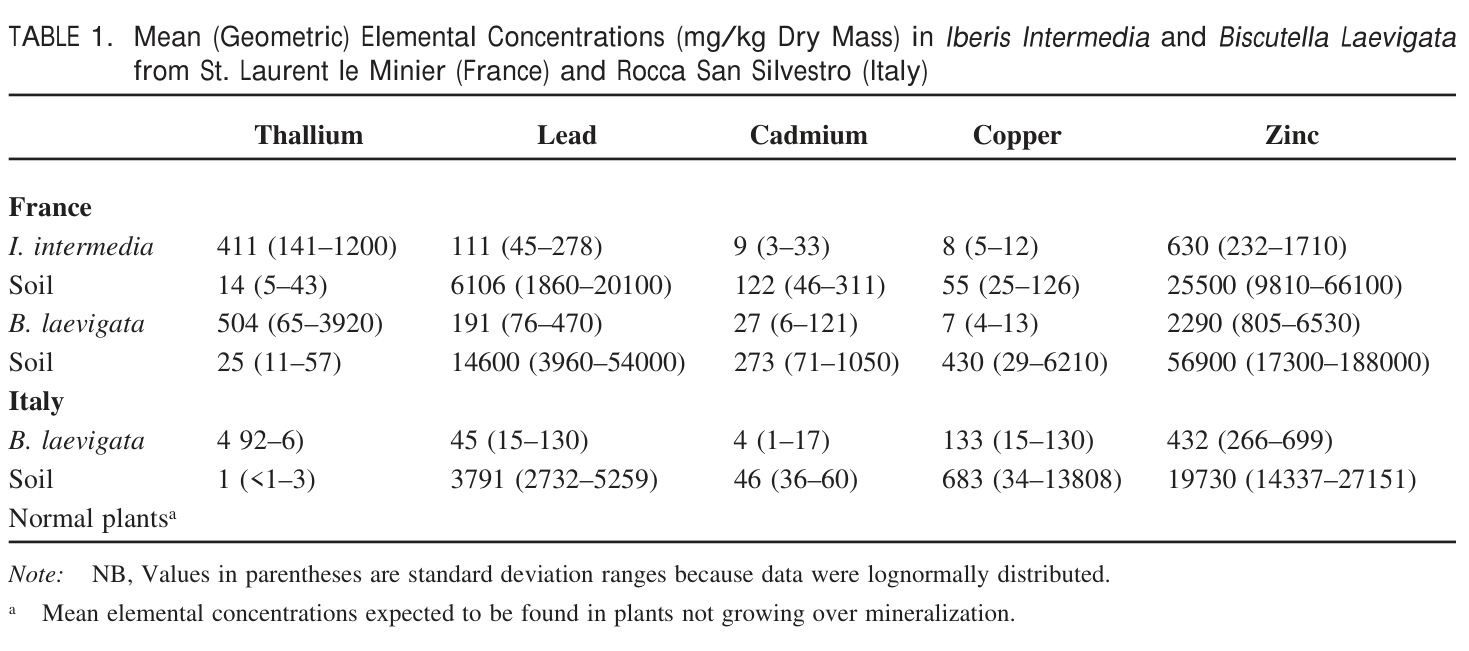
The metal contents of plants and associated soils from St Laurent le Minier and Rocca San Silvestro are shown in Table 1. Because the data were lognormally distributed, geometric means are reported with the corresponding standard deviation ranges. Except for copper, values of all the metals measured are high relative to plants growing over nonmetalliferous soils. However, values for lead, cadmium, and zinc are well below the ‘threshold’ for hyperaccumulation (1000, 100, and 10,000 mg/kg, respectively; Brooks, 1998). The concentration of thallium in most plants was above the threshold of 500 mg/kg dry matter set by Leblanc et al. (1999) for Iberis intermedia from St Laurent le Minier. Biscutella specimens from Rocca San Silvestro were below this limit but were well in excess of it (up to 1.96%) at the French location. The lower values could be attributed to the lower soil thallium concentrations at the Italian site. The high levels of lead in most of the plants probably indicate some degree of soil contamination. However, because the thallium concentration in the plants was actually higher than the corresponding soil values, soil contamination will lower rather than raise the measured thallium concentration in the plant material.
St Laurent le Minier和Rocca San Silvestro的植物及相应土壤的金属含量见表1。由于数据呈对数正态分布,故报道几何平均值及相应的标准差范围。除铜外,所测各金属的含量均高于非含金属土壤上生长的植物。然而,铅、镉和锌的含量远低于超富集“阈值”(分别为1000、100和10,000 mg/kg;Brooks, 1998)。大多数植物中的铊浓度高于Leblanc et al.(1999)针对St Laurent le Minier的Iberis intermedia所设定的500 mg/kg干物质阈值。来自Rocca San Silvestro的Biscutella样品低于该限值,但在法国样点则远超该限值(最高达1.96%)。较低的值可能归因于意大利样点土壤铊浓度较低。大多数植物中铅含量较高,可能表明存在一定程度的土壤污染。然而,由于植物中的铊浓度实际上高于相应土壤中的值,土壤污染只会降低而非升高植物材料中铊的测定浓度。
B. Relationships between Plant-Metal Concentrations and Soil Properties for Biscutella laevigataB. Biscutella laevigata植物金属浓度与土壤性质的关系
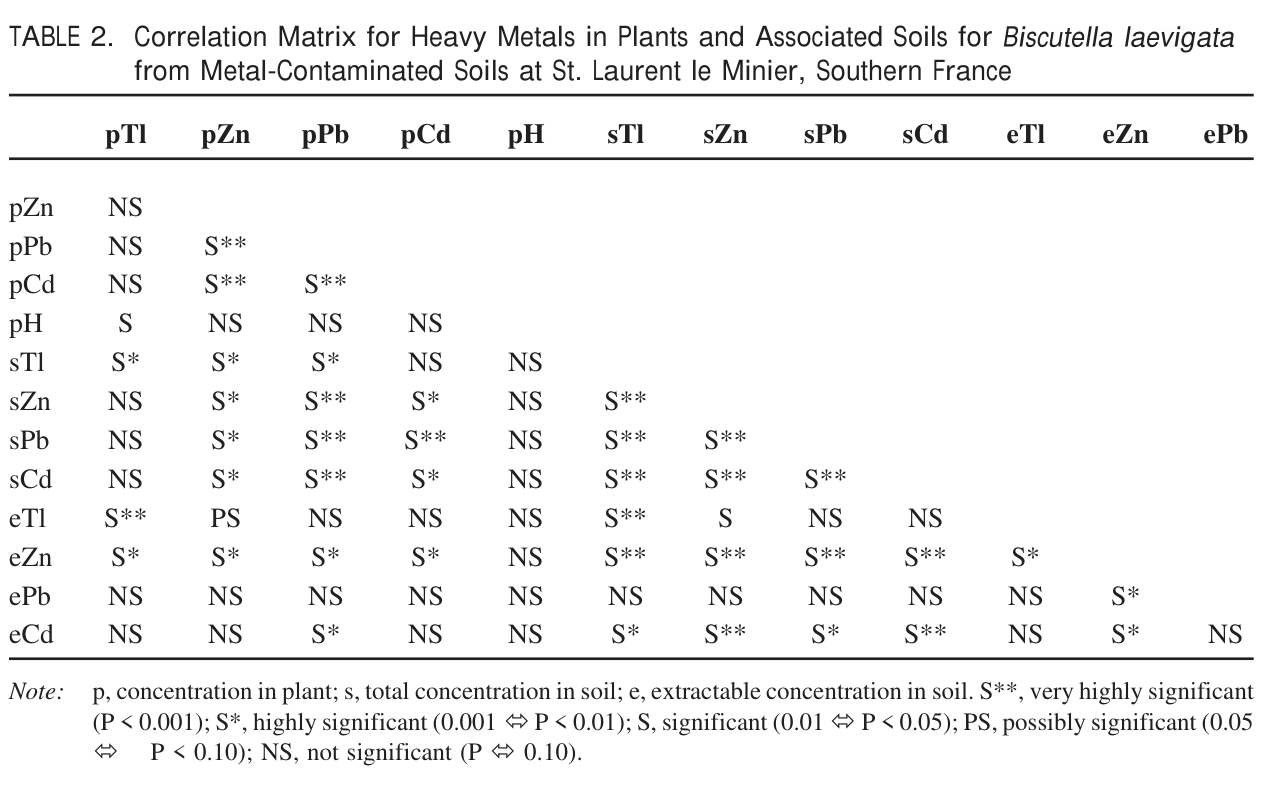
Table 2 shows a matrix of correlations for elemental concentrations in soils and specimens of Biscutella laevigata growing around St Laurent le Minier, southern France. Analogous data have already been presented for Iberis intermedia by Leblanc et al. (1999). The total elemental concentrations in the soils were all correlated with each other and with their respective extractable fractions. This is expected as all four elements are geochemically related and indicate the degree of metal-bearing mineral contamination in the soil.表2列出了法国南部St Laurent le Minier周边土壤及其上生长的Biscutella laevigata样品中元素浓度的相关矩阵。Leblanc et al.(1999)已报道了Iberis intermedia的类似数据。土壤中各元素全量彼此之间均相关,并与其各自的可提取态组分相关。这在意料之中,因为这四种元素在地球化学上相互关联,反映了土壤受含金属矿物污染的程度。
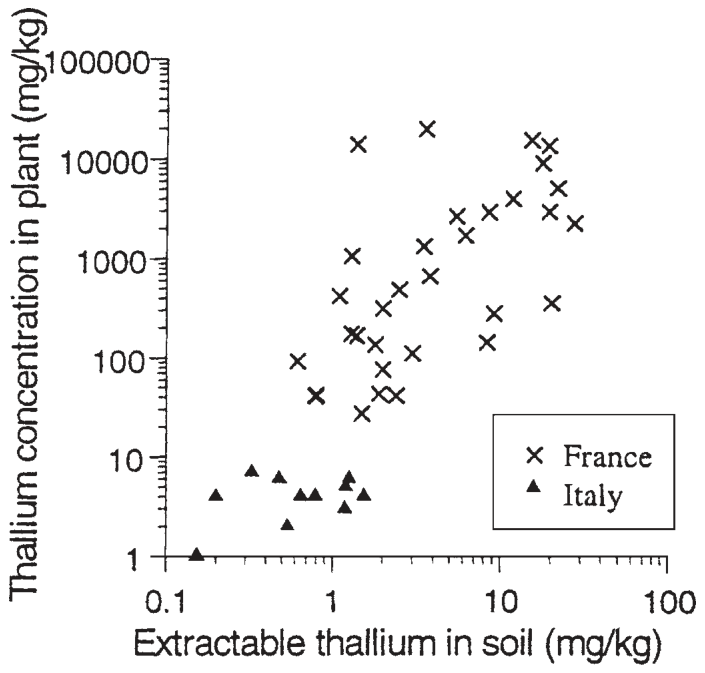
Thallium concentrations in plants were correlated significantly with pH and with the total thallium concentration in the soil. The correlation between plant thallium and the extractable soil fraction of this element was much stronger than its correlation with the total thallium in soils. This reinforces the theory that it is the extractable, rather than the total fraction of a metal that determines plant uptake. Figure 2 shows the relationship between the thallium concentration in B. laevigata (from both French and Italian sites) and the extractable thallium concentration in the soil. There was no significant relationship between the levels of lead in the plants (indicating soil contamination because lead is not usually accumulated in plants via root systems) and the plant thallium concentration. This is further evidence that the high measured thallium values are not the result of wind-borne contamination.
植物中的铊浓度与pH及土壤铊全量均显著相关。植物铊与土壤可提取态铊的相关性远强于其与土壤铊全量的相关性。这进一步支持了决定植物吸收的是金属的可提取态组分而非全量这一理论。图2显示了B. laevigata(来自法国和意大利样点)中铊浓度与土壤可提取态铊浓度之间的关系。植物中的铅含量(由于铅通常不经根系在植物中积累,其可指示土壤污染)与植物铊浓度之间无显著关系。这进一步证明所测得的高铊值并非风力携带污染所致。
Surprisingly, there was a significant positive correlation between plant thallium uptake and soil pH. Previous studies (e.g., Robinson et al., 1998) have shown that the uptake of other heavy metals was negatively correlated with pH presumably due to the greater solubility of these metals under more acidic conditions.
出乎意料的是,植物铊吸收与土壤pH呈显著正相关。以往研究(如Robinson et al., 1998)表明,其他重金属的吸收与pH呈负相关,这可能是由于这些金属在较酸性条件下溶解度较高。
Copyright© 1999, CRC Press LLC — Files may be downloaded for personal use only. Reproduction of this material without the consent of the publisher is prohibited.
版权所有© 1999,CRC Press LLC——文件仅供个人使用下载。未经出版者同意,禁止复制本材料。
Copyright© 1999, CRC Press LLC — Files may be downloaded for personal use only. Reproduction of this material without the consent of the publisher is prohibited.
版权所有© 1999,CRC Press LLC——文件仅供个人使用下载。未经出版者同意,禁止复制本材料。
Copyright© 1999, CRC Press LLC — Files may be downloaded for personal use only. Reproduction of this material without the consent of the publisher is prohibited.
版权所有© 1999,CRC Press LLC——文件仅供个人使用下载。未经出版者同意,禁止复制本材料。
C. The Relationship between Extractable and Total Thallium Concentrations in Soils
C. 土壤中可提取态铊与铊全量的关系
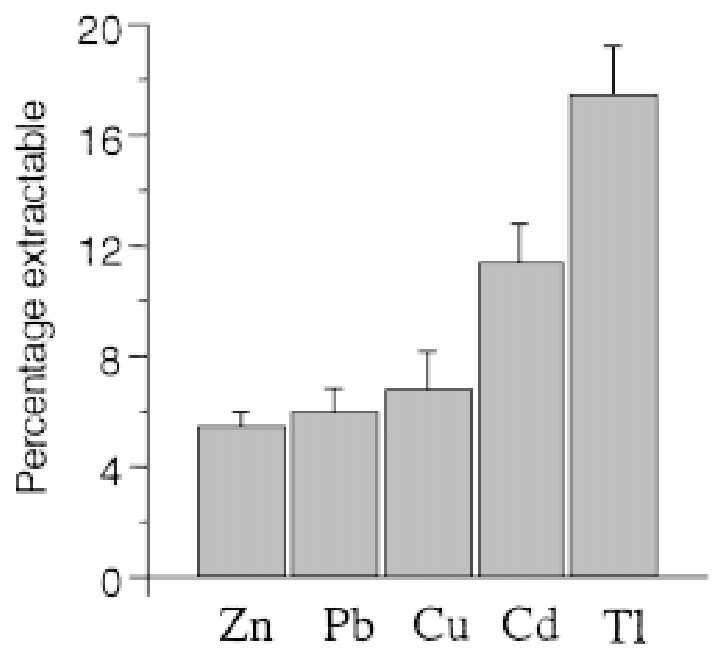
Figure 3 shows the percentage of the total metal concentration that is extractable using 1 M ammonium acetate. As a percentage of its total concentration, thallium was significantly (P < 0.005) more soluble than all the other metals tested and had the lowest total concentrations in soils. This is in contrast to numerous studies (e.g., Waitz and Percival, 1993) that have shown that in soils the percentage of a metal that is soluble increases as its total concentration increases. This relatively high solubility of thallium indicates that it could have a greater impact on biota than the other metals tested at low total concentrations.图3显示了用1 M乙酸铵可提取的金属占金属全量的百分比。以占全量的百分比计,铊的溶解度显著(P < 0.005)高于所测其他所有金属,而其在土壤中的全量最低。这与大量研究(如Waitz and Percival, 1993)的结果相反,这些研究表明土壤中金属的可溶比例随其全量增加而增加。铊相对较高的溶解度表明,在全量较低时,铊对生物群的影响可能大于所测其他金属。
To measure the extractable, rather than total, elemental concentrations in soils is not a new concept, but usually gives a much better estimate of the metal fraction “seen” by the plant than does the total concentration in the soil (Robinson et al., 1997). A simple extraction with ammonium acetate of a soil intended for phytoremediation can give valuable preliminary information on the feasibility of carrying out phytoremediation in that particular instance.
测定土壤中可提取态而非全量元素浓度并非新概念,但与土壤全量相比,其通常能更好地估计植物“感知”到的金属组分(Robinson et al., 1997)。对拟进行植物修复的土壤进行简单的乙酸铵提取,可为评估该具体情形下实施植物修复的可行性提供有价值的初步信息。
D. The Potential use of B. laevigata and I. intermedia for Phytoremediation/ Phytomining of Thallium-Rich Soils
D. B. laevigata和I. intermedia用于富铊土壤植物修复/植物采矿的潜力
The greater solubility of thallium in soils means that more is available for plant uptake in phytoremediation/phytomining operations. The high bioaccumulation coefficients (BAC = plant/soil concentration quotients) for thallium in B. laevigata and I. intermedia (respectively 20.2 and 29.4) make them ideal candidates for the phytoremediation of thallium-contaminated soils. Experiments by Leblanc et al. (1999) demonstrated that I. intermedia had a fertilized biomass production of around 15 tonnes per hectare per annum. A single crop of this grown on a soil with 14 mg/ kg thallium would have a concentration of 411 mg/kg (from Table 1), and thus would remove 6.165 kg of thallium per hectare worth $1850 US at today’s prices. Assuming a root depth of 10 cm and a soil density of 1.1, the thallium burden in the top 10 cm of soil would be reduced to 9.2 mg/kg in 1 year.
铊在土壤中溶解度较高,意味着在植物修复/植物采矿操作中有更多铊可供植物吸收。B. laevigata和I. intermedia对铊的生物富集系数(BAC = 植物/土壤浓度比)较高(分别为20.2和29.4),使其成为铊污染土壤植物修复的理想候选物种。Leblanc et al.(1999)的试验表明,施肥条件下I. intermedia的生物量产量约为每公顷每年15吨。在铊含量为14 mg/kg的土壤上种植一茬该植物,其铊浓度可达411 mg/kg(据表1),因此每公顷可去除6.165 kg铊,按现价计值1850美元。假设根系深度为10 cm、土壤容重为1.1,则1年内表层10 cm土壤中的铊负荷可降至9.2 mg/kg。
Copyright© 1999, CRC Press LLC — Files may be downloaded for personal use only. Reproduction of this material without the consent of the publisher is prohibited.
版权所有© 1999,CRC Press LLC——文件仅供个人使用下载。未经出版者同意,禁止复制本材料。
C. LaCoste, et al.
C. LaCoste, et al.
At present, some sites around the town of St Laurent le Minier are being used for vegetable production. Crop growth is poor, presumably due to the high levels of heavy metals, as well as the general paucity of nutrients in the soil. Additionally, the produce may pose a health risk due to heavy metal contamination — both from plant uptake and wind-borne contamination. Cultivation of hyperaccumulator species such as I. intermedia and B. laevigata could produce a viable economic return, while decontaminating the soils.
目前,St Laurent le Minier镇周边的部分场地正被用于蔬菜生产。作物长势较差,推测是由于土壤中重金属含量高以及养分普遍匮乏所致。此外,由于植物吸收和风力携带污染两方面导致的重金属污染,这些农产品可能构成健康风险。种植I. intermedia和B. laevigata等超富集植物,可在净化土壤的同时产生可观的经济回报。
Caution should be exercised in extrapolating the results of these initial experiments to full-scale phytoextraction operations, as it is unknown what the effect of repeated cropping will have on thallium uptake by plants. There was a large variation in the BAC values (3 to 698) for both species, indicating that it may be possible to enhance thallium uptake by altering soil conditions or by selective breeding, a fertile area for future research.
将这些初步试验的结果外推至全规模植物提取操作时应谨慎,因为多次连续种植对植物铊吸收的影响尚不清楚。两个物种的BAC值变异很大(3~698),表明可能通过改变土壤条件或选择育种来提高铊吸收,这是未来研究的一个富有前景的领域。
Copyright© 1999, CRC Press LLC — Files may be downloaded for personal use only. Reproduction of this material without the consent of the publisher is prohibited.
版权所有© 1999,CRC Press LLC——文件仅供个人使用下载。未经出版者同意,禁止复制本材料。
IV. CONCLUSIONS四、结论
The thallium uptake of I. intermedia and B. laevigata is primarily dependent on the concentration of soluble thallium in the soil. As the percentage of total thallium that is soluble is relatively high compared with other metals, fewer problems should be encountered during a thallium phytoextraction operation, particularly when the total concentration of this element in the soil is low. Problems in other phytoextraction operations involve maintaining sufficient plant uptake as the soluble fraction of the target metal in the soil decreases. The current very high world price of thallium metal implies recouping much or all of the costs of phytoremediation by the sale of the harvested biomass, or even giving an overall profit. Future work should focus on the enhancement of thallium uptake by these species, and on agricultural practices required for efficient crop production of them.
I. intermedia和B. laevigata对铊的吸收主要取决于土壤中可溶态铊的浓度。由于可溶态铊占铊全量的比例相对高于其他金属,在铊植物提取操作中遇到的问题应较少,尤其是在土壤中该元素全量较低时。其他植物提取操作中的问题在于,随着土壤中目标金属可溶组分的减少,如何维持足够的植物吸收。当前世界市场上铊金属价格很高,这意味着通过出售收获的生物质可收回植物修复的大部分乃至全部成本,甚至实现总体盈利。今后的工作应着重于提高这些物种对铊的吸收,以及研究实现其高效作物生产所需的农艺措施。
ACKNOWEDGMENTS致谢
We thank the Delmot family of St Laurent le Minier for permission to collect samples from their property. We acknowledge AGMARDT for financial assistance to the second author.
感谢St Laurent le Minier的Delmot家族允许我们在其土地上采集样品。感谢AGMARDT对第二作者的资助。
2REFERENCES参考文献
Anderson, C. W. N., Brooks, R. R., Chiarucci, A., LaCoste, C. J., Leblanc, M., Robinson, B. H., Symcock, R., and Stewart, R. B. 1999. Phytomining for nickel, thallium and gold. J. Geochem. Explor. (in press).
Brooks, R. R., Lee, J., Reeves, R. D., and Jaffré, T. 1977. Detection of nickeliferous rocks by analysis of herbarium specimens of indicator plants. J. Geochem. Explor. 7, 49–57.
Brooks, R. R. 1998. Plants That Hyperaccumulate Heavy Metals: Their Role in Archaeology, Microbiology, Mineral Exploration, Phytomining and Phytoremediation. Wallingford, CAB International.
Brooks, R. R., Chambers, M. F., Nicks, L., and Robinson, B. H. 1998. Phytomining. Trends Plant Sci. 3, 359–362.
Chaney, R. L. 1983. Plant uptake of inorganic waste constituents. In: Land Treatment of Hazardous Wastes, pp. 50–76. (Parr, J. F., et al., Eds.). New York, Noyes Datya Corp. Ernst, W. H. O. 1996. Bioavailability of heavy metals and decontamination of soils by plants. Appl. Geochem. 11, 163–167.
Kurz, H., Schulz, R., and Rîmheld, V. 1997. Phytoremediation of thallium and cadmium from contaminated soils — possibilities and limitations. Proc. Int. Sem. Use Plants. Environ.
Remed. Council for Promotion of Utilization of Organic Materials (ed.), Tokyo, Sept. 1997, 120–122.
Kurz, H., Schulz, R., and Rîmheld, V. 1999. Selection of cultivars to reduce the concentration of cadmium and thallium in food and fodder plants. J. Plant Nutr. Soil Sci. 162, 1–6.
Copyright© 1999, CRC Press LLC — Files may be downloaded for personal use only. Reproduction of this material without the consent of the publisher is prohibited.
Leblanc, M., Robinson, B. H., Petit, D., Deram, A., and Brooks, R. R. 1999. The phytomining and environmental significance of hyperaccumulation of thallium by Iberis intermedia from southern France. Econ. Geol. 94, 109–114.
Robinson, B. H., Brooks, R. R., Howes, A. W., Kirkman, J. H. and Gregg, P. E. H. 1997. The potential of the high-biomass Berkheya coddii for phytoremediation and phytomining. J. Geochem. Explor. 60, 115–126.
Robinson, B. H., Leblanc, M., Petit, D., Brooks, R. R., Kirkman, J. H., and Gregg, P. E. H. 1998. The potential of Thlaspi caerulescens for phytoremediation of contaminated soils. Plant Soil. 203, 47–56
Tremel, A., 1996. Transfer du Thallium du Sol vers la Plante. PhD Thesis, Université de Nancy.
Waitz, M. F. W. and Percival, H. J. 1993. Sorption Behaviour of Copper, Lead, Zinc and Cadmium in Three Heavy-Metal-Amended Soils Using CaCl2 Extracts and Soil Solutions. Publication of Landcare Research, Lower Hutt, New Zealand.
Zitco, V. 1975. Toxicity and pollution potential of thallium. Sci. Total Environ. 4, 185–192.
Zyka, V. 1970. Thallium in plants from Alsar. Sb. Cesky Geologicky ved. Technol./Geochem. 10, 91–95.
Copyright© 1999, CRC Press LLC — Files may be downloaded for personal use only. Reproduction of this material without the consent of the publisher is prohibited.