R E S E A R C H A R T I C L E
Hongtao Zhong1,2 | Carol Smith3 | Brett Robinson4 | Young-Nam Kim1,5 | Nicholas Dickinson1
1Faculty of Agriculture and Life Sciences, Lincoln University, Canterbury, New Zealand
2School of Biological Sciences, The University of Western Australia, Perth, Western Australia, Australia
3Department of Soil and Physical Sciences, Lincoln University, Canterbury, New Zealand 4School of Physical and Chemical Sciences, University of Canterbury, Christchurch, New Zealand
5Department of Environmental Horticulture, University of Seoul, Seoul, South Korea
Correspondence
Hongtao Zhong, School of Biological Sciences, The University of Western Australia, 35 Stirling Highway, Perth, WA 6009, Australia.
Email: hongtao.zhong@uwa.edu.au
Funding information
Closure & Legacy Management, Grant/Award Number: Punakaiki Coastal Restoration Project; Conservation Volunteers New Zealand, Grant/Award Number: 46061; Rio Tinto Services Ltd, Grant/Award Numbers: 46164, 46084
1Abstract摘要
We aim to understand the impact of ecological restoration on soil biogeochemistry, and the interrelationship between vegetation and soil phosphorus. In a study of two different-aged soils in coastal New Zealand, soils are described along a transition from abandoned agricultural pasture, through 6-year old restoration plots, towards forest fragments that have been largely undisturbed for 75 and 166 years. Soil biogeochemistry varied spatially along this restoration trajectory; there were profound changes in surface soil, but little impact on deeper soil horizons. In the early stages, soil organic matter accumulation and decomposition, and increasing demand of N from fast-growing plants corresponded with rapid nutrient mineralization. Loss of soil total P, an increase of occluded P, and the increasing importance of soil organic P as soils weathered and aged, supported conceptual models of longer-term soil pedogenesis. There was no evidence that the success of the establishment of plants varied across the site, but this is a first report of vegetation establishment during ecological restoration markedly impacting soil P dynamics and biogeochemistry.
本研究旨在了解生态恢复对土壤生物地球化学的影响,以及植被与土壤磷之间的相互关系。在对新西兰沿海两种不同年龄土壤的研究中,沿着从弃耕农业草地、经6年生恢复样地、到基本未受干扰达75年和166年的森林斑块这一过渡序列对土壤进行了描述。土壤生物地球化学沿该恢复轨迹呈现空间变化:表层土壤发生了显著变化,而对较深土层的影响甚微。在恢复早期,土壤有机质的积累与分解以及速生植物对N需求的增加与养分的快速矿化相对应。随着土壤风化与老化,土壤全磷减少、闭蓄态磷增加以及土壤有机磷的重要性上升,这支持了长期土壤发生的概念模型。没有证据表明植物定植的成功程度在整个样地内存在差异,但本研究首次报道了生态恢复过程中的植被定植显著影响土壤磷动态和生物地球化学。
K E Y W O R D S pedogenesis, phosphorus dynamics, restoration, soil biogeochemistry, soil chronosequence
关键词:土壤发生,磷动态,恢复,土壤生物地球化学,土壤时间序列
21 | INTRODUCTION1 | 引言
It has often been suggested that more soil science should be included in the study of ecological restoration (Bradshaw, 1983; Perring et al., 2015) due to (Adhikari & Hartemink, 2016; Costantini et al., 2016). Nevertheless, soil development seldom receives detailed attention in restoration practice, beyond the necessity of addressing fertility and contamination constraints. Few studies have progressed towards an integrated understanding of the mutual interdependence between ecology and soil pedogenesis on degraded and damaged land undergoing restoration.
常有人建议在生态恢复研究中纳入更多土壤科学内容(Bradshaw, 1983; Perring et al., 2015),原因在于(Adhikari & Hartemink, 2016; Costantini et al., 2016)。然而,除了必须解决肥力和污染限制之外,土壤发育在恢复实践中很少受到详细关注。很少有研究能够对处于恢复中的退化和受损土地上生态与土壤发生之间的相互依存关系形成综合认识。
Vegetation development on degraded land is dependent on the characteristics of the soil template, with feedback to the physicochemistry of the soil provided by the biomass, life processes and activities of flora, fauna and microbes (Bradshaw & Chadwick, 1980).
退化土地上的植被发育取决于土壤基底的特性,而植物、动物和微生物的生物量、生命过程及活动又反过来影响土壤的物理化学性质(Bradshaw & Chadwick, 1980)。
Numerous biotic and abiotic indicators of the transition towards ecosystem restoration have been proposed (Gann et al., 2019). Soil faunal communities (Frouz et al., 2009; Kooch, Tavakoli, & Akbarinia, 2018) and microbial indices (e.g., Hu et al., 2016; Ros, Hernandez, & Carlos, 2003) have provided useful descriptors of the restoration trajectory, with improved biomolecular methodologies enabling a contemporary focus on soil microbial assemblages and associated functional groupings (Banning et al., 2011; Harris, 2009; Strickland et al., 2017). Soil development is also facilitated through processes driven by vegetation and soil biota (Brady & Weil, 2008; Kelly, Chadwick, & Hilinski, 1998). Changes in soil biogeochemical processes along restoration gradients typically include measurements of soil organic matter, litter accumulation and decomposition, and physicochemical parameters such as soil pH, total carbon (C) and nitrogen (N), cation exchange capacity (CEC), and mobilization/immobilization of pollutants (e.g., Crouzeilles et al., 2016; Rowland, Prescott, Grayston, Quideau, & Bradfield, 2009; Wang, Kang, Cheng, Han, & Ji, 2016; Wortley, Hero, & Howes, 2013). The availability of soil phosphorus (P) plays a particularly critical role in agriculture and in the establishment of plants more generally (Menge, Hedin, & Pacala, 2012), but the dynamics of soil phosphorus has been considered as a 'slow variable' along the restoration gradient (Costantini et al., 2016) and has seldom been investigated in much detail.
已有研究提出了众多反映生态系统恢复进程的生物和非生物指标(Gann et al., 2019)。土壤动物群落(Frouz et al., 2009; Kooch, Tavakoli, & Akbarinia, 2018)和微生物指数(如Hu et al., 2016; Ros, Hernandez, & Carlos, 2003)为恢复轨迹提供了有用的描述指标,而分子生物学方法的改进使当前研究能够聚焦于土壤微生物群落及相关功能类群(Banning et al., 2011; Harris, 2009; Strickland et al., 2017)。植被和土壤生物驱动的过程也促进了土壤发育(Brady & Weil, 2008; Kelly, Chadwick, & Hilinski, 1998)。沿恢复梯度土壤生物地球化学过程的变化通常通过测定土壤有机质、凋落物积累与分解,以及土壤pH、全碳(C)和全氮(N)、阳离子交换量(CEC)、污染物的活化/固定等理化参数来表征(如Crouzeilles et al., 2016; Rowland, Prescott, Grayston, Quideau, & Bradfield, 2009; Wang, Kang, Cheng, Han, & Ji, 2016; Wortley, Hero, & Howes, 2013)。土壤磷(P)的有效性在农业以及更广泛的植物定植中起着尤为关键的作用(Menge, Hedin, & Pacala, 2012),但土壤磷动态一直被视为恢复梯度上的“慢变量”(Costantini et al., 2016),很少得到详细研究。
Walker and Syers (1976) proposed an early conceptual model of P dynamics during long-term soil and ecosystem development under natural conditions; during soil development there is: (a) a gradual decrease and eventual depletion of primary mineral P (mainly apatite P), (b) a continual increase and eventual dominance of occluded P, and (c) an overall decrease of total P. Surface runoff, leaching, and incorporation of P into biomass play a significant role. This model has been tested across long-term chronologies in different climatic zones, vegetation types, soil parent materials and different geomorphological sites in New Zealand and elsewhere (e.g., Chen et al., 2015; Crews et al., 1995; Eger, Almond, & Condron, 2011; Turner & Laliberté, 2015; Wardle, Walker, & Bardgett, 2004). Restoration studies that have given attention to soil phosphorus have invariably focussed on its effect on plant production and plant community assemblages (e.g., Chen, Condron, Davis, & Sherlock, 2000; Li et al., 2007; Oelmann et al., 2011), but not vice versa—on the effect of vegetation establishment on soil P.
Walker and Syers(1976)提出了自然条件下长期土壤与生态系统发育过程中磷动态的早期概念模型:在土壤发育过程中,(a)原生矿物磷(主要为磷灰石磷)逐渐减少并最终耗竭,(b)闭蓄态磷持续增加并最终占主导,(c)全磷总体减少。地表径流、淋溶以及磷被纳入生物量起着重要作用。该模型已在新西兰及其他地区不同气候带、植被类型、土壤母质和不同地貌部位的长期时间序列中得到检验(如Chen et al., 2015; Crews et al., 1995; Eger, Almond, & Condron, 2011; Turner & Laliberté, 2015; Wardle, Walker, & Bardgett, 2004)。关注土壤磷的恢复研究无一例外地聚焦于其对植物生产力和植物群落组成的影响(如Chen, Condron, Davis, & Sherlock, 2000; Li et al., 2007; Oelmann et al., 2011),而非相反,即植被定植对土壤磷的影响。
In the present study, we question whether changes of soil P dynamics provide a useful measure of restoration progression. Is it possible to demonstrate that soils in restoration plots are being transitioned towards a reference of mature forest plots through the impact of developing vegetation? Our objectives were to investigate whether and how (a) restoration of vegetation modifies soil P in the direction of the target ecosystem; (b) an established conceptual model for soil P is applicable to succession along a shorter-term restoration trajectory; and (c) knowledge of pedogenesis could be used to inform practitioners concerned with restoration of biodiversity.
本研究探讨土壤磷动态的变化能否作为衡量恢复进程的有效指标。能否证明,在植被发育的影响下,恢复样地的土壤正朝着成熟林样地这一参照状态转变?本研究的目标是探究:(a)植被恢复是否以及如何使土壤磷朝目标生态系统方向改变;(b)已建立的土壤磷概念模型是否适用于较短期恢复轨迹上的演替;(c)土壤发生方面的知识能否为从事生物多样性恢复的实践者提供参考。
32 | MATERIALS AND METHODS2 | 材料与方法
2.1 | Study site2.1 | 研究区概况
The field study site is located in the Punakaiki Coastal Restoration Project (PCRP) area at Punakaiki, South Island, New Zealand. The PCRP involves a partnership between Rio Tinto, Conservation Volunteers New Zealand (CVNZ), the Department of Conservation (DOC) and Lincoln University. The PCRP study consists of a range of ecological (e.g., vegetation surveys, invertebrate [leaf litter and soil], herbivorous insects, mammalian pests) and edaphic (e.g., soil descriptions, soil biogeochemistry) components (see more details in Hahner et al., 2013). The present study covers the soil phosphorus dynamics component of the overall PCRP study.
野外研究区位于新西兰南岛Punakaiki的Punakaiki海岸恢复项目(PCRP)区域。PCRP由Rio Tinto、新西兰保护志愿者组织(CVNZ)、新西兰保护部(DOC)和林肯大学合作开展。PCRP研究包括一系列生态学组分(如植被调查、无脊椎动物[凋落物层和土壤]、植食性昆虫、哺乳类有害动物)和土壤学组分(如土壤描述、土壤生物地球化学)(详见Hahner et al., 2013)。本研究涵盖PCRP整体研究中的土壤磷动态部分。
The PCRP study site consists of a 114 ha of coastal land, within the Punakaiki Ecological District, encompassing the most northern part of the Barrytown Flats, is a strip of coastal sand plain between the foothills of the Paparoa Range and the Tasman Sea (Figure 1). According to data collected from 1981 to 2010, the climate within this region of the West Coast is classified as warm and wet with a mean annual rainfall of 2,200–2,600 mm, mean annual temperature of 12�C–13�C, and 1,700–1,750 mean hours of sunshine (Hahner et al., 2013).
PCRP研究区包括114 ha的沿海土地,位于Punakaiki生态区内,涵盖Barrytown Flats的最北部;Barrytown Flats是位于Paparoa山脉山麓与塔斯曼海之间的一条沿海沙质平原带(图1)。根据1981—2010年收集的数据,西海岸该区域的气候属温暖湿润型,年均降水量2,200–2,600 mm,年均气温12°C–13°C,年均日照时数1,700–1,750 h(Hahner et al., 2013)。
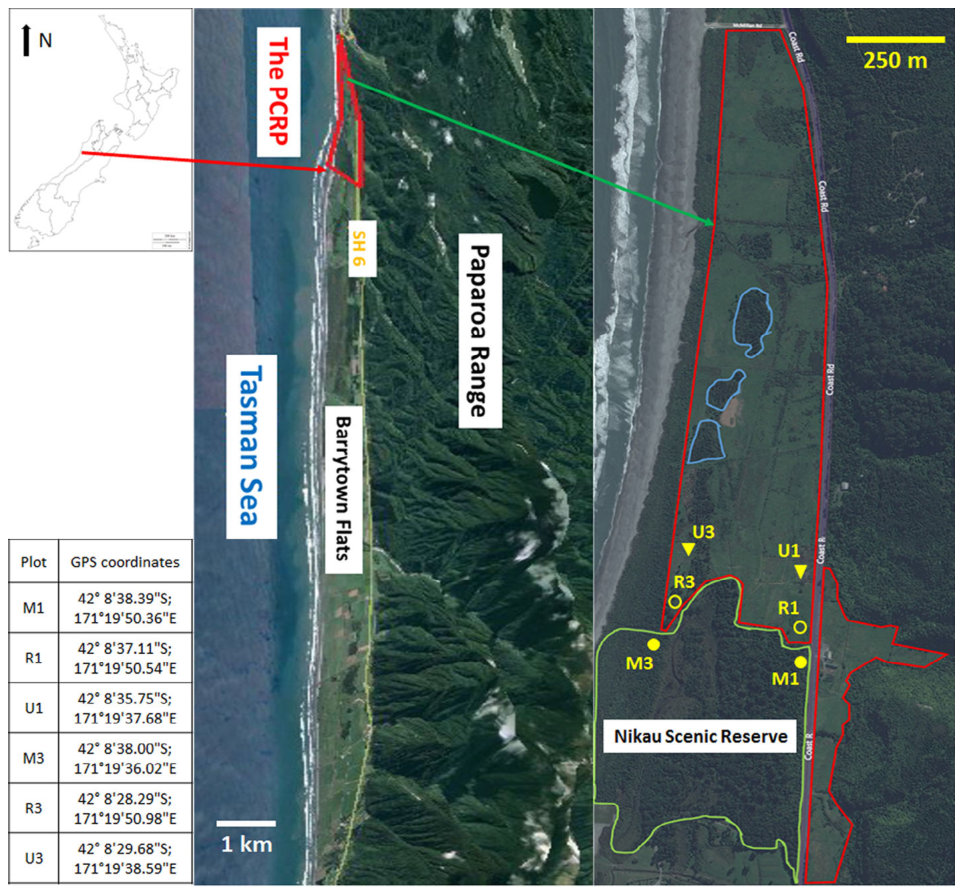
Seven restoration monitoring transects were set up before the present study, and more details were provided in Smith et al. (2016). In the present study, Transects 1 and 3 were selected to represent a coastal sand dune chronosequence on this sand plain which has developed on a well-drained sand and gravel shoreline (Figure 1). The older Transect 1 (Mahinapua soil series) presented a greater expression of overall pedogenesis in the profiles than the younger Transect 3 (Karoro soil series) (Smith et al., 2016). In addition, each transect has three different stages of ecosystem development, consisting of a mature forest plot (M), a restoration plot (R), and an unplanted grassland plot (U). Mature forest plots (M1 and M3) are located in the Nikau Scenic Reserve (Figure 1). Restoration planting of a selection of native plants in plots R1 and R3 were initiated in August–October 2009 and January–April 2010, respectively (See the development of two restoration areas from January 2009 until May 2013 in Figure S1, Data S1). The unplanted grassland plots are not natural grassland, instead they used to be coastal sandplain forest and cleared for proposed ilmenite sand mining, however turned out to be uneconomic to mine. Therefore, the land was abandoned and occupied by invasive weeds until the PCRP established. The grassland consists of a mixture of introduced grasses, including ryegrass (Lolium perenne, Poaceae) and cocksfoot (Dactylis glomerata, Poaceae), with a substantial component of invasive weeds such as blackberry (Rubus spp., Rosaceae) and European gorse (Ulex europaeus, Fabaceae) but not well developed.
在本研究之前已设置了7条恢复监测样带,详见Smith et al.(2016)。本研究选择样带1和3代表该沙质平原上的海岸沙丘时间序列,该平原发育于排水良好的砂砾质海岸线上(图1)。较老的样带1(Mahinapua土系)剖面的整体土壤发生程度高于较年轻的样带3(Karoro土系)(Smith et al., 2016)。此外,每条样带包含三个不同的生态系统发育阶段,即成熟林样地(M)、恢复样地(R)和未种植草地样地(U)。成熟林样地(M1和M3)位于Nikau风景保护区内(图1)。R1和R3样地分别于2009年8—10月和2010年1—4月开始种植精选的本土植物进行恢复(两个恢复区2009年1月至2013年5月的发展情况见图S1,数据S1)。未种植草地样地并非天然草地,而是原为海岸沙质平原森林,因拟开采钛铁矿砂而被清除,但后来证明开采不经济。因此,该土地被弃置并被入侵杂草占据,直至PCRP建立。该草地由多种引入禾草混合组成,包括黑麦草(Lolium perenne,禾本科)和鸭茅(Dactylis glomerata,禾本科),并含有大量入侵杂草,如黑莓(Rubus spp.,蔷薇科)和欧洲荆豆(Ulex europaeus,豆科),但发育不良。
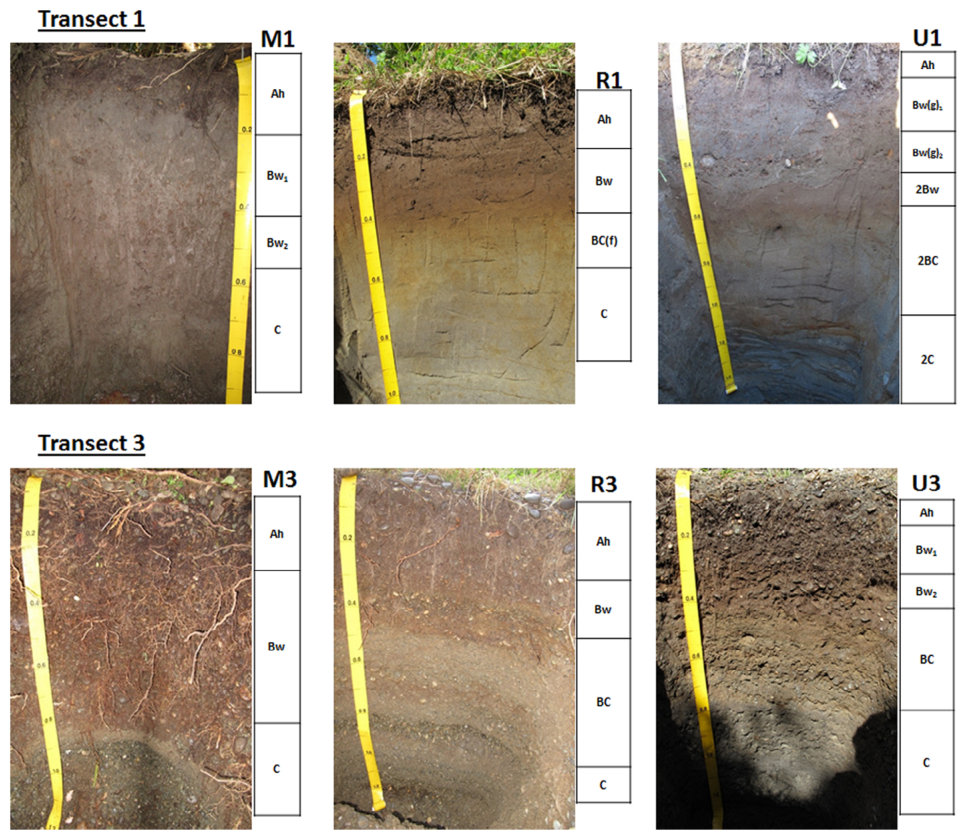
For each plot, a soil pit was dug for a soil profile description (Figure 2; also see detailed soil profile descriptions in the Data S2). It was thought that: (a) soils in restoration and unplanted plots on Transects 1 and 3, respectively, were similar before commencement of the PCRP trial; and (b) the corresponding mature forest soils on each transect provided a reference or targeting soil status for the restoration of native vegetation in the long term. Our assumption was that any measured changes in soil properties in restoration plots in comparison with unplanted plots at each transect would be primarily due to vegetation establishment and earlier land-use changes.
在每个样地挖掘一个土壤剖面坑进行剖面描述(图2;详细剖面描述见数据S2)。本研究认为:(a)在PCRP试验开始之前,样带1和样带3上恢复样地与未种植样地的土壤分别相似;(b)各样带上相应的成熟林土壤为长期本土植被恢复提供了参照或目标土壤状态。我们假设,各样带上恢复样地与未种植样地相比所测得的土壤性质变化,主要归因于植被定植和早期土地利用变化。
Approximate ages of each transect (dune) were estimated by counting tree rings in the largest forest trees, following standard methods described in Wells, Duncan, and Stewart (2001). It was assumed that the oldest tree would give a minimum age for dune stabilization, after which the only site disturbance would be associated with conversion to agricultural pasture. Although there was known to be some pilotscale ilmenite mining across the site (mainly south of the Nikau Scenic Reserve), there was no evidence of this in the soil profiles of excavated pits along transects being studied. It is unlikely that the trees were planted in the mature forest plots. It is thought that the approximate time required for tree colonization in this region is between 5 and 50 years (Wells, Yetton, Duncan, & Stewart, 1999). A limited number of randomly selected largest trees of kamahi (Weinmannia racemosa, Cunoniaceae) were selected at mature forest plots in each transect to take a tree core sample. This species were dominated by rata (Metrosideros robusta, Myrtaceae), but rata wood was too hard for coring. The cores were mounted and carefully sanded, and the number of rings were counted using a microscope. Although kamahi was not recommended for tree coring species due to its low tree ring clarity (Wells & Goff, 2006), the tree rings were sufficiently visible in the present study.
按照Wells, Duncan, and Stewart(2001)所述的标准方法,通过计数最大林木的年轮估算各样带(沙丘)的大致年龄。假设最老的树木可给出沙丘稳定的最小年龄,此后该地唯一的扰动与转变为农业草地有关。尽管已知该区域曾进行过一些中试规模的钛铁矿开采(主要在Nikau风景保护区以南),但在所研究样带挖掘的剖面坑中未发现相关证据。成熟林样地中的树木不太可能为人工种植。据认为,该地区树木定殖所需时间约为5至50年(Wells, Yetton, Duncan, & Stewart, 1999)。在各样带成熟林样地中随机选取少量最大的kamahi(Weinmannia racemosa,火把树科)树木采集树芯样品。这些样地以rata(Metrosideros robusta,桃金娘科)为优势种,但rata木材过硬,无法钻取树芯。树芯经固定并仔细打磨后,在显微镜下计数年轮。尽管kamahi因年轮清晰度低而不被推荐作为树芯采样树种(Wells & Goff, 2006),但在本研究中年轮足够清晰可见。
Profile soil samples were collected from each described soil horizon on the profile from existing excavated soil pits (collecting at least 200 g of moist soil from each horizon). At the same sampling event, field moist surface soil samples were collected at each plot (five replicates) using a stepping auger (diameter = 3.5 cm, depth = 10 cm). Surface soil samples within each plot were collected via walking away from each dug soil pit about 5–10 m five times at random directions. And, at each direction an approximately 2 × 2 m2 subplot was set and a stepping auger was stepped into the soil at least five times to collect surface soils to form one soil replicate. Therefore, there were five surface soil replicates at each plot across the study site. Both surface and profile soils were sampled, because it was thought that surface soils would have been modified in response to the current ecological restoration relatively faster and more evident than soils in deeper horizons, and the profile soils would be more likely to show the differences between old (Transect 1) and young (Transect 3) soils. Soil samples were sieved (< 2 mm) and stored in zip-lock polyethylene bags at 4�C for less than 1 week prior to analysis, with additional sub-samples being air dried (25�C for up to 1 week). Air-dried soils were crushed using a rubber hammer, sieved (500 μm brass sieve) and stored in zip-lock polyethylene bags at room temperature.
从已有剖面坑中按所描述的各土壤发生层采集剖面土样(每层至少采集200 g湿土)。在同一采样时间,使用踏板式土钻(直径 = 3.5 cm,深度 = 10 cm)在每个样地采集田间湿润表层土样(5个重复)。各样地内的表层土样采集方法为:从每个剖面坑出发沿随机方向走开约5–10 m,重复5次;在每个方向上设置约2 × 2 m2的小样方,用踏板式土钻至少取土5次,混合组成一个土壤重复。因此,整个研究区每个样地有5个表层土壤重复。同时采集表层和剖面土壤,是因为我们认为表层土壤对当前生态恢复的响应比深层土壤更快、更明显,而剖面土壤更可能显示老(样带1)和年轻(样带3)土壤之间的差异。土样过筛(< 2 mm)后装入自封聚乙烯袋,于4°C下保存不超过1周后进行分析,另取部分亚样品风干(25°C下至多1周)。风干土样用橡胶锤碾碎,过筛(500 μm黄铜筛),装入自封聚乙烯袋于室温下保存。
2.2 | Soil analysis2.2 | 土壤分析
Soil microbial biomass carbon (MBC) was measured by CHCl3 fumigation and 0.5 M K2SO4 extraction on moist soils as described in Vance, Brookes, and Jenkinson (1987)). A conversion factor (Kc) of 0.45 was applied to the MBC results as described in Wu, Joergensen, Pommerening, Chaussod, and Brookes (1990). Soil microbial biomass phosphorus (MBP) was measured by CHCl3 fumigation and 0.5 M NaHCO3 (pH adjusted to 8.5) extraction on moist soils as described in Brookes, Powlson, and Jenkinson (1982). A conversion factor (Kp) of 0.4 was applied to the MBP results following Brookes et al. (1982). Following extraction in 2 M KCl on moist soil, determination of mineral nitrogen (NH4-N and NO3-N) used a FIAstar 5,000 triple channel analyser with SoFIA software version 1.30 (Foss Tector AB, Sweden; Clough, Stevens, Laughlin, Sherlock, & Cameron, 2001). Soil pH and electrical conductivity (EC) were measured using pH and EC probes (Mettler Toledo, Australia). Soil total organic matter (% SOM) was measured as loss on ignition in a muffle furnace at 500�C. Soil organic carbon (% SOC) was estimated by dividing the total organic matter with a conversion factor of 1.72 (Blakemore et al., 1987).
土壤微生物生物量碳(MBC)按照Vance, Brookes, and Jenkinson(1987)所述方法,对湿土采用CHCl3熏蒸和0.5 M K2SO4浸提测定。按照Wu, Joergensen, Pommerening, Chaussod, and Brookes(1990)的方法,对MBC结果采用0.45的转换系数(Kc)。土壤微生物生物量磷(MBP)按照Brookes, Powlson, and Jenkinson(1982)所述方法,对湿土采用CHCl3熏蒸和0.5 M NaHCO3(pH调至8.5)浸提测定。依照Brookes et al.(1982),对MBP结果采用0.4的转换系数(Kp)。湿土经2 M KCl浸提后,采用配备SoFIA 1.30版软件的FIAstar 5,000三通道分析仪(Foss Tector AB,瑞典;Clough, Stevens, Laughlin, Sherlock, & Cameron, 2001)测定矿质氮(NH4-N和NO3-N)。土壤pH和电导率(EC)采用pH和EC探头(Mettler Toledo,澳大利亚)测定。土壤总有机质(% SOM)以马弗炉500°C灼烧损失量测定。土壤有机碳(% SOC)以总有机质除以转换系数1.72估算(Blakemore et al., 1987)。
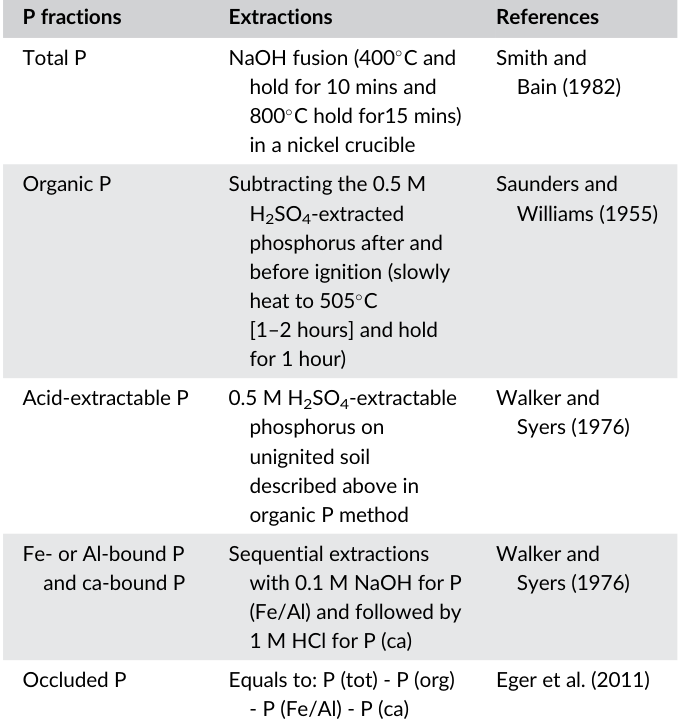
The soil P fractionation scheme (non-sequential) followed Eger et al. (2011), which includes (a) soil total P: P (tot); (b) organic P: P (org); (c) acid-extractable P: P (acid); (d) iron (Fe) or aluminium (Al) bound P: P (Fe/Al), (e) calcium (Ca) bound P: P (Ca); and (f) occluded P: P (occ). Detailed P fractionation methods are provided in Table 1. The main reason of applying non-sequential P fractionation was to allow a fair comparison with Eger et al. (2011), a coastal sand dune chronosequence under same climate zone. The P fate of P (org), P (Fe/Al), P (Ca) and P (occ) are directly related to pedogenesis (Walker & Syers, 1976), in contrast to Hedley, Stewart, and Chauhan (1982) which focuses more on the availability of soil P. Filtrates were stored in a fridge (4�C) prior to analysis. Phosphate concentrations in all extracts were determined spectrophotometrically using a UV160A spectrophotometer at 880 nm (Shimadu, Japan) after reaction with molybdate blue (Blakemore et al., 1987; Murphy & Riley, 1962). Results are expressed on dry soil basis.
土壤磷分级方案(非连续)参照Eger et al.(2011),包括:(a)土壤全磷:P (tot);(b)有机磷:P (org);(c)酸提取态磷:P (acid);(d)铁(Fe)或铝(Al)结合态磷:P (Fe/Al);(e)钙(Ca)结合态磷:P (Ca);(f)闭蓄态磷:P (occ)。详细的磷分级方法见表1。采用非连续磷分级的主要原因是便于与Eger et al.(2011)进行公平比较,该研究为同一气候带下的海岸沙丘时间序列。P (org)、P (Fe/Al)、P (Ca)和P (occ)的归趋与土壤发生直接相关(Walker & Syers, 1976),而Hedley, Stewart, and Chauhan(1982)的方法则更侧重于土壤磷的有效性。滤液在分析前保存于冰箱(4°C)中。所有浸提液中的磷酸盐浓度经钼蓝显色反应后,用UV160A分光光度计(Shimadu,日本)在880 nm处测定(Blakemore et al., 1987; Murphy & Riley, 1962)。结果以干土计。
Extractable Fe and Al were extracted separately for different mineral forms, using (a) 0.2 M acid oxalate (Feo and Alo) to extract poorly crystalline minerals and mobile metal–organic complexes, and (b) citrate-dithionite reagent (0.3 M tri-sodium citrate and 1 M sodium bicarbonate) (Fed and Ald) to extract secondary iron oxides and the fractions extracted by acid oxalate and pyrophosphate (Eger et al., 2011). Extractable Fe and Al concentrations in all extracts were determined using ICP-OES (Varian 720 ES, Australia). Filtrates were stored in a freezer prior to analysis. Results are expressed on dry soil basis.
针对不同矿物形态分别浸提可提取态Fe和Al:(a)采用0.2 M酸性草酸盐(Feo和Alo)浸提弱结晶矿物和活性金属–有机络合物;(b)采用柠檬酸盐–连二亚硫酸盐试剂(0.3 M柠檬酸三钠和1 M碳酸氢钠)(Fed和Ald)浸提次生铁氧化物以及酸性草酸盐和焦磷酸盐可提取的组分(Eger et al., 2011)。所有浸提液中可提取态Fe和Al浓度采用ICP-OES(Varian 720 ES,澳大利亚)测定。滤液在分析前冷冻保存。结果以干土计。
2.3 | Statistical analysis2.3 | 统计分析
Data analyses used MINITAB version 17 (Minitab Inc., State College, PA), performing one-way analysis of variance (ANOVA) with the Fisher's least-significance-difference post-host test, Pearson correlation analyses for key soil parameters with P fractions, and principal component analysis (PCA). Non-parametric Mann–Whitney tests used for profile soil properties comparisons between plots.
数据分析采用MINITAB 17版(Minitab Inc., State College, PA),进行单因素方差分析(ANOVA)及Fisher最小显著差异事后检验、关键土壤参数与磷组分的Pearson相关分析以及主成分分析(PCA)。样地间剖面土壤性质比较采用非参数Mann–Whitney检验。
43 | RESULTS3 | 结果
3.1 | Properties of surface soil3.1 | 表层土壤性质
Transect age estimation from tree cores showed that the age of Transect 1 could be as recent as 166 years ago, and Transect 3 as recent as 75 years ago (Table 2). This is the likely the time of first establishment of woody plants on these parts of this pro-grading shoreline. The forest canopy has probably remained intact since this time, although some stock access to the forest was evident in a somewhat depleted understorey at the beginning of the present study.
基于树芯的样带年龄估算表明,样带1的年龄可能短至166年,样带3可能短至75年(表2)。这很可能是木本植物首次在这段进积海岸线上定植的时间。此后林冠可能一直保持完整,尽管在本研究开始时,林下层有所退化,表明有牲畜进入森林。
In the surface soil (0–10 cm), pH was higher (0.2–0.5 units) in both the restoration and unplanted plots compared with mature forest plots (Table 3). Microbial C:P ratio, total C, total N, C:N ratio and N:P ratio were consistently higher in M3 compared to the other plots. This is due to extremely high fine soil organic matter in the M3
在表层土壤(0–10 cm)中,恢复样地和未种植样地的pH均高于成熟林样地(高0.2–0.5个单位)(表3)。M3的微生物C:P比、全碳、全氮、C:N比和N:P比始终高于其他样地。这是由于M3
Ah-horizon (Data S2). Soil EC, ammonium-N and nitrate-N, and MBC were consistently higher in the younger transect (Table 3). Virtually all measured soil P fractions were lower in the mature forest plots (Table 4). The concentrations of P (tot) and P (org) were higher in the younger Transect 3 in parallel compared with the older Transect 1. Acid-extractable P, P (Ca) and P (Fe/Al) and were all significantly lower in mature forest plots in both transects.
Ah层中细颗粒土壤有机质含量极高(数据S2)。较年轻样带的土壤EC、铵态氮和硝态氮以及MBC始终较高(表3)。几乎所有测定的土壤磷组分在成熟林样地中均较低(表4)。与较老的样带1相比,较年轻的样带3中P (tot)和P (org)浓度相应较高。两条样带中,成熟林样地的酸提取态磷、P (Ca)和P (Fe/Al)均显著较低。
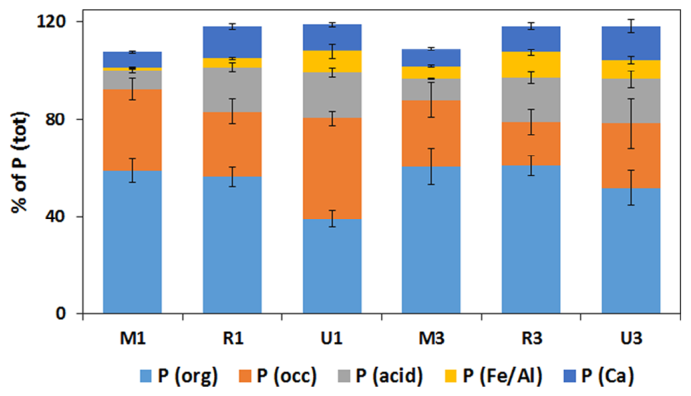
Organic P (ca. 50% to 60% of Total P) and occluded P (ca, 20% to 40% of Total P) consistently accounted for the two largest soil P fraction in most plots (Figure 3). Soil P fractionations were nonsequentially extracted in the present study, resulting that the sum of different proportions of P (org), P (acid), P (Fe/Al) and P (Ca), P (occ) as fractions of P (tot) at each plot can be higher than 100%.
在大多数样地中,有机磷(约占全磷的50%至60%)和闭蓄态磷(约占全磷的20%至40%)始终是两个最大的土壤磷组分(图3)。本研究中土壤磷组分采用非连续浸提,因此各样地P (org)、P (acid)、P (Fe/Al)、P (Ca)和P (occ)占P (tot)比例之和可能高于100%。
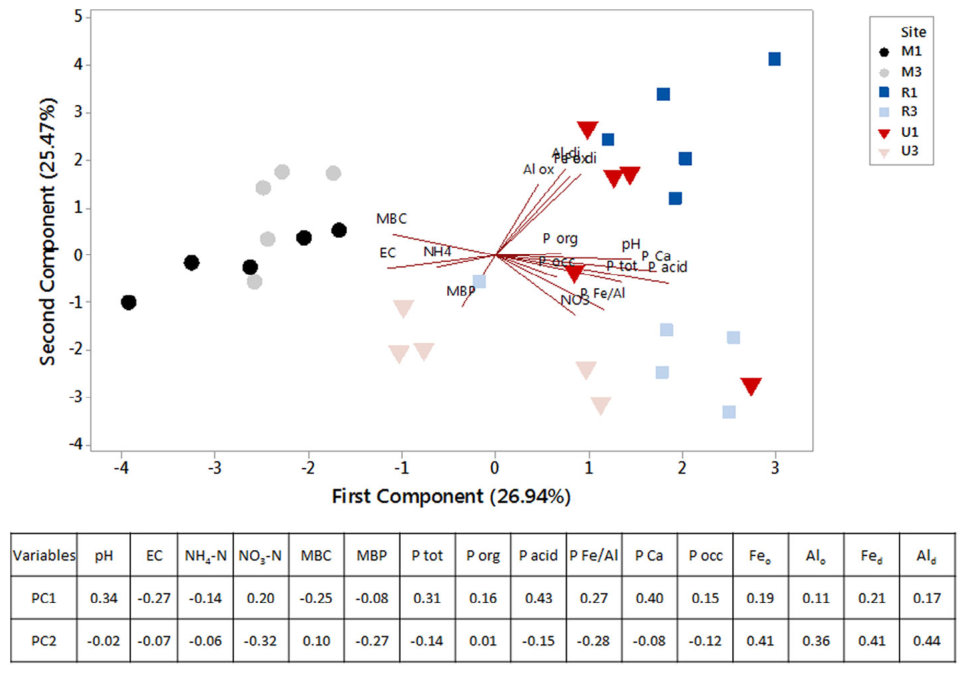
PCA of surface soil properties of Transects 1 and 3 showed mature forest plots (M1 and M3) were separated by high soil MBC and EC, but they were low in soil P (acid), P (Ca), P (tot) and pH
样带1和3表层土壤性质的PCA显示,成熟林样地(M1和M3)以较高的土壤MBC和EC区分开来,但其土壤P (acid)、P (Ca)、P (tot)和pH较低
| Number of数量 | Estimated估算 | |||
|---|---|---|---|---|
| NZ soil classificationa | USDA soil taxonomyb | tree rings | transect age | |
| Transect 1 | Sandy brown | Dystrudept | 116 | 166 |
| Transect 3 | Orthic brown | Dystrudept | 25 | 75 |
aHewitt (2010). bSoil Survey Staff (2014).
aHewitt (2010). bSoil Survey Staff (2014).
| Plots样地 | pH (H2O) | EC (mS cm−1) | NH4-N (mg kg−1) | NO3-N (mg kg−1) | MBC (mg kg−1) | MBP (mg kg−1) | Microbial C: P molar ratio微生物C: P摩尔比 | TC (mg g−1) | TN (mg g−1) | C:N ratioC:N 比 | N:P ratioN:P 比 |
|---|---|---|---|---|---|---|---|---|---|---|---|
| M1 | 4.83 (0.21)c | 0.12 (0.01)b | 2.6 (1.0)b | 0.8 (0.2)b | 671 (186)b | 5.8 (1.7)a | 47 (6)b | 35.8 | 2.3 | 15.93 | 5.8 |
| R1 | 5.44 (0.04)a | 0.04 (<0.01)c | 2.0 (1.2)b | 0.7 (0.2)b | 294 (35)b | 2.1 (0.5)b | 67 (14)b | 28.0 | 2.7 | 10.22 | 4.5 |
| U1 | 5.46 (0.12)a | 0.03 (<0.01)c | 0.8 (0.3)b | 2.0 (1.1)b | 342 (70)b | 1.6 (0.2)b | 92 (25)b | 43.1 | 3.5 | 12.41 | 5.8 |
| M3 | 5.01 (0.13)bc | 0.18 (0.01)a | 13.7 (8.4)a | 1.4 (0.5)b | 1985 (354)a | 2.5 (0.4)b | 385 (141)a | 282.4 | 16.3 | 17.33 | 12.5 |
| R3 | 5.52 (0.13)a | 0.11 (0.02)b | 2.8 (0.7)b | 7.7 (2.2)a | 382 (74)b | 5.9 (1.0)a | 30 (10)c | 29.5 | 3.0 | 9.78 | 5.0 |
| U3 | 5.22 (0.06)ab | 0.05 (<0.01)c | 5.1 (0.9)ab | 3.0 (0.9)b | 364 (17)b | 5.6 (0.6)a | 27 (4)c | 68.1 | 6.2 | 11.07 | 4.8 |
Note: Data in columns are means (n = 5) with SEs in parenthesis. The same letters indicate no significant difference (p < .05). Where '1' plots are the older transect and '3' plots are the younger transect; where M, mature forest plot; R, restoration plot; and U, unplanted grassland plot. TC, TN, C:N ratio and N:P ratio were modified from Smith et al. (2016), which were measured in 2012. Abbreviations: EC, electrical conductivity; MBC, microbial biomass carbon; MBP, microbial biomass phosphorus; TC, total carbon; TN, total nitrogen.
注:各列数据为平均值(n = 5),括号内为标准误。相同字母表示无显著差异(p < .05)。“1”样地为较老样带,“3”样地为较年轻样带;M为成熟林样地,R为恢复样地,U为未种植草地样地。TC、TN、C:N比和N:P比改自Smith et al.(2016),于2012年测定。缩写:EC,电导率;MBC,微生物生物量碳;MBP,微生物生物量磷;TC,全碳;TN,全氮。
| Plots样地 | P (tot) | P (org) (mg kg−1) | P (acid) (mg kg−1)P (acid) (mg kg−1) | P (ca) (mg kg−1) | P (Fe/Al) (mg kg−1) | P (occ) | TABLE 4 Surface soil (0–10 cm) phosphorus fractions and Fe and Al minerals表4 表层土壤(0–10 cm) 磷组分及Fe和Al 矿物 |
|---|---|---|---|---|---|---|---|
| M1 | 400 (78)b | 247 (71)b | 29 (5)b | 23 (3)b | 5 (1)d | 125 (14)a | |
| R1 | 551 (16)ab | 310 (21)ab | 100 (11)a | 73 (7)a | 20 (2)cd | 149 (29)a | |
| U1 | 540 (50)ab | 204 (8)b | 103 (15)a | 58 (3)a | 50 (19)ab | 227 (36)a | |
| M3 | 456 (32)b | 275 (40)b | 40 (3)b | 32 (4)b | 24 (3)cd | 125 (34)a | |
| R3 | 658 (60)a | 394 (21)a | 117 (12)a | 69 (9)a | 67 (7)a | 128 (49)a | |
| U3 | 546 (117)ab | 252 (24)b | 87 (12)a | 67 (10)a | 36 (2)bc | 191 (104)a |
Note: Data in columns are means (n = 5) with SEs in parenthesis. The same letters indicate no significant difference (p < .05). Where '1' plots are the older transect and '3' plots are the younger transect; where M, mature forest plot; R, restoration plot; and U, unplanted grassland plot. Abbreviations: P (tot), total phosphorus; P (org), organic phosphorus; P (acid), acid-soluble phosphorus; P (Ca), primary apatite P; P (Fe/Al), secondary mineral P; P (occ), occluded phosphorus.
注:各列数据为平均值(n = 5),括号内为标准误。相同字母表示无显著差异(p < .05)。“1”样地为较老样带,“3”样地为较年轻样带;M为成熟林样地,R为恢复样地,U为未种植草地样地。缩写:P (tot),全磷;P (org),有机磷;P (acid),酸溶性磷;P (Ca),原生磷灰石磷;P (Fe/Al),次生矿物磷;P (occ),闭蓄态磷。
(Figure 4). A second PCA component was positively correlated with soil Fe and Al minerals, but to a lesser extent negatively correlated with soil MBP and P (Fe/Al).
(图4)。第二主成分与土壤Fe和Al矿物呈正相关,并在较小程度上与土壤MBP和P (Fe/Al)呈负相关。
3.2 | Properties of soil profiles3.2 | 土壤剖面性质
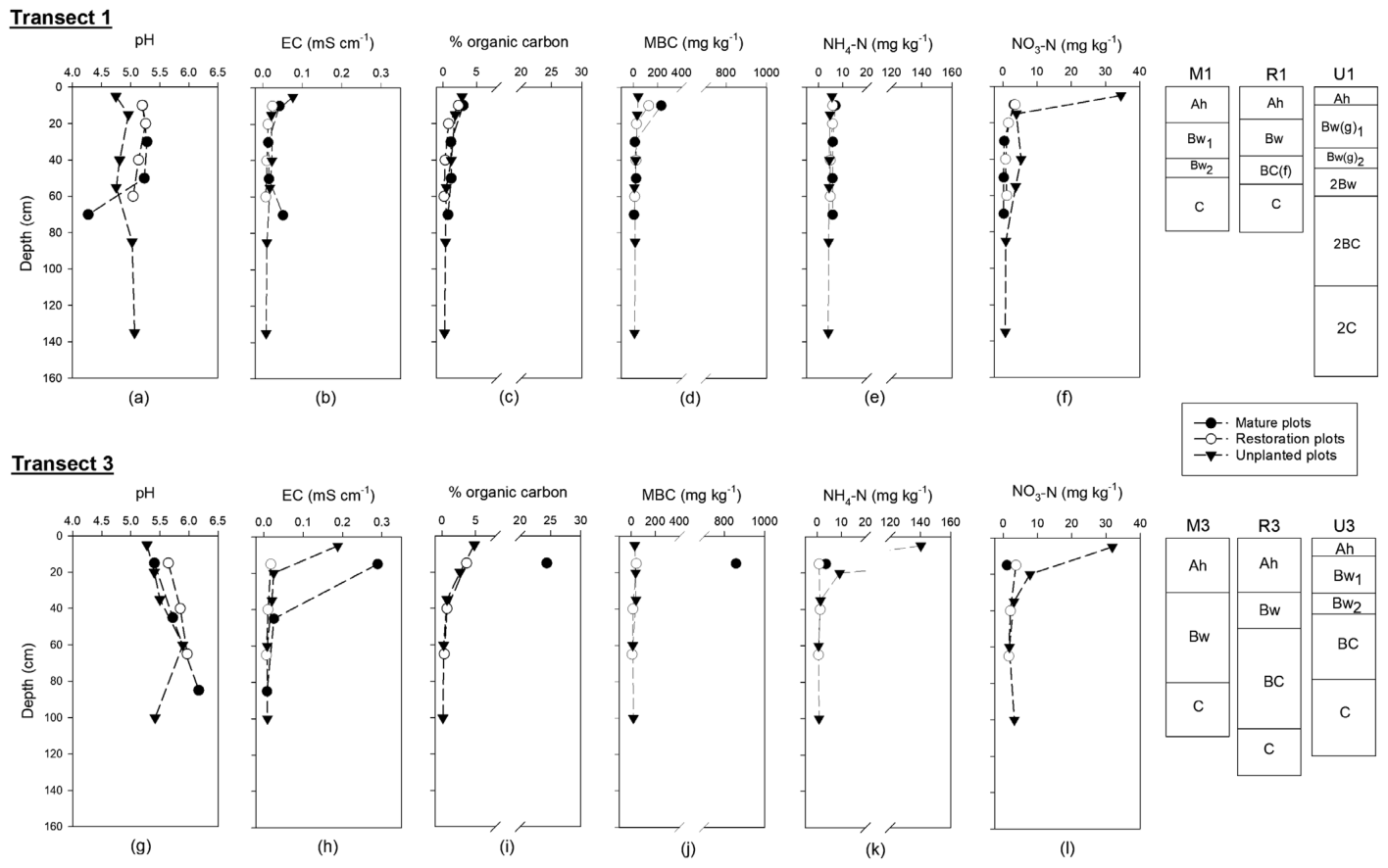
In the older Transect 1, soil pH (4.5–5.3) tended to be similar through the profile, but increased with depth (from 5.3 to 6.2) in younger Transect 3 (Figure 5). M3 and U3 Ah horizons had significantly higher EC. Apart from an exceptionally high SOC content (ca. 25%) in M3 Ah, the rest of profile soils had between 0.2% and 5% of SOC, decreasing with soil depth. Soil MBC concentration was highest in M3 Ah, and decreased with soil depth in the rest of profile soils. R1 had more than double of MBC, compared to R3. NH4-N concentration was exceptionally high in M3 Ah. NO3-N was significantly high in the Ah-horizons of R3 plot.
在较老的样带1中,土壤pH(4.5–5.3)在剖面上趋于一致,而在较年轻的样带3中随深度增加而升高(从5.3升至6.2)(图5)。M3和U3的Ah层EC显著较高。除M3 Ah层SOC含量异常高(约25%)外,其余剖面土壤SOC含量为0.2%至5%,并随土壤深度减少。土壤MBC浓度在M3 Ah层最高,在其余剖面中随深度降低。R1的MBC是R3的两倍以上。M3 Ah层NH4-N浓度异常高。R3样地Ah层NO3-N显著较高。
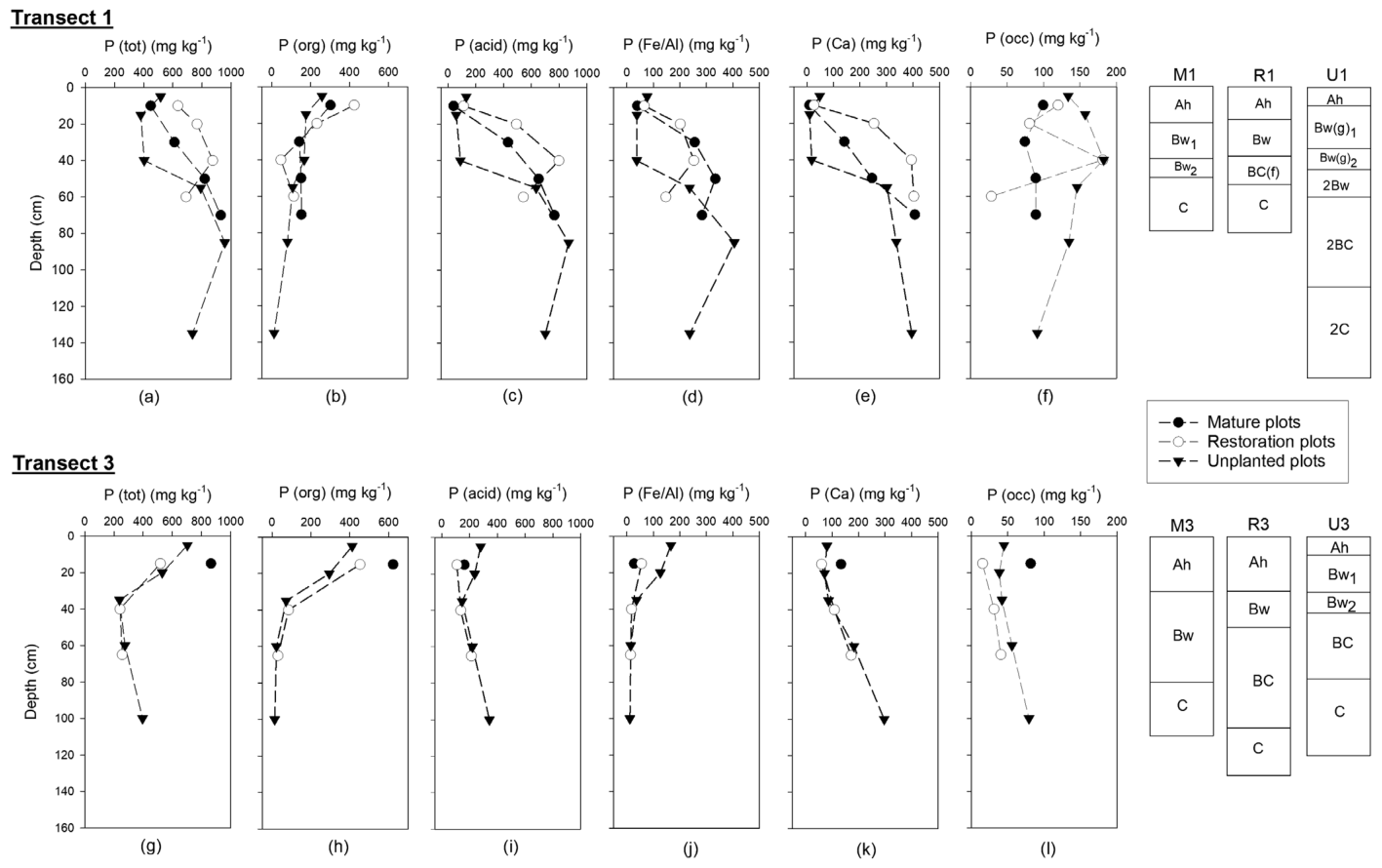
The depth trend of P (tot) showed a general increase in the M1 profile, but P (tot) tended to decrease in the top two horizons in Transect 3 (Figure 6). Soil P (org) generally showed a decreasing trend with depth in both transects. The proportional significances of P (org) to P (tot) were clearly evident in all Ah-horizons in both transects (Figure 7). Conversely, P (acid) generally showed increasing concentrations with depth and accounted for up to 90% of P (tot) in the bottom C-horizons (Figures 6 and 7). Secondary mineral P (Fe/Al) presented its importance with a general increase trend with depth in Transect 1, while a reverse pattern was presented in the Transect 3. Primary mineral P (Ca) became a more important faction with depth in both transects. Soil P (occ) were mostly higher in Transect 1 than in Transect 3.
P (tot)在M1剖面中总体随深度增加,而在样带3中上部两层趋于减少(图6)。两条样带中土壤P (org)总体随深度呈下降趋势。在两条样带的所有Ah层中,P (org)占P (tot)的比例均明显较高(图7)。相反,P (acid)浓度总体随深度增加,在底部C层中可占P (tot)的90%(图6和图7)。次生矿物磷P (Fe/Al)在样带1中随深度总体呈增加趋势,重要性上升,而在样带3中则呈相反格局。两条样带中原生矿物磷P (Ca)均随深度成为更重要的组分。土壤P (occ)在样带1中大多高于样带3。
The area-based soil P stocks on soil profiles, Mann–Whitney test results of significant difference between Transect 1 and 3 on profile soil chemical properties, and the results of Pearson Correlation analyses were given in the Tables S1–S3, Data S1.
土壤剖面基于面积的土壤磷储量、样带1与3剖面土壤化学性质显著性差异的Mann–Whitney检验结果以及Pearson相关分析结果见表S1–S3,数据S1。
54 | DISCUSSION4 | 讨论
4.1 | Soil phosphorus dynamics4.1 | 土壤磷动态
Along the restoration trajectory, the proportional importance of soil organic P, MBP, Fe/Al-bound P, and Ca-bound P fractions to total P in the restored plots were moving away from the unplanted plots. After only 6 years, both surface soils and lower soil profiles moved slightly but surely towards the P status in the mature forest plots. From a soil development perspective, soil P fractions in the present study mainly agree with the conceptual model of Walker and Syers (1976), as the younger less-weathered soils in Transect 3 had overall larger soil total P pools than the older more-weathered soils in Transect 1. Similar results of soil P factions on soil chronosequences and ecosystem development had been reported in many longer-term studies (e.g., Chen et al., 2015; Crews et al., 1995; Eger et al., 2011; Izquierdo, Houlton, & van Huysen, 2013; Parfitt et al., 2005). In the present study, the concentration of P (org) and proportional importance of P (org) to P (tot) had been significantly increased by restoration of native woody and perennial plants, compared to abandoned and unrestored exotic grassland (Table 4 and Figure 3). In northwest Russia, a similar pattern of soil inorganic and organic P transformations was observed in a 40-year Pinus sylvestris natural revegetation site (Celi, Cerli, Turner, Santoni, & Bonifacio, 2013). It was believed that soil organic P fraction was mainly driven by the development of vegetation cover. This position can be justified by the contribution of vegetation restoration on soil P dynamics being mostly defined in the upper two horizon soils, rather than at greater depths (Figure 6). Zhou et al. (2013) suggested that soil P fractionation was more governed by changes of soil pH, microbial activity and vegetation cover in a short-term young soil chronosequence. In the present study, the restoration of native plant species at the oldest restoration site (R1) had substantially promoted the weathering of soil minerals. Further study of effects of the effects of vegetation restoration and composition on soil microbial P dynamics would be worthwhile.
沿恢复轨迹,恢复样地中土壤有机磷、MBP、Fe/Al结合态磷和Ca结合态磷组分占全磷的比例逐渐偏离未种植样地。仅6年后,表层土壤和下部土壤剖面均轻微但确定地向成熟林样地的磷状态移动。从土壤发育角度看,本研究中的土壤磷组分基本符合Walker and Syers(1976)的概念模型,因为样带3中较年轻、风化程度较低的土壤总体上比样带1中较老、风化程度较高的土壤具有更大的全磷库。许多较长期研究也报道了土壤时间序列和生态系统发育中土壤磷组分的类似结果(如Chen et al., 2015; Crews et al., 1995; Eger et al., 2011; Izquierdo, Houlton, & van Huysen, 2013; Parfitt et al., 2005)。本研究中,与弃置未恢复的外来草地相比,本土木本和多年生植物的恢复显著提高了P (org)浓度及P (org)占P (tot)的比例(表4和图3)。在俄罗斯西北部,一个40年生Pinus sylvestris自然植被恢复样地中观察到了类似的土壤无机磷和有机磷转化格局(Celi, Cerli, Turner, Santoni, & Bonifacio, 2013)。该研究认为土壤有机磷组分主要受植被覆盖发育驱动。植被恢复对土壤磷动态的贡献主要体现在上部两个土层而非更深层(图6),这可以佐证上述观点。Zhou et al.(2013)认为,在短期年轻土壤时间序列中,土壤磷分级更多受土壤pH、微生物活性和植被覆盖变化的控制。本研究中,最老恢复样地(R1)的本土植物恢复显著促进了土壤矿物的风化。进一步研究植被恢复及其组成对土壤微生物磷动态的影响将很有价值。
Contrasting results were reported relating grassland afforestation studies in inland dry mountainous areas of New Zealand, where there were lower organic P concentration in the topsoil of pine stands compared with adjacent grassland (Chen et al., 2000; Condron, Cornforth, Davis, & Newman, 1996; Davis & Lang, 1991). This was thought to be due to enhanced mineralization of soil organic P under the trees. A number of variables could explain the differences between studies, including (a) different degrees of organic material decomposition because of the different ages of restoration or afforestation (De Schrijver et al., 2012; Zhang, Shi, Wen, & Yu, 2016); (b) multi-species restoration versus single species afforestation (Oelmann et al., 2011) and revegetation of arbuscular mycorrhizal fungi dominated versus ectomycorrhizal fungi dominated plant mixtures (Rosling et al., 2016) resulting in different strategies of P utilisation and P dynamics; and (c) different environmental conditions (dry versus wet climate) (Chen, Condron, & Xu, 2008). Extrapolation of the results of the present study site would suggest that organic P pool in restoration soils will eventually approach the level in the mature forest soil and become stabilised.
在新西兰内陆干旱山区开展的草地造林研究报道了相反的结果,松树林分表土中的有机磷浓度低于相邻草地(Chen et al., 2000; Condron, Cornforth, Davis, & Newman, 1996; Davis & Lang, 1991)。这被认为是由于树下土壤有机磷矿化增强所致。多种因素可以解释各研究之间的差异,包括:(a)恢复或造林年限不同导致有机物料分解程度不同(De Schrijver et al., 2012; Zhang, Shi, Wen, & Yu, 2016);(b)多物种恢复与单一物种造林(Oelmann et al., 2011)以及以丛枝菌根真菌为主与以外生菌根真菌为主的植物组合的植被恢复(Rosling et al., 2016)导致不同的磷利用策略和磷动态;(c)不同的环境条件(干旱与湿润气候)(Chen, Condron, & Xu, 2008)。根据本研究样地结果外推,恢复土壤中的有机磷库最终将接近成熟林土壤水平并趋于稳定。
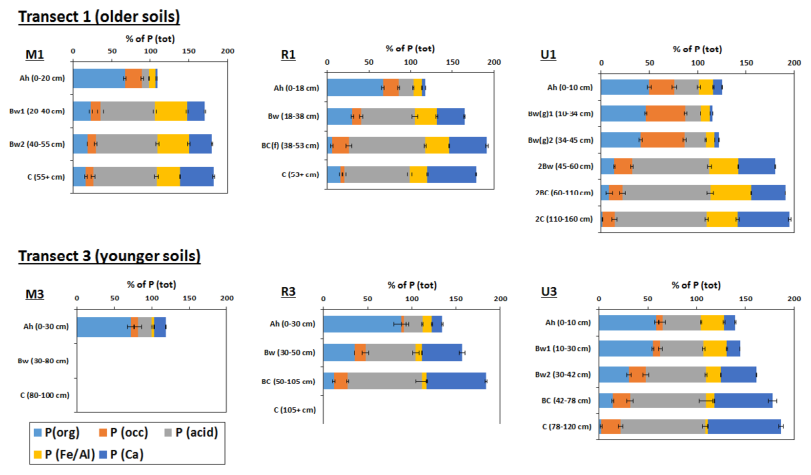
Although soil occluded P fractions were not significantly different between plots, this could be because of the relatively short gap in soil ages between transects; there remains a small indication occluded P become slightly more important as soils age (from older Transect 1 to younger Transect 3). Nevertheless, occluded P fractions were proportionally less important in restoration plots, compared to mature and unplanted plots at both transects (Figure 3). This is partially attributed to promoted P transformation by restored vegetation, as reflected in increased importance of organic P. Elsewhere, similar results were obtained in a 300-year post-landslide tropical forest development at Puerto Rico (Frizano, Johnson, Vann, & Scatena, 2002). The authors attributed this to the potential release of P from occluded pool by soil biota. In South China, Zhang et al. (2016) found an increase in occluded P fraction at a mid-way (90-year old) forest successional stage, but a decrease to the late (ca. 400-year old) successional stage. They thought increased organic acid production (rhizosphere processes and microbial activities) in mid-succession promoted the release of inorganic P into soil solution but that, in the favourable pH environment of tropical soils, this might be quickly precipitated by Al and Fe and become occluded.
尽管各样地间土壤闭蓄态磷组分无显著差异,但这可能是由于样带间土壤年龄差距相对较短;仍有少许迹象表明,随着土壤老化(从较老的样带1到较年轻的样带3),闭蓄态磷的重要性略有上升。然而,在两条样带中,恢复样地闭蓄态磷组分所占比例均低于成熟林和未种植样地(图3)。这部分归因于恢复植被促进了磷的转化,表现为有机磷重要性的提高。在其他地区,波多黎各一处滑坡后300年热带森林发育序列中也获得了类似结果(Frizano, Johnson, Vann, & Scatena, 2002)。作者将其归因于土壤生物可能从闭蓄态磷库中释放磷。在华南,Zhang et al.(2016)发现闭蓄态磷组分在森林演替中期(90年生)增加,而在演替后期(约400年生)减少。他们认为演替中期有机酸产生增加(根际过程和微生物活动)促进了无机磷向土壤溶液的释放,但在热带土壤适宜的pH环境下,这些磷可能迅速被Al和Fe沉淀而成为闭蓄态。
Lower in the soil profiles of the present study, total soil P concentrations (ca. 518–865 mg kg−1 on a 75-year terrace) in the A-horizon at the younger Transect 3 were similar to the youngest site at a comparable study on Franz Josef Schist outwash glacial chronosequence in the same region (ca. 554 mg kg−1 on a 130-year terrace) (Parfitt et al., 2005). However, concentrations were higher than on another study at the Haast sand dune chronosequence (ca. 220 mg kg−1 on a 370-year terrace) (Eger et al., 2011). These differences could be attributed to soils developing from different parent materials or to different degrees of weathering. The presence of ilmenite sand in the present study site could contribute to relatively larger soil P pool; inclusion of primary apatite P in the ilmenite sand has been reported previously (Cescas, Tyner, & Syers, 1970; Syers, Williams, & Walker, 1968). The difference was particularly evident at the deeper horizons (2Bw, 2BC and 2C) of U1, showing sharp increases of P (Ca) concentrations, as well as P (acid) (Figure 6). This potential change of parent material (from Bw to 2Bw, see profile description in Data S2) also led to a relatively low stock of primary mineral P in the upper horizons at U1 profile (Table S1, Data S1). However, overall losses of soil P stocks in the upper soil horizons in the present study were less evident in comparison to Eger et al. (2011) although under similar humid climate, which may firstly due to different time-scale of soil chronosequence. Secondly, differences in soil P stocks may be in part related to the variation of soil density among plots (Crews et al., 1995). Nevertheless, the presence of primary apatite P (Ca) in the upper soil horizons indicates a relatively young soil development stage at the present study site, but it is projected that their concentrations and relative importance will continue to decrease as both the soils and ecosystem age.
在本研究土壤剖面下部,较年轻样带3的A层土壤全磷浓度(约518–865 mg kg−1,75年阶地)与同一地区Franz Josef片岩冰水沉积时间序列可比研究中最年轻样点相近(约554 mg kg−1,130年阶地)(Parfitt et al., 2005)。然而,该浓度高于Haast沙丘时间序列的另一研究(约220 mg kg−1,370年阶地)(Eger et al., 2011)。这些差异可归因于土壤发育自不同母质或风化程度不同。本研究区存在的钛铁矿砂可能导致土壤磷库相对较大;此前已有报道指出钛铁矿砂中含有原生磷灰石磷(Cescas, Tyner, & Syers, 1970; Syers, Williams, & Walker, 1968)。这种差异在U1较深土层(2Bw、2BC和2C)尤为明显,表现为P (Ca)及P (acid)浓度急剧增加(图6)。这种潜在的母质变化(从Bw到2Bw,见数据S2中的剖面描述)也导致U1剖面上部土层原生矿物磷储量相对较低(表S1,数据S1)。然而,尽管气候同样湿润,本研究上部土层土壤磷储量的总体损失不如Eger et al.(2011)明显,这首先可能是由于土壤时间序列的时间尺度不同;其次,土壤磷储量的差异可能部分与各样地土壤容重的变化有关(Crews et al., 1995)。尽管如此,上部土层中原生磷灰石磷P (Ca)的存在表明本研究区土壤处于相对年轻的发育阶段,但预计随着土壤和生态系统的老化,其浓度和相对重要性将持续降低。
4.2 | The importance of soil biogeochemistry in the ecological restoration4.2 | 土壤生物地球化学在生态恢复中的重要性
Different impacts of ecological restoration on soils developed from different parent materials have been reported previously (Abella, Crouse, Covington, & Springer, 2015). In the present study, soils with two different development stages have clearly responded differently to the ecological restoration in terms of soil pH, mineral nitrogen, microbial biomass C and P dynamics. Differences between unplanted grassland, restoration site and mature forest plots also help to elucidate the effects of ecological restoration on soil development pathways. With a clearer understanding of these changes over an extended time-period, prediction of future soil development would provide insights into the rate of re-supply of ecosystem services (Moorhead, 2015; Prach & Walker, 2011).
此前已有研究报道生态恢复对不同母质发育土壤的影响不同(Abella, Crouse, Covington, & Springer, 2015)。本研究中,处于两个不同发育阶段的土壤在土壤pH、矿质氮、微生物生物量碳和磷动态方面对生态恢复的响应明显不同。未种植草地、恢复样地和成熟林样地之间的差异也有助于阐明生态恢复对土壤发育途径的影响。在更长时期内更清楚地了解这些变化后,对未来土壤发育的预测将有助于深入认识生态系统服务重新供给的速率(Moorhead, 2015; Prach & Walker, 2011)。
This work has relevance to current global changes to increase tree planting to mitigate climate change (Bastin et al., 2019; O'Connell, Ruan, & Silver, 2018). Soil nutrient transformation is likely to have particularly critical implications when ecological restoration is undertaken on large-scale across landscapes. In much longer-term soil chronosequences, we know that soil nutrient dynamics is transformed from being N-limited in the early stages to being P-limited at later stages of ecosystem development, eventually leading to ecosystem retrogression if no major disturbance occurs (Peltzer et al., 2010). This results in old regressive forest ecosystems (Wardle et al., 2004). However, landscapes typically consist of a mosaic of different stages of soil development, as reflected in newly developed versus highly weathered soils in the present study. Of course vegetation composition also changes along long-term soil chronosequences. Many previous studies have indicated that plant community changes are mainly driven by soil nutrient dynamics that accompany long-term soil development (Crews et al., 1995; Richardson, Peltzer, Allen, McGlone, & Parfitt, 2004; Turner, Wells, Andersen, & Condron, 2012). Pioneer N-fixing species are critical in the early stages, while plants adjusted to P-poor soils perform well in the late stages. It has been suggested that mixed species planting may facilitate vegetation restoration by providing a combination of N-fixing, P demanding and P-mobilising species, the latter require N to promote growth (Hinsinger et al., 2011; Vance, 2001). Selecting appropriate native plant species assemblages that complement soil nutrient status and soil development potential could make a substantial impact on restoration practice and outcomes in the future.
本研究与当前全球为减缓气候变化而增加植树的趋势相关(Bastin et al., 2019; O'Connell, Ruan, & Silver, 2018)。当生态恢复在景观尺度上大规模开展时,土壤养分转化可能具有尤为关键的意义。在更长期的土壤时间序列中,我们知道土壤养分动态会从生态系统发育早期的N限制转变为后期的P限制,若无重大扰动,最终导致生态系统退化(Peltzer et al., 2010),从而形成古老的退化森林生态系统(Wardle et al., 2004)。然而,景观通常由处于不同土壤发育阶段的斑块镶嵌组成,正如本研究中新发育土壤与高度风化土壤所反映的那样。当然,植被组成也会沿长期土壤时间序列发生变化。许多先前研究表明,植物群落变化主要受伴随长期土壤发育的土壤养分动态驱动(Crews et al., 1995; Richardson, Peltzer, Allen, McGlone, & Parfitt, 2004; Turner, Wells, Andersen, & Condron, 2012)。先锋固氮物种在早期阶段至关重要,而适应贫磷土壤的植物在后期阶段表现良好。有研究提出,混合物种种植可通过组合固氮、需磷和活化磷的物种促进植被恢复,其中活化磷物种需要N来促进生长(Hinsinger et al., 2011; Vance, 2001)。选择与土壤养分状况和土壤发育潜力相互补充的适宜本土植物物种组合,可能对未来的恢复实践和成效产生重大影响。
65 | CONCLUSIONS5 | 结论
1. Soil biogeochemistry, including soil P dynamics, varied along a trajectory of ecological restoration on the short-term soil chronosequence and had been modified by restoration planting. In some cases, but not always, this was strongly directional towards the forest soil characteristics.
1. 在短期土壤时间序列上,包括土壤磷动态在内的土壤生物地球化学沿生态恢复轨迹发生变化,并已受到恢复种植的改变。在某些情况下(但并非总是如此),这种变化强烈地指向森林土壤特征。
2. Dynamics of soil organic matter (accumulation and decomposition) and increasing demand of N from fast-growing plants early in the restoration was associated with rapid nutrient mineralization.
2. 恢复早期土壤有机质的动态(积累与分解)以及速生植物对N需求的增加与养分的快速矿化相关。
3. Earlier conceptual models fit this short-term restoration trajectory, with a loss of total P, an increase of occluded P and increasing importance of soil organic P as soils age. Progressive changes of P fractions in soil are probably directional soil development trends in these restored ecosystems.
3. 早期概念模型适用于这一短期恢复轨迹,表现为随着土壤老化全磷减少、闭蓄态磷增加以及土壤有机磷重要性上升。土壤磷组分的渐进变化可能代表这些恢复生态系统中具有方向性的土壤发育趋势。
4. There was no evidence that the success of establishment of plants varied across the site, but vegetation establishment markedly impacted soil biogeochemistry. This knowledge makes a valuable contribution to our understanding of restoration biogeochemistry, but requires further advancement before it will be useful to practitioners.
4. 没有证据表明植物定植的成功程度在整个样地内存在差异,但植被定植显著影响了土壤生物地球化学。这一认识对理解恢复生物地球化学具有重要价值,但在对实践者有用之前还需进一步深入研究。
7ACKNOWLEDGMENTS致谢
The authors thank Closure & Legacy Management, Rio Tinto Services Ltd., and Punakaiki Coastal Restoration Project (PCRP) for their sponsorship of this work. We thank the financial support of Rio Tinto Services Ltd. (grant numbers 46084, 46164) and Conservation Volunteers New Zealand (grant number 46061).The authors thank Mike Bowie and James Washer for assistance in the field.
作者感谢Closure & Legacy Management、Rio Tinto Services Ltd.和Punakaiki海岸恢复项目(PCRP)对本研究的资助。感谢Rio Tinto Services Ltd.(资助编号46084、46164)和新西兰保护志愿者组织(资助编号46061)的经费支持。作者感谢Mike Bowie和James Washer在野外工作中提供的帮助。
8DATA AVAILABILITY STATEMENT数据可用性声明
The data that support the findings of this study Data are available from the figshare repository: https://doi.org/10.6084/m9.figshare.12994289.v1.
支持本研究结果的数据可从figshare数据库获取:https://doi.org/10.6084/m9.figshare.12994289.v1。
9ORCIDORCID
Hongtao Zhong https://orcid.org/0000-0003-0674-0010 Young-Nam Kim https://orcid.org/0000-0002-9745-6551
Hongtao Zhong https://orcid.org/0000-0003-0674-0010 Young-Nam Kim https://orcid.org/0000-0002-9745-6551
10REFERENCES参考文献
Abella, S. R., Crouse, J. E., Covington, W. W., & Springer, J. D. (2015). Diverse responses across soil parent materials during ecological restoration. Restoration Ecology, 23(2), 113–121. https://doi.org/10.1111/ rec.12160
Adhikari, K., & Hartemink, A. E. (2016). Linking soils to ecosystem services — A global review. Geoderma, 262, 101–111. https://doi.org/10.1016/ j.geoderma.2015.08.009
Banning, N. C., Gleeson, D. B., Grigg, A. H., Grant, C. D., Andersen, G. L., Brodie, E. L., & Murphy, D. V. (2011). Soil microbial community successional patterns during forest ecosystem restoration. Applied and Environmental Microbiology, 77(17), 6158–6164. https://doi.org/10.1128/ aem.00764-11
Bastin, J. F., Finegold, Y., Garcia, C., Mollicone, D., Rezende, M., Routh, D., … Crowther, T. W. (2019). The global tree restoration potential. Science, 365, 76–79. https://doi.org/10.1126/science.aax0848
Blakemore, L. C., Searle, P. L., Daly, B. K., & Department of Scientific and Industrial Research. (1987). Methods for chemical analysis of soils. Lower Hutt, NZ: Soil Bureau of Scientific and Industrial Research.
Bradshaw, A. (1983). The reconstruction of ecosystems. Journal of Applied Ecology, 20(1), 1–17.
Bradshaw, A. D., & Chadwick, M. J. (1980). The restoration of land: The ecology and reclamation of derelict and degraded land. Berkeley: University of California Press.
Brady, N. C., & Weil, R. R. (2008). The nature and properties of soils (14th ed.). Upper Saddle River, NJ: Pearson Education.
Brookes, P. C., Powlson, D. S., & Jenkinson, D. S. (1982). Measurement of microbial biomass phosphorus in soil. Soil Biology and Biochemistry, 14(4), 319–329. https://doi.org/10.1016/0038-0717(82)90001-3
Celi, L., Cerli, C., Turner, B. L., Santoni, S., & Bonifacio, E. (2013). Biogeochemical cycling of soil phosphorus during natural revegetation of Pinus sylvestris on disused sand quarries in Northwestern Russia. Plant and Soil, 367(1), 121–134. https://doi.org/10.1007/s11104-013-1627-y
Cescas, M. P., Tyner, E. H., & Syers, J. K. (1970). Distribution of apatite and other mineral inclusions in a rhyolitic pumice ash and beach sands from New Zealand: An electron-microprobe study. Journal of Soil Science, 21(1), 78–84. https://doi.org/10.1111/j.1365-2389.1970.tb01154.x
Chen, C. R., Condron, L. M., Davis, M. R., & Sherlock, R. R. (2000). Effects of afforestation on phosphorus dynamics and biological properties in a New Zealand grassland soil. Plant and Soil, 220(1), 151–163. https:// doi.org/10.1023/a:1004712401721
Chen, C. R., Condron, L. M., & Xu, Z. H. (2008). Impacts of grassland afforestation with coniferous trees on soil phosphorus dynamics and associated microbial processes: A review. Forest Ecology and Management, 255(3–4), 396–409. https://doi.org/10.1016/j.foreco.2007.10.040
Chen, C. R., Hou, E. Q., Condron, L. M., Bacon, G., Esfandbod, M., Olley, J., & Turner, B. L. (2015). Soil phosphorus fractionation and nutrient dynamics along the Cooloola coastal dune chronosequence, southern Queensland, Australia. Geoderma, 257–258, 4–13. https:// doi.org/10.1016/j.geoderma.2015.04.027
Clough, T. J., Stevens, R. J., Laughlin, R. J., Sherlock, R. R., & Cameron, K. C. (2001). Transformations of inorganic-N in soil leachate under differing storage conditions. Soil Biology and Biochemistry, 33 (11), 1473–1480. https://doi.org/10.1016/S0038-0717(01)00056-6
Condron, L. M., Cornforth, I. S., Davis, M. R., & Newman, R. H. (1996). Influence of conifers on the forms of phosphorus in selected New Zealand grassland soils. Biology and Fertility of Soils, 21(1), 37–42. https://doi.org/10.1007/bf00335991
Costantini, E. A. C., Branquinho, C., Nunes, A., Schwilch, G., Stavi, I., Valdecantos, A., & Zucca, C. (2016). Soil indicators to assess the
effectiveness of restoration strategies in dryland ecosystems. Solid Earth, 7(2), 397–414. https://doi.org/10.5194/se-7-397-2016
Crews, T. E., Kitayama, K., Fownes, J. H., Riley, R. H., Herbert, D. A., Mueller- Dombois, D., & Vitousek, P. M. (1995). Changes in soil phosphorus fractions and ecosystem dynamics across a long chronosequence in Hawaii. Ecology, 76(5), 1407–1424. https://doi.org/10.2307/1938144
Crouzeilles, R., Curran, M., Ferreira, M. S., Lindenmayer, D. B., Grelle, C. E. V., & Rey Benayas, J. M. (2016). A global meta-analysis on the ecological drivers of forest restoration success. Nature Communications, 7, 11666. https://doi.org/10.1038/ncomms11666
Davis, M. R., & Lang, M. H. (1991). Increased nutrient availability in topsoils under conifers in the South Island high country. New Zealand Journal of Forestry Science, 21(2/3), 165–179.
De Schrijver, A., Vesterdal, L., Hansen, K., De Frenne, P., Augusto, L., Achat, D. L., … Verheyen, K. (2012). Four decades of post-agricultural forest development have caused major redistributions of soil phosphorus fractions. Oecologia, 169(1), 221–234. https://doi.org/10.1007/ s00442-011-2185-8
Eger, A., Almond, P. C., & Condron, L. M. (2011). Pedogenesis, soil mass balance, phosphorus dynamics and vegetation communities across a Holocene soil chronosequence in a super-humid climate, South Westland, New Zealand. Geoderma, 163(3–4), 185–196. https://doi.org/10. 1016/j.geoderma.2011.04.007
Frizano, J., Johnson, A. H., Vann, D. R., & Scatena, F. N. (2002). Soil phosphorus fractionation during forest development on landslide scars in the Luquillo Mountains, Puerto Rico1. Biotropica, 34(1), 17–26. https://doi.org/10.1111/j.1744-7429.2002.tb00238.x
Frouz, J., Van Diggelen, R., Pižl, V., Starý, J., Háneˇl, L., Tajovský, K., & Kalcˇík, J. (2009). The effect of topsoil removal in restored heathland on soil fauna, topsoil microstructure, and cellulose decomposition: Implications for ecosystem restoration. Biodiversity and Conservation, 18(14), 3963–3978. https://doi.org/10.1007/s10531-009-9692-5
Gann, G. D., McDonald, T., Walder, B., Aronson, J., Nelson, C. R., Jonson, J., … Dixon, K. W. (2019). International principles and standards for the practice of ecological restoration. Second edition. Restoration Ecology, 27(S1), S1–S46. http://dx.doi.org/10.1111/rec. 13035
Hahner, J. L., Bowie, M. K., Dickinson, N. M., Smith, C. M. S., Boyer, S., Chassagneux, A., … Mountier, C. (2013). Development and testing indicators of restoration success: Punakaiki Coastal Restoration Project (Lincoln University Wildlife Management Report No. 52). Department of Ecology/Lincoln University, Lincoln, NZ.
Harris, J. (2009). Soil microbial communities and restoration ecology: Facilitators or followers? Science, 325(5940), 573–574. https://doi.org/10. 1126/science.1172975
Hedley, M. J., Stewart, J. W. B., & Chauhan, B. S. (1982). Changes in inorganic and organic soil phosphorus fractions induced by cultivation practices and by laboratory incubations. Soil Science Society of America Journal, 46(5), 970–976. https://doi.org/10.2136/ sssaj1982.03615995004600050017x
Hewitt, A. E. (2010). New Zealand soil classification. Landcare Research Science Series No. 1 (3rd ed.). Lincoln, N.Z.: Manaaki Whenua Press.
Hinsinger, P., Betencourt, E., Bernard, L., Brauman, A., Plassard, C., Shen, J., … Zhang, F. (2011). P for two, sharing a scarce resource: Soil phosphorus acquisition in the rhizosphere of intercropped species. Plant Physiology, 156(3), 1078–1086. https://doi.org/10.1104/pp.111. 175331
Hu, N., Li, H., Tang, Z., Li, Z., Li, G., Jiang, Y., … Lou, Y. (2016). Community size, activity and C:N stoichiometry of soil microorganisms following reforestation in a karst region. European Journal of Soil Biology, 73, 77–83. https://doi.org/10.1016/j.ejsobi.2016.01.007
Izquierdo, J. E., Houlton, B. Z., & van Huysen, T. L. (2013). Evidence for progressive phosphorus limitation over long-term ecosystem development: Examination of a biogeochemical paradigm. Plant and Soil, 367(1), 135–147. https://doi.org/10.1007/s11104-013-1683-3
Kelly, E. F., Chadwick, O. A., & Hilinski, T. E. (1998). The effect of plants on mineral weathering. Biogeochemistry, 42(1), 21–53. https://doi.org/10. 1023/a:1005919306687
Kooch, Y., Tavakoli, M., & Akbarinia, M. (2018). Tree species could have substantial consequences on topsoil fauna: A feedback of land degradation/restoration. European Journal of Forest Research, 137(6), 793–805. https://doi.org/10.1007/s10342-018-1140-1
Li, L., Li, S.-M., Sun, J.-H., Zhou, L.-L., Bao, X.-G., Zhang, H.-G., & Zhang, F.- S. (2007). Diversity enhances agricultural productivity via rhizosphere phosphorus facilitation on phosphorus-deficient soils. Proceedings of the National Academy of Sciences, 104(27), 11192–11196. https://doi. org/10.1073/pnas.0704591104
Menge, D. N. L., Hedin, L. O., & Pacala, S. W. (2012). Nitrogen and phosphorus limitation over long-term ecosystem development in terrestrial ecosystems. PLoS One, 7(8), e42045. https://doi.org/10.1371/journal. pone.0042045
Moorhead, K. K. (2015). A pedogenic view of ecosystem restoration. Ecological Restoration, 33(4), 341–351. https://doi.org/10.3368/er.33. 4.341
Murphy, J., & Riley, J. P. (1962). A modified single solution method for the determination of phosphate in natural waters. Analytica Chimica Acta, 27, 31–36. https://doi.org/10.1016/S0003-2670(00) 88444-5
O'Connell, C. S., Ruan, L., & Silver, L. (2018). Drought drives rapid shifts in tropical rainforest soil biogeochemistry and greenhouse gas emissions. Nature Communications, 9, 1348. https://doi.org/10.1038/s41467- 018-03352-3
Oelmann, Y., Richter, A. K., Roscher, C., Rosenkranz, S., Temperton, V. M., Weisser, W. W., & Wilcke, W. (2011). Does plant diversity influence phosphorus cycling in experimental grasslands? Geoderma, 167–168, 178–187. https://doi.org/10.1016/j.geoderma.2011.09.012
Parfitt, R. L., Ross, D. J., Coomes, D. A., Richardson, S. J., Smale, M. C., & Dahlgren, R. A. (2005). N and P in New Zealand soil chronosequences and relationships with foliar N and P. Biogeochemistry, 75(2), 305–328. https://doi.org/10.1007/s10533-004-7790-8
Peltzer, D. A., Wardle, D. A., Allison, V. J., Baisden, W. T., Bardgett, R. D., Chadwick, O. A., … Walker, L. R. (2010). Understanding ecosystem retrogression. Ecological Monographs, 80(4), 509–529. https://doi.org/10. 1890/09-1552.1
Perring, M. P., Standish, R. J., Price, J. N., Craig, M. D., Erickson, T. E., Ruthrof, K. X., … Hobbs, R. J. (2015). Advances in restoration ecology: Rising to the challenges of the coming decades. Ecosphere, 6(8), 1–25. https://doi.org/10.1890/ES15-00121.1
Prach, K., & Walker, L. R. (2011). Four opportunities for studies of ecological succession. Trends in Ecology & Evolution, 26(3), 119–123. https:// doi.org/10.1016/j.tree.2010.12.007
Richardson, S. J., Peltzer, D. A., Allen, R. B., McGlone, M. S., & Parfitt, R. L. (2004). Rapid development of phosphorus limitation in temperate rainforest along the Franz Josef soil chronosequence. Oecologia, 139(2), 267–276. https://doi.org/10.1007/s00442-004-1501-y
Ros, M., Hernandez, M. T., & Carlos, G. (2003). Soil microbial activity after restoration of a semiarid soil by organic amendments. Soil Biology and Biochemistry, 35(3), 463–469. https://doi.org/10.1016/S0038-0717 (02)00298-5
Rosling, A., Midgley, M. G., Cheeke, T., Urbina, H., Fransson, P., & Phillips, R. P. (2016). Phosphorus cycling in deciduous forest soil differs between stands dominated by ecto- and arbuscular mycorrhizal trees. New Phytologist, 209(3), 1184–1195. https://doi.org/10.1111/ nph.13720
Rowland, S. M., Prescott, C. E., Grayston, S. J., Quideau, S. A., & Bradfield, G. E. (2009). Recreating a functioning forest soil in reclaimed oil sands in northern Alberta: An approach for measuring success in ecological restoration. Journal of Environmental Quality, 38(4), 1580–1590. https://doi.org/10.2134/jeq2008.0317
Saunders, W. M. H., & Williams, E. G. (1955). Observatioms on the determination of total organic phosphorus in soils. Journal of Soil Science, 6(2), 254–267. https://doi.org/10.1111/j.1365-2389.1955. tb00849.x
Smith, B. F. L., & Bain, D. C. (1982). A sodium hydroxide fusion method for the determination of total phosphate in soils. Communications in Soil Science and Plant Analysis, 13(3), 185–190. https://doi.org/10.1080/ 00103628209367257
Smith, C. M. S., Bowie, M. H., Hahner, J. L., Boyer, S., Kim, Y. N., Zhong, H. T., … Dickinson, N. (2016). Punakaiki coastal restoration project: A case study for a consultative and multidisciplinary approach in selecting indicators of restoration success for a sand mining closure site, West Coast, New Zealand. Catena, 136, 91–103. https://doi.org/ 10.1016/j.catena.2015.07.024
Soil Survey Staff. (2014). Keys to soil taxonomy (12th ed.). Washington, D.C.: Dept. of Agriculture, Natural Resources Conservation Service.
Strickland, M. S., Callaham, M. A., Gardiner, E. S., Stanturf, J. A., Leff, J. W., Fierer, N., & Bradford, M. A. (2017). Response of soil microbial community composition and function to a bottomland forest restoration intensity gradient. Applied Soil Ecology, 119, 317–326. https://doi.org/ 10.1016/j.apsoil.2017.07.008
Syers, J. K., Williams, J. D. H., & Walker, T. W. (1968). The determination of total phosphorus in soils and parent materials. New Zealand Journal of Agricultural Research, 11(4), 757–762. https://doi.org/10.1080/ 00288233.1968.10422407
Turner, B. L., & Laliberté, E. (2015). Soil development and nutrient availability along a 2 million-year coastal dune chronosequence under species-rich Mediterranean shrubland in southwestern Australia. Ecosystems, 18(2), 287–309. https://doi.org/10.1007/s10021-014- 9830-0
Turner, B. L., Wells, A., Andersen, K. M., & Condron, L. M. (2012). Patterns of tree community composition along a coastal dune chronosequence in lowland temperate rain forest in New Zealand. Plant Ecology, 213 (10), 1525–1541. https://doi.org/10.1007/s11258-012-0108-3
Vance, C. P. (2001). Symbiotic nitrogen fixation and phosphorus acquisition. Plant nutrition in a world of declining renewable resources. Plant Physiology, 127(2), 390–397. https://doi.org/10.1104/pp. 010331
Vance, E. D., Brookes, P. C., & Jenkinson, D. S. (1987). An extraction method for measuring soil microbial biomass C. Soil Biology and Biochemistry, 19(6), 703–707. https://doi.org/10.1016/0038-0717(87) 90052-6
Walker, T. W., & Syers, J. K. (1976). The fate of phosphorus during pedogenesis. Geoderma, 15(1), 1–19. https://doi.org/10.1016/0016-7061 (76)90066-5
Wang, T., Kang, F., Cheng, X., Han, H., & Ji, W. (2016). Soil organic carbon and total nitrogen stocks under different land uses in a hilly ecological restoration area of North China. Soil and Tillage Research, 163, 176–184. https://doi.org/10.1016/j.still.2016.05.015
Wardle, D. A., Walker, L. R., & Bardgett, R. D. (2004). Ecosystem properties and forest decline in contrasting long-term chronosequences. Science, 305(5683), 509–513. https://doi.org/10.1126/science.1098778
Wells, A., Duncan, R. P., & Stewart, G. H. (2001). Forest dynamics in Westland, New Zealand: The importance of large, infrequent earthquakeinduced disturbance. Journal of Ecology, 89(6), 1006–1018. https://doi. org/10.1111/j.1365-2745.2001.00594.x
Wells, A., & Goff, J. (2006). Coastal dune ridge systems as chronological markers of palaeoseismic activity: A 650-yr record from Southwest New Zealand. The Holocene, 16(4), 543–550. https://doi.org/10.1191/ 0959683606hl949rp
Wells, A., Yetton, M. D., Duncan, R. P., & Stewart, G. H. (1999). Prehistoric dates of the most recent alpine fault earthquakes, New Zealand. Geology, 27(11), 995–998. https://doi.org/10.1130/0091-7613(1999) 027<0995:pdotmr>2.3.co;2
Wortley, L., Hero, J.-M., & Howes, M. (2013). Evaluating ecological restoration success: A review of the literature. Restoration Ecology, 21(5), 537–543. https://doi.org/10.1111/rec.12028
Wu, J., Joergensen, R. G., Pommerening, B., Chaussod, R., & Brookes, P. C. (1990). Measurement of soil microbial biomass C by fumigationextraction—An automated procedure. Soil Biology and Biochemistry, 22(8), 1167–1169. https://doi.org/10.1016/0038-0717(90)90046-3
Zhang, H., Shi, L., Wen, D., & Yu, K. (2016). Soil potential labile but not occluded phosphorus forms increase with forest succession. Biology and Fertility of Soils, 52(1), 41–51. https://doi.org/10.1007/s00374- 015-1053-9
Zhong, H. (2017). Soil chemistry and ecology on a restoration trajectory of a coastal sandplain forest, Punakaiki, New Zealand. (Doctor of Philosophy). Lincoln University, New Zealand.
Zhou, J., Wu, Y., Prietzel, J., Bing, H., Yu, D., Sun, S., … Sun, H. (2013). Changes of soil phosphorus speciation along a 120-year soil chronosequence in the Hailuogou Glacier retreat area (Gongga
Mountain, SW China). Geoderma, 195–196, 251–259. https://doi.org/ 10.1016/j.geoderma.2012.12.010
11SUPPORTING INFORMATION支持信息
Additional supporting information may be found online in the Supporting Information section at the end of this article.
其他支持信息可在本文末尾的在线支持信息部分查阅。
How to cite this article: Zhong H, Smith C, Robinson B, Kim Y-N, Dickinson N. Soil phosphorus dynamics along a short-term ecological restoration trajectory of a coastal sandplain forest in New Zealand. Land Degrad Dev. 2021;32: 1250–1261. https://doi.org/10.1002/ldr.3782
引用本文:Zhong H, Smith C, Robinson B, Kim Y-N, Dickinson N. Soil phosphorus dynamics along a short-term ecological restoration trajectory of a coastal sandplain forest in New Zealand. Land Degrad Dev. 2021;32: 1250–1261. https://doi.org/10.1002/ldr.3782