Contents lists available at ScienceDirect journal homepage: www.elsevier.com/locate/apsoil
Maria Jesus Gutierrez-Gines a,*, Hossein Alizadeh b, Elizabeth Alderton a, Vikki Ambrose a,1, Alexandra Meister c, Brett H. Robinson c, Sky Halford a,2, Jennifer A. Prosser a,3, Jacqui Horswell a,4
a Institute of Environmental Science and Research (ESR) Ltd., 34 Kenepuru Drive, Kenepuru, Porirua 5022, New Zealand b Bio-Protection Research Centre, PO Box 85084, Lincoln University, 7647 Canterbury, New Zealand c School of Physical and Chemical Sciences, University of Canterbury, 20 Kirkwood Ave, Christchurch 8041, New Zealand
a 新西兰环境科学与研究所(ESR)有限公司,34 Kenepuru Drive, Kenepuru, Porirua 5022, 新西兰 b 生物保护研究中心,PO Box 85084, 林肯大学,7647 坎特伯雷,新西兰 c 坎特伯雷大学物理与化学科学学院,20 Kirkwood Ave, 基督城 8041, 新西兰
A R T I C L E I N F O
A B S T R A C T
Keywords: Novel research has demonstrated that the roots of some bioactive plants - called pathogen phytoremediation Myrtaceae plants - enhance die-off of pathogenic organisms in the soil. Strategic establishment of pathogen phytor- Winteraceae emediation plants may reduce the transport of human pathogens to water sources. Such plantings could be used Escherichia coli in riparian margins, as buffer strips to protect drinking water supplies, or block planting in ‘critical source areas’ Staphylococcus aureus of microbial contamination, such as grazing paddocks, organic waste – including sewage sludge - amended land, Pseudomonas aeruginosa Burkholderia cepacia animal feedlots and housing facilities, and manure storage areas. This work aimed to investigate the antimicrobial activity of a range of New Zealand native plants known for their antimicrobial potential from previous research or through indigenous knowledge, and to assess if any of them could potentially be used for pathogen phytoremediation. Two laboratory screening experiments demonstrated the antimicrobial activity of Leptospermum scoparium, including the local variety swamp manuka, ¯Kunzea ericoides, Pseudowintera colorata, and Metrosideros robusta against three human pathogens and two indicator organisms. A greenhouse experiment showed a 90% reduction of Escherichia coli numbers in dairy shed effluent irrigated pots after 14 days in soils under swamp L. scoparium and M. robusta, compared with 45 days in soil under Lolium perenne. The pH in the soil under swamp L. scoparium and M. robusta was significantly lower than under L. perenne, which could partially explain the faster E. coli reduction.
关键词: 病原体植物修复;桃金娘科(Myrtaceae);林仙科(Winteraceae);Escherichia coli;Staphylococcus aureus;Pseudomonas aeruginosa Burkholderia cepacia。新近研究表明,某些生物活性植物(称为病原体植物修复植物)的根系可加速土壤中病原生物的死亡。有策略地种植病原体植物修复植物,可减少人类病原体向水源的迁移。此类植被可用于河岸带、作为保护饮用水供应的缓冲带,或成片种植于微生物污染的“关键源区”,如放牧围场、施用有机废物(包括污水污泥)的土地、动物育肥场与圈舍以及粪肥贮存区。本研究旨在考察一系列新西兰本土植物的抗菌活性,这些植物已由既往研究或本土传统知识表明具有抗菌潜力,并评估其中是否有可用于病原体植物修复的种类。两项实验室筛选试验表明,Leptospermum scoparium(包括当地变种沼泽麦卢卡)、Kunzea ericoides、Pseudowintera colorata和Metrosideros robusta对三种人类病原体和两种指示生物具有抗菌活性。温室试验表明,在灌溉奶牛棚废水的盆栽中,沼泽型L. scoparium和M. robusta下土壤中Escherichia coli数量在14天后降低90%,而Lolium perenne下土壤则需45天。沼泽型L. scoparium和M. robusta下土壤的pH显著低于L. perenne下土壤,这可在一定程度上解释E. coli更快的减少。
1Introduction引言
Medicinal use of plants is as old as humanity, with the first written records of plant medicinal use dating from 2600 BC in Mesopotamia (Gurib-Fakim, 2006). Medicinal plants were also the first source of pharmaceuticals; Aspirin, produced from salicin extracted from bark of Salix alba, was one of the first examples of a plant derived drug (McRae et al., 2007). Bioprospecting, the process of discovery and commercialisation of new products from biological resources, has become an important discipline, above all in the search for new drugs to treat human diseases and/or conditions (McRae et al., 2007). Currently, the development of pathogens with antibiotic resistance is pushing researchers to find new antibiotic products and compounds (Gorlenko et al., 2020).
植物的药用历史与人类历史一样悠久,最早关于植物药用的文字记载可追溯至公元前2600年的美索不达米亚(Gurib-Fakim, 2006)。药用植物也是药物的最初来源;阿司匹林由Salix alba树皮中提取的水杨苷制得,是最早的植物源药物实例之一(McRae et al., 2007)。生物勘探,即从生物资源中发现并商业化新产品的过程,已成为一门重要学科,尤其是在寻找治疗人类疾病和/或病症的新药方面(McRae et al., 2007)。目前,具有抗生素耐药性病原体的出现正推动研究人员寻找新的抗生素产品和化合物(Gorlenko et al., 2020)。
Recent novel research has investigated the use of medicinal plants to inhibit or kill human pathogens in the soil. Yossa et al. (2010) demonstrated the efficacy of treating soil with essential oils from different plant species to reduce contamination of food by Escherichia coli (E. coli) O157: H7 in organic agriculture. Prosser et al. (2016) demonstrated a faster die-off of E. coli under soil containing bioactive plants compared with soil planted with pasture only, and suggested the release of antimicrobial compounds as a probable mechanism. These authors were the first ones to refer to this research as phytoremediation of microbial contamination.
近期的新研究探讨了利用药用植物抑制或杀灭土壤中人类病原体的可能性。Yossa et al. (2010) 证明了在有机农业中用不同植物种类的精油处理土壤可有效减少Escherichia coli(E. coli)O157: H7对食品的污染。Prosser et al. (2016) 证明,与仅种植牧草的土壤相比,含生物活性植物的土壤中E. coli死亡更快,并提出抗菌化合物的释放可能是其作用机制。这些作者首次将此类研究称为微生物污染的植物修复。
* Corresponding author.
E-mail address: maria.gutierrez-gines@esr.cri.nz (M.J. Gutierrez-Gines).
1Present address: Nelson City Council, 110 Trafalgar Street, Nelson 7010, New Zealand.
1现地址:Nelson City Council,110 Trafalgar Street, Nelson 7010, 新西兰。
2Present address: School of Physical and Chemical Sciences, University of Canterbury, 20 Kirkwood Ave, Christchurch 8041, New Zealand.
2现地址:坎特伯雷大学物理与化学科学学院,20 Kirkwood Ave, 基督城 8041, 新西兰。
3Present address: Lowe Environmental Impact, 441 Church Street, Palmerston North 4410, New Zealand
3现地址:Lowe Environmental Impact,441 Church Street, Palmerston North 4410, 新西兰
4Present address: Ministry for Primary Industries, PO Box 2526, Wellington 6140, New Zealand.
4现地址:新西兰初级产业部,PO Box 2526, Wellington 6140, 新西兰。
https://doi.org/10.1016/j.apsoil.2021.104040
https://doi.org/10.1016/j.apsoil.2021.104040
Received 24 November 2020; Received in revised form 6 April 2021; Accepted 14 April 2021 Available online 21 April 2021
0929-1393/© 2021 The Authors. Published by Elsevier B.V. This is an open access article under the CC BY-NC-ND license (http://creativecommons.org/licenses/by-nc-nd/4.0/).
0929-1393/© 2021 作者。由Elsevier B.V.出版。本文为依据CC BY-NC-ND许可协议(http://creativecommons.org/licenses/by-nc-nd/4.0/)发布的开放获取文章。
Contamination of soil by pathogenic microorganisms can occur via many pathways including: excrements deposited by grazing livestock, land application of organic waste – including manure or sewage effluent, the use of animal products as soil conditioners, animal feedlots and housing facilities, and manure storage areas (Unc and Goss, 2004; Nicholson et al., 2005; Mosaddeghi et al., 2009; Semenov et al., 2009; Horswell et al., 2010; Ongeng et al., 2015). Horswell et al. (2010) demonstrated that the presence of organic matter increases the survival period of pathogens in the soil. This suggests that pathways of microbial contamination that include high concentration of organic matter - such as manures, organic waste, or dairy effluent - might be high risk settings for sources of pathogens to other systems, like waterways. The transport of microbial contaminants to water sources significantly impacts water quality and is a major public health concern worldwide (WHO, 2015). Ingestion of contaminated water, or food irrigated with contaminated water can cause a variety of infectious water-borne diseases (Cooley et al., 2007; Pachepsky et al., 2011). Diarrhoeal disease caused by food and water contamination causes over 1.8 million deaths per year (WHO, 2015). In 2016 in New Zealand, the contamination of a drinking-water supply with Campylobacter jejuni by run-off from an adjacent sheep farm infected over 8000 people (Gilpin et al., 2020). Strategic establishment of plants with antimicrobial properties in the root systems (pathogen phytoremediation plants) may reduce the transport of human pathogens from contaminated soils to water sources through their use in riparian margins, block planting in ‘critical source areas’ of microbial contamination, or even as buffer strips to protect drinking water supplies.
病原微生物污染土壤的途径众多,包括:放牧家畜排泄物的沉积、有机废物(包括粪肥或污水出水)的土地施用、以动物产品作为土壤调理剂、动物育肥场与圈舍以及粪肥贮存区(Unc and Goss, 2004; Nicholson et al., 2005; Mosaddeghi et al., 2009; Semenov et al., 2009; Horswell et al., 2010; Ongeng et al., 2015)。Horswell et al. (2010) 证明有机质的存在会延长病原体在土壤中的存活期。这表明,含高浓度有机质的微生物污染途径(如粪肥、有机废物或奶牛场废水)可能是向水道等其他系统输送病原体的高风险情形。微生物污染物向水源的迁移严重影响水质,是全球范围内的重大公共卫生问题(WHO, 2015)。摄入受污染的水或以受污染水灌溉的食物,可引起多种感染性水传播疾病(Cooley et al., 2007; Pachepsky et al., 2011)。由食物和水污染导致的腹泻病每年造成逾180万人死亡(WHO, 2015)。2016年,新西兰一处饮用水供应因邻近牧羊场的径流而受到Campylobacter jejuni污染,导致8000余人感染(Gilpin et al., 2020)。有策略地种植根系具有抗菌特性的植物(病原体植物修复植物),将其用于河岸带、成片种植于微生物污染的“关键源区”,甚至作为保护饮用水供应的缓冲带,可减少人类病原体从受污染土壤向水源的迁移。
The Myrtaceae plant species from New Zealand (Leptospermum scoparium and Kunzea spp.) has demonstrated enhanced E. coli die-off in soil (Prosser et al., 2016) and are well known for their antimicrobial properties through use in wound care products and as topical agents. These species have a high economic value, producing honey, oil, and cosmetics which are sold widely throughout the world (Perry et al., 1997; Weston et al., 2000; Stephens et al., 2005; Adams et al., 2008). Potential economic return provides an extra incentive for their planting. Different plant species have antimicrobial activity against different types of pathogenic organisms (Calder et al., 1986). If plantations for pathogen phytoremediation were to be used, a high biodiversity in such plantations would likely increase the spectrum of targeted organisms. In addition, higher biodiversity would better represent native ecosystems and diversify the root system structure, thus increasing the infiltration of run-off (Bharati et al., 2002) or even provide a wider range of ecosystem services (Gilvear et al., 2013).
新西兰的桃金娘科植物(Leptospermum scoparium和Kunzea spp.)已被证明可加速土壤中E. coli的死亡(Prosser et al., 2016),且因用于伤口护理产品和外用制剂而以抗菌特性著称。这些物种经济价值高,可生产蜂蜜、精油和化妆品并销往世界各地(Perry et al., 1997; Weston et al., 2000; Stephens et al., 2005; Adams et al., 2008)。潜在的经济回报为种植这些植物提供了额外激励。不同植物种类对不同类型的病原生物具有抗菌活性(Calder et al., 1986)。若采用种植园进行病原体植物修复,种植园中较高的生物多样性可能扩大所针对生物的范围。此外,较高的生物多样性能更好地代表本土生态系统,并使根系结构多样化,从而增加径流的入渗(Bharati et al., 2002),甚至提供更广泛的生态系统服务(Gilvear et al., 2013)。
Due to the high rate of endemism in New Zealand, 80% of the plant species are not found anywhere else in the world (DOC, 2020). This provides an opportunity for investigating new plant species with antimicrobial properties, which will not be found in other countries. Some New Zealand plant species from different taxonomic families, commonly used in traditional Maori medicine (rongo¯¯a), are being bioprospected for the discovery, isolation and use of bioactive plant compounds, such as species from Myrtaceae (Wollenweber et al., 2000; Owens et al., 2013; Killeen et al., 2016; Lawrence et al., 2019), Fabaceae (McDougal et al., 2018) and Winteraceae families (Wayman et al., 2010). However, little is known about their microbial phytoremediation potential in the soil. To the best of our knowledge, Prosser et al. (2016) are the only authors worldwide who proposed and investigated the potential use of bioactive plants to remediate human pathogens in soils. This work provides new results in a totally unexplored area of phytoremediation research.
由于新西兰特有种比例高,80%的植物种类在世界其他地方均无分布(DOC, 2020)。这为研究其他国家所没有的、具有抗菌特性的新植物种类提供了机会。一些常用于毛利传统医学(rongoā)的新西兰植物来自不同分类科,正被开展生物勘探,以发现、分离和利用植物生物活性化合物,如桃金娘科(Wollenweber et al., 2000; Owens et al., 2013; Killeen et al., 2016; Lawrence et al., 2019)、豆科(McDougal et al., 2018)和林仙科(Wayman et al., 2010)的物种。然而,人们对其在土壤中修复微生物污染的潜力知之甚少。据我们所知,Prosser et al. (2016) 是全世界唯一提出并研究利用生物活性植物修复土壤中人类病原体潜力的作者。本研究在植物修复研究的一个全新领域提供了新的结果。
The objective of this work was to investigate a) the antimicrobial properties of water soluble extracts from a variety of New Zealand native plants with a potential to be used in microbial phytoremediation plots, and b) if their antimicrobial properties would be also effective in soil.
本研究的目的是考察:a)多种具有用于微生物植物修复样地潜力的新西兰本土植物水溶性提取物的抗菌特性;b)其抗菌特性在土壤中是否同样有效。
2Materials and methods材料与方法
2.1. Screening plants for antimicrobial potential
2.1. 植物抗菌潜力筛选
2.1.1. Plant selection and plant extract preparation
2.1.1. 植物选择与植物提取物制备
The criteria considered to select the plants (Table 1) for this study
本研究选择植物(表1)所考虑的标准
Table 1表1
List of plants tested for potential antimicrobial activity. Names and families of plant species were checked October 2020 in www.nzflora.info.
测试潜在抗菌活性的植物名录。植物种名及科名于2020年10月经www.nzflora.info核对。
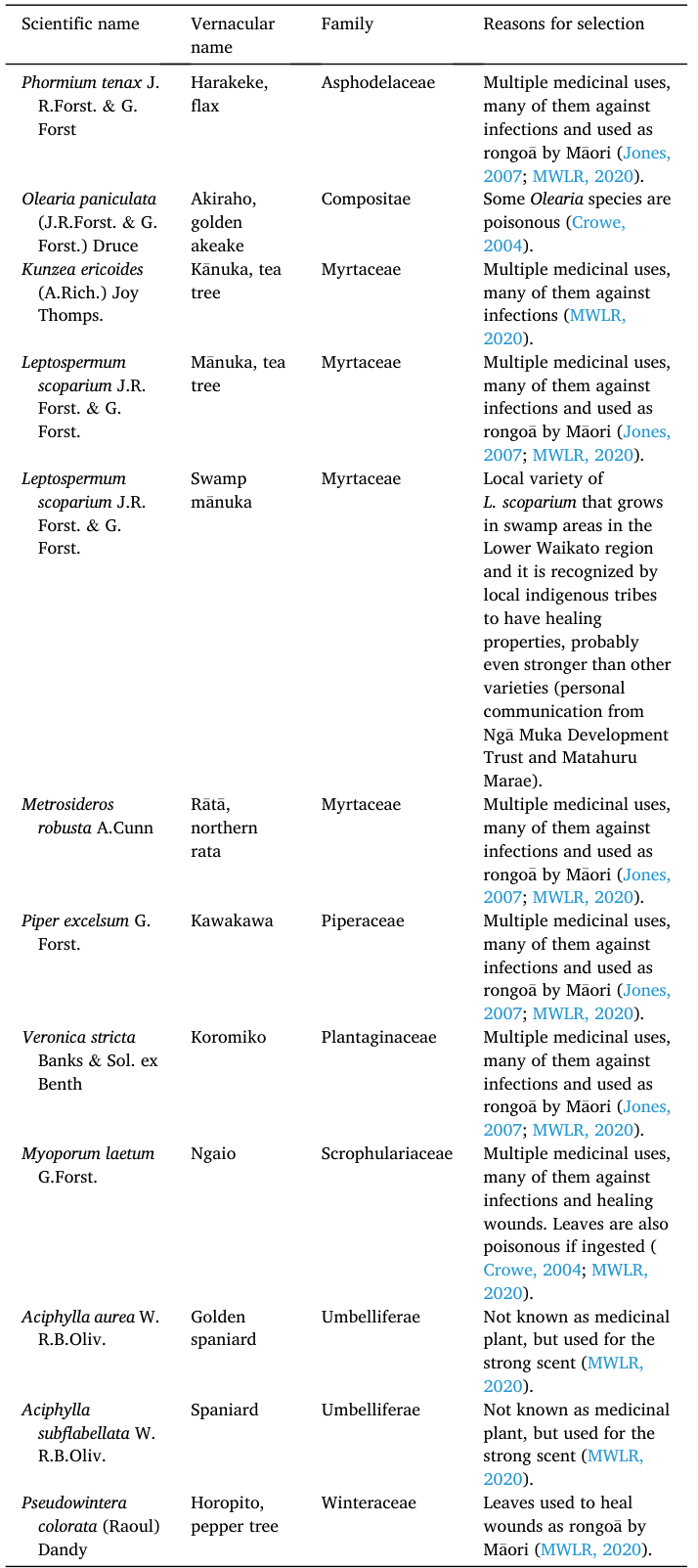
were: a) readily available commercially, so they can easily be planted in microbial phytoremediation plots, and b) known or suspected to possess antimicrobial properties according to existence of a scientific evidence, or Rongoa M¯¯aori (traditional Maori healing), having strong scent, and/ ¯ or being poisonous. Lolium perenne L. was chosen as a negative control plant, since it has negligible antimicrobial properties (Prosser et al., 2014).
为:a)市场上易于获得,便于种植于微生物植物修复样地;b)根据现有科学证据或Rongoā Māori(毛利传统疗法),已知或疑似具有抗菌特性,气味浓烈,和/或有毒。选择Lolium perenne L.作为阴性对照植物,因其抗菌特性可忽略不计(Prosser et al., 2014)。
Seedlings (approximately 20 cm high) of each species were purchased from commercial nurseries. When possible, plants of the same species were purchased from the North and South Island to compare results based on location, since there could be strong differences in the chemical composition of plants in between locations, as shown for L. scoparium (Douglas et al., 2004). As explained by these authors, the different L. scoparium chemotypes may be the evolutionary result of the local populations adaptation to their environment. Lolium perenne leaves were cut from the Lincoln University research field area. Given that previous research showed higher antimicrobial activity in leaves compared to roots (Prosser et al., 2014), and creating root extracts is very labour intensive, requiring thorough washing of considerable amounts of plant material, only the leaves of all species were used for the first screening. Root extracts were only tested for those species selected for the pot experiment. Leaf and root samples were ground using a mortar and pestle after flash-freezing in liquid nitrogen, and the extracts prepared in water at a ratio of 1:3 to 1:4 depending on the texture of the mixture. The mixture was shaken at 320 rpm for an hour, and then centrifuged at 6000 rpm for 10 min before they were filtered through 0.22 μm syringe filters. Extracts were kept at − 20 ◦C until required.
各物种的幼苗(高约20 cm)购自商业苗圃。在可能的情况下,同一物种的植株分别购自北岛和南岛,以比较不同产地的结果,因为不同产地植物的化学组成可能存在显著差异,正如L. scoparium所表现的那样(Douglas et al., 2004)。据这些作者解释,L. scoparium的不同化学型可能是当地种群适应其环境的进化结果。Lolium perenne叶片采自林肯大学研究试验田。鉴于既往研究表明叶片的抗菌活性高于根系(Prosser et al., 2014),且制备根系提取物非常耗费人力,需要彻底清洗大量植物材料,因此首次筛选仅使用所有物种的叶片。仅对入选盆栽试验的物种测试根系提取物。叶片和根系样品经液氮速冻后用研钵和研杵研磨,并根据混合物质地以1:3至1:4的比例用水制备提取物。混合物以320 rpm振荡1小时,然后以6000 rpm离心10 min,再经0.22 μm针式滤器过滤。提取物保存于− 20 ◦C直至使用。
2.1.2. Acute toxicity lux bioassay2.1.2. 急性毒性lux生物测定
A rapid first screen for antimicrobial activity of all leaf extracts was undertaken using the E. coli lux biosensor (Horswell and Dickson, 2003). This bacterial bioluminescence-based bioassay is an acute toxicity test (results are checked after 30 min) adapted from Horswell et al. (2006), and was performed as described by Prosser et al. (2014). The biosensor (supplied by the University of Aberdeen, UK) produces luminescence when exposed to favourable conditions, and exhibits reduced luminescence in less favourable conditions, such as presence of toxic compounds or changes in pH. This test was carried out with 10% diluted leaf extracts.
采用E. coli lux生物传感器(Horswell and Dickson, 2003)对所有叶片提取物的抗菌活性进行快速初筛。该基于细菌生物发光的生物测定为急性毒性试验(30 min后检查结果),改编自Horswell et al. (2006),并按Prosser et al. (2014) 所述方法进行。该生物传感器(由英国阿伯丁大学提供)在适宜条件下产生发光,而在不利条件下(如存在有毒化合物或pH变化)发光减弱。该试验使用稀释至10%的叶片提取物进行。
The results of Lux bioassay were expressed as percentage of the luminescence of the extract when compared to water. For quality control, the Lux - E. coli were exposed to test solutions containing serial dilutions of TCPTMantiseptic liquid (Pfizer Ltd., UK) as described in Redshaw et al. (2007).
Lux生物测定结果以提取物发光量相对于水的百分比表示。为进行质量控制,按Redshaw et al. (2007) 所述,将Lux - E. coli暴露于含TCPTM抗菌液(Pfizer Ltd., UK)系列稀释液的测试溶液中。
at 37 ◦C, at 180 rpm. The bacterial suspension was then diluted 1/100 in TSB, and this final suspension was immediately used in the experiments. This dilution factor was optimized previously to create a full growth curve visible over a 24 h incubation period.
于37 ◦C、180 rpm条件下培养。随后将菌悬液用TSB稀释100倍,所得最终菌悬液立即用于试验。该稀释倍数已预先优化,以便在24 h培养期内获得完整的生长曲线。
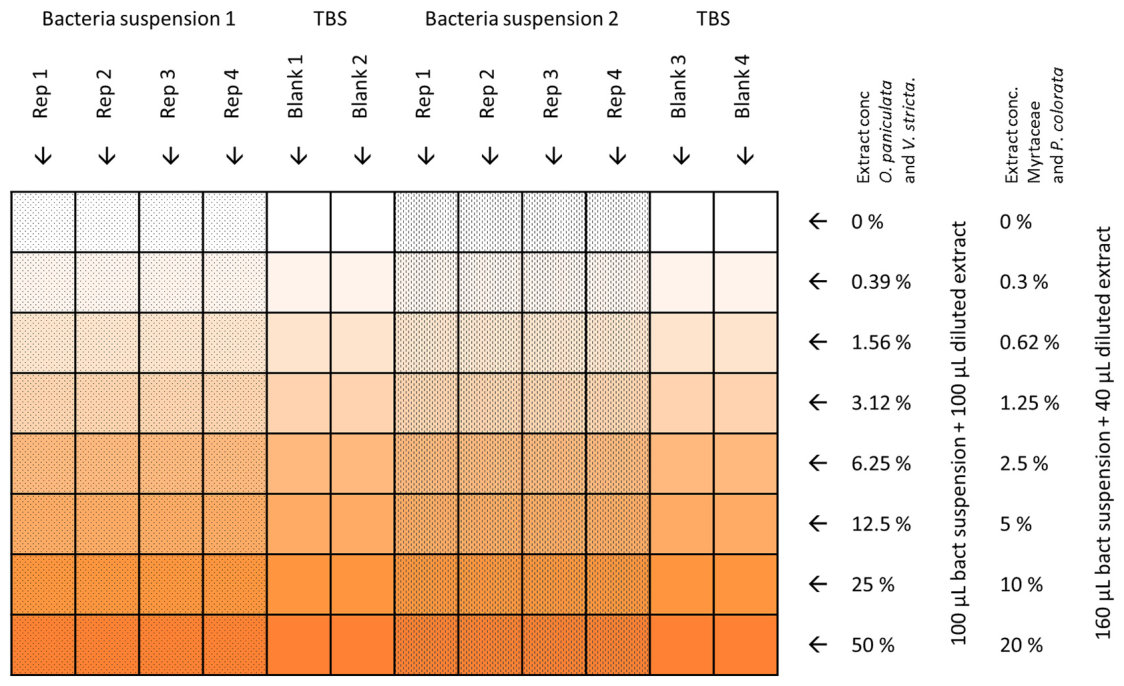
The plant extracts were tested against the four bacterial strains using a spectrophotometric bioassay described by Prosser et al. (2014), which has been previously used to determine microbial sensitivity to L. scoparium leaf extracts. Tests were performed in 96 well plates laid out as shown in Fig. 1, with individual total volume of 200 μL, which consisted of 100 μL bacterial suspension, and 100 μL of plant extract. Maximum extract concentration tested for O. paniculata and V. stricta was 50%. However, when plant extracts of L. scoparium, swamp L. scoparium, K. ericoides, M. robusta and P. colorata extracts were added to bacterial suspensions, the suspension was highly turbid which made it difficult to read by spectrophotometry. In these cases, the maximum concentration of extract was reduced to 20%, with the tests consisting of 160 μL bacterial suspension, and 40 μL of plant extract (Fig. 1). L. scoparium and K. ericoides extracts were not tested against E. coli because their effect against this bacterium was previously demonstrated (Prosser et al., 2014; Prosser et al., 2016).
采用Prosser et al. (2014) 所述的分光光度生物测定法测试植物提取物对四种菌株的作用,该方法此前已用于测定微生物对L. scoparium叶片提取物的敏感性。试验在96孔板中进行,布局如图1所示,每孔总体积200 μL,由100 μL菌悬液和100 μL植物提取物组成。O. paniculata和V. stricta的最大提取物测试浓度为50%。然而,将L. scoparium、沼泽型L. scoparium、K. ericoides、M. robusta和P. colorata的提取物加入菌悬液后,悬液高度浑浊,难以用分光光度法读数。在这些情况下,最大提取物浓度降至20%,试验由160 μL菌悬液和40 μL植物提取物组成(图1)。由于L. scoparium和K. ericoides提取物对E. coli的作用此前已得到证明(Prosser et al., 2014; Prosser et al., 2016),故未对其进行针对该菌的测试。
Additionally, leaf and root extracts of the species selected for the glasshouse experiment were tested for their activity against an environmental strain of E. coli that was previously isolated from dairy shed effluent (DSE E. coli).
此外,还测试了入选温室试验物种的叶片和根系提取物对一株此前从奶牛棚废水中分离的环境E. coli菌株(DSE E. coli)的活性。
The 96-well plates were incubated in a UV–Vis Spectrophotometer (FLUOstar Optima, BMG Labtech) at 37 ◦C overnight. Optical density (OD) was measured (595 nm), after shaking the plate for 15 s, every 30 min for 12 to 20 h, depending on the growth rate of each bacterium, which had been determined prior to the experiments.
将96孔板置于紫外-可见分光光度计(FLUOstar Optima, BMG Labtech)中于37 ◦C培养过夜。根据试验前测定的各细菌生长速率,在12至20 h内每30 min于振板15 s后测定光密度(OD)(595 nm)。
Blank ODs were subtracted from each extract dilution OD at each measuring time to obtain the final OD result.
在每个测定时间点,从各提取物稀释液的OD中扣除空白OD,得到最终OD结果。
When OD results were not conclusive, mainly due to strong colour development with some extracts, the final culture of the test was plated to determine colony forming units (CFU), 200 μL of bacterial and extract suspension were transferred from the 96-well plate to a 2 mL Eppendorf tube and centrifuged at 3000 rpm for 20 min. The supernatant was discarded, and the pellet was re-suspended in 1 mL of Ringer’s solution. A 10-fold serial dilution was carried out in Ringer’s solution, and 10 μL of those dilutions were plated in triplicate on Tryptic Soy Agar plates, and incubated for 24 h at 37 ◦C. CFU were counted in the dilutions where CFU were >3 and <30 across the three replicates. If no growth was observed in these plates, it would indicate a bacteriostatic effect of the plant extract.
当OD结果不明确时(主要由于部分提取物显色强烈),将试验最终培养物进行平板涂布以测定菌落形成单位(CFU):将200 μL细菌与提取物悬液从96孔板转移至2 mL Eppendorf管中,以3000 rpm离心20 min。弃去上清液,沉淀用1 mL Ringer’s溶液重悬。以Ringer’s溶液进行10倍系列稀释,取10 μL稀释液在胰蛋白胨大豆琼脂平板上一式三份涂布,于37 ◦C培养24 h。在三个重复中CFU均>3且<30的稀释度下计数CFU。若这些平板中未见生长,则表明植物提取物具有抑菌作用。
2.2. Investigating the antimicrobial properties of plants in the soil2.2. 植物在土壤中的抗菌特性研究
2.1.3. Microplate sensitivity assay2.1.3. 微孔板敏感性测定
Leaf extracts that showed toxicity in the acute toxicity Lux bioassay were chosen for further investigation to determine their antimicrobial potential against four microorganisms: E. coli, Staphylococcus aureus (S. aureus), Pseudomonas aeruginosa (P. aeruginosa) and Burkholderia cepacia (B. cepacia). E. coli was selected because it is the most common bacterial indicator for faecal contamination in water and soil. S. aureus, P. aeruginosa and B. cepacia were selected to represent both grampositive and gram-negative pathogenic organisms in which antibiotic resistance is common (Pray, 2008; Rhodes and Schweizer, 2016). This would represent a worst-case scenario of higher risk bacterial contamination. Bacterial strains were sourced from the New Zealand Reference Culture Collection (ESR, Porirua, New Zealand): E. coli 2718, S. aureus 87, P. aeruginosa 3007, B. cepacia 2768 as freeze-dried cultures. The freeze-dried bacterial strains were resuscitated in Tryptic Soy Broth (TSB) at 37 ◦C, and 180 rpm for 24 h. Cultures were then centrifuged at 2000 rpm for 1 h. The pellet was then washed twice with Ringer’s solution (Oxoid TM), re-suspended in 5 mL of Ringer’s solution to form a seed stock, and stored at 4 ◦C until required. The seed stock was refreshed every three weeks. The day before an experiment, 100 μL of the seed stock was transferred to 20 mL of TSB and incubated overnight
选择在急性毒性Lux生物测定中表现出毒性的叶片提取物,进一步研究其对四种微生物的抗菌潜力:E. coli、Staphylococcus aureus (S. aureus)、Pseudomonas aeruginosa(P. aeruginosa)和Burkholderia cepacia (B. cepacia)。选择E. coli是因为它是水和土壤中粪便污染最常用的细菌指示菌。选择S. aureus、P. aeruginosa和B. cepacia以代表抗生素耐药性常见的革兰氏阳性和革兰氏阴性病原生物(Pray, 2008; Rhodes and Schweizer, 2016)。这代表了较高风险细菌污染的最不利情形。菌株以冻干培养物形式获自新西兰参考菌种保藏中心(ESR, Porirua, 新西兰):E. coli 2718、S. aureus 87、P. aeruginosa 3007、B. cepacia 2768。冻干菌株在胰蛋白胨大豆肉汤(TSB)中于37 ◦C、180 rpm复苏24 h。随后将培养物以2000 rpm离心1 h。沉淀用Ringer’s溶液(Oxoid TM)洗涤两次,重悬于5 mL Ringer’s溶液中制成种子液,于4 ◦C保存直至使用。种子液每三周更新一次。试验前一天,将100 μL种子液转移至20 mL TSB中过夜培养
2.2.1. Experimental design and setup2.2.1. 试验设计与布置
From all the plants tested, swamp L. scoparium, P. colorata, and M. robusta showed antimicrobial properties, and were therefore selected for the glasshouse experiment to test the antimicrobial properties in soil. L. perenne was included as control. The topsoil (0–20 cm) of a Perch-Gley Pallic soil (LandcareResearch, 2018) was collected from an experimental sheep farm in Massey University, Palmerston North (40◦ 23′ 30′′ S, 175◦ 36′ 22′′ E). This soil had a pH of 5.75, total C of 4.32% and total N of 0.45% (Prosser, 2011). Pots were layered with 2 cm of gravel at the bottom for drainage and filled with 1.3 kg (dry weight equivalent) of fresh sieved soil (5 mm). 24 seedlings per species (total 96 pots) were planted after removal of potting mix from the roots by gently washing with tap water. Seedlings were grown in a glasshouse for one year until the roots had visibly colonised the whole pot. During that time, pots were set up randomly in the glasshouse, and their positions were exchanged every week to avoid location biases. The pots were irrigated to field capacity with tap water every two-three days in winter and twice per day in summer.
在所测试的全部植物中,沼泽型L. scoparium、P. colorata和M. robusta表现出抗菌特性,因此被选入温室试验以测试其在土壤中的抗菌特性。L. perenne作为对照。Perch-Gley Pallic土壤(LandcareResearch, 2018)的表土(0–20 cm)采自Palmerston North梅西大学的一个试验牧羊场(40◦ 23′ 30′′ S, 175◦ 36′ 22′′ E)。该土壤pH为5.75,全碳4.32%,全氮0.45%(Prosser, 2011)。盆底铺2 cm砾石以利排水,并装入1.3 kg(干重当量)过筛(5 mm)的新鲜土壤。用自来水轻轻冲洗除去根部的育苗基质后,每个物种种植24株幼苗(共96盆)。幼苗在温室中生长一年,直至根系明显布满整个花盆。在此期间,花盆在温室中随机摆放,并每周交换位置以避免位置偏差。冬季每两三天、夏季每天两次用自来水将花盆灌溉至田间持水量。
Before E. coli application, two pots of every plant species were destructively harvested to demonstrate no presence of background
在施用E. coli之前,对每种植物的两个盆进行破坏性收获,以证明不存在本底
E. coli. Due to the death of some P. colorata plants, only one pot was harvested for this plant species for the background sampling.
E. coli。由于部分P. colorata植株死亡,该物种仅收获一盆用于本底采样。
2.2.2. E. coli application2.2.2. E. coli的施用
The bacterium E. coli was used as an indicator organism. Once the roots had colonised the whole pot, the pots were returned to the laboratory and placed over ethanol sterilized containers to collect leachates. To avoid edge flow in the pots, space between the soil and the pot was filled with petroleum jelly (Cameron et al., 1992). E. coli application was similar to Prosser et al. (2016), but with spiking of the DSE with additional E. coli to represent the practice of irrigation with high nutrient content organic waste, as worst-case scenario of long survival of bacteria in the soil (Horswell et al., 2010). DSE was collected fresh from a dairy farm milking shed the day before the experiment, E. coli was enumerated, and the DSE was stored at 4 ◦C overnight. The following day, it was spiked with the DSE E. coli strain (as used in the Microplate Assays) to ensure the presence of E. coli at an approximate concentration of 106 cfu/mL, which is consistent with the average values found in DSE (Donnison et al., 2011).
以E. coli作为指示生物。待根系布满整个花盆后,将花盆移回实验室,置于经乙醇灭菌的容器上以收集渗滤液。为避免盆壁边缘流,土壤与花盆间的空隙用凡士林填充(Cameron et al., 1992)。E. coli的施用方式与Prosser et al. (2016) 相似,但在DSE中额外加入E. coli,以模拟用高养分含量有机废物灌溉的做法,作为细菌在土壤中长期存活的最不利情形(Horswell et al., 2010)。试验前一天从一个奶牛场挤奶棚采集新鲜DSE,计数E. coli,并将DSE于4 ◦C保存过夜。次日,向其中加入DSE E. coli菌株(与微孔板测定中所用相同),以确保E. coli浓度约为106 cfu/mL,与DSE中的平均值相符(Donnison et al., 2011)。
The E. coli spiked DSE was added with a pipette to each pot at a rate of 100 mL of DSE over 2.5-h period. This was equivalent to a 7 mm irrigation, or a one-month irrigation of an annual 200 kg N/ha, standard practice in New Zealand (Houlbrooke et al., 2004; Wallace and Johnstone, 2010). Shortly after, a rain fall event was simulated by addition of 50 mL of water to the surface of each pot (equivalent 3.5 mm) via spray bottles over a 1.5-h period. The pots were weighed and kept at the same moisture level throughout the experiment by daily watering with a spray bottle. When present, leachates were collected daily with volume recorded and E. coli enumerated as mentioned in follows.
用移液管将加标E. coli的DSE以2.5 h内100 mL的速率加入各盆。这相当于7 mm的灌溉量,或相当于年施氮量200 kg N/ha条件下一个月的灌溉量,这是新西兰的标准做法(Houlbrooke et al., 2004; Wallace and Johnstone, 2010)。随后不久,通过喷壶在1.5 h内向每盆表面加入50 mL水(相当于3.5 mm)以模拟一次降雨事件。对花盆称重,并在整个试验期间每日用喷壶浇水以保持相同的含水量。如有渗滤液产生,则每日收集,记录体积,并按下文所述计数E. coli。
2.2.3. Harvest and E. coli enumeration in leachates and soil2.2.3. 收获及渗滤液和土壤中E. coli的计数
Bacteria enumeration in soil occurred on days 1, 3, 7, 14, and 21 after the DSE application and the rainfall simulation event. The soil was separated from the roots, sieved (4 mm), homogenized, and a 20 g subsample was collected for E. coli enumeration and soil moisture determination. Four pots per plant species were harvested per day. P. colorata pots were only sampled until day 7 due to plant death. For the same reason, only three L. scoparium pots could be harvested on day 21. E. coli was enumerated in the soil by the five-tube Most Probable
在施用DSE和模拟降雨事件后第1、3、7、14和21天对土壤中细菌进行计数。将土壤与根系分离,过筛(4 mm),混匀,取20 g子样用于E. coli计数和土壤含水量测定。每个采样日每种植物收获四盆。由于植株死亡,P. colorata盆仅采样至第7天。出于同样原因,第21天仅能收获三盆L. scoparium。土壤中E. coli采用五管最大可能
Number (MPN) method described by Horswell et al. (2007). Enumeration was completed by comparing the results with a MPN table and calculated per gram of dry soil. E. coli was enumerated in the leachates using the Colilert method (IDEXX Laboratories, Inc.).
数(MPN)法进行计数,方法见Horswell et al. (2007)。计数结果通过与MPN表比对得出,并按每克干土计算。渗滤液中E. coli采用Colilert法(IDEXX Laboratories, Inc.)计数。
2.2.4. Soil pH and moisture content determination2.2.4. 土壤pH与含水量测定
Sieved fresh soil was oven-dried at 104 ◦C for 24 h to determine soil moisture. Another subsample was dried at 40 ◦C for four days, sieved through a 2 mm sieve, and pH was analysed in a 1:2.5 water extract with a HACH Multi-Parameter Meter HQ440d with pH probe PHC735.
将过筛的新鲜土壤在104 ◦C下烘干24 h以测定土壤含水量。另一子样于40 ◦C下干燥四天,过2 mm筛,使用配备PHC735 pH电极的HACH Multi-Parameter Meter HQ440d在1:2.5水浸提液中测定pH。
2.3. Data analysis2.3. 数据分析
The results of luminescence from the Lux-bioassay for each plant extract were calculated as percentage of the luminescence produced by control tests with just water. The results were analysed with an analysis of variance (ANOVA) analysis, and differences between plant extracts were analysed using Tukey’s test.
各植物提取物Lux生物测定的发光结果以相对于仅加水对照试验发光量的百分比计算。结果采用方差分析(ANOVA),植物提取物间差异采用Tukey检验分析。
Data from the Microplate Sensitivity Assay was used to obtain extinction curves by plotting the percentage of OD of each treatment compared to the Control (0% extract) at the stationary phase of the growth curve, against the concentration of extract in the treatment, as described by Prosser et al. (2014). These graphs were used to calculate the effective plant extract concentration that produced a 50% reduction in OD (EC50) by interpolating the results with the best fitted model.
按照Prosser et al. (2014) 所述方法,利用微孔板敏感性测定数据绘制消光曲线:以生长曲线稳定期各处理OD相对于对照(0%提取物)的百分比对处理中提取物浓度作图。通过以最佳拟合模型内插结果,利用这些图计算使OD降低50%的植物提取物有效浓度(EC50)。
Differences in soil moisture and soil pH between plant species were analysed with an ANOVA and differences between treatments were analysed using Tukey’s test, after homoscedasticity and normality of the data were confirmed. E. coli numbers in the soil and leachates were compared between plant species for each sampling day, using a nonparametric Kruskall-Wallis. Calculations were performed with Statgraphics Centurion.
在确认数据满足方差齐性和正态性后,采用ANOVA分析不同植物种类间土壤含水量和土壤pH的差异,处理间差异采用Tukey检验分析。对每个采样日,采用非参数Kruskall-Wallis检验比较不同植物种类间土壤和渗滤液中的E. coli数量。计算使用Statgraphics Centurion完成。
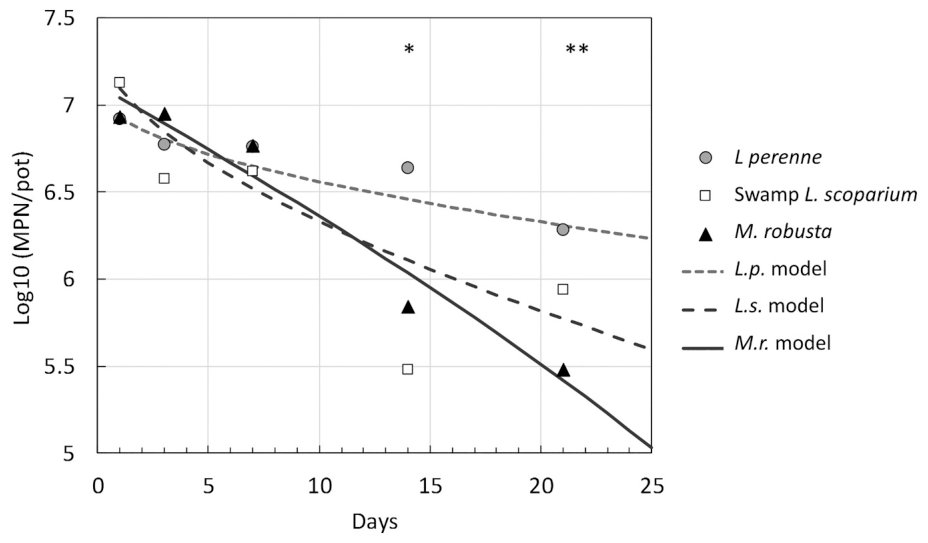
Decimal reduction time (DRT) indicates the days required to reduce E. coli numbers in the soil 90% or one Log10 from initial numbers (Horswell et al., 2010). Horswell et al. (2010) calculated DRT based on an exponential decay curve. However, the best fit model was used for these results to best explain the variance of our data. For this, Log10(MPN) results for each plant species were plotted against time, and models were fitted with Statgraphics Centurion. Only medians are represented in Fig. 4, although the tests and models were performed with all the replicates (as shown in Supplementary materials).
十倍减少时间(DRT)表示土壤中E. coli数量从初始值降低90%(即一个Log10)所需的天数(Horswell et al., 2010)。Horswell et al. (2010) 基于指数衰减曲线计算DRT。然而,本研究采用最佳拟合模型,以最好地解释数据的方差。为此,将各植物种类的Log10(MPN)结果对时间作图,并用Statgraphics Centurion拟合模型。图4中仅显示中位数,但检验和模型均使用全部重复进行(见补充材料)。
3Results结果
3.1. Screening plants for antimicrobial potential3.1. 植物抗菌潜力筛选
cases, no CFU were recovered after exposure to the highest extract concentrations (Table 3). Root extracts of swamp L. scoparium M. robusta and P. colorata showed less antimicrobial effect against all five strains when compared to leaf extracts. Only M. robusta and swamp L. scoparium root extracts showed some inhibitory effect against P. aeruginosa and B. cepacia.
情况下,暴露于最高提取物浓度后未回收到CFU(表3)。与叶片提取物相比,沼泽型L. scoparium M. robusta和P. colorata的根系提取物对全部五种菌株的抗菌作用均较弱。仅M. robusta和沼泽型L. scoparium的根系提取物对P. aeruginosa和B. cepacia表现出一定的抑制作用。
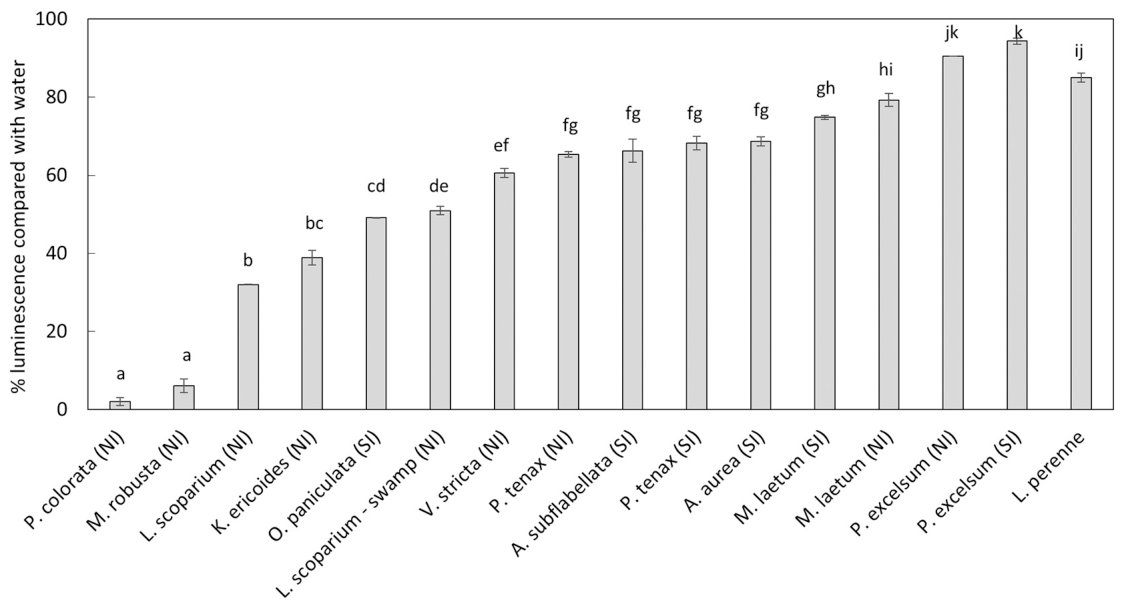
In the Lux Bioassay, all plant extracts - except M. laetum from North Island, and P. excelsum from both North and South Island - presented significant differences in the bioluminescence reduction compared with L. perenne. The greatest reduction in luminescence was observed in P. colorata and M. robusta extracts, followed by L. scoparium, K. ericoides, O. paniculata, and swamp L. scoparium (Fig. 2). No other species produced a reduction in luminescence of >50% when compared with water (EC50).
在Lux生物测定中,除北岛的M. laetum以及北岛和南岛的P. excelsum外,所有植物提取物引起的生物发光降低与L. perenne相比均存在显著差异。发光降低最大的是P. colorata和M. robusta提取物,其次为L. scoparium、K. ericoides、O. paniculata和沼泽型L. scoparium(图2)。与水相比,其他物种均未使发光降低>50%(EC50)。
A summary of the results (EC50) of the Microplate sensitivity assays is shown in Table 2. Graphs of the growth curves for each test are presented in Supplementary Material. O. paniculata and V. stricta leaf extracts slowed down the growth of P. aeruginosa, B. cepacia and S. aureus. However, in the stationary phase the optical density (OD) was similar, or not lower than 50% compared to the control, even if the maximum extract concentration tested for these plant species was 50% (=125 mg/ mL fresh weight).
微孔板敏感性测定结果(EC50)汇总见表2。各试验的生长曲线图见补充材料。O. paniculata和V. stricta叶片提取物减缓了P. aeruginosa、B. cepacia和S. aureus的生长。然而,即使这些植物的最大提取物测试浓度为50%(=125 mg/ mL鲜重),稳定期的光密度(OD)与对照相近,或降低未达50%。
Extracts of L. scoparium inhibited the growth of all tested bacteria, although the EC50 was relatively high compared with the effect of swamp L. scoparium on S. aureus, with an EC50 of 3.3 mg/mL. In this case the highest tested concentration of the extract (32 mg/mL) produced a four Log10 reduction of CFU compared with the control (Table 3). K. ericoides inhibited the growth of B. cepacia, S. aureus, and P. aeruginosa in that order. Extracts of both M. robusta and P. colorata showed the strongest inhibition against most of the bacteria. Leaf extracts of P. colorata were the most effective against E. coli, with an EC50 of 43.5 mg/mL fresh leaves, although the highest concentration tested (50 mg/ mL) produced less than one Log10 reduction in CFU (Table 3) compared with the control. P. colorata leaf extracts reduced the growth of S. aureus, P. aeruginosa and B. cepacia (Table 2). M. robusta and swamp L. scoparium showed the highest growth inhibition against E. coli present in DSE. However, when the bacterial cultures exposed to these plant extracts were plated, the CFU were no lower than one Log10 compared with water-control (Table 3). M. robusta leaf extracts also decreased the growth of P. aeruginosa, S. aureus and B. cepacia, and in the last two
L. scoparium提取物抑制了所有受试细菌的生长,但其EC50相对较高,而沼泽型L. scoparium对S. aureus的EC50为3.3 mg/mL。在此情况下,最高测试浓度的提取物(32 mg/mL)使CFU较对照降低了四个Log10(表3)。K. ericoides对B. cepacia、S. aureus和P. aeruginosa生长的抑制作用依次减弱。M. robusta和P. colorata的提取物对大多数细菌表现出最强的抑制作用。P. colorata叶片提取物对E. coli最为有效,EC50为43.5 mg/mL鲜叶,但最高测试浓度(50 mg/ mL)使CFU较对照降低不足一个Log10(表3)。P. colorata叶片提取物降低了S. aureus、P. aeruginosa和B. cepacia的生长(表2)。M. robusta和沼泽型L. scoparium对DSE中E. coli的生长抑制最强。然而,将暴露于这些植物提取物的细菌培养物进行平板涂布后,CFU与水对照相比降低未达一个Log10(表3)。M. robusta叶片提取物同样降低了P. aeruginosa、S. aureus和B. cepacia的生长,且在后两种
3.2. Antimicrobial properties of plants in the soil3.2. 植物在土壤中的抗菌特性
The fresh DSE contained 2.8 × 10⁵MPN E. coli/mL. Based on the cfu present in the seed stock of DSE E. coli, inoculated DSE was calculated to contain E. coli at 2.4 × 10⁶cfu/mL. Results from the Colilert® test of spiked DSE on the day of the irrigation confirmed a concentration of 2.15 × 10⁶MPN/mL, which corresponds to 2.15 × 10⁸MPN/pot.
新鲜DSE含2.8 × 10⁵MPN E. coli/mL。根据DSE E. coli种子液中的cfu计算,接种后的DSE中E. coli浓度为2.4 × 10⁶cfu/mL。灌溉当日对加标DSE进行的Colilert®检测结果证实其浓度为2.15 × 106MPN/mL,相当于2.15 × 108MPN/盆。
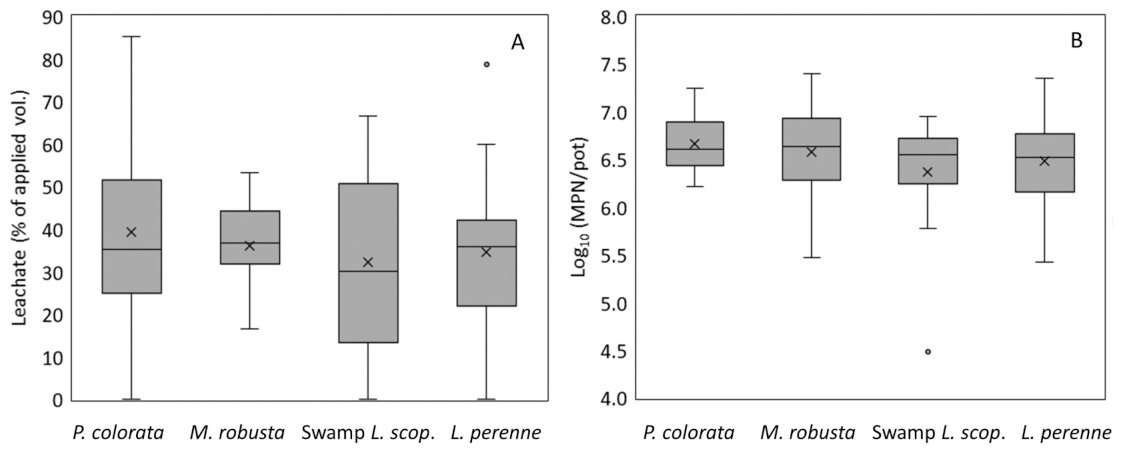
Despite each pot receiving the same amount of DSE and rainfall (100 mL of DSE (7 mm equivalent over 2.5 h); and 50 mL of irrigation (3.5 mm over 1.5 h)), there was large variability between and within species for leaching and surface ponding. Some pots started to leach immediately, and some pots presented surface ponding after application of DSE and rainfall water. Leachates collected the day after irrigation, as well as total E. coli leached per pot, were also highly variable and not related to the plant type (Fig. 3).
尽管每盆接受的DSE和降雨量相同(100 mL DSE(2.5 h内相当于7 mm);50 mL灌溉水(1.5 h内3.5 mm)),物种间和物种内的淋溶与地表积水情况仍存在较大差异。部分花盆立即开始渗漏,部分花盆在施用DSE和降雨水后出现地表积水。灌溉次日收集的渗滤液以及每盆淋失的E. coli总量也高度变异,且与植物类型无关(图3)。
Despite large amounts of E. coli leached from most of the pots (between 106and 107MPN/pot, Fig. 3), E. coli remaining in the soil was over 90% of the applied E. coli, as shown by the E. coli enumeration in soil in Day 1, which was similar for all treatments (Fig. 4). Adjusting the irrigation level to accommodate moisture loss, resulted in very occasional leachate production, and the total amount of E. coli leached was always lower than the levels leached on Day 1.
尽管大多数花盆淋失了大量E. coli(106至107MPN/盆之间,图3),但土壤中残留的E. coli仍超过所施用E. coli的90%,这由第1天土壤中E. coli计数结果所示,且各处理间相近(图4)。调整灌溉量以补偿水分损失后,仅偶尔产生渗滤液,且E. coli淋失总量始终低于第1天的淋失水平。
The results of E. coli numbers in the soil are represented in Fig. 4. The total numbers of E. coli in the soil on day 1, (median of 107MPN/pot) were similar across all plant types. Similarly for leachate results, E. coli numbers in the soil were highly variable (see Supplementary Material). Despite that, there were statistically significant differences in the survival of E. coli between L. perenne, swamp L. scoparium and M. robusta on day 14 (p-value = 0.06) and 21 (p-value = 0.03). P. colorata plants did not grow under the experimental conditions, and only 14 survived. E. coli could only be analysed in the soil under P. colorata on days 1, 3 and 7, and there was no evidence of a reduction in E. coli (see Supplementary Material).
土壤中E. coli数量结果见图4。第1天土壤中E. coli总数(中位数为107MPN/盆)在所有植物类型间相近。与渗滤液结果类似,土壤中E. coli数量高度变异(见补充材料)。尽管如此,在第14天(p值 = 0.06)和第21天(p值 = 0.03),L. perenne、沼泽型L. scoparium和M. robusta之间E. coli的存活存在统计学显著差异。P. colorata植株在试验条件下未能生长,仅14株存活。仅能在第1、3和7天分析P. colorata下土壤中的E. coli,且无证据表明E. coli有所减少(见补充材料)。
There was a significant negative correlation between E. coli numbers in soil over time (after DSE application) for the three types of plant species tested (Table 4). Results showed that M. robusta had the strongest negative correlation, and the fitted model explained over 80% of the variance. Interpolation with the models for M. robusta and swamp L. scoparium indicated that a reduction of 90% E. coli in the soil is likely to be reached by day 14. Extrapolation from L. perenne data indicated that this reduction would happen by day 45.
对于所测试的三类植物,土壤中E. coli数量随时间(施用DSE后)均呈显著负相关(表4)。结果表明,M. robusta的负相关最强,拟合模型解释了80%以上的方差。根据M. robusta和沼泽型L. scoparium模型内插,土壤中E. coli可能在第14天降低90%。根据L. perenne数据外推,这一降低将在第45天出现。
Concentration of plant extract (mg/mL fresh weight) that reduced OD by 50% (EC50).
使OD降低50%的植物提取物浓度(mg/mL鲜重)(EC50)。
| Species物种 | Plant part植物部位 | E. coliE. coli | S. aureusS. aureus | P. aeruginosaP. aeruginosa | B. cepaciaB. cepacia | DSE E. coliDSE E. coli |
|---|---|---|---|---|---|---|
| O. paniculata | Leaf | _>_125 | _>_125 | _>_125 | _>_125 | – |
| K. ericoides | Leaf | – | 42.0 | 70.0a | 5.0 | – |
| L. scoparium | Leaf | – | 35.9 | 48.3 | 27.7 | – |
| Swamp_L. scoparium_ | Leaf | _>_50 | 3.3 | _>_50 | 32.8 | 29.7 |
| Root | _>_64.6 | _>_64.6 | 78.4a | 63.5 | _>_64.6 | |
| M. robusta | Leaf | 70.1a | 12.5 | 2.4 | 1.6 | 29.1 |
| Root | _>_63.8 | _>_63.8 | 23.4 | 30.3 | _>_63.8 | |
| V. stricta | Leaf | _>_125 | _>_125 | _>_125 | _>_125 | – |
| P. colorata | Leaf | 43.5 | 34.6 | 21.1 | 34.1 | _>_54.6 |
| Root | _>_43.8 | _>_43.8 | _>_43.8 | _>_43.8 | _>_43.8 |
– Test not performed, as explained in the methods section. a Result is an extrapolation.
– 未进行测试,原因见方法部分。a 结果为外推值。
Average Log10 reduction of CFU on the most concentrated extract test compared with the water control. NR: not recovered, there was no growth in the plate. Blank cells indicate that the test was not performed.
最高浓度提取物试验相对于水对照的CFU平均Log10降低量。NR:未回收,平板中无生长。空白单元格表示未进行该测试。
| Species物种 | Plant part植物部位 | E. coliE. coli | S. aureusS. aureus | P. aeruginosaP. aeruginosa | B. cepaciaB. cepacia | DSE E. coliDSE E. coli |
|---|---|---|---|---|---|---|
| Swamp_L. scoparium_ | Leaf | 4.2 | 0.85 | _<_0.5 | ||
| M. robusta | Leaf | _<_0.5 | NR | 1.5 | NR | 0.72 |
| P. colorata | Leaf | 0.7 | 5.1 | _<_0.5 |
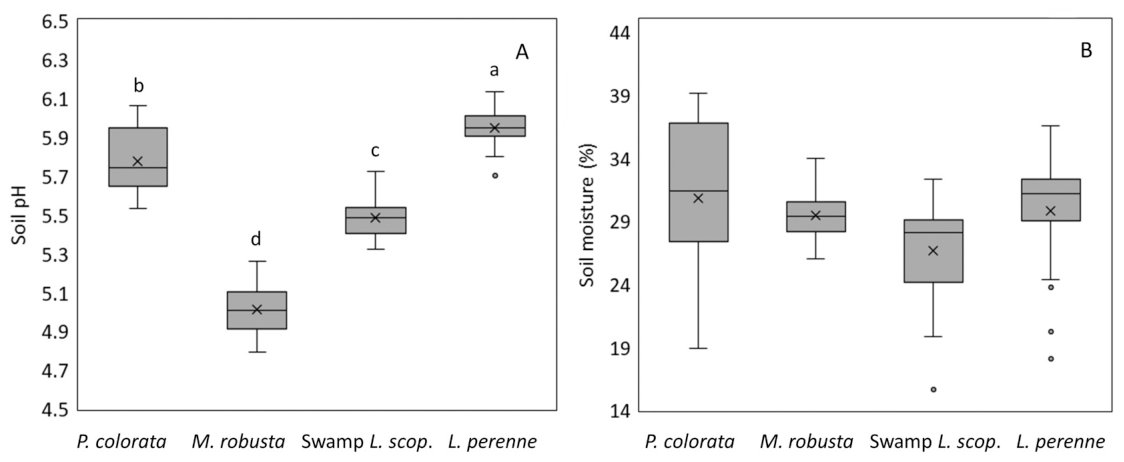
Soil pH was significantly different depending on the plant that was growing on it, and decreased in the order L. perenne > P. colorata > swamp L. scoparium > M. robusta (Fig. 5A). Soil moisture, on the other hand, was similar in the soil under all plant species (Fig. 5B).
土壤pH因所生长植物的不同而存在显著差异,其大小顺序为L. perenne > P. colorata > 沼泽型L. scoparium > M. robusta(图5A)。而各植物下土壤的含水量相近(图5B)。
4Discussion讨论
The results of plant screening for antimicrobial potential partially support previous research that reported the antimicrobial capacity of L. scoparium, Kunzea sp., P. colorata and M. robusta. The work by Calder et al. (1986) is the largest screening of NZ vegetation with antimicrobial activity currently published. However, Calder et al. (1986) used methanol to prepare leaf extracts, and inhibition tests were based on the diameter of the inhibition zone. High activity of P. colorata, L. scoparium, Kunzea sp. (called Leptospermum ericoides at the time of that publication), and M. robusta against S. aureus growth was reported. However, in that work, only P. colorata presented growth inhibitory activity against E. coli and P. aeruginosa, which was not detected in other Myrtaceae species (Calder et al., 1986). Interestingly, our work did show a strong activity of the extracts of Myrtaceae species tested against gram-negative bacteria, which is not commonly reported in the literature, as it was also highlighted by Prosser et al. (2014).
植物抗菌潜力筛选结果部分支持了既往关于L. scoparium、Kunzea sp.、P. colorata和M. robusta抗菌能力的研究报道。Calder et al. (1986) 的工作是目前已发表的针对新西兰植被抗菌活性的最大规模筛选。然而,Calder et al. (1986) 使用甲醇制备叶片提取物,抑菌试验基于抑菌圈直径。该研究报道了P. colorata、L. scoparium、Kunzea sp.(该文发表时称为Leptospermum ericoides)和M. robusta对S. aureus生长具有较高活性。然而,在该研究中,仅P. colorata对E. coli和P. aeruginosa表现出生长抑制活性,而其他桃金娘科物种中未检测到该活性(Calder et al., 1986)。有趣的是,本研究确实显示所测试桃金娘科物种的提取物对革兰氏阴性菌具有较强活性,这在文献中并不常见,Prosser et al. (2014) 也曾强调这一点。
The strong inhibition of luminescence by P. colorata and M. robusta leaf extracts could be explained in part by the low pH of those extracts, pH 4.15 and 3.93 respectively, as the optimal pH range for this toxicity test is approx. 5.5–7 (Horswell and Dickson, 2003). However, when those extracts were mixed with TSB, it resulted in optimal pH conditions for bacterial growth even in the highest concentration of the leaf extracts (pH 6.9–7.1). For this reason, we suggest the compounds within the extract, likely with an acidic nature, might be the main reason for the antimicrobial activity of these extracts; rather than free H+ that would be buffered by TSB.
P. colorata和M. robusta叶片提取物对发光的强烈抑制,部分可由这些提取物的低pH(分别为pH 4.15和3.93)解释,因为该毒性试验的最适pH范围约为5.5–7(Horswell and Dickson, 2003)。然而,这些提取物与TSB混合后,即使在叶片提取物最高浓度下也形成了细菌生长的最适pH条件(pH 6.9–7.1)。因此,我们认为提取物中可能呈酸性的化合物是这些提取物具有抗菌活性的主要原因,而非会被TSB缓冲的游离H+。
The chemistry of essential oils, and secondary metabolites with antimicrobial activity from P. colorata, K. ericoides and L. scoparium have been extensively described (Perry et al., 1997; Christoph et al., 2000; Wyatt et al., 2005; Perry and Gould, 2010; Van Vuuren et al., 2014; Killeen et al., 2015; Killeen et al., 2016). The main compounds described with antimicrobial activity are β-triketones such as leptosperomone, isoleptosperomone, and grandiflorone, in L. scoparium (Douglas et al., 2004; Killeen et al., 2015; Killeen et al., 2016), a high variety of monoand sesquiterpenes in Kunzea spp. (Wyatt et al., 2005; Van Vuuren et al., 2014), and P. colorata, in this case specially polygodial, (Perry and Gould, 2010; Wayman et al., 2010). Phytochemical composition of M. robusta is largely unknown (Wollenweber et al., 2000), and the compounds responsible for its antimicrobial activity have not yet been described. For P. colorata, K. robusta and L. scoparium, all described compounds with antimicrobial activity are lipophilic. It is highly unlikely that any of those compounds were present in the water extracts in enough concentration to produce the inhibition shown in Tables 2 and 3. Our research, as well as previous work by Prosser et al. (2014), suggests that compounds in the water extracts are hydrophilic, and probably of acidic nature. Future research should determine whether any other compounds, apart from the ones already described, are responsible for the antimicrobial activity of these plants.
P. colorata、K. ericoides和L. scoparium的精油以及具有抗菌活性的次生代谢产物的化学组成已有大量描述(Perry et al., 1997; Christoph et al., 2000; Wyatt et al., 2005; Perry and Gould, 2010; Van Vuuren et al., 2014; Killeen et al., 2015; Killeen et al., 2016)。已描述的主要抗菌化合物包括:L. scoparium中的β-三酮类,如细子木酮(leptosperomone)、异细子木酮(isoleptosperomone)和grandiflorone(Douglas et al., 2004; Killeen et al., 2015; Killeen et al., 2016);Kunzea spp.中种类繁多的单萜和倍半萜(Wyatt et al., 2005; Van Vuuren et al., 2014);以及P. colorata中的化合物,此处尤指水蓼二醛(polygodial)(Perry and Gould, 2010; Wayman et al., 2010)。M. robusta的植物化学组成在很大程度上尚不清楚(Wollenweber et al., 2000),其抗菌活性的相关化合物尚未见报道。对于P. colorata、K. robusta和L. scoparium,所有已描述的抗菌化合物均为亲脂性。这些化合物极不可能以足够浓度存在于水提取物中,从而产生表2和表3所示的抑制作用。本研究以及Prosser et al. (2014) 的前期工作表明,水提取物中的化合物为亲水性,且可能呈酸性。未来研究应确定除已描述的化合物外,是否还有其他化合物对这些植物的抗菌活性起作用。
The results of the greenhouse experiment (Fig. 4) were similar to those of Prosser et al. (2016), who found a faster E. coli reduction with Kunzea robusta and L. scoparium than L. perenne. However, the calculated period for reaching 90% reduction of E. coli in soil was much faster in Prosser’s experiment (5 and 8 days respectively) than in this experiment. The soil C and N content of this experiment were higher than those of Prosser et al. (2016) and might explain the difference. In addition to that, application of DSE further increased the presence of organic matter and nutrients. Both factors (organic matter and nutrients) have shown to promote the survival, or even favour the regrowth of some enteric bacteria in the soil (Jamieson et al., 2002; Horswell et al., 2010).
温室试验结果(图4)与Prosser et al. (2016) 的结果相似,该研究发现Kunzea robusta和L. scoparium下E. coli的减少快于L. perenne。然而,Prosser试验中土壤E. coli降低90%的计算时间(分别为5天和8天)远短于本试验。本试验土壤的C、N含量高于Prosser et al. (2016),这可能解释了该差异。此外,DSE的施用进一步增加了有机质和养分的含量。这两个因素(有机质和养分)已被证明可促进某些肠道细菌在土壤中的存活,甚至有利于其再生长(Jamieson et al., 2002; Horswell et al., 2010)。
Changes in soil induced by roots of M. robusta and swamp L. scoparium, are likely to explain the enhanced die-off of E. coli compared with L. perenne. These changes in the soil differ from one plant species to another due to production of root exudates (with or without antimicrobial properties), water and nutrient uptake, and/or colonisation by associate microorganisms (Philippot et al., 2013; Zhang et al., 2017). In this experiment, the significant differences found in soil pH under the different plant species (Fig. 5A) can partially explain the quicker die-off of E. coli in soil under M. robusta > swamp L. scoparium > L. perenne. E. coli survival is the highest at neutral to alkaline pH and it decreases in acidic pH in the same soil type (Jamieson et al., 2002). Apart from temperature (Underthun et al., 2017), soil moisture is usually recognized as an important factor affecting the survival of E. coli or other pathogenic organisms in the soil (Jamieson et al., 2002; Horswell et al., 2007). However, soil moisture was not significantly different irrespective of plant type (Fig. 5B), which indicates that in this case soil moisture does not contribute to the different survival rates of E. coli in the soil.
M. robusta和沼泽型L. scoparium根系引起的土壤变化,可能是其E. coli死亡较L. perenne加快的原因。由于根系分泌物(具有或不具有抗菌特性)的产生、水分和养分吸收和/或相关微生物的定殖,这些土壤变化因植物种类而异(Philippot et al., 2013; Zhang et al., 2017)。本试验中,不同植物下土壤pH的显著差异(图5A)可部分解释E. coli在土壤中死亡速度按M. robusta >沼泽型L. scoparium > L. perenne的顺序加快。在同一土壤类型中,E. coli在中性至碱性pH下存活率最高,在酸性pH下则降低(Jamieson et al., 2002)。除温度外(Underthun et al., 2017),土壤含水量通常被认为是影响E. coli或其他病原生物在土壤中存活的重要因素(Jamieson et al., 2002; Horswell et al., 2007)。然而,不同植物类型下土壤含水量无显著差异(图5B),表明本研究中土壤含水量并非造成土壤中E. coli存活率差异的原因。
Excretion of root exudates could be one of the reasons for the changes in soil pH, and for enhanced die-off of E. coli under M. robusta and swamp L. scoparium compared with L. perenne, as was also hypothesised by Prosser et al. (2016). Stress factors, such as changes in temperature, presence of plant pathogens or herbivores, nutrient, water, or light shortages can induce secondary metabolite production (Isah, 2019), many of which (i.e. terpenes, flavonoids or phenolic compounds) are described to have antimicrobial properties.
根系分泌物的排出可能是土壤pH变化的原因之一,也可能是M. robusta和沼泽型L. scoparium下E. coli死亡较L. perenne加快的原因之一,Prosser et al. (2016) 也曾提出这一假设。温度变化、植物病原体或食草动物的存在、养分、水分或光照不足等胁迫因素均可诱导次生代谢产物的产生(Isah, 2019),其中许多(如萜类、黄酮类或酚类化合物)已被报道具有抗菌特性。
Finally, although not part of this experiment, the diverse range of organisms associated with roots of L. scoparium (McKenzie et al., 2006) and probably M. robusta, could also be antagonistic to E. coli, facilitating its die-off compared with L. perenne. Jamieson et al. (2002); Jiang et al. (2002); Erickson et al. (2014) demonstrated the presence of competing organisms limits the survival of enteric bacteria, Salmonella spp., and E. coli respectively, in soil or manure. In addition, Wicaksono et al. (2017) showed that some endophytes associated with L. scoparium present antibacterial activity against plant pathogens.
最后,尽管不属于本试验内容,与L. scoparium(McKenzie et al., 2006)以及可能与M. robusta根系相关的多种生物也可能对E. coli产生拮抗作用,从而使其死亡较L. perenne下更快。Jamieson et al. (2002)、Jiang et al. (2002) 和Erickson et al. (2014) 分别证明了竞争生物的存在会限制肠道细菌、Salmonella spp.和E. coli在土壤或粪肥中的存活。此外,Wicaksono et al. (2017) 表明,一些与L. scoparium相关的内生菌对植物病原体具有抗菌活性。
Despite the potential of these Myrtaceae species to enhance the die-off of E. coli in the soil, the leaching of this bacterium on the first day after irrigation with DSE was very high and not dependent on plant type. This indicated that under high irrigation regimes, when the soil is already saturated (in this case by the application of DSE), E. coli move quickly through the soil through by-pass flow, as was also demonstrated by Mishra (2018).
尽管这些桃金娘科物种具有加速土壤中E. coli死亡的潜力,但在施用DSE灌溉后第一天该细菌的淋失量非常高,且与植物类型无关。这表明,在高灌溉强度下,当土壤已经饱和(本研究中由DSE施用所致)时,E. coli会通过优先流在土壤中快速迁移,Mishra (2018) 也证明了这一点。
The results from this work, together with the lacuna of knowledge in this area of the phytoremediation, suggest the need for future research to a) better understand the benefits and limitations of plantings with bioactive species to prevent the contamination of freshwater resources, and b) find new applications of bioactive plants in different settings, such as biofilters (Galbraith et al., 2019).
本研究结果连同该植物修复领域的知识空白表明,未来需要开展研究以:a)更好地理解种植生物活性物种以防止淡水资源污染的效益与局限;b)寻找生物活性植物在不同情景中的新应用,如生物滤池(Galbraith et al., 2019)。
Best fitted models for MPN correlation over time for each plant species, and the calculated days needed to show a reduction in E. coli by 90% from day 1 (Log red.).
各植物种类MPN随时间相关性的最佳拟合模型,以及E. coli较第1天降低90%所需的计算天数(Log red.)。
| Plant species植物种类 | Best fitted mo最佳拟合模型 | i del | Correlation coefficient相关系数 | P-valueP值 | R2 | Log red. (days)Log red.(天) |
|---|---|---|---|---|---|---|
| L. perenne | Log10(MPN) | =(50.2–2.3×day1/2)1/2 | −0.61 | 0.0000 | 36.7% | 45 |
| Swamp_L. scoparium_ | Log10(MPN) | =(55.1–4.7×day1/2)1/2 | −0.72 | 0.0005 | 51.8% | 14.5 |
| M. robusta | Log10(MPN) | =(50.5–1.0×day)1/2 | −0.90 | 0.0000 | 80.7% | 14 |
5Conclusions结论
This work demonstrated that water extracts of three species of Myrtaceae family, and one to Winteraceae family (out of 11 plant species tested from the North and South Island of New Zealand) showed antimicrobial activity against one or more of the five human pathogens or indicator organisms used in these experiments. Leaf extracts from L. scoparim, swamp L. scoparium, K. ericoides, P. colorata, and M. robusta demonstrated a bacteriostatic effect. In addition, leaf extracts of M. robusta and P. colorata showed bactericidal effect against S. aureus and B. cepacia. The acidic water soluble leaf extracts of those plants indicated that it is unlikely that the previously described lipophilic antimicrobial compounds are responsible for the antimicrobial potential demonstrated in these experiments. M. robusta and the local variety of L. scoparium, called swamp manuka, enhanced the die-off of ¯E. coli in soil compared with L. perenne after irrigation with E. coli spiked dairy shed effluent. A 90% E. coli reduction was reached on day 14 for the two Myrtaceae species compared with 45 days calculated for L. perenne. Soil pH was significantly different for those plant species, whereby order of pH decrease was matched with E. coli reduction capability (M. robusta > swamp L. scoparium > L. perenne). This is a potential explanation for the differences in E. coli survival in soil. Despite these promising results, caution is needed, since under almost saturated soil conditions, irrigation with DSE created an initial flush of E. coli in the leachates after one day, which was not different between plant species. We demonstrated that under certain management conditions to avoid bypass flow, phytoremediation of microbially contaminated soils with bioactive plants is possible. Future research in field conditions would show the potential and/or limitations of bioactive plantings for preventing faecal or microbial contamination of freshwater resources from contaminated soil.
本研究表明,在所测试的11种来自新西兰北岛和南岛的植物中,3种桃金娘科(Myrtaceae)植物和1种林仙科(Winteraceae)植物的水提取物对本试验所用5种人类病原菌或指示微生物中的一种或多种具有抗菌活性。L. scoparim、沼泽L. scoparium、K. ericoides、P. colorata和M. robusta的叶片提取物表现出抑菌作用。此外,M. robusta和P. colorata的叶片提取物对S. aureus和B. cepacia表现出杀菌作用。这些植物的酸性水溶性叶片提取物表明,先前报道的亲脂性抗菌化合物不太可能是本试验所显示抗菌潜力的来源。在施用加标E. coli的奶牛场废水灌溉后,与L. perenne相比,M. robusta和当地称为沼泽麦卢卡的L. scoparium变种加速了土壤中E. coli的消亡。两种桃金娘科植物在第14天即实现了E. coli 90%的削减,而L. perenne的计算值为45天。上述植物物种间土壤pH存在显著差异,且pH降低的顺序与E. coli削减能力相一致(M. robusta > 沼泽L. scoparium > L. perenne)。这可能是土壤中E. coli存活差异的一种解释。尽管结果令人鼓舞,但仍需谨慎:在土壤接近饱和的条件下,奶牛场废水(DSE)灌溉1天后淋出液中出现了E. coli的初始冲刷峰,且不同植物物种之间无差异。本研究证明,在避免优先流(旁路流)的特定管理条件下,利用生物活性植物对微生物污染土壤进行植物修复是可行的。今后在田间条件下开展的研究将揭示生物活性植物种植在防止污染土壤对淡水资源造成粪便或微生物污染方面的潜力和/或局限。
Declaration of competing interest利益冲突声明
The authors declare that they have no known competing financial interests or personal relationships that could have appeared to influence the work reported in this paper.
作者声明,不存在任何可能影响本文所报道工作的已知经济利益冲突或个人关系。
Acknowledgements致谢
This work is derived from the Centre for Integrated Biowaste Research funded by Strategic Science Investment Funding from Ministry of Business, Innovation and Employment, New Zealand (contract C03X1701), and additional work funded by ESR’s Pioneer Fund. Authors would like to thank Minakshi Mishra and Simon Behrends for their help with the preparation of the plant extracts and the antimicrobial testing with E. coli. Authors are grateful for the knowledge about swamp m¯anuka shared by the Maori indigenous communities in the Lower ¯ Waikato region in the North Island of New Zealand, Ngaa Muka Development Trust and Matahuru Marae. According to the Wai262 claim into the Waitangi Tribunal, this knowledge belongs to the Maori ¯ indigenous communities, who generously shared it with the authors for the specific purpose of this work. We particularly acknowledge kaumatua (respected male elder) Major Herewini and Pat Kingi, kuia ¯ (respected female elder) Elsie Davis, Glen Tupuhi (Ng¯a Muka Development Trust) and Tawera Nikau (Matahuru Marae) for their invaluable contribution to this and many other projects with swamp manuka. ¯
本研究源自综合生物废弃物研究中心(Centre for Integrated Biowaste Research),该中心由新西兰商业、创新与就业部战略科学投资基金资助(合同号C03X1701),部分额外工作由ESR先锋基金(Pioneer Fund)资助。作者感谢Minakshi Mishra和Simon Behrends在植物提取物制备及E. coli抗菌测试方面给予的帮助。作者衷心感谢新西兰北岛Lower Waikato地区的毛利原住民社区——Ngaa Muka Development Trust和Matahuru Marae——分享有关沼泽麦卢卡的知识。根据向怀唐伊法庭(Waitangi Tribunal)提出的Wai262索赔,这些知识归毛利原住民社区所有,他们为本研究的特定目的慷慨地与作者分享了这些知识。我们特别感谢kaumatua(受尊敬的男性长者)Major Herewini和Pat Kingi、kuia(受尊敬的女性长者)Elsie Davis、Glen Tupuhi(Ngā Muka Development Trust)以及Tawera Nikau(Matahuru Marae),感谢他们对本项目及其他众多沼泽麦卢卡相关项目作出的宝贵贡献。
Appendix A. Supplementary data附录A. 补充数据
Supplementary data to this article can be found online at https://doi. org/10.1016/j.apsoil.2021.104040.
本文的补充数据可在线获取:https://doi.org/10.1016/j.apsoil.2021.104040。
References参考文献
Adams, C.J., Boult, C.H., Deadman, B.J., Farr, J.M., Grainger, M.N.C., Manley-Harris, M., Snow, M.J., 2008. Isolation by HPLC and characterisation of the bioactive fraction of New Zealand manuka (Leptospermum scoparium) honey. Carbohydr. Res. 343, 651–659.
Bharati, L., Lee, K.-H., Isenhart, T., Schultz, R., 2002. Soil-water infiltration under crops, pasture, and established riparian buffer in Midwestern USA. Agrofor. Syst. 56, 249–257.
Calder, V.L., Cole, A.L.J., Walker, J.R.L., 1986. Antibiotic compounds from New Zealand plants. III: a survey of some New Zealand plants for antibiotic substances. J. R. Soc. N. Z. 16, 169–181.
Cameron, K.C., Smith, N.P., McLay, C.D.A., Fraser, P.M., McPherson, R.J., Harrison, D.F., Harbottle, P., 1992. Lysimeters without edge flow: an improved design and sampling procedure. Soil Sci. Soc. Am. J. 56, 1625–1628.
Christoph, F., Kaulfers, P.M., Stahl-Biskup, E., 2000. A comparative study of the in vitro antimicrobial activity of tea tree oils s.l. with special reference to the activity of β-triketones. Planta Med. 66, 556–560.
Cooley, M., Carychao, D., Crawford-Miksza, L., Jay, M.T., Myers, C., Rose, C., Keys, C., Farrar, J., Mandrell, R.E., 2007. Incidence and tracking of Escherichia coli O157:H7 in a major produce production region in California. PLoS One 2, e1159.
Crowe, A., 2004. A Field Guide to the Native Edible Plants of New Zealand. Penguin. DOC, 2020. Native plants. In: DO (Ed.), Conservation. https://www.doc.govt.nz/na
ture/native-plants/.
Donnison, A., Ross, C., McGowan, A., 2011. Escherichia coli and Campylobacter in two
conventional Waikato dairy farm effluent ponds. N. Z. J. Agric. Res. 54, 97–104.
Douglas, M.H., van Klink, J.W., Smallfield, B.M., Perry, N.B., Anderson, R.E., Johnstone, P., Weavers, R.T., 2004. Essential oils from New Zealand manuka: triketone and other chemotypes of Leptospermum scoparium. Phytochemistry 65, 1255–1264.
Erickson, M.C., Habteselassie, M.Y., Liao, J., Webb, C.C., Mantripragada, V., Davey, L.E., Doyle, M.P., 2014. Examination of factors for use as potential predictors of human enteric pathogen survival in soil. J. Appl. Microbiol. 116, 335–349.
Galbraith, P., Henry, R., McCarthy, D.T., 2019. Rise of the killer plants: investigating the antimicrobial activity of Australian plants to enhance biofilter-mediated pathogen removal. J. Biol. Eng. 13, 52. Gilpin, B.J., Walker, T., Paine, S., Sherwood, J., Mackereth, G., Wood, T., Hambling, T., Hewison, C., Brounts, A., Wilson, M., Scholes, P., Robson, B., Lin, S., Cornelius, A., Rivas, L., Hayman, D.T.S., French, N.P., Zhang, J., Wilkinson, D.A., Midwinter, A.C., Biggs, P.J., Jagroop, A., Eyre, R., Baker, M.G., Jones, N., 2020. A large scale waterborne Campylobacteriosis outbreak, Havelock North, New Zealand. J. Infect. 81, 390–395.
Gilvear, D.J., Spray, C.J., Casas-Mulet, R., 2013. River rehabilitation for the delivery of multiple ecosystem services at the river network scale. J. Environ. Manag. 126, 30–43.
Gorlenko, C.L., Kiselev, H.Y., Budanova, E.V., Zamyatnin, A.A., Ikryannikova, L.N., 2020. Plant secondary metabolites in the battle of drugs and drug-resistant bacteria: new heroes or worse clones of antibiotics? Antibiotics 9, 170.
Gurib-Fakim, A., 2006. Medicinal plants: traditions of yesterday and drugs of tomorrow. Mol. Asp. Med. 27, 1–93.
Horswell, J., Dickson, S.J., 2003. Use of biosensors to screen urine samples for potentially toxic chemicals. J. Anal. Toxicol. 27, 372–376.
Horswell, J., Weitz, H.J., Percival, H.J., Speir, T.W., 2006. Impact of heavy metal amended sewage sludge on forest soils as assessed by bacterial and fungal biosensors. Biol. Fertil. Soils 42, 569–576. Horswell, J., Ambrose, V., Clucas, L., Leckie, A., Clinton, P., Speir, T.W., 2007. Survival of Escherichia coli and Salmonella spp. after application of sewage sludge to a Pinus radiata forest. J. Appl. Microbiol. 103, 1321–1331. Horswell, J., Hewitt, J., Prosser, J., Van Schaik, A., Croucher, D., Macdonald, C., Burford, P., Susarla, P., Bickers, P., Speir, T., 2010. Mobility and survival of Salmonella typhimurium and human adenovirus from spiked sewage sludge applied to soil columns. J. Appl. Microbiol. 108, 104–114. Houlbrooke, D.J., Horne, D.J., Hedley, M.J., Hanly, J.A., Snow, V.O., 2004. A review of literature on the land treatment of farm-dairy effluent in New Zealand and its impact on water quality. N. Z. J. Agric. Res. 47, 499–511. Isah, T., 2019. Stress and defense responses in plant secondary metabolites production. Biol. Res. 52, 39.
Jamieson, R.C., Gordon, R.J., Sharples, K.E., Stratton, G.W., Madani, A., 2002. Movement and persistence of fecal bacteria in agricultural soils and subsurface drainage water: a review. Can. Biosyst. Eng. 44.
Jiang, X., Morgan, J., Doyle, M.P., 2002. Fate of Escherichia coli O157:H7 in manureamended soil. Appl. Environ. Microbiol. 68, 2605–2609.
Jones, R., 2007. Rongoa ¯– Medicinal Use of Plants. The Encyclopedia of New Zealand, Te Ara.
Killeen, D.P., van Klink, J.W., Smallfield, B.M., Gordon, K.C., Perry, N.B., 2015. Herbicidal β-triketones are compartmentalized in leaves of Leptospermum species: localization by Raman microscopy and rapid screening. New Phytol. 205, 339–349. Killeen, D.P., Larsen, L., Dayan, F.E., Gordon, K.C., Perry, N.B., van Klink, J.W., 2016. Nortriketones: antimicrobial Trimethylated Acylphloroglucinols from Ma‾nuka (Leptospermum scoparium). J. Nat. Prod. 79, 564–569.
LandcareResearch, 2018. New Zealand Soil Classifiation. Landcare Research New Zealand Ltd, Manaaki Whenua.
Lawrence, S.A., Burgess, E.J., Pairama, C., Black, A., Patrick, W.M., Mitchell, I., Perry, N. B., Gerth, M.L., 2019. M¯atauranga-guided screening of New Zealand native plants reveals flavonoids from k¯anuka (Kunzea robusta) with anti-Phytophthora activity. J. R. Soc. N. Z. 49, 137–154. McDougal, O.M., Heenan, P.B., Perry, N.B., van Klink, J.W., 2018. Chemotaxonomy of kowhai: leaf and seed flavonoids of New Zealand ¯Sophora species. N. Z. J. Bot. 56, 227–236.
McKenzie, E.H.C., Johnston, P.R., Buchanan, P.K., 2006. Checklist of fungi on teatree (Kunzea and Leptospermum species) in New Zealand. N. Z. J. Bot. 44, 293–335. McRae, J., Yang, Q., Crawford, R., Palombo, E., 2007. Review of the methods used for isolating pharmaceutical lead compounds from traditional medicinal plants. Environmentalist 27, 165–174.
Mishra, M., 2018. Interactions Between Escherichia coli and the New Zealand Native Plants Leptospermum scoparium and Kunzea robusta. PhD Thesis Available on. Lincoln Univeristy, Lincoln, New Zealand. https://researcharchive.lincoln.ac.nz/handle/10 182/10460. Mosaddeghi, M.R., Mahboubi, A.A., Zandsalimi, S., Unc, A., 2009. Influence of organic waste type and soil structure on the bacterial filtration rates in unsaturated intact soil columns. J. Environ. Manag. 90, 730–739.
MWLR, 2020. Ng¯a Tipu Whakaoranga database. In: Research. MWL. http://maoriplan tuse.landcareresearch.co.nz.
Nicholson, F.A., Groves, S.J., Chambers, B.J., 2005. Pathogen survival during livestock manure storage and following land application. Bioresour. Technol. 96, 135–143. Ongeng, D., Geeraerd, A.H., Springael, D., Ryckeboer, J., Muyanja, C., Mauriello, G., 2015. Fate of Escherichia coli O157:H7 and Salmonella enterica in the manureamended soil-plant ecosystem of fresh vegetable crops: a review. Crit. Rev. Microbiol. 41, 273–294.
Owens, D.K., Nanayakkara, N.P., Dayan, F.E., 2013. In planta mechanism of action of leptospermone: impact of its physico-chemical properties on uptake, translocation, and metabolism. J. Chem. Ecol. 39, 262–270.
Pachepsky, Y., Shelton, D.R., McLain, J.E.T., Patel, J., Mandrell, R.E., 2011. Chapter two - irrigation waters as a source of pathogenic microorganisms in produce: a review. In: Sparks, D.L. (Ed.), Advances in Agronomy. Academic Press, pp. 75–141.
Perry, N.B., Gould, K.S., 2010. Hot chemistry from horopito. Chem. N. Z. 74, 145–148.
Perry, N.B., Brennan, N.J., Van Klink, J.W., Harris, W., Douglas, M.H., McGimpsey, J.A., Smallfield, B.M., Anderson, R.E., 1997. Essential oils from New Zealand manuka and kanuka: chemotaxonomy of Leptospermum. Phytochemistry 44, 1485–1494.
Philippot, L., Raaijmakers, J.M., Lemanceau, P., van der Putten, W.H., 2013. Going back to the roots: the microbial ecology of the rhizosphere. Nat. Rev. Microbiol. 11, 789–799.
Pray, L., 2008. Antibiotic resistance, mutation rates and MRSA. Nat. Educ. 1 (1), 3.
Prosser, J.A., 2011. Manuka (Leptospermum scoparium) as a Remediation Species for Biosolids Amended Land. Massey University, Manawatu, New Zealand.
Prosser, J.A., Anderson, C.W.N., Horswell, J., Speir, T.W., 2014. Can manuka
(Leptospermum scoparium) antimicrobial properties be utilised in the remediation of pathogen contaminated land? Soil Biol. Biochem. 75, 167–174.
Prosser, J.A., Woods, R.R., Horswell, J., Robinson, B.H., 2016. The potential in-situ antimicrobial ability of Myrtaceae plant species on pathogens in soil. Soil Biol. Biochem. 96, 1–3.
Redshaw, N., Dickson, S.J., Ambrose, V., Horswell, J., 2007. A preliminary investigation into the use of biosensors to screen stomach contents for selected poisons and drugs. Forensic Sci. Int. 172, 106–111.
Rhodes, K.A., Schweizer, H.P., 2016. Antibiotic resistance in Burkholderia species. Drug Resist. Updat. 28, 82–90.
Semenov, A.V., van Overbeek, L., van Bruggen, A.H.C., 2009. Percolation and survival of Escherichia coli O157:H7 and Salmonella enterica Serovar Typhimurium in soil amended with contaminated dairy manure or slurry. Appl. Environ. Microbiol. 75, 3206–3215.
Stephens, J., Molan, C., Clarkson, P.B., 2005. A review of Leptospermum scoparium (Myrtaceae) in New Zealand. N. Z. J. Bot. 43, 431–449.
Unc, A., Goss, M.J., 2004. Transport of bacteria from manure and protection of water resources. Appl. Soil Ecol. 25, 1–18.
Underthun, K., De, J., Gutierrez, A., Silverberg, R., Schneider, K.R., 2017. Survival of Salmonella and Escherichia coli in two different soil types at various moisture levels and temperatures. J. Food Prot. 81, 150–157.
Van Vuuren, S.F., Docrat, Y., Kamatou, G.P.P., Viljoen, A.M., 2014. Essential oil composition and antimicrobial interactions of understudied tea tree species. S. Afr. J. Bot. 92, 7–14.
Wallace, D.F., Johnstone, P.R., 2010. Dairy Effluent – Composition, Application and Release, Report Prepared for Foundation for Arable Research (M07/03). The new Zealand Institute for Plant &. Food Research Ltd, Hawke’s Bay, NZ, p. 24.
Wayman, K.A., de Lange, P.J., Larsen, L., Sansom, C.E., Perry, N.B., 2010.
Chemotaxonomy of Pseudowintera: Sesquiterpene dialdehyde variants are species markers. Phytochemistry 71, 766–772.
Weston, R.J., Brocklebank, L.K., Lu, Y., 2000. Identification and quantitative levels of antibacterial components of some New Zealand honeys. Food Chem. 70, 427–435. WHO, 2015. Health in 2015: from MDGs. In: Millennium Development Goals to SDGs, Sustainable Development Goals. World Health Organization, p. 204.
Wicaksono, W.A., Jones, E.E., Sansom, C.E., Perry, N.B., Monk, J., Black, A., Ridgway, H. J., 2017. Indigenous bacteria enhance growth and modify essential oil content in Leptospermum scoparium (manuka). N. Z. J. Bot. 55, 306¯–317. Wollenweber, E., Wehde, R., Dorr, M., Lang, G., Stevens, J.F., 2000. C-methyl-flavonoids ¨ from the leaf waxes of some Myrtaceae. Phytochemistry 55, 965–970.
Wyatt, R.M., Hodges, L.D., Kalafatis, N., Wright, P.F.A., Wynne, P.M., Macrides, T.A., 2005. Phytochemical analysis and biological screening of leaf and twig extracts from Kunzea ericoides. Phytother. Res. 19, 963–970.
Yossa, N., Patel, J., Miller, P., Lo, Y.M., 2010. Antimicrobial activity of essential oils against Escherichia coli O157:H7 in organic soil. Food Control 21, 1458–1465.
Zhang, R., Vivanco, J.M., Shen, Q., 2017. The unseen rhizosphere root–soil–microbe interactions for crop production. Curr. Opin. Microbiol. 37, 8–14.