Contents lists available at ScienceDirect journal homepage: www.elsevier.com/locate/chemosphere
Dharshika Welikala a, Brett H. Robinson b, Elena Moltchanova c, Adam Hartland d, Niklas J. Lehto a, *
a Department of Soil and Physical Sciences, Lincoln University, Lincoln, 7647, Christchurch, New Zealand b School of Physical and Chemical Sciences, University of Canterbury, New Zealand
c School of Mathematics and Statistics, University of Canterbury, New Zealand
d Environmental Research Institute, School of Science, University of Waikato, Private Bag 3105, Hamilton, 3240, New Zealand
h i g h l i g h t s
� Cd mobilisation from soils treated with organic matter-rich substrates was tested.
• 测试了经富含有机质基质处理的土壤中Cd的活化。
� Mobilisation was reduced by the treatments at soil pH 5.6 and by liming to 7.4
• 在土壤pH 5.6条件下,各处理以及施用石灰将pH调节至7.4均降低了Cd的活化。
� Treating soils with compost and peat at pH 6.4 increased Cd mobilisation.
• 在pH 6.4条件下,用堆肥和泥炭处理土壤增加了Cd的活化。
� Dissolved organic matter quality can determine extent of Cd mobilisation.
• 溶解性有机质的质量可决定Cd活化的程度。
a r t i c l e i n f o
a b s t r a c t
Article history: Received 8 October 2020 Received in revised form 18 December 2020 Accepted 1 January 2021 Available online 4 January 2021 Handling Editor: Martine Leermakers
Article history: Dissolved organic matter (DOM) release from Cd contaminated soils been linked to mobilisation of the Received 8 October 2020 metal as Cd-DOM complexes and this may be exacerbated by organic matter-rich soil amendments. The Received in revised form quantity and quality of the DOM can determine the proportion of dissolved Cd that partitions to mobile 18 December 2020 complexes and their stability and, thus, the potential for Cd transport from contaminated soils. The aim Accepted 1 January 2021 of this work was to examine differences in Cd mobilisation from soils to which different types of soil Available online 4 January 2021 amendments/conditioners have been applied and the importance of DOM characteristics in determining Handling Editor: Martine Leermakers the extent to which this can happen. Three soils were spiked with Cd to 2 mg kg�1, allowed to equilibrate and then treated with compost and peat. These soils and an untreated subsample of each soil were then Keywords: adjusted to three different pHs: 5.6, 6.4 and 7.4, using lime. The amount of Cd mobilised from each soil Cadmium mobility was tested using a column leaching experiment. Ultrafiltration and speciation modelling were used to Dissolved organic matter quality determine amounts of Cd as DOM-complexed, “truly” dissolved (<5 kDa) and colloidal species, while Soils DOM quality was assessed using UVeVis and fluorescence spectroscopy. Most colloidal Cd was mobilised Organic matter amendments from the compost treated soils (50%e60%), followed by the peat treated soils (20e44%). The relationships Colloids between colloidal Cd, DOC concentration and soil pH, together with the spectroscopic and modelling Speciation results showed that structural properties of DOM are an important factor in mobilising Cd from contaminated soils.
文章历史:2020年10月8日收稿;2020年12月18日收到修改稿;2021年1月1日接受;2021年1月4日在线发表。责任编辑:Martine Leermakers。关键词:镉迁移性;溶解性有机质质量;土壤;有机质改良剂;胶体;形态。已有研究将Cd污染土壤中溶解性有机质(DOM)的释放与该金属以Cd-DOM络合物形式的活化联系起来,而富含有机质的土壤改良剂可能加剧这一过程。DOM的数量和质量可决定溶解态Cd分配至可移动络合物的比例及其稳定性,进而决定Cd从污染土壤中迁移的潜力。本研究旨在考察施用不同类型土壤改良剂/调理剂的土壤中Cd活化的差异,以及DOM特性在决定这种活化程度方面的重要性。向3种土壤中添加Cd至2 mg kg−1,平衡后用堆肥和泥炭进行处理。随后使用石灰将这些土壤及各土壤的未处理子样调节至3个不同pH:5.6、6.4和7.4。采用土柱淋溶试验测定各土壤中活化的Cd量。采用超滤和形态模拟确定DOM络合态、“真溶解态”(<5 kDa)和胶体态Cd的含量,并采用紫外-可见光谱和荧光光谱评价DOM质量。堆肥处理土壤中活化的胶体态Cd最多(50%–60%),其次为泥炭处理土壤(20%–44%)。胶体态Cd、DOC浓度与土壤pH之间的关系,以及光谱和模拟结果表明,DOM的结构性质是污染土壤中Cd活化的重要因素。
© 2021 Elsevier Ltd. All rights reserved.
1Introduction引言
Cadmium (Cd) is a biologically non-essential trace metal that is relatively toxic to living organisms. It is a naturally occurring impurity in many phosphorus fertilizers, whose intensive use has been identified as an important contributor to the accumulation of the metal in agricultural soils (Chaney, 2010). High concentrations of Cd in soils can increase Cd uptake by plants (McLaughlin et al., 2011), causing exceedances of food safety standards. It may also mobilise to other environmental compartments, such as ground water (Salmanzadeh et al., 2017; Kubier et al., 2019). Plant uptake of the metal can be reduced by various low-cost inorganic and organic matter-rich soil amendments (Bolan and Duraisamy, 2003; Bolan et al., 2014) while improving soil fertility (Al Mamun et al., 2016;
镉(Cd)是一种生物非必需的痕量金属,对生物体具有较强毒性。它是许多磷肥中天然存在的杂质,磷肥的集约化施用已被认为是该金属在农业土壤中累积的重要来源(Chaney, 2010)。土壤中高浓度的Cd可增加植物对Cd的吸收(McLaughlin et al., 2011),导致超出食品安全标准。Cd还可能迁移至地下水等其他环境介质中(Salmanzadeh et al., 2017; Kubier et al., 2019)。多种低成本的无机及富含有机质的土壤改良剂可降低植物对该金属的吸收(Bolan and Duraisamy, 2003; Bolan et al., 2014),同时提高土壤肥力(Al Mamun et al., 2016;
* Corresponding author.
E-mail address: Niklas.Lehto@lincoln.ac.nz (N.J. Lehto).
https://doi.org/10.1016/j.chemosphere.2021.129536 0045-6535/© 2021 Elsevier Ltd. All rights reserved.
https://doi.org/10.1016/j.chemosphere.2021.129536 0045-6535/© 2021 Elsevier Ltd. 保留所有权利。
D. Welikala, B.H. Robinson, E. Moltchanova et al.
D. Welikala, B.H. Robinson, E. Moltchanova et al.
Khan et al., 2017; Gła˛b et al., 2018). However, organic matter amendments can also increase concentrations of dissolved organic matter (DOM) in soils (Kalbitz et al., 2000; Hernandez-Soriano et al., 2013) and that can serve as a potential vector for transporting the metal from soils to other parts of the biosphere (Welikala et al., 2018). The ability of soil amendments that are rich in organic matter (OM) to retain Cd in the soil is variable (Welikala et al., 2018; Liu et al., 2019) and the key factors that determine the extent to which they can achieve this are not well understood (Shuman, 1998; Houben et al., 2013; Bolan et al., 2014). Developing further insight into these mechanisms can help inform better application of OM amendments to prevent plant Cd uptake while minimizing mobilisation of the metal.
Khan et al., 2017; Gła˛b et al., 2018)。然而,有机质改良剂也会增加土壤中溶解性有机质(DOM)的浓度(Kalbitz et al., 2000; Hernandez-Soriano et al., 2013),而DOM可作为将该金属从土壤迁移至生物圈其他部分的潜在载体(Welikala et al., 2018)。富含有机质(OM)的土壤改良剂将Cd保持在土壤中的能力存在差异(Welikala et al., 2018; Liu et al., 2019),而决定其保持程度的关键因素尚不清楚(Shuman, 1998; Houben et al., 2013; Bolan et al., 2014)。深入认识这些机制,有助于更合理地施用OM改良剂,在防止植物吸收Cd的同时尽量减少该金属的活化。
The extent to which organic matter is solubilised in soils, and its subsequent mobility, is determined by the physical, chemical and biological characteristics of the soil (e.g. texture, pH, microbial activity) and soil management practices (Ghani et al., 2010; Bolan et al., 2011). When OM-rich substrates are applied to soils, the characteristics of the substrate (e.g. parent material, maturity) are another important determinant in the quantity of DOM released (Tapia et al., 2010; Liu et al., 2019) and its quality (Huang et al., 2016; Guo et al., 2019).
土壤中有机质的溶解程度及其随后的迁移性,取决于土壤的物理、化学和生物学特性(如质地、pH、微生物活性)以及土壤管理措施(Ghani et al., 2010; Bolan et al., 2011)。当向土壤施用富含OM的基质时,基质的特性(如原料、腐熟度)是决定所释放DOM数量(Tapia et al., 2010; Liu et al., 2019)及其质量(Huang et al., 2016; Guo et al., 2019)的另一重要因素。
Dissolved organic matter has been shown to solubilise Cd in soils through complexation as Cd-DOM complexes and ligandassisted dissolution of solid binding phases (namely metal (oxyhydr)oxides) (Collins et al., 2003). Others have shown DOM to be an important vector for transport of other trace metals cations, such as Cu in soils and the surrounding environment (Amery et al., 2008). Welikala et al. (2018) proposed that the extent to which Cd can move through soils as DOM complexes could be regulated by the rates at which Cd-DOM complexes can release Cd to be (re)adsorbed onto solid phases by dissociation and biodegradation. They showed that the quantity and characteristics (or ‘quality’) of the DOM can help inform the rate of Cd dissociation from DOM complexes, while others have shown DOM quality to also be an important determinant in how fast it can be degraded by microorganisms (Kalbitz et al., 2003; Liu et al., 2019; Vujinovi�c et al., 2019).
研究表明,溶解性有机质可通过形成Cd-DOM络合物以及配体辅助溶解固相结合相(即金属(氢)氧化物)而使土壤中的Cd溶解(Collins et al., 2003)。另有研究表明,DOM是土壤及周边环境中Cu等其他痕量金属阳离子迁移的重要载体(Amery et al., 2008)。Welikala et al. (2018) 提出,Cd以DOM络合物形式在土壤中的迁移程度,可能受Cd-DOM络合物经解离和生物降解释放Cd并使其(重新)吸附到固相上的速率所调控。他们表明,DOM的数量和特性(即“质量”)有助于判断Cd从DOM络合物中解离的速率,而另有研究表明,DOM质量也是决定其被微生物降解快慢的重要因素(Kalbitz et al., 2003; Liu et al., 2019; Vujinović et al., 2019)。
Dissolved organic matter is a heterogeneous mixture of organic molecules (e.g. humic-like, protein, lignin, polysaccharides) with various functional groups (e.g. carboxylic, phenolic, amine and thiol groups) that can show different affinities for complexing Cd (Kaschl et al., 2002; Karlsson et al., 2007; Laborda et al., 2009; Bai et al., 2018). These organic molecules in DOM are often fractionated depending on their molecular weight, polarity, acidity and humic or non-humic characteristics. The association of Cd with different fractions of DOM can vary depending on the provenance of DOM (e.g. soil solution, surface and groundwater, compost extracts) and the resulting DOM characteristics and environmental variables (e.g. soil texture and pH) (Laborda et al., 2008; Ren et al., 2015; Kozyatnyk et al., 2016; Bai et al., 2018). Kaschl et al. (2002) and Bai et al. (2018) found that Cd has a strong affinity for high molecular weight humic-like compounds that are abundant in colloidal DOM derived from aged OM (e.g. compost and peat) frequently used to amend soils (Laborda et al., 2008, 2009,bib_ Laborda_et_al_2008,bib_Laborda_et_al_2009). Kalbitz et al. (2003) showed that DOM emerging from aged OM sources is less susceptible to biodegradation, thus Cd associated with this DOM may exist in these species for longer and travel further.
溶解性有机质是由有机分子(如类腐殖质、蛋白质、木质素、多糖)组成的非均质混合物,含有多种官能团(如羧基、酚基、胺基和巯基),这些官能团对Cd的络合亲和力各不相同(Kaschl et al., 2002; Karlsson et al., 2007; Laborda et al., 2009; Bai et al., 2018)。DOM中的这些有机分子通常依据其分子量、极性、酸度以及腐殖质或非腐殖质特性进行分级。Cd与DOM不同组分的结合情况,可因DOM的来源(如土壤溶液、地表水和地下水、堆肥浸提液)、由此形成的DOM特性以及环境变量(如土壤质地和pH)而异(Laborda et al., 2008; Ren et al., 2015; Kozyatnyk et al., 2016; Bai et al., 2018)。Kaschl et al. (2002) 和Bai et al. (2018) 发现,Cd对高分子量类腐殖质化合物具有较强的亲和力,这类化合物大量存在于常用于改良土壤的陈化OM(如堆肥和泥炭)所产生的胶体态DOM中(Laborda et al., 2008, 2009,bib_ Laborda_et_al_2008,bib_Laborda_et_al_2009)。Kalbitz et al. (2003) 表明,来源于陈化OM的DOM较不易被生物降解,因此与该类DOM结合的Cd可能以此形态存在更长时间并迁移更远。
The pernicious nature of soil Cd in the environment means that further insight is urgently needed to understand how sensitive the mobilisation of Cd may be to the characteristics of DOM in different soils. Therefore, the aim of this work was to examine differences in the magnitude of Cd-DOM complexes’ release from contaminated soils treated with different types of organic matter-rich substrates and elucidate important characteristics of the DOM that may inform the extent to which this happens.
鉴于土壤Cd在环境中的危害性,亟需进一步认识不同土壤中Cd的活化对DOM特性的敏感程度。因此,本研究旨在考察经不同类型富含有机质基质处理的污染土壤中Cd-DOM络合物释放量的差异,并阐明可能决定这一释放程度的DOM重要特性。
2Materials and methods材料与方法
2.1. Sample collection and preparation2.1. 样品采集与制备
Topsoils (<0.25 m depth) from three New Zealand (NZ) soil orders (Hewitt, 2010) were collected from New Zealand’s South Island in January 2018. The ‘Craigieburn’ soil is an Allophanic Brown soil, collected from Craigieburn area (43� 200 2100 S, 171� 370 5400 E); the ‘Templeton’ soil is an Immature Pallic soil, collected from near Lincoln University (43� 380 5400 S,172� 390 3900 E). These two soils are generally representative of soils used for agriculture in parts of NZ. The ‘Waikari’ soil is a Rhendzic Melanic soil, collected from Waikari (42� 580 200 S, 172� 380 2200 E) and was chosen to expand the range of soil chemical and physical characteristics considered in this study. Large stones and roots were removed manually, after which the soils were sieved through a 2 mm nylon mesh. Subsamples of each soil were air-dried for characterisation (see below). Cadmium was added as Cd(NO3)2 solution to increase the total Cd concentration by 2 mg Cd kg�1 (expressed as oven-dried at 105 �C). The soil moisture content of each soil was increased to field capacity (FC), after which the soils were left to equilibrate at room temperature (20e25 �C) for four months while being regularly mixed to ensure aeration. Subsamples of the spiked soils were collected at various intervals and tested for pH (not shown) and 0.05 M Ca(NO3)2 extractable Cd (see section 2.2 for method description) (Fig. S1).
于2018年1月在新西兰南岛采集了新西兰(NZ)3个土纲(Hewitt, 2010)的表层土壤(<0.25 m深度)。“Craigieburn”土壤为水铝英石棕色土,采自Craigieburn地区(43° 20′ 21″ S, 171° 37′ 54″ E);“Templeton”土壤为幼年淡色土,采自林肯大学附近(43° 38′ 54″ S,172° 39′ 39″ E)。这两种土壤总体上代表了新西兰部分地区的农用土壤。“Waikari”土壤为石灰黑色土,采自Waikari(42° 58′ 2″ S, 172° 38′ 22″ E),选择该土壤是为了扩大本研究所涵盖的土壤理化性质范围。人工去除大块石头和根系后,将土壤过2 mm尼龙筛。各土壤的子样经风干后用于性质表征(见下文)。以Cd(NO3)2溶液形式添加Cd,使总Cd浓度增加2 mg Cd kg−1(以105 °C烘干土计)。将各土壤含水量提高至田间持水量(FC),随后在室温(20–25 °C)下平衡4个月,期间定期混匀以保证通气。在不同时间间隔采集加Cd土壤的子样,测定pH(未列出)和0.05 M Ca(NO3)2可提取态Cd(方法见2.2节)(图S1)。
Commercially produced compost and naturally formed peat were used as the OM substrates. The compost was made from municipal green waste by Living Earth Ltd, Christchurch. Peat is a component part of some commercially produced composts and soil conditioners. The peat used here was sampled from a formation near Lincoln, New Zealand (43� 400 3700 S, 172� 26’ 52” E) and used to provide distinct source of organic matter to the soils to compare to the compost. Both substrates were sieved through a 2 mm nylon mesh and air-dried. Subsets of each of the three Cd-spiked and equilibrated soils were treated with a combination of one of three organic matter treatments and three lime (laboratory grade Calcium carbonate, VETEC™, Sigma-Aldrich, India) rates. The OM substrates were applied at a rate of 2.5% (total organic carbon (TOC) wt/soil wt, air-dried mass basis). Subsets of the three treated soils and untreated control soils were then limed at different rates to achieve a final pH of 5.5, 6.5 or 7.5 (±0.2 pH units) and the moisture content was adjusted to 60% of FC. This was followed by further 12 weeks of incubation at 25 �C, during which the pHs in the treatments stabilised; forthwith, the soil pHs are categorised into three groups: 5.6, 6.4 and 7.4 according to the median pHs at the time of the experiment.
以商品堆肥和天然形成的泥炭作为OM基质。堆肥由Living Earth Ltd(基督城)以城市绿化废弃物制成。泥炭是部分商品堆肥和土壤调理剂的组成成分。本研究所用泥炭采自新西兰林肯附近的一处泥炭层(43° 40′ 37″ S, 172° 26’ 52” E),用于为土壤提供不同于堆肥的有机质来源以作比较。两种基质均过2 mm尼龙筛并风干。将3种加Cd并平衡后的土壤各分为若干份,分别采用3种有机质处理之一与3个石灰(实验室级碳酸钙,VETEC™,Sigma-Aldrich,印度)用量组合进行处理。OM基质的施用量为2.5%(总有机碳(TOC)质量/土壤质量,以风干质量计)。随后对3种处理土壤及未处理对照土壤按不同用量施加石灰,使最终pH达到5.5、6.5或7.5(±0.2 pH单位),并将含水量调节至FC的60%。之后在25 °C下继续培养12周,期间各处理pH趋于稳定;下文按试验时的pH中位数将土壤pH分为5.6、6.4和7.4三组。
2.2. Soil and organic matter analysis2.2. 土壤与有机质分析
Soil pH and conductivity were measured at 2:5 and 1:5 soil:- water ratios, respectively (Blakemore et al., 1987). The pH of the organic substrates was measured using 1:5 solid:water ratio. Total C and N were determined using a CN element analyser (Elementar Vario MAX CN Elemental Analyser, Elementar®, Germany). Total organic carbon in the soil and substrates was analysed by predigesting inorganic carbon with 0.5e0.8 mL of 3% HCl prior to total C measurement. The soil and OM were prepared for pseudo-total element content analysis using microwave digestion (MARS XPRESS, CEM Corporation, USA) as described by Kovacs� et al. (2000). Cation exchange capacity (CEC) of the soils and OM substrates was measured using the silver thiourea (AgTu)(- Blakemore et al., 1987) (results are shown in Table 1).
土壤pH和电导率分别以2:5和1:5的土水比测定(Blakemore et al., 1987)。有机基质的pH以1:5的固水比测定。全C和全N采用CN元素分析仪(Elementar Vario MAX CN Elemental Analyser,Elementar®,德国)测定。土壤和基质中的总有机碳通过在测定全C前用0.5–0.8 mL 3% HCl预先消解无机碳进行分析。采用微波消解(MARS XPRESS,CEM Corporation,美国)按Kovács et al. (2000) 所述方法制备土壤和OM样品,用于准全量元素含量分析。土壤和OM基质的阳离子交换量(CEC)采用硫脲银(AgTu)法测定(Blakemore et al., 1987)(结果见表1)。
Chemical properties and element concentrations of soils and organic matter substrates.
土壤和有机质基质的化学性质及元素浓度。
| CraigieburnCraigieburn | TempletonTempleton | WaikariWaikari | Compost堆肥 | Peat泥炭 | |
|---|---|---|---|---|---|
| clay/silt/sand% | 10/50/40 | 4/22/74 | 7/36/57 | nd | Nd |
| pH (H2O) | 5.62 | 5.51 | 6.05 | 6.49 | 4.69 |
| Conductivity (mS cm�1) | 23.5(0.2)* | 41.7(0.2)* | 48.6(0.3)* | 5347(24)* | 560(12)* |
| CEC AgTU þ (cmol kg�1) | 6.5(0.1)* | 7.5(0.2)* | 15.2(0.4)* | 62.0(2.6)* | 37.9(2.2)* |
| BS% | 58.4(4.3)* | 89.7(9.5)* | 83.2(2.0)* | 136.3(6.4)* | 103.5(6.4)* |
| TOC% | 1.96(0.02)* | 1.99(0.05)* | 3.57(0.03)* | 18.85(0.93)* | 18.25(0.39)* |
| N% | 0.24(0.01) | 0.19(0.003) | 0.30(0.004) | 2.28(0.02) | 1.95(0.02) |
| P (mg kg�1) | 575(7) | 405(8) | 858(45) | 2996(84) | 1635(27) |
| S (mg kg�1) | 281(5) | 225(3) | 398(28) | 2579(11) | 3765(10) |
| Mn (mg kg�1) | 637(24) | 256(18) | 698(56) | 293(2) | 384(29) |
| Al (g kg�1) | 40.7(0.8) | 18.5(0.6) | 23.0(0.8) | 7.3(0.6) | 13.3(0.2) |
| Fe (g kg�1) | 26.1(0.1) | 13.7(0.3) | 16.5(0.4) | 7.9(0.1) | 140.3(0.1) |
| Cd (mg kg�1)y | <0.001ŧ | <0.001ŧ | <0.001ŧ | 0.5(0.003) | 0.34(0.007) |
| Cd (mg kg�1) T- | 1.70 | 1.47 | 1.85 | ||
| Cu (mg kg�1) | 8.2 (0.1) | 3.4 (0.1) | 9.0 (0.1) | 49.2 (0.1) | 28.5 (0.1) |
| Pb (mg kg�1) | 21.0 (0.2) | 8.1 (0.02) | 9.0 (0.1) | 109.5 (1.1) | 32.7 (0.5) |
Standard error (SE) of the mean of replicates is given in bracket. (n ¼ 3, except when * indicated n ¼ 2). ŧ below the detection limit. nd ¼ not determined. y Pseudo-total Cd concentration in unspiked soil and organic substrate. T- Total Cd concentration in Cd-spiked soil. CEC is the cation exchange capacity and BS is the base saturation.
括号内为重复样平均值的标准误(SE)。(n = 3,标*者n = 2)。ŧ低于检出限。nd = 未测定。y 未加Cd土壤及有机基质中的准全量Cd浓度。T- 加Cd土壤中的总Cd浓度。CEC为阳离子交换量,BS为盐基饱和度。
After six weeks of incubation following the OM and lime treatment (15 weeks after spiking), extractable Cd (as determined by a 0.05 M Ca(NO3)2 solution) was determined using the method reported by Gray et al. (1999). Briefly, 5.00 g of air-dried soil was mixed with 30 mL of 0.05 M Ca(NO3)2$4H2O (ACS reagent, Sigma- Aldrich) solution and equilibrated in an end-over-end shaker for 2 h. The mixture was then centrifuged at 2000 rpm for 20 min followed by filtration (Whatman 52 filter paper). The filtrate was stored at �20 �C prior to analysis for extracted trace metals and other elements, forthwith this shall be referred to as ‘extractable Cd’.
在OM和石灰处理后培养6周(加Cd后15周),按Gray et al. (1999) 报道的方法测定可提取态Cd(以0.05 M Ca(NO3)2溶液提取)。简言之,将5.00 g风干土与30 mL 0.05 M Ca(NO3)2·4H2O(ACS试剂,Sigma-Aldrich)溶液混合,在翻转振荡器上平衡2 h。随后将混合物以2000 rpm离心20 min,并过滤(Whatman 52滤纸)。滤液于−20 °C保存,待测提取的痕量金属及其他元素,下文称之为“可提取态Cd”。
2.3. Column leaching2.3. 土柱淋溶
After a further six weeks of incubation the moist soils were packed into cylindrical PVC leaching columns (height: 50 mm, internal ø: 44 mm) to a uniform bulk density of 1 g cm�3. The bottom of each column was underlaid with a nylon mesh (mesh size of 20 mm) and the top of the soil was protected from water droplet impact using a filter membrane, which also helped to ensure an even distribution of water across the surface. The soil moisture content in each column was then increased to FC and left to equilibrate for 24 h. Leaching was induced by dripping synthetic rainwater (Zhao et al., 2007) at a constant rate of 0.3 mL min�1 onto the soil until a volume of leachate equal to four soil porewater volumes was collected at the bottom of the column. The use of moist soils aimed to reduce the release of additional DOM by OM mineralisation following a soil drying-rewetting event (Vujinovi�c et al., 2019).
再培养6周后,将湿润土壤装入圆柱形PVC淋溶柱(高:50 mm,内径:44 mm),使容重均匀达到1 g cm−3。各柱底部垫以尼龙网(网孔20 mm),土壤表面覆以滤膜以防水滴冲击,同时有助于水分在表面均匀分布。随后将各柱土壤含水量提高至FC并平衡24 h。以0.3 mL min−1的恒定速率向土壤滴加人工雨水(Zhao et al., 2007)进行淋溶,直至柱底收集到相当于4倍土壤孔隙水体积的淋出液。使用湿润土壤旨在减少土壤干湿交替后OM矿化所导致的额外DOM释放(Vujinović et al., 2019)。
The leachates were collected into acid-cleaned containers on ice baths (<4 �C) to minimize microbial activity. Samples were filtered through 0.45 mm syringe filters (GPA/CA Membrane, Phenex™, phenomenex®, USA) and divided into subsamples within 12 h of the end of leachate collection. The filtered leachates were analysed for pH and conductivity, dissolved organic and inorganic carbon (DOC and DIC, respectively), cations and anions (section 2.7). Subsamples for dissolved cation analysis were preserved by acidifying with high purity 1 M HNO3 (pH < 2) (PrimarPlus-Trace Analysis grade, Fisher Scientific, UK) and DIC samples were preserved with saturated mercuric chloride (0.02% V/V; HgCl2, BDH laboratory reagent, England). Forthwith, cadmium (and other solutes) in these samples will be referred to as having been ‘mobilised’.
淋出液收集于置于冰浴(<4 °C)中的酸洗容器内,以尽量降低微生物活性。在淋出液收集结束后12 h内,样品经0.45 μm针式滤器(GPA/CA膜,Phenex™,phenomenex®,美国)过滤并分装为子样。过滤后的淋出液用于测定pH和电导率、溶解性有机碳和无机碳(分别为DOC和DIC)以及阳离子和阴离子(2.7节)。用于溶解态阳离子分析的子样以高纯1 M HNO3酸化保存(pH < 2)(PrimarPlus-Trace Analysis级,Fisher Scientific,英国),DIC样品以饱和氯化汞保存(0.02% V/V;HgCl2,BDH实验室试剂,英国)。下文将这些样品中的镉(及其他溶质)称为“已活化”的。
Filtered samples were also allocated for ultrafiltration (section 2.4), organic matter quality indices analysis (section 2.5) and tested using Small Volume Diffusive Gradient in Thin-Films (SV-DGT) (section 2.6). Samples allocated to organic matter quality indices were stored at �80 �C, all the other samples were stored at �20 �C before analysis.
过滤后的样品还分别用于超滤(2.4节)、有机质质量指数分析(2.5节)以及小体积薄膜扩散梯度技术(SV-DGT)测试(2.6节)。用于有机质质量指数分析的样品于−80 °C保存,其余样品均于−20 °C保存待测。
2.4. Ultrafiltration: the ‘truly’ dissolved fraction2.4. 超滤:“真”溶解态组分
The <5 kDa size fraction of Cd in the leachates of OM treated and untreated soils at pHs 5.6 and 6.4 was isolated using a 200 mL polycarbonate stirred cell (Amicon® stirred cell, Merck Millipore, USA) where, 50 mL of leachate was filtered through 5 kDa regenerated cellulose membrane (ø: 63.5 mm, Merck Millipore, USA). The pressure of N2 (oxygen-free) was set at 250 kPa to get a continuous flow rate. The filtrate was then acidified to pH < 2 with high purity 1 M HNO3 for subsequent Cd analysis Forthwith, this will be referred to as the “truly dissolved” fraction. The “colloidal Cd” was estimated as the difference between the total dissolved (<0.45 mm) and truly dissolved Cd.
采用200 mL聚碳酸酯搅拌超滤杯(Amicon®搅拌超滤杯,Merck Millipore,美国)分离pH 5.6和6.4下OM处理及未处理土壤淋出液中<5 kDa粒级的Cd,将50 mL淋出液通过5 kDa再生纤维素膜(直径:63.5 mm,Merck Millipore,美国)过滤。N2(无氧)压力设定为250 kPa以获得连续流速。随后以高纯1 M HNO3将滤液酸化至pH < 2,用于后续Cd分析。下文将其称为“真溶解态”组分。“胶体态Cd”按总溶解态(<0.45 μm)Cd与真溶解态Cd之差估算。
2.5. Dissolved carbon analyses2.5. 溶解性碳分析
The DOC concentration in the leachates was measured using a TOC analyser (Vario TOC-cube, elementar, Germany). UV-VIS spectrophotometry (UVmini-1240, SHIMADZU corporation, Kyoto, Japan) was used to elucidate certain qualitative characteristics of DOM: specific absorbance measured at 254 nm (SUVA254) was used to estimate the aromaticity of the DOM (Weishaar et al., 2003), while the ratio of absorbance measured at 465 and 665 nm (E4/E6) was considered to reflect the degree of aromatic condensation of the substance in the DOM (Kleber and Johnson, 2010). The ratio of the absorbance measured at 254 and 365 nm (A254/A365) was calculated to estimate the relative molecular weight of the DOM (Dahlen� et al., 1996).
淋出液中的DOC浓度采用TOC分析仪(Vario TOC-cube,elementar,德国)测定。采用紫外-可见分光光度法(UVmini-1240,SHIMADZU corporation,日本京都)阐明DOM的某些质量特征:以254 nm处的比吸光度(SUVA254)估算DOM的芳香性(Weishaar et al., 2003),以465 nm与665 nm处吸光度之比(E4/E6)反映DOM中物质的芳香缩合程度(Kleber and Johnson, 2010)。计算254 nm与365 nm处吸光度之比(A254/A365)以估算DOM的相对分子量(Dahlén et al., 1996)。
Fluorescence excitation-emission matrices (EEMs) for the leachates were obtained by measuring fluorescence emission intensities across excitation wavelengths ranging from 240 to 600 nm and emission wavelengths ranging from 245 to 820 nm using a Horiba Aqualog fluorescence spectrophotometer (Kyoto, Japan). For all samples, fluorescence intensities were normalised using ultra-pure water Raman peak intensity (350 nm excitation, 398 nm emission) at the same analytical setting as the samples. Common DOM quality indices (Fluorescence index, Humification index, and Biological index) were calculated for DOM leached using the EEMs (Parlanti et al., 2000; Wilson and Xenopoulos, 2009; Gao et al., 2017).
采用Horiba Aqualog荧光分光光度计(日本京都),在激发波长240–600 nm、发射波长245–820 nm范围内测定荧光发射强度,获得淋出液的荧光激发-发射矩阵(EEMs)。所有样品的荧光强度均以与样品相同分析条件下超纯水的拉曼峰强度(激发350 nm,发射398 nm)进行归一化。利用EEMs计算淋出DOM的常用质量指数(荧光指数、腐殖化指数和生物源指数)(Parlanti et al., 2000; Wilson and Xenopoulos, 2009; Gao et al., 2017)。
The fraction of humic acid in the leachate was determined using the method described by Van Zomeren and Comans (2007). Briefly, 30 mL of leachate was acidified to pH < 1 with 6 M HCl (AnalaR NORMAPUR, VWR International S.A.S, France) and centrifuged at 2000 rpm for 10 min. The supernatant was carefully extracted and analysed for DOC, with the proportion of DOC as humic acids in the leachates being the difference in concentration between the initial non-acidified and the acidified leachate. The low amount of DOM mobilised from some of the untreated soils resulted in low DOC concentrations (<10 mg L�1) and a large uncertainty in the percentage of HA. The concentration of humic acids in those cases was assumed to be zero.
淋出液中腐殖酸组分采用Van Zomeren and Comans (2007) 所述方法测定。简言之,以6 M HCl(AnalaR NORMAPUR,VWR International S.A.S,法国)将30 mL淋出液酸化至pH < 1,并以2000 rpm离心10 min。小心取出上清液测定DOC,淋出液中以腐殖酸形式存在的DOC比例为初始未酸化与酸化后淋出液的浓度差。部分未处理土壤活化的DOM量较低,导致DOC浓度较低(<10 mg L−1),HA百分比的不确定性较大,此时假定腐殖酸浓度为零。
2.6. Kinetic limitation measurement2.6. 动力学限制测定
The kinetic limitation of Cd leached from the OM treated and untreated soils at pH 5.6 and 6.4 was evaluated using an adapted DGT: SV-DGT. The operating principles of the technique and preparation of SV-DGT vials are described elsewhere (Welikala et al., 2018) and summarised in the supplementary information (Section S1.). Briefly, the SV-DGT comprise a 30 mL cylindrical vial with a 3 mm thick agarose gel cast over a layer into which a cation binding resin (Chelex® 100 Resin, BIO-RAD, USA) is embedded. A 10 mL control solution of 0.077 mM Cd (Cd(NO3)2$4H2O, BDH, AnalaR®, England) is deployed in the SV-DGT vial and the diffusion rate of labile Cd species into the binding resin is measured by monitoring the rate at which the Cd concentration in the solution is depleted over 24 h. The depletion rate in the control is then compared against the rate in 10 mL of a sample solution, where the Cd may be bound by inert or partially labile complexes, deployed in an identical vessel simultaneously. Comparison of the two rates allows a semi-quantitative estimate of the extent to which the rate of dissociation of free Cd2þ ions from complexes in the sample solution is limited. Forthwith, this is referred to as ‘relative kinetic limitation’. Here the ionic strength of the control solutions and samples were normalised by adjusting the electrical conductivity of the solution to 2 mS cm�1 with 0.1 M NaNO3 (TraceSELECT®, Sigma-Aldrich, Germany).
采用改进的DGT,即SV-DGT,评价pH 5.6和6.4下OM处理及未处理土壤淋出Cd的动力学限制。该技术的工作原理和SV-DGT小瓶的制备已有报道(Welikala et al., 2018),并在补充材料(S1节)中予以概述。简言之,SV-DGT由一个30 mL圆柱形小瓶构成,瓶内一层嵌有阳离子结合树脂(Chelex® 100 Resin,BIO-RAD,美国)的凝胶之上浇铸有3 mm厚的琼脂糖凝胶。将10 mL 0.077 mM Cd(Cd(NO3)2·4H2O,BDH,AnalaR®,英国)对照溶液置于SV-DGT小瓶中,通过监测24 h内溶液中Cd浓度的消耗速率,测定活性Cd形态向结合树脂的扩散速率。然后将对照中的消耗速率与同时置于相同容器中的10 mL样品溶液的消耗速率进行比较,样品中的Cd可能与惰性或部分活性的络合物结合。比较两者速率,可半定量估算样品溶液中游离Cd2+离子从络合物中解离的速率受限程度,下文称之为“相对动力学限制”。本研究以0.1 M NaNO3(TraceSELECT®,Sigma-Aldrich,德国)将溶液电导率调节至2 mS cm−1,使对照溶液与样品的离子强度归一化。
2.7. Cation and anion analyses2.7. 阳离子与阴离子分析
The concentration of Cd in 0.05 M Ca(NO3)2 extracts and elemental concentrations in acid digests were analysed using Inductively Coupled Plasma- Optical Emission Spectrometry (ICP- OES; Varian 720 ES e USA). These are expressed on a mass element per mass air-dried soil basis. The leachates were analysed for cations (Ca, Mg, Na, K, Zn, Cu, Cd, Ni) and anions (Cl�, NO3�, PO43�, SO42�) using a ICP- Mass Spectrometry (ICP-MS, Agilent 7500cx, USA) and a DIONEX (ICS-2100, Thermo Scientific, USA), respectively. The filtrates from the ultrafiltration and the solutions from SV-DGT experiment were analysed only for Cd using the same ICP-MS. All sample treatments and dilutions used high purity water (18.2 MU resistivity; Heal Force® SMART Series Ultra-pure water system, Model-PWUV), acid (HNO3, PrimarPlus-Trace Analysis grade, Fisher Scientific UK) and reagents. The equipment used to handle, contain, and/or analyse samples was thoroughly acid-washed before analysis. Blank extracts, filtrates, and solutions were analysed regularly to confirm low contamination levels.
0.05 M Ca(NO3)2提取液中的Cd浓度及酸消解液中的元素浓度采用电感耦合等离子体发射光谱法(ICP-OES;Varian 720 ES,美国)测定,结果以单位质量风干土中的元素质量表示。淋出液中的阳离子(Ca、Mg、Na、K、Zn、Cu、Cd、Ni)和阴离子(Cl−、NO3−、PO43−、SO42−)分别采用电感耦合等离子体质谱仪(ICP-MS,Agilent 7500cx,美国)和DIONEX离子色谱仪(ICS-2100,Thermo Scientific,美国)测定。超滤滤液和SV-DGT试验溶液仅用同一台ICP-MS测定Cd。所有样品处理和稀释均使用高纯水(电阻率18.2 MΩ;Heal Force® SMART Series超纯水系统,型号PWUV)、高纯酸(HNO3,PrimarPlus-Trace Analysis级,Fisher Scientific,英国)及试剂。用于处理、盛装和/或分析样品的器材在分析前均经彻底酸洗。定期分析空白提取液、滤液和溶液,以确认污染水平较低。
2.8. Speciation modelling2.8. 形态模拟
The speciation of Cd in leachates collected from OM treated and treated soils at pH 5.6 and 6.4 was modelled using the Windermere Humic Acid Model (WHAM) VII (Tipping et al., 2011). The concentration ratio of DOM: DOC was assumed to be 2 (Cornu et al., 2011). The DOM was considered to consist of 25% fulvic acid (Laborda et al., 2009; Ren et al., 2015) and experimentally determined concentrations of humic acid were used. Overall, <30% of the mobile DOM was found to exist in the humic acid fraction.
采用Windermere腐殖酸模型(WHAM)VII(Tipping et al., 2011)模拟pH 5.6和6.4下OM处理及未处理土壤淋出液中Cd的形态。假定DOM与DOC的浓度比为2(Cornu et al., 2011)。假定DOM中富里酸占25%(Laborda et al., 2009; Ren et al., 2015),腐殖酸浓度采用实测值。总体而言,可移动DOM中以腐殖酸组分存在的比例<30%。
2.9. Statistical analysis2.9. 统计分析
Data analysis and visualization were carried out using R (R core Team, 2018). Data were analysed using ANOVA, with Tukey’s posthoc test to compare means. Linear models were fitted to understand the statistical significance of the soil order, type of OM treatment and soil pH and their interactions for the observed variation for the leached Cd. The correlations among the amount of Cd leached, DOC quantity and quality, and kinetic limitation were tested using Spearman’s rho (r) using log-transformed data. The normality of residuals was assessed using QQ-plots. Significance was assumed at the 0.05 confidence level throughout, unless stated otherwise.
数据分析与可视化采用R软件完成(R core Team, 2018)。数据采用ANOVA分析,并以Tukey事后检验比较均值。拟合线性模型以明确土纲、OM处理类型和土壤pH及其交互作用对淋出Cd变异的统计显著性。采用对数转换数据,以Spearman秩相关系数(ρ)检验Cd淋出量、DOC数量和质量以及动力学限制之间的相关性。以QQ图评估残差的正态性。除另有说明外,均以0.05水平作为显著性标准。
3Results and discussion结果与讨论
3.1. Cadmium mobilisation from soils3.1. 土壤中镉的活化
Soil type, pH and OM treatment, and the interactions between these three factors, significantly affected the amount of Cd mobilised from the soils (P < 0.001). As indicated by the leaching experiment, most Cd was mobilised from the untreated soils at pH 5.6 (7.5e12.2 mg kg�1 soil) and decreased in the order: Templeton > Craigieburn > Waikari, with significant differences between the soils (P < 0.05) (Fig. 1). Treating the soils with compost at pH 5.6 reduced Cd mobilisation significantly in the Templeton and Craigieburn soils (49e70%), while peat only reduced the mobilisation in the Craigieburn soil (17%; P < 0.05) (Fig. 1). Across all soils, 56% of the variation in Cd mobilisation was explained by soil pH (P < 0.001). Increasing soil pH from 5.6 to 6.4 reduced the average amounts of Cd mobilised from the untreated soils by 76% and the peat treated soils by 65%. The amount of Cd mobilised was further reduced between pH 6.4 and 7.4 (P < 0.05) (Fig. 1). Increasing the pH of the compost treated soils from 5.6 to 6.4 reduced Cd mobilisation from the Templeton and Waikari soils (P < 0.05). Moreover, treating the soil with compost increased Cd mobilisation from the Templeton and Waikari soils at pH 6.4 (P < 0.05; no significant differences at pH 7.4). The 0.05 M Ca(NO3)2-extractable Cd concentration plateaued four weeks after spiking (Fig. S1) and subsequent changes under the constant incubation conditions were considered unlikely. Adding peat and compost to the soils and raising the pH reduced the amount of 0.05 M Ca(NO3)2- extractable Cd from each soil significantly, with the effect of compost being greater than peat (Fig. S2). The amount of Cd extracted from the soil was between 2- to 99-fold higher than what was mobilised; the correlation between the two was not significant.
土壤类型、pH和OM处理及三者之间的交互作用均显著影响土壤中Cd的活化量(P < 0.001)。淋溶试验表明,pH 5.6下未处理土壤中活化的Cd最多(7.5–12.2 μg kg−1土),且依次为Templeton > Craigieburn > Waikari,各土壤间差异显著(P < 0.05)(图1)。在pH 5.6下,堆肥处理显著降低了Templeton和Craigieburn土壤中Cd的活化(49%–70%),而泥炭仅降低了Craigieburn土壤中的活化(17%;P < 0.05)(图1)。在所有土壤中,Cd活化变异的56%可由土壤pH解释(P < 0.001)。将土壤pH由5.6提高至6.4,使未处理土壤和泥炭处理土壤中Cd的平均活化量分别降低了76%和65%。pH由6.4升至7.4时,Cd活化量进一步降低(P < 0.05)(图1)。将堆肥处理土壤的pH由5.6提高至6.4,降低了Templeton和Waikari土壤中Cd的活化(P < 0.05)。此外,在pH 6.4下,堆肥处理增加了Templeton和Waikari土壤中Cd的活化(P < 0.05;pH 7.4下差异不显著)。0.05 M Ca(NO3)2可提取态Cd浓度在加Cd后4周趋于稳定(图S1),在恒定培养条件下其后续变化被认为不太可能发生。向土壤添加泥炭和堆肥并提高pH,显著降低了各土壤中0.05 M Ca(NO3)2可提取态Cd的量,且堆肥的效果大于泥炭(图S2)。土壤中提取的Cd量为活化量的2~99倍,但二者之间相关性不显著。
The rate of organic matter application to the soils here (equivalent areal rate of ~134 t/ha) is ca. 3e5 times higher than in most agronomic situations (e.g. Horrocks et al. (2016)). However, high rates can be used to ensure longer term nutrient supply to plants (Sullivan et al., 2003). Applying at a higher rate could arguably also sequester soil Cd into less plant available forms for longer and help reduce the frequency with which fresh compost needs to be applied and mixed in, thus potentially reducing mineralisation of existing OM, however these effects on Cd have not been systematically tested. The overall contribution of Cd that was already in the compost and peat (Table 1) to the total amounts mobilised is unlikely to have been significant. Adding Cd with the OM substrates will have only increased the total soil Cd by <5% and the low amounts of mobilised Cu and Pb (not shown) ealso readily transported by DOM (Amery et al., 2007; Okkenhaug et al., 2018)d suggest that the greater Cd mobilisation observed in OM treated soils at pH 6.4 is likely to be driven by the increased complexation of soil Cd by the DOM (Naidu and Harter, 1998).
本研究中土壤有机质的施用量(相当于面积施用量约134 t/ha)约为大多数农业生产情形下的3~5倍(如Horrocks et al. (2016))。然而,高施用量可用于确保对植物的长期养分供应(Sullivan et al., 2003)。可以认为,较高的施用量还能使土壤Cd更长时间地以植物较难利用的形态存在,并有助于减少新鲜堆肥的施用和混入频率,从而可能减少原有OM的矿化,但这些对Cd的影响尚未得到系统检验。堆肥和泥炭中原有的Cd(表1)对总活化量的总体贡献不太可能显著。随OM基质添加的Cd仅使土壤总Cd增加<5%,且活化的Cu和Pb量较低(未列出)——二者同样易被DOM迁移(Amery et al., 2007; Okkenhaug et al., 2018)——这表明pH 6.4下OM处理土壤中观察到的较高Cd活化,很可能是由DOM对土壤Cd络合作用的增强所驱动(Naidu and Harter, 1998)。
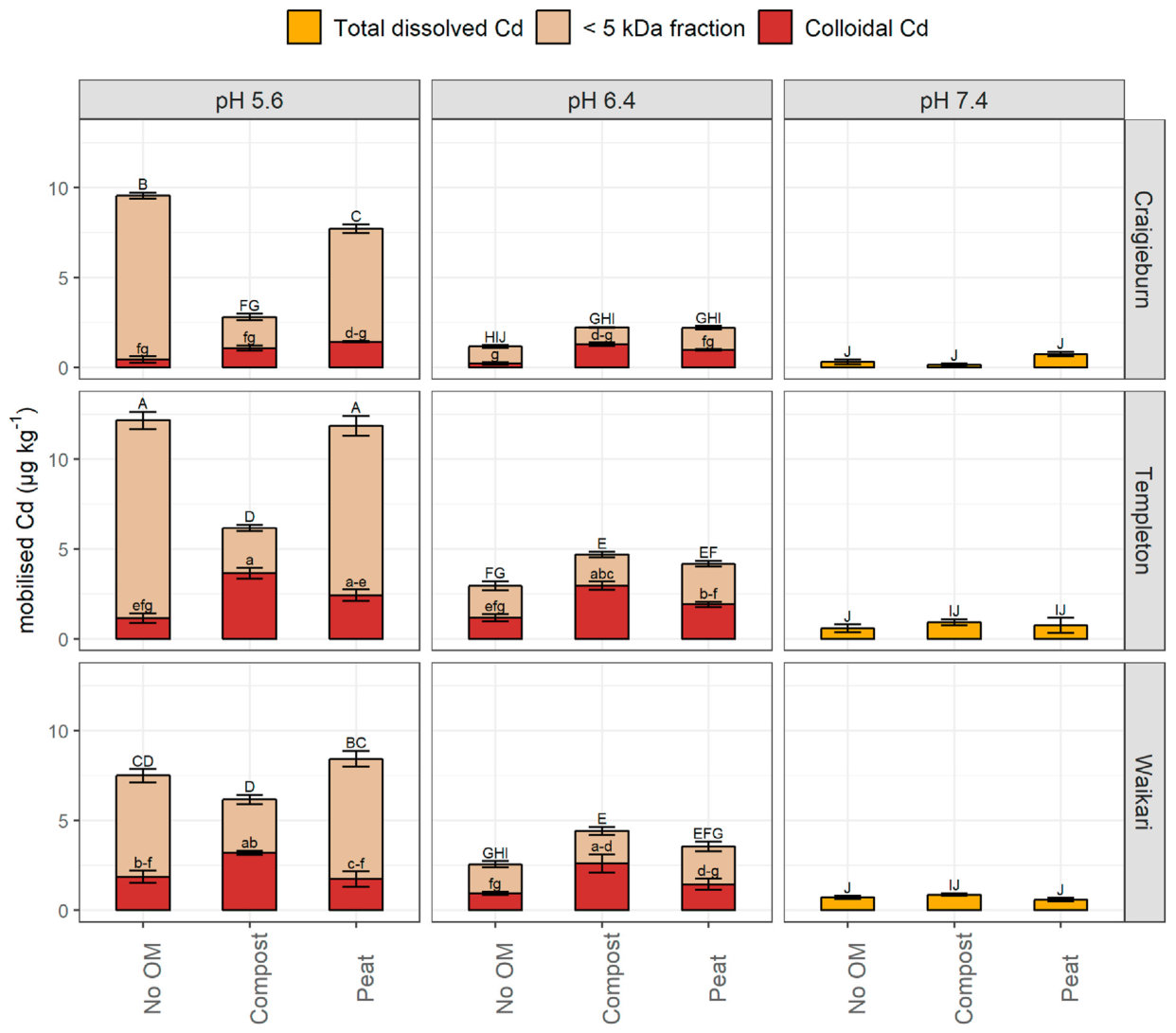
Given the short measurement period and relatively low volume of leachate collected, these results can be best used to describe the initial mobilisation of solute and colloids from these soils and should be considered in that context. Therefore, the mobilised Cd here is likely to be representative of a combination of (i) the initial concentration of Cd species in the soil solution, (ii) Cd released from relatively labile solid-phase species into soil solution species during leaching and (iii) Cd bound to organic matter solid phases that dissolve during the experiment. The advantage of the experimental procedure employed here is that it allows a relatively rapid and systematic means by which to examine the role of quality of DOM in mobilising soil Cd across three different soils.
鉴于测定周期较短且收集的淋出液体积相对较少,这些结果最适合用于描述这些土壤中溶质和胶体的初始活化,并应在此背景下加以考量。因此,此处活化的Cd可能代表以下三者的综合:(i)土壤溶液中Cd形态的初始浓度;(ii)淋溶期间由相对活性的固相形态释放至土壤溶液形态中的Cd;(iii)试验期间溶解的有机质固相所结合的Cd。本研究所采用试验方法的优点在于,可相对快速、系统地考察3种不同土壤中DOM质量在土壤Cd活化中的作用。
3.2. Mobile colloidal-cadmium and its relation with quantity and characteristics of dissolved organic matter
3.2. 可移动胶体态镉及其与溶解性有机质数量和特性的关系
The colloidal fraction is thought to consist of large (high molecular weight) humic acids and organo-minerals that have a strong affinity for binding Cd (Kaschl et al., 2002; Pokrovsky et al., 2005; Chen et al., 2019). In this experiment, the colloidal fraction of mobilised Cd correlated strongly with mobilised DOM (r = 0.771, P < 0.0005), but showed a poor relationship with soil pH (r ¼ 0.053, P > 0.05) (Table 2). The opposite was seen for truly dissolved Cd (<5 kDa size fraction), where pH was strongest explanatory variable for this fraction (r ¼ �0.751, P < 0.0005) (Table 2). This agrees with Tang et al. (2020) who showed a significant decrease in dissolved Cd release from a clay soil following an increase in pH from 5.9 to 6.8 using lime, with a concomitant increase in colloidal Cd. The strong negative correlation between pH and truly dissolved Cd may be explained by the preferential sorption of free Cd2þ ions to solid phases. This also helps to explain the relatively low binding of Cd to the soil matrix in the relatively sandy Templeton soil that is likely to feature lower numbers of variable charge sorption sites (McLaren, 1996; McLaughlin et al., 1996) and reduced sensitivity in Cd immobilisation to changes in pH (Naidu et al., 1994, 1997,bib_Naidu_et_al_1994,bib_Naidu_et_al_1997). The higher amounts of Fe and Al in the Craigieburn and Waikari soils (Table 1) may also be indicative of the presence of oxide minerals that can bind Cd. On the other hand, the reasons behind the poor relationship between pH and colloidal Cd appears to extend beyond simply the relationship between pH and DOM (r = �0.434, P < 0.001) (Table 2). The characteristics of the mobilised DOM are likely to be an important contributing factor.
胶体组分被认为由对Cd具有较强结合亲和力的大分子(高分子量)腐殖酸和有机-矿物复合体组成(Kaschl et al., 2002; Pokrovsky et al., 2005; Chen et al., 2019)。本试验中,活化Cd的胶体组分与活化DOM呈强相关(ρ = 0.771,P < 0.0005),但与土壤pH的关系较弱(ρ = 0.053,P > 0.05)(表2)。真溶解态Cd(<5 kDa粒级)的情况则相反,pH是该组分最强的解释变量(ρ = −0.751,P < 0.0005)(表2)。这与Tang et al. (2020) 的结果一致,其研究表明,施用石灰使黏土pH由5.9升至6.8后,溶解态Cd释放显著减少,同时胶体态Cd增加。pH与真溶解态Cd之间的强负相关可由游离Cd2+离子在固相上的优先吸附来解释。这也有助于解释在质地相对偏砂的Templeton土壤中Cd与土壤基质的结合相对较弱,该土壤可能具有较少的可变电荷吸附位点(McLaren, 1996; McLaughlin et al., 1996),且Cd固定对pH变化的敏感性较低(Naidu et al., 1994, 1997,bib_Naidu_et_al_1994,bib_Naidu_et_al_1997)。Craigieburn和Waikari土壤中较高的Fe和Al含量(表1)也可能表明存在可结合Cd的氧化物矿物。另一方面,pH与胶体态Cd关系较弱的原因似乎不仅仅在于pH与DOM之间的关系(ρ = −0.434,P < 0.001)(表2),活化DOM的特性很可能是一个重要的影响因素。
Spearman correlation matrix for the relationship among Cd mobilised, soil pH, kinetic limitation, and quantity and quality of DOM.
活化Cd、土壤pH、动力学限制以及DOM数量和质量之间关系的Spearman相关矩阵。
| <5 kDa Cde (mg kg�1) | colloidal Cdf (mg kg�1)胶体态Cdf (mg kg−1) | soil pH土壤pH | DOC (mg kg�1) | SUVA254SUVA254 | E4/E6 | A254/A366 | Kinetic Limitation动力学限制 | |
|---|---|---|---|---|---|---|---|---|
| soil pH | �0.751 | 0.053 | ||||||
| DOC (mg kg�1) | �0.115 | 0.771 | 0.434* | |||||
| SUVA254 | 0.166 | �0.479 | �0.298* | �0.654 | ||||
| E4/E6 | �0.522 | 0.229 | 0.711 | 0.61 | �0.398 | |||
| A254/A365 | 0.069 | �0.688 | 0.157 | �0.518 | 0.398 | �0.086 | ||
| kinetic limitation | �0.541 | �0.373 | 0.502* | �0.006 | �0.152 | 0.329 | 0.122 | |
| Cd-HAa,d (M) | 0.219 | 0.625 | 0.148 | 0.571 | �0.482* | 0.251 | �0.456* | �0.067 |
| Cd-FAb,d (M) | 0.449 | 0.876 | �0.254 | 0.734* | �0.433 | 0.136 | �0.739* | �0.447 |
| Cd-DOMc,d (M) | 0.389 | 0.820 | �0.024 | 0.697* | �0.485* | 0.214 | �0.625 | �0.300 |
P < 0.0005 ‘****’ 0.001 ‘***’ 0.01 ‘**’ 0.05 ‘*’ 0.9 ‘‘ a Concentration of Cd complexes with HA (mol L�1). b Total concentration of Cd complexes with FA (mol L�1). c Concentration of Cd complexes with both HA and FA (mol L�1). d Correlations are calculated with average results for each parameter for each treatment. e Considered to be “truly dissolved” Cd. f Calculated as total dissolved - truly dissolved.
P < 0.0005 ‘****’ 0.001 ‘***’ 0.01 ‘**’ 0.05 ‘*’ 0.9 ‘‘ a Cd与HA络合物的浓度(mol L−1)。b Cd与FA络合物的总浓度(mol L−1)。c Cd与HA和FA络合物的浓度(mol L−1)。d 相关性采用各处理各参数的平均结果计算。e 视为“真溶解态”Cd。f 按总溶解态−真溶解态计算。
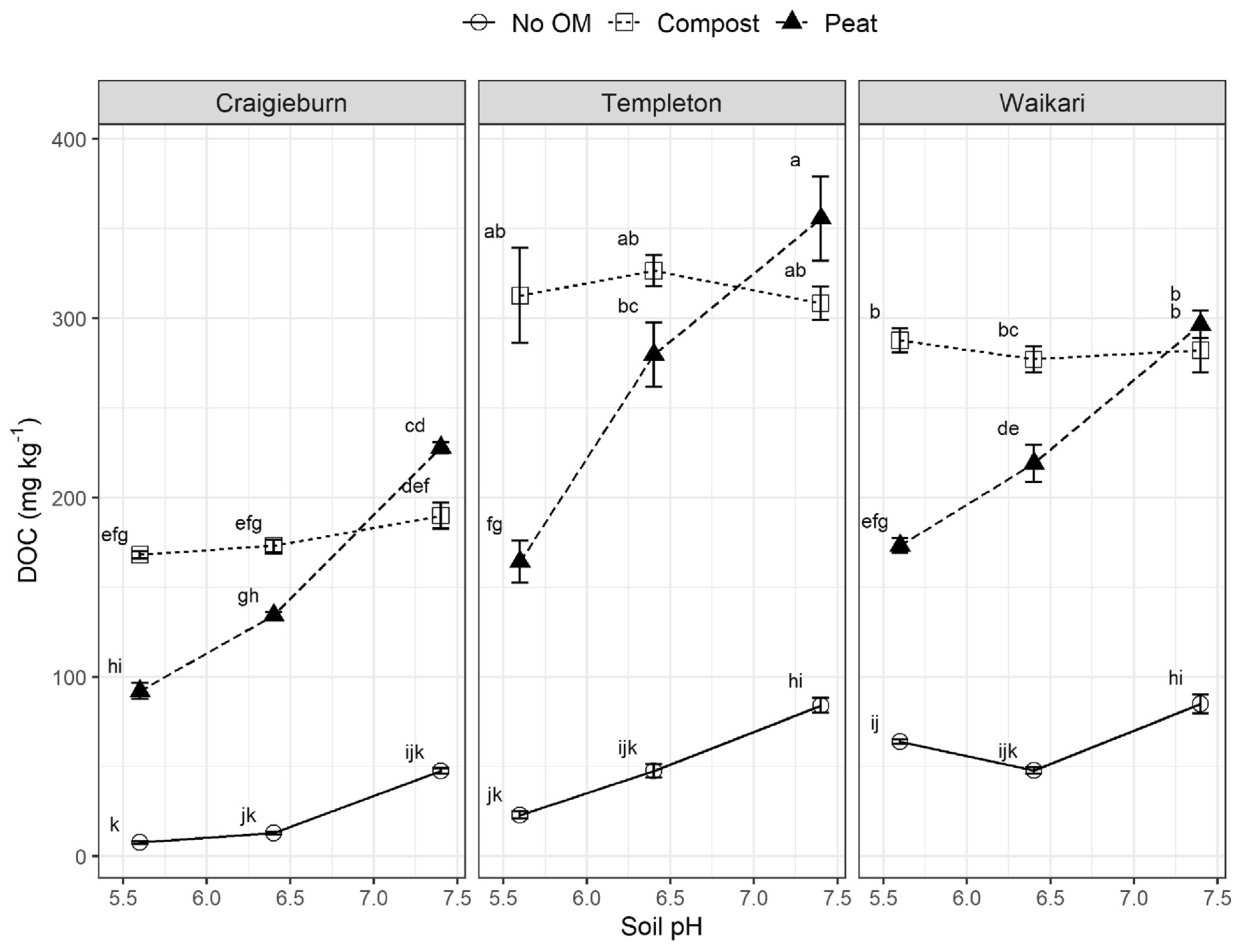
The average proportion of colloidal Cd mobilised from the compost treated soils increased from 50% to 60% between pH 5.6 and 6.4 across all three soils, the corresponding increase in the peat treated soils was from 20% to 44% (Fig. 1). In the untreated soils the proportion of colloidal Cd increased between pH 5.6 and 6.4 in the three soils as follows: Craigieburn (5%e20%), Templeton (9%e40%) and Waikari (25%e37%) soils. The increase in Cd mobilisation from compost treated Templeton and Waikari soils at pH 6.4 can therefore be linked to the mobilisation of colloidal Cd. The generally lower mobilisation of colloidal Cd from the Craigieburn soil is likely to be due to the relatively small amount of mobilised DOM from that soil (Fig. 2), probably driven by the abundance of strongly DOM-binding iron oxide minerals in that soil (Kaiser et al., 1996) and, by extension, an increased metal sorption capacity (Arias et al., 2002; Chen et al., 2019).
在3种土壤中,pH由5.6升至6.4时,堆肥处理土壤中活化胶体态Cd的平均比例由50%增至60%,泥炭处理土壤中相应由20%增至44%(图1)。在未处理土壤中,pH由5.6升至6.4时胶体态Cd比例的增幅如下:Craigieburn(5%–20%)、Templeton(9%–40%)和Waikari(25%–37%)土壤。因此,pH 6.4下堆肥处理的Templeton和Waikari土壤中Cd活化的增加可归因于胶体态Cd的活化。Craigieburn土壤中胶体态Cd活化总体较低,可能是由于该土壤中活化的DOM量相对较少(图2),这可能源于该土壤中富含对DOM具有强结合力的铁氧化物矿物(Kaiser et al., 1996),进而具有较高的金属吸附容量(Arias et al., 2002; Chen et al., 2019)。
The amount of DOC mobilised ranged between 0.4 and 7.9 mg DOC g�1 TOC which agrees with Vujinovi�c et al. (2019) who reported a range of 1.5e5.5 mg DOC g�1 TOC (assuming all soil C was organic C) mobilised from a laboratory leaching experiment with another group of soils. The mobilisation from the peat treated soils was more sensitive to pH than from the soils treated with compost (Fig. 2). The DOM from these soils also had a generally proportion of aromatic moieties and were lower in molecular weight (Table 3). Increase in DOM mobilisation with pH is well recognized (Kalbitz et al., 2000). In this case the increase in Ca2þ through the lime application is likely to have reduced the total amount of DOM mobilised, when compared what might be seen if the pH is elevated along with the addition of Na+ or K+, due to changes in the intermolecular attraction between DOM moieties (Lieffering and McLay, 1996; Curtin et al., 2016).
DOC活化量为0.4~7.9 mg DOC g−1 TOC,这与Vujinović et al. (2019) 的结果一致,其在另一组土壤的室内淋溶试验中报道的活化量为1.5~5.5 mg DOC g−1 TOC(假定土壤C均为有机C)。泥炭处理土壤中的活化对pH的敏感性高于堆肥处理土壤(图2)。这些土壤中的DOM芳香基团比例总体也较低,且分子量较小(表3)。DOM活化随pH升高而增加已得到公认(Kalbitz et al., 2000)。在本研究中,由于DOM基团间分子间引力的变化,与在提高pH的同时添加Na+或K+的情形相比,施用石灰带来的Ca2+增加很可能降低了DOM的总活化量(Lieffering and McLay, 1996; Curtin et al., 2016)。
Across pH 5.6 and 6.4 the average proportions of humic acid in the DOM mobilised from compost (20.5 ± 5.2%) and peat (24.1 ± 5.7%) treated soils agree with those found in compost extracts by Laborda et al. (2009), but are lower than those reported by Klinkert and Comans (2020). Bai et al. (2018) showed that high molecular weight humic acid molecules bind Cd strongly, which is supported here by the correlation between colloidal Cd and the A254/A365 index (inversely related to molecular weight of the DOM (Dahlen� et al., 1996)) (Table 2). However, the amount of mobilised colloidal Cd correlated negatively with the aromaticity index, SUVA254 (P < 0.0005; Table 2), indicating that Cd binding ligands in large DOM moieties tend to occur predominantly in aliphatic moieties. This is further supported by negative correlations between SUVA254 and the amount of Cd complexed with humic and fulvic acid (Table 2), and aligns with the suggestions that nonphenolic moieties and reduced sulphide groups on non-aromatic humic acid structures are important Cd-binding ligands in DOM (Chen et al., 2018; Welikala et al., 2018).
在pH 5.6和6.4下,堆肥(20.5 ± 5.2%)和泥炭(24.1 ± 5.7%)处理土壤活化DOM中腐殖酸的平均比例与Laborda et al. (2009) 在堆肥浸提液中的结果一致,但低于Klinkert and Comans (2020) 的报道值。Bai et al. (2018) 表明,高分子量腐殖酸分子可强烈结合Cd,本研究中胶体态Cd与A254/A365指数(与DOM分子量呈负相关(Dahlén et al., 1996))之间的相关性支持了这一点(表2)。然而,活化胶体态Cd量与芳香性指数SUVA254呈负相关(P < 0.0005;表2),表明大分子DOM中的Cd结合配体主要存在于脂肪族基团中。SUVA254与腐殖酸和富里酸络合Cd量之间的负相关(表2)进一步支持了这一点,这也与非芳香腐殖酸结构上的非酚类基团和还原态硫化物基团是DOM中重要Cd结合配体的观点相符(Chen et al., 2018; Welikala et al., 2018)。
Colloidal DOM may be formed through breakdown of larger OM aggregates or the polymerising or aggregating of small organic molecules, which can show more resistivity for biodegradation than the DOM in the smaller fractions (Kleber and Johnson, 2010; Lehmann and Kleber, 2015). Moreover, due to its generally larger size and stability, colloidal DOM may not bind to soil solid mineral surfaces to a large extent (Kleber and Johnson, 2010). Therefore, colloidal Cd-DOM species may persist in the soil solution for longer and have the potential to transport Cd in the surrounding environment. Kalbitz et al. (2003) measured high proportions (>75%) of stable DOM from humified OM (humified layer from Spruce forest) and agricultural soil and reported their half-lives as 8.6 and 2.3 years, respectively. Given the higher humification degree of DOM mobilised from the compost and peat treated soils than DOM from the untreated soils (Fig. S3), it is possible that Cd associated with DOM-released from compost or peat treated soils may persist as complexes in soils and able to be transported from their point of origin. The quality of the DOM here is, again, only reflective of what was initially mobilised from these soils, but this should serve as a basis from which to investigate the role of DOM quality in Cd mobilisation further.
胶体态DOM可通过较大OM团聚体的分解或小分子有机物的聚合或聚集而形成,其抗生物降解能力可能强于较小组分中的DOM(Kleber and Johnson, 2010; Lehmann and Kleber, 2015)。此外,由于胶体态DOM通常尺寸较大且较稳定,其与土壤固相矿物表面的结合程度可能有限(Kleber and Johnson, 2010)。因此,胶体态Cd-DOM形态可能在土壤溶液中存留更长时间,并具有将Cd迁移至周边环境的潜力。Kalbitz et al. (2003) 测得来源于腐殖化OM(云杉林腐殖质层)和农业土壤的DOM中稳定DOM比例较高(>75%),其半衰期分别为8.6年和2.3年。鉴于堆肥和泥炭处理土壤中活化DOM的腐殖化程度高于未处理土壤中的DOM(图S3),与堆肥或泥炭处理土壤释放的DOM相结合的Cd可能以络合物形式存留于土壤中,并能够从其来源处迁移。此处DOM的质量同样仅反映了这些土壤初始活化的情况,但可为进一步研究DOM质量在Cd活化中的作用提供基础。
3.3. Kinetic limitation and speciation of cadmium in the leachates3.3. 淋出液中镉的动力学限制与形态
The total fraction of mobilised Cd that was bound by either humic or fulvic acid ranged widely between pH 5.6 and 6.4 in the untreated (4e21%) soils and soils treated with compost (30e62%) and peat (32e77%), with greater proportions complexed by these fractions at pH 6.4 (Table 3). The proportions of Cd complexes identified here are in line with estimates of Cd bound by soil DOM by Ren et al. (2015) (<28%) and by Cornu et al. (2011) (34e77%). Various authors have emphasised the importance using an experimentally determined F-value, (i.e.) the ratio of active to total DOM that is both metal and DOM specific and, therefore, appropriate for modelling the speciation of specific trace metals across a range of diverse soil solutions and natural waters (Groenenberg et al., 2010; Djae et al., 2017; Chen et al., 2018). In absence of specific measurements, an F-value of 1.3 is commonly used (Tipping et al., 2011); however, the F-values determined here ranged between 0.5 and 1.2, which agrees with the optimum range of values 0.3 to 1.1 for modelling Cd speciation reported by Chen et al. (2018).
在pH 5.6和6.4之间,未处理土壤(4%–21%)、堆肥处理土壤(30%–62%)和泥炭处理土壤(32%–77%)中与腐殖酸或富里酸结合的活化Cd总比例变化范围较大,且pH 6.4下被这些组分络合的比例更高(表3)。本研究确定的Cd络合物比例与Ren et al. (2015)(<28%)和Cornu et al. (2011)(34%–77%)对土壤DOM结合Cd的估算结果一致。多位学者强调了采用实测F值的重要性,即活性DOM与总DOM之比,该值因金属和DOM而异,因而适用于模拟多种土壤溶液和天然水体中特定痕量金属的形态(Groenenberg et al., 2010; Djae et al., 2017; Chen et al., 2018)。在缺乏具体测定的情况下,通常采用1.3的F值(Tipping et al., 2011);然而,本研究确定的F值为0.5~1.2,与Chen et al. (2018) 报道的模拟Cd形态的最佳取值范围0.3~1.1相符。
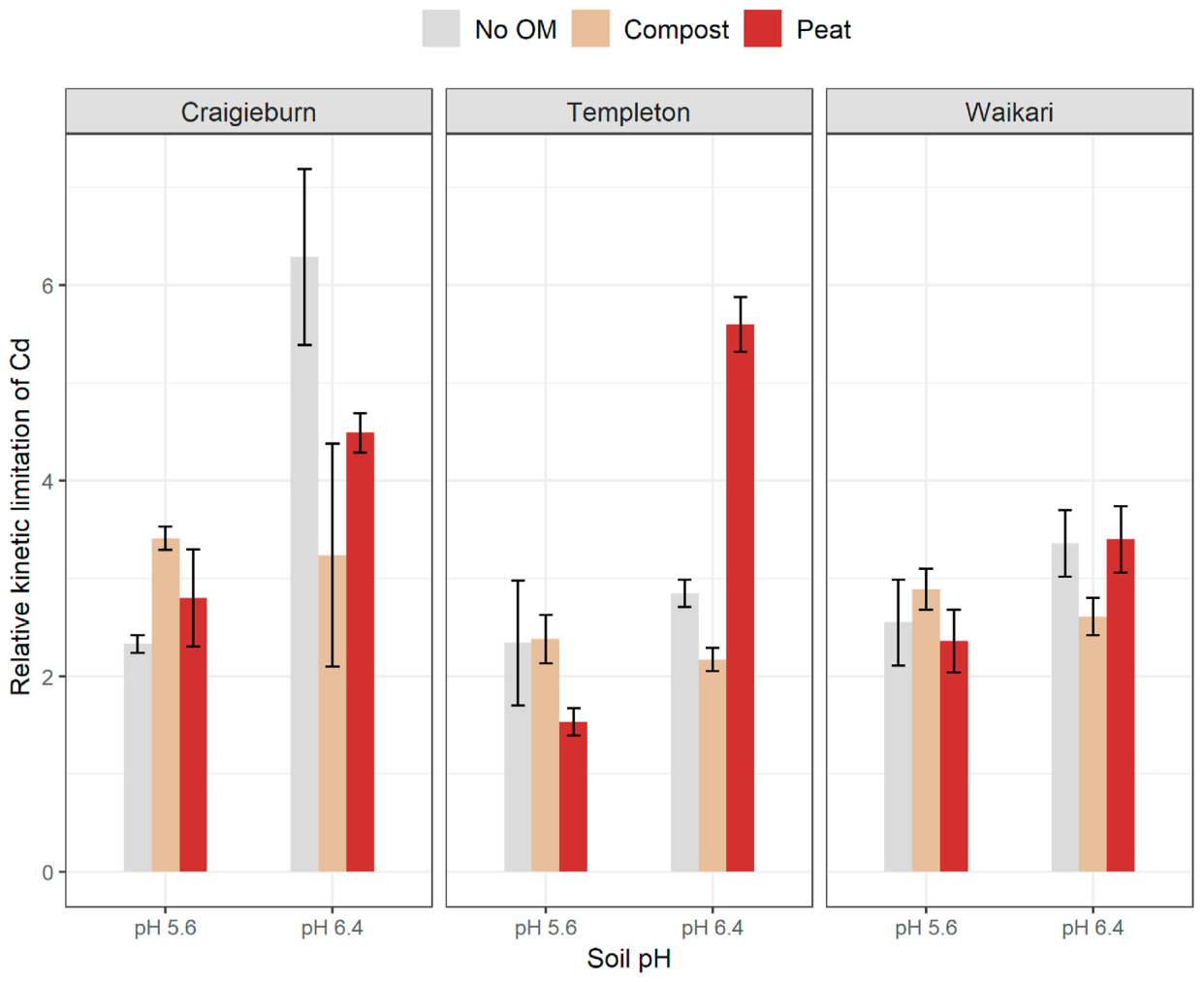
The kinetic limitation of Cd in the leachates correlated negatively with Cd measured in the <5 kDa fraction (P < 0.0005; Table 2), which suggests that the non-colloidal Cd was generally more labile. The lack of significant correlation between Cd-DOM complexes and Cd in the truly dissolved fraction (P > 0.05) suggests that the metal in that fraction could be present as free Cd2þ and complexed to inorganic or smaller organic molecules. The correlation between kinetic limitation and pH (Table 2) is likely to be due to a combination of increasing amounts of complexation by DOM and reduced competition for binding ligands by H+ ions. The kinetic limitations for Cd estimated for dissolved Cd from OM treated soils here (Fig. 3) are higher than the kinetic limitations for Cd observed by Welikala et al. (2018), which can be attributed to the generally lower Cd:DOC ratio (10�3 - 10�6), here. As the metal:ligand ratio increases, the strong metal-binding sites in heterogeneous substrates like DOM become increasingly saturated and remaining metal starts to bind to the weaker ligands, resulting in more labile metal (Guthrie et al., 2003). However, it is important to recognize that in three cases the theoretical maximum kinetic limitation value that could be measured for Cd using SV-DGT (4.13) (Welikala et al., 2018) was exceeded (Fig. 3). The range of ionic strengths in the leachates (2.3e27 mM) agrees with previously reported values for soil solutions (Schofield and Taylor (1955); Edmeades et al., 1985). To reduce the effect that differences in ionic strength may have on the diffusion rates of the Cd-DOM complexes (Wang et al., 2016), the conductivity of all leachates was normalised to 2 mS cm�1 (the conductivity of leachates from compost treated soils at all pHs tested). The possibility Cd-DOM complexes aggregating following the increase in solution ionic strength (Cincotta et al., 2019; Mosley and Liss, 2019) cannot be discounted and this may have reduced the rate of Cd diffusion into the agarose gel and thus confounding the interpretation of kinetic limitations in these cases. Future studies employing SV-DGT to measure kinetic limitation should seek to identify whether such effects are likely by testing different ionic strength solutions.
淋出液中Cd的动力学限制与<5 kDa组分中的Cd呈负相关(P < 0.0005;表2),表明非胶体态Cd总体活性更高。Cd-DOM络合物与真溶解态组分中的Cd之间缺乏显著相关性(P > 0.05),表明该组分中的金属可能以游离Cd2+形式存在,或与无机分子或较小的有机分子络合。动力学限制与pH之间的相关性(表2)很可能是DOM络合量增加与H+离子对结合配体竞争减弱共同作用的结果。本研究估算的OM处理土壤溶解态Cd的动力学限制(图3)高于Welikala et al. (2018) 所观测的Cd动力学限制,这可归因于本研究中Cd:DOC比值总体较低(10−3 - 10−6)。随着金属与配体之比的增加,DOM等非均质基质中的强金属结合位点逐渐饱和,剩余金属开始与较弱的配体结合,导致金属活性增加(Guthrie et al., 2003)。然而,需要认识到,有3种情况超出了SV-DGT所能测得的Cd理论最大动力学限制值(4.13)(Welikala et al., 2018)(图3)。淋出液的离子强度范围(2.3–27 mM)与此前报道的土壤溶液数值一致(Schofield and Taylor (1955); Edmeades et al., 1985)。为减少离子强度差异对Cd-DOM络合物扩散速率的影响(Wang et al., 2016),将所有淋出液的电导率归一化至2 mS cm−1(即所测各pH下堆肥处理土壤淋出液的电导率)。不能排除溶液离子强度增加后Cd-DOM络合物发生聚集的可能性(Cincotta et al., 2019; Mosley and Liss, 2019),这可能降低了Cd向琼脂糖凝胶的扩散速率,从而干扰对这些情况下动力学限制的解释。今后采用SV-DGT测定动力学限制的研究,应通过测试不同离子强度的溶液来判断是否可能存在此类效应。
4Conclusions结论
The amount of Cd that is (im)mobilised by the addition of OM to soil in the short term varied widely (between �70% and +73%) depending on the soil, the nature of the OM and other physicochemical conditions. Mobilisation of colloidal-Cd increased with OM treatments, where Cd can be bound to the mobile and high molecular weight DOM released by the substrates. While increasing pH from 5.6 to 6.4 can significantly reduce the Cd in <5 kDa dissolved fraction, mobilisation of colloidal-Cd species was less affected by changes in pH and could conceivably sustain losses of Cd from soils, within the pH range tested here. It follows that the potential for continued mobilisation Cd as organic species, despite changes in pH, should be considered when estimating Cd leaching losses, especially from OM-amended contaminated soils. In the larger DOM fractions, Cd may be bound by the ligands in non-aromatic structures, where its lability is likely to depend on the source of the DOM, pH, and Cd:DOC ratio. Dissolved OM emerged from OM treated soils may persist in soil solution for longer than the DOM from soil itself. Future work should examine its biodegradability and differences in DOM release rates at other amendment application rates and longer time frames to further understand the potential for DOM-facilitated transport of Cd in soils and surrounding environments.
短期内向土壤添加OM所导致的Cd(固定)活化量变化范围很大(−70%至+73%),取决于土壤、OM性质及其他理化条件。OM处理增加了胶体态Cd的活化,此时Cd可与基质释放的可移动高分子量DOM结合。虽然将pH由5.6提高至6.4可显著降低<5 kDa溶解组分中的Cd,但在本研究所测pH范围内,胶体态Cd形态的活化受pH变化的影响较小,可能导致土壤中Cd的持续损失。由此可见,在估算Cd淋溶损失时,尤其是对于经OM改良的污染土壤,应考虑尽管pH发生变化Cd仍可能以有机形态持续活化的潜力。在较大的DOM组分中,Cd可能与非芳香结构中的配体结合,其活性可能取决于DOM来源、pH和Cd:DOC比值。OM处理土壤释放的溶解性有机质在土壤溶液中的存留时间可能长于土壤自身的DOM。今后的研究应考察其生物降解性,以及在其他改良剂施用量和更长时间尺度下DOM释放速率的差异,以进一步认识DOM促进Cd在土壤及周边环境中迁移的潜力。
WHAM VII speciation modelling results and DOM quality indices via SUVA254 and E4/E6. Humic and fulvic acids are represented by HA and FA, respectively. Cd2þ:DOC is the ratio of concentrations (mol L�1) of free Cd2þ and DOC. For SUVA254 and E4/E6, the values are expressed as mean ± standard error of the mean (n = 3).
WHAM VII形态模拟结果及基于SUVA254和E4/E6的溶解性有机质(DOM)品质指数。HA和FA分别代表腐殖酸和富里酸。Cd2+:DOC为游离Cd2+与DOC浓度(mol L−1)之比。SUVA254和E4/E6数值以平均值 ± 平均值标准误表示(n = 3)。
| soil土壤 | treatment处理 | soil pH土壤pH | leachate淋溶液 | Total [DOC]总[DOC] | [HA]a (m | g WHAM speciatig WHAM形态模 | on modelling resul拟结果 | ts | SUVA254 (LSUVA254 (L | E4/E6 | A254/A365 |
|---|---|---|---|---|---|---|---|---|---|---|---|
| group | pH | (mgCL�1) | CL�1) | mg�1 m�1) | |||||||
| total dissolved Cd (mg L�1) | Cd bound by colloidal HA (%)a | Cd bound by colloidal FA (%) | |||||||||
| Craigieburn | non | 5.6 | 5.61 | 3.15 | 0 | 3.83 | 0 | 4 | 4 1.3 5.37 ± 0.17 | 2.6 ± 0.1 | 6.00 ± 0.18 |
| compost | 5.6 | 6.88 | 69.09 | 19.4 | 1.16 | 16 | 27 | 43 0.02 2.92 ± 1.13 | 5.9 ± 0.4 | 5.58 ± 0.09 | |
| peat | 5.6 | 5.59 | 37.86 | 14.5 | 3.17 | 14 | 18 | 32 0.09 2.65 ± 0.17 | 2.9 ± 0.1 | 5.65 ± 0.07 | |
| non | 6.4 | 6.75 | 5.28 | 0 | 0.48 | 0 | 9 | 9 0.1 5.06 ± 0.51 | 5.3 ± 0.7 | 5.90 ± 0.17 | |
| compost | 6.4 | 7.13 | 71.13 | 36 | 0.92 | 28 | 26 | 54 0.01 1.75 ± 0.18 | 8.0 ± 0.5 | 5.49 ± 0.02 | |
| peat | 6.4 | 6.78 | 55.19 | 22 | 0.91 | 25 | 30 | 54 0.02 2.61 ± 0.08 | 5.4 ± 0.5 | 5.82 ± 0.01 | |
| Templeton | non | 5.6 | 5.44 | 9.42 | 0 | 4.99 | 0 | 5 | 5 0.57 2.77 ± 0.23 | 3.3 ± 0.5 | 6.29 ± 0.07 |
| compost | 5.6 | 6.38 | 128.49 | 0 | 2.54 | 0 | 30 | 30 0.02 2.59 ± 0.18 | 6.5 ± 0.0 | 3 6.27 ± 0.04 | |
| peat | 5.6 | 5.36 | 67.51 | 28.7 | 4.87 | 15 | 18 | 33 0.08 2.70 ± 0.16 | 3.6 ± 0.2 | 6.18 ± 0.03 | |
| non | 6.4 | 6.74 | 19.6 | 12 | 1.21 | 24 | 20 | 44 0.07 2.61 ± 0.04 | 4.1 ± 0.2 | 6.04 ± 0.17 | |
| compost | 6.4 | 7.13 | 134.2 | 48.2 | 1.93 | 24 | 33 | 57 0.02 1.85 ± 0.15 | 6.4 ± 0.4 | 5.21 ± 0.01 | |
| peat | 6.4 | 6.68 | 114.97 | 76.6 | 1.72 | 45 | 32 | 77 0.02 2.11 ± 0.22 | 6.4 ± 0.2 | 5.55 ± 0.03 | |
| Waikari | non | 5.6 | 5.81 | 26.24 | 11.5 | 3.07 | 13 | 15 | 28 0.12 3.04 ± 0.33 | 4.2 ± 0.1 | 5.84 ± 0.04 |
| compost | 5.6 | 6.46 | 118.22 | 59 | 2.54 | 28 | 27 | 55 0.02 2.09 ± 0.32 | 8.0 ± 0.3 | 5.10 ± 0.06 | |
| peat | 5.6 | 5.47 | 67.51 | 31.4 | 3.46 | 19 | 22 | 41 0.05 2.83 ± 0.41 | 5.1 ± 0.3 | 5.65 ± 0.22 | |
| non | 6.4 | 6.9 | 19.6 | 1.1 | 1.05 | 2 | 19 | 21 0.06 4.98 ± 0.28 | 7.3 ± 1.1 | 5.75 ± 0.03 | |
| compost | 6.4 | 7.2 | 134.2 | 56.7 | 1.81 | 32 | 31 | 62 0.01 2.34 ± 0.17 | 15.9 ± 0. | 8 5.26 ± 0.06 | |
| peat | 6.4 | 6.9 | 114.97 | 52.2 | 1.45 | 38 | 32 | 70 0.01 2.61 ± 0.21 | 10.8 ± 0. | 9 5.81 ± 0.03 |
a Where concentrations of DOC were low (<10 mg L�1), the HA fraction could not be measured reliably and was assumed to be zero.
a 当DOC浓度较低(<10 mg L−1)时,HA组分无法可靠测定,故假定为零。
Author contributions作者贡献
Dharshika Welikala: Conceptualisation, Methodology, Investigation, Formal analysis, Visualization, Writing e original draft and revisionsBrett H. Robinson: Supervision, Writing e review & editing; Elena Moltchanova: Formal analysis; Adam Hartland: Resources, Writing e review & editing; Niklas J. Lehto: Supervision, Conceptualisation, Methodology, Writing e review & editing and revisions
Dharshika Welikala:构思、方法、调查研究、形式分析、可视化、撰写初稿及修改;Brett H. Robinson:指导、审阅与编辑;Elena Moltchanova:形式分析;Adam Hartland:资源、审阅与编辑;Niklas J. Lehto:指导、构思、方法、审阅与编辑及修改
Declaration of competing interest利益冲突声明
The authors declare that they have no known competing financial interests or personal relationships that could have appeared to influence the work reported in this paper.
作者声明,不存在任何可能影响本文所报道工作的已知经济利益冲突或个人关系。
Acknowledgements致谢
This research was partly funded by New Zealand Ministry of Business Innovation and Employment (Smart Ideas contract UOWX1804). Dharshika Welikala was supported by a Lincoln University Doctoral Scholarship. We thank Lynne Clucas, Leanne Hassall, Roger Cresswell, Huma Saeed and Robert Stainthorpe for their assistance in analysing the samples. We also recognize the contribution made by three anonymous reviewers whose input helped to improve this article.
本研究部分由新西兰商业、创新与就业部资助(Smart Ideas项目,合同号UOWX1804)。Dharshika Welikala获得林肯大学博士奖学金资助。感谢Lynne Clucas、Leanne Hassall、Roger Cresswell、Huma Saeed和Robert Stainthorpe协助样品分析。同时感谢三位匿名审稿人,他们的意见有助于完善本文。
Appendix A. Supplementary data附录A. 补充数据
Supplementary data to this article can be found online at https://doi.org/10.1016/j.chemosphere.2021.129536.
本文补充材料可在线获取:https://doi.org/10.1016/j.chemosphere.2021.129536。
References参考文献
Al Mamun, S., Chanson, G., Muliadi, Benyas, E., Aktar, M., Lehto, N., McDowell, R., Cavanagh, J., Kellermann, L., Clucas, L., Robinson, B., 2016. Municipal composts reduce the transfer of Cd from soil to vegetables. Environ. Pollut. 213, 8e15.
Amery, F., Degryse, F., Cheyns, K., De Troyer, I., Mertens, J., Merckx, R., Smolders, E., 2008. The UV-absorbance of dissolved organic matter predicts the fivefold variation in its affinity for mobilizing Cu in an agricultural soil horizon. Eur. J. Soil Sci. 59, 1087e1095.
Amery, F., Degryse, F., Degeling, W., Smolders, E., Merckx, R., 2007. The coppermobilizing-potential of dissolved organic matter in soils varies 10-fold depending on soil incubation and extraction procedures. Environ. Sci. Technol. 41, 2277e2281.
Arias, M., Barral, M.T., Mejuto, J.C., 2002. Enhancement of copper and cadmium adsorption on kaolin by the presence of humic acids. Chemosphere 48, 1081e1088.
Bai, H.C., Jiang, Z.M., He, M.J., Ye, B.Y., Wei, S.Q., 2018. Relating Cd2þ binding by humic acids to molecular weight: a modeling and spectroscopic study. J. Environ. Sci. 70, 154e165.
Blakemore, L.C., Searle, P.L., Daly, B.K., 1987. Methods for Chemical Analysis of Soils New Zealand Soil Bureau Scientific Report 80.
Bolan, N., Kunhikrishnan, A., Thangarajan, R., Kumpiene, J., Park, J., Makino, T., Kirkham, M.B., Scheckel, K., 2014. Remediation of heavy metal(loid)s contaminated soils - to mobilize or to immobilize? J. Hazard Mater. 266, 141e166.
Bolan, N.S., Adriano, D.C., Kunhikrishnan, A., James, T., McDowell, R., Senesi, N., 2011. Chapter one - dissolved organic matter: biogeochemistry, dynamics, and environmental significance in soils. In: Sparks, D.L. (Ed.), Advances in Agronomy. Academic Press, pp. 1e75.
Bolan, N.S., Duraisamy, V.P., 2003. Role of inorganic and organic soil amendments on immobilisation and phytoavailability of heavy metals: a review involving specific case studies. Aust. J. Soil Res. 41, 533e555.
Chaney, R.L., 2010. Cadmium and zinc. In: Hooda, P.S. (Ed.), Trace Elements in Soils. A John Wiley and Sons, pp. 409e440.
Chen, W.B., Gueguen, C., Smith, D.S., Galceran, J., Puy, J., Companys, E., 2018. Metal
(Pb, Cd, and Zn) binding to diverse organic matter samples and implications for speciation modeling. Environ. Sci. Technol. 52, 4163e4172.
Chen, Y., Ma, J., Li, Y., Weng, L., 2019. Enhanced cadmium immobilization in saturated media by gradual stabilization of goethite in the presence of humic acid with increasing pH. Sci. Total Environ. 648, 358e366.
Cincotta, M.M., Perdrial, J.N., Shavitz, A., Libenson, A., Landsman-Gerjoi, M., Perdrial, N., Armfield, J., Adler, T., Shanley, J.B., 2019. Soil aggregates as a source of dissolved organic carbon to streams: an experimental study on the effect of solution chemistry on water extractable carbon. Frontiers in Environmental Science 7.
Collins, R.N., Merrington, G., McLaughlin, M.J., Morel, J.L., 2003. Organic ligand and ph effects on isotopically exchangeable cadmium in polluted soils. Soil Sci. Soc. Am. J. 67, 112e121.
Cornu, J.Y., Schneider, A., Jezequel, K., Denaix, L., 2011. Modelling the complexation of Cd in soil solution at different temperatures using the UV-absorbance of dissolved organic matter. Geoderma 162, 65e70.
Curtin, D., Peterson, M.E., Anderson, C.R., 2016. pH-dependence of organic matter solubility: base type effects on dissolved organic C, N, P, and S in soils with contrasting mineralogy. Geoderma 271, 161e172.
Dahlen, J., Bertilsson, S., Pettersson, C., 1996. Effects of UV-A irradiation on dissolved� organic matter in humic surface waters. Environ. Int. 22, 501e506. Djae, T., Bravin, M.N., Garnier, C., Doelsch, E., 2017. Parameterizing the binding properties OF dissolved organic matter with default values skews the prediction OF copper solution speciation and ecotoxicity IN soil. Environ. Toxicol. Chem. 36, 898e905.
Edmeades, D., Wheeler, D., Clinton, O., 1985. The chemical composition and ionic strength of soil solutions from New Zealand topsoils. Soil Res. 23, 151e165. Gao, J.K., Liang, C.L., Shen, G.Z., Lv, J., Wu, H.M., 2017. Spectral characteristics of dissolved organic matter in various agricultural soils throughout China. Chemosphere 176, 108e116.
Ghani, A., Müller, K., Dodd, M., Mackay, A., 2010. Dissolved organic matter leaching in some contrasting New Zealand pasture soils. Eur. J. Soil Sci. 61, 525e538.
Gła˛b, T., Zabi_ nski,� A., Sadowska, U., Gondek, K., Kope�c, M., Mierzwa-Hersztek, M., Tabor, S., 2018. Effects of co-composted maize, sewage sludge, and biochar mixtures on hydrological and physical qualities of sandy soil. Geoderma 315, 27e35.
Gray, C.W., McLaren, R.G., Roberts, A.H.C., Condron, L.M., 1999. Solubility, sorption and desorption of native and added cadmium in relation to properties of soils in New Zealand. Eur. J. Soil Sci. 50, 127e137.
Groenenberg, J.E., Koopmans, G.F., Comans, R.N.J., 2010. Uncertainty analysis of the nonideal competitive adsorption - donnan model: effects of dissolved organic matter variability on predicted metal speciation in soil solution. Environ. Sci. Technol. 44, 1340e1346.
Guo, X.X., Liu, H.T., Wu, S.B., 2019. Humic substances developed during organic waste composting: formation mechanisms, structural properties, and agronomic functions. Sci. Total Environ. 662, 501e510.
Guthrie, J.W., Mandal, R., Salam, M.S.A., Hassan, N.M., Murimboh, J., Chakrabarti, C.L., Back, M.H., Gregoire,� D.C., 2003. Kinetic studies of nickel speciation in model solutions of a well-characterized humic acid using the competing ligand exchange method. Anal. Chim. Acta 480, 157e169.
Hernandez-Soriano, M.C., Pena, A., Mingorance, M.D., 2013. Soluble metal pool as affected BY soil addition with organic inputs. Environ. Toxicol. Chem. 32, 1027e1032.
Hewitt, A.E., 2010. New Zealand soil classification. Landcare Res. Sci. Ser. 1, 1e136. Horrocks, A., Curtin, D., Tregurtha, C., Meenken, E., 2016. Municipal compost as a nutrient source for organic crop production in New Zealand. Agronomy 6, 35.
Houben, D., Evrard, L., Sonnet, P., 2013. Mobility, bioavailability and pH-dependent leaching of cadmium, zinc and lead in a contaminated soil amended with biochar. Chemosphere 92, 1450e1457.
Huang, M., Zhu, Y., Li, Z., Huang, B., Luo, N., Liu, C., Zeng, G., 2016. Compost as a soil amendment to remediate heavy metal-contaminated agricultural soil: mechanisms, efficacy, problems, and strategies. Water Air Soil Pollut. 227.
Kaiser, K., Guggenberger, G., Zech, W., 1996. Sorption of DOM and DOM fractions to forest soils. Geoderma 74, 281e303.
Kalbitz, K., Schmerwitz, J., Schwesig, D., Matzner, E., 2003. Biodegradation of soilderived dissolved organic matter as related to its properties. Geoderma 113, 273e291.
Kalbitz, K., Solinger, S., Park, J.H., Michalzik, B., Matzner, E., 2000. Controls on the dynamics of dissolved organic matter in soils: a review. Soil Sci. 165.
Karlsson, T., Elgh-Dalgren, K., Bjorn, E., Skyllberg, U., 2007. Complexation of cadmium to sulfur and oxygen functional groups in an organic soil. Geochem. Cosmochim. Acta 71, 604e614.
Kaschl, A., Romheld, V., Chen, Y., 2002. Cadmium binding by fractions of dissolved organic matter and humic substances from municipal solid waste compost. J. Environ. Qual. 31, 1885e1892.
Khan, M.A., Khan, S., Khan, A., Alam, M., 2017. Soil contamination with cadmium, consequences and remediation using organic amendments. Sci. Total Environ. 601e602, 1591e1605.
Kleber, M., Johnson, M.G., 2010. Chapter 3 - advances in understanding the molecular structure of soil organic matter: implications for interactions in the environment. In: Sparks, D.L. (Ed.), Advances in Agronomy. Academic Press, pp. 77e142.
Klinkert, S., Comans, R.N.J., 2020. Geochemical multisurface modeling of reactive zinc speciation in compost as influenced by extraction conditions. Environ. Sci. Technol. 54, 2467e2475.
D. Welikala, B.H. Robinson, E. Moltchanova et al.
Kovacs,� B., Prokisch, J., Gyori,€ Z., Kov�acs, A.B., Palencs�ar, A.J., 2000. Studies on soil sample preparation for inductively coupled plasma atomic emission spectrometry analysis. Commun. Soil Sci. Plant Anal. 31, 1949e1963.
Kozyatnyk, I., Bouchet, S., Bjorn, E., Haglund, P., 2016. Fractionation and sizedistribution of metal and metalloid contaminants in a polluted groundwater rich in dissolved organic matter. J. Hazard Mater. 318, 194e202.
Kubier, A., Wilkin, R.T., Pichler, T., 2019. Cadmium in soils and groundwater: a review. Appl. Geochem. 108.
Laborda, F., Bolea, E., Gorriz, M.P., Martin-Ruiz, M.P., Ruiz-Begueria, S., Castillo, J.R., 2008. A speciation methodology to study the contributions of humic-like and fulvic-like acids to the mobilization of metals from compost using size exclusion chromatography-ultraviolet absorption-inductively coupled plasma mass spectrometry and deconvolution analysis. Anal. Chim. Acta 606, 1e8.
Laborda, F., Ruiz-Begueria, S., Bolea, E., Castillo, J.R., 2009. Functional speciation of metal-dissolved organic matter complexes by size exclusion chromatography coupled to inductively coupled plasma mass spectrometry and deconvolution analysis. Spectroc. Acta Pt. B-Atom. Spectr. 64, 392e398.
Lehmann, J., Kleber, M., 2015. The contentious nature of soil organic matter. Nature 528, 60e68.
Lieffering, R., McLay, C., 1996. The effect of strong hydroxide solutions on the stability of aggregates and hydraulic conductivity of soil. Eur. J. Soil Sci. 47, 43e50. Liu, L., Wang, S., Guo, X., Wang, H., 2019. Comparison of the effects of different maturity composts on soil nutrient, plant growth and heavy metal mobility in the contaminated soil. J. Environ. Manag. 250.
McLaren, R.G., 1996. In: Auckland, N.Z. (Ed.), Soil Science : Sustainable Production and Environmental Protection, New ed. Oxford University Press, Auckland [N.Z. McLaughlin, M.J., Smolders, E., Degryse, F., Rietra, R., 2011. Uptake of metals from soil into vegetables. In: Swartjes, F.A. (Ed.), Dealing with Contaminated Sites: from Theory towards Practical Application. Springer Netherlands, Dordrecht, pp. 325e367.
McLaughlin, M.J., Tiller, K.G., Naidu, R., Stevens, D.P., 1996. Review: the behaviour and environmental impact of contaminants in fertilizers. Aust. J. Soil Res. 34, 1e54.
Mosley, L.M., Liss, P.S., 2019. Particle aggregation, pH changes and metal behaviour during estuarine mixing: review and integration. Mar. Freshw. Res.
Naidu, R., Bolan, N.S., Kookana, R.S., Tiller, K.G., 1994. IONIC-STRENGTH and PH effects ON the sorption OF cadmium and the surface-charge OF soils. Eur. J. Soil Sci. 45, 419e429.
Naidu, R., Harter, R.D., 1998. Effect of different organic ligands on cadmium sorption by and extractability from soils. Soil Sci. Soc. Am. J. 62, 644e650.
Naidu, R., Kookana, R.S., Sumner, M.E., Harter, R.D., Tiller, K.G., 1997. Cadmium sorption and transport in variable charge soils: a review. J. Environ. Qual. 26, 602e617.
Okkenhaug, G., Smebye, A.B., Pabst, T., Amundsen, C.E., Sævarsson, H., Breedveld, G.D., 2018. Shooting range contamination: mobility and transport of lead (Pb), copper (Cu) and antimony (Sb) in contaminated peatland. J. Soils Sediments 18, 3310e3323.
Parlanti, E., Worz,€ K., Geoffroy, L., Lamotte, M., 2000. Dissolved organic matter fluorescence spectroscopy as a tool to estimate biological activity in a coastal zone submitted to anthropogenic inputs. Org. Geochem. 31, 1765e1781.
elements in peat soil solutions: results of ultrafiltration and dialysis. Aquat. Geochem. 11, 241e278.
R core Team, 2018. R: A Language and Environment for Statistical Computing. http://www.R-project.org.
Ren, Z.L., Tella, M., Bravin, M.N., Comans, R.N.J., Dai, J., Garnier, J.M., Sivry, Y., Doelsch, E., Straathof, A., Benedetti, M.F., 2015. Effect of dissolved organic matter composition on metal speciation in soil solutions. Chem. Geol. 398, 61e69.
Salmanzadeh, M., Hartland, A., Stirling, C.H., Balks, M.R., Schipper, L.A., Joshi, C., George, E., 2017. Isotope tracing of long-term cadmium fluxes in an agricultural soil. Environ. Sci. Technol. 51, 7369e7377.
Schofield, R., Taylor, A.W., 1955. The measurement of soil pH. Soil Sci. Soc. Am. J. 19, 164e167.
Shuman, L.M., 1998. Effect of organic waste amendments on cadmium and lead in soil fractions of two soils. Commun. Soil Sci. Plant Anal. 29, 2939e2952.
Sullivan, D.M., Bary, A.I., Nartea, T.J., Myrhe, E.A., Cogger, C.G., Fransen, S.C., 2003. Nitrogen availability seven years after a high-rate food waste compost application. Compost Sci. Util. 11, 265e275.
Tang, X.Y., Katou, H., Suzuki, K., 2020. Liming effects on dissolved and colloidassociated transport of cadmium in soil under intermittent simulated rainfall. J. Hazard Mater. 400.
Tapia, Y., Cala, V., Eymar, E., Frutos, I., Garate, A., Masaguer, A., 2010. Chemical characterization and evaluation of composts as organic amendments for immobilizing cadmium. Bioresour. Technol. 101, 5437e5443.
Tipping, E., Lofts, S., Sonke, J.E., 2011. Humic Ion-Binding Model VII: a revised parameterisation of cation-binding by humic substances. Environ. Chem. 8, 225e235.
Van Zomeren, A., Comans, R.N.J., 2007. Measurement of humic and fulvic acid concentrations and dissolution properties by a rapid ratch procedure. Environ. Sci. Technol. 41, 6755e6761.
Vujinovi�c, T., Clough, T.J., Curtin, D., Meenken, E.D., Lehto, N.J., Beare, M.H., 2019. Quantity and biodegradability of dissolved organic matter released from sequentially leached soils, as influenced by the extent of soil drying prior to rewetting. Soil Res. 57, 374e386.
Wang, Y., Ding, S., Gong, M., Xu, S., Xu, W., Zhang, C., 2016. Diffusion characteristics of agarose hydrogel used in diffusive gradients in thin films for measurements of cations and anions. Anal. Chim. Acta 945, 47e56.
Weishaar, J.L., Aiken, G.R., Bergamaschi, B.A., Fram, M.S., Fujii, R., Mopper, K., 2003. Evaluation of specific ultraviolet absorbance as an indicator of the chemical composition and reactivity of dissolved organic carbon. Environ. Sci. Technol. 37, 4702e4708.
Welikala, D., Hucker, C., Hartland, A., Robinson, B.H., Lehto, N.J., 2018. Trace metal mobilization by organic soil amendments: insights gained from analyses of solid and solution phase complexation of cadmium, nickel and zinc. Chemosphere 199, 684e693.
Wilson, H.F., Xenopoulos, M.A., 2009. Effects of agricultural land use on the composition of fluvial dissolved organic matter. Nat. Geosci. 2, 37e41.
Zhao, L.Y.L., Schulin, R., Weng, L., Nowack, B., 2007. Coupled mobilization of dissolved organic matter and metals (Cu and Zn) in soil columns. Geochem. Cosmochim. Acta 71, 3407e3418.
Pokrovsky, O.S., Dupre, B., Schott, J., 2005. Fe-Al-organic colloids control of trace