Contents lists available at ScienceDirect journal homepage: www.elsevier.com/locate/envpol
Nanthi Bolan a,b,c, Son A. Hoang c,d, Mohsin Tanveer e,f, Lei Wang f, Shiv Bolan c, Prasanthi Sooriyakumar c, Brett Robinson g, Hasintha Wijesekara h, Madhuni Wijesooriya h, S. Keerthanan i, Meththika Vithanage i, Bernd Markert j, Stefan Franzle¨ k, Simone Wünschmann j, Binoy Sarkar l, Ajayan Vinu c, M.B. Kirkham m, Kadambot H.M. Siddique b, Jorg Rinklebe¨ n,o,*
Nanthi Bolan a,b,c, Son A. Hoang c,d, Mohsin Tanveer e,f, Lei Wang f, Shiv Bolan c, Prasanthi Sooriyakumar c, Brett Robinson g, Hasintha Wijesekara h, Madhuni Wijesooriya h, S. Keerthanan i, Meththika Vithanage i, Bernd Markert j, Stefan Franzle¨ k, Simone Wünschmann j, Binoy Sarkar l, Ajayan Vinu c, M.B. Kirkham m, Kadambot H.M. Siddique b, Jorg Rinklebe¨ n,o,*
a School of Agriculture and Environment, The University of Western Australia, Perth, WA, 6001, Australia
b The UWA Institute of Agriculture, The University of Western Australia, Perth, WA, 6001, Australia
c The Global Innovative Centre for Advanced Nanomaterials, College of Engineering, Science and Environment, University of Newcastle, Callaghan, NSW, Australia d Division of Urban Infrastructural Engineering, Mien Trung University of Civil Engineering, Phu Yen, 56000, Viet Nam
c 纽卡斯尔大学工程、科学与环境学院全球先进纳米材料创新中心,Callaghan,新南威尔士州,澳大利亚 d Mien Trung土木工程大学城市基础设施工程系,Phu Yen,56000,越南
e Tasmanian Institute of Agriculture, University of Tasmania, Hobart, 7005, Australia
f State Key Laboratory of Desert and Oasis Ecology, Xinjiang Institute of Ecology and Geography, Chinese Academy of Sciences, Urumqi, Xinjiang, People’s Republic of China
g School of Physical and Chemical Sciences, University of Canterbury, New Zealand
h Department of Natural Resources, Faculty of Applied Sciences, Sabaragamuwa University of Sri Lanka, P.O. Box 02, Belihuloya, 70140, Sri Lanka
i Ecosphere Resilience Research Center, Faculty of Applied Sciences, University of Sri Jayewardenepura, Nugegoda, 10250, Sri Lanka j Environmental Institute of Scientific Networks (EISN-Institute), Fliederweg 17, D-49733, Haren, Germany k IHI Zittau, TU Dresden, Department of Bio- and Environmental Sciences, Zittau, Germany l Lancaster Environment Centre, Lancaster University, Lancaster, LA1 4YQ, United Kingdom
i 斯里贾亚瓦德纳普拉大学应用科学学院生态圈恢复力研究中心,Nugegoda,10250,斯里兰卡 j 科学网络环境研究所(EISN-Institute),Fliederweg 17,D-49733,Haren,德国 k 德累斯顿工业大学IHI Zittau生物与环境科学系,Zittau,德国 l 兰卡斯特大学兰卡斯特环境中心,Lancaster,LA1 4YQ,英国
m Department of Agronomy, Kansas State University, Manhattan, KS, 66506, USA n University of Wuppertal, Institute of Soil Engineering, Waste- and Water Science, Faculty of Architecture und Civil Engineering, Laboratory of Soil- and Groundwater- Management, Germany
m 堪萨斯州立大学农学系,Manhattan,KS,66506,美国 n 伍珀塔尔大学建筑与土木工程学院土壤工程、废物与水科学研究所,土壤与地下水管理实验室,德国
o Department of Environment, Energy and Geoinformatics, Sejong University, Seoul, Republic of Korea
☆ This paper has been recommended for acceptance by Wen-Xiong Wang.
* Corresponding author. Soil- and Groundwater-Management, University of Wuppertal, School of Architecture and Civil Engineering, Institute of Foundation Engineering, Water- and Waste Management, Laboratory of Soil- and Groundwater-Management, Pauluskirchstraße 7, 42285, Wuppertal, Germany. E-mail address: rinklebe@uni-wuppertal.de (J. Rinklebe).
https://doi.org/10.1016/j.envpol.2021.118067
Received 20 June 2021; Received in revised form 20 August 2021; Accepted 28 August 2021 Available online 31 August 2021
0269-7491/Crown Copyright © 2021 Published by Elsevier Ltd. All rights reserved.
1Introduction引言
Humans and animals exposed to increasing environmental lithium (Li) concentrations through the use and improper disposal of Li-containing products has been an emerging concern globally. Global Li production is currently 77,000 tons year− 1(USGS, 2020), a three-fold increase since 2000 (Kelly et al., 2010). The growing use of rechargeable Li-ion batteries in electronic products and electric vehicles drives global lithium demand (Mohr et al., 2012). Soil contamination with the degradation products of electronic waste could add Li to soil as Li + ions or Li2O nanoparticles (Avila-Arias et al., 2019; Li and Achal, 2020). Vehicular grease contains 1% Li, which enters the environment through runoff from roads (Zeng and Li, 2014). Similarly, ceramics and mood-stabilizing drugs contain Li, which can enter soil and water from landfill leachate, stormwater, and sewage (Aral and Vecchio-Sadus, 2008; Hao et al., 2017). Lithium is also used in the illicit manufacture of methamphetamine and could enter the environment through inappropriate disposal (Person et al., 2005).
由于含锂产品的使用及不当处置,人类和动物暴露于日益升高的环境锂(Li)浓度之下,这已成为全球新兴关注问题。目前全球Li产量为77,000 t year− 1(USGS, 2020),较2000年增加了三倍(Kelly et al., 2010)。电子产品和电动汽车中可充电锂离子电池使用量的不断增长推动了全球锂需求(Mohr et al., 2012)。电子废物降解产物对土壤的污染可能以Li +离子或Li2O纳米颗粒的形式向土壤中输入Li(Avila-Arias et al., 2019; Li and Achal, 2020)。车用润滑脂含1%的Li,可通过道路径流进入环境(Zeng and Li, 2014)。同样,陶瓷和情绪稳定类药物也含有Li,可经由填埋场渗滤液、雨水径流和污水进入土壤和水体(Aral and Vecchio-Sadus, 2008; Hao et al., 2017)。Li还被用于非法制造甲基苯丙胺,并可能因不当处置而进入环境(Person et al., 2005)。
Bibienne et al. (2020), in their article entitled ‘From mine to mind and mobiles: Society’s increasing dependence on Li’ delineated the journey of Li from mining through to a suite of applications, including safe, clean, and portable energy storage devices and pharmaceuticals. We have deliberately retained part of their article in our review’s title to highlight the importance of this emerging, potentially toxic element (PTE) in industrial and medicinal applications and its eventual release to the environment. Highly variable concentrations in soil and water in different agro-ecological regions of the world have led to variations in Li concentrations in plants and food products, posing various levels of risks to human populations (Shahzad et al., 2016, 2017; Sobolev et al., 2019).
Bibienne et al.(2020)在其题为“From mine to mind and mobiles: Society’s increasing dependence on Li”的文章中,描述了Li从开采到一系列应用的历程,包括安全、清洁、便携的储能装置以及药物。本综述有意在标题中保留了该文章的部分内容,以突出这一新兴潜在有毒元素(PTE)在工业和医药应用中的重要性及其最终向环境中的释放。世界不同农业生态区土壤和水体中Li浓度差异很大,导致植物和食品中的Li浓度存在差异,从而对人类群体构成不同程度的风险(Shahzad et al., 2016, 2017; Sobolev et al., 2019)。
Lithium is not one of the essential nutrients for vital functions as its deficiency causes no obvious symptoms in humans. However, low Li intake has been associated with neurotransmission regulation, indicating that low Li levels have beneficial effects for living organisms (Jakobsson et al., 2017). Low Li levels have also been linked to slowing cell growth and impairment of reproductive function and life expectancy in humans (Sobolev et al., 2019). However, at high doses (e.g., 15–20 mg L− 1blood concentrations), Li is toxic to humans causing nausea, visual impairment, and kidney problems, or even medical emergencies such as coma and cardiac arrest. Excretion of Li from animals, including humans, occurs predominantly via the kidney; the proximal renal tubule reabsorbs approximately 80% of Li, with 20% excreted in urine. However, apart from a medium-specific concentration of 0.005 mg L− 1for Li, recently proposed by the Pennsylvania Department of Environmental Protection, it is largely unregulated in ground or drinking water.
Li并非维持生命功能所必需的营养元素,因为其缺乏不会在人体中引起明显症状。然而,低剂量Li摄入与神经传递调节有关,表明低水平Li对生物体具有有益作用(Jakobsson et al., 2017)。低水平Li还与人体细胞生长减缓、生殖功能受损及预期寿命降低有关(Sobolev et al., 2019)。然而,在高剂量下(如血液浓度达15–20 mg L− 1),Li对人体有毒,可引起恶心、视力损害和肾脏问题,甚至导致昏迷和心脏骤停等医疗急症。包括人类在内的动物主要经肾脏排泄Li;近端肾小管重吸收约80%的Li,其余20%随尿液排出。然而,除宾夕法尼亚州环境保护部近期提出的0.005 mg L− 1的Li介质特定浓度外,地下水或饮用水中的Li基本上不受监管。
There are few reports on Li in soil, sediments, and aquatic environments (Bradford, 1973; Robinson et al., 2018). However, awareness of Li in the environment has increased recently due to its extensive use in the energy sector (Bibienne et al., 2020). Lithium has been recently drawing attention of the general public and scientific community, and it is considered as an emerging environmental contaminant. Recent review articles have concentrated on the dynamics and mobility of Li in the soil–plant system (Robinson et al., 2018), including toxicity in plants (Shahzad et al., 2016), aquatic systems (Kszos and Stewart, 2003), and humans (Aral and Vecchio-Sadus, 2008). Of these, only two review articles have critically analysed soil remediation with Li in terrestrial and aquatic ecosystems (Shahzad et al., 2017; Kszos and Stewart, 2003). More research is warranted to establish the scientific and technological soundness for remediation of Li-contaminated environments, especially in soils, sediments, and aquatic systems.
有关土壤、沉积物和水环境中Li的报道较少(Bradford, 1973; Robinson et al., 2018)。然而,由于Li在能源领域的广泛应用,近年来人们对环境中Li的关注日益增加(Bibienne et al., 2020)。Li近来引起了公众和科学界的关注,并被视为一种新兴环境污染物。近期的综述文章集中于Li在土壤–植物系统中的动态和迁移性(Robinson et al., 2018),包括其对植物(Shahzad et al., 2016)、水生系统(Kszos and Stewart, 2003)和人类(Aral and Vecchio-Sadus, 2008)的毒性。其中,仅有两篇综述文章对陆地和水生生态系统中Li污染土壤的修复进行了批判性分析(Shahzad et al., 2017; Kszos and Stewart, 2003)。有必要开展更多研究,以确立Li污染环境(尤其是土壤、沉积物和水生系统)修复的科学与技术可靠性。
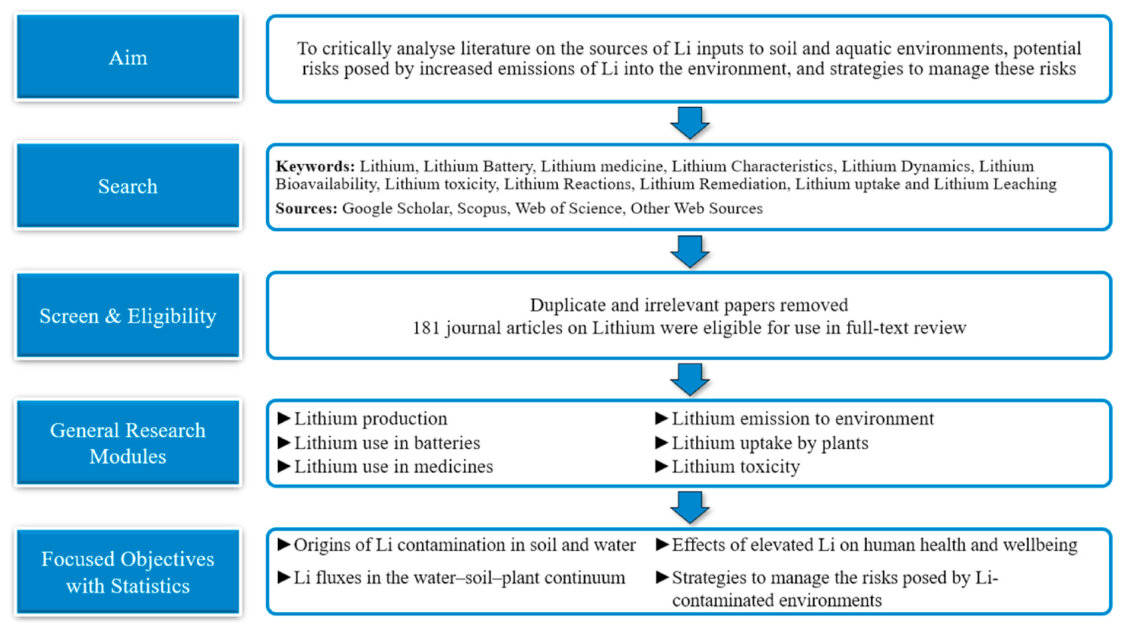
The goal of this review is to critically analyse literature on the sources of Li inputs to soil and aquatic environments, potential risks posed by increased emissions of Li into the environment, and strategies to manage these risks. Specifically, we determine the (1) origins of Li contamination in soil and water, (2) likely Li fluxes in the water–soil–- plant continuum, (3) potential effects of elevated Li on human health and wellbeing, and (4) strategies to manage the risks posed by Li-contaminated environments with a view to their eventual remediation. Literature was analysed through the databases of Google Scholar, Scopus, Web of Science and other web sources using the key words: ‘Lithium’, ‘Lithium Battery’, ‘Lithium medicine’, ‘Lithium Characteristics’, ‘Lithium Dynamics’, ‘Lithium Bioavailability’, ‘Lithium toxicity’ “Lithium Reactions’, ‘Lithium Remediation’, ‘Lithium uptake’ and ‘Lithium Leaching’. Fig. 1 depicts the article decision-making process and the scope of this review. The review aims to fill knowledge gaps about the increasing emissions of Li to soil and aquatic environments and assist in developing sustainable strategies for managing Li contamination in the environment. The review will outline areas in which more research needs to be conducted to address knowledge gaps effectively. Moreover, increased knowledge about Li dynamics in soil and aquatic environments will benefit the mining industries by changing public perception of Li contamination.
本综述旨在批判性分析有关土壤和水环境中Li输入来源、Li向环境排放增加所带来的潜在风险以及管理这些风险的策略的文献。具体而言,本文确定了:(1)土壤和水体中Li污染的来源;(2)水–土壤–植物连续体中可能的Li通量;(3)Li浓度升高对人类健康和福祉的潜在影响;(4)以最终修复为目标、管理Li污染环境所带来风险的策略。通过Google Scholar、Scopus、Web of Science数据库及其他网络资源对文献进行了分析,所用关键词为:“Lithium”、“Lithium Battery”、“Lithium medicine”、“Lithium Characteristics”、“Lithium Dynamics”、“Lithium Bioavailability”、“Lithium toxicity”、“Lithium Reactions”、“Lithium Remediation”、“Lithium uptake”和“Lithium Leaching”。图1描述了文献筛选决策过程及本综述的范围。本综述旨在填补有关Li向土壤和水环境排放不断增加的知识空白,并协助制定管理环境中Li污染的可持续策略。本综述将概述需要开展更多研究以有效填补知识空白的领域。此外,加深对土壤和水环境中Li动态的认识,将通过改变公众对Li污染的看法而使采矿业受益。
2Origin and sources of lithium contamination锂污染的起源与来源
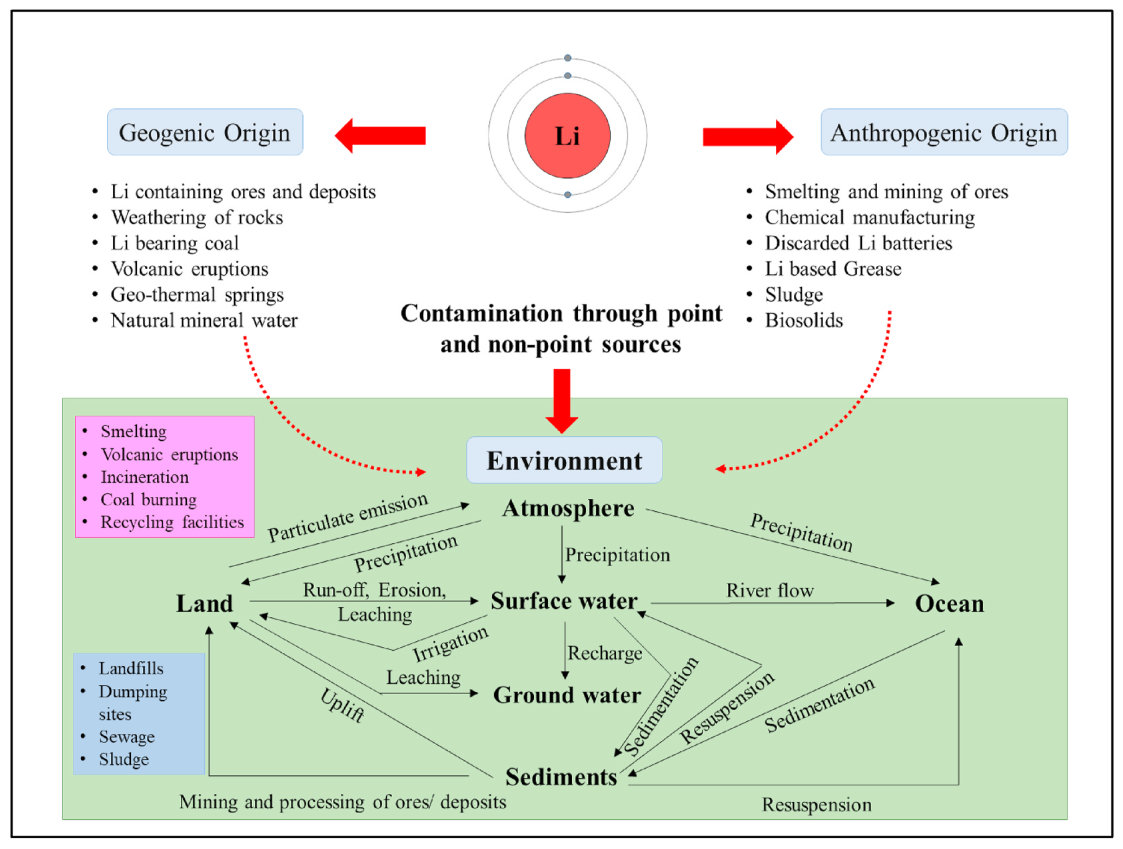
Environmental Li contamination originates mainly from geogenic and anthropogenic origin (Aral and Vecchio-Sadus, 2011), which can be further divided into point and nonpoint sources based on the exact location Li enters the environmental compartments (i.e., air, water, and soil) (Fig. 2). Point sources are when pollution occurs from a defined area, and nonpoint sources are when pollution comes from diffused places. As a reactive element, Li does not occur in its free form in nature but is predominantly associated with mineral components such as apatite or aluminium silicide (Dessemond et al., 2019; Gourcerol et al., 2019; Kesler et al., 2012; Kushnir, 2013), and various salts such as lithium carbonate (Li2CO3), lithium chloride (LiCl), and lithium hydroxide (LiOH) (Bleiwas and Coffman, 1986; Speirs et al., 2014). Furthermore, Li in aquatic marine environments can be terrigenous and authigenic (or hydrogenous) in origin (Qin et al., 2015).
环境Li污染主要来源于地质成因和人为成因(Aral and Vecchio-Sadus, 2011),根据Li进入环境介质(即大气、水体和土壤)的确切位置,又可进一步分为点源和非点源(图2)。点源是指污染来自某一确定区域,非点源是指污染来自分散的地点。作为一种活泼元素,Li在自然界中不以游离态存在,而主要与磷灰石或硅化铝等矿物组分(Dessemond et al., 2019; Gourcerol et al., 2019; Kesler et al., 2012; Kushnir, 2013)以及碳酸锂(Li2CO3)、氯化锂(LiCl)和氢氧化锂(LiOH)等各种盐类相结合(Bleiwas and Coffman, 1986; Speirs et al., 2014)。此外,海洋水环境中的Li可能为陆源成因和自生(或水成)成因(Qin et al., 2015)。
2.1. Geogenic origin2.1. 地质成因
Geogenic sources provide baseline or background levels of Li in the environment. Lithium occurs naturally, and it is mainly deposited in rocks, minerals, or mines at different concentrations (Aral and Vecchio-Sadus, 2008, 2011). Lithium is enriched in the Earth’s crust, ranging from of 20–60 mg kg− 1(0.002–0.006%) of the Earth’s crust (Danielik and Fellner, 1998), with 22, 15, 66, 15, and 5 mg kg− 1in granite, diabase, shales, sandstones, and carbonates, respectively (Mason and Moore, 1985). In soils, the highest Li concentrations occur in arid and saline soils, where Li and other salts are concentrated through surface evaporation (Merian and Clarkson, 1991).
地质来源决定了环境中Li的基线或背景水平。Li天然存在,主要以不同浓度赋存于岩石、矿物或矿床中(Aral and Vecchio-Sadus, 2008, 2011)。Li在地壳中富集,其含量为20–60 mg kg− 1(占地壳的0.002–0.006%)(Danielik and Fellner, 1998),在花岗岩、辉绿岩、页岩、砂岩和碳酸盐岩中的含量分别为22、15、66、15和5 mg kg− 1(Mason and Moore, 1985)。在土壤中,Li浓度最高的是干旱土壤和盐渍土壤,其中Li和其他盐分通过地表蒸发而浓缩(Merian and Clarkson, 1991)。
Natural weathering processes in geological deposits, hot springs arising from geothermal activities, and volcanic eruptions are the major geogenic sources releasing Li into the environment, and play an important role in balancing the global Li cycle (Robinson et al., 2018). Lithium also occurs naturally in trace amounts in freshwater, groundwater, oceans, soil, and the atmosphere and rarely occurs in elevated concentrations in water, soil, or bottom sediments. The average background Li concentration in soils is ~30 mg kg− 1(Schrauzer, 2002); however, its concentrations ranged from 0.08 up to 92 mg kg− 1in New Zealand soils (Yalamanchali, 2012). Topsoil has lower Li contents than underlying layers (Merian and Clarkson, 1991) and clay fractions have significantly higher Li contents than organic fractions (Schrauzer, 2002). Volcanic fumaroles, thermal springs, material from weathering processes, and water sourcing from rocks rich in Li or Li deposits can have higher Li concentrations than background levels (Aral and Vecchio-Sadus, 2011). For example, in Kuril Island (Russia), Li concentration up to ~927 μg L− 1was reported in the waters (rich in sulfate) of the Mendeleev volcano, while it ranged from 264 to 398 μg L− 1in the Stolbovskie springs (Aral and Vecchio-Sadus, 2011).
地质矿床的自然风化过程、地热活动形成的温泉以及火山喷发是向环境释放Li的主要地质来源,并在平衡全球Li循环中发挥重要作用(Robinson et al., 2018)。Li也以痕量天然存在于淡水、地下水、海洋、土壤和大气中,很少在水体、土壤或底部沉积物中以较高浓度出现。土壤中Li的平均背景浓度约为30 mg kg− 1(Schrauzer, 2002);然而,新西兰土壤中Li浓度范围为0.08至92 mg kg− 1(Yalamanchali, 2012)。表层土壤的Li含量低于下伏土层(Merian and Clarkson, 1991),黏粒组分的Li含量显著高于有机组分(Schrauzer, 2002)。火山喷气孔、温泉、风化过程产物以及源自富Li岩石或Li矿床的水体,其Li浓度可能高于背景水平(Aral and Vecchio-Sadus, 2011)。例如,在千岛群岛(俄罗斯),Mendeleev火山(富含硫酸盐)的水体中Li浓度高达约927 μg L− 1,而Stolbovskie温泉中Li浓度为264至398 μg L− 1(Aral and Vecchio-Sadus, 2011)。
The weathering of rocks (igneous and sedimentary) releases Li into soil (Aral and Vecchio-Sadus, 2008, 2011) and aquatic systems (Millot et al., 2010). Coarse-grained, intrusive igneous rocks, pegmatites (such as spodumene, petalite, lepidolite, amblygonite and eucryptite), and sedimentary rocks (mainly clays as hectorite and lacustrine evaporates) contain Li-bearing minerals (Gruber et al., 2011). Aral and Vecchio-Sadus (2011) reported much higher Li contents (200–500 mg kg− 1) in authigenic clays than igneous rocks (~30 mg kg− 1) and detrital clays (70–80 mg kg− 1). Lithium and Li-containing compounds are highly mobile. They can easily leach into surface- and ground-water sources (Yalamanchali, 2012), becoming highly bioavailable, and tend to bioaccumulate in certain microbiota, which could explain the high Li content in authigenic clays.
岩石(火成岩和沉积岩)风化向土壤(Aral and Vecchio-Sadus, 2008, 2011)和水生系统(Millot et al., 2010)释放Li。粗粒侵入火成岩、伟晶岩(如锂辉石、透锂长石、锂云母、锂磷铝石和锂霞石)以及沉积岩(主要为锂蒙脱石等黏土和湖相蒸发岩)中含有含Li矿物(Gruber et al., 2011)。Aral and Vecchio-Sadus(2011)报道,自生黏土中的Li含量(200–500 mg kg− 1)远高于火成岩(约30 mg kg− 1)和碎屑黏土(70–80 mg kg− 1)。Li及含Li化合物具有很高的迁移性。它们易于淋溶进入地表水和地下水源(Yalamanchali, 2012),具有很高的生物有效性,并倾向于在某些微生物群中生物累积,这可以解释自生黏土中Li含量高的原因。
Millot et al. (2010) reported that the dissolved Li content in the Mackenzie River Basin in Northwestern Canada is mainly from the silicate and carbonate weathering. Compared to carbonates, high Li concentrations (>50 mg kg− 1) are associated with silicates, because Li can strongly bind to silicate matrices. Carbonates have low Li (<1 mg kg− 1), but the high dissolution rate makes Li available in carbonate-rich regions (Millot et al., 2010). Further, high Li concentrations have been reported in carbonates precipitated from evaporated lake water; for example, 19 mg kg− 1of Li in aragonite from the Dead Sea (Aral and Vecchio-Sadus, 2011).
Millot et al.(2010)报道,加拿大西北部Mackenzie河流域的溶解态Li主要来自硅酸盐和碳酸盐风化。与碳酸盐相比,高Li浓度(>50 mg kg− 1)与硅酸盐相关,因为Li可与硅酸盐基质牢固结合。碳酸盐的Li含量较低(<1 mg kg− 1),但其较高的溶解速率使Li在富碳酸盐地区具有有效性(Millot et al., 2010)。此外,从蒸发湖水中沉淀的碳酸盐中也有高Li浓度的报道;例如,死海文石中Li含量为19 mg kg− 1(Aral and Vecchio-Sadus, 2011)。
In coal deposits, Li is enriched in extractable quantities (Qin et al., 2015). For the first time globally, Li associated ore deposits were found in coals at the Jungar Coalfield, China (Sun et al., 2010, 2012). Lithium distribution in fly and bottom ashes were similar during and after coal combustion (Qin et al., 2015). In another study, however, Bhangare et al. (2011) found that fly ash contained more Li than bottom ash. In this light, Pougnet et al. (1985) reported that fly ash samples in South Africa had Li concentrations ranging from 65 to 287 mg kg− 1.
在煤矿床中,Li富集至可开采的数量(Qin et al., 2015)。在中国准格尔煤田的煤中,全球首次发现了与Li相关的矿床(Sun et al., 2010, 2012)。在煤燃烧期间及燃烧后,Li在飞灰和底灰中的分布相似(Qin et al., 2015)。然而,在另一项研究中,Bhangare et al.(2011)发现飞灰中的Li含量高于底灰。在这方面,Pougnet et al.(1985)报道南非飞灰样品中Li浓度为65至287 mg kg− 1。
In freshwater systems, natural sources of Li in water include rock weathering (e.g., bedrock solubilization, desorption from secondary minerals containing Li), precipitation and dry deposition from the atmosphere, and groundwater input (Millot et al., 2010). However, several studies have highlighted low Li contents from natural sources. For example, the major rivers of the United States have low Li concentrations (2.0 μg L− 1) (Kszos and Stewart, 2003). Typical background concentrations of Li ranged from 1.0 to 10 μg L− 1in surface water and up to 0.5 mg L− 1in ground water (Schrauzer, 2002). However, Li levels in ground water of the South East of Ireland reached 500 mg L− 1(Kavanagh et al., 2017). In the Massif Central in France, N´egrel et al. (2010) reported fluctuating Li concentrations in ground water ranging from 0.07 μg L− 1in springs feeding a peat bog to 196 μg L− 1in a peat bog of a maar depression. Therefore, fluctuations in Li concentrations in ground water are likely affected by geological factors and hydrological regimes. Worldwide, Li concentrations in mineral water generally range from 0.05 to 1.0 mg L− 1but can reach 100 mg L− 1in some places (Schrauzer, 2002).
在淡水系统中,水体中Li的天然来源包括岩石风化(如基岩溶解、含Li次生矿物的解吸)、大气降水和干沉降以及地下水输入(Millot et al., 2010)。然而,多项研究表明天然来源的Li含量较低。例如,美国主要河流的Li浓度较低(2.0 μg L− 1)(Kszos and Stewart, 2003)。Li的典型背景浓度在地表水中为1.0至10 μg L− 1,在地下水中可达0.5 mg L− 1(Schrauzer, 2002)。然而,爱尔兰东南部地下水中的Li水平达到500 mg L− 1(Kavanagh et al., 2017)。在法国中央高原,N´egrel et al.(2010)报道地下水中Li浓度波动较大,范围从补给泥炭沼泽的泉水中的0.07 μg L− 1到低平火山口洼地泥炭沼泽中的196 μg L− 1。因此,地下水中Li浓度的波动可能受地质因素和水文状况的影响。在世界范围内,矿泉水中的Li浓度一般为0.05至1.0 mg L− 1,但在某些地方可达100 mg L− 1(Schrauzer, 2002)。
River inputs, weathering of oceanic silicates, and high-temperature hydrothermal fluxes in mid-ocean ridges are the major sources of Li enrichment in oceans (Chan et al., 2006; Misra and Froelich, 2012). Lithium is incorporated into authigenic aluminosilicate clays formed in/on the seafloor (Chan et al., 2006). Apart from the deposited fraction, the dissolved fraction of Li (0.17–0.18 mg L− 1) is homogeneously distributed throughout the oceanic water column regardless of depth and latitude (Aral and Vecchio-Sadus, 2011; Misra and Froelich, 2012; Riley and Tongudai, 1964; Thibon et al., 2021). Circulation of water from the tropics to polar regions, and vice versa, and mixing might explain the homogenous distribution of Li in oceanic water. Even though oceans have a large Li reservoir (231.4 trillion tons), recovering Li from seawater is not economically viable due to its homogeneous distribution with low Li concentration in the water (Diallo et al., 2015). Moreover, Li accumulates to high concentrations in calcareous shales and carbonates, precipitated from evaporated seawater or lagoon water (Aral and Vecchio-Sadus, 2011). Besides, brine deposits found in dry lakes (e.g., the Salar de Atacama in Chile) contain high Li concentrations (Yaksic and Tilton, 2009).
河流输入、海洋硅酸盐风化以及洋中脊高温热液通量是海洋中Li富集的主要来源(Chan et al., 2006; Misra and Froelich, 2012)。Li被结合进在海底形成的自生铝硅酸盐黏土中(Chan et al., 2006)。除沉积部分外,溶解态Li(0.17–0.18 mg L− 1)在整个海洋水柱中均匀分布,与深度和纬度无关(Aral and Vecchio-Sadus, 2011; Misra and Froelich, 2012; Riley and Tongudai, 1964; Thibon et al., 2021)。海水在热带与极地之间的往复环流及混合作用可能解释了海水中Li的均匀分布。尽管海洋拥有巨大的Li储量(231.4万亿吨),但由于其分布均匀且水中Li浓度低,从海水中回收Li在经济上并不可行(Diallo et al., 2015)。此外,Li在由蒸发海水或潟湖水沉淀形成的钙质页岩和碳酸盐中累积至高浓度(Aral and Vecchio-Sadus, 2011)。另外,干盐湖(如智利的Salar de Atacama)中发现的卤水矿床含有高浓度Li(Yaksic and Tilton, 2009)。
Sediments act as a contamination source because they can adsorb and accumulate pollutants. Further, the contamination remains for long periods, even after the pollution has declined (USEPA, 2004). Slukovskii and Svetov (2016) indicated that bottom sediments in small rivers can be used as an indicator for determining the anthropogenic status of alkali metals (including Li) in an urban, because higher concentrations of the pollutants accumulated in sediments than overlying water, with the smallest concentrations in surface water. Kjølholt et al. (2003) reported that the amount of Li accumulated in sediment from road runoff ranged from 15.5 to 16.3 mg kg− 1. Notably, the adsorption of pollutants onto suspended sediments and resuspension of adsorbed sediments in the sediment–water interface enrich the pollutants in sediments and their associated water column. A study indicated that approximately 10 mg kg− 1of Li was adsorbed onto riverbed sediments and clays (Aral and Vecchio-Sadus, 2011). Elevated levels of Li were reported in the sediments in sabkhas and evaporite deposits of lagoons (Aral and Vecchio-Sadus, 2011). Generally, the concentrations of Li, and rubidium (Rb) and caesium (Cs) in bottom sediments correlate with their contents in parent material (Kabata-Pendias and Mukherjee, 2007).
沉积物可吸附和累积污染物,因而成为污染源。此外,即使在污染减轻之后,污染仍会长期存在(USEPA, 2004)。Slukovskii and Svetov(2016)指出,小河流的底部沉积物可用作确定城市区域碱金属(包括Li)人为状况的指标,因为沉积物中累积的污染物浓度高于上覆水,而地表水中的浓度最低。Kjølholt et al.(2003)报道,道路径流沉积物中累积的Li含量为15.5至16.3 mg kg− 1。值得注意的是,污染物在悬浮沉积物上的吸附以及已吸附沉积物在沉积物–水界面的再悬浮,使污染物在沉积物及其相关水柱中富集。一项研究表明,约10 mg kg− 1的Li被吸附于河床沉积物和黏土上(Aral and Vecchio-Sadus, 2011)。据报道,萨布哈(sabkha)和潟湖蒸发岩沉积物中的Li水平较高(Aral and Vecchio-Sadus, 2011)。一般而言,底部沉积物中Li、铷(Rb)和铯(Cs)的浓度与其在母质中的含量相关(Kabata-Pendias and Mukherjee, 2007)。
Major potential natural sources of Li entering the atmosphere include dust and fumes released during volcanic eruptions and airborne soil particles (Kavanagh et al., 2018), but the subsequent wet and dry deposition and associated Li concentrations in terrestrial and aquatic ecosystems have not been studied.
Li进入大气的主要潜在天然来源包括火山喷发释放的粉尘和烟雾以及空气中的土壤颗粒(Kavanagh et al., 2018),但其随后的湿沉降和干沉降以及陆地和水生生态系统中相关的Li浓度尚未得到研究。
2.2. Anthropogenic origin2.2. 人为成因
The world’s annual consumption and demand for Li have increased significantly in recent decades and continue to rise with new technologies and growing industries (Choi et al., 2019). Worldwide Li production increased from 28,000 to 95,000 tons in 2018 (USGS, 2017, 2020). Lithium content exceeds its natural threshold level in environmental compartments mainly as a consequence of various anthropogenic activities (e.g., high consumption and improper disposal of Li based products) (Mohr et al., 2012; Winslow et al., 2018).
近几十年来,世界Li的年消费量和需求量显著增加,并随着新技术和产业的发展而持续上升(Choi et al., 2019)。全球Li产量从28,000吨增加至2018年的95,000吨(USGS, 2017, 2020)。环境介质中Li含量超过其自然阈值水平,主要是各种人为活动(如锂基产品的大量消费和不当处置)的结果(Mohr et al., 2012; Winslow et al., 2018)。
The anthropogenic use of Li-based compounds occurs in aluminium (Al) processing, chemical treatments (e.g., nano-Li concrete floor treatments, air purification, organic compounds, and as drying agents), pharmaceuticals, lubricants, Li-ion batteries (LIBs) for electrical appliances and electric vehicles, and glass and ceramic production (Hao et al., 2017; Kokkotis et al., 2017; Tanveer et al., 2019; Winslow et al., 2018). By 2025, >80% of the total Li market will be used to produce LIBs (Harper et al., 2019). Apart from Li, spent LIBs also contain other PTEs, including Co, Mn, Ni, Fe, Cu, Al, and organic compounds (Lv et al., 2018 Siqi et al., 2019; Sun et al., 2017). The PTE concentrations in LIBs are often higher than those in naturally occurring ores (Meshram et al., 2015). Furthermore, LIBs need to be replaced after 300 to 500 charge cycles or two to three years. Moreover, Li has the worst recycling recovery rate of all PTEs used in LIBs (Harper et al., 2019). Consequently, spent LIBs are a potential source of contaminants in the environment. The ultimate destinations of spent LIBs are landfills (municipal solid waste dumping sites), specialized recycling facilities, and waste-to-energy facilities (Bernardes et al., 2004). However, consumers dispose of spent LIBs in municipal solid waste due to the lack of awareness about the toxicity of spent LIBs (Aral and Vecchio-Sadus, 2008). If Li-containing wastes are disposed of in landfills or open dumps or buried in soil, the chemical content in the wastes, together with other substances, can leach into soil and contaminate surface- and ground-water sources. During the compaction process of landfills, the outer casing of batteries and other devices can be broken, or the casing can degrade chemically, releasing toxic substances to the natural environment (Li et al., 2009b; Winslow et al., 2018). Richa (2016) found that a lithium nickel manganese cobalt (NMC) oxide (LiNiMnCoO2 or Li-NMC) battery disposed into landfill could leach 42.50% Li, 11.45% Mn, and <4% of the total Co, Ni, Al, Cu, and Fe into the leachate solution. In the United States, Li-contaminated ground water at toxic levels for freshwater organisms (50–170 μg L− 1) due to improper waste disposal practices had been noticed (Kszos and Stewart, 2003).
锂基化合物的人为用途包括铝(Al)加工、化学处理(如纳米锂混凝土地坪处理、空气净化、有机化合物及用作干燥剂)、药物、润滑剂、用于电器和电动汽车的锂离子电池(LIBs)以及玻璃和陶瓷生产(Hao et al., 2017; Kokkotis et al., 2017; Tanveer et al., 2019; Winslow et al., 2018)。到2025年,Li总市场的>80%将用于生产LIBs(Harper et al., 2019)。除Li外,废旧LIBs还含有其他PTEs,包括Co、Mn、Ni、Fe、Cu、Al以及有机化合物(Lv et al., 2018 Siqi et al., 2019; Sun et al., 2017)。LIBs中的PTE浓度通常高于天然矿石(Meshram et al., 2015)。此外,LIBs在300至500次充电循环或两到三年后需要更换。而且,在LIBs所用的所有PTEs中,Li的回收率最低(Harper et al., 2019)。因此,废旧LIBs是环境中潜在的污染物来源。废旧LIBs的最终去向是填埋场(城市固体废物倾倒场)、专门的回收设施和垃圾焚烧发电设施(Bernardes et al., 2004)。然而,由于缺乏对废旧LIBs毒性的认识,消费者将废旧LIBs丢弃于城市固体废物中(Aral and Vecchio-Sadus, 2008)。如果含Li废物被弃置于填埋场或露天垃圾场或埋入土壤,废物中的化学成分连同其他物质可能淋溶进入土壤,污染地表水和地下水源。在填埋场压实过程中,电池及其他设备的外壳可能破裂,或外壳发生化学降解,从而向自然环境释放有毒物质(Li et al., 2009b; Winslow et al., 2018)。Richa(2016)发现,弃置于填埋场的锂镍锰钴(NMC)氧化物(LiNiMnCoO2或Li-NMC)电池可向渗滤液中淋溶出42.50%的Li、11.45%的Mn以及<4%的Co、Ni、Al、Cu和Fe总量。在美国,已发现因废物处置不当而导致地下水Li污染达到对淡水生物有毒的水平(50–170 μg L− 1)(Kszos and Stewart, 2003)。
Apart from landfill leachates and dumping sites, anthropogenic sources of Li that can contaminate soil, and surface- and ground-water sources include chemical manufacturing facilities, spills from manufacturing and recycling facilities, and industrial effluents (Kszos and Stewart, 2003; Winslow et al., 2018). The lubricating greases used in vehicles manufactured from LiOH⋅H2O can release Li into the environment through surface-water runoff from roads (Aral and Vecchio-Sadus, 2008; Martin et al., 2017; Yalamanchali, 2012). Agricultural and soil amendments are another potential sources of Li contamination, because biosolids (sludge) from wastewater treatment facilities are used as soil amendments (Aral and Vecchio-Sadus, 2008 Kjølholt et al., 2003). Lithium concentration in sludge from a municipal wastewater treatment facility ranged from 5.0 to 6.0 mg kg− 1(Kjølholt et al., 2003). Furthermore, composts from household and garden wastes contained nearly 4.6 mg kg− 1of Li (Kjølholt et al., 2003). However, there are no comprehensive data on the amount of Li present in composts and biosolids in various countries.
除填埋场渗滤液和倾倒场外,可污染土壤及地表水和地下水源的人为Li来源还包括化工生产设施、生产和回收设施的泄漏以及工业废水(Kszos and Stewart, 2003; Winslow et al., 2018)。由LiOH⋅H2O制造的车用润滑脂可通过道路地表径流向环境释放Li(Aral and Vecchio-Sadus, 2008; Martin et al., 2017; Yalamanchali, 2012)。农业及土壤改良剂是Li污染的另一潜在来源,因为污水处理设施产生的生物固体(污泥)被用作土壤改良剂(Aral and Vecchio-Sadus, 2008 Kjølholt et al., 2003)。某城市污水处理设施污泥中的Li浓度为5.0至6.0 mg kg− 1(Kjølholt et al., 2003)。此外,由生活和园林废弃物制成的堆肥含Li近4.6 mg kg− 1(Kjølholt et al., 2003)。然而,关于各国堆肥和生物固体中Li含量尚无全面的数据。
In a riverine system, Li contamination can occur through geogenic sources, such as leaching from natural weathering of silicate rocks and minerals (Millot et al., 2010). Anthropogenic activities from urban areas and industries are also responsible for increased Li content in rivers and other water bodies (Choi et al., 2019). Urban runoff is a significant source of Li pollution. Many substances deposited on surface materials are washed off and transported to nearby drainage systems and water bodies. Choi et al. (2019) showed that the downstream area of the Han River in Seoul (South Korea) contained a high Li concentration (1.57 mg L− 1) compared to the upstream area (0.28 mg L− 1), due to pollution from LIBs, therapeutic drugs in hospital waste, and food waste from households and industries. Tap water for human consumption was also contaminated with Li because it came from the Han River. The Li contamination was aggravated due to the inefficiency of wastewater treatment processes for Li removal. Indeed, Li concentration was not significantly different between influent and effluent wastewaters (Choi et al., 2019). In the USA, the Environmental Protection Agency (EPA) has regulated Li regional screening level of 40 μg L− 1for residential tap waters (Winslow et al., 2018).
在河流系统中,Li污染可通过地质来源发生,如硅酸盐岩石和矿物自然风化产生的淋溶(Millot et al., 2010)。城市地区和工业的人为活动也导致河流及其他水体中Li含量增加(Choi et al., 2019)。城市径流是Li污染的重要来源。沉积在地表材料上的许多物质被冲刷并输送至附近的排水系统和水体。Choi et al.(2019)表明,由于LIBs、医院废物中的治疗药物以及家庭和工业食物垃圾造成的污染,首尔(韩国)汉江下游区域的Li浓度(1.57 mg L− 1)高于上游区域(0.28 mg L− 1)。由于取自汉江,供人类饮用的自来水也受到了Li污染。污水处理工艺对Li去除效率低下加剧了Li污染。事实上,进水与出水中的Li浓度并无显著差异(Choi et al., 2019)。在美国,环境保护署(EPA)规定住宅自来水的Li区域筛选水平为40 μg L− 1(Winslow et al., 2018)。
Annually, more than 600,000 tons of Li are extracted from ore deposits (e.g., spodumene, lepidolite, petalite, amblygonite, and zinnwaldite) and mineralized zones (USGS, 2017), which are circulated in the environment, with around 9510 tons of Li assumed to end up as wastes (Peiro et al., 2013´). Therefore, mining, smelting, and foundries are point sources for major Li contamination during the exploitation and processing of ore deposits (Tanveer et al., 2019). Processing ore results in the disposal of tailings and discharge of tailing effluents containing Li, contaminating all three compartments of the environment, i.e., air, water, and soil. Moreover, tailing water is repeatedly used without any additional treatment intensifying the dissolved Li content in water systems (Shah et al., 2016). Finely ground Li minerals (e.g., Li-containing phosphate ores) are more readily dissolved in water due to their increased surface area (Aral and Vecchio-Sadus, 2008). Aral and Vecchio-Sadus (2011) reported that Li mineral beneficiation plants had high concentrations of Li (>15 mg L− 1) dissolved in tailing water. Figueroa et al. (2012) mentioned that Li contents in surface-water sources of northern Chile were remarkably high due to the presence of ores from actively mined areas. Lithium is also present as a trace metal impurity in minerals such as feldspars, micas, and illites (Scott and Smith, 1987). Therefore, Li can also enter the environment through waste-rock dumps and mine drainage (Kavanagh et al., 2018).
每年有超过600,000吨Li从矿床(如锂辉石、锂云母、透锂长石、锂磷铝石和铁锂云母)及矿化带中开采出来(USGS, 2017),并在环境中循环,其中约9510吨Li被认为最终成为废物(Peiro et al., 2013´)。因此,在矿床开采和加工过程中,采矿、冶炼和铸造是造成重大Li污染的点源(Tanveer et al., 2019)。矿石加工导致尾矿的处置和含Li尾矿废水的排放,污染了环境的全部三个介质,即大气、水体和土壤。此外,尾矿水未经任何额外处理而被反复使用,加剧了水系统中的溶解态Li含量(Shah et al., 2016)。磨细的Li矿物(如含Li磷酸盐矿石)由于比表面积增大而更易溶于水(Aral and Vecchio-Sadus, 2008)。Aral and Vecchio-Sadus(2011)报道,Li矿物选矿厂的尾矿水中溶解有高浓度的Li(>15 mg L− 1)。Figueroa et al.(2012)提到,由于存在活跃开采区的矿石,智利北部地表水源中的Li含量异常高。Li还以痕量金属杂质的形式存在于长石、云母和伊利石等矿物中(Scott and Smith, 1987)。因此,Li也可通过废石堆和矿山排水进入环境(Kavanagh et al., 2018)。
Anthropogenic sources of Li emission into the atmosphere include the burning of coal enriched with Li, dust, and minute particles released during ore-processing activities, domestic e-waste from recycling centres, and during waste incineration (Bernardes et al., 2004; Li et al., 2010; Winslow et al., 2018). Dai et al. (2010) found that the volatile loss of Li during the combustion of coal was less than 5%. Nevertheless, once in the atmosphere, Li can be condensed on fine particles and transported by wind over long distances, and may contribute to the deposition of Li in terrestrial and aquatic environments.
Li向大气排放的人为来源包括富Li煤的燃烧、矿石加工活动中释放的粉尘和微细颗粒、回收中心的生活电子废物以及废物焚烧过程(Bernardes et al., 2004; Li et al., 2010; Winslow et al., 2018)。Dai et al.(2010)发现,煤燃烧过程中Li的挥发损失不到5%。尽管如此,Li一旦进入大气,便可凝结在细颗粒上并随风长距离迁移,并可能促进Li在陆地和水生环境中的沉降。
3Distribution and speciation of lithium in the environment锂在环境中的分布与形态
The environmental chemistry of Li has received much attention due to its numerous and important applications for green energy and the automotive and health sectors (N´egrel et al., 2017). Additionally, Li’s stable isotope structure plays a vital role in gathering quantitative geochemical information about various Earth processes (i.e., sediment recycling, global chemical weathering, carbon cycling, hydrothermal alteration, and groundwater evolution) (N´egrel et al., 2010).
由于Li在绿色能源、汽车和卫生领域具有众多重要应用,其环境化学受到广泛关注(N´egrel et al., 2017)。此外,Li的稳定同位素结构在获取有关各种地球过程(即沉积物再循环、全球化学风化、碳循环、热液蚀变和地下水演化)的定量地球化学信息方面发挥着重要作用(N´egrel et al., 2010)。
3.1. Distribution in soils and sediments3.1. 在土壤和沉积物中的分布
Lithium is often found in traces in soils (Table 1). Lithium is widely distributed in sedimentary rocks and released into soil through the weathering process (Aral and Vecchio-Sadus, 2008; Chan et al., 1997). Topsoil usually contains less Li due to the interaction of plant roots, i.e., plant uptake (Yalamanchali, 2012). Arid and saline soils generally contain higher background soil Li concentrations than other soils, due to the selective concentration of alkaline metals, including Li, Na, and K (Yalamanchali, 2012; Hayyat et al., 2021). Lithium concentration in the clay fraction was reported ranging from 7 to 200 mg kg− 1(Schrauzer, 2002). In soils with high salt content, such as sodic and saline soils, Li concentrations can exceed 200 mg kg− 1(Yalamanchali, 2012). Lithium can replace Al in montmorillonite, and Mg in several minerals due to the similar size of their atomic radii (90 and 86 pm (pm), respectively) (Mason and Moore, 1985). Clay minerals characteristically concentrate Li (Anderson et al., 1988), retaining significantly more than other inorganic soil fractions (Schrauzer, 2002). Anderson et al. (1988) suggested that Li may be present in ditrigonal cavities of clay minerals.
Li在土壤中通常以痕量存在(表1)。Li广泛分布于沉积岩中,并通过风化过程释放到土壤中(Aral and Vecchio-Sadus, 2008; Chan et al., 1997)。由于植物根系的相互作用(即植物吸收),表层土壤通常含Li较少(Yalamanchali, 2012)。由于包括Li、Na和K在内的碱金属的选择性浓缩,干旱和盐渍土壤的Li背景浓度一般高于其他土壤(Yalamanchali, 2012; Hayyat et al., 2021)。据报道,黏粒组分中的Li浓度为7至200 mg kg− 1(Schrauzer, 2002)。在钠质土和盐渍土等高盐分土壤中,Li浓度可超过200 mg kg− 1(Yalamanchali, 2012)。由于原子半径相近(分别为90和86 pm(皮米)),Li可替代蒙脱石中的Al以及若干矿物中的Mg(Mason and Moore, 1985)。黏土矿物具有富集Li的特性(Anderson et al., 1988),其保留的Li显著多于其他土壤无机组分(Schrauzer, 2002)。Anderson et al.(1988)认为Li可能存在于黏土矿物的复三方孔穴中。
Selected references on lithium concentrations in soil, water, and sediment.
土壤、水体和沉积物中锂浓度的部分参考文献。
| A. Li concentratioA. 不同土壤中的 | ns in different soilsLi浓度 | ||
|---|---|---|---|
| Locations and soil depth | Soil type | Total Li concentration (mean) (mg kg−1) | Reference |
| Lincoln | Templeton silt loam | 31.8 | Robinson |
| University dairy farm, | et al. (2018) | ||
New Zealand | |||
0–20 cm | |||
| Jiajika rare metal minin | Not available | 169.5 | Xu et al. (2019) |
| g area, China 10–25 cm | |||
| Weinan, China | Not available | 28.1 | Tsai et al. |
| 0–14 m Nearby desert areas | Mud crust | 24.3 | (2014) |
020 | |||
| –cm Transbaikal | Gray forest soil | 25.1 | Kashin (2019) |
| region, The | |||
Republic of | |||
| Buryatia 0–20 cm | |||
Cecil, | Clayey, kaolinitic | 11.49 | Anderson |
| Iredell, | Fine, montmorillonotic | 25.38 | et al. (1988) |
| Madison, | Clayey, kaolinitic | 11.93 | |
| Louisa, | Fine, montmorillonotic | 33.29 | |
| Wakulla; and | Sandy, siliceous | 5.82 | |
| Bonifay, USA | Loamy, siliceous | 3.74 | |
| Soil depth: not available | |||
Jordan Valley | Ustochreptic and | Mean soluble Li | Ammari et al. |
| (JV); | ustollic camborthids | concentration | (2011) |
| Northern JV; | and calciorthids, ustic | ranged from 1.04 to | |
Middle JV; and | torriorthents | 268 m L−1; | |
South JV, | . g Soluble Li | ||
| Jordan | concentration in | ||
| 0–20 cm | subsoil layer was | ||
| (topsoil) 20–40 cm | relatively higher than that of topsoil | ||
| (subsoil) | layer. | ||
| B. Li concentratio | ns in different water bodies | ||
Location of | Water body | Li concentration | Reference |
| water sample | (Mean) | ||
| Tibetan Plateau, | Lake Donggi Cona | 4.6–5.7μmol L−1 | Weynell et al. |
| China | Dongqu River Yellow River | 1.2–1.8μmol L−1 8.3–8.6μmol L−1 1 | (2017) |
| Stream | 2.8–5.2μmol L− | ||
| Spring | 2.9μmol L−1 | ||
Pond | 57–93μmol L−1 | ||
Hot spring Wenquan | .. 103.1–135.2μmol −1 | ||
| Stillwater | Wetland | L _>_1000μg L−1 | Hallock |
| Wildlife Management | (1993) | ||
| Area in | |||
Nd USA | |||
| evaa, Abia and Imo | Springs | 2.49μg L−1 | Ewuzie et al. |
| States, | Streams | 1.58μg L−1 | (2020) |
Southeast | |||
Nigeria | |||
| Public supply | Groundwater | _<_1–396μg L−1 | Lindsey et al. |
wells | _<_1–1700μg L−1 | (2021) | |
| Domestic supply wells Across USA | |||
h | d | 11 l | |
| Norteast Iceland | Grounwater | 30–0,000 nmo L−1 | von Strandmann |
| River | 116–237 nmol L−1 | et al. (2016) | |
| Changjiang, | River | 1260 nmol L−1 | Wang et al. |
| China North Atlantic | Sea water | 0.22 ppm | (2015) |
(continued on next page)
(续下页)
| A. Li concentrationA. 不同土壤中的Li浓度 | s in different soils | ||
|---|---|---|---|
| Locations and soil depth | Soil type | Total Li concentration (mean) (mg kg−1) | Reference |
| Japan | Coastal Water | 1.173 ppm | Choubey et al. |
| India Ocean | Coastal Water | 0.160 ppm | (2017) |
| North Sea | Sea water | 0.1 ppm | |
| C. Li concentration | s in sediment | ||
| Location of | Sediment | Li concentration | Reference |
| sediment sample | (range/mean) (mg kg−1) | ||
| China | Top catchment sediment | 5.37–400 | Liu et al. (2020) |
| Deep catchment sediment | 5.27–400 | ||
| Patos Lagoon, Brazil | Lagoon sediments | 10.05–61.61 | Niencheski et al. (2002) |
| Aegean Sea, Greece | Coastal sediments | 9.74–37.1 | Aloupi and Angelidis (2001) |
| Costa Rica | Subduction zone sediments | 0.50–78.09 | Chan and Kastner (2000) |
| Mariana Island Arc | Subduction zone sediments | 7.3–50.8 | Bouman et al. (2004) |
| South Sandwich Island Arc | 6.2–57.3 | ||
| East Sunda Island Arc | 2.4–41.9 | ||
| Lesser Antilles Island Arc | 35.2–74.3 | ||
| Mackenzie | River sediments | 57.8 | Millot et al. |
| tributary | (2010) | ||
| Red Arctic tributary | 56.8 | ||
| Liard tributary | 46.1 | ||
| Slave tributary | 41.2 | ||
| Canada | |||
| Loire River | River sediments | 41–73 | Millot and |
| Basin, France | N´egrel (2021) | ||
| Dongqu River | River sediments | 14.7–44.9 | Weynell et al. |
| Lake Donggi Cona | Lake sediments | 52.2 | (2017) |
| Tibetan Plateau, China |
Anderson et al. (1988) studied Li distribution in different layers of Bonifay soils. The authors determined that the concentrations (both total and exchangeable forms) of Li are directly proportional to depth, with the top 60 cm of soil profile containing the lowest Li content. Increasing Li concentrations with depth are likely due to the increase in clay minerals. Clay minerals can include Li through isomorphous substitution, where the structural cations present in the tetrahedral and octahedral sheets in clay minerals are likely substituted by cations with a similar charge and ionic radius (Anderson et al., 1988; Bolan et al., 1999).
Anderson et al.(1988)研究了Bonifay土壤不同土层中的Li分布。作者确定Li的浓度(全量和交换态)与深度成正比,土壤剖面顶部60 cm的Li含量最低。Li浓度随深度增加可能是由于黏土矿物的增加。黏土矿物可通过类质同象置换容纳Li,即黏土矿物四面体片和八面体片中的结构阳离子可能被电荷和离子半径相近的阳离子所取代(Anderson et al., 1988; Bolan et al., 1999)。
Lithium is taken up by all plants, although the element appears not to be essential for their growth and development (Shahzad et al., 2016). Schrauzer (2002) and Lenntech (2007) reported that Li stimulates plant growth. Plants generally have 0.2–30 mg kg− 1Li depending on their preferential uptake or exclusion of available Li in soils. For instance, in soil spiked with 5 mg kg− 1Li, the amount of Li taken up by plants and stored in leaves was up several hundred mg kg− 1, without any loss in the plant biomass (Robinson et al., 2018).
所有植物都会吸收Li,尽管该元素对植物的生长发育似乎并非必需(Shahzad et al., 2016)。Schrauzer(2002)和Lenntech(2007)报道Li可促进植物生长。根据植物对土壤中有效Li的优先吸收或排斥,植物中Li含量一般为0.2–30 mg kg− 1。例如,在添加5 mg kg− 1Li的土壤中,植物吸收并储存于叶片中的Li量高达数百mg kg− 1,而植物生物量并未减少(Robinson et al., 2018)。
Robinson et al. (2018) observed a strong positive relationship between Li and Al, B, Fe, K, Mg, Mn, and Zn in soil. In contrast to other cations in soil, Li is relatively mobile; it can therefore be taken up by plants or leached into receiving waters (Robinson et al., 2018). Much like other PTE cations, the soil adsorption coefficient (Kd) increased exponentially with increasing pH and decreased with increasing Li concentration (Robinson et al., 2018). For example, Li and Liu (2020) found that the sorption of Li onto kaolinite is pH-dependent, and the adsorbed Li proportion increased with an increase in pH from 3 to 10.
Robinson et al.(2018)观察到土壤中Li与Al、B、Fe、K、Mg、Mn和Zn之间存在强正相关关系。与土壤中的其他阳离子相比,Li的迁移性相对较强;因此可被植物吸收或淋溶进入受纳水体(Robinson et al., 2018)。与其他PTE阳离子类似,土壤吸附系数(Kd)随pH升高呈指数增加,并随Li浓度升高而降低(Robinson et al., 2018)。例如,Li and Liu(2020)发现Li在高岭石上的吸附具有pH依赖性,随着pH从3升至10,被吸附Li的比例增加。
N´egrel et al. (2017) investigated Li distribution in agricultural and grazing-land soils from 33 European countries spanning more than 5.6 million km2in different climate zones and landscapes. The authors reported a mean Li concentration in these soils of 11.4 mg kg− 1, about one-fourth of that in the Earth’s upper continental crust (41 mg kg− 1). In addition, northern Europe soils had predominantly low Li concentrations (median 6.4 mg kg− 1), and southern Europe soils had significantly higher values (median 15 mg kg− 1) (N´egrel et al., 2017). In southern Europe, climate (e.g., temperature and precipitation) increased weathering, accounting for the secondary Li enrichment in the region, with high Li concentrations observed in limestone areas. The spatial variance in Li concentration across Europe was also associated with parent materials and their weathering products (N´egrel et al., 2017).
N´egrel et al.(2017)调查了来自33个欧洲国家、覆盖超过5.6百万km2、分布于不同气候带和景观的农业和放牧地土壤中的Li分布。作者报道这些土壤的平均Li浓度为11.4 mg kg− 1,约为地球上部大陆地壳(41 mg kg− 1)的四分之一。此外,北欧土壤的Li浓度以低值为主(中位数6.4 mg kg− 1),而南欧土壤的数值显著较高(中位数15 mg kg− 1)(N´egrel et al., 2017)。在南欧,气候(如温度和降水)增强了风化作用,这是该地区Li次生富集的原因,石灰岩地区观测到较高的Li浓度。欧洲范围内Li浓度的空间差异还与母质及其风化产物有关(N´egrel et al., 2017)。
Hydrated cations tend to sorb to surfaces of soil- and sediment- (in aquatic systems) colloids with a binding strength proportional to the quotient of their charge or hydrated ionic radius (Sposito, 2008). Table 2 shows that Li+ has weaker binding strength than all other metals present in soil solution. There are considerable energy differences between the bonding orbitals on Li+ and the corresponding orbitals on various functional groups of soil colloids or aquatic sediments (Cotton and Wilkinson, 1980). It is, therefore, unlikely that any significant covalent inner-sphere bonding of Li+ by the functional groups of soil colloids. Robinson et al. (2018) reported that Li+, when added to soil, is more mobile than other trace elements, with typical Kdvalues ranging from <1 to 10. As with other soluble cations primarily sorbed via outer-sphere processes, the Kd value for Li+ was found to increase with enhancing pH and decrease with increasing ionic strength.
水合阳离子倾向于吸附于土壤胶体和(水生系统中)沉积物胶体表面,其结合强度与其电荷和水合离子半径之商成正比(Sposito, 2008)。表2表明,Li+的结合强度弱于土壤溶液中存在的所有其他金属。Li+上的成键轨道与土壤胶体或水体沉积物各种官能团上相应轨道之间存在相当大的能量差异(Cotton and Wilkinson, 1980)。因此,土壤胶体官能团不太可能与Li+形成任何显著的共价内圈键合。Robinson et al.(2018)报道,Li+添加到土壤中后,其迁移性强于其他微量元素,典型Kd值范围为<1至10。与其他主要通过外圈过程吸附的可溶性阳离子一样,Li+的Kd值随pH升高而增加,随离子强度增大而降低。
In contrast to ionic Li+ introduced through Li compounds, geogenic Li present in clay minerals is sparingly soluble. The Kdof geogenic Li ranges from 200 to 500 (Mili´cevi´c et al., 2018; Robinson et al., 2018), indicating that Li is essentially immobile in aluminosilicate lattices and enters soil solution gradually from the weathering of sedimentary minerals and phyllosilicate clays (Aral and Vecchio-Sadus, 2008; Chan et al., 1997).
与通过Li化合物引入的离子态Li+不同,黏土矿物中的地质成因Li难溶。地质成因Li的Kd为200至500(Mili´cevi´c et al., 2018; Robinson et al., 2018),表明Li在铝硅酸盐晶格中基本不迁移,并通过沉积矿物和层状硅酸盐黏土的风化逐渐进入土壤溶液(Aral and Vecchio-Sadus, 2008; Chan et al., 1997)。
Charge and hydrated ionic radii of lithium and other significant cations in soil, ranked in order of selectivity for outer sphere binding.
锂及土壤中其他重要阳离子的电荷和水合离子半径,按外圈结合选择性排序。
| Elements元素 | Ionic radius hydrated (pm)水合离子 半径(pm) | Charge/hydrated radius (e pm−1)电荷/水合 半径(e pm−1) | References参考文献 |
|---|---|---|---|
| Al3+ | 480 | 6.25×10⁻³ | (Israelachvili, 2011;Volkov |
| Pb2+ | 401 | 4.99×10⁻³ | et al., 1997;Wiberg, 2001) |
| Ca2+ | 412 | 4.85×10⁻³ | |
| Cd2+ | 426 | 4.69×10⁻³ | |
| Mg2+ | 428 | 4.67×10⁻³ | |
| Zn2+ | 430 | 4.65×10⁻³ | |
| K+ | 331 | 3.02×10⁻³ | |
| Na+ | 360 | 2.78×10⁻³ | |
| Li+ | 382 | 2.62×10⁻³ |
Lithium is also found in sediments of water bodies such as lakes, rivers and marine (Chan et al., 2006; Weynell et al., 2017). Sedimentary sources of Li originate when Li is slowly washed out of volcanic minerals into basins, where the element reacts with other minerals in water bodies. In addition, water-rock interactions within water bodies, soil erosion and wet and dry depositions are also sources of Li in sediments. Lithium in sediments is mainly bound to Fe–Mn oxide and residual fractions (Li et al., 2021). Generally, Li concentrations in sediments are higher than those in the continental crust, indicating that Li is enriched during sediment formation (Liu et al., 2020). Various factors such as water flow, ionic strength, and rock types affect level and composition of Li in sediments (Li et al., 2021; Liu et al., 2020).
Li也存在于湖泊、河流和海洋等水体的沉积物中(Chan et al., 2006; Weynell et al., 2017)。当Li从火山矿物中被缓慢淋洗进入盆地,并在水体中与其他矿物发生反应时,便形成了Li的沉积来源。此外,水体中的水–岩相互作用、土壤侵蚀以及湿沉降和干沉降也是沉积物中Li的来源。沉积物中的Li主要与Fe–Mn氧化物结合态和残渣态结合(Li et al., 2021)。一般而言,沉积物中的Li浓度高于大陆地壳,表明Li在沉积物形成过程中发生了富集(Liu et al., 2020)。水流、离子强度和岩石类型等多种因素影响沉积物中Li的水平和组成(Li et al., 2021; Liu et al., 2020)。
Several Li fractions, which differ in their mobility and interaction, are incorporated in soil and sediment components. Lithium existing in soil and sediment matrices include exchangeable (mainly carbonate phases), oxidizable (sulfides and organic matter), reducible (Fe/Mn (hydro)-oxides), and residual (silicate phases) fractions. The Community Bureau of Reference (BCR) sequential extraction protocols are commonly used to study speciation of metals, including Li, in soils and sediments (Kumkrong et al., 2021; Tong et al., 2020). For instance, Li et al. (2020) studied Li distribution in a shallow arid regolith using this sequential extraction. The residual fractions ranged from 59 to 84% of total Li while the exchangeable fractions contained the lowest Li content (<2%). The oxidizable fractions and reducible fractions accounted for 1–5% and 3–28%, respectively.
土壤和沉积物组分中结合有若干Li组分,其迁移性和相互作用各不相同。土壤和沉积物基质中存在的Li包括可交换态(主要为碳酸盐相)、可氧化态(硫化物和有机质)、可还原态(Fe/Mn(氢)氧化物)和残渣态(硅酸盐相)。欧共体参考物质局(BCR)连续提取方案常用于研究土壤和沉积物中包括Li在内的金属形态(Kumkrong et al., 2021; Tong et al., 2020)。例如,Li et al.(2020)采用该连续提取法研究了干旱区浅层风化层中的Li分布。残渣态占总Li的59%至84%,而可交换态的Li含量最低(<2%)。可氧化态和可还原态分别占1–5%和3–28%。
3.2. Distribution in aquatic environments3.2. 在水环境中的分布
In natural waters, Li concentrations are correlated with other alkali metals, particularly Na. In freshwater systems, the average Li concentration is relatively low (<3 μg L− 1) in comparison to other alkali metals (e.g., Na, K) (Mason and Moore, 1985). Higher concentrations occur in streams and lakes surrounded by Li-rich rocks and soils (Kavanagh et al., 2017) (Table 1). As with Na, Li concentrations are orders of magnitude higher in sea water (170–190 μg L− 1) than in fresh water (0.07–40 μg L− 1) (Mason and Moore, 1985). Lithium is often found in trace concentrations in surface- and ground-water sources (Aral and Vecchio-Sadus, 2008). As a highly soluble ion, Li in water systems is primarily present as ions. Due to its low concentration in the natural environment, Li does not usually cause any detrimental effects to the environment. In hydrological studies, LiCl is often used to trace streams due to its highly soluble and chemically inert characteristics. Unlike Na and K that account for >2% of the Earth’s crust, Li only accounts for 0.0065% (Hou et al., 2014; Tarascon, 2010).
在天然水体中,Li浓度与其他碱金属,尤其是Na相关。在淡水系统中,与其他碱金属(如Na、K)相比,Li的平均浓度相对较低(<3 μg L− 1)(Mason and Moore, 1985)。被富Li岩石和土壤包围的溪流和湖泊中Li浓度较高(Kavanagh et al., 2017)(表1)。与Na一样,海水中的Li浓度(170–190 μg L− 1)比淡水(0.07–40 μg L− 1)高出几个数量级(Mason and Moore, 1985)。Li在地表水和地下水源中通常以痕量浓度存在(Aral and Vecchio-Sadus, 2008)。作为一种高度可溶的离子,水系统中的Li主要以离子形式存在。由于其在自然环境中浓度较低,Li通常不会对环境造成任何不利影响。在水文研究中,由于LiCl具有高溶解性和化学惰性,常被用于示踪河流。与占地壳>2%的Na和K不同,Li仅占0.0065%(Hou et al., 2014; Tarascon, 2010)。
Whereas the naturally occurring Li concentration in surface waters is generally less than 0.04 mg L− 1, its concentration is elevated in Li-contaminated water bodies (Emery et al., 1981; Hill and Gilliom, 1993; Mathis and Cummings, 1973; Tanner, 1995). Only few studies reported Li concentration in drinking water, with values ranging from 1.0 to 10 μg L− 1(Anderson et al., 1988; Choi et al., 2019; Durfor and Becker, 1964; Sievers and Cannon, 1975).
天然地表水中的Li浓度一般低于0.04 mg L− 1,而在受Li污染的水体中其浓度升高(Emery et al., 1981; Hill and Gilliom, 1993; Mathis and Cummings, 1973; Tanner, 1995)。仅有少数研究报道了饮用水中的Li浓度,其值为1.0至10 μg L− 1(Anderson et al., 1988; Choi et al., 2019; Durfor and Becker, 1964; Sievers and Cannon, 1975)。
4Bioavailability and toxicity of lithium to biota, including humans锂对包括人类在内的生物群的生物有效性和毒性
4.1. Toxicity to microorganisms and plants4.1. 对微生物和植物的毒性
Lithium is considered toxic to organisms at high concentrations. However, application of Li2O nanoparticles and Li + ions to soil at 500 mg kg− 1increased methane, nitrous oxide, and carbon dioxide emissions (Avila-Arias et al., 2019), paradoxically indicating some stimulatory effect of the compound on soil respiration, possibly due to an increase in soil pH. These results also indicate that Li is relatively non-toxic to soil microorganisms (Avila-Arias et al., 2019). In contrast, high Li concentrations impede plant growth; Li phytotoxicity greatly depends on plant species and type of Li salt. Plants can take up Li in soil; Li contents in plants grown in uncontaminated soils can be as low as a few mg kg− 1dry weight. For example, Li contents in plants grown in uncontaminated pasture soils in Western Transbaikalia (Russia) and New Zealand were 2–4 mg kg− 1and 1.5 mg kg− 1(dry weight), respectively (Kashin, 2019; Robinson et al., 2018). Leaves of pepper, cucumber, potato, and citrus from the Jordan Valley contained foliar Li concentrations of 5–30 mg kg− 1(Ammari et al., 2011). Given the relatively low solubility of geogenic Li in uncontaminated soil (<0.1 mg L− 1), these results indicate that Li in soil solution is readily taken up by plants.
Li在高浓度下被认为对生物体有毒。然而,以500 mg kg− 1向土壤施加Li2O纳米颗粒和Li +离子增加了甲烷、氧化亚氮和二氧化碳的排放(Avila-Arias et al., 2019),这反而表明该化合物对土壤呼吸具有一定的刺激作用,可能是由于土壤pH升高所致。这些结果还表明Li对土壤微生物相对无毒(Avila-Arias et al., 2019)。相反,高浓度Li会阻碍植物生长;Li的植物毒性在很大程度上取决于植物种类和Li盐类型。植物可吸收土壤中的Li;生长在未污染土壤中的植物Li含量可低至数mg kg− 1干重。例如,生长在俄罗斯西外贝加尔地区和新西兰未污染牧场土壤中的植物Li含量分别为2–4 mg kg− 1和1.5 mg kg− 1(干重)(Kashin, 2019; Robinson et al., 2018)。约旦河谷的辣椒、黄瓜、马铃薯和柑橘叶片中Li浓度为5–30 mg kg− 1(Ammari et al., 2011)。鉴于未污染土壤中地质成因Li的溶解度相对较低(<0.1 mg L− 1),这些结果表明土壤溶液中的Li易被植物吸收。
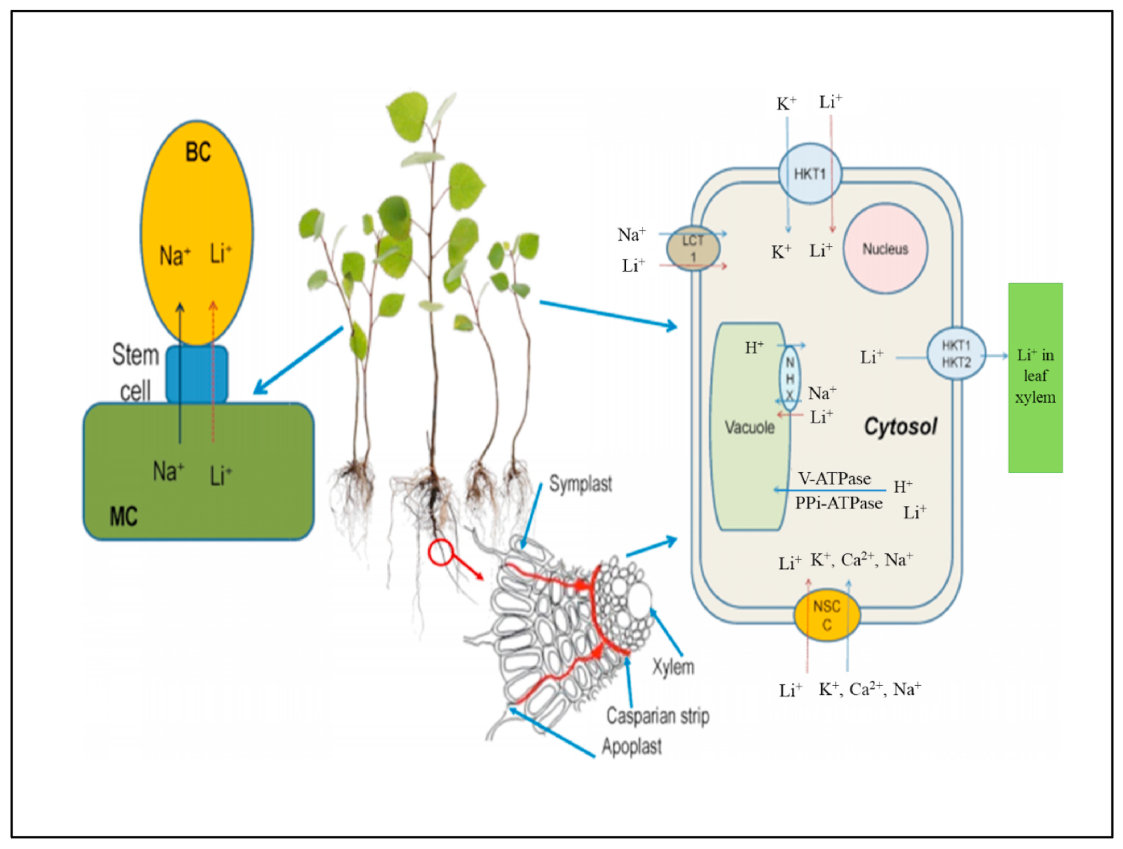
Lithium can enter plant roots via the apoplastic and symplastic pathways (Tanveer et al., 2019) (Fig. 3), and its entry can be facilitated by the non-specificity of uptake pathways for similarly sized ions such as Mg2+ (Reid and Hayes, 2003). In soils where Li+ has been added, bioaccumulation coefficients of >10 have been reported for perennial ryegrass, sunflower (Robinson et al., 2018), lettuce, buckwheat, and maize (Franzaring et al., 2016). Plant uptake of Li could be limited only by the tolerance of plants to Li. In perennial ryegrass and lettuce, Li contents (up to 1000 mg kg− 1) in the plant tissue were reported with little effect on biomass (Kalinowska et al., 2013; Robinson et al., 2018). Sword-leaf dogbane, used in Chinese medicine, can accumulate >1800 mg kg− 1Li (Jiang et al., 2014). The low plant toxicity of Li combined with high bioaccumulation coefficients indicates that plants will afford little food-chain protection from Li contamination compared to other soil contaminants (Chaney, 1980; Henschel et al., 2020; Hayyat et al., 2021).
Li可通过质外体和共质体途径进入植物根系(Tanveer et al., 2019)(图3),而吸收途径对Mg2+等尺寸相近离子的非特异性可促进其进入(Reid and Hayes, 2003)。在添加了Li+的土壤中,已报道多年生黑麦草、向日葵(Robinson et al., 2018)、生菜、荞麦和玉米(Franzaring et al., 2016)的生物累积系数>10。植物对Li的吸收可能仅受植物对Li耐受性的限制。据报道,多年生黑麦草和生菜植物组织中的Li含量(高达1000 mg kg− 1)对生物量影响甚微(Kalinowska et al., 2013; Robinson et al., 2018)。用于中药的剑叶罗布麻可累积>1800 mg kg− 1的Li(Jiang et al., 2014)。Li的低植物毒性加上高生物累积系数表明,与其他土壤污染物相比,植物对Li污染几乎无法提供食物链保护(Chaney, 1980; Henschel et al., 2020; Hayyat et al., 2021)。
Although Li is not considered to be essential for plants, some studies have indicated that deficiency of this element affects plant growth and development (Shahzad et al., 2016). Lithium reduces plant morphological and physiological growth by altering plant metabolism, such as developing necrotic spots due to ethylene accumulation (Naranjo et al., 2003), reducing enzyme activities during pollen development (Gumber et al., 1984), and altering gravi-trophism in plant roots (Mulkey, 2007). Lithium also affects plant metabolism in different organelles (e.g., mitochondria, peroxisomes, and chloroplasts) (Qiao et al., 2018), and its impact is considered non-specific because Li is able to substitute other important monovalent cations (e.g., Na+, K+) in plant cells (Kabata-- Pendias and Mukherjee, 2007). Lithium inhibits inositol monophosphatases and calcium signalling at high concentrations by interfering with the activity of inositol monophosphatases and dephosphorylation of inositol-1-phosphate (Baran, 2019; Murry et al., 2019).
尽管Li不被认为是植物必需元素,但一些研究表明该元素的缺乏会影响植物生长发育(Shahzad et al., 2016)。Li通过改变植物代谢而降低植物的形态和生理生长,如因乙烯积累而形成坏死斑(Naranjo et al., 2003)、降低花粉发育过程中的酶活性(Gumber et al., 1984)以及改变植物根系的向重力性(Mulkey, 2007)。Li还影响不同细胞器(如线粒体、过氧化物酶体和叶绿体)中的植物代谢(Qiao et al., 2018),且其影响被认为是非特异性的,因为Li能够替代植物细胞中其他重要的一价阳离子(如Na+、K+)(Kabata-- Pendias and Mukherjee, 2007)。高浓度Li通过干扰肌醇单磷酸酶活性和肌醇-1-磷酸的去磷酸化,抑制肌醇单磷酸酶和钙信号传导(Baran, 2019; Murry et al., 2019)。
Because Li complexes more readily with organic and inorganic anions than other alkali metals, it can replace these metals (e.g., Na, K) at the uptake sites of biota, including higher plants (Aral and Vecchio-Sadus, 2008). This complexing characteristic may explain the lower K concentrations at higher Li exposures in spinach (antagonistic effect) (Bakhat et al., 2019). A similar effect was also observed for Ca uptake in the plant species (i.e., Ca concentration in the spinach shoots was decreased by increasing Li concentration in soil) (Bakhat et al., 2019) (Table 3). Therefore, Li can induce various Ca-dependent responses inside plant bodies by involving in glutamate-receptor and acting via the inositol signalling pathway, as suggested by Stevenson et al. (2000). Jacobson et al. (1960), however, found that Ca regulated K acquisition in plants by reducing Li uptake. The authors proposed that Li and Ca compete for absorption sites in roots, while Li hinders K uptake in plants.
由于Li比其他碱金属更易与有机和无机阴离子络合,它可在包括高等植物在内的生物群吸收位点上取代这些金属(如Na、K)(Aral and Vecchio-Sadus, 2008)。这种络合特性可以解释菠菜在较高Li暴露下K浓度降低的现象(拮抗效应)(Bakhat et al., 2019)。在该植物中也观察到对Ca吸收的类似效应(即菠菜地上部Ca浓度随土壤Li浓度的增加而降低)(Bakhat et al., 2019)(表3)。因此,正如Stevenson et al.(2000)所提出的,Li可通过参与谷氨酸受体并经由肌醇信号途径发挥作用,在植物体内诱导各种Ca依赖性响应。然而,Jacobson et al.(1960)发现Ca通过减少Li吸收来调节植物对K的获取。作者提出,Li与Ca竞争根系中的吸收位点,而Li阻碍植物对K的吸收。
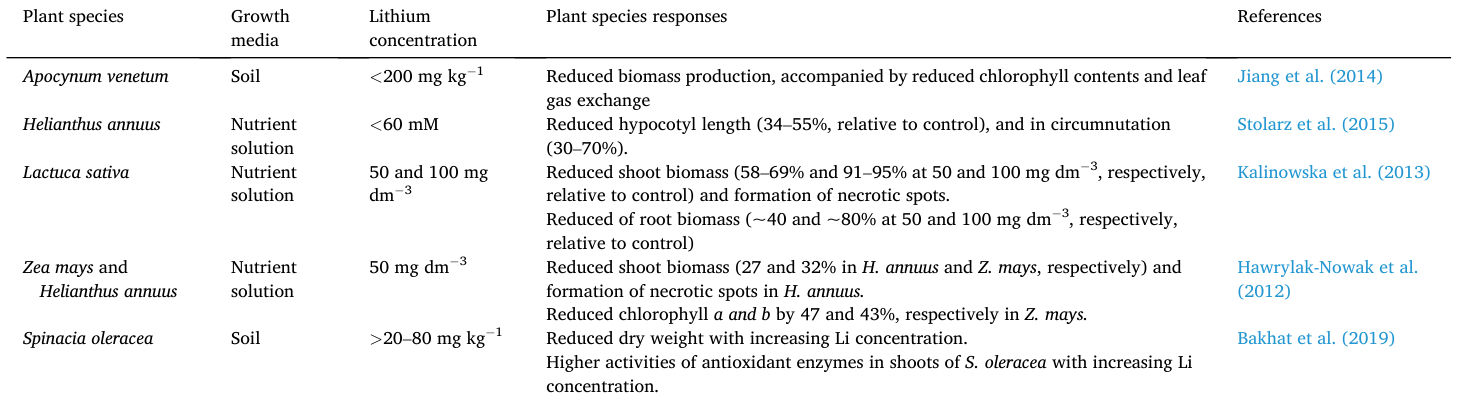
Lithium toxicity reduces photosynthesis by reducing chlorophyll content (Table 3). For instance, in maize, Li toxicity reduced chlorophyll a content by 45% and carotenoid content by 67% (Hawrylak-Nowak et al., 2012). Likewise, Li toxicity reduced chlorophyll content and caused necrotic spots in lettuce (Kalinowska et al., 2013), Ethiopian mustard (Li et al., 2009a), avocado, sour orange, and soybean (Bingham et al., 1964). A Li-induced decrease in photosynthesis might be linked to changes in content and stability of pigment-protein complexes as well as in metabolite composition, deprivation of chlorophyll contents, and reduction in Mg2+ uptake (Kabata-Pendias and Mukherjee, 2007; Shahzad et al., 2017).
Li毒性通过降低叶绿素含量而减弱光合作用(表3)。例如,在玉米中,Li毒性使叶绿素a含量降低45%,类胡萝卜素含量降低67%(Hawrylak-Nowak et al., 2012)。同样,Li毒性降低了生菜(Kalinowska et al., 2013)、埃塞俄比亚芥(Li et al., 2009a)、鳄梨、酸橙和大豆(Bingham et al., 1964)的叶绿素含量并引起坏死斑。Li诱导的光合作用下降可能与色素–蛋白复合体含量和稳定性的变化、代谢物组成的变化、叶绿素含量的损失以及Mg2+吸收的减少有关(Kabata-Pendias and Mukherjee, 2007; Shahzad et al., 2017)。
Selected examples of the response of different plant species to lithium toxicity.
不同植物物种对锂毒性响应的部分实例。
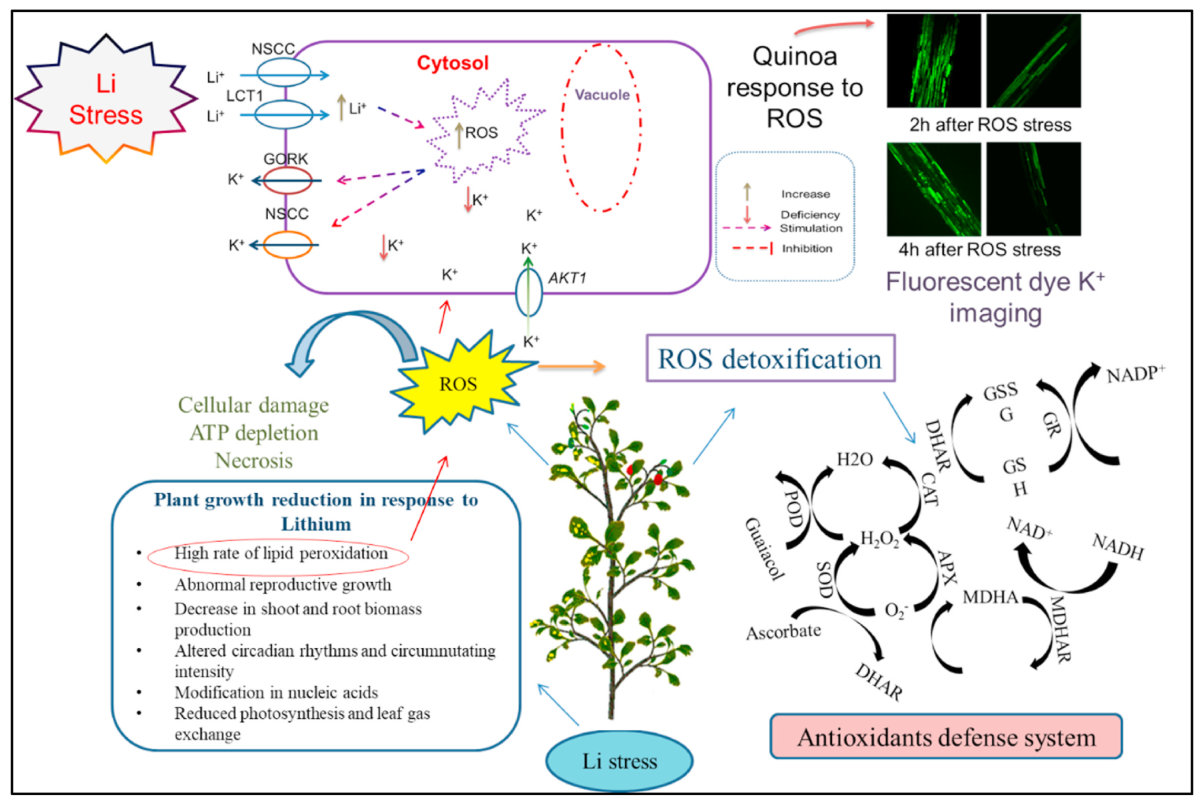
Most importantly, Li toxicity induces oxidative damage by promoting the generation of reactive oxygen species (ROS) (Kiełczykowska et al., 2004; Oktem et al., 2005) (Fig. 4). High levels of malondialdehyde (a marker for oxidative stress) in plants in response to Li exposure have been reported (Hawrylak-Nowak et al., 2012; Naranjo et al., 2003). Lithium can also induce inhibitory effects on nucleic acids (important components of overall plant metabolism) and protein biosynthesis, leading to the alteration of translation and transcription process (Aral and Vecchio-Sadus, 2008; Allagui et al., 2007; Dichtl et al., 1997). Moreover, Li-induced ROS might be associated with the inactivation or physiologically zero activation of enzymatic antioxidant systems, or reduced transcription of genes involved in antioxidant defence. In plants, Li toxicity can increase intracellular levels of O2− or OH− radicals through a Fenton-type reaction known to initiate lipid peroxidation (Shahzad et al., 2016). Plants’ Li sensitivity and their tolerance to this element may vary with species. For instance, plant species from Asteraceae and Solanaceae families showed Li tolerance (Kabata-Pendias and Mukherjee, 2007; Schrauzer, 2002), while citrus plants showed Li sensitivity (Aral and Vecchio-Sadus, 2008; Bradford, 1973); the species differences might be due to the activation of different antioxidant enzymes (Tanveer et al., 2019). Production of various antioxidants is not in a similar manner, or in direct proportion to stress severity; it can depend on the study sample and sampling time (Tanveer and Shabala, 2018). For instance, glutathione peroxidase (GPX) activity was inhibited at 1 mM Li (7.0 mg L− 1), whereas superoxide dismutase activity was promoted, indicating the dissimilar response of various antioxidants to Li stress (Nciri et al., 2012). Hence, it is warranted to examine antioxidant activity in response to Li exposure in plants under different experimental conditions (both in vitro and in vivo study).
最重要的是,Li毒性通过促进活性氧(ROS)的生成而诱导氧化损伤(Kiełczykowska et al., 2004; Oktem et al., 2005)(图4)。已有研究报道,植物在Li暴露下丙二醛(氧化胁迫的标志物)含量升高(Hawrylak-Nowak et al., 2012; Naranjo et al., 2003)。锂还可对核酸(植物整体代谢的重要组分)和蛋白质生物合成产生抑制作用,从而改变翻译和转录过程(Aral and Vecchio-Sadus, 2008; Allagui et al., 2007; Dichtl et al., 1997)。此外,Li诱导产生的ROS可能与酶促抗氧化系统失活或生理上零激活有关,或与参与抗氧化防御的基因转录下降有关。在植物中,Li毒性可通过已知可引发脂质过氧化的类Fenton反应提高细胞内O2−或OH−自由基水平(Shahzad et al., 2016)。植物对Li的敏感性及耐受性可能因物种而异。例如,菊科和茄科植物表现出对Li的耐受性(Kabata-Pendias and Mukherjee, 2007; Schrauzer, 2002),而柑橘类植物则对Li敏感(Aral and Vecchio-Sadus, 2008; Bradford, 1973);物种间差异可能源于不同抗氧化酶的激活(Tanveer et al., 2019)。各类抗氧化剂的产生并非以相同方式进行,也不与胁迫程度成正比,而可能取决于研究样本和取样时间(Tanveer and Shabala, 2018)。例如,1 mM Li(7.0 mg L− 1)抑制了谷胱甘肽过氧化物酶(GPX)活性,而超氧化物歧化酶活性则受到促进,表明不同抗氧化剂对Li胁迫的响应存在差异(Nciri et al., 2012)。因此,有必要在不同试验条件下(包括体外和体内研究)考察植物抗氧化活性对Li暴露的响应。
4.2. Toxicity to aquatic life4.2. 对水生生物的毒性
Elevated Li concentrations in various waters have been reported, which negatively affects aquatic life. For instance, in northern Chile, Li concentrations in ground water is up to 500 mg L− 1, while in surface waters it only reaches 5.2 mg L− 1(Schrauzer, 2002; Zaldívar, 1980). In the USA, Li was detected at 0.002 mg L− 1in some major rivers (Kszos and Steward, 2003). Thus, it is important to examine the sources of Li contamination in water and the Li-induced detrimental effects on aquatic life.
已有报道显示多种水体中Li浓度升高,对水生生物产生不利影响。例如,在智利北部,地下水中Li浓度高达500 mg L− 1,而地表水中仅达5.2 mg L− 1(Schrauzer, 2002; Zaldívar, 1980)。在美国,部分主要河流中检出Li浓度为0.002 mg L− 1(Kszos and Steward, 2003)。因此,考察水体Li污染来源及Li对水生生物的有害效应十分重要。
Kszos et al. (2003) investigated Li toxicity to three aquatic organisms [Pimephales promelas (fathead minnow), Ceriodaphnia dubia, and a freshwater snail (Elimia clavaeformis)] by adding elevated Li levels to induce toxic effects. Under laboratory, hydroponic-solution-culture conditions, Li suppressed the growth of P. promelas and reproductive response of C. dubia as measured by 25% inhibitory concentration (IC25–Li concentration which caused 25% inhibition in growth), but the results varied depending on the composition of the solution culture. In the hydroponic solution containing ~2.8 mg Na L− 1, IC25 values for P. promelas and C. dubia were 0.38 and 0.32 mg Li L− 1, respectively. These values increased to 1.99 and 3.33 mg Li L− 1, respectively, in ambient stream water containing ~17 mg Na L− 1, indicating lower toxicity at higher Na concentration (Kszos et al., 2003). In addition, the feeding patterns of E. clavaeformis were disrupted when Li concentrations reached 0.15 mg L− 1. However, adequate Na content in the solution enabled P. promelas and C. dubia to tolerate Li concentrations >6 mg L− 1. The authors stated that the reproduction of C. dubia was not affected when exposed to a mixture of Li and Na with a logarithmic ratio of mmol Na: mmol Li > 1.63. The concentrations of Na in most natural waters are sufficient to inhibit Li toxicity (Kszos et al., 2003). However, a comprehensive water quality assessment is warranted, especially in areas with historical Li use, disposal or recycling processes.
Kszos et al.(2003)通过添加高浓度Li诱导毒性效应,研究了Li对三种水生生物[Pimephales promelas(黑头呆鱼)、Ceriodaphnia dubia及一种淡水螺(Elimia clavaeformis)]的毒性。在实验室水培溶液培养条件下,以25%抑制浓度(IC25,即导致生长受到25%抑制的Li浓度)衡量,Li抑制了P. promelas的生长和C. dubia的繁殖响应,但结果因培养溶液组成而异。在含约2.8 mg Na L− 1的水培溶液中,P. promelas和C. dubia的IC25值分别为0.38和0.32 mg Li L− 1。在含约17 mg Na L− 1的天然溪流水中,这些数值分别升至1.99和3.33 mg Li L− 1,表明Na浓度较高时毒性较低(Kszos et al., 2003)。此外,当Li浓度达到0.15 mg L− 1时,E. clavaeformis的摄食模式受到干扰。然而,溶液中充足的Na含量使P. promelas和C. dubia能够耐受>6 mg L− 1的Li浓度。作者指出,当暴露于mmol Na: mmol Li对数比> 1.63的Li与Na混合物时,C. dubia的繁殖未受影响。大多数天然水体中的Na浓度足以抑制Li毒性(Kszos et al., 2003)。然而,仍有必要开展全面的水质评估,尤其是在历史上曾有Li使用、处置或回收活动的地区。
Based on the Li+ lethal concentration (LC50) in the growth medium, the sensitivity of different fish species was in the range of 13 mg L− 1to >100 mg L− 1(Hamilton, 1995; Long et al., 1998). Likewise, the lowest observed effect concentration (LOEC) of 200 μg L− 1Li was observed in the hepatopancreas, while it was 1000 μg L− 1in the gills in the epidermis (Sawasdee et al., 2011). Moreover, embryonic development of M. cornuarietis was highly sensitive to Li, with an LC50 value of 2500 μg L− 1Li (Sawasdee and Kohler, 2010¨). LC50 values from 1.2 to 8.7 mg L− 1Li were observed for P. promelas after 26 days of Li stress, and 9.2–62 mg L− 1in white cloud mountain minnow, Tanichthys albonubes, after 48 h of Li stress (Lenntech, 2007).
根据生长介质中Li+的致死浓度(LC50),不同鱼类的敏感性范围为13 mg L− 1至>100 mg L− 1(Hamilton, 1995; Long et al., 1998)。同样,在肝胰腺中观察到的最低可观察效应浓度(LOEC)为200 μg L− 1 Li,而在鳃和表皮中为1000 μg L− 1(Sawasdee et al., 2011)。此外,M. cornuarietis的胚胎发育对Li高度敏感,其LC50值为2500 μg L− 1 Li(Sawasdee and Kohler, 2010¨)。P. promelas在Li胁迫26 d后的LC50值为1.2~8.7 mg L− 1 Li,而白云山鱼(Tanichthys albonubes)在Li胁迫48 h后的LC50值为9.2~62 mg L− 1(Lenntech, 2007)。
Several case studies on Li toxicity in O. mykiss have underpinned some key mechanisms involved in the Li-induced negative effects on trout; in particular, the interference of Li with Na+ and K+ transport. Fish gills uptake Li in water most likely via a putative Na+ channel, and ionic disturbance in the pavement cells of fish gills alters the ionic homeostasis (Bury et al., 2003; Wood, 2001). Lithium decreases branchial citrate synthase activity and alters the regulation of Na+ and K+-ATPases, thus reducing trout growth (Tkatcheva et al., 2007a). Moreover, Li disrupts the ultrastructure and lipid composition of fish gills by altering membrane fluidity and increasing sphingomyelin (Tkatcheva et al., 2007b; Tkatcheva et al., 2004). Lithium also imposed negative effects on plasma due to high arachidonic acid production, inhibition of prostaglandin synthase, and reduced concentrations of Na+, K+, and Mg2+. Although these studies revealed some impacts of Li on different metabolic mechanisms in trout, it remains unclear how Li interferes with them. Potentially, electrophysiological and gene-expression approaches can answer this question.
关于O. mykiss中Li毒性的若干案例研究揭示了Li对鳟鱼产生负面效应的一些关键机制,特别是Li对Na+和K+转运的干扰。鱼鳃很可能通过一种假定的Na+通道吸收水中的Li,而鱼鳃扁平细胞中的离子紊乱会改变离子稳态(Bury et al., 2003; Wood, 2001)。锂降低鳃柠檬酸合酶活性,并改变Na+和K+-ATP酶的调控,从而降低鳟鱼生长(Tkatcheva et al., 2007a)。此外,Li通过改变膜流动性和增加鞘磷脂含量,破坏鱼鳃的超微结构和脂质组成(Tkatcheva et al., 2007b; Tkatcheva et al., 2004)。由于花生四烯酸大量产生、前列腺素合酶受到抑制以及Na+、K+和Mg2+浓度降低,锂还对血浆产生负面影响。尽管上述研究揭示了Li对鳟鱼不同代谢机制的某些影响,但Li如何干扰这些机制仍不清楚。电生理学和基因表达方法有望回答这一问题。
In addition, the presence of Li in sediments causes potential toxic impacts towards benthic communities (Viana et al., 2020). Benthic organisms have an important role to play in the continuity of the aquatic ecosystem; therefore, the protection of benthic habitats (i.e., sediments) is of great importance. Empirical sediment quality guidelines (SQGs) have been developed to predict the potential toxicities of contaminants in aquatic sediments posed to sediment-dwelling organisms (Kwok et al., 2014). Threshold effect level and probable effect level derived from SQGs were proved to reliably predict the toxicities of both inorganic and organic pollutants in sediments (Zhang et al., 2017). However, this information is still lacking in the case of Li and thus, further investigation is warranted for toxicity and risk assessment of Li in sediments.
此外,沉积物中Li的存在对底栖生物群落具有潜在毒性影响(Viana et al., 2020)。底栖生物在维持水生生态系统的连续性方面发挥重要作用,因此保护底栖生境(即沉积物)至关重要。已建立经验性沉积物质量基准(SQGs),用于预测水体沉积物中污染物对底栖生物的潜在毒性(Kwok et al., 2014)。由SQGs得出的阈值效应水平和可能效应水平已被证明能够可靠地预测沉积物中无机和有机污染物的毒性(Zhang et al., 2017)。然而,针对Li的此类信息仍然缺乏,因此有必要进一步开展沉积物中Li的毒性与风险评估研究。
4.3. Risks to humans and animals4.3. 对人类和动物的风险
Lithium can enter animal and human bodies through drinking water and plants (Franzaring et al., 2016). Whereas several studies have reported positive effects of Li in drinking water (at low concentrations) on human mental health and quality of life, some health groups are concerned about the detrimental effects of Li at high concentrations. For instance, high Li levels in waterbodies and tap water due to pollution from Li batteries, caused toxicity to human cardiomyocytes (Shen et al., 2020). Indeed, Li significantly repressed cell capability and proliferation of human cardiomyocytes and promoted cell apoptosis. These effects were attributed to the regulation of glycogen synthase kinase 3 beta (GSK3β), an enzyme in humans that is encoded by the GSK3β gene (Shen et al., 2020). Abnormal regulation and expression of GSK3β are associated with mood disorders, bipolar disorder and depression, and schizophrenia (Jope and Roh, 2006).
锂可通过饮用水和植物进入动物和人体(Franzaring et al., 2016)。尽管已有多项研究报道饮用水中(低浓度)Li对人类心理健康和生活质量具有积极作用,但一些卫生组织对高浓度Li的有害效应表示担忧。例如,锂电池污染导致水体和自来水中Li含量升高,对人心肌细胞产生毒性(Shen et al., 2020)。事实上,Li显著抑制了人心肌细胞的细胞能力和增殖,并促进细胞凋亡。这些效应归因于对糖原合酶激酶3β(GSK3β)的调控,GSK3β是人体内由GSK3β基因编码的一种酶(Shen et al., 2020)。GSK3β的异常调控和表达与心境障碍、双相情感障碍、抑郁症及精神分裂症有关(Jope and Roh, 2006)。
In addition, high Li concentrations can affect hematopoietic stem cell differentiation and glycogen synthesis during fetal development (Phiel and Klein, 2001). However, Li at suitable doses could be used to treat several mental illnesses, including depression, suicide, dementia, and bipolar effect (Kessing et al., 2017; Ohgami et al., 2009; Won and Kim, 2017), and, thus, a safe limit of Li is required.
此外,高浓度Li可影响胎儿发育过程中的造血干细胞分化和糖原合成(Phiel and Klein, 2001)。然而,适当剂量的Li可用于治疗多种精神疾病,包括抑郁症、自杀倾向、痴呆和双相情感障碍(Kessing et al., 2017; Ohgami et al., 2009; Won and Kim, 2017),因此需要确定Li的安全限值。
Lithium toxicity results in abnormalities and dysfunctions in several metabolic pathways, causing serious problems to human health (Table 4). Cardiotoxicity and changes in benign electrocardiograms and the development of fatal arrhythmias due to Li toxicity have been reported (Maddala et al., 2017; Mehta and Vannozzi, 2017). High Li levels can also lead to dysfunction of sinus node dysfunction, prothrombin ratio (PR), QT prolongation (a measure between Q wave and T wave in the heart’s electrical cycle), heart blocks, and ventricular tachyarrhythmias (Goldberger, 2007; Mehta and Vannozzi, 2017; Waring, 2007). Lithium overdose can induce several nephrological disorders in humans such as cognitive impairment, coma, autism, and stupor, and weight gain (McKnight et al., 2012; Munshi and Thampy, 2005).
锂毒性会导致多种代谢途径出现异常和功能障碍,对人体健康造成严重问题(表4)。已有报道指出Li毒性可引起心脏毒性、良性心电图改变以及致死性心律失常(Maddala et al., 2017; Mehta and Vannozzi, 2017)。高水平Li还可导致窦房结功能障碍、凝血酶原比值(PR)异常、QT间期延长(心脏电活动周期中Q波与T波之间的间隔)、心脏传导阻滞及室性快速性心律失常(Goldberger, 2007; Mehta and Vannozzi, 2017; Waring, 2007)。锂过量可诱发人体多种肾脏相关病症,如认知障碍、昏迷、自闭症、木僵以及体重增加(McKnight et al., 2012; Munshi and Thampy, 2005)。
Selected examples of the effect of lithium intoxication in different body parts in
锂中毒对身体不同部位影响的部分实例
humans.
| Body part身体部位 | Acute symptoms急性 症状 | Chronic symptoms慢性症状 | References参考文献 |
|---|---|---|---|
| Neuron | Tremor, muscle twitching, cognitive impairment | Muscle seizures, coma, stupor | (Dunne, 2010; Gong et al., 2016;Malhi et al., 2020; |
| Renal | Water and Na+ diuresis | Hyperchloremic acidosis, renal acidosis, renal failure, insipidus | Shahzad et al., 2017;Timmer and Sands, |
| Gastrointestinal | Mild nausea and vomiting | Severe vomiting, diarrhea, nausea | 1999) |
| Neuro-muscles | Neuropathy | Psychosis | |
| Cardiac | Prolonged PR, and QT intervalsa | Myocarditis, development of arrhythmia, heart blocks | |
| Weight gain | Development of diabetes | – | |
| Thyroid | – | Development of hyperparathyroidism; high Ca2+ concentration in blood |
a PR (prothrombin ratio); QT (measure between Q wave and T wave in the heart’s electrical cycle).
a PR(凝血酶原比值);QT(心脏电活动周期中Q波与T波之间的间隔)。
Renal toxicity is another consequence of Li overdose. Renal toxicity increases water and Na+ diuresis, dehydration, hyperchloremic metabolic acidosis, renal tubular acidosis, and reduction in urinary concentrating ability (Gong et al., 2016; Grünfeld and Rossier, 2009). Lithium further alters renal functionality by dysregulating aquaporin activity and entering apical membranes via epithelial Na+ channels, which inhibit signaling pathways involving glycogen synthase kinase type 3β (Davis et al., 2018; Grünfeld and Rossier, 2009). Hyperparathyroidism (overproduction of thyroid hormones) is another inevitable feature of Li toxicity (Palm´er et al., 1987). Such a response is attributable to Li-induced inactivation of Ca2+ sensing receptors and interference with intracellular second messenger signalling, which concomitantly results in high parathyroid hormone production and Ca2+ concentrations in the blood (Szalat et al., 2009). Lithium, after oral ingestion, does not bind to serum proteins in the gastrointestinal tract (GIT), but completely dissolves in water in the human body and remains there for a long time, causing renal failure in response to Li toxicity.
肾毒性是Li过量的另一后果。肾毒性会增加水和Na+利尿,导致脱水、高氯性代谢性酸中毒、肾小管酸中毒以及尿液浓缩能力下降(Gong et al., 2016; Grünfeld and Rossier, 2009)。锂还通过扰乱水通道蛋白活性并经上皮Na+通道进入顶端膜而进一步改变肾功能,从而抑制涉及3β型糖原合酶激酶的信号通路(Davis et al., 2018; Grünfeld and Rossier, 2009)。甲状旁腺功能亢进(甲状腺激素分泌过多)是Li毒性的另一必然特征(Palm´er et al., 1987)。这一响应可归因于Li诱导的Ca2+敏感受体失活以及对胞内第二信使信号传导的干扰,进而导致甲状旁腺激素大量分泌和血液中Ca2+浓度升高(Szalat et al., 2009)。锂经口摄入后,在胃肠道(GIT)中不与血清蛋白结合,而是在人体内完全溶于水并长期滞留,从而在Li毒性作用下引起肾衰竭。
A few studies have indicated the toxic effects of Li on different animals, with the toxic or fatal dose depending on species and Li compounds. For example, doses of 500 and 700 mg kg− 1body weight showed severe depression and ataxia in beef cattle (Johnson et al., 1980), with residual Li found in striated muscle, heart, liver, kidney, and brain tissues. Using lithium hypochlorite (LiClO) as the sole source of drinking water for two dogs, Davies (1991) reported clinical signs of polyuria, polydipsia, loss of body mass, dehydration, diarrhea, and general weakness in one dog, and, polyuria, polydipsia, loss of body mass, and seizure in the other dog. Similarly, Li exposure significantly increased lipid peroxidation, decreased renal functionality, and caused weight loss in rats (Schrauzer, 2002; Tandon et al., 1998). Overdose supplementation of Li to a pregnant mouse caused drastic malformations in offspring, indicating that Li-induced effects can be transferred to offspring (Smithberg and Dixit, 1982). Due to the similar physicochemical properties of Li+ with Na+ and K+, Li interferes with the uptake of these essential elements and alters cellular ionic homeostasis affecting the mechanism associated with dose-dependent inhibition of myocyte voltage-gated Na+ channels that decrease intracellular K+ and causing electrical instability in atria and ventricles (Singer and Rotenberg, 1973).
少数研究指出了Li对不同动物的毒性效应,其毒性剂量或致死剂量取决于物种和Li化合物种类。例如,500和700 mg kg− 1体重的剂量使肉牛出现严重抑郁和共济失调(Johnson et al., 1980),并在横纹肌、心脏、肝脏、肾脏和脑组织中检出残留Li。Davies(1991)以次氯酸锂(LiClO)作为两只犬的唯一饮水来源,报道其中一只犬出现多尿、烦渴、体重下降、脱水、腹泻和全身虚弱等临床症状,另一只犬则出现多尿、烦渴、体重下降和癫痫发作。同样,Li暴露显著增加了大鼠的脂质过氧化,降低了肾功能并导致体重下降(Schrauzer, 2002; Tandon et al., 1998)。对妊娠小鼠过量补充Li导致其后代出现严重畸形,表明Li诱导的效应可传递给后代(Smithberg and Dixit, 1982)。由于Li+与Na+和K+的理化性质相似,Li会干扰这些必需元素的吸收并改变细胞离子稳态,影响与心肌细胞电压门控Na+通道剂量依赖性抑制相关的机制,从而降低胞内K+并引起心房和心室的电不稳定(Singer and Rotenberg, 1973)。
5Risk management of lithium in contaminated environments污染环境中锂的风险管理
The lack of a complete Li recycling system requires disposal of Li-containing materials, such that Li can leach into the environment and present a risk to humans and ecosystems (Henschel et al., 2020; Tanveer et al., 2019). Developing cost-effective and eco-friendly remediation technologies for the sustainable management of Li-contaminated environments is necessary.
由于缺乏完善的Li回收体系,含Li材料需要进行处置,导致Li可能淋溶进入环境,对人类和生态系统构成风险(Henschel et al., 2020; Tanveer et al., 2019)。因此,有必要开发经济高效且环境友好的修复技术,以实现Li污染环境的可持续管理。
5.1. Remediation of lithium-contaminated soils and sediments5.1. 锂污染土壤和沉积物的修复
Various technologies, including physical, chemical, and biological strategies, are currently accessible for controlling metal pollution in the soil environment, which can be theoretically applied to sediment (Bolan et al., 2014). Wuana and Okieimen (2011) categorized the general practices used in metal remediation: isolation, extraction, and reduction in toxicity and mobility. The operation of these strategies can either be in situ (takes place at the contaminated sites without moving or excavating soil) or ex-situ (soil is moved or excavated from the contaminated site).
目前已有多种技术(包括物理、化学和生物策略)可用于控制土壤环境中的金属污染,这些技术理论上也可应用于沉积物(Bolan et al., 2014)。Wuana and Okieimen(2011)将金属修复的常用措施归纳为:隔离、提取以及降低毒性和迁移性。这些策略的实施可以是原位(在污染场地进行,不移动或挖掘土壤)或异位(将土壤从污染场地移出或挖出)。
As Li is highly mobile in soil and sediment, reducing the mobility and toxicity of Li by applying various amendments and followed by phytoremediation, which is considered a cost-effective and eco-friendly remediation process, is an effective approach. Shahzad et al. (2016) proposed the following Li-remediation technologies: (1) application of soil amendments to immobilize Li in contaminated soil (Table 5). For example, applying zeolite to Li-contaminated soil significantly reduced plant uptake over 14 days (Harbottle et al., 2007), and adding 33% sphagnum peat moss and 33% coal fly ash to Li-contaminated soil significantly reduced Li in the soil leachate (Bilski et al., 2013). Amorphous and nano-size materials provide a large surface area, which can contribute to the increased sorption of Li in soil (Abbas et al., 2021); (2) identification of plants and microorganisms that can accumulate and tolerate Li. For instance, Apocynum venetum (sword-leaf dogbane) and Apocynum pictum (Indian hemp or dogbane) show high translocation and bioaccumulation of Li (Jiang et al., 2014; Jiang et al., 2018) (Table 6). The underlying mechanism of plant uptake and translocation of Li in soil remains unclear; however, it is suggested that Li can be absorbed by plants in a similar way to other alkali metals (e.g., Na and K) due to functional analogues (Shkolnik, 1984). A few microbial strains, including Arthrobacter nicotianae and Brevibacterium helovolum, also have the potential to accumulate Li. These microbial strains can exhibit a strong negative charge on their cell surface owing to high level of ionized phosphate groups, to enhance chelate formation between the cell surface and Li ions (Tsuruta, 2005); (3) application of a chelating agent to Li-contaminated soil to alter Li toxicity and bioavailability (Table 5). For example, ethylenediaminetetraacetic acid (EDTA) and ethylenediamine-N, N′-di succinic acid (EDDS) were used as Li chelators, which increased bioavailable Li for plant uptake, facilitating the phytoremediation of Li- contaminated soils (Kavanagh et al., 2018). The addition of chelating agents can enhance Li-chelant complexes, which are directly absorbed by the plant roots. Moreover, the dissociation of the complexes releases freely available Li for plant uptake (Brian et al., 2018). Several factors affecting Li remediation efficiency include environmental conditions (e.g., temperature, precipitation), soil properties (e.g., texture, pH), and chemical composition of Li in soils and sediments (Shahzad et al., 2016).
由于Li在土壤和沉积物中迁移性很强,施用各种改良剂以降低Li的迁移性和毒性,继而进行被视为经济高效且环境友好的植物修复,是一种有效的方法。Shahzad et al.(2016)提出了以下Li修复技术:(1)施用土壤改良剂以固定污染土壤中的Li(表5)。例如,向Li污染土壤中施用沸石可在14 d内显著降低植物对Li的吸收(Harbottle et al., 2007),而向Li污染土壤中添加33%泥炭藓和33%粉煤灰可显著降低土壤淋溶液中的Li(Bilski et al., 2013)。无定形及纳米尺度材料具有较大的比表面积,有助于增强土壤对Li的吸附(Abbas et al., 2021);(2)筛选能够累积并耐受Li的植物和微生物。例如,Apocynum venetum(罗布麻)和Apocynum pictum(白麻)表现出较高的Li转运和生物累积能力(Jiang et al., 2014; Jiang et al., 2018)(表6)。植物吸收和转运土壤中Li的内在机制尚不清楚;然而,有研究认为,由于功能上的类似性,植物可能以与其他碱金属(如Na和K)相似的方式吸收Li(Shkolnik, 1984)。少数微生物菌株,包括Arthrobacter nicotianae和Brevibacterium helovolum,也具有累积Li的潜力。这些菌株由于离子化磷酸基团含量高,其细胞表面可呈现较强的负电荷,从而增强细胞表面与Li离子之间的螯合物形成(Tsuruta, 2005);(3)向Li污染土壤中施加螯合剂,以改变Li的毒性和生物有效性(表5)。例如,将乙二胺四乙酸(EDTA)和乙二胺-N, N′-二琥珀酸(EDDS)用作Li螯合剂,提高了可供植物吸收的生物有效态Li,促进了Li污染土壤的植物修复(Kavanagh et al., 2018)。添加螯合剂可促进Li-螯合剂络合物的形成,这些络合物可被植物根系直接吸收。此外,络合物解离后可释放出可供植物吸收的游离态Li(Brian et al., 2018)。影响Li修复效率的因素包括环境条件(如温度、降水)、土壤性质(如质地、pH)以及土壤和沉积物中Li的化学组成(Shahzad et al., 2016)。
Selected references on the (im)mobilization of Li in soil.
土壤中Li(固定)活化的部分参考文献。
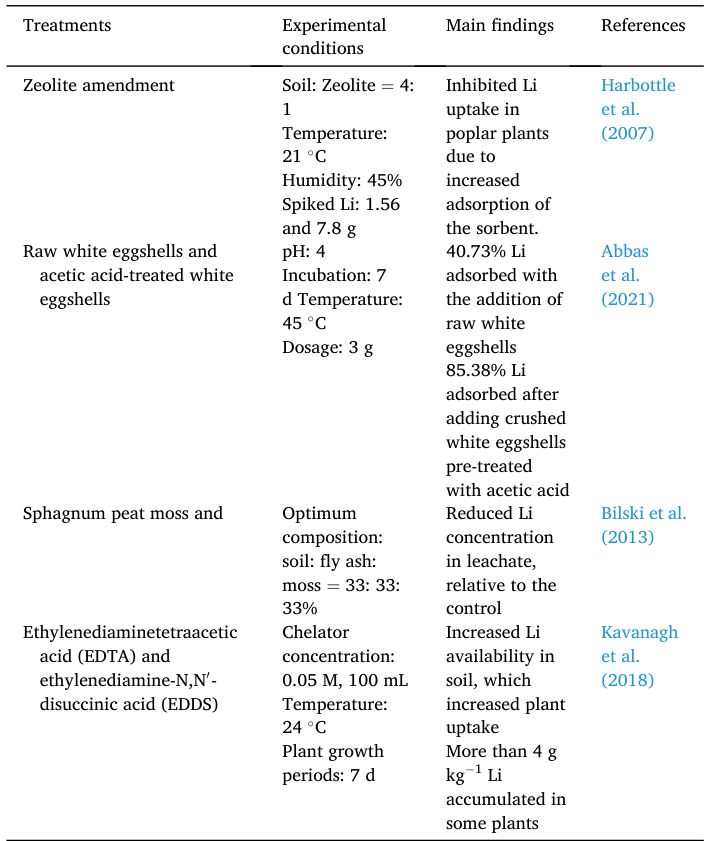
Selected references on the phyto-availability of Li in soil.
土壤中Li植物有效性的部分参考文献。
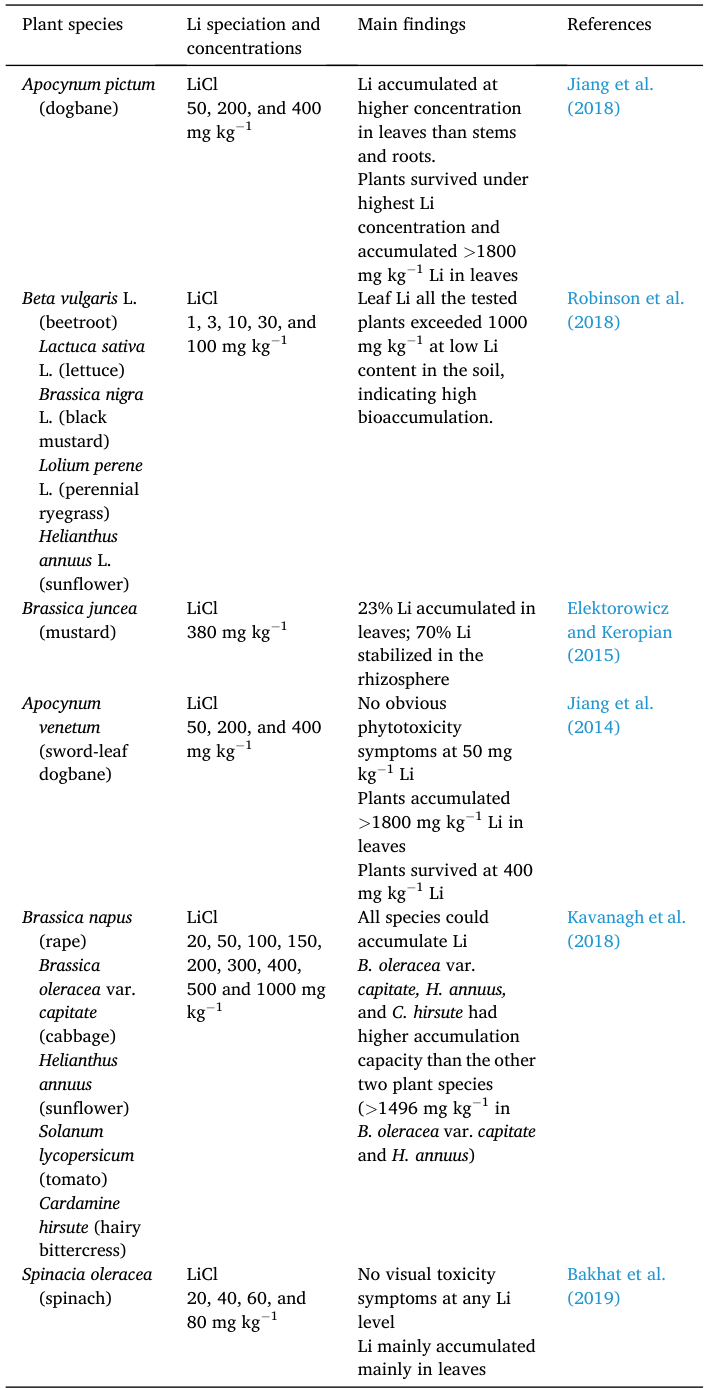
5.2. Removal of lithium from aquatic environments5.2. 水环境中锂的去除
Among the available Li removal techniques for aquatic environments, recent attention has been given to various precipitation, adsorption, electro-dialysis, and ion exchanging approaches (Çiçek et al., 2018; Parsa et al., 2015; Zhao et al., 2020). The precipitation of Li with suitable anions is effective for removing Li from Li-containing wastewaters. Zhao et al. (2020) used a precipitation method to recover Li+ in the presence of common cations, such as Ca2+, Mg2+,
在现有的水环境Li去除技术中,各种沉淀、吸附、电渗析和离子交换方法近年来受到关注(Çiçek et al., 2018; Parsa et al., 2015; Zhao et al., 2020)。以适当阴离子沉淀Li可有效去除含Li废水中的Li。Zhao et al.(2020)采用沉淀法,在常见阳离子如Ca2+、Mg2+、
Al3+, and Fe3+, from low concentration, Li-containing wastewater. Under optimized conditions, they recovered 84.2% of Li + as a Li3PO4, with simultaneous removal of 99–99.8% of other associated cations (Zhao et al., 2020). Similarly, an environmentally friendly Li precipitation method successfully recovered Li from wastewater (Jandova et al., 2012), where CO2 was used to precipitate Li as Li2CO3, with an efficiency of about 90%.
Al3+和Fe3+共存的条件下,从低浓度含Li废水中回收Li+。在优化条件下,他们以Li3PO4形式回收了84.2%的Li +,同时去除了99%~99.8%的其他伴随阳离子(Zhao et al., 2020)。同样,一种环境友好的Li沉淀方法成功地从废水中回收了Li(Jandova et al., 2012),该方法利用CO2将Li沉淀为Li2CO3,效率约为90%。
Lithium-selective resins have been used to successfully remove Li from water. For instance, an aminomethyl phosphonic acid-containing chelating resin was used as a cation exchanger under different optimized conditions, removing 13.65 mg g− 1of Li within 15 min (Çiçek et al., 2018). A novel magnetic Li imprinted-polymer is selective for the Li-ion, removing 4.10 mg g− 1, the maximum adsorption affinity, within 10 min at pH 6 (Luo et al., 2015). Zandevakili et al. (2014) used MnO2 nanorod as a Li sieve to remove 63 mg g− 1Li from lake water. Similarly, a three-dimensional MnO2 ion cage was successfully fabricated by Luo et al. (2016) to treat Li-contaminated wastewater, which selectively targeted Li ions in wastewater with an adsorption affinity of 57 mg g− 1 Li. Kim et al. (2018) used an electrochemical technique to recover about 98.6% of Li ions (containing 1900 mg L− 1Li) from wastewater using a Li recovery electrode of Li Mn-oxide. It was also estimated that about 24 mg Li was recovered in each hour of operation (Kim et al., 2018).
锂选择性树脂已被成功用于去除水中的Li。例如,在不同优化条件下,以一种含氨甲基膦酸的螯合树脂作为阳离子交换剂,可在15 min内去除13.65 mg g− 1的Li(Çiçek et al., 2018)。一种新型磁性Li离子印迹聚合物对Li离子具有选择性,在pH 6条件下10 min内的最大吸附量为4.10 mg g− 1(Luo et al., 2015)。Zandevakili et al.(2014)以MnO2纳米棒作为锂离子筛,从湖水中去除了63 mg g− 1 Li。同样,Luo et al.(2016)成功制备了三维MnO2离子笼用于处理Li污染废水,其可选择性捕获废水中的Li离子,吸附量为57 mg g− 1 Li。Kim et al.(2018)采用电化学技术,利用锂锰氧化物Li回收电极,从废水(含1900 mg L− 1 Li)中回收了约98.6%的Li离子。据估算,每运行1 h约可回收24 mg Li(Kim et al., 2018)。
5.3. Integrated risk management5.3. 综合风险管理
In integrated risk strategies, two or more individual remediation techniques are used to improve Li removal i.e., chemical–biological, chemical–physical, biological–physical, or chemical–biological–physical. Integrated risk management ensures an effective and efficient achievement than individual approaches. For example, the addition of EDTA and EDDS, as chelating agents, to Li-containing soil enhanced the accumulation of Li in leaves of Brassica napus (rapeseed), Brassica oleracea (wild cabbage), and Helianthus annuus (sunflower) (Kavanagh et al., 2018). Similarly, under optimum conditions, Abbas et al. (2021) investigated the effect of raw, untreated-eggshells and acetic acid-treated eggshells as soil amendments to remove Li. The acetic acid-treated eggshells increased Li removal from 45.7 to 85.3% in the Li-contaminated soil, which was attributed to the reduction in soil pH induced by acetic acid (Abbas et al., 2021). Thus, mobilization of Li using soil amendments, followed by phytoremediation, is an integrated and effective approach for the remediation of Li-contaminated soils and sediments.
在综合风险策略中,采用两种或多种单一修复技术以提高Li去除效果,即化学–生物、化学–物理、生物–物理或化学–生物–物理联合。与单一方法相比,综合风险管理可实现更有效、更高效的修复。例如,向含Li土壤中添加螯合剂EDTA和EDDS,提高了Brassica napus(油菜)、Brassica oleracea(野甘蓝)和Helianthus annuus(向日葵)叶片中Li的累积(Kavanagh et al., 2018)。同样,Abbas et al.(2021)在最佳条件下研究了未处理蛋壳和乙酸处理蛋壳作为土壤改良剂对Li去除的效果。乙酸处理蛋壳使Li污染土壤中Li的去除率从45.7%提高至85.3%,这归因于乙酸引起的土壤pH降低(Abbas et al., 2021)。因此,利用土壤改良剂活化Li后再进行植物修复,是修复Li污染土壤和沉积物的一种有效的综合方法。
6Final remarks and future research needs结语与未来研究需求
Lithium is a potentially toxic element that adversely affects human health and ecosystems. Terrestrial and aquatic environments contaminated with Li from various (geogenic and anthropogenic) origins have been drawing public concern since last several years in many countries. The biogeochemistry of Li in soil is largely controlled by its interactions with the clay mineral components. Lithium in most soils is readily released into ground water due to its high mobility. Although the accumulation of Li in biota (plants and organisms) has been reported in various studies, biochemical transformations of Li in living organisms remain largely unknown.
锂是一种对人体健康和生态系统产生不利影响的潜在有毒元素。近年来,许多国家受各种(地质成因和人为)来源Li污染的陆地和水生环境日益引起公众关注。土壤中Li的生物地球化学行为在很大程度上受其与黏土矿物组分相互作用的控制。由于迁移性高,大多数土壤中的Li易于释放进入地下水。尽管已有多项研究报道了Li在生物群(植物和生物体)中的累积,但Li在生物体内的生化转化在很大程度上仍不清楚。
Risk management of lithium contamination of terrestrial and aquatic environments is a great challenge, but essential, to protect and alleviate adverse impacts on ecosystem and public health. Remediation of these contaminated environments has been carried out using various physical, chemical, and biological approaches (e.g., precipitation, biosorption). Despite some remarkable positive results, most of these remedial technologies have been conducted under controlling conditions and pilot scales. Further research in field scale application of such technologies is therefore warranted to attract attention from the remediation industry or policy makers. Nevertheless, these remedial treatment actions require trained personnel for the operation of equipment to treat the contaminated soils and waters. Phytoremediation, which is cost-effective and environmentally friendly, could be a suitable alternative for the remediation of Li-contaminated environments.
陆地和水生环境锂污染的风险管理是一项巨大挑战,但对于保护生态系统和公众健康、减轻不利影响至关重要。目前已采用多种物理、化学和生物方法(如沉淀、生物吸附)修复这些污染环境。尽管取得了一些显著的积极成果,但大多数修复技术仍是在受控条件和中试规模下开展的。因此,有必要进一步开展此类技术的田间尺度应用研究,以引起修复行业或政策制定者的关注。然而,这些修复处理措施需要训练有素的人员操作设备来处理污染土壤和水体。植物修复经济高效且环境友好,可作为修复Li污染环境的适宜替代方案。
Some key knowledge gaps, which require future research, include:
需要未来研究填补的一些关键知识空白包括:
- Understanding biogeochemical processes regulating dynamics of Li in different media using advanced techniques (e.g., spectroscopic based).利用先进技术(如基于光谱的技术)了解调控不同介质中Li动态的生物地球化学过程。
- Elucidation of various environmental factors (e.g., pH) affecting the chemical and biological transformations of Li in soil and aquatic systems.阐明影响土壤和水体系统中Li化学与生物转化的各种环境因素(如pH)。
- Investigation of Li speciation in both solid- and liquid-phase in soil and water environments.研究土壤和水环境中固相与液相Li的形态。
- Examination of biochemical mechanisms involved in Li accumulation in specific tissues or organs in living organisms.探讨生物体特定组织或器官中Li累积所涉及的生化机制。
- Evaluation of plants’ response and tolerance to Li toxicity under field conditions.评估田间条件下植物对Li毒性的响应与耐受性。
- Determination of the underlying mechanisms in the rhizosphere underpinning effective phytoremediation of Li contamination.确定根际中支撑Li污染有效植物修复的内在机制。
- Exploitation of the effectiveness of industrial by-products containing high metallic oxide content to immobilize Li in the contaminated sites; examination of the desorption of sorbed Li from the immobilized media.探索高金属氧化物含量工业副产品在污染场地固定Li的效果;考察被吸附Li从固定介质中的解吸。
- Development of bio-monitors for risk assessment of Li-contaminated environments.开发用于Li污染环境风险评估的生物监测指示物。
Credit author statement作者贡献声明
Nanthi Bolan: Research idea, initiated and coordinated the review, provided the skeleton and overall contents, Contributed to Section 1 and 6, writing and editing. Mohsin Tanveer and Lei Wang: Contributed to section 4.1 and in compiling the associated Figures/tables, writing and editing. Son A. Hoang and Shiv Bolan: Contributed to Section 2.1 and in compiling the associated Figures/tables, writing and editing. Prasanthi Sooriyakumar, Brett Robinson: Contributed to section 2.2 and in compiling the associated Figures/tables, writing and editing. Hasintha Wijesekara and Madhuni Wijesooriya: Contributed to section 3.1 and in compiling the associated Figures/tables, writing and editing. S. Keerthanan and Meththika Vithanage: Contributed to section 3.2 and in compiling the associated Figures/tables, writing and editing. Bernd Markert, Stefan Franzle, and Simone Wünschmann: ¨ Have written Section 4.2 and in compiling the associated Figures/tables, writing and editing. Binoy Sarkar, Ajayan Vinu and Kadambot H.M Siddique: Contributed to Section 5 and in compiling the associated Figures/tables, writing and editing. M.B. Kirkhamn, Jorg Rinklebe: ¨ Contributed to research concept, writing and editing, proof reading.
Nanthi Bolan:提出研究构想,发起并协调本综述,提供框架与总体内容,参与第1节和第6节,撰写与编辑。Mohsin Tanveer和Lei Wang:参与4.1节及相关图表的整理,撰写与编辑。Son A. Hoang和Shiv Bolan:参与2.1节及相关图表的整理,撰写与编辑。Prasanthi Sooriyakumar、Brett Robinson:参与2.2节及相关图表的整理,撰写与编辑。Hasintha Wijesekara和Madhuni Wijesooriya:参与3.1节及相关图表的整理,撰写与编辑。S. Keerthanan和Meththika Vithanage:参与3.2节及相关图表的整理,撰写与编辑。Bernd Markert、Stefan Franzle和Simone Wünschmann:¨ 撰写4.2节并整理相关图表,撰写与编辑。Binoy Sarkar、Ajayan Vinu和Kadambot H.M Siddique:参与第5节及相关图表的整理,撰写与编辑。M.B. Kirkhamn、Jorg Rinklebe:¨ 参与研究构思、撰写与编辑及校对。
Declaration of competing interest利益冲突声明
The authors declare that they have no known competing financial interests or personal relationships that could have appeared to influence the work reported in this paper.
作者声明,不存在任何可能影响本文所报道工作的已知经济利益冲突或个人关系。
References参考文献
Abbas, M.N., Al-Tameemi, I.M., Hasan, M.B., Al-Madhhachi, A.-S.T., 2021. Chemical removal of cobalt and lithium in contaminated soils using promoted white eggshells with different catalysts. S. Afr. J. Chem. Eng. 35, 23–32.
Allagui, M., Vincent, C., Gaubin, Y., Croute, F., 2007. Lithium toxicity and expression of stress-related genes or proteins in A549 cells. Biochim. Biophys. Acta Mol. Cell Res. 1773, 1107–1115.
Aloupi, M., Angelidis, M., 2001. Normalization to lithium for the assessment of metal contamination in coastal sediment cores from the Aegean Sea, Greece. Mar. Environ. Res. 52, 1–12.
Ammari, T.G., Al-Zu’bi, Y., Abu-Baker, S., Dababneh, B., Tahboub, A., 2011. The occurrence of lithium in the environment of the Jordan Valley and its transfer into the food chain. Environ. Geochem. Health 33, 427–437.
Anderson, M.A., Bertsch, P.M., Miller, W.P., 1988. The distribution of lithium in selected soils and surface waters of the southeastern USA. Appl. Geochem. 3, 205–212.
Aral, H., Vecchio-Sadus, A., 2008. Toxicity of lithium to humans and the environment—a literature review. Ecotoxicol. Environ. Saf. 70, 349–356.
Aral, H., Vecchio-Sadus, A., 2011. Lithium: environmental pollution and health effects. [Incomplete reference—add the journal, volume number, and page numbers.]. Avila-Arias, H., Nies, L.F., Gray, M.B., Turco, R.F., 2019. Impacts of molybdenum-, nickel-, and lithium-oxide nanomaterials on soil activity and microbial community structure. Sci. Total Environ. 652, 202–211.
Bakhat, H.F., Rasul, K., Farooq, A.B.U., Zia, Z., Fahad, S., Abbas, S., Shah, G.M., Rabbani, F., Hammad, H.M., 2019. Growth and physiological response of spinach to various lithium concentrations in soil. Environ. Sci. Pollut. Control Ser. 1–9.
Baran, E.J., 2019. Lithium in plants. Advances in Plant Physiology 18 (18), 153.
Bernardes, A.M., Espinosa, D.C.R., Tenorio, J.S., 2004. Recycling of batteries: a review of ´ current processes and technologies. J. Power Sources 130, 291–298.
Bhangare, R., Ajmal, P., Sahu, S., Pandit, G., Puranik, V., 2011. Distribution of trace
elements in coal and combustion residues from five thermal power plants in India. Int. J. Coal Geol. 86, 349–356.
Bibienne, T., Magnan, J.-F., Rupp, A., Laroche, N., 2020. From mine to mind and mobiles: Society’s increasing dependence on lithium. Elements: An International Magazine of Mineralogy, Geochemistry, and Petrology 16, 265–270.
Bilski, J., Kraft, C., Jacob, D., Soumaila, F., Farnsworth, A., 2013. Leaching of selected trace elements from plant growth media composed of coal fly ash (FA), and of FA amended with sphagnum peat moss and soil. Part 1: leaching of trace elements from group 1: cesium (Cs) and lithium (Li), and from group 2: beryllium (Be), strontium (Sr), and barium (Ba). Res. J. Chem. Environ. Sci. 1, 7.
Bingham, F., Bradford, G., Page, A., 1964. Toxicity of lithium to plants. Calif. Agric. 18, 6–7.
Bleiwas, D., Coffman, J., 1986. Lithium Availability-Market Economy Countries. Bureau of Mines Information Circular. 9102, p. 23.
Bolan, N.S., Naidu, R., Syers, J.K., Tillman, R.W., 1999. Surface charge and solute interactions in soils. Adv. Agron. 67, 87–140.
Bolan, N., Kunhikrishnan, A., Thangarajan, R., Kumpiene, J., Park, J., Makino, T., Kirkham, M.B., Scheckel, K., 2014. Remediation of heavy metal (loid) s contaminated soils–to mobilize or to immobilize? J. Hazard Mater. 266, 141–166. Bouman, C., Elliott, T., Vroon, P.Z., 2004. Lithium inputs to subduction zones. Chem. Geol. 212, 59–79.
Bradford, G.R., 1973. Lithium. In: Chapman, H.D. (Ed.), Diagnostic Criteria for Plants and Soils. Second Printing. Quality Printing Co., Abilene, Texas, pp. 218–224. Brian, X.G., Cui, J., Tang, B.P., Yang, L., 2018. Chelant-induced phytoextraction of heavy metals from contaminated soils: a review. Pol. J. Environ. Stud. 27, 2417–2424. Bury, N.R., Walker, P.A., Glover, C.N., 2003. Nutritive metal uptake in teleost fish. J. Exp. Biol. 206, 11–23.
Chan, L.-H., Kastner, M., 2000. Lithium isotopic compositions of pore fluids and sediments in the Costa Rica subduction zone: implications for fluid processes and sediment contribution to the arc volcanoes. Earth Planet Sci. Lett. 183, 275–290. Chan, L., Sturchio, N., Katz, A., 1997. Lithium isotope study of the Yellowstone hydrothermal system. EOS Trans. Am. Geophys. Union. 78, F802.
Chan, L.H., Leeman, W.P., Plank, T., 2006. Lithium isotopic composition of marine sediments. G-cubed 7.
Chaney, R.L., 1980. Health risks associated with toxic metal in municipal sludge. Sludge- Health risks of land application 59–83.
Choi, H.-B., Ryu, J.-S., Shin, W.-J., Vigier, N., 2019. The impact of anthropogenic inputs on lithium content in river and tap water. Nat. Commun. 10, 1–7.
Choubey, P.K., Chung, K.-S., Kim, M.-s., Lee, J.-c., Srivastava, R.R., 2017. Advance review on the exploitation of the prominent energy-storage element Lithium. Part II: from sea water and spent lithium ion batteries (LIBs). Miner. Eng. 110, 104–121.
Çiçek, A., Yılmaz, O., Arar, O., 2018. Removal of lithium from water by aminomethylphosphonic acid containing resin. J. Serb. Chem. Soc. 83, 1059–1069, 1059–1069.
Cotton, F.A., Wilkinson, G., 1980. Inorganic Chemistry. John Wiley, p. 540.
Dai, S., Zhao, L., Peng, S., Chou, C.-L., Wang, X., Zhang, Y., Li, D., Sun, Y., 2010. Abundances and distribution of minerals and elements in high-alumina coal fly ash from the Jungar Power Plant, Inner Mongolia, China. Int. J. Coal Geol. 81, 320–332. Danielik, V., Fellner, P., 1998. Content of sodium and lithium in aluminium in equilibrium with cryolite melts experimental data and thermodynamic model. Chem. Pap. 52, 195–198.
Davies, N., 1991. Lithium toxicity in two dogs. J. S. Afr. Vet. Assoc. 62, 140–142. Davis, J., Desmond, M., Berk, M., 2018. Lithium and nephrotoxicity: a literature review of approaches to clinical management and risk stratification. BMC Nephrol. 19, 1–7. Dessemond, C., Lajoie-Leroux, F., Soucy, G., Laroche, N., Magnan, J.-F., 2019. Spodumene: the lithium market, resources and processes. Minerals 9, 334.
Diallo, M.S., Kotte, M.R., Cho, M., 2015. Mining critical metals and elements from seawater: opportunities and challenges. Environ. Sci. Technol. 49, 9390–9399. Dichtl, B., Stevens, A., Tollervey, D., 1997. Lithium toxicity in yeast is due to the inhibition of RNA processing enzymes. EMBO J. 16, 7184–7195.
Dunne, F.J., 2010. Lithium toxicity: the importance of clinical signs. Br. J. Hosp. Med. 71, 206–210, 2005.
Durfor, C.N., Becker, E., 1964. Public Water Supplies of the 100 Largest Cities in the United States, 1962. US Government Printing Office.
Elektorowicz, M., Keropian, Z., 2015. Lithium, vanadium and chromium uptake ability of Brassica juncea from lithium mine tailings. Int. J. Phytoremediation 17, 521–528. Emery, R., Klopfer, D., Skalski, J., 1981. Incipient toxicity of lithium to freshwater organisms representing a salmonid habitat. In: Battelle Pacific Northwest Labs.. Ewuzie, U., Nnorom, I.C., Eze, S.O., 2020. Lithium in drinking water sources in rural and urban communities in Southeastern Nigeria. Chemosphere 245, 125593.
Figueroa, L., Barton, S., Schull, W., Razmilic, B., Zumaeta, O., Young, A., Kamiya, Y., Hoskins, J., Ilgren, E., 2012. Environmental lithium exposure in the North of Chile—I. Natural water sources. Biol. Trace Elem. Res. 149, 280–290.
Franzaring, J., Schlosser, S., Damsohn, W., Fangmeier, A., 2016. Regional differences in plant levels and investigations on the phytotoxicity of lithium. Environ. Pollut. 216, 858–865.
Goldberger, Z.D., 2007. Sinoatrial block in lithium toxicity. Am. J. Psychiatr. 164,
831–832.
Gong, R., Wang, P., Dworkin, L., 2016. What we need to know about the effect of lithium on the kidney. Am. J. Physiol. Ren. Physiol. 311, F1168–F1171.
Gourcerol, B., Gloaguen, E., Melleton, J., Tuduri, J., Galiegue, X., 2019. Re-assessing the European lithium resource potential–A review of hard-rock resources and metallogeny. Ore Geol. Rev. 109, 494–519.
Gruber, P.W., Medina, P.A., Keoleian, G.A., Kesler, S.E., Everson, M.P., Wallington, T.J., 2011. Global lithium availability: a constraint for electric vehicles? J. Ind. Ecol. 15, 760–775.
Grünfeld, J.-P., Rossier, B.C., 2009. Lithium nephrotoxicity revisited. Nat. Rev. Nephrol. 5, 270.
Gumber, S.C., Loewus, M.W., Loewus, F.A., 1984. Further studies on myo-inositol-1- phosphatase from the pollen of Lilium longiflorum Thunb. Plant Physiol. 76, 40–44. Hallock, L.L., 1993. Detailed study of irrigation drainage in and near wildlife management areas, west-central Nevada, 1987-90; Part B, Effect on biota in Stillwater and Fernley Wildlife Management Areas and other nearby wetlands. In: US Geological Survey; Books and Open-File Reports Section [distributor].
Hamilton, S.J., 1995. Hazard assessment of inorganics to three endangered fish in the Green River, Utah. Ecotoxicol. Environ. Saf. 30, 134–142.
Hao, H., Liu, Z., Zhao, F., Geng, Y., Sarkis, J., 2017. Material flow analysis of lithium in China. Resour. Pol. 51, 100–106.
Harbottle, M.J., Mantle, M.D., Johns, M.L., Van Herwijnen, R., Al-Tabbaa, A., Hutchings, T.R., Moffat, A.J., Ouki, S.K., 2007. Magnetic resonance imaging of the effect of zeolite on lithium uptake in poplar. Environ. Sci. Technol. 41, 3444–3448.
Harper, G., Sommerville, R., Kendrick, E., Driscoll, L., Slater, P., Stolkin, R., Walton, A., Christensen, P., Heidrich, O., Lambert, S., 2019. Recycling lithium-ion batteries from electric vehicles. Nature 575, 75–86.
Hawrylak-Nowak, B., Kalinowska, M., Szymanska, M., 2012. A study on selected ´ physiological parameters of plants grown under lithium supplementation. Biol. Trace Elem. Res. 149, 425–430.
Hayyat, M.U., Nawaz, R., Siddiq, Z., Shakoor, M.B., Mushtaq, M., Ahmad, S.R., Ali, S., Hussain, A., Irshad, M.A., Alsahli, A.A., 2021. Investigation of lithium application and effect of organic matter on soil health. Sustainability 13, 1705.
Henschel, J., Mense, M., Harte, P., Diehl, M., Buchmann, J., Kux, F., Schlatt, L., Karst, U., Hensel, A., Winter, M., 2020. Phytoremediation of soil contaminated with lithium ion battery active materials—a proof-of-concept study. Recycling 5, 26. Hill, B.R., Gilliom, R.J., 1993. Streamflow, Dissolved Solids, Suspended Sediment, and Trace Elements, San Joaquin River, California, June 1985-September 1988. US Department of the Interior, US Geological Survey, US Geological Survey.
Hou, H., Jing, M., Yang, Y., Zhu, Y., Fang, L., Song, W., Pan, C., Yang, X., Ji, X., 2014. Sodium/lithium storage behavior of antimony hollow nanospheres for rechargeable batteries. ACS Appl. Mater. Interfaces 6, 16189–16196.
Israelachvili, J.N., 2011. Intermolecular and Surface Forces. Academic press.
Jacobson, L., Moore, D.P., Hannapel, R.J., 1960. Role of calcium in absorption of monovalent cations. Plant Physiol. 35, 352.
Jakobsson, E., Argüello-Miranda, O., Chiu, S.-W., Fazal, Z., Kruczek, J., Nunez- Corrales, S., Pandit, S., Pritchet, L., 2017. Towards a unified understanding of lithium action in basic biology and its significance for applied biology. J. Membr. Biol. 250, 587–604.
Jandova, J., Dvorak, P., Kondas, J., Havlak, L., 2012. Recovery of lithium from waste materials. Ceramics 56, 50–54.
Jiang, L., Wang, L., Mu, S.-Y., Tian, C.-Y., 2014. Apocynum venetum: a newly found lithium accumulator. Flora-Morphology, Distribution. Func. Ecol. Plants 209, 285–289.
Jiang, L., Wang, L., Zhang, L., Tian, C., 2018. Tolerance and accumulation of lithium in Apocynum pictum Schrenk. PeerJ 6, e5559.
Johnson, J., Crookshank, H., Smalley, H., 1980. Lithium toxicity in cattle. Vet. Hum. Toxicol. 22, 248–251.
Jope, R.S., Roh, M.-S., 2006. Glycogen synthase kinase-3 (GSK3) in psychiatric diseases and therapeutic interventions. Curr. Drug Targets 7, 1421–1434.
Kabata-Pendias, A., Mukherjee, A.B., 2007. Trace Elements from Soil to Human. Springer Science & Business Media.
Kalinowska, M., Hawrylak-Nowak, B., Szymanska, M., 2013. The influence of two ´ lithium forms on the growth, L-ascorbic acid content and lithium accumulation in lettuce plants. Biol. Trace Elem. Res. 152, 251–257.
Kashin, V., 2019. Lithium in soils and plants of western Transbaikalia. Eurasian Soil Sci. 52, 359–369.
Kavanagh, L., Keohane, J., Cabellos, G.G., Lloyd, A., Cleary, J., 2018. Induced plant accumulation of lithium. Geosciences 8, 56.
Kavanagh, L., Keohane, J., Cleary, J., Garcia Cabellos, G., Lloyd, A., 2017. Lithium in the natural waters of the South East of Ireland. Int. J. Environ. Res. Publ. Health 14, 561.
Kelly, T.D., Matos, G.R., Buckingham, D.A., DiFrancesco, C.A., Porter, K.E., Berry, C., 2010. Historical statistics for mineral and material commodities in the United States. US Geol. Surv. Data Ser. 140, 01-006.
Kesler, S.E., Gruber, P.W., Medina, P.A., Keoleian, G.A., Everson, M.P., Wallington, T.J., 2012. Global lithium resources: relative importance of pegmatite, brine and other deposits. Ore Geol. Rev. 48, 55–69.
Kessing, L.V., Gerds, T.A., Knudsen, N.N., Jørgensen, L.F., Kristiansen, S.M., Voutchkova, D., Ernstsen, V., Schullehner, J., Hansen, B., Andersen, P.K., 2017.
Meshram, P., Pandey, B., Mankhand, T., 2015. Hydrometallurgical processing of spent lithium ion batteries (LIBs) in the presence of a reducing agent with emphasis on kinetics of leaching. Chem. Eng. J. 281, 418–427. –427. 427. .
Association of lithium in drinking water with the incidence of dementia. JAMA Meshram, P., Pandey, B., Mankhand, T., 2015. Hydrometallurgical processing of spent Psychiatr. 74, 1005–1010. lithium ion batteries (LIBs) in the presence of a reducing agent with emphasis on Kiełczykowska, M., Pasternak, K., Boguszewska, A., Musik, I., 2004. The influence of kinetics of leaching. Chem. Eng. J. 281, 418–427. –427. 427. . chosen metals administration in drinking water on magnesium balance in rats. In: Mili´cevi´c, T., Uroˇsevi´c, M.A., Reli´c, D., Vukovi´c, G., Skrivanj, S., Popoviˇ ´c, A., 2018. Annales Universitatis Mariae Curie-Sklodowska. Sectio D, Medicina, pp. 146–151. Bioavailability of potentially toxic elements in soil–grapevine (leaf, skin, pulp and Kim, S., Kim, J., Kim, S., Lee, J., Yoon, J., 2018. Electrochemical lithium recovery and seed) system and environmental and health risk assessment. Sci. Total Environ. 626, organic pollutant removal from industrial wastewater of a battery recycling plant. 528–545. Environ. Sci.: Water Res. Technol. 4, 175–182. Millot, R., N´egrel, P., 2021. Lithium isotopes in the Loire River Basin (France): Kjølholt, J., Stuer-Lauridsen, F., Skibsted Mogensen, A., Havelund, S., 2003. The hydrogeochemical characterizations at two complementary scales. Appl. Geochem. Elements in the Second Rank-Lithium. Miljoministeriet, Copenhagen, Denmark. 125, 104831. Kokkotis, P.I., Psomopoulos, C.S., Ioannidis, G.C., Kaminaris, S.D., 2017. Small scale Millot, R., Vigier, N., Gaillardet, J., 2010. Behaviour of lithium and its isotopes during energy storage systems. A short review in their potential environmental impact. weathering in the Mackenzie Basin, Canada. Geochem. Cosmochim. Acta 74, Fresenius Environ. Bull. 26, 5658–5665. 3897–3912. Kszos, L.A., Beauchamp, J.J., Stewart, A.J., 2003. Toxicity of lithium to three freshwater Misra, S., Froelich, P.N., 2012. Lithium isotope history of Cenozoic seawater: changes in organisms and the antagonistic effect of sodium. Ecotoxicology 12, 427–437. silicate weathering and reverse weathering. Science 335, 818–823. Kszos, L.A., Stewart, A.J., 2003. Review of lithium in the aquatic environment: Mohr, S.H., Mudd, G.M., Giurco, D., 2012. Lithium resources and production: critical distribution in the United States, toxicity and case example of groundwater assessment and global projections. Minerals 2, 65–84. contamination. Ecotoxicology 12, 439–447. Mulkey, T.J., 2007. Alteration of growth and gravitropic response of maize roots by Kumkrong, P., Mercier, P.H., Gedara, I.P., Mihai, O., Tyo, D.D., Cindy, J., Kingston, D.M., lithium. Grav. Space Res. 18. Mester, Z., 2021. Determination of 27 metals in HISS-1, MESS-4 and PACS-3 marine Munshi, K.R., Thampy, A., 2005. The syndrome of irreversible lithium-effectuated sediment certified reference materials by the BCR sequential extraction. Talanta 221, neurotoxicity. Clin. Neuropharmacol. 28, 38–49. 121543. Murry, R., Kniemeyer, O., Krause, K., Saiardi, A., Kothe, E., 2019. Crosstalk between Ras Kushnir, D., 2013. Lithium resource flows over time: implications and challenges. and inositol phosphate signaling revealed by lithium action on inositol Abstracts of Papers of the. American Chemical Society. monophosphatase in Schizophyllum commune. Adv. Biol. Regul. 72, 78–88. Kwok, K.W., Batley, G.E., Wenning, R.J., Zhu, L., Vangheluwe, M., Lee, S., 2014. Naranjo, M.A., Romero, C., Bell´es, J.M., Montesinos, C., Vicente, O., Serrano, R., 2003. Sediment quality guidelines: challenges and opportunities for improving sediment Lithium treatment induces a hypersensitive-like response in tobacco. Planta 217, management. Environ. Sci. Pollut. Control Ser. 21, 17–27. 417–424. Lenntech, B., 2007. Lithium and water reaction mechanisms, environmental impact and Nciri, R., Allagui, M.S., Bourogaa, E., Saoudi, M., Murat, J.-C., Croute, F., Elfeki, A., health effects. Retrieved from. http://www.lenntech.com/periodic/water/lithiu 2012. Lipid peroxidation, antioxidant activities and stress protein (HSP72/73, m/lithium. GRP94) expression in kidney and liver of rats under lithium treatment. J. Physiol. Li, B., Wu, J., Li, L., 2021. Speciation and correlation of boron and lithium in surficial Biochem. 68, 11–18. sediments of the eastern and western Taijinar Salt Lake. Environ. Earth Sci. 80, 1–10. N´egrel, P., Millot, R., Brenot, A., Bertin, C., 2010. Lithium isotopes as tracers of Li, L., Ge, J., Chen, R., Wu, F., Chen, S., Zhang, X., 2010. Environmental friendly leaching groundwater circulation in a peat land. Chem. Geol. 276, 119–127. reagent for cobalt and lithium recovery from spent lithium-ion batteries. Waste N´egrel, P., Reimann, C., Ladenberger, A., Birke, M., 2017. Distribution of lithium in Manag. 30, 2615–2621. agricultural and grazing land soils at European continental scale (GEMAS project). Li, W., Achal, V., 2020. Environmental and health impacts due to e-waste disposal in In: EGU General Assembly Conference Abstracts, p. 15340. China–A review. Sci. Total Environ. 737, 139745. Niencheski, L.F.H., Baraj, B., Franca, R.G., Mirlean, N., 2002. Lithium as a normalizer for Li, W., Liu, X.M., 2020. Experimental investigation of lithium isotope fractionation the assessment of anthropogenic metal contamination of sediments of the southern during kaolinite adsorption: implications for chemical weathering. Geochem. area of Patos Lagoon. Aquat. Ecosys. Health Manag. 5, 473–483. Cosmochim. Acta 284, 156–172. Ohgami, H., Terao, T., Shiotsuki, I., Ishii, N., Iwata, N., 2009. Lithium levels in drinking Li, W., Liu, X.-M., Chadwick, O.A., 2020. Lithium isotope behavior in Hawaiian regoliths: water and risk of suicide. Br. J. Psychiatr. 194, 464–465. soil-atmosphere-biosphere exchanges. Geochem. Cosmochim. Acta 285, 175–192. Oktem, F., Ozguner, F., Sulak, O., Olgar, S., Akturk, O., Yilmaz, H.R., Altuntas, I., 2005. Li, X., Gao, P., Gjetvaj, B., Westcott, N., Gruber, M.Y., 2009a. Analysis of the metabolome Lithium-induced renal toxicity in rats: protection by a novel antioxidant caffeic acid and transcriptome of Brassica carinata seedlings after lithium chloride exposure. phenethyl ester. Mol. Cell. Biochem. 277, 109–115. Plant Sci. 177, 68–80. Palm´er, M., Bergstrom, R., Akerstrom, G., Adami, H.-O., Jakobsson, S., Ljunghall, S., ¨ Li, Y., Richardson, J.B., Bricka, R.M., Niu, X., Yang, H., Li, L., Jimenez, A., 2009b. 1987. Survival and renal function in untreated hypercalcaemia: population-based Leaching of heavy metals from E-waste in simulated landfill columns. Waste Manag. cohort study with 14 years of follow-up. Lancet 329, 59–62. 29, 2147–2150. Parsa, N., Moheb, A., Mehrabani-Zeinabad, A., Masigol, M.A., 2015. Recovery of lithium Lindsey, B.D., Belitz, K., Cravotta III, C.A., Toccalino, P.L., Dubrovsky, N.M., 2021. ions from sodium-contaminated lithium bromide solution by using electrodialysis Lithium in groundwater used for drinking-water supply in the United States. Sci. process. Chem. Eng. Res. Des. 98, 81–88. Total Environ. 767, 144691. Peiro, L.T., M´´endez, G.V., Ayres, R.U., 2013. Lithium: sources, production, uses, and Liu, H., Wang, X., Zhang, B., Wang, W., Han, Z., Chi, Q., Zhou, J., Nie, L., Xu, S., Yao, W., recovery outlook. JOM (J. Occup. Med.) 65, 986–996. 2020. Concentration and distribution of lithium in catchment sediments of China: Person, E.C., Meyer, J.A., Vyvyan, J.R., 2005. Structural determination of the principal conclusions from the China Geochemical Baselines project. J. Geochem. Explor. 215, byproduct of the lithium-ammonia reduction method of methamphetamine 106540. manufacture. J. Forensic Sci. 50, JFS2004204–2004209. Long, K., Brown Jr., R., Woodburn, K., 1998. Lithium chloride: a flow-through embryo- Phiel, C.J., Klein, P.S., 2001. Molecular targets of lithium action. Annu. Rev. Pharmacol. larval toxicity test with the fathead minnow, Pimephales promelas Rafinesque. Bull. Toxicol. 41, 789–813. Environ. Contam. Toxicol. 60, 312–317. Pougnet, M., Orren, M., Haraldsen, L., 1985. Determination of beryllium and lithium in Luo, X., Guo, B., Luo, J., Deng, F., Zhang, S., Luo, S., Crittenden, J., 2015. Recovery of coal ash by inductively coupled plasma atomic emission spectroscopy. Int. J. lithium from wastewater using development of Li ion-imprinted polymers. ACS Environ. Anal. Chem. 21, 213–228. Sustain. Chem. Eng. 3, 460–467. Qiao, L., Tanveer, M., Wang, L., Tian, C., 2018. Subcellular distribution and chemical Luo, X., Zhang, K., Luo, J., Luo, S., Crittenden, J., 2016. Capturing lithium from forms of lithium in Li-accumulator Apocynum venetum. Plant Physiol. Biochem. wastewater using a fixed bed packed with 3-D MnO2 ion cages. Environ. Sci. 132, 341–344. Technol. 50, 13002–13012. Qin, S., Zhao, C., Li, Y., Zhang, Y., 2015. Review of coal as a promising source of lithium. Lv, W., Wang, Z., Cao, H., Sun, Y., Zhang, Y., Sun, Z., 2018. A critical review and analysis Int. J. Oil Gas Coal Technol. 9, 215–229. on the recycling of spent lithium-ion batteries. ACS Sustain. Chem. Eng. 6, Reid, R., Hayes, J., 2003. Mechanisms and control of nutrient uptake in plants. Int. Rev. 1504–1521. Cytol. 229, 73–115. Maddala, R.N.M., Ashwal, A., Rao, M.S., Padmakumar, R., 2017. Chronic lithium Richa, K., 2016. Sustainable Management of Lithium-Ion Batteries after Use in Electric intoxication: varying electrocardiogram manifestations. Indian J. Pharmacol. 49, Vehicles. 127. Riley, J., Tongudai, M., 1964. The lithium content of sea water. In: Deep Sea Research Malhi, G.S., Bell, E., Porter, R.J., Boyce, P., Mulder, R., Hopwood, M., Hazell, P., and Oceanographic Abstracts. Elsevier, pp. 563–568.
Malhi, G.S., Bell, E., Porter, R.J., Boyce, P., Mulder, R., Hopwood, M., Hazell, P., Bassett, D., Bryant, R.A., Lyndon, B., 2020. Lithium Should Be Borne in Mind: Five Key Reasons. SAGE Publications Sage UK, London, England.
Robinson, B.H., Yalamanchali, R., Reiser, R., Dickinson, N.M., 2018. Lithium as an emerging environmental contaminant: mobility in the soil-plant system. Chemosphere 197, 1–6.
Martin, G., Rentsch, L., Hock, M., Bertau, M., 2017. Lithium market research¨–global
Sawasdee, B., Kohler, H.-R., 2010. Metal sensitivity of the embryonic development of the ¨ ramshorn snail Marisa cornuarietis (Prosobranchia). Ecotoxicology 19, 1487–1495. Sawasdee, B., Kohler, H.-R., Triebskorn, R., 2011. Histopathological effects of copper and ¨ lithium in the ramshorn snail, Marisa cornuarietis (Gastropoda, Prosobranchia). Chemosphere 85, 1033–1039.
supply, future demand and price development. Energy Storage Mater. 6, 171–179.
Mason, B., Moore, C.B., 1985. Principles of Geochemistry ([Incomplete reference]).
Mathis, B., Cummings, T., 1973. Selected metals in sediments, water, and biota in the
Illinois River. Journal (Water Pollution Control Federation) 1573–1583.
McKnight, R.F., Adida, M., Budge, K., Stockton, S., Goodwin, G.M., Geddes, J.R., 2012. Lithium toxicity profile: a systematic review and meta-analysis. Lancet 379, 721–728.
Schrauzer, G.N., 2002. Lithium: occurrence, dietary intakes, nutritional essentiality. J. Am. Coll. Nutr. 21, 14–21. Scott, A., Smith, S., 1987. Sources, amounts, and forms of alkali elements in soils. In: Advances in Soil Science. Springer, pp. 101–147.
Mehta, N., Vannozzi, R., 2017. Lithium-induced electrocardiographic changes: a complete review. Clin. Cardiol. 40, 1363–1367.
Shah, A.N., Tanveer, M., Hussain, S., Yang, G., 2016. Beryllium in the environment: whether fatal for plant growth? Rev. Environ. Sci. Biotechnol. 15, 549–561.
Merian, E., Clarkson, T.W., 1991. Metals and Their Compounds in the Environment. Vch.
Shahzad, B., Mughal, M.N., Tanveer, M., Gupta, D., Abbas, G., 2017. Is lithium biologically an important or toxic element to living organisms? An overview. Environ. Sci. Pollut. Control Ser. 24, 103–115. Shahzad, B., Tanveer, M., Hassan, W., Shah, A.N., Anjum, S.A., Cheema, S.A., Ali, I., 2016. Lithium toxicity in plants: reasons, mechanisms and remediation possibilities–A review. Plant Physiol. Biochem. 107, 104–115. Shen, J., Li, X., Shi, X., Wang, W., Zhou, H., Wu, J., Wang, X., Li, J., 2020. The toxicity of lithium to human cardiomyocytes. Environ. Sci. Eur. 32, 1–12. Shkolnik, M.Y.A., 1984. Trace Elements in Plants. Elsevier, Amsterdam, p. 463. Sievers, M., Cannon, H., 1975. Disease patterns of pima Indians of the Gila river Indian reservation of Arizona in relation to the geochemical environment. Trace Subst. Environ. Health 7. Singer, I., Rotenberg, D., 1973. Mechanisms of lithium action. N. Engl. J. Med. 289, 254–260. Siqi, Z., Guangming, L., Wenzhi, H., Juwen, H., Haochen, Z., 2019. Recovery methods and regulation status of waste lithium-ion batteries in China: a mini review. Waste Manag. Res. 37, 1142–1152. Slukovskii, Z., Svetov, S., 2016. Geochemical indicators of technogenic pollution of bottom sediments of small rivers in an urbanized environment. Geogr. Nat. Resour. 37, 32–38. Smithberg, M., Dixit, P.K., 1982. Teratogenic effects of lithium in mice. Teratology 26, 239–246. Sobolev, O., Gutyj, B., Darmohray, L., Sobolievа, S., Ivanina, V., Kuzmenko, O., Karkach, P., Fesenko, V., Bilkevych, V., Mashkin, Y., 2019. Lithium in the natural environment and its migration in the trophic chain. Ukr. J. Ecol. 9. Speirs, J., Contestabile, M., Houari, Y., Gross, R., 2014. The future of lithium availability for electric vehicle batteries. Renew. Sustain. Energy Rev. 35, 183–193. Sposito, G., 2008. The Chemistry of Soils. Oxford university press. Stevenson, J.M., Perera, I.Y., Heilmann, I., Persson, S., Boss, W.F., 2000. Inositol signaling and plant growth. Trends Plant Sci. 5, 252–258. Stolarz, M., Krol, E., Dziubi´nska, H., 2015. Lithium distinguishes between growth and ´ circumnutation and augments glutamate-induced excitation of Helianthus annuus seedlings. Acta Physiol. Plant. 37, 69.
Sun, X., Hao, H., Zhao, F., Liu, Z., 2017. Tracing global lithium flow: a trade-linked material flow analysis. Resour. Conserv. Recycl. 124, 50–61.
Sun, Y., Li, Y., Zhao, C., Lin, M., Wang, J., Qin, S., 2010. Concentrations of lithium in Chinese coals. Energy Explor. Exploit. 28, 97–104.
Sun, Y., Yang, J., Zhao, C., 2012. Minimum mining grade of associated Li deposits in coal seams. Energy Explor. Exploit. 30, 167–170.
Szalat, A., Mazeh, H., Freund, H.R., 2009. Lithium-associated hyperparathyroidism: report of four cases and review of the literature. Eur. J. Endocrinol. 160, 317.
Tandon, A., Dhawan, D., Nagpaul, J., 1998. Effect of lithium on hepatic lipid peroxidation and antioxidative enzymes under different dietary protein regimens. In: Journal of Applied Toxicology: an International Forum Devoted to Research and Methods Emphasizing Direct Clinical, Industrial and Environmental Applications. Wiley Online Library, pp. 187–190.
Tanner, D.Q., 1995. Surface-water-quality Assessment of the Lower Kansas River Basin, Kansas and Nebraska: Distribution of Trace-Element Concentrations in Dissolved and Suspended Phases, Streambed Sediment, and Fish Samples, May 1987 Through April 1990. US Department of the Interior, US Geological Survey.
Tanveer, M., Hasanuzzaman, M., Wang, L., 2019. Lithium in environment and potential targets to reduce lithium toxicity in plants. J. Plant Growth Regul. 38, 1574–1586. Tanveer, M., Shabala, S., 2018. Targeting redox regulatory mechanisms for salinity stress tolerance in crops. In: Salinity Responses and Tolerance in Plants, vol. 1. Springer, pp. 213–234.
Tarascon, J.-M., 2010. Is lithium the new gold? Nat. Chem. 2, 510-510.
Thibon, F., Weppe, L., Vigier, N., Churlaud, C., Lacoue-Labarthe, T., Metian, M., Cherel, Y., Bustamante, P., 2021. Large-scale survey of lithium concentrations in marine organisms. Sci. Total Environ. 751, 141453.
Timmer, R.T., Sands, J.M., 1999. Lithium intoxication. J. Am. Soc. Nephrol. 10, 666–674.
Tkatcheva, V., Franklin, N.M., McClelland, G.B., Smith, R.W., Holopainen, I.J., Wood, C. M., 2007a. Physiological and biochemical effects of lithium in rainbow trout. Arch. Environ. Contam. Toxicol. 53, 632–638.
Tkatcheva, V., Holopainen, I.J., Hyvarinen, H., Kukkonen, J.V., 2007b. The responses of ¨ rainbow trout gills to high lithium and potassium concentrations in water. Ecotoxicol. Environ. Saf. 68, 419–425.
Tkatcheva, V., Hyvarinen, H., Kukkonen, J., Ryzhkov, L.P., Holopainen, I.J., 2004. Toxic ¨ effects of mining effluents on fish gills in a subarctic lake system in NW Russia. Ecotoxicol. Environ. Saf. 57, 278–289.
Tong, L., He, J., Wang, F., Wang, Y., Wang, L., Tsang, D.C., Hu, Q., Hu, B., Tang, Y., 2020. Evaluation of the BCR sequential extraction scheme for trace metal fractionation of alkaline municipal solid waste incineration fly ash. Chemosphere 249, 126115.
Tsai, P.-H., You, C.-F., Huang, K.-F., Chung, C.-H., Sun, Y.-B., 2014. Lithium distribution and isotopic fractionation during chemical weathering and soil formation in a loess profile. J. Asian Earth Sci. 87, 1–10.
Tsuruta, T., 2005. Removal and recovery of lithium using various microorganisms. J. Biosci. Bioeng. 100, 562–566. USEPA, 2004. In: Technology, O.o.S.a. (Ed.), The Incidence and Severity of Sediment Contamination in Surface Waters of the United States.
USGS, 2017. Mineral commodity summaries 2017: U.S. Geological survey. In: U.S.D.o.t. Interior, p. 202. Reston, Virginia.
USGS, 2020. Mineral commodity summaries 2020: U.S. Geological survey. In: U.S.D.o.t. Interior, p. 200. Reston, Virginia.
Viana, T., Ferreira, N., Henriques, B., Leite, C., De Marchi, L., Amaral, J., Freitas, R., Pereira, E., 2020. How safe are the new green energy resources for marine wildlife? The case of lithium. Environ. Pollut. 267, 115458.
Volkov, A., Paula, S., Deamer, D., 1997. Two mechanisms of permeation of small neutral molecules and hydrated ions across phospholipid bilayers. Bioelectrochem. Bioenerg. 42, 153–160.
von Strandmann, P.A.P., Burton, K.W., Opfergelt, S., Eiríksdottir, E.S., Murphy, M.J., ´ Einarsson, A., Gislason, S.R., 2016. The effect of hydrothermal spring weathering processes and primary productivity on lithium isotopes: lake Myvatn, Iceland. Chem. Geol. 445, 4–13.
Wang, Q.-L., Chetelat, B., Zhao, Z.-Q., Ding, H., Li, S.-L., Wang, B.-L., Li, J., Liu, X.-L., 2015. Behavior of lithium isotopes in the Changjiang River system: sources effects and response to weathering and erosion. Geochem. Cosmochim. Acta 151, 117–132. Waring, W.S., 2007. Delayed cardiotoxicity in chronic lithium poisoning: discrepancy between serum lithium concentrations and clinical status. Basic Clin. Pharmacol. Toxicol. 100, 353–355.
Weynell, M., Wiechert, U., Schuessler, J.A., 2017. Lithium isotopes and implications on chemical weathering in the catchment of Lake Donggi Cona, northeastern Tibetan Plateau. Geochem. Cosmochim. Acta 213, 155–177.
Wiberg, N., 2001. Holleman-Wiberg’s Inorganic Chemistry. Academic press, New York. Winslow, K.M., Laux, S.J., Townsend, T.G., 2018. A review on the growing concern and potential management strategies of waste lithium-ion batteries. Resour. Conserv. Recycl. 129, 263–277. Won, E., Kim, Y.-K., 2017. An oldie but goodie: lithium in the treatment of bipolar disorder through neuroprotective and neurotrophic mechanisms. Int. J. Mol. Sci. 18, 2679.
Wood, C.M., 2001. Toxic responses of the gill. Targ. Organ Toxic. Mar. Freshwater Tele. 1, 1–89.
Wuana, R.A., Okieimen, F.E., 2011. Heavy metals in contaminated soils: a review of sources, chemistry, risks and best available strategies for remediation. Int. Scholar. Res. Notice. 2011.
Xu, Z., Liang, B., Geng, Y., Liu, T., Wang, Q., 2019. Extraction of soils above concealed lithium deposits for rare metal exploration in Jiajika area: a pilot study. Appl. Geochem. 107, 142–151.
Yaksic, A., Tilton, J.E., 2009. Using the cumulative availability curve to assess the threat of mineral depletion: the case of lithium. Resour. Pol. 34, 185–194.
Yalamanchali, R., 2012. Lithium, an Emerging Environmental Contaminant, Is Mobile in the Soil-Plant System. Lincoln University.
Zaldívar, R., 1980. High lithium concentrations in drinking water and plasma of exposed subjects. Arch. Toxicol. 46, 319–320.
Zandevakili, S., Ranjbar, M., Ehteshamzadeh, M., 2014. Recovery of lithium from Urmia Lake by a nanostructure MnO2 ion sieve. Hydrometallurgy 149, 148–152.
Zeng, X., Li, J., 2014. Spent rechargeable lithium batteries in e-waste: composition and its implications. Front. Environ. Sci. Eng. 8, 792–796.
Zhang, Y., Han, Y., Yang, J., Zhu, L., Zhong, W., 2017. Toxicities and risk assessment of heavy metals in sediments of Taihu Lake, China, based on sediment quality guidelines. J. Environ. Sci. 62, 31–38.
Zhao, C., He, M., Cao, H., Zheng, X., Gao, W., Sun, Y., Zhao, H., Liu, D., Zhang, Y., Sun, Z., 2020. Investigation of solution chemistry to enable efficient lithium recovery from low-concentration lithium-containing wastewater. Front. Chem. Sci. Eng. 14, 639–650.