Contents lists available at ScienceDirect Resources, Conservation & Recycling
journal homepage: www.elsevier.com/locate/resconrec
Kristin Bohm a,*, Gregory A. Hatley b, Brett H. Robinson b, María J. Guti´errez-Gin´es a
a Institute of Environmental Science and Research, Porirua, New Zealand b University of Canterbury, Christchurch, New Zealand
1Introduction引言
Globally, over 30 million dry tonnes of biosolids are produced annually (ANZBP, 2019; Mateo-Sagasta et al., 2015; Stantec, 2019; Wei et al., 2020). Management practices of biosolids such as stockpiling, landfilling, incineration or discharge into waterbodies can result in environmental degradation and present human health risks (Paramashivam et al., 2017). Biosolids are the product of dewatered and treated sewage sludge resulting from wastewater treatment processes (Mohajerani et al., 2019). Since biosolids are rich in carbon and plant nutrients they could be used as fertilizer or as a soil conditioner in agriculture, forestry, or ecological restoration (Simcock et al., 2019). Diverting biosolids from landfills by land application is a growing and cost-effective practice in some countries such as Australia or Czech Republic, where 83% and 91% of biosolids, respectively, are applied to land (ANZBP, 2019; LeBlanc et al., 2009). Other countries like Japan, USA and Germany have moved away from land application, towards incineration and energy-recovery (LeBlanc et al., 2009). However, this solution is expensive and represents a waste of potentially valuable organic carbon and plant nutrients (EPA, 2003; Mateo-Sagasta et al., 2015). It also releases greenhouse gases. On the other hand, land application of biosolids may negatively affect soil quality and human health while also being culturally unacceptable (James et al., 2016).
全球每年产生的生物固体(污泥)超过3000万干吨(ANZBP, 2019; Mateo-Sagasta et al., 2015; Stantec, 2019; Wei et al., 2020)。堆存、填埋、焚烧或排入水体等生物固体管理方式可能导致环境退化,并带来人体健康风险(Paramashivam et al., 2017)。生物固体是污水处理过程中产生的污泥经脱水和处理后的产物(Mohajerani et al., 2019)。由于生物固体富含碳和植物养分,可在农业、林业或生态恢复中用作肥料或土壤调理剂(Simcock et al., 2019)。在澳大利亚和捷克等国家,通过土地施用使生物固体免于填埋是一种日益普及且具有成本效益的做法,两国分别有83%和91%的生物固体施用于土地(ANZBP, 2019; LeBlanc et al., 2009)。日本、美国和德国等其他国家已逐步放弃土地施用,转向焚烧和能源回收(LeBlanc et al., 2009)。然而,这一方案成本高昂,且浪费了潜在有价值的有机碳和植物养分(EPA, 2003; Mateo-Sagasta et al., 2015),同时还会释放温室气体。另一方面,生物固体的土地施用可能对土壤质量和人体健康产生不利影响,并且在文化上难以被接受(James et al., 2016)。
Biosolids contain pathogenic organisms, and depending on the type of wastewater treated (municipal or industrial), it may contain unacceptable levels of heavy metals and organic contaminants, such as pharmaceuticals, personal care products, halogenated organic compounds, and other xenobiotics (Brisolara and Bourgeois, 2019). Therefore, extensive treatment of sewage sludge is necessary to eliminate or reduce those contaminants, and to comply with current national guidelines for land application of biosolids (e.g. NZWWA, 2003). This is accompanied by particular sludge treatment costs covering up to 50% total costs for wastewater treatment (LeBlanc et al., 2009). In New Zealand, annual sludge treatment costs are around US$ 30 M per year (Tinholt, 2019). While 52% of biosolids are applied to land (largely for remediation purposes), over 40% are still discharged to landfills and oceans (Stantec, 2019). To overcome increasing costs for sludge treatment and landfilling as well as the environmental impacts from biosolids discharge to land and ocean, sustainable waste management solutions are needed.
生物固体(污泥)含有病原微生物,并且根据所处理污水的类型(市政或工业),可能含有不可接受水平的重金属和有机污染物,如药物、个人护理品、卤代有机化合物及其他外源性物质(Brisolara and Bourgeois, 2019)。因此,需要对污水污泥进行深度处理,以消除或减少这些污染物,并符合现行国家生物固体土地施用指南(如NZWWA, 2003)。由此产生的污泥处理费用可占污水处理总成本的50%(LeBlanc et al., 2009)。在新西兰,污泥处理费用每年约为3000万美元(Tinholt, 2019)。虽然52%的生物固体施用于土地(主要用于修复目的),但仍有超过40%被排放至填埋场和海洋(Stantec, 2019)。为应对日益增长的污泥处理和填埋成本,以及生物固体排放至陆地和海洋所造成的环境影响,亟需可持续的废弃物管理方案。
* Corresponding author at: CIBR, Institute of Environmental Science and Research Ltd, 34 Kenepuru Drive, Kenepuru Science Centre, Porirua, Kenepuru 5022, New Zealand.
* 通讯作者地址:CIBR, Institute of Environmental Science and Research Ltd, 34 Kenepuru Drive, Kenepuru Science Centre, Porirua, Kenepuru 5022, 新西兰。
E-mail addresses: kristin.bohm@web.de, kristin.bohm@esr.cri.nz (K. Bohm).
https://doi.org/10.1016/j.resconrec.2021.106149
https://doi.org/10.1016/j.resconrec.2021.106149
Received 14 September 2021; Received in revised form 27 December 2021; Accepted 29 December 2021 Available online 7 January 2022 0921-3449/© 2022 The Authors. Published by Elsevier B.V. This is an open access article under the CC BY-NC-ND license (http://creativecommons.org/licenses/by-nc-nd/4.0/).
In some countries like New Zealand vermicomposting of biosolids using earthworms is applied on a small scale (Tinholt, 2019). The resulting compost is traded as soil fertilizer and due to the transformation process, it is more socially accepted than direct application of biosolids to land (Quintern and Morley, 2017). However, vermicomposting is a relatively slow conversion process taking a minimum of eight weeks to reduce the volume by just 10% (Ndegwa et al., 2000). In contrast, insect-based bioconversion can reduce volumes of organic waste by up to 70% in two weeks (Gold et al., 2018; Myers et al., 2008; Rehman et al., 2017b) and produces high-value biomass from a waste product that would otherwise being disposed of in a linear economy system. This could create new revenue streams for the wastewater management from resulting insect-derived high-value products including fat or chitin (Gold et al., 2018).
在新西兰等一些国家,利用蚯蚓对生物固体进行蚯蚓堆肥已有小规模应用(Tinholt, 2019)。所得堆肥作为土壤肥料进行销售,由于经过了转化过程,其社会接受度高于生物固体直接施用于土地(Quintern and Morley, 2017)。然而,蚯蚓堆肥是一个相对缓慢的转化过程,至少需要8周才能使体积仅减少10%(Ndegwa et al., 2000)。相比之下,基于昆虫的生物转化可在两周内使有机废弃物体积减少高达70%(Gold et al., 2018; Myers et al., 2008; Rehman et al., 2017b),并可将在线性经济体系中原本需要处置的废弃物转化为高价值生物质。由此产生的昆虫源高价值产品(包括脂肪或几丁质)可为污水管理创造新的收入来源(Gold et al., 2018)。
Hermetia illucens L. (Diptera: Stratiomyidae), commonly known as the Black Soldier Fly (BSF) could be used for the bioconversion of biosolids. This insect is native to America but is now widespread in tropical and temperate regions (May, 1961; Sarpong et al., 2019). BSF larvae (BSFL) have a broad range of natural diets including animal manure and human faeces (Banks et al., 2014; Lalander et al., 2019; 2019; Rehman et al., 2017a). They have also been reported to consume fruit and vegetable waste and waste of milling or brewery side streams (Gold et al., 2018). Depending on the biowaste composition, they can consume up to four times their body weight of organic matter per day and convert it into high-value protein (35–50%) and fat biomass (17–36%) (Diener et al., 2009; Liu et al., 2018; Tomberlin et al., 2002). The resulting residues could be used as organic fertilizer for agricultural purposes (Sarpong et al., 2019).
Hermetia illucens L.(双翅目:水虻科),俗称黑水虻(Black Soldier Fly,BSF),可用于生物固体的生物转化。该昆虫原产于美洲,但目前已广泛分布于热带和温带地区(May, 1961; Sarpong et al., 2019)。黑水虻幼虫(BSFL)的天然食性广泛,包括动物粪便和人类粪便(Banks et al., 2014; Lalander et al., 2019; 2019; Rehman et al., 2017a)。另有报道称其可取食果蔬废弃物以及制粉或酿造副产物废弃物(Gold et al., 2018)。根据生物废弃物组成的不同,其每天可消耗相当于自身体重4倍的有机物,并将其转化为高价值的蛋白质(35–50%)和脂肪生物质(17–36%)(Diener et al., 2009; Liu et al., 2018; Tomberlin et al., 2002)。所得残余物可作为有机肥料用于农业(Sarpong et al., 2019)。
While production of animal feed from BSF-based bioconversion of food waste is a growing market, there is limited knowledge on the use of high-value products (protein, fat, and chitin) from larvae grown on highrisk waste like biosolids containing high concentrations of heavy metals, salts, and other contaminants and how those contaminants could affect the survival and bioconversion efficiency of BSFL (Cho et al., 2020; Gold et al., 2018). Previous studies have demonstrated that BSFL can reduce microbial contaminants and pharmaceuticals during bioconversion processes (Awasthi et al., 2020; Cai et al., 2018b; Lalander et al., 2013; Lalander et al., 2015; 2016). BSFL are also able to tolerate microplastics and high concentrations of heavy metals in their feed (Cho et al., 2020; Diener et al., 2015; Gao et al., 2017; Purschke et al., 2017). Only a small set of studies indicated that biosolids or untreated sewage sludge could be a potential feed substrate for BSFL (Awasthi et al., 2020; Cai et al., 2018a; Lalander et al., 2019; Leong et al., 2015). In these studies, the risk of bioaccumulation of heavy metals in the larvae bodies was raised with exception of Cai et al. (2018a) but not further measured. In fact, studies have shown that heavy metals can accumulate during the bioconversion process of different substrates in BSFL, limiting their use as animal feed (Biancarosa et al., 2018; Cai et al., 2018a; Gao et al., 2017; Proc et al., 2020; Purschke et al., 2017; Schmitt et al., 2019; Tschirner and Simon, 2015; Van der Fels-Klerx et al., 2016; Wu et al., 2020). On the contrary, Diener et al. (2015) found that the bioaccumulation factor of Zn (BSFL/ substrate concentration quotient) decreased in BSFL with increasing Zn concentrations in their feed. Therefore, we hypothesise that the bioaccumulation factor of Zn and perhaps other metals in BSFL feeding on biosolids will be low. This may result in the production of valuable low-metal BSFL biomass.
虽然利用黑水虻对食物垃圾进行生物转化以生产动物饲料是一个不断增长的市场,但对于在生物固体这类高风险废弃物(含有高浓度重金属、盐分及其他污染物)上生长的幼虫所产高价值产品(蛋白质、脂肪和几丁质)的利用,以及这些污染物如何影响BSFL的存活和生物转化效率,目前了解仍然有限(Cho et al., 2020; Gold et al., 2018)。已有研究表明,BSFL可在生物转化过程中降低微生物污染物和药物含量(Awasthi et al., 2020; Cai et al., 2018b; Lalander et al., 2013; Lalander et al., 2015; 2016)。BSFL还能耐受饲料中的微塑料和高浓度重金属(Cho et al., 2020; Diener et al., 2015; Gao et al., 2017; Purschke et al., 2017)。仅有少数研究指出生物固体或未经处理的污水污泥可作为BSFL的潜在饲料基质(Awasthi et al., 2020; Cai et al., 2018a; Lalander et al., 2019; Leong et al., 2015)。这些研究均提出了重金属在幼虫体内生物累积的风险,但除Cai et al. (2018a)外均未进一步测定。事实上,已有研究表明,在不同基质的生物转化过程中,重金属可在BSFL体内累积,从而限制其作为动物饲料的应用(Biancarosa et al., 2018; Cai et al., 2018a; Gao et al., 2017; Proc et al., 2020; Purschke et al., 2017; Schmitt et al., 2019; Tschirner and Simon, 2015; Van der Fels-Klerx et al., 2016; Wu et al., 2020)。与之相反,Diener et al. (2015)发现,随着饲料中Zn浓度的升高,BSFL中Zn的生物累积因子(BSFL/基质浓度之比)降低。因此,我们假设取食生物固体的BSFL中Zn及其他金属的生物累积因子较低,从而有望生产出有价值的低金属含量BSFL生物质。
In this study, we aimed to: (1) determine the survival and bioconversion efficiency of BSFL in a range of biosolids and blends of biosolids with other types of organic waste, (2) analyse and determine the partitioning and bioaccumulation factors of heavy metals (Cd, Co, Cr, Cu, Fe,
本研究的目的是:(1)测定BSFL在一系列生物固体及生物固体与其他类型有机废弃物混合物中的存活率和生物转化效率;(2)分析并确定以上述系列基质饲养的BSFL中重金属(Cd、Co、Cr、Cu、Fe、
Mn, Mo, Ni, Pb, Zn), non-essential elements (Al, As) and macronutrients (N, Ca, Mg, Na, K, S) in BSFL fed on the range of substrates, (3) infer the potential factors affecting the bioconversion efficiency of BSFL, and (4) determine if the BSFL could be used as animal feed based on their heavy metal composition.
Mn、Mo、Ni、Pb、Zn)、非必需元素(Al、As)和大量营养元素(N、Ca、Mg、Na、K、S)的分配及生物累积因子;(3)推断影响BSFL生物转化效率的潜在因素;(4)根据BSFL的重金属组成判断其能否用作动物饲料。
2Material and methods材料与方法
2.1. Source of larvae and feed substrates2.1. 幼虫来源与饲料基质
Ten-day-old larvae of Hermetia illucens L.(BSFL), fed on moist wheat bran substrate, were obtained from Prescient Nutrition Ltd. (Palmerston North, New Zealand). Wheat bran substrate was freshly prepared before every feeding by mixing the dry bran flakes (Champion Professional Flour Food Bran, Champion Flour Milling Ltd., Auckland, New Zealand) with autoclaved deionized water in a ratio 1:4 (w/w). Household food waste consisted of cuttings and peelings of fruit and vegetables (feijoas, banana, mandarin, pineapple, mango, kiwi fruit, cabbage, onion, zucchini, sweet corn, carrot, potato, tomato, cucumber, lettuce), grounded tea, rice, noodles, and chicken eggshells. It was blended and kept at 4 ◦C until feeding to BSFL. Two types of biosolids, (1) dewatered sludge treated with Solid Grade Cationic Polyelectrolyte (Zetag® 8185, BASF) for thickening (referred to as Biosolids 1) and (2) digester sludge containing 3% solids (referred to as Biosolids 2), were retrieved from New Zealand municipal wastewater treatment plants in Wellington and Palmerston North, respectively. The sludge was kept at 4 ◦C until feeding to BSFL. Table A.1 (Supplementary Material, Part A) shows the nutritional composition of the different feed substrates. The water content of the substrates ranged between 78%, for Biosolids 1, to 82% for wheat bran, Biosolids 2 + Wheat and food waste (Figure A.2 B, Supplementary Material, Part A). Heavy metal and macronutrient composition of ten-day-old larvae and substrates are listed in Table A.3.
以湿麦麸基质饲养的十日龄Hermetia illucens L.幼虫(BSFL)购自Prescient Nutrition Ltd.(新西兰Palmerston North)。每次投喂前新鲜配制麦麸基质,将干麸皮片(Champion Professional Flour Food Bran, Champion Flour Milling Ltd., 新西兰奥克兰)与经高压灭菌的去离子水按1:4(w/w)比例混合。家庭食物垃圾由果蔬的切屑和果皮(菲油果、香蕉、柑橘、菠萝、芒果、猕猴桃、卷心菜、洋葱、西葫芦、甜玉米、胡萝卜、马铃薯、番茄、黄瓜、生菜)、茶渣、米饭、面条和鸡蛋壳组成,经粉碎混匀后于4 ◦C保存直至投喂BSFL。两种生物固体分别为:(1)经固体级阳离子聚电解质(Zetag® 8185, BASF)处理浓缩的脱水污泥(称为Biosolids 1);(2)固体含量为3%的消化池污泥(称为Biosolids 2),分别取自新西兰惠灵顿和Palmerston North的市政污水处理厂。污泥于4 ◦C保存直至投喂BSFL。表A.1(补充材料A部分)列出了不同饲料基质的营养组成。基质含水率介于78%(Biosolids 1)至82%(麦麸、Biosolids 2 + Wheat和食物垃圾)之间(图A.2 B,补充材料A部分)。十日龄幼虫和基质的重金属及大量营养元素组成列于表A.3。
2.2. Experimental setup and rearing conditions2.2. 试验设计与饲养条件
About 680 ten-day old larvae were fed with different blends of biowaste every three or four days with a feeding rate of 100 mg/ larvae/ day (Figure A.1, Supplementary Material Part A). Feed substrates (total amount of 1300 g per treatment) were wheat bran (Wheat), food waste (Food), dewatered sludge (Biosolids 1), dewatered sludge blended with food waste in ratio 50:50 (w/w based on fresh weight; Biosolids 1 + Food), dewatered sludge blended with wheat bran in ratio 50:50 (w/w based on fresh weight; Biosolids 1 + Wheat), or digester sludge blended with wheat bran in ratio 75:25 (w/w based on fresh weight; Biosolids 2 + Wheat). All treatments were set up in triplicates. BSFL were reared at 25 ◦C and 60–70% RH for 20 days in squared plastic boxes (12 cm height, 16 cm length), closed by a lid with a 10 × 10 cm hole that was covered with a polyester cloth. Samples of substrate and residues were taken at the beginning and end of the experiment to monitor chemical composition and electrical conductivity (EC). In addition, samples of the transformed substrates were collected after 4, 7, 11, and 14 days of rearing to monitor pH, moisture content, and dehydrogenase activity (Figure A.1). At the end of 20 days of rearing, boxes with larvae and residues were weighed to determine the mass of residues. The mature larvae (5th and 6th instar, based on coloration) were separated from the residues, disinfected with 70% ethanol, and rinsed several times with tap water. To empty their digestive tracts before further analysis, they were kept overnight at 13 ◦C in a clean box until another rinsing step with demi-water and gentle drying with clean tissue paper. After this overnight starvation period, the total weight of all mature larvae was determined and the average weight per larvae was calculated from repeated measurements of small subsets of larvae. BSFL were kept at − 20 ◦C until further processing for chemical analysis.
约680头十日龄幼虫每3或4天投喂一次不同配比的生物废弃物,投喂速率为100 mg/头/天(图A.1,补充材料A部分)。饲料基质(每个处理总量1300 g)为:麦麸(Wheat)、食物垃圾(Food)、脱水污泥(Biosolids 1)、脱水污泥与食物垃圾按50:50混合(以鲜重计w/w;Biosolids 1 + Food)、脱水污泥与麦麸按50:50混合(以鲜重计w/w;Biosolids 1 + Wheat),或消化池污泥与麦麸按75:25混合(以鲜重计w/w;Biosolids 2 + Wheat)。所有处理均设3次重复。BSFL在25 ◦C、相对湿度60–70%条件下于方形塑料盒(高12 cm,长16 cm)中饲养20天,盒盖开有10 × 10 cm的孔并覆以聚酯布。在试验开始和结束时采集基质和残余物样品,以监测化学组成和电导率(EC)。此外,在饲养第4、7、11和14天采集转化后的基质样品,以监测pH、含水率和脱氢酶活性(图A.1)。饲养20天结束时,称量装有幼虫和残余物的饲养盒以确定残余物质量。将成熟幼虫(根据体色判断为5龄和6龄)从残余物中分离,用70%乙醇消毒,并用自来水冲洗数次。为在后续分析前排空其消化道,将幼虫置于洁净盒中于13 ◦C过夜,然后再用去离子水冲洗,并用洁净纸巾轻轻吸干。经过夜饥饿处理后,测定全部成熟幼虫的总重,并通过对小批幼虫的重复称量计算单头幼虫的平均体重。BSFL于− 20 ◦C保存,直至进行化学分析前处理。
2.3. Analysis of larvae growth rate and survival, substrate reduction and bioconversion efficiency2.3. 幼虫生长速率与存活率、基质减量及生物转化效率分析
The final weight of the residues was calculated by subtracting the total weight of the rearing container, containing the mature larvae and residues, with the empty weight of the container and the total weight of mature larvae. The final number of surviving larvae was estimated by dividing the final weight of all larvae by the average weight per larvae. Growth Rate Index of larvae (GRI), substrate reduction (SR) based on total or volatile solids and Bioconversion rate (BCR) were calculated according to Diener et al. (2009) and Banks et al. (2014), Eqs. (1)–(4).
残余物最终重量由装有成熟幼虫和残余物的饲养容器总重减去空容器重量和成熟幼虫总重计算得出。最终存活幼虫数由全部幼虫的最终重量除以单头幼虫平均体重估算。幼虫生长速率指数(GRI)、基于总固体或挥发性固体的基质减量(SR)以及生物转化率(BCR)根据Diener et al. (2009)和Banks et al. (2014)的方法计算,见式(1)–(4)。
GRI(mg / days) = (Lend − L0)t (1)
GRI(mg / days) = (Lend − L0)t (1)
t, days of rearing; L0 initial weight of ten-days old larvae; Lend, total weight of mature larvae Survivalrate(%) = 100 ∗ nLend/nL0 (2)
t,饲养天数;L0,十日龄幼虫初始重量;Lend,成熟幼虫总重 存活率(%) = 100 ∗ nLend/nL0 (2)
nL0, number of larvae at beginning; nLend, number of larvae at the end SR(%) = ((S − R)/S)∗100 (3)
nL0,试验开始时幼虫数量;nLend,试验结束时幼虫数量 SR(%) = ((S − R)/S)∗100 (3)
macronutrients (Ca, K, Mg, Na, S) were determined by acid digestion with HNO3. In brief, 0.2 g of dried material was mixed with 5 ml 67% HNO3 and incubated overnight at room temperature, followed by digestion at 220 ◦C using a UltraWAVE Single Reaction Chamber Microwave Digestion System (Milestone Inc.). The digest was diluted with milli-Q water to reduce final HNO3 concentration to below 10%. Digests were analysed with an Agilent 8900 Triple Quadrupole ICP-MS. Mean recovery of As, Co, Cu, Mo, and Cd in reference plant materials (Rice Flour 1568a, Tobacco Leaves c2015/76,210, and Tomato Leaves 1573a; International Plant analytical Exchange [IPE] 100), obtained from NIST (USA) and Ichtj (Poland), were analysed for quality assurance; mean recovery ranged between 80 and 102%.
大量营养元素(Ca、K、Mg、Na、S)采用HNO3酸消解法测定。简言之,将0.2 g干燥样品与5 ml 67% HNO3混合,于室温下过夜浸提,随后使用UltraWAVE单反应腔微波消解系统(Milestone Inc.)于220 ◦C消解。消解液用milli-Q水稀释,使最终HNO3浓度低于10%。消解液采用Agilent 8900三重四极杆ICP-MS进行分析。为进行质量控制,分析了购自NIST(美国)和Ichtj(波兰)的参考植物材料(Rice Flour 1568a、Tobacco Leaves c2015/76,210和Tomato Leaves 1573a;International Plant analytical Exchange [IPE] 100)中As、Co、Cu、Mo和Cd的平均回收率,平均回收率介于80%至102%之间。
Mass balances were calculated by multiplying the concentration with the dry weight of the whole sample. A bioaccumulation factor (BAF) was determined according to Diener et al. (2015), Eq. (6). BAF = CL/C (6)
质量平衡通过浓度乘以整个样品的干重计算得出。生物累积因子(BAF)根据Diener et al. (2015)的方法确定,见式(6)。BAF = CL/C (6)
CL, concentration of elements in larvae; CS, initial concentration of elements in substrate; based on dry matter.
CL,幼虫中元素浓度;CS,基质中元素初始浓度;均以干物质计。
2.4.5. Dehydrogenase activity (DHA)2.4.5. 脱氢酶活性(DHA)
S, weight of total or volatile solids of total substrate; R, weight of total or volatile solid of residues BCR(%) = (LDM / SDM)∗100 (4)
S,全部基质的总固体或挥发性固体重量;R,残余物的总固体或挥发性固体重量 BCR(%) = (LDM / SDM)∗100 (4)
LDM, total dry weight of mature larvae; SDM, dry weightLDM,成熟幼虫总干重;SDM,干重
2.4. Chemical and biological analysis of substrate, residues, and larvae2.4. 基质、残余物和幼虫的化学与生物学分析
DHA (related to total microbial activity) in the substrates and residues was determined by a colorimetric enzyme assay as previously published (Barrena et al., 2008; Wong and Fang, 2000). DHA led to reduction of 2,3,5-triphenyltetrazolium chloride to triphenylformazan (TPF). The production of TPF was measured after 20–24 h of incubation at 25 ◦C along with a calibration curve of different TPF standard concentrations using a BMG FLUOstar Optima spectrophotometer at 485 nm. Measurements were performed in triplicates per sample.
基质和残余物中的DHA(与微生物总活性相关)采用已发表的比色酶法测定(Barrena et al., 2008; Wong and Fang, 2000)。DHA使2,3,5-氯化三苯基四氮唑还原为三苯基甲臜(TPF)。于25 ◦C培养20–24 h后,使用BMG FLUOstar Optima分光光度计在485 nm下测定TPF生成量,同时以不同浓度TPF标准溶液绘制校准曲线。每个样品重复测定3次。
2.4.1. Dry weight, ash, organic matter, pH, and EC2.4.1. 干重、灰分、有机质、pH和EC
The weight of total solids (TS; referred to as dry matter) was determined by drying 5–10 g material at 105 ◦C for 24 h. Ash was determined by ignition in a muffle furnace at 550 ◦C for 6 h according to APHA 2540 G (Baird et al., 2017). Mass of volatile solids (VS; referred to as organic matter) resulted from subtraction of 100 by mass of ash.
总固体(TS,即干物质)重量通过将5–10 g样品于105 ◦C烘干24 h测定。灰分根据APHA 2540 G(Baird et al., 2017)于马弗炉中550 ◦C灼烧6 h测定。挥发性固体(VS,即有机质)质量由100减去灰分质量得出。
Changes in pH and EC were analysed with a pH metre (pH700, EUTECH Instruments) and EC electrode (CON700, EUTECH Instruments). 4 g of substrate or residues were mixed with 10 ml autoclaved deionized water and incubated at room temperature for 18 h before each measurement.
pH和EC的变化分别采用pH计(pH700, EUTECH Instruments)和EC电极(CON700, EUTECH Instruments)测定。每次测定前,将4 g基质或残余物与10 ml经高压灭菌的去离子水混合,于室温下浸提18 h。
2.4.3. Total carbon, nitrogen, recoverable phosphorous, larvae crude2.4.3. 总碳、总氮、可回收磷及幼虫粗
protein and fat content蛋白与脂肪含量
Total carbon (C [%]) and nitrogen (N [%]) were determined by combustion analysis using a LECO CN828 according to AOAC method 972.43 and method 968.06 (Dumas Method), respectively (AOAC, 2005). Total recoverable phosphorus was measured by Hills laboratory using ICP-MS according to EPA-OST 200.2 (Martin et al., 1994); samples were dried, sieved and digested using nitric/hydrochloric prior measurements.
总碳(C [%])和总氮(N [%])分别根据AOAC方法972.43和方法968.06(杜马斯法)使用LECO CN828通过燃烧分析法测定(AOAC, 2005)。总可回收磷由Hills实验室根据EPA-OST 200.2(Martin et al., 1994)采用ICP-MS测定;样品在测定前经烘干、过筛,并用硝酸/盐酸消解。
Crude fat content of larvae was extracted by Soxhlet extraction according to Liu et al. (2018). Crude protein content (%) of larvae was determined by multiplying N (%) with 4.67 (Janssen et al., 2017) and crude protein content of the substrate was calculated by multiplying N (%) with 6.25. A protein conversion rate (PrCR) was calculated according to Lalander et al. (2019), Eq. (5).
幼虫粗脂肪根据Liu et al. (2018)的方法采用索氏提取法提取。幼虫粗蛋白含量(%)以N(%)乘以4.67计算(Janssen et al., 2017),基质粗蛋白含量以N(%)乘以6.25计算。蛋白质转化率(PrCR)根据Lalander et al. (2019)的方法计算,见式(5)。

PrL, crude protein content of mature larvae; PrS, crude protein content of substrate
PrL,成熟幼虫粗蛋白含量;PrS,基质粗蛋白含量
2.5. Statistical analysis2.5. 统计分析
Data for larvae survival rate, SR of total solids and volatile solids, crude fat and crude protein content, BCR, PrCR, C/N ratio, total carbon and nitrogen content in substrates were arcsine transformed and analysed by One-way ANOVA followed by Tukey HSD tests (agricolae package, de Mendiburu and Yaseen, 2020). The same test was also performed to compare differences in GRI, organic matter, total P, pH, DHA, EC, macronutrient, heavy metal, and non-essential element content of the substrates. Type-III two-way ANOVA of log-transformed data was performed to compare concentrations of heavy metals, non-essential elements and macronutrients between treatments and sample types. Tukey HSD post-hoc tests were performed by using the R-Shiny application designed by Assaad et al. (2015). Changes in elemental composition between substrate, residues and larvae were analysed by principal component analysis (PCA, stats 3.6.2 package [R-Core, 2021]) and visualized with fviz_pca_biplot function (factoextra package, Kassambara and Mundt, 2020). Differences in pH, moisture or DHA between treatments were analysed by ANCOVA (agricolae package). Spearman’s rank correlation analysis was performed to test for potential relationships between initial elemental concentrations in the substrate and resulting elemental concentrations and BAF in mature larvae. The same analysis was also performed to test for correlations of larvae growth, BCR, crude fat or crude protein content to substrate nutritional factors (corx package, Conigrave, 2020). All statistical tests and graphical interpretations were performed with RStudio 1.4.1717 based on R 4.1.0.
幼虫存活率、总固体和挥发性固体的SR、粗脂肪和粗蛋白含量、BCR、PrCR、C/N比以及基质中总碳和总氮含量数据经反正弦转换后,采用单因素ANOVA分析,随后进行Tukey HSD检验(agricolae程序包,de Mendiburu and Yaseen, 2020)。同样的检验也用于比较基质GRI、有机质、总P、pH、DHA、EC、大量营养元素、重金属和非必需元素含量的差异。对数转换数据采用III型双因素ANOVA,比较不同处理和样品类型间重金属、非必需元素和大量营养元素浓度的差异。Tukey HSD事后检验使用Assaad et al. (2015)设计的R-Shiny应用程序进行。基质、残余物和幼虫之间元素组成的变化采用主成分分析(PCA,stats 3.6.2程序包 [R-Core, 2021])进行分析,并用fviz_pca_biplot函数(factoextra程序包,Kassambara and Mundt, 2020)进行可视化。处理间pH、含水率或DHA的差异采用ANCOVA分析(agricolae程序包)。采用Spearman秩相关分析检验基质中元素初始浓度与成熟幼虫中元素浓度及BAF之间的潜在关系。同样的分析也用于检验幼虫生长、BCR、粗脂肪或粗蛋白含量与基质营养因子之间的相关性(corx程序包,Conigrave, 2020)。所有统计检验和图形解析均在基于R 4.1.0的RStudio 1.4.1717中完成。
3Results结果
3.1. Survival and growth of BSFL on biosolids blends3.1. BSFL在生物固体混合基质上的存活与生长
2.4.4. Heavy metals, non-essential elements, macronutrients, and bioaccumulation factor2.4.4. 重金属、非必需元素、大量营养元素及生物累积因子
The total extractable concentration of heavy metals (Cd, Co, Cr, Cu, Fe, Mn, Mo, Ni, Pb, Zn), non-essential elements (Al, As) and
重金属(Cd、Co、Cr、Cu、Fe、Mn、Mo、Ni、Pb、Zn)、非必需元素(Al、As)和
BSFL survived and grew in all substrates including those containing biosolids. While the survival rate of BSFL for the different substrates did not differ, the growth rate of BSFL was significantly affected by the type of substrate (Table 1). The larvae growth rate for Biosolids 1 (6.3 mg/ day) was significantly lower than for the control substrate wheat bran (7.9 mg/ day). Blending biosolids with other organic waste led to similar (Biosolids 1 + Wheat and Biosolids 2 + Wheat: around 7.4–8 mg/ day) or higher larvae growth rates (Biosolids 1 + Food: 8.7 mg/ day) compared to wheat bran. The growth rate of BSFL was significantly lower when BSFL were reared on food waste (4.7 mg/ day) compared to wheat bran and significantly lower compared to Biosolids 1 (Table 1). There were no significant correlations between larvae growth rate and substrate nutritional factors (Table A.2, Supplementary Material Part A).
BSFL在包括含生物固体基质在内的所有基质中均能存活和生长。虽然不同基质间BSFL的存活率无差异,但BSFL的生长速率受基质类型的显著影响(表1)。Biosolids 1处理的幼虫生长速率(6.3 mg/天)显著低于对照基质麦麸(7.9 mg/天)。将生物固体与其他有机废弃物混合后,幼虫生长速率与麦麸相近(Biosolids 1 + Wheat和Biosolids 2 + Wheat:约7.4–8 mg/天)或更高(Biosolids 1 + Food:8.7 mg/天)。以食物垃圾饲养时,BSFL生长速率(4.7 mg/天)显著低于麦麸,也显著低于Biosolids 1(表1)。幼虫生长速率与基质营养因子之间无显著相关性(表A.2,补充材料A部分)。
After 20 days of rearing, the substrate mass was reduced between 29.5% and 49.8% (Table 1) and was lowest for food waste (29.5% TS, 33.3% VS) or Biosolids 1 (34.9% TS, 34.9% VS). Blending biosolids with food waste (Biosolids 1 + Food) or wheat bran (Biosolids 2 + Wheat) increased the substrate reduction to similar ranges for wheat bran (46.3% TS, 49.8% VS). Overall, the bioconversion rate (BCR) was highest for wheat bran and biosolids blends compared to food waste or Biosolids 1 (Table 1). Furthermore, the BCR was positively correlated with the volatile solids content in the substrates (Table A.2). The protein conversion rate (PrCR) ranged between 9.3 and 35.8% and was highest for wheat bran, food waste (30.1%) and Biosolids 2 + Wheat (28.2%) and lowest for Biosolids 1 (Table 1).
饲养20天后,基质质量减少了29.5%至49.8%(表1),其中食物垃圾(29.5% TS,33.3% VS)和Biosolids 1(34.9% TS,34.9% VS)的减量最低。将生物固体与食物垃圾(Biosolids 1 + Food)或麦麸(Biosolids 2 + Wheat)混合后,基质减量提高至与麦麸相近的水平(46.3% TS,49.8% VS)。总体而言,与食物垃圾和Biosolids 1相比,麦麸和生物固体混合基质的生物转化率(BCR)最高(表1)。此外,BCR与基质中挥发性固体含量呈正相关(表A.2)。蛋白质转化率(PrCR)介于9.3%至35.8%之间,以麦麸、食物垃圾(30.1%)和Biosolids 2 + Wheat(28.2%)最高,Biosolids 1最低(表1)。
3.2. Effect of biosolids on the fat and protein concentrations in the BSFL3.2. 生物固体对BSFL脂肪和蛋白质含量的影响
The crude fat content of mature larvae ranged between 16.6% and 31.3% (Table 1). Larvae reared on food waste had the lowest concentration of fat, while larvae reared on biosolid blends Biosolids 1 + Wheat and Biosolids 2 + Wheat had the highest concentration of fat (31.3% and 30.2%, respectively). The crude fat content of the larvae had a significant positive correlation to volatile solids (i.e. organic matter), Mg as well as Mn and had a significant negative correlation to the concentration of Ca and overall sum of macronutrients in the substrates (Table A.2).
成熟幼虫粗脂肪含量介于16.6%至31.3%之间(表1)。以食物垃圾饲养的幼虫脂肪含量最低,而以生物固体混合基质Biosolids 1 + Wheat和Biosolids 2 + Wheat饲养的幼虫脂肪含量最高(分别为31.3%和30.2%)。幼虫粗脂肪含量与基质中挥发性固体(即有机质)、Mg及Mn呈显著正相关,与基质中Ca浓度及大量营养元素总量呈显著负相关(表A.2)。
Mature larvae had a crude protein content of 28.3% to 37.1%. With exception of larvae reared on food waste or Biosolids 1 + Food, the larvae crude protein content was not significantly different from the control substrate wheat bran (Table 1). Crude protein content was significantly positive correlated with phosphorus, volatile solids, initial pH, Mg and Mn in the substrate. A significant negative correlation for crude protein content and substrate nutritional factors was obtained for Ca, and the sum of all macronutrients (Table A.2). Although there were significant differences in moisture content and DHA between the different substrates (Figure A.2 B and C), these factors had no significant effect on larvae crude fat or crude protein content (Table A.2).
成熟幼虫粗蛋白含量为28.3%至37.1%。除以食物垃圾或Biosolids 1 + Food饲养的幼虫外,其余幼虫粗蛋白含量与对照基质麦麸无显著差异(表1)。粗蛋白含量与基质中的磷、挥发性固体、初始pH、Mg和Mn呈显著正相关。粗蛋白含量与基质营养因子中的Ca及全部大量营养元素总量呈显著负相关(表A.2)。虽然不同基质间含水率和DHA存在显著差异(图A.2 B和C),但这些因素对幼虫粗脂肪或粗蛋白含量无显著影响(表A.2)。
3.3. Changes in the composition of substrate and larvae3.3. 基质与幼虫组成的变化
Processing of the different substrates by BSFL led to significant increases in pH, from an initial pH of the substrate of 4.5–6 to a final pH in the residues of 7.5–8.0 (Figure A.2 A, Supplementary Material Part A). Except for Biosolids 1, moisture content of the substrates did not significantly change over time (Figure A.2 B). When BSFL were feeding on the different substrates, DHA increased significantly within the first four days of rearing (Figure A.2 C). The highest DHA at day 4 was measured for Biosolids 1 (80 µg/ g/ h) while lowest DHA was observed for food waste (32 µg/ g/ h).
BSFL对不同基质的处理使pH显著升高,从基质初始pH 4.5–6升至残余物最终pH 7.5–8.0(图A.2 A,补充材料A部分)。除Biosolids 1外,基质含水率随时间无显著变化(图A.2 B)。BSFL取食不同基质时,DHA在饲养前4天内显著升高(图A.2 C)。第4天DHA以Biosolids 1最高(80 µg/g/h),以食物垃圾最低(32 µg/g/h)。
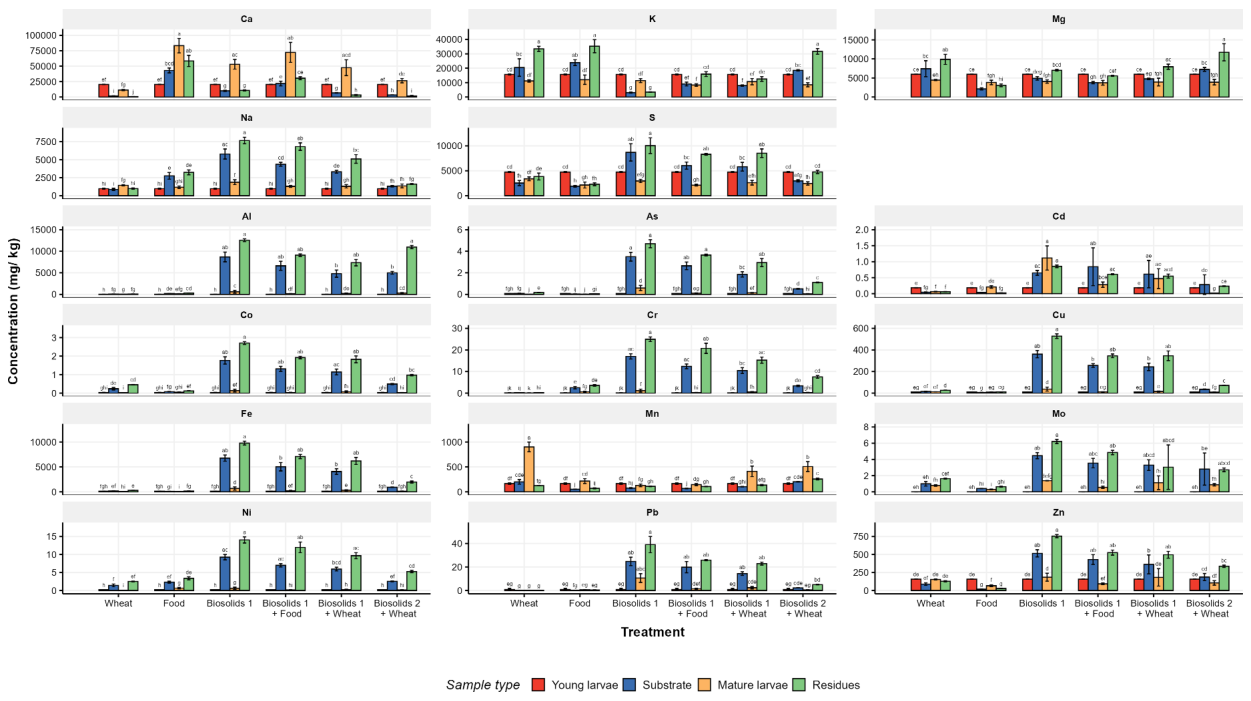
Although initial ten-day-old larvae contained significantly higher concentrations of Ca (20,354 mg/ kg), K (15,694 mg/ kg), Mg (5966 mg/ kg) and S (4747 mg/ kg) as well as Mn (165 mg/ kg) (Fig. 2, Table A.3), overall total masses of these elements contributed by the ten-day-old larvae were significantly lower compared to the substrates (Figure A.3). Therefore, the total mass of macronutrients, heavy metals, and non-essential elements at the beginning of the feeding trial were largely introduced by the substrates.
尽管初始十日龄幼虫含有显著较高浓度的Ca(20,354 mg/kg)、K(15,694 mg/kg)、Mg(5966 mg/kg)、S(4747 mg/kg)以及Mn(165 mg/kg)(图2,表A.3),但十日龄幼虫所贡献的这些元素总质量显著低于基质(图A.3)。因此,饲养试验开始时大量营养元素、重金属和非必需元素的总质量主要由基质引入。
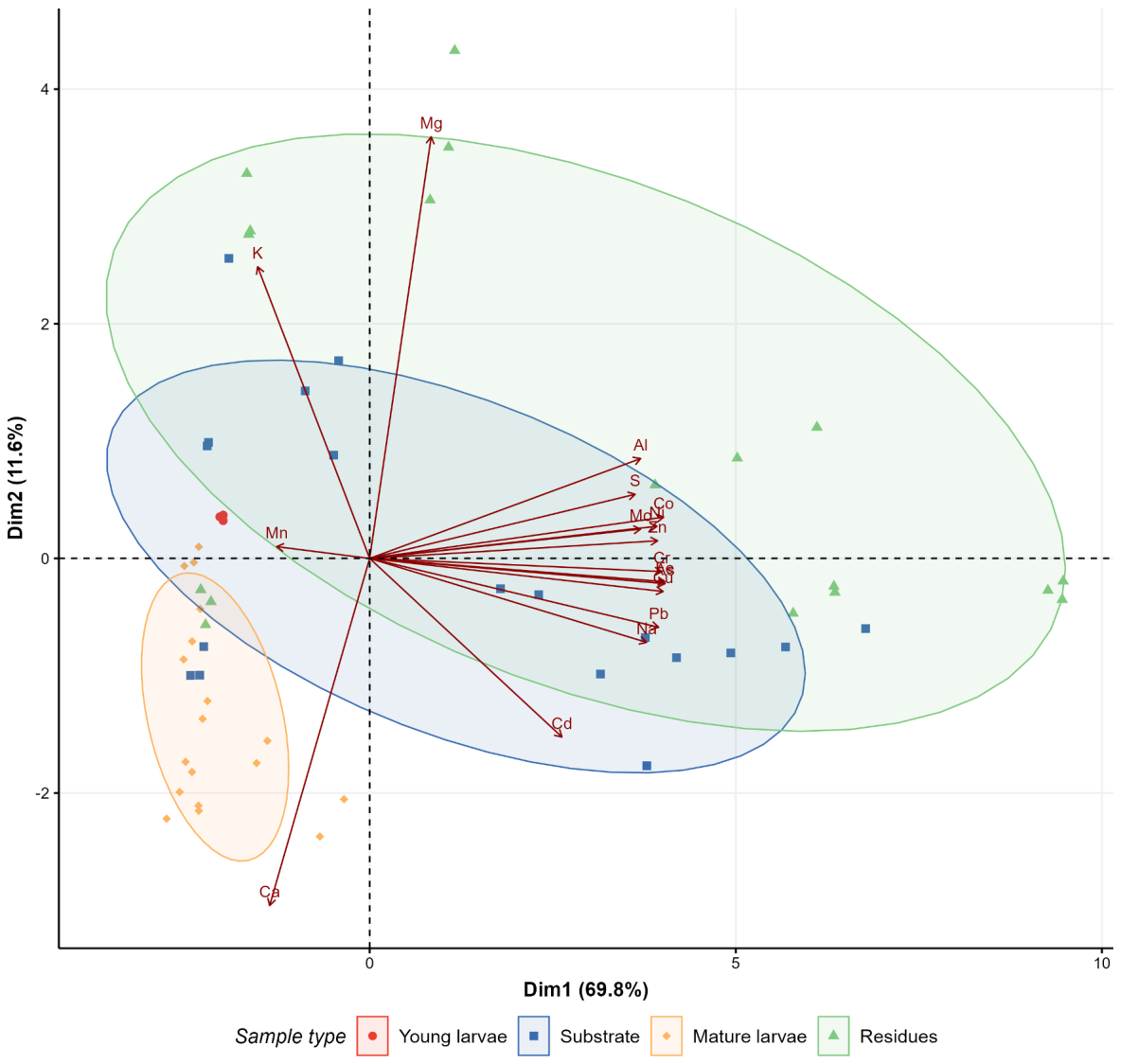
There were significant differences in the chemical composition of the feed substrates (Table A.3). Biosolids containing substrates had significantly higher (p < 0.0001) concentrations of heavy metals and non-essential elements but similar concentrations of macronutrients compared to the control substrate wheat bran (Table B.8 and B.9, Supplementary Materials Part B). Overall, concentration of heavy metals and non-essential elements were 7-times (for Co) to 150-times (for Pb) higher in Biosolids 1 as compared to wheat bran or food waste. Blending biosolids with other organic waste decreased concentration of these elements (Table A.3, Fig. 2). After 20 days of rearing, heavy metals, non-essential elements and macronutrients except for Ca and Mn were partitioned into the residues but not mature larvae (Fig. 1). Concentrations of most of these elements were significantly higher in the residues compared to the mature larvae as well as the substrates (Fig. 2, Table A.3). Biosolids 1, contained the highest concentrations of heavy metals and non-essentials elements (Fig. 2). The concentrations of As, Al, Cd, Co, Cr, Cu, Fe, Mo, and Ni significantly increased in the mature larvae fed on Biosolids 1 compared to the ten-day-old larvae. Concentrations of these elements were significantly higher (up to 60 times) in mature larvae feeding on Biosolids 1 compared to wheat bran or food waste (Table A.3). Spearman rank correlation analysis showed significant but moderate positive correlations (p < 0.0004, R > 0.28) between concentration of macronutrients (except for K, Na and S) and heavy metals in substrates and mature larvae (Figure A.4).
不同饲料基质的化学组成存在显著差异(表A.3)。与对照基质麦麸相比,含生物固体的基质重金属和非必需元素浓度显著较高(p < 0.0001),而大量营养元素浓度相近(表B.8和B.9,补充材料B部分)。总体而言,Biosolids 1中重金属和非必需元素浓度是麦麸或食物垃圾的7倍(Co)至150倍(Pb)。将生物固体与其他有机废弃物混合降低了这些元素的浓度(表A.3,图2)。饲养20天后,除Ca和Mn外,重金属、非必需元素和大量营养元素均分配至残余物而非成熟幼虫中(图1)。大多数元素在残余物中的浓度显著高于成熟幼虫和基质(图2,表A.3)。Biosolids 1含有最高浓度的重金属和非必需元素(图2)。与十日龄幼虫相比,以Biosolids 1饲养的成熟幼虫中As、Al、Cd、Co、Cr、Cu、Fe、Mo和Ni浓度显著升高。以Biosolids 1饲养的成熟幼虫中这些元素的浓度显著高于以麦麸或食物垃圾饲养的幼虫(最高达60倍)(表A.3)。Spearman秩相关分析表明,基质与成熟幼虫中大量营养元素(K、Na和S除外)和重金属浓度之间存在显著但中等程度的正相关(p < 0.0004,R > 0.28)(图A.4)。
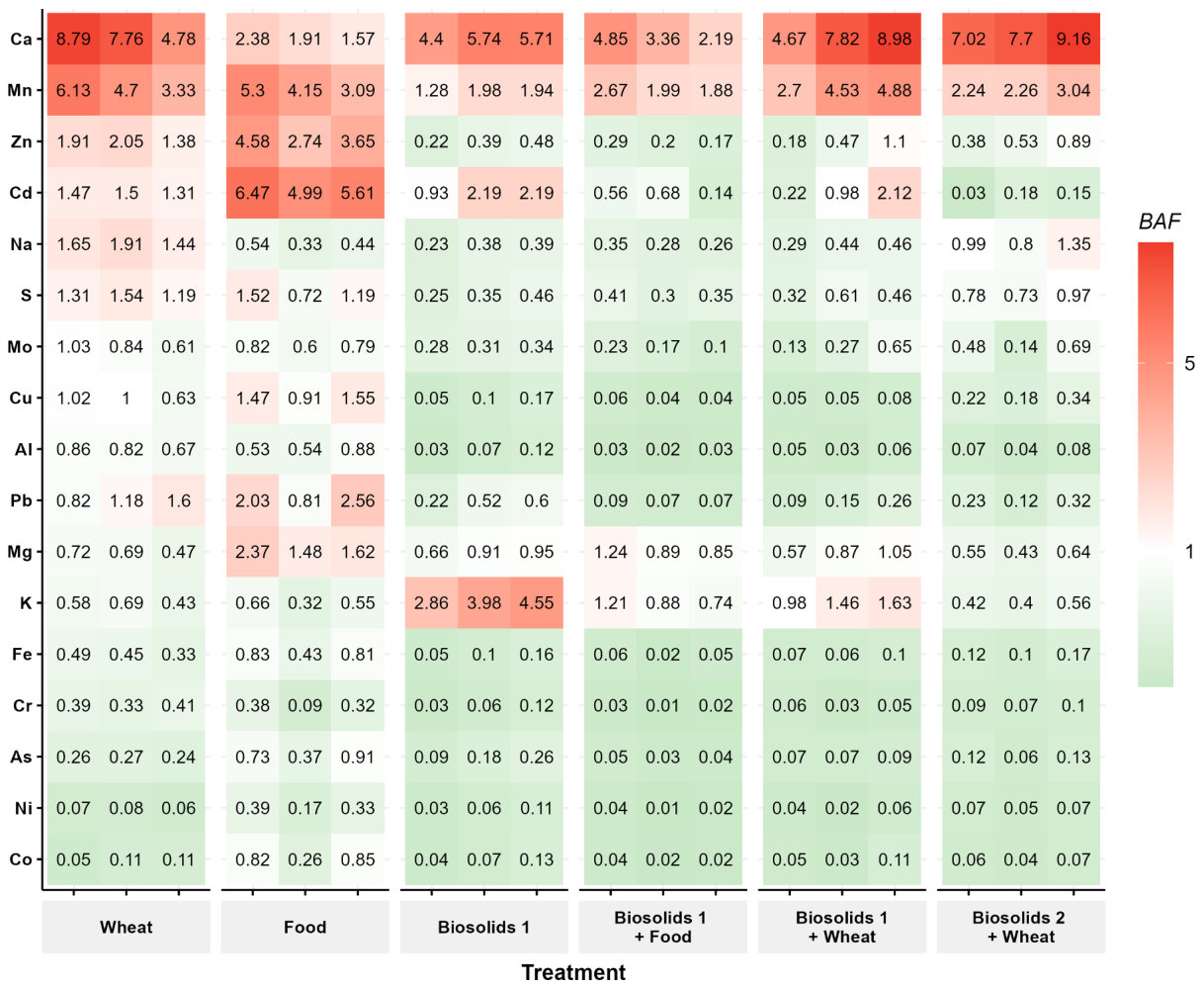
The bioaccumulation factor (BAF) indicates whether an element is portioned into (BAF > 1) or out of (BAF < 1) BSFL (Diener et al., 2015).
生物累积因子(BAF)表示某元素是分配进入BSFL(BAF > 1)还是排出BSFL(BAF < 1)(Diener et al., 2015)。
Summary of performance data of BSFL that were reared on various feed substrates. Average and standard deviation (n = 3) are displayed. Different letters indicate significant differences amongst different treatments (p < 0.05, see Table B.7): wheat bran (Wheat), food waste (Food), dewatered sludge (Biosolids 1), dewatered sludge blended with food waste in ratio 50:50 (Biosolids 1 + Food), dewatered sludge blended with wheat bran in ratio 50:50 (Biosolids 1 + Wheat), or digester sludge blended with wheat bran in ratio 75:25 (Biosolids 2 + Wheat).
以不同饲料基质饲养的BSFL性能数据汇总。表中给出平均值和标准差(n = 3)。不同字母表示不同处理间差异显著(p < 0.05,见表B.7):麦麸(Wheat)、食物垃圾(Food)、脱水污泥(Biosolids 1)、脱水污泥与食物垃圾按50:50混合(Biosolids 1 + Food)、脱水污泥与麦麸按50:50混合(Biosolids 1 + Wheat),或消化池污泥与麦麸按75:25混合(Biosolids 2 + Wheat)。
| Treatment处理 | Survival rate存活率 | Growth rate生长速率 | Substrate reduc基质减 | tion rate (%)量率(%) | Bioconversion rate生物转化率 | Protein conversion ratio蛋白质转化率 | Larvae compositi幼虫组成 | on* |
|---|---|---|---|---|---|---|---|---|
| (%) | index (mg/ days) | Total Solids | Volatile Solids | (%)* | (%)* | Crude protein (%) | Crude fat (%) | |
| Wheat | 87± 10 | 7.87 ±0.23 ab | 46.30± 4.17 a | 49.85±2.72 a | 15.68± 0.14 a | 35.78± 1.08 a | 37.07±0.75 a | 28.58± 2.95 ab |
| Food | 92± 9 | 4.73 ±0.55 d | 29.53± 1.48 c | 33.32±1.04 c | 9.98± 0.54 b | 30.06± 0.55 b | 28.26± 1.29 c | 16.61± 0.78 c |
| Biosolids 1 | 83± 13 | 6.27 ±0.55 c | 34.93± 1.11 bc | 34.92±0.26 c | 7.08± 0.54 c | 9.34± 0.22 d | 35.96±1.42 a | 23.29± 1.60 b |
| Biosolids 1+ | 82± 9 | 8.67 | 40.75± 6.03 | 45.48±5.69 | 16.1± 0.55 a | 16.49± 1.73 c | 31.59±1.02 b | 26.05± 3.41 |
| Food | ±0.57 a | ab | ab | ab | ||||
| Biosolids 1+ | 95± 8 | 8.07 | 32.16± 4.1 | 37.61±5.37 | 13.84± 0.31 a | 14.38± 1.86 c | 34.96±1.21 a | 31.29± 1.12 |
| Wheat | ±0.38 ab | bc | bc | a | ||||
| Biosolids 2+ | 92± 4 | 7.37 | 40.48± 2.64 | 44.86±2.72 | 14.6± 0.07 a | 28.15± 2.35 b | 36.72±1.50 a | 30.24± 1.72 |
| Wheat | ±0.06 bc | ab | ab | a |
* based on dry weight.
* 以干重计。
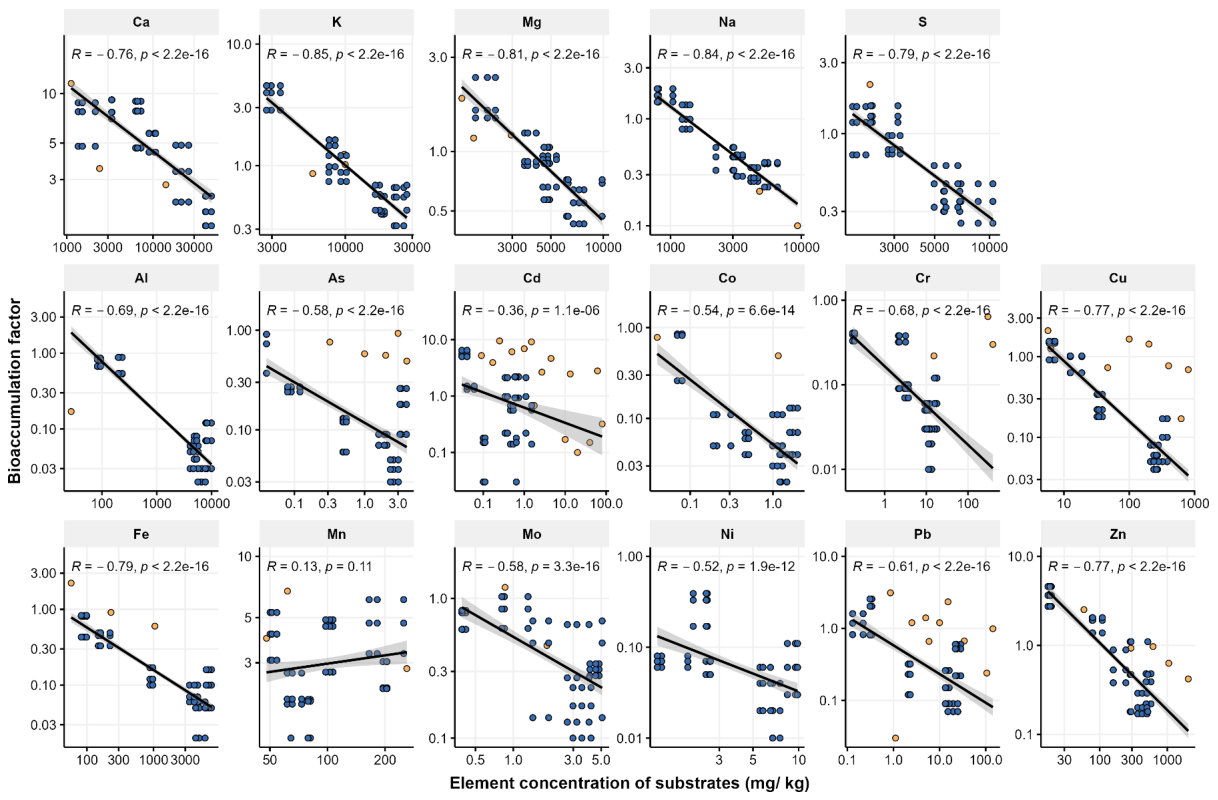
For wheat bran and food waste, a BAF > 1 occurred for the macronutrients Ca, Mg, Na, S and the heavy metals Cd, Cu, Mn, Pb and Zn (Fig. 3). In comparison, a BAF > 1 was only obtained for Ca, K, Mn as well as Cd (only for Biosolids 1) for resulting mature larvae when feeding on biosolid containing substrates (Fig. 3). There was a significant and for some elements very strong negative correlation (p < 0.0001, R < − 0.52) between initial substrate concentration and BAF in mature larvae for all macronutrients, heavy metals, and non-essential elements except for Mn (Fig. 4).
对于麦麸和食物垃圾,大量营养元素Ca、Mg、Na、S以及重金属Cd、Cu、Mn、Pb和Zn的BAF > 1(图3)。相比之下,以含生物固体基质饲养所得的成熟幼虫仅Ca、K、Mn以及Cd(仅Biosolids 1)的BAF > 1(图3)。除Mn外,所有大量营养元素、重金属和非必需元素的基质初始浓度与成熟幼虫BAF之间均呈显著负相关,部分元素的负相关极强(p < 0.0001,R < − 0.52)(图4)。
4Discussion讨论
In this study, we aimed to determine the tolerance of BSFL to different types of biosolids and blends of biosolids. We showed for the first time that high-value insect biomass of low heavy metal concentration can be produced from biosolid substrates containing high background concentrations of those elements. In particular, concentrations of As, Zn and Cu were increased in the biosolids that limits their use as soil conditioner (NZWWA, 2003). BSFL grew successfully on different types of biosolids substrates with similar levels of crude protein (35.9–36.7%) and crude fat content (23.3–30.2%) compared to the control wheat bran. However, the larvae growth and bioconversion efficiency was strongly affected by the different feed substrates. To upscale
本研究旨在确定BSFL对不同类型生物固体及生物固体混合物的耐受性。我们首次证明,可以从背景重金属浓度较高的生物固体基质中生产出重金属浓度较低的高价值昆虫生物质。尤其是生物固体中As、Zn和Cu浓度较高,限制了其作为土壤调理剂的使用(NZWWA, 2003)。BSFL在不同类型的生物固体基质上均生长良好,其粗蛋白(35.9–36.7%)和粗脂肪含量(23.3–30.2%)与对照麦麸相近。然而,幼虫生长和生物转化效率受不同饲料基质的强烈影响。为扩大
BSF-based bioconversion of biosolids it is important to understand which nutritional factors of the feed substrate may be attributed to a better performance of the larvae.
基于黑水虻的生物固体生物转化规模,有必要了解饲料基质中哪些营养因子可能有助于提高幼虫的表现。
4.1. Factors affecting bioconversion efficiency of biosolids substrates by BSFL4.1. 影响BSFL对生物固体基质生物转化效率的因素
While some studies have shown that elevated concentrations of Zn and Cu can affect the survival of BSFL (Cai et al., 2018a), the larvae survival was not significantly different amongst the treatments in this study. However, BSFL mass was significantly lower when biosolids were supplied as the only diet substrate (i.e. Biosolids 1) with highest concentrations of Zn, Cu, and other heavy metals. This is consistent with other BSF-studies (Purschke et al., 2017; Wu et al., 2020). Blending biosolids with other organic waste improved larvae growth rate, substrate reduction rate and bioconversion efficiency to similar or even higher levels compared to the control substrate wheat bran. Although not identified in this study, out-diluting of heavy metals and non-essential elements Cu, Pb, Zn and As, by blending biosolids with other organic waste, might have led to improved larvae growth rate, similarly to what was reported by Cai et al. (2018a). In addition, high concentration of total macronutrients and especially Ca were identified to negatively affect the formation of larvae fat and protein biomass. This is consistent with studies showing delayed development of Drosophila melanogaster under high concentrations of Ca (Clark, 1958). Furthermore, high salt concentrations in unblended biosolids substrates may decrease larvae growth (Cho et al., 2020).
虽然一些研究表明Zn和Cu浓度升高会影响BSFL的存活(Cai et al., 2018a),但本研究中各处理间幼虫存活率无显著差异。然而,当生物固体作为唯一饲料基质(即Biosolids 1)时,由于其Zn、Cu及其他重金属浓度最高,BSFL质量显著较低。这与其他黑水虻研究结果一致(Purschke et al., 2017; Wu et al., 2020)。将生物固体与其他有机废弃物混合后,幼虫生长速率、基质减量率和生物转化效率提高至与对照基质麦麸相近甚至更高的水平。虽然本研究未予证实,但通过将生物固体与其他有机废弃物混合而稀释重金属和非必需元素Cu、Pb、Zn和As,可能是幼虫生长速率提高的原因,这与Cai et al. (2018a)的报道相似。此外,研究发现大量营养元素总量尤其是Ca浓度较高会对幼虫脂肪和蛋白质生物质的形成产生不利影响。这与高浓度Ca延缓Drosophila melanogaster发育的研究结果一致(Clark, 1958)。另外,未混合生物固体基质中的高盐浓度可能降低幼虫生长(Cho et al., 2020)。
Values for crude protein and fat content as well as protein conversion ratios of larvae fed on biosolids were comparable to other BSF-studies using human faeces as feed substrate (Gold et al., 2020; Leong et al., 2015; Nyakeri et al., 2019). However, these values contrast with findings of Lalander et al. (2019) who measured a protein conversion ratio for undigested sludge of around 7.8%, while in this study the protein conversion ratio for Biosolids 1 was around 9.3%. The authors also reported a decreased performance of the larvae when reared on digested sludge compared to undigested sludge. However, no comment on heavy metal content for the different types of substrates was made. In this study, Biosolids 2 was obtained from a digester but mixing with wheat bran as bulking substance led to a similar bioconversion and protein conversion rate compared to the control substrate.
以生物固体饲养的幼虫的粗蛋白和脂肪含量以及蛋白质转化率,与其他以人类粪便为饲料基质的黑水虻研究结果相当(Gold et al., 2020; Leong et al., 2015; Nyakeri et al., 2019)。然而,这些数值与Lalander et al. (2019)的结果不同,该研究测得未消化污泥的蛋白质转化率约为7.8%,而本研究中Biosolids 1的蛋白质转化率约为9.3%。该研究作者还报道,与未消化污泥相比,以消化污泥饲养时幼虫表现下降,但未对不同类型基质的重金属含量作出说明。本研究中,Biosolids 2取自消化池,但与作为膨松剂的麦麸混合后,其生物转化率和蛋白质转化率与对照基质相近。
Aside from high heavy metal concentrations, BSFL growth and survival may be affected by C/N ratio, protein, and volatile solids content of the provided substrate (Gold et al., 2020; Lalander et al., 2019; Rehman et al., 2017a). Here, similarly to Lalander et al. (2019), the volatile solids content was attributed to positively affect larvae protein and fat biomass formation as well as the bioconversion efficiency. Volatile solids constitute the organic fraction in biowaste that can be easily decomposed by BSFL for energy consumption (Gold et al., 2018). This could partially explain the improvement of the bioconversion efficiency for the substrate Biosolids 1 + Wheat (13.8%) compared to Biosolids 1 (7.1%) as blending increased the volatile solids content from 88% to 91.1%. However, volatile solids content seemed to only explain a better bioconversion efficiency and growth rate partially. This was the case for the feed substrate Biosolids 1 + Food compared to Biosolids 1 + Wheat. Rehman et al. (2017a) postulated a good balance of volatile solids and nitrogen content in the substrate is essential for a good bioconversion performance which could explain the performance differences of the larvae for the discussed biosolids blends. The C/N ratio for Biosolids 1 + Food was higher and similar to the control substrate compared to Biosolids 1 + Wheat.
除重金属浓度高外,BSFL的生长和存活还可能受所提供基质的C/N比、蛋白质和挥发性固体含量的影响(Gold et al., 2020; Lalander et al., 2019; Rehman et al., 2017a)。本研究与Lalander et al. (2019)类似,认为挥发性固体含量对幼虫蛋白质和脂肪生物质的形成以及生物转化效率具有正向作用。挥发性固体构成生物废弃物中的有机组分,易被BSFL分解以供能量消耗(Gold et al., 2018)。这可部分解释基质Biosolids 1 + Wheat(13.8%)相较于Biosolids 1(7.1%)生物转化效率的提高,因为混合使挥发性固体含量从88%增至91.1%。然而,挥发性固体含量似乎只能部分解释较好的生物转化效率和生长速率,饲料基质Biosolids 1 + Food与Biosolids 1 + Wheat的比较即属此情况。Rehman et al. (2017a)提出,基质中挥发性固体与氮含量的良好平衡是实现良好生物转化性能的关键,这可以解释上述生物固体混合基质中幼虫表现的差异。与Biosolids 1 + Wheat相比,Biosolids 1 + Food的C/N比更高,且与对照基质相近。
In contrast to former studies (Gold et al., 2018; Gold et al., 2020 Lalander et al., 2019; Li et al., 2011; Nyakeri et al., 2019), in our study the larvae growth and bioconversion efficiency including substrate reduction rate was lowest for food waste compared to all other substrates including biosolids blended with food waste. Besides the low nitrogen and volatile solids content in food waste a higher fraction of fibres, originating from fruit and vegetable as prominent part of the blend, would have contributed to the low performance of the larvae. High concentrations of fibres in BSFL feed have been shown to negatively affect the larvae growth and the bioconversion efficiency accordingly (Barrag´an-Fonseca et al., 2018; Li et al., 2011; Liu et al., 2018; Palma et al., 2019). Generally, the low protein and fat content of the mature larvae fed on food waste were comparable to former studies (Gold et al., 2018; Gold et al., 2020; Liu et al., 2018; Nyakeri et al., 2019).
与以往研究不同(Gold et al., 2018; Gold et al., 2020 Lalander et al., 2019; Li et al., 2011; Nyakeri et al., 2019),本研究中食物垃圾处理的幼虫生长和生物转化效率(包括基质减量率)低于包括生物固体与食物垃圾混合基质在内的所有其他基质。除食物垃圾中氮和挥发性固体含量较低外,混合物中占较大比例的果蔬所带来的较高纤维含量也可能是幼虫表现较差的原因。已有研究表明,BSFL饲料中高浓度纤维会对幼虫生长及相应的生物转化效率产生不利影响(Barrag´an-Fonseca et al., 2018; Li et al., 2011; Liu et al., 2018; Palma et al., 2019)。总体而言,以食物垃圾饲养的成熟幼虫蛋白质和脂肪含量较低,与以往研究结果相当(Gold et al., 2018; Gold et al., 2020; Liu et al., 2018; Nyakeri et al., 2019)。
Correlation analysis indicated higher concentrations of Mn or Mg as well as an initial high pH of the feed substrate as important factors that enhance larvae fat and protein accumulation. Manganese is an essential element for the development and growth of insects (Ben-Shahar, 2018). Harrison (1928) showed that melanism in moth larvae can be increased when exposed to food enriched with Mn. Similarly, higher levels of Mn may improve anabolism of BSFL to produce more protein and fat. Magnesium was reported to be essential for the development of D. melanogaster (Clark, 1958) which might be also the case for BSF. Moreover, low pH (< 4) of the substrate was shown to decrease larvae growth and development (Ma et al., 2018). This may explain why the larvae fed on food waste of initially pH 4.5 did not gain equally weight and accordingly had a significantly lower protein and fat content compared to the larvae fed on the other substrates with initial higher pH of above 5.5.
相关分析表明,饲料基质中较高的Mn或Mg浓度以及较高的初始pH是促进幼虫脂肪和蛋白质积累的重要因素。锰是昆虫发育和生长所必需的元素(Ben-Shahar, 2018)。Harrison (1928)发现,饲喂富含Mn的食物可增强蛾类幼虫的黑化现象。同样,较高水平的Mn可能促进BSFL的合成代谢,从而产生更多的蛋白质和脂肪。据报道,镁是D. melanogaster发育所必需的元素(Clark, 1958),这对黑水虻可能同样适用。此外,研究表明基质pH过低(< 4)会抑制幼虫生长发育(Ma et al., 2018)。这可以解释为何以初始pH为4.5的食物垃圾饲养的幼虫增重不及其他处理,并且与以初始pH高于5.5的其他基质饲养的幼虫相比,其蛋白质和脂肪含量显著较低。
4.2. Partitioning of heavy metals and macronutrients in larvae and residues
4.2. 重金属和大量营养元素在幼虫与残余物中的分配
High protein and fat levels as well high Ca levels in BSFL reared on biosolid substrates in this study, similarly to what was observed for other BSF studies (Proc et al., 2020; Schmitt et al., 2019; Tschirner and Simon, 2015), makes them advantageous to use as feed for livestock (Kim et al., 2021). However, concentrations of toxic elements in BSFL that could accumulate from the substrate may represent a health risk when used as animal feed. In this study, we showed that most heavy metals and non-essential elements from the substrates were partitioned into the residues, not the mature larvae. Concentrations of heavy metals in mature larvae that fed on biosolid substrates were up to 50-times lower as compared to the substrates and the BAF was < 1 for almost all elements except for Mn. This stands in contrast with a former BSF-study on sewage sludge (Cai et al., 2018a). However, other studies that reared BSF with corn or wheat-based substrates spiked with high concentrations of particular heavy metals such as Zn, Cu or Cr (Diener et al., 2015; Gao et al., 2017; Wu et al., 2020) demonstrated that BAF in mature larvae is decreasing with increasing substrate levels. This is also supported by the correlation analysis (Fig. 4) showing a significant negative correlation between initial concentration of most heavy metals (except Mn) and non-essential elements in the substrate and BAF in mature larvae. Hence, BSFL demonstrate a mechanism of exclusion of toxic concentrations of heavy metals by actively excreting those into the residues. Similar phenomena were reported for other insects such as mealworms or grasshoppers (Crawford et al., 1996; Lindqvist and Block, 1995). At low concentrations some heavy metals such as Cu or Zn are essential for cellular functions. Therefore, BSFL might actively uptake those elements to maintain metabolism. This would support the increased BAF (> 1) when wheat bran or food waste was provided as feed substrate. Besides Cu and Zn, Mn is an essential element for maintaining metabolism. The concentration of Mn was already elevated initially in the ten-day-old larvae. During the bioconversion process the concentration of this element increased in the mature larvae. This is consistent with Proc et al. (2020). In BSF, Mn is linked to the synthesis of melanin, especially in the late stage of BSFL development, as a protection mechanism against solar radiation when migrating from the substrate (Ushakova et al., 2017).
本研究中以生物固体基质饲养的BSFL具有较高的蛋白质、脂肪及Ca含量,这与其他黑水虻研究的观察结果相似(Proc et al., 2020; Schmitt et al., 2019; Tschirner and Simon, 2015),使其适宜用作畜禽饲料(Kim et al., 2021)。然而,BSFL中可能从基质累积的有毒元素在用作动物饲料时可能构成健康风险。本研究表明,基质中的大部分重金属和非必需元素分配至残余物,而非成熟幼虫。以生物固体基质饲养的成熟幼虫中重金属浓度比基质低至1/50,且除Mn外几乎所有元素的BAF均< 1。这与此前一项关于污水污泥的黑水虻研究结果相反(Cai et al., 2018a)。然而,其他以添加高浓度特定重金属(如Zn、Cu或Cr)的玉米或小麦基质饲养黑水虻的研究(Diener et al., 2015; Gao et al., 2017; Wu et al., 2020)表明,成熟幼虫的BAF随基质重金属水平升高而降低。相关分析(图4)也支持这一结论,显示基质中大多数重金属(Mn除外)和非必需元素的初始浓度与成熟幼虫BAF之间呈显著负相关。因此,BSFL表现出一种通过主动将有毒浓度重金属排泄至残余物中而实现排斥的机制。在黄粉虫或蝗虫等其他昆虫中也有类似现象的报道(Crawford et al., 1996; Lindqvist and Block, 1995)。在低浓度下,Cu或Zn等部分重金属是细胞功能所必需的。因此,BSFL可能主动吸收这些元素以维持新陈代谢。这可以解释以麦麸或食物垃圾为饲料基质时BAF升高(> 1)的现象。除Cu和Zn外,Mn也是维持新陈代谢的必需元素。十日龄幼虫中Mn浓度初始即较高,在生物转化过程中成熟幼虫体内该元素浓度进一步升高。这与Proc et al. (2020)的结果一致。在黑水虻中,Mn与黑色素的合成有关,尤其是在BSFL发育后期,作为其离开基质迁移时抵御太阳辐射的保护机制(Ushakova et al., 2017)。
When unblended biosolids (Biosolids 1) were supplied as a feed substrate, Cd accumulated in the larvae (BAF >1). However, this was not the case for BSFL reared on Biosolids 1 + Wheat although the initial substrate concentrations were similarly high (around 0.6 mg/ kg). In contrast, the BAF for larvae fed on Biosolids 1 + Food was lower than Biosolids 1 although the initial substrate concentration of Cd was higher (0.8 mg/ kg). Interestingly, Purschke et al. (2017) observed an accumulation of Cd in BSFL (BAF = 1.5) fed on corn semolina spiked with heavy metals with a concentration of 1.5 mg/ kg while no bioaccumulation (BAF = 0.68) was observed for BSFL fed on sewage sludge mixed with chicken manure and wheat bran that had an alike concentration of 1.8 mg/ kg (Cai et al., 2018a). These contrasts show that differences in the accumulation of Cd in BSFL may not only be attributed to the initial concentration in the substrate and by feed exclusion mechanisms of the larvae but also other factors. For example, extraordinary high Ca content in BSF compared to other dipterans (Finke and Oonincx, 2014) have been related to Cd uptake in BSFL because of similar ionic sizes that fit through the same uptake channel (Braeckman et al., 1999). However, in this study accumulation of Cd in the larvae was not related to increases in larvae Ca content.
当以未混合的生物固体(Biosolids 1)作为饲料基质时,Cd在幼虫体内发生累积(BAF >1)。然而,以Biosolids 1 + Wheat饲养的BSFL并未出现这种情况,尽管其基质初始浓度同样较高(约0.6 mg/kg)。相反,以Biosolids 1 + Food饲养的幼虫BAF低于Biosolids 1,尽管其基质Cd初始浓度更高(0.8 mg/kg)。有趣的是,Purschke et al. (2017)观察到以添加重金属(浓度为1.5 mg/kg)的玉米粗粉饲养的BSFL中存在Cd累积(BAF = 1.5),而以污水污泥与鸡粪和麦麸混合(浓度相近,为1.8 mg/kg)饲养的BSFL则未观察到生物累积(BAF = 0.68)(Cai et al., 2018a)。这些差异表明,BSFL中Cd累积的差异可能不仅取决于基质初始浓度和幼虫的摄食排斥机制,还受其他因素影响。例如,与其他双翅目昆虫相比,黑水虻异常高的Ca含量(Finke and Oonincx, 2014)被认为与BSFL对Cd的吸收有关,因为二者离子半径相近,可通过同一吸收通道(Braeckman et al., 1999)。然而,本研究中幼虫体内Cd的累积与幼虫Ca含量的增加无关。
International regulation guidelines for metal concentrations in animal feed in EU, USA, Canada, and China.
欧盟、美国、加拿大和中国动物饲料中金属浓度的国际监管指南。
| Element元素 | EU maximu kg) Feed materials欧盟最大 kg) 饲料 原料 | m limitsa(mg/ Complete feed限量a(mg/ 全价 饲料 | USA: NRC Minimal Toleranceb(mg/ kg)美国:NRC最低 耐受量b(mg/ kg) | Canadian Regulatory guidancec (mg/ kg)加拿大 监管 指导值c (mg/kg) | Chinese feed standardd Feed ingredient中国饲料标准d 饲料原料 | (mg/kg) Feed products(mg/kg) 饲料产品 | Concentratio substratese Biosolids1以生物固体 基质e饲养的 Biosolids1 | n in larvae fed o Biosolids 1 +Food幼虫中的浓 Biosolids 1 +Food | n biosolids Biosolids 1 + Wheat度 Biosolids 1 + Wheat |
|---|---|---|---|---|---|---|---|---|---|
| Al | n.a. | n.a. | n.a. | 200 (non- ruminant) | n.a. | n.a. | 613± 325.2 | 169.4± 25.7 | 229.8±93 |
| As | 2 | 2 | 30 | 8 | 2 (stone powder) 40 (algae and processed products) | 2 (other compound feed) 10 (additive premixed feeds) | 0.59± 0.24 | 0.11±0.03 | 0.14±0.03 |
| Cd | 2 | 0.5 | 10 | 0.3 (other livestock) 0.4 (horses) | 0.75 (stone powder) 2 (feed ingredients derived from animals) | 0.5 (compound feed) 1.25 (Concentrated feed) | 1.11± 0.38 | 0.28±0.08 | 0.47±0.31 |
| Cr | n.a. | n.a. | 100 (swine, horse cattle sheep) | n.a. | 5 | 5 (compound feeds) | 1.17± 0.66 | 0.24±0.1 | 0.49±0.21 |
| 500 (poultry) | 20 (additive for pigs) | ||||||||
| Cu | n.a. | n.a. | 40 (goat) | n.a. | n.a. | n.a. | 37±18.5 | 11.1±2.04 | 14.9±4.58 |
| Hg | 0.1 | 0.1 | 0.2 | n.a. | 0.1 (other feed ingredients) 0.5 (fish and by- product feed ingredients) | 0.1 (other compound feed) 0.5 (aquatic compound feed) | n.a. | n.a. | n.a. |
| Pb | 10 | 5 | 10 (swine, horse, poultry) | 8 | 5 (single-cell protein feed) 30 (feed grass) | 5 (compound feed) 40 (additive premixed feed) | 10.61±68 | 1.48±0.41f | 2.35±1.02 |
| Se | n.a. | n.a. | 0.5 | n.a. | n.a. | n.a. | n.a. | n.a. | n.a. |
a EU Directive 2002/32/EC. b NRC, 2005 (Guide used by FDA). c CFIA, 2017. d AQSIQ, 2017. e This study.
a 欧盟指令2002/32/EC。b NRC, 2005(FDA采用的指南)。c CFIA, 2017。d AQSIQ, 2017。e 本研究。
Because of increased levels of Cd, Cu, Pb and Al, BSFL fed on Biosolids 1 (Table 2) would not comply to international animal feed guidelines (Table 2). In contrast, the heavy metal content of larvae that were reared on blended biosolids substrates like Biosolids 1 + Wheat or Biosolids 1 + Food were below maximum levels of these guidelines and could be potentially used as animal feed if concentration of Hg for these larvae (not measured in this study) would also be below acceptable limits. Alternately to animal feed, larvae fed on biosolid substrates including Biosolids 1 could be used as fertilizer as the low metal content compared to resulting residues are below the limits of organic material for land application (NZWWA, 2003). Previous studies also indicated that heavy metals like Cd and Cr do not accumulate in the skin (Gao et al., 2017) and that BSFL reared on substrate with high levels of heavy metals such as Zn, Cu, Pb and Ni bioaccumulated these elements in their bodies but not in extracted larval fats (Cai et al., 2018a). Hence, chitin and fat of BSFL fed on biosolids substrates could be a valuable source for a range of other industrial use (Gold et al., 2018).
由于Cd、Cu、Pb和Al含量升高,以Biosolids 1为食的黑水虻幼虫(BSFL)(表2)不符合国际动物饲料标准(表2)。相比之下,以混合生物固体(污泥)基质(如Biosolids 1 + Wheat或Biosolids 1 + Food)饲养的幼虫,其重金属含量低于上述标准的最高限值;若这些幼虫的Hg浓度(本研究未测定)同样低于可接受限值,则有望用作动物饲料。除用作动物饲料外,以包括Biosolids 1在内的生物固体基质饲养的幼虫还可用作肥料,因为与相应残渣相比,其较低的金属含量低于有机物料土地施用的限值(NZWWA, 2003)。已有研究还表明,Cd和Cr等重金属不会在表皮中累积(Gao et al., 2017),且在含高浓度Zn、Cu、Pb和Ni等重金属的基质上饲养的黑水虻幼虫会在体内生物累积这些元素,但不会累积于提取的幼虫脂肪中(Cai et al., 2018a)。因此,以生物固体基质饲养的黑水虻幼虫的几丁质和脂肪可成为多种其他工业用途的宝贵原料(Gold et al., 2018)。
4.3. Economic potential of BSF-based bioconversion of biosolids4.3. 基于黑水虻的生物固体生物转化的经济潜力
The reduction of heavy metals in biosolids continues to be a challenge and new (expensive) technologies have been developed to treat this problem (Brisolara and Bourgeois, 2019). Here, we have shown that BSF-based bioconversion of biosolids blends can create high-value biomass with low heavy metal concentrations and can reduce waste volume of up to 40% in 20 days which is up to 195-times faster than decay in landfills (Cruz and Barlaz, 2010). This could strongly reduce costs for landfilling as well as greenhouse gas emission. For example, in New Zealand a 40% reduction of normally landfilled biosolids (45,000 tonnes [Stantec, 2019]) to 27,000 tonnes/ year) by BSF-based bioconversion could lead to cost reduction of over US$12 M/ year (landfill disposal fee: US$660/ dry tonne [Beecroft and Prosser, 2020]) and reduction of carbon emissions of over 27,000 Mg CO2e/ year (based on emission rate of 1.50 Mg CO2e/ Mg substrate by decay on landfills [Brown et al., 2010]).
降低生物固体(污泥)中的重金属含量仍是一项挑战,为此已开发出多种新的(昂贵的)处理技术(Brisolara and Bourgeois, 2019)。本研究表明,基于黑水虻的混合生物固体生物转化能够产生重金属浓度低的高价值生物质,并可在20天内使废弃物体积减少多达40%,其速度比填埋场中的分解快达195倍(Cruz and Barlaz, 2010)。这可大幅降低填埋成本和温室气体排放。例如,在新西兰,通过基于黑水虻的生物转化使通常填埋的生物固体(45,000 t[Stantec, 2019])减少40%(至27,000 t/年),可降低成本逾1200万美元/年(填埋处置费:660美元/干吨[Beecroft and Prosser, 2020]),并减少碳排放逾27,000 Mg CO2e/年(基于填埋场分解排放率1.50 Mg CO2e/Mg基质计算[Brown et al., 2010])。
On the other hand, bioconversion of biosolids blends such as Biosolids 1 + Food and Biosolids 1 + Wheat could create 149 and 130 kg larvae per tonne dry substrate, respectively. This relates to 45–47 kg insect protein and 39–41 kg insect fat as well as 17–19 kg chitin per tonne dry substrate (based on 13% chitin content of the larvae [Wong et al., 2019]). Given the biosolids production in the EU, China, or NZ of 8.9 Mio., 7.8 Mio. and 66,000 dry tonnes/ year, respectively (Mateo-- Sagasta et al., 2015; Stantec, 2019; Wei et al., 2020), BSF-based bioconversion could recover valuable resources from this waste product and could create up to 420,000, 370,000, and 3100 tonnes of protein/ year, 360,000, 320,000, and 2680 tonnes of fat/ year as well as 170,000, 150,000, and 1280 tonnes of chitin/ year, respectively. The market value of larvae protein, fat and chitin are estimated to be US$ 6000/t, US$ 2350/t, and US$ 34,500/t, respectively (Bloomberg, 2020; Byrne, 2021; Priyadarshi and Rhim, 2020). Therefore, under optimal conditions, revenues of about US$ 9 bn/ year, US$ 8 bn/ year, or US$ 70 M/ year could be created by BSF-based bioconversion of all biosolids produced in EU, China, and NZ, respectively.
另一方面,Biosolids 1 + Food和Biosolids 1 + Wheat等混合生物固体(污泥)的生物转化分别可产生每吨干基质149 kg和130 kg幼虫,相当于每吨干基质产出45–47 kg昆虫蛋白、39–41 kg昆虫脂肪以及17–19 kg几丁质(基于幼虫几丁质含量13%计算[Wong et al., 2019])。鉴于欧盟、中国和新西兰的生物固体年产量分别为890万、780万和66,000干吨(Mateo-- Sagasta et al., 2015; Stantec, 2019; Wei et al., 2020),基于黑水虻的生物转化可从该废弃物中回收宝贵资源,每年分别可产出多达420,000、370,000和3100 t蛋白质,360,000、320,000和2680 t脂肪,以及170,000、150,000和1280 t几丁质。幼虫蛋白、脂肪和几丁质的市场价值估计分别为6000美元/t、2350美元/t和34,500美元/t(Bloomberg, 2020; Byrne, 2021; Priyadarshi and Rhim, 2020)。因此,在最优条件下,若对欧盟、中国和新西兰产生的全部生物固体进行基于黑水虻的生物转化,每年分别可创造约90亿美元、80亿美元和7000万美元的收益。
4.4. Conclusion4.4. 结论
We have shown that BSF-based bioconversion of biosolids can (1) produce valuable insect biomass rich in protein and fat and (2) reduce waste volume by up to 40% in less than 20 days. Furthermore, we demonstrated that (3) heavy metals and non-essential elements did not accumulate in the mature BSFL but rather in the residues. The heavy metal concentration in BSFL fed on biosolids was low enough to allow their use as animal feed. For a potential upscaling of the bioconversion technology of biosolids we identified nutritional factors such as volatile solids content, Mg, Mn, pH, and Ca to be relevant to control to improve the bioconversion efficiency of BSFL. Further research is needed to evaluate potential transmission of other contaminants than heavy metals during the BSF-based bioconversion process of biosolids. Overall, this study provided evidence that BSF-based bioconversion can be a promising waste minimization and resource recovery solution towards the creation of a circular economy around biosolids management.
本研究表明,基于黑水虻的生物固体(污泥)生物转化能够(1)产生富含蛋白质和脂肪的高价值昆虫生物质,并且(2)在不到20天内使废弃物体积减少多达40%。此外,本研究证实(3)重金属和非必需元素并未在成熟黑水虻幼虫体内累积,而是累积于残渣中。以生物固体饲养的黑水虻幼虫的重金属浓度足够低,可用作动物饲料。为实现生物固体生物转化技术的潜在规模化应用,本研究确定了挥发性固体含量、Mg、Mn、pH和Ca等营养因子是提高黑水虻幼虫生物转化效率所需调控的关键因素。在基于黑水虻的生物固体生物转化过程中,除重金属以外其他污染物的潜在传递仍需进一步研究加以评估。总体而言,本研究提供的证据表明,基于黑水虻的生物转化有望成为一种废弃物减量与资源回收的解决方案,有助于围绕生物固体管理构建循环经济。
CRediT authorship contribution statementCRediT作者贡献声明
Kristin Bohm: Conceptualization, Methodology, Investigation, Formal analysis, Visualization, Project administration, Funding acquisition. Gregory A. Hatley: Investigation, Writing – review & editing. Brett H. Robinson: Validation, Supervision, Project administration, Writing – review & editing. María J. Gutierrez-Gin´ es: ´ Resources, Writing – review & editing.
Kristin Bohm:构思、方法、调查研究、形式分析、可视化、项目管理、经费获取。Gregory A. Hatley:调查研究、写作——审阅与编辑。Brett H. Robinson:验证、指导、项目管理、写作——审阅与编辑。María J. Gutierrez-Gin´ es: ´ 资源、写作——审阅与编辑。
Declaration of Competing Interest利益冲突声明
The authors declare that they have no known competing financial interests or personal relationships that could have appeared to influence the work reported in this paper.
作者声明,不存在任何可能影响本文所报道工作的已知经济利益冲突或个人关系。
Acknowledgments致谢
This project was funded by a Pioneer Fund awarded by the Institute of Environmental Science and Research Ltd. (ESR). The authors thank Prescient Nutrition who kindly provided BSFL and supported the set-up of the experiment. Biosolids were kindly provided by Wellington Water and Palmerston North City Council.
本项目由Institute of Environmental Science and Research Ltd.(ESR)授予的Pioneer Fund资助。作者感谢Prescient Nutrition慷慨提供黑水虻幼虫并协助搭建试验装置。生物固体(污泥)由Wellington Water和Palmerston North City Council惠赠。
Supplementary materials补充材料
Supplementary material associated with this article can be found, in the online version, at doi:10.1016/j.resconrec.2021.106149.
本文相关补充材料可在在线版本中查阅,doi:10.1016/j.resconrec.2021.106149。
References参考文献
ANZBP, 2019. Biosolids Production in Australia-2019. Australian Water Association, St Leonards. AOAC, 2005. Official Methods of Analysis of AOAC International, 18th ed. Association of Official Analytical Chemists (AOAC), Gaitherburg, MD.
Assaad, H.I., Hou, Y., Zhou, L., Carroll, R.J., Wu, G., 2015. Rapid publication-ready MS- Word tables for two-way ANOVA. SpringerPlus 4 (1), 33. https://doi.org/10.1186/ s40064-015-0795-z.
Awasthi, M.K., Liu, T., Awasthi, S.K., Duan, Y., Pandey, A., Zhang, Z., 2020. Manure pretreatments with Black Soldier Fly Hermetia illucens L. (Diptera: stratiomyidae): a study to reduce pathogen content. Sci. Total Environ. 737, 139842 https://doi.org/ 10.1016/j.scitotenv.2020.139842. Baird, R.B., Eaton, A.D., Rice, E.W., Bridgewater, L., 2017. Standard Methods For the Examination of Water and Wastewater. American Public Health Association, Washington, DC.
Banks, I.J., Gibson, W.T., Cameron, M.M., 2014. Growth rates of Black Soldier Fly larvae fed on fresh human faeces and their implication for improving sanitation. Trop. Med. Int. Health 19 (1), 14–22. https://doi.org/10.1111/tmi.12228. Barrag´an-Fonseca, K.B., Dicke, M., van Loon, J.J., 2018. Influence of larval density and dietary nutrient concentration on performance, body protein, and fat contents of Black Soldier Fly larvae (Hermetia illucens). Entomol. Exp. Appl. 166 (9), 761–770. https://doi.org/10.1111/eea.12716.
Barrena, R., V´azquez, F., Sanchez, A., 2008. Dehydrogenase activity as a method for ´ monitoring the composting process. Bioresour. Technol. 99 (4), 905–908. https:// doi.org/10.1016/j.biortech.2007.01.027.
Beecroft, K., Prosser, J.A., 2020. Report 14: Potential end-Use Options For the Lower North Island. Lowe Environmental Impact (LEI), Palmerston North, p. 35. Ben-Shahar, Y., 2018. The impact of environmental Mn exposure on insect biology. Front. Genet. 9 (70), 1–7. https://doi.org/10.3389/fgene.2018.00070. -70. Biancarosa, I., Liland, N.S., Biemans, D., Araujo, P., Bruckner, C.G., Waagbo, R., Torstensen, B.E., Lock, E.J., Amlund, H., 2018. Uptake of heavy metals and arsenic in
Black Soldier Fly (Hermetia illucens) larvae grown on seaweed-enriched media. J. Sci. Food Agric. 98 (6), 2176–2183. https://doi.org/10.1002/jsfa.8702.
Bloomberg, 2020. Bloomberg Market Data.
Braeckman, B., Smagghe, G., Brutsaert, N., Cornelis, R., Raes, H., 1999. Cadmium uptake and defense mechanism in insect cells. Environ. Res. 80 (3), 231–243. https://doi. org/10.1006/enrs.1998.3897.
Brisolara, K.F., Bourgeois, J., 2019. Biosolids and sludge management. Water Environ. Res. 91 (10), 1168–1176. https://doi.org/10.1002/wer.1212.
Brown, S., Beecher, N., Carpenter, A., 2010. Calculator tool for determining greenhouse gas emissions for biosolids processing and end use. Environ. Sci. Technol. 44 (24), 9509–9515. https://doi.org/10.1021/es101210k.
Byrne, J., 2021. Demand For Insect Protein Could Hit 500,000 Tons By 2030.
FeedNavigator. William Reed.
Cai, M., Hu, R., Zhang, K., Ma, S., Zheng, L., Yu, Z., Zhang, J., 2018a. Resistance of Black Soldier Fly (Diptera: stratiomyidae) larvae to combined heavy metals and potential application in municipal sewage sludge treatment. Environ. Sci. Pollut. Res. 25 (2), 1559–1567. https://doi.org/10.1007/s11356-017-0541-x.
Cai, M., Ma, S., Hu, R., Tomberlin, J.K., Yu, C., Huang, Y., Zhan, S., Li, W., Zheng, L., Yu, Z., Zhang, J., 2018b. Systematic characterization and proposed pathway of tetracycline degradation in solid waste treatment by Hermetia illucens with intestinal microbiota. Environ. Pollut. 242 (Pt A), 634–642. https://doi.org/10.1016/j. envpol.2018.06.105.
Cho, S., Kim, C.-.H., Kim, M.-.J., Chung, H., 2020. Effects of microplastics and salinity on food waste processing by Black Soldier Fly (Hermetia illucens) larvae. J. Ecol. Environ. 44 (1) https://doi.org/10.1186/s41610-020-0148-x. Clark, E.W., 1958. A review of literature on calcium and magnesium in insects. Ann. Entomol. Soc. Am. 51 (2), 142–154. https://doi.org/10.1093/aesa/51.2.142.
Conigrave, J., 2020. CORX: create and format correlation matrices. R package version 1.0.6.1. https://github.com/conig/corx.
Crawford, L.A., Lepp, N.W., Hodkinson, I.D., 1996. Accumulation and egestion of dietary copper and cadmium by the grasshopper Locusta migratoria R & F (Orthoptera: acrididae). Environ. Pollut. 92 (3), 241–246. https://doi.org/10.1016/0269-7491 (96)00004-8.
Cruz, F.B.D.I., Barlaz, M.A., 2010. Estimation of waste component-specific landfill decay rates using laboratory-scale decomposition data. Environ. Sci. Technol. 44 (12), 4722–4728. https://doi.org/10.1021/es100240r.
de Mendiburu, F., Yaseen, M., 2020. agricolae: statistical procedures for agricultural research. R package version 1.4.0. https://myaseen208.github.io/agricolae/htt ps://cran.r-project.org/package=agricolae.
Diener, S., Zurbrugg, C., Tockner, K., 2009. Conversion of organic material by Black Soldier Fly larvae: establishing optimal feeding rates. Waste Manage. Res. 27 (6), 603–610. https://doi.org/10.1177/0734242×09103838.
Diener, S., Zurbrügg, C., Tockner, K., 2015. Bioaccumulation of heavy metals in the Black Soldier Fly, Hermetia illucens and effects on its life cycle. J. Insects Food Feed 1 (4), 261–270. https://doi.org/10.3920/jiff2015.0030. EPA, 2003. Biosolids Technology Fact Sheet. United States Environmental Protection Agency (EPA), Office of Water. Available online. https://www.epa.gov/biosolids /fact-sheet-use-incineration-biosolids-management.
Finke, M.D., Oonincx, D., 2014. Insects As Food For insectivores, Mass production of
Beneficial Organisms. Elsevier, pp. 583–616.
Gao, Q., Wang, X., Wang, W., Lei, C., Zhu, F., 2017. Influences of chromium and cadmium on the development of Black Soldier Fly larvae. Environ. Sci. Pollut. Res. 24 (9), 8637–8644. https://doi.org/10.1007/s11356-017-8550-3.
Gold, M., Cassar, C.M., Zurbrugg, C., Kreuzer, M., Boulos, S., Diener, S., Mathys, A., 2020. Biowaste treatment with Black Soldier Fly larvae: increasing performance through the formulation of biowastes based on protein and carbohydrates. Waste Manage. 102, 319–329. https://doi.org/10.1016/j.wasman.2019.10.036.
Gold, M., Tomberlin, J.K., Diener, S., Zurbrugg, C., Mathys, A., 2018. Decomposition of biowaste macronutrients, microbes, and chemicals in Black Soldier Fly larval treatment: a review. Waste Manage. 82, 302–318. https://doi.org/10.1016/j. wasman.2018.10.022.
Harrison, J.H., 1928. A further induction of melanism in the lepidopterous insect, Selenia biiunaria esp., and its inheritance. Proceedings of the Royal Society of London. Series B, Containing Papers of a Biological Character 102 (718), 338–347. https://doi.org/ 10.1098/rspb.1928.0009.
James, A., Virginia, B., Joanna, G.E.R.L., Alan, L., Mark, R., Jacqui, H., 2016. From Tapu
to Noa - Maori cultural Views On Biowastes management: A focus On Biosolids. ¯ Centre for Integrated Biowaste Research (CIBR).
Janssen, R.H., Vincken, J.-.P., van den Broek, L.A., Fogliano, V., Lakemond, C.M., 2017. Nitrogen-to-protein conversion factors for three edible insects: tenebrio molitor, Alphitobius diaperinus, and Hermetia illucens. J. Agric. Food Chem. 65 (11), 2275–2278. https://doi.org/10.1021/acs.jafc.7b00471.
Kassambara, A., Mundt, F., 2020. factoextra: extract and visualize the results of multivariate data analyses. R package version 1.0.7. http://www.sthda.com/engli sh/rpkgs/factoextra.
Kim, C.-.H., Ryu, J., Lee, J., Ko, K., Lee, J.-y., Park, K.Y., Chung, H., 2021. Use of Black Soldier Fly Larvae for food waste treatment and energy production in asian countries: a review. Processes 9 (1). https://doi.org/10.3390/pr9010161.
Lalander, C., Diener, S., Magri, M.E., Zurbrugg, C., Lindstrom, A., Vinneras, B., 2013. Faecal sludge management with the larvae of the Black Soldier Fly (Hermetia illucens)–from a hygiene aspect. Sci. Total Environ. 458-460, 312–318. https://doi. org/10.1016/j.scitotenv.2013.04.033.
Lalander, C., Diener, S., Zurbrügg, C., Vinnerås, B., 2019. Effects of feedstock on larval development and process efficiency in waste treatment with Black Soldier Fly (Hermetia illucens). J. Clean. Prod. 208, 211–219. https://doi.org/10.1016/j. jclepro.2018.10.017.
Lalander, C., Senecal, J., Calvo, M.G., Ahrens, L., Josefsson, S., Wiberg, K., Vinneras, B., 2016. Fate of pharmaceuticals and pesticides in fly larvae composting. Sci. Total Environ. 565, 279–286. https://doi.org/10.1016/j.scitotenv.2016.04.147.
Lalander, C.H., Fidjeland, J., Diener, S., Eriksson, S., Vinnerås, B., 2015. High waste-tobiomass conversion and efficient Salmonella spp. reduction using Black Soldier Fly for waste recycling. Agron. Sustain. Dev. 35 (1), 261–271. https://doi.org/10.1007/ s13593-014-0235-4.
LeBlanc, R.J., Matthews, P., Richard, R.P., 2009. Global atlas of excreta, wastewater sludge, and biosolids management: moving forward the sustainable and welcome uses of a global resource. UN-habitat.
Leong, S., Kutty, S., Tan, C., Tey, L., 2015. Comparative study on the effect of organic waste on lauric acid produced by Hermetia illucens larvae via bioconversion. J. Eng. Sci. Technol. 8 (2015), 52–63.
Li, Q., Zheng, L., Qiu, N., Cai, H., Tomberlin, J.K., Yu, Z., 2011. Bioconversion of dairy manure by Black Soldier Fly (Diptera: stratiomyidae) for biodiesel and sugar production. Waste Manage 31 (6), 1316–1320. https://doi.org/10.1016/j. wasman.2011.01.005.
Lindqvist, L., Block, M., 1995. Excretion of cadmium during moulting and metamorphosis in Tenebrio molitor (Coleoptera; Tenebrionidae). Comp. Biochem. Physiol. Part - C: Toxicol. Pharmacol. 111 (2), 325–328. https://doi.org/10.1016/ 0742-8413(95)00057-U.
Liu, Z., Minor, M., Morel, P.C.H., Najar-Rodriguez, A.J., 2018. Bioconversion of three organic wastes by Black Soldier Fly (Diptera: stratiomyidae) larvae. Environ. Entomol. 47 (6), 1609–1617. https://doi.org/10.1093/ee/nvy141.
Ma, J., Lei, Y., Rehman, K.U., Yu, Z., Zhang, J., Li, W., Li, Q., Tomberlin, J.K., Zheng, L., 2018. Dynamic effects of initial pH of substrate on biological growth and metamorphosis of Black Soldier Fly (Diptera: stratiomyidae). Environ. Entomol. 47 (1), 159–165. https://doi.org/10.1093/ee/nvx186.
Martin, T., Creed, J., Brockhoff, C., 1994. Sample Preparation Procedure For Spectrochemical Determination of Total Recoverable elements, Method 200.2. U.S. Environmental Protection Agency. Available online. https://www.epa.gov/sites/de fault/files/2015-08/documents/method_200-2_rev_2-8_1994.pdf.
Mateo-Sagasta, J., Raschid-Sally, L., Thebo, A., 2015. Global Wastewater and Sludge production, Treatment and Use. Wastewater. Springer, pp. 15–38.
May, B.M., 1961. The occurrence in New Zealand and the life-history of the soldier fly Hermetia illucens (L.) (Diptera: stratiomyidae). N.Z. J. Sci. 4 (5), 023921473.
Mohajerani, A., Ukwatta, A., Jeffrey-Bailey, T., Swaney, M., Ahmed, M., Rodwell, G., Bartolo, S., Eshtiaghi, N., Setunge, S., 2019. A proposal for recycling the world’s unused stockpiles of treated wastewater sludge (biosolids) in fired-clay bricks. Buildings 9 (1). https://doi.org/10.3390/buildings9010014.
Myers, H.M., Tomberlin, J.K., Lambert, B.D., Kattes, D., 2008. Development of Black Soldier Fly (Diptera: stratiomyidae) larvae fed dairy manure. Environ. Entomol. 37 (1), 11–15. https://doi.org/10.1603/0046-225x(2008)37[11:dobsfd]2.0.co;2.
Ndegwa, P., Thompson, S., Das, K., 2000. Effects of stocking density and feeding rate on vermicomposting of biosolids. Bioresour. Technol. 71 (1), 5–12. https://doi.org/ 10.1016/S0960-8524(99)00055-3.
Nyakeri, E.M., Ayieko, M.A., Amimo, F.A., Salum, H., Ogola, H.J.O., 2019. An optimal feeding strategy for black soldier fly larvae biomass production and faecal sludge reduction. J. Insects Food Feed 5 (3), 201–213. https://doi.org/10.3920/ jiff2018.0017.
NZWWA, 2003. Guidelines For the Safe Application of Biosolids to Land in New Zealand. New Zealand Waste Water Association. Available online: https://www.waternz.org. nz/Article?Action=View&Article_id=26.
Palma, L., Fernandez-Bayo, J., Niemeier, D., Pitesky, M., VanderGheynst, J.S., 2019. Managing high fiber food waste for the cultivation of Black Soldier Fly larvae. npj Sci. Food 3 (1), 1–7. https://doi.org/10.1038/s41538-019-0047-7.
Paramashivam, D., Dickinson, N.M., Clough, T.J., Horswell, J., Robinson, B.H., 2017. Potential environmental benefits from blending biosolids with other organic amendments before application to land. J. Environ. Qual. 46 (3), 481–489. https:// doi.org/10.2134/jeq2016.10.0421.
Priyadarshi, R., Rhim, .J..-W., 2020. Chitosan-based biodegradable functional films for food packaging applications. Innov. Food Sci. Emerg. Technol. 62, 102346 https:// doi.org/10.1016/j.ifset.2020.102346.
Proc, K., Bulak, P., Wiacek, D., Bieganowski, A., 2020. Hermetia illucens exhibits bioaccumulative potential for 15 different elements - Implications for feed and food production. Sci. Total Environ. 723, 138125 https://doi.org/10.1016/j. scitotenv.2020.138125.
Purschke, B., Scheibelberger, R., Axmann, S., Adler, A., Jager, H., 2017. Impact of substrate contamination with mycotoxins, heavy metals and pesticides on the growth performance and composition of Black Soldier Fly larvae (Hermetia illucens) for use in the feed and food value chain. Food Addit. Contam. 34 (8), 1410–1420. https://doi.org/10.1080/19440049.2017.1299946.
Quintern, M., Morley, M., 2017. Vermicomposting of Biosolids and Beneficial Reuse - New Zealand Commercial Case Studies from 4 Communities Over 8 Years Proceedings of the Water Environment Federation. Water Environment Federation, pp. 1084–1098.
R-Core, 2021. R: A language and Environment For Statistical Computing, in: Computing, R.F.f.S. (Ed.). Vienna, Austria.
Rehman, K., Rehman, A., Cai, M., Zheng, L., Xiao, X., Somroo, A.A., Wang, H., Li, W., Yu, Z., Zhang, J., 2017a. Conversion of mixtures of dairy manure and soybean curd residue by Black Soldier Fly larvae (Hermetia illucens L.). J. Clean. Prod. 154, 366–373. https://doi.org/10.1016/j.jclepro.2017.04.019.
Rehman, K.U., Cai, M., Xiao, X., Zheng, L., Wang, H., Soomro, A.A., Zhou, Y., Li, W., Yu, Z., Zhang, J., 2017b. Cellulose decomposition and larval biomass production from the co-digestion of dairy manure and chicken manure by mini-livestock
(Hermetia illucens L.). J. Environ. Manage. 196, 458–465. https://doi.org/10.1016/ j.jenvman.2017.03.047.
Rehman, K.U., Ur Rehman, R., Somroo, A.A., Cai, M., Zheng, L., Xiao, X., Ur Rehman, A., Rehman, A., Tomberlin, J.K., Yu, Z., Zhang, J., 2019. Enhanced bioconversion of dairy and chicken manure by the interaction of exogenous bacteria and black soldier fly larvae. J. Environ. Manage. 237, 75–83. https://doi.org/10.1016/j. jenvman.2019.02.048.
Sarpong, D., Oduro-Kwarteng, S., Gyasi, S.F., Buamah, R., Donkor, E., Awuah, E., Baah, M.K., 2019. Biodegradation by composting of municipal organic solid waste into organic fertilizer using the Black Soldier Fly (Hermetia illucens) (Diptera: stratiomyidae) larvae. Int. J. Recycl. Org. Waste Agric. 8 (S1), 45–54. https://doi. org/10.1007/s40093-019-0268-4.
Schmitt, E., Belghit, I., Johansen, J., Leushuis, R., Lock, E.J., Melsen, D., Ramasamy Shanmugam, R.K., Van Loon, J., Paul, A., 2019. Growth and safety assessment of feed streams for Black Soldier Fly larvae: a case study with aquaculture sludge. Animals (Basel) 9 (4). https://doi.org/10.3390/ani9040189.
Simcock, R., Cavanagh, J., Robinson, B., Gutierrez-Gines, M., 2019. Using biowastes to establish native plants and ecosystems in New Zealand. Front. Sustain. Food Syst. 3, 85. https://doi.org/10.3389/fsufs.2019.00085.
Stantec, 2019. New Zealand biosolids Survey 2019. Australia and New Zealand Biosolids Partnership (ANZBP).
Tinholt, R., 2019. The value of biosolids in New Zealand - An industry assessment, in: ltd, W.S. (Ed.). In: Water New Zealand Conference & Expo 2019. Water NZ, p. 15.
Tomberlin, J.K., Sheppard, D.C., Joyce, J.A., 2002. Selected life-history traits of Black Soldier Flies (Diptera: stratiomyidae) reared on three artificial diets. Ann. Entomol. Soc. Am. 95 (3), 379–386. https://doi.org/10.1603/0013-8746(2002)095[0379: SLHTOB]2.0.CO;2.
Tschirner, M., Simon, A., 2015. Influence of different growing substrates and processing on the nutrient composition of Black Soldier Fly larvae destined for animal feed. J. Insects as Food Feed 1 (4), 249–259. https://doi.org/10.3920/jiff2014.0008.
Ushakova, N., Dontsov, A., Bastrakov, A., Garmash, N.Y., Pavlov, D., 2017.
Paramagnetics melanin and Mn 2+ in Black Soldier Fly Hermetia illucens. Doklady Biochemistry and Biophysics. Springer, pp. 102–105.
Van der Fels-Klerx, H.J., Camenzuli, L., van der Lee, M.K., Oonincx, D.G., 2016. Uptake of cadmium, lead and arsenic by Tenebrio molitor and Hermetia illucens from contaminated substrates. PLoS ONE 11 (11), e0166186. https://doi.org/10.1371/ journal.pone.0166186.
Wei, L., Zhu, F., Li, Q., Xue, C., Xia, X., Yu, H., Zhao, Q., Jiang, J., Bai, S., 2020. Development, current state and future trends of sludge management in China: based on exploratory data and CO2-equivalent emissions analysis. Environ. Int. 144, 106093 https://doi.org/10.1016/j.envint.2020.106093.
Wong, C.-.Y., Rosli, S.-.S., Uemura, Y., Ho, Y.C., Leejeerajumnean, A., Kiatkittipong, W., Cheng, C.-.K., Lam, M.-.K., Lim, .J..-W., 2019. Potential protein and biodiesel sources from Black Soldier Fly larvae: insights of larval harvesting instar and fermented feeding medium. Energies 12 (8). https://doi.org/10.3390/en12081570.
Wong, J.W., Fang, M., 2000. Effects of lime addition on sewage sludge composting process. Water Res 34 (15), 3691–3698. https://doi.org/10.1016/s0269-7491(99) 00056-1.
Wu, N., Wang, X., Xu, X., Cai, R., Xie, S., 2020. Effects of heavy metals on the bioaccumulation, excretion and gut microbiome of Black Soldier Fly larvae (Hermetia illucens). Ecotoxicol. Environ. Saf. 192, 110323 https://doi.org/10.1016/j. ecoenv.2020.110323.