Contents lists available at ScienceDirect journal homepage: www.elsevier.com/locate/apsoil
Young-Nam Kim a,b,c, Brett Robinson d, Stephane Boyer e, Hongtao Zhong a,f, Keum-Ah Lee a,b, Yong Bok Lee b,c,*, Nicholas Dickinson a,**
a Faculty of Agriculture and Life Science, Lincoln University, Canterbury, New Zealand b Institute of Agriculture and Life Science (IALS), Gyeongsang National University, Jinju 52828, Republic of Korea c Division of Applied Life Science (BK21), Gyeongsang National University, Jinju 52828, Republic of Korea d School of Physical and Chemical Sciences, University of Canterbury, Christchurch 8041, New Zealand e Institut de Recherche sur la Biologie de l'Insecte (IRBI), UMR CNRS 7261, Tours University, Parc de Grandmont, 37200 Tours, France f School of Biological Sciences, The University of Western Australia, Perth, WA 6009, Australia
a 新西兰坎特伯雷林肯大学农业与生命科学学院 b 韩国庆尚国立大学农业与生命科学研究所(IALS),晋州 52828 c 韩国庆尚国立大学应用生命科学系(BK21),晋州 52828 d 新西兰基督城坎特伯雷大学物理与化学科学学院,基督城 8041 e 法国图尔大学昆虫生物学研究所(IRBI),UMR CNRS 7261,Parc de Grandmont,37200 图尔 f 澳大利亚西澳大学生物科学学院,珀斯,WA 6009
1Introduction引言
Earthworms are typical soil engineers as they have a large effect on soil functions, which can mediate soil structure, organic matter dynamic, nutrient cycling and biological interactions of belowground ecosystem (Blouin et al., 2013). Thus, there is no doubt that earthworms contribute to the sustainability of agroecosystem, but significant paucity of knowledge of New Zealand native earthworms still exists in this context. This appears to be problematic in terms of biodiversity conservation in this global biodiversity hotspot. The history of New Zealand earthworm study was started by Lee (1961), who described the distribution and interaction of native and exotic earthworms and their impacts on soil and vegetation properties. However, since then, many researchers have focused more on exotic lumbricid earthworms, wellcolonised in New Zealand agricultural land (e.g. McColl et al., 1982; Wüst et al., 2009; Schon et al., 2021). Meanwhile, only seven previous research papers have been published on the functionality of New Zealand's native earthworms, with only one or two species (Springett et al., 1998; Wüst et al., 2009; Waterhouse et al., 2014; Kim et al., 2015, 2017b, 2017c; Zhong et al., 2017). Currently, we have far too little understanding of the function of native earthworms in soil to identify and utilise their potential benefits as soil engineers and to soil ecosystem services. Therefore, comparative studies on the effects of more diverse species and ecological groups are needed to further broaden our insights.
蚯蚓是典型的土壤工程师,对土壤功能具有重要影响,能够调节土壤结构、有机质动态、养分循环以及地下生态系统的生物相互作用(Blouin et al., 2013)。因此,蚯蚓对农业生态系统可持续性的贡献毋庸置疑,但在这方面,有关新西兰本土蚯蚓的知识仍然十分匮乏。对于这一全球生物多样性热点地区而言,这在生物多样性保护方面似乎是一个问题。新西兰蚯蚓研究始于Lee(1961),他描述了本土蚯蚓与外来蚯蚓的分布及其相互作用,以及它们对土壤和植被性质的影响。然而,此后许多研究者更多地关注在新西兰农田中广泛定殖的外来正蚓科蚯蚓(如McColl et al., 1982; Wüst et al., 2009; Schon et al., 2021)。与此同时,关于新西兰本土蚯蚓功能的已发表研究论文仅有7篇,且仅涉及一两个物种(Springett et al., 1998; Wüst et al., 2009; Waterhouse et al., 2014; Kim et al., 2015, 2017b, 2017c; Zhong et al., 2017)。目前,我们对本土蚯蚓在土壤中功能的认识远远不足,难以识别和利用其作为土壤工程师及对土壤生态系统服务的潜在益处。因此,需要对更多样的物种和生态类群的作用开展比较研究,以进一步拓宽认识。
* Correspondence to: Y. B. Lee, Institute of Agriculture and Life Science (IALS), Gyeongsang National University, Jinju 52828, Republic of Korea.
* 通讯作者:Y. B. Lee,韩国庆尚国立大学农业与生命科学研究所(IALS),晋州 52828。
** Corresponding author.
E-mail addresses: yblee@gnu.ac.kr (Y.B. Lee), Nicholas.Dickinson@lincoln.ac.nz (N. Dickinson).
https://doi.org/10.1016/j.apsoil.2022.104506 Received 2 November 2021; Received in revised form 12 April 2022; Accepted 15 April 2022 Available online 27 April 2022 0929-1393/© 2022 Published by Elsevier B.V.
https://doi.org/10.1016/j.apsoil.2022.104506 收稿日期:2021年11月2日;修回日期:2022年4月12日;接受日期:2022年4月15日;在线发表日期:2022年4月27日 0929-1393/© 2022 Elsevier B.V. 出版
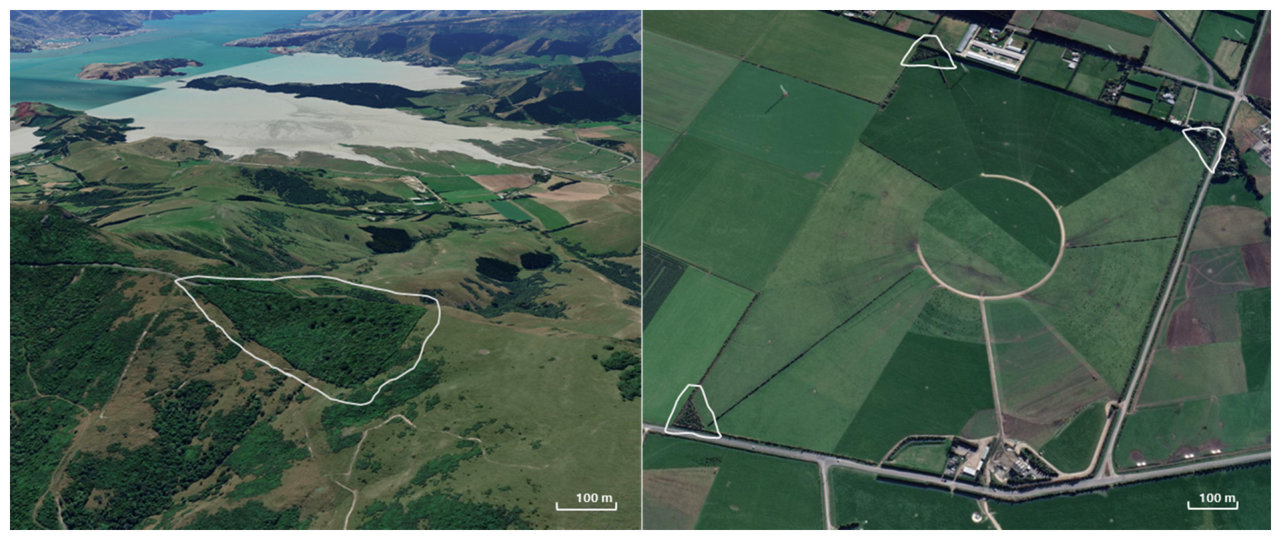
Since the settlement of Europeans in 1840, ground disturbances accompanying changes in land use (deforestation and intensive farming practices) decimated native megascolecid communities (Kim et al., 2015; Boyer et al., 2016), as also happened elsewhere (Edwards and Bohlen, 1996; Hendrix, 2006). The primarily agricultural province of Canterbury in South Island alone has 25 recognised species of native earthworms (Winterbourne et al., 2008). However, native earthworms are almost entirely absent from New Zealand's agricultural pastures, with the probable exception of only a single deep-burrowing endogeic species, Octochaetus multiporus (Springett et al., 1998). Fraser et al. (1996) recorded a complete absence of native earthworms in a comprehensive study of agricultural pastures. European lumbricids have been introduced to improve agricultural pasture. While some effects have been limited possibly by dry New Zealand summers, areas where large populations have established have experience improved quality in agricultural soils (Lee, 1961; Springett, 1992). In contrast, in the same landscapes, native earthworms have found some refuge on lessdisturbed land, in nature reserves, riparian zone and along tree/shrub fenceline boundaries of agriculture land (Fig. 1) (Kim et al., 2015, 2017a; Bowie et al., 2016). Coexistence of native and exotic species is evident in these marginal habitats (Boyer et al., 2016).
自1840年欧洲人定居以来,伴随土地利用变化(森林砍伐和集约化耕作)而来的地表扰动使本土巨蚓科蚯蚓群落大量减少(Kim et al., 2015; Boyer et al., 2016),其他地区亦是如此(Edwards and Bohlen, 1996; Hendrix, 2006)。仅以农业为主的南岛坎特伯雷地区就有25种已确认的本土蚯蚓(Winterbourne et al., 2008)。然而,本土蚯蚓在新西兰农业牧场中几乎完全缺失,唯一可能的例外是一种深穴居的内栖型物种Octochaetus multiporus(Springett et al., 1998)。Fraser et al.(1996)在一项针对农业牧场的全面调查中未记录到任何本土蚯蚓。欧洲正蚓科蚯蚓被引入以改良农业牧场。尽管其部分作用可能受到新西兰夏季干旱的限制,但在其大量种群得以建立的区域,农业土壤质量得到了改善(Lee, 1961; Springett, 1992)。相比之下,在同一景观中,本土蚯蚓在受扰动较少的土地、自然保护区、河岸带以及农田的乔木/灌木围栏边界找到了一定的庇护所(图1)(Kim et al., 2015, 2017a; Bowie et al., 2016)。在这些边缘生境中,本土物种与外来物种明显共存(Boyer et al., 2016)。
Recent large-scale landscape conversion to irrigated dairy farming and more intensive production systems has profoundly affected the status of soil biogeochemistry (Mclenaghen et al., 2014). This has also impacted biodiversity conservation; for example, nutrient spillover from farmland has been shown to degrade adjacent native vegetation (Didham et al., 2015). In our earlier study on earthworms in these fragments we were surprised to find native species actually preferred the physicochemical condition of intensively dairy-farmed soils to native forest soils (Kim et al., 2015). We suggested that interactions between soils, earthworms, and native plant rhizospheres are likely to be particularly crucial in vegetation remnants that represent novel native ecosystems (Bowie et al., 2016; Kim, 2016). Since native earthworms and native vegetation are generally found together, a better understanding of the structure and functionality of this relationship within the soil ecosystem is clearly important to inform ecological restoration practise. Questions also remain as to whether burrowing activity of native earthworms in paddock soil may be of benefit to the physicochemistry and agroecosystem services. Could agricultural pastures provide a significant and beneficial habitat for native species?
近年来大规模的景观转变为灌溉奶牛养殖及更为集约化的生产系统,深刻影响了土壤生物地球化学状况(Mclenaghen et al., 2014)。这也影响了生物多样性保护;例如,已有研究表明农田养分外溢会导致邻近本土植被退化(Didham et al., 2015)。在我们早期对这些斑块中蚯蚓的研究中,令人意外地发现,本土物种实际上更偏好集约化奶牛养殖土壤的理化条件,而非本土森林土壤(Kim et al., 2015)。我们认为,在代表新型本土生态系统的植被残余斑块中,土壤、蚯蚓与本土植物根际之间的相互作用可能尤为关键(Bowie et al., 2016; Kim, 2016)。由于本土蚯蚓与本土植被通常相伴出现,更好地理解土壤生态系统中这一关系的结构与功能,对于指导生态恢复实践显然十分重要。此外,本土蚯蚓在围场土壤中的掘穴活动是否有利于土壤理化性质和农业生态系统服务,仍有待解答。农业牧场能否为本土物种提供重要且有益的生境?
The aims of the present study were to identify how native and exotic species of earthworms affect the properties of a low fertility agricultural soil prior to farm intensification, and to investigate whether native species adapt and leverage the soil properties for their survivorship. Our hypothesis is that exotic lumbricid earthworms are better-suited to agricultural land and will burrow more actively, providing a large effect on soil biogeochemical conditions. This was expected to contrast with native megascolecid earthworms that are naturally found in more acidic native soils with low to moderate fertility.
本研究旨在明确本土与外来蚯蚓物种如何影响农场集约化之前低肥力农业土壤的性质,并探讨本土物种是否能够适应并利用该土壤性质以维持生存。我们的假设是:外来正蚓科蚯蚓更适应农业用地,掘穴更为活跃,从而对土壤生物地球化学条件产生较大影响;与之相对,本土巨蚓科蚯蚓天然分布于酸性更强、肥力中低的本土土壤中。
2Materials and methods材料与方法
2.1. Soil and earthworm collection2.1. 土壤与蚯蚓采集
Topsoil (about 100 kg, 0–15 cm depth) was collected from a sheep-grazed paddock situated near the Lincoln University campus (Gammack Estate: 43◦38′39.48′′S, 172◦23′28.07′′E). This stony Eyre soil has free drainage with low water storage capacity, although the surface horizon of the soil sampled under the turf was mostly free of stones. The mixed sward consisted mainly of perennial ryegrass (Lolium perenne), clovers (Trifolium spp.), and cocksfoot (Dactylis glomerata) as well as several invasive weeds, quite typical of extensively-managed lowland sheep pasture. This agricultural soil was selected for the experimental work because its fertility was typically low. Soil properties were: pH 5.4, organic matter (OM) content – 75 g kg− 1, moisture – 25%, total C – 33 g kg− 1, total N – 3 g kg− 1, and total P – 341 mg kg− 1(Kim et al., 2015). The pasture has had some degree of ploughing, top-dressing and re-seeding since the mid-19th century, but no recent history of intensive land management or fertilisation.
表层土壤(约100 kg,0–15 cm深度)采自林肯大学校园附近的一处放牧绵羊的围场(Gammack Estate:43◦38′39.48′′S,172◦23′28.07′′E)。该多石的Eyre土壤排水通畅、持水能力低,但草皮下采样的表层土壤基本不含石块。混合草地主要由多年生黑麦草(Lolium perenne)、三叶草(Trifolium spp.)和鸭茅(Dactylis glomerata)以及若干入侵杂草组成,是典型的粗放管理低地绵羊牧场。选择该农业土壤开展试验是因为其肥力通常较低。土壤性质为:pH 5.4,有机质(OM)含量75 g kg− 1,含水量25%,全碳33 g kg− 1,全氮3 g kg− 1,全磷341 mg kg− 1(Kim et al., 2015)。自19世纪中叶以来,该牧场经历过一定程度的翻耕、表施肥料和补播,但近期无集约化土地管理或施肥历史。
Soil was thoroughly mixed and sieved with a 4 mm sieve prior to a microcosm study. As we expected, introduced species of earthworms including Lumbricus rubellus, Aporrectodea caliginosa and Octolasion cyaneum, but not native earthworms, were recorded while sampling in the sheep-farmed pastures of the present study. Earthworms were collected from sites with native and restored vegetation in the East and West Coasts of South Island (Table 1) by digging (20 × 20 × 20 cm) and hand-sorting; more than 100 individuals of each earthworm species were collected to use in this study. Native species were classified based on both morphological (Lee, 1959a, 1959b) and molecular methods, the latter using DNA barcoding of 16S rDNA regions (Kim et al., 2017a). Epigeic, anecic and endogeic behavioural groups were represented by three native species (Table 1), previously described and recorded in South Island (Lee, 1959a, 1959b; Wüst et al., 2009); further details of the species are provided in earlier papers (Kim et al., 2015; Kim et al., 2017a). Two exotic lumbricid earthworms, A. caliginosa and O. lacteum were collected respectively on Lincoln University farmland (East Coast) and in a natural forest at Punakaiki on the West Coast. These two endogeics are commonly found on agricultural land, among about 19 species of exotic earthworms in New Zealand (Lee, 1959a; Springett, 1992).
在微宇宙试验前,将土壤充分混匀并过4 mm筛。正如预期,在本研究绵羊牧场采样过程中记录到了引入的蚯蚓物种,包括Lumbricus rubellus、Aporrectodea caliginosa和Octolasion cyaneum,但未发现本土蚯蚓。蚯蚓采自南岛东海岸和西海岸具有本土植被和恢复植被的样地(表1),采用挖掘(20 × 20 × 20 cm)和手拣法;每种蚯蚓采集100余条个体用于本研究。本土物种基于形态学(Lee, 1959a, 1959b)和分子方法进行分类,后者采用16S rDNA区域的DNA条形码(Kim et al., 2017a)。表栖型、深栖型和内栖型三个行为类群分别由三种本土物种代表(表1),这些物种此前已在南岛被描述和记录(Lee, 1959a, 1959b; Wüst et al., 2009);物种的详细信息见早期文献(Kim et al., 2015; Kim et al., 2017a)。两种外来正蚓科蚯蚓A. caliginosa和O. lacteum分别采自林肯大学农场(东海岸)和西海岸Punakaiki的一处天然林。在新西兰约19种外来蚯蚓中,这两种内栖型蚯蚓常见于农业用地(Lee, 1959a; Springett, 1992)。
Earthworm species used in this experiment. Native species were named based on morphological and genetic identification following Lee (1959a, 1959b) and Kim et al. (2017a).
本试验所用蚯蚓物种。本土物种依据Lee(1959a, 1959b)和Kim et al.(2017a)的形态学和遗传学鉴定进行命名。
| Species物种 | Functional group功能 类群 | Origin来源 | Sampling location采样地点 | Field density (individuals m−2)野外密度 (个体 m−2) |
|---|---|---|---|---|
| Deinodrilus sp.1 | Epigeic | Native | Punakaiki Nikau Reserve (−42◦8′38.39′′S/ 171◦19′50.36′′E) | 50 to 125 |
| Maoridrilus transalpinus | Anecic | Native | Ahuriri Reserve (−43◦39′58.97′′S/ 172◦37′26.37′′E) | ≥125 |
| Octochaetus multiporus | Endogeic | Native | Southern Summit Roadside (−43◦44′15.41′′S/ 172◦54′32.64′′E) | 50 to 125 |
| Aporrectodea caliginosa | Endogeic | Exotic | Lincoln University Farm Field (−43◦38′55.05′′S/ 172◦28′4.72′′E) | ≥125 |
| Octolasion lacteum | Endogeic | Exotic | Punakaiki Restored Land (−42◦8′10.99′′S/ 171◦19′46.68′′E) | ≥125 |
2.2. Microcosm study2.2. 微宇宙试验
Experimental work was conducted after an acclimatisation period for the earthworms of at least one month in field-collected soils in the laboratory, to provide confidence of survivorship and maintenance of body mass. To investigate the effect of earthworms on soil properties, three native species (Deinodrilus sp.1, M. transalpinus, and O. multiporus) and two exotic species (A. caliginosa and O. lacteum) were placed in 400 mL polypropylene containers containing 250 g wetted soil (30% moisture). Two individuals of the same species were added into each container covered with a gauze lid to prevent the earthworm escaping. The soil moisture in each container was maintained the same as at the beginning level through water supply on a weekly basis by weighing. About 2 g of sawdust, equivalent to an increase of 1.1% of soil organic matter, was added in each container as a food source at the beginning of incubation; this limited resource was intended to avoid a large nutrient pulse to the soil. The microcosm was maintained in a dark incubator room at 15 ◦C for 3 weeks. The experiment comprised four replicates for each earthworm species and additional four reference containers without earthworms. Cultures were checked for mortality of earthworms on a weekly basis with minimal disturbance. Visual observation of the soil surface and a lack of smell of decay proved to be sufficient for this purpose.
试验开始前,蚯蚓在实验室内于野外采集的土壤中驯化至少一个月,以确保其存活并维持体重。为研究蚯蚓对土壤性质的影响,将三种本土物种(Deinodrilus sp.1、M. transalpinus和O. multiporus)和两种外来物种(A. caliginosa和O. lacteum)分别放入盛有250 g湿润土壤(含水量30%)的400 mL聚丙烯容器中。每个容器中放入同一物种的2条个体,并用纱布盖覆盖以防蚯蚓逃逸。每周通过称重补水,使各容器土壤含水量维持在初始水平。培养开始时向每个容器添加约2 g木屑作为食物来源,相当于土壤有机质增加1.1%;限制该资源旨在避免向土壤输入大量养分脉冲。微宇宙置于15 ◦C的黑暗培养室中培养3周。每种蚯蚓设4个重复,另设4个不加蚯蚓的对照容器。每周在尽量减少扰动的情况下检查蚯蚓死亡情况。通过目视观察土壤表面及确认无腐败气味即可满足该目的。
2.3. Analytical2.3. 分析方法
After earthworm collection, fresh soil was sampled and kept at 4 ◦C before soil analysis. The samples were extracted with 2 M KCl solution to determine PAN, which is the sum of NH4-N and NO3-N, using a FIA star 5000 triple channel analyser (Foss Tecator AB, Sweden) (Blakemore et al., 1987). Following air-drying and sieving (<2 mm), soil pH was measured using a pH meter (Mettler Toledo SevenEasy, USA). Soil organic matter content was determined with Loss on Ignition (LOI) method at 500 ◦C for 5 h (Blakemore et al., 1987). Subtracting LOI at the end of the incubation from LOI at the beginning allowed to estimate the amount of OM consumed by earthworms. Cation Exchange Capacity (CEC) and exchangeable Ca were determined with the silver thio-urea method (Blakemore et al., 1987). Following extraction with 0.05 M Ca (NO3)2 the concentration of soluble elements were measured by ICP-OES (Varian 702-ES, Australia) (Simmler et al., 2013).
取出蚯蚓后,采集新鲜土壤并于4 ◦C保存待分析。样品用2 M KCl溶液浸提,采用FIA star 5000三通道分析仪(Foss Tecator AB,瑞典)测定植物有效氮(PAN),即NH4-N与NO3-N之和(Blakemore et al., 1987)。风干并过筛(<2 mm)后,用pH计(Mettler Toledo SevenEasy,美国)测定土壤pH。土壤有机质含量采用烧失量(LOI)法于500 ◦C灼烧5 h测定(Blakemore et al., 1987)。以培养开始时的LOI减去培养结束时的LOI,估算蚯蚓消耗的OM量。阳离子交换量(CEC)和交换性Ca采用硫脲银法测定(Blakemore et al., 1987)。用0.05 M Ca (NO3)2浸提后,采用ICP-OES(Varian 702-ES,澳大利亚)测定可溶性元素浓度(Simmler et al., 2013)。
2.4. Statistical analyses2.4. 统计分析
Differences among earthworm species were assessed for earthworm mortality and biomass change as well as soil chemical properties using one-way analysis of variance (ANOVA), followed by Fisher's least significant difference (LSD) post-hoc test for separation of means using agricolae R package (de Mendiburu, 2019). Omega squared (ω2) from the ANOVA results was used to compare difference in effect size between behaviour groups and species origins for single soil factor. For soil pH, the detected values of pH were calculated by conversion to the equivalent H+ concentrations and subsequent back calculation to pH. Principal component analysis (PCA) was performed to identify the major parameters of soil incubated with different earthworm species and the interrelations using factomineR (Husson et al., 2020) and factoextra (Kassambara and Mundt, 2020) packages. Relative site-to-site dissimilarities in ordination space were analysed on the basis of the first and second axis scores. All statistical analyses were performed using the R software (version 3.2.5).
采用单因素方差分析(ANOVA)评估不同蚯蚓物种间蚯蚓死亡率、生物量变化及土壤化学性质的差异,随后利用agricolae R软件包(de Mendiburu, 2019)进行Fisher最小显著差异(LSD)事后检验以区分均值。基于ANOVA结果计算的Omega平方(ω2)用于比较单一土壤因子在行为类群与物种来源之间效应量的差异。对于土壤pH,将测得的pH值换算为相应的H+浓度进行计算,再反算为pH。利用factomineR(Husson et al., 2020)和factoextra(Kassambara and Mundt, 2020)软件包进行主成分分析(PCA),以识别不同蚯蚓物种培养土壤的主要参数及其相互关系。基于第一和第二轴得分分析排序空间中样点间的相对差异。所有统计分析均使用R软件(3.2.5版)完成。
3Results结果
3.1. Growth and organic matter consumption3.1. 生长与有机质消耗
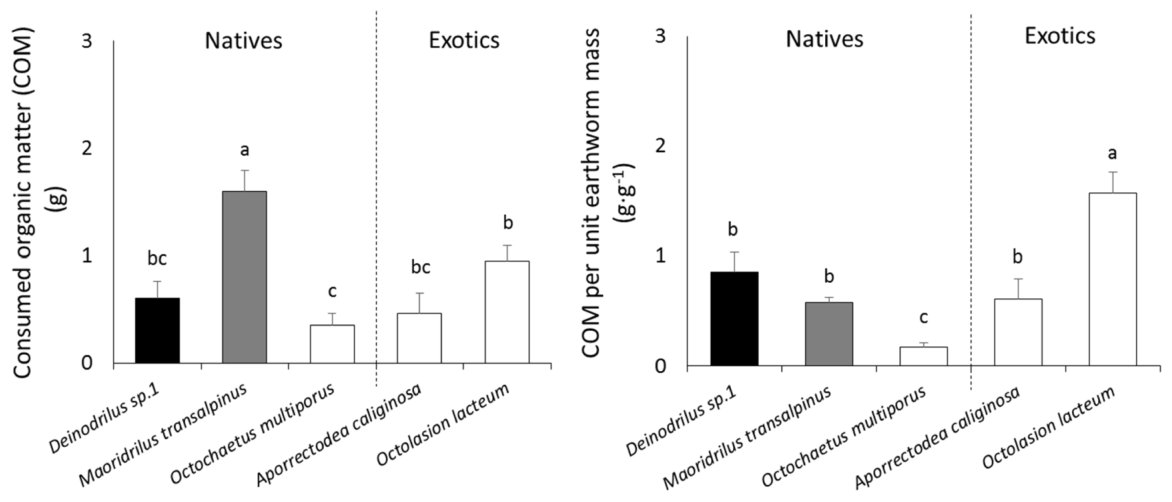
During 21 days of incubation, survival rate of most earthworms was successfully maintained. Visual observation based on burrowing and casting activities suggested native species were more active and healthier than exotic ones. However, individuals of all species lost body weight (Table 2). There was a large difference in the amount of OM consumed by the different species of earthworm; the greatest difference was observed by M. transalpinus that consumed 5 times more OM than O. multiporus (p < 0.05, Fig. 2). Less OM was consumed by other endogeic earthworms but, within this behavioural group, exotic species consumed relatively more OM. When looking at the amount of OM consumed per unit of biomass, the native O. multiporus consumed significantly less OM than other species (p < 0.05) while the exotic O. lacteum consumed significantly more (p < 0.05); thus, O. lacteum appeared to be the most active feeder for its size.
在21天的培养期间,大多数蚯蚓的存活率得以维持。基于掘穴和排粪活动的目视观察表明,本土物种比外来物种更为活跃和健康。然而,所有物种的个体体重均有所下降(表2)。不同蚯蚓物种消耗的OM量差异很大;差异最大的是M. transalpinus,其OM消耗量为O. multiporus的5倍(p < 0.05,图2)。其他内栖型蚯蚓消耗的OM较少,但在该行为类群内,外来物种消耗的OM相对较多。就单位生物量的OM消耗量而言,本土O. multiporus显著低于其他物种(p < 0.05),而外来O. lacteum显著较高(p < 0.05);因此,相对于其体型,O. lacteum似乎是取食最活跃的物种。
3.2. Alteration of soil properties3.2. 土壤性质的变化
Burrowing and casting by earthworms had a large influence on the chemistry of the soils (Table 3). Initial soil pH of 5.4 was reduced to 4.8 after incubation, even without earthworms in the reference containers and dropped further in all earthworm treatments. Plant-available N increased in the presence of both native and exotic earthworms; native deep burrowing species (endogeic and anecic) provided the most pronounced effect. The presence of native M. transalpinus and O. multiporus increased PAN by 104% and 121%, respectively, compared to control soil. In addition, the solubility of S was increased by 39% and 53% by both native species, respectively. There was also increased CEC and exchangeable Ca, P, K, Mg and S in the presence of both native and exotic earthworms, with marginal reduced concentrations of soluble Zn, Cd, Cu and Co (p < 0.05, Table 3). The solubility of K, Mg, Fe, Cu, Ni and Cd showed the larger effect size by species origin rather than by behavioural group (Table 4). On the other hand, higher omega-squared (ω2) of other nutrients including PAN and exchangeable Ca, P and S were found by behavioural group than by the origin.
蚯蚓的掘穴和排粪活动对土壤化学性质影响很大(表3)。土壤初始pH为5.4,培养后即使在无蚯蚓的对照容器中也降至4.8,而在所有蚯蚓处理中进一步下降。本土和外来蚯蚓的存在均使植物有效氮增加;本土深穴居物种(内栖型和深栖型)的效果最为显著。与对照土壤相比,本土M. transalpinus和O. multiporus的存在分别使PAN增加104%和121%。此外,两种本土物种分别使S的溶解度提高39%和53%。本土和外来蚯蚓的存在还提高了CEC以及交换性Ca、P、K、Mg和S,而可溶性Zn、Cd、Cu和Co浓度略有降低(p < 0.05,表3)。K、Mg、Fe、Cu、Ni和Cd的溶解度按物种来源划分的效应量大于按行为类群划分的效应量(表4)。另一方面,包括PAN以及交换性Ca、P和S在内的其他养分,按行为类群划分的omega平方(ω2)高于按来源划分的值。
Mortality and body weight variation of earthworms used in this study. Values in brackets represent standard error of the mean (n = 4). Same letters within each row indicate no significant difference (LSD, p < 0.05).
本研究所用蚯蚓的死亡率和体重变化。括号内数值为均值标准误(n = 4)。同一行中相同字母表示无显著差异(LSD,p < 0.05)。
| Species物种 | Mortality (%)死亡率(%) | Weight change (%)体重变化(%) |
|---|---|---|
| _Deinodrilus_sp.1 | 0b | −9a |
| Maoridrilus transalpinus | 0b | −13a |
| Octochaetus multiporus | 17ab | −7a |
| Aporrectodea caliginosa | 50a | N/A† |
| Octolasion lacteum | 0b | −7a |
† Not applicable due to high mortality.
† 因死亡率高而不适用。
Chemical properties of soils after three weeks incubation with different earthworm species. Control values refer to analyses carried out following incubation under the same conditions without earthworms. Values in brackets represent standard error of the mean (n = 4). Same letters within each row indicate no significant difference (LSD, p < 0.05).
不同蚯蚓物种培养三周后土壤的化学性质。对照值指在相同条件下无蚯蚓培养后的分析结果。括号内数值为均值标准误(n = 4)。同一行中相同字母表示无显著差异(LSD,p < 0.05)。
| Soil para土壤参 | meter数 | Control (no earthworm)对照(无蚯蚓) | Native本土种 | Exotic外来种 | |||
|---|---|---|---|---|---|---|---|
| _Deinodrilus_sp.1 | Maoridrilus transalpinus | Octochaetus multiporus | Aporrectodea caliginosa | Octolasion lacteum | |||
| pH1:5W | – | 4.82 (0.01)a | 4.72 (0.01)c | 4.68 (0.01)e | 4.78 (0.01)b | 4.70 (_<_0.01)e | 4.71 (_<_0.01)d |
| CEC† | (me 100 g−1) | 7.84 (0.29)c | 9.02 (0.24)ab | 8.49 (0.24)bc | 8.93 (0.17)ab | 9.52 (0.37)a | 8.64 (0.18)ab |
| PAN‡ | (mg kg−1) | 53.4 (17.8)d | 90.3 (1.4)c | 108.8 (4.6)ab | 118.0 (3.7)a | 101.8 (4.1)b | 87.6 (1.4)c |
| Ca§ | (me 100 g−1) | 5.37 (0.04)b | 5.66 (0.31)b | 6.72 (0.05)a | 5.41 (0.12)b | 6.60 (0.09)a | 5.35 (0.08)b |
| P¶ | (mg kg−1) | 0.99 (0.01)d | 1.03 (0.01)bcd | 1.08 (0.02)a | 1.01 (0.02)cd | 1.05 (0.03)abc | 1.08 (0.01)ab |
| K¶ | (mg kg−1) | 169.59 (0.30)b | 169.61 (2.04)b | 169.05 (2.05)b | 175.94 (1.68)a | 162.10 (4.15)c | 167.00 (0.55)bc |
| S¶ | (mg kg−1) | 5.56 (0.11)d | 6.86 (0.25)c | 7.71 (0.51)ab | 8.53 (0.25)a | 8.00 (0.71)ab | 7.05 (0.05)bc |
| Mg¶ | (mg kg−1) | 225.04 (1.84)cd | 228.20 (7.21)bc | 246.35 (1.85)a | 213.12 (2.95)d | 241.08 (9.28)ab | 251.17 (1.44)a |
| Fe¶ | (mg kg−1) | 2.06 (0.10)b | 2.28 (0.09)ab | 2.32 (0.18)ab | 2.30 (0.08)ab | 2.43 (0.09)a | 2.21 (0.05)ab |
| Al¶ | (mg kg−1) | 17.71 (0.62)d | 19.34 (0.33)bc | 21.19 (0.75)a | 18.34 (0.53)cd | 20.26 (0.33)ab | 19.86 (0.07)ab |
| Mn¶ | (mg kg−1) | 13.08 (0.29)b | 13.16 (0.33)b | 12.75 (0.21)b | 13.43 (0.37)ab | 13.03 (0.71)b | 14.27 (0.03)a |
| Cu¶ | (mg kg−1) | 0.025 (0.004)a | 0.012 (0.002)b | 0.009 (0.002)b | 0.015 (0.001)b | 0.008 (0.001)b | 0.012 (0.003)b |
| Zn¶ | (mg kg−1) | 5.07 (0.19)a | 4.95 (0.08)ab | 5.01 (0.07)a | 4.68 (0.06)b | 4.97 (0.22)ab | 5.14 (0.03)a |
| Na¶ | (mg kg−1) | 43.47 (1.30)ab | 40.21 (1.76)bc | 37.39 (0.83)cd | 44.91 (1.21)a | 36.23 (0.96)d | 36.32 (0.21)d |
| Li¶ | (mg kg−1) | 0.038 (0.003)a | 0.024 (0.001)b | 0.024 (0.001)b | 0.027 (0.001)b | 0.024 (0.001)b | 0.025 (0.001)b |
| Ni¶ | (mg kg−1) | 0.189 (0.003)a | 0.175 (0.006)ab | 0.183 (0.006)a | 0.181 (0.005)a | 0.162 (0.005)b | 0.181 (0.002)a |
| Cd¶ | (mg kg−1) | 0.028 (0.003)a | 0.015 (_<_0.001)c | 0.015 (_<_0.001)bc | 0.018 (0.001)b | 0.014 (0.001)c | 0.015 (0.001)bc |
| Co¶ | (mg kg−1) | 0.060 (0.005)a | 0.047 (0.002)c | 0.047 (0.001)c | 0.055 (0.002)ab | 0.046 (0.001)c | 0.051 (0.001)b |
3.3. Separation of species3.3. 物种区分
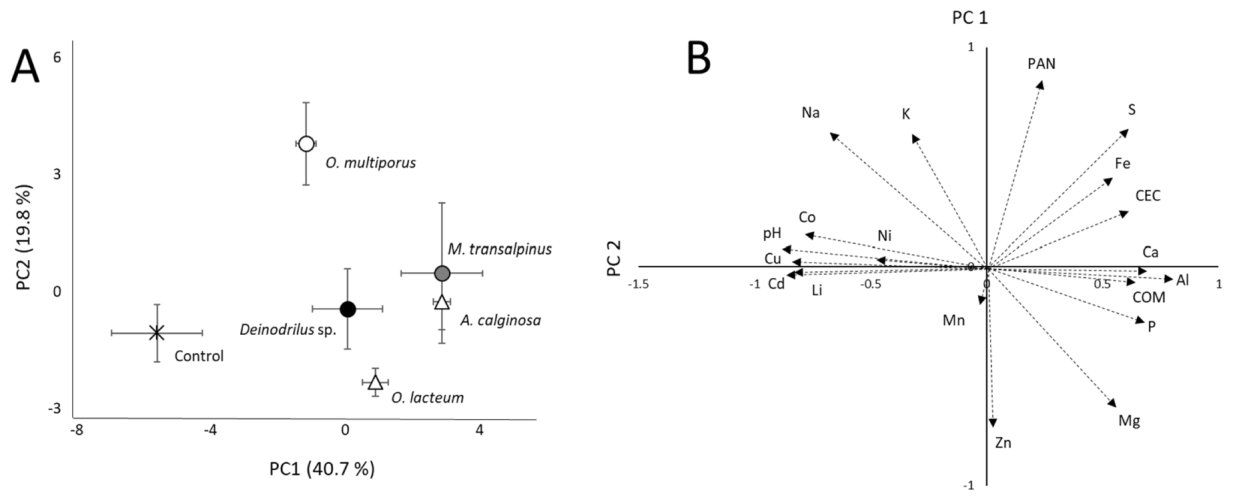
Multivariate analysis of soil properties separated each species into distinct groups on the two PCA axes (Fig. 3; Table 5). Native species were separated from each other along both axes. Native epigeic Deinodrilus sp.1 burrowing least in the soil had minimal effect on modifying chemical properties, as would be expected. The native anecic M. transalpinus was split from other behavioural groupings on Axis 1, represented by increasing soil acidity (pH) and its determinant soluble elements (S, Al, and Ca) and labile P. The other native endogeic O. multiporus clearly was split along Axis 2 from the epigeic and anecic earthworms in respect of increased nutrient solubility (PAN and K). Furthermore, the same endogeic grouping of earthworms separated native and exotic species (O. multiporus vs A. caliginosa and O. lacteum) on Axis 2. It seems that the native O. multiporus had a larger influence than the exotic species on N mineralisation.
土壤性质的多元分析在两个PCA轴上将各物种区分为不同的组(图3;表5)。本土物种在两个轴上彼此分开。正如预期,在土壤中掘穴最少的本土表栖型Deinodrilus sp.1对化学性质的改变作用最小。本土深栖型M. transalpinus在轴1上与其他行为类群分开,该轴代表土壤酸度(pH)及其决定性可溶元素(S、Al和Ca)和活性P的增加。另一本土内栖型O. multiporus在轴2上与表栖型和深栖型蚯蚓明显分开,体现为养分溶解度(PAN和K)的提高。此外,在同一内栖型类群中,本土与外来物种(O. multiporus与A. caliginosa和O. lacteum)在轴2上也被区分开。本土O. multiporus对氮矿化的影响似乎大于外来物种。
Table 4表4
Analysis of effect size between different behaviour groups (epigeic, endogeic, and anecic) and origins (native and exotic) based on the omega-squared (ω2) metric for single factor ANOVA model.
基于单因素ANOVA模型omega平方(ω2)指标的不同行为类群(表栖型、内栖型和深栖型)与来源(本土和外来)间效应量分析。
| Soil parameter土壤参数 | Behaviour行为 | group类群 | Origin来源 | |||
|---|---|---|---|---|---|---|
| F | p | ω2 | F | p | ω2 | |
| pH | 17.17 | _<_0.001 | 0.67 | 16.84 | _<_0.001 | 0.57 |
| CEC† | 6.31 | 0.003 | 0.40 | 7.83 | 0.003 | 0.36 |
| PAN‡ | 2.95ns | 0.058 | 0.20 | 3.84 | 0.038 | 0.19 |
| Ca§ | 5.04 | 0.009 | 0.34 | 1.39ns | 0.272 | 0.03 |
| P¶ | 5.11 | 0.009 | 0.34 | 5.57 | 0.011 | 0.28 |
| K¶ | 0.08ns | 0.970 | −0.13 | 6.10 | 0.008 | 0.30 |
| S¶ | 9.40 | _<_0.001 | 0.51 | 10.00 | 0.001 | 0.43 |
| Mg¶ | 1.62ns | 0.216 | 0.07 | 4.96 | 0.017 | 0.25 |
| Fe¶ | 1.76ns | 0.186 | 0.09 | 2.76ns | 0.086 | 0.13 |
| Al¶ | 7.13 | 0.002 | 0.43 | 5.16 | 0.015 | 0.26 |
| Mn¶ | 1.58ns | 0.226 | 0.07 | 1.54ns | 0.238 | 0.04 |
| Cu¶ | 11.82 | _<_0.001 | 0.57 | 18.34 | _<_0.001 | 0.59 |
| Zn¶ | 0.39ns | 0.763 | −0.08 | 2.04ns | 0.155 | 0.08 |
| Na¶ | 1.98ns | 0.149 | 0.11 | 8.96 | 0.002 | 0.40 |
| Li¶ | 27.29 | _<_0.001 | 0.77 | 41.44 | _<_0.001 | 0.77 |
| Ni¶ | 1.88ns | 0.165 | 0.10 | 3.71 | 0.042 | 0.18 |
| Cd¶ | 33.36 | _<_0.001 | 0.80 | 58.79 | _<_0.001 | 0.83 |
| Co¶ | 6.93 | 0.002 | 0.43 | 7.69 | 0.003 | 0.36 |
4Discussion讨论
4.1. Influences of native earthworms on soil chemistry4.1. 本土蚯蚓对土壤化学性质的影响
The sheep-farmed pasture soil used in the present study was suitable for maintaining the survival of native and exotic earthworms of the three behavioural groups, despite limited space and lack of food source, at least in the short term. In this respect, higher populations of the earthworms in natural soils would be dependent on maintaining a supply of OM enrichment from some combination of plant litter, root exudates or animal wastes. In the soil of the present study, the organic matter source is likely to have provided a pulse of decomposition from residual root fractions and litters that had been collected during the dry period of summer, following the soil being wetted and incubated. Also, it is likely that sawdust did not have a significant role. Consistently, all species of earthworms did lose their biomass during the incubation period, which may have been due to the limited nutritious value of sawdust, equivalent to an increase of less than 0.5% of existing soil carbon.
尽管空间有限且缺乏食物来源,本研究所用的绵羊牧场土壤至少在短期内能够维持三个行为类群的本土和外来蚯蚓的存活。就此而言,自然土壤中较高的蚯蚓种群数量有赖于植物凋落物、根系分泌物或动物排泄物等组合所维持的OM补给。在本研究土壤中,有机质来源可能是在夏季干旱期积累的残余根系和凋落物,在土壤湿润并培养后引发了一次分解脉冲。此外,木屑可能并未发挥显著作用。与此一致,所有蚯蚓物种在培养期间均出现生物量下降,这可能是由于木屑营养价值有限所致,其相当于使现有土壤碳增加不到0.5%。
Earthworm burrowing significantly altered the physicochemical properties of this soil. Liiri et al. (2012) compared soils with and without a legacy of intensive agriculture, finding that earthworms had similar influences in terms of modification of soil biogeochemistry. We found that native O. multiporus and M. transalpinus stimulated N and P mineralisation (Table 3) but other studies with longer incubation periods have showed a much more pronounced effect on N and P availability (e. g. Scheu and Parkinson, 1994; Vos et al., 2014). The present study also showed broader effects of these two native earthworms on the mobility of essential mineral elements, but native epigeic Deinodrilus sp.1 did not show similar effects. Deficiencies of various nutrients (e.g. Fe, Mg, S, B, Cu and Co etc.) for plants and animals are widespread in New Zealand soil (Dickinson et al., 2015). Given this fact, the marked enhancements of bioavailability of some minerals such as Ca, K, S or Mg by burrowing or casting of two native species would suggest that the presence of native earthworms have the potential to further improve the fertility of NZ pastoral soil, away from native vegetation areas.
蚯蚓掘穴显著改变了该土壤的理化性质。Liiri et al.(2012)比较了有无集约化农业历史的土壤,发现蚯蚓在改变土壤生物地球化学方面具有相似的影响。我们发现本土O. multiporus和M. transalpinus促进了N和P的矿化(表3),但其他培养时间更长的研究显示其对N和P有效性的影响更为显著(如Scheu and Parkinson, 1994; Vos et al., 2014)。本研究还表明,这两种本土蚯蚓对必需矿质元素的迁移性具有更广泛的影响,而本土表栖型Deinodrilus sp.1未表现出类似作用。在新西兰土壤中,植物和动物普遍缺乏多种养分(如Fe、Mg、S、B、Cu和Co等)(Dickinson et al., 2015)。鉴于此,两种本土物种的掘穴或排粪活动显著提高了Ca、K、S或Mg等部分矿质元素的生物有效性,表明本土蚯蚓的存在有可能在远离本土植被区域的地方进一步提高新西兰牧场土壤的肥力。
Loadings for variables assessed through Principle Component Analysis (PCA) in this study.
本研究主成分分析(PCA)中各变量的载荷。
| Soil parameter土壤参数 | PC1 | PC2 | PC3 |
|---|---|---|---|
| pH | −0.920 | 0.085 | −0.058 |
| COM | 0.661 | −0.064 | 0.387 |
| CEC† | 0.624 | 0.256 | 0.21 |
| PAN‡ | 0.251 | 0.826 | −0.334 |
| Ca§ | 0.702 | −0.016 | −0.113 |
| P¶ | 0.700 | −0.257 | 0.486 |
| K¶ | −0.338 | 0.614 | 0.507 |
| S¶ | 0.621 | 0.635 | 0.031 |
| Mg¶ | 0.572 | −0.647 | 0.380 |
| Fe¶ | 0.544 | 0.415 | 0.194 |
| Al¶ | 0.820 | −0.055 | 0.284 |
| Mn¶ | −0.043 | −0.170 | 0.706 |
| Cu¶ | −0.883 | 0.022 | 0.249 |
| Zn¶ | 0.021 | −0.754 | 0.361 |
| Na¶ | −0.706 | 0.623 | 0.080 |
| Li¶ | −0.869 | −0.017 | 0.186 |
| Ni¶ | −0.496 | 0.036 | 0.666 |
| Cd¶ | −0.899 | −0.030 | 0.132 |
| Co¶ | −0.822 | 0.154 | 0.387 |
Earthworm casts from soil passed through their gut are towards a neutral pH, probably due to the pH buffering role of organic molecules generated in the gut (Hitinayake et al., 2018). Earthworms also prefer less acidic to neutral soil (pH 4.5–7.0) and can adjust the soil pH between 5 and 8 with some species tolerating more acidic soils (Curry, 2004; Lowe and Butt, 2005). In the present study, soil pH value was generally reduced by increased moisture and with incubation, but varied significantly between earthworm species. Such differences in pH level may be attributed that the decomposition ability of OM sources and the composition of secreted mucus, which differs between species. The earthworms also changed the lability of chemical elements that are indirect determinants of acidity, increasing soil levels of soluble S and Al. Such increase in the minerals is attributed to organic matter decomposition by the earthworm activities (Villar et al., 1993; Balamurugan et al., 1999; Tognetti et al., 2005; Sonowal et al., 2013).
土壤经蚯蚓肠道排出形成的蚓粪pH趋于中性,这可能归因于肠道内产生的有机分子的pH缓冲作用(Hitinayake et al., 2018)。蚯蚓也偏好弱酸性至中性土壤(pH 4.5–7.0),并可将土壤pH调节至5~8之间,部分物种可耐受酸性更强的土壤(Curry, 2004; Lowe and Butt, 2005)。本研究中,土壤pH值总体上因含水量增加和培养而降低,但在不同蚯蚓物种间差异显著。pH水平的这种差异可能归因于不同物种对OM来源的分解能力及其分泌黏液的组成不同。蚯蚓还改变了作为酸度间接决定因素的化学元素的活性,提高了土壤中可溶性S和Al的含量。这些矿质元素的增加归因于蚯蚓活动引起的有机质分解(Villar et al., 1993; Balamurugan et al., 1999; Tognetti et al., 2005; Sonowal et al., 2013)。
In lumbricid earthworms, endogeics (permanent sub-surface species) have a larger effect on soil properties by consuming more OM than epigeic or anecic species (Edwards and Bohlen, 1996). However, this differed in the present study, and subtle influences on soil properties were brought about by different behavioural groups. On the other hand, better benefits in improvement of nutrient availability were found by native species of earthworms, such as O. multiporus (e.g. N, K and S) and M. transalpinus (e.g. P and Ca). Within the endogeic functional group, we were able to compare native species with exotics. Exotic endogenic species such as A. caliginosa and O. lacteum with relatively greater OM consumption (see Fig. 2) did mobilise less N, K, and S than native endogeic O. multiporus (Table 3). In addition, the higher omega-squared values of key nutrients (N, Mg and Fe) by the origin rather than by behavioural group (Table 4) suggest that the chemical parameters of agricultural soil might be affected more by native species rather than exotic species, regardless of the known functional role according to the behaviour group. In this study, due to various limitations of microcosm use (e.g. stocking density, biomass loss and short experimental duration etc.), it was difficult to fully assess practical functions of earthworms in agricultural fields. Additionally, another weakness of this microcosm study is that the three behavioural groups access the soil to an equal degree, unlike the situation in real soil profiles in a field situation. Future co-existence of communities of native and exotic earthworms in pasture lands appears realistic, and this would benefit conservation of native species. Therefore, further studies are needed to determine whether native earthworms and their interactions with exotic earthworms and/ or other soil organisms have unique synergy in improving the quality of New Zealand agricultural soils.
在正蚓科蚯蚓中,内栖型(永久生活于地表下的物种)因消耗更多OM而比表栖型或深栖型物种对土壤性质的影响更大(Edwards and Bohlen, 1996)。然而,本研究结果与此不同,不同行为类群对土壤性质的影响较为细微。另一方面,本土蚯蚓物种在提高养分有效性方面表现出更好的效益,如O. multiporus(如N、K和S)和M. transalpinus(如P和Ca)。在内栖型功能类群内,我们得以将本土物种与外来物种进行比较。OM消耗量相对较高的外来内栖型物种A. caliginosa和O. lacteum(见图2)对N、K和S的活化作用低于本土内栖型O. multiporus(表3)。此外,关键养分(N、Mg和Fe)按来源划分的omega平方值高于按行为类群划分的值(表4),表明无论其按行为类群划分的已知功能作用如何,农业土壤的化学参数受本土物种的影响可能大于外来物种。在本研究中,由于微宇宙方法的种种局限(如放养密度、生物量损失和试验周期短等),难以全面评估蚯蚓在农田中的实际功能。此外,本微宇宙研究的另一不足在于,三个行为类群对土壤的利用程度相同,这与田间真实土壤剖面中的情况不同。未来本土与外来蚯蚓群落在牧场中共存似乎是现实可行的,这将有利于本土物种的保护。因此,有必要进一步研究本土蚯蚓及其与外来蚯蚓和/或其他土壤生物的相互作用在改善新西兰农业土壤质量方面是否具有独特的协同效应。
4.2. Potential role of native earthworms in pasture agroecosystems4.2. 本土蚯蚓在牧场农业生态系统中的潜在作用
Earthworms regulate hydrology, OM dynamics, nutrient cycling, and improving plant growth and development (Fragoso et al., 1997; Francis and Fraser, 1998; Topp et al., 2001; Edwards, 2004; Ojha and Devkota, 2014). Native earthworms, particularly endogeics considerably increased N mineralisation in soil (Table 3). This may suggest enhanced leaching of soluble N and could be detrimental to maintain a tight N cycle in agricultural land, as is known to be the case elsewhere (Domí- nguez et al., 2004). Kernecker et al. (2014) evaluated that earthworms caused a decrease in the reduction of NO3 to gaseous N2O, but increased leaching of dissolved organic carbon and NO3 to the environment due to preferential flow pathways. Therefore, minimising the C and N losses, especially during the most vulnerable periods of the year with higher precipitation, lower temperature, and reduced crop growth, would be beneficial in New Zealand lowlands where soil beneath native vegetation is also known as a sink for methane with very low background emissions of N2O compared to grassland (Hedley et al., 2013).
蚯蚓能够调节水文、OM动态和养分循环,并促进植物生长发育(Fragoso et al., 1997; Francis and Fraser, 1998; Topp et al., 2001; Edwards, 2004; Ojha and Devkota, 2014)。本土蚯蚓,尤其是内栖型蚯蚓,显著提高了土壤中N的矿化(表3)。这可能意味着可溶性N的淋溶增强,不利于维持农田中紧密的N循环,这在其他地区已有报道(Domí- nguez et al., 2004)。Kernecker et al.(2014)评估认为,蚯蚓减少了NO3还原为气态N2O,但由于优先流路径,增加了溶解性有机碳和NO3向环境的淋溶。因此,尤其是在降水较多、温度较低、作物生长减缓的一年中最脆弱时期,尽量减少C和N的损失,将有益于新西兰低地;已知该地区本土植被下的土壤也是甲烷汇,且与草地相比其N2O背景排放极低(Hedley et al., 2013)。
Like elsewhere, the New Zealand agricultural system strives to improve the efficiency of N usage in order to reduce NO3 leaching loss and N2O emission from dairy farm. Nitrous oxide accounts for about 17% of the total GHG emissions in New Zealand which originates mainly from pastoral agriculture (de Klein et al., 2006). O. multiporus is the only native species commonly found in New Zealand's agricultural paddocks, and this species appears to increase N2O emissions from the agriculture soil (Kim et al., 2015). Nevertheless, considering that capacity of biological nitrification inhibition in roots of pasture grasses would result in improved management of nitrogen (Subbarao et al., 2013), the root rhizosphere interactions with earthworm communities under proper soil management will play a highly significant role in maintaining the tight nutrient cycle. As reported by Kim et al. (2017b), for example, two native anecic Maoridrilus spp. incubated in pot soil of legume plant (Sophora microphylla) resulted in less N2O emission, and this seemed to be due to the provision of more aerobic condition and improvement of nodulation by high level of their burrowing activity.
与其他地区一样,新西兰农业系统致力于提高N的利用效率,以减少奶牛场的NO3淋溶损失和N2O排放。氧化亚氮约占新西兰温室气体(GHG)排放总量的17%,主要来源于放牧农业(de Klein et al., 2006)。O. multiporus是新西兰农业围场中唯一常见的本土物种,该物种似乎会增加农业土壤的N2O排放(Kim et al., 2015)。然而,考虑到牧草根系的生物硝化抑制能力可改善氮素管理(Subbarao et al., 2013),在适当土壤管理下,根系根际与蚯蚓群落的相互作用将在维持紧密的养分循环中发挥十分重要的作用。例如,据Kim et al.(2017b)报道,在豆科植物(Sophora microphylla)盆栽土壤中培养的两种本土深栖型Maoridrilus spp.导致N2O排放减少,这似乎是由于其高强度的掘穴活动提供了更好的好氧条件并改善了结瘤。
Moreover, New Zealand pasture lands have widely been issued about cadmium contamination of agricultural soils through application of Cdrich phosphate fertilisers or biosolids (Simmler et al., 2013); the average level of pastoral soil is 0.43 mg Cd kg− 1, which is 2.7 times greater than the background level (Taylor et al., 2007). Consistently, this is a major concern for human health because grazing livestock animals can absorb Cd via consumption of herbaceous plants. Earthworms can affect the bioavailability of metal(loids) in soil through feeding, burrowing, and casting (Sizmur and Hodson, 2009). In particular, the earthworm activities increase dissolved organic carbon and reduce soil pH that would enhance the mobility and bioavailability and plant uptake of metals (Wen et al., 2004; Yu et al., 2005). However, native earthworms in the present study did reduce the solubility of Cd in the incubated soil, which would contribute to reducing the concern about toxic Cd from the dairy industry. Stürzenbaum et al. (1998) elucidated a metal binding mechanism in earthworms that it may be attributed to their capacity to accumulate in their tissues by retaining insoluble calcium phosphate granules or chloragosomes, and this do not inhibit essential biochemical mechanisms in the cytoplasm. Also, the formation of stable metal-humus complexes in earthworm casts can immobilize the metals in the soil (Kang et al., 2011).
此外,新西兰牧场因施用富Cd磷肥或生物固体(污泥)而导致的农业土壤镉污染问题受到广泛关注(Simmler et al., 2013);牧场土壤的平均Cd含量为0.43 mg Cd kg− 1,是背景值的2.7倍(Taylor et al., 2007)。因此,由于放牧家畜可通过采食草本植物吸收Cd,这成为人类健康的一大关切。蚯蚓可通过取食、掘穴和排粪影响土壤中金属(类金属)的生物有效性(Sizmur and Hodson, 2009)。特别是,蚯蚓活动会增加溶解性有机碳并降低土壤pH,从而提高金属的迁移性、生物有效性和植物吸收(Wen et al., 2004; Yu et al., 2005)。然而,本研究中的本土蚯蚓确实降低了培养土壤中Cd的溶解度,这将有助于减轻对奶牛业有毒Cd的担忧。Stürzenbaum et al.(1998)阐明了蚯蚓的金属结合机制,认为这可归因于蚯蚓通过保留不溶性磷酸钙颗粒或黄色组织颗粒(chloragosomes)而在组织中积累金属的能力,且这不会抑制细胞质中的基本生化机制。此外,蚓粪中形成的稳定金属-腐殖质络合物可使土壤中的金属固定(Kang et al., 2011)。
4.3. Conservation of native species4.3. 本土物种的保护
Our findings suggest that native species of earthworms are tolerant to modified pasture soils, and they increase nutrient mineralisation more than introduced exotic species. It is likely that the population of native species will expand into intensive farmland under reduced tillage management systems, based on the assumption that the cause of their disappearance from arable and pastoral lands was mainly due to ground disturbance (Chan, 2001). In addition, an appropriate policy is needed to gradually expand the distribution of native earthworms and improve the potential of their advance into wider farmland by increasing the density of the native vegetations around or on pasture farmland. A better understanding of the functional role of native earthworms in the process of soil formation, as well as consequences for soil management and restoration in such environments may be necessary for their conservation. This could be beneficial both to biodiversity conservation and to soil quality in New Zealand agricultural systems.
我们的研究结果表明,本土蚯蚓物种能够耐受改良后的牧场土壤,且比引入的外来物种更能促进养分矿化。基于本土物种从耕地和牧场中消失的主要原因是地表扰动这一假设(Chan, 2001),在减少耕作的管理体系下,本土物种种群很可能扩展至集约化农田。此外,需要制定适当的政策,通过增加牧场周边或牧场内本土植被的密度,逐步扩大本土蚯蚓的分布,并提高其向更广泛农田扩展的潜力。更好地理解本土蚯蚓在成土过程中的功能作用,以及其对此类环境中土壤管理和恢复的影响,可能是保护本土蚯蚓所必需的。这将有利于新西兰农业系统中的生物多样性保护和土壤质量。
5Conclusions结论
The present study is an early attempt to understand the functional role of native species of earthworm in New Zealand agricultural soils. On the periphery of agricultural land, divergent families of native and exotic earthworms coexist with apparently similar burrowing behaviours. Although spillover of fertilisers and enhanced fertility of soil are known to have impacted the biodiversity of adjacent fragments of native vegetation, there is currently no evidence that this is harmful to native earthworms. Our findings suggest that the modification of soil properties by native earthworms is likely to be more significant than exotic earthworms; O. multiporus and M. transalpinus enhanced the bioavailability of nutrients including N, P, S, K, and Ca. We also found that differences between native and exotic species in their effect size on the solubility of K, Mg and Fe were greater than differences between burrowing groupings. As such, the results suggest that soil fertility of agricultural lands may be influenced more by native species rather than exotic species. This justifies further research, in view of the increasing importance of sustainable and efficient management of these elements in agriculture and the wider environment. Identifying the impact of native earthworms alone and in combination with exotic earthworms in the provision of ecosystem services is needed for an integrated soil management plan in New Zealand agricultural landscape mosaics.
本研究是理解本土蚯蚓物种在新西兰农业土壤中功能作用的早期尝试。在农业用地边缘,分属不同科的本土与外来蚯蚓以明显相似的掘穴行为共存。尽管已知肥料外溢和土壤肥力提高会影响邻近本土植被斑块的生物多样性,但目前尚无证据表明这对本土蚯蚓有害。我们的研究结果表明,本土蚯蚓对土壤性质的改变可能比外来蚯蚓更为显著;O. multiporus和M. transalpinus提高了N、P、S、K和Ca等养分的生物有效性。我们还发现,本土与外来物种之间在K、Mg和Fe溶解度效应量上的差异大于不同掘穴类群之间的差异。因此,结果表明农业用地的土壤肥力受本土物种的影响可能大于外来物种。鉴于农业及更广泛环境中对这些元素进行可持续和高效管理的重要性日益增加,这值得进一步研究。为制定新西兰农业景观镶嵌体的综合土壤管理计划,需要明确本土蚯蚓单独及其与外来蚯蚓共同作用在提供生态系统服务中的影响。
agroecosystem function in the tropics: the role of earthworms. Appl. Soil Ecol. 6, 17–35.
agroecosystem function in the tropics: the role of earthworms. Appl. Soil Ecol. 6, 17–35.
Francis, G.S., Fraser, P.M., 1998. The effects of three earthworm species on soil macroporosity and hydraulic conductivity. Appl. Soil Ecol. 10, 11–19.
Francis, G.S., Fraser, P.M., 1998. The effects of three earthworm species on soil macroporosity and hydraulic conductivity. Appl. Soil Ecol. 10, 11–19.
Fraser, P.M., Williams, P.H., Haynes, R.J., 1996. Earthworm species, population size and biomass under different cropping systems across the Canterbury plainsNew Zealand. Appl. Soil Ecol. 3, 49–57.
Fraser, P.M., Williams, P.H., Haynes, R.J., 1996. Earthworm species, population size and biomass under different cropping systems across the Canterbury plainsNew Zealand. Appl. Soil Ecol. 3, 49–57.
Hedley, C.B., Lambie, S.M., Dando, J.L., 2013. Edaphic and environmental controls of soil respiration and related soil processes under two contrasting manuka and kanuka shrubland stands in North IslandNew Zealand. Soil Res. 51, 390–405.
Hedley, C.B., Lambie, S.M., Dando, J.L., 2013. Edaphic and environmental controls of soil respiration and related soil processes under two contrasting manuka and kanuka shrubland stands in North IslandNew Zealand. Soil Res. 51, 390–405.
Hendrix, P.F., 2006. Biological invasions belowground—earthworms as invasive species. Biol. Invasions 8, 1201–1204.
Hendrix, P.F., 2006. Biological invasions belowground—earthworms as invasive species. Biol. Invasions 8, 1201–1204.
Hitinayake, H.M.G.S.B., Ubayapala, K.G.K.C., Samaranayake, J.K.S., Weerasekera, W.A. T.H., 2018. Evaluation of earthworm species and bedding material collected from tea plantations for vermicomposting in Sri Lanka. Int. J. Environ. Agric. Biotech. 3, 266210.
Hitinayake, H.M.G.S.B., Ubayapala, K.G.K.C., Samaranayake, J.K.S., Weerasekera, W.A. T.H., 2018. Evaluation of earthworm species and bedding material collected from tea plantations for vermicomposting in Sri Lanka. Int. J. Environ. Agric. Biotech. 3, 266210.
Husson, F., Josse, J., Le, S., Mazet, J., 2020. FactoMineR: multivariate exploratory data analysis and data mining. In: R Package Version 2.4.. https://cran.r-project. org/web/packages/FactoMineR/.
Husson, F., Josse, J., Le, S., Mazet, J., 2020. FactoMineR: multivariate exploratory data analysis and data mining. In: R Package Version 2.4.. https://cran.r-project. org/web/packages/FactoMineR/.
Declaration of competing interest利益冲突声明
Kang, J., Zhang, Z., Wang, J.J., 2011. Influence of humic substances on bioavailability of Cu and Zn during sewage sludge composting. Bioresour. Technol. 102, 8022–8026. Kassambara, A., Mundt, F., 2020. Factoextra: extract and visualize the results of multivariate data analyses. In: R Package Version 1.0.7. https://cran.r-project. org/web/packages/factoextra/index.html.
Kang, J., Zhang, Z., Wang, J.J., 2011. Influence of humic substances on bioavailability of Cu and Zn during sewage sludge composting. Bioresour. Technol. 102, 8022–8026. Kassambara, A., Mundt, F., 2020. Factoextra: extract and visualize the results of multivariate data analyses. In: R Package Version 1.0.7. https://cran.r-project. org/web/packages/factoextra/index.html.
The authors declare that they have no known competing financial interests or personal relationships that could have appeared to influence the work reported in this paper.
作者声明,不存在任何可能影响本文所报道工作的已知经济利益冲突或个人关系。
Kernecker, M., Whalen, J.K., Bradley, R.L., 2014. Litter controls earthworm-mediated carbon and nitrogen transformations in soil from temperate riparian buffers. Appl. Environ. Soil Sci. 2014, 1–12.
Kernecker, M., Whalen, J.K., Bradley, R.L., 2014. Litter controls earthworm-mediated carbon and nitrogen transformations in soil from temperate riparian buffers. Appl. Environ. Soil Sci. 2014, 1–12.
Acknowledgements致谢
Kim, Y., 2016. Interactions Between Soil Biogeochemistry and Native Earthworms in New Zealand. Lincoln University, Lincoln, New Zealand (PhD thesis).
Kim, Y., 2016. Interactions Between Soil Biogeochemistry and Native Earthworms in New Zealand. Lincoln University, Lincoln, New Zealand (PhD thesis).
This research was supported by Basic Science Research Program through the National Research Foundation of Korea (NRF) funded by the Ministry of Education (NRF-2021R1I1A1A01059927 and NRF- 2015R1A6A1A030314133261382116530302). Also, this work was conducted by the financial support of Rio Tinto Services Ltd. (grant numbers 46084, 46164) and Conservation Volunteers New Zealand (grant number 46061). The authors thank the Punakaiki Coastal Restoration Project (PCRP) and Rio Tinto for their sponsorship of this work.
本研究得到韩国教育部资助、韩国国家研究基金会(NRF)基础科学研究计划的支持(NRF-2021R1I1A1A01059927和NRF- 2015R1A6A1A030314133261382116530302)。此外,本工作还得到Rio Tinto Services Ltd.(资助编号46084、46164)和Conservation Volunteers New Zealand(资助编号46061)的资助。作者感谢Punakaiki海岸恢复项目(PCRP)和Rio Tinto对本工作的赞助。
Kim, Y.N., Dickinson, N., Bowie, M., Robinson, B., Boyer, S., 2017a. Molecular identification and distribution of native and exotic earthworms in New Zealand human-modified soils. N. Z. J. Ecol. 41, 218–225.
Kim, Y.N., Dickinson, N., Bowie, M., Robinson, B., Boyer, S., 2017a. Molecular identification and distribution of native and exotic earthworms in New Zealand human-modified soils. N. Z. J. Ecol. 41, 218–225.
Kim, Y.N., Robinson, B., Boyer, S., Zhong, H.T., Dickinson, N.M., 2015. Interactions of native and introduced earthworms with soils and plant rhizospheres in production landscapes of New Zealand. Appl. Soil Ecol. 96, 141–150.
Kim, Y.N., Robinson, B., Boyer, S., Zhong, H.T., Dickinson, N.M., 2015. Interactions of native and introduced earthworms with soils and plant rhizospheres in production landscapes of New Zealand. Appl. Soil Ecol. 96, 141–150.
Kim, Y.N., Robinson, B., Lee, K.A., Boyer, S., Dickinson, N., 2017b. Interactions between earthworm burrowing, growth of a leguminous shrub and nitrogen cycling in a former agricultural soil. Appl. Soil Ecol. 110, 79–87.
Kim, Y.N., Robinson, B., Lee, K.A., Boyer, S., Dickinson, N., 2017b. Interactions between earthworm burrowing, growth of a leguminous shrub and nitrogen cycling in a former agricultural soil. Appl. Soil Ecol. 110, 79–87.
Kim, Y.N., Robinson, B., Horswell, J., Boyer, S., Dickinson, N., 2017c. Impacts of endemic maoridrilus earthworms (Megascolecidae) in biosolids-amended soil. J. Environ. Qual. 46, 177–184.
Kim, Y.N., Robinson, B., Horswell, J., Boyer, S., Dickinson, N., 2017c. Impacts of endemic maoridrilus earthworms (Megascolecidae) in biosolids-amended soil. J. Environ. Qual. 46, 177–184.
Lee, K.E., 1959. The Earthworm Fauna of New Zealand, 130. New Zealand Department of
Lee, K.E., 1959. The Earthworm Fauna of New Zealand, 130. New Zealand Department of
References Scientific and Industrial Research Bulletin, Wellington. Lee, K.E., 1959. A key for the identification of New Zealand earthworms. In: Soil Bureau Publication No. 172, 8. Balamurugan, V., Gobi, M., Vijayalakshmi, G.S., 1999. Comparative studies on Lee, K.E., 1961. Interactions between native and introduced earthworms. Proc. NZ Ecol. degradation of press mud using cellulolytic fungi and exotic species of earthworms with a note on its gut microflora. Asian J. Microbiol. Biotechnol. Environ. Sci. 1, 131–134. Liiri, M., Hasa, M., Haimi, J., Setala, H., 2012. History of land-use intensity can modify Soc. 8, 60–62. the relationship between functional complexity of the soil fauna and soil ecosystem Blakemore, L.C., Searle, P.L., Daly, B.K., 1987. Methods for chemical analysis of soils. In: New Zealand Soil Bureau Scientific Report 80. NZ Soil Bureau, Department of Scientific and Industrial Research, Lower Hutt, New Zealand. Lowe, C.N., Butt, K.R., 2005. Culture techniques for soil dwelling earthworms: a review. services Pedobiologia 49, 401– a microcosm study. Appl. Soil Ecol. 55, 53–413. –61. Blouin, M., Hodson, M.E., Delgado, E.A., Baker, G., Brussaard, L., Butt, K.R., Dai, J., Dendooven, L., Peres, G., Tondoh, J.E., Cluzeau, D., Brun, J.J., 2013. A review of McColl, H.P., Hart, P.B.S., Cook, F.J., 1982. Influence of earthworms on some soil chemical and physical properties, and the growth of ryegrass on a soil after topsoil earthworm impact on soil function and ecosystem services. Eur. J. Soil Sci. 64, 161–182. stripping—a pot experiment. N.Z. J. Agric. Res. 25, 239–243. —a pot experiment. N.Z. J. Agric. Res. 25, 239–243. a pot experiment. N.Z. J. Agric. Res. 25, 239–243. –243. 243. . Mclenaghen, R., Malcolm, B., Cameron, K., Di, H., 2014. Natural regeneration of soil Bowie, M.H., Black, L., Boyer, S., Dickinson, N.M., Hodge, S., 2016. Persistence of biodiversity in a dryland remnant within an intensified dairy farm landscape. N. Z. J. physical conditions following the establishment of permanent pasture on a structurally degraded soil (oral presentation). In: Proc. 20th World Congr. Soil Sci. Ecol. 40, 121–130.
参考文献 Scientific and Industrial Research Bulletin, Wellington. Lee, K.E., 1959. A key for the identification of New Zealand earthworms. In: Soil Bureau Publication No. 172, 8. Balamurugan, V., Gobi, M., Vijayalakshmi, G.S., 1999. Comparative studies on Lee, K.E., 1961. Interactions between native and introduced earthworms. Proc. NZ Ecol. degradation of press mud using cellulolytic fungi and exotic species of earthworms with a note on its gut microflora. Asian J. Microbiol. Biotechnol. Environ. Sci. 1, 131–134. Liiri, M., Hasa, M., Haimi, J., Setala, H., 2012. History of land-use intensity can modify Soc. 8, 60–62. the relationship between functional complexity of the soil fauna and soil ecosystem Blakemore, L.C., Searle, P.L., Daly, B.K., 1987. Methods for chemical analysis of soils. In: New Zealand Soil Bureau Scientific Report 80. NZ Soil Bureau, Department of Scientific and Industrial Research, Lower Hutt, New Zealand. Lowe, C.N., Butt, K.R., 2005. Culture techniques for soil dwelling earthworms: a review. services Pedobiologia 49, 401– a microcosm study. Appl. Soil Ecol. 55, 53–413. –61. Blouin, M., Hodson, M.E., Delgado, E.A., Baker, G., Brussaard, L., Butt, K.R., Dai, J., Dendooven, L., Peres, G., Tondoh, J.E., Cluzeau, D., Brun, J.J., 2013. A review of McColl, H.P., Hart, P.B.S., Cook, F.J., 1982. Influence of earthworms on some soil chemical and physical properties, and the growth of ryegrass on a soil after topsoil earthworm impact on soil function and ecosystem services. Eur. J. Soil Sci. 64, 161–182. stripping—a pot experiment. N.Z. J. Agric. Res. 25, 239–243. —a pot experiment. N.Z. J. Agric. Res. 25, 239–243. a pot experiment. N.Z. J. Agric. Res. 25, 239–243. –243. 243. . Mclenaghen, R., Malcolm, B., Cameron, K., Di, H., 2014. Natural regeneration of soil Bowie, M.H., Black, L., Boyer, S., Dickinson, N.M., Hodge, S., 2016. Persistence of biodiversity in a dryland remnant within an intensified dairy farm landscape. N. Z. J. physical conditions following the establishment of permanent pasture on a structurally degraded soil (oral presentation). In: Proc. 20th World Congr. Soil Sci. Ecol. 40, 121–130.
Lowe, C.N., Butt, K.R., 2005. Culture techniques for soil dwelling earthworms: a review. services Pedobiologia 49, 401– a microcosm study. Appl. Soil Ecol. 55, 53–413. Pedobiologia 49, 401– a microcosm study. Appl. Soil Ecol. 55, 53–413. –413. 413. . McColl, H.P., Hart, P.B.S., Cook, F.J., 1982. Influence of earthworms on some soil chemical and physical properties, and the growth of ryegrass on a soil after topsoil stripping—a pot experiment. N.Z. J. Agric. Res. 25, 239–243. —a pot experiment. N.Z. J. Agric. Res. 25, 239–243. a pot experiment. N.Z. J. Agric. Res. 25, 239–243. –243. 243. . Mclenaghen, R., Malcolm, B., Cameron, K., Di, H., 2014. Natural regeneration of soil physical conditions following the establishment of permanent pasture on a structurally degraded soil (oral presentation). In: Proc. 20th World Congr. Soil Sci. structurally degraded soil (oral presentation). In: Proc. 20th World Congr. Soil Sci. 20WCSS Jeju Korea.
Lowe, C.N., Butt, K.R., 2005. Culture techniques for soil dwelling earthworms: a review. services Pedobiologia 49, 401– a microcosm study. Appl. Soil Ecol. 55, 53–413. Pedobiologia 49, 401– a microcosm study. Appl. Soil Ecol. 55, 53–413. –413. 413. . McColl, H.P., Hart, P.B.S., Cook, F.J., 1982. Influence of earthworms on some soil chemical and physical properties, and the growth of ryegrass on a soil after topsoil stripping—a pot experiment. N.Z. J. Agric. Res. 25, 239–243. —a pot experiment. N.Z. J. Agric. Res. 25, 239–243. a pot experiment. N.Z. J. Agric. Res. 25, 239–243. –243. 243. . Mclenaghen, R., Malcolm, B., Cameron, K., Di, H., 2014. Natural regeneration of soil physical conditions following the establishment of permanent pasture on a structurally degraded soil (oral presentation). In: Proc. 20th World Congr. Soil Sci. structurally degraded soil (oral presentation). In: Proc. 20th World Congr. Soil Sci. 20WCSS Jeju Korea.
Boyer, S., Kim, Y.N., Bowie, M.H., Lefort, M.C., Dickinson, N.M., 2016. Response of endemic and exotic earthworm communities to ecological restoration. Restor. Ecol. 24, 717–721. Chan, K.Y., 2001. An overview of some tillage impacts on earthworm population abundance and diversity – implications for functioning in soils. Soil Tillage Res. 57, 179–191. Curry, J.P., 2004. Factors affecting the abundance of earthworms in soils. In: Edwards, C. A. (Ed.), Earthworm Ecology. CRC Press, New York. De Klein, C.A.M., Smith, L.C., Monaghan, R.M., 2006. Restricted autumn grazing to reduce nitrous oxide emissions from dairy pastures in Southland, New Zealand. Agric. Ecosyst. Environ. 112, 192–199. de Mendiburu, F., 2019. Agricolae: statistical procedures for agricultural research. In: R Package Version 1.3-1. https://CRAN.R-project.org/package=agricolae. Dickinson, N., Marmiroli, M., Das, B., McLaughlin, D., Leung, D., Robinson, B., 2015. Endemic plants as browse crops in agricultural landscapes of New Zealand. Agroecol. Sustain. Food Syst. 39, 224–242. Didham, R.K., Barker, G.M., Bartlam, S., Deakin, E.L., Denmead, L.H., Fisk, L.M., Peters, J.M.R., Tylianakis, J.M., Wright, H.R., Schipper, L.A., 2015. Agricultural intensification exacerbates spillover effects on soil biogeochemistry in adjacent forest remnants. PLoS ONE 10, e0116474.
Boyer, S., Kim, Y.N., Bowie, M.H., Lefort, M.C., Dickinson, N.M., 2016. Response of endemic and exotic earthworm communities to ecological restoration. Restor. Ecol. 24, 717–721. Chan, K.Y., 2001. An overview of some tillage impacts on earthworm population abundance and diversity – implications for functioning in soils. Soil Tillage Res. 57, 179–191. Curry, J.P., 2004. Factors affecting the abundance of earthworms in soils. In: Edwards, C. A. (Ed.), Earthworm Ecology. CRC Press, New York. De Klein, C.A.M., Smith, L.C., Monaghan, R.M., 2006. Restricted autumn grazing to reduce nitrous oxide emissions from dairy pastures in Southland, New Zealand. Agric. Ecosyst. Environ. 112, 192–199. de Mendiburu, F., 2019. Agricolae: statistical procedures for agricultural research. In: R Package Version 1.3-1. https://CRAN.R-project.org/package=agricolae. Dickinson, N., Marmiroli, M., Das, B., McLaughlin, D., Leung, D., Robinson, B., 2015. Endemic plants as browse crops in agricultural landscapes of New Zealand. Agroecol. Sustain. Food Syst. 39, 224–242. Didham, R.K., Barker, G.M., Bartlam, S., Deakin, E.L., Denmead, L.H., Fisk, L.M., Peters, J.M.R., Tylianakis, J.M., Wright, H.R., Schipper, L.A., 2015. Agricultural intensification exacerbates spillover effects on soil biogeochemistry in adjacent forest remnants. PLoS ONE 10, e0116474.
Ojha, R.B., Devkota, D., 2014. Earthworms: ‘soil and ecosystem engineers’ – a review. World J. Agric. Res. 2, 257–260. Scheu, S., Parkinson, D., 1994. Effects of earthworms on nutrient dynamics, carbon turnover and microorganisms in soils from cool temperate forests of the Canadian Rocky Mountains – laboratory studies. Appl. Soil Ecol. 1, 113–125.
Ojha, R.B., Devkota, D., 2014. Earthworms: ‘soil and ecosystem engineers’ – a review. World J. Agric. Res. 2, 257–260. Scheu, S., Parkinson, D., 1994. Effects of earthworms on nutrient dynamics, carbon turnover and microorganisms in soils from cool temperate forests of the Canadian Rocky Mountains – laboratory studies. Appl. Soil Ecol. 1, 113–125.
Schon, N.L., Fraser, P.M., Mackay, A.D., 2021. Relationship between earthworm abundance, ecological diversity and soil function in pastures. Soil Res. 59, 767–777. Simmler, M., Ciadamidaro, L., Schulin, R., Madejon, P., Reiser, R., Clucas, L., Weber, P., Robinson, B., 2013. Lignite reduces the solubility and plant uptake of cadmium in pasturelands. Environ. Sci. Technol. 47, 4497–4504.
Schon, N.L., Fraser, P.M., Mackay, A.D., 2021. Relationship between earthworm abundance, ecological diversity and soil function in pastures. Soil Res. 59, 767–777. Simmler, M., Ciadamidaro, L., Schulin, R., Madejon, P., Reiser, R., Clucas, L., Weber, P., Robinson, B., 2013. Lignite reduces the solubility and plant uptake of cadmium in pasturelands. Environ. Sci. Technol. 47, 4497–4504.
Sizmur, T., Hodson, M.E., 2009. Do earthworms impact metal mobility and availability in soil? – a review. Environ. Pollut. 157, 1981–1989.
Sizmur, T., Hodson, M.E., 2009. Do earthworms impact metal mobility and availability in soil? – a review. Environ. Pollut. 157, 1981–1989.
Sonowal, P., Dhamodharan, K., Khwaipkpam, M., Kalamadhad, A.S., 2013. Feasibility of vermicomposting dewatered sludge from paper mills using perionyx excavatus. Eur. J. Environ. Sci. 3, 17–26.
Sonowal, P., Dhamodharan, K., Khwaipkpam, M., Kalamadhad, A.S., 2013. Feasibility of vermicomposting dewatered sludge from paper mills using perionyx excavatus. Eur. J. Environ. Sci. 3, 17–26.
Springett, J.A., 1992. Distribution of lumbricid earthworms in New Zealand. Soil Biol. Biochem. 24, 1377–1381.
Springett, J.A., 1992. Distribution of lumbricid earthworms in New Zealand. Soil Biol. Biochem. 24, 1377–1381.
Springett, J., Gray, R., Barker, D.J., Lambert, M.G., Mackay, A.D., Thomas, V.J., 1998. Population density and distribution of the New Zealand indigenous earthworm octochaetus multiporus (Megascolecidae: Oligochaeta) in hill pastures. N. Z. J. Ecol. 22, 87–93. Stürzenbaum, S.R., Kille, P., Morgan, A.J., 1998. The identification, cloning and characterization of earthworm metallothionein. FEBS Lett. 431, 437–442.
Springett, J., Gray, R., Barker, D.J., Lambert, M.G., Mackay, A.D., Thomas, V.J., 1998. Population density and distribution of the New Zealand indigenous earthworm octochaetus multiporus (Megascolecidae: Oligochaeta) in hill pastures. N. Z. J. Ecol. 22, 87–93. Stürzenbaum, S.R., Kille, P., Morgan, A.J., 1998. The identification, cloning and characterization of earthworm metallothionein. FEBS Lett. 431, 437–442.
Domínguez, J., Bohlen, P.J., Parmelee, R.W., 2004. Earthworms increase nitrogen leaching to greater soil depths in row crop agroecosystems. Ecosystems 7, 672–685. Edwards, C.A., 2004. The importance of earthworms as key representatives of the soil fauna. In: Edwards, C.A. (Ed.), Earthworm Ecology. CRC Press, New York.
Domínguez, J., Bohlen, P.J., Parmelee, R.W., 2004. Earthworms increase nitrogen leaching to greater soil depths in row crop agroecosystems. Ecosystems 7, 672–685. Edwards, C.A., 2004. The importance of earthworms as key representatives of the soil fauna. In: Edwards, C.A. (Ed.), Earthworm Ecology. CRC Press, New York.
Subbarao, G.V., Sahrawat, K.L., Nakahara, K., Rao, I.M., Ishitani, M., Hash, C.T., Kishii, M., Bonnett, D.G., Berry, W.L., Lata, J.C., 2013. A paradigm shift towards lownitrifying production systems: the role of biological nitrification inhibition (BNI). Ann. Bot. 112, 297–316.
Subbarao, G.V., Sahrawat, K.L., Nakahara, K., Rao, I.M., Ishitani, M., Hash, C.T., Kishii, M., Bonnett, D.G., Berry, W.L., Lata, J.C., 2013. A paradigm shift towards lownitrifying production systems: the role of biological nitrification inhibition (BNI). Ann. Bot. 112, 297–316.
Edwards, C.A., Bohlen, P.J., 1996. Biology and Ecology of Earthworms. Chapman and Hall, London. Fragoso, C., Brown, G.G., Patron, J.C., Blanchart, E., Lavelle, P., Pashanasi, B., Senapati, B., Kumar, T., 1997. Agricultural intensification, soil biodiversity and
Edwards, C.A., Bohlen, P.J., 1996. Biology and Ecology of Earthworms. Chapman and Hall, London. Fragoso, C., Brown, G.G., Patron, J.C., Blanchart, E., Lavelle, P., Pashanasi, B., Senapati, B., Kumar, T., 1997. Agricultural intensification, soil biodiversity and
Taylor, M., Gibb, R., Willoughby, J., Hewitt, A., Arnold, G., 2007. Soil maps of cadmium in New Zealand. In: Landcare Research Contract Report. Ministry of Agriculture and Forestry, Wellington.
Taylor, M., Gibb, R., Willoughby, J., Hewitt, A., Arnold, G., 2007. Soil maps of cadmium in New Zealand. In: Landcare Research Contract Report. Ministry of Agriculture and Forestry, Wellington.
Tognetti, C., Laos, F., Mazzarino, M.J., Hernandez, M.T., 2005. Composting vs.
Tognetti, C., Laos, F., Mazzarino, M.J., Hernandez, M.T., 2005. Composting vs.
vermicomposting: a comparison of end product quality. Compost Sci. Util. 13, 6–13. Topp, W., Simon, M., Kautz, G., Dworschak, U., Nicolini, F., Pruckner, S., 2001. Soil fauna of a reclaimed lignite open-cast mine of the rhineland: improvement of soil quality by surface pattern. Ecol. Eng. 17, 307–322.
vermicomposting: a comparison of end product quality. Compost Sci. Util. 13, 6–13. Topp, W., Simon, M., Kautz, G., Dworschak, U., Nicolini, F., Pruckner, S., 2001. Soil fauna of a reclaimed lignite open-cast mine of the rhineland: improvement of soil quality by surface pattern. Ecol. Eng. 17, 307–322.
Villar, M.C., Beloso, M.C., Acea, M.J., Cabaneiro, A., Gonzalez-Prieto, S.J., Diza- Ravina, M., Carballas, T., 1993. Physical and chemical characterization of four composted urban refuses. Bioresour. Technol. 45, 105–113.
Villar, M.C., Beloso, M.C., Acea, M.J., Cabaneiro, A., Gonzalez-Prieto, S.J., Diza- Ravina, M., Carballas, T., 1993. Physical and chemical characterization of four composted urban refuses. Bioresour. Technol. 45, 105–113.
Vos, H.M.J., Ros, M.B.H., Koopmans, G.F., van Groenigen, J.W., 2014. Do earthworms affect phosphorus availability to grass?A pot experiment. Soil Biol. Biochem. 79, 34–42.
Vos, H.M.J., Ros, M.B.H., Koopmans, G.F., van Groenigen, J.W., 2014. Do earthworms affect phosphorus availability to grass?A pot experiment. Soil Biol. Biochem. 79, 34–42.
Wen, B., Hu, X., Liu, Y., Wang, W., Feng, M., Shan, X., 2004. The role of earthworms (Eisenia fetida) in influencing bioavailability of heavy metals in soils. Biol. Fertil. Soils 40, 181–187.
Wen, B., Hu, X., Liu, Y., Wang, W., Feng, M., Shan, X., 2004. The role of earthworms (Eisenia fetida) in influencing bioavailability of heavy metals in soils. Biol. Fertil. Soils 40, 181–187.
Winterbourne, M., Knox, G., Burrows, C., Marsden, I., 2008. The natural history of Canterbury. Canterbury University Press, Christchurch.
Winterbourne, M., Knox, G., Burrows, C., Marsden, I., 2008. The natural history of Canterbury. Canterbury University Press, Christchurch.
Wüst, P.K., Horn, M.A., Henderson, G., Janssen, P.H., Rehm, B.H., Drake, H.L., 2009. Gut-associated denitrification and in vivo emission of nitrous oxide by the earthworm families megascolecidae and lumbricidae in New Zealand. Appl. Environ. Microbiol. 75, 3430–3436.
Wüst, P.K., Horn, M.A., Henderson, G., Janssen, P.H., Rehm, B.H., Drake, H.L., 2009. Gut-associated denitrification and in vivo emission of nitrous oxide by the earthworm families megascolecidae and lumbricidae in New Zealand. Appl. Environ. Microbiol. 75, 3430–3436.
Yu, X., Cheng, J., Wong, M.H., 2005. Earthworm–mycorrhiza interaction on cd uptake and growth of ryegrass. Soil Biol. Biochem. 37, 195–201.
Yu, X., Cheng, J., Wong, M.H., 2005. Earthworm–mycorrhiza interaction on cd uptake and growth of ryegrass. Soil Biol. Biochem. 37, 195–201.
Zhong, H., Kim, Y.N., Smith, C., Robinson, B., Dickinson, N., 2017. Seabird guano and phosphorus fractionation in a rhizosphere with earthworms. Appl. Soil Ecol. 120, 197–205.
Zhong, H., Kim, Y.N., Smith, C., Robinson, B., Dickinson, N., 2017. Seabird guano and phosphorus fractionation in a rhizosphere with earthworms. Appl. Soil Ecol. 120, 197–205.
Waterhouse, B.R., Boyer, S., Adair, K.L., Wratten, S.D., 2014. Using municipal biosolids in ecological restoration: what is good for plants and soil may not be good for endemic earthworms. Ecol. Eng. 70, 414–421.
Waterhouse, B.R., Boyer, S., Adair, K.L., Wratten, S.D., 2014. Using municipal biosolids in ecological restoration: what is good for plants and soil may not be good for endemic earthworms. Ecol. Eng. 70, 414–421.