Zhang Wei1 ✉, Thomas Maxwell 1 ✉, Brett Robinson 2 ✉ and Nicholas Dickinson 1 ✉
Rhizobial nitrogen fixation in legumes provides spillover benefits to neighbouring plants such as pasture grasses. Generally, it is understood to be unidirectional between plant functional groups, providing a benefit from legumes to grasses. We question whether bidirectional complementarity also exists in terms of exploiting the wider soil nutrient pool. We test this hypothesis using soil cores with their component vegetation assemblages sampled from a hill country pasture in South Island, New Zealand. The soil was deficient in key essential elements: P, S, B, Mo and Ni. Facilitation from grasses to clovers was evident; legume–grass mixtures procured more nutrients from the soil than when either species was growing alone. When grasses and clover grow together in unfertilized grassland, more nitrogen is procured by the plant community, and other limiting plant nutrients in the soil are better exploited. Coexistence with grasses is favourable to clovers in terms of soil biogeochemistry.
豆科植物的根瘤菌固氮作用可为牧草等邻近植物带来溢出效益。一般认为,这种效益在植物功能群之间是单向的,即由豆科植物惠及禾草。本研究探讨在利用更广泛的土壤养分库方面是否也存在双向互补。我们以采自新西兰南岛丘陵地区牧场的土柱及其所含植被组合为材料检验这一假设。该土壤缺乏P、S、B、Mo和Ni等关键必需元素。禾草对三叶草的促进作用明显;豆科–禾草混播组合从土壤中获取的养分多于任一物种单独生长时。在未施肥草地中,禾草与三叶草共同生长时,植物群落获取的氮更多,土壤中其他限制性植物养分也得到更充分的利用。就土壤生物地球化学而言,与禾草共存对三叶草有利。
id-altitude grasslands (approximately 400–1,000 m above sea level, with slopes >15°) account for around 18% of the Mtotal land area of New Zealand1. This pastoral hill country farmland was converted from forests, mostly in the past few centuries, and contributes substantially to the economy2. Vegetation productivity and stocking rates are constrained by a hot and dry summer climate combined with nutrient-poor, low-pH, shallow soils. Steeper slopes are prone to erosion, and typically only about 10–20% of this land is sufficiently flat to be cultivated for crops. Grazing herbage consists largely of introduced exotic species with some remnants of native grasses and shrubs. Native species are less productive, and nitrogen-fixing forbs are almost entirely absent from the indigenous flora3. Pastoral farming is reliant on over-sowing with seeds of more productive introduced grasses and legumes, and top-dressing with fertilizers and lime. The latter is prohibitively expensive due to the large expanse of this landscape and its difficult trafficability that requires the use of aircraft. Opportunities to establish productive pasture, such as ryegrass–white clover swards, are restricted; hardier drought-tolerant perennial grasses tend to proliferate. Pasture management aims to improve forage quality by increasing the prevalence of annual and perennial legumes, rather than relying on vegetation dominated by hardier grasses of less forage value4,5. Stock (mostly sheep) productivity and health are markedly improved by increasing the establishment, productivity and persistence of naturalized nitrogen-fixing plants. The hill country environment as described provides the template for this study.
中海拔草地(海拔约400–1,000 m,坡度>15°)约占新西兰国土总面积的18%1。这类丘陵牧区农地主要是在过去几个世纪中由森林转变而来,对经济贡献显著2。炎热干燥的夏季气候,加之养分贫瘠、pH低、土层浅薄的土壤,限制了植被生产力和载畜率。较陡的坡地易受侵蚀,通常仅约10–20%的土地足够平坦,可用于作物种植。放牧草料主要由引入的外来物种组成,间有少量残存的本土禾草和灌木。本土物种生产力较低,而本土植物区系中几乎完全没有固氮杂类草3。牧业生产依赖于补播生产力更高的引进禾草和豆科植物种子,以及表施化肥和石灰。由于该地貌面积广阔、通行困难而需借助飞机作业,后者成本高昂,令人难以承受。建立高产牧场(如黑麦草–白三叶草草地)的机会有限;更耐旱的抗逆性多年生禾草往往大量繁衍。牧场管理的目标是通过提高一年生和多年生豆科植物的比例来改善饲草品质,而非依赖以饲用价值较低的抗逆禾草为主的植被4,5。提高归化固氮植物的定植、生产力和持久性,可显著改善牲畜(主要为绵羊)的生产性能和健康状况。上述丘陵地区环境构成了本研究的背景。
We question whether we properly understand the mutualism between grasses and clovers (Trifolium spp.) in terms of soil biogeochemistry. It is well known that nitrogen fixed by legumes can be utilized by grasses or other companion plants6. Nitrogen fixation can be substantially constrained by soil acidity and a limiting supply of key nutrients such as phosphorus, especially without fertilizer intervention. It has become clearer recently that multiple-nutrient constraints widely impact primary productivity in grasslands7,8. Plant species differ in their ability to acquire key nutrients. For example, P is obtained through symbiotic mycorrhizal associations9 or through root adaptations to resource partitioning of this element10. Other plants, including grasses, can secrete organic acids (phytosiderophores) that mobilize deficient chemical elements (for example, Fe, Zn, Cu and Mn) in soil11. Competition for resources is more extensively studied than are the mutual benefits that may be
我们质疑,就土壤生物地球化学而言,我们是否真正理解了禾草与三叶草(Trifolium spp.)之间的互利共生关系。众所周知,豆科植物固定的氮可被禾草或其他伴生植物利用6。土壤酸度以及磷等关键养分供应不足会显著限制固氮作用,在不施肥的情况下尤为如此。近来越来越清楚的是,多种养分限制广泛影响着草地的初级生产力7,8。不同植物物种获取关键养分的能力各异。例如,P可通过共生菌根联合体9或通过对该元素进行资源分配的根系适应10而获得。包括禾草在内的其他植物能够分泌有机酸(植物铁载体),活化土壤中缺乏的化学元素(如Fe、Zn、Cu和Mn)11。与资源竞争相比,对可能
derived from the coexistence of different plant species or functional groups, although the temporal and spatial advantages of plants growing together are well known12–14. Belowground functional traits in plants are recognized to be important for nutrient uptake, but interactions between root systems and possible complementarity between species are poorly understood15. However, there would be an obvious advantage to a plant of sharing limiting soil resources with a neighbouring species if there were a reduced metabolic cost to both16.
源自不同植物物种或功能群共存的互惠效益的研究较少,尽管植物共同生长在时间和空间上的优势已广为人知12–14。植物的地下功能性状被认为对养分吸收十分重要,但根系之间的相互作用以及物种间可能存在的互补性仍知之甚少15。然而,如果双方的代谢成本均得以降低,那么与邻近物种共享限制性土壤资源对植物显然是有利的16。
In the present study, we hypothesize that clovers benefit from the presence of companion grasses in terms of procuring essential nutrients, and this relationship is not limited to the spillover of nitrogen from clovers that is subsequently exploited by grasses. We aim to determine whether complementarity between legume and grass rhizospheres is bidirectional in nutritional terms and more substantial than we currently realize. We extracted 200 soil cores with their component plant assemblages from a hill country sheep station to investigate how the soil pool of nutrients was exploited. The cores were maintained as experimental microcosms in a controlled-environment growth chamber that simulated historic ambient temperature and sunlight conditions without limiting water availability. The study had three objectives: (1) to evaluate existing small-scale variability of nutrient mobility and uptake, (2) to investigate whether grasses modify the nutrient content of clovers and (3) to explore the extent to which the manipulation of key soil nutrients modifies the nutrition of clover–grass assemblages. Three separate experiments were designed to pursue these objectives.
本研究假设,在获取必需养分方面,三叶草可从伴生禾草的存在中获益,且这种关系并不局限于三叶草的氮溢出并随后被禾草利用。我们旨在确定豆科植物与禾草根际之间的互补在营养方面是否是双向的,以及其程度是否比目前所认识的更大。我们从一个丘陵地区牧羊场采集了200个带有植物组合的土柱,以研究土壤养分库的利用方式。这些土柱作为试验微宇宙置于人工气候生长室中培养,模拟历史环境温度和日照条件,且不限制水分供应。本研究有三个目标:(1)评估养分迁移性和吸收现有的小尺度变异;(2)研究禾草是否改变三叶草的养分含量;(3)探讨调控关键土壤养分在多大程度上改变三叶草–禾草组合的营养状况。为实现上述目标,设计了三个独立的试验。
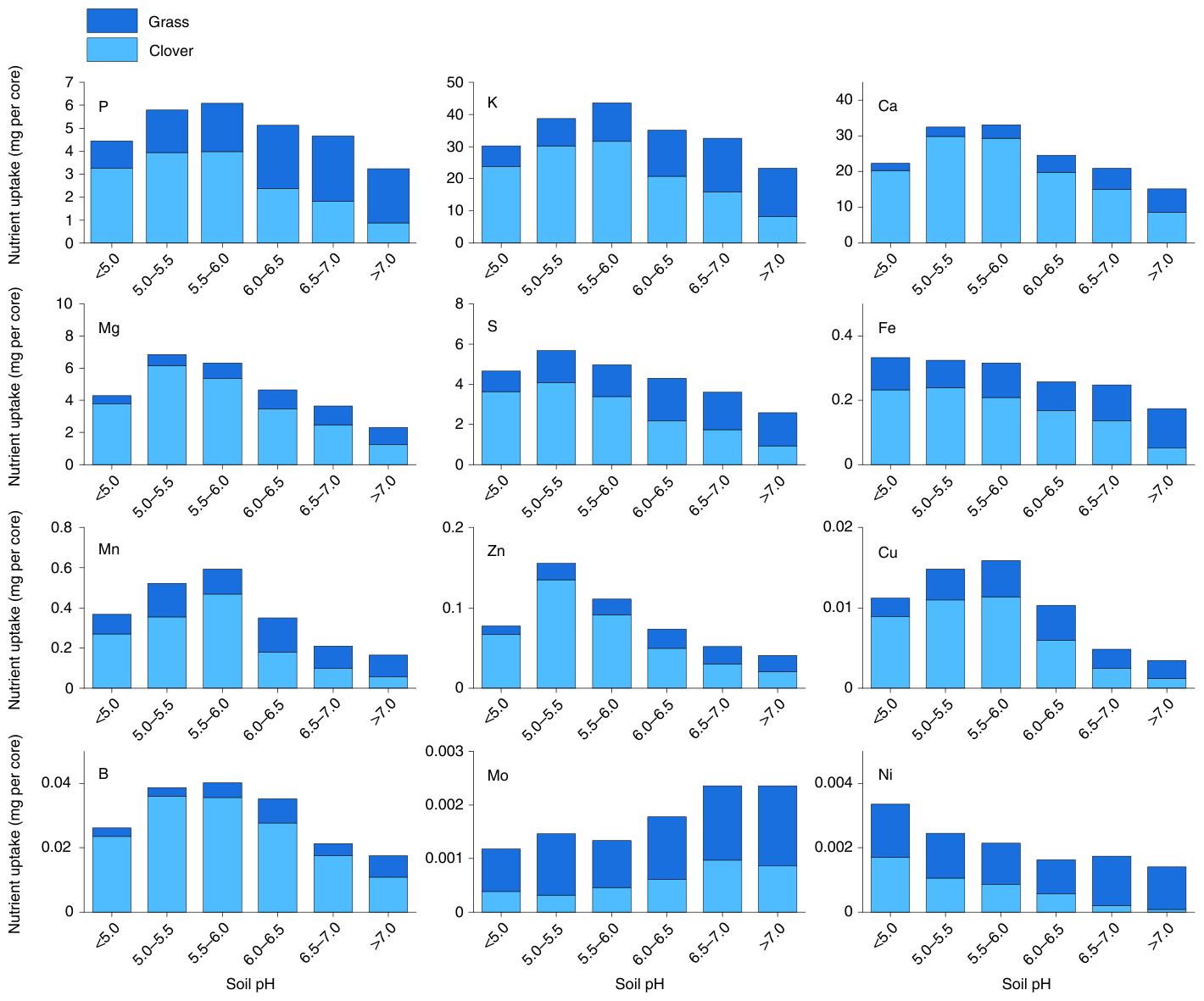
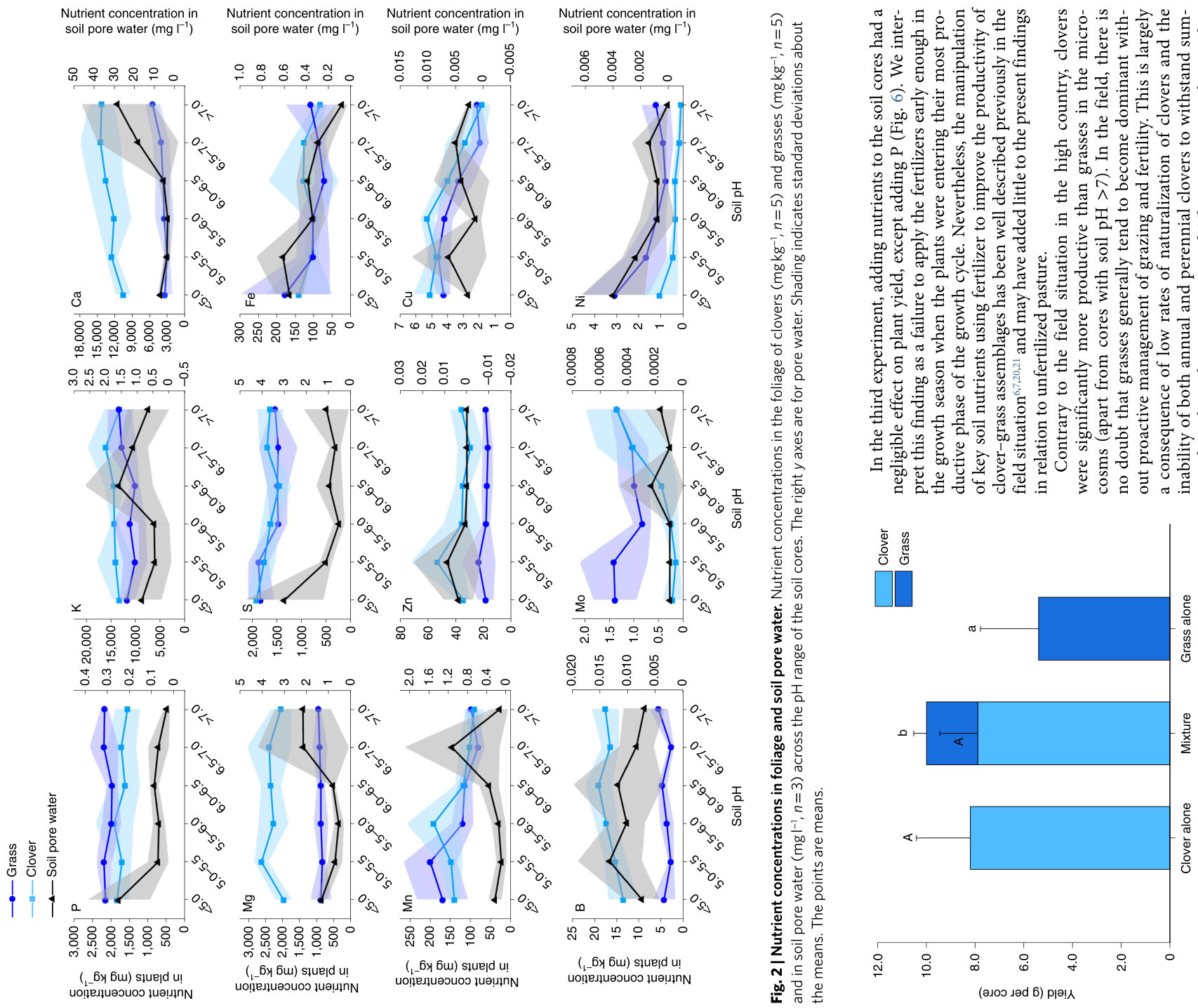
Clovers produced more aboveground biomass than grasses in all soils below pH 7, growing significantly better in the more acidic soils, where yields were double those of grasses (Supplementary Fig. 1). There was an effect of soil pH on the mobility and uptake of nutrients (Fig. 1). The optimal pH for the uptake of most nutrients was in the range of 5–6.5, but analyses of these cores indicated that there is considerable small-scale spatial variability across the sampling site both below and above this pH range (Fig. 2). Nutrient concentrations in pore water tended to be higher in lower-pH soil cores for six elements (P, S, Fe, Ni, B and Zn). Except for B, this was reflected in foliar concentrations of the same elements in clover or grasses or in both. Foliar concentrations of Mo were unique in this dataset, substantially declining in lower-pH cores. Three elements (P, Mo and Ni) were at significantly higher foliar concentrations in grasses than
在所有pH低于7的土壤中,三叶草的地上生物量均高于禾草,且在酸性较强的土壤中生长明显更好,其产量为禾草的两倍(补充图1)。土壤pH对养分的迁移性和吸收有影响(图1)。大多数养分吸收的最适pH范围为5–6.5,但对这些土柱的分析表明,在该pH范围之下和之上,采样点均存在相当大的小尺度空间变异(图2)。在pH较低的土柱中,六种元素(P、S、Fe、Ni、B和Zn)的孔隙水浓度往往较高。除B外,这一点也反映在三叶草或禾草或两者叶片中相同元素的浓度上。Mo的叶片浓度在本数据集中独具特点,在pH较低的土柱中大幅下降。三种元素(P、Mo和Ni)在禾草叶片中的浓度显著高于
1Faculty of Agriculture and Life Sciences, Lincoln University, Lincoln, New Zealand. 2Department of Chemistry, University of Canterbury, Christchurch, New Zealand. ✉e-mail: Wei.zhang@lincolnuni.ac.nz; Tom.Maxwell@lincoln.ac.nz; Brett.robinson@canterbury.ac.nz; Nicholas.dickinson@lincoln.ac.nz
in clovers, and five elements (K, Ca, Mg, Zn and B) were in much higher concentrations in clover foliage. Manganese concentrations in soil pore water varied in the opposite direction to concentrations in foliage, which may be a result of the plants readily taking up this element through non-specific transporters17 and depleting mobile forms of this element in the soil. We have found previously that pore water data collected from rhizon samplers can be variable and unreliable depending on pathways of water flow through the soil, which can produce a rapid flush into the sampler or a slow seepage, thus providing differing amounts of time to accumulate solutes. A range of complex interactions occur in the rhizosphere that are likely to be critical to the mobilization of nutrients and to accessing discrete resources from the same soil volume13, which undoubtedly play an important role in grassland productivity7,18.
三叶草,而五种元素(K、Ca、Mg、Zn和B)在三叶草叶片中的浓度则高得多。土壤孔隙水中Mn浓度的变化方向与叶片中的浓度相反,这可能是由于植物通过非特异性转运蛋白容易吸收该元素17,从而耗竭了土壤中该元素的可移动形态。我们此前发现,由根际土壤溶液采样器(rhizon)采集的孔隙水数据可能因土壤中水流路径不同而变异较大、可靠性较差:水流可能快速涌入采样器,也可能缓慢渗入,从而使溶质积累的时间各不相同。根际中发生着一系列复杂的相互作用,这些作用可能对养分活化以及从同一土壤体积中获取不同资源至关重要13,无疑在草地生产力中发挥着重要作用7,18。
In the second experiment, clovers were competitively dominant in terms of yield when growing in mixed-species assemblages with grasses and appeared to be the main beneficiary of coexistence. Growing as single species, the yield of clovers was approximately double that of grasses and did not significantly differ in the presence of grasses (Fig. 3). Conversely, grass yield was reduced by approximately half when growing in mixtures. Clover had higher foliar con-
在第二个试验中,三叶草与禾草组成混合物种组合生长时,在产量上具有竞争优势,并似乎是共存的主要受益者。单一物种生长时,三叶草的产量约为禾草的两倍,且在有禾草存在时无显著差异(图3)。相反,混合生长时禾草产量约减少一半。三叶草与禾草组合生长时,其叶片中
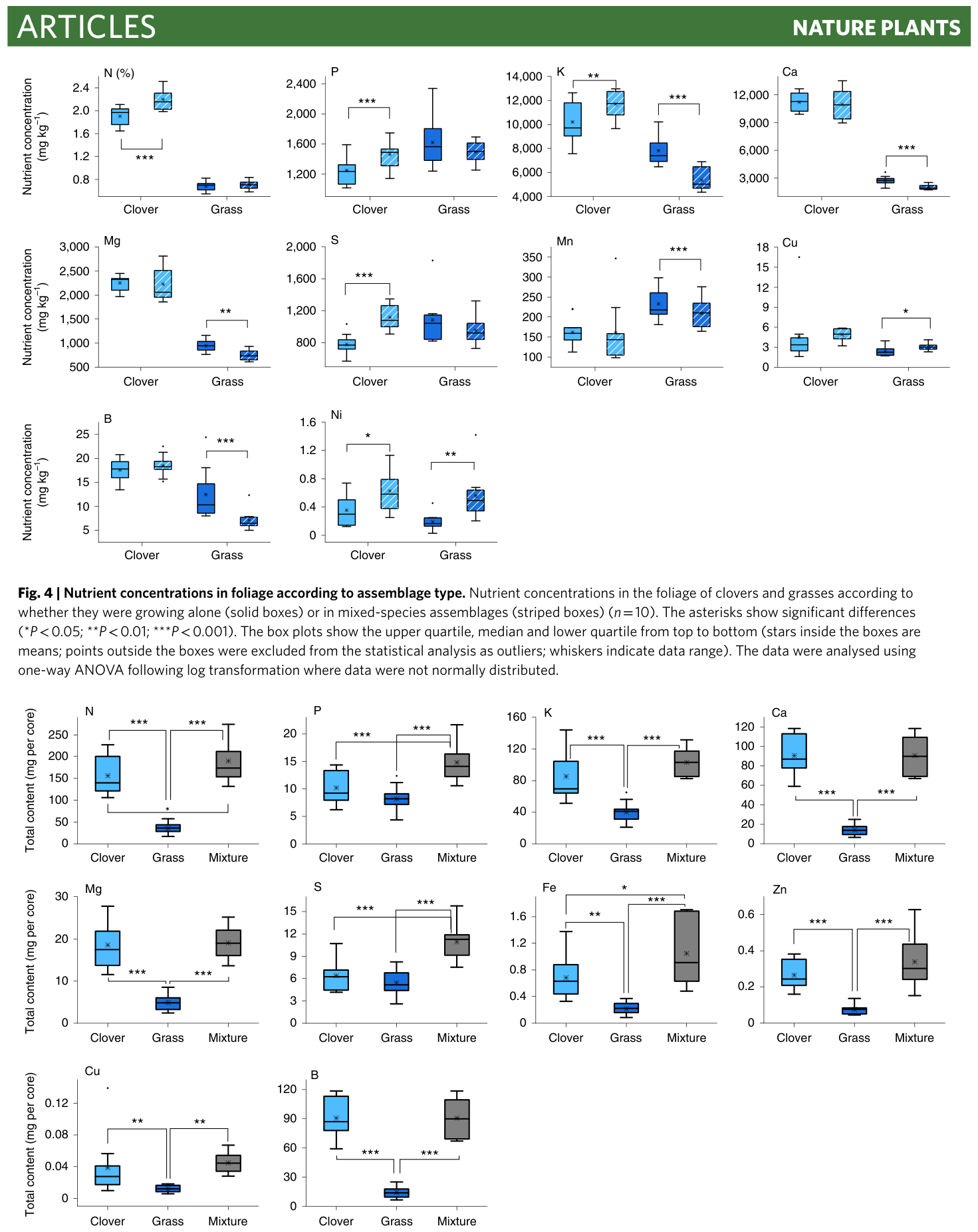
centrations of the major nutrients N, P, K, S and Ni when growing in combination with grasses (Fig. 4). Clovers but not grasses acquired more N when growing in combination, and there was no evidence of N spillover to grasses. Grasses benefited by growing together with clovers through higher foliar concentrations of only Cu and Ni. Potassium, Ca, Mn and B concentrations in grasses were significantly lower when they grew with clovers. Soil pore water contained higher Fe concentrations in cores with only grasses and higher Zn concentrations in cores with clover–grass mixtures (Supplementary Fig. 2). When these data are analysed using mass balance (Fig. 5), mixed-species assemblages extracted significantly larger quantities of three elements (P, S and Fe) from soil than when either grasses or clovers were growing alone. This is largely explained by the increased combined biomass in mixed-species assemblages and by lower yields of grasses in mixture. However, differences in foliar nutrient concentrations between clovers and grasses also contribute substantially to quite different exploitation of the nutrient content of the soil cores. When growing as single species, clovers captured more of 9 of the 13 elements than grasses. Grasses were more efficient than clovers at procuring only Mo from the soil, which is a particularly critical element for N fixation in legumes19.
主要养分N、P、K、S和Ni的浓度更高(图4)。组合生长时,三叶草获取了更多的N,而禾草则没有,且没有证据表明存在向禾草的N溢出。禾草与三叶草共同生长的获益仅体现在叶片Cu和Ni浓度较高。禾草与三叶草共同生长时,禾草中K、Ca、Mn和B的浓度显著降低。仅有禾草的土柱中土壤孔隙水Fe浓度较高,而三叶草–禾草混合土柱中Zn浓度较高(补充图2)。采用质量平衡分析这些数据时(图5),混合物种组合从土壤中提取的三种元素(P、S和Fe)的量显著大于禾草或三叶草单独生长时。这在很大程度上可由混合物种组合总生物量的增加以及混合生长时禾草产量的降低来解释。然而,三叶草与禾草之间叶片养分浓度的差异,也在很大程度上导致了二者对土柱养分含量的利用方式截然不同。单一物种生长时,在13种元素中,三叶草对其中9种的获取量多于禾草。禾草仅在从土壤中获取Mo方面比三叶草更有效,而Mo对豆科植物固氮是一种特别关键的元素19。
mer drought without going to seed. The moisture conditions that were maintained in the soil cores favoured the clovers over the more drought-tolerant perennial grasses. The present experimental work did not realistically match the field situation in terms of simulating typical moisture deficits, but it was considered more important to maintain suitable conditions for plant growth. Modelling the effect of soil moisture deficit on nutrient cycling requires more work.
季干旱而不结籽。土柱中维持的水分条件有利于三叶草,而不利于更耐旱的多年生禾草。本试验在模拟典型水分亏缺方面并未真实反映田间情况,但我们认为维持适宜植物生长的条件更为重要。模拟土壤水分亏缺对养分循环的影响尚需更多研究。
While soil nutrient analysis data have drawn attention to deficiencies of P, S, B, Mo and Ni in these acid soils, the biogeochemical complexities of nutrient mobility within the rhizosphere makes the prediction of key deficient elements less straightforward22. Nevertheless, many of the findings of the present study are explained by existing knowledge of nutrient mobility in soils and plants. For example, S, Fe and Zn were at higher concentrations in pore water at lower pH, and this was reflected in plant tissue concentrations. This would be expected for the two metals that are more soluble in acid conditions and enter plants through passive flow. Low concentrations in pore water may simply reflect plant uptake and depletion of the labile soil pool; for example, the lowest concentrations of Mn in pore water occurred alongside high concentrations in foliage. Foliar Mn is known to be closely associated with P acquisition in the rhizosphere17. Other pore water concentrations are less easy to explain, and the reliability of the pore water data is likely to be questionable. For example, soluble phosphate and the availability of this element to plants are the highest at pH 6–7 (ref. 23), but this is not reflected in the data in the present study. Boron is known to be the most available under neutral-pH conditions in soils and is readily leached at low pH, but, like Ni, its apparent lack of correlation with soil pH may be indicative of the very low soil concentrations of these elements. At higher pH, pore water concentrations of five other elements (K, Ca, Mg, Mn and Mo) appeared to be generally more labile.
尽管土壤养分分析数据已揭示这些酸性土壤缺乏P、S、B、Mo和Ni,但根际内养分迁移的生物地球化学复杂性使得关键缺乏元素的预测并不那么简单22。尽管如此,本研究的许多发现仍可由现有的土壤和植物养分迁移知识加以解释。例如,S、Fe和Zn在较低pH下的孔隙水浓度较高,这也反映在植物组织浓度上。对于在酸性条件下溶解度更高并通过被动流进入植物的两种金属而言,这是意料之中的。孔隙水中的低浓度可能仅反映了植物吸收和土壤活性库的耗竭;例如,孔隙水中Mn浓度最低时,叶片中Mn浓度较高。已知叶片Mn与根际P的获取密切相关17。其他孔隙水浓度则较难解释,孔隙水数据的可靠性可能值得怀疑。例如,可溶性磷酸盐及其对植物的有效性在pH 6–7时最高(参考文献23),但这并未反映在本研究的数据中。已知B在中性pH条件下的土壤中有效性最高,且在低pH下易被淋溶,但与Ni一样,其与土壤pH明显缺乏相关性,可能表明这些元素的土壤浓度极低。在较高pH下,其他五种元素(K、Ca、Mg、Mn和Mo)的孔隙水浓度总体上似乎更具活性。
Our data do not elucidate the exact processes of the interaction between clovers and grasses, and more detailed mechanistic studies are required to guide further thinking and experimentation. Interactions between different nutrients within the rhizosphere undoubtedly played a large role in our findings. The main reason for adding lime to hill country soils is to increase the mobility and
我们的数据并未阐明三叶草与禾草之间相互作用的确切过程,需要更详细的机理研究来指导进一步的思考和试验。根际内不同养分之间的相互作用无疑在我们的发现中发挥了重要作用。在丘陵地区土壤中施用石灰的主要原因,是提高Mo对三叶草的迁移性和
availability of Mo to clovers to increase N fixation23. Hydrogen ions and organic acids released by roots acidify rhizosphere soil. One effect of this is to decrease soil redox potential, reducing oxidized materials and increasing the solubility of Fe and Mn24. Phytosiderophore exudation from grass roots is part of a rhizosphere priming effect that stimulates organic matter decomposition and nutrient cycling25,26. The uptake of K is mainly determined by the characteristics of the root system and root exudates27 but also involves Ca2+ and other secondary messengers18. The production of root exudates can be a response to environmental stress, including nutrient stress26. Magnesium improves nitrogen use efficiency, although basic research on Mg nutrition is lacking28. Exudates released by grasses are known to enhance the activity of soil microorganisms that accelerate the oxidation of S, allowing more available forms of S to be utilized by plants. Microorganisms play a major role in sulfur oxidation in soil, such as by mineralizing organic S2–29. Clearly, mechanistic explanations are complex and require more detailed study.
有效性,从而增强固氮作用23。根系释放的氢离子和有机酸使根际土壤酸化。其影响之一是降低土壤氧化还原电位,使氧化态物质还原,并提高Fe和Mn的溶解度24。禾草根系分泌植物铁载体是根际激发效应的一部分,可刺激有机质分解和养分循环25,26。K的吸收主要取决于根系特征和根系分泌物27,但也涉及Ca2+及其他第二信使18。根系分泌物的产生可能是对包括养分胁迫在内的环境胁迫的响应26。镁可提高氮素利用效率,但有关Mg营养的基础研究尚缺乏28。已知禾草释放的分泌物可增强土壤微生物活性,加速S的氧化,使植物能够利用更多有效形态的S。微生物在土壤硫氧化中起主要作用,例如通过矿化有机S2–29。显然,其机理解释十分复杂,需要更详细的研究。
In terms of the complementarity of species, there is an obvious advantage to a plant of acquiring a limiting soil resource at reduced metabolic cost16. Clovers acquired higher concentrations and quantities of all nutrients (apart from Ni and Mo) than grasses. Grasses were better than clovers at procuring Mo from soil, even though the Mo requirement of clovers is likely to be greater22. Molybdate is the predominant form of Mo available to plants, but there is little knowledge of how plants access molybdate from the soil solution and redistribute it within the plant. We know that its availability is strongly dependent on soil pH and organic compounds in soil colloids30. Furthermore, phytosiderophore release by grass roots that occurs under Fe, Zn, Mn and Cu deficiencies is thought to be an adaptive response to enhance the acquisition of micronutrient metals31,32. We speculate that there are important mutually beneficial rhizosphere interactions between grasses and clovers within which Mo is likely to play a key role. More nitrogen was procured by clovers, but not grasses, when clovers were growing in mixture. An explanation for this may be that the growth cycle of grasses was already advanced at the onset of the experimental work. The grasses were not in an early stage of seasonal growth and may have had limited demand for N. This was also our best explanation for the failure of a selective herbicide to kill the grasses.
就物种互补性而言,以较低的代谢成本获取限制性土壤资源对植物显然是有利的16。三叶草获取的所有养分(Ni和Mo除外)的浓度和数量均高于禾草。禾草从土壤中获取Mo的能力优于三叶草,尽管三叶草对Mo的需求可能更大22。钼酸盐是植物可利用的Mo的主要形态,但关于植物如何从土壤溶液中获取钼酸盐并在体内再分配,目前知之甚少。我们知道其有效性在很大程度上取决于土壤pH和土壤胶体中的有机化合物30。此外,在Fe、Zn、Mn和Cu缺乏条件下禾草根系释放植物铁载体,被认为是增强微量营养金属获取的一种适应性响应31,32。我们推测,禾草与三叶草之间存在重要的互惠根际相互作用,其中Mo可能起关键作用。三叶草在混合生长时获取了更多的氮,而禾草则没有。对此的一种解释可能是,在试验开始时禾草的生长周期已经较为靠后。禾草并不处于季节性生长的早期阶段,对N的需求可能有限。这也是我们对选择性除草剂未能杀死禾草的最佳解释。
Our hypothesis that clovers benefit from the presence of grasses is supported by the fact that clover had higher foliage concentrations of the major nutrients N, P, K and S when growing in combination with grasses, procuring significantly larger quantities of P, S and Fe from soil than when either were growing alone. The latter is a combination of improved plant nutrition and higher yields. Many earlier studies have shown that mixed plant assemblages result in higher overall plant biomass33 and extract more nutrients from the soil than monocultures34. This is generally explained by better spatial exploitation of the soil by different root architectures35,36. The present findings indicate more positive mutually beneficial interactions most likely involving a rhizosphere priming effect26,37 of grasses that benefits clovers. This study reports the nutritional benefits of mixed communities of grasses and clovers in a field situation, showing that grasses enhance the ability of clovers to procure limiting plant nutrients. Chemical communication that has evolved in the rhizosphere of mixed plant communities is poorly understood, even in the context of the nitrogen cycle38. The findings of the present study show that grasses provide an advantage by enhancing N fixation by clovers, also increasing the mobility and uptake of other major nutrients and trace elements. Recognized deficiencies of P, S, Mg, B, Mo and Ni in these soils, to a significant extent, are mitigated by rhizosphere interactions that occur between grasses and clovers. This plays an important role in the interplay of key elements that are modified by and modify the physicochemistry of soil, nutrient lability and plant uptake.
三叶草与禾草组合生长时,其叶片中主要养分N、P、K和S的浓度更高,并且从土壤中获取的P、S和Fe显著多于二者单独生长时,这支持了三叶草从禾草的存在中获益的假设。后者是植物营养改善和产量提高共同作用的结果。许多早期研究表明,与单一栽培相比,混合植物组合可产生更高的总植物生物量33,并从土壤中提取更多养分34。这通常被解释为不同根系构型对土壤更好的空间利用35,36。本研究结果表明存在更为积极的互惠相互作用,很可能涉及禾草的根际激发效应26,37,从而使三叶草受益。本研究报道了田间条件下禾草与三叶草混合群落的营养效益,表明禾草增强了三叶草获取限制性植物养分的能力。即使在氮循环方面,人们对混合植物群落根际中演化形成的化学通讯仍知之甚少38。本研究结果表明,禾草通过增强三叶草的固氮作用提供优势,同时提高其他主要养分和微量元素的迁移性和吸收。这些土壤中已知的P、S、Mg、B、Mo和Ni缺乏,在很大程度上通过禾草与三叶草之间的根际相互作用得到缓解。这在关键元素的相互作用中发挥着重要作用,这些元素既受土壤理化性质、养分活性和植物吸收的影响,又反过来改变它们。
Enhanced exploitation of soil chemistry probably has wider relevance to other low-input forms of agriculture22 and to providing research pathways to build science-based evidence relating to regenerative agriculture39. We conclude that more attention is required towards enhancing diversity rather than attempting to simplify species assemblages in grassland pastures. Clovers and grasses have different, complementary functional roles. Advancing this knowledge through further research could also help optimize the use of fertilizer amendments in pasture farming systems. We suggest that future work could identify root exudates of monocot and dicot combinations using rhizoboxes fitted with suction cups; the deployment of planar optodes in such rhizoboxes may reveal the spatial locations of root interactions. This knowledge may be used to determine optimal plant species combinations for pasture management. Our findings in this paper support other studies that have argued that maintaining and re-establishing plant diversity could be a way to manage temperate grasslands40 towards sustainable intensification41 as well as to combat grassland degradation42.
增强对土壤化学的利用可能对其他低投入农业形式具有更广泛的意义22,并为建立与再生农业相关的科学证据提供研究途径39。我们得出结论:在草地牧场中,应更加重视提高多样性,而不是试图简化物种组合。三叶草和禾草具有不同且互补的功能角色。通过进一步研究推进这方面的认识,还有助于优化牧场农业系统中肥料的使用。我们建议,未来的工作可利用装有吸杯的根箱鉴定单子叶与双子叶植物组合的根系分泌物;在此类根箱中部署平面光极可揭示根系相互作用的空间位置。这些知识可用于确定牧场管理的最佳植物物种组合。本文的研究结果支持了其他研究的观点,即维持和重建植物多样性可能是管理温带草地40、实现可持续集约化41以及防治草地退化42的一种途径。
1Methods方法
Study site. Soil cores were extracted from a 1,607 ha high country sheep farm (Mt Grand Station) situated in Hawea, Central Otago, on South Island, which has a continental-type climate of hot, dry summers and cold winters10. The soils are derived primarily from metamorphic schists and loess and are defined as Pallic Yellow Grey Earths. They are acidic (typically pH 5.5) with lower concentrations of P, S, B, Mo and Ni than typical soils elsewhere in New Zealand (Supplementary Table 1). They are also deficient in Na, which is an essential element for stock but not for plants. Annual rainfall is 703 mm with high annual and seasonal variability5. The station supports <2 stock units of sheep per ha that probably harvest <3 t of dry matter per ha across the whole landscape (D. Lucas, personal communication).
研究地点。土柱采自位于南岛中奥塔哥Hawea的一个面积为1,607 ha的高地牧羊场(Mt Grand Station),该地属大陆性气候,夏季炎热干燥,冬季寒冷10。土壤主要由变质片岩和黄土发育而来,属Pallic Yellow Grey Earths。土壤呈酸性(通常pH 5.5),P、S、B、Mo和Ni浓度低于新西兰其他地区的典型土壤(补充表1)。土壤还缺乏Na,Na是牲畜而非植物的必需元素。年降雨量为703 mm,年际和季节变异性较大5。该牧场每公顷承载<2个绵羊存栏单位,在整个景观范围内每公顷采食的干物质可能<3 t(D. Lucas,个人通讯)。
The sampling location was an approximately 400 m2 area of mixed grass– legume pasture on a mid-altitude (700 m), north-facing (sunny aspect), moderately steep (20–30°) hillside slope within a 65 ha grazed pasture block. White clover (Trifolium repens L.) and subterranean clover (T. subterraneum L.) have been periodically sown at this location, but the vegetation has a larger component of adventive and naturalized grasses and forbs; in an earlier study of the same sampling area, Maxwell et al.5 identified 4 other species of clovers, 11 species of grasses and 4 other forb species. There is also a very small component of native grasses (Rytidosperma spp.). The sampling area is largely below the altitude and too heavily grazed for native tussocks to form a significant component of the vegetation, although remnants of one lower-altitude tussock grass (Poa cita) and a native woody shrub (Discaria toumatou) are established in patches adjacent to the sampling location.
采样地点为一片约400 m2的禾草–豆科混合牧场,位于65 ha放牧草场区块内一处中海拔(700 m)、朝北(向阳坡)、中等陡峭(20–30°)的山坡上。该地曾定期播种白三叶草(Trifolium repens L.)和地三叶草(T. subterraneum L.),但植被中外来和归化禾草及杂类草占较大比例;在对同一采样区的早期研究中,Maxwell et al.5鉴定出另外4种三叶草、11种禾草和另外4种杂类草。本土禾草(Rytidosperma spp.)所占比例也很小。采样区大部分低于本土丛生草的分布海拔,且放牧过重,本土丛生草未能成为植被的重要组分,但在采样点附近有一种低海拔丛生禾草(Poa cita)和一种本土木本灌木(Discaria toumatou)的残余斑块。
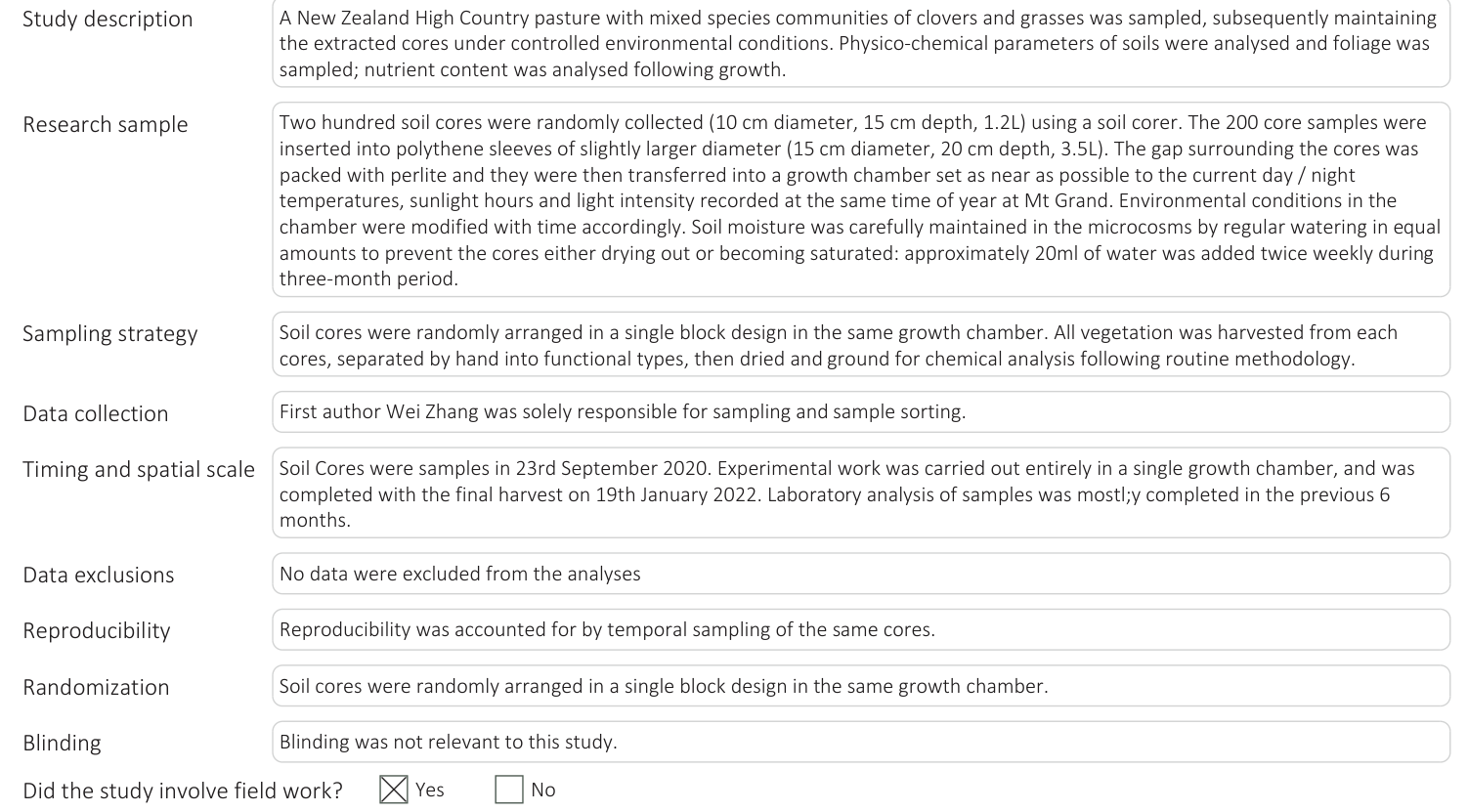
Experimental procedure. A total of 202 cores were randomly collected (10 cm in diameter, 15 cm deep, 1.2 l) using a soil corer in the spring month of September when sward height was approximately 3–5 cm. The core samples were inserted into polythene sleeves of slightly larger dimensions (15 cm in diameter, 20 cm deep, 3.5 l). The gap surrounding the cores was packed with perlite, and they were then transferred into a growth chamber set as near as possible to the current day/night temperatures, sunlight hours and light intensity recorded at the same time of year at Mt Grand. The environmental conditions in the chamber were modified with time accordingly. Soil moisture was carefully maintained in the microcosms by regular watering in equal amounts to prevent the cores from either drying out or becoming saturated: approximately 20 ml of water was added twice weekly during a three-month period. We considered this deviation from field conditions to be justified to maintain plant growth and nutrient mobility in soil and plants during the experimental period.
试验程序。于春季9月、草层高度约3–5 cm时,使用土钻随机采集共202个土柱(直径10 cm,深15 cm,1.2 l)。将土柱样品插入尺寸稍大的聚乙烯套管(直径15 cm,深20 cm,3.5 l)中。土柱周围的空隙用珍珠岩填充,然后移入生长室,生长室设置尽可能接近Mt Grand同期记录的当前昼/夜温度、日照时数和光照强度。生长室内的环境条件随时间作相应调整。通过定期等量浇水,精心维持微宇宙中的土壤水分,防止土柱干燥或饱和:在三个月期间每周加水两次,每次约20 ml。我们认为这种与田间条件的偏差是合理的,以便在试验期间维持植物生长以及养分在土壤和植物中的迁移。
Cores selected for the experimental work were those that contained approximately equal amounts of grasses and clovers. The experimental cores were then further selected and grouped in accordance with the objectives of the three experiments. At the outset, the vegetation in all cores was clipped to 2 cm above the soil surface. Three separate experiments were designed as follows:
选作试验的土柱为禾草和三叶草数量大致相等者。随后根据三个试验的目标对试验土柱作进一步筛选和分组。试验开始时,所有土柱中的植被均剪至土表以上2 cm。三个独立试验设计如下:
(1) pH and nutrient mobility. Soil pH was measured in every core using a surface probe attached to a HANNA HI 99121 pH meter for surface pH. The cores were then divided into a range of six pH intervals: 4.5–4.99 (n= 10), 5.0–5.49 (n= 61), 5.5–5.99 (n= 52), 6.0–6.49 (n= 33), 6.5–6.99 (n= 34) and >7.0 (n= 12). Five replicates were collected from each of the six pH ranges. Soil pore water rhizon samplers (5 cm porous samplers with female luers, Rhizosphere Research Products) were inserted into three cores randomly selected at each pH interval. They were positioned diagonally at approximately 20° to sample pore water between depths of 5 and 10 cm. Soil pore water was then collected after one month in the growth chamber. Aboveground vegetation was harvested from the cores by hand clipping to 2 cm after three months in
(1)pH与养分迁移性。使用连接HANNA HI 99121 pH计的表面探头测定每个土柱的表面土壤pH。然后将土柱划分为六个pH区间:4.5–4.99(n= 10)、5.0–5.49(n= 61)、5.5–5.99(n= 52)、6.0–6.49(n= 33)、6.5–6.99(n= 34)和>7.0(n= 12)。从六个pH范围中各选取五个重复。在每个pH区间随机选取三个土柱,插入土壤孔隙水rhizon采样器(5 cm多孔采样器,带母鲁尔接头,Rhizosphere Research Products)。采样器以约20°斜向放置,以采集5–10 cm深度之间的孔隙水。在生长室中培养一个月后收集土壤孔隙水。培养三个月后,于
January, then dried and weighed. Nutrients were analysed separately in the foliage of grasses and clovers, each bulk sampled from each core.
1月以手工剪割至2 cm的方式收获土柱地上植被,然后烘干称重。分别分析禾草和三叶草叶片中的养分,每个土柱各自混合取样。
(2) Grasses and the nutrient content of clovers. A further 30 cores were selected within the pH range 5.2–5.7. Either grasses or clovers were selectively removed from ten cores each. Both a selective herbicide and careful hand removal were tested in a preliminary trial, before settling on the latter. The additional ten cores were left with a mixture of grasses and clovers; we selected those with an approximately equal ratio of clovers and grass. Five soil pore water rhizon samplers were inserted as above into the cores of each treatment. Harvest and analyses followed those described above.
(2)禾草与三叶草的养分含量。另选取pH范围为5.2–5.7的30个土柱。分别从其中各10个土柱中选择性去除禾草或三叶草。在预试验中测试了选择性除草剂和仔细人工拔除两种方法,最终采用后者。另外10个土柱保留禾草与三叶草的混合物;我们选取了三叶草与禾草比例大致相等的土柱。按上述方法在每个处理的土柱中插入五个土壤孔隙水rhizon采样器。收获和分析方法同上。
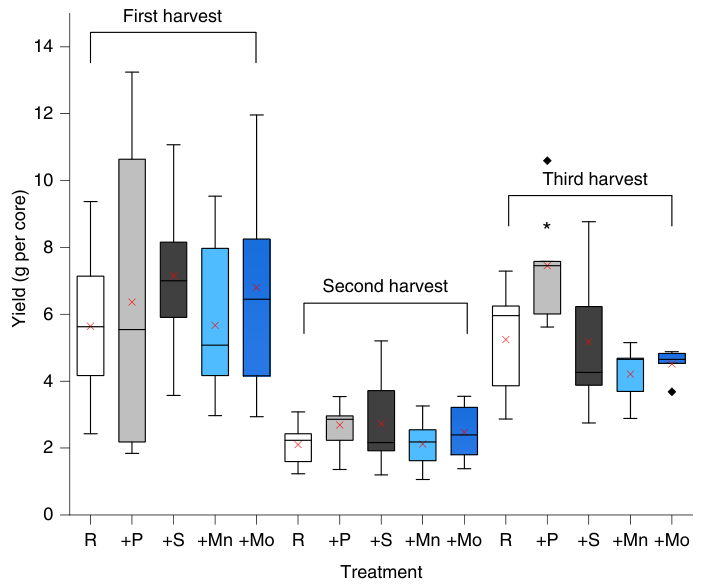
(3) Amendment of soil fertility. One of four nutrients (P, S, Mn and Mo) was added to the microcosms at approximately standard rates of fertilizer application that would typically be used in the hill country. Salts of each element (0.58 g (NH4) H2PO4, 513 kg ha−1; 0.0037 g Na2MoO4·2H2O, 3.3 kg ha−1; 0.6 g MnSO4·3H2O, 530 kg ha−1; and 0.15 g S, 135.4 kg ha−1) were dissolved in 10 ml of water. Pots with similar pH values (range 5.7–6.7) and comparable ratios of legumes and grass were selected, and herbage was clipped at 2 cm before the nutrients were added. Yield was measured twice, at two-month intervals.
(3)土壤肥力改良。以丘陵地区通常采用的大致标准施肥量,向微宇宙中添加四种养分(P、S、Mn和Mo)之一。将各元素的盐(0.58 g (NH4) H2PO4,513 kg ha−1;0.0037 g Na2MoO4·2H2O,3.3 kg ha−1;0.6 g MnSO4·3H2O,530 kg ha−1;0.15 g S,135.4 kg ha−1)溶于10 ml水中。选取pH值相近(范围5.7–6.7)且豆科植物与禾草比例相当的盆钵,在添加养分前将草层剪至2 cm。每隔两个月测定一次产量,共测定两次。
Analytical procedure. The soil and plant samples were dried at 25 °C/65 °C and ground (2 mm), then prepared for analysis by Analytical Services at Lincoln University and RJ Hill Laboratories Limited, Hamilton, following the standard procedures, and N was determined using an Elementar Rapid Max N Elemental Analyser. The other elements in plant and water samples were determined using an inductively coupled plasma mass spectrometry facility at Canterbury University. Nutrients in foliage are expressed in terms of both foliage concentrations (mg kg−1) and mass balance (concentration × dry weight of foliage). For statistical analysis, data not normally distributed were log-transformed before analysis. Differences between means were determined using one-way ANOVA, with a post-hoc Fisher’s least significant difference test. All analyses were conducted using Minitab Statistical Software (Minitab, LLC), v.19.
分析方法。土壤和植物样品在25 °C/65 °C下烘干并粉碎(2 mm),然后由林肯大学分析服务部和汉密尔顿RJ Hill Laboratories Limited按标准程序制备分析,N采用Elementar Rapid Max N元素分析仪测定。植物和水样中的其他元素采用坎特伯雷大学的电感耦合等离子体质谱仪测定。叶片养分以叶片浓度(mg kg−1)和质量平衡(浓度 × 叶片干重)两种方式表示。统计分析时,非正态分布数据经对数转换后再行分析。均值间差异采用单因素ANOVA测定,并进行Fisher最小显著差异事后检验。所有分析均使用Minitab统计软件(Minitab, LLC)v.19完成。
Reporting summary. Further information on research design is available in the Nature Research Reporting Summary linked to this article.
报告摘要。有关研究设计的更多信息,见本文链接的Nature Research报告摘要。
2Data availability数据可用性
The raw data supporting the findings of this study are available through https:// data.lincoln.ac.nz/. Source data are provided with this paper.
支持本研究结果的原始数据可通过https:// data.lincoln.ac.nz/获取。源数据随本文提供。
Received: 10 February 2022; Accepted: 30 June 2022; Published online: 8 August 2022
3References参考文献
1. Agricultural and Horticultural Land Use (StatsNZ, 2021); https://www.stats.govt.
nz/indicators/agricultural-and-horticultural-land-use
2. Thom, E. R. Hill Country Symposium Grassland Research and Practice Series No. 16 (New Zealand Grassland Association, 2016).
3. Wardle, P. Vegetation of New Zealand (Cambridge Univ. Press, 1991).
4. Maxwell, T. M. R., Moir, J. L. & Edwards, G. R. Grazing and soil fertility effect on naturalized annual clover species in New Zealand high country. Rangel. Ecol. Manage. 69, 444–448 (2016).
5. Maxwell, T., Moir, J. & Edwards, G. Influence of environmental factors on the abundance of naturalised annual clovers in the South Island hill and high country. J. N. Z. Grassl. 72, 165–170 (2010).
6. Nölke, I., Tonn, B., Komainda, M., Heshmati, S. & Isselstein, J. The choice of the white clover population alters overyielding of mixtures with perennial ryegrass and chicory and underlying processes. Sci. Rep. 12, 1155 (2022).
7. Fay, P. A. et al. Grassland productivity limited by multiple nutrients. Nat. Plants 1, 15080 (2015).
8. Zhang, W., Maxwell, T. M. R., Robinson, B. & Dickinson, N. Legume nutrition is improved by neighbouring grasses. Plant Soil (in the press).
9. Smith, S. E. & Read, D. J. Mycorrhizal Symbiosis (Academic Press, 2008)
10. Phoenix, G. K., Johnson, D. A., Muddimer, S. P., Leake, J. R. & Cameron, D. D. Niche differentiation and plasticity in soil phosphorus acquisition among co-occurring plants. Nat. Plants 6, 349–354 (2020).
11. Lambers, H., Clements, J. C. & Nelson, M. N. How a phosphorus-acquisition strategy based on carboxylate exudation powers the success and agronomic potential of lupines (Lupinus, Fabaceae). Am. J. Bot. 100, 263–288 (2013).
12. Li, X. et al. Long-term increased grain yield and soil fertility from intercropping. Nat. Sustain. 4, 943–950 (2021).
13. Homulle, Z., George, T. & Karley, A. Root traits with team benefits: understanding belowground interactions in intercropping systems. Plant Soil 471, 1–26 (2021).
14. Burrows, C. J. Processes of Vegetation Change (Unwin Hyman, 1990).
15. Fornara, D. & Tilman, D. Plant functional composition influences rates of soil carbon and nitrogen accumulation. J. Ecol. 96, 314–322 (2008).
16. Lynch, J. P., Strock, C. F., Schneider, H. M., Sidhu, J. S. & Ajmera, I. Root anatomy and soil resource capture. Plant Soil 466, 21–63 (2021).
17. Lambers, H., Wright, I. J., Caio, G. & Pereira, P. J. Leaf manganese concentrations as a tool to assess belowground plant functioning in phosphorus-impoverished environments. Plant Soil 461, 43–61 (2021).
18. Liu, G. & Martinoia, E. How to survive on low potassium. Nat. Plants 6, 332–333 (2020).
19. Anke, M. & Seifert, M. The biological and toxicological importance of molybdenum in the environment and in the nutrition of plants, animals and man. Part 1: molybdenum in plants. Acta Biol. Hung. 58, 311–324 (2007).
20. Gylfadóttir, T., Helgadóttir, Á. & Høgh-Jensen, H. Consequences of including adapted white clover in northern European grassland: transfer and deposition of nitrogen. Plant Soil 297, 93–104 (2007).
21. Maxwell, T. M. L. R. Ecology and Management of Adventive Annual Clover Species in the South Island Hill and High Country of New Zealand. PhD thesis, Lincoln Univ. (2013).
22. Li, C. et al. Syndromes of production in intercropping impact yield gains. Nat. Plants 6, 653–660 (2020).
23. McLaren, R. G. & Cameron, K. C. Soil Science: Sustainable Production and Environmental Science (Oxford Univ. Press, 1996).
24. Chang, X., Duan, C. & Wang, H. Root excretion and plant resistance to metal toxicity. J. Appl. Ecol. 11, 315–320 (2000).
25. Puschenreiter, M., Gruber, B. & Wenzel, W. W. Phytosiderophore-induced mobilization and uptake of Cd, Cu, Fe, Ni, Pb and Zn by wheat plants grown on metal-enriched soils. Environ. Exp. Bot. 138, 67–76 (2017).
26. Lu, J. Y. et al. Rhizosphere priming effects of Lolium perenne and Trifolium repens depend on phosphorus fertilization and biological nitrogen fixation. Soil Biol. Biochem. 150, 108805 (2020).
27. Wang, L., Chen, F. & Wan, K. Y. Research progress and prospects of plant growth efficiency and its evaluation. Soils 42, 164–170 (2010).
28. Tian, X. Y. et al. Physiological and molecular advances in magnesium nutrition of plants. Plant Soil 468, 1–17 (2021).
29. Wainwright, M. Sulfur oxidation in soils. Adv. Agron. 37, 349–376 (1984).
30. Kaiser, B. N., Gridley, K. L., Ngaire Brady, J., Phillips, T. & Tyerman, S. D. The role of molybdenum in agricultural plant production. Ann. Bot. 96, 745–754 (2005).
31. Khobra, R. & Singh, B. Phytosiderophore release in relation to multiple micronutrient metal deficiency in wheat. J. Plant Nutr. 41, 679–688 (2018).
32. Erenoglu, B., Eker, S., Cakmak, I., Derici, R. & Römheld, V. Effect of iron and zinc deficiency on release of phytosiderophores in barley cultivars differing in zinc efficiency. J. Plant Nutr. 23, 1645–1656 (2000).
33. Chen, C., Chaudhary, A. & Mathys, A. Nutritional and environmental losses embedded in global food waste. Resour. Conserv. Recycl. 160, 104912 (2020).
34. Nyfeler, D., Huguenin-Elie, O., Suter, M., Frossard, E. & Lüscher, A. Grass–legume mixtures can yield more nitrogen than legume pure stands due to mutual stimulation of nitrogen uptake from symbiotic and non-symbiotic sources. Agric. Ecosyst. Environ. 140, 155–163 (2011).
35. Zhang, C., Postma, J. A., York, L. M. & Lynch, J. P. Root foraging elicits niche complementarity-dependent yield advantage in the ancient ‘three sisters’ (maize/bean/squash) polyculture. Ann. Bot. 114, 1719–1733 (2014).
36. Ghestem, M., Sidle, R. C. & Stokes, A. The influence of plant root systems on subsurface flow: implications for slope stability. BioScience 61, 869–879 (2011).
37. Huo, C., Luo, Y. & Cheng, W. Rhizosphere priming effect: a meta-analysis. Soil Biol. Biochem. 111, 78–84 (2017).
38. Coskun, D., Britto, D. T., Shi, W. & Kronzucker, H. J. How plant root exudates shape the nitrogen cycle. Trends Plant Sci. 22, 661–673 (2017).
39. Grelet, G. et.al. Regenerative Agriculture in Aotearoa New Zealand: Research Pathways to Build Science-Based Evidence and National Narratives (Landcare Research New Zealand, 2021).
40. Sergei Schaub, R. F. et al. Plant diversity effects on forage quality, yield and revenues of semi-natural grasslands. Nat. Commun. 11, 768 (2020).
41. Brooker, R. W. et al. Improving intercropping: a synthesis of research in agronomy, plant physiology and ecology. N. Phytol. 206, 107–117 (2015).
42. Bardgett, R. D. et al. Combatting global grassland degradation. Nat. Rev. Earth Environ. 2, 720–735 (2021).
4acknowledgements致谢
The research team are grateful to the Miss E. L. Hellaby Indigenous Grasslands Research Trust for grant funding to support Z.W. for his PhD stipend and operational funds. Special thanks also to S. Stephen, B. Richards, E. Huang, L. Hassall and R. Cresswell for practical support.
研究团队感谢Miss E. L. Hellaby本土草地研究信托基金为Z.W.的博士生津贴及运行经费提供资助。特别感谢S. Stephen、B. Richards、E. Huang、L. Hassall和R. Cresswell提供的实际支持。
5author contributions作者贡献
All authors contributed to the planning and execution of the project and to manuscript preparation. Z.W. carried out the practical work and data analysis as part of his PhD programme supervised by N.D., T.M. and B.R. N.D. and Z.W. are responsible for the final manuscript draft.
所有作者均参与了项目的规划与实施以及论文的撰写。Z.W.在N.D.、T.M.和B.R.指导下,作为其博士课程的一部分开展了实验工作和数据分析。N.D.和Z.W.负责论文终稿的撰写。
6Competing interests利益冲突
The authors declare no competing interests.
作者声明不存在利益冲突。
7additional information附加信息
Supplementary information The online version contains supplementary material available at https://doi.org/10.1038/s41477-022-01210-1.
补充信息 本文在线版本包含补充材料,见https://doi.org/10.1038/s41477-022-01210-1。
Correspondence and requests for materials should be addressed to Zhang Wei, Thomas Maxwell, Brett Robinson or Nicholas Dickinson.
通信及材料索取请联系Zhang Wei、Thomas Maxwell、Brett Robinson或Nicholas Dickinson。
Peer review information Nature Plants thanks Rafael Clemente, Chris Anderson and the other, anonymous, reviewer(s) for their contribution to the peer review of this work.
同行评审信息 Nature Plants感谢Rafael Clemente、Chris Anderson以及其他匿名审稿人对本文同行评审所作的贡献。
Reprints and permissions information is available at www.nature.com/reprints.
重印及许可信息见www.nature.com/reprints。
Publisher’s note Springer Nature remains neutral with regard to jurisdictional claims in published maps and institutional affiliations.
出版者声明 Springer Nature对已出版地图中的管辖权主张及机构隶属关系保持中立。
Springer Nature or its licensor holds exclusive rights to this article under a publishing agreement with the author(s) or other rightsholder(s); author self-archiving of the accepted manuscript version of this article is solely governed by the terms of such publishing agreement and applicable law.
根据与作者或其他权利持有人签订的出版协议,Springer Nature或其许可方拥有本文的专有权利;作者对本文已接受稿件版本的自存档仅受该出版协议条款及适用法律的约束。
© The Author(s), under exclusive licence to Springer Nature Limited 2022
© 作者,经独家许可授予Springer Nature Limited 2022

������������������������
������������������� ���������
�������������������������� 23/06/2022
8�����������������
�������������������������������������������������������������������������������������������������������������������������������������������������� ����������������������������������������������������������������������������������������������������������������������������������
9����������
���������������������������������������������������������������������������������������������������������������������������������������������
��� ���������
�������������������������������������������������������������������������������������������������������������������
�����������������������������������������������������������������������������������������������������������������������
��������������������������������������������������������������������
��������������������������������������������������������������������������������������������������������������
��������������������������������������
�������������������������������������������������������������������������������������������������������������������
������������������������������������������������������������������������������������������������������������������������������������������������
����������������������������������������������������������������������������������������������������������
��������������������������������������������������������������������������������������������������������������������������������������������� ������������������������������������������������
������������������������������������������������������������������������������������������������
����������������������������������������������������������������������������������������������������������������������
��������������������������������������������������������������������������������������������
����������������������������������������������������������������������������������������������
10�����������������
������������������������������������������������������
��������������� �������������������� ������������� ����������
���������������������������������������������������������������������������������������������������������������������������������������������������������������������������������������
�������������������������������������������������������������������������������������������������������������������������������������������������������������������������������������
11����
���������������������������������������������
��������������������������������������������������������������������������������������������������������������������������������������� ������������������������������������������������������������������������������������ ���������������������������������������������������������
���������������������������������������������������������������������������������������������������
�����������������������������������������������������������������������������������������������������������������������������������������
12������������������������
����������������������������������������������������������������������������������������������������������������������������������������������������
�������������
����������������������������� ��������������������������������������������������
��������������������������������������������������������������������������������������������������������������
13��������������������������������������������������������������
�������������������������������������������������������������������������������
14������������������������������������

15�����������������������������������������������������
����������������������������������������������������������������������������������������������������������������������������������������������������������������
��������������������������������������������������������������������������������������������������������������������������������������������������������������������������
| �������������������������������� | ������� |
|---|---|
| ��� ��������������������� | ��� ��������������������� |
| ���������� | �������� |
| ��������������������� | �������������� |
| ����������������������������� | ���������������������� |
| ��������������������������� | |
| ��������������������������� | |
| ������������� | |
| ���������������������������� |