ELSEVIER
Journal of Geochemical Exploration 67 (1999) 407–415 www.elsevier.com/locate/jgeoexp
C.W.N. Anderson a, R.R. Brooks a,Ł, A. Chiarucci b, C.J. LaCoste a, M. Leblanc c, B.H. Robinson d, R. Simcock e, R.B. Stewart a
a Soil and Earth Sciences, Institute of Natural Resources, Massey University, Palmerston North, New Zealand c Ge´ofluides-Bassins-Eau, CNRS, Universite´ de Montpellier II, Montpellier 34095, France d Horticulture and Food Research Institute, Palmerston North, New Zealand e Landcare Research Ltd., Massey University, Palmerston North, New Zealand
a 土壤与地球科学系, 梅西大学自然资源研究所,新西兰北帕默斯顿 c Géofluides-Bassins-Eau实验室, 法国国家科学研究中心(CNRS),蒙彼利埃第二大学,法国蒙彼利埃 34095 d 园艺 与食品研究所,新西兰北帕默斯顿 e Landcare Research有限公司,梅西大学,新西兰北帕默斯顿
b Dipartimento di Biologia Ambientale, Universita` di Siena, Siena, Italy
Accepted 22 July 1999
Abstract摘要
The technique of phytomining involves growing a crop of a metal-hyperaccumulating plant species, harvesting the biomass and burning it to produce a bio-ore. The first phytomining experiments were carried out in California using the Ni-hyperaccumulator Streptanthus polygaloides and it was found that a yield of 100 kg=ha of sulphur-free Ni could be produced. We have used the same technique to test the phytomining potential of the Ni-hyperaccumulators Alyssum bertolonii from Italy and Berkheya coddii from South Africa. The effect of different fertiliser treatments on growth of Alyssum bertolonii was established in situ in Tuscany and showed that the biomass of the plant could be increased by a factor of nearly 3 (4.5 t=ha to 12 t=ha) without significant loss of the Ni concentration (7600 mg=kg) in the plant. Analogous experiments have been carried out on Berkheya coddii where a biomass yield of over 20 t=ha can readily be achieved though the Ni concentration is not as high as in A. bertolonii. The total yield is, however, much greater. We have also been able to induce plants to hyperaccumulate Au by adding ammonium thiocyanate to the substrate. Up to 57 mg=kg Au (dry mass) could be accumulated by Indian mustard (Brassica juncea). Unusual hyperaccumulation (>500 mg=kg dry mass) of Tl has been determined in Iberis intermedia and Biscutella laevigata (Brassicaceae) from southern France. The Iberis contained up to 0.4% Tl (4000 mg=kg) in the whole-plant dry matter and the Biscutella over 1.5%. This unusually high accumulation of Tl has significance for animal and human health, phytoremediation of contaminated soils, and phytomining for Tl. We calculate that using Iberis, a net return of $ US 1200=ha (twice the return from a crop of wheat) would be possible with a biomass yield of 10 t=ha containing 0.08% Tl in dry matter. The break-even point (net yield of $ US 500=ha) would require 170 mg=kg (0.017%) Tl in dry matter. A model of a phytomining operation and its economics is presented and its advantages and disadvantages discussed. © 1999 Elsevier Science B.V. All rights reserved.
植物采矿技术是指种植金属超富集植物作物,收获其生物量并焚烧以生产生物矿石。首批植物采矿试验在美国加利福尼亚州开展,采用镍超富集植物Streptanthus polygaloides,结果表明可获得100 kg/ha不含硫的镍。我们采用相同技术,检验了来自意大利的镍超富集植物Alyssum bertolonii和来自南非的Berkheya coddii的植物采矿潜力。在托斯卡纳原位研究了不同施肥处理对Alyssum bertolonii生长的影响,结果表明该植物的生物量可提高近3倍(由4.5 t/ha增至12 t/ha),而植物体内镍浓度(7600 mg/kg)无显著下降。对Berkheya coddii开展了类似试验,其生物量产量可轻易超过20 t/ha,尽管镍浓度不及A. bertolonii,但总产量要高得多。我们还通过向基质中添加硫氰酸铵诱导植物超富集金。印度芥菜(Brassica juncea)可累积高达57 mg/kg的金(干重)。在法国南部的Iberis intermedia和Biscutella laevigata(十字花科)中测得异常的铊超富集(>500 mg/kg干重)。Iberis全株干物质中铊含量高达0.4%(4000 mg/kg),Biscutella则超过1.5%。这种异常高的铊累积对动物和人类健康、污染土壤的植物修复以及铊的植物采矿均具有重要意义。据我们计算,利用Iberis,在生物量产量为10 t/ha、干物质中铊含量为0.08%的条件下,可获得1200美元/ha的净收益(为小麦作物收益的两倍)。盈亏平衡点(净收益500美元/ha)要求干物质中铊含量达到170 mg/kg(0.017%)。本文提出了植物采矿作业及其经济性模型,并讨论了其优缺点。© 1999 Elsevier Science B.V. 版权所有。
Keywords: Alyssum bertolonii; Berkheya coddi; phytomining; phytoremediation; gold; nickel; thallium
关键词:Alyssum bertolonii;Berkheya coddi;植物采矿;植物修复;金;镍;铊
1Introduction引言
The technique of phytomining involves the use of hyperaccumulator plants to grow and concentrate a metal. Subsequently, the crop is harvested and the metal extracted. Hyperaccumulator plants were originally defined by Brooks et al. (1977) as taxa containing >1000 mg=kg (ppm) Ni in their dry biomass. This concentration was selected on the basis of being 100 times the Ni concentration of non-accumulator plants, even when growing over Ni-rich ultramafic (‘serpentine’) soils. The term hyperaccumulator was later redefined to include uptake by plants of most other heavy metals except for Cd (at a threshold of 100 mg=kg — Reeves et al., 1995), Mn and Zn (at 10,000 mg=kg — Reeves and Brooks, 1983), and Au (at 1 mg=kg — Anderson et al., 1998).
植物采矿技术是指利用超富集植物生长并富集某种金属,随后收获作物并提取金属。超富集植物最初由Brooks et al. (1977)定义为干生物量中镍含量>1000 mg/kg(ppm)的分类群。选择这一浓度的依据是,它相当于非富集植物镍浓度的100倍,即使后者生长在富镍的超基性(“蛇纹岩”)土壤上亦是如此。超富集植物一词后来被重新定义,涵盖植物对大多数其他重金属的吸收,但Cd(阈值为100 mg/kg——Reeves et al., 1995)、Mn和Zn(10,000 mg/kg——Reeves and Brooks, 1983)以及Au(1 mg/kg——Anderson et al., 1998)除外。
Ł Corresponding author. E-mail: r.brooks@massey.ac.nz
0375-6742/99/$ – see front matter © 1999 Elsevier Science B.V. All rights reserved. PII: S 0 3 7 5 - 6 7 4 2 ( 9 9 ) 0 0 0 5 5 - 2
0375-6742/99/$ – 见前页 © 1999 Elsevier Science B.V. 版权所有。PII: S 0 3 7 5 - 6 7 4 2 ( 9 9 ) 0 0 0 5 5 - 2
There are about 300 Ni-hyperaccumulator species, 26 of Co, 24 of Cu, 19 of Se, 16 of Zn, 11 of Mn, 2 of Tl (including new data in this present paper) and one of Cd (Table 1). Most of these plants were initially regarded as scientific curiosities until it was proposed by Chaney (1983) and Baker and Brooks (1989) that they might be used to remove pollutants from soils (phytoremediation). Their use for phytomining was first suggested by Chaney (1983). A phytomining operation would entail planting a hyperaccumulator crop over a low-grade ore body or mineralized soil, followed by harvesting and incineration of the biomass to produce a commercial bio-ore. A U.S. Patent has since been taken out on phytomining for various metals including Ni (Chaney et al., 1998).
目前已知镍超富集植物约300种,钴26种,铜24种,硒19种,锌16种,锰11种,铊2种(包括本文的新数据),镉1种(表1)。这些植物大多最初仅被视为科学上的奇特现象,直至Chaney (1983)以及Baker and Brooks (1989)提出可利用它们去除土壤中的污染物(植物修复)。Chaney (1983)首次提出将其用于植物采矿。植物采矿作业需在低品位矿体或矿化土壤上种植超富集植物作物,随后收获并焚烧生物量,以生产可商业化的生物矿石。此后,一项涉及镍等多种金属植物采矿的美国专利已获授权(Chaney et al., 1998)。
2Phytomining for nickel镍的植物采矿
2.1. Pioneering studies with Streptanthus polygaloides2.1. Streptanthus polygaloides的开创性研究
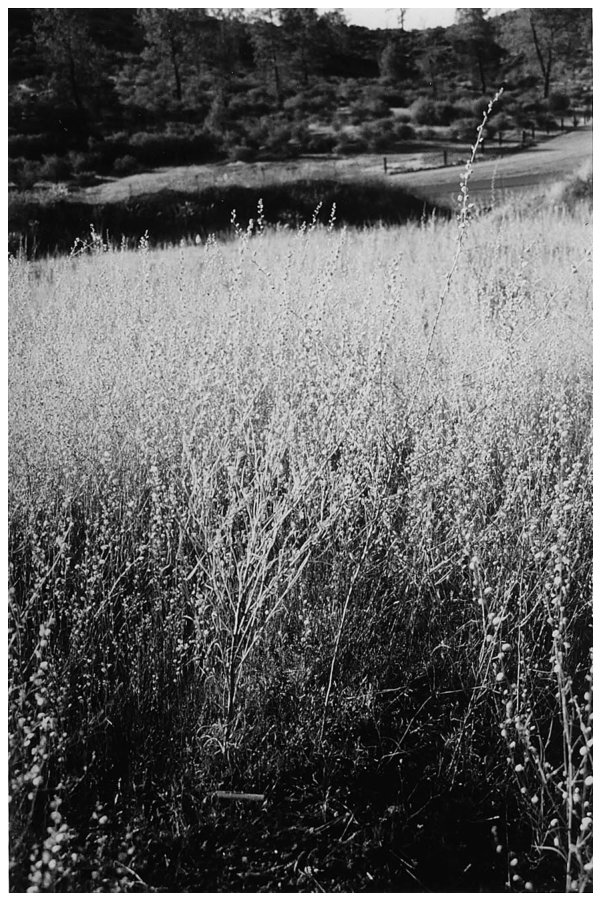
The first field trials on Ni phytomining in 1994 were based at the US Bureau of Mines, Reno, Nevada (Nicks and Chambers, 1995, 1998) and used a naturally occurring stand of Streptanthus polygaloides (Fig. 1), a known Ni-hyperaccumulator (Reeves et al., 1981). The soil contained about 0.35% Ni, well below the economic range for conventional mining. Nicks and Chambers (1995, 1998) proposed that a net return to the grower of $ US 513=ha could be achieved, assuming that: (1) a minimum of selective breeding produced plants with 1% Ni in dry mass; (2) the world price of Ni was $ US 7.65=kg; (3) the biomass yield after moderate fertilization was 10 t=ha; (4) a quarter of the energy of combustion of the biomass could be turned into electricity for a yield of $ US 131=ha; (5) the return to the grower would be half of the gross yield of $ US 765 for the metal plus the energy yield of $ US 131. This compares well with the average returns from other crops — for example, it is well in excess of the average return of $ US 333=ha (including $ US 111 for wheat straw) obtained by US wheat farmers in 1995.
首批镍植物采矿田间试验于1994年由美国矿务局(内华达州里诺)开展(Nicks and Chambers, 1995, 1998),利用了一片天然生长的Streptanthus polygaloides群落(图1),该物种为已知的镍超富集植物(Reeves et al., 1981)。土壤镍含量约为0.35%,远低于常规采矿的经济范围。Nicks and Chambers (1995, 1998)提出,种植者可获得513美元/ha的净收益,其假设条件为:(1)通过最低限度的选择育种,使植物干重中镍含量达到1%;(2)镍的国际价格为7.65美元/kg;(3)适度施肥后生物量产量为10 t/ha;(4)生物量燃烧能量的四分之一可转化为电能,收益为131美元/ha;(5)种植者的收益为金属毛收益765美元的一半加上能量收益131美元。这一收益与其他作物的平均收益相比颇具优势——例如,远高于1995年美国小麦种植者获得的平均收益333美元/ha(包括111美元的麦秸收入)。
2.2. Studies with Alyssum bertolonii2.2. Alyssum bertolonii的研究
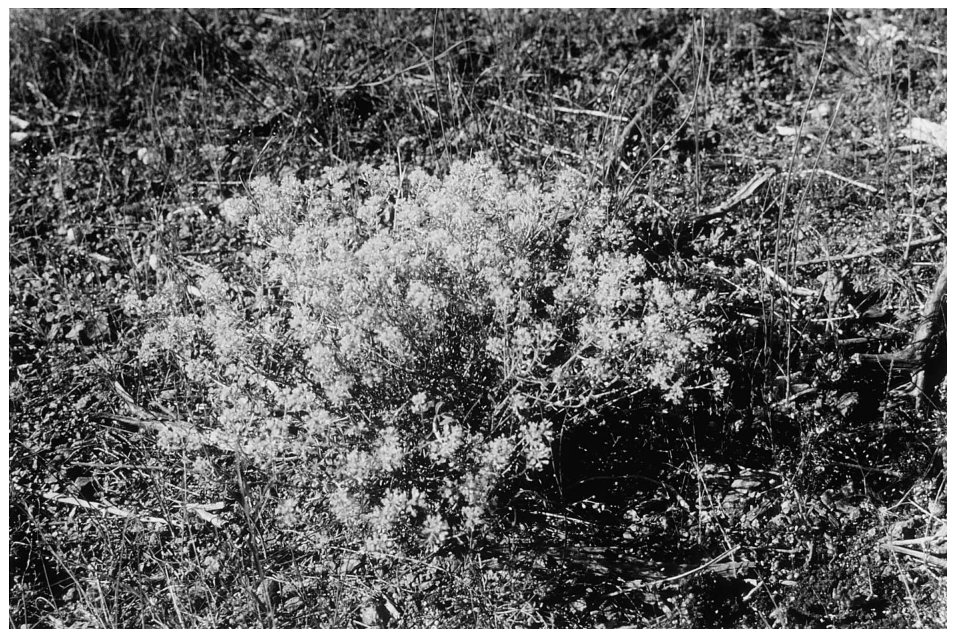
Alyssum bertolonii (Fig. 2), the first plant species identified as a hyperaccumulator of Ni (Minguzzi and Vergnano, 1948) was used in the second phytomining field trials (Robinson et al., 1997a) in Italy at Murlo, Tuscany. Plants were fertilized with N C P C K combinations over a two-year period. A threefold increase of the biomass of dry matter to 9.0 t=ha was gained with N C P C K without dilution of the unfertilized Ni concentration. A Ni level of 0.8% in dry matter (11% in ash), equated to a yield of 72 kg of Ni=ha. There was no correlation between the age of a plant and its Ni content. The long-term cropping sustainability of the soils was simulated by sequential extractions with potassium hydrogen phthalate solutions at pH 2, 4 and 6 (Robinson et al., 1999) that showed a limiting plant-available Ni concentration of 768 mg=kg. Thus, seven croppings would reduce the plant-available Ni pool by 30%. A proposed model for phytomining (Robinson et al., 1997a) involved harvesting the crop after 12 months and burning the material to produce a sulphur-free bio-ore with about 11% Ni.
Alyssum bertolonii(图2)是最早被鉴定为镍超富集植物的物种(Minguzzi and Vergnano, 1948),被用于在意大利托斯卡纳Murlo开展的第二次植物采矿田间试验(Robinson et al., 1997a)。在两年内对植物施用N + P + K组合肥料。施用N + P + K后,干物质生物量增加了三倍,达到9.0 t/ha,且未稀释未施肥时的镍浓度。干物质中镍含量为0.8%(灰分中为11%),相当于72 kg/ha的镍产量。植株年龄与其镍含量之间无相关性。采用pH 2、4和6的邻苯二甲酸氢钾溶液进行连续提取,模拟了土壤长期种植的可持续性(Robinson et al., 1999),结果表明植物有效态镍的极限浓度为768 mg/kg。因此,种植七茬作物将使植物有效态镍库减少30%。所提出的植物采矿模型(Robinson et al., 1997a)包括在12个月后收获作物,并焚烧植物材料以生产镍含量约11%的无硫生物矿石。
Specific hyperaccumulators (natural and induced) that could be used for phytomining
可用于植物采矿的特定超富集植物(天然与诱导)
| Element元素 | Species物种 | Mean metal concn. (mg=kg d.w.)平均金属浓度 (mg/kg 干重) | Biomass (t=ha)生物量 (t/ha) |
|---|---|---|---|
| Cadmium | Thlaspi caerulescens | 3,000 (1) | 4 |
| Cobalt | Haumaniastrum robertii | 10,200 (1) | 4 |
| Copper | Haumaniastrum katangense | 8,356 (1) | 5 |
| Gold a | Brassica juncea | 10 (0.001) | 20 |
| Lead | _Thlaspi rotundifolium_subsp. | 8,200 (5) | 4 |
| Manganese | Macadamia neurophylla | 55,000 (400) | 30 |
| Nickel | Alyssum bertolonii | 13,400 (2) | 9 |
| Berkheya coddii | 17,000 (2) | 22 | |
| Selenium | Astragalus pattersoni | 6,000 (1) | 5 |
| Thallium | Biscutella laevigata | 13,768 (1) | 4 |
| Iberis intermedia | 4,055 (1) | 10 | |
| Uranium | Atriplex confertifolia | 100 (0.5) | 10 |
| Zinc | Thlaspi calaminare | 10,000 (100) | 4 |
d.w. D dry weight. a Induced hyperaccumulation using ammonium thiocyanate. NB: values in parentheses are mean concentrations usually found in non-accumulator plants.
d.w. = 干重。a 使用硫氰酸铵诱导超富集。注:括号内数值为非富集植物中通常的平均浓度。
2.3. Studies with Berkheya coddii2.3. Berkheya coddii的研究
The third recorded phytomining field trials for Ni (Robinson et al., 1997b) used the South African Ni-hyperaccumulator Berkheya coddii. Field trials in New Zealand showed that a dry biomass of 22 t=ha could be achieved after moderate fertilisation (N C P C K). Pot trials showed enhanced biomass and relatively higher uptake of Ni with increasing nitrogen addition, but no increase with phosphorus. The Ni content of the plant was directly related to the ammonium-acetate-extractable fraction of Ni in a wide range of natural and artificial substrates. Excision of shoots induced a dramatic increase in the Ni content in the new growth (5500 mg=kg compared with 1800 mg=kg Ni). When plants were grown in pots with Ni added to the substrate (0–1%), Ni concentrations in the plants rose to a maximum value of about 10,000 mg=kg (1%) dry mass. The data from this last experiment were used to calculate the probable Ni yield (kg=ha) of plants grown in Ni-rich soils in different parts of the world, assuming non-limiting soil moisture. Moderately contaminated soils (100 mg=kg Ni) could be phytoremediated with only two crops of Berkheya coddii. The potential of this species for phytomining was also evaluated and it was proposed that a yield of 100 kg=ha of Ni should be achievable at many sites worldwide with applied fertiliser and adequate moisture.
有记录的第三次镍植物采矿田间试验(Robinson et al., 1997b)采用了南非镍超富集植物Berkheya coddii。在新西兰开展的田间试验表明,适度施肥(N + P + K)后干生物量可达22 t/ha。盆栽试验表明,随施氮量增加,生物量提高,镍吸收也相对增加,但施磷无此效果。在多种天然和人工基质中,植物镍含量与乙酸铵可提取态镍直接相关。剪除地上部可使新生组织中镍含量显著增加(5500 mg/kg,而对照为1800 mg/kg)。当植物在添加镍(0–1%)的基质中盆栽生长时,植物体内镍浓度升至最大值约10,000 mg/kg(1%)干重。利用最后这一试验的数据,在土壤水分不受限制的假设下,计算了世界各地富镍土壤上种植该植物的可能镍产量(kg/ha)。中度污染土壤(100 mg/kg Ni)仅需种植两茬Berkheya coddii即可实现植物修复。本文还评估了该物种的植物采矿潜力,并提出在施肥和水分充足的条件下,全球许多地点应可实现100 kg/ha的镍产量。
3Phytomining for thallium铊的植物采矿
3.1. Introduction3.1. 引言
This subsection reviews phytomining for Tl and presents previously unpublished data on Tl in plants. We have recently discovered unusually high hyperaccumulation of Tl by the brassicaceous Iberis intermedia Guersent (candytuft) and Biscutella laevigata L. growing over lead=zinc mine tailings at Les Malines (Les Avinie`res) near Montpellier, France (Leblanc et al., 1999). Tailings typically contain 1.5% Zn and 0.5% Pb, and locally up to 40 mg=kg (mean 10 mg=kg) Tl. The mine dumps and substrate overburden are colonised by a typical base metal flora dominated by Thlaspi caerulescens (a hyperaccumulator of both Zn and Cd), Biscutella laevigata, Iberis intermedia, and Minuartia verna (a non-accumulator).
本小节综述了铊的植物采矿,并给出此前未发表的植物铊数据。我们最近发现,生长在法国蒙彼利埃附近Les Malines(Les Avinières)铅/锌矿尾矿上的十字花科植物Iberis intermedia Guersent(屈曲花)和Biscutella laevigata L.对铊具有异常高的超富集能力(Leblanc et al., 1999)。尾矿通常含1.5% Zn和0.5% Pb,局部含铊高达40 mg/kg(平均10 mg/kg)。矿渣堆和基质覆盖层上生长着典型的贱金属植物区系,以Thlaspi caerulescens(Zn和Cd的超富集植物)、Biscutella laevigata、Iberis intermedia和Minuartia verna(非富集植物)为主。
Thallium is extremely toxic and is used both in rat poison and for the control of ants. It also has uses in the electronics industry in semiconductors, switches and fuses. Thallium minerals are quite rare (0.7 mg=kg in the Earth’s crust — Green, 1972), and are found almost exclusively in the realgar deposits of Allchar (Alsar) in Macedonia near the Greek border. They occur as complex sulphides of As–Hg–Tl (lorandite, picopaulite, raguinite, vrbaite) associated with realgar and iron sulphides. High concentrations of Tl have been reported in plants growing in the Allchar area (though not to the extent reported in this present paper) and have been found to cause toxic effects on local cattle (Zyka, 1970). The current world price of Tl is about $ US 300,000=t with production of only a few tonnes per annum.
铊毒性极强,被用于灭鼠药和蚂蚁防治。铊在电子工业中也用于半导体、开关和保险丝。铊矿物相当稀少(地壳中含量为0.7 mg/kg——Green, 1972),几乎只见于马其顿靠近希腊边境的Allchar(Alsar)雄黄矿床。它们以As–Hg–Tl复杂硫化物(红铊矿、picopaulite、raguinite、vrbaite)形式存在,与雄黄和铁硫化物伴生。据报道,Allchar地区生长的植物中铊浓度较高(尽管未达到本文报道的程度),并已发现其对当地牛只产生毒害作用(Zyka, 1970)。目前铊的国际价格约为300,000美元/t,年产量仅数吨。
Scientists at Hohenheim University, Stuttgart, Germany are investigating possible phytoremediation of soils polluted by heavy metals such as Cd, Zn and Tl (Kurz et al., 1997). Their work has shown that Tl is accumulated by food crops, particularly brassicaceous plants, and they have recommended that these should not be grown in such contaminated soils. Research in France on the same topic (Tremel, 1996; Tremel et al., 1997; Tremel and Mench, 1997) has found concentrations of up to 20 mg=kg (dry weight) Tl in vegetables (particularly in cabbage) and up to 40 mg=kg in rape (Brassica napus L.).
德国斯图加特霍恩海姆大学的科学家正在研究受Cd、Zn和Tl等重金属污染土壤的植物修复可能性(Kurz et al., 1997)。他们的研究表明,粮食作物(尤其是十字花科植物)会累积铊,并建议不应在此类污染土壤上种植这些作物。法国关于同一主题的研究(Tremel, 1996; Tremel et al., 1997; Tremel and Mench, 1997)发现,蔬菜(尤其是卷心菜)中铊浓度高达20 mg/kg(干重),油菜(Brassica napus L.)中高达40 mg/kg。
Thallium concentrations in plants have excited the most interest from scientists concerned with potential harmful effects on animals and humans. The potential of using hyperaccumulation in some plants in order to phytoremediate Tl-contaminated soils, or even to grow a ‘crop of Tl’ as has already been proposed for Ni (Robinson et al., 1997a,b), has been overlooked so far.
植物中的铊浓度主要引起了关注其对动物和人类潜在危害的科学家的兴趣。而利用某些植物的超富集能力对铊污染土壤进行植物修复,甚至像已针对镍所提出的那样(Robinson et al., 1997a,b)种植“铊作物”的潜力,迄今一直被忽视。
3.2. Thallium accumulation by selected plant species3.2. 部分植物物种对铊的累积
Both Biscutella laevigata and Iberis intermedia from Les Malines in southern France contained very high levels of Tl of up to 1.4% dry weight in Biscutella and 0.4% in Iberis in the dry matter (Table 2). This present paper is the first record of the hyperaccumulator status of Biscutella laevigata in regards to Tl. The very high concentrations of Tl in these plants cannot be derived from wind-borne contamination by soil, since the Tl concentrations in plant material are much higher than in the soil and the effect of soil-derived contamination would actually have been to lower plant Tl concentrations. The data in Table 2 were obtained from analyses performed by both flame and graphite-furnace atomic absorption spectrometry. Quality control was effected by replicate randomised analyses by inductively coupled plasma emission mass spectrometry that was initially responsible for identification of hyperaccumulation of Tl by our studied plants.
采自法国南部Les Malines的Biscutella laevigata和Iberis intermedia均含有极高水平的铊,干物质中铊含量在Biscutella中高达1.4%(干重),在Iberis中高达0.4%(表2)。本文首次记录了Biscutella laevigata的铊超富集植物地位。这些植物中极高的铊浓度不可能源自风携土壤污染,因为植物材料中的铊浓度远高于土壤,土壤来源的污染实际上只会降低植物铊浓度。表2中的数据来自火焰原子吸收光谱法和石墨炉原子吸收光谱法的分析。质量控制通过电感耦合等离子体质谱法的重复随机分析实现,最初正是该方法鉴定出所研究植物对铊的超富集。
Thallium concentrations (mg=kg, dry weight) in plants and soils from France and Italy
法国和意大利植物与土壤中的铊浓度(mg/kg,干重)
| Species物种 | N | Location地点 | A | B | C | B=C |
|---|---|---|---|---|---|---|
| Biscutella laevigata | 3 | Avinie`res, France (L) | 244–308 | 291 | 28 | 10.4 |
| 1 | Aveyron, France (L) | 43 | 43 | – | – | |
| 4 | Avinie`res, France (S) | 125–255 | 187 | 28 | 6.7 | |
| 1 | Avinie`res, France (F) | 428 | 428 | 28 | 15.3 | |
| 34 | Avinie`res, France (W) a | 20–15,199 | 480 | 28 | 17.1 | |
| 15 | Tuscany, Italy (W) | <1–2 | <1 | <1 | – | |
| Iberis intermedia | 19 | Avinie`res (L) | 47–3070 | 1190 | 16 | 74 |
| 3 | Avinie`res (S) | 39–64 | 54 | 16 | 3.4 | |
| 3 | Avinie`res (F) | 313–522 | 422 | 16 | 27 | |
| 1 | Avinie`res (R) | 5.5 | 5.5 | 18 | 0.3 | |
| 26 | Avinie`res (W) b | 21–4055 | 372 | 16 | 23.2 |
N D number of specimens. A D absolute range of Tl in plants; B D geometric mean of Tl in plants; C D geometric mean of Tl in soils; B=C D plant soil Tl concentration quotient; F D flowers; L D leaves; R D roots; S D stems; W D whole plant. a Standard deviation range was 124–1116 mg=kg. b Standard deviation range was 48–4723 mg=kg.
N = 样本数。A = 植物中铊的绝对范围;B = 植物中铊的几何平均值;C = 土壤中铊的几何平均值;B/C = 植物/土壤铊浓度比;F = 花;L = 叶;R = 根;S = 茎;W = 全株。a 标准差范围为124–1116 mg/kg。b 标准差范围为48–4723 mg/kg。
3.3. Phytomining for thallium3.3. 铊的植物采矿
With a biomass of 10 t=ha as determined from field observations in France and field trials in New Zealand, the Iberis should produce about 700 kg=ha of bio-ore containing 8 kg of Tl, worth $ US 2400 at the current world price of $ US 300,000=t. There is clearly potential for phytomining for Tl if sufficiently large areas of contaminated soils are available in order to obtain the advantage of large-scale production. To be economic, phytomining should be able to produce $ US 500 per hectare irrespective of additional revenue from incineration of the biomass to generate electricity. For such a scenario, a crop with a biomass of 10 t=ha would have to contain at least 170 mg=kg Tl in dry matter, a level attainable with Iberis intermedia since 68% of our recorded values were above this threshold. Biscutella laevigata, at 4 t=ha has less than half of the biomass of Iberis but three times the mean Tl concentration. Biscutella would have to contain on average about 425 mg=kg Tl to achieve $ US 500=ha. About 39% of the plants analysed by us (Table 2) exceeded this concentration threshold.
根据法国野外观测和新西兰田间试验确定的生物量为10 t/ha,Iberis应可生产约700 kg/ha的生物矿石,其中含铊8 kg,按当前国际价格300,000美元/t计算价值2400美元。如果有足够大面积的污染土壤以获得规模化生产优势,铊的植物采矿显然具有潜力。要具有经济性,植物采矿应能在不计焚烧生物量发电额外收入的情况下每公顷产出500美元。在此情形下,生物量为10 t/ha的作物干物质中铊含量须至少达到170 mg/kg,Iberis intermedia可达到这一水平,因为我们记录的数值中有68%高于该阈值。Biscutella laevigata,的生物量为4 t/ha,不及Iberis的一半,但其平均铊浓度为后者的三倍。Biscutella平均须含约425 mg/kg铊方能实现500美元/ha。我们分析的植物中约39%(表2)超过了这一浓度阈值。
The potential yield of saleable power by incineration of the biomass could add $ US 131=ha to the Iberis crop and $ US 53=ha to that of Biscutella using the assumptions of Nicks and Chambers (1998). However, sale of the energy would require a large-scale operation or alternative sources of biomass=rubbish to keep the generating plant operating for the whole year.
按照Nicks and Chambers (1998)的假设,焚烧生物量所得可售电力的潜在收益可为Iberis作物增加131美元/ha,为Biscutella作物增加53美元/ha。然而,出售能量需要大规模作业,或需要其他生物量/垃圾来源以维持发电厂全年运行。
4Phytomining for gold金的植物采矿
The discussion so far has centred around the use of natural hyperaccumulators for phytomining. An alternative strategy uses induced hyperaccumulation whereby plants are induced to take up metals by solubilising them in the soil solution and allowing them to be taken up passively. This approach has been developed commercially (Blaylock et al., 1997) for phytoremediating soils contaminated with heavy metals such as lead. EDTA is applied to the soil to solubilise Pb. Numerous plant species can attain concentration levels as high as 1% in the dry tissue using this technique. An analogous approach used by Anderson et al. (1998) described induced hyperaccumulation of Au for phytomining.
以上讨论集中于利用天然超富集植物进行植物采矿。另一种策略是利用诱导超富集,即通过使金属溶解于土壤溶液中,诱导植物被动吸收金属。该方法已被商业化开发(Blaylock et al., 1997),用于铅等重金属污染土壤的植物修复。向土壤施用EDTA以溶解Pb。采用该技术,许多植物物种的干组织中金属浓度可高达1%。Anderson et al. (1998)采用类似方法,描述了用于植物采矿的金诱导超富集。
The form of Au present in an area of mineralisation dictates the concentration of the metal introduced into soil solution after addition of thiocyanate as a chelating agent. Anderson et al. (1998) compared several auriferous substrates and their degree of extractable metal. The material with the greatest relative degree of extractable Au was acidic sulphide mine tailings. This material had the lowest total metal but contained heavily weathered residual Au. Reduced sulphide ore had the highest total Au content but very little extractable metal. Inducing Au-hyperaccumulation from this particular substrate has not been successful although the Au in this material could by solubilised by addition of thiosulphate.
矿化区中金的存在形态决定了添加硫氰酸盐作为螯合剂后进入土壤溶液的金属浓度。Anderson et al. (1998)比较了几种含金基质及其金属可提取程度。可提取金相对比例最高的材料是酸性硫化物矿尾矿。该材料总金属含量最低,但含有强烈风化的残余金。还原性硫化物矿石总金含量最高,但可提取金属极少。尽管添加硫代硫酸盐可使该材料中的金溶解,但从这一基质中诱导金超富集尚未成功。
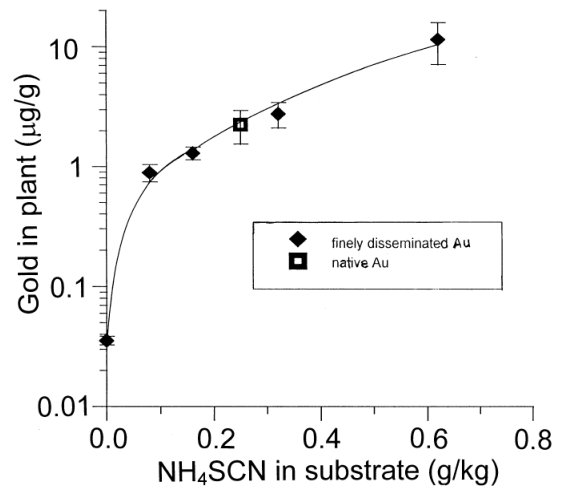
An artificial, finely disseminated Au ore (5 mg=kg) was also prepared to reduce background variability in glasshouse experiments. Brassica juncea was chosen for a series of pot trials because of its high biomass and rapid growth rate. After approximately 3 weeks growth in pots of different auriferous substrates, the growth media were treated with 0 to 0.62 g=kg ammonium thiocyanate. The above-ground parts of each plant were harvested a week later, dried and ashed at 550ºC. The ash was digested in aqua regia before analysis by graphite furnace atomic absorption spectroscopy. Hyperaccumulation of Au was achieved above a thiocyanate treatment level of 0.16 g=kg (Fig. 3) with a maximum individual value of 57 mg=kg Au. The values overall were very variable, probably because of the dichotomy of variable rate of plant death and the consequent variation of allowable time for Au uptake. A similar experiment grew Brassica juncea in a medium containing 5 mg=kg Au prepared from finely powdered native Au (44 µm) and treated with ammonium thiocyanate at an application rate of 0.25 g=kg (Fig. 3). The average Au in leaves compared well with that of the finely disseminated Au experiment.
为降低温室试验中的背景变异,还制备了一种人工细粒浸染状金矿石(5 mg/kg)。由于Brassica juncea生物量高、生长速度快,被选用于一系列盆栽试验。在不同含金基质的盆中生长约3周后,用0至0.62 g/kg的硫氰酸铵处理生长介质。一周后收获每株植物的地上部分,干燥后于550 °C灰化。灰分经王水消解后,采用石墨炉原子吸收光谱法分析。硫氰酸盐处理水平高于0.16 g/kg时实现了金的超富集(图3),单株最大值为57 mg/kg Au。总体而言数值变异很大,这可能是由于植物死亡速率不一,进而导致可供金吸收的时间不同所致。另一项类似试验中,Brassica juncea生长在由细粉状自然金(44 µm)配制的含5 mg/kg金的介质中,并以0.25 g/kg的施用量施加硫氰酸铵(图3)。叶片中的平均金含量与细粒浸染状金试验结果相当。
Phytomining could be used to extract Au from tailings areas that contain concentrations of Au at a level uneconomic for conventional extraction techniques. In the initial stages of a revegetation programme, phytomining could also be used to extract
植物采矿可用于从金浓度水平对常规提取技术而言不经济的尾矿区中提取金。在植被恢复计划的初期阶段,植物采矿还可用于提取
Au from low-grade ore that many mining companies stockpile against expected increases in the gold price.
许多矿业公司为预期金价上涨而堆存的低品位矿石中的金。
There are environmental concerns related to adding complexing agents or other chemicals to soils or tailings. The biodegradation pathways of ammonium thiocyanate to ammonia, bicarbonate and sulphate have been well studied (Hung and Pavlostathis, 1997). Despite a toxicity that is low relative to cyanide, use of thiocyanate would have to be strictly controlled to prevent leaching into ground and surface waters of this chemical and associated metals not taken up by plants. Leaching of the Au solution from the root zone is certainly not desirable in a phytomining operation. It might also be possible to use transgenic plants expressing a bacterial thiocyanate degrading system in order to extract Au from auriferous substrates (C. French — pers. commun., 1997). Such an approach would solve the problem of thiocyanate toxicity to plants and perhaps allow them to extract more Au, but not non-target metals.
向土壤或尾矿中添加络合剂或其他化学品存在环境隐患。硫氰酸铵生物降解为氨、碳酸氢盐和硫酸盐的途径已得到充分研究(Hung and Pavlostathis, 1997)。尽管其毒性相对氰化物较低,但仍须严格控制硫氰酸盐的使用,以防止该化学品及未被植物吸收的相关金属淋溶进入地下水和地表水。在植物采矿作业中,含金溶液从根区淋溶显然是不可取的。也有可能利用表达细菌硫氰酸盐降解系统的转基因植物从含金基质中提取金(C. French——个人通讯,1997)。这种方法可解决硫氰酸盐对植物的毒性问题,或许还能使植物提取更多的金,而不提取非目标金属。
5Model of a phytomining operation and its economics植物采矿作业模型及其经济性
A model of a proposed economic scheme for phytomining is shown in Fig. 4. This system applies to either natural or induced hyperaccumulation. In the latter case, the cost of the reagent has to be taken into account. The economics of the operation are dependent on a number of factors such as the metal content of the plant, its biomass production per annum, and whether or not the energy of combustion of the biomass can be recovered and sold.
图4给出了所提出的植物采矿经济方案模型。该系统适用于天然超富集或诱导超富集。对于后者,须将试剂成本计算在内。该作业的经济性取决于多种因素,如植物的金属含量、每年的生物量产量,以及生物量燃烧能量能否回收并出售。
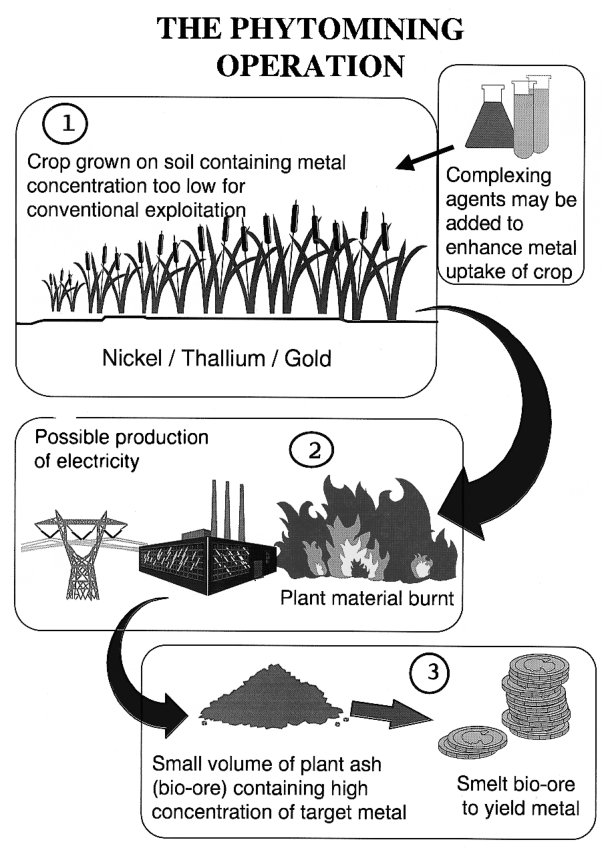
Table 3 shows metal concentrations (mg=kg dry mass) required to provide a $ US 500=ha return for phytomining crops of different biomass, excluding the sale of energy from combustion of the plant material. When the pioneering field trials on phytomining were carried out in 1994 by Nicks and Chambers, the world price of Ni was $ US 7650=t (Nicks and Chambers, 1998). The halving of this price since that year can be expressed in terms of the economics of phytomining. In 1994 Berkheya coddii with a biomass of 20 t=ha needed only 3340 mg=kg Ni in dry mass (easily attainable) to recoup $ US 500=ha, neglecting the sale of energy of combustion. Today, phytomining is marginal for Ni despite a recent price upturn and it would require 6160 mg=kg for the same yield. The energy sale would be needed to make the project viable. It is clear that phytomining, like any other type of mining, will be dependent on world commodity prices.
表3列出了不同生物量的植物采矿作物在不计植物材料燃烧能量销售的情况下,获得500美元/ha收益所需的金属浓度(mg/kg干重)。1994年Nicks和Chambers开展开创性植物采矿田间试验时,镍的国际价格为7650美元/t(Nicks and Chambers, 1998)。此后镍价减半,这一变化可从植物采矿的经济性上体现出来。1994年,在不计燃烧能量销售的情况下,生物量为20 t/ha的Berkheya coddii干重中镍含量仅需3340 mg/kg(很容易达到)即可收回500美元/ha。如今,尽管镍价近期有所回升,镍的植物采矿仍处于盈亏边缘,要获得同样收益需要6160 mg/kg。要使项目可行,需要出售能量。显然,植物采矿与任何其他类型的采矿一样,将取决于国际大宗商品价格。
It may well be argued that the economics of phytomining should not be compared with an agricultural scenario because the former is concerned with a finite resource that can be depleted whereas the latter is not. However, Robinson et al. (1999) have shown that up to ten successive crops of Ni could be removed from nickeliferous soils before there was any noticeable reduction in the metal content of the substrate. Phytomining for Ni from the extensive lateritic soils of Cuba and New Caldeonia, for example, could exploit a virtually limitless resource.
有人可能会认为,植物采矿的经济性不应与农业情景相比较,因为前者涉及可被耗竭的有限资源,而后者则不然。然而,Robinson et al. (1999)已表明,在基质金属含量出现明显下降之前,可从含镍土壤中连续收获多达十茬镍作物。例如,从古巴和新喀里多尼亚广阔的红土中进行镍的植物采矿,可利用几乎无限的资源。
Metal concentration (mg=kg dry mass) in vegetation of different biomass needed to provide a crop with a value of $ US 500=ha excluding sale of energy of biomass combustion
在不计生物量燃烧能量销售的情况下,不同生物量的植被产出价值500美元/ha的作物所需的金属浓度(mg/kg干重)
| Metal金属 | $ US=t | Biomasss yiel生物量产量 | d (t=ha) | |||
|---|---|---|---|---|---|---|
| 1 | 10 | 15 | 20 | 30 | ||
| Platinum a | 12,500,000 | 40 | 4.0 | 2.7 | 2.0 | 1.3 |
| Gold a | 10,714,000 | 47 | 4.7 | 3.2 | 2.3 | 1.5 |
| Palladium a | 3,787,000 | 130 | 13 | 8.8 | 6.6 | 4.3 |
| Thallium | 300,000 | 1,670 | 167 | 111 | 83 | 56 |
| Silver a | 152,113 | 3,280 | 328 | 218 | 164 | 109 |
| Cobalt | 48,000 | 10,400 | 1,040 | 694 | 521 | 347 |
| Uranium | 22,000 | 22,700 | 2,270 | 1,520 | 1,140 | 758 |
| Tin a | 5,580 | 88,700 | 8,870 | 5,910 | 4,400 | 3,000 |
| Nickel | 4,000 | 123,000 | 12,300 | 8,220 | 6,160 | 4,190 |
| Cadmium | 3,750 | 133,000 | 13,300 | 8,890 | 6,690 | 4,440 |
| Copper | 1,964 | 255,000 | 25,500 | 17,000 | 12,700 | 8,500 |
| Manganese | 1,700 | 294,000 | 29,400 | 19,600 | 14,700 | 9,800 |
| Zinc | 1,192 | 417,000 | 41,700 | 27,800 | 20,900 | 13,900 |
| Lead a | 577 | 869,000 | 86,900 | 57,900 | 43,500 | 30,000 |
a Induced hyperaccumulation probably required.
a 可能需要诱导超富集。
Sale of energy in a phytomining operation is often a sine qua non for the project to be economic. It must be appreciated that this energy dividend also has to be set against agronomic costs such as site preparation, fertiliser application (if needed) and seed.
在植物采矿作业中,出售能量往往是项目具有经济性的必要条件。须认识到,这部分能量收益还须抵消场地准备、施肥(如需要)和种子等农艺成本。
Phytomining technology has the following unique features:
植物采矿技术具有以下独特特点:
(1) It offers the possibility of exploiting ores or mineralised soils that are uneconomic by conventional mining methods.
(1)它为开发以常规采矿方法不经济的矿石或矿化土壤提供了可能。
(2) ‘Bio-ores’ are virtually sulphur-free, and their smelting requires less energy than sulphidic ores.
(2)“生物矿石”几乎不含硫,其冶炼所需能量低于硫化物矿石。
(3) The metal content of a bio-ore is usually much greater than that of a conventional ore and therefore requires less storage space despite the lower density of a bio-ore.
(3)生物矿石的金属含量通常远高于常规矿石,因此尽管生物矿石密度较低,所需储存空间仍较少。
(4) Phytomining is a ‘green’ technology that should appeal to the conservation movement as an alternative to opencast mining of low-grade ores.
(4)植物采矿是一项“绿色”技术,作为低品位矿石露天开采的替代方案,应会受到环保运动的欢迎。
Phytomining has, however, not yet been tested on a commercial scale and much research remains to be carried out, particular in the field of increasing metal uptake by plants either by genetic manipulation or addition of specific reagents to the soil, and the potential leaching of metals during induced hyperaccumulation. It is only then that we shall know the true value of this proposed technology.
然而,植物采矿尚未在商业规模上得到检验,仍有大量研究有待开展,特别是在通过基因操作或向土壤添加特定试剂来提高植物金属吸收,以及诱导超富集过程中金属的潜在淋溶等领域。只有到那时,我们才能了解这项拟议技术的真正价值。
References参考文献
Anderson, C.W.N., Brooks, R.R., Stewart, R.B., Simcock, R., 1998. Harvesting a crop of gold in plants. Nature 395, 553– 554.
Baker, A.J.M., Brooks, R.R., 1989. Terrestrial higher plants which hyperaccumulate chemical elements — a review of their distribution, ecology and phytochemistry. Biorecovery 1, 81–126.
Blaylock, M.J., Salt, D.E., Dushenkov, S., Zakharova, O., Guss-
man, C., Kapulnik, Y., Ensley, B.D., Raskin, I., 1997. Enhanced accumulation of Pb in Indian mustard by soil-applied chelating agents. Environ. Sci. Technol. 31, 860–865.
Brooks, R.R., Lee, J., Reeves, R.D., Jaffre´, T., 1977. Detection of nickeliferous rocks by analysis of herbarium specimens of indicator plants. J. Geochem. Explor. 7, 49–57.
Chaney, R.L., 1983. Plant uptake of inorganic waste constituents. In: Parr, J.F. et al. (Eds.), Land Treatment of Hazardous Wastes. Noyes Data Corp., New York.
Chaney, R.L., Angle, J.S., Baker, A.J.M., Li, J.M., 1998. Method for phytomining of Ni, cobalt and other metals from soil. U.S. Patent # 5,711,784.
Green, J., 1972. Elements: planetary abundance and distribution. In: Fairbridge, R. (Ed.), Encyclopedia of Geochemistry and Environmental Sciences. Van Nostrand Reinhold, New York, pp. 268–300.
Hung, C.H., Pavlostathis, S.G., 1997. Aerobic degradation of thiocyanate. Water Res. 31, 2761–2770.
Kurz, H., Schulz, R., Ro¨mheld, V., 1997. Studies on thallium uptake by various crop plants for risk assessment of the food chain. World Wide Web at: http:==www.uni-hohenheim.de= institutes=plant_nutrition=hinstres.htm
Leblanc, M., Robinson, B.H., Petit, D., Deram, A., Brooks, R.R., 1999. The phytomining and environmental significance of hyperaccumulation of thallium by Iberis intermedia from southern France. Econ. Geol. 94, 109–114.
Minguzzi, C., Vergnano, O., 1948. Il contenuto di nichel nelle ceneri di Alyssum bertolonii. Atti Soc. Tosc. Sci. Nat. 55, 49–74.
Nicks, L.J., Chambers, M.F., 1995. Farming for metals. Min. Environ. Mgt. Mining Journal Ltd., London, Sep., pp. 15–18.
Nicks, L.J., Chambers, M.F., 1998. A pioneering study of the potential of phytomining for nickel. In: Brooks, R.R. (Ed.). Plants that Hyperaccumulate Heavy Metals. CAB International, Wallingford, 380 pp.
Reeves, R.D., Brooks, R.R., 1983. European species of Thlaspi L. (Cruciferae) as indicators of nickel and zinc. J. Geochem. Explor. 18, 275–283.
Reeves, R.D., Brooks, R.R., McFarlane, R.M., 1981. Nickel uptake by Californian Streptanthus and Caulanthus with particular reference to the hyperaccumulator S. polygaloides Gray (Brassicaceae). Am. J. Bot. 68, 708–712.
Reeves, R.D., Baker, A.J.M., Brooks, R.R., 1995. Abnormal accumulation of trace metals by plants. Mining Environ. Mgt. Mining Journal Ltd., London, Sep., pp. 4–8.
Robinson, B.H., Chiarucci, A., Brooks, R.R., Petit, D., Kirkman, J.H., Gregg, P.E.H., De Dominicis, V., 1997a. The nickel hyperaccumulator plant Alyssum bertolonii as a potential agent for phytoremediation and phytomining of nickel. J. Geochem. Explor. 59, 75–86.
Robinson, B.H., Brooks, R.R., Howes, A.W., Kirkman, J.H., Gregg, P.E.H., 1997b. The potential of the high-biomass Berkheya coddii for phytoremediation and phytomining. J. Geochem. Explor. 60, 115–126.
Robinson, B.H., Brooks, R.R., Gregg, P.E.H., Kirkman, J.H., 1999. The nickel phytoextraction potential of some ultramafic
C.W.N. Anderson et al. / Journal of Geochemical Exploration 67 (1999) 407–415 soils as determined by sequential extraction. Geoderma 87, 293–304.
Tremel, A., 1996. Transfert du thallium du sol vers la plante. PhD Thesis, Univ. Nancy, Nancy.
Tremel, A., Mench, M., 1997. Le thallium dans les sols et
les ve´ge´taux supe´rieures, II. Le thallium dans les ve´ge´taux supe´rieures. Agronomie 17, 261–269. Tremel, A., Masson, P., Sterckeman, T., Baize, D., Mench, M., 1997. Thallium in French agrosystems, I. Thallium content in arable soils. Environ. Pollut. 95, 293–302.
Zyka, V., 1970. Thallium in plants from Alsar. Sb. Cesk. Geol. Ved, Technol., Geochem. 10, 91–95.