Contents lists available at ScienceDirect journal homepage: www.elsevier.com/locate/apsoil
Alexandra Meister a,*, Kristin Bohm a, Maria Jesus Guti´errez-Gin´es a, Sally Gaw b, Nicholas Dickinson c, Brett Robinson b
a Institute of Environmental Science and Research Ltd., 27 Creyke Road, Ilam, Christchurch 8041, New Zealand b School of Physical and Chemical Sciences, University of Canterbury, 20 Kirkwood Avenue, Ilam, Christchurch 8041, New Zealand c Faculty of Agricultural and Life Sciences, Lincoln University, PO Box 85084, Lincoln 7647, New Zealand
a 新西兰环境科学与研究所有限公司(Institute of Environmental Science and Research Ltd.),27 Creyke Road, Ilam, 基督城 8041, 新西兰 b 坎特伯雷大学物理与化学科学学院,20 Kirkwood Avenue, Ilam, 基督城 8041, 新西兰 c 林肯大学农业与生命科学学院,PO Box 85084, Lincoln 7647, 新西兰
1Introduction引言
Nitrogen (N) pollution is a global environmental issue (Kanter et al., 2020). Galloway et al. (2003) calculated that 88 % of N inputs into agroecosystems are lost into air, soil, or water prior to reaching humans, totalling 149 Tg yr− 1worldwide. Typically, N is lost from soil through nitrate (NO3− ) leaching and gaseous emissions of nitrous oxide (N2O), nitric oxide (NO), and dinitrogen (N2), as well as through volatilised ammonia (NH3) at high soil pH (Cameron et al., 2013). The global warming potential of N2O is 298 times higher than that of CO2, making it a potent greenhouse gas (Philibert et al., 2013). NO3− is highly mobile in soils due to its negative charge and readily leaches when precipitation exceeds evapotranspiration (Robertson and Groffman, 2015). Inputs of NO3− to surface waters can lead to eutrophication (Smith and Schindler, 2009). Groundwater with elevated NO−3 concentrations can pose a public health risk where it is utilised for drinking water, since concentrations >1 mg NO−3 L− 1in drinking water can increase the risk of colorectal cancer (Richards et al., 2022). Furthermore, high NO−3 concentrations in drinking water have been linked with methemoglobinemia in infants, commonly known as blue baby syndrome (Brender, 2020). Transformation processes of N in the soil are largely microbially mediated (wise reduction of NORobertson and Groffman, 2015−3to nitrite (NO2− ), NO, N). Denitrification is the step-2O, and N2 (Cameron et al., 2013). It mainly occurs under anaerobic conditions, when heterotrophic denitrifying bacteria use NO−3 as terminal electron acceptor during respiration (Robertson and Groffman, 2015). The reduction steps are enzymatically controlled by NO−3 reductase, NO−2 reductase, NO reductase and N2O reductase, which are associated with most denitrifying bacteria (Cameron et al., 2013). There are two types of NO−2 reductases, cytochrome cd1 NO−2 reductase (encoded by nirS) and copper-containing NO2− reductase (encoded by nirK). N2O reductase is encoded by nosZ (Kandeler et al., 2006). However, archaea and fungi can also play a role in denitrification, with distinct underlying mechanisms (Hayatsu et al., 2008).
氮(N)污染是一个全球性环境问题(Kanter et al., 2020)。Galloway et al. (2003) 计算得出,进入农业生态系统的N输入中有88 %在到达人类之前即损失到大气、土壤或水体中,全球总量达149 Tg yr− 1。通常,土壤中的N通过硝酸盐(NO3−)淋溶以及氧化亚氮(N2O)、一氧化氮(NO)和氮气(N2)的气态排放而损失,在土壤pH较高时还可通过氨(NH3)挥发而损失(Cameron et al., 2013)。N2O的全球增温潜势是CO2的298倍,是一种强效温室气体(Philibert et al., 2013)。由于带负电荷,NO3−在土壤中移动性很强,当降水量超过蒸散量时极易淋溶(Robertson and Groffman, 2015)。NO3−进入地表水可导致富营养化(Smith and Schindler, 2009)。在以地下水作为饮用水源的地区,NO−3浓度升高的地下水可能构成公共健康风险,因为饮用水中NO−3浓度>1 mg NO−3 L− 1即可增加结直肠癌风险(Richards et al., 2022)。此外,饮用水中高浓度NO−3还与婴儿高铁血红蛋白血症(俗称“蓝婴综合征”)有关(Brender, 2020)。土壤中N的转化过程主要由微生物介导(Robertson and Groffman, 2015)。反硝化作用是将NO−3逐步还原为亚硝酸盐(NO2−)、NO、N2O和N2的过程(Cameron et al., 2013)。该过程主要发生在厌氧条件下,此时异养反硝化细菌在呼吸过程中以NO−3作为末端电子受体(Robertson and Groffman, 2015)。各还原步骤分别由NO−3还原酶、NO−2还原酶、NO还原酶和N2O还原酶进行酶促调控,这些酶存在于大多数反硝化细菌中(Cameron et al., 2013)。NO−2还原酶有两种类型,即细胞色素cd1型NO−2还原酶(由nirS编码)和含铜NO2−还原酶(由nirK编码)。N2O还原酶由nosZ编码(Kandeler et al., 2006)。然而,古菌和真菌也可参与反硝化作用,其潜在机制各不相同(Hayatsu et al., 2008)。
* Corresponding author.
E-mail address: alexandra.meister@esr.cri.nz (A. Meister).
https://doi.org/10.1016/j.apsoil.2023.105031
https://doi.org/10.1016/j.apsoil.2023.105031
Received 1 February 2023; Received in revised form 24 June 2023; Accepted 26 June 2023
Available online 4 July 2023
2023年7月4日在线发表
0929-1393/© 2023 The Authors. Published by Elsevier B.V. This is an open access article under the CC BY-NC-ND license (http://creativecommons.org/licenses/bync-nd/4.0/).
0929-1393/© 2023 作者。由Elsevier B.V.出版。本文为依据CC BY-NC-ND许可协议(http://creativecommons.org/licenses/bync-nd/4.0/)发布的开放获取文章。
In contrast, nitrification is the two-step microbial oxidation of NH3 and ammonium (NH4+) to NO3− , mediated by autotrophic ammonia-oxidising bacteria and archaea (AOB and AOA, respectively) and nitrite-oxidising bacteria (Li et al., 2018). In the first step, NH+4 is oxidised to NO2− by ammonia monooxygenase, which is encoded by amoA, and hydroxylamine oxidoreductase, which is encoded by hao (Francis et al., 2005; Sayavedra-Soto et al., 1994). These enzymes are associated with AOA and AOB, such as Nitrosospira spp. and Nitrosomonas spp. (oxidation of NORobertson and Groffman, 2015−2to NO−3 by nitrite oxidoreductase associated with ). The second step of nitrification is the nitrite-oxidising bacteria (Robertson and Groffman, 2015). There is evidence of complete nitrification by Nitrospira spp. (Daims et al., 2015), as well as heterotrophic nitrification at low soil pH (Zhang et al., 2014). Plants can significantly influence the abundance and community composition of microorganisms in the rhizosphere (Bais et al., 2006; Wardle et al., 2004). Nitrification and denitrification are indirectly controlled by plant species specific effects on NO−3 and NH4+ availability, organic C availability, pH, soil moisture, and oxygen availability (Laffite et al., 2020). These factors can affect the abundance and activity of (de) nitrifying microorganisms (Bowatte et al., 2016). Some plants can release compounds that directly inhibit nitrification, termed biological nitrification inhibitors (BNIs) (Subbarao et al., 2012). They are produced in the plant tissue and enter the soil through litter decomposition or root exudation (Subbarao et al., 2006). The associated nitrification inhibition derives from a direct inhibiting effect of BNIs on ammonia monooxygenase or hydroxylamine oxidoreductase (Coskun et al., 2017). The use of plants with potential to suppress nitrification could reduce N losses from agricultural land and other high-nutrient environments.
与之相对,硝化作用是由自养氨氧化细菌和古菌(分别为AOB和AOA)以及亚硝酸盐氧化细菌介导的、将NH3和铵(NH4+)经两步微生物氧化为NO3−的过程(Li et al., 2018)。第一步中,NH+4在氨单加氧酶(由amoA编码)和羟胺氧化还原酶(由hao编码)的作用下被氧化为NO2−(Francis et al., 2005; Sayavedra-Soto et al., 1994)。这些酶与AOA和AOB相关,例如Nitrosospira spp.和Nitrosomonas spp.(Robertson and Groffman, 2015)。硝化作用的第二步是由亚硝酸盐氧化细菌所含的亚硝酸盐氧化还原酶将NO−2氧化为NO−3(Robertson and Groffman, 2015)。有证据表明Nitrospira spp.可进行全程硝化(Daims et al., 2015),且在低pH土壤中存在异养硝化作用(Zhang et al., 2014)。植物可显著影响根际微生物的丰度和群落组成(Bais et al., 2006; Wardle et al., 2004)。硝化和反硝化作用受植物物种特异性效应的间接调控,这些效应作用于NO−3和NH4+有效性、有机C有效性、pH、土壤水分及氧气有效性(Laffite et al., 2020)。这些因素可影响硝化(反硝化)微生物的丰度和活性(Bowatte et al., 2016)。某些植物可释放直接抑制硝化作用的化合物,称为生物硝化抑制剂(BNIs)(Subbarao et al., 2012)。这些化合物在植物组织中产生,并通过凋落物分解或根系分泌进入土壤(Subbarao et al., 2006)。相关的硝化抑制源于BNIs对氨单加氧酶或羟胺氧化还原酶的直接抑制作用(Coskun et al., 2017)。利用具有抑制硝化潜力的植物,可减少农业用地及其他高养分环境中的N损失。
Some New Zealand (NZ) native species in the Myrtaceae family have the potential to reduce NO−3 leaching and N2O emissions more than other species (Esperschuetz et al., 2017; Franklin et al., 2017; Halford et al., 2021). No underlying mechanisms for these observations have been described. However, Esperschuetz et al. (2017) reported higher concentrations of NH4+ in a nitrification assay with Leptospermum scoparium and Kunzea robusta compared to Pinus radiata, indicating an inhibition of nitrification under these species. Furthermore, K. robusta, L. scoparium, Metrosideros robusta, and Pseudowintera colorata were found to suppress pathogenic bacteria in soil (Gutierrez-Gines et al., 2021; Prosser et al., 2016), and may potentially also affect microorganisms involved in nitrification. A study from Pakistan showed that local medicinal plants with antimicrobial properties can inhibit nitrification in soil more than the synthetic nitrification inhibitor dicyandiamide (Tahir et al., 2021). The antimicrobial properties in the essential oil of K. robusta are associated with α-pinene (Porter and Wilkins, 1999). Previous studies reported that α-pinene directly competes for ammonia monooxygenase’s active site (Ward et al., 1997) and suppresses nitrification in forest soil (Paavolainen et al., 1998).
桃金娘科(Myrtaceae)中的一些新西兰(NZ)本土物种比其他物种更有潜力减少NO−3淋溶和N2O排放(Esperschuetz et al., 2017; Franklin et al., 2017; Halford et al., 2021)。目前尚未阐明这些现象的潜在机制。然而,Esperschuetz et al. (2017) 报道,在硝化培养试验中,Leptospermum scoparium和Kunzea robusta处理的NH4+浓度高于Pinus radiata,表明这些物种下硝化作用受到抑制。此外,研究发现K. robusta、L. scoparium、Metrosideros robusta和Pseudowintera colorata能抑制土壤中的病原细菌(Gutierrez-Gines et al., 2021; Prosser et al., 2016),因此也可能影响参与硝化作用的微生物。一项来自巴基斯坦的研究表明,具有抗菌特性的当地药用植物对土壤硝化作用的抑制效果强于合成硝化抑制剂双氰胺(Tahir et al., 2021)。K. robusta精油的抗菌特性与α-蒎烯有关(Porter and Wilkins, 1999)。已有研究报道,α-蒎烯可直接竞争氨单加氧酶的活性位点(Ward et al., 1997),并抑制森林土壤中的硝化作用(Paavolainen et al., 1998)。
We hypothesized that N speciation and N fluxes in the soil will be affected by plant species, through both direct and indirect effects of plants on the abundance of N-cycling microorganisms. This study aimed to determine whether microorganisms involved in nitrification and denitrification differed in the rhizosphere of NZ native plants, including the myrtaceous species K. robusta and L. scoparium. It sought to quantify the abundance of total bacteria and archaea, as well as the functional genes encoding nitrifying and denitrifying enzymes in the rhizosphere of five NZ native species compared to the exotic pasture species Lolium perenne with and without the application of fertiliser.
我们假设,植物物种会通过直接和间接影响N循环微生物的丰度,进而影响土壤中的N形态和N通量。本研究旨在确定参与硝化和反硝化作用的微生物在新西兰本土植物(包括桃金娘科物种K. robusta和L. scoparium)根际中是否存在差异。研究在施肥与不施肥条件下,定量分析了5种新西兰本土物种与外来牧草物种Lolium perenne根际中总细菌和总古菌的丰度,以及编码硝化酶和反硝化酶的功能基因丰度。
2Materials and methods材料与方法
2.1. Pot experiment2.1. 盆栽试验
2.1.1. Experimental setup2.1.1. 试验设计
A pot experiment was set up in a greenhouse at the University of Canterbury in Christchurch, NZ (S 43◦ 31’ 24", E 172◦ 35’ 15") using a cross factorial design with six plant treatments (L. scoparium, K. robusta, Coprosma robusta, Metrosideros umbellata, Carex secta, and L. perenne) and two fertilisation treatments (non-fertilised control and a NPKSfertiliser treatment, equivalent to 200 kg N ha− 1). L. scoparium, K. robusta, and M. umbellata were selected as they have previously shown antimicrobial activity in soil (Gutierrez-Gines et al., 2021; Prosser et al., 2016). C. robusta was included because of the low NO−3 concentration in the soil under this species compared to others (Meister et al., 2022). C. secta was selected because it is widely used in riparian areas to mitigate N losses from agricultural land throughout NZ (McKergow et al., 2016). The exotic ryegrass L. perenne was used as control because (i) it was demonstrated to show low BNI capacity (Subbarao et al., 2007), and (ii) it is a typical pasture species in NZ (Kirkman et al., 1994). With six replicates per treatment combination the experiment included 72 pots in total.
盆栽试验在新西兰基督城坎特伯雷大学的温室中进行(S 43◦ 31’ 24", E 172◦ 35’ 15"),采用交叉因子设计,包括6个植物处理(L. scoparium、K. robusta、Coprosma robusta、Metrosideros umbellata、Carex secta和L. perenne)和2个施肥处理(不施肥对照和NPKS施肥处理,相当于200 kg N ha− 1)。选择L. scoparium、K. robusta和M. umbellata是因为它们此前已在土壤中表现出抗菌活性(Gutierrez-Gines et al., 2021; Prosser et al., 2016)。纳入C. robusta是因为与其他物种相比,该物种下土壤的NO−3浓度较低(Meister et al., 2022)。选择C. secta是因为它在新西兰各地的河岸带被广泛用于减少农业用地的N损失(McKergow et al., 2016)。以外来黑麦草L. perenne作为对照,原因在于:(i)已证明其BNI能力较低(Subbarao et al., 2007);(ii)它是新西兰典型的牧草物种(Kirkman et al., 1994)。每个处理组合设6个重复,试验共计72盆。
The soil used in this experiment was a Typic Allophanic Brown Soil (Hewitt, 2010), commonly known as the Craigieburn silt loam (Gutierrez-Gines et al., 2019). The soil was collected between Lake Lyndon and Lake Coleridge in the South Island of NZ (S 43◦ 20′ 35″, E 171◦ 36′ 59″). The same soil was used by Gutierrez-Gines et al. (2019), who analysed its physicochemical properties. The site was not previously cultivated or fertilised and vegetation was dominated by Dracophyllum longifolium, L. scoparium, and K. robusta (Gutierrez-Gines et al., 2019). The vegetation was removed from the collection site and a spade was used to collect soil from the Ah horizon (0–15 cm depth). All stones, vegetation and roots >2 mm diameter were removed from the soil and the soil was thoroughly mixed to achieve maximal homogeneity. 1.7 kg of fresh soil (equivalent to 1.06 kg dry weight) was weighed into each pot before native seedlings were transplanted and L. perenne was sown. The native seedlings were two years old at the beginning of the experiment and 12–25 cm tall. Seedlings were native to the Canterbury region of NZ. The sowing density of L. perenne was equivalent to the recommended sowing rate of 25 kg ha− 1(Specialty Seeds, 2019). However, 60 days after seeding the sowing density of L. perenne was increased to an equivalent of 75 kg ha− 1to ensure sufficient growth. The diploid variety Mega Rich was used (Specialty Seeds, 2019). Within the greenhouse, pots were arranged in a completely randomised design and were newly randomised every two weeks. Pots were watered to field capacity every 2–3 days with tap water.
本试验所用土壤为典型水铝英石棕壤(Typic Allophanic Brown Soil)(Hewitt, 2010),通常称为Craigieburn粉砂壤土(Gutierrez-Gines et al., 2019)。土壤采自新西兰南岛Lake Lyndon与Lake Coleridge之间(S 43◦ 20′ 35″, E 171◦ 36′ 59″)。Gutierrez-Gines et al. (2019) 曾使用同一土壤并分析了其理化性质。该地点此前未经耕作或施肥,植被以Dracophyllum longifolium、L. scoparium和K. robusta为主(Gutierrez-Gines et al., 2019)。清除采样点植被后,用铁锹采集Ah层(0–15 cm深度)土壤。去除土壤中所有石块、植被及直径>2 mm的根系,并将土壤充分混匀以达到最大均一性。每盆称取1.7 kg鲜土(相当于1.06 kg干重),随后移栽本土植物幼苗并播种L. perenne。试验开始时本土幼苗为两年生,高12–25 cm,均原产于新西兰坎特伯雷地区。L. perenne的播种密度相当于推荐播种量25 kg ha− 1(Specialty Seeds, 2019)。然而,播种60天后将L. perenne的播种密度提高至相当于75 kg ha− 1,以确保充分生长。所用品种为二倍体品种Mega Rich(Specialty Seeds, 2019)。在温室内,各盆按完全随机设计排列,每两周重新随机排列一次。每2–3天用自来水将各盆浇水至田间持水量。
2.1.2. Fertilisation2.1.2. 施肥
After 26 weeks, half of the pots received NPKS fertilisation (Table S- 1). Nitrogen was applied in the form of urea, equivalent to 200 kg N ha− 1 (Table S-1). Furthermore, P (30 kg ha− 1equiv.), K (224 kg ha− 1equiv.), and S (61 kg ha− 1equiv.) were added because these plant nutrients are present in biowastes (Gutierrez-Gines et al., 2019) and can affect microbial activity (Lejoly et al., 2020). All compounds were dissolved in water and a total of 40 mL of solution was applied to each pot in 10 mL increments.
26周后,一半的盆施用NPKS肥料(表S- 1)。氮以尿素形式施用,相当于200 kg N ha− 1(表S-1)。此外,还添加了P(相当于30 kg ha− 1)、K(相当于224 kg ha− 1)和S(相当于61 kg ha− 1),因为这些植物养分存在于生物废弃物中(Gutierrez-Gines et al., 2019),并可影响微生物活性(Lejoly et al., 2020)。所有化合物均溶于水,每盆共施用40 mL溶液,分4次施用,每次10 mL。
2.1.3. Harvest and sample preparation2.1.3. 收获与样品制备
Pots were harvested 8 weeks after fertilisation. At that point, the roots of all but one species had occupied the pots sufficiently to classify the entire soil as rhizosphere-like soil. C. robusta was growing more slowly than the other species and its root system did not fully occupy the pot at the time of harvest. Plants were cut 5 mm above the soil surface.
施肥8周后收获各盆。此时,除一个物种外,其余所有物种的根系均已充分占据盆体,可将整盆土壤视为类根际土壤。C. robusta生长较其他物种缓慢,收获时其根系未完全占据盆体。在土壤表面以上5 mm处剪取植株。
Roots were removed from the soil and the soil was mixed to achieve homogeneity. Soils were split into three parts: (1) frozen at − 20 ◦C and used for moisture determination and mineral N analysis within one week, (2) dried at 40 ◦C for 4 days and sieved to <2 mm for further chemical analysis, and (3) frozen at − 80 ◦C for nucleic acid extraction.
将根系从土壤中移除,并混匀土壤使其均一。土壤分为三份:(1)于− 20 ◦C冷冻,一周内用于含水量测定和矿质N分析;(2)于40 ◦C烘干4天并过<2 mm筛,用于进一步化学分析;(3)于− 80 ◦C冷冻,用于核酸提取。
2.2. Chemical analysis of soils and plants2.2. 土壤与植物化学分析
A subsample of 10–20 g thawed soil was dried at 105 ◦C for 24 h to determine the moisture content. For analysis of NO−3 and NH4+, 4 g of thawed soil was extracted with 20 mL of 2 M KCl (Clough et al., 2001). Colorimetric methods were used to determine concentrations of NO−3 -N (Miranda et al., 2001) and NH4+-N (Mulvaney, 1996) in the extracts with a Cary 100 Bio UV–visible spectrophotometer (Agilent Technologies, Santa Clara, CA, USA). Soil pH was determined in deionised water in a 1:2.5 soil:water extract (Blakemore et al., 1987) using a HQ 440d Multi- Parameter Meter with pH probe PHC735 (HACH, Loveland, CO, USA). Total C and N concentrations in the soils and plants were determined by dry combustion using a LECO CN828 CN analyser (LECO, St. Joseph, MI, USA).
取10–20 g解冻土壤子样,于105 ◦C烘干24 h以测定含水量。分析NO−3和NH4+时,用20 mL 2 M KCl浸提4 g解冻土壤(Clough et al., 2001)。采用比色法,使用Cary 100 Bio紫外-可见分光光度计(Agilent Technologies, Santa Clara, CA, USA)测定浸提液中NO−3 -N(Miranda et al., 2001)和NH4+-N(Mulvaney, 1996)的浓度。土壤pH在去离子水中以1:2.5土水比浸提液测定(Blakemore et al., 1987),使用配备PHC735 pH探头的HQ 440d多参数测量仪(HACH, Loveland, CO, USA)。土壤和植物中的全C和全N浓度采用干烧法,使用LECO CN828 CN分析仪(LECO, St. Joseph, MI, USA)测定。
2.3. DNA extraction2.3. DNA提取
The extraction of DNA from soil was modified from Lever et al. (2015) and Lim et al. (2016). In brief, 0.6–0.8 g of fresh soil was added to a lysing matrix E tube. 100 μL 100 mM dNTPs (1:1:1:1 mixture of dATP, dGTP, dCTP, and dTTP), 500 μL 5 % cetyltrimethyl ammonium bromide (CTAB) extraction buffer (consistent of 10 g CTAB and 4.09 g NaCl mixed 1:1 with 240 mM NaPO4 buffer of pH 8), and 50 μL of 4 % sodium dodecyl sulphate (SDS) were added. Samples were frozen at − 80 ◦C for 15 min prior to heating at 50 ◦C and 1000 rpm for 15 min on a thermomixer (ThermoMixer® C, Eppendorf, Hamburg, Germany). 400 μL phenol-chloroform-isoamyl alcohol (25:24:1) was added. Samples were lysed in two rounds of 30 s at 5.5 m s− 1using a FastPrep-24 tissue homogenizer (MP Biomedicals, Irvine, CA, USA). Samples were centrifuged (14,000 ×g) at 4 ◦C for 7 min. The aqueous phase was transferred into a new 2 mL tube and 1 volume of chloroform-isoamyl alcohol (24:1) was added, followed by centrifugation (14,000 ×g) at 4 ◦C for 3 min. The aqueous phase was transferred into a new 2 mL tube and 1 volume isopropanol, 0.1 volume 3 M sodium acetate, and 1 μL 20 mg/ mL glycogen were added. Samples were centrifuged (14,000 ×g) at 12 ◦C for 20 min to precipitate the nucleic acids. The supernatant was removed. 500 μL ice cold 70 % (vol/vol) ethanol was used to wash the pelleted nucleic acids. This step was repeated twice. The washed pelleted nucleic acid was air-dried (speed-vac at 40 ◦C for 2–5 min) and resuspended in 100 μL DNase/RNase-free water. The QIAGEN DNeasy® PowerClean® Pro Cleanup Kit was subsequently used for secondary purification of extracted DNA following the manufacturer’s instructions. Extracted DNA was quantified with a NanoDrop spectrophotometer (Thermo- Fisher Scientific, Waltham, MA, USA).
土壤DNA提取方法参照Lever et al. (2015) 和Lim et al. (2016) 并加以改进。简言之,将0.6–0.8 g新鲜土壤加入lysing matrix E管中,加入100 μL 100 mM dNTPs(dATP、dGTP、dCTP和dTTP按1:1:1:1混合)、500 μL 5 %十六烷基三甲基溴化铵(CTAB)提取缓冲液(由10 g CTAB和4.09 g NaCl组成,与240 mM pH 8的NaPO4缓冲液按1:1混合)以及50 μL 4 %十二烷基硫酸钠(SDS)。样品先于− 80 ◦C冷冻15 min,然后在恒温混匀仪(ThermoMixer® C, Eppendorf, Hamburg, Germany)上于50 ◦C、1000 rpm加热15 min。加入400 μL苯酚-氯仿-异戊醇(25:24:1)。使用FastPrep-24组织均质器(MP Biomedicals, Irvine, CA, USA)以5.5 m s− 1裂解样品两轮,每轮30 s。样品于4 ◦C离心(14,000 ×g)7 min。将水相转移至新的2 mL管中,加入1倍体积氯仿-异戊醇(24:1),随后于4 ◦C离心(14,000 ×g)3 min。将水相转移至新的2 mL管中,加入1倍体积异丙醇、0.1倍体积3 M乙酸钠和1 μL 20 mg/ mL糖原。样品于12 ◦C离心(14,000 ×g)20 min以沉淀核酸。弃去上清液。用500 μL冰冷的70 %(vol/vol)乙醇洗涤核酸沉淀,此步骤重复两次。洗涤后的核酸沉淀风干(speed-vac,40 ◦C,2–5 min),并重悬于100 μL无DNase/RNase水中。随后按照制造商说明,使用QIAGEN DNeasy® PowerClean® Pro Cleanup Kit对提取的DNA进行二次纯化。提取的DNA用NanoDrop分光光度计(Thermo- Fisher Scientific, Waltham, MA, USA)定量。
2.4. Quantitative real-time PCR2.4. 实时荧光定量PCR
The abundance of bacterial and archaeal 16S ribosomal RNA (16S rRNA) and the functional genes amoA (encoding the subunit A of ammonia monooxygenase, both bacterial and archaeal), nirS (encoding cytochrome cd1 NO2− reductase), nirK (encoding copper-containing NO−2 reductase) and nosZ (encoding N2O reductase) was determined in triplicates by quantitative real-time PCR (qPCR) in a 96-well plate using a CFX Connect Real-Time PCR System (Bio-Rad, Hercules, CA, USA). The quantification of bacterial 16S rRNA and the functional genes was adapted from Lourenço et al. (2018). The quantification of archaeal 16S rRNA was adapted from Siles and Margesin (2016). The total reaction volume was 15 μL for each assay, containing 7.5 μL of SYBR® Green Supermix (Bio-Rad, Hercules, CA, USA) and 5 μL of DNA. Details on primers, standards, reaction details, and thermal cycler conditions are included in the supplementary material (Tables S-2, S-3, S-4). Dilution series of extracted DNA were performed to test inhibition by humic acids. Final DNA concentrations used for reactions were 0.5 ng μL− 1for bacterial and archaeal 16S, 1–2 ng μL− 1for nirK, nirS, and nosZ, and 10–20 ng μL− 1for bacterial and archaeal amoA. Melting curve analysis was performed after each assay to ensure that only targeted genes were amplified. Target genes were synthesised into plasmid containing vectors by Integrated DNA Technologies (IDT™, Coralville, IA, USA) and used as standards. Standard curves were performed using 10-fold dilution series from 10− 2to 10− 8gene copies μL− 1and regression to relate the cycle threshold value to the known copy numbers of the standards (Siles and Margesin, 2016). The reaction efficiency ranged from 85 % to 100 % and R2was >0.98. Quantification results were used to calculate gene copy numbers per gram of soil (on a dry weight basis).
采用CFX Connect实时荧光定量PCR系统(Bio-Rad, Hercules, CA, USA),在96孔板中通过实时荧光定量PCR(qPCR)一式三份测定细菌和古菌16S核糖体RNA(16S rRNA)以及功能基因amoA(编码氨单加氧酶A亚基,包括细菌和古菌)、nirS(编码细胞色素cd1 NO2−还原酶)、nirK(编码含铜NO−2还原酶)和nosZ(编码N2O还原酶)的丰度。细菌16S rRNA和功能基因的定量方法参照Lourenço et al. (2018),古菌16S rRNA的定量方法参照Siles and Margesin (2016)。每个反应的总体积为15 μL,包含7.5 μL SYBR® Green Supermix(Bio-Rad, Hercules, CA, USA)和5 μL DNA。引物、标准品、反应细节及热循环条件详见补充材料(表S-2、S-3、S-4)。对提取的DNA进行梯度稀释,以检验腐殖酸的抑制作用。反应所用的最终DNA浓度为:细菌和古菌16S为0.5 ng μL− 1,nirK、nirS和nosZ为1–2 ng μL− 1,细菌和古菌amoA为10–20 ng μL− 1。每次测定后进行熔解曲线分析,以确保仅扩增目标基因。目标基因由Integrated DNA Technologies(IDT™, Coralville, IA, USA)合成至含质粒的载体中并用作标准品。标准曲线采用10− 2至10− 8基因拷贝 μL− 1的10倍梯度稀释系列构建,并通过回归建立循环阈值与标准品已知拷贝数之间的关系(Siles and Margesin, 2016)。反应效率为85 %至100 %,R2 >0.98。定量结果用于计算每克土壤(以干重计)的基因拷贝数。
2.5. Statistical analysis2.5. 统计分析
Analysis of variance (ANOVA) with Tukey’s honestly significant difference (HSD) post-hoc test was used to determine differences between species and fertilisation treatments. The package multcomp (Hothorn et al., 2021) was used for Tukey’s HSD. The assumptions of homogeneity of variance and normality were tested by plotting the residuals against the fitted values and quantiles of the normal distribution, respectively. Soil and plant parameters were log-transformed where the assumptions were not met. All AOA amoA results and the results of AOB amoA in the control soil were excluded from analysis because >50 % of values were below the cycle threshold value of the lowest standard. The package factoextra (Kassambara and Mundt, 2016) was used to conduct Principal Component Analysis (PCA) of soil data. All data were analysed using R (R Core Team, 2020).
采用方差分析(ANOVA)结合Tukey真实显著差异(HSD)事后检验确定物种间和施肥处理间的差异。使用multcomp程序包(Hothorn et al., 2021)进行Tukey’s HSD检验。通过绘制残差与拟合值以及残差与正态分布分位数的关系图,分别检验方差齐性和正态性假设。不满足假设时,对土壤和植物参数进行对数转换。由于>50 %的数值低于最低标准品的循环阈值,所有AOA amoA结果以及对照土壤中AOB amoA的结果均未纳入分析。使用factoextra程序包(Kassambara and Mundt, 2016)对土壤数据进行主成分分析(PCA)。所有数据均采用R软件进行分析(R Core Team, 2020)。
3Results结果
3.1. Plant biomass and chemistry3.1. 植物生物量与化学组成
Fertilisation significantly increased aerial biomass of C. robusta C. secta, and L. perenne, but not the myrtaceous species (Table 1). The N concentration in the foliage ranged from 0.62 % to 2.8 % and was significantly increased by fertilisation in all species. Concentrations of N in the fertilised plants were significantly higher in L. perenne L. scoparium, K. robusta, and C. robusta than in C. secta and M. umbellata There were significant interspecific differences in the total mass of N extracted by plants. In the fertilised treatment, C. secta extracted the most N, while C. robusta extracted the least (Table 1). Assuming a root: shoot ratio of 1 and a root N concentration equivalent to half of the shoot N concentration (Wayman et al., 2014), C. secta took up more N (approx. 390 mg) than was added with the fertilisation (353 mg) whereas L. perenne took up nearly as much N as was applied (approx. 300 mg).
施肥显著增加了C. robusta、C. secta和L. perenne的地上生物量,但对桃金娘科物种无显著影响(表1)。叶片N浓度为0.62 %至2.8 %,所有物种的叶片N浓度均因施肥而显著增加。施肥植株中,L. perenne、L. scoparium、K. robusta和C. robusta的N浓度显著高于C. secta和M. umbellata。植物吸收提取的N总量存在显著的种间差异。在施肥处理中,C. secta吸收的N最多,而C. robusta最少(表1)。假设根冠比为1、根系N浓度相当于地上部N浓度的一半(Wayman et al., 2014),则C. secta吸收的N(约390 mg)超过了施肥添加的N量(353 mg),而L. perenne吸收的N量接近施用量(约300 mg)。
3.2. Soil chemistry3.2. 土壤化学性质
The soil in this study was slightly acidic, and NPKS fertilisation resulted in significant acidification under C. robusta, L. scoparium, and M. umbellata (Table 2). Soil pH was strongly negatively correlated (r = − 0.92, p ≤ 0.001) with soil NO−3 concentration. Fertilisation increased soil NO3− concentrations in the dicotyledonous native species C. robusta, L. scoparium, K. robusta, and M. umbellata, but not in the monocotyledonous species L. perenne and C. secta. In contrast, fertilisation increased NH4+ concentrations in L. perenne, as well as in K. robusta L. scoparium, and M. umbellata (Table 2).
本研究土壤呈弱酸性,NPKS施肥导致C. robusta、L. scoparium和M. umbellata下的土壤显著酸化(表2)。土壤pH与土壤NO−3浓度呈极显著负相关(r = − 0.92, p ≤ 0.001)。施肥提高了双子叶本土物种C. robusta、L. scoparium、K. robusta和M. umbellata下的土壤NO3−浓度,但未提高单子叶物种L. perenne和C. secta下的土壤NO3−浓度。相反,施肥提高了L. perenne以及K. robusta、L. scoparium和M. umbellata下的NH4+浓度(表2)。
3.3. Microbial abundance3.3. 微生物丰度
Bacterial 16S rRNA (total bacteria, TB) ranged from (1.63 ± 0.23) × 1010to (9.60 ± 1.74) × 1010gene copies g− 1soil (Table S-6) and was 1000 times more abundant in the soil than archaeal 16S rRNA (total archaea, TA), which ranged from (1.51 ± 0.17) × 107to (8.90 ± 1.36) × 107gene copies g− 1soil. The abundance of TB was not significantly affected by fertilisation and did not differ between plant species (Table 3). The abundance of TA was also unaffected by fertilisation, but in contrast to TB there were significant differences between plant species and a significant interaction effect (Table 3).
细菌16S rRNA(总细菌,TB)丰度为(1.63 ± 0.23) × 1010至(9.60 ± 1.74) × 1010基因拷贝 g− 1土(表S-6),是古菌16S rRNA(总古菌,TA)的1000倍;TA丰度为(1.51 ± 0.17) × 107至(8.90 ± 1.36) × 107基因拷贝 g− 1土。TB丰度未受施肥显著影响,且在植物物种间无差异(表3)。TA丰度同样不受施肥影响,但与TB不同,其在植物物种间存在显著差异,且存在显著的交互效应(表3)。
Aerial plant biomass, plant carbon and nitrogen concentrations, and total nitrogen uptake per pot in each of the plant and fertiliser treatments (control = no added fertiliser, NPKS = fertilised with nitrogen, phosphorus, potassium, and sulphur).
各植物与施肥处理的植物地上生物量、植物碳和氮浓度以及每盆氮吸收总量(对照(control)= 不施肥,NPKS = 施用氮、磷、钾和硫肥)。
| Species物种 | Treatment处理 | Biomass (g)生物量 (g) | Total N† (%)全 N† (%) | Total C† (%)全 C† (%) | C/N ratioC/N 比 | N uptake‡ (mg)N 吸收量‡ (mg) |
|---|---|---|---|---|---|---|
| Control | 1.3± | 1.9± | 44± | 24± | 25± | |
| C robusta | 0.19g | 0.11bc | 0.13a | 1.5ce | 4.4a | |
| . | NPKS | 2.9± | 2.7± | 44± | 16± | 80± |
| 0.27df | 0.12e | 0.23a | 0.59a | 6.7bc | ||
| Ctl | 9.9± | 0.61 ± | 44± | 77± | 57± | |
| C. secta | onro | 1.2ab | 0.07a | 0.12a | 8.0d | 3.2c |
| NPKS | 19± | 1.4± | 45± | 33± | 260± | |
| 1.0h | 0.07d | 0.05a | 1.9bf | 5.2d | ||
| Cl | 4.1± | 1.9± | 49± | 26± | 77± | |
| K b | ontro | 0.28cde | 0.07bc | 0.26a | 0.96cef | 5.5bc |
| . rousta | NPKS | 5.5± | 2.8± | 50± | 18± | 152± |
| 0.17bce | 0.05e | 0.16a | 0.29a | 5.9def | ||
| Cl | 3.1± | 2.0± | 49± | 25± | 62± | |
| L scoarium | ontro | 0.23cdf | 0.10c | 0.45a | 1.3ce | 6.0bc |
| . p | NPKS | 4.2± | 2.5± | 50± | 20± | 106± |
| 0.34cde | 0.10e | 0.29a | 0.71ac | 11bce | ||
| Cl | 14± | 0.66 ± | 48± | 74± | 86± | |
| M. umbellata | ontro | 2.6ah | 0.06a | 0.24a | 5.8d | 13bc |
| 9.5± | 1.3± | 48± | 39± | 123± | ||
| NPKS | 1.7ab | 0.08d | 0.16a | 2.7b | 24bef | |
| l | 1.7± | 1.6± | 43± | 27± | 27± | |
| L | Contro | 0.12fg | 0.06bd | 0.13a | 0.98ef | 1.9a |
| . perenne | NPKS | 7.1± | 2.8± | 44± | 16± | 198± |
| 0.31abe | 0.12e | 0.09a | 0.57a | 7.0df |
Values are means ± standard errors (n = 6). Different letters indicate significant differences between means (p ≤ 0.05) according to Tukey’s HSD post-hoc test. † For C. robusta, K. robusta, L. scoparium, and M. umbellata total C and N were measured in the leaves, stems were excluded. ‡ Assuming equal N concentrations in the stems and leaves for C. robusta, K. robusta, L. scoparium and M. umbellata.
数值为平均值 ± 标准误(n = 6)。不同字母表示根据Tukey’s HSD事后检验,均值间差异显著(p ≤ 0.05)。† 对于C. robusta、K. robusta、L. scoparium和M. umbellata,全C和全N测定的是叶片,不包括茎。‡ 假设C. robusta、K. robusta、L. scoparium和M. umbellata的茎和叶N浓度相等。
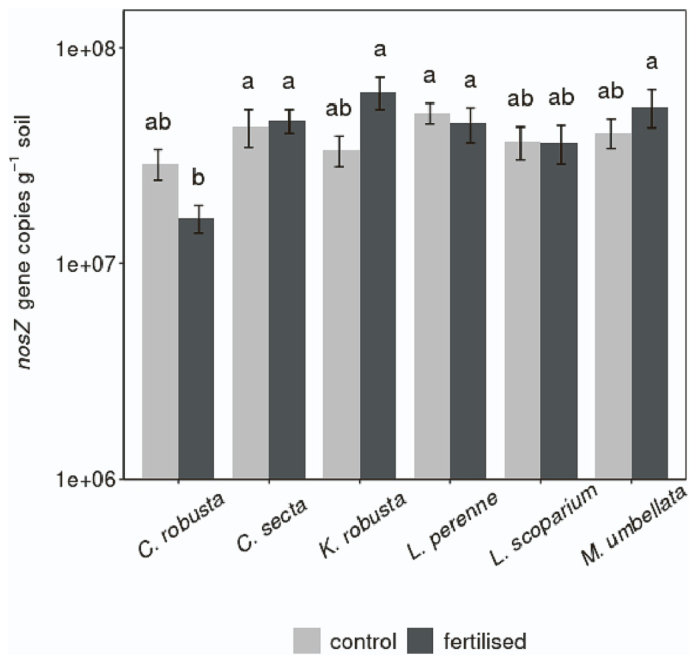
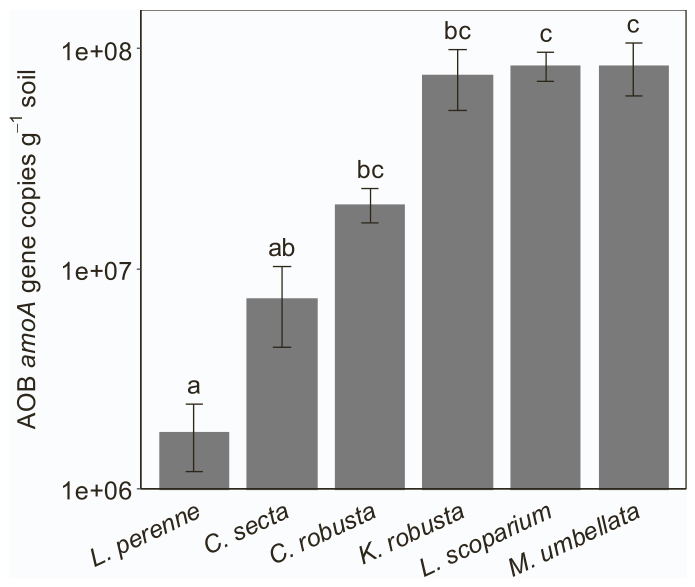
For the denitrifying bacteria, the genes encoding nitrite reductase (nirK, nirS) and nitrous oxide reductase (nosZ), were similarly abundant, in the range of 107–108gene copies g− 1soil (Fig. 1, Table S-6). None of these genes were affected by the fertiliser application (Table 3). However, nirS and nosZ were affected by plant species (Table 3). For the nitrifying microorganisms, AOB amoA was more abundant than AOA amoA (Table S-5). AOB amoA abundance in the fertilised soil ranged from 106to 108gene copies g− 1soil, while AOA amoA was below the detection limit (<104gene copies g− 1soil) in 50 % of samples. The percentage of samples where AOA amoA was detected, was unaffected by fertilisation and did not differ between plant species. The abundance of AOB amoA was below the detection limit (<104gene copies g− 1soil) in the control treatment, except for C. robusta ((2.68 ± 0.72) × 106gene copies g− 1soil). Fertilisation increased the abundance of AOB amoA above the detection limit in all species (Fig. 2).
对于反硝化细菌,编码亚硝酸盐还原酶(nirK、nirS)和氧化亚氮还原酶(nosZ)的基因丰度相近,均在107–108基因拷贝 g− 1土范围内(图1,表S-6)。这些基因均未受施肥影响(表3),但nirS和nosZ受植物物种影响(表3)。对于硝化微生物,AOB amoA的丰度高于AOA amoA(表S-5)。施肥土壤中AOB amoA丰度为106至108基因拷贝 g− 1土,而50 %的样品中AOA amoA低于检出限(<104基因拷贝 g− 1土)。检出AOA amoA的样品比例不受施肥影响,且在植物物种间无差异。在对照处理中,除C. robusta((2.68 ± 0.72) × 106基因拷贝 g− 1土)外,AOB amoA丰度均低于检出限(<104基因拷贝 g− 1土)。施肥使所有物种的AOB amoA丰度均高于检出限(图2)。
Plant species affected the abundance of AOB amoA in the fertilised soil (Fig. 2). The abundance of AOB amoA differed between monocotyledonous and dicotyledonous species. L. scoparium and M. umbellata showed significantly higher AOB C. secta (Fig. 2). Soil NO−3 and NHamoA 4+ abundances than concentrations were positively L. perenne and correlated with the AOB amoA: bacterial 16S rRNA ratio (Fig. 3).
植物物种影响施肥土壤中AOB amoA的丰度(图2)。AOB amoA丰度在单子叶与双子叶物种之间存在差异。L. scoparium和M. umbellata的AOB amoA丰度显著高于L. perenne和C. secta(图2)。土壤NO−3和NH4+浓度与AOB amoA:细菌16S rRNA比值呈正相关(图3)。
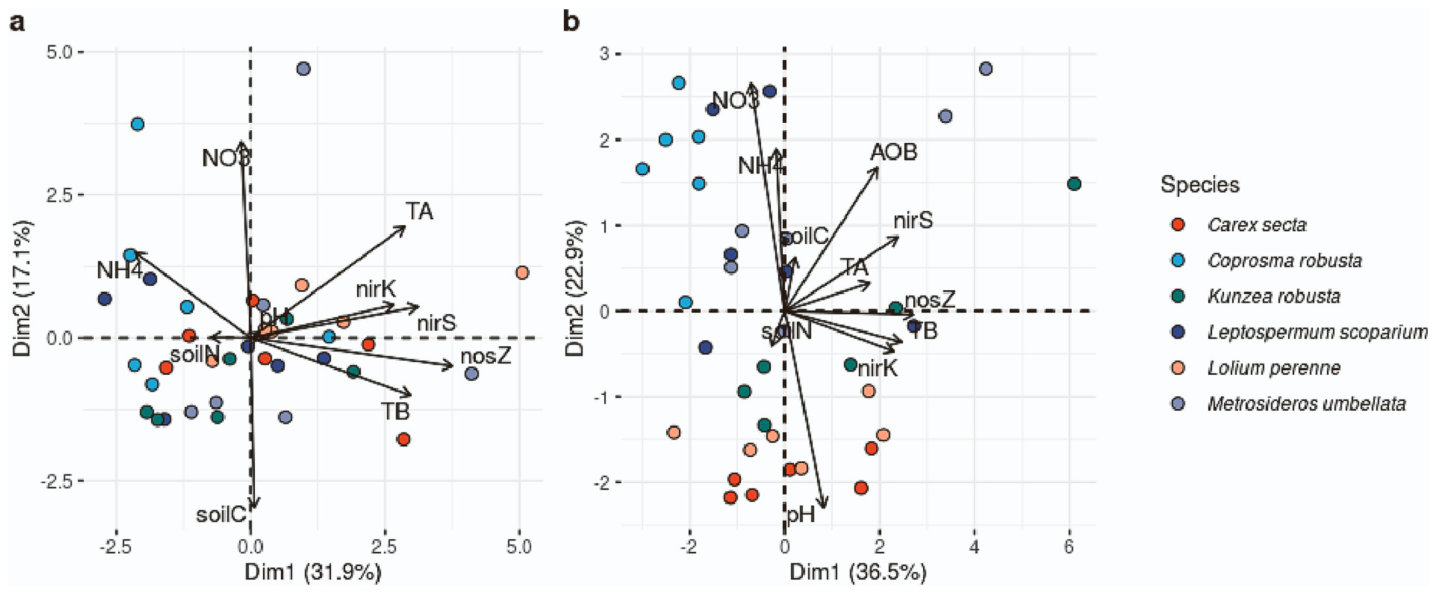
Mono- and dicotyledonous species not only affected the abundance of AOB amoA, but also the chemical properties of the soil. PCA showed that fertilisation resulted in the separation of mono- and dicotyledons (Fig. 4). In the fertilised soil, variation along PC1 (31.4 % of variation) was mainly explained by soil microbial abundance, primarily nosZ, nirS, and bacterial 16S rRNA, while PC2 (25.1 % of variation) was mainly explained by soil chemical properties.
单子叶和双子叶物种不仅影响AOB amoA的丰度,还影响土壤化学性质。PCA显示,施肥导致单子叶与双子叶物种相互分离(图4)。在施肥土壤中,PC1(解释31.4 %的变异)上的变异主要由土壤微生物丰度解释,主要为nosZ、nirS和细菌16S rRNA,而PC2(解释25.1 %的变异)主要由土壤化学性质解释。
Soil chemical properties in each of the plant and fertiliser treatments (control; no added fertiliser, NPKS; fertilised with nitrogen, phosphorus, potassium, and sulphur).
各植物与施肥处理的土壤化学性质(对照(control):不施肥;NPKS:施用氮、磷、钾和硫肥)。
| Species物种 | Treatment处理 | pH | Total C (%)全C (%) | Total N (%)全N (%) | NO3 −N (mg/ kg) | NH4 +-N (mg/ kg) |
|---|---|---|---|---|---|---|
| l | 5.6± | 5.7± | 0.44± | 2.2± | 39± | |
| b | Contro | 0.03ab | 0.04a | 0.01a | 1.0a | 3.7def |
| C. rousta | NPKS | 5.2± | 5.8± | 0.47± | 67± | 48± |
| 0.08c | 0.02a | 0.01a | 7.7c | 1.5e | ||
| Cl | 5.6± | 5.7± | 0.45± | d | 10± | |
| ontro | 0.01ab | 0.04a | 0.00a | n | 0.40a | |
| C. secta | 5.5± | 5.7± | 0.49± | 15± | ||
| NPKS | 0.02ab | 0.03a | 0.01a | nd | 0.33ab | |
| l | 5.6± | 5.8± | 0.42± | d | 18± | |
| b | Contro | 0.02ab | 0.03a | 0.01a | n | 0.93bc |
| K. rousta | 5.6± | 5.8± | 0.46± | 16± | 42± | |
| NPKS | 0.03ab | 0.03a | 0.01a | 4.4b | 0.93def | |
| 5.6± | 5.8± | 0.40± | 30± | |||
| Control | 0.04a | 0.04a | 0.01a | nd | 4.4d | |
| L. scoparium | 5.4± | 5.8± | 0.43± | 43± | 46± | |
| NPKS | 0.11bd | 0.02a | 0.01a | 12bc | 0.84ef | |
| Cl | 5.6± | 5.8± | 0.40± | 2.4± | 14± | |
| M bll | ontro | 0.03ab | 0.04a | 0.00a | 1.8a | 0.66ab |
| . umeata | 5.3± | 5.8± | 0.40± | 46± | 33± | |
| NPKS | 0.07cd | 0.04a | 0.01a | 8.7bc | 5.5df | |
| 5.6± | 5.7± | 0.41± | 1.0± | 14± | ||
| Control | 0.02ab | 0.02a | 0.00a | 0.34a | 1.8ab | |
| L. perenne | NPKS | 5.6± | 5.8± | 0.42± | 0.99± | 28± |
| 0.02ab | 0.02a | 0.01a | 0.37a | 3.2cd |
Values are means ± standard errors (n = 6). Different letters indicate significant differences between means (p ≤ 0.05) according to Tukey’s HSD post-hoc test. nd: not detectable (<0.25 mg/kg NO−3 -N)
数值为平均值 ± 标准误(n = 6)。不同字母表示根据Tukey’s HSD事后检验,均值间差异显著(p ≤ 0.05)。nd:未检出(<0.25 mg/kg NO−3 -N)
Results of two-way ANOVA for total archaea (TA), total bacteria (TB) and the functional genes encoding nitrite reductase (nirK, nirS) and nitrous oxide reductase (nosZ). Asterisks indicate significant effects (* p ≤ 0.05, ** p ≤ 0.01, ***p ≤ 0.001). Log-normally distributed data were log transformed.
总古菌(TA)、总细菌(TB)以及编码亚硝酸盐还原酶(nirK、nirS)和氧化亚氮还原酶(nosZ)的功能基因的双因素方差分析结果。星号表示显著效应(* p ≤ 0.05, ** p ≤ 0.01, ***p ≤ 0.001)。对数正态分布数据进行了对数转换。
| TA | TB | nirKnirK | nirSnirS | nosZnosZ | |
|---|---|---|---|---|---|
| Transformation | Log | None | None | Log | Log |
| Treatment | 0.999 | 0.064 | 0.752 | 0.195 | 0.644 |
| Species | 0.001* | 0.113 | 0.110 | 0.015* | 0.001 |
| Interaction | 0.033* | 0.350 | 0.582 | 0.332 | 0.040* |
4Discussion讨论
The results support our hypothesis that plant species affect the concentrations of N in the soil, as well as the abundance of microorganisms involved in the N cycle. There were strong species-dependent effects on the abundance of TA, nirS, and nosZ. However, while some NZ native Myrtaceae can reduce pathogenic bacteria in soil (Gutierrez- Gines et al., 2021), K. robusta, L. scoparium and M. umbellata did not affect the abundance of TB including nitrifying or denitrifying bacteria in this study. Furthermore, against expectations, TB and TA abundance did not significantly increase with NPKS application. The soil C:N ratio in this experiment ranged from 11 to 15, which indicates that the soil bacteria and archaea were more likely limited by C than N (Bengtsson et al., 2003). There were significant differences between plant species for TA abundance, with TA being significantly lower in C. robusta than M. umbellata and C. secta. This is consistent with a higher sensitivity of archaea to plant variation compared to bacteria (Yarwood et al., 2016).
研究结果支持了我们的假设,即植物物种会影响土壤中的N浓度以及参与N循环的微生物丰度。TA、nirS和nosZ的丰度表现出强烈的物种依赖效应。然而,尽管一些新西兰本土桃金娘科植物可减少土壤中的病原细菌(Gutierrez- Gines et al., 2021),但在本研究中,K. robusta、L. scoparium和M. umbellata并未影响TB(包括硝化和反硝化细菌)的丰度。此外,与预期相反,施用NPKS后TB和TA丰度并未显著增加。本试验土壤C:N比为11至15,表明土壤细菌和古菌更可能受C而非N的限制(Bengtsson et al., 2003)。TA丰度在植物物种间存在显著差异,C. robusta下的TA显著低于M. umbellata和C. secta。这与古菌比细菌对植物差异更为敏感的结论一致(Yarwood et al., 2016)。
The contrasting abundance of TA between plant species likely derived from differing availability of energy in the form of labile C from root exudates (Karlsson et al., 2012; Valentine, 2007). With the smaller root systems developed in C. robusta than other species, it is possible that lower availability of C exudates limited the growth of archaea.
TA丰度在植物物种间的差异可能源于根系分泌物中以活性C形式存在的能量有效性不同(Karlsson et al., 2012; Valentine, 2007)。由于C. robusta形成的根系比其他物种小,C分泌物有效性较低可能限制了古菌的生长。
The genes involved in denitrification, nirK, nirS, and nosZ, were unaffected by the application of NPKS (Table 3). This contrasts with a study by Kastl et al. (2015), in which fertilisation of 200 kg NH4NO3 ha− 1 halved the abundance of denitrifying microbes. However, Fischer et al. (2013) showed that the abundance of denitrifiers was more limited by low levels of dissolved organic C than NO−3 . The abundance of nirS and nosZ differed between plant species, while the abundance of nirK did not. C. robusta had a significantly lower abundance of nosZ than all other species, except L. scoparium. This may be a result of differing root exudation of organic compounds among species, which can increase microbial activity (Leptin et al., 2021). As nosZ is responsible for the reduction of N2O to N2 (Kandeler et al., 2006), it is likely that a higher abundance and activity would increase the rate of N2 emissions relative to N2O. With plant species having the strongest effect on nosZ, species selection may be critical to favour complete denitrification in the soil and reduce emissions of N2O.
参与反硝化作用的基因nirK、nirS和nosZ均不受NPKS施用的影响(表3)。这与Kastl et al. (2015) 的研究结果相反,该研究中施用200 kg NH4NO3 ha− 1使反硝化微生物丰度减半。然而,Fischer et al. (2013) 表明,反硝化菌丰度更多地受低水平溶解性有机C而非NO−3的限制。nirS和nosZ的丰度在植物物种间存在差异,而nirK则无差异。除L. scoparium外,C. robusta的nosZ丰度显著低于其他所有物种。这可能是由于不同物种根系分泌有机化合物的差异所致,而这些化合物可提高微生物活性(Leptin et al., 2021)。由于nosZ负责将N2O还原为N2(Kandeler et al., 2006),其丰度和活性较高可能会提高N2相对于N2O的排放比例。鉴于植物物种对nosZ的影响最强,物种选择对于促进土壤中完全反硝化、减少N2O排放可能至关重要。
The abundance of bacterial amoA was higher than that of archaeal amoA in the present study, which is consistent with TB being more abundant than TA. However, this contrasts with several studies whereby AOA are more abundant in soil than AOB (Adair and Schwartz, 2008; Di et al., 2009; Fischer et al., 2013; Leptin et al., 2021). It was demonstrated that AOA and AOB occupy different niches, with AOB being predominant in neutral or alkaline N-rich soils with high levels of ammonia (Di et al., 2010; Shen et al., 2012). However, the Craigieburn silt loam used in this study had low N concentrations and a pH of 5.6, indicating that AOA would dominate, which was not the case. The abundance of AOB amoA was below the detection limit (<104gene copies g− 1soil) in the control treatment, except for C. robusta, which was likely due to the insignificant root system and slow plant growth in this species and reduced plant-microbe competition. The low abundance of AOB amoA in the control treatment was likely due to competition between microbes and plants for organic and inorganic N in the soil (Kaye and Hart, 1997). Plants are superior to AOB when competing for NH+4 and the reduced mobility of AOB limits their ability to utilise NH+4 (Skiba et al., 2011). AOB therefore required higher concentrations of NH+4 in the soil, which was reflected in their strong response to NPKS application. Fertilisation increased the abundance of AOB amoA above the detection limit in all species. Results are consistent with those of Kastl et al. (2015) and Okano et al. (2004), who reported that the abundance of AOB was significantly increased by ammonium nitrate (NH4NO3) and ammonium sulphate application, respectively. Furthermore, Di et al. (2009) reported that AOB gene copy numbers increased 3–10 times with addition of urine equivalent to 1000 kg N ha− 1.
本研究中细菌amoA的丰度高于古菌amoA,这与TB比TA更丰富的结果一致。然而,这与多项研究结果相反,这些研究发现土壤中AOA比AOB更丰富(Adair and Schwartz, 2008; Di et al., 2009; Fischer et al., 2013; Leptin et al., 2021)。已有研究证明AOA和AOB占据不同的生态位,AOB在氨含量高、富N的中性或碱性土壤中占优势(Di et al., 2010; Shen et al., 2012)。然而,本研究所用Craigieburn粉砂壤土N浓度低、pH为5.6,预示AOA应占优势,但实际情况并非如此。在对照处理中,AOB amoA丰度均低于检出限(<104基因拷贝 g− 1土),但C. robusta除外,这可能是由于该物种根系不发达、植株生长缓慢,植物与微生物之间的竞争减弱所致。对照处理中AOB amoA丰度较低,可能是由于微生物与植物竞争土壤中的有机和无机N(Kaye and Hart, 1997)。在竞争NH+4时植物优于AOB,且AOB移动性较低,限制了其利用NH+4的能力(Skiba et al., 2011)。因此,AOB需要土壤中更高的NH+4浓度,这体现在其对NPKS施用的强烈响应上。施肥使所有物种的AOB amoA丰度均高于检出限。该结果与Kastl et al. (2015) 和Okano et al. (2004) 的研究一致,他们分别报道施用硝酸铵(NH4NO3)和硫酸铵显著增加了AOB丰度。此外,Di et al. (2009) 报道,添加相当于1000 kg N ha− 1的尿液后,AOB基因拷贝数增加了3–10倍。
Plant species affected the abundance of AOB amoA in the fertilised soil. The results indicate that AOB amoA abundance differs between monocotyledonous and dicotyledonous species. L. scoparium and M. umbellata showed significantly higher AOB amoA abundances than L. perenne and C. secta (Fig. 2). Typically, plants affect nitrification through (i) direct competition for N, (ii) the release of BNIs, and (iii) physicochemical changes in the rhizosphere that affect the microbial activity and community composition (Bowatte et al., 2016). The higher uptake of N by mono- than dicotyledonous species (Table 1), and the associated lower concentrations of mineral N, is likely the main explanation for the lower abundance of AOB under these species. In addition, heterotrophic bacteria are more competitive for NH4+ than nitrifying bacteria under low N and sufficient organic C conditions (Verhagen et al., 1992). Differential root exudation by monocotyledonous and dicotyledonous species may also explain the differences in AOB between the rhizospheres of the two groups (Chai and Schachtman, 2022; Oburger and Jones, 2018). AOB were shown to negatively correlate with C inputs from roots (Ollivier et al., 2011). This can be explained by an accelerated growth of heterotrophic bacteria in response to C inputs, increasing their N use and reducing N that is available to AOB (Leptin et al., 2021).
植物物种影响施肥土壤中AOB amoA的丰度。结果表明,AOB amoA丰度在单子叶与双子叶物种之间存在差异。L. scoparium和M. umbellata的AOB amoA丰度显著高于L. perenne和C. secta(图2)。通常,植物通过以下途径影响硝化作用:(i)对N的直接竞争;(ii)释放BNIs;(iii)改变根际理化性质,进而影响微生物活性和群落组成(Bowatte et al., 2016)。单子叶物种对N的吸收高于双子叶物种(表1),以及由此导致的矿质N浓度较低,可能是这些物种下AOB丰度较低的主要原因。此外,在低N和有机C充足的条件下,异养细菌对NH4+的竞争力强于硝化细菌(Verhagen et al., 1992)。单子叶与双子叶物种根系分泌的差异也可能解释两类植物根际中AOB的差异(Chai and Schachtman, 2022; Oburger and Jones, 2018)。研究表明,AOB与根系C输入呈负相关(Ollivier et al., 2011)。这可以解释为异养细菌响应C输入而加速生长,增加了其对N的利用,从而减少了AOB可利用的N(Leptin et al., 2021)。
Mono- and dicotyledonous species were separated in the PCA by chemical and microbial properties, which reflects that different plant species affect soil properties through their distinct architectural, morphological, physiological, and biotic root traits (Bardgett et al., 2014). Monocotyledonous species have more fibrous root systems, which likely affected nutrient cycling, microbial activity, and preferential flow differently compared to the dicotyledonous species (Franklin et al., 2015; Mishra, 2018). An increase in in soil NO3− following fertilisation under dicotyledons but not monocotyledons is consistent with the higher N uptake by the latter species, which likely reduced the concentration of mineral N in the soil, as plants usually take up N in the form of NO3− and NH4+ (Britto and Kronzucker, 2013). The large increase in biomass following NPKS fertilisation is consistent with one or more of these elements limiting plant growth (Güsewell and Koerselman, 2002). No difference in N concentrations between species contrasts with the results reported by Franklin et al. (2015), who measured higher N concentrations in L. perenne than NZ native species. The lack of difference in our study was likely due to the low N availability in the Craigieburn silt loam, as fertilisation may not have been sufficient to meet plant requirements. N concentrations in the foliage of the unfertilised C. secta and M. umbellata, were only 40–44 % of the average concentration of N in plant shoot dry matter of 1.5 % (Kirkby, 2012). However, the N concentrations in both species doubled with NPKS application. Many NZ native species do not require high levels of N, as they are adapted to low fertility soils (Wardle, 1985). However, the increase in N concentrations in natives with fertilisation indicates that native plants can take up more N than required for optimal growth, a phenomenon known as luxury uptake (Iversen et al., 2010). This was also reported by Franklin et al. (2015) for K. robusta and L. scoparium grown in a low fertility soil after N fertilisation.
在PCA中,单子叶与双子叶物种因化学和微生物性质而相互分离,这反映出不同植物物种通过其独特的根系结构、形态、生理及生物学性状影响土壤性质(Bardgett et al., 2014)。单子叶物种具有更发达的须根系,与双子叶物种相比,可能对养分循环、微生物活性和优先流产生不同影响(Franklin et al., 2015; Mishra, 2018)。施肥后土壤NO3−在双子叶植物下增加而在单子叶植物下未增加,这与后者较高的N吸收量一致;较高的N吸收可能降低了土壤中的矿质N浓度,因为植物通常以NO3−和NH4+形式吸收N(Britto and Kronzucker, 2013)。NPKS施肥后生物量大幅增加,表明其中一种或多种元素限制了植物生长(Güsewell and Koerselman, 2002)。物种间N浓度无差异,这与Franklin et al. (2015) 报道的结果相反,他们测得L. perenne的N浓度高于新西兰本土物种。本研究中未见差异,可能是由于Craigieburn粉砂壤土的N有效性较低,施肥量可能不足以满足植物需求。未施肥的C. secta和M. umbellata叶片N浓度仅为植物地上部干物质平均N浓度(1.5 %)的40–44 %(Kirkby, 2012)。然而,施用NPKS后,这两个物种的N浓度均翻倍。许多新西兰本土物种适应低肥力土壤,对N的需求不高(Wardle, 1985)。然而,施肥后本土植物N浓度的增加表明,本土植物吸收的N可超过最佳生长所需,这种现象称为奢侈吸收(Iversen et al., 2010)。Franklin et al. (2015) 也报道了在低肥力土壤中生长的K. robusta和L. scoparium在施N后出现这一现象。
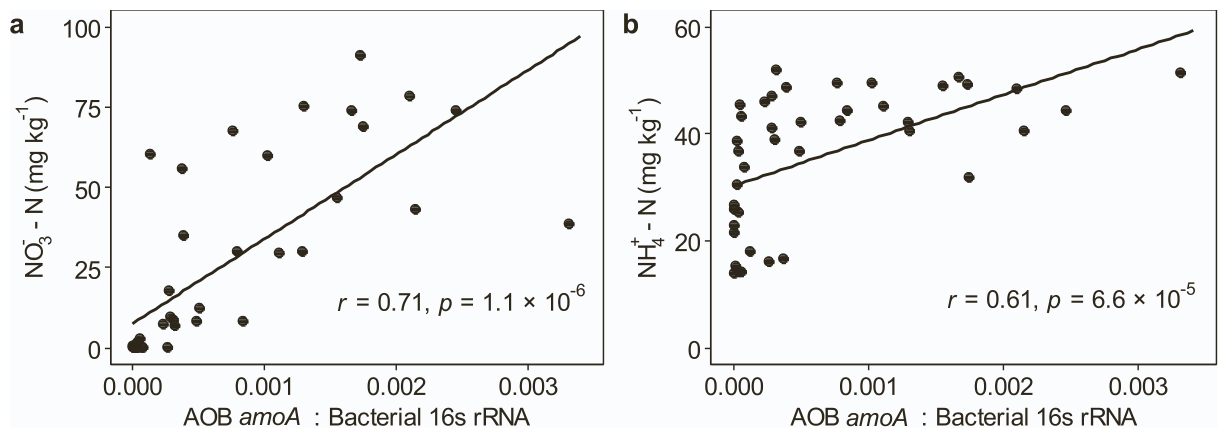
Despite previous reports that L. scoparium and K. robusta may suppress nitrification in soil more than other species (Esperschuetz et al., 2017; Franklin et al., 2017), the relatively high abundance of AOB amoA under these species indicates that this was not the case in the present study. However, it was not possible to assess inhibitory effects of myrtaceous species on nitrification and potential BNI activity, as enzyme activity was not analysed. While measuring the abundance of functional genes in soil allows the quantification of its genetic potential for a particular turnover process, it does not necessarily correlate with the activity of the enzymes they are encoding (Laffite et al., 2020), nor with actual turnover rates (Fischer et al., 2013). Nevertheless, Ouyang et al. (2018) found that functional gene abundance was correlated with corresponding enzyme activity. Moreover, Di et al. (2009) found a correlation between the growth of AOB and nitrification. In the present study, soil NO3− and NH4+ concentrations were positively correlated with the AOB amoA: bacterial 16S rRNA ratio. This provides evidence that AOB amoA abundance is correlated with nitrification rates, as previously reported by Nicol et al. (2008). Further analysis would be required to quantify enzyme activity.
尽管此前有报道称L. scoparium和K. robusta对土壤硝化作用的抑制可能强于其他物种(Esperschuetz et al., 2017; Franklin et al., 2017),但本研究中这些物种下AOB amoA丰度相对较高,表明本研究并未出现这种情况。然而,由于未分析酶活性,无法评估桃金娘科物种对硝化作用的抑制效应及潜在的BNI活性。测定土壤中功能基因丰度虽可量化特定转化过程的遗传潜力,但其并不一定与所编码酶的活性相关(Laffite et al., 2020),也不一定与实际转化速率相关(Fischer et al., 2013)。尽管如此,Ouyang et al. (2018) 发现功能基因丰度与相应的酶活性相关。此外,Di et al. (2009) 发现AOB的生长与硝化作用之间存在相关性。本研究中,土壤NO3−和NH4+浓度与AOB amoA:细菌16S rRNA比值呈正相关。这为AOB amoA丰度与硝化速率相关提供了证据,与Nicol et al. (2008) 此前的报道一致。量化酶活性尚需进一步分析。
Although not part of this research, it is important to highlight the role of fungi in nitrification and denitrification. Fungi can dominate heterotrophic nitrification (cation and other NO−3/NOZhu et al., 2015−2reduction processes () and are capable of denitrifi-Aldossari and Ishii, 2021). However, their relative contribution to these processes in high-nutrient environments is not clear, as it was demonstrated that long-term fertiliser inputs can reduce fungal biomass in soil (Schon et al., 2023). To obtain a complete unerstanding of soil N cycling under native plants in high-nutrient environments, future research should include fungal N transformation processes.
虽然不属于本研究范围,但有必要强调真菌在硝化和反硝化作用中的作用。真菌可在异养硝化作用中占主导地位(Zhu et al., 2015),并能够进行反硝化及其他NO−3/NO−2还原过程(Aldossari and Ishii, 2021)。然而,由于已有研究证明长期施肥会降低土壤真菌生物量(Schon et al., 2023),真菌在高养分环境中对这些过程的相对贡献尚不清楚。为全面了解高养分环境中本土植物下的土壤N循环,未来研究应纳入真菌的N转化过程。
5Conclusions结论
We have shown that there were interspecific differences between NZ native monocotyledonous and dicotyledonous plant species with respect to N-cycling in fertilised soil. AOB were limited by N and could only be quantified in soils that were fertilised. There, the abundance of AOB amoA was affected by plant species and was lower under mono- than dicotyledonous species. There was no evidence of an inhibitory effect of NZ native Myrtaceae on AOB. L. perenne and C. secta took up significantly more N than the dicotyledonous species. The use of monocotyledonous native species in riparian zones and farm margins, as well as for the land application of N-rich wastes, in NZ and elsewhere, may reduce NO−3 leaching from the system through plant uptake and competition with AOB. In addition, there was a strong species effect on the abundance of nosZ. This indicates that the targeted selection of plant species may also reduce emissions of the potent greenhouse gas N2O through complete denitrification. Further research is required to elucidate species specific mechanisms of interaction between plant roots and AOB and denitrifying microorganisms, although plant uptake can explain some of the observed differences. Overall, the results of this study demonstrated that species selection may be used to reduce N losses from high-fertility environments.
我们证明,在施肥土壤中,新西兰本土单子叶与双子叶植物物种在N循环方面存在种间差异。AOB受N限制,仅能在施肥土壤中被定量检测。在施肥土壤中,AOB amoA丰度受植物物种影响,且单子叶物种下低于双子叶物种。没有证据表明新西兰本土桃金娘科植物对AOB具有抑制作用。L. perenne和C. secta吸收的N显著多于双子叶物种。在新西兰及其他地区的河岸带和农场边缘,以及富N废弃物的土地施用中,使用单子叶本土物种可通过植物吸收及与AOB的竞争减少系统中的NO−3淋溶。此外,植物物种对nosZ丰度有强烈影响。这表明有针对性地选择植物物种还可通过完全反硝化减少强效温室气体N2O的排放。尽管植物吸收可以解释部分观察到的差异,但仍需进一步研究以阐明植物根系与AOB及反硝化微生物之间物种特异性的相互作用机制。总体而言,本研究结果表明,物种选择可用于减少高肥力环境中的N损失。
Declaration of competing interest利益冲突声明
The authors declare that they have no known competing financial interests or personal relationships that could have appeared to influence the work reported in this paper.
作者声明,不存在任何可能影响本文所报道工作的已知经济利益冲突或个人关系。
Data availability数据可用性
Data will be made available on request.
数据可应要求提供。
Acknowledgements致谢
This study was funded by the Institute of Environmental Science and Research. (ESR) Strategic Science Investment Funding from the Ministry of Business, Innovation and Employment, New Zealand [grant number C03X1701]. The lead author gratefully acknowledges the receipt of a University of Canterbury Doctoral Scholarship.
本研究由新西兰环境科学与研究所(ESR)获得的新西兰商业、创新与就业部战略科学投资基金资助[资助编号C03X1701]。第一作者衷心感谢坎特伯雷大学博士奖学金的资助。
Appendix A. Supplementary data附录A. 补充数据
Supplementary data to this article can be found online at https://doi. org/10.1016/j.apsoil.2023.105031.
本文补充数据可在线获取:https://doi. org/10.1016/j.apsoil.2023.105031。
References参考文献
Adair, K.L., Schwartz, E., 2008. Evidence that ammonia-oxidizing archaea are more abundant than ammonia-oxidizing bacteria in semiarid soils of northern Arizona, USA. Microb. Ecol. 56 (3), 420–426. https://doi.org/10.1007/s00248-007-9360-9.
Aldossari, N., Ishii, S., 2021. Fungal denitrification revisited – recent advancements and future opportunities. Soil Biol. Biochem. 157, 108250 https://doi.org/10.1016/j. soilbio.2021.108250.
Bais, H.P., Weir, T.L., Perry, L.G., Gilroy, S., Vivanco, J.M., 2006. The role of root exudates in rhizosphere interactions with plants and other organisms. Annu. Rev. Plant Biol. 57, 233–266. https://doi.org/10.1146/annurev. arplant.57.032905.105159.
Bardgett, R.D., Mommer, L., De Vries, F.T., 2014. Going underground: root traits as drivers of ecosystem processes. Trends Ecol. Evol. 29 (12), 692–699. https://doi.org/ 10.1016/j.tree.2014.10.006.
Bengtsson, G., Bengtson, P., Månsson, K.F., 2003. Gross nitrogen mineralization-, immobilization-, and nitrification rates as a function of soil C/N ratio and microbial activity. Soil Biol. Biochem. 35 (1), 143–154. https://doi.org/10.1016/s0038-0717 (02)00248-1.
Blakemore, L.C., Searle, P.L., Daly, B.K., 1987. Methods for chemical analysis of soils. In:
NZ Soil Bureau Scientific Report, 80. Bowatte, S., Newton, P.C.D., Hoogendoorn, C.J., Hume, D.E., Stewart, A.V., Brock, S.C., Theobald, P.W., 2016. Wide variation in nitrification activity in soil associated with different forage plant cultivars and genotypes. Grass Forage Sci. 71 (1), 160–171. https://doi.org/10.1111/gfs.12175.
Brender, J.D., 2020. Human health effects of exposure to nitrate, nitrite, and nitrogen dioxide. In: Sutton, M.A., Mason, K.E., Bleeker, A., Hicks, W.K., Masso, C., Raghuram, N., Reis, S., Bekunda, M. (Eds.), Just Enough Nitrogen: Perspectives on How to Get There for Regions With Too Much and Too Little Nitrogen. Springer International Publishing, pp. 283–294. https://doi.org/10.1007/978-3-030-58065- 0_18. Britto, D.T., Kronzucker, H.J., 2013. Ecological significance and complexity of N-source preference in plants. Ann. Bot. 112 (6), 957–963. https://doi.org/10.1093/aob/ mct157.
Cameron, K.C., Di, H.J., Moir, J.L., 2013. Nitrogen losses from the soil/plant system: a review. Ann. Appl. Biol. 162 (2), 145–173. https://doi.org/10.1111/aab.12014. Chai, Y.N., Schachtman, D.P., 2022. Root exudates impact plant performance under abiotic stress. Trends Plant Sci. 27 (1), 80–91. https://doi.org/10.1016/j. tplants.2021.08.003. Clough, T.J., Stevens, R.J., Laughlin, R.J., Sherlock, R.R., Cameron, K.C., 2001. Transformations of inorganic-N in soil leachate under differing storage conditions. Soil Biol. Biochem. 33, 1473–1480. https://doi.org/10.1016/s0038-0717(01)00056- 6.
Coskun, D., Britto, D.T., Shi, W., Kronzucker, H.J., 2017. How plant root exudates shape the nitrogen cycle. Trends Plant Sci. 22 (8), 661–673. https://doi.org/10.1016/j. tplants.2017.05.004.
Daims, H., Lebedeva, E.V., Pjevac, P., Han, P., Herbold, C., Albertsen, M., Jehmlich, N., Palatinszky, M., Vierheilig, J., Bulaev, A., Kirkegaard, R.H., von Bergen, M., Rattei, T., Bendinger, B., Nielsen, P.H., Wagner, M., 2015. Complete nitrification by Nitrospira bacteria. Nature 528 (7583), 504–509N. https://doi.org/10.1038/ nature16461. Di, H.J., Cameron, K.C., Shen, J.P., Winefield, C.S., O’Callaghan, M., Bowatte, S., He, J. Z., 2009. Nitrification driven by bacteria and not archaea in nitrogen-rich grassland soils. Nat. Geosci. 2 (9), 621–624. https://doi.org/10.1038/ngeo613. Di, H.J., Cameron, K.C., Shen, J.-P., Winefield, C.S., O’Callaghan, M., Bowatte, S., He, J.- Z., 2010. Ammonia-oxidizing bacteria and archaea grow under contrasting soil nitrogen conditions. FEMS Microbiol. Ecol. 72 (3), 386–394. https://doi.org/ 10.1111/j.1574-6941.2010.00861.x.
Esperschuetz, J., Balaine, N., Clough, T., Bulman, S., Dickinson, N.M., Horswell, J., Robinson, B.H., 2017. The potential of L. scoparium, K. robusta and P. radiata to mitigate N-losses in silvopastural systems. Environ. Pollut. 225, 12–19. https://doi. org/10.1016/j.envpol.2017.03.042.
Fischer, D., Uksa, M., Tischler, W., Kautz, T., Kopke, U., Schloter, M., 2013. Abundance ¨ of ammonia oxidizing microbes and denitrifiers in different soil horizons of an agricultural soil in relation to the cultivated crops. Biol. Fertil. Soils 49, 1243–1246. https://doi.org/10.1007/s00374-013-0812-8.
Francis, C.A., Roberts, K.J., Beman, J.M., Santoro, A.E., Oakley, B.B., 2005. Ubiquity and diversity of ammonia-oxidizing archaea in water columns and sediments of the ocean. PNAS 102 (41), 14683–14688. https://doi.org/10.1073/pnas.0506625102.
Franklin, H.M., Dickinson, N.M., Esnault, C.J.D., Robinson, B.H., 2015. Native plants and nitrogen in agricultural landscapes of New Zealand. Plant Soil 394 (1–2), 407–420. https://doi.org/10.1007/s11104-015-2622-2.
Franklin, H.M., Woods, R.R., Robinson, B., Dickinson, N., 2017. Nitrous oxide emissions following dairy shed effluent application beneath Kunzea robusta (Myrtaceae) trees. Ecol. Eng. 99, 473–478. https://doi.org/10.1016/j.ecoleng.2016.11.064.
Galloway, J.N., Aber, J.D., Erisman, J.W., Seitzinger, S.P., Howarth, R.W., Cowling, E.B., Cosby, B.J., 2003. The nitrogen cascade. BioScience 53 (4), 341–356. https://doi. org/10.1641/0006-3568(2003)053[0341:Tnc]2.0.Co;2.
Güsewell, S., Koerselman, W., 2002. Variation in nitrogen and phosphorus concentrations of wetland plants. Perspect. Plant Ecol. Evol. Syst. 5 (1), 37–61. https://doi.org/10.1078/1433-8319-0000022.
Gutierrez-Gines, M.J., Madejon, E., Lehto, N.J., McLenaghen, R.D., Horswell, J., Dickinson, N., Robinson, B.H., 2019. Response of a pioneering species (Leptospermum scoparium J.R. Forst. & G. Forst.) to heterogeneity in a low-fertility soil. Frontiers. Plant Sci. 10, 93. https://doi.org/10.3389/fpls.2019.00093.
Gutierrez-Gines, M.J., Alizadeh, H., Alderton, E., Ambrose, V., Meister, A., Robinson, B. H., Halford, S., Prosser, J.A., Horswell, J., 2021. Phytoremediation of microbial contamination in soil by New Zealand native plants. Appl. Soil Ecol. 167, 104040 https://doi.org/10.1016/j.apsoil.2021.104040.
Halford, S., Guti´errez-Gin´es, M.J., Rees, A., Alderton, I., Schaller, K., Smith, R., Horswell, J., 2021. Effect of m¯anuka (Leptospermum scoparium) on nitrogen and Escherichia coli reductions in soils: a field experiment. Plant Soil 456, 491–502. https://doi.org/10.1007/s11104-021-05035-3.
Hayatsu, M., Tago, K., Saito, M., 2008. Various players in the nitrogen cycle: diversity and functions of the microorganisms involved in nitrification and denitrification. Soil Sci. Plant Nutr. 54 (1), 33–45. https://doi.org/10.1111/j.1747- 0765.2007.00195.x.
Hewitt, A.E., 2010. New Zealand Soil Classification, 3rd ed. Manaaki Whenua Press https://doi.org/10.7931/DL1-LRSS-1-2010.
Hothorn, T., Bretz, F., Westfall, P., Heiberger, R.M., Schuetzenmeister, A., Scheibe, S., Hothorn, M.T., 2021. Package ‘multcomp’. Simultaneous Inference in General Parametric Models.
Iversen, C.M., Bridgham, S.D., Kellogg, L.E., 2010. Scaling plant nitrogen use and uptake efficiencies in response to nutrient addition in peatlands. Ecology 91 (3), 693–707. https://doi.org/10.1890/09-0064.1.
Kandeler, E., Deiglmayr, K., Tscherko, D., Bru, D., Philippot, L., 2006. Abundance of narG, nirS, nirK, and nosZ genes of denitrifying bacteria during primary successions of a glacier foreland. Appl. Environ. Microbiol. 72 (9), 5957–5962. https://doi.org/ 10.1128/aem.00439-06.
Kanter, D.R., Bartolini, F., Kugelberg, S., Leip, A., Oenema, O., Uwizeye, A., 2020. Nitrogen pollution policy beyond the farm. Nat. Food 1 (1), 27–32. https://doi.org/ 10.1038/s43016-019-0001-5.
Karlsson, A.E., Johansson, T., Bengtson, P., 2012. Archaeal abundance in relation to root and fungal exudation rates. FEMS Microbiol. Ecol. 80 (2), 305–311. https://doi.org/ 10.1111/j.1574-6941.2012.01298.x.
Kassambara, A., Mundt, F., 2016. Package ’factoextra’. Extract and Visualize the Results of Multivariate Data Analyses. R Package Version 1.0.7. https://cran.r-project. org/web/packages/factoextra/index.html. Kastl, E.-M., Schloter-Hai, B., Buegger, F., Schloter, M., 2015. Impact of fertilization on the abundance of nitrifiers and denitrifiers at the root-soil interface of plants with different uptake strategies for nitrogen. Biol. Fertil. Soils 51, 57–64. https://doi.org/ 10.1007/s00374-014-0948-1. Kaye, J.P., Hart, S.C., 1997. Competition for nitrogen between plants and soil microorganisms. Trends Ecol. Evol. 12, 139–143. https://doi.org/10.1016/s0169- 5347(97)01001-x. Kirkby, E., 2012. Introduction, definition and classification of nutrients. In: Marschner, P. (Ed.), Marschner’s Mineral Nutrition of Higher Plants. Academic Press, pp. 3–5. https://doi.org/10.1016/b978-0-12-384905-2.00007-8. Kirkman, J.H., Basker, A., Surapaneni, A., MacGregor, A.N., 1994. Potassium in the soils of New Zealand—a review. N. Z. J. Agric. Res. 37 (2), 207–227. https://doi.org/ 10.1080/00288233.1994.9513059. Laffite, A., Florio, A., Andrianarisoa, K.S., Creuze de Chatelliers, C., Schloter-Hai, B., Ndaw, S.M., Periot, C., Schloter, M., Zeller, B., Poly, F., Le Roux, X., 2020. Biological inhibition of soil nitrification by forest tree species affects Nitrobacter populations. Environ. Microbiol. 22 (3), 1141–1153. https://doi.org/10.1111/1462-2920.14905. Lejoly, J., Quideau, S.A., Rees, F., Naeth, M.A., 2020. Microbial response to carbon and nutrient additions in boreal forest soils and coversoils used during post-mining reclamation. Can. J. Soil Sci. 100 (1), 69–80. https://doi.org/10.1139/cjss-2019- 0088.
Leptin, A., Whitehead, D., Anderson, C.R., Cameron, K.C., Lehto, N.J., 2021. Increased soil nitrogen supply enhances root-derived available soil carbon leading to reduced potential nitrification activity. Appl. Soil Ecol. 159 https://doi.org/10.1016/j. apsoil.2020.103842.
Lever, M.A., Torti, A., Eickenbusch, P., Michaud, A.B., Santl-Temkiv, T., Jorgensen, B.B., 2015. A modular method for the extraction of DNA and RNA, and the separation of DNA pools from diverse environmental sample types. Front. Microbiol. 6, 476. https://doi.org/10.3389/fmicb.2015.00476.
Li, Y., Chapman, S.J., Nicol, G.W., Yao, H., 2018. Nitrification and nitrifiers in acidic soils. Soil Biol. Biochem. 116, 290–301. https://doi.org/10.1016/j. soilbio.2017.10.023.
Lim, N.Y., Roco, C.A., Frostegard, A., 2016. Transparent DNA/RNA co-extraction workflow protocol suitable for inhibitor-rich environmental samples that focuses on complete DNA removal for transcriptomic analyses. Front. Microbiol. 7, 1588. https://doi.org/10.3389/fmicb.2016.01588.
Lourenço, K.S., Dimitrov, M.R., Pijl, A., Soares, J.R., do Carmo, J.B., van Veen, J.A., Cantarella, H., Kuramae, E.E., 2018. Dominance of bacterial ammonium oxidizers and fungal denitrifiers in the complex nitrogen cycle pathways related to nitrous oxide emission. GCB Bioenergy 10 (9), 645–660. https://doi.org/10.1111/ gcbb.12519.
McKergow, L.A., Matheson, F.E., Quinn, J.M., 2016. Riparian management: a restoration tool for New Zealand streams. Ecol. Manag. Restor. 17 (3), 218–227. https://doi. org/10.1111/emr.12232.
Meister, A., Li, F., Gutierrez-Gines, M.J., Dickinson, N., Gaw, S., Bourke, M., Robinson, B., 2022. Interactions of treated municipal wastewater with native plant species. Ecol. Eng. 183, 106741 https://doi.org/10.1016/j.ecoleng.2022.106741.
Miranda, K.M., Espey, M.G., Wink, D.A., 2001. A rapid, simple spectrophotometric method for simultaneous detection of nitrate and nitrite. Nitric Oxide 5 (1), 62–71. https://doi.org/10.1006/niox.2000.0319.
Mishra, M., 2018. Interactions Between Escherichia Coli and the New Zealand Native Plants Leptospermum Scoparium and Kunzea Robusta. Doctoral Thesis. Lincoln University. https://researcharchive.lincoln.ac.nz/handle/10182/10460.
Mulvaney, R.L., 1996. Nitrogen–inorganic forms. In: Sparks, D.L., Page, A.L., Helmke, P. A., Leoppert, R.H., Soltanpour, P., Tabatabai, N., Johnston, M.A., Summer, M.E. (Eds.), Methods of Soil Analysis. Part 3, Chemical Methods–SSSA Book Series no. 5. Soil Science Society of America and American Society of Agronomy.
Nicol, G.W., Leininger, S., Schleper, C., Prosser, J.I., 2008. The influence of soil pH on the diversity, abundance and transcriptional activity of ammonia oxidizing archaea and bacteria. Environ. Microbiol. 10 (11), 2966–2978. https://doi.org/10.1111/j.1462- 2920.2008.01701.x.
Oburger, E., Jones, D.L., 2018. Sampling root exudates – mission impossible? Rhizosphere 6, 116–133. https://doi.org/10.1016/j.rhisph.2018.06.004.
Okano, Y., Hristova, K.R., Leutenegger, C.M., Jackson, L.E., Denison, R.F., Gebreyesus, B., Lebauer, D., Scow, K.M., 2004. Application of real-time PCR to study effects of ammonium on population size of ammonia-oxidizing bacteria in soil. Appl. Environ. Microbiol. 70 (2), 1008–1016. https://doi.org/10.1128/aem.70.2.1008- 1016.2004.
Ollivier, J., Towe, S., Bannert, A., Hai, B., Kastl, E.-M., Meyer, A., Su, M.X., ¨ Kleineidam, K., Schloter, M., 2011. Nitrogen turnover in soil and global change. FEMS Microbiol. Ecol. 78 (1), 3–16. https://doi.org/10.1111/j.1574- 6941.2011.01165.x.
Ouyang, Y., Reeve, J.R., Norton, J.M., 2018. Soil enzyme activities and abundance of microbial functional genes involved in nitrogen transformations in an organic farming system. Biol. Fertil. Soils 54 (4), 437–450. https://doi.org/10.1007/s00374- 018-1272-y.
Paavolainen, L., Kitunen, V., Smolander, A., 1998. Inhibition of nitrification in forest soil by monoterpenes. Plant Soil 205 (2), 147–154. https://doi.org/10.1023/A: 1004335419358. Philibert, A., Loyce, C., Makowski, D., 2013. Prediction of N2O emission from local information with Random Forest. Environ. Pollut. 177, 156–163. https://doi.org/ 10.1016/j.envpol.2013.02.019.
Porter, N.G., Wilkins, A.L., 1999. Chemical, physical and antimicrobial properties of essential oils of Leptospermum scoparium and Kunzea ericoides. Phytochemistry 50, 407–415. https://doi.org/10.1016/s0031-9422(98)00548-2.
Prosser, J.A., Woods, R.R., Horswell, J., Robinson, B.H., 2016. The potential in-situ antimicrobial ability of Myrtaceae plant species on pathogens in soil. Soil Biol. Biochem. 96, 1–3. https://doi.org/10.1016/j.soilbio.2015.12.007. R Core Team, 2020. R: A Language and Environment for Statistical Computing. R Foundation for Statistical Computing, Vienna, Austria. https://www.R-project.org. Richards, J., Chambers, T., Hales, S., Joy, M., Radu, T., Woodward, A., Humphrey, A., Randal, E., Baker, M.G., 2022. Nitrate contamination in drinking water and colorectal cancer: exposure assessment and estimated health burden in New Zealand. Environ. Res. 204, 112322 https://doi.org/10.1016/j.envres.2021.112322.
Robertson, G.P., Groffman, P.M., 2015. Nitrogen transformations. In: Paul, E.A. (Ed.), Soil Microbiology, Ecology and Biochemistry, pp. 421–446. https://doi.org/ 10.1016/b978-0-12-415955-6.00014-1.
Sayavedra-Soto, L.A., Hommes, N.G., Arp, D.J., 1994. Characterization of the gene encoding hydroxylamine oxidoreductase in Nitrosomonas europaea. J. Bacteriol. 176 (2), 504–510. https://doi.org/10.1128/jb.176.2.504-510.1994.
Schon, N.L., Stevenson, B.A., Fraser, P.M., Shi, S., Anderson, C., Mansfield, S., Simpson, R., Cavanagh, J., Orwin, K.H., Gray, C.W., Mackay, A., Lear, G., O’Callaghan, M., 2023. Impacts of long-term phosphorus and nitrogen fertiliser application on soil biology: a New Zealand perspective. N. Z. J. Agric. Res. 1-25 https://doi.org/10.1080/00288233.2023.2215532.
Shen, J.-P., Zhang, L.-M., Di, H.J., He, J.-Z., 2012. A review of ammonia-oxidizing bacteria and archaea in Chinese soils. Front. Microbiol. 3 (296) https://doi.org/ 10.3389/fmicb.2012.00296.
Siles, J.A., Margesin, R., 2016. Abundance and diversity of bacterial, archaeal, and fungal communities along an altitudinal gradient in alpine forest soils: what are the driving factors? Microb. Ecol. 72, 207–220. https://doi.org/10.1007/s00248-016- 0748-2.
Skiba, M.W., George, T.S., Baggs, E.M., Daniell, T.J., 2011. Plant influence on nitrification. Biochem. Soc. Trans. 39, 275–278. https://doi.org/10.1042/
bst0390275.
Smith, V.H., Schindler, D.W., 2009. Eutrophication science: where do we go from here? Trends Ecol. Evol. 24 (4), 201–207. https://doi.org/10.1016/j.tree.2008.11.009. Specialty Seeds, 2019. Ryegrasses. Retrieved 25 January 2019 from. http://www. specseed.co.nz/portfolio-item/ryegrasses/#perennial.
Subbarao, G.V., Ito, O., Sahrawat, K.L., Berry, W.L., Nakahara, K., Ishikawa, T., Watanabe, T., Suenaga, K., Rondon, M., Rao, I.M., 2006. Scope and strategies for regulation of nitrification in agricultural systems—challenges and opportunities. Crit. Rev. Plant Sci. 25 (4), 303–335. https://doi.org/10.1080/ 07352680600794232.
Subbarao, G.V., Rondon, M., Ito, O., Ishikawa, T., Rao, I.M., Nakahara, K., Lascano, C., Berry, W.L., 2007. Biological nitrification inhibition (BNI)—is it a widespread phenomenon? Plant Soil 294 (1), 5–18. https://doi.org/10.1007/s11104-006-9159- 3.
Subbarao, G.V., Sahrawat, K.L., Nakahara, K., Ishikawa, T., Kishii, M., Rao, I.M., Hash, C. T., George, T.S., Srinivasa Rao, P., Nardi, P., Bonnett, D., Berry, W., Suenaga, K., Lata, J.C., 2012. Chapter six - biological nitrification inhibition—a novel strategy to regulate nitrification in agricultural systems. In: Sparks, D.L. (Ed.), Advances in Agronomy, vol. 114. Academic Press, pp. 249–302. https://doi.org/10.1016/b978- 0-12-394275-3.00001-8.
Tahir, M.M., Begum, S., Maqbool, M., Khaliq, A., Zahid, N., Mehmood, K., Shehzad, M., 2021. Evaluation of selected medicinal plant materials and dicyandiamide on nitrification of urea-derived ammonium under laboratory conditions. J. Plant Nutr. Soil Sci. 184 (1), 132–141. https://doi.org/10.1002/jpln.201900501.
Valentine, D.L., 2007. Adaptations to energy stress dictate the ecology and evolution of the Archaea. Nat. Rev. Microbiol. 5 (4), 316–323. https://doi.org/10.1038/ nrmicro1619.
Verhagen, F.J.M., Duyts, H., Laanbroek, H.J., 1992. Competition for ammonium between nitrifying and heterotrophic bacteria in continuously percolated soil columns. Appl. Environ. Microbiol. 58 (10), 3303–3311. https://doi.org/10.1128/aem.58.10.3303- 3311.1992.
Ward, B.B., Courtney, K.J., Langenheim, J.H., 1997. Inhibition of Nitrosomonas europeae by monoterpenes from coastal redwood (Sesquoia sempervirens) in whole-cell studies. J. Chem. Ecol. 23 (11), 2583–2598. https://doi.org/10.1023/B: JOEC.0000006668.48855.b7.
Wardle, D.A., Bardgett, R.D., Klironomos, J.N., Setӓlӓ, H., van der Putten, W.H., Wall, D. H., 2004. Ecological linkages between aboveground and belowground biota. Science 304 (5677), 1629–1633. https://doi.org/10.1126/science.1094875.
Wardle, P., 1985. Environmental influences on the vegetation of New Zealand. N. Z. J. Bot. 23 (4), 773–788. https://doi.org/10.1080/0028825x.1985.10434242.
Wayman, S., Bowden, R.D., Mitchell, R.B., 2014. Seasonal changes in shoot and root nitrogen distribution in switchgrass (Panicum virgatum). BioEnergy Res. 7 (1), 243–252. https://doi.org/10.1007/s12155-013-9365-9.
Yarwood, S.A., Baldwin, A.H., Gonzalez Mateu, M., Buyer, J.S., 2016. Archaeal rhizosphere communities differ between the native and invasive lineages of the wetland plant Phragmites australis (common reed) in a Chesapeake Bay subestuary. Biol. Invasions 18 (9), 2717–2728. https://doi.org/10.1007/s10530-016-1144-z.
Zhang, J., Sun, W., Zhong, W., Cai, Z., 2014. The substrate is an important factor in controlling the significance of heterotrophic nitrification in acidic forest soils. Soil Biol. Biochem. 76, 143–148. https://doi.org/10.1016/j.soilbio.2014.05.001. Zhu, T., Meng, T., Zhang, J., Zhong, W., Müller, C., Cai, Z., 2015. Fungi-dominant heterotrophic nitrification in a subtropical forest soil of China. J. Soils Sediments 15 (3), 705–709. https://doi.org/10.1007/s11368-014-1048-4.