Article
Alexandra Meister 1,* , María Jesús Gutiérrez-Ginés 1 , Hamish Lowe 2 and Brett Robinson 3
1 Institute of Environmental Science and Research Ltd., Christchurch 8041, New Zealand
1 Institute of Environmental Science and Research Ltd.,基督城 8041,新西兰
2 Lowe Environmental Impact, Palmerston North 4410, New Zealand
2 Lowe Environmental Impact,Palmerston North 4410,新西兰
3 School of Physical and Chemical Sciences, University of Canterbury, Christchurch 8041, New Zealand
3 坎特伯雷大学物理与化学科学学院,新西兰基督城 8041
* Correspondence: alexandra.meister@esr.cri.nz
Abstract: The use of native plants in land application systems for treated municipal wastewater (TMW) can contribute to ecological restoration. However, research on the potential of native species to manage the nutrients and contaminants contained in TMW is scarce. At a 10-hectare field site irrigated with TMW at >4000 mm yr−1, we investigated the distribution of nutrients and trace elements in the soil–plant system, comparing the New Zealand native Myrtaceae species Leptosperum scoparium and Kunzea robusta with pasture. The results showed that plant growth did not correlate with TMW irrigation rates. L. scoparium and K. robusta had higher foliar trace element concentrations than pasture, but these were not correlated with TMW irrigation rates. The pasture accumulated more N and P (68 kg of N ha−1 yr−1 and 11 kg of P ha−1 yr−1) than the Myrtaceae species (0.6–17 kg of N ha−1 yr−1 and 0.06–1.8 kg of P ha−1 yr−1). Regular harvesting of the pasture would likely remove more N and P from the site than the Myrtaceae species. The results highlight the importance of adjusting TMW application rates to the soil–plant capacity, in which case, native plants could provide ecological or economic value to TMW-irrigated land.
摘要:在经处理的城市污水(TMW)土地施用系统中使用本土植物,有助于生态恢复。然而,关于本土物种管理TMW中所含养分和污染物潜力的研究十分匮乏。在一处以 >4000 mm yr−1 灌溉TMW的10公顷田间试验地,我们研究了土壤–植物系统中养分和微量元素的分布,并将新西兰本土桃金娘科物种Leptosperum scoparium和Kunzea robusta与牧草进行了比较。结果表明,植物生长与TMW灌溉量无相关性。L. scoparium和K. robusta叶片微量元素浓度高于牧草,但与TMW灌溉量无相关性。牧草积累的N和P(68 kg N ha−1 yr−1和11 kg P ha−1 yr−1)多于桃金娘科物种(0.6–17 kg N ha−1 yr−1和0.06–1.8 kg P ha−1 yr−1)。定期刈割牧草可能比桃金娘科物种从场地移除更多的N和P。研究结果强调了根据土壤–植物系统容量调整TMW施用量的重要性;在此前提下,本土植物可为TMW灌溉土地提供生态或经济价值。
Keywords: biowaste; Kunzea robusta; land treatment; Leptospermum scoparium; native vegetation
关键词:生物废弃物;Kunzea robusta;土地处理;Leptospermum scoparium;本土植被
Academic Editors: Valeria Spagnuolo, Simonetta Giordano and Maria Cristina Sorrentino
Received: 26 May 2023 Revised: 26 July 2023 Accepted: 26 July 2023 Published: 1 August 2023
Copyright: © 2023 by the authors. Licensee MDPI, Basel, Switzerland. This article is an open access article distributed under the terms and conditions of the Creative Commons Attribution (CC BY) license (https:// creativecommons.org/licenses/by/ 4.0/).
版权:© 2023 作者所有。授权方 MDPI,瑞士巴塞尔。本文为开放获取文章,依据知识共享署名(CC BY)许可协议(https:// creativecommons.org/licenses/by/ 4.0/)条款发布。
1Introduction引言
Population growth and economic development are accelerating the production of wastewater [1]. With 65–80% of global freshwater withdrawals being released back into the environment as wastewater [2], the estimated global wastewater production is 359 billion m3 yr−1 [3]. The management of wastewater is a major social and environmental challenge, with most wastewater, treated or not, being directly released into aquatic environments [4]. Despite the majority of wastewater being treated in high-income countries [5], the discharge of treated municipal wastewater (TMW) can adversely affect water quality [6]. Depending on the level of treatment, TMW contains varying amounts of nutrients and contaminants. When TMW is discharged into waterbodies, these nutrients, primarily N and P, can cause eutrophication and toxic algal blooms [7,8]. While it is possible to reduce the concentration of nutrients and contaminants in TMW to below drinking water standard using advanced treatment options, this greatly increases treatment costs [9]. Alternatively, TMW can be applied to land where the soil–plant system can retain and transform nutrients and contaminants and lead to better environmental and economic outcomes [10].
人口增长和经济发展正在加速污水的产生[1]。全球取用的淡水中有65–80%以污水形式重新排入环境[2],全球污水产生量估计为3590亿 m3 yr−1[3]。污水管理是一项重大的社会和环境挑战,大部分污水无论是否经过处理均直接排入水生环境[4]。尽管在高收入国家大部分污水经过处理[5],但经处理的城市污水(TMW)的排放仍可能对水质产生不利影响[6]。根据处理程度的不同,TMW含有不同数量的养分和污染物。当TMW排入水体时,这些养分(主要是N和P)可引起富营养化和有毒藻华[7,8]。虽然采用深度处理工艺可将TMW中养分和污染物浓度降至饮用水标准以下,但这会大幅增加处理成本[9]。另一种选择是将TMW施用于土地,由土壤–植物系统截留和转化养分与污染物,从而带来更好的环境和经济效益[10]。
Treated municipal wastewater is widely used on agricultural land to accelerate the production of crops [11]. However, combining TMW reuse with food production can be restricted by cultural and societal views on waste, as well as industry perceptions and limitations [12]. In such cases, TMW may instead be used for other purposes, such as landscaping or environmental restoration. Examples include the irrigation of golf courses, parks, and gardens, wetland restoration, and the creation of artificial lakes [13,14]. Furthermore, TMW is used to support short rotation coppice [15] and to accelerate the growth of timber species [16]. However, the species used in such systems are often exotic and may disturb local ecosystems, such as Pinus radiata (Monterey pine), which has become invasive in large parts of the southern hemisphere [17]. Recent research has focused on the potential of native vegetation as an alternative for the phytomanagement of biosolids [18], municipal wastewater [19], and industrial wastewater [20,21]. Native species are well adapted to the local conditions, promote and preserve native biodiversity, aid with ecological restoration, and can be utilised for the production of high-value native (non-food) products, such as essential oils, timber, and fibre [22,23].
经处理的城市污水被广泛用于农田以促进作物生产[11]。然而,将TMW回用与粮食生产相结合,可能受到文化和社会对废弃物的看法以及行业认知和限制的制约[12]。在这种情况下,TMW可改作他用,如景观绿化或环境修复,例如灌溉高尔夫球场、公园和花园,湿地修复以及建造人工湖泊[13,14]。此外,TMW还被用于支持短轮伐期矮林[15]以及促进用材树种的生长[16]。然而,此类系统中使用的物种往往为外来种,可能扰乱当地生态系统,例如Pinus radiata(辐射松)已在南半球大部分地区成为入侵种[17]。近期研究关注本土植被作为替代选择,用于生物固体(污泥)[18]、城市污水[19]和工业废水[20,21]的植物管理。本土物种很好地适应当地条件,能够促进和保护本土生物多样性,有助于生态恢复,并可用于生产高价值的本土(非食品)产品,如精油、木材和纤维[22,23]。
Some native species have the potential to accumulate nutrients in excess of plant requirements, commonly referred to as luxury uptake [24]. Esperschuetz, et al. [25] reported that the New Zealand (NZ) native species Leptospermum scoparium (manuka) and¯ Kunzea robusta (kanuka)¯ accumulated three times more N in their stem biomass than P. radiata. Furthermore, there is evidence that some NZ native species not only mitigate nutrient losses through plant uptake but distinctively affect the biogeochemical cycling of N. reported significantly lower levels of NO3− leaching under L. scoparium and K. robusta compared to P. radiata following the addition of urea to soils. These species can also reduce nitrous oxide (N2O) emissions from the soil, likely by inhibiting nitrification and denitrification [25,26]. Replacing P. radiata in TMW land application systems with native vegetation may therefore reduce nutrient inputs into ground and surface waters. However, many NZ native species are adapted to low-fertility soils and marginal environments [27]. Therefore, the testing of different species in high-nutrient environments is required to understand candidate species’ potential to manage nutrients and contaminants in TMW land application schemes.
一些本土物种具有积累超出植物需求量养分的潜力,通常称为奢侈吸收[24]。Esperschuetz, et al. [25]报道,新西兰(NZ)本土物种Leptospermum scoparium(麦卢卡)和Kunzea robusta(卡努卡)茎生物量中积累的N是P. radiata的三倍。此外,有证据表明,一些新西兰本土物种不仅通过植物吸收减少养分损失,而且对N的生物地球化学循环具有独特影响。有研究报道,向土壤添加尿素后,L. scoparium和K. robusta下的NO3−淋溶水平显著低于P. radiata。这些物种还可减少土壤氧化亚氮(N2O)排放,可能是通过抑制硝化和反硝化作用实现的[25,26]。因此,在TMW土地施用系统中以本土植被替代P. radiata,可能减少进入地下水和地表水的养分输入。然而,许多新西兰本土物种适应于低肥力土壤和边缘环境[27]。因此,需要在高养分环境中对不同物种进行测试,以了解候选物种在TMW土地施用方案中管理养分和污染物的潜力。
Previous research demonstrated that N fertilisers and biosolids have negligible or positive effects on the biomass production of NZ native plant species [24,28]. Similarly, we showed that NZ native plants can thrive with TMW irrigation at application rates comparable to the annual rainfall [19]. However, the performance of native vegetation on land with the historical application of TMW and irrigation regimes manyfold higher than the annual rainfall is unknown. We aimed to determine the distribution of nutrients and trace elements in soils and plants following the irrigation of TMW at rates up to >4000 mm yr−1 in an area that has received TMW for over 30 years. Specifically, we sought to quantify nutrient concentrations in the soil–plant system in K. robusta and L. scoparium compared to pasture.
以往研究表明,氮肥和生物固体(污泥)对新西兰本土植物物种生物量生产的影响可忽略不计或为正面影响[24,28]。同样,我们曾证明,在施用量与年降雨量相当的TMW灌溉条件下,新西兰本土植物能够生长良好[19]。然而,在历史上长期施用TMW且灌溉量为年降雨量数倍的土地上,本土植被的表现尚不清楚。本研究旨在确定,在一个已接受TMW超过30年的区域内,以高达 >4000 mm yr−1 的速率灌溉TMW后,土壤和植物中养分和微量元素的分布。具体而言,我们试图量化K. robusta和L. scoparium与牧草相比土壤–植物系统中的养分浓度。
2Materials and Methods材料与方法
2.1. Site Description2.1. 研究区概况
The study site was located in Levin on the North Island of NZ (40◦37′27′′ S 175◦10′48′′ E). The site consisted of sand dunes and plains. It had been used for TMW irrigation from the local wastewater treatment plant onto the P. radiata plantation forest since 1986. The wastewater underwent secondary treatment at the Levin Wastewater Treatment Plant, prior to being pumped into a 7-hectare unlined pond at the land application site. From there, the TMW was irrigated onto 40.5 ha of land at an average rate of 4667 mm yr−1 [29]. Table 1 shows the concentration of nutrients and contaminants in the TMW and their respective application rates. The sprinkler irrigation system operated overnight and the irrigation of each plot occurred 1–3 times per week, depending on the TMW level in the pond.
研究地点位于新西兰北岛的Levin(40◦37′27′′ S 175◦10′48′′ E)。场地由沙丘和平原组成。自1986年起,该场地一直以当地污水处理厂的TMW灌溉P. radiata人工林。污水在Levin污水处理厂经二级处理后,泵入土地施用场地的一个7公顷无衬砌池塘。然后,TMW以平均4667 mm yr−1的速率灌溉到40.5 ha土地上[29]。表1列出了TMW中养分和污染物的浓度及其相应的施用量。喷灌系统在夜间运行,每个样地每周灌溉1–3次,具体取决于池塘中的TMW水位。
| Parameter参数 | Concentration in TMW (mg L−1) aTMW中浓度(mg L−1)a | Application (kg ha−1 yr−1)施用量(kg ha−1 yr−1) |
|---|---|---|
| NO3−-N | 11_±_1.2 | 513 |
| NH4+-N | 8.0_±_1.1 | 373 |
| Total N | 48_±_3.0 | 2240 |
| Parameter参数 | Concentration in TMW (mg L−1) aTMW中浓度(mg L−1)a | Application (kg ha−1 yr−1)施用量(kg ha−1 yr−1) |
|---|---|---|
| PO43−-P | 1.2_±_0.19 | 56 |
| Total P | 6.6_±_0.91 | 308 |
| Ca | 12_±_0.19 | 560 |
| Mg | 3.2_±_0.13 | 149 |
| K | 25_±_1.9 | 1167 |
| Na | 61_±_3.2 | 2847 |
| B | 163_±_12 (µg L_−_1) | 7.6 |
| As, Cd, Cr, Cu, Hg, Ni, Pb | <0.01 | <0.47 |
| Total suspended solids (TSS) | 13_±_6.3 | 607 |
Electrical conductivity (EC) | 74_±_5.1 (mS m_−_1) | - |
| Sodium adsorption ratio (SAR) b | 4.0 ((meq L_−_1)1/2) | - |
a Mean ± standard error (n = 4–145). Values are in mg L−1, unless otherwise indicated. b SAR expresses the concentration of Na relative to Ca and Mg, calculated after Ayers and Westcot [30].
a 平均值 ± 标准误(n = 4–145)。除另有说明外,数值单位为mg L−1。 b SAR表示Na相对于Ca和Mg的浓度,按Ayers and Westcot [30]的方法计算。
In 2017 and 2018, the P. radiata plantation was harvested and ca. 80% of the resulting slash was cleared and piled in windrows. In 2018, 10 ha were substituted with NZ native species, dominated by Kunzea robusta (de Lange et Toelken) and Leptospermum scoparium (J.R.Forst. et G.Forst). Root trainer-grown seedlings of 0.3–0.5 m in height were planted at a density of 10,000 plants ha−1. Following planting, a grass cover, dominated by Holcus lanatus L. and Lolium perenne L., was sown to prevent the development of further weeds. The soils in the planted areas were well-drained Sandy Recent soils [31]. The median annual temperature at the site was 13.5 ◦C and the annual rainfall was 1163 mm [32].
2017年和2018年,P. radiata人工林被采伐,约80%的采伐剩余物被清理并堆成条垛。2018年,10 ha林地被新西兰本土物种取代,以Kunzea robusta(de Lange et Toelken)和Leptospermum scoparium(J.R.Forst. et G.Forst)为主。以0.3–0.5 m高的容器育苗苗木按10,000株 ha−1的密度种植。种植后,播种以Holcus lanatus L.和Lolium perenne L.为主的草被,以防止杂草进一步滋生。种植区土壤为排水良好的砂质新成土(Sandy Recent soils)[31]。场地年平均气温中位数为13.5 ◦C,年降雨量为1163 mm[32]。
2.2. Soil and Plant Chemistry2.2. 土壤与植物化学
In November 2020, soil and plant samples were collected from a TMW-irrigated plot that had received weed management in the form of manual weeding and herbicide spot spraying. Seventeen specimens each of K. robusta and L. scoparium, as well as 17 areas of pasture (dominated by Holcus lanatus and Lolium perenne), were selected at varying distances from central sprinklers. A rain gauge was placed beside each specimen to record the TMW irrigation rates during one run of overnight irrigation. There was no rainfall during this period. The heights of the K. robusta and L. scoparium specimens were measured with a measuring tape. Foliage was sampled from each specimen by cutting 10 individual branches of varying ages and aspects using secateurs. All branches had a diameter of <5 mm and were cut near the trunk. There were no flowers or fruits on the sampled foliage. To collect pasture samples, a rectangle of 0.2 m × 0.2 m was placed on the ground and all pasture within that rectangle was cut 10 mm above the soil surface. Soil samples were collected from below each sampled specimen, inside the rectangle for pasture and within 0.3 m from the trunk for K. robusta and L. scoparium. Samples were taken at two depths, using a bucket soil sampler (23 mm diameter) to collect samples from the topsoil (0–10 cm depth) and a soil auger (25 mm diameter) to collect samples from the subsoil (30–45 cm depth). The soils were stored in polyethylene bags, cooled with ice packs, and transported to the lab in insulated containers where they were immediately frozen at −20 ◦C until analysis.
2020年11月,从一块经TMW灌溉并通过人工除草和除草剂点喷进行杂草管理的样地采集土壤和植物样品。在距中心喷头不同距离处,分别选取K. robusta和L. scoparium各17株以及17个牧草样区(以Holcus lanatus和Lolium perenne为主)。在每个样株旁放置一个雨量计,以记录一次夜间灌溉过程中的TMW灌溉量。该期间无降雨。用卷尺测量K. robusta和L. scoparium样株的高度。使用修枝剪从每个样株剪取10根不同年龄和朝向的枝条采集叶片。所有枝条直径均 <5 mm,并在靠近主干处剪取。所采叶片上无花或果实。采集牧草样品时,将一个0.2 m × 0.2 m的矩形框置于地面,将框内所有牧草在距土壤表面10 mm处剪下。土壤样品采自每个采样植株下方:牧草在矩形框内采集,K. robusta和L. scoparium在距主干0.3 m范围内采集。样品分两个深度采集,用桶式土钻(直径23 mm)采集表土(0–10 cm深度)样品,用土钻(直径25 mm)采集底土(30–45 cm深度)样品。土壤装入聚乙烯袋中,用冰袋冷却,并以保温箱运回实验室,随即在 −20 ◦C下冷冻保存直至分析。
Soil NO3− and exchangeable ammonium (NH4+) were extracted from fresh soil with 2 M KCl [33]. Colourimetric methods were used to determine the NO3−-N [34] and NH4+-N [35] in the extract, using a Cary 100 Bio UV-visible spectrophotometer (Agilent Technologies, Santa Clara, CA, USA). The soil moisture content was determined by drying a subsample of 10–20 g fresh soil at 105 ◦C for 24 h [33]. The remaining soils were spread on aluminium trays, dried at 40 ◦C for 4 days, and sieved to ≤2 mm. The plant samples were washed with deionised water before being dried at 60 ◦C until a constant weight was obtained (4 days). Leaves of the K. robusta and L. scoparium were separated from the stems. Dried plant leaves and soils were ground with a Rocklabs Bench Top Ring Mill (Scott, Dunedin, New Zealand). A LECO CN828 C and N analyser (LECO, St. Joseph, MI, USA) was used to determine the total C and N contents in the ground soil and plant samples. Soil pH and electrical conductivity (EC) were determined using deionised water in a 1:5 soil:water extract, using a HQ 440d Multi-Parameter Meter with pH probe PHC735 and EC probe CDC40101 (HACH, Loveland, CO, USA).
土壤NO3−和交换性铵(NH4+)用2 M KCl从新鲜土壤中提取[33]。采用比色法测定提取液中的NO3−-N[34]和NH4+-N[35],所用仪器为Cary 100 Bio紫外–可见分光光度计(Agilent Technologies, Santa Clara, CA, USA)。土壤含水量通过将10–20 g新鲜土壤子样品在105 ◦C下烘干24 h测定[33]。其余土壤摊放于铝盘上,在40 ◦C下干燥4天,并过 ≤2 mm筛。植物样品用去离子水洗净后,在60 ◦C下烘干至恒重(4天)。将K. robusta和L. scoparium的叶片与茎分开。干燥的植物叶片和土壤用Rocklabs台式环磨机(Scott, Dunedin, New Zealand)研磨。用LECO CN828碳氮分析仪(LECO, St. Joseph, MI, USA)测定研磨后土壤和植物样品中的全C和全N含量。土壤pH和电导率(EC)以去离子水按1:5土水比浸提测定,使用配备PHC735 pH探头和CDC40101 EC探头的HQ 440d多参数测定仪(HACH, Loveland, CO, USA)。
For the determination of total elemental concentrations, 0.2 g of ground soil or plant material was digested with 5 mL of ultrapure HNO3 (69%). Samples were left to predigest overnight; they were digested on an ultraWAVE microwave digester (Milestone Srl, Sorisole, Italy) and diluted 21 times with ultrapure water. The element concentrations in the digests were determined by ICP-MS (7500cx, Agilent Technologies, Santa Clara, CA, USA). Certified reference materials were included with the soil and plant digestions (SRM 2710a—Montana I Soil and SRM1573a—Tomato Leaves, National Institute of Standards and Technology (NIST), U.S. Department of Commerce). A total of 0.05 M of Ca(NO3)2 was used to extract phytoavailable metals from the soil [36]. The extracts were filtered through Whatman No. 42 filter paper and diluted 21 times with ultrapure water. The element concentrations were analysed by ICP-MS (Agilent 7500cx). To determine plant-available P, the soils (air-dried, ≤2 mm) were extracted with 0.5 M of NaHCO3 [37]. The P concentration in the extract was determined colourimetrically, using a UV-visible spectrophotometer (Cary 100 Bio).
测定元素全量时,取0.2 g研磨后的土壤或植物材料,加入5 mL超纯HNO3(69%)消解。样品先预消解过夜,再用ultraWAVE微波消解仪(Milestone Srl, Sorisole, Italy)消解,并用超纯水稀释21倍。消解液中的元素浓度采用ICP-MS(7500cx, Agilent Technologies, Santa Clara, CA, USA)测定。土壤和植物消解过程中均加入有证标准物质(SRM 2710a—Montana I Soil和SRM1573a—Tomato Leaves,美国商务部国家标准与技术研究院(NIST))。采用0.05 M Ca(NO3)2提取土壤中的植物有效态金属[36]。提取液经Whatman No. 42滤纸过滤,并用超纯水稀释21倍。元素浓度采用ICP-MS(Agilent 7500cx)分析。为测定植物有效磷,土壤(风干,≤2 mm)用0.5 M NaHCO3提取[37]。提取液中的P浓度采用紫外–可见分光光度计(Cary 100 Bio)比色测定。
2.3. Statistical Analysis2.3. 统计分析
Data were analysed and visualised using RStudio (R Core Team, 2021). Descriptive statistics included geometric means and standard error ranges for soil and plant variables, due to the range of TMW irrigation rates received by the sampled specimens. Pearson correlation coefficients were determined for correlations between the individual soil and plant variables in each species. The Kruskal–Wallis Test, followed by Dunn’s test, was used to determine significant differences (p ≤ 0.05) in the soil and plant parameters between the plant species. Principal component analysis (PCA) was performed using the package ‘factoextra’ [38].
数据采用RStudio(R Core Team, 2021)进行分析和可视化。由于所采样植株接受的TMW灌溉量范围较大,描述性统计包括土壤和植物变量的几何平均值和标准误范围。计算了各物种中土壤和植物各变量之间的Pearson相关系数。采用Kruskal–Wallis检验及随后的Dunn检验确定不同植物物种之间土壤和植物参数的显著差异(p ≤ 0.05)。主成分分析(PCA)使用‘factoextra’程序包进行[38]。
3Results and Discussion结果与讨论
3.1. Soil Chemistry3.1. 土壤化学
The soil pH was low (Tables 2 and 3) but still within the typical range for NZ soils, which is 4.1 to 7.4 [39]. Plantation forests and native vegetation typically show lower soil pHs than other land uses in NZ, highlighting the low pH tolerance of these plants [39]. Under pasture, TMW irrigation rates were negatively correlated with soil pH in both the top- and subsoil. This was not observed under K. robusta and L. scoparium. The negative correlation in this study contrasted with other studies reporting that soil pH increases in TMW irrigation systems [40,41]. Soil acidification may result from increased nitrification with TMW application, which can be a major source of soil acidity [42]. High inputs of N through TMW irrigation likely provided a sufficient substrate for high nitrification rates, and the soil pH was in the optimum range for nitrification (4.5 to 7.4) [43]. Consistently, soil pH was negatively correlated with NO3− in the topsoil under pasture (r = −0.58, p < 0.05). While the measured pH at the site was below the optimum range for the availability of plant nutrients [42], it is unlikely to result in nutrient deficiencies due to the high application rates with TMW irrigation (Table 1).
土壤pH较低(表2和表3),但仍在新西兰土壤的典型范围(4.1至7.4)之内[39]。在新西兰,人工林和本土植被的土壤pH通常低于其他土地利用类型,这表明这些植物对低pH具有较强的耐受性[39]。在牧草下,TMW灌溉量与表土和底土的pH均呈负相关,而在K. robusta和L. scoparium下未观察到这一现象。本研究中的负相关与其他报道TMW灌溉系统中土壤pH升高的研究结果相反[40,41]。土壤酸化可能源于TMW施用导致的硝化作用增强,而硝化作用可能是土壤酸度的主要来源[42]。TMW灌溉带来的大量N输入可能为高硝化速率提供了充足底物,且土壤pH处于硝化作用的最适范围(4.5至7.4)[43]。与此一致,牧草下表土pH与NO3−呈负相关(r = −0.58,p < 0.05)。虽然场地实测pH低于植物养分有效性的最适范围[42],但由于TMW灌溉的施用量很高(表1),不太可能导致养分缺乏。
| 0–10 cm | K. robustaK. robusta | L. scopariumL. scoparium | Pasture牧草 |
|---|---|---|---|
| Irrigation (mm day_−_1) | 11 (2.5–50) | 10 (2.4–43) | 12 (2.6–81) |
| pH | 4.7 (4.4–5.0) | 4.7 (4.4–5.0) | 4.8 (4.4–5.2)[_−_S] |
| EC (dS m_−_1) | 149 (83–265) | 116 (54–250) | 118 (73–235) |
| Total C (%) | 5.5 (3.4–8.7) | 4.9 (2.6–9.0) | 5.4 (3.5–10) |
| Total N (%) | 0.27 (0.17–0.33) | 0.25 (0.13–0.49) | 0.28 (0.18–0.58) |
| NO3−-N | 7.5 (2.5–23) | 7.0 (1.9–26) | 4.9 (1.8–16)[+S *] |
| NH4+-N | 19 (11–33) | 16 (9. 1–30) | 16 (9.7–30) |
| Total P | 579 (500–671) | 577 (491–678) | 535 (456–634) |
| Olsen P | 131 (105–163)[+S] | 121 (66–222)[+S *] | 122 (91–214) |
| Total Na | 734 (616–876)[+S] | 803 (689–936) | 708 (589–878)[+S *] |
| Total K | 2584 (1999–3088) | 2506 (2080–3019) | 2278 (2008–2736) |
| Total Ca | 7208 (6643–7822) | 7476 (6988–7997) | 7233 (6746–7834) |
| Total Mg | 2570 (2325–2842) ab | 2580 (2299–2896) a | 2409 (2265–2631) b |
Extractable Mg | 129 (62–269)[_−_S *] | 158 (87–287) | 99 (37–235)[_−_S] |
Total As | 2.3 (1.9–2.6) a | 2.3 (2.0–2.5) ab | 2.0 (1.9–2.3)[+S *] b |
| Total Cd (µg kg_−_1) | 8.3 (5.6–12.3)[_−_S *] a | 6.5 (4.8–8.8)[_−_S] ab | 5.5 (3.9–8.2)[_−_S] b |
Total Cu | 5.0 (4.1–5.9) | 4.7 (3.7–5.8)[_−_S *] | 4.6 (3.7–5.8) |
| Total Pb | 4.2 (3.4–5.3)[_−_S] | 4.0 (3.6–4.5) | 3.9 (3.5–4.8) |
Values are geometric means and standard deviation ranges (n = 17). Values are in mg kg−1, unless otherwise indicated. Variables that were significantly correlated (+positive/−negative) with TMW irrigation rates are indicated in bold in square brackets; S: p ≤ 0.05, S *: p ≤ 0.01. Different superscript letters indicate significant differences between species at p ≤ 0.05.
数值为几何平均值和标准差范围(n = 17)。除另有说明外,数值单位为mg kg−1。与TMW灌溉量显著相关(+正相关/−负相关)的变量以粗体标注于方括号中;S:p ≤ 0.05,S *:p ≤ 0.01。不同上标字母表示物种间在 p ≤ 0.05 水平上差异显著。
| 30–45 cm | K. robustaK. robusta | L. scopariumL. scoparium | Pasture牧草 |
|---|---|---|---|
| pH | 5.3 (4.9–5.7) | 5.5 (5.0–6.1) | 5.3 (4.8–5.8)[_−_S] |
| EC (dS m_−_1) | 30 (20–47) | 27 (19–39) | 22 (17–32)[+S] |
| Total C (%) | 0.7 (0.5–1.0) | 0.6 (0.5–0.8) | 0.7 (0.5–0.9) |
| Total N (%) | <0.05 | <0.05 | <0.05 |
| NO3−-N | 2.0 (0.6–6.4) | 1.9 (0.6–5.9) | 1.1 (0.3–3.9) |
| NH4+-N | 4.6 (2.5–8.5) | 4.2 (2.3–7.5) | 4.0 (2.0–7.2) |
| Total P | 388 (307–490) | 372 (299–464) | 417 (325–524) |
| Olsen P | 39 (22–66) ab | 28 (12–62) b | 50 (27–110) a |
| Total Na | 734 (658–818) | 712 (586–866) | 680 (570–817) |
| Total K | 2121 (1683–2676) | 2416 (2163–2700) | 2118 (1640–2423) |
| Total Ca | 7418 (6771–8126) | 7726 (7296–8182) | 7562 (6487–8277) |
| Total Mg | 2880 (2584–3209) | 3058 (2821–3315) | 2882 (2407–3198) |
| Extractable Mg | 30 (18–52) | 32 (19–54)[_−_S] | 26 (14–44)[_−_S] |
| Total As | 2.5 (2.2–2.9)[+S] | 2.6 (2.4–2.9) | 2.6 (2.2–3.0) |
| Total Cd (µg kg_−_1) | 5.2 (3.5–7.9) | 6.5 (5.3–4.1) | 5.1 (3.5–7.7) |
Total Cu | 3.7 (3.4–3.9) | 3.7 (3.3–4.1) | 3.7 (3.2–4.0) |
| Total Pb | 3.7 (3.4–4.2) | 3.8 (3.6–4.1) | 3.8 (3.4–4.2) |
Values are geometric means and standard deviation ranges (n = 17). Values are in mg kg−1, unless otherwise indicated. Variables that were significantly correlated (+positive/−negative) with TMW irrigation rates (Table 2) are indicated in bold in square brackets; S: p ≤ 0.05, S. Different superscript letters indicate significant differences between species at p ≤ 0.05.
数值为几何平均值和标准差范围(n = 17)。除另有说明外,数值单位为mg kg−1。与TMW灌溉量(表2)显著相关(+正相关/−负相关)的变量以粗体标注于方括号中;S:p ≤ 0.05,S。不同上标字母表示物种间在 p ≤ 0.05 水平上差异显著。
Total Na concentrations in the topsoil were positively correlated with TMW irrigation under K. robusta and pasture, but this was not the case under L. scoparium. However, the Na concentrations were only two to three times higher than those measured in a TMW-irrigated silt loam under native vegetation elsewhere in NZ [19], despite the high application rate of Na (Table 1) and the conduction of TMW irrigation for over 30 years. This is consistent with findings by Gutierrez-Gines et al. (2020), whereby Na accumulation is not proportional to Na application and reflects the high mobility of Na in soil (Blume et al., 2016). Total concentrations of Mg, Ca, and K were unaffected by TMW irrigation, in both the top- and subsoil. This was likely due to the low application rate of these elements compared to their total concentrations in the soil. However, Na may have replaced other cations in the soil and there was a negative correlation between extractable Mg and TMW irrigation in the topsoil under K. robusta and pasture (Table 2). In the subsoil, extractable Mg was negatively correlated with TMW irrigation under L. scoparium and pasture (Table 3). A sodium adsorption ratio (SAR) in the TMW of 4.0 (meq L−1)1/2, in combination with an EC of 74 mS m−1 (Table 1), indicate that ‘slight to moderate’ restrictions on TMW application rates are required [44]. However, the risk of Na-induced clay dispersion negatively affecting infiltration is low, due to the low clay content of approx. 7% in the sandy soil [45,46].
在K. robusta和牧草下,表土全Na浓度与TMW灌溉量呈正相关,但在L. scoparium下并非如此。然而,尽管Na施用量很高(表1)且TMW灌溉已持续30年以上,Na浓度仅为新西兰其他地区本土植被下TMW灌溉粉砂壤土中测定值的两到三倍[19]。这与Gutierrez-Gines et al. (2020)的研究结果一致,即Na的积累与Na的施用量不成比例,反映了Na在土壤中的高迁移性(Blume et al., 2016)。表土和底土中Mg、Ca和K的全量均未受TMW灌溉影响,这可能是由于这些元素的施用量相对于其在土壤中的全量较低。然而,Na可能置换了土壤中的其他阳离子,在K. robusta和牧草下,表土可提取态Mg与TMW灌溉呈负相关(表2)。在底土中,L. scoparium和牧草下可提取态Mg与TMW灌溉呈负相关(表3)。TMW的钠吸附比(SAR)为4.0 (meq L−1)1/2,结合74 mS m−1的EC(表1),表明需要对TMW施用量实施“轻度至中度”限制[44]。然而,由于该砂质土壤黏粒含量低(约7%),Na引起黏粒分散进而对入渗产生不利影响的风险较低[45,46]。
The total C and N concentrations were ca. 10-fold lower than those found in NZ pastoral soils [47]. This is typical for a sandy soil as its ability to store organic matter is low due to the low specific surface area of sand [48]. Soil C and N concentrations did not correlate with TMW irrigation rates. However, total C and total N were strongly positively correlated in the topsoil under all species (r = 0.97, p < 0.01), which indicates that most of the soil N was present as organic N. This was consistent with about 60% of the TMW-applied N being applied as organic N (Table 1). The concentrations of mineral N were similar to those found in other TMW-irrigated soils [19,49], despite higher application rates in this study. Given the high mobility of NO3− in soil [50], soil NO3− concentrations likely increased with the onset of TMW irrigation but did not continue to increase over time due to leaching.
全C和全N浓度比新西兰牧场土壤中的含量低约10倍[47]。这是砂质土壤的典型特征,因为砂粒比表面积小,其储存有机质的能力较低[48]。土壤C和N浓度与TMW灌溉量无相关性。然而,在所有物种下,表土全C与全N均呈强正相关(r = 0.97,p < 0.01),表明土壤N大部分以有机N形式存在。这与TMW施入的N中约60%为有机N相一致(表1)。尽管本研究的施用量更高,矿质N浓度与其他TMW灌溉土壤中的测定值相近[19,49]。鉴于NO3−在土壤中具有高迁移性[50],土壤NO3−浓度可能在TMW灌溉开始后升高,但由于淋溶作用,并未随时间持续增加。
The total P concentrations in the soil were 50% of those typically found in NZ pastoral soils [51]. However, the soils tested by McDowell and Condron [51] were mostly silt loams; the lower P concentrations likely derived from a low P retention in the sandy soil at our study site [52]. In contrast, plant-available P in the topsoil, as indicated by Olsen P, was manifold higher (~125 mg kg−1) than the suggested target range of 5–50 mg kg−1 in NZ soils [53] and was comparable with values reported in market gardens [54]. Olsen P in the topsoil was positively correlated with TMW irrigation under K. robusta (r = 0.60, p < 0.05) and L. scoparium (r = 0.64, p < 0.01). Olsen P is usually correlated with DRP in soil and Olsen P values above 50 mg kg−1 can result in high P losses, even via leaching [53,54]. Phosphorus leaching losses of up to 8% of the TMW-applied P were reported in a Recent soil with P application rates equivalent to approx. 50% of those at our study site [40]. Given the high Olsen P content at the site and the relatively high hydraulic conductivity of sandy soils [48], subsurface flow can be expected to contribute to P fluxes into groundwater and the nearby stream [55]. Inputs of P into waterways can lead to eutrophication and the degradation of water quality [56]. Olsen P in the subsoil was significantly higher under pasturethan under L. scoparium, which may indicate a higher risk of P losses. It is possible that the root exudation of organic C was higher in pasture than L. scoparium, resulting in the increased availability of P [57].
土壤全P浓度为新西兰牧场土壤典型值的50%[51]。然而,McDowell and Condron [51]所测试的土壤多为粉砂壤土;本研究场地P浓度较低,可能源于砂质土壤对P的保持能力较低[52]。相反,以Olsen P表示的表土植物有效磷含量(~125 mg kg−1)比新西兰土壤建议目标范围5–50 mg kg−1高出数倍[53],与菜园土中的报道值相当[54]。在K. robusta(r = 0.60,p < 0.05)和L. scoparium(r = 0.64,p < 0.01)下,表土Olsen P与TMW灌溉呈正相关。Olsen P通常与土壤中的DRP相关,Olsen P值超过50 mg kg−1时可导致大量P损失,甚至通过淋溶途径[53,54]。在P施用量约为本研究场地50%的新成土中,报道的磷淋溶损失高达TMW施入P的8%[40]。鉴于场地Olsen P含量高且砂质土壤导水率相对较高[48],可以预期壤中流会促进P向地下水和附近溪流的通量[55]。P输入水道可导致富营养化和水质退化[56]。底土Olsen P在牧草下显著高于L. scoparium下,这可能表明P损失风险较高。牧草根系分泌的有机C可能高于L. scoparium,从而提高了P的有效性[57]。
The soil concentrations of trace elements were similar to or below the levels found in NZ pastoral soils [47]. Concentrations of As, Cd, Cr, Cu, Hg, Ni, and Pb in the TMW were below the detection limit (<0.01 mg L−1) and within the recommended limits for continuous TMW irrigation [44]. This indicates that the risk of non-essential trace elements accumulating and impairing soil health or plant growth with TMW irrigation is low. However, there was a positive correlation between TMW irrigation rates and As in the topsoil under pasture and in the subsoil under K. robusta. In the topsoil, Cd was negatively correlated with TMW irrigation under all species; the same was true for Cu under L. scoparium and Pb under K. robusta. Soil pH is the major factor controlling the adsorption of trace elements into soil [58]. The solubilities of Cd, Cu, and Pb are high at low soil pH [58], which is likely what resulted in the observed reduction of these trace elements in the topsoil with TMW irrigation. In contrast, As is less mobile at a low soil pH and will likely continue to accumulate with TMW irrigation. However, despite TMW irrigation taking place for over 30 years, As concentrations were in the low range of normal soil levels (0.2–40 mg kg−1 [59]).
土壤中微量元素浓度与新西兰牧场土壤中的水平相近或更低[47]。TMW中As、Cd、Cr、Cu、Hg、Ni和Pb的浓度均低于检出限(<0.01 mg L−1),并处于TMW持续灌溉的推荐限值之内[44]。这表明TMW灌溉导致非必需微量元素积累并损害土壤健康或植物生长的风险较低。然而,TMW灌溉量与牧草下表土As以及K. robusta下底土As呈正相关。在表土中,所有物种下Cd均与TMW灌溉呈负相关;L. scoparium下的Cu和K. robusta下的Pb亦是如此。土壤pH是控制微量元素在土壤中吸附的主要因素[58]。在低土壤pH下,Cd、Cu和Pb的溶解度较高[58],这很可能是TMW灌溉下表土中这些微量元素减少的原因。相反,As在低土壤pH下迁移性较低,可能会随TMW灌溉继续积累。不过,尽管TMW灌溉已持续30年以上,As浓度仍处于正常土壤水平(0.2–40 mg kg−1[59])的低值范围。
3.2. Plant Growth and Chemistry3.2. 植物生长与化学组成
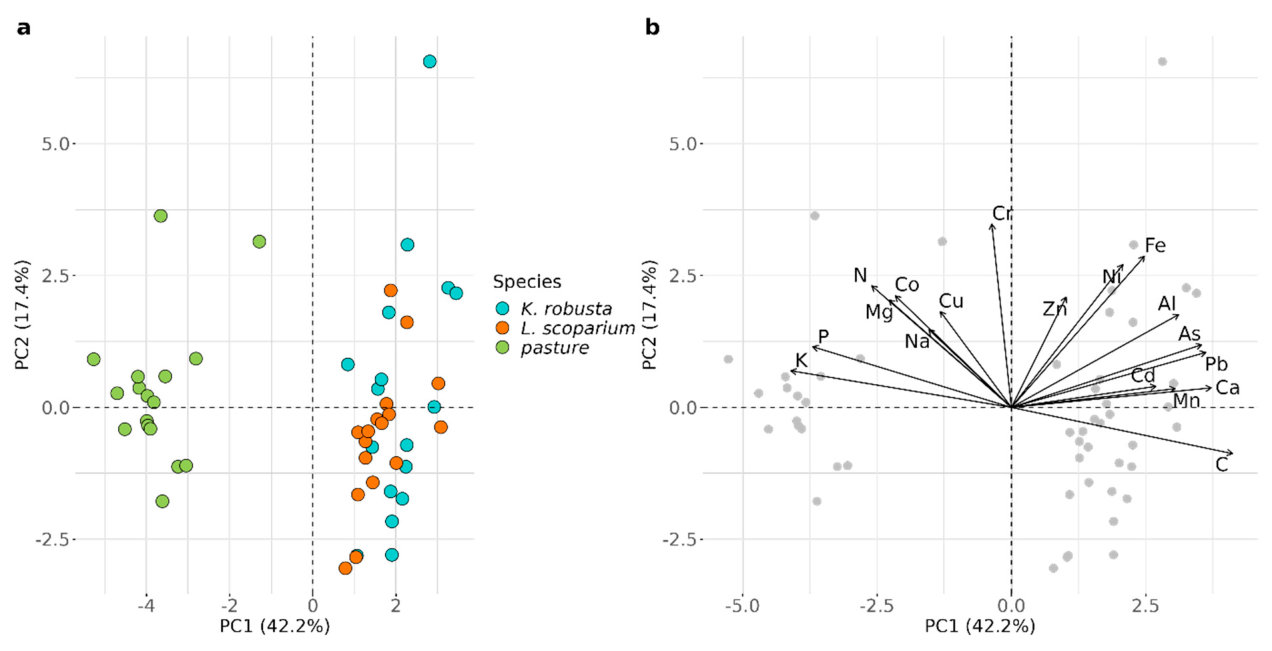
There was no correlation between TMW irrigation rates and K. robusta and L. scoparium height. Similarly, there was no correlation between TMW irrigation rates and pasture biomass (Table 4). This is in contrast with studies by Gutierrez-Gines, et al. [60] and Meister, et al. [19], who found positive growth responses of pasture and native vegetation to TMW irrigation. However, in contrast to these studies, the current site received higher rates of TMW irrigation and had done so for more than 30 years. It is likely that the plants were not limited by nutrient availability and, therefore, did not show a positive growth response to further nutrient addition, particularly because the average application rates of the major plant nutrients, such as N, P, and K, exceeded plant requirements [44]. However, the concentrations of N and P in pasture did not differ from the average NZ values reported by Reiser, et al. [47]. In contrast, the concentrations of N, P, and K in K. robusta and L. scoparium were higher than in other unamended soils [61]. This is consistent with the luxury uptake of nutrients previously observed in native species [24]. The chemical composition of K. robusta and L. scoparium differed from the pasture, which contained higher concentrations of macronutrients and lower concentrations of micronutrients than the Myrtaceae species (Figure 1). However, non-essential trace elements, that may have had a negative effect on plant growth, were similar to or lower than those found elsewhere in L. scoparium [62], K. robusta [63], and pasture [47], which is consistent with the low application rates of these elements (Table 1).
TMW灌溉量与K. robusta和L. scoparium的株高之间无相关性。同样,TMW灌溉量与牧草生物量之间也无相关性(表4)。这与Gutierrez-Gines, et al. [60]和Meister, et al. [19]的研究相反,他们发现牧草和本土植被对TMW灌溉有正向生长响应。然而,与这些研究不同,本研究场地接受了更高的TMW灌溉量,且已持续30年以上。植物很可能未受养分有效性限制,因此对进一步添加养分未表现出正向生长响应,尤其是因为N、P和K等主要植物养分的平均施用量已超过植物需求[44]。不过,牧草中N和P的浓度与Reiser, et al. [47]报道的新西兰平均值无差异。相反,K. robusta和L. scoparium中N、P和K的浓度高于其他未改良土壤中的植株[61]。这与此前在本土物种中观察到的养分奢侈吸收相一致[24]。K. robusta和L. scoparium的化学组成与牧草不同,牧草所含大量元素浓度较高而微量营养元素浓度低于桃金娘科物种(图1)。然而,可能对植物生长产生负面影响的非必需微量元素,与其他地区L. scoparium[62]、K. robusta[63]和牧草[47]中的含量相近或更低,这与这些元素的低施用量相一致(表1)。
| Parameter参数 | Kunzea robustaKunzea robusta | Leptospermum scopariumLeptospermum scoparium | Pasture牧草 |
|---|---|---|---|
| Plant height (cm) | 164 (140–194) | 157 (137–180) | n.d. |
| Plant biomass (g m_−_2) | - | - | 725 (525–835) |
| C (%) | 51 (51–52) a | 52 (52–53) a | 43 (42–44) b |
| N (%) | 2.0 (1.7–2.4) b | 2.2 (1.9–2.5) b | 2.8 (2.2–3.2)[+S ] a |
| Biomass N (kg ha_−_1) | - | - | 204 (135–208)[+S] |
| K (%) | 0.6 (0.5–0.7) b | 0.6 (0.5–0.7)[_−_S] b | 3.7 (3.0–4.4) a |
| P (mg kg_−_1) | 2695 (2272–3196)[+S] b | 2398 (2009–2864) b | 4386 (3926–5314) a |
| Biomass P (kg ha_−_1) | - | - | 32 (24–44) |
Mg (mg kg_−_1) | 1454 (1167–1746) b | 1614 (1371–1827) ab | 1884 (1550–2260) a |
| Na (mg kg_−_1) | 4991 (4097–6082) | 4575 (3745–5588)[+S] | 5480 (3229–7013)[+S ] |
| Zn (mg kg_−_1) | 51 (39–66) a | 30 (23–39)[_−_S] b | 35 (28–54)[+S *] b |
| Mn (mg kg_−_1) | 1341 (907–1983) a | 651 (411–1032)[_−_S] b | 177 (108–338)[_−_S] c |
| Cu (mg kg_−_1) | 3.1 (1.9–5.0) | 3.3 (2.4–4.5)[_−_S *] | 4.2 (3.1–6.1) |
| Cr (mg kg_−_1) | 0.43 (0.22–0.84)[+S] ab | 0.33 (0.18–0.59)[+S] b | 0.57 (0.42–1.3) a |
| As (µg kg_−_1) | 57 (43–77)[+S] a | 67 (49–91) a | 22 (14–30) b |
| Cd (µg kg_−_1) | 17 (10–29) a | 12 (7.4–19) a | 2.4 (0.9–4.1) b |
| Pb (µg kg_−_1) | 82 (55–121)[+S *] a | 83 (54–127) a | 14 (5.3–21)[+S] b |
Values are geometric means and standard deviation ranges (n = 17). Variables that were significantly correlated with TMW irrigation rates (Tables 1–4) are indicated in bold and square brackets; S: p ≤ 0.05, S *: p ≤ 0.01, S **: p ≤ 0.001. Different superscript letters indicate significant differences between species at p ≤ 0.05.
数值为几何平均值和标准差范围(n = 17)。与TMW灌溉量显著相关的变量(表1–4)以粗体标注于方括号中;S:p ≤ 0.05,S *:p ≤ 0.01,S **:p ≤ 0.001。不同上标字母表示物种间在 p ≤ 0.05 水平上差异显著。
There was a significant negative correlation between the heights of K. robusta and L. scoparium and their foliar Na concentrations (Table 4, Figure 2). The foliar concentration of Na was two to three times higher than those reported in naturally established stands of L. scoparium [62]. Similarly, they were up to five and eight times higher than in K. robusta and L. scoparium grown in pot experiments, respectively [18,64]. The pasture Na concentrations were 37% higher than those reported by Gutierrez-Gines, et al. [60] in pasture grown on a Fluvial Recent soil with TMW irrigation at 1672 mm yr−1. Consistent with their study, this shows that pasture Na uptake increases with increased Na application rates. While the TMW contained high concentrations of Na (Table 1), it is possible that sea spray also increased the Na concentrations in plants. The site is located about 1 km east of the coast and strong westerly winds are common in this area, increasing sea spray [65]. It has been demonstrated that sea spray can affect pasture Na concentrations up to 50 km inland [66]. Although Na is not an essential element for most terrestrial plants and can be directly toxic, with woody species being most susceptible [67,68], there were no visual signs indicating such toxicity in K. robusta and L. scoparium.
K. robusta和L. scoparium的株高与其叶片Na浓度呈显著负相关(表4,图2)。叶片Na浓度为L. scoparium天然林分报道值的两到三倍[62]。同样,分别比盆栽试验中生长的K. robusta和L. scoparium高出多达五倍和八倍[18,64]。牧草Na浓度比Gutierrez-Gines, et al. [60]报道的、在以1672 mm yr−1灌溉TMW的冲积新成土上生长的牧草高37%。与该研究一致,这表明牧草对Na的吸收随Na施用量的增加而增加。虽然TMW含有高浓度的Na(表1),但海雾也可能提高了植物中的Na浓度。该场地位于海岸以东约1 km处,该地区常有强西风,会加剧海雾影响[65]。已有研究表明,海雾可影响远至内陆50 km处牧草的Na浓度[66]。尽管Na对大多数陆生植物并非必需元素,且可直接产生毒害(木本物种最为敏感)[67,68],但K. robusta和L. scoparium未表现出此类毒害的可见症状。


3.3. Phytomanagement Potential3.3. 植物管理潜力
The concentrations of plant nutrients in both the top- and subsoil did not differ between plant species (Table 4). This indicates that TMW irrigation at >4000 mm yr−1 and relative nutrient application rates (Table 1) exceeded plant requirements and uptake capacity. The uptake of N by pasture was 204 kg of N ha−1, equivalent to 68 kg of N ha−1 yr−1 during the three years of growth or 3.0% of the TMW-applied N. Similarly, the uptake of P by pasture was 32 kg of P ha−1. This was equivalent to 11 kg of P ha−1 yr−1 or 3.6% of the TMW-applied P. Pasture could therefore likely only remove a fraction of the applied N and P, even if it were harvested regularly. This is not consistent with uptake rates reported for cut-and-carry pasture, where regular harvesting can remove large proportions of the nutrients applied to land with wastewater [60,69]. Furthermore, the elemental composition of the TMW-irrigated pasture might make it unsuitable for stock fodder, with K concentrations exceeding the maximum tolerable levels [70]. Excess dietary K intake in dairy cows is associated with an increased predisposition to milk fever [71].
表土和底土中植物养分浓度在不同植物物种间均无差异(表4)。这表明以 >4000 mm yr−1 灌溉TMW及相应的养分施用量(表1)超过了植物的需求和吸收能力。牧草对N的吸收量为204 kg N ha−1,相当于三年生长期内68 kg N ha−1 yr−1,或TMW施入N的3.0%。同样,牧草对P的吸收量为32 kg P ha−1,相当于11 kg P ha−1 yr−1,或TMW施入P的3.6%。因此,即使定期刈割,牧草也可能仅能移除所施N和P的一小部分。这与刈割饲喂型牧草的报道吸收速率不一致,在后者中,定期刈割可移除随污水施入土地的大部分养分[60,69]。此外,TMW灌溉牧草的元素组成可能使其不适合作为家畜饲料,其K浓度超过了最大耐受水平[70]。奶牛日粮中K摄入过量与产乳热易感性增加有关[71]。
Marden and Lambie [72] found that, regarding L. scoparium, annual rates of biomass production ranged from 27 to 785 kg ha−1 yr−1 at a plant density of 784–1242 plants ha−1. A similar plant density was measured during sampling and represents a survival rate of 8–12% of the initial plantings [73]. At such biomass production rates, and assuming that the measured foliage N and P concentrations are representative for all of the aboveground biomass, this would be equivalent to accumulation rates of 0.6 to 17 kg of N ha−1 yr−1 and 0.06 to 1.8 kg of P ha−1 yr−1. For both elements, these uptake rates are manifold lower than the amount of N and P applied with TMW. The N uptake aligns with that reported in 25-year-old stands of L. scoparium and K. robusta, which are 104 and 22 kg of N ha−1, respectively [74]. These results indicate that pasture has a better potential to extract N and P than the Myrtaceae species. If native plant survival rates were as high as 80%, as reported at another TMW irrigation site in NZ [19], N and P accumulation rates may be eight-fold higher; yet, they would be <50% of the mass that is accumulated by pasture.
Marden and Lambie [72]发现,L. scoparium在784–1242株 ha−1的种植密度下,年生物量生产速率为27至785 kg ha−1 yr−1。采样时测得的种植密度与此相近,相当于初始种植量8–12%的存活率[73]。在此生物量生产速率下,并假设所测叶片N和P浓度可代表全部地上生物量,则相当于0.6至17 kg N ha−1 yr−1和0.06至1.8 kg P ha−1 yr−1的积累速率。对于这两种元素,这些吸收速率均比随TMW施入的N和P量低数倍。该N吸收量与25年生L. scoparium和K. robusta林分的报道值(分别为104和22 kg N ha−1)相符[74]。这些结果表明,牧草提取N和P的潜力优于桃金娘科物种。若本土植物存活率高达80%(如新西兰另一处TMW灌溉场地所报道[19]),N和P的积累速率可能提高八倍;但仍将 <50% 牧草的积累量。
Despite the difference in the N and P uptakes between the tested species, there were no differences in soil nutrients between the Myrtaceae species and pasture (Tables 2 and 3). This indicates that excess N that is not taken up by plants will be lost from the soil. Potential pathways are through the leaching of NO3− and organic N or through gaseous N emissions, following volatilization and denitrification [52]. While previous studies showed different effects of L. scoparium and K. robusta on soil N concentrations, as well as losses compared to other species [25,26], any such effects were likely outweighed by high N application rates at the study site. Therefore, immobile nutrients, such as NO3−, will readily leach from the soil into groundwater, as well as the nearby stream.
尽管所测试物种之间N和P吸收量存在差异,但桃金娘科物种与牧草之间土壤养分并无差异(表2和表3)。这表明未被植物吸收的过量N将从土壤中损失。可能的途径包括NO3−和有机N的淋溶,或经挥发和反硝化作用产生的气态N排放[52]。虽然此前研究表明L. scoparium和K. robusta与其他物种相比对土壤N浓度及N损失具有不同影响[25,26],但在本研究场地,任何此类影响很可能被高N施用量所抵消。因此,NO3−等不易固持的养分将很容易从土壤淋溶进入地下水以及附近溪流。
In contrast to plant macronutrients, the concentrations of some micronutrients and non-essential trace elements (As, Cd, Mn, Pb, and Zn) were significantly higher in the Myrtaceae species than in the pasture. Although trace elements were applied at negligible rates (Table 1), this indicates that K. robusta and L. scoparium may be suitable to manage trace elements from other land-applied biowastes that have higher concentrations thereof, such as biosolids or industrial wastewater [20,28].
与植物大量元素不同,一些微量营养元素和非必需微量元素(As、Cd、Mn、Pb和Zn)在桃金娘科物种中的浓度显著高于牧草。尽管微量元素的施用量可忽略不计(表1),但这表明K. robusta和L. scoparium可能适用于管理其他含较高浓度微量元素的土地施用生物废弃物(如生物固体(污泥)或工业废水)中的微量元素[20,28]。
4Conclusions结论
The application of TMW at a rate of >4000 mm yr−1 did not directly impair the growth of L. scoparium, K. robusta, and pasture, as measured by plant height and biomass after three years of irrigation. However, the application rates of nutrients were higher than what the plants, both the pasture and Myrtaceae species, could uptake or manage, which implies a loss of nutrients into the ground and surface waters, as well as the atmosphere. K. robusta and L. scoparium had higher concentrations of non-essential trace elements, indicating that they are better suited to manage these than pasture. In contrast, the uptake rates of N and P by the Myrtaceae species were estimated to be manifold lower than in pasture. However, to remove nutrients and contaminants from the site and prevent them from re-entering the soil, plant biomass would need to be harvested, for example, to extract high-value essential oils from K. robusta and L. scoparium. Pasture, on the other hand, could be used as cut-and-carry fodder; but, its K concentration would need to be monitored to not exceed stock fodder limits. This study highlights that TMW application rates must be adjusted to plant requirements and phytoremediation potential to avoid the losses of nutrients and contaminants from TMW-irrigated land. Future research should quantify nutrient losses, occurring through leaching and gaseous emissions, for example, from TMW-irrigated native vegetation. This will allow for the selection of suitable native species for the management of TMW to provide ecological and biodiversity benefits from TMW-irrigated land.
以 >4000 mm yr−1 施用TMW并未直接损害L. scoparium、K. robusta和牧草的生长(以灌溉三年后的株高和生物量衡量)。然而,养分施用量超过了植物(包括牧草和桃金娘科物种)所能吸收或管理的量,这意味着养分会损失进入地下水和地表水以及大气。K. robusta和L. scoparium中非必需微量元素浓度较高,表明其比牧草更适合管理这些元素。相反,据估算桃金娘科物种对N和P的吸收速率比牧草低数倍。然而,为了将养分和污染物从场地移除并防止其重新进入土壤,需要收获植物生物量,例如从K. robusta和L. scoparium中提取高价值精油。另一方面,牧草可用作刈割饲喂饲料,但需监测其K浓度以免超过家畜饲料限值。本研究强调,TMW施用量必须根据植物需求和植物修复潜力进行调整,以避免TMW灌溉土地中养分和污染物的损失。未来研究应量化例如TMW灌溉本土植被下经淋溶和气态排放发生的养分损失。这将有助于筛选适合管理TMW的本土物种,使TMW灌溉土地产生生态和生物多样性效益。
Author Contributions: Conceptualization, A.M., M.J.G.-G., H.L. and B.R.; Data curation, A.M.; Formal analysis, A.M.; Funding acquisition, M.J.G.-G., H.L. and B.R.; Investigation, A.M. and M.J.G.-G.; Methodology, A.M., M.J.G.-G. and B.R.; Project administration, M.J.G.-G., H.L. and B.R.; Resources, M.J.G.-G., H.L. and B.R.; Supervision, M.J.G.-G. and B.R.; Visualization, A.M.; Writing— original draft, A.M.; Writing—review and editing, A.M., M.J.G.-G., H.L. and B.R. All authors have read and agreed to the published version of the manuscript.
作者贡献:构思,A.M.、M.J.G.-G.、H.L.和B.R.;数据整理,A.M.;形式分析,A.M.;获取资助,M.J.G.-G.、H.L.和B.R.;调查研究,A.M.和M.J.G.-G.;方法学,A.M.、M.J.G.-G.和B.R.;项目管理,M.J.G.-G.、H.L.和B.R.;资源,M.J.G.-G.、H.L.和B.R.;指导,M.J.G.-G.和B.R.;可视化,A.M.;写作——初稿,A.M.;写作——审阅与编辑,A.M.、M.J.G.-G.、H.L.和B.R.。所有作者均已阅读并同意手稿的发表版本。
Funding: This study was funded by the Ministry for the Environment Freshwater Improvement Fund [grant number 22127] and the Horowhenua District Council, New Zealand. Further funding was derived from the Institute of Environmental Science and Research Ltd. (ESR) Strategic Science Investment Funding from the Ministry of Business, Innovation and Employment, New Zealand [grant number C03x1701].
基金资助:本研究由新西兰环境部淡水改善基金(Ministry for the Environment Freshwater Improvement Fund)[资助编号22127]和新西兰Horowhenua District Council资助。另有资助来自新西兰商业、创新与就业部(Ministry of Business, Innovation and Employment)对Institute of Environmental Science and Research Ltd.(ESR)的战略科学投资基金(Strategic Science Investment Funding)[资助编号C03x1701]。
Data Availability Statement: The data presented in this study are available on request from the corresponding author.
数据可用性声明:本研究所呈现的数据可向通讯作者索取。
Acknowledgments: We thank Izzie Alderton for her assistance with soil and plant sample collection. The lead author gratefully acknowledges the receipt of a University of Canterbury Doctoral Scholarship.
致谢:感谢Izzie Alderton协助采集土壤和植物样品。第一作者衷心感谢坎特伯雷大学博士奖学金的资助。
Conflicts of Interest: The authors declare no conflict of interest.
利益冲突:作者声明无利益冲突。
References参考文献
1. Morris, L.; Colombo, V.; Hassell, K.; Kellar, C.; Leahy, P.; Long, S.M.; Myers, J.H.; Pettigrove, V. Municipal wastewater effluent licensing: A global perspective and recommendations for best practice. Sci. Total Environ. 2017, 580, 1327–1339. [CrossRef] 2. Liu, D.H.F.; Lipták, B.G. Wastewater Treatment; CRC Press: Boca Raton, FL, USA, 2000.
3. Jones, E.R.; van Vliet, M.T.H.; Qadir, M.; Bierkens, M.F.P. Country-level and gridded wastewater production, collection, treatment and re-use. Earth Syst. Sci. Data 2021, 13, 237–254. [CrossRef]
4. WWAP (United Nations World Water Assessment Programme). The United Nations World Water Development Report 2017. Wastewater: The Untapped Resource; UNESCO: Paris, France, 2017.
5. Sato, T.; Qadir, M.; Yamamoto, S.; Endo, T.; Zahoor, A. Global, regional, and country level need for data on wastewater generation, treatment, and use. Agric. Water Manag. 2013, 130, 1–13. [CrossRef]
6. Gluckman, P. New Zealand’s Fresh Waters: Values, State, Trends, and Human Impacts; Office of the Prime Minister’s Chief Science Advisor: Auckland, New Zealand, 2017.
7. Davies-Colley, R.J. River water quality in New Zealand: An introduction and overview. In Ecosystem Services in New Zealand— Conditions and Trends; Dymond, J.R., Ed.; Manaaki Whenua Press: Lincoln, New Zealand, 2013; pp. 423–447.
8. McDowell, R.W.; Larned, S.T.; Houlbrooke, D.J. Nitrogen and phosphorus in New Zealand streams and rivers: Control and impact of eutrophication and the influence of land management. N. Z. J. Mar. Freshw. Res. 2009, 43, 985–995. [CrossRef]
9. Spellman, F.R. Handbook of Water and Wastewater Treatment Plant Operations, 3rd ed.; CRC Press: Boca Raton, FL, USA, 2014.
10. Tzanakakis, V.A.; Paranychianakis, N.V.; Angelakis, A.N. Nutrient removal and biomass production in land treatment systems receiving domestic effluent. Ecol. Eng. 2009, 35, 1485–1492. [CrossRef]
11. Pedrero, F.; Kalavrouziotis, I.; Alarcón, J.J.; Koukoulakis, P.; Asano, T. Use of treated municipal wastewater in irrigated agriculture— Review of some practices in Spain and Greece. Agric. Water Manag. 2010, 97, 1233–1241. [CrossRef]
12. Ataria, J.; Baker, V.; Goven, J.; Langer, E.R.; Leckie, A.; Ross, M.; Horswell, J. From Tapu to Noa—Maori Cultural Views on Biowastes¯ Management: A Focus on Biosolids; Centre for Integrated Biowaste Research: Christchurch, New Zealand, 2016.
13. Kivaisi, A.K. The potential for constructed wetlands for wastewater treatment and reuse in developing countries: A review. Ecol. Eng. 2001, 16, 545–560. [CrossRef]
14. Qian, Y.L.; Mecham, B. Long-term effects of recycled wastewater irrigation on soil chemical properties on golf course fairways. Agron. J. 2005, 97, 717–721. [CrossRef]
15. Hänel, M.; Isteniˇc, D.; Brix, H.; Arias, C.A. Wastewater-Fertigated Short-Rotation Coppice, a Combined Scheme of Wastewater Treatment and Biomass Production: A State-of-the-Art Review. Forests 2022, 13, 810. [CrossRef]
16. Evett, S.R.; Zalesny, R.S.; Kandil, N.F.; Stanturf, J.A.; Soriano, C. Opportunities for Woody Crop Production Using Treated Wastewater in Egypt. II. Irrigation Strategies. Int. J. Phytoremediation 2011, 13, 122–139. [CrossRef]
17. Williams, M.C.; Wardle, G.M. Pinus radiata invasion in Australia: Identifying key knowledge gaps and research directions. Austral Ecol. 2007, 32, 721–739. [CrossRef]
18. Esperschuetz, J.; Anderson, C.; Bulman, S.; Katamian, O.; Horswell, J.; Dickinson, N.M.; Robinson, B.H. Response of Leptospermum scoparium, Kunzea robusta and Pinus radiata to contrasting biowastes. Sci. Total Environ. 2017, 587–588, 258–265. [CrossRef] [PubMed]
19. Meister, A.; Li, F.; Gutierrez-Gines, M.J.; Dickinson, N.; Gaw, S.; Bourke, M.; Robinson, B. Interactions of treated municipal wastewater with native plant species. Ecol. Eng. 2022, 183, 106741. [CrossRef]
20. Sharma, P.; Tripathi, S.; Purchase, D.; Chandra, R. Integrating phytoremediation into treatment of pulp and paper industry wastewater: Field observations of native plants for the detoxification of metals and their potential as part of a multidisciplinary strategy. J. Environ. Chem. Eng. 2021, 9, 105547. [CrossRef]
21. Hasan, S.M.M.; Akber, M.A.; Bahar, M.M.; Islam, M.A.; Akbor, M.A.; Siddique, M.A.B.; Islam, M.A. Chromium contamination from tanning industries and Phytoremediation potential of native plants: A study of savar tannery industrial estate in Dhaka, Bangladesh. Bull. Environ. Contam. Toxicol. 2021, 1–9. [CrossRef]
22. Simcock, R.; Cavanagh, J.; Robinson, B.; Gutierrez-Gines, M.J. Using biowastes to establish native plants and ecosystems in New Zealand. Front. Sustain. Food Syst. 2019, 3. [CrossRef]
23. McAlpine, K.G.; Wotton, D.M. Conservation and the Delivery of Ecosystem Services; Department of Conservation: Wellington, New Zealand, 2009.
24. Franklin, H.M.; Dickinson, N.M.; Esnault, C.J.D.; Robinson, B.H. Native plants and nitrogen in agricultural landscapes of New Zealand. Plant Soil 2015, 394, 407–420. [CrossRef]
25. Esperschuetz, J.; Balaine, N.; Clough, T.; Bulman, S.; Dickinson, N.M.; Horswell, J.; Robinson, B.H. The potential of L. scoparium, K. robusta and P. radiata to mitigate N-losses in silvopastural systems. Environ. Pollut. 2017, 225, 12–19. [CrossRef]
26. Franklin, H.M.; Woods, R.R.; Robinson, B.; Dickinson, N. Nitrous oxide emissions following dairy shed effluent application beneath Kunzea robusta (Myrtaceae) trees. Ecol. Eng. 2017, 99, 473–478. [CrossRef]
27. Wardle, P. Environmental influences on the vegetation of New Zealand. N. Z. J. Bot. 1985, 23, 773–788. [CrossRef]
28. Gutierrez-Gines, M.J.; Robinson, B.H.; Esperschuetz, J.; Madejon, E.; Horswell, J.; McLenaghen, R. Potential Use of Biosolids to Reforest Degraded Areas with New Zealand Native Vegetation. J. Environ. Qual. 2017, 46, 906–914. [CrossRef]
29. GHD. The Pot Levin WWTP. Groundwater Assessment; GHD: Christchurch, New Zealand, 2018.
30. Ayers, R.S.; Westcot, D.W. Water Quality for Agriculture. FAO Irrigation and Drainage Paper 29 Rev. 1; FAO: Rome, Italy, 1985.
31. MWLR (Manaaki Whenua Landcare Research). Soils Map Viewer. Available online: https://soils-maps.landcareresearch.co.nz/ #maps (accessed on 12 April 2023).
32. Chappell, P.R. The Climate and Weather of Manawatu-Wanganui, 2nd ed.; NIWA: Wellington, New Zealand, 2015.
33. Blakemore, L.C.; Searle, P.L.; Daly, B.K. Methods for Chemical Analysis of Soils; NZ Soil Bureau: Lower Hutt, New Zealand, 1987. 34. Miranda, K.M.; Espey, M.G.; Wink, D.A. A rapid, simple spectrophotometric method for simultaneous detection of nitrate and nitrite. Nitric Oxide 2001, 5, 62–71. [CrossRef] [PubMed]
35. Mulvaney, R.L. Nitrogen–Inorganic Forms. In Methods of Soil Analysis: Part 3 Chemical Methods; Sparks, D.L., Page, A.L., Helmke, P.A., Leoppert, R.H., Soltanpour, P., Tabatabai, N., Johnston, M.A., Summer, M.E., Eds.; Soil Science Society of America and American Society of Agronomy: Madison, WI, USA, 1996.
36. Gray, C.W.; McLaren, R.G.; Roberts, A.H.C.; Condron, L.M. Effect of soil pH on cadmium phytoavailability in some New Zealand soils. N. Z. J. Crop. Hortic. Sci. 1999, 27, 169–179. [CrossRef]
37. Olsen, S.R.; Cole, C.V.; Watanabe, F.S.; Dean, L.A. Estimation of Available Phosphorus in Soils by Extraction With Sodium Bicarbonate; United States Department of Agriculture: Washington, DC, USA, 1954.
38. Kassambara, A.; Mundt, F. Factoextra: Extract and Visualize the Results of Multivariate Data Analyses. R Package Version 1.0.7. Available online: https://cran.r-project.org/web/packages/factoextra/index.html (accessed on 20 May 2023).
39. Sparling, G.P.; Schipper, L.A. Ecological risk assessment: Soil quality at a national scale in New Zealand. J. Environ. Qual. 2002, 31, 1848–1857. [CrossRef]
40. Sparling, G.P.; Barton, L.; Duncan, L.; McGill, A.; Speir, T.W.; Schipper, L.A.; Arnold, G.; Van Schaik, A. Nutrient leaching and changes in soil characteristics of four contrasting soils irrigated with secondary-treated municipal wastewater for four years. Aust. J. Soil Res. 2006, 44, 104–116. [CrossRef]
41. Walker, C.; Lin, H.S. Soil property changes after four decades of wastewater irrigation: A landscape perspective. Catena 2008, 73, 63–74. [CrossRef]
42. Goulding, K.W.T. Soil acidification and the importance of liming agricultural soils with particular reference to the United Kingdom. Soil Use Manag. 2016, 32, 390–399. [CrossRef]
43. Cameron, K.C.; Di, H.J.; Moir, J.L. Nitrogen losses from the soil/plant system: A review. Ann. Appl. Biol. 2013, 162, 145–173. [CrossRef]
44. FAO. User Manual for Irrigation with Treated Wastewater; FAO Regional Office of the Near East: Cairo, Egypt, 2003.
45. Vogeler, I. Effect of Long-term Wastewater Application on Physical Soil Properties. Water Air Soil Pollut. 2009, 196, 385–392. [CrossRef]
46. Farahani, E.; Emami, H.; Keller, T. Impact of monovalent cations on soil structure. Part II. Results of two Swiss soils. Int. Agrophysics 2018, 32, 69–80. [CrossRef]
47. Reiser, R.; Simmler, M.; Portmann, D.; Clucas, L.; Schulin, R.; Robinson, B. Cadmium concentrations in New Zealand pastures: Relationships to soil and climate variables. J. Environ. Qual. 2014, 43, 917–925. [CrossRef]
48. McLaren, R.G.; Cameron, K.C. Soil Science: Sustainable Production and Environmental Protection; Oxford University Press: Oxford, UK, 1996.
49. Barton, L.; McLay, C.D.A.; Schipper, L.A.; Smith, C.T. Denitrification rates in a wastewater-irrigated forest soil in New Zealand. J. Environ. Qual. 1999, 28, 2008–2014. [CrossRef]
50. Di, H.J.; Cameron, K.C. Nitrate leaching in temperate agroecosystems: Sources, factors and mitigating strategies. Nutr. Cycl. Agroecosystems 2002, 46, 237–256. [CrossRef]
51. McDowell, R.W.; Condron, L.M. Estimating phosphorus loss from New Zealand grassland soils. N. Z. J. Agric. Res. 2004, 47, 137–145. [CrossRef]
52. Barton, L.; Schipper, L.A.; Barkle, G.F.; McLeod, M.; Speir, T.W.; Taylor, M.D.; McGill, A.C.; van Schaik, A.P.; Fitzgerald, N.B.; Pandey, S.P. Land Application of Domestic Effluent onto Four Soil Types: Plant Uptake and Nutrient Leaching. J. Environ. Qual. 2005, 34, 635–643. [CrossRef]
53. Taylor, M.; Drewry, J.; Curran-Cournane, F.; Pearson, L.; McDowell, R.; Lynch, B. Soil quality targets for Olsen P for the protection of environmental values. In Integrated Nutrient and Water Management for Sustainable Farming. Occasional Report No. 29; Currie, L.D., Singh, R., Eds.; Fertilizer and Lime Research Centre, Massey University: Palmerston North, New Zealand, 2016; p. 12.
54. Drewry, J.J.; Cavanagh, J.-A.E.; McNeill, S.J.; Stevenson, B.A.; Gordon, D.A.; Taylor, M.D. Long-term monitoring of soil quality and trace elements to evaluate landuse effects and temporal change in the Wellington region, New Zealand. Geoderma Reg. 2021, 25, e00383. [CrossRef]
55. Mittelstet, A.R.; Heeren, D.M.; Fox, G.A.; Storm, D.E.; White, M.J. Comparison of subsurface and surface runoff phosphorus transport rates in alluvial floodplains. Agric. Ecosyst. Environ. 2011, 141, 417–425. [CrossRef]
56. Smith, V.H.; Schindler, D.W. Eutrophication science: Where do we go from here? Trends Ecol. Evol. 2009, 24, 201–207. [CrossRef]
57. Chen, C.R.; Condron, L.M.; Sinaj, S.; Davis, M.R.; Sherlock, R.R.; Frossard, E. Effects of plant species on phosphorus availability in a range of grassland soils. Plant Soil 2003, 256, 115–130. [CrossRef]
58. Bradl, H.B. Adsorption of heavy metal ions on soils and soils constituents. J. Colloid Interface Sci. 2004, 277, 1–18. [CrossRef]
59. Moreno-Jiménez, E.; Esteban, E.; Peñalosa, J.M. The Fate of Arsenic in Soil-Plant Systems. In Reviews of Environmental Contamination and Toxicology; Whitacre, D.M., Ed.; Springer: New York, NY, USA, 2012; pp. 1–37.
60. Gutierrez-Gines, M.J.; Mishra, M.; McIntyre, C.; Chau, H.W.; Esperschuetz, J.; McLenaghen, R.; Bourke, M.P.; Robinson, B.H. Risks and benefits of pasture irrigation using treated municipal effluent: A lysimeter case study, Canterbury, New Zealand. Environ. Sci. Pollut. Res. 2020, 27, 11830–11841. [CrossRef]
61. Dickinson, N.; Marmiroli, M.; Das, B.; McLaughlin, D.; Leung, D.; Robinson, B. Endemic Plants as Browse Crops in Agricultural Landscapes of New Zealand. Agroecol. Sustain. Food Syst. 2015, 39, 224–242. [CrossRef]
62. Meister, A.; Gutierrez-Gines, M.J.; Maxfield, A.; Gaw, S.; Dickinson, N.; Horswell, J.; Robinson, B. Chemical elements and the quality of m¯anuka (Leptospermum scoparium) honey. Foods 2021, 10, 1670. [CrossRef]
63. Hahner, J.L.; Robinson, B.H.; Hong-Tao, Z.; Dickinson, N.M. The phytoremediation potential of native plants on New Zealand dairy farms. Int. J. Phytoremediation 2014, 16, 719–734. [CrossRef] [PubMed]
64. Reis, F.V.P.; Gutiérrez-Ginés, M.J.; Smith, C.M.S.; Lehto, N.J.; Robinson, B.H. Manuka (¯Leptospermum scoparium ) roots forage biosolids in low fertility soil. Environ. Exp. Bot. 2017, 133, 151–158. [CrossRef]
65. KCDC (K¯apiti Coast District Council). A Guide to Growing Native Plants in Kapiti; KCDC: Paraparaumu, New Zealand, 1999.
66. Jensen, H.; Orth, B.; Reiser, R.; Bürge, D.; Lehto, N.J.; Almond, P.; Gaw, S.; Thomson, B.; Lilburne, L.; Robinson, B. Environmental parameters affecting the concentration of iodine in New Zealand pasture. J. Environ. Qual. 2019, 48, 1517–1523. [CrossRef] [PubMed]
67. Bernstein, L. Effects of salinity and sodicity on plant growth. Annu. Rev. Phytopathol. 1975, 13, 295–312. [CrossRef]
68. Maathuis, F.J. Sodium in plants: Perception, signalling, and regulation of sodium fluxes. J. Exp. Bot. 2014, 65, 849–858. [CrossRef] 69. Luo, J.; Lindsey, S.; Xue, J. Irrigation of meat processing wastewater onto land. Agric. Ecosyst. Environ. 2004, 103, 123–148. [CrossRef]
70. National Research Council. Mineral Tolerance of Animals, 2nd ed.; National Academies Press: Washington, DC, USA, 2005.
71. Horst, R.L.; Goff, J.P.; Reinhardt, T.A.; Buxton, D.R. Strategies for Preventing Milk Fever in Dairy Cattle1, 2. J. Dairy Sci. 1997, 80, 1269–1280. [CrossRef]
72. Marden, M.; Lambie, S. Plot-Based, Growth Performance of Space-Planted Manuka (Leptospermum scoparium) on Marginal Land, and¯ Vulnerability to Erosion; Ministry for Primary Industries: Wellington, New Zealand, 2016.
73. Meister, A.; Robinson, B.; Gutiérrez-Ginés, M.J. Water Quality Improvement in the Waiwiri Catchment through Strategic Establishment of Native Ecosystems with Bioactive Properties Used at a Land Treatment Site; ESR and University of Canterbury: Christchurch, New Zealand, 2023.
74. Scott, N.A.; White, J.D.; Townsend, J.A.; Whitehead, D.; Leathwick, J.R.; Hall, G.M.J.; Marden, M.; Rogers, G.N.D.; Watson, A.J.; Whaley, P.T. Carbon and nitrogen distribution and accumulation in a New Zealand scrubland ecosystem. Can. J. For. Res. 2000, 30, 1246–1255. [CrossRef]
Disclaimer/Publisher’s Note: The statements, opinions and data contained in all publications are solely those of the individual author(s) and contributor(s) and not of MDPI and/or the editor(s). MDPI and/or the editor(s) disclaim responsibility for any injury to people or property resulting from any ideas, methods, instructions or products referred to in the content.