M. J. Gutiérrez‑Ginés · N. J. Lehto · E. Madejón · B. H. Robinson
Received: 29 March 2023 / Accepted: 9 April 2023 / Published online: 17 April 2023 © The Author(s) 2023
1Abstract摘要
Purpose Incorporating biosolids into the soil improves plant yield compared with surface application, but it can result in the increased uptake of trace elements. However, there is a lack of knowledge about how different types of biosolids applications affect soil quality. We aimed to determine the effect of the type and rate of biosolids application on soil quality and the mobility of contaminants. Methods Soil quality was determined by soil fertility (inorganic N, exchangeable P, Mg, Ca, K), exchangeable trace and non-essential elements (Al,
目的 与表面施用相比,将生物固体(污泥)混入土壤可提高植物产量,但也可能导致植物对微量元素的吸收增加。然而,目前对于不同生物固体施用方式如何影响土壤质量尚缺乏认识。本研究旨在确定生物固体的施用方式和施用量对土壤质量及污染物迁移性的影响。方法 通过土壤肥力(无机N,交换性P、Mg、Ca、K)、交换性微量元素及非必需元素(Al、
Responsible Editor: Ismail Cakmak.
Supplementary information The online version contains supplementary material available at https:// doi. org/ 10. 1007/ s11104- 023- 06029-z.
补充信息 在线版本包含补充材料,可通过 https:// doi. org/ 10. 1007/ s11104- 023- 06029-z 获取。
M. J. Gutiérrez-Ginés · N. J. Lehto · B. H. Robinson Faculty of Agriculture and Life Sciences, Lincoln University, Lincoln, New Zealand
M. J. Gutiérrez-Ginés · N. J. Lehto · B. H. Robinson 林肯大学农业与生命科学学院,新西兰林肯
M. J. Gutiérrez-Ginés (*) Institute of Environmental Science and Research Ltd, Christchurch, New Zealand e-mail: maria.gines@esr.cri.nz
E. MadejónE. Madejón
The Institute of Natural Resources and Agrobiology of Seville (IRNAS), CSIC, Sevilla, Spain
塞维利亚自然资源与农业生物学研究所(IRNAS),西班牙国家研究委员会(CSIC),西班牙塞维利亚
Mn, Zn, Cu and Cd) and biological activity (dehydrogenase activity). We measured the properties of soil pore water, bulk soil and rhizosphere in a pot and a rhizobox experiment, with increasing concentration of biosolids (equiv. 16 t ha− 1, 48 t ha− 1 and 145 t ha− 1 dry weight), applied on the surface, incorporated to 25 cm, or incorporated into a patch.
Mn、Zn、Cu和Cd)以及生物活性(脱氢酶活性)来表征土壤质量。在盆栽试验和根箱试验中,我们测定了土壤孔隙水、土体土壤和根际土壤的性质,生物固体浓度逐级增加(相当于干重16 t ha− 1、48 t ha− 1和145 t ha− 1),施用方式为表面施用、混入0–25 cm土层或以斑块形式混入土壤。
Results and discussion The incorporation of biosolids into the soil increased the exchangeable Zn, Cu, Cr, Ni and Cd, compared with surface application. The surface application of biosolids increased the inorganic N in the soil compared with biosolids incorporation (680 mg kg− 1 vs. 380 mg kg− 1), and decreased soil pH by 1.1 units. This aligned with solubilisation of Al (43 mg kg− 1 vs. 6 mg kg− 1) and Mn (43 mg kg− 1 vs. 33 mg kg− 1) and explains the decreased microbial activity in the soil compared with the unamended soil. Incorporating biosolids in the soil increased the biological activity, likely due to biosolids-borne microbes. The root systems significantly increased microbial activity, pH, and the concentration of NH4+, NO3−, and exchangeable P, S, Mg, Na, Zn, Cu and Ni, and significantly decreased exchangeable concentration of Mn and Fe.
结果与讨论 与表面施用相比,将生物固体混入土壤提高了交换性Zn、Cu、Cr、Ni和Cd的含量。与混入土壤相比,表面施用生物固体提高了土壤无机N含量(680 mg kg− 1对380 mg kg− 1),并使土壤pH降低1.1个单位。这与Al(43 mg kg− 1对6 mg kg− 1)和Mn(43 mg kg− 1对33 mg kg− 1)的溶出相一致,并解释了与未改良土壤相比土壤微生物活性下降的原因。将生物固体混入土壤提高了生物活性,这可能源于生物固体自身携带的微生物。根系显著提高了微生物活性、pH以及NH4+、NO3−和交换性P、S、Mg、Na、Zn、Cu和Ni的含量,并显著降低了交换性Mn和Fe的含量。
Keywords Plant nutrients · Trace elements · Incorporation · Surface application · Root systems
关键词 植物养分 · 微量元素 · 混施 · 表面施用 · 根系
B. H. Robinson
School of Physical and Chemical Sciences, University of Canterbury, Christchurch, New Zealand
坎特伯雷大学物理与化学科学学院,新西兰基督城
2Introduction引言
Biosolids are a by-product from the treatment of wastewater. Biosolids can be used to improve soil through the addition of organic matter and plant nutrients, yet their reuse is limited by elevated concentrations of contaminants and pathogens (Gianico et al. 2021). Research on the beneficial reuse of biosolids started at Pennsylvania University in the early 1960s (Sopper and Kardos 1974), and in some U.S. jurisdictions, biosolids reuse became a common, but regulated practice since the 1970s (Lu et al. 2012). Agriculture is the preferred option for the reuse of biosolids in many countries: nearly 50% of biosolids are applied to agricultural soil in the EU and USA (Collivignarelli et al. 2019; LeBlanc et al. 2008), and up to 70% in Australia (ANZBP 2020). In contrast, in New Zealand (NZ) only 3% of biosolids are used in agriculture, with ~ 77% of biosolids being landfilled, monofilled, stockpiled or discharged into the ocean (Stantec 2019). Due to social and cultural concerns about using biosolids in food-production systems (Ataria et al. 2016), beneficial reuse of biosolids in NZ tends to be restricted to forestry (Xue et al. 2015), or restoration of degraded land into native ecosystems (Simcock et al. 2019).
生物固体(污泥)是污水处理的副产物。生物固体可通过补充有机质和植物养分来改良土壤,但其回用受到污染物和病原体含量较高的限制(Gianico et al. 2021)。关于生物固体有益回用的研究始于20世纪60年代初的宾夕法尼亚大学(Sopper and Kardos 1974),自20世纪70年代以来,在美国部分司法管辖区,生物固体回用已成为一种普遍但受监管的做法(Lu et al. 2012)。在许多国家,农业是生物固体回用的首选途径:在欧盟和美国,近50%的生物固体施用于农业土壤(Collivignarelli et al. 2019; LeBlanc et al. 2008),在澳大利亚这一比例高达70%(ANZBP 2020)。相比之下,在新西兰(NZ),仅有3%的生物固体用于农业,约77%的生物固体被填埋、单一填埋、堆存或排入海洋(Stantec 2019)。由于社会和文化层面对在粮食生产系统中使用生物固体的顾虑(Ataria et al. 2016),新西兰生物固体的有益回用往往仅限于林业(Xue et al. 2015)或将退化土地恢复为本土生态系统(Simcock et al. 2019)。
Biosolids application into degraded soils increases soil organic matter and plant nutrient concentrations (Gravuer et al. 2019; Madejón et al. 2016; Wang et al. 2008) and improves infiltration and aeration (Gravuer et al. 2019; Lu et al. 2012). The application of biosolids for ecosystem restoration is different from the application to productive systems. Biosolids used for productive systems such as agriculture or forestry need a recurrent application (Alvarez-Campos and Evanylo 2019; Nicholson et al. 2018; Wang et al. 2004), which in NZ is limited to 200 kg N/ha/y, which equals to ~ 5 t ha–1 of biosolids depending on the N concentration (NZWWA, 2003). In the case of use in restoration, the most likely scenario is a oneoff application of biosolids to enhance plant establishment (Fuentes et al. 2010; Newman et al. 2014), with no additional biosolids applications (Borden and Black 2011). When biosolids are used to establish vegetation in degraded areas, the underlying soil may be contaminated or entirely absent, such as in the case of disused mines (Borden and Black 2011), or quarries (Moreno-Peñaranda et al. 2004). The application rate is usually higher for ecosystem restoration than in agricultural use, and rates that have been researched vary between 10 and 500 t ha− 1 (Borden and Black 2011; Fuentes et al. 2010; Moreno-Peñaranda et al. 2004). This has implications for the best application and management methods. High application rates can result in an initial pulse of nitrate leaching, which can be reduced by blending biosolids with other organic waste with a higher C:N ratio (Paramashivam et al. 2017). Similarly, nitrate leaching may be reduced by using species with biological nitrification inhibition (BNI) activity (Esperschuetz et al. 2017; Halford et al. 2021) showed both reduced nitrate leaching and nitrous oxide emissions in soils exposed to high rates of nitrogen inputs where Leptospermum scoparium (mānuka) was grown. L. scoparium is a pioneer plant species native to New Zealand (Stephens et al. 2005), which is frequently used in restoration plantings. In addition to the environmental benefits of growing L. scoparium on biosolid-amended soils, this species has both cultural and economic significance for honey and essential oil production (Stephens et al. 2005).
向退化土壤施用生物固体(污泥)可提高土壤有机质和植物养分含量(Gravuer et al. 2019; Madejón et al. 2016; Wang et al. 2008),并改善入渗和通气性(Gravuer et al. 2019; Lu et al. 2012)。用于生态系统恢复的生物固体施用不同于用于生产系统的施用。用于农业或林业等生产系统的生物固体需要重复施用(Alvarez-Campos and Evanylo 2019; Nicholson et al. 2018; Wang et al. 2004),在新西兰其施用量上限为200 kg N/ha/y,根据N含量的不同,约相当于5 t ha–1生物固体(NZWWA, 2003)。在用于生态恢复的情况下,最可能的方式是一次性施用生物固体以促进植物定植(Fuentes et al. 2010; Newman et al. 2014),此后不再追加施用(Borden and Black 2011)。当利用生物固体在退化区域建立植被时,下层土壤可能已受污染或完全缺失,例如废弃矿山(Borden and Black 2011)或采石场(Moreno-Peñaranda et al. 2004)。生态系统恢复中的施用量通常高于农业利用,已有研究的施用量介于10至500 t ha− 1之间(Borden and Black 2011; Fuentes et al. 2010; Moreno-Peñaranda et al. 2004)。这对最佳施用和管理方法具有重要影响。高施用量可能导致初期出现硝酸盐淋溶高峰,而将生物固体与C:N比较高的其他有机废弃物混合可减轻这一现象(Paramashivam et al. 2017)。同样,利用具有生物硝化抑制(BNI)活性的物种也可减少硝酸盐淋溶(Esperschuetz et al. 2017; Halford et al. 2021),研究表明,在种植Leptospermum scoparium(麦卢卡)的高氮输入土壤中,硝酸盐淋溶和氧化亚氮排放均有所降低。L. scoparium是新西兰本土的先锋植物物种(Stephens et al. 2005),常用于生态恢复种植。除在生物固体改良土壤上种植L. scoparium所带来的环境效益外,该物种在蜂蜜和精油生产方面还具有文化和经济意义(Stephens et al. 2005)。
Biosolids application may alter ecological succession and result in ecosystems that are dissimilar to the restoration objectives (Borden and Black 2011; Moreno-Peñaranda et al. 2004; Newman et al. 2014; Simcock et al. 2019). Altering biosolids type and rate of application can address some of these challenges. Biosolids can be applied to the land as a surface application, where the biosolids are spread on the surface of the soil without further management, or they can be incorporated into the soil, where ploughing ensures the blending of the biosolids into the soil. Alternatively, biosolids can be blended with other substrates as soil substitution in mine or quarry rehabilitation. Incorporation of biosolids is usually a preferred option for reducing the potential spread of pathogens or contaminants via run-off (NZWWA 2003). However, for restoration, ploughing exacerbates the loss of existing vegetation, and potentially increases soil erosion (Alvarez and Steinbach 2009). Reis et al. (2017) showed in a pot experiment that surface application of biosolids decreased the plant uptake of certain trace elements compared with incorporation into the soil. The roots of some plants can forage patches of biosolids in the soil, showing similar growth rates as plants growing in surface applied or incorporated biosolids into the soil (Gutiérrez-Ginés et al. 2019; Reis et al. 2017). The rate of biosolids application can also be managed for achieving preferred outcomes. For example, Martínez et al. (2003) showed that grassland species richness decreased while plant cover increased with higher rates of biosolids. Gutiérrez-Ginés et al. (2019) and Seyedalikhani et al. (2019) showed that increasing rates of biosolids had beneficial effects on plant growth up to an optimum beyond which plant health started to be compromised.
施用生物固体(污泥)可能改变生态演替,导致形成与恢复目标不同的生态系统(Borden and Black 2011; Moreno-Peñaranda et al. 2004; Newman et al. 2014; Simcock et al. 2019)。调整生物固体的施用方式和施用量可以应对其中部分挑战。生物固体可以表面施用的方式施于土地,即将生物固体撒布于土壤表面而不做进一步处理;也可混入土壤,即通过翻耕使生物固体与土壤充分混合。此外,在矿山或采石场修复中,生物固体还可与其他基质混合作为土壤替代物。混入土壤通常是减少病原体或污染物经地表径流扩散的首选方式(NZWWA 2003)。然而,在生态恢复中,翻耕会加剧现有植被的丧失,并可能加剧土壤侵蚀(Alvarez and Steinbach 2009)。Reis et al.(2017)的盆栽试验表明,与混入土壤相比,表面施用生物固体降低了植物对某些微量元素的吸收。一些植物的根系能够在土壤中觅取生物固体斑块,其生长速率与生长在表面施用或混入土壤的生物固体中的植物相近(Gutiérrez-Ginés et al. 2019; Reis et al. 2017)。生物固体的施用量也可加以调控以获得预期效果。例如,Martínez et al.(2003)表明,随着生物固体施用量增加,草地物种丰富度下降,而植被覆盖度增加。Gutiérrez-Ginés et al.(2019)和Seyedalikhani et al.(2019)表明,增加生物固体施用量对植物生长的促进作用存在最适值,超过该值后植物健康开始受到损害。
While the effect of biosolids application rate in the soil has been extensively studied (Fuentes et al. 2010; Griffith et al. 2020; Martínez et al. 2003), there is less information on soil responses to different types of biosolids application. There are studies of either incorporated biosolids (Bozkurt et al. 2006; Griffith et al. 2020), either surface applied biosolids (Jin et al. 2015; Moffet et al. 2005). However, few studies have specifically compared the effects of both types of application on soil characteristics. Gove et al. (2002) demonstrated in a column experiment with a sandy loam that the subsurface application of biosolids increased P and metal leaching compared with surface application, while nitrate losses were independent of the application method. Further research to compare the two types of biosolids application was more focused on plant growth and health. A field experiment with Pennisetum purpureum (elephant grass) and biosolids incorporated vs. surface applied (Castillo et al. 2011) demonstrated higher crop yields when biosolids were incorporated, however, the concentration of N and P in the leaves was not significantly different in both types of application. The same experiment showed that, at the same rate of N application, organic N mineralization was greater when biosolids were incorporated into the soil than when they were applied on the surface. Roman-Perez et al. (2021), in a field experiment with Hordeum vulgare (barley), demonstrated that incorporating biosolids led to higher N2O emissions, and higher barley biomass and greenness, than surface application. By contrast, in two different pot experiments, Reis et al. (2017) and Gutiérrez-Ginés et al. (2019), did not find differences in biomass production by Leptospermum scoparium when the biosolids were incorporated or surface applied in the soil, nor did they find any differences in plant nutrient concentration in the leaves. However, the leaf concentrations of Mn, Zn, Cu and Cd were different depending on type of biosolids application, and the soil type. The soil properties that could have explained those changes in plant growth and plant composition were not investigated. There is a general lack of knowledge on how the type of biosolids application affects soil quality.
尽管生物固体施用量对土壤的影响已被广泛研究(Fuentes et al. 2010; Griffith et al. 2020; Martínez et al. 2003),但关于土壤对不同生物固体施用方式响应的信息较少。现有研究要么针对混入土壤的生物固体(Bozkurt et al. 2006; Griffith et al. 2020),要么针对表面施用的生物固体(Jin et al. 2015; Moffet et al. 2005)。然而,专门比较这两种施用方式对土壤特性影响的研究很少。Gove et al.(2002)在砂壤土柱试验中证明,与表面施用相比,地下施用生物固体增加了P和金属的淋溶,而硝酸盐损失与施用方式无关。其后比较两种生物固体施用方式的研究更多关注植物生长和健康。一项以Pennisetum purpureum(象草)为对象、比较生物固体混入与表面施用的田间试验(Castillo et al. 2011)表明,生物固体混入土壤时作物产量更高,但两种施用方式下叶片N和P含量无显著差异。同一试验还表明,在相同N施用量下,生物固体混入土壤时有机N矿化量大于表面施用。Roman-Perez et al.(2021)在以Hordeum vulgare(大麦)为对象的田间试验中证明,与表面施用相比,混入生物固体导致更高的N2O排放,以及更高的大麦生物量和绿度。相比之下,Reis et al.(2017)和Gutiérrez-Ginés et al.(2019)在两项不同的盆栽试验中,均未发现生物固体混入或表面施用对Leptospermum scoparium生物量产生的影响存在差异,也未发现叶片植物养分含量存在任何差异。然而,叶片Mn、Zn、Cu和Cd含量因生物固体施用方式和土壤类型而异。可能解释上述植物生长和植物组成变化的土壤性质尚未得到研究。总体而言,关于生物固体施用方式如何影响土壤质量的认识仍较为缺乏。
The objective of this research was to investigate the combined effects of type and rate of biosolids application in the quality of a low fertility soil. We aimed to determine whether changes in the soil by root systems of a potential BNI plant species (Leptospermum scoparium) could mitigate the loss of nutrients from a biosolids-amended soil. Based on the results by Castillo et al. (2011) and Roman-Pérez et al. (2021), we hypothesized that compared to surface application, the incorporation of biosolids into the soil would increase the soil fertility of the soil, as indicated by the bioavailability of plant nutrients, such as N, P and K. Based on Gove et al. (2002), Reis et al. (2017) and Gutiérrez-Ginés et al. (2019), we expected to see an increase in trace element availability in soils where biosolids were incorporated in the soil compared with surface application. Given the potential BNI by L. scoparium demonstrated by Esperschuetz et al. (2017), we hypothesized that the rhizosphere soil would have a higher NH4+ : NO3− ratio than the bulk soil. To test these hypotheses, we determined the changes in soil and rhizosphere properties in the soils of two experiments set up in pots and rhizoboxes (Gutiérrez-Ginés et al. 2019).
本研究的目的是探究生物固体施用方式与施用量对低肥力土壤质量的综合影响。我们旨在确定潜在BNI植物物种(Leptospermum scoparium)根系引起的土壤变化能否减轻生物固体改良土壤中的养分损失。基于Castillo et al.(2011)和Roman-Pérez et al.(2021)的结果,我们假设与表面施用相比,将生物固体混入土壤会提高土壤肥力,表现为N、P和K等植物养分生物有效性的提高。基于Gove et al.(2002)、Reis et al.(2017)和Gutiérrez-Ginés et al.(2019)的研究,我们预期与表面施用相比,生物固体混入土壤时土壤中微量元素的有效性会增加。鉴于Esperschuetz et al.(2017)证明的L. scoparium潜在BNI作用,我们假设根际土壤的NH4+ : NO3−比值高于土体土壤。为验证上述假设,我们测定了盆栽和根箱两项试验中土壤及根际性质的变化(Gutiérrez-Ginés et al. 2019)。
3Materials and methods材料与方法
Collection of materials, experimental set up and harvesting
材料采集、试验设置与收获
A detailed explanation of the materials, experimental set up of the pot and rhizobox experiments, and harvesting was described by Gutiérrez-Ginés et al. (2019) and is briefly summarized here. A naturally low fertility soil, a Craigieburn silt loam; NZ Soil classification - Typic Allophanic Brown Soil, Hewitt (2010), was collected from three soil horizons (Ah: 0–15 cm, Bw; 20–40 cm, and BC: 40–70 cm) and sieved to 12 mm. Anaerobically digested and thermally dried municipal biosolids were supplied in granular form by the Christchurch City Council. Given the concentration of Zn, Cu and Cd in the biosolids (Table 1), these are graded b, which means that their use is restricted (NZWWA 2003). The chemical properties of the soil and biosolids are shown in Table 1. Leptospermum scoparium J.R.Forst. & G.Forst. seedlings, between 4 and 6 cm high, were obtained from the Department of Conservation of New Zealand’s Motukarara Nursery.
关于材料、盆栽和根箱试验设置以及收获的详细说明见Gutiérrez-Ginés et al.(2019),此处仅作简要概述。天然低肥力土壤为Craigieburn粉砂壤土(新西兰土壤分类:典型火山灰质棕壤,Hewitt(2010)),分别采自三个土壤发生层(Ah:0–15 cm,Bw:20–40 cm,BC:40–70 cm),并过12 mm筛。经厌氧消化和热干化处理的城市生物固体(污泥)由基督城市议会以颗粒形式提供。根据生物固体中Zn、Cu和Cd的含量(表1),其被划分为b级,即其使用受到限制(NZWWA 2003)。土壤和生物固体的化学性质见表1。株高4–6 cm的Leptospermum scoparium J.R.Forst. & G.Forst.幼苗购自新西兰保护部Motukarara苗圃。
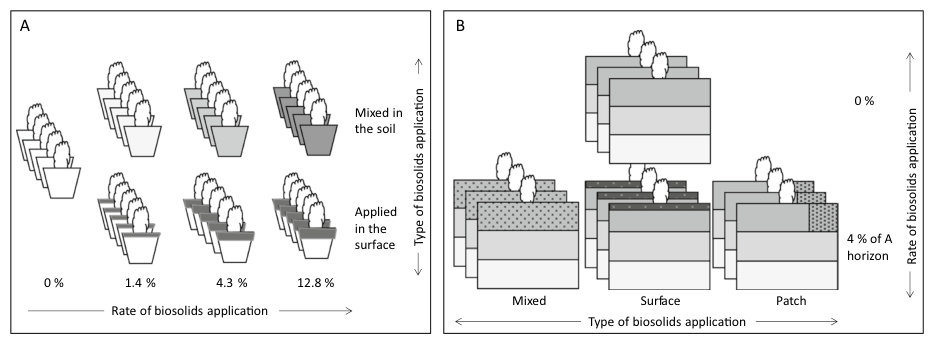
A 35-pot experiment was set up with 3.2 kg of substrate per pot, consisting of a mixture of 4:1 of A and B soil horizons to which biosolids were applied at rates of 1.4%, 4.3% and 12.8% fresh weight (corresponding
盆栽试验共设35盆,每盆装基质3.2 kg,基质由A层和B层土壤按4:1混合而成,并按鲜重1.4%、4.3%和12.8%的比例施用生物固体(分别相当于
| eca characteristics of the soils化学 土壤特性 | Parameter参数 | Biosolids生物固体 | Soil for pots盆栽用土 | Horizon AhAh层 | Horizon BwBw层 | Horizon BCBC层 |
|---|---|---|---|---|---|---|
| and biosolids in the pot and | pH | 6.78 ± 0.02 | 5.56 ± 0.01 | 5.57 ± 0.00 | 5.77 ± 0.04 | 5.89 ± 0.06 |
| rhizobox experiments | EC (dS m− 1) | 2.7 ± 0.032 | 0.036 ± 0.001 | 0.036 ± 0.001 | 0.017 ± 0.0007 | 0.008 ± 0.0003 |
| C (%) | 30 ± 0.03 | 1.59 ± 0.04 | 1.46 ± 0.18 | 1.03 ± 0.07 | 0.70 ± 0.05 | |
| N (%) | 3.95 ± 0.00 | 0.22 ± 0.01 | 0.24 ± 0.00 | 0.12 ± 0.00 | 0.07 ± 0.00 | |
| NH4 +-N | 2375 ± 14 | < 0.01 | < 0.01 | < 0.01 | < 0.01 | |
| NO3 −-N | 3.56 ± 0.23 | < 0.01 | 0.04 ± 0.02 | 0.29 ± 0.04 | 0.17 ± 0.03 | |
| Olsen P | 506 ± 5.9 | 18 ± 1.1 | 15 ± 0.37 | 15 ± 0.37 | 6.2 ± 0.23 | |
| P (T) | 16,250 ± 10.2 | 720 ± 6.4 | 750 ± 16 | 650 ± 17.9 | 450 ± 4.3 | |
| S (T) | 14,000 ± 90 | 380 ± 2.4 | 380 ± 8.5 | 270 ± 3.5 | 230 ± 3.3 | |
| S (E) | 1807 ± 21 | < 0.01 | < 0.01 | < 0.01 | < 0.01 | |
| K (T) | 2160 ± 19 | 3510 ± 51 | 3430 ± 88 | 3750 ± 112 | 4200 ± 85 | |
| K (E) | 879 ± 40 | 102 ± 15 | 87 ± 12 | 36 ± 9 | 23 ± 6 | |
| Ca (T, %) | 3.0 ± 0.02 | 0.48 ± 0.006 | 0.50 ± 0.01 | 0.37 ± 0.01 | 0.42 ± 0.004 | |
| Mg (T) | 5020 ± 24 | 5620 ± 30 | 5570 ± 60 | 5650 ± 109 | 6040 ± 52 | |
| Mg (E) | 916 ± 9 | 163 ± 14 | 134 ± 14 | 57 ± 12 | 9.1 ± 1.8 | |
| Na (T) | 650 ± 5.9 | 210 ± 8.4 | 210 ± 7 | 220 ± 8.4 | 210 ± 3.7 | |
| Na (E) | 564 ± 15 | 15 ± 2.9 | 13 ± 2 | 18 ± 4.2 | 8.2 ± 1.9 | |
| Fe (T, %) | 2.2 ± 0.01 | 2.8 ± 0.005 | 2.7 ± 0.02 | 2.8 ± 0.05 | 2.2 ± 0.03 | |
| The reported values are | Fe (E) | 62 ± 9.7 | 1.4 ± 0.05 | 1.3 ± 0.13 | 0.49 ± 0.12 | 0.11 ± 0.01 |
| averages ± standard errors | Al (T, %) | 1.1 ± 0.02 | 4.2 ± 0.04 | 4.1 ± 0.02 | 4.3 ± 0.13 | 3.1 ± 0.05 |
| (n= 5) and given as mg k− 1l iditd | Al (E) | 168 ± 27 | 8.4 ± 0.06 | 5.3 ± 0.67 | 13.1 ± 2.9 | 4.5 ± 0.8 |
| g, uness ncae otherwise. Total (T) | Mn (T) | 410 ± 2.2 | 510 ± 1.9 | 520 ± 2 | 440 ± 6.3 | 340 ± 6.2 |
and exchangeable (E) | Mn (E) | 11 ± 0.3 | 4.1 ± 0.8 | 4.8 ± 0.6 | 1.2 ± 0.5 | 0.4 ± 0.0 |
| concentrations shown for | Cu (T) | 291 ± 2.4* | 8.4 ± 0.1 | 8.5 ± 0.22 | 8.5 ± 0.26 | 10.7 ± 0.14 |
| major cations and trace lt | Cu (E) | 2.8 ± 0.06 | 0.02 ± 0.00 | < 0.01 | < 0.01 | < 0.01 |
| eemens * | Zn (T) | 993 ± 1.8* | 94 ± 1.4 | 90 ± 1.3 | 104 ± 2.6 | 79 ± 0.7 |
| exceeds guideline for Grade A biosolids | Zn (E) | 5.1 ± 0.54 | 0.22 ± 0.07 | 0.13 ± 0.05 | 0.02 ± 0.01 | 0.06 ± 0.04 |
(Cu = 100 mg kg− 1, | Ni (T) | 27 ± 0.08 | 10 ± 0.07 | 10 ± 0.07 | 11 ± 0.32 | 13 ± 0.24 |
| Zn = 300 mg kg− 1, | Cd (T) | 1.6 ± 0.01* | 0.32 ± 0.03 | 0.3 ± 0.03 | 0.29 ± 0.03 | 0.15 ± 0.04 |
| Cd = 1 mg kg− 1(NZWWA 2003)). | Pb (T) | 54 ± 0.6 | 26 ± 0.6 | 26 ± 0.6 | 25 ± 0.6 | 20 ± 0.6 |
Vol:. (1234567890)Vol:. (1234567890)
to approx. 16 t ha− 1, 48 t ha− 1 and 145 t ha− 1, respectively). These rates are within the range of application investigated previously by other authors (Borden and Black 2011; Fuentes et al. 2010; Moreno-Peñaranda et al. 2004). The highest application rate intended to identify the concentration at which plant health is impacted, as demonstrated by Gutiérrez-Ginés et al. (2019), and the effects in soil quality, which is the objective of this work. The biosolids were either applied to the surface or homogeneously mixed into the soil. There were five replicates of each treatment and a control without biosolids (Fig. 1A).
约16 t ha− 1、48 t ha− 1和145 t ha− 1)。这些施用量均在其他作者此前研究的施用范围之内(Borden and Black 2011; Fuentes et al. 2010; Moreno-Peñaranda et al. 2004)。设置最高施用量的目的是确定影响植物健康的浓度(如Gutiérrez-Ginés et al.(2019)所证明),以及对土壤质量的影响,后者正是本研究的目标。生物固体采用表面施用或与土壤均匀混合两种方式。每个处理及不施生物固体的对照均设5个重复(图1A)。
Twelve large rhizoboxes (80 × 80 × 2.5 cm) were filled with Craigieburn silt loam with the three soil horizons repacked in 25 cm layers. Biosolids were applied at a rate of 4% (wt/wt) of the A horizon (150 g per rhizobox) using one of three modes of application: surface (T); mixed (M) in the A horizon; or as a concentrated patch (P) in one third of the A horizon (Fig. 1B).
12个大型根箱(80 × 80 × 2.5 cm)中填充Craigieburn粉砂壤土,三个土壤发生层按每层25 cm重新装填。生物固体按A层土壤重量的4%(wt/wt)施用(每个根箱150 g),采用三种施用方式之一:表面施用(T);混入A层(M);或以集中斑块形式施于A层的三分之一区域(P)(图1B)。
Both experiments ran for four months in a greenhouse with an overall mean temperature of 20.2 °C (min. – max. range: 9.8–32 °C). The pots and rhizoboxes were watered daily to field capacity. One week before the end of the experiment, soil pore water in the pots was collected with Rhizon samplers (Eijkelkamp Soil & Water, Giesbeek, The Netherlands) placed vertically near the centre of the pot. The soil pore water in each pot was sampled daily over a 3-day period, approx. 1 h after watering. A 50 mL syringe was used to create a vacuum for approx. 2 h in each collection time and to collect the sample. The three collected samples in each pot were combined into a single sample. The samples were stored in the dark at 4 °C and analysed within one week of collection.
两项试验均在温室中进行,为期四个月,总体平均温度为20.2 °C(最低–最高范围:9.8–32 °C)。每天对花盆和根箱浇水至田间持水量。试验结束前一周,使用垂直放置于花盆中心附近的Rhizon采样器(Eijkelkamp Soil & Water,荷兰Giesbeek)采集花盆中的土壤孔隙水。各花盆的土壤孔隙水连续3天每天采样一次,于浇水后约1 h进行。每次采集时用50 mL注射器抽真空约2 h并收集样品。每盆采集的3个样品合并为一个样品。样品于4 °C避光保存,并在采集后一周内完成分析。
At the end of the experiments, the soil in the pots was collected and divided into rhizosphere soil (attached to the roots of L. scoparium) and bulk soil (soil not attached to the roots after gentle shaking). In the rhizobox experiment, the soil from each horizon was collected separately. Each horizon was divided into three quadrants of the same width (see Fig. 5). On some occasions, the quadrants were further divided to potentially identify gradients from the biosolids (see Fig. 5). Bulk soil and rhizosphere soil were also separated in each of the quadrants. The biosolids applied on the surface of both experiments were sampled separately from the soil. Soil samples were stored at 4 °C until they were processed within 48 h.
试验结束时,采集花盆中的土壤,并将其分为根际土壤(附着于L. scoparium根系的土壤)和土体土壤(轻轻抖动后未附着于根系的土壤)。在根箱试验中,各土层土壤分别采集。每个土层划分为三个等宽的象限(见图5)。某些情况下,象限被进一步细分,以识别源自生物固体的潜在梯度(见图5)。各象限中的土体土壤和根际土壤亦分别分离。两项试验中表面施用的生物固体均与土壤分开采样。土壤样品于4 °C保存,并在48 h内完成处理。
Chemical analysis化学分析
Concentrations of mineral nitrogen species (NH4+ and NO3−) in the soil pore water were analysed within two days of collection with a Flow Injection Analyser (FOSS FIAstar 5000). pH and electrical conductivity (EC, as a measurement for salinity) were analysed with a Toledo pH and EC meter. Elements were analysed using an ICP-OES (Varian 720-ES).
土壤孔隙水中矿质氮形态(NH4+和NO3−)的浓度在采集后两天内用流动注射分析仪(FOSS FIAstar 5000)测定。pH和电导率(EC,作为盐分的衡量指标)用Toledo pH和EC仪测定。元素采用ICP-OES(Varian 720-ES)测定。
The collected fresh soil samples were sieved through a 4 mm sieve for homogenization, and subsamples were taken for each analysis. Soil was extracted with 2 M KCl (Clough et al. 2001) for determining NH4+ and NO3− concentrations with the Flow Injection Analyser. Dehydrogenase activity (DHA) was analysed spectrophotometrically by the transformation of 2,3,5-triphenyl-tetrazolium chloride into triphenylformazan, as described by Gutiérrez- Ginés et al. (2017).
采集的新鲜土壤样品过4 mm筛以使其均匀,并为每项分析取子样。土壤用2 M KCl浸提(Clough et al. 2001),以流动注射分析仪测定NH4+和NO3−浓度。脱氢酶活性(DHA)按Gutiérrez- Ginés et al.(2017)所述方法,通过2,3,5-三苯基氯化四氮唑转化为三苯基甲臜,采用分光光度法测定。
Sub samples of soil and biosolids were oven-dried at 60 °C for one week and sieved through a 2 mm stainless steel sieve. These were used for analyses of pH and EC (1:5 w:v soil-water ratio (Blakemore et al. 1987)) and exchangeable element concentrations. Exchangeable elements were determined using a 0.05 M Ca(NO3)2 extraction (McLaren et al. 2005), and analysed by ICP-OES. Total-extractable element concentrations were determined in the soils and biosolids prior to the experiment. The samples (0.5 g) were digested using a CEM MARS Xpress microwave digestion with 4.0 mL of 30% H2O2 and 4.0 mL of 69% HNO3, and analysed by ICP-OES.
土壤和生物固体子样于60 °C烘干一周,并过2 mm不锈钢筛。所得样品用于测定pH和EC(土水比1:5 w:v(Blakemore et al. 1987))以及交换性元素含量。交换性元素采用0.05 M Ca(NO3)2浸提(McLaren et al. 2005),并用ICP-OES测定。试验开始前测定了土壤和生物固体中的全量可提取元素含量。样品(0.5 g)采用CEM MARS Xpress微波消解系统,加入4.0 mL 30% H2O2和4.0 mL 69% HNO3进行消解,并用ICP-OES测定。
Data analysis数据分析
The results of the two experiments were analysed separately. Two-way ANOVA was used to determine differences in each of the parameters based on rate of biosolids application and type of application. Homoscedasticity was verified with the Levene’s test, and normality with the kurtosis and skewness of the data distribution. When assumptions were not fulfilled by the data, transformations (ln or square root) were applied. Principal Component Analyses (PCA) were also performed on the standardized data of soil pore water and soils (separately) from the pot experiment, and from the rhizobox experiment. For these analyses, all the results were treated together, without distinguishing between bulk and rhizosphere soil. The rhizosphere effect was assessed by a pairwise T-test. Due to the high variability in the results, this analysis was performed for all the results of each parameter, instead of separating them between treatments. The results are, however, shown for each treatment (Fig. 6). The software Statgraphics Centurion was used for the calculations. The graphics were created in Microsoft Excel 10, except for the graph in Fig. 2, which was created with the ggplot2 package (Wickham 2016), using RStudio (R Core Team 2021).
两项试验的结果分别进行分析。采用双因素ANOVA确定各参数在生物固体施用量和施用方式之间的差异。用Levene检验验证方差齐性,并以数据分布的峰度和偏度检验正态性。当数据不满足假设条件时,进行数据转换(ln或平方根)。此外,还对盆栽试验中土壤孔隙水和土壤(分别)的标准化数据以及根箱试验的数据进行了主成分分析(PCA)。在这些分析中,所有结果合并处理,不区分土体土壤和根际土壤。根际效应通过配对T检验评估。由于结果变异性较大,该分析针对每个参数的全部结果进行,而未按处理分开。不过,结果按各处理分别呈现(图6)。计算使用Statgraphics Centurion软件完成。图形采用Microsoft Excel 10绘制,但图2除外,该图使用ggplot2软件包(Wickham 2016)在RStudio(R Core Team 2021)中绘制。
4Results结果
Effect of rate and type of biosolids application on soil quality
生物固体施用量和施用方式对土壤质量的影响
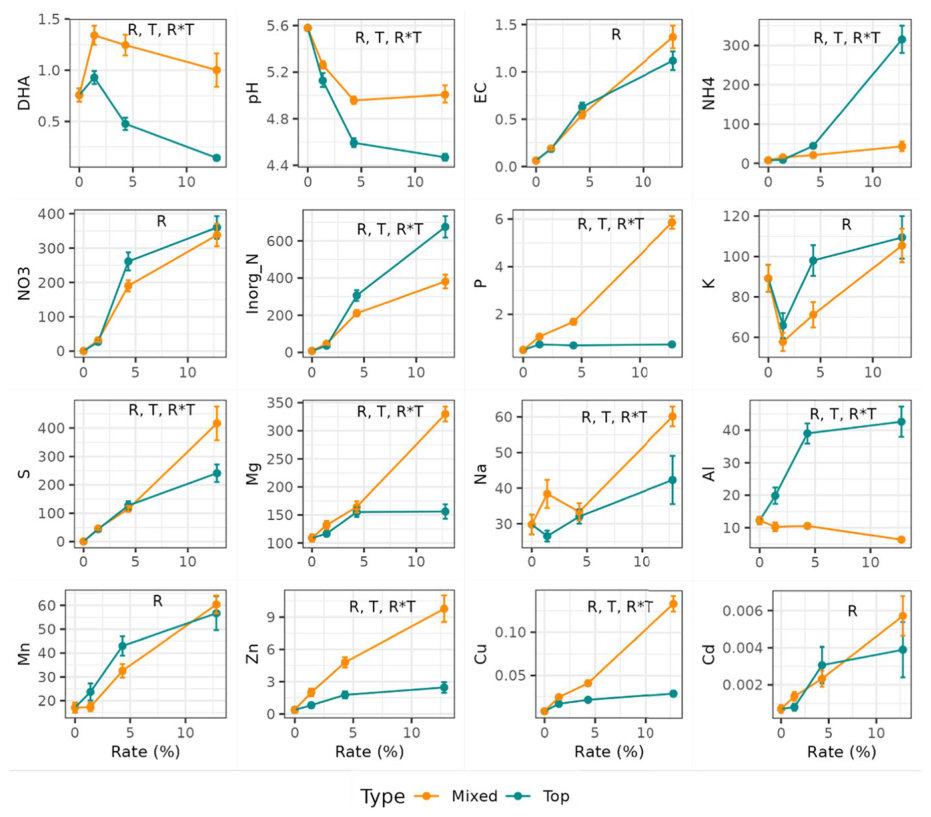
The results of soil quality parameters in the pot experiment are represented in Fig. 2 and in Suppl. Material. The concentrations of key plant nutrients (including P, NH4+, NO3−, K, Ca, Mg and S) significantly increased with higher rates of biosolids application.
盆栽试验中土壤质量参数的结果见图2及补充材料。主要植物养分(包括P、NH4+、NO3−、K、Ca、Mg和S)的浓度随生物固体施用量的增加而显著升高。
The increase in exchangeable P, S and Mg was significantly higher when biosolids were mixed into the soil than when they were applied on the surface, and this difference was more pronounced in the highest rate of biosolids application. In the soil with the highest biosolids concentration (Eq. 145 t ha−1), exchangeable P was 6 mg/kg when biosolids were mixed into the soil vs. 0.7 mg kg–1 when they were applied on the surface. This difference, although significant, was less pronounced at a rate of Eq. 48 t ha–1: 1.7 mg kg−1 vs. 0.7 mg kg−1. The inorganic nitrogen, on the other hand, was significantly higher when biosolids were applied on the surface. NH4+ increased from 8 mg kg− 1 in unamended soil to 316 mg kg− 1 in the highest biosolids application when applied on the surface, compared with 43 mg kg−1 when biosolids were mixed into the soil. At lower application rates (Eq. 16 t ha−1 and 48 t ha−1), this difference was less pronounced (see Suppl. Material Table S1 and S2). The exchangeable concentration of micronutrients and non-essential elements was also significantly higher with increasing rates of biosolids application, but this increased depended on the type of application in some of the elements. Exchangeable Na, Zn and Cd increased significantly more when biosolids were mixed into the soil than when they were applied on the surface. On the other hand, exchangeable Al only increased when biosolids were applied on the surface, being 3.5 higher in soil with the highest rate of biosolids compared with unamended soil. Salinity (measured by EC) was also significantly higher as the rate of application increased, but the results were not affected by the type of application. pH significantly decreased with increasing rates of biosolids application, and this decrease was significantly lower when biosolids were applied to the surface; in the highest rate, soil pH was 5 when biosolids were mixed into the soil, compared with 4.5 when they were applied on the surface. The dehydrogenase activity (DHA) in the soil was very variable with rate and type of biosolids application. When the biosolids were mixed into the soil, DHA increased almost twice with the lowest application rate compared with unamended soil, and decreased 30% with the highest application rate, but it was still higher than in the unamended soil. On the contrary, when biosolids were applied on the surface, DHA slightly increased 20% with the lowest biosolids application, but decreased five times compared with unamended soil, when biosolids were applied at Eq. 145 t ha− 1.
生物固体混入土壤时交换性P、S和Mg的增幅显著高于表面施用,且这一差异在最高施用量下更为明显。在生物固体浓度最高的土壤中(相当于145 t ha−1),生物固体混入土壤时交换性P为6 mg/kg,而表面施用时为0.7 mg kg–1。在相当于48 t ha–1的施用量下,这一差异虽然显著,但较不明显:1.7 mg kg−1对0.7 mg kg−1。另一方面,表面施用生物固体时无机氮显著更高。在最高生物固体施用量下,表面施用时NH4+由未改良土壤中的8 mg kg− 1增至316 mg kg− 1,而生物固体混入土壤时为43 mg kg−1。在较低施用量下(相当于16 t ha−1和48 t ha−1),这一差异较不明显(见补充材料表S1和S2)。微量营养元素和非必需元素的交换态浓度也随生物固体施用量的增加而显著升高,但部分元素的增幅取决于施用方式。生物固体混入土壤时,交换性Na、Zn和Cd的增幅显著大于表面施用。另一方面,交换性Al仅在表面施用生物固体时增加,在最高施用量下比未改良土壤高3.5倍。盐分(以EC衡量)也随施用量增加而显著升高,但不受施用方式影响。pH随生物固体施用量增加而显著下降,且表面施用时的下降幅度显著较小;在最高施用量下,生物固体混入土壤时土壤pH为5,而表面施用时为4.5。土壤脱氢酶活性(DHA)随生物固体施用量和施用方式变化很大。生物固体混入土壤时,最低施用量下DHA比未改良土壤增加近一倍,最高施用量下下降30%,但仍高于未改良土壤。相反,表面施用生物固体时,最低施用量下DHA略增20%,但在施用量相当于145 t ha− 1时,DHA比未改良土壤降低至五分之一。
The results of soil pore water showed similar trends to the exchangeable element concentration, with similar results of the Principal Component Analysis (Fig. 3), so they are only represented in Supp. Material. The first two components of the PCA explained a cumulative 67.1% of the variance in the soil results (Fig. 3A), and 73.5% of the variance of the soil pore water results (Fig. 3B). The first component mostly organized the results with increasing biosolids application rates in the negative part of the component, which was correlated with plant nutrients (NO3−, P, Mg, and S), EC and Na, and trace elements (Cu, Zn, Cd, Ni). The second component separated the results based on the type of biosolids application. The results of mixed biosolids had a positive value of the second component, which was mostly due to weights of DHA, pH, and trace elements. The results of surface applied biosolids were in the negative part of the second component, which were mostly related to Al, Fe, NH4+ and Mn.
土壤孔隙水的结果与交换性元素浓度呈现相似趋势,主成分分析结果也相似(图3),因此仅在补充材料中列出。PCA的前两个主成分累计解释了土壤结果方差的67.1%(图3A)和土壤孔隙水结果方差的73.5%(图3B)。第一主成分主要按生物固体施用量递增将结果排列于该主成分的负向区域,该主成分与植物养分(NO3−、P、Mg和S)、EC和Na以及微量元素(Cu、Zn、Cd、Ni)相关。第二主成分按生物固体施用方式区分结果。混入生物固体处理的结果在第二主成分上为正值,主要源于DHA、pH和微量元素的载荷。表面施用生物固体处理的结果位于第二主成分的负向区域,主要与Al、Fe、NH4+和Mn有关。
As reflected by the representation of the PCA, the results of the soil quality in the rhizobox experiment follow a similar pattern than in the pot experiment (Fig. 4). The two first components explained 63.1% of the variance. The first component was mostly determined for the variation in plant nutrients and trace elements, while the second component was determined by a positive weight by Al, and a negative weight by pH. The distribution of the results as a scatterplot showed the difference in the results from three soil horizons; the results of the A horizon were separated based on type of biosolids application. The results of the Patch application were both similar to the results of the Control (for the quadrants without biosolids) and similar to the mixed application (for the quadrant where the biosolids were concentrated).
如PCA图所示,根箱试验中土壤质量的结果与盆栽试验呈现相似规律(图4)。前两个主成分解释了63.1%的方差。第一主成分主要由植物养分和微量元素的变化决定,而第二主成分由Al的正载荷和pH的负载荷决定。散点图中结果的分布显示了三个土壤发生层之间的差异;A层的结果按生物固体施用方式区分。斑块施用的结果既与对照相似(对于无生物固体的象限),又与混合施用相似(对于生物固体集中的象限)。
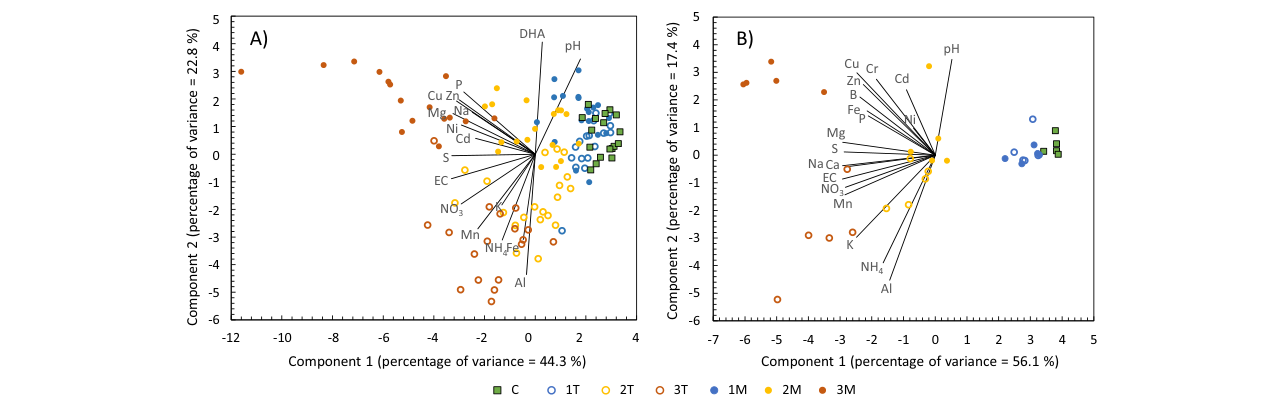
three treatments: (C) control, (T) surface application of biosolids and (M) biosolids mixed with the soil, with the numbers 1–3 reflecting the increasing rates of biosolids application
三个处理分组:(C)对照,(T)表面施用生物固体,(M)生物固体与土壤混合,数字1–3表示生物固体施用量递增
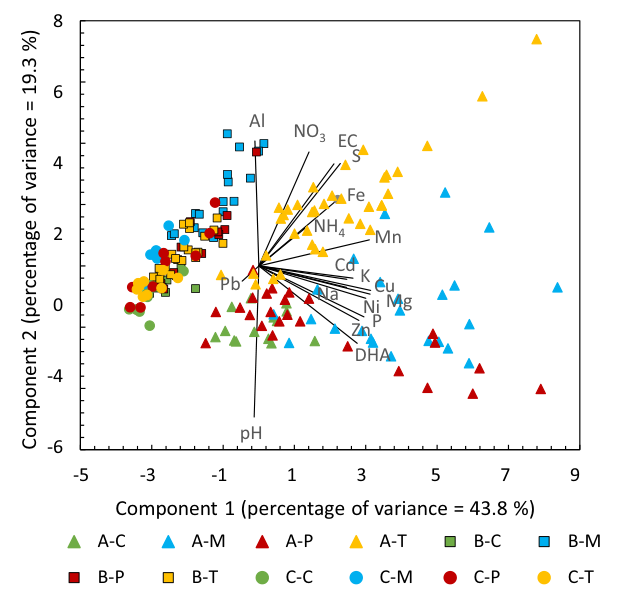
The chemical characteristics of the B and C horizons also changed based on types of biosolid application (Fig. 4), with the results of mixed treatment presenting higher values in PC1 and PC2 than those of surface applied.
B层和C层的化学特性也因生物固体施用方式不同而发生变化(图4),混合处理的结果在PC1和PC2上的值均高于表面施用处理。
Figure 5 shows the spatial distribution of the main plant nutrients and pH in the rhizoboxes, with the complete set of results shown in Supp. Material. Exchangeable P was higher in the areas with biosolids, or in the horizons immediately below the biosolids compared with the respective horizons in the control rhizoboxes. However, the concentration was similar to the control in the deeper horizons, like in the C horizon in all the treatments, and in the B horizon on the surface application. NO3− can be detected in all horizons of the rhizoboxes where biosolids were applied, while it was not detected in any horizon of the control rhizoboxes. In the deepest horizon, C, NO3− was higher when biosolids were mixed into the soil (58 mg kg− 1), or in the area under the patch (48 mg kg− 1), than when they are applied on the surface (20 mg kg− 1). The NH4+ was similar in the A horizon when biosolids were applied on the surface (27 mg kg− 1) than when they were mixed into the A horizon (21 mg kg− 1). However, it was the highest in the B horizon immediately below the path of biosolids (87 mg kg− 1).
图5显示了根箱中主要植物养分和pH的空间分布,完整结果见补充材料。与对照根箱的相应土层相比,施有生物固体的区域或紧邻生物固体下方的土层中交换性P更高。然而,在较深土层中,如所有处理的C层以及表面施用处理的B层,其浓度与对照相近。在施用生物固体的根箱中,所有土层均可检测到NO3−,而在对照根箱的任何土层中均未检出。在最深的C层中,生物固体混入土壤时(58 mg kg− 1)或斑块下方区域(48 mg kg− 1)的NO3−高于表面施用时(20 mg kg− 1)。A层中表面施用生物固体时的NH4+(27 mg kg− 1)与生物固体混入A层时(21 mg kg− 1)相近。然而,NH4+在紧邻生物固体斑块下方的B层中最高(87 mg kg− 1)。
Effect of the rhizosphere on soil properties with contrasting biosolids applications
不同生物固体施用方式下根际对土壤性质的影响
The rhizosphere had a significant effect in most of analysed soil properties (Fig. 6). Although these effects appear different depending on biosolids rate and type of application (Fig. 6), the difference between rhizosphere and bulk soil was only analysed for the whole set of results, due to the high variability of the results. The DHA was significantly higher in the rhizosphere than in bulk soil. Similarly, pH and exchangeable P, S, Mg, Na, Zn, Cu and Ni were significantly higher in the rhizosphere than in bulk soil. Although both NH4+ and NO3− were significantly higher in rhizosphere, the ratio of both was also different with higher proportion of NH4+ compared with NO3− in rhizosphere than in bulk soil (average ratio 1.2 vs. 0.4). The ratio could not be calculated in control pots because there was no detectable concentration of NO3− in the soil. Contrary effect was detected for Fe and Mn, which were significantly lower in the rhizosphere than in the bulk soil.
根际对所分析的大多数土壤性质具有显著影响(图6)。尽管这些影响似乎因生物固体施用量和施用方式而异(图6),但由于结果变异性较大,根际土壤与土体土壤之间的差异仅针对全部结果进行分析。根际中的DHA显著高于土体土壤。同样,根际中的pH以及交换性P、S、Mg、Na、Zn、Cu和Ni均显著高于土体土壤。尽管根际中NH4+和NO3−均显著更高,但二者的比值也存在差异,与土体土壤相比,根际中NH4+相对于NO3−的比例更高(平均比值1.2对0.4)。由于对照盆土壤中NO3−浓度低于检出限,因此无法计算该比值。Fe和Mn则呈现相反效应,其在根际中显著低于土体土壤。
5Discussion讨论
Rate and type of biosolids application affect soil quality
生物固体施用量和施用方式影响土壤质量
As hypothesized, increasing the rate of biosolids application increased nutrients, but also the exchangeable concentration of trace elements in the soil. Incorporation increased the exchangeable Zn, Cu, Cr, Ni and Cd, and P at the highest application rate (Eq. 145 t ha− 1) compared with surface application. These results explained the higher plant uptake of these elements by L. scoparium plants grown in the pots with the highest rate of biosolids application mixed into the soil compared with the rest of the treatments (Gutiérrez-Ginés et al. 2019).
正如假设,提高生物固体施用量增加了土壤养分,但也提高了土壤中微量元素的交换态浓度。在最高施用量下(相当于145 t ha− 1),与表面施用相比,混入土壤提高了交换性Zn、Cu、Cr、Ni和Cd以及P的含量。这些结果解释了为何与其余处理相比,在生物固体以最高施用量混入土壤的花盆中生长的L. scoparium对这些元素的吸收更高(Gutiérrez-Ginés et al. 2019)。
Contrary to our hypothesis, the surface application of biosolids increased the fertility of the soil (i.e. higher inorganic N) more than when they were incorporated into the soil. Surface application also increased the exchangeable concentrations of Al and
与我们的假设相反,表面施用生物固体比混入土壤更能提高土壤肥力(即无机N更高)。与混入土壤相比,表面施用还提高了土壤和孔隙水中Al和
Mn in the soil and pore water, compared with biosolids incorporation. This may be due to the significant decrease in soil pH. These effects were more pronounced in the highest rate of application (Eq. 145 t ha− 1). The differences in inorganic N were not reflected by N foliar concentration of L. scoparium, which was similar in all the treatments, and only significantly different between control and the treatment with the highest application rate mixed into the soil (3 M) (Gutiérrez-Ginés et al. 2019). The increased fertility of the soils with surface application of biosolids contrasts with previous results showing better N mineralization and plant growth when biosolids were incorporated (Castillo et al. 2011; He et al. 2003; Roman-Perez et al. 2021) also observed higher inorganic N in the soil over time when biosolids were applied on the surface, compared with incorporation into the soil. However, those authors were unable to give an explanation to those findings, mostly due to the contrast with their results. They assumed the higher mineralisation and N2O emissions, and higher yield and health of the crops when biosolids were incorporated into the soil, were due to higher N bioavailability. Quemada et al. (1998) found higher NH4+ in soil when biosolids were incorporated, but higher NO3− in the soil and significantly higher NH3 volatilization when they were applied on the surface. They assumed a higher mineralization when biosolids were applied on the surface. However, given the high concentration of NH4+ in their biosolids, NH3 might have volatilized from NH3 directly or from the initial load of NH4+, rather than from N mineralization. The high amount of organic matter concentrated on the surface locally may have induced highly reducing conditions (Mench et al. 2003). The low pH and reducing conditions could explain the increased NH4+ and higher exchangeable Mn concentrations.
Mn的交换态浓度。这可能是由于土壤pH显著下降所致。这些效应在最高施用量下(相当于145 t ha− 1)更为明显。无机N的差异并未反映在L. scoparium叶片N含量上,各处理的叶片N含量相近,仅对照与最高施用量混入土壤处理(3 M)之间存在显著差异(Gutiérrez-Ginés et al. 2019)。表面施用生物固体提高土壤肥力这一结果,与此前显示生物固体混入土壤时N矿化和植物生长更好的结果形成对比(Castillo et al. 2011; He et al. 2003; Roman-Perez et al. 2021),后者也观察到,与混入土壤相比,表面施用生物固体时土壤无机N随时间推移更高。然而,这些作者未能对上述发现作出解释,主要是因为其与他们的其他结果相矛盾。他们认为,生物固体混入土壤时更高的矿化作用和N2O排放以及作物更高的产量和更好的健康状况,是由于N的生物有效性更高。Quemada et al.(1998)发现,生物固体混入土壤时土壤NH4+更高,而表面施用时土壤NO3−更高且NH3挥发显著更多。他们认为表面施用生物固体时矿化作用更强。然而,鉴于其生物固体中NH4+浓度很高,NH3可能直接由NH3或由初始NH4+负荷挥发,而非来自N矿化。表层局部集中的大量有机质可能导致了强烈的还原条件(Mench et al. 2003)。低pH和还原条件可以解释NH4+增加以及交换性Mn浓度升高的现象。
Sullivan et al. (2006) showed a significant decrease in soil pH (from 6.3 to 5.5) when the rate of biosolids application was increased (from 2.5 to 30 t ha− 1) in a long-term experiment of surface applied biosolids. This was despite the biosolids having a pH of 7.3. Xue et al. (2015) also showed a decrease in soil pH (5.4 to 4.8) with an increasing rate of biosolids application (0 t ha− 1, 3 t ha− 1 and 6 t ha− 1, applied every 3 years) in a long-term experiment of repeated surface applied biosolids in a pine plantation, even with alkaline biosolids with pH of 8.5. The biosolids in those experiments, as well as those in our experiment, had high concentrations of NH4+ that could have potentially driven a reduction in pH as it underwent nitrification. The decrease in pH may be linked to the observed increases in exchangeable Mn, Al, and Fe, as these elements are rarely soluble in soils above pH 5.0 (Sposito 2008). However, the extent of acidification was lower when the biosolids were incorporated into the soils, and this is likely to be due to an increase in the soil cation exchange capacity (CEC) in the mixed and patch treatments. Welikala et al. (2018) determined the CEC for these same biosolids as 31 cmol kg− 1, which was 5 times higher than the CEC of soil collected from the same formation as our experiment (Craigieburn soil, 6.5 cmol kg− 1; Welikala et al. 2021) and mixing them may have resulted in an overall increase in the soil CEC. This agrees with previous research that showed that incorporation of biosolids into the soil increased the CEC (Gardner et al. 2010; Price et al. 2015). Increased CEC in the mixed treatments may have mitigated acidification both directly, through buffering against pH change, and indirectly by binding NH4+ and reducing its availability to nitrifying bacteria, when compared to the top treatment (cf. lower NO3− concentrations in the mixed treatments).
Sullivan et al.(2006)在一项表面施用生物固体的长期试验中表明,当生物固体施用量从2.5增至30 t ha− 1时,土壤pH显著下降(从6.3降至5.5),尽管所用生物固体的pH为7.3。Xue et al.(2015)在松树人工林中重复表面施用生物固体的长期试验中也表明,随着生物固体施用量增加(0 t ha− 1、3 t ha− 1和6 t ha− 1,每3年施用一次),即使使用pH为8.5的碱性生物固体,土壤pH仍有所下降(从5.4降至4.8)。这些试验中的生物固体以及本试验中的生物固体均含有高浓度NH4+,其在硝化过程中可能导致pH降低。pH下降可能与观察到的交换性Mn、Al和Fe增加有关,因为这些元素在pH 5.0以上的土壤中很少可溶(Sposito 2008)。然而,当生物固体混入土壤时酸化程度较低,这可能是由于混合和斑块处理中土壤阳离子交换量(CEC)增加所致。Welikala et al.(2018)测定同一批生物固体的CEC为31 cmol kg− 1,是采自与本试验相同成土母质土壤(Craigieburn土壤,6.5 cmol kg− 1;Welikala et al. 2021)CEC的5倍,二者混合可能导致土壤CEC整体提高。这与此前研究表明将生物固体混入土壤可提高CEC的结果一致(Gardner et al. 2010; Price et al. 2015)。与表面施用处理相比,混合处理中CEC的提高可能通过两种途径缓解酸化:直接途径是缓冲pH变化,间接途径是结合NH4+并降低其对硝化细菌的有效性(参见混合处理中较低的NO3−浓度)。
DHA in the soil increased with increased biosolids application rate if they were incorporated into the soil. These results are consistent with findings from previous research (i.e. Gardner et al. 2010; Gutiérrez-Ginés et al. 2017). Interestingly however, when biosolids were applied on the surface, DHA only increased with the lowest application rate (Eq. 16 t ha− 1) but significantly decreased with higher application rates (Fig. 2). This indicates that indigenous microbes of the soil were negatively affected by low pH, increased EC, increased exchangeable Al and Mn, and potentially anoxic conditions. The addition of biosolids in the soil might shift the microbial communities to favour biosolids-borne microbes at the expense of the soil indigenous ones. Sullivan et al. (2006), Hu et al. (2019), and Wang et al. (2020), amongst others, demonstrated that biosolids change the soil microbial communities.
当生物固体混入土壤时,土壤DHA随生物固体施用量增加而升高。这些结果与此前研究的发现一致(如Gardner et al. 2010; Gutiérrez-Ginés et al. 2017)。然而值得注意的是,当表面施用生物固体时,DHA仅在最低施用量(相当于16 t ha− 1)下增加,而在较高施用量下显著下降(图2)。这表明土壤土著微生物受到低pH、EC升高、交换性Al和Mn增加以及可能的缺氧条件的不利影响。向土壤中添加生物固体可能使微生物群落发生转变,有利于生物固体携带的微生物,而以牺牲土壤土著微生物为代价。Sullivan et al.(2006)、Hu et al.(2019)和Wang et al.(2020)等研究均证明生物固体会改变土壤微生物群落。
The rhizosphere effect and potential to reduce export of contaminants
根际效应及其减少污染物输出的潜力
As expected, the rhizosphere had a significant positive effect in the availability of most plant nutrients and microbial activity. These results mostly agree with Liu et al. (2022) who showed a generally higher concentration of available nutrients and microbial biomass in the rhizosphere of most plants. Microbial activity around plant roots is usually higher than in bulk soil, due to the synergies between plants and associated microorganisms (McNear Jr 2013). This explains the higher DHA in the rhizosphere vs. bulk soil (Fig. 6). Higher concentration of NH4+ and NO3− in the rhizosphere were also similar to previous works (Liu et al. 2022) and agree with observations of increased mineralization of organic matter and associated nutrient release in the rhizosphere of plants (Keiluweit et al. 2015; Liu et al. 2022). Our results confirm the hypothesis of a higher NH4+:NO3− ratio in the rhizosphere indicating a slower nitrification around L. scoparium roots compared with bulk soil, as reported by Esperschuetz et al. (2017). Higher exchangeable P in the rhizosphere of L. scoparium contrast with general trends for plants (Liu et al. 2022) with high demand for P, however it was similar to other trees and herbaceous plants (Liu et al. 2022). This higher mobilization of nutrients around the roots can explain the significantly higher EC in the rhizosphere compared with bulk soil. Notably, the pH was significantly higher in rhizosphere than in bulk soil. This contrast with previous results showing that the roots of L. scoparium can decrease 1 unit soil pH compared with Lolium perenne. However, given the low pH of the soil and soils amended with biosolids in our experiment, the increase of pH by L. scoparium roots is consistent with the meta-analysis of Liu et al. (2022), who demonstrated that the differences in pH in rhizosphere compared with bulk soil were dependent on the original soil pH, and that plants had a neutralizing effect both in acidic and alkaline soils. Lower concentrations of exchangeable Fe and Mn in the rhizosphere can indicate a depletion of these micronutrients, indicating a high demand by L. scoparium, also occurs for P in some plants (Liu et al. 2022). The high Mn demand by L. scoparium was indicated by the high foliar Mn concentration in plants grown in these experiments (Gutiérrez-Ginés et al. 2019), and previous ones (Reis et al. 2017).
正如预期,根际对大多数植物养分的有效性和微生物活性具有显著的正效应。这些结果与Liu et al.(2022)的研究基本一致,后者表明大多数植物根际中有效养分和微生物生物量通常较高。由于植物与相关微生物之间的协同作用,植物根系周围的微生物活性通常高于土体土壤(McNear Jr 2013)。这解释了根际DHA高于土体土壤的现象(图6)。根际中较高的NH4+和NO3−浓度也与此前研究相似(Liu et al. 2022),并与植物根际有机质矿化增强及相关养分释放的观察结果一致(Keiluweit et al. 2015; Liu et al. 2022)。本研究结果证实了根际NH4+:NO3−比值较高的假设,表明与土体土壤相比,L. scoparium根系周围硝化作用较慢,这与Esperschuetz et al.(2017)的报道一致。L. scoparium根际中较高的交换性P与对P需求较高的植物的一般趋势相反(Liu et al. 2022),但与其他乔木和草本植物相似(Liu et al. 2022)。根系周围养分的这种更高程度的活化可以解释根际EC显著高于土体土壤的现象。值得注意的是,根际pH显著高于土体土壤。这与此前表明L. scoparium根系可使土壤pH比Lolium perenne低1个单位的结果不同。然而,鉴于本试验中土壤及生物固体改良土壤的pH较低,L. scoparium根系提高pH的结果与Liu et al.(2022)的荟萃分析一致,该研究证明根际与土体土壤之间的pH差异取决于原始土壤pH,且植物在酸性和碱性土壤中均具有中和作用。根际中交换性Fe和Mn浓度较低可能表明这些微量营养元素的耗竭,说明L. scoparium对其需求较高,这种现象在某些植物中对P也会发生(Liu et al. 2022)。在本试验(Gutiérrez-Ginés et al. 2019)及此前试验(Reis et al. 2017)中生长的植物叶片Mn浓度较高,表明L. scoparium对Mn的需求较高。
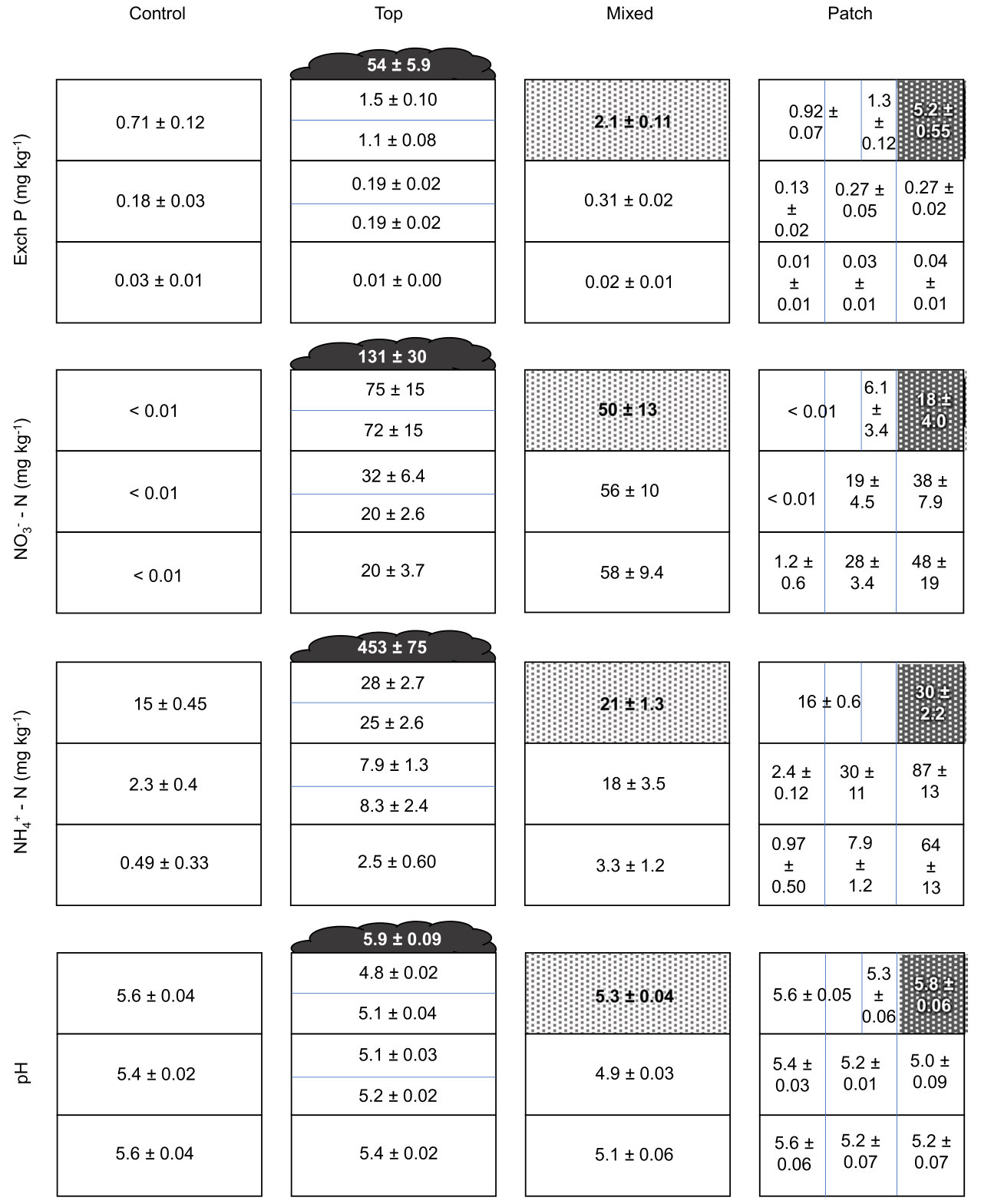
◂Fig. 5 Representation of mean ± standard error of exchangeable P, NO3−-N, NH4+-N (mg kg−1), and pH in each of the soil horizons (A: upper layer, B: middle layer, C: lower layer) and quadrants of the rhizobox experiment. The shaded areas represent the location and relative concentration of the biosolids in each rhizobox. Note that samples were collected and analysed separately per quadrant, but quadrants with similar results are represented together for simplicity (i.e. each horizon in Control, Top and Mixed, and adjacent quadrants in A horizon in Patch)
◂图5 根箱试验各土壤发生层(A:上层,B:中层,C:下层)和各象限中交换性P、NO3−-N、NH4+-N(mg kg−1)及pH的平均值 ± 标准误。阴影区域表示各根箱中生物固体的位置及相对浓度。注意,样品按象限分别采集和分析,但为简化起见,结果相近的象限合并表示(即对照、表面施用和混合处理中的各土层,以及斑块处理中A层的相邻象限)
Even with the strong rhizosphere effect shown by these experiments, it is unlikely that only roots can manage the export of contaminants from biosolids amended soil. As demonstrated by the rhizobox experiment (Fig. 5 and Supp. Material), NO3−, NH4+, S and Al can reach deeper soil horizons. Gove et al. (2002) demonstrated no difference in NO3− leaching between types of biosolids application in their column experiment. Our rhizobox results partially supported those observations with similar NO3− concentrations in the horizons immediately below the biosolids. However, the results in the deeper horizons showed that when biosolids were mixed on the surface - either homogeneously or concentrated in a patch - the NO3− was higher under these treatments than when the biosolids were applied on the surface. On the contrary, Gove et al. (2002) showed an increased P leaching when biosolids were applied in the subsurface compared with surface application, which is opposite to our results showing that the exchangeable P in the deeper soil horizons was similar in all treatments including control.
尽管这些试验显示出较强的根际效应,但仅靠根系不太可能控制生物固体改良土壤中污染物的输出。根箱试验(图5及补充材料)表明,NO3−、NH4+、S和Al能够到达更深的土层。Gove et al.(2002)在其土柱试验中证明,不同生物固体施用方式之间NO3−淋溶无差异。本研究的根箱结果部分支持了上述观察结果,即紧邻生物固体下方土层中的NO3−浓度相近。然而,较深土层的结果表明,当生物固体混入表层土壤时(无论是均匀混合还是集中于斑块中),这些处理下方的NO3−均高于表面施用生物固体的处理。相反,Gove et al.(2002)表明,与表面施用相比,地下施用生物固体时P淋溶增加,这与本研究结果相反,本研究显示包括对照在内的所有处理中较深土层的交换性P均相近。
Insights for management of biosolids land application
对生物固体土地施用管理的启示
Our experiments showed that both rate and type of biosolids application can profoundly affect soil quality. Although it is not possible to extrapolate these results to field conditions to provide guidance for biosolids application, they are still valuable to raise concerns about effects on soil quality that they have not been demonstrated previously.
本研究的试验表明,生物固体的施用量和施用方式均可深刻影响土壤质量。尽管无法将这些结果外推至田间条件以指导生物固体施用,但这些结果对于揭示此前尚未被证实的土壤质量影响问题仍具有重要价值。
Rate of biosolids application was the most important factor affecting the quality of soil, as demonstrated by the results on fertility, exchangeable trace elements, and biological activity (DHA). We agree with Borden and Black (2011) and Fuentes et al. (2010), to suggest that application rates < 45 t ha− 1 are recommended. Higher application rate in this experiment (Eq. 145 t ha− 1) produced acidification of the soil and solubilisation of Al when biosolids were applied to the surface, decreasing biological activity in the soil. However, when biosolids were mixed into the soil, the exchangeable concentration of P, Zn and Cu could be deleterious for plant health. Given that
生物固体(污泥)施用量是影响土壤质量的最重要因素,这一点从土壤肥力、可交换态微量元素及生物活性(DHA)的结果中均得到体现。我们赞同Borden and Black (2011) 和Fuentes et al. (2010) 的观点,建议施用量应低于45 t ha− 1。本试验中较高的施用量(相当于145 t ha− 1)在生物固体表施时导致土壤酸化和Al溶出,从而降低了土壤生物活性。然而,当生物固体与土壤混合时,P、Zn和Cu的可交换态浓度可能对植物健康产生不利影响。鉴于
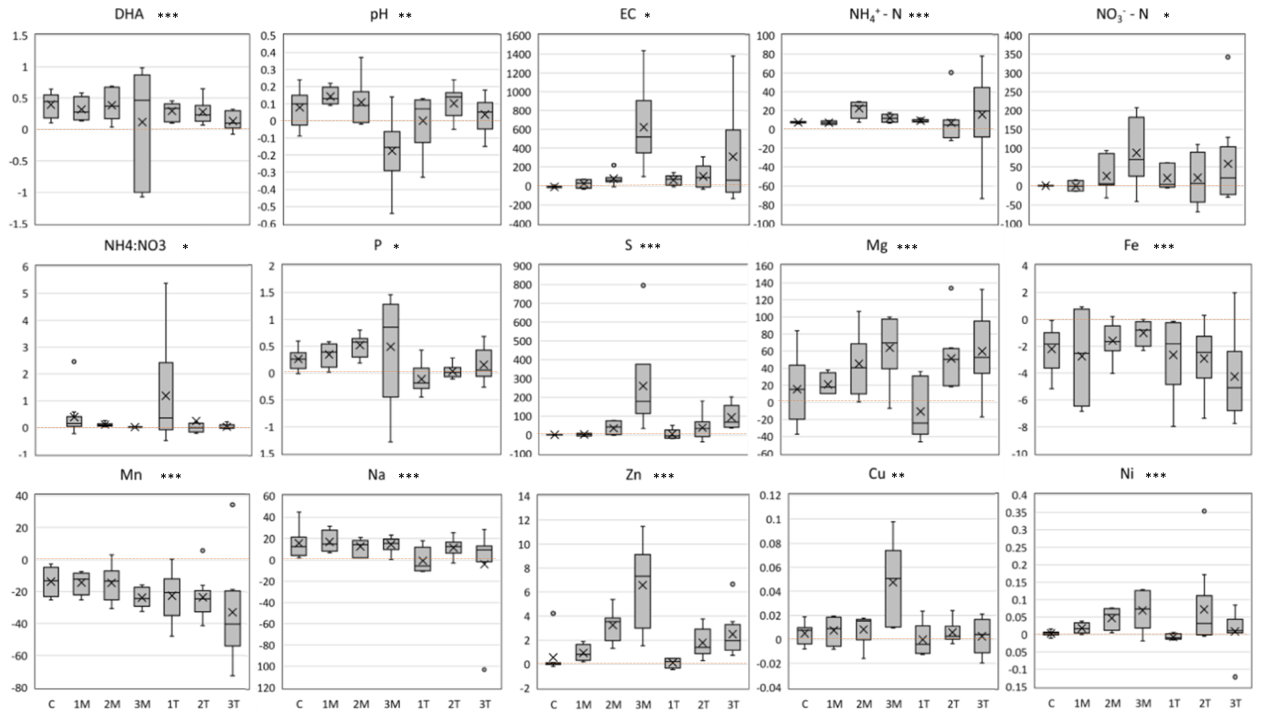
surface, with the numbers 1–3 reflecting the increasing rates of biosolids application. Where significant differences between rhizosphere and bulk in the pairwise t-test were identified, they are represented by * (p < 0.05), ** (p < 0.01) and *** (p < 0.001) next to the analysed parameter土壤表面,数字1–3表示生物固体施用量依次增加。成对t检验中根际与非根际之间存在显著差异时,在所分析参数旁以*(p < 0.05)、**(p < 0.01)和***(p < 0.001)标示
L. scoparium decreased plant growth in the highest application rate (Eq. 145 t ha− 1) compared with lower rates (Eq. 16 t ha− 1 and 48 t ha− 1), regardless of type of application (Gutiérrez-Ginés et al. 2019), it is obvious the deleterious effects on soil quality caused by the two types of application were similarly negative for this plant species.
L. scoparium在最高施用量(相当于145 t ha− 1)下的生长量低于较低施用量(相当于16 t ha− 1和48 t ha− 1),且与施用方式无关(Gutiérrez-Ginés et al. 2019),显然两种施用方式对土壤质量造成的不利影响对该植物物种而言同样是负面的。
Given the low nutrient requirements by L. scoparium (Stephens et al. 2005), or New Zealand native plants in general, the lowest application rate (Eq. 16 t ha− 1) would ensure the maintenance of a good biological activity in the soil regardless the type of application, still producing a significant increase in the plant biomass (Gutiérrez-Ginés et al. 2019). At the lowest application rate there were not significant differences in soil quality between surface or mixed application of biosolids (Fig. 2 and Supp. Material). Alternatively, heterogeneous application of biosolids in distinct zones in the soil (Fig. 5), through soil management practices such as strip tilling, could provide the benefits of incorporated biosolids and the maintenance of areas of low fertility and indigenous microbial community. Previous research (Gutiérrez-Ginés et al. 2019) showed that the root foraging behaviour of L. scoparium favours this heterogeneous application, still supporting an increased growth of this plant compared with unamended soil. This compromise may be more beneficial for restoring natural habitats by creating a variety of niches (Simcock et al. 2019). However, the results of the rhizobox experiment showed that this type of application may favour the movement of N and other nutrients such as K, Mg, S and Mn to deeper horizons by the high concentration of biosolids in a small area. Further research in real conditions is needed to better understand how different distribution of biosolids can affect soil quality and contribute to a more realistic restoration of natural ecosystems (Simcock et al. 2019). For creating guidance about the best methods for applying biosolids to restore degraded land, the effect of rainfall or irrigation need to be considered to better assess the real movement of contaminants to groundwater.
鉴于L. scoparium(Stephens et al. 2005)乃至新西兰本土植物总体上对养分的需求较低,最低施用量(相当于16 t ha− 1)无论采用何种施用方式均可确保土壤维持良好的生物活性,同时仍能显著提高植物生物量(Gutiérrez-Ginés et al. 2019)。在最低施用量下,生物固体表施与混施之间的土壤质量无显著差异(图2及补充材料)。另一种方案是,通过条带耕作等土壤管理措施将生物固体非均匀地施用于土壤中的不同区域(图5),既可获得混施生物固体的益处,又可保留低肥力区域及土著微生物群落。先前的研究(Gutiérrez-Ginés et al. 2019)表明,L. scoparium的根系觅食行为有利于这种非均匀施用方式,且与未改良土壤相比仍能促进该植物的生长。这种折中方案通过创造多样化的生态位,可能更有利于自然生境的恢复(Simcock et al. 2019)。然而,根箱试验结果表明,由于生物固体在小范围内高度集中,这种施用方式可能促进N及K、Mg、S和Mn等其他养分向更深土层迁移。需要在实际条件下开展进一步研究,以更好地了解生物固体的不同分布方式如何影响土壤质量,并促进更符合实际的自然生态系统恢复(Simcock et al. 2019)。为制定利用生物固体修复退化土地的最佳施用方法指南,需考虑降雨或灌溉的影响,以更好地评估污染物向地下水的实际迁移。
6Conclusions结论
This is the first work that compare the effects of rate and type of biosolids application on soil quality in the same experiment. Our results showed that the surface application of biosolids increased the fertility of the soil (higher inorganic N in soil and soi solution, and K and P in soil solution), and significantly decreased soil pH compared with the treatments when biosolids were incorporated into the soil. The acidic conditions might have mobilised Al, as shown by higher exchangeable Al, and inhibited nitrification, increasing the accumulation of NH4+. Anaerobic microsites created by accumulation of organic matter on the surface of the soil, could also be linked to the high NH4+ concentration and Mn mobilisation. The potential increase in CEC when biosolids were incorporated might have buffered the pH reduction seen on the surface applied biosolids treatments. These changes in soil chemistry can help to explain the decrease in DHA when biosolids were applied on the surface compared with the unamended soil. The contrast with the increase of DHA when biosolids were mixed indicates an enhanced biological activity by biosolidsborn microbes. Soil microbial activity was higher in the rhizosphere compared with bulk soil, where the concentration of plant nutrients and most of trace elements was also higher. Better understanding the biogeochemical changes happening in these biosolids altered systems requires further research.
本研究首次在同一试验中比较了生物固体(污泥)施用量和施用方式对土壤质量的影响。结果表明,与生物固体混入土壤的处理相比,生物固体表施提高了土壤肥力(土壤及土壤溶液中无机N含量更高,土壤溶液中K和P含量更高),并显著降低了土壤pH。酸性条件可能促使Al活化(表现为可交换态Al含量升高),并抑制了硝化作用,从而增加了NH4+的积累。土壤表面有机质积累所形成的厌氧微区也可能与高NH4+浓度及Mn的活化有关。生物固体混施时阳离子交换量(CEC)的潜在增加可能缓冲了表施生物固体处理中出现的pH下降。土壤化学性质的这些变化有助于解释与未改良土壤相比,表施生物固体时DHA下降的现象。与之相反,生物固体混施时DHA升高,表明生物固体携带的微生物增强了生物活性。根际土壤的微生物活性高于非根际土壤,且根际中植物养分和大多数微量元素的浓度也更高。要更好地理解这些经生物固体改变的系统中所发生的生物地球化学变化,尚需进一步研究。
Although the results of higher NH4+: NO3− ratio in rhizosphere than in bulk soil support the hypothesis of inhibition of denitrification by these root systems, this potential was not enough to prevent mobilization of these compounds to deeper soil horizons.
尽管根际中NH4+: NO3−比值高于非根际土壤的结果支持了这些根系抑制反硝化作用的假设,但这一潜力不足以阻止这些化合物向更深土层迁移。
These results could inform decisions about biosolids application for ecological restoration purposes. The results suggest that application rates of Eq. 16 t ha− 1 would provide an increase in fertility and biological activity in the soil, without the negative effects of increased soil acidity if biosolids were surface applied, or increased exchangeable Zn, and Cu if they were mixed into the soil. Heterogeneous distribution of biosolids could be a good method to increase microsites to favour diversity in the soil. However, potential export of nutrients to deeper soil horizons is a concern. Future research should focus on comparing these types of biosolids application in real conditions to better assess the benefits in recovering soil biodiversity and plant growth while minimizing contaminant exports to groundwater or plant uptake.
这些结果可为以生态恢复为目的的生物固体(污泥)施用决策提供参考。结果表明,相当于16 t ha− 1的施用量可提高土壤肥力和生物活性,且不会产生表施时土壤酸度增加的负面效应,也不会产生混施时可交换态Zn和Cu增加的负面效应。生物固体的非均匀分布可能是增加土壤微区、促进土壤多样性的良好方法。然而,养分可能向更深土层输出的问题值得关注。未来研究应着重在实际条件下比较这些生物固体施用方式,以更好地评估其在恢复土壤生物多样性和促进植物生长方面的效益,同时尽量减少污染物向地下水的输出或被植物吸收。
Acknowledgements This study was funded by the Centre for Integrated Biowaste Research which was supported by ESR Strategic Science Investment Funding from the Ministry of Business, Innovation and Employment, New Zealand (C03X1701). We acknowledge the staff in the Lincoln University greenhouse facilities and in the laboratories of the Soil Department, where all the experimental work took place. We thank Christchurch City Council for providing the biosolids. During her postdoc position in Lincoln University (New Zealand), MJGG held a fellowship granted by Fundación Ramón Areces (Spain). EM thanks the financial support for her work at Lincoln University from Program Salvador de Madariaga of the Spanish MECD.
致谢 本研究由Centre for Integrated Biowaste Research资助,该中心获得新西兰商业、创新与就业部ESR战略科学投资基金(Strategic Science Investment Funding)的支持(C03X1701)。感谢Lincoln University温室设施及土壤系实验室的工作人员,所有试验工作均在此完成。感谢基督城市议会(Christchurch City Council)提供生物固体。MJGG在Lincoln University(新西兰)从事博士后研究期间获得Fundación Ramón Areces(西班牙)资助的奖学金。EM感谢西班牙MECD的Salvador de Madariaga项目对其在Lincoln University工作的资助。
Author contributions All authors contributed to the study conception and design. Material preparation and data collection were performed by María J Gutiérrez-Ginés, with support from Niklas Lehto, Engracia Madejón and Brett Robinson. Data analysis and the first draft of the manuscript were prepared by María J Gutiérrez-Ginés and all authors commented on previous versions of the manuscript. All authors read and approved the final manuscript.
作者贡献 全体作者均参与了研究的构思与设计。材料准备和数据收集由María J Gutiérrez-Ginés完成,Niklas Lehto、Engracia Madejón和Brett Robinson提供了协助。数据分析和论文初稿由María J Gutiérrez-Ginés完成,全体作者对稿件的前期版本提出了意见。全体作者阅读并同意最终稿件。
Data availability The original data is provided as Excel sheets in Supplementary Material.
数据可用性 原始数据以Excel表格形式提供于补充材料中。
Declarations声明
Conflict of interest The authors declare that they have no conflict of interest.
利益冲突 作者声明不存在利益冲突。
Open Access This article is licensed under a Creative Commons Attribution 4.0 International License, which permits use, sharing, adaptation, distribution and reproduction in any medium or format, as long as you give appropriate credit to the original author(s) and the source, provide a link to the Creative Commons licence, and indicate if changes were made. The images or other third party material in this article are included in the article’s Creative Commons licence, unless indicated otherwise in a credit line to the material. If material is not included in the article’s Creative Commons licence and your intended use is not permitted by statutory regulation or exceeds the permitted use, you will need to obtain permission directly from the copyright holder. To view a copy of this licence, visit http:// creat iveco mmons. org/ licen ses/ by/4. 0/.
开放获取 本文采用知识共享署名4.0国际许可协议(Creative Commons Attribution 4.0 International License)授权,该协议允许以任何媒介或格式使用、共享、改编、分发和复制本文,但须适当注明原作者及来源,提供知识共享许可协议的链接,并说明是否作了修改。除非在材料的署名说明中另有注明,本文中的图像或其他第三方材料均包含在本文的知识共享许可协议中。如果材料未包含在本文的知识共享许可协议中,且您的预期用途不为法律法规所允许或超出允许的使用范围,则需直接获得版权持有人的许可。如需查看该许可协议的副本,请访问 http:// creat iveco mmons. org/ licen ses/ by/4. 0/。
7References参考文献
Alvarez R, Steinbach HS (2009) A review of the effects of tillage systems on some soil physical properties, water content, nitrate availability and crops yield in the Argentine Pampas. Soil Tillage Res 104(1):1–15. https:// doi. org/ 10. 1016/j. still. 2009. 02. 005
Alvarez-Campos O, Evanylo GK (2019) Environmental impact of exceptional quality biosolids use in urban agriculture. J Environ Qual 48(6):1872–1880. https:// doi. org/ 10. 2134/ jeq20 19. 04. 0181
Ataria J, Baker V, Goven J, Langer ER, Leckie A, Ross M et al (2016) From Tapu to Noa - Māori cultural views on biowastes management: a focus on biosolids. Centre for integrated biowaste research. Available via http:// www. cibr. org. nz/ news/ cibr- publi catio ns/ from- tapu- to- noa- maoricultu ral- views- on- biowa ste- manag ement/
ANZBP (2020) Australian Biosolids Statistics [Online]. Australian and New Zealand Biosolids Partnership. Available: https:// www. bioso lids. com. au/ guide lines/ austr alian- bioso lids- stati stics/.. Accessed 14 Oct 2021
Blakemore LC, Searle PL, Daly BK (1987) Methods for chemical analysis of soils. In: NZ Soil Bureau Scientific Report 80
Borden RK, Black R (2011) Biosolids application and long-term noxious weed dominance in the Western United States. Restor Ecol 19(5):639–647. https:// doi. org/ 10. 1111/j. 1526- 100X. 2010. 00671.x
Bozkurt MA, Akdeniz H, Keskin B, Yilmaz IH (2006) Possibilities of using sewage sludge as nitrogen fertilizer for maize. Acta Agric Scand Sect B — Soil Plant Sci 56(2):143–149. https:// doi. org/ 10. 1080/ 09064 71051 003113
Castillo MS, Sollenberger LE, Vendramini JMB, Woodard KR, O’Connor GA, Silveira ML et al (2011) Incorporation of municipal biosolids affects organic nitrogen mineralization and elephantgrass biomass production. Agron J 103(3):899–905. https:// doi. org/ 10. 2134/ agron j2010. 0497
Clough TJ, Stevens RJ, Laughlin RJ, Sherlock RR, Cameron KC (2001) Transformations of inorganic-N in soil leachate under differing storage conditions. Soil Biol Biochem 33(11):1473–1480. https:// doi. org/ 10. 1016/ S0038- 0717(01) 00056-6 Collivignarelli MC, Canato M, Abbà A, Carnevale Miino M (2019) Biosolids: What are the different types of reuse? J Clean Prod 238. https:// doi. org/ 10. 1016/j. jclep ro. 2019. 117844
Esperschuetz J, Balaine N, Clough T, Bulman S, Dickinson N, Horswell J et al (2017) The potential of L. scoparium, K. robusta and P. radiata to mitigate N-losses in silvopastural systems. Environ Poll 225:12–19. https:// doi. org/ 10. 1016/j. envpol. 2017. 03. 042
Fuentes D, Valdecantos A, Llovet J, Cortina J, Vallejo VR (2010) Fine-tuning of sewage sludge application to promote the establishment of Pinus halepensis seedlings. Ecol Eng 36(10):1213–1221. https:// doi. org/ 10. 1016/j. ecole ng. 2010. 04. 012 Gardner WC, Broersma K, Naeth A, Chanasyk D, Jobson A (2010) Influence of biosolids and fertilizer amendments on physical, chemical and microbiological properties of copper mine tailings. Can J Soil Sci 90(4):571–583. https:// doi. org/ 10. 4141/ cjss0 9067
Gianico A, Braguglia CM, Gallipoli A, Montecchio D, Mininni G (2021) Land application of biosolids in Europe: possibilities, con-straints and future perspectives. Water 13:103. https:// doi. org/ 10. 3390/ w1301 0103
Gove L, Nicholson FA, Cook HF, Beck AJ (2002) Comparison of the effect of surface application and subsurface incorporation of enhanced treated biosolids on the leaching of
heavy metals and nutrients through sand and sandy loam soils. Environ Technol 23(2):189–198. https:// doi. org/ 10. 1080/ 09593 33250 86184 21
Gravuer K, Gennet S, Throop HL (2019) Organic amendment additions to rangelands: a meta-analysis of multiple ecosystem outcomes. Glob Change Biol 25(3):1152–1170. https:// doi. org/ 10. 1111/ gcb. 14535
Griffith S, Bero N, Stier J, Obear G, Ruis S, Soldat D (2020) Use of biosolids for sod production: impact on the import/export of nutrients, heavy metals, and soil mineral matter. Agron J 112. https:// doi. org/ 10. 1002/ agj2. 20086
Gutiérrez-Ginés MJ, Robinson BH, Esperschütz J, Madejon E, McLenaghen RD, Horswell J (2017) Potential use of biosolids to reforest degraded areas with New Zealand native vegetation. J Environ Qual. https:// doi. org/ 10. 2134/ jeq20 17. 04. 0139
Gutiérrez-Ginés MJ, Madejón E, Lehto NJ, McLenaghen RD, Horswell J, Dickinson N et al (2019) Response of a pioneering species (Leptospermum scoparium J.R.Forst. & G.Forst.) to heterogeneity in a low-fertility soil. Front Plant Sci 10(93). https:// doi. org/ 10. 3389/ fpls. 2019. 00093
Halford S, Gutiérrez-Ginés MJ, Rees A, Alderton I, Schaller K, Smith R et al (2021) Effect of mānuka (Leptospermum scoparium) on nitrogen and Escherichia coli reductions in soils: a field experiment. Plant Soil 465(1):491–502. https:// doi. org/ 10. 1007/ s11104- 021- 05035-3
He ZL, Calvert DV, Alva AK, Li YC, Stoffella PJ, Banks DJ (2003) Nitrogen transformation and ammonia volatilization from biosolids and compost applied to calcareous soil. Compost Sci Util 11(1):81–88. https:// doi. org/ 10. 1080/ 10656 57X. 2003. 10702 112
Hewitt AE (2010) New Zealand soil classification. Landcare research science series 1. Manaaki Whenua Press, Lincoln, p 136
Hu Y, Pang S, Yang J, Zhao X, Cao J (2019) Changes in soil microbial community structure following amendment of biosolids for seven years. Environ Pollut Bioavail 31(1):24–31. https:// doi. org/ 10. 1080/ 26395 940. 2019. 15694 78
Jin VL, Potter KN, Johnson MVV, Harmel RD, Arnold JG (2015) Surface-applied biosolids enhance soil organic carbon and nitrogen stocks but have contrasting effects on soil physical quality. Appl Environ Soil Sci. https:// doi. org/ 10. 1155/ 2015/ 715916
Keiluweit M, Bougoure J, Nico P, Pett-Ridge J, Weber PK, Kleber M (2015) Mineral protection of soil carbon counteracted by root exudates. Nat Clim Change 5:588–595. https:// doi. org/ 10. 1038/ nclim ate25 80
LeBlanc RJ, Matthews P, Richard RP (2008) Global atlas of excreta, wastewater sludge, and biosolids management: moving forward the sustainable and welcome uses of a global resource. United Nations Human Settlements Programme (UN-HABITAT). United Nations Human Settlements Programme (UN-HABITAT), Nairobi
Liu S, He F, Kuzyakov Y, Xiao H, Hoang DTT, Pu S, Razavi BS (2022) Nutrients in the rhizosphere: a meta-analysis of content, availability, and influencing factors. Sci Total Environ 826:153908. https:// doi. org/ 10. 1016/j. scito tenv. 2022. 153908
Vol:. (1234567890)
Lu Q, He ZL, Stoffella PJ (2012) Land application of biosolids in the USA: a review. Appl Environ Soil Sci. https:// doi. org/ 10. 1155/ 2012/ 201462
Madejón P, Alaejos J, García-Álbala J, Fernández M, Madejón E (2016) Three-year study of fast-growing trees in degraded soils amended with composts: Effects on soil fertility and productivity. J Environ Manage 169:18–26. https:// doi. org/ 10. 1016/j. jenvm an. 2015. 11. 050
Martínez F, Cuevas G, Calvo R, Walter I (2003) Biowaste effects on soil and native plants in a semiarid ecosystem. J Environ Qual 32(2):472–479. https:// doi. org/ 10. 2134/ jeq20 03. 4720
McLaren RG, Clucas LM, Taylor MD (2005) Leaching of macronutrients and metals from undisturbed soils treated with metal-spiked sewage sludge. 3. Distribution of residual metals. Soil Res 43(2):159–170. https:// doi. org/ 10. 1071/ SR041 09
McNear DH Jr (2013) The rhizosphere - roots, soil and everything in between. Nat Educ Knowl 4(3):1
Mench M, Vangronsveld J, Lepp N, Ruttens A, Bleeker P, Geebelen W (2003) Use of soil amendments to attenuate trace element exposure: sustainability, side effects, and failures. Natural attenuation of trace element availability in soils. SETAC Publication, France
Moffet CA, Zartman RE, Wester DB, Sosebee RE (2005) Surface biosolids application: effects on infiltration, erosion, and soil organic carbon in Chihuahuan Desert grasslands and shrublands. J Environ Qual 34(1):299–311 Moreno-Peñaranda R, Lloret F, Alcañiz JM (2004) Effects of sewage sludge on plant community composition in restored limestone quarries. Restor Ecol 12(2):290–296. https:// doi. org/ 10. 1111/j. 1061- 2971. 2004. 00310.x
Newman RF, Krzic M, Wallace BM (2014) Differing effects of biosolids on native plants in grasslands of Southern British Columbia. J Environ Qual 43(5):1672–1678. https:// doi. org/ 10. 2134/ jeq20 14. 01. 0013
Nicholson F, Bhogal A, Taylor M, McGrath S, Withers P (2018) Long-term effects of biosolids on soil quality and fertility. Soil Sci 183(3):89–98. https:// doi. org/ 10. 1097/ ss. 00000 00000 000239
NZWWA (2003) Guidelines for the safe application of biosolids to land in New Zealand, N.Z.W.a.W. Association
Paramashivam D, Dickinson NM, Clough TJ, Horswell J, Robinson BH (2017) Potential environmental benefits from blending biosolids with other organic amendments before application to land. J Environ Qual 46(3):481–489. https:// doi. org/ 10. 2134/ jeq20 16. 10. 0421
Price GW, Astatkie T, Gillis JD, Liu K (2015) Long-term influences on nitrogen dynamics and pH in an acidic sandy soil after single and multi-year applications of alkaline treated biosolids. Agric Ecosyst Environ 208:1–11. https:// doi. org/ 10. 1016/j. agee. 2015. 04. 010
Quemada M, Lasa B, Lamsfus C, Aparicio-Tejo PM (1998) Ammonia volatilization from surface or incorporated biosolids by the addition of dicyandiamide. J Environ Qual 27(4):980–983. https:// doi. org/ 10. 2134/ jeq19 98. 00472 42500 27000 40036x
R Core Team (2021) R: a language and environment for statistical computing. R Foundation for Statistical Computing, Vienna
Reis FVP, Gutiérrez-Ginés MJ, Smith CMS, Lehto NJ, Robinson BH (2017) Mānuka (Leptospermum scoparium) roots forage biosolids in low fertility soil. Environ Exp Bot 133:151–158. https:// doi. org/ 10. 1016/j. envex pbot. 2016. 10. 012
Roman-Perez CC, Hernandez-Ramirez G, Kryzanowski L, Puurveen D, Lohstraeter G (2021) Greenhouse gas emissions, nitrogen dynamics and barley productivity as impacted by biosolids applications. Agric Ecosyst Environ 320:107577. https:// doi. org/ 10. 1016/j. agee. 2021. 107577
Seyedalikhani S, Esperschuetz J, Dickinson NM, Hofmann R, Breitmeyer J, Horswell J et al (2019) Biowastes to augment the essential oil production of Leptospermum scoparium and Kunzea robusta in low-fertility soil. Plant Physiol Biochem 137:213–221. https:// doi. org/ 10. 1016/j. plaphy. 2019. 02. 008
Simcock R, Cavanagh J, Robinson B, Gutierrez-Gines MJ (2019) Using biowastes to establish native plants and ecosystems in New Zealand. Front Sustain Food Syst 3(85). https:// doi. org/ 10. 3389/ fsufs. 2019. 00085
Sopper WE, Kardos LT (1974) Recycling treated municipal wastewater and sludge through forest and cropland. The Pennsylvania State Univ. Press, University Park
Sposito G (2008) The chemistry of soils. Oxford University Press, New York
Stantec (2019) New Zealand Biosolids Survey 2019. (ed.) A.a.N.Z.B. Partnership. https:// www. bioso lids. com. au/
Stephens JMC, Molan PC, Clarkson BD (2005) A review of Leptospermum scoparium (Myrtaceae) in New Zealand. N Z J Bot 43:431–449. https:// doi. org/ 10. 1080/ 00288 25x. 2005. 95129 66
Sullivan TS, Stromberger ME, Paschke MW, Ippolito JA (2006) Long-term impacts of infrequent biosolids applications on chemical and microbial properties of a semi-arid rangeland soil. Biol Fertil Soils 42(3):258–266. https:// doi. org/ 10. 1007/ s00374- 005- 0023-z
Wang H, Magesan GN, Kimberley MO, Payn TW, Wilks PJ, Fisher CR (2004) Environmental and nutritional responses of a Pinus radiata plantation to biosolids application. Plant Soil 267(1):255–262. https:// doi. org/ 10. 1007/ s11104- 005- 0107-4
Wang H, Brown SL, Magesan GN, Slade AH, Quintern M, Clinton PW et al (2008) Technological options for the management of biosolids. Environ Sci Pollut Res Int 15(4):308–317. https:// doi. org/ 10. 1007/ s11356- 008- 0012-5
Wang D, Felice ML, Scow KM (2020) Impacts and interactions of biochar and biosolids on agricultural soil microbial communities during dry and wet-dry cycles. Appl Soil Ecol 152:103570. https:// doi. org/ 10. 1016/j. apsoil. 2020. 103570
Welikala D, Hucker C, Hartland A, Robinson BH, Lehto NJ (2018) Trace metal mobilization by organic soil amendments: insights gained from analyses of solid and solution phase complexation of cadmium, nickel and zinc. Chemosphere 199:684–693. https:// doi. org/ 10. 1016/j. chemo sphere. 2018. 02. 069
Welikala D, Robinson BH, Moltchanova E, Hartland A, Lehto NJ (2021) Soil cadmium mobilisation by dissolved organic matter from soil amendments. Chemosphere 271:129536. https:// doi. org/ 10. 1016/j. chemo sphere. 2021. 129536
Wickham H (2016) ggplot2: elegant graphics for data analysis. Springer-Verlag. https:// ggplo t2. tidyv erse. org/
Xue J, Kimberley MO, Ross C, Gielen G, Tremblay LA, Champeau O et al (2015) Ecological impacts of long-term application of biosolids to a radiata pine plantation. Sci Total Environ 530–531:233–240. https:// doi. org/ 10. 1016/j. scito tenv. 2015. 05. 096
Publisher’s note Springer Nature remains neutral with regard to jurisdictional claims in published maps and institutional affiliations.
8Terms and Conditions条款与条件
Springer Nature journal content, brought to you courtesy of Springer Nature Customer Service Center GmbH (“Springer Nature”). Springer Nature supports a reasonable amount of sharing of research papers by authors, subscribers and authorised users (“Users”), for small-scale personal, non-commercial use provided that all copyright, trade and service marks and other proprietary notices are maintained. By accessing, sharing, receiving or otherwise using the Springer Nature journal content you agree to these terms of use (“Terms”). For these purposes, Springer Nature considers academic use (by researchers and students) to be non-commercial. These Terms are supplementary and will apply in addition to any applicable website terms and conditions, a relevant site licence or a personal subscription. These Terms will prevail over any conflict or ambiguity with regards to the relevant terms, a site licence or a personal subscription (to the extent of the conflict or ambiguity only). For Creative Commons-licensed articles, the terms of the Creative Commons license used will apply.
Springer Nature期刊内容由Springer Nature Customer Service Center GmbH(“Springer Nature”)提供。Springer Nature支持作者、订阅者和授权用户(“用户”)在合理范围内共享研究论文,用于小规模的个人非商业用途,前提是保留所有版权、商标和服务标志及其他所有权声明。访问、共享、接收或以其他方式使用Springer Nature期刊内容,即表示您同意本使用条款(“条款”)。就此而言,Springer Nature将学术用途(研究人员和学生的使用)视为非商业用途。本条款为补充性条款,在任何适用的网站条款和条件、相关站点许可或个人订阅之外另行适用。如与相关条款、站点许可或个人订阅存在冲突或歧义,以本条款为准(仅限于冲突或歧义的范围)。对于采用知识共享(Creative Commons)许可的文章,适用所采用的知识共享许可条款。
We collect and use personal data to provide access to the Springer Nature journal content. We may also use these personal data internally within ResearchGate and Springer Nature and as agreed share it, in an anonymised way, for purposes of tracking, analysis and reporting. We will not otherwise disclose your personal data outside the ResearchGate or the Springer Nature group of companies unless we have your permission as detailed in the Privacy Policy.
我们收集和使用个人数据以提供对Springer Nature期刊内容的访问。我们也可能在ResearchGate和Springer Nature内部使用这些个人数据,并经约定以匿名方式共享,用于跟踪、分析和报告。除非获得您的许可(详见隐私政策),否则我们不会以其他方式向ResearchGate或Springer Nature集团公司以外披露您的个人数据。
While Users may use the Springer Nature journal content for small scale, personal non-commercial use, it is important to note that Users may not:
尽管用户可将Springer Nature期刊内容用于小规模的个人非商业用途,但需注意,用户不得:
1. use such content for the purpose of providing other users with access on a regular or large scale basis or as a means to circumvent access control;
1. 为定期或大规模地向其他用户提供访问,或作为规避访问控制的手段而使用此类内容;
2. use such content where to do so would be considered a criminal or statutory offence in any jurisdiction, or gives rise to civil liability, or is otherwise unlawful;
2. 在任何司法管辖区内构成刑事或法定违法行为、引起民事责任或以其他方式违法的情况下使用此类内容;
3. falsely or misleadingly imply or suggest endorsement, approval , sponsorship, or association unless explicitly agreed to by Springer Nature in writing;
3. 虚假或误导性地暗示或表明获得认可、批准、赞助或存在关联,除非Springer Nature以书面形式明确同意;
4. use bots or other automated methods to access the content or redirect messages 5. override any security feature or exclusionary protocol; or
4. 使用机器人或其他自动化方法访问内容或重定向信息;5. 绕过任何安全功能或排除协议;或
6. share the content in order to create substitute for Springer Nature products or services or a systematic database of Springer Nature journal content.
6. 为创建Springer Nature产品或服务的替代品,或建立Springer Nature期刊内容的系统性数据库而共享内容。
In line with the restriction against commercial use, Springer Nature does not permit the creation of a product or service that creates revenue, royalties, rent or income from our content or its inclusion as part of a paid for service or for other commercial gain. Springer Nature journal content cannot be used for inter-library loans and librarians may not upload Springer Nature journal content on a large scale into their, or any other, institutional repository.
根据禁止商业使用的限制,Springer Nature不允许利用我们的内容创建产生收入、版税、租金或收益的产品或服务,也不允许将其纳入付费服务或用于其他商业利益。Springer Nature期刊内容不得用于馆际互借,图书馆员不得将Springer Nature期刊内容大规模上传至其本机构或任何其他机构的知识库。
These terms of use are reviewed regularly and may be amended at any time. Springer Nature is not obligated to publish any information or content on this website and may remove it or features or functionality at our sole discretion, at any time with or without notice. Springer Nature may revoke this licence to you at any time and remove access to any copies of the Springer Nature journal content which have been saved.
本使用条款会定期审查,并可能随时修订。Springer Nature没有义务在本网站上发布任何信息或内容,并可自行决定随时删除这些信息、内容、特性或功能,无论是否另行通知。Springer Nature可随时撤销对您的许可,并删除对已保存的Springer Nature期刊内容副本的访问权限。
To the fullest extent permitted by law, Springer Nature makes no warranties, representations or guarantees to Users, either express or implied with respect to the Springer nature journal content and all parties disclaim and waive any implied warranties or warranties imposed by law, including merchantability or fitness for any particular purpose.
在法律允许的最大范围内,Springer Nature不就Springer Nature期刊内容向用户作出任何明示或暗示的保证、陈述或担保,且各方均否认并放弃任何默示保证或法律规定的保证,包括适销性或特定用途适用性的保证。
Please note that these rights do not automatically extend to content, data or other material published by Springer Nature that may be licensed from third parties.
请注意,上述权利并不自动延及Springer Nature所发布的、可能获得第三方许可的内容、数据或其他材料。
If you would like to use or distribute our Springer Nature journal content to a wider audience or on a regular basis or in any other manner not expressly permitted by these Terms, please contact Springer Nature at onlineservice@springernature.com