Article
Hayley Jensen 1, Niklas Lehto 2 , Peter Almond 2 , Sally Gaw 1 and Brett Robinson 1,*
1 School of Physical and Chemical Sciences, University of Canterbury, Christchurch 8041, New Zealand; sally.gaw@canterbury.ac.nz (S.G.)
2 Department of Soil and Physical Sciences, Lincoln University, Lincoln 7647, New Zealand; niklas.lehto@lincoln.ac.nz (N.L.); peter.almond@lincoln.ac.nz (P.A.)
* Correspondence: brett.robinson@canterbury.ac.nz; Tel.: +64-21-288-5655
Abstract: Technological development has increased the use of chemical elements that have hitherto received scant scientific attention as environmental contaminants. Successful management of these rare trace elements (RTEs) requires elucidation of their mobility in the soil–plant system. We aimed to determine the capacity of Lolium perenne (a common pasture species) to tolerate and accumulate the RTEs Be, Ga, In, La, Ce, Nd, and Gd in a fluvial recent soil. Cadmium was used as a reference as a well-studied contaminant that is relatively mobile in the soil–plant system. Soil was spiked with 2.5–283 mg kg−1 of RTE or Cd salts, representing five, 10, 20, and 40 times their background concentrations in soil. For Be, Ce, In, and La, there was no growth reduction, even at the highest soil concentrations (76, 1132, 10.2, and 874 mg kg−1, respectively), which resulted in foliar concentrations of 7.1, 12, 0.11, and 50 mg kg−1, respectively. The maximum no-biomass reduction foliar concentrations for Cd, Gd, Nd, and Ga were 0.061, 0.1, 7.1, and 11 mg kg−1, respectively. Bioaccumulation coefficients ranged from 0.0030–0.95, and increased Ce < In < Nd ∼= Gd < La ∼= Be ∼= Ga < Cd. Beryllium and La were the RTEs most at risk of entering the food chain via L. perenne, as their toxicity thresholds were not reached in the ranges tested, and the bioaccumulation coefficient (plant/soil concentration quotient) trends indicated that uptake would continue to increase at higher soil concentrations. In contrast, In and Ce were the elements least likely to enter the food chain. Further research should repeat the experiments in different soil types or with different plant species to test the robustness of the findings.
摘要:技术发展增加了一些化学元素的使用,而这些元素作为环境污染物迄今很少受到科学关注。要对这些稀有微量元素(RTEs)进行有效管理,须阐明其在土壤–植物系统中的迁移性。本研究旨在测定Lolium perenne(一种常见牧草)在新近冲积土中对稀有微量元素Be、Ga、In、La、Ce、Nd和Gd的耐受与累积能力。以Cd作为参照,因其是研究较为充分、在土壤–植物系统中迁移性相对较强的污染物。向土壤中添加2.5–283 mg kg−1的稀有微量元素盐或Cd盐,分别相当于其土壤背景浓度的5、10、20和40倍。对于Be、Ce、In和La,即使在最高土壤浓度下(分别为76、1132、10.2和874 mg kg−1)也未出现生长下降,此时叶片浓度分别为7.1、12、0.11和50 mg kg−1。Cd、Gd、Nd和Ga在生物量未下降条件下的最大叶片浓度分别为0.061、0.1、7.1和11 mg kg−1。生物富集系数介于0.0030–0.95之间,大小顺序为Ce < In < Nd ∼= Gd < La ∼= Be ∼= Ga < Cd。Be和La是经由L. perenne进入食物链风险最高的稀有微量元素,因为在所测试的浓度范围内未达到其毒性阈值,且生物富集系数(植物/土壤浓度比)的变化趋势表明,在更高的土壤浓度下其吸收量将继续增加。相反,In和Ce是最不易进入食物链的元素。今后的研究应在不同土壤类型中或以不同植物物种重复本试验,以检验上述结果的稳健性。
Academic Editor: Irina Shtangeeva
Received: 30 September 2023 Revised: 9 November 2023 Accepted: 12 November 2023 Published: 15 November 2023
Copyright: © 2023 by the authors. Licensee MDPI, Basel, Switzerland. This article is an open access article distributed under the terms and conditions of the Creative Commons Attribution (CC BY) license (https:// creativecommons.org/licenses/by/ 4.0/).
版权:© 2023 作者所有。授权方 MDPI,瑞士巴塞尔。本文为开放获取文章,依据知识共享署名(CC BY)许可协议(https:// creativecommons.org/licenses/by/ 4.0/)条款发布。
Keywords: bioaccumulation coefficient; perennial ryegrass; phytomanagement
关键词:生物富集系数;多年生黑麦草;植物管理
1Introduction引言
New technology uses Rare Trace Elements (RTEs), which have previously not been emitted into the environment at high concentrations. Soil contamination via the disposal of mining and extraction waste, rudimentary recycling of electronic waste [1], and leaching of materials from landfills has increased rapidly with the industrial use of RTEs [2–5]. Beryllium, Ga, In, La, Ce, Nd, and Gd are RTEs of concern that are used across several industrial sectors at the rate of tens or hundreds of tonnes per year [6].
新技术使用了稀有微量元素(RTEs),这些元素以往并未以高浓度排放到环境中。随着稀有微量元素的工业化应用,经由采矿和提取废弃物处置、电子废弃物的粗放回收[1]以及垃圾填埋场物料淋溶所造成的土壤污染迅速增加[2–5]。Be、Ga、In、La、Ce、Nd和Gd是值得关注的稀有微量元素,在多个工业部门中的使用量达到每年数十至数百吨[6]。
Upon entry to soil, these RTEs either become associated with the solid phase through specific or non-specific adsorption to organic or inorganic matter, precipitation, or remaining in solution [7]. In the soil solution, RTEs may leach downwards through the soil profile or be taken up by plants [8]. Ions associated with the solid phase of the soil age to less soluble forms the longer they are in soil [9]. As RTEs are not known to be essential for plants and because soil background concentrations are relatively modest (Table 1) [10], plants are unlikely to have evolved specific mechanisms affecting tolerance or uptake. In soil, soluble RTEs will migrate toward plant roots via mass flow and diffusion [11]. Inside the root cortex, they are transported to the xylem tissues via the apoplastic or symplastic pathways [12]. Transportation across membranes into the symplast may occur, via the pathways of chemically similar ions [11], e.g., Ga3+ may be taken up via the same mechanism as Fe3+ in strategy II plants because the ions are similar in size and electronegativity [13]; La, Ce, Nd, and Gd can replace Ca2+ [14]; and Be can replace Ca2+ and Mg2+ [15]. Once in the roots, RTEs may be translocated around the plant, and if they enter the above-ground biomass or the edible organs, animal and human ingestion may occur. If RTEs are retained by soil, they can be ingested through soil retained on the surfaces of plant material [16], which is more common in erosion-prone areas where the contaminated soil can migrate, and on root crops such as potatoes that are directly in contact with the contaminated soil. RTEs may be taken up and translocated by plants if they are present in the soil solution, such as in hydroponic systems or acidic soils where elements such as Ga and In have not been hydrolysed to insoluble forms [17–19]. In hydroponic conditions, rice seedlings contained 74 mg kg−1 Ga without toxicity [18]. The phytotoxicity of these elements when added to soil depends on solid-phase retention and thus bioavailability, which vary between soil types [17,20,21]. Bioaccumulation coefficients (BACs), defined as the plant/soil concentration quotient for RTEs, typically range from <0.1–1.0 [17,22–25], but in rare instances can be >1.0 in plants which have strategies to take up and mitigate the phytotoxicity of RTEs, such as wild species growing in contaminated locations in Khan et al. [26].
这些稀有微量元素进入土壤后,或通过对有机或无机物质的专性或非专性吸附、沉淀而与固相结合,或保留在溶液中[7]。在土壤溶液中,稀有微量元素可能沿土壤剖面向下淋溶,或被植物吸收[8]。与土壤固相结合的离子在土壤中存留时间越长,就越会老化为溶解度更低的形态[9]。由于尚未发现稀有微量元素是植物必需元素,且其土壤背景浓度相对较低(表1)[10],植物不太可能已进化出影响其耐受或吸收的专门机制。在土壤中,可溶性稀有微量元素将通过质流和扩散向植物根系迁移[11]。在根皮层内,它们经质外体或共质体途径被运输至木质部组织[12]。跨膜进入共质体的运输可能借助化学性质相似离子的途径进行[11],例如,由于离子大小和电负性相近,Ga3+在机理II植物中可能通过与Fe3+相同的机制被吸收[13];La、Ce、Nd和Gd可替代Ca2+[14];Be可替代Ca2+和Mg2+[15]。稀有微量元素一旦进入根系,便可能在植物体内转运,若进入地上部生物量或可食器官,则可能被动物和人类摄入。若稀有微量元素被土壤保留,则可通过附着在植物材料表面的土壤被摄入[16],这在污染土壤易于迁移的侵蚀易发区更为常见,在马铃薯等与污染土壤直接接触的根茎类作物上也较为常见。若稀有微量元素存在于土壤溶液中,例如在水培系统中或在Ga、In等元素尚未水解为不溶形态的酸性土壤中,它们便可能被植物吸收和转运[17–19]。在水培条件下,水稻幼苗含Ga 74 mg kg−1而未表现出毒性[18]。这些元素添加到土壤后的植物毒性取决于固相保留程度及由此决定的生物有效性,而二者因土壤类型而异[17,20,21]。生物富集系数(BACs)定义为稀有微量元素的植物/土壤浓度比,通常介于<0.1–1.0之间[17,22–25],但在少数情况下,具有吸收稀有微量元素并缓解其植物毒性策略的植物中该值可>1.0,例如Khan et al. [26]中生长于污染地点的野生物种。
| Element元素 | Concentration in Experimental Soil (mg kg−1)试验土壤中的浓度(mg kg−1) |
|---|---|
| Be | 13 (0.55) |
| Cd | 0.064 (0.0018) |
| Ga | 89 (1.1) |
| In | 0.31 (0.0081) |
| La | 308 (1.5) |
| Ce | 60 (0.53) |
| Nd | 256 (4.0) |
| Gd | 39 (0.56) |
There is a lacuna in studies comparing plant uptake and bioaccumulation of RTEs to each other and to common contaminants such as Cd. For example, the concentrations of RTEs in Fagus sylvatica leaves increased In < Gd < Be < Ga < La < Nd < Ce, from 0.0002 to 0.066 mg kg−1 [27], and in Browntop grass Gd < Be < Nd < La < Ce, from 0.0031–0.025 to 0.051–0.13 mg kg−1 [28]. Bioaccumulation coefficients in wheat/barley stems and grains increased Nd < La < Ga < Be < Ce, ranging from 0.0022–0.48 in stems and 0.00053–0.14 in grains [20]. However, the plants in the aforementioned studies were grown in uncontaminated soils. In contaminated soils, the RTEs may be less strongly sorbed to soil and thus more bioavailable [9]. Two studies used contaminants, e.g., root–shoot translocation of In was higher than Ga in Vietnamese wild plants growing in contaminated soil [3], and L. perenne growing in spiked soil had a higher uptake and bioaccumulation of Ga than In [29], but these studies only measured two of the selected RTEs, and did not compare the solubility to that of other contaminants.
目前缺乏将稀有微量元素之间以及稀有微量元素与Cd等常见污染物的植物吸收和生物富集进行比较的研究。例如,Fagus sylvatica叶片中稀有微量元素浓度的大小顺序为In < Gd < Be < Ga < La < Nd < Ce,范围为0.0002至0.066 mg kg−1[27];在细弱剪股颖(Browntop)中的顺序为Gd < Be < Nd < La < Ce,范围为0.0031–0.025至0.051–0.13 mg kg−1[28]。小麦/大麦茎和籽粒中的生物富集系数大小顺序为Nd < La < Ga < Be < Ce,茎中为0.0022–0.48,籽粒中为0.00053–0.14[20]。然而,上述研究中的植物均生长于未污染土壤。在污染土壤中,稀有微量元素被土壤吸附的强度可能较弱,因而生物有效性更高[9]。有两项研究涉及污染物,例如,生长于污染土壤中的越南野生植物对In的根–地上部转运高于Ga[3];生长于加标土壤中的L. perenne对Ga的吸收和生物富集高于In[29]。但这些研究仅测定了所选稀有微量元素中的两种,且未将其溶解度与其他污染物进行比较。
We hypothesised that the uptake of the RTEs Be, Ga, In, La, Ce, Nd, and Gd by L. perenne growing in spiked soil would be proportional to the elements’ soluble concentrations in the soil, consistent with other elements for which there is no specific uptake mechanism [27,30]. We aimed to determine the uptake of Lolium perenne with Be, Ga, In, La, Ce, Nd, and Gd in a greenhouse trial, and compared their behaviour to a well-studied soil contaminant (Cd).
我们假设,生长于加标土壤中的L. perenne对稀有微量元素Be、Ga、In、La、Ce、Nd和Gd的吸收与这些元素在土壤中的可溶性浓度成正比,这与其他不存在专门吸收机制的元素一致[27,30]。本研究旨在通过温室试验测定Lolium perenne对Be、Ga、In、La、Ce、Nd和Gd的吸收,并将其行为与一种研究充分的土壤污染物(Cd)进行比较。
2Materials and Methods材料与方法
2.1. Soil Preparation2.1. 土壤准备
A fluvial recent soil, typical of a relatively high-fertility agricultural soil was collected from Christchurch (−43.5229981 S, 172.5873929 E). Surface litter was removed using a spade and soil collected from the top 15 cm. The soil was homogenised using a spade. The soil was an acidic (pH 5.3) loamy sand (81% sand, 16% silt, 3% clay), with high Olsen P (27 mg kg−1), a moderate cation exchange capacity (13 cmol kg−1), and low concentrations of organic C (1.9%). Table 1 shows the concentrations of RTEs (determined using the methods in 2.3) in the soil. The soil had stones removed and was dried and sieved to <2 mm. Note that there was significant variation in background concentrations due to the soil’s parent material [31] so our results differ somewhat to the global background reported by Kabata-Pendias and Mukherjee [10].
从基督城(−43.5229981 S, 172.5873929 E)采集了一种典型的肥力相对较高的农业土壤——新近冲积土。用铁锹清除地表凋落物后采集表层15 cm土壤,并用铁锹将土壤混匀。该土壤为酸性(pH 5.3)壤质砂土(砂粒81%、粉粒16%、黏粒3%),Olsen P含量较高(27 mg kg−1),阳离子交换量中等(13 cmol kg−1),有机C含量较低(1.9%)。表1列出了土壤中稀有微量元素的浓度(采用2.3节所述方法测定)。土壤经去除石块、风干并过<2 mm筛。需要指出的是,由于土壤母质的影响,背景浓度存在显著差异[31],因此本研究结果与Kabata-Pendias and Mukherjee [10]报道的全球背景值有所不同。
Soil was spiked with RTEs at rates proportional to their background concentrations (Table 1), specifically the treatments comprised 5 (T1), 10 (T2), 20 (T3), and 40 (T4) times the reference RTE and Cd-background concentrations, with the RTEs and Cd spiked in separate samples. The spiked concentrations were relative to the background concentrations of the RTEs and Cd in soil, as they varied by orders of magnitude, from 0.255 mg kg−1 In to 56.6 mg kg−1 Ce, thus the addition of the same concentrations of the elements would almost certainly cause toxicity by some elements and have no effect on others, and the aim was to identify the toxicity thresholds of each element (toxicity calculations explained later), and find how L. perenne takes up and translocates each element, relevant to what it has evolved to.
按与背景浓度成比例的添加量向土壤中加入稀有微量元素(表1),具体而言,各处理分别为参照稀有微量元素和Cd背景浓度的5倍(T1)、10倍(T2)、20倍(T3)和40倍(T4),各稀有微量元素和Cd分别在不同样品中加标。加标浓度以稀有微量元素和Cd在土壤中的背景浓度为基准,因为这些背景浓度相差数个数量级,从In的0.255 mg kg−1到Ce的56.6 mg kg−1不等;若各元素添加相同浓度,几乎必然会导致部分元素产生毒性而对其他元素无影响。本研究的目的是确定各元素的毒性阈值(毒性计算方法见下文),并探明L. perenne如何吸收和转运各元素(相对于其进化所适应的背景水平)。
Cadmium and all RTEs were added as nitrate salts, except for Be, which was added as sulphate. While nitrogen and sulphur affect plant growth and metal uptake [32], the amounts added in these experiments were low compared to the amounts already present in a typical soil [33]. All RTEs except Cd and Be were in the +3 oxidation state. The mass of salt required to achieve the RTE or Cd concentration in T4, in 2 kg of soil, was solubilised in 100 mL of deionised water, which was transferred to a spray bottle and made up to approximately 200 mL. The solution was evenly incorporated into 2 kg of soil; 1 kg was taken out, and 250 g of that soil was placed into three pots, and 1 kg of uncontaminated soil was added to the remaining 1 kg of spiked soil to create a dilution. Dilutions were repeated to prepare each treatment. Three pots with uncontaminated soil were used as a control. The pots were square, with a height of 100 mm, a diameter of 70 mm across the top, and 50 mm across the bottom. Three replicates of each sample type were placed in a shared saucer to prevent contamination between sample types from water, and the big saucers were placed in a randomised design in a greenhouse. Pots were watered, and the RTEs and Cd were left to equilibrate for seven weeks.
Cd和所有稀有微量元素均以硝酸盐形式添加,唯Be以硫酸盐形式添加。虽然氮和硫会影响植物生长和金属吸收[32],但本试验中的添加量与典型土壤中已有的含量相比很低[33]。除Cd和Be外,所有稀有微量元素均为+3氧化态。将2 kg土壤达到T4处理稀有微量元素或Cd浓度所需的盐溶于100 mL去离子水中,转入喷壶并定容至约200 mL。将该溶液均匀混入2 kg土壤中;取出1 kg,从中分取250 g土壤分别装入3个盆中,再向剩余的1 kg加标土壤中加入1 kg未污染土壤进行稀释。重复稀释步骤以制备各处理。以3盆未污染土壤作为对照。盆为方形,高100 mm,顶部宽70 mm,底部宽50 mm。每种样品类型的3个重复置于同一托盘中,以防止不同样品类型之间经水分发生交叉污染,各大托盘在温室中按随机设计摆放。盆栽浇水后,使稀有微量元素和Cd平衡7周。
2.2. Plant Growth2.2. 植物培养
Lolium perenne was used for this experiment. Lolium perenne is grown in temperate areas of Asia, Australia, Europe, New Zealand, North America, South Africa, and South America. It is a member of the Poaceae family, and thus shares physiological similarities to wheat, barley, and the other grains which are present in this family, which are important food crops [34,35]. While some grasses, growing on metalliferous soils, have evolved tolerance to soil contamination [36], L. perenne used in agriculture has no reported adaptations for metal contamination. The leaves of L. perenne (representing >90% of the aboveground biomass) accumulate non-essential elements such as Cd at concentrations proportional to their respective soluble concentrations in soil [32,37]. We chose this species for the experiments because, due to its widespread use for pastoral production, RTE uptake could result in the entry of potentially toxic elements into the food chain. On the 9th of October, 2019, 50 seeds of L. perenne, variety Nui, obtained from Luisetti seeds, Rangiora, were sown into each pot. Pots were watered three times a week for 15 min each time for the duration they were in the greenhouse, from 8 overhead sprinklers at a rate of 0.47 L h−1 for each sprinkler. One week later, most of the seeds had germinated. The L. perenne was harvested on the 17th of December 2019. During the growth period, the day length varied from 14 h (October) to 16 h (December). Minimum temperatures ranged from 4 ◦C to 12 ◦C and maximum temperatures ranged from 18 ◦C to 29 ◦C. The aboveground portions of L. perenne were cut 1 cm above the soil, rinsed in distilled water, placed into separate paper bags, and dried at 65 ◦C until a constant weight was obtained. The dried material was stored in zip-lock bags until analysis.
本试验采用Lolium perenne。Lolium perenne种植于亚洲、澳大利亚、欧洲、新西兰、北美洲、南非和南美洲的温带地区。它属于禾本科(Poaceae),因而与该科中小麦、大麦及其他谷物等重要粮食作物具有生理上的相似性[34,35]。虽然某些生长于含金属土壤上的禾草已进化出对土壤污染的耐受性[36],但农业中使用的L. perenne尚无适应金属污染的报道。L. perenne的叶片(占地上部生物量的>90%)对Cd等非必需元素的累积浓度与这些元素在土壤中各自的可溶性浓度成正比[32,37]。选择该物种进行试验是因为其广泛用于牧业生产,对稀有微量元素的吸收可能导致潜在有毒元素进入食物链。2019年10月9日,将从Rangiora的Luisetti seeds公司购得的L. perenne(品种Nui)种子每盆播种50粒。在温室期间,每周浇水3次,每次15 min,由8个顶喷喷头供水,每个喷头流量为0.47 L h−1。一周后,大部分种子已发芽。L. perenne于2019年12月17日收获。生长期间日长由14 h(10月)变化至16 h(12月)。最低气温为4 ◦C至12 ◦C,最高气温为18 ◦C至29 ◦C。在土面以上1 cm处剪取L. perenne地上部,用蒸馏水冲洗后分别装入纸袋,于65 ◦C烘干至恒重。烘干样品保存于自封袋中直至分析。
2.3. Digestion and Measurement2.3. 消解与测定
In 15 mL glass vials, 0.05–0.5 g of dried L. perenne was added to 5 mL of concentrated HNO3 and left overnight. The next day, the samples were digested in a Milestone Ultra- WAVE single reaction chamber microwave digestion system at 220 ◦C for 25 min using the General digestion method for environmental samples. After they had been cooled and stored, the samples underwent a 21× dilution in 10 mL of ultrapure 1% HNO3. The samples were then analysed using inductively coupled plasma mass spectrometry, which measured the concentrations of Be, Na, Mg, Al, P, K, Ca, Cr, Mn, Fe, Co, Ni, Cu, Zn, Ga, As, Cd, In, Te, La, Ce, Nd, Gd, and Pb (listed in order of atomic number). The concentrations of the elements in L. perenne were all reported on a dry weight (DW) basis. The National Institute of Standards and Technology [38] Certified Reference Material was used, and the measurements were 60–140% of the certified value.
在15 mL玻璃瓶中,将0.05–0.5 g烘干的L. perenne加入5 mL浓HNO3中并放置过夜。次日,采用环境样品通用消解程序,在Milestone Ultra- WAVE单反应腔微波消解系统中于220 ◦C消解25 min。样品冷却并保存后,用10 mL超纯1% HNO3进行21×稀释。随后采用电感耦合等离子体质谱法分析样品,测定Be、Na、Mg、Al、P、K、Ca、Cr、Mn、Fe、Co、Ni、Cu、Zn、Ga、As、Cd、In、Te、La、Ce、Nd、Gd和Pb(按原子序数排列)的浓度。L. perenne中各元素浓度均以干重(DW)计。采用美国国家标准与技术研究院[38]有证标准物质进行质控,测定值为标准值的60–140%。
Soil digestions were completed in the same way, with 0.2–0.3 g of soil added to concentrated HNO3 and digested, to measure the pseudo-total concentration (Table 1), and Ca(NO3)2 extractable concentrations were determined using the method in [39].
土壤消解采用相同方法,将0.2–0.3 g土壤加入浓HNO3中消解,以测定准全量浓度(表1);Ca(NO3)2可提取浓度采用文献[39]中的方法测定。
2.4. Data Analysis2.4. 数据分析
Bioaccumulation coefficients (BACs) were calculated by dividing the concentration of the RTEs or Cd in each of the L. perenne samples (mg kg−1 DW) by the concentration of the RTE or Cd in soil. In the treatments, the total concentrations of the elements in soil were assumed to be the pseudo-total concentration in the soil (Table 1) plus the concentrations added to the treatments which were gained from [10].
生物富集系数(BACs)的计算方法为:以各L. perenne样品中稀有微量元素或Cd的浓度(mg kg−1 DW)除以土壤中该稀有微量元素或Cd的浓度。在各处理中,土壤中元素的总浓度假定为土壤中的准全量浓度(表1)与各处理中添加浓度之和,后者依据文献[10]确定。
Biomass indexes were calculated by dividing the mass of the L. perenne in each sample against the average mass in the control. When the biomass indexes of the treatments were significantly lower than the control, it was assumed that adding the RTEs and Cd to soil reduced the biomass production of L. perenne, and thus phytotoxicity occurred. The toxicity threshold for each RTE was established as the concentration at which the plant biomass was significantly lower than the control (as determined by least significant differences).
生物量指数的计算方法为:以各样品中L. perenne的质量除以对照的平均质量。当处理的生物量指数显著低于对照时,即认为向土壤中添加稀有微量元素和Cd降低了L. perenne的生物量生产,从而发生了植物毒性。各稀有微量元素的毒性阈值定义为植物生物量显著低于对照时的浓度(依据最小显著差数判定)。
The biomass indexes for the RTEs and Cd at the same concentration added to soil were calculated by adding trendlines to graphs with the concentration added to soil versus BAC, and inputting the same concentration added to soil into the trendlines for each of the elements.
在土壤中添加浓度相同的条件下,稀有微量元素和Cd的生物量指数的计算方法为:在土壤添加浓度对BAC的图中添加趋势线,并将相同的土壤添加浓度代入各元素的趋势线中。
Data in Supplementary Materials were tested for normality. Log-normally distributed data were log-transformed before analysis. A single-factor ANOVA analysis was performed and the least significant differences (LSD) were calculated. Elements were compared using a Pearson correlation analysis. The threshold for significance was p < 0.05.
对补充材料中的数据进行正态性检验。对数正态分布的数据在分析前进行对数转换。进行单因素ANOVA分析并计算最小显著差数(LSD)。采用Pearson相关分析对元素进行比较。显著性阈值为p < 0.05。
3Results结果
3.1. Effect of RTEs and Cd on the Biomass of L. perenne3.1. 稀有微量元素和Cd对L. perenne生物量的影响
There was a significant reduction in biomass in the treatments containing Cd (T1 and above), Ga (T3 and above), Ce (T1 and above), Nd (T3 and above), and Gd (T3 and above) (Table 2). However, for Be (T2) and Gd (T1) the biomass was significantly higher than in the control. There were no differences in biomass in the In and La treatments. The toxicity (as indicated by a reduction in biomass) of Cd and the RTEs decreased Cd > Gd > Nd > Ga, and the maximum concentrations of Be, Ce, In, and La did not cause consistent significant reductions to biomass within the range tested. The maximum concentrations of the RTEs in L. perenne found in this study without reductions to biomass (thus T4 or the highest treatment without reductions in growth) increased Cd < In < Gd < Be < Nd < Ga < Ce < La on a mass basis, and the ranking was similar on a molar basis. In the plants with reduced biomass, only Cd showed visible signs of chlorosis, and no plants had visible necrotic tissue.
含Cd(T1及以上)、Ga(T3及以上)、Ce(T1及以上)、Nd(T3及以上)和Gd(T3及以上)的处理中生物量显著降低(表2)。然而,Be(T2)和Gd(T1)处理的生物量显著高于对照。In和La处理的生物量无差异。Cd和稀有微量元素的毒性(以生物量下降表征)大小顺序为Cd > Gd > Nd > Ga,而在所测试范围内,Be、Ce、In和La的最高浓度均未造成一致的显著生物量下降。本研究中,在生物量未下降条件下(即T4或未出现生长下降的最高处理)L. perenne中稀有微量元素的最高浓度按质量计的大小顺序为Cd < In < Gd < Be < Nd < Ga < Ce < La,按摩尔计的排序与之相似。在生物量下降的植株中,仅Cd处理表现出可见的褪绿症状,所有植株均未见坏死组织。
| RTE or Cd Added to Soil土壤中添加的 稀有微量元素或Cd | Treatment and Added (m处理及 添加(m | Concentration g kg−1)浓度 g kg−1) | Biomass Index生物量指数 | Significance显著性 | Toxicity T Plant毒性阈 植物 | hreshold in Biomass值 生物量 |
|---|---|---|---|---|---|---|
| (mg kg−1) | (µmol kg−1) | |||||
| Control | 0 | 1 | ab | |||
| T1 | 9.5 | 1.1 (0.28) | abc | |||
| Be | T2 | 19 | 1.9 (0.52) | c | >7.1 | >790 |
| T3 | 38 | 1.6 (0.053) | bc | |||
| T4 | 76 | 0.56 (0.11) | a | |||
| Control | 0 | 1 | c | |||
| T1 | 2.5 | 0.70 (0.046) | b | |||
| Cd | T2 | 5 | 0.81 (0.078) | bc | 0.06–0.30 | 0.54–2.6 |
| T3 | 10 | 0.76 (0.012) | b | |||
| T4 | 20 | 0.47 (0.11) | a | |||
| Control | 0 | 1 | bc | |||
| T1 | 140 | 1.3 (0.27) | c | |||
| Ga | T2 | 280 | 0.83 (0.061) | ab | 11–21 | 159–300 |
| T3 | 560 | 0.56 (0.056) | a | |||
| T4 | 1120 | 0.69 (0.060) | ab | |||
| Control | 0 | 1 | a | |||
| T1 | 1.275 | 1.1 (0.42) | a | |||
| In | T2 | 2.55 | 1.0 (0.20) | a | >0.11 | >0.98 |
| T3 | 5.1 | 1.3 (0.20) | a | |||
| T4 | 10.2 | 0.84 (0.064) | a | |||
| Control | 0 | 1 | ab | |||
| T1 | 109.25 | 0.88 (0.18) | ab | |||
| La | T2 | 218.5 | 1.5 (0.25) | b | >50 | >362 |
| T3 | 437 | 1.2 (0.43) | ab | |||
| T4 | 874 | 0.71 (0.22) | a | |||
| Control | 0 | 1 | b | |||
| T1 | 283 | 0.37 (0.058) | a | |||
| Ce | T2 | 566 | 0.87 (0.081) | b | >12 | >87 |
| T3 | 1132 | 0.85 (0.22) | b | |||
| T4 | 2264 | 0.84 (0.22) | b | |||
| Control | 0 | 1 | c | |||
| T1 | 92.25 | 0.80 (0.019) | bc | |||
| Nd | T2 | 184.5 | 0.75 (0.10) | abc | 8.7–9.0 | 60–62 |
| T3 | 369 | 0.51 (0.041) | a | |||
| T4 | 738 | 0.72 (0.15) | ab | |||
| Control | 0 | 1 | b | |||
| T1 | 15.075 | 1.7 (0.31) | c | |||
| Gd | T2 | 30.15 | 0.58 (0.045) | ab | 1.1–2.1 | 6.0–14 |
| T3 | 60.3 | 0.44 (0.069) | a | |||
| T4 | 120.6 | 0.69 (0.025) | ab |
3.2. Uptake and bioaccumulation of RTEs in L. perenne3.2. L. perenne对稀有微量元素的吸收与生物富集
In the control, the concentrations of the RTEs and Cd in L. perenne increased In < Cd < Be < Cd < Gd < Ga < Nd < La on a mass basis, and In < Cd < Ce < Gd < Nd < La < Ga < Be on a molar basis. Lanthanum, Ga, and Nd were taken up at the highest concentrations in the control and in all the treatments on a mass basis, and on a molar basis Ga, Be, and La were taken up at the highest concentrations. Indium consistently had the lowest uptake by L. perenne, with In concentrations of 0.05 mg kg−1 in the control, and a maximum of 0.11 mg kg−1 In in T4 when 10.2 mg kg−1 In was added to soil.
在对照中,L. perenne中稀有微量元素和Cd的浓度按质量计的大小顺序为In < Cd < Be < Cd < Gd < Ga < Nd < La,按摩尔计为In < Cd < Ce < Gd < Nd < La < Ga < Be。按质量计,在对照和所有处理中La、Ga和Nd的吸收浓度最高;按摩尔计,Ga、Be和La的吸收浓度最高。L. perenne对In的吸收始终最低,对照中In浓度为0.05 mg kg−1,在土壤中添加10.2 mg kg−1 In的T4处理中最高为0.11 mg kg−1。
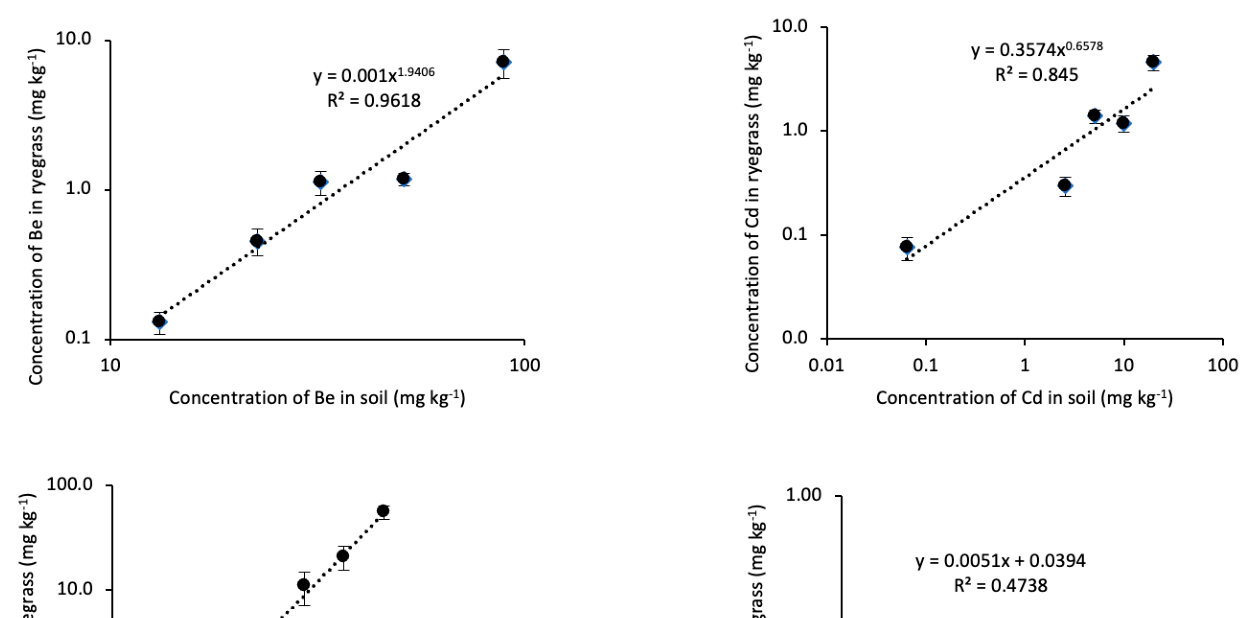
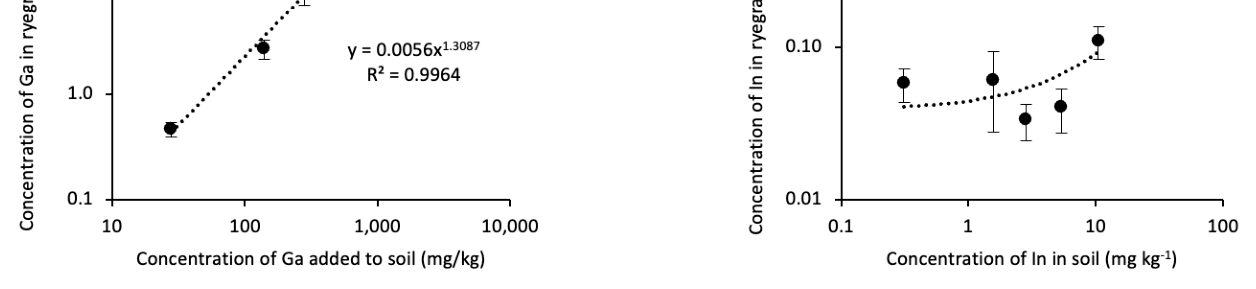
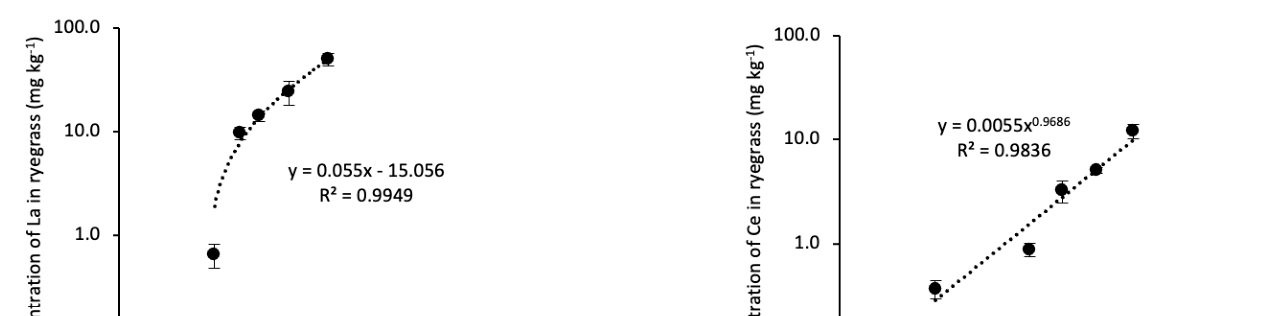
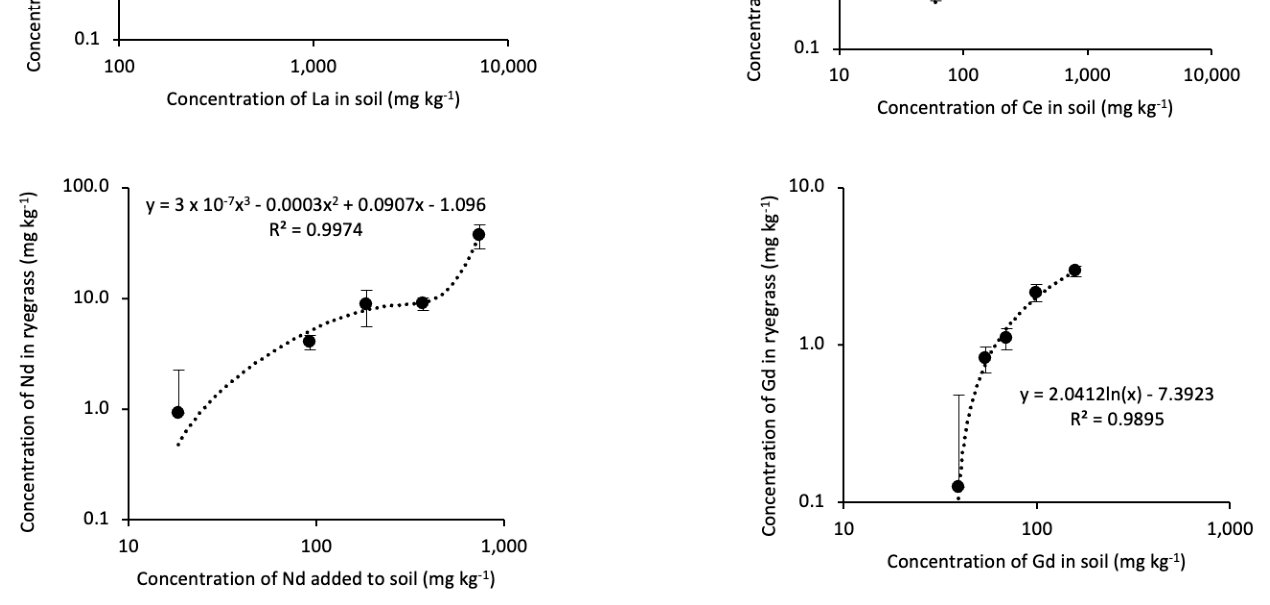
Apart from In, uptake of the RTEs and Cd by L. perenne increased with increasing concentrations of the RTEs and Cd added to soil (Figure 1). The uptake of Be and Cd in T4 was high and did not fit the trendlines well. Lolium perenne Ga and La concentrations increased linearly with the concentrations of these elements added to soil. The uptake of Nd had a sigmoid response, which like Be and Gd is due to the inordinately high uptake of these elements in T4.
除In外,L. perenne对稀有微量元素和Cd的吸收均随土壤中添加浓度的增加而增加(图1)。T4处理中Be和Cd的吸收量较高,与趋势线拟合不佳。Lolium perenne中Ga和La的浓度随土壤中这些元素添加浓度的增加而线性增加。Nd的吸收呈S形响应,与Be和Gd一样,这是由于T4处理中这些元素的吸收量异常高所致。
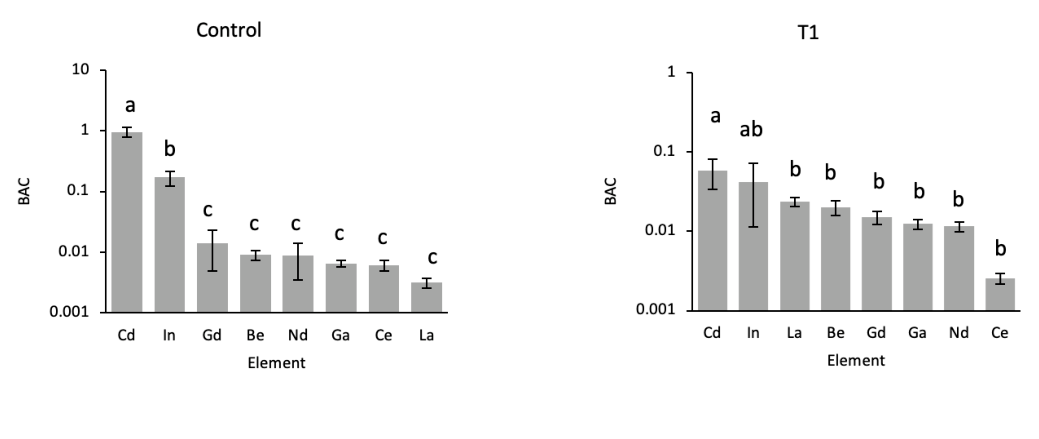
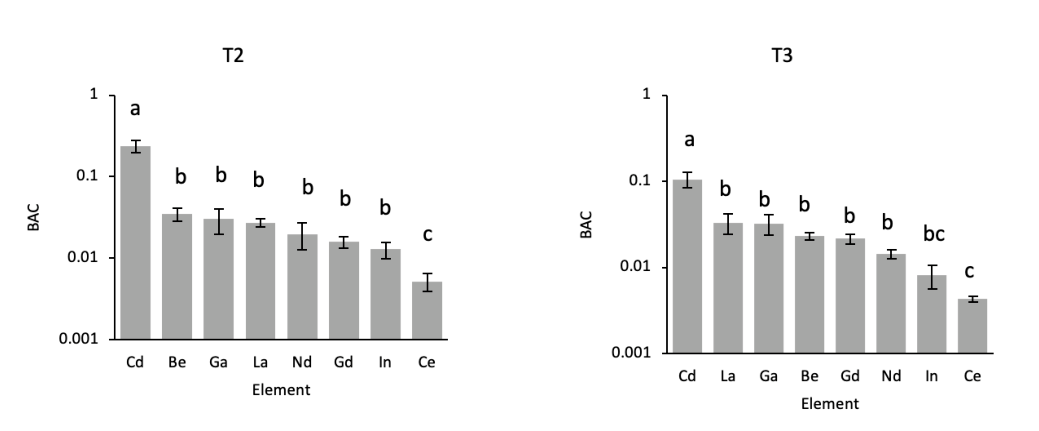
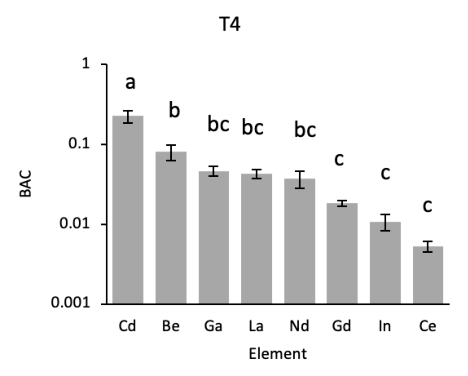
BACs of the RTEs and Cd in L. perenne varied from 0.0031–0.95 in the control (Figure 2) to 0.0052–0.22 in T4 (Figure 2). Across all the treatments, BACs increased Ce < In < Nd∼=Gd < La ∼= Be ∼= Ga < Cd. When BACs were calculated at the same concentration of RTE or Cd added to soil, at 5 mg kg−1 RTE or Cd added to soil, the ranking of the RTEs and Cd was the same as T1 except Gd had a higher BAC than Be and La, and at 1 mg kg−1 added to soil, the ranking of the BACs was La < Nd < Ce < Ga < Gd < In < Be < Cd.
L. perenne中稀有微量元素和Cd的BACs在对照中为0.0031–0.95(图2),在T4中为0.0052–0.22(图2)。在所有处理中,BACs的大小顺序为Ce < In < Nd∼=Gd < La ∼= Be ∼= Ga < Cd。在土壤中添加相同浓度稀有微量元素或Cd的条件下计算BACs时,在添加5 mg kg−1稀有微量元素或Cd时,稀有微量元素和Cd的排序与T1相同,唯Gd的BAC高于Be和La;在添加1 mg kg−1时,BACs的排序为La < Nd < Ce < Ga < Gd < In < Be < Cd。
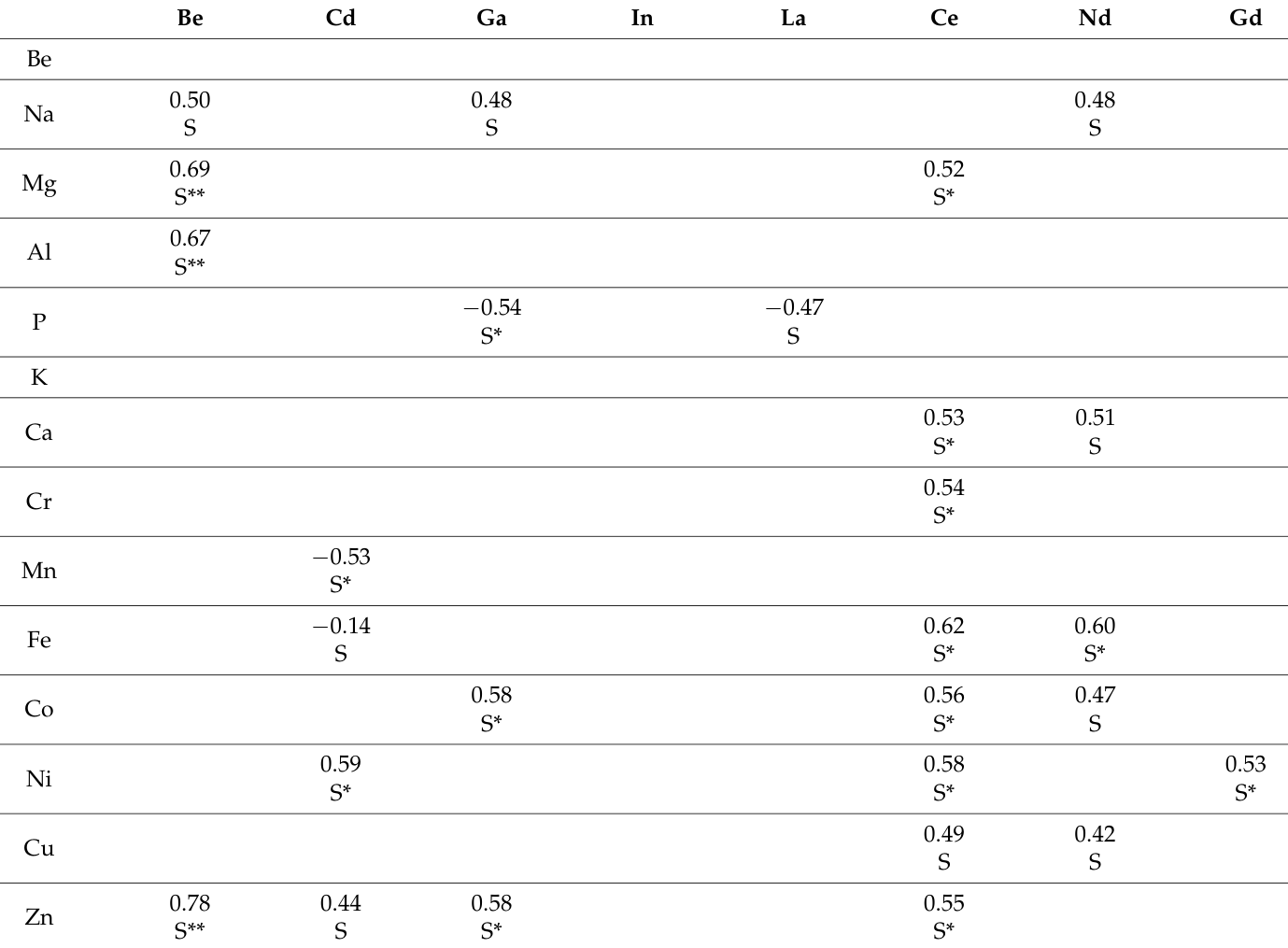
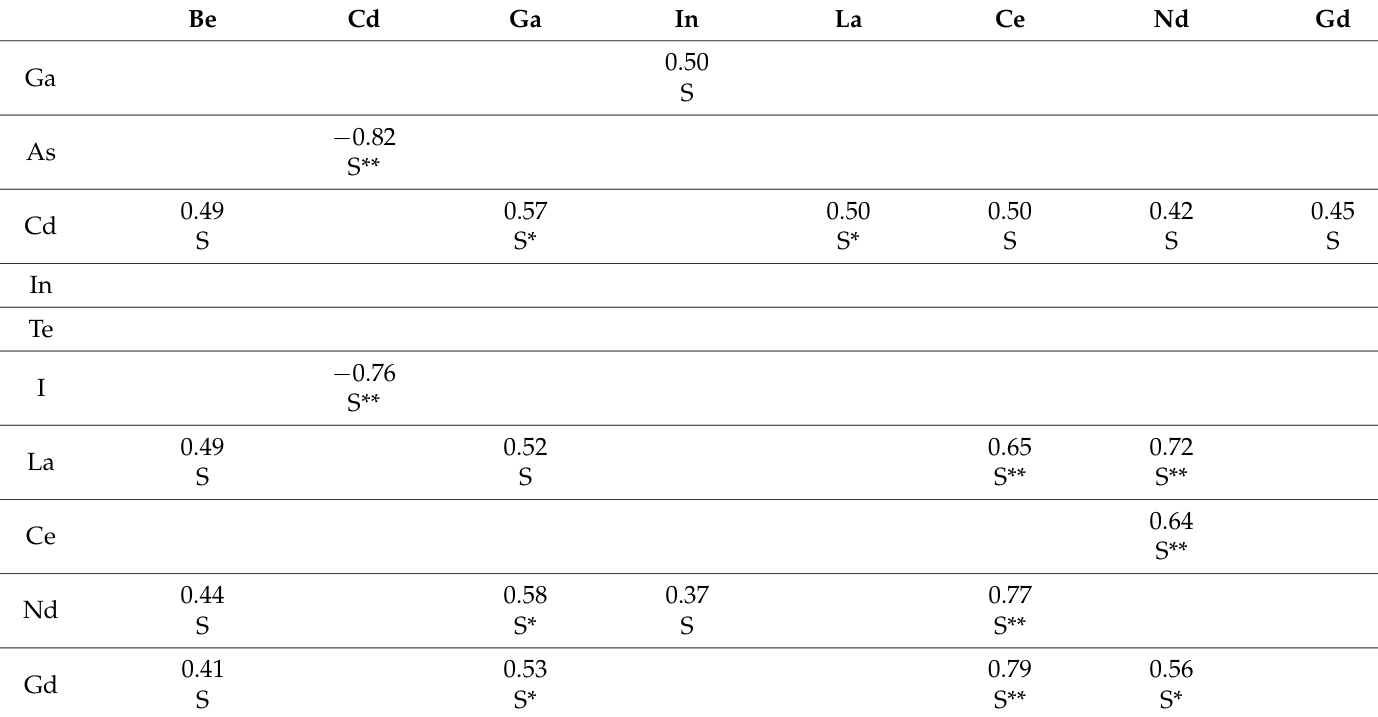
The concentration of Be in L. perenne was significantly positively correlated with the concentrations of Al, Cd, Gd, La, Mg, Na, Nd, and Zn (Table 3). The concentrations of Gd, In, and La taken up by L. perenne did not affect the uptake of many of the other elements in L. perenne.
L. perenne中的Be浓度与Al、Cd、Gd、La、Mg、Na、Nd和Zn的浓度呈显著正相关(表3)。L. perenne对Gd、In和La的吸收浓度对L. perenne中其他多数元素的吸收没有影响。
4Discussion讨论
4.1. Effect of the RTEs and Cd Contaminants on the Biomass of L. perenne4.1. 稀有微量元素和Cd污染物对L. perenne生物量的影响
Cadmium, Ga, Nd, and Gd significantly reduced the biomass of L. perenne. In our experiment, the Cd concentrations in L. perenne were below the 3–30 mg kg−1 plant Cd toxicity threshold range reported by other authors (Table 4), but the concentration of Cd added to soil in T1 was close to the soil Cd toxicity threshold of 5 mg kg−1 [40]. The soil used in this study was an acidic sandy loam (pH 5.3) with a moderate cation exchange capacity (13 cmol kg−1), and thus was expected to have high solubility and bioavailability of RTEs and Cd [17,21], which may have contributed to the low soil toxicity threshold of Cd. For the other elements, whether they experienced toxicity or not in this study, the toxicity thresholds were close to the ranges in Table 4 for Be, Ga, In, La, Ce, and Nd. The concentrations of the RTEs added to soil which induced toxicity were similar to other studies [41–45]. The addition of Be and Gd to soil significantly increased the biomass of L. perenne, likely due to hormesis, an increase in growth in response to stress [46], as both elements are non-essential to plants, and the biomass consistently decreased from the peak when higher concentrations of these elements were present in the soil. The anions added to the soil as the counterion in the RTE and Cd salts added to soil, SO42− and NO3−, may have also increased growth in the treatments.
Cd、Ga、Nd和Gd显著降低了L. perenne的生物量。在本试验中,L. perenne中的Cd浓度低于其他作者报道的3–30 mg kg−1植物Cd毒性阈值范围(表4),但T1处理中土壤Cd添加浓度接近5 mg kg−1的土壤Cd毒性阈值[40]。本研究所用土壤为酸性砂壤土(pH 5.3),阳离子交换量中等(13 cmol kg−1),因此预计稀有微量元素和Cd具有较高的溶解度和生物有效性[17,21],这可能是Cd土壤毒性阈值较低的原因之一。对于其他元素,无论本研究中是否出现毒性,Be、Ga、In、La、Ce和Nd的毒性阈值均接近表4中的范围。引起毒性的稀有微量元素土壤添加浓度与其他研究相近[41–45]。向土壤中添加Be和Gd显著增加了L. perenne的生物量,这可能源于毒物兴奋效应(hormesis),即生长对胁迫的增强响应[46],因为这两种元素均为植物非必需元素,且当土壤中这些元素浓度更高时,生物量自峰值起持续下降。随稀有微量元素和Cd盐作为抗衡离子加入土壤的阴离子SO42−和NO3−也可能促进了各处理中的生长。
For Be, Ce, La, and In, no toxicity occurred within the range tested. The soil and conditions (e.g., pH) in this study may have caused high retention of some elements, but not others, e.g., Ga and In precipitate and thus are bioavailable at different pH ranges in soil [47]. Future research should test the relative phytotoxicity of Be, Ce, La, and In at higher soil concentrations and in different soil types.
对于Be、Ce、La和In,在所测试范围内未出现毒性。本研究的土壤和条件(如pH)可能导致某些元素而非另一些元素被高度保留,例如Ga和In会发生沉淀,因而在土壤中不同的pH范围内具有生物有效性[47]。今后的研究应在更高的土壤浓度和不同土壤类型中检验Be、Ce、La和In的相对植物毒性。
| Element元素 | Pla | nt Concentrations (mg kg−1) in Un植物浓度(mg kg−1):未 | spiked加标 | Soil土壤 | Uptake in Plants Spi (mg kg−1, µmol kg−1加标植物中的吸收量 (mg kg−1,µmol kg−1 | ked with ETECs )(ETECs) ) |
|---|---|---|---|---|---|---|
| Bac | kground | Ele | vated (without Visible Toxicity) | Before Toxicity | With Toxicity | |
| Be | • • • | Lettuce: 0.06 [23] Grass: 0.0051 [28] Wheat grain: <0.0005 [48] | • • • | Potato foliage: 30 [41] Collards foliage: 10 [44] Oat foliage: 2 [41] | 0.1–10.1, 11–1121 [44,49] | 0.4–32, 44–3551 [49,50] |
| Ga | • • • | Strawberry: 0.4 [51] Beech leaf: 0.032 [27] Wheat grain: 0.0014 [48] | • • • | Rice foliage: 75 [18] Wheat foliage: 12.1 [21] Mushroom: 6.6 [52] | 2–74, 29–1061 [18,53] | 5–16, 72–229 [17,21] |
| In | • • • | Wheat grain: 0.11 [54] Grass: 0.051 [24] Beech leaf: 0.0002 [27] | • • • | Mushroom: 7.5 [55] Pteris vittata: 5.14 [3] Rice foliage: 4.3 [17] | 1.1–4.2, 9.6–37 [17,18] | 2.5–6.6, 22–57 [17,21] |
| La | • • • | Grass: 0.17 [56] Tea: 0.072 [57] Various vegetables: 0.017 [58] | • • • | _Cyperus rotundus_L.: 568.9 [26] Barley foliage: 6 [59] Populus sieboldii: 3.4 [57] | 0.44–6.5, 3.2–47 [43,60] | 0.95–120, 6.8–864 [43,45] |
| Ce | • • • | Grass: 0.33 [56] Pepper: 0.19 [22] Corn: 0.011 [61] | • • • | Dicranopteris dichotoma: 2290.33 [26] Rice foliage: 19 [25] Chinese cabbage: 3.8 [25] | 6.7, 48 [60] | 16, 114 [60] |
| Nd | • • • | Grass: 0.051 [62] Rice: 0.029 [63] Tomato: 0.0071 [64] | • • • | Melastoma malabathricum: 49.13 [26] Mushroom: 7.1 [65] Barley foliage: 7 [59] | 1.79–13, 12–90 [42] | 6.69–221, 46–1532 [42,45] |
| • | Grass: 0.025 [28] | • | _Cyperus rotundus_L.: 175.8 [26] | |||
| Gd | • • | Pepper: 0.015 [22] Barley grain: 0.0003 [48] | • • | Dicranopteris dichotoma: 75.08 [26] Rice foliage: 0.49 [25] | - | - |
The ‘background’ column consists of examples of the concentrations of RTEs typically found in various plant species in environments without contamination, and the ‘elevated’ column has examples of unusually high uptake of the RTEs in plants without toxicity.
“背景”列给出了未受污染环境中各种植物物种通常所含稀有微量元素浓度的实例,“升高”列给出了植物对稀有微量元素吸收异常高而未表现出毒性的实例。
4.2. Uptake of the RTEs and Cd in L. perenne4.2. L. perenne对稀有微量元素和Cd的吸收
The ranking of the uptake of the RTEs and Cd by L. perenne differed from the ranking of RTE accumulation by Fagus sylvatica, which may be due to the physiological differences between a monocotyledonous plant (Lolium perenne) and a dicotyledonous plant (Fagus sylvatica) [28]. Cerium was hypothesised to be taken up at the highest concentrations by L. perenne, but was only the fourth highest, with the lowest BACs of the RTEs and Cd. Compared to the ranking of the RTEs in [27], the uptakes of Ga and La were higher than the other RTEs. The uptake of the RTEs in L. perenne was similar to that (within the same order of magnitude) of grasses and other members of the Poaceae family [10,56,61]; it is useful to compare within this family if possible, as they have physiological differences to other plant species which affect uptake and translocation, e.g., they are monocotyledonous plants, and use Strategy II for Fe acquisition [66], which helps them to acquire higher concentrations of Cu, Mn, and Zn [67]. In studies that spiked soil with similar concentrations of the RTEs, the uptakes of Be and Ga in L. perenne were similar to that in oat plants, collards, cabbage, wheat, and rice seedlings [17,21,41,44,68].
L. perenne对稀有微量元素和Cd的吸收排序与Fagus sylvatica对稀有微量元素的累积排序不同,这可能源于单子叶植物(Lolium perenne)与双子叶植物(Fagus sylvatica)之间的生理差异[28]。原假设L. perenne对Ce的吸收浓度最高,但其仅居第四位,且在稀有微量元素和Cd中BACs最低。与文献[27]中稀有微量元素的排序相比,Ga和La的吸收量高于其他稀有微量元素。L. perenne对稀有微量元素的吸收与禾草及禾本科其他成员相近(处于同一数量级)[10,56,61];如有可能,在该科内进行比较是有益的,因为它们与其他植物物种存在影响吸收和转运的生理差异,例如,它们是单子叶植物,并采用机理II获取Fe[66],这有助于其获取更高浓度的Cu、Mn和Zn[67]。在以相近浓度稀有微量元素加标土壤的研究中,L. perenne对Be和Ga的吸收与燕麦、羽衣甘蓝、甘蓝、小麦和水稻幼苗相近[17,21,41,44,68]。
The grasses (L. perenne and Leersia hexandra) growing in soil that had been contaminated previously (with sufficient time for residential development and wild species to grow) contained concentrations of Ga and In, which were more similar to the control versus the grass growing in contaminated soil [24]. This suggests that ageing quickly reduced the bioavailability of the contaminants, or that the most bioavailable fraction was quickly taken up by plants and passed up the food chain. Thus, the concentrations of the RTEs found in L. perenne in this study are only comparable for environments where recent contamination has occurred. Our study therefore represents a ‘worst-case’ scenario.
生长于既往受污染土壤(经历了足以进行居住开发和野生物种生长的时间)中的禾草(L. perenne和Leersia hexandra)所含Ga和In浓度,与生长于污染土壤中的禾草相比更接近对照[24]。这表明老化迅速降低了污染物的生物有效性,或者生物有效性最高的部分很快被植物吸收并沿食物链向上传递。因此,本研究中L. perenne中的稀有微量元素浓度仅可与新近发生污染的环境进行比较。本研究因而代表了一种“最坏情形”。
4.3. Bioaccumulation Coefficients of the RTEs and Cd in L. perenne4.3. L. perenne中稀有微量元素和Cd的生物富集系数
The BAC values were, for the most part, similar to those of Poaceae species [56,59,69], in contaminated and uncontaminated soil. BACs for In in L. perenne were higher than that for In in rice and wheat [54], but higher concentrations of In were added to the soil in that study, which is consistent with the BAC of In decreasing with increasing concentrations added to soil.
无论在污染还是未污染土壤中,BAC值大多与禾本科物种相近[56,59,69]。L. perenne中In的BACs高于水稻和小麦中In的BAC[54],但该研究中向土壤添加的In浓度更高,这与In的BAC随土壤添加浓度增加而降低的规律一致。
4.4. Effect of the Concentration of RTEs and Cd Added to Soil on Bioaccumulation in L. perenne4.4. 土壤中稀有微量元素和Cd添加浓度对L. perenne生物富集的影响
The literature indicates that Cd has a relatively high BAC because it is more soluble in soil than other trace elements [70], which has been verified by the lesser solid-phase retention [20]. Plant uptake of Cd linearly increased between the control and T4. Therefore, it seems unlikely that the uptake and translocation of Cd was limited by the plants.
文献表明,Cd的BAC相对较高,因为其在土壤中的溶解度高于其他微量元素[70],其较低的固相保留也证实了这一点[20]。植物对Cd的吸收在对照至T4之间呈线性增加。因此,Cd的吸收和转运似乎不太可能受到植物的限制。
Cadmium, a ‘soft’ Lewis acid, binds more strongly to soft functional groups such as S2- than hydroxide groups [71]. The soft functional groups may have been present at high concentrations in soil, which Cd bound to, limiting the availability of exogenous Cd to plants, particularly at the lower concentrations of Cd added to soil. This was not directly measured in the soil properties however, so it cannot be confirmed.
Cd作为一种“软”Lewis酸,与S2-等软官能团的结合强于与羟基的结合[71]。土壤中可能存在高浓度的软官能团并与Cd结合,从而限制了外源Cd对植物的有效性,尤其是在土壤Cd添加浓度较低时。然而,土壤性质测定中并未直接测定这一点,因此无法证实。
The change in the BACs with increasing soil concentrations was different for Ce and Gd than La and Nd. In the control, Ce and Gd had higher BACs than La and Nd and thus had higher uptakes than expected relative to the sum of the REEs in the soil. It cannot be explained why the bioavailability of endogenous Ce and Gd was higher than endogenous La and Nd, and the existing high uptake may have limited the increase in bioaccumulation factors.
随着土壤浓度增加,Ce和Gd的BACs变化与La和Nd不同。在对照中,Ce和Gd的BACs高于La和Nd,因而相对于土壤中稀土元素(REEs)总量而言,其吸收量高于预期。内源Ce和Gd的生物有效性为何高于内源La和Nd尚无法解释,而原本已较高的吸收可能限制了生物富集系数的增加。
Another process that may have increased the uptake of the elements is following the uptake pathways of essential ions, which would result in a significant negative correlation with the essential ion, as the RTE would occupy spaces in the molecules responsible for the uptake and translocation of essential elements. There were few negative correlations across the elements (Table 3), and those often occurred with anions (Ga and La with P, Cd with As and I) which the cations would not substitute for in biological molecules. The uptake of Be was positively correlated with the uptake of Mg, but this could be a strategy to ameliorate toxicity by taking up higher concentrations of essential elements to maintain the physiological processes which Be may disrupt [15]. Beryllium was one of the RTEs that did not cause toxicity within the range tested in this study, which supports the above theory. Two of the four REEs had significant positive correlations with Ca, to which the REEs have physiological similarities [14], but they were Ce and Nd, elements whose BACs were little affected and increased with the concentration added to soil, respectively. Thus, the significance of this correlation on plant uptake is unknown. The uptake of Be was positively correlated with uptake of the REEs, thus Be stress may increase the uptake of Mg and Ca, resulting in a net increase in growth.
另一个可能增加元素吸收的过程是沿用必需离子的吸收途径,这将导致其与该必需离子呈显著负相关,因为稀有微量元素会占据负责必需元素吸收和转运的分子中的位点。各元素间的负相关很少(表3),且多出现在与阴离子之间(Ga和La与P,Cd与As和I),而这些阳离子在生物分子中不会替代阴离子。Be的吸收与Mg的吸收呈正相关,但这可能是一种缓解毒性的策略,即通过吸收更高浓度的必需元素来维持可能被Be干扰的生理过程[15]。Be是本研究所测试范围内未引起毒性的稀有微量元素之一,这支持了上述推论。四种稀土元素中有两种与Ca呈显著正相关,而稀土元素与Ca具有生理上的相似性[14],但这两种元素为Ce和Nd,其BACs分别几乎不受影响和随土壤添加浓度增加而增加。因此,该相关性对植物吸收的意义尚不清楚。Be的吸收与稀土元素的吸收呈正相关,因此Be胁迫可能增加对Mg和Ca的吸收,从而使生长出现净增加。
The concentrations of each element added to the soil in the treatments were relative to the concentrations of the elements naturally in soil and may not represent concentrations in contaminated soils. If the same concentrations of each RTE and Cd were added to soil, at >750 mg kg−1 the BAC of Nd would be higher than Ga, Gd, and La, and Be would be higher than Cd if the patterns in Figure 1 extrapolate without saturation.
各处理中每种元素的土壤添加浓度是相对于土壤中该元素的天然浓度而定的,可能不代表污染土壤中的浓度。若向土壤中添加相同浓度的各稀有微量元素和Cd,且图1中的规律可在无饱和的情况下外推,则在>750 mg kg−1时,Nd的BAC将高于Ga、Gd和La,Be的BAC将高于Cd。
4.5. Risk of RTEs Entering the Food Chain4.5. 稀有微量元素进入食物链的风险
By discussing mobility, the relative risks of the RTEs entering the food chain can be evaluated. Of the RTEs and Cd tested in this study, Be and La have the highest risk of entering the food chain via L. perenne. Beryllium and La did not cause significant phytotoxicity within the concentration range tested, and the BACs of these elements increased with the concentration added to soil. Thus, the uptake of Be and La will likely continue to increase.
通过对迁移性的讨论,可以评估稀有微量元素进入食物链的相对风险。在本研究所测试的稀有微量元素和Cd中,Be和La经由L. perenne进入食物链的风险最高。在所测试的浓度范围内,Be和La未引起显著的植物毒性,且这些元素的BACs随土壤添加浓度的增加而增加。因此,Be和La的吸收很可能会继续增加。
Only Cd, Ga, Nd, and Gd had toxicity thresholds, which occurred at plant concentrations of 0.3, 21, 9.0, and 2.1 mg kg−1, respectively. Thus, relative and non-relative to the background concentrations of the elements in soil, Be and La have the highest risk of being taken up and translocated to above-ground biomass at high concentrations by L. perenne.
仅Cd、Ga、Nd和Gd存在毒性阈值,对应的植物浓度分别为0.3、21、9.0和2.1 mg kg−1。因此,无论是否相对于土壤中元素的背景浓度而言,Be和La被L. perenne以高浓度吸收并转运至地上部生物量的风险均最高。
Contrastingly, Cd had a higher BAC than the RTEs, but had a low toxicity threshold, with reductions to growth occurring in T1. The low toxicity threshold contrasts with previous findings of Cd being a mobile and easily transferable contaminant to animals [72]. Thus, the cultivar of L. perenne used (Nui) should be regrown in different environments to confirm its low tolerance to Cd. The RTEs least likely to be taken up and translocated by L. perenne (variety Nui) are In, as uptake did not increase with the concentration added to soil, and Ce, due to the low BACs. Cerium was safely taken up at the second-highest concentration in L. perenne due to the high concentrations naturally in and thus added to soil.
相比之下,Cd的BAC高于稀有微量元素,但其毒性阈值较低,在T1处理即出现生长下降。这一低毒性阈值与以往关于Cd是一种迁移性强、易于向动物传递的污染物的研究结果形成对比[72]。因此,应在不同环境中重新种植所用的L. perenne品种(Nui),以确认其对Cd的低耐受性。L. perenne(品种Nui)最不易吸收和转运的稀有微量元素为In(因其吸收未随土壤添加浓度增加而增加)和Ce(因其BACs较低)。由于土壤中Ce的天然浓度高、添加浓度亦随之较高,L. perenne对Ce的安全吸收浓度居第二位。
Unlike other crop types such as grains and vegetables, L. perenne does not need to survive reproduction or be harvested to enter the food chain. In the field, reductions in L. perenne growth by RTEs could be mistaken for symptoms of drought, nutrient deficiency, disease, or insufficient aeration, increasing the feasibility of animals eating contaminated L. perenne. Currently, there are no food safety standards in place for these RTEs, and thus the implications of animals ingesting the L. perenne grown in this study are unknown.
与谷物和蔬菜等其他作物类型不同,L. perenne无需完成繁殖或经收获即可进入食物链。在田间,稀有微量元素导致的L. perenne生长下降可能被误认为干旱、养分缺乏、病害或通气不足的症状,从而增加了动物采食受污染L. perenne的可能性。目前尚无针对这些稀有微量元素的食品安全标准,因此动物摄食本研究中种植的L. perenne的影响尚不清楚。
5Conclusions结论
The addition of Be, Ce, In, and La to soil at 40x the background concentration did not cause significant reductions to the biomass of L. perenne. Cadmium and Gd had the lowest toxicity thresholds of the selected RTEs. The bioaccumulation coefficients of the RTEs and Cd increased Ce < In < Nd∼=Gd < La ∼= Be ∼= Ga < Cd. The elements with the highest overall mobility in the soil–plant system are La and Be, as they were present at 50 and 7.1 mg kg−1, respectively, in L. perenne in the highest treatment, and the BACs of these elements are likely to continue to increase beyond the range tested. The least mobile elements in the variety of L. perenne tested were Cd, as it had a low toxicity threshold; Ce, as it had low BACs; and In, as its uptake did not increase with the concentration added to the system. Therefore, data in Supplementary Materials showed that there is a low risk of L. perenne uptake being a significant source of Cd, Ce, and In to animals, but there is a higher risk of L. perenne being a source of Be and La to animals and humans. Further research should determine whether the trends identified in this study are repeatable across a range of soil types, plant species, and climates, to better evaluate the mobility of these RTEs in the soil–plant system. Then the rates of transfer of these elements to animals and their ecotoxicology should be determined.
以背景浓度40x的水平向土壤中添加Be、Ce、In和La未导致L. perenne生物量显著下降。在所选元素中,Cd和Gd的毒性阈值最低。稀有微量元素和Cd的生物富集系数大小顺序为Ce < In < Nd∼=Gd < La ∼= Be ∼= Ga < Cd。在土壤–植物系统中总体迁移性最高的元素为La和Be,因为在最高处理中L. perenne中二者的浓度分别为50和7.1 mg kg−1,且这些元素的BACs在超出测试范围后很可能继续增加。在所测试的L. perenne品种中迁移性最低的元素为Cd(因其毒性阈值低)、Ce(因其BACs低)和In(因其吸收未随系统中添加浓度增加而增加)。因此,补充材料中的数据表明,L. perenne的吸收成为动物Cd、Ce和In重要来源的风险较低,但L. perenne成为动物和人类Be和La来源的风险较高。今后的研究应确定本研究所发现的趋势在不同土壤类型、植物物种和气候条件下是否具有可重复性,以更好地评估这些稀有微量元素在土壤–植物系统中的迁移性。随后还应确定这些元素向动物的传递速率及其生态毒理学效应。
Supplementary Materials: The following supporting information can be downloaded at: https: //www.mdpi.com/article/10.3390/toxics11110929/s1.
补充材料:相关支持信息可从以下网址下载:https: //www.mdpi.com/article/10.3390/toxics11110929/s1。
Author Contributions: Conceptualization, B.R. and H.J.; methodology, H.J.; formal analysis, B.R.; writing—original draft preparation, H.J.; writing—review and editing, B.R., N.L., S.G. and P.A.; supervision, B.R., N.L. and P.A.; funding acquisition, B.R. All authors have read and agreed to the published version of the manuscript.
作者贡献:构思,B.R.和H.J.;方法,H.J.;正式分析,B.R.;初稿撰写,H.J.;审阅与编辑,B.R.、N.L.、S.G.和P.A.;指导,B.R.、N.L.和P.A.;经费获取,B.R.。全体作者均已阅读并同意发表版本的稿件。
Funding: This research was funded by Environmental Science and Research (ESR), grant no. E7254.
资助:本研究由Environmental Science and Research(ESR)资助,资助编号E7254。
Institutional Review Board Statement: Not applicable.
机构审查委员会声明:不适用。
Informed Consent Statement: Not applicable.
知情同意声明:不适用。
Data Availability Statement: Elemental concentrations in plant materials are available on: https: //www.kiwiscience.com/journal-articles.html (accessed on 12 November 2023).
数据可用性声明:植物材料中的元素浓度数据可在以下网址获取:https: //www.kiwiscience.com/journal-articles.html(访问日期:2023年11月12日)。
Conflicts of Interest: The authors declare no conflict of interest.
利益冲突:作者声明无利益冲突。
References参考文献
1. Robinson, B.H. E-Waste: An Assessment of Global Production and Environmental Impacts. Sci. Total Environ. 2009, 408, 183–191. [CrossRef] [PubMed]
2. Ha, N.N.; Agusa, T.; Ramu, K.; Tu, N.P.C.; Murata, S.; Bulbule, K.A.; Parthasaraty, P.; Takahashi, S.; Subramanian, A.; Tanabe, S. Contamination by Trace Elements at E-Waste Recycling Sites in Bangalore, India. Chemosphere 2009, 76, 9–15. [CrossRef]
3. Nguyen, T.H.H.; Sakakibara, M.; Sano, S.; Mai, T.N. Uptake of Metals and Metalloids by Plants Growing in a Lead-Zinc Mine Area, Northern Vietnam. J. Hazard. Mater. 2011, 186, 1384–1391. [PubMed]
4. Li, J.; Hong, M.; Yin, X.; Liu, J. Effects of the Accumulation of the Rare Earth Elements on Soil Macrofauna Community. J. Rare Earths 2010, 28, 957–964. [CrossRef]
5. Tokumaru, T.; Ozaki, H.; Onwona-Agyeman, S.; Ofosu-Anim, J.; Watanabe, I. Determination of the Extent of Trace Metals Pollution in Soils, Sediments and Human Hair at E-Waste Recycling Site in Ghana. Arch. Environ. Contam. Toxicol. 2017, 73, 377–390. [CrossRef]
6. Jensen, H. A Comparative Assessment of Lesser-Studied Trace Elements in the Soil-Plant System: Implications for Environmental Quality. Doctor Thesis, University of Canterbury, Christchurch, New Zealand, 2022.
7. Bradl, H.B. Adsorption of Heavy Metal Ions on Soils and Soils Constituents. J. Colloid Interface Sci. 2004, 277, 1–18. [CrossRef]
8. Hooda, P. Trace Elements in Soils; John Wiley & Sons: Hoboken, NJ, USA, 2010; ISBN 9781444319484.
9. Alloway, B.J. Heavy Metals in Soils: Trace Metals and Metalloids in Soils and Their Bioavailability; Springer Science & Business Media: Berlin, Germany, 2012; ISBN 9789400744707.
10. Kabata-Pendias, A.; Mukherjee, A.B. Trace Elements from Soil to Human; Springer Science & Business Media: Berlin, Germany, 2007; ISBN 9783540327134.
11. Bañuelos, G.S.; Ajwa, H.A. Trace Elements in Soils and Plants: An Overview. J. Environ. Sci. Health 1999, 34, 951–974. [CrossRef]
12. Reid, R.; Hayes, J. Mechanisms and Control of Nutrient Uptake in Plants. Int. Rev. Cytol. 2003, 229, 73–114.
13. Bernstein, L.R. 31Ga Therapeutic Gallium Compounds. In Metallotherapeutic Drugs and Metal-Based Diagnostic Agents; John Wiley & Sons, Ltd.: Chichester, UK, 2005; pp. 259–277. ISBN 9780470864050.
14. Tyler, G. Rare Earth Elements in Soil and Plant Systems—A Review. Plant Soil 2004, 267, 191–206. [CrossRef]
15. Shah, A.N.; Tanveer, M.; Hussain, S.; Yang, G. Beryllium in the Environment: Whether Fatal for Plant Growth? Rev. Environ. Sci. Technol. 2016, 15, 549–561. [CrossRef]
16. Laaouidi, Y.; Bahmed, A.; Naylo, A.; El Khalil, H.; Ouvrard, S.; Schwartz, C.; Boularbah, A. Trace Elements in Soils and Vegetables from Market Gardens of Urban Areas in Marrakech City. Biol. Trace Elem. Res. 2020, 195, 301–316. [CrossRef]
17. Su, J.-Y.; Syu, C.-H.; Lee, D.-Y. Growth Inhibition of Rice (Oryza sativa L.) Seedlings in Ga- and In-Contaminated Acidic Soils Is Respectively Caused by Al and Al+In Toxicity. J. Hazard. Mater. 2018, 344, 274–282. [CrossRef]
18. Syu, C.-H.; Chien, P.-H.; Huang, C.-C.; Jiang, P.-Y.; Juang, K.-W.; Lee, D.-Y. The Growth and Uptake of Ga and In of Rice (Oryza sative L.) Seedlings as Affected by Ga and In Concentrations in Hydroponic Cultures. Ecotoxicol. Environ. Saf. 2017, 135, 32–39. [CrossRef]
19. Yu, X.-Z.; Feng, X.-H.; Feng, Y.-X. Phytotoxicity and Transport of Gallium (Ga) in Rice Seedlings for 2-Day of Exposure. Bull. Environ. Contam. Toxicol. 2015, 95, 122–125. [CrossRef] [PubMed]
20. Kärnbränslehantering, S.; Sheppard, S.; Long, J.; Sanipelli, B.; Sohlenius, G. Solid/liquid Partition Coefficients (Kd) for Selected Soils and Sediments at Forsmark and Laxemar-Simpevarp. Available online: https://www.skb.com/publication/1951648/R-09 -27.pdf (accessed on 21 September 2023).
21. Syu, C.-H.; Chen, L.-Y.; Lee, D.-Y. The Growth and Uptake of Gallium (Ga) and Indium (In) of Wheat Seedlings in Ga- and In-Contaminated Soils. Sci. Total Environ. 2021, 759, 143943. [CrossRef] [PubMed]
22. Cao, X.; Chen, Y.; Gu, Z.; Wang, X. Determination of Trace Rare Earth Elements in Plant and Soil Samples by Inductively Coupled Plasma-Mass Spectrometry. Int. J. Environ. Anal. Chem. 2000, 76, 295–309. [CrossRef]
23. Wang, J.; Wang, L.; Wang, Y.; Tsang, D.C.W.; Yang, X.; Beiyuan, J.; Yin, M.; Xiao, T.; Jiang, Y.; Lin, W.; et al. Emerging Risks of Toxic Metal(loid)s in Soil-Vegetables Influenced by Steel-Making Activities and Isotopic Source Apportionment. Environ. Int. 2021, 146, 106207. [CrossRef] [PubMed]
24. Waterlot, C.; Bidar, G.; Pelfrêne, A.; Roussel, H.; Fourrier, H.; Douay, F. Contamination, Fractionation and Availability of Metals in Urban Soils in the Vicinity of Former Lead and Zinc Smelters, France. Pedosphere 2013, 23, 143–159. [CrossRef]
25. Wen, B.; Yuan, D.-A.; Shan, X.-Q.; Li, F.-L.; Zhang, S.-Z. The Influence of Rare Earth Element Fertilizer Application on the Distribution and Bioaccumulation of Rare Earth Elements in Plants under Field Conditions. Chem. Spec. Bioavail. 2001, 13, 39–48. [CrossRef]
26. Khan, A.M. Accumulation, Uptake and Bioavailability of Rare Earth Elements (Rees) in Soil Grown Plants from Ex-Mining Area in Perak, Malaysia. Appl. Ecol. Environ. Res. 2017, 15, 117–133. [CrossRef]
27. Tyler, G. Changes in the Concentrations of Major, Minor and Rare-Earth Elements during Leaf Senescence and Decomposition in a Fagus sylvatica Forest. For. Ecol. Manag. 2005, 206, 167–177. [CrossRef]
28. Tyler, G.; Olsson, T. Plant Uptake of Major and Minor Mineral Elements as Influenced by Soil Acidity and Liming. Plant Soil 2001, 230, 307–321. [CrossRef]
29. Jensen, H.; Gaw, S.; Lehto, N.J.; Hassall, L.; Robinson, B.H. The Mobility and Plant Uptake of Gallium and Indium, Two Emerging Contaminants Associated with Electronic Waste and Other Sources. Chemosphere 2018, 209, 675–684. [CrossRef]
30. Davis, R.D.; Beckett, P.H.T.; Wollan, E. Critical Levels of Twenty Potentially Toxic Elements in Young Spring Barley. Plant Soil 1978, 49, 395–408. [CrossRef]
31. Mason, B.; Moore, C.B. Principles of Geochemistry; IAEA: Vienna, Austria, 1985.
32. Reiser, R.; Simmler, M.; Portmann, D.; Clucas, L.; Schulin, R.; Robinson, B. Cadmium Concentrations in New Zealand Pastures: Relationships to Soil and Climate Variables. J. Environ. Qual. 2014, 43, 917–925. [CrossRef]
33. McLaren, R.G.; Cameron, K.C. Soil Science: Sustainable Production and Environmental Protection; Oxford University Press: Oxford, UK, 1996; ISBN 9780195583458.
34. Cunningham, P.J.; Blumenthal, M.J.; Anderson, M.W.; Prakash, K.S.; Leonforte, A. Perennial Ryegrass Improvement in Australia. N. Z. J. Agric. Res. 1994, 37, 295–310. [CrossRef]
35. Grogan, D.; Gilliland, T.J. A Review of Perennial Ryegrass Variety Evaluation in Ireland. Ir. J. Agric. Food Res. 2011, 50, 65–81.
36. Gregory, R.P.G.; Bradshaw, A.D. Heavy Metal Tolerance in Populations of Agrostis Tenuis Sibth. and Other Grasses. New Phytol. 1965, 64, 131–143. [CrossRef]
37. Gartler, J.; Robinson, B.; Burton, K.; Clucas, L. Carbonaceous Soil Amendments to Biofortify Crop Plants with Zinc. Sci. Total Environ. 2013, 465, 308–313. [CrossRef]
38. NIST Standard Reference Material 1573a; Leaves, Tomato. National Institute of Standards and Technology: Gaithersburg, MD, USA, 2018.
39. Al Mamun, S.; Lehto, N.J.; Cavanagh, J.; McDowell, R.; Aktar, M.; Benyas, E.; Robinson, B.H. Effects of Lime and Organic Amendments Derived from Varied Source Materials on Cadmium Uptake by Potato. J. Environ. Qual. 2017, 46, 836–844. [CrossRef]
40. Ismael, M.A.; Elyamine, A.M.; Moussa, M.G.; Cai, M.; Zhao, X.; Hu, C. Cadmium in Plants: Uptake, Toxicity, and Its Interactions with Selenium Fertilizers. Metallomics 2019, 11, 255–277. [CrossRef]
41. Bohn, H.L.; Seekamp, G. Beryllium Effects on Potatoes and Oats in Acid Soil. Water Air Soil Pollut. 1979, 11, 319–322. [CrossRef] 42. Carpenter, D.; Boutin, C.; Allison, J.E.; Parsons, J.L.; Ellis, D.M. Uptake and Effects of Six Rare Earth Elements (REEs) on Selected Native and Crop Species Growing in Contaminated Soils. PLoS ONE 2015, 10, e0129936. [CrossRef] 43. Hao, L.; Zhang, Z.; Hao, B.; Diao, F.; Zhang, J.; Bao, Z.; Guo, W. Arbuscular Mycorrhizal Fungi Alter Microbiome Structure of Rhizosphere Soil to Enhance Maize Tolerance to La. Ecotoxicol. Environ. Saf. 2021, 212, 111996. [CrossRef] 44. Kaplan, D.I.; Sajwan, K.S.; Adriano, D.C.; Gettier, S. Phytoavailability and Toxicity of Beryllium and Vanadium. Water Air Soil Pollut. 1990, 53, 203–212. [CrossRef]
45. Rezaee, A.; Hale, B.; Santos, R.M.; Chiang, Y.W. Accumulation and Toxicity of Lanthanum and Neodymium in Horticultural Plants (Brassica Chinensis L. and Helianthus Annuus L.). Can. J. Chem. Eng. 2018, 96, 2263–2272. [CrossRef] 46. Poschenrieder, C.; Cabot, C.; Martos, S.; Gallego, B.; Barceló, J. Do Toxic Ions Induce Hormesis in Plants? Plant Sci. 2013, 212, 15–25. [CrossRef]
47. Wood, S.A.; Samson, I.M. The Aqueous Geochemistry of Gallium, Germanium, Indium and Scandium. Ore Geol. Rev. 2006, 28, 57–102. [CrossRef]
48. Eriksson, J. Concentrations of 61 Trace Elements in Sewage Sludge, Farmyard Manure, Mineral Fertiliser, Precipitation and in Oil and Crops; Swedish Environmental Protection Agency: Stockholm, Sweden, 2001.
49. Williams, R.J.B.; Le Riche, H.H. The Effect of Traces of Beryllium on the Growth of Kale, Grass, and Mustard. Plant Soil 1968, 29, 317–326. [CrossRef]
50. Sajwan, K.S.; Ornes, W.H.; Youngblood, T.V. Beryllium Phytotoxicity in Soybeans. Water Air Soil Pollut. 1996, 86, 117–124. [CrossRef]
51. Jeong, J.; Choi, J. Adverse Outcome Pathways Potentially Related to Hazard Identification of Microplastics Based on Toxicity Mechanisms. Chemosphere 2019, 231, 249–255. [CrossRef] 52. Dursun, N.; Özcan, M.M.; Ka¸sık, G.; Öztürk, C. Mineral Contents of 34 Species of Edible Mushrooms Growing Wild in Turkey. J. Sci. Food Agric. 2006, 86, 1087–1094. [CrossRef]
53. Wheeler, D.M.; Power, I.L. Comparison of Plant Uptake and Plant Toxicity of Various Ions in Wheat. Plant Soil 1995, 172, 167–173. [CrossRef]
54. Chang, H.-F.; Yang, P.-T.; Lin, H.-W.; Yeh, K.-C.; Chen, M.-N.; Wang, S.-L. Indium Uptake and Accumulation by Rice and Wheat and Health Risk Associated with Their Consumption. Environ. Sci. Technol. 2020, 54, 14946–14954. [CrossRef] [PubMed]
55. Niedzielski, P.; Mleczek, M.; Budka, A.; Rzymski, P.; Siwulski, M.; Jasi´nska, A.; G ˛asecka, M.; Budzy´nska, S. A Screening Study of Elemental Composition in 12 Marketable Mushroom Species Accessible in Poland. Eur. Food Res. Technol. 2017, 243, 1759–1771. [CrossRef]
56. Laul, J.C.; Weimer, W.C.; Rancitelli, L.A. Biogeochemical Distribution of Rare Earths and Other Trace Elements in Plants and Soils. Phys. Chem. Earth. 1979, 11, 819–827. [CrossRef]
57. Fu, F.; Akagi, T.; Yabuki, S.; Iwaki, M. The Variation of REE (rare Earth Elements) Patterns in Soil-Grown Plants: A New Proxy for the Source of Rare Earth Elements and Silicon in Plants. Plant Soil 2001, 235, 53–64. [CrossRef]
58. Zhuang, M.; Zhao, J.; Li, S.; Liu, D.; Wang, K.; Xiao, P.; Yu, L.; Jiang, Y.; Song, J.; Zhou, J.; et al. Concentrations and Health Risk Assessment of Rare Earth Elements in Vegetables from Mining Area in Shandong, China. Chemosphere 2017, 168, 578–582. [CrossRef] [PubMed]
59. Kotelnikova, A.; Fastovets, I.; Rogova, O.; Volkov, D.S. La, Ce and Nd in the Soil-Plant System in a Vegetation Experiment with Barley (Hordeum vulgare L.). Ecotoxicol. Environ. Saf. 2020, 206, 111193. [CrossRef]
60. Hu, X.; Ding, Z.; Chen, Y.; Wang, X.; Dai, L. Bioaccumulation of Lanthanum and Cerium and Their Effects on the Growth of Wheat (Triticum aestivum L.) Seedlings. Chemosphere 2002, 48, 621–629. [CrossRef]
61. Li, F.; Shan, X.; Zhang, T.; Zhang, S. Evaluation of Plant Availability of Rare Earth Elements in Soils by Chemical Fractionation and Multiple Regression Analysis. Environ. Pollut. 1998, 102, 269–277. [CrossRef]
62. Wiche, O.; Székely, B.; Kummer, N.-A.; Moschner, C.; Heilmeier, H. Effects of Intercropping of Oat (Avena sativa L.) with White Lupin (Lupinus albus L.) on the Mobility of Target Elements for Phytoremediation and Phytomining in Soil Solution. Int. J. Phytoremediation 2016, 18, 900–907. [CrossRef]
63. Šmuc, N.R.; Dolenec, T.; Serafimovski, T.; Dolenec, M.; Vrhovnik, P. Geochemical Characteristics of Rare Earth Elements (REEs) in the Paddy Soil and Rice (Oryza sativa L.) System of Koˇcani Field, Republic of Macedonia. Geoderma 2012, 183–184, 1–11. [CrossRef]
64. Spalla, S.; Baffi, C.; Barbante, C.; Turetta, C.; Cozzi, G.; Beone, G.M.; Bettinelli, M. Determination of Rare Earth Elements in Tomato Plants by Inductively Coupled Plasma Mass Spectrometry Techniques. Rapid Commun. Mass Spectrom. 2009, 23, 3285–3292. [CrossRef] [PubMed]
65. Campos, J.A.; Tejera, N.A.; Sánchez, C.J. Substrate Role in the Accumulation of Heavy Metals in Sporocarps of Wild Fungi. Biometals 2009, 22, 835–841. [CrossRef] [PubMed]
66. Wairich, A.; de Oliveira, B.H.N.; Arend, E.B.; Duarte, G.L.; Ponte, L.R.; Sperotto, R.A.; Ricachenevsky, F.K.; Fett, J.P. The Combined Strategy for Iron Uptake Is Not Exclusive to Domesticated Rice (Oryza sativa). Sci. Rep. 2019, 9, 16144. [CrossRef] [PubMed]
67. Graham, R.D.; Stangoulis, J.C.R. Trace Element Uptake and Distribution in Plants. J. Nutr. 2003, 133, 1502S–1505S. [CrossRef] [PubMed]
68. Hara, T.; Furuta, T.; Sonoda, Y.; Iwai, I. Growth Response of Cabbage Plants to Beryllium and Strontium under Water Culture Conditions. Soil Sci. Plant Nutr. 1977, 23, 373–380. [CrossRef]
69. Tyler, G.; Olsson, T. Concentrations of 60 Elements in the Soil Solution as Related to the Soil Acidity. Eur. J. Soil Sci. 2001, 52, 151–165. [CrossRef]
70. Sarwar, N.; Saifullah; Malhi, S. S.; Zia, M.H.; Naeem, A.; Bibi, S.; Farid, G. Role of Mineral Nutrition in Minimizing Cadmium Accumulation by Plants. J. Sci. Food Agric. 2010, 90, 925–937. [CrossRef]
71. Kinraide, T.B. Improved Scales for Metal Ion Softness and Toxicity. Environ. Toxicol. Chem. 2009, 28, 525–533. [CrossRef] [PubMed]
72. Kopittke, P.M.; Blamey, F.P.C.; Menzies, N.W. Toxicity of Cd to Signal Grass (Brachiaria decumbens Stapf.) and Rhodes Grass (Chloris gayana Kunth.). Plant Soil 2010, 330, 515–523. [CrossRef]
Disclaimer/Publisher’s Note: The statements, opinions and data contained in all publications are solely those of the individual author(s) and contributor(s) and not of MDPI and/or the editor(s). MDPI and/or the editor(s) disclaim responsibility for any injury to people or property resulting from any ideas, methods, instructions or products referred to in the content.