Contents lists available at ScienceDirect journal homepage: www.elsevier.com/locate/chemosphere
Wei Yang a,**, Huiping Dai b,***, Shuhe Wei c,*, Brett H. Robinson d, Jianming Xue e
a Academy of Environmental and Chemical Engineering, Shenyang Ligong University, Shenyang, 110159, Liaoning, China
b College of Biological Science & Engineering, Shaanxi Province Key Laboratory of Bio-resources, Shaanxi University of Technology, Hanzhong 723001, China
c Key Laboratory of Pollution Ecology and Environment Engineering, Institute of Applied Ecology, Chinese Academy of Sciences, Shenyang 110016, China d School of Physical and Chemical Sciences, University of Canterbury, Christchurch 8041, New Zealand
e New Zealand Forest Research Institute (Scion), POB 29237, Christchurch 8440, New Zealand
H I G H L I G H T S
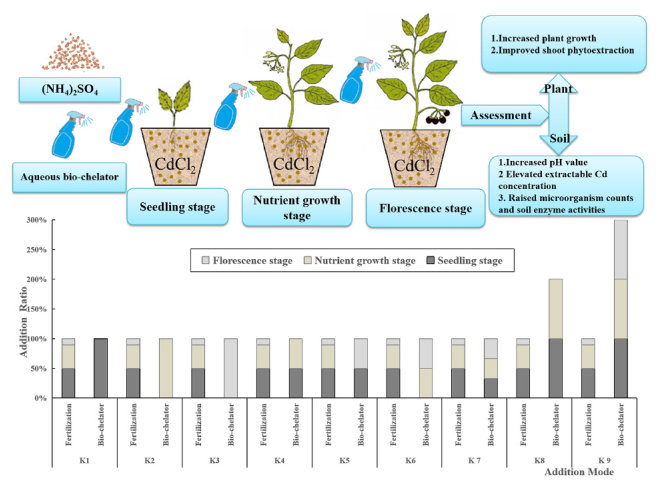
G R A P H I C A L A B S T R A C T
- ◆Co-application of (NH4)2SO4 and bio-chelator was more effective than alone.◆(NH4)2SO4与生物螯合剂联合施用比单独施用更为有效。
- ◆K8 and K9 treatments achieved the optimal Cd phytoextraction pattern.◆K8和K9处理实现了最佳的Cd植物提取模式。
- ◆The microorganism counts and enzyme activities advanced most for K8 and K9.◆K8和K9处理的微生物数量和酶活性提升最为显著。
- ◆2 mg kg− 1Cd pollution could be removed after three rounds of phytoremediation.◆经过三轮植物修复后,2 mg kg− 1的Cd污染可被去除。
A R T I C L E I N F O
Handling editor: Lena Q. Ma Keywords: Cadmium Aqueous bio-chelator Enhanced phytoremediation Ammonium sulfate ((NH4)2SO4) Solanum nigrum L
A B S T R A C T
The efficacy of using plants to phytoremediate heavy metal (HM) contaminated soils can be improved using soil amendments. These amendments may both increase plant biomasses and HMs uptake. We aimed to determine the composite effect of ammonium sulfate ((NH4)2SO4) combined with the application of an aqueous stem-extracted bio-chelator (Bidens tripartita L) on the plant biomasses and cadmium (Cd) phytoextraction by Solanum nigrum L. The constant (NH4)2SO4 application mode plus bio-chelator additives collectively enhanced the shoot Cd extraction ability owing to the increased plant biomass and shoot Cd concentration by S. nigrum. The shoot Cd extraction and the soil Cd decreased concentration confirmed the optimal Cd phytoextraction pattern in
利用植物修复重金属(HM)污染土壤的效果可通过施用土壤改良剂加以提高。这些改良剂既可增加植物生物量,又可提高重金属吸收量。本研究旨在确定硫酸铵((NH4)2SO4)与Bidens tripartita L茎部水提生物螯合剂联合施用对Solanum nigrum L植物生物量及镉(Cd)植物提取的复合效应。恒定的(NH4)2SO4施用模式配合生物螯合剂添加,由于S. nigrum植物生物量和地上部Cd浓度的提高,共同增强了地上部Cd提取能力。地上部Cd提取量和土壤Cd降低浓度证实,最佳Cd植物提取模式出现于
* Corresponding author. Key Laboratory of Pollution Ecology and Environment Engineering, Institute of Applied Ecology, Chinese Academy of Sciences, Shenyang 110016, China.
* 通讯作者。中国科学院沈阳应用生态研究所污染生态与环境工程重点实验室,沈阳 110016,中国。
** Corresponding author.
*** Corresponding author.
E-mail addresses: yangwei0709@sylu.edu.cn (W. Yang), daihp72@snut.edu.cn (H. Dai), shuhewei@iae.ac.cn (S. Wei).
https://doi.org/10.1016/j.chemosphere.2024.141317 Received 19 December 2023; Received in revised form 25 January 2024; Accepted 26 January 2024 Available online 27 January 2024 0045-6535/© 2024 Elsevier Ltd. All rights reserved.
K8 and K9 treatments (co-application of (NH4)2SO4 and twofold/threefold bio-chelators). Accordingly, Cd contamination risk in the soil (2 mg kg− 1) could be completely eradicated (<0.2 mg kg− 1) after three rounds of phytoremediation by S.nigrum based on K8 and K9 treatments through calculating soil Cd depletion. The microorganism counts and enzyme activities in rhizosphere soils at treatments with the combined soil additives apparently advanced. In general, co-application mode of (NH4)2SO4 and aqueous bio-chelator was likely to be a perfect substitute for conventional scavenger agents on account of its environmental friendliness and cost saving for field Cd contamination phytoremediation by S. nigrum.
K8和K9处理((NH4)2SO4与二倍/三倍生物螯合剂联合施用)中。据此,通过计算土壤Cd耗竭量可知,基于K8和K9处理,利用S.nigrum进行三轮植物修复后,土壤中的Cd污染风险(2 mg kg− 1)可被完全消除(<0.2 mg kg− 1)。联合施用土壤添加剂处理的根际土壤微生物数量和酶活性明显提高。总体而言,鉴于其环境友好和节约成本的特点,(NH4)2SO4与水提生物螯合剂联合施用模式有望成为S. nigrum田间Cd污染植物修复中传统清除剂的理想替代品。
1Introduction引言
While agricultural and industrial development has brought exceptional economic benefits in the world, it has also resulted in widespread soil contamination (Rizwan et al., 2018a). Cadmium (Cd) is a non-essential heavy metal (HM) that reduces plant growth through the inhibition ofphotosynthesis, creation ofmineral nutrient imbalances, and oxidative stress (Niu et al., 2021). Meanwhile, it is a human carcinogen, and may accumulate in the food chain (Yan et al., 2018).
农业和工业的发展在全球范围内带来了巨大的经济效益,但同时也造成了广泛的土壤污染(Rizwan et al., 2018a)。镉(Cd)是一种非必需重金属(HM),可通过抑制光合作用、造成矿质营养失衡以及引发氧化胁迫而抑制植物生长(Niu et al., 2021)。同时,Cd是一种人类致癌物,并可能在食物链中累积(Yan et al., 2018)。
Potentially, phytoextraction may be used to remove HMs, from contaminated soil (Ahemad, 2019), although there is a lacuna of examples of successful operations (Robinson et al., 2018).Hyperaccumulators, plants that accumulate inordinately-high concentrations of HMs in the aerial portions may extract HMs from contaminated soil in situ, without excessive soil disturbance (Burges et al., 2018). Hyperaccumulators can tolerate high concentrations of HMs with no obvious physiological damage (Guo et al., 2017), the HM concentrations in their aerial portions exceed the concentrations in soil (Liu et al., 2019). Depending on the HM, the threshold concentration for hyperaccumulation is a leaf concentration 10–100 times higher than the soil concentration. Typical thresholds are 100 mg kg− 1(for Cd, Tl), 1000 mg kg− 1(Ni, As, Se, B, Co) and 10,000 mg kg− 1(Zn, Mn) (Lu et al., 2018). Many Cd hyperaccumulators belong to the Brassica family or the Brassicaceae (Noccaea, Arabidopsis, Rorippa) or Solanacea, such as Sedum alfredii Hance. (Tao et al., 2020), Sphagneticola calendulacea (Liu et al., 2019; Lu et al., 2020). Arabidopsis helleri (Kushwaha et al., 2022), Solatium nigrum L (Dai et al., 2022), Noccaea caerulescens (Yan et al., 2022), Rorippa globosa (Dou et al., 2019), and Lantana camara L (Liu et al., 2019), etc.
植物提取有望用于去除污染土壤中的重金属(Ahemad, 2019),但成功应用的实例仍较为缺乏(Robinson et al., 2018)。超富集植物是指地上部能够累积极高浓度重金属的植物,可在不过度扰动土壤的情况下原位提取污染土壤中的重金属(Burges et al., 2018)。超富集植物能够耐受高浓度重金属而无明显生理损伤(Guo et al., 2017),其地上部重金属浓度超过土壤中的浓度(Liu et al., 2019)。根据重金属种类的不同,超富集的阈值为叶片浓度比土壤浓度高10–100倍。典型阈值为100 mg kg− 1(Cd、Tl)、1000 mg kg− 1(Ni、As、Se、B、Co)和10,000 mg kg− 1(Zn、Mn)(Lu et al., 2018)。许多Cd超富集植物属于Brassica科或Brassicaceae(Noccaea, Arabidopsis, Rorippa)或Solanacea,如Sedum alfredii Hance.(Tao et al., 2020)、Sphagneticola calendulacea(Liu et al., 2019; Lu et al., 2020)、Arabidopsis helleri(Kushwaha et al., 2022)、Solatium nigrum L(Dai et al., 2022)、Noccaea caerulescens(Yan et al., 2022)、Rorippa globosa(Dou et al., 2019)和Lantana camara L(Liu et al., 2019)等。
Despite early enthusiasm, one drawback of phytoextraction is the remediation time of at least10 years or even much longer timesneeded even for moderately-contaminated soil (Zhao et al., 2015).There is an urgent needto overcome the conventional phytoremediation bottlenecksresulting from limited metal uptake by low-biomass hyperaccumulators. (Wu et al., 2020). To date, many papers and reports have demonstrated that a variety of techniques can be used to increase the efficacy of Cd-hyperaccumulator systems (Gu et al., 2022; Sahito et al., 2022), by increasing both biomass and Cd concentration (Rostami and Azhdarpoor, 2019).
尽管早期备受关注,植物提取的一个缺点是修复周期长,即便是中度污染土壤也至少需要10年甚至更长时间(Zhao et al., 2015)。低生物量超富集植物的金属吸收量有限,导致传统植物修复存在瓶颈,亟需加以突破(Wu et al., 2020)。迄今为止,大量论文和报告表明,可采用多种技术,通过同时提高生物量和Cd浓度(Rostami and Azhdarpoor, 2019)来提高Cd超富集植物体系的修复效率(Gu et al., 2022; Sahito et al., 2022)。
This may be achieved through soil conditioners including N fertilizers (NO3− -N, NH4+-N), crop straw and split N fertilization for reducing N losses could promote the aboveground biomasses and strengthen the Cd remediation efficiency by hyperaccumulators planted in the Cd-contaminated soil (Huo et al., 2018; Lin et al., 2018; Yang et al., 2020). Other studies on Cd phytoremediation research discovered that the applicationof plant growth regulators (PGRs), plant growth-promoting bacteria (PGPB) and chelating agents by leading to the exaltation of Cd bioavailability in soils elevated Cd concentration at different parts of the plants, and finally improved Cd phytoaccumulation by tested plants (Chen et al., 2020a; Pramanik et al., 2018; Chen et al., 2020b). Noteworthily, some chemical chelators, such as EDTA, EDDS and EGTA, were difficult to degrade and would cause secondary pollution for environmental security (Wang et al., 2019). Therefore, to explore a newly high-efficiency, environment-friendly and low-cost chelating agent is key to phytoremediation improver.
这可以通过土壤调理剂实现,包括氮肥(NO3− -N、NH4+-N)、作物秸秆以及为减少氮损失而采用的分次施氮,这些措施可促进种植于Cd污染土壤中的超富集植物的地上部生物量,并增强其Cd修复效率(Huo et al., 2018; Lin et al., 2018; Yang et al., 2020)。其他Cd植物修复研究发现,施用植物生长调节剂(PGRs)、植物促生细菌(PGPB)和螯合剂可提高土壤中Cd的生物有效性,从而提高植物不同部位的Cd浓度,最终改善受试植物对Cd的累积(Chen et al., 2020a; Pramanik et al., 2018; Chen et al., 2020b)。值得注意的是,一些化学螯合剂如EDTA、EDDS和EGTA难以降解,会对环境安全造成二次污染(Wang et al., 2019)。因此,探索一种新型高效、环境友好且低成本的螯合剂是提升植物修复效果的关键。
from R. globosa shoots significantly increased Cd concentrations in the roots and shoots of the Cd-hyperaccumulator Galinsoga parviflora. This effect was partly due to an increased proportion of exchangeable Cd in soils. They concluded that natural green additives positively affect the soil rhizosphere, serving as potential alternatives to conventional chelators (Wang et al., 2016). Han et al. (2019) found that stem aqueous extracts of Bidens tripartita L. are cleaner chelating agents compared to EDTA for Cd extraction and accumulation in contaminated soil by S. nigrum (Han et al., 2019).S. nigrum, identified by Wei et al. (2006)as a new Cd hyperaccumulator, is highly effective in phytoremediation of slightly Cd-contaminated soil. Its advantages include large biomass, rapid growth, strong Cd accumulation and tolerance, and adaptability to various regions (Wei et al., 2006; Dou et al., 2022).
R. globosa地上部水提物显著提高了Cd超富集植物Galinsoga parviflora根系和地上部的Cd浓度。该效应部分归因于土壤中可交换态Cd比例的增加。他们认为,天然绿色添加剂对土壤根际具有积极影响,可作为传统螯合剂的潜在替代品(Wang et al., 2016)。Han et al. (2019)发现,在S. nigrum对污染土壤中Cd的提取与累积方面,Bidens tripartita L.茎部水提物是比EDTA更清洁的螯合剂(Han et al., 2019)。S. nigrum由Wei et al. (2006)鉴定为一种新的Cd超富集植物,对轻度Cd污染土壤的植物修复非常有效。其优势包括生物量大、生长迅速、Cd累积和耐受能力强,以及对不同地区的适应性强(Wei et al., 2006; Dou et al., 2022)。
However, there has been limited detailed experimental research on the combined use of N fertilizers and bio-chelating agents to enhance phytoremediation by S. nigrum. The aims of our study were i) to evaluate whether the co-application of (NH4)2SO4 and bio-chelators could enhance the shoot Cd extraction by increasing plant biomass and jointly raising shoot Cd concentration by S. nigrum, and ii) to explore the optimal Cd removal from contaminated soil under different co-application doses and patterns. We hypothesize that (NH4)2SO4 combined with the double doses of aqueous bio-chelators will be considered the top co-application mode due to the highest level of shoot Cd extraction through the maximum Cd concentration in the aboveground parts of S. nigrum. Furthermore, this method shows great promise for practical application in the phytoremediation of soils contaminated with low to moderate levels of Cd.
然而,关于氮肥与生物螯合剂联合施用以强化S. nigrum植物修复的详细试验研究仍较为有限。本研究的目的是:i)评估(NH4)2SO4与生物螯合剂联合施用能否通过增加植物生物量并共同提高S. nigrum地上部Cd浓度来增强地上部Cd提取;ii)探究不同联合施用剂量和模式下污染土壤中Cd的最佳去除效果。我们假设,由于S. nigrum地上部Cd浓度最高从而地上部Cd提取水平最高,(NH4)2SO4与双倍剂量水提生物螯合剂联合施用将被视为最佳联合施用模式。此外,该方法在中低水平Cd污染土壤的植物修复中具有广阔的实际应用前景。
2Materials and methods材料与方法
2.1. Basic physicochemical properties of soil and the pot experiment2.1. 土壤基本理化性质与盆栽试验
The tested soil samples were obtained from the soil surface in a depth of 0–20 cm at the Shenyang Ecological Experimental Station of Chinese Academy of Sciences (41◦31′ N and 123◦41′ E), which belong to brown soils (GB/T 17296-2009). The background Cd concentration in soil was 0.16 mg kg− 1and the pH was 6.94. The soil contained 15.2 g kg− 1 organic carbon, total N 0.85 g kg− 1, available P of 10.4 mg kg− 1, available K 81.0 mg kg− 1and CEC 22.9 cmol kg− 1, respectively.The other physicochemical properties referred to Yang et al. (2019). The pot trial was performed in the station (41◦31′ N and 123◦41′ E) of the semi-moist continental climates prevailing with a total annual radiation of 520–544 kJ cm− 2average annual precipitation of 650–700 mm, and approximately 127–164 frostless days per year (Wei et al., 2010).
供试土壤采自中国科学院沈阳生态实验站0–20 cm表层土壤(41◦31′ N,123◦41′ E),属于棕壤(GB/T 17296-2009)。土壤Cd背景浓度为0.16 mg kg− 1,pH为6.94。土壤有机碳含量为15.2 g kg− 1,全氮0.85 g kg− 1,有效磷10.4 mg kg− 1,速效钾81.0 mg kg− 1,CEC 22.9 cmol kg− 1。其他理化性质参见Yang et al. (2019)。盆栽试验在该站(41◦31′ N,123◦41′ E)进行,该地属半湿润大陆性气候,年总辐射量为520–544 kJ cm− 2,年均降水量为650–700 mm,年无霜期约127–164天(Wei et al., 2010)。
In all the treatment groups, Cd was spiked in deionized water with no Cd detection and added into the prepared soil as the form of CdCl2 ′2.5H2O with 2 mg kg− 1concentration (exclude the CK). According to the National Soil-Environmental Quality Standard of China (NSEQSC GB 15618-2018), the soil pollution level was considered moderate (SEQ, 2018). All the soil samples of 2.5 kg DW were loaded in plastic pots (φ = 20 cm and H = 15 cm) and equilibrated for 2 months (from March 15 to May 15). Six four-leaves S. nigrum seedlings with uniform height were transplanted from the tray into the tested pot. Each treatment was repeated in triplicate.
所有处理组(CK除外)中,Cd以CdCl2 ′2.5H2O形式溶于未检出Cd的去离子水中,按2 mg kg− 1的浓度加入到制备好的土壤中。根据中国国家土壤环境质量标准(NSEQSC GB 15618-2018),该土壤污染水平属于中度(SEQ, 2018)。将2.5 kg(干重)土壤装入塑料盆(φ = 20 cm,H = 15 cm)中,平衡2个月(3月15日至5月15日)。选取6株高度一致的四叶期S. nigrum幼苗,从育苗盘移栽至供试盆中。每个处理设3次重复。
In their 2016 study, Wang et al. discovered that aqueous extracts
Wang等在2016年的研究中发现,
2.2. Experiment design and exogenous additives preparation2.2. 试验设计与外源添加剂制备
The appropriate N fertilizer type and addition mode, 800 mg kg− 1 (NH4)2SO4 (9.4 g per pot) ((5:4:1): 50 % added at base, 40 % irrigated at nutrient growth stage and 10 % at fluorescence stage) was selected according to Yang et al. (2019, 2020)in previous studies (Yang et al., 2019, 2020). Additionally, by description of one research on enhancing Cd phytoremediation by S. nigrum, the optimum bio-chelator, 20 % stem extract of accumulator Bidens tripartita L., was designated as the target bio-chelator concentration and type in this trial (Han et al., 2019). In the present experiment, the accumulator B. tripartita was collected from this station, and subsequently, divided into three parts: roots, stems and leaves. The EDTA reagent and (NH4)2SO4 were purchased from Sinopharm Chemical Reagent Co. Ltd. (China). The Cd concentrations in all the additives was <0.01 mg kg− 1.
依据Yang et al. (2019, 2020)的前期研究(Yang et al., 2019, 2020),选定适宜的氮肥类型及施用方式,即800 mg kg− 1 (NH4)2SO4(每盆9.4 g)((5:4:1):50 %作基肥施入,40 %于营养生长期灌施,10 %于开花期灌施)。此外,根据一项关于强化S. nigrum Cd植物修复的研究,选定最佳生物螯合剂——富集植物Bidens tripartita L.的20 %茎提取物——作为本试验的目标生物螯合剂浓度和类型(Han et al., 2019)。本试验中,富集植物B. tripartita采自本站,随后分为根、茎、叶三部分。EDTA试剂和(NH4)2SO4购自国药集团化学试剂有限公司(中国)。所有添加剂中的Cd浓度均<0.01 mg kg− 1。
The collected plant stem parts were thoroughly washed with aseptic water and dried in the oven at 105 ◦C for 15 min, subsequently, incubated at 70 ◦C overnight until reaching constant weight and completely dry condition, and then the dried plant samples were pulverized and passed through a 2 mm nylon sieve. Sieved stem samples (200g) were soaked in 1000 mL distilled water and oscillated in an oscillator at 25 ◦C for 24h. The resulting suspension was centrifuged at 180 r min− 1for 30 min (Han et al., 2019) and filtered through a 0.45 μm filter membrane (Longjin film technology Co., Ltd. (China))and the filtrate was stored in a refrigerator at 4 ◦C for preparation. The related organic contents of 20 % (M/V) prepared aqueous extracts, such as soluble polysaccharide, was determinated by Phenol-sulfuric acid method (Wu et al., 2016), the detection of total organic acid was described by Dobrowolskaiwanek (2015) through Scid-base neutralization titration method (Dobrowolskaiwanek, 2015), reducing sugar referred to the 3,5-Dinitrosalicylic acid method (Han et al., 2019), free amino acids were detected using Ninhydrin colorimetry method (Kong et al., 2017), and the corresponding contents was 58.1 μg g− 1, 12.6 %, 10.5 μg g− 1and 4.68 μg g− 1, respectively.
采集的植物茎部用无菌水彻底洗净,于105 ◦C烘箱中杀青15 min,随后于70 ◦C烘干过夜至恒重并完全干燥,然后将干燥植物样品粉碎并过2 mm尼龙筛。取过筛茎样(200g)浸泡于1000 mL蒸馏水中,于25 ◦C振荡器中振荡24h。所得悬浮液以180 r min− 1离心30 min(Han et al., 2019),经0.45 μm滤膜(Longjin film technology Co., Ltd.(中国))过滤,滤液置于4 ◦C冰箱中保存备用。所制备的20 %(M/V)水提物中相关有机成分含量测定如下:可溶性多糖采用苯酚-硫酸法测定(Wu et al., 2016);总有机酸按Dobrowolskaiwanek (2015)所述的酸碱中和滴定法测定(Dobrowolskaiwanek, 2015);还原糖参照3,5-二硝基水杨酸法测定(Han et al., 2019);游离氨基酸采用茚三酮比色法测定(Kong et al., 2017);相应含量分别为58.1 μg g− 1、12.6 %、10.5 μg g− 1和4.68 μg g− 1。
Twelve treatments were set up in this experiment, namely CK (without Cd and additives), CK1 (with Cd, no other additives), CK2 (with Cd and EDTA). Table 1 gives a description of the treatmentsK1 ((NH4)2SO4 (5:4:1) + bio-chelator (100 % irrigated at base)), K2 ((NH4)2SO4 (5:4:1) + bio-chelator (100 % irrigated at nutrient growth stage)), K3 ((NH4)2SO4 (5:4:1) + bio-chelator (100 % irrigated at fluorescence stage)), K4 ((NH4)2SO4 (5:4:1) + bio-chelator (50 % irrigated at base, 50 % at nutrient growth stage)), K5 ((NH4)2SO4 (5:4:1) + bio-chelator (50 % irrigated at base, 50 % at fluorescence stage)), K6 ((NH4)2SO4 (5:4:1) + bio-chelator (50 % irrigated at nutrient growth stage, 50 % at fluorescence stage)), K7 ((NH4)2SO4(5:4:1) + bio-chelator (1/3 irrigated at base, 1/3 at nutrient growth stage and 1/3 at fluorescence stage)), K8 ((NH4)2SO4 (5:4:1) + bio-chelator 2-folds content (50 % irrigated at base, 50 % at nutrient growth stage)), K9 ((NH4)2SO4 (5:4:1) + bio-chelator 3-folds content (1/3 irrigated at base, 1/3 nutrient growth stage and 1/3 at fluorescence stage)). Among all the treatments, 9.4 g pot− 1(NH4)2SO4 were supplemented with 50 % at base mixed with the tested soil in the form of particles, 40 % irrigated at nutrient growth stage and 10 % at fluorescencestage by liquid irrigation (Yang et al., 2020); The stem aqueous solutions of B. tripartita was added in the variable additive amounts at the different time intervals including the ratio of 5:4:1 (NH4)2SO4 application. The applications of EDTA were irrigated at nutrient growth stage (the start after 30 day of seedling transplantation). The detailed addition modes and contents are elaborately shown in Table 1 (Table 1).
本试验共设12个处理,即CK(不添加Cd和添加剂)、CK1(添加Cd,不添加其他添加剂)、CK2(添加Cd和EDTA)。表1给出了各处理说明:K1((NH4)2SO4 (5:4:1) + 生物螯合剂(100 %作基施灌入))、K2((NH4)2SO4 (5:4:1) + 生物螯合剂(100 %于营养生长期灌施))、K3((NH4)2SO4 (5:4:1) + 生物螯合剂(100 %于开花期灌施))、K4((NH4)2SO4 (5:4:1) + 生物螯合剂(50 %作基施灌入,50 %于营养生长期灌施))、K5((NH4)2SO4 (5:4:1) + 生物螯合剂(50 %作基施灌入,50 %于开花期灌施))、K6((NH4)2SO4 (5:4:1) + 生物螯合剂(50 %于营养生长期灌施,50 %于开花期灌施))、K7((NH4)2SO4(5:4:1) + 生物螯合剂(1/3作基施灌入,1/3于营养生长期、1/3于开花期灌施))、K8((NH4)2SO4 (5:4:1) + 2倍量生物螯合剂(50 %作基施灌入,50 %于营养生长期灌施))、K9((NH4)2SO4 (5:4:1) + 3倍量生物螯合剂(1/3作基施灌入,1/3于营养生长期、1/3于开花期灌施))。所有处理中,9.4 g pot− 1 (NH4)2SO4的50 %以颗粒形式作基肥与供试土壤混匀,40 %于营养生长期、10 %于开花期以液体灌施方式施入(Yang et al., 2020);B. tripartita茎部水提液在与(NH4)2SO4 5:4:1施用比例相应的不同时间节点以不同添加量加入。EDTA于营养生长期(幼苗移栽30天后开始)灌施。详细的添加方式和添加量见表1(表1)。
All the pot-cultured plants were randomly placed in the grid greenhouse of the station and watered with tap water twice daily in the morning and evening for keeping the soil water holding capacity at approximately 80 %. Finally, the tested plants were harvested with a 118 days of growth period, of which, the seedling stage lasts from June 1 to July 1 (30 days), the nutrient growth stage from July 2 to August 11 (40 days), the fluorescence stage from August 12 to September 29 (48 days), subsequently, were reaped thoroughly.
所有盆栽植物随机放置于该站网室温室中,每天早晚用自来水浇灌两次,使土壤持水量保持在约80 %。受试植物生长期共118天,其中幼苗期为6月1日至7月1日(30天),营养生长期为7月2日至8月11日(40天),开花期为8月12日至9月29日(48天),随后全部收获。
Experimental treatments with exogenous additives in pot cultivation by S. nigrum.
S. nigrum盆栽试验中外源添加剂的试验处理。
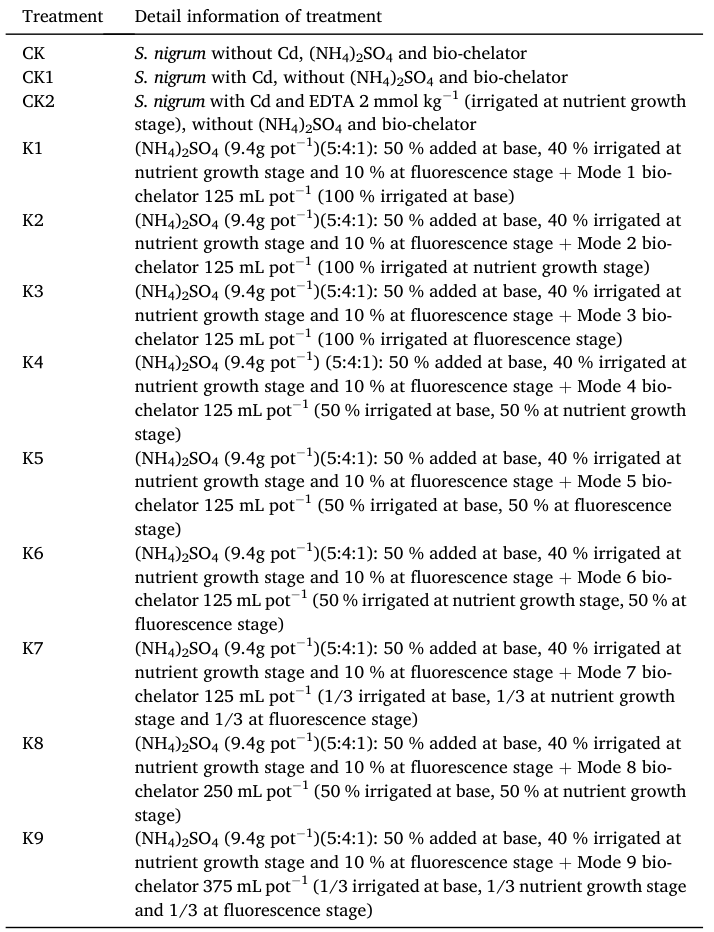
Note: Doses of (NH4)2SO4 and EDTA are supplemented for analytically pure reagents.
注:(NH4)2SO4和EDTA的用量按分析纯试剂计。
2.3. Sample determination2.3. 样品测定
The plant samples were divided into the root and shoot parts. Cd concentrations in plant samples after digestion with 87 %HNO3 (analytical reagent) and 13 % HClO4, (analytical reagent) purchased from Sinopharm Chemical Reagent Co. Ltd. (China), were determined by atomic absorption spectrophotometry (AAS, Hitachi 180). The available Cd concentration in the soil was extracted with 1 mol L− 1MgCl2 for analysis by the above-mentioned instrument. The international certified standard reference materials (NISTSRM1547, GBW07405, GSS-5) were utilized as the soil and plant quality control parameters, respectively. The soil pH was determined by a pH meter (PHS–3B, purchased from Shanghai Instrument (Group) Co., Ltd. (China)) at the soil/water ratio of 1:2.5 (v/w) according to the previous measures (Yang et al., 2020). The basic properties of soil, such as the amounts of bacteria and the activities of catalase and urease were detected by the regularly used method described by the related researchers (Zhan et al., 2019).
植物样品分为根和地上部两部分。植物样品经87 % HNO3(分析纯)和13 % HClO4(分析纯)(购自国药集团化学试剂有限公司(中国))消解后,采用原子吸收分光光度法(AAS,Hitachi 180)测定Cd浓度。土壤有效态Cd采用1 mol L− 1 MgCl2提取,并用上述仪器测定。分别采用国际有证标准物质(NISTSRM1547、GBW07405、GSS-5)作为土壤和植物的质量控制。土壤pH参照前人方法(Yang et al., 2020),以1:2.5(v/w)的土水比用pH计(PHS–3B,购自上海仪器(集团)有限公司(中国))测定。土壤基本性质如细菌数量以及过氧化氢酶和脲酶活性,采用相关研究者所述的常规方法测定(Zhan et al., 2019)。
2.4. Data processing and statistical analysis2.4. 数据处理与统计分析
Data processing and standard deviation (SD) calculations were performed using Microsoft Excel. Means of different treatments were evaluated using one-way ANOVA with DPS (Data Processing System) software. According to Duncan’s multiple comparison, the significance level was p < 0.05 based on the statistical analysis principal (n = 3) (Li et al., 2018).
数据处理和标准差(SD)计算采用Microsoft Excel完成。不同处理的均值采用DPS(Data Processing System)软件进行单因素方差分析(one-way ANOVA)。根据Duncan多重比较,按统计分析原则(n = 3),显著性水平为p < 0.05(Li et al., 2018)。
Shoot Cd extraction (μg plant− 1) = Shoot Cd concentration (mg kg− 1) × Shoot biomass (g plant− 1)
地上部Cd提取量(μg plant− 1)= 地上部Cd浓度(mg kg− 1)× 地上部生物量(g plant− 1)
Soil Cd phytoextraction efficiency (%) = [(Cd extraction contents of Root (μg plant− 1) + Cd extraction contents of Shoot (μg plant− 1)] × 6 × 10− 3/original Cd contents of soil (mg pot− 1)] × 100 soil Cd decreased concentration (mg kg− 1) = original Cd concentration of soil (2 mg kg− 1)-Cd concentration in soil after harvested (mg kg− 1)
土壤Cd植物提取效率(%)= [(根部Cd提取量(μg plant− 1)+ 地上部Cd提取量(μg plant− 1)] × 6 × 10− 3/土壤初始Cd含量(mg pot− 1)] × 100 土壤Cd降低浓度(mg kg− 1)= 土壤初始Cd浓度(2 mg kg− 1)- 收获后土壤Cd浓度(mg kg− 1)
Soil Cd depletion (mg pot− 1) = soil Cd decreased concentration (mg kg− 1) × soil weight (kg pot− 1)
土壤Cd耗竭量(mg pot− 1)= 土壤Cd降低浓度(mg kg− 1)× 土壤质量(kg pot− 1)
3Results and discussion结果与讨论
3.1. Effect of (NH4)2SO4 combined with bio-chelator on root and shoot biomasses by S. nigrum
3.1. (NH4)2SO4与生物螯合剂联合施用对S. nigrum根系和地上部生物量的影响
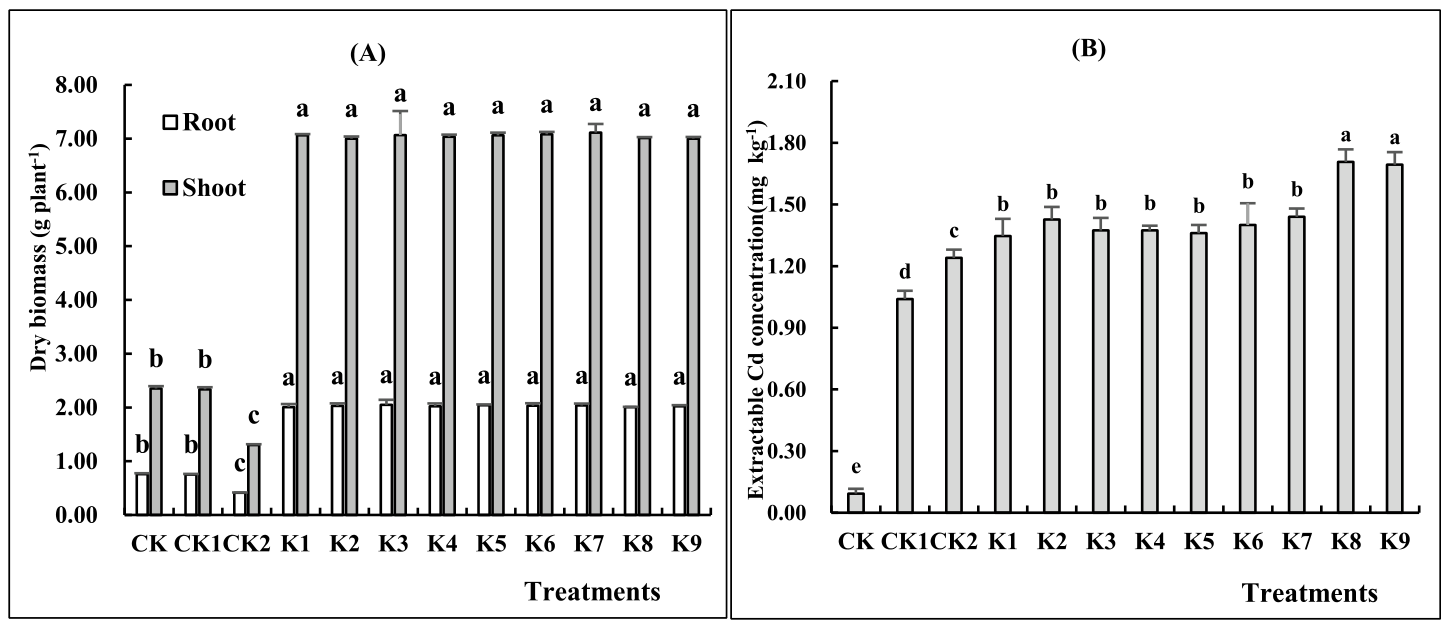
Fig. 1A shows that the combined addition of (NH4)2SO4 with the bio-chelator from the stem of accumulator B. tripartita into the Cd-contaminated soil, the Cd-hyperaccumulators S. nigrum root and aboveground biomasses at either treatments (K1, K2, K3, K4, K5, K6, K7, K8, K9) increased by 1.66-, 2.02 times, 1.69-, 1.99 times, 1.73-, 2.02 times, 1.69-, 2.01 times, 1.71-, 2.02 times, 1.70-, 2.03 times, 1.70-, 2.04 times, 1.69- times, 2.0 times and 1.69-, 1.99 times, respectively, compared with the control CK1 (with Cd, no other additions) (p < 0.05). Conversely, after applying EDTA to the Cd-contaminated soil (CK2), the biomasses at roots and aboveground parts of the Cd-hyperaccumulators S. nigrum significantly reduced (p < 0.05), compared with the control CK1 (with Cd, without other additions), the production of biomasses decreased 45.2 % and 44.3 %, respectively (p < 0.05).图1A显示,向Cd污染土壤中联合添加(NH4)2SO4与富集植物B. tripartita茎部生物螯合剂后,与对照CK1(添加Cd,无其他添加)相比,各处理(K1、K2、K3、K4、K5、K6、K7、K8、K9)Cd超富集植物S. nigrum的根系和地上部生物量分别增加了1.66和2.02倍、1.69和1.99倍、1.73和2.02倍、1.69和2.01倍、1.71和2.02倍、1.70和2.03倍、1.70和2.04倍、1.69和2.0倍以及1.69和1.99倍(p < 0.05)。相反,向Cd污染土壤中施加EDTA(CK2)后,与对照CK1(添加Cd,无其他添加)相比,Cd超富集植物S. nigrum根系和地上部生物量显著降低(p < 0.05),分别减少了45.2 %和44.3 %(p < 0.05)。
In some previous studies, the investigators concluded that on account of the essential mineral nutrient supply, one-off or partition N fertilizer applications of different types at the appropriate plant growth period could dramatically improve the Cd phytoextraction capacity by hyperaccumulators relying on the increased biomasses (Huo et al., 2018; Yang et al., 2020). These preceding conclusions were similar with our experimental findings (Fig. 1A). Nevertheless, other researchers have confirmed that straws with maize and wheat provided some available nutrients (N, P, K and other nutrients) directly and indirectly absorbed by functional plants to satisfy the nutrient demands through short- and long-terms manners (Wu et al., 2019; Liu et al., 2019). In brief, the addition of aqueous bio-chelators alone into contaminated soil either increased the plant biomasses or elevated Cd concentration to shorten phytoremediation period by the target HMs hyperaccumulators (Rizwan et al., 2018b; Huang et al., 2019), the appearance of the dissimilarity for the above consequences was attributed to the interactions with soil-environment-rhizosphere systems (Gu et al., 2020).
前人研究认为,由于必需矿质养分的供应,在植物适宜生长期一次性或分次施用不同类型的氮肥,可依靠生物量的增加显著提高超富集植物的Cd植物提取能力(Huo et al., 2018; Yang et al., 2020)。这些结论与本试验结果相似(图1A)。然而,其他研究者证实,玉米和小麦秸秆可直接或间接地提供一些有效养分(N、P、K及其他养分)供功能植物吸收,以短期和长期方式满足其养分需求(Wu et al., 2019; Liu et al., 2019)。简言之,单独向污染土壤中添加水提生物螯合剂,或增加植物生物量,或提高目标重金属超富集植物的Cd浓度,从而缩短植物修复周期(Rizwan et al., 2018b; Huang et al., 2019);上述结果出现差异归因于其与土壤-环境-根际系统的相互作用(Gu et al., 2020)。
In summary, our experimental results further displayed that the application of (NH4)2SO4 supplemented with the stem-extracted aqueous bio-chelator posed a synergistic effect on strengthening Cd phytoremediation efficiency by S. nigrum planted in contaminated soil; Thereinto, the role of N fertilizer (NH4)2SO4 was to increase biomasses, while the exogenous bio-chelator additives contributed to the elevated Cd concentration at roots and aboveground parts of the target plant (Table 2; Fig. 1A).
综上所述,本试验结果进一步表明,(NH4)2SO4配施茎部水提生物螯合剂对强化污染土壤中S. nigrum的Cd植物修复效率具有协同效应;其中,氮肥(NH4)2SO4的作用是增加生物量,而外源生物螯合添加剂则有助于提高目标植物根系和地上部的Cd浓度(表2;图1A)。
3.2. Effects of (NH4)2SO4 combined with bio-chelator on shoot Cd extraction
3.2. (NH4)2SO4与生物螯合剂联合施用对地上部Cd提取量的影响
Addition of (NH4)2SO4 in combination with stem-extracted bio-chelating additives (Bidens tripartita L.) added to S. nigrum inCdcontaminated soil significantly increased both root and shoot Cd concentrations compared with the control, CK1 (Table 2).Increasing bio-chelator rates (K1–K9) resulted in increased shoot Cd concentrations up to a maximum concentration of Ca. 30 mg kg− 1(K8, K9), representing a bioaccumulation coefficient (BAC) of 15. Root Cd concentrations were Ca. 80 % of the shoot concentrations (Table 2).
与对照CK1相比,在种植S. nigrum的Cd污染土壤中联合添加(NH4)2SO4与茎部提取生物螯合添加剂(Bidens tripartita L.)显著提高了根系和地上部Cd浓度(表2)。随着生物螯合剂施用量的增加(K1–K9),地上部Cd浓度随之升高,最高浓度约为30 mg kg− 1(K8、K9),对应的生物累积系数(BAC)为15。根系Cd浓度约为地上部浓度的80 %(表2)。
In contrast to the control CK1, at K8 and K9 treatments the Cd concentrations in the roots and shoots, shoot Cd extraction and soil Cd phytoextraction efficiency by hyperaccumulators increased by 69.9 %, 70.6 %, 57.2 %, 58.0 %, 3.71-, 3.73 folds and 3.67-, 3.70 folds, respectively (p < 0.05) (Table 2). The soil Cd decreased concentration (mg kg− 1) and soil Cd depletion (mg pot− 1) were followed as K9––K8 > K7––K6––K5––K4––K3––K2––K1 > CK2 (CK1), suggesting the K8 and K9 was with the highest Cd phytoextraction efficiency due to the bio-chelator addition to the soil causing the remarkable elevation in shoot and root concentrations of S. nigrum (Table 2). Consequently, after mathematical calculation, Cd contamination in the soil could be completely removed and cleaned (<0.2 mg kg− 1) (NSEQSC GB 15618- 2018) after three rounds of phytoremediation by co-application of (NH4)2SO4 and aqueous bio-chelator by S.nigrum.
与对照CK1相比,K8和K9处理中超富集植物根系和地上部Cd浓度、地上部Cd提取量以及土壤Cd植物提取效率分别提高了69.9 %和70.6 %、57.2 %和58.0 %、3.71和3.73倍以及3.67和3.70倍(p < 0.05)(表2)。土壤Cd降低浓度(mg kg− 1)和土壤Cd耗竭量(mg pot− 1)的顺序为K9––K8 > K7––K6––K5––K4––K3––K2––K1 > CK2(CK1),表明K8和K9的Cd植物提取效率最高,这是由于向土壤中添加生物螯合剂使S. nigrum地上部和根系Cd浓度显著升高(表2)。因此,经数学计算,通过(NH4)2SO4与水提生物螯合剂联合施用,利用S.nigrum进行三轮植物修复后,土壤中的Cd污染可被完全去除和清洁(<0.2 mg kg− 1)(NSEQSC GB 15618- 2018)。
Pearson’s correlation analysis showed that Cd concentrations in root and shoot portions, also shoot extraction by S. nigrum had significantly positive correlations (p < 0.05) with the bio-chelating agents addition amounts, rather than bio-chelating agents application mode (Table 4).
Pearson相关分析表明,S. nigrum根系和地上部Cd浓度以及地上部提取量与生物螯合剂添加量呈显著正相关(p < 0.05),而与生物螯合剂施用方式无关(表4)。
Effect of (NH4)2SO4 combined with bio-chelator on Cd extraction by S. nigrum.
(NH4)2SO4与生物螯合剂联合施用对S. nigrum Cd提取的影响。
| Treatments处理 | Root concentration (mg kg−1)根系浓度 (mg kg−1) | Shoot concentration (mg kg−1)地上部浓度 (mg kg−1) | Shoot Cd extraction (μg plant−1)地上部Cd提取量 (μg plant−1) | Soil Cd phytoextraction efficiency (%)土壤Cd植物提取 效率(%) | Soil Cd decreased concentration (mg kg−1)土壤Cd降低 浓度(mg kg−1) | Soil Cd depletion (mg pot−1)土壤Cd耗竭量 (mg pot−1) |
|---|---|---|---|---|---|---|
| CK | 0.03± 0.01e | 0.04± 0.01e | 0.10±0.02e | – | – | – |
| CK1 | 14.4± 0.71d | 19.3± 0.51d | 45.2±1.82c | 6.72± 0.17c | 0.130±0.004c | 0.325±0.011c |
| CK2 | 17.5± 0.88c | 22.9± 0.65c | 29.8±1.17d | 4.45± 0.18d | 0.088±0.008c | 0.219±0.020c |
| K1 | 20.9± 0.92b | 26.4± 0.30b | 186± 1.88b | 27.5± 0.45b | 0.549±0.011b | 1.37±0.028b |
| K2 | 21.0± 0.71b | 26.8± 0.89b | 188± 7.19b | 27.6± 0.98b | 0.523±0.072b | 1.31±0.181b |
| K3 | 20.3± 0.54b | 27.2± 0.87b | 192± 16.5b | 28.1± 2.13b | 0.560±0.036b | 1.40±0.09b |
| K4 | 20.2± 0.33b | 26.8± 0.62b | 189± 3.38b | 27.5± 0.26b | 0.547±0.006b | 1.37±0.014b |
| K5 | 20.5± 1.04b | 27.1± 0.70b | 191± 4.98b | 28.0± 0.73b | 0.560±0.01b | 1.40±0.025b |
| K6 | 20.5± 0.65b | 26.7± 1.42b | 189± 11.2b | 27.7± 1.36b | 0.553±0.015b | 1.38±0.038b |
| K7 | 21.5± 0.76b | 27.2± 1.67b | 194± 16.1b | 28.5± 1.87b | 0.570±0.036b | 1.43±0.090b |
| K8 | 24.5± 1.28a | 30.4± 0.16a | 213± 0.70a | 31.4± 0.32a | 0.630±0.01a | 1.58±0.025a |
| K9 | 24.6± 1.57a | 30.5± 0.65a | 214± 4.42a | 31.6± 0.71a | 0.633±0.012a | 1.58±0.029a |
Note: Means with different letters in the column are significantly different at p < 0.05.
注:同列中不同字母表示在p < 0.05水平差异显著。
Our study demonstrated that combining N fertilizers with aqueous bio-chelators significantly increased the Cd uptake of S. nigrum (Table 2, Fig. 1A). Similar findings have been reported in other studies, where straw biochar application increased Cd accumulation in plant seedlings. This increase was attributed to increased mobility and bioavailability of Cd (Sungur et al., 2015; Gong et al., 2021). Additionally, some studies have observed that certain straws affect microbial composition (Fang et al., 2014) and produce specific chemicals that increase HM uptake by roots (Okanya et al., 2011). However, some researchers argue that straw biochar amendments reduce the bioavailable Cd concentration in contaminated soil, predominantly due to changes in soil’s physicochemical properties (Wu et al., 2019; Du et al., 2019). The lack of consensus in these findings is mainly attributed to variations in soil types, plant species, aqueous extraction methods, and plant tissues studied (Han et al., 2020).
本研究表明,氮肥与水提生物螯合剂联合施用显著提高了S. nigrum对Cd的吸收(表2,图1A)。其他研究也报道了类似结果,即秸秆生物炭的施用增加了植物幼苗中的Cd累积,这归因于Cd迁移性和生物有效性的提高(Sungur et al., 2015; Gong et al., 2021)。此外,一些研究观察到某些秸秆会影响微生物组成(Fang et al., 2014),并产生可增加根系重金属吸收的特定化学物质(Okanya et al., 2011)。然而,也有研究者认为,秸秆生物炭改良会降低污染土壤中生物有效态Cd浓度,这主要是由于土壤理化性质的变化(Wu et al., 2019; Du et al., 2019)。这些研究结果缺乏一致性,主要归因于所研究的土壤类型、植物种类、水提方法和植物组织的差异(Han et al., 2020)。
This study revealed that in comparison to the control (CK1) with only Cd, the Cd concentrations in the roots and aerial parts of plants significantly increased in the EDTA-treated control (CK2) (p < 0.05). However, decreased Cd extraction was mainly attributed to a substantial reduction in plant biomass (Fig. 1A). As a prominent member of the hexahydric acid family, EDTA forms soluble metal-EDTA compounds with metals, enhancing the solubility, mobility, and bioavailability of HMs in soils. This facilitates absorption and translocation of HMs from soil to roots and shoots in plants (Gul et al., 2019; Liu et al., 2019). Numerous studies have indicated that EDTA application increases HM accumulation, thereby increasing phytoremediation efficiency (Shahid et al., 2014; Afshan et al., 2015), aligning with the findings of this study (Table 2). However, the use of chelators such as EDTA in the field has been widely discredited due to inevitable leaching losses of the chelated HM (Nowack et al., 2006).
本研究发现,与仅添加Cd的对照(CK1)相比,EDTA处理对照(CK2)中植物根系和地上部Cd浓度显著增加(p < 0.05)。然而,Cd提取量的下降主要归因于植物生物量的大幅降低(图1A)。EDTA作为六元酸家族的重要成员,可与金属形成可溶性金属-EDTA络合物,提高土壤中重金属的溶解性、迁移性和生物有效性,从而促进重金属从土壤向植物根系和地上部的吸收与转运(Gul et al., 2019; Liu et al., 2019)。大量研究表明,施用EDTA可增加重金属累积,从而提高植物修复效率(Shahid et al., 2014; Afshan et al., 2015),这与本研究结果一致(表2)。然而,由于被螯合的重金属不可避免地发生淋溶损失,在田间使用EDTA等螯合剂已普遍不被认可(Nowack et al., 2006)。
Effect of (NH4)2SO4 combined with bio-chelator on microorganism counts and enzyme activities in soils.
(NH4)2SO4与生物螯合剂联合施用对土壤微生物数量和酶活性的影响。
| Treatments处理 | Bacteria number (× 106)细菌数量(× 106) | Catalase activity (mL g−1)过氧化氢酶活性(mL g−1) | Urease activity (μg g−1)脲酶活性(μg g−1) |
|---|---|---|---|
| CK | 25.9± 0.4a | 6.13± 0.12a | 256±11.5c |
| CK1 | 25.7± 0.4a | 6.17± 0.21a | 263±3.3c |
| CK2 | 16.6± 0.9b | 3.53± 0.25b | 165±1.6d |
| K1 | 25.9± 0.5a | 6.30± 0.10a | 331±3.5b |
| K2 | 25.8± 0.3a | 6.27± 0.06a | 330±4.6b |
| K3 | 26.4± 0.1a | 6.13± 0.15a | 330±6.7b |
| K4 | 25.7± 0.6a | 6.20± 0.17a | 330.±2.6b |
| K5 | 26.1± 0.3a | 6.13± 0.15a | 331±4.4b |
| K6 | 26.2± 0.5a | 6.10± 0.10a | 331±5.9b |
| K7 | 26.3± 0.1a | 6.13± 0.21a | 334±3.7b |
| K8 | 25.9± 0.5a | 6.20± 0.26a | 373±4.6a |
| K9 | 26.0± 0.6a | 6.13± 0.12a | 374±4.5a |
Conversely, other research indicates that EDTA alone does not improve cadmium and other heavy metal accumulation in S. alfredii roots and shoots. This inefficacy is likely due to excessive EDTA adversely affecting root development and plant growth, ultimately leading to phytotoxicity (Guo et al., 2019; Li et al., 2020). Moreover, inappropriate use of EDTA in farmland soils can cause environmental issues, owing to its non-degradable nature, leading to soil physicochemical imbalances and potential ecological risks (Guo et al., 2015).
相反,另有研究表明,单独施用EDTA并不能提高S. alfredii根系和地上部的镉及其他重金属累积。这可能是由于过量EDTA对根系发育和植物生长产生不利影响,最终导致植物毒性(Guo et al., 2019; Li et al., 2020)。此外,由于EDTA难以降解,在农田土壤中不当使用会引发环境问题,导致土壤理化失衡并带来潜在生态风险(Guo et al., 2015)。
3.3. Effect of (NH4)2SO4 combined with bio-chelator on microorganism counts and enzyme activities in soil3.3. (NH4)2SO4与生物螯合剂联合施用对土壤微生物数量和酶活性的影响
As shown in Table 3, the addition of EDTA into the Cd-contaminated soil had a negative impact on soil environment, which caused considerable decline in bacteria amounts, catalase (CAT) activity and urease activity in the rhizosphere soil (p < 0.05), compared with CK1 (with Cd, no other additions) (Table 3). To the contrary, the combined application of (NH4)2SO4 with the aqueous additives treatments did not result in the conspicuous changes in bacteria counts and catalase (CAT) activities (p < 0.05). Apart from this, the study demonstrated that the complex application of (NH4)2SO4 with the natural chelating agent treatments greatly activated urease activity in the rhizosphere soil cultivating Cd-hyperaccumulators S. nigrum via enzyme activity assay (p < 0.05) (Table 3). As the bio-chelator additive contents multiplied, the soil urease activity enhanced significantly and reached to a peak, which increase by 41.9 % compared with CK1 (with Cd, no other additions) (p < 0.05). The above conclusions elaborated that the combined addition of (NH4)2SO4 with the aqueous bio-chelator played a positively regulatory role on enhancing Cd phytoremediation by S. nigrum. Pearson’s correlation analysis showed that the urease activity in soils had a significantly positive correlation (p < 0.05) with the bio-chelating agents addition amounts (Table 4).
如表3所示,与CK1(添加Cd,无其他添加)相比,向Cd污染土壤中添加EDTA对土壤环境产生了负面影响,导致根际土壤细菌数量、过氧化氢酶(CAT)活性和脲酶活性显著下降(p < 0.05)(表3)。相反,(NH4)2SO4与水提添加剂联合施用处理并未引起细菌数量和过氧化氢酶(CAT)活性的明显变化(p < 0.05)。除此之外,酶活性测定表明,(NH4)2SO4与天然螯合剂复合施用处理显著激活了种植Cd超富集植物S. nigrum的根际土壤脲酶活性(p < 0.05)(表3)。随着生物螯合剂添加量成倍增加,土壤脲酶活性显著增强并达到峰值,较CK1(添加Cd,无其他添加)提高了41.9 %(p < 0.05)。上述结论说明,(NH4)2SO4与水提生物螯合剂联合添加对增强S. nigrum的Cd植物修复起到了正向调控作用。Pearson相关分析表明,土壤脲酶活性与生物螯合剂添加量呈显著正相关(p < 0.05)(表4)。
Our experimental conclusions drawn in this experiment were unanimous with the results of previous study, which showed the addition of stem-extracted exogenous additives maintained and guaranteed the favorable physicochemical environment in soil-plant systems, obviously improved the living environment of micro-organisms and positively regulated microbial enzymatic activities (Han et al., 2019). Furthermore, our trial also observed that the EDTA amendment led to the physicochemical properties in soils in disorder and negatively affects microbial enzymatic activities, as another literature has reported (Vigliotta et al., 2016).
本试验得出的结论与前人研究结果一致,即添加茎部提取的外源添加剂可维持和保障土壤-植物系统良好的理化环境,明显改善微生物的生存环境,并对微生物酶活性起正向调控作用(Han et al., 2019)。此外,本试验还观察到,EDTA改良导致土壤理化性质紊乱,并对微生物酶活性产生负面影响,这与另一文献的报道一致(Vigliotta et al., 2016)。
Note: Means with different letters in the column are significantly different at p < 0.05.
注:同列中不同字母表示在p < 0.05水平差异显著。
Pearson correlation coefficients between bio-chelator with S.nigrum phytoremediation and soil environment.
生物螯合剂与S.nigrum植物修复及土壤环境之间的Pearson相关系数。
| Treatment处理 | Root Cd concentration (mg kg−1)根系Cd 浓度(mg kg−1) | Shoot Cd concentration (mg kg−1)地上部Cd 浓度(mg kg−1) | Shoot Cd phytoextraction (μg plant−1)地上部Cd 植物提取量(μg plant−1) | Extractable Cd concentration (mg kg−1)可提取态Cd 浓度(mg kg−1) | Bacteria number (× 106)细菌 数量(× 106) | Catalase activity (mL g−1)过氧化氢酶 活性(mL g−1) | Urease activity (μg g−1)脲酶 活性(μg g−1) |
|---|---|---|---|---|---|---|---|
| Bio-chelator addition amount | 0.747* | 0.868* | 0.863* | 0.804* | 0.157 | 0.407 | 0.863* |
| Bio-chelator application mode | 0.103 | 0.164 | 0.189 | 0.246 | 0.323 | 0.491 | 0.237 |
Note: * is significant difference at p < 0.05.
注:*表示在p < 0.05水平差异显著。
3.4. Effect of (NH4)2SO4 combined with bio-chelator on extractable Cd concentration in soil
3.4. (NH4)2SO4与生物螯合剂联合施用对土壤可提取态Cd浓度的影响
As shown in Fig. 1B, the results explained that after the application of (NH4)2SO4 combined with stem-extracted natural additives and the EDTA addition alone to the Cd-contaminated soil, in contrast to the CK1 (with Cd, no other additions), the extractable Cd concentration in soil significantly increased (p < 0.05) (Fig. 1B). As the (NH4)2SO4 addition contents were constant and the stem-extracted exogenous additives (B. tripartita) contents improved to the twofold and irrigated into the soil, the extractable Cd concentrations in soil markedly elevated, which increase by 64.10 % in comparison to the CK1(with Cd and without other additions) (p < 0.05) (Fig. 1B). Furthermore, when the bio-chelator concentrations improved to threefold doses (375 mL pot− 1), the available Cd concentration did not continue to boost (p < 0.05) (Fig. 1B). In addition, Pearson’s correlation analysis stated briefly that there was a high-positive relevance between amounts of bio-chelator additives and the extractable Cd concentration in soils (Table 4).
如图1B所示,结果表明,向Cd污染土壤中施用(NH4)2SO4配施茎部提取天然添加剂以及单独添加EDTA后,与CK1(添加Cd,无其他添加)相比,土壤可提取态Cd浓度显著增加(p < 0.05)(图1B)。在(NH4)2SO4添加量恒定、茎部提取外源添加剂(B. tripartita)用量提高至两倍并灌入土壤时,土壤可提取态Cd浓度显著升高,较CK1(添加Cd,无其他添加)增加了64.10 %(p < 0.05)(图1B)。此外,当生物螯合剂浓度提高至三倍剂量(375 mL pot− 1)时,有效态Cd浓度未继续升高(p < 0.05)(图1B)。另外,Pearson相关分析简要表明,生物螯合剂添加量与土壤可提取态Cd浓度之间存在高度正相关(表4)。
It is found that the mobility and availability of Cd are closely associated not only with its total concentration in Cd-contaminated soil but also with the concentration proportion of the other Cd2+ species including available and water soluble Cd forms in the soil (Manquian-Cerda et al., 2018´). In our experiment, the circumstance of (NH4)2SO4 supplemented with stem-extracted exogenous additives and EDTA Treatment (CK2) resulting in outstanding elevation of available Cd concentrations in contaminated soils was possibly because that the increase of active ingredients in exogenous bio-chelators immediately stimulated the dissolved organic carbon (DOC) contents in soils, which chelated with Cd, finally improved the Cd bioavailability (Wei and Twardowska, 2013). Similar research conducted on by Mousavi et al. (2021) well established that chelators like EDTA can reduce Cd toxicity by binding to toxic Cd2+ cations as these chelators have a high potential of binding to metals, and thereby obviously enhanced the Cd extraction by okra plants (Mousavi et al., 2021). Earlier studies pointed out that some organic acids and reducing sugars were closely involved in HMs absorption and transfer processes at aboveground parts by hyperaccumulators (Sun et al., 2006; Sheel et al., 2015), which agrees with our experimental results (Fig. 1B). Furthermore, researchers still showed that chelation was taken between amino acids extracted from xylem sap with rare metals lanthanum (La) and yttrium (Y), which improved the HMs bioavailability in soils (Wu et al., 2013).
研究发现,Cd的迁移性和有效性不仅与Cd污染土壤中Cd的总浓度密切相关,还与土壤中其他Cd2+形态(包括有效态和水溶态Cd)的浓度比例密切相关(Manquian-Cerda et al., 2018´)。本试验中,(NH4)2SO4配施茎部提取外源添加剂以及EDTA处理(CK2)使污染土壤有效态Cd浓度显著升高,可能是因为外源生物螯合剂中活性成分的增加直接刺激了土壤中溶解性有机碳(DOC)含量的提高,DOC与Cd发生螯合,最终提高了Cd的生物有效性(Wei and Twardowska, 2013)。Mousavi et al. (2021)开展的类似研究充分证实,EDTA等螯合剂与金属具有很高的结合潜力,可通过结合有毒的Cd2+阳离子来降低Cd毒性,从而明显增强秋葵对Cd的提取(Mousavi et al., 2021)。早期研究指出,一些有机酸和还原糖与超富集植物地上部对重金属的吸收和转运过程密切相关(Sun et al., 2006; Sheel et al., 2015),这与本试验结果一致(图1B)。此外,研究者还发现,从木质部汁液中提取的氨基酸可与稀有金属镧(La)和钇(Y)发生螯合,从而提高土壤中重金属的生物有效性(Wu et al., 2013)。
4Conclusions结论
The combined application of (NH4)2SO4 with exogenous bio-chelator resulted in a significant increase in the plant biomasses and Cd concentrations at the root and shoot parts of S. nigrum, a newly Cd hyperaccumulator. Consequently, the shoot extraction capability of Cd (shoot biomass × shoot Cd concentration) by S. nigrum improved. As (NH4)2SO4 content was constant and the exogenous chelating additives concentration multiplied, the Cd concentrations in the roots and shoots of S. nigrum obviously increased, the shoot extraction ability of Cd clearly enhanced and reached to the maximum, no longer advanced.
(NH4)2SO4与外源生物螯合剂联合施用显著提高了新型Cd超富集植物S. nigrum的生物量以及根系和地上部Cd浓度。因此,S. nigrum地上部对Cd的提取能力(地上部生物量 × 地上部Cd浓度)得到提高。在(NH4)2SO4用量恒定、外源螯合添加剂浓度成倍增加的条件下,S. nigrum根系和地上部Cd浓度明显升高,地上部Cd提取能力显著增强并达到最大值,此后不再提高。
Concurrently, the promoted circumstances appeared in extractable Cd concentration in soils and the soil microenvironment, such as the soil microbial quantity and enzyme activities in rhizosphere soils.
同时,土壤可提取态Cd浓度以及土壤微环境(如根际土壤微生物数量和酶活性)也得到了改善。
To sum up, Cd contamination (2 mg kg− 1) in the soil could be eliminated comprehensively (<0.2 mg kg− 1) after three rounds of phytoremediation through analysisof the shoot Cd extraction, the soil Cd decreased concentration and the soil Cd depletion. Overall, co-application mode of (NH4)2SO4 and aqueous bio-chelator is expected to be an alternative for conventional scavenger agents in Cd contaminated soil with large scale and low level due to its advantages of environmental friendliness and high efficiency.
总之,通过对地上部Cd提取量、土壤Cd降低浓度和土壤Cd耗竭量的分析,经过三轮植物修复后,土壤中的Cd污染(2 mg kg− 1)可被全面消除(<0.2 mg kg− 1)。总体而言,(NH4)2SO4与水提生物螯合剂联合施用模式具有环境友好和高效的优势,有望成为大面积低水平Cd污染土壤中传统清除剂的替代方案。
CRediT authorship contribution statementCRediT作者贡献声明
Wei Yang: Writing – original draft, Data curation. Huiping Dai: Methodology, Formal analysis. Shuhe Wei: Methodology, Funding acquisition, Supervision, Project administration, Methodology. Brett H. Robinson: Writing – review & editing, Validation. Jianming Xue: Writing – review & editing, Validation.
Wei Yang: 撰写–初稿,数据整理。Huiping Dai: 方法,形式分析。Shuhe Wei: 方法,获取资助,指导,项目管理,方法。Brett H. Robinson: 撰写–审阅与编辑,验证。Jianming Xue: 撰写–审阅与编辑,验证。
Declaration of competing interest利益冲突声明
The authors declare that they have no known competing financial interests or personal relationships that could have appeared to influence the work reported in this paper.
作者声明,不存在任何可能影响本文所报道工作的已知经济利益冲突或个人关系。
Data availability数据可用性
Data will be made available on request.
数据可应要求提供。
Acknowledgements致谢
This work was supported by Research Support Project for high level talent of Shenyang Ligong University, Liaoning, China (1010147001212), City-University co-construction of State Key Laboratory of Biological Resources and Ecological Environment of Qinba, China (SXZJ-2301; SXJ-2101), Innovation Capability Support Program of Shaanxi (2023WGZJ-YB-05), Scientific and Technological Innovation Team of Bioremediation and Selenium Resources Development and Utilization of Shaanxi University of Technology, and Open Fund of Cultivation State Key Laboratory of Qinba Biological Resources and Ecological Environment of Shaanxi University of Technology, China (SLGPT2019KF04-02), the project of Foreign Experts Burean of China (G2023041029L; DL2023041006L; G2022040018L).
本研究得到以下项目资助:沈阳理工大学高层次人才科研支持项目(中国辽宁)(1010147001212),秦巴生物资源与生态环境国家重点实验室市校共建项目(中国)(SXZJ-2301; SXJ-2101),陕西省创新能力支撑计划(2023WGZJ-YB-05),陕西理工大学生物修复与硒资源开发利用科技创新团队,陕西理工大学秦巴生物资源与生态环境省部共建国家重点实验室培育基地开放基金(中国)(SLGPT2019KF04-02),以及中国国家外国专家局项目(G2023041029L; DL2023041006L; G2022040018L)。
References参考文献
Ahemad, M., 2019. Remediation of metalliferous soils through the heavy metal resistant plant growth promoting bacteria: paradigms and prospects. Arab. J. Chem. 12 (7), 1365–1377.
Afshan, S., Ali, S., Bharwana, S.A., Rizwan, M., Farid, M., Abbas, F., Abbasi, G.H., 2015. Citric acid enhances the phytoextraction of chromium, plant growth, and photosynthesis by alleviating the oxidative damages in Brassica napus L. Environ. Sci. Pollut. Control Ser. 22, 11679–11689.
Burges, A., Alkorta, I., Epelde, L., Garbisu, C., 2018. From phytoremediation of soil contaminants to phytomanagement of ecosystem services in metal contaminated sites. Int. J. Phytoremediation 20 (4), 384–397.
Chen, L., Long, C., Wang, D., Yang, J., 2020a. Phytoremediation of cadmium (Cd) and uranium (U) contaminated soils by Brassica juncea L. enhanced with exogenous application of plant growth regulators. Chemosphere 242, 125112.
Chen, L., Yang, J.Y., Wang, D., 2020b. Phytoremediation of uranium and cadmium contaminated soils by sunflower (Helianthus annuus L.) enhanced with biodegradable chelating agents. J. Clean. Prod. 263, 121491. Dai, H.P., Wei, S.H., Twardowska, I., Hou, N., Zhang, Q.R., 2022. Cosmopolitan cadmium hyperaccumulator Solanum nigrum: exploring cadmium uptake, transport and physiological mechanisms of accumulation in different ecotypes as a way of enhancing its hyperaccumulative capacity. J. Environ. Manag. 320, 115878.
Dobrowolskaiwanek, J., 2015. Simple method for determination of short-chain organic acid in Mead. Food Anal. Methods 8, 2356–2359.
Dou, X.K., Dai, H.P., Twardowska, I., Wei, S.H., 2019. Hyperaccumulation of Cd by Rorippa globosa (Turcz.) Thell. from soil enriched with different Cd compounds, and impact of soil amendment with glutathione (GSH) on the hyperaccumulation efficiency. Environ. Pollut. 255, 113270.
Dou, X.K., Dai, H.P., Skuza, L., Wei, S.H., 2022. Cadmium removal potential of hyperaccumulator Solanum nigrum L. under two planting modes in three years continuous phytoremediation. Environ. Pollut. 307, 119493. Du, J., Zhang, L., Liu, T., Xiao, R., Li, R., Guo, D., Zhang, Z., 2019. Thermal conversion of a promising phytoremediation plant (Symphytum officinale L.) into biochar: dynamic of potentially toxic elements and environmental acceptability assessment of the biochar. Bioresour. Technol. 274, 73–82.
Fang, Q., Chen, B., Lin, Y., Guan, Y., 2014. Aromatic and hydrophobic surfaces of woodderived biochar enhance perchlorate adsorption via hydrogen bonding to oxygencontaining organic groups. Environ. Sci. Technol. 48 (1), 279–288.
Guo, L., Ding, Y.Q., Xu, Y.L., Li, Z.D., Jin, Y.L., He, K., Fang, Y., Zhao, H., 2017. Responses of Landoltia punctata to cobalt and nickel: removal, growth, photosynthesis, antioxidant system and starch metabolism. Aquat. Toxicol. 190, 87–93.
Gul, I., Manzoor, M., Silvestre, J., 2019. EDTA-assisted phytoextraction of lead and cadmium by Pelargonium cultivars grown on spiked soil. Int. J. Phytoremediation 21 (2), 101–110.
Gu, X., Zhang, Q., Jia, Y., Cao, M., Zhang, W., Luo, J., 2022. Enhancement of the Cd phytoremediation efficiency of Festuca arundinacea by sonic seed treatment. Chemosphere 287, 132158.
Guo, D., Ali, A., Ren, C., Du, J., Li, R., Lahori, A.H., Zhang, Z., 2019. EDTA and organic acids assisted phytoextraction of Cd and Zn from a smelter contaminated soil by potherb mustard (Brassica juncea, Coss) and evaluation of its bioindicators. Ecotoxicol. Environ. Saf. 167, 396–403.
Guo, X., Wei, Z., Wu, Q., 2015. Degradation and residue of EDTA used for soil repair in heavy metal-contaminated soil. Trans. Chin. Soc. Agric. Eng. 31 (7), 272–278.
Gu, P., Zhang, Y., Xie, H., Wei, J., Zhang, X., Huang, X., Lou, X., 2020. Effect of cornstalk biochar on phytoremediation of Cd-contaminated soil by Beta vulgaris var. cicla L. Ecotoxicol. Environ. Saf. 205, 111144.
Gong, X.M., Huang, D.L., Liu, Y.G., Zou, D.S., Hu, X., Zhou, L., Wu, Z.B., Xiao, Z.H., 2021. Nanoscale zerovalent iron, carbon nanotubes and biochar facilitated the phytoremediation of cadmium contaminated sediments by changing cadmium fractions, sediments properties and bacterial community structure. Ecotoxicol. Environ. Saf. 208, 111510.
Huo, W.X., Zou, R., Wang, L., Guo, W., Zhang, D., Fan, H., 2018. Effect of different forms of N fertilizers on the hyperaccumulator Solanum nigrum L. and maize in intercropping mode under Cd stress. RSC Adv. 8 (70), 40210–40218.
Han, R., Dai, H., Zhan, J., Wei, S.H., 2019. Clean extracts from accumulator efficiently improved Solanum nigrum L. accumulating Cd and Pb in soil. J. Clean. Prod. 239, 118055.
Han, R., Dai, H.P., Twardowska, I., Zhan, J., Wei, S.H., 2020. Aqueous extracts from the selected hyperaccumulators used as soil additives significantly improve accumulation capacity of Solanum nigrum L. for Cd and Pb. J. Hazard Mater. 394,
122553.
Huang, X.F., Li, S.Q., Li, S.Y., Huang, X.F., Li, S.Q., Li, S.Y., Ye, G.Y., Lu, L.J., Zhang, L., Liu, J., 2019. The effects of biochar and dredged sediments on soil structure and fertility promote the growth, photosynthetic and rhizosphere microbial diversity of Phragmites communis (Cav.) Trin. ex Steud. Sci. Total Environ. 697, 134073. Kushwaha, P., Neilson, J.W., Maier, R.M., Babst-Kostecka, A., 2022. Soil microbial community and abiotic soil properties influence Zn and Cd hyperaccumulation differently in Arabidopsis halleri. Sci. Total Environ. 803, 150006.
Kong, Y., Zhang, L.L., Sun, Y., Zhang, Y.Y., Sun, B.G., Chen, H.T., 2017. Determination of the free amino acid, organic acid, and nucleotide in commercial vinegars. J. Food Sci. 82, 336–345.
Liu, S., Ali, S., Yang, R., Tao, J., Ren, B., 2019. A newly discovered Cd-hyperaccumulator Lantana camara L. J. Hazard Mater. 371, 233–242.
Lu, G., Wang, B., Zhang, C., Li, S., Wen, J., Lu, G., Zhou, Y., 2018. Heavy metals contamination and accumulation in submerged macrophytes in an urban river in China. Int. J. Phytoremediation 20 (8), 839–846.
Lu, R.R., Hu, Z.H., Zhang, Q.L., Li, Y.Q., Lin, M., Wang, X.L., Peng, C.L., 2020. The effect of Funneliformis mosseae on the plant growth, Cd translocation and accumulation in the new Cd-hyperaccumulator Sphagneticola calendulacea. Ecotoxicol. Environ. Saf. 203, 110988.
Lin, L., Chen, F., Wang, J., Liao, M.A., Lv, X., Wang, Z., Ren, W., 2018. Effects of living hyperaccumulator plants and their straws on the growth and cadmium accumulation of Cyphomandra betacea seedlings. Ecotoxicol. Environ. Saf. 155, 109–116.
Li, H., Li, X., Xiang, L., Zhao, H.M., Li, Y.W., Cai, Q.Y., Wong, M.H., 2018. Phytoremediation of soil co-contaminated with Cd and BDE-209 using hyperaccumulator enhanced by AM fungi and surfactant. Sci. Total Environ. 613, 447–455.
Li, F.L., Qiu, Y., Xu, X., Yang, F., Wang, Z., Feng, J., Wang, J., 2020. EDTA-enhanced phytoremediation of heavy metals from sludge soil by Italian ryegrass (Lolium perenne L.). Ecotoxicol. Environ. Saf. 191, 110185.
Liu, X., Mao, Y., Zhang, X., Gu, P., Niu, Y., Chen, X., 2019. Effects of PASP/NTA and TS on the phytoremediation of pyrene-nickel contaminated soil by Bidens pilosa L. Chemosphere 237, 124502.
Manquian-Cerda, K., Cruces, E., Escudey, M., Zú´niga, G., Calder˜on, R., 2018. Interactive ´ effects of aluminum and cadmium on phenolic compounds, antioxidant enzyme activity and oxidative stress in blueberry (Vaccinium corymbosum L.) plantlets cultivated in vitro. Ecotoxicol. Environ. Saf. 150, 320–326.
Mousavi, A., Pourakbar, L., Moghaddam, S.S., Popovi´c-Djordjevi´c, J., 2021. The effect of the exogenous application of EDTA and maleic acid on tolerance, phenolic compounds, and cadmium phytoremediation by okra (Abelmoschus esculentus L.) exposed to Cd stress. J. Environ. Chem. Eng. 9 (4), 105456.
Niu, H., Leng, Y., Li, X., Yu, Q., Wu, H., Gong, J., Chen, K., 2021. Behaviors of cadmium in rhizosphere soils and its interaction with microbiome communities in phytoremediation. Chemosphere 269, 128765.
Nowack, B., Schulin, R., Robinson, B.H., 2006. Critical assessment of chelant-enhanced metal phytoextraction. Environmental Science and Technology 40 (17), 5225-–5232. Okanya, P.W., Mohr, K.I., Gerth, K., Jansen, R., Muller, R., 2011. Marinoquinolines A-F, pyrroloquinolines from Ohtaekwangia kribbensis (bacteroidetes). J. Nat. Prod. 74 (4), 603–608.
Rizwan, M., Ali, S., ur Rehman, M.Z., Rinklebe, J., Tsang, D.C., Bashir, A., Ok, Y.S., 2018a. Cadmium phytoremediation potential of Brassica crop species: a review. Sci. Total Environ. 631, 1175–1191.
Robinson, B.H., Yalamanchali, R., Reiser, R., Nicholas, M., Dickinson, N.M., 2018. Lithium as an emerging environmental contaminant: mobility in the soil-plant system. Chemosphere Environmental Toxicology & Risk Assessment.
Pramanik, K., Mitra, S., Sarkar, A., Soren, T., Maiti, T.K., 2018. Characterization of a Cd2 +- resistant plant growth promoting rhizobacterium (Enterobacter sp.) and its effects on rice seedling growth promotion under Cd2+-stress in vitro. Agric. Natu. Res. 52, 215–221.
Rizwan, M., Ali, S., Abbas, T., Adrees, M., Zia-ur-Rehman, M., Ibrahim, M., Nawaz, R., 2018b. Residual effects of biochar on growth, photosynthesis and cadmium uptake in rice (Oryza sativa L.) under Cd stress with different water conditions. J. Environ. Manag. 206, 676–683.
Rostami, S., Azhdarpoor, A., 2019. The application of plant growth regulators to improve phytoremediation of contaminated soils: a review. Chemosphere 220, 818–827. Sahito, Z.A., Zehra, A., Chen, S., Yu, S., Tang, L., Ali, Z., Yang, X.E., 2022. Rhizobium rhizogenes-mediated root proliferation in Cd/Zn hyperaccumulator Sedum alfredii and its effects on plant growth promotion, root exudates and metal uptake efficiency. J. Hazard Mater. 424, 127442.
SEQ (Soil environmental quality), 2018. Soil Environmental Quality Risk Control Standard for Soil Contamination of Agricultural Land. GB15618-2018. National standard of China.
Sungur, A., Soylak, M., Yilmaz, E., Yilmaz, S., Ozcan, H., 2015. Characterization of heavy metal fractions in agricultural soils by sequential extraction procedure: the relationship between soil properties and heavy metal fractions. Soil Sediment Contam.: Int. J. 24 (1), 1–15.
Shahid, M., Austruy, A., Echevarria, G., Arshad, M., Sanaullah, M., Aslam, M., Dumat, C., 2014. EDTA-enhanced phytoremediation of heavy metals: a review. Soil Sediment Contam.: Int. J. 23 (4), 389–416. Sun, R.L., Zhou, Q.X., Jin, C.X., 2006. Cadmium accumulation in relation to organic acids in leaves of Solanum nigrum L. as a newly found cadmium hyperaccumulator. Plant Soil 285 (1–2), 125–134. Sheel, R., Anand, M., Nisha, K., 2015. Phytoremediation of heavy metals (Zn and Pb) and its toxicity on Azolla filiculoides. Int. J. Sci. Res. 4, 1238–1241.
Tao, Q., Zhao, J., Li, J., Liu, Y., Luo, J., Yuan, S., Wang, C., 2020. Unique root exudate tartaric acid enhanced cadmium mobilization and uptake in Cd-hyperaccumulator Sedum alfredii. J. Hazard Mater. 383, 121177.
Vigliotta, G., Matrella, S., Cicatelli, A., Guarino, F., Castiglione, S., 2016. Effects of heavy metals and chelants on phytoremediation capacity and on rhizobacterial communities of maize. J. Environ. Manag. 179, 93–102.
Wu, Y., Ma, L., Liu, Q., Vestergård, M., Topalovic, O., Wang, Q., Feng, Y., 2020. The plant-growth promoting bacteria promote cadmium uptake by inducing a hormonal crosstalk and lateral root formation in a hyperaccumulator plant Sedum alfredii. J. Hazard Mater. 395, 122661. Wang, K., Liu, Y., Song, Z., Wang, D., Qiu, W., 2019. Chelator complexes enhanced Amaranthus hypochondriacus L. phytoremediation efficiency in Cd-contaminated soils. Chemosphere 237, 124480.
Wang, J., Liu, C., Zhang, X., Lin, L., Liao, M.A., Lv, X., Liang, D., 2016. Effects of applying hyperaccumulator straw in soil on growth and cadmium accumulation of G alinsoga parviflora. Environ. Prog. Sustain. Energy 35 (3), 618–623.
Wei, S.H., Li, Y.M., Zhou, Q.X., Srivastava, M., Chiu, S., Zhan, J., Sun, T., 2010. Effect of fertilizer amendments on phytoremediation of Cd-contaminated soil by a newly discovered hyperaccumulator Solanum nigrum L. J. Hazard Mater. 176 (1–3), 269–273.
Wu, C., Shi, L., Xue, S., Li, W., Jiang, X., Rajendran, M., Qian, Z., 2019. Effect of sulfuriron modified biochar on the available cadmium and bacterial community structure in contaminated soils. Sci. Total Environ. 647, 1158–1168.
Wei, S.H., Zhou, Q.X., Koval, P.V., 2006. Flowering stage characteristics of cadmium hyperaccumulator Solanum nigrum L. and their significance to phytoremediation. Sci. Total Environ. 369, 441–446.
Wu, J., Chen, A., Peng, S., Wei, Z., Liu, G., 2013. Identification and application of amino acids as chelators in phytoremediation of rare earth elements lanthanum and yttrium. Plant Soil 373, 329–338.
Wei, S.H., Twardowska, I., 2013. Main rhizosphere characteristics of the Cd hyperaccumulator Rorippa globose (Turcz.) Thell. Plant Soil 372 (1–2), 669–681.
Wu, D.T., Lam, S.C., Cheong, K.L., 2016. Simultaneous determination of molecular weights and contents of water-soluble polysaccharides and their fractions from Lycium barbarum collected in China. J. Pharmaceut. Biomed. Anal. 28 (129), 210–218.
Yan, Y.Y., Wang, J.J., Lan, X.Y., Wang, Q.M., Xu, F.L., 2018. Comparisons of cadmium bioaccumulation potentials and resistance physiology of Microsorum pteropus and Echinodorus grisebachii. Environ. Sci. Pollut. Control Ser. 25, 12507–12514.
the hyperaccumulator Noccaea caerulescens grown in a moderately contaminated soil. Plant Soil 475 (1–2), 379–394.
Yang, W., Dai, H.P., Skuza, L., Wei, S.H., 2020. The front-heavy and back-light nitrogen application mode to increase stem and leaf biomass significantly improved cadmium accumulation in Solanum nigrum L. J. Hazard Mater. 393, 122482.
Yang, W., Dai, H.P., Skuza, L., Wei, S.H., 2019. Strengthening role and the mechanism of optimum nitrogen addition in relation to Solanum nigrum L. Cd hyperaccumulation in soil. Ecotoxicol. Environ. Saf. 182, 109444.
Zhan, J., Twardowska, I., Wang, S.Q., Wei, S.H., Chen, Y.Q., Ljupco, M., 2019. Prospective sustainable production of safe food for growing population based on the soybean (Glycine max L. Merr.) crops under Cd soil contamination stress. J. Clean. Prod. 212, 22–36.
Zhao, X.M., Xie, H., Wu, K., Yu, M.H., Yang, R.G., Li, X.L., 2015. Phytoremediation and health risk assessment of acidified and cadmium contaminated farmland. Journal of Agro-Environment Science 34, 702–708.
Yan, J., Tang, Z., Fischel, M., Wang, P., Siebecker, M.G., Aarts, M.G., Zhao, F.J., 2022. Variation in cadmium accumulation and speciation within the same population of