Article
Max Nightingale-McMahon 1,* , Brett Robinson 1 , Brendon Malcolm 2, Tim Clough 3 and David Whitehead 4
1 School of Physical and Chemical Sciences, University of Canterbury, Christchurch 8041, New Zealand 2 The New Zealand Institute for Plant and Food Research Limited, Lincoln 7608, New Zealand
1 坎特伯雷大学物理与化学科学学院,基督城 8041,新西兰 2 新西兰植物与食品研究所有限公司,Lincoln 7608,新西兰
3 Faculty of Agriculture & Life Sciences, Lincoln University, Lincoln 7647, New Zealand
3 林肯大学农业与生命科学学院,Lincoln 7647,新西兰
4 Manaaki Whenua—Landcare Research, Lincoln 7608, New Zealand
4 Manaaki Whenua—Landcare Research,Lincoln 7608,新西兰
* Correspondence: mni63@uclive.ac.nz
Abstract: Winery wastewater (WW) is a high-volume biowaste and, in the context of Marlborough and New Zealand wineries, there is a growing recognition of the need to improve current WW disposal systems to mitigate negative environmental impacts. The application of WW to land is a low-cost method of disposal, that could significantly reduce the environmental risk associated with WW directly entering surface and groundwater bodies. This study analysed elemental concentrations in WW and soils from three Marlborough vineyards across their annual vintage to determine the loading rates of nutrients into WW and the subsequent accumulation effects of WW irrigation on receiving soils. The findings showed loading rates of approximately 1.8 t ha−1 yr−1 of sodium within WW and a significant increase in soil sodium concentration and pH, attributed to sodium-based cleaning products. A loading rate of approximately 4 t ha−1 yr−1 of total organic carbon was also identified within WW, however, significant losses in soil carbon, nitrogen, magnesium and calcium concentrations were identified. Focusing efforts to retain key nutrients from WW within soils could provide benefits to New Zealand’s wine industry, facilitating increased biomass production in irrigation plots, thereby increasing biodiversity and potentially generating incentives for vineyard owners to contribute to increasing biomass carbon stocks and offset agricultural greenhouse gas emissions.
摘要:酿酒废水(WW)是一种产生量大的生物废弃物。就马尔堡及新西兰其他酒厂而言,人们日益认识到有必要改进现行的WW处置系统,以减轻其对环境的负面影响。将WW施用于土地是一种低成本的处置方式,可显著降低WW直接进入地表水体和地下水体所带来的环境风险。本研究分析了马尔堡3个葡萄园在一个完整年度酿造期内WW和土壤中的元素浓度,以确定WW中养分的负荷速率及WW灌溉对受纳土壤的后续累积效应。结果表明,WW中钠的负荷速率约为1.8 t ha−1 yr−1,土壤钠浓度和pH显著升高,这归因于钠基清洁产品的使用。WW中总有机碳的负荷速率约为4 t ha−1 yr−1,然而土壤碳、氮、镁和钙浓度均出现显著损失。着力将WW中的关键养分保留在土壤中,可为新西兰葡萄酒产业带来效益:促进灌溉地块生物量的增加,从而提高生物多样性,并有望激励葡萄园主为增加生物量碳储量作出贡献,以抵消农业温室气体排放。
Academic Editor: Amrakh I. Mamedov
Received: 3 May 2024 Revised: 23 May 2024 Accepted: 25 May 2024
Published: 28 May 2024
Copyright: © 2024 by the authors. Licensee MDPI, Basel, Switzerland. This article is an open access article distributed under the terms and conditions of the Creative Commons Attribution (CC BY) license (https:// creativecommons.org/licenses/by/ 4.0/).
版权:© 2024 作者所有。被许可方MDPI,巴塞尔,瑞士。本文为开放获取文章,依据知识共享署名(CC BY)许可协议(https:// creativecommons.org/licenses/by/ 4.0/)条款发布。
Keywords: sustainability; wine; wastewater reclamation; sustainable development goal 15; life on land; soil carbon loss
关键词:可持续性;葡萄酒;废水回用;可持续发展目标15;陆地生物;土壤碳损失
1Introduction引言
By 2030, an aim of the United Nations Sustainable Development Goals (SDGs) is to halve the proportion of untreated wastewater by substantially increasing recycling and safe reuse of industrial wastewater, thereby minimising the release of hazardous material and reducing pollution [1]. Presently, the volumes of industrial wastewater are unquantified, resulting in a limited understanding of the risks or scope for reuse as potential resources. One suitable source for reclamation is winery wastewater (WW) [2], a significant byproduct of the winemaking process, generated from cleaning tanks, washing floors and equipment, rinsing transfer lines, cleaning barrels, managing off wine and product losses, bottling facilities, and operating filtration units [3]. The volumes of WW produced are generally related to the processing capacity of each vineyard. However, estimates vary from 0.2 to 14 litres (L) of WW per L of wine produced, depending on the type of wine and the processing required [4,5]. In New Zealand, it is generally accepted that approximately 10 L of WW is produced per L of wine [6–8], suggesting an approximate national generation of 380,000 m3 yr−1. [9]. The implementation of effective WW management strategies is considered a critical issue to improve the environmental performance of New Zealand’s expanding wine industry as future limitations to water supply are anticipated [10].
联合国可持续发展目标(SDGs)的目标之一是,到2030年通过大幅增加工业废水的循环利用和安全回用,将未经处理废水的比例减半,从而最大限度地减少有害物质的排放并降低污染[1]。目前,工业废水的产生量尚未得到量化,导致人们对其风险及作为潜在资源回用的空间认识有限。酿酒废水(WW)是一种适宜回收利用的来源[2],它是葡萄酒酿造过程中的重要副产物,产生于清洗储罐、冲洗地面和设备、冲洗输送管线、清洗酒桶、处理变质酒和产品损耗、灌装设施以及运行过滤装置等环节[3]。WW的产生量通常与各葡萄园的加工能力有关。然而,根据葡萄酒类型和所需加工工艺的不同,每生产1 L葡萄酒产生的WW估计为0.2~14升(L)[4,5]。在新西兰,一般认为每生产1 L葡萄酒约产生10 L WW[6–8],据此推算全国产生量约为380,000 m3 yr−1[9]。鉴于预计未来供水将受到限制,实施有效的WW管理策略被视为改善新西兰不断扩张的葡萄酒产业环境绩效的关键问题[10]。
As the largest wine-producing region in New Zealand, Marlborough accounts for 74% of the total grape production [11], generating approximately 280,000 m3 of WW annually [6]. Currently, two methods of WW disposal are available to Marlborough wineries: discharge directly to the municipal wastewater network, or irrigation to land. Disposal through municipal wastewater is not possible for many wineries due to their locality outside the civil network, additionally, the processing required at the wastewater treatment plant has associated costs and the subsequent discharge to sea has potentially harmful environmental impacts [7]. The practice of disposing of WW onto field crops, tree lots, pastures and vineyards through land application is common as a cost-effective method of WW disposal in Marlborough as minimal technical expertise is required [12]. However, there is an environmental risk associated with land application as WW can directly enter surface water and groundwater bodies [13],degrading the resources [7,14] through salinisation, eutrophication and depletion of dissolved oxygen (DO) [15,16]. The deterioration of these water bodies hinders their ability to be used for drinking supply [17,18], water for livestock, and recreational activities [19]. Due to the high organic load, variable salinity and the large volumes produced, it is also crucial to ensure the receiving soils can facilitate the added nutrients, salts and other contaminants [20,21]. Currently, 39 wineries across the Marlborough region discharge their WW to land while the majority discharge their WW to the wastewater network [7]. Compliance monitoring undertaken previously by MDC has observed impaired infiltration, ponding and runoff are apparent, particularly around the autumn vintage season (March to April) [22]. Of the 39 wineries discharging their WW to land in Marlborough, 13 were deemed fully compliant with permitted criteria for WW discharge over the 2021/2022 period, with compliance failures relating to surface ponding, WW sampling inadequacy and parameter exceedances (particularly pH) [23].
马尔堡是新西兰最大的葡萄酒产区,其葡萄产量占全国总产量的74%[11],每年产生约280,000 m3的WW[6]。目前,马尔堡酒厂可采用两种WW处置方式:直接排入市政污水管网,或灌溉于土地。由于许多酒厂位于市政管网覆盖范围之外,无法通过市政污水系统处置;此外,污水处理厂所需的处理过程会产生相应费用,而随后排海还可能造成有害的环境影响[7]。由于所需技术专业知识极少,在马尔堡,通过土地施用将WW处置于大田作物、林地、牧场和葡萄园是一种常见且经济有效的WW处置方式[12]。然而,土地施用存在环境风险,因为WW可能直接进入地表水体和地下水体[13],使水资源退化[7,14],其途径包括盐渍化、富营养化和溶解氧(DO)耗竭[15,16]。这些水体的恶化会妨碍其用作饮用水源[17,18]、牲畜用水及娱乐用途[19]。由于WW有机负荷高、盐度多变且产生量大,确保受纳土壤能够容纳所添加的养分、盐分及其他污染物也至关重要[20,21]。目前,马尔堡地区有39家酒厂将WW排放至土地,而大多数酒厂将WW排入污水管网[7]。马尔堡区议会(MDC)此前开展的合规监测发现,入渗受阻、积水和径流现象明显,尤其是在秋季酿造期(3月至4月)前后[22]。在马尔堡将WW排放至土地的39家酒厂中,2021/2022年度仅有13家被认定完全符合WW排放的许可标准,不合规情形涉及地表积水、WW采样不充分以及参数超标(尤其是pH)[23]。
Typically, the composition of WW varies based on the type of wine produced [24], the season [13] and the bespoke nature of the WW treatment systems employed by each vineyard [25]. Due to the high quantities of grape juice and solids, WW is typically acidic [15] and contains high concentrations of potassium (K) [26,27]. In addition, high sodium (Na) concentrations are often observed, most of which result from the use of alkaline cleaners used for sanitation, i.e., sodium percarbonate (2Na2CO3·3H2O2), sodium carbonate (Na2CO3) and sodium hydroxide (NaOH) [28], resulting in the Na concentration dependent on sanitation operations rather than the volume or type of wine processed. When applied to soils, the relative molar concentration of Na or K compared to the divalent cations of magnesium (Mg) and calcium (Ca) is expressed as the Na adsorption ratio and K adsorption ratio (SAR and PAR, respectively), in mmolc L−1. A high value for SAR and PAR present in WW can cause the accumulation of Na and K [7,9,29], leading to the dispersal and subsequent loss of Mg and Ca ions from the soil exchange complex [30], resulting in soil nutrient deficiencies in these elements. High SAR and PAR values have also been shown to change soil structure by increasing clay dispersion and reducing the distribution of mesopores and micropores [31,32]. This impedes water and root penetration [33], ultimately leading to a reduction in plant growth. The decrease in soil infiltration rates can also result in surface runoff and soil erosion [34], subsequently remobilising pollutants into surrounding environments [35].
通常,WW的组成因所生产的葡萄酒类型[24]、季节[13]以及各葡萄园所采用的定制化WW处理系统[25]而异。由于含有大量葡萄汁和固形物,WW通常呈酸性[15],并含有高浓度的钾(K)[26,27]。此外,WW中还常出现高浓度的钠(Na),其大部分来源于卫生清洁所用的碱性清洁剂,即过碳酸钠(2Na2CO3·3H2O2)、碳酸钠(Na2CO3)和氢氧化钠(NaOH)[28],因此Na浓度取决于清洁作业,而非所加工葡萄酒的数量或类型。施用于土壤时,Na或K相对于二价阳离子镁(Mg)和钙(Ca)的相对摩尔浓度分别以钠吸附比和钾吸附比(分别为SAR和PAR)表示,单位为mmolc L−1。WW中较高的SAR和PAR值可导致Na和K的累积[7,9,29],引起土壤交换复合体中Mg和Ca离子的分散及随后的损失[30],进而导致土壤中这些元素的养分缺乏。研究还表明,较高的SAR和PAR值会通过增强黏粒分散、减少中孔隙和微孔隙的分布而改变土壤结构[31,32]。这会阻碍水分和根系的穿透[33],最终导致植物生长下降。土壤入渗速率的降低还可能引起地表径流和土壤侵蚀[34],进而使污染物重新迁移进入周边环境[35]。
Attempts to mitigate the accumulation of Na in soils resulting from WW irrigation have led to the encouragement for industry to change to K-based caustic cleaning products (e.g., KOH) [26]. Previous research in Marlborough has shown that the soil dispersion risk under WW irrigation is low due to the high silt content in the native soils [29]. However, the accumulation of Na and K in soils under WW irrigation has been observed [7]. Grape residues also cause WW to be high in organic compounds such as sugars, ethanol [5], organic acids, phenolic compounds [36] and higher molecular weight organic compounds [28]. The decomposition of these organic compounds leads to elevated biological and chemical oxygen demand (BOD and COD, respectively), particularly during the grape harvest period in autumn (March to April) [20,37]. While elevated BOD and COD may hinder soil and plant function [13], the addition of the organic constituents also provides significant increases in soil carbon (C) and a slow release source of other nutrients [14,28]. International evidence suggests that the rates of WW to land application could be kept within a potentially beneficial range for key soil and plant nutrients including C [15,25], K [26], phosphorus (P) [38] and some cases, nitrogen (N) [5,39]. However, the limited records on the volumes of WW applied in Marlborough’s vineyards result in inaccuracies when approximating the total nutrient loading rates [20] and the impacts on plant growth are not known.
为减轻WW灌溉引起的土壤Na累积,业界已被鼓励改用K基碱性清洁产品(如KOH)[26]。马尔堡以往的研究表明,由于当地原生土壤粉粒含量高,WW灌溉下的土壤分散风险较低[29]。然而,已有研究观察到WW灌溉下土壤中Na和K的累积[7]。葡萄残渣还使WW富含有机化合物,如糖类、乙醇[5]、有机酸、酚类化合物[36]以及较高分子量的有机化合物[28]。这些有机化合物的分解导致生化需氧量和化学需氧量(分别为BOD和COD)升高,尤其是在秋季(3月至4月)葡萄采收期间[20,37]。尽管BOD和COD升高可能妨碍土壤和植物的功能[13],但有机组分的加入也可显著增加土壤碳(C),并提供其他养分的缓释来源[14,28]。国际证据表明,WW土地施用速率可控制在对关键土壤和植物养分有潜在益处的范围内,这些养分包括C[15,25]、K[26]、磷(P)[38],在某些情况下还包括氮(N)[5,39]。然而,由于马尔堡葡萄园WW施用量的记录有限,估算总养分负荷速率时存在误差[20],且其对植物生长的影响尚不清楚。
The aim of this research was to quantify the loading rates and subsequent accumulation of WW nutrients in soil C, N, P, K and Na, as well as the effects on soil pH. We hypothesised that the application of WW would lead to an increase in soil C stocks, in both the topsoil and subsoil as the organic C substrates within WW are assimilated into receiving soils. Increases in total N, P and K were also hypothesised, suggesting a potential enhancement of soil fertility by positively affecting the soil’s nutrient availability [14]. However, we hypothesised that any enhancement in soil fertility would be hindered by increases in Na, with expected rates of accumulation higher than those for K.
本研究旨在量化WW养分的负荷速率及其随后在土壤C、N、P、K和Na中的累积,以及对土壤pH的影响。我们假设,随着WW中的有机C底物被受纳土壤同化,WW的施用将导致表土和底土中土壤C储量增加。我们还假设全N、全P和全K会增加,表明通过对土壤养分有效性产生积极影响,土壤肥力可能得到提升[14]。然而,我们假设土壤肥力的任何提升都会受到Na增加的制约,且Na的预期累积速率高于K。
2Materials and Methods材料与方法
2.1. Site Descriptions2.1. 样点描述
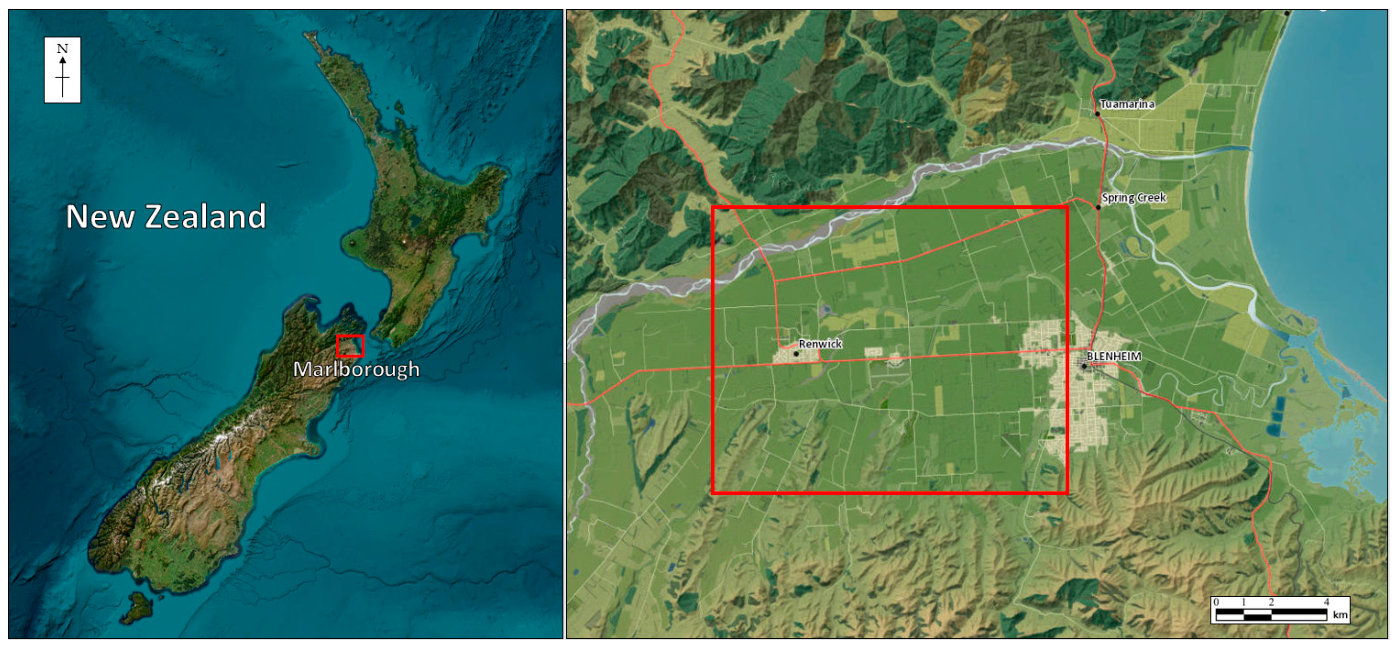
Two sets of soil and WW samples were collected in spring (October) 2021 and autumn (April) 2022 from three separate vineyards (Site A, Site B and Site C) in Marlborough, New Zealand (Figure 1). Samples were obtained under the conditions of anonymity of land ownership and therefore, Figure 1 identifies only the general locality of the three vineyards. Due to the topography, the average annual rainfall within the Marlborough region is highly variable; however, the sampling region, inland from Blenheim typically receives 600–800 mm of rainfall per year [40]. The soil at Site A and Site C are described as Typic Fluvial Recent Soils (RFT), and the soil at Site B is classed as Immature Orthic Brown Soil (BOI) [41]. RFT and BOI soils are taxonomically related to Typic Ustifluvent and Dystric Ustochrept soils [42,43], respectively, and are weakly developed and formed in alluvial sand, silt or gravel [44]. These soils are generally well drained with very low vulnerability to water logging in non-irrigated conditions, however, have a moderate or high structural vulnerability and are therefore susceptible to leaching [45]. Results from particle size analyses of soils confirmed that there were no significant differences in soil texture between Site A and Site C where soils were predominately sandy loam ranging to silt loam [43]. Site B’s soil texture was significantly different from that at Sites A and C with higher silt and clay contents, predominantly classified as a silt loam.
于2021年春季(10月)和2022年秋季(4月)从新西兰马尔堡的3个独立葡萄园(样地A、样地B和样地C)采集了两批土壤和WW样品(图1)。样品是在土地所有权匿名的条件下获取的,因此图1仅标示了3个葡萄园的大致位置。受地形影响,马尔堡地区的年均降雨量变化很大;但布伦海姆内陆的采样区域通常年降雨量为600–800 mm[40]。样地A和样地C的土壤被描述为典型河流新成土(RFT),样地B的土壤则归类为未成熟正常棕色土(BOI)[41]。在分类学上,RFT和BOI土壤分别与Typic Ustifluvent和Dystric Ustochrept土壤相对应[42,43],均发育较弱,形成于冲积砂、粉砂或砾石之上[44]。这些土壤通常排水良好,在非灌溉条件下极不易发生渍水,但具有中等或较高的结构脆弱性,因此易受淋溶影响[45]。土壤粒径分析结果证实,样地A与样地C之间的土壤质地无显著差异,其土壤主要为砂壤土至粉壤土[43]。样地B的土壤质地与样地A和C显著不同,粉粒和黏粒含量较高,主要归类为粉壤土。
The site coverage across the WW irrigation plots, where soil samples were collected, was similar for all three sites, largely consisting of grass cover with a small number of sporadic gum trees (Eucalyptus camaldulensis) at Site B and C. Georeferenced historic aerial photographs held by Marlborough District Council (MDC) indicates that the WW irrigation plots were established between 2005 and 2012, 1996 and 2004 and 2012 and 2016 for Site A, B and C, respectively [46]. The WW irrigation plots for all three sites were approximately 5.1 ha, 1.0 ha and 1.6 ha, respectively. Annual WW volume generation was recorded at Site B at the discharge point (July 2021 to June 2022) as 6661 m3. The WW volumes at Site C were estimated to be 10,000–12,000 m3 over the same time period, based on water usage throughout the year as measured at the vineyard’s water take. The annual WW application rate from Site B can be therefore estimated at approximately 670 mm and Site C can be estimated between 625 mm and 750 mm. It was not possible to estimate WW volumes for Site A during the 2021/2022 period.
3个样地中采集土壤样品的WW灌溉地块的地表覆盖状况相似,主要为草被,样地B和C另有少量零星分布的桉树(Eucalyptus camaldulensis)。马尔堡区议会(MDC)保存的具有地理参考的历史航拍照片显示,样地A、B和C的WW灌溉地块分别建立于2005–2012年、1996–2004年和2012–2016年间[46]。3个样地的WW灌溉地块面积分别约为5.1 ha、1.0 ha和1.6 ha。样地B在排放点记录的年WW产生量(2021年7月至2022年6月)为6661 m3。根据葡萄园取水口测得的全年用水量,估算样地C同期的WW产生量为10,000–12,000 m3。据此,样地B的年WW施用量估计约为670 mm,样地C估计为625~750 mm。样地A在2021/2022年度的WW产生量无法估算。
2.2. Sample Collection2.2. 样品采集
During the spring 2021 sample round, a total of 30 soil pits, 10 per site, were hand-dug using a stainless-steel spade to a maximum depth of 600 mm. Five pits were excavated within each of the WW irrigation plots, the locations of which were chosen randomly within each WW irrigation plot and an additional five pits were excavated on soils deemed to have not been irrigated with WW (control), adjacent to each irrigation plot where land cover was the same. Soil samples were collected from four depths of 0–50 (referred to as 25 in Figures), 300, 450 and 600 mm, at each pit using a stainless-steel trowel. This resulted in the collection of 120 soil samples that were transported to the laboratory on ice, where they were kept at <10 ◦C prior to analysis. During the autumn 2022 sampling period, a total of 30 soil samples, 10 per site, we collected from 0 to 50 mm depth (referred to as 0 in Figures) using a stainless-steel trowel. Again, five samples were chosen randomly within the WW irrigation plot, and five control samples were taken from non-irrigated soils adjacent to each WW irrigation plot. This resulted in the collection of 30 surface samples, resulting in 150 soil samples in total over the two sampling periods.
在2021年春季采样期间,使用不锈钢铁锹人工挖掘了共30个土壤剖面坑(每个样地10个),最大深度为600 mm。在每个WW灌溉地块内随机选择位置挖掘5个剖面坑,另在各灌溉地块附近、地表覆盖相同且被认为未接受WW灌溉的土壤上(对照)挖掘5个剖面坑。使用不锈钢小铲在每个剖面坑的4个深度采集土壤样品:0–50(图中记为25)、300、450和600 mm。由此共采集120个土壤样品,冰藏运回实验室,分析前保存于<10 ◦C条件下。在2022年秋季采样期间,使用不锈钢小铲从0–50 mm深度(图中记为0)采集了共30个土壤样品(每个样地10个)。同样,在WW灌溉地块内随机选取5个样品,并在各WW灌溉地块附近的非灌溉土壤上采集5个对照样品。由此共采集30个表层样品,两个采样期合计采集土壤样品150个。
The WW samples were collected in 20 L sealed plastic containers from each of the three wineries discharge points during both the spring and autumn sampling periods and transported to the laboratory to be stored (<10 ◦C) prior to analysis. A WW sample was unable to be taken from Site B during the autumn period due to unscheduled maintenance of the vineyard’s WW treatment system.
在春季和秋季采样期间,均使用20 L密封塑料容器从3家酒厂的排放点采集WW样品,并运回实验室于<10 ◦C条件下保存待分析。由于该葡萄园WW处理系统进行了计划外维护,秋季未能从样地B采集WW样品。
2.3. Chemical Analyses of Soil and WW Samples2.3. 土壤和WW样品的化学分析
Soil water content was determined by weighing 10–20 g of fresh soil and oven drying at 105 ◦C for 24 h [47]. Soil pH was measured using an HQ 440d Multi-Parameter Meter (HACH, Loveland, CO, USA) from soil solutions with 1:2.5 g sieved (<2 mm) soil and deionised water, shaken for 1 h in a horizontal shaker at 120 cycles min−1 and left overnight to equilibrate [47]. pH and electrical conductivity (EC) of the WW were measured using the same meter. Total C and N concentrations of sieved (<2 mm) soils were determined by total combustion in a C: N analyser (LECO CN828, St. Joseph, MI, USA). Microwave digestion was used prior to analyses of the following element concentrations: Na, Mg, P, K, and Ca. Digestion was carried out using 5 mL HNO3 reagent with a 1:50 Milli-Q dilution on 0.5 g of sieved (<2 mm) soil and 0.5 g of WW. Element concentrations in the digests were determined using inductively coupled plasma mass spectrometry (ICP-MS, 7500cx, Agilent Technologies, Santa Clara, CA, USA). Standard reference materials (SRMs) were included at 30 sample intervals, blanks were analysed during each digestion batch (15 sample intervals), and duplicates and triplicates were included at 10 and 20 sample intervals, respectively. WW samples were run in triplicate. Recoveries of SRMs ranged from 93 to 132% with the exception of one SRM where recovery was 150 and 202% for K and Na, respectively. Laser diffraction measurements were undertaken for each soil sample to determine particle size distribution (PSD) using a high-definition particle size analyser (Micrometrics Saturn DigiSizer II, Norcross, GA, USA). Total organic carbon (TOC) concentrations in the WW were determined using IR detection combustion analysis (Elementar TOC-TNb Cube analyzer, Hanau, Germany).
称取10–20 g新鲜土壤,于105 ◦C烘干24 h,测定土壤含水量[47]。土壤pH采用HQ 440d多参数测定仪(HACH,Loveland,CO,USA)测定:将过筛(<2 mm)土壤与去离子水按1:2.5混合制备土壤溶液,在水平振荡器上以120次 min−1振荡1 h,静置过夜以达到平衡[47]。WW的pH和电导率(EC)使用同一仪器测定。过筛(<2 mm)土壤的全C和全N浓度采用C:N分析仪(LECO CN828,St. Joseph,MI,USA)通过完全燃烧法测定。测定以下元素浓度前采用微波消解:Na、Mg、P、K和Ca。对0.5 g过筛(<2 mm)土壤和0.5 g WW使用5 mL HNO3试剂进行消解,并以Milli-Q水按1:50稀释。消解液中的元素浓度采用电感耦合等离子体质谱仪(ICP-MS,7500cx,Agilent Technologies,Santa Clara,CA,USA)测定。每30个样品插入标准参考物质(SRMs),每个消解批次(每15个样品)均分析空白,并分别每10个和20个样品设置平行双样和三平行样。WW样品均进行三次重复测定。SRMs的回收率为93%~132%,但其中一个SRM的K和Na回收率分别为150%和202%。采用高分辨率粒度分析仪(Micrometrics Saturn DigiSizer II,Norcross,GA,USA)对每个土壤样品进行激光衍射测定,以确定粒径分布(PSD)。WW中总有机碳(TOC)浓度采用红外检测燃烧分析法(Elementar TOC-TNb Cube分析仪,Hanau,Germany)测定。
2.4. Data Analyses2.4. 数据分析
Statistical analyses were performed using R version 4.3.2 [48] with the residuals plotted to test the assumptions of data normality and homoscedasticity. Data were log10, sqrt or cube root transformed where assumptions were not met. A two-tailed unpaired t-test was used to compare element concentrations at each depth, for each site individually. A three-way analysis of variance (ANOVA) was carried out for soil variables with depth, irrigation and site used as independent variables with interactions. Where there were significant differences (p < 0.05) between group means, Tukey’s HSD (honestly significant difference) post-hoc tests were calculated using the package multcomp, version 1.4-25 [49]. Data visualization was made using the package ggplot2 version 3.5.1 [50].
统计分析采用R 4.3.2版本[48]进行,并绘制残差图以检验数据正态性和方差齐性假设。未满足假设时,对数据进行log10、平方根或立方根转换。采用双尾非配对t检验分别比较各样地各深度的元素浓度。以深度、灌溉和样地为自变量(含交互作用),对土壤变量进行三因素方差分析(ANOVA)。组间均值存在显著差异(p < 0.05)时,使用multcomp程序包(1.4-25版本)进行Tukey HSD(真实显著差异)事后检验[49]。数据可视化使用ggplot2程序包(3.5.1版本)完成[50]。
3Results结果
3.1. WW Volumes and Loading Rates3.1. WW量与负荷速率
WW characteristics between Site A, B and C were consistent with the most notable variation occurring between the autumn and spring sampling rounds. With the exception of pH (which was more alkaline during the spring sampling period than in autumn), the highest WW analytical results were recorded during the autumn 2022 period (Table 1). Total P concentration at Site B was 1.1 mg/L in WW during autumn, while P concentrations were <0.3 mg/L for both sampling periods at Sites A and C. The mean SAR and PAR values were 16.0 and 5.7 mmolc L−1, respectively. There were no visual signs of ponding or runoff following WW application at any of the sites during the sampling periods.
样地A、B和C之间的WW特征基本一致,最显著的差异出现在秋季与春季两轮采样之间。除pH(春季采样期比秋季更偏碱性)外,WW各分析指标的最高值均出现在2022年秋季(表1)。秋季样地B的WW中全P浓度为1.1 mg/L,而样地A和C在两个采样期的P浓度均<0.3 mg/L。SAR和PAR的平均值分别为16.0和5.7 mmolc L−1。采样期间,各样地在施用WW后均未出现可见的积水或径流迹象。
| Analyte分析项目 | Mean Concentration平均 浓度 | Range范围 | Nutrient Loading Rate (kg ha−1 yr−1)养分负荷速率 (kg ha−1 yr−1) |
|---|---|---|---|
| pH | 7.1 (0.5) | 5.5–8.2 | - |
| Electrical conductivity (dS/m) | 2.2 (0.3) | 1.2–3.1 | - |
| Total organic carbon (mg/L) | 597 (178) | 91–1020 | 4000 |
| P (mg/L) | 0.1 (0.1) | 0–1.1 | 0.7 |
| Na (mg/L) | 265 (21.1) | 108–433 | 1776 |
| Mg (mg/L) | 2.8 (0.4) | 0.4–5.5 | 19 |
| Al (mg/L) | 10.0 (1.0) | 3.1–19.8 | 67 |
| K (mg/L) | 163 (19.5) | 74.5–280.0 | 1092 |
| Ca (mg/L) | 16.3 (2.0) | 3.9–29.7 | 109 |
| Sodium Adsorption Ratio (mmolc L_−_1) | 16 | 14.1–19.2 | - |
| Potassium Adsorption Ratio (mmolc L_−_1) | 5.8 | 5.7–7.3 | - |
3.2. Properties of Soils under WW Irrigation3.2. WW灌溉下的土壤性质
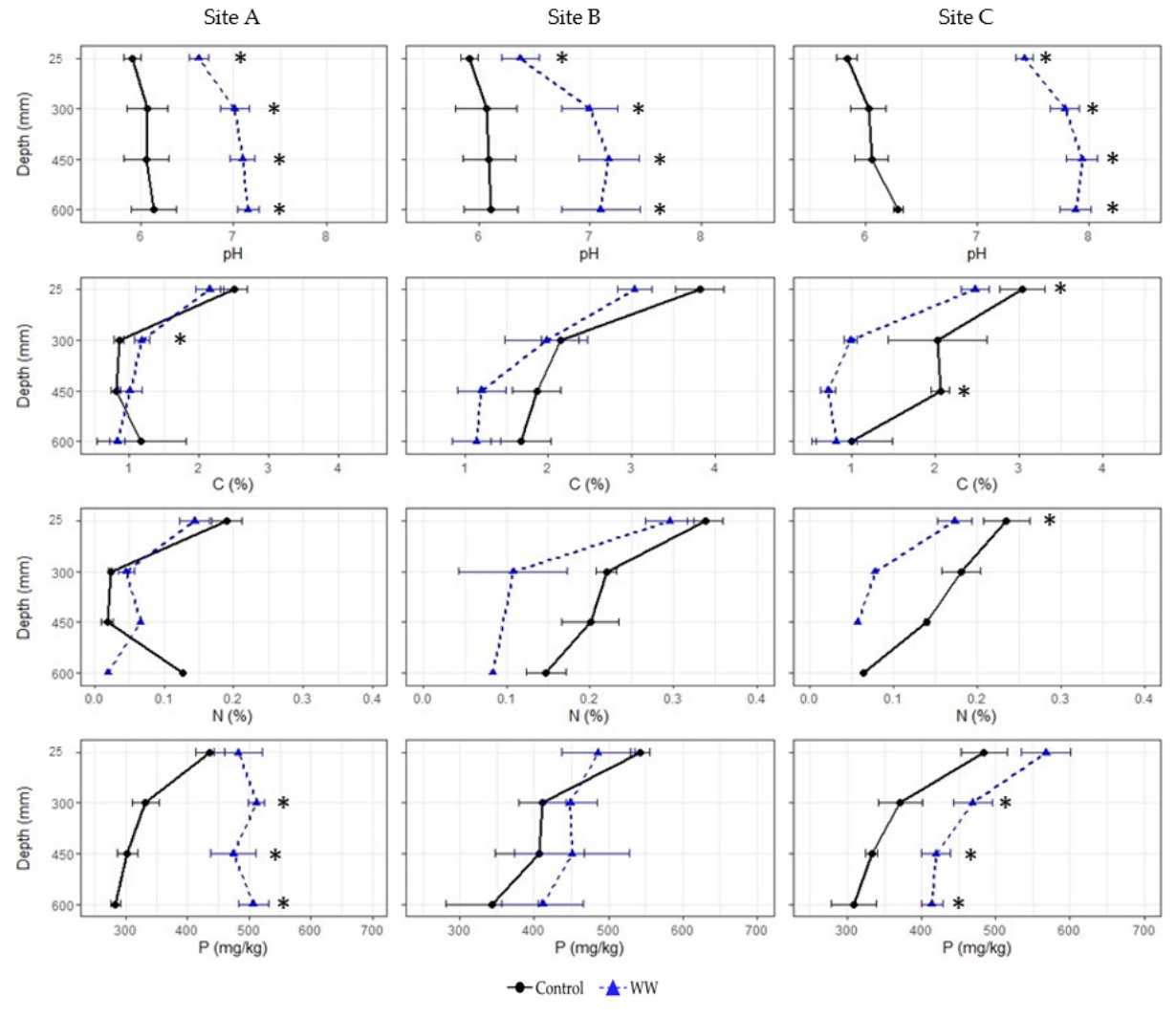
The irrigation of WW increased the pH across all sites and depths compared to values for the controls (Figure 2). The most marked increases were at Site C where all soils across all depths within the WW irrigated plot were alkaline (pH > 7). Total soil C and N concentrations within WW irrigated soils showed significant decreases at Site C compared to the controls, while a significant increase was recorded in soil C at Site A at the 300 mm depth. Soil N concentrations were below the laboratory detection limits for a number of the subsoil (300–600 mm) samples collected, hence, standard errors are not shown. Significant increases in total soil P concentrations were measured in subsoils (300–600 mm depth) at Sites A and C and this trend was observable but not significant at Site B where variances were high.
与对照相比,WW灌溉提高了所有样地和所有深度的pH(图2)。增幅最显著的是样地C,其WW灌溉地块内所有深度的土壤均呈碱性(pH > 7)。与对照相比,样地C的WW灌溉土壤中全C和全N浓度显著降低,而样地A在300 mm深度的土壤C显著增加。部分底土(300–600 mm)样品的土壤N浓度低于实验室检出限,因此未显示标准误。样地A和C的底土(300–600 mm深度)中全P浓度显著增加;样地B也可观察到这一趋势,但由于变异较大而未达显著水平。
Under WW irrigation, concentrations of Na were greater in soils at all depths compared with the non-irrigated plots at Sites A and C (Figure 3). Significant differences in Na concentration were measured between WW irrigated soils and controls at the surface (0–50 mm depth) for Site B, and this trend was observable but not significant in for the remaining depths where variances were high, similar to that for P concentrations. There were no significant increases in soil K at any site with the exception of Site C at 450 mm depth (Figure 3). Significant decreases in Ca concentrations were recorded at Sites B and C at 0–50 mm and 450 mm depths, respectively. Significant decreases in Mg concentrations were recorded at Sites A and B at 0–50 and 450 mm depths, respectively.
在WW灌溉下,样地A和C所有深度土壤中的Na浓度均高于非灌溉地块(图3)。样地B的WW灌溉土壤与对照在表层(0–50 mm深度)的Na浓度存在显著差异;其余深度也可观察到这一趋势,但与P浓度的情况类似,由于变异较大而未达显著水平。除样地C的450 mm深度外,各样地土壤K均未显著增加(图3)。样地B和C分别在0–50 mm和450 mm深度记录到Ca浓度的显著下降。样地A和B分别在0–50 mm和450 mm深度记录到Mg浓度的显著下降。
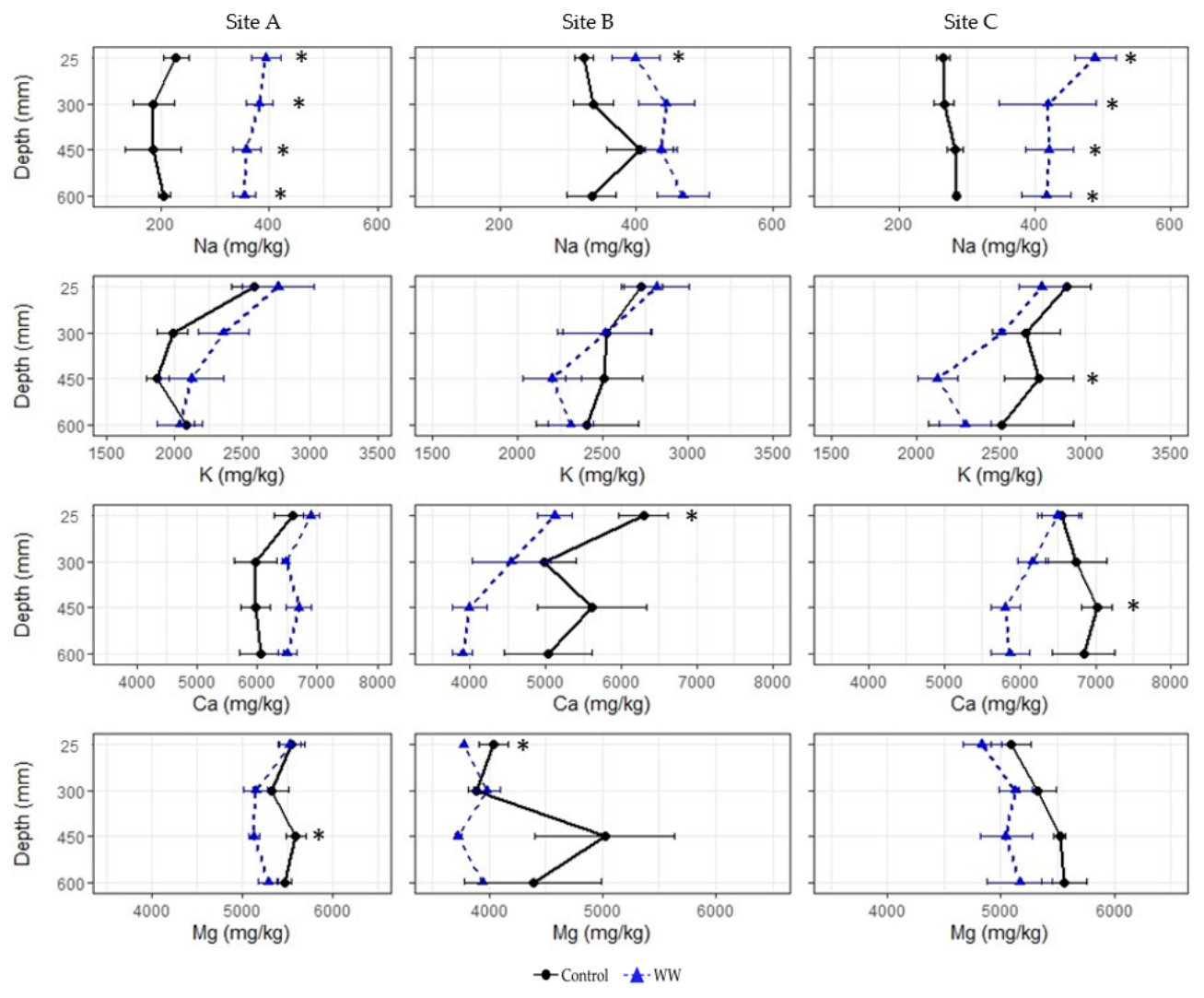
Depth had a significant effect (p > 0.05) on all measured soil parameters, with the exception of Na. Significant differences (p > 0.05) between sites were identified for all measured soil parameters with the exception of Mg. Significant differences between the interactions of site and treatment were also identified for total soil N, K, Na, Ca and soil pH. Irrigation with WW decreased (p < 0.05) soil C concentrations relative to the controls (mean concentrations of 1.7% and 2.3% for the WW irrigated and control soils, respectively). Significant decreases were also recorded in soil N concentration (mean 0.17% and 0.21% for WW irrigated soils and control soils, respectively), although the C/N stoichiometry was consistent between WW treated and control soils, indicating a tight coupling of soil C and N cycling. Significant increases were identified in pH (mean values 7.1 and 5.9 for the WW irrigated soils and control soils, respectively), and Na (mean values 449.3 mg/kg and 281 mg/kg for the WW treated and control soils, respectively). A significant increase in soil P was also identified (mean values 513 mg kg−1, and 418 mg kg−1 for the WW-treated and control soils, respectively). However, it is unclear how much of the increased P was available to plants. Significantly lower concentrations of soil Ca were measured in the WW-treated plots (5764 mg/kg) compared with concentrations in the control plots (6292 mg kg−1) with similar differences in soil Mg concentrations (5167 mg kg−1 and 6000 mg kg−1 for the treated and control soils, respectively). No significant differences were measured in soil K concentrations (2104 mg kg−1 and 2502 mg kg−1 for the treated and control soils, respectively).
除Na外,深度对所有测定的土壤参数均有显著影响(p > 0.05)。除Mg外,所有测定的土壤参数在样地间均存在显著差异(p > 0.05)。样地与处理的交互作用对土壤全N、K、Na、Ca和土壤pH也有显著影响。与对照相比,WW灌溉降低了土壤C浓度(p < 0.05)(WW灌溉土壤和对照土壤的平均浓度分别为1.7%和2.3%)。土壤N浓度也显著下降(WW灌溉土壤和对照土壤的平均值分别为0.17%和0.21%),但WW处理土壤与对照土壤的C/N化学计量比保持一致,表明土壤C和N循环紧密耦合。pH(WW灌溉土壤和对照土壤的平均值分别为7.1和5.9)和Na(WW处理土壤和对照土壤的平均值分别为449.3 mg/kg和281 mg/kg)显著增加。土壤P也显著增加(WW处理土壤和对照土壤的平均值分别为513 mg kg−1和418 mg kg−1)。然而,增加的P中有多少可被植物利用尚不清楚。WW处理地块的土壤Ca浓度(5764 mg/kg)显著低于对照地块(6292 mg kg−1),土壤Mg浓度也存在类似差异(处理土壤和对照土壤分别为5167 mg kg−1和6000 mg kg−1)。土壤K浓度无显著差异(处理土壤和对照土壤分别为2104 mg kg−1和2502 mg kg−1)。
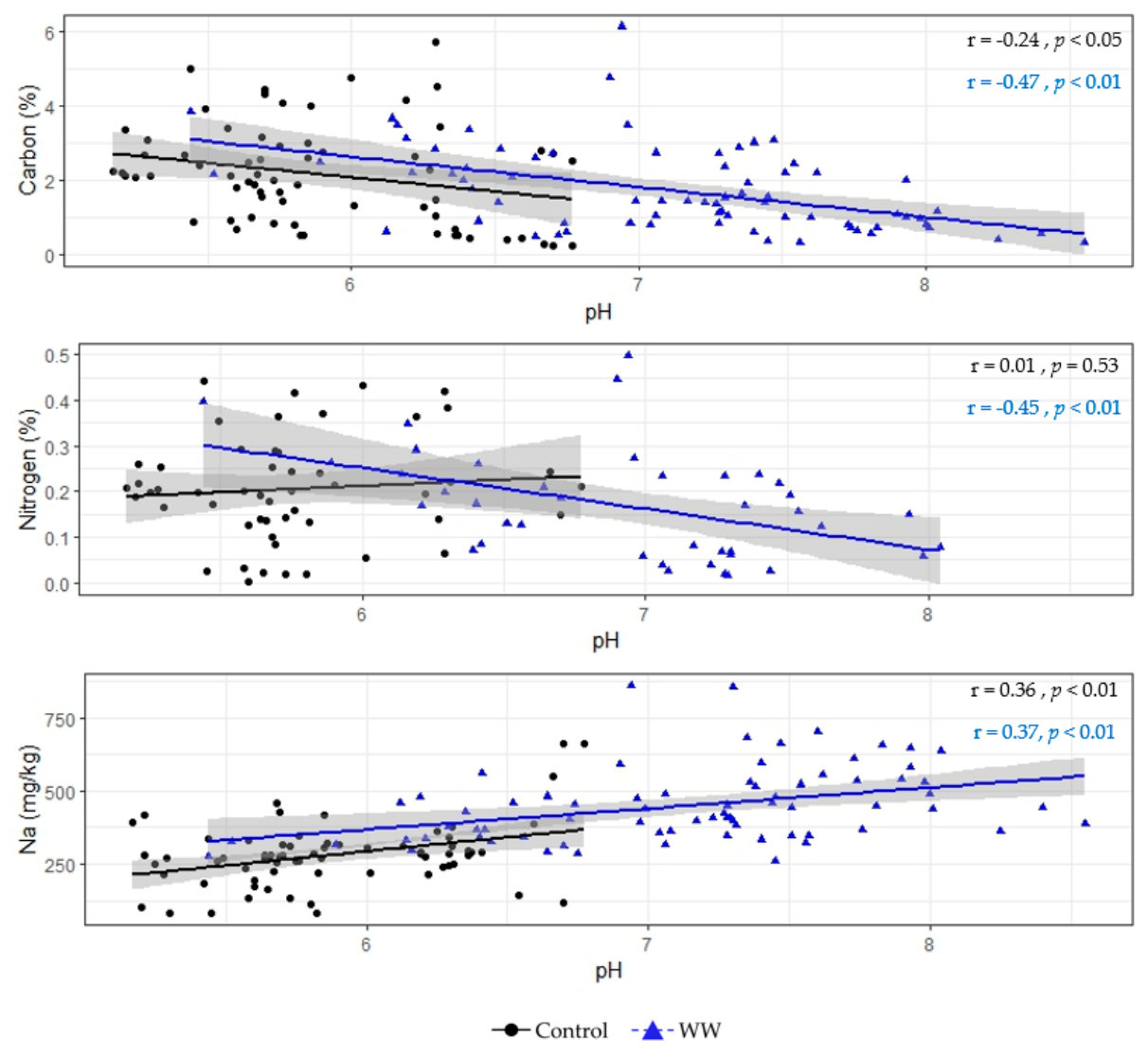
Significant linear relationships (p < 0.05) between soil pH and total soil C, N and Na concentrations were identified when all soil samples were combined (Figure 4). The relationship between soil pH and soil N concentration was significant for all soils however, the negative relationships were only significant (p > 0.05) for the WW-treated soils (Figure 4B).
将所有土壤样品合并分析时,土壤pH与土壤全C、N和Na浓度之间存在显著的线性关系(p < 0.05)(图4)。土壤pH与土壤N浓度之间的关系在所有土壤中均显著,但负相关关系仅在WW处理土壤中显著(p > 0.05)(图4B)。
4Discussion讨论
Due to the increases in soil pH and Na, the differences between WW-treated soil and control soil indicate the effects are likely attributable to mineral concentrations within WW as opposed to the increased water supply between treated soils and the non-irrigated control soils. However, the significant differences identified between sites, depth and interactions of site and treatment reflect the complexity of soil interactions and the subsequent accumulation of nutrients from WW. Plant–soil–microbe interactions are likely important factors in the rhizosphere [15,51] and physio-chemical differences such as soil texture [52] and mineralogy will alter accumulation rates between sites and with depth.
鉴于土壤pH和Na的增加,WW处理土壤与对照土壤之间的差异表明,这些效应很可能归因于WW中的矿质浓度,而非处理土壤与非灌溉对照土壤之间供水量的差异。然而,样地间、深度间以及样地与处理交互作用中存在的显著差异,反映了土壤相互作用以及WW养分随后累积过程的复杂性。植物–土壤–微生物相互作用很可能是根际中的重要因素[15,51],而土壤质地[52]和矿物组成等物理化学差异将改变不同样地间及不同深度的累积速率。
The elevated pH identified in WW-treated soils is likely due to the hydrolysis of sodium-based cleaning products [53], evidenced by the correlation identified between soil pH and Na. While the pH of the discharged WW is important, elevated Na concentrations from bicarbonate products have been shown to cause soil pH to increase, even in wastewaters with acidic to neutral pH [54]. The significant increases in soil Na are concurrent with the mean SAR values of 16.0 mmolc L−1 at the WW irrigated sites and the observed increases in soil Na concentrations could therefore have a large effect on the availability of plant nutrients and plant growth [20], regardless of the pH at the time of discharge [7,9,29]. Studies have shown that salt accumulation and modifications to soil structure can become evident when SAR and/or PAR values exceed approximately 6 and 10 mmolc L−1, respectively [55]. This is of note as the minimum SAR recorded from the spring sampling was >6 mmolc L−1, suggesting Na accumulation that could result in soil dispersion occurs in both spring and autumn.
WW处理土壤中pH升高可能是由钠基清洁产品的水解所致[53],土壤pH与Na之间的相关性证明了这一点。尽管所排放WW的pH很重要,但已有研究表明,即使在酸性至中性pH的废水中,碳酸氢盐类产品带来的高Na浓度也会导致土壤pH升高[54]。土壤Na的显著增加与WW灌溉样地16.0 mmolc L−1的平均SAR值相一致,因此,无论排放时pH如何[7,9,29],所观察到的土壤Na浓度增加都可能对植物养分有效性和植物生长产生较大影响[20]。研究表明,当SAR和/或PAR值分别超过约6和10 mmolc L−1时,盐分累积和土壤结构的改变便会显现[55]。值得注意的是,春季采样记录的最低SAR >6 mmolc L−1,表明可能导致土壤分散的Na累积在春季和秋季均有发生。
The soil K findings were consistent with the mean PAR values of 5.8 mmolc L−1, however, this does contrast with previous reports in Marlborough where exchangeable K (me/100 g) from four WW irrigated sites recorded average increases of 1.3 me/100 g between 1999 and 2011 when compared to control soils [7]. Observable accumulation of K may not be occurring due to competition with Na as shown by the elevated SAR values. These results provide strong recommendations for wineries to reduce their use of caustic cleaning products and to use alternative cleaning chemicals such as potassium hydroxide (KOH) in place of NaOH, resulting in minimising Na concentrations in the final WW effluent [9]. The practice is currently uncommon as the cost of potassium-based products is approximately five to ten times higher than that of Na products [26,56]. However, the findings from this study suggest the potential benefits may offset the cost by subsequently decreasing the soil pH and increasing soil quality by reducing the Na accumulation. The use of soil amendments such as gypsum [57] and polyacrylamide [58] to reduce soil Na is also feasible. However, the application of certain polyacrylamide products can sometimes only provide a short-term solution (1–2 weeks) and application rates often need to be high, particularly using gypsum (tons per hectare) [58].
土壤K的结果与5.8 mmolc L−1的平均PAR值相一致,但这与马尔堡以往的报道相反:该报道中4个WW灌溉样地的交换性K(me/100 g)在1999–2011年间与对照土壤相比平均增加了1.3 me/100 g[7]。如较高的SAR值所示,由于与Na的竞争,K可能未出现可观察到的累积。这些结果强烈建议酒厂减少碱性清洁产品的使用,并改用氢氧化钾(KOH)等替代清洁化学品取代NaOH,从而使最终WW出水中的Na浓度降至最低[9]。由于钾基产品的成本约为Na基产品的5~10倍,这一做法目前尚不普遍[26,56]。然而,本研究结果表明,通过降低土壤pH并减少Na累积以改善土壤质量,其潜在效益可能抵消成本。使用石膏[57]和聚丙烯酰胺[58]等土壤改良剂降低土壤Na也是可行的。然而,某些聚丙烯酰胺产品的施用有时只能提供短期解决方案(1–2周),且施用量往往需要很高,尤其是石膏(每公顷数吨)[58]。
The decrease in soil C concentrations relative to the controls (mean concentrations of 1.7% and 2.3% for the WW irrigated and control soils, respectively), requires further investigation as the findings contradict earlier studies that recorded significant increases in soil C concentration beneath vine rows [25] and pasture soils [15] under WW irrigation. Significant increases in total organic soil C concentrations were also found at long-term WW disposal sites in Australia [3,59]. However, the increases in one of the soil types may be attributable to the different land use between the soils receiving WW (tree-lot) and the control (permanent grassland). Further analysis using synthetic WW labelled with 14Clactic acid and glycerol [3,59], found that adsorption of 14C-compounds to soil particles resulted in the removal of 10 to 50% of the added 14C within the first hour after application, while microbial uptake and metabolism were responsible for the removal of less than 5% of 14C. Therefore, the fate of the organic C in WW also warrants further investigation considering the high mean TOC loading rates of 4000 kg ha−1 yr−1 at our sites (Table 1).
与对照相比土壤C浓度的下降(WW灌溉土壤和对照土壤的平均浓度分别为1.7%和2.3%)有待进一步研究,因为该结果与早期研究相矛盾:早期研究记录到WW灌溉下葡萄行下土壤[25]和牧场土壤[15]的C浓度显著增加。在澳大利亚的长期WW处置场地也发现土壤总有机C浓度显著增加[3,59]。然而,其中一种土壤类型中的增加可能归因于接受WW的土壤(林地)与对照(永久草地)之间土地利用方式的不同。使用14C标记乳酸和甘油的模拟WW开展的进一步分析[3,59]发现,14C化合物在土壤颗粒上的吸附使所添加14C的10%~50%在施用后第一小时内被去除,而微生物吸收和代谢去除的14C不足5%。因此,考虑到本研究样地TOC的平均负荷速率高达4000 kg ha−1 yr−1(表1),WW中有机C的归趋也值得进一步研究。
While the correlations identified between soil pH and concentrations of soil C, N and Na do not necessarily indicate that these were attributable directly to pH, the findings are helpful in identifying recommendations to wineries for practical changes that could be made during WW treatments to potentially improve the retention of key macronutrients. In the case of pH and soil C concentration, the dissolution of organic matter at high pH is common [53], and this is likely attributed to the significantly lower values of soil C. Conversely, soil acidification is considered to be an important contributor to soil C accumulation [60], so the negative relationship suggests that while WW irrigation resulted in significantly lower values of soil C concentration compared with the controls, the effect could be less pronounced or even reversed if soil pH were lowered (<7) within WW receiving soils. The direct adsorption of organic C to soil minerals has also been shown to result in a negative relationship with pH value [61], considering the previous research findings that 10 to 50% of added 14C in WW can be adsorbed to soil [3,59], this suggests that the losses in soil C may be partially attributable to decreases in the mineral bound organic carbon content. Further investigation is needed to determine the processes regulating the absorption of organic C onto soil minerals as this is an important mechanism for the long-term protection of soil C [62,63], while also filtering potentially harmful organic constituents such as fungicides [64] and phenolic compounds [65].
尽管土壤pH与土壤C、N和Na浓度之间的相关性并不一定表明这些变化直接由pH引起,但这些结果有助于为酒厂提出在WW处理过程中可采取的实际改进建议,以期提高关键大量养分的保留。就pH与土壤C浓度而言,有机质在高pH下溶解是常见现象[53],这很可能是土壤C值显著较低的原因。相反,土壤酸化被认为是土壤C累积的重要促进因素[60],因此这一负相关关系表明,尽管与对照相比WW灌溉导致土壤C浓度显著降低,但若降低WW受纳土壤的pH(<7),该效应可能会减弱甚至逆转。研究还表明,有机C在土壤矿物上的直接吸附与pH值呈负相关[61];考虑到以往研究发现WW中所添加14C的10%~50%可被土壤吸附[3,59],这表明土壤C的损失可能部分归因于矿物结合态有机碳含量的下降。有机C在土壤矿物上的吸附是长期保护土壤C的重要机制[62,63],同时还能过滤杀真菌剂[64]和酚类化合物[65]等潜在有害有机组分,因此需要进一步研究以确定调控这一吸附过程的机制。
The industry could also stand to benefit from further investigation to address how WW discharge to land accumulates available forms of nutrients P, Mg, K and Ca to potentially promote sustainable vegetation growth. A possible alternative approach for the disposal of WW is to irrigate tree species for woody biomass production that could provide cobenefits for increasing carbon stocks and offsetting agricultural greenhouse gas emissions and potentially generate financial incentives for vineyard owners through participation in New Zealand’s emissions trading scheme (ETS). Mean annual rates of carbon sequestration are up to 30 t C ha−1 yr−1 for native shrub planting within the first 20 years [66]. The effects of irrigating soils with WW may not affect the growth rates of New Zealand native plants as many are adapted to low fertility environments [67]. For example, while the presence of organic compounds and salts in WW could be expected to reduce plant growth [15,68], the salt content and organic loading may not be too dissimilar to the brackish conditions where many New Zealand native species such as Phormium tenax, Coprosma propinqua and Cordyline australis thrive [69]. The effect of WW irrigation on New Zealand native plants is currently unknown, however, as certain native plants have been shown to increase biodiversity, suppress weeds and increase microbial activity in New Zealand vineyards [70], further investigation is warranted.
葡萄酒产业还可通过进一步研究WW排放至土地后如何累积P、Mg、K和Ca等养分的有效形态而受益,以期促进植被的可持续生长。WW处置的一种可能替代方案是用其灌溉树种以生产木质生物量,这可带来增加碳储量和抵消农业温室气体排放的协同效益,并有可能通过参与新西兰排放交易体系(ETS)为葡萄园主带来经济激励。本土灌木种植在最初20年内的年均碳固存速率可达30 t C ha−1 yr−1[66]。由于许多新西兰本土植物适应低肥力环境,WW灌溉土壤可能不会影响其生长速率[67]。例如,尽管WW中的有机化合物和盐分可能会抑制植物生长[15,68],但其盐分含量和有机负荷可能与许多新西兰本土物种(如Phormium tenax、Coprosma propinqua和Cordyline australis)茂盛生长的微咸环境相差不大[69]。WW灌溉对新西兰本土植物的影响目前尚不清楚;然而,鉴于某些本土植物已被证明可在新西兰葡萄园中提高生物多样性、抑制杂草并增强微生物活性[70],有必要开展进一步研究。
5Conclusions结论
Improvements to the discharge of WW to land through the effective assimilation of nutrients using well-managed irrigation systems may lead to additional benefits to New Zealand’s wine industry. Our findings clearly recommend the use of potassium-based caustic chemicals over sodium-based chemicals by wineries to reduce environmental impacts. Additionally, the mean decreases in soil C concentration between WW treated and control soils (approximately 1.5%), is equivalent to the loss of carbon stock of approximately 100 tC ha−1, assuming the change in bulk density is consistent with 600 mm depth in the soil profile. There is a further addition of 4 t C ha−1 yr−1 in the WW. By focusing on the retention of C and promoting sustainable growth of vegetation, biomass and soil carbon stocks could be increased in an effort to offset agricultural greenhouse gas emissions. By incorporating native vegetation growth within WW irrigation plots, multi-purpose restoration could be encouraged with increases in biodiversity and enhancing cultural significance.
借助管理良好的灌溉系统有效同化养分,从而改进WW的土地排放,可为新西兰葡萄酒产业带来额外效益。我们的研究结果明确建议酒厂使用钾基而非钠基碱性化学品,以减轻环境影响。此外,WW处理土壤与对照土壤之间土壤C浓度的平均降幅(约1.5%),在假设600 mm土壤剖面深度内容重变化一致的情况下,相当于约100 tC ha−1的碳储量损失。WW每年还额外输入4 t C ha−1 yr−1。通过着力保留C并促进植被的可持续生长,可增加生物量和土壤碳储量,以抵消农业温室气体排放。通过在WW灌溉地块内种植本土植被,可推动多用途生态修复,提高生物多样性并增强文化意义。
Author Contributions: Conceptualisation, B.R., D.W. and M.N.-M.; methodology, B.R. and M.N.- M.; formal analysis, B.R. and M.N.-M.; investigation, B.R. and M.N.-M.; writing—original draft preparation, M.N.-M.; writing—review and editing, B.R., D.W., B.M. and T.C.; supervision, B.R., D.W., B.M., and T.C.; project administration, B.R. and M.N.-M. All authors have read and agreed to the published version of the manuscript.
作者贡献:构思,B.R.、D.W.和M.N.-M.;方法,B.R.和M.N.- M.;形式分析,B.R.和M.N.-M.;调查研究,B.R.和M.N.-M.;撰写—初稿,M.N.-M.;撰写—审阅与编辑,B.R.、D.W.、B.M.和T.C.;指导,B.R.、D.W.、B.M.和T.C.;项目管理,B.R.和M.N.-M.。所有作者均已阅读并同意手稿的出版版本。
Funding: This research was undertaken as part of the Food Transition 2050 partnership (https://www. foodtransitions2050.ac.nz/) initiative where M.N.-M. is pursuing a Doctoral Scholarship from the University of Canterbury.
资助:本研究是Food Transition 2050合作计划(https://www. foodtransitions2050.ac.nz/)的一部分,M.N.-M.在该计划下获得坎特伯雷大学博士奖学金攻读博士学位。
Data Availability Statement: The data presented in this study are available on request from the corresponding author.
数据可用性声明:本研究所呈现的数据可向通讯作者索取。
Conflicts of Interest: The authors declare no conflicts of interest.
利益冲突:作者声明无利益冲突。
References参考文献
1. WWAP. The United Nations World Water Development Report 2017. Wastewater: The Untapped Resource; UNESCO: Paris, France, 2017. 2. Arvanitoyannis, I.S.; Ladas, D.; Mavromatis, A. Potential uses and applications of treated wine waste: A review. Int. J. Food Sci. Technol. 2006, 41, 475–487. [CrossRef]
3. Chapman, J.A.; Correll, R.L.; Ladd, J.N. Removal of soluble organic carbon from winery and distillery wastewaters by application to soil. Aust. J. Grape Wine Res. 1995, 1, 39–47. [CrossRef]
4. Duarte, E.; Oliveira, M. Guidelines for the Management of Winery Wastewaters; Winetech: Auckland, New Zealand, 2010.
5. Welz, P.J.; Holtman, G.; Haldenwang, R.; le Roes-Hill, M. Characterisation of winery wastewater from continuous flow settling basins and waste stabilisation ponds over the course of 1 year: Implications for biological wastewater treatment and land application. Water Sci. Technol. 2016, 74, 2036–2050. [CrossRef] [PubMed]
6. Gabzdylova, B.; Raffensperger, J.F.; Castka, P. Sustainability in the New Zealand wine industry: Drivers, stakeholders and practices. J. Clean. Prod. 2009, 17, 992–998. [CrossRef]
7. Gray, C. Survey of Soil Properties at Some Sites Receiving Winery Wastewater in Marlborough; Marlborough District Council: Blenheim, New Zealand, 2012.
8. Laurenson, S.; Houlbrooke, D. Review of Guidelines for the Management of Winery Wastewater and Grape Marc; AgResearch: Hamilton, New Zealand, 2012.
9. Laurenson, S.; Houlbrooke, D. Winery Wastewater Irrigation—The Effect of Sodium and Potassium on Soil Structure; AgResearch: Hamilton, New Zealand, 2011.
10. New Zealand Winegrowers. New Zealand Winegrowers Statistics Annual 2020; New Zealand Winegrowers Inc.: Auckland, New Zealand, 2020; p. 46.
11. Jones, J.; McLaren, S.; Chen, Q.; Seraj, M. Repurposing Grape Marc; Massey University: Palmerston North, New Zealand, 2020. 12. Howell, C.L.; Myburgh, P.A.; Lategan, E.L.; Hoffman, J.E. Effect of Irrigation Using Diluted Winery Wastewater on the Chemical Status of a Sandy Alluvial Soil, With Particular Reference to Potassium and Sodium. S. Afr. J. Enol. Vitic. 2018, 39, 1–13. [CrossRef] 13. Howell, C.L.; Myburgh, P.A. Management of winery wastewater by re-using it for crop irrigation—A review. S. Afr. J. Enol. Vitic. 2018, 39, 116–131. [CrossRef]
14. Mosse, K.P.M.; Patti, A.F.; Christen, E.W.; Cavagnaro, T.R. Review: Winery wastewater quality and treatment options in Australia. Aust. J. Grape Wine Res. 2011, 17, 111–122. [CrossRef]
15. Kumar, A.; Kookana, R. Impact of Winery Wastewater on Ecosystem Health—An Introductory Assessment; CSIRO: Canberra, Australia, 2006. 16. Kumar, V.; Wati, L.; FitzGibbon, F.; Nigam, P.; Banat, I.M.; Singh, D.; Marchant, R. Bioremediation and decolorization of anaerobically digested distillery spent wash. Biotechnol. Lett. 1997, 19, 311–314. [CrossRef]
17. Jackson, R.B.; Carpenter, S.R.; Dahm, C.N.; McKnight, D.M.; Naiman, R.J.; Postel, S.L.; Running, S.W. Water in a Changing World. Ecol. Appl. 2001, 11, 1027–1045. [CrossRef]
18. McDonough, L.K.; Santos, I.R.; Andersen, M.S.; O’Carroll, D.M.; Rutlidge, H.; Meredith, K.; Oudone, P.; Bridgeman, J.; Gooddy, D.C.; Sorensen, J.P.R.; et al. Changes in global groundwater organic carbon driven by climate change and urbanization. Nat. Commun. 2020, 11, 1279. [CrossRef]
19. Carey, R.O.; Migliaccio, K.W. Contribution of Wastewater Treatment Plant Effluents to Nutrient Dynamics in Aquatic Systems: A Review. Environ. Manag. 2009, 44, 205–217. [CrossRef] [PubMed]
20. Laurenson, S.; Bolan, N.S.; Smith, E.; McCarthy, M. Review: Use of recycled wastewater for irrigating grapevines. Aust. J. Grape Wine Res. 2012, 18, 1–10. [CrossRef]
21. Howell, C.L.; Myburgh, P.A.; Lategan, E.L.; Hoffman, J.E. Seasonal variation in composition of winery wastewater in the breede River Valley with respect to classical water quality parameters. S. Afr. J. Enol. Vitic. 2016, 37, 31–38. [CrossRef]
22. Marlborough District Council. Rural Winery Wastewater and Grape Marc Monitoring—Compliance Snapshot; Marlborough District Council: Blenheim, New Zealand, 2020.
23. Marlborough District Council. Rural Winery Wastewater and Grape Marc Monitoring—Compliance Snapshot; Marlborough District Council: Blenheim, New Zealand, 2022.
24. Sheridan, C.M.; Bauer, F.F.; Burton, S.; Lorenzen, L. A critical process analysis of wine production to improve cost, quality and environmental performance. Water Sci. Technol. 2005, 51, 39–46. [CrossRef] [PubMed]
25. Hirzel, D.R.; Steenwerth, K.; Parikh, S.J.; Oberholster, A. Impact of winery wastewater irrigation on soil, grape and wine composition. Agric. Water Manag. 2017, 180, 178–189. [CrossRef]
26. Arienzo, M.; Christen, E.W.; Quayle, W.; Kumar, A. A review of the fate of potassium in the soil–plant system after land application of wastewaters. J. Hazard. Mater. 2009, 164, 415–422. [CrossRef] [PubMed]
27. Boulton, R. The General Relationship Between Potassium, Sodium and pH in Grape Juice and Wine. Am. J. Enol. Vitic. 1980, 31, 182–186. [CrossRef]
28. Buelow, M.C.; Steenwerth, K.; Silva, L.C.R.; Parikh, S.J. Characterization of Winery Wastewater for Reuse in California. Am. J. Enol. Vitic. 2015, 66, 302. [CrossRef]
29. Laurenson, S.; Houlbrooke, D.; Styles, T. Determination of Soil Dispersion in Response to Changes in Soil Salinity under Winery Wastewater Irrigation; AgResearch: Hamilton, New Zealand, 2012.
30. Bond, W.J. Effluent irrigation—An environmental challenge for soil science. Soil Res. 1998, 36, 543–556. [CrossRef]
31. ANZECC. Australia and New Zealand Guidelines for Fresh and Marine water Quality; Environment Australia: Canberra, Australia, 2000. 32. Quirk, J. The significant of the threshold and turbidity concentrations in relation to sodicity and microstructure. Soil Res. 2001, 39, 1185–1217. [CrossRef]
33. Essington, M.E. Soil and Water Chemistry: An Integrative Approach; CRC Press: Boca Raton, FL, USA, 2015.
34. Hillel, D. 15–Surface Runoff and Water Erosion. In Introduction to Environmental Soil Physics; Hillel, D., Ed.; Academic Press: Burlington, MA, USA, 2003; pp. 283–295. [CrossRef]
35. Dehotin, J.; Breil, P.; Braud, I.; de Lavenne, A.; Lagouy, M.; Sarrazin, B. Detecting surface runoff location in a small catchment using distributed and simple observation method. J. Hydrol. 2015, 525, 113–129. [CrossRef]
36. Malandra, L.; Wolfaardt, G.; Zietsman, A.; Viljoen-Bloom, M. Microbiology of a biological contactor for winery wastewater treatment. Water Res. 2003, 37, 4125–4134. [CrossRef] [PubMed]
37. Ganesh, R.; Rajinikanth, R.; Thanikal, J.V.; Ramanujam, R.A.; Torrijos, M. Anaerobic treatment of winery wastewater in fixed bed reactors. Bioprocess. Biosyst. Eng. 2010, 33, 619–628. [CrossRef] [PubMed]
38. Mulidzi, A.; Clarke, C.; Myburgh, P. Effect of Irrigation with Diluted Winery Wastewater on Phosphorus in Four Differently Textured Soils. S. Afr. J. Enol. Vitic. 2016, 37, 79–84. [CrossRef]
39. Christen, E.W.; Quayle, W.C.; Marcoux, M.A.; Arienzo, M.; Jayawardane, N.S. Winery wastewater treatment using the land filter technique. J. Environ. Manag. 2010, 91, 1665–1673. [CrossRef] [PubMed]
40. Chappell, P.R. The Climate and Weather of Marlborough; NIWA Science and Technology: Auckland, New Zealand, 2016; p. 40.
41. Whenua, M. S-Map Online—The Digital Soil Map for New Zealand; Manaaki Whenua Landcare Research: Lincoln, New Zealand, 2019.
42. Soils, N. Soils of NZ: By USDA Classification. 2011. Available online: http://www.nzsoils.org.nz/PageFiles/233/SoilsOfNZ%20 By%20USDA%20Classification.pdf (accessed on 21 May 2024).
43. USDA [United States Department of Agriculture], Soil Taxonomy: A Basic System of Soil Classification for Making and Interpreting Soil Surveys, 2nd ed.; USDA: Washington, DC, USA, 1999.
44. Hewitt, A.; Balks, M.; Lowe, D. The Soils of Aotearoa New Zealand; Springer: Berlin/Heidelberg, Germany, 2021. [CrossRef]
45. McNeill, S.J.; Lilburne, L.R.; Carrick, S.; Webb, T.H.; Cuthill, T. Pedotransfer functions for the soil water characteristics of New Zealand soils using S-map information. Geoderma 2018, 326, 96–110. [CrossRef]
46. Marlborough District Council. Marlborough District Council, Online GIS; Marlborough District Council: Blenheim, New Zealand, 2023. 47. Blakemore, L.C.; Searle, P.L.; Daly, B.K. Method for chemical analysis of soils. N. Z. Soil Bur. Sci. Rep. 1987, 80, 71–76.
48. R Core Team. R: A Language and Environment for Statistical Computing; R Foundation for Statistical Computing: Vienna, Austria, 2023. 49. Hothorn, T.; Bretz, F.; Westfall, P. Simultaneous inference in general parametric models. Biom. J. 2008, 50, 346–363. [CrossRef] [PubMed]
50. Wickham, H. ggplot2: Elegant Graphics for Data Analysis; Springer: New York, NY, USA, 2016.
51. Chamkhi, I.; El Omari, N.; Balahbib, A.; El Menyiy, N.; Benali, T.; Ghoulam, C. Is the rhizosphere a source of applicable multi-beneficial microorganisms for plant enhancement? Saudi J. Biol. Sci. 2022, 29, 1246–1259. [CrossRef]
52. Bueno, P.C.; Martín Rubí, J.A.; García Giménez, R.; Jiménez Ballesta, R. Impacts caused by the addition of wine vinasse on some chemical and mineralogical properties of a Luvisol and a Vertisol in La Mancha (Central Spain). J. Soils Sediments 2009, 9, 121–128. [CrossRef]
53. McLaren, R.G.; Cameron, K.C. Soil Science: Sustainable Production and Environmental Protection, 2nd ed.; Oxford University Press: Auckland, New Zealand, 1996.
54. Sparling, G.P.; Schipper, L.A.; Russell, J.M. Changes in soil properties after application of dairy factory effluent to New Zealand volcanic ash and pumice soils. Soil Res. 2001, 39, 505–518. [CrossRef]
55. Laurenson, S. The Influence of Recycled Water Irrigation on Cation Dynamics in Relation to the Structural Stability of Vineyard Soils/Seth Laurenson. Ph.D. Thesis, University of South Australia, Adelaide, Australia, 2010.
56. Mosse, K.P.M.; Patti, A.F.; Christen, E.W.; Cavagnaro, T.R. Winery wastewater inhibits seed germination and vegetative growth of common crop species. J. Hazard. Mater. 2010, 180, 63–70. [CrossRef] [PubMed]
57. Warrington, D.; Shainberg, I.; Agassi, M.; Morin, J. Slope and Phosphogypsum’s Effects on Runoff and Erosion. Soil Sci. Soc. Am. J. 1989, 53, 1201–1205. [CrossRef]
58. Gardiner, D.T.; Sun, Q. Infiltration of wastewater and simulated rainwater as affect by polyacrylamide. JAWRA J. Am. Water Resour. Assoc. 2002, 38, 1061–1067. [CrossRef]
59. Chapman, J.A.; Correll, R.L.; Ladd, J.N. The removal of soluble organic carbon from synthetic winery wastewater by repeated application to soil. Aust. J. Grape Wine Res. 1995, 1, 76–85. [CrossRef]
60. Lu, X.; Vitousek, P.M.; Mao, Q.; Gilliam, F.S.; Luo, Y.; Turner, B.L.; Zhou, G.; Mo, J. Nitrogen deposition accelerates soil carbon sequestration in tropical forests. Proc. Natl. Acad. Sci. USA 2021, 118, e2020790118. [CrossRef]
61. Shaker, A.M.; Komy, Z.R.; Heggy, S.E.; El-Sayed, M.E. Kinetic study for adsorption humic acid on soil minerals. J. Phys. Chem. A 2012, 116, 10889–10896. [CrossRef] [PubMed]
62. Dungait, J.A.; Hopkins, D.W.; Gregory, A.S.; Whitmore, A.P. Soil organic matter turnover is governed by accessibility not recalcitrance. Glob. Chang. Biol. 2012, 18, 1781–1796. [CrossRef]
63. Kögel-Knabner, I.; Guggenberger, G.; Kleber, M.; Kandeler, E.; Kalbitz, K.; Scheu, S.; Eusterhues, K.; Leinweber, P. Organo-mineral associations in temperate soils: Integrating biology, mineralogy, and organic matter chemistry. J. Plant Nutr. Soil Sci. 2008, 171, 61–82. [CrossRef]
64. Andrades, M.S.; Rodriguez-Cruz, M.S.; Sanchez-Martin, M.J.; Sanchez-Camazano, M. Effect of the Addition of Wine Distillery Wastes to Vineyard Soils on the Adsorption and Mobility of Fungicides. J. Agric. Food Chem. 2004, 52, 3022–3029. [CrossRef]
65. Strong, P.J.; Burgess, J.E. Treatment Methods for Wine-Related and Distillery Wastewaters: A Review. Bioremediat. J. 2008, 12, 70–87. [CrossRef]
66. Bergin, D.O. Planting and Managing Native Trees: Technical Handbook; Tãne’s Tree Trust: Hamilton, New Zealand, 2011. 67. Wardle, P. Environmental influences on the vegetation of New Zealand. N. Z. J. Bot. 1985, 23, 773–788. [CrossRef] 68. Melamane, X.; Tandlich, R.; Burgess, J. Anaerobic digestion of fungally pre-treated wine distillery wastewater. Afr. J. Biotechnol. 2007, 6, 17. [CrossRef] 69. Thannheiser, D.; Holland, P. The Plant Communities of New Zealand Salt Meadows. Glob. Ecol. Biogeogr. Lett. 1994, 4, 107–115. [CrossRef]
70. Shields, M.W.; Tompkins, J.M.; Saville, D.J.; Meurk, C.D.; Wratten, S. Potential ecosystem service delivery by endemic plants in New Zealand vineyards: Successes and prospects. PeerJ 2016, 4, e2042. [CrossRef]
Disclaimer/Publisher’s Note: The statements, opinions and data contained in all publications are solely those of the individual author(s) and contributor(s) and not of MDPI and/or the editor(s). MDPI and/or the editor(s) disclaim responsibility for any injury to people or property resulting from any ideas, methods, instructions or products referred to in the content.