Article
Yu Qiu 1, Shuhe Wei 2,* , Jie Zhan 3, Brett H. Robinson 4 , Lidia Skuza 5 , Jianming Xue 6 , Huiping Dai 1,*, Li Zhan 1 and Ziyang Tang 1
1 College of Biological Science & Engineering, Shaanxi Province Key Laboratory of Bio-Resources, Qinling-Bashan Mountains Bioresources Comprehensive Development C.I.C., State Key Laboratory of Biological Resources and Ecological Environment Jointly Built by Qinba Province and Ministry, Shaanxi University of Technology, Hanzhong 723001, China
1 陕西理工大学生物科学与工程学院,陕西省资源生物重点实验室,秦巴生物资源综合开发协同创新中心,省部共建秦巴生物资源与生态环境国家重点实验室,汉中 723001,中国
2 Key Laboratory of Pollution Ecology and Environment Engineering, Institute of Applied Ecology, Chinese Academy of Sciences, Shenyang 110016, China
2 中国科学院沈阳应用生态研究所,污染生态与环境工程重点实验室,沈阳 110016,中国
3 Health Management Department, Liaoning Vocational College of Medicine, Shenyang 110101, China
3 辽宁医药职业学院健康管理系,沈阳 110101,中国
4 School of Physical and Chemical Sciences, University of Canterbury, Christchurch 8041, New Zealand
4 坎特伯雷大学物理与化学科学学院,基督城 8041,新西兰
5 Institute of Biology, Centre for Molecular Biology and Biotechnology, University of Szczecin,
5 什切青大学生物研究所,分子生物学与生物技术中心,
71-415 Szczecin, Poland
6 New Zealand Forest Research Institute (Scion), P.O. Box 29237, Christchurch 8440, New Zealand * Correspondence: shuhewei@iae.ac.cn (S.W.); daihp72@snut.edu.cn (H.D.)
Academic Editor: Mercè Llugany
Received: 9 December 2024 Revised: 5 January 2025 Accepted: 6 January 2025 Published: 9 January 2025
Citation: Qiu, Y.; Wei, S.; Zhan, J.; Robinson, B.H.; Skuza, L.; Xue, J.; Dai, H.; Zhan, L.; Tang, Z. Physio- Biochemical Indexes as Indicators of Cadmium Tolerance in Brassica napus
L. Cultivars. Agriculture 2025, 15, 132. https://doi.org/10.3390/ agriculture15020132
Copyright: © 2025 by the authors. Licensee MDPI, Basel, Switzerland. This article is an open access article distributed under the terms and conditions of the Creative Commons Attribution (CC BY) license (https://creativecommons.org/ licenses/by/4.0/).
版权:© 2025 作者所有。许可方 MDPI,瑞士巴塞尔。本文为开放获取文章,依据知识共享署名(CC BY)许可协议(https://creativecommons.org/ licenses/by/4.0/)的条款和条件发布。
Abstract: Cadmium (Cd) is a non-essential heavy metal and a pervasive pollutant in agricultural soils. Despite numerous studies investigating Cd accumulation and tolerance in plants, there is a lack of systematic analysis of how various physio-biochemical indexes respond to Cd toxicity, particularly their indicative role in plant tolerance mechanisms. A pot experiment was conducted in greenhouse to assess the differences in Cd accumulation and tolerance among three Brassica napus L. cultivars (‘Hanyou 2’, ‘Hanyou 3’, and ‘Hanyou 16’) under the treatments of CK (0.18 mg kg−1 in soil), T1 (2.18 mg kg−1 in soil), T2 (4.18 mg kg−1 in soil), and T3 (8.18 mg kg−1 in soil). All three cultivars exhibited high tolerance indexes (TIs) and strong Cd tolerance when exposed to a Cd concentration of 2.18 mg kg−1 in soil (T1). There were significant positive correlations between TI and chlorophyll a (Chla), chlorophyll b (Chlb), carotenoids (Car), net photosynthetic rate (Pn), transpiration rate (Tr), and activities of antioxidant enzymes and non-enzymatic antioxidants such as superoxide dismutase (SOD), ascorbate peroxidase (APX), glutathione (GSH), and ascorbic acid (ASA), while negatively correlating with intercellular CO2 concentration (Ci) and malondialdehyde (MDA) content. These findings underscore the significant indicative role of these physio-biochemical indexes in elucidating Cd tolerance mechanisms in B. napus and may be used in breeding programs to develop cultivars with a high Cd-tolerance but low Cd uptake profile. However, this was a pot experiment only. Field experiments might be more useful in the future.
摘要:镉(Cd)是一种非必需重金属,也是农业土壤中普遍存在的污染物。尽管已有大量研究探讨了植物对Cd的积累与耐受,但对于各类生理生化指标如何响应Cd毒害,尤其是这些指标在植物耐受机制中的指示作用,仍缺乏系统分析。本研究在温室中开展盆栽试验,评估了三个Brassica napus L.(甘蓝型油菜)品种(‘Hanyou 2’、‘Hanyou 3’和‘Hanyou 16’)在CK(土壤Cd 0.18 mg kg−1)、T1(土壤Cd 2.18 mg kg−1)、T2(土壤Cd 4.18 mg kg−1)和T3(土壤Cd 8.18 mg kg−1)处理下Cd积累与耐受性的差异。当土壤Cd浓度为2.18 mg kg−1(T1)时,三个品种均表现出较高的耐性指数(TI)和较强的Cd耐受性。TI与叶绿素a(Chla)、叶绿素b(Chlb)、类胡萝卜素(Car)、净光合速率(Pn)、蒸腾速率(Tr)以及超氧化物歧化酶(SOD)、抗坏血酸过氧化物酶(APX)等抗氧化酶活性和谷胱甘肽(GSH)、抗坏血酸(ASA)等非酶抗氧化物质含量呈显著正相关,而与胞间CO2浓度(Ci)和丙二醛(MDA)含量呈负相关。上述结果表明,这些生理生化指标在阐明B. napus耐Cd机制方面具有重要的指示作用,可用于育种计划,以培育高耐Cd、低Cd吸收的品种。然而,本研究仅为盆栽试验,今后开展田间试验可能更具价值。
Keywords: Brassica napus L.; cadmium tolerance; physiological indexes; indicative role
关键词:Brassica napus L.;镉耐受性;生理指标;指示作用
1Introduction引言
Cadmium (Cd) is a heavy metal showing high bio-toxicity, and even at low concentrations, exogenous Cd deposited in soil is readily absorbed by plants [1]. Currently, there are varying degrees of heavy metal pollution across different regions in China. Among these, soil Cd pollution is the most severe. Cd is one of the primary heavy metal pollutants [2]. Human activities are a significant source of Cd pollution, with areas such as metal mining regions and industrial zones being particularly concentrated in cadmium pollution [3]. In these regions, Cd can enter agricultural soils through atmospheric deposition, rivers, groundwater, and other pathways [4], and is transmitted to humans through the food chain, leading to a range of related diseases. This poses a severe threat to both the ecosystem and public health [5]. Plants growing in Cd-polluted soils may also experience growth and development damage, which impacts their yield [6,7].
镉(Cd)是一种具有高生物毒性的重金属,即使在低浓度下,沉积于土壤中的外源Cd也易被植物吸收[1]。目前,中国不同地区均存在不同程度的重金属污染,其中以土壤Cd污染最为严重,Cd是主要的重金属污染物之一[2]。人类活动是Cd污染的重要来源,金属矿区和工业区等区域的镉污染尤为集中[3]。在这些区域,Cd可通过大气沉降、河流、地下水等途径进入农业土壤[4],并经食物链传递给人类,引发一系列相关疾病,对生态系统和公众健康构成严重威胁[5]。生长在Cd污染土壤中的植物也可能遭受生长发育损害,进而影响其产量[6,7]。
During the plant growth cycle, Cd stress can negatively affect various fundamental functions of plants at the physiological and biochemical levels [8]. On the one hand, Cd stress can reduce plant photosynthesis by inhibiting chlorophyll synthesis, damaging photosynthetic organs, and inducing the production of photo-inhibition pigments. On the other hand, Cd stress can lead to an imbalance in reactive oxygen species (ROS), which can directly or indirectly cause damage to the plant, promote lipid peroxidation, damage cell membranes, and affect various metabolic activities in the plant [9,10]. To protect themselves from ROS, plants employ an antioxidant system to combat oxidative stress induced by Cd. The antioxidant system includes enzymes such as superoxide dismutase (SOD), catalase (CAT), and ascorbate peroxidase (APX), as well as non-enzyme antioxidants like glutathione (GSH) and ascorbic acid (ASA) [11]. These components work together to reduce excess ROS within the plant, thereby minimizing oxidative damage. Ci et al. [12] reported that tolerant wheat cultivars accumulated less Cd, and both SOD and CAT activities were higher in Cd-tolerant wheat compared to Cd-sensitive wheat. This indicates the importance of these enzymes for Cd tolerance [13]. To safely utilize Cd-contaminated soils, using Cd hyperaccumulator plants for soil remediation and planting Cd-safe crops in Cd-polluted soils are two environmentally friendly methods with good economic potential [14]. Therefore, plants used in Cd-contaminated soils need to have strong Cd tolerance [15,16]. Studies have found that rapeseed has a relatively strong tolerance to cadmium, and its cadmium accumulation is higher than that of other species, making it an ideal plant for the remediation of Cd-contaminated soils [17].
在植物生长周期中,Cd胁迫可在生理和生化水平上对植物的多种基本功能产生负面影响[8]。一方面,Cd胁迫可通过抑制叶绿素合成、损伤光合器官以及诱导光抑制色素的产生而降低植物光合作用;另一方面,Cd胁迫可导致活性氧(ROS)失衡,进而直接或间接地对植物造成损伤,促进脂质过氧化,破坏细胞膜,并影响植物体内的多种代谢活动[9,10]。为保护自身免受ROS伤害,植物利用抗氧化系统应对Cd诱导的氧化胁迫。抗氧化系统包括超氧化物歧化酶(SOD)、过氧化氢酶(CAT)和抗坏血酸过氧化物酶(APX)等酶类,以及谷胱甘肽(GSH)和抗坏血酸(ASA)等非酶抗氧化物质[11]。这些组分协同作用,清除植物体内过量的ROS,从而将氧化损伤降至最低。Ci等[12]报道,耐性小麦品种积累的Cd较少,且耐Cd小麦的SOD和CAT活性均高于Cd敏感小麦,表明这些酶对Cd耐受性具有重要作用[13]。为安全利用Cd污染土壤,利用Cd超富集植物进行土壤修复以及在Cd污染土壤中种植Cd安全作物,是两种环境友好且具有良好经济潜力的方法[14]。因此,用于Cd污染土壤的植物需具备较强的Cd耐受性[15,16]。研究发现,油菜对镉具有较强的耐受性,且其镉积累量高于其他物种,是修复Cd污染土壤的理想植物[17]。
Brassica napus L. in the Brassicaceae family is an important oilseed crop grown worldwide. It serves as a major source of edible plant oil, vegetables, animal feed, green manure, and biodiesel, and is widely cultivated in China. It can also be used as green manure or even as an ornamental crop [18]. The Cd tolerance of B. napus depends on the rhizosphere soil and the variety of B. napus [19]. Screening B. napus cultivars for enhanced Cd tolerance is crucial for improving growth in Cd-contaminated soils. Wang et al. [20] identified two high-yielding B. napus cultivars (‘72A’ and ‘47’) with low Cd accumulation. When grown in soils containing 1.57 mg kg−1 of Cd, these cultivars accumulated less than 0.30 mg kg−1 of Cd in their seeds, well below the food safety standard of 0.50 mg kg−1. At the same time, they also identified three B. napus cultivars (‘Nanchongjie’, ‘Pengzhoubai’, and ‘J-25’) with high biomass and Cd content. In general, B. napus cultivars with strong Cd tolerance and high Cd accumulation can be used for soil remediation in Cd-contaminated soils, while those with strong Cd tolerance but low Cd accumulation are suitable for crop cultivation in Cd-polluted soils [21]. However, there is a lack of studies on the relationship between the tolerant physiological characteristics of B. napus and Cd, especially among its different cultivars [22,23]. We hypothesized that the Cd tolerance of B. napus will be inversely correlated with foliar Cd concentration. Furthermore, we hypothesized that a Cd-induced reduction in growth would occur with reduced ROS and decreased SOD, CAT, and APX. We aimed to quantify the Cd uptake and enzyme activity of B. napus in soil containing Cd concentrations from 0.18 to 8.18 mg kg−1.
Brassica napus L.属十字花科,是世界范围内种植的重要油料作物。它是食用植物油、蔬菜、动物饲料、绿肥和生物柴油的主要来源,在中国广泛种植,亦可用作绿肥甚至观赏作物[18]。B. napus的Cd耐受性取决于根际土壤和B. napus品种[19]。筛选Cd耐受性更强的B. napus品种,对于改善其在Cd污染土壤中的生长至关重要。Wang等[20]鉴定出两个低Cd积累的高产B. napus品种(‘72A’和‘47’)。在含Cd 1.57 mg kg−1的土壤中种植时,这些品种籽粒中的Cd积累量低于0.30 mg kg−1,远低于0.50 mg kg−1的食品安全标准。同时,他们还鉴定出三个高生物量、高Cd含量的B. napus品种(‘Nanchongjie’、‘Pengzhoubai’和‘J-25’)。一般而言,Cd耐受性强且Cd积累量高的B. napus品种可用于Cd污染土壤的修复,而Cd耐受性强但Cd积累量低的品种则适合在Cd污染土壤中作为作物种植[21]。然而,关于B. napus耐性生理特征与Cd之间关系的研究尚显不足,尤其是不同品种之间[22,23]。我们假设B. napus的Cd耐受性与叶片Cd浓度呈负相关;此外,我们假设Cd诱导的生长下降将伴随ROS减少以及SOD、CAT和APX活性降低。本研究旨在定量分析B. napus在Cd浓度为0.18~8.18 mg kg−1的土壤中的Cd吸收和酶活性。
2Materials and Methods材料与方法
2.1. Experimental Materials and Design2.1. 试验材料与设计
Soil (yellow-brown) was collected from the plow layer (0–20 cm) of the experiment field of Shaanxi University of Technology. The pH was 6.5, the total nitrogen content was 1.71 g kg−1, the organic matter content was 26.8 g kg−1, the available potassium content was 17.3 mg kg−1, the available phosphorus content was 16.8 mg kg−1, and Cd content was 0.18 mg kg−1 [24]. Following the National Standard of the People’s Republic of China, specifically the Soil Environmental Quality Standard for Soil Pollution Risk Control of Agricultural Land (Trial), the soil was classified as clean [25]. The pot experiment was a two-factor experiment (factor a: soil treatment with 4 graduations; factor b: genotype with 3 graduations), with final Cd concentrations in the soil amounting to 0.18 mg kg−1 (CK), 2.18 mg kg−1 (T1), 4.18 mg kg−1 (T2). and 8.18 mg kg−1 (T3). Superior pure grade CdCl2 2.5 H2O reagent was spiked to soil samples to obtain target Cd concentrations, and the final values were confirmed through measurements [24]. According to the general situation of Cd contamination in fields of China, the soil in CK is quite clean with low-grade pollution in T1, T2 and T3 are heavily polluted. The Cd concentration gradient in soils might better reflect the tolerance of plants [24]. After a two-month equilibration period, seeds of different rapeseed cultivars were sown into 2 kg of soil per pot under the respective treatments.
供试土壤(黄棕壤)采自陕西理工大学试验田耕层(0–20 cm)。土壤pH为6.5,全氮含量为1.71 g kg−1,有机质含量为26.8 g kg−1,速效钾含量为17.3 mg kg−1,有效磷含量为16.8 mg kg−1,Cd含量为0.18 mg kg−1[24]。依据中华人民共和国国家标准《土壤环境质量 农用地土壤污染风险管控标准(试行)》,该土壤属于清洁土壤[25]。盆栽试验为双因素试验(因素a:土壤处理,4个水平;因素b:基因型,3个水平),土壤最终Cd浓度分别为0.18 mg kg−1(CK)、2.18 mg kg−1(T1)、4.18 mg kg−1(T2)和8.18 mg kg−1(T3)。向土壤样品中添加优级纯CdCl2 2.5 H2O试剂以达到目标Cd浓度,最终浓度经测定确认[24]。根据中国农田Cd污染的总体状况,CK土壤较为清洁,T1为轻度污染,T2和T3为重度污染。土壤Cd浓度梯度可更好地反映植物的耐受性[24]。经过两个月的平衡期后,将不同油菜品种的种子播种于各处理土壤中,每盆装土2 kg。
The B. napus cultivars ‘Hanyou 2’, ‘Hanyou 3’, and ‘Hanyou 16’ were provided by the Hanzhong Institute of Agricultural Sciences. The seeds were sterilized with 5% NaClO and soaked in ultrapure water for 1 day then sown into a tray containing the substrate soil under greenhouse conditions (25 ◦C, 15,000 lx, 10/14 D/L) to wait for their germination. The seedlings were transplanted to Cd-containing soil when they germinated with the length of the radicle ca. 30 mm (one week). Each pot was planted with five seedlings. Pots were arranged in a randomized block design. There were three replicates of each treatment. Pots were watered with tap water to maintain the water holding capacity (WHC) at 75% of the field water capacity. The average cycle of the three B. napus cultivars was 150 days and plants were harvested at the seedling stage (65 days, near the great vegetative stage without flowering) after translocation. Samples used to measure physio-biochemical indexes were collected at the same time. There was no specific phenological stage or time period for leaf collection for the determinations made.
B. napus品种‘Hanyou 2’、‘Hanyou 3’和‘Hanyou 16’由汉中市农业科学研究所提供。种子经5% NaClO消毒后,在超纯水中浸泡1 d,随后播种于装有基质土的育苗盘中,在温室条件下(25 ◦C,15,000 lx,暗/光 10/14)等待萌发。待种子萌发、胚根长约30 mm时(约一周),将幼苗移栽至含Cd土壤中。每盆种植5株幼苗。各盆按随机区组设计排列,每个处理设3次重复。用自来水浇灌,使土壤持水量(WHC)保持在田间持水量的75%。三个B. napus品种的平均生育周期为150 d,移栽后于苗期(65 d,接近旺盛营养生长期,未开花)收获。用于测定生理生化指标的样品同时采集。叶片采集未针对特定的物候期或时间段。
2.2. Measurement of Samples2.2. 样品测定
2.2.1. Biomass and Cd Content Determination2.2.1. 生物量与Cd含量测定
Plant samples were divided into roots and leaves, washed thoroughly with ultrapure water, dried in an oven at 105 ◦C for 5 min first, and then dried at 75 ◦C until a constant weight was obtained. The dry weights of the leaves and roots of the plants were recorded [24].
植物样品分为根和叶两部分,用超纯水彻底洗净,先于105 ◦C烘箱中杀青5 min,再于75 ◦C烘干至恒重。记录植株叶片和根系的干重[24]。
Based on the biomass, a tolerance index (TI) was calculated following Equation (1) [19]:
基于生物量,按式(1)计算耐性指数(TI)[19]:
TI (%) = Dry weight of treated plants/Dry weight of the CK × 100% (1)
TI (%) = 处理植株干重/CK干重 × 100% (1)
Cd concentration in plants was determined in the digestion solution using an atomic absorption spectrophotometer (Hitachi 180-80, Tokyo, Japan). Before the determination, the dried plant samples were ground into a fine powder. Digestion was performed using a mixture of concentrated nitric acid and perchloric acid in a 9:3 ratio. Quality control and evaluation were conducted using the reference material GBW07405 (GSS-5) [24].
采用原子吸收分光光度计(Hitachi 180-80,日本东京)测定消解液中的植物Cd浓度。测定前,将烘干的植物样品研磨成细粉。采用浓硝酸与高氯酸(体积比9:3)混合酸进行消解。以标准物质GBW07405(GSS-5)进行质量控制与评价[24]。
2.2.2. Chlorophyll Content Determination2.2.2. 叶绿素含量测定
Chlorophyll content was determined using the ethanol–acetone mixture extraction method [26]. Fresh, fully expanded leaves were weighed and immersed in acetone– anhydrous ethanol solution (1:1, v/v, Shanghai, China) in the dark for 24 h. Absorbance was measured at OD470, OD645, and OD663. The contents of chlorophyll a (Ch1a), chlorophyll b (Ch1b), and carotenoids (Car) were calculated according to the method of Dai et al. [27].
叶绿素含量采用乙醇–丙酮混合液浸提法测定[26]。称取新鲜的完全展开叶片,浸入丙酮–无水乙醇溶液(1:1,v/v,中国上海)中,避光浸提24 h。分别在OD470、OD645和OD663处测定吸光度。按照Dai等[27]的方法计算叶绿素a(Ch1a)、叶绿素b(Ch1b)和类胡萝卜素(Car)含量。
2.2.3. Measurement of Photosynthetic Parameter2.2.3. 光合参数测定
The measurements were taken between 9:00 a.m. and 11:00 a.m., with a temperature of approximately 20–25 ◦C, light intensity ranging from 1200 to 2000 lx, and relative humidity between 60 and 80%. The net photosynthetic rate (Pn), transpiration rate (Tr), and intercellular CO2 concentration (Ci) of B. napus leaves were measured by a CI-340 portable photosynthesizer (CID, Camas, WA, USA), following the protocols of measurement [28].
测定于上午9:00至11:00进行,温度约为20–25 ◦C,光照强度为1200~2000 lx,相对湿度为60%~80%。按照测定规程[28],使用CI-340便携式光合仪(CID,美国华盛顿州卡马斯)测定B. napus叶片的净光合速率(Pn)、蒸腾速率(Tr)和胞间CO2浓度(Ci)。
2.2.4. Antioxidant Enzyme Activity Determination2.2.4. 抗氧化酶活性测定
An enzyme solution was prepared for the determination of SOD, APX, and MDA. Fresh B. napus leaves (1 g) were weighed out and 5 mL of pre-cooled 50 mM phosphate buffer (pH = 7.8, Hangzhou, China) was added. The mixture was ground in an ice bath and the solution made up to 10 mL. Following the centrifugation at 12,000× g at 4 ◦C for 20 min, the supernatant was decanted and stored for analyses [24].
制备酶液用于测定SOD、APX和MDA。称取新鲜B. napus叶片1 g,加入5 mL预冷的50 mM磷酸缓冲液(pH = 7.8,中国杭州),在冰浴中研磨,并定容至10 mL。于4 ◦C下12,000× g离心20 min后,倾出上清液保存备用[24]。
SOD activity determination: 100 µL of the enzyme solution was mixed with 2 mL of 39 mM methionine (Met, Shanghai, China), 2 mL of 0.225 mmol/L nitro-blue tetrazolium (NBT, Ningbo, China), 1 mL of 0.6 mmol/L EDTA-Na2 (Guangzhou, China), and 1 mL of 0.012 mM riboflavin (Handan, China). The mixture was shaken well and placed in an artificial incubator at 30 ◦C under a 4000 lx fluorescent lamp for 20 min and terminated in the dark; the reaction was then terminated in the dark. Absorbance was measured at OD560 using a UV spectrophotometer. The control used for calibration was an illuminated tube without enzyme solution, and the zeroing was performed using a sample with no illumination and no enzyme solution [29].
SOD活性测定:取100 µL酶液,与2 mL 39 mM甲硫氨酸(Met,中国上海)、2 mL 0.225 mmol/L氮蓝四唑(NBT,中国宁波)、1 mL 0.6 mmol/L EDTA-Na2(中国广州)和1 mL 0.012 mM核黄素(中国邯郸)混合。充分摇匀后,置于30 ◦C人工培养箱中,在4000 lx荧光灯下照射20 min,随后在黑暗中终止反应。使用紫外分光光度计在OD560处测定吸光度。以不加酶液的光照管作为校准对照,以既不光照也不加酶液的样品调零[29]。
APX activity determination: 100 µL of the enzyme solution, and 5 µL of 9 mM H2O2 solution (Baoding, China) were sequentially added to 3 mL of 50 mM PBS (pH = 7.0, Hangzhou, China) containing 0.1 mM EDTA-Na2 and 0.3 mM ASA. The reaction solution was mixed homogeneously, and the change in absorbance was measured over time at OD290 using a UV spectrophotometer (Shimadzu, Kyoto, Japan). The APX activity of the samples was then calculated according to the formula described by Zhang et al. [30].
APX活性测定:向3 mL含0.1 mM EDTA-Na2和0.3 mM ASA的50 mM PBS(pH = 7.0,中国杭州)中依次加入100 µL酶液和5 µL 9 mM H2O2溶液(中国保定)。将反应液混匀后,使用紫外分光光度计(Shimadzu,日本京都)在OD290处测定吸光度随时间的变化。随后按照Zhang等[30]所述公式计算样品的APX活性。
MDA content determination: 2 mL of enzyme solution was mixed with 2 mL of 0.5% thiobarbituric acid solution (dissolved in 10% trichloroacetic acid (Zibo, China), Wuhan, China). The reaction mixture was heated at 95 ◦C for 30 min, cooled rapidly, and centrifuged at 10,000× g for 10 min. Absorbance was measured at OD532, OD600 and OD450. The control was prepared by replacing the enzyme solution with 2 mL of water and adding thiobarbituric acid solution. The MDA content was calculated according to the formula provided by Dhindsa and Matowe [31].
MDA含量测定:取2 mL酶液,与2 mL 0.5%硫代巴比妥酸溶液(以10%三氯乙酸溶解(中国淄博),中国武汉)混合。反应混合物于95 ◦C加热30 min,迅速冷却后,以10,000× g离心10 min。分别在OD532、OD600和OD450处测定吸光度。以2 mL水代替酶液并加入硫代巴比妥酸溶液作为对照。按照Dhindsa和Matowe[31]提供的公式计算MDA含量。
2.2.5. Determination of Non-Enzymatic Components2.2.5. 非酶组分测定
For determining the reduced GSH content, 0.2 g of B. napus leaves was ground with 10 mL of pre-cooled 5% HPO3 solution (Shanghai, China). The mixture was then centrifuged at 4 ◦C for 10 min. The resulting supernatant was used as the sample solution. Absorption at OD412 was measured using the DTNB (5,5′-dithiobis (2-nitrobenzoic acid), Zhenjiang, China) method [28].
测定还原型GSH含量时,取0.2 g B. napus叶片,加入10 mL预冷的5% HPO3溶液(中国上海)研磨,随后于4 ◦C离心10 min,所得上清液作为样品溶液。采用DTNB(5,5′-二硫代双(2-硝基苯甲酸),中国镇江)法在OD412处测定吸光度[28]。
To determine the ASA content, 0.2 mL of the stock solution was mixed with 1.4 mL of 75 mM NaH2PO4 solution (pH = 7.4, Yangzhou, China). Next, 0.4 mL of 10% HPO3, 0.4 mL of 44% H3PO4 (Kunming, China), 0.4 mL of 4% 2,2-dipyridine (Wuhan, China), and 0.2 mL of 3% FeCl3 (Langfang, China) were added to the mixture and incubated at 37 ◦C for 1 h. Afterward, the absorbance at OD525 was measured, and the ASA content was calculated using the standard curve equation [32].
测定ASA含量时,取0.2 mL母液与1.4 mL 75 mM NaH2PO4溶液(pH = 7.4,中国扬州)混合,再依次加入0.4 mL 10% HPO3、0.4 mL 44% H3PO4(中国昆明)、0.4 mL 4% 2,2-联吡啶(中国武汉)和0.2 mL 3% FeCl3(中国廊坊),于37 ◦C孵育1 h。随后在OD525处测定吸光度,并利用标准曲线方程计算ASA含量[32]。
2.3. Data Processing and Statistical Analysis2.3. 数据处理与统计分析
The mean value, standard deviation (SD), and figures were calculated or generated using Microsoft Excel 2021 and Origin 2021. The statistical software SPSS 27 was used to analyze the difference significance of the data among different cultivars and treatments by the LSD method at levels of p < 0.05, p < 0.01, or p < 0.001.
采用Microsoft Excel 2021和Origin 2021计算平均值、标准差(SD)并绘图。使用统计软件SPSS 27,采用LSD法在p < 0.05、p < 0.01或p < 0.001水平上分析不同品种和处理间数据的差异显著性。
3Results结果
3.1. Cd Accumulation and Tolerance Differences of Three B. napus Cultivars3.1. 三个B. napus品种Cd积累与耐受性的差异
As shown in Figure 1, from CK to T1-T3, the Cd concentration in leaves (a) and roots (b) of three B. napus cultivars were significantly increased (p < 0.05), indicating the significant role of the Cd concentration gradient in soils. In treatments of T1–T3, the levels of this heavy metal in the leaves of three cultivars were largely lower than in the roots, but there were no huge differences between leaves and roots in the CK treatment. Among different cultivars, Cd concentrations in the leaves and roots of the cultivars Hayou 16 and Hanyou 2 were comparable, but significantly higher than those observed in Hanyou 3 (p < 0.05).
如图1所示,从CK到T1–T3,三个B. napus品种叶片(a)和根系(b)中的Cd浓度均显著升高(p < 0.05),表明土壤Cd浓度梯度的作用显著。在T1–T3处理中,三个品种叶片中该重金属的含量大多低于根系,但在CK处理中叶片与根系之间差异不大。在不同品种之间,Hanyou 16和Hanyou 2叶片和根系中的Cd浓度相当,但均显著高于Hanyou 3(p < 0.05)。
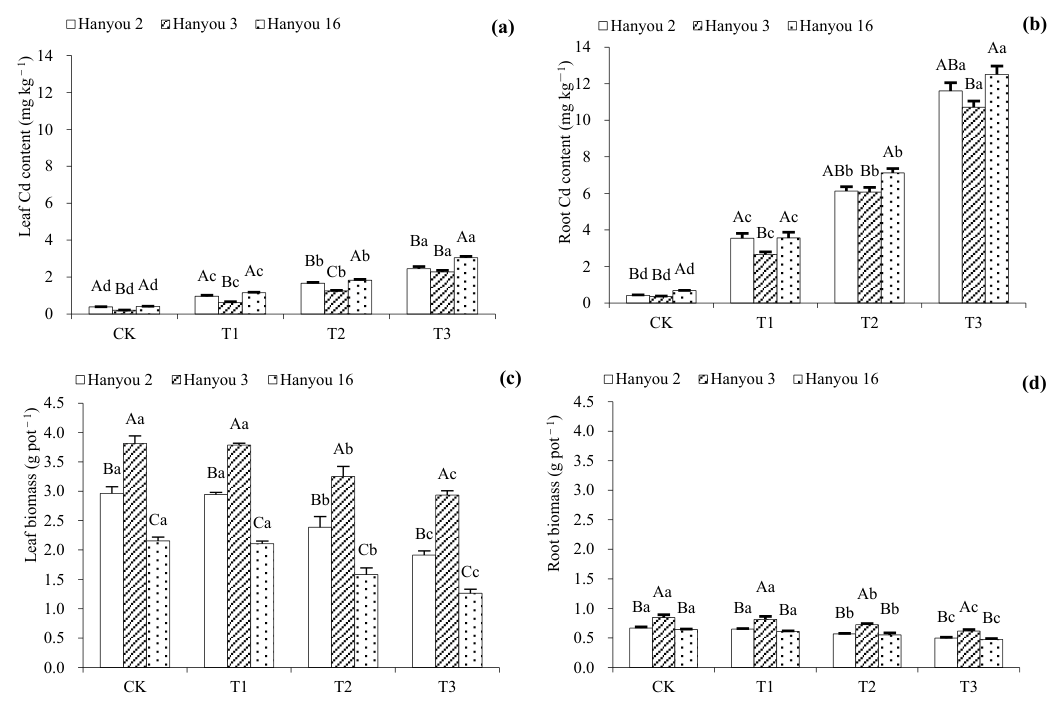
The biomasses of leaves and roots of three B. napus cultivars under study generally decreased with increasing Cd concentrations (from CK and T1 to T2 and T3) in soils (p < 0.05) as shown in Figure 1c,d. Leaf and root biomasses in the T2 and T3 treatments were significantly lower compared to the CK treatment, while no significant reduction was observed in T1 (p < 0.05). Significant differences in leaf biomass were observed among the cultivars (p < 0.05). The root biomass of Hanyou 3 was significantly higher than that of Hanyou 2 and Hanyou 16 (p < 0.05). Hanyou 2 showed higher biomass than Hanyou 16, and Hanyou 3 had the highest biomass overall.
如图1c、d所示,随着土壤Cd浓度升高(从CK和T1至T2和T3),所研究的三个B. napus品种叶片和根系生物量总体呈下降趋势(p < 0.05)。与CK处理相比,T2和T3处理的叶片和根系生物量显著降低,而T1处理未见显著下降(p < 0.05)。品种间叶片生物量差异显著(p < 0.05)。Hanyou 3的根系生物量显著高于Hanyou 2和Hanyou 16(p < 0.05)。Hanyou 2的生物量高于Hanyou 16,而Hanyou 3的总体生物量最高。
Table 1 shows the TIs of three B. napus cultivars. Generally, TIs in T1 treatments were the highest and gradually decreased from T2 to T3 (p < 0.05). The differences in TIs among the three cultivars were not significant in the T1 treatment. However, the TIs of Hanyou 3 were obviously the highest in T2 and T3 (with Hanyou 2 in the middle), indicating Hanyou 3’s stronger tolerance to Cd.表1列出了三个B. napus品种的TI。总体而言,T1处理的TI最高,并从T2到T3逐渐下降(p < 0.05)。T1处理中三个品种间TI差异不显著;然而,在T2和T3处理中Hanyou 3的TI明显最高(Hanyou 2居中),表明Hanyou 3对Cd的耐受性更强。
| Treatment处理 | Cultivars品种 | TI |
|---|---|---|
| Hanyou 2 | 99_±_0.04 Aa | |
| T1 | Hanyou 3 | 99_±_0.03 Aa |
| Hanyou 16 | 97_±_0.03 Aa | |
| Hanyou 2 | 81_±_0.04 Bb | |
| T2 | Hanyou 3 | 85_±_0.02 Ab |
| Hanyou 16 | 76_±_0.06 Cb | |
| Hanyou 2 | 66_±_0.03 Bc | |
| T3 | Hanyou 3 | 76_±_0.01 Ac |
| Hanyou 16 | 62_±_0.04 Cc |
Note: Different uppercase letters indicate significant differences in TIs among cultivars under the same treatment. Different lowercase letters indicate significant differences among treatments within the same cultivar (p < 0.05).
注:不同大写字母表示同一处理下不同品种间TI差异显著;不同小写字母表示同一品种不同处理间差异显著(p < 0.05)。
3.2. Chlorophyll Differences Among Three B. napus Cultivars3.2. 三个B. napus品种叶绿素的差异
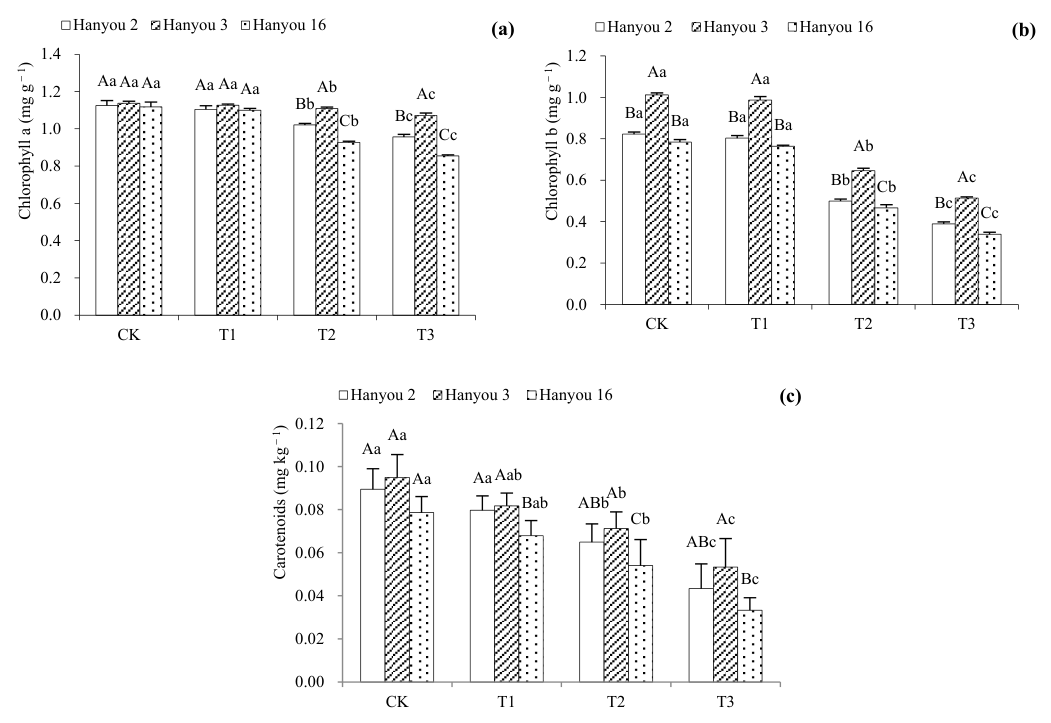
The chlorophyll a (Chla), chlorophyll b (Chlb), and carotenoid (Car) contents of the three B. napus cultivars gradually decreased with increasing Cd concentration (T1–T3) (Figure 2). However, compared to the CK, the Chla, Chlb, and Car contents in the T1 treatment were not significantly decreased (p < 0.05). Among the cultivars, Hanyou 3 consistently contained the highest Chla, Chlb, and Car contents, followed by Hanyou 2 and Hanyou 16.
随着Cd浓度升高(T1–T3),三个B. napus品种的叶绿素a(Chla)、叶绿素b(Chlb)和类胡萝卜素(Car)含量逐渐降低(图2)。然而,与CK相比,T1处理的Chla、Chlb和Car含量未显著降低(p < 0.05)。在各品种中,Hanyou 3的Chla、Chlb和Car含量始终最高,其次为Hanyou 2和Hanyou 16。
3.3. Differences in Photosynthetic Parameter Among Three B. napus Cultivars3.3. 三个B. napus品种光合参数的差异
Figure 3a illustrates that the net photosynthetic rate (Pn) showed a decreasing trend with increasing Cd concentrations. Compared to the CK treatment, Pn values for the three cultivars were not significantly reduced in T1, but significant declines were recorded in treatments T2 and T3 (p < 0.05). Hanyou 3 was significantly higher than Hanyou 2 and Hanyou 16 under the T2 treatment, but there was no significant difference under T3 (p < 0.05), with Hanyou 3 showing the highest Pn, while Hanyou 2 and Hanyou 16 reached similar values.图3a表明,净光合速率(Pn)随Cd浓度升高呈下降趋势。与CK处理相比,三个品种的Pn在T1处理中未显著降低,但在T2和T3处理中显著下降(p < 0.05)。在T2处理下,Hanyou 3显著高于Hanyou 2和Hanyou 16,而在T3处理下差异不显著(p < 0.05);其中Hanyou 3的Pn最高,Hanyou 2与Hanyou 16数值相近。
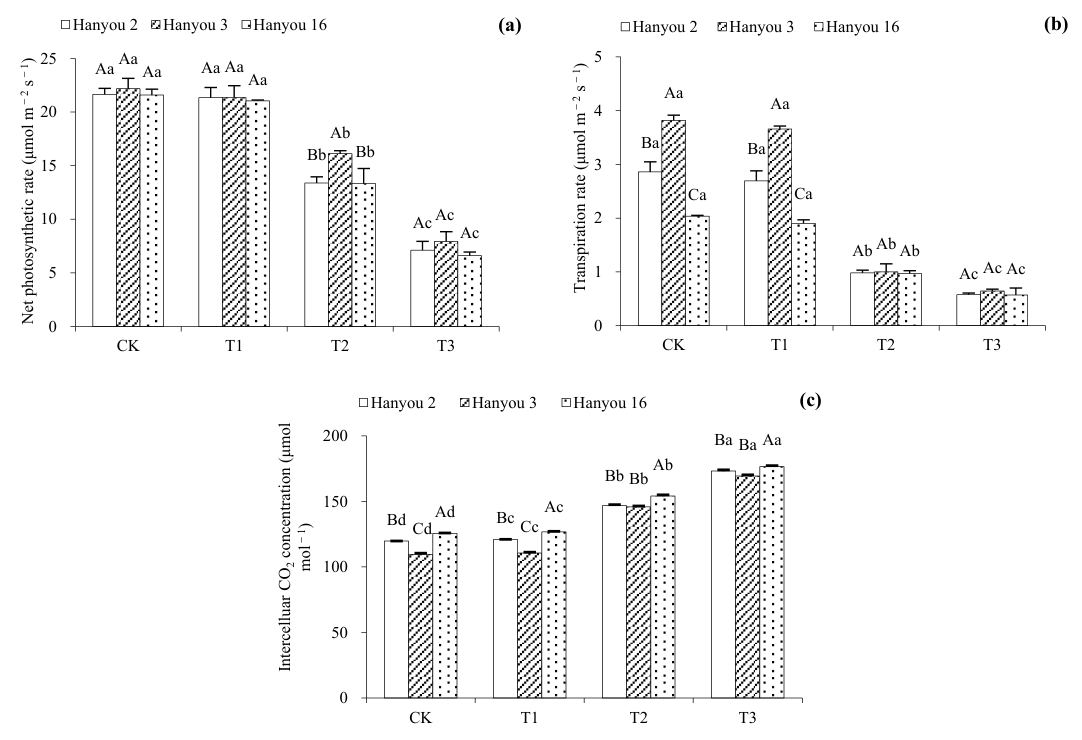
The transpiration rate (Tr) followed a similar trend to Pn (Figure 3b). In T1, no significant reduction in Tr was observed compared to the CK treatment, but marked decreases were measured in T2 and T3 in all three cultivars (p < 0.05). The Tr of Hanyou 3 was the highest in the CK and T1 treatments, while no significant differences were detected among the three cultivars in treatments T2 and T3 (p < 0.05).
蒸腾速率(Tr)的变化趋势与Pn相似(图3b)。与CK处理相比,T1处理的Tr未见显著降低,但三个品种在T2和T3处理中均显著下降(p < 0.05)。在CK和T1处理中,Hanyou 3的Tr最高,而在T2和T3处理中三个品种间无显著差异(p < 0.05)。
The intercellular CO2 concentration (Ci) showed an opposite trend to that of Pn and Tr (Figure 3c). The Ci of all three cultivars was significantly increased with the Cd concentration enhanced in soils (T1–T3) (p < 0.05). Among the cultivars, Hanyou 3 had the lowest Ci values, while higher but similar values were obtained for Hanyou 2 and Hanyou 16 (p < 0.05).
胞间CO2浓度(Ci)呈现出与Pn和Tr相反的趋势(图3c)。随着土壤Cd浓度升高(T1–T3),三个品种的Ci均显著增加(p < 0.05)。在各品种中,Hanyou 3的Ci值最低,而Hanyou 2和Hanyou 16的Ci值较高且相近(p < 0.05)。
3.4. MDA Content Differences Among Three B. napus Cultivars3.4. 三个B. napus品种MDA含量的差异
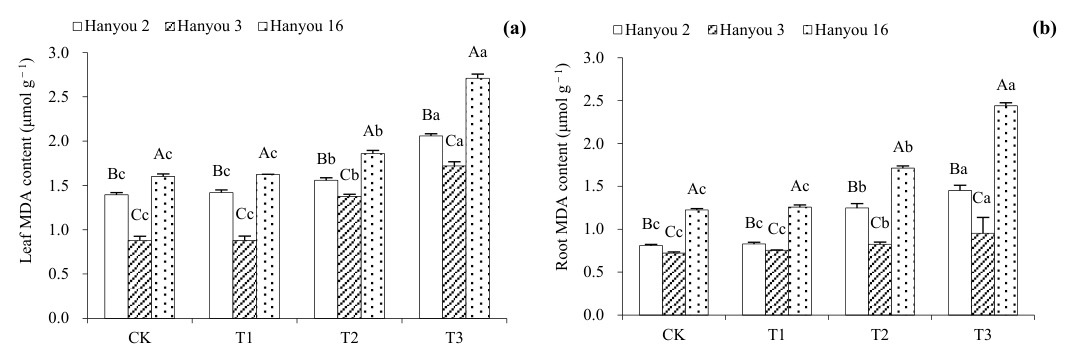
Figure 4 illustrates that the MDA content in the leaves and roots of the three cultivars increased with the rising Cd concentration in the soils. Compared to the CK treatment, the MDA content in the T1 treatment did not change significantly, whereas significant increases were observed in T2 and T3 (p < 0.05). The MDA content of Hanyou 16 was the highest across all treatments, and Hanyou 3 and Hanyou 2 were the second and third, respectively (p < 0.05).图4表明,三个品种叶片和根系中的MDA含量随土壤Cd浓度升高而增加。与CK处理相比,T1处理的MDA含量无显著变化,而T2和T3处理显著增加(p < 0.05)。在所有处理中,Hanyou 16的MDA含量最高,Hanyou 3和Hanyou 2分别居第二和第三位(p < 0.05)。
3.5. Antioxidant Enzyme Activity Differences Among B. napus Cultivars3.5. B. napus品种间抗氧化酶活性的差异
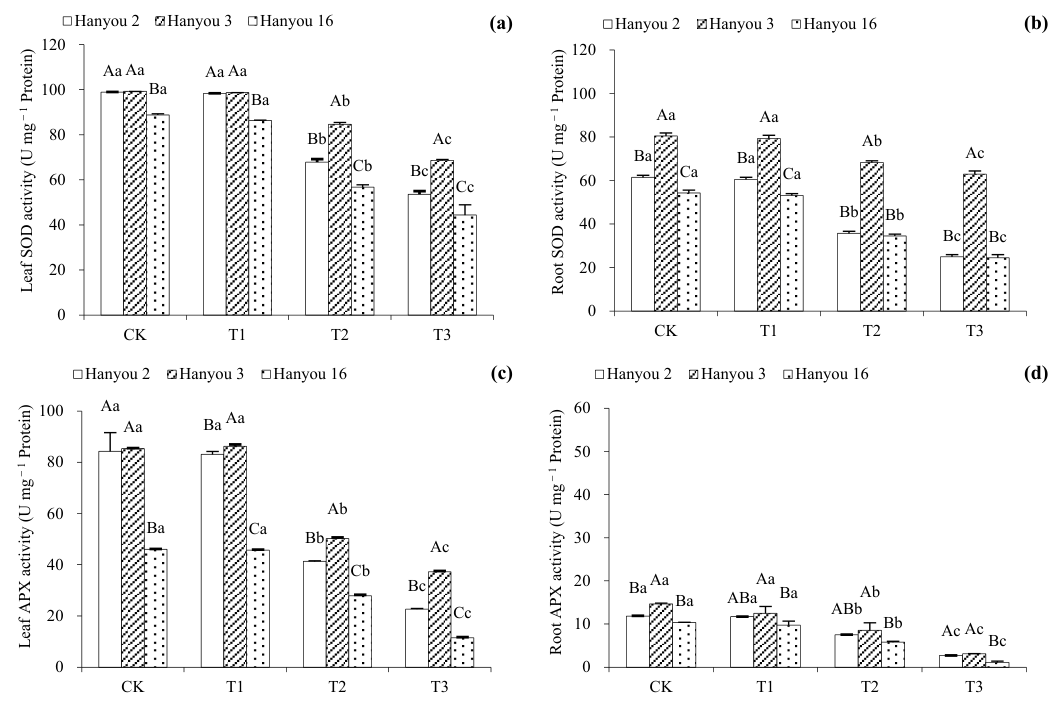
The activities of SOD and APX in the leaves and roots of the three cultivars followed similar trends in all treatments (CK, T1-T3; Figure 5). Compared to the CK treatment, SOD, and APX activities in leaves and roots were not significantly reduced in the T1 treatment but showed significant decreases in the T2 and T3 treatments (p < 0.05). Among the cultivars, Hanyou 3 demonstrated the highest SOD and APX activities in both leaves and roots, followed by Hanyou 2 and Hanyou 16, respectively (p < 0.05).
在所有处理(CK、T1–T3;图5)中,三个品种叶片和根系的SOD和APX活性变化趋势相似。与CK处理相比,T1处理中叶片和根系的SOD和APX活性未显著降低,但在T2和T3处理中显著下降(p < 0.05)。在各品种中,Hanyou 3叶片和根系的SOD和APX活性均最高,其次依次为Hanyou 2和Hanyou 16(p < 0.05)。
3.6. Non-Enzymatic Antioxidants in the Three B. napus Cultivars3.6. 三个B. napus品种的非酶抗氧化物质
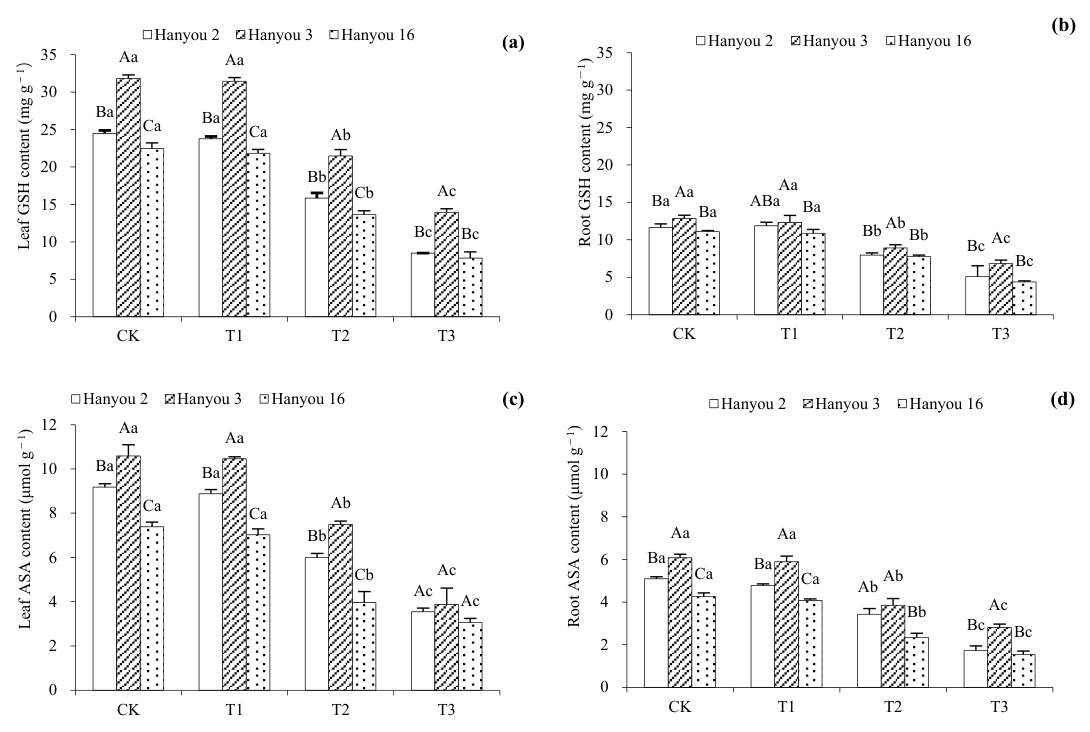
The contents of GSH and ASA in the leaves and roots of the three cultivars (Figure 6) showed similar trends to the SOD and APX activities (Figure 5). There were no significant differences recorded between the CK and T1 treatments for GSH and ASA contents; however, these markers were significantly decreased in T2 and T3 compared to the CK treatment (p < 0.05). Hanyou 3 had the highest levels of GSH and ASA, followed by Hanyou 2 and Hanyou 16 (p < 0.05).
三个品种叶片和根系中的GSH和ASA含量(图6)与SOD和APX活性(图5)的变化趋势相似。CK与T1处理之间GSH和ASA含量无显著差异;然而,与CK处理相比,这些指标在T2和T3处理中显著降低(p < 0.05)。Hanyou 3的GSH和ASA含量最高,其次为Hanyou 2和Hanyou 16(p < 0.05)。
3.7. Pearson Correlation Analysis of Cd Concentration and Biomass with Physiological Indicators of Three B. napus Cultivars
3.7. 三个B. napus品种Cd浓度和生物量与生理指标的Pearson相关分析
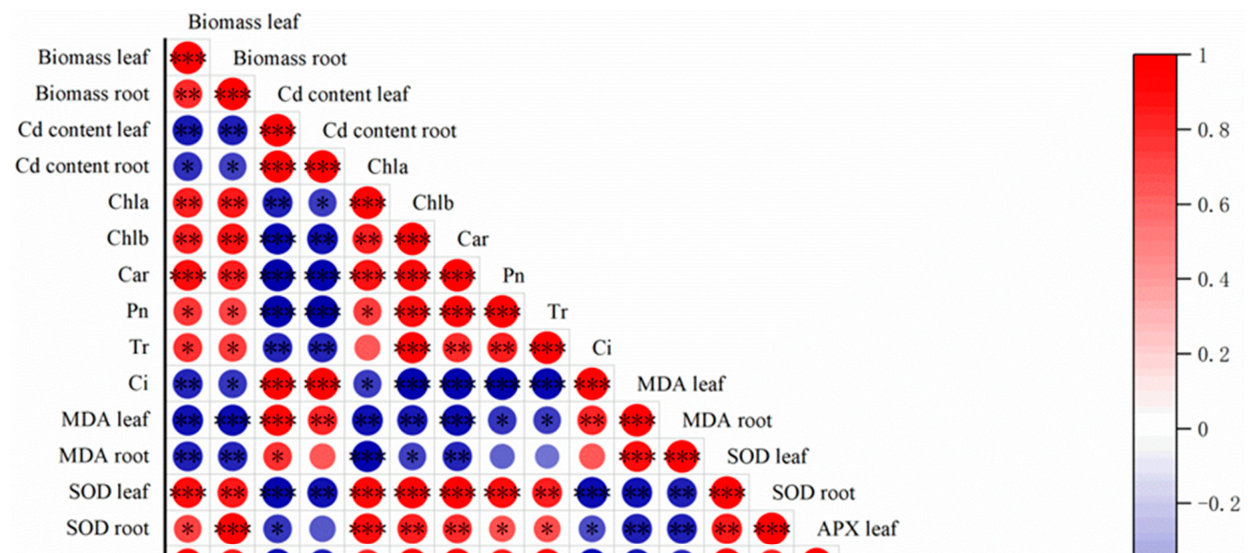
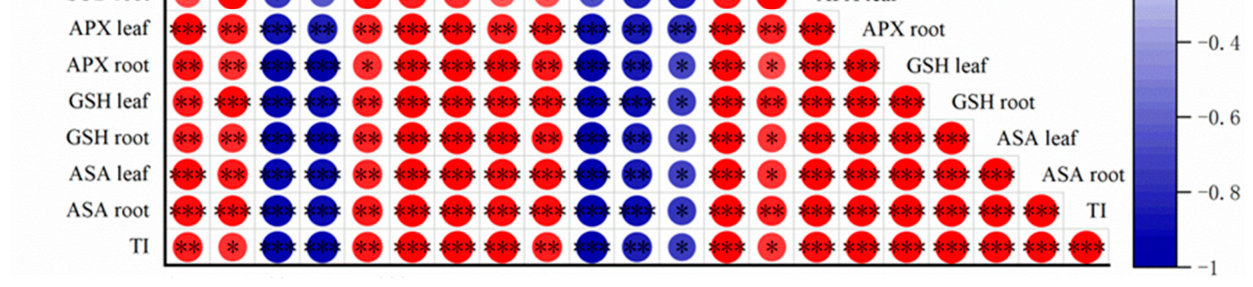
The Cd content in both leaves and roots showed significant negative correlations with their biomasses, Chla, Chlb, Car, Tr, SOD, APX, GSH, ASA, and TI. In contrast, we observed significant positive correlations between Ci and MDA (p < 0.05, p < 0.01 or p < 0.001). The relationship between leaf and root biomasses with Cd content and these physiological indices followed the same pattern as that of TI (Figure 7).
叶片和根系中的Cd含量均与其生物量、Chla、Chlb、Car、Tr、SOD、APX、GSH、ASA以及TI呈显著负相关;相反,与Ci和MDA呈显著正相关(p < 0.05、p < 0.01或p < 0.001)。叶片和根系生物量与Cd含量及上述生理指标之间的关系与TI呈现相同规律(图7)。
4Discussion讨论
The three cultivars’ biomasses in the T1 treatment were not significantly decreased compared to the CK treatment, and all exhibited high Cd tolerance indexes, indicating they were Cd-tolerant cultivars under such conditions [33]. However, the Cd concentration in the leaves exceeded the limit of pollutants in food (0.1 mg kg−1, fresh matter) [34]. Therefore, they cannot be classified as low Cd-accumulating cultivars when soil Cd concentration is below 2 mg kg−1 (T1) [33]. While Hanyou 3 exhibited the highest biomass, all three cultivars followed a similar trend in all treatments (T1–T3), i.e., plant biomass remained stable under T1 but declined significantly under T2 and T3 conditions compared to the CK treatment (Figure 1), indicating tolerance to low Cd concentrations (T1) [33]. The TI treatment more directly reflected the level of tolerance as it showed a positive correlation with biomass (Figure 7).
与CK处理相比,三个品种在T1处理中的生物量未显著降低,且均表现出较高的Cd耐性指数,表明在该条件下它们均为耐Cd品种[33]。然而,其叶片中的Cd浓度超过了食品中污染物限量(0.1 mg kg−1,鲜重)[34]。因此,当土壤Cd浓度低于2 mg kg−1(T1)时,它们不能被归类为低Cd积累品种[33]。尽管Hanyou 3的生物量最高,但三个品种在所有处理(T1–T3)中均呈现相似的趋势,即与CK处理相比,植株生物量在T1下保持稳定,而在T2和T3条件下显著下降(图1),表明其对低浓度Cd(T1)具有耐受性[33]。TI与生物量呈正相关(图7),因而更直接地反映了耐受水平。
Chlorophyll content, photosynthesis, respiration, and transpiration are significantly affected by Cd stress. Photosynthetic pigments play a crucial role in absorbing and transferring light energy during plant photosynthesis, and their levels indicate external stresses [35]. Under Cd stress, chlorophyll a (Chla), chlorophyll b (Chlb), and carotenoid (Car) contents in Brassica and strawberry leaves significantly decrease, leading to a marked reduction in net photosynthesis rate (Pn) and transpiration rate (Tr), while the internal CO2 concentration (Ci) increases [23,36]. In this study, compared to the CK, Pn, Tr, Chla, Chlb, and Car of the three B. napus cultivars did not significantly decrease under T1 conditions, but significantly decreased under T2 and T3 conditions. Conversely, Ci did not significantly increase under T1 conditions but significantly increased under T2 and T3 conditions (Figures 2 and 3). These findings were consistent with the responses of Robinia pseudoacacia and castor bean, which showed strong tolerance to Cd [37,38]. Cd impacts photosynthesis by disrupting electron transfer and damaging chloroplast integrity [39]. As Cd concentration in plants increases, chlorophyll content decreases significantly [40]. Beyond altering chloroplast structure, Cd stress reduces chlorophyll content by inhibiting the expression of key enzymes involved in its synthesis. Heavy metals, including Cd, exacerbate carotenoid degradation by increasing the expression of degradative enzymes [41], and Cd also replaces Mg2+ in chlorophyll and Ca2+ in the Ca/Mn cluster of the PSII complex [42]. Li et al. [43] suggested that the Ci was a key indicator for distinguishing between stomatal and non-stomatal limitations. When Pn and Ci all decreased simultaneously, photosynthesis was primarily limited by stomata. Conversely, if Pn decreased while Ci significantly increased, the limitation to photosynthesis was non-stomatal. In this study, Cd treatments at different concentrations reduced Pn and increased Ci in the three B. napus cultivars. This indicated that the limitation of photosynthesis under Cd stress was due to non-stomatal factors, primarily through damage to the photosynthetic apparatus and inhibition of enzyme activity during the dark reaction, thereby reducing photosynthetic efficiency.
叶绿素含量、光合作用、呼吸作用和蒸腾作用均显著受到Cd胁迫的影响。光合色素在植物光合作用中对光能的吸收和传递起着关键作用,其含量可指示外界胁迫[35]。在Cd胁迫下,Brassica和草莓叶片中的叶绿素a(Chla)、叶绿素b(Chlb)和类胡萝卜素(Car)含量显著降低,导致净光合速率(Pn)和蒸腾速率(Tr)明显下降,而胞间CO2浓度(Ci)升高[23,36]。本研究中,与CK相比,三个B. napus品种的Pn、Tr、Chla、Chlb和Car在T1条件下未显著降低,但在T2和T3条件下显著降低;相反,Ci在T1条件下未显著升高,而在T2和T3条件下显著升高(图2和图3)。这些结果与对Cd表现出较强耐受性的Robinia pseudoacacia和蓖麻的响应一致[37,38]。Cd通过干扰电子传递和破坏叶绿体完整性影响光合作用[39]。随着植物体内Cd浓度升高,叶绿素含量显著下降[40]。除改变叶绿体结构外,Cd胁迫还通过抑制叶绿素合成关键酶的表达而降低叶绿素含量。包括Cd在内的重金属通过提高降解酶的表达加剧类胡萝卜素降解[41],且Cd还可取代叶绿素中的Mg2+以及PSII复合体Ca/Mn簇中的Ca2+[42]。Li等[43]认为,Ci是区分气孔限制与非气孔限制的关键指标:当Pn和Ci同时下降时,光合作用主要受气孔限制;反之,若Pn下降而Ci显著升高,则光合作用受非气孔因素限制。本研究中,不同浓度的Cd处理均降低了三个B. napus品种的Pn并提高了Ci,表明Cd胁迫下光合作用的限制源于非气孔因素,主要是光合机构受损以及暗反应过程中酶活性受到抑制,从而降低了光合效率。
Beyond affecting photosynthesis, Cd stress significantly increases the MDA content in B. napus. Under T1 conditions, compared to the CK, the MDA content of this variety did not show a significant increase (Figure 4), indicating a certain level of Cd tolerance. Cd stress can damage plant cell membranes, increasing cell membrane permeability, the extravasation of intracellular soluble substances, the destruction of intracellular enzymes, and metabolic action in the original region. MDA content reflects the strength of lipid peroxidation [44]. Damage to the cell membrane can lead to a dysfunction of the balance between membrane-bound enzymes and the intracellular membrane, allowing a large number of substances to extravasate and toxic substances to enter the cell freely, leading to a series of disturbances in the physiological and biochemical processes of the cell [45]. However, plants can increase their tolerance to Cd through avoidance and detoxification strategies [46]. SOD, APX, GSH, and ASA can scavenge reactive oxygen species from plants and reduce Cd damage by regulating the antioxidant system, indicative of Cd tolerance to some extent [47]. In the study by Zhang et al. [48], the Cd-tolerant cultivar castor Zibo No. 8 had higher GSH and SOD activities than Zibo No. 5. In this experiment, the activities of antioxidant enzymes and non-enzymes of Hanyou 3, which exhibited high Cd tolerance in T1, were higher than those of the other two B. napus cultivars. This antioxidant enzyme and non-enzymatic indices of Hanyou 3 in T1 treatment were not significantly altered compared to the CK, significantly positively correlated with the Cd tolerance index, and had similar tolerance to Cd. This may be a response by the plant to protect itself from reactive oxygen species (ROS) damage, triggering a series of complex antioxidant enzyme defense mechanisms to avoid or reduce oxidative damage caused by cadmium. The enzyme protection system includes antioxidant enzymes such as SOD and APX. SOD is an important protective enzyme in the enzymatic defense system against ROS in plants, while APX plays a key role in maintaining a balanced redox state, enhancing the stability of the GSH-ASA cycle, and maintaining high levels of GSH and ASA to counteract the potential problems caused by oxidative damage [49]. These physio-biochemical indexes play an indicative role in the B. napus cultivars’ response to Cd stress.
除影响光合作用外,Cd胁迫还显著提高B. napus的MDA含量。在T1条件下,与CK相比,该品种的MDA含量未显著增加(图4),表明其具有一定的Cd耐受性。Cd胁迫可损伤植物细胞膜,导致细胞膜透性增加、胞内可溶性物质外渗、胞内酶遭到破坏以及原有区域的代谢作用受损。MDA含量反映了脂质过氧化的强度[44]。细胞膜受损可导致膜结合酶与胞内膜系统之间的平衡失调,使大量物质外渗、有毒物质自由进入细胞,进而引起细胞生理生化过程的一系列紊乱[45]。然而,植物可通过规避和解毒策略提高对Cd的耐受性[46]。SOD、APX、GSH和ASA可清除植物体内的活性氧,并通过调节抗氧化系统减轻Cd伤害,在一定程度上指示了Cd耐受性[47]。Zhang等[48]的研究中,耐Cd蓖麻品种淄蓖8号的GSH和SOD活性高于淄蓖5号。本试验中,在T1处理下表现出高Cd耐受性的Hanyou 3,其抗氧化酶和非酶抗氧化物质活性均高于另外两个B. napus品种。Hanyou 3在T1处理中的抗氧化酶和非酶指标与CK相比无显著变化,与Cd耐性指数呈显著正相关,并表现出相近的Cd耐受性。这可能是植物为保护自身免受活性氧(ROS)损伤而作出的响应,触发了一系列复杂的抗氧化酶防御机制,以避免或减轻镉引起的氧化损伤。酶保护系统包括SOD和APX等抗氧化酶。SOD是植物酶促防御系统中抵御ROS的重要保护酶,而APX在维持氧化还原平衡、增强GSH-ASA循环的稳定性以及维持较高的GSH和ASA水平以应对氧化损伤可能带来的问题方面发挥关键作用[49]。这些生理生化指标在B. napus品种对Cd胁迫的响应中起着指示作用。
5Conclusions结论
There were significant differences in the Cd tolerance between the Hanyou 2, 3, and 16 cultivars, which showed high tolerance indexes (TIs) and strong Cd tolerance at a Cd concentration of 2.18 mg kg−1 (T1) in soil. Among them, Hanyou 3 demonstrated the highest tolerance index (TI) and the least biomass reduction under Cd stress, indicating its superior adaptability to Cd-contaminated environments. The physiological responses of the cultivars were closely linked to their Cd tolerance. There was a significant positive correlation between TI and various physiological indicators, including chlorophyll content, net photosynthetic rate, transpiration rate, and antioxidant enzyme activities, underscoring the importance of these parameters in conferring Cd tolerance. Notably, Hanyou 3 showed higher activities of SOD, APX, GSH, and ASA, indicating a robust antioxidant defense system that contributes to its enhanced Cd tolerance. The study highlights the need for further genetic studies to identify the specific genes or gene networks responsible for Cd tolerance, particularly those influencing antioxidant enzyme activities and chlorophyll synthesis. Additionally, this was a pot experiment only. Considering that plant–element interactions could differ significantly when compared to field conditions, particularly regarding the accumulation and concentration of Cd in the leaves, a field experiment might be needed for further confirmation.
Hanyou 2、Hanyou 3和Hanyou 16三个品种的Cd耐受性存在显著差异,在土壤Cd浓度为2.18 mg kg−1(T1)时均表现出较高的耐性指数(TI)和较强的Cd耐受性。其中,Hanyou 3在Cd胁迫下耐性指数(TI)最高、生物量降幅最小,表明其对Cd污染环境具有更强的适应性。各品种的生理响应与其Cd耐受性密切相关。TI与叶绿素含量、净光合速率、蒸腾速率及抗氧化酶活性等多项生理指标呈显著正相关,凸显了这些参数在赋予Cd耐受性方面的重要性。值得注意的是,Hanyou 3的SOD、APX、GSH和ASA活性较高,表明其具有强健的抗氧化防御系统,有助于增强其Cd耐受性。本研究表明,有必要进一步开展遗传学研究,以鉴定决定Cd耐受性的特定基因或基因网络,尤其是影响抗氧化酶活性和叶绿素合成的基因。此外,本研究仅为盆栽试验。考虑到植物与元素之间的相互作用可能与田间条件存在显著差异,尤其是在叶片Cd的积累和浓度方面,可能需要开展田间试验以进一步验证。
Author Contributions: Y.Q.: Investigation, Formal analysis, Software, Writing—original draft; S.W.: Methodology, Writing—review and editing, Supervision; J.Z.: Data curation, Writing—review and editing; B.H.R.: Validation, Writing—review and editing; L.S.: Validation, Writing—review and editing; J.X.: Validation, Writing—review and editing; H.D.: Conceptualization, Data curation, Validation, Methodology, Writing—review and editing: L.Z.: Formal analysis, Validation, Writing—review and editing; Z.T.: Data curation, Writing—review and editing. All authors have read and agreed to the published version of the manuscript.
作者贡献:Y.Q.:调查、形式分析、软件、撰写—初稿;S.W.:方法学、撰写—审阅与编辑、指导;J.Z.:数据整理、撰写—审阅与编辑;B.H.R.:验证、撰写—审阅与编辑;L.S.:验证、撰写—审阅与编辑;J.X.:验证、撰写—审阅与编辑;H.D.:概念构思、数据整理、验证、方法学、撰写—审阅与编辑;L.Z.:形式分析、验证、撰写—审阅与编辑;Z.T.:数据整理、撰写—审阅与编辑。所有作者均已阅读并同意稿件的出版版本。
Funding: This research received no external funding.
基金资助:本研究未获得外部资助。
Institutional Review Board Statement: Not applicable.
机构审查委员会声明:不适用。
Data Availability Statement: The datasets used or analyzed during the current study are available from the corresponding authors upon reasonable request.
数据可用性声明:本研究中使用或分析的数据集可在合理要求下向通讯作者索取。
Acknowledgments: This work was supported by Sanqin Talents, the Shaanxi Provincial First-class Team, the “Contaminated Soil Remediation and Resource Utilization Innovation Team at Shaanxi University of Technology”, the Shaanxi University of Technology Research Ability Enhancement Project (SLGNL202405), the National Natural Science Foundation of China (32471703), Qin Chuangyuan “Scientists + Engineers” Team Construction in Shaanxi Province (2024QCY-KXJ-104), the project of Foreign Experts Bureau of China (S20240182, 2024WZ-ZDXM-15, G2023041029L, DL2023041006L), the Shaanxi Province City-University co-construction Project (SXZJ-2301), the Qinba Bioremediation and Resource Development Research Innovation and Introduction Base (S2022-ZC-GXYZ-0029), and the program financed by the Poland Minister of Science under the “Regional Excellence Initiative” for 2024–2027.
致谢:本研究得到以下项目资助:三秦人才、陕西省一流团队、“陕西理工大学污染土壤修复与资源化利用创新团队”、陕西理工大学科研能力提升项目(SLGNL202405)、国家自然科学基金(32471703)、陕西省秦创原“科学家+工程师”队伍建设项目(2024QCY-KXJ-104)、国家外国专家局项目(S20240182, 2024WZ-ZDXM-15, G2023041029L, DL2023041006L)、陕西省市校共建项目(SXZJ-2301)、秦巴生物修复与资源开发研究创新引智基地(S2022-ZC-GXYZ-0029),以及波兰科学部长“区域卓越计划”(2024–2027年)资助项目。
Conflicts of Interest: Author Jianming Xue was employed by the company New Zealand Forest Research Institute (Scion). The remaining authors declare that the research was conducted in the absence of any commercial or financial relationships that could be construed as a potential conflict of interest.
利益冲突:作者Jianming Xue受雇于新西兰林业研究院(Scion)公司。其余作者声明,本研究不存在任何可能被视为潜在利益冲突的商业或财务关系。
References参考文献
1. Filippone, E.; Tranchida-Lombardo, V.; Vitiello, A.; Ruiu, F.; Di Salvatore, M.; Galise, T.R.; Laccetti, L.; Amoresano, A.; D’Ambrosio, G.; Frusciante, L.; et al. Evaluation of Cadmium Effects on Six Solanum melongena L. Cultivars from the Mediterranean Basin. Agriculture 2022, 12, 1059. [CrossRef]
2. Wu, Y.; Li, X.; Yu, L.; Wang, T.; Wang, J.; Liu, T. Review of Soil Heavy Metal Pollution in China: Spatial Distribution, Primary Sources, and Remediation Alternatives. Resour. Conserv. Recycl. 2022, 181, 106261. [CrossRef]
3. Shi, J.; Zhao, D.; Ren, F.; Huang, L. Spatiotemporal Variation of Soil Heavy Metals in China: The Pollution Status and Risk Assessment. Sci. Total Environ. 2023, 871, 161768. [CrossRef] [PubMed]
4. Yang, J.; Han, Z.Y.; Yan, Y.X.; Guo, G.H.; Wang, L.; Shi, H.D.; Liao, X.Y. Neglected Pathways of Heavy Metal Input into Agricultural Soil: Water–Land Migration of Heavy Metals Due to Flooding Events. Water Res. 2024, 267, 122469. [CrossRef] [PubMed]
5. Peng, J.Y.; Zhang, S.; Han, Y.Y.; Bate, B.; Ke, H.; Chen, Y.M. Soil Heavy Metal Pollution of Industrial Legacies in China and Health Risk Assessment. Sci. Total Environ. 2022, 816, 151632. [CrossRef] [PubMed]
6. Guo, Z.X.; Lv, J.L.; Zhang, H.M.; Hu, C.Y.; Qin, Y.; Dong, H.; Zhang, T.; Dong, X.X.; Du, N.S.; Piao, F.Z. Red and Blue Light Function Antagonistically to Regulate Cadmium Tolerance by Modulating the Photosynthesis, Antioxidant Defense System and Cd Uptake in Cucumber (Cucumis sativus L.). J. Hazard. Mater. 2022, 429, 128412. [CrossRef] [PubMed]
7. Ahmad, S.; Sehrish, A.K.; Alomrani, S.O.; Zhang, L.; Waseem, M.; Noureen, S.; Ullah, I.; Tabassam, R.; Abbas, G.; Ali, S. Combined Application of Biochar and Metal-Tolerant Bacteria Alleviates Cadmium Toxicity by Modulating the Antioxidant Defense Mechanism and Physicochemical Attributes in Rice (Oryza sativa L.) Grown in Cadmium-Contaminated Soil. Plant Stress 2024, 11, 100348. [CrossRef]
8. Wu, Z.M.; Tang, Q.M.; Wang, Y.F.; Qiu, C.S.; Long, S.H.; Zhao, X.L. Ramie (Boehmeria nivea) as Phytoremediation Crop for Heavy Metal-Contaminated Paddy Soil in Southern China: Variety Comparison, Cd Accumulation, and Assessment of Fiber Recycling. J. Nat. Fibers 2022, 19, 11078–11091. [CrossRef]
9. Lyˇcka, M.; Barták, M.; Helia, O.; Kopriva, S.; Moravcová, D.; Hájek, J.; Fojt, L.; Cmelˇ ík, R.; Fajkus, J.; Fojtová, M. Sulfate Supplementation Affects Nutrient and Photosynthetic Status of Arabidopsis thaliana and Nicotiana tabacum Differently under Prolonged Exposure to Cadmium. J. Hazard. Mater. 2023, 445, 130527. [CrossRef] [PubMed]
10. Shomali, A.; Das, S.; Sarraf, M.; Johnson, R.; Janeeshma, E.; Kumar, V.; Aliniaeifard, S.; Puthur, J.T.; Hasanuzzaman, M. Modulation of Plant Photosynthetic Processes during Metal and Metalloid Stress, and Strategies for Manipulating Photosynthesis-Related Traits. Plant Physiol. Biochem. 2024, 206, 108211. [CrossRef]
11. Fan, P.H.; Wu, L.W.; Wang, Q.; Wang, Y.; Luo, H.M.; Song, J.Y.; Yang, M.H.; Yao, H.; Chen, S.L. Physiological and Molecular Mechanisms of Medicinal Plants in Response to Cadmium Stress: Current Status and Future Perspective. J. Hazard. Mater. 2023, 450, 131008. [CrossRef] [PubMed]
12. Ci, D.W.; Jiang, D.; Dai, T.B.; Jing, Q.; Cao, W.X. Effects of Cadmium on Plant Growth and Physiological Traits in Contrast Wheat Recombinant Inbred Lines Differing in Cadmium Tolerance. Chemosphere 2009, 77, 1620–1625. [CrossRef]
13. Wu, X.W.; Tian, H.; Li, L.; Guan, C.Y.; Zhang, Z.H. Higher Cd-Accumulating Oilseed Rape Has Stronger Cd Tolerance Due to Stronger Cd Fixation in Pectin and Hemicellulose and Higher Cd Chelation. Environ. Pollut. 2021, 285, 117218. [CrossRef]
14. Sarker, A.; Masud, M.A.A.; Deepo, D.M.; Das, K.; Nandi, R.; Ansary, M.W.R.; Islam, A.R.M.T.; Islam, T. Biological and Green Remediation of Heavy Metal Contaminated Water and Soils: A State-of-the-Art Review. Chemosphere 2023, 332, 138861. [CrossRef] 15. Jinadasa, N.; Collins, D.; Holford, P.; Milham, P.J.; Conroy, J.P. Reactions to Cadmium Stress in a Cadmium-Tolerant Variety of Cabbage (Brassica oleracea L.): Is Cadmium Tolerance Necessarily Desirable in Food Crops? Environ. Sci. Pollut. Res. 2016, 23, 5296–5306. [CrossRef] [PubMed]
16. Ghuge, S.A.; Nikalje, G.C.; Kadam, U.S.; Suprasanna, P.; Hong, J.C. Comprehensive Mechanisms of Heavy Metal Toxicity in Plants, Detoxification, and Remediation. J. Hazard. Mater. 2023, 450, 131039. [CrossRef] [PubMed]
17. Rosca, M.; Cozma, P.; Minut, M.; Hlihor, R.-M.; Bet,ianu, C.; Diaconu, M.; Gavrilescu, M. New Evidence of Model Crop Brassica Napus L. in Soil Clean-Up: Comparison of Tolerance and Accumulation of Lead and Cadmium. Plants 2021, 10, 2051. [CrossRef] [PubMed]
18. Fu, D.H.; Jiang, L.Y.; Mason, A.S.; Xiao, M.L.; Zhu, L.R.; Li, L.Z.; Zhou, Q.H.; Shen, C.J.; Huang, C.H. Research Progress and Strategies for Multifunctional Rapeseed: A Case Study of China. J. Integr. Agric. 2016, 15, 1673–1684. [CrossRef]
19. Pan, W.; Lu, Q.; Xu, Q.R.; Zhang, R.R.; Li, H.Y.; Yang, Y.H.; Liu, H.J.; Du, S.T. Abscisic Acid-Generating Bacteria Can Reduce Cd Concentration in Pakchoi Grown in Cd-Contaminated Soil. Ecotoxicol. Environ. Saf. 2019, 177, 100–107. [CrossRef] [PubMed]
20. Wang, X.; Bai, J.Y.; Wang, J.; Le, S.; Wang, M.L.; Zhao, Y. Variations in Cadmium Accumulation and Distribution among Different Oilseed Rape Cultivars in Chengdu Plain in China. Environ. Sci. Pollut. Res. 2019, 26, 3415–3427. [CrossRef] [PubMed]
21. Zhang, Q.Y.; Wang, L.; Zhu, J.; Liu, Q.Q.; Zhao, F.H.; Liao, X.Y. Screening of Low-Cd-Accumulating and Cd-Remediating Oilseed Rape Varieties Using a Newly Indicator System for Risk Management of Cd-Contaminated Agricultural Land. Chemosphere 2024, 358, 142148. [CrossRef]
22. Zhang, F.G.; Xiao, X.; Wu, X.M. Physiological and Molecular Mechanism of Cadmium (Cd) Tolerance at Initial Growth Stage in Rapeseed (Brassica napus L.). Ecotoxicol. Environ. Saf. 2020, 197, 110613. [CrossRef] [PubMed]
23. Dhaliwal, S.S.; Sharma, V.; Kaur, J.; Shukla, A.K.; Singh, J.; Singh, P. Cadmium Phytoremediation Potential of Brassica Genotypes Grown in Cd Spiked Loamy Sand Soils: Accumulation and Tolerance. Chemosphere 2022, 302, 134842. [CrossRef] [PubMed]
24. Dai, H.P.; Wei, S.H.; Twardowska, I.; Hou, N.; Zhang, Q. Cosmopolitan Cadmium Hyperaccumulator Solanum nigrum: Exploring Cadmium Uptake, Transport and Physiological Mechanisms of Accumulation in Different Ecotypes as a Way of Enhancing Its Hyperaccumulative Capacity. J. Environ. Manag. 2022, 320, 115878. [CrossRef] [PubMed]
25. GB15618-2018; NSPRC-SEQS. National Standard of the People’s Republic of China: Soil Environmental Quality Standard for Soil Pollution Risk Control of Agricultural Land (Trial). Environmental Protection Agency Beijing: Beijing, China, 2018.
26. Kapoor, D.; Singh, M.P.; Kaur, S.; Bhardwaj, R.; Zheng, B.; Sharma, A. Modulation of the Functional Components of Growth, Photosynthesis, and Anti-Oxidant Stress Markers in Cadmium Exposed Brassica juncea L. Plants 2019, 8, 260. [CrossRef]
27. Dai, H.P.; Shan, C.J.; Zhao, H.; Li, J.C.; Jia, G.-L.; Jiang, H.; Wu, S.Q.; Wang, Q. The Difference in Antioxidant Capacity of Four Alfalfa Cultivars in Response to Zn. Ecotoxicol. Environ. Saf. 2015, 114, 312–317. [CrossRef] [PubMed]
28. Dai, H.P.; Wei, S.H.; Skuza, L.; Jia, G.L. Selenium Spiked in Soil Promoted Zinc Accumulation of Chinese Cabbage and Improved Its Antioxidant System and Lipid Peroxidation. Ecotoxicol. Environ. Saf. 2019, 180, 179–184. [CrossRef]
29. Chen, D.M.; Chen, D.Q.; Xue, R.R.; Long, J.; Lin, X.H.; Lin, Y.B.; Jia, L.H.; Zeng, R.S.; Song, Y.Y. Effects of Boron, Silicon and Their Interactions on Cadmium Accumulation and Toxicity in Rice Plants. J. Hazard. Mater. 2019, 367, 447–455. [CrossRef]
30. Zhang, W.E.; Pan, X.J.; Zhao, Q.; Zhao, T. Plant Growth, Antioxidative Enzyme, and Cadmium Tolerance Responses to Cadmium Stress in Canna orchioides. Hortic. Plant J. 2021, 7, 256–266. [CrossRef]
31. Dhindsa, R.S.; Matowe, W. Drought Tolerance in Two Mosses: Correlated with Enzymatic Defence Against Lipid Peroxidation. J. Exp. Bot. 1981, 32, 79–91. [CrossRef]
32. Jung, H.; Lee, B.-R.; Chae, M.-J.; Lee, E.-J.; Lee, T.-G.; Jung, G.-B.; Kim, M.-S.; Lee, J. Ascorbate-Mediated Modulation of Cadmium Stress Responses: Reactive Oxygen Species and Redox Status in Brassica napus. Front. Plant Sci. 2020, 11, 586547. [CrossRef] [PubMed]
33. Liu, W.T.; Liang, L.C.; Zhang, X.; Zhou, Q.X. Cultivar Variations in Cadmium and Lead Accumulation and Distribution among 30 Wheat (Triticum aestivum L.) Cultivars. Environ. Sci. Pollut. Res. 2015, 22, 8432–8441. [CrossRef]
34. GB 2762-2012; National Food Safety Standards—Limit of Pollutants in Food. Ministry of Health: Beijing, China, 2012.
35. Zhang, H.H.; Xu, Z.S.; Huo, Y.Z.; Guo, K.W.; Wang, Y.; He, G.Q.; Sun, H.W.; Li, M.B.; Li, X.; Xu, N.; et al. Overexpression of Trx CDSP32 Gene Promotes Chlorophyll Synthesis and Photosynthetic Electron Transfer and Alleviates Cadmium-Induced Photoinhibition of PSII and PSI in Tobacco Leaves. J. Hazard. Mater. 2020, 398, 122899. [CrossRef]
36. Saqib, M.; Shahzad, U.; Zulfiqar, F.; Tiwari, R.K.; Lal, M.K.; Naz, S.; Jahan, M.S.; Awan, Z.A.; El-Sheikh, M.A.; Altaf, M.A. Exogenous Melatonin Alleviates Cadmium-Induced Inhibition of Growth and Photosynthesis through Upregulating Antioxidant Defense System in Strawberry. S. Afr. J. Bot. 2023, 157, 10–18. [CrossRef]
37. Liu, C.F.; Guo, J.L.; Cui, Y.L.; Lü, T.F.; Zhang, X.H.; Shi, G.R. Effects of Cadmium and Salicylic Acid on Growth, Spectral Reflectance and Photosynthesis of Castor Bean Seedlings. Plant Soil 2011, 344, 131–141. [CrossRef]
38. Dezhban, A.; Shirvany, A.; Attarod, P.; Delshad, M.; Matinizadeh, M.; Khoshnevis, M. Cadmium and Lead Effects on Chlorophyll Fluorescence, Chlorophyll Pigments and Proline of Robinia pseudoacacia. J. For. Res. 2015, 26, 323–329. [CrossRef]
39. Chu, J.J.; Zhu, F.; Chen, X.Y.; Liang, H.Z.; Wang, R.J.; Wang, X.X.; Huang, X.H. Effects of Cadmium on Photosynthesis of Schima Superba Young Plant Detected by Chlorophyll Fluorescence. Environ. Sci. Pollut. Res. 2018, 25, 10679–10687. [CrossRef] [PubMed]
40. Huang, W.M.; Jin, Q.; Yin, L.Y.; Li, W. Responses of CO2-Concentrating Mechanisms and Photosynthetic Characteristics in Aquatic Plant Ottelia Alismoides Following Cadmium Stress under Low CO2. Ecotoxicol. Environ. Saf. 2020, 202, 110955. [CrossRef]
41. Chen, X.J.; Tao, H.F.; Wu, Y.Z.; Xu, X.M. Effects of Cadmium on Metabolism of Photosynthetic Pigment and Photosynthetic System in Lactuca sativa L. Revealed by Physiological and Proteomics Analysis. Sci. Hortic. 2022, 305, 111371. [CrossRef]
42. Rasafi, T.E.; Oukarroum, A.; Haddioui, A.; Song, H.; Kwon, E.E.; Bolan, N.; Tack, F.M.; Sebastian, A.; Prasad, M.N.V.; Rinklebe, J. Cadmium Stress in Plants: A Critical Review of the Effects, Mechanisms, and Tolerance Strategies. Crit. Rev. Environ. Sci. Technol. 2022, 52, 675–726. [CrossRef]
43. Li, S.L.; Yang, W.H.; Yang, T.T.; Chen, Y.; Ni, W.Z. Effects of Cadmium Stress on Leaf Chlorophyll Fluorescence and Photosynthesis of Elsholtzia argyi—A Cadmium Accumulating Plant. Int. J. Phytoremediat. 2015, 17, 85–92. [CrossRef] [PubMed]
44. Zhao, H.Y.; Guan, J.L.; Liang, Q.; Zhang, X.Y.; Hu, H.L.; Zhang, J. Effects of Cadmium Stress on Growth and Physiological Characteristics of Sassafras Seedlings. Sci. Rep. 2021, 11, 9913. [CrossRef]
45. Saeed, W.; Mubeen, S.; Pan, J.; Rehman, M.; Fang, W.Q.; Luo, D.J.; Liu, P.W.; Li, Y.; Chen, P. Integrated Physiological and Metabolomic Responses Reveal Mechanisms of Cd Tolerance and Detoxification in Kenaf (Hibiscus cannabinus L.) under Cd Stress. Front. Plant Sci. 2024, 15, 1332426. [CrossRef] [PubMed]
46. Su, H.X.; Zou, T.; Lin, R.Y.; Zheng, J.X.; Jian, S.G.; Zhang, M. Characterization of a Phytochelatin Synthase Gene from Ipomoea Pes-Caprae Involved in Cadmium Tolerance and Accumulation in Yeast and Plants. Plant Physiol. Biochem. 2020, 155, 743–755. [CrossRef]
47. Wen, K.; Li, X.G.; Huang, R.; Nian, H. Application of Exogenous Glutathione Decreases Chromium Translocation and Alleviates Its Toxicity in Soybean (Glycine max L.). Ecotoxicol. Environ. Saf. 2022, 234, 113405. [CrossRef] [PubMed]
48. Zhang, H.Z.; Guo, Q.J.; Yang, J.X.; Chen, T.B.; Zhu, G.X.; Peters, M.; Wei, R.F.; Tian, L.Y.; Wang, C.Y.; Tan, D.Y.; et al. Cadmium Accumulation and Tolerance of Two Castor Cultivars in Relation to Antioxidant Systems. J. Environ. Sci. 2014, 26, 2048–2055. [CrossRef]
49. Gill, S.S.; Tuteja, N. Reactive Oxygen Species and Antioxidant Machinery in Abiotic Stress Tolerance in Crop Plants. Plant Physiol. Biochem. 2010, 48, 909–930. [CrossRef] [PubMed]
Disclaimer/Publisher’s Note: The statements, opinions and data contained in all publications are solely those of the individual author(s) and contributor(s) and not of MDPI and/or the editor(s). MDPI and/or the editor(s) disclaim responsibility for any injury to people or property resulting from any ideas, methods, instructions or products referred to in the content.