Short communication
Brett Robinson a,∗, Charles Russell b, Mike Hedley b, Brent Clothier a
a Environment and Risk Management Group, Horticulture and Food Research Institute of New Zealand Ltd., Private Bag 11-030, Palmerston North, New Zealand
b Soil and Earth Sciences, Institute of Natural Resources, Massey University, Palmerston North, New Zealand
Received 28 February 2000; received in revised form 31 August 2000; accepted 13 December 2000
Abstract摘要
Cadmium (Cd) accumulation by plants is a concern for human health and for decreased productivity of plants and animals. Uptake of Cd by plants is also fundamental in the process of phytoremediation, whereby plants are used to remove Cd from polluted soils. Plants have a substantial microflora associated with their rhizospheres that influence nutrient mobilisation and availability to the plant. This study investigated the effects of Cd on the growth and Cd uptake of Pseudomonas fluorescens (CR3), a lux-marked rhizoplane bacterial isolate from clover-root tips, as well as four other bacterial isolates from the clover (Trifolium spp.) rhizosphere. The bacteria studied are from a ryegrass (Lolium perenne)/clover pastureland near Palmerston North. In the first study, CR3 was grown in a media containing 0, 0.1, 0.5, 1 and 5 mg l−1 Cd. Optical density, a luminescence measurement of metabolic activity and Cd adsorption were measured over a 48-hour period. There was no significant retardation of growth in media containing less than 1 mg l−1 Cd. The lag phase was significantly longer in the 1 and 5 mg l−1 treatments. The metabolic activity in these treatments, as indicated by luminescence, was also significantly lower during the exponential growth phase. Cadmium accumulated in the bacteria to circa is 100 times that of the Cd concentration of the media in which they were grown. Accumulation of Cd was also assessed under different growth-media pH conditions and with different bacterial isolates. Cadmium absorption by cells decreased with reduced pH and absorption varied between different species. Sequestration of Cd by rhizosphere microorganisms may have an important influence on plant Cd uptake. Further research is still required, however, to establish whether the accumulation of Cd by rhizobacteria inhibits, or accelerates, Cd uptake by the host plant. © 2001 Elsevier Science B.V. All rights reserved.
植物对镉(Cd)的累积既危害人体健康,也会降低植物和动物的生产力。植物对Cd的吸收也是植物修复过程的基础,即利用植物去除污染土壤中的Cd。植物根际伴生有大量微生物区系,这些微生物影响养分的活化及其对植物的有效性。本研究考察了Cd对Pseudomonas fluorescens(CR3)——一株从三叶草根尖分离、带有lux标记的根面细菌——以及另外四株三叶草(Trifolium spp.)根际细菌分离株的生长及Cd吸收的影响。供试细菌采自Palmerston North附近的黑麦草(Lolium perenne)/三叶草牧场。在第一项研究中,CR3在Cd浓度为0、0.1、0.5、1和5 mg l−1的培养基中培养,在48小时内测定了光密度、反映代谢活性的发光强度以及Cd吸附量。在Cd浓度低于1 mg l−1的培养基中,细菌生长未受到显著抑制。1和5 mg l−1处理的迟滞期显著延长。以发光强度表征的这些处理的代谢活性在指数生长期也显著较低。细菌体内累积的Cd浓度约为其培养基Cd浓度的100倍。本研究还评估了不同培养基pH条件下以及不同细菌分离株对Cd的累积。细胞对Cd的吸收随pH降低而减少,且不同菌种之间的吸收存在差异。根际微生物对Cd的固持可能对植物吸收Cd具有重要影响。然而,根际细菌对Cd的累积究竟是抑制还是促进宿主植物对Cd的吸收,仍有待进一步研究。© 2001 Elsevier Science B.V. 版权所有。
Keywords: Cadmium; Pastureland; Phytoremediation; Rhizobacteria; New Zealand
关键词:镉;牧场;植物修复;根际细菌;新西兰
1Introduction引言
Cadmium is a non-essential, toxic, heavy metal that is a common contaminant in soil. Elevated levels of
镉是一种非必需的有毒重金属,是土壤中常见的污染物。高含量的
∗ Corresponding author. Tel.: +64-6356-8080/7821; fax: +64-6354-6731.
∗ 通讯作者。电话:+64-6356-8080/7821;传真:+64-6354-6731。
E-mail address: brobinson@hort.cri.nz (B. Robinson).
Cd reduce productivity, endanger human health and could even be used as non-tariff barriers to exports. Soil Cd pollution is cumulative with levels increasing over time until eventually the soil may become unusable for production. Common sources of soil Cd contamination are:
Cd会降低生产力、危害人体健康,甚至可能被用作出口的非关税壁垒。土壤Cd污染具有累积性,其含量随时间不断增加,最终可能导致土壤无法用于生产。土壤Cd污染的常见来源有:
1. application of Cd-rich phosphatic fertilisers (Loganathan and Hedley, 1997),
1. 施用富Cd磷肥(Loganathan and Hedley, 1997);
0167-8809/01/$ – see front matter © 2001 Elsevier Science B.V. All rights reserved. PII: S0167-8809(01)00146-3 316
0167-8809/01/$ – see front matter © 2001 Elsevier Science B.V. All rights reserved. PII: S0167-8809(01)00146-3 316
B. Robinson et al. / Agriculture, Ecosystems and Environment 87 (2001) 315–321
B. Robinson et al. / Agriculture, Ecosystems and Environment 87 (2001) 315–321
2. application of municipal sewage sludge (Gardiner et al., 1995),
2. 施用城市污水污泥(Gardiner et al., 1995);
3. runoff or leaching from roadways (Morrison and Florence, 1990), and base-metal mines (Robinson et al., 1998),
3. 道路(Morrison and Florence, 1990)和贱金属矿山(Robinson et al., 1998)的径流或淋溶;
4. deposition from base-metal smelter emissions (Robinson et al., 1998).
4. 贱金属冶炼厂排放物的沉降(Robinson et al., 1998)。
Central to the problem of soil Cd contamination and its remediation is plant Cd uptake. Kuboi et al. (1986) investigated Cd accumulation in different families of higher plants. Plant Cd uptake is also important in the process of Cd phytoextraction, where crops of plants are grown to accumulate Cd in the above ground portions. The plant material is removed from the site and placed in an area where it does not pose a risk to the environment (Chaney, 1983).
植物对Cd的吸收是土壤Cd污染及其修复问题的核心。Kuboi et al.(1986)研究了不同高等植物科对Cd的累积。植物对Cd的吸收在Cd植物提取过程中同样重要,即种植作物使Cd累积于地上部分,随后将植物材料移出场地,置于不会对环境构成风险的区域(Chaney, 1983)。
To date, attempts to decrease plant Cd uptake in agricultural/horticultural systems have focused on using or creating varieties that take up less Cd (Yeargan et al., 1992) and decrease the bioavailability of Cd in the soil (Hooda and Alloway, 1996). The bioavailability of Cd in soils is a function of its solubility (Ernst, 1996) with pH and organic matter content being the main controlling factors (Grey et al., 1998). The production of metal-binding compounds by roots such as phytochelatins has been considered as a mechanism of Cd sequestration by the plant (Salt et al., 1995).
迄今为止,降低农业/园艺系统中植物Cd吸收的尝试主要集中于利用或培育Cd吸收较少的品种(Yeargan et al., 1992)以及降低土壤中Cd的生物有效性(Hooda and Alloway, 1996)。土壤中Cd的生物有效性取决于其溶解度(Ernst, 1996),而pH和有机质含量是主要控制因素(Grey et al., 1998)。根系产生的植物螯合肽等金属结合化合物被认为是植物固持Cd的一种机制(Salt et al., 1995)。
The activities of the large population of bacteria inhabiting the rhizosphere can also be expected to influence Cd uptake by plants. Rhizobacteria produce metal-chelating agents called siderophores (Leong, 1986). These have the effect of scavenging Fe3+ and their production is stimulated by the presence of heavy metals (van der Lelie et al., 1999). Heavy metal tolerance by bacteria has been reviewed by Silver and Phung (1996). Tolerance is facilitated by plasmid systems that encode active transport and exclusion systems called chemiosmotic pumps, whereby Cd is moved from the cytoplasm to the periplasmic space outside the cell. Scott et al. (1986) showed that Cd is absorbed into bacterial capsular coatings, whilst Cotoras et al. (1992) demonstrated that different sorption capacities of metals by different bacteria types is correlated more to the size of the organism than to the age of the culture.
栖居于根际的大量细菌的活动也可能影响植物对Cd的吸收。根际细菌可产生称为铁载体的金属螯合剂(Leong, 1986)。铁载体具有清除Fe3+的作用,其产生受重金属存在的刺激(van der Lelie et al., 1999)。Silver and Phung(1996)对细菌的重金属耐性进行了综述。这种耐性依赖于质粒系统,该系统编码称为化学渗透泵的主动转运和排出系统,借此将Cd从细胞质转移到细胞外的周质空间。Scott et al.(1986)表明Cd可被吸收进入细菌荚膜层,而Cotoras et al.(1992)证明,不同类型细菌对金属吸附能力的差异与生物体的大小相关性更强,而与培养物的菌龄关系较小。
Rhizobacteria encounter soil solution before it enters the root and the sequestration of Cd by rhizobacteria from soil solution may play an important part in plant Cd uptake. However, the role played by bacteria in plant Cd uptake is still poorly understood.
根际细菌在土壤溶液进入根系之前即与之接触,因此根际细菌从土壤溶液中固持Cd可能在植物Cd吸收中发挥重要作用。然而,目前对细菌在植物Cd吸收中所起作用的认识仍十分有限。
This paper reports experiments measuring the effect of increasing Cd levels on rhizobacteria survival, growth and activity. A lux-marked rhizobacterium evaluated as a biosensitive indicator to the effect of Cd on growth and metabolic activity of rhizobacteria (Amin-Hanjani et al., 1993). The ability of different rhizobacteria to sequester Cd was measured and the effect of pH on Cd-adsorption by rhizobacteria. Additional studies were conducted with Rhizobium leguminosarum bv. trifolii to determine the Cd characteristics of this organism.
本文报道了测定Cd水平升高对根际细菌存活、生长和活性影响的试验。以一株lux标记的根际细菌作为生物敏感指示物,评估Cd对根际细菌生长和代谢活性的影响(Amin-Hanjani et al., 1993)。测定了不同根际细菌固持Cd的能力,以及pH对根际细菌吸附Cd的影响。另外还以Rhizobium leguminosarum bv. trifolii开展了补充研究,以确定该生物体的Cd特性。
2Materials and methods材料与方法
2.1. Study area2.1. 研究区域
The clover and ryegrass pasture studied was at Massey University’s No. 1 dairy farm, Palmerston North (latitude 40.2◦S, longitude 175.4◦E). The soil type was Manawatu silt loam (FAO soil classification: eutric fluvisol; New Zealand classification: recent alluvial) which has a pH of 5.7, total organic carbon content of 63 g kg−1 and an exchange capacity of 13.4 cmol(+) kg−1.
所研究的三叶草和黑麦草牧场位于Palmerston North的梅西大学1号奶牛场(南纬40.2◦,东经175.4◦)。土壤类型为Manawatu粉砂壤土(FAO土壤分类:饱和冲积土;新西兰分类:新近冲积土),其pH为5.7,总有机碳含量为63 g kg−1,交换量为13.4 cmol(+) kg−1。
2.2. Bacterial strains2.2. 菌株
The bacterial strains used in this study were rhizosphere and rhizoplane isolates from the study area described above. P. fluorescens CR3 is a clover root-tip isolate that was chromosomally lux-tagged with the minitransposon Tn5luxAB::Tcr (Russell, pers. commun.). Details of strains are given in Table 1.
本研究所用菌株为从上述研究区域分离的根际和根面菌株。P. fluorescens CR3是一株三叶草根尖分离株,其染色体经微型转座子Tn5luxAB::Tcr进行了lux标记(Russell,私人通讯)。菌株详情见表1。
2.3. Culture media and growth conditions2.3. 培养基与培养条件
Bacterial strains were inoculated into a mineral-salts’ (MS) broth medium (Williams and Wollum, 1981). Luria Bertani broth (LB) and agar (LBA) (Amin- Hanjani et al., 1993) were used to grow Pseudomonas strains and CR3 (Amin-Hanjani et al., 1993) at 28◦C overnight. R. leguminosarum bv. trifolii was cultured on tryptone yeast (TY) and agar (TYA) medium (Beringer, 1974) at 28◦C for 48 h. MS medium without glucose amendment was used for characterising
将菌株接种于无机盐(MS)液体培养基中(Williams and Wollum, 1981)。采用Luria Bertani液体培养基(LB)和琼脂培养基(LBA)(Amin- Hanjani et al., 1993)于28◦C下过夜培养Pseudomonas菌株和CR3(Amin-Hanjani et al., 1993)。R. leguminosarum bv. trifolii在胰蛋白胨酵母(TY)及其琼脂(TYA)培养基(Beringer, 1974)上于28◦C培养48 h。不添加葡萄糖的MS培养基用于表征
Bacterial strains used in the study本研究所用菌株
| Bacterial strain菌株 | Relevant properties相关特性 | Reference or source参考文献或来源 |
|---|---|---|
| P. fluorescens CR3 (C) | Transconjugant clover root-tip isolate carrying Tn_5luxAB_ | C.N. Russell |
| R. leguminosarum bv. trifolii NZP561 (R) | Wild type nodulates Trifolium repens | D.B. Scott |
| Brevundimonas sp. KR013 (A) | Rhizoplane isolate from clover/ryegrass pasture; oxidase negative | C.N. Russell |
| Pseudomonas sp. KR017 (B) | Rhizosphere soil isolate from clover/ryegrass pasture; oxidase negative | C.N. Russell |
the effect of Cd on the different rhizobacterial strains. The effect of pH on Cd uptake by CR3 was performed in phosphate buffer at pH 5, 5.5, 6 and 6.5. The pH was measured in the solution after the cells were added.
Cd对不同根际细菌菌株的影响。pH对CR3吸收Cd的影响试验在pH 5、5.5、6和6.5的磷酸盐缓冲液中进行。pH在加入细胞后于溶液中测定。
for 15 min). For bioassay standardisation, the cells were then immediately pelleted by centrifugation (12 000 × g, 18◦C, 5 min).
15 min)。为实现生物测定的标准化,随后立即离心沉淀细胞(12 000 × g, 18◦C, 5 min)。
2.6. Rhizobacterial strains and2.6. 根际细菌菌株与
Cd2+ concentrationsCd2+ 浓度
2.4. Growth and luminescence measurements during batch growth2.4. 分批培养过程中生长和发光的测定
CR3 was grown in LB overnight to late log-phase growth in batch culture. Two 1 ml aliquots were spun in a microcentrifuge for 2 min, re-suspended in phosphate buffer (pH = 7.0) and the process was repeated twice. A 0.1 ml aliquot was added to triplicate flasks of MS containing 0, 0.1, 0.5, 1 and 5 mg l−1 Cd (as CdCl2·2 21 H2O). The flasks were incubated at 28◦C on an orbital shaker rotating at 150 rpm. Samples were removed at regular intervals and the optical density (A550) measured. Light output was measured using integrated output over a 10 s period of continuous mixing. The results were expressed in relative light units (RLU) one minute after the addition of 2 �l of aldehyde solution (33% (v/v) of n-decyl aldehyde (Sigma):ethanol) in 1 ml samples. A Wallac Bio-orbit 1251 luminometer was used.
CR3在LB中分批培养过夜,至对数生长后期。取两份1 ml等分样在微量离心机中离心2 min,重悬于磷酸盐缓冲液(pH = 7.0)中,该过程重复两次。取0.1 ml等分样分别加入含0、0.1、0.5、1和5 mg l−1 Cd(以CdCl2·2 21 H2O形式加入)的MS三角瓶中,每个处理设三个重复。三角瓶置于转速为150 rpm的回旋振荡器上,于28◦C培养。定时取样测定光密度(A550)。发光量以连续混合10 s内的积分输出值计。结果以在1 ml样品中加入2 �l醛溶液(n-癸醛(Sigma):乙醇为33%(v/v))1 min后的相对光单位(RLU)表示。采用Wallac Bio-orbit 1251型发光计进行测定。
2.5. Variable pH and Cd2+ concentrations with CR32.5. CR3在不同pH和Cd2+ 浓度下的试验
Overnight cultures (4 × 100 ml) of CR3 in LB were washed twice in phosphate buffer (pH = 7.0) by centrifugation (12 000 × g, 18◦C, 5 min), and then re-suspended in 200 ml of phosphate buffer at pH 4.0, 5.0, 6.0 and 7.0. Optical density measurements were also made. Aliquots of 10 ml were placed into PVC universal bottles and 0, 0.5, 1, 5 and 100 mg l−1 Cd2+ was added in 100 �l aliquots. The cell suspensions were agitated on a rotary mixer (100 rpm
将CR3在LB中的过夜培养物(4 × 100 ml)用磷酸盐缓冲液(pH = 7.0)离心洗涤两次(12 000 × g, 18◦C, 5 min),然后分别重悬于200 ml pH为4.0、5.0、6.0和7.0的磷酸盐缓冲液中,并测定光密度。取10 ml等分样置于PVC通用瓶中,以100 �l等分量加入0、0.5、1、5和100 mg l−1 Cd2+。细胞悬液在旋转混合器上振荡(100 rpm
This experiment was set up exactly as described immediately above, except log-phase cultures (100 ml) of R. leguminosarum bv. trifolii (R), RK013 (A), RK017 (B) and CR3 (C) were re-suspended in 200 ml of MS without glucose.
本试验的设置与上文所述完全相同,只是将R. leguminosarum bv. trifolii(R)、RK013(A)、RK017(B)和CR3(C)的对数期培养物(100 ml)重悬于200 ml不含葡萄糖的MS中。
2.7. Cadmium uptake2.7. 镉的吸收
The quantity of Cd2+ taken up by cells grown in the MS broth with varying Cd concentrations was measured by flame atomic absorption spectrophotometry using a GBC 904 atomic absorption spectrophotometer. Residual Cd2+ concentration in the culture supernatant was determined.
采用GBC 904型原子吸收分光光度计,以火焰原子吸收分光光度法测定在不同Cd浓度MS液体培养基中生长的细胞吸收的Cd2+量,并测定培养上清液中残留的Cd2+浓度。
2.8. Cell dry weight2.8. 细胞干重
CR3 was inoculated into triplicate flasks of MS as described above and the optical density and biomass readings were made at regular intervals. Biomass was measured by filtering 5 ml of culture media through a 0.45 �m millipore membrane, drying the filter overnight at 105◦C and weighing. Control membranes were included which were filtered with sterile MS only.
按上述方法将CR3接种于MS三角瓶中(三个重复),定时测定光密度和生物量。生物量的测定方法为:将5 ml培养液通过0.45 �m微孔滤膜过滤,滤膜于105◦C烘干过夜后称重。同时设置仅过滤无菌MS的对照滤膜。
2.9. Statistical analysis2.9. 统计分析
Significant differences between treatment means were determined by analysis of variance using Microsoft® Excel 97.
采用Microsoft® Excel 97进行方差分析,确定各处理均值间的显著性差异。
3Results and discussion结果与讨论
3.1. Growth and luminescence in broth culture with varying cadmium concentrations
3.1. 不同镉浓度下液体培养中的生长与发光
Fig. 1a shows cell growth of the aerated broth cultures of CR3 in MS at the five different Cd concentrations. Exponential growth curves were fitted and growth rates were significantly reduced (P < 0.05) for the 1 and 5 mg l−1 Cd treatments. As Cd concentration increased cultures exhibited longer lag phases, the control and the 0.5 mg l−1 Cd treatments had the shortest lag phase of 8 h. The term ‘lag phase’ is defined as the adjustment time of the bacterial inoculum to the growth media where there is a significant physiological activity but little growth in numbers. Exponential growth rates were different and regression analysis showed that optical density was correlated to time (r = 0.978, P < 0.001). The maximum specific growth rate, µmax (where dx/dt = �µax x[1 − x/xf], x = population and xf = final population in maximum phase) for the control, 0.1 and 0.5 mg l−1 Cd treatments was reached after 22 h. In the 1 and 5 mg l−1 Cd treatments, �max was reached after 25 and 30 h, respectively.
图1a显示了CR3在MS中五种不同Cd浓度下通气液体培养的细胞生长情况。对数据拟合指数生长曲线,1和5 mg l−1 Cd处理的生长速率显著降低(P < 0.05)。随着Cd浓度增加,培养物的迟滞期延长,对照和0.5 mg l−1 Cd处理的迟滞期最短,为8 h。“迟滞期”定义为细菌接种物适应培养基的调整时间,此期间生理活动显著,但数量增长很少。各处理的指数生长速率不同,回归分析表明光密度与时间相关(r = 0.978,P < 0.001)。对照、0.1和0.5 mg l−1 Cd处理在22 h后达到最大比生长速率µmax(其中dx/dt = �µax x[1 − x/xf],x为种群数量,xf为最大生长期的最终种群数量)。1和5 mg l−1 Cd处理分别在25和30 h后达到�max。
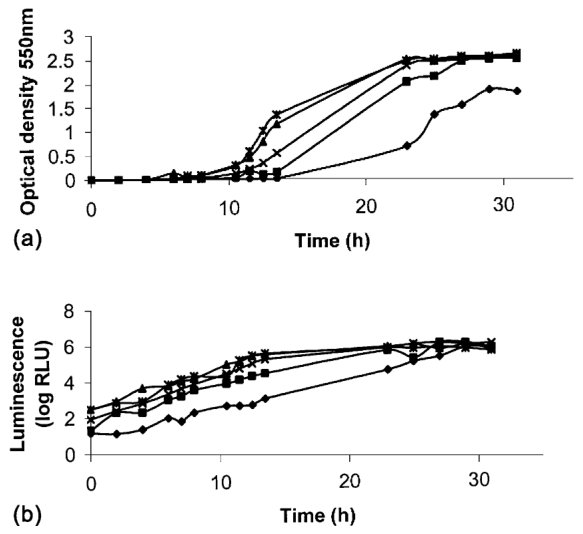
Increased Cd concentration decreased the rate of luminescence increase (Fig. 1b). Luminescence was correlated with time and increase of cell numbers (r = 0.904, P < 0.001). The initial reduction in luminescence in the higher Cd treatments disappeared after 30 h, where upon luminescence became the same in all treatments. As luminescence is a measure of metabolic activity (Meikle et al., 1994), the equality of luminescence after 30 h indicates adaptation of the bacteria to elevated Cd levels. Scott and Palmer (1990) showed that pseudomonad species can have detoxification systems that precipitate Cd internally. McGrath et al. (1999) used a lux-marked biosensor to provide a common basis for the expression of toxic thresholds in soils. However, if adaptation to Cd occurs, detection of Cd toxicity in situ may not be possible. It should be noted that the solution Cd concentrations (0–5 mg l−1) used in this study are higher than those expected (0–0.04 mg l−1) for normal agricultural soils (Andersson, 1976; Tiller et al., 1993).
Cd浓度升高降低了发光强度的增长速率(图1b)。发光强度与时间及细胞数量的增加相关(r = 0.904,P < 0.001)。较高Cd处理中发光强度的初始降低在30 h后消失,此后各处理的发光强度趋于一致。由于发光强度是代谢活性的量度(Meikle et al., 1994),30 h后发光强度的一致表明细菌已适应较高的Cd水平。Scott and Palmer(1990)表明,假单胞菌可具有在细胞内沉淀Cd的解毒系统。McGrath et al.(1999)利用lux标记的生物传感器为表达土壤毒性阈值提供了统一基础。然而,若细菌对Cd产生适应,则可能无法原位检测Cd毒性。需要指出的是,本研究所用的溶液Cd浓度(0–5 mg l−1)高于一般农业土壤的预期浓度(0–0.04 mg l−1)(Andersson, 1976; Tiller et al., 1993)。
3.2. Absorption of Cd by CR3 and pH effects3.2. CR3对Cd的吸收及pH的影响
Cadmium absorption by CR3 in solutions with varying Cd concentrations and varying pH, increased with increasing Cd in solution (Fig. 2). The bioaccumulation coefficient is classified as the bacterial biomass (dry weight): solution metal concentration quotient. This decreased with increasing solution Cd concentration. At pH 6.5, the average bioaccumulation coefficient was 231. A decrease in pH caused a significant (P < 0.01) reduction in the amount of Cd adsorbed by the bacteria. The average bioaccumulation coefficient at pH 5.1 was lower than 112. The reduced accumulation in acid conditions is consistent with the decreased stability of compounds where metals are complexed with organic ligands such as Cd bound to bacterial cell walls.
在不同Cd浓度和不同pH的溶液中,CR3对Cd的吸收随溶液Cd浓度的增加而增加(图2)。生物累积系数定义为细菌生物量(干重)Cd浓度与溶液金属浓度之商。该系数随溶液Cd浓度增加而降低。在pH 6.5时,平均生物累积系数为231。pH降低使细菌吸附的Cd量显著(P < 0.01)减少。pH 5.1时的平均生物累积系数低于112。酸性条件下累积量降低,这与金属与有机配体络合形成的化合物(如结合于细菌细胞壁上的Cd)稳定性下降相一致。
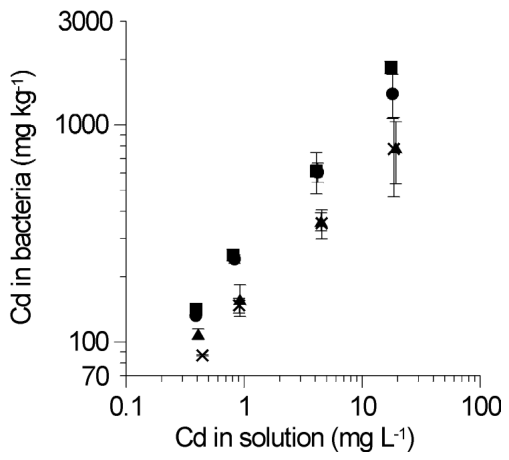
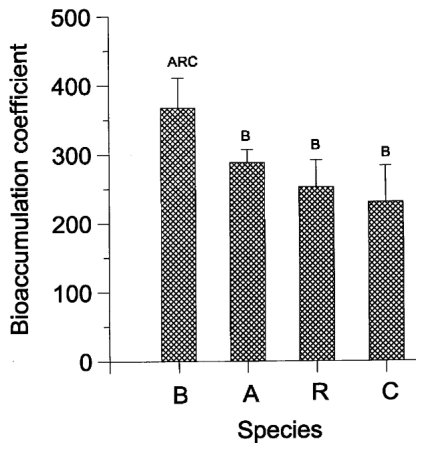
Bioaccumulation values of rhizobacteria in situ will obviously differ in absolute terms to those reported in Fig. 3 because our experiments neither replicated the chemical environment of the root zone nor measured the long-term effect of Cd exposure on adsorption. Nevertheless, our results do indicate that rhizobacteria have the potential to sequester Cd from soil solution.
由于本试验既未复制根区的化学环境,也未测定Cd暴露对吸附的长期影响,原位条件下根际细菌的生物累积值在绝对数值上显然会与图3所报道的不同。尽管如此,我们的结果确实表明根际细菌具有从土壤溶液中固持Cd的潜力。
4Potential implications潜在意义
4.1. Rhizobacterial cadmium in a New Zealand pastureland4.1. 新西兰牧场中根际细菌所含的镉
Table 2 shows the distribution of biologically active Cd in a typical New Zealand pasture. The results have been calculated using the average Cd concentration in表2显示了新西兰典型牧场中生物活性Cd的分布。计算结果基于
Balance of biologically active cadmium from a hectare of New Zealand soil with a total Cd concentration of 0.4 mg kg−1, depth 0.1 m and moisture content of 33%a a Biomass data are from Clark and Paul (1970).
总Cd浓度为0.4 mg kg−1、深度0.1 m、含水量33%的每公顷新西兰土壤中生物活性镉的平衡a a 生物量数据引自Clark and Paul(1970)。
| Pastureland牧场 | Mass (t ha−1)质量(t ha−1) | [Cd] | Mass of Cd (gha−1)Cd质量 (g ha−1) |
|---|---|---|---|
| Soil water | 330 | 0.005 | 1.65 |
| Shoots | 3 | 0.1 | 0.3 |
| Roots | 3 | 0.15 | 0.45 |
| Bacteria | 0.2 | 1.5 | 0.3 |
| Fungi | 0.5 | Unknown | Unknown |
New Zealand pasturelands (0.4 mg kg−1) which results in 0.005 mg l−1 Cd in the soil solution (Loganathan and Hedley, 1997). The Cd concentration of the rhizobacteria was calculated using bioaccumulation coefficients from Fig. 3 using Pseudomonas KR017. The Cd concentration in the pastureland soil solution is lower than the concentrations used in Fig. 3. Bioaccumulation coefficients decrease with increasing solution concentration (Fig. 2), so our calculation of Cd adsorption is likely to be conservative. Table 2 indicates that although the biomass of rhiozobacteria is small relative to the other biota, the amount of Cd associated with these organisms may be comparable to that contained in the roots. Rhizobacteria therefore have potential to enhance plant Cd uptake. Upon cell death, the Cd will be released in the vicinity of the root, some of which may be taken up by the plant. Additionally, the removal of Cd from soil solution will result in an increased desorption of Cd by soil particles.
新西兰牧场的平均Cd浓度(0.4 mg kg−1),由此得到土壤溶液中Cd浓度为0.005 mg l−1(Loganathan and Hedley, 1997)。根际细菌的Cd浓度采用图3中Pseudomonas KR017的生物累积系数计算。牧场土壤溶液中的Cd浓度低于图3所用浓度。由于生物累积系数随溶液浓度增加而降低(图2),我们对Cd吸附量的计算可能偏保守。表2表明,尽管根际细菌的生物量相对于其他生物群较小,但与这些生物体相关联的Cd量可能与根系所含Cd量相当。因此,根际细菌具有促进植物吸收Cd的潜力。细胞死亡后,Cd将在根系附近释放,其中部分可能被植物吸收。此外,从土壤溶液中移除Cd将促使土壤颗粒上的Cd解吸增加。
Gadd (1990) demonstrated that some fungal species accumulated Cd and other heavy metals. The interaction of Cd with soil fungi, which have a biomass twice that of rhizobacteria per unit area (Table 2), should represent a fertile area for future research.
Gadd(1990)证明某些真菌可累积Cd及其他重金属。土壤真菌单位面积生物量为根际细菌的两倍(表2),Cd与土壤真菌的相互作用应是今后研究中大有可为的领域。
4.2. Relative absorption of cadmium by different rhizobacteria4.2. 不同根际细菌对镉的相对吸收
Bioaccumulation coefficients for the four rhizobacteria studied are shown in Fig. 3. Cadmium accumulation was significantly (P < 0.05) greater in Pseudomonas KR017 than R. leguminosarum bv. trifolii and CR3, although there was no significant difference between the latter. These results indicate that the species of bacteria associated with the rhizosphere have different affinities for Cd accumulation. This may be correlated to organism surface area as reported by Cotoras et al. (1992). It may be possible to enhance or inhibit plant-Cd uptake by rhizosphere inoculation with different strains of rhizobacteria.
所研究的四种根际细菌的生物累积系数见图3。Pseudomonas KR017对Cd的累积显著(P < 0.05)高于R. leguminosarum bv. trifolii和CR3,而后两者之间无显著差异。这些结果表明,与根际相关的不同细菌种类对Cd累积具有不同的亲和力。正如Cotoras et al.(1992)所报道,这可能与生物体的表面积有关。通过向根际接种不同的根际细菌菌株,或可促进或抑制植物对Cd的吸收。
5Conclusions结论
Cadmium temporarily reduces both the growth rate and luminescence of the rhizoplane bacterial biosensor. Luminescence is therefore an excellent measure of bacterial activity since detection is far more sensitive than optical density. Luminescence output from a lux-marked rhizobacterium should be an effective indicator of increasing Cd concentrations, activity and growth rate, however, long-term assays will be ineffective as bacteria adapt to the increased Cd concentrations.
Cd会暂时降低根面细菌生物传感器的生长速率和发光强度。由于发光检测远比光密度灵敏,发光强度是衡量细菌活性的极佳指标。lux标记根际细菌的发光输出应可有效指示Cd浓度的升高以及细菌的活性和生长速率;然而,由于细菌会适应升高的Cd浓度,长期测定将无效。
Rhizobacteria sequester Cd from solution. The pH and the species of bacteria present affect the degree of sequestration. A significant amount of biologically active Cd may be associated with rhizobacteria in pasturelands.
根际细菌可从溶液中固持Cd。pH及所存在的细菌种类会影响固持程度。牧场中可能有相当数量的生物活性Cd与根际细菌相关联。
Future work should involve plant uptake experiments where plant Cd uptake from sterile soils is compared with the uptake from soils inoculated with various rhizobacterial strains.
今后的工作应开展植物吸收试验,比较植物从无菌土壤中吸收Cd与从接种不同根际细菌菌株的土壤中吸收Cd的差异。
References参考文献
Amin-Hanjani, S., Meikle, A., Glover, L.A., Prosser, J.I., Killham, K., 1993. Plasmid and chromosomally encoded luminescence marker systems for detection of Pseudomonas fluorescens in soil. Mol. Ecol. 2, 47–54.
Andersson, A., 1976. On the influence of manure fertilisers on the distribution and amounts of plant available cadmium in soils. Swed. J. Agric. Res. 6, 27–36.
Beringer, J.E., 1974. R factor transfer in Rhizobium leguminosarum. J. Gen. Microbiol. 84, 188–198.
Chaney, R.L., 1983. Plant uptake of inorganic waste constituents. In: Parr, J.F., et al. (Eds.), Land Treatment of Hazardous Wastes, Noyes Data Corp., Park Ridge, pp. 50–76.
Clark, F.E., Paul, E.A., 1970. The microflora of grassland. Adv. Agron. 22, 375–426.
Cotoras, D., Viedma, P., Cifuentes, L., Mestre, A., 1992. Sorption of metal ions by whole cells of Bacillus and Micrococcus. Env. Tech. 13, 551–559.
Ernst, W.H.O., 1996. Bioavailability of heavy metals and decontamination of soils by plants. Appl. Geochem. 11, 163– 167.
Gadd, G.M., 1990. Heavy metal accumulation by bacteria and other microorganisms. Experientia 46, 834–840.
Gardiner, D.T., Miller, R.W., Badamchian, B., Azzari, A.S., Sisson, D.R., 1995. Effects of repeated sewage sludge applications on plant accumulation of heavy metals. Agric. Eco. Env. 55, 1–6.
Grey, C.W., McLaren, R.G., Roberts, A.H.C., Condron, L.M., 1998. Sorption and desorption of cadmium from some New Zealand soils: effect of pH and contact time. Aust. J. Soil Res. 36, 199–216.
Hooda, P.S., Alloway, B.J., 1996. The effect of liming on heavy metal concentrations in wheat, carrots and spinach grown on previously sludge-applied soils. J. Agric. Sci. 127, 289–294.
Kuboi, T., Noguchi, A., Yazaki, J., 1986. Family dependent cadmium accumulation characteristics in higher plants. Plant Soil 92, 405–416.
Leong, J., 1986. Siderophores: their biochemistry and possible role in control of plant pathogens. Ann. Rev. Phytopathol. 24, 187–209.
Loganathan, P., Hedley, M.J., 1997. Downward movement of cadmium and phosphorus from phosphatic fertilisers in a pasture soil in New Zealand. Environ. Pollut. 95, 319–324.
McGrath, S.P., Knight, B., Killham, K., Preston, S., Paton, G.I., 1999. Assessment of the toxicity of metals in soils amended with sewage sludge using a chemical speciation technique and a lux-based biosensor. Environ. Toxicol. Chem. 18, 659–663.
Meikle, A., Glover, L.A., Killham, K., Prosser, J.I., 1994. Potential luminescence as an indicator of activation of genetically modified Pseudomonas fluorescens in liquid culture and in soil. Soil Biol. Biochem. 26, 747–755.
Morrison, G.M., Florence, T.M., 1990. Influence of complexing agents and surfactants on metal speciation analysis in road runoff. Sci. Total Environ. 93, 481–488.
Robinson, B.H., Leblanc, M., Petit, D., Brooks, R.R., Kirkman, J.H., Gregg, P.E.H., 1998. The potential of Thlaspi caerulescens for phytoremediation of contaminated soils. Plant Soil 203, 47– 56.
Salt, D.E., Prince, R.C., Pickering, I.J., Raskin, I., 1995. Mechanisms of cadmium mobility and accumulation in Indian mustard. Pl. Physiol. 109, 1427–1433.
Scott, J.A., Palmer, S.J., 1990. Sites of cadmium uptake in bacteria used for biosorption. Appl. Microbiol. Biotechnol. 33, 221–225.
Scott, J.A., Sage, G.K., Palmer, S.J., Powell, D.S., 1986. Cadmium adsorption by bacterial capsular polysaccharide coatings. Biotech. Lett. 8, 711–714.
Silver, S., Phung, L.T., 1996. Bacterial heavy metal resistance: new surprises. Ann. Rev. Microbiol. 50, 753–789.
Tiller, K.G., Oliver, D.P., McLaughlin, M.J., Merry, R.H., Naidu, R., 1993. Managing cadmium contamination of agricultural land. In: Iskander, I.K., Adriano, D.C. (Eds.), Remediation of Soils Contaminated with Metals, Proceedings of the Conference on the Biogeochemistry of Trace Elements, Taipei, Taiwan. Science Reviews Ltd., Northwood, USA, pp. 225–255.
van der Lelie, D., Corbisier, P., Diels, L., Gilis, A., Lodewyckx, C., Mergeay, M., Taghavi, S., Spelmans, N., Vangronsveld, J.,
B. Robinson et al. / Agriculture, Ecosystems and Environment 87 (2001) 315–321 1999. The role of bacteria in the phytoremediation of heavy metals. In: Terry, N., Banuelos, G. (Eds.), Phytoremediation of Contaminated Soil and Water. Lewis Publishers, London. Williams, S.E., Wollum, A.G., 1981. Effect of cadmium on soil bacteria and actinomycetes. J. Environ. Qual. 10, 142–144.
Yeargan, R., Maiti, I.B., Nielsen, M.T., Hunt, A.G., Wagner, G.J., 1992. Tissue partitioning of cadmium in transgenic tobacco seedlings and field grown plants expressing the mouse metallothionein I gene. Transgen. Res. 1, 261– 267.