P u b l i s h i n g Australian Journal of Soil Research

Volume 40, 2002 © CSIRO 2002
An international journal for the publication of original research into all aspects of soil science
All enquiries and manuscripts should be directed to:
Australian Journal of Soil Research CSIRO Publishing PO Box 1139 (150 Oxford St) Collingwood, Vic. 3066, Australia
Telephone: +61 3 9662 7628 Fax: +61 3 9662 7611 Email: publishing.sr@csiro.au
Published by CSIRO Publishing for CSIRO and the Australian Academy of Science w w w. p u b l i s h . c s i r o . a u / j o u r n a l s / a j s r
1Short Communication简报
2Cadmium accumulation by willow clones used for soil conservation, stock fodder, and phytoremediation用于水土保持、牲畜饲料和植物修复的柳树无性系对镉的积累
Thierry GranelA, Brett RobinsonAB, Tessa MillsA, Brent ClothierA, Steve GreenA, and Lindsay FungA
Thierry GranelA, Brett RobinsonAB, Tessa MillsA, Brent ClothierA, Steve GreenA, and Lindsay FungA
AThe Horticulture and Food Research Institute of New Zealand, Private Bag 11 030, Palmerston North, New Zealand.
A新西兰园艺与食品研究所,Private Bag 11 030,Palmerston North,新西兰。
BCorresponding author; email: brobinson@hortresearch.co.nz
3Abstract摘要
Elevated levels of cadmium are often found in the soil of New Zealand pasturelands due to the long-term use of Cd-contaminated fertilisers. The accumulation of Cd in willow biomass used as stock fodder could therefore adversely affect agricultural productivity and human health. Alternatively, willows may be used for phytoremediation of Cd-contaminated soil at polluted sites. An investigation was carried out to determine the variation in Cd as well as Zn, Mn, and Fe accumulation in 15 willow clones that had been bred for soil conservation purposes. These clones were grown under controlled conditions in 20-L pots of soil containing Cd, Zn, Mn, and Fe at concentrations of 0.3, 64, 597, and 56000 mg/kg, respectively. Daily water use was measured over the final 2 weeks of the experiment and biomass accumulation was determined at the end of the experiment. We found that shrub willows had significantly higher leaf and stem Cd, Mn, and Zn concentrations than tree willows. Average leaf Cd concentrations varied widely between clones from 1.5 to 10 mg/kg. Clones with a high Cd accumulation capacity may be selected to improve the efficacy of Cd-phytoremediation, whereas clones that accumulated lower Cd concentrations may be used for stock fodder. Metal concentrations were not significantly correlated with plant water-use, or biomass production.
由于长期施用受镉污染的肥料,新西兰牧场土壤中的镉含量往往偏高。因此,用作牲畜饲料的柳树生物量中镉的积累可能对农业生产力和人体健康产生不利影响。另一方面,柳树也可用于污染场地镉污染土壤的植物修复。本研究考察了15个为水土保持目的而培育的柳树无性系对Cd以及Zn、Mn和Fe积累的差异。这些无性系在受控条件下种植于装有20 L土壤的盆中,土壤中Cd、Zn、Mn和Fe的浓度分别为0.3、64、597和56000 mg/kg。在试验的最后2周测定了每日耗水量,并在试验结束时测定了生物量积累。结果表明,灌木柳叶片和茎中的Cd、Mn和Zn浓度显著高于乔木柳。不同无性系间叶片平均Cd浓度差异很大,为1.5~10 mg/kg。可选用Cd积累能力高的无性系以提高镉植物修复的效率,而Cd积累浓度较低的无性系则可用作牲畜饲料。金属浓度与植物耗水量或生物量产量之间均无显著相关性。
Additional keywords: bioaccumulation, heavy metal, pastureland, water use.其他关键词:生物积累,重金属,牧场,耗水量。
4Introduction引言
Willows are used extensively in New Zealand for soil conservation and supplementary stock fodder during times of drought (Wilkinson et al. 1999). Both foliage and small twigs can be browsed by sheep and cattle (Hathaway 1986; Douglas et al. 1996). The majority of New Zealand pasturelands have elevated cadmium (Cd) concentrations due to repeated applications of Cd-rich superphosphate fertiliser (Bramley 1990). The average concentration of Cd in dry topsoil of New Zealand pasturelands is 0.44 mg/kg (Roberts et al. 1994). Robinson et al. (2000) showed that a commonly used willow clone, Tangoio (Salix matsudana × S. alba), accumulated Cd at levels of up to 14 mg/kg in the dry leaves when grown in a soil containing just 0.6 mg/kg of this element. This concentration is above levels (1–5 mg/kg) shown to adversely affect livestock (Underwood and Suttle 1999). Thus Cd accumulation by willows that might be used for fodder is of concern. Willows may also facilitate the entry of Cd into the food chain via insect browsing. The recently introduced willow saw fly (Nematus oligospilus) can completely defoliate willows, going through several generations in 1 year (Charles and Allan 2000). This could introduce another exposure pathway for Cd.
在新西兰,柳树被广泛用于水土保持,并在干旱期间用作牲畜的补充饲料(Wilkinson et al. 1999)。其叶片和细枝均可被绵羊和牛采食(Hathaway 1986; Douglas et al. 1996)。由于反复施用富含镉的过磷酸钙肥料,新西兰大多数牧场的镉(Cd)浓度偏高(Bramley 1990)。新西兰牧场干表土中Cd的平均浓度为0.44 mg/kg(Roberts et al. 1994)。Robinson et al.(2000)研究表明,一种常用的柳树无性系Tangoio(Salix matsudana × S. alba)在Cd含量仅为0.6 mg/kg的土壤中生长时,其干叶中Cd积累量可高达14 mg/kg。该浓度高于已证实对家畜产生不利影响的水平(1~5 mg/kg)(Underwood and Suttle 1999)。因此,可能用作饲料的柳树对Cd的积累值得关注。柳树还可能通过昆虫取食促使Cd进入食物链。新近传入的柳叶蜂(Nematus oligospilus)可使柳树完全落叶,且一年内可繁殖数代(Charles and Allan 2000)。这可能引入另一条Cd暴露途径。
The ability of willows to accumulate Cd has been exploited to remove Cd from contaminated soils (Östman 1994; Greger and Landberg 1997, 1999; Robinson et al. 2000). The phytoremediation of Cd-contaminated soil would involve short rotation coppicing of willows. Harvested material could then be burnt in an incinerator equipped with a Cottrell precipitator (Graham and Cragg 1959) that prevents the metal being lost in the smoke. The remaining ash product could be stored in an appropriately designed landfill. The energy produced by the incineration of the crop might even be utilised for generating electricity (Nixon et al. 2001).
柳树积累Cd的能力已被用于去除污染土壤中的Cd(Östman 1994; Greger and Landberg 1997, 1999; Robinson et al. 2000)。镉污染土壤的植物修复需对柳树进行短轮伐期平茬。收获的材料随后可在配备Cottrell除尘器(Graham and Cragg 1959)的焚烧炉中焚烧,以防止金属随烟气散失。剩余的灰分产物可贮存于经适当设计的填埋场中。焚烧作物所产生的能量甚至可用于发电(Nixon et al. 2001)。
The efficacy of willows to extract soil-metals is due to a number of attributes including high biomass production, and water-use (Chmelar 1973). Mills et al. (2000) demonstrated that within a single clone, Cd uptake was influenced primarily by tree water-use. It has been demonstrated that there is a wide variation in the ability of different willow clones to accumulate heavy metals in the bark and wood (Riddell-Black et al. 1997). Using hydroponic experiments, Punshon and Dickinson (1999) showed interclonal variation in tolerance to Cu, Cd, Ni, and Zn, as well as in the uptake of Cu.
柳树提取土壤金属的效能取决于多种特性,包括生物量产量高和耗水量大(Chmelar 1973)。Mills et al.(2000)证明,在单一无性系内,Cd吸收主要受树木耗水量的影响。已有研究表明,不同柳树无性系在树皮和木材中积累重金属的能力存在很大差异(Riddell-Black et al. 1997)。Punshon and Dickinson(1999)通过水培试验表明,不同无性系对Cu、Cd、Ni和Zn的耐受性以及对Cu的吸收均存在差异。
Given the potential economic importance to New Zealand of Cd accumulation by willows when used as stock fodder or in phytoremediation, an investigation was warranted into Cd accumulation in the leaves and wood of New Zealand bred willow clones. This study aimed to determine variation in Cd, Zn, Mn, and Fe accumulation, as well as water use, in 15 willow clones that have been bred or selected for soil conservation purposes in New Zealand. It was anticipated that suitable clones could be found for both stock fodder (low Cd accumulation), and phytoremediation (high Cd accumulation). Thus clones could be matched for soil conditions, whether that soil was pastureland or a contaminated site.
鉴于柳树用作牲畜饲料或用于植物修复时对Cd的积累对新西兰具有潜在的经济重要性,有必要研究新西兰培育的柳树无性系叶片和木材中的Cd积累。本研究旨在测定15个在新西兰为水土保持目的而培育或选育的柳树无性系在Cd、Zn、Mn和Fe积累以及耗水量方面的差异。预期可以找到分别适用于牲畜饲料(低Cd积累)和植物修复(高Cd积累)的无性系。从而可根据土壤条件(无论是牧场还是污染场地)匹配相应的无性系。
5Materials and methods材料与方法
Experimental design试验设计
The experiment was conducted at the Horticultural and Food Research Institute of New Zealand Ltd (HortResearch), Palmerston North, New Zealand (40.2°S, 175.4°E). Fifteen willow clones were selected for the experiment from the HortResearch poplar and willow nursery at Aokautere. Eight were shrub willows (sub-genus Caprisalix) and 7 were tree willows (sub-genus Salix). Information on the clones is shown in Table 1. Plant material and soils were taken from a stool bed containing 9-year-old willows growing in a fine sandy loam (Manawatu series) with pH 5.7, CEC (cation exchange capacity) 13.4 cmolc/kg, organic carbon content of 63 g/kg, and a resident Cd concentration of 0.3 mg/kg. No further Cd was added to the soil. The soil was homogenised using a soil mixer, and Osmocote fertiliser added at rates recommended by the manufacturer.
试验在新西兰Palmerston North的新西兰园艺与食品研究所有限公司(HortResearch)进行(40.2°S, 175.4°E)。从HortResearch位于Aokautere的杨树和柳树苗圃中选取15个柳树无性系用于试验。其中8个为灌木柳(Caprisalix亚属),7个为乔木柳(Salix亚属)。各无性系的信息见表1。植物材料和土壤取自一个采穗圃,其中生长着9年生柳树,土壤为细砂壤土(Manawatu系),pH 5.7,CEC(阳离子交换量)13.4 cmolc/kg,有机碳含量63 g/kg,本底Cd浓度0.3 mg/kg。土壤中未另外添加Cd。用土壤混合机将土壤混匀,并按生产商推荐用量施加Osmocote肥料。
| Clone number无性系 编号 | Cross杂交组合 | Tree/shrub乔木/灌木 | Sex |
|---|---|---|---|
| 1 | S.viminalis(L.) | Shrub | M |
| 2 | S.opaca(Anderss. ex. Seemen) | Shrub | M |
| 3 | S.caprea(L.) ×S.viminalis(L.) | Shrub | F |
| 4 | S.viminalis(L.) | Shrub | F |
| 5 | S.schwerinii(E. Wolf) | Shrub | M |
| 6 | S.disperma | Shrub | F |
| 7 | S.dasyclados(Wimm.) | Shrub | F |
| 8 | S.triandra(L.) | Shrub | M |
| 9 | S.matsudana(Koidz) ×S.alba(L.) clone 1 | Tree | F |
| 10 | S.matsudana(Koidz) ×S.alba(L.) clone 2 | Tree | F |
| 11 | S.matsudana(Koidz) ×S.alba(L.) clone 3 | Tree | M |
| 12 | S.matsudana(Koidz) ×S.alba(L.) clone 4 | Tree | F |
| 13 | S.babylonica(L.) ×S.alba(L.) clone 1 | Tree | F |
| 14 | S.babylonica(L.) ×S.alba(L.) clone 2 | Tree | F |
| 15 | S.fragilis(L.) | Tree | F |
Three cuttings of each willow clone were grown separately in 20-L plastic buckets from 5 January 2000 to 8 April 2000. Each planted pole was 200–300 mm in length and 20 mm in diameter. Plants were grown in a shade-house in a randomised block design and watered twice daily using an automatic watering system, dispensing c.1 L of water per application. The first leaves appeared after 8 days, and at the end of the experiment, the average dry weight of the new growth was 61.6 g/plant.
2000年1月5日至2000年4月8日,每个柳树无性系的3根插条分别种植于20 L塑料桶中。每根插干长200~300 mm,直径20 mm。植株在荫棚中按随机区组设计种植,采用自动灌溉系统每天浇水2次,每次供水c.1 L。8天后长出第一批叶片,试验结束时新生部分的平均干重为61.6 g/株。
Water-use耗水量
From 23 March 2000 to 3 April 2000, the daily water-use of individual plants was measured. Automatic watering was discontinued and the buckets were weighed daily using a balance accurate to 0.001 kg. The pots were watered manually on alternate days according to each plant’s water use. A control pot containing bare soil was used to calculate soil evaporation.
2000年3月23日至2000年4月3日,测定了单株植物的每日耗水量。停止自动灌溉,每天用精度为0.001 kg的天平称量各桶。根据每株植物的耗水量,隔天人工浇水。以装有裸土的对照盆计算土壤蒸发量。
Sample preparation and metal determination样品制备与金属测定
On 4 April 2000, each tree was defoliated, and all current season’s wood was removed. Total leaf area per tree was evaluated using a leaf-area meter (LICOR 3000). Leaves and stems of each cutting were placed in a drying cabinet at 80°C until a constant weight was reached. These samples were then weighed separately and ground. A 0.15-g subsample was placed into a 50-mL Erlenmeyer flask and digested with 10 mL of concentrated nitric acid. These flasks were placed on a heating block until a final volume of 3 mL was reached. It was then diluted to 10 mL in a measuring cylinder using deionised water and stored in polyethylene containers. Cadmium determinations were performed using a graphite furnace atomic absorption spectrometer (GBC 909 AA). Zinc, Fe, and Mn were determined using flame atomic absorption spectroscopy (GBC Avanta Σ).
2000年4月4日,摘除每株树的全部叶片,并剪下当季所有新生木材。使用叶面积仪(LICOR 3000)测定每株树的总叶面积。将每根插条的叶片和茎置于80°C干燥箱中烘至恒重。随后分别称重并粉碎。取0.15 g子样品置于50 mL锥形瓶中,用10 mL浓硝酸消解。将锥形瓶置于加热块上,直至最终体积为3 mL。然后用去离子水在量筒中定容至10 mL,并贮存于聚乙烯容器中。镉采用石墨炉原子吸收光谱仪(GBC 909 AA)测定。锌、Fe和Mn采用火焰原子吸收光谱法(GBC Avanta Σ)测定。
Data analysis数据分析
Data from the metal concentration measurements were analysed using MINITAB. Fisher’s least significant difference method was used to indicate significant difference between the metal concentrations of different clones. The Spearman Rank Correlation test was then used to test rankings of clones given water-use, and Cd, Zn, Mn, and Fe concentration data.
金属浓度测定数据采用MINITAB进行分析。采用Fisher最小显著差数法检验不同无性系金属浓度之间的显著差异。随后采用Spearman秩相关检验,根据耗水量以及Cd、Zn、Mn和Fe浓度数据检验各无性系的排序。
6Results and discussions结果与讨论
Cd accumulationCd积累
Table 2 summarises the average metal concentrations from all 15 willow clones. Clearly the concentration of Cd is higher in the leaves of the willows than in the stems. There was, however, a significant positive correlation (r = 0.79, P < 0.001) between leaf and stem Cd concentrations. The higher Cd concentrations in the leaves compared with the stems is consistent with the findings of Greger and Landberg (1997) and Robinson et al. (2000). The data also clearly illustrate the ability of some willows to take up significant amounts of Cd from soil, with a mean bioaccumulation coefficient of 13 (Table 2). The bioaccumulation coefficient, as used here, is defined as the leaf/soil metal concentration quotient on a dry weight basis. Given that the Cd concentration in the soils of this experiment (0.3 mg/kg) is表2汇总了全部15个柳树无性系的平均金属浓度。显然,柳树叶片中的Cd浓度高于茎中。然而,叶片与茎的Cd浓度之间存在显著正相关(r = 0.79, P < 0.001)。叶片中Cd浓度高于茎,这与Greger and Landberg(1997)和Robinson et al.(2000)的研究结果一致。数据还清楚地表明,部分柳树能够从土壤中吸收大量Cd,平均生物积累系数为13(表2)。本文所用的生物积累系数定义为以干重计的叶片/土壤金属浓度之比。鉴于本试验土壤中的Cd浓度(0.3 mg/kg)
| Cd | Mn | Zn | Fe | ||
|---|---|---|---|---|---|
| Leaf | Median | 03.9 | 236.4 | 137.4 | 136.6% |
| s.e. | 00.5 | 32.4 | 008.4 | 70.6% | |
| Stem | Median | 02.7 | 65.4 | 054.4 | 20.6% |
| s.e. | 00.2 | 10.4 | 004.4 | 4.6% | |
| Soil | 00.3 | 597.4 | 064.4 | 5.6% | |
| Bioaccumulation coefficientA | 13.0 | 0.4 | 2.1 | 0.002 |
AThe leaf/soil metal concentration quotient on a dry weight basis.
A以干重计的叶片/土壤金属浓度之比。
lower than the national average (0.44 mg/kg), the Cd concentrations in willow trees used for soil conservation and fodder purposes may well exceed our experimental values.
低于全国平均水平(0.44 mg/kg),用于水土保持和饲料的柳树中的Cd浓度很可能超过本试验测得的数值。
All the clones tested had Cd concentrations above levels (1–5 mg/kg) shown to adversely affect livestock (Underwood and Suttle 1999). It is unclear, however, what adverse effect (if any) willow leaves may have if they only form a small part of the animal’s diet. Not all the Cd from the ingested leaves will be adsorbed by the animal’s gut. The nutritional implications of using willow for stock fodder warrants further research.
所有受试无性系的Cd浓度均高于已证实对家畜产生不利影响的水平(1~5 mg/kg)(Underwood and Suttle 1999)。然而,若柳树叶片仅占动物日粮的一小部分,其会产生何种不利影响(如有)尚不清楚。所摄入叶片中的Cd并不会全部被动物肠道吸收。将柳树用作牲畜饲料的营养学意义有待进一步研究。
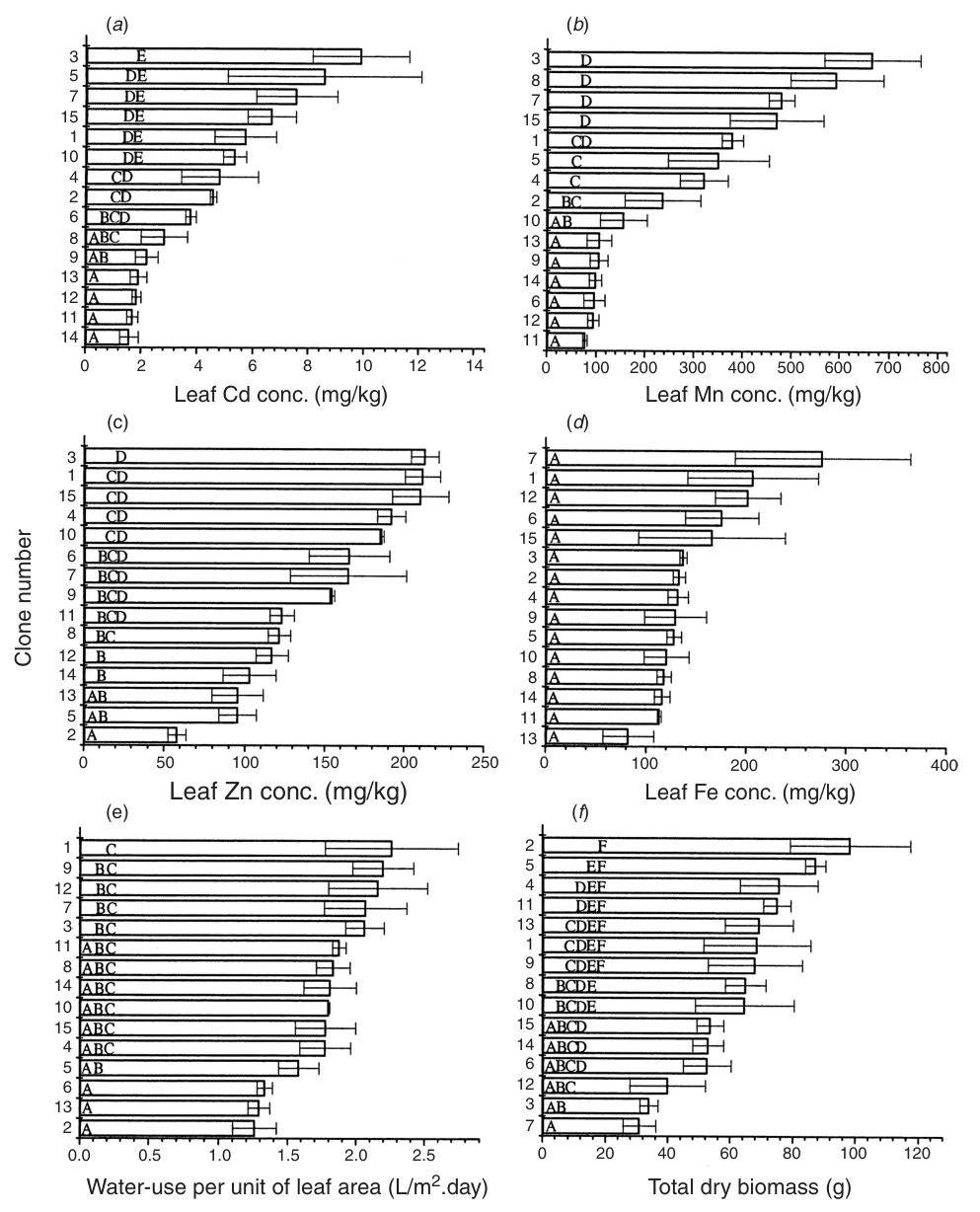
Figure 1a illustrates the mean leaf Cd concentration for each clone. Corresponding bioaccumulation coefficients ranged from 6 to 33. Shrub willows (sub-genus Caprisalix) had significantly (P < 0.01) higher leaf Cd concentrations than tree willows (sub-genus Salix) with mean values of 5.81 and 3.05 mg/kg, respectively.图1a显示了各无性系叶片Cd浓度的平均值。相应的生物积累系数为6~33。灌木柳(Caprisalix亚属)叶片Cd浓度显著(P < 0.01)高于乔木柳(Salix亚属),平均值分别为5.81和3.05 mg/kg。
Accumulation of Zn, Mn, and FeZn、Mn和Fe的积累
Evaluation of the leaf concentrations of Zn, Mn, and Fe was sought to provide additional information about the potential fodder value of different willow clones, and provide clues as to how and why there are differences in Cd accumulation between clonal types. Significant clonal variation was found for Mn and Zn (Fig. 1b, c) but not for Fe (Fig. 1d). These 3 elements were concentrated mostly in the leaves (Table 2). With the exception of Clone 2, the Zn bioaccumulation coefficient in the leaves was >1, whereas the Mn and Fe bioaccumulation coefficients were <1. As with Cd, shrub willows showed a higher level of Zn and Mn accumulation than tree willows. Average leaf metal concentrations for shrub and tree willows were, respectively, 391 and 159 mg/kg for Mn, 153 and 141 mg/kg for Zn, and 291 and 236 mg/kg for Fe.
测定叶片中Zn、Mn和Fe的浓度,旨在为不同柳树无性系的潜在饲用价值提供更多信息,并为不同类型无性系间Cd积累差异的机制和原因提供线索。Mn和Zn存在显著的无性系间差异(图1b, c),而Fe则无显著差异(图1d)。这3种元素主要富集于叶片中(表2)。除无性系2外,叶片中Zn的生物积累系数均 >1,而Mn和Fe的生物积累系数均 <1。与Cd相同,灌木柳对Zn和Mn的积累水平高于乔木柳。灌木柳和乔木柳叶片的平均金属浓度分别为:Mn 391和159 mg/kg,Zn 153和141 mg/kg,Fe 291和236 mg/kg。
Experiments investigating Cd toxicity revealed direct effects on both Mn and Zn metabolism in calves and sheep and showed that Zn consumption may annul toxic Cd effects (Van Bruwaene et al. 1986). Willows with a high Zn concentration may therefore be selected for fodder use so as to reduce Cd toxicity to stock. In addition, supplemental feeding of willow leaves to stock may alleviate Zn deficiency in areas with a low soil Zn concentration. Clark and Millar (1983) reported a Zn concentration of <5 mg/kg in New Zealand pasture species, compared with the mean Zn concentration in willow leaves of 148 mg/kg found here.
有关Cd毒性的试验表明,Cd对犊牛和绵羊的Mn和Zn代谢均有直接影响,且摄入Zn可能消除Cd的毒性作用(Van Bruwaene et al. 1986)。因此,可选择Zn浓度高的柳树用作饲料,以降低Cd对牲畜的毒性。此外,在土壤Zn浓度低的地区,以柳树叶片补饲牲畜可能缓解缺Zn问题。Clark and Millar(1983)报道新西兰牧草物种中的Zn浓度 <5 mg/kg,而本研究测得柳树叶片中Zn的平均浓度为148 mg/kg。
Metal accumulation in relation to water use and biomass production金属积累与耗水量及生物量产量的关系
Figure 1e illustrates plant water use per unit of leaf area. The Spearman Rank Correlation test of data presented in Fig. 1a–d (leaf metal concentrations) and Fig. 1e (water-use per unit leaf area) showed no significant relationships. This finding indicates that differences in metal accumulation between clones are controlled mostly by factor(s) other than water use. Our findings differ from those of Mills et al. (2000) because we investigated the relationship between Cd concentration and water-use over several different clones whereas Mills et al. (2000) investigated one single clone. There was no significant relationship between plant biomass production (Fig. 1f) and either leaf or stem metal concentration.图1e显示了单位叶面积的植物耗水量。对图1a–d(叶片金属浓度)和图1e(单位叶面积耗水量)数据进行Spearman秩相关检验,结果均未显示显著相关。这一结果表明,无性系间金属积累的差异主要受耗水量以外的因素控制。本研究结果与Mills et al.(2000)不同,原因在于本研究考察的是多个不同无性系的Cd浓度与耗水量之间的关系,而Mills et al.(2000)仅研究了单一无性系。植物生物量产量(图1f)与叶片或茎的金属浓度之间均无显著相关性。
Caution should be applied when extending our results to the field. The clonal variations with prospects for fodder or phytoremediation are nonetheless exciting and merit further exploration. Our experiments, however, conducted over one growing season, may not represent the long-term metal accumulation behaviour of the clones. The root morphology and soil-Cd distribution in the field need not bear any resemblance to our buckets filled with homogenised soil. The accumulation of metals could be affected by different soil types and the concentrations of other elements (Punshon and Dickinson 1997). The soil used in our experiments has a relatively low clay-fraction and organic matter content. This may have resulted in increased metal bioavailability and plant uptake, relative to other soils. The presence or absence of arbuscular mycorrhizal fungi may also play a role in the metal accumulation and tolerance of Salix (Harris and Jurgensen 1977).
将本研究结果外推至田间时应持审慎态度。尽管如此,无性系间的差异在饲料或植物修复方面展现出令人鼓舞的前景,值得进一步探索。然而,本试验仅进行了一个生长季,可能无法反映各无性系的长期金属积累特性。田间的根系形态和土壤Cd分布与本试验中装有混匀土壤的桶未必相似。金属的积累可能受不同土壤类型及其他元素浓度的影响(Punshon and Dickinson 1997)。本试验所用土壤的黏粒含量和有机质含量相对较低。与其他土壤相比,这可能导致金属生物有效性和植物吸收量升高。丛枝菌根真菌的存在与否也可能影响Salix的金属积累和耐受性(Harris and Jurgensen 1977)。
7Conclusions结论
Willow clones have been found to display a large interclonal variation with respect to Cd accumulation from soil. The most efficient clones for Cd-extraction have leaf Cd concentrations 6 times higher than the lowest one and they can concentrate Cd within leaves at levels 33 times that of the soil. These clonal differences cannot be attributed to either biomass or water-use. They may be due to some genetic expression and could be related to differing root microflorae. Shrub willows generally showed greater concentrations of elements within their leaves when compared with tree willow.
研究发现,柳树无性系在从土壤中积累Cd方面表现出很大的无性系间差异。Cd提取效率最高的无性系叶片Cd浓度是最低者的6倍,其叶片中Cd的富集水平可达土壤的33倍。这些无性系间差异既不能归因于生物量,也不能归因于耗水量。其可能源于某种基因表达,并可能与根际微生物区系的差异有关。与乔木柳相比,灌木柳叶片中的元素浓度普遍较高。
Willows with both high-biomass production and low leaf Cd concentrations, such as clones 11 and 13, can be selected for stock fodder on Cd-contaminated soils. These characteristics are typically found in tree willows. Shrub willows, such as clones 1 and 5, showed good biomass production, and their Cd concentration in their leaves tended to be higher indicating their suitability as phytoremediation plants for Cd-contaminated soil. Our results illustrate the potential for manipulating the characteristics of specific willow types to improve the appropriateness and efficacy for particular land management strategies.
兼具高生物量产量和低叶片Cd浓度的柳树(如无性系11和13)可选作镉污染土壤上的牲畜饲料。这些特性通常见于乔木柳。灌木柳(如无性系1和5)生物量产量良好,且叶片中Cd浓度往往较高,表明其适合作为镉污染土壤的植物修复植物。本研究结果表明,可通过利用特定柳树类型的特性,提高其对特定土地管理策略的适用性和效能。
8Acknowledgments致谢
Thanks to Vaughan Cruden for technical support and to Alistair Hall for assistance with statistical analysis. Harold van Es provided a thorough review of the manuscript. This work was conducted under the FRST contract C06X004 ‘Knowledge Tools for Environmental Action’.
感谢Vaughan Cruden提供的技术支持以及Alistair Hall在统计分析方面给予的帮助。Harold van Es对本文稿进行了全面审阅。本研究在FRST合同C06X004“Knowledge Tools for Environmental Action”(环境行动知识工具)资助下完成。
9References参考文献
Bramley RGV (1990) Cadmium in New Zealand agriculture. New Zealand Journal of Agricultural Research 33, 505–519.
Charles JG, Allan DJ (2000) Development of the willow sawfly, Nematus oligospilus, at different temperatures, and an estimation of voltinism throughout New Zealand. New Zealand Journal of Zoology 27, 197–200.
Chmelar J (1973) Propagation of willows by cuttings. New Zealand Journal of Forestry Science 4, 185–190. Clark RG, Millar KR (1983) Cobalt. In ‘The mineral requirements of grazing ruminants.’ (Ed. ND Grace) pp. 27–38. (New Zealand Society of Animal Production: Hamilton) Douglas GB, Bulloch BT, Foote AG (1996) Cutting management of willows (Salix spp.) and leguminous shrubs for forage during summer. New Zealand Journal of Agricultural Research 39, 175–184. Graham RP, Cragg LH (1959) Suspensions and colloidal dispersions. In ‘The essentials of chemistry’. (Eds RP Graham, LH Cragg) pp. 490–502. (Clarke, Irwin & Company Limited: Toronto)
Greger M, Landberg T (1997) Use of willow clones with high Cd accumulating properties in phytoremediation of agricultural soils with elevated Cd levels. In ‘Contaminated soils: 3rd International Conference on the Biogeochemistry of Trace Elements’. Paris, France, 15–19 May, 1995. (Ed. R Prost) pp. 505–511. (Institut National de la Recherche Agronomique (INRA): France) Greger M, Landberg T (1999) Use of willow in phytoextraction. International Journal of Phytoremediation 1, 115–123.
Harris MM, Jurgensen MF (1977) Development of Salix and Populus mycorrhizae in metallic mine tailings. Plant and Soil 47, 509–517.
Hathaway RL (1986) Short-rotation coppiced willows for sheep fodder in New Zealand. New Zealand Agricultural Science 20, 140–142.
Mills T, Robinson B, Green S, Clothier B, Fung L, Hurst S (2000) Difference in Cd uptake and distribution within poplar and willow species. In ‘Proceedings of the 42nd Annual Conference and Expo of the New Zealand Water and Waste Association’. Rotorua, New Zealand.
Nixon DJ, Stephens W, Tyrrel SF, Brierley EDR (2001) The potential for short rotation energy forestry on restored landfill caps. Bioresource Technology 77, 237–245.
Östman G (1994) Cd in Salix — a study of the capacity of Salix to remove Cd from arable soils. In ‘Willow vegetation filters for municipal wastewaters and sludges: A biological purification system. Proceedings
of a study tour, conference and workshop in Sweden’. (Eds P Aronsson, K. Perttu) pp. 153–155. (Sveriges Lantbruksuniversitet: Sweden) Punshon T, Dickinson N (1997) Acclimation of Salix to metal stress. New Phytologist 137, 303–314. Punshon T, Dickinson N (1999) Heavy metal resistance and accumulation characteristics in Willows. International Journal of Phytoremediation 1, 361–385. Riddell-Black D, Pulford ID, Stewart C (1997) Clonal variation in heavy metal uptake by willow. Aspects of Applied Biology 49, 327–334. Roberts AHC, Longhurst RD, Brown MW (1994) Cadmium status of soils, plants and grazing animals in New Zealand. New Zealand Journal of Agricultural Research 37, 119–129. Robinson BH, Mills TM, Petit D, Fung LE, Green SR, Clothier BE (2000) Natural and induced Cd-accumulation in poplar and willow: Implications for phytoremediation. Plant and Soil 227, 301–306. Underwood EJ, Suttle NF (1999) ‘The mineral nutrition of livestock.’ 3rd edn. pp. 531–533. (CAB International: Wallingford, UK) Van Bruwaene R, Kirchmann R, Impens R (1986) Cd contamination in agricultural and zootechnology. In ‘Cd in the environment’. (Eds H Mislin, O Ravera) (Birkhaüser: Basel, Boston, Stuttgart) Experientia Supplementum 50, 87–96. Wilkinson AG, Zsuffa L, Verwijst T (1999) Poplars and willows for soil erosion control in New Zealand. Biomass-and-Bioenergy 16, 263–274.