T. M. Mills
B. H. Robinson
Horticulture and Food Research Institute of New Zealand, Palmerston North, New Zealand
1INTRODUCTION引言
Near-constant growth of the world economy has been accompanied by a corresponding increase in contaminated sites and degraded lands. In North America and Western Europe alone, there are over 300,000 and 400,000 contaminated sites, respectively.[1] The range of contaminants polluting these sites is broad and consists of both organic and inorganic compounds, many of which are mobile within the soil profile and thus pose a threat to underlying groundwater and to surrounding environments. The negative effects these sites have on agricultural production and human health results in lowered economic growth and reduced quality of life. Mitigation of these negative effects is therefore imperative.
世界经济近乎持续的增长伴随着污染场地和退化土地的相应增加。仅在北美和西欧,污染场地就分别超过300,000处和400,000处。[1]污染这些场地的污染物种类繁多,包括有机和无机化合物,其中许多在土壤剖面中具有迁移性,因而对下伏地下水及周边环境构成威胁。这些场地对农业生产和人体健康的不利影响导致经济增长放缓和生活质量下降。因此,减轻这些不利影响势在必行。
Traditional cap-and-contain technology may be used at sites leaching contaminants to ground or surface waters; however, such caps are generally costly to install and may not retain their integrity long-term. Moreover, sealing the site in this manner does not result in contaminant degradation; thus, the initial problem may reappear if the cap degrades.
对于向地下水或地表水淋溶污染物的场地,可采用传统的覆盖封存技术;然而,此类覆盖层的安装成本通常较高,且可能无法长期保持完整性。此外,以这种方式封闭场地并不能使污染物降解;因此,一旦覆盖层退化,原有问题可能再次出现。
In some instances a vegetative cap may offer a sound alternative to traditional caps while allowing work toward future remediation of the site via phytostimulation and/or phytoextraction.[2] Here, we investigate the principles behind the hydrologic sealing of contaminated sites and discuss the application of vegetative caps. A case study is presented that outlines the establishment of a vegetation cap on a disused sawdust pile contaminated with boron, arsenic, copper, chromium, and pentachlorophenol (PCP).
在某些情况下,植被覆盖层可作为传统覆盖层的可靠替代方案,同时还可通过植物刺激和/或植物提取为场地的后续修复创造条件。[2]本文探讨了污染场地水文封闭的原理,并讨论了植被覆盖层的应用。文中还介绍了一个案例研究,概述了在一处受硼、砷、铜、铬和五氯苯酚(PCP)污染的废弃锯末堆上建立植被覆盖层的过程。
2PLANTS AS BIOPUMPS植物作为生物泵
Roots have been described as ‘‘the big movers of water and chemicals in soil.’’[3] Indeed, of the global average of 720 mm of rainfall per annum, some 410 mm are transpired from the earth surface by plants.[3] Plants require water for growth and regulation. Upward of 95% of water taken up by plants is returned to the atmosphere via evapotranspiration. This both cools the plant and translocates many essential, and nonessential, elements to the aboveground portions.
根系被描述为“土壤中水分和化学物质的主要搬运者”。[3]事实上,全球年均720 mm的降雨中,约有410 mm经由植物从地表蒸腾。[3]植物的生长和调节需要水分。植物吸收的水分中95%以上通过蒸散作用返回大气。这一过程既能为植物降温,又能将许多必需和非必需元素转运至地上部分。
Solar radiation is the primary driver of plant growth and water use, and climatic conditions set an upper limit on evapotranspiration. Biological variables determine the actual evapotranspiration of various vegetation types, which may be much less than the theoretical upper limit. In many climates, annual evapotranspiration is much greater from fast-growing deep-rooted trees than from shallow rooted herbs or grasses.[4] During periods of drought, deep-rooted species have greater access to water and continue to transpire long after shallow-rooted species have gone dormant. Tree canopies act as umbrellas where at least 15% of rainfall may be evaporated before it reaches the ground.[5] Some species have sunken stomata, and hairy or waxy leaves that can greatly reduce actual transpiration.[6] By closing stomata, many plants conserve water in conditions that would otherwise result in excessive water loss. Some species such as kiwifruit sometimes transpire at night.[7] Evapotranspiration is dependent on the developmental stage of the plants, primarily through the development or senescence in leaf area or leaf function.
太阳辐射是植物生长和水分利用的主要驱动因素,而气候条件决定了蒸散的上限。生物学变量决定了各类植被的实际蒸散量,其可能远低于理论上限。在许多气候条件下,速生深根树木的年蒸散量远大于浅根草本植物或禾草。[4]在干旱期间,深根物种更易获取水分,在浅根物种进入休眠后仍能长时间持续蒸腾。树冠起到伞的作用,至少15%的降雨可在到达地面之前被蒸发。[5]一些物种具有下陷气孔以及多毛或蜡质叶片,可大幅降低实际蒸腾量。[6]许多植物通过关闭气孔,在原本会导致过度失水的条件下保存水分。一些物种(如猕猴桃)有时会在夜间蒸腾。[7]蒸散取决于植物的发育阶段,主要通过叶面积或叶片功能的发育或衰老而体现。
These biological parameters should be carefully considered when choosing a vegetative cap for landfills. Species should be chosen that tolerate the range of local climatic and edaphic conditions. Shallow-rooted turf species do control surface erosion and dust from a contaminated site; however, turf does not give the same level of water removal from deep within the profile as tree species may. The shallow-rooted nature of many turf species means contaminant leaching is generally greater under a grass cover when compared to trees.[4]
为填埋场选择植被覆盖层时,应认真考虑上述生物学参数。所选物种应能耐受当地一系列气候和土壤条件。浅根草坪物种确实能够控制污染场地的表面侵蚀和扬尘;然而,草坪无法像树种那样从剖面深处去除同等程度的水分。由于许多草坪物种根系较浅,与树木相比,草被覆盖下的污染物淋溶通常更为严重。[4]
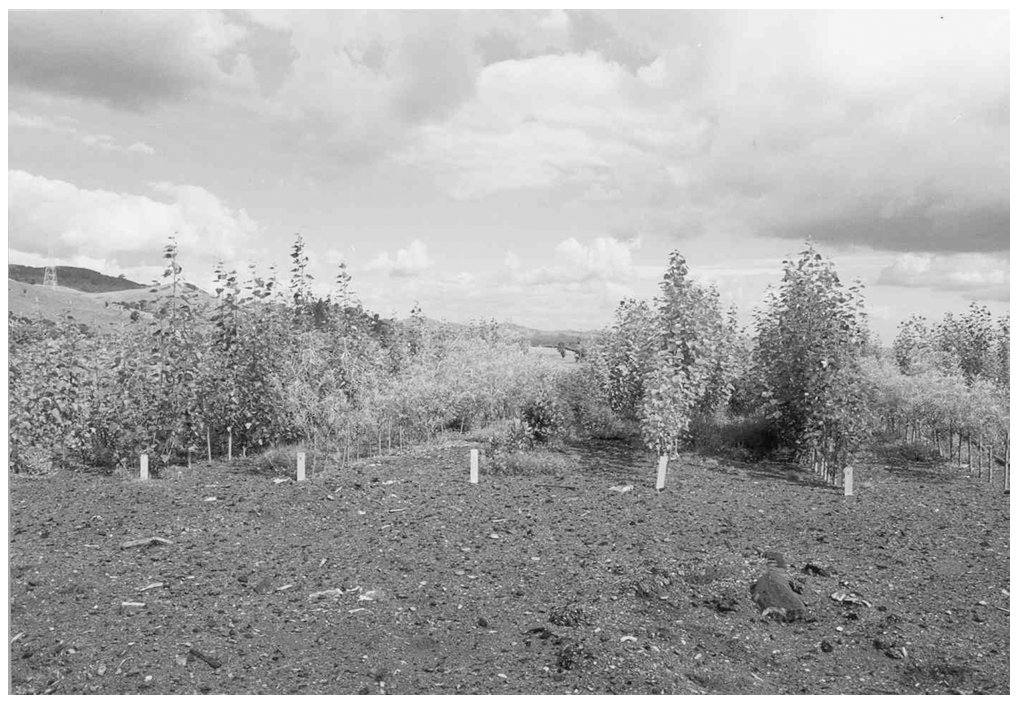
Vegetative caps using several species or varieties overcome the risk of all plants being destroyed by pests or environmental conditions. If the substrate to be vegetated is not soil, trials may be needed to determine the optimal species for the vegetative cap. Fig. 1 demonstrates the effect of genetic differences among poplar clones grown on a contaminated sawdust pile.
采用多个物种或品种构建植被覆盖层,可避免所有植物因病虫害或环境条件而全部毁损的风险。若待植被化的基质并非土壤,则可能需要开展试验以确定植被覆盖层的最佳物种。图1展示了生长于污染锯末堆上的杨树无性系之间遗传差异的影响。
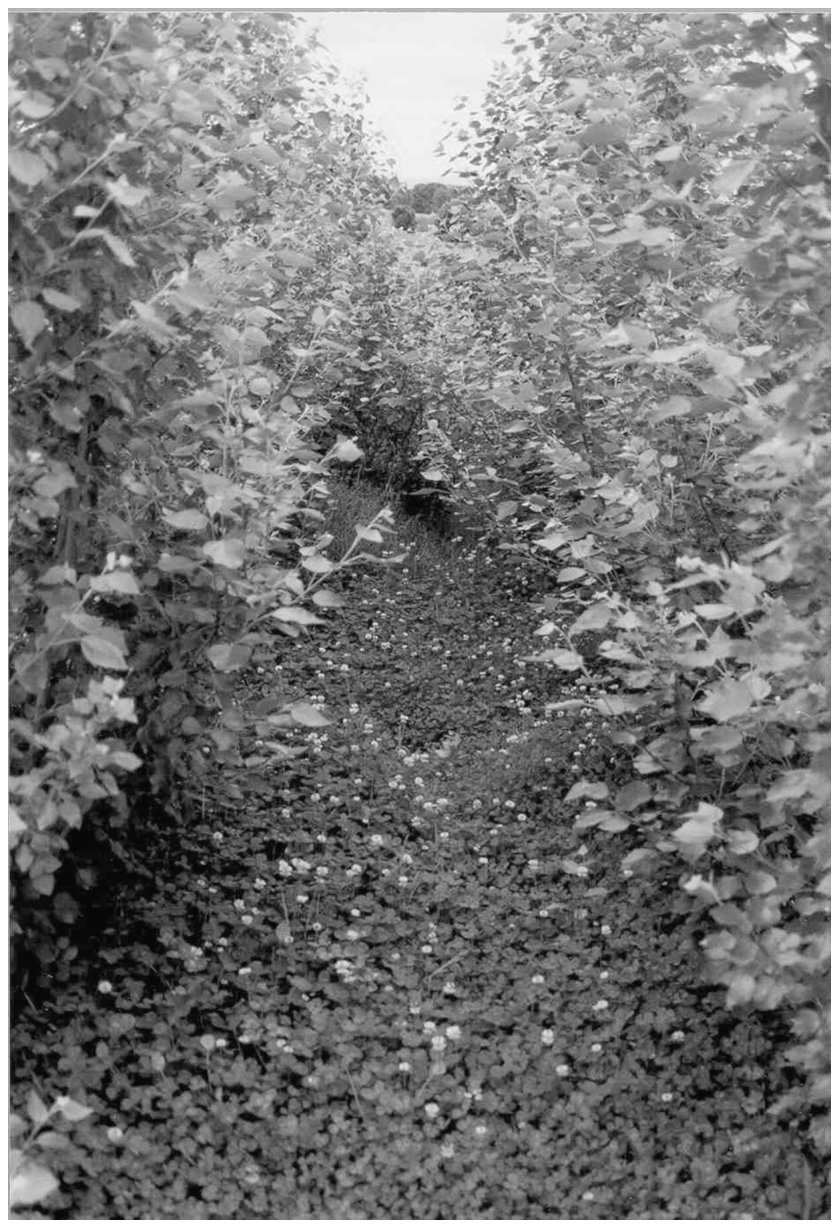
Low-growing species may be combined with deciduous tree species to provide a transpiring green surface during the winter months. Legumes can be used to fix nitrogen in low-fertility substrates such as mine tailings or sawdust piles (Fig. 2).
低矮物种可与落叶树种组合种植,以在冬季提供具有蒸腾作用的绿色表面。豆科植物可用于在尾矿或锯末堆等低肥力基质中固氮(图2)。

Before planting, contaminated sites may be capped with soil to provide a fertile substrate for plant growth and a buffer zone that captures and stores rainfall. Although more expensive, such ‘‘sponge and pump’’ systems reduce leaching by providing the vegetation with a longer period to transpire infiltrated water. This is due to the retention of water within the soil buffer zone and subsequent uptake by the plants. The soil cap thickness may be critical to the success of the vegetative cap, and must be balanced with the costs of earthmoving.
种植前,可在污染场地上覆盖一层土壤,为植物生长提供肥沃基质,并形成截留和储存降雨的缓冲区。此类“海绵与泵”系统虽然成本较高,但能为植被提供更长的时间来蒸腾入渗水分,从而减少淋溶。这是由于水分被保持在土壤缓冲区内,随后被植物吸收。土壤覆盖层的厚度可能对植被覆盖层的成败至关重要,且须与土方工程成本相权衡。
Modeling the performance of the vegetative cap can provide information on project viability and optimal site management, such as the thickness (if any) of the soil cap, species selection, fertilization, and required irrigation.
对植被覆盖层的性能进行模拟,可为项目可行性和最佳场地管理提供信息,例如土壤覆盖层的厚度(如需要)、物种选择、施肥以及所需灌溉量。
Plant water use can be calculated using a modified Penman–Monteith equation[8] that integrates environmental factors, including net solar radiation, ambient air temperature, and vapor pressure deficit between air and plant leaves, and that includes stomatal conductance and tree leaf area data. Whole-system models can calculate water and contaminant movement in the substrate–plant– atmosphere continuum and may predict the vegetative caps performance for mitigating environmental effects.
植物耗水量可采用修正的Penman–Monteith方程[8]计算,该方程综合了净太阳辐射、环境气温以及空气与植物叶片之间的水汽压差等环境因子,并纳入了气孔导度和树木叶面积数据。整体系统模型可计算基质–植物–大气连续体中水分和污染物的运移,并可预测植被覆盖层在减轻环境影响方面的性能。
Vegetative caps are porous and leaching may occur in some climates. In systems where rainfall is greater than evapotranspiration, leaching can be managed by trapping the leachate leaving the site and circulating it back onto the vegetation.[9] In effect this can be done ad infinitum and with each pass through the root zone the leachate is further modified and more contaminants removed. An increase in the level of solutes including sodium and chloride within the leachate may be of concern if leachate is to be reapplied to the site. However, depending on the composition of the leachate, it may have beneficial effects on plant growth when compared to unirrigated vegetation.[9] If leachate is applied via overhead sprinklers, there may be a negative effect on plant foliage and growth; thus, application directly onto the substrate surface is recommended.[9]
植被覆盖层具有多孔性,在某些气候条件下可能发生淋溶。在降雨量大于蒸散量的系统中,可通过截留离开场地的渗滤液并将其回灌至植被上来管理淋溶。[9]实际上,这一过程可无限循环,渗滤液每次通过根区都会得到进一步改变,更多污染物被去除。若渗滤液需回灌至场地,其中钠和氯等溶质含量的增加可能值得关注。然而,视渗滤液组成而定,与未灌溉的植被相比,其可能对植物生长产生有益影响。[9]若通过顶部喷灌施用渗滤液,可能对植物叶片和生长产生不利影响;因此,建议直接施用于基质表面。[9]
Where rainfall is greater than evapotranspiration, there is no possibility of eliminating drainage. However, vegetative caps may be used to eliminate drainage during low-rainfall periods. Depending on the contaminants in the drainage, the small volumes leached during wet periods may be diluted in receiving waters to the point so that they do not pose an environmental risk.
在降雨量大于蒸散量的地区,不可能完全消除排水。然而,植被覆盖层可用于在少雨期消除排水。视排水中所含污染物而定,湿润期淋溶的少量水分在受纳水体中可被稀释至不构成环境风险的程度。
Limitations of Vegetative Caps植被覆盖层的局限性
Vegetative caps will not always provide a suitable solution for contaminated sites. Contaminant toxicity or extreme environmental conditions may prevent plant establishment and effective seal development. In high-rainfall regions, plant transpiration will not be able to keep pace with drainage from the site, thus rendering the vegetative cap ineffective. If an instant solution is sought then a vegetative cap may not be appropriate. The time to establish a sound vegetative cap is dependent on the species of plant selected, but in general it will take 2–4 years with perennial tree species. Common choices include Populus sp., including cottonwood, and the Salix sp. These tree species are chosen because of their rapid establishment, high water-use characteristics, high tolerance of environmental and contaminant extremes, ease of establishment, and ability to take up some contaminants.[10] Drying the soil profile may create an aerobic environment where metal mobility is reduced.[2] Biological activity is enhanced under vegetation, which stimulates the decomposition of some organic compounds.[11]
植被覆盖层并非总能为污染场地提供合适的解决方案。污染物毒性或极端环境条件可能阻碍植物定植和有效封闭层的形成。在高降雨地区,植物蒸腾无法跟上场地的排水速度,从而使植被覆盖层失效。若寻求即时解决方案,则植被覆盖层可能并不适用。建立稳固植被覆盖层所需的时间取决于所选植物物种,但对于多年生树种一般需要2–4年。常用的选择包括Populus sp.(包括三角叶杨)和Salix sp.。选择这些树种是因为其定植迅速、耗水量高、对极端环境和污染物条件耐受性强、易于栽植,并能吸收部分污染物。[10]使土壤剖面变干可形成好氧环境,从而降低金属的迁移性。[2]植被下的生物活性增强,可促进某些有机化合物的分解。[11]
Application应用
Long-term management of closed landfills has posed problems in the past. Generally, a clay cap is installed and turf is established. Because of the settling of waste under the cap with time, clay caps can lose integrity as they age. The establishment of a deep-rooted species on closed landfills can control leachate migration from the site and allows circulation of leachate back onto the site, closing the hydrological system.
封场填埋场的长期管理以往一直存在问题。通常的做法是安装黏土覆盖层并建植草坪。由于覆盖层下的废弃物随时间沉降,黏土覆盖层随老化可能丧失完整性。在封场填埋场上建植深根物种可控制渗滤液从场地向外迁移,并可将渗滤液回灌至场地,从而形成闭合的水文系统。

Hydrologic Management of Contaminated Sites Using Vegetation
利用植被对污染场地进行水文管理
The establishment of vegetation directly on metalliferous mine tailings controls leaching and erosion and also wind-borne dust contamination of surrounding environments. Sites contaminated with organic compounds may be remediated through plants via phytostimulation of soil microflora and fauna, which degrade organic compounds to their primary products.[12]
直接在含金属尾矿上建立植被可控制淋溶和侵蚀,以及风蚀扬尘对周边环境的污染。受有机化合物污染的场地可通过植物刺激土壤微生物区系和动物区系进行修复,后者可将有机化合物降解为其初级产物。[12]
Soluble fertilizers and nutrients, such as N and P, pose a serious pollution threat to ground and surface water bodies. Plants can be used to protect riparian areas from stock effluent and from applied fertilizers. Work currently progressing in New Zealand indicates that dairy shed effluent may be applied to poplar and willow species as an alternative to application directly onto pasture (data not currently published). This has advantages in that the water use of trees is greater than grass.[4] Trees therefore work more effectively as N sponges and require less area in systems where excess N tends to leach and become a contaminant. The biomass produced by palatable species may be fed to stock as fodder.
可溶性肥料和养分(如N和P)对地下水和地表水体构成严重的污染威胁。植物可用于保护河岸地带免受牲畜排泄物和施用肥料的影响。新西兰目前正在开展的研究表明,可将奶牛场废水施用于杨树和柳树,以替代直接施用于牧场(数据尚未发表)。其优势在于树木的耗水量大于牧草。[4]因此,在过量N易于淋溶并成为污染物的系统中,树木作为N“海绵”的效果更好,且所需面积更小。适口性物种产生的生物量可作为饲料饲喂牲畜。
Case Study案例研究
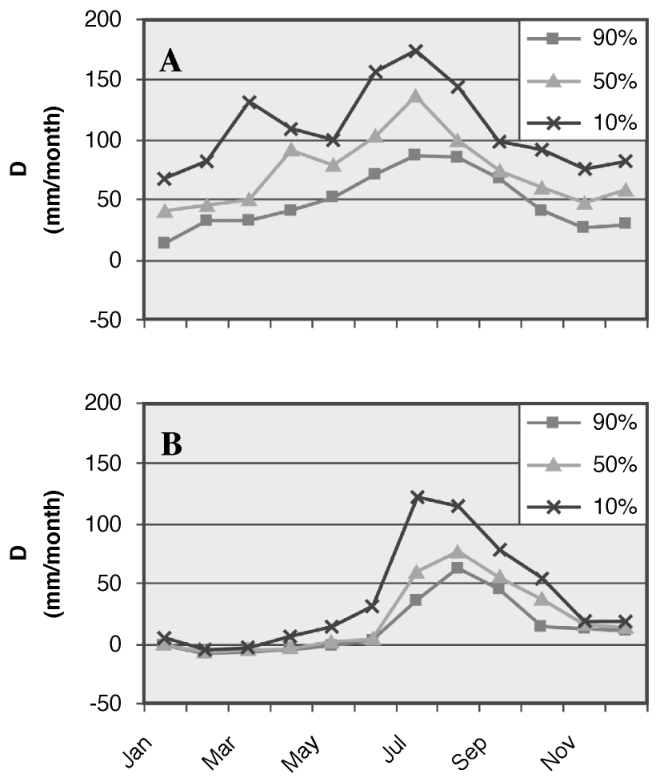
A disused sawdust pile, 15 m deep and 5 ha in size, contaminated with As, B, Cu, and Cr was continuously leaching B, As, and tannins into local surface water bodies and into the nearby harbor. Under New Zealand’s Resource Management Act (1991), the site owners were required to avoid, remedy, or mitigate any adverse effects of their activity on surrounding environs. A traditional clay cap was initially proposed for the site; however, the cost of cap installation was approximately $750,000. An alternative strategy proposed included the establishment of selected poplar species on the site and the installation of a dam to trap escaping leachate to recirculate it onto the sawdust pile. A risk assessment, using the soil plant atmosphere model (SPASMO) similar to that described in Ref. [13] demonstrated the change in site water balance with the establishment of vegetative cap (Fig. 3). Table 1 gives mean monthly precipitation, mean monthly potential evapotranspiration, and the mean monthly number of expected rainfall days for the site to aid interpretation of
一处深15 m、面积5 ha的废弃锯末堆受到As、B、Cu和Cr污染,持续向当地地表水体及附近港湾淋溶B、As和单宁。根据新西兰《资源管理法》(1991),场地所有者须避免、补救或减轻其活动对周边环境的任何不利影响。最初为该场地提出的方案是传统黏土覆盖层;然而,覆盖层的安装成本约为$750,000。另一替代策略包括在场地上种植选定的杨树物种,并修建一座水坝截留外泄的渗滤液,将其回灌至锯末堆上。采用与文献[13]所述类似的土壤–植物–大气模型(SPASMO)进行的风险评估表明,建立植被覆盖层后场地水分平衡发生了变化(图3)。表1列出了该场地的月平均降水量、月平均潜在蒸散量及月平均预期降雨日数,以辅助解读
| Month月份 | Mean precipitation (mm)平均降水量(mm) | Mean evapotranspiration (mm)平均蒸散量(mm) | Mean number of rain days平均降雨日数 |
|---|---|---|---|
| Jan | 65.14 | 129.02 | 7.2 |
| Feb | 63.87 | 112.51 | 5.2 |
| March | 98.65 | 100.69 | 7.7 |
| April | 95.58 | 72.66 | 9.0 |
| May | 85.12 | 56.63 | 10.3 |
| June | 121.69 | 44.97 | 11.5 |
| July | 141.85 | 48.70 | 13.0 |
| Aug | 121.48 | 54.96 | 13.5 |
| Sept | 111.00 | 65.56 | 12.4 |
| Oct | 81.45 | 86.89 | 10.2 |
| Nov | 79.08 | 102.30 | 9.3 |
| Dec | 80.62 | 121.10 | 8.3 |
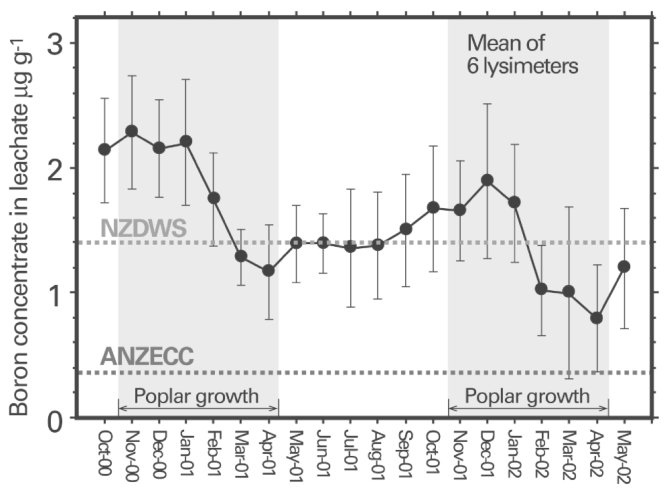
Fig. 3. Parallel lysimeter studies were conducted in conjunction with plant establishment on the pile. SPASMO was parameterized for the poplar species grown at Kopu from data collected during the lysimeter study.[2] Full details for the lysimeter experiment are outlined in Ref. [14]. The lysimeter study demonstrated the efficacy of poplar to remove B from the exiting leachate (Fig. 4). Data from this study also show accumulation of B within poplar leaves of lysimeter grown trees to levels as high as 700 mgkg�1 dry mass.[2] Traces of Cu and Cr were also recorded in poplar leaves from the lysimeter study.[2] Boron removal coupled with the poplar trees capacity to dewater the site suggest poplars provide a suitable phytoremediation tool for B contaminated sawdust.[2] As the trees mature, hydrologic management of the field site will be further enhanced.图3。在锯末堆上建植植物的同时,开展了平行的渗漏计研究。利用渗漏计研究期间收集的数据,对SPASMO中Kopu所种杨树物种的参数进行了设定。[2]渗漏计试验的详细情况见文献[14]。渗漏计研究证实了杨树去除外排渗滤液中B的效果(图4)。该研究数据还表明,渗漏计中生长的杨树叶片中B的积累量高达700 mg kg−1干重。[2]渗漏计研究中还在杨树叶片中检测到微量Cu和Cr。[2]B的去除加之杨树使场地脱水的能力表明,杨树是修复受B污染锯末的合适植物修复工具。[2]随着树木成熟,田间场地的水文管理将得到进一步加强。
3CONCLUSION结论
In contrast to the immediate solution provided by traditional containment technologies, living vegetative caps may take 4 to 5 years to become fully functional. However, in suitable circumstances living systems can offer better long-term solutions, which improve with time. This may provide a remediation solution rather than a solution that conceals the problem for others to confront later. Trees have aesthetic and ecological advantage. They enhance the environment and enjoy wide public acceptance. Hydrologic management of contaminated sites using vegetation will not always be a suitable solution; however, increasing public awareness and a demand to ‘‘do something’’ will ensure a steady increase in the use of plants, either alone or in conjunction with more traditional containment solutions.
与传统封存技术提供的即时解决方案不同,活体植被覆盖层可能需要4至5年才能完全发挥作用。然而,在适宜条件下,活体系统可提供更好的长期解决方案,且效果随时间推移而改善。这可能提供的是一种修复方案,而非将问题掩盖、留待他人日后应对的方案。树木具有美学和生态优势,能够改善环境并广受公众认可。利用植被对污染场地进行水文管理并非总是合适的解决方案;然而,公众意识的提高以及“有所作为”的诉求,将确保植物的使用稳步增加,无论是单独使用还是与更传统的封存方案结合使用。
4REFERENCES参考文献
1. Glass, D.J. US and International Markets for Phytoremediation, 1999–2000; D. Glass and Associates, Inc.: Needham, MA, 1999.
2. Robinson, B.; Green, S.; Mills, T.; Clothier, B.; van der Velde, M.; Laplane, R.; Fung, L.; Deurer, M.; Hurst, S.; Thayalakumaran, T.; van den Dijssel, C. Phytoremediation: Using plants as biopumps to improve degraded environments. Austr. J. Soil. Res. 2003, 41 (3), 599–611.
3. Clothier, B.E.; Green, S.R. Roots: The big movers of water and chemical in soil. Soil Sci. 1997, 162 (8), 534–543.
4. Vogeler, I.; Green, S.R.; Clothier, B.E.; Kirkham, M.B.; Robinson, B.H. Contaminant Transport in the Root Zone. In Trace Elements in the Soil, Bioavailability, Flux and Transfer; Iskandar, I.K., Kirkham, M.B., Eds.; Lewis Publishers: Boca Raton, FL, 2001.
5. McNaughton, K.G.; Jarvis, P.G. Effects of Vegetation on Transpiration and Evaporation. In Water Deficits and Plant Growth, Vol. VII, Additional Woody Crop Plants; Kozlowski, T.T., Ed.; Academic Press: New York, 1983.
6. Salisbury, F.B.; Ross, C.W. The Photosynthesis–Transpiration Compromise. In Plant Physiology, 2nd Ed.; Wadsworth Publishing Company Inc.: Belmont, CA, 1978.
7. Green, S.R.; McNaughton, K.G.; Clothier, B.E. Observations of night-time water use in kiwifruit vines and apple trees. Agric. For. Meteorol. 1989, 48, 251–261.
8. Allen, R.G.; Pererira, L.S.; Raes, D.; Smith, M. Crop Evapotranspiration. Guidelines for Computing Crop Water Requirements. In FAO Irrigation and Drainage Paper No. 56; FAO: Rome, 1998.
9. Nixon, D.J.; Stevens, W.; Tyrrel, S.F.; Brierley, E.D.R. The potential for short rotation forestry on restored landfill caps. Bioresour. Technol. 2001, 77, 237–245.
10. Quinn, J.J.; Negri, C.M.; Hinchman, R.R.; Moos, L.P.; Wozniak, J.B.; Gatliff, E. Predicting the effect of deep-rooted hybrid poplars on the groundwater flow system at a large scale phytoremediation site. Int’l. J. Phytoremidiat. 2001, 3 (1), 41–60.
11. Boyle, J.J.; Shann, J.R. Biodegradation and bioremediation: The influence of planting and soil characteristics on mineralizataion of 2,4,5-T in rhizosphere soil. J. Environ. Qual. 1998, 27, 704–709.
12. Campanella, B.F.; Bock, C.; Schroder, P. Phytoremediation to increase the degradation of PCBs and PCDD/Fs: Potential and limitations. Environ. Sci. Pollut. Res. 2002, 9 (1), 73–85.
13. Green, S.R.; Clothier, B.E.; Mills, T.M.; Millar, A. Risk assessment of irrigation requirements of field crops in a maritime climate. J. Crop Prod. 1999, 2 (2), 353–377.
14. Willits, P. Natural Caps Prove to be an Economic Landfill Solution. Business First of Columbus; http://columbus. bizjournals.com/columbus/stories/2002/11/25/focus5.html (accessed Nov 22, 2002).