S. M. Keeling,1,2* R. B. Stewart,1 C. W. N. Anderson,1 and B. H. Robinson3 1Soil and Earth Sciences, Institute of Natural Resources, Massey University, Palmerston North, New Zealand; 2Currently, School of Earth Sciences, James Cook University, Cairns, Australia; 3HortResearch Ltd., Palmerston North, New Zealand
S. M. Keeling,1,2* R. B. Stewart,1 C. W. N. Anderson,1 和 B. H. Robinson3 1梅西大学自然资源研究所土壤与地球科学系,新西兰北帕默斯顿(Palmerston North); 2现工作单位:詹姆斯库克大学地球科学学院,澳大利亚凯恩斯; 3HortResearch有限公司,新西兰北帕默斯顿(Palmerston North)
∗ Corresponding author: Soil and Earth Sciences, Institute of Natural Resources, PB 11-222, Massey University, Palmerston North, New Zealand.
∗ 通讯作者:梅西大学自然资源研究所土壤与地球科学系,PB 11-222,新西兰北帕默斯顿(Palmerston North)。
1ABSTRACT摘要
We investigated the potential of the South African high-biomass Ni hyperaccumulator Berkheya coddii to phytoextract Co and/or Ni from artificial metalliferous media. Plant accumulation of both metals from single-element substrates indicate that the plant/media metal concentration quotient (bioaccumulation coefficient) increases as total metal concentrations increase. Cobalt was readily taken up by B. coddii with and without the presence of Ni. Nickel uptake was, however, inhibited by the presence of an equal concentration of Co. Bioaccumulation coefficients of Ni and Co for the single element substrates (total metal concentration of 1000 µg g−1) were 100 and 50, respectively. Cobalt phytotoxicity was observed above a total Co concentration in plant growth media of 20 µg g−1. Elevated Co concentrations significantly decreased the biomass production of B. coddii without affecting the bioaccumulation coefficients. The mixed Ni–Co substrate produced bioaccumulation coefficients of 22 for both Ni and Co. Cobalt phytotoxicity in mixed Ni–Co substrate occurred above a total Co concentration of 15 µg g−1. When grown in the presence of both Ni and Co, the bioaccumulation coefficients of each metal were reduced, as compared to single-element substrate. This may indicate competition for binding sites in the root zone. The interference relationship between Ni and Co uptake demonstrated by B. coddii suggests a significant limitation to phytoextraction where both metals are present.
本研究考察了南非高生物量镍超富集植物Berkheya coddii从人工含金属基质中植物提取Co和/或Ni的潜力。植物从单一元素基质中对两种金属的累积结果表明,植物/基质金属浓度比(生物富集系数)随基质金属总浓度的升高而增大。无论是否存在Ni,B. coddii均易于吸收Co。然而,等浓度Co的存在抑制了Ni的吸收。在单一元素基质中(金属总浓度为1000 µg g−1),Ni和Co的生物富集系数分别为100和50。当植物生长基质中Co总浓度高于20 µg g−1时,出现Co植物毒性。Co浓度升高显著降低了B. coddii的生物量,但不影响生物富集系数。在Ni–Co混合基质中,Ni和Co的生物富集系数均为22。在Ni–Co混合基质中,Co总浓度高于15 µg g−1时即出现Co植物毒性。与单一元素基质相比,在Ni和Co共存条件下生长时,两种金属的生物富集系数均降低,这可能表明二者在根区存在结合位点竞争。B. coddii所表现出的Ni与Co吸收之间的相互干扰关系表明,在两种金属共存的情况下,植物提取将受到显著限制。
KEY WORDS: Berkheya coddii, cobalt, nickel, hyperaccumulation, phytomining, phytotoxicity.
关键词: Berkheya coddii,钴,镍,超富集,植物采矿,植物毒性。
2I. INTRODUCTION一、引言
Phytoextraction is a process that has applications for the recovery of metal from substrates such as soil, particularly those associated with sub-economic mineralizations and contamination by industry. Numerous sites across the globe that are enriched with heavy metals could potentially be phytoremediated (decontamination by phytoextraction) and/or phytomined (commercial production of metals via cropping). This technology also has potential application in the minerals industry for the phytomining and phytoremediation of low-grade ores and metalliferous mine spoils.
植物提取是一种可用于从土壤等基质中回收金属的技术,尤其适用于与次经济品位矿化及工业污染相关的基质。全球范围内众多富含重金属的场地均有可能实施植物修复(通过植物提取去除污染)和/或植物采矿(通过种植作物商业化生产金属)。该技术在矿业领域亦具有应用潜力,可用于低品位矿石及含金属尾矿废弃物的植物采矿和植物修复。
Hyperaccumulator plants are plant species that are able to accumulate abnormal concentrations of various metal in their tissues. Brooks et al. (1977) defined hyperaccumulation of Ni and Co as being concentrations greater than 1000 µg g−1 (ppm) of dried plant material. The hyperaccumulation level varies for different metals, e.g., 10,000 µg g−1 Zn and Mn (Brooks et al., 1977).
超富集植物是指能够在其组织中累积异常高浓度各种金属的植物物种。Brooks et al.(1977)将Ni和Co的超富集定义为干燥植物材料中浓度大于1000 µg g−1(ppm)。不同金属的超富集阈值不同,例如Zn和Mn为10,000 µg g−1(Brooks et al., 1977)。
The South African Ni hyperaccumulator Berkheya coddii is an asteraceous perennial plant that typically grows to 2 m in height and is confined to ultramafic outcrops in the Eastern Transvaal near Barberton (Brooks, 1998). Berkheya coddii is one of over 300 known Ni hyperaccumulators with reported foliar Ni concentrations in excess of 17,000 µg g−1 (1.7%) dry mass (Howes, 1991; Howes et al., 1998; Morrey et al., 1989).
南非镍超富集植物Berkheya coddii为菊科多年生植物,株高通常可达2 m,仅分布于Barberton附近东德兰士瓦(Eastern Transvaal)的超基性岩露头上(Brooks, 1998)。Berkheya coddii是已知300余种镍超富集植物之一,据报道其叶片Ni浓度超过17,000 µg g−1(1.7%)干重(Howes, 1991; Howes et al., 1998; Morrey et al., 1989)。
Phytoextraction using hyperaccumulating plants was first proposed by Chaney (1983) and later by McGrath et al. (1993), who demonstrated that these plants could be used to recover soil contaminants. The technique required cultivating the crop of hyperaccumulators selected for the ability to take up the target contaminants on the polluted soil. The above-ground biomass would be harvested and combusted to produce an ash containing the contaminant metals. This metal-rich ash, typically only 7% of the original weight of the dried biomass, would then be stored or treated in a smelter to recover the metals for sale to offset the cost of soil remediation. The technique was termed phytoremediation and is the subject of a considerable research effort worldwide (Brooks, 1998; Raskin et al., 1994; Salt et al., 1995).
利用超富集植物进行植物提取最早由Chaney(1983)提出,随后McGrath et al.(1993)证明此类植物可用于去除土壤污染物。该技术需在污染土壤上种植经筛选、具有吸收目标污染物能力的超富集植物。收获其地上部生物量并加以焚烧,得到含有污染金属的灰分。这种富含金属的灰分通常仅占原干生物量重量的7%,随后可加以贮存,或送入冶炼厂处理以回收金属并出售,从而抵消土壤修复成本。该技术被称为植物修复,目前在全球范围内受到大量研究关注(Brooks, 1998; Raskin et al., 1994; Salt et al., 1995)。
Nicks and Chambers (1994, 1995, 1998) reported a novel application for hyperaccumulating plants, termed phytomining, by cultivating a crop of a Ni accumulator on a substrate containig Ni concentrations that were considered sub-economic by today’s modern mining methods. They showed that the California Ni hyperaccumulator Streptanthus polygalides could recover over 100 kg ha−1 of Ni from a serpentine soil. Robinson et al. (1997) achieved a similar Ni recovery rate from serpentine soil using B. coddii.
Nicks和Chambers(1994, 1995, 1998)报道了超富集植物的一种新应用,即植物采矿:在按现代采矿方法衡量属于次经济品位的含Ni基质上种植镍富集植物。他们发现,加利福尼亚镍超富集植物Streptanthus polygalides可从蛇纹岩土壤中回收超过100 kg ha−1的Ni。Robinson et al.(1997)利用B. coddii从蛇纹岩土壤中获得了相近的Ni回收率。
As a result of the large-scale development of lateritic Ni–Co deposits in Australia, significant volumes of waste materials require rehabilitation. Similarly, the shallow depths to which laterite miners excavate these deposits exposes large areas of (often) bare saprolitic rock. These sub-economic materials often still contain minerals at levels that are suitable for phytoextraction. For example, saprolitic pit-floor waste rock from the Murrin Murrin dry Ni–Co laterite mine in Western Australia, operated by Anaconda Nickel Limited, contained 3.3% Ni, 900 µg Co g−1, and 6.5% Mg (Keeling, 2000).
由于澳大利亚红土型Ni–Co矿床的大规模开发,大量废弃物料亟需进行复垦。同样,红土矿开采深度较浅,导致大面积(通常为)裸露的腐岩暴露于地表。这些次经济品位物料中的矿物含量往往仍适于植物提取。例如,由Anaconda Nickel Limited运营的西澳大利亚Murrin Murrin干式Ni–Co红土矿,其采坑底部腐岩废石含Ni 3.3%、Co 900 µg g−1、Mg 6.5%(Keeling, 2000)。
Since the value of Co on the world market is often 3–4 times that of Ni, it is surprising that little quantitative research has emerged reporting Co accumulation or Ni–Co co-accumulation in B. coddii. It was therefore decided to investigate the Ni, Co, and Ni–Co uptake potential of B. coddii under controlled greenhouse conditions using pot trial experiments of mono- and bi-metal substrates as a prelude to investigating its response to polymetallic lateritic materials.
鉴于Co在国际市场上的价格通常为Ni的3–4倍,令人意外的是,有关B. coddii对Co的累积或Ni–Co共累积的定量研究报道甚少。因此,本研究决定在可控温室条件下,采用单金属和双金属基质的盆栽试验,考察B. coddii对Ni、Co及Ni–Co的吸收潜力,为进一步研究其对多金属红土物料的响应奠定基础。
3II. MATERIALS AND METHODS二、材料与方法
All experiments were conducted in climate-controlled glasshouses in a plant growth unit. Glasshouse temperatures were regulated between 15◦C (night) and 25◦C (day) and growth lamps maintained a daylight period of 14 hours per day. The single metal substrates were prepared by blending 10 g of finely ground solid Ni or Co sulphate to 10 kg of a potting mix composed of 50% peat and 50% finely sieved pumice with additions of lime, dolomite, and “Osmocote” (a three-month slow-release fertilizer) at rates recommended by the manufacturer. These 1000 µg g−1 Ni- and Co-only substrates were then further blended at a ratio of 1:3 with the same potting mix (devoid of Ni and Co) to produce a final substrate concentration range of 1000, 333, 111, 37, 12, and 4 µg g−1 Ni or Co, respectively. The mixed Ni–Co substrate was prepared by blending equal amounts of both the single metal substrates together to produce potting medium containing concentrations of both elements at 500, 333, 111, 37, 12, and 4 µg g−1 Ni and Co. Six-week-old seedlings of B. coddii propagated from commercially available germination mix were transplanted into 280 mL pots containing the prepared substrates. Eight replicates of each treatment were prepared. After two weeks, fresh seedlings were added to pots with poor survival. After 12 weeks, all above-ground biomass was harvested, oven dried at 70◦C overnight, and dry weights (DW) were recorded to determine rates of biomass production. Sub-samples of biomass from each soil treatment were then ground, weighed, and ashed at 540◦C in a muffle furnace until fully combusted. The resulting ash was accurately weighed and digested in near-boiling 2-M HCl, agitated, and analyzed by flame atomic absorption spectroscopy (FAAS). All data were tested for normality and analyzed using ANOVA due to the observed normal distribution.
所有试验均在植物生长中心的气候可控玻璃温室中进行。温室温度控制在15◦C(夜间)至25◦C(白天)之间,并以生长灯维持每天14 h的光照期。单一金属基质的制备方法为:将10 g磨细的固体硫酸镍或硫酸钴与10 kg盆栽基质混匀;该盆栽基质由50%泥炭和50%细筛浮石组成,并按生产商推荐用量添加石灰、白云石和“Osmocote”(一种三个月缓释肥料)。随后将上述1000 µg g−1的单Ni和单Co基质以1:3的比例与同种盆栽基质(不含Ni和Co)进一步混合,得到Ni或Co最终浓度分别为1000、333、111、37、12和4 µg g−1的基质系列。Ni–Co混合基质由等量的两种单一金属基质混合制得,所得盆栽基质中两种元素的浓度均为500、333、111、37、12和4 µg g−1 Ni和Co。将由市售发芽基质培育的6周龄B. coddii幼苗移栽至装有上述基质的280 mL花盆中。每个处理设8个重复。两周后,对成活率低的花盆补栽新苗。12周后收获全部地上部生物量,于70◦C烘箱中过夜烘干,记录干重(DW)以确定生物量产量。随后将各处理的生物量子样品粉碎、称重,并于马弗炉中540◦C灰化至完全燃烧。将所得灰分准确称重,用近沸的2 M HCl消解并振荡,采用火焰原子吸收光谱法(FAAS)测定。所有数据均进行正态性检验,因数据呈正态分布,采用ANOVA进行分析。
4III. RESULTS AND DISCUSSION三、结果与讨论
A. Nickel and Cobalt Accumulation from Single-Element SubstratesA. 单一元素基质中镍和钴的累积
Table 1 shows the plant–metal concentrations in B. coddii over the range of total substrate metal concentrations used in this experiment. Plant uptake of Ni from both the single-element and mixed Ni–Co substrates was considerably lower than previously published data (Brooks, 1998; Robinson et al., 1997). Paucity of accumulation is often reported in the literature when comparisons between natural表1给出了本试验所用基质金属总浓度范围内B. coddii植株的金属浓度。无论是单一元素基质还是Ni–Co混合基质,植物对Ni的吸收均明显低于已发表的数据(Brooks, 1998; Robinson et al., 1997)。文献中在比较超富集植物自然
| Substrate基质 | 4 | 12 | 37 | 111 | 333 | 500 | 1000 |
|---|---|---|---|---|---|---|---|
| Ni only | |||||||
| Plant Ni | 40±37 | 177±120 | 735±301 | 2903±693 | 5180±944 | nt | 5809±893 |
| Survival | 3 | 5 | 7 | 7 | 7 | 4 | |
| Biomass | 0.28 | 0.94 | 0.67 | 0.41 | 0.43 | 0.29 | |
| Co only | |||||||
| Plant Co | 30±13 | 157±116 | 522±285 | 1178±548 | 1328±966 | nt | 3295±822 |
| Survival | 6 | 4 | 8 | 7 | 7 | 4 | |
| Biomass | 0.41 | 0.50 | 0.34 | 0.37 | 0.24 | 0.32 | |
| Ni–Co mix | |||||||
| Plant Ni | 36±12 | 100±48 | 117±43 | 124±80 | 411±43 | 534±149 | nt |
| Plant Co | 41±18 | 135±68 | 693±244 | 712±508 | 2116±307 | 2097±296 | nt |
| Survival | 6 | 7 | 7 | 4 | 4 | 3 | |
| Biomass | 0.51 | 0.29 | 0.42 | 0.12 | 1.09 | 0.70 |
nt = not tested.
nt = 未测定。
stands of hyperaccumulator plants and pot trials are made. This may result from unfavorable environmental conditions as compared to the plants’ native habitats or from effects relating to the controlled short-term growth experiments performed in greenhouse plant trials. An investigation of the direct effects of studying metal uptake in pot trial experiments, as compared to metal uptake under field conditions, is required.
种群与盆栽试验结果时,常报道累积量偏低的现象。这可能源于与植物原生生境相比不利的环境条件,或源于温室盆栽试验中可控短期生长试验本身的影响。有必要研究盆栽试验中金属吸收与田间条件下金属吸收相比所受的直接影响。
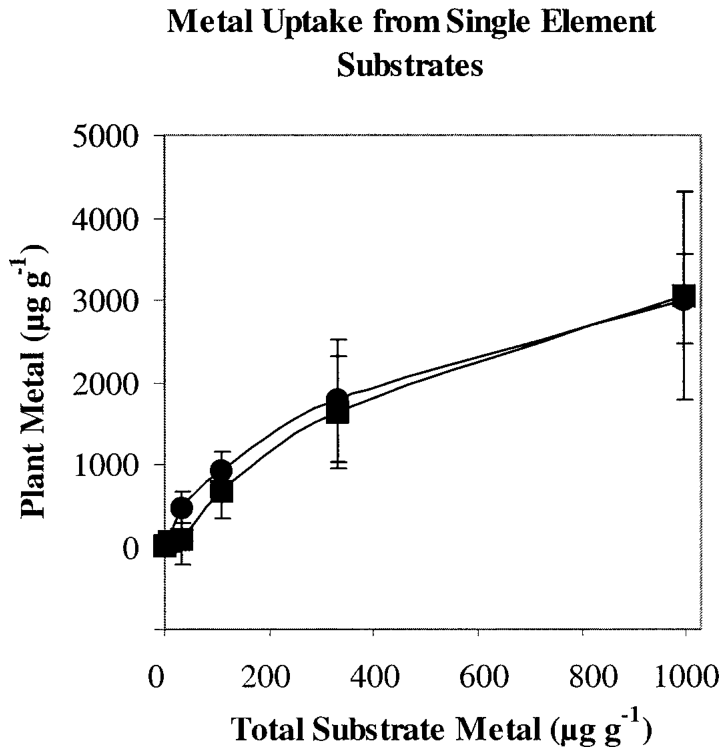
The bioaccumulation coefficient for metal uptake from the single element substrates is higher for Co than for Ni, below a total substrate metal concentration of 333 µg g−1. Above a total metal substrate concentration of 333 µg g−1, however, the uptake of Co from the Co-only substrate decreases relative to Ni uptake from the Ni-only substrate (Table 1). This decrease in the Co uptake may be attributed to visible Co phytotoxicity above a substrate concentration of 333 µg g−1, which was exhibited as stuniting, yellowed and brittle leaves, and poor root development. No visible effect of Ni phytotoxicity was evident over the experimental range (4–1000 µg g−1). Nickel and Co uptake (Figure 1) increased in the plants with increasing total metal concentration in the substrates. These data indicate that a total substrate metal concentration of approximately168µgg−1 isrequiredforhyperaccumulation(<1000µgg−1)tooccur (Figure 1), representing an Ni bioaccumulation coefficient of 6 for B. coddii. Cobalt hyperaccumulation occurred above a total substrate concentration of 125 µg g−1, representing a Co bioaccumulation coefficient of 8 for B. coddii.
在基质金属总浓度低于333 µg g−1时,单一元素基质中Co的生物富集系数高于Ni。然而,当基质金属总浓度高于333 µg g−1时,单Co基质中Co的吸收相对于单Ni基质中Ni的吸收有所下降(表1)。Co吸收的下降可归因于基质浓度高于333 µg g−1时出现的明显Co植物毒性,表现为植株矮化、叶片发黄变脆以及根系发育不良。在整个试验浓度范围内(4–1000 µg g−1)均未观察到明显的Ni植物毒性。植物对Ni和Co的吸收(图1)随基质金属总浓度的升高而增加。上述数据表明,基质金属总浓度约为168 µg g−1时才能发生超富集(>1000 µg g−1)(图1),对应B. coddii的Ni生物富集系数为6。Co超富集发生在基质总浓度高于125 µg g−1时,对应B. coddii的Co生物富集系数为8。
B. Nickel and Cobalt Accumulation from the Mixed Nickel–Cobalt SubstrateB. Ni–Co混合基质中镍和钴的累积
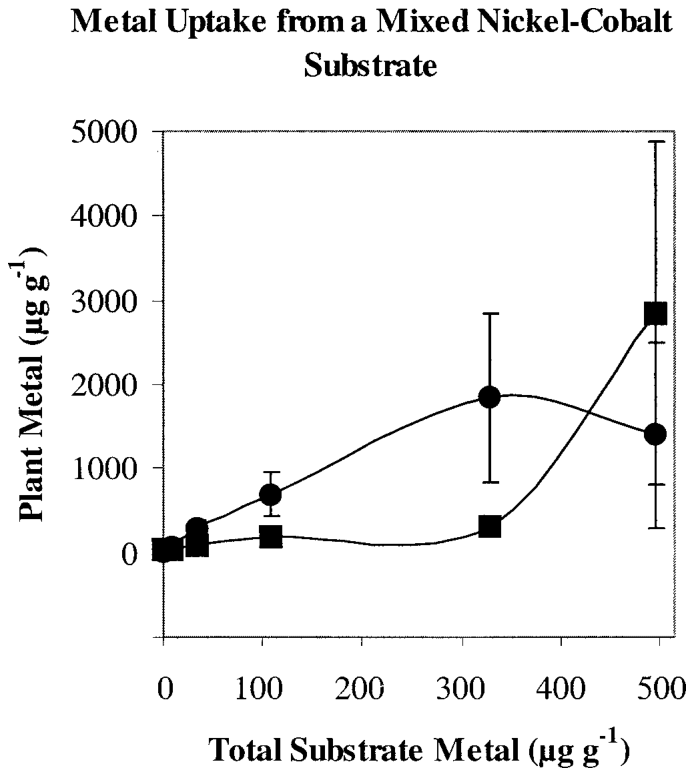
In comparison to Ni-only substrate, Ni uptake is much less in the Ni–Co substrate (Figure 2). A total substrate Ni concentration of 400 µg g−1 is required form Ni hyperaccumulation, compared with 168 µg g−1 required in the Ni-only substrate. This is a 2.4-fold decrease in the bioaccumulation coefficients, from 6 to 2.5, compared with the single-element substrate. The decrease in the bioaccumulation coefficients is attributed to interference by Co in the substrate. Cobalt is inhibiting Ni uptake at concentrations below approximately 450 µg g−1 by being preferentially accumulated by B. coddii.
与单Ni基质相比,Ni–Co基质中Ni的吸收量明显较低(图2)。Ni超富集所需的基质Ni总浓度为400 µg g−1,而单Ni基质中仅需168 µg g−1。与单一元素基质相比,生物富集系数由6降至2.5,降低了2.4倍。生物富集系数的降低归因于基质中Co的干扰。在浓度低于约450 µg g−1时,Co因被B. coddii优先累积而抑制了Ni的吸收。
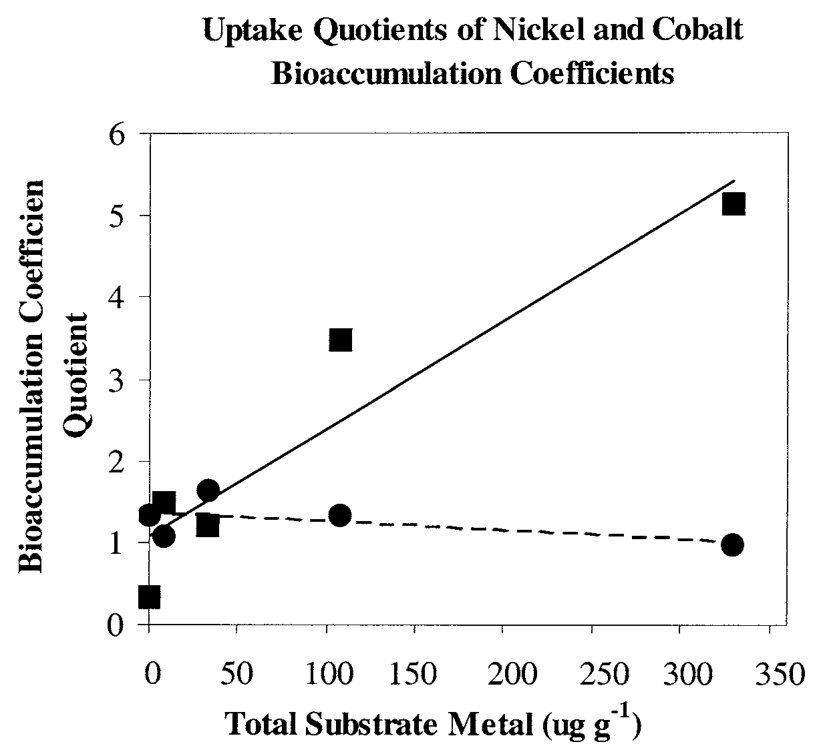
The relationship between Ni and Co uptake by B. coddii for single-element substrates, compared to the mixed Ni–Co substrate, is best expressed using bioaccumulation coefficients quotients of both elements (Figure 3). The bioaccumulation coefficient quotient for Co indicates little deviation about a 1:1 relationship at different substrate concentrations, indicating that Co uptake from both the single- and mixed-element substrates is similar. Therefore, Co accumulation by B. coddii is independent of any influence from Ni uptake. However, Ni uptake is markedly different in the single- and mixed-element substrates, indicated by increasing deviation from a 1:1 relationship at different substrate concentrations.
B. coddii在单一元素基质与Ni–Co混合基质中对Ni和Co吸收的关系,最好用两种元素的生物富集系数商来表示(图3)。在不同基质浓度下,Co的生物富集系数商围绕1:1关系的偏离很小,表明单一元素基质与混合元素基质中Co的吸收相近。因此,B. coddii对Co的累积不受Ni吸收的任何影响。然而,Ni的吸收在单一元素基质与混合元素基质中差异显著,表现为在不同基质浓度下偏离1:1关系的程度不断增大。
C. Biomass Production by Berkheya coddii Grown on Artificial SubstratesC. 人工基质上生长的Berkheya coddii的生物量产量
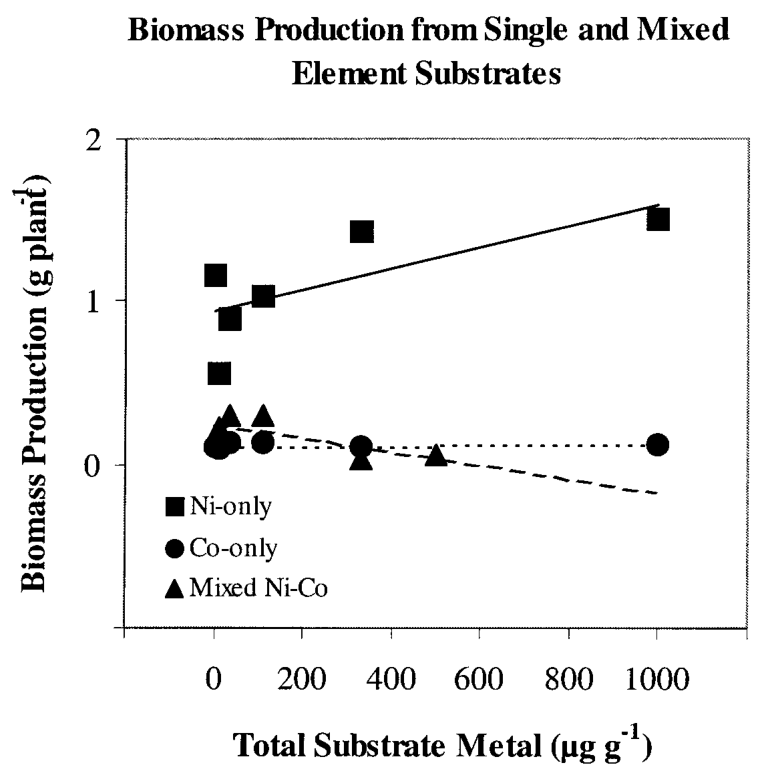
Biomass production in Ni-only substrates (Figure 4) was not significantly affected (P = 0.296) by metal concentrations over the experimental range investigated. All plants appeared healthy and vigorous at harvest, with no noticeable symptoms of Ni toxicity.
在所研究的试验浓度范围内,单Ni基质中的生物量产量(图4)未受金属浓度的显著影响(P = 0.296)。收获时所有植株均健康、生长旺盛,无明显的Ni毒害症状。
By contrast, there was a significant decrease (P = 0.023) in biomass production when B. coddii was grown on Co-only substrates. The mean herbage weight at the growth maximum on 37 µg g−1 total substrate Co was 0.65 g. Above this substrate concentration, evidence of Co phytotoxicity was seen as a reduction in plant weight and, visibly, as pronounced yellowing of leaves, leaf stems, and leaf axial regions (frequently accompanied by white spotting on foliage); stunted inter-nodal stems; and foliage that was brittle and readily broken when grasped firmly. The date indicate that B. coddii is more tolerant to Ni than Co at higher substrate metal concentrations. The effects of Co phytotoxicity did not, however, affect the Co bioaccumulation coefficients (Figure 3). Cobalt accumulation in B. coddii may, therefore, be an externally controlled process related to Co geochemistry rather than a plant-initiated response to, or need for, Co. Berkheya coddii could, as a result, be classified as an indicator plants for Co (Baker, 1981).
相比之下,B. coddii在单Co基质上生长时生物量产量显著下降(P = 0.023)。在基质Co总浓度为37 µg g−1的生长最大值处,地上部平均重量为0.65 g。高于该基质浓度时,Co植物毒性表现为植株重量降低,外观上表现为叶片、叶柄及叶腋区明显发黄(常伴有叶面白斑),节间茎矮缩,以及叶片变脆、稍用力握持即易折断。数据表明,在较高基质金属浓度下,B. coddii对Ni的耐受性强于对Co的耐受性。然而,Co植物毒性并未影响Co的生物富集系数(图3)。因此,B. coddii对Co的累积可能是一个受Co地球化学性质控制的外部过程,而非植物对Co的主动响应或需求。由此,Berkheya coddii可被归为Co的指示植物(Baker, 1981)。
Biomass production from the mixed Ni–Co substrate is greater at total substrate metal concentrations below 37 µg g−1 Ni and Co. Above this concentration, biomass production decreased significantly and was attributed to Co phytotoxicity. The average herbage weight recorded at a total metal concentration of 37 µg g−1 (the growth maximum) was 0.4 g. Observations made at harvest time recorded similar symptoms as those seen in the Co-only trial, yet not as pronounced. Phytotoxicity at total substrate metal concentrations greater than 111 µg g−1 Ni and Co resulted in the death of 85% of the sampled population. The average weight of the surviving plants was approximately 0.1 g, indicating that Co bioavailability is the dominant factor in plant health on the mixed Ni–Co substrate at, and above, this total metal concentration.
在基质Ni和Co总浓度低于37 µg g−1时,Ni–Co混合基质中的生物量产量较高。高于此浓度时,生物量产量显著下降,这归因于Co植物毒性。在金属总浓度为37 µg g−1(生长最大值)时,记录的地上部平均重量为0.4 g。收获时观察到的症状与单Co试验相似,但程度较轻。当基质Ni和Co总浓度高于111 µg g−1时,植物毒性导致85%的供试植株死亡。存活植株的平均重量约为0.1 g,表明在该金属总浓度及以上,Co的生物有效性是决定Ni–Co混合基质上植物健康状况的主导因素。
5IV. CONCLUSIONS四、结论
Berkheya coddii hyperaccumulated Ni from the single-element artificial substrate at a total Ni level (168 µg g−1) lower than concentrations reported from previous glasshouse research (Robinson et al., 1997). Cobalt hyperaccumulation from the single-element substrate occurred above 125 µg g−1 total substrate Co and appeared at the biomass production maximum, preceding the onset of Co phytotoxicity. The bioaccumulation coefficients for Co- and Ni-only substrates for B. coddii were eight and six, respectively Phytotoxicity to Co was manifest above a total substrate Co concentration of 111 µg g−1, represented by a reduction in biomass production and yellowing of foliage leading to necrosis at high concentrations.
Berkheya coddii在单一元素人工基质中Ni总浓度为168 µg g−1时即发生Ni超富集,该浓度低于以往温室研究报道的浓度(Robinson et al., 1997)。单一元素基质中的Co超富集发生在基质Co总浓度高于125 µg g−1时,出现在生物量产量最大值处,先于Co植物毒性的出现。B. coddii在单Co和单Ni基质中的生物富集系数分别为8和6。当基质Co总浓度高于111 µg g−1时出现Co植物毒性,表现为生物量产量降低和叶片发黄,高浓度下可导致坏死。
Plant uptake of Ni and Co from the mixed substrate showed higher Co accumulation and a reduction in overall Ni accumulation in plant materials as compared to single-element substrates. Total substrate Ni required to achieve hyperaccumulation (>1000 µg g−1) by B. coddii increased from 168 µg g−1 in the single-element substrate to 400 µg g−1 in the mixed substrate. The bioaccumulation coefficients for Ni therefore increased 60% as compared to the Ni-only substrate.
与单一元素基质相比,植物从混合基质中吸收Ni和Co时,植株中Co的累积较高,而Ni的总体累积减少。B. coddii实现超富集(>1000 µg g−1)所需的基质Ni总浓度由单一元素基质中的168 µg g−1增至混合基质中的400 µg g−1。因此,与单Ni基质相比,Ni的生物富集系数变化了60%。
Cobalt hyperaccumulation from both Co-bearing substrates occurred at a total Co concentration of 400 µg g−1, above the total Co concentration that induced phytotoxicity. The Co bioaccumulation coefficients did not, therefore, change between substrates.
两种含Co基质中的Co超富集均发生在Co总浓度为400 µg g−1时,高于诱发植物毒性的Co总浓度。因此,Co的生物富集系数在两种基质间并无变化。
Biomass production rates and general plant health, for both Co-bearing substrates, indicated Co phytotoxicity at total substrate metal concentrations in excess of 111 µg g−1. A comparison of the potential crop yields of Ni and Co illustrates the negative impact of Co phytotoxicity on biomass production and the mean Ni and Co phytoremediation potential of B. coddii. Biomass production values were determined assuming optimal growth conditions of 9 t ha−1 occurred on the Ni-only substrate. Biomass production values for the Co-bearing substrates were determined using the ratio of plant weights between these substrates and the Ni-only substrate. The crop yields for single element substrates were approximately 14.5 kg Ni ha−1 and 12.6 kg Co ha−1. By comparison, the extrapolated metal yields for the mixed Ni–Co substrates were 0.9 kg Ni ha−1 and 3.1 kg Co ha−1, a reduction in Ni and Co bioaccumulation coefficients by 95% and 75%, respectively.
两种含Co基质的生物量产量和植物总体健康状况均表明,基质金属总浓度超过111 µg g−1时出现Co植物毒性。对Ni和Co潜在作物产量的比较说明了Co植物毒性对生物量产量的负面影响,以及B. coddii对Ni和Co的平均植物修复潜力。生物量产量值的确定以单Ni基质上达到9 t ha−1的最佳生长条件为假设前提。含Co基质的生物量产量值则根据这些基质与单Ni基质之间的植株重量比推算。单一元素基质的作物金属产量约为14.5 kg Ni ha−1和12.6 kg Co ha−1。相比之下,Ni–Co混合基质的外推金属产量为0.9 kg Ni ha−1和3.1 kg Co ha−1,即Ni和Co的生物富集系数分别降低了95%和75%。
The phytotoxic effect of Co on general plant growth and accumulation potential in B. coddii is important and must be considered when evaluating Ni and Co phytoextraction potential using this species. If we assume that the Ni-only pot trial is a “best case scenario” for plant growth, then the following points can be made.
在利用B. coddii评估Ni和Co的植物提取潜力时,Co对该物种总体生长及累积潜力的植物毒性效应十分重要,必须予以考虑。若假定单Ni盆栽试验代表植物生长的“最佳情形”,则可得出以下几点结论。
1. Berkheya coddii is Ni hypertolerant over the experimental range.
1. 在试验浓度范围内,Berkheya coddii对Ni具有超耐受性。
2. Nickel uptake decreases significantly in the presence of Co.
2. 在Co存在时,Ni的吸收显著降低。
3. Berkheya coddii readily accumulates Co. However, in the presence of Ni, hyperaccumulation of both elements appears at Co concentrations that are phytotoxic.
3. Berkheya coddii易于累积Co。然而,在Ni存在时,两种元素的超富集均出现在具有植物毒性的Co浓度下。
4. Cobalt concentrations above 111 µg g−1 have a pronounced phytotoxic effect on biomass production in B. coddii without affecting the bioaccumulation coefficients of Co.
4. Co浓度高于111 µg g−1时,对B. coddii的生物量产量产生明显的植物毒性效应,但不影响Co的生物富集系数。
6ACKNOWLEDGEMENTS致谢
The author gratefully acknowledges the late Emeritus Professor R. R. Brooks and Anglo American Platinum Corporation Ltd of Rothenburg, South Africa, for providing seed of Berkheya coddii.
作者衷心感谢已故荣誉教授R. R. Brooks以及南非Rothenburg的Anglo American Platinum Corporation Ltd提供Berkheya coddii种子。
7REFERENCES参考文献
Baker, A. J. M. 1981. Accumulators and excluders—strategies in the response of plants to heavy metals. J. Plant Nutrition 3, 643–654.
Brooks, R. R. 1998. Plants that Hyperaccumulate Heavy Metals: Their Role in Phytoremediation, Microbiology, Archaeology, Mineral Exploration and Phytomining. Wallingford, UK, CAB International.
Brooks, R. R., Lee, J., Reeves, R. D., and Jaffr´e, T. 1977. Detection of nickeliferous rocks by analysis of herbarium specimens of indicator plants. J. Geochem. Expl. 7, 49–57.
Chaney, R. L. 1983. Plant uptake of inorganic waste constituents. In: Land Treatment of Hazardous Wastes, pp. 50–76 (Parr, J. F., Marsh, P. B., and Kla, J. M., Eds.). Park Ridge, NJ. Noyes Data Corp.
Howes, A. W. 1991. Investigations into nickel hyperaccumulation in the plant Berkheya coddii: Unpublished MSc thesis, Natal, South Africa, University of Natal.
Howes, A. W., Slatter, K. A., Sim, E. A., and Jones, A. N. 1998. Rehabilitating nickel contaminated soils at a base metal refinery using the nickel hyperaccumulating plant species, Berkheya coddii. In: Waste Processing and Recycling in Mineral and Metallurgical Industries III (Rao, S. R., Amaratunga, L. M., Richards, G. G., and Kondos, P. D., Eds.). Canada, The Metallurgical Society of CIM.
Keeling, S. M. 2000. The economic significance of the phytoextraction of nickel, cobalt and gold from metalliferous soils: Unpublished MSc thesis, New Zealand, Massey University, 162 p.
McGrath, S. P., Sidoli, C. M. D., Baker, A. J. M., and Reeves, R. D. 1993. The potential for the use of metal-accumulating plants for the in situ decontamination of metal-polluted soils. In: Integrated Soil and Sediment Research: A Basis for Proper Protection, pp. 673–676 (Eijackers, H. J. P. and Hamers, T., Eds.). Amsterdam, The Netherlands, Kluwer.
Morrey, D. R., Balkwill, K., and Balkwill, M.-J. 1989. Studies on serpentine flora: preliminary analyses of soils and vegetation associated with serpentine rock formation in the southeastern Transvaal. S. African J. Botany 55, 171–177.
Nicks, L. J., and Chambers, M. F. 1994. Nickel farming. Discovery Magazine 19, 22–23.
Nicks, L. J., and Chambers, M. F. 1995. Farming of metals. Mining Environmental Management 11, 15–18.
Nicks, L. J., and Chambers, M. F. 1998. A pioneering study of the potential of phytomining for nickel. In: Plants that Hyperaccumulate Heavy Metals, pp. 313–326 (Brooks, R. R., Ed.). Wallingford, UK, CAB International.
Raskin, I., Kumar, N. P. B. A., and Dushenkov, S. 1994. Phytoremediation of Metals. Nov. 15: United States of America, Phytotech, Inc., Morristown, NJ.
Robinson, B. H., Brooks, R. R., Howes, A. W., Kirkman, J. H., and Gregg, P. E. H. 1997. The potential of the high-biomass nickel hyperaccumulator Berkheya coddii for phytoremediation and phytomining. J. Geochem. Expl. 60, 115–126.
Robinson,B.H.,Brooks,R.R.,Kirkman,J.H.,Gregg,P.E.H.,andAlverez,H.V.1997.Edaphic influences on a New Zealand ultramafic (‘serpentine’) flora: a statistical approach. Plant Soil 188, 11–20.
Salt, D. E., Blaylock, M. J., Kumar, N. P. B. A., Dushenkov, V., Ensley, B. D., and Chet, I. 1995. Phytoremediation: a novel strategy for the removal of toxic metals from the environment using plants. Biotechnol. 13, 468–474.