The Science of the Total Environment 301 (2003) 67–73
Brett Robinsona,*, Celine´ Duwigb, Nanthi Bolanc, M. Kannathasand, A. Saravanand
aHort Research, Private Bag 11030, Palmerston North, New Zealand 14850 bLaboratoire d’etude´ des Transferts en Hydrologie et Environnement, LTHE-UMR (CNRS, INPG, IRD, UJF), BP 53 X,
38041 Grenoble, France
cInstitute of Natural Resources, Massey University, Palmerston North, New Zealand dTamil Nadu Agricultural University, Coimbatore, India
Received 7 March 2002; accepted 5 July 2002
Abstract摘要
Watercress (Lepidium sativum) is consumed as a vegetable, especially by the indigenous community in New Zealand. An investigation was carried out on the accumulation of arsenic by watercress, following earlier reports of inordinate arsenic concentrations in some aquatic macrophytes collected from the Waikato River, North Island, New Zealand. The Waikato River and some other aquatic systems in Taupo Volcanic Zone, New Zealand have elevated arsenic concentrations due to geothermal activity. Watercress, river water and sediment samples were collected from 27 sites along the Waikato river and analysed for arsenic. Greenhouse trials with watercress grown in beakers containing added arsenic were conducted to confirm the ability of this species to accumulate arsenic. At a number of sites, the concentration of arsenic in both the water and the watercress samples exceeded the World Health Organisation (WHO) limit for drinking water (0.01 mg ly1) and foodstuffs (2 mg kgy1 on a fresh weight basis). The average leaf and stem arsenic concentrations were, respectively, 29.0 and 15.9 mg kgy1 on a fresh weight basis. Plants grown in solutions of )0.4 mg ly1 arsenic concentration had fresh weight arsenic concentrations above the WHO limit. Despite these higher concentrations, arsenic levels in plants grown under greenhouse conditions were approximately fivefold lower than in plants growing in the Waikato River, possibly because under natural conditions, the watercress is rooted in sediment containing on average approximately 35 mg kgy1 arsenic. It is recommended that watercress from the Waikato River, or other areas with elevated water arsenic concentrations, should not be consumed.
豆瓣菜(Lepidium sativum)作为蔬菜食用,在新西兰原住民群体中尤为普遍。此前有报道称,采自新西兰北岛怀卡托河(Waikato River)的部分水生大型植物中砷浓度异常偏高,据此本研究对豆瓣菜的砷累积情况进行了调查。受地热活动影响,怀卡托河以及新西兰陶波火山带(Taupo Volcanic Zone)的其他一些水体砷浓度较高。沿怀卡托河在27个位点采集了豆瓣菜、河水和沉积物样品并测定其砷含量。同时开展温室试验,将豆瓣菜种植于添加砷的烧杯中,以确认该物种累积砷的能力。在多个位点,水样和豆瓣菜样品中的砷浓度分别超过了世界卫生组织(WHO)规定的饮用水限值(0.01 mg L⁻¹)和食品限值(以鲜重计2 mg kg⁻¹)。以鲜重计,叶片和茎的平均砷浓度分别为29.0和15.9 mg kg⁻¹。在砷浓度>0.4 mg L⁻¹的溶液中生长的植株,其鲜重砷浓度超过WHO限值。尽管浓度较高,但温室条件下生长植株的砷含量仍比怀卡托河中生长的植株低约5倍,其原因可能是在自然条件下豆瓣菜根植于平均含砷约35 mg kg⁻¹的沉积物中。建议不要食用采自怀卡托河或其他水体砷浓度较高地区的豆瓣菜。
� 2002 Elsevier Science B.V. All rights reserved.
© 2002 Elsevier Science B.V. 版权所有。
Keywords: Watercress; Waikato River; Arsenic; Phytoremediation
关键词:豆瓣菜;怀卡托河;砷;植物修复
1Introduction引言
It is widely known that some aquatic macrophytes growing in the Taupo Volcanic Zone and *Corresponding author. Tel: +64-217-49867; fax: +64- 635-46731. E-mail address: brobinson@hortresearch.co.nz (B. Robinson).
Waikato River contain high concentrations of arsenic (Reay, 1972; Liddle, 1982). Robinson et al. (1995) reported )1000 mg kgy1 (ppm) arsenic (dry weight) in samples of Egeria densa and Ceratophyllum demersum growing in the Waikato River system. This arsenic is derived from geothermal activity to some extent exacerbated by commercial exploitation of geothermal power.
怀卡托河中(的水生植物)含有高浓度的砷(Reay, 1972; Liddle, 1982)。Robinson et al. (1995) 报道,在怀卡托河水系中生长的Egeria densa和Ceratophyllum demersum样品中砷含量(干重)>1000 mg kg⁻¹(ppm)。这些砷来源于地热活动,而地热发电的商业开发在一定程度上加剧了这一问题。
0048-9697/03/$ - see front matter � 2002 Elsevier Science B.V. All rights reserved. PII: S0048-9697(02)00294-2
0048-9697/03/$ - see front matter © 2002 Elsevier Science B.V. 版权所有。PII: S0048-9697(02)00294-2
Liddle (1982) conducted experiments involving the uptake of arsenic by Ceratophyllum demersum. He found that plants grown in arsenic solutions with −0.1 mg ly1 arsenic (III or V) reached equilibrium in 1 or 2 days, while plants in )0 5 mg ly1 of this element, needed up to a week to reach equilibrium. Arsenic concentration in plants increased with increasing concentration of arsenic in the growing medium. At a similar arsenic concentration in the growing medium, plants grown under laboratory conditions contained far less arsenic than plants collected under natural conditions in the Waikato River. A plant grown in 0.5 mg ly1 of arsenic reached an equilibrium concentration of 67 mg kgy1 arsenic (dry weight). It was noted that the majority of the arsenic in the plant was stored in the leaves.
Liddle (1982) 开展了Ceratophyllum demersum吸收砷的试验。他发现,在砷(III或V)浓度<0.1 mg L⁻¹的溶液中生长的植株在1~2 d内达到平衡,而在该元素浓度>0.5 mg L⁻¹的溶液中生长的植株则需长达1周才能达到平衡。植株中的砷浓度随生长介质中砷浓度的升高而增加。在生长介质砷浓度相近的情况下,实验室条件下生长的植株所含砷远低于在怀卡托河自然条件下采集的植株。在0.5 mg L⁻¹砷溶液中生长的植株达到的平衡砷浓度为67 mg kg⁻¹(干重)。研究还指出,植株中的砷大部分储存于叶片中。
Arsenic uptake by plants is associated with the phosphate uptake mechanism, where presumably arsenate is taken up as a phosphate analogue (Khattak et al., 1991; Meharg and Macnair, 1991; Pickering et al., 2000). To date, there is only one report (Ma et al., 2001) of a terrestrial plant, Pteris vittata, that hyperaccumulates arsenic (up to 2.2% on a dry matter basis). It was suggested that this fern could be used for the phytoremediation of arsenic-contaminated sites. The possibility of using hyperaccumulator plants to extract arsenic from aquatic environments was discussed by Brooks and Robinson (1998).
植物对砷的吸收与磷酸盐吸收机制有关,一般认为砷酸盐是作为磷酸盐类似物被吸收的(Khattak et al., 1991; Meharg and Macnair, 1991; Pickering et al., 2000)。迄今为止,仅有一篇报道(Ma et al., 2001)发现一种陆生植物——Pteris vittata,能够超富集砷(以干物质计高达2.2%)。有研究提出,这种蕨类植物可用于砷污染场地的植物修复。Brooks and Robinson (1998) 探讨了利用超富集植物从水生环境中提取砷的可能性。
In the course of our work on the uptake of arsenic by aquatic plants and other organisms in the Waikato River system (Robinson et al., 1995), we observed an inordinate accumulation of arsenic in watercress (Lepidium sativum). Four samples taken from the river at a site near a geothermal power station (Ohaaki near Broadlands) averaged 412 mg kgy1 (dry weight). This prompted further studies on this plant as it is used as a food source and its metal concentration could have serious implications for public health, as this amount is well in excess of 2 mg kgy1 fresh weight, the WHO limit for arsenic in foodstuffs (Brandsetter et al., 2001).
在研究怀卡托河水系中水生植物及其他生物对砷的吸收过程中(Robinson et al., 1995),我们观察到豆瓣菜(Lepidium sativum)存在异常的砷累积。在一座地热电站附近(Broadlands附近的Ohaaki)的河段采集的4个样品,平均砷含量为412 mg kg⁻¹(干重)。由于该植物被用作食物来源,其金属浓度可能对公众健康产生严重影响——这一含量远超WHO规定的食品中砷限值(鲜重2 mg kg⁻¹)(Brandsetter et al., 2001),因此促使我们对该植物开展进一步研究。
The predominant form of arsenic in the environment is As(V) since As(III) is oxidised by atmospheric oxygen (Pepper et al., 1987). For most of the year, over 90% of the arsenic in the Waikato
环境中砷的主要存在形态为As(V),因为As(III)会被大气中的氧气氧化(Pepper et al., 1987)。一年中的大部分时间,怀卡托
River is present as As(V) (Aggett and Aspell, 1978), but in the summer months the levels of As(III) increase, probably because of bacterial action (Freeman, 1985). In this experiment, As(V) was used because it approximates the majority of arsenic in the river.
河中90%以上的砷以As(V)形态存在(Aggett and Aspell, 1978),但在夏季数月,As(III)含量升高,这可能是细菌作用所致(Freeman, 1985)。本试验采用As(V),因为它代表了河水中大部分砷的形态。
The aim of this experiment was to determine if L. sativum accumulated arsenic, and if so what was the maximum level of arsenic in the surrounding water before arsenic levels in L. sativum exceeded 2 mg kgy1, the WHO limit for arsenic in foodstuffs.
本试验的目的是确定L. sativum是否累积砷;若累积,则进一步确定周围水体中砷浓度的最高水平,超过该水平时L. sativum中的砷含量将超过WHO规定的食品中砷限值2 mg kg⁻¹。
2Materials and methods材料与方法
2.1. Sample collection from the Waikato River2.1. 怀卡托河样品采集
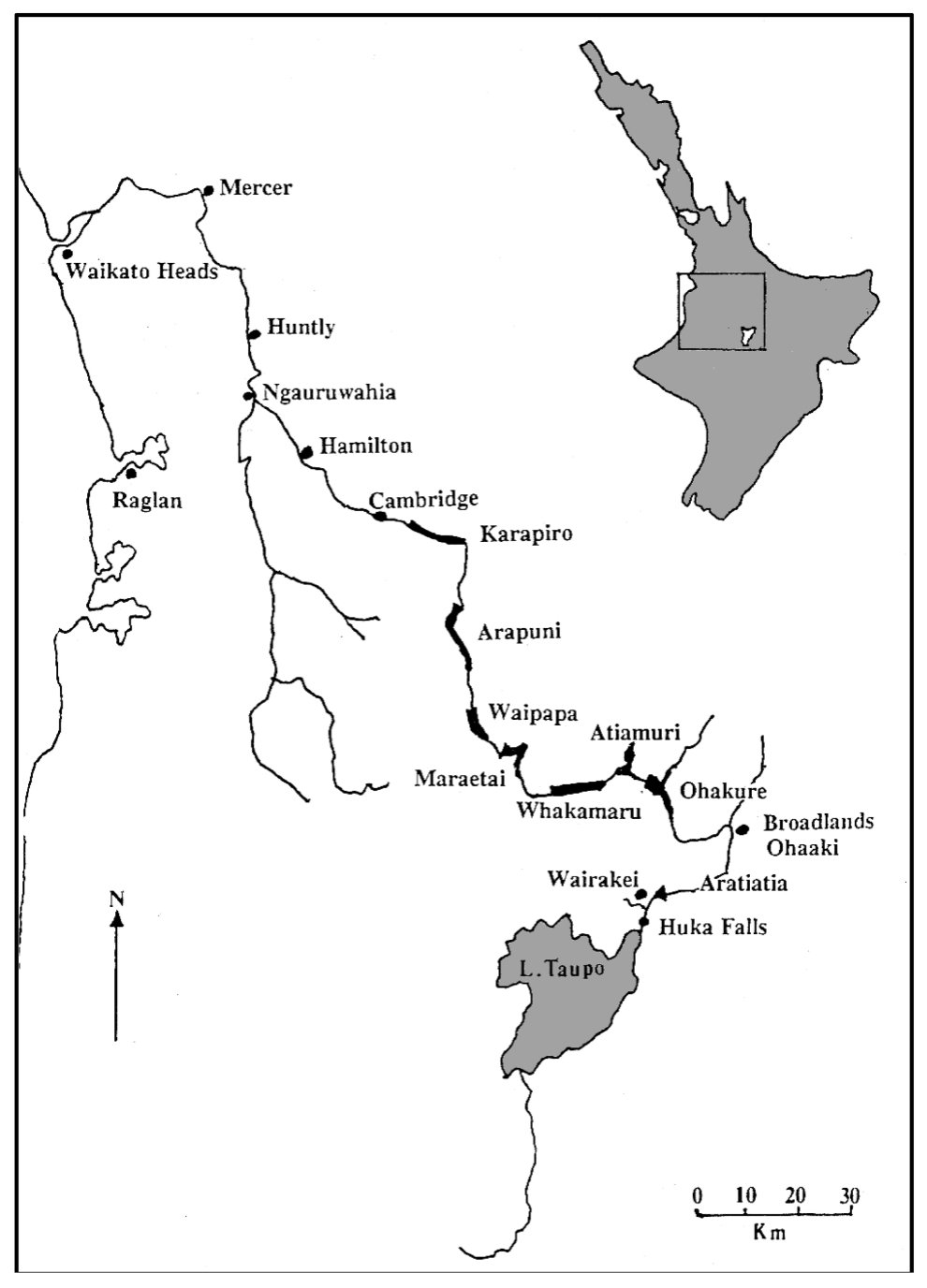
L. sativum samples were taken at several sites (Fig. 1) along the Waikato River in late May, 2000. As a control, samples were taken from the Tiritea stream near Massey University, an area with no known arsenic contamination. Water and sediment samples were also collected from the Waikato River and control sites at the same time as the L. sativum. Plant material was washed thoroughly in the river and placed in plastic bags until return to the laboratory where further washing in distilled water was carried out.
2000年5月下旬,沿怀卡托河在若干位点(图1)采集了L. sativum样品。以Massey University附近的Tiritea溪(无已知砷污染的区域)采集的样品作为对照。在采集L. sativum的同时,还从怀卡托河及对照位点采集了水样和沉积物样品。植物材料在河中彻底清洗后装入塑料袋,带回实验室后再用蒸馏水进一步清洗。
2.2. Greenhouse experiments2.2. 温室试验
The control watercress samples from Tiritea stream, which accumulated an insignificant amount of arsenic, were used in the greenhouse experiments. Excess water was removed from the fresh material, and approximately 12-g portions of plant weighed out and rinsed in distilled water. They were then floated in 1-l beakers containing 0.8 l of arsenic solution. Each beaker contained an aerator to ensure adequate oxygen. The experiments were conducted in greenhouse facilities at Massey University, Palmerston North, New Zealand (latitude 40.28 S, longitude 175.48 E). Temperatures ranged from 13 to 23 °C.
温室试验采用来自Tiritea溪的对照豆瓣菜样品,其砷累积量可忽略不计。去除新鲜材料表面多余的水分后,称取约12 g的植株,用蒸馏水冲洗,然后使其漂浮于盛有0.8 L砷溶液的1 L烧杯中。每个烧杯均配有曝气器以保证充足的氧气供应。试验在新西兰北帕默斯顿(Palmerston North)Massey University的温室设施中进行(南纬40.28°,东经175.48°),温度范围为13~23 °C。
The arsenic solutions were prepared by taking a measured amount of 1000 mg ly1 of sodium arsenate solution and making the volume up to 0.8 l with distilled water. Plants were grown in solutions containing various levels (-0.01–0.8 mg The control consisted of a beaker containing 0.8 l ly1) of arsenic. There were three replicates each of 0.8 mg ly1 of arsenic but no plant. Aliquots of of six treatments and the experiment lasted 8 days. 4 ml of solution were taken from each beaker initially at the start of the experiment and then at 48-h intervals, to determine when the plants had reached an equilibrium concentration. We assumed this point to have been reached when there was only a negligible change in solution concentration caused by plant growth.
砷溶液的配制方法为:量取一定量1000 mg L⁻¹的砷酸钠溶液,用蒸馏水定容至0.8 L。植株在含不同水平砷(<0.01~0.8 mg L⁻¹)的溶液中生长。对照为盛有0.8 L含砷0.8 mg L⁻¹溶液但不放植株的烧杯。共设6个处理,每个处理3次重复,试验持续8 d。在试验开始时及此后每隔48 h从每个烧杯中取4 mL溶液,以确定植株何时达到平衡浓度。当植株生长引起的溶液浓度变化可忽略不计时,即认为已达到平衡。
2.3. Sample preparation and As determination2.3. 样品制备与砷测定
Leaves and stems were separated, weighed and placed in a drying cabinet at 80 8C until a constant weight was reached. Approximately 0.2 g of ground material from each sample was accurately weighed into 50-ml Erlenmeyer flasks. Concentrated nitric acid (10 ml) was added to each flask and the mixtures heated on a heating block until a final volume of approximately 3 ml was reached. The samples were then diluted to 10 ml using distilled water and stored in polythene containers.
将叶片和茎分开,称重后置于80 °C烘箱中烘至恒重。从每个样品中准确称取约0.2 g磨碎的材料,置于50 mL锥形瓶中。向每个锥形瓶加入浓硝酸(10 mL),在加热块上加热,直至最终体积约为3 mL。随后用蒸馏水将样品稀释至10 mL,并储存于聚乙烯容器中。
Sediment samples were dried at 80 °C and sieved to −1−mm size using a nylon sieve. Approximately 0.2-g quantities of sediment were accurately weighed into 50-ml Erlenmeyer flasks. Concentrated nitric acid (10 ml ) was then added and the mixtures boiled until a final volume of 3 ml was reached. A further 10 ml of concentrated hydrochloric acid was then added and the mixtures again evaporated to 3 ml. After filtration, the solutions were diluted to 10 ml with distilled water.
沉积物样品于80 °C烘干,并用尼龙筛过筛至<1 mm粒径。准确称取约0.2 g沉积物,置于50 mL锥形瓶中,加入浓硝酸(10 mL),煮沸至最终体积为3 mL。再加入10 mL浓盐酸,再次蒸发至3 mL。过滤后,用蒸馏水将溶液稀释至10 mL。
All samples of plant material, sediment and waters were analysed for arsenic using hydridegeneration atomic absorption spectroscopy. Sodium borohydride was used as a reducing agent in a direct introduction method similar to that described in Godden and Thomerson (1980). The limit of detection was approximately 4 ng for loadings of up to 5 ml of sample (i.e. 0.8 µg ly1 wppbx for waters and 4 µg kgy1 for sediments and plant material). Repeated measurements indicated that the reproducibility was approximately 10% at concentrations of arsenic close to the limit of detection. Reproducibility improved at higher arsenic concentrations. Reagent blanks were below detection limits, i.e. −0.8 µg ly1 in the solution. The fresh weight arsenic concentration was calculated using the percentage water that the plants contained (an average of 92.7% with a standard deviation of 0.4%).
所有植物材料、沉积物和水样均采用氢化物发生原子吸收光谱法测定砷含量。以硼氢化钠作为还原剂,采用与Godden and Thomerson (1980) 所述方法类似的直接进样法。进样量不超过5 mL时,检出限约为4 ng(即水样为0.8 µg L⁻¹ [ppb],沉积物和植物材料为4 µg kg⁻¹)。重复测定表明,在砷浓度接近检出限时,重现性约为10%;砷浓度较高时重现性更好。试剂空白低于检出限,即溶液中<0.8 µg L⁻¹。鲜重砷浓度根据植株含水率(平均92.7%,标准差0.4%)计算。
Arsenic concentrations for waters (mg ly1), sediments (mg kgy1) and plant samples (mg kgy1) taken from along the Waikato River, North Island, New Zealand
新西兰北岛怀卡托河沿岸采集的水样(mg L⁻¹)、沉积物(mg kg⁻¹)和植物样品(mg kg⁻¹)的砷浓度
| Average平均值 | Standard error标准 误 | Range范围 | |
|---|---|---|---|
| Water (_n_s27) | 0.041 | 0.006 | 0.001–0.1532 |
| Sediments (_n_s5) | 40.5 | 5.3 | 14.0–85.0 |
| Leaves (_n_s27) | |||
| Fresh weight | 28.97 | 6.06 | 0.1–103.0 |
| Dry weight | 499.6 | 90.2 | 12.0–1766.0 |
| Stems (_n_s27) | |||
| Fresh weight | 15.9 | 3.78 | 1.9–76.0 |
| Dry weight | 280.6 | 54.7 | 43.0–1226.0 |
3Results and discussion结果与讨论
3.1. Arsenic in watercress, water and sediments from the Waikato River
3.1. 怀卡托河豆瓣菜、水体和沉积物中的砷
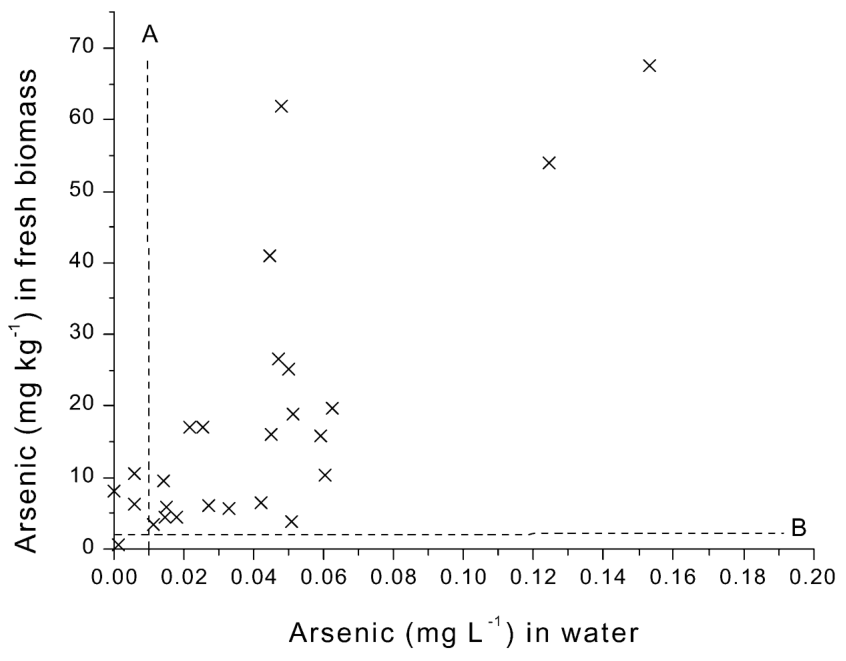
Table 1 summarises the arsenic concentrations in L. sativum, sediments and waters from the Waikato River sampling sites. Nearly all samples taken were above the WHO limit for arsenic in foodstuffs (2 mg kgy1 fresh weight) and the leaves, on average, were 14 times this value. Arsenic concentrations in the leaves were nearly twice that of the stems, consistent with the distribution of metal in most plants (Brooks, 1998). Although the arsenic concentrations in the L. sativum samples are highly variable, this is the usual pattern for water plants in the Waikato River. For example, Liddle (1982) reported arsenic values ranging from 265 to 1121 mg kgy1 for Ceratophyllum demersum growing in nearby Lake Ohakure. Fig. 2 shows the significant positive correlation (r=0.77, P−0.001) between the arsen− ic concentrations in the watercress and that from the ambient water. It is clear from Fig. 2 that even if the ambient water concentration is less than the WHO limit for drinking water (0.01 mg ly1) the arsenic concentration in watercress may be above the WHO limit for foodstuffs (2 mg kgy1). All but four of the water samples taken had arsenic concentrations in excess of the WHO limit for arsenic in drinking water (0.01 mg ly1). This concentration may be greater in the summer months when the river flow is lower. The arsenic concentration in the sediments (Table 1) was on average 988 times higher than the ambient water concentration.
表1汇总了怀卡托河各采样位点L. sativum、沉积物和水样中的砷浓度。几乎所有样品均超过WHO规定的食品中砷限值(鲜重2 mg kg⁻¹),叶片平均含量为该值的14倍。叶片中的砷浓度接近茎的2倍,这与大多数植物中金属的分布规律一致(Brooks, 1998)。尽管L. sativum样品中的砷浓度变异很大,但这是怀卡托河水生植物的普遍规律。例如,Liddle (1982) 报道附近Ohakure湖中生长的Ceratophyllum demersum砷含量为265~1121 mg kg⁻¹。图2显示豆瓣菜中的砷浓度与周围水体砷浓度之间存在显著正相关(r=0.77,P<0.001)。由图2可以清楚地看出,即使周围水体砷浓度低于WHO饮用水限值(0.01 mg L⁻¹),豆瓣菜中的砷浓度仍可能超过WHO食品限值(2 mg kg⁻¹)。除4个水样外,其余所有水样的砷浓度均超过WHO饮用水砷限值(0.01 mg L⁻¹)。在河流流量较低的夏季数月,该浓度可能更高。沉积物中的砷浓度(表1)平均为周围水体浓度的988倍。
3.2. Arsenic accumulation by watercress in greenhouse experiments3.2. 温室试验中豆瓣菜对砷的累积
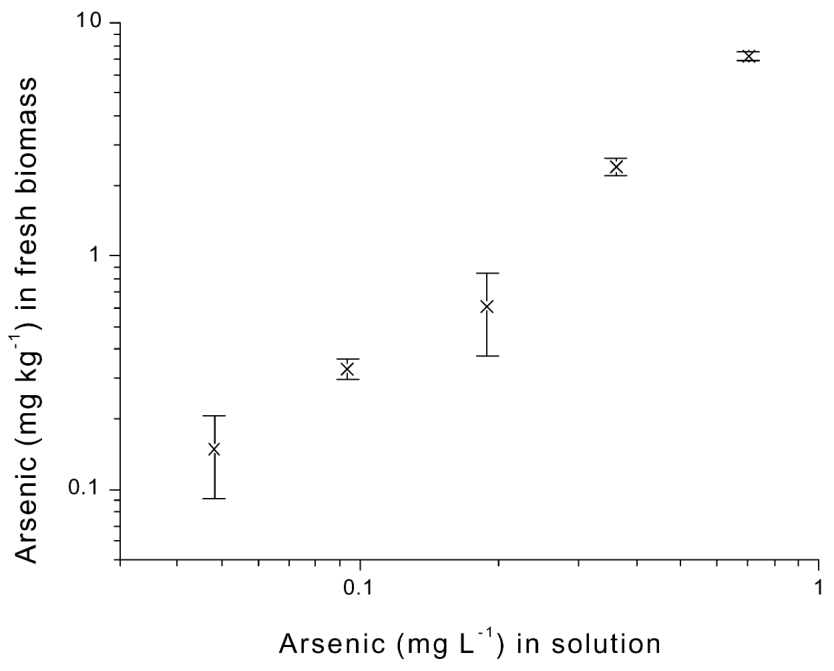
At the completion of the greenhouse trials, the arsenic concentrations in all the plants had reached equilibrium, indicated by negligible decrease in the arsenic concentrations of the surrounding solutions. The arsenic levels in the shoots (leavesq stems) of the plants at the end of the greenhouse trials ranged from 0.02 (control) to 106 mg kg−1 dry weight and 0.0018–7.79 mg kgy1 fresh weight (Fig. 3). The arsenic concentrations in the plants were strongly positively correlated (r=0.96, P− 0.001) with the arsenic concentrations of the surrounding water. There was a slight increase in the arsenic concentration in the control beaker, this probably being due to evaporation.
温室试验结束时,所有植株中的砷浓度均已达到平衡,表现为周围溶液中砷浓度的下降可忽略不计。试验结束时,植株地上部(叶+茎)的砷含量范围为0.02(对照)~106 mg kg−1干重,以及0.0018~7.79 mg kg⁻¹鲜重(图3)。植株中的砷浓度与周围水体的砷浓度呈极显著正相关(r=0.96,P<0.001)。对照烧杯中的砷浓度略有升高,这可能是蒸发所致。
All the plants in the arsenic solutions accumulated this element, the plantywater arsenic concentration ratio increasing exponentially from 3:1 to 10:1 as the arsenic concentration in the surrounding water increased from 0.05 to 0.8 mg ly1. This type of increase is usually associated with active exclusion: at low concentrations the plant is able to exclude the element, and this barrier breaking down at higher concentrations. Active exclusion is not, however, consistent with the theory that arsenic accumulation occurs via the phosphate uptake pathway. If phosphate is taken up preferentially over arsenate, then the higher plantywater concentration ratio at high solution arsenic concentrations may be explained by an increase in arsenic competition for the phosphate uptake sites in the rootzone.
砷溶液中的所有植株均累积了该元素;随着周围水体砷浓度由0.05 mg L⁻¹增至0.8 mg L⁻¹,植物/水体砷浓度比由3:1呈指数增加至10:1。这种增加方式通常与主动排斥有关:在低浓度下植物能够排斥该元素,而在较高浓度下这一屏障被打破。然而,主动排斥与砷经由磷酸盐吸收途径累积的理论并不一致。若植物优先吸收磷酸盐而非砷酸盐,则溶液砷浓度较高时植物/水体浓度比较高的现象,可解释为根区磷酸盐吸收位点上砷的竞争作用增强。
At equilibrium, the arsenic concentrations were approximately fivefold less than in plants taken from the Waikato River, even though both were in arsenic solutions of similar concentrations. This is similar to the findings of Liddle (1982) for Ceratophyllum demersum. A possible reason for the difference is that the watercress in this experiment was free floating, whereas in the river it is rooted to the sediment layer. Sediments from the Waikato
达到平衡时,尽管两者所处砷溶液浓度相近,温室植株的砷浓度仍比采自怀卡托河的植株低约5倍。这与Liddle (1982) 对Ceratophyllum demersum的研究结果相似。造成这一差异的可能原因是,本试验中的豆瓣菜呈自由漂浮状态,而在河中则根植于沉积层。怀卡托
River were found to contain on average of 40.5 mg kgy1 arsenic (Table 1). If this is a major source of arsenic to the plant, then it would be expected that the plants growing in a high arsenic sediment would have a higher arsenic concentration. Further work could be conducted to explore this possibility. Despite the lower arsenic concentrations in the watercress of this experiment, plants grown in arsenic solutions of 0.4 mg ly1 or greater, were above 2 mg kgy1 on a fresh weight basis (the WHO limit for arsenic in foodstuffs).
河沉积物的平均砷含量为40.5 mg kg⁻¹(表1)。若沉积物是植物砷的主要来源,则可以预期生长在高砷沉积物中的植株砷浓度更高。可进一步开展研究以探讨这一可能性。尽管本试验中豆瓣菜的砷浓度较低,但在砷浓度≥0.4 mg L⁻¹的溶液中生长的植株,其砷含量以鲜重计均超过2 mg kg⁻¹(WHO规定的食品中砷限值)。
The ability of L. sativum to take up large amounts of arsenic from substrates containing relatively low concentration of this element indicate the plant may have potential for phytoremediation by extracting arsenic from contaminated soils or water. In our greenhouse experiments, the arsenic taken up by the watercress reduced the arsenic concentration in the solutions by 7.3% on average. Before any conclusions can be drawn in this area, however, an investigation is needed of the plant’s biomass production and arsenic uptake in terrestrial as well as aquatic environments.
L. sativum能够从该元素浓度相对较低的基质中吸收大量砷,表明该植物可能具有从污染土壤或水体中提取砷进行植物修复的潜力。在本温室试验中,豆瓣菜吸收的砷使溶液中砷浓度平均降低了7.3%。然而,在该领域得出任何结论之前,还需对该植物在陆生及水生环境中的生物量产量和砷吸收情况开展研究。
4Conclusions结论
Watercress should not be taken from zones where there may be elevated arsenic concentrations in aquatic systems. This is particularly relevant in geothermal areas where As-rich geothermal fluids increase the arsenic burden on aquatic systems. The development of geothermal power stations and geothermal heating systems that discharge geothermal fluids into waterways may render previously safe locations unsuitable for watercress collection.
不应从水体砷浓度可能偏高的区域采摘豆瓣菜。这一点在地热区尤为重要,因为富砷地热流体会增加水体的砷负荷。建设地热电站以及向水道排放地热流体的地热供暖系统,可能使原本安全的地点不再适宜采摘豆瓣菜。
Acknowledgments致谢
We gratefully acknowledge the late professor Robert Brooks who initiated this work.
谨此感谢已故的Robert Brooks教授,本研究由他发起。
References参考文献
Aggett J, Aspell AC. Arsenic from Geothermal Sources. New Zealand Research and Development Committee Report, �35 1978.
Brandsetter A, Lombi E, Wenzel WW, Adriano DC. Arsenic contaminated soils: I. Risk assessment. Adriano DC, editor. Trace Elements in Terrestrial Environments: Biogeochemistry, Bioavailability and Risks of Metals, 2nd ed. New York: Springer 2001:715–737.
Brooks RR. Phytochemistry of hyperaccumulators. In: Brooks RR, editor. Plants that Hyperaccumulate Heavy Metals: their Role in Archaeology, Microbiology, Mineral Exploration, Phytomining and Phytoremediation. Wallingford: CAB International, 1998. p. 15–53.
Brooks RR, Robinson BH. Aquatic phytoremediation by accumulator plants. In: Brooks RR, editor. Plants that Hyperaccumulate Heavy Metals: their Role in Archaeology, Microbiology, Mineral Exploration, Phytomining and Phytoremediation. Wallingford: CAB International, 1998. p. 203–226.
Freeman MC. The reduction of arsenate to arsenite by an Anabaena bacteria assemblage isolated from the Waikato River. N Z J Mar Freshwater Res 1985;19:277–282.
Godden RG, Thomerson DR. Generation of covalent hydrides in atomic-absorption spectroscopy. Analyst 1980;105:1137– 1156.
Khattak AK, Page AL, Parker DR, Bakhtar D. Accumulation and interactions of arsenic, selenium, molybdenum and phosphorus in Alfalfa. J Environ Qual 1991;20:165–168.
Liddle JR. Arsenic and other elements of geothermal origin in the Taupo Volcanic Zone. Ph.D Thesis, Massey University, Palmerston North, New Zealand 1982.
Ma LQ, Komar KM, Tu C, Zhang W, Cai Y, Kennelly ED. A fern that hyperaccumulates arsenic. Nature 2001;409:579.
Meharg AA, Macnair MR. Uptake, accumulation and translocation of arsenate in arsenate-tolerant and non-tolerant Holcus lanatus L. New Phytol 1991;117:225–231.
Pepper I, Galanti N, Sans J, Lopez-Saez JF. Reversible inhibition of root growth and cell proliferation by pentavalent arsenic in Allium cepa. Environ Exp Botany 1987;28:9–18.
Pickering IJ, Prince RC, George MJ, Smith RD, George GN, Salt DE. Reduction and coordination of arsenic in Indian Mustard. Plant Physiol 2000;122:1171–1177.
Reay PF. The accumulation of arsenic from arsenic-rich natural waters by aquatic plants. J Appl Ecol 1972;9:557–565.
Robinson BH, Brooks RR, Outred HA, Kirkman JH. The distribution and fate of arsenic in the Waikato River system, North Island, New Zealand. Chem Speciation Bioavailability 1995;7(3):89–96.