Fabio N. Moreno, Chris W. N. Anderson, Robert B. Stewart, Brett H. Robinson
in most contaminated soils and mine tailings, mercury (Hg) is not readily available for plant uptake. A strategy for inducing Hg mobilization in soils to increase accumulation potential in plants was investigated to enhance Hg phytoremediation. Accumulation of Hg in the nickel hyperaccumulator Berkheya coddii, the salt-tolerant Atriplex canescens, and the nonaccumulators Brassica juncea and Lupinus sp. was studied by pot trials containing mine tailings treated with either soluble Hg or sulfur-containing ligands. Accumulation of Hg in shoots of B. coddi and A. canescens after addition of soluble Hg was lower than 10 mg/kg dry weight. The addition of ammonium thiosulfate (NH4S203) to tailings mobilized Hg in substrates, as indicated by the elevated Hg concentrations in leachates from the pots of both species. Ammonium thiosulfate caused a significant increase in the Hg concentration in shoots of B. juncea. Conversely, Hg translocation to Lupinus sp. shoots was significantly reduced in the presence of this ligand. Mass balance calculations revealed a significant fraction of Hg was lost from the system. This unaccounted-for Hg may indicate Hg volatilization. The results suggest that there is potential for induced plant Hg accumulation for phytoremediation of Hg-contaminated sites. Issues of Hg leaching and volatilization, however, need to be addressed before this technology can be implemented in the field.
在大多数受污染土壤和矿山尾矿中,汞(Hg)不易被植物吸收。为增强汞的植物修复效果,本研究探讨了一种诱导土壤中汞活化以提高植物累积潜力的策略。通过盆栽试验,以添加可溶性汞或含硫配体处理的矿山尾矿为基质,研究了镍超富集植物Berkheya coddii、耐盐植物Atriplex canescens以及非富集植物Brassica juncea和Lupinus sp.对汞的累积。添加可溶性汞后,B. coddii和A. canescens地上部汞含量低于10 mg/kg干重。向尾矿中添加硫代硫酸铵((NH4)2S2O3)可活化基质中的汞,两种植物盆栽渗滤液中汞浓度的升高证明了这一点。硫代硫酸铵使B. juncea地上部汞浓度显著增加;相反,在该配体存在下,汞向Lupinus sp.地上部的转运显著减少。质量平衡计算表明,相当一部分汞从系统中损失,这部分未计入的汞可能表明发生了汞的挥发。结果表明,诱导植物累积汞在汞污染场地的植物修复中具有应用潜力。然而,在该技术应用于田间之前,需解决汞的淋溶和挥发问题。
Environmental Practice 6:165-175 (2004)
per spite of the technological advances over the past fev decades, soil degradation from mining activities is stil occurring in developed and developing nations (Veiga and Hinton, 2002). Mining operations generally involve the displacement of thousands of tons of rock and the
尽管过去几十年来技术不断进步,但在发达国家和发展中国家,采矿活动造成的土壤退化仍在发生(Veiga and Hinton, 2002)。采矿作业通常涉及数千吨岩石的移动以及
generation of large volumes of metal-contaminated waste. Among the environmental impacts associated with the presence of base-metal waste is the metal contamination of local soils and water systems. Metal contamination of surrounding soils is propagated via airborne dispersal of dust particles and wind erosion, whereas acid mine drainage emanating from tailings dams can pollute adjacent streams and groundwater supplies with metal ions (Holmström et al., 2001; Morrell et al., 1996).
大量含金属废弃物的产生。与贱金属废弃物存在相关的环境影响包括当地土壤和水体的金属污染。周边土壤的金属污染通过粉尘颗粒的空气扩散和风蚀而蔓延,而尾矿坝产生的酸性矿山排水则可使金属离子污染邻近溪流和地下水源(Holmström et al., 2001; Morrell et al., 1996)。
Implementation of remedial procedures for metal removal is therefore a first step toward the rehabilitation and/or reclamation of heavy metal-polluted sites (Gupta et al., 2000). During the past decade there has been increasing interest in the possibility of using vegetation for remediating heavy metal-contaminated sites (phytoremediation) Plant-based remediation represents a low-cost and environmentally friendly alternative to traditional techniques such as soil removal and capping, which can be expensive and leave the site barren (Brooks, 1998).
因此,实施去除金属的修复措施是重金属污染场地恢复和/或复垦的第一步(Gupta et al., 2000)。过去十年间,利用植被修复重金属污染场地(植物修复)的可能性日益受到关注。与土壤移除和覆盖等传统技术相比,基于植物的修复是一种低成本、环境友好的替代方案,而传统技术往往费用高昂,且会使场地寸草不生(Brooks, 1998)。
Among the different areas embraced by the field of phytoremediation, special interest has been devoted to the phytoextraction and phytovolatilization of metals from contaminated soils. In the first case, metals are removed from soils by concentrating them in the aerial parts of the plant. Harvesting and disposal of shoot biomass allows the metal to be removed in significant quantities from the soil. Phytovolatilization, on the other hand, uses plants to clean up metal-polluted sites through volatilization of the contaminant from the plant biomass into the atmosphere (Brooks, 1998; Meagher et al., 2000; Zayed et al., 2000).
在植物修复领域涵盖的各个方向中,污染土壤中金属的植物提取和植物挥发尤其受到关注。前者通过将金属富集于植物地上部而将其从土壤中去除,收获并处置地上部生物量即可从土壤中去除大量金属。植物挥发则是利用植物将污染物从植物生物量挥发至大气中,从而净化金属污染场地(Brooks, 1998; Meagher et al., 2000; Zayed et al., 2000)。
Suitable plants for phytoextraction and phytovolatilization can be divided into three groups. The first are the plants known as metal hyperaccumulators, which can accumulate unusually high levels of metals in their aerial tissues but quite often do not provide high annual biomass. The zinc
适用于植物提取和植物挥发的植物可分为三类。第一类是金属超富集植物,其地上组织可累积异常高浓度的金属,但年生物量往往不高。例如,锌
Affiliation of authors: Fabio N. Moreno, INR, Soil and Earth Sciences, Massey University, Palmerston North, New Zealand; Chris W. N. Anderson, INR, Soil and Earth Sciences, Massey University, Palmerston North, New Zealand; Robert B. Stewart, INR, Soil and Earth Sciences, Massey University, Palmerston North, New Zealand; Brett H. Robinson, HortResearch, Palmerston North, New Zealand
作者单位:Fabio N. Moreno,INR,Soil and Earth Sciences,Massey University,Palmerston North,新西兰;Chris W. N. Anderson,INR,Soil and Earth Sciences,Massey University,Palmerston North,新西兰;Robert B. Stewart,INR,Soil and Earth Sciences,Massey University,Palmerston North,新西兰;Brett H. Robinson,HortResearch,Palmerston North,新西兰
Address correspondence to: Fabio N. Moreno, INR, Soil and Earth Sciences, Massey University: Private Bag 11222; Palmerston North, New Zealand; (e-mail) morenofabio@hotmail.com or Fabio.Moreno.1@uni. massey.ac.nz.
© 2004 National Association of Environmental Professionals
(Zn) hyperaccumulator Thlaspi caerulenscens, for example, can contain up to 1% of this metal on a dry weight basis and falls within the low-biomass plant group. The second group consists of plants that have a relatively lower metal concentration in plant tissues but can produce a substantial amount of biomass. Plants in this group can also volatilize metals, as is the case with the selenium accumulator Astragalus sp. and the nonaccumulator Brassica juncea (McGrath, 1998; Robinson et al., 1998; Zayed et al., 2000). Finally, the third group includes transgenic plants encoding the bacterial mercury (Hg) ion reductase (merA) and organomercury lyase (MerB) genes, which have increased Hg resistance and enhanced volatilization capacity (Bizily et al., 1999; Rugh et al., 1996). For example, transgenic Brassica napus expressing the merA gene can germinate in media containing up to 50 mg/L Hg, while transgenic tobacco, cultured in Hg-containing hydroponics solution and expressing the same gene, can volatilize 1.5 ng of Hg(o) per milligram of root tissue per minute (Meagher et al., 2000).
(Zn)超富集植物Thlaspi caerulescens干重中该金属含量可高达1%,属于低生物量植物类群。第二类植物组织中金属浓度相对较低,但能产生大量生物量。此类植物也能挥发金属,如硒富集植物Astragalus sp.和非富集植物Brassica juncea(McGrath, 1998; Robinson et al., 1998; Zayed et al., 2000)。第三类为编码细菌汞(Hg)离子还原酶(merA)和有机汞裂解酶(MerB)基因的转基因植物,其对汞的抗性增强、挥发能力提高(Bizily et al., 1999; Rugh et al., 1996)。例如,表达merA基因的转基因Brassica napus可在汞含量高达50 mg/L的培养基中萌发,而表达同一基因、培养于含汞水培溶液中的转基因烟草,每毫克根组织每分钟可挥发1.5 ng Hg(0)(Meagher et al., 2000)。
The goal of this study was to investigate the phytoextractive potential of different plant species with a view to remediating Hg-contaminated mine tailings. The specific aims, which involved combined studies on the geochemistry of Hg in the tailings with simple plant pot trials, are detailed below:
本研究旨在考察不同植物物种的植物提取潜力,以期修复汞污染矿山尾矿。具体目标结合了尾矿中汞的地球化学研究与简单的植物盆栽试验,详述如下:
To test tolerance, uptake, and translocation of increasing concentrations of soluble Hg (HgCL,) by Berkheya coddii and Atriplex canescens;
测试Berkheya coddii和Atriplex canescens对浓度递增的可溶性汞(HgCl2)的耐受性、吸收和转运;
To examine the chemical solubilization of Hg in the substrate in the presence of sulfur-containing ligands;
考察含硫配体存在下基质中汞的化学增溶;
To investigate the enhanced Hg accumulation of B. juncea and Lupinus sp, in this substrate in the presence of selected sulfur-containing ligands.
研究在选定含硫配体存在下,B. juncea和Lupinus sp.在该基质中对汞累积的增强效应。
1Materials and Methods材料与方法
The success of phytoextraction depends on the availability of the target metal in soil for plant uptake (Blaylock et al., 1997). For example, Hg, one of the most toxic pollutants, has limited solubility in soils, and thus low availability for plant uptake. In general, only trace concentrations of Hg are found in soil solution, mostly as uncharged complexes (Schuster, 1991). Plant availability and uptake of Hg will therefore depend on the ability to control the processes that enhance the concentration of this element in the soil solution (Mclaren and Cameron, 1996). The coordination chemistry of Hg suggests that this element will be present mostly as a complex in soil solution. Therefore the partitioning of Hg from the solid phase into soil solution will occur as a consequence of coordinative reactions where Hg ions are exchanged with water molecules for some preferred ligands (Yaron, Calvet, and Prost, 1996). According to the hard and soft acid-base principle (Pearson, 1963), HIg is a soft metal and thus forms stronger complexes with soft ligands like CI, OH, S, and sulfur-containing functional groups of organic ligands. Consequently, in well-oxygenated soils, the uncharged and soluble species HgCL, Hg(OH)CL, and Hg(OH), tend to predominate over other aqueous species, depending on the presence of CI ions and soil pH. In mildly reduced environments and in the presence of other metal sulfides or sulfhydril groups, Hg will precipitate as insoluble cinnabar (HgS) (Barnett et al., 1997). In addition, the strong affinity of Hg for organic matter profoundly influences Hg solid phase speciation and is regarded as one of the major driving forces for Hg adsorption by soil particles (Kabata-Pendias and Pendias, 2000).
植物提取的成效取决于土壤中目标金属对植物吸收的有效性(Blaylock et al., 1997)。例如,汞作为毒性最强的污染物之一,在土壤中的溶解度有限,因而植物有效性较低。一般而言,土壤溶液中仅存在痕量汞,且主要以不带电荷的络合物形式存在(Schuster, 1991)。因此,汞的植物有效性和吸收取决于能否调控提高土壤溶液中该元素浓度的过程(McLaren and Cameron, 1996)。汞的配位化学表明,该元素在土壤溶液中主要以络合物形式存在。因此,汞从固相向土壤溶液的分配是配位反应的结果,即汞离子与水分子交换,转而与某些优先配体结合(Yaron, Calvet, and Prost, 1996)。根据软硬酸碱原理(Pearson, 1963),汞属于软金属,因而与Cl、OH、S等软配体以及有机配体中的含硫官能团形成较强的络合物。因此,在通气良好的土壤中,依Cl离子的存在和土壤pH而定,不带电荷的可溶性形态HgCl2、Hg(OH)Cl和Hg(OH)2往往在各水相形态中占优势。在弱还原环境中,并在其他金属硫化物或巯基存在时,汞会以不溶性辰砂(HgS)形式沉淀(Barnett et al., 1997)。此外,汞对有机质的强亲和力深刻影响其固相形态,被视为土壤颗粒吸附汞的主要驱动因素之一(Kabata-Pendias and Pendias, 2000)。
Site Description场地概况
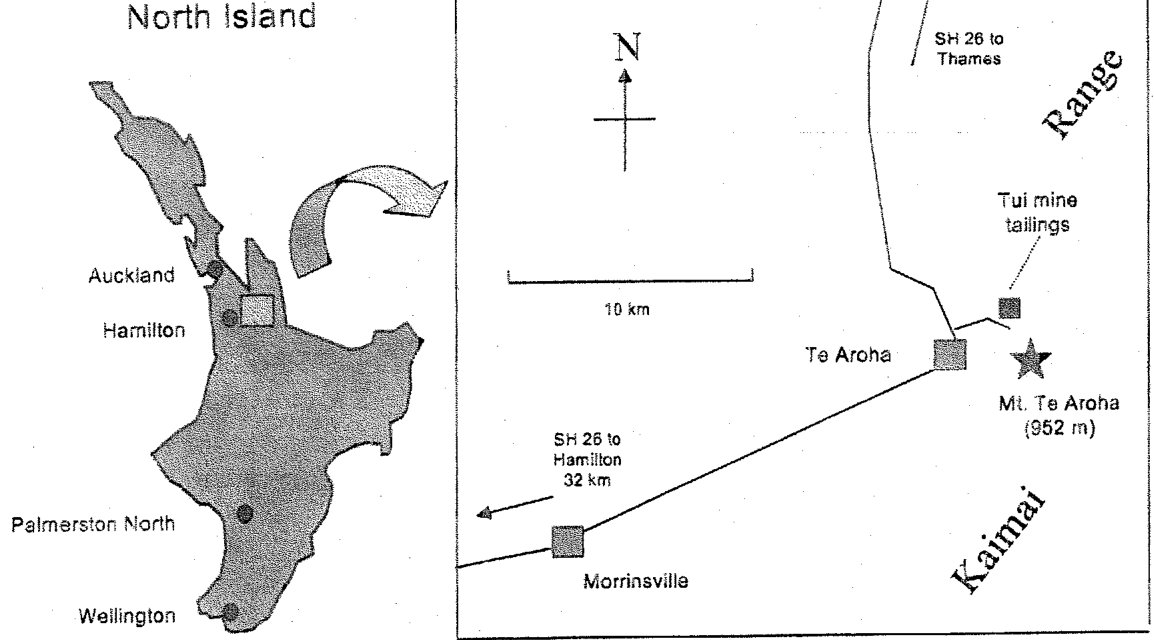
Substrate samples for the pot trials were collected from the tailings dam of the abandoned Tui base-metal mine, located on the northwest flank on Mount Te Arona, approximately 3 km northeast of the township of Te Aroha, North Island of New Zealand (Figure 1). The most recent period of mining activity occurred between 1967 and 1974 with the extraction and processing of up to 100 tons of ore a day, yielding up to io tons of lead-copperzinc concentrate containing minor amounts of mercury, cadmium, silver, and gold. The cessation of activities in 1974 left a tailings dam containing 100,000 m' of sulfiderich tailings with high levels of heavy metals. The main metal-bearing minerals present in the Tui ore are sphalerite (ZnS), galena (PbS), chalcopyrite (CuFeS2), and pyrite (FeS), which have been oxidized in contact with the air, producing acid mine drainage (Morrell et al., 1996).
盆栽试验所用基质样品采自废弃的Tui贱金属矿尾矿坝,该矿位于Te Aroha山西北坡,距新西兰北岛Te Aroha镇东北约3 km(图1)。最近一期采矿活动为1967—1974年,每天开采和加工矿石多达100 t,可产出多达10 t铅-铜-锌精矿,其中含少量汞、镉、银和金。1974年停产后,留下一座储存100,000 m3富硫化物尾矿的尾矿坝,其重金属含量很高。Tui矿石中主要的含金属矿物为闪锌矿(ZnS)、方铅矿(PbS)、黄铜矿(CuFeS2)和黄铁矿(FeS2),这些矿物与空气接触后被氧化,产生酸性矿山排水(Morrell et al., 1996)。
Substrate Characterization基质表征
The experiments described in this article utilized two types of samples collected from the Tui mine site. The experiment investigating plant accumulation of added soluble Hg used a low Hg content sample (0.3 = 0.003 mg/ kg·, whereas the experiments investigating the chemical solubilization of tailings and the induced plant Hg accumulation utilized a high Hg content sample (2.82 · 0.31 mg/kg).
本文所述试验使用了采自Tui矿区的两类样品。研究植物对外源可溶性汞累积的试验采用低汞含量样品(0.3 ± 0.003 mg/kg),而研究尾矿化学增溶及诱导植物汞累积的试验则采用高汞含量样品(2.82 ± 0.31 mg/kg)。
Chemically Solubilized Hg化学增溶汞
Seven chemical extractants were tested for their ability to estimate the concentration of chemically solubilized Hg in the Tui tailings. One gram of tailings was weighed into so ml polypropylene centrifuge tubes in triplicate. After addition of extractant solutions (20 ml of 2 g/L, unless otherwise stated), the tubes were rotated in a shaker overnight and the supernatant filtered. The following chemicals were investigated for their ability to extract Hg: ammonium thiocyanate (SCN), potassium thiocyanate (KCN), thiourea, humic acid (HA), ammonium thiosulfate (NH,S,O3), sodium sulfide (Na,S), hydrogen peroxide (at 0.27%), and ammonium thiocyanate (SCN + H202) plus hydrogen peroxide (at 0.27%).
测试了七种化学提取剂估算Tui尾矿中化学增溶汞浓度的能力。称取1 g尾矿置于50 ml聚丙烯离心管中,设三次重复。加入提取液(除另有说明外,为20 ml 2 g/L溶液)后,将离心管置于振荡器中旋转过夜,并过滤上清液。考察了以下化学试剂提取汞的能力:硫氰酸铵(SCN)、硫氰酸钾(KSCN)、硫脲、腐殖酸(HA)、硫代硫酸铵((NH4)2S2O3)、硫化钠(Na2S)、过氧化氢(0.27%)以及硫氰酸铵加过氧化氢(0.27%)(SCN + H2O2)。
Soluble Hg Plant Accumulation植物对可溶性汞的累积
The nickel hyperaccumulator B. coddii and the salt-tolerant A. canescens were grown from seeds in flat trays. They were transplanted individually into 250 ml plastic pots filled with 1:1 mixture of Tui mine tailings and pumice as one-week-old seedlings. The pumice was used to improve drainage of the fine-textured tailings. After five weeks, Hg was added as aqueous HgCl, to achieve total Hg concentrations of 1, 5, and i0 mg/kg in each growing pot. Previous analysis for total Hg in this particular subsample of Tui mine tailings showed average Hg levels of 0.3 mg/kg. Plants from each species grown in untreated substrates (without added Hg) were designated as control plants. Pots with Hg added at 1, 5, and 10 mg/kg of Hg but without plants were designated as control pots. All plants were watered daily. Forty-four days after HgCI, addition, all plants were harvested and substrates sampled.
镍超富集植物B. coddii和耐盐植物A. canescens由种子在平盘中育苗。幼苗长至一周龄时,逐株移栽至装有Tui矿尾矿与浮石1:1混合物的250 ml塑料盆中。浮石用于改善细质地尾矿的排水性能。五周后,以HgCl2水溶液形式添加汞,使各盆总汞浓度分别达到1、5和10 mg/kg。此前对该Tui矿尾矿子样品的总汞分析显示,其平均汞含量为0.3 mg/kg。各物种在未处理基质(未添加汞)中生长的植株作为对照植株;添加1、5和10 mg/kg汞但未种植植物的盆作为对照盆。所有植株每天浇水。添加HgCl2 44 d后,收获全部植株并采集基质样品。
Induced Plant Hg Accumulation诱导植物汞累积
The nonaccumulator plants B. juncea and Lupinus sp. were seeded directly into pots filled with the high Hg content Tui mine tailings. No pumice was added, as drainage was adequate for plant growth. In each pot, approximately 20 seeds of B. junceu and two seeds of Lupinus sp. were sown and the seedlings then grown for two more weeks. After five weeks each pot was thinned to leave only one individual plant. Three treatments, each with a different functional sulfur group, were investigated for inducing Hg accumulation in plants: thiourea, ammonium thiosulfate (NH,SO,), and ammonium thiocyanate supplemented with hydrogen peroxide at 0.27% (SCN + H202). The amount of chemical added was 2 g/kg of substrate, unless otherwise stated. Plants from each species grown in untreated substrates (without addition of ligands) were designated as control plants. Pots treated with ligands but without plants were designated as control pots. All plants
将非富集植物B. juncea和Lupinus sp.直接播种于装有高汞含量Tui矿尾矿的盆中。由于排水条件足以满足植物生长,未添加浮石。每盆播种B. juncea种子约20粒、Lupinus sp.种子2粒,幼苗再生长两周。五周后每盆间苗至仅留一株。考察了三种各含不同含硫官能团的处理对植物汞累积的诱导作用:硫脲、硫代硫酸铵((NH4)2S2O3)以及添加0.27%过氧化氢的硫氰酸铵(SCN + H2O2)。除另有说明外,化学试剂添加量为2 g/kg基质。各物种在未处理基质(未添加配体)中生长的植株作为对照植株;添加配体但未种植植物的盆作为对照盆。所有植株
Phytoremediation of Mercury-Contaminated Mine Tailings 167 were watered daily. A system for leachate collection was set up by putting the individual pots on the top of funnels and connecting them to 100 ml Erlenmeyer flasks. Five days after the addition of extractant solutions, all plants were harvested and leachates and substrates sampled.
汞污染矿山尾矿的植物修复 167 每天浇水。将各盆置于漏斗上方并连接100 ml锥形瓶,建立渗滤液收集系统。添加提取液5 d后,收获全部植株并采集渗滤液和基质样品。
The substrates used for investigating both soluble and induced plant Hg accumulation were fertilized with 5 g/L of Osmocote (slow-release fertilizer) and had their pH adjusted to 5.5 by the addition of lime. The experiments were carried out in a greenhouse with the temperature controlled at 21° C and under a natural sunlight flux. Both experiments utilized a two-factorial completely randomized experimental design (CRD), with plant species, Hg concentrations, and sulfur-containing ligands as factors (accordingly for each group of experiments). At least five pots were used as replicates for comparing plant treatment means (unless otherwise stated). Leachates and substrates were collected in triplicate. Except for dry yield biomass, all plant data were log-normally distributed.
用于研究可溶性汞累积和诱导植物汞累积的基质均施用5 g/L的Osmocote(缓释肥),并通过添加石灰将pH调至5.5。试验在温室中进行,温度控制在21 °C,采用自然光照。两项试验均采用双因素完全随机设计(CRD),分别以植物物种、汞浓度和含硫配体为因素(依各组试验而定)。除另有说明外,比较植物处理均值时至少设5盆重复。渗滤液和基质样品均采集三次重复。除干物质产量外,所有植物数据均呈对数正态分布。
Soil and Plant Digestions土壤和植物消解
Total Hg determinations for all tailings substrates were obtained through aqua regia digestions of dried samples collected from 12 locations at the Tui mine site. For this purpose, 1 g of substrate was weighed into 50 ml polypropyiene pots in triplicate, and a 15 ml solution of HNO, and HCI at 1:3 ratio was added. The samples were digested in a water bath at 80° C for one hour and the filtrates diluted to a final volume of 50 ml by adding reverse osmosis water. Total Hg from substrates of both soluble and induced plant pot trials was extracted using exactly the same procedure.
所有尾矿基质的总汞通过对Tui矿区12个采样点的干燥样品进行王水消解测定。为此,称取1 g基质置于50 ml聚丙烯容器中,设三次重复,加入15 ml HNO3与HCl体积比为1:3的混合溶液。样品于80 °C水浴中消解1 h,滤液用反渗透水定容至50 ml。可溶性汞和诱导植物盆栽试验基质的总汞均采用完全相同的方法提取。
Plants to be analyzed for total Hg were prepared in the following manner. Shoots and roots were washed in tap water and placed in a drying oven at 70° C until a constant weight was obtained. Subsamples (o.1 g) were accurately weighed into 50 ml plastic pots and digested with 15 ml of HNO. The plant samples were left overnight, and the following day were heated in a water bath at 80° C for one hour. Subsequently the plant digests were transferred to 10 ml polythene tubes and diluted with reverse osmosis water to make a final volume of 10 ml.
用于测定总汞的植物样品按以下方式制备。地上部和根系用自来水洗净后,置于70 °C烘箱中烘至恒重。准确称取子样品(0.1 g)置于50 ml塑料容器中,加入15 ml HNO3消解。植物样品静置过夜,次日于80 °C水浴中加热1 h。随后将植物消解液转移至10 ml聚乙烯管中,用反渗透水定容至10 ml。
Mercury Analyses汞分析
All samples of plant material, tailings, and leachates were analyzed for Hg using hydride-generation atomic absorption spectroscopy (Godden and Thomerson, 1980). Mercury-containing liquid samples were analyzed along with 10 ml of 0.5 M HCI. Sodium borohydride was used as a reducing agent to generate Hg vapor in a 5% NaBH4 + 1% KOH wt/vol solution. The limit of detection for Hg in solution was 11.5 ng/ml (i.e., 0.0115 mg/L). Reproducibility was obtained through replicate analysis of 10 standards containing 1 mg/I of Hg and variation was less than 5%. Reagent blanks were below detection limits, that is, less than 5 ppb, in the solution. Linear calibration curves were obtained over the range of 125 to 1000 ng/ml of Hg using four standards prepared from a 10 mg/L mercuric nitrate (HgNO,) AAS reagent (M&B). The analytical method was assessed for quality control by an external certified laboratory, with agreements ranging from 85% to 103% for Hg-containing solutions and Hg-containing plant and soil samples.
所有植物材料、尾矿和渗滤液样品均采用氢化物发生原子吸收光谱法测定汞(Godden and Thomerson, 1980)。含汞液体样品与10 ml 0.5 M HCl一同分析。以硼氢化钠为还原剂,在5% NaBH4 + 1% KOH(质量/体积)溶液中生成汞蒸气。溶液中汞的检出限为11.5 ng/ml(即0.0115 mg/L)。通过对10个含1 mg/L汞的标准溶液进行重复分析检验重现性,变异小于5%。试剂空白低于检出限,即溶液中小于5 ppb。用10 mg/L硝酸汞(Hg(NO3)2)AAS试剂(M&B)配制的四个标准溶液,在125~1000 ng/ml汞范围内获得线性校准曲线。分析方法经外部认证实验室进行质量控制评估,含汞溶液及含汞植物和土壤样品的一致性为85%~103%。
Statistical Analyses统计分析
A copy of SAS PC version &e was used for statistical analyses. Possible interactions between the main factors were addressed performing a two-way analysis of variance (ANOVA) on the logs of the data. Duncan's multiple range test was used for pairwise comparison of means.
统计分析采用SAS PC 6版软件。对数据取对数后进行双因素方差分析(ANOVA),以考察主因素间可能的交互作用。均值两两比较采用Duncan多重极差检验。
2Results结果
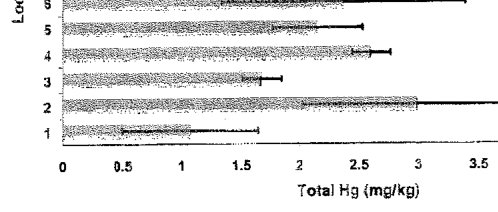
Total and Chemically Solubilized Fig that Hg was not uniformly distributed in the Tui mine tailings.
总汞与化学增溶汞 表明汞在Tui矿尾矿中分布不均匀。
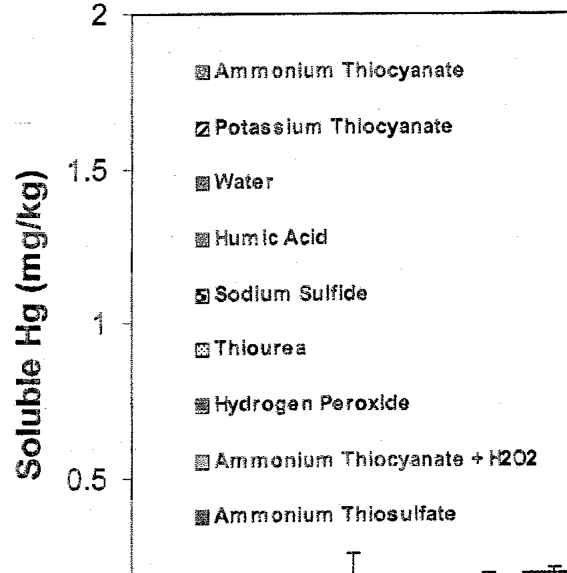
Figure 3. Chemically solubilized Hg as a result of sulfur-containing ligands applied to Tui mine tailings at a 2 g/L concentration [except H,O½, (0.27%)]. Bars denote +1 standard deviation from the mean of three replicates.图3. 向Tui矿尾矿施用2 g/L含硫配体[H2O2(0.27%)除外]所致的化学增溶汞。误差线表示三次重复平均值的±1标准差。
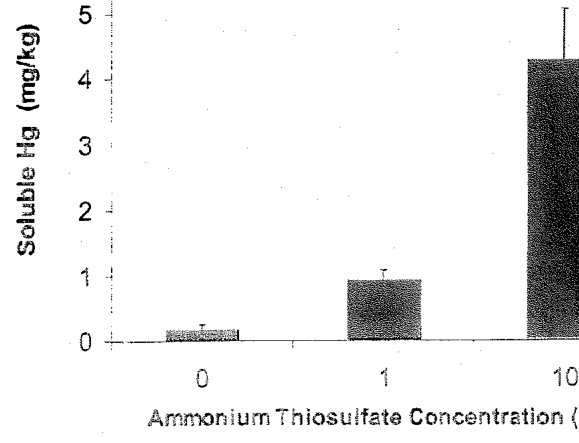
Soluble Hg concentrations, as a function of chemical extractants (specifically, sulfur-containing ligands) added to Tui mine tailings, are shown in Figure 3. Mercury solubility in Tui mine tailings was significantly increased in the presence of NH,S,O, and SCN + H202 when compared to the control (p < 0.0001) (Figure 3). Figure 4 shows that the concentration of soluble Hg was significant and positively correlated (r = 0.88, p < 0.0001) to the concentration of NHS20, applied to the substrate. At the highest NH4S20, concentration, the concentration of Hg in the extract reached 4.3 mg/kg, which is equivalent to the highest range for total Hg concentration found in the aqua regia digests (Figure 2). We believe therefore that two main processes increased Hg solubility under the acidic conditions that prevail in the Tui mine tailings. The first process occurred in the presence of NH4S,0, and involved extraction of Hg bound to the solid phase of sulfidic minerals, possibly through the formation of a thiosulfate- Hg complex. For the second process, hydrogen peroxide may have oxidized sulfidic Hg forms, allowing formation of a Hg-SCN complex.
图3给出了向Tui矿尾矿添加化学提取剂(具体为含硫配体)后可溶性汞的浓度。与对照相比,(NH4)2S2O3和SCN + H2O2的存在显著提高了Tui矿尾矿中汞的溶解度(p < 0.0001)(图3)。图4表明,可溶性汞浓度与基质中(NH4)2S2O3的施用浓度呈显著正相关(r = 0.88,p < 0.0001)。在(NH4)2S2O3最高浓度下,提取液中汞浓度达4.3 mg/kg,相当于王水消解所测总汞浓度的最高范围(图2)。因此我们认为,在Tui矿尾矿普遍存在的酸性条件下,有两个主要过程提高了汞的溶解度。第一个过程发生在(NH4)2S2O3存在时,可能通过形成硫代硫酸根-汞络合物,提取了与硫化矿物固相结合的汞。第二个过程中,过氧化氢可能氧化了硫化态汞,使汞-SCN络合物得以形成。
Soluble Hg Plant Accumulation植物对可溶性汞的累积
The accumulation of soluble Hg in roots and shoots of B. coddi and A. canescens is shown in Figure 5. On average, root concentration was an order of magnitude higher than shoot concentration. Roots of both species showed very similar patterns for Hg accumulation as a function of Hg treatments, indicating that a physiological mechanism exists for regulating Hg uptake above certain concentrations. Accumulation of Hg in roots therefore increased drastically up to 5 mg/kg of Hg in substrates, keeping a steady concentration in the root tissue of around 75 mg/kg with no significant increase beyond this level (Figure 5A). In the case of shoots, B. coddii accumulated significantly more Hg than A. canescens (Figure SB). At substrate additions of 10 mg/kg of Hg, for instance,
图5给出了B. coddii和A. canescens根系和地上部对可溶性汞的累积。平均而言,根系汞浓度比地上部高一个数量级。两种植物根系汞累积随汞处理的变化规律非常相似,表明存在一种在一定浓度以上调节汞吸收的生理机制。因此,基质汞浓度在5 mg/kg以下时,根系汞累积急剧增加,之后根组织中汞浓度稳定在约75 mg/kg,超过该水平后无显著增加(图5A)。地上部方面,B. coddii累积的汞显著多于A. canescens(图5B)。例如,在基质添加10 mg/kg汞时,
Phytoremediation of Mercury-Contaminated Mine Tailings 169 the average Hg values for B. coddii and A. canescens in shoots were 8.7 and 2.47 mg/kg dry weight, respectively. Furthermore, B. coddii showed shoot Hg concentrations that were highly and positively correlated to increasing concentrations of Hg in substrates (r = 0.76, p < 0.0001). Mean values for dry matter yield were not significantly different, neither between plant species nor between levels of Hg treatments (Table 1). Therefore both plant species showed evidence of some degree of tolerance to the presence of Hg in substrates.
汞污染矿山尾矿的植物修复 169 B. coddii和A. canescens地上部平均汞含量分别为8.7和2.47 mg/kg干重。此外,B. coddii地上部汞浓度与基质汞浓度的增加呈高度正相关(r = 0.76,p < 0.0001)。干物质产量均值在植物物种之间及汞处理水平之间均无显著差异(表1)。因此,两种植物均表现出对基质中汞一定程度的耐受性。
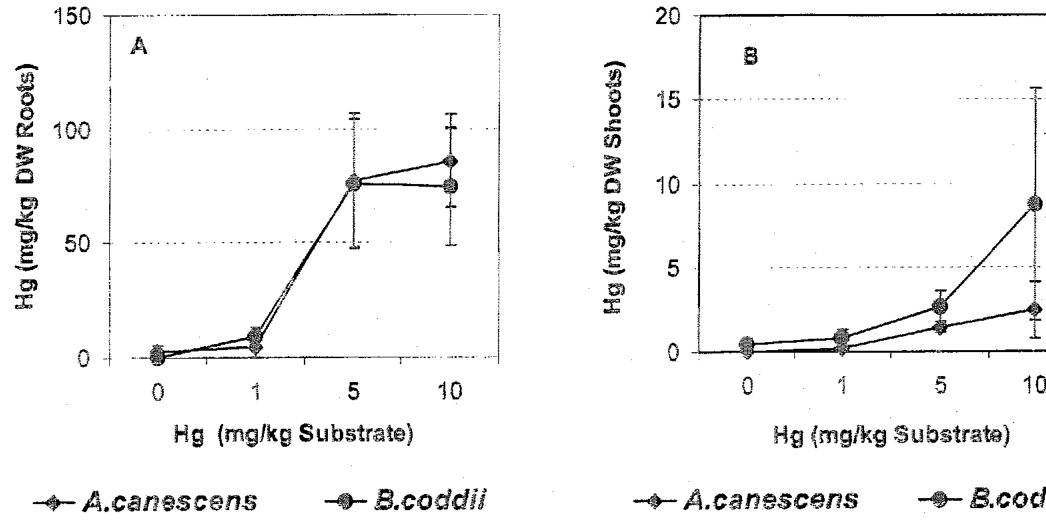
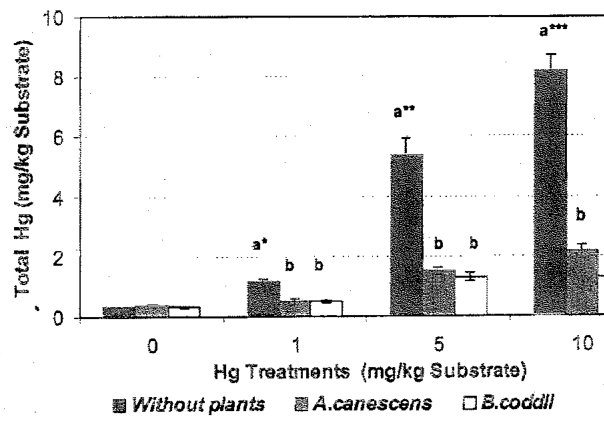
Figure 6 compares Hg concentrations (in mg/kg) between planted and unplanted substrates within each treatment level of Hg at the end of the experiment. The Hg concentrations found in control substrates were significantly higher than in planted substrates for all Hg-treated substrates (0.05 > p > 0.0001). In addition, there was no significant difference between control and planted pots in relation to the initial concentration of Hg present in untreated substrates (0.3 mg/kg, on average). These results图6比较了试验结束时各汞处理水平下种植与未种植基质的汞浓度(mg/kg)。在所有加汞基质中,对照基质的汞浓度均显著高于种植基质(0.05 > p > 0.0001)。此外,就未处理基质中原有的汞浓度(平均0.3 mg/kg)而言,对照盆与种植盆之间无显著差异。这些结果
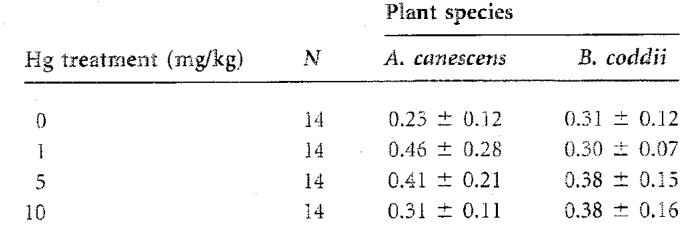
Values are +1 standard deviation from the mean of five replicates.
数值为五次重复平均值的±1标准差。
indicate the naturally occurring Hg forms present in the tailings provide very limited availability for plant uptake.
表明尾矿中天然存在的汞形态对植物吸收的有效性非常有限。
Induced Plant Hg Accumulation诱导植物汞累积
The results for induced Hg accumulation by B. juncea and Lupinus sp. as a consequence of the addition of sulfur-containing ligands to Tui mine tailings are shown in Table 2 (roots) and Figure 7 (shoots). The application of NH4520, and SCN + H202 solubilized Hg in the substrates and substantially increased Hg uptake by the roots, as well as translocation to shoots. Overall, root accumulation in the presence of NH,$,03 and SCN + H20, was significantly higher (0.05 > p > 0.0001) among all plant-ligand combinations. Mercury concentrations in the root tissues of Lupinus sp. and B. juncen averaged 255 and 104 mg/kg dry weight, respectively, after individual addition of NH4S2O, (Table 2), Application of NH,S,O, to substrates also dramatically increased Hg accumulation in shoots of B. juncea relative to other treatments (Figure 7). Recorded values in aerial tissues of B. juncen averaged 43 mg/kg, with a single replicate reaching a value of 61 mg/kg. In contrast, translocation of Hg to shoots of Lupinus sp. was substantially lower when compared to B. juncea shoots. The maximum value observed for the former species was 0.5 mg/kg in the presence of NH,S20, (Figure 7). In addition, the presence of NH,S,0, induced a more equal distribution of the Hg mass between shoots and roots of B, juncen, whereas for Lupinus sp. the great majority of the total plant Hg mass was retained in the root tissues (data not shown).
表2(根系)和图7(地上部)给出了向Tui矿尾矿添加含硫配体后B. juncea和Lupinus sp.的诱导汞累积结果。施用(NH4)2S2O3和SCN + H2O2使基质中的汞溶解,并大幅提高了根系对汞的吸收及其向地上部的转运。总体而言,在所有植物-配体组合中,(NH4)2S2O3和SCN + H2O2存在时根系累积显著更高(0.05 > p > 0.0001)。单独添加(NH4)2S2O3后,Lupinus sp.和B. juncea根组织中汞浓度平均分别为255和104 mg/kg干重(表2)。与其他处理相比,向基质施用(NH4)2S2O3也显著提高了B. juncea地上部的汞累积(图7)。B. juncea地上组织中汞含量平均为43 mg/kg,其中一个重复达61 mg/kg。相反,与B. juncea地上部相比,汞向Lupinus sp.地上部的转运显著较低,后者的最大观测值为(NH4)2S2O3存在时的0.5 mg/kg(图7)。此外,(NH4)2S2O3的存在使B. juncea中汞质量在地上部与根系之间的分配更为均衡,而Lupinus sp.植株汞总质量的绝大部分滞留于根组织中(数据未列出)。
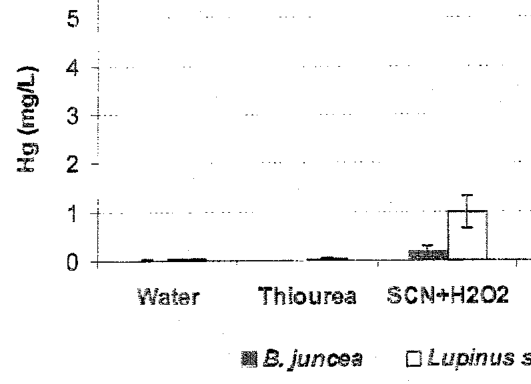
The Hg content in leachates was enhanced after addition of sulfur-containing ligands to Tui mine tailings (Figure 8). Specifically, the application of NH,S20, promoted a significant increase (p < 0.0001) in the Hg concentration present in leachates collected from Lupinus sp. pots among all other plant-ligand combinations. After the addition of NH45203, the Hg concentration in leachates collected from Lupinus sp. and B. juncea pots increased by 4 and 1 mg/L, respectively, whereas Hg concentrations in controls were an order of magnitude lower.
向Tui矿尾矿添加含硫配体后,渗滤液中的汞含量升高(图8)。具体而言,在所有植物-配体组合中,施用(NH4)2S2O3使Lupinus sp.盆渗滤液中的汞浓度显著增加(p < 0.0001)。添加(NH4)2S2O3后,Lupinus sp.和B. juncea盆渗滤液中的汞浓度分别增加了4和1 mg/L,而对照的汞浓度则低一个数量级。
Figure 9 shows a 100% normalized picture of mass balance for plant, soil, leachates, and unaccounted for Hg for B. juncea and Lupinus sp. grown in Tui tailings and treated with NH,S203. The unaccounted for Hg fraction was obtained for each plant species by subtracting the Hg mass found in plants (shoots + roots), leachates, and substrates at harvest from the average Hg mass found in control pots (without plants) at the end of the experiment. Because Hg accumulation in roots and shoots was superior in the presence of NH4S203, the Hg mass balance for both species was compared only within this treatment level.图9给出了在Tui尾矿中生长并经(NH4)2S2O3处理的B. juncea和Lupinus sp.的植物、土壤、渗滤液及未计入汞的质量平衡(按100%归一化)。各植物物种的未计入汞部分,由试验结束时对照盆(无植物)的平均汞质量减去收获时植物(地上部 + 根系)、渗滤液和基质中的汞质量求得。由于(NH4)2S2O3存在时根系和地上部的汞累积更高,两种植物的汞质量平衡仅在该处理水平内进行比较。
The existence of a Hg fraction that could not be accounted for indicates that the added Hg has been transformed to a form of Hg that could not be measured after the addition of NH,S203. Therefore it is possible to infer that the unaccounted-for Hg fraction might be due to Hg(o) volatilization from plant leaves or roots and their associated microbes (Barkay et al., 1992; Leonard et al., 1998;
存在无法计入的汞部分,表明添加(NH4)2S2O3后,添加的汞已转化为无法测定的形态。因此可以推断,未计入的汞部分可能源于植物叶片或根系及其相关微生物的Hg(0)挥发(Barkay et al., 1992; Leonard et al., 1998;
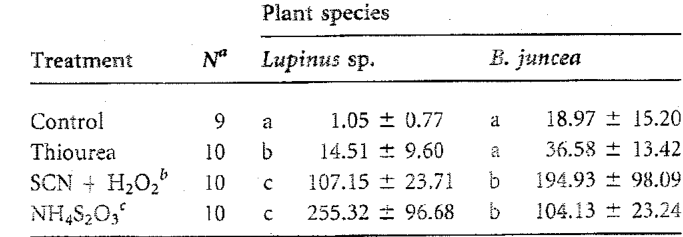
Values are ·1 standard deviation from the mean of five replicates. Letters compare treatments in the vertical; means with the same letter are not significantly different [Duncan's test at a significance level (x) of o.ou]. " Missing values due to Hg concentrations in sample digests below detection limits.
数值为五次重复平均值的±1标准差。字母用于纵向比较各处理;字母相同的均值差异不显著[Duncan检验,显著性水平(α)为0.01]。" 因样品消解液中汞浓度低于检出限而缺失的数值。
" Ammonium thiocyanate + hydrogen peroxide at 2 g/kg and 0.27%, respectively.
" 硫氰酸铵 + 过氧化氢,浓度分别为2 g/kg和0.27%。
· Ammonium thiosulfate.
Meagher et al., 2000). In addition, because photochemical and chemical reduction processes are significant sources of Hg(o) emitted from contaminated sites (Andersson, 1979; Morel, Kraepiel, and Amyot, 1998), it is also possible that these abiotic factors have contributed to the volatile Hg fraction. The fact that Hg-treated substrates without plants exhibited up to 20% losses from initial Hg concentrations (Figure 6) provides support for this assumption. Finally, the existence of a volatilized Hg fraction offers an explanation for the discrepancy observed between planted pots and controls in relation to the Hg concentrations found in substrates at the end of the experiment (Figure 6).
Meagher et al., 2000)。此外,由于光化学和化学还原过程是污染场地Hg(0)排放的重要来源(Andersson, 1979; Morel, Kraepiel, and Amyot, 1998),这些非生物因素也可能对挥发性汞部分有所贡献。未种植植物的加汞基质的汞损失可达初始浓度的20%(图6),这为上述推测提供了支持。最后,挥发性汞部分的存在也解释了试验结束时种植盆与对照盆基质汞浓度之间的差异(图6)。
3Discussion讨论
The high sulfide content (>10%) and the presence of the sulfide-bearing minerals galena (PbS), sphalerite (ZnS), pyrite (FeS2), and chalcopyrite (CuFeS2) in the Tui ore indicate that Hg in the tailings might be present as sulfidic Hg forms such as cinnabar, metacinnabar, Hg polysulfides, or Hg associated with iron sulfides. In addition, trace quantities of cinnabar were shown to be present in the Tui ore (Morrell et al., 1996). These Hg forms are very insoluble, not easily altered, and seldom found as detrital material (Kabata-Pendias and Pendias, 2000). Because of their insolubility, sulfidic forms of Hg are said to be unavailable and/or immobile in the environment. This means that they do not liberate Eg ions in water and thus their mobility for aqueous transport and transformation in the environment is low (Wallschäger et al. 1998). Our studies showed, however, the presence of significant amounts of water-extractable Hg in the Tui tailings (Figure 3). Because the tailings have been left to weather since the closure of the mine in 1974, oxidation of pyrite and other sulfide-bearing minerals has led to acid mine drainage. As a result, the surface tailings exhibit variable but low pH (2.76-3.85) and high concentrations of total sulfur and sulfates (SO,) (Morrell et al., 1996). The presence of significant amounts of water-soluble Hg species in the Tui tailings suggests therefore that Hg was released to solution complexed to SO4 or S ligands, a reaction that has been shown to occur if significant levels of sulfur-containing functional groups are present in well-oxygenated solutions (Schuster, 1991). Consequently we cannot assume that the sulfidic Hg forms present in Tui mine tailings are able to retain Hg in an environmentally safe form and that they do not represent a risk to the environment.
Tui矿石中较高的硫化物含量(>10%)以及方铅矿(PbS)、闪锌矿(ZnS)、黄铁矿(FeS2)和黄铜矿(CuFeS2)等含硫化物矿物的存在,表明尾矿中的汞可能以硫化态汞形式存在,如辰砂、黑辰砂、多硫化汞或与铁硫化物结合的汞。此外,已证实Tui矿石中存在痕量辰砂(Morrell et al., 1996)。这些汞形态极难溶解、不易蚀变,且很少以碎屑物质形式存在(Kabata-Pendias and Pendias, 2000)。由于其不溶性,硫化态汞在环境中被认为是非有效和/或不可移动的。这意味着它们不会在水中释放汞离子,因而其在环境中经水相迁移和转化的能力较低(Wallschläger et al. 1998)。然而,我们的研究表明,Tui尾矿中存在大量可被水提取的汞(图3)。自1974年矿山关闭以来,尾矿一直处于风化状态,黄铁矿和其他含硫化物矿物的氧化导致了酸性矿山排水。因此,表层尾矿的pH变化较大但普遍较低(2.76~3.85),且总硫和硫酸盐(SO4)浓度较高(Morrell et al., 1996)。因此,Tui尾矿中大量水溶性汞形态的存在表明,汞以与SO4或S配体络合的形式释放到溶液中;已有研究表明,当通气良好的溶液中存在大量含硫官能团时会发生这一反应(Schuster, 1991)。由此可见,我们不能认为Tui矿尾矿中的硫化态汞能够将汞保持在环境安全的形态,也不能认为其对环境不构成风险。
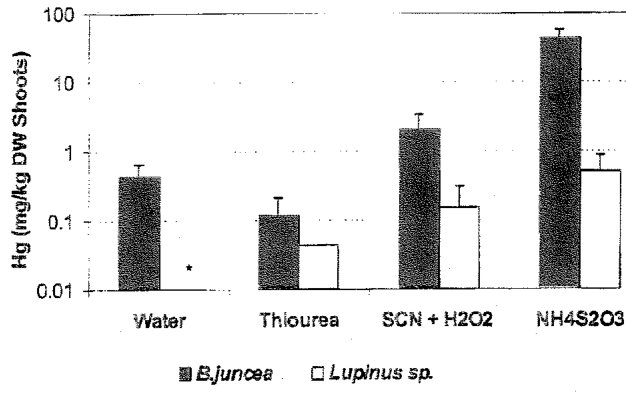
Average background levels of Hg in plants are usually not greater than 100 ng/g (ppb) dry weight (Kabata-Pendias and Pendias, 2000). Through addition of NH,S,03 to Tui mine tailings, B. juncea was able to accumulate more than 400 times this value in the aerial tissues. In addition, Hg analysis in New Zealand native plants grown on Tui mine tailings showed Hg values below detection levels for aboveground plant tissues (data not shown), thus highlighting the effect of NH, $20, on shoot Hg accumulation. The greater ability of NH,$20, to enhance shoot Hg accumulation over other sulfur-containing ligands appears to be species specific, as only very small concentrations of Hg were found in the aerial tissues of Lupinus sp. Assuming that Hg retention in roots occurs at ion exchangeable sites on the cell wall (Blaylock et al., 1997), then NH,S,0, under the moderately acidic conditions prevailing in Tui mine tailings effectively reduced Hg retention in cell walls of B. juncea roots, thus facilitating Hg translocation to aerial tissues.
植物中汞的平均背景值通常不超过100 ng/g(ppb)干重(Kabata-Pendias and Pendias, 2000)。通过向Tui矿尾矿添加(NH4)2S2O3,B. juncea地上组织中汞的累积量超过该值的400倍。此外,对生长在Tui矿尾矿上的新西兰本土植物的汞分析显示,其地上组织汞含量低于检出限(数据未列出),这突显了(NH4)2S2O3对地上部汞累积的作用。与其他含硫配体相比,(NH4)2S2O3促进地上部汞累积的较强能力似乎具有物种特异性,因为Lupinus sp.地上组织中仅发现极低浓度的汞。假设根系对汞的滞留发生在细胞壁的离子交换位点上(Blaylock et al., 1997),则在Tui矿尾矿普遍存在的中度酸性条件下,(NH4)2S2O3有效降低了B. juncea根系细胞壁对汞的滞留,从而促进了汞向地上组织的转运。
The volatilization of Hg by plants has been the subject of many studies that have attempted to investigate the behavior of Hg at the soil-plant-atmosphere interface (Leonard et al., 1998; Siegel, Puerner, and Speitel, 1974; Siegel and Siegel, 1979). Indeed, Leonard et al. (1998), in a carefully designed system for studying plant Hg emissions to the atmosphere, accumulated sufficient evidence to conclude that, in a biogeochemical context, plants work as biological conduits for Hg transfer from the geosphere to the atmosphere. Although great care was taken to minimize Hg losses, both the experimental procedure and the analytical techniques used in these experiments were not sufficient to determine the reasons for the unaccounted-for Hg fraction lost from the system (Figure 9). We have overcome this problem in subsequent studies by using gastight volatilization systems carefully designed to account for Hg losses from hydroponically grown B. juncea plants (Moreno et al., 2003). The results demonstrated that the volatilization process was significantly enhanced by plants in relation to controls and that it increased progressively from 40% to approximately 80% as the Hg concentrations in solutions increased from 0.05 to 10 mg/L. Therefore we can infer with a certain degree of confidence that plants and their associated microbes may have played an important role in the overall mass balance
植物对汞的挥发已有许多研究,旨在探讨汞在土壤-植物-大气界面的行为(Leonard et al., 1998; Siegel, Puerner, and Speitel, 1974; Siegel and Siegel, 1979)。事实上,Leonard et al.(1998)利用精心设计的植物汞向大气排放研究系统,积累了充分证据,得出结论:在生物地球化学背景下,植物是汞从地圈向大气迁移的生物通道。尽管本研究已尽力减少汞损失,但试验程序和分析技术均不足以确定系统中未计入汞部分损失的原因(图9)。在后续研究中,我们采用为计量水培B. juncea植株汞损失而精心设计的气密性挥发系统克服了这一问题(Moreno et al., 2003)。结果表明,与对照相比,植物显著增强了挥发过程,且随溶液中汞浓度由0.05 mg/L增至10 mg/L,挥发比例由40%逐步增至约80%。因此,我们可以在一定程度上推断,植物及其相关微生物可能在
* Unaccounted Hg · Plant Hg Figure 9. Normalized (100%) values · Soil Hg of plant, soil, leachates, and unaccounted-for Hg from Brassica juncea and Lupinus sp. after · Leachates Hg application of ammonium thiosulfate at 2 g/kg to Tui mine tailings. Note that 100% = total Hg concentration in control pots (2.82 · 0.31 mg/kg).
* 未计入汞 · 植物汞 图9. 向Tui矿尾矿施用2 g/kg硫代硫酸铵后,Brassica juncea和Lupinus sp.的植物、土壤、渗滤液 · 土壤汞 及未计入汞的归一化(100%)值 · 渗滤液汞。注:100% = 对照盆中的总汞浓度(2.82 ± 0.31 mg/kg)。
for Hg in Tui mine tailings. In this way, any plant-based strategy that aims to remediate Hg-contaminated soils should take into consideration the possibility of Hg losses from the system by volatilization.
Tui矿尾矿汞的总体质量平衡中发挥了重要作用。因此,任何旨在修复汞污染土壤的植物修复策略都应考虑汞通过挥发从系统中损失的可能性。
The application of chelating agents to soils to induce a higher metal concentration in plants raises environmental concerns due to the potential contamination of groundwater via the leaching of mobilized metals. Leachates can be produced when rates of solubilizing agents applied to the soil are above the levels of metals in the soil solution that can be effectively taken up by plants. This excess metal may leach below the root zone into groundwater, a process exacerbated by macropore flow (Bundt et al., 2000). This explains the generation of Hg-containing leachates after the addition of NH4S,0, and SCN + H202 to substrates (Figure 8). Mercury leachate generation could be managed by using plant species with high transpiration rates, such as willows and poplars, or by intensive cropping practices and careful management of the irrigation systern. The use of dual-pipe subirrigationdrainage systems has been proposed to collect metalenriched drainage from an ethylenediaminetetraacetic (EDTA)-assisted phytoremediation (Madrid, Liphadzi, and Kirkham, 2003). In this system, water intercepted by drain tubes was pumped back to the irrigation supply in order to reduce leaching and the potential for groundwater contamination. This method could be optimized if a natural barrier of deep-rooted poplar or willow trees is established on site to help reduce downward movement of contaminants into the unsaturated zone, as has been proposed for leaching control of pesticides, nitrates, and heavy metals such as arsenic, boron, copper, and chromium (Paterson and Schnoor, 1992, 1993; Robinson et al., 2003).
向土壤施用螯合剂以提高植物中金属浓度,会因活化金属的淋溶而可能污染地下水,从而引发环境担忧。当增溶剂的施用量超过植物能够有效吸收的土壤溶液金属水平时,便会产生渗滤液。这些过量的金属可能淋溶至根区以下进入地下水,而大孔隙流会加剧这一过程(Bundt et al., 2000)。这解释了向基质添加(NH4)2S2O3和SCN + H2O2后产生含汞渗滤液的原因(图8)。含汞渗滤液的产生可通过种植柳树和杨树等高蒸腾速率植物、采用集约化种植方式以及精心管理灌溉系统加以控制。已有研究提出采用双管地下灌溉-排水系统,收集乙二胺四乙酸(EDTA)辅助植物修复过程中产生的富含金属的排水(Madrid, Liphadzi, and Kirkham, 2003)。在该系统中,排水管截留的水被泵回灌溉水源,以减少淋溶及地下水污染的可能性。若在场地建立深根性杨树或柳树的天然屏障,以减少污染物向非饱和带的下移,该方法可得到进一步优化;此类屏障已被提出用于控制农药、硝酸盐以及砷、硼、铜和铬等重金属的淋溶(Paterson and Schnoor, 1992, 1993; Robinson et al., 2003)。
Another issue of concern is the potential toxicity of sulfur-containing chemical ligands to fauna and flora. It has been demonstrated, however, that thio- complexes are readily broken down by soil microorganisms and that thiosulfate salts are only slightly toxic to plants and animals. The lethal concentration (LDs) of sodium thiosulfate in rabbits, for instance, is 4000 mg/kg, a value that indicates a toxicity level very similar to that of sodium chloride in rats (LDso = 3000 mg/kg) (Anderson, Brooks, and Stewart, 2000; Strecher et al., 1968).
另一个值得关注的问题是含硫化学配体对动植物的潜在毒性。然而,已有研究表明,硫代络合物易被土壤微生物分解,且硫代硫酸盐对植物和动物仅有轻微毒性。例如,硫代硫酸钠对家兔的致死剂量(LD50)为4000 mg/kg,这一数值表明其毒性水平与氯化钠对大鼠的毒性(LD50 = 3000 mg/kg)非常接近(Anderson, Brooks, and Stewart, 2000; Strecher et al., 1968)。
The feasibility of a phytoremediation operation using induced plant Hg accumulation was assessed for a B. juncea crop grown under the phytotoxic conditions that prevail in the Tui base-metal tailings. Assuming a conservative value of 10 tons per hectare (ha) of biomass production and an average Hg value of 50 mg/kg (dry weight) in shoot tissues, a single crop of B. juncea would remove 0.5 kg/ha of Hg from the Tui mine tailings. Following this approach and assuming a soil bulk density of 1.3, each crop of B. juncea would reduce the soil Hg concentration by 0.25 mg/kg. These calculations do not take into account Hg losses from the system as a result of leaching or volatilization.
针对在Tui贱金属尾矿普遍存在的植物毒性条件下种植的B. juncea作物,评估了利用诱导植物汞累积开展植物修复的可行性。假设生物量产量取保守值10 t/ha,地上组织平均汞含量为50 mg/kg(干重),则单季B. juncea作物可从Tui矿尾矿中去除0.5 kg/ha汞。按此方法并假设土壤容重为1.3,每季B. juncea作物可使土壤汞浓度降低0.25 mg/kg。上述计算未考虑因淋溶或挥发造成的系统汞损失。
4Conclusions结论
In this work we have effectively induced plants to accumulate Hg from contaminated metal waste by treating the substrate with sulfur-containing chelates. By doing this, B. juncea plants concentrated 43 mg/kg of Hg in shoot tissues from a substrate Hg concentration of 2.8 mg/kg, thus giving a concentration factor (concentration in plant tissue/ concentration in soil) of 15.3. This achievement might have
本研究通过用含硫螯合剂处理基质,有效诱导了植物从受污染的金属废弃物中累积汞。由此,B. juncea植株从汞浓度为2.8 mg/kg的基质中在地上组织富集了43 mg/kg汞,富集系数(植物组织浓度/土壤浓度)为15.3。这一成果可能
Phytoremediation of Mercury-Contaminated Mine Tailings 173 some positive implications for the remediation of sites with low to moderate levels of Hg in substrates, where availability of some Hg forms limits Hg uptake and accumulation by plants. A possible phytoremediation strategy for the removal of Hg from the contaminated tailings therefore would be to promote volatilization of Hg by plants established on site in conjunction with periodic removal of Hg-containing plant material after treatment with NH4S203. The results of this preliminary study, however, should be validated under field conditions where plant uptake of Hg and root growth can occur without the physical limitations imposed by simple pot trials. The logical sequence of this work will investigate plant Hg accumulation with New Zealand native species growing directly on Tui mine tailings, whereas additional plant pot trials using gastight volatilization chambers will address the effect of NH4S20, on the plant Hg volatilization process.
汞污染矿山尾矿的植物修复 173 对基质汞含量为低至中等水平、且某些汞形态的有效性限制了植物对汞的吸收和累积的场地修复具有积极意义。因此,从受污染尾矿中去除汞的一种可能的植物修复策略是:促进场地上所种植物对汞的挥发,同时在(NH4)2S2O3处理后定期移除含汞植物材料。然而,本初步研究的结果应在田间条件下加以验证,在田间条件下植物对汞的吸收和根系生长不受简单盆栽试验的物理限制。本工作的后续研究将考察直接生长在Tui矿尾矿上的新西兰本土植物对汞的累积,另将利用气密性挥发室开展盆栽试验,研究(NH4)2S2O3对植物汞挥发过程的影响。
5Acknowledgments致谢
We gratefully acknowledge the National Council for Scientific and Technological Development (CNPq/Brazil) for providing a scholarship to the first author.
感谢巴西国家科学技术发展委员会(CNPq/Brazil)为第一作者提供奖学金。
6References参考文献
Anderson, C. W. N., R. Brooks, and R. B. Stewart. 200o. Phytomining: A New Method of Mining Using Plants. Chemistry in New Zealand 81:16-22.
Andersson, A. 1979. Mercury in Soils. In The Biogeochemistry of Mercury in the Environment, J. O. Nriagu, ed. Elsevier Biomedical Press, Amsterdam, The Netherlands, 79-106.
Barkay, T., R. Turner, E. Saouter, and J. Horn. 1992. Mercury Biotransformations and their Potential for Remediation of Mercury Contamination. Biodegradation 3147-159.
Barnett, M. O., L. A. Harris, R. R. Turner, R. J. Stevenson, T. J. Henson, R. C. Melton, and D. Hoffman. 1997. Formation of Mercuric Sulfide in Soils. Environmental Science and Technology 313037-3043.
Bizily, S. P., C. L. Rugh, A. O. Summers, and R. B. Meagher. 1999. Phytoremediation of Methyimercury Pollution: MerB Expression in Arabidopsis thaliana Confers Resistance to Organomercurials. Proceedings of the National Academy of Sciences 96:6808-6813.
Blaylock, M. J., D. E. Salt, S. Dushenkov, O. Zakharova, C. Gussman, Y. Kapulnik, B. D. Ensley, and I. Kaskin. 1997. Enhanced Accumulation of Pb in Indian Mustard by Soil-Applied Chelating Agents. Environment Science and Technology 31:860-865.
Brooks, R. R. 1998. Phytoremediation by Volatilization. In Plants that Hyperaccumulate Heavy Metals, R. R. Brooks, ed. CAB International, Cambridge, UK, 380 Pp.
Bundt, M., A. Albrecht, P. Froidevaux, P. Blaser, and H. Fluhler. 2000. Impact of Preferential Flow on Radionuclide Distribution in Soil. Environment Science and Technology 34:3595-3899.
Godden, R. G., and D. R. Thomerson. 1980. Generation of Covalent Hydrides in Atomic-Absorption Spectroscopy. Analyst 105:1137-1156.
Gupta, S. K., T. Herren, K. Wenger, R. Krebs, and T. Hari. 2000. In situ Gentle Remediation Measures for Heavy Metal-Polluted Sites. In Phytoremediation of Contaminated Soil and Water, N. Terry and G. Bañuelos, eds. CRC Press, Boca Raton, FL, 303~322.
Hoimström, H1., U. J. Salmon, E. Carisson, P. Petrov, and B. Ohlander. 2001. Geochemical Investigations of Sulfide-Bearing Tailings at Kristineberg, Northern Sweden, a Few Years after Remediation. Science of Total Environment 273:113-133.
Kabata-Pendias, A., and H. Pendias, 200o. Trace Elements in Soils and Plants. CRC Press, Boca Raton, FL, 413 pp.
Leonard, T. L., G. E. Taylor, Jr., M. S. Gustin, and G. C. J. Fernandez. 1998. Mercury and Plants in Contaminated Soils: 1. Uptake, Partitioning, and Emission to the Atmosphere. Environmental Toxicology and Chemistry 17:2063-2071.
Madrid, F., M. S. Liphadzi, and M. B. Kirkham. 2003. Heavy Metal Displacement in Chelated-Irrigated Soil during Phytoremediation. Journa! of Hydrology 272(1-4):107-119.
McGrath, S. P. 1998. Phytoextraction for Soil Remediation. In Plants that Hyperaccumulate Heavy Metals, R. R. Brooks, ed. CAB International, Cambridge, UK, 261-287.
McLaren, R. G., and K. C. Cameron. 1996. Soil Science. Oxford University Press, Canterbury, New Zealand, 304 pp.
Meagher, R. B., C. L. Rugh, M. K. Kandasamy, G. Gragson, and N. J. Wang. 2000. Engineering Phytoremediation of Mercury Pollution in Soil and Water using Bacterial Genes. In Phytoremediation of Contaminated Soil and Water, N. Terry and G. Bañuelos, eds. CRC Press, Boca Raton, FL., 201-219.
Morel, F. M. M., A. M. L. Kraepiel, and M. Amyot. 1998. The Chemical Cycle and Bioaccumulation of Mercury. Annual Reviews in Ecological Systems 29:543-566.
Moreno, F. N., C. W. N. Anderson, B. H. Robinson, and R. B. Stewart. 2003. Is Volatilization a Significant Process for Hg-Phytoremediation? In Environmental Management using Soil-Plant Systems, I. D. Currie, R. B. Stewart, and C. W. N. Anderson, eds. Occasional Report no. 16. Fertilizer and Lime Research Centre, Palmerston North, New Zealand, 77-83.
Morrell, W. J., R. B. Stewart, P. E. H, Gregg, N. S. Bolan, and D. Horne. 1996: An Assessment of Sulfide Oxidation in Abandoned Base-Metal Tailings, Te Aroha, New Zealand. Environmental Pollation 94:2176-2225.
Paterson, K. G., and J. L. Schnoor. 1992. Fate of Alachlor and Atrazine in a Riparian Zone Field Site. Woter Environment Reseurch 64:274-283.
Paterson, K. G., and J. L. Schnoor. 1993. Vegetative Alteration of Nitrate in the Unsaturated Zone. Journal of Environmental Engineering 119: 986-993- Rugh, C. L.., H. D. Wilde, N. M. Stacks, D. M. Thompson, A. O. Summers, and R. B. Meagher, 1996. Mercury Ion Reduction and Resistance in Transgenic Arabidopsis thaliana Plants Expressing a Modified Bacterial merA Gene. Proceedings of the National Academy of Sciences 174 Environmental Practice 6 (2) June 2004
Pearson, R. G. 1963. Hard and Soft Acids and Bases. Journal of the American Chemical Society 85:3533-3539.
Robinson, B. H., S. R. Green, T. M. Mills, B. E. Clothier, M. van der Velde, K. Laplane, L. Fung., M. Deurer, S. Hurst, T. Thayalakumaran, and C. van den Dijssel, 2003. Phytoremediation: Using Plants as Biopumps to Improve Degraded Environments. Australian Journal of Soil Research 41:599-611.
Robinson, B. H., M. Leblanc, D. Petit, R. R. Brooks, J. H. Kirkman, and P. E. H. Gregg, 1998. The Potential of Thlaspi caerulencens for Phytoremediation of Contaminated Soils. Plant and Soil 203:47-56.
Schuster, E. 1991. The Behaviour of Mercury in the Soil with Special Emphasis on the Complexation and Adsorption Processes: A Review of the Literature. Water, Air, and Soil Pollution 56:667-680.
Siegel, B. Z., and S. M. Siegel, 1979. Biological Indicators of Atmospheric Mercury. In The Biogeochemistry of Mercury in the Environment, J. O. Nriagu, ed. Elsevier Biomedical Press, Amsterdam, The Netherlands, 131-160.
Siegel, S. M., N. J. Puerner, and T. W. Speitel. 1974. Release of Volatile Mercury from Vascular Plants. Physiology Plantarum 32:
Strecher, P. G., M. Windholz, D. S. Lealy, D. M. Bolton, and L. G. Eaton, eds. 1968. Merck Index. Merck and Co, Rahway, UK, 1713 Pp.
Wallschläger, D., V. M. M. Desai, M. Spengler, and R. Wilken. 1998. Mercury Speciation in Floodplain Soils and Sediments along a Contaminated River Transect. Journal of Environment Quality 27:1034-1044.
Yaron, B., R. Calvet, and R. Prost. 1996. Soil Pollution. Springer-Verlag, Berlin, 313 pp.
Zayed, A. M., E. Pilot-Smits, M. deSouza, Z. Q. Lin, and N. Terry. 200o. Remediation of Selenium-Polluted Soils and Waters by Phytovolatilization. In Phytoremediation of Contaminated Soil and Water, N. Terry and G. Bañuelos, eds. CRC Press, Boca Raton, FL, 201-219.
Submitted January 2, 2003; revised January 29, 2004; accepted February 12, 2004.
Veiga, M. M., and J. J. Hinton. 2002. Abandoned Artisanal Gold Mines in the Brazilian Amazon: A Legacy of Mercury Pollution. Nutural Resources Forum 26:15-26.