Fabio N. Moreno1,4, Christopher W. N. Anderson1, Robert B. Stewart1,4, Brett H. Robinson2, Mory Ghomshei3 and John A. Meech3
1Soil and Earth Sciences, Institute of Natural Resources, Massey University, Palmerston North, New Zealand; 2The Horticultural and Food Research Institute of New Zealand. Palmerston North, New Zealand; 3The Centre for Environmental Research in Minerals, Metals and Materials, University of British Columbia, 6350 Stores Road., Vancouver BC V6T 1Z4, BC, Canada; 4Present address: R. Castro Alves, 654, B. Aclimação, Ed. Alabastro, AP. 101, São Paulo, SP, Brazil, CEP 01532-900
1Massey University自然资源研究所土壤与地球科学系,新西兰Palmerston North;2新西兰园艺与食品研究所,新西兰Palmerston North;3University of British Columbia矿物、金属与材料环境研究中心,6350 Stores Road., Vancouver BC V6T 1Z4, BC, 加拿大;4现地址:R. Castro Alves, 654, B. Aclimação, Ed. Alabastro, AP. 101, São Paulo, SP, 巴西,CEP 01532-900
1Summary摘要
• The induced accumulation of mercury (Hg) by plants was investigated for the species Phaseolus vulgaris (Bush bean), Brassica juncea (Indian mustard), and Vicia villosa (Hairy vetch).
• 本研究考察了Phaseolus vulgaris(菜豆)、Brassica juncea(印度芥菜)和Vicia villosa(毛苕子)三种植物对汞(Hg)的诱导积累。
Author for correspondence: • The induced accumulation of mercury (Hg) by plants was investigated for the Fabio N. Moreno species Phaseolus vulgaris (Bush bean), Brassica juncea (Indian mustard), and Vicia Tel: +55 11 3277 5461 villosa (Hairy vetch). Fax: +55 11 3277 5461 Email: fabionmoreno@terra.com.br • All plants were grown in modified Hg-contaminated mine tailings and were treated with sulphur-containing ligands to induce Hg accumulation. The effects of varied Received: 3 November 2004 substrate Hg concentration and humic acid (HA) level on the induced plant-Hg Accepted: 14 December 2004 accumulation for B. juncea were examined. • Thiosulphate salts (ammonium and sodium) mobilised Hg in the substrates and caused an increase in the Hg concentration of roots and shoots of all tested plant species. Root Hg accumulation was positively correlated to extractable Hg for (NH4)2S2O3-treated B. juncea plants grown in HA-amended substrates. However, shoot Hg translocation for this species was inhibited at 1.25 g HA kg−1 of substrate. • Mercury–thiosulphate complexes could be translocated and accumulated in the upper parts of the plants up to 25 times the Hg concentration in the substrate. We conclude that shoot Hg accumulation in the presence of thiosulphate salts is dependent upon plant species characteristics (e.g. root surface area) and humic acid content.
通讯作者:• 本研究考察了Fabio N. Moreno Phaseolus vulgaris(菜豆)、Brassica juncea(印度芥菜)和Vicia Tel: +55 11 3277 5461 villosa(毛苕子)三种植物对汞(Hg)的诱导积累。Fax: +55 11 3277 5461 Email: fabionmoreno@terra.com.br • 所有植物均生长于经改良的汞污染尾矿中,并施用含硫配体以诱导汞积累。考察了不同基质汞浓度和腐殖酸(HA)水平对B. juncea诱导性汞积累的影响。收稿日期:3 November 2004 接受日期:14 December 2004 • 硫代硫酸盐(铵盐和钠盐)可活化基质中的汞,并使所有供试植物根部和地上部的汞浓度升高。在添加HA的基质中生长、经(NH4)2S2O3处理的B. juncea植株,其根部汞积累与可提取态汞呈正相关。然而,当基质HA含量为1.25 g HA kg−1时,该物种地上部的汞转运受到抑制。• 汞–硫代硫酸盐络合物可被转运并积累于植物上部,其汞浓度可达基质汞浓度的25倍。我们认为,在硫代硫酸盐存在下,地上部汞积累取决于植物物种特性(如根表面积)和腐殖酸含量。
Key words: Hg complex speciation, Hg availability, humic acid, induced plant-Hg accumulation, mine tailings, sulphur-containing ligands.
关键词:汞络合物形态,汞有效性,腐殖酸,植物汞诱导积累,尾矿,含硫配体。
2Abbreviations缩略语
HA, humic acid; (NH4)2S2O3, ammonium thiosulphate; Na2S2O3, sodium thiosulphate; NH4SCN, ammonium thiocyanate; H2O2, hydrogen peroxide. New Phytologist (2005) 166: 445–454
HA,腐殖酸;(NH4)2S2O3,硫代硫酸铵;Na2S2O3,硫代硫酸钠;NH4SCN,硫氰酸铵;H2O2,过氧化氢。New Phytologist (2005) 166: 445–454
© New Phytologist (2005) doi: 10.1111/j.1469-8137.2005.01361.x
© New Phytologist (2005) doi: 10.1111/j.1469-8137.2005.01361.x
3Introduction引言
Mercury (Hg) is one of the most toxic metals to living organisms. In the case of human Hg poisoning, the critically affected organ is the brain, with symptoms that vary from minor learning disabilities to extremely diminished mental capacity (Suzuki, 1979). Despite this toxicity, Hg is extensively used in developing countries for small-scale gold (Au) mining (Veiga & Hinton, 2002).
汞(Hg)是对生物毒性最强的金属之一。人体汞中毒时,受影响最严重的器官是大脑,症状从轻微的学习障碍到智力严重下降不等(Suzuki, 1979)。尽管汞具有此种毒性,发展中国家仍在小规模金(Au)矿开采中大量使用汞(Veiga & Hinton, 2002)。
Small-scale miners extract Au from ore through the Hg amalgamation method, which uses elemental Hg at an Au : Hg ratio of 1 : 70. A lack of technical knowledge, combined with lax regulations in developing countries leads to widespread Hg contamination, mostly through the release of Hg (0) to the atmosphere. A substantial fraction of Hg also contaminates water and soils after the discharge of amalgamation tailings (Veiga & Hinton, 2002). Heavy-mineral rich tailings, containing up to 200 mg kg−1 of elemental Hg, are often left exposed to the environment, where they are prone to weathering (e.g. leaching, erosion, and volatilisation) (Melamed & Villas Bôas, 1998; Roulet et al., 2000; Moreno et al., 2004a) as well as biochemical transformations (methylation and biological reduction) (Morel et al., 1998).
小规模矿工采用汞齐化法从矿石中提取金,该方法使用单质汞,Au : Hg比例为1 : 70。技术知识匮乏加之发展中国家监管宽松,导致汞污染广泛存在,主要途径是Hg (0)向大气的释放。汞齐化尾矿排放后,相当一部分汞还会污染水体和土壤(Veiga & Hinton, 2002)。富含重矿物的尾矿中单质汞含量可高达200 mg kg−1,这些尾矿常暴露于环境中,易受风化作用(如淋溶、侵蚀和挥发)(Melamed & Villas Bôas, 1998; Roulet et al., 2000; Moreno et al., 2004a)以及生物化学转化(甲基化和生物还原)(Morel et al., 1998)的影响。
Mercury that is released to surface soils is generally retained in the solid phase through adsorption onto sulphides, clay particles, and organic matter (Evans, 1989). These Hg forms are insoluble, and therefore, relatively immobile. However, exchange reactions can occur in the soil solution, leading to increased Hg solubility and mobility in soil. Chloride (Cl–) and hydroxide (OH–) ions occur naturally in soils and the soluble HgCl2, Hg(OH)Cl, and Hg(OH)2 complexes are the predominant Hg species in well-oxygenated environments (Schuster, 1991). Mercury has a strong affinity for thiol groups and Hg speciation under anoxic conditions is completely dominated by sulphide and bisulphide complexes (Morel et al., 1998). Humic substances (HS) represent 50% of the natural organic matter in soils and contain a high proportion of S-containing functional groups (Wallschläger et al., 1998a). The soluble fraction of HS comprises fulvic and humic acid (HA), which are known Hg ligands (Wallschläger et al., 1996). Therefore Hg–HA complexes are mobile in soils (Wallschläger et al., 1998b) and HA has been demonstrated to enhance both Hg bioavailability in soils and Hg uptake by organisms (Hinton, 2002).
释放至表层土壤中的汞通常通过吸附于硫化物、黏土颗粒和有机质上而保留在固相中(Evans, 1989)。这些形态的汞不溶,因而相对不易迁移。然而,土壤溶液中可发生交换反应,使土壤中汞的溶解度和迁移性增加。土壤中天然存在氯离子(Cl–)和氢氧根离子(OH–),在氧化良好的环境中,可溶性的HgCl2、Hg(OH)Cl和Hg(OH)2络合物是主要的汞形态(Schuster, 1991)。汞对巯基具有很强的亲和力,缺氧条件下汞的形态完全由硫化物和硫氢化物络合物主导(Morel et al., 1998)。腐殖物质(HS)占土壤天然有机质的50%,并含有大量含硫官能团(Wallschläger et al., 1998a)。HS的可溶部分包括富里酸和腐殖酸(HA),二者均为已知的汞配体(Wallschläger et al., 1996)。因此,Hg–HA络合物在土壤中具有迁移性(Wallschläger et al., 1998b),并且已有研究证明HA可同时提高土壤中汞的生物有效性和生物体对汞的吸收(Hinton, 2002)。
Sulphur-containing solutions have been used to induce Hg accumulation into above ground tissues of high-biomass plant species (Moreno et al., 2004a). For instance, Brassica juncea was able to accumulate 40 mg kg−1 of Hg in the shoot tissues following application of (NH4)2S2O3 to mine tailings contaminated with Hg at 2.8 mg kg−1. Thioligand-induced plant-Hg accumulation has been therefore proposed as a potential strategy for the removal of Hg from contaminated substrates. Despite the environmental impact of chelatedenhanced phytoextraction (e.g. leaching of heavy metals to groundwater) (Lombi et al., 2001), complexing agents can be useful tools for studying the geochemistry and the uptake of pollutants that have limited plant availability in soils. In the current study we investigate the effect of sulphur-containing ligands on the Hg availability and plant Hg uptake for three plant species grown in Hg-contaminated mine tailings. We also examined the effects of substrate Hg concentrations and humic acid levels on the root-to-shoot transport of Hg for ammonium thiosulphate-treated B. juncea plants.
含硫溶液已被用于诱导高生物量植物将汞积累于地上组织中(Moreno et al., 2004a)。例如,向汞含量为2.8 mg kg−1的污染尾矿施用(NH4)2S2O3后,Brassica juncea地上部组织中的汞积累量可达40 mg kg−1。因此,硫配体诱导的植物汞积累被认为是从污染基质中去除汞的一种潜在策略。尽管螯合剂强化植物提取会带来环境影响(如重金属向地下水淋溶)(Lombi et al., 2001),络合剂仍可作为研究土壤中植物有效性有限的污染物的地球化学行为及其吸收的有用工具。本研究考察了含硫配体对生长于汞污染尾矿中的三种植物的汞有效性及植物汞吸收的影响。我们还考察了基质汞浓度和腐殖酸水平对经硫代硫酸铵处理的B. juncea植株中汞由根向地上部转运的影响。
4Materials and Methods材料与方法
Site description研究区概况
The Hg-contaminated mine tailings used in this study were collected from the processing centre of the Gold Mountain mine, north-central China. It was requested that the exact location of the mine be omitted to protect the local mining community (A.J. Gunson, pers. comm.). The Gold Mountain mine is a small-scale mine that extracts gold (Au) from ore using the amalgamation method. The aqueous slurry of Au ore is ground with elemental Hg in locally manufactured mills. Gold liberated during rotation of iron wheels contacts Hg and forms an amalgam that may contain a 1 : 1 Au : Hg ratio. The Gold Mountain mine processes about 10–15 tonnes of ore daily and is responsible for annual emission of an estimated 70 tonnes of Hg into the regional environment (Gunson & Veiga, 2004). Mineralogical analysis (ACME Laboratories, Vancouver, BC, Canada) indicated the solid fraction of tailings to contain the following metals: Hg (100 mg kg−1), Au (0.2 mg kg−1), Cu (10 000 mg kg−1), Ni (88 mg kg−1), Fe (17%), As (14 mg kg−1), Sb (63 mg kg−1), and Te (4 mg kg−1).
本研究所用的汞污染尾矿采自中国中北部Gold Mountain矿的选矿中心。应要求,本文未注明该矿的确切位置,以保护当地矿业社区(A.J. Gunson,私人通讯)。Gold Mountain矿为小规模矿山,采用汞齐化法从矿石中提取金(Au)。金矿石的水浆在当地制造的磨机中与单质汞一同研磨。铁轮转动过程中解离出的金与汞接触并形成汞齐,其Au : Hg比例可达1 : 1。Gold Mountain矿每天处理矿石约10–15吨,估计每年向区域环境排放约70吨汞(Gunson & Veiga, 2004)。矿物学分析(ACME Laboratories, Vancouver, BC, Canada)表明,尾矿固相中含有以下金属:Hg(100 mg kg−1)、Au(0.2 mg kg−1)、Cu(10 000 mg kg−1)、Ni(88 mg kg−1)、Fe(17%)、As(14 mg kg−1)、Sb(63 mg kg−1)和Te(4 mg kg−1)。
Substrate preparation基质制备
In order to reduce background variability and maximise Hg uptake, all plant experiments were carried out in modified mine tailings. The modified substrate was prepared through dilution of the original Gold Mountain mine tailings (100 mg Hg kg−1) with a 1 : 1 mixture of coarse and fine silica sand (fine fraction < 1000 microns) to give final Hg concentrations of 0, 1.25, 2.5, and 5 mg kg−1. The substrate with Hg at 2.5 mg kg−1 was amended with commercially available humic acid (catalogue n° H1, 675–2, Aldrich Chemical Company, USA). The chocolatebrown, dust-like powder was mixed with the substrate to give (w/w) HA concentrations of 0, 0.125, and 1.25 g kg−1 of substrate. All substrates were supplemented with Osmocote (slow release NPK fertiliser) at 5 g kg−1 and left to equilibrate for 1 wk before the initiation of the growth experiment. No lime was added, as the pH of substrate (around 8) was suitable for plant growth. The preparation of substrates was carried out in the laboratory facility of the Department of Mining and Mineral Processing Engineering at the University of British Columbia (UBC), Vancouver, BC, Canada. A separate batch of substrate samples was sealed in plastic bags and shipped to New Zealand for Hg analysis.
为降低背景变异并最大化汞吸收,所有植物试验均在改良尾矿中进行。改良基质的制备方法为:以粗、细石英砂1 : 1混合物(细粒部分 < 1000 μm)稀释原始Gold Mountain矿尾矿(100 mg Hg kg−1),使最终汞浓度分别为0、1.25、2.5和5 mg kg−1。在汞浓度为2.5 mg kg−1的基质中添加市售腐殖酸(目录号H1, 675–2,Aldrich Chemical Company,美国)。将这种巧克力棕色的粉尘状粉末与基质混合,使HA浓度(w/w)分别为每千克基质0、0.125和1.25 g kg−1。所有基质均以5 g kg−1的用量补充Osmocote(缓释NPK肥料),并在生长试验开始前平衡1周。由于基质pH(约为8)适宜植物生长,故未添加石灰。基质制备在加拿大温哥华University of British Columbia(UBC)采矿与矿物加工工程系的实验室中完成。另取一批基质样品密封于塑料袋中,运至新西兰进行汞分析。
Extractable Hg可提取态汞
Extractable Hg concentrations were determined for diluted and original tailings substrates. The extractants investigated were ammonium thiosulphate ([NH4]2S2O3), sodium thiosulphate (Na2S2O3), and ammonium thiocyanate supplemented with hydrogen peroxide (NH4SCN + H2O2). Extractable Hg concentrations for substrates amended with humic acid were measured using only (NH4)2S2O3 as an extractant. One gram of substrate was weighed into 50 ml polypropylene centrifuge tubes in triplicate. After addition of extractant solutions (20 ml at 2 g l−1, unless otherwise stated), the tubes were rotated in a shaker overnight at 45 rotations per minute (rpm) and the supernatant separated after centrifugation at 3000 rpm for 3 min. The pH and Eh of the extractant solutions were measured using a pH and Eh meter (Copenhagen Radiometer, PHM 83 Autocal pH meter).
测定了稀释尾矿基质和原始尾矿基质的可提取态汞浓度。所考察的提取剂为硫代硫酸铵([NH4]2S2O3)、硫代硫酸钠(Na2S2O3)以及添加过氧化氢的硫氰酸铵(NH4SCN + H2O2)。添加腐殖酸基质的可提取态汞浓度仅以(NH4)2S2O3作为提取剂进行测定。称取1 g基质置于50 ml聚丙烯离心管中,设3次重复。加入提取液(除另有说明外,20 ml,浓度2 g l−1)后,将离心管置于振荡器中以每分钟45转(rpm)旋转过夜,随后以3000 rpm离心3 min并分离上清液。提取液的pH和Eh采用pH/Eh计(Copenhagen Radiometer, PHM 83 Autocal pH计)测定。
Effect of plant species × sulphur-containing ligands植物物种 × 含硫配体的效应
Seeds of Brassica juncea (Indian mustard), Phaseolus vulgaris (Bush beans), and Vicia villosa (Hairy vetch) were germinated in 400-ml plastic pots (8 × 8 cm, n = 60) filled with the amended substrates containing Hg at 2.5 mg kg−1. Two weeks after seeding each pot was thinned to leave one individual plant. The experiment was initiated 5 wk after seeding. Three sulphur–containing ligands were investigated for their ability to induce Hg accumulation in the plants: ammonium thiosulphate ([NH4]2S2O3), sodium thiosulphate (Na2S2O3), and ammonium thiocyanate supplemented with hydrogen peroxide (NH4SCN + H2O2). The experiment utilised a twofactorial completely randomised design with plants species (B. juncea, P. vulgaris, and V. villosa) and sulphur-containing ligands ([NH4]2S2O3, Na2S2O3, and NH4SCN + H2O2) as factors. The extractants were dissolved in 1 L of reverse osmosis (RO) water and 10 ml of the resulting solutions were added to plant pots to give a final concentration of 2 g of chemical per kg of substrate (unless otherwise stated). Plants from each species that were treated with water were designated as control plants. Five replicates were used for each plant-chemical combination.
将Brassica juncea(印度芥菜)、Phaseolus vulgaris(菜豆)和Vicia villosa(毛苕子)的种子播于400 ml塑料盆(8 × 8 cm,n = 60)中发芽,盆内装有汞含量为2.5 mg kg−1的改良基质。播种两周后间苗,每盆保留1株。试验于播种后5周开始。考察了三种含硫配体诱导植物汞积累的能力:硫代硫酸铵([NH4]2S2O3)、硫代硫酸钠(Na2S2O3)以及添加过氧化氢的硫氰酸铵(NH4SCN + H2O2)。试验采用两因素完全随机设计,以植物物种(B. juncea、P. vulgaris和V. villosa)和含硫配体([NH4]2S2O3、Na2S2O3和NH4SCN + H2O2)为因素。将提取剂溶于1 L反渗透(RO)水中,取所得溶液10 ml加入植物盆中,使最终浓度为每千克基质2 g化学药剂(除另有说明外)。各物种中以水处理的植株作为对照植株。每个植物–化学药剂组合设5次重复。
Effect of substrate Hg concentration and humic acid level基质汞浓度和腐殖酸水平的效应
Seeds of B. juncea were sown in 400-ml plastic pots (8 × 8 cm) filled with the modified substrate contaminated with Hg at 1.25, 2.5, and 5 mg kg−1 (n = 30). B. juncea seeds sown in substrates without added Hg were used as control for monitoring the shoot uptake of Hg via the atmosphere pathway (n = 5). Another batch of B. juncea seed was also sown in modified substrate contaminated with Hg at 2.5 mg kg−1 and amended with humic acid at 0, 0.125, and 1.25 g kg−1 of substrate (n = 40). Two weeks after seeding, each pot was thinned to leave one individual plant. Ammonium thiosulphate solution was added after 5 wk of plant growth at a rate of 2 g kg−1 of substrate. Plants that received only water were designated as controls plants. These two experiments utilised a completely randomised design with five replicates per each treatment level.
将B. juncea种子播于400 ml塑料盆(8 × 8 cm)中,盆内装有汞含量分别为1.25、2.5和5 mg kg−1的改良污染基质(n = 30)。播于未添加汞基质中的B. juncea种子作为对照,用于监测地上部经大气途径对汞的吸收(n = 5)。另一批B. juncea种子播于汞含量为2.5 mg kg−1、并分别添加每千克基质0、0.125和1.25 g kg−1腐殖酸的改良基质中(n = 40)。播种两周后间苗,每盆保留1株。植物生长5周后,按每千克基质2 g kg−1的用量加入硫代硫酸铵溶液。仅接受水处理的植株作为对照植株。这两项试验均采用完全随机设计,每个处理水平设5次重复。
The thioligand–induced plant experiments were carried out over a 5-d period in a glasshouse with the ambient temperature set at 25°C with no humidity control. All the experiments were carried out together and plants received the chemical treatments in the same day. The pot positions were randomly changed on a periodic basis to equalise light exposure. The glasshouse facility was located at the campus of UBC, Vancouver, BC, Canada. The maximum interval period between planting, treating and harvesting the plants was 6 wk. The glasshouse experiments were carried out over the summer period and the plant pots were watered every day to field capacity. All the plants were treated before the outset of flowering.
硫配体诱导的植物试验在温室中进行,为期5 d,环境温度设定为25°C,不控制湿度。所有试验同时进行,植株在同一天接受化学处理。定期随机调换盆的位置,以使光照均匀。温室位于加拿大温哥华UBC校园内。从种植、处理到收获的最长间隔为6周。温室试验在夏季进行,每天浇水至田间持水量。所有植株均在开花前完成处理。
Plant harvest植物收获
At the end of the experiments, plants were harvested and washed in tap water. Shoots were excised from roots by using a steel blade. Due to the sandy composition of the substrates, the intact root system could be harvested from the pots by soaking the bulk roots with the adhering substrate in a bucket filled with water. The buckets were acid washed and the water was fully replaced after each soaking period. The roots were further washed several times with tap water to remove residual substrate and HA particles. The soaking process was carried out for one hour and was done separately for each plant-chemical treatment. Plant tissues were placed into individual paper bags and dried at 70°C. After drying, all plant samples were sealed in plastic bags and shipped to New Zealand for Hg analysis.
试验结束时收获植株并用自来水清洗。用钢刀将地上部与根部切分。由于基质为砂质,可将带有附着基质的整体根系浸泡于盛水的桶中,从盆中完整收获根系。桶经酸洗,每次浸泡后完全换水。根系再用自来水反复清洗数次,以去除残留的基质和HA颗粒。浸泡过程持续1小时,并按各植物–化学药剂处理分别进行。将植物组织分别装入纸袋,于70°C烘干。烘干后,所有植物样品密封于塑料袋中,运至新西兰进行汞分析。
Plant digestion植物消解
Ground shoots and roots were accurately weighed (0.1 g) into 50-ml plastic pots. Concentrated HNO3 (15 ml) was then added. The digest samples were left overnight and, in the following day, were heated in a water bath at 100°C for 1 h. Digest solutions were transferred to 10 ml polythene tubes and diluted with RO water to make a final volume of 10 ml. A blank reagent was used with all digestions.
准确称取磨碎的地上部和根部样品(0.1 g)置于50 ml塑料容器中,加入浓HNO3(15 ml)。消解样品放置过夜,次日于100°C水浴中加热1 h。将消解液转移至10 ml聚乙烯管中,用RO水稀释定容至10 ml。所有消解均设试剂空白。
Substrate digestion基质消解
The total Hg concentration in the original and Hg-amended substrates was determined through aqua regia digestions. One gram of substrate was weighed into 50 ml polypropylene pots in triplicate and a 15-ml solution of HNO3 and HCl at a 1 : 3 ratio was added. The samples were digested in water bath at 100°C for 1 h and the filtrates diluted to a final volume of 50 ml with RO water.
原始基质及添加汞基质中的全汞浓度采用aqua regia(王水)消解法测定。称取1 g基质置于50 ml聚丙烯容器中,设3次重复,加入15 ml HNO3与HCl按1 : 3比例配制的溶液。样品于100°C水浴中消解1 h,滤液用RO水稀释定容至50 ml。
Mercury analysis汞分析
Total Hg concentrations in plant and substrate digests and in extractant solutions were analysed through the hydride-generation atomic absorption spectroscopy technique (Moreno et al., 2004b). The analysis was performed using a GBC 909 A atomic absorption spectrophotometer (AAS, Victoria, Australia) operating in the flame mode. A sodium borohydride solution (5% NaBH4 + 1% KOH) in combination with 10 ml of 0.5 of HCl was used to generate the Hg vapour. The limit of detection (LOD) for mercury in solution was 10 ng ml−1 for plant digests and 5 ng ml−1 for soil digests and extractant solutions. Reagent blanks were below detection limits in the solution. Linear calibration curves were obtained over the range of 125–1000 ng ml−1 of Hg using four standards prepared from a 10 mg l−1 mercuric nitrate (HgNO3) spectrosol solution (AAS standard reagent solution, May & Baker, Dagenham, UK). Solutions with Hg concentration over the 1000 ng ml−1 range were diluted with RO. The Hg readings obtained from the replicate analysis (n = 10) of a standard solution containing 1 mg l−1 of Hg could be reproduced with less than 5% of variation. The analytical method was assessed for quality control by an external certified laboratory and the maximum discrepancy was 15%.
植物和基质消解液以及提取液中的全汞浓度采用氢化物发生–原子吸收光谱法测定(Moreno et al., 2004b)。分析使用GBC 909 A原子吸收分光光度计(AAS, Victoria, Australia),以火焰模式运行。采用硼氢化钠溶液(5% NaBH4 + 1% KOH)结合10 ml 0.5 HCl生成汞蒸气。溶液中汞的检出限(LOD)对植物消解液为10 ng ml−1,对土壤消解液和提取液为5 ng ml−1。试剂空白在溶液中低于检出限。以10 mg l−1硝酸汞(HgNO3)spectrosol溶液(AAS标准试剂溶液,May & Baker, Dagenham, UK)配制4个标准溶液,在125–1000 ng ml−1 Hg范围内获得线性校准曲线。汞浓度超过1000 ng ml−1的溶液用RO水稀释。对含1 mg l−1 Hg的标准溶液重复分析(n = 10),汞读数的重现性变异小于5%。分析方法经外部认证实验室进行质量控制评估,最大偏差为15%。
Statistical analysis统计分析
A copy of SAS PC version 8e was used for statistical analyses (SAS Institute, 1988). Due to poor germination rates for P. vulgaris and Hg readings below detection limits, some plant-chemical combinations were missing. As a result of this, the two factorial structure of the plant-Hg induced experiment became unbalanced. The analyses of variance () for the effect of plant species × sulphur-containing ligands was, therefore, performed in one-way structures with each plant-chemical combination regarded as a single treatment. Linear contrasts were then performed for comparing the treatment means separately for roots, shoots, and the shoot : root ratio. The following comparisons were performed:
统计分析采用SAS PC 8e版(SAS Institute, 1988)。由于P. vulgaris发芽率低以及汞读数低于检出限,部分植物–化学药剂组合缺失。因此,植物汞诱导试验的两因素结构变得不平衡。故植物物种 × 含硫配体效应的方差分析(ANOVA)采用单因素结构进行,将每个植物–化学药剂组合视为一个处理。随后分别对根部、地上部以及地上部 : 根部比值进行线性对比,以比较处理均值。进行了以下比较:
control (water) × sulphur-containing ligands (ignoring plant species);
对照(水) × 含硫配体(忽略植物物种);
between the three sulphur-containing ligands (ignoring plant species); between plant species (ignoring sulphur-containing ligands); between plant species within each sulphur-containing ligand. Differences between three or more treatment means in the remaining experiments were performed through one-way analysis of variance (). Tukey’s test was used for pairwise comparison of means at 0.05 and 0.01 significance levels. The t-test was used to compare two treatment means assuming equality of variances. Simple linear and polynomial regression models were used to interpret the relationships between two variables. The significance of the fitted regression was assessed through the and the coefficient of determination (r 2). Correlation analysis was used to assess the positive and negative dependence between two variables. The for testing the effects of sulphur-containing ligands, plant species, substrate Hg concentration, and humic acid on Hg uptake and transport was carried out in log-transformed data.
三种含硫配体之间(忽略植物物种);植物物种之间(忽略含硫配体);每种含硫配体内的植物物种之间。其余试验中三个或以上处理均值间的差异采用单因素方差分析(ANOVA)进行检验。采用Tukey检验在0.05和0.01显著性水平下进行均值的两两比较。在假定方差齐性的条件下,采用t-检验比较两个处理均值。采用简单线性和多项式回归模型解释两个变量之间的关系。拟合回归的显著性通过ANOVA和决定系数(r 2)进行评估。采用相关分析评估两个变量之间的正、负相关性。检验含硫配体、植物物种、基质汞浓度和腐殖酸对汞吸收和转运影响的ANOVA基于对数转换数据进行。
5Results结果
Total and extractable Hg concentrations全汞和可提取态汞浓度
The total Hg concentrations in the aqua-regia digests and the pH and Eh for original and diluted tailings samples are shown in Table 1. All amended substrates exhibited similar geochemical conditions with moderately alkaline pH (between 8.1 and 8.3) and mildly reducing conditions (Eh between −62 and −73 mV).
原始及稀释尾矿样品aqua-regia(王水)消解液中的全汞浓度以及pH和Eh见表1。所有改良基质均表现出相似的地球化学条件,pH呈中等碱性(8.1–8.3),并处于弱还原状态(Eh介于−62与−73 mV之间)。
| Substrate composition基质 组成 | Target Hg (mg kg−1)目标Hg (mg kg−1) | Measured Hg (mg kg−1)b实测Hg (mg kg−1)b | pHc | Ehc (mV) |
|---|---|---|---|---|
| Original | 100d | 67.47±11.25 | 9.45 | −137 |
| 1.25 | 1.65±0.05 | 8.17 | −62 | |
| Modifiede | 2.5 | 2.42±0.07 | 8.24 | −66 |
| 5 | 3.40±0.11 | 8.32 | −72 | |
| HA 0 | 8.24 | −66 | ||
| Modified + HA 0.125 | 2.5 | 2.42±0.07 | 8.19 | −63 |
| HA 1.25 | 8.34 | −73 |
aTotal Hg concentrations in the samples were determined through aqua regia digestions. bValues are the mean and standard deviation of at least three replicates. cpH and Eh values are the mean of three measurements. dAnalysed by cold vapour atomic absorption spectrometry, ACME labs, Vancouver, BC, Canada. eThe modified substrate was prepared through dilution of the original GM mine tailings with a 1 : 1 mixture of coarse and fine silica sand.
a样品中的全汞浓度采用aqua regia(王水)消解法测定。b数值为至少3次重复的平均值和标准差。cpH和Eh值为3次测定的平均值。d由ACME labs(Vancouver, BC, Canada)采用冷蒸气原子吸收光谱法分析。e改良基质由粗、细石英砂1 : 1混合物稀释原始GM矿尾矿制得。
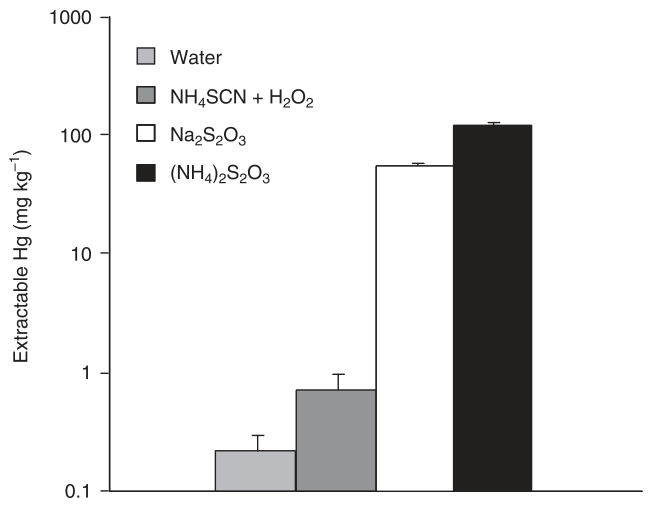
The extractable Hg concentrations for the original Gold Mountain mine tailings are shown in Fig. 1. Mercury solubility in the mine tailings was significantly increased in the presence of (NH4)2S2O3. The total Hg concentration in (NH4)2S2O3 extracts reached 122 ± 9.4 mg kg−1 and was significantly higher than the concentration extracted using Na2S2O3, NH4SCN + H2O2, and water (P < 0.001, Fig. 1). The concentration of Hg extracted using (NH4)2S2O3 was significantly higher than the Hg concentration found in aqua regia digests, as shown in Table 1 (P < 0.01, Table 1).
原始Gold Mountain矿尾矿的可提取态汞浓度见图1。在(NH4)2S2O3存在下,尾矿中汞的溶解度显著增加。(NH4)2S2O3提取液中的全汞浓度达122 ± 9.4 mg kg−1,显著高于Na2S2O3、NH4SCN + H2O2和水所提取的浓度(P < 0.001,图1)。如表1所示,(NH4)2S2O3提取的汞浓度显著高于aqua regia(王水)消解液中的汞浓度(P < 0.01,表1)。
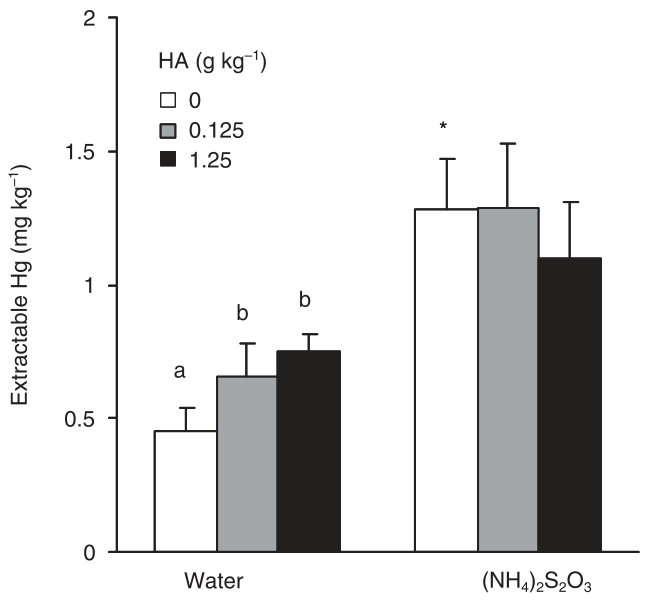
The effect of humic acid on the water and (NH4)2S2O3- extractable Hg concentrations of modified mine tailings is shown in Fig. 2. Again, the Hg concentration was significantly higher in the presence of (NH4)2S2O3 relative to water (P < 0.0001).
腐殖酸对改良尾矿中水提取态和(NH4)2S2O3提取态汞浓度的影响见图2。同样,与水相比,(NH4)2S2O3存在下的汞浓度显著更高(P < 0.0001)。
The concentration of water-soluble Hg was higher for substrates that had been amended with humic acid at rates of 0.125 and 1.25 g HA kg−1 (P < 0.01). This increase corresponded to a 40% increment in the Hg soluble fraction relative to non HA amended water-treated substrates. There were no significant differences within the (NH4)2S2O3 treatment for the Hg values between the control (no HA-amended substrates) and the two tested levels of humic acid (P > 0.05).
添加0.125和1.25 g HA kg−1腐殖酸的基质中水溶性汞浓度较高(P < 0.01)。相对于未添加HA的水处理基质,这一增幅相当于可溶性汞组分增加了40%。在(NH4)2S2O3处理内,对照(未添加HA的基质)与两个腐殖酸水平之间的汞值无显著差异(P > 0.05)。
Effect of plant species × sulphur-containing ligands植物物种 × 含硫配体的效应
Although great care was taken to ensure that Hg was washed off from the root system, neither the experimental protocol nor the analytical techniques used in this study was sufficient to distinguish between the Hg that was adsorbed onto, or taken up into (absorbed) root cells. Therefore, we assume that the accumulation of Hg by the roots of the tested plants will contain both of these Hg fractions.
尽管已十分注意将根系上的汞冲洗干净,但本研究所用的试验方案和分析技术均不足以区分吸附于根细胞表面的汞与被根细胞吸收的汞。因此,我们假定供试植物根部积累的汞同时包含这两部分。
The Hg concentrations in plant shoots and roots, harvested at the end of the experiment, are shown in Table 2. The associated comparisons including their F-ratio and P-values are shown in Table 3. The application of (NH4)2S2O3 and Na2S2O3 mobilised Hg in substrates and greatly increased root Hg accumulation relative to controls and to NH4SCN + H2O2 (P < 0.0001, Tables 2 and 3). The induced root Hg accumulation was significantly higher for V. villosa relative to all plant-chemical combinations (P < 0.0001, Table 2). For example, in the presence of (NH4)2S2O3 and Na2S2O3, the root Hg concentration for this plant species increased to more than 100 mg kg−1 dry weight relative to an average of 69 mg kg−1 recorded in the root tissues of B. juncea (Table 2).
试验结束时收获的植物地上部和根部汞浓度见表2。相应比较结果(包括F值和P值)见表3。施用(NH4)2S2O3和Na2S2O3可活化基质中的汞,与对照和NH4SCN + H2O2相比,显著提高了根部汞积累(P < 0.0001,表2和表3)。V. villosa的诱导性根部汞积累显著高于所有其他植物–化学药剂组合(P < 0.0001,表2)。例如,在(NH4)2S2O3和Na2S2O3存在下,该物种根部汞浓度升至100 mg kg−1干重以上,而B. juncea根组织中的平均值为69 mg kg−1(表2)。
| Treatments Description (Plant Species/chemical)b处理说明 (植物物种/化学药剂)b | Contrastc Number对比c 编号 | Root根部 | Shootd地上部d | Shoot : root ratiod地上部 : 根部 比值d |
|---|---|---|---|---|
| VV/Control | 1 | 5.5±0.8 | BDL | NA |
| VV/Na2S2O3 | 2 | 113±10 | 9.5±1.4 | 0.08±0.04 |
| VV/(NH4)2S2O3 | 3 | 131±13 | 14.8±0.8 | 0.11±0.015 |
| VV/NH4SCN + H2O2 | 4 | 23±2.6 | BDL | NA |
| BJ/Control | 5 | 9.8±1.7 | BDL | NA |
| BJ/Na2S2O3 | 6 | 69±4 | 15.2±2.3 | 0.22±0.03 |
| BJ/(NH4)2S2O3 | 7 | 61±6 | 16.4±2.5 | 0.27±0.04 |
| BJ/NH4SCN + H2O2 | 8 | 12±1.4 | BDL | NA |
| PV/Controle | 9 | 4.2±0.3 | BDL | NA |
| PV/(NH4)2S2O3 | 10 | 28±4.4 | 17.2±1.8 | 0.62±0.14 |
Values for Hg in roots and shoots are in mg kg−1. The shoot : root ratio is the quotient of Hg content in shoots/Hg content in rootsa. aValues are ±1 SD from the mean of five replicates. bVV,Vicia villosa; BJ, Brassica juncea; PV, Phaseolus vulgaris; (NH4)2S2O3, ammonium thiosulphate; Na2S2O3, sodium thiosulphate; (NH4)2S2O3, ammonium thiocyanate; H2O2, hydrogen peroxide. cRelates a single plant-chemical combination to its respective treatment mean. dMissing cells due to Hg below detection limits. ePV/Na2S2O3 and PV/NH4SCN + H2O2 treatments were omitted due to absence of plant germination. BDL, below detection limits; NA, not applicable.
根部和地上部汞值单位为mg kg−1。地上部 : 根部比值为地上部汞含量/根部汞含量之商a。a数值为5次重复平均值的±1 SD。bVV,Vicia villosa;BJ,Brassica juncea;PV,Phaseolus vulgaris;(NH4)2S2O3,硫代硫酸铵;Na2S2O3,硫代硫酸钠;(NH4)2S2O3,硫氰酸铵;H2O2,过氧化氢。c将单个植物–化学药剂组合与其相应处理均值相对应。d因汞低于检出限而存在缺失单元格。e由于植物未发芽,PV/Na2S2O3和PV/NH4SCN + H2O2处理被略去。BDL,低于检出限;NA,不适用。
| Treatment contrastsb处理对比b | dfc | F-ValueF值 | Pr > Fc | |
|---|---|---|---|---|
| 1 & 5 & 9 vs 2 & 3 & 4 & 6 & 7 & 8 & 10 | 1 | 816.62 | < 0.0001 | |
| 2 & 3 vs 4 & 6 & 7 & 8 & 10 | 1 | 1276.03 | < 0.0001 | |
| Root | 2 & 3 vs 6 & 7 & 10 | 1 | 730.87 | < 0.0001 |
| 2 & 6 vs 3 & 7 & 10 | 1 | 636.36 | < 0.0001 | |
| 3 vs 7 & 10 | 1 | 67.46 | < 0.0001 | |
| 7 vs 10 | 1 | 22.18 | < 0.0001 | |
| 2 vs. 6 | 1 | 121.31 | < 0.0001 | |
| 2 & 3 vs 6 & 7 & 10 | 1 | 15.35 | 0.0009 | |
| 2 & 6 vs 3 & 7 & 10 | 1 | 15.35 | 0.0009 | |
| Shoot | 3 vs 7 & 10 | 1 | 2.60 | 0.1224 |
| 7 vs 10 | 1 | 0.40 | 0.5360 | |
| 2 vs 6 | 1 | 21.02 | 0.0002 | |
| 2 & 3 vs 6 & 7 & 10 | 1 | 84.10 | < 0.0001 | |
| 2 & 6 vs 3 & 7 & 10 | 1 | 84.10 | < 0.0001 | |
| Shoot : root | 3 vs 7 & 10 | 1 | 54.63 | < 0.0001 |
| Ratio | 7 vs 10 | 1 | 65.39 | < 0.0001 |
| 2 vs 6 | 1 | 9.67 | 0.0055 |
The contrasts were tested separately for roots, shoots, and the shoot : root ratioa. aSee contrast number in Table 2 for treatments description. bThe associated hypothesis for each contrast tested possible differences between the means of each plant/chemical contrast number; comparisons were not orthogonal. cdf, degrees of freedom; Pr > F, probability level for rejecting or accepting the hypothesis associated with each treatment contrast at α = 0.05.
分别对根部、地上部和地上部 : 根部比值进行对比检验a。a处理说明见表2中的对比编号。b各对比的相应假设检验各植物/化学药剂对比编号均值之间可能存在的差异;各比较并非正交。cdf,自由度;Pr > F,在α = 0.05水平下拒绝或接受各处理对比相应假设的概率水平。
The Hg concentration in the shoot tissues of (NH4)2S2O3 and Na2S2O3-treated plants was significantly higher than in control plants and those treated with NH4SCN + H2O2, which had Hg values below detection limits (Table 2). These results indicate that a fraction of Hg mobilised by (NH4)2S2O3 and Na2S2O3 could be taken up into the roots and subsequently transported to the aerial tissues of the tested plant species. Although the Hg concentration in shoot tissues appears to be similar between plant species in the presence of these ligands (Table 2), there was a significant plant-chemical effect in the shoot Hg translocation (P < 0.001, see first two contrasts Table 3). For instance, Hg values in aerial tissues of Na2S2O3-treated plants were significantly lower than the ones observed in the (NH4)2S2O3-treated plants (P < 0.001, see 1st contrast for shoots, Table 3). Also, Hg translocation to the aerial tissues of V. villosa was significantly reduced when compared to the other two species (P < 0.001, see 2nd contrast for shoots, Table 3). The results for Hg accumulation in shoot tissues indicate, however, that shoot Hg translocation was similar between plant species within the (NH4)2S2O3 treatment (Table 2, see shoots). Furthermore (NH4)2S2O3-treated plants showed variable efficiency for Hg transport from root to shoot tissues when the results were expressed by their respective shoot : root ratios (Table 2, see shoot : root ratio). For example, the shoot : root ratio for P. vulgaris was two and five times higher after (NH4)2S2O3 treatment relative to B. juncea and to V. villosa, respectively (P < 0.0001, Tables 2 and 3, see contrasts for shoot : root ratio). The shoot : root ratio for B. juncea was approximately two-fold greater than the shoot : root ratio obtained for V. villosa in the presence of both (NH4)2S2O3 and Na2S2O3 (P < 0.0001 and P < 0.01, respectively, Table 2, see contrasts for shoot : root ratio).
经(NH4)2S2O3和Na2S2O3处理的植株地上部组织汞浓度显著高于对照植株及经NH4SCN + H2O2处理的植株,后两者的汞值低于检出限(表2)。这些结果表明,由(NH4)2S2O3和Na2S2O3活化的部分汞可被根部吸收,并随后转运至供试植物的地上组织。尽管在这些配体存在下各物种地上部组织的汞浓度看似相近(表2),但植物–化学药剂对地上部汞转运存在显著效应(P < 0.001,见表3前两项对比)。例如,Na2S2O3处理植株地上组织的汞值显著低于(NH4)2S2O3处理植株(P < 0.001,见表3地上部第1项对比)。此外,与另外两个物种相比,V. villosa向地上组织的汞转运显著降低(P < 0.001,见表3地上部第2项对比)。然而,地上部组织汞积累结果表明,在(NH4)2S2O3处理内,各物种地上部汞转运相近(表2,见地上部)。此外,以各自的地上部 : 根部比值表示时,(NH4)2S2O3处理植株由根部向地上部组织转运汞的效率存在差异(表2,见地上部 : 根部比值)。例如,经(NH4)2S2O3处理后,P. vulgaris的地上部 : 根部比值分别为B. juncea和V. villosa的2倍和5倍(P < 0.0001,表2和表3,见地上部 : 根部比值对比)。在(NH4)2S2O3和Na2S2O3存在下,B. juncea的地上部 : 根部比值均约为V. villosa的地上部 : 根部比值的2倍(分别为P < 0.0001和P < 0.01,表2,见地上部 : 根部比值对比)。
Effect of substrate Hg concentration and humic acid level基质汞浓度和腐殖酸水平的效应
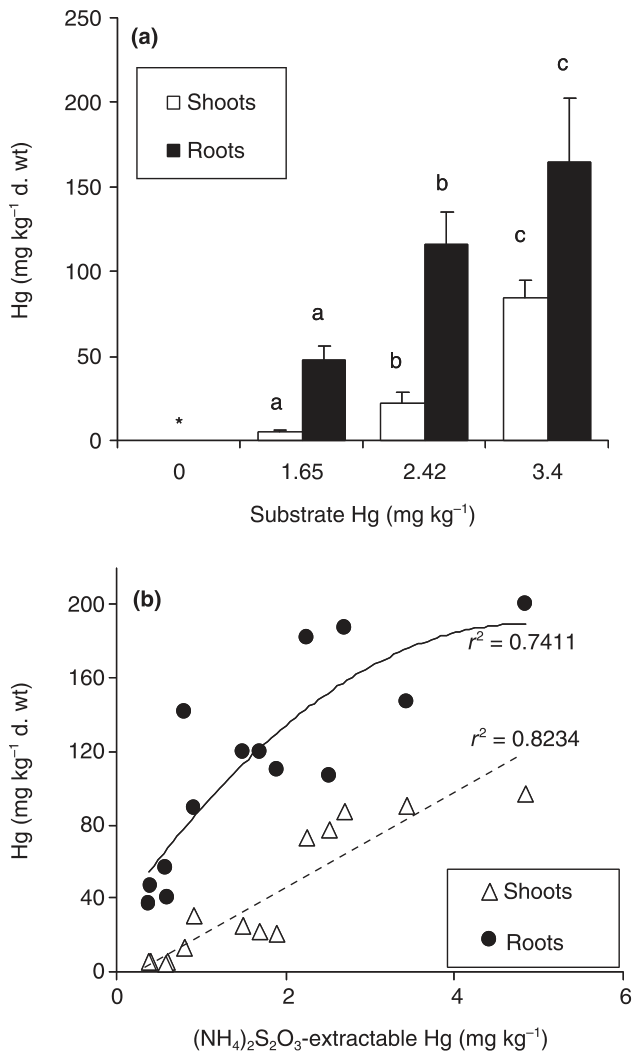
The results shown in the Fig. 3(a) demonstrates that Hg accumulation in shoot and root tissues of (NH4)2S2O3-treated B. juncea plants was significantly enhanced as a function of increasing Hg concentrations in substrates (P < 0.05). Control (water-treated) plants, on the other hand, had shoot Hg values below detection limits for all tested substrate Hg concentrations (data not shown). Plants grown in substrates without added Hg also had shoot Hg values below detection limits (Fig. 3a). These results suggest that foliar uptake of Hg (0) released from planted substrates was not a significant pathway for Hg accumulation in the aerial tissues of tested plants under glasshouse conditions.
图3(a)所示结果表明,经(NH4)2S2O3处理的B. juncea植株地上部和根部组织中的汞积累随基质汞浓度的升高而显著增强(P < 0.05)。而对照(水处理)植株在所有供试基质汞浓度下,地上部汞值均低于检出限(数据未列出)。生长于未添加汞基质中的植株地上部汞值也低于检出限(图3a)。这些结果表明,在温室条件下,叶片对种植基质释放的Hg (0)的吸收并非供试植物地上组织汞积累的重要途径。
Although the root Hg concentration after (NH4)2S2O3 treatment appears to be increasing with regard to Hg concentration in substrates (Fig. 3a), a plot of the root Hg concentration vs the (NH4)2S2O3-extractable Hg concentration shows a significant asymptotic response (Fig. 3b, r 2 = 0.7411, P < 0.001). Consequently, it can be inferred that Hg uptake into the roots of B. juncea is physiologically regulated above certain concentrations and thus, not completely dependent on the amount of Hg available in the substrate. However, this is not true for shoots, whose Hg concentration showed a significant and linear response to the concentration of (NH4)2S2O3-extractable Hg in the substrate (Fig. 3b, r 2 = 0.8324, P < 0.0001).
尽管(NH4)2S2O3处理后根部汞浓度似乎随基质汞浓度增加而升高(图3a),但根部汞浓度对(NH4)2S2O3可提取态汞浓度的作图呈显著的渐近响应(图3b,r 2 = 0.7411,P < 0.001)。由此可推断,超过一定浓度后,B. juncea根部对汞的吸收受到生理调控,因而并不完全取决于基质中的有效汞量。然而,地上部并非如此,其汞浓度与基质中(NH4)2S2O3可提取态汞浓度呈显著线性响应(图3b,r 2 = 0.8324,P < 0.0001)。
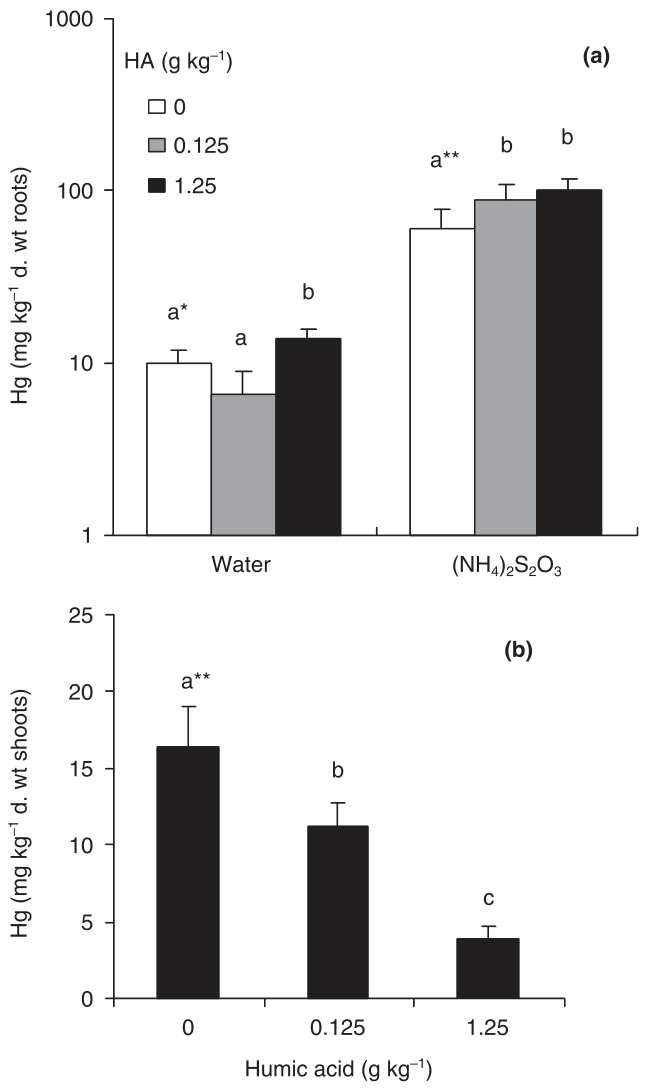
The effect of variable humic acid levels on the root Hg concentration in B. juncea after water (control) and (NH4)2S2O3 treatment is shown in Fig. 4(a). Addition of (NH4)2S2O3 to substrates greatly enhanced the root Hg concentration relative to the water treatment (P < 0.0001). The Hg concentration of both water and (NH4)2S2O3-treated plants was substantially affected by the amount of HA in the substrate. The concentration of Hg in the root tissues of control plants significantly increased from 9.8 to 13.7 mg kg−1 when the HA content in substrates was raised from 0 to 1.25 g kg−1 (P < 0.05). The root Hg concentration of (NH4)2S2O3-treated plants showed a similar pattern, increasing significantly from 61 to around 100 mg kg−1 over the same HA concentration range (P < 0.05). By contrast, the shoot Hg concentration of B. juncea was significantly decreased in the presence of HA (P < 0.01, Fig. 4b). Root to shoot transport therefore appears to be inhibited by humic acid.
图4(a)显示了水(对照)和(NH4)2S2O3处理后不同腐殖酸水平对B. juncea根部汞浓度的影响。与水处理相比,向基质中添加(NH4)2S2O3显著提高了根部汞浓度(P < 0.0001)。水处理和(NH4)2S2O3处理植株的汞浓度均明显受基质中HA含量的影响。当基质HA含量由0提高至1.25 g kg−1时,对照植株根组织中的汞浓度由9.8显著增至13.7 mg kg−1(P < 0.05)。(NH4)2S2O3处理植株根部汞浓度呈现相似规律,在相同HA浓度范围内由61显著增至约100 mg kg−1(P < 0.05)。相反,在HA存在下,B. juncea地上部汞浓度显著降低(P < 0.01,图4b)。因此,腐殖酸似乎抑制了汞由根部向地上部的转运。
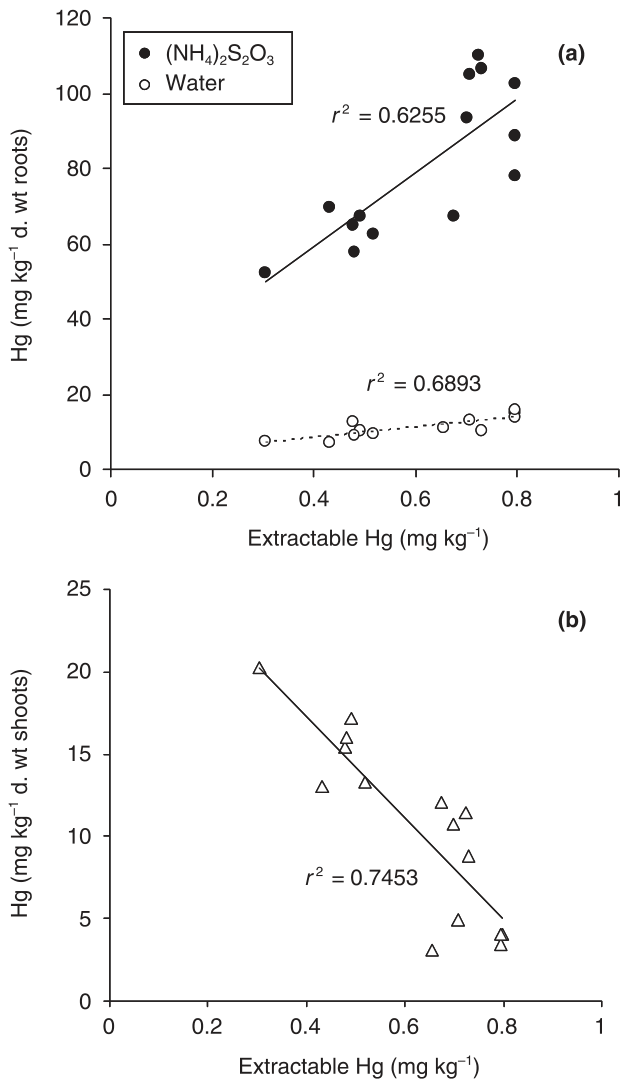
The relationship between the root Hg concentration in B. juncea and the extractable Hg concentration of HA amended substrates is shown in Fig. 5(a). Both water and (NH4)2S2O3- treated plants showed strong evidence for a positive and linear relationship between the concentration of Hg in root tissues and the concentration of extractable Hg (r 2 = 0.6893, P < 0.001 and r2 = 0.6255, P < 0.001, respectively). However, when the concentration of extractable Hg was plotted against the concentration of Hg in shoot tissues, the regression relationship was inverted, confirming the inhibition effect of HA on shoot Hg translocation (r2 = 0.7453, P < 0.0001, Fig. 5b). The relationship between the root and shoot Hg concentration as a function of extractable Hg was confirmed by correlation analysis (r = –0.86 for shoots of [NH4]2S2O3-treated plants; r = 0.82 for roots of water-treated plants, and r = 0.86 for roots of [NH4]2S2O3-treated plants).
B. juncea根部汞浓度与添加HA基质中可提取态汞浓度的关系见图5(a)。水处理和(NH4)2S2O3处理植株均显示根组织汞浓度与可提取态汞浓度之间存在明显的线性正相关(分别为r 2 = 0.6893,P < 0.001和r2 = 0.6255,P < 0.001)。然而,将可提取态汞浓度与地上部组织汞浓度作图时,回归关系呈相反趋势,证实了HA对地上部汞转运的抑制作用(r2 = 0.7453,P < 0.0001,图5b)。相关分析证实了根部和地上部汞浓度与可提取态汞之间的关系([NH4]2S2O3处理植株地上部r = –0.86;水处理植株根部r = 0.82;[NH4]2S2O3处理植株根部r = 0.86)。
6Discussion讨论
Mercury speciation in the substrate基质中汞的形态
Given that the original tailings samples exhibited mild reducing conditions (−137 mV) and high pH (9.45) (Table 1), the speciation of solid phase Hg in the tailings substrate may be in the elemental Hg (0) form (Brookins, 1988). In this oxidation state, Hg is volatile and thus some Hg may have been lost from the system due to volatilisation. However, it is possible that dissolved Hg species in the tailings (Fig. 1) were adsorbed to iron oxy-hydroxides, as it has been demonstrated for Hg-contaminated soils with neutral to alkaline conditions (Andersson, 1979). The fact that the mine tailings have an alkaline pH and contain 17% Fe provides support to this assumption (Table 1). The ammonium and sodium thiosulphate salts may have, therefore, mobilised Hg because they are strong ligands and nonselective to specific Hg species. The Hg solubilization process is possibly related to thiosulphate Hg-complex formation in the presence of the thiosulphate ion. Thiosulphate solutions have complexing abilities with a variety of metal ions from the IB and IIB classes of the periodical table (e.g. Ag, Au, Hg, Cu) and will dissolve many insoluble forms of Hg under alkaline conditions (Wilkinson et al., 1987; Molleman & Dreisinger, 2002).
鉴于原始尾矿样品呈弱还原状态(−137 mV)且pH较高(9.45)(表1),尾矿基质中固相汞的形态可能为单质Hg (0)(Brookins, 1988)。在此氧化态下,汞具有挥发性,因此部分汞可能因挥发而从体系中损失。然而,尾矿中的溶解态汞(图1)也可能吸附于铁的羟基氧化物上,这一现象已在中性至碱性条件下的汞污染土壤中得到证实(Andersson, 1979)。尾矿pH呈碱性且含17%的Fe,这一事实支持了上述假设(表1)。因此,硫代硫酸铵和硫代硫酸钠之所以能活化汞,可能是因为它们是强配体,且对汞的具体形态无选择性。汞的溶解过程可能与硫代硫酸根离子存在下硫代硫酸–汞络合物的形成有关。硫代硫酸盐溶液能与元素周期表IB和IIB族的多种金属离子(如Ag、Au、Hg、Cu)络合,并在碱性条件下溶解多种不溶态汞(Wilkinson et al., 1987; Molleman & Dreisinger, 2002)。
The existence of a water-extractable Hg fraction in the original tailings samples (Fig. 1) indicates that Hg was available for exchange reactions with S-containing ligands in the substrate solution. Since there was no significant variation in the pH values between control and HA-amended substrates (Table 1), enhanced Hg solubility in the water extracts for HA-amended substrates can only be explained through the formation of Hg–HA complexes (Fig. 2). The fact that the pH of diluted substrates was around 8 (Table 1) and that humic acid is soluble at alkaline conditions (Wallschläger et al., 1996) provides support for this statement. Considering that soluble Hg–HA complexes were present in both water and (NH4)2S2O3 extracts (Fig. 2), we hypothesise that the total soluble Hg fraction of HA-amended substrates comprises a mixture of both Hg–HA and Hg–thiosulphate complexes.
原始尾矿样品中存在水提取态汞组分(图1),表明基质溶液中的汞可与含硫配体发生交换反应。由于对照基质与添加HA基质之间的pH值无显著差异(表1),添加HA基质的水提取液中汞溶解度的提高只能以Hg–HA络合物的形成来解释(图2)。稀释基质的pH约为8(表1),且腐殖酸在碱性条件下可溶(Wallschläger et al., 1996),这一事实支持了上述论断。考虑到水提取液和(NH4)2S2O3提取液中均存在可溶性Hg–HA络合物(图2),我们推测添加HA基质中的总可溶性汞组分由Hg–HA和Hg–硫代硫酸盐两类络合物混合组成。
Mercury accumulation in relation to plant species汞积累与植物物种的关系
Results from the current study indicate that root Hg accumulation might be dependent on the root specific features of plant species. For instance, V. villosa showed the highest root Hg values and the lowest shoot : root ratio while the opposite was true for P. vulgaris (Table 2). The same pattern was also observed for V. villosa and B. juncea in the presence of Na2S2O3. The explanation for this variability might be attributed to an interaction between plant roots and the components (i.e. diffusion and mass flow) that affect nutrient uptake and transport to root surfaces. (Marschner, 1986; Marschner, 1991). For example, the transport of nutrients to plant roots along a concentration gradient (i.e. diffusion) is closely related to plant factors such as root morphology and root surface area (Marschner, 1991). A field study conducted with the purpose of correlating Hg uptake with the characteristics of plant roots found a strong relationship between root Hg accumulation and root surface area (Cocking et al., 1995). Plant species with fine root systems (such as Allium sp.) and greater surface area exhibited elevated Hg concentration in roots, whereas an inverse relationship was observed for plants with a larger root size (smaller root surface area). Also, Hg plant uptake was shown to be strongly dependent on root length density of Zorro fescue (Vulpia myuros L.) grown in acidic Hg-contaminated mine soils (Heeraman et al., 2001). It was observed during harvesting that V. villosa produced more roots per unit of soil volume when compared to the other two species. This factor might have contributed to the superior root Hg values exhibited by this species in the presence of S-containing ligands.
本研究结果表明,根部汞积累可能取决于植物物种的根系特征。例如,V. villosa的根部汞值最高而地上部 : 根部比值最低,P. vulgaris则恰好相反(表2)。在Na2S2O3存在下,V. villosa和B. juncea也表现出同样的规律。这种差异可能归因于植物根系与影响养分吸收及向根表面迁移的过程(即扩散和质流)之间的相互作用(Marschner, 1986; Marschner, 1991)。例如,养分沿浓度梯度向植物根系的迁移(即扩散)与根系形态和根表面积等植物因素密切相关(Marschner, 1991)。一项旨在将汞吸收与植物根系特征相关联的田间研究发现,根部汞积累与根表面积之间存在密切关系(Cocking et al., 1995)。具有细根系(如Allium sp.)且表面积较大的植物根部汞浓度较高,而根系较粗(根表面积较小)的植物则呈相反关系。此外,在酸性汞污染矿区土壤中生长的鼠尾狐茅(Vulpia myuros L.)对汞的吸收被证明强烈依赖于根长密度(Heeraman et al., 2001)。收获时观察到,与另外两个物种相比,V. villosa单位土壤体积内的根系更多。这一因素可能导致了该物种在含硫配体存在下具有更高的根部汞值。
Selectivity of mercury complexes to shoot transport汞络合物向地上部转运的选择性
Literature indicates that plants are selective to the form of metal transported to above-ground tissues (Blaylock et al., 1997; Anderson et al., 1998; Moreno et al., 2004a). For example, the accumulation of Hg was confined within root tissues for plants species grown in Hg-contaminated mine tailings treated with soluble HgCl2 at 1, 5 and 10 mg kg−1 (Moreno et al., 2004a). The pH of substrates was around 5.5 and the Ni-hyperaccumulator Berkheya coddii and the salt-tolerant Atriplex canescens showed no evidence of stress to Hg-exposure. However, translocation to the upper plant parts was restricted for all tested concentrations, yielding a maximum concentration factor (concentration shoot tissue/concentration in soil) of only 0.8 at the highest Hg concentration. By contrast (NH4)2S2O3-treated plants grown on the highest substrate level (3.4 mg Hg kg−1, Table 1) accumulated Hg in shoots at an average of 85 mg kg−1 (Fig. 3a), hence yielding a concentration factor of 25. Since thiosulphate complexes are stable at neutral to alkaline conditions (Bowell et al., 1993) and the pH of the modified substrates was around 8 (Table 1), it is plausible that Hg-S2O3 complexes were selected for shoot transport over other dissolved Hg species present in the substrate.
文献表明,植物对向地上组织转运的金属形态具有选择性(Blaylock et al., 1997; Anderson et al., 1998; Moreno et al., 2004a)。例如,在以1、5和10 mg kg−1可溶性HgCl2处理的汞污染尾矿中生长的植物,汞积累局限于根组织内(Moreno et al., 2004a)。该基质pH约为5.5,镍超富集植物Berkheya coddii和耐盐植物Atriplex canescens均未表现出汞胁迫症状。然而,在所有供试浓度下,汞向植物上部的转运均受到限制,即使在最高汞浓度下,最大富集系数(地上部组织浓度/土壤浓度)也仅为0.8。相比之下,生长于最高基质水平(3.4 mg Hg kg−1,表1)的(NH4)2S2O3处理植株地上部平均汞积累量为85 mg kg−1(图3a),富集系数达25。由于硫代硫酸盐络合物在中性至碱性条件下稳定(Bowell et al., 1993),且改良基质pH约为8(表1),因此Hg-S2O3络合物很可能优先于基质中其他溶解态汞形态被选择性地转运至地上部。
Effect of humic acid on root-to-shoot transport腐殖酸对根向地上部转运的影响
Despite the strong affinity of Hg for organic matter, few studies have examined the effect of these substances on the uptake and translocation of Hg in higher plants. Limited dissociation of Hg bound to soil organic components translates into low Hg availability in soils and, therefore, restricted Hg uptake by plants. For example, the addition of organic matter to Hg-contaminated mine spoil has been negatively correlated with the Hg tissue concentrations in Zorro fescue (Vulpia myuros L.) (Heeraman et al., 2001). Humic acid from decayed plant material suppressed Hg uptake for duckweed (Lemna minor) grown in a hydroponic medium containing Hg at 10 mg l−1 (Mo et al., 1989). Similarly, the root concentration factor (concentration root tissue/concentration in soil) of Brassica chinesis and Lactuca sativa was significantly decreased with increasing humic acid concentrations in two types of Hg-contaminated soils (Wang et al., 1997). The reasons for the decline in plant Hg concentrations were attributed to a decrease in the soluble Hg fraction due to Hg complexation with either organic matter or humic acid. By contrast, our studies showed that the Hg soluble fraction of modified substrates was significantly increased in the presence of HA due to Hg–HA complex formation (Fig. 2). Furthermore, the discrepancy in the root Hg values between water and (NH4)2S2O3-treated plants (respectively, 13.7 and 99.8 mg kg−1 at 1.25 HA, Fig. 4a) was possibly linked to the uptake of Hg– HA and Hg–thiosulphate complexes by plants. Considering that Hg–HA complexes were soluble in the aqueous phase of the HA-amended substrates, then Hg root uptake would be initially a function of the available Hg–HA complexes in the substrate solution. Subsequently, the application of (NH4)2S2O3 to substrates would have mobilised the unavailable Hg fraction through Hg–thiosulphate complex formation, enhancing Hg accumulation in root and shoot tissues. The significantly positive correlation between extractable Hg and root Hg concentration (Fig. 5a) indicates that root tissues absorbed both Hg–HA and Hg–thiosulphate complexes. Furthermore, the evidence of negative correlation between extractable Hg and shoot Hg concentration indicates that Hg translocation to aerial tissues was severely restricted in the presence of HA (Fig. 5b). Our results indicate therefore that Hg–thiosulphate complexes were translocated into aerial tissues to the detriment of Hg–HA complexes, which were probably adsorbed to root tissues.
尽管汞对有机质具有很强的亲和力,但很少有研究考察这些物质对高等植物吸收和转运汞的影响。与土壤有机组分结合的汞解离有限,导致土壤中汞的有效性较低,从而限制了植物对汞的吸收。例如,向汞污染矿渣中添加有机质与鼠尾狐茅(Vulpia myuros L.)组织汞浓度呈负相关(Heeraman et al., 2001)。来自腐解植物材料的腐殖酸抑制了在含汞10 mg l−1水培介质中生长的浮萍(Lemna minor)对汞的吸收(Mo et al., 1989)。同样,在两种汞污染土壤中,Brassica chinesis和Lactuca sativa的根部富集系数(根组织浓度/土壤浓度)随腐殖酸浓度的增加而显著降低(Wang et al., 1997)。植物汞浓度下降的原因被归结为汞与有机质或腐殖酸络合导致可溶性汞组分减少。相反,本研究表明,由于Hg–HA络合物的形成,改良基质中的可溶性汞组分在HA存在下显著增加(图2)。此外,水处理与(NH4)2S2O3处理植株根部汞值的差异(在1.25 HA下分别为13.7和99.8 mg kg−1,图4a)可能与植物对Hg–HA和Hg–硫代硫酸盐络合物的吸收有关。考虑到Hg–HA络合物在添加HA基质的水相中是可溶的,根部对汞的吸收最初应取决于基质溶液中有效的Hg–HA络合物。随后,向基质中施用(NH4)2S2O3将通过形成Hg–硫代硫酸盐络合物而活化原本无效的汞组分,从而增强根部和地上部组织的汞积累。可提取态汞与根部汞浓度之间的显著正相关(图5a)表明,根组织同时吸收了Hg–HA和Hg–硫代硫酸盐络合物。此外,可提取态汞与地上部汞浓度之间呈负相关,表明在HA存在下汞向地上组织的转运受到严重限制(图5b)。因此,我们的结果表明,Hg–硫代硫酸盐络合物优先于Hg–HA络合物被转运至地上组织,而后者可能吸附于根组织上。
7Conclusions结论
The results of this study show that Hg availability and Hg plant uptake are interrelated processes that appear to be controlled by plant species, the presence of sulphur-containing ligands, substrate Hg concentration, and humic acid content. Mercury solubility was significantly enhanced in the presence of thiosulphates and HA and may be related to the formation of Hg–thiosulphate and Hg–HA complexes. The Hg content in root and shoot tissues was significantly enhanced in the presence of thiosulphates but the Hg accumulation pattern was markedly different between plant species. For example, in the presence of (NH4)2S2O3, root Hg accumulation was greater for V. villosa, whereas shoot Hg translocation was superior for P. vulgaris. We believe that plant species characteristics played an important role in the enhanced root uptake and transport for Hg in the presence of thio-solutions. The uptake and translocation of Hg in B. juncea plants was shown to be dependent on the speciation of the Hg complex. In the presence of (NH4)2S2O3, shoot Hg translocation was increasingly promoted as a function of substrate Hg concentration. The Hg accumulation in shoot tissues in the presence of this ligand increased up to 25 times at the highest Hg level in the substrate. However (NH4)2S2O3-treated plants showed suppression of Hg translocation in the presence of HA. It is therefore plausible that Hg–thiosulphate complexes were transported to shoot tissues to the detriment of Hg–HA complexes, which were retained in root tissues.
本研究结果表明,汞有效性和植物汞吸收是相互关联的过程,似乎受植物物种、含硫配体的存在、基质汞浓度和腐殖酸含量的控制。在硫代硫酸盐和HA存在下,汞溶解度显著提高,这可能与Hg–硫代硫酸盐和Hg–HA络合物的形成有关。在硫代硫酸盐存在下,根部和地上部组织的汞含量显著提高,但不同植物物种的汞积累模式存在明显差异。例如,在(NH4)2S2O3存在下,V. villosa的根部汞积累较高,而P. vulgaris的地上部汞转运较强。我们认为,植物物种特性在硫溶液存在下根部对汞吸收和转运的增强中发挥了重要作用。B. juncea植株对汞的吸收和转运被证明取决于汞络合物的形态。在(NH4)2S2O3存在下,地上部汞转运随基质汞浓度的升高而不断增强。在该配体存在下,地上部组织的汞积累在基质最高汞水平下可达基质浓度的25倍。然而,(NH4)2S2O3处理植株在HA存在下汞转运受到抑制。因此,Hg–硫代硫酸盐络合物很可能优先于Hg–HA络合物被转运至地上部组织,而后者则滞留于根组织中。
8Acknowledgements致谢
We gratefully acknowledge the National Council for Scientific and Technological Development (CNPq/Brazil) for providing a scholarship to the first author. We are in debt to Mr A. J. Gunson from The Centre for Responsible Mining (CRM), University of British Columbia, B.C., Canada, who kindly provided the Hg-contaminated mine tailings used for the laboratory and greenhouse studies. We also thank M. B. Kirkham for the helpful comments on the manuscript.
衷心感谢巴西国家科学技术发展委员会(CNPq/Brazil)为第一作者提供奖学金。感谢加拿大不列颠哥伦比亚省不列颠哥伦比亚大学负责任采矿中心(The Centre for Responsible Mining, CRM)的A. J. Gunson先生慷慨提供本研究实验室和温室试验所用的Hg污染尾矿。同时感谢M. B. Kirkham对本文稿提出的宝贵意见。
9References参考文献
Anderson CWN, Brooks RR, Stewart RB, Simcock R. 1998. Harvesting a crop of gold in plants. Nature 395: 553–554.
Andersson A. 1979. Mercury in soils. In: Nriagu JO, ed. The Biogechemistry of Mercury in the Environment. Amsterdam, The Netherlands: Elsevier Press, 79–106.
Blaylock MJ, Salt DE, Dushenkov S, Zakharova O, Gussman C, Kapulnik Y, Ensley B, Raskin I. 1997. Enhanced accumulation of Pb in Indian mustard by soil-applied chelating agents. Environmental Science and Technology 31: 860–865.
Bowell RJ, Foster RP, Gize AP. 1993. The mobility of gold in tropical rain forest soils. Economic Geology 88: 999–1016.
Brookins DG. 1988. Eh-Ph Diagrams for Geochemistry. New York, USA: Springer-Verlag, 58.
Cocking D, Rohrer M, Thomas R, Walker TJ, Ward D. 1995. Effects of root morphology and Hg concentration in the soil on uptake by terrestrial vascular plants. Water, Air, and Soil Pollution 80: 1113–1116.
Evans LJ. 1989. Chemistry of metal retention by soils. Environmental Science and Technology 23: 1046–1056.
Gunson AJ, Veiga MM. 2004. Mercury and artisanal mining in China. Environmental Practice 6: 109–120.
Heeraman DA, Claassen VP, Zasoski RJ. 2001. Interaction of lime, organic matter and fertilizer on growth and uptake of arsenic and mercury by Zorro fescue (Vulpia myuros L.). Plant and Soil 234: 231.
Hinton JJ. 2002. Earthworms as a Bioindicator of Mercury Pollution in an Artisanal Gold Mining Community, Cachoeira do Piriá, Brazil. Master Thesis. University of British Columbia, Canada.
Lombi E, Zhao FJ, Dunham SJ, McGrath SP. 2001. Phytoremediation of heavy metal-contaminated soils: natural hyperaccumulation versus chemically enhanced phytoextraction. Journal of Environmental Quality 30: 1919–1926.
Marschner H. 1986. Mineral Nutrition in Higher Plants. New York, USA: Academic Press, 412–424.
Marschner H. 1991. Root-induced changes in the availability of
micronutrients in rhizosphere. In: Waisel Y, Eshel A, Kafkaki U, eds.
Plant Roots – the Hidden Half. New York, USA: Marcel–Decker, 641– 669.
Melamed R, Villas Bôas RC. 1998. Phosphate–background electrolyte interaction affecting the transport of mercury through a Brazilian oxisol. Science of the Total Environment 213: 151–156.
Mo SC, Choi DS, Robinson JW. 1989. Uptake of mercury from aqueous solutions by duckweed: the effects of pH, copper, and humic acid. Journal of Environmental Science and Health A24: 135–146.
Molleman E, Dreisinger D. 2002. The treatment of copper-gold ores by ammonium thiosulphate leaching. Hydrometallurgy 66: 1–21.
Morel FMM, Kraepiel AML, Amyot M. 1998. The chemical cycle and
bioaccumulation of mercury. Annual Reviews in Ecological Systems 29: 543–566.
Moreno FN, Anderson CWN, Stewart RB, Robinson BH. 2004a. Phytoremediation of mercury-contaminated mine tailings by induced plant-mercury accumulation. Environmental Practice 6: 165–175.
Moreno FN, Anderson CWN, Robinson BH, Stewart RB. 2004b. Mercury analysis of plant and soil samples using the hydride-generation AAS method. In: Currie LD, Hanly JA, eds. Tools for Nutrient and Pollutant Management: Applications to Agriculture and Environmental Quality. Occasional Report no. 17. Palmerston North, New Zealand: Fertilizer and Lime Research Centre, 425–433.
Roulet M, Lucotte M, Canvel R, Farella N, Courcelles M, Guimarães D, Mergler JRD, Amorin M. 2000. Increase in mercury concentration recorded in lacustrian sediments following deforestation in Central Amazon. Chemical Ecology 165: 243–266.
SAS Institute Inc. 1988. SAS/STAT User’s Guide, 8th edn. Cary, NC, USA: SAS Institute.
Schuster E. 1991. The behaviour of mercury in the soil with special emphasis on the complexation and adsorption processes-a review of the literature. Water, Air, and Soil Pollution 56: 667–680.
Suzuki T. 1979. Dose-effect and dose–response relationships of mercury and its derivatives. In: Nriagu JO, ed. The Biogechemistry of Mercury in the Environment. Amsterdam, The Netherlands: Elsevier Press, 399–422.
Veiga MM, Hinton JJ. 2002. Abandoned artisanal gold mines in the Brazilian Amazon: a legacy of mercury pollution. Natural Resources Forum 26: 15–26.
Wallschläger D, Desai VMM, Spengler M, Wilken R. 1998a. Mercury speciation in floodplain soils and sediments along a contaminated river transect. Journal of Environmental Quality 27: 1034–1044.
Wallschläger D, Desai VMM, Spengler M, Windmöller CC, Wilken R. 1998b. How humic substances dominate mercury geochemistry in contaminated floodplain soils and sediments. Journal of Environmental Quality 27: 1044–1057.
Wallschläger D, Desai VMM, Wilken R. 1996. The role of humic substances in the aqueous mobilization of mercury from contaminated floodplain soils. Water, Air, and Soil Pollution 90: 507–520.
Wang DY, Qing CL, Guo TY, Guo YJ. 1997. Effects of humic acid on transport and transformation of mercury in soil-plant systems. Water, Air, and Soil Pollution 95: 35–43.
Wilkinson G, Gillard RD, McCleverty JA. 1987. Comprehensive Coordination Chemistry, Vol. 2. London, UK: Pergamon Press, 636–637.