Bernd Nowack, Rainer Schulin and Brett H. Robinson
Institute of Terrestrial Ecosystems ETH Zurich
Universitaetstrasse 16 8092 Zürich, Switzerland
Phone: +41 (0)44-633 61 60 Fax: +41 (0)44-633 11 23 e-mail: nowack@env.ethz.ch
1Supporting Information补充材料
8 pages 3 Tables 1 Figure
共8页,3个表,1幅图
Modeling extraction of Pb in the presence of chelants from soil螯合剂存在条件下土壤中Pb提取的模拟
We use Pb as an example because data on the extractability of this metal from soils in the presence and absence of chelating agents are available (1). The soil had been polluted in the field with Pb (723 mg kg-1) by application of sewage sludge. The extraction of Pb was measured over the pH range from 3 to 9 in the absence of chelants and in the presence of EDTA and EDDS. Dissolved Pb as well as dissolved Ca and Fe were measured.
本文以Pb为例,因为已有关于该金属在有无螯合剂条件下从土壤中可提取性的数据(1)。该土壤在田间因施用污水污泥而受到Pb污染(723 mg kg-1)。在无螯合剂以及存在EDTA和EDDS的条件下,于pH 3~9范围内测定了Pb的提取量,同时测定了溶解态Pb以及溶解态Ca和Fe。
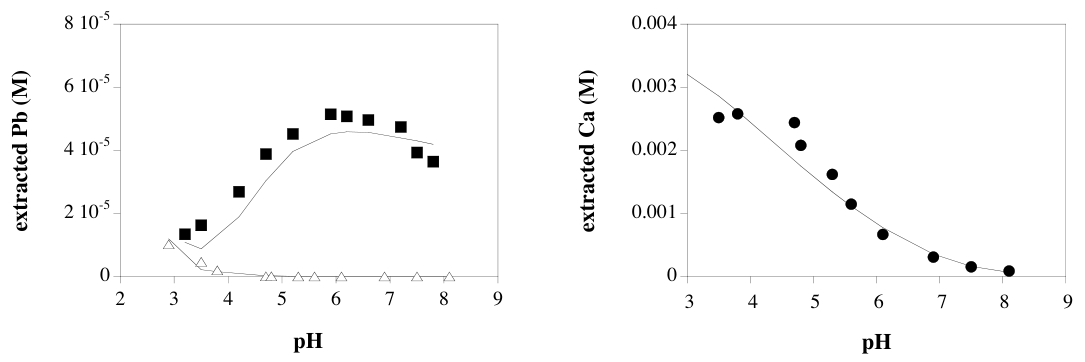
Soil-bound Pb can be modeled using two pH-dependent binding sites. This concept of using a “soil-ligand” to model the solubility of metals in soils was introduced by Lindsay (2). Whereas Pb-binding in the absence of chelants can be modeled successfully using one “soil-ligand”, this is not possible for the Pb solubilization in the presence of chelants. Two different binding sites with differing affinity and pH dependence were necessary to model the observed solubilization of Pb. Fitting parameters are the protonation of the site, the logK value of the “soil-ligand”-Pb complex and the total site concentration. The dependence on pH was fixed at the power of -1 and -2 for the two sites, representing different susceptibility of the site towards protonation. The total site concentration (4.5 mmol kg-1) was chosen in slight excess of the total Pb content (3.5 mmol kg-1) and arbitrarily distributed between the two sites with a ratio of 1:2. Fitting parameters were therefore mainly the log K values. The measured Ca concentration was also included in the model to account for competition between Ca and Pb for the chelant. The total chelant concentration was also corrected for the measured amount of solubilized Fe, indicative of formation of Fe(III)-complexes that decrease the amount of chelant available for complexing other metals. Table S1 presents the results of a manual fit of the observed data with these two sites. Figure S1a shows the final model fit for Pb solubility in the absence and presence of EDDS.
土壤结合态Pb可采用两个依赖于pH的结合位点进行模拟。利用“土壤配体”模拟土壤中金属溶解度的概念由Lindsay提出(2)。在无螯合剂条件下,采用一个“土壤配体”即可成功模拟Pb的结合,但对于螯合剂存在下Pb的溶出则无法实现。为模拟所观测到的Pb溶出,需要采用两个亲和力及pH依赖性不同的结合位点。拟合参数包括位点的质子化、“土壤配体”-Pb络合物的logK值以及位点总浓度。两个位点对pH的依赖性分别固定为-1次方和-2次方,代表位点对质子化的敏感性不同。位点总浓度(4.5 mmol kg-1)取值略高于Pb总含量(3.5 mmol kg-1),并按1:2的比例任意分配于两个位点之间。因此,拟合参数主要为log K值。模型中还纳入了实测Ca浓度,以考虑Ca与Pb对螯合剂的竞争。此外,根据实测的溶出Fe量对螯合剂总浓度进行了校正,因为溶出Fe表明形成了Fe(III)络合物,从而减少了可用于络合其他金属的螯合剂量。表S1给出了采用这两个位点对观测数据进行人工拟合的结果。图S1a显示了无EDDS和有EDDS条件下Pb溶解度的最终模型拟合结果。
Modeling Ca extraction from a carbonate-free soil无碳酸盐土壤中Ca提取的模拟
Ca extraction from a carbonate-free soil containing only exchangeable Ca was modeled using the same approach as for Pb. Two binding sites >X3Ca and >X4Ca were used. The pH-dependent reactions are given in Table S1. Fig. S1b shows the experimental data for the solubilization of Ca as a function of pH together with the model fit.
对于仅含交换性Ca的无碳酸盐土壤,其Ca提取采用与Pb相同的方法进行模拟,使用了两个结合位点>X3Ca和>X4Ca。依赖于pH的反应列于表S1。图S1b显示了Ca溶出随pH变化的实验数据及模型拟合结果。
| Species物种 | Equation方程 | Site concentration位点浓度 |
|---|---|---|
| (mmol kg-1) | ||
| >X1Pb | [Pb][X1][H]-1102.61 | 1.5 |
| >X2Pb | [Pb][X2][H]-210-1.32 | 3.0 |
| >X3Ca | [Ca][X3][H]-110-4.32 | 250 |
| >X4Ca | [Ca][X4][H]-0.5100.44 | 250 |
| _____________ Pb | ________________________________________________________ 500 mg kg-1(2.4 mmoles kg-1)________________________________________________________ 500 mg kg-1(2.4 mmol kg-1) |
|---|---|
| extraction | in suspension with 20 g l-1soil |
| EDTA/ EDDS | 50 µM |
| EDTA:Pb | 1 |
| logK values | source of all logK values for EDTA, EDDS, Pb and Ca: reference (3) |
| case 1 | no Ca in the system |
| case 2 | exchangeable Ca (200 mmoles kg-1) |
| case 3 | soil with 10% CaCO3, CO2(g): 3.16.10-4atm in extraction solution |
| case 4 | case 2) and additionally the Fe-phase hydrous ferric oxide (HFO) |
| __________________________________________ soil Pb concentration__________________________________________ 土壤Pb浓度 | ________________________ 1000 mg kg-1 |
|---|---|
| depth of polluted soil | 0.2 m |
| soil bulk density | 1.2 g cm-3 |
| total Pb mass | 2400 kg ha-1 |
| soil water content | 0.3 cm3cm-3 |
| soil solution concentration if all Pb is mobilized | 16 mM (3300 mg L-1) |
| evapotranspiration | 5 mm d-1(5 L m-2d-1) |
| yield (dry matter) __________________________________________ | 30 t ha-1 _________________________ |
Cited References引用文献
(1) Tandy, S.; Bossart, K.; Mueller, R.; Ritschel, J.; Hauser, L.; Schulin, R.; Nowack, B. Extraction of heavy metals from soils using biodegradable chelating agents. Environ. Sci. Technol. 2004, 38, 937-944.
(1) Tandy, S.; Bossart, K.; Mueller, R.; Ritschel, J.; Hauser, L.; Schulin, R.; Nowack, B. Extraction of heavy metals from soils using biodegradable chelating agents. Environ. Sci. Technol. 2004, 38, 937-944.
(2) Lindsay, W. L. Chemical equilibria in soils; John Wiley & Sons, New York, 1979.
(2) Lindsay, W. L. Chemical equilibria in soils; John Wiley & Sons, New York, 1979.
(3) Martell, A. E.; Smith, R. M.; Motekaitis, R. J. "NIST critically selected stability constants of metal complexes, Version 6.0," NIST, 2001.
(3) Martell, A. E.; Smith, R. M.; Motekaitis, R. J. "NIST critically selected stability constants of metal complexes, Version 6.0," NIST, 2001.
References used to draw figure 1 of the manuscript.绘制正文图1所用的参考文献。
Allen, H. E.; Chen, P. H. Remediation of metal contaminated soil by EDTA incorporating electrochemical recovery of metal and EDTA. Environ. Prog. 1993, 12, 284-293.
Allen, H. E.; Chen, P. H. Remediation of metal contaminated soil by EDTA incorporating electrochemical recovery of metal and EDTA. Environ. Prog. 1993, 12, 284-293.
Barona, A.; Aranguiz, I.; Elias, A. Metal associations in soils before and after EDTA extractive decontamination: implications for the effectiveness of further clean-up strategies. Environ. Pollut. 2001, 113, 79-85.
Barona, A.; Aranguiz, I.; Elias, A. Metal associations in soils before and after EDTA extractive decontamination: implications for the effectiveness of further clean-up strategies. Environ. Pollut. 2001, 113, 79-85.
De Gregori, I.; Fuentes, E.; Olivares, D.; Pinochet, H. Extractable copper, arsenic and antimony by EDTA solution from agricultural Chilean soils and its transfer to alfalfa plants (medicago sativa L.). J. Environ. Monit. 2004, 6, 38-47.
De Gregori, I.; Fuentes, E.; Olivares, D.; Pinochet, H. Extractable copper, arsenic and antimony by EDTA solution from agricultural Chilean soils and its transfer to alfalfa plants (medicago sativa L.). J. Environ. Monit. 2004, 6, 38-47.
Elliott, H. A.; Brown, G. A. Comparative evaluation of NTA and EDTA for extractive decontamination of Pb-polluted soils. Water Air Soil Pollut. 1989, 45, 361-369.
Elliott, H. A.; Brown, G. A. Comparative evaluation of NTA and EDTA for extractive decontamination of Pb-polluted soils. Water Air Soil Pollut. 1989, 45, 361-369.
Elliott, H. A.; Linn, J. H.; Shields, G. A. Role of Fe in extractive decontamination of Pb-polluted soils. Hazard. Waste Hazard. Mater. 1989, 6, 223-229.
Elliott, H. A.; Linn, J. H.; Shields, G. A. Role of Fe in extractive decontamination of Pb-polluted soils. Hazard. Waste Hazard. Mater. 1989, 6, 223-229.
Finzgar, N.; Kos, B.; Lestan, D. Washing of Pb contaminated soil using (S,S)
Finzgar, N.; Kos, B.; Lestan, D. Washing of Pb contaminated soil using (S,S)
ethylenediamine disuccinate and horizontal permeable barriers. Chemosphere 2004, 57, 655- 661.
ethylenediamine disuccinate and horizontal permeable barriers. Chemosphere 2004, 57, 655- 661.
Ghestem, J. P.; Bermond, A. EDTA extractability of trace metals in polluted soils: a chemical-physical study. Environ. Technol. 1998, 19, 409-416.
Ghestem, J. P.; Bermond, A. EDTA extractability of trace metals in polluted soils: a chemical-physical study. Environ. Technol. 1998, 19, 409-416.
Hong, P. K. A.; Li, C.; Banerji, S. K.; Regmi, T. Extraction, recovery, and biostability of EDTA for remediation of heavy metal-contaminated soil. J. Soil Contam. 1999, 8, 81-103.
Hong, P. K. A.; Li, C.; Banerji, S. K.; Regmi, T. Extraction, recovery, and biostability of EDTA for remediation of heavy metal-contaminated soil. J. Soil Contam. 1999, 8, 81-103.
Hong, P. K. A.; Li, C.; Banerji, S. K.; Wang, Y. Feasibility of metal recovery from soil using DTPA and its biostability. J. Hazard. Materials 2002, B94, 253-272.
Hong, P. K. A.; Li, C.; Banerji, S. K.; Wang, Y. Feasibility of metal recovery from soil using DTPA and its biostability. J. Hazard. Materials 2002, B94, 253-272.
Kim, C.; Lee, Y.; Ong, S. K. Factors affecting EDTA extraction of lead from leadcontaminated soils. Chemosphere 2003, 51, 845-853.
Kim, C.; Lee, Y.; Ong, S. K. Factors affecting EDTA extraction of lead from leadcontaminated soils. Chemosphere 2003, 51, 845-853.
Kos, B.; Lestan, D. Soil washing of Pb, Zn and Cd using biodegradable chelator and permeable barriers and induced phytoextraction of Cannabis sativa. Plant Soil 2004, 263, 43- 51.
Kos, B.; Lestan, D. Soil washing of Pb, Zn and Cd using biodegradable chelator and permeable barriers and induced phytoextraction of Cannabis sativa. Plant Soil 2004, 263, 43- 51.
Lee, C. C.; Marshall, W. D. Recycling of complexometric extractants to remediate soil contaminated with heavy metals. J. Environ. Monit. 2002, 4, 325-329.
Lee, C. C.; Marshall, W. D. Recycling of complexometric extractants to remediate soil contaminated with heavy metals. J. Environ. Monit. 2002, 4, 325-329.
Lestan, D.; Hanc, A.; Finzgar, N. Influence of ozonation on extractability of Pb and Zn from contaminated soils. Chemosphere 2005, 61, 1012-1019.
Lestan, D.; Hanc, A.; Finzgar, N. Influence of ozonation on extractability of Pb and Zn from contaminated soils. Chemosphere 2005, 61, 1012-1019.
Linn, J. H.; Elliott, H. A. Mobilization of Cu and Zn in contaminated soil by nitrilotriacetic acid. Water Air Soil Pollut. 1988, 37, 449-458.
Linn, J. H.; Elliott, H. A. Mobilization of Cu and Zn in contaminated soil by nitrilotriacetic acid. Water Air Soil Pollut. 1988, 37, 449-458.
Manouchehri, N.; Besancon, S.; Bermond, A. Major and trace metal extraction from soil by EDTA: equilibrium and kinetic studies. Anal. Chim. Acta 2006, 559, 105-112.
Manouchehri, N.; Besancon, S.; Bermond, A. Major and trace metal extraction from soil by EDTA: equilibrium and kinetic studies. Anal. Chim. Acta 2006, 559, 105-112.
Meers, E.; Lesage, E.; Lamsal, S.; Hopgood, M.; Vervaeke, P.; Tack, F. M. G.; Verloo, M. G. Enhanced phytoextraction: I. Effect of EDTA and citric acid on heavy metal mobility in a calcareous soil. Int. J. Phytorem. 2005, 7, 129-142.
Meers, E.; Lesage, E.; Lamsal, S.; Hopgood, M.; Vervaeke, P.; Tack, F. M. G.; Verloo, M. G. Enhanced phytoextraction: I. Effect of EDTA and citric acid on heavy metal mobility in a calcareous soil. Int. J. Phytorem. 2005, 7, 129-142.
Neubauer, U.; Furrer, G.; Kayser, A.; Schulin, R. Siderophores, NTA, and citrate: potential soil amendments to enhance heavy metal mobility in phytoremediation. Int. J. Phytorem. 2000, 2, 353-368.
Neubauer, U.; Furrer, G.; Kayser, A.; Schulin, R. Siderophores, NTA, and citrate: potential soil amendments to enhance heavy metal mobility in phytoremediation. Int. J. Phytorem. 2000, 2, 353-368.
Papassiopi, N.; Tambouris, S.; Kontopoulos, A. Removal of heavy metals from calcareous contaminated soils by EDTA leaching. Water Air Soil Pollut. 1999, 109, 1-15.
Papassiopi, N.; Tambouris, S.; Kontopoulos, A. Removal of heavy metals from calcareous contaminated soils by EDTA leaching. Water Air Soil Pollut. 1999, 109, 1-15.
Stanhope, K. G.; Young, S. D.; Hutchinson, J. J.; Kamath, R. Use of isotopic dilution techniques to assess the mobilization of nonlabile Cd by chelating agents in phytoremediation. Environ. Sci. Technol. 2000, 34, 4123-4127.
Stanhope, K. G.; Young, S. D.; Hutchinson, J. J.; Kamath, R. Use of isotopic dilution techniques to assess the mobilization of nonlabile Cd by chelating agents in phytoremediation. Environ. Sci. Technol. 2000, 34, 4123-4127.
Sun, B.; Zhao, F. J.; Lombi, E.; McGrath, S. P. Leaching of heavy metals from contaminated soils using EDTA. Environ. Pollut. 2001, 113, 111-120.
Sun, B.; Zhao, F. J.; Lombi, E.; McGrath, S. P. Leaching of heavy metals from contaminated soils using EDTA. Environ. Pollut. 2001, 113, 111-120.
Tandy, S.; Bossart, K.; Mueller, R.; Ritschel, J.; Hauser, L.; Schulin, R.; Nowack, B. Extraction of heavy metals from soils using biodegradable chelating agents. Environ. Sci. Technol. 2004, 38, 937-944.
Tandy, S.; Bossart, K.; Mueller, R.; Ritschel, J.; Hauser, L.; Schulin, R.; Nowack, B. Extraction of heavy metals from soils using biodegradable chelating agents. Environ. Sci. Technol. 2004, 38, 937-944.
Theodoratus, P.; Papassiopi, N.; Georgoudis, T.; Kontopoulos, A. Selective removal of lead from calcareous polluted soils using the Ca-EDTA salt. Water Air Soil Pollut. 2000, 122, 351-368.
Theodoratus, P.; Papassiopi, N.; Georgoudis, T.; Kontopoulos, A. Selective removal of lead from calcareous polluted soils using the Ca-EDTA salt. Water Air Soil Pollut. 2000, 122, 351-368.
Van Benschoten, J. E.; Reed, B. E.; Matsumoto, M. R.; McGarvey, P. J. Metal removal by soil washing for an iron oxide coated sandy soil. Water Environ. Res. 1994, 66, 168-174.
Van Benschoten, J. E.; Reed, B. E.; Matsumoto, M. R.; McGarvey, P. J. Metal removal by soil washing for an iron oxide coated sandy soil. Water Environ. Res. 1994, 66, 168-174.
Vandevivere, P.; Hammes, F.; Verstraete, W.; Feijtel, T.; Schowanek, D. Metal decontamination of soil, sediment, and sewage sludge by means of transition metal chelant (S,S)-EDDS. J. Environ. Eng. 2001, 127, 802-811.
Vandevivere, P.; Hammes, F.; Verstraete, W.; Feijtel, T.; Schowanek, D. Metal decontamination of soil, sediment, and sewage sludge by means of transition metal chelant (S,S)-EDDS. J. Environ. Eng. 2001, 127, 802-811.
Wasay, S. A.; Parker, W. J.; Van Geel, P. J. Contamination of a calcareous soil by battery industry wastes. II. Treatment. Can. Civ. Eng. 2001, 28, 349-354.
Wasay, S. A.; Parker, W. J.; Van Geel, P. J. Contamination of a calcareous soil by battery industry wastes. II. Treatment. Can. Civ. Eng. 2001, 28, 349-354.
Xie, T.; Marshall, W. D. Approaches to soil remediation by complexometric extraction of metal contaminants with regeneration of reagents. J. Environ. Monit. 2001, 3, 411-416. Yu, J.; Klarup, D. Extraction kinetics of copper, zinc, iron and manganese from contaminated sediment using disodium ethylenediaminetetraacetate. Water Air Soil Pollut. 1994, 75, 205- 225.
Xie, T.; Marshall, W. D. Approaches to soil remediation by complexometric extraction of metal contaminants with regeneration of reagents. J. Environ. Monit. 2001, 3, 411-416. Yu, J.; Klarup, D. Extraction kinetics of copper, zinc, iron and manganese from contaminated sediment using disodium ethylenediaminetetraacetate. Water Air Soil Pollut. 1994, 75, 205- 225.
Yukselen, M. A.; Gokyay, O. Leachability of metals from soil contaminated by mining activities. Environ. Eng. Sci. 2006, 23, 125-132.
Yukselen, M. A.; Gokyay, O. Leachability of metals from soil contaminated by mining activities. Environ. Eng. Sci. 2006, 23, 125-132.