M. Greven*, S. Green** , B. Robinson*** , B. Clothier** , I. Vogeler** , R. Agnew*, S. Neal* and S. Sivakumaran**
*HortResearch Marlborough, Marlborough Wine Research Centre, P.O. Box 845, Blenheim 7240, New Zealand (E-mail: mgreven@hortresearch.co.nz)
** HortResearch Palmerston North, Private Bag 11030, Manawatu Mail Centre, Palmerston North 4442, New Zealand
*** Institut fu¨r Terrestrische O¨ kologie, Universita¨tstrasse 16, ETH Zentrum CHN F 29.1, CH-8092 Zu¨rich, Switzerland
Abstract Grapes in Marlborough are typically grown on a vertical shoot positioned trellis system (VSP). For this purpose Pinus radiata posts are treated with CCA, a mixture of copper (Cu), chromium (Cr) and arsenic (As), giving a wood concentration of 1,730, 3,020 and 2,410 mg/kg, respectively on a dry matter basis. The CCA levels around the posts in different soils were investigated and assessed for the potential leaching of CCA into ground water. An initial survey showed leaching of all three heavy metals from the treated posts into the soil surrounding the posts (0.2% of the total vineyard area) compared with the control, depending on vineyard age and soil type. The rate of movement out of the posts was calculated from posts placed in lysimeters. HortResearch’s Soil Plant Atmosphere Model (SPASMO) was used to predict the leaching rate of CCA. For As, leaching was found to be 5 mg/post/month, with the Cr rate being about twice that. Further modelling revealed a steady plume of As moving downwards after about 200–300 years. However, long-term hydrogeological modelling showed that sufficient aquifer water flow prevented the accumulation of CCA in the ground water. The modelling approaches are discussed. Keywords Arsenic; chromium; copper; leaching; vineyard posts; viticulture
摘要 马尔堡(Marlborough)地区的葡萄通常采用垂直新梢定位棚架系统(VSP)栽培。为此,辐射松(Pinus radiata)立柱经CCA(铜(Cu)、铬(Cr)和砷(As)的混合物)处理,以干物质计,木材中三者的浓度分别为1,730、3,020和2,410 mg/kg。本研究调查了不同土壤中立柱周围的CCA含量,并评估了CCA向地下水淋溶的可能性。初步调查表明,与对照相比,三种重金属均从处理过的立柱淋溶进入立柱周围土壤(占葡萄园总面积的0.2%),其程度取决于葡萄园年限和土壤类型。利用置于渗漏计中的立柱计算了CCA从立柱中迁出的速率,并采用HortResearch的土壤-植物-大气模型(SPASMO)预测CCA的淋溶速率。As的淋溶速率为5 mg/立柱/月,Cr的淋溶速率约为其两倍。进一步模拟表明,约200–300年后将形成一个稳定向下迁移的As羽流。然而,长期水文地质模拟表明,含水层中充足的水流可防止CCA在地下水中累积。本文对所采用的模拟方法进行了讨论。关键词 砷;铬;铜;淋溶;葡萄园立柱;葡萄栽培
1Introduction引言
The area of producing vineyards in Marlborough, New Zealand, has increased from about 2,000 ha in 1996 to 15,000 ha in 2006. Grapes in Marlborough are typically grown on a vertical shoot positioned trellis system (VSP), using treated timber posts to support wires. Post spacing is generally 7.2 m within the row (one post per four vines), resulting in approximately 580 posts per ha. Over 95% of vineyard posts in Marlborough are made from pine timber (Pinus radiata) that is treated with a mixture of copper, chromium and arsenic (CCA) to prevent fungal rot and insect damage. This treatment typically results in a wood concentration of copper (Cu), chromium (Cr) and arsenic (As) of 1,730, 3,020 and 2,410 mg/kg, respectively, on a dry matter basis. With an average post weight of 12 kg, each hectare of vineyard has a CCA loading of 12, 21 and 17 kg, respectively. Research by hydrologists had found lightly elevated levels of arsenic in groundwater in one small area. Despite this area being known for the presence of geogenic arsenic, the Council needed to ascertain the sustainability of using CCA-treated timber as support structures in vineyards. HortResearch was asked by the Marlborough District Council to survey CCA levels around the posts in different soils and to assess the possible long-term effects of any potential leaching of CCA into ground water.
新西兰马尔堡地区的结果葡萄园面积已从1996年的约2,000 ha增加到2006年的15,000 ha。马尔堡的葡萄通常采用垂直新梢定位棚架系统(VSP)栽培,以经防腐处理的木质立柱支撑铁丝。行内立柱间距一般为7.2 m(每四株葡萄一根立柱),即每公顷约580根立柱。马尔堡95%以上的葡萄园立柱由辐射松(Pinus radiata)木材制成,并经铜、铬和砷的混合物(CCA)处理以防止真菌腐烂和虫害。经此处理后,以干物质计,木材中铜(Cu)、铬(Cr)和砷(As)的浓度通常分别为1,730、3,020和2,410 mg/kg。按立柱平均重量12 kg计算,每公顷葡萄园的CCA负荷分别为12、21和17 kg。水文学家的研究曾发现某一小片区域地下水中砷含量略有升高。尽管该区域已知存在地质成因砷,地区议会仍需确认在葡萄园中使用CCA处理木材作为支撑结构的可持续性。受马尔堡区议会委托,HortResearch对不同土壤中立柱周围的CCA含量进行了调查,并评估了CCA向地下水淋溶可能产生的长期影响。
doi: 10.2166/wst.2007.485
2Survey materials and methods调查的材料与方法
Six sites were selected to represent a range of post ages and soil types from around the Marlborough Region. The soils varied from clay loams, through shallow silt loams to very gravelly soils with high winter water levels. The vineyard ages varied from 2 to 16 years old. The posts were levered out of the ground for sampling to cause minimal soil disturbance around each post. For each class of posts, three replicates were taken.
在马尔堡地区选取6个样点,以涵盖不同的立柱年限和土壤类型。土壤类型从黏壤土、浅层粉砂壤土到冬季地下水位较高的强砾质土壤不等。葡萄园年限为2至16年。采样时将立柱从地里撬出,以尽量减少对立柱周围土壤的扰动。每类立柱均设3个重复。
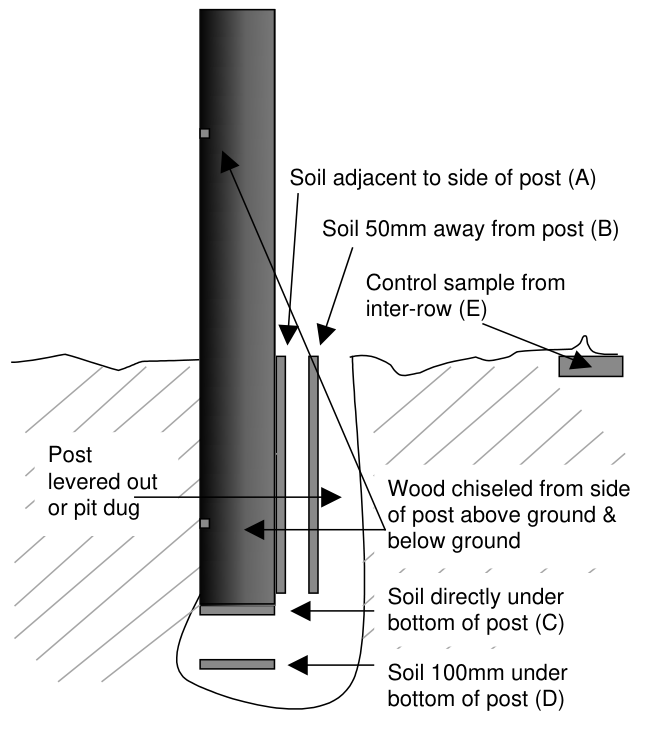
Soil samples were taken adjacent to the posts, (A), at 50 mm horizontal distance (B) and immediately and 100 mm below the post (C and D respectively). A reference soil sample (E) was collected from the inter-row (Figure 1).
土壤样品分别采自紧邻立柱处(A)、水平距离50 mm处(B)以及立柱正下方和立柱下方100 mm处(分别为C和D)。另在行间采集参照土壤样品(E)(图1)。
Approximately 20 g (dry weight) samples of wood were removed from both the above- and below-ground portions of the post using a chisel. For the half-round and quarter-round posts, wood was removed to approximately 15 mm deep at the intersection between the flat face and the circumference. An additional six samples were taken from new posts. The samples were sent to a commercial laboratory for dry-weight determinations of copper, chromium, arsenic and boron.
用凿子从立柱地上部分和地下部分各取约20 g(干重)木材样品。对于半圆柱和四分之一圆柱,在平面与圆周交界处取样,深度约15 mm。另从新立柱中采集了6个样品。样品送至商业实验室测定铜、铬、砷和硼的干重含量。
3Survey results and discussion调查结果与讨论
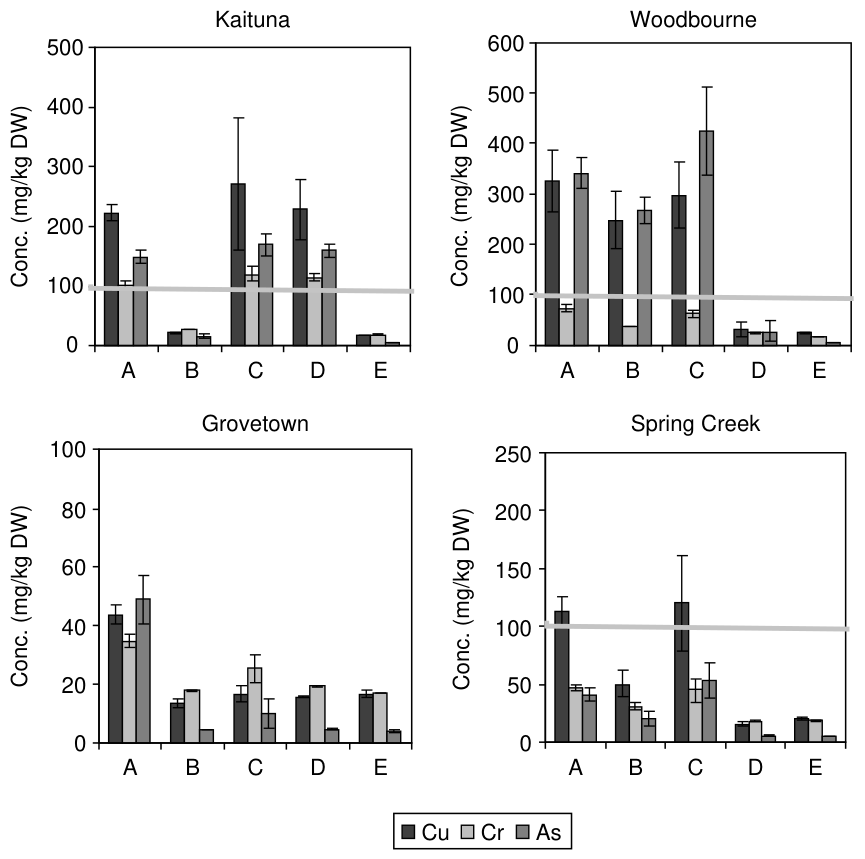
The results from this survey clearly show the appearance in the adjacent soil of all three heavy metals, with significantly higher concentrations of CCA in the soil surrounding the posts compared with the control soil. Across all sites, 25% of the samples contained more than 100 mg/kg As (As threshold for agricultural soils set by the Australian National Environmental Protection Council; ANEPC). If the investigation levels were the NZ Timber Treatment Guideline value of 30 mg/kg, then nearly half the soil samples would have exceeded the investigation level. Some 10% of the samples were above ANPEC guidelines for chromium (100 mg/kg). None of the copper values exceeded the ANPEC guideline of 1,000 mg/kg (Figure 2, compare with Table 1). However, 33 samples were above 200 mg/kg, a level shown to cause plant toxicity in other studies (Thayalakumaran et al., 2003). However, this was very localised and only happened in the area immediately around the posts, which covers about 0.2% of the total vineyard area. Earlier studies on treated posts also showed that soil CCA concentrations decreased rapidly with increasing distance from the post, especially for copper and chromium, which approached background levels at 50 mm. Arsenic is more mobile and has been found 500 mm out from posts, and 1 m below (Zagury et al., 2003). The average soil
本次调查结果清楚地表明,三种重金属均出现在立柱邻近土壤中,与对照土壤相比,立柱周围土壤中的CCA浓度显著较高。在所有样点中,25%的样品As含量超过100 mg/kg(澳大利亚国家环境保护委员会(ANEPC)设定的农业土壤As阈值)。若以新西兰木材处理指南值30 mg/kg作为调查水平,则近半数土壤样品将超过该调查水平。约10%的样品超过ANPEC的铬指南值(100 mg/kg)。所有铜含量均未超过ANPEC指南值1,000 mg/kg(图2,与表1比较)。然而,有33个样品超过200 mg/kg,而其他研究表明该水平可导致植物毒害(Thayalakumaran et al., 2003)。不过,这种情况高度局部化,仅发生在紧邻立柱的区域,该区域约占葡萄园总面积的0.2%。早期对处理立柱的研究也表明,土壤CCA浓度随距立柱距离的增加而迅速下降,铜和铬尤其如此,在50 mm处已接近背景水平。砷的迁移性更强,在距立柱500 mm处及其下方1 m处均有检出(Zagury et al., 2003)。平均土壤
| Soil series土系 | Description描述 | Loss (kg/ha)损失量(kg/ha) | @ 1 m (kg/ha) | @ 2 m (kg/ha) | @ 3 m (kg/ha) |
|---|---|---|---|---|---|
| Rarangi | Pea gravel | 2.66 | 1.37 | 0.65 | 0.41 |
| Fairhall | Shallow silt loam | 2.66 | 0.41 | 0.16 | 0.09 |
| Rapaura | Shallow silt loam | 2.66 | 0.63 | 0.26 | 0.13 |
| Brancott | Deep silt loam | 2.66 | 0.33 | 0.10 | 0.03 |
| Spring Creek | Clay loam | 2.66 | 0.33 | 0.11 | 0.03 |
| Kaituna | Silt loam, high C | 2.66 | 0.07 | 0.02 | 0.01 |
| Woodbourne | Deep silt loam | 2.66 | 0.02 | 0.00 | 0.00 |
| Grovetown | Deep clay loam | 2.66 | 0.06 | 0.00 | 0.00 |
CCA concentrations in our study were consistent with the findings of many overseas studies (Hingston et al., 2001; Chirenje et al., 2003; Zagury et al., 2003).
本研究中的CCA浓度与许多国外研究结果一致(Hingston et al., 2001; Chirenje et al., 2003; Zagury et al., 2003)。
4Lysimeter trial materials and methods渗漏计试验的材料与方法
To study the leaching of CCA from vineyard trellis posts under controlled conditions, a trial was set up in which six round and six half-round 1.5 m long CCA-treated posts were placed in 75 L lysimeters that were filled with soil from one of the areas in Marlborough, most at risk from CCA leaching. Before posts were installed in the lysimeters, samples of the soil and water were taken to determine the background levels of CCA. Similarly, samples of the above-ground and below-ground portions of the posts were obtained prior to installation. Six of the soil-containing lysimeters (three with round, and three with half-round posts) were permanently drained, keeping the posts relatively dry, while in six other similar lysimeters, the posts were kept saturated to imitate elevated groundwater levels.
为研究受控条件下CCA从葡萄园棚架立柱中的淋溶,设置了一项试验:将6根圆柱和6根半圆柱、长1.5 m的CCA处理立柱置于75 L渗漏计中,渗漏计内填充的土壤取自马尔堡CCA淋溶风险最高的区域之一。在渗漏计中安装立柱之前,采集土壤和水样以测定CCA背景水平。同样,在安装前采集了立柱地上部分和地下部分的样品。6个装土渗漏计(3个装圆柱,3个装半圆柱)保持持续排水,使立柱相对干燥;另外6个相同的渗漏计则使立柱保持饱和状态,以模拟地下水位升高的情形。
In addition, three replicates of half-round and three of full round 500 mm posts were suspended in buckets filled with water with 400 mm of posts under water to simulate a worst-case scenario when the bottoms of the posts dip into shallow ground water. Lids were placed on these buckets to prevent rainfall entering and to reduce evaporation. The water levels in these lysimeters were maintained throughout the experiment. Drainage was collected weekly, the volume measured, and a sub-sample sent away for CCA analysis. Wood samples from the water-filled lysimeters were initially collected monthly but after three months were collected only every third month. By monitoring the CCA rise in the water, we could parameterise a first-order model for the soil-to-solution transfer.
此外,将半圆柱和全圆柱500 mm立柱各3个重复悬置于盛水的桶中,立柱有400 mm浸没于水下,以模拟立柱底部浸入浅层地下水的最坏情形。桶上加盖,以防雨水进入并减少蒸发。试验期间各渗漏计的水位保持不变。每周收集渗漏液,测量体积,并取子样送检CCA。盛水渗漏计中的木材样品最初每月采集一次,三个月后改为每三个月采集一次。通过监测水中CCA的升高,可对土壤-溶液迁移的一级动力学模型进行参数化。
The meteorological station on site recorded daily rainfall and other pertinent climatic variables throughout the experiment.
试验期间,现场气象站记录了逐日降雨量及其他相关气候变量。
5Lysimeter trial results and discussion渗漏计试验结果与讨论
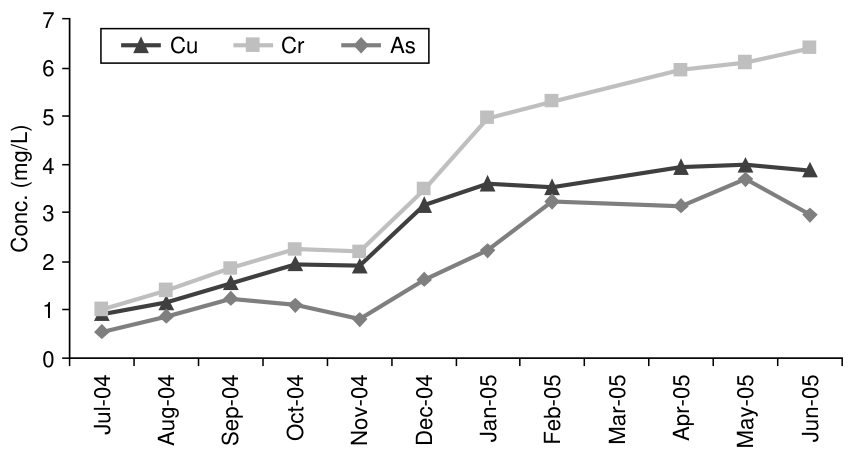
Results from this trial showed a clear movement of CCA from the post both into the water, and into the soil (Figure 3). The lateral and depthwise penetration depends on the permeability of the soil and the capacity of the soil to bind these heavy metals. Allinson et al. (2000) reported that once in soil, the movement of the copper component of CCA is strongly retarded by exchange with the soil, even in sandy soils. Monthly analysis of the leachate gave us the parameters to calculate the rate of movement out of the posts. These values were used in HortResearch’s Soil Plant Atmosphere Model (SPASMO) to predict the movement of these heavy metals through, and out of these posts into the water and the soil, for eight different sites in the Marlborough vineyard area. The leaching rate for As was found to be 5 mg/post/month, with the Cr rate being about twice that. During the treatment process, the end-grain penetration of CCA is 40 times higher than lateral penetration (Morgan and Purslow, 1973). It can therefore be expected that, in reverse, the end-grain leaching would also be considerably higher than lateral leaching because of the wood’s longitudinal vascular structure. Leaching measured from CCA-treated posts that had their ends sealed with paint showed .50% reduction of CCA concentration in the water compared with non-sealed posts (Ko et al., 2006).
本试验结果表明,CCA明显从立柱迁移进入水体和土壤(图3)。其横向和纵向渗透程度取决于土壤的渗透性以及土壤对这些重金属的结合能力。Allinson et al. (2000)报道,CCA中的铜组分一旦进入土壤,即使在砂质土壤中,其迁移也会因与土壤的交换作用而受到强烈阻滞。通过对渗漏液的逐月分析获得了计算立柱中重金属迁出速率所需的参数。将这些数值用于HortResearch的土壤-植物-大气模型(SPASMO),预测了马尔堡葡萄园区8个不同样点中这些重金属穿过并迁出立柱进入水体和土壤的过程。As的淋溶速率为5 mg/立柱/月,Cr的淋溶速率约为其两倍。在处理过程中,CCA的端面(横切面)渗透是侧向渗透的40倍(Morgan and Purslow, 1973)。因此可以预期,由于木材的纵向维管结构,反过来端面淋溶也会显著高于侧向淋溶。对端面用油漆封闭的CCA处理立柱的淋溶测定表明,与未封闭立柱相比,水中CCA浓度降低了50%以上(Ko et al., 2006)。
Using our knowledge of the soils in Marlborough and their related climates, as well as the measurements from the lysimeters, it has been possible to model the likely flow of Cu, Cr and As out of the posts into the surrounding soil and down through the profile. The results from this modelling exercise corresponded with the actual field results found in the leaching survey of several Marlborough vineyards (Robinson et al., 2005). This gives us confidence that our modelling has given us good insight into the potential leaching risks for the different soils around Marlborough.
结合对马尔堡土壤及其相应气候的认识以及渗漏计测定结果,得以模拟Cu、Cr和As从立柱迁出进入周围土壤并向下穿过剖面的可能通量。模拟结果与在马尔堡若干葡萄园开展的淋溶调查的实际田间结果相符(Robinson et al., 2005)。这使我们确信,该模拟能够较好地揭示马尔堡不同土壤的潜在淋溶风险。
Using locally obtained vineyard posts revealed enormous variation in concentrations of CCA (Greven et al., 2005). For example, the concentration of arsenic between posts [As] varied from 1,100 to 5,300 mg/kg, with a median [As] of 2,150 mg/kg. The variation of [As] within the posts ranged from 1,850–3,000 mg/kg, with the higher concentrations at the pointed end. The ratio of As, Cu and Cr in the posts was always similar, but varied from the industry standard of Cu:Cr:As = 1,700:3,000:2,400 mg/kg. However, in this particular experiment, chemical concentrations between the posts were consistent ([Cu] = 2,500 mg/kg, [Cr] = 6,000 mg/kg and [As] = 3,600 mg/kg). It is on the basis of these concentrations that the modelling was carried out. Figure 3 shows the leaching of CCA from the treated timber into water. The SPASMO model for describing treatmentchemical fate was run only for arsenic.
对当地所取葡萄园立柱的分析表明,CCA浓度差异巨大(Greven et al., 2005)。例如,不同立柱间的砷浓度[As]为1,100至5,300 mg/kg,中位数[As]为2,150 mg/kg。同一立柱内[As]的变化范围为1,850–3,000 mg/kg,尖端浓度较高。立柱中As、Cu和Cr的比例始终相近,但与行业标准Cu:Cr:As = 1,700:3,000:2,400 mg/kg有所不同。不过,在本试验中各立柱间的化学物质浓度较为一致([Cu] = 2,500 mg/kg,[Cr] = 6,000 mg/kg,[As] = 3,600 mg/kg),模拟即以这些浓度为基础进行。图3显示了CCA从处理木材中向水体的淋溶。描述处理化学物质归趋的SPASMO模型仅针对砷进行了运算。
The chemicals leached out of the posts are transported in the water through the profile depending on: a) the permeability of the soil to the water carrying the CCA, and b) the capacity of the soil and organic matter particles to adsorb these chemicals. “The amount and rate at which arsenic leaches varies considerably depending on numerous factors, such as local climate, acidity of rain and soil, age of the wood product, and how much CCA was applied” (US EPA, 2002). With our knowledge of the various soil properties, it has been possible to calculate the amount of chemical that will leach over a period of 30 years based on weather information taken from historic meteorological data 1974–2004. The results of these calculations are shown in Table 1 for eight dominant soil profiles in Marlborough.
从立柱中淋溶出的化学物质随水在剖面中迁移,其迁移取决于:a)土壤对携带CCA的水的渗透性;b)土壤及有机质颗粒对这些化学物质的吸附能力。“砷淋溶的数量和速率因诸多因素而差异很大,如当地气候、雨水和土壤的酸度、木制品的年限以及CCA的施用量”(US EPA, 2002)。基于对各种土壤性质的了解,并依据1974–2004年的历史气象数据,得以计算出30年内的化学物质淋溶量。马尔堡8种主要土壤剖面的计算结果列于表1。
It is calculated that after 30 years, 44% of the As will have leached from the posts, i.e. 7.9 g As/post. This rate is controlled, we assume, by the diffusive nature of the wood, and the fraction of the soil’s volume that is filled with water and in direct contact with the post. Movement of this amount of arsenic through the soil, however, depends very much on the soil type. Soil conditions, especially pH, organic matter and clay contents, play an important role in leaching and movement of CCA (Carey et al., 1996; Hingston et al., 2001). From the calculations (Table 1), we see that in heavy soils (e.g. the Grovetown, deep clay loam) most of the chemical will bind to the soil particles close to the post. Virtually all the As in these soils ends up being bound to the soil, raising the level of As in these soils rapidly (within 8 years) to levels exceeding the ANPEC guideline value of 100 mg-As/kg. However, with about 600 posts/ha this equates to only 0.05% of the vineyard surface area, and therefore the spatially averaged loading at depth needs to be weighted accordingly. Because most As is bound in the top part of the soil, little leaches much beyond 1 m depth over this 30-year timescale (Table 1). Other more free draining soils adsorb sufficient As to avoid risk to the groundwater. Table 1 shows the kg/ha of As that can be expected at depths of 1, 2 and 3 m in eight Marlborough soils after 30 years.
计算表明,30年后立柱中44%的As将被淋溶,即7.9 g As/立柱。我们推测,该速率受木材的扩散特性以及土壤中充水且与立柱直接接触的体积分数控制。然而,这部分砷在土壤中的迁移在很大程度上取决于土壤类型。土壤条件,尤其是pH、有机质和黏粒含量,对CCA的淋溶和迁移起着重要作用(Carey et al., 1996; Hingston et al., 2001)。由计算结果(表1)可见,在黏重土壤(如Grovetown深层黏壤土)中,大部分化学物质将结合在立柱附近的土壤颗粒上。这些土壤中几乎所有的As最终都与土壤结合,使土壤As含量迅速(8年内)升至超过ANPEC指南值100 mg-As/kg的水平。然而,按每公顷约600根立柱计,这仅相当于葡萄园地表面积的0.05%,因此深层的空间平均负荷需相应加权。由于大部分As结合在土壤上层,在30年时间尺度内很少淋溶至1 m深度以下(表1)。其他排水较为通畅的土壤也能吸附足够的As,从而避免对地下水构成风险。表1给出了马尔堡8种土壤30年后在1、2和3 m深度处预计的As量(kg/ha)。
Only the Rarangi gravels could pose some risk (Green et al., 2001). These stony soils have a low absorption capacity, low water content, and they are extremely free draining. This causes the As to move deep down into the profile at high concentrations of around 0.025 mg/L. This value is 2.5 times the New Zealand Drinking Water Standard (NZDWS). Furthermore, at times, the Rarangi shallow aquifer reaches close to the soil surface, inundating the bottom part of the posts. This increases the risks of CCA removal from the post and brings it directly into the groundwater.
仅Rarangi砾质土可能构成一定风险(Green et al., 2001)。这类石质土壤吸附能力低、含水量低,且排水极为通畅,导致As以约0.025 mg/L的高浓度向剖面深处迁移。该值为新西兰饮用水标准(NZDWS)的2.5倍。此外,Rarangi浅层含水层有时接近地表,淹没立柱底部,这增加了CCA从立柱中脱出并直接进入地下水的风险。
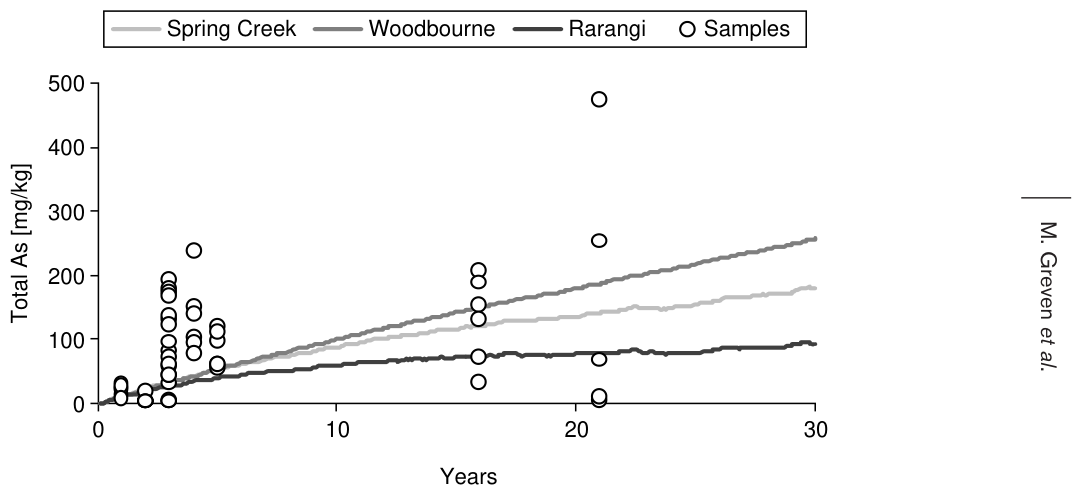
Further modelling was based on soil type and climatic conditions in order to elucidate the potential for CCA to contaminate the underlying aquifers (Figure 4). Modelling over 500 years, but now with the expected post replacement every 20 years, revealed that after about 200–300 years, depending on soil type, a steady plume of As moved downwards (Clothier et al., 2006). It was found that As, which is more mobile in the soil than Cu or Cr, potentially could move through the soil into the local aquifers after the adsorption capacity of the soil was filled. Spatially averaged, the concentration of As was found eventually to reach 0.0125–0.0175 mg/L at 2 m depth, which just exceeds the NZDWS. However, when combined with ground water flow results measured by the Regional Council, long-term hydrogeological modelling showed that in Marlborough, even at Rarangi, despite the high density of vineyards and hence posts, sufficient aquifer water flow prevented the accumulation of these heavy metals in the ground water. Long term, As concentrations will stay an order of magnitude below the NZDWS.
为阐明CCA污染下伏含水层的可能性,基于土壤类型和气候条件进行了进一步模拟(图4)。在500年时间尺度上的模拟(此时考虑每20年更换一次立柱)表明,约200–300年后(取决于土壤类型),将形成一个稳定向下迁移的As羽流(Clothier et al., 2006)。研究发现,在土壤中迁移性强于Cu和Cr的As,在土壤吸附容量饱和后可能穿过土壤进入当地含水层。经空间平均,2 m深度处As浓度最终将达到0.0125–0.0175 mg/L,略超过NZDWS。然而,结合地区议会实测的地下水流数据,长期水文地质模拟表明,在马尔堡,即使在Rarangi,尽管葡萄园及立柱密度较高,含水层中充足的水流仍可防止这些重金属在地下水中累积。从长期来看,As浓度将比NZDWS低一个数量级。
This work has shown that the use of CCA-treated posts will result in some levels of leaching of CCA into the soil. How much CCA accumulates in the soil is dependent on soil type (Figure 5). However, the steady downward flow in the long term depends mainly on the leaching rate from the post, not the soil type.
本研究表明,使用CCA处理立柱会导致一定程度的CCA向土壤淋溶。CCA在土壤中的累积量取决于土壤类型(图5)。然而,长期稳定的向下迁移主要取决于立柱的淋溶速率,而非土壤类型。
![Figure 4 The Cu, Cr and As leaching processes described in the SPASMO (Soil Plant Atmosphere Model) model. Here dg is the depth to groundwater, u is the soil water content, m [mg As/post/month] is the flux of As leaving](59/figure-04.jpg)
6Conclusions结论
The three timber treatment chemicals of copper, chromium and arsenic (CCA) do move out of the vineyard support posts into the surrounding soils and then eventually they move down towards ground water. Chromium is the most mobile in the soil of the three elements, followed by arsenic and copper, yet there is great variability in CCA concentrations between posts. Soil type, stoniness and organic carbon in the soil are important factors controlling the speed and depth of movement of CCA through the soil.
铜、铬和砷三种木材处理化学物质(CCA)确实会从葡萄园支撑立柱迁移进入周围土壤,并最终向下迁移至地下水。三种元素中铬在土壤中的迁移性最强,其次为砷和铜,但不同立柱间的CCA浓度差异很大。土壤类型、石砾含量和土壤有机碳是控制CCA在土壤中迁移速度和深度的重要因素。
CCA has the potential to accumulate in the soil over time and reach levels that are above guideline values. However, in Marlborough, some 95% of the vineyards are in areas where the subterranean aquifers have sufficient capacity to dilute the descending plume of copper, chromium and arsenic down to levels that are only 0.1 to 0.05 times the drinking water standard. Furthermore, naturally occurring geogenic arsenic levels in the aquifers are well above that contributed by the treated-timber posts.
随着时间推移,CCA有可能在土壤中累积并达到超过指南值的水平。然而,在马尔堡,约95%的葡萄园位于地下含水层有足够容量稀释下渗铜、铬和砷羽流的区域,可将其稀释至仅为饮用水标准0.1至0.05倍的水平。此外,含水层中天然存在的地质成因砷含量远高于处理木质立柱的贡献。
Further work on CCA loss from paint-sealed end-grains of the post found a reduction of leaching by more than 50%.
对立柱端面以油漆封闭后CCA损失的进一步研究发现,淋溶减少了50%以上。
7References参考文献
Allinson, G., Tyroczy, N.J., Kelsall, Y., Allinson, M., Stagnitti, F., Lloyd-Smith, J. and Nishikawa, M.
(2000). Mobility of the constituents of chromated copper arsenate in a shallow sandy soil. New Zealand J. Agri. Res., 43, 149–156.
Carey, P.L., McLaren, R.G., Cameron, K.C. and Sedcole, J.R. (1996). Leaching of copper, chromium, and arsenic through some free-draining New Zealand soils. Australian J. Soil Res., 34, 583–597.
Chirenje, T., Ma, L.Q., Clark, C., and Reeves, M. (2003) Cu, Cr and As distribution in soils adjacent to pressure-treated decks, fences and poles. Environ. Pollut., 124, 407–417.
Clothier, B.E., Green, S.R., Vogeler, I., Greven, M.M., Agnew, R., van den Dijssel, C.W., Neal, S.,
Robinson, B.H. and Davidson, P. (2006). CCA transport in soil from treated-timber posts: pattern dynamics from the local to regional scale. Hydrol. Earth Sys. Sci. Discuss., 3(4), 2037–2061.
Green, D., Cotter, D., Greven, M., Neal, S. and Clothier, B. (2001). Pesticide Leaching under Vineyards in the Rarangi Area of Marlborough. HortResearch Client report No. 2002/141.
Greven, M., Green, S., Agnew, R., Neal, S. and Clothier, B. (2005). CCA Leaching Experiment at
Grovetown Park. Annual report/Marlborough Research Centre 2004/2005, pp. 27–29.
Hingston, J.A., Collins, C.D., Murphy, R.J. and Lester, J.N. (2001). Leaching of chromated copper arsenate wood preservatives: a review. Environ. Pollut., 111, 53–66.
Ko, B.-G., Vogeler, I., Clothier, B.E. and Bolan, N.S. (2006). Bottom sealing to reduce the release rate of CCA from wood posts. WISPAS, 94, 5–6.
Morgan, J.W.W. and Purslow, D.F. (1973). Volatile losses of wood preservatives. In: Proceedings of the 23rd Annual Convention of the BWPA, British Wood Preservers Association, pp. 173–193.
Robinson, B.H., Greven, M.M., Green, S.R., Sivakumaran, S., Davidson, P. and Clothier, B.E. (2005).
Leaching of copper, chromium and arsenic from treated timber vineyard posts in Marlborough, New Zealand. Sci. Total Environ., 364(1/3), 113–123.
Thayalakumaran, T., Robinson, B.H., Vogeler, I., Scotter, D.R., Clothier, B.E. and Percival, H.J. (2003). Plant uptake and leaching of copper during EDTA-enhanced phytoremediation of repacked and
undisturbed soil. Plant and Soil, 254, 415–423.
US EPA (2002). Questions and answers: what you need to know about wood pressure treated with Chromated Copper Arsenate (CCA), United States Environmental Protection Agency, www.epa.gov/ pesticides/factsheets/chemicals/cca-qa.htm.
Zagury, G.W., Sampson, R. and Deschenes, L. (2003). Occurrence of metals in soil and groundwater near chromated copper arsenate-treated utility poles. J. Environ. Qual., 32, 507–514.