JOURNAl Of GEOCNEMlCAl ~WPLORATION
ELSEVIER
Journal of Geochemical Exploration 60 (I 997) 115- 126
The potential of the high-biomass nicke 1 hyperaccumulator Berkheya coddii for phytoremediation and phytomining
B.H. Robinson ‘, R.R. Brooks a, * , A.W. Howes h, J.H. Kirkman a, P.E.H. Gregg a
’ Deprtment of Soil Science, Mussqv Clnirersiy, Palmerston North, New Zealand
’ Rustenburg Base Metal Refiners. PO Bo.x 483, Rustenburg, 0300. South Africu
Received 17 June 1997; accepted 19 August 1997
Abstract摘要
Pot trials and tests in outside plots were carried out on the South African Ni hyperaccumulator plant Berkhqa coddii in order to establish its potential for phytoremediation of contaminated soils and for phytomining of Ni. Outside trial plots showed that a dry biomass of 22 t/ha could be achieved after moderate fertilisation. Pot trials with varying soil amendments with nitrogen and phosphorus fertilisers showed enhanced uptake of Ni with increasing nitrogen addition, though there was no reaction to phosphorus. The Ni content of the plant was directly related to the ammonium acetate extractable fraction of Ni in a wide range of natural and artificial substrates. Excision of shoots induced a dramatic increase in the Ni content in the new growth (5500 pg/g compared with 1800 kg/g Ni). When plants were grown in pots with Ni added to the substrate (O-l%), the Ni content of the plants rose to a maximum value of about 1% dry mass. The data from this last experiment were used to calculate the probable Ni yield (kg/ha) of plants grown in nickel-rich soils in different parts of the world. It was calculated that moderately contaminated soils (100 kg/g Ni) could be remediated with only two crops of Berkhe~a coddii. The potential of this species for phytomining has also been evaluated and it is proposed that a yield of 100 kg/ha of Ni should be achievable at many sites worldwide. Phytomining is also discussed in general terms for other metals as well as Ni. 0 1997 Elsevier Science B.V.
为评估南非镍超富集植物 Berkheya coddii 在污染土壤植物修复及镍植物采矿方面的潜力,本研究开展了盆栽试验和室外小区试验。室外试验小区结果表明,经适度施肥后其干生物量可达22 t/ha。不同氮、磷肥料土壤改良的盆栽试验表明,镍吸收量随施氮量增加而提高,但对磷无响应。在多种天然及人工基质中,植物镍含量与乙酸铵可提取态镍直接相关。刈割地上部后,新生组织中镍含量显著升高(5500 μg/g,而刈割前为1800 μg/g)。在基质中添加镍(0–1%)的盆栽条件下,植物镍含量最高可达约1%(干重)。利用该试验数据,计算了在世界不同地区富镍土壤上种植该植物可能获得的镍产量(kg/ha)。计算表明,中度污染土壤(100 μg/g Ni)仅需种植两茬 Berkheya coddii 即可得到修复。本文还评估了该物种用于植物采矿的潜力,认为在全球许多地点镍产量有望达到100 kg/ha。此外,还对镍及其他金属的植物采矿进行了一般性讨论。© 1997 Elsevier Science B.V.
Keywords: Brrkheyu coddii; phltoremediation; phytomining; hyperaccumulator of nickel
关键词:Berkheya coddii;植物修复;植物采矿;镍超富集植物
1Introduction引言
Berkheya coddii is an asteraceous perennial plant that typically grows to a height of 1.5 m. It is found naturally only on serpentine soils in southern Africa. Berkheya coddii belongs to a group of very unusual plants termed hyperaccumulators (Brooks et al., 1977). Hyperaccumulator plants accumulate heavy metals from the soil into the aerial parts to concentrations in excess of a threshold of 1000 kg/g (ppm) set by Brooks et al. (1977) for dry biomass. In the case of Zn, the threshold has been set at 10000 kg/g. There are known hyperaccumulator plants for As, Cd, Co, Cu, Mn, Ni, Pb, Se and Zn, of the order of 700 species in all, of which more than half are Ni hyperaccumulators. Berkheya coddii falls into this latter category, with foliar Ni concentrations reported in excess of 11.600 kg/g (1.16%) dry mass (Morrey et al.. 1992).
Berkheya coddii 为菊科多年生植物,株高通常可达1.5 m,在自然界中仅分布于南部非洲的蛇纹岩土壤上。Berkheya coddii 属于一类极为特殊的植物,称为超富集植物(Brooks et al., 1977)。超富集植物可将土壤中的重金属积累于地上部,其浓度超过 Brooks et al.(1977)所设定的干物质1000 μg/g(ppm)阈值。对于Zn,该阈值定为10000 μg/g。目前已知的超富集植物涉及As、Cd、Co、Cu、Mn、Ni、Pb、Se和Zn,共约700种,其中半数以上为镍超富集植物。Berkheya coddii 即属于后者,据报道其叶片镍浓度超过11600 μg/g(1.16%)干重(Morrey et al., 1992)。
* Corresponding author
A potential practical use for hyperaccumulators was first suggested by Chaney (1983) and later by McGrath et al. (1993) who showed that these plants might be used to remove metals from polluted soils. The process would involve growing repeated crops of a hyperaccumulator on the polluted area. The plant material would be burnt to produce a ‘bio-ore’. This metal-rich ash, typically only 7% of the weight of the dried plant material, could be stored in a safe area or even conceivably be sold as feedstock to a smelter to recoup some of the cost of the operation. This technique has been termed I’12~toremediatiorl and is now the subject of many studies (Brooks, 1998).
超富集植物的潜在实际用途最早由 Chaney(1983)提出,随后 McGrath et al.(1993)指出这类植物可用于去除污染土壤中的金属。该过程是在污染区域反复种植超富集植物,将植物材料焚烧后生成“生物矿石”。这种富含金属的灰分通常仅占干植物材料重量的7%,可在安全场所贮存,甚至可作为冶炼原料出售,以回收部分运行成本。该技术被称为植物修复,目前已成为众多研究的主题(Brooks, 1998)。
degree of metal accumulation compared with hyperaccumulators. One strategy for increasing metal yields at present is, as mentioned above, to try to induce high biomass non-accumulator plants to accumulate a higher concentration of metal by adding chelating agents to the soil. or in the longer term by inducing the plant to produce its own complexing agents, by introducing genes from other hyperaccumulating species.
金属积累程度较超富集植物低。如上所述,目前提高金属产量的一种策略是向土壤中添加螯合剂,促使高生物量的非富集植物积累更高浓度的金属;从长远看,也可通过导入其他超富集物种的基因,诱导植物自身产生络合剂。
It is clearly desirable on economic grounds to discover high-biomass hyperaccumulators for phytoremediation/phytomining operations. An initial study of Berkhey coddii in its natural environment by some of us (RRB and AWH) showed that this plant certainly combines a high biomass (individual plants averaged 300 g d.w. at a site in Barberton. South Africa) with a high Ni content (up to 1.7% Ni in dried leaves). We have now grown this plant experimentally in New Zealand for two years in which we studied the effect of climate. shoot excision, soil amendments (including chelating agents) and varying Ni contents in the substrate. These studies were performed both in plant growth units and outside under field conditions and had the purpose of establishing the suitability of this species for phytomining and/or phytoremediation.
从经济角度看,为植物修复/植物采矿寻找高生物量超富集植物显然十分必要。本文部分作者(RRB和AWH)对自然环境中的 Berkheya coddii 进行的初步研究表明,该植物确实兼具高生物量(在南非 Barberton 的一处样点,单株平均干重300 g)和高镍含量(干叶中镍含量高达1.7%)。我们已在新西兰对该植物进行了为期两年的试验性种植,研究了气候、地上部刈割、土壤改良(包括螯合剂)以及基质中不同镍含量的影响。这些研究在植物生长室及室外田间条件下进行,目的是确定该物种是否适用于植物采矿和/或植物修复。
A potential new use for hyperaccumulator plants was proposed Nicks and Chambers (1995. 19981, who showed that the Californian hyperaccumulator Streptunthus polygaloides could extract over 100 kg of Ni per hectare from serpentine soils. In this operation termed phytomining, the objective was to grow commercial crops of Ni, on soils that are too nickel-poor for direct extraction by mining.
Nicks and Chambers(1995, 1998)提出了超富集植物的一种潜在新用途,他们发现加利福尼亚镍超富集植物 Streptanthus polygaloides 每公顷可从蛇纹岩土壤中提取超过100 kg的镍。在这一被称为植物采矿的过程中,其目标是在镍含量过低、无法直接通过采矿开采的土壤上,以商业化方式“种植”镍。
A study by Robinson et al. (1997) reported earlier in this journal, showed that the Ni hyperaccumulator A/yssum bertolonii from central Italy could potentially be used to phytomine Ni commercially, though the operation was nearing the low end of economic feasibility. It was found that the Ni content of the plants was correlated positively with the ammonium acetate extractable fraction of Ni in the soil.
Robinson et al.(1997)早先在本刊发表的研究表明,意大利中部的镍超富集植物 Alyssum bertolonii 具有商业化植物采矿镍的潜力,但该操作接近经济可行性的下限。研究还发现,植物镍含量与土壤中乙酸铵可提取态镍呈正相关。
2Materials and methods材料与方法
2. I. Enr~ironmentul control rrnd growth media
2.1. 环境控制与生长基质
It has been proposed that adding a compound to the soil that solubilises non-available heavy metals. would increase metal yields in the plant. Evidence for this comes from Blaylock et al. (1997) who showed that Indian mustard (Brussicu juncea) plants accumulated Pb to a level of 1.5% (dry mass) in the aerial parts one week after addition of EDTA to the soil. The plant rapidly died, but this is not important for a phytoextraction operation as dead tissue can be harvested and burnt as easily as live material. The disadvantage with this strategy is the cost involved in adding such compounds and the risks that metals may pose to the environment.
有人提出,向土壤中添加可溶解非有效态重金属的化合物,可提高植物中的金属产量。Blaylock et al.(1997)为此提供了证据:他们发现向土壤中添加EDTA一周后,印度芥菜(Brassica juncea)地上部Pb积累量达1.5%(干重)。植株随即迅速死亡,但这对植物提取并不重要,因为死亡组织与活体材料一样容易收获和焚烧。该策略的缺点在于添加此类化合物的成本,以及金属可能对环境造成的风险。
All experiments, except the biomass estimation, were conducted in glasshouses at the Plant Growth Unit, Massey University, New Zealand. The temperature was controlled year-round within the limits of 15”-25°C. Plants were watered daily. The biomass production experiments were conducted out-of-doors in experimental plots at Massey University during a I2-month period. Plants were also grown outside for 24 months in order to study their resistance to frost during the winter.
除生物量估算外,所有试验均在新西兰梅西大学(Massey University)植物生长室的温室中进行。全年温度控制在15–25°C范围内,每日浇水。生物量试验在梅西大学的室外试验小区中进行,历时12个月。此外,还将植物在室外种植24个月,以研究其冬季抗霜冻能力。
In Palmerston North mean maximum and minimum temperatures for July (winter) are 12.1” and 4.O”C. For January (summer) the values are 22.3” and 13.l”C. In the winter a rare ground frost could be as cold as -5°C. Various growth media (Table 1) were used. These included a serpentine soil from Red Hills in Califor- So far, the problem with most potential phytoextraction operations has been that the hyperaccumulator plants that would be used, often have a low biomass production. If recourse is made to high-biomass plants, the advantage is offset by a lower
Palmerston North 7月(冬季)平均最高和最低气温分别为12.1°C和4.0°C;1月(夏季)分别为22.3°C和13.1°C。冬季偶有地面霜冻,最低可达−5°C。试验采用了多种生长基质(表1),包括来自加利福尼亚 Red Hills 的蛇纹岩土壤—— 迄今为止,大多数潜在植物提取操作所面临的问题是,拟采用的超富集植物生物量往往较低。若改用高生物量植物,其优势又会被较低的
Elemental concentrations (total) and pH of natural and artifical growth media used in the experiments
试验所用天然及人工生长基质的元素(全量)浓度和pH
| Growth medium生长基质 | Mg (SC) | Fe cc/,) | Ni @g/g) | Cr ((*.g/g) | Co @g/g) | PH |
|---|---|---|---|---|---|---|
| Bark ,’ | 0.000I | 0.00 I | <I | <I | <I | 6 2 |
| Serpentine mineral (Te Kuiti) | 23.0 | 1.8 | 1880 | 9I 0 | Yh | 9.2 |
| Bark:serpentine (v/v) h | ||||||
| IO:I | 3.83 | 0.8 | 313 | 152 | 16 | 7 (I |
| 5: I | 6.57 | I .4 | 53; | 260 | 27 | 7-J |
| 4: I | 7.67 | I .6 | 626 | 303 | 32 | 7.1 |
| 3:1 | 9.20 | I.9 | 752 | 364 | 38 | 7; |
| 7:I | I I.5 | 2.4 | Y4CI | 355 | 48 | XI |
| I:1 | 15.3 | 3.2 | 1253 | 606 | 64 | x..I |
| Bark:serpentine:gravel (I : 1 : Z)(v/v/v) ’ | 6.57 | 1 .-I | 537 | 260 | 27 | 7Y |
| Bark:califomian serpentine soilI :I (v/v) h | 10.7 | 6.5 | 7-q | I027 | I I6 | h.5 |
| Californian serpentine soil (Chinese Camp) | 16.1 | 9.7 | 3&o | I540 | I74 | 0.5 |
| South Island serpentine rubble (Rai Valley) | 15.9 | 23.4 | 6090 | 7850 | 540 | 7.6 |
| Sourh African serpentine soil (Barberton) | 5.26 | 16.1 | 3000 | 6200 | _ | 6.7 |
N.B. All artifical growth media had been amended with ‘Osmocote‘ slow-release fertilisers. * The bark contained 10 kg/g N and 2 kg/g P. ’ Mixtures prepared wrth fresh bark on a volume basis. On a weight basis. the dry bark had half the mass of the fresh material
注:所有人工生长基质均添加了“Osmocote”缓释肥。* 树皮含N 10 μg/g、P 2 μg/g。’ 混合物按体积比用新鲜树皮配制;按重量计,干树皮质量为新鲜材料的一半
Berkheya coddii in 500-ml plastic pots for a period of 20 weeks in a 3 : 1 bark : serpentine mineral mixture (see Table 11 to which was added incremental amounts of nitrogen and phosphorus from calcium ammonium nitrate and superphosphate fertiliser. There was a total of nine different amendments with replicates of five plants within each group. The amendments were as follows: N,P,,, N,,P,. N,,P,, N,P,,, N,P,, N,P,, N,P,, N,P, and N,P,; where No--N2 were 0, 100 and 200 pg/g nitrogen as N, and PO-P, were 0. 50 and 100 pg/g phosphorus as P. The leaves of the plants were excised after 20 weeks and analysed for Ni.
Berkheya coddii,将其种植于500 ml塑料盆中,基质为3 : 1的树皮 : 蛇纹岩矿物混合物(见表1),培养20周,并以硝酸铵钙和过磷酸钙肥料的形式梯度添加氮和磷。共设9种不同改良处理,每组5株重复。处理如下:N0P0、N0P1、N0P2、N1P0、N1P1、N1P2、N2P0、N2P1和N2P2;其中N0–N2分别为0、100和200 μg/g氮(以N计),P0–P2分别为0、50和100 μg/g磷(以P计)。20周后剪取叶片并分析其镍含量。
nia, and a serpentine soil from South Island, New Zealand. Other growth media were artificial ‘serpentine soils’ prepared from additions of a serpentine mineral (‘Te Kuiti Serpentine’) to either garden soil or finely sieved ( < 2.0 mm> bark. Fertilisation was carried out by addition of ‘Osmocote’ slow-release fertilisers at the rates recommended by the manufacturers.
以及新西兰南岛的蛇纹岩土壤。其他生长基质为人工“蛇纹岩土壤”,由蛇纹岩矿物(“Te Kuiti Serpentine”)与园土或细筛(< 2.0 mm)树皮混合制备。施肥采用“Osmocote”缓释肥,用量按生产商推荐。
2.2. Estimation of annual biomass production
2.2. 年生物量产量估算
Two adjacent 1 X 1 m plots, containing a 3 : I mixture of bark: crushed serpentine rock to a depth of 20 cm (see Table 1) and fertilised with ‘Osmotote’, were each planted with 16 individual seedlings. The boundaries of these plots were surrounded with 1 m high shade cloth. This was added to reduce edge effects: i.e. extra peripheral light and the effects of wind. One year after planting, the plants were excised approximately 5 cm above ground level. The plants were dried and the weight of the stems, leaves and flowers from each plant were recorded and their Ni concentrations determined.
两个相邻的1 × 1 m小区内填入深20 cm、比例为3 : 1的树皮 : 碎蛇纹岩混合物(见表1),施用“Osmocote”肥料,每个小区种植16株幼苗。小区四周以1 m高的遮阳网围隔,以减少边缘效应,即额外的侧向光照和风的影响。种植一年后,在距地面约5 cm处刈割植株。植株经干燥后,分别记录每株茎、叶和花的重量,并测定其镍浓度。
2.4. Effect on soil nickel concentration. .coil nickel solubility and excision on nickel uptake
2.4. 土壤镍浓度、土壤镍溶解度及刈割对镍吸收的影响
Nickel was added as the nitrate to a standard commercial seed compost to give concentrations of 0, 14, 41, 123. 370, 1111, 3333, and 10,000 kg/g. In a further experiment, mixtures were also prepared with crushed serpentine rock: bark in the followingratios: l:l, 1:2, 1:3, 1:4, 1:5, 1:lOand pure bark. Californian serpentine soil (from Red Hills near Chinese Camp), and a 1 : I mixture of bark/Californian serpentine was also used. Five replicates were prepared for each treatment. Plants were grown in 500-ml pots for 6 months then ex- 2.3. Effect of fertiliser additions on nickel uptake
以硝酸盐形式向标准商品育苗基质中添加镍,使其浓度分别为0、14、41、123、370、1111、3333和10000 μg/g。在另一试验中,还将碎蛇纹岩与树皮按以下比例配制混合物:1:1、1:2、1:3、1:4、1:5、1:10以及纯树皮。同时采用了加利福尼亚蛇纹岩土壤(采自 Chinese Camp 附近的 Red Hills)以及1 : 1的树皮/加利福尼亚蛇纹岩混合物。每个处理设5个重复。植物在500 ml盆中生长6个月后 2.3. 施肥对镍吸收的影响
The effect of nitrogen and phosphorus on Ni uptake was studied by growing specimens of cised at ground level and analysed. The re-growth of the plants in the same mixtures were re-sampled and re-analysed after two months.
氮、磷对镍吸收的影响通过种植以下样本进行研究 于地面处刈割并进行分析。两个月后,对同一基质中的再生植株重新取样和分析。
3Results and discussion结果与讨论
3.1. The biomass production of Berkheyu coddii 2.5. lZffwt of citric acid and EDTA OH plant metal uptake
3.1. Berkheya coddii 的生物量产量 2.5. 柠檬酸和EDTA对植物金属吸收的影响
Forty plants were grown in pots containing 500 g of a 3 : 1 mixture of bark : crushed serpentine rock (see Table I) for a period of 5 months. The plants were divided into five groups of eight and the following treatments prepared for each specimen: control, 5 g citric acid, 10 g citric acid, 2 g EDTA, and 2 g EDTA and 5 g citric acid. Citric acid was added as a 20% solution, and the EDTA added as a 5% solution of the trisodium salt. Leaf samples were taken after the first and third weeks after treatment, and the entire plant harvested one month after treatment.
将40株植物种植于盛有500 g 3 : 1树皮 : 碎蛇纹岩混合物(见表1)的盆中,培养5个月。将植株分为5组,每组8株,每株分别进行以下处理:对照、5 g柠檬酸、10 g柠檬酸、2 g EDTA、2 g EDTA加5 g柠檬酸。柠檬酸以20%溶液形式添加,EDTA以其三钠盐的5%溶液形式添加。处理后第1周和第3周采集叶片样品,处理一个月后收获整株植物。
2.6. Determination of the nickel content of the plants
2.6. 植物中镍含量的测定
Plant material was placed in a drying cabinet at 70°C until a constant weight was reached. Approximately 0.1 g samples of plant material were weighed accurately into 15-ml borosilicate test tubes. The samples were ashed overnight at 500°C. A 5-ml volume of warm (80°C) 2 M HCl was added to each, and the samples were mixed and shaken to dissolve the ash. Nickel in the solutions was determined by flame atomic absorption spectroscopy (FAAS).
将植物材料置于70°C烘箱中烘干至恒重。准确称取约0.1 g植物样品于15 ml硼硅酸盐试管中,于500°C灰化过夜。向每个样品中加入5 ml温热(80°C)的2 M HCl,混匀振荡以溶解灰分。采用火焰原子吸收光谱法(FAAS)测定溶液中的镍。
2.7. Determination of the soluhility of nickel in the soil
2.7. 土壤中镍溶解度的测定
Soils were dried at 35°C. Soil samples (2 g) were weighed accurately into 50-ml centrifuge tubes and 20 ml of 1 M ammonium acetate (pH 7.0) was then added to each. This extractant was used so that the results could be compared with those of other studies (e.g. Robinson et al., 1997) that had shown that the ammonium acetate extract could be used to predict the nickel content of a plant grown in the extracted soil. The tubes were agitated for 24 h and the mixtures filtered. Nickel was determined in these extracts by graphite furnace atomic absorption spectroscopy (GFAAS).
土壤于35°C下烘干。准确称取2 g土样于50 ml离心管中,各加入20 ml 1 M乙酸铵(pH 7.0)。选用该提取剂是为了便于与其他研究结果进行比较(如 Robinson et al., 1997),这些研究已表明乙酸铵提取液可用于预测在该土壤上生长的植物镍含量。离心管振荡24 h后过滤,采用石墨炉原子吸收光谱法(GFAAS)测定提取液中的镍。
After one year’s growth from seed, the total above-ground dry biomass of plants in the two I X 1 rn plots were 2.08 and 2.20 kg respectively. This translates to a mean biomass production of 2 1.4 t/ha per year. Plants were on average 180 cm tall and are shown in Fig. 1. This biomass was achieved with moderate addition of Osmocote slow-release fertilisers. However, field observations indicate that the plant attains this height in its natural habitat. Poorer soils may, however, need fertiliser addition for optimal production. Table 2 compares the biomass production of B. coddii with some other plant species, both non- and hyper-accumulating. The value of 2 I .4 t/ha is among the highest reported for any natural hyperaccumulator species, and over twice as high as the biomass production of Alyssum hertolonii (9 t/ha per year) that has been shown by Robinson et al. (1997) to have the potential of being able to provide an economic crop of nickel.
从播种起生长一年后,两个1 × 1 m小区植物地上部总干生物量分别为2.08 kg和2.20 kg,折合平均生物量产量为21.4 t/ha/年。植株平均高180 cm,见图1。该生物量是在适量施用 Osmocote 缓释肥的条件下获得的。不过,田间观察表明,该植物在自然生境中也可达到这一高度。但较贫瘠的土壤可能需要施肥才能获得最佳产量。表2比较了 B. coddii 与其他一些非富集和超富集植物的生物量产量。21.4 t/ha 是已报道的天然超富集植物中最高的数值之一,是 Alyssum bertolonii(9 t/ha/年)生物量产量的两倍以上,而 Robinson et al.(1997)已证明后者具有提供经济镍产量的潜力。
3.2. Efect of fertiliser amendments on nickel uptake by Berkheya coddii
3.2. 施肥改良对 Berkheya coddii 镍吸收的影响
Chemical analysis of leaves collected in these experiments showed no statistically significant relationship between the nickel content of the plants and the phosphorus content of the medium when the nitrogen content was constant. If, however, the experimental samples were considered as three separate populations with treatments N,,, N, and N? (i.e. ignoring the P treatments), there was a significant increase of Ni content with increasing addition of N (Fig. 2). The mean Ni content rose from 2300 kg/g d.w. for zero addition of N, to 3250 for the N, treatment and to 4200 kg/g for the N? amendments (see also Fig. 2).
对这些试验所采集叶片的化学分析表明,在氮含量一定时,植物镍含量与基质磷含量之间无统计学显著关系。然而,若将试验样本视为N0、N1和N2三个独立处理总体(即忽略磷处理),则镍含量随施氮量增加而显著升高(图2)。平均镍含量由不施氮时的2300 μg/g干重升至N1处理的3250 μg/g,N2处理则达4200 μg/g(另见图2)。
3.3. The nickel concentration of Berkheya coddii in relation to soil nickel solubility
3.3. Berkheya coddii 镍浓度与土壤镍溶解度的关系
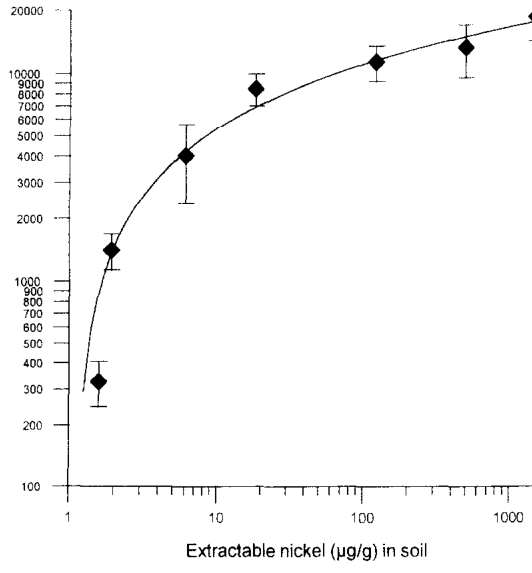
Nickel concentrations in the plants grown in various substrates as detailed in Table 1, ranged from 3 1 to 7880 kg/g (Fig. 3). The values represent the whole of the aerial parts of the plants as calculated from analyses of leaves, flowers and stems (percentages being 49, 19, and 32 by weight, respectively).
在表1所列各种基质中生长的植物镍浓度范围为31–7880 μg/g(图3)。该数值代表植物整个地上部,由叶、花和茎的分析结果计算得出(三者重量百分比分别为49、19和32)。
Fig. I. Experimental out-door stand of Brrkhrxa co&/ii with a hiomars of 22 t/ha and height of about I .X III图1. Berkheya coddii 室外试验群落,生物量为22 t/ha,株高约1.8 m
No significant correlation was found between the total metal content of the soil and that of the plants. This was almost certainly due to the fact that it is the soluble Ni fraction in the soil which determines plant uptake (Robinson et al., 1997). This hypothesis is supported by the fact that there was a very highly significant (P < 0.001) positive correlation between the metal content of the plant and the soluble Ni concentration as determined by extraction into a I M ammonium acetate solution (Fig. 3). This concurs with results obtained by Robinson et al. (1997) in which the Ni content of Alyssum bertolonii had a significant positive correlation with the extractable Ni concentration in the supporting soil. These results indicate that the concentration of extractable Ni in a
土壤金属全量与植物金属含量之间未发现显著相关性。这几乎可以肯定是因为决定植物吸收的是土壤中的可溶态镍(Robinson et al., 1997)。以下事实支持这一假设:植物金属含量与1 M乙酸铵溶液提取的可溶态镍浓度之间存在极显著正相关(P < 0.001)(图3)。这与 Robinson et al.(1997)的结果一致,其研究中 Alyssum bertolonii 的镍含量与其生长土壤中可提取态镍浓度呈显著正相关。这些结果表明,
Fertilised biomass. mean metal content and extraction施肥条件下生物量、平均金属含量及提取
potential of various hyperaccumulators of metals
各种金属超富集植物的潜力
| Fertilised biomass/ha施肥生物量/ha | Mean metal content (pg/g)平均金属含量(μg/g) | Metal extracted (kg/ha)金属提取量(kg/ha) |
|---|---|---|
| 36 | 556 d | 20 |
| 30 | 0.03 | |
| 23 | 339 1 | 78 |
| 21.1 | 7880 | 16X |
| 1s | 1 OOOil | I so |
| 13.8 | 7101 | 98 |
| 9 | 7500 | 68 |
| 7.5 | 2266 | 17 |
| 5.1 | 30000 | 153 |
| 2.6 | 3846 | I 0 |
” Leaves have 7000 kg/g Ni but the stems have much less; hence the low extraction yield soil is a better indicator of the probable metal content of the plant than is the total concentration of Ni in the soil.
” 叶片含镍7000 μg/g,但茎中含量低得多,因此提取量较低 土壤中可提取态镍浓度比土壤镍全量更能指示植物可能的金属含量。
of ammonium acetate solutions. Obviously there are other factors involved in Ni uptake such as the pH ot the soil, nutrient availability, and the concentration of other heavy metals; however, the predictions should give a rough guide to a soil’s suitability for phytomining or phytoremediation.
乙酸铵溶液测定的可提取态镍进行预测。显然,镍吸收还涉及其他因素,如土壤pH、养分有效性以及其他重金属的浓度等;但这些预测仍可为评价土壤是否适于植物采矿或植物修复提供粗略指导。
3.4. Prediction ~ti the probable nickel content of Berkheya coddii grown on various serpentine soils
3.4. 不同蛇纹岩土壤上生长的 Berkheya coddii 可能镍含量的预测
It is important to mention, however, other considerations that would need to be addressed before B. coddii were to be introduced to an area intended for phytomining or phytoremediation. All the plants in our experiments, as well as plants growing naturally in South Africa, were not under water stress. It has yet to be determined how B. coddii would tolerate
然而,需要指出的是,在将 B. coddii 引入拟开展植物采矿或植物修复的地区之前,还需考虑其他问题。本试验中的所有植物以及南非自然生长的植物均未受到水分胁迫。B. coddii 对以下条件的耐受性尚有待确定:
From Fig. 3 it will be observed that there is a linear relationship between the Ni content of Berkheyo coddii and the extractable fraction of this element in the soil. The Ni content of B. coddii growing on a nickeliferous soil can therefore be predicted by the extractable Ni as determined by use xeric conditions. The plants in our outside plots withstood ground frosts of up to -5°C though growth will undoubtedly suffer in very cold climates. The question arises as to whether B. cod&i could potentially become a weed. The rapid growth rate, and the production of large quantities of wind-borne seeds could in theory make the species invasive of surrounding areas, thus outcompeting native vegetation. Even though this plant is entirely confined to ultramafic environments in South Africa where the limiting factor may indeed be lack of competition from non-serpentine plants, it should not be assumed that there is no risk of its becoming a weed in other environments and this question should therefore be addressed in future field trials in other countries.
由图3可见,Berkheya coddii 的镍含量与土壤中该元素的可提取态之间呈线性关系。因此,可以通过 干旱条件。我们室外小区中的植物经受住了低至−5°C的地面霜冻,但在极寒气候下其生长无疑会受到影响。由此产生的问题是,B. coddii 是否可能成为杂草。其快速的生长速率以及大量风播种子的产生,理论上可能使该物种入侵周边地区,从而排挤本土植被。尽管该植物在南非完全局限于超基性(蛇纹岩)环境,其限制因素可能正是缺乏来自非蛇纹岩植物的竞争,但不应假定其在其他环境中不存在成为杂草的风险,因此应在其他国家今后的田间试验中对这一问题加以研究。 预测在含镍土壤上生长的 B. coddii 的镍含量
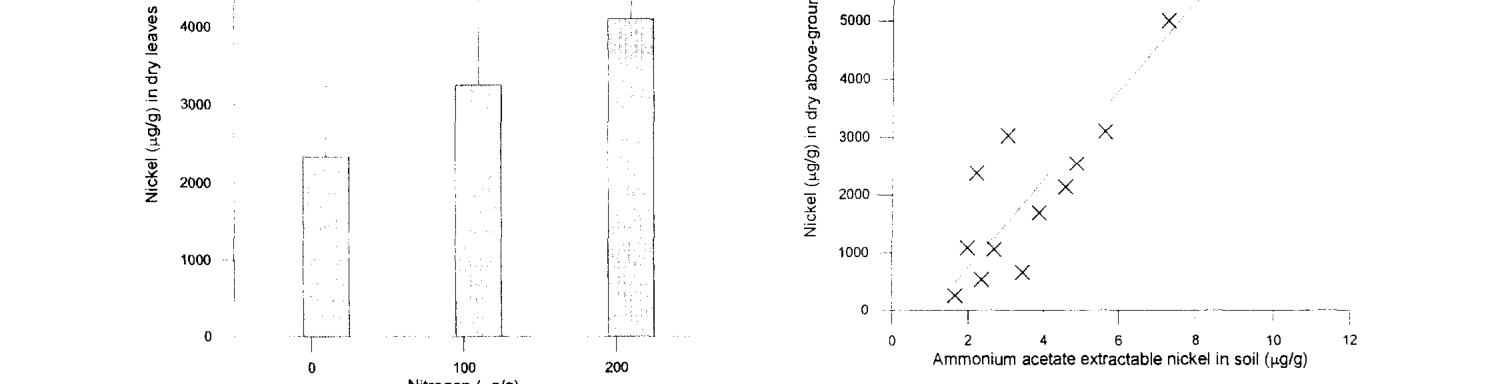
Fig. 2. Effect of nitrogen fertiliser on the nickel content of Brrkhevu coddii.图2. 氮肥对 Berkheya coddii 镍含量的影响。
3.5. The qj$ect of’ excision3.5. 刈割的影响
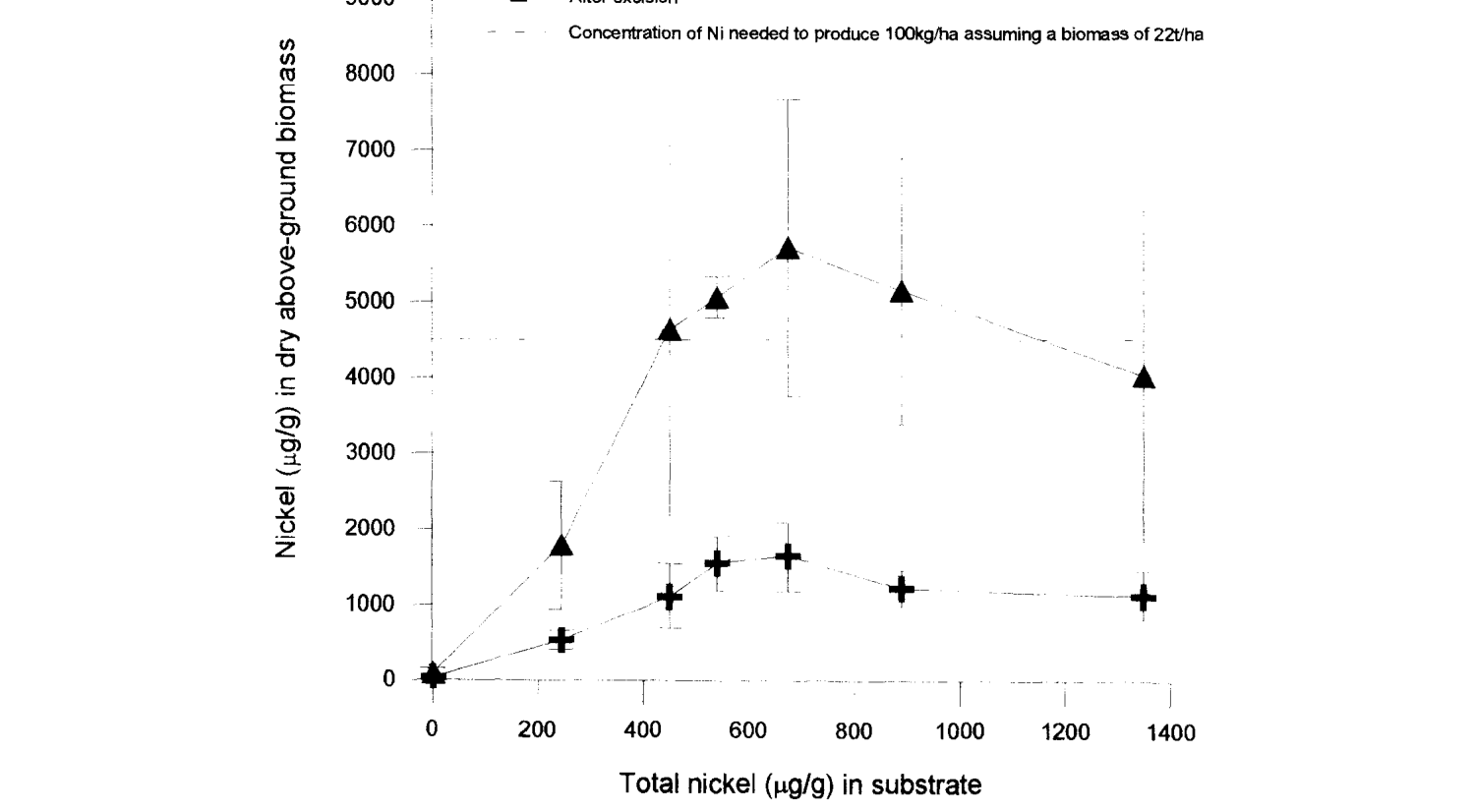
Plants that were excised at ground level rapidly grew new foliage. This new growth had a much higher Ni concentration than the original plant (Fig. 4). The difference is on average over three times greater in the optimum range of 600- IO00 pg/g in the soil. The same behaviour has been noted by Varennes et al. (1996) for the Ni hyperaccumulator Al~ssurn pintodusilrae.
在地面处刈割的植株迅速长出新叶。新生组织的镍浓度远高于原植株(图4)。在土壤镍含量600–1000 μg/g的最适范围内,二者差异平均达三倍以上。Varennes et al.(1996)在镍超富集植物 Alyssum pintodasilvae 中也观察到了同样的现象。
Enhanced Ni uptake after excision could be due to two factors. The plant may be removing more Ni from the soil, or it may simply be translocating existing Ni in the plant to the new growth structures. The higher Ni in the new growth would be advantageous to the plant if it inhibited its predation by folivores (Boyd and Martens, 1994). Were the plant to be extracting more Ni from the soil, it may be possible to induce increased Ni uptake by removal of the apical meristem for example, or the addition of Ni-binding compounds to the soil. This could be tested by measuring the change in the Ni concentration of the regrowth over time. No significant decrease in Ni would indicate increased uptake of the metal by the plant. Whichever mechanism is responsible for the increase in Ni, the new growth could be harvested as another high Ni crop a few months after the original cropping, or the plant may be cropped once a year, removing the need to resow the plants.
刈割后镍吸收增强可能源于两个因素:植物可能从土壤中吸收了更多镍,也可能只是将体内已有的镍转运至新生组织。若新生组织中较高的镍含量能抑制食叶动物的取食,则对植物有利(Boyd and Martens, 1994)。若植物确实从土壤中吸收了更多镍,则或许可以通过去除顶端分生组织或向土壤中添加镍结合化合物等方式诱导其增加镍吸收。这可通过测定再生组织镍浓度随时间的变化加以检验:若镍含量无显著下降,则表明植物对该金属的吸收增加。无论镍含量升高由何种机制所致,新生组织均可在首次收获数月后作为又一茬高镍作物收获,或每年收获一次,从而无需重新播种。
3.6. Nickel in plants as a function qf total nickel in the substrate
3.6. 植物镍含量与基质镍全量的关系
The results of experiments in which two-monthold whole plants of B. coddii were grown in standard seed mix containing incremental concentrations of Ni (O-10,000 kg/g) are shown in Fig. 5. The plants would not grow in substrates containing more than 3333 kg/g available Ni and the highest level of just over 10,000 pg/g Ni in the plants grown in pot trials is probably a limiting value. Although under natural conditions the plant can have up to 17,000 Fg/g (1.7%) of this element in its dry leaves, the whole plant has a nickel content around 0.8% and this is of the same order as our experimental value of I% in pot trials.
在含梯度镍浓度(0–10000 μg/g)的标准育苗基质中生长两个月的 B. coddii 整株植物试验结果见图5。植物在有效态镍超过3333 μg/g的基质中无法生长,盆栽试验中植物镍含量最高刚超过10000 μg/g,这可能是一个极限值。尽管在自然条件下该植物干叶中该元素含量可达17000 μg/g(1.7%),但整株植物镍含量约为0.8%,与我们盆栽试验中1%的数值处于同一数量级。
3.7. The effect oj’ chelating agent uddition on the metal uptuke of Berkheya coddii
3.7. 添加螯合剂对 Berkheya coddii 金属吸收的影响
Compounds to be added to augment metal crops in a phytoextraction operation necessarily have to be cheap and relatively non-toxic as large amounts may need to be added. Citric acid was used in these experiments to lower the pH of the soil. This increase of acidity has been shown by Robinson et al. (1996) to increase metal solubility. Citric acid costs around US$ 20 per kilogram, and is rapidly broken down in the soil. EDTA has been shown by Blaylock et al. (1997) and by Huang and Cunningham (1996) to induce hyperaccumulation of Pb in crop plants such as Zecr mqs and Brussica juncea that do not usually hyperaccumulate this element. EDTA is a well known chelating agent which bonds with many metals including Ni. It costs around US$ 40 per kilogram, and is degraded in the natural environment in a few months (Means et al., 1980).
在植物提取操作中,为提高金属产量而添加的化合物由于用量可能很大,必须价格低廉且毒性相对较低。本试验采用柠檬酸降低土壤pH。Robinson et al.(1996)已表明,酸度增加可提高金属溶解度。柠檬酸价格约为每千克20美元,且在土壤中迅速分解。Blaylock et al.(1997)以及 Huang and Cunningham(1996)已表明,EDTA可诱导 Zea mays 和 Brassica juncea 等通常不超富集Pb的作物超量积累Pb。EDTA是一种常见的螯合剂,可与包括Ni在内的多种金属结合,价格约为每千克40美元,在自然环境中数月内即可降解(Means et al., 1980)。
| Effect of various treatments Berkhevu mddii不同 处理对 Berkheya coddii | on metal金属 | uptake (pg/吸收的影响(μg/ | g d.m.) by |
|---|---|---|---|
| Treatment(n = 8) | Ni | Co | Cr |
| Control | 3480 | 38 | 0.9 |
| 5 g citric acid | 1612” | I 2 I ,’ | I .o |
| IO g citric acid | 770 :’ | 119” | 7.9 h |
| 7 EDTA g | 1559;’ | 19 | 1.1 |
| ? g EDTA + 5 g citric acid | I306 “ | 14 | I.7 |
” Very highly significant difference from the mean ( P < 0.001) ah determined by r-test. h Significant difference from the mean ( P = 0.037) as determined by f-test. All other values showed no significant differences from the mean.
” 与均值差异极显著(P < 0.001),经t检验确定。h 与均值差异显著(P = 0.037),经t检验确定。其余数值与均值均无显著差异。
The relationship shown in Fig. 3 implies that the Ni content of the plant might be increased by increasing the availability of Ni in the soil. Citric acid and EDTA (trisodium salt) were added to plants in an attempt to augment their uptake of Ni and other metals. Table 3 shows the effect of these additions. Surprisingly, the addition of both citric acid and EDTA caused a highly significant decrease (P < 0.001) of Ni content in all relative to the control. This was in spite of an increase in the extractable Ni content of the soils. However, there was no noticeable reduction in the biomass yield. A possible explanation for reduced Ni is that the compounds added to the soil compete with the plant’s own nickel-binding agents causing the Ni to diffuse out down its concentration gradient. This is consistent with an active Ni uptake system, which can be from Fig. 5, an estimate can be made for the probable Ni content of a Berkheya crop growing over polluted soils. It must be remembered, however, that the experiments portrayed in Fig. 5 were carried out with substrates containing Ni as the totally soluble nitrate, though a high proportion of this Ni would have been absorbed by complexing with the organic matter of the substrate. In applying these data to a hypothetical situation involving a contaminated soil in which the availability of the Ni might not be known in advance, we have adopted a conservative approach that assumes that only half of the metal burden of the soil would be available to the plants. The number of annual crops of Berkheya coddii that would be required to reduce the Ni burden of soils down to the EU level of 75 kg/g is summarised in Table 4. For moderate Ni contamination (100 pg/g) two crops would be sufficient to reduce the metal content to well below the 75 p.g/g of the EU guidelines. Even at 250 kg/g (few polluted sites would exceed this value) only four crops of Berkheya coddii would be needed.
图3所示关系意味着,通过提高土壤中镍的有效性,或可提高植物镍含量。为促进植物对镍及其他金属的吸收,向植物添加了柠檬酸和EDTA(三钠盐)。表3列出了这些添加处理的效果。出乎意料的是,与对照相比,添加柠檬酸和EDTA均导致所有处理镍含量极显著降低(P < 0.001),尽管土壤可提取态镍含量有所增加。然而,生物量产量并未明显下降。镍含量降低的一个可能解释是,添加到土壤中的化合物与植物自身的镍结合物质相竞争,导致镍沿浓度梯度向外扩散。这与主动镍吸收系统相符,这一点可 根据图5,可以估算在污染土壤上生长的 Berkheya 作物可能的镍含量。但须注意,图5所示试验中基质所含镍为完全可溶的硝酸盐形态,尽管其中很大一部分镍会因与基质有机质络合而被吸附。在将这些数据应用于镍有效性可能无法事先获知的假设污染土壤情形时,我们采取了保守的方法,假定土壤中仅有一半金属负荷可被植物利用。将土壤镍负荷降至欧盟75 μg/g标准所需的 Berkheya coddii 年种植茬数汇总于表4。对于中度镍污染(100 μg/g),两茬即可使金属含量降至远低于欧盟指导值75 μg/g。即使在250 μg/g(很少有污染场地超过该值)的情况下,也仅需种植四茬 Berkheya coddii。
contrasted to the passive uptake of Pb by Zea mays (Huang and Cunningham, 1996). In the latter system, the addition of EDTA solubilises large quantities of Pb from the soil, which then diffuses down its concentration gradient into the plant root, or is taken up by mass flow. More evidence for this comes from the fact that addition of citric acid caused a significant increase in concentrations of other elements not normally accumulated by B. coddii. The uptake of the other elements upon the addition of citric acid, though significant, is not sufficient to make their phytoextraction an economic means of increasing the value of a metal crop. Unlike in the case of Pb, there is thus no advantage in adding citric acid or EDTA to the soil, if Ni extraction is the aim of the operation.
与 Zea mays 对Pb的被动吸收形成对比(Huang and Cunningham, 1996)。在后一系统中,添加EDTA可使土壤中大量Pb溶解,这些Pb随后沿浓度梯度扩散进入植物根系,或通过质流被吸收。另一证据是,添加柠檬酸使 B. coddii 通常不积累的其他元素浓度显著增加。添加柠檬酸后其他元素的吸收量虽显著增加,但不足以使其植物提取成为提高金属作物价值的经济手段。因此,与Pb的情况不同,若以提取镍为目的,向土壤中添加柠檬酸或EDTA并无益处。
4Discussion of the potential role of Berkheya coddii in phytoremediation and phytominingBerkheya coddii 在植物修复和植物采矿中的潜在作用讨论
4.1. Phytoremediation of nickel-contaminated soils
4.1. 镍污染土壤的植物修复
Current EU guidelines (CEC, 1986) permit an annual addition of only 3 kg/ha Ni when sewage sludge is used as fertiliser for pastures and cropping. One crop of Berkheya (Table 2) would remove the equivalent of 24 years of annual fertiliser additions assuming that only half of the Ni is extractable.
现行欧盟指导标准(CEC, 1986)规定,将污水污泥用作牧场和农作物肥料时,每年仅允许添加3 kg/ha镍。假定仅有一半镍可被提取,种植一茬 Berkheya(表2)所去除的镍相当于24年的年施肥添加量。
The combination of high biomass and high Ni content of Berkheya coddii, together with its ease of propagation and culture as well as its tolerance of cool climatic conditions, should render this species a suitable agent for phytoremediation. Sites highly polluted with Ni are less numerous than those contaminated with Pb and Zn. There is, however, a need for some degree of remediation of several sites throughout the world where pollution from Ni is a problem. S.P. McGrath (pers commun.) has described the problem of Ni pollution of the environment. Apart from the obvious local pollution from smelters, a significant problem arises from addition of Ni to pastures via sewage sludges. At Beaumont Leys (UK) for example, the Ni content of surface soils at a sewage farm was found to be as high as 385 p_g/g. European Community guidelines for Ni in pastures receiving sewage sludge have been set at a maximum level of 75 kg/g where background levels are around 25 Kg/g for UK (McGrath, 1995). Assuming a biomass of 22 t/ha for Berkheya coddii and a soil depth of 15 cm and density of 1.3, it is possible to calculate the amount of Ni that could potentially be removed annually from contaminated pastures using a crop of this species. Using the data
Berkheya coddii 兼具高生物量和高镍含量,且易于繁殖和栽培,并能耐受凉爽气候条件,因而应是一种适宜的植物修复物种。镍重度污染场地的数量少于Pb和Zn污染场地,但世界各地仍有若干受镍污染困扰的场地需要一定程度的修复。S.P. McGrath(个人通讯)阐述了环境中的镍污染问题。除冶炼厂造成的明显局地污染外,通过污水污泥向牧场添加镍也是一个重要问题。例如,在英国 Beaumont Leys,某污水处理农场表层土壤镍含量高达385 μg/g。欧共体对施用污水污泥的牧场设定的镍最高限值为75 μg/g,而英国的背景值约为25 μg/g(McGrath, 1995)。假定 Berkheya coddii 生物量为22 t/ha,土层深度为15 cm,容重为1.3,即可计算利用该物种每年可能从污染牧场中去除的镍量。利用
Number of annual crops of Be&hey coddii required to reduce nickel contamination in soils to the EU guideline of 75 p&g
将土壤镍污染降至欧盟指导值75 μg/g所需的 Berkheya coddii 年种植茬数
| Initial Ni in soil土壤初始镍含量 | Content after种植后含量 | Number of crops茬数 |
|---|---|---|
| (P.g/zs) | one year | to decontaminate |
| 10000 | 9918 | 138 |
| 5000 | 4925 | 14 |
| 2000 | 1932 | 34 |
| 1500 | 1435 | 26 |
| 1000 | 939 | IX |
| 750 | 691 | I4 |
| 500 | 445 | I 0 |
| 250 | 200 | 4 |
| I 00 | 59 | 2 |
Assumptions: I = biomass of 22 t/ha, 2 = only half the Ni is extractable. 3 = Ni content of the plant, and hence its extractive power. is a function of the extractable Ni content of the coil as determined from Fig. 5.
假设条件:1 = 生物量为22 t/ha;2 = 仅有一半镍可被提取;3 = 植物镍含量及其提取能力是土壤可提取态镍含量的函数,由图5确定。
4.2. Phytomining .fbr nickel4.2. 镍的植物采矿
The concept of phytomining has not yet been thoroughly tested under field conditions. The first paper on the subject by Nicks and Chambers (1995) involving the Californian Ni hyperaccumulator Streptunthus polygaloides proposed a yield of 100 kg/ha of metal, worth at today’s prices about US$ 720. A fertilised biomass yield of IO t/ha would provide 175 GJ of energy with a value of US$ 3 per GJ. Assuming that 25% of this energy could be recovered, the incineration process would provide an additional US$ 131/ha. The total yield would therefore be US$ X51. If half of this sum could be returned to the grower, the yield would be about US$ 425 compared with the US$ 333 net return of a crop of wheat.
植物采矿的概念尚未在田间条件下得到充分验证。Nicks and Chambers(1995)以加利福尼亚镍超富集植物 Streptanthus polygaloides 为对象发表了该领域的第一篇论文,提出金属产量可达100 kg/ha,按现价约值720美元。施肥条件下10 t/ha的生物量可提供175 GJ能量,按每GJ 3美元计。假定可回收其中25%的能量,焚烧过程可额外带来131美元/ha的收益,因此总收益为851美元。若其中一半可返还给种植者,则收益约为425美元,而种植小麦的净收益为333美元。
The figure of 100 kg/ha quoted by Nicks and Chambers (1995) as the minimum quantity of Ni per hectare in an economic phytomining operation would require a minimum plant Ni content of about 4500 kg/g in Berkheya coddii assuming a biomass yield of 22 t/ha as found in our experiments. Our experiments and field observations in South Africa indicate that this limit should be easy to reach.
Nicks and Chambers(1995)提出,经济可行的植物采矿每公顷镍产量最低为100 kg;按照我们试验中获得的22 t/ha生物量计算,这要求 Berkheya coddii 植物镍含量最低约为4500 μg/g。我们在南非的试验和田间观察表明,这一限值应不难达到。
At the highest recorded concentration of 7880 p,g/g, a l-ha crop of Berkheyu coddii would remove 168 kg of Ni. This combined with the energy derived from the combustion of the plant material (US$ 288) translates to 1260 + 288 = US$ 1548 per hectare. If half of this sum could be returned to the producer (US$ 774), this is about twice the value of a wheat crop.
按最高记录浓度7880 μg/g计算,1 ha的 Berkheya coddii 作物可去除168 kg镍。加上植物材料燃烧所获能量(288美元),每公顷收益为1260 + 288 = 1548美元。若其中一半(774美元)可返还给生产者,约为小麦作物价值的两倍。
Some caution must be applied in extrapolating to large-scale metal farming, the results of pot trials and limited field trials. We have not been able to achieve experimentally the 7880 Fg/g Ni found in wild plants and believe from our experimental studies that a more conservative level of 5000 Fg/g Ni seems more realistic. This could provide 110 kg/ha Ni worth US$ 792 at today’s prices. Adding the energy ‘profit’ and assuming a 50% return to the operator, the value of the crop then becomes US$ 540, still well above that of a wheat crop. Berkheyu coddii has several advantages over other phytomining candidates:
将盆栽试验和有限田间试验的结果外推至大规模金属农业时须谨慎。我们在试验中未能达到野生植株中7880 μg/g的镍含量,根据试验研究结果,我们认为较为保守的5000 μg/g镍含量更为现实。这可提供110 kg/ha镍,按现价值792美元。加上能量“收益”,并假定经营者获得50%的回报,则该作物价值为540美元,仍远高于小麦作物。与其他植物采矿候选物种相比,Berkheya coddii 具有以下几方面优势:
I. its biomass production is superior to that reported of any other hyperaccumulator except perhaps
1. 其生物量产量高于已报道的任何其他超富集植物,可能仅次于
A/yssum le,shiacum (McGrath et al.. 1993) and is not at the expense of Ni content;
Alyssum lesbiacum(McGrath et al., 1993),且高生物量并不以牺牲镍含量为代价;
2. the plant is a perennial that can be harvested and regrown the following year without need of resowing:
2. 该植物为多年生,收获后次年可再生,无需重新播种;
3. preliminary observations indicate that the Ni content of regrowth tissue is significantly higher than in the original first-year’s growth;
3. 初步观察表明,再生组织的镍含量显著高于第一年的原始生长组织;
4. Berkheya coddii is an exceptionally hardy plant that will tolerate cool climatic conditions including frost. It is easy to grow from seed but doe!, not propagate from cuttings;
4. Berkheya coddii 是一种极为耐寒的植物,可耐受包括霜冻在内的凉爽气候条件。该植物易于通过种子繁殖,但不能通过扦插繁殖;
5. although the plant is tolerant of the relatively mild New Zealand winter, this would probably not be the case for North America; however, it could conceivably be grown ah an annual crop in North America during say the March-September period;
5. 尽管该植物能耐受新西兰相对温和的冬季,但在北美可能并非如此;不过,可以设想在北美于3月至9月期间将其作为一年生作物种植;
6. Berkheya coddii produces seed readily for future crops and the flowers are easily fertilised by local honey bees and bumble bees, though in South Africa they appear to be fertilised by a local species of flying beetle;
6. Berkheya coddii 易于结籽以供后续种植,其花易由当地蜜蜂和熊蜂授粉,而在南非则似乎由当地一种飞行甲虫授粉;
7. finally. Berkheya appears to be resistant to insect attack and soil pathogens; we have had very few failures in pot trials even when growing plants in non-serpentinic substrates where soil pathogens and fungi might be expected to flourish. It must be emphasised at this stage, that phytomining is at present only a theoretical concept advanced by only two previous reports (Nicks and Chambers, 1995; Robinson et al., 1997).
7. 最后,Berkheya 似乎对虫害和土传病原菌具有抗性;即使在非蛇纹岩基质中种植(在此类基质中土传病原菌和真菌可能大量滋生),我们的盆栽试验中也极少出现失败。在此须强调,植物采矿目前仍只是一个理论概念,此前仅有两篇报道提出(Nicks and Chambers, 1995; Robinson et al., 1997)。
The first requirement is that there should be a terrain with extensive areas of subeconomic Ni mineralisation (often lateritic). The Ni yield of such phytomining operations would be governed by a number of factors such as climate and the degree of plant-availability of the Ni. This latter factor is of supreme importance as we have established from the above experimentation. We have determined the Ni extractability (using ammonium acetate) of eleven serpentine soils from throughout the world. Relating this extractability to the projected Ni content of Berkheya coddii (see Fig. 3). we have calculated the probable Ni yield of crops of this species grown in various parts of the world as is shown in Table 5. It is possible that economic crops of Ni could be phytomined from those sites with > 98 kg Ni/ha projected yields from B. coddii. provided of course that other factors were favourable, not the least of which would be a sufficiently large area for economic metal farming. Although some of the soils show extractable Ni levels well in excess of the maximum of 10.5 kg/g shown in Fig. 3, we have chosen not to extrapolate beyond this level since as is shown in Fig. 5, Ni levels in Berkheya tend to level off at just over 1% in dry matter.
首要条件是应有大面积次经济品位镍矿化(通常为红土型)的地块。此类植物采矿的镍产量将受气候和镍的植物有效性等多种因素制约。由上述试验可知,后一因素至关重要。我们测定了来自世界各地11种蛇纹岩土壤的镍可提取性(采用乙酸铵),并将其与 Berkheya coddii(见图3)的预测镍含量相关联,计算了在世界不同地区种植该物种可能获得的镍产量,结果见表5。在 B. coddii 预测镍产量 > 98 kg/ha 的场地,有可能通过植物采矿获得经济的镍产量,当然前提是其他因素也较为有利,其中最重要的是要有足够大的面积以开展经济的金属农业。尽管部分土壤的可提取态镍含量远超图3所示的最大值10.5 μg/g,但我们选择不在此范围之外外推,因为如图5所示,Berkheya 中的镍含量在干物质中略超过1%时即趋于稳定。
| Predicted nickel nickel-rich soils世界各地 富镍 土壤上 预测镍 | yields for crops of_Berkh_ throughout the worldBerkheya 作物的产量 全球 各地 | eya | co&ii | gro | wn on种植 于 |
|---|---|---|---|---|---|
| Country/State | Location | NA | B | C | |
| New Caledonia | Plaine des Lacs | I | 30.8 | 1.00” | 200” |
| California | Red Hills (Chinese Camp) | 2 | 26.3 | I .OO ’ | 200 I’ |
| New Zealand | Coppermine Saddle | 6 | 19.3 | 1.00” | 200” |
| Italy | Monte Pelato | 40 | 14.4 | 1.00 ‘I | 200 ;’ |
| New Zealand | Dun Mountain | 5 | 11.7 | 0.82 | 164 |
| South Africa | Barberton | 2 | 10.5 | 0.73 | I46 |
| Italy | Monte Mm-lo | 76 | 7.46 | 0.49 | 98 |
| Argentina | Vitali Quarry, C’ordoba | I | 3.30 | 0.18 | 39 |
| Morocco | Taafat | I | 2.91 | 0.14 | 31 |
| New Zealand | Cobb asbestos mine | 5 | 2.46 | 0.1 I | 24 |
| Portugal | Braganqa | I | 1.63 | 0.05 | IO |
“ It is assumed that there is a limiting value of I % Ni in B. wddii irrespective of the extractable Ni in the soil. N= number of soil samples tested, A = extractable soil nickel (%I, B = estimated nickel content of plant (kg/g). C = estimated nickel yield (kg/ha). Assumptions: 1 = biomass of 22 t/ha, 2 = Ni content of the plant. and hence its extractive power, is a function of the extractable Ni content of the soil as determined from Fig. 5.
“ 假定无论土壤可提取态镍含量如何,B. coddii 镍含量的极限值均为1%。N = 测试土样数,A = 土壤可提取态镍(%),B = 植物镍含量估算值(μg/g),C = 镍产量估算值(kg/ha)。假设条件:1 = 生物量为22 t/ha;2 = 植物镍含量及其提取能力是土壤可提取态镍含量的函数,由图5确定。
The most obvious regions on earth where metal farming with Berkheya might be possible are the ultramafics of California/Oregon, Central Brazil in Goi& State, New Caledonia, Anatolia, and Western Australia. The next step in the development process would be the establishment of a pilot scheme in one of these or other suitable territories.
地球上最有可能利用 Berkheya 开展金属农业的地区是加利福尼亚/俄勒冈、巴西中部 Goiás 州、新喀里多尼亚、安纳托利亚以及西澳大利亚的超基性岩区。开发过程的下一步是在上述地区或其他适宜地区建立试点项目。
4.3. Phytomining jbr other metals4.3. 其他金属的植物采矿
The practical limits of phytomining have already been discussed by Robinson et al. (1997). The main variables that control the economic feasibility of phytomining are metal price, plant biomass, and the metal content of the plant. These variables are highlighted in Table 6. The metal values extend from US$ 13,600,000/t for Au to US$ 817/t for Pb. A plant with a biomass of 20 t/ha such as Berkheym would need to contain 1.8 kg/g Au or 4.08% Pb at the two extremes. To achieve either of these extremes would require some type of substrate modification such as EDTA as natural concentrations of these two elements do not usually exceed 0.1 kg/g for gold and SO kg/g for Pb. It is true that the Pb content of Zeu mqs with a biomass of 30 t/ha can be raised to close to the limit of 2.04% by addition of EDTA to the substrate (Blaylock et al., 1997):
Robinson et al.(1997)已讨论过植物采矿的实际局限。决定植物采矿经济可行性的主要变量是金属价格、植物生物量和植物金属含量,这些变量列于表6。金属价值从Au的13600000美元/t到Pb的817美元/t不等。生物量为20 t/ha的植物(如 Berkheya)在这两个极端情况下分别需含Au 1.8 μg/g或Pb 4.08%。由于这两种元素的天然浓度通常不超过金0.1 μg/g和铅50 μg/g,要达到任一极端值均需进行某种基质改良(如添加EDTA)。诚然,向基质中添加EDTA可使生物量为30 t/ha的 Zea mays 的Pb含量提高至接近2.04%的限值(Blaylock et al., 1997);
Metal concentrations (pg/g dm.) in vegetation required to provide a total LrS$ SOO/ha return A on hyperaccumulator crops with varying biomass
在不同生物量的超富集植物作物上获得500美元/ha总收益所需的植被金属浓度(μg/g 干物质)
| Metal金属 | (US$/t) | Biomass pr生物量产 | oduction (t/h量 (t/h | a) | |||||||
|---|---|---|---|---|---|---|---|---|---|---|---|
| 1 | 2 | 3 | 3 | 5 | 10 | IS | 20 | 2s | 30 | ||
| Au | 13,600,OOO | 36.8 | 18.4 | 12.3 | 9.2 | 7.4 | 3.7 | 2.5 | 1.8 | I.5 | 1.2 |
| Pd | 4.464.000 | 112.0 | 56.0 | 37.3 | 28.0 | 72.4 | I I.2 | 7.5 | 5.6 | 4.5 | 3.7 |
| Ag | 1X3.000 | 2732 | 1366 | 91 I | 6X3 | 546 | 273 | 1x2 | 137 | I 09 | qI .o |
co | 38,000 | 10417 | 5208 | 3472 | 2604 | 2083 | 1042 | 694 | 521 | 417 | 347 |
| TI | 15,OOO | 33333 | 16667 | lllll | 8333 | 6667 | 3333 | 2222 | 1667 | 1332 | I I I I |
| Ni | 7.485 | 66800 | 33400 | 22267 | 16700 | I3360 | 6680 | 4453 | 3340 | 7672 | ,717 -_- |
| Sn | 6,200 | 80650 | 40323 | 26882 | 20161 | 16129 | 8065 | 5376 | 4032 | 3226 | 26X8 |
| Cd | 3,750 | 133333 | 66667 | 44444 | 33333 | 26667 | 13333 | 8889 | 6667 | 53.13 | 4-t-l-l |
| CU | 1,961 | 254970 | I27485 | 8499 1 | 63743 | 50994 | 25497 | 16998 | 12749 | 1019Y | X499 |
| Mn | 1,700 | 294 I20 | I47060 | 98039 | 7351Y | 58824 | 29412 | 19608 | 14706 | 11765 | 9804 |
| Zn | I.007 | 496520 | 248260 | 165506 | 124130 | 99305 | 496.52 | 33 102 | 24826 | 19861 | 16551 |
| Pb | 817 | 6 12000 | 204000 | 153000 | I22400 | 6 1200 | -10800 | 30600 | 34480 | 20300 |
” Excluding any profit from sale of the energy of biomass incineration however, the cost of the EDTA alone would exceed the value of the Pb yielded from the soil.
” 不计生物质焚烧能量销售所得的任何收益 然而,仅EDTA的成本就将超过从土壤中获得的Pb的价值。
To be realistic, we may assume that phytomining, if ever realised as a commercial enterprise, will be confined to metals such as Co and Ni that lie in the price range of US$ 7500 to US$ 48,000 per tonne and which are known to have plant hyperaccumulators of them.
实事求是地说,即便植物采矿能够实现商业化,也将仅限于Co和Ni等价格在每吨7500美元至48000美元之间且已知存在相应超富集植物的金属。
Finally, there is the possibility of simultaneous extraction of two different metals with the same plant species since some plants (e.g. the Co/Cu hyperaccumulators of former Zaire in Central Africa) can accumulate two metals of which the lesser priced of the two could contribute to the financial return, though neither might be economically viable in its own right.
最后,还存在利用同一植物物种同时提取两种不同金属的可能性,因为某些植物(如中非前扎伊尔的Co/Cu超富集植物)可积累两种金属,其中价格较低的一种可增加经济收益,尽管两者单独可能均不具备经济可行性。
Acknowledgements致谢
The authors gratefully acknowledge Dr. Koos Bodenstein and the Anglo American Platinum Corporation Ltd. of Rustenburg, South Africa for providing seed of Berkheya coddii.
作者衷心感谢 Koos Bodenstein 博士和南非 Rustenburg 的 Anglo American Platinum Corporation Ltd. 提供 Berkheya coddii 种子。
References参考文献
Blaylock, M.J., Salt, D.E., Dushenkov, S.. Zakharova. O., Gussman, C., Kapulnik, Y., Ensley, B.D.. Raskin. 1.. 1997. Enhanced accumulation of lead in Indian Mustard by soil-applied chelating agents. Environ. Sci. Technol. 31. 860-865.
Boyd, R.S.. Martens, S.N.. 1994. The raison d’&tre for metal hyperaccumulation by plants. In: Baker, A.J.M.. Proctor. J.. Reeves. R.D. (Eds.), The Vegetation of Ultramafic (Serpentine) Soils. Intercept, Andover, pp. 279-289.
Brooks, R.R. (Ed.), 1998. Plants That Hyperaccumulate Heavy Metals, CAB International, Wallingford, 379 pp, Brooks, R.R., Lee, J.. Reeves, R.D., Jaffre. T.. 1977. Detection of nickeliferous rocks by analysis of herbarium specimens of indicator plants. J. Geochem. Explor. 7, 49-57.
CEC (Commission of the European Community), 1986. Council directive of 12 June 1986 on the protection of the environment, and in particular of the soil, when sewage sludge is used in agriculture. Off. J. Eur. Communities Ll81 (86/278/EECI. pp. 6612.
Chaney, R.L.. 1983. Plant uptake of inorganic waste constituents. In: Parr, J.F. ct al. (Eds.), Land Treatment of Hazardous Wastes. Noyes Data Corp. Park Ridge, pp. SO-76. Huang. J.W.. Cunningham, S.D.. 1996. Lead phytoextraction: species variation in lead uptake and translocation. New Phytol. 134, 75-84.
McGrath. S.P.. 1995. Chromium and nickel. In: Alloway. B.J. (Ed.). Heavy Metals in Soils. Blackie. Glasgow. 2nd ed.. pp. 152-178.
McGrath. S.P.. Sidoli, C.M.D., Baker, A.J.M.. Reeves, R.D.. 1993. The potential for the use of metal-accumulating plants for the in <itu decontamination of metal-polluted soils. In: Eijsackers, H.J.P.. Hamers, T. (Eds.). Integrated Soil and Sediment Research: A Basis for Proper Protection. Kluwer Academic Publishers, Dordrecht. pp. 673-676.
Means, J.L.. Kucak, T.. Crerar. D.A., 1980. Relative degradation rates of NTA. EDTA and DTPA and environmental implications. Environ. Pollut. Ser. B I, 45-60.
Morrey. D.R.. Balkwill. K., Balkwill. M.J., Williamson. S.. 1992. A review of some studies of the serpentine flora of Southern Africa. In: Baker, A.J.M.. Proctor. J.. Reeve\. R.D. (Eds.). The Vegetation of Ultramafic (Serpentine) Soils. Intercept. Andover, pp. 1477158.
Nicks, L.. Chambers, M.F., 1995. Farming for metals. Mining Environ. Meet., September, pp. I5- 18.
Nicks, L., Chambers, M.F.. 1998. A pioneering study of the potential of phytomining for nickel. In: Brooks. R.R. (Ed.). Plants that Hyperaccumulate Heavy Metals. CAB Intemational, Wallingford, pp. 3 12-325.
Robinson, B.H.. Brooks, R.R., Kirkman, J.H., Gregg, P.E.H., Gremigni. P.. 1996. Plant-available elements in soils and their influence on the vegetation over ultramafic tuerpentine) rocks
m New Zealand. J.R. Sot. N.Z. 26. 455-466.
Robinson, B.H.. Chiarucci. A., Brooks, R.R.. Petit. D.. Kirkman. J.H.. Gregg, P.E.H.. 1997. The nickel hyperaccumulator plant Alysm bertdonii as a potential agent for phytoremediation and phytomining of nickel. J. Geochem. Explor. 59, 75-86. Varennes. A. de. Torres. M.O.. Coutinho, J.F.. Rocha. M.M.F.S.. Neto, M.M.P.M., 1996. Effects of heavy metals on growth and mineral composition of a nickel hyperdccumulator. J. Plant Nutr. 19. 6699678.