Available online at www.sciencedirect.com
Environmental and Experimental Botany 62 (2008) 78–85
Fabio N. Moreno a,∗, Christopher W.N. Anderson b, Robert B. Stewart b, Brett H. Robinson c
a Institute of Geosciences, University of S˜ao Paulo, R. do Lago, 562, Cidade Universit´aria, CEP 05508-080 S˜ao Paulo, SP, Brazil b Soil and Earth Sciences, Institute of Natural Resources, Massey University, Private Bag 11222, Palmerston North, New Zealand c Institute of Terrestrial Ecosystems, Swiss Federal Institute of Technology (ETH), Universit¨atstrasse 16, CH-8092 Z¨urich, Switzerland
a 巴西圣保罗大学地球科学研究所,R. do Lago, 562, Cidade Universitária, CEP 05508-080 São Paulo, SP, Brazil b 新西兰梅西大学自然资源研究所土壤与地球科学系,Private Bag 11222, Palmerston North, New Zealand c 瑞士苏黎世联邦理工学院(ETH)陆地生态系统研究所,Universitätstrasse 16, CH-8092 Zürich, Switzerland
Received 12 July 2007; accepted 25 July 2007
Abstract摘要
Phytofiltration may be a cost-effective approach for treating Hg-contaminated wastewater. We investigated the removal of Hg from solutions by Indian mustard [Brassica juncea (L.) Czern.] grown in hydroponic conditions with solutions containing Hg concentrations from 0 to 10 mg/L. Plants were enclosed in gastight volatilisation chambers to assess the effect of Hg concentrations on plant transpiration, accumulation and volatilisation. We also determined the speciation and site of origin of volatilised Hg. Solution Hg concentrations of 5 and 10 mg/L detrimentally affected transpiration. Roots concentrated Hg 100–270 times (on a dry weight basis) above initial solution concentrations. The plants translocated little Hg to the shoots, which accounted for just 0.7–2% of the total Hg in the plants. Volatilisation from planted vessels increased linearly as a function of Hg concentrations in solutions. Most Hg volatilisation occurred from the roots. Volatilised Hg was predominantly in the Hg(0) vapour form. Volatilisation was dependant on root uptake and absorption of Hg from the ambient solution. Production of Hg(0) vapour in the solutions may result from the activity of root-associated algae and Hg-resistant bacteria. Phytofiltration effectively removed up to 95% of Hg from the contaminated solutions by both volatilisation and plant accumulation. However, Hg(0) vapours released from living roots may have unforeseen environmental effects.
植物过滤可能是处理汞污染废水的一种经济有效的方法。本研究在水培条件下种植印度芥菜[Brassica juncea (L.) Czern.],培养液Hg浓度为0~10 mg/L,考察其对溶液中Hg的去除作用。将植株封闭于气密性挥发室中,以评估Hg浓度对植物蒸腾、积累和挥发的影响。同时测定了挥发性Hg的形态及其释放部位。溶液Hg浓度为5和10 mg/L时,蒸腾作用受到不利影响。根系Hg浓度(以干重计)为初始溶液浓度的100~270倍。植物向地上部转运的Hg很少,地上部Hg仅占植株总Hg的0.7%~2%。种植容器的Hg挥发量随溶液Hg浓度呈线性增加。Hg挥发主要发生于根系。挥发性Hg主要以Hg(0)蒸气形态存在。挥发作用取决于根系对周围溶液中Hg的吸收与吸附。溶液中Hg(0)蒸气的产生可能源于根系相关藻类及抗汞细菌的活动。通过挥发和植物积累两种途径,植物过滤可有效去除污染溶液中高达95%的Hg。然而,活体根系释放的Hg(0)蒸气可能产生难以预见的环境影响。
© 2007 Elsevier B.V. All rights reserved.
© 2007 Elsevier B.V. 版权所有。
Keywords: Mercury; Translocation; Root absorption; Hg(0) vapour; Phytoremediation
关键词:汞;转运;根系吸收;Hg(0)蒸气;植物修复
1Introduction引言
Although developed nations have long banned the use of metallic mercury (Hg) for gold (Au) extraction, miners from the developing world still employ it in artisanal and small-scale gold mining (ASM) operations. In developing countries, ASM may release up to 450–800 tonnes per year of metallic Hg into the environment (Lacerda, 2003; Veiga, 2004). This figure corresponds to 10–20% of global Hg anthropogenic emissions. Veiga (2004) estimated that Brazil and China together contribute with as much as 300 tonnes per year of metallic Hg because of ASM.
尽管发达国家早已禁止使用金属汞(Hg)提取金(Au),但发展中国家的矿工仍在手工及小规模金矿开采(ASM)中使用金属汞。在发展中国家,ASM每年向环境释放的金属Hg可达450~800 t(Lacerda, 2003; Veiga, 2004),相当于全球人为Hg排放量的10%~20%。Veiga(2004)估计,巴西和中国因ASM每年排放的金属Hg合计高达300 t。
Gold extraction using metallic Hg consists of four main steps: amalgamation, separation of mineral portion, amalgam decomposition and gold melting (Veiga and Hinton, 2002).
使用金属Hg提金主要包括四个步骤:汞齐化、矿物部分分离、汞齐分解和金熔炼(Veiga and Hinton, 2002)。
∗ Corresponding author. Tel.: +55 11 3277 5461; fax: +55 11 3277 5461. E-mail address: fabionmoreno@terra.com.br (F.N. Moreno).
Environmental contamination due to ASM mostly occurs from atmospheric deposition of emitted Hg(0) because of amalgam decomposition and gold smelting. Mercury also contaminates water bodies and soils after the discharge of water used to wash away amalgam residues (Veiga and Hinton, 2002). The amalgam residues may contain up to 450 mg/kg of residual Hg, whereas the Hg concentration in the wastewater varies from 0.5 to 3 mg of Hg per kg of suspended matter (Oliveira et al., 2004).
ASM造成的环境污染主要源于汞齐分解和金冶炼过程中排放的Hg(0)经大气沉降。用于冲洗汞齐残渣的废水排放后,汞也会污染水体和土壤(Veiga and Hinton, 2002)。汞齐残渣中残留Hg含量可达450 mg/kg,而废水中Hg浓度为每千克悬浮物0.5~3 mg Hg(Oliveira et al., 2004)。
Organic acids oxidise the metallic Hg deposited in surface soils and waters, thus forming soluble Hg(II) complexes, which may be transported to areas away from the pollution source (Veiga, 2004). Owing to the toxicity and biomagnification potential of methylmercury in the food chain, Hg(II) methylation is a critical step in the Hg biogeochemical cycle. Biotic and abiotic methylmercury pathways include enzymatic transference of CH3 radicals from methylcobalamin to Hg(II) via sulphatereducing bacteria (Barkay et al., 2003) and methylation in the presence of alkylated and methyl tin compounds (Cerrati et al., 1992; Weber, 1993), carboxylic acids (Falter, 1999) and humic and fulvic acids (Weber, 1993), respectively.
有机酸可将沉积于表层土壤和水体中的金属Hg氧化,形成可溶性Hg(II)络合物,后者可被迁移至远离污染源的区域(Veiga, 2004)。由于甲基汞具有毒性且可在食物链中生物放大,Hg(II)的甲基化是汞生物地球化学循环中的关键环节。生物与非生物甲基化途径分别包括:通过硫酸盐还原菌将甲基钴胺素上的CH3基团酶促转移至Hg(II)(Barkay et al., 2003),以及在烷基化和甲基锡化合物(Cerrati et al., 1992; Weber, 1993)、羧酸(Falter, 1999)和腐殖酸与富里酸(Weber, 1993)存在下发生的甲基化。
0098-8472/$ – see front matter © 2007 Elsevier B.V. All rights reserved. doi:10.1016/j.envexpbot.2007.07.007
0098-8472/$ – see front matter © 2007 Elsevier B.V. 版权所有。doi:10.1016/j.envexpbot.2007.07.007
Phytoremediation describes the use of plants to improve degraded environments. Developing nations that lack financial support and incentives to implement remedial procedures could benefit from cost-effective plant-based systems to remove toxic metals from soil and water. Phytofiltration employs aquatic and terrestrial plants with the ability to remove metals, metalloids and radionuclides from polluted groundwater, surface water and wastewater (Dushenkov et al., 1995). Plants such as Ashyperaccumulating ferns (Pteris vittata, Pteris cretica), Indian mustard (Brassica juncea), sunflower (Helianthus annuus) and water hyacinth (Eichornia crassipes) may remove As, Cu, Pb, Ni, Zn, Cr, Cd, Pu, U and Hg from aqueous solutions by precipitating, adsorbing or concentrating these elements in their roots or shoot tissues (Dushenkov et al., 1995, 1997; Lytle et al., 1998; Riddle et al., 2002; Axtell et al., 2003; Huang et al., 2004).
植物修复是指利用植物改善退化环境。缺乏资金支持和激励措施以实施修复工程的发展中国家,可受益于经济有效的植物系统来去除土壤和水体中的有毒金属。植物过滤利用具有去除金属、类金属和放射性核素能力的水生及陆生植物,处理受污染的地下水、地表水和废水(Dushenkov et al., 1995)。As超富集蕨类(Pteris vittata、Pteris cretica)、印度芥菜(Brassica juncea)、向日葵(Helianthus annuus)和凤眼莲(Eichornia crassipes)等植物可通过在根系或地上部组织中沉淀、吸附或富集As、Cu、Pb、Ni、Zn、Cr、Cd、Pu、U和Hg等元素,将其从水溶液中去除(Dushenkov et al., 1995, 1997; Lytle et al., 1998; Riddle et al., 2002; Axtell et al., 2003; Huang et al., 2004)。
We aimed to investigate the phytofiltration potential of Hg by B. juncea plants with a view for treating Hg-contaminated wastewater. Since previous works have reported Hg losses from the plant–soil system by Hg(0) volatilisation (Moreno et al., 2005a,b), we hypothesize that this terrestrial plant species could remove Hg from water by both volatilisation and plant-accumulation processes. Specifically we sought to evaluate the effect of Hg concentrations on plant transpiration, accumulation and volatilisation and to examine speciation and site of origin of volatilised Hg produced in the air–plant–solution system.
本研究旨在考察B. juncea对Hg的植物过滤潜力,以期用于处理汞污染废水。鉴于已有研究报道植物–土壤系统中存在通过Hg(0)挥发造成的Hg损失(Moreno et al., 2005a,b),我们假设该陆生植物可通过挥发和植物积累两种过程去除水中的Hg。具体而言,本研究评估了Hg浓度对植物蒸腾、积累和挥发的影响,并考察了空气–植物–溶液系统中所产生挥发性Hg的形态及其释放部位。
2Material and methods材料与方法
2.1. Plant growth culture2.1. 植物培养
Plastic pots (100 mL) were filled with silica-sand and sown with seeds of Indian mustard (B. juncea) at a rate of ∼10 seeds per pot (n = 20). The pots were watered and placed inside a plant growth chamber with the temperature maintained at 22 ± 2 ◦C and a photoperiod of 14 h. All seeds germinated after 1 week.HoaglandandArnon(1950)solution(one-fourthstrength, 10 mL) was added every day to provide the plant’s nutritional requirements. After the second week, the seedlings were gently washed to remove the sand and transferred to plastic pots containing 100 mL of one-fourth strength Hoagland’s solution at pH 6. The nutrient solution, replaced weekly, was aerated using a small pump. The seedlings were used for the experiments 12 days after transplantation into the nutrient solutions.
在塑料盆(100 mL)中装填石英砂,每盆播种约10粒印度芥菜(B. juncea)种子(n = 20)。浇水后将盆置于植物生长室内,温度保持在22 ± 2 ◦C,光周期为14 h。1周后所有种子均已萌发。每天添加1/4强度的Hoagland and Arnon(1950)营养液(10 mL)以满足植物营养需求。第2周后,轻轻冲洗幼苗以去除砂粒,并移栽至盛有100 mL 1/4强度Hoagland营养液(pH 6)的塑料盆中。营养液每周更换一次,并用小型气泵通气。幼苗移栽至营养液12 d后用于试验。
2.2. Effect of Hg concentration on plant transpiration, accumulation and volatilisation2.2. Hg浓度对植物蒸腾、积累和挥发的影响
The treatments consisted of dissolution of HgCl2 in deionised water to give the following Hg concentrations: 0, 0.05, 0.5, 1, 2.5, 5 and 10 mg/L. The effect of Hg concentrations on plant transpiration, root and shoot accumulation and volatilisation was measured for each treatment. The plant roots were washed with reverse osmosis (RO) water and then immersed in 100 mL of Hg-containing solutions. The solution pH was maintained at 6 by adding either NaOH or HCl solutions (0.01 M).
处理方法为将HgCl2溶于去离子水中,配制Hg浓度分别为0、0.05、0.5、1、2.5、5和10 mg/L的溶液。测定各处理下Hg浓度对植物蒸腾、根系和地上部积累以及挥发的影响。植物根系经反渗透(RO)水冲洗后浸入100 mL含Hg溶液中。通过添加NaOH或HCl溶液(0.01 M)将溶液pH维持在6。
Transpiration, determined gravimetrically using a four-figure balance, was measured at the beginning of the experiment (day 0) and thereafter at 24 h intervals. Mercury volatilisation was quantified by enclosing the root system in a gastight root compartment (100 mL plastic vessel). Outlet tubes carried air from the root compartments into a trapping system that consisted of a 10 mL vial containing 5% KMnO4 in 1 M H2SO4 (Moreno et al., 2005a,b). The vial was open to the atmosphere to maintain pressure equilibrium within the trap system. Plant transpiration, accumulation and volatilisation were measured in triplicates (n = 3) over a period of 5 days.
蒸腾量采用四位天平称重法测定,于试验开始时(第0天)测定一次,此后每隔24 h测定一次。将根系封闭于气密性根室(100 mL塑料容器)中以定量Hg挥发量。出气管将根室中的空气导入捕集系统,该系统由一个盛有5% KMnO4(溶于1 M H2SO4)的10 mL小瓶组成(Moreno et al., 2005a,b)。小瓶与大气相通,以维持捕集系统内的压力平衡。植物蒸腾、积累和挥发均设3次重复(n = 3),测定周期为5 d。
2.3. Speciation and site of origin for volatilised Hg2.3. 挥发性Hg的形态及释放部位
The assessment for volatilised Hg speciation and site of origin was performed for plants exposed to 1 mg/L of Hg (as HgCl2) in the ambient solution. A two-trap system in series captured inorganic and organic Hg vapours released from shoots and roots of the B. juncea plants. The experimental unit consisted of two small air pumps, two gastight volatilisation chambers (3.6 L and 100 mL of volume) and a set of four Hg traps (Fig. 1). Trap solutions used in this work followed the protocols of Yannai et al. (1991), Devars et al. (2000) and Moreno et al. (2005a,b). Mercury vapour released from the shoots of each plant was contained within the larger volatilisation chamber. The vapour then passed sequentially through inorganic and organic traps by continuous airflow (1 L/min). Inorganic Hg vapour [elemental Hg(0)] was trapped in a 70 mL solution containing 5% KMnO4 dissolved in 1 M H2SO4 (T1). Organic Hg vapours were trapped in a 70 mL solution containing 5% Na2CO3 and 2.5% Na2HPO4 (T2). Both trap solutions were contained within 125 mL Erlenmeyer’s flasks. Outlet tubes carried air from the shoot and root compartments into the Hg traps. The outlet of the inorganic trap (T2) was open to the atmosphere to maintain pressure equilibrium within the trap system. Mercury vapour released from the root system was contained using a gastight root compartment (as described above). The gastight root compartment, a 100 mL plastic vessel, was placed inside the larger gastight shoot compartment (3.6 L) (Fig. 1). Volatile Hg speciation and site of origin were measured in triplicates (n = 3) over a period of 3 days.
对暴露于1 mg/L Hg(以HgCl2形式)溶液中的植物进行挥发性Hg形态及释放部位的评估。采用串联的双捕集系统收集B. juncea地上部和根系释放的无机和有机Hg蒸气。试验装置由两台小型气泵、两个气密性挥发室(容积分别为3.6 L和100 mL)和一组四个Hg捕集器组成(图1)。本研究所用捕集液参照Yannai et al.(1991)、Devars et al.(2000)和Moreno et al.(2005a,b)的方法。各植株地上部释放的汞蒸气被收集于较大的挥发室内,随后在连续气流(1 L/min)作用下依次通过无机和有机捕集器。无机Hg蒸气[元素态Hg(0)]被捕集于70 mL含5% KMnO4(溶于1 M H2SO4)的溶液中(T1)。有机Hg蒸气被捕集于70 mL含5% Na2CO3和2.5% Na2HPO4的溶液中(T2)。两种捕集液均盛于125 mL锥形瓶中。出气管将地上部室和根室中的空气导入Hg捕集器。无机捕集器(T2)的出口与大气相通,以维持捕集系统内的压力平衡。根系释放的汞蒸气采用气密性根室收集(如上所述)。气密性根室为100 mL塑料容器,置于较大的气密性地上部室(3.6 L)内(图1)。挥发性Hg形态及释放部位的测定均设3次重复(n = 3),测定周期为3 d。
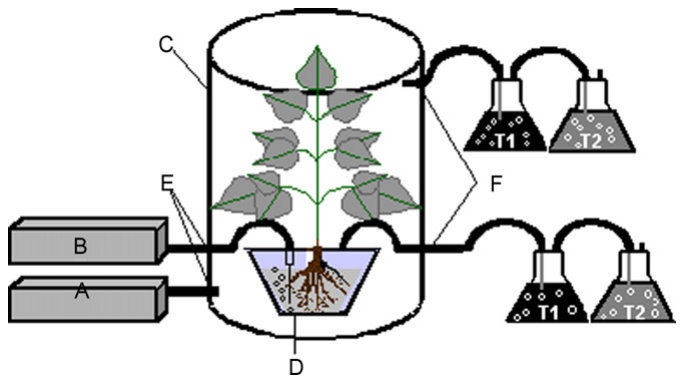
Both experiments occurred inside a plant growth chamber with the temperature controlled at 22 ± 2 ◦C and photoperiod set to 14 h. All the measured parameters were monitored by the use of controls (n = 3, unless otherwise stated), which were comprised of the same experimental set up without plants. Aluminium foil was wrapped around the root compartment to prevent algae growth and/or photochemical reactions. Air was bubbled into the root compartment using continuous airflow (1 L/min). The flow rate of the aeration system was monitored using an air flow meter (J&W, model AMD 1000) and was adjusted to 100 mL/min using small clamps attached to the air outlets. After collection of volatilised Hg, trap solutions were transferred to airtight plastic containers and stored at 4 ◦C. The precipitated fraction of the permanganate acid trap was redissolved with concentrated hydrochloric acid and the resulted solution was stored following the same procedure.
两项试验均在植物生长室内进行,温度控制在22 ± 2 ◦C,光周期设为14 h。所有测定参数均设对照(除另有说明外n = 3),对照为不含植物的相同试验装置。根室外包裹铝箔,以防止藻类生长和/或光化学反应。采用连续气流(1 L/min)向根室内鼓气。通气系统流速用空气流量计(J&W, model AMD 1000)监测,并通过出气口上的小夹子调节至100 mL/min。收集挥发性Hg后,将捕集液转移至密闭塑料容器中,于4 ◦C保存。酸性高锰酸钾捕集器中的沉淀部分用浓盐酸重新溶解,所得溶液按相同方法保存。
2.4. Plant digestion2.4. 植物样品消解
At the end of the experiments, shoots and roots were harvested and washed in tap water. Roots were separated from shoots and placed in a drying oven at 70 ◦C until a constant weightwasobtained.Afterthetotaldryweightofrootandshoots wasrecorded,thesampleswereground.Subsamples(0.1 g)were then accurately weighed into 50 mL plastic pots and digested with 15 mL of HNO3. The plant samples were left overnight and, in the following day, were heated in a water bath at 80 ◦C for 1 h. Plant digests were transferred to 10 mL polythene tubes and diluted with reverse osmosis (RO) water to make a final volume of 10 mL. A blank reagent was used with all digestions.
试验结束时收获地上部和根系,用自来水冲洗。将根系与地上部分离,置于70 ◦C烘箱中烘至恒重。记录根系和地上部总干重后,将样品粉碎。准确称取0.1 g子样品于50 mL塑料瓶中,加入15 mL HNO3消解。植物样品静置过夜,次日于80 ◦C水浴中加热1 h。将消解液转移至10 mL聚乙烯管中,用反渗透(RO)水定容至10 mL。所有消解均设试剂空白。
2.5. Mercury analysis2.5. 汞分析
The total Hg concentrations of the plant digests, hydroponic solutions and Hg traps were determined using hydridegenerationatomicabsorptionspectroscopy(Morenoetal.,2004) using a GBC 909A AAS (Victoria, Australia). A sodium borohydride solution (5% NaBH4 + 1% KOH) in combination with 10 mL of 0.5 M of HCl was used to generate the Hg vapour. The limit of detection (LOD) for Hg in solution was 5 ng/mL. Reagent blanks were below detection limits in the solution. Linear calibration curves were obtained over the range of 125–1000 ng/mL of Hg using four standards prepared from a 10 mg/L mercuric nitrate (HgNO3) Spectrosol solution (May & Baker, AAS standard reagent solution, England). The Hg readings obtained from the replicate analysis (n = 10) of a standard solution containing 1 mg/L of Hg could be reproduced with less than 5% of variation. An external certified laboratory assessed the quality of the analytical method. The maximum discrepancy between the results was 15% (Moreno et al., 2004).
植物消解液、水培溶液和Hg捕集液中的总Hg浓度采用氢化物发生原子吸收光谱法(Moreno et al., 2004)测定,仪器为GBC 909A AAS(Victoria, Australia)。以硼氢化钠溶液(5% NaBH4 + 1% KOH)配合10 mL 0.5 M HCl生成Hg蒸气。溶液中Hg的检出限(LOD)为5 ng/mL。试剂空白均低于检出限。采用由10 mg/L硝酸汞(HgNO3)Spectrosol溶液(May & Baker, AAS标准试剂溶液, England)配制的4个标准溶液,在125~1000 ng/mL Hg范围内获得线性校准曲线。对含1 mg/L Hg的标准溶液进行重复分析(n = 10),所得Hg读数的变异小于5%。分析方法的质量经外部认证实验室评估,结果间最大偏差为15%(Moreno et al., 2004)。
2.6. Statistical analysis2.6. 统计分析
A copy of SAS PC version 8e was used for statistical analyses (SAS Inst, 1988). The Student’s t-test was used to compare two means. Differences between three or more means were performed by a one-way analysis of variance (ANOVA). Duncan’s test was used for pair-wise comparison of means at 0.05 and 0.01 significance levels. Linear and polynomial regression models were used to provide the relationships between two variables. The significance of the fitted regression was assessed through the ANOVA and the coefficient of determination (r2). Correlation analysis was used to assess the positive and negative dependence between two variables. Log-normally distributed data were log-transformed.
采用SAS PC 8e版进行统计分析(SAS Inst, 1988)。两个均值的比较采用Student t检验;三个及以上均值间的差异采用单因素方差分析(ANOVA)。均值的两两比较采用Duncan检验,显著性水平为0.05和0.01。采用线性和多项式回归模型描述两变量间的关系,拟合回归的显著性通过ANOVA和决定系数(r2)评估。采用相关分析评估两变量间的正、负相关性。呈对数正态分布的数据经对数转换。
3Results结果
3.1. Effect of Hg concentration on plant transpiration, accumulation and volatilisation3.1. Hg浓度对植物蒸腾、积累和挥发的影响
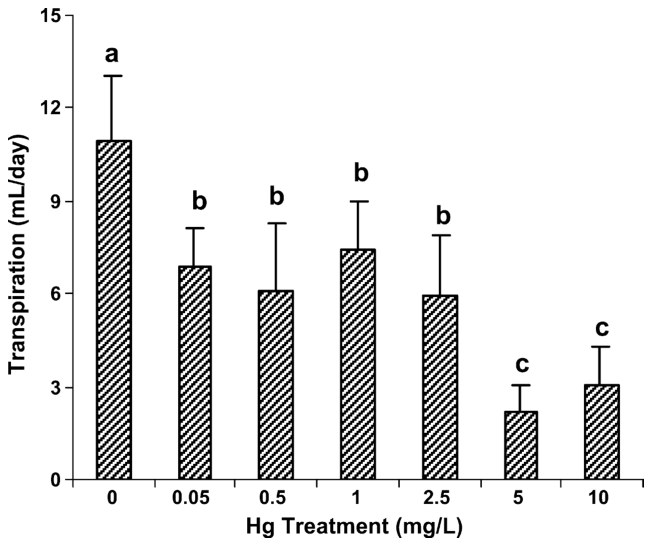
Mercury significantly reduced plant transpiration (Fig. 2). Increasing Hg concentrations in the solutions reduced transpiration rates by 1.4–5.1-fold when compared to the control (0 mg/L) (P < 0.05). In spite of this, Hg-exposure did not affect dry matter yields (P > 0.05) (Table 1) and plants exhibited no visible sign of chlorosis at the end of the experiment.
汞显著降低了植物蒸腾(图2)。与对照(0 mg/L)相比,随着溶液Hg浓度升高,蒸腾速率降低了1.4~5.1倍(P < 0.05)。尽管如此,Hg暴露并未影响干物质产量(P > 0.05)(表1),且试验结束时植株未表现出可见的失绿症状。
We expressed the plant Hg accumulation in terms of bioconcentration factors (BF). The BF is defined here as the concentration in plant tissues/concentration in the ambient solution. Table 1 shows the plant Hg-accumulation and BFs for B. juncea grown in solution containing various Hg concentrations. The Hg concentrations in roots and shoots increased linearly as a function of Hg treatments (roots, r2 = 0.80, P < 0.001; shoots, r2 = 0.85, P < 0.001). Root Hg concentrations were at least an order of magnitude higher than shoot Hg concentrations. The greater ability of roots to concentrate Hg was also shown by root BF values, which were around 130–340-fold higher than shoot BF values. Although tissue Hg concentrations were higher at the upper Hg range, maximum BF values occurred at intermediate Hg concentrations (Table 1).
本研究以生物富集系数(BF)表示植物Hg积累,此处BF定义为植物组织中浓度与周围溶液中浓度之比。表1列出了在不同Hg浓度溶液中生长的B. juncea的Hg积累量及BF。根系和地上部Hg浓度均随Hg处理浓度呈线性增加(根系,r2 = 0.80,P < 0.001;地上部,r2 = 0.85,P < 0.001)。根系Hg浓度比地上部至少高一个数量级。根系BF值约为地上部BF值的130~340倍,也表明根系富集Hg的能力更强。尽管较高Hg浓度范围内组织Hg浓度更高,但BF最大值出现在中等Hg浓度下(表1)。
Dry weights, plant Hg concentrations and the bioconcentration factor (BF) for B. juncea plants cultured for 5 days in solutions containing Hg at concentrations ranging from 0 to 10 mg/L
在Hg浓度为0~10 mg/L的溶液中培养5 d的B. juncea植株的干重、植物Hg浓度及生物富集系数(BF)
| Hg (mg/L) | Dry weight (mg)干重(mg) | Plant Hg (mg/kg DW植物Hg(mg/kg DW | ) | BFa | ||
|---|---|---|---|---|---|---|
| Root | Shoot | Root | Shoot | Root | Shoot | |
| 0 | 150 ± 08 | 382 ± 53 | BDL | BDL | NA | NA |
| 0.05 | 136 ± 28 | 496 ± 50 | 5±01 | BDL | 100 | NA |
| 0.5 | 119 ± 30 | 316 ± 19 | 136±36 | 0.52±0.14 | 272 | 1.04 |
| 1 | 162 ± 15 | 445 ± 79 | 142±07 | 1.07±0.08 | 142 | 1.07 |
| 2.5 | 162 ± 24 | 424 ± 17 | 327±68 | 1.56±1.18 | 130 | 0.62 |
| 5 | 144 ± 11 | 345 ± 78 | 532±110 | 1.56±1.16 | 106 | 0.31 |
| 10 | 125 ± 33 | 443 ± 55 | 1076±572 | 3.56±2.21 | 107 | 0.35 |
Values are the means of three replicates ± 1 standard deviation. BDL, Below detection limits; NA, not applicable. a The bioconcentration factor was calculated according to the equation: total Hg concentration in root and shoot tissues (mg/kg DW)/initial Hg concentration in solutions (mg/L).
数值为3次重复的平均值 ± 1个标准差。BDL,低于检出限;NA,不适用。a 生物富集系数按下式计算:根系和地上部组织中总Hg浓度(mg/kg DW)/溶液中初始Hg浓度(mg/L)。
Table2showstheeffectofHgtreatmentsonrootandshootHg accumulation, translocation and the shoot/root Hg concentration quotient (shoot:root ratio). There was no significant correlation between the Hg mass accumulated and the solution Hg concentration. The highest values occurred at intermediate Hg concentrations and significantly decreased at solution Hg concentrations of 5 and 10 mg/L. This was not true for shoots, whose effective Hg accumulation values decreased significantly as a function of Hg treatments (r2 = 0.34, P < 0.05). For each treatment, roots accumulated around 12–30% of the total Hg mass added whereas the effective accumulation values for shoots were never above 0.5%. Table 2 also indicates that only a small fraction, between 0.7 and 2%, of the Hg mass taken up by roots was translocated to the shoots. For all solution concentrations, shoot concentrations ranged from 0.3 to 0.75% of the total Hg taken up by roots, as shown by the shoot:root ratio. This distribution pattern indicates restricted transport of soluble Hg into plant shoots.
表2列出了Hg处理对根系和地上部Hg积累、转运以及地上部/根系Hg浓度比(地上部:根系比值)的影响。累积的Hg质量与溶液Hg浓度之间无显著相关性。最高值出现在中等Hg浓度下,而在溶液Hg浓度为5和10 mg/L时显著降低。地上部则不然,其有效Hg积累值随Hg处理浓度的增加而显著降低(r2 = 0.34,P < 0.05)。各处理中,根系积累了所添加Hg总质量的约12%~30%,而地上部的有效积累值从未超过0.5%。表2还表明,根系吸收的Hg中仅有很小一部分(0.7%~2%)转运至地上部。由地上部:根系比值可见,在所有溶液浓度下,地上部浓度为根系吸收总Hg的0.3%~0.75%。这一分布格局表明可溶性Hg向植物地上部的转运受到限制。
Effective Hg accumulation in plant tissues (roots and shoots), translocation and theshoot:rootratioforB.junceaplantsculturedfor5daysinsolutionscontaining Hg at concentrations ranging from 0.05 to 10 mg/L
在Hg浓度为0.05~10 mg/L的溶液中培养5 d的B. juncea植株组织(根系和地上部)的有效Hg积累、转运及地上部:根系比值
| Hg (mg/L) | Hg in | Hg in | Translocationb转运b | Shoot:root地上部:根系 |
|---|---|---|---|---|
| rootsa (%) | shootsa (%) | (%) | ratioc (%) | |
| 0.05 | 14.4 ± 2.0 | NA | NA | NA |
| 0.5 | 31.1 ± 5.5 | 0.32±0.05 | 1.14±0.11 | 0.41±0.24 |
| 1 | 22.9 ± 1.7 | 0.47±0.05 | 2.02±0.05 | 0.76±0.06 |
| 2.5 | 21.5 ± 6.8 | 0.26±0.19 | 1.51±1.61 | 0.54±0.52 |
| 5 | 15.1 ± 1.9 | 0.10±0.03 | 0.73±0.32 | 0.30±0.07 |
| 10 | 12.1 ± 3.0 | 0.16±0.11 | 1.22±0.22 | 0.31±0.08 |
Values are the means of three replicates ± 1 standard deviation. NA, Not applicable. a Effective accumulation in roots and shoots was calculated according to the equation: total Hg mass in roots and shoots (�g)/total Hg mass (�g) in the solutions at the beginning of the experiment × 100. b Effective translocation was calculated according to the equation: total Hg mass in shoots (�g)/total Hg mass in the plant (�g) × 100. c The shoot:root ratio was calculated according to the equation: total Hg concentration in shoots (mg/kg DW)/total Hg concentration in roots (mg/kg DW).
数值为3次重复的平均值 ± 1个标准差。NA,不适用。a 根系和地上部的有效积累按下式计算:根系和地上部中Hg总质量(μg)/试验开始时溶液中Hg总质量(μg)× 100。b 有效转运按下式计算:地上部中Hg总质量(μg)/植株中Hg总质量(μg)× 100。c 地上部:根系比值按下式计算:地上部总Hg浓度(mg/kg DW)/根系总Hg浓度(mg/kg DW)。
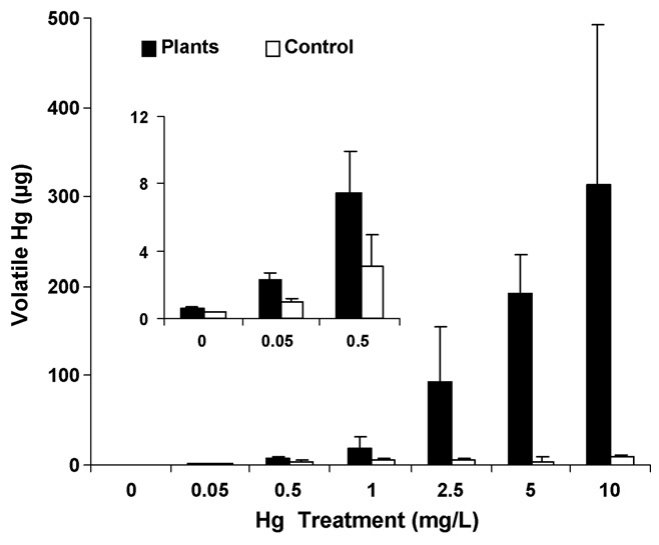
Fig.3showsthemassofHgvolatilisedfromtherootcompartment and captured in the acid permanganate traps as a function of Hg treatments after the end of the experiment. The detection of minor amounts of Hg, about 0.5 �g, in the control treatment indicated contamination of the trap by Hg species in the air. The Hg emissions from planted vessels increased linearly from 0.625 to 314 �g at the 0–10 mg/L range (r2 = 0.76, P < 0.0001) and were significantly greater than controls for all tested concentrations (P < 0.05) (Fig. 3). The discrepancy between plants and controls in relation to Hg mass emissions was greater at the upper Hg range. Planted vessels volatilised 35–42 times more Hg than the unplanted controls at 5 and 10 mg of Hg/L of solution.图3显示了试验结束后从根室挥发并被酸性高锰酸钾捕集器捕获的Hg质量随Hg处理的变化。对照处理中检测到少量Hg(约0.5 μg),表明捕集器受到空气中Hg形态的污染。在0~10 mg/L范围内,种植容器的Hg排放量从0.625 μg线性增加至314 μg(r2 = 0.76,P < 0.0001),且在所有测试浓度下均显著高于对照(P < 0.05)(图3)。在较高Hg浓度范围内,植物处理与对照之间Hg排放质量的差异更大。在5和10 mg Hg/L溶液中,种植容器的Hg挥发量为无植物对照的35~42倍。
3.2. Speciation and site of origin of volatilised Hg3.2. 挥发性Hg的形态及释放部位
Table 3 shows the mass of volatilised Hg captured from shoot and root compartments in the acid permanganate (T1) and表3列出了从地上部室和根室中挥发并被酸性高锰酸钾(T1)和
Mercury mass (�g) captured in acid permanganate (T1) and carbonate-phosphate (T2) traps for B. juncea plants cultured in solutions containing Hg at 1 mg/L for 3 days
在含1 mg/L Hg的溶液中培养3 d的B. juncea植株在酸性高锰酸钾(T1)和碳酸盐–磷酸盐(T2)捕集器中捕获的汞质量(μg)
| Treatment/compartment处理/隔室 | Na | Hg mass in traps (�g)捕集器中Hg质量(μg) | Total Hg massb (�g)Hg总质量b (μg) | |
|---|---|---|---|---|
| T1 | T2 | |||
| Plant/roots | 6 | 33.85 ± 5.5 A | 0.94 | 34.16 ± 5.2 A |
| Control/roots | 6 | 5.60 ± 1.7 Ba | 0.51 ± 0.01 b | 6.11 ± 1.8 B |
| Plant/shoots | 6 | 1.76 ± 0.29 Aa | 0.60 ± 0.22 Ab | 2.17 ± 0.66 A |
| Control/shoots | 6 | 0.90 ± 0.33 Ba | 0.54 ± 0.04 Aa | 1.45 ± 0.37 A |
Controls comprised of Hg-treated solutions without plants. Values are the means of three replicates ± 1 standard deviation. Upper and lower-case letters compare treatment means in the vertical and in the horizontal, respectively. Means with the same letters are not statistically different (Duncan’s test at α = 0.05). a N = 3 for each T1 and T2 traps. b Total Hg mass is the arithmetic mean of three replicates for the sum of the Hg mass captured in T1 and T2 traps.
对照为不含植物的Hg处理溶液。数值为3次重复的平均值 ± 1个标准差。大写和小写字母分别用于比较纵向和横向的处理均值,字母相同的均值间无显著差异(Duncan检验,α = 0.05)。a T1和T2捕集器均为N = 3。b Hg总质量为T1和T2捕集器捕获Hg质量之和的3次重复算术平均值。
carbonate-phosphate (T2) traps for plants exposed at 1 mg/L of Hg. For the T1 traps, volatilisation from root and shoot compartments were significantly higher than controls (0.001 < P < 0.05). Within the plant treatment, the mass of Hg in T1 traps was an order of magnitude greater than the mass in T2 traps (P < 0.01). The total Hg emission from the root compartment was 34.16 �g, representing around 94% of the total Hg mass captured by the T1 and T2 traps. Mercury volatilisation from the shoot compartment was not significantly different from the control (P > 0.05), indicating that volatilised Hg is not released from plant shoots.
碳酸盐–磷酸盐(T2)捕集器捕获的挥发性Hg质量(暴露于1 mg/L Hg的植物)。对于T1捕集器,根室和地上部室的挥发量均显著高于对照(0.001 < P < 0.05)。在植物处理中,T1捕集器中的Hg质量比T2捕集器高一个数量级(P < 0.01)。根室Hg总排放量为34.16 μg,约占T1和T2捕集器捕获Hg总质量的94%。地上部室的汞挥发量与对照无显著差异(P > 0.05),表明挥发性Hg并非由植物地上部释放。
3.3. Mercury removal from solution3.3. 溶液中汞的去除
Fig. 4 shows the Hg removal by B. juncea as a function of solution Hg concentration. Mercury concentrations in planted图4显示了B. juncea对Hg的去除随溶液Hg浓度的变化。种植处理中的汞浓度
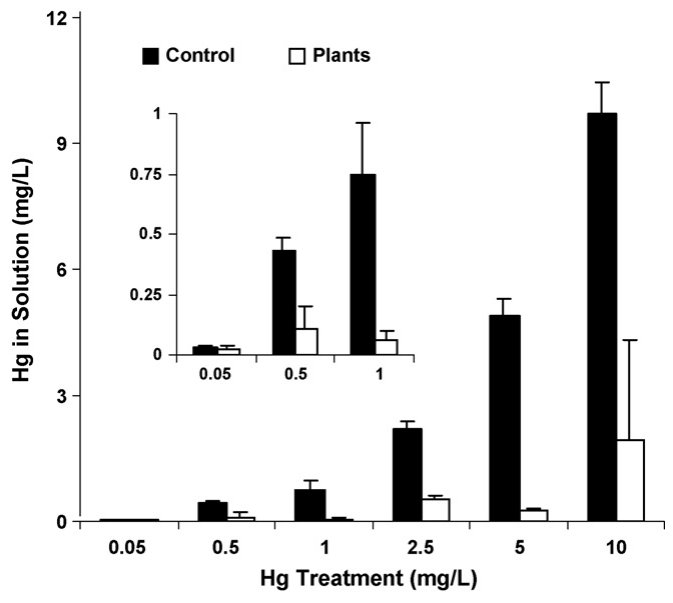
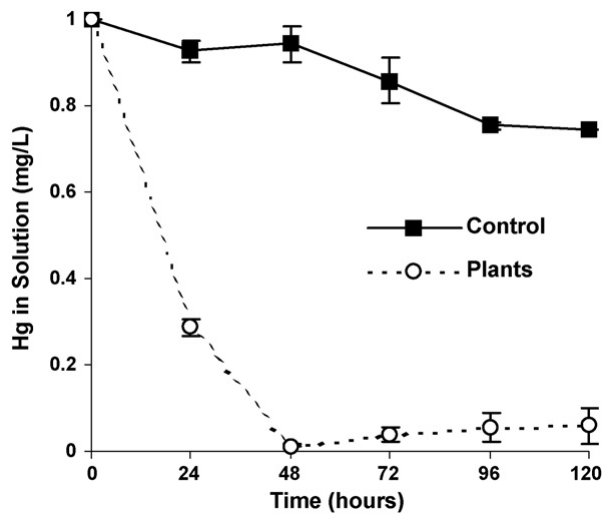
treatments were significantly lower than in controls for all Hg concentrations (P < 0.05), except at 0.05 mg/L (P > 0.05). The removal of Hg from solution (phytofiltration) was most efficient at intermediary concentrations, where plants removed between 80 and 95%. The Hg concentration in solution as a function of time for plants exposed at 1 mg Hg/L (Fig. 5) shows that the Hg concentration decreased 80-fold to 0.0125 mg/L in just 48 h. Equilibrium occurred at 0.061 mg/L.
在所有Hg浓度下均显著低于对照(P < 0.05),0.05 mg/L除外(P > 0.05)。溶液中Hg的去除(植物过滤)在中等浓度下效率最高,植物去除了80%~95%的Hg。暴露于1 mg Hg/L的植株溶液Hg浓度随时间的变化(图5)表明,Hg浓度在仅48 h内降低了80倍,降至0.0125 mg/L。平衡浓度为0.061 mg/L。
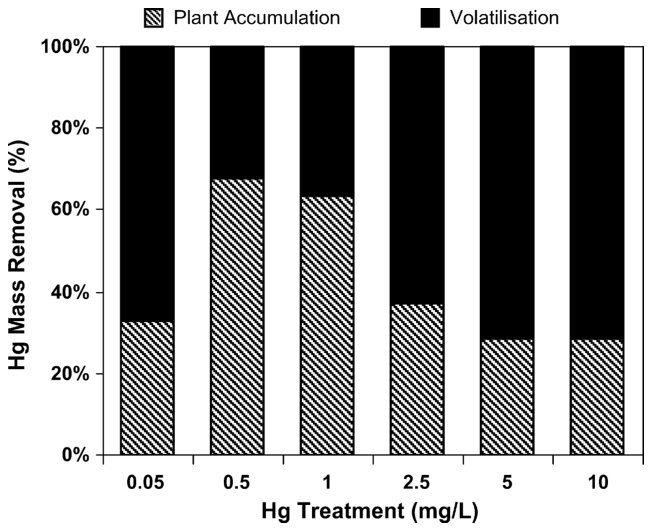
Fig. 6 shows the contribution of plant accumulation and volatilisation mechanisms to the overall removal from solutions for each Hg solution concentration. Although both mechanisms were active in the removal process, their contribution to Hg extraction varied over the tested range, with plant tissues containing the highest proportion of Hg in solutions containing 1 mg/L of Hg. The volatilisation contribution increased as the solution concentrations diverged from 1 mg/L (Fig. 6). Thus, volatilisation depends on the root uptake of Hg from solutions. The significant and positive correlation found between volatilisation and root-Hg accumulation supported this relationship (r = 0.98, data not shown).图6显示了在各溶液Hg浓度下植物积累和挥发两种机制对溶液中Hg总去除量的贡献。尽管两种机制均参与了去除过程,但其对Hg去除的贡献在所测浓度范围内有所不同,在含1 mg/L Hg的溶液中植物组织所含Hg比例最高。溶液浓度偏离1 mg/L越远,挥发的贡献越大(图6)。因此,挥发作用取决于根系从溶液中吸收的Hg。挥发量与根系Hg积累量之间显著正相关(r = 0.98,数据未列出),支持了这一关系。
4Discussion讨论
4.1. Effect of Hg on plant transpiration4.1. Hg对植物蒸腾的影响
The toxic effect of Hg on plants can arise from enzyme inhibition by the linkage of Hg to sulphydryl groups (Ferreira et al., 1998). Such a breakdown of the normal –SH system affects the germination and growth of embryos because these tissues are particularly rich in SH-groups (Patra and Sharma, 2000). Ferreira et al. (1998) reported the primary effects of Hg toxicity in aquatic and terrestrial plants to be reduced levels of biomass, photosynthetic activity, total chlorophyll, as well as lower contents of nitrogen, phosphorus and potassium. Conversely, peroxidase activity, malondialdehyde levels and induction of thiol-enriched molecules increase in response to Hg exposure (Gupta et al., 1998; Ali et al., 2000; Moreno-Jimen´ez et al., 2006). In our study, we observed reduced plant transpiration rates at the lowest level of Hg (0.05 mg/L) in solution (Fig. 2). This effect may be linked to disruptions in the structure and function of the plasma membrane, altering its permeability to water and nutrient uptake (Patra and Sharma, 2000). Exposure to HgCl2 may have damaged the membrane of cells, thus resulting in decreased water uptake by B. juncea. This effect was more pronounced at high Hg concentrations in the solutions, as shown in Fig. 2.
Hg对植物的毒性作用可能源于Hg与巯基结合而导致的酶抑制(Ferreira et al., 1998)。正常–SH系统的这种破坏会影响胚的萌发和生长,因为这些组织中SH基团尤其丰富(Patra and Sharma, 2000)。Ferreira et al.(1998)报道,Hg对水生和陆生植物毒性的主要效应表现为生物量、光合活性和总叶绿素水平下降,以及氮、磷、钾含量降低。相反,过氧化物酶活性、丙二醛水平和富硫醇分子的诱导则随Hg暴露而增加(Gupta et al., 1998; Ali et al., 2000; Moreno-Jiménez et al., 2006)。本研究中,在溶液Hg浓度最低(0.05 mg/L)时即观察到植物蒸腾速率降低(图2)。这一效应可能与质膜结构和功能受到破坏、其对水分和养分吸收的通透性改变有关(Patra and Sharma, 2000)。暴露于HgCl2可能损伤了细胞膜,从而导致B. juncea吸水量减少。如图2所示,该效应在溶液Hg浓度较高时更为明显。
4.2. Mercury retention by the root system4.2. 根系对汞的滞留
Since roots accounted for 98–99% of the total plant Hg (Table 2), it is possible that this Hg retention process was a physicochemical reaction enhanced by the hydroponic conditions. The dichloro-mercuric complex, HgCl2, is relatively non-polar and rather lipid-soluble. The octanol–water partition coefficient (Kow) for HgCl2 is 3.3, indicating that this complex readily crosses the lipid bilayers of the plasma membrane. However, the chemistry of Hg in oxygen-containing waters indicates thatatpHaround6,theHg(II)insolutionshouldbecomplexedto hydroxide ions (Morel et al., 1998). The Kow for the uncharged mercuric hydroxide complex, Hg(OH)2 (=0.5), is lower than HgCl2 indicating that this complex is slightly more hydrophobic and will diffuse only slowly through the lipidic bilayer of the plasma membrane. Therefore, the increased retention of soluble Hg to roots may be caused by adsorption of Hg(OH)2 and Hg(OH)+ complexes to binding sites on the cell wall. Experiments with 203Hg-spiked solutions demonstrated that most Hg taken up by roots of Triticum durum cv. Creso after 25 days exposure was found on cell walls at the external layers of the cortical cylinder (Cavallini et al., 1999). Root Hg accumulation by B. juncea plants may relate to the movement of soluble Hg complexes in the apoplast, an interconnected system that includes all cell walls in the root cortex (Salisbury and Ross, 1992). The binding of Hg to specific sites on the cell wall can restrict transport to sensitive sites in shoots and is an important factor to the Hg tolerance in plants (Cavallini et al., 1999).
由于根系Hg占植株总Hg的98%~99%(表2),这一Hg滞留过程可能是受水培条件增强的物理化学反应。二氯汞络合物HgCl2极性相对较弱,具有较强的脂溶性。HgCl2的正辛醇–水分配系数(Kow)为3.3,表明该络合物易于穿过质膜的脂双层。然而,含氧水体中Hg的化学性质表明,在pH约为6时,溶液中的Hg(II)应与氢氧根离子络合(Morel et al., 1998)。不带电荷的氢氧化汞络合物Hg(OH)2的Kow(= 0.5)低于HgCl2,表明该络合物的疏水性稍强,仅能缓慢扩散穿过质膜脂双层。因此,可溶性Hg在根系中滞留增加,可能是由于Hg(OH)2和Hg(OH)+络合物吸附于细胞壁的结合位点。以203Hg标记溶液进行的试验表明,Triticum durum cv. Creso暴露25 d后,根系吸收的大部分Hg存在于皮层柱外层的细胞壁上(Cavallini et al., 1999)。B. juncea植株根系对Hg的积累可能与可溶性Hg络合物在质外体中的迁移有关,质外体是包括根皮层所有细胞壁在内的相互连通系统(Salisbury and Ross, 1992)。Hg与细胞壁特定位点的结合可限制其向地上部敏感部位的转运,是植物耐Hg的重要因素(Cavallini et al., 1999)。
In spite of the limited translocation of Hg to shoot tissues even at high Hg concentrations (Table 2), there was a significant and positive correlation between Hg translocation and transpiration (r = 0.82) (data not shown). This indicates that simple diffusion and mass flow of water would have delivered Hg to the plant shoots via the xylem. Uptake and upward transport of Hg may have occurred across the plasma membrane via the symplast pathway. Since a range of metals, including Hg, can induce phytochelatin synthesis (Rauser, 1995), movement of Hg in the symplast was likely in the form of Hg-thiol complexes.
尽管即使在高Hg浓度下Hg向地上部组织的转运也很有限(表2),但Hg转运与蒸腾之间存在显著正相关(r = 0.82)(数据未列出)。这表明简单扩散和水分的质流可经木质部将Hg输送至植物地上部。Hg的吸收和向上运输可能经共质体途径跨越质膜进行。由于包括Hg在内的多种金属均可诱导植物螯合肽的合成(Rauser, 1995),Hg在共质体中的迁移很可能以Hg–巯基络合物的形式进行。
4.3. Speciation and site of origin for volatilised Hg4.3. 挥发性Hg的形态及释放部位
The higher recovery rate of Hg in the permanganate acid solution and the lack of evidence for the contribution of shoots in the volatilisation process (Table 3) indicate that the root system of B. juncea releases Hg predominantly as the elemental Hg(0) vapour form. A mass balance of Hg in the air–plant–solution system (Table 4) validates these results. The efficiency for Hg recovery using the trapping system averaged more than 90% with no significant differences between plant and control treatments (P > 0.05) (Table 4). Our results, therefore, corroborate with Greger et al. (2005), who demonstrated the absence of Hg transpiration from shoots of six terrestrial plants, including oil-seed rape (Brassica napus L. cv Paroll).
酸性高锰酸钾溶液中Hg的回收率较高,且无证据表明地上部参与挥发过程(表3),说明B. juncea根系主要以元素态Hg(0)蒸气形式释放Hg。空气–植物–溶液系统中Hg的质量平衡(表4)验证了上述结果。捕集系统的Hg平均回收效率超过90%,植物处理与对照之间无显著差异(P > 0.05)(表4)。因此,本研究结果与Greger et al.(2005)的结论一致,后者证明包括油菜(Brassica napus L. cv Paroll)在内的6种陆生植物地上部不存在Hg蒸腾释放。
Bacterial reduction of Hg(II) to Hg(0) via mercuric-reductase is a recognized pathway for the volatilisation of Hg from contaminated environments (Barkay et al., 1992). This pathway is carried out by a diversity of Hg-resistant bacteria (both Gram positive and negative) living in soil and water (Barkay et al., 2003). In the aquatic environment, some algae are able to produce Hg(0) vapours either in the light or in the dark (Ben- Bassat and Mayer, 1978; Devars et al., 2000). Volatilisation of Hg(0) by Euglena gracilis is a light-independent process mediated by metabolites capable of reducing Hg(II) (Devars et al., 2000). Neither the nutrient media nor the Hg-containing solutions, however, were pre-treated with algaecides or bactericides.
细菌经汞还原酶将Hg(II)还原为Hg(0),是污染环境中Hg挥发的公认途径(Barkay et al., 1992)。该途径由生活在土壤和水体中的多种抗汞细菌(包括革兰氏阳性菌和阴性菌)完成(Barkay et al., 2003)。在水生环境中,一些藻类在光照或黑暗条件下均能产生Hg(0)蒸气(Ben- Bassat and Mayer, 1978; Devars et al., 2000)。Euglena gracilis对Hg(0)的挥发是一个不依赖光照的过程,由能够还原Hg(II)的代谢产物介导(Devars et al., 2000)。然而,本研究中营养液和含Hg溶液均未经杀藻剂或杀菌剂预处理。
Balance sheet for the Hg mass in the air–plant–solution system at the end of the experimenta. B. juncea plants were treated with soluble Hg at 1 mg/L for three days. Controls comprised of Hg-treated solutions without plants. Values are the means of three replicates ± 1 standard deviation. Letters compare treatment means in the vertical. Means with the same letters are not statistically different (Duncan’s test at α = 0.05)
试验结束时空气–植物–溶液系统中Hg质量平衡表a。B. juncea植株以1 mg/L可溶性Hg处理3 d。对照为不含植物的Hg处理溶液。数值为3次重复的平均值 ± 1个标准差。字母用于比较纵向的处理均值,字母相同的均值间无显著差异(Duncan检验,α = 0.05)
| Treatment处理 | Volatilised Hgb (�g)挥发Hgb (μg) | Plant Hgc (�g)植物Hgc (μg) | Solution Hg (�g)溶液Hg(μg) | Total Hgd (�g)总Hgd (μg) |
|---|---|---|---|---|
| Plant | 36.05 ± 5.71 A | 44.84±5.8 | 9.79 ± 1.3 A | 90.81 ± 3.32 A |
| Control | 7.56 ± 2.09 B | NA | 84.39 ± 4.4 B | 91.96 ± 2.33 A |
NA, Not applicable. a Note that the total Hg mass at the beginning of the experiment was 100 �g of Hg in 100 mL of solution. b Volatilised Hg is the arithmetic mean for the sum of the Hg mass captured in root and shoot compartments for both T1 and T2 traps. c Plant tissue Hg is the arithmetic mean for the sum of the Hg mass in root and shoot tissues. d Total Hg is the arithmetic mean for the sum of the Hg mass in the air, plant and solution compartments.
NA,不适用。a 注:试验开始时Hg总质量为100 mL溶液中含100 μg Hg。b 挥发Hg为根室和地上部室中T1和T2捕集器所捕获Hg质量之和的算术平均值。c 植物组织Hg为根系和地上部组织中Hg质量之和的算术平均值。d 总Hg为空气、植物和溶液各隔室中Hg质量之和的算术平均值。
This indicates the participation of root-associated algae or Hg-resistant bacteria in the volatilisation process.
这表明根系相关藻类或抗汞细菌参与了挥发过程。
4.4. Implications for the phytofiltration of Hg-contaminated wastewater4.4. 对汞污染废水植物过滤的启示
Living roots of B. juncea plants were able to reduce 2–18 times the initial Hg concentrations in the contaminated solutions (Fig. 4). At 1 mg/L, for example, the Hg concentration droppedtotheBrazilianregulatorydischargelevelsof0.01 mg/L (CONAMA, 2005) within 48 h (Fig. 5). Phytofiltration has the potential to treat low levels of Hg-contaminated wastewaters from ASM before discharge into local water bodies. Further Hg reductions to drinking water standards (0.001 mg/L) (Casarini, 2001) may be attainable by wastewater flow through several connected phytofiltration units, as has been proposed for uranium and arsenic contaminated waters (Dushenkov et al., 1997; Elless et al., 2005). Reductions in soluble Hg correlated well with increasing concentrations of Hg in roots (r = 0.84). Therefore, eachadditionaltreatmentunitshoulddoubletheHgremovalefficiency. The amount of water and the target final concentration will dictate the number of treatment units needed. In our experiments, one single plant with around 20 mL of roots was used to treat 100 mL of water (1:5, v/v). Therefore, 1000 plants of this size could treat 5000 L of Hg-contaminated water in just 48 h.
B. juncea活体根系可使污染溶液中的Hg浓度降至初始浓度的1/2~1/18(图4)。例如,在1 mg/L时,Hg浓度在48 h内降至巴西的排放限值0.01 mg/L(CONAMA, 2005)(图5)。植物过滤有潜力在ASM产生的低浓度汞污染废水排入当地水体之前对其进行处理。通过使废水流经多个串联的植物过滤单元,有望将Hg进一步降至饮用水标准(0.001 mg/L)(Casarini, 2001),此类方案已被提出用于处理铀和砷污染水体(Dushenkov et al., 1997; Elless et al., 2005)。可溶性Hg的降低与根系Hg浓度的升高密切相关(r = 0.84)。因此,每增加一个处理单元,Hg去除效率应提高一倍。所需处理单元的数量取决于水量和目标终浓度。本试验中,一株根系体积约20 mL的植株用于处理100 mL水(1:5, v/v)。因此,1000株同等大小的植株可在仅48 h内处理5000 L汞污染水。
Due to Hg(0) volatilisation, between 30 and 70% of the extracted Hg was lost to the air at the end of the experiment (Fig. 6). Although important from an environmental point of view, the scaling up of the volatilisation data to a water treatment scenario would be unrealistic as the removal of Hg from solutionwaspoorlycorrelatedtotheHg(0)massvolatilisedfrom planted vessels (r = 0.13). Furthermore, there is evidence that Hg removal by volatilisation is related to biotic factors that could not be controlled under the experimental conditions used in this study. It thus might be possible to decrease biological volatilisation by the addition of antibiotics to the Hg-contaminated water. More studies, however, are needed to elucidate the biological pathways by which Hg(II) is reduced in the system and how plant roots affect this process.
由于Hg(0)挥发,试验结束时被提取的Hg中有30%~70%散失到空气中(图6)。尽管从环境角度看这一点很重要,但将挥发数据外推至水处理情景并不现实,因为溶液中Hg的去除与种植容器中挥发的Hg(0)质量相关性很差(r = 0.13)。此外,有证据表明,通过挥发去除Hg与生物因素有关,而这些因素在本研究的试验条件下无法控制。因此,向汞污染水中添加抗生素可能会降低生物挥发。然而,仍需进一步研究以阐明系统中Hg(II)被还原的生物途径以及植物根系对该过程的影响。
5Conclusions结论
When exposed to varied range of Hg concentrations, B. juncea can concentrate Hg in roots 100–270 times higher than theinitialHgsolutionconcentrations.Mercurywasmoretoxicto plants at 5 and 10 mg/L. Accumulation of Hg by roots peaked at 0.5 and 1 mg/L of Hg in the solutions. Thus, removal of Hg from solutions by plant accumulation was dominant at these intermediate Hg concentrations. Volatilisation was dependant on the roots absorption of Hg. In view of the Hg chemistry in solution, root retention is probably due to adsorption of Hg(OH)2 and HgOH+ complexes to binding sites on the cell wall. Production of Hg(0) vapour occurred at the root interface, possibly augmented by algal and bacterial activity. The remediation of Hg-contaminated wastewater from ASM by phytofiltration is promising but the remediation relies on Hg losses from the system by Hg(0) volatilisation.
在不同Hg浓度下,B. juncea根系中的Hg浓度可达初始溶液Hg浓度的100~270倍。汞在5和10 mg/L时对植物的毒性更强。根系对Hg的积累在溶液Hg浓度为0.5和1 mg/L时达到峰值。因此,在这些中等Hg浓度下,植物积累是溶液中Hg去除的主导途径。挥发作用取决于根系对Hg的吸收。从溶液中Hg的化学性质来看,根系滞留可能源于Hg(OH)2和HgOH+络合物吸附于细胞壁结合位点。Hg(0)蒸气在根系界面产生,藻类和细菌活动可能对此有增强作用。利用植物过滤修复ASM产生的汞污染废水前景广阔,但该修复依赖于系统通过Hg(0)挥发损失Hg。
Acknowledgement致谢
We gratefully acknowledge the National Council for Scientific and Technological Development (CNPq/Brazil) for providing a post-doctoral scholarship to the first author.
感谢巴西国家科学技术发展委员会(CNPq/Brazil)为第一作者提供博士后奖学金。
References参考文献
Ali, M.B., Vajpayee, P., Tripathi, R.D., Rai, U.N., Kumar, A., Singh, N., Behl, H.M., Singh, S.P., 2000. Mercury bioaccumulation induces oxidative stress and toxicity to submerged macrophyte Potamogeton crispus L. Bull. Env. Cont. Toxicol. 65, 573–582.
Axtell, N.R., Sternberg, S.P.K., Claussen, K., 2003. Lead and nickel removal using Microspora and Lemna minor. Biores. Technol. 89, 41–48.
Barkay, T., Turner, R., Saouter, E., Horn, J., 1992. Mercury biotransformations and their potential for remediation of mercury contamination. Biodegradation 3, 147–159.
Barkay, T., Miller, S.M., Summers, A.O., 2003. Bacterial mercury resistance from atoms to ecosystems. FEMS Microbiol. Rev. 27, 355–384.
Ben-Bassat, D., Mayer, A.M., 1978. Light-induced Hg volatilization and O2 evolution in Chlorella and the effect of DCMU and methylamine. Physiol. Plant. 42, 33–38.
Casarini, D.C.P., 2001. Relat´orio de Estabelecimento de Valores Orientadores para Solos e Aguas Subterrˆaneas no Estado de S˜ao Paulo. Cetesb, S˜ao Paulo´ (in Portuguese).
Cavallini, A., Natali, L., Durante, M., Maserti, B., 1999. Mercury uptake, distribution and DNA affinity in durum wheat (Triticum durum Desf) plants. Sci. Tot. Env. 233/234, 119–127.
Cerrati, G., Bernhard, M., Weber, J.H., 1992. Model reactions for abiotic mercury(II) methylation: kinetics of methylation of mercury(II) by mono-, di-, and tri-methylation in seawater. Appl. Organomet. Chem. 6, 587–595.
Conselho Nacional do Meio Ambiente (CONAMA), 2005. Resoluc¸˜ao No. 357. Available at: http://www.mma.gov.br/port/conama/res/res05/res35705.pdf (in Portuguese).
Devars,S.,Avil´es,C.,Cervantes,C.,Moreno-S´anchez,R.,2000.Mercuryuptake and removal by Euglena gracilis. Arch. Microbiol. 174, 175–180.
Dushenkov, V., Nanda Kumar, P.B.A., Motto, H., Raskin, I., 1995. Phytofiltration: the use of plants to remove heavy metals from aqueous streams. Env. Sci. Technol. 29, 1239–1245.
Dushenkov, V., Vasudev, D., Kapulnik, Y., Doloressa, G., Fleisher, D., Ting, K.C., Ensley, B., 1997. Removal of uranium from water using terrestrial plants. Env. Sci. Technol. 31, 3468–3474.
Elless, M.P., Poynton, C.Y., Willms, C.A., Doyle, M.P., Lopez, A.C., Sokkary, D.A., Fergunson, B.W., Blaylock, M.J., 2005. Pilot-scale demonstration of phytofiltration for treatment of arsenic in New Mexico drinking water. Water Res. 39, 3863–3872.
Falter, R., 1999. Experimental study on the unintentional abiotic methylation of inorganic mercury during analysis. Part 1. Localisation of the compounds effecting the abiotic mercury methylation. Chemosphere 39, 1051– 1073.
Ferreira, C., Lopes Vieira, C., Azevedo, H., Caldeira, G., 1998. The effects of high levels of Hg on senescence, proline accumulation and stress enzymes activities of maize plants. Agrochimica 42 (5), 209–218.
Greger, M., Wang, Y., Neusch¨utz, C., 2005. Absence of Hg transpiration by shoot after Hg uptake by roots of six terrestrial plant species. Env. Pollut. 134, 201–208.
Gupta, M., Tripathi, R.D., Rai, U.N., Chandra, P., 1998. Role of glutathione and phytochelatin in Hydrilla verticillata (i.f. ) Royle and Vallisneria spiralis L. under mercury stress. Chemosphere 37 (4), 785–800.
Hoagland, D.R., Arnon, D.I., 1950. The water culture method of growing plants without soil. California. Agric. Exp. Stat. Circular 347.
Huang, J.W., Poynton, C.Y., Kochian, L.V., Elless, M.P., 2004. Phytofiltration of arsenic from drinking water using arsenic-hyperaccumulating ferns. Env. Sci. Technol. 38, 3412–3417.
Lacerda, L.D., 2003. Updating global Hg emissions from small-scale gold mining and assessing its environmental impacts. Env. Geol. 43 (3), 308–314.
Lytle, C.M., Lytle, F.W., Yang, N., Qian, J.-H., Hansen, D., Zayed, A., Terry, N., 1998. Reduction of Cr(VI) to Cr(III) by wetland plants: potential for in situ heavy metal detoxification. Env. Sci. Technol. 32, 3087–3093.
Morel, F.M.M., Kraepiel, A.M.L., Amyot, M., 1998. The chemical cycle and bioaccumulation of mercury. Ann. Rev. Ecol. Syst. 29, 543–566.
Moreno, F.N., Anderson, C.W.N., Robinson, B.H., Stewart, R.B., 2004. Mercury analysis of plant and soil samples using the hydride-generation AAS method. In: Currie, L.D., Hanly, J.A. (Eds.), Tools for Nutrient and Pollutant Management. Occasional Report No. 17. Fertilizer and Lime Research Centre, Palmerston North, New Zealand, pp. 425–433.
Moreno, F.N., Anderson, C.W.N., Stewart, R.B., Robinson, B.H., 2005a. Mercury volatilisation and phytoextraction from base-metal mine tailings. Env. Pollut. 136, 341–352.
Moreno, F.N., Anderson, C.W.N., Stewart, R.B., Robinson, B.H., Nomura, R., Gomshei, M., Meech, J.A., 2005b. Effect of thioligands on plant-Hg accumulation and volatilisation from mercury-contaminated tailings. Plant Soil 275, 233–246.
Moreno-Jimen´ez, E., Gamarra, R., Carpena-Ruiz, R.O., Mill´an, R., Pe˜nalosa, J.M., Esteban, E., 2006. Mercury bioaccumulation and phytotoxicity in two wild plant species of Almad´en area. Chemosphere 63, 1969–1973.
Oliveira, L.J., Hylander, L.D., Castro e Silva, E., 2004. Mercury behavior in a tropical environment: the case of small-scale gold mining in Pocon´e, Brazil. Env. Practice 6 (2), 121–134.
Patra, M., Sharma, A., 2000. Mercury toxicity in plants. Bot. Rev. 66 (3), 79–422. Rauser, W.E., 1995. Phytochelatins and related peptides. Plant Physiol. 109, 1141–1149.
Riddle, S.G., Tran, H.H., Dewitt, J.G., Andrews, J.C., 2002. Field, laboratory, and X-ray absorption spectroscopic studies of mercury accumulation by water hyacinths. Env. Sci. Technol. 36 (9), 1965–1970.
Salisbury, F.B., Ross, C.W., 1992. Plant Physiology, fourth ed. Wadsworth Publishing Company, California, USA, 682 pp.
SAS Institute Inc., 1988. SAS/STAT User’s Guide, Release 8e ed. Cary, NC, USA.
Veiga, M.M., 2004. Mercury pollution: revealing sources and suggesting solutions. Env. Practice 6 (2), 97–98.
Veiga, M.M., Hinton, J.J., 2002. Abandoned artisanal gold mines in the Brazilian Amazon: a legacy of mercury pollution. Nat. Resour. Forum 26, 15–26.
Weber, J.H., 1993. Review of the possible paths for abiotic methylation of mercury(II) in the aquatic environment. Chemosphere 26, 2063–2077.
Yannai, S., Berdicevsky, I., Duek, L., 1991. Transformations of inorganic mercury by Candida albicans and Saccharomices cerevisae. Appl. Env. Microbiol. 57 (1), 245–247.