Available online at www.sciencedirect.com
Environmental Pollution 152 (2008) 50e59
www.elsevier.com/locate/envpol
Marı´a T. Domı´nguez a,*, Teodoro Mara~no´n a, Jose´ M. Murillo a, Rainer Schulin b, Brett H. Robinson b
a Instituto de Recursos Naturales y Agrobiologı´a, CSIC, P.O. Box 1052, E-41080 Seville, Spain b Institute of Terrestrial Ecosystems, ETH Zu¨rich, Universita¨tstrasse 16, CH-8092 Zurich, Switzerland
Received 26 December 2006; received in revised form 29 March 2007; accepted 15 May 2007
There is a low trace element transfer from contaminated soils to the aboveground parts of afforested woody plants under a semi-arid climate.
Abstract摘要
Phytomanagement employs vegetation and soil amendments to reduce the environmental risk posed by contaminated sites. We investigated the distribution of trace elements in soils and woody plants from a large phytomanaged site, the Guadiamar Valley (SW Spain), 7 years after a mine spill, which contaminated the area in 1998. At spill-affected sites, topsoils (0e25 cm) had elevated concentrations of As (129 mg kg�1), Bi (1.64 mg kg�1), Cd (1.44 mg kg�1), Cu (115 mg kg�1), Pb (210 mg kg�1), Sb (13.8 mg kg�1), Tl (1.17 mg kg�1) and Zn (457 mg kg�1). Trace element concentrations in the studied species were, on average, within the normal ranges for higher plants. An exception was white poplar (Populus alba), which accumulated Cd and Zn in leaves up to 3 and 410 mg kg�1 respectively. We discuss the results with regard to the phytomanagement of trace element contaminated sites.
植物管理是利用植被和土壤改良剂来降低污染场地所带来的环境风险。本研究调查了西班牙西南部大型植物管理场地——Guadiamar河谷——在1998年矿山泄漏事故污染该地区7年后,土壤和木本植物中微量元素的分布。在受泄漏影响的场地,表层土壤(0–25 cm)中As(129 mg kg−1)、Bi(1.64 mg kg−1)、Cd(1.44 mg kg−1)、Cu(115 mg kg−1)、Pb(210 mg kg−1)、Sb(13.8 mg kg−1)、Tl(1.17 mg kg−1)和Zn(457 mg kg−1)的浓度均偏高。所研究植物中的微量元素浓度平均处于高等植物的正常范围之内。银白杨(Populus alba)是一个例外,其叶片中Cd和Zn的累积量分别高达3和410 mg kg−1。本文结合微量元素污染场地的植物管理对研究结果进行了讨论。
� 2007 Elsevier Ltd. All rights reserved.
© 2007 Elsevier Ltd. 版权所有。
Keywords: Heavy metal; Bioaccumulation; Phytoremediation; Populus alba; Quercus ilex; Olea europaea
关键词:重金属;生物累积;植物修复;Populus alba;Quercus ilex;Olea europaea
1Introduction引言
Phytomanagement is the use of vegetation and soil amendments to reduce the environmental risk posed by contaminated sites (Ba~nuelos, 1996; Barcelo´ and Poschenrieder, 2003). The primary aim of phytomanagement is to reduce contaminant mobility and the effects of contaminants on humans and ecosystems. A successfully phytomanaged site should have limited leaching and limited plant uptake of contaminants. The soil surface must be stabilised so that wind and water erosion are minimised and there is a reduced risk of direct soil consumption by humans and animals (Robinson et al., 2003). Here we investigate a large-scale phytomanagement programme, implemented after a toxic sludge spill in the Guadiamar River Valley (Southwestern Spain). This programme was one of the largest soil remediation operations in Europe. It included the use of soil amendments and the revegetation of the affected area (about 55 km2) with native woody plants.
植物管理是利用植被和土壤改良剂来降低污染场地所带来的环境风险(Ba~nuelos, 1996; Barcelo´ and Poschenrieder, 2003)。植物管理的首要目标是降低污染物的迁移性及其对人类和生态系统的影响。一个成功实施植物管理的场地,其污染物的淋溶和植物吸收均应受到限制。土壤表面必须得到稳定,以尽量减少风蚀和水蚀,并降低人类和动物直接摄入土壤的风险(Robinson et al., 2003)。本文研究了在西班牙西南部Guadiamar河谷发生有毒污泥泄漏事故后实施的一项大规模植物管理计划。该计划是欧洲规模最大的土壤修复工程之一,包括施用土壤改良剂,以及在受影响区域(约55 km2)种植本土木本植物进行植被重建。
* Corresponding author. Tel.: +34 954 62 47 11; fax: +34 954 62 40 02. E-mail address: maitedn@irnase.csic.es (M.T. Domı´nguez).
As with the phytomanagement of other trace element-contaminated sites, the success of this programme depends on the combination of suitable soil amendments and wellchosen plant species that tolerate the local conditions, including the elevated concentrations of trace elements. Plants should not accumulate high concentrations of trace elements into their aboveground parts, because this would facilitate their entry into the food chain (Salomons et al., 1995) and increase the trace element concentration on the soil surface upon litter fall (Johnson et al., 2003; Watmough et al., 2005). The revegetated plants should limit leaching by returning rainfall to the atmosphere via evapotranspiration (Tordoff et al., 2000).
与其他微量元素污染场地的植物管理一样,该计划的成败取决于合适的土壤改良剂与精心选择的植物物种的组合,这些植物须能耐受当地条件,包括较高的微量元素浓度。植物不应在其地上部分累积高浓度的微量元素,因为这会促使微量元素进入食物链(Salomons et al., 1995),并在凋落物归还后增加土壤表面的微量元素浓度(Johnson et al., 2003; Watmough et al., 2005)。重建的植被应通过蒸散作用将降水返回大气,从而限制淋溶(Tordoff et al., 2000)。
0269-7491/$ - see front matter � 2007 Elsevier Ltd. All rights reserved. doi:10.1016/j.envpol.2007.05.021
0269-7491/$ - see front matter © 2007 Elsevier Ltd. 版权所有。doi:10.1016/j.envpol.2007.05.021
Woody species constitute most of plant biomass in native Mediterranean forests and shrublands. They are important primary producers in local food webs. Woody species are long-lived organisms that can take up trace elements from the environment and store them for a long time. In the Guadiamar Valley, potential evapotranspiration exceeds rainfall (see description of study area below). Therefore, deep-rooting woody species would be most effective to reduce leaching, since they can access water from a greater depth in the soil profile allowing them to continue to transpire long after shallow-rooted plants have shut down due to drought stress. The dry buffer zone in the soil profile so created by deep-rooted plants can absorb water following a heavy rainfall event (Mills and Robinson, 2003).
木本物种构成了地中海地区天然森林和灌丛中植物生物量的主体,是当地食物网中重要的初级生产者。木本物种是寿命较长的生物,能够从环境中吸收微量元素并长期储存。在Guadiamar河谷,潜在蒸散量超过降水量(见下文研究区概况)。因此,深根性木本物种在减少淋溶方面最为有效,因为它们能够从土壤剖面更深处获取水分,使其在浅根植物因干旱胁迫而停止蒸腾之后仍能长时间持续蒸腾。深根植物由此在土壤剖面中形成的干燥缓冲带能够在强降雨事件后吸收水分(Mills and Robinson, 2003)。
In previous studies, trace element accumulation was analysed in surviving trees shortly after the mine-spill (Madejo´n et al., 2004, 2006a). High concentrations of Cd and Zn were found in leaves of Populus alba. The leaves of Quercus ilex had high concentrations of As and Pb and the fruits of Olea europaea had high concentrations of Cd and Pb. However, there is no previous published information on the response of afforested vegetation during the phytomanagement programme.
此前的研究在矿山泄漏事故发生后不久分析了幸存树木的微量元素累积情况(Madejo´n et al., 2004, 2006a)。研究发现Populus alba叶片中Cd和Zn浓度较高,Quercus ilex叶片中As和Pb浓度较高,Olea europaea果实中Cd和Pb浓度较高。然而,关于植物管理计划实施期间造林植被的响应,此前尚无公开发表的资料。
This paper aims to determine the environmental risk posed by trace element accumulation for the major tree and shrub species occurring in the Guadiamar Valley. These include existing trees that survived the spill as well as newly planted trees and shrubs. Specifically, we sought to determine the trace element burden under selected areas of the Guadiamar Valley, to investigate the vegetation uptake of trace elements in relation to plant species and soil characteristics, and to discuss their implications for the phytomanagement of contaminated sites.
本文旨在确定Guadiamar河谷主要乔木和灌木物种的微量元素累积所带来的环境风险,这些物种既包括在泄漏事故中幸存的原有树木,也包括新种植的乔木和灌木。具体而言,本研究试图确定Guadiamar河谷选定区域的微量元素负荷,探讨植被对微量元素的吸收与植物物种和土壤性质的关系,并讨论其对污染场地植物管理的意义。
2Material and methods材料与方法
2.1. Study area and studied species2.1. 研究区概况与研究物种
The Guadiamar River Valley lies inside the Iberian Pyrite Belt, the largest massive sulphide province in Western Europe. It has a semi-arid Mediterranean climate with mild rainy winters and warm dry summers. Average annual temperature is 19 �C (min. 9 �C in January, max. 27 �C in July). Average annual rainfall is 484 mm and potential evapotranspiration is 1139 mm. Soils of the Guadiamar floodplain are mostly neutral or slightly alkaline, with the exception of some terraces (in the North right bank), which have low pH. Soil texture varies from loamy sand to silty clay (Madejo´n et al., 2004, 2006a). Currently, the vegetation in the Guadiamar Valley includes savannah-like oak woodlands in the upper reaches, cereal and olive crops (outside the spill-affected zone) in the middle, rice crops and halophytic shrubs in the saltmarshes southward to Do~nana National Park, into which the river flows. Fragmented riparian forests are dominated by white poplar (Populus alba) and narrow-leafed ash (Fraxinus angustifolia), while in terrace open woodlands the Holm oak (Quercus ilex subsp. ballota) and wild olive tree (Olea europaea var. sylvestris) are most abundant.
Guadiamar河谷位于伊比利亚黄铁矿带内,该矿带是西欧最大的块状硫化物矿区。该区属半干旱地中海气候,冬季温和多雨,夏季温暖干燥。年平均气温为19 °C(1月最低9 °C,7月最高27 °C)。年平均降水量为484 mm,潜在蒸散量为1139 mm。Guadiamar河漫滩土壤大多呈中性或弱碱性,但部分阶地(北部右岸)pH较低。土壤质地从壤质砂土到粉质黏土不等(Madejo´n et al., 2004, 2006a)。目前,Guadiamar河谷的植被包括:上游的稀树草原状栎林;中游(泄漏影响区以外)的谷物和油橄榄作物;以及向南直至河流汇入的Do~nana国家公园的盐沼中的水稻作物和盐生灌丛。片段化的河岸林以银白杨(Populus alba)和窄叶白蜡(Fraxinus angustifolia)为优势种,而在阶地疏林中,冬青栎(Quercus ilex subsp. ballota)和野生油橄榄(Olea europaea var. sylvestris)最为丰富。
In 1998, the failure of a large mine tailing dam at Aznalco´llar (Seville) released about 4 million m3 of trace element-contaminated sludge into the
1998年,位于Aznalco´llar(塞维利亚)的一座大型矿山尾矿坝溃决,约400万m3受微量元素污染的污泥被释放进入
Guadiamar River (Garralo´n et al., 1999). The resulting flood inundated 55 km2 of the basin southward towards the Do~nana National Park (Grimalt et al., 1999). The affected soils, mostly under agricultural production, were burdened with high concentrations of As, Cd, Cu, Pb, Tl and Zn (Cabrera et al., 1999).
Guadiamar河(Garralo´n et al., 1999)。由此引发的洪水淹没了流域中向南延伸至Do~nana国家公园方向的55 km2区域(Grimalt et al., 1999)。受影响的土壤大多为农业生产用地,承受了高浓度的As、Cd、Cu、Pb、Tl和Zn负荷(Cabrera et al., 1999)。
After the accident, an emergency cleanup removed sludge and contaminated topsoil, which were transported and deposited in the nearby opencast mine. Despite this remediation, the underlying soils still contained elevated amounts of trace elements (Moreno et al., 2001). Organic matter and Ca-rich amendments were added with the aim of immobilising trace elements and improving soil fertility (CMA, 2003).
事故发生后,紧急清理工作移除了污泥和受污染的表层土壤,并将其运送至附近的露天矿坑中堆存。尽管进行了此项修复,下层土壤中仍含有较高含量的微量元素(Moreno et al., 2001)。为固定微量元素并提高土壤肥力,向土壤中施用了有机质和富钙改良剂(CMA, 2003)。
The Regional Administration (RA) purchased affected lands, which were farms with some fragmented forests and savannah-like woodlands. The RA implemented the Guadiamar Green Corridor programme, with the goal of providing a continuous vegetation belt for wildlife to migrate along the Guadiamar River basin between the Do~nana National Park in the South and the Sierra Morena mountains in the North (CMA, 2001). Revegetation on the alluvial terraces started in 1999. Depending on the local habitat conditions, the target tree and shrub species to afforest were those typical of Mediterranean riparian forests, such as Populus alba, Tamarix africana, Fraxinus angustifolia and Salix atrocinerea or those typical of drier upland forests, such as Quercus ilex subsp. ballota, Olea europaea var. sylvestris, Phillyrea angustifolia, Pistacia lentiscus, Rosmarinus officinalis and Retama sphaerocarpa.
地区政府(RA)收购了受影响的土地,这些土地原为农场,其间分布有一些片段化的森林和稀树草原状林地。地区政府实施了“Guadiamar绿色走廊”计划,目标是沿Guadiamar河流域在南部的Do~nana国家公园与北部的Sierra Morena山脉之间构建一条连续的植被带,以供野生动物迁移(CMA, 2001)。冲积阶地上的植被重建始于1999年。根据当地生境条件,拟造林的目标乔木和灌木物种为典型的地中海河岸林物种,如Populus alba、Tamarix africana、Fraxinus angustifolia和Salix atrocinerea,或典型的较干旱高地森林物种,如Quercus ilex subsp. ballota、Olea europaea var. sylvestris、Phillyrea angustifolia、Pistacia lentiscus、Rosmarinus officinalis和Retama sphaerocarpa。
We focused our study on the most important trees and shrubs species, in terms of abundance, used in the restoration project of the Guadiamar Valley. We also monitored adult trees of the same species, from some remnants forests affected by the spill. The selected tree species were: Holm oak (Quercus ilex subsp. ballota (Desf.) Samp.), wild olive tree (Olea europaea var. sylvestris Brot.) and white poplar (Populus alba L.). For shrubs, we selected narrow-leafed mock privet (Phillyrea angustifolia L.), mastic shrub (Pistacia lentiscus L.), rosemary (Rosmarinus officinalis L.), yellow retama brush (Retama sphaerocarpa (L.) Boiss.) and tamarisk (Tamarix africana Poir.). The nomenclature follows that of Lo´pez-Gonza´lez (2002).
本研究以Guadiamar河谷修复项目中所用的、就数量而言最重要的乔木和灌木物种为对象。我们还监测了受泄漏影响的部分残存森林中同种的成年树木。所选乔木物种为:冬青栎(Quercus ilex subsp. ballota (Desf.) Samp.)、野生油橄榄(Olea europaea var. sylvestris Brot.)和银白杨(Populus alba L.)。灌木选取了窄叶总序桂(Phillyrea angustifolia L.)、乳香黄连木(Pistacia lentiscus L.)、迷迭香(Rosmarinus officinalis L.)、黄花雷塔马(Retama sphaerocarpa (L.) Boiss.)和柽柳(Tamarix africana Poir.)。命名依据Lo´pez-Gonza´lez(2002)。
2.2. Plant and soil sampling2.2. 植物与土壤采样
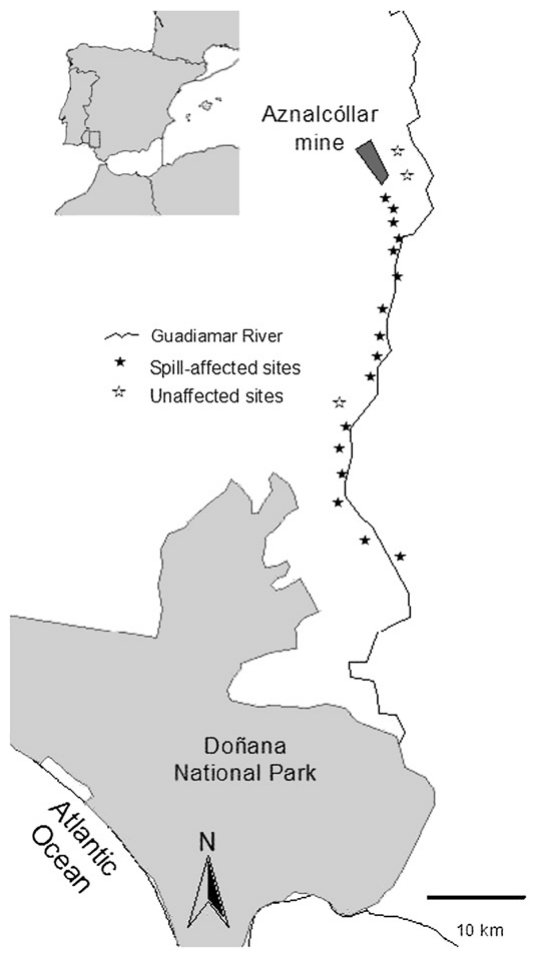
Sampling occurred in the autumn of 2005. Nineteen sites along the Guadiamar floodplain were selected (Fig. 1), from the non-affected areas upstream of the Aznalco´llar tailings dam (37�300 N, 6�130 W) down to the southern limit of the Do~nana saltmarshes (37�130 N, 6�140 W). Three of these sites were unaffected by the spill. Riparian species (Populus alba and Tamarix africana) were collected from ten sites and the rest of the species, typical of drier upland forests, were collected from 11 sites. Two sites had a mixture of both suites of species.
采样于2005年秋季进行。沿Guadiamar河漫滩选取了19个样点(图1),范围从Aznalco´llar尾矿坝上游的未受影响区域(37°30′ N, 6°13′ W)直至Do~nana盐沼的南部边界(37°13′ N, 6°14′ W)。其中3个样点未受泄漏影响。河岸物种(Populus alba和Tamarix africana)采自10个样点,其余属于较干旱高地森林典型物种的植物采自11个样点。有2个样点同时分布有这两类物种。
For each species, we took samples from affected and unaffected sites, with exception of white poplar and tamarisk, which were only present at affected sites. The unaffected sites were located either outside the riparian areas (since the flood moved forward the riverbed) or upstream the mine tailing dam (Northern edge of the phytomanaged area, where acid soils are predominant); in neither of those habitats we found white poplar and tamarisk individuals.
对每个物种,我们均在受影响和未受影响的样点采样,但银白杨和柽柳除外,二者仅见于受影响样点。未受影响样点或位于河岸区域以外(因洪水使河床发生了前移),或位于矿山尾矿坝上游(植物管理区北缘,以酸性土壤为主);在这两类生境中均未发现银白杨和柽柳个体。
At each site, we selected between three and ten individual trees for each species, depending on their abundance. Around each tree, the leaf litter was removed and soil samples were taken from the root-zone at 0e25 cm and 25e40 cm, using a spiral auger of 2.5 cm diameter. Two cores were taken at opposite sides of the trunks to make a composite soil sample for each tree. Between 12 and 40 soil samples were taken at each site. The total number of soil samples was 234.
在每个样点,根据各物种的丰度,每个物种选取3至10株个体树木。在每株树周围清除枯落物后,使用直径2.5 cm的螺旋土钻在根区采集0–25 cm和25–40 cm土层的土壤样品。在树干两侧相对位置各取1个土芯,混合成每株树的土壤混合样。每个样点采集土壤样品12至40个,土壤样品总数为234个。
For each selected tree, a composite leaf sample was taken from the outer canopy. Between 15 and 25 samples per tree species and life-stage (adults and saplings) were collected. For shrubs, four to six individuals of each species at each site were selected and leaf samples were obtained by combining the leaves of selected individuals of the same species. In the case of Retama sphaerocarpa, a shrub with short-lived leaves and photosynthetic stems, green stems were collected. The total number of plant samples was 152 (52 adult trees, 64 sapling trees and 36 shrubs) corresponding to eight species.
对于每株选定的树木,从树冠外层采集叶片混合样。每个树种和生活阶段(成年树和幼树)采集15至25个样品。对于灌木,在每个样点每个物种选取4至6株个体,将同一物种选定个体的叶片合并获得叶片样品。Retama sphaerocarpa为叶片寿命短、具光合茎的灌木,故采集其绿色茎。植物样品总数为152个(成年树52个、幼树64个、灌木36个),涉及8个物种。
2.3. Sample preparation and chemical analyses2.3. 样品制备与化学分析
Soil samples were oven-dried at 40 �C until a constant weight was obtained, then sieved to <2 mm. A fraction of each sample was then ground in an agate mortar to <1 mm for trace elements analysis. Soil samples were digested using concentrated HNO3 and HCl (aqua regia). The values determined with this extraction are referred to as ‘‘total’’ concentration (Vidal et al., 1999).
土壤样品于40 °C烘干至恒重,然后过<2 mm筛。随后取每个样品的一部分在玛瑙研钵中研磨至<1 mm,用于微量元素分析。土壤样品采用浓HNO3和HCl(王水)消解。以该提取方法测得的值称为“全量”浓度(Vidal et al., 1999)。
The pH was determined potentiometrically in a 1:2.5 soilewater suspension. Equivalent calcium carbonate was determined using a Bernard calcimeter (Hulseman, 1966). Organic matter content was analysed by dichromate oxidation and titration with ferrous ammonium sulphate (Walkley and Black, 1934).
pH采用电位法在1:2.5的土水悬液中测定。碳酸钙当量采用Bernard钙量计测定(Hulseman, 1966)。有机质含量采用重铬酸盐氧化-硫酸亚铁铵滴定法测定(Walkley and Black, 1934)。
Leaf samples were washed thoroughly with distilled water, dried at 70 �C for at least 48 h and ground using a stainless-steel mill. Leaves were digested using concentrated HNO3 (Jones and Case, 1990).
叶片样品用蒸馏水彻底清洗,于70 °C烘干至少48 h,并用不锈钢粉碎机粉碎。叶片采用浓HNO3消解(Jones and Case, 1990)。
Trace element (As, Ba, Be, Bi, Cd, Co, Cu, Mn, Mo, Ni, Pb, Sb, Tl and Zn) concentrations of both soils and plants samples were determined by ICP-MS (inductively coupled plasma-mass spectroscopy). Quality assurance was obtained for soils by analysing reference material CRM 141R (calcareus loam soil, European Community Bureau of Reference). Recoveries from CRM 141R values ranged from 82% to 94%. The quality of the plant analyses was assessed by analysing two reference materials: NCS DC 73350 (white poplar leaves, China National Analysis Center for Iron and Steel) and BCR 62 (olive tree leaves, European Community Bureau of Reference; Colinet et al., 1982). For all elements except Sb our experimental values were 82e109% of the certified values. The lower recovery of Sb (60%) indicates that our results may be conservative estimations of the true values for this element.
土壤和植物样品中的微量元素(As、Ba、Be、Bi、Cd、Co、Cu、Mn、Mo、Ni、Pb、Sb、Tl和Zn)浓度采用ICP-MS(电感耦合等离子体质谱)测定。土壤分析的质量保证通过分析标准物质CRM 141R(钙质壤土,欧洲共同体标准局)实现,CRM 141R的回收率为82%至94%。植物分析的质量通过分析两种标准物质进行评估:NCS DC 73350(银白杨叶片,中国钢铁研究总院国家钢铁材料测试中心)和BCR 62(油橄榄叶片,欧洲共同体标准局;Colinet et al., 1982)。除Sb外,所有元素的实测值为认证值的82%–109%。Sb的回收率较低(60%),表明本研究对该元素的结果可能是对真实值的保守估计。
2.4. Data analyses2.4. 数据分析
Significant differences in soil and plant trace element concentrations between spill-affected and unaffected sites were analysed using the t-test. This test was also performed to compare contamination levels between soils beneath adult trees (from remnant woodlands) and beneath afforested saplings. Principal Components Analyses (PCA) were performed to investigate trace element variability trends both in soils and in plants. Data that were log-normally distributed were log-transformed for these statistical analyses.
采用t检验分析受泄漏影响样点与未受影响样点之间土壤和植物微量元素浓度的显著差异。该检验还用于比较成年树(来自残存林地)下方土壤与造林幼树下方土壤的污染水平。采用主成分分析(PCA)研究土壤和植物中微量元素的变异趋势。对于呈对数正态分布的数据,在进行上述统计分析前进行对数转换。
Plantesoil relationships were assessed for the tree species, from individual plant/soil samples. Correlation analyses were performed between plant and soil trace element concentrations. Bioaccumulation coefficients (BC), defined as the plant/soil concentration quotient (Adriano, 2001), were calculated. Average trace element concentrations through the sampled soil profile (0e40 cm) were considered for these coefficients. Relationships between BC and soil pH and organic matter were also evaluated by correlation analyses.
根据单株植物/土壤样品,对乔木物种的植物–土壤关系进行了评估。对植物与土壤微量元素浓度进行了相关分析。计算了生物累积系数(BC),其定义为植物/土壤浓度之比(Adriano, 2001)。计算该系数时采用整个采样土壤剖面(0–40 cm)的平均微量元素浓度。此外,还通过相关分析评估了BC与土壤pH和有机质之间的关系。
The level of significance was fixed at 0.05. In order to avoid the increase of type I error derived from multiple testing, we controlled the ‘‘false discovery rate’’, (FDR) at the 5% level, as suggested by Garcı´a (2003). We used a ‘‘adaptive’’ FDR procedure (Hochberg and Benjamini, 2000) to calculate an overall threshold value ( pt � 0.05), to which individual p values were compared. After applying the adaptive-FDR procedure to the overall p-value vector (including 420 p values) we obtained a significance threshold value ( pt) of 0.013. Therefore, only p values not exceeding this threshold value were considered as significant.
显著性水平设定为0.05。为避免多重检验导致Ⅰ类错误增加,我们按照García(2003)的建议,将“错误发现率”(FDR)控制在5%水平。我们采用“自适应”FDR程序(Hochberg and Benjamini, 2000)计算总体阈值( pt ≤ 0.05),并将各个p值与之比较。对总体p值向量(包括420个p值)应用自适应FDR程序后,得到显著性阈值( pt)为0.013。因此,只有不超过该阈值的p值才被视为显著。
All statistical analyses were performed with STATISTICA v. 6.0. (StatSoft Inc., Tulsa, OK, USA).
所有统计分析均使用STATISTICA v. 6.0.(StatSoft Inc., Tulsa, OK, USA)完成。
Mean (min.emax.) total concentration (mg kg�1) of main trace element in soils in the Guadiamar Valley, from spill-affected and unaffected sitesGuadiamar河谷受泄漏影响与未受影响样点土壤中主要微量元素的平均(最小值–最大值)全量浓度(mg kg−1)
| Surface soils (0e25 cm)表层土壤(0–25 cm) | Deep soils (25e40 cm)深层土壤(25–40 cm) | Normal ranges正常范围 | DIV | |||
|---|---|---|---|---|---|---|
| Affected (N¼100) | Unaffected (N¼17) | Affected (N¼100) | Unaffected (N¼17) | |||
| As | 129 (49e339) | 17 (13e20) | 95 (18e438) | 16 (14e17) | 0.1e40 | 55 |
| Bi | 1.64 (0.57e5.40) | 0.30 (0.15e0.40) | 1.35 (0.33e4.29) | 0.25 (0.18e0.35) | 0.1e13 | e |
| Cd | 1.44 (0.44e3.05) | 0.23 (0.07e0.37) | 1.27 (0.22e3.28) | 0.17 (0.10e0.25) | 0.01e2 | 12 |
| Cu | 115 (66e198) | 32 (13e43) | 110 (30e238) | 24 (14e31) | 2e250 | 190 |
| Pb | 210 (73e607) | 47 (15e65) | 179 (38e519) | 31 (18e38) | 2e300 | 530 |
| Sb | 13.8 (4.5e37.7) | 3.0 (0.7e5.4) | 11.1 (2.1e30.0) | 1.8 (0.9e2.8) | 0.2e10 | 15 |
| Tl | 1.17 (0.55e4.02) | 0.29 (0.16e0.43) | 0.82 (0.20e3.15) | 0.27 (0.23e0.33) | 0.01e0.8 | 15 |
| Zn | 457 (183e768) | 109 (47e149) | 376 (103e954) | 82 (53e99) | 1e900 | 720 |
Significance levels in the comparison (by t-test, controlling the overall FDR at the 5% level) between affected and unaffected sites are indicated (*p < 0.013, **p < 0.001). Normal ranges in soils reported by Bowen (1979) and Dutch Intervention Values (DIV) are also indicated.
图中标出了受影响样点与未受影响样点比较(t检验,总体FDR控制在5%水平)的显著性水平(*p < 0.013,**p < 0.001)。同时列出了Bowen(1979)报道的土壤正常范围以及荷兰干预值(DIV)。
3Results结果
3.1. Trace elements in soils3.1. 土壤中的微量元素
The concentrations of As, Bi, Cd, Cu, Pb, Sb, Tl and Zn were significantly higher in the spill-affected soils compared to the unaffected soils, at both 0e25 cm and 25e40 cm depths (Table 1). This result indicates that there was significant penetration of these eight contaminants (from the mine spill) into the soil profile. In contrast, the concentrations of other trace elements, namely Ba, Be, Co, Fe, Mn, Mo and Ni, were not significantly different between the contaminated and uncontaminated sites.
在0–25 cm和25–40 cm两个深度,受泄漏影响土壤中As、Bi、Cd、Cu、Pb、Sb、Tl和Zn的浓度均显著高于未受影响土壤(表1)。这一结果表明,这8种(来自矿山泄漏的)污染物已显著渗入土壤剖面。相比之下,其他微量元素,即Ba、Be、Co、Fe、Mn、Mo和Ni的浓度在污染与未污染样点之间无显著差异。
Most affected surface soils (86% of the samples) had As concentrations above the range considered normal (0.1e 40 mg kg�1) for agricultural soils (Bowen, 1979). Similarly, other trace elements were above Bowen’s range for normal concentrations in soils. These were (in decreasing order of the percentage of samples that exceeded these values) Tl (53%), Sb (52%), Pb (24%), Cd (17%), Zn (5%) and Cu (4%). Furthermore, 75% of affected soils exceeded the Dutch Intervention Values (DIV, see NIPHE, 2001) for As (55 mg kg�1), and lower percentages of samples for other elements: Sb (40%), Zn (13%), Cu (8%) and Pb (4%).
大多数受影响表层土壤(86%的样品)的As浓度高于农业土壤的正常范围(0.1–40 mg kg−1)(Bowen, 1979)。同样,其他微量元素也超过了Bowen给出的土壤正常浓度范围,按超标样品百分比从高到低依次为Tl(53%)、Sb(52%)、Pb(24%)、Cd(17%)、Zn(5%)和Cu(4%)。此外,75%的受影响土壤超过了As的荷兰干预值(DIV,见NIPHE, 2001)(55 mg kg−1),其他元素超标样品的百分比较低:Sb(40%)、Zn(13%)、Cu(8%)和Pb(4%)。
At a greater depth (25e40 cm) the concentrations of trace elements were generally lower than for the surface soils. Nevertheless, the DIV were still exceeded for As (60% of samples), Sb (27%), Cu and Zn (10% for both).
在较深土层(25–40 cm),微量元素浓度总体低于表层土壤。尽管如此,As(60%的样品)、Sb(27%)、Cu和Zn(均为10%)仍超过了DIV。
There were significant and positive correlations between all elements that occurred in elevated concentrations in the spill-affected soils (compared to the unaffected soils). This result supports the hypothesis that a single contamination event, the Aznalco´llar mine accident, deposited all these trace elements. The first PCA component explained 47% of the total variance, and completely separated affected from unaffected soils (mean scores of �0.69 and 4.03 respectively). The factor loadings of the eight trace elements associated to the spill had the highest values for this first component (Table 2). Given that the contaminants are mutually correlated, the first component scores for each sample can be use as an index for the total contaminant burden. Detailed information about the level of trace element contamination at each sample site is given in Appendix, along with other soil properties that affect the solubility of trace elements, namely pH, carbonate and organic matter content.
在受泄漏影响土壤中浓度升高(与未受影响土壤相比)的所有元素之间均存在显著正相关。这一结果支持了以下假设:所有这些微量元素均来自同一次污染事件,即Aznalco´llar矿山事故。第一主成分解释了总方差的47%,并将受影响土壤与未受影响土壤完全区分开来(平均得分分别为4.03和−0.69)。与泄漏相关的8种微量元素在第一主成分上的因子载荷最高(表2)。鉴于这些污染物彼此相关,各样品的第一主成分得分可用作污染物总负荷的指数。各样点微量元素污染水平的详细信息见附录,附录中还列出了影响微量元素溶解度的其他土壤性质,即pH、碳酸盐和有机质含量。
Results of the Principal Component Analyses (factor loadings) of trace elements concentrations in soils (0e25 cm), and in leaves of three tree species (Holm oak, olive tree and white poplar), from the Guadiamar Valley
Guadiamar河谷土壤(0–25 cm)及三种乔木(冬青栎、油橄榄和银白杨)叶片中微量元素浓度的主成分分析结果(因子载荷)
| Soils土壤 | Plants植物 | |||
|---|---|---|---|---|
| Comp. 1 (47%) | Comp. 2 (29%) | Comp.1 (26%) | Comp. 2 (20%) | |
| As | �0.96 | �0.03 | �0.81 | �0.20 |
| Ba | 0.06 | �0.85 | �0.14 | 0.21 |
| Be | 0.34 | �0.79 | �0.42 | 0.28 |
| Bi | �0.95 | �0.10 | �0.39 | 0.19 |
| Cd | �0.76 | �0.10 | �0.35 | �0.86 |
| Co | �0.04 | �0.85 | �0.21 | �0.59 |
| Cu | �0.92 | �0.15 | �0.62 | 0.12 |
| Mn | 0.20 | �0.83 | �0.55 | 0.44 |
| Mo | �0.62 | �0.04 | �0.01 | �0.05 |
| Ni | 0.20 | �0.91 | �0.26 | 0.29 |
| Pb | �0.95 | �0.01 | �0.82 | 0.39 |
| Sb | �0.94 | �0.14 | �0.66 | 0.42 |
| Tl | �0.93 | �0.01 | �0.58 | �0.32 |
| Zn | �0.78 | �0.12 | �0.53 | �0.77 |
The percentage of variance explained by each component is also indicated.
同时列出了各主成分所解释的方差百分比。
There was a large degree of spatial heterogeneity in the level of contamination between sites, as well as the factors affecting trace element solubility, namely carbonate, organic matter and pH (Appendix). The Northern and Central areas were the most contaminated sites; they were closest to the contamination source (tailing dam), and sludge was stored mostly in these sites during the clean-up operation. The degree of heterogeneity, as indicated by the coefficient of variation, increased in proportion to the described index for soil contamination (data not shown).
各样点之间的污染水平以及影响微量元素溶解度的因素(即碳酸盐、有机质和pH)均存在很大的空间异质性(附录)。北部和中部区域是污染最严重的样点;它们距污染源(尾矿坝)最近,且在清理作业期间污泥主要堆存于这些区域。以变异系数表示的异质性程度随上述土壤污染指数成比例增加(数据未列出)。
Soil acidity was also heterogeneous in the Guadiamar floodplain. The soil pH in Northern and Central regions was lower than in Southern regions, due to the different nature of bedrocks in Guadiamar Valley (slate and schist in the upper reaches and limestone and calcarenite in the lower reaches). In Northern and Central regions strongly acid soils were observed, having pH values below 4.5 and carbonate contents lower than 1% (21% of the samples).
Guadiamar河漫滩的土壤酸度同样具有异质性。由于Guadiamar河谷基岩性质不同(上游为板岩和片岩,下游为石灰岩和钙屑砂岩),北部和中部区域的土壤pH低于南部区域。在北部和中部区域观察到强酸性土壤,其pH值低于4.5,碳酸盐含量低于1%(占样品的21%)。
3.2. Trace element concentrations in plants3.2. 植物中的微量元素浓度
Table 3 shows the trace element concentrations in the leaves of studied species from the spill-affected sites. When compared with values from unaffected sites (for the six common species) there were significant differences for some elements and species (5 out of the 48 comparisons). Holm oak leaves accumulated significantly more As (t = 2.95, p = 0.005), Bi (t = 3.26, p = 0.002), Cu (t = 2.62, p = 0.012) and Zn (t = 2.72, p = 0.010) than in the unaffected sites (mean values of 0.10, 0.007, 6.14 and 29.9 mg kg�1, respectively, in unaffected sites). Wild olive tree leaves had higher concentrations of Tl (t = 2.71, p = 0.009) than in unaffected sites (mean of 0.003 mg kg�1). For the rest of elements and species, there was no significantly higher accumulation in the spill-affected sites.表3列出了受泄漏影响样点所研究物种叶片中的微量元素浓度。与未受影响样点的值相比(针对6个共有物种),部分元素和物种存在显著差异(48次比较中有5次)。与未受影响样点相比,冬青栎叶片中As(t = 2.95,p = 0.005)、Bi(t = 3.26,p = 0.002)、Cu(t = 2.62,p = 0.012)和Zn(t = 2.72,p = 0.010)的累积量显著更高(未受影响样点的平均值分别为0.10、0.007、6.14和29.9 mg kg−1)。野生油橄榄叶片中Tl浓度(t = 2.71,p = 0.009)高于未受影响样点(平均值为0.003 mg kg−1)。对于其余元素和物种,受泄漏影响样点均未表现出显著更高的累积。
Despite the higher accumulation of some trace elements in the leaves of some woody plant species, in comparison to uncontaminated sites, the concentrations were within the normal ranges for higher plants (as reported by Chaney, 1989, see Table 3). A notable exception was white poplar, which had foliar Cd up to 3 mg kg�1,and Zn up to 410 mg kg�1, well above normal ranges of 1 and 150 mg kg�1, respectively.
尽管与未污染样点相比,部分木本植物物种叶片中某些微量元素的累积量较高,但其浓度仍处于高等植物的正常范围之内(据Chaney, 1989报道,见表3)。一个显著的例外是银白杨,其叶片Cd高达3 mg kg−1,Zn高达410 mg kg−1,远高于各自1和150 mg kg−1的正常范围。
The accumulation of trace elements was also influenced by the life-stage of the tree. In general, adult trees that survived the spill had higher foliar concentration of many trace elements than young saplings that were afforested after the spill. For example, adult wild olives had higher concentration of Zn (2�) than saplings, adult poplars had higher Cd (5�) and Zn (3.4�) concentration than saplings, and adult oaks had higher Bi (2.3�) and Cu (1.8�) levels than saplings (Table 4).
微量元素的累积还受树木生活阶段的影响。总体而言,在泄漏事故中幸存的成年树叶片中多种微量元素的浓度高于泄漏后造林的幼树。例如,成年野生油橄榄的Zn浓度比幼树高(2×),成年银白杨的Cd(5×)和Zn(3.4×)浓度高于幼树,成年栎树的Bi(2.3×)和Cu(1.8×)水平高于幼树(表4)。
Trace element concentration (mg kg�1) in leaves (stems in the case of Retama sphaerocarpa) of woody plants from spill-affected sites in the study area
研究区受泄漏影响样点木本植物叶片(Retama sphaerocarpa为茎)中的微量元素浓度(mg kg−1)
| Species物种 | As | Bi | Cd | Cu | Pb | Sb | Tl | Zn |
|---|---|---|---|---|---|---|---|---|
| O. europaea N¼31 | 0.32�0.04 | 0.025�0.005 | 0.07�0.01 | 6.94�0.49 | 0.89�0.06 | 0.031�0.023 | 0.013�0.002 | 42.2�3.8 |
| P. angustifolia N¼6 | 0.25�0.07 | 0.019�0.007 | 0.13�0.03 | 5.67�0.11 | 1.11�0.18 | 0.046�0.005 | 0.009�0.004 | 79.9�10.6 |
| P. lentiscus N¼4 | 0.27�0.12 | 0.026�0.008 | 0.06�0.01 | 4.48�0.59 | 1.18�0.39 | 0.028�0.009 | 0.018�0.006 | 14.9�0.4 |
| P. alba N¼40 | 0.50�0.04 | 0.014�0.003 | 3.13�0.45 | 8.11�0.35 | 1.21�0.05 | 0.037�0.005 | 0.032�0.008 | 412�43 |
| Q. ilex N¼29 | 0.56�0.08 | 0.026�0.003 | 0.21�0.05 | 10.2�0.8 | 2.48�0.26 | 0.070�0.005 | 0.021�0.005 | 80.0�8.9 |
| R. sphaerocarpa N¼6 | 0.30�0.10 | 0.014�0.002 | 0.31�0.20 | 15.5�3.0 | 1.40�0.48 | 0.067�0.016 | 0.006�0.002 | 114�36 |
| R. officinalis N¼7 | 0.79�0.18 | 0.023�0.005 | 0.04�0.01 | 13.2�1.1 | 2.01�0.52 | 0.046�0.005 | 0.021�0.007 | 51.2�9.5 |
| T. africana N¼6 | 0.83�0.19 | 0.022�0.009 | 0.46�0.21 | 11.3�1.8 | 1.58�0.27 | 0.070�0.051 | 0.213�0.059 | 54.7�19.4 |
| Normal levels | 0.01e1a | 0.06b | 0.1e1a | 3e20a | 2e5a | 0.005e0.1c | 0.05c | 15e150a |
| Maximum levels for livestocka | 50 | 0.5 | 300 | 30 | 1000 |
In the case of tree species, both adults and saplings are combined. Normal ranges for trace element in plants and maximum levels tolerated by livestock are indicated (see below for references). a Chaney, 1989. b Bowen, 1979. c Adriano, 2001.
对于乔木物种,成年树与幼树数据合并。表中列出了植物中微量元素的正常范围以及家畜可耐受的最高水平(参考文献见下)。a Chaney, 1989。b Bowen, 1979。c Adriano, 2001。
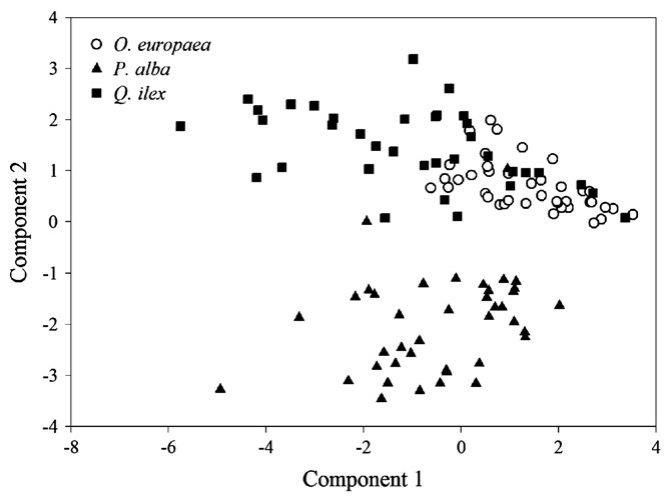
In the leaves of tree species, sludge-associated trace elements were significantly and positively correlated. A PCA of the trace element composition of the leaf tissue revealed that the main trend (the first component accounted for 26% of the total variation) was related to elements contained in the sludge. Arsenic, Pb, and in a lower degree Cu, Sb, Tl (contained within the sludge) had high weightings, as well as Mn, which the PCA of the soil samples did not discriminate. The second component (20% of variance) was defined sharply by Cd and Zn, and in a lesser degree by Co (Table 2). The first PCA axis may reflect a soil contamination gradient inducing a parallel gradient of leaf concentrations of trace elements, mostly As and Pb. The three tree species overlap in that accumulation gradient, although olive trees tend to have the lowest values (Fig. 2). The second trend of variation had a species-specific physiological nature, clearly associated with the higher accumulation of Cd, Zn, and Co in poplar leaves.
在乔木物种的叶片中,与污泥相关的微量元素之间呈显著正相关。对叶片组织微量元素组成的PCA表明,主要趋势(第一主成分解释了总变异的26%)与污泥中所含元素有关。砷、Pb以及程度较低的Cu、Sb、Tl(均含于污泥中)具有较高的权重,Mn亦是如此,而土壤样品的PCA并未区分出Mn。第二主成分(解释20%的方差)主要由Cd和Zn明确定义,Co的贡献程度较低(表2)。第一PCA轴可能反映了土壤污染梯度,该梯度诱导了叶片微量元素(主要是As和Pb)浓度的平行梯度。三种乔木在该累积梯度上相互重叠,但油橄榄的值往往最低(图2)。第二变异趋势具有物种特异性的生理性质,明显与银白杨叶片中Cd、Zn和Co的较高累积相关。
3.3. Plantesoil correlations3.3. 植物–土壤相关性
The correlation coefficients between the concentrations of trace elements in surface soils and in leaves of trees (grouping adults and saplings) showed a low number of significant relationships (Table 5). Only 5 out of 48 possible correlations, corresponding to Holm oak saplings, were significant ( p < 0.013). In other cases, marginally significant correlations (0.05 > p < 0.013) were found. In general, there were higher correlations between the trace element concentrations in plants and in the surface soils, than in deeper soils (data not shown). Tree saplings had higher plantesoil trace element correlations than the adult trees.
表层土壤与树木叶片(成年树与幼树合并)微量元素浓度之间的相关系数显示,显著关系数量较少(表5)。在48个可能的相关中,仅有5个显著( p < 0.013),均属于冬青栎幼树。在其他情况下,发现了边缘显著的相关(0.05 > p < 0.013)。总体而言,植物与表层土壤微量元素浓度之间的相关性高于与深层土壤之间的相关性(数据未列出)。幼树的植物–土壤微量元素相关性高于成年树。
Trace element concentrations in leaves of adult and sapling trees from affected sites
受影响样点成年树与幼树叶片中的微量元素浓度
| O. europaeaO. europaea | P. albaP. alba | Q. ilexQ. ilex | ||||
|---|---|---|---|---|---|---|
| Adult (N¼15) | Sapling (N¼16) | Adult (N¼22) | Sapling (N¼18) | Adult (N¼15) | Sapling (N¼14) | |
| As | 0.42�0.07 | 0.22�0.03 | 0.63�0.06 | 0.34�0.05 | 0.59�0.07 | 0.54�0.14 |
| Bi | 0.016�0.03 | 0.034�0.010 | 0.018�0.005 | 0.010�0.03 | 0.036�0.004 | 0.016�0.001 |
| Cd | 0.06�0.01 | 0.08�0.02 | 4.90�0.58 | 0.96�0.13 | 0.14�0.02 | 0.29�0.09 |
| Cu | 6.55�0.55 | 7.32�0.80 | 8.16�0.47 | 8.07�0.54 | 13.1�0.9 | 7.18�0.31 |
| Pb | 1.02�0.09 | 0.77�0.07 | 1.28�0.06 | 1.12�0.08 | 3.18�0.40 | 1.72�0.21 |
| Sb | 0.037�0.004 | 0.025�0.002 | 0.050�0.008 | 0.021�0.004 | 0.079�0.006 | 0.059�0.008 |
| Tl | 0.014�0.003 | 0.013�0.003 | 0.053�0.012 | 0.007�0.002 | 0.029�0.009 | 0.013�0.003 |
| Zn | 57.0�5.2 | 28.2�2.5 | 605�45 | 176�22 | 83.5�8.4 | 76.2�16.4 |
Significance levels (analysed by t-test) are indicated (*p < 0.013, **p < 0.001). Values in italics are marginally significant (0.05 > p < 0.013), after controlling the overall FDR at the 5% level.
图中标出了显著性水平(t检验)(*p < 0.013,**p < 0.001)。斜体数值为在总体FDR控制在5%水平后的边缘显著值(0.05 > p < 0.013)。
3.4. Bioaccumulation coefficients3.4. 生物累积系数
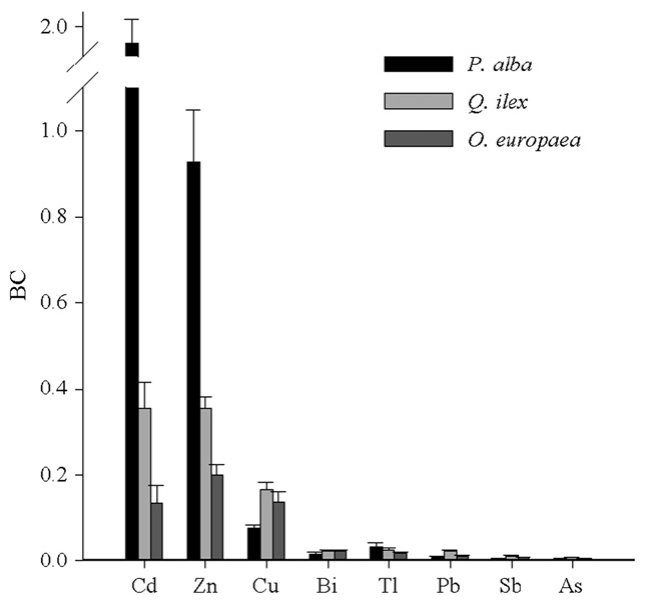
For As, Bi, Pb, Sb and Tl, bioaccumulation coefficients (BC) were low (<0.03) and there were no significant differences between the species (Fig. 3). In contrast, Cd, Zn and Cu had the highest BCs, and there were greater differences between species. The BC of Cu was similar for all species, around 0.2. There were highly significant inter-specific differences in the BCs of Zn and Cd, in particular due to Populus alba, having values close to 2.0 for Cd, and about 0.9 for Zn (Fig. 3).
As、Bi、Pb、Sb和Tl的生物累积系数(BC)较低(<0.03),且各物种之间无显著差异(图3)。相比之下,Cd、Zn和Cu的BC最高,且物种间差异更大。各物种Cu的BC相近,约为0.2。Zn和Cd的BC存在极显著的种间差异,这主要是由于Populus alba的Cd的BC接近2.0,Zn的BC约为0.9(图3)。
3.5. Effect of pH and soil organic matter on the bioaccumulation coefficients3.5. pH和土壤有机质对生物累积系数的影响
There were few significant correlations between pH and BCs. For white poplar, soil pH was negatively correlated with BC for Zn (r = �0.60, p < 0.001). A marginally significant positive correlation was found for As (r = 0.35, p = 0.032). A positive correlation between soil pH and the BC for Sb was found for olive trees (r = 0.43, p = 0.012). For the rest of elements and plant species, pHeBC correlations were not significant. Soil organic matter did not significantly affect the BC of any element in any species.
pH与BC之间的显著相关很少。对于银白杨,土壤pH与Zn的BC呈负相关(r = −0.60,p < 0.001)。As呈边缘显著的正相关(r = 0.35,p = 0.032)。油橄榄的土壤pH与Sb的BC呈正相关(r = 0.43,p = 0.012)。对于其余元素和植物物种,pH–BC相关均不显著。土壤有机质对任何物种任何元素的BC均无显著影响。
4Discussion讨论
The soils affected by a mine spill in the Guadiamar Valley were contaminated by several trace elements, namely As, Bi, Cd, Cu, Pb, Sb, Tl and Zn. These results are consistent with those reported by Cabrera et al. (1999) just after the mine spill. The contamination was spatially heterogeneous. Several factors may explain this non-uniform contamination. Firstly, it was a function of the irregular sludge deposition (Alastuey et al., 1999; Lo´pez-Pamo et al., 1999). Secondly, the heterogeneous nature of the alluvial sediments along the Guadiamar River (Gallart et al., 1999) may also affect the distribution of residual soil contamination and may influence the different degree of leaching between different sites. Cabrera et al. (1999) showed that the clay content affected the degree of sludge penetration into the Guadiamar surface soils. Thirdly, the residual contamination is also a function of the irregular cleanup of affected soils. The contamination levels in soils around adult trees surviving the spill were significantly higher than those of soils with newly afforested saplings. This is probably due to the difficulty of removing sludge and topsoil from forested areas (Ayora et al., 2001).
Guadiamar河谷受矿山泄漏影响的土壤被多种微量元素污染,即As、Bi、Cd、Cu、Pb、Sb、Tl和Zn。这些结果与Cabrera et al.(1999)在矿山泄漏刚发生后报道的结果一致。污染在空间上具有异质性,有多种因素可以解释这种不均匀的污染。首先,它与污泥的不规则沉积有关(Alastuey et al., 1999; Lo´pez-Pamo et al., 1999)。其次,Guadiamar河沿岸冲积沉积物的异质性(Gallart et al., 1999)也可能影响残余土壤污染的分布,并可能影响不同样点之间淋溶程度的差异。Cabrera et al.(1999)的研究表明,黏粒含量影响污泥向Guadiamar表层土壤的渗透程度。第三,残余污染还与受影响土壤清理的不均匀性有关。在泄漏中幸存的成年树周围土壤的污染水平显著高于新造林幼树所在土壤,这可能是由于从林地中移除污泥和表层土壤较为困难(Ayora et al., 2001)。
Correlation coefficients (r) between trace elements in soils (total concentrations, 0e25 cm depth) and plants, for tree species, both from affected and unaffected sites
受影响和未受影响样点乔木物种土壤(全量浓度,0–25 cm深度)与植物中微量元素之间的相关系数(r)
| Species物种 | As | Bi | Cd | Cu | Pb | Sb | Tl | Zn | |
|---|---|---|---|---|---|---|---|---|---|
| O. europaea | Adult (N¼15) | n.s. | n.s. | n.s. | n.s. | n.s. | n.s. | n.s. | n.s. |
| Sapling (N¼25) | 0.46 | n.s. | n.s. | n.s. | n.s. | n.s. | n.s. | n.s. | |
| P. alba | Adult (N¼22) | n.s. | n.s. | 0.45 | n.s. | n.s. | n.s. | n.s. | n.s. |
| Sapling (N¼18) | n.s. | n.s. | n.s. | n.s. | n.s. | 0.54 | n.s. | n.s. | |
| Q. ilex | Adult (N¼15) | n.s. | n.s. | n.s. | n.s. | n.s. | n.s. | n.s. | n.s. |
| Sapling (N¼21) | 0.79 | 0.68 | 0.78 | n.s. | 0.53 | n.s. | 0.77 | 0.78 |
Non-significant correlations (n.s.) are not shown. For the rest of correlations, significance levels are indicated (*p < 0.013, **p < 0.001). Values in italics are marginally significant (0.05 > p < 0.013), after controlling the overall FDR at the 5% level.
不显著的相关(n.s.)未列出。其余相关标出了显著性水平(*p < 0.013,**p < 0.001)。斜体数值为在总体FDR控制在5%水平后的边缘显著值(0.05 > p < 0.013)。
Strong soil acidification was observed in the most contaminated sites. Soil acidification may have occurred due to the leaching of acids generated by the oxidation of sulphides in the remnant of sludges in the soils. Carbonates would have reduced the effects of such acidification. However, the natural pH of these sites was acidic and the soil’s carbonate reserve was low, so there may have been less pH buffering in these sites.
在污染最严重的样点观察到强烈的土壤酸化。土壤酸化可能是由于土壤中残余污泥内硫化物氧化所产生的酸发生淋溶所致。碳酸盐本可减轻这种酸化的影响;然而,这些样点的天然pH呈酸性,土壤碳酸盐储量较低,因此这些样点的pH缓冲能力可能较弱。
Despite the relatively high soil trace element concentrations, sometimes well in excess of Dutch Intervention Values, their transfer into the woody plants from the Guadiamar Valley was limited. The concentrations in the aboveground parts of studied species were, on average, within the normal ranges for higher plants. The notable exception was the high Cd and Zn accumulation by poplar leaves in the spill-affected area. As a comparison, Madejo´n et al. (2004) reported foliar concentrations of Cd and Zn in the leaves of poplars from uncontaminated soils of the Guadiamar Valley (outside the phytomanaged area) of just 0.21 mg Cd kg�1 and <82 mg Zn kg�1 on a dry matter basis, manifold lower than the values found in this study (3 and 410 mg kg�1, respectively). The average Cd concentration in poplar leaves from the affected areas of the Guadiamar floodplain was greater than the concentration (0.5 mg kg�1) that has been shown to adversely affect livestock (Chaney, 1989).
尽管土壤微量元素浓度相对较高,有时远超荷兰干预值,但其向Guadiamar河谷木本植物的转移有限。所研究物种地上部分的浓度平均处于高等植物的正常范围之内。显著的例外是受泄漏影响区域银白杨叶片中Cd和Zn的高累积。作为比较,Madejo´n et al.(2004)报道,Guadiamar河谷未污染土壤(植物管理区以外)中银白杨叶片的Cd和Zn浓度以干物质计仅分别为0.21 mg Cd kg−1和<82 mg Zn kg−1,比本研究中的值(分别为3和410 mg kg−1)低数倍。Guadiamar河漫滩受影响区域银白杨叶片的平均Cd浓度高于已证明会对家畜产生不利影响的浓度(0.5 mg kg−1)(Chaney, 1989)。
It is well known that poplar species accumulate Cd and Zn in their leaves (Di Baccio et al., 2003; Madejo´n et al., 2004; Robinson et al., 2005). Their high biomass production combined with high Cd and Zn accumulation may make poplar suitable for the phytoextraction of these elements from contaminated soils (Robinson et al., 2000; Giachetti and Sebastiani, 2006). The use of poplar for phytomanagement in this site may increase the risk of Cd and Zn entering the food chain. However, poplar is an integral part of the native riparian ecosystem and has a high landscape value. Moreover, poplar plays an important role in maintaining the stability of riparian zones. Before any recommendation to change the management programme, a risk assessment is required to determine the extent of Cd and Zn transfer to other organisms, as well as they accumulation in the topsoil due to litter fall.
众所周知,杨树物种会在叶片中累积Cd和Zn(Di Baccio et al., 2003; Madejo´n et al., 2004; Robinson et al., 2005)。杨树生物量产量高,同时对Cd和Zn累积量高,这可能使其适用于从污染土壤中植物提取这些元素(Robinson et al., 2000; Giachetti and Sebastiani, 2006)。在该场地利用杨树进行植物管理可能会增加Cd和Zn进入食物链的风险。然而,杨树是本土河岸生态系统的组成部分,具有较高的景观价值;此外,杨树在维持河岸带稳定性方面发挥着重要作用。在提出任何调整管理计划的建议之前,需要开展风险评估,以确定Cd和Zn向其他生物的转移程度,以及凋落物归还导致其在表层土壤中的累积程度。
Madejo´n et al. (2006a) reported that oak leaves had significantly higher concentrations of some trace elements than olive tree leaves, in spill-affected sites. We found similar results in this study. However, for both species the average trace element concentrations found in this study were lower than in the trees analysed in the first three years following the Aznalco´llar accident. The higher foliar concentrations reported in surveys taken immediately following the soil cleanup may have resulted from increased surface deposition of elements following the generation of dust during earth moving (Madejo´n et al., 2005).
Madejo´n et al.(2006a)报道,在受泄漏影响样点,栎树叶片中某些微量元素的浓度显著高于油橄榄叶片。本研究得到了类似结果。然而,对于这两个物种,本研究中测得的平均微量元素浓度均低于Aznalco´llar事故后最初三年所分析的树木。在土壤清理刚结束后开展的调查中报道的较高叶片浓度,可能源于土方作业期间产生的扬尘导致元素表面沉积增加(Madejo´n et al., 2005)。
With the exception of Holm oak saplings, very few significant soileplant correlations were found in this study. Plante soil relationships are always complex, since a suite of edaphic and climatic variables, in addition to the soil’s trace element concentration, determines the trace element concentration in plants. Our soil analyses revealed a high variability in pH and organic matter content of the soil. Both these factors may affect the phytoavailability of trace elements (Greger, 1999). The nutrient status of each site is likely to have been different, further degrading leaf-soil correlations (Bargagli, 1998). In addition, plant physiology influences the uptake, transport, and accumulation rates, determining the foliar concentration of a trace element. Despite the correlations between leaf concentrations and soil total concentrations being low, the main trend of leaf chemical composition of the studied tree species reflected the gradient of soil trace element contamination. This indicates that leaf analyses may indicate soil quality with regard to trace element phytoavailability in contaminated sites. Since plants integrate several environmental variables over an extended time, they can provide information that is unobtainable from direct soil analyses (see Madejo´n et al., 2006b for a full discussion of this topic).
除冬青栎幼树外,本研究发现的土壤–植物显著相关极少。植物–土壤关系总是十分复杂,因为除土壤微量元素浓度外,一系列土壤和气候变量共同决定植物中的微量元素浓度。我们的土壤分析显示,土壤pH和有机质含量具有很高的变异性,这两个因素都可能影响微量元素的植物有效性(Greger, 1999)。各样点的养分状况可能也不相同,从而进一步削弱了叶片–土壤相关性(Bargagli, 1998)。此外,植物生理影响吸收、转运和累积速率,从而决定叶片中微量元素的浓度。尽管叶片浓度与土壤全量浓度之间的相关性较低,但所研究乔木物种叶片化学组成的主要趋势反映了土壤微量元素污染梯度。这表明,在污染场地,叶片分析可以指示与微量元素植物有效性相关的土壤质量。由于植物在较长时间内整合了多种环境变量,它们能够提供直接土壤分析无法获得的信息(关于该主题的全面讨论见Madejo´n et al., 2006b)。
There were higher plantesoil correlations for afforested saplings than for adult trees. A possible explanation is that the roots of smaller plants occupy a smaller volume than large trees. Therefore, the soil that was sampled is more likely to reflect closely the local concentration that the roots of smaller plants were exposed to. Afforested shrubs and trees have been transplanted into the contaminated and remediated soil, therefore roots are growing and exposed to trace elements since the beginning. The roots of larger trees explore a larger volume of soil, which a single soil analysis may not accurately reflect.
造林幼树的植物–土壤相关性高于成年树。一种可能的解释是,较小植物的根系所占据的体积小于大树。因此,所采集的土壤更可能密切反映较小植物根系所接触的局部浓度。造林的灌木和乔木被移植到经过修复的污染土壤中,因此其根系从一开始就在生长并暴露于微量元素之中。较大树木的根系探索的土壤体积更大,单次土壤分析可能无法准确反映。
Another factor may be that smaller saplings and shrubs are more affected by dust deposition than larger trees. Smaller plants, and those with pubescent leaves, are more likely to incorporate soil particles into the foliar tissues that even vigorous washing will not remove (Jones and Case, 1990). The foliar trace element concentrations could increase due to the deposition of soil, which is highly contaminated by trace elements, thus producing a positive correlation between plant and soil concentrations. The highest number of soileplant correlations was observed for Holm oak saplings, low-growing trees with spiny and tomentose leaves. In this case, we found significant correlations for elements, such as Bi and Pb, that are relatively immobile in plantesoil systems, (Adriano, 2001; Jung et al., 2002). This may indicate that, in these saplings, a higher proportion of trace elements may arise from surface deposition. Foliar trace elements that occur via dust deposition still pose an ecological risk, since herbivores will ingest the trace elements, irrespective of their provenance. In taller trees with glabrous leaves, the influence of surface deposition may be smaller. Olive tree leaves are glabrous, so they capture less aerial dust and are easier to wash before chemical analysis. White poplar is a fast-growing tree, and the saplings can reach several metres in height after just 3 years, thus avoiding high surface deposition, despite their pubescent leaves. The contribution of surface deposition to the total metal burden of poplars in this study is likely to be low. In the case of Cd accumulation, the foliar concentration exceeded that of the soil. Here the effect of surface deposition would be to decrease the observed foliar Cd concentration, since the high concentration of Cd in the leaf is diluted by the addition of soil that has a lower Cd concentration.
另一个因素可能是,较小的幼树和灌木比大树更易受扬尘沉降的影响。较小的植物以及叶片被毛的植物更有可能将土壤颗粒掺入叶片组织,即便用力清洗也无法去除(Jones and Case, 1990)。叶片微量元素浓度可能因微量元素污染严重的土壤沉降而升高,从而导致植物与土壤浓度之间呈正相关。冬青栎幼树的土壤–植物相关数量最多,这是一种叶片具刺和绒毛的低矮树木。在这种情况下,我们发现Bi和Pb等在植物–土壤系统中相对不迁移的元素存在显著相关(Adriano, 2001; Jung et al., 2002)。这可能表明,在这些幼树中,较高比例的微量元素可能来自表面沉积。通过扬尘沉降进入叶片的微量元素仍具有生态风险,因为无论其来源如何,食草动物都会摄入这些微量元素。对于叶片光滑的高大树木,表面沉积的影响可能较小。油橄榄叶片光滑无毛,因此捕获的空气尘埃较少,在化学分析前也更易清洗。银白杨是速生树种,幼树仅需3年即可长至数米高,因此尽管其叶片被毛,仍可避免大量表面沉积。本研究中表面沉积对银白杨总金属负荷的贡献可能较低。就Cd累积而言,叶片浓度超过了土壤浓度。在此情况下,表面沉积的作用反而会降低所观测到的叶片Cd浓度,因为叶片中的高浓度Cd会被Cd浓度较低的土壤的加入所稀释。
For Bi, Tl, Pb, Sb, and As, bioaccumulation coefficients were below 0.03. This is consistent with previous works that report that these elements, with the exception of Tl, are immobile in plantesoil systems (Kabata-Pendias and Pendias, 2001; Ross, 1994). Thallium has limited mobility in the spill-affected soils in the study area (Vidal et al., 1999; Martı´n et al., 2004), especially in dry conditions, while during wet periods plants can uptake higher content of this element (Madejo´n et al., 2007). The BC of Cu was constant in the considered species, which probably is related to the plants’ regulation of the uptake of this essential micronutrient. Several studies have reported a restricted transport of Cu from contaminated soils to aboveground parts in different species (Arduini et al., 1996; Kozlov et al., 2000; Ait Ali et al., 2002). A single species, white poplar, showed BCs higher than 1 for some elements: Cd (all sites) and Zn (some sites). This indicates a high transfer of these elements from soil to leaves. Due to these high rates of metal transfer, concentrations in poplar leaves can be higher than those in soils. In the contaminated Guadiamar Valley, Cd and Zn accumulation by poplar represents one of the greatest environmental risks regarding the entry of trace elements into the food chain.
Bi、Tl、Pb、Sb和As的生物累积系数低于0.03。这与以往研究报道的这些元素(Tl除外)在植物–土壤系统中不迁移的结论一致(Kabata-Pendias and Pendias, 2001; Ross, 1994)。在研究区受泄漏影响的土壤中,Tl的迁移性有限(Vidal et al., 1999; Martı´n et al., 2004),尤其是在干燥条件下,而在湿润时期植物可吸收更多该元素(Madejo´n et al., 2007)。所研究物种中Cu的BC保持恒定,这可能与植物对这一必需微量营养元素吸收的调控有关。多项研究报道了不同物种中Cu从污染土壤向地上部分的转运受到限制(Arduini et al., 1996; Kozlov et al., 2000; Ait Ali et al., 2002)。只有银白杨一个物种对某些元素的BC高于1:Cd(所有样点)和Zn(部分样点)。这表明这些元素从土壤向叶片的转移率较高。由于金属转移率高,银白杨叶片中的浓度可能高于土壤中的浓度。在受污染的Guadiamar河谷,银白杨对Cd和Zn的累积是微量元素进入食物链方面最大的环境风险之一。
The solubility of cationic trace elements increases at low pH (Ross, 1994; Greger, 1999). Soil pH is the main determinant of cationic trace element solubility in the Guadiamar floodplain (Clemente et al., 2003; Burgos et al., 2006). Positive correlations between pH and BCs can occur for the anionic trace elements arsenate and antimonite, which are more mobile at higher pHs (Adriano, 2001). In this work, despite local acidic conditions, the BCs for cationic elements were not significantly correlated with soil pH, with the exception of Zn BC in white poplar. The positive correlations observed for As and Sb were weak. As discussed above, the physiology of these woody species may limit the uptake and transport of trace elements, despite increases in soil bioavailability due to pH conditions. Although low pH may not greatly affect trace element uptake by woody plants in the Guadiamar Valley, the pH of the sites requires close monitoring, since acidification will result in increased trace element mobility and it may increase the rates of leaching into receiving waters. In the Guadiamar system, soil contamination is associated with sulphides, which will gradually oxidise and lower the soil pH. There is, therefore, a risk of a chemical time bomb where significant amounts of sludge remain in the soil. Maintaining neutral to basic soil pH should be an integral part of any phytomanagement programme that involves cationic trace element-contaminated soils. While there is little risk of plant uptake, the higher downward mobility of these elements may endanger groundwater.
阳离子型微量元素的溶解度在低pH下增加(Ross, 1994; Greger, 1999)。土壤pH是Guadiamar河漫滩阳离子型微量元素溶解度的主要决定因素(Clemente et al., 2003; Burgos et al., 2006)。对于在较高pH下迁移性更强的阴离子型微量元素砷酸盐和锑酸盐,pH与BC之间可能呈正相关(Adriano, 2001)。在本研究中,尽管局部存在酸性条件,除银白杨中Zn的BC外,阳离子型元素的BC与土壤pH均无显著相关。观察到的As和Sb的正相关较弱。如上所述,尽管pH条件导致土壤生物有效性增加,这些木本物种的生理特性仍可能限制微量元素的吸收和转运。虽然低pH可能不会显著影响Guadiamar河谷木本植物对微量元素的吸收,但仍需密切监测各样点的pH,因为酸化会导致微量元素迁移性增加,并可能提高其向受纳水体的淋溶速率。在Guadiamar系统中,土壤污染与硫化物相关,硫化物将逐渐氧化并降低土壤pH。因此,在土壤中残留大量污泥的地方,存在“化学定时炸弹”的风险。对于任何涉及阳离子型微量元素污染土壤的植物管理计划,维持中性至碱性的土壤pH都应是其不可或缺的组成部分。虽然植物吸收的风险很小,但这些元素较高的向下迁移性可能危及地下水。
5Conclusions结论
Despite the high concentrations of several trace elements in the soils from the Guadiamar Valley, there was a limited transfer of these elements to the aboveground parts of woody plants. With the exception of white poplar, the ecological risk of the foliar trace accumulation in these plants is low. Future work could focus on the effect of the trees on the downward mobility of trace elements in the Guadiamar basin. This should include not just the effect of transpiration, but also the generation of preferential flow pathways along root-macropores, and the solubilisation of trace elements by organic acids generated from decaying leaf litter. Horizontal migration of diluted elements and solid matter as surface run-off during heavy rainfall events should also be taken into account.
尽管Guadiamar河谷土壤中多种微量元素浓度较高,但这些元素向木本植物地上部分的转移有限。除银白杨外,这些植物叶片微量元素累积的生态风险较低。今后的工作可侧重于研究树木对Guadiamar流域微量元素向下迁移的影响。这不仅应包括蒸腾作用的影响,还应包括沿根系大孔隙形成的优先流路径,以及凋落物分解产生的有机酸对微量元素的溶解作用。强降雨事件期间,溶解态元素和固体物质随地表径流的水平迁移也应予以考虑。
Also warranted is a better understanding of the effect of the contaminating trace elements on the vegetation dynamics in the Guadiamar Basin. While the accumulation of trace elements is unlikely to pose an ecological threat, the effects of the contaminants may nonetheless have ecological consequences in terms of plant growth or nutrient status of plant tissue. Such information would be helpful in the selection of most suitable species for the phytomanagement of trace element-contaminated areas under semi-arid climate.
此外,还有必要更好地了解污染微量元素对Guadiamar流域植被动态的影响。虽然微量元素的累积不太可能构成生态威胁,但污染物在植物生长或植物组织养分状况方面仍可能产生生态后果。此类信息将有助于为半干旱气候下微量元素污染区域的植物管理选择最适宜的物种。
Acknowledgements致谢
We acknowledge the Regional Ministry of Environment (Junta de Andalucı´a) for supporting this study within the SECOVER research programme, and the Spanish Ministry of Education for a PFU grant awarded to M.T.D. We thank Luis V. Garcı´a for his statistical advise and Olga Cazalla (Centre for Scientific Instrumentation, University of Granada) for the ICP-MS measurements. We are grateful to Jose´ Marı´a Alegre and Isabel Iba´~nez for their help in different stages of the study.
感谢安达卢西亚自治区环境厅(Junta de Andalucı´a)在SECOVER研究计划框架内对本研究的支持,并感谢西班牙教育部授予M.T.D.的PFU奖学金。感谢Luis V. Garcı´a在统计方面提供的建议,感谢Olga Cazalla(格拉纳达大学科学仪器中心)完成ICP-MS测定。感谢Jose´ Marı´a Alegre和Isabel Iba´~nez在研究各阶段提供的帮助。
Appendix附录
Soil contamination levels (indicated by a contamination index) and general properties (geometric mean and range) in studied sites from the Guadiamar Valley (SW Spain). Sites 1, 2 and 13 were not affected by the mine spill. For each site, the contamination index is the average value of PCA first component scores, calculated from the total concentrations of 14 trace elements in soil. Further explanation is given in Section 3.
Guadiamar河谷(西班牙西南部)各研究样点的土壤污染水平(以污染指数表示)和基本性质(几何平均值及范围)。样点1、2和13未受矿山泄漏影响。各样点的污染指数为PCA第一主成分得分的平均值,由土壤中14种微量元素的全量浓度计算得出。详细说明见第3节。
| Site样点 | Contamination index (0e25 cm)污染指数 (0–25 cm) | Contamination index (25e40 cm)污染指数 (25–40 cm) | pH (0e25 cm) | pH (25e40 cm) | CaCO3 (%)CaCO3(%) | OM (%) |
|---|---|---|---|---|---|---|
| 1 | 3.33 | 3.38 | 8.4 (8.3e8.5) | 8.1 (7.9e8.2) | 17 (17e18) | 2.32 (1.73e2.90) |
| 2 | 2.96 | 2.92 | 5.4 (5.1e5.6) | 5.1 (4.3e5.6) | <0.5 | 1.72 (0.85e2.57) |
| 3 | �0.66 | �0.51 | 5 (3.5e7.5) | 5.0 (4.0e6.2) | 1 (<0.5e20) | 3.16 (2.85e3.56) |
| 4 | 0.40 | �0.71 | 7.4 (6.5e9.2) | 7.0 (6.4e7.6) | 2 (<0.5e6) | 2.21 (1.39e2.95) |
| 5 | 1.21 | 0.57 | 7.7 (6.2e8.4) | 6.5 (3.0e8.4) | 2 (<0.5e6) | 1.8 (1.50e2.84) |
| 6 | �2.46 | �1.14 | 6.3 (3.7e7.9) | 5.2 (3.5e7.7) | 2 (<0.5e6) | 1.6 (0.53e3.27) |
| 7 | �1.78 | 0.24 | 7.6 (7.2e8.1) | 6.6 (5.2e7.5) | 2 (<0.5e3) | 1.13 (0.81e1.51) |
| 8 | �1.06 | �0.45 | 5.5 (3.1e7.9) | 4.6 (2.6e7.4) | 2 (<0.5- 12) | 2.35 (1.40e4.54) |
| 9 | �1.78 | �2.48 | 7.3 (6.1e7.9) | 6.9 (4.6e8.1) | 3 (<0.5e12) | 2.73 (2.16e3.56) |
| 10 | �3.17 | �1.60 | 3.5 (2.4e4.5) | 4.4 (2.9e5.8) | <0.5 | 2.26 (1.82e3.88) |
| 11 | �1.87 | �4.48 | 7.6 (7.3e7.8) | 7.1 (6.6e7.8) | 13 (10e15) | 2.56 (2.40e2.67) |
| 12 | 1.41 | 1.38 | 7.9 (7.5e8.1) | 8.0 (7.9e8.2) | 12 (6e16) | 1.63 (1.45e1.92) |
| 13 | 6.34 | 5.06 | 7.8 (7.5e8.2) | 7.7 (7.1e8.3) | <0.5 (<0.5e1) | 1.57 (1.16e2.26) |
| 14 | 0.72 | 0.56 | 7.7 (7.6e8.2) | 8.1 (7.9e8.2) | 11 (8e13) | 2.43 (1.78e2.63) |
| 15 | �0.70 | �2.30 | 7.8 (7.0e8.1) | 7.3 (6.3e7.8) | 8 (3e10) | 1.6 (0.89e3.18) |
| 16 | 0.42 | �0.68 | 7.7 (7.4e8.1) | 8.0 (8.0e8.1) | 13 (11e14) | 2.55 (2.39e2.84) |
| 17 | �0.18 | 1.11 | 8.1 (7.5e8.5) | 7.9 (7.7e8.2) | 9 (6e12) | 2.14 (1.33e3.05) |
| 18 | 0.54 | 3.52 | 8.3 (8.2e8.4) | 8.2 (8.1e8.2) | 6 (6e7) | 2.48 (1.45e1.47) |
| 19 | 0.32 | �1.85 | 8.0 (8e8.1) | 7.7 (7.5e7.9) | 9 (8e11) | 2.02 (1.68e2.80) |
References参考文献
Adriano, D.C., 2001. Trace Elements in Terrestrial Environments: Biochemistry, Bioavailability and Risks of Metals. Springer, New York.
Ait Ali, N., Bernal, M.P., Ater, M., 2002. Tolerance and bioaccumulation of copper in Phragmites australis and Zea mays. Plant and Soil 239, 103e111.
Alastuey, A., Garcı´a-Sa´nchez, A., Lo´pez, F., Querol, X., 1999. Evolution of pyrite mud weathering and mobility of heavy metals in the Guadiamar valley after the Aznalco´llar spill, south-west Spain. The Science of the Total Environment 242, 41e55.
Arduini, I., Godbold, D.L., Onnis, A., 1996. Cadmium and copper uptake and distribution in Mediterranean tree seedlings. Physiologia Plantarum 97, 111e117.
Ayora, C., Barettino, D., Carrera, J., Manzano, M., Mediavilla, C. (Eds.), 2001, Las aguas y los suelos tras el accidente de Aznalco´llar. Boletı´n Geolo´gico y Minero, 112 (Special Volume), pp. 1e294.
Ba~nuelos, G.S., 1996. Managing high levels of B and Se with trace element accumulator crops. Journal of Environmental Science and Health 31 (5), 1179e1196.
Barcelo´, J., Poschenrieder, C., 2003. Phytoremediation: principles and perspectives. Contributions to Science 2, 333e344.
Bargagli, R., 1998. Trace Elements in Terrestrial Plants: An Ecophysiological Approach to Biomonitoring and Biorecovery. Springer, Berlin.
Bowen, H.J.M., 1979. Environmental Chemistry of the Elements. Academic Press, London.
Burgos, P., Madejo´n, E., Pe´rez-de-Mora, A., Cabrera, F., 2006. Spatial variability of the chemical characteristics of a trace-element-contaminated soil before and after remediation. Geoderma 130, 157e175.
Cabrera, F., Clemente, L., Dı´az Barrientos, E., Lo´pez, R., Murillo, J.M., 1999. Heavy metal pollution of soils affected by the Guadiamar toxic flood. The Science of the Total Environment 242, 117e129.
Chaney, R.L., 1989. Toxic element accumulation in soils and crops: protecting soil fertility and agricultural food chains. In: Bar-Yosef, B., Barrow, N.J., Goldshmid, J. (Eds.), Inorganic Contaminants in the Vadose Zone. Springer, Berlin, pp. 140e158.
Clemente, R., Walker, D.J., Roig, A., Bernal, P., 2003. Heavy metal bioavailability in a soil affected by mineral sulphides contamination following the mine spillage at Aznalco´llar (Spain). Biodegradation 14, 199e205.
CMA, 2001. Corredor Verde del Guadiamar. Consejerı´a de Medio Ambiente, Junta de Andalucı´a, Seville.
CMA, 2003. Ciencia y Restauracio´n del Rı´o Guadiamar. Consejerı´a de Medio Ambiente, Junta de Andalucı´a, Seville.
Colinet, E., Griepink, B., Muntau, H., 1982. The certification of the contents of cadmium, copper, manganese, mercury, lead and zinc in two plant materials of aquatic origin (BCR numbers 60 and 61) and in olives leaves (BCR number 62). Report EUR 8119 EN, Luxembourg.
Di Baccio, D., Tognetti, R., Sebastiani, L., Vitagliano, C., 2003. Responses of Populus deltoides x Populus nigra (Populus x euramericana) clone I-214 to high zinc concentrations. New Phytologist 159, 443e452.
Gallart, F., Benito, G., Martı´n-Vide, J.P., Benito, A., Prio´, J.M., Regu¨es, D., 1999. Fluvial geomorphology and hydrology in the dispersal and fate of pyrite mud particles released by the Aznalco´llar mine tailings spill. The Science of the Total Environment 242, 13e26.
Garcı´a, L.V., 2003. Controlling the false discovery rate in ecological research. Trends in Ecology and Evolution 18, 553e554.
Garralo´n, A., Go´mez, P., Turrero, M.J., Sa´nchez, M., Melo´n, A.M., 1999. The geochemical aspects of toxic waters retained in the Entremuros area (Spain). The Science of the Total Environment 242, 27e40.
Giachetti, G., Sebastiani, L., 2006. Metal accumulation in poplar plant grown with industrial wastes. Chemosphere 64, 446e454.
Greger, M., 1999. Metal availability and bioconcentration in plants. In: Prasad, M.N.V., Hagemeyer, J. (Eds.), Heavy Metals Stress in Plants. From Molecules to Ecosystems. Springer, Berlin, pp. 1e27.
Grimalt, J.O., Ferrer, M., Macpherson, E., 1999. The mine tailing accident in Aznalco´llar. The Science of the Total Environment 242, 3e11.
Hochberg, Y., Benjamini, Y., 2000. On the adaptive control of the false discov-
ery rate in multiple testing with independent statistics. Journal of Educational and Behavioural Statistics 25, 60e83.
Hulseman, J., 1966. An inventory of marine carbonate materials. Journal of Sedimentary Petrology ASCE 36, 622e625.
Johnson, D., MacDonald, D., Hendershot, W., Hale, B., 2003. Metals in Northern forest ecosystems: role of vegetation in sequestration and cycling, and implications for ecological risk assessment. Human and Ecological Risk Assessment 9, 749e766.
Jones, J.B., Case, V.W., 1990. Sampling, handling and analyzing plant tissues samples. In: Westerman, R.L. (Ed.), Soil Testing and Plant Analysis. Soil Science Society of America, Madison, pp. 389e427.
Jung, M.C., Thorntonb, I., Chonc, H.T., 2002. Arsenic, Sb and Bi contamination of soils, plants, waters and sediments in the vicinity of the Dalsung Cu-W mine in Korea. The Science of the Total Environment 292, 81e89.
Kabata-Pendias, A., Pendias, H., 2001. Trace Elements in Soils and Plants, third ed. CRC Press, Boca Raton, FL.
Kozlov, M.V., Haukioja, E., Bakhtiarov, A.V., Stroganov, D.N., Zimina, S.N., 2000. Root versus canopy uptake of heavy metals by birch in an
industrially polluted area: contrasting behaviour of nickel and copper. Environmental Pollution 107, 413e420.
Lo´pez-Gonza´lez, G., 2002. Guı´a de los a´rboles y arbustos de la Penı´nsula Ibe´rica y Baleares. Mundi-Prensa, Madrid.
Lo´pez-Pamo, E., Barettino, D., Anto´n-Pacheco, C., Ortiz, G., Arra´nz, J.C., Gumiel, J.C., Martı´nez-Pledel, M., Aparicio, O., Montouto, O., 1999. The extent of the Aznalco´llar pyritic sludge spill and its effects on soils. The Science of the Total Environment 242, 57e88.
Madejo´n, P., Mara~no´n, T., Murillo, J.M., Robinson, B., 2004. White poplar (Populus alba) as a biomonitor of trace elements in contaminated riparian forests. Environmental Pollution 132, 145e155.
Madejo´n, P., Mara~no´n, T., Murillo, J.M., Cabrera, F., 2005. Evolution of arsenic, lead, iron and manganese in evergreen trees affected by the Aznalco´llar mine spill. In: Del Valls, T.A., Blasco, J. (Eds.), Integrated Assessment and Management of the Ecosystems Affected by the Aznalcollar Mining Spill (SW Spain). UNESCO/Unitwin, Ca´diz, pp. 91e98.
Madejo´n, P., Mara~no´n, T., Murillo, J.M., 2006a. Biomonitoring of trace elements in the leaves and fruits of wild olive and holm oak trees. The Science of the Total Environment 355, 187e203.
Madejo´n, P., Mara~no´n, T., Murillo, J.M., Robinson, B., 2006b. In defence of plants as biomonitors of soil quality. Environmental Pollution 143, 1e3.
Madejo´n, P., Murillo, J.M., Mara~no´n, T., Lepp, N.W., 2007. Factors affecting accumulation of thallium and other trace elements in two wild Brassicaceae spontaneously growing on soils contaminated by tailings dam waste. Chemosphere 67, 20e28.
Martı´n, F., Garcı´a, I., Dorronsoro, C., Simo´n, M., Aguilar, J., Ortiz, I., Ferna´ndez,E.,Ferna´ndez,J., 2004.Thalliumbehaviourinsoilspollutedby pyritetailings(Aznalco´llar,Spain).SoilandSedimentContamination13,25e36.
Mills, T., Robinson, B.H., 2003. Hydraulic management of contaminated sites using vegetation. In: Stewart, B.A., Howell, T.A. (Eds.), Encyclopedia of Water Science. Marcel Dekker, New York.
Moreno, F., Cabrera, F., Ferna´ndez, J.E., Giro´n, I., 2001. Propiedades hidra´ulicas y concentracio´n de metales pesados en los suelos y en las aguas de drenaje de dos zonas afectadas por el vertido. Boletı´n Geolo´gico y Minero 112 (Special Volume), 178e184.
NIPHE, 2001. Technical evaluation of the intervention values for soil/sediment and groundwater. Human and ecotoxicological risk assessment and derivation of risk limits for soil, aquatic sediment and groundwater. National Institute for Public Health and Environment, Ministry of Housing Spatial Planning and Environment, Bilthoven.
Robinson, B.H., Mills, T.M., Petit, D., Fung, L.E., Green, S.R., Clothier, B., 2000. Natural and induced cadmium-accumulation in poplar and willow: Implications for phytoremediation. Plant and Soil 227, 301e306.
Robinson, B.H., Green, S.R., Mills, T.M., Clothier, B.E., van der Velde, M., Laplane, R., Fung, L., Deurer, M., Hurst, S., Thayalakumaran, T., van den Dijssel, C., 2003. Phytoremediation: using plants as biopumps to improve degraded environments. Australian Journal of Soil Research 41, 599e611.
Robinson, B.H., Mills, T., Green, S., Chancerel, B., Clothier, B., Fung, L., Hurst, S., McIvor, I., 2005. Trace element accumulation by poplars and willows used for stock fodder. New Zealand Journal of Agricultural Research 48, 489e497.
Ross, S.M., 1994. Retention, transformation and mobility of toxic metals in soils. In: Ross, S.M. (Ed.), Toxic Metals in Soil-Plant Systems. John Wiley and Sons, Chichester, pp. 63e152.
Salomons, W., Fo¨rstner, U., Mader, P., 1995. Heavy Metals: Problems and Solutions. Springer, Berlin.
Tordoff, G.M., Baker, A.J.M., Willis, A.J., 2000. Current approaches to the revegetation and reclamation of metalliferous wastes. Chemosphere 41, 219e228.
Vidal, M., Lo´pez-Sa´nchez, J.F., Sastre, J., Jime´nez, G., Dagnac, T., Rubio, R., 1999. Prediction of the impact of the Aznalco´llar toxic spill on the trace element contamination of agricultural soils. The Science of the Total Environment 242, 131e148.
Walkley, A., Black, I.A., 1934. An examination of the Degtjareff method for determining soil organic matter and a proposed determination of the chromic acid titration method. Soil Science 37, 29e38.
Watmough, S.A., Dillon, P.J., Epova, E.N., 2005. Metal partitioning and uptake in central Ontario forests. Environmental Pollution 134, 493e502.